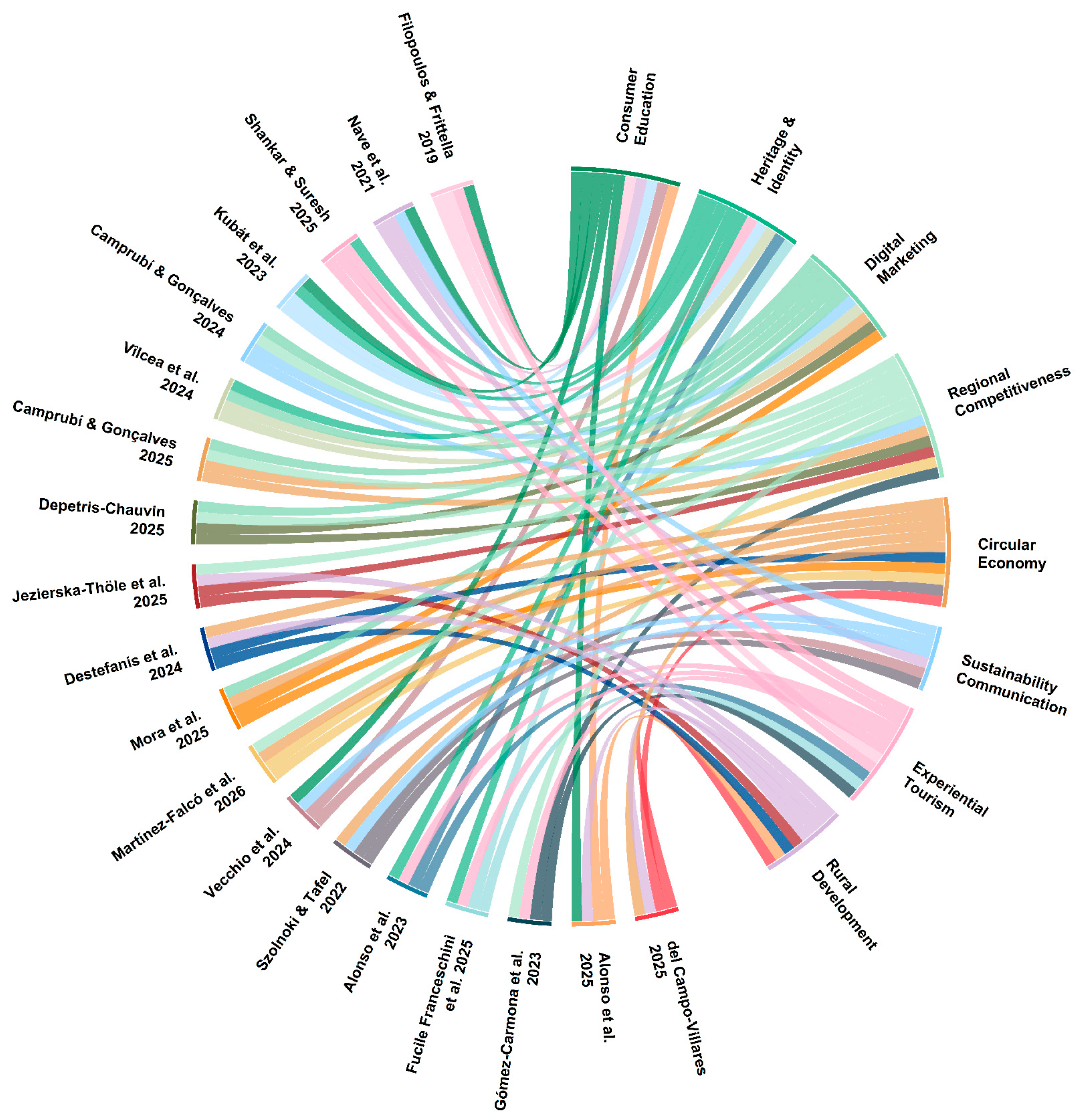
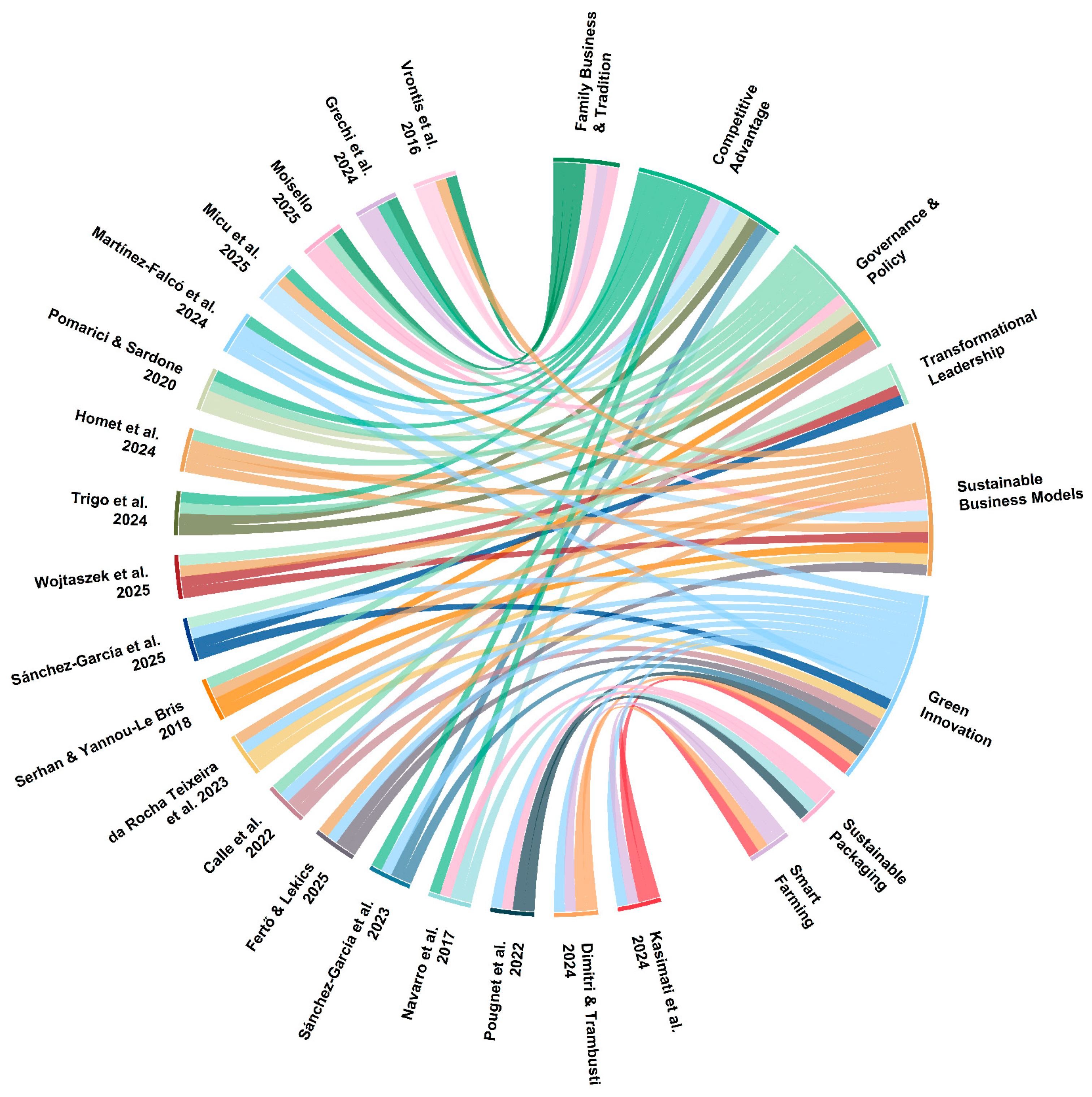
Sustainability Evolution in the Wine Industry: A Systematic Review of Environmental Practices and Marketing Dynamics


Abstract
1. Introduction
- To analyze the conceptual and thematic evolution of sustainability in the wine industry by identifying the main research directions, emerging trends, and thematic directions of sustainability research.
- To examine the sustainable practices documented in the academic literature related to the wine sector across the entire value chain, from agricultural production to distribution and consumption, analyzing how these practices are framed and evaluated in the reviewed studies in relation to sectoral performance. The examination encompasses the environmental, social, and economic dimensions of sustainability, with the aim of assessing the degree to which the reviewed literature addresses each of these dimensions and the extent to which an integrated perspective grounded in the triple bottom line principle is reflected in the analyzed corpus.
- To examine the role of wine marketing in promoting sustainability by analyzing consumer and market-oriented differentiation, positioning, and communication strategies.
- To analyze consumer behavior and the interaction between sustainability and market demand, including perceptions, preferences, and willingness to pay for sustainable wines. Based on the synthesis of the preceding analytical dimensions, the study additionally aims to map the key research gaps and future directions emerging from the reviewed literature, with a view to informing both academic inquiry and industry practice.
2. Materials and Methods
2.1. Research Design and Methodological Approach
2.2. Data Sources and Search Strategy
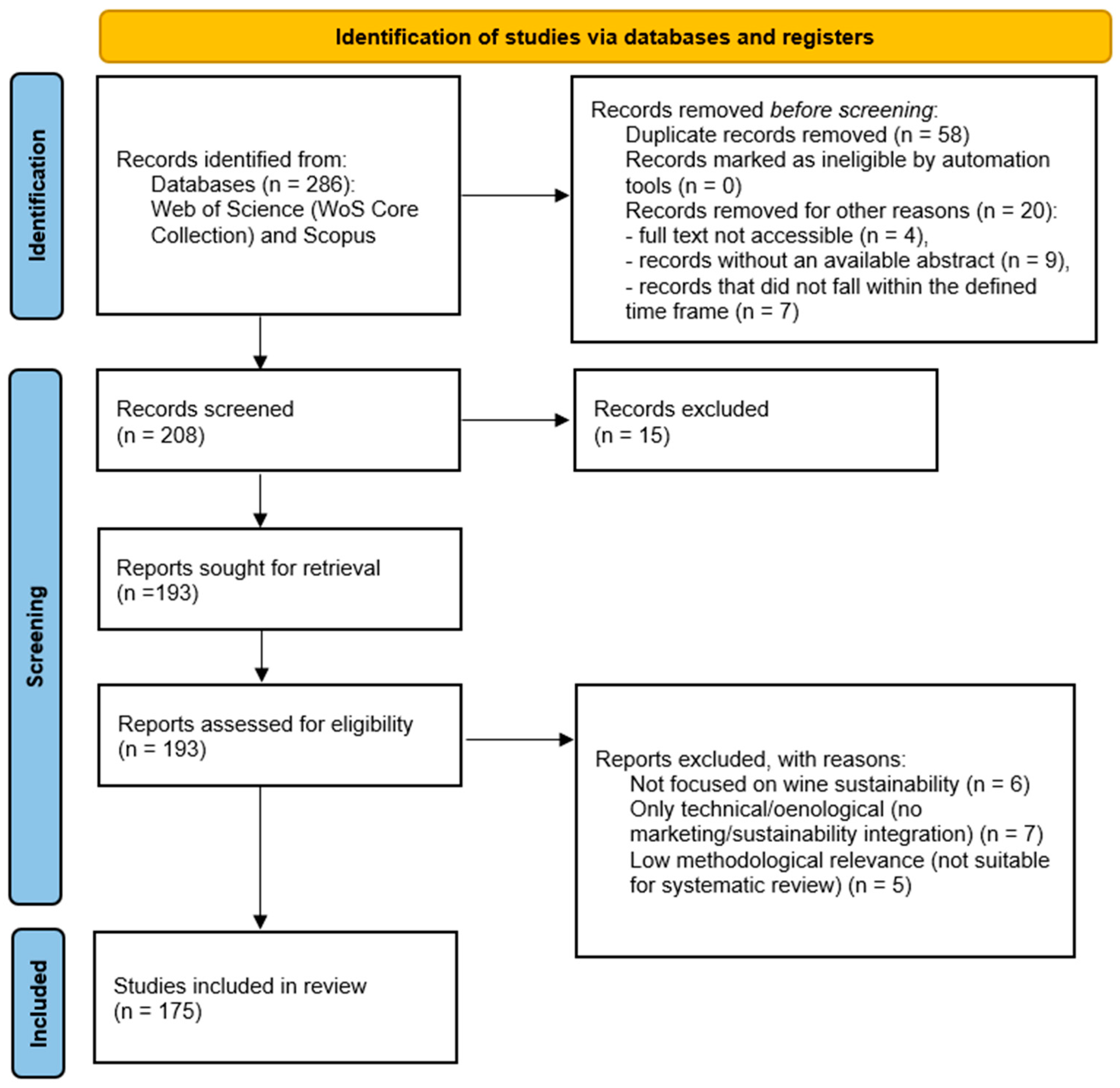
2.3. Study Selection Process (PRISMA)
2.4. Inclusion Criteria, Analysis and Methods of Interpretation
3. Results
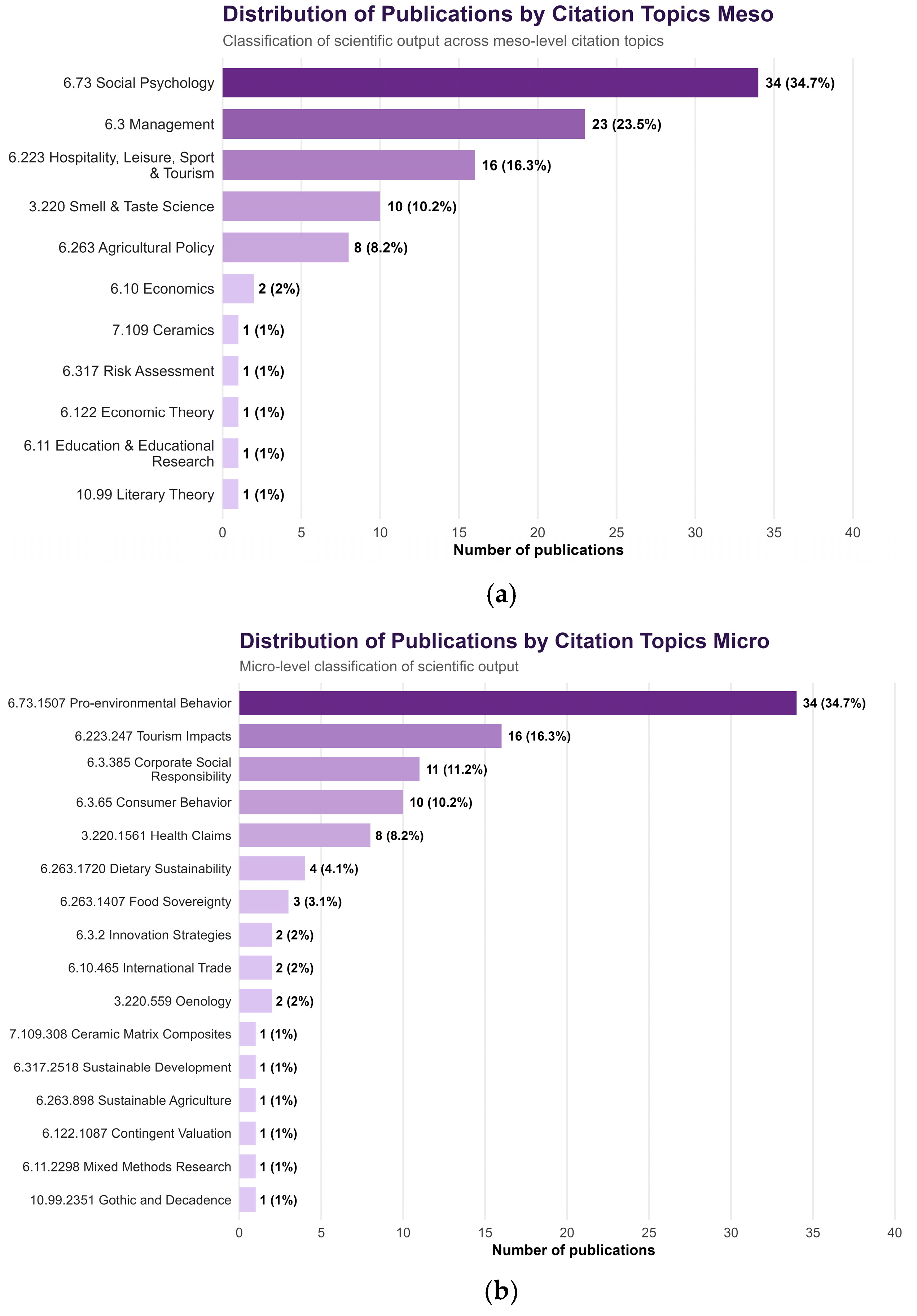
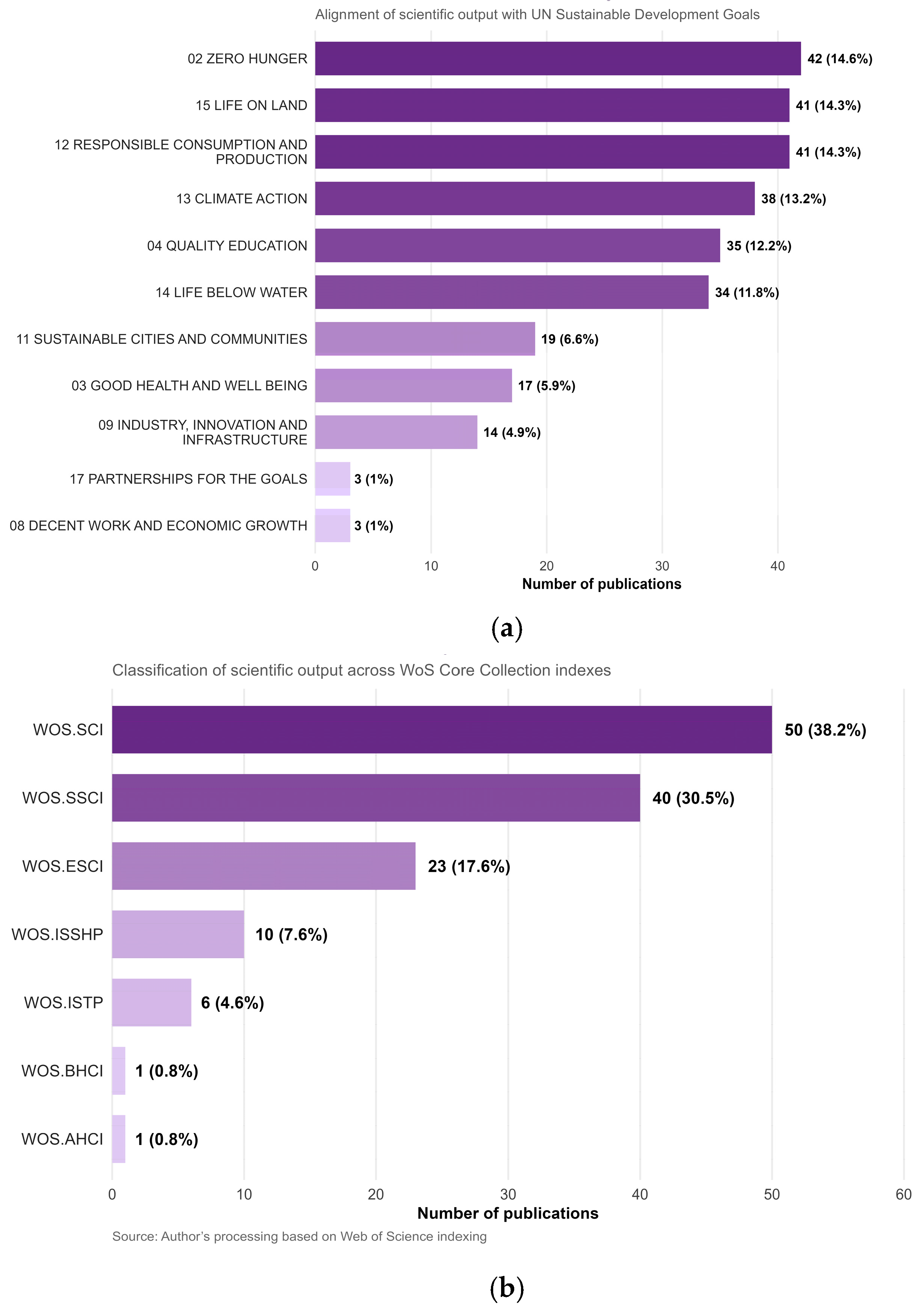
3.1. Bibliometric Overview of the Analyzed Literature
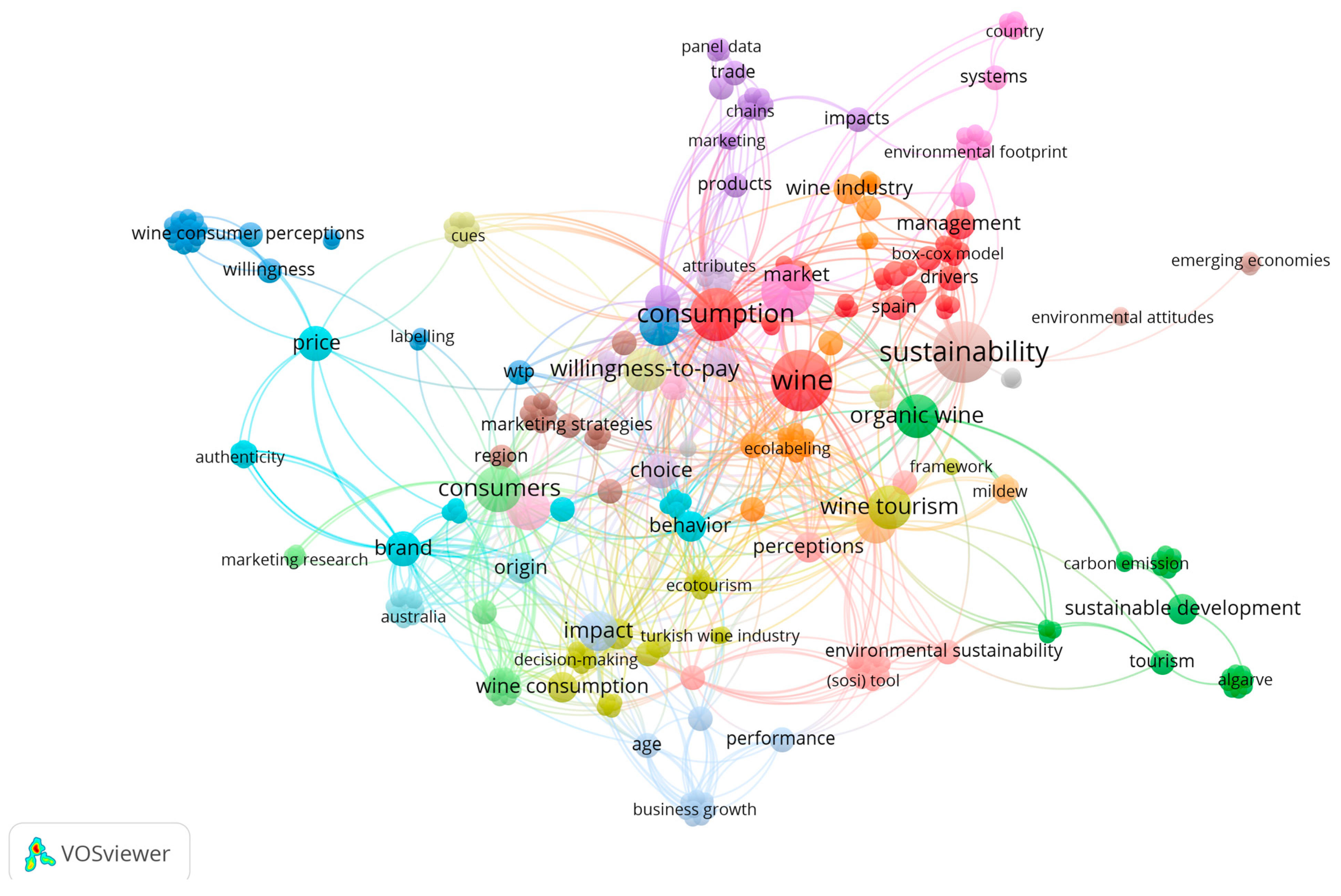
3.2. Keyword Co-Occurrence Analysis and Thematic Clusters
3.3. Descriptive Thematic Synthesis of the Reviewed Literature
4. Interpretive Discussion and Conceptual Implications
4.1. Sustainability, Environmental Practices and Climate Adaptation in Viticulture
4.1.1. Sustainable Value Chain and Sustainability in Wine Production
4.1.2. Environmental Practices, Ecological Management, and Reducing Environmental Impact
4.1.3. Climate Change, Adaptation and Vineyard Resilience
4.1.4. Policies, Regulations, SDGs and Sustainable Governance
4.2. Wine Marketing, Consumer Behavior and Willingness to Pay
4.2.1. Wine Marketing, Positioning and Competitiveness
4.2.2. Consumer Preferences and Wine Attributes
4.3. Wine Tourism, Experience and Regional Development
4.4. Innovation, Business Models and Sustainable Competitiveness
5. Conclusions
6. Limitations and Future Research Directions
Author Contributions
Funding
Institutional Review Board Statement
Data Availability Statement
Acknowledgments
Conflicts of Interest
References
- Florea, A.C.; Sumedrea, D.I.; Rodino, S.; Ion, M.; Dragomir, V.; Dumitru, A.-M.; Pîrcalabu, L.; Dinu, D.G. The Impact of Climate Change on Eastern European Viticulture: A Review of Smart Irrigation and Water Management Strategies. Horticulturae 2025, 11, 1282. [Google Scholar] [CrossRef]
- Morandi, S.; Zinno, I. Sustainable practices in the wine sector: Firm perspectives and actions. Int. J. Wine Bus. Res. 2025, 37, 640–676. [Google Scholar] [CrossRef]
- Calle, F.; Carrasco, I.; González-Moreno, Á.; Córcoles, C. Are Environmental Regulations to Promote Eco-Innovation in the Wine Sector Effective? A Study of Spanish Wineries. Agronomy 2022, 12, 21. [Google Scholar] [CrossRef]
- Rui, M.; Rosa, F.; Viberti, A.; Brun, F.; Massaglia, S.; Blanc, S. Understanding Factors Associated with Interest in Sustainability-Certified Wine among American and Italian Consumers. Foods 2024, 13, 1468. [Google Scholar] [CrossRef]
- Bux, C.; Lombardi, M.; Rana, R.L.; Tricase, C. Decarbonization Strategies in the Wine Supply Chain: From Environmental Mitigation Towards Integrated Sustainability Management. Environments 2026, 13, 195. [Google Scholar] [CrossRef]
- Rui, M.; Blanc, S.; Brun, F.; Massaglia, S. Shifting wine consumption trends (2019–2024): Market dynamics, sustainability, and consumer preferences. In Proceedings of the 46th World Congress of Vine and Wine; IVES Conference Series; IVES: Villenave d’Ornon, France, 2024; p. 46. [Google Scholar] [CrossRef]
- Montalvo-Falcón, J.V.; Sánchez-García, E.; Marco-Lajara, B.; Martínez-Falcó, J. Sustainability Research in the Wine Industry: A Bibliometric Approach. Agronomy 2023, 13, 871. [Google Scholar] [CrossRef]
- Brito, C.; Pereira, S.; Martins, S.; Monteiro, A.; Moutinho-Pereira, J.M.; Dinis, L. Strategies for achieving the sustainable development goals across the wine chain: A review. Front. Sustain. Food Syst. 2024, 8, 1437872. [Google Scholar] [CrossRef]
- Reinhardt, T. The farm to fork strategy and the digital transformation of the agrifood sector—An assessment from the perspective of innovation systems. Appl. Econ. Perspect. Policy 2023, 45, 819–838. [Google Scholar] [CrossRef]
- Ceccacci, A.; Camanzi, L.; Rota, C.; Fiorentini, R.; Malorgio, G. Enhancing wineries’ sustainability through territorial certifications: A case study in Emilia-Romagna, Italy. Int. J. Wine Bus. Res. 2025, 37, 87–112. [Google Scholar] [CrossRef]
- Zambon, I.; Colantoni, A.; Cecchini, M.; Mosconi, E.M. Rethinking Sustainability within the Viticulture Realities Integrating Economy, Landscape and Energy. Sustainability 2018, 10, 320. [Google Scholar] [CrossRef]
- Alessandri, G.; Daddi, T.; Iraldo, F. Environmental sustainability in the wine industry: A literature review. Clean. Prod. Lett. 2024, 7, 100067. [Google Scholar] [CrossRef]
- Rusch, A. Nature-based solutions to increase sustainability and resilience of vineyard-dominated landscapes. Basic Appl. Ecol. 2025, 82, 70–78. [Google Scholar] [CrossRef]
- Mainar-Toledo, M.D.; Gómez Palmero, M.; Díaz-Ramírez, M.; Mendioroz, I.; Zambrana-Vasquez, D. A Multi-Criteria Approach to Evaluate Sustainability: A Case Study of the Navarrese Wine Sector. Energies 2023, 16, 6589. [Google Scholar] [CrossRef]
- Santini, C.; Cavicchi, A.; Casini, L. Sustainability in the Wine Industry: Key Questions and Research Trends. Agric. Econ. 2013, 1, 9. [Google Scholar] [CrossRef]
- Sánchez-García, E.; Martínez-Falcó, J.; Marco-Lajara, B.; Abraham, L. Leading the way towards greener business models in the wine industry. Bus. Strateg. Environ. 2025, 34, 7878–7896. [Google Scholar] [CrossRef]
- Baiano, A. An Overview on Sustainability in the Wine Production Chain. Beverages 2021, 7, 15. [Google Scholar] [CrossRef]
- Castillo-Valero, J.S.; Carrasco, I.; Carchano, M.; Córcoles, C. What Is the Environmental Impact of Wine Entering Global Value Chains? Studying the Evolution of CO2 Emissions from the Export of Spanish Denomination of Origin Wines. Foods 2021, 10, 1664. [Google Scholar] [CrossRef]
- Marques, C.; Güneş, S.; Vilela, A.; Gomes, R. Life-Cycle Assessment in Agri-Food Systems and the Wine Industry—A Circular Economy Perspective. Foods 2025, 14, 1553. [Google Scholar] [CrossRef] [PubMed]
- Serra, M.; Antonio, N.; Henriques, C.; Afonso, C.M. Promoting Sustainability through Regional Food and Wine Pairing. Sustainability 2021, 13, 13759. [Google Scholar] [CrossRef]
- Wojtaszek, H.; Miciuła, I.; Kowalczyk, A.; Stefaniuk, R. Documenting the Transition: Sustainable Strategic Management and Leadership in European SMEs—A Comparative Analysis of Policy and Industry Reports. Sustainability 2025, 17, 9726. [Google Scholar] [CrossRef]
- Flores, S.S. What is sustainability in the wine world? A cross-country analysis of wine sustainability frameworks. J. Clean. Prod. 2018, 172, 2301–2312. [Google Scholar] [CrossRef]
- Di Chiara, V.; Battistella, A.; Boatto, V.; Furlan, S.; Giavi, L.; Liggieri, S.; Paiola, A.; Pomarici, E.; Stefanucci, S. Collaborative Approach for Achieving Ambitious Sustainability Goals: The Prosecco Sustainability Project. Sustainability 2024, 16, 583. [Google Scholar] [CrossRef]
- Camprubí, R.; Gonçalves, O. Exploring marketing strategies in wine tourism: A comparative study of Roussillon and Empordà wine regions. Int. J. Wine Bus. Res. 2025, 37, 1–26. [Google Scholar] [CrossRef]
- Casolani, N.; D’Eusanio, M.; Liberatore, L.; Raggi, A.; Petti, L. Life Cycle Assessment in the Wine Sector: A Review on Inventory Phase. J. Clean. Prod. 2022, 379, 134404. [Google Scholar] [CrossRef]
- Schäufele, I.; Hamm, U. Consumers’ Perceptions, Preferences and Willingness-to-Pay for Wine with Sustainability Characteristics: A Review. J. Clean. Prod. 2017, 147, 379–394. [Google Scholar] [CrossRef]
- Nave, A.; do Paço, A.; Duarte, P. A systematic literature review on sustainability in the wine tourism industry: Insights and perspectives. Int. J. Wine Bus. Res. 2021, 33, 457–480. [Google Scholar] [CrossRef]
- Sánchez-García, E.; Montalvo-Falcón, J.V.; Marco-Lajara, B.; Martínez-Falcó, J. Guiding organizations toward sustainable success: The strategic role of leadership in environmental corporate governance in the wine industry. Corp. Soc. Responsib. Environ. Manag. 2024, 31, 6438–6456. [Google Scholar] [CrossRef]
- Boeske, J. Leadership towards Sustainability: A Review of Sustainable, Sustainability, and Environmental Leadership. Sustainability 2023, 15, 12626. [Google Scholar] [CrossRef]
- Bodiroga, R.; Banjanin, T.; Vukojević Ateljević, D.; Kerma, S. The trends in viticulture and winemaking in the context of wine tourism development in Bosnia and Herzegovina. Acta Geogr. Slov. 2024, 64, 33–48. [Google Scholar] [CrossRef]
- Gaybullaev, O.; Strode, J.P. Transformational leadership and organizational sustainability performance: A systematic literature review of global evidence. Environ. Dev. Sustain. 2026. [Google Scholar] [CrossRef]
- Psychogiou, E.-E.; Tsoulfas, G.T. Critical Factors Affecting Trust in the Wine Supply Chain in Greece: A Grey DEMATEL Approach. Logistics 2024, 8, 24. [Google Scholar] [CrossRef]
- Dalla Valle, C.; Viana, J.G.A.; Dorr, A.C. The Governance of Global Value Chains from the Perspective of Economic Competence: A Literature Review. Adm. Sci. 2026, 16, 138. [Google Scholar] [CrossRef]
- Mian, G.; Nassivera, F.; Sillani, S.; Iseppi, L. Grapevine Resistant Cultivars: A Story Review and the Importance on the Related Wine Consumption Inclination. Sustainability 2023, 15, 390. [Google Scholar] [CrossRef]
- Hauck, K.; Szolnoki, G. German Consumers’ Perceptions of Organic Wine—A Qualitative Approach. Sustainability 2020, 12, 7729. [Google Scholar] [CrossRef]
- Vîlcea, C.; Licurici, M.; Popescu, L. The Role of Websites in Promoting Wine Tourism: An Evaluation of Romanian Wineries. Sustainability 2024, 16, 6336. [Google Scholar] [CrossRef]
- Savvinopoulou, M.; Mylonas, N. The Impact of Entrepreneurial Orientation, Market Orientation and Dynamic Capabilities on Firms’ Performance in Wine Tourism. Tour. Hosp. 2026, 7, 109. [Google Scholar] [CrossRef]
- Ricci, E.C.; Morandi, S. What strategies do wine firms adopt to integrate CSR into their activities? An analysis among Italian wineries. In Proceedings of the International Scientific Congress GreenWINE 2025; IVES Conference Series; IVES: Villenave d’Ornon, France, 2025. [Google Scholar]
- Abbate, S.; Centobelli, P.; Di Gregorio, M. Wine waste valorisation: Crushing the research domain. Rev. Manag. Sci. 2025, 19, 963–998. [Google Scholar] [CrossRef]
- Schimmenti, E.; Migliore, G.; Di Franco, C.P.; Borsellino, V. Is there sustainable entrepreneurship in the wine industry? Exploring Sicilian wineries participating in the SOStain program. Wine Econ. Policy 2016, 5, 14–23. [Google Scholar] [CrossRef]
- Anzivino, A.; Galli, M.; Sebastiani, R. Addressing Tensions and Paradoxes in Sustainable Wine Industry: The Case of the Association “Le Donne Del Vino”. Sustainability 2021, 13, 4157. [Google Scholar] [CrossRef]
- Páramo-Telle, Ó.; Vence, X. Industrial symbiosis in the wine value chain: A systematic review of research trends, barriers, and drivers. J. Ind. Ecol. 2026. [Google Scholar] [CrossRef]
- Ribeiro Trigo, A.F.; Marta-Costa, A.A.; Fragoso, R.M.d.S. Sustainable wine assessment tool (SWAT): A hierarchical framework to measure sustainability performance. J. Wine Res. 2025, 36, 190–215. [Google Scholar] [CrossRef]
- Trigo, A.; Marta-Costa, A.; Fragoso, R. Improving sustainability assessment: A context-oriented classification analysis for the wine industry. Land Use Policy 2023, 126, 106551. [Google Scholar] [CrossRef]
- Landoni, P.; Moratti, A. Impact Assessment in the Wine Industry: Potential and Limitations of the Social Return on Investment (SROI). Adm. Sci. 2025, 15, 346. [Google Scholar] [CrossRef]
- Martínez-Falcó, J.; Sánchez-García, E.; Marco-Lajara, B.; Millán-Tudela, L.A. Unraveling the relationship between ESG strategy and sustainable performance in the Spanish wine industry: A structural equation analysis. Soc. Responsib. J. 2025, 21, 962–986. [Google Scholar] [CrossRef]
- Ferretti, L.; Di Blasi, S.; Landers, L.; Elli, F.; O’Connor, R.; Pacini, G.C. Agroecology in wine production: Assessing the environmental, productive and social sustainability pillars of conventional, organic and biodynamic vineyard management through the AESIS framework. Ecol. Solut. Evid. 2025, 6, e70101. [Google Scholar] [CrossRef]
- Marques, A.; Guerra, M.; Ferreira, F.; Sousa, T.A.d.; Teixeira, C.A. Challenges of Implementing Sustainability Benchmarks in Wine Cooperative. Agronomy 2025, 15, 1408. [Google Scholar] [CrossRef]
- Spraul, K.; Höfert, A. Governance for Sustainability: Patterns of Regulation and Self-Regulation in the German Wine Industry. Sustainability 2021, 13, 3140. [Google Scholar] [CrossRef]
- Tria, E.; Di Cosola, F.; Bozzo, F.; Casieri, A.; Zeka, E.; Petrontino, A. Sustainability and Quality in Wine Pricing: Insights from the Primitivo E-Commerce Market. Sustainability 2025, 17, 8094. [Google Scholar] [CrossRef]
- De Steur, H.; Temmerman, H.; Gellynck, X.; Canavari, M. Drivers, adoption, and evaluation of sustainability practices in Italian wine SMEs. Bus. Strateg. Environ. 2020, 29, 744–762. [Google Scholar] [CrossRef]
- Baptista, A.; Fontaínhas-Fernandes, A.; Sequeira, T. A strategy for sustainability and competitiveness in wine production and tourism in Portugal’s Douro Valley. Discov. Sustain. 2025, 6, 1269. [Google Scholar] [CrossRef]
- Carroll, C.; Booth, A.; Cooper, K. A worked example of “best fit” framework synthesis: A systematic review of views concerning the taking of some potential chemopreventive agents. BMC Med. Res. Methodol. 2011, 11, 29. [Google Scholar] [CrossRef]
- Page, M.J.; McKenzie, J.E.; Bossuyt, P.M.; Boutron, I.; Hoffmann, T.C.; Mulrow, C.D.; Shamseer, L.; Tetzlaff, J.M.; Akl, E.A.; Brennan, S.E.; et al. The PRISMA 2020 statement: An updated guideline for reporting systematic reviews. BMJ 2021, 372, n71. [Google Scholar] [CrossRef]
- Tahon, C.; Batt, P.J. An Exploratory Study of the Sustainable Practices Used at Each Level of the Bordeaux Wine Value Chain. Sustainability 2021, 13, 9760. [Google Scholar] [CrossRef]
- Wagner, M.; Stanbury, P.; Dietrich, T.; Döring, J.; Ewert, J.; Foerster, C.; Freund, M.; Friedel, M.; Kammann, C.; Koch, M.; et al. Developing a Sustainability Vision for the Global Wine Industry. Sustainability 2023, 15, 10487. [Google Scholar] [CrossRef]
- Marques, A.; Teixeira, C.A. Vine and Wine Sustainability in a Cooperative Ecosystem—A Review. Agronomy 2023, 13, 2644. [Google Scholar] [CrossRef]
- Guerra, M.; Ferreira, F.; Oliveira, A.A.; Pinto, T.; Teixeira, C.A. Drivers of Environmental Sustainability in the Wine Industry: A Life Cycle Assessment Approach. Sustainability 2024, 16, 5613. [Google Scholar] [CrossRef]
- Vagnoni, E.; Cesaraccio, C.; Pirino, P.; Duce, P. The environmental role of small organic wineries: The case study of a multi-year assessment of a local Italian red wine. Int. J. Life Cycle Assess. 2024, 29, 469–482. [Google Scholar] [CrossRef]
- Giacopelli, F.; Rossi, L.; Challita, C.; Bacenetti, J. Environmental sustainability of wine sector: A focus on pesticide management. Environ. Impact Assess. Rev. 2025, 115, 108022. [Google Scholar] [CrossRef]
- Casolani, N.; Chiodo, E.; Liberatore, L. Continuous Improvement of VIVA-Certified Wines: Analysis and Perspective of Greenhouse Gas Emissions. Sustainability 2023, 15, 2349. [Google Scholar] [CrossRef]
- Beaumelle, L.; Giffard, B.; Tolle, P.; Winter, S.; Entling, M.H.; Benítez, E.; Zaller, J.G.; Auriol, A.; Bonnard, O.; Charbonnier, Y.; et al. Biodiversity conservation, ecosystem services and organic viticulture: A glass half-full. Agric. Ecosyst. Environ. 2023, 351, 108474. [Google Scholar] [CrossRef]
- Santos, J.A.; Fraga, H.; Malheiro, A.C.; Moutinho-Pereira, J.; Dinis, L.-T.; Correia, C.; Moriondo, M.; Leolini, L.; Dibari, C.; Costafreda-Aumedes, S.; et al. A Review of the Potential Climate Change Impacts and Adaptation Options for European Viticulture. Appl. Sci. 2020, 10, 3092. [Google Scholar] [CrossRef]
- Faralli, M.; Mallucci, S.; Bignardi, A.; Varner, M.; Bertamini, M. Four decades in the vineyard: The impact of climate change on grapevine phenology and wine quality in northern Italy. OENO One 2024, 58(3). [Google Scholar] [CrossRef]
- Vega-Bayo, A.; Mariel, P.; Meyerhoff, J.; Corsi, A.M.; Chovan, M. Climate change adaptation preferences of winemakers from the Rioja wine appellation. J. Choice Model. 2023, 48, 100434. [Google Scholar] [CrossRef]
- Petriashvili, A.; Mach, J.; Štěbeták, M.; Prášilová, M.; Svoboda, R.; Navrátilová, M.; Beranová, M.; Veselá, K.; Hofman, V.; Němec, O. The impact of climate change on the sustainability of wine production and the structure of its consumption in Czechia. Heliyon 2023, 9, e17882. [Google Scholar] [CrossRef]
- Martínez-Falcó, J.; Martínez-Falcó, J.; Marco-Lajara, B.; Sánchez-García, E.; Visser, G. Aligning the Sustainable Development Goals in the Wine Industry: A Bibliometric Analysis. Sustainability 2023, 15, 8172. [Google Scholar] [CrossRef]
- Ducman, A.A.; Diaconita, V.; Simonca, I.; Belciu, A.; Corbea, A.M.I. Government Oversight and Economic Impacts: Sustainability in the Vineyard and the Evolution of Wine Regulations, Trade and Production. Agronomy 2023, 13, 2991. [Google Scholar] [CrossRef]
- Martínez-Navarro, J.; Sellers-Rubio, R. Three decades of research on wine marketing. Heliyon 2024, 10, e30938. [Google Scholar] [CrossRef]
- Martínez-Falcó, J.; Sánchez-García, E.; Marco-Lajara, B.; Georgantzis, N. The interplay between competitive advantage and sustainability in the wine industry: A bibliometric and systematic review. Discov. Sustain. 2024, 5, 13. [Google Scholar] [CrossRef]
- Martinho, V.J.P.D. Contributions from Literature for Understanding Wine Marketing. Sustainability 2021, 13, 7468. [Google Scholar] [CrossRef]
- Kotler, P.; Keller, K.L. Marketing Management, 15th ed.; Pearson: Harlow, UK, 2016. [Google Scholar]
- Brence, I.; Ozoliņa, A. Wine market in France: Challenges for a wine producer. Proc. Econ. Sci. Rural Dev. 2019, 51, 275–283. [Google Scholar] [CrossRef]
- Gastaldello, G.; Bošnjak, M.; Schäufele-Elbers, I.; Schamel, G. Are consumers willing to pay more for sustainable wine? A pre-registered systematic review and meta-analysis. Food Qual. Prefer. 2025, 134, 105655. [Google Scholar] [CrossRef]
- Valenzuela, L.; Ortega, R.; Moscovici, D.; Gow, J.; Alonso Ugaglia, A.; Mihailescu, R. Consumer Willingness to Pay for Sustainable Wine—The Chilean Case. Sustainability 2022, 14, 10910. [Google Scholar] [CrossRef]
- Gow, J.; Moscovici, D.; Rana, R.; Rinaldi, A.; Ugaglia, A.A.; Valenzuela, L.; Mihailescu, R.; Haque, R. Determinants of Purchasing Sustainably Produced Wines by Italian Wine Consumers. Sustainability 2024, 16, 8283. [Google Scholar] [CrossRef]
- Capitello, R.; Sirieix, L. Consumers’ Perceptions of Sustainable Wine: An Exploratory Study in France and Italy. Economies 2019, 7, 33. [Google Scholar] [CrossRef]
- de-Magistris, T.; Gracia, A.; Albisu, L.M. Wine consumers’ preferences in Spain: An analysis using the best–worst scaling approach. Span. J. Agric. Res. 2014, 12, 529–541. [Google Scholar] [CrossRef]
- del Campo-Villares, J.L.; Fuentes-Fernández, R. Wine Tourism in Galicia, Sustainability, Circular Economy and Unique Experiences, the Future for the Wine Sector. Sustainability 2025, 17, 5335. [Google Scholar] [CrossRef]
- Gómez-Carmona, D.; Paramio, A.; Cruces-Montes, S.; Marín-Dueñas, P.P.; Aguirre Montero, A.; Romero-Moreno, A. The effect of the wine tourism experience. J. Destin. Mark. Manag. 2023, 29, 100793. [Google Scholar] [CrossRef]
- Szolnoki, G.; Tafel, M. Environmental Sustainability and Tourism—The Importance of Organic Wine Production for Wine Tourism in Germany. Sustainability 2022, 14, 11831. [Google Scholar] [CrossRef]
- Vecchio, R.; Annunziata, A.; Bouzdine-Chameeva, T. How to promote sustainable wine tourism: Insights from Italian and French young adults. Ann. Tour. Res. Empir. Insights 2024, 5, 100137. [Google Scholar] [CrossRef]
- Fucile Franceschini, C.; Giampietri, E.; Pomarici, E. What Defines the Perfect Wine Tourism Experience? Evidence from a Best–Worst Approach. Agriculture 2025, 15, 876. [Google Scholar] [CrossRef]
- Kasimati, A.; Papadopoulos, G.; Manstretta, V.; Giannakopoulou, M.; Adamides, G.; Neocleous, D.; Vassiliou, V.; Savvides, S.; Stylianou, A. Case Studies on Sustainability-Oriented Innovations and Smart Farming Technologies in the Wine Industry: A Comparative Analysis of Pilots in Cyprus and Italy. Agronomy 2024, 14, 736. [Google Scholar] [CrossRef]
- Sánchez-García, E.; Martínez-Falcó, J.; Alcon-Vila, A.; Marco-Lajara, B. Developing Green Innovations in the Wine Industry: An Applied Analysis. Foods 2023, 12, 1157. [Google Scholar] [CrossRef] [PubMed]
- da Rocha Oliveira Teixeira, R.; Arcuri, S.; Cavicchi, A.; Galli, F.; Brunori, G.; Vergamini, D. Can alternative wine networks foster sustainable business model innovation and value creation? The case of organic and biodynamic wine in Tuscany. Front. Sustain. Food Syst. 2023, 7, 1241062. [Google Scholar] [CrossRef]
- Pougnet, S.; Martin-Rios, C.; Pasamar, S. Keg wine technology as a service innovation for sustainability in the foodservice industry. J. Clean. Prod. 2022, 360, 132145. [Google Scholar] [CrossRef]
- Trigo, A.; Marta-Costa, A.; Fragoso, R. Enhancing wine industry sustainability: An empirical test of the sustainable wine assessment tool. J. Clean. Prod. 2024, 472, 143480. [Google Scholar] [CrossRef]
- Mania, E.; Petrella, F.; Giovannozzi, M.; Piazzi, M.; Wilson, A.; Guidoni, S. Managing Vineyard Topography and Seasonal Variability to Improve Grape Quality and Vineyard Sustainability. Agronomy 2021, 11, 1142. [Google Scholar] [CrossRef]
- Tancelov, L.; Dobre Gudei, C.S. Sustainable viticulture and organic farming in Romania: Challenges and opportunities for future development. Proc. Int. Conf. Bus. Excell. 2024, 18, 1592–1601. [Google Scholar] [CrossRef]
- Corino, L.; Calò, A. Sustainable viticulture: Current practices and future developments. Agric. Conspec. Sci. 2001, 66, 3–11. [Google Scholar]
- Dimitri, G.M.; Trambusti, A. Precision agriculture for wine production: A machine learning approach to link weather conditions and wine quality. Heliyon 2024, 10, e31648. [Google Scholar] [CrossRef]
- Lekics, V. Sustainable innovation in wine industry: A systematic review. Reg. Bus. Stud. 2021, 13, 55–73. [Google Scholar] [CrossRef]
- Macías-Gallardo, F.; Quiñones-Muñoz, T.A.; Miranda-Avilés, R.; Ramírez-Santoyo, L.F.; Zanor, G.A.; Ozuna, C. Impact of Organic Agriculture on the Quality of Grapes (Syrah and Tempranillo) Harvested in Guanajuato, Mexico: Relationship Between Soil Elemental Profile and Grape Bioactive Properties. Agriculture 2025, 15, 169. [Google Scholar] [CrossRef]
- Dobre Gudei, S.C.; Tancelov, L.; Bucea-Manea-Țoniș, R.; Manolache, D.; Ionescu, N. Sustainable Competitiveness and Applicative Comparative Analysis of Wine Production Through the Lens of Triple Bottom Line, Robotics, and Industry 5.0 Strategies. Sustainability 2025, 17, 3767. [Google Scholar] [CrossRef]
- Fertő, I.; Lekics, V. Eco-innovation drivers in the wine industry: Insights from Hungarian wineries. Br. Food J. 2025, 127, 4226–4246. [Google Scholar] [CrossRef]
- Fiore, M.; Silvestri, R.; Contò, F.; Pellegrini, G. Understanding the relationship between green approach and marketing innovations tools in the wine sector. J. Clean. Prod. 2017, 142, 4085–4091. [Google Scholar] [CrossRef]
- Maesano, G.; Carrà, G.; Peri, I. How do consumers perceive sustainable wine? A review. Qual.-Access Success 2019, 20, S2. [Google Scholar]
- Azabagaoglu, M.O.; Akyol, A.; Ozay, A. Examining the Turkish wine industry: Marketing effectiveness and recommendations for increasing its competitive performance. N. Z. J. Crop Hortic. Sci. 2006, 34, 257–268. [Google Scholar] [CrossRef]
- Azabagaoglu, M.O.; Akyol, A.; Ozay, A. The demand for organic wines and organic wine marketing. J. Environ. Prot. Ecol. 2007, 8, 171–178. [Google Scholar]
- Průša, D.; Šrédl, K.; Prášilová, M.; Žovincová, A.; Kopecká, L.; Severová, L.; Svoboda, R.; Drozdová, D.; Naveriani, L.; Němec, O.; et al. Wine Tourism and Its Role in the Transformation of Wine Production and Consumption in Czechia: A Case Study. Agriculture 2025, 15, 1882. [Google Scholar] [CrossRef]
- Marshall, R.S.; Akoorie, M.E.M.; Hamann, R.; Sinha, P. Environmental practices in the wine industry: An empirical application of the theory of reasoned action and stakeholder theory in the United States and New Zealand. J. World Bus. 2010, 45, 405–414. [Google Scholar] [CrossRef]
- Maicas, S.; Mateo, J.J. Sustainability of Wine Production. Sustainability 2020, 12, 559. [Google Scholar] [CrossRef]
- Mariani, A.; Vastola, A. Sustainable winegrowing: Current perspectives. Int. J. Wine Res. 2015, 7, 37–48. [Google Scholar] [CrossRef]
- Gilinsky, A., Jr.; Newton, S.K.; Fuentes Vega, R. Sustainability in the global wine industry: Concepts and cases. Agric. Agric. Sci. Procedia 2016, 8, 37–49. [Google Scholar] [CrossRef]
- Ignat, G.; Colibaba, C.; Costuleanu, C.L.; Balan, A.; Rotaru, L.; Sandu, I.C.A. Studies regarding the use of senescent viticultural material as colorants in the plastics industry. Mater. Plast. 2016, 53, 367–369. [Google Scholar]
- Ignat, G.; Balan, G.; Sandu, I.; Costuleanu, C.L.; Ville, S.T.S. Study of phenolic compounds in Merlot red wines obtained by different technologies. Rev. Chim. 2016, 67, 1560–1565. [Google Scholar]
- Masotti, P.; Zattera, A.; Malagoli, M.; Bogoni, P. Environmental Impacts of Organic and Biodynamic Wine Produced in Northeast Italy. Sustainability 2022, 14, 6281. [Google Scholar] [CrossRef]
- Visconti, F.; López, R.; Olego, M.Á. Special Issue: ‘Sustainable Viticulture: Soil Fertility, Plant Nutrition and Grape Quality’. Horticulturae 2025, 11, 649. [Google Scholar] [CrossRef]
- Rivera Chavez, Z.B.; Porcaro, A.; De Simone, M.C.; Guida, D. Improving Sustainable Viticulture in Developing Countries: A Case Study. Sustainability 2025, 17, 5338. [Google Scholar] [CrossRef]
- Pomarici, E.; Vecchio, R.; Mariani, A. Wineries’ Perception of Sustainability Costs and Benefits: An Exploratory Study in California. Sustainability 2015, 7, 16164–16174. [Google Scholar] [CrossRef]
- Bandinelli, R.; Acuti, D.; Fani, V.; Bindi, B.; Aiello, G. Environmental practices in the wine industry: An overview of the Italian market. Br. Food J. 2020, 122, 1625–1646. [Google Scholar] [CrossRef]
- Fiorilo, M.; Tempesta, G.; Barison, D.; Boselli, M.; Venturi, A. Wine, sustainability, and the dynamism of changing lifestyles. BIO Web Conf. 2023, 56, 03009. [Google Scholar] [CrossRef]
- Vasvári, M.; Oláh, N.; Kovács, T. Changes in wine tourism and the transformation of wine tourism products through the example of the Berehove district in Transcarpathia. Geo J. Tour. Geosites 2025, 60, 1338–1347. [Google Scholar] [CrossRef]
- Valentin, D.; Valente, C.; Ballester, J.; Symoneaux, R.; Smith, I.; Bauer, F.F.; Nieuwoudt, H. The Impact of “Wine Country of Origin” on the Perception of Wines by South African and French Wine Consumers: A Cross-Cultural Comparison. Foods 2021, 10, 1710. [Google Scholar] [CrossRef] [PubMed]
- Tsiakis, T.; Anagnostou, E.; Granata, G.; Manakou, V. Communicating Terroir through Wine Label Toponymy Greek Wineries Practice. Sustainability 2022, 14, 16067. [Google Scholar] [CrossRef]
- Kruger, M.; Viljoen, A. Blooming brilliant: Insights into wine knowledge and motivation of wine festival visitors. Int. J. Wine Bus. Res. 2026, 38, 85–113. [Google Scholar] [CrossRef]
- Reinhardt, T.; Ambrogio, Y.; Springer, L.; Tafel, M. Wine law, sustainable innovation and the emergence of a wine constitution. Wine Econ. Policy 2024, 13, 15–23. [Google Scholar] [CrossRef]
- Rabadán, A. Consumer Attitudes towards Technological Innovation in a Traditional Food Product: The Case of Wine. Foods 2021, 10, 1363. [Google Scholar] [CrossRef]
- Woldarsky, V. Tapping into the emotions of the wine consumer through storytelling: A case study. BIO Web Conf. 2019, 15, 03012. [Google Scholar] [CrossRef]
- Brata, A.M.; Chiciudean, D.I.; Brata, V.D.; Popa, D.; Chiciudean, G.O.; Muresan, I.C. Determinants of Choice and Wine Consumption Behaviour: A Comparative Analysis between Two Counties of Romania. Foods 2022, 11, 1110. [Google Scholar] [CrossRef]
- Muñoz, R.M.; Fernández, M.V.; Salinero, M.Y. Assessing consumer behavior in the wine industry and its consequences for wineries: A case study of a Spanish company. Front. Psychol. 2019, 10, 2491. [Google Scholar] [CrossRef]
- Yang, J.-I.; Choi, J. Does Knowledge of Wine Affect Consumers’ Wine Purchase Behavior in Restaurants? An Application of Extended Theory of Planned Behavior (ETPB). Beverages 2022, 8, 11. [Google Scholar] [CrossRef]
- Carvalho, M.; Kastenholz, E.; Carneiro, M.J. Pairing Co-Creation with Food and Wine Experiences—A Holistic Perspective of Tourist Experiences in Dão, a Portuguese Wine Region. Sustainability 2021, 13, 13416. [Google Scholar] [CrossRef]
- Antonio, S.; Basiricò, R.; Seccia, A. On the effects of storytelling on wine price. BIO Web Conf. 2019, 15, 03010. [Google Scholar] [CrossRef]
- Yang, J.; Lee, J. Consumer Perception of Red Wine by the Degree of Familiarity Using Consumer-Based Methodology. Foods 2021, 10, 749. [Google Scholar] [CrossRef]
- Casolani, N.; Ciccarelli, A.; Perito, M.A.; Chiodo, E. The Importance of Region of Origin in Sparkling Wines: An International Analysis of Consumers’ Perception. Sustainability 2024, 16, 390. [Google Scholar] [CrossRef]
- Parr, W.V. Demystifying wine tasting: Cognitive psychology’s contribution. Food Res. Int. 2019, 124, 230–233. [Google Scholar] [CrossRef]
- Moscovici, D.; Gow, J.; Alonso Ugaglia, A.; Rezwanul, R.; Valenzuela, L.; Mihailescu, R. Consumer preferences for organic wine—Global analysis of people and place. J. Clean. Prod. 2022, 368, 133215. [Google Scholar] [CrossRef]
- Werner, C.P.; Birkhaeuer, J.; Locher, C.; Gerger, H.; Heimgartner, N.; Colagiuri, B.; Gaab, J. Price information influences the subjective experience of wine: A framed field experiment. Food Qual. Prefer. 2021, 92, 104223. [Google Scholar] [CrossRef]
- Chamorro, A.; García-Gallego, J.M.; Trindade-Carlos, H.D.C. Study on the importance of wine bottle design on consumer choices. Br. Food J. 2021, 123, 577–593. [Google Scholar] [CrossRef]
- Sáenz-Navajas, M.P.; Campo, E.; Sutan, A.; Ballester, J.; Valentin, D. Perception of wine quality according to extrinsic cues: The case of Burgundy wine consumers. Food Qual. Prefer. 2013, 27, 44–53. [Google Scholar] [CrossRef]
- Bernabéu, R.; Díaz, M.; Olivas, R.; Olmeda, M. Consumer preferences for wine applying best-worst scaling: A Spanish case study. Br. Food J. 2012, 114, 1228–1250. [Google Scholar] [CrossRef]
- Lădaru, R.G.; Beciu, S. Marketing research on wine consumers preferences in Romania. Sci. Pap. Ser. Manag. Econ. Eng. Agric. Rural Dev. 2014, 14, 201–206. [Google Scholar]
- Bernabéu, R.; Díaz, M.; Oliveira, F. Consumer preferences for red wine in the Spanish market. Cienc. Tec. Vitivinic. 2016, 31, 88–97. [Google Scholar] [CrossRef]
- Filopoulos, S.; Frittella, N. Designing sustainable and responsible wine tourism experiences. BIO Web Conf. 2019, 12, 03006. [Google Scholar] [CrossRef]
- Shankar, N.; Suresh, S. Promoting experiences in wine tourism and hospitality: Setting a research agenda. Int. J. Wine Bus. Res. 2025, 37, 592–619. [Google Scholar] [CrossRef]
- Kubát, P.; Králiková, A.; Ryglová, K. Shifting the focus from mere wine (and) tourism to the wine destination and winescape concept. Deturope 2023, 15, 78–92. [Google Scholar] [CrossRef]
- Depetris-Chauvin, N.; Meidell, J.E. Strategic pathways to winery tourism competitiveness: How firm orientations shape digital visibility and visitor satisfaction. J. Foodserv. Bus. Res. 2025, 1–25. [Google Scholar] [CrossRef]
- Jezierska-Thöle, A.; Gonia, A.; Podgórski, Z.; Gwiaździńska-Goraj, M. Wine Tourism as a Tool for Sustainable Development of the Cultural Landscape—A Case Study of Douro Wine Region in Portugal. Sustainability 2025, 17, 1494. [Google Scholar] [CrossRef]
- Destefanis, R.; Cela, N.; Torri, L.; Fassio, F. Systemic Approach Applied to the “R” Paradigm of the Circular Economy: A Critical Reading of the Winemaking Process Through Case Studies from Northwest Italy. Sustainability 2024, 16, 8960. [Google Scholar] [CrossRef]
- Mora, D.; Moral-Cuadra, S.; López-Guzmán, T.; Aguilar-Rivero, M. Circular economy practices in wine tourism: Environmental policies and strategies for the development of wine routes in Spain. Int. J. Gastron. Food Sci. 2025, 39, 101122. [Google Scholar] [CrossRef]
- Martínez-Falcó, J.; Sánchez-García, E.; Marco-Lajara, B.; Einsle, C.; Toribio-Gómez, E. Circular economy implementation as the cornerstone of green competitive advantage in the wine industry: A PLS-SEM and IPMA analysis. Wine Econ. Policy 2026. [Google Scholar] [CrossRef]
- Alonso, A.D.; Bressan, A.; Kim, O.V.T.; Kok, S.K.; Atay, E. Integrating tradition and innovation within a wine tourism and hospitality experience. Int. J. Tour. Res. 2023, 25, 169–182. [Google Scholar] [CrossRef]
- Duarte Alonso, A.; Vu, O.T.K.; Bressan, A.; Buitrago Solis, M.A.; Roedder, F.; Carrillo, B.; Guedes, A.; Nayak, N.P.; Zifaro, M.; Borer, D.; et al. Sustainable wine and food products as precursors of sustainable wine tourism: A qualitative cross-national analysis. Curr. Issues Tour. 2025, 1–22. [Google Scholar] [CrossRef]
- Vrontis, D.; Bresciani, S.; Giacosa, E. Tradition and innovation in Italian wine family businesses. Br. Food J. 2016, 118, 1883–1897. [Google Scholar] [CrossRef]
- Grechi, D.; Pavione, E.; Gazzola, P.; Cardini, F. Tradition and Innovation in the Italian Wine Industry: The Best Practices of Casa Paladin. Sustainability 2024, 16, 2857. [Google Scholar] [CrossRef]
- Moisello, A.M. From heritage to sustainability: A systematic literature review of family wineries. J. Fam. Bus. Manag. 2025, 15, 1478–1503. [Google Scholar] [CrossRef]
- Micu, D.M.; Arghiroiu, G.A.; Micu, Ș.; Beciu, S. Competitive Advantage in the World of Wine—An Analysis of Differentiation Strategies Developed by Sectoral Brands in the Global Market. Foods 2025, 14, 1858. [Google Scholar] [CrossRef] [PubMed]
- Martínez-Falcó, J.; Sánchez-García, E.; Marco-Lajara, B.; Millán-Tudela, L.A. Wine tourism as a catalyst for sustainable performance: The mediating role of corporate legitimacy and green innovation. Agribusiness 2024, 40, 1–22. [Google Scholar] [CrossRef]
- Pomarici, E.; Sardone, R. EU wine policy in the framework of the CAP: Post-2020 challenges. Agric. Econ. 2020, 8, 17. [Google Scholar] [CrossRef]
- Homet, P.; Gallardo-Reina, M.Á.; Aguiar, J.F.; Liberal, I.M.; Casimiro-Soriguer, R.; Ochoa-Hueso, R. Viticulture and the European Union’s Common Agricultural Policy (CAP): Historical overview, current situation and future perspective. J. Sustain. Agric. Environ. 2024, 3, e12099. [Google Scholar] [CrossRef]
- Trigo, A.; Fragoso, R.; Marta-Costa, A. Sustainability awareness in the Portuguese wine industry: A grounded theory approach. Int. J. Agric. Sustain. 2022, 20, 1437–1453. [Google Scholar] [CrossRef]
- Serhan, H.; Yannou-Le Bris, G. Sustainability business model: A case study of the evolution of activity system by eco-design and eco-innovation practices to value wine production. In Proceedings of 6th International OFEL Conference on Governance, Management and Entrepreneurship; CIRU: Zagreb, Croatia, 2018; pp. 61–85. [Google Scholar]
- Navarro, A.; Puig, R.; Kılıç, E.; Penavayre, S.; Fullana-i-Palmer, P. Eco-innovation and benchmarking of carbon footprint data for vineyards and wineries in Spain and France. J. Clean. Prod. 2017, 142, 1661–1671. [Google Scholar] [CrossRef]
- López-Santiago, J.; Md Som, A.; Asyadi Bin Md Yusof, F.; Mazarrón, F.R.; Gómez-Villarino, M.T. Exploring Sustainability in Wineries: Evaluating Food Safety and Environmental Management Aligning with the Farm to Fork Strategy. Agriculture 2024, 14, 330. [Google Scholar] [CrossRef]
- Ungureanu, G.; Ignat, G.; Leonte, E.; Costuleanu, C.L.; Stanciu, N.; Sandu, I.G.; Bejinariu, C. Solid waste management on Romanian households. Rev. Chim. 2017, 68, 2941–2947. [Google Scholar] [CrossRef]
- Hamrita, A.; Haouala, F.; Annabi, K.; Kouki, R.; Rejili, M.; Al Mohandes Dridi, B. Evolution and transformation of vineyard landscapes and promotion of sustainable viticulture: The case of Boukornine protected area in Tunisia. Front. Environ. Sci. 2025, 13, 1614675. [Google Scholar] [CrossRef]
- European Parliament; Council of the European Union. Regulation (EU) 2018/848 of the European Parliament and of the Council of 30 May 2018 on Organic Production and Labelling of Organic Products and Repealing Council Regulation (EC) No 834/2007; Official Journal of the European Union; Publications Office of the European Union: Luxembourg, 2018; Available online: https://eur-lex.europa.eu/eli/reg/2018/848/oj/eng (accessed on 10 April 2026).
- Dudić, B.; Mittelman, A.; Gubíniová, K.; Bartáková, G.P.; Kader, S.; Zejak, D.; Spalević, V. Wine industry and wine markets: Dynamics, challenges, and implications of globalization. Agrofor Int. J. 2024, 9, 27–37. [Google Scholar] [CrossRef]
- Fuciu, M. New marketing tendencies in the Romanian wine industry. Stud. Bus. Econ. 2020, 15, 31–39. [Google Scholar] [CrossRef]
- Stanco, M.; Lerro, M.; Marotta, G. Consumers’ Preferences for Wine Attributes: A Best-Worst Scaling Analysis. Sustainability 2020, 12, 2819. [Google Scholar] [CrossRef]
- Kelkar, V.N.; Mallya, J.; Payini, V.; Kamath, V. Wine consumer studies: Current status and future agendas. F1000Research 2024, 13, 228. [Google Scholar] [CrossRef]
- Modica, F.; Sgroi, F.; Baviera-Puig, A.; Sciortino, C. Main factors influencing consumer willingness to pay for sustainable wine. Int. J. Gastron. Food Sci. 2025, 39, 101131. [Google Scholar] [CrossRef]
- Fabbrizzi, S.; Alampi Sottini, V.; Cipollaro, M.; Menghini, S. Sustainability and Natural Wines: An Exploratory Analysis on Consumers. Sustainability 2021, 13, 7645. [Google Scholar] [CrossRef]
- Rihn, A.L.; Jensen, K.L.; Hughes, D.W. Consumer Perceptions of Wine Quality Assurance Programs: An Opportunity for Emerging Wine Markets. Sustainability 2022, 14, 2340. [Google Scholar] [CrossRef]
- Sogari, G.; Mora, C.; Menozzi, D. Sustainable wine labeling: A framework for definition and consumers’ perception. Agric. Agric. Sci. Procedia 2016, 8, 58–64. [Google Scholar] [CrossRef]
- Sgroi, F.; Maenza, L.; Modica, F. Exploring consumer behavior and willingness to pay regarding sustainable wine certification. J. Agric. Food Res. 2023, 14, 100681. [Google Scholar] [CrossRef]
- Sáenz-Navajas, M.P.; Martínez-Rodríguez, C.; Fernández-Zurbano, P.; Valentin, D. Wine in a can: A consumer study in a traditional wine-producing region. Effect of the level of consumer involvement. OENO One 2025, 59, 8470. [Google Scholar] [CrossRef]
- Eisinger Balassa, B.; Koteczki, R.; Csiba-Herczeg, Á. Traditional or alternative wine packaging: A study of consumer choices and perceptions. Int. J. Urban Sci. 2025, 29, 314–331. [Google Scholar] [CrossRef]
- Akbayzadeh, A.; Liu, M. Savoring the vine: Exploring visitor experiences of wine harvest and tasting tours through qualitative inquiry. J. Tour. Theory Res. 2025, 11, 87–95. [Google Scholar] [CrossRef]
- Jovanović, R.; Almeida-García, F.; Cortés-Macías, R.; Parzych, K. Assessment of wine tourism potential in the countries of the former Yugoslavia. J. Outdoor Recreat. Tour. 2025, 49, 100863. [Google Scholar] [CrossRef]
- Ruiz Pulpón, Á.R.; Cañizares Ruiz, M.d.C. The European Wine Tourism Charter and Its Link with Wine Museums in Spain. Tour. Hosp. 2025, 6, 128. [Google Scholar] [CrossRef]
- Montella, M.M. Wine Tourism and Sustainability: A Review. Sustainability 2017, 9, 113. [Google Scholar] [CrossRef]
- Szolnoki, G.; Bail, S.; Tafel, M.; Feher, A.; Veith, C. A Cross-Cultural Comparison of New Implemented Sustainable Wine Tourism Strategies during the COVID-19 Crisis. Sustainability 2022, 14, 4688. [Google Scholar] [CrossRef]
- Bail, S.; Culmone, J.; Szolnoki, G. Conceptualizing a sustainable wine tourism ecosystem—Global perspectives. J. Foodserv. Bus. Res. 2026, 1–33. [Google Scholar] [CrossRef]
- Martínez-Falcó, J.; Marco-Lajara, B.; Zaragoza-Sáez, P.; Sánchez-García, E. The effect of wine tourism on the sustainable performance of Spanish wineries: A structural equation model analysis. Int. J. Wine Bus. Res. 2024, 36, 61–84. [Google Scholar] [CrossRef]
- Joy, A.; Yoon, S.; Grohmann, B.; LaTour, K. How winery tourism experience builds brand image and brand loyalty. Wine Bus. J. 2021, 1–18. [Google Scholar] [CrossRef]
- Duarte Alonso, A.; Kok, S.; O’Brien, S. Sustainable wine tourism development through the lens of dynamic capabilities and entrepreneurial action: An exploratory four-region perspective. Tour. Recreat. Res. 2020, 45, 401–419. [Google Scholar] [CrossRef]
- Martínez-Falcó, J.; Sánchez-García, E.; Marco-Lajara, B.; Millán-Tudela, L.A. Wine tourism as a catalyst for sustainable competitive advantage: Unraveling the role of winery image and reputation. Int. J. Wine Bus. Res. 2025, 37, 677–703. [Google Scholar] [CrossRef]
- Kyriakidou, A.; Kouti, D.; Karampela, S. Sustainable Wine Tourism in Greece: Preserving Tradition, Building the Future. Proceedings 2026, 134, 65. [Google Scholar] [CrossRef]
- Gil-Saura, I.; Ruiz-Molina, M.E.; Berenguer-Contrí, G.; Marín-García, A. Sustainability-oriented innovation in retailing. Psychol. Mark. 2024, 41, 240–253. [Google Scholar] [CrossRef]
- Gazzola, P.; Pavione, E.; Grechi, D.; Scavarda, F. Natural wine as an expression of sustainability: An exploratory analysis of Italy’s restaurant industry. Br. Food J. 2023, 125, 390–409. [Google Scholar] [CrossRef]
- Szolnoki, G. A cross-national comparison of sustainability in the wine industry. J. Clean. Prod. 2013, 53, 243–251. [Google Scholar] [CrossRef]
- Fino, M.A.; Garzia, C. Regulatory Innovation and Sustainable Growth Strategies in the Wine Industry: The Case of an Italian Sparkling Wine Designation of Origin. Standards 2026, 6, 7. [Google Scholar] [CrossRef]
- Philipps, S.; Mueller, M.; Schlaile, M.P.; Benner, M.; Elzinga, R.; Korzhenevych, A.; Negro, S.O.; Pyka, A.; Stöber, L.F.; Trippl, M.; et al. Transforming innovation systems: On missions, challenges, and dedication. Can. J. Adm. Sci. 2026, 43, e70063. [Google Scholar] [CrossRef]
- Rauhut Kompaniets, O. Sustainable competitive advantages for a nascent wine country: An example from southern Sweden. Compet. Rev. 2022, 32, 376–390. [Google Scholar] [CrossRef]
- Richter, B.; Hanf, J.H. Cooperatives in the Wine Industry: Sustainable Management Practices and Digitalisation. Sustainability 2021, 13, 5543. [Google Scholar] [CrossRef]



| Classification Criterion | Category | n | % |
|---|---|---|---|
| Research approach | Qualitative | 73 | 41.70 |
| Quantitative | 58 | 33.10 | |
| Mixed methods | 44 | 25.10 | |
| Unit of analysis | Firm/winery level | 61 | 34.90 |
| Consumer/individual level | 45 | 25.70 | |
| Value chain/sectoral level | 39 | 22.30 | |
| Regional/territorial level | 30 | 17.10 | |
| Primary methodological technique | Case study research | 47 | 26.90 |
| Survey and willingness-to-pay methods (conjoint analysis, contingent valuation) | 41 | 23.40 | |
| Narrative and systematic literature review | 32 | 18.30 | |
| Other methods (experimental, mixed modelling) | 18 | 10.30 | |
| Structural Equation Modeling (SEM) | 13 | 7.40 | |
| Life Cycle Assessment (LCA) | 12 | 6.90 | |
| Bibliometric analysis | 8 | 4.60 | |
| Econometric analysis | 4 | 2.30 | |
| Primary thematic direction | Consumer behavior and willingness to pay | 35 | 20.00 |
| Wine tourism and regional development | 35 | 20.00 | |
| Governance, policies and SDG integration | 25 | 14.30 | |
| Green innovation and sustainable business models | 22 | 12.60 | |
| Environmental practices and ecological management | 22 | 12.60 | |
| Sustainable value chain and wine production | 18 | 10.30 | |
| Wine marketing, positioning and competitiveness | 12 | 6.90 | |
| Climate change adaptation and viticultural resilience | 6 | 3.40 |
| Major Theme | Sustainability Dimensions | Representative Studies | Key Findings | Identified Gaps |
|---|---|---|---|---|
| Sustainable Value Chain & Wine Production | Environmental, Economic, Social | Baiano 2021 [17]; Tahon & Batt 2021 [55]; Wagner et al., 2023 [56]; Morandi & Zinno 2025 [2]; Marques & Teixeira 2023 [57] | Sustainability spans entire value chain from grape to consumer; triple bottom line approach dominates; social dimension systematically underexplored relative to environmental and economic components | Lack of integrated social indicators; insufficient cross-actor coordination; high certification costs limiting adoption |
| Environmental Practices & Ecological Management | Environmental | Guerra et al., 2024 [58]; Vagnoni et al., 2024 [59]; Giacopelli et al., 2025 [60]; Casolani et al., 2023 [61]; Beaumelle et al., 2023 [62] | Viticulture is the main environmental hotspot; LCA is the standard assessment tool; pesticide use and GHG emissions are the most significant impact sources; PEF and VIVA certifications emerging as integrated indicators | Limited comparative LCA studies across regions; PEF adoption still nascent; adoption barriers related to cost and regulatory enforcement |
| Climate Change Adaptation & Viticultural Resilience | Environmental, Economic | Santos et al., 2020 [63]; Faralli et al., 2024 [64]; Vega-Bayo et al., 2023 [65]; Petriashvili et al., 2023 [66]; Florea et al., 2025 [1] | Phenological shifts and early ripening documented; significant geographical redistribution of suitable vineyard areas projected; extreme weather events increasing; topography and microclimate as resilience factors | Insufficient longitudinal studies; gap between long-term climate projections and short-term reactive adaptation strategies; discrepancy between consumer preferences and climatically favored wine types |
| Governance, Policies & SDG Integration | Institutional, Environmental | Brito et al., 2024 [8]; Spraul & Höfert 2021 [49]; Martínez-Falcó et al., 2023 [67]; Ducman et al., 2023 [68] | SDG 12, 13 and 15 dominate wine sector research; EU regulations and OIV guidelines are key governance drivers; PDO/PGI identified as innovative governance tools; governance transitioning from compliance-based to mission-oriented models | Lack of standardized performance indicators; limited coordination between public regulatory frameworks and private firm strategies; institutional gaps in emerging wine regions |
| Wine Marketing, Positioning & Competitiveness | Economic, Social | Martínez-Navarro & Sellers-Rubio 2024 [69]; Martínez-Falcó et al., 2024 [70]; Martinho 2021 [71]; Kotler & Keller 2016 [72]; Brence & Ozoliņa 2019 [73] | Shift from product-centered to consumer-oriented marketing; region of origin and branding decisive for competitive positioning; experiential marketing and storytelling emerging as key differentiation tools; sustainability increasingly integrated into branding strategies | Limited longitudinal studies on marketing effectiveness; insufficient evidence on how sustainability narratives translate into measurable competitive advantage |
| Consumer Behavior & Willingness to Pay | Economic, Social | Gastaldello et al., 2025 [74]; Valenzuela et al., 2022 [75]; Gow et al., 2024 [76]; Capitello & Sirieix 2019 [77]; de-Magistris et al., 2014 [78] | Growing willingness to pay premium for sustainable wines; significant attitude–behavior gap documented; stated preference methods subject to hypothetical and social desirability bias; price and wine type remain strongest purchase determinants | Limited experimental and longitudinal consumer studies; overreliance on stated preference methods; insufficient revealed preference evidence on actual sustainable wine demand |
| Wine Tourism & Regional Development | Economic, Social, Environmental | del Campo-Villares & Fuentes-Fernández 2025 [79]; Gómez-Carmona et al., 2023 [80]; Szolnoki & Tafel 2022 [81]; Vecchio et al., 2024 [82]; Fucile Franceschini et al., 2025 [83] | Wine tourism evolved from auxiliary activity to central strategic tool; experiential tourism replacing passive winery visits; sustainability must be actively communicated to generate tourist perceived value; circular economy emerging as territorial regeneration mechanism | Underexplored circular economy models in wine tourism; limited cross-cultural comparative studies; gap between existence of sustainable practices and their communication to visitors |
| Green Innovation & Sustainable Business Models | Economic, Environmental | Kasimati et al., 2024 [84]; Sánchez-García et al., 2023 [85]; da Rocha Oliveira Teixeira et al., 2023 [86]; Pougnet et al., 2022 [87]; Trigo et al., 2024 [88] | Smart farming and precision viticulture reduce pesticide use and GHG emissions; transformational leadership drives green innovation adoption; sustainable business models generate value through organic and biodynamic networks; SWAT demonstrates need for standardized sustainability indicators | Limited empirical evidence on economic returns of green innovation; insufficient evidence on organizational capacity barriers; lack of standardized performance frameworks limiting cross-producer comparability |
| Identified Gap | Type of Gap | Unanswered Research Question | Suggested Methodological Approach | Expected Contribution |
|---|---|---|---|---|
| Lack of standardized sustainability definition and indicators | Theoretical | What constitutes a universally applicable and operationalizable definition of sustainability in the wine sector? | Systematic review combined with Delphi expert consensus method | Development of a standardized sustainability assessment framework |
| Underexploration of the social dimension | Theoretical & Empirical | How do working conditions, community impact, and social equity vary across wine value chain actors and regions? | Mixed-method research combining surveys and in-depth interviews | More balanced triple bottom line assessment across the wine value chain |
| Attitude–behavior gap in sustainable wine consumption | Empirical | What factors mediate or moderate the translation of pro-sustainability attitudes into actual purchasing behavior? | Longitudinal panel studies and experimental consumer research | Evidence-based communication and marketing strategies for sustainable wines |
| Limited cross-regional and cross-cultural comparative studies | Empirical | How do cultural, economic, and institutional contexts shape the adoption of sustainable practices across wine-producing countries? | Comparative international studies using standardized protocols | Identification of best-practice models adaptable to different regional contexts |
| Insufficient evidence on economic returns of sustainable practices | Empirical & Methodological | To what extent do sustainable practices generate measurable economic benefits for wine producers? | Econometric modeling using firm-level panel data | Quantification of the business case for sustainability in the wine industry |
| Absence of longitudinal research on sustainability evolution | Methodological | How have sustainability practices and their market implications evolved over time at the firm and sector level? | Longitudinal case studies and time-series bibliometric analysis | Dynamic understanding of sustainability transitions in the wine sector |
| Limited integration of digital technologies in sustainability research | Theoretical & Empirical | How do artificial intelligence, precision agriculture, and digital platforms reshape sustainable practices and consumer behavior in the wine industry? | Mixed-method studies combining big data analysis and consumer surveys | Framework for digital sustainability integration across the wine value chain |
Disclaimer/Publisher’s Note: The statements, opinions and data contained in all publications are solely those of the individual author(s) and contributor(s) and not of MDPI and/or the editor(s). MDPI and/or the editor(s) disclaim responsibility for any injury to people or property resulting from any ideas, methods, instructions or products referred to in the content. |
© 2026 by the authors. Licensee MDPI, Basel, Switzerland. This article is an open access article distributed under the terms and conditions of the Creative Commons Attribution (CC BY) license.
Share and Cite
Jităreanu, A.-F.; Prigoreanu, I.; Ignat, G. Sustainability Evolution in the Wine Industry: A Systematic Review of Environmental Practices and Marketing Dynamics. Agriculture 2026, 16, 1258. https://doi.org/10.3390/agriculture16121258
Jităreanu A-F, Prigoreanu I, Ignat G. Sustainability Evolution in the Wine Industry: A Systematic Review of Environmental Practices and Marketing Dynamics. Agriculture. 2026; 16(12):1258. https://doi.org/10.3390/agriculture16121258
Chicago/Turabian StyleJităreanu, Andy-Felix, Ioan Prigoreanu, and Gabriela Ignat. 2026. "Sustainability Evolution in the Wine Industry: A Systematic Review of Environmental Practices and Marketing Dynamics" Agriculture 16, no. 12: 1258. https://doi.org/10.3390/agriculture16121258
APA StyleJităreanu, A.-F., Prigoreanu, I., & Ignat, G. (2026). Sustainability Evolution in the Wine Industry: A Systematic Review of Environmental Practices and Marketing Dynamics. Agriculture, 16(12), 1258. https://doi.org/10.3390/agriculture16121258