3.1. Calibration Results for Powdered Organic Fertilizer
Significant parameter screening: Through the Plackett–Burman (PB) test, the significance of seven contact parameters affecting the flowability of the powdered organic fertilizer was evaluated. The test results are shown in
Table 4.
Analysis of variance (ANOVA) provided the basis for judging the significance of the parameters. The
p-value is the core indicator for determining significance; when the
p-value < 0.0001, the factor is generally considered to have a statistically highly significant effect. Using the Design Expert software, an analysis of variance was performed on the experimental results, and the ANOVA for the seven parameters is shown in
Table 5. Among them, the parameters with a significant influence on the angle of repose included: the fertilizer–fertilizer coefficient of rolling friction (C), the fertilizer–steel coefficient of rolling friction (D), and the JKR surface energy (G). The remaining parameters had no significant influence.
Steepest ascent interval location: After identifying the JKR surface energy (G), the fertilizer–fertilizer coefficient of rolling friction (C), and the fertilizer–steel coefficient of rolling friction (D) as the significant factors, a steepest ascent test was designed to quickly and efficiently determine the optimal parameter interval for the response surface method optimization test. Based on the PB test results, only the three significant parameters were gradually increased with a selected step size in this test, while the remaining parameters (fertilizer–fertilizer coefficient of restitution, fertilizer–fertilizer coefficient of static friction) were set to their intermediate levels. The relative error between the simulated angle of repose of the organic fertilizer and the actual angle of repose was calculated. The test scheme is shown in
Table 6.
As the parameters increased, the angle of repose rose continuously, while the relative error first decreased and then increased. The optimal region was located within the parameter space covered by the fourth, fifth, and sixth groups of tests. Therefore, the parameter ranges selected for the fourth, fifth, and sixth groups were chosen for the response surface analysis test to establish a regression model and solve for the optimal values of the significant material parameters.
Response surface method optimization. To further explore the interactions among the significant factors and obtain precise numerical solutions, this section employed the Box–Behnken Design (BBD) in the Design-Expert 13 software (Stat-Ease, Inc., Minneapolis, MN, USA) to conduct a three-factor, three-level experiment. Based on the effective interval identified by the steepest ascent test, the fifth group of parameters was taken as the center level (0), while the fourth and sixth groups of parameters were used as the low level (−1) and high level (+1), respectively. The three determined experimental factors and their coded levels are shown in
Table 7.
Using the BBD design principle, a total of 17 experimental schemes were generated. Simulations were carried out in the EDEM software according to the parameter settings of each group, and the angle of repose was measured after the particle pile stabilized. With the physically measured 33.29° as the target value, the simulation results are shown in
Table 8.
Utilizing the Design-Expert software, a quadratic multiple regression fitting was performed on the experimental data, establishing a mathematical model between the angle of repose Y and the three significant parameters (fertilizer–fertilizer coefficient of rolling friction C, fertilizer–steel coefficient of rolling friction D, and JKR surface energy G). The regression equation is as follows:
To verify the reliability and goodness of fit of this model, a detailed analysis of variance (ANOVA) was conducted, and the results are shown in
Table 9.
The F-value of the overall model was 462.8, with a p-value < 0.0001, indicating that the regression model is statistically highly significant and can adequately reflect the influence of each parameter on the angle of repose. Among them, the p-values of the single-factor terms C, D, and G were all less than 0.0001, indicating that the main effects of all three parameters are highly significant on the angle of repose, with the order of influence being C > G > D. This mainly stems from the specific physical properties of the powdered organic fertilizer. The powdered organic fertilizer particles used in this study actually possess a certain degree of irregular shape characteristics, but in the discrete element simulation, substituting spherical particles for real irregular particles eliminates the geometric interlocking effect caused by shape irregularity, resulting in the simulated particles being more flowable than the actual particles. To address this, the coefficient of rolling friction is introduced to physically compensate for this geometric deficiency. Essentially, it applies a resisting moment at the contact point in the direction opposite to the particles’ relative rolling tendency. A larger rolling friction coefficient results in a greater resisting torque, thereby providing stronger resistance to particle rotation and decreasing the overall flowability of the particle assembly. This restrictive moment macroscopically compensates for the loss of geometric interlocking caused by shape simplification, thereby effectively restricting excessive particle rotation and accurately reproducing the actual material’s angle of repose and accumulation characteristics.
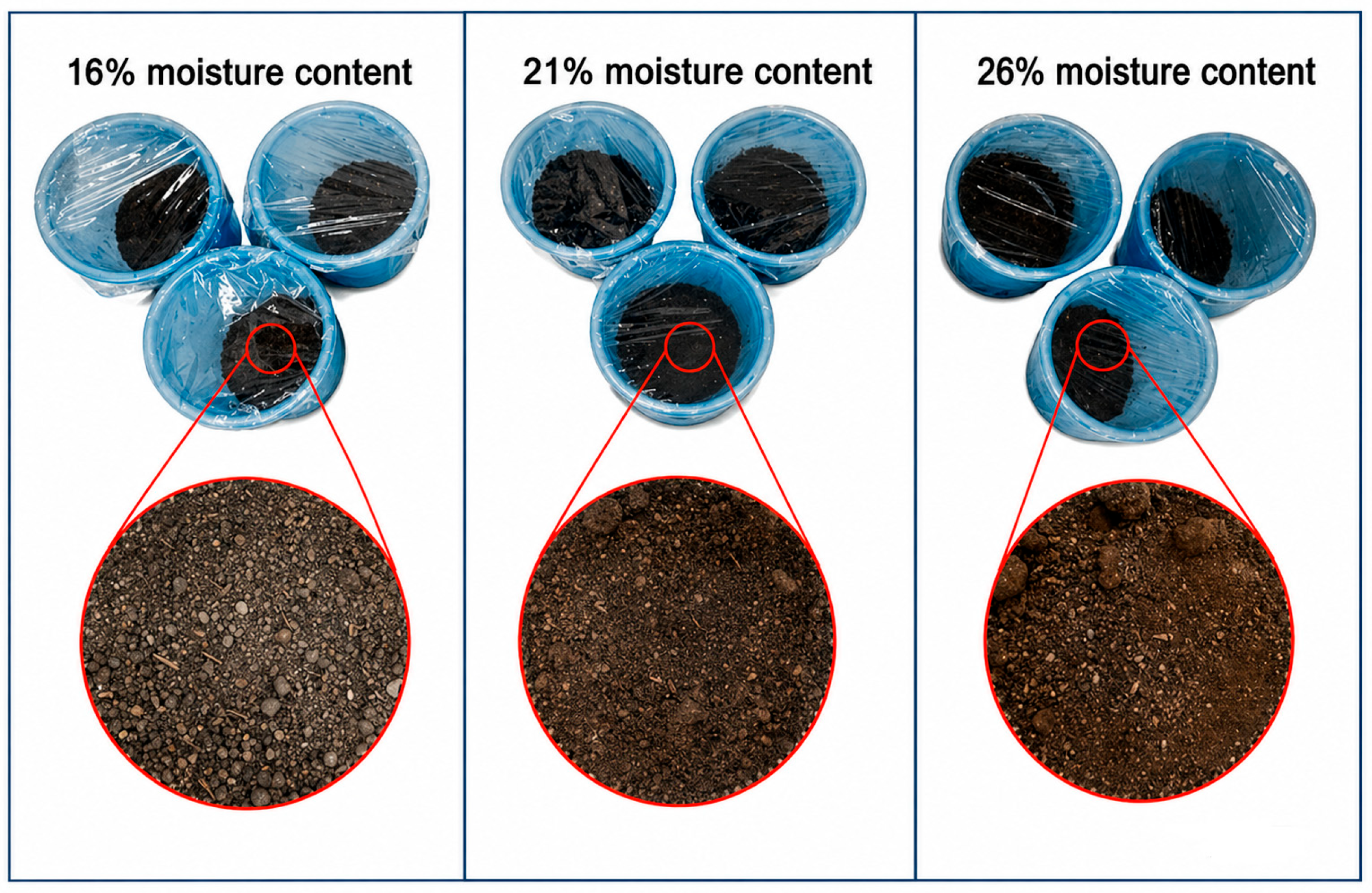
Secondly, because the moisture content of the powdered organic fertilizer used in this study was 26%, the high moisture content easily led to the formation of liquid bridges between particles, thereby generating microscopic adhesion forces. In this context, JKR surface energy, as a key parameter characterizing the adhesion properties, directly determines the bonding strength between particles. The ANOVA results showed that the interaction terms CG and CD were significant, indicating a clear coupling effect between the fertilizer–fertilizer rolling friction and surface energy and between the fertilizer–fertilizer and fertilizer–steel rolling friction coefficients. Among them, the significance of the CG term reveals that during the formation of the angle of repose, the macroscopic flow and packing behavior of the organic fertilizer is the result of the combined action of motion resistance caused by particle shape (characterized by the rolling friction coefficient) and microscopic adhesion induced by moisture (characterized by JKR surface energy). In contrast, the p-value of the DG term was 0.3238, indicating no significant interaction between the steel friction and surface energy. Furthermore, the quadratic terms C2, D2, and G2 were all highly significant, verifying the existence of a complex nonlinear surface relationship between the angle of repose and each parameter, rather than simple linear superposition. This further confirms the necessity and scientific validity of using the response surface method for numerical optimization. Fitting statistics: The lack-of-fit p-value of the model was 0.2900, indicating non-significance. The coefficient of determination R2 was 0.9983 and the adjusted R2adj was 0.9961, indicating that the model can explain over 99.8% of the variation in the response value, with high prediction accuracy, and can be used for the subsequent search for optimal parameters.
With the physically measured angle of repose of 33.29° as the target value, the regression equation was solved within the required parameter range, yielding the optimal values for the three parameters: the fertilizer–fertilizer coefficient of rolling friction (C) = 0.246, the fertilizer–steel coefficient of rolling friction (D) = 0.160, and the JKR surface energy (G) = 0.787 J/m2. Compared to typical agricultural granular materials (such as maize seeds or dry biomass), the calibrated fertilizer–fertilizer rolling friction coefficient (0.246) is notably higher. This quantitatively reflects the highly irregular shape and rough surface texture of the powdered organic fertilizer. Furthermore, the calibrated JKR surface energy (0.787 J/m2) is also higher than that of other granular materials, highlighting the strong liquid bridge forces generated at the 26% moisture content level. This analytical comparison explains the fundamental physical mechanism behind the fertilizer’s poor flowability and its severe tendency to bridge.
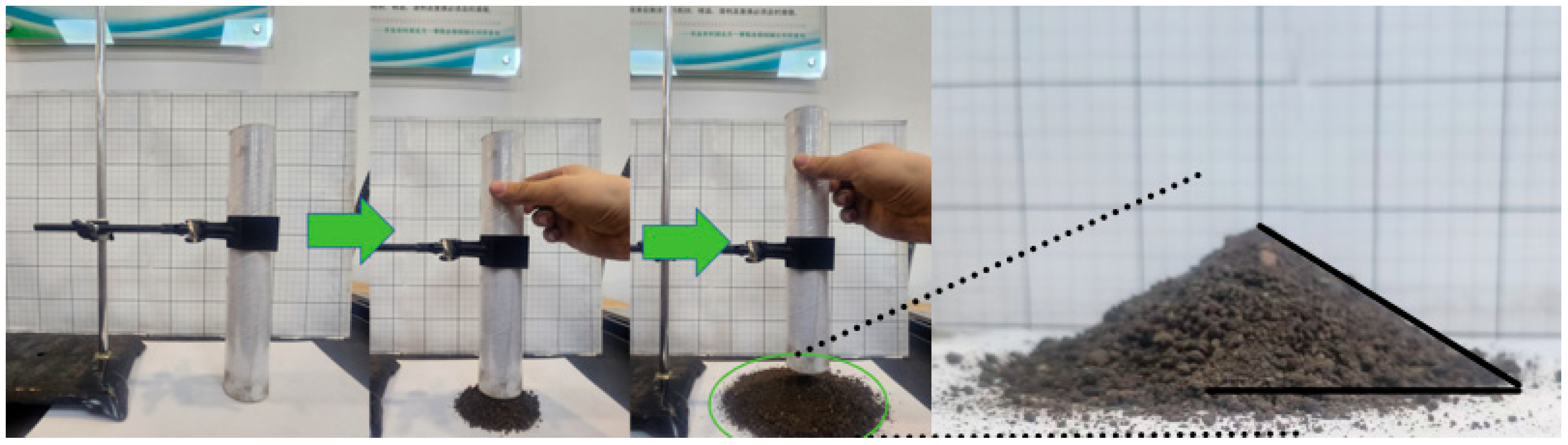
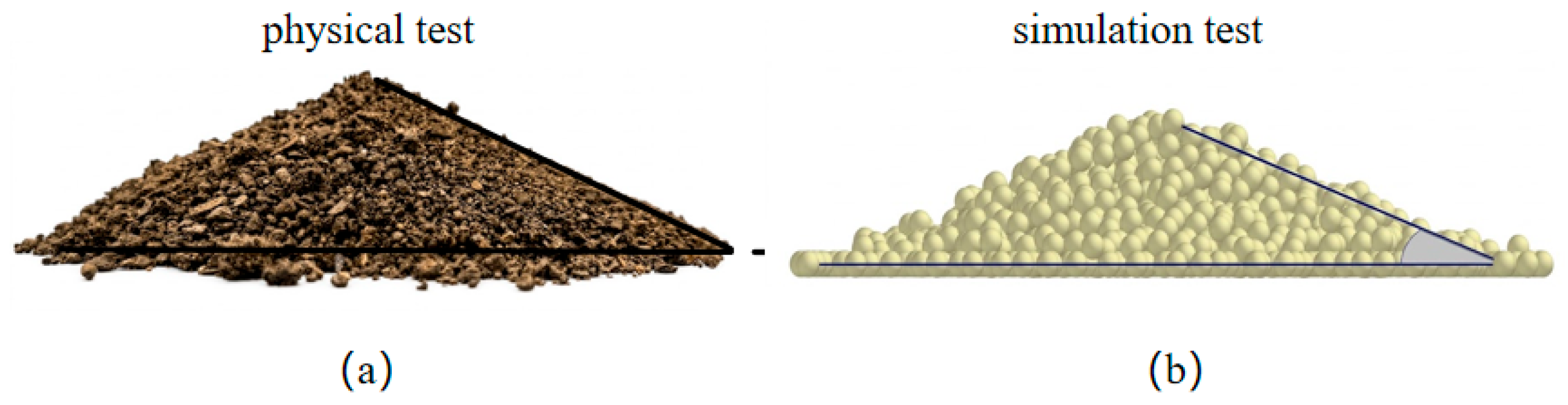
Validation Test for the Angle of Repose of Powdered Organic Fertilizer: To verify the reliability of the optimized parameters, the above parameters were input into the EDEM software to conduct three repeated simulation tests, with the remaining parameters set to their intermediate values. The simulation results showed that the average angle of repose of the generated pile was 33.35°. Compared with the physical test value (33.29°), the absolute error was only 0.06°, and the relative error was 0.18%. This error is extremely small. The comparison between the simulation test and the physical test is shown in
Figure 14; the pile morphology was highly consistent with the physical test, proving that the discrete element model established based on the coarse-graining strategy and its calibrated parameters possess extremely high accuracy.
3.4. Limitations of the Study
While the established comprehensive DEM model successfully predicts the macroscopic flow and breakage behavior of the powdered organic fertilizer, certain limitations should be explicitly acknowledged to clearly delimit the applicability of the model:
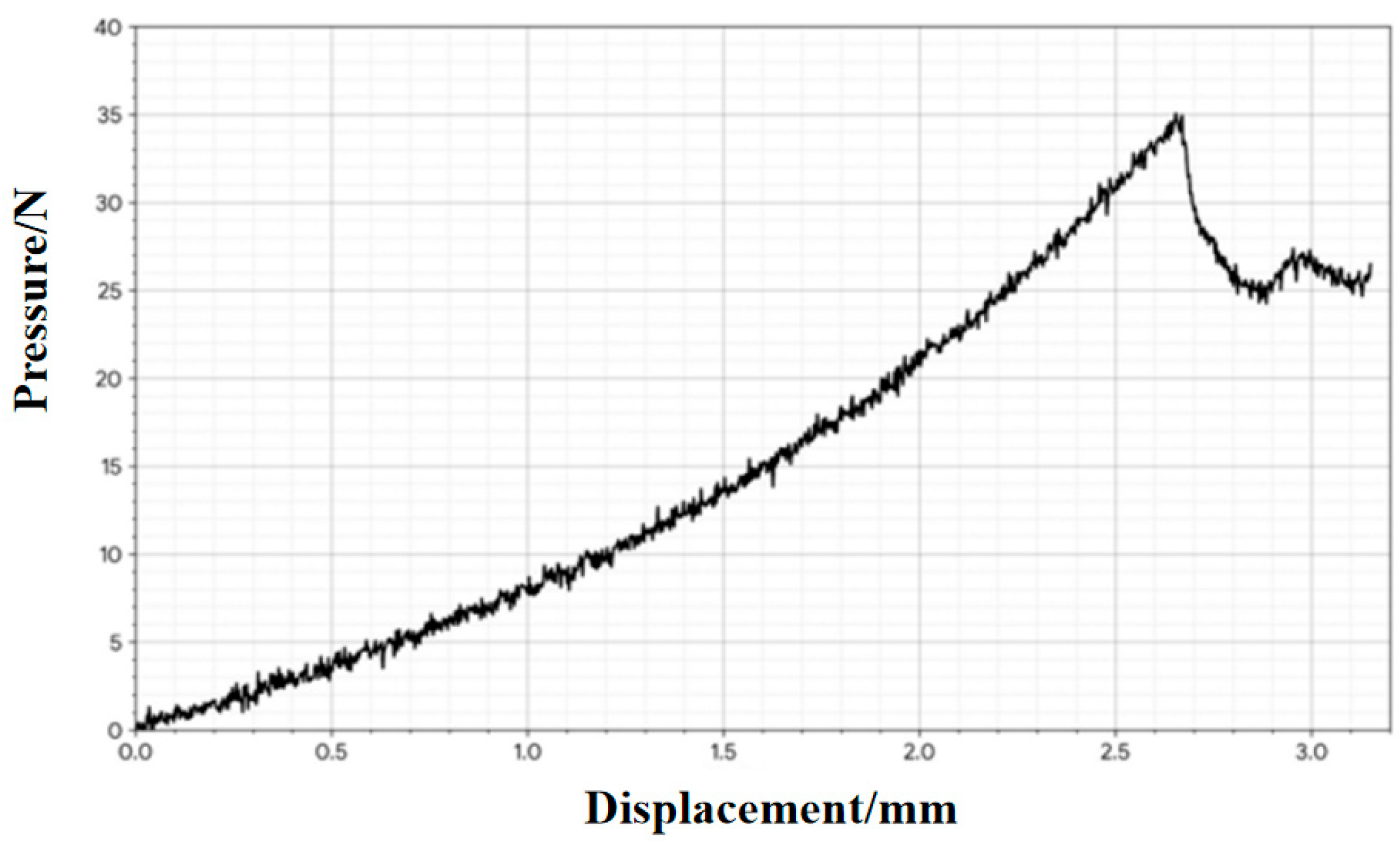
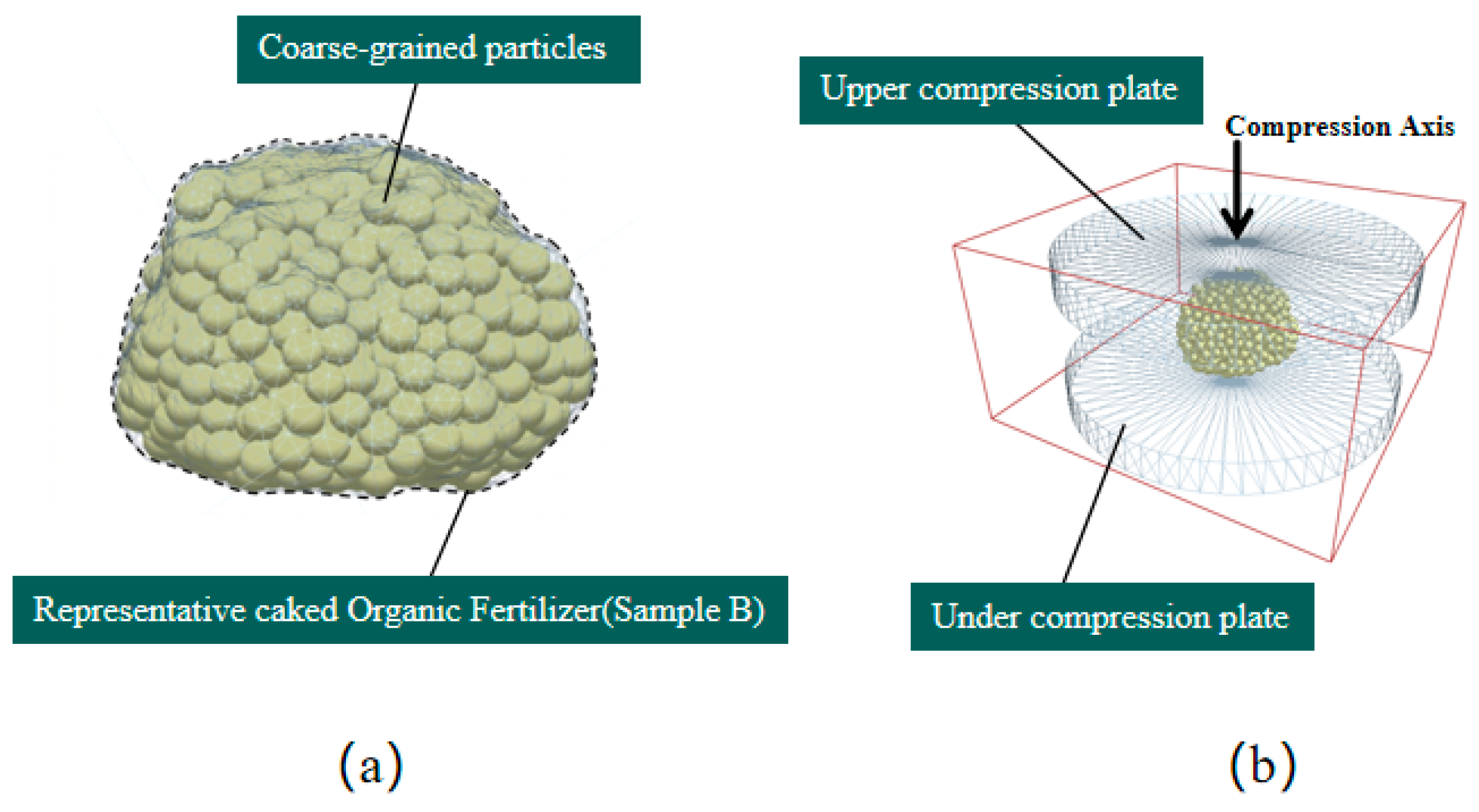
(1) Homogeneous bonding assumption and artificial lumps: The Hertz–Mindlin with Bonding model assumes perfectly uniform bonding properties between the coarse-grained particles. In reality, actual fertilizer lumps exhibit non-uniform moisture distribution, variable porosity, and heterogeneous internal cohesion. Furthermore, the lumps analyzed in this study were artificially formed under controlled laboratory conditions. Although these standardized samples successfully replicate the macroscopic cohesion and fracture behavior encountered in extreme caking scenarios, their internal microscopic structures may differ from naturally formed lumps. However, for the engineering purpose of optimizing an anti-blocking device, the primary concern is the macroscopic “overall ultimate crushing load” required to break the lump from the outside. By calibrating the ultimate compressive strength of the homogeneous model to match physical test data, the model sufficiently provides a reliable mechanical force limit for device optimization.
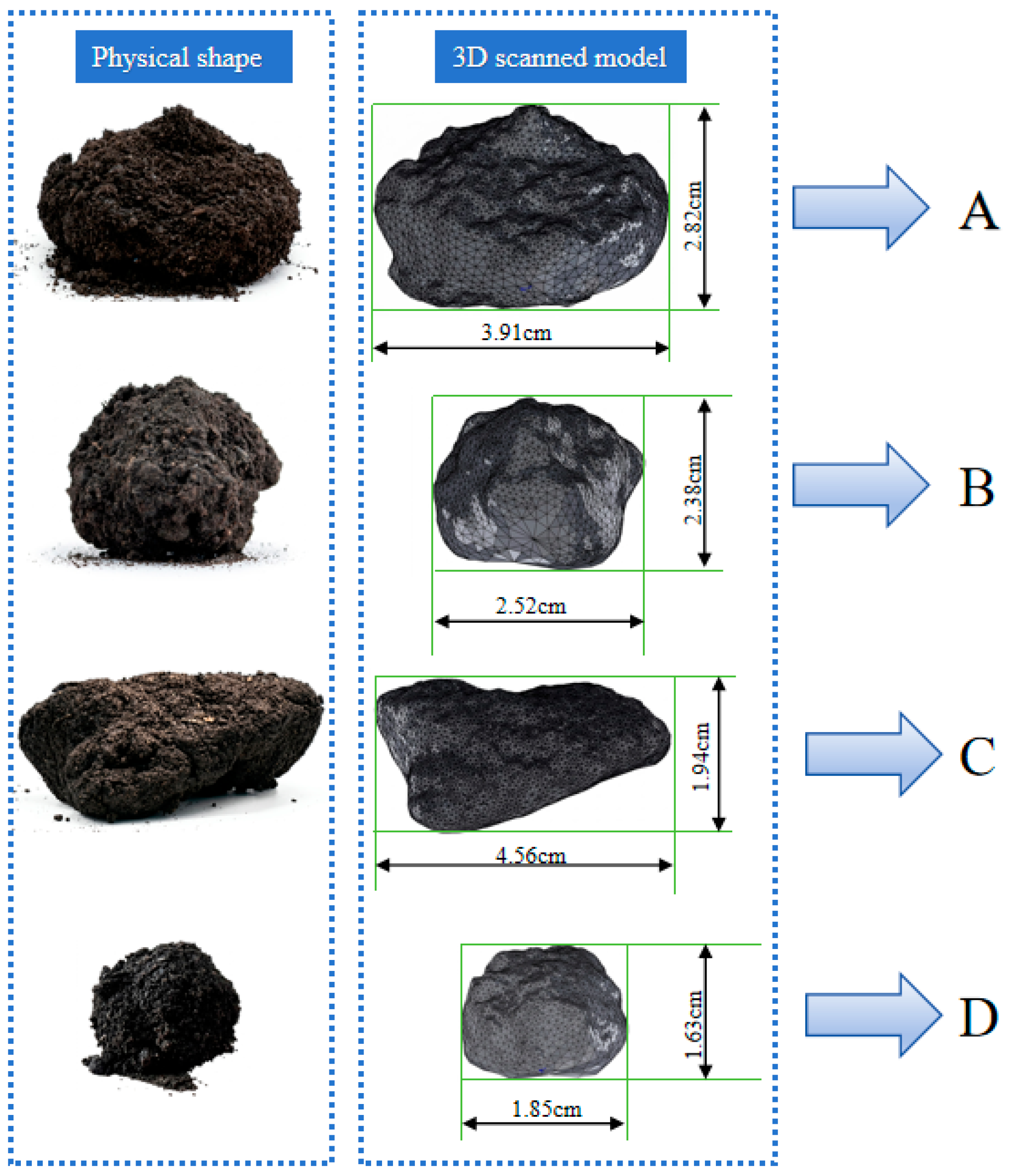
(2) Limited sample size and parameter generalizability: Due to the intensive computational and modeling costs associated with 3D scanning, reverse engineering, and DEM bonding parameter calibration, only four representative caked lumps were initially scanned, with one optimal lump selected as the primary baseline model. Consequently, the established model and its calibrated parameters are strictly limited to the specific material batch and controlled experimental conditions (e.g., 26% moisture content) analyzed in this study. Applying this model to other types of organic fertilizers, different moisture levels, or other distribution devices would require systematic recalibration.
(3) Static calibration versus dynamic field conditions: The DEM parameter calibration and structural validation were primarily based on quasi-static laboratory tests. While these tests provide a solid foundation for initial parameter calibration, they cannot fully reproduce the complex dynamic interactions encountered in real-world agricultural operations. Factors such as machine vibrations, variable compaction, fluctuating flow, and irregular terrain may influence the real behavior of the material. Future research should incorporate these dynamic field variables to further enhance the robustness and generalizability of the predictive model.