Article

Calibration and Experiment of Discrete Element Simulation Parameters for Powdered Organic Fertilizer Based on Coarse-Graining

1
College of Engineering, Northeast Agricultural University, Harbin 150030, China
2
College of Agriculture, Northeast Agricultural University, Harbin 150030, China
*
Author to whom correspondence should be addressed.
Agriculture 2026, 16(12), 1257; https://doi.org/10.3390/agriculture16121257
Submission received: 29 April 2026 / Revised: 24 May 2026 / Accepted: 5 June 2026 / Published: 7 June 2026
(This article belongs to the Section Agricultural Technology)

Abstract

Powdered organic fertilizer is crucial for sustainable agriculture, but its poor flowability and hygroscopic compaction and caking nature cause frequent blockages during mechanized strip application. While a single Johnson–Kendall–Roberts (JKR) discrete element method (DEM) model simulates powder flow well, it fails to reflect the mechanical breakage of hard caked lumps. Thus, this study established a comprehensive DEM model simultaneously simulating both powder and caked lumps. Based on coarse-graining theory, 0.147 mm particles were scaled to 2 mm spheres. Contact parameters (e.g., JKR surface energy) were calibrated using response surface methodology, yielding a repose angle simulation error of only 0.18%. The actual three-dimensional (3D) geometry of caked lumps was reconstructed via 3D scanning, and breakage mechanical parameters were accurately calibrated by combining uniaxial compression tests with a Bonding model (errors for ultimate load and displacement < 2%). Applying this model to an anti-blocking fertilizer discharge device, simulations and performance tests demonstrated an acceptable macroscopic representation of both powder flow and lump breakage. The optimized device achieved a strip application uniformity coefficient of variation of 3.87–6.40%. By simulating the complex coexistence of powder flow and lump breakage, this study provides a feasible parameter calibration method and numerical reference for optimizing anti-blocking discharge devices.

1. Introduction

The long-term over-application of traditional chemical fertilizers has led to severe negative ecological impacts, such as soil compaction, acidification, heavy metal accumulation, and water eutrophication, seriously undermining agricultural sustainability [1,2]. With the improvement of living standards, there is an increasingly urgent pursuit of green, organic food and a healthy, high-quality lifestyle. As a core component of organic agriculture, organic fertilizer plays a vital role in advancing sustainable farming practices. Specifically, its strategic application contributes significantly to improving soil physical structure, enhancing crop nutritional quality, and mitigating environmental pollution, thereby providing essential support for the sustainable development of modern agriculture [3,4,5].
Banding is an efficient fertilization technique that can precisely and intensively apply fertilizer near the crop root system, thereby significantly improving fertilizer utilization, reducing nutrient loss, and promoting crop absorption [6]. However, due to the poor flowability and hygroscopic caking nature of powdered organic fertilizer, it easily causes blockage at the discharge outlet or uneven fertilization during the banding process [7,8]. To solve these problems, the design and optimization of an anti-blocking fertilizer discharge device for strip application are necessary. In the recent literature, studies have widely utilized the Johnson–Kendall–Roberts (JKR) contact model, often combined with statistical designs (e.g., Plackett–Burman, Box–Behnken), to successfully calibrate discrete element method (DEM) parameters for cohesive organic materials. However, a critical scientific gap remains: while a single JKR model excels at simulating the cohesive flow of high-moisture powders, it fundamentally lacks the capability to represent the solid mechanics [9], brittle fracture, and structural failure of already consolidated hard lumps. Most current DEM simulations still idealize the fertilizer as a uniform discrete powder, which severely limits the accurate prediction of blockage during actual strip application operations where loose powders and hard caked lumps complexly coexist. Therefore, revealing the flow mechanism and breakage state of powdered organic fertilizer containing caked lumps and establishing an accurate and reliable discrete element model are of great scientific significance for optimizing the anti-blocking fertilizer discharge device and achieving precision fertilization.
The discrete element method (DEM), first proposed by Cundall and Strack, has become a powerful tool for studying the dynamics of agricultural material particles [10]. It provides particle-scale motion states, enabling the analysis of particle–particle and particle–machine interactions that are difficult to observe experimentally. DEM has been widely used to simulate processes involving seeds, grains, and soil [11,12]. Despite its advantages, applying DEM to fine-particle materials remains challenging [13]. The computational cost of a DEM simulation is related to the number of generated particles, and the number of particles required to fill a given volume is inversely proportional to the cube of the particle diameter. For materials with an average particle size in the sub-millimeter range, a direct 1:1 simulation would involve billions of particles, exceeding the capacity of most computational resources. To address the computational efficiency problem, coarse-graining (CG) technology has emerged. Sakai et al. proposed a scaling law based on energy conservation [14], and Bierwisch et al. further refined its application in powder cavity filling [15]. Research by Roessler et al. demonstrated that by adjusting contact parameters, the coarse-grained model can effectively reproduce the macroscopic rheological properties of real materials [16,17,18]. To address the limitations of existing JKR-only models, this study introduces the explicit three-dimensional (3D) scanning reconstruction of actual caked lumps combined with the Hertz–Mindlin with Bonding contact model. The concrete advantage of incorporating the Bonding model lies in its ability to define normal and shear critical stress thresholds between coarse-grained particles. This uniquely enables the realistic reproduction of the macroscopic fragmentation process—the phase transition from a “solid consolidation” to a “discrete granular state” under mechanical external forces [19]. This approach effectively bridges the blind spot of pure JKR models when handling hard caked lumps. By revealing the flow mechanism of the powder and the breakage state of the lumps, establishing this accurate and reliable comprehensive DEM model is of great scientific significance for optimizing the anti-blocking fertilizer discharge device.
This study aims to develop and validate a DEM parameter calibration method for powdered organic fertilizer and its caked lumps based on coarse-graining theory. The specific objectives are: (1) to measure the physical parameters of the fertilizer, including moisture content, particle size distribution, angle of repose, Poisson’s ratio, elastic modulus, and the mechanical response to compressive failure; (2) to implement coarse-graining in EDEM2022 software (Altair Engineering Inc., Troy, MI, USA), scaling the particle size from the measured value of 0.147 mm to 2 mm; (3) to systematically calibrate the scaled model of the powdered organic fertilizer through an integrated PB test, steepest ascent test, and BBD test to match the angle of repose obtained from the physical experiment; (4) to introduce the Hertz–Mindlin with Bonding model, model the caked organic fertilizer through 3D scanning, and calibrate the bonding parameters based on uniaxial compression test data using a Central Composite Design (CCD); and (5) to apply the calibrated model to the design optimization of an anti-blocking fertilizer discharge device and verify the reliability of the model and parameters through a physical banding uniformity test. This research provides a computationally efficient and highly accurate discrete element modeling method for the design and optimization of discharge devices for powdered organic fertilizer containing caked lumps.

2. Materials and Methods

2.1. Experimental Materials and Physical Parameter Determination for Powdered Organic Fertilizer Containing Caked Lumps

Powdered organic fertilizer is typically produced from organic raw materials through aerobic composting, fermentation, and crushing, ideally presenting as uniform, powdered organic fertilizer. However, during actual storage, transportation, and fertilization, influenced by environmental moisture absorption and compaction stress, some of the bulk fertilizer particles adhere to each other, forming irregular caked lumps with a certain compressive strength. Therefore, in actual operations, organic fertilizer often exists in a mixed physical state of loose powder granules and irregular caked lumps. Focusing on this practical characteristic, this study uses powdered organic fertilizer produced by Heilongjiang Junxing Biotechnology Co., Ltd. (Harbin, China). as the test subject. To simulate the material state of the organic fertilizer after absorbing moisture and caking in an actual working environment, this experiment first determined the original moisture content of the material. Subsequently, by artificially adding water and allowing the samples to equilibrate, organic fertilizer samples with three moisture content gradients were prepared. The physical state of the organic fertilizer at different moisture contents was observed, and the moisture content at which powdered organic fertilizer produces caked lumps was selected. Key basic physical parameters were then measured by physical test methods, serving as a unified material benchmark for subsequent discrete element parameter calibration and providing a reference for the design of an anti-blocking fertilizer discharge device for organic fertilizer. All physical measurements and material parameter determinations described in this section were conducted systematically during the same period in September 2025. Prior to the physical tests, the bulk organic fertilizer was stored in standard woven bags in a dry, ventilated indoor environment to minimize baseline moisture variation.

2.1.1. Determination of Moisture Content and Density of Powdered Organic Fertilizer

A moisture content measurement test was conducted on powdered organic fertilizer using an oven. A cutting ring was used to collect samples of approximately 30–50 g from three random points in the organic fertilizer batch to ensure representativeness. The mass of the crucible was measured. The samples from different locations were placed in the crucible, and the total mass of the non-dried organic fertilizer and crucible was weighed. The mass of the non-dried organic fertilizer was calculated using the subtraction method. The organic fertilizer was placed in an oven set at a heating temperature of 105 °C and weighed every half hour. The drying process was repeated multiple times until a constant mass was achieved, which was defined as a mass difference of less than 0.01 g between two consecutive weighings. This test was repeated 10 times. The experimental data were observed and recorded, the corresponding wet basis moisture content was calculated, and the average value was taken as the moisture content of the organic fertilizer [20].
The formula for calculating moisture content is as follows:
w = m 1 m 2 m 1 m 3 × 100 %
where w is the moisture content of the material, %; m1 is the mass of the crucible and material before drying, g; m2 is the mass of the crucible and material after drying, g; and m3 is the mass of the crucible, g.
The measured data were substituted into Formula 1 for calculation, and the moisture content of the powdered organic fertilizer was determined to be 16%.
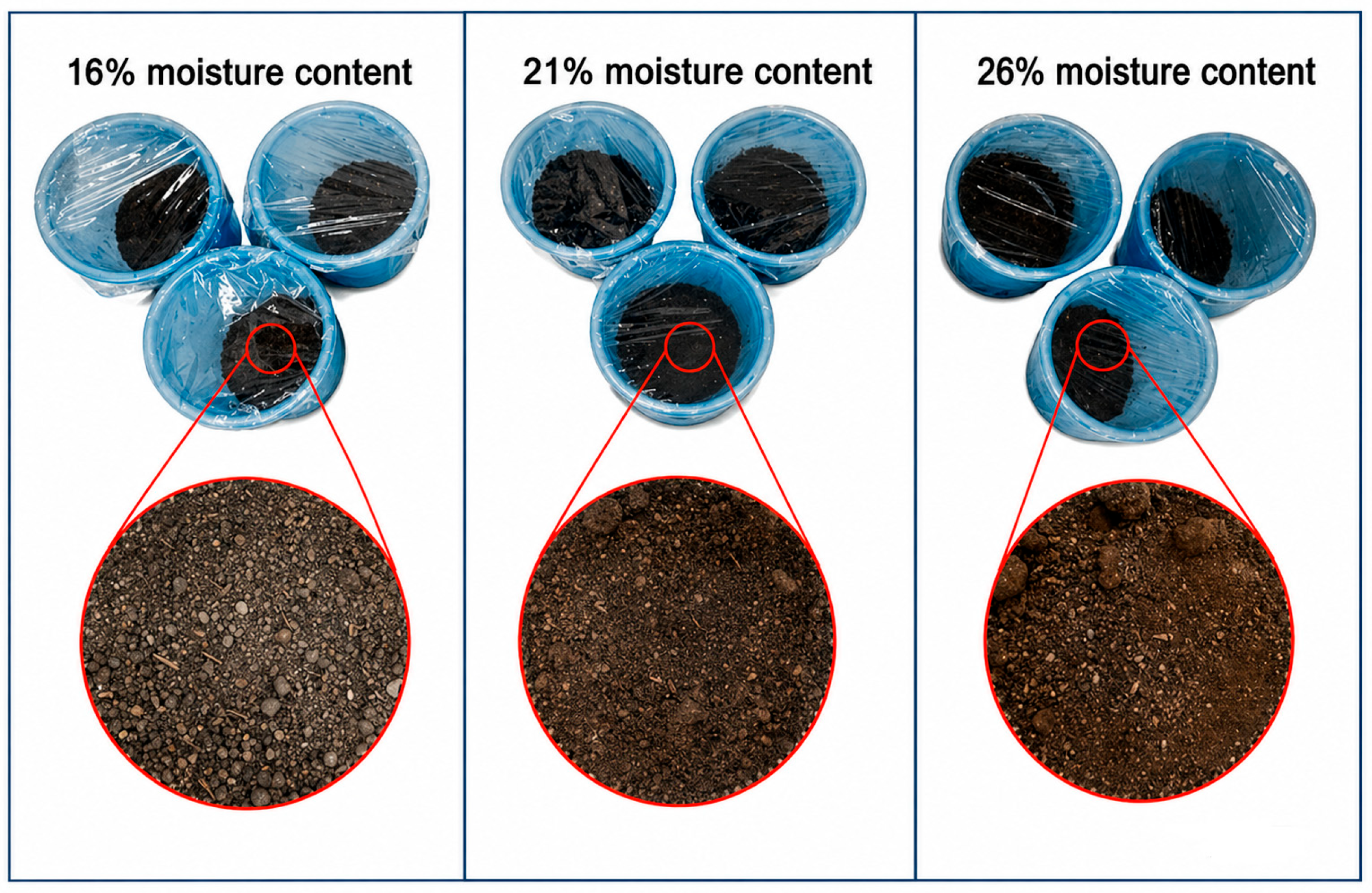
To simulate the hygroscopic caking material state under actual working conditions, test samples with three moisture content levels of 16%, 21%, and 26% were artificially prepared. The 5% gradient was selected based on preliminary trials to efficiently capture the critical macroscopic state transitions of the fertilizer without resulting in an overly dense experimental design. The process was as follows: first, two groups of organic fertilizer with a moisture content of 16% were weighed out. The amount of water required for the two groups to reach moisture contents of 21% and 26%, respectively, was calculated. The organic fertilizer was evenly sprinkled with water, uniformly turned, and mixed. The above process was repeated until all the required water was added. After a period of static standing in a sealed container at a constant temperature of 20 °C and for 48 h to ensure uniform moisture distribution and natural compaction, two new types of organic fertilizer with moisture contents of 21% and 26% were obtained, as shown in Figure 1. This static resting process was specifically designed to partially simulate the compaction stress and moisture migration conditions typical during actual agricultural transportation and storage, thereby forming agglomerates similar to real-world caked lumps driven by both hygroscopic binding and mechanical compaction. It is acknowledged that due to the controlled laboratory environment, the internal microstructure and porosity of these artificial lumps might differ slightly from those formed naturally over extended periods. However, their macroscopic morphology, overall cohesion, and ultimate fracture behavior successfully replicate the severe caking conditions encountered in actual exploitation. Consequently, characterizing the mechanical response of these representative lumps provides a valid and reliable engineering reference for the subsequent design and parameter optimization of the anti-blocking fertilizer discharge device.
The three groups of fertilizer that had been left to stand were first observed for their physical state:
(1) 16% moisture content sample: The material was overall relatively loose and powdery, with no obvious adhesion between particles and good flowability.
(2) 21% moisture content sample: The surface humidity of the material increased and obvious adhesion phenomena began to appear between particles, accompanied by the formation of small caked lumps, which would naturally fall apart with slight mechanical touch.
(3) 26% moisture content sample: The material exhibited obvious cohesion, with a small portion of significant caked lumps appearing and consolidating within the container. Applying slight manual pressure to the agglomerates caused them to break into several smaller pieces, but they remained in an agglomerated state.
These observations confirmed the rationale for the selected 5% gradient: 21% moisture marks the critical transition point where obvious liquid bridge adhesion and initial small agglomerates begin to appear, while 26% leads to severe caking and consolidation. Considering the complex and variable environmental humidity faced in actual operations, and to ensure that the established discrete element model of the organic fertilizer represents the state most prone to blockage, thereby providing a reference for the design of the anti-blocking fertilizer discharge device, this study selected the 26% moisture content powdered organic fertilizer containing caked lumps, which had the worst flowability and was most likely to cause blockage, as the research object. Physical parameters were measured for both the powdered and caked organic fertilizer separately. The physical parameter measurements for the caked fertilizer are detailed in Section 2.1.4 and Section 2.1.5.
The bulk density of the organic fertilizer was measured using the cutting ring method. Samples were taken from three random points of the organic fertilizer using a standard cutting ring with a known volume of 100 cm3. This measurement was independently repeated five times. During each replicate, the mass of the organic fertilizer within the ring was accurately weighed and recorded (the measured masses for the five replicates were 82.45 g, 81.59 g, 84.97 g, 85.13 g, and 87.41 g, respectively). The bulk density calculation formula is as follows:
ρ = m 4 V
where ρ is the bulk density of organic fertilizer, kg/m3; m4 is the mass of organic fertilizer in the cutting ring, kg; and V is the volume of the cutting ring, m3.
Based on the recorded masses across the five replicates, the bulk density of the organic fertilizer was determined to be 843.10 ± 23.23 kg/m3.

2.1.2. Microscopic Morphology and Particle Size Distribution of Powdered Organic Fertilizer

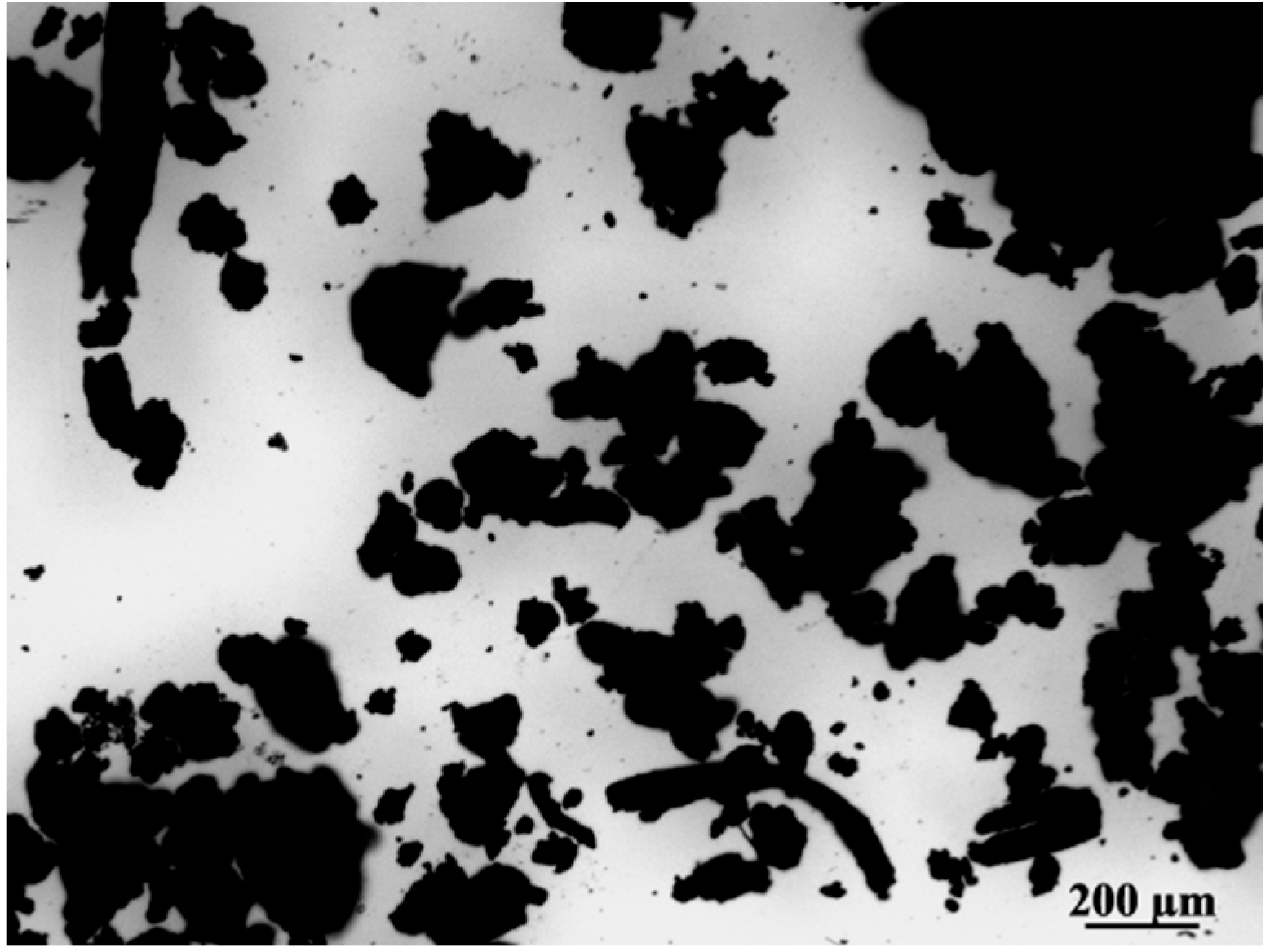
An Axiocam 105 color optical microscope produced by Zeiss (Carl Zeiss AG, Oberkochen, Germany) was used to measure the particle size of the organic fertilizer. Appropriate amounts of powdered organic fertilizer were randomly taken and placed on glass slides for observation at 50 magnification across ten random locations. Partial microscopic images of the organic fertilizer are shown in Figure 2. Through this image, we can visually observe the microscopic morphology of powdered organic fertilizer, and this image set provides fundamental image data for subsequent software extraction and particle size analysis. Observation of the organic fertilizer particles showed that the particle shape was irregular, but due to the small particle size, they could be considered as spheres [21].
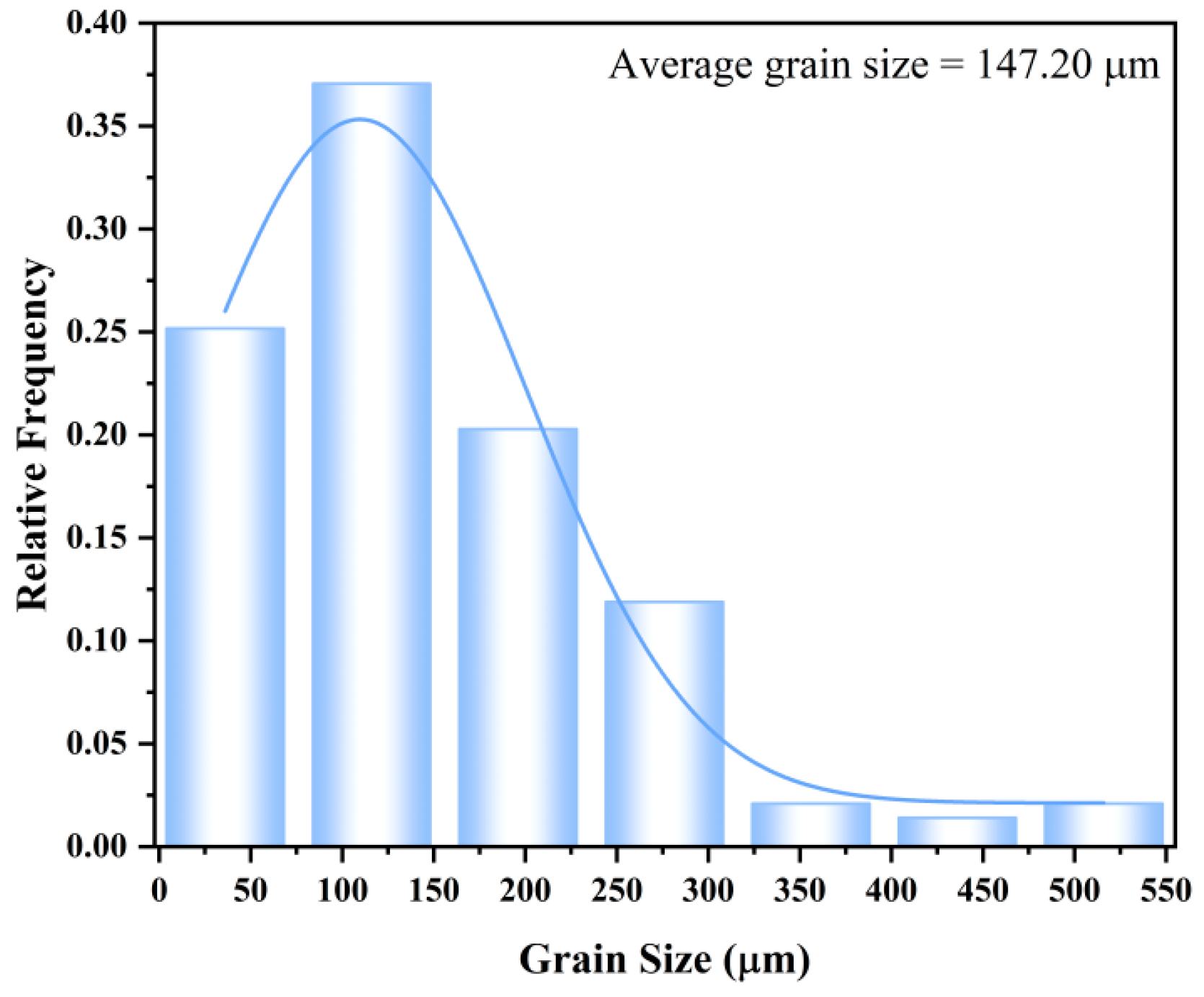
The particle size of the organic fertilizer was measured and statistically analyzed using Nano Measurer1.2 software (Fudan University, Shanghai, China) based on 10 microscopic images captured in Section 2.1.2. A total of 1438 individual particles were randomly selected and manually segmented using the distance measurement tool to ensure representative sampling across multiple fields of view. As shown in Figure 3, the overall particle size distribution ranged from 50 µm to 550 µm, with the majority of particles concentrated between 50 µm and 300 µm. The calculated average particle size was 147.20 µm with a standard deviation of 42.65 µm, and the 95% confidence interval was approximately 144.79 to 149.21 µm. These precise metrological data provide a foundational reference for the subsequent discrete element simulation and parameter calibration.

2.1.3. Determination of Macroscopic Characteristics and Mechanical Properties of Powdered Organic Fertilizer

Determination of the Angle of Repose: To accurately calibrate the discrete element model, three key physical and mechanical properties of the powdered organic fertilizer were systematically determined: angle of repose, Poisson’s ratio, and elastic modulus.
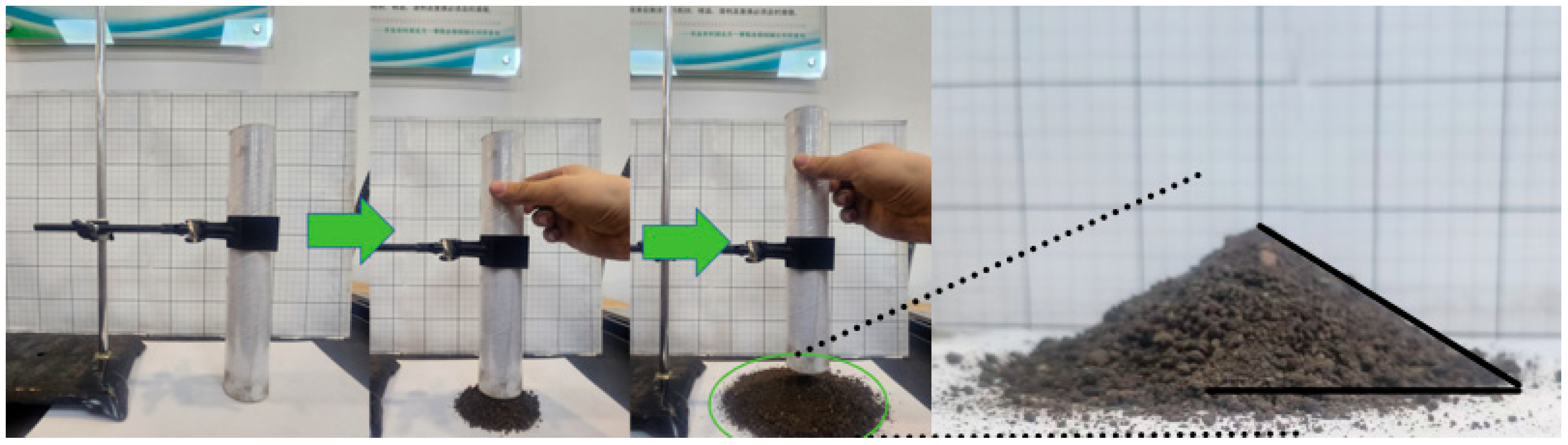
The angle of repose effectively reflects the friction and flow characteristics of materials [12]. The angle of repose was measured using the lifting bucket method, as shown in Figure 4. A horizontal base plate was placed on a stable test bench, and an open cylinder was placed vertically at the center of the base plate. The organic fertilizer sample to be tested was slowly and uniformly filled into the cylinder through a funnel until the cylinder was completely full, and the upper surface was leveled with a scraper along the cylinder mouth to ensure that the initial filling volume and packing state were basically consistent for each test. The lifting device was activated to lift the cylinder vertically at a constant speed of 1 cm/s. An excessively high lifting speed would cause airflow disturbance, affecting the stability of the pile. After the cylinder was completely detached from the powder and the powder on the base plate naturally slid down to form a stable conical pile, the lifting was stopped, completing one measurement. The test was repeated three times, and the results were averaged. The average angle of repose of the powdered organic fertilizer was calculated to be 33.29°.
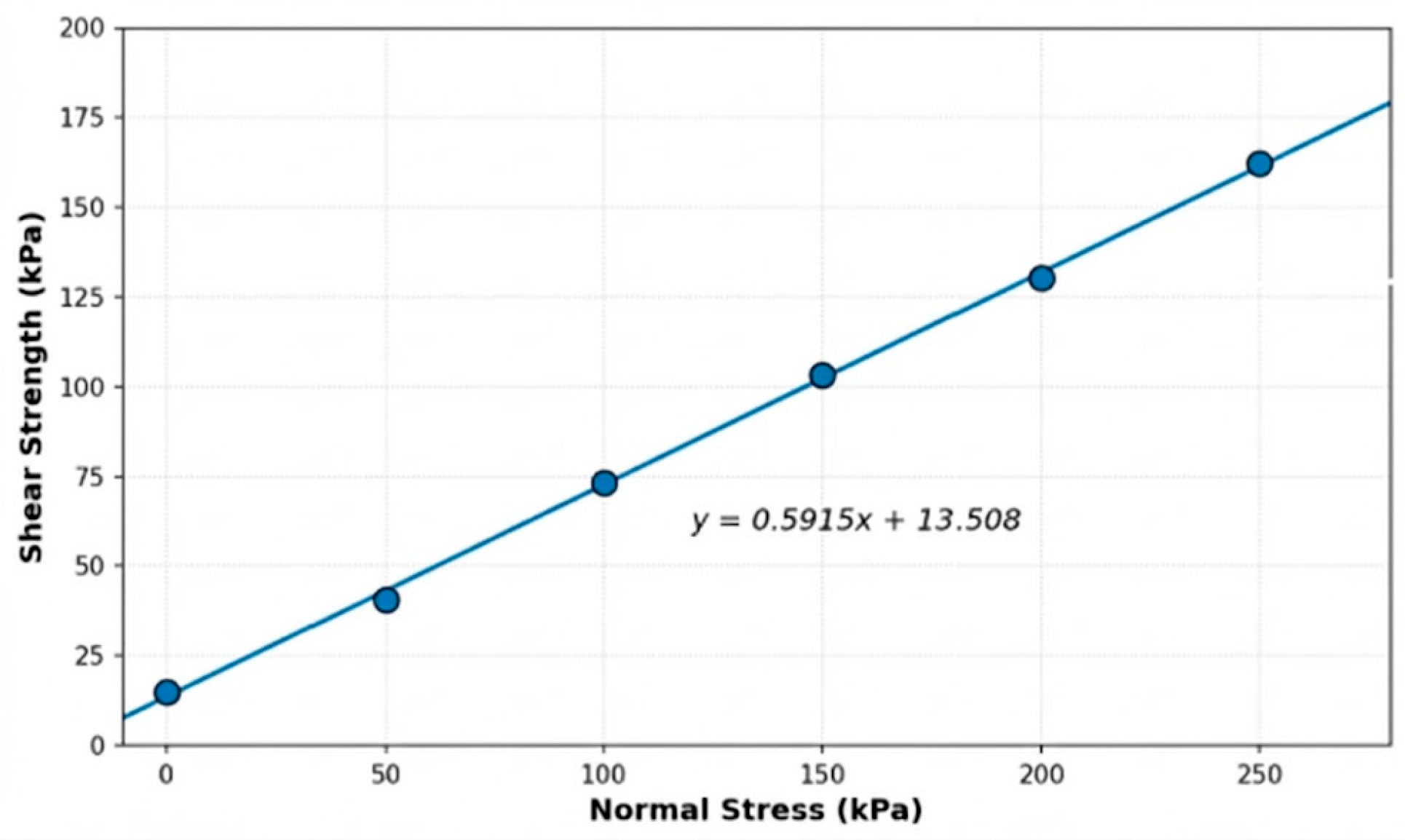
Determination of Poisson’s Ratio: Poisson’s ratio is an important parameter for discrete element simulation and can be derived from the internal friction angle of the organic fertilizer combined with empirical formulas. The calculation formulas are:
τ = c + σ tan ϕ
k 0 = 1 sin ϕ
μ = k 0 1 + k 0
where c is the cohesion of organic fertilizer, kPa; σ is the normal stress, kPa; ϕ is the internal friction angle of organic fertilizer, (°); μ is Poisson’s ratio; and k0 is the coefficient of lateral earth pressure.
According to the literature [22], the internal friction angle of the organic fertilizer was determined using a quick shear test. Based on the measured data, a shear strength curve was plotted. The resulting shear strength diagram of the organic fertilizer is shown in Figure 5. The Poisson’s ratio of the organic fertilizer was calculated according to the formula to be 0.29.
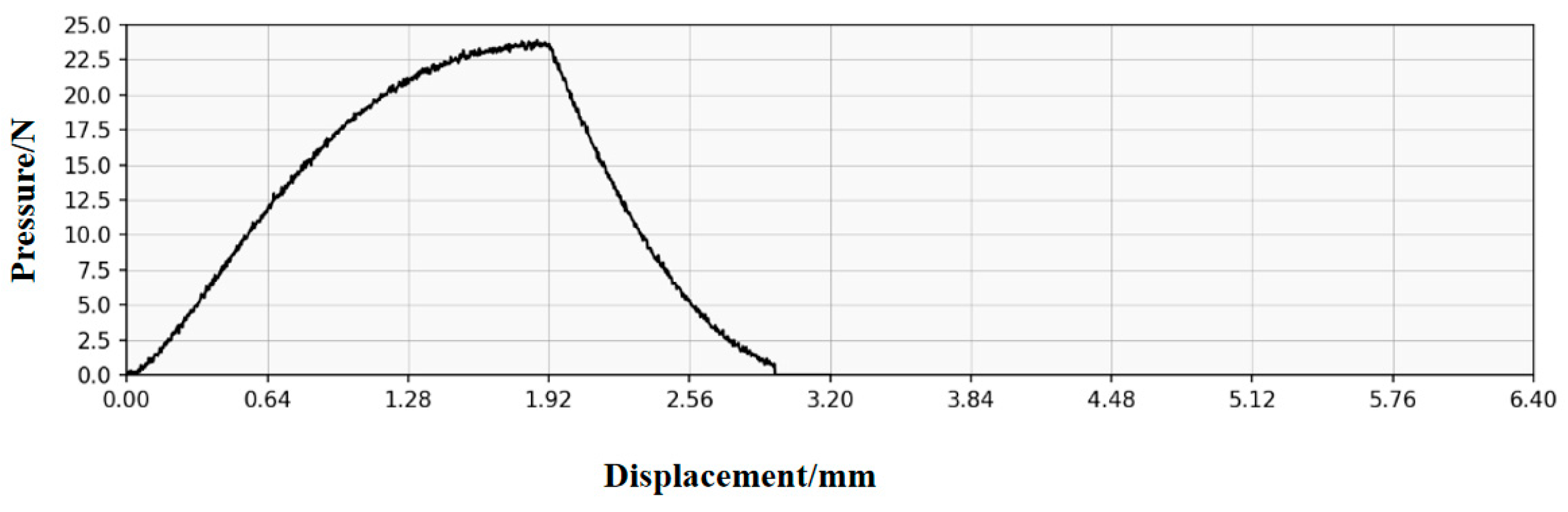
Determination of Elastic Modulus: The shear modulus and elastic modulus are key parameters in discrete element simulation [22]. In this study, a Tinius Olsen 1ST series benchtop universal testing machine (Tinius Olsen, Horsham, PA, USA) was used to perform a uniaxial compression test on a compressed sample of powdered organic fertilizer. The sample dimensions were a cylinder with a height of 40 mm and a diameter of 20 mm. The stress was calculated based on the pressure and the force-bearing area, and the strain was calculated based on the compression displacement. The ratio of stress to strain is the elastic modulus of the organic fertilizer.
The compression curve is shown in Figure 6. The formula for calculating the elastic modulus is:
E = F / A 0 L / L 0
where: E is the elastic modulus of organic fertilizer, MPa; F is the pressure, N; A0 is the cross-sectional area of the sample, mm2; L is the deformation of the sample, mm; and L0 is the original length of the sample, mm.
The elastic modulus of the organic fertilizer was calculated to be 2.35 MPa. Combined with the previously determined Poisson’s ratio of the organic fertilizer, the shear modulus of the organic fertilizer can be calculated using the following formula:
G = E 2 1 + μ
where G is the shear modulus of organic fertilizer, MPa.
Calculated according to Formula (7), the shear modulus of the organic fertilizer was 0.91 MPa.

2.1.4. 3D Modeling of Caked Organic Fertilizer

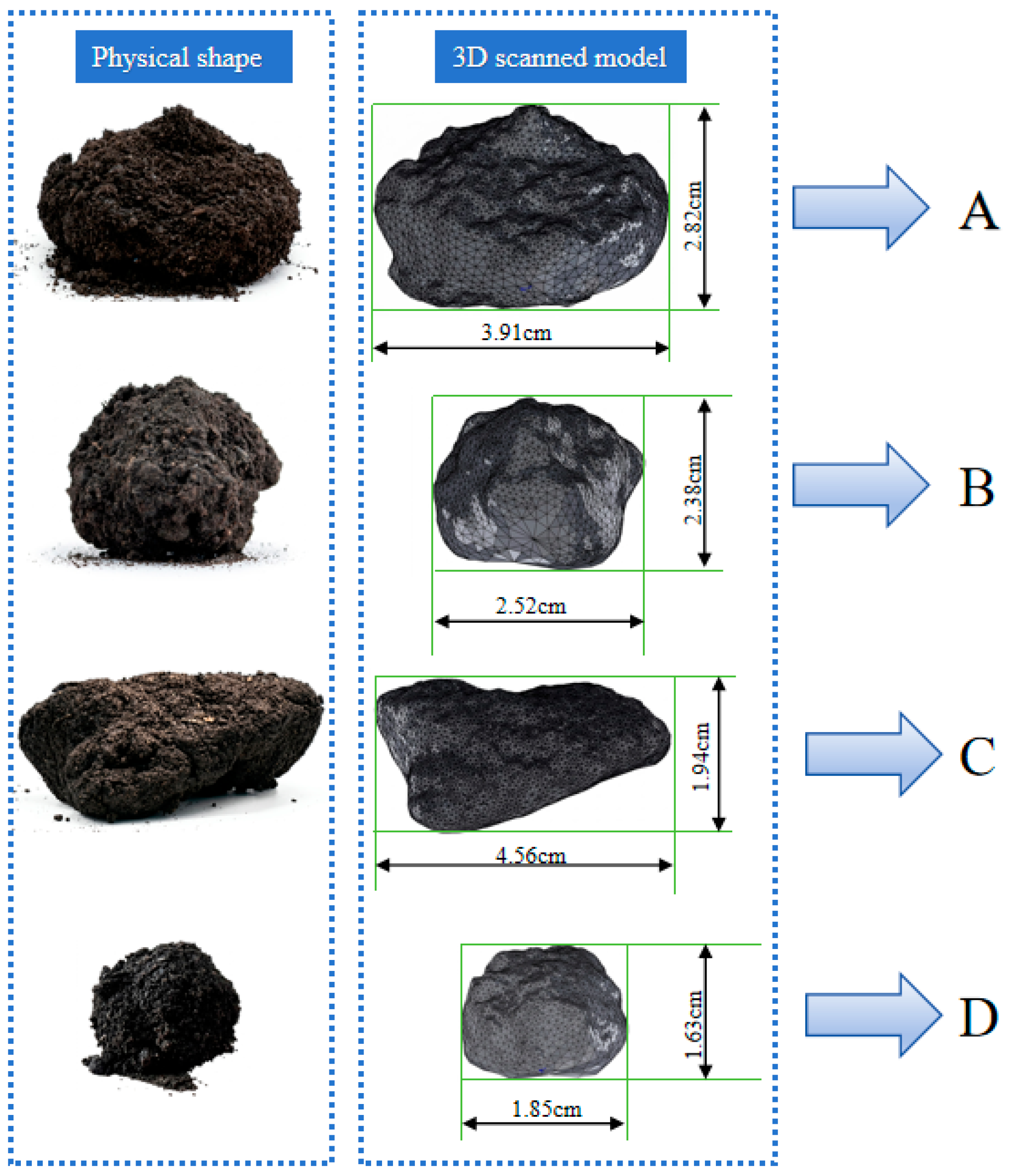
In an actual fertilizer hopper, the geometric morphology of caked powdered organic fertilizer exhibits strong randomness and discreteness. Due to variations in volume, surface area, and the presence of internal pores, different caked lumps have different shapes, leading to different displacement–pressure curves. For the subsequent EDEM calibration, it was necessary to select a caked lump with dimensions close to the average value as the standard lump. From the 26% moisture content powdered organic fertilizer material containing caked lumps obtained in Section 2.1.1, four structurally intact irregular caked organic fertilizer without obvious external artificial damage were extracted and labeled A, B, C, and D. To obtain their precise external spatial contours, a high-precision handheld laser 3D scanner (Model: HSCAN331, Scantech, Hangzhou, China) was employed. The scanning was performed using six pairs of crossed laser lines plus one extra red laser line, providing a metrological accuracy of up to 0.030 mm and a resolution of 0.050 mm. The measurement rate was maintained at 265,000 measurements/s within a depth of field of 250 mm. During the procedure, the scanning environment was maintained at a stable temperature (approx. 20 °C) to minimize thermal expansion errors. The point cloud data were captured with a volumetric accuracy of 0.020 mm + 0.080 mm/m. The raw data were subsequently processed through noise removal and surface reconstruction to generate high-fidelity STL format files, as shown in Figure 7.
The scanned STL files were imported into SolidWorks 2024 (Dassault Systèmes, Vélizy-Villacoublay, France) software for post-processing. Utilizing the software’s mass properties evaluation module, the maximum length, width, and height dimensions of each caked sample were automatically measured and output, while the spatial volume and surface area of each sample were accurately extracted; specifically, the volumes were 19.43 cm3 for sample A, 11.46 cm3 for sample B, 16.81 cm3 for sample C, and 8.19 cm3 for sample D. By comparing the relative deviation between the spatial volume of each sample and the overall mean value, sample B, whose geometric feature indicators were closest to the statistical mean of the complete dimensional distribution, was ultimately selected as the representative caked lump for this study’s mechanical testing and subsequent Bonding model calibration.

2.1.5. 3D Uniaxial Compression Test on Caked Organic Fertilizer

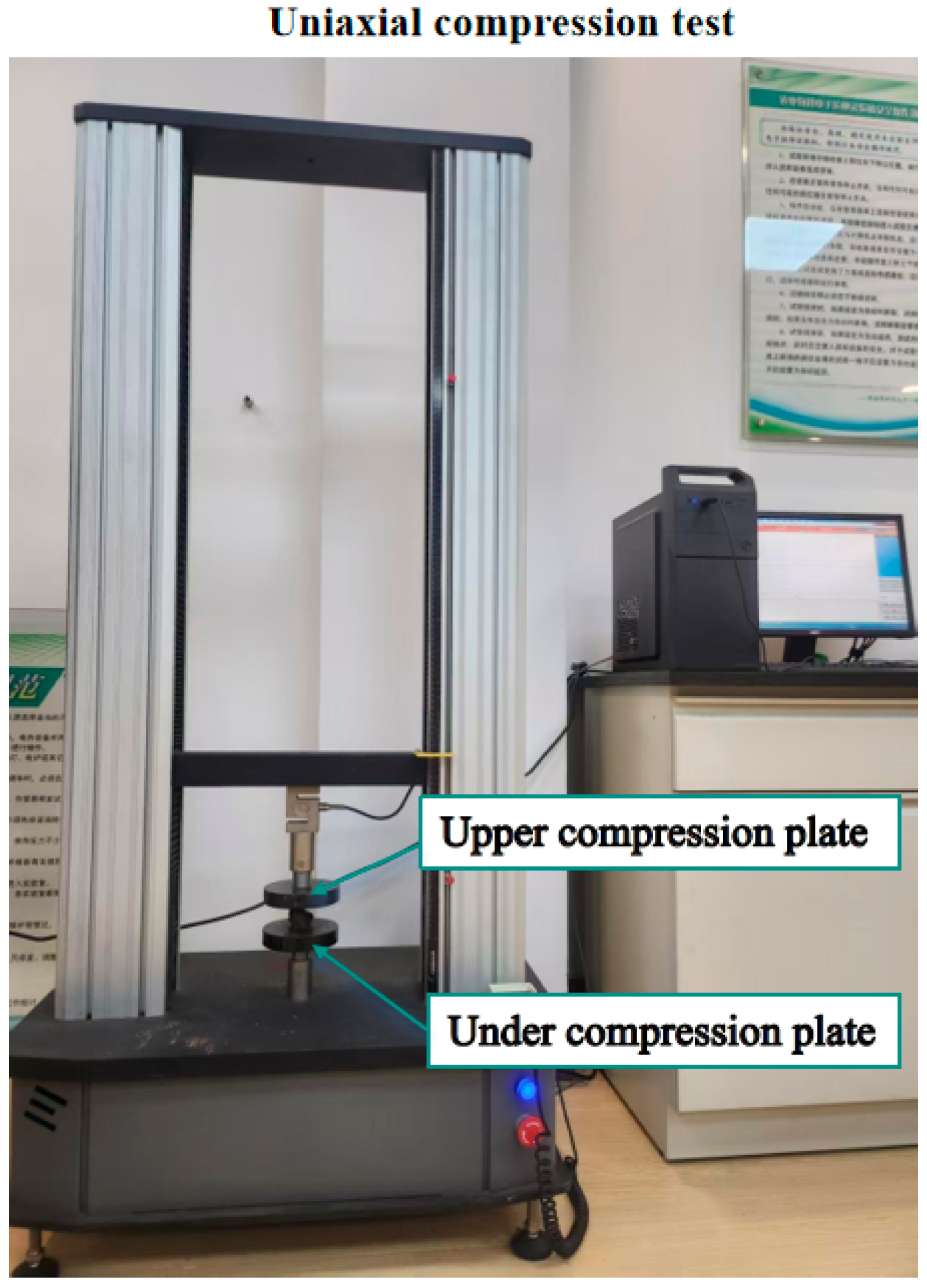
After completing the 3D geometric model establishment and selecting the representative standard lump, it was necessary to obtain the failure mechanical response of the caked lump with this specific geometric form through a uniaxial compression test, providing a benchmark for the calibration of the Bonding model parameters. This test was conducted using a Tinius Olsen 1ST series benchtop universal testing machine. The loading end of the machine was a standard disk platen, and the test object was the representative caked lump (sample B). The test process is shown in Figure 8.
The test was conducted in a constant temperature indoor environment of 23–25 °C. The representative caked lump (sample B) was placed smoothly on the center of the upper compression plate. The upper compression plate was controlled to descend slowly until it was positioned approximately 3 mm above the highest convex surface of the sample. The compression centering was carefully calibrated to avoid eccentric load interference. During formal loading, the host computer software controlled the upper compression plate to press down vertically at a constant rate of 0.5 mm/min.
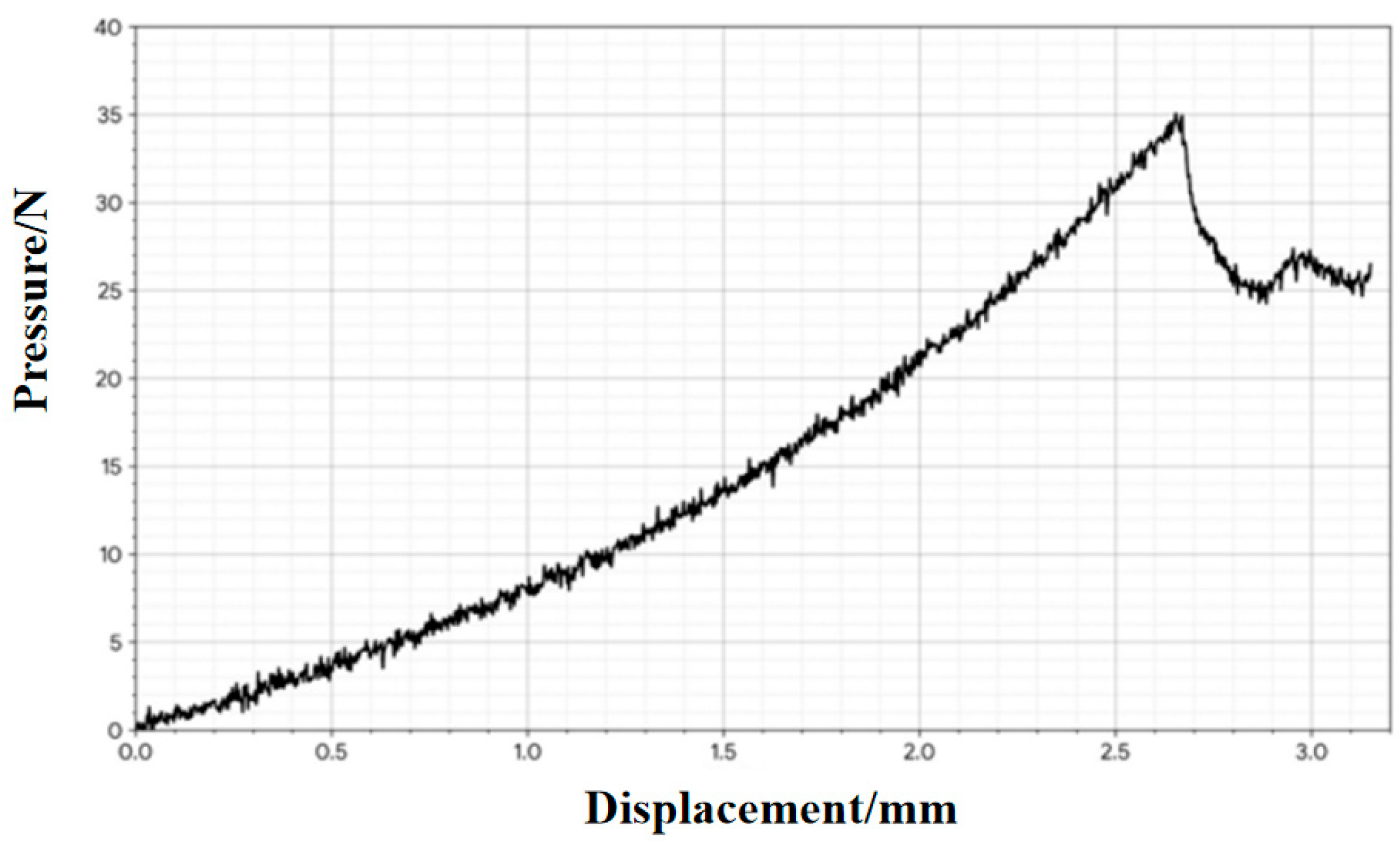
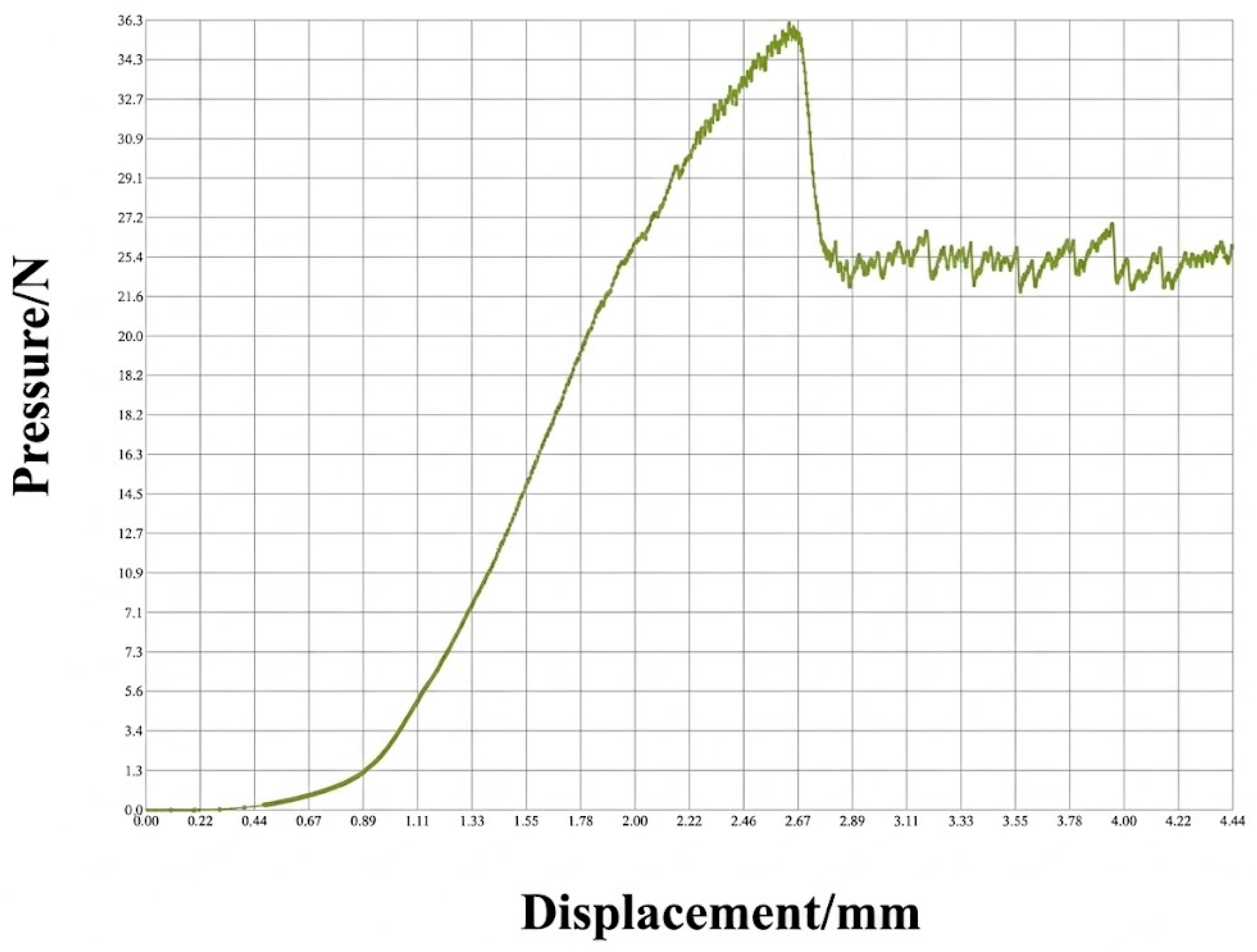
The data from the uniaxial compression test are shown in Figure 9. In the initial stage of compression, the pressure head gradually compacted the minor uneven areas on the surface of the caked lump. As the load continued to be applied, the internal stress in the sample gradually accumulated, and the deformation exhibited an approximately linear elastic growth stage. When the stress reached the material’s bearing limit, the sample fractured. At this moment, the load value monitored by the software dropped sharply, indicating that the sample structure had failed. The testing machine automatically recorded and plotted the displacement–pressure characteristic curve in real time through the backend. After the test, the ultimate displacement during the linear elastic deformation stage and the ultimate peak failure load at the moment of specimen disintegration were captured and extracted from the curve. This set of data would become the core calibration indicators for deriving various parameters of the caked organic fertilizer in the subsequent discrete element simulations.

2.2. Discrete Element Contact Model and Coarse-Graining Theory

The discrete element method (DEM) is an effective method for simulating the macroscopic mechanical behavior of discrete materials. This method is based on a Lagrangian coordinate system and predicts the overall dynamic behavior by tracking the motion of each individual particle in the system and their interactions. In this study, EDEM 2022 was used for all numerical simulations.

2.2.1. Particle Contact Model

In the DEM framework, the motion of each particle follows Newton’s second law. Its translation and rotation are described by Equations (8) and (9):
m i d v i d t = j = 1 k F n , i j + F t , i j + m i g
I i d w i d t = j = 1 k T i j + M i j
where m i is the mass of particle i, kg; I i is the moment of inertia of particle i, kg·m2; v i is the linear velocity of particle i, m/s; w i is the angular velocity of particle i, rad/s; F n , i j is the normal contact force acting on particle i by particle j, N; F t , i j is the tangential contact force acting on particle i by particle j, N; g is the gravitational acceleration, m/s2; T i j is the sum of tangential torques, N·m; M i j is the rolling friction torque, N·m; and k is the total number of particles in contact with particle i.
Contact force is the core of DEM calculations. Considering that the organic fertilizer powder possesses significant surface adhesion energy, this study selected the Johnson–Kendall–Roberts (JKR) contact model [23]. This model shows superior applicability in handling wet particle and cohesive powder flow [24,25]. Based on the standard Hertz–Mindlin theory, this model introduces the J.K.R. (Johnson–Kendall–Roberts) theory to describe the surface adhesion effects caused by van der Waals forces.
The normal force Fn consists of a spring force from the Hertzian contact theory and a damping force. For the JKR model, the normal force FJKR is calculated as:
F J K R = 4 E * a 3 3 R * 8 π E * γ a 3
where E * is the equivalent Young’s modulus, Pa; R * is the equivalent radius, m; a is the contact radius, m; and γ is the surface energy between particles, J.
Surface energy is a key parameter characterizing the magnitude of the adhesion force. The relationship between the contact radius a and the normal overlap δ n is given by
δ n = a 2 R * 2 π γ a E *
Unlike non-cohesive models, when particles begin to separate, the JKR model exhibits a certain bonding force. Its theoretical maximum pull-off force is given by:
F p u l l o f f = 3 2 π R * γ
The tangential force Ft is calculated based on the Mindlin–Deresiewicz theory. Its magnitude depends on the tangential overlap δ t and the tangential stiffness St. Meanwhile, the tangential force is limited by the Coulomb friction law, i.e., F t μ s F n , where μ s is the coefficient of static friction.

2.2.2. Caking Bonding Model

To simulate the process of caked organic fertilizer breaking under force in the discrete element method, this study selected the Hertz–Mindlin with Bonding contact model in EDEM. This model allows the creation of virtual bonding beams (bonds) between contacting discrete particles. These virtual beams can withstand and transmit normal tension and compression, tangential shear, as well as bending and torsional moments. When the local stress transmitted between particles exceeds the set critical threshold, the bond undergoes irreversible physical fracture, and the contact point degrades into the standard Hertz–Mindlin frictional collision model, thereby perfectly realizing the entire process from “solid consolidation” to “discrete fragmentation” during the simulation.
The micromechanical behavior of the Bonding model is governed by five core parameters: normal stiffness Sn and shear stiffness St, normal critical stress σ x and shear critical stress τ x , and bonded radius Rb. Among them, the bonded radius characterizes the effective range of the virtual beam, and in engineering practice, it is typically set to 1.2 times the particle radius. In this study, Rb = 1.2 × 1 mm = 1.2 mm, which is treated as a constant in the experiment. The remaining four parameters need to be calibrated through tests.

2.2.3. Coarse-Graining Modeling Scheme and Equivalent Particle Size Selection

According to the measurement results in Section 2.1.2, the average true particle size of the organic fertilizer powder was 0.147 mm. If the simulation were conducted using the true particle size, the total number of particles required would reach an extremely high order of magnitude, which is infeasible under current computational conditions. Therefore, this study adopted the coarse-graining (CG) modeling method. The core idea of this method is to use a larger-sized, parameter-calibrated “equivalent particle” to represent a collection of many real fine particles, thereby significantly reducing the total number of particles required for the simulation and lowering the computational cost, while ensuring that the macroscopic mechanical behavior of the system (such as flowability and packing characteristics) remains unchanged [16].
Considering both computational efficiency and simulation accuracy, 2 mm was determined as the diameter of the equivalent particle in this study [14,16]. The selection of this size followed the characteristic size principle of DEM simulation. According to the three-dimensional model of the fertilizer discharge device, the minimum dimension of the key geometric feature of the discharge outlet is approximately 36 mm. The ratio of the selected 2 mm particle size to Lmin is approximately 18:1, which falls within a reasonable range. This ensures that there are sufficient particles to analyze the flow behavior in critical regions, thereby avoiding simulation distortion caused by scale effects.
For the coarse-grained equivalent particles, their contact parameters (such as the coefficient of static friction, surface energy, coefficient of rolling friction, etc.) are no longer the true physical properties of the material, but rather integrated equivalent parameters. Their values must be recalibrated by comparing them with macroscopic physical experiment results. The core task of this study is to establish a discrete element model that can accurately describe the flow behavior of powdered organic fertilizer particles, and through systematic simulation tests, to calibrate the DEM contact parameters that can precisely reproduce the physical experiment.

2.3. Selection and Range Determination of Simulation Parameters

Parameter calibration is a key step in DEM simulation [26]. Targeting the physical characteristics of the coexistence of powdered organic fertilizer and caked lumps in organic fertilizer, this study constructed a progressive parameter calibration system. First, for the powdered organic fertilizer, this study adopted the systematic calibration strategy recommended by Coetzee [13], combined with a PB design for parameter screening, and utilized a BBD design to construct a response surface model [27]. This method has been widely validated in the calibration of soil and organic fertilizer. The calibration process includes four stages: determining the parameter range, screening significant parameters, determining the optimal interval, and response surface optimization [28]. Subsequently, based on the fixed parameters for the loose granular powder, the bond parameters were calibrated for the established caked organic fertilizer model. The overall logic follows the statistical optimization path of “parameter screening–interval approaching–numerical optimization,” aiming to ensure that the discrete element model can accurately predict the complex dynamic behavior of materials containing caked lumps.

2.3.1. Selection of Simulation Parameters and Range Determination

DEM simulation parameters are divided into two categories: material intrinsic parameters and contact model parameters. Based on the physical experiment measurement results in Section 2, the material intrinsic parameters were set as fixed values and did not participate in the subsequent parameter calibration, as shown in Table 1.
Since directly applying microscopic measurement values can lead to distortion of the macroscopic simulation results of the coarse-grained model, they must be recalibrated [13]. According to the relevant literature on DEM studies of biomass, soil, and other cohesive powders [21,29], this study selected seven key contact parameters for calibration: the fertilizer–fertilizer coefficient of static friction, the fertilizer–fertilizer coefficient of rolling friction, the fertilizer–fertilizer coefficient of restitution, the fertilizer–steel coefficient of static friction, the fertilizer–steel coefficient of rolling friction, the fertilizer–steel coefficient of restitution, and JKR surface energy. The initial value range for each parameter was determined based on empirical values from the literature.

2.3.2. Design of Calibration Experiment for Powdered Organic Fertilizer

Not all contact parameters and contact model parameters have a significant influence on the angle of repose [30]. Parameters without significant influence cannot be calibrated based on the angle of repose; otherwise, the calibrated parameters would be inaccurate [31]. Therefore, for the loose granular model, this study designed a three-stage optimization calibration scheme:
(1) PB significance screening test: The PB test is an efficient method for screening significant factors. It can evaluate the main effects of each parameter with the fewest number of experimental runs, thereby isolating the key influencing factors. Using the angle of repose as the evaluation index, this study designed 12 groups of PB simulation tests, selecting the high (+1) and low (−1) levels of the seven factors shown in Table 2 for screening calculations.
To quickly screen out the key parameters with the most significant influence on the angle of repose from the above seven parameters, this study employed a PB test design. The test used the angle of repose as the response value [32], and ultimately, through analysis of variance, the key parameters with a highly significant effect on the angle of repose were identified.
(2) Steepest ascent interval location test: Based on the ANOVA results of the PB test, the key factors with a significant effect on the angle of repose were screened out. To quickly approach the optimal value region of these key factors, a steepest ascent test was designed. In this test, the significant parameters were gradually increased or decreased according to the sign of their main effects and with a set step size; the non-significant parameters were fixed at the central level (0 level) of the PB test. By comparing the relative error between the simulated angle of repose and the physical test target value (33.29°) at different ascent steps, the center point for subsequent quadratic optimization was determined.
(3) Box–Behnken Design (BBD) response surface optimization: After the steepest ascent test determined the optimal parameter interval, the Box–Behnken Design (BBD) was selected for a three-factor, three-level experiment to further explore the interaction coupling effects among the significant factors and obtain precise numerical solutions. Based on the effective interval identified in the earlier stage, the coded and actual level values of the significant parameters were determined. In this stage, a second-order multiple regression mathematical model was established, and the optimal combination of contact parameters for the coarse-grained powdered organic fertilizer was finally obtained.

2.3.3. Design of Parameter Calibration Experiment for Caked Organic Fertilizer

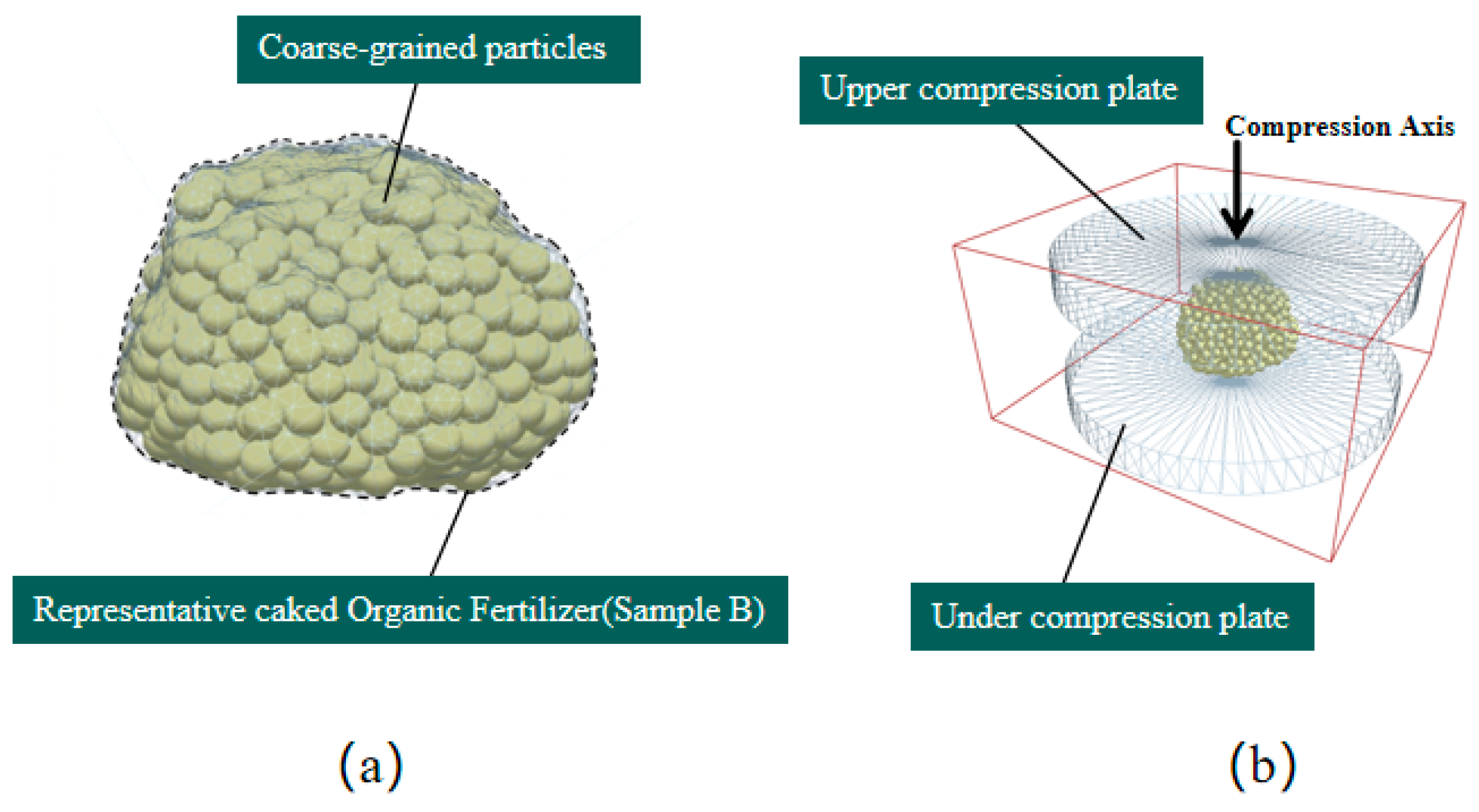
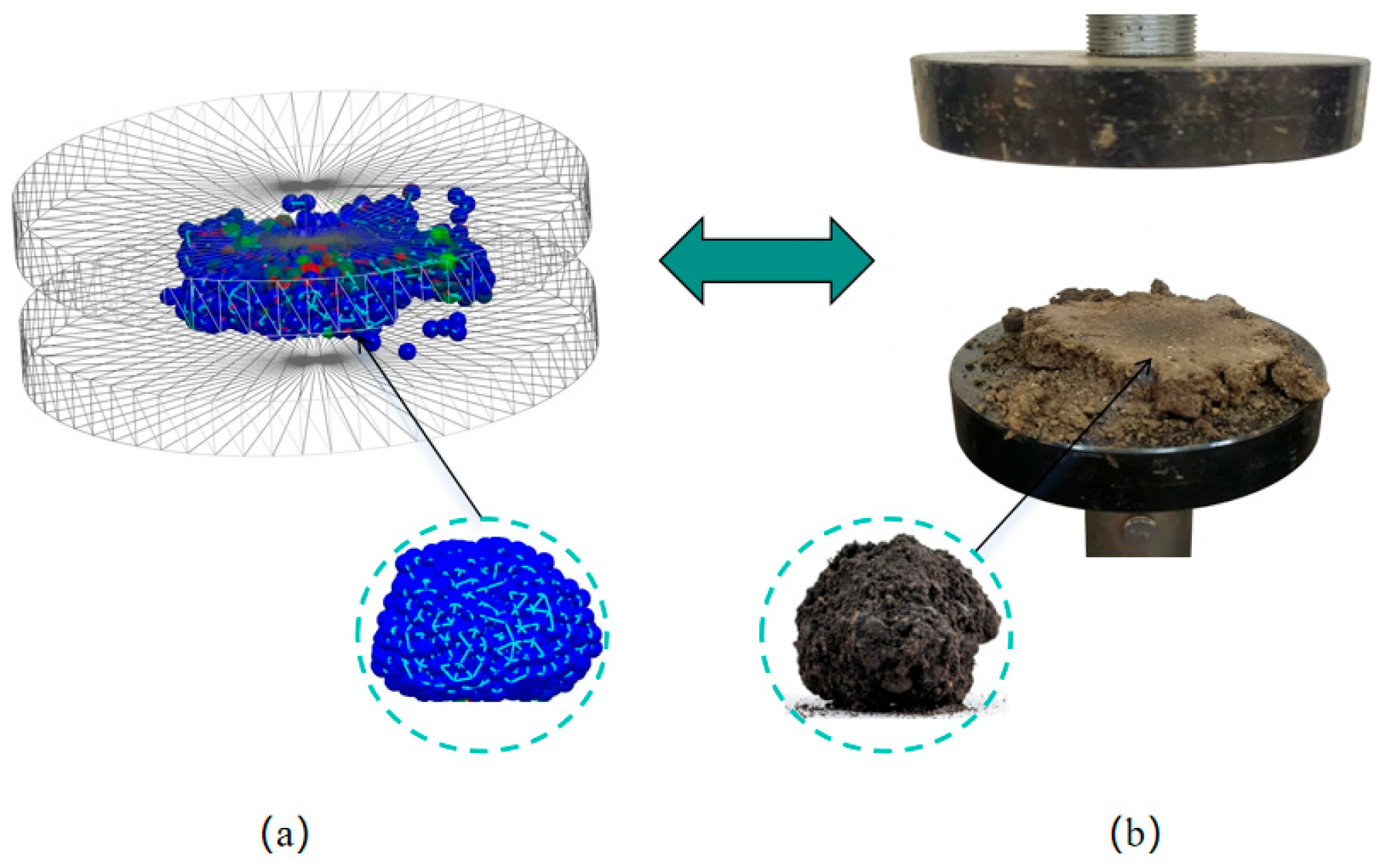
In EDEM, the STL model of the representative caked lump (sample B) constructed from the previous 3D scanning was imported as the particle generation container. It was completely filled with the calibrated 2 mm equivalent particles. After the particle system reached a static equilibrium, virtual bonds were generated between all contacting particles. Subsequently, two rigid compression plates were established, with the lower plate fixed and the upper plate moving downward at exactly the same constant rate as in the physical test, performing a uniaxial compression on the virtual fertilizer lump as shown in Figure 10, while outputting the load–displacement curve in real time.
A Central Composite Design (CCD) scheme was adopted to establish the virtual compression test. Normal stiffness (x1), shear stiffness (x2), normal critical stress (x3), and shear critical stress (x4) were set as experimental factors. Based on references and the effective parameter ranges determined from preliminary tests [33,34,35,36], each factor was set at five levels (−2, −1, 0, +1, +2), as shown in Table 3.
The simulation in this phase used the ultimate failure load (34.9 N) and ultimate failure displacement (2.60 mm) measured from the physical uniaxial compression test in Section 2.1.5 as the dual-objective evaluation indicators. By running 30 groups of CCD simulation tests and recording the force–displacement data at the moment of model disintegration, multiple regression analysis was employed to reveal the influence law of the microscopic bonding parameters on the macroscopic crushing strength of the caked lump, thereby inversely determining the optimal calibration values of the bonding parameters.

2.4. Application and Validation Methods of the Discharge Device

2.4.1. Virtual Simulation Optimization of the Fertilizer Discharge Device

To further verify the practicality of the established discrete element model of powdered organic fertilizer containing caked lumps in the design of an actual fertilizer discharge device, this study applied the calibrated parameters to the parameter optimization simulation of the organic fertilizer discharge device. This application aimed not only to verify the stability of the model under complex mechanical operating conditions, but more importantly, to provide a theoretical reference for the optimal design of the anti-blocking device by simulating the state of the particles during device operation.
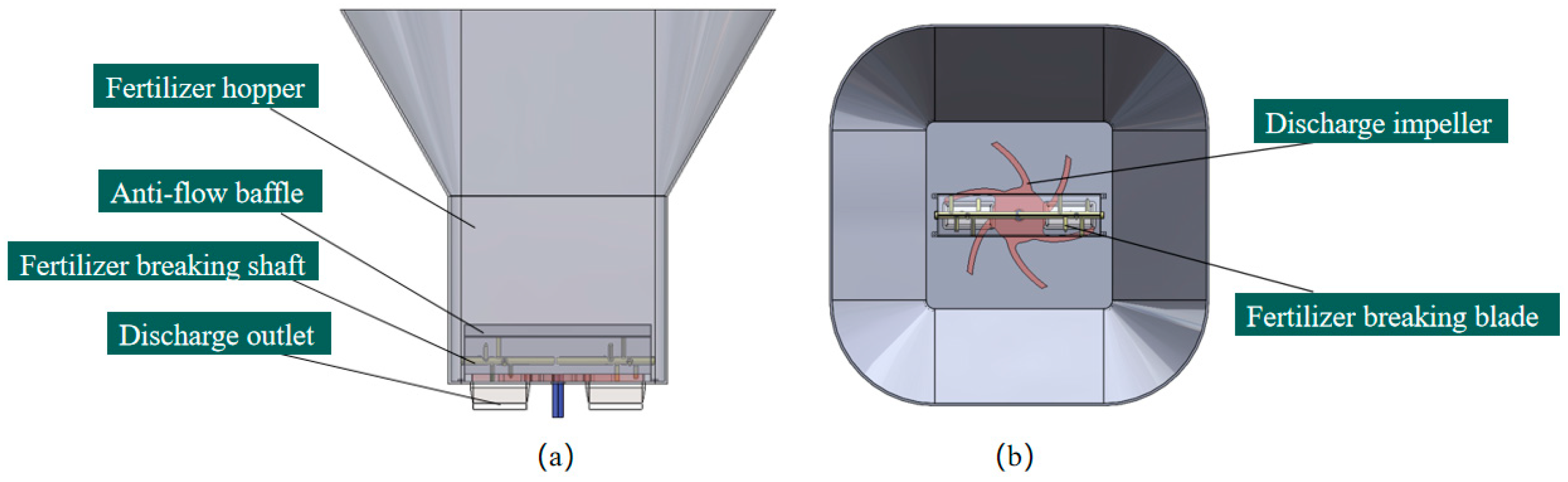
The structure of the fertilizer discharge device is shown in Figure 11, with the core working components retained; non-critical geometric features such as chamfers, external support brackets, and fastening bolts were eliminated. The simplified assembly was imported into EDEM 2022 software in STEP format. Two virtual particle factories were set up above the fertilizer hopper. According to the mass ratio of loose powder to caked lumps measured by the physical test (8:2), powdered organic fertilizer and caked lumps were dynamically generated simultaneously. After the generation phase ended, the system was left to settle for 0.5 s, allowing the material to settle naturally and compact under gravity, forming a mixed particle bed within the fertilizer hopper of the fertilizer discharge device.
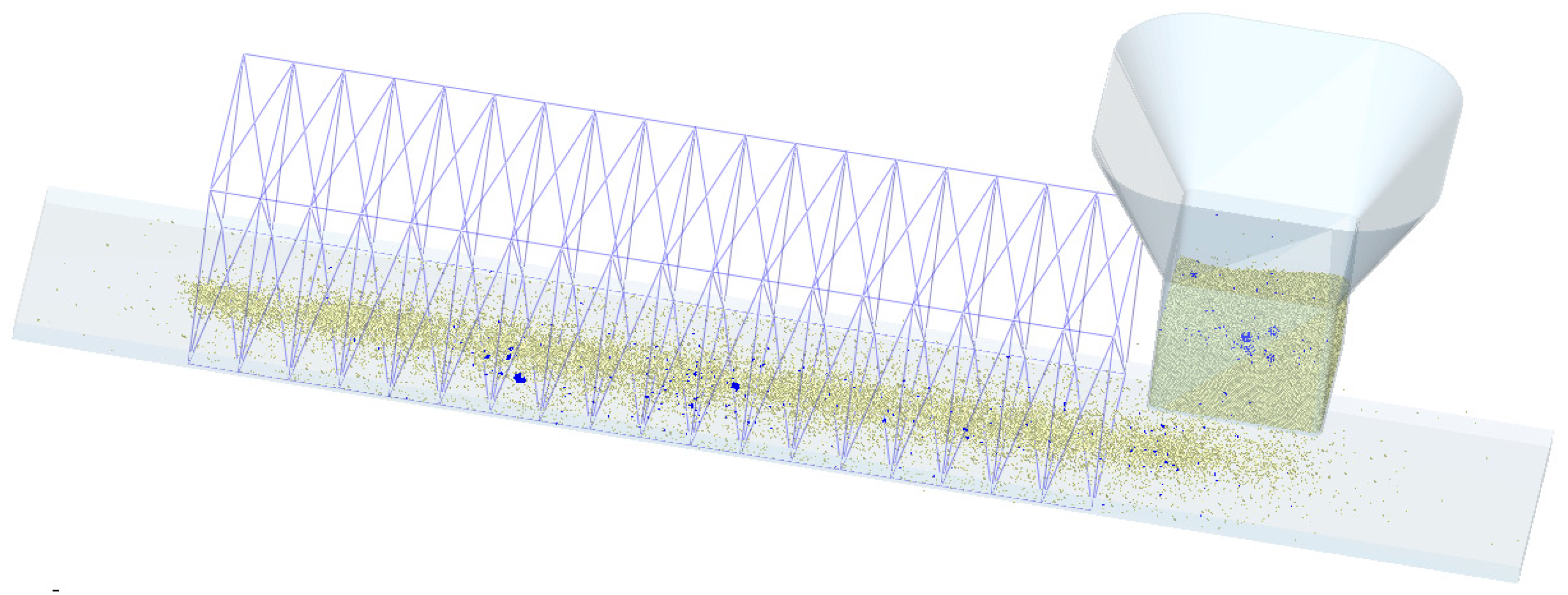
Using the coefficient of variation (CV) of fertilizer discharge uniformity as the core evaluation indicator, a three-factor, three-level response surface optimization test based on the Box–Behnken Design was conducted. The test process is shown in Figure 12, and the optimal parameter combination was obtained through optimization.

2.4.2. Verification of Banding Fertilizer Discharge Uniformity Test

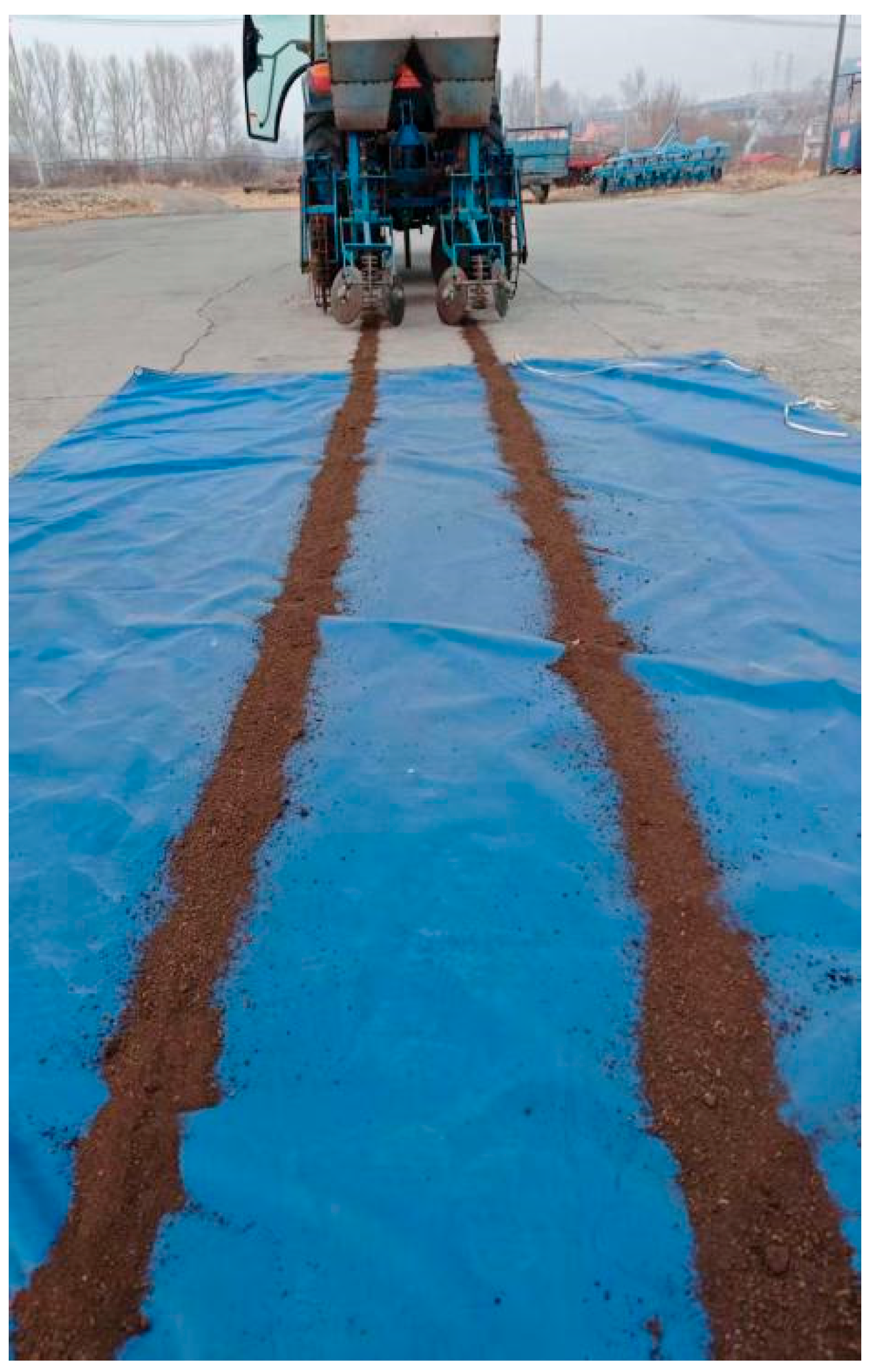
To further validate the accuracy and feasibility of the discrete element model and the simulation optimization results, a physical prototype of the anti-blocking fertilizer dis-charge device was fabricated based on the optimal structural parameters determined by EDEM simulation. Subsequently, a performance test evaluating the uniformity of strip fertilization was conducted at Xiangyang Farm of Northeast Agricultural University in November 2025. The experimental procedure is illustrated in Figure 13.
The test used the 26% moisture content powdered organic fertilizer from this study, which had the poorest flowability and tended to form caked lumps, as the test material. A Dongfanghong 604 tractor (YTO Group Corporation, Luoyang, China) with a three-point hitch driven fertilizer applicator was used.

3. Results and Discussion

3.1. Calibration Results for Powdered Organic Fertilizer

Significant parameter screening: Through the Plackett–Burman (PB) test, the significance of seven contact parameters affecting the flowability of the powdered organic fertilizer was evaluated. The test results are shown in Table 4.
Analysis of variance (ANOVA) provided the basis for judging the significance of the parameters. The p-value is the core indicator for determining significance; when the p-value < 0.0001, the factor is generally considered to have a statistically highly significant effect. Using the Design Expert software, an analysis of variance was performed on the experimental results, and the ANOVA for the seven parameters is shown in Table 5. Among them, the parameters with a significant influence on the angle of repose included: the fertilizer–fertilizer coefficient of rolling friction (C), the fertilizer–steel coefficient of rolling friction (D), and the JKR surface energy (G). The remaining parameters had no significant influence.
Steepest ascent interval location: After identifying the JKR surface energy (G), the fertilizer–fertilizer coefficient of rolling friction (C), and the fertilizer–steel coefficient of rolling friction (D) as the significant factors, a steepest ascent test was designed to quickly and efficiently determine the optimal parameter interval for the response surface method optimization test. Based on the PB test results, only the three significant parameters were gradually increased with a selected step size in this test, while the remaining parameters (fertilizer–fertilizer coefficient of restitution, fertilizer–fertilizer coefficient of static friction) were set to their intermediate levels. The relative error between the simulated angle of repose of the organic fertilizer and the actual angle of repose was calculated. The test scheme is shown in Table 6.
As the parameters increased, the angle of repose rose continuously, while the relative error first decreased and then increased. The optimal region was located within the parameter space covered by the fourth, fifth, and sixth groups of tests. Therefore, the parameter ranges selected for the fourth, fifth, and sixth groups were chosen for the response surface analysis test to establish a regression model and solve for the optimal values of the significant material parameters.
Response surface method optimization. To further explore the interactions among the significant factors and obtain precise numerical solutions, this section employed the Box–Behnken Design (BBD) in the Design-Expert 13 software (Stat-Ease, Inc., Minneapolis, MN, USA) to conduct a three-factor, three-level experiment. Based on the effective interval identified by the steepest ascent test, the fifth group of parameters was taken as the center level (0), while the fourth and sixth groups of parameters were used as the low level (−1) and high level (+1), respectively. The three determined experimental factors and their coded levels are shown in Table 7.
Using the BBD design principle, a total of 17 experimental schemes were generated. Simulations were carried out in the EDEM software according to the parameter settings of each group, and the angle of repose was measured after the particle pile stabilized. With the physically measured 33.29° as the target value, the simulation results are shown in Table 8.
Utilizing the Design-Expert software, a quadratic multiple regression fitting was performed on the experimental data, establishing a mathematical model between the angle of repose Y and the three significant parameters (fertilizer–fertilizer coefficient of rolling friction C, fertilizer–steel coefficient of rolling friction D, and JKR surface energy G). The regression equation is as follows:
Y = 33.60 + 1.84C + 1.17D + 1.37G + 0.49CD + 0.32CG − 0.06DG − 0.96C2 − 0.41D2 − 0.57G2
To verify the reliability and goodness of fit of this model, a detailed analysis of variance (ANOVA) was conducted, and the results are shown in Table 9.
The F-value of the overall model was 462.8, with a p-value < 0.0001, indicating that the regression model is statistically highly significant and can adequately reflect the influence of each parameter on the angle of repose. Among them, the p-values of the single-factor terms C, D, and G were all less than 0.0001, indicating that the main effects of all three parameters are highly significant on the angle of repose, with the order of influence being C > G > D. This mainly stems from the specific physical properties of the powdered organic fertilizer. The powdered organic fertilizer particles used in this study actually possess a certain degree of irregular shape characteristics, but in the discrete element simulation, substituting spherical particles for real irregular particles eliminates the geometric interlocking effect caused by shape irregularity, resulting in the simulated particles being more flowable than the actual particles. To address this, the coefficient of rolling friction is introduced to physically compensate for this geometric deficiency. Essentially, it applies a resisting moment at the contact point in the direction opposite to the particles’ relative rolling tendency. A larger rolling friction coefficient results in a greater resisting torque, thereby providing stronger resistance to particle rotation and decreasing the overall flowability of the particle assembly. This restrictive moment macroscopically compensates for the loss of geometric interlocking caused by shape simplification, thereby effectively restricting excessive particle rotation and accurately reproducing the actual material’s angle of repose and accumulation characteristics.
Secondly, because the moisture content of the powdered organic fertilizer used in this study was 26%, the high moisture content easily led to the formation of liquid bridges between particles, thereby generating microscopic adhesion forces. In this context, JKR surface energy, as a key parameter characterizing the adhesion properties, directly determines the bonding strength between particles. The ANOVA results showed that the interaction terms CG and CD were significant, indicating a clear coupling effect between the fertilizer–fertilizer rolling friction and surface energy and between the fertilizer–fertilizer and fertilizer–steel rolling friction coefficients. Among them, the significance of the CG term reveals that during the formation of the angle of repose, the macroscopic flow and packing behavior of the organic fertilizer is the result of the combined action of motion resistance caused by particle shape (characterized by the rolling friction coefficient) and microscopic adhesion induced by moisture (characterized by JKR surface energy). In contrast, the p-value of the DG term was 0.3238, indicating no significant interaction between the steel friction and surface energy. Furthermore, the quadratic terms C2, D2, and G2 were all highly significant, verifying the existence of a complex nonlinear surface relationship between the angle of repose and each parameter, rather than simple linear superposition. This further confirms the necessity and scientific validity of using the response surface method for numerical optimization. Fitting statistics: The lack-of-fit p-value of the model was 0.2900, indicating non-significance. The coefficient of determination R2 was 0.9983 and the adjusted R2adj was 0.9961, indicating that the model can explain over 99.8% of the variation in the response value, with high prediction accuracy, and can be used for the subsequent search for optimal parameters.
With the physically measured angle of repose of 33.29° as the target value, the regression equation was solved within the required parameter range, yielding the optimal values for the three parameters: the fertilizer–fertilizer coefficient of rolling friction (C) = 0.246, the fertilizer–steel coefficient of rolling friction (D) = 0.160, and the JKR surface energy (G) = 0.787 J/m2. Compared to typical agricultural granular materials (such as maize seeds or dry biomass), the calibrated fertilizer–fertilizer rolling friction coefficient (0.246) is notably higher. This quantitatively reflects the highly irregular shape and rough surface texture of the powdered organic fertilizer. Furthermore, the calibrated JKR surface energy (0.787 J/m2) is also higher than that of other granular materials, highlighting the strong liquid bridge forces generated at the 26% moisture content level. This analytical comparison explains the fundamental physical mechanism behind the fertilizer’s poor flowability and its severe tendency to bridge.
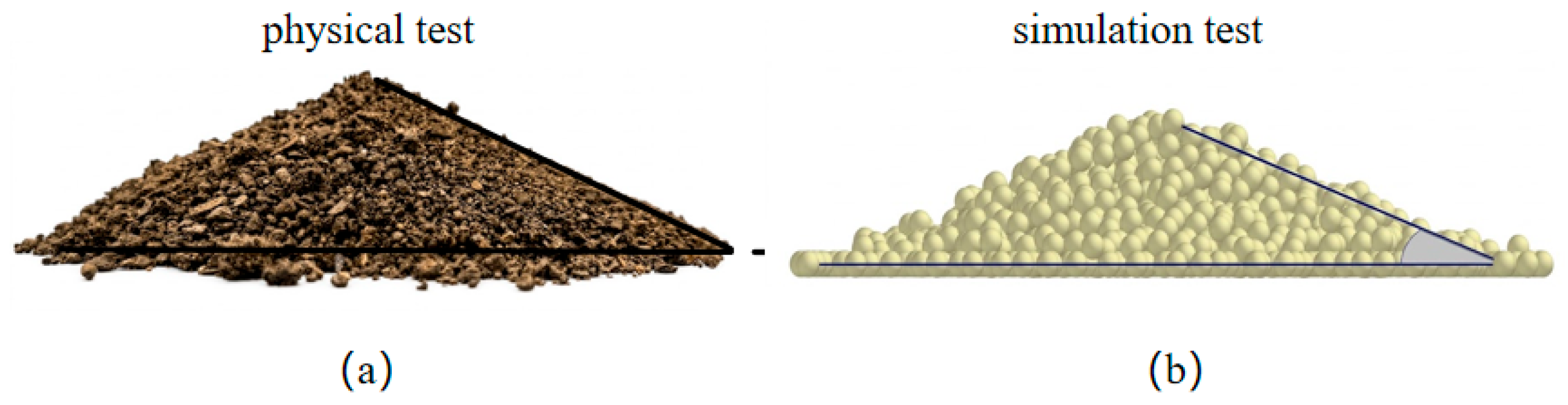
Validation Test for the Angle of Repose of Powdered Organic Fertilizer: To verify the reliability of the optimized parameters, the above parameters were input into the EDEM software to conduct three repeated simulation tests, with the remaining parameters set to their intermediate values. The simulation results showed that the average angle of repose of the generated pile was 33.35°. Compared with the physical test value (33.29°), the absolute error was only 0.06°, and the relative error was 0.18%. This error is extremely small. The comparison between the simulation test and the physical test is shown in Figure 14; the pile morphology was highly consistent with the physical test, proving that the discrete element model established based on the coarse-graining strategy and its calibrated parameters possess extremely high accuracy.

3.2. Calibration Results for Bonding Parameters of Caked Organic Fertilizer

3.2.1. CCD Test Results for the Bonding Model

Based on the determined particle parameters, a Central Composite Design (CCD) test was conducted for the bonding parameters of the caked organic fertilizer. According to the effective parameter ranges determined by preliminary tests, the center point (0 level) for each factor was set. The CCD design includes five levels: −2, −1, 0, +1, +2. The correspondence between the coded and actual physical values of each factor is shown in Table 3.
Using Design-Expert software, a total of 30 experimental schemes were generated. A virtual compression test platform was established in EDEM, and simulations were carried out sequentially according to the scheme, recording the force and displacement data at the moment of breakage. The results are shown in Table 10.

3.2.2. Establishment and Discussion of the Regression Model

Multiple regression analysis was performed on the experimental data in Table 10 using Design-Expert software to establish quadratic polynomial regression models between the two response indicators and the coded values of the four microscopic parameters. The regression equations for ultimate load (Y1) and ultimate displacement (Y2) are as follows:
Y1 = 34.66 + 0.35x1 + 0.27x2 + 8.50x3 + 5.40x4 + 1.14x3 x4 + 0.52x32 + 0.19x42
Y2 = 2.64 − 0.66x1 − 0.15x2 + 0.44x3 + 0.11x4 − 0.12x1 x3 + 0.08x12
To deeply analyze the contribution of each microscopic parameter to the macroscopic response, Table 11 and Table 12 list the detailed ANOVA results for ultimate load (Y1) and ultimate displacement (Y2), respectively.
Analysis of variance (ANOVA) was performed on ultimate load (Y1). The results showed that the model F-value was 1255.92 with a p-value less than 0.0001, indicating that the model is highly significant. As shown in Table 11, normal critical stress (x3) and shear critical stress (x4) are the decisive factors determining the compressive strength of the fertilizer lump. Macroscopically, ultimate load (Y1) corresponds to the highest peak point on the force–displacement curve in the physical uniaxial compression test, which marks the crushing of the material. In the Bonding model, normal critical stress (x3) and shear critical stress (x4) directly define the ultimate failure threshold that a single virtual bond can withstand. Therefore, the magnitudes of these two parameters determine the upper limit of the macroscopic load-bearing capacity of the caked organic fertilizer, making them the decisive factors influencing Y1.
During the uniaxial compression process, due to the existence of internal pores within the irregular caked lump and the material properties, the relative displacement between particles not only generates normal compression along the loading direction but also causes lateral sliding between particles. This indicates that the macroscopic crushing of the caked lump is not caused by a single force, but is the result of the combined action of normal tensile fracture and tangential shear slip at the microscopic level. The extremely high significance of the interaction term x3 x4 reflects the complex stress state during the actual compression process of the caked lump, where there is a coupling mechanism between normal tensile fracture and tangential shear slip, which together determine the crushing threshold of the fertilizer lump.
As shown in Table 12, normal stiffness (x1) has the largest negative contribution to the ultimate displacement. In terms of physical mechanism, normal stiffness represents the ability of the virtual bond to resist elastic deformation: the greater the stiffness, the higher the force required for unit displacement between particles, resulting in a smaller accumulated deformation of the fertilizer lump before it reaches its strength limit. This indicates that normal stiffness directly determines the brittleness of the caked organic fertilizer. The larger the stiffness parameter, the more obvious the small-deformation characteristic of the hard caked lump appears in the simulation model. At the same time, normal critical stress (x3) and shear critical stress (x4) also exhibited significant effects. This is because, under a given stiffness, higher stress limits prolong the linear elastic loading stage of the virtual bond, enabling the fertilizer lump to withstand a longer duration of compression before final disintegration, thereby increasing the ultimate displacement at the moment of fracture.

3.2.3. Multi-Objective Optimization and Experimental Verification

The goal of multi-objective parameter optimization was to ensure that the simulation model could reproduce the real mechanical properties of the fertilizer lump in both the “strength” and “stiffness” dimensions. Using the Numerical Optimization module of Design-Expert, the objective functions were set as follows: Objective 1 (ultimate load Y1): target value set to 34.9 N, weight of 1. Objective 2 (ultimate displacement Y2): target value set to 2.60 mm, weight of 1. Constraint condition: all factor values were within the range of [−2, 2].
The optimization solution yielded a set of optimal calibration values for the Bonding model: normal stiffness (Sn) = 2.01 × 10⁸ N/m3, shear stiffness (St) = 0.99 × 10⁸ N/m3, normal critical stress ( σ x ) = 1.94 × 10⁶ Pa, and shear critical stress ( τ x ) = 1.69 × 10⁶ Pa.
When compared to traditional rock mechanics or concrete DEM simulations, the calibrated normal critical stress and shear critical stress for the caked organic fertilizer are orders of magnitude lower, yet they remain significantly higher than the yield stress of loose agricultural powders. This intermediate mechanical state confirms the necessity and advantage of the Bonding model over a single JKR model: it successfully captures the brittle fracture characteristics of the hard outer shell formed by mechanical compaction and hygroscopic binding. However, it must be emphasized that these micromechanical parameters are highly sensitive to moisture variations. As moisture changes, the internal pore structure and liquid bridge network of the lumps will alter drastically. Consequently, the transferability of these specific calibrated bonding parameters is strictly limited to powdered organic fertilizers with a 26% moisture content under equivalent compaction conditions. To verify the reliability of this set of parameters, the above parameters were input into the Hertz–Mindlin with Bonding model in EDEM software, while keeping other parameters unchanged. Three repeated tests were conducted, and the data from the three repeated tests were fitted to obtain the curve shown in Figure 15. The validation results showed: the average ultimate load obtained from the simulation was 34.82 N, with a relative error of only 0.23% compared to the physical test value (34.9 N); and the average ultimate displacement was 2.67 mm, with a relative error of 1.54% compared to the physical test value (2.60 mm). As shown in Figure 15, the calibrated simulated force–displacement curve highly overlapped with the physical test curve in both the slope of the linear stage and the peak failure point.
The fragmentation morphology presented in the simulation was consistent with the actual observation, as shown in Figure 16. This indicates that the calibration strategy based on the CCD response surface method effectively solved the problem of the difficulty in determining Bonding model parameters, and the established model possesses extremely high accuracy.

3.3. Validation Results of the Fertilizer Discharge Device

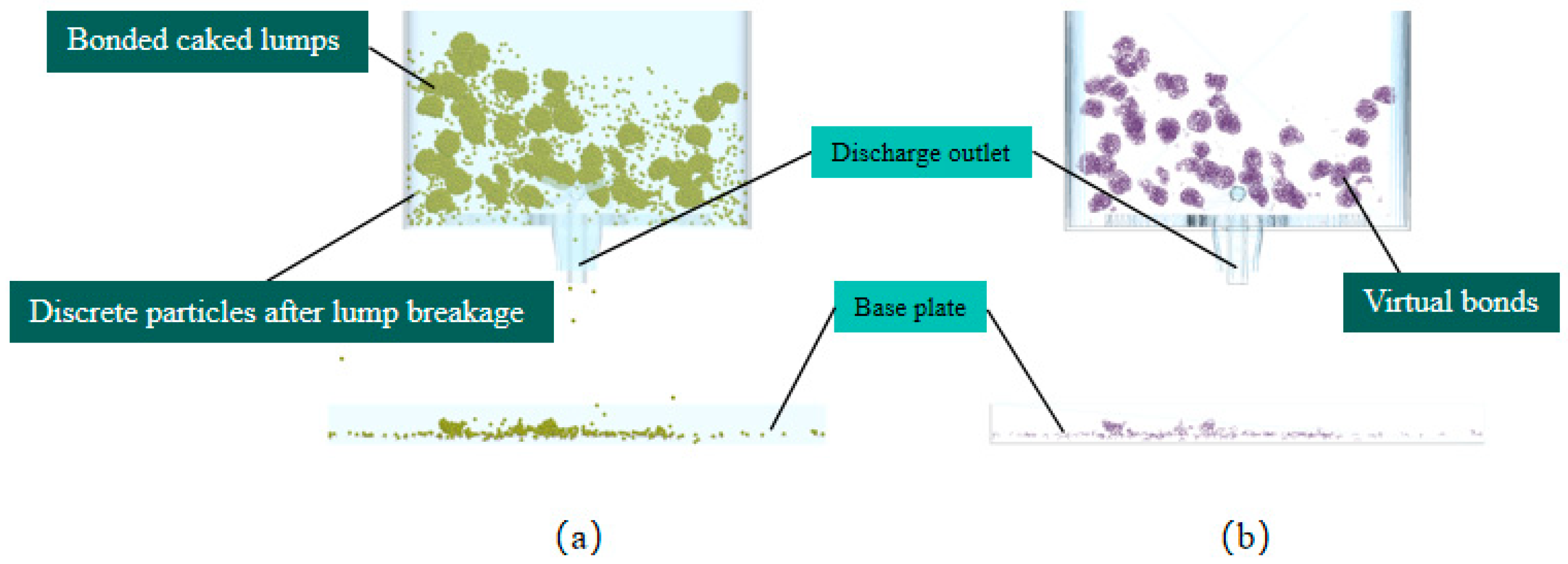
During the simulation test, the model was able to realistically simulate the motion state of the powder particles and caked lumps under the action of the device. Through the post-processing function of the discrete element software, the model enabled the classified observation of particles in different physical states. By hiding the powdered organic fertilizer and retaining only the caked lumps established based on virtual bonds, as shown in Figure 17, the model allowed real-time observation of the stress state, motion trajectory, and bond breakage of the caked organic fertilizer during the working process.
During the performance test, the implement advanced at constant speeds of 5 km/h, 6 km/h, 7 km/h, and 8 km/h, respectively. The coefficient of variation (CV) of fertilizer discharge uniformity was used to evaluate the discharge performance. The test data are shown in Table 13.
The physical test results showed that throughout the entire fertilizer discharge process, the anti-blocking fertilizer discharge device operated smoothly, with no obvious material bridging or blockage at the discharge outlet inside the fertilizer hopper. The caked material was effectively broken up and uniformly discharged along with the loose powder. Moreover, under different forward speeds, the coefficients of variation in fertilizer discharge uniformity were all within the technical requirement range, meeting the operational requirements.

3.4. Limitations of the Study

While the established comprehensive DEM model successfully predicts the macroscopic flow and breakage behavior of the powdered organic fertilizer, certain limitations should be explicitly acknowledged to clearly delimit the applicability of the model:
(1) Homogeneous bonding assumption and artificial lumps: The Hertz–Mindlin with Bonding model assumes perfectly uniform bonding properties between the coarse-grained particles. In reality, actual fertilizer lumps exhibit non-uniform moisture distribution, variable porosity, and heterogeneous internal cohesion. Furthermore, the lumps analyzed in this study were artificially formed under controlled laboratory conditions. Although these standardized samples successfully replicate the macroscopic cohesion and fracture behavior encountered in extreme caking scenarios, their internal microscopic structures may differ from naturally formed lumps. However, for the engineering purpose of optimizing an anti-blocking device, the primary concern is the macroscopic “overall ultimate crushing load” required to break the lump from the outside. By calibrating the ultimate compressive strength of the homogeneous model to match physical test data, the model sufficiently provides a reliable mechanical force limit for device optimization.
(2) Limited sample size and parameter generalizability: Due to the intensive computational and modeling costs associated with 3D scanning, reverse engineering, and DEM bonding parameter calibration, only four representative caked lumps were initially scanned, with one optimal lump selected as the primary baseline model. Consequently, the established model and its calibrated parameters are strictly limited to the specific material batch and controlled experimental conditions (e.g., 26% moisture content) analyzed in this study. Applying this model to other types of organic fertilizers, different moisture levels, or other distribution devices would require systematic recalibration.
(3) Static calibration versus dynamic field conditions: The DEM parameter calibration and structural validation were primarily based on quasi-static laboratory tests. While these tests provide a solid foundation for initial parameter calibration, they cannot fully reproduce the complex dynamic interactions encountered in real-world agricultural operations. Factors such as machine vibrations, variable compaction, fluctuating flow, and irregular terrain may influence the real behavior of the material. Future research should incorporate these dynamic field variables to further enhance the robustness and generalizability of the predictive model.


4. Conclusions

To address the problems of poor flowability, easy caking, and the high computational cost of discrete element simulation for powdered organic fertilizer, this study proposed a DEM parameter calibration method for powdered organic fertilizer and its caked lumps based on the coarse-graining theory. A discrete element model incorporating the characteristics of both “loose granular flow” and “caked lump breakage” was established, featuring high computational efficiency and realistic physical behavior, which can provide a reliable numerical simulation tool for the discharge performance prediction and structural optimization of powdered organic fertilizer application machinery. The main conclusions are as follows:
(1) Establishment of the coarse-grained discrete model: By introducing the JKR contact model combined with the coarse-graining theory, the original powder particles of 0.147 mm were scaled up to equivalent particles of 2 mm. Through the three-stage statistical calibration of Plackett–Burman, steepest ascent, and Box–Behnken designs, the optimal particle contact parameters were determined (particle–particle rolling friction 0.246, particle–steel rolling friction 0.160, JKR surface energy 0.787 J/m2). Validation tests showed that the relative error between the simulated angle of repose (33.35°) and the physical test (33.29°) was only 0.18%, proving that the coarse-grained model can accurately represent the macroscopic flow characteristics of the material.
(2) Establishment of the caked lump breakage model: For the caked organic fertilizer, a discrete element breakage model based on bonds was constructed. A Central Composite Design (CCD) was used to conduct multi-objective calibration of the bonding parameters. Analysis of variance revealed the physical mechanisms that normal critical stress dominates the failure strength, normal stiffness dominates the deformation capacity, and multiple factors exhibit coupling effects. For the specific organic fertilizer batch tested at 26% moisture content, the finally calibrated bond parameters (Sn = 2.01 × 10⁸ N/m3, St = 0.99 × 10⁸ N/m3, σ x = 1.94 × 10⁶ Pa, τ x = 1.69 × 10⁶ Pa) enabled the errors of both the ultimate load and ultimate displacement of the simulation model in the uniaxial compression test to be controlled within 2%.
(3) Engineering application verification of the discrete element model: The calibrated discrete element parameters were applied to the design optimization of the anti-blocking fertilizer discharge device. The simulation and banding uniformity performance test results showed that the optimized anti-blocking device could effectively break up the caked lumps, with no material bridging or blockage at the discharge outlet. Under different operating speeds of 5–8 km/h, the coefficients of variation in fertilizer discharge uniformity all met the actual technical requirements for fertilization. This proves that the discrete element model and its parameter system constructed in this study possess extremely high accuracy and reliability and can serve as an effective numerical tool for the design, development, performance prediction, and structural optimization of anti-blocking fertilizer discharge devices for powdered organic fertilizer.
However, it must be explicitly stated that the specific calibrated parameters obtained in this study are valid exclusively for the specific material, batch, moisture level (26%), and compaction conditions investigated. Applying this discrete element model to other types of organic powdery fertilizers, varying organic matter ratios, or different moisture states will mandate systematic recalibration.

Author Contributions

Writing—original draft, S.Z.; Writing—review and editing, S.Z., S.D. and X.L.; Investigation, S.Z., X.L. and C.J.; Formal analysis, S.Z., X.L. and C.J.; Visualization, Y.Y., S.D. and M.L.; Resources, Y.Y., M.L. and C.J.; Methodology, S.Z., S.D. and X.L.; Validation, X.L., C.J. and M.L.; Project administration, S.Z. and X.L.; Data curation, S.Z. and Y.Y.; Conceptualization, C.J., S.Z. and X.L.; Supervision, Y.Y. All authors have read and agreed to the published version of the manuscript.

Funding

This research was funded by the National Key R&D Program of China, Grant (Project No. 2024YFD1500300).

Institutional Review Board Statement

Not applicable.

Data Availability Statement

The raw data supporting the conclusions of this article will be made available by the authors on request.

Conflicts of Interest

The authors declare no conflicts of interest.

References

  1. Guo, J.H.; Liu, X.J.; Zhang, Y.; Shen, J.L.; Han, W.X.; Zhang, W.F.; Christie, P.; Goulding, K.W.T.; Vitousek, P.M.; Zhang, F.S. Significant Acidification in Major Chinese Croplands. Science 2010, 327, 1008–1010. [Google Scholar] [CrossRef]
  2. Savci, S. Investigation of Effect of Chemical Fertilizers on Environment. APCBEE Procedia 2012, 1, 287–292. [Google Scholar] [CrossRef]
  3. Diacono, M.; Montemurro, F. Long-term effects of organic amendments on soil fertility. Sustain. Agric. 2011, 2, 761–786. [Google Scholar] [CrossRef]
  4. Chen, L.; Xie, H.; Wang, G.; Yuan, L.; Qian, X.; Wang, W.; Xu, Y.; Zhang, W.; Zhang, H.; Liu, L.; et al. Reducing environmental risk by improving crop management practices at high crop yield levels. Field Crop. Res. 2021, 265. [Google Scholar] [CrossRef]
  5. Reganold, J.P.; Wachter, J.M. Organic agriculture in the twenty-first century. Nat. Plants 2016, 2, 15221. [Google Scholar] [CrossRef]
  6. Wu, H.; Wang, L.; Liu, X.; Li, Q.; Lu, C.; Dong, W. Layered-Strip Fertilization Improves Nitrogen Use Efficiency by Enhancing Absorption and Suppressing Loss of Urea Nitrogen. Agronomy 2023, 13, 2428. [Google Scholar] [CrossRef]
  7. You, J.; Wu, P.; Shao, H.; Han, L.; Huang, G. Discrete Element Simulation Calibration and Flowability Study of Organic Manure with Different Moisture Contents. Agriculture 2026, 16, 508. [Google Scholar] [CrossRef]
  8. Song, Z.; Zhang, L.; Lai, H.; Wu, C.; Chen, J. Parameter Optimization of a Double-Screw Trenching-Fertilizing Machine Based on the Discrete Element Method. Agriculture 2026, 16, 548. [Google Scholar] [CrossRef]
  9. Ge, R.; Ghadiri, M.; Bonakdar, T.; Zhou, Z.; Larson, I.; Hapgood, K. Experimental study of the deformation and breakage of 3D printed agglomerates: Effects of packing density and inter-particle bond strength. Powder Technol. 2018, 340, 299–310. [Google Scholar] [CrossRef]
  10. Cundall, P.A.; Strack, O.D.L. A discrete numerical model for granular assemblies. Géotechnique 1979, 29, 47–65. [Google Scholar] [CrossRef]
  11. Boac, J.M.; Casada, M.E.; Maghirang, R.G.; Harner, J.P., III. Material and Interaction Properties of Selected Grains and Oilseeds for Modeling Discrete Particles. Trans. ASABE 2010, 53, 1201–1216. [Google Scholar] [CrossRef]
  12. Horabik, J.; Molenda, M. Parameters and contact models for DEM simulations of agricultural granular materials: A review. Biosyst. Eng. 2016, 147, 206–225. [Google Scholar] [CrossRef]
  13. Coetzee, C. Review: Calibration of the discrete element method. Powder Technol. 2017, 310, 104–142. [Google Scholar] [CrossRef]
  14. Sakai, M.; Koshizuka, S. Large-scale discrete element modeling in pneumatic conveying. Chem. Eng. Sci. 2009, 64, 533–539. [Google Scholar] [CrossRef]
  15. Bierwisch, C.; Kraft, T.; Riedel, H.; Moseler, M. Three-dimensional discrete element models for the granular statics and dynamics of powders in cavity filling. J. Mech. Phys. Solids 2009, 57, 10–31. [Google Scholar] [CrossRef]
  16. Roessler, T.; Katterfeld, A. Scaling of the angle of repose test and its influence on the calibration of DEM parameters using upscaled particles. Powder Technol. 2018, 330, 58–66. [Google Scholar] [CrossRef]
  17. Tausendschön, J.; Kolehmainen, J.; Sundaresan, S.; Radl, S. Coarse graining Euler-Lagrange simulations of cohesive particle fluidization. Powder Technol. 2020, 364, 167–182. [Google Scholar] [CrossRef]
  18. Nasato, D.S.; Goniva, C.; Pirker, S.; Kloss, C. Coarse Graining for Large-scale DEM Simulations of Particle Flow—An Investigation on Contact and Cohesion Models. Procedia Eng. 2015, 102, 1484–1490. [Google Scholar] [CrossRef]
  19. Ding, H.; Wang, M.; Wang, Q.; Lin, H.; Zhang, C.; Jin, X. Parameter Calibration and Experimental Study of a Discrete Element Simulation Model for Yellow Cinnamon Soil in Henan, China. Agriculture 2025, 15, 1365. [Google Scholar] [CrossRef]
  20. Yuan, Q.C.; Xu, L.M.; Xing, J.J.; Duan, Z.Z.; Ma, S.; Yu, C.C.; Chen, C. Parameter calibration of discrete element model of organic fertilizer particles for mechanical fertilization. Trans. CSAE 2018, 34, 21–27. [Google Scholar]
  21. Shuhong, Z.; Hanpeng, L.; Chao, Y.; Luoluo, Y.; Lianlong, G.; Yueqian, Y. Design and discrete element simulation of interactive layered subsoiler with maize straw returned to field. Trans. Chin. Soc. Agric. Mach. 2021, 52, 1–13. [Google Scholar]
  22. Johnson, K.L.; Kendall, K.; Roberts, A.D. Surface energy and the contact of elastic solids. Proc. R. Soc. A Math. Phys. Eng. Sci. 1971, 324, 301–313. [Google Scholar] [CrossRef]
  23. Sun, W.; Sun, Y.; Wang, Y.; He, H. Calibration and experimental verification of discrete element parameters for modelling feed pelleting. Biosyst. Eng. 2023, 237, 182–195. [Google Scholar] [CrossRef]
  24. Hoshishima, C.; Ohsaki, S.; Nakamura, H.; Watano, S. Parameter calibration of discrete element method modelling for cohesive and non-spherical particles of powder. Powder Technol. 2021, 386, 199–208. [Google Scholar] [CrossRef]
  25. Rackl, M.; Hanley, K.J. A methodical calibration procedure for discrete element models. Powder Technol. 2017, 307, 73–83. [Google Scholar] [CrossRef]
  26. Zhu, G.; He, X.; Wang, X.; Shi, J.; Xing, J.; Wang, L. Physical Properties and Experimental Study of Cotton Stalks from Typical Arid Regions of Southern Xinjiang Based on DEM. Agriculture 2026, 16, 427. [Google Scholar] [CrossRef]
  27. Dean, A.; Voss, D. (Eds.) Design and Analysis of Experiments; Springer: New York, NY, USA, 1999. [Google Scholar]
  28. Ucgul, M.; Fielke, J.M.; Saunders, C. Three-dimensional discrete element modelling of tillage: Determination of a suitable contact model and parameters for a cohesionless soil. Biosyst. Eng. 2014, 121, 105–117. [Google Scholar] [CrossRef]
  29. Ucgul, M.; Fielke, J.M.; Saunders, C. 3D DEM tillage simulation: Validation of a hysteretic spring (plastic) contact model for a sweep tool operating in a cohesionless soil. Soil Tillage Res. 2014, 144, 220–227. [Google Scholar] [CrossRef]
  30. Han, Y.-L.; Jia, F.-G.; Tang, Y.-R.; Liu, Y.; Zhang, Q. Influence of granular coefficient of rolling friction on accumulation characteristics. Acta Phys. Sin. 2014, 63, 174501. [Google Scholar] [CrossRef]
  31. Jia, X.G.; Chen, X.; Li, X. Experiment research on instantaneous natural repose angle of granular slope under different granularity and stack form. Mod. Min. 2015, 31, 25–27. [Google Scholar]
  32. Al-Hashemi, H.M.B.; Al-Amoudi, O.S.B. A review on the angle of repose of granular materials. Powder Technol. 2018, 330, 397–417. [Google Scholar] [CrossRef]
  33. Potyondy, D.O.; Cundall, P.A. A bonded-particle model for rock. Int. J. Rock. Mech. Min. Sci. 2004, 41, 1329–1364. [Google Scholar] [CrossRef]
  34. Zhou, L.; Yu, J.; Liang, L.; Wang, Y.; Yu, Y.; Yan, D.; Sun, K.; Liang, P. DEM Parameter Calibration of Maize Seeds and the Effect of Rolling Friction. Processes 2021, 9, 914. [Google Scholar] [CrossRef]
  35. Obermayr, M.; Dressler, K.; Vrettos, C.; Eberhard, P. A bonded-particle model for cemented sand. Comput. Geotech. 2013, 49, 299–313. [Google Scholar] [CrossRef]
  36. Hare, C.; Ghadiri, M.; Wu, C.-Y. Discrete element modelling of ribbon milling: A comparison of approaches. Powder Technol. 2021, 388, 63–69. [Google Scholar] [CrossRef]
Figure 1. Moisture content gradient test of organic fertilizer.
Agriculture 16 01257 g001
Figure 2. Observation of the particle size of powdered organic fertilizer.
Agriculture 16 01257 g002
Figure 3. Particle size distribution of powdered organic fertilizer.
Agriculture 16 01257 g003
Figure 4. Angle of repose measurement test process.
Agriculture 16 01257 g004
Figure 5. Shear strength curve.
Agriculture 16 01257 g005
Figure 6. Compression curve of powdered organic fertilizer.
Agriculture 16 01257 g006
Figure 7. Caked organic fertilizer and 3D scanned models (A, B, C, and D represent the four extracted caked organic fertilizer samples).
Agriculture 16 01257 g007
Figure 8. Uniaxial compression test on caked organic fertilizer.
Agriculture 16 01257 g008
Figure 9. Uniaxial compression test data of caked organic fertilizer.
Agriculture 16 01257 g009
Figure 10. Simulated uniaxial compression test on caked organic fertilizer. (a) Discrete element model of the caked organic fertilizer. (b) Virtual uniaxial compression test setup.
Agriculture 16 01257 g010
Figure 11. Structure diagram of the anti-blocking fertilizer discharge device for powdered organic fertilizer. (a) Front view. (b) Side view.
Agriculture 16 01257 g011
Figure 12. Simulation optimization test.
Agriculture 16 01257 g012
Figure 13. Banding fertilizer discharge uniformity performance test.
Agriculture 16 01257 g013
Figure 14. Comparison of simulation and physical tests. (a) Physical test. (b) Simulation test.
Agriculture 16 01257 g014
Figure 15. Simulated uniaxial compression test data.
Agriculture 16 01257 g015
Figure 16. Comparison of simulated and physical uniaxial compression tests. (a) Fertilizer Uniaxial Compression Test Simulation via EDEM. (b) Physical uniaxial compression test.
Agriculture 16 01257 g016
Figure 17. Movement and breakage of caked organic fertilizer. (a) Breakage status of powdery organic fertilizer clods. (b) Breakage status of bonds.
Agriculture 16 01257 g017
Table 1. Intrinsic parameters of powdered organic fertilizer.
ParameterValue
Poisson’s ratio of organic fertilizer0.29
Shear modulus of organic fertilizer/(MPa)0.91
Density of organic fertilizer/(kg/m3)843.1
Table 2. Factor levels for Plackett–Burman Design.
FactorParametersLevel
−10+1
AFertilizer–Fertilizer Coefficient of Static Friction0.40.60.8
BFertilizer–Steel Coefficient of Static Friction0.30.450.6
CFertilizer–Fertilizer Coefficient of Rolling Friction0.050.1750.30
DFertilizer–Steel Coefficient of Rolling Friction0.010.1050.20
EFertilizer–Fertilizer Coefficient of Restitution0.20.350.5
FFertilizer–Steel Coefficient of Restitution0.30.450.6
GJKR Surface Energy/(J·m−2)00.51
Table 3. Factor levels for Central Composite Design.
CodedFactor
x1 (108 N·m−3)x2 (108 N·m−3)x3 (106 N·m−3)x4 (106 N·m−3)
−21.00.51.00.8
−11.50.751.51.2
02.01.02.01.6
12.51.252.52.0
23.01.53.02.4
Table 4. Plackett–Burman Design matrix and results.
Test No.FactorAngle of Repose (°)
ABCDEFG
111−1111−128.32
2−111−111135.46
31−111−11138.58
4−11−111−1132.69
5−1−11−111−131.73
6−1−1−11−11132.03
71−1−1−11−1130.81
811−1−1−11−125.93
9111−1−1−1135.59
10−1111−1−1−134.20
111−1111−1−134.39
12−1−1−1−1−1−1−125.69
Table 5. Analysis of variance (ANOVA) results for Plackett–Burman Design.
Source of VariationSum of SquaresEffectF-Valuep-Value
C99.075.75721.23<0.0001 **
G51.674.15376.13<0.0001 **
D18.752.50136.50<0.0001 **
A0.280.302.010.229
E0.160.231.160.343
F0.15−0.221.060.362
B0.09−0.170.660.463
Note: ** indicates extremely significant differences (p ≤ 0.01).
Table 6. Steepest ascent test scheme and results.
Test No.FactorAngle of Repose (°)Relative Error
CDG
10.0500.0100.0025.5523.25%
20.1000.0480.2027.6017.29%
30.1500.0860.4029.7010.78%
40.2000.1240.6031.854.33%
50.2500.1620.8033.600.93%
60.3000.2001.0035.105.44%
Table 7. Factor levels for Box–Behnken Design.
FactorLevel
−10+1
C0.2000.2500.300
D0.1240.1620.200
G0.6000.8001.000
Table 8. Box–Behnken Design matrix and results.
Test No.FactorAngle of Repose (°)
CDG
1−1−1029.79
21−1032.45
3−11031.12
411035.74
5−10−129.13
610−132.21
7−10131.39
810135.74
90−1−130.13
1001−132.62
110−1132.83
1201135.07
1300033.52
1400033.68
1500033.48
1600033.65
1700033.72
Table 9. ANOVA results for Box–Behnken Design.
SourceSum of SquaresdfMean SquareF-Valuep-Value
Model50.7796.42462.8<0.0001 **
C27.05127.051949.7<0.0001 **
D10.93110.93787.8<0.0001 **
G14.96114.961078.3<0.0001 **
CD0.960410.960469.2<0.0001 **
CG0.403210.403229.10.0010 **
DG0.015610.01561.130.3238
C23.8913.89280.4<0.0001 **
D20.7110.7151.20.0002 **
G21.3411.3496.6<0.0001 **
Residual0.09770.0139
Lack of Fit0.055530.01851.780.2900
Pure Error0.041640.0104
Total57.8716
Note: ** indicates extremely significant differences (p ≤ 0.01).
Table 10. Central Composite Design matrix and results.
Test No.FactorResponse Value
x1x2x3x4Ultimate Load (N)Ultimate Displacement (mm)
1−1−1−1−122.202.81
21−1−1−122.741.82
3−11−1−122.662.53
411−1−123.811.39
5−1−11−136.513.96
61−11−137.312.38
7−111−137.633.64
8111−138.112.05
9−1−1−1130.413.02
101−1−1131.621.98
11−11−1130.812.80
1211−1131.611.68
13−1−11150.104.17
141−11150.032.66
15−111149.713.81
16111150.982.34
17200035.191.62
18−200034.134.28
19020034.842.33
200−20033.832.85
21002053.993.53
2200−2019.311.70
23000246.632.83
24000−224.032.40
25000034.582.66
26000034.842.66
27000034.342.59
28000034.952.61
29000034.562.63
30000034.682.66
Table 11. ANOVA results for ultimate load (Y1).
SourceSum of SquaresdfMean SquareF-Valuep-Value
Model2465.2614176.091255.92<0.0001 **
x12.8712.8720.470.0004 **
x21.7211.7212.250.0032 **
x31731.9611731.9612352.77<0.0001 **
x4698.761698.764983.73<0.0001 **
x1 x20.0910.090.660.4281
x1 x30.0910.090.660.4281
x1 x40.00410.0040.030.8748
x2 x30.0210.020.140.7137
x2 x40.3910.392.790.1158
x3 x420.75120.75147.98<0.0001 **
x120.0210.020.120.7336
x220.0910.090.620.4420
x327.4817.4853.36<0.0001 **
x421.0111.017.230.0168
Residual2.10150.140
Lack of Fit1.87100.1873.960.0709
Pure Error0.2450.047
Total2467.3629
Note: ** indicates extremely significant differences (p ≤ 0.01).
Table 12. ANOVA results for ultimate displacement (Y2).
SourceSum of SquaresdfMean SquareF-Valuep-Value
Model16.315141.165717.64<0.0001 **
x110.349110.3496373.01<0.0001 **
x20.54010.540332.54<0.0001 **
x34.71714.7172904.80<0.0001 **
x40.31310.313198.63<0.0001 **
x1 x20.00310.0031.540.2337
x1 x30.21610.216133.15<0.0001 **
x1 x40.00210.0020.990.3366
x2 x30.00110.0010.380.5443
x2 x40.00210.0020.990.3366
x3 x40.00110.0010.020.9029
x120.16810.168103.64<0.0001 **
x220.00410.0042.300.1502
x320.00110.0010.500.4922
x420.00110.0010.500.4922
Residual0.024150.0016
Lack of Fit0.020100.00202.180.2021
Pure Error0.00550.0010
Total16.34029
Note: ** indicates extremely significant differences (p ≤ 0.01).
Table 13. Banding uniformity coefficient of variation.
Speed/(km/h)Fertilization Uniformity Coefficient of Variation (%)
53.87
65.29
75.56
86.40
Disclaimer/Publisher’s Note: The statements, opinions and data contained in all publications are solely those of the individual author(s) and contributor(s) and not of MDPI and/or the editor(s). MDPI and/or the editor(s) disclaim responsibility for any injury to people or property resulting from any ideas, methods, instructions or products referred to in the content.