1. Introduction
As one of the most important crops for food, feed and industrial raw materials worldwide, maize yield growth is essential for safeguarding global food security. In modern maize production, the utilization of hybrid seeds serves as a core driver of yield enhancement, and high-quality hybrid seed production relies on standardized agronomic management in seed production fields. To guarantee the genetic purity of hybrid seeds during seed production, female parent plants must be completely and timely detasseled prior to pollen shedding to avoid self-pollination.
Although improved corn varieties have significantly improved yield and stress resistance, the consistency of plant growth in seed fields is still severely constrained by complex microenvironments. This consistency largely depends on the physical properties of the soil and the characteristics of the cultivation system, as they determine the microclimate conditions for plant emergence and root development. Previous studies have confirmed that soil bulk density and tillage strategies significantly affect soil agricultural physical parameters, which in turn affect the coherence and stability of field operations [
1,
2,
3]. The high temperature, drought, and soil moisture stress caused by climate change are significantly altering the growth cycle and plant height uniformity of maize [
4,
5].
Precise management of seed production is the key to improving seed quality. For instance, seed grading before sowing, especially the variation in 1000-seed weight, directly affects seedling emergence uniformity and plant morphological characteristics at later growth stages [
6,
7]. In some countries with low agricultural mechanization, the seed production pattern is shifting from traditional local varieties to high-yield and stable hybrids to narrow the yield gap [
8]. Rapid detection technologies also provide a new approach for quality monitoring during seed production and distribution [
9]. However, detasseling remains the most labor-intensive and time-consuming procedure and constitutes a major bottleneck limiting the efficiency improvement of maize seed production. Under the conditions of drought stress, varied planting densities and variable soil nitrogen use efficiency, optimizing field operation routes and mitigating operational damage via intelligent technologies has become a research hotspot in the development of agricultural machinery and equipment [
10]. Although research on agricultural automation has been increasing in recent years, existing reviews are mostly limited to single agricultural breeding or pure visual algorithm levels, with few studies focused on the technical trade-off between “male removal efficiency and leaf damage” under complex field variation conditions. This review proposes a system engineering framework that integrates “perception system algorithm decision-making mechanical execution”, providing theoretical support and a technical roadmap for the development of the next generation of precision detasseling robots.
This review mainly searched for peer-reviewed articles published between 2010 and 2026 in the Web of Science and Scopus databases. The search term is mainly composed of four logical combinations of keywords: “maize” or “seed production”; ‘Detaching’ or ‘Detaching machine’; Machine vision “or” deep learning “; and “biomechanics” or “agricultural robots”. The inclusion criteria of the literature are strictly limited to studies directly related to maize detasseling, field phenotype detection algorithms, and actuator dynamics analysis, excluding pure algorithm research in non-agricultural scenarios and research on threshing/spraying operations unrelated to maize seed production.
2. Detasseling Agronomy of Seed Maize
To meet the quality criteria and high-quality and eligible hybrids, Tian and Ma emphasized that all tassels of the female parent must be completely removed prior to anthesis or silking, adhering to the principles of timeliness, thoroughness, and cleanliness [
11,
12]. According to the Chinese national standard (GB/T 17315-2011) [
13], during the whole detasseling process, if the cumulative rate of plants with shed flowers exceeds 1%, the seed production field shall be scrapped. Currently, the main methods of detasseling for seed maize are manual and mechanical. Detasseling of seed maize is the core step to ensure the genetic purity of hybrid seeds. With the continuous advancement of biotechnology and breeding agronomy, detasseling has evolved from a mere physical removal practice into a systematic engineering discipline integrating genetic regulation, flowering period prediction and physiological modulation.
2.1. Genetic Control and Flowering Synchronization Technology in Hybrid Seed Production
In hybrid maize seed production, parental flowering synchronization is a prerequisite for high yield. Rodríguez et al. proposed a novel framework that integrates crop growth modeling with genome-wide prediction (CGM-WGP) to simulate flowering phenotypes via the prediction of physiological parameters across diverse environments. This framework provides precise staggered sowing recommendations for commercial seed production fields, ensuring perfect timing of male and female flowering periods [
14].
To fundamentally streamline the detasseling process, the utilization of male sterility technology has garnered significant attention in hybrid maize breeding. Kandoliya et al. successfully transferred cytoplasmic male sterility (CMS-C) into elite heat and drought-tolerant maize inbred lines via a molecular marker-assisted backcrossing approach. The near isogenic lines bred achieved complete sterility while maintaining the original excellent agronomic traits, thus avoiding heavy detasseling [
15]. Ghete et al. found through their research on the stability of sterile lines in different environments that although CMS cytoplasm may have a slight negative impact on yield in certain environments, hybrids containing CMS-C cytoplasm actually exhibit higher yield potential under stress such as high temperature. This proves the economic and feasibility of using male sterile lines to produce hybrids in modern breeding [
16].
At the forefront of biotechnology, although the pollen inactivation system based on seed production technology (SPT) was initially validated in other model plants, Li et al. proposed an innovative approach to successfully transfer it to the maize system. This system can effectively destroy the fertility of genetically modified pollen, enabling the producing of large-scale nuclear sterile female plants through bioengineering methods [
17]. Zhang et al. further optimized the pollen inactivation efficiency of the SPT system by comparing amylase genes from different sources, providing a diverse genetic tool for large-scale seed production [
18]. Vernoud et al. investigated the feasibility of applying apomixis for cloned seed production. If this technology is successfully implemented in maize, it will fundamentally alter the conventional annual detasseling practice in hybrid seed production and enable the stable preservation of superior heterozygous loci [
19]. Zhang et al. successfully induced the autonomous development of maize embryo and endoderm through the study of MADS-box transcription factors, providing a new path for the self-reproduction of unfertilized hybrids [
20].
2.2. Effect of Parent Selection on Seed Vigor and Operation Window
The genetic background of the female parent not only dictates the yield potential but also exerts a profound influence on the physiological quality of seeds. Shi et al. found that the female inbred line is the key factor to determine the vigor of F
1 hybrid seeds. This female effect is mainly achieved by regulating the dry weight of embryos and starch metabolism. Therefore, it is important to select high vigor inbred lines as female parents in seed production agronomy [
21]. The genetic background of female parents not only determines yield but also profoundly affects the physiological quality of seeds. Shi et al. found that female inbred lines play a key role in determining the vitality of F1 hybrids by regulating embryo dry weight and starch metabolism. TeKrony et al. found that the seed vitality of different genotypes of maize reached its peak during the physiological maturity stage (black layer stage); even under leaf removal or high-temperature stress, the high vitality stage remains stable in the fourth stage of the black layer. This indicates that by monitoring physiological maturity, the optimal harvest period can be accurately determined, thereby avoiding the negative impact of adversity on parental seed vitality [
22]. To address the challenges associated with climate warming, Hussain et al. inoculated maize seeds with a bacterial consortium to improve heat tolerance by modulating plant morphological and physiological traits. This strategy partially stabilized the tassel development rhythm under high-temperatures stress, thereby ensuring a more consistent operational window for detasseling [
23].
2.3. Comprehensive Utilization and Disease Prevention and Control of By-Products After Detasseling
Tassels and associated foliage generated via detasseling represent key by-products in hybrid maize seed production fields. Singh et al. assessed the nutritional value of diverse maize by-products, including whole plants post-detasseling, and demonstrated that these by-products retained favorable crude protein and dry matter digestibility when utilized as fresh forage or silage, while exhibiting high feed conversion potential. This finding provides a theoretical basis for enhancing the comprehensive benefits of seed production agronomy [
24].
In terms of plant protection agronomy, the incision after detasseling is susceptible to pathogen infection. Wang et al. screened out highly effective fungicides against southern rust of maize through indoor toxicity test and two-year field test. They proposed that the use of fungicides such as benzovindiflupyr before and after detasseling could significantly reduce the risk of incision infection caused by detasseling and ensure the healthy development of seeds in the later stage [
25]. As illustrated in
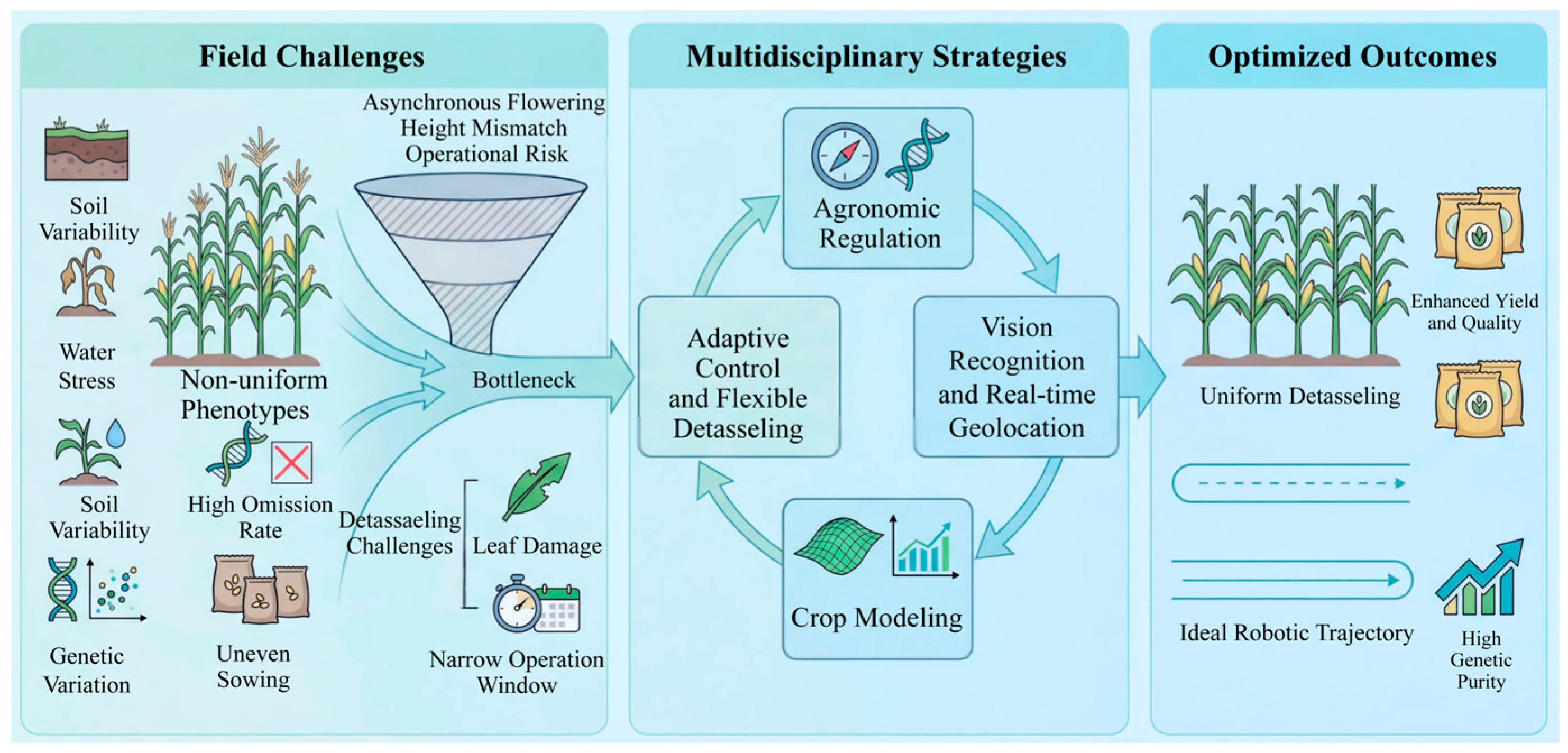
Figure 1, modern detasseling agronomy has transcended mere mechanical removal and is evolving toward genetic sterility, precise developmental simulation, and comprehensive resource utilization.
The growth consistency of seed maize in the field is the premise of the success of mechanized detasseling. This consistency includes not only the uniformity of plant height but also the synchronization of tasseling time. The results showed that if the coefficient of variation of female plant height exceeded 10%, the rate of mechanical detasseling would be significantly increased. At present, the consistency of field growth can be effectively improved through precision fertilization, variable rate irrigation and seed grading technology. Furthermore, parental flowering synchronization technology not only influences pollination but also dictates window for mechanical detasseling. If the flowering periods are not synchronized, repeated machinery field entries are required, which increases the risk of soil compaction and causes leaf damage. Therefore, breeding mechanization-oriented varieties with centralized tasseling characteristics and stable plant height is the fundamental way to solve the bottleneck of detasseling. The core challenge of mechanized male removal lies in the “consistency bottleneck” of field growth. This is mainly manifested in the heterogeneity of plant height in the spatial dimension and the asynchronous tasseling period in the temporal dimension. This dual deviation in physics and physiology directly leads to extremely high missed detasseling rates and leaf damage risks for traditional rigid agricultural machinery during task execution. To break this bottleneck,
Figure 1 further illustrates a multidisciplinary collaborative solution framework. This framework indicates that a single mechanical structure optimization is no longer sufficient to meet the precise operational requirements.
2.4. Perception–Decision–Execution Framework for Mechanized Detasseling
In this review, we systematically decompose the mechanized detasseling operation into three functional layers: perception, decision-making, and execution. The perception layer integrates machine vision and photoelectric sensing to acquire tassel position and morphological characteristics. The decision-making layer employs deep learning models and rule-based algorithms to generate real-time control commands. The execution layer implements these commands through cutting or extraction mechanisms, thereby forming a closed-loop control system. The corresponding perception–decision–execution framework for mechanized detasseling is illustrated in
Figure 2.
The perception layer integrates machine vision algorithms (e.g., YOLO, R-CNN), photoelectric sensors, and biomechanical measurement techniques to capture the position, morphological features, and mechanical properties of crop tassels. The decision layer processes the acquired data using object detection models and classic control algorithms (e.g., PID, threshold logic) to produce real-time operational commands. The execution layer executes these commands through cutting and extraction mechanisms, in which the working height and clamping force are dynamically adjusted via hydraulic and electric actuators. A feedback loop connecting the execution and decision layers realizes closed-loop control, while iterative model updates from the decision layer to the perception layer support continuous performance optimization and adaptive learning.
3. Research Status of Detasseling Technology for Seed Maize
3.1. Mechanical Properties of Tassels in Seed Production Maize
The mechanical properties of tassels in hybrid maize for seed production are critical physical parameters for the design and optimization of detasseling equipment [
26,
27,
28,
29], with relevant research having been conducted over decades.
The precise design of detasseling equipment for seed maize highly depends on the in-depth understanding of the mechanical properties of the plant and its key organs. Kumar et al. proposed the use of wild closely related species Teosinte to hybridize with modern maize inbred lines and found significant differences in plant fracture resistance under different genetic backgrounds. For the basal population derived from Teosinte, the fracture resistance at the base of the tassel was 552.17 N, while the backcross population fluctuated between 140.9 and 252.5 N. This indicates that genetic improvement can significantly alter the mechanical strength of plants, thereby affecting their stress performance during detasseling [
30]. Aiming at the adjustment of mechanical properties by external environmental factors, Chandio et al. proposed the coupling effect of moisture content and loading speed on mechanical parameters of maize. They pointed out that with the increase of moisture content from 11.2% to 21.3%, the fracture force, hardness and toughness of plant materials decreased significantly, and the vertical and lateral fracture forces decreased with the increase in loading speed. This provides a theoretical basis for determining the optimal operating speed of detasseling actuator [
31]. Zheng et al. proposed to optimize the parameters of transpiration model through global sensitivity analysis (GSA) and found that the proportion of film mulching and environmental wind speed would change the water distribution and physical state of plant surface. The dynamic change of environmental physical field indirectly affected the bending resistance and flexibility of plants, which was of great significance to improve the accuracy of seed production in complex climate [
32].
To develop a lightweight rotary cutting supplementary detasseling device mounted on unmanned aerial vehicle (UAV), Ou calibrated the physical characteristic parameters of maize tassels and conducted mechanical property tests. The bending modulus and shear strength of tassels were determined to be 46.41 MPa and 0.76 MPa, respectively. Through the simulation test of cutting tassels with rotary cutting parts, it was found that the vertical feed cutting has the least impact on the bending deformation of tassels, which is conducive to the stability of UAV [
33]. Li et al. developed a pulling-type clamping detasseling device and established a Burgers rheological numerical model for maize tassels. Based on the force-deformation curves of tassels under varying probe velocities, the rheological model parameters were fitted, and the correlations among parameters including radial vertical stiffness, wheel spacing, rotational speed, and clamping force were analyzed [
34]. This rheological analysis breaks through the limitations of the traditional quasi-static mechanical test, can more accurately describe the mechanical behavior of tassels under dynamic loading conditions, and provides a more scientific theoretical basis for the optimization of high-speed operation parameters of detasseling device.
Overseas research on the biomechanical properties of hybrid maize tassels for seed production initiated earlier, with a relatively well-established theoretical system and distinct advantages in multi-factor systematic analysis [
35]. Although it started late in China, it has made rapid progress in engineering application-oriented research and is closer to the reality of maize seed production in China, forming a practical research path with device design optimization as the traction and field test data as the support. In recent years, the domestic scholars’ follow-up on the frontier methods such as rheology and the development of international cooperative research are gradually narrowing this gap. However, in addition to the mechanical properties of plants, the impact of the machine–soil interaction should not be underestimated. Field testing of soil-processing machines has shown that the variability of soil resistance and structure greatly affects the dynamic performance and positioning of working bodies [
36].
3.2. Tassel Detection Technology of Seed Production Maize
With the progression of agricultural modernization and intelligentization, the in-depth integration of computer technologies with agricultural machinery and equipment has emerged as a prominent development trend [
37,
38]. At present, the use of advanced sensing technology to realize the automatic detection of tassels is the key link to improve the precision and intelligence level of detasseling operation. Researchers at home and abroad have actively explored this direction, mainly focusing on two kinds of technology paths: machine vision recognition and photoelectric sensing [
39].
3.2.1. Machine Vision Recognition Technology
Machine vision technology exhibits the characteristics of non-destructiveness, high precision, efficiency, large information capacity, excellent real-time performance, and flexibility and has been widely applied and gained significant attention in precision agriculture [
40,
41].
In the field of maize phenotypic perception in seed production, Niu et al. proposed a new method using azure Kinect DK to couple Red Green Blue-Depth (RGB-D) data. By integrating the YOLOv11-SAM2 joint model to extract semantic information and optimizing the depth completion algorithm, it realized the accurate analysis of crop organ level features and provided a high-precision three-dimensional perception scheme for the fine detection of tassels and leaves in complex field environment [
42].
Kumar et al. proposed a novel method for maize tassel counting based on K-means clustering and adaptive threshold segmentation. In this study, a semi-automatic image annotation method was designed for the task of maize heading detection in UAV images, which is convenient for the rapid construction of the labeled dataset of maize crops. The tool developed based on this method can be integrated with machine learning models to generate initial annotation results for given images and enable users to perform interactive modifications and refinements [
43].
Wang et al. compared three object detection models, Faster R-CNN, SSD, and YOLO-X, using transfer learning methods based on UAV images. The results show that transfer learning significantly improves the performance of the model, and YOLO-X is the best, with recognition accuracy of 97.16% and average accuracy (mAP) of 93.60%. This study also found that the detection adaptability of different varieties was significantly different, and the detection effect of Zhengdan 958 was the best. With the increase in planting density, the average absolute error increased from 0.19 to 0.75. This study provides a reliable method for high-throughput detection of tassels in the field [
44].
Guo et al. designed a machine vision-based precision maize detasseling device. This device combines machine vision with traditional automation technology, utilizing the YOLOv8 algorithm and binocular vision positioning technology to obtain the three-dimensional coordinates of the tassel in real time. It achieves precise clamping through a CAN bus-driven row adjustment mechanism, addressing the challenge of adaptability in field operations. Field test results show that the device has an average detasseling rate of 80% and an average leaf damage rate of 31%. The YOLOv8 algorithm performs stably in complex field environments [
45].
Both Chinese national standards and seed purchasers impose stringent requirements on the detasseling rate of hybrid maize for seed production. Therefore, Ding et al. actively carried out research on the detection of missing tassels [
46]. Li et al. proposed a lightweight tassel detection model MLCE-RTMDet, which is based on the RTMDet-tiny architecture. It adopts MobileNetv3 as the backbone feature extraction network to reduce computational burden and introduces the CBAM attention mechanism to enhance the multi-scale feature extraction ability of tassels, thereby mitigating the performance degradation that may occur in lightweight networks. This model uses EIOU Loss instead of GIOU Loss to further improve the accuracy of tassel detection. This study can provide effective technical support for the detection of missing tassels after manual detasseling in maize seed production fields [
47,
48].
Yang et al. fused machine vision and UAV remote sensing technology to collect visible light images of maize at the tasseling stage. In order to build the dataset and improve the robustness of the model, the Segment Anything Model (SAM) is used for semi-automatic annotation, and the image enhancement technology is used to simulate environmental changes. This study improved upon the YOLOv5 framework by introducing a lightweight MobileNetV3 network to reduce parameter count and optimizing the network structure for precise detection of missed tassels. Experiments showed that this method can automatically identify missed female tassels in the field, effectively evaluate the quality of detasseling operation, and provide accurate location guidance for the leakage repair operation [
49].
Computer vision technology serves a central role in image recognition. Falahat, Alzadjali, Niu, et al. applied deep learning-based object detection algorithms (e.g., Faster R-CNN, SSD and YOLO) to maize tassel recognition [
50,
51,
52]. Researchers trained the models using a large number of annotated maize tassel image samples to learn key information such as the morphological characteristics, color distribution, and texture features of tassels. The trained model can identify tassels with high accuracy in the new images collected by UAV so as to provide reliable and high-throughput tasseling status information for breeders [
53,
54,
55]. However, the recognition accuracy of such models is still insufficient, and its algorithm performance needs to be further optimized [
56,
57,
58].
Table 1 presents a performance comparison of deep learning-based tassel recognition algorithms.
Although the above deep learning models perform well on controlled datasets, they still face severe adaptability and generalization challenges when deployed in actual fields. Feature loss can be caused by drastic changes in lighting conditions; secondly, high-density overlapping leaves in corn fields can easily cause male spikes to be obstructed, leading to false negatives and missed detections; and finally, the diversity of male ear color, morphology, and developmental stages among different maize genotypes requires visual models to have strong cross-domain generalization ability, which is currently the weakness of most single dataset training models.
3.2.2. Photoelectric Sensing Technology
Gu et al. developed a maize detasseling machine based on infrared detection technology, which is primarily composed of a frame, a lifting mechanism, a detasseling unit, and an infrared detection module. Its core innovation lies in the integration of an infrared detection module in front of the detasseling unit, comprising multiple groups of infrared tubes, for the precise localization of maize tassel height. During field operation, when the top of the maize blocks the light path of the infrared tube, the control mechanism adjusts the working height of the hydraulic detasseling device in real time according to the multi-channel height signal so as to achieve accurate alignment and adaptive control of the detasseling position [
70]. Liu et al. invented a highly adaptive maize detasseling device which is mainly composed of a detasseling support and a control module: two detasseling plates are fixedly installed on the detasseling support and include a support hydraulic cylinder and a light-sensing strut hydraulic cylinder; the front end is provided with a reflector mechanism and a light-sensing probe mechanism. During operation, the light sensor probe detects the height of tassels in real time and transmits the signal to the control module. The control module then drives the hydraulic cylinder of the support to expand and retract, then adjusts the working height of the tasseling plate and the tasseling roller so as to realize the adaptive tasseling operation for tassels with different heights [
71].
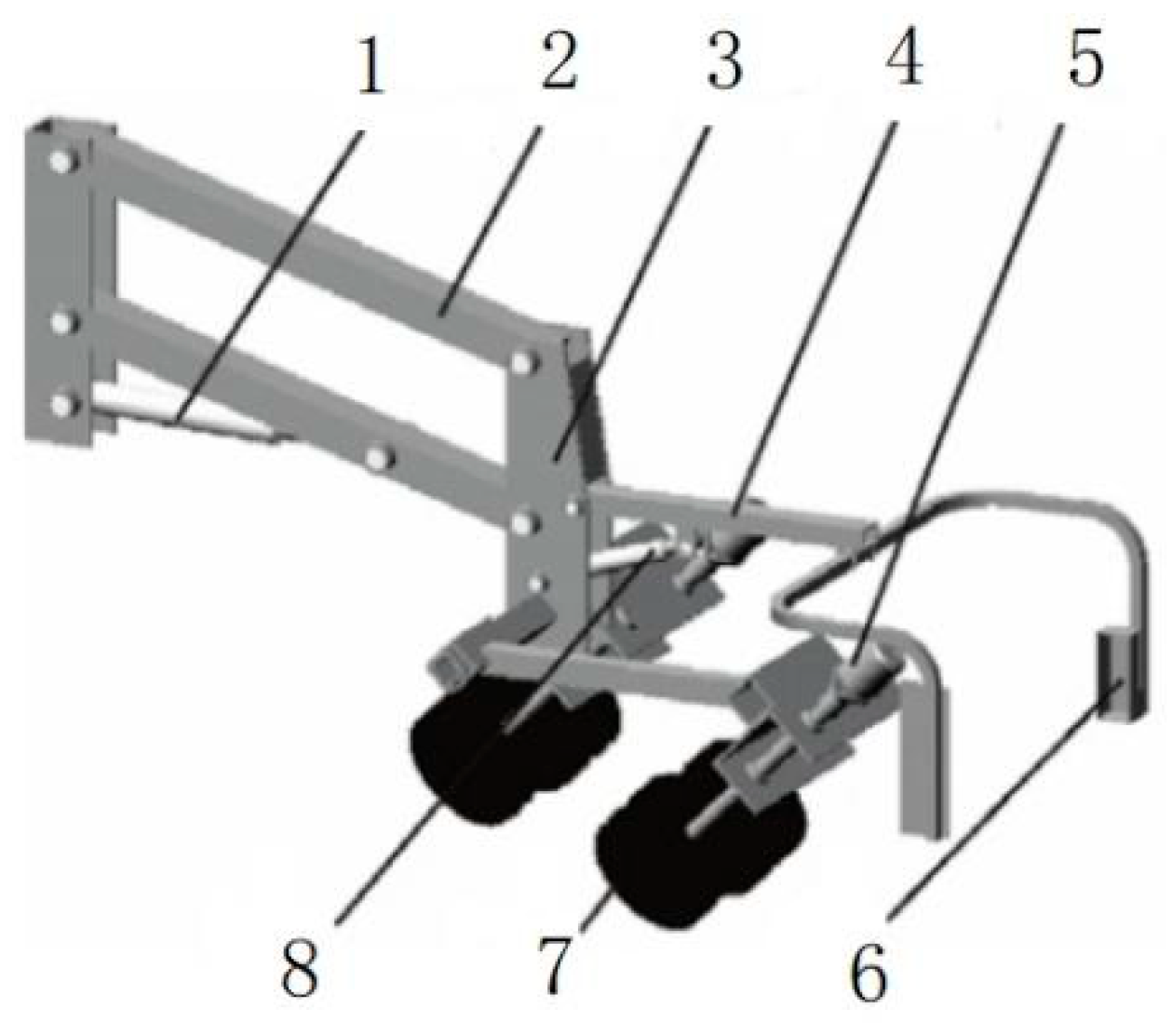
Wang developed a profiling lifting device for tassel monomer; the device is mainly composed of hydraulic lifting cylinder, parallel four-bar profiling mechanism, hydraulic motor, photoelectric sensor, etc., as illustrated in
Figure 3. Photoelectric sensors are installed at the front of the rack and are respectively placed on both sides of the sensor mounting bracket. The male pulling wheel is installed in front of the bracket, behind the photoelectric sensor, and connected with the electric push rod; the whole entire tassel extraction assembly is connected with the parallel four-bar profiling mechanism, and the hydraulic cylinder controls the parallel four-bar profiling mechanism. A displacement sensor is installed on the hydraulic cylinder. The displacement sensor is connected with the piston rod of the hydraulic cylinder to detect the displacement change of the piston rod and convert it into a pulse signal; the system controller will control the up-and-down profiling of the piston rod and electric push rod of the hydraulic cylinder according to the input and output signals of the photoelectric sensor and displacement sensor so as to realize the extraction of tassels with different heights [
72].
Photoelectric sensor technology has the characteristics of easy implementation, low cost and high adaptivity. At present, commercial maize detasseling machines generally use this technology. However, the fatal drawback of this technology is the inability to distinguish between male spikes and top leaves. Field tests have illustrated that the false triggering rate of photoelectric sensors caused by high position leaves of corn can reach 15% to 20%, which directly leads to errors in determining the height of male removal, severe damage to top leaves, or missed male ears.
4. Key Technologies of Mechanized Detasseling
Existing mechanized detasseling technologies can be categorized into two types based on the detasseling methods: pulling-type and cutting-type. Costa et al. demonstrated that extraction-based detasseling typically employs rotating rollers, belts, or cylinders to separate tassels and associated stems and leaves from maize plants via clamping [
74]. Zou et al. reported that cutting-based detasseling primarily relies on reciprocating or rotating blades and cutters to directly sever tassels and associated foliage through shearing [
75].
4.1. Cutting Detasseling Technology
As early as the 1970s, foreign developed countries began to study the cutting maize detasseling technology.
Gildersleeve et al. developed a clamping and cutting detasseling device, which is mainly composed of frame, hydraulic motor, transmission flexible shaft, transmission chain, fixed blade, clamping wheel, etc. During operation, the hydraulic motor transmits power to a pair of clamping wheels through the transmission flexible shaft and transmission chain to make the clamping wheels rotate (in the same direction), and the left clamping wheel is close to the bottom end of the right clamping wheel under the action of the tension spring to produce friction contact. With the advance of the machine, the maize plants for seed production gather in the middle under the action of the divider and enter the contact area of the clamping wheel. Under the joint action of the clamping wheel and the fixed blade, the tassels of maize are cut off [
73].
Meiners et al. developed a horizontal cutting detasseling device, which is mainly composed of drive belt, blade, guide rod, divider, guide plate, etc. During operation, the maize plants gather in the middle under the action of the divider, enter the space formed by the guide rod and the guide rod or the guide rod and the shield, and finally are cut off by the blade in a straight line structure. The feature of the device is that the designed multiple guide rods not only play a guiding role but also effectively prevent plant leaves from entering the blade cutting space and reduce the loss of leaves [
76].
Grandinetti et al. developed an air-assisted maize detasseling device, which is primarily composed of a paddle wheel, a crop divider, a guide nozzle, and a bow-shaped buffer plate. During operation, the drive shaft drives the paddle wheel to rotate and generate an air flow, which is directed through the guide tube and ejected from the nozzle to spread the top foliage. After exiting the airflow area, the vertical plate keeps the plants in the above state. The tassels enter the middle of two vertical plates and are knocked (cut) off under the action of pulp wheel, pulp leaf and bow-shaped plate. The airflow device and vertical plate designed in the machine effectively separate the tassel from the top leaf and prevent the rebound of the leaf, which can reduce the damage to the top leaf of maize [
77].
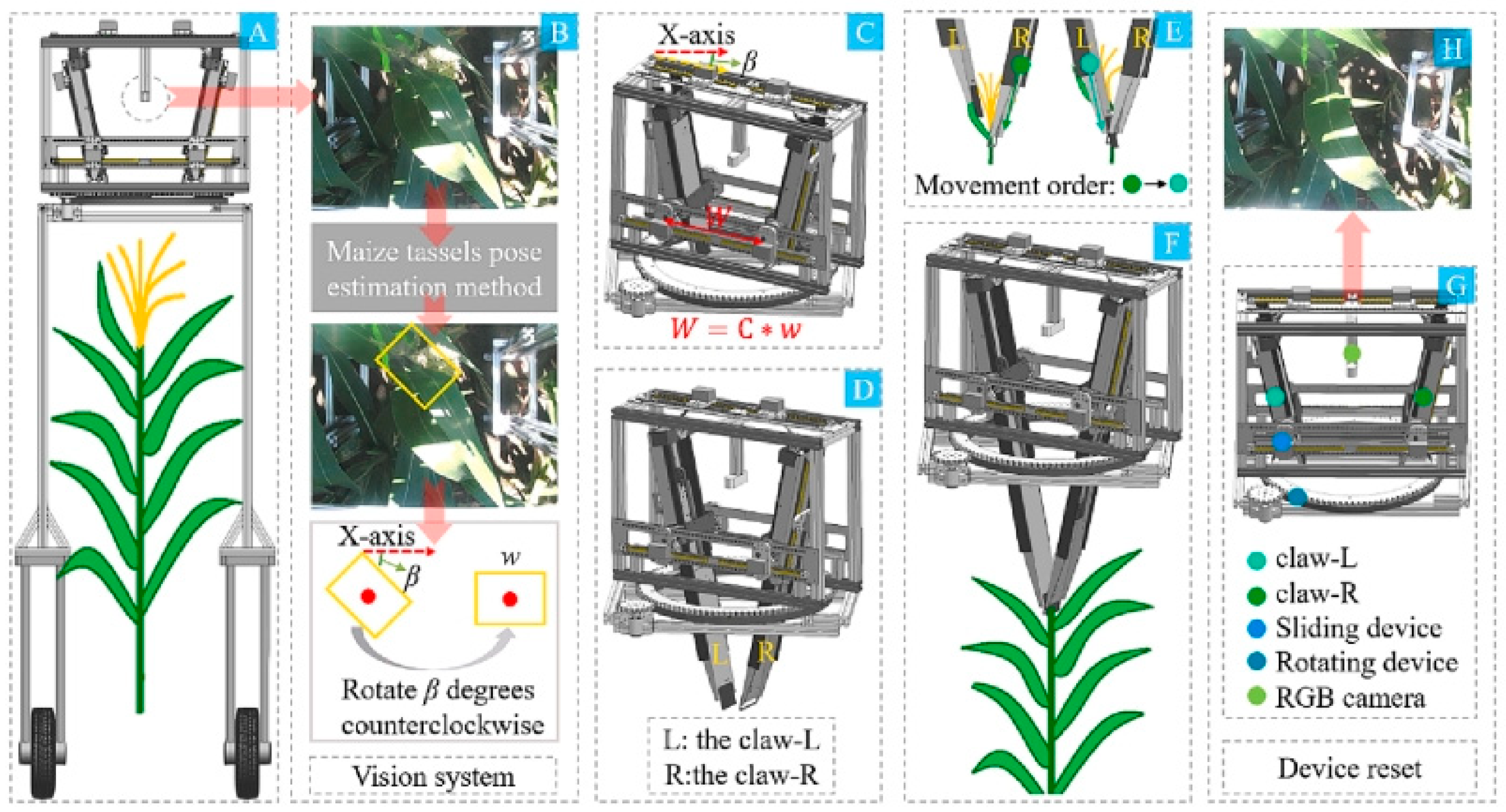
Based on the phenotypic characteristics of maize plants and the principle of artificial tassel removal, Song et al. proposed a downward cutting rotating tassel removal method, which effectively reduced the damage to the leaves near the tassel. In order to realize this method, a compact maize detasseling device was designed, which mainly includes an RGB camera, left and right clamping devices (claw-L and claw-R), a sliding mechanism and a rotating mechanism. The whole working process of the detasseling device is illustrated in
Figure 4. The maize in the field experiment was planted with a spacing of 0.6 m between rows and 0.3 m between plants, with a plant height of about 1.6 m and a male tassel height of about 0.35 m. The results showed that the success rate of tassel removal of the device was 71.67%, and the average time spent detasseling each maize tassel is around 11.85 s [
78].
Gao et al. investigated the induced bending characteristics of crop leaves under wind load and reported that the leaves exhibit significant non-uniform flexibility, namely, high basal rigidity and enhanced apical flexibility. When the wind speed exceeds 6 m/s, the maximum curvature of the leaves more than doubles, and the primary deformation region shifts from the base to the tip. This study on nonlinear deformation and structural gradient mechanics of leaves under dynamic loading provides critical mechanical mechanism analysis and data support for the interaction between cutting tools and non-uniform flexible plant organs (e.g., tassels and surrounding foliage) during cutting-based detasseling [
79].
4.2. Extraction Detasseling Technology
In 1970, Spryrh invented a belt extraction detasseling device. The device mainly includes a pressing wheel, hydraulic motor, blade pressing roller and other components. During operation, with the advance of the machines and tools, the seed maize plants gather in the middle through the divider. Under the continuous action of the leaf pressing roller, the tassels are separated from the leaves and then enter the clamping area formed by the two elastic bands. The tassels are gradually pulled out, thrown to the ground or retracted. The blade roller surface of the device is attached with spiral metal belt, which increases the grasping and pressing capacity [
80].
Kenneth developed an inflatable wheel-type maize detasseling device mainly composed of a fixed frame, a hydraulic motor, a driving shaft, a driven shaft, an inflatable rubber wheel, etc. During detasseling, the driving wheel and the driven wheel rotate in the opposite direction; the tassels and attached stems and leaves of maize are clamped and extracted, then finally thrown into the rows of maize. In this device, the inflatable rubber wheel plays the role of flexible clamping, which improves the adaptability of the detasseling device, and the surface pattern of the rubber wheel improves the grasping ability of the mechanism [
81]. In particular, it should be noted that the efficiency of extraction devices depends on the effectiveness of the transportation mechanism of rotors. Analysis and experimental verification of transporting capacity of rotors in soil processing equipment showed that the geometric and kinematic features play a crucial role in the material carrying capacity [
82].
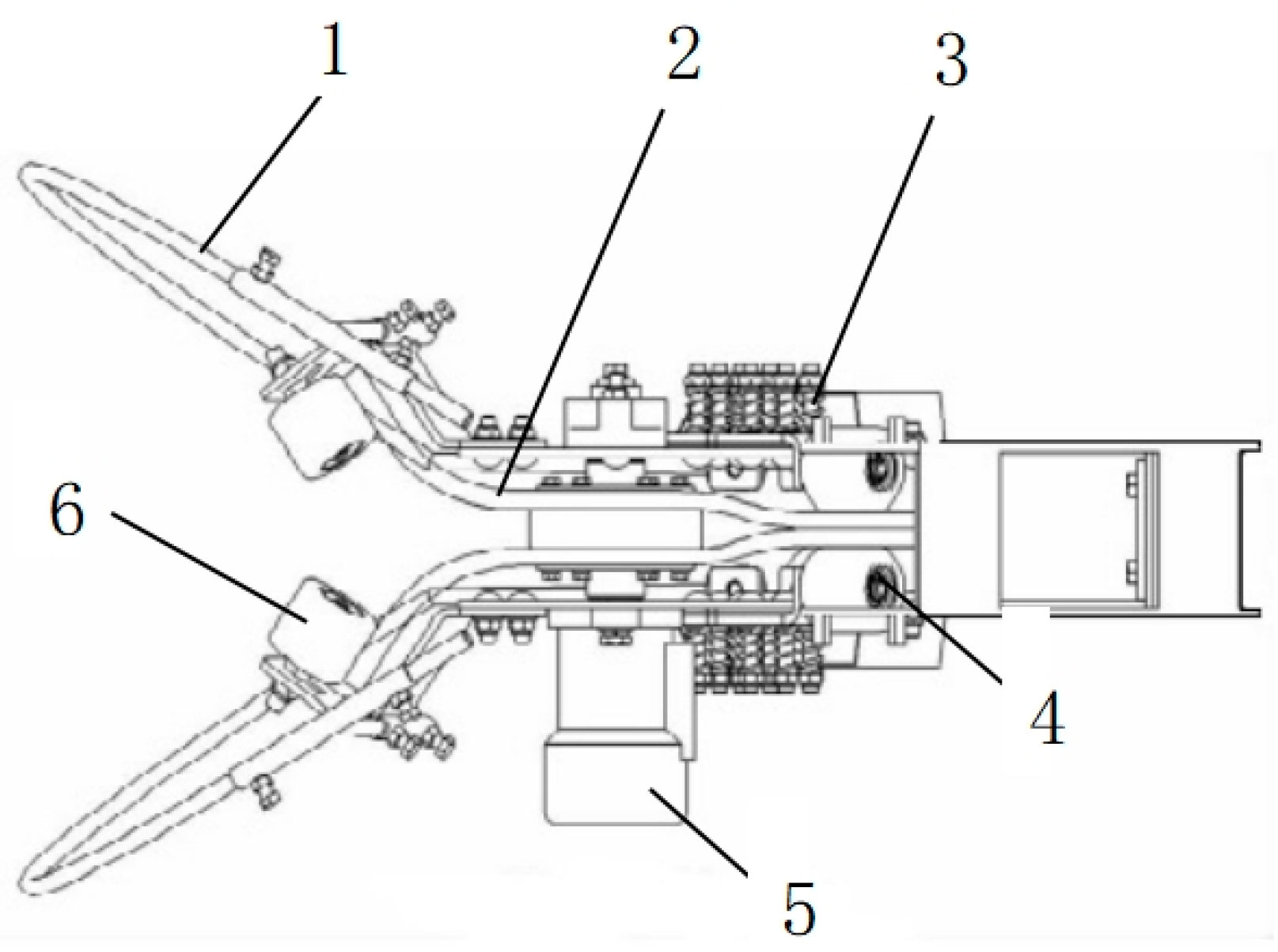
Bourgoin has developed a flexible disc pulling-type maize detasseling component, as illustrated in
Figure 5. This part is mainly composed of a divider, two flexible discs, an opening roll and a pressing roll. During operation, with the rotation of the detasseling parts, the maize plants gather into the included angle formed by the flexible disc in the middle through the divider. Under the joint action of the rotation of the flexible disc and the forward movement of the machine, they gradually enter the contact area where the flexible disc gradually becomes smaller and finally completely closed. The tassels of maize are firmly clamped by the flexible disc under the action of the pressing roller, then they are extracted and thrown forward. The disadvantage is that the extracted tassels are easy to hang on the maize plant [
83]. The device maintains a flexible clamping force of approximately 15–25 N by adjusting the material hardness and rotational speed of the rubber disc. Although it reduces rigid damage, its disadvantage is that the pulled out male ear is prone to hanging on the plant.
Early representative devices for cutting-based detasseling include clamping-cutting, horizontal cutting, and air-assisted cutting. This technology offers the advantages of a simple structure and high operating efficiency but tends to damage the upper leaves, which exerts a more significant impact on the yield of maize varieties with fewer leaves surrounding the tassels. In contrast, extraction-based detasseling causes less leaf damage and achieves more thorough detasseling; however, it is prone to tassel entanglement or clamping malfunctions.
Table 2 compares the technical routes and operational performance of key detasseling technologies developed domestically and internationally.
Mechanical detasseling inevitably results in the loss of certain functional leaves. While cutting-based detasseling offers high operating efficiency, it is sensitive to variations in plant height, which frequently leads to excessive leaf remove and subsequent yield reduction. Although extraction detasseling can retain more leaves, if the clamping force is not properly controlled, it is easy to cause tassel residue or stem fracture. Therefore, the evaluation standard of detasseling technology should be changed from a single rate of detasseling to a comprehensive evaluation index combining the rate of detasseling, leaf loss rate and late seed yield. By developing an actuator with flexible clamping function, the contradiction between detasseling depth and blade protection can be balanced.
4.3. Control Logic for Real-Time Detasseling Adjustment
In the photoelectric sensing mode, the acquired occlusion signal is directly mapped to a height threshold value, which drives the hydraulic cylinder to lift or lower the detasseling header. For vision-based detection systems, the tassel bounding box is firstly extracted via a lightweight YOLO model. Subsequently, the centroid coordinates and vertical height of the tassel are converted into control signals by a PID controller to realize the real-time adjustment of the extraction wheel and cutting blade.
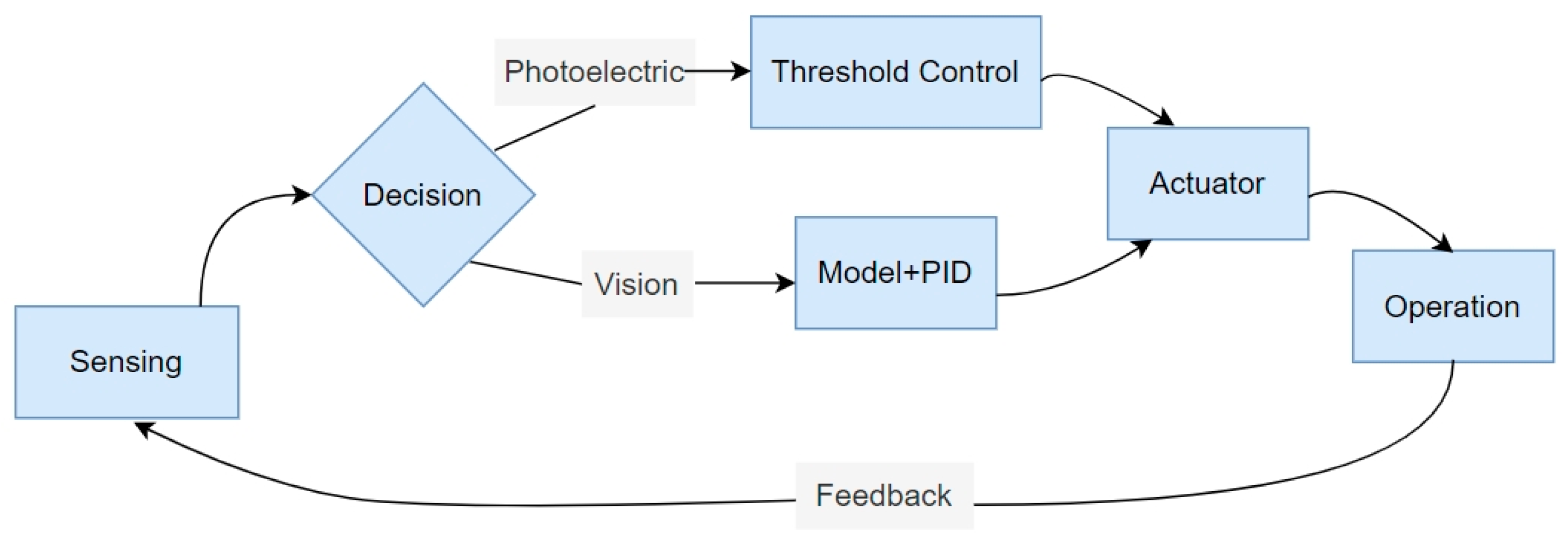
As shown in
Figure 6, the system workflow starts from the perception layer, which collects tassel characteristic information through photoelectric sensors (infrared beam interruption) and machine vision techniques (e.g., YOLO-based bounding box detection and height estimation). The type of detection method adopted governs the corresponding decision-making pathway:
For photoelectric sensing, the beam interruption signal is directly mapped to a height threshold. The controller compares the collected signal with the preset threshold and outputs binary adjustment commands accordingly.
For machine vision sensing, the tassel bounding box features are extracted and processed via a lightweight detection model. The acquired centroid coordinates and vertical height parameters are subsequently input with PID or rule-based controllers to generate continuous adjustment commands for real-time operational regulation.
The decision outputs drive the operation of the execution layer, covering height adjustment via hydraulic and electric linear actuators, as well as clamping and cutting force modulation through flexible wheels and blades. After field implementation, feedback signals derived from actual operating conditions (e.g., successful tassel removal and residual tassel detection) are transmitted back to the perception layer, thereby forming a closed-loop adaptive control system.
5. Current Development of Mechanized Detasseling Equipment for Seed Maize Production
5.1. Mechanized Detasseling Equipment for Foreign Seed Maize Production
Foreign countries started earlier in the field of detasseling equipment for seed maize production. As early as 1937, the United States developed the tasseling machine. The earliest detasseling machine, which uses a high clearance chassis, carries six manned operation platforms, is supported by three walking wheels, and can travel at a low speed between maize rows; detasseling operation still needs to be completed manually on the onboard platform, which is essentially a mechanical assisted manual detasseling [
97,
98]. By 1950, researchers launched the second-generation detasseling machine [
99]. This model has significantly improved the driving stability, safety and operation efficiency, but it has not been widely applied due to the limited degree of automation.
In recent years, all kinds of maize detasseling machines in Europe and the United States have been widely used to replace manual labor, with mature technology, high operation efficiency and strong adaptability. Representative models include Hagie’s 204SP and DTB series from the United States, Oxbo’s TS4, 5175, and 5180 from the United States, Big John’s PDF752D from the United States, Bourgion’s BD864 from France, Frema’s FALCON140 from France, and Castrix’s S series from Italy.
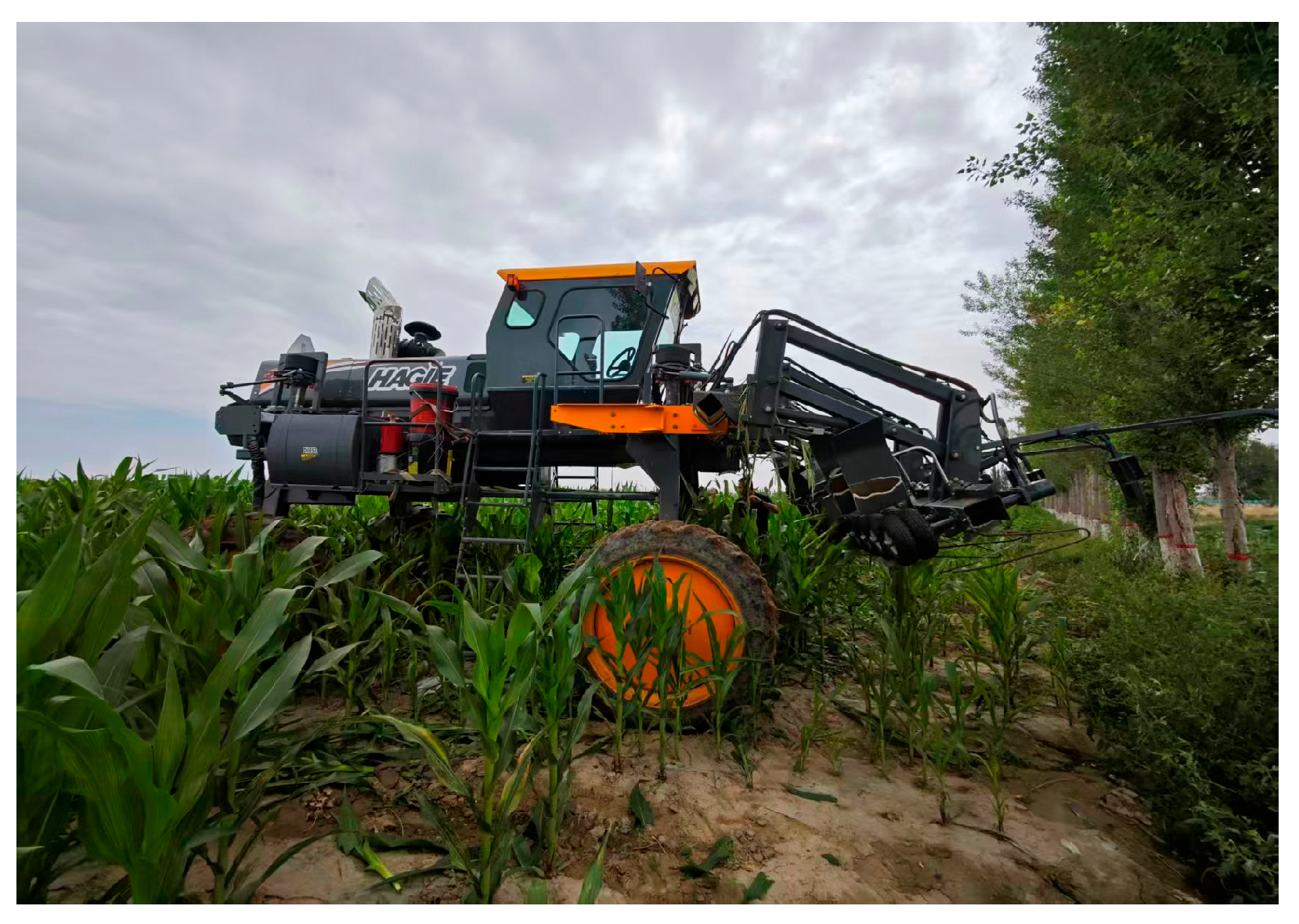
The 204SP type detasseling machine launched by Hagie Corporation in the United States is one of the earliest self-propelled seed maize detasseling machines to achieve commercial application in the market, as illustrated in
Figure 7. This model uses four-wheel hydrostatic full-time drive, the chassis ground clearance is 193 cm, and the wheel track can be adjusted in the range of 214.6–304.8 cm, which is suitable for the common maize row spacing of 51–76 cm. The front of the machine can be hung with pulling-type or cutting-type detasseling parts according to the operation requirements. The height adjustment range of detasseling parts is 0–167.6 cm, and the number of operating rows can be selected in the even range of 4–18 lines [
100]. The DTB series maize detasseling machine developed by Hagie is also favored by users because of its various functions. This series of models can also be easily refitted into a spray machine [
101], and its core performance parameters are illustrated in
Table 3.
Mainstream foreign maize detasseling machines feature relatively mature technologies, with their typical configurations generally including adoption of a self-propelled power system, hydraulic-driven working components, and detasseling modes such as cutting-based and inflatable wheel extraction-based detasseling. These models generally integrate intelligent technologies such as optical sensor tassel recognition and highly automatic profiling to achieve precise operation. However, its high level of technology integration also leads to high cost of single machine, usually more than 1 million RMB [
102,
103,
104], which seriously restricts its popularization and application in domestic farms with generally small operation scale.
Foreign research on detasseling equipment for seed maize production not only focuses on the improvement of mechanical structure but also focuses on intelligent and precise operation combined with phenotypic characteristics, crop water and fertilizer status and environmental adaptability. Kramer et al.’s research in Kenya pointed out that drought-tolerant (DT) hybrid maize varieties showed obvious morphological differences at the flowering stage, but this visible difference would disappear under severe water stress, suggesting that detasseling equipment needs to adjust itself according to plant morphological changes in different climate years [
105]. Aiming at the most critical problem of plant growth consistency in detasseling operation, Zhang et al. used theoretical and empirical crop water stress index (CWSI) to monitor maize in Colorado, USA. The results showed that the consistency of yield predicted by the model was as high as R
2 = 0.95, which provided a data benchmark for the preset operation parameters of detasseling machinery under different water stress [
106]. Intelligent sensing technology has also made a breakthrough. Liu et al. developed a wearable nitrogen nutrition detection sensor based on the principle of stem puncture. The determination coefficient R
2 of the detection model in evaluating the nutrition and growth status of maize reached 0.9046, and the root mean square error (RMSE) was only 12.3 g, which provided a new sensing means for the accurate implementation of detasseling equipment based on plant mechanical strength and nutritional level [
107].
5.2. Mechanized Detasseling Equipment for Seed Maize Production in China
The systematic research on maize detasseling machines in China started relatively late, and the early stage mainly focused on the introduction and imitation of foreign models. Representative achievements include the 3QXZ-6 maize detasseling machine designed and developed by the Chinese Academy of Agricultural Mechanization Sciences in 2016. However, its high level of system integration also leads to high single-machine costs, typically exceeding 150,000 per unit. In addition, its lack of adaptability to complex agricultural and small- and medium-sized plots in China, as well as high maintenance costs for hydraulic systems, severely restrict the large-scale production and promotion of large imported equipment and early imitation models (such as 3QXZ-6) in China [
108,
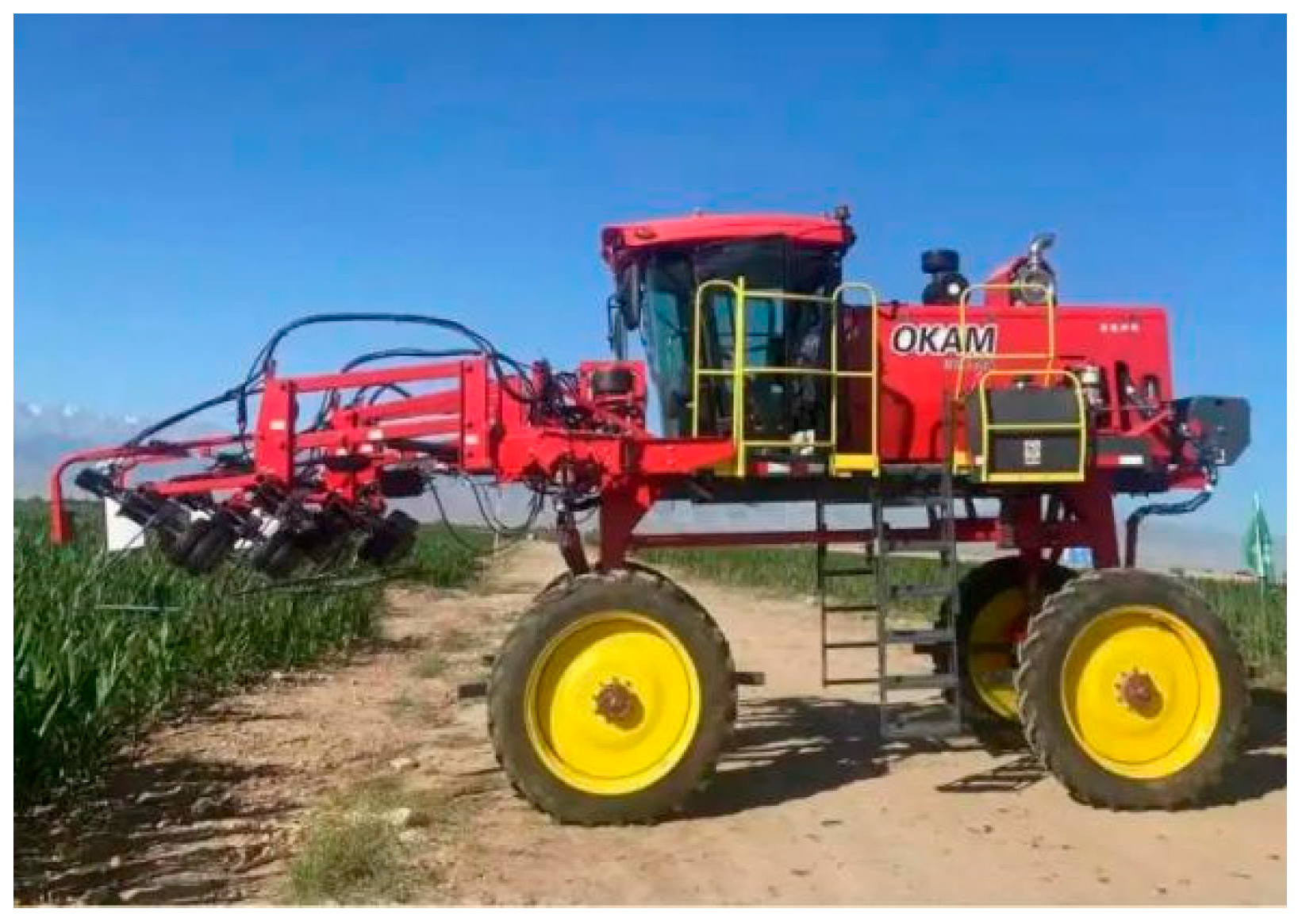
109]. At present, the models that have truly achieved mass production and been put into practical application in China are mainly OK104-3CX and 3CX-6A maize detasseling machines developed by Jiuquan Aokai Seed Machinery Co., Ltd., as illustrated in
Figure 8 [
110]. The detasseling methods of the three models are cutting-type and inflatable wheel pulling-type, and their core performance parameters are illustrated in
Table 4.
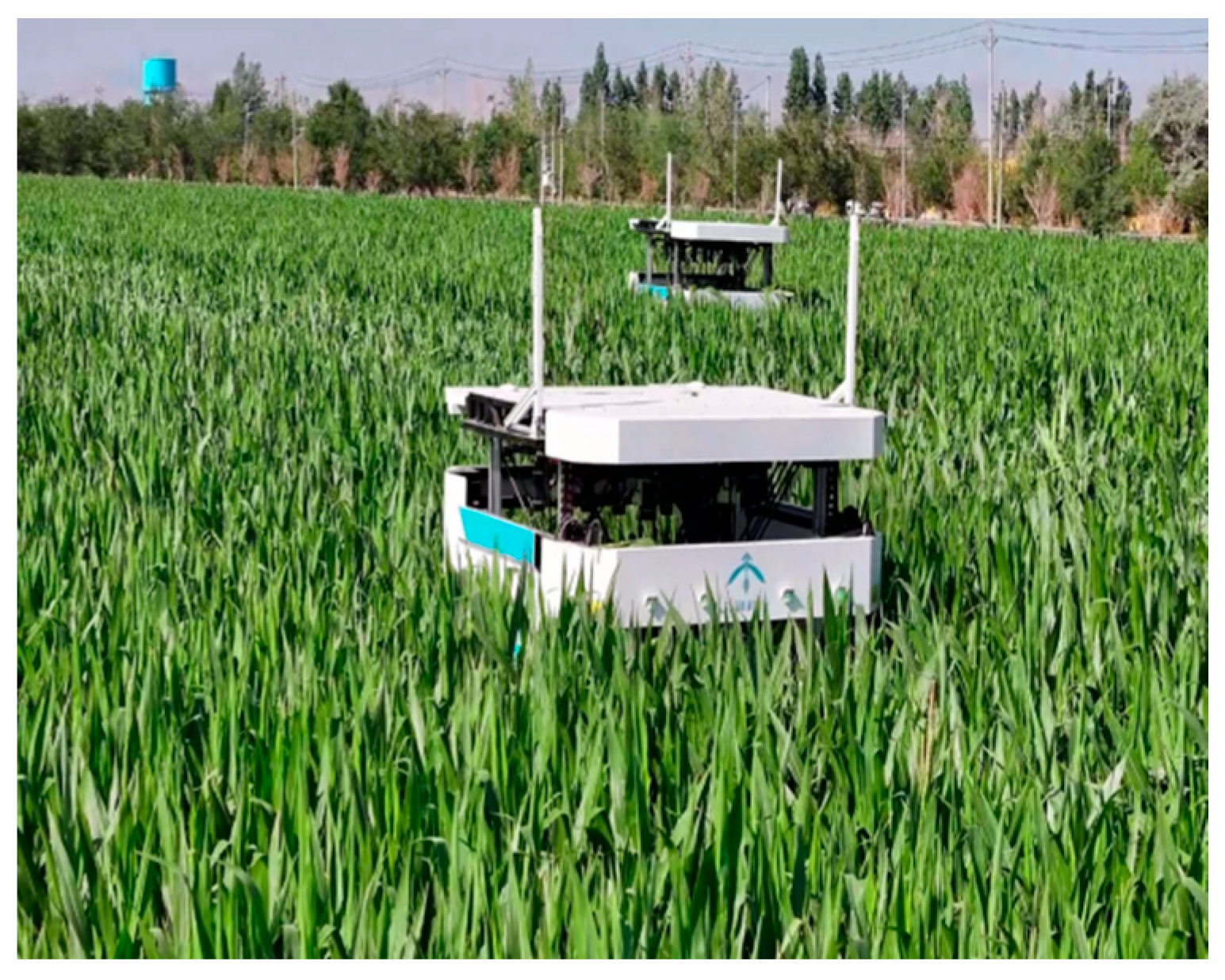
In July 2024, the pure electric maize detasseling robot independently developed by Xinjiang jiuyu Technology Co., Ltd. made its debut and was put into field operation in Guangming Village, Erliugong Town, Changji City, as illustrated in
Figure 9 [
115]. The robot integrates Beidou navigation system, integrates LIDAR point cloud data and AI image recognition algorithm, and generates accurate operation trajectory in real time. In the process of operation, the robot can adapt to the plant height range of 1.5–2.3 m by comprehensively sensing the information of leaves and tassels and independently determining the precise down probing distance of the executive mechanism so as to achieve millimeter-level control accuracy, and the tassel extraction rate can reach 90%. This machine can complete four rows of detasseling operations at a time. At a reasonable field operation speed of 2–3 km/h, the actual operation efficiency stabilizes at 0.47–0.73 hm
2/h, with a power consumption of about 0.4 kW·h per mu. Compared with the traditional method, it can save more than 40 CNY of labor cost per mu, significantly shortening the detasseling operation cycle. The application of this machine marks an important step in the direction of intelligent detasseling of seed maize in China.
Domestic research is more focused on the construction of crop growth model and the mechanization evaluation and selection of specific farming time systems. Li et al. built a biomass process simulation model (SMSMBP) for summer maize in the Yangtze Huaihe region. Through quantitative analysis of aboveground biomass (AGBW) before and after tasseling, they found that the relative error of prediction before tasseling after model adjustment was reduced to 4.18%, and the RMSE was 219.43 kg/HM
2 [
116]. This study provides theoretical support for domestic detasseling equipment in determining the optimal operation time window and predicting plant load. In terms of equipment system integration and evaluation, Zhang et al. built a mechanical selection model based on the improved fuzzy comprehensive evaluation method for the area with a double cropping system of winter wheat and summer maize and quantitatively ranked the performance of machines and tools through the combination of subjective and objective weights, providing a selection basis for the scientific configuration of maize detasseling and related supporting machinery under the complex planting mode [
117]. These studies jointly promote the development of domestic detasseling technology in the direction of modeling and systematization.
Detasseling, represented by Europe and the United States, has formed a technical system characterized by high-power self-propelled chassis, hydraulically driven working parts (cutting/extraction) and preliminary optical profiling, with high efficiency, but there are problems such as high cost and insufficient adaptability to diversified agronomy. In contrast, although China’s technological development started late, it has made significant progress in light-weight models [
118,
119,
120] for small- and medium-sized plots and intelligent recognition technology based on machine vision [
121] and photoelectric sensors, especially in the field of intelligent robots driven by pure electricity and integrated with Beidou and AI. With the maturity of Beidou navigation and autopilot technology, the detasseling equipment for seed maize production is transforming to miniaturization and intelligence. Compared with the expensive large self-propelled machinery, the lightweight detasseling robot is more suitable for small-scale farmland in China. These robots can use laser radar to avoid obstacles and realize accurate alignment through the vision system. The long-term development trend is a multi-machine cluster collaborative operation, large-area detasseling through ground robots, and air patrol with small UAVs to identify missing tassels and generate accurate location map. This collaborative mode can greatly improve the operation efficiency and solve the problem of inconvenient operation of traditional machinery in the edge of the field and irregular areas.
6. Factors Restricting Mechanized Detasseling of Seed Maize
The efficiency and quality of mechanized detasseling of maize seed production not only depend on the performance of the equipment itself but also are severely challenged by complex field environment, uneven plant growth and development, diseases and pests and other factors.
6.1. Constraints of Environmental Stress and Planting Geometric Parameters on Growth Consistency
6.1.1. Water and Fertilizer Stress and Climate Impact
The lack and unbalanced distribution of water resources will significantly affect plant development. Zou et al. in the semi-arid area of Northwest China showed that deficit irrigation would significantly reduce the yield, and by adjusting the irrigation amount from V8 to R6 (80% of the control group), the WUE could reach 20.3–34.9 kg ha
−1 mm
−1, indicating that water fluctuation directly caused uneven tasseling stage [
5]. This heterogeneity is highly associated with the variability of soil structure depending on tillage system. The results of the analysis of chisel and conservation tillage show the influence of soil loosening depth and structure on spatial variability of crops and trafficability, which affect the operational stability of agricultural equipment [
122].
Javed et al. found in the research of similar crops that low light stress will inhibit leaf area index and photosynthetic efficiency, lead to the obstruction of assimilate transportation to economic organs, and affect the concentration of the tasseling window [
123]. In addition to biological agents, trace elements also play a significant role in the stability of plant phenotype under stress. Hong et al. found that under potassium (K) deficiency, salt stress, and their compound stress, the growth of maize seedlings is inhibited due to increased levels of reactive oxygen species (H
2O
2) and malondialdehyde (MDA). Research has illustrated that the addition of cerium ions (Ce
3+) can significantly reduce damage to leaf morphology and structure and increase the activity of superoxide dismutase (SOD) and catalase (CAT), thereby maintaining normal plant development under stress conditions by alleviating oxidative damage [
124].
6.1.2. Planting Density and Geometric Distribution
Planting configuration directly determines the passing ability and detasseling difficulty of mechanical operation. King et al. found through two-year experiments that the planting density range to achieve 99% maximum benefit is 6.7–8.4 plants m
−2, and the optimal density of modern hybrids is 10% higher than that of old varieties [
125]. Di Mauro et al. pointed out that farmers tend to reduce the density at late sowing, but this practice may lead to insufficient resource utilization, and there is no significant difference in the response of different planting dates to density [
126]. Stevanovic et al. used the machine learning model to predict the yield under different densities and found that although the high density (S7) increased the total yield, it led to the restriction of individual development, and the prediction accuracy of R
2 was above 0.77 [
127].
6.2. Interference of Pest Infection and Sowing Quality on Detasseling Window Period
6.2.1. Effect of Disease and Mold
Fungal infection is an important cause of abnormal plant growth. Kumar et al. found that sheath blight (BLSB) broke out in specific meteorological weeks (31–32 weeks), and the yield could be increased to 4827 kg/ha through integrated management, but the leaf spalling and stem damage caused by the disease increased the difficulty of mechanical detection [
128]. Aydogdu et al. found that M. phaseolina can reduce plant height by 36.39% and biomass by 47.11%, seriously damaging the height alignment foundation of detasseling [
129]. Tarau et al. pointed out that the European maize borer and Fusarium tassel rot are mutually causal. From 2020 to 2022, different hybrids show different susceptibility, and the affected plants tend to wither or develop in advance [
130].
6.2.2. Pests and Parasitic Weeds
Mechanical damage caused by pests cannot be ignored. McCulloch et al. studied the density dependent mortality of westerly root beetles and pointed out that pest pressure would lead to significant differences in root damage and later growth between Bt maize and non Bt maize [
131]. Wang et al. proposed using RNAi technology to control the longtarsal leaf beetle, which directly affects the yield performance after pollination and detasseling by eating maize filaments [
132].
6.2.3. Sowing Unevenness and Seed Vigor
The source of mechanized detasseling is the uniformity of sowing. Ahmad et al. evaluated the performance of the pneumatic seeder and found that tillage level and forward speed had a significant impact on the seeding quality index (IQF), with the maximum missing seeding rate of 22.12% [
133]. Riya et al. found that the germination rate of seeds stored at room temperature for 12 months decreased from 96% to 88%, and the unbalanced emergence of deteriorated seeds would lead to different plant heights when emasculated in the later stage [
134]. Pinho et al. proposed using image analysis technology (−0.6 MPa PEG stress) to quickly identify drought tolerance five days after sowing, providing a tool for screening parents with good growth consistency [
135].
6.3. Genetic Variation and Field Heterogeneity
The efficiency of detasseling was also restricted by the difference of field microhabitat. Horhocea et al. evaluated 17 maize varieties and found that the impact of environment, genes, and their interactions (G × E) on yield was extremely significant (
p < 0.01) [
136]. Alvez et al. studied the residual nitrogen effect of winter mulching crops on maize and found that the nitrogen use efficiency (NUE) of maize fluctuated significantly between 9.5% and 40% under different CC treatments. This spatial heterogeneity of soil fertility directly led to the deviation of maize growth curve [
137]. Limay Rios et al. monitored pesticide residues at the edge of farmland and pointed out that environmental risks such as seeder dust may affect the activity of pollination media [
138]. As seen from above, such micro-habitats variability can be caused by spatial variability of soil density and mechanical properties, which in turn affects the process of plant growth and the dynamics of machines in the field [
36].
Bhat et al. found that the genetic difference of soybean plant height originated from specific haplotypes (such as hap-a), and 128 significantly associated SNPs were identified through GWAS, which provided the genetic root for the analysis of phenotypic heterogeneity [
139]. In terms of environmental factors, Quispe Puma et al. pointed out that drought stress can lead to significant differences in maize photosynthetic rate and intracellular water holding capacity. Under severe drought, the net photosynthetic rate can decrease to 3.8 ± 0.9 μmol/m
2∙s, and this physiological response fluctuation exacerbates the inconsistency of population growth [
140]. Chauhdary et al. found through APSIM model simulation that climate change has advanced the phenological period of wheat and maize, and the yield faces the risk of decline of about 11% to 20.5%, respectively, changing the spatial output pattern of the field [
141]. In addition, Khan et al. showed that the application of 36 t/ha biochar combined with straw mulching could significantly improve the plant height and dry weight of maize, suggesting the role of microenvironment management in alleviating the heterogeneity [
142]. However, a large-scale survey conducted by Qiu et al. showed that the distribution of pathogens (such as FFSC and FSAMSC) and toxins of tassel rot in different regions of China had geographical variation, and this pathological difference was an important factor leading to uneven field quality [
143].
7. Optimization Strategy for Mechanized Detasseling of Seed Maize
The mechanization level of detasseling in hybrid maize for seed production has been continuously enhanced, with the technology evolving from mere physical cutting toward an intelligent and precise systems engineering approach. By integrating multi-sensor fusion, growth model optimization, and precision operation control, detasseling efficiency can be remarkably improved while ensuring the genetic purity of hybrid seeds.
7.1. Precision Perception and Growth Consistency Model Optimization
Accurate perception of plant status is the core of the logic of mechanical detasseling. Ruiz Ramirez et al. put forward the technical path of optimizing the seeding ratio based on the source of parents and pointed out that in the seed production of h-384a hybrid, the 4:2 row ratio can obtain better seed yield and quality. This method of controlling the population distribution from the source provides the physical basis for the path planning of mechanical detasseling [
144]. In order to further quantify the group consistency, Niu et al. proposed a new method to build a crop surface model (CSM). The plant height was retrieved from the RGB image of the UAV. It was found that when the vegetation coverage (FVC) was less than 0.4, the accuracy of the digital terrain model was the highest, and the PH estimation error was only 0.09–0.15 m, which provided a key parameter for the real-time adjustment of the cutting height of the detasseling machine [
145].
In response to developmental delays caused by environmental stress, Jiang et al. improved the Jarvis canopy resistance model by introducing a multi-layer leaf area index (LAIe) to describe the spatial distribution of leaves, resulting in an R
2 of 0.81 for crop transpiration calculation at the hourly scale. This helps to maintain high consistency of plants during the detasseling period through precise irrigation models [
146]. Chauhdary et al. used APSIM model combined with integrated modeling method to evaluate the impact of different plant spacing on yield and verified that the optimal plant spacing of 10 cm could increase the yield by 35.5%. This model-based spatial optimization strategy greatly alleviated the risk of tassel removal machinery in complex terrain [
147].
7.2. Cross-Scale Precision Operation and Decision Support System
At the implementation level, cross-scale information fusion and rapid classification technologies have emerged as critical for ensuring detasseling quality. Pan et al. proposed the DualtransAttNet model, which achieves non-destructive classification of maize seeds by fusing high-resolution hyperspectral and RGB image data—leveraging the complementary spectral and spatial feature advantages of two modalities—while maintaining an ultra-compact model size of merely 1.758 MB. This model integrates convolutional neural networks (CNNs) and transformers to extract local and global features synergistically, effectively addressing the limitations of single-source data in feature diversity and laying a technical foundation for precise target recognition during detasseling operations. The reasoning time was only 0.019 ms and the accuracy 90.01%. This technology can be extended to the field rapid detection of variety purity before and after detasseling [
148]. For the optimization of the field spraying system, Zhong et al. studied the nozzle configuration under the soybean maize intercropping mode and found that under the pressure of 0.3 MPa, the double eccentric nozzle configuration with a spacing of 70 cm can reduce the coefficient of variation (CV) to 0.3, ensuring the precise coverage of chemical assisted treatment after detasseling [
149].
In terms of monitoring and risk assessment, Truter et al. found through the data-intensive farm management project that the optimized variable rate seeding strategy can increase the yield by 1.57 t/ha compared with the traditional fixed rate, which shows that the decision support based on spatial heterogeneity can effectively improve the uniformity of the seed production field [
150]. Zhang et al. developed a one-step fluorescence immunoassay method based on quantum dots (QDs) to address the risk of fungal toxins. The detection limit for vomitoxin (DON) was as low as 12.2 μg/kg, ensuring the safety of seed production quality in the later stage [
9]. Sampath et al. found through long-term monitoring of genetically modified gene flow that an isolation distance of more than 8 m is sufficient to prevent unexpected genetic drift, with an average flow rate of only 2.57%. This provides an indicator reference for setting biosafety distances after physical detasseling [
151]. Zhang et al. reviewed the breakthrough of spectral imaging technology in seed quality detection and pointed out that in the future, portable detection equipment based on near infrared spectroscopy will become an important means of quality monitoring in the whole process of seed production [
152].
7.3. System Scalability and Field Deployment Constraints
The technological evolution of intelligent debunking equipment is undergoing a paradigm shift from “pure mechanical/hydraulic drive” to “all electric drive, autonomous driving, and multi-sensor fusion”. However, in the transition to lightweight automated robots, the scalability of the system is subject to strict engineering constraints. Firstly, there is the issue of computing load. Deploying complex deep learning networks on tractors or small chassis requires expensive edge computing hardware support, which can easily lead to thermal frequency reduction or system collapse in the field environment with large vibration and poor heat dissipation. Secondly, there are limitations on energy consumption and battery life. A pure electric-driven detasseling robot must find a balance between the peak power of the clamping/cutting actuator and the total battery capacity. The high-energy real-time adjustment mechanism may significantly shorten its continuous operation time and reduce the flexibility of field scheduling.
Table 5 compares the limiting factors affecting mechanical detasseling efficiency and their corresponding mitigation strategies.
7.4. Practical Deployment Considerations for Lightweight Intelligent Detasseling
Although lightweight electric detasseling robots exhibit prominent advantages in economic cost and operational flexibility, their practical field deployment is still constrained by limited onboard computing resources, battery endurance, and environmental adaptability. Future intelligent detasseling systems are expected to adopt an edge–cloud collaborative architecture, in which real-time tassel detection is executed via lightweight models (e.g., MLCE-RTMDet) deployed onboard, whereas computationally intensive decision-making tasks are offloaded to cloud terminals. Furthermore, multi-robot collaborative clustering coordinated by UAV-generated tassel distribution maps provides a feasible and promising solution for the large-scale popularization of intelligent detasseling technology in smallholder-dominated regions.
8. Conclusions
Mechanized corn tasseling is currently in a critical period of transition from extensive physical cutting to precision robotic operations based on systems engineering. This review indicates that there is a fundamental contradiction between the heterogeneity of plant growth in the field and the rigid execution of operating equipment, which is manifested as a trade-off between tassel removal efficiency and top leaf damage.
To break this bottleneck, the future technology roadmap should focus on the following three dimensions.
- (1)
Enhancement of algorithm and perception robustness
Develop a lightweight visual model that can be highly generalized in extreme light, severe leaf occlusion and different genotypes and reduce the energy consumption and hardware cost of edge computing.
- (2)
Closed-loop adaptive control actuator
Design a flexible clamping or cutting end with force feedback function based on biomechanical threshold, achieving dynamic adaptive adjustment according to different moisture content and stem strength.
- (3)
Digital twins of agricultural machinery and agronomy
Integrating micro-meteorological data, soil physical properties, and crop growth models, a field spatial variation map is established through unmanned aerial vehicle multispectral inspection, providing global path planning and real-time task scheduling for pure electric driven lightweight tassel removal robot clusters.
Author Contributions
Conceptualization, Y.L. (Yang Li); methodology, Y.L. (Yiteng Lei); software, Y.L. (Yang Li); validation, Y.L. (Yang Li); formal analysis, Z.M. and C.W.; investigation, Z.M.; resources, Y.L. (Yang Li); data curation, Z.M.; writing—original draft preparation, Y.L. (Yang Li); writing—review and editing, Z.M. and C.W.; visualization, Y.L. (Yiteng Lei); supervision, Y.L. (Yiteng Lei); project administration, Y.L. (Yiteng Lei); funding acquisition, Y.L. (Yiteng Lei). All authors have read and agreed to the published version of the manuscript.
Funding
This research was supported by the Collaborative Education Project of the Ministry of Education: Teacher Training for Engineering Training Centers of Local Universities Targeting the Economy of Ili Region (No. 202102257012).
Institutional Review Board Statement
Not applicable.
Data Availability Statement
The data presented in this study are available on request from the authors.
Conflicts of Interest
The authors declare that they have no known competing financial interests or personal relationships that could have appeared to influence the work reported in this paper.
References
- Khalilov, N.; Gulyarenko, A.; Malikov, V. Dynamics of agrophysical parameters and corn yield under minimum tillage in Samarkand region. Acta Technol. Agric. 2025, 28, 80–87. [Google Scholar] [CrossRef]
- Vozhegova, R.A.; Malyarchuk, A.S.; Reznichenko, N.D.; Kotelnikov, D.I. Effect of different basic tillage and fertilizer systems on corn grain yield, when irrigating in the south of Ukraine. Land Reclam. Water Manag. 2021, 128–135. [Google Scholar] [CrossRef]
- Dolia, S.; Shevchenko, M. Influence of primary tillage on some soil fertility indicators and corn yield. Ukr. Black Sea Reg. Agrar. Sci. 2024, 28, 33–41. [Google Scholar] [CrossRef]
- Mdoda, L.; Tamako, N.; Gidi, L.S.; Naidoo, D. Evaluating the impact of improved maize varieties on agricultural productivity and technical efficiency among smallholder farmers in the Eastern Cape, South Africa: An empirical analysis. GM Crops Food 2025, 16, 272–304. [Google Scholar] [CrossRef]
- Zou, Y.; Saddique, Q.; Ali, A.; Xu, J.; Khan, M.I.; Qing, M.; Azmat, M.; Cai, H.; Siddique, K.H. Deficit irrigation improves maize yield and water use efficiency in a semi-arid environment. Agric. Water Manag. 2021, 243, 106483. [Google Scholar] [CrossRef]
- Panasiewicz, K.; Sobieszczański, R.; Ratajczak, K.; Faligowska, A.; Szymańska, G.; Bocianowski, J.; Kolanoś, A.; Pretkowski, R. Effects of Seed Fraction on Sowing Quality and Yield of Three-Line Hybrid Maize. Agriculture 2025, 15, 972. [Google Scholar] [CrossRef]
- Mastenbroek, A.; Gumucio, T.; Nakanwagi, J. Gender, agricultural risk perceptions, and maize seed systems: A case study of drought-tolerant maize varieties in Uganda. Agric. Syst. 2024, 217, 103912. [Google Scholar] [CrossRef]
- Lira-Mendoza, A.J.; Santacruz-Varela, A.; García-Zavala, J.J.; Esquivel-Esquivel, G. Agronomic performance of native and hybrid maize (Zea mays L.) in the municipality of Atenco, State of Mexico. Agrociencia 2025, 1–12. [Google Scholar] [CrossRef]
- Zhang, X.; Yu, X.; Wang, J.; Wang, Q.; Meng, H.; Wang, Z. One-step core/multishell quantum dots-based fluoroimmunoassay for screening of deoxynivalenol in maize. Food Anal. Methods 2018, 11, 2569–2578. [Google Scholar] [CrossRef]
- Borman, G.D.; Mastenbroek, A.; Rodier, C.; Thijssen, M.H.; Aga, A.A.; Abate, L.; Adong, C.J.; Menya, C.K.; Oyee, P.; Subedi, A.; et al. Farmer seed enterprise revisited: Local seed business models in Ethiopia, Uganda, and Myanmar. Agric. Syst. 2025, 230, 104452. [Google Scholar] [CrossRef]
- Tian, F.D.; Gao, L.H.; Xiong, J.L. Overview of Maize Seed Production Technology. Mod. Agric. Sci. Technol. 2014, 43–44+51. [Google Scholar]
- Ma, C.Y.; Zhu, H.C.; Xiao, Y.G. Technical Regulations for Hybrid Seed Production of Maize. J. Seed Ind. Guide 2009, 28–29. [Google Scholar]
- GB/T 17315-2011; Operational Procedures for Hybrid Maize Seed Production Technology. State Administration for Market Regulation: Beijing, China, 2011.
- Laurent, A.; Munaro, E.; Zhao, H.; Technow, F.; Whitted, E.; Clark, R.; Martin, J.P.S.; Totir, R. Predicting inbred parent synchrony at flowering for maize hybrid seed production by integrating crop growth model with whole genome prediction. Crop Sci. 2025, 65, e21453. [Google Scholar] [CrossRef]
- Patil, A.; Gowda, K.; Lakshman, S.T.; Kuchanur, P.H.; Saykhedkar, G.; Nair, S.K.; Jadhav, K.B.; Yeri, S.; Sunkad, G.; Nidagundi, J.M.; et al. Transfer of Cytoplasmic Male Sterility to the Female Parents of Heat- and Drought-Resilient Maize (Zea mays L.) Hybrids. Agronomy 2025, 15, 98. [Google Scholar] [CrossRef]
- Haş, V.; Tritean, N.; Varga, A.; Călugăr, R.E.; Ceclan, L.A.; Russu, F. Influence of Cytoplasmic Male Sterility on Grain Yield of the Turda Maize Hybrids under Different Environmental Conditions. Rom. Agric. Res. 2025, 42, 53–62. [Google Scholar] [CrossRef]
- Wang, M.; Peng, X.; Wang, C.; Tang, X. Identification of two plastid transit peptides for construction of pollen-inactivation system in rice. Mol. Breed. 2024, 44, 33. [Google Scholar] [CrossRef] [PubMed]
- Wang, M.; Peng, X.; Tang, X. Identification of Two Amylases for Construction of Pollen-Inactivation System in Rice (Oryza sativa L.). Plant Breed. 2025, 144, 206–214. [Google Scholar] [CrossRef]
- Hu, S.; Han, X.; Tian, L.; Wang, K.; Chen, S. Harnessing apomixis: Natural mechanisms and synthetic innovations for advancing crop and forage breeding. Hortic. Res. 2025, 12, uhaf186. [Google Scholar] [CrossRef] [PubMed]
- Shi, Q.; Chen, X.; Ma, L.; Wei, A.; Fei, X. Inspiration from apomictic species of Rutaceae: AGL11-FIE module induces autonomous development of maize embryo and endosperm without fertilization. Theor. Appl. Genet. 2025, 138, 195. [Google Scholar] [CrossRef]
- Yang, W.; Qv, S.; Zhao, L.; Zhang, C.; Wu, C. Maternal inbred line is a decisive factor determining the vigour of F1 hybrid maize seeds. Seed Sci. Technol. 2025, 53, 349–368. [Google Scholar] [CrossRef]
- TeKrony, D.M.; Hunter, J.L. Effect of seed maturation and genotype on seed vigor in maize. Crop Sci. 1995, 35, 857–862. [Google Scholar] [CrossRef]
- Hussain, I.; Ikram, R.M.; Habib Ur Rahman, M.; Hussain, M.B. Enhancing Heat Tolerance in Maize Hybrids Using Bacterial Consortium: Modulation of Morpho-Physiological Traits and Antioxidant Mechanisms. J. Agron. Crop Sci. 2025, 211, e70077. [Google Scholar] [CrossRef]
- Kumar, P.; Hundal, J.S.; Bhushan, B.; Choudhary, M.; Kumar, B.; Sharma, A.; Singh, S.B. Nutritional quality evaluation of maize byproducts for green fodder and silage potential. Range Manag. Agrofor. 2025, 46, 170–175. [Google Scholar]
- Wang, Y.; Shao, Y.; Zhao, X.; Pei, Q.; Nan, N.; Zhang, F.W.; Jiang, X.Y.; Li, X.D. High-efficiency fungicide screening and field control efficacy of maize southern corn rust. Crop Prot. 2025, 187, 106997. [Google Scholar] [CrossRef]
- Jia, J.; Gibson, H.G.; Krutz, G.W. Forces Required to Remove Tassels from Dent Seed Corn. Appl. Eng. Agric. 1990, 6, 553–556. [Google Scholar] [CrossRef]
- Kruszelnicka, W. Study of selected physical-mechanical properties of corn grains important from the point of view of mechanical processing systems designing. Materials 2021, 14, 1467. [Google Scholar] [CrossRef]
- Li, Y.M.; Qin, T.D.; Chen, J.; Zhao, Z. Experiments and Analysis on Mechanical Property of Corn Stalk Reciprocating Cutting. Trans. Chin. Soc. Agric. Eng. 2011, 27, 160–164. [Google Scholar]
- Ji, B.; Xie, Y.S.; Pan, L.; Wang, Z.K.; Li, P.; Wang, X.S. Design and Testing of a Single-row Fresh Corn Picking Mechanism. INMATEH-Agric. Eng. 2025, 76, 786–795. [Google Scholar] [CrossRef]
- Kumar, P.; Choudhary, M.; Sheoran, S.; Kumar, B.; Kumar, S.; Sharma, A.; Bhushan, B.; Jat, B.S.; Paul, D.; Aggarwal, S.K.; et al. Harnessing teosinte for quality traits enhancement and genetic diversity in maize. Cereal Res. Commun. 2026, 54, 645–656. [Google Scholar] [CrossRef]
- Chandio, F.A.; Li, Y.; Ma, Z.; Ahmad, F.; Syed, T.N.; Shaikh, S.A.; Tunio, M.H. Influences of moisture content and compressive loading speed on the mechanical properties of maize grain orientations. Int. J. Agric. Biol. Eng. 2021, 14, 41–49. [Google Scholar] [CrossRef]
- Zheng, H.; Wang, B.; Wang, X.; Yan, H.; Wu, J.; Wang, G.; Han, Y. Global sensitivity analysis of SIMDual-Kc for modeling evapotranspiration in maize field under film-mulched and drip irrigation. Irrig. Sci. 2025, 43, 1503–1519. [Google Scholar] [CrossRef]
- Ou, H. Design and Development of Rotary-Cutting Device for Corn Seed Production Detasseling UAV. Master’s Thesis, Guangxi University, Nanning, China, 2024. [Google Scholar]
- Li, J.; Liu, C.; Guo, Y.L. Research on a removable clamping device for corn emasculation based on rheological analysis. J. Shandong Agric. Univ. (Nat. Sci. Ed.) 2024, 55, 644–651. [Google Scholar]
- Igathinathane, C.; Womac, A.R.; Sokhansanj, S. Corn stalk orientation effect on mechanical cutting. Biosyst. Eng. 2010, 107, 97–106. [Google Scholar] [CrossRef]
- Syromyatnikov, Y.; Klyosov, D.; Vodolazskaya, N.; Syromyatnikov, P.; Sementsov, V. Field tests of the experimental installation for soil processing. J. Terramech. 2022, 100, 81–86. [Google Scholar] [CrossRef]
- Da Silveira, F.; Lermen, F.H.; Amaral, F.G. An overview of agriculture 4.0 development: Systematic review of descriptions, technologies, barriers, advantages, and disadvantages. Comput. Electron. Agric. 2021, 189, 106405. [Google Scholar] [CrossRef]
- Kasal, Y.G.; Singh, S.; Khan, S. Emerging trends in agricultural robotics: Integration of artificial intelligence, machine vision, and IoT in farm machinery. Int. J. Agric. Nutr. 2025, 7, 70–74. [Google Scholar] [CrossRef]
- Rodene, E.; Fernando, G.D.; Piyush, V.; Ge, Y.; Schnable, J.C.; Ghosh, S.; Yang, J. Image filtering to improve maize tassel detection accuracy using machine learning algorithms. Sensors 2024, 24, 2172. [Google Scholar] [CrossRef]
- Yu, X.; Ying, D.M.; Nie, C.W. Dynamic monitoring of corn tassel area based on U-Net. In Proceedings of the 20th Annual Academic Conference of the Chinese Society of Crop Sciences, Changsha, China, 1–4 November 2023. [Google Scholar]
- Falahat, S.; Karami, A. Maize tassel detection and counting using a YOLOv5-based model. Multimed. Tools Appl. 2023, 82, 19521–19538. [Google Scholar] [CrossRef]
- Niu, Z.; Huang, T.; Xu, C.; Sun, X.; Taha, M.F.; He, Y.; Qiu, Z. A novel approach to optimize key limitations of azure kinect DK for efficient and precise leaf area measurement. Agriculture 2025, 15, 173. [Google Scholar] [CrossRef]
- Kumar, A.; Desai, S.V.; Balasubramanian, V.N.; Rajalakshmi, P.; Guo, W.; Naik, B.B.; Balram, M.; Desai, U.B. Efficient Maize Tassel-Detection Method using UAV based remote sensing. Remote Sens. Appl. Soc. Environ. 2021, 23, 100549. [Google Scholar] [CrossRef]
- Wang, B.B.; Yang, G.J.; Yang, H. UAV images for detecting maize tassel based on YOLO_X and transfer learning. Trans. Chin. Soc. Agric. Eng. 2022, 38, 53–62. [Google Scholar]
- Guo, Y.L.; Xu, J.N.; Li, S.L. Design and experiment of a corn emasculation device based on machine vision. J. Agric. Mech. Res. 2026, 48, 259–266. [Google Scholar] [CrossRef]
- Ding, C.; Zhang, R.; Qi, J.; Xie, Y.; Yi, T.; Li, L.; Wu, M.; Zhang, W.; Bao, Z. Precision detection and geolocation of missed pre-tassels in hybrid maize seed production using UAV-based deep learning. Eur. J. Agron. 2026, 173, 127923. [Google Scholar] [CrossRef]
- Li, J.R. Research on Tassel Detection Method of Seed Maize Based on Deep Learnin. Doctoral Dissertation, Northwest A&F University, Xianyang, China, 2024. [Google Scholar]
- Li, J.R.; Du, J.J.; Zhang, H.M.; Guo, X.Y.; Zhao, C.J. Maize Tassel Detection Algorithm after Artificial Emasculation Based on Lightweight MLCE-RTMDet. Trans. Chin. Soc. Agric. Mach. 2024, 55, 184–192+503. [Google Scholar]
- Yang, J.X.; Chen, L.P.; Zhang, R.R. Identification and Detection of Omitted Tassels in Maize for Seed Based on Machine Vision. J. Agric. Mech. Res. 2026, 48, 182–189+198. [Google Scholar] [CrossRef]
- Falahat, S.; Karami, A. Maize tassel detection and counting using deep learning techniques. J. Agric. Mach. 2023, 13, 175–194. [Google Scholar]
- Alzadjali, A.; Alali, M.H.; Veeranampalayam Sivakumar, A.N.; Deogun, J.S.; Scott, S.; Schnable, J.C.; Shi, Y. Maize tassel detection from UAV imagery using deep learning. Front. Robot. AI 2021, 8, 600410. [Google Scholar] [CrossRef]
- Niu, S.; Nie, Z.; Li, G.; Zhu, W. Multi-altitude corn tassel detection and counting based on UAV RGB imagery and deep learning. Drones 2024, 8, 198. [Google Scholar] [CrossRef]
- Qi, J.; Ding, C.; Zhang, R.; Xie, Y.; Li, L.; Zhang, W.; Chen, L. UAS-based MT-YOLO model for detecting missed tassels in hybrid maize detasseling. Plant Methods 2025, 21, 21. [Google Scholar] [CrossRef]
- Pu, H.; Chen, X.; Yang, Y.; Tang, R.; Luo, J.; Wang, Y.; Mu, J. Tassel-YOLO: A new high-precision and real-time method for maize tassel detection and counting based on UAV aerial images. Drones 2023, 7, 492. [Google Scholar] [CrossRef]
- Gao, R.; Jin, Y.; Tian, X.; Ma, Z.; Liu, S.; Su, Z. YOLOv5-T: A precise real-time detection method for maize tassels based on UAV low altitude remote sensing images. Comput. Electron. Agric. 2024, 221, 108991. [Google Scholar] [CrossRef]
- Kumar, A.; Taparia, M.; Rajalakshmi, P.; Desai, U.B.; Naik, B.; Guo, W. Uav based remote sensing for tassel detection and growth stage estimation of maize crop using f-rcnn. Comput. Vis. Probl. Plant Phenotyping 2019, 3, 9323266. [Google Scholar]
- Chen, J.; Fu, Y.; Guo, Y.; Xu, Y.; Zhang, X.; Hao, F. An improved deep learning approach for detection of maize tassels using UAV-based RGB images. Int. J. Appl. Earth Obs. Geoinf. 2024, 130, 103922. [Google Scholar] [CrossRef]
- Fu, L.; Sun, J.; Wang, S.; Xu, M.; Yao, K.; Cao, Y.; Tang, N. Identification of maize seed varieties based on stacked sparse autoencoder and near-infrared hyperspectral imaging technology. J. Food Process Eng. 2022, 45, e14120. [Google Scholar] [CrossRef]
- Yang, J.; Zhang, R.; Ding, C.; Chen, L.; Xie, Y.; Ou, H. YOLO-detassel: Efficient object detection for Omitted Pre-Tassel in detasseling operation for maize seed production. Comput. Electron. Agric. 2025, 231, 109951. [Google Scholar] [CrossRef]
- Jia, Y.; Fu, K.; Lan, H.; Wang, X.; Su, Z. Maize tassel detection with CA-YOLO for UAV images in complex field environments. Comput. Electron. Agric. 2024, 217, 108562. [Google Scholar] [CrossRef]
- Du, J.; Li, J.; Fan, J.; Gu, S.; Guo, X.; Zhao, C. Detection and identification of tassel states at different maize tasseling stages using UAV imagery and deep learning. Plant Phenomics 2024, 6, 188. [Google Scholar] [CrossRef]
- Ferraz, M.A.J.; Arantes, P.S.; Bruzi, A.T.; dos Santos, A.F. Application of YOLO-based deep learning and UAV imagery in hybrid maize seed production. Sci. Agric. 2025, 82, e20240235. [Google Scholar] [CrossRef]
- Zan, X.; Zhang, X.; Xing, Z. Automatic Detection of Maize Tassels from UAV Images by Combining Random Forest Classifier and VGG16. Remote Sens. 2020, 12, 3049. [Google Scholar] [CrossRef]
- Pei, H.; Sun, Y.; Huang, H.; Zhang, W.; Sheng, J.; Zhang, Z. Weed detection in maize fields by UAV images based on crop row preprocessing and improved YOLOv4. Agriculture 2022, 12, 975. [Google Scholar] [CrossRef]
- Sun, W.; Xu, M.; Xu, K.; Chen, D.; Wang, J.; Yang, R.; Chen, Q.; Yang, S. CSGD-YOLO: A Corn Seed Germination Status Detection Model Based on YOLOv8n. Agronomy 2025, 15, 128. [Google Scholar] [CrossRef]
- Sun, W.; Xu, K.; Chen, D.; Lv, D.; Yang, R.; Yang, S.; Wang, R.; Wang, L.; Chen, L. LWCD-YOLO: A Lightweight Corn Seed Kernel Fast Detection Algorithm Based on YOLOv11n. Agriculture 2025, 15, 1968. [Google Scholar] [CrossRef]
- Dong, P.; Li, K.; Wang, M.; Li, F.; Guo, W.; Si, H. Maize Leaf Compound Disease Recognition Based on Attention Mechanism. Agriculture 2024, 14, 74. [Google Scholar] [CrossRef]
- Zhang, Y.; Zhang, B.; Shen, C.; Liu, H.; Huang, J.; Tian, K.; Tang, Z. Review of the field environmental sensing methods based on multi-sensor information fusion technology. Int. J. Agric. Biol. Eng. 2024, 17, 1–13. [Google Scholar] [CrossRef]
- Zhu, Q.; Liu, Q.; Ma, D.; Zhu, Y.; Zhang, L.; Wang, A.; Fan, S. Maize seed variety classification based on hyperspectral imaging and a CNN-LSTM learning framework. Agronomy 2025, 15, 1585. [Google Scholar] [CrossRef]
- Gu, J.C.; Yang, J.H.; Tan, C.P. Sensitivity Corn Male Removal Machine. China Patent No. CN202819217U, 27 March 2013. [Google Scholar]
- Liu, D.X.; Zheng, Y.X.; Yu, H.T. Highly Adaptive Corn Male Removal Head Unit. China Patent No. CN120092700A, 6 June 2025. [Google Scholar]
- Wang, T. Design of Corn Tassel Single Profile Automatic Lifting System. Master’s Thesis, Shihezi University, Shihezi, China, 2015. [Google Scholar]
- Gildersleeve, B.T. Machine for Detasseling Corn. U.S. Patent No. 3712035, 23 January 1973. [Google Scholar]
- Costa, L.; Carvalho, I.; Ferreira, L.; Szareski, V.; Pimentel, J.; Troyjack, C.; Aumonde, T.Z. The effects of different mechanical detasseling methods on hybrid maize seed production. Genet. Mol. Res. 2019, 18, 10–4238. [Google Scholar] [CrossRef]
- Zou, Z.R.; Wang, J.J.; Zhao, Q.N. Research Status of Seed Corn Emasculation Technology and Equipment. Agric. Eng. 2020, 10, 19–23. [Google Scholar]
- Meiners, E.R. Corn Detasseler Head. U.S. Patent No. 3717982, 27 February 1973. [Google Scholar]
- Grandinetti, D.L. Corn Detasseling Machine. U.S. Patent No. 4890447, 2 January 1990. [Google Scholar]
- Song, C.; Zhang, F.; Xie, J.; Yang, C.; Li, J.; Zhang, J. Development and evaluation of a novel maize detasseling device. Comput. Electron. Agric. 2024, 221, 108944. [Google Scholar] [CrossRef]
- Gao, Z.; Ma, J.; Hu, W.; Wang, K.; Liu, K.; Chen, J.; Qiu, B. Wind-induced bending characteristics of crop leaves and their potential applications in air-assisted spray optimization. Horticulturae 2025, 11, 1002. [Google Scholar] [CrossRef]
- Spry, R.H. Detasseler Apparatus. U.S. Patent No. 3524308, 18 August 1970. [Google Scholar]
- Kenneth, P.C. Corn Detasseling Head. U.S. Patent No. 4989399, 5 February 1991. [Google Scholar]
- Kuts, A.; Tikhonov, E.; Sokolova, V. Transporting ability calculation of the rotor of soil-cultivating loosening and separating vehicle. Acta Technol. Agric. 2022, 25, 73–78. [Google Scholar] [CrossRef]
- Bourgoin. BD864 Detasseling Machine. Available online: http://www.bourgoin.fr (accessed on 12 May 2023).
- Wang, Y.; Yang, Y.; Zhang, Y.; Guo, L.; Li, L. Route Planning for Unmanned Maize Detasseling Vehicle Based on a Dual-Route and Dual-Mode Adaptive Ant Colony Optimization. Agriculture 2025, 15, 2062. [Google Scholar] [CrossRef]
- Liu, H.; Luo, J.; Yu, H.; Tang, J.; Wang, F.; Wang, S. Intelligent cooperative scheduling and path planning for tracked maize harvesters and grain trucks using an enhanced hybrid MOEA/D-LSA algorithm. Comput. Electron. Agric. 2025, 239, 110952. [Google Scholar] [CrossRef]
- Liu, Y.J.; Guo, Y.C.; Yang, Y.A. Navigation Line Extraction Algorithm for Maize Detasseling Machines Based on YOLOv8 and Pseudo-Color Processing. Tract. Farm Transp. 2024, 51, 47–51+68. [Google Scholar]
- Ma, Z.; Han, M.; Li, Y.; Yu, S.; Chandio, F.A. Comparing kernel damage of different threshing components using high-speed cameras. Int. J. Agric. Biol. Eng. 2020, 13, 215–219. [Google Scholar] [CrossRef]
- Liu, H.; Yan, S.; Shen, Y.; Li, C.; Zhang, Y.; Hussain, F. Model predictive control system based on direct yaw moment control for 4WID self-steering agriculture vehicle. Int. J. Agric. Biol. Eng. 2021, 14, 175–181. [Google Scholar] [CrossRef]
- Dong, X.; Li, Z.; Ou, M.; Jia, W. Design and Exploitation of a Dual-Channel Direct Injection System. Agriculture 2025, 15, 1029. [Google Scholar] [CrossRef]
- Zheng, K.; Zhao, X.; Han, C.; He, Y.; Zhai, C.; Zhao, C. Design and experiment of an automatic row-oriented spraying system based on machine vision for early-stage maize corps. Agriculture 2023, 13, 691. [Google Scholar] [CrossRef]
- Zhang, B.; Chen, X.; Liang, R.; Li, J.; Wang, X.; Meng, H.; Kan, Z. Cotton stalk restitution coefficient determination tests based on the binocular high-speed camera technology. Int. J. Agric. Biol. Eng. 2022, 15, 181–189. [Google Scholar] [CrossRef]
- Liu, N.; Zhang, W.; Liu, F.; Zhang, M.; Du, C.; Sun, C.; Sun, H. Development of a crop spectral reflectance sensor. Agronomy 2022, 12, 2139. [Google Scholar] [CrossRef]
- Yang, S.; Zhai, C.; Gao, Y.; Dou, H.; Zhao, X.; He, Y.; Wang, X. Planting uniformity performance of motor-driven maize precision seeding systems. Int. J. Agric. Biol. Eng. 2022, 15, 101–108. [Google Scholar] [CrossRef]
- Cui, X.; Han, W.; Zhang, H.; Dong, Y.; Ma, W.; Zhai, X.; Li, G. Estimating and mapping the dynamics of soil salinity under different crop types using Sentinel-2 satellite imagery. Geoderma 2023, 440, 116738. [Google Scholar] [CrossRef]
- Fan, C.; Liu, Y.; Cui, T.; Qiao, M.; Yu, Y.; Xie, W.; Huang, Y. Quantitative prediction of protein content in corn kernel based on near-infrared spectroscopy. Foods 2024, 13, 4173. [Google Scholar] [CrossRef]
- Luo, Y.; Wei, L.; Xu, L.; Zhang, Q.; Liu, J.; Cai, Q.; Zhang, W. Stereo-vision-based multi-crop harvesting edge detection for precise automatic steering of combine harvester. Biosyst. Eng. 2022, 215, 115–128. [Google Scholar] [CrossRef]
- Seeber, P. Corn Detasseling Machine. U.S. Patent No. 2081681, 25 May 1937. [Google Scholar]
- Liljedahl, J. The Design of a Corn Detasseling Machine and Its Adaptation for Other Uses. Master’s Thesis, Iowa State Collage, Ames, IA, USA, 1947. [Google Scholar]
- Hagle, R.W.; Collins, E.V. Corn Detasseling Machine. U.S. Patent No. 2508605A, 23 May 1950. [Google Scholar]
- Ma, J.F. Application of Haiji 204 Seed Production Corn Male Removal Machine in Changji City. Xinjiang Agric. Mech. 2012, 36–37. [Google Scholar] [CrossRef]
- HAGIE. Hagie Mfg.’s Detasseler Toolbar. Available online: https://www.agriexpo.cn/prod/hagie-manufacturing-company/product-169195-4970.html (accessed on 26 January 2026).
- Liu, C. Design and Experimental Study of Extraction Type Maize Seed Production Machine. Master’s Thesis, Northeast Forestry University, Harbin, China, 2025. [Google Scholar]
- Industrial Same-City Network. Available online: https://gytc.com/ (accessed on 1 April 2026).
- Agricultural Machinery Network. Available online: https://www.nongjitong.com/ (accessed on 1 April 2026).
- Kramer, B.; Wellenstein, H.; Waweru, C.; Kivuva, B. Looks matter? Field performance and farmers’ preferences for drought-tolerant maize in Kenya. Agric. Syst. 2025, 229, 104434. [Google Scholar] [CrossRef]
- Zhang, L.; Zhang, H.; Zhu, Q.; Niu, Y. Further investigating the performance of crop water stress index for maize from baseline fluctuation, effects of environmental factors, and variation of critical value. Agric. Water Manag. 2023, 285, 108349. [Google Scholar] [CrossRef]
- Liu, Y.; Qin, W.; Yang, Y.; Wang, Y.; Wang, B.; Shi, Q.; Mao, H. Study on a new nitrogen nutrition detection sensor based on stem puncture. Qual. Assur. Saf. Crops Foods 2025, 17, 274–292. [Google Scholar] [CrossRef]
- Wang, J.J. Research on Mechanized Extraction Technology and Device for Male Tassel of Hybrid Maize. Doctoral Dissertation, Chinese Academy of Agricultural Mechanization Sciences, Beijing, China, 2016. [Google Scholar]
- Wang, J.J.; Chen, Z.; Dong, X. Design and Testing of the Wheeled Stalk-Pulling Component for Corn Seed Production De-Stalking Machine. Trans. Chin. Soc. Agric. Mach. 2016, 47, 75–81. [Google Scholar]
- Jiuquan Aokai Seed Machinery Co., Ltd. Field Breeding Equipment. Available online: https://www.woksm.com/cpzx (accessed on 1 February 2026).
- Xu, T.; Xie, B.; Mao, E.R.; Du, Y.F. Design and experiment of emasculation control system of corn detasseling machine. Trans. Chin. Soc. Agric. Eng. 2015, 31, 49–54. [Google Scholar]
- Jiu Quan Ok Seed Machinery Co., Ltd. OK104-3CX Detasseling Machine. Available online: http://www.woksm.com/productinfo/1156378.html (accessed on 1 February 2026).
- Feng, Z.R. The high-clearance self-propelled corn seed tassel-pulling machine developed by Gansu Jiuquan Aokai Seed Machinery Co., Ltd. is exported overseas, earning foreign exchange through exports. Xinjiang Agric. Mech. 2017, 19. [Google Scholar]
- Feng, Z.R.; Zhao, L.; Li, Y.W.; Fu, Q.F. Development and Experimental Verification of 3CX-6A Small and Lightweight Seed Production Corn Male Removal Machine. Agric. Mach. Technol. Ext. 2024, 45–47. [Google Scholar]
- Xinjiang Jiuyu Technology Co., Ltd. Pure Electric Corn Debudding Robot. Available online: https://www.cjs.gov.cn/xwzx/xtjddt/932349.htm (accessed on 1 February 2026).
- Li, W.; Zhang, C.; Ma, T.; Li, W. Estimation of summer maize biomass based on a crop growth model. Emir. J. Food Agric. 2021, 33, 742–750. [Google Scholar] [CrossRef]
- Zhang, F.; Chen, T.; Teng, S.; Wang, J.; Xu, R.; Guo, Z. Model construction for field operation machinery selection and configuration in wheat-maize double cropping system. Int. J. Agric. Biol. Eng. 2021, 14, 82–89. [Google Scholar] [CrossRef]
- Chen, L.P.; Ou, H.; Zhang, R.R. Design and Experiment of Rotary-cutting Device for corn Seed Production Detasseling UAV. Trans. Chin. Soc. Agric. Mach. 2024, 55, 53–63. [Google Scholar]
- Nie, Z.G.; Wang, J.J.; Tian, T. Design and Testing of a Flexible Disc Extractable Seed Production Corn Emasculation Machine. J. Agric. Mech. Res. 2021, 43, 84–87+170. [Google Scholar]
- Liu, Y.; Li, Y.X.; Mao, H.P. Design and experiment of self-propelled and stride-type corn emasculation machine. J. Agric. Mech. Res. 2017, 39, 112–116. [Google Scholar] [CrossRef]
- Cao, Y.Y.; Liu, Y.C.; Gao, X.Y. LightTassel-YOLO: A Real-Time Detection Method for Corn Tassel Based on UAV Remote Sensing. Smart Agric. 2025, 7, 96–110. [Google Scholar]
- Zagidullin, R.; Orekhovskaya, A. Chisel tillage under spring barley in the forest-steppe. Acta Technol. Agric. 2024, 27, 30–34. [Google Scholar] [CrossRef]
- Javed, H.H.; Hu, Y.; Raza, A.; Alabdallah, N.M.; Asghar, M.A.; Khan, K.S.; Peng, X.; Ghafoor, A.Z.; Ullah, A.; Wu, Y.C. Low Light at Specific Growth Stage Affects Photoassimilates Transportation, Seed Quality and Yield in Brassica napus L. J. Agron. Crop Sci. 2024, 210, e12735. [Google Scholar] [CrossRef]
- Hong, F.; Qu, C.; Wang, L. Cerium improves growth of maize seedlings via alleviating morphological structure and oxidative damages of leaf under different stresses. J. Agric. Food Chem. 2017, 65, 9022–9030. [Google Scholar] [CrossRef]
- King, K.A.; Archontoulis, S.V.; Baum, M.E.; Edwards, J.W. From a point to a range of optimum estimates for maize plant density and nitrogen rate recommendations. Agron. J. 2024, 116, 598–611. [Google Scholar] [CrossRef]
- Di Mauro, G.; Rotili, D.H.; Parra, G.; Gambin, B.L.; Costanzi, J.; Micheloud, J.; Martini, G.; Paolini, M.; Schwalbert, R. Revisiting plant density by environment interaction in maize across contrasting sowing dates. Field Crops Res. 2025, 328, 109917. [Google Scholar] [CrossRef]
- Stevanovic, D.; Peric, V.; Nikolic, S.R.; Stefanovic, V.M.; Oro, V.; Tabakovic, M.; Kolaric, L. Predictive Modelling of Maize Yield Under Different Crop Density Using a Machine Learning Approach. Agriculture 2025, 15, 2138. [Google Scholar] [CrossRef]
- Kumar, P.; Mehra, R.; Kumari, P.; Chauhan, P.; Kumar, R.; Singh, H.; Gandhi, V.; Bochalya, M.S.; Jain, A.; Sumit. Impact of weather parameters and integrated disease management practices on banded leaf and sheath blight (caused by Rhizoctonia solani f. sp. sasakii) and grain yield of maize. Eur. J. Plant Pathol. 2025, 173, 647–663. [Google Scholar] [CrossRef]
- Aydogdu, M.; Kurbetli, I.; Canpolat, S.; Ozturk, A. Host response of maize to root infection of Macrophomina phaseolina varies depending on maize variety groups. Rhizosphere 2024, 32, 100996. [Google Scholar] [CrossRef]
- Tarau, A.D.; Sopterean, L.; Valean, A.M.; Suciu, L.; Russu, F.; Varga, A.; Crisan, I.; Popa, C. Behavior of Some Maize Hybrids to the Attack of the European Corn Borer (Ostrinia nubilalis Hbn.) and Fusarium Ear Rot (Fusarium sp.). Rom. Agric. Res. 2024, 41, 33–45. [Google Scholar] [CrossRef]
- McCulloch, J.B.; Gassmann, A.J. Larval density-dependent mortality of western corn rootworm (Coleoptera: Chrysomelidae) in Bt and non-Bt maize and implications on dose calculations. Pest Manag. Sci. 2024, 80, 4034–4043. [Google Scholar] [CrossRef]
- Wang, F.; Zhou, K.; Yu, Y.; Peng, L.; Ye, Y.; Lin, C.; Xu, C.; Shen, Z. RNAi-based transgenic maize to control double-spotted leaf beetle (Monolepta hieroglyphica). Pest Manag. Sci. 2025, 81, 1412–1421. [Google Scholar] [CrossRef]
- Ahmad, F.; Adeel, M.; Qui, B.; Ma, J.; Shoaib, M.; Shakoor, A.; Chandio, F.A. Sowing uniformity of bed-type pneumatic maize planter at various seedbed preparation levels and machine travel speeds. Int. J. Agric. Biol. Eng. 2021, 14, 165–171. [Google Scholar] [CrossRef]
- Riya, B.; Vijayakumar, H.P.; Vijay, D.; Chikkappa, G.K.; Prasad, C.T.M.; Ganapati, M.; Vinutha, T.; Yalamalle, V.R.; Saini, M. Ageing-based evaluation of maize (Zea mays) inbreds for seed storability and associated biochemical insights. Seed Sci. Technol. 2025, 53, 447–462. [Google Scholar] [CrossRef]
- Pinho, I.V.V.; de Souza, J.C.; Vasconcellos, R.C.C.; Vaz-Tostes, D.P.; Vilela, D.R.; Pereira, W.V.S. Germination under stress simulation and image analysis as tools for water deficit phenotyping of maize. J. Seed Sci. 2024, 46, e202446011. [Google Scholar] [CrossRef]
- Horhocea, D.; Petcu, E.; Iordan, H.; Ciontu, C. Evaluation of New Maize Genotypes for Seed Yield Potential and Stability. Rom. Agric. Res. 2024, 41, 489–496. [Google Scholar] [CrossRef]
- Alvez, C.M.; Varela, C.P.; Machado, A.P. Nitrogen Residual Effect of Winter Cover Crops on Maize in Uruguay: Conventional and Isotopic Evaluation. Agriculture 2024, 14, 2123. [Google Scholar] [CrossRef]
- Limay-Rios, V.; Schaafsma, A.W.; Baute, T.S.; Smith, J.L. Neonicotinoid and atrazine content in forage sources available to honey bees found near corn field margins collected around and after neonicotinoid-treated seed planting in southwestern Ontario, Canada. Can. J. Plant Sci. 2025, 105, 6. [Google Scholar] [CrossRef]
- Bhat, J.A.; Karikari, B.; Adeboye, K.A.; Ganie, S.A.; Barmukh, R.; Hu, D.; Yu, D. Identification of superior haplotypes in a diverse natural population for breeding desirable plant height in soybean. Theor. Appl. Genet. 2022, 135, 2407–2422. [Google Scholar] [CrossRef]
- Quispe-Puma, M.R.; Xing, D.; Wu, Y.; Zhang, Q.; Wang, J. Dynamic characteristics of leaf intracellular water, nutrients, metabolic energy, and photosynthetic responses to drought stress in maize. Chil. J. Agric. Res. 2025, 85, 677–688. [Google Scholar] [CrossRef]
- Chauhdary, J.N.; Li, H.; Pan, X.; Zaman, M.; Anjum, S.A.; Yang, F.; Azamat, U. Modeling effects of climate change on crop phenology and yield of wheat–maize cropping system and exploring sustainable solutions. J. Sci. Food Agric. 2025, 105, 3679–3700. [Google Scholar] [CrossRef]
- Khan, I.; Iqbal, B.; Khan, A.A.; Inamullah; Rehman, A.; Fayyaz, A.; Wang, L.X. The interactive impact of straw mulch and biochar application positively enhanced the growth indexes of maize (Zea mays L.) crop. Agronomy 2022, 12, 2584. [Google Scholar] [CrossRef]
- Qiu, J.; Jiang, C.; Wang, S.; He, C.; Chen, D.; Lan, J.; Shi, J. Geographic variations in the Fusarium species and toxins associated with maize ear rot in China. Int. J. Food Microbiol. 2025, 436, 111208. [Google Scholar] [CrossRef]
- Ruiz-Ramirez, S.; Hernandez-Martinez, R.; Velazquez-Martinez, M.; Hernandez-Guzman, F.J.; Aranda-Lara, U.; Valdez-Hernandez, M.A. Mating system for seed production and seed quality in two maize hybrids. Bioagro 2024, 36, 175–182. [Google Scholar]
- Niu, Y.; Han, W.; Zhang, H.; Zhang, L.; Chen, H. Estimating maize plant height using a crop surface model constructed from UAV RGB images. Biosyst. Eng. 2024, 241, 56–67. [Google Scholar] [CrossRef]
- Jiang, J.; Wang, B.; Yan, H.; Zhang, C.; Zhang, J.; Wang, G.; Zhou, Y. Improving Jarvis Canopy Resistance Model by Modifying the Effective Leaf Area Index in a Venlo-Type Greenhouse. J. Agron. Crop Sci. 2025, 211, e70103. [Google Scholar] [CrossRef]
- Chauhdary, J.N.; Li, H.; Akbar, N.; Javaid, M.; Rizwan, M.; Akhlaq, M. Evaluating corn production under different plant spacings through integrated modeling approach and simulating its future response under climate change scenarios. Agric. Water Manag. 2024, 293, 108691. [Google Scholar] [CrossRef]
- Pan, F.; He, D.; Xiang, P.; Hu, M.; Yang, D.; Huang, F.; Peng, C. DualTransAttNet: A Hybrid Model with a Dual Attention Mechanism for Corn Seed Classification. Agronomy 2025, 15, 200. [Google Scholar] [CrossRef]
- Zhong, W.; Yang, W.; Li, Y.; Wang, G.; Dong, X.; Ou, M.; Wang, X. Effects of Nozzle Arrangement Strategies on Spray Uniformity in Soybean–Maize Intercropping. Agronomy 2025, 15, 985. [Google Scholar] [CrossRef]
- Truter, K.J.; Glas, H.; Delport, M.; Otterman, H.; Meyer, F.H.; Swanepoel, P.A. Assessing seeding rate management strategies for maize production in South Africa: Insights from the Data Intensive Farm Management Project. Precis. Agric. 2026, 27, 37. [Google Scholar] [CrossRef]
- Sampath, K.; Shilu, Z.; Yan, H.; Tripathi, Y.K.; Ramachandran, S. Assessment of interspecies and intergeneric gene flow for the GM Jatropha curcas event X8#34 with high oleic acid content in seed. GM Crops Food 2025, 16, 235–251. [Google Scholar] [CrossRef]
- Zhang, J.; Dai, L.; Huang, Z.; Gong, C.; Chen, J.; Xie, J.; Qu, M. Corn seed quality detection based on spectroscopy and its imaging technology: A review. Agriculture 2025, 15, 390. [Google Scholar] [CrossRef]
- Tian, Z.; Zhang, M.; Liu, C.; Xiang, Y.; Hu, Y.; Wang, Y.; Liu, E.; Wu, P.; Ren, X.; Jia, Z.; et al. Optimizing fertilization depth to promote yield performance and economic benefit in maize for hybrid seed production. Eur. J. Agron. 2024, 159, 127245. [Google Scholar] [CrossRef]
- Hammami, M.D.E.; Lasram, A.; Kthiri, Z.; Boukef, S.; Hamada, W.; Revilla, P.; Karmous, C. Assessing Yield and Productivity Gaps in Tunisian Maize Cropping System. Agronomy 2025, 15, 331. [Google Scholar] [CrossRef]
- Gomes, V.E.V.; Lindsey, A.J.; Novais, W.; Thomison, P.R.; Geyer, A.B.; Roth, G.W.; Reese, K.D. Narrow row maize cultivation increased grain and forage yield of hybrids in Ohio and Pennsylvania. Agron. J. 2024, 116, 1817–1827. [Google Scholar] [CrossRef]
- Li, T.; Wang, S.; Liu, Q.; Zhang, X.; Chen, L.; Chen, Y.; Gao, W.; Sui, P. Effects of changing assimilate supply on starch synthesis in maize kernels under high temperature stress. J. Integr. Agric. 2026, 25, 639–647. [Google Scholar] [CrossRef]
- Marahatta, S.; Sah, S.K.; Mcdonald, A.; Timsina, J.; Devkota, K.P. Improving soil health and crop productivity through conservation agriculture and nitrogen management in rice-mustard-maize systems. Field Crops Res. 2025, 325, 109825. [Google Scholar] [CrossRef]
- Mendonca, W.S.; Zimmermann, G.G.; Jasper, S.P.; Gracietti, E.A. Effect of pneumatic dosing mechanism angle on corn seed deposition. Rev. Cienc. Agron. 2025, 56, e202391647. [Google Scholar] [CrossRef]
- Grabber, J.H.; Patel, S.; Northup, C.P. Alfalfa interseeding depresses seedling emergence, shoot development, and silage yield components in diverse maize hybrids. Agron. J. 2026, 118, e70327. [Google Scholar] [CrossRef]
- Liang, X.G.; Chen, H.M.; Pan, Y.Q.; Wang, Z.W.; Huang, C.; Chen, Z.Y.; Tang, W.; Chen, X.M.; Shen, S.; Zhou, S.L. Yield more in the shadow: Mitigating shading-induced yield penalty of maize via optimizing source-sink carbon partitioning. Eur. J. Agron. 2025, 162, 127421. [Google Scholar] [CrossRef]
- Halli, H.M.; Shivakumar, B.G.; Wasnik, V.K.; Govindasamy, P.; Yadav, V.K.; Swami, S.; Kumar, V.; Senthamil, E.; Gowdra, V.M.G.; Basavaraj, P.S.; et al. Co-implementation of deficit irrigation and nutrient management strategies to strengthen soil-plant-seed nexus, water use efficiency, and yield sustainability in fodder corn. Eur. J. Agron. 2025, 168, 127609. [Google Scholar] [CrossRef]
- Fang, H.M.; Niu, M.M.; Zhu, Z.B.; Zhang, Q.Y. Experimental and numerical investigations of the impacts of separating board and anti-blocking mechanism on maize. J. Agric. Eng. 2022, 53, 1273. [Google Scholar] [CrossRef]
- Wang, Z.; Ye, X.; Huang, L.; Yuan, Y. Modulation of morphogenesis and metabolism by plant cell biomechanics: From model plants to traditional herbs. Hortic. Res. 2025, 12, uhaf011. [Google Scholar] [CrossRef] [PubMed]
- Noland, R.; Dowdy, M.; Harris, G. Maize Row Spacing and Seeding Rate Informed by Space-per-Plant Geometry. Agronomy 2025, 15, 374. [Google Scholar] [CrossRef]
| Disclaimer/Publisher’s Note: The statements, opinions and data contained in all publications are solely those of the individual author(s) and contributor(s) and not of MDPI and/or the editor(s). MDPI and/or the editor(s) disclaim responsibility for any injury to people or property resulting from any ideas, methods, instructions or products referred to in the content. |