Article

Remediation Effects and Mechanisms of Biochar Derived from Agricultural Waste on Soils Contaminated with Cadmium (Cd) and Lead (Pb)


College of Biology and Agriculture, Guangdong Engineering Technology Research Center for Efficient Utilization of Soil and Water Resources in Northern Guangdong, Shaoguan University, Shaoguan 512005, China
*
Author to whom correspondence should be addressed.
Agriculture 2026, 16(11), 1236; https://doi.org/10.3390/agriculture16111236
Submission received: 6 May 2026 / Revised: 30 May 2026 / Accepted: 31 May 2026 / Published: 3 June 2026
(This article belongs to the Section Agricultural Soils)

Abstract

Cadmium (Cd) and lead (Pb) are ubiquitous toxic heavy metals in farmland soils, posing a threat to agricultural product safety and human health through food chain transmission. Biochar is widely used for in situ immobilization of heavy metals; however, systematic comparisons of the immobilization performance of rice straw biochar (RSB) and sugarcane bagasse biochar (SCB) under single and combined Cd–Pb contamination remain limited. This study systematically evaluated their immobilization performance and mechanisms through pot and batch adsorption experiments. Without altering total soil Cd and Pb contents, both biochars significantly regulated heavy metal bioavailability in the soil–plant system. In batch adsorption, RSB exhibited maximum Cd and Pb adsorption capacities 2.1 and 3.0 times those of SCB, respectively, with chemisorption as the dominant mechanism. In pot experiments, RSB reduced Pb uptake in pakchoi by 60.0% and 81.0%, but increased Cd uptake. SCB increased Cd uptake under single Cd contamination, had no significant effect on Pb under single Pb contamination, yet reduced Cd and Pb uptake under co-contamination by 44.4% and 31.6%, respectively. These differential effects are attributed to distinct mechanisms: Pb was primarily immobilized via stable mineral precipitation, whereas Cd was bound through weakly reversible ion exchange. Both biochars improved soil fertility and maintained core bacterial ecological functions without posing additional ecological risks. This study clarifies the feedstock-dependency and metal-specificity of biochar in remediating Cd- and Pb-contaminated farmlands, guiding precise biochar selection under varying contamination scenarios.

1. Introduction

In recent years, soil heavy metal pollution has drawn increasing international attention as a global environmental challenge that poses serious risks to crop growth, food security, and human health [1]. In China, the main types of contaminated sites include mining areas (the dominant category), industrial zones, sewage irrigation areas, and demolished factories; the contamination ranking of heavy metals in soils of these sites is Cd > Pb > Cu/Zn/Hg > As/Cr > Ni, with pollution being particularly severe in the southeastern regions [2]. Among these metals, Cd and Pb are the most common and most extensively studied heavy metals in China [1,2]. Hou et al. [3] reported that approximately 14–17% of global arable land is affected by toxic metal contamination, with Cd exceeding regulatory standards in up to 9.0% of cases, particularly in southern China, while Pb accounts for nearly 9.0% of soil quality exceedances in China. In mining-affected areas, Cd pollution is especially severe in Zn-Pb mining regions, reaching “extremely high pollution” levels in multiple countries [4]. Pb pollution is equally critical, with concentrations frequently exceeding safety thresholds, especially in South Asia [5]. Cd and Pb are highly toxic and non-essential elements for living organisms [6]. In plants, they induce oxidative stress, inhibit photosynthesis, and impair root growth and nutrient uptake [7]. In humans, Cd primarily targets the kidneys and bones [8], while Pb causes neurological and hematological damage [6]. The IARC classifies Cd as a Group 1 carcinogen [8] and inorganic Pb as Group 2A (probably carcinogenic to humans) [6]. At the ecosystem level, elevated Cd and Pb can suppress soil microbial activity, reduce enzyme functions, and disrupt nutrient cycling [3]. These two metals were selected for this study because they are the most prevalent heavy metal contaminants in Chinese agricultural soils and exhibit contrasting geochemical behaviors—Cd is highly mobile and readily taken up by crops, whereas Pb is relatively immobile and persists in surface soils—making their comparative remediation both practically important and scientifically instructive.
For in situ remediation of heavy metal-contaminated soils, applying soil amendments is an effective and widely adopted strategy. These amendments reduce the bioavailability and environmental risks of heavy metals through immobilization, transformation, and related mechanisms. Based on their origin and properties, they are generally classified into natural, synthetic, natural–synthetic copolymer, and biological amendments [9]. Commonly applied amendments include organic materials (e.g., manure, compost), carbon-based materials (e.g., biochar), mineral materials (e.g., clay minerals, lime, phosphate compounds, fly ash), and metal (Fe, Mn, Al) oxides [10,11]. Among these, bio-waste-derived amendments have attracted increasing attention in recent years due to their low cost, low ecological risk, wide availability, operational simplicity, and rapid remediation performance [12]. Biochar, a carbon-rich material produced via pyrolysis of biodegradable waste, features a high specific surface area, well-developed pore structure, and abundant surface functional groups, making it an environmentally friendly material capable of efficiently adsorbing and immobilizing heavy metals [13]. In soil remediation, biochar modifies soil structure through its unique porous architecture and abundant surface functional groups, effectively reducing bulk density, improving water retention and aeration, and enhancing nutrient retention via ion exchange and surface complexation [14,15,16]. The immobilization of heavy metal cations (e.g., Cd2+, Pb2+) by biochar involves multiple mechanisms, including electrostatic attraction to negatively charged surfaces, surface complexation with oxygen-containing functional groups (e.g., –OH, –COOH), cation exchange with base cations (e.g., K+, Ca2+, Mg2+) on biochar surfaces, and precipitation with anions (e.g., CO32−, PO43−) present in the ash fraction [16]. Ketrot et al. [17] demonstrated in pot experiments that adding sugarcane filter cake biochar at rates of 5% and 1% to mine-contaminated soil reduced extractable Pb by 50.35% and 29.42%, respectively. Xue et al. [18] reported in a two-year field experiment that the application of rapeseed straw biochar and rice husk biochar significantly reduced grain Cd concentrations in rice by an average of 60.1% and 22.9% in the first and second years, respectively. Chen et al. [19] showed in a three-year field trial that biochar continued to immobilize Cd, Pb, and Cu during natural aging, persistently lowering heavy metal bioavailability. Owing to its stable physicochemical properties and notable economic advantages, biochar holds promise not only for heavy metal remediation but also for promoting ecological sustainability through carbon sequestration. Although biochar derived from rice straw and sugarcane bagasse has been individually investigated for heavy metal immobilization [17,18], these studies have primarily focused on single-metal systems. Systematic side-by-side comparisons of RSB and SCB under combined Cd–Pb co-contamination—a common scenario in multi-metal polluted farmlands—remain scarce. This gap limits our ability to select the most suitable feedstock for practical remediation of co-contaminated soils.
Rice straw and sugarcane bagasse rank among the most abundant and cost-effective agricultural wastes globally [20,21]. As a major agricultural producer, China is one of the world’s largest rice and sugarcane growers, generating vast quantities of such residues annually [22,23]. Traditional disposal methods—open burning or direct field return—not only cause severe air pollution and increase carbon emissions but also pose fire hazards and release organic acids that inhibit crop growth [24,25]. Converting these abundant, low-cost wastes into biochar via pyrolysis offers a safe, harmless, and resource-efficient utilization pathway.
Therefore, this study aims to immobilize Cd and Pb in farmland soil using biochars derived from two agricultural biomass feedstocks—rice straw and sugarcane bagasse. The specific objectives are: (1) to evaluate the immobilization efficiency of rice straw biochar (RSB) and sugarcane bagasse biochar (SCB) for Cd and Pb in soil; (2) to elucidate the adsorption behavior of RSB and SCB for Cd and Pb; and (3) to investigate the effects of RSB and SCB application on soil microbial communities in Cd-Pb co-contaminated farmland. Based on the above background and research objectives, the following hypotheses are proposed: (1) Both RSB and SCB exhibit differential abilities to immobilize Cd and Pb in contaminated farmland soils; (2) The adsorption performance of RSB and SCB toward Cd2+ and Pb2+ differs due to the distinct physicochemical properties of their feedstocks; (3) The addition of RSB and SCB can alter the composition and structure of the soil microbial community under Cd and Pb contamination.

2. Materials and Methods

2.1. Experimental Setup

Soil samples (0–20 cm depth) were collected from an uncontaminated farmland in Guangdong Province, China (24°50′03″ N, 114°44′12″ E). After natural air-drying, the soil was sieved through a 10-mesh nylon sieve. According to the “Soil environmental quality—Risk control standard for soil contamination of agricultural land” (GB 15618-2018) [26], target heavy metals were introduced into the experimental soil by adding Cd(NO3)2 and Pb(NO3)2 solutions based on the original soil pH, with the contamination gradients set with reference to the typical pollution levels of southern China’s farmlands and widely used dose settings in similar pot experiments [27]. The designed contamination levels were: for Cd-only or Pb-only soils, Cd at 5 mg/kg or Pb at 500 mg/kg; for co-contaminated soil, Cd at 5 mg/kg and Pb at 500 mg/kg. The contaminated soils were first equilibrated for 30 days to allow heavy metal stabilization. Subsequently, RSB and SCB were individually added to the prepared contaminated soil at a rate of 1% (w/w), which falls within the commonly used range in similar remediation studies [28,29], and equilibrated for 7 days. Urea (0.54 g), superphosphate (0.83 g), and potassium chloride (0.33 g) were then applied once to all treatments (including the control) at rates of 0.2 g N, 0.1 g P2O5, and 0.2 g K2O per kg of dry soil, followed by a further 3-day equilibration. Finally, pakchoi seeds were sown and cultivated for 30 days. During the entire cultivation period, soil moisture was strictly controlled by regular watering. All chemical reagents used in this study were of analytical grade. The experimental design is summarized in Table 1.

2.2. Preparation of Biochar and Characterization

The raw materials, rice straw and sugarcane bagasse, were collected from uncontaminated paddy fields and sugarcane fields in Guangdong Province, China, respectively. They were washed sequentially with tap water and deionized water, air-dried, and then oven-dried at 70 °C to constant weight. The dried materials were pulverized with a grinder and sieved through a 50-mesh nylon sieve. The resulting powder was placed in 100 mL ceramic crucibles, compacted, and covered with ceramic lids. The crucibles were then placed in a muffle furnace and pyrolyzed at 500 °C for 1 h with a heating rate of 10 °C/min under a continuous nitrogen (N2) flow to maintain an oxygen-free atmosphere. After pyrolysis, the furnace was allowed to cool naturally to room temperature under the same N2 flow. The obtained biochar was ground into a fine powder using a mortar and sieved through a 100-mesh nylon sieve. Finally, the biochar samples were stored in airtight, light-proof containers.
Biochar yield was calculated from the mass difference before and after pyrolysis. Ash content was determined using the high-temperature combustion method in a muffle furnace [30], and pH was measured by the water extraction potentiometric method. The specific surface area and pore structure parameters were analyzed using a surface area and porosity analyzer (ASAP 2460, Micromeritics, Norcross, GA, USA) based on the Brunauer–Emmett–Teller (BET) method, with BET surface area determined by nitrogen adsorption–desorption at 77.30 K. Surface morphology and microstructure were observed using a scanning electron microscope (SEM, Sigma 360, Zeiss, Oberkochen, Germany). The biochar samples were directly mounted on aluminum stubs using double-sided conductive carbon tape and sputter-coated with gold. Secondary electron (SE) images were acquired at an accelerating voltage of 3 kV. Elemental composition was determined using an elemental analyzer (EA, Vario EL cube, Elementar, Langenselbold, Germany). Surface functional groups were characterized by Fourier transform infrared spectroscopy (FTIR, Nicolet iS20, Thermo Fisher Scientific, Waltham, MA, USA).

2.3. Soil Physicochemical Parameters

Soil electrical conductivity (EC) was determined using the conductivity electrode method [31], and other basic physicochemical properties were measured following Bao [32]. The soil properties were as follows: pH 5.39 ± 0.05, EC 51.40 ± 4.30 μS/cm, total organic carbon (TOC) 2.41 ± 0.26 g/kg, total nitrogen (TN) 0.80 ± 0.07 g/kg, alkali-hydrolyzable nitrogen (AN) 44.43 ± 4.08 mg/kg, available phosphorus (AP) 1.05 ± 0.03 mg/kg, and available potassium (AK) 98.82 ± 9.05 mg/kg.
After cultivation, soil and pakchoi samples were collected. Soil samples were divided into two portions: one fresh portion for enzyme activity assays and microbial community analysis, and one air-dried portion for total heavy metal content and basic physicochemical property measurements. Total Cd and Pb contents in soil and pakchoi samples were determined by inductively coupled plasma mass spectrometry (ICP-MS) after wet digestion with HNO3–HClO4. Soil EC was measured as described above [31]. Soil pH, soil total organic matter (SOM), total nitrogen (TN), AN, AP, and AK were determined following Bao [32]. Activities of soil urease (S-UE), sucrase (S-SC), and acid phosphatase (S-ACP) were assayed using commercial kits (Suzhou Mengxi Biomedical Technology Co., Ltd., Suzhou, China) strictly according to the manufacturer’s instructions. Experimental data are presented as mean ± standard deviation (SD) with three replicates (n = 3). Different letters indicate significant differences among treatments at p < 0.05.

2.4. Adsorption of Cd and Pb by Biochars

Batch adsorption experiments were conducted to evaluate the adsorption performance of two biochars (RSB and SCB) for Cd2+ and Pb2+ under different conditions. All experiments were performed in a constant-temperature shaking incubator at 25 °C and 200 r/min. Heavy metal standard solutions were prepared using Cd(NO3)2 and Pb(NO3)2, and all treatments were performed in triplicate. After the reaction, the solutions were filtered through a 0.45 μm aqueous filter membrane, and the equilibrium concentrations of Cd2+ and Pb2+ in the filtrate were determined by atomic absorption spectroscopy (AAS). The specific experimental setups were as follows: (1) Effect of pH: To simulate soil pH variations, the initial pH was set at 2, 3, 4, 5, 6, and 7 for the Cd2+ system, and at 2, 3, 4, 5, and 6 for the Pb2+ system. For Cd2+, the initial concentration was 12 mg/L with a solid-to-liquid ratio of 2 g/L; for Pb2+, the initial concentration was 26 mg/L with a solid-to-liquid ratio of 0.2 g/L. Samples were collected after shaking for 20 h. (2) Adsorption kinetics: The initial pH was fixed at 5.0. For Cd2+, the initial concentration was 12 mg/L with a solid-to-liquid ratio of 2 g/L; for Pb2+, the initial concentration was 26 mg/L with a solid-to-liquid ratio of 0.4 g/L. Samples were collected at 0, 2, 4, 6, 8, 10, and 20 h of shaking. (3) Adsorption isotherms: The initial pH was fixed at 5.0. Initial concentration gradients were 0–12 mg/L for Cd2+ (solid-to-liquid ratio 1.2 g/L) and 0–120 mg/L for Pb2+ (solid-to-liquid ratio 0.8 g/L). Samples were collected after shaking for 20 h to reach adsorption equilibrium.

2.5. High-Throughput Sequencing

Total genomic DNA was extracted from three replicate soil samples using the E.Z.N.A.® Soil DNA Kit (Omega Bio-Tek, Norcross, GA, USA) following the manufacturer’s protocol. DNA concentration and purity were determined using a NanoDrop 2000 spectrophotometer (Thermo Fisher Scientific, Waltham, MA, USA). The V4 region of the bacterial 16S rRNA gene was amplified with the 341F-806R primer pair. PCR reactions were performed in a GeneAmp 9700 thermal cycler (ABI, Foster City, CA, USA), and the products were purified using the AxyPrep DNA Gel Extraction Kit (Axygen Biosciences, Union City, CA, USA). PCR products were quantified using a Quantus™ Fluorometer (Promega, Madison, WI, USA) according to the manufacturer’s instructions, and high-throughput sequencing was conducted on the Illumina MiSeq platform at Shanghai Ling’en Biotechnology Co., Ltd., Shanghai, China.
Raw sequencing reads were quality-controlled using fastp 0.20.0 [33] to remove low-quality reads and those shorter than 50 bp, followed by assembly using FLASH 1.2.7 [34]. Sequence denoising was performed using the DADA2 plugin in QIIME 2 to remove low-quality sequences and chimeras, generating an amplicon sequence variant (ASV) feature table (without OTU clustering based on a 97% similarity threshold). Based on the ASV table, α-diversity indices—including Chao1, ACE, Shannon, and Simpson—were calculated. Taxonomic classification of each sequence was performed using the RDP Classifier 2.2 [35] against the Silva 16S rRNA database (v138) with a confidence threshold of 70%.

2.6. Statistical Analysis

Preliminary data organization and calculations were performed using Microsoft Excel 2021. All results were presented as mean ± standard deviation (SD) of three replicates. One-way analysis of variance (ANOVA) was conducted using SPSS 27.0 to evaluate statistical differences between RSB and SCB in terms of heavy metal adsorption performance and soil remediation capacity. When ANOVA indicated significant differences, treatment means were separated using Duncan’s multiple range test at a significance level of p < 0.05. For two-group comparisons (biochar yield, ash content, and pH), an independent samples t-test was used. Graphs were generated using Origin 2022.
For microbial community analysis, the composition and relative abundance of bacterial taxa at the phylum and genus levels were analyzed using R 4.2.3. Alpha diversity indices were compared among treatments using Duncan’s multiple range test. Principal coordinate analysis (PCoA) based on Bray–Curtis distances was performed using QIIME 2 to visualize differences in microbial community structure among treatments, and PERMANOVA was used to test the significance of these differences. The Kruskal–Wallis rank-sum test was applied to identify taxa with significantly different abundances across treatments. Pearson correlation coefficients were calculated using R 4.2.3 to assess the relationships between environmental factors and the microbial community.

3. Results and Discussion

3.1. Biochar Characteristics

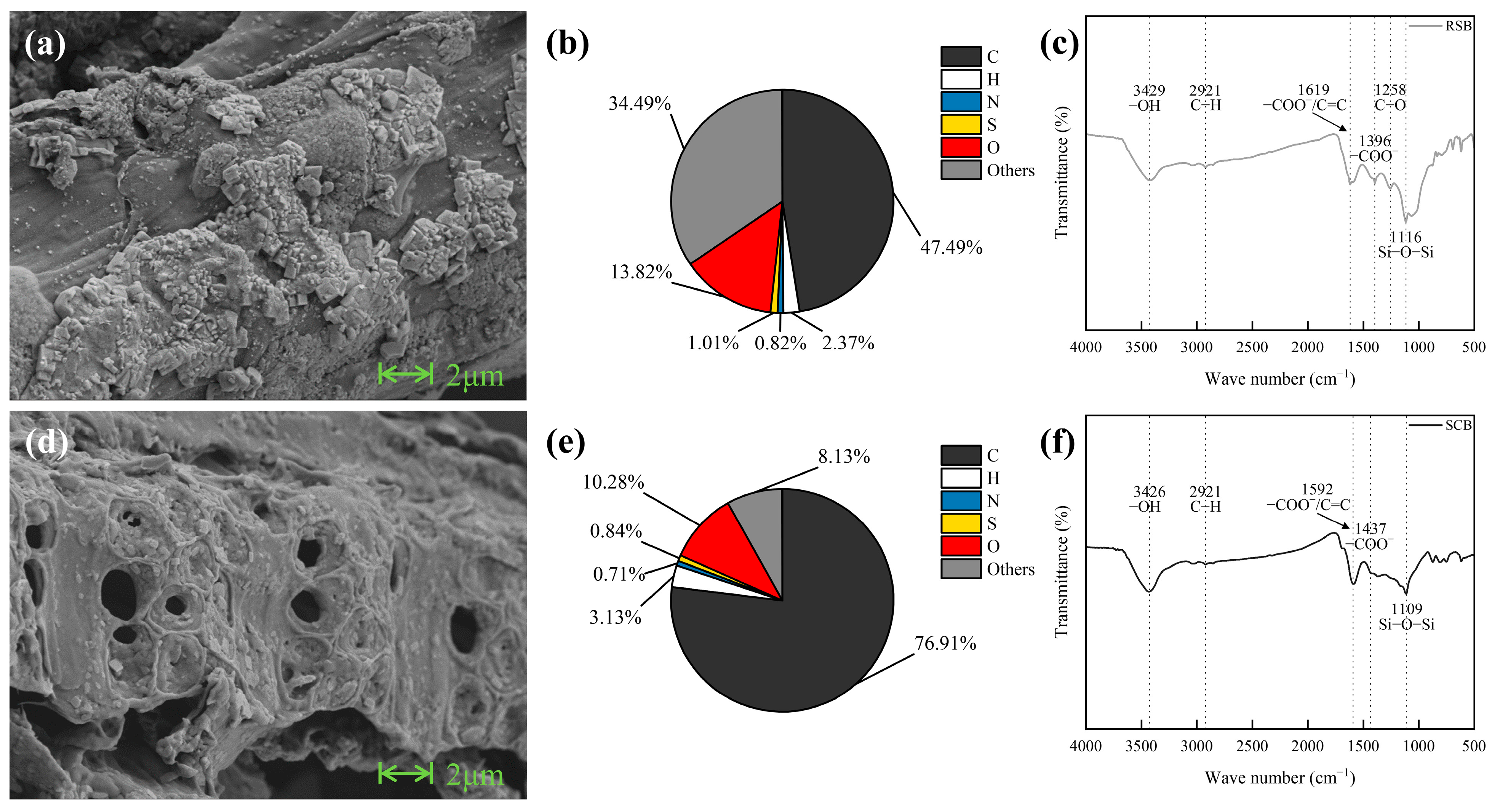
The characterization of RSB and SCB is shown in Figure 1 and Table S1. The basic physicochemical properties of both biochars, including yield, ash content, pH, and pore structure parameters, are summarized in Table S1. The SEM images reveal significant differences in surface morphology and pore structure between the two biochars. SCB exhibits a loose, sponge-like surface, whereas RSB shows a dense and rough surface. Consistent with SEM observations, BET analysis quantified the pore structure divergence between the two biochars: SCB had markedly higher specific surface area (57.913 m2/g), total pore volume (0.034 cm3/g), micropore area (38.760 m2/g), and micropore volume (0.016 cm3/g) than RSB (6.988 m2/g, 0.015 cm3/g, 2.379 m2/g, 0.001 cm3/g).
EA results indicate that the carbon content of SCB is significantly higher than that of RSB, suggesting a higher degree of carbonization. Atomic ratio analysis shows lower H/C and O/C ratios in SCB than in RSB, indicating a more stable carbon structure and higher aromaticity [36,37,38]. In contrast, the higher O/C and (O + N)/C ratios of RSB reflect its abundant oxygen-containing functional groups, as well as stronger surface polarity and hydrophilicity. FTIR spectra of both biochars display a hydroxyl (−OH) stretching peak near 3430 cm−1, a C−H stretching peak near 2920 cm−1, and aromatic C=C skeleton stretching, along with carboxylate (−COO) asymmetric stretching peaks in the 1500–1650 cm−1 region. The main differences are as follows: RSB exhibits significantly stronger symmetric stretching peaks of carboxylate (−COO) at 1360–1450 cm−1 and antisymmetric stretching peaks of siloxane (Si−O−Si) at 1000–1150 cm−1 compared to SCB. Additionally, a C−O stretching peak near 1260 cm−1 is observed for RSB, but is nearly undetectable for SCB.
The differences in properties between RSB and SCB originate from their feedstock characteristics. Rice straw is rich in inorganic minerals, and upon pyrolysis, it produces biochar with high ash content and abundant oxygen-containing groups. However, mineral particles block pores, resulting in a low specific surface area. In contrast, sugarcane bagasse is rich in cellulose; its pyrolysis releases volatiles that generate abundant pores, and its low ash content prevents catalytic gasification of carbon, leading to higher carbon content, pore volume, and aromaticity. Previous studies have shown that oxygen-containing functional groups (e.g., −COO, −O−) and inorganic minerals are not only the main contributors to biochar alkalinity but also the primary sources of its adsorption capacity for heavy metal cations such as Cd2+ and Pb2+ [39,40]. FTIR results indicate that RSB possesses more abundant −COO, Si−O−Si, and C−O functional groups, whereas SCB is dominated by an aromatic carbon framework with a hydroxyl-rich surface, determining their distinct adsorption site compositions. Owing to its functional group composition, RSB is expected to possess stronger ion-exchange and complexation capacities; thus, we speculate that RSB may exhibit better adsorption performance for Cd2+ and Pb2+ than SCB.

3.2. Effects of Biochar on Total Heavy Metal Contents in Soil and Pakchoi Shoots

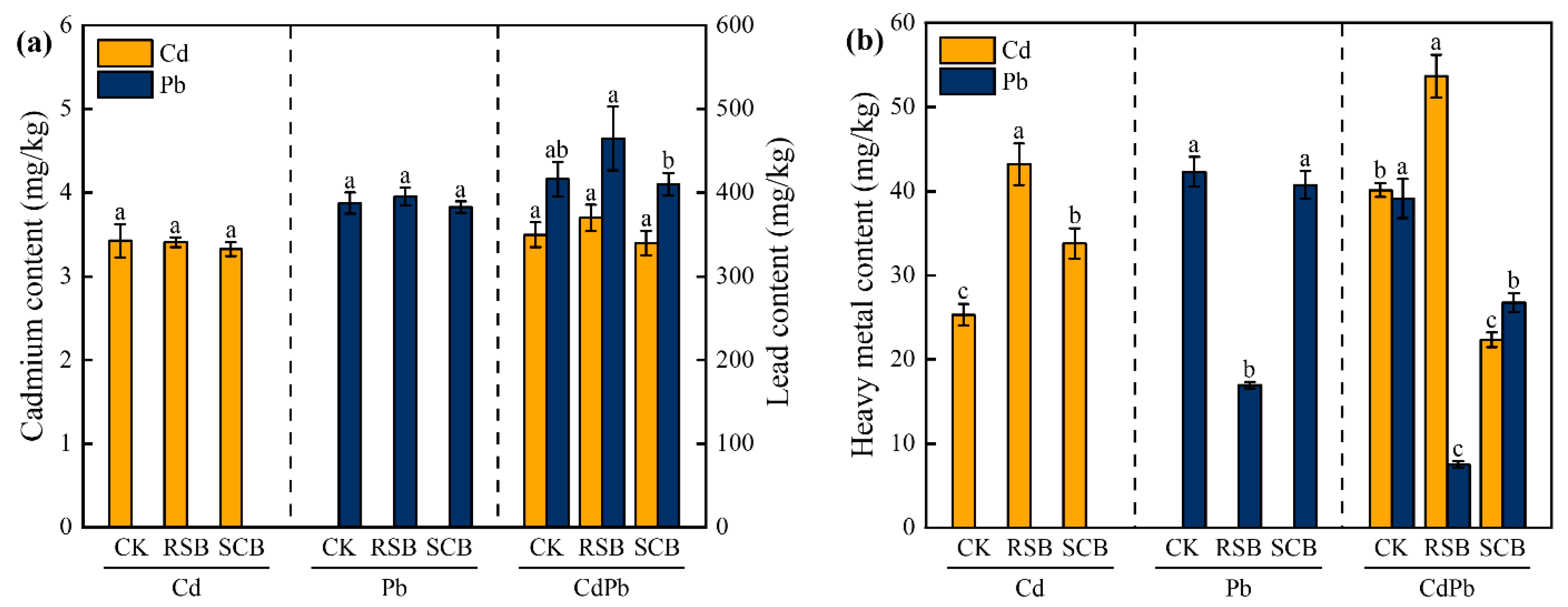
Changes in total heavy metal contents in soil and pakchoi shoots after biochar application are shown in Figure 2a,b. Under Cd-only conditions, both RSB and SCB slightly reduced total soil Cd (p > 0.05), but significantly increased Cd content in pakchoi shoots, with RSB increasing by 70.8% (p < 0.05) and SCB by 33.5% (p < 0.05). The slight decrease in soil Cd corresponds to the significant increase in shoot Cd, indicating that neither biochar effectively blocks Cd translocation to shoots; instead, they promote Cd uptake and accumulation, especially RSB. The likely mechanism is that Cd ions, with their small radii and high soil mobility, are less effectively retained by biochar through adsorption or ion exchange. Additionally, nutrients released from biochars (more from RSB) enhance plant growth and alter the rhizosphere, increasing Cd uptake. Previous studies have shown that Cd is mainly adsorbed via ion exchange [41,42], and this binding is weak, leaving Cd in exchangeable/acid-soluble forms, making it prone to plant uptake [43,44]. Consequently, under Cd-only conditions, neither biochar effectively immobilized Cd; instead, both promoted Cd accumulation in pakchoi—particularly RSB—raising potential food safety concerns and indicating that neither RSB nor SCB is suitable for application in soils solely contaminated with Cd.
Under Pb-only conditions, RSB slightly increased total soil Pb (p > 0.05) but significantly reduced Pb content in pakchoi shoots (by 60.0%, p < 0.05). SCB showed no significant difference from CK in either soil or shoot Pb. In the closed system, total Pb is conserved. RSB, with stronger Pb immobilization capacity, inhibits Pb translocation to shoots, retaining more Pb in soil and reducing Pb in shoots. SCB’s weaker immobilization fails to significantly inhibit Pb transport, resulting in no significant changes. Previous studies have shown that Pb is primarily immobilized via stable precipitation with anions (e.g., carbonate, phosphate) in biochar ash, reducing its bioavailability [45,46]. Consequently, these findings indicate that RSB is effective for Pb immobilization, whereas SCB shows limited effectiveness.
Under Cd-Pb co-contaminated conditions, RSB and SCB exerted differential effects. Compared with CK, RSB slightly increased total soil Cd and Pb (p > 0.05), whereas SCB slightly decreased both (p > 0.05). In pakchoi shoots, RSB significantly increased Cd content by 33.7% (p < 0.05) and decreased Pb content by 81.0% (p < 0.05); SCB significantly decreased Cd by 44.4% and Pb by 31.6% (p < 0.05). This contrasting behavior is attributed to the distinct adsorption properties of the two biochars and the competitive interactions between Cd and Pb for binding sites. RSB, with its high ash content and abundant functional groups, possesses strong Pb precipitation and complexation ability, effectively inhibiting Pb translocation to shoots. In contrast, Cd is mainly adsorbed via ion exchange [47]. Under co-contamination, Pb preferentially occupies adsorption sites, possibly due to its higher electronegativity (2.33 vs. 1.9) and smaller hydrolysis constant (pKh 7.71 vs. 10.08) [48], which weakens Cd immobilization, increases Cd mobility, and promotes Cd uptake by pakchoi. Inyang et al. [49] also noted that Cd adsorption is most severely affected by competition in multi-metal systems, further confirming Pb’s competitive advantage. By contrast, SCB has low ash content and fewer oxygen-containing functional groups, but its large specific surface area and abundant pore structure enable non-specific adsorption of both Cd and Pb, achieving mild simultaneous suppression of the two metals. Consequently, these findings indicate that under Cd-Pb co-contaminated conditions, RSB effectively immobilizes Pb but aggravates Cd accumulation in pakchoi, whereas SCB provides balanced and moderate suppression of both heavy metals. Collectively, these findings highlight that biochar remediation efficacy is metal-specific and contamination-scenario dependent, underscoring that biochar application must be carefully tailored to avoid unintended Cd mobilization.

3.3. Effects of Biochar on Soil Enzyme Activities

Soil enzyme activities under different biochar treatments are shown in Table 2. S-UE, S-SC, and S-ACP are key hydrolases driving soil N, C, and P cycles, respectively, highly sensitive to Cd/Pb stress and serving as core indicators of soil pollution [50,51,52].
Both biochars tended to increase S-UE activity under all contamination conditions, with varying magnitudes. Under Cd-only conditions, RSB increased S-UE activity by 22.3% (p < 0.05), while SCB showed no significant difference from CK. Under Pb-only conditions, RSB and SCB increased S-UE activity by 12.5% (p > 0.05) and 51.8% (p < 0.05), respectively. Under Cd-Pb co-contamination, both RSB and SCB significantly increased S-UE activity (by 23.9% and 41.9%, p < 0.05). The general increases in S-UE activity across these contamination scenarios suggest that biochar addition effectively alleviates heavy metal stress, consistent with the role of S-UE as a sensitive indicator of metal pollution [51,53].
S-SC activity was also consistently enhanced by both biochars under all contamination conditions. Under Cd-only conditions, RSB increased S-SC activity by 212.0% (p < 0.05) and SCB by 90.7% (p < 0.05). Under Pb-only conditions, RSB and SCB increased S-SC activity by 56.0% and 41.7%, respectively (both p > 0.05). Under Cd-Pb co-contamination, the increases were 130.2% and 140.7%, respectively (both p < 0.05). The enhanced S-SC activity suggests that biochar addition may increase the availability of labile organic carbon, which can complex both Cd2+ and Pb2+, thereby reducing their mobility [54].
The response of S-ACP differed between RSB and SCB, and between Cd-only and Pb-containing treatments. Under Cd-only conditions, both biochars increased S-ACP activity (RSB: 29.0%, SCB: 36.7%, both p > 0.05), suggesting that phosphorus cycling may be enhanced, potentially immobilizing Cd through the formation of stable metal-phosphate complexes [52]. Under Pb-only and Cd-Pb co-contaminated conditions, RSB decreased S-ACP activity (by 30.7%, p > 0.05 and 50.1%, p < 0.05, respectively), while SCB showed negligible changes (5.9% and 19.7%, both p > 0.05). This differential response may reflect a negative feedback regulation: Hou et al. [54] reported that Pb contamination directly upregulates S-ACP activity, and RSB-mediated Pb immobilization likely alleviates this upregulation, leading to decreased S-ACP activity. SCB’s weaker Pb immobilization capacity may explain its lack of significant effect on S-ACP.
Collectively, both biochars generally enhanced S-UE and S-SC activities across all contamination scenarios, with the only exception being SCB under Cd-only conditions, where S-UE showed no significant change. These improvements may indicate enhanced soil biochemical functioning and reduced heavy metal stress. Notably, RSB exhibited a stronger capacity to downregulate S-ACP under Pb stress, possibly due to its more effective Pb immobilization.

3.4. Adsorption of Cd and Pb by Biochar

3.4.1. Effect of pH

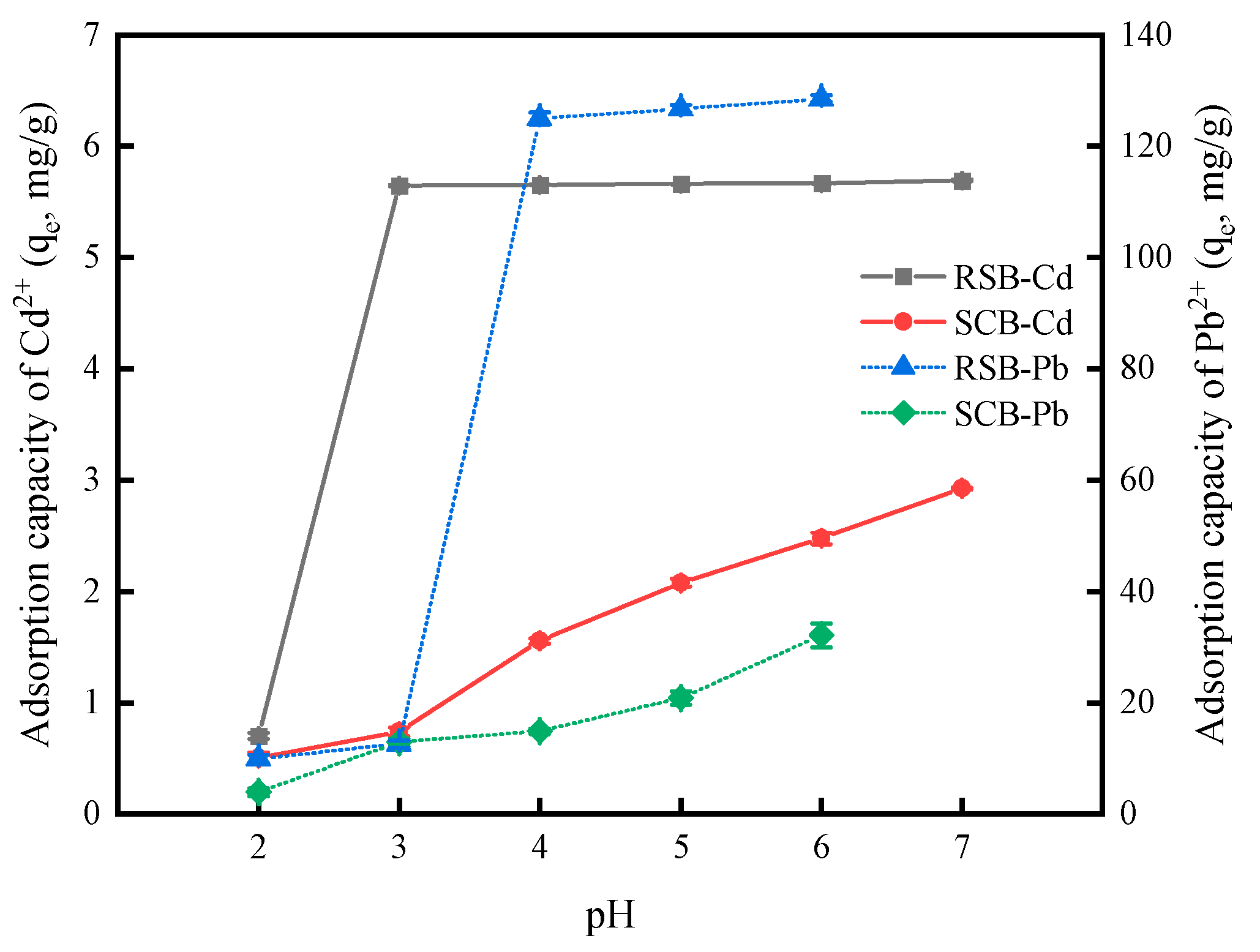
The effects of pH on Cd2+ and Pb2+ adsorption by RSB and SCB are shown in Figure 3. For SCB, the adsorption capacities for both Cd2+ and Pb2+ increased almost linearly with increasing pH. The maximum adsorption of Cd2+ occurred at pH 7 (2.9 mg/g), and that of Pb2+ at pH 6 (32.1 mg/g). At the same pH, SCB exhibited a much higher adsorption capacity for Pb2+ than for Cd2+. For RSB, the adsorption behavior showed a different pattern. Its adsorption of Cd2+ increased sharply at pH 3, reaching a high level (5.6 mg/g), and thereafter remained relatively stable with further pH increase. Its adsorption of Pb2+ showed a lag, with no obvious increase at pH 3 but a sharp rise at pH 4 to a high level (125.0 mg/g), followed by a plateau. Similarly, RSB exhibited a much higher adsorption capacity for Pb2+ than for Cd2+ at each pH; moreover, at pH > 3, RSB consistently outperformed SCB in adsorbing both metals. Under strongly acidic conditions (pH < 3.0), abundant H+ competes with heavy metal ions for adsorption sites, and surface functional groups become protonated, causing electrostatic repulsion and low adsorption capacity for both biochars [47,48]. With rising pH, H+ concentration decreases, functional groups deprotonate, and the negative charge on biochar surfaces increases, thereby enhancing electrostatic adsorption and reducing site competition, which improves adsorption capacity [55,56,57]. The abrupt increase in RSB adsorption at specific pH thresholds likely reflects the deprotonation of specific oxygen-containing functional groups and the onset of precipitation reactions involving its high ash content. In contrast, the near-linear increase for SCB suggests that its adsorption is mainly driven by gradual surface charge development, consistent with its lower ash content and fewer functional groups. Additionally, the superior adsorption of Pb2+ over Cd2+ is due to the higher electronegativity, smaller hydration radius, and lower hydrolysis constant of Pb2+, which enhances its affinity for biochar surfaces [48]. A high-pH environment lowers the heterogeneous nucleation barrier, promoting precipitation with inorganic biochar components and further increasing adsorption [58]. Consequently, at the same pH, RSB exhibited higher adsorption capacities for both Cd2+ and Pb2+ than SCB, and both biochars showed much stronger adsorption for Pb2+ than for Cd2+.

3.4.2. Adsorption Kinetics

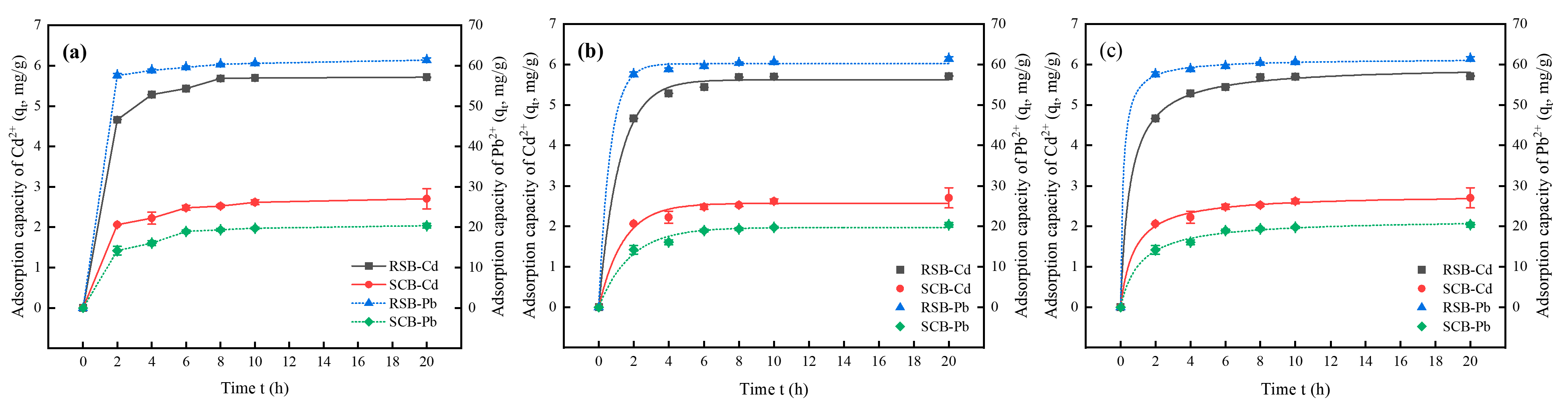
Figure 4a shows the adsorption capacities of RSB and SCB for Cd2+ and Pb2+ over 0–20 h at pH 5.0 and 25 °C. During the first 6 h, RSB and SCB exhibit rapid Cd2+ adsorption, reaching 5.44 and 2.48 mg/g, respectively. From 6 to 20 h, the adsorption rate slows, reaching equilibrium at 5.71 and 2.70 mg/g. Similarly, both biochars show rapid Pb2+ adsorption within 6 h (59.58 and 18.93 mg/g), followed by a slower phase, reaching equilibrium at 61.40 and 20.37 mg/g, respectively. The initial rapid phase is attributed to intense concentration-driven mass transfer and abundant unoccupied surface adsorption sites [59]. As sites become occupied, ion diffusion resistance increases, slowing adsorption until equilibrium [59,60]. The equilibrium adsorption capacities of both biochars for Pb2+ are significantly higher than those for Cd2+. This difference stems from the intrinsic properties of the two metal ions: the smaller hydration radius of Pb2+ allows easier access to the biochar surface, and its higher electronegativity enhances complexation with surface functional groups [47,49]. Thus, throughout the adsorption process, RSB exhibits significantly higher adsorption capacities for both Cd2+ and Pb2+ than SCB, demonstrating superior performance.
Combining the fitted curves in Figure 4b,c and the kinetic parameters in Table 3, the adsorption of Cd2+ and Pb2+ by both biochars better conforms to the pseudo-second-order kinetic model. The R2 values for the pseudo-second-order model in all four systems exceed 0.995 and are significantly higher than those of the pseudo-first-order model, indicating an excellent fit. Notably, the pseudo-second-order model yields theoretical equilibrium adsorption capacities for the SCB-Cd and RSB-Pb systems (2.79 and 61.40 mg/g) that closely match the experimental values (2.71 and 61.40 mg/g). For the RSB-Cd and SCB-Pb systems, the pseudo-first-order model gives theoretical values (5.62 and 19.69 mg/g) closer to the experimental ones (5.71 and 20.37 mg/g), but the pseudo-second-order model still provides a better overall fit. Mohan et al. [48] demonstrated that the pseudo-second-order kinetic model fits Cd2+ and Pb2+ adsorption data well, confirming chemisorption as the core rate-controlling mechanism, and attributed the higher adsorption selectivity of biochar for Pb2+ over Cd2+ to the higher electronegativity (2.33 > 1.9) and smaller hydrolysis constant (Kh: 7.71 < 10.08) of Pb2+. Overall, the pseudo-second-order kinetic model more accurately describes the adsorption of Cd2+ and Pb2+ onto RSB and SCB, indicating that the process is primarily controlled by chemisorption.

3.4.3. Adsorption Isotherms

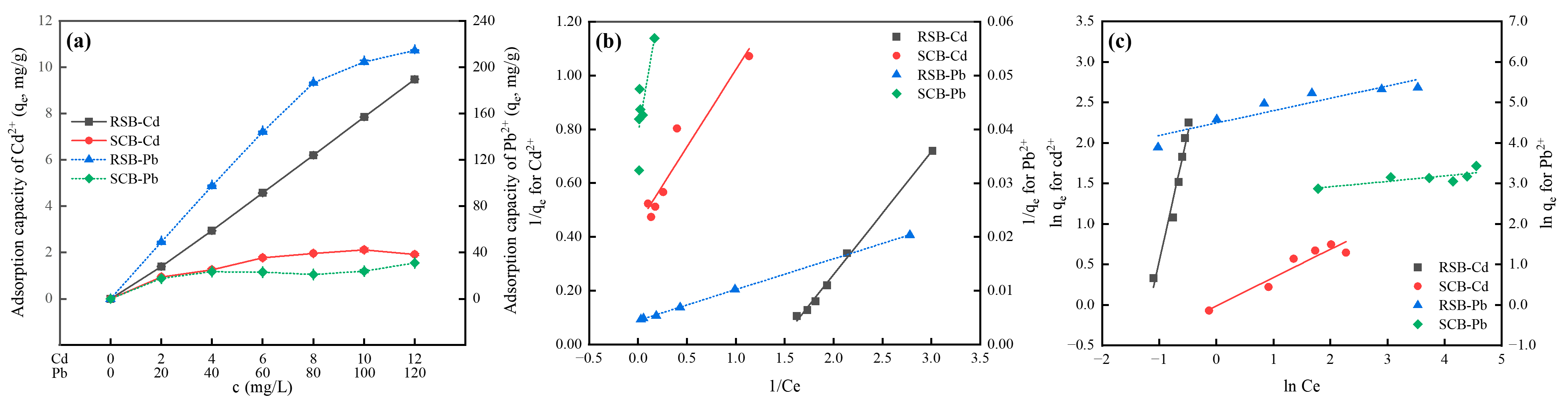
Figure 5a shows the isothermal adsorption curves of RSB and SCB for Cd2+ and Pb2+ at different initial concentrations (pH 5.0, 25 °C). For RSB, the adsorption capacity for Cd2+ increased almost linearly with increasing initial concentration, whereas that for Pb2+ increased sharply at lower concentrations and then gradually leveled off. For SCB, the adsorption capacities for both Cd2+ and Pb2+ increased slowly at first and then quickly reached a plateau, with only marginal increases at higher concentrations. This is because the initial concentration provides the mass transfer driving force until surface adsorption sites become saturated [48,60]. In contrast, the continued increase for RSB suggests that its abundant active sites and high ash content allow further adsorption even at higher concentrations, reflecting its superior adsorption capacity. Consequently, at the same initial concentration, RSB exhibited much higher adsorption capacities for both Cd2+ and Pb2+ than SCB, and both biochars adsorbed Pb2+ far more efficiently than Cd2+, consistent with the kinetic analysis.
Langmuir and Freundlich models were used to fit the isothermal adsorption data. The fitted curves are presented in Figure 5b,c, and the fitting parameters and evaluation metrics are listed in Table 3. For RSB-Cd, the Langmuir model yielded negative parameter values, which are physically meaningless, indicating that this model is not suitable for describing the adsorption process. This anomaly is likely due to insufficient data points at low equilibrium concentrations—possibly related to the experimental concentration range and interval settings—as well as the highly heterogeneous surface of RSB. Therefore, the adsorption of Cd2+ by RSB was described by the Freundlich model alone. For the other three systems (SCB-Cd, RSB-Pb, SCB-Pb), all Langmuir parameters were positive, and the Langmuir model showed consistently higher R2, lower RMSE, and lower AIC values than the Freundlich model, providing converging evidence for its superior fit. The Langmuir model has been widely validated for describing heavy metal adsorption by biochars from various feedstocks [61,62]. In this study, the theoretical maximum adsorption capacities calculated by the Langmuir model are consistent with the experimental saturated adsorption capacities, further confirming the reliability of the fitting results. Overall, except for RSB-Cd, which was better fitted by the Freundlich model, the adsorption behavior of both biochars for the target heavy metals is more consistent with the Langmuir model, suggesting that the adsorption process is dominated by homogeneous monolayer adsorption.

3.5. Microbial Community Analysis

3.5.1. Microbial Abundance and Diversity

Bacterial α-diversity indices under different biochar treatments in Cd, Pb, and Cd-Pb contaminated soils are shown in Table 4. The Chao1 and ACE indices are used to characterize soil bacterial community richness, while the Shannon and Simpson indices assess bacterial diversity [63]. Compared with CK, under Cd-contaminated soil, both RSB and SCB groups led to a decrease in Chao1 and ACE indices, with the SCB group showing the lowest values. However, RSB caused an increase in the Shannon index, while SCB led to a decrease. Although both biochar treatments reduced bacterial richness under Cd pollution, RSB treatment increased community diversity, while SCB treatment decreased both richness and diversity. This indicated that in Cd-contaminated soil, RSB treatment was more beneficial for maintaining the stability of the soil bacterial community than SCB treatment.
Under Pb-contaminated soil, compared with CK, the Chao1 and ACE indices of both RSB and SCB treatments decreased, with the SCB group showing the lowest values. The Shannon index also decreased in both RSB and SCB groups, with the most significant decrease in the SCB group. Therefore, the addition of both biochars reduced bacterial richness and diversity under Pb stress, with SCB having the most significant impact. This suggests that RSB is also superior to SCB in maintaining the stability of the bacterial community in Pb-contaminated soil.
Under Cd-Pb co-contaminated soil, compared with CK, the Chao1 and ACE indices in the RSB group increased, while those in the SCB group decreased. Meanwhile, the Shannon index decreased most significantly in the SCB group, while there was no significant effect in the RSB group. SCB led to a decrease in both bacterial richness and diversity in the soil under combined Cd and Pb pollution, while RSB increased bacterial richness without significantly inhibiting diversity. This indicates that in Cd-Pb co-contaminated soil, RSB can still maintain a higher bacterial richness and diversity compared to SCB.
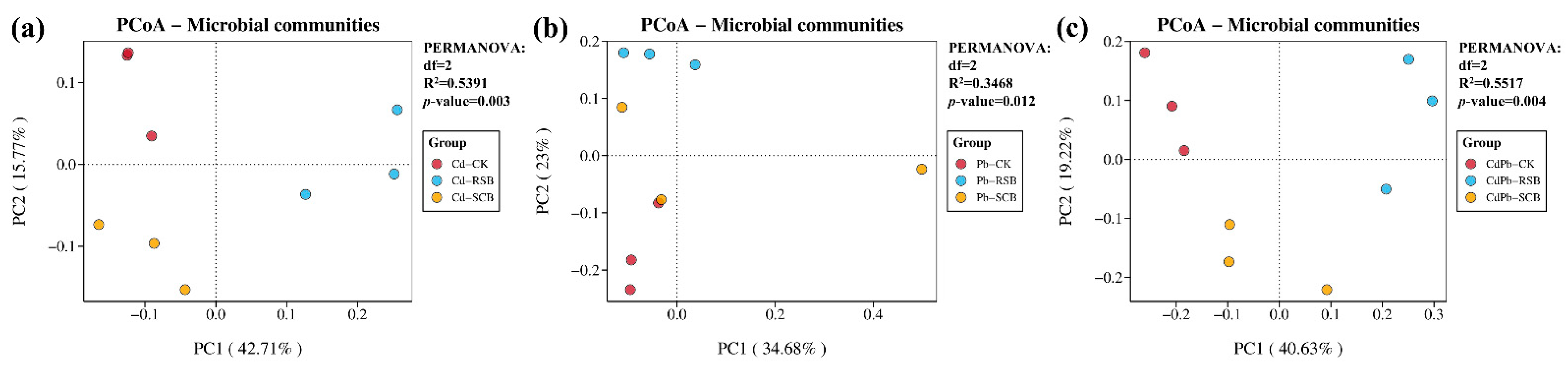
PCoA was performed to assess the effects of RSB and SCB on soil bacterial community structure (Figure 6). In Cd-contaminated, Pb-contaminated, and Cd-Pb co-contaminated soils, the first two principal coordinates (PC1 and PC2) collectively explained 58.48%, 57.68%, and 59.85% of the total variance, respectively. Permutational multivariate analysis of variance (PERMANOVA) based on Bray–Curtis dissimilarity confirmed that bacterial community structures significantly differed among treatments in all three contamination scenarios (Cd: p = 0.003; Pb: p = 0.012; Cd-Pb: p = 0.004). Specifically, in Cd-contaminated soil, all three groups (CK, RSB, SCB) were significantly different from each other. In Pb-contaminated soil, only RSB differed significantly from CK. In Cd-Pb co-contaminated soil, all three groups were again significantly different from each other. These results indicate that both RSB and SCB significantly altered bacterial community structure in Cd and Cd-Pb co-contaminated soils, whereas only RSB exerted a significant effect in Pb-contaminated soil.

3.5.2. Microbial Community Composition

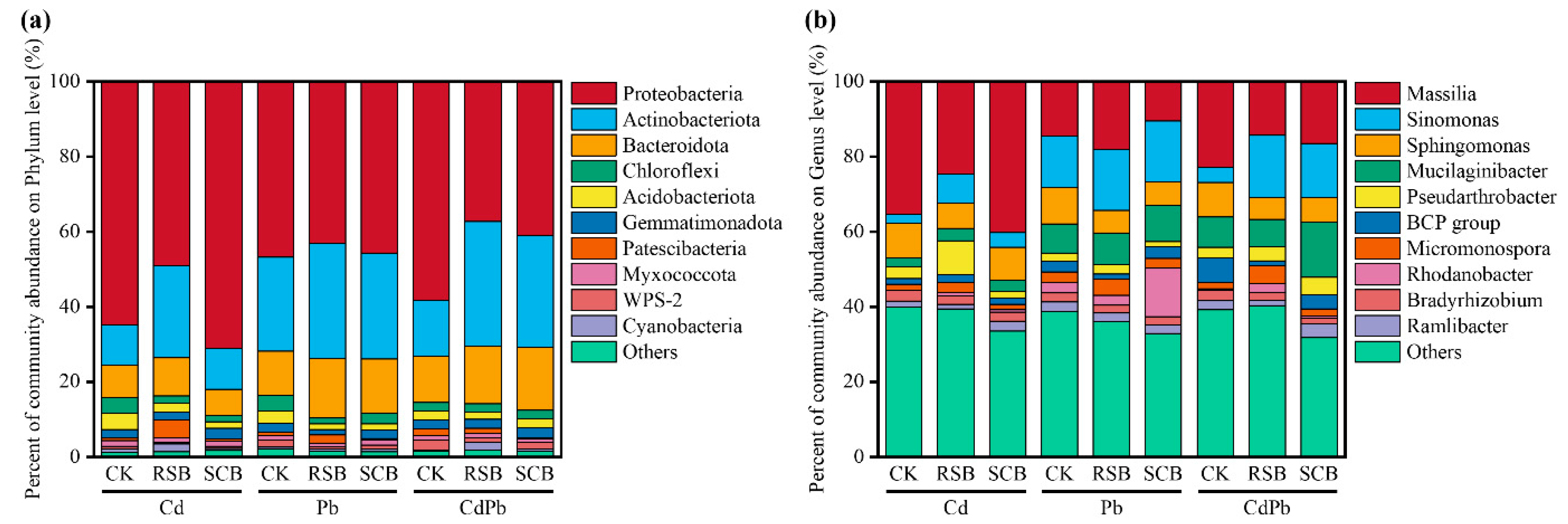
Figure 7a shows the microbial community composition at the phylum level. In the Cd-contaminated group, compared with CK, RSB increased the relative abundance of Actinobacteriota (by 13.68%) and Bacteroidota (by 1.59%), while decreasing that of Proteobacteria (by 15.65%), Chloroflexi (by 2.32%), and Acidobacteriota (by 1.94%). SCB increased the relative abundance of Proteobacteria (by 6.35%), while decreasing that of Chloroflexi (by 2.70%) and Acidobacteriota (by 2.46%). In the Pb-contaminated group, compared with CK, RSB increased the relative abundance of Actinobacteriota (by 5.75%) and Bacteroidota (by 3.99%), while decreasing that of Chloroflexi (by 2.58%) and Acidobacteriota (by 1.73%). SCB increased the relative abundance of Actinobacteriota (by 3.24%) and Bacteroidota (by 2.89%), while decreasing that of Chloroflexi (by 1.57%) and Acidobacteriota (by 1.56%). In the Cd-Pb co-contaminated group, compared with CK, RSB increased the relative abundance of Actinobacteriota (by 18.44%) and Bacteroidota (by 2.89%), while decreasing that of Proteobacteria (by 20.97%). SCB increased the relative abundance of Actinobacteriota (by 14.92%) and Bacteroidota (by 4.36%), while decreasing that of Proteobacteria (by 17.21%). Previous studies have reported that Proteobacteria, Chloroflexi, and Acidobacteriota are highly tolerant to heavy metals, and their abundance changes directly reflect soil heavy metal stress intensity [64,65,66]. Actinobacteriota is a core functional taxon for remediating heavy metal-contaminated soils, and Bacteroidota is a copiotrophic functional phylum, whose increased abundance signals enhanced heavy metal immobilization and improved nutrient availability [67,68,69]. This suggests that Actinobacteriota and Bacteroidota may play important roles in biochar-mediated soil remediation, and that RSB exerts a stronger regulatory effect on community structure than SCB.
Figure 7b shows the microbial community composition at the genus level. In the Cd-contaminated group, compared with CK, RSB increased the relative abundance of Sinomonas (by 5.26%), Mucilaginibacter (by 0.71%), and Pseudarthrobacter (by 5.99%), while decreasing that of Massilia (by 10.70%) and Sphingomonas (by 2.25%). SCB increased the relative abundance of Massilia (by 4.84%), Sinomonas (by 1.58%), and Mucilaginibacter (by 0.45%), while decreasing that of Sphingomonas (by 0.29%) and Pseudarthrobacter (by 1.47%). In the Pb-contaminated group, compared with CK, RSB increased the relative abundance of Massilia (by 3.51%), Sinomonas (by 2.63%), Mucilaginibacter (by 0.57%), and Pseudarthrobacter (by 0.39%), while decreasing that of Sphingomonas (by 3.75%). SCB increased the relative abundance of Sinomonas (by 2.63%) and Mucilaginibacter (by 1.85%), while decreasing that of Massilia (by 4.15%), Sphingomonas (by 3.37%), and Pseudarthrobacter (by 0.89%). In the Cd-Pb co-contaminated group, compared with CK, RSB increased the relative abundance of Sinomonas (by 12.64%) and Pseudarthrobacter (by 0.94%), while decreasing that of Massilia (by 8.57%), Mucilaginibacter (by 0.79%), and Sphingomonas (by 3.35%). SCB increased the relative abundance of Sinomonas (by 10.36%), Mucilaginibacter (by 6.72%), and Pseudarthrobacter (by 2.00%), while decreasing that of Massilia (by 6.42%) and Sphingomonas (by 2.65%). Overall, Sinomonas shows an upward trend in all contaminated groups. Pseudarthrobacter significantly increases from 2.99% to 8.98% after RSB treatment in the Cd-contaminated group. Mucilaginibacter increases in both single-pollutant groups, with lower overall abundance in the Cd-contaminated group than in the Pb-contaminated group. Sphingomonas decreases in all groups, and Massilia shows a consistent decrease in the Cd-Pb co-contaminated group. Previous studies have shown that heavy metal stress enriches tolerant indicator taxa in contaminated soils, whereas biochar amendment can restore the core functional microbial network and enhance metal immobilization and nutrient cycling by reducing metal bioavailability, improving soil fertility, and stimulating microbial activity [16,70]. In this study, potentially remediation-related genera, such as Pseudarthrobacter, Sinomonas, and Mucilaginibacter, were significantly enriched under biochar treatments. Consistent with previous reports on their roles in heavy metal-contaminated environments [16], their enrichment provides microbiological evidence for the enhanced soil remediation potential. Concurrently, the decline of tolerant indicator genera aligns with the alleviation of heavy metal toxicity and a community shift from a stress-tolerant state toward a nutrient-cycling and symbiotic state. These results indicate that biochar can selectively enrich heavy metal-remediating genera within Actinobacteriota and Bacteroidota while suppressing tolerant indicator genera within Proteobacteria, consistent with phylum-level changes.

3.5.3. Effects of Soil Physicochemical Parameters on Microbial Community Structure

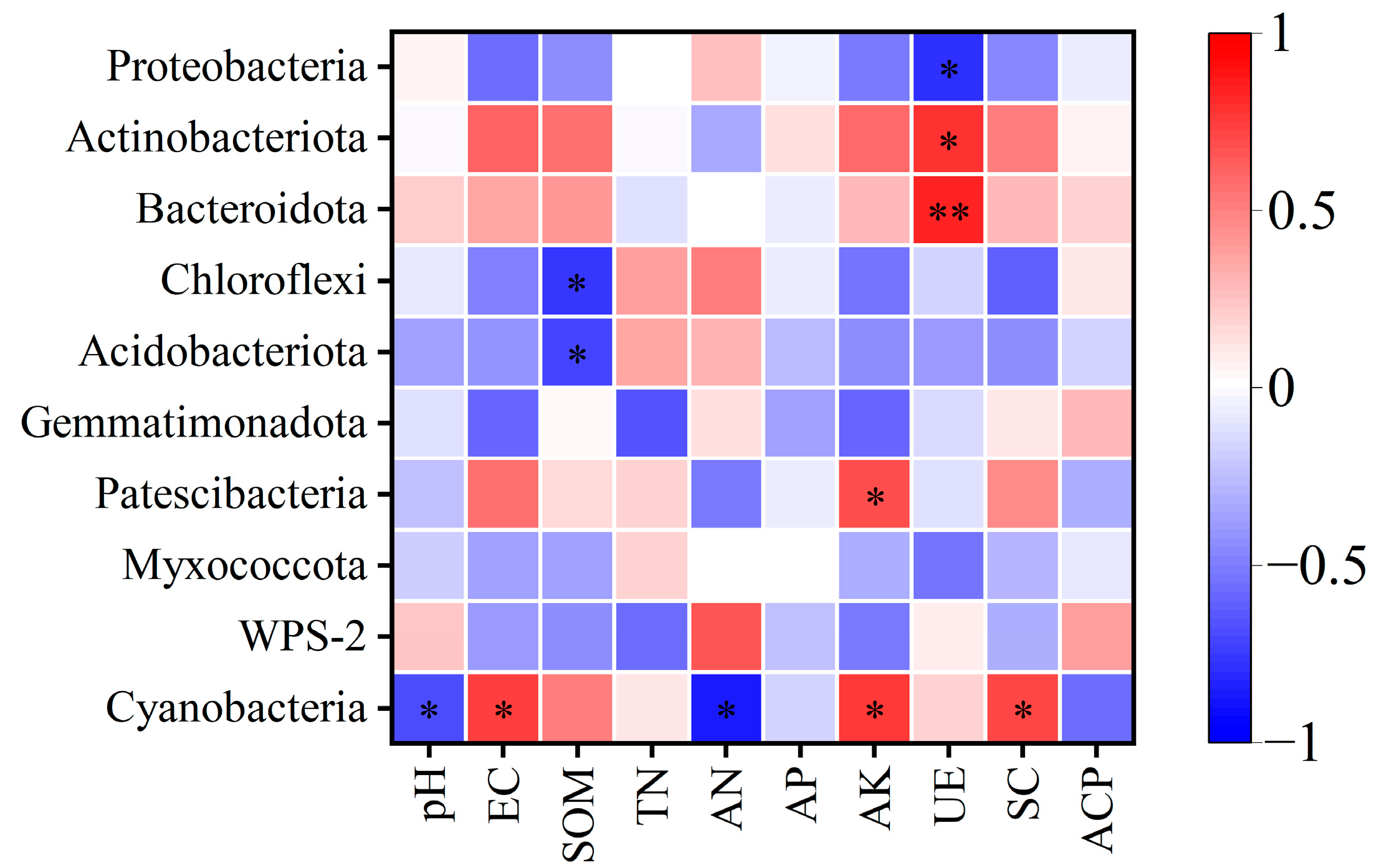
Figure 8 illustrates the correlation between the abundance of dominant bacterial phyla and environmental factors. The bacteria Proteobacteria were only negatively correlated with UE (p < 0.05), while the bacteria Actinobacteriota and Bacteroidota were significantly positively correlated with UE (p < 0.05). The bacteria Chloroflexi and Acidobacteriota were only negatively correlated with SOM (p < 0.05). The bacteria Patescibacteria were only positively correlated with AK (p < 0.05). The bacteria Cyanobacteria showed a more complex correlation (p < 0.05). The bacteria Cyanobacteria were significantly positively correlated with EC, AK, and SC, but were significantly negatively correlated with pH and AN (p < 0.05). The results indicate that the improvement of soil fertility and enzyme activity induced by biochar plays a key role in reshaping the bacterial community, facilitating the enrichment of beneficial functional groups and inhibiting the growth of metal-resistant oligotrophic groups.

4. Conclusions

This study systematically compared the remediation performance and mechanisms of RSB and SCB in Cd-only, Pb-only, and Cd-Pb co-contaminated soils. RSB exhibited high ash content, abundant functional groups, and low specific surface area, whereas SCB was characterized by high aromaticity, a well-developed pore structure, and low ash content. Adsorption experiments revealed that chemisorption was the dominant mechanism for Cd and Pb immobilization, with RSB’s superior adsorption attributable to active sites provided by its high ash content. In the soil-pakchoi system, RSB significantly reduced Pb uptake by pakchoi (by 60.0% under Pb-only and 81.0% under co-contaminated conditions). SCB showed limited Pb immobilization under single-pollution conditions but achieved balanced suppression of both metals under co-contamination, reducing Cd and Pb uptake by 44.4% and 31.6%, respectively. Both biochars enhanced S-UE and S-SC activities but had divergent effects on S-ACP: RSB decreased S-ACP, likely by alleviating Pb-stress-induced upregulation, while SCB showed little effect. At the microecological level, RSB maintained bacterial community richness and diversity while selectively enriching metal-immobilizing taxa (e.g., Actinobacteriota, Bacteroidota); SCB caused greater community disturbance in Pb-only soil, posing a risk of reducing richness, but neither biochar disrupted core ecological functions. In summary, RSB efficiently immobilizes Pb and is well-suited for Pb-contaminated farmland, although the risk of promoting Cd uptake should be noted. SCB demonstrated a certain capacity to suppress both Cd and Pb uptake under co-contaminated conditions, suggesting its potential applicability in combined pollution scenarios.
Despite these findings, several limitations should be acknowledged. First, the experimental duration was relatively short (30 days), which may not reflect long-term aging effects. Second, the study was conducted under small-scale pot conditions, requiring field-scale validation. Third, the long-term stability of immobilized heavy metals was not assessed. Fourth, direct metal speciation analyses (e.g., XPS, XRD, sequential extraction) were not performed, limiting our ability to distinguish the relative contributions of different immobilization mechanisms. Fifth, post-adsorption FTIR analysis was not conducted, which would have provided direct evidence for identifying functional groups involved in Cd and Pb binding. Future research should focus on long-term field trials to evaluate immobilization stability under natural conditions, employ advanced spectroscopic and sequential extraction techniques to elucidate immobilization mechanisms at the molecular level, conduct pre- and post-adsorption FTIR characterization to identify key binding functional groups, and explore modified biochars for simultaneous and efficient immobilization of both Cd and Pb.

Supplementary Materials

The following supporting information can be downloaded at: https://www.mdpi.com/article/10.3390/agriculture16111236/s1, Table S1: Physicochemical properties of RSB and SCB; Table S2: Growth and nutrient indicators of pakchoi under different treatments; Table S3: Soil pH and EC under different pollution conditions amended with RSB and SCB; Table S4: Soil fertility indicators under different pollution conditions amended with RSB and SCB; Figure S1: Bubble chart showing the top 10 predicted functional categories of soil bacterial communities based on FAPROTAX analysis across different treatments; Figure S2: Rarefaction curves of bacterial ASV richness across all soil samples.

Author Contributions

X.Z.: Conceptualization, Investigation, Data Curation, Visualization, Writing—original draft. C.K.: Investigation, Data Curation, Writing—original draft. Z.H.: Investigation, Data Curation, Writing—original draft. X.C.: Conceptualization, Funding Acquisition, Writing—review and editing. Z.G.: Methodology, Writing—review and editing. Y.Z.: Writing—review and editing. All authors have read and agreed to the published version of the manuscript.

Funding

This work was supported by the Key Scientific Research Platform and Project Fund of Guangdong Provincial Universities (2025ZDZX4060).

Data Availability Statement

The original data presented in the study are openly available in [NCBI] at [http://www.ncbi.nlm.nih.gov/bioproject/1462295 (accessed on 6 May 2026)].

Acknowledgments

We would like to express our sincere gratitude to the editors and reviewers for their insightful comments and valuable time, which have greatly improved the quality of this manuscript.

Conflicts of Interest

The authors declare that they have no known competing financial interests or personal relationships that could have appeared to influence the work reported in this paper.

References

  1. Yu, J.; Chen, Z.; Gao, W.; He, S.; Xiao, D.; Fan, W.; Huo, M.; Nugroho, W.A. Global trends and prospects in research on heavy metal pollution at contaminated sites. J. Environ. Manag. 2025, 383, 125402. [Google Scholar] [CrossRef]
  2. Yan, K.; Wang, H.; Lan, Z.; Zhou, J.; Fu, H.; Wu, L.; Xu, J. Heavy metal pollution in the soil of contaminated sites in China: Research status and pollution assessment over the past two decades. J. Clean. Prod. 2022, 373, 133780. [Google Scholar] [CrossRef]
  3. Hou, D.; Jia, X.; Wang, L.; McGrath, S.P.; Zhu, Y.-G.; Hu, Q.; Zhao, F.-J.; Bank, M.S.; O’Connor, D.; Nriagu, J. Global soil pollution by toxic metals threatens agriculture and human health. Science 2025, 388, 316–321. [Google Scholar] [CrossRef]
  4. Setu, S.; Strezov, V. Impacts of non-ferrous metal mining on soil heavy metal pollution and risk assessment. Sci. Total Environ. 2025, 969, 178962. [Google Scholar] [CrossRef] [PubMed]
  5. Kumar, A.; Kumar, V.; Thakur, M.; Singh, K.; Jasrotia, R.; Kumar, R.; Radziemska, M. Global perspectives on lead contamination and health risks in surface water, rice grains, and soils. Land Degrad. Dev. 2025, 36, 2159–2169. [Google Scholar] [CrossRef]
  6. Balali-Mood, M.; Naseri, K.; Tahergorabi, Z.; Khazdair, M.R.; Sadeghi, M. Toxic mechanisms of five heavy metals: Mercury, lead, chromium, cadmium, and arsenic. Front. Pharmacol. 2021, 12, 643972. [Google Scholar] [CrossRef]
  7. Mohamed, H.I.; Ullah, I.; Toor, M.D.; Tanveer, N.A.; Din, M.M.U.; Basit, A.; Sultan, Y.; Muhammad, M.; Rehman, M.U. Heavy metals toxicity in plants: Understanding mechanisms and developing coping strategies for remediation: A review. Bioresour. Bioprocess. 2025, 12, 95. [Google Scholar] [CrossRef]
  8. Genchi, G.; Sinicropi, M.S.; Lauria, G.; Carocci, A.; Catalano, A. The effects of cadmium toxicity. Int. J. Environ. Res. Public Health 2020, 17, 3782. [Google Scholar] [CrossRef]
  9. Nie, X.; Huang, X.; Li, M.; Lu, Z.; Ling, X. Advances in soil amendments for remediation of heavy metal-contaminated soils: Mechanisms, impact, and future prospects. Toxics 2024, 12, 872. [Google Scholar] [CrossRef] [PubMed]
  10. Palansooriya, K.N.; Shaheen, S.M.; Chen, S.S.; Tsang, D.C.W.; Hashimoto, Y.; Hou, D.; Bolan, N.S.; Rinklebe, J.; Ok, Y.S. Soil amendments for immobilization of potentially toxic elements in contaminated soils: A critical review. Environ. Int. 2020, 134, 105046. [Google Scholar] [CrossRef]
  11. Zhao, L.; Imran. Heavy metal mitigation in soil and plants using organic and inorganic amendments alone and in combination. Int. J. Phytoremediat. 2025, 27, 606–623. [Google Scholar] [CrossRef]
  12. Datta, D.K.; Biswas, T.; Castonguay, E.; Ni, P. Sustainable stabilizer derived from calcium- and phosphorus-rich biowaste for remediation of heavy metal-contaminated soil: A critical review. Sustainability 2024, 16, 8841. [Google Scholar] [CrossRef]
  13. Rajput, V.; Saini, I.; Parmar, S.; Pundir, V.; Kumar, V.; Kumar, V.; Naik, B.; Rustagi, S. Biochar production methods and their transformative potential for environmental remediation. Discov. Appl. Sci. 2024, 6, 408. [Google Scholar] [CrossRef]
  14. Chi, W.; Nan, Q.; Liu, Y.; Dong, D.; Qin, Y.; Li, S.; Wu, W. Stress resistance enhancing with biochar application and promotion on crop growth. Biochar 2024, 6, 43. [Google Scholar] [CrossRef]
  15. Zhu, Z.; Zhang, Y.; Tao, W.; Zhang, X.; Xu, Z.; Xu, C. The biological effects of biochar on soil’s physical and chemical characteristics: A review. Sustainability 2025, 17, 2214. [Google Scholar] [CrossRef]
  16. Maqbool, Z.; Shahbaz Farooq, M.; Rafiq, A.; Uzair, M.; Yousuf, M.; Ramzan Khan, M.; Huo, S. Unlocking the potential of biochar in the remediation of soils contaminated with heavy metals for sustainable agriculture. Funct. Plant Biol. 2024, 51, FP23257. [Google Scholar] [CrossRef]
  17. Ketrot, D.; Wisawapipat, W. Lead immobilisation in mining contaminated soil using biochar and ash from sugarcane. Plant Soil Environ. 2021, 67, 474–481. [Google Scholar] [CrossRef]
  18. Xue, Z.; Sui, F.; Qi, Y.; Pan, S.; Wang, N.; Bian, R.; Joseph, S.; Zhang, X.; Li, L.; Pan, G. Differences in soil Cd immobilization and blockage of rice Cd uptake by biochar derived from crop residue and bone—A 2-year field experiment. Ecotoxicol. Environ. Saf. 2025, 290, 117533. [Google Scholar] [CrossRef]
  19. Chen, X.; Jiang, S.; Wu, J.; Yi, X.; Dai, G.; Shu, Y. Three-year field experiments revealed the immobilization effect of natural aging biochar on typical heavy metals (Pb, Cu, Cd). Sci. Total Environ. 2024, 912, 169384. [Google Scholar] [CrossRef]
  20. Thongsomboon, W.; Baimark, Y.; Srihanam, P. Valorization of cellulose-based materials from agricultural waste: Comparison between sugarcane bagasse and rice straw. Polymers 2023, 15, 3190. [Google Scholar] [CrossRef]
  21. Shukla, A.; Kumar, M.; Tiwari, H.; Shukla, A. Alternative uses of rice straw in North-Western regions of India: A review. Int. J. Environ. Clim. Change 2022, 12, 206–216. [Google Scholar] [CrossRef]
  22. Zhuang, J.; Kim, K.H.; Jia, L.; Meng, X.; Kumar, D.; Leem, G.; Kang, S.B.; Li, Y.; Ragauskas, A.J.; Hou, Y.; et al. Ferric chloride aided peracetic acid pretreatment for effective utilization of sugarcane bagasse. Fuel 2022, 319, 123739. [Google Scholar] [CrossRef]
  23. Ni, Y.; Zhang, M.; Qian, X.; Shen, G.; Mwabonje, O. Anaerobic digestion of rice straw as profitable climate solution reduces paddy field greenhousegas emissions and produces climate-smart fertilizer under carbon trading mechanisms. Sustainability 2025, 17, 2439. [Google Scholar] [CrossRef]
  24. Xu, Z.; Liu, B.; Wang, W.; Zhang, Z.; Qiu, W. Assessing the impact of straw burning on PM2.5 using explainable machine learning: A case study in Heilongjiang Province, China. Sustainability 2024, 16, 7315. [Google Scholar] [CrossRef]
  25. Liang, F.; Li, B.; Vogt, R.D.; Mulder, J.; Song, H.; Chen, J.; Guo, J. Straw return exacerbates soil acidification in major Chinese croplands. Resour. Conserv. Recycl. 2023, 198, 107176. [Google Scholar] [CrossRef]
  26. GB 15618-2018; Soil Environmental Quality—Risk Control Standard for Soil Contamination of Agricultural Land. CNEPA (Chinese National Environmental Protection Agency): Beijing, China, 2018. (In Chinese)
  27. Su, M.X.; Zhang, L.; Zhou, X.P.; Kou, M.; Xiong, J.; Wang, M.X.; Tan, W.F. Remediation of lead-cadmium contaminated soil via continuous effect of combined biochar and calciumsilicate. J. Agric. Resour. Environ. 2024, 41, 473–481. (In Chinese) [Google Scholar] [CrossRef]
  28. Guo, M.; Song, W.; Tian, J. Biochar-facilitated soil remediation: Mechanisms and efficacy variations. Front. Environ. Sci. 2020, 8, 521512. [Google Scholar] [CrossRef]
  29. Alkharabsheh, H.M.; Seleiman, M.F.; Battaglia, M.L.; Shami, A.; Jalal, R.S.; Alhammad, B.A.; Almutairi, K.F.; Al-Saif, A.M. Biochar and its broad impacts in soil quality and fertility, nutrient leaching and crop productivity: A review. Agronomy 2021, 11, 993. [Google Scholar] [CrossRef]
  30. Xue, Y.; Wang, C.; Hu, Z.; Zhou, Y.; Xiao, Y.; Wang, T. Pyrolysis of sewage sludge by electromagnetic induction: Biochar properties and application in adsorption removal of Pb (II), Cd (II) from aqueous solution. Waste Manag. 2019, 89, 48–56. [Google Scholar] [CrossRef]
  31. NY/T 1121.16-2006; Soil Testing—Part 16: Method for Determination of Total Water-Soluble Salt. Ministry of Agriculture of the People’s Republic of China: Beijing, China, 2006.
  32. Bao, S.D. Soil Agrochemical Analysis, 3rd ed.; China Agriculture Press: Beijing, China, 2000. [Google Scholar]
  33. Chen, S.; Zhou, Y.; Chen, Y.; Gu, J. Fastp: An ultra-fast all-in-one FASTQ preprocessor. Bioinformatics 2018, 34, i884–i890. [Google Scholar] [CrossRef]
  34. Magoč, T.; Salzberg, S.L. FLASH: Fast length adjustment of short reads to improve genome assemblies. Bioinformatics 2011, 27, 2957–2963. [Google Scholar] [CrossRef]
  35. Wang, Q.; Garrity, G.M.; Tiedje, J.M.; Cole, J.R. Naive Bayesian classifier for rapid assignment of rRNA sequences into the new bacterial taxonomy. Appl. Environ. Microbiol. 2007, 73, 5261–5267. [Google Scholar] [CrossRef]
  36. Wang, Z.; Han, L.; Sun, K.; Jin, J.; Ro, K.S.; Libra, J.A.; Liu, X.; Xing, B. Sorption of four hydrophobic organic contaminants by biochars derived from maize straw, wood dust and swine manure at different pyrolytic temperatures. Chemosphere 2016, 144, 285–291. [Google Scholar] [CrossRef]
  37. Sahoo, S.S.; Vijay, V.K.; Chandra, R.; Kumar, H. Production and characterization of biochar produced from slow pyrolysis of pigeon pea stalk and bamboo. Clean. Eng. Technol. 2021, 3, 100101. [Google Scholar] [CrossRef]
  38. Chen, J.; Zhou, J.; Zheng, W.; Leng, S.; Ai, Z.; Zhang, W.; Yang, Z.; Yang, J.; Xu, Z.; Cao, J.; et al. A complete review on the oxygen-containing functional groups of biochar: Formation mechanisms, detection methods, engineering, and applications. Sci. Total Environ. 2024, 946, 174081. [Google Scholar] [CrossRef]
  39. Yuan, J.H.; Xu, R.K.; Zhang, H. The forms of alkalis in the biochar produced from crop residues at different temperatures. Bioresour. Technol. 2011, 102, 3488–3497. [Google Scholar] [CrossRef] [PubMed]
  40. Li, A.; Ye, C.; Jiang, Y.; Deng, H. Enhanced removal performance of magnesium-modified biochar for cadmium in wastewaters: Role of active functional groups, processes, and mechanisms. Bioresour. Technol. 2023, 386, 129515. [Google Scholar] [CrossRef] [PubMed]
  41. Stoykova, M.; Atanassova, I.; Benkova, M.; Simeonova, T.; Nenova, L.; Harizanova, M.; Atsenova, M. Positive effect of biochar application on soil properties: Solubility and speciation of heavy metals in non-acidic contaminated soils near a steel metallurgical plant in Southeastern Europe. Sustainability 2024, 16, 6891. [Google Scholar] [CrossRef]
  42. Nenova, L.; Atanassova, I.; Benkova, M.; Harizanova, M.; Simeonova, T. Dynamics, mobility and sources of heavy metals after biochar addition in contaminated agricultural soils around a copper smelter. J. Soils Sediments 2025, 25, 3381–3396. [Google Scholar] [CrossRef]
  43. Lima, J.Z.; Nauerth, I.M.R.; da Silva, E.F.; José Pejon, O.; Guimarães Silvestre Rodrigues, V. Competitive sorption and desorption of cadmium, lead, and zinc onto peat, compost, and biochar. J. Environ. Manag. 2023, 344, 118515. [Google Scholar] [CrossRef]
  44. Zhang, Y.; Xiao, Q.; Wu, W.; Zhang, X.; Xu, X.; Yang, S. Comparison of water-soluble organic matter (WSOM)-containing and WSOM-free biochars for simultaneous sorption of lead and cadmium. Sci. Total Environ. 2024, 921, 171159. [Google Scholar] [CrossRef]
  45. Chen, H.; Zhang, J.; Tang, L.; Su, M.; Tian, D.; Zhang, L.; Li, Z.; Hu, S. Enhanced Pb immobilization via the combination of biochar and phosphate solubilizing bacteria. Environ. Int. 2019, 127, 395–401. [Google Scholar] [CrossRef]
  46. Soria, R.I.; Rolfe, S.A.; Betancourth, M.P.; Thornton, S.F. The relationship between properties of plant-based biochars and sorption of Cd (II), Pb (II) and Zn (II) in soil model systems. Heliyon 2020, 6, e05388. [Google Scholar] [CrossRef]
  47. Li, H.; Dong, X.; da Silva, E.B.; de Oliveira, L.M.; Chen, Y.; Ma, L.Q. Mechanisms of metal sorption by biochars: Biochar characteristics and modifications. Chemosphere 2017, 178, 466–478. [Google Scholar] [CrossRef] [PubMed]
  48. Mohan, D.; Pittman, C.U., Jr.; Bricka, M.; Smith, F.; Yancey, B.; Mohammad, J.; Steele, P.H.; Alexandre-Franco, M.F.; Gómez-Serrano, V.; Gong, H. Sorption of arsenic, cadmium, and lead by chars produced from fast pyrolysis of wood and bark during bio-oil production. J. Colloid Interface Sci. 2007, 310, 57–73. [Google Scholar] [CrossRef]
  49. Inyang, M.I.; Gao, B.; Yao, Y.; Xue, Y.; Zimmerman, A.; Mosa, A.; Pullammanappallil, P.; Ok, Y.S.; Cao, X. A review of biochar as a low-cost adsorbent for aqueous heavy metal removal. Crit. Rev. Environ. Sci. Technol. 2016, 46, 406–433. [Google Scholar] [CrossRef]
  50. Adetunji, A.T.; Lewu, F.B.; Mulidzi, R.; Ncube, B. The biological activities of β-glucosidase, phosphatase and urease as soil quality indicators: A review. J. Soil Sci. Plant Nutr. 2017, 17, 794–807. [Google Scholar] [CrossRef]
  51. Tang, B.; Xu, H.; Song, F.; Ge, H.; Yue, S. Effects of heavy metals on microorganisms and enzymes in soils of lead–zinc tailing ponds. Environ. Res. 2022, 207, 112174. [Google Scholar] [CrossRef]
  52. Cui, L.; Yan, J.; Yang, Y.; Li, L.; Quan, G.; Ding, C.; Chen, T.; Fu, Q.; Chang, A. Influence of Biochar on Microbial Activities of Heavy Metals Contaminated Paddy Fields. BioResources 2013, 8, 5536. [Google Scholar] [CrossRef]
  53. Yang, X.; Liu, J.; McGrouther, K.; Huang, H.; Lu, K.; Guo, X.; He, L.; Lin, X.; Che, L.; Ye, Z. Effect of biochar on the extractability of heavy metals (Cd, Cu, Pb, and Zn) and enzyme activity in soil. Environ. Sci. Pollut. Res. 2016, 23, 974–984. [Google Scholar] [CrossRef] [PubMed]
  54. Hou, X.L.; Han, H.; Tigabu, M.; Li, Q.; Li, Z.; Zhu, C.; Huang, S.; Cai, L.; Liu, A. Lead contamination alters enzyme activities and microbial composition in the rhizosphere soil of the hyperaccumulator Pogonatherum crinitum. Ecotoxicol. Environ. Saf. 2021, 207, 111308. [Google Scholar] [CrossRef] [PubMed]
  55. Xiao, X.; Chen, Z.; Chen, B. Proton uptake behaviors of organic and inorganic matters in biochars prepared under different pyrolytic temperatures. Sci. Total Environ. 2020, 746, 140853. [Google Scholar] [CrossRef] [PubMed]
  56. Mei, Y.; Zhuang, S.; Wang, J. Adsorption of heavy metals by biochar in aqueous solution: A review. Sci. Total Environ. 2025, 968, 178898. [Google Scholar] [CrossRef] [PubMed]
  57. Padilla, J.T.; Watts, D.W.; Szogi, A.A.; Johnson, M.G. Evaluation of a pH-and time-dependent model for the sorption of heavy metal cations by poultry litter-derived biochar. Chemosphere 2024, 347, 140688. [Google Scholar] [CrossRef]
  58. Han, R.; Gao, Y.; Jia, Y.; Wang, S. Heterogeneous precipitation behavior and mechanism during the adsorption of cationic heavy metals by biochar: Roles of inorganic components. J. Hazard. Mater. 2024, 480, 136322. [Google Scholar] [CrossRef]
  59. Kołodyńska, D.; Wnętrzak, R.; Leahy, J.J.; Hayes, M.H.B.; Kwapiński, W.; Hubicki, Z. Kinetic and adsorptive characterization of biochar in metal ions removal. Chem. Eng. J. 2012, 197, 295–305. [Google Scholar] [CrossRef]
  60. Shafiq, M.; Alazba, A.A.; Amin, M.T. Kinetic and isotherm studies of Ni2+ and Pb2+ adsorption from synthetic wastewater using Eucalyptus camdulensis—Derived biochar. Sustainability 2021, 13, 3785. [Google Scholar] [CrossRef]
  61. Ding, W.; Dong, X.; Ime, I.M.; Gao, B.; Ma, L.Q. Pyrolytic temperatures impact lead sorption mechanisms by bagasse biochars. Chemosphere 2014, 105, 68–74. [Google Scholar] [CrossRef]
  62. Liu, L.; Fan, S.; Wang, Z.; Hu, J. Chemical speciation distribution, desorption characteristics, and quantitative adsorption mechanisms of cadmium/lead ions adsorbed on biochars. Arab. J. Chem. 2024, 17, 105669. [Google Scholar] [CrossRef]
  63. Dimov, S.G.; Doytchinov, V.V.; Neykov, N.; Muleshkova, T.; Kenderov, L.; Ilieva, R.; Georgieva Miteva, D.; Kitanova, M.; Peykov, S.; Iliev, M. Observations on the antagonistic relationships between fungi, archaea, and bacteria in Livingston Island (Maritime Antarctica) with the use of amplicon-based metagenomics. Diversity 2024, 16, 56. [Google Scholar] [CrossRef]
  64. Custodio, M.; Espinoza, C.; Peñaloza, R.; Peralta-Ortiz, T.; Sánchez-Suárez, H.; Ordinola-Zapata, A.; Vieyra-Peña, E. Microbial diversity in intensively farmed lake sediment contaminated by heavy metals and identification of microbial taxa bioindicators of environmental quality. Sci. Rep. 2022, 12, 80. [Google Scholar] [CrossRef]
  65. Arif, S.; Nacke, H.; Schliekmann, E.; Reimer, A.; Arp, G.; Hoppert, M. Composition and niche-specific characteristics of microbial consortia colonizing Marsberg copper mine in the Rhenish Massif. Biogeosciences 2022, 19, 4883–4902. [Google Scholar] [CrossRef]
  66. Xu, R.; Sun, X.; Häggblom, M.M.; Dong, Y.; Zhang, M.; Yang, Z.; Xiao, E.; Xiao, T.; Gao, P.; Li, B.; et al. Metabolic potentials of members of the class Acidobacteriia in metal-contaminated soils revealed by metagenomic analysis. Environ. Microbiol. 2022, 24, 803–818. [Google Scholar] [CrossRef]
  67. Presentato, A.; Piacenza, E.; Turner, R.J.; Zannoni, D.; Cappelletti, M. Processing of metals and metalloids by Actinobacteria: Cell resistance mechanisms and synthesis of metal (loid)-based nanostructures. Microorganisms 2020, 8, 2027. [Google Scholar] [CrossRef]
  68. Makarani, N.; Kaushal, R.S. Advances in actinobacteria-based bioremediation: Mechanistic insights, genetic regulation, and emerging technologies. Biodegradation 2025, 36, 24. [Google Scholar] [CrossRef] [PubMed]
  69. Li, J.; Peduruhewa, J.H.; Brown, R.W.; Chadwick, D.R.; Griffiths, R.I.; Fu, H.; Bian, H.; Sheng, L.; Ma, Q.; Jones, D.L. Biochar reshapes soil bacterial community composition and survival strategies: A meta-analysis revealing trade-offs between microbial stability and functional complexity. Biol. Fertil. Soils 2026, 62, 251–266. [Google Scholar] [CrossRef] [PubMed]
  70. Cui, W.; Liu, Y.; Li, W.; Pei, L.; Xu, S.; Sun, Y.; Liu, J.; Wang, F. Remediation agents drive bacterial community in a Cd-contaminated soil. Toxics 2023, 11, 53. [Google Scholar] [CrossRef] [PubMed]
Figure 1. Characterization of biochars: (a,d) SEM surface morphology (RSB, SCB); (b,e) elemental analysis (RSB, SCB); (c,f) FTIR functional group analysis (RSB, SCB).
Agriculture 16 01236 g001
Figure 2. Effects of biochar application on Cd and Pb contents in soil (a) and pakchoi (b) under Cd-only, Pb-only, and Cd-Pb co-contaminated conditions. CK: control; RSB: rice straw biochar; SCB: sugarcane bagasse biochar. Different lowercase letters indicate significant differences (p < 0.05) for each heavy metal separately.
Agriculture 16 01236 g002
Figure 3. Effect of pH on Cd2+ and Pb2+ adsorption by RSB and SCB.
Agriculture 16 01236 g003
Figure 4. Adsorption capacity of Cd2+ and Pb2+ by RSB and SCB (a); pseudo-first-order (b) and pseudo-second-order (c) kinetic models.
Agriculture 16 01236 g004
Figure 5. Isothermal adsorption of Cd2+ and Pb2+ by RSB and SCB (a); Langmuir (b) and Freundlich (c) isotherm models.
Agriculture 16 01236 g005
Figure 6. PCoA based on Bray–Curtis distance of ASV-level soil bacterial communities, illustrating biochar effects on community structure across different heavy metal pollution regimes. (a) Cd-only; (b) Pb-only; (c) Cd-Pb co-contaminated group.
Agriculture 16 01236 g006
Figure 7. The effects of different biochars on the composition of microbial communities in Cd and Pb-contaminated soils. (a) Phylum-level; (b) Genus-level. All reported percentages represent the mean values of three replicates per treatment.
Agriculture 16 01236 g007
Figure 8. Color gradient from blue to red represents Pearson correlation coefficients (r) ranging from −1 to 1, with blue indicating negative correlations and red indicating positive correlations. Asterisks denote statistical significance: * p < 0.05, ** p < 0.01. Abbreviations: pH, soil pH; EC, electrical conductivity; SOM, soil organic matter; TN, total nitrogen; AN, alkali-hydrolyzable nitrogen; AP, available phosphorus; AK, available potassium; UE, soil urease activity; SC, soil sucrase activity; ACP, soil acid phosphatase activity.
Agriculture 16 01236 g008
Table 1. Experimental design and treatment description.
Treatment IDBiocharContamination TypeCd (mg/kg)Pb (mg/kg)Replicates
Cd-CKNoneCd-only53
Cd-RSBRSBCd-only53
Cd-SCBSCBCd-only53
Pb-CKNonePb-only5003
Pb-RSBRSBPb-only5003
Pb-SCBSCBPb-only5003
CdPb-CKNoneCd-Pb co-contaminated55003
CdPb-RSBRSBCd-Pb co-contaminated55003
CdPb-SCBSCBCd-Pb co-contaminated55003
Notes: All metal concentrations refer to the pure metal ions (Cd2+ and Pb2+), calculated based on the mass of their respective nitrate salts.
Table 2. Soil enzyme activities in different biochar-amended soils.
ContaminatedTreatmentS-UE (umol/d/g)S-SC (mmol/d/g)S-ACP (ug/d/g)
CdCK92.61 ± 9.94 ef0.75 ± 0.03 c16.39 ± 2.22 cd
RSB113.29 ± 10.88 cde2.34 ± 0.48 a21.15 ± 6.06 abc
SCB79.34 ± 9.91 f1.43 ± 0.33 b22.40 ± 3.86 abc
PbCK104.36 ± 5.76 de0.84 ± 0.18 c28.64 ± 0.68 ab
RSB117.40 ± 12.06 cd1.31 ± 0.16 bc19.86 ± 3.66 bcd
SCB158.38 ± 24.46 a1.19 ± 0.28 bc30.32 ± 4.01 a
CdPbCK103.27 ± 12.46 de0.86 ± 0.22 bc24.37 ± 6.15 abc
RSB127.98 ± 11.76 bc1.98 ± 0.24 a12.16 ± 4.12 d
SCB146.52 ± 8.60 ab2.07 ± 0.53 a29.17 ± 8.25 a
Notes: Values are presented as mean ± standard deviation (n = 3). Different lowercase letters within the same column indicate statistically significant differences among treatments at p < 0.05 according to Duncan’s multiple range test. Abbreviations: S-UE, soil urease activity; S-SC, soil sucrase activity; S-ACP, soil acid phosphatase activity.
Table 3. Kinetic and isotherm model parameters for Cd2+ and Pb2+ adsorption by RSB and SCB.
Models ParametersRSB-CdSCB-CdRSB-PbSCB-Pb
Kinetic modelsPseudo-first-orderqe, cal (mg/g)5.6212.56660.19319.693
K1 (h−1)0.8510.7221.5450.553
R20.99740.98590.99890.9880
Pseudo-second-orderqe, cal (mg/g)5.9662.78761.39721.811
K2 (g/(mg·h)−1)0.3100.4610.1130.041
R20.99910.99680.99980.9953
Isotherm modelsLangmuirqm (mg/g)−1.5322.237223.71425.445
KL (L/mg)−1.4310.7780.7800.3754
R20.99610.92050.99970.6419
RMSE0.01630.07380.00010.0054
AIC−47.85−29.71−106.98−61.18
Freundlichn (mg/g)0.3182.8633.2767.352
KF (L/mg)39.9030.98989.19614.055
R20.96540.90790.85650.5967
RMSE0.14790.10850.24150.1306
AIC−21.36−25.08−15.48−22.86
Table 4. Bacterial α-diversity indices (richness and diversity) in different biochar-amended soils.
ContaminatedTreatmentChao1ACEShannonSimpson
CdCK241.333 ± 13.317 ab241.333 ± 13.317 ab4.218 ± 0.092 a0.960 ± 0.005 a
RSB239.000 ± 21.000 ab238.767 ± 21.399 ab4.390 ± 0.166 a0.973 ± 0.006 a
SCB216.667 ± 15.503 b216.713 ± 15.433 b4.162 ± 0.160 a0.961 ± 0.005 a
PbCK278.000 ± 48.570 a278.053 ± 48.488 a4.509 ± 0.175 a0.975 ± 0.007 a
RSB248.667 ± 7.572 ab248.751 ± 7.629 ab4.496 ± 0.086 a0.975 ± 0.007 a
SCB204.000 ± 51.507 b204.000 ± 51.507 b4.017 ± 0.692 a0.931 ± 0.074 a
CdPbCK228.667 ± 10.693 ab228.713 ± 10.753 ab4.480 ± 0.194 a0.977 ± 0.007 a
RSB261.778 ± 34.835 ab261.824 ± 34.796 ab4.468 ± 0.107 a0.974 ± 0.005 a
SCB222.000 ± 28.054 ab222.000 ± 28.054 ab4.289 ± 0.140 a0.971 ± 0.006 a
Notes: Values are presented as mean ± standard deviation (n = 3). Different lowercase letters within the same column indicate statistically significant differences among treatments at p < 0.05 according to Duncan’s multiple range test. Abbreviations: Chao1, Chao1 richness estimator; ACE, abundance-based coverage estimator; Shannon, Shannon diversity index; Simpson, Simpson diversity index.
Disclaimer/Publisher’s Note: The statements, opinions and data contained in all publications are solely those of the individual author(s) and contributor(s) and not of MDPI and/or the editor(s). MDPI and/or the editor(s) disclaim responsibility for any injury to people or property resulting from any ideas, methods, instructions or products referred to in the content.