Article

Effects of Glucose Addition on Soil Organic Carbon Mineralization and Bacterial Community Structure in Orchards Along a Soil Depth Gradient

1
Xuzhou Institute of Agricultural Sciences of Xuhuai District of Jiangsu Province, Xuzhou 221131, China
2
Tongshan Research Station, Xuzhou Institute of Agricultural Sciences of Xuhuai District of Jiangsu Province, Xuzhou 221123, China
3
Jiangsu Province Key Laboratory for High-Efficiency Genetic Improvement of Horticultural Crops/Institute of Pomology, Jiangsu Academy of Agricultural Sciences, Nanjing 210014, China
*
Author to whom correspondence should be addressed.
These authors contributed equally to this work.
Agriculture 2026, 16(11), 1225; https://doi.org/10.3390/agriculture16111225
Submission received: 14 April 2026 / Revised: 29 May 2026 / Accepted: 29 May 2026 / Published: 2 June 2026
(This article belongs to the Section Agricultural Soils)

Abstract

Orchard soils have distinct stratification heterogeneity, while the responses of soil organic carbon mineralization (essentially microbial-mediated decomposition of organic matter, mainly producing CO2) and bacterial communities to exogenous carbon addition in different soil layers are still unclear. In this study, a laboratory incubation experiment was conducted to investigate the differences in soil organic carbon mineralization characteristics and bacterial communities between glucose addition and no-glucose addition treatments in three soil layers (N1: 0–20 cm, N2: 20–40 cm, N3: 40–60 cm) of hilly orchards. The results demonstrated that soil organic carbon mineralization rates in all layers generally declined with increasing incubation duration. At D3, compared with the CK group, glucose addition increased the soil organic carbon mineralization rate by 3.28-fold, 9.30-fold, and 15.03-fold in the N1, N2 and N3 soil layers, respectively. Cumulative organic carbon mineralization followed the order N1 > N2 > N3. Compared with the CK treatment, glucose addition increased C0 by 65.62% and 203.97% in the N2 and N3 soil layers, respectively. Two-way ANOVA was applied to quantitatively separate and compare the contributions of carbon addition treatment, incubation time and soil layer, and Beta diversity analysis revealed that soil layer was the primary driving factor. Under glucose addition, the key microorganisms related to organic carbon mineralization varied across soil layers: Gemmatimonadota and Acidobacteriota may exert a negative effect on soil organic carbon mineralization in orchard soils, whereas copiotrophic taxa, including Sphingomonas and Bacteroidota, contributed more strongly to carbon mineralization. Our results highlight the pronounced impact of labile carbon input on soil organic carbon mineralization within different soil layers, and reveal associations between soil bacterial communities and organic carbon mineralization in orchard ecosystems.

1. Introduction

Maintaining and increasing organic carbon content in agricultural soils is critically important. Soil organic carbon (SOC) not only acts as a vital source of plant nutrients and plays a pivotal role in regulating soil functions but also serves as a critical indicator for assessing the effectiveness of agricultural management practices [1,2]. Organic carbon mineralization describes the process in which microorganisms decompose soil organic matter (including exogenous organic materials), during which the contained organic carbon is converted into inorganic carbon and emitted to the atmosphere [3]. Organic carbon mineralization represents a core process in the soil carbon cycle and nutrient supply, and is of great significance to the global carbon balance and soil fertility [4]. Exogenous organic matter input is a major factor influencing the mineralization rate of organic carbon. With glucose addition, the turnover rate of SOC in grassland is higher than that in forest soil [5]. Straw incorporation significantly increased the mineralization rate of SOC by 68.5%, as compared with straw removal [6]. Under the 12-year combined application regime of organic and chemical fertilizers, soil carbon sequestration potential was effectively improved in rubber plantations, and this carbon sequestration effect was more prominent in the 10–20 cm subsoil layer [7]. By contrast, the two-year field experiment of partial substitution of chemical fertilizers with animal manures revealed intensified decomposition of soil organic carbon and increased soil carbon dioxide emissions in apple orchards [8]. However, most existing studies concentrate on surface soil, ignoring soil stratification heterogeneity and failing to explore how fresh carbon input regulates soil organic carbon mineralization in various soil layers [9,10].
Microorganisms are pivotal to the soil carbon cycle, and organic carbon mineralization is closely linked to the structure and composition of soil bacterial communities [11,12]. Wang et al. reported that organic additives elevated the relative abundance of most Gram-negative bacteria and shifted the keystone taxa within the bacterial network from oligotrophic to eutrophic groups [13]. Consistent with the symbiosis-oligotrophic dichotomy framework, eutrophic taxa (e.g., Proteobacteria, Bacteroidota, and Actinobacteriota) prioritized glucose-carbon utilization. Conversely, oligotrophic taxa, including genera like Acidobacteriota and Chloroflexus, exhibited limited capacity to utilize readily degradable carbon sources [14,15]. The results revealed a positive correlation of Proteobacteria and Actinobacteriota with cumulative organic carbon mineralization, whereas Gemmatimonadota showed a negative correlation with this parameter [16]. Therefore, soil organic carbon mineralization serves as a critical link between soil microbial activities and external nutrient cycling. However, previous studies have largely concentrated on how various exogenous carbon additions affect soil organic carbon mineralization and enzyme activities [17,18]. Research targeting orchard ecosystems is still inadequate [19], and few studies have clarified the relationships between organic carbon mineralization and soil microbial communities.
Soil depth represents an important factor regulating organic carbon mineralization, which is often reflected in the differences in soil physicochemical properties. Previous studies indicate that organic carbon mineralization in forest subsoil is more sensitive to glucose addition [20,21]. However, fruit trees possess widely distributed root systems, leading to pronounced heterogeneity among soil layers in orchards. The response of soil organic carbon transformation to exogenous carbon addition across different soil layers, as well as the underlying mechanisms, remain poorly understood. In this study, typical fluvo-aquic soils from pear orchards with a planting history of more than 5 years were selected as the research object, and an indoor incubation experiment was conducted. We compared the mineralization characteristics of soil organic carbon and the shifts in bacterial communities in different soil layers following glucose addition, aiming to understand the relationship between microbial community distribution and organic carbon mineralization at varying soil depths. Owing to pronounced vertical soil heterogeneity, the topsoil accumulates substantial fresh carbon inputs such as plant residues and root exudates, accompanied by high content and high lability of organic matter. By contrast, organic matter in deep soil is dominated by recalcitrant compounds [22,23]. Consequently, microbial niche differentiation drives distinct adaptive strategies of microbial communities toward varying carbon substrates and edaphic environments. Accordingly, we hypothesized that: (1) The cumulative mineralization of soil organic carbon decreased with the increase in soil depth under glucose addition in orchard soil, owing an order of 0–20 cm > 20–40 cm > 40–60 cm. (2) Soil layer exerts a strong influence on soil organic carbon mineralization. (3) Under glucose addition, the bacterial taxa associated with soil organic carbon mineralization varied across different soil layers and incubation periods.

2. Materials and Methods

2.1. Study Site and Soil Sampling

The study was conducted in a 10-year-old pear orchard (Pyrus bretschneideri cv. Huangguan) located in Xuzhou Modern Agricultural Experiment and Demonstration Base (34°27′ N, 117°19′ E), Xuzhou City, Jiangsu Province. The region has a subtropical monsoon climate (mean temperature: 14 °C, rainfall: 860 mm, sunshine: 2317 h, frost-free period: 210 days), with fluvo-aquic soil. The orchard belongs to a typical intensive management orchard, which has been under conventional management for a long time, with no fallow history and no bare fallow treatment. The ground vegetation of the orchard is dominated by Capsella bursa-pastoris, Veronica didyma and Fragaria vesca.
Soil sampling was conducted after pear orchard cleaning in December 2023. Three sampling points were evenly arranged in the orchard with an interval of 10 m. At each point, soil samples were collected from three soil layers: 0–20 cm, 20–40 cm, and 40–60 cm, using a 5 cm diameter soil auger. For each soil layer at every sampling point, five individual soil cores (approximately 2.5 kg in total) were taken and thoroughly mixed to prepare a single composite sample, thereby minimizing the influence of microhabitat heterogeneity. Air-drying and sieving through a 2 mm mesh were adopted to unify the initial soil physicochemical properties, which is a conventional pretreatment protocol widely used in soil organic carbon mineralization incubation studies [24,25]. A portion of the sieved soil was used for the determination of soil chemical properties, and the remainder was used for indoor incubation experiments. The physicochemical properties of the soil from different layers at the sampling sites are shown in Table 1.

2.2. Indoor Incubation

Air-dried and sieved soil samples from the three soil layers of the aforementioned experimental site were weighed separately (30.0 g per sample) and evenly spread in 500 mL plastic incubation bottles. The soil water content was adjusted to 60% of the maximum field capacity, and the samples were pre-incubated in an incubator at 25 °C for 3 days to stabilize microbial activity.
After pre-incubation, two treatments were established: glucose addition (C treatment, 1.35 mg·g−1 dry soil), a dosage converted from the conventional organic fertilizer application rate in field orchards, and the no-glucose control (CK). Each treatment was set up with six biological replicates, among which three replicates were destructively sampled on Day 1 and the remaining three on Day 70. Subsequently, an absorption bottle containing 10 mL of 0.2 mol·L−1 NaOH solution was placed inside each plastic incubation bottle, which was then sealed and incubated at 25 °C. A blank control experiment was also conducted simultaneously.
Soil respiration intensity was measured on the 1st, 3rd, 8th, 14th, 21st, 29th, 36th, 45th, 56th, and 70th days after the start of the incubation experiment. Specifically, 2 mL of 1 mol·L−1 BaCl2 solution and 2 drops of phenolphthalein indicator were added to the NaOH absorption bottle, followed by titration with 0.01 mol·L−1 standard HCl solution until the solution turned white. The amount of CO2 absorbed by NaOH was calculated based on the titration results.
During the entire incubation period, the soil moisture content was adjusted by the weighing method to maintain it at 60% of the maximum field capacity. On the 1st and 70th days of incubation, soil samples were destructively sampled, immediately frozen in liquid nitrogen, and then stored in a −80 °C refrigerator for subsequent 16S rRNA microbial diversity sequencing.

2.3. Measurements and Methods

2.3.1. Soil Physicochemical Properties

Soil physicochemical properties were determined with reference to the methods described by Zhao et al. [26]. Soil organic matter was determined by the potassium dichromate-sulfuric acid oxidation method. Total nitrogen was determined by the modified Kjeldahl method, in which copper sulfate was used to reduce nitrate (NO3-N) to ammonium (NH4+-N) prior to digestion to include both organic and nitrate nitrogen in the measurement. Soil pH was determined using the potentiometric method at a soil-to-water ratio of 2.5:1. Soil electrical conductivity (EC) was measured by the conductivity method at a soil-to-water ratio of 5:1.

2.3.2. DNA Extraction and PCR Amplification of Soil Samples

DNA was extracted from soil samples (n = 18, 3 soil layers × 2 sampling time points × 3 biological replicates) using the DNeasy PowerSoil Kit (Qiagen, Hilden, Germany) following the manufacturer’s instructions. The concentration and purity of the extracted DNA were detected by Nanodrop 2000 (Thermo Fisher Scientific, Waltham, MA, USA) and agarose gel electrophoresis, and the purified DNA was stored at −20 °C for subsequent experiments. Genomic DNA was used as the PCR template and amplified with barcoded primers using Tks Gflex DNA Polymerase (Takara, Shiga, Japan). For bacterial diversity analysis, the V3–V4 variable region of the 16S rRNA gene was amplified from the extracted genomic DNA via the universal primer pair 343F (5′-TACGGRAGGCAGCAG-3′) and 798R (5′-AGGGTATCTAATCCT-3′). The reaction system and amplification procedure of the first round of PCR are shown in Table S1.

2.3.3. Library Construction and Sequencing

The PCR amplification products were first detected by agarose gel electrophoresis. Then, the products were purified using AMPure XP beads (Beckman Coulter, Inc., Brea, CA, USA), and the purified products were used as templates for the second round of PCR amplification. The reaction system and thermal cycling protocol for the second-round PCR are listed in Table S2. After the second round of PCR, the products were purified again with the same magnetic beads. The purified second-round PCR products were quantified using Qubit, and their concentrations were adjusted for subsequent sequencing. Sequencing was performed on the Illumina NovaSeq 6000 platform (Illumina Inc., San Diego, CA, USA), generating 250 bp paired-end reads. Both sequencing and subsequent data processing were conducted by Shanghai OE Biotech Co., Ltd. (Shanghai, China) [27].

2.4. Data Analysis

The calculation formula for the cumulative release amount of CO2-C during incubation is as follows (1). C CO 2 - C represents the cumulative release amount of CO2-C; V0 represents the volume of hydrochloric acid consumed by blank test, mL; V represents the volume of hydrochloric acid consumed by sample, mL; CHCl represents the concentration of standard hydrochloric acid solution, mol·L−1; m represents the dry soil sample mass, g; 12 represents the molar mass of carbon; 44 represents the molar mass of carbon dioxide; ×1000 converts to the content per kilogram of dry soil. The calculation formula for soil organic carbon mineralization rate is as follows (2). Vc represents the stage mineralization rate of soil organic carbon, mg·kg−1·d−1; t represents the Duration of single incubation interval, d. The formula for cumulative mineralization amount of soil organic carbon is as follows (3). Ctotal represents the cumulative mineralization amount of soil organic carbon; Ci represents the organic carbon mineralization amount in the i-th incubation stage; n represents the total number of measurement periods.
The first-order kinetic equation was used to fit the cumulative mineralization process of soil organic carbon [28,29]. The potential mineralizable organic carbon content (C0) and the turnover rate constant (k) of the organic carbon pool were estimated using the following formula (1), where t represents the incubation days (d), and Cₜ denotes the cumulative mineralization amount of soil organic carbon at incubation time t (g·kg−1).
C C O 2 C = ( V 0 V ) × C H C l × 44 2 × 12 44 × 1000 m
V c = C C O 2 C t
C t o t a l = i = 1 n C i
C t = C 0 ( 1 e k t )
Data analysis was performed using Excel 2019 and GraphPad Prism 8.0.2 software. The Shapiro–Wilk test was used to check for the normal distribution of residues, and homogeneity was determined using Levene’s test. Non-normally distributed data were initially log-transformed prior to statistical analysis. One-way analysis of variance (ANOVA) was performed to analyze soil physicochemical properties, and Tukey’s test was adopted for multiple comparisons among treatments. The remaining data were subjected to two-way ANOVA, and Sidak’s and Tukey’s tests were used for inter-group multiple comparisons. Soil organic carbon mineralization characteristics were calculated using the above formulas, and the calculation results were plotted into graphs using GraphPad Prism 8.0.2. Non-metric multidimensional scaling (NMDS) plots and Mantel test plots were drawn using R software (Version 3.2.0). Redundancy analysis (RDA) plots were generated using Canoco 5 software. Image combination was performed using Adobe Illustrator 2025.

3. Results

3.1. Characteristics of Soil Organic Carbon Mineralization in Different Soil Layers Under Various Glucose Addition Treatments

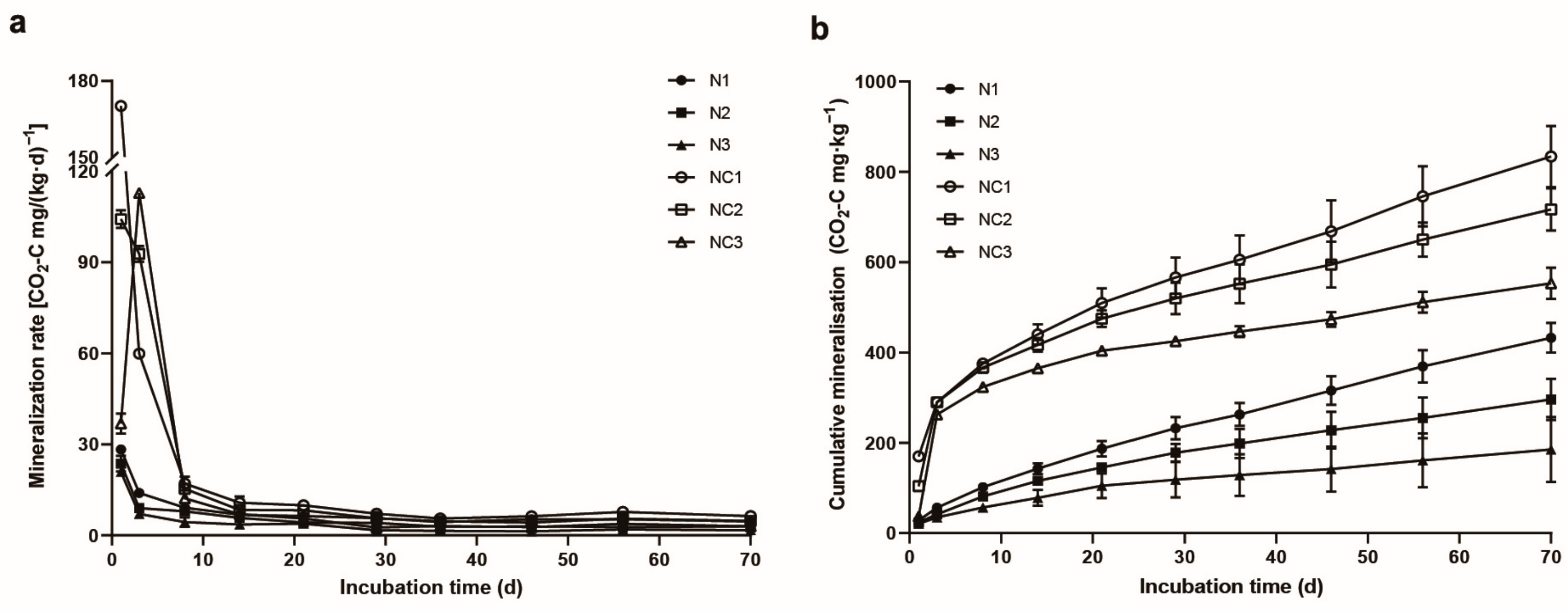
Regardless of glucose addition, the mineralization rate of soil organic carbon in the N1 and N2 soil layers showed a decreasing trend, and the CO2 release rate gradually slowed down with prolonged incubation (Figure 1a, Table S10). In the N3 layer under exogenous carbon addition, the mineralization rate of soil organic carbon initially increased and then decreased, reaching a peak of 112.85 mg·kg−1·d−1 on day 3 of incubation. All other treatments exhibited the highest mineralization rate on day 1. Exogenous carbon addition increased the organic carbon mineralization rate in all soil layers. Taking day 3 as an example, the increases in the mineralization rate of soil organic carbon in the N1, N2, and N3 layers were 3.28-fold, 9.30-fold, and 15.03-fold, respectively.
The cumulative mineralization of soil organic carbon (Cm) under all treatments increased with incubation time, whereas the cumulative release rate gradually slowed down (Figure 1b, Table S11). Significant differences were observed in the cumulative mineralization of soil organic carbon among different treatments. With or without glucose addition, the cumulative mineralization of soil organic carbon in different soil layers followed the order: N1 > N2 > N3. Compared with the control treatment, exogenous carbon addition significantly increased the cumulative mineralization of soil organic carbon at the early incubation stage. By the end of incubation, the cumulative mineralization of soil organic carbon in the N1, N2, and N3 layers increased by 92.82%, 142.04%, and 198.18%, respectively.

3.2. Fitting Cumulative Mineralization of Soil Organic Carbon with the First-Order Kinetic Model

During the 70-day incubation experiment, the cumulative mineralization of soil organic carbon was well fitted by the first-order kinetic model (R2 = 0.82–0.98) (Table 2). Exogenous carbon addition significantly affected the potentially mineralizable carbon (C0) and turnover rate (k) (p < 0.05). Compared with the CK treatment, glucose addition increased C0 by 65.62%, and 203.97% in the N2, and N3 soil layers, respectively (Table S8). The potentially mineralizable carbon showed a decreasing trend with increasing soil depth. The turnover rate of each soil layer increased significantly under exogenous carbon addition (Table S9).

3.3. Soil Layer Rather than Glucose Addition Is the Dominant Factor Shaping Soil Microbial Community Structure

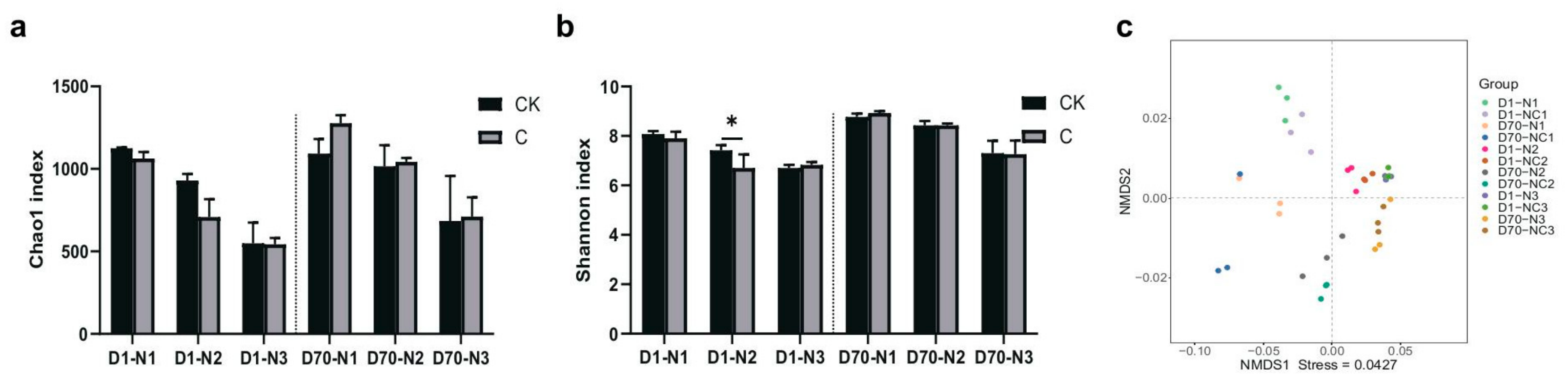
The Chao1 index reflects the total number of species. A higher Chao1 value indicates greater species richness. No significant variations in the Chao1 index were observed regardless of glucose addition. Under C treatment, the Chao1 index of layer N2 increased significantly by 47.18% during incubation compared with the CK group (Figure 2a, Table S12). The Shannon index considers both community richness and evenness, with a higher value representing higher community diversity. With exogenous carbon addition, the Shannon index of layer N2 was markedly reduced by 9.7% at the early incubation stage relative to CK. In C treatment, the Shannon indices of layers N1 and N2 rose significantly by 13.04% and 25.82% respectively throughout the incubation period in comparison with CK (Figure 2b, Table S13).
Non-metric multidimensional scaling (NMDS) analysis showed that soil bacterial communities were clearly separated by soil layer (Figure 2c). The stress value was 0.0427 < 0.1, indicating a good fitting effect. Soil bacterial community structure showed clear differentiation across soil layers, and bacterial communities from the same soil layer presented significant spatial aggregation. The three-way ANOVA results (Table 3) was also consistent with the above result. Incubation time only significantly affected the Shannon index (p < 0.01), but had no obvious influence on Chao1index. Glucose addition had no significant effect on all alpha diversity indices. All two-way and three-way interactions among glucose addition, incubation time and soil layer were not significant (p > 0.05), indicating that the three factors affected soil bacterial alpha diversity independently without synergistic or antagonistic relationships.

3.4. Bacterial Community and Dominant Taxa Responses to Glucose Addition

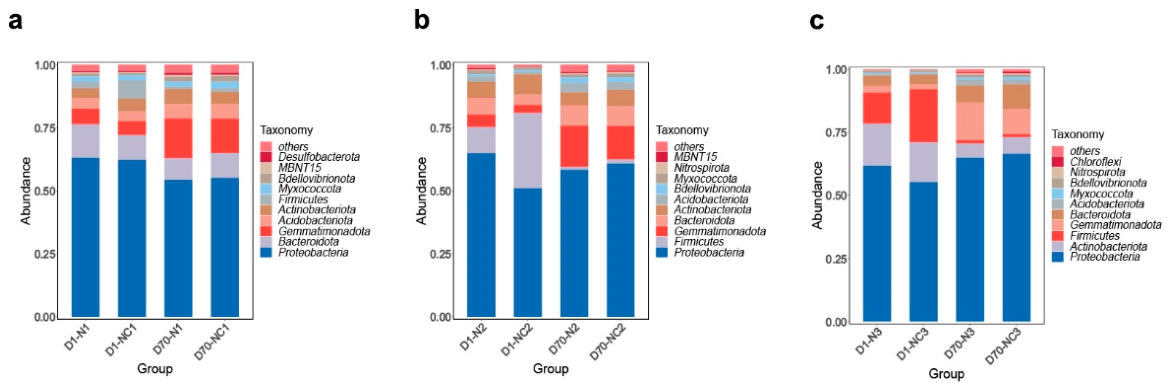
At the phylum level, Proteobacteria, Firmicutes, Actinobacteriota, Gemmatimonadota, Bacteroidota, Acidobacteriota, and Myxococcota collectively accounted for more than 90% of the total bacterial relative abundance (Figure 3). At D1, the relative abundances of all phyla except Proteobacteria differed significantly among soil layers. At D70, significant differences among layers were only observed for Gemmatimonadota, Bacteroidota, Acidobacteriota, and Myxococcota.
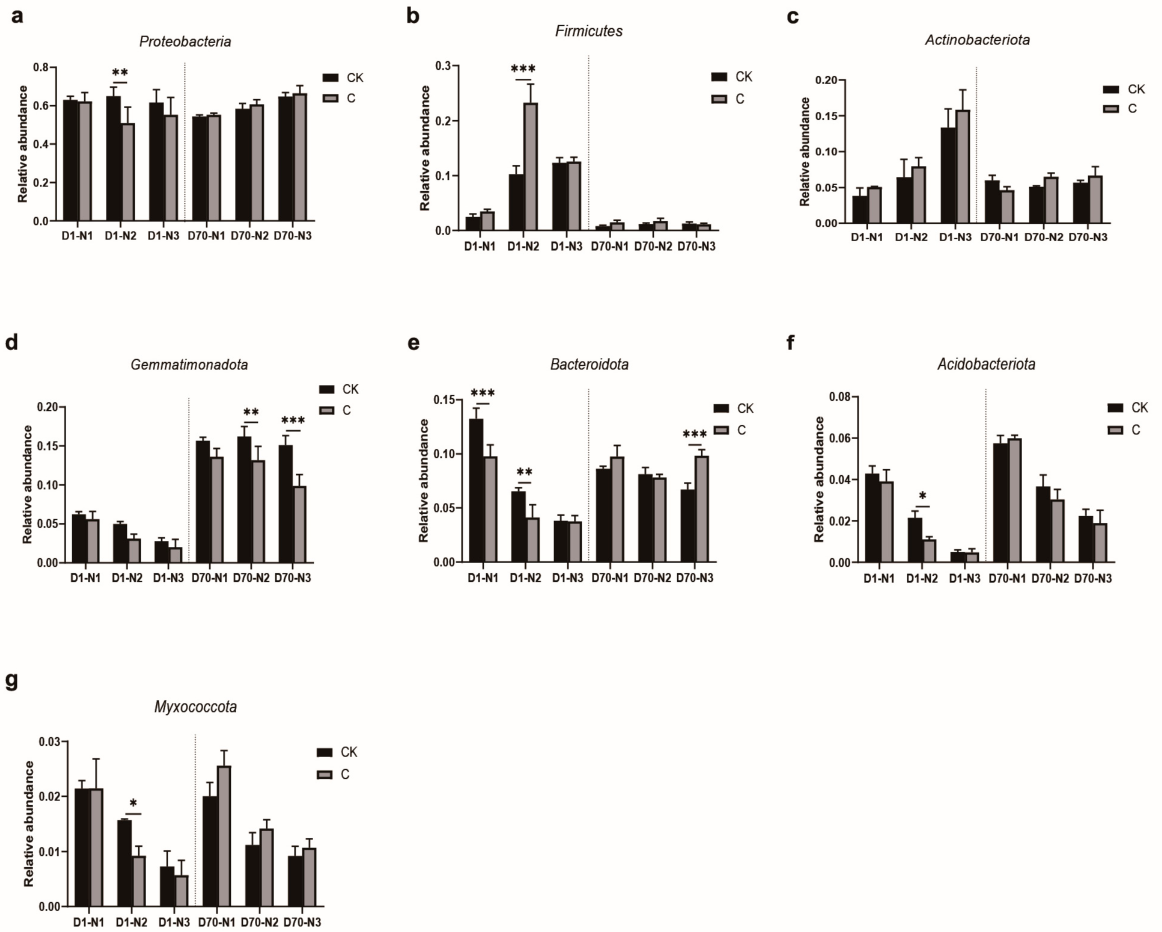
The N2 soil layer showed a distinct response to glucose addition at the early incubation stage (Figure 4, Tables S14–S20). Specifically, compared with CK, exogenous carbon addition significantly reduced the relative abundance of Proteobacteria by 21.50% and that of Bacteroidota by 36.82%, decreased the relative abundance of Acidobacteriota by 48.48% and Myxococcota by 41.26%, while markedly increased the relative abundance of Firmicutes by 126.07% (Figure 4a,b,e–g). At D1, the relative abundance of Bacteroidota in the N1 soil layer was significantly decreased by 26.13% relative to CK (Figure 4e). At D70, the relative abundance of Gemmatimonadota in N2 and N3 soil layers was significantly reduced by 18.82% and 34.59%, respectively (Figure 4d). In addition, the relative abundance of Bacteroidota in the N3 soil layer was significantly elevated by 46.36% compared with CK (Figure 4e).
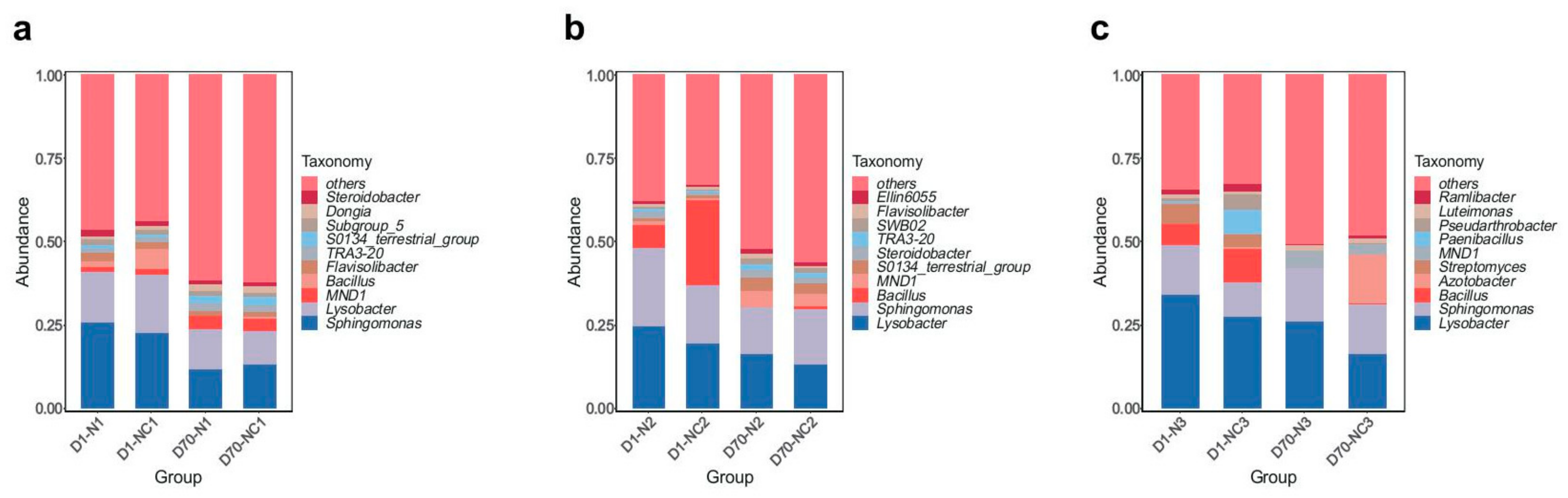
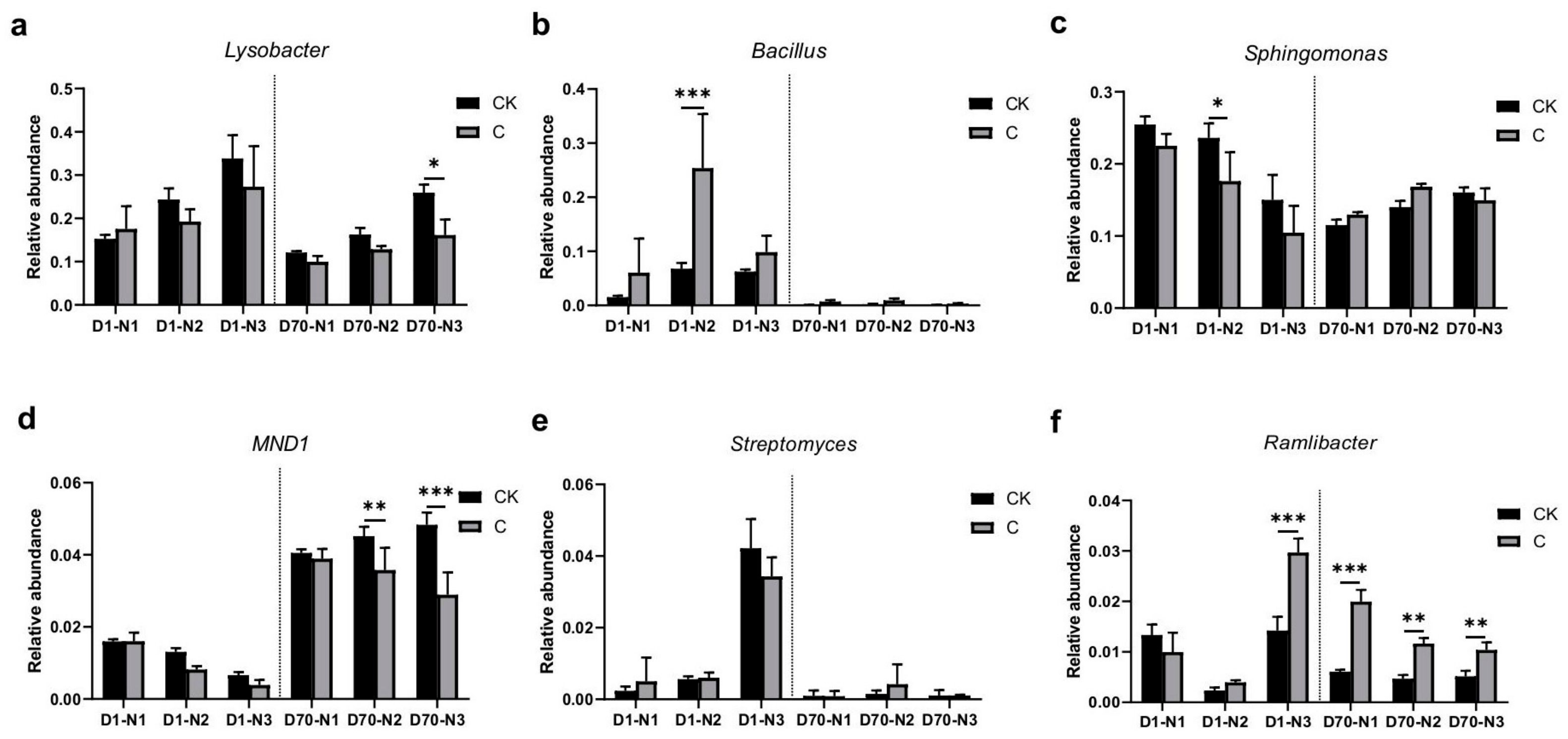
At the genus level, the bacterial community was mainly composed of Lysobacter, Bacillus, Sphingomonas, MND1, Streptomyces, and Ramlibacter (Figure 5). Similarly, at the genus level, the bacterial community in the N2 soil layer exhibited a strong response to glucose addition at D1 (Figure 6, Tables S21–S26). Specifically, the relative abundance of Bacillus was significantly increased by 274.03% compared with the CK group, while that of Sphingomonas was significantly decreased by 25.44% (Figure 6b,c). In addition, the relative abundance of Ramlibacter in the N3 soil layer was significantly increased by 108.67% under carbon addition treatment at the early incubation stage. At D70, the relative abundance of MND1 in the N2 and N3 soil layers under carbon addition treatment was significantly reduced by 20.86% and 40.10%, respectively, relative to CK (Figure 6d), and reduced that of Lysobacter by 37.73% in the N3 soil layer. In contrast, the relative abundance of Ramlibacter was significantly elevated by 228.58%, 148.61% and 101.40% in the N1, N2 and N3 soil layers in comparison with CK (Figure 6f).

3.5. Combined Analysis of Dominant Bacterial Taxa and Soil Organic Carbon Mineralization Under Glucose Addition

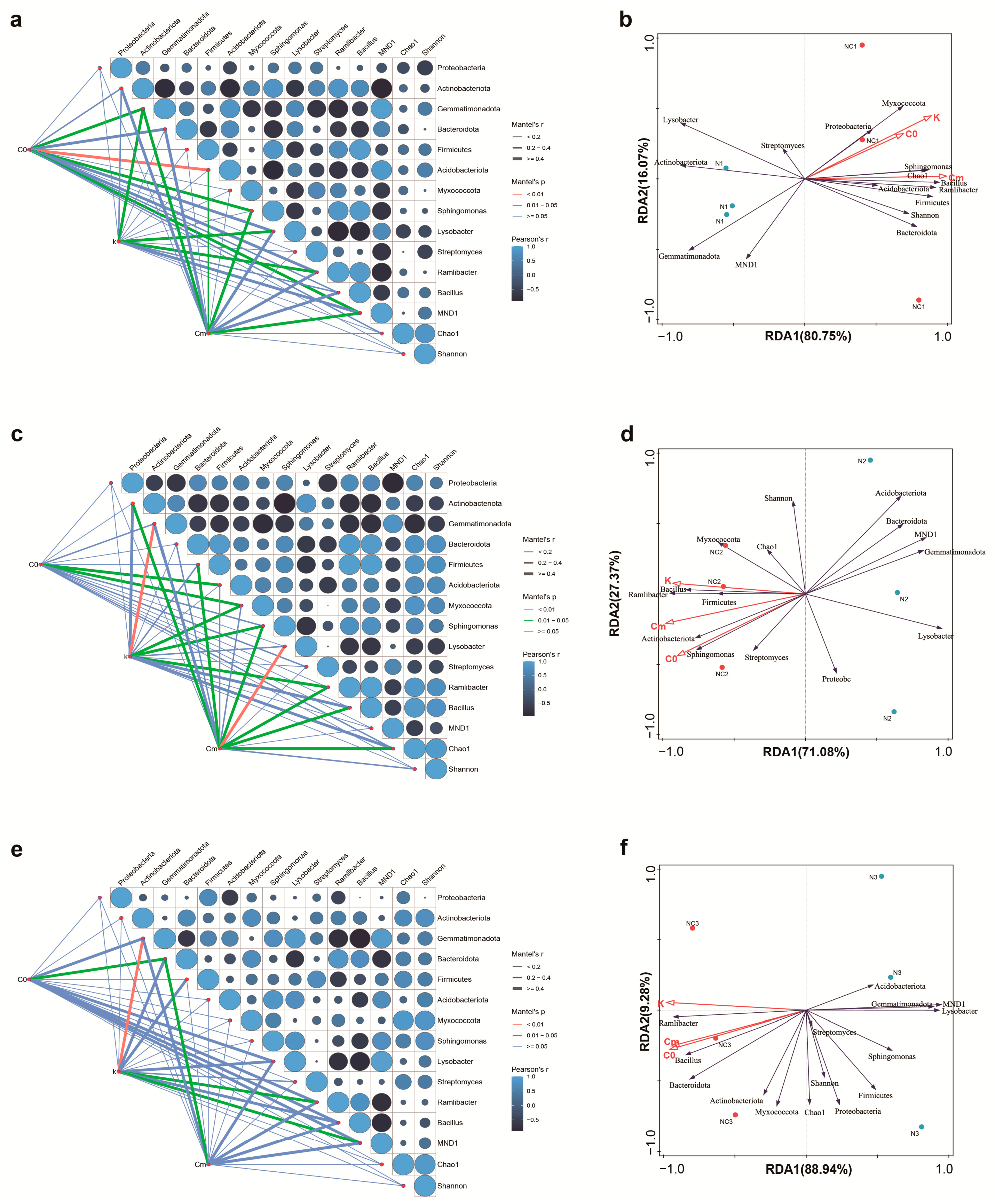
Mantel test was used to analyze the explanatory degree of soil organic carbon mineralization-related indicators for bacterial abundance and diversity at the end of incubation, and redundancy analysis (RDA) was conducted to visualize the relationships between these mineralization parameters and bacterial community composition, with the eigenvalues of the first two RDA axes accounting for over 95% of the total variation in all three soil layers (Figure 7). Soil organic carbon mineralization was significantly affected by five bacterial phyla in the N1 soil layer (Figure 7a), whereas only two significantly correlated bacterial groups were identified in the N2 and N3 soil layers (Figure 7e,f). The mineralization turnover rate (k) was significantly negatively correlated with Gemmatimonadota and significantly positively correlated with Ramlibacter across all soil layers (Figure 7b,d,f). Bacterial communities regulating soil organic carbon cumulative mineralization (Cm) and potential mineralization capacity (C0) varied distinctly across N1-N3 soil layers (Figure 7b,d,f). In the N1 layer, Cm was significantly negatively correlated with Lysobacter and Firmicutes and significantly positively correlated with Sphingomonas, Bacillus, and the Chao1 index, whereas C0 was significantly positively correlated with Actinobacteriota. In the N2 layer, Cm and C0 exhibited similar trends, being significantly positively correlated with Sphingomonas and significantly negatively correlated with Gemmatimonadota and MND1, except that C0 was also significantly negatively correlated with Acidobacteriota; in the N3 layer, both Cm and C0 were significantly positively correlated with Bacteroidota.

4. Discussion

4.1. Glucose Addition Affects Soil Organic Carbon Mineralization in Orchard Soils

Glucose addition caused a rapid increase in soil organic carbon mineralization rate at the initial incubation stage, a pattern consistent with previous findings [30]. Interestingly, the soil organic carbon mineralization rate in the glucose-amended N3 soil layer peaked on day 3 of incubation, exhibiting an initial increase followed by a subsequent decrease (Figure 1a). This could be attributed to the fact that the native organic carbon in the N3 soil layer is predominantly composed of recalcitrant fractions such as humus and lignin, coupled with a relatively low soil organic carbon content (Table 1), which leaves soil microorganisms under long-term carbon limitation [31]. As a labile carbon source, glucose can be rapidly assimilated and utilized by microorganisms upon addition, directly stimulating their metabolic activity and thus causing a pronounced short-term increase in soil organic carbon mineralization rate [32]. Cumulative organic carbon mineralization followed the order N1 > N2 > N3 and plateaued during the late incubation stage (Figure 1b). This result confirmed hypothesis 1 that the cumulative mineralization of soil organic carbon decreased with the increase in soil depth under glucose addition in orchard soil, owing an order of 0–20 cm > 20–40 cm > 40–60 cm. With the progressive depletion of labile organic carbon substrates by microorganisms, the residual soil organic carbon was predominantly composed of recalcitrant inert fractions. The scarcity of readily decomposable components constrained microbial metabolic activity, resulting in a marked decline in SOC mineralization rates at the later phase [33,34]. The organic carbon mineralization processes of fluvo-aquic soils across different soil layers were fitted with a first-order kinetic model. Analysis revealed that glucose addition significantly elevated the potentially mineralizable organic carbon pool and accelerated the turnover rate in the N1-N3 soil layers (Table 2), thus diminishing the differences in potential mineralization among soil layers. It is speculated in this study that the increase in soil organic carbon substrate content serves as a potential mechanism for the enhancement of soil carbon mineralization potential. Nevertheless, this inference is only based on existing correlation analysis results and has not been verified by direct experimental data. Meanwhile, glucose decomposition supplied additional energy for the growth and proliferation of soil microbes utilizing labile carbon, further promoting microbial nutrient uptake and utilization [35,36]. It should be noted that the soil samples in this study were subjected to air-drying, rewetting and pre-incubation. Air-drying, sieving and rewetting disrupt soil aggregate structure, activate microorganisms and induce the Birch effect [37,38,39]. Although pre-incubation was applied to reduce such interferences, the impacts of these pretreatments on soil organic carbon mineralization could not be completely eliminated. Accordingly, the results obtained in this experiment cannot fully represent the actual mineralization status of soils under field in situ conditions.

4.2. Glucose Addition Affects Soil Bacterial Communities Less than Soil Layer in Orchard Soils

Soil bacterial communities play a critical role in the terrestrial organic carbon cycle and are closely linked to soil organic carbon mineralization. In the present study, exogenous carbon addition significantly decreased the Shannon index in the N2 soil layer during the initial stage (Figure 2b), suggesting that glucose addition reduced the richness and evenness of the soil microbial community, thereby causing a significant decline in microbial diversity. Conversely, Qi et al. documented that glucose addition remarkably improved the richness and diversity indices of soil bacterial communities in crabapple-planted soil, irrespective of soil sterilization [40]. The discrepancy may be attributed to the different soil carbon status. The soil used by Qi et al. was carbon-limited, and moderate glucose addition provided sufficient energy for microbial growth, thus promoting the recovery of bacterial diversity. By contrast, our soil was relatively carbon-rich. Competitive bacteria dominated exogenous carbon utilization and outcompeted other taxa, resulting in decreased overall microbial diversity [41,42]. A three-year field experiment demonstrated that biochar amendment increased bacterial and fungal diversity while reducing soil organic carbon mineralization, which further corroborates this inference from an opposite perspective [43]. At the late incubation stage, exogenous glucose was completely depleted, thereby eliminating differences among treatments and allowing microbial diversity to gradually recover and stabilize. Beta-diversity and Two-way ANOVA analysis demonstrated that the influences of experimental factors followed the order: soil layer > incubation time > glucose addition (Figure 2c, Table 3). This result confirmed hypothesis 2 that soil layer exerts a strong influence on soil organic carbon mineralization. This could be attributed to substantial variations in basic physicochemical properties across soil layers, including significant differences in total nitrogen content, pH, and C/N ratio (Table 1), which serve as critical determinants shaping soil microbial community composition [44], resulting in a much stronger influence of soil layer on bacterial community than glucose addition.
Studies have demonstrated that Bacillus (phylum Firmicutes) exhibits a preferential utilization of labile carbohydrates, particularly glucose [14]. In the present study, the relative abundances of Firmicutes and Bacillus were significantly increased in glucose-amended N2 soil during the initial incubation stage compared with the CK treatment (Figure 4 and Figure 6), which is supported by the findings of Yu et al. [45]. In the present study, the relative abundance of Bacteroidota was significantly decreased in the N1 and N2 layers under glucose addition during the initial incubation stage compared with the CK treatment. This may be explained by the fact that Bacteroidota lack high-affinity transporters for monosaccharides; instead, they possess TonB-dependent transporters, which are conducive to the decomposition of polysaccharides [46,47]. In the present study, the significantly increased relative abundance of Bacteroidota in the N3 layer under glucose addition at the end of incubation further supported this inference. Given the relatively low soil organic carbon content in the N3 layer and the depletion of glucose at the late stage, Bacteroidota became dominant and functional. At the end of incubation, glucose addition significantly decreased the relative abundance of Gemmatimonadota in the N2 and N3 layers. Although Proteobacteria showed no significant difference at the phylum level, the relative abundances of Lysobacter (N3) and MND1 (N2, N3) were significantly decreased, while Ramlibacter (N1-N3) was significantly enriched. Previous studies demonstrated that Gemmatimonadota plays a key role in decomposing recalcitrant components and is insensitive to monosaccharides [48,49]. Previous studies showing a negative correlation between Ramlibacter and recalcitrant substrates support the findings of the present study [50].

4.3. Oligotrophic Phyla Are Strongly Negatively Correlated with Soil Organic Carbon Mineralization Under Glucose Addition

In this study, Gemmatimonadota, Acidobacteriota and Sphingomonas belong to oligotrophic microbial groups, while Bacillus, Lysobacter and Bacteroidota are classified as copiotrophic groups. Under glucose addition, Gemmatimonadota, Lysobacter, and Acidobacteriota may play negative roles in organic carbon mineralization in the N1, N2, and N3 layers, respectively (Figure 7). Previous studies reported that Gemmatimonadota was the dominant phylum contributing to organic carbon mineralization under biochar addition [51]. Compared with biochar, glucose used in this study is a labile monosaccharide, which is inconsistent with the ecological niche of Gemmatimonadota, thereby leading to its negative effect on organic carbon mineralization. Oligotrophic bacteria such as Acidobacteriota rarely utilize labile carbon [52]. As a member of Gammaproteobacteria, Lysobacter is mainly involved in the utilization of DOM-lignin molecules [53].
Under glucose addition, Sphingomonas and Bacillus, Sphingomonas, and Bacteroidota may act as key contributors to labile organic carbon mineralization in the N1, N2, and N3 layers, respectively. As a member of Alphaproteobacteria, Sphingomonas is adept at utilizing low-concentration recalcitrant carbon substrates [15]. In this study, readily decomposable carbon was exhausted in N1 and N2 soil layers at the late incubation stage, leaving mainly recalcitrant carbon fractions, which consequently facilitated the enrichment of Sphingomonas. Bacteroidota are copiotrophic bacteria that favor nutrient-rich conditions [54]. Compared with the N1 and N2 layers, the N3 layer had a higher C/N ratio (up to 16), which was more conducive for Bacteroidota to function in organic carbon mineralization. This result is basically consistent with hypothesis 3 that the bacterial taxa associated with soil organic carbon mineralization varied across different soil layers and incubation periods under glucose addition.
This study applied redundancy analysis (RDA) and the Mantel test to clarify the correlations between bacterial community structure and factors associated with soil carbon mineralization. However, the contents of soil ammonium nitrogen and nitrate nitrogen were not determined, resulting in the absence of key nitrogen functional parameters. The current analytical results can only characterize the apparent patterns of community distribution. Without integrating nitrogen transformation processes such as ammonification and nitrification, it is impossible to elucidate the functional regulation pathways of microbial communities in response to carbon input, leaving obvious deficiencies in the exploration of underlying mechanisms.

4.4. Limitations and Perspectives

Carbon-nitrogen coupling is a core feature of soil biogeochemical cycles. Soil nitrogen mineralization is a microbially mediated process that converts organic nitrogen into plant-available inorganic forms, and facilitates CO2 sequestration through plant growth [55]. As readily available nitrogen sources directly utilized by microorganisms, ammonium nitrogen and nitrate nitrogen regulate the metabolic strategies and community assembly of microbial populations [56]. Carbon and nitrogen dynamics are strongly coupled, and soil C and net N mineralization were positively correlated in topsoil [57]. Therefore, analyzing carbon transformation processes independently without considering nitrogen indicators resulted in an incomplete research system and hinder the accurate elucidation of interactions between the environment and microorganisms. This limitation also points out directions for future research in this field. When exploring the effects of exogenous carbon input on soil carbon mineralization and microbial communities in orchard soils, a coordinated carbon-nitrogen monitoring system should be established. The dynamics of soil organic carbon and available nitrogen need to be tracked simultaneously, so as to fully reveal the in-depth mechanisms of microbially driven soil material cycles from the perspective of carbon-nitrogen coupling.
Although 16S rRNA gene sequencing can effectively characterize the taxonomic composition and diversity of soil bacterial communities, it cannot directly reflect the actual metabolic functions and ecological processes of microorganisms. This study only analyzed the structural changes in bacterial communities based on 16S rRNA sequencing. Future research should combine metagenomics or other functional omics technologies to further explore the functional pathways and underlying mechanisms of microorganisms involved in soil organic carbon mineralization.

5. Conclusions

This study found that glucose addition generally accelerates soil organic carbon mineralization in different soil layers of orchard soils, and soil layer depth exerts a far stronger regulatory effect on this process than glucose addition. Exogenous labile carbon input may alter the composition and diversity of soil bacterial communities, thereby improving substrate utilization capacity.
Specifically, Firmicutes (Bacillus) tend to preferentially utilize glucose and gradually become dominant in the early incubation stage. In contrast, the relative abundance of polysaccharide-degrading Bacteroidota increases markedly in the late incubation stage, which is particularly prominent in the low-carbon N3 soil layer. Microbial groups including Gemmatimonadota, Acidobacteriota and Lysobacter exhibit weak capacity in utilizing soluble monosaccharides, and are likely negatively correlated with soil organic carbon mineralization.
Overall, soil layer is the core factor dominating soil microbial community assembly, with effects much greater than those of glucose addition. This study provides theoretical references for clarifying how labile carbon input regulates soil organic carbon mineralization and mediates bacterial community succession across different soil layers in orchard ecosystems.
In accordance with the preliminary hypotheses of this study, the experimental results confirmed that under glucose addition, the cumulative soil organic carbon mineralization generally decreased with the increase in soil depth, following the order of 0–20 cm > 20–40 cm > 40–60 cm. The second hypothesis was also verified, namely, that soil layer depth had a more remarkable regulatory effect on soil organic carbon mineralization than glucose addition and incubation duration, confirming soil layer as the primary influencing factor. Additionally, the results supported the third hypothesis, namely that the bacterial taxa associated with soil organic carbon mineralization varied across different soil layers and incubation periods under glucose addition.

Supplementary Materials

The following supporting information can be downloaded at: https://www.mdpi.com/article/10.3390/agriculture16111225/s1, Table S1 & S2 The reaction system and amplification procedure of PCR; Tables S3–S7 Statistical analysis table of physico-chemical properties of fluvo-aquic soil; Table S8 & S9 Statistical analysis table of C0 and k; Table S10 Statistical analysis table of mineralization rate; Table S11 Statistical analysis table of cumulative mineralization; Table S12 Statistical analysis table of Chao1; Table S13 Statistical analysis table of Shannon; Table S14 Statistical analysis table of Proteobacteria; Table S15 Statistical analysis table of Myxococcota; Table S16 Statistical analysis table of Acidobacteriota; Table S17 Statistical analysis table of Actinobacteriota; Table S18 Statistical analysis table of Gemmatimonadota; Table S19 Statistical analysis table of Bacteroidota; Table S20 Statistical analysis table of Firmicutes; Table S21 Statistical analysis table of Sphingomonas; Table S22 Statistical analysis table of Lysobacter; Table S23 Statistical analysis table of Streptomyces; Table S24 Statistical analysis table of Ramlibacter; Table S25 Statistical analysis table of Bacillus; Table S26 Statistical analysis table of MND1.

Author Contributions

Conceptualization, M.W.; methodology, W.J.; formal analysis, W.J.; data curation, T.Z.; writing—original draft, W.J. and M.W.; writing—review and editing, W.J., M.W., J.Z., Z.J., G.L., T.Z. and Z.W.; funding acquisition, M.W.; investigation, W.J., J.Z. and Z.J.; visualization, W.J. All authors have read and agreed to the published version of the manuscript.

Funding

This research was funded by the Jiangsu Agriculture Science and Technology Innovation Fund (Grant No. CX(23)2004) and Jiangsu Forestry Science and Technology Innovation and Promotion Project (Grant No. LYKJ[2025]13).

Data Availability Statement

All data supporting the findings of this study are included in the article and its supplementary materials. Further inquiries can be directed to the corresponding author.

Conflicts of Interest

The authors declare no conflict of interest.

References

  1. Martin, W.; Johannes, B.; Noelia, G.F.; Manuel, S. Long-term changes (1986–2016) in soil organic carbon and nitrogen in agricultural soils of Bavaria. Agric. Ecosyst. Environ. 2025, 394, 109874. [Google Scholar] [CrossRef]
  2. Wang, Q.; Le Noë, J.; Li, Q.; Lan, T.; Gao, X.; Deng, O.; Li, Y. Incorporating agricultural practices in digital mapping improves prediction of cropland soil organic carbon content: The case of the Tuojiang River Basin. J. Environ. Manag. 2023, 330, 117203. [Google Scholar] [CrossRef]
  3. Brookes, P.C.; Chen, Y.; Chen, L.; Qiu, G.; Luo, Y.; Xu, J. Is the rate of mineralization of soil organic carbon under microbiological control? Soil Biol. Biochem. 2017, 112, 127–139. [Google Scholar] [CrossRef]
  4. Wen, Y.; Gao, X.; Zhang, Z.; Wang, X.; Cheng, M. Shifts in biotic and abiotic controls of soil organic carbon mineralization across vegetation types and soil depths in Luya Mountain. Sci. Total Environ. 2025, 1001, 180522. [Google Scholar] [CrossRef] [PubMed]
  5. You, M.; Xia, Z.; Hao, X.; Li, L. Profile distribution of soil organic carbon and its isotopic value following long term land-use changes. CATENA 2021, 207, 105623. [Google Scholar] [CrossRef]
  6. Qian, R.; Gao, L.; Liu, J.; Biswas, A.; Peng, X. Linking microbial life strategies to carbon mineralization under diverse tillage practices: Insights from eroding black soil hillslopes. Agric. Ecosyst. Environ. 2026, 399, 110174. [Google Scholar] [CrossRef]
  7. Xu, W.; Liu, W.; Tang, S.; Yang, Q.; Meng, L.; Wu, Y.; Wang, J.; Wu, L.; Wu, M.; Xue, X.; et al. Long-term partial substitution of chemical nitrogen fertilizer with organic fertilizers increased SOC stability by mediating soil C mineralization and enzyme activities in a rubber plantation of Hainan Island, China. Appl. Soil Ecol. 2023, 182, 104691. [Google Scholar] [CrossRef]
  8. Esteves, C.; Costa, E.; Mata, M.; Mota, M.; Martins, M.; Ribeiro, H.; Fangueiro, D. Partial replacement of mineral fertilisers with animal manures in an apple orchard: Effects on GHG emission. J. Environ. Manag. 2024, 356, 120552. [Google Scholar] [CrossRef]
  9. San-Emeterio, L.M.; Bernad, I.O.; Garzón, F.J.M.; Aragón, M.S.; Fernández-Ondoño, E. Residue mulching differentially enhances soil organic carbon fractions and stabilization in Mediterranean subtropical orchards. Soil Tillage Res. 2026, 262, 107210. [Google Scholar] [CrossRef]
  10. Li, X.; Feng, J.; Zhang, Q.; Zhu, B. Warming inhibits the priming effect of soil organic carbon mineralization: A meta-analysis. Sci. Total Environ. 2023, 904, 166170. [Google Scholar] [CrossRef] [PubMed]
  11. Liu, Z.; Gu, H.; Hu, X.; Yu, Z.; Li, Y.; Jin, J.; Liu, X.; Liu, J.; Wang, G. Enhancing microbial carbon use efficiency in organic rice farming through improved soil nutrient availability and microbial resource acquisition strategies. Agric. Ecosyst. Environ. 2026, 397, 110097. [Google Scholar] [CrossRef]
  12. Liu, H.; Huang, X.; Tan, W.; Di, H.; Xu, J.; Li, Y. High manure load reduces bacterial diversity and network complexity in a paddy soil under crop rotations. Soil Ecol. Lett. 2020, 2, 104–119. [Google Scholar] [CrossRef]
  13. Wang, X.; Bian, Q.; Jiang, Y.; Zhu, L.; Chen, Y.; Liang, Y.; Sun, B. Organic amendments drive shifts in microbial community structure and keystone taxa which increase C mineralization across aggregate size classes. Soil Biol. Biochem. 2020, 153, 108062. [Google Scholar] [CrossRef]
  14. Wang, X.; Zhang, W.; Liu, Y.; Jia, Z.; Li, H.; Yang, Y.; Wang, D.; He, H.; Zhang, X. Identification of microbial strategies for labile substrate utilization at phylogenetic classification using a microcosm approach. Soil Biol. Biochem. 2021, 153, 107970. [Google Scholar] [CrossRef]
  15. Fierer, N.; Bradford, M.A.; Jackson, R.B. Toward an ecological classification of soil bacteria. Ecology 2007, 88, 1354–1364. [Google Scholar] [CrossRef]
  16. Lang, D.; Zhou, R.; Hao, F.; Zhu, Z.; Zhang, P. Effect of Wheat Straw Addition on Organic Carbon Mineralisation and Bacterial Community in Orchard Soil. J. Soil Sci. Plant Nutr. 2023, 23, 4328–4341. [Google Scholar] [CrossRef]
  17. Hu, L.; Huang, R.; Zhou, L.; Qin, R.; He, X.; Deng, H.; Li, K. Effects of magnesium-modified biochar on soil organic carbon mineralization in citrus orchard. Front. Microbiol. 2023, 14, 1109272. [Google Scholar] [CrossRef] [PubMed]
  18. Duan, B.; Yu, A.; Zhang, H. Effect of Exogenous Nutrient Addition on Soil Organic Carbon Mineralization and Stabilization. Agronomy 2023, 13, 1908. [Google Scholar] [CrossRef]
  19. Hu, Y.; Zhan, P.; Thomas, B.W.; Zhao, J.; Zhang, X.; Yan, H.; Zhang, Z.; Chen, S.; Shi, X.; Zhang, Y. Organic carbon and nitrogen accumulation in orchard soil with organic fertilization and cover crop management: A global meta-analysis. Sci. Total Environ. 2022, 852, 158402. [Google Scholar] [CrossRef] [PubMed]
  20. Li, W.; Guo, Z.; Li, J.; Han, J. Response of the characteristics of organic carbon mineralization of soft rock and soil composed of sand to soil depth. PeerJ 2021, 9, e11572. [Google Scholar] [CrossRef] [PubMed]
  21. Karhu, K.; Hilasvuori, E.; Fritze, H.; Biasi, C.; Nykänen, H.; Liski, J.; Vanhala, P.; Heinonsalo, J.; Pumpanen, J. Priming effect increases with depth in a boreal forest soil. Soil Biol. Biochem. 2016, 99, 104–107. [Google Scholar] [CrossRef]
  22. Wu, B.; Bai, Y.; Guan, H.; Feng, J.; Zheng, X. Grazing Intensity Alters Vertical Nutrient Stratification Through Plant–Soil Cascading Effects in Karst Grasslands of Southern Guizhou, China. Land Degrad. Dev. 2025, 36, 5066–5077. [Google Scholar] [CrossRef]
  23. Wu, Y.; Guo, Z.; Li, Z.; Liang, M.; Tang, Y.; Zhang, J.; Miao, B.; Wang, L.; Liang, C. The main driver of soil organic carbon differs greatly between topsoil and subsoil in a grazing steppe. Ecol. Evol. 2022, 12, e9182. [Google Scholar] [CrossRef]
  24. Yin, X.; Yu, X.; Qin, L.; Jiang, M.; Lu, X.; Zou, Y. Reclamation leads to loss of soil organic carbon and molecular complexity: Evidence from natural to reclaimed wetlands. Soil Tillage Res. 2025, 248, 106436. [Google Scholar] [CrossRef]
  25. She, R.; Yu, Y.; Ge, C.; Yao, H. Soil Texture Alters the Impact of Salinity on Carbon Mineralization. Agronomy 2021, 11, 128. [Google Scholar] [CrossRef]
  26. Zhao, P.; Liu, M.; Jin, R.; Chen, X.; Zhang, A.; Tang, Z.; Wei, M. Effects of long-term application of organic fertilizer on carbon and nitrogen accumulation and distribution of sweetpotato in fluvoaquic soil area. Sci. Agric. Sin. 2021, 54, 2142–2153. [Google Scholar] [CrossRef]
  27. Zhang, J.; Jia, Z.; Jiang, W.; Zhang, W.; Wang, S.; Wei, M. Enantioselective Degradation Behavior and Influencing Factors of Chiral Imazalil in Different Soils. J. Soil Sci. Plant Nutr. 2024, 24, 7449–7459. [Google Scholar] [CrossRef]
  28. Sapkota, S.; Sharma, B.; Ghimire, R. Enhancing carbon stability in arid soils through biochar amendment: Insights from a long-term soil incubation study. Carbon Manag. 2025, 16, 2602999. [Google Scholar] [CrossRef]
  29. Nazir, M.J.; Hussain, M.M.; Albasher, G.; Iqbal, B.; Khan, K.A.; Rahim, R.; Li, G.; Du, D. Glucose input profit soil organic carbon mineralization and nitrogen dynamics in relation to nitrogen amended soils. J. Environ. Manag. 2024, 351, 119715. [Google Scholar] [CrossRef]
  30. Ying, C.; Ma, Z.; Li, Y.; Rong, X.; Zhang, Z.; Li, G.; Wang, S.; Ge, T.; Zhu, Z. Millennial rice cultivation shapes depth-dependent organic carbon mineralization and microbial life strategies in saline paddy soils. Soil Tillage Res. 2026, 255, 106806. [Google Scholar] [CrossRef]
  31. Endress, M.G.; Dehghani, F.; Blagodatsky, S.; Reitz, T.; Schlüter, S.; Blagodatskaya, E. Spatial substrate heterogeneity limits microbial growth as revealed by the joint experimental quantification and modeling of carbon and heat fluxes. Soil Biol. Biochem. 2024, 197, 109509. [Google Scholar] [CrossRef]
  32. Yin, K.; Gong, L.; Ma, X.; Li, X.; Sun, X. Soil Microbiome Drives Depth-Specific Priming Effects in Picea schrenkiana Forests Following Labile Carbon Input. Microorganisms 2025, 13, 1729. [Google Scholar] [CrossRef]
  33. Li, S.; Lyu, M.; Deng, C.; Deng, W.; Wang, X.; Cao, A.; Jiang, Y.; Liu, J.; Lu, Y.; Xie, J. Input of high-quality litter reduces soil carbon losses due to priming in a subtropical pine forest. Soil Biol. Biochem. 2024, 194, 109444. [Google Scholar] [CrossRef]
  34. Ma, R.; Wu, X.; Liu, Z.; Yi, Q.; Xu, M.; Zheng, J.; Bian, R.; Zhang, X.; Pan, G. Biochar improves soil organic carbon stability by shaping the microbial community structures at different soil depths four years after an incorporation in a farmland soil. Curr. Res. Environ. Sustain. 2023, 5, 100214. [Google Scholar] [CrossRef]
  35. Lv, Z.; Liu, X.; Zhong, J.; Lan, X.; Hou, H.; Ji, J.; Feng, Z.; Liu, Y. Effects of long-term fertilization on mineralization of soil organic carbon in red paddy soil. Sci. Agric. Sin. 2019, 52, 2636–2645. [Google Scholar] [CrossRef]
  36. Wang, S.; Yang, Y.; Wang, G.; Zhao, X.; Chen, C.; Huang, X. Effect of long-term fertilization on organic carbon mineralization of cinnamon soil. J. Plant Nutr. Fertil. 2016, 22, 1278–1285. [Google Scholar] [CrossRef]
  37. Guo, Y.S.; Weitz, K.K.; Truong, A.; Ryan, A.G.; Shor, L.M.; Bhattacharjee, A.; Lipton, M.S. Accessing Fungal Contributions to the Birch Effect: Real-Time Respiration from Pore-Scale Microfluidics. Microorganisms 2024, 12, 2295. [Google Scholar] [CrossRef]
  38. Birch, H.F. The effect of soil drying on humus decomposition and nitrogen availability. Plant Soil 1958, 10, 9–31. [Google Scholar] [CrossRef]
  39. Mooshammer, M.; Hofhansl, F.; Frank, A.H.; Wanek, W.; Hämmerle, I.; Leitner, S.; Schnecker, J.; Wild, B.; Watzka, M.; Keiblinger, K.M.; et al. Decoupling of microbial carbon, nitrogen, and phosphorus cycling in response to extreme temperature events. Sci. Adv. 2017, 3, e1602781. [Google Scholar] [CrossRef]
  40. Qi, B.; Zhang, K.; Qin, S.; Lyu, D.; He, J. Glucose addition promotes C fixation and bacteria diversity in C-poor soils, improves root morphology, and enhances key N metabolism in apple roots. PLoS ONE 2022, 17, e0262691. [Google Scholar] [CrossRef]
  41. Chen, S.; Guo, J.; Guo, R.; Huang, B.; Huang, J.; Wang, M.; Shen, Q.; Ling, N.; Guo, S. Deciphering the active bacteria involving glucose-triggered priming effect in soils with gradient N inputs. Soil Biol. Biochem. 2024, 199, 109612. [Google Scholar] [CrossRef]
  42. Liang, Y.; Lu, Q.; Liang, Z.; Liu, X.; Fang, W.; Liang, D.; Kuang, J.; Qiu, R.; He, Z.; Wang, S. Substrate-dependent competition and cooperation relationships between Geobacter and Dehalococcoides for their organohalide respiration. ISME Commun. 2021, 1, 23. [Google Scholar] [CrossRef]
  43. Chen, L.; Jiang, Y.; Liang, C.; Luo, Y.; Xu, Q.; Han, C.; Zhao, Q.; Sun, B. Competitive interaction with keystone taxa induced negative priming under biochar amendments. Microbiome 2019, 7, 77. [Google Scholar] [CrossRef]
  44. Liao, Y.; Xiao, S.; Shen, F.; Liu, H.; Huang, J.; Chang, M.; Li, H.; Wang, F.; Chen, F. Combined effect of vegetation restoration duration and soil layers on soil microbial community in the red soil granite erosion area of southern China. Appl. Soil Ecol. 2026, 217, 106557. [Google Scholar] [CrossRef]
  45. Yu, Z.; Chen, L.; Pan, S.; Li, Y.; Kuzyakov, Y.; Xu, J.; Brookes, P.C.; Luo, Y. Feedstock determines biochar-induced soil priming effects by stimulating the activity of specific microorganisms. Eur. J. Soil Sci. 2018, 69, 521–534. [Google Scholar] [CrossRef]
  46. Martin, H.; Rogers, L.A.; Moushtaq, L.; Brindley, A.A.; Forbes, P.; Quintion, A.R.; Murphy, A.R.J.; Hipperson, H.; Daniell, T.J.; Ndeh, D.; et al. Metabolism of hemicelluloses by root-associated Bacteroidota species. ISME J. 2025, 19, wraf022. [Google Scholar] [CrossRef]
  47. Carvalho, L.A.L.d.; Souza, A.C.d.O.; Fernandes, C.C.; Prado, C.D.d.; Lemos, E.G.d.M.; Alves, L.M.C.; Pinheiro, D.G. Metatranscriptomic profiling reveals microbial succession and adaptation strategies during long-term lignocellulose degradation. Int. Biodeterior. Biodegrad. 2025, 203, 106110. [Google Scholar] [CrossRef]
  48. Campos, P.; Miller, A.Z.; Prats, S.A.; Knicker, H.; Hagemann, N.; De la Rosa, J.M. Biochar amendment increases bacterial diversity and vegetation cover in trace element-polluted soils: A long-term field experiment. Soil Biol. Biochem. 2020, 150, 108014. [Google Scholar] [CrossRef]
  49. Whitman, T.; Whitman, E.; Woolet, J.; Flannigan, M.D.; Thompson, D.K.; Parisien, M.A. Soil bacterial and fungal response to wildfires in the Canadian boreal forest across a burn severity gradient. Soil Biol. Biochem. 2019, 138, 107571. [Google Scholar] [CrossRef]
  50. Ling, L.; Fu, Y.; Jeewani, P.H.; Tang, C.; Pan, S.; Reid, B.J.; Gunina, A.; Li, Y.; Li, Y.; Cai, Y.; et al. Organic matter chemistry and bacterial community structure regulate decomposition processes in post-fire forest soils. Soil Biol. Biochem. 2021, 160, 108311. [Google Scholar] [CrossRef]
  51. Lu, L.; Yu, L.; Bin, J.; Jitao, L.; Chunmei, M.; Yuhong, L.; Reid, B.J.; Fan, D.; Zhijiang, L.; Yakov, K.; et al. Biochar induces mineralization of soil recalcitrant components by activation of biochar responsive bacteria groups. Soil Biol. Biochem. 2022, 172, 108778. [Google Scholar] [CrossRef]
  52. Irfan, M.; Wang, Y.; Yokamo, S.; Wang, Y.; Akram, M.A.; Lu, D.; Chen, X.; Wang, H. Distinct nitrogen application strategies and straw incorporation modulate carbon mineralization rate and SOC dynamics by regulating soil microbiome composition. Appl. Soil Ecol. 2025, 216, 106556. [Google Scholar] [CrossRef]
  53. Bugg, T.D.; Ahmad, M.; Hardiman, E.M.; Singh, R. The emerging role for bacteria in lignin degradation and bio-product formation. Curr. Opin. Biotechnol. 2010, 22, 394–400. [Google Scholar] [CrossRef]
  54. Chai, J.; Yao, T.; Wang, X.; Lei, Y.; Li, S.; He, S.; Li, C.; Guo, X. Alpine grassland degradation affects soil properties and the abundance of N cycling functional genes. Appl. Soil Ecol. 2025, 214, 106390. [Google Scholar] [CrossRef]
  55. Schimel, J.P.; Bennett, J. Nitrogen mineralization: Challenges of a changing paradigm. Ecology 2004, 85, 591–602. [Google Scholar] [CrossRef]
  56. Zhao, Y.; Li, Z.; Wang, H.; Zhang, Z.; Chen, C.; Li, L.B. Coupling of soil carbon and nitrogen during the anthropogenic transition from desert grassland to shrubland. CATENA 2025, 259, 109349. [Google Scholar] [CrossRef]
  57. Tian, Q.; Wang, X.; Wang, D.; Wang, M.; Liao, C.; Yang, X.; Liu, F. Decoupled linkage between soil carbon and nitrogen mineralization among soil depths in a subtropical mixed forest. Soil Biol. Biochem. 2017, 109, 135–144. [Google Scholar] [CrossRef]
Figure 1. SOC mineralization rate (a) and cumulative mineralization (b) during incubation. Error bars represent standard deviations (n = 3). Abbreviations: N1 = 0–20 cm soil under CK treatment; NC1 = 0–20 cm soil with glucose addition; N2 = 20–40 cm soil under CK treatment; NC2 = 20–40 cm soil with glucose addition; N3 = 40–60 cm soil under CK treatment; NC3 = 40–60 cm soil layer with glucose addition.
Agriculture 16 01225 g001
Figure 2. Chao1 index (a), Shannon index (b) and Non-metric multidimensional scaling (NMDS) analysis (c) of soil bacterial communities in different soil layers at different incubation stages. Error bars represent standard deviations (n = 3). ‘*’ indicate significant difference between different incubation periods (p < 0.05). Abbreviations: D1 = Day 1 of incubation; D70 = Day 70 of incubation; N1 = 0–20 cm soil; N2 = 20–40 cm soil; N3 = 40–60 cm soil; CK = Control; C = Glucose addition.
Agriculture 16 01225 g002
Figure 3. Bacterial community composition at the phylum level in the N1 (a), N2 (b) and N3 (c) soil layers. Abbreviations: D1 = Day 1 of incubation; D70 = Day 70 of incubation; N1 = 0–20 cm soil; N2 = 20–40 cm soil; N3 = 40–60 cm soil; CK = Control; C = Glucose addition.
Agriculture 16 01225 g003
Figure 4. Relative abundance of dominant microbes at the phylum level in different soil layers at different incubation stages. (a) Proteobacteria; (b) Firmicutes; (c) Actinobacteriota; (d) Gemmatimonadota; (e) Bacteroidota; (f) Acidobacteriota; (g) Myxococcota. Error bars represent standard deviations (n = 3). ‘*’ indicate significant differences between treatments (p < 0.05). ‘**’ indicate highly significant differences between treatments (p < 0.01). ‘***’ indicates extremely significant differences between treatments (p < 0.001). Abbreviations: D1 = Day 1 of incubation; D70 = Day 70 of incubation; N1 = 0–20 cm soil; N2 = 20–40 cm soil; N3 = 40–60 cm soil; CK = Control; C = Glucose addition.
Agriculture 16 01225 g004
Figure 5. Bacterial community composition at the genus level in the N1 (a), N2 (b) and N3 (c) soil layers. Abbreviations: D1 = Day 1 of incubation; D70 = Day 70 of incubation; N1 = 0–20 cm soil; N2 = 20–40 cm soil; N3 = 40–60 cm soil; CK = Control; C = Glucose addition.
Agriculture 16 01225 g005
Figure 6. Relative abundance of dominant microbes at the genus level in different soil layers at different incubation stages. (a) Lysobacter; (b) Bacillus; (c) Sphingomonas; (d) MND1; (e) Streptomyces; (f) Ramlibacter. Error bars represent standard deviations (n = 3). ‘*’ indicate significant differences between treatments (p < 0.05). ‘**’ indicate highly significant differences between treatments (p < 0.01). ‘***’ indicates extremely significant differences between treatments (p < 0.001). Abbreviations: D1 = Day 1 of incubation; D70 = Day 70 of incubation; N1 = 0–20 cm soil; N2 = 20–40 cm soil; N3 = 40–60 cm soil; CK = Control; C = Glucose addition.
Agriculture 16 01225 g006
Figure 7. Mantel test analysis between mineralization parameters and dominant bacterial taxa in the N1 (a), N2 (c) and N3 (e) soil layers. RDA between mineralization parameters and dominant bacterial taxa in the N1 (b), N2 (d) and N3 (f) soil layers.
Agriculture 16 01225 g007
Table 1. Physico-chemical properties of fluvo-aquic soil in different soil layers (mean ± SE, n = 3). Different lowercase letters indicate significant difference among soil layers (p < 0.05) (Tables S3–S7).
Soil TypeSoil LayerOrganic Carbon Content (g·kg−1)Total Nitrogen Content (g·kg−1)pHEC (μS·cm−1)C/N
Fluvo-aquic soilN111.99 ± 1.52 a1.61 ± 0.06 a7.91 ± 0.01 a398 ± 3.61 a7.45 ± 1.17 b
N211.34 ± 1.64 a1.06 ± 0.03 b8.05 ± 0.05 b459 ± 11.72 b10.09 ± 0.65 b
N38.01 ± 3.48 a0.59 ± 0.00 c 8.22 ± 0.03 c520 ± 2.65 c16.51 ± 2.33 a
Table 2. Estimated parameters according to first-order kinetic model for SOC mineralization (mean ± SE, n = 3). Different lowercase letters indicate significant difference among treatments (p < 0.05). Abbreviations: N1 = 0–20 cm soil; N2 = 20–40 cm soil; N3 = 40–60 cm soil; CK = Control; C = Glucose addition.
Soil LayerTreatmentPotential Mineralization Amount (C0) (mg·kg−1)Turnover Rate (k)R2
N1CK580.28 ± 41.57 a0.02 ± 0.00 b0.98
C662.31 ± 35.77 a0.07 ± 0.01 a0.82
N2CK370.45 ± 71.40 b0.03 ± 0.01 b0.98
C613.54 ± 55.21 a0.1 ± 0.02 a0.85
N3CK155.55 ± 38.74 b0.04 ± 0.02 b0.95
C472.82 ± 21.66 a0.15 ± 0.02 a0.88
Table 3. Three-way analysis of variance of glucose addition, incubation time and soil layer on soil bacterial alpha diversity. p < 0.05 indicates significant difference, p < 0.01 indicates highly significant difference, p > 0.05 means no significant difference.
Source of VariationdFShannon Index
F (p)
Chao1 Index
F (p)
Glucose addition (A)11.02 (0.4644)0.95 (0.4982)
Incubation time (B)43.86 (0.0094)0.62 (0.7270)
Soil layer (C)212.56 (<0.001)11.89 (<0.001)
A × B40.35 (0.8912)0.71 (0.6547)
A × C20.58 (0.7654)0.82 (0.5871)
B × C80.28 (0.9123)0.39 (0.8765)
A × B × C80.19 (0.9567)0.25 (0.9345)
Disclaimer/Publisher’s Note: The statements, opinions and data contained in all publications are solely those of the individual author(s) and contributor(s) and not of MDPI and/or the editor(s). MDPI and/or the editor(s) disclaim responsibility for any injury to people or property resulting from any ideas, methods, instructions or products referred to in the content.