Review

Research Status and Development Trends of Agricultural Machinery Chassis for Hilly and Mountainous Areas

1
Nanjing Institute of Agricultural Mechanization, Ministry of Agriculture and Rural Affairs, Nanjing 210014, China
2
Graduate School of Chinese Academy of Agricultural Sciences, Beijing 100081, China
3
Huaihua Academy of Agricultural Sciences, Huaihua 418000, China
*
Authors to whom correspondence should be addressed.
Agriculture 2026, 16(11), 1223; https://doi.org/10.3390/agriculture16111223
Submission received: 6 April 2026 / Revised: 9 May 2026 / Accepted: 18 May 2026 / Published: 1 June 2026

Abstract

Hilly and mountainous regions are strategically vital for national food security. However, due to complex topographical constraints, their agricultural mechanization levels remain severely underdeveloped. This creates a critical bottleneck in agricultural modernization. Conventional agricultural machinery faces multifaceted challenges in terrain adaptability, operational efficiency, and safety assurance when deployed in these environments, necessitating the urgent development of specialized chassis with enhanced trafficability and stability. Following a systematic literature review of key technologies, including power transmission systems, traveling and support mechanisms, leveling control, and navigation tracking, this study reveals that current chassis technology is advancing toward intelligentization, enhanced efficiency, environmental sustainability, and improved terrain adaptability. The analysis demonstrates that multiple technological pathways, encompassing mechanical, hydraulic, and electric drives, are exhibiting convergent and complementary trends. Future research and development should prioritize the following areas: integrated intelligent coordinated control architectures, green and sustainable power system innovation, modular and reconfigurable platform design, and the establishment of collaborative frameworks among industry, academia, research institutions, and application sectors. Comprehensive standardization systems are also needed. These strategic directions are essential for comprehensively elevating agricultural mechanization levels and maximizing developmental benefits in hilly and mountainous regions.

1. Introduction

Hilly and mountainous areas are important agricultural regions in China, accounting for approximately 34.62% of the country’s total cultivated land and 34.20% of the annual sown area. These terrains serve not only as vital grain supply zones but also as key production bases for high-value specialty economic crops such as fruits, tea, and medicinal herbs. Among these, tea plantations, orchards, and sugarcane fields in these regions account for 93.39%, 62.28%, and 62.78% of their respective national cultivation areas, and their output and economic value, holding significant shares in both domestic and export markets, thereby playing an irreplaceable role in national food security and the agricultural economy [1,2,3]. However, official statistical data indicate that the agricultural mechanization rate exceeds 80% in plain areas such as Northeast China, North China, and the middle–lower Yangtze River region. In contrast, the overall mechanization level in hilly and mountainous areas remains below 50%. Furthermore, the comprehensive mechanization rate for cultivation, planting, and harvesting in southwestern hilly and mountainous regions falls below 30%. This marked regional imbalance has emerged as a critical bottleneck constraining the modernization and sustainable development of China’s agriculture [4,5,6].
As a critical supporting platform for agricultural machinery, the chassis directly determines operational mobility, stability, and adaptability in sloped and fragmented environments. A well-designed chassis system must integrate several key functional modules: efficient power transmission systems, adaptive traveling mechanisms, terrain-leveling and dynamic stability control, and precise navigation and tracking integration [7].
Compared to the relatively uniform conditions of plain areas, agricultural operations in hilly and mountainous regions face challenges such as slope variability, soil heterogeneity, plot dispersion, and persistent ground undulation. These factors introduce significant uncertainties in chassis dynamics, causing general-purpose chassis platforms deployed in such conditions to suffer from issues such as traction loss, power mismatch, vibration-induced instability, and control inaccuracy, ultimately resulting in limited adaptability, reduced operational efficiency, and accelerated wear [8,9]. Consequently, developing terrain-specific chassis architectures is essential to advance mechanization in these critical agricultural zones [10].
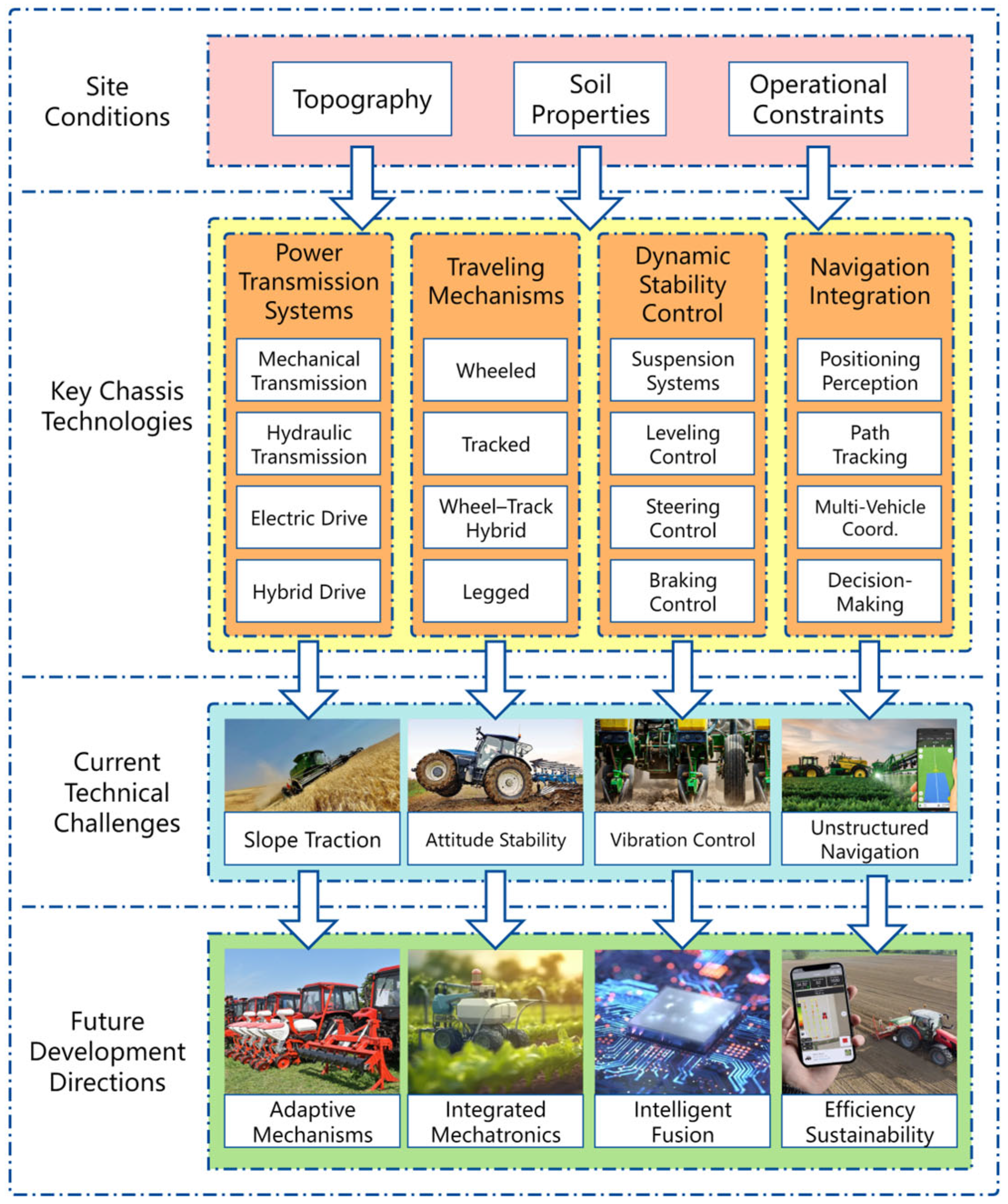
Achieving reliable and efficient chassis performance in complex sloped agricultural environments requires the coordinated integration of terrain-adapted mechanical design, accurate dynamic modeling, and robust control strategies. Despite considerable progress, most existing reviews focus either on general agricultural machinery or on navigation and robotics in flat terrains, often lacking a systematic and in-depth analysis dedicated to chassis systems for hilly and mountainous areas. To bridge this gap, this article provides a structured and comprehensive review of key technologies related to agricultural chassis designed for sloped terrain, with emphasis on power transmission systems, traveling mechanisms, dynamic Stability Control, and navigation integration. Furthermore, it highlights prevailing technical challenges—such as traction maintenance on slopes, vibration suppression on uneven ground, and energy-efficient drive matching under varying loads—and suggests promising directions for future research. This review aims to offer a focused and practically oriented synthesis that can assist researchers and practitioners in developing robust, adaptive, and efficient chassis systems for hilly and mountainous agriculture. The overall structure of this review is illustrated in Figure 1.

2. Review Methodology

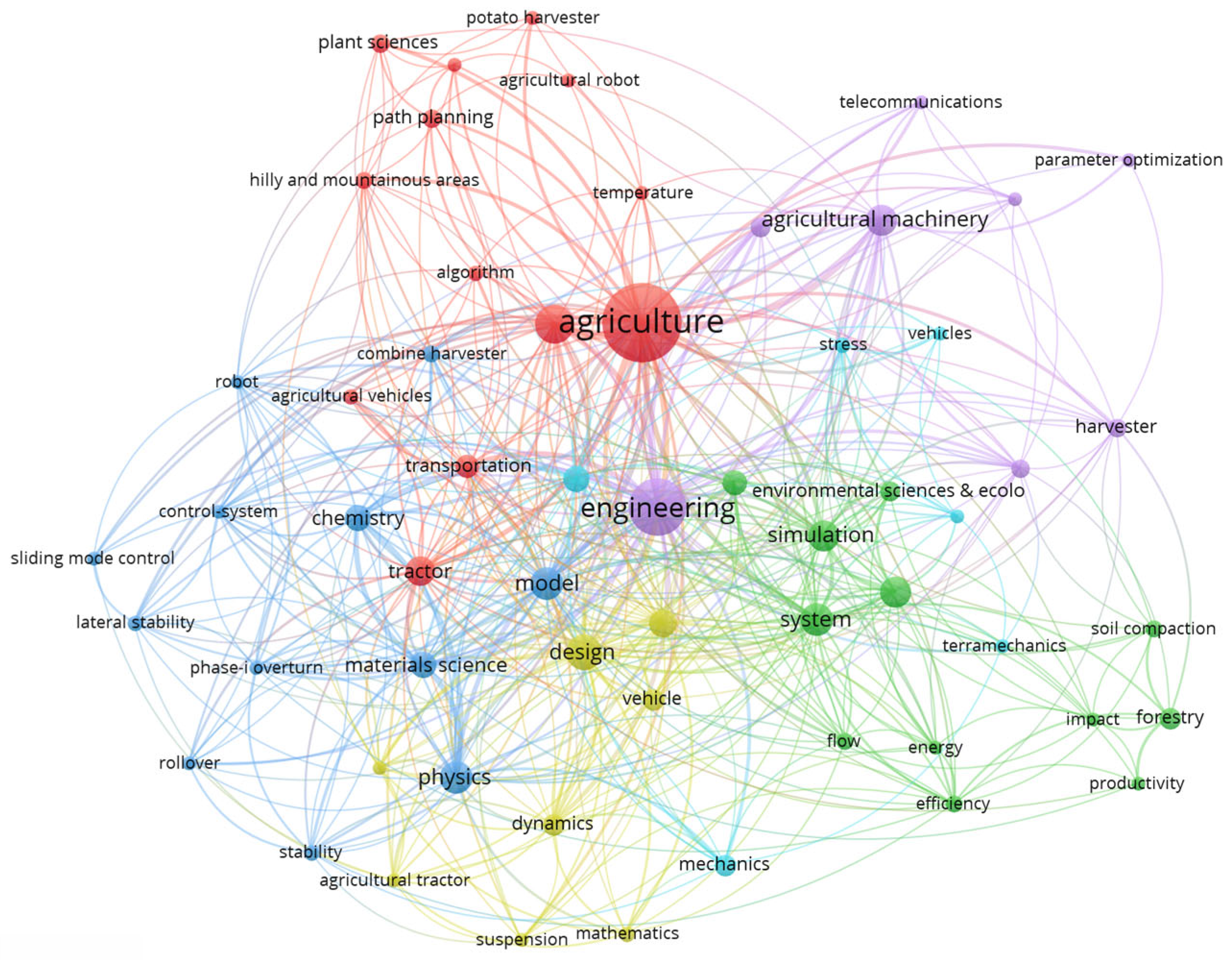
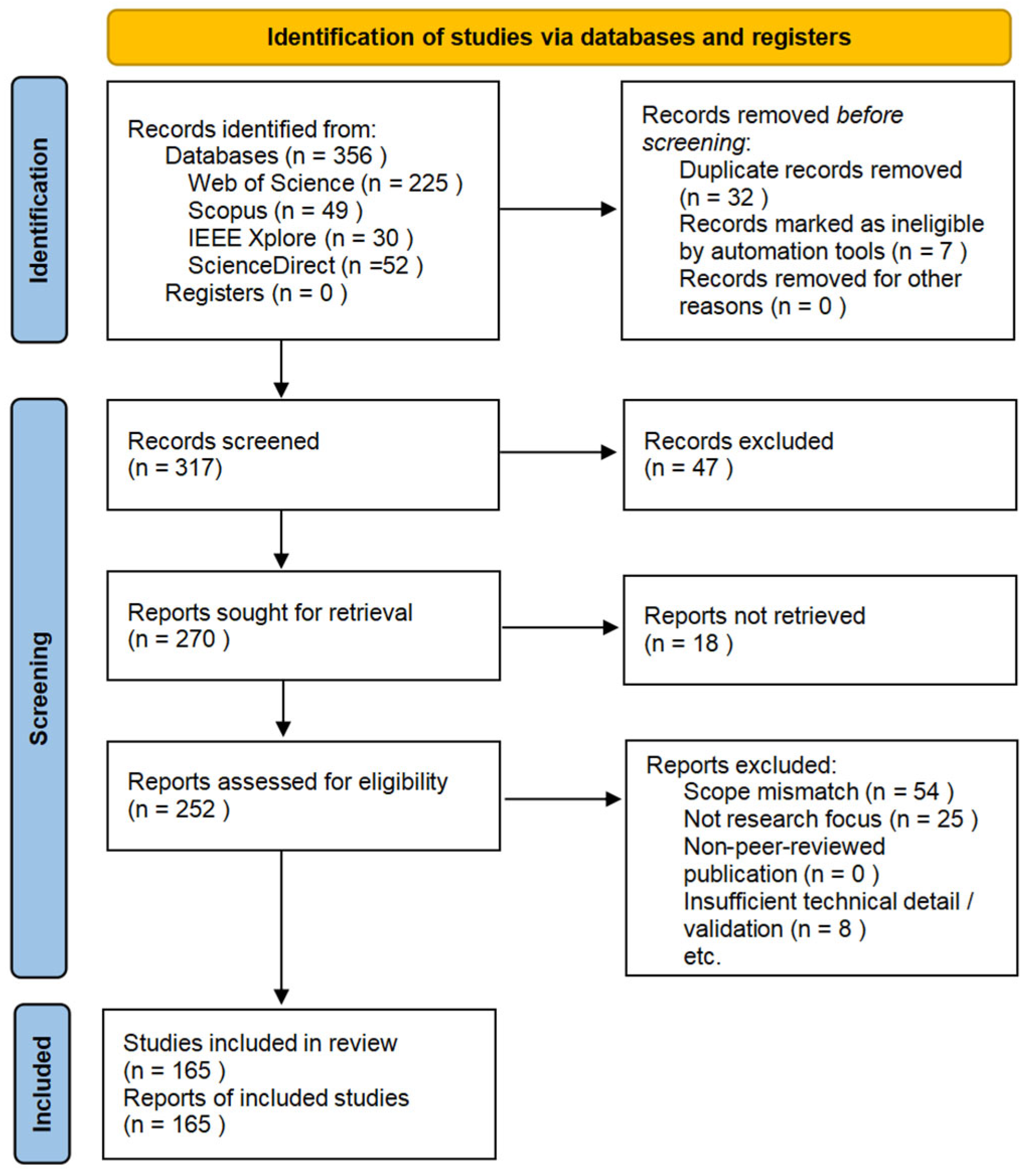
To enhance the transparency and reproducibility of this review, a systematic literature identification and screening process was conducted in accordance with the PRISMA 2020 guidelines. The literature search was performed across four major academic databases, namely Web of Science, Scopus, IEEE Xplore, and ScienceDirect, covering the publication period from January 2020 to January 2026. The search strategy employed a combination of keywords centered on the core concept of agricultural chassis—such as “chassis”, “chassis design” and “undercarriage”—and integrated relevant terms for terrain (e.g., “hilly”, “mountainous area”, “slope”) and application (e.g., “agricultural”, “farm machinery”). The preliminary search yielded 356 potentially relevant records. All retrieved records were exported and consolidated into a dedicated EndNote library. Duplicate entries and ineligible publication types such as book sections were removed, resulting in 317 unique records for the screening stage. Figure 2 presents a keyword co-occurrence network derived from the initial literature pool, delineating the principal thematic clusters.

2.1. Eligibility Criteria

To ensure the relevance and quality of the selected studies, the literature selection process was guided by the specific inclusion and exclusion criteria summarized in Table 1.

2.2. Screening Process

The screening of the 317 records was conducted in two stages. First, titles and abstracts were reviewed, resulting in the exclusion of 47 records due primarily to topic irrelevance, such as non-agricultural robotics or purely theoretical work without practical application. Subsequently, full-text retrieval was attempted for the remaining 270 articles, of which 18 could not be obtained. Full-text review was performed on the remaining 252 articles to assess their eligibility, resulting in the exclusion of 38 articles for reasons including scope mismatch, the topic not being the core research focus, insufficient technical detail, or lack of validation. Ultimately, 165 studies were selected for inclusion in the systematic review. Additionally, 44 references were cited as background sources but were not included in the systematic review. Figure 3 presents a PRISMA 2020 flowchart summarizing the study selection and inclusion process.

2.3. Descriptive Statistics

To better reflect the long-term evolution and regional characteristics of research hotspots, we expanded the literature search scope appropriately and, applying the same screening criteria, ultimately identified 562 relevant papers.
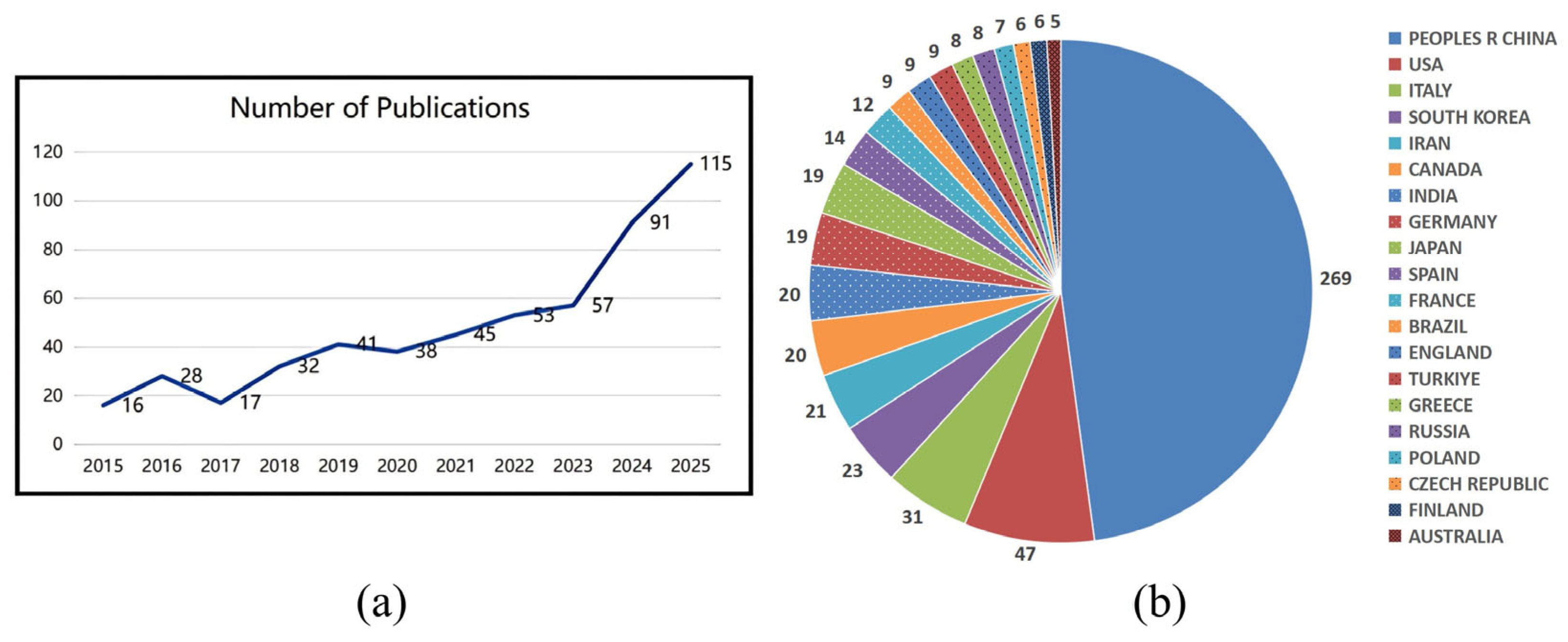
Figure 4a illustrates the annual number of publications related to agricultural chassis for hilly and mountainous terrains from 2015 to 2025. The publication count increased from 16 in 2015 to 115 in 2025, demonstrating a clear upward trend with accelerated growth after 2020. This trend indicates that research on key technologies for agricultural chassis operating in sloped and complex terrains is gaining increasing attention, establishing itself as an important academic direction in promoting the mechanization and intelligentization of mountainous agriculture.
Figure 4b illustrates the geographical distribution of publications in the field of agricultural chassis for hilly and mountainous terrain from 2015 to 2025. China recorded the highest number of publications with 269 papers, followed by the United States, Italy, South Korea, and Iran, which also demonstrated substantial research output. Other countries including Canada, India, Germany, and Japan contributed comparatively smaller yet steady publication volumes. Geographically, research activity is predominantly concentrated in regions characterized by advanced agricultural mechanization and pronounced terrain adaptability requirements, indicating a strong correlation between research focus and regional topographic conditions. This distribution pattern provides valuable insights for fostering international collaboration and advancing the adaptation and development of hilly-terrain agricultural chassis technologies across diverse geographical contexts.

3. Power Transmission Systems

Serving as the central functional module of agricultural chassis for hilly and mountainous terrain, the power and drivetrain system fundamentally determines the equipment’s operational efficiency, traction performance, and environmental adaptability under complex topographical conditions. Current technological development reflects a diversified and increasingly specialized landscape. Mechanical, hydraulic, electric, and hybrid propulsion architectures have each established distinct technical pathways, exhibiting characteristic advantages and inherent limitations across varied application scenarios.
To provide a clear comparative overview of these four transmission technologies, Table 2 summarizes their key characteristics in terms of efficiency, relative cost, terrain and slope adaptability, impact load resistance, and core applications. This comparison highlights the main trade-offs that guide the selection of appropriate drivetrain solutions for hilly and mountainous agricultural machinery [11,12,13,14].

3.1. Mechanical Transmission

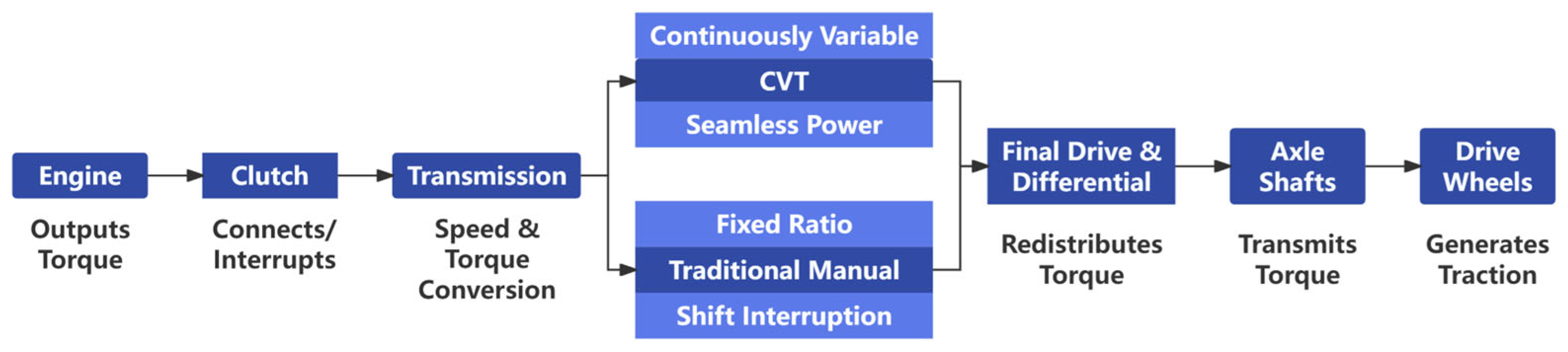
As a conventional power delivery mechanism in agricultural machinery, mechanical transmission operates through kinematic chains composed of rigid components, including the engine, clutch, gearbox, drive shafts, and differential, with torque transmitted via engaging elements such as gears and synchronizer rings [15]. Recognized for its structural simplicity and serviceability, this system provides reliable operational stability and fundamental terrain adaptability, rendering it particularly suitable for sustained, high-load tasks on moderate slopes—such as those encountered in orchard and terrace farming [16]. The torque-flow path of the mechanical drivetrain system is detailed in Figure 5.
To meet the diverse operational demands in hilly and mountainous regions, several specialized chassis configurations based on mechanical transmission have been developed. Compact chassis use their dimensional advantages and four-wheel-drive systems equipped with differential locks for narrow-row, small-plot operations [17]. Low-center-of-gravity designs integrated with automatic leveling systems aim to support large-scale work on steep slopes [18]. Articulated-steering orchard chassis are designed to balance field maneuverability with physical protection for high-value crops [19].
Traditional manual transmissions have long been limited by issues such as power interruption during gear shifts, operational complexity, and suboptimal engine operating condition matching. These constraints have hindered further improvements in agricultural machinery efficiency and quality [20,21]. With the wider adoption of continuously variable transmission (CVT) technology in agriculture, particularly mechanical CVTs based on variable-diameter pulley and metal push-belt mechanisms, continuous adjustment of transmission ratios allows engines to operate persistently within high-efficiency, economical ranges. This development not only reduces fuel consumption and emissions but also significantly enhances operational smoothness and intuitive control. As a result, CVT has become one of the mainstream transmission solutions for medium- and low-power agricultural machinery [22,23]. However, this technology is not without limitations. The torque transmission capacity of metal push-belts remains constrained, making them less suitable for high-power applications where shock loads are prevalent. Additionally, efficiency losses due to belt-pulley friction and hydraulic system parasitic losses can be pronounced under low-speed, high-torque conditions, such as during field tillage operations [24,25]. Beyond these inherent constraints, the evolution of CVT technology continues. Notably, electromechanical CVT (e-CVT) architectures, typically based on power-split devices, are emerging for high-efficiency and hybrid platforms due to their superior engine-point optimization capability. For instance, Rossi et al. [26] proposed an e-CVT power-split hybrid driveline that supports pure electric mode, power boost, and electric power delivery, with a compact layout that simplifies tractor integration. Furthermore, Chung et al. [27] developed a design methodology based on electric circulation for compound split e-CVT systems, identifying the “United UC/DC” configuration without power recirculation as particularly energy-efficient, especially at high speed and low load. Consequently, current research has been increasingly focused on improving e-CVT durability under shock loads, optimizing its efficiency maps across wider operational ranges, and developing more intelligent, adaptive shift strategies [28].

3.2. Hydraulic Transmission

Hydraulic transmission systems operate on the principles of fluid dynamics and hydrostatic drive, transmitting power and enabling precise control through pressurized fluid. Compared to traditional mechanical drivetrains, these systems demonstrate superior compliance, higher torque output, and enhanced adaptability to complex terrain [29]. Their core advantages include continuously variable speed regulation, high torque at low speeds, and dynamic load adaptation, making them particularly suitable for operations in hilly and mountainous areas with variable slopes and fluctuating loads [30]. However, this technology is not without limitations. The overall efficiency of hydrostatic drivetrains is generally lower than that of mechanical transmissions, particularly under partial load conditions, due to energy losses associated with fluid pressurization, flow throttling, and mechanical friction within pumps and motors [31,32]. Additionally, the manufacturing cost of hydraulic components remains high. System performance is also sensitive to oil temperature variations, which can alter fluid viscosity, affect volumetric and mechanical efficiency, and necessitate complex thermal management systems [33,34]. A typical hydraulic transmission architecture generally consists of variable-displacement pumps, actuating motors, control valve assemblies, and auxiliary circuits, forming either closed or open power transmission loops [35]. The corresponding energy transmission pathway is illustrated in Figure 6.
A pivotal technological milestone in this evolution is the Hydraulic-Mechanical Continuously Variable Transmission (HMCVT). By combining hydraulic and mechanical power paths in a power-split configuration, the HMCVT overcomes the inherent efficiency limitations of pure hydrostatic drives at higher operational speeds [37]. Cheng et al. [38] designed a five-stage HMCVT for tractors. After optimization, the transmission ratio characteristics matched the target, with an average error of about 3.27% and a common ratio of about 1.81; the mean absolute percentage error of 36 simulation experiments was about 0.72%; and the maximum tractor speed reached 41.62 km/h. Li et al. [39] compared binary logic transmission unit configurations for HMCVT. Under light-load conditions, the optimal configuration improved average and maximum scores by 13.38% and 11.53%, respectively; under heavy-load conditions, improvements were 9.38% and 5.86%. After GRNN optimization, the total relative error was reduced by 39.6% under light loads and 61% under heavy loads. This innovation significantly enhanced tractive performance and overall efficiency, establishing it as a benchmark solution for high-power tractors operating on variable slopes.
At the technical implementation level, modern hydraulic transmission systems have progressed beyond fundamental speed control to encompass integrated, intelligent management of vehicle dynamics. This evolution is characterized by the adoption of advanced architectures, such as multi-circuit independent drives, which facilitate decoupled and coordinated control of propulsion, steering, and implement functions. Song et al. [40] designed a hydraulic hub-motor auxiliary system (HHMAS) for heavy trucks with a coordinated control algorithm. The pump displacement composite control achieved a steady-state error within 0.03, effectively improving tractive capacity on poor roads. Liu et al. [41] proposed a flow sensor with active regulation. Under active compensation, the flow measurement error was about 0.66%, the flow control accuracy was about 1%, and the system demonstrated variable flow gain capability and strong load-disturbance rejection. These systems leverage precise flow and pressure regulation to enhance key operational metrics, including traction performance, stability on slopes, and overall energy efficiency.
Current hydraulic transmission technology continues to face fundamental challenges that influence its broader application. A primary concern remains the intrinsic compromise between system energy efficiency and dynamic response [42]. Additionally, the performance ceilings of core hydraulic components, along with the complexities involved in modeling the intricate interactions between the hydraulic system, mechanical chassis, and variable terrain, present significant research and development hurdles [43]. More comprehensive integration of actuator dynamics with suspension system models within system energy analyses is often identified as a necessary step to deepen the understanding of vibration energy pathways and dissipation mechanisms. Liu et al. [44] proposed a hybrid electromagnetic–hydraulically interconnected actuator suspension (EHIAS). During double lane-change conditions, EHIAS enhanced anti-roll performance by 3.3% over a hydraulically interconnected suspension (HIS) and by 81.24% over a traditional independent suspension. Addressing these multifaceted challenges is pivotal for advancing the capabilities and adoption of next-generation high-performance hydraulic systems [45].

3.3. Electric Drive

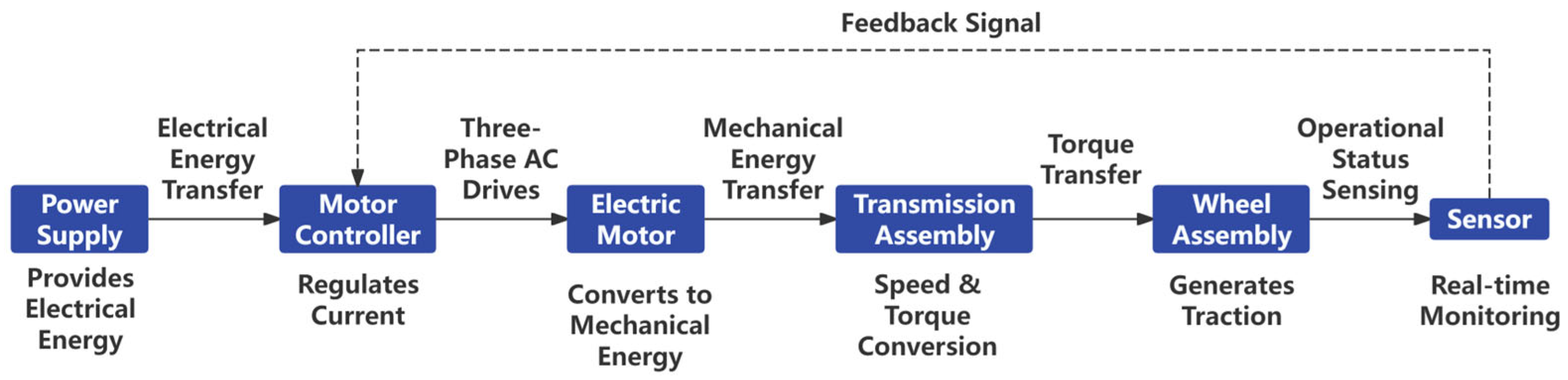
Electric drive systems offer precise control, low noise, and zero point-of-use emissions, making them particularly suitable for compact agricultural machinery operating in hilly and mountainous areas [46]. Their architecture typically comprises high-energy-density battery packs, high-efficiency motors, and intelligent power controllers, enabling millisecond-level torque response and sustained low-speed torque, both critical for slope transitions and precision agriculture [47]. The corresponding electromechanical energy conversion pathway is illustrated in Figure 7.
The inherent modularity of electric drivetrains supports two complementary configurations: integrated drives and distributed drives, each with distinct system layouts and performance characteristics [50].
Integrated Electric Drives consolidate the motor, reducer, and controller into a single module that powers a conventional axle. This design provides structural compactness, low manufacturing costs, and seamless integration with existing chassis [51]. Research targeting mountainous applications has focused on optimizing battery placement to enhance vehicle stability, developing wide-speed-range high-torque drive units, and applying advanced algorithms such as deep reinforcement learning for co-optimizing transmission parameters and control strategies under complex operating conditions [52]. Xu et al. [53] optimized transmission parameters of a dual-motor-driven electric tractor using an improved deep deterministic policy gradient (IDDPG) algorithm. In transport mode, the 0–20 km/h acceleration time was reduced by 13.6% and motor efficiency increased by 10%; in rotary mode, acceleration performance improved by 28.5% and motor efficiency increased by 5%. Integrated drives are primarily employed in cost-sensitive applications with predictable duty cycles, such as medium- to low-power tractors and stationary orchard platforms.
Distributed electric drives position motors near or inside the wheels, including wheel-side or in-wheel motors, eliminating the need for clutches, transmissions, and drive shafts [54]. This configuration grants independent torque and speed control per wheel, enabling electronic differentials, torque vectoring, and direct yaw moment control. Consequently, it significantly improves passability, traction, and active safety on slippery or uneven slopes [55,56]. Recent studies on distributed-drive electric plant-protection vehicles demonstrated substantial performance gains using hierarchical control architectures that combined nonlinear model predictive control with multi-objective deep reinforcement learning for active torque distribution, thereby enhancing both stability and energy efficiency under field conditions. Xu et al. [57] proposed a hierarchical control strategy with an upper-layer NMPC and a lower-layer AW-MO-TD3 torque allocation. Field tests showed that under dry plowed terrain and muddy rice field conditions, vehicle stability was improved by 29.1% and 41.4%, respectively, while energy consumption was reduced by 19.8% and 21.1%, respectively.
Building upon this hardware foundation, control strategies for electric drives have undergone significant evolution. The progression moved from classical proportional–integral–derivative (PID) controllers to enhanced algorithms like Fuzzy PID and Adaptive PID for better handling of system nonlinearities [58]. More recently, the research frontier has shifted towards multi-objective co-optimization frameworks, as exemplified by the aforementioned integration of predictive and learning-based methods [59]. These advanced controllers holistically manage torque distribution, path tracking, and energy consumption, aiming to resolve the fundamental range–performance trade-off endemic to battery-powered platforms [60].
However, battery technology imposes fundamental trade-offs that become particularly critical in hilly terrain. Energy density and power density are often mutually constrained, and repeated high-current discharge during prolonged climbing accelerates capacity fade and shortens cycle life. Thermal management is equally challenging under field conditions, as inadequate cooling can lead to temperature-induced derating or safety risks [61]. These limitations directly constrain the practical deployment of pure electric chassis in mountainous areas, determining continuous operation time during high-power tasks such as slope tillage. Ruggedized thermal management systems are also required to cope with dust, vibration, and wide ambient temperature variations, adding to design complexity and cost [62].

3.4. Hybrid Drive

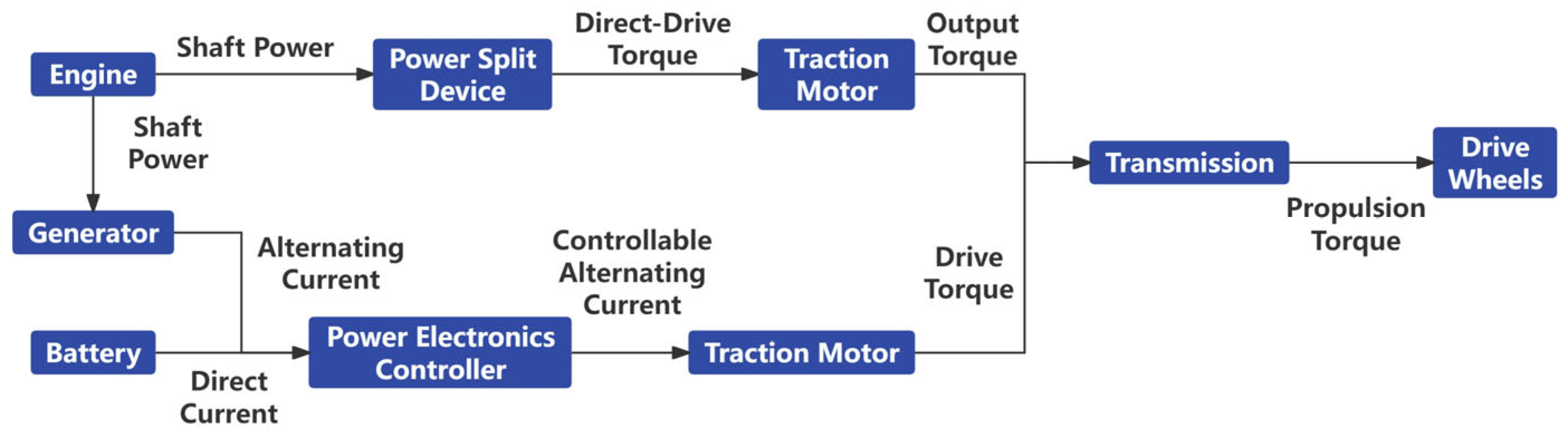
Hybrid drive systems utilize innovative electromechanical–hydraulic coupling architectures to dynamically coordinate power from internal combustion engines and electric motors [63]. They are designed to merge the high energy density of conventional powertrains with the precision and cleanliness of electric drives, establishing themselves as a strategic technological solution to the dual challenges of operational endurance and power demand in hilly and mountainous agricultural operations [64]. Their core function is intelligent energy management, which aims to maintain continuous engine operation within its peak efficiency zone and recover energy from braking and power take-off drag, thereby potentially extending work duration and improving overall energy efficiency. The characteristic energy-flow paths are schematically represented in Figure 8. Based on the method of power flow coupling, the field is primarily defined by three fundamental architectures: series, parallel, and series–parallel hybrid. Each represents a distinct balance between system efficiency, control complexity, and manufacturing cost [65,66].
Series hybrid architecture achieves mechanical decoupling between the engine and the drive wheels. The engine drives a generator to produce electrical energy, which either directly powers the traction motor or is stored in a battery, with the motor ultimately propelling the vehicle [67]. This design completely decouples engine operation from wheel load, allowing it to run steadily at its optimal fuel economy point. It is particularly suitable for complex field operations characterized by frequent start–stop cycles and demands for high torque at low speeds. However, the energy must undergo multiple conversion stages from chemical to mechanical, then to electrical, and finally back to mechanical energy. The inherent losses in these conversions impose a fundamental limit on the maximum achievable driveline efficiency [68].
Parallel hybrid architecture enables the engine and the electric motor to drive the wheels either cooperatively or independently through a mechanical coupling device such as a clutch or gear set. This structure is relatively compact and retains a conventional mechanical drive path, allowing for direct engine drive during its high-efficiency operating conditions and thereby avoiding the energy form conversion losses inherent to series architectures [69]. The central challenge of this technological pathway lies in the real-time coordinated distribution of torque between the engine and motor, along with seamless transitions between driving modes under complex and variable operating conditions. This places extremely high demands on the real-time performance and robustness of the control system.
Series–parallel hybrid architecture deeply integrates the technical features of both series and parallel architectures through composite coupling devices. It achieves decoupled control of engine speed and wheel torque, enabling engine operation optimization across a broader working range and providing continuously variable transmission capability [70,71]. This architecture offers the greatest theoretical potential for system efficiency. Nonetheless, its system configuration is the most complex, and the development of sophisticated control strategies capable of managing multi-source energy flow and coordinated torque distribution in advanced, purpose-built systems like distributed hybrid electric tractors remains a primary challenge, as does its high initial manufacturing cost [72]. Despite these challenges, simulation and field studies indicate that well-optimized hybrid powertrains could achieve substantial benefits, typically demonstrating 15–30% fuel savings in hilly terrain compared to their conventional counterparts [73]. In practice, series hybrids excel in complex field operations characterized by frequent start–stops, while series–parallel hybrids offer the highest theoretical efficiency potential, albeit requiring the most sophisticated control systems to realize it [74].
In hilly and mountainous operations, hybrid systems face additional practical constraints. During prolonged low-speed climbing with heavy drawbar loads, the battery pack may experience sustained high-current discharge, leading to significant internal heat generation. Without effective thermal management, this can trigger power derating or accelerate battery aging. To mitigate these issues, integration of supercapacitors or small high-power buffer batteries has been explored, forming a hybrid energy storage system [75]. Supercapacitors offer high power density and excellent cyclability, enabling them to handle peak power demands during slope acceleration or transient high-torque events, thereby reducing stress on the main battery and improving overall system responsiveness [76].

4. Traveling Mechanism

The traveling mechanism, serving as the key actuation and load-bearing system of agricultural chassis for hilly and mountainous terrain, directly determines the machine’s overall terrain adaptability, operational stability, and trafficability [77]. It must efficiently convert power into tractive effort while effectively damping ground excitations to cope with complex operating environments comprising fragmented plots, steep slopes, and variable soils. Current technological development exhibits trends toward diversification in configuration and systematization in intelligence, with wheeled, tracked, and composite systems each having their own focus, collectively advancing mountain agricultural machinery [78].

4.1. Wheeled

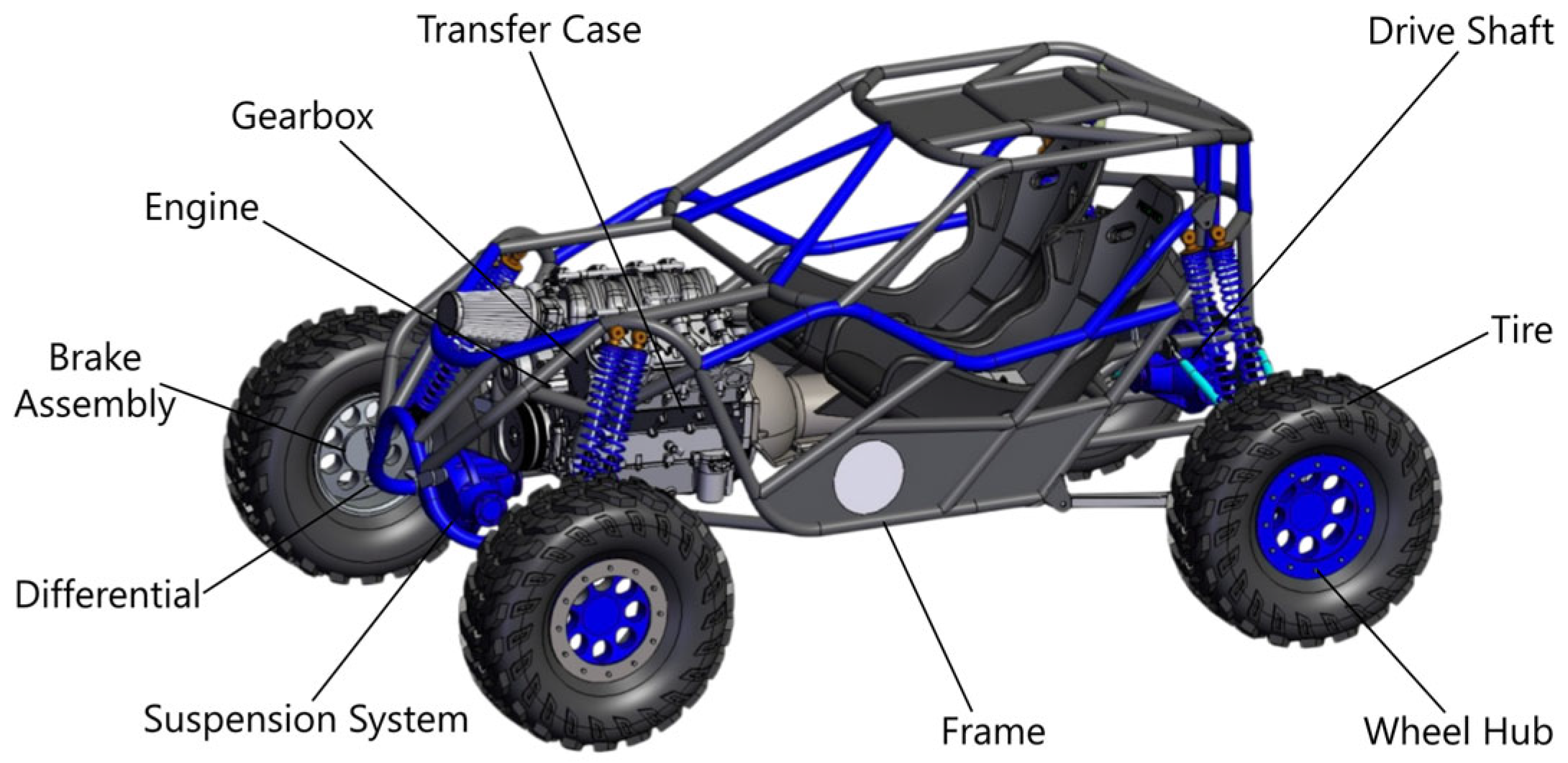
The wheeled traveling mechanism, comprising core components such as tires, wheel hubs, suspension, and steering systems, holds a significant position in agricultural machinery for hilly and mountainous areas due to its high mobility, good ride comfort on roads, and relatively low maintenance requirements. Its drive configurations primarily include front-wheel drive, rear-wheel drive, and all-wheel drive to accommodate different load and terrain conditions [79]. Among these, all-wheel-drive systems have become the mainstream choice for complex slope conditions owing to their superior traction distribution capabilities [80]. To clearly illustrate these core components and their spatial arrangement within a typical agricultural chassis, a detailed structural diagram of a wheeled system is presented in Figure 9.
The evolution of current wheeled traveling technology focuses on two main directions: traction optimization and system intelligence. In terms of traction, the widespread adoption of all-wheel-drive technology and electronically controlled differential locks has significantly enhanced chassis anti-slip and extrication capabilities. The combination of low-pressure wide-base tires and central tire inflation/deflation systems achieves a balance between hill-climbing ability and travel efficiency by increasing the contact area on soft soil and restoring standard tire pressure on hard surfaces [82]. At the level of system intelligence, the application of independent suspension systems and adaptive damping technology effectively improves attitude stability and ride comfort during high-speed obstacle crossing. More profound changes stem from innovations in control systems: environment perception algorithms based on deep learning, real-time updated wheel–soil interaction models, and decision-making controllers deeply integrated with the vehicle’s electromechanical hydraulic systems are propelling wheeled chassis from passive execution toward active adaptation. This enables the chassis to dynamically adjust drive torque, braking force, and even suspension stiffness based on real-time terrain and load information, establishing the core technological foundation for achieving high-precision, fully autonomous all-terrain operations. For example, Li et al. [83] designed an orchard operation-aid platform specifically for hilly and mountainous orchards with tree and row spacing of ≤6 m and slopes of ≤15°. The platform achieved an in situ turning radius of 1.2 m, a working height of 4.0 m, and an operating radius of 3.7 m, meeting operational requirements for multiple tasks.

4.2. Tracked

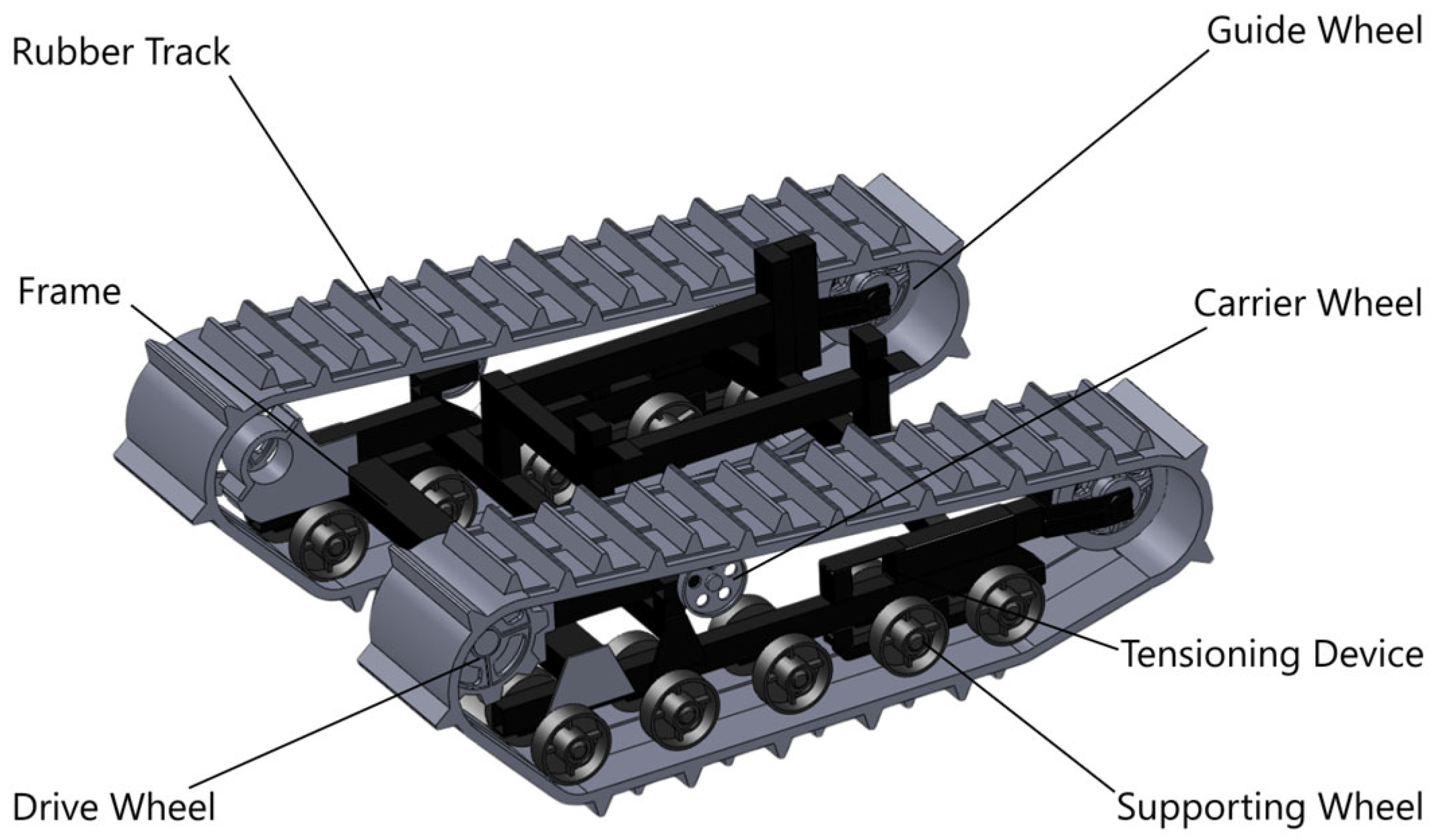
The tracked traveling mechanism comprises a drive sprocket, a series of road wheels (bogies), a front idler wheel, interconnected track shoes, and an automatic tensioning device [84]. A schematic representation of its typical configuration is provided in Figure 10. This architecture achieves a substantial increase in ground contact area, enabling superior load distribution and a dramatic reduction in ground pressure. Consequently, it delivers exceptional performance in terms of slip resistance, sinkage prevention, and tractive effort on soft, low-adhesion, and undulating slopes [85]. When compared to wheeled systems, tracked configurations provide unmatched trafficability in challenging environments such as deep mud, marshland, and highly irregular terrain, a direct result of their continuous ground engagement and minimized specific ground pressure [86]. Nevertheless, the system remains susceptible to pronounced vibration and shock loads induced by ground irregularities and the periodic impact of track shoes during engagement and disengagement. Li et al. [87] analyzed the track system vibration of a remote-controlled weeding machine in orchards using a column-type test-to-pass method. At forward velocities of 0–2.5 km/h and exciter heights of 20–100 mm, the vertical vibration acceleration of the target roller ranged from −13.3 to 42.2 (units: m/s2, added for clarity) and was significantly affected by track contact point centrifugal acceleration. The dynamic performance, specifically the uniformity of ground pressure distribution and the overall ride quality, is critically influenced by the number and spatial arrangement of the road wheels, as well as the design and damping characteristics of the undercarriage suspension system.
Currently, track technology is primarily categorized into three types based on material. Steel tracks are renowned for their extreme wear resistance and structural strength but are heavy and highly damaging to hard surfaces. Rubber tracks provide excellent damping and noise reduction and are gentle on paved roads and crops, but face durability challenges under heavy loads or in the presence of sharp objects. Composite tracks aim for a better balance among structural strength, wear resistance, lightweight properties, and ground friendliness, making them a key focus of current research and development [88].
To systematically enhance performance, the technological development of tracked systems is evolving toward structural adaptability and control intelligence. At the structural design level, research focuses on optimizing the overall mass distribution and track ground contact geometry to achieve more uniform ground pressure transmission [89]. To improve terrain compliance on uneven surfaces, balance suspension configurations, in which multiple road wheels are connected via rigid linkages to form a pivoting bogie, are widely adopted. This design allows the suspension to articulate with ground contours, maintaining continuous track contact and reducing localized pressure peaks, thereby enhancing ride quality and stability on rugged terrain [90]. While ensuring structural strength, designs incorporating segmented or deformable track frames are being developed to enhance adaptive capability and steering agility on asymmetric terrain. At the vibration suppression level, beyond optimizing traditional torsion bar or hydro-pneumatic suspensions, the introduction of active or semi-active control architectures based on sensor feedback to suppress pitch and roll vibrations in real time has become a cutting-edge solution for improving high-speed travel stability and operator comfort [91]. At the comprehensive trafficability level, guided by theoretical models and simulations, precisely adjusting the ground pressure distribution between the front and rear track segments enables the system to better maintain vehicle posture stability on extremely rough terrain, demonstrating enhanced obstacle-crossing and extrication capabilities [92].

4.3. Wheel–Track Hybrid

The wheel–track hybrid traveling system is designed to synergistically combine the high transport efficiency of wheeled configurations on prepared surfaces with the superior off-road trafficability of tracked systems in unstructured terrain, thereby endowing agricultural machinery for hilly and mountainous areas with enhanced all-terrain adaptability [93]. A typical system incorporates an electromechanical–hydraulic hybrid drive and conversion mechanism, enabling automatic or semi-automatic switching between locomotion modes based on forward terrain perception data. It operates in wheeled mode on firm, level ground for high-speed, energy-efficient transfer and operation, and switches to tracked mode on soft, muddy, or steep slopes to utilize continuous ground contact and a larger footprint for increased tractive effort and effective suppression of slip and sinkage. Furthermore, by integrating adaptive suspension and modular traveling units, the system can dynamically optimize ground pressure distribution and reduce the complexity of replacing or maintaining specific components [94]. However, the practical application of this technology remains constrained by its inherent structural complexity, higher manufacturing costs, and issues related to dynamic delay and reliability during mode transitions.
To address these core challenges, current research focuses on both structural and control aspects. Structurally, modular and reconfigurable chassis architectures enable rapid functional reconfiguration [95]. Continuously adjustable wheel–track width mechanisms allow dynamic adaptation to varying crop row spacings or terrain profiles, enhancing operational versatility. Optimized hybrid kinematic chains and dual-mode power transmission pathways improve gradeability and trench-crossing capability while ensuring structural rigidity and reliability [96]. At the intelligent control level, the technological focus has shifted from independent control of individual wheeled or tracked units to the coordinated decision-making and integrated management of multiple subsystems, including propulsion, steering, suspension, and mode switching. Control strategies that combine dual-drive differential steering mechanisms with advanced algorithms such as MPC and SMC enable high-precision, high-robustness steering and path tracking on complex terrain [97]. This lays a crucial technological foundation for the wheel–track hybrid chassis to achieve autonomous environmental perception and decision-making, and precise operation. Zhang et al. [98] proposed a coordinated control strategy for wheel–tracked driving force allocation based on hierarchical theory. The strategy included a feedforward–feedback compound speed controller, an energy-optimal allocation layer using Lagrange multipliers, and a sliding mode control-based optimal slip ratio controller. Compared with conventional equal distribution strategies, the proposed method reduced energy loss by 15%. In summary, through the deep integration of electromechanical-hydraulic and intelligent technologies, the wheel–track hybrid traveling system demonstrates clear technical potential by breaking the performance boundaries of single-mode locomotion and comprehensively improving the terrain adaptability and overall operational efficiency of agricultural machinery for hilly and mountainous areas [99]. It represents a significant direction in advancing equipment in this field toward higher efficiency and greater intelligence.

4.4. Legged

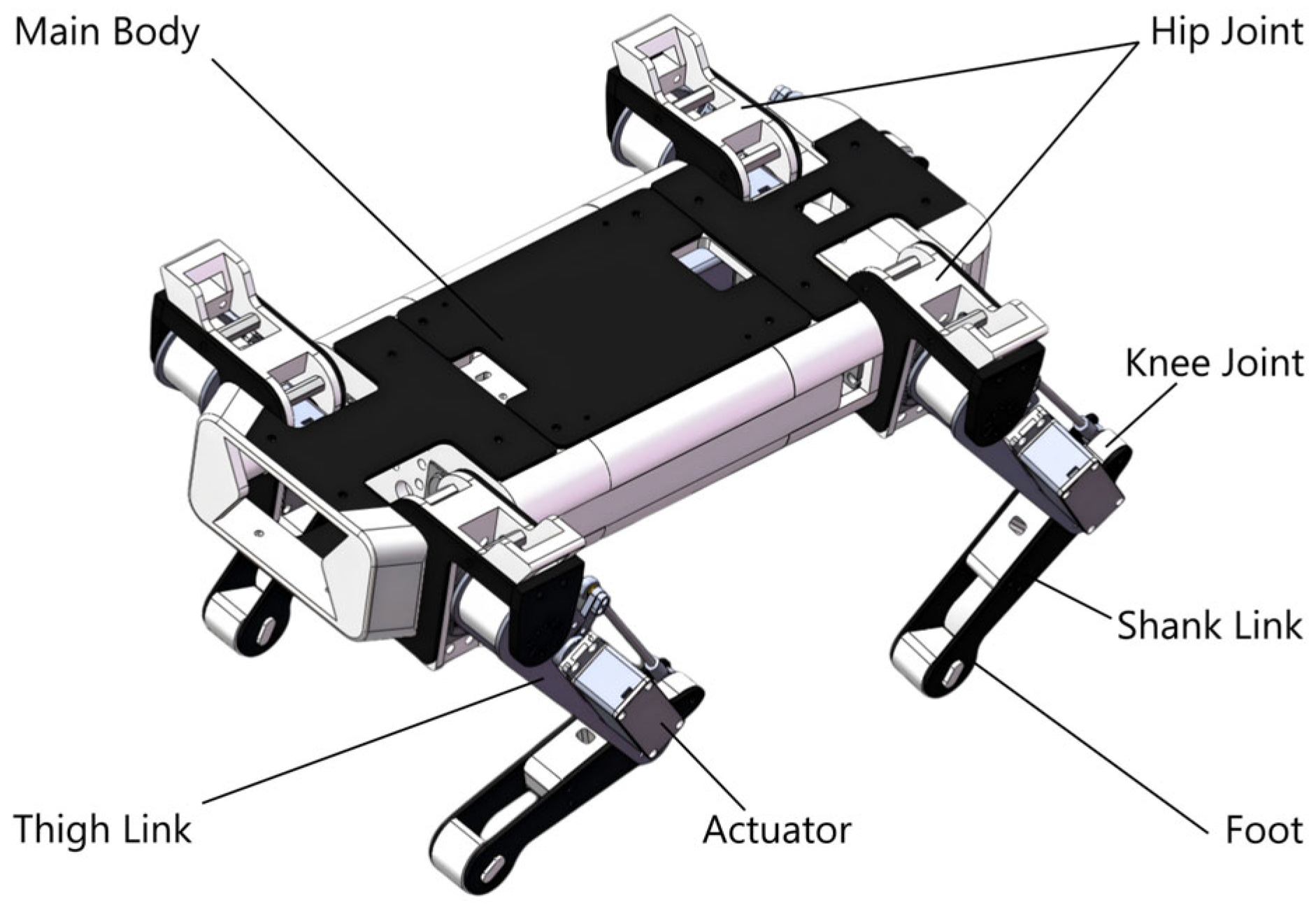
The legged traveling mechanism represents a transformative technological solution for extremely rugged and highly unstructured terrain in hilly and mountainous areas. Through bio-inspired design, this system utilizes multi-degree-of-freedom mechanical legs to mimic biological locomotion, integrating independently actuated joints with high-bandwidth force-feedback sensing to achieve active adaptation and traversal over discrete obstacles such as rocks, ditches, and roots [100,101]. A schematic diagram of a typical legged locomotion mechanism is presented in Figure 11. Its discrete foothold pattern fundamentally avoids the slip and sinkage issues inherent to continuous traction mechanisms and can significantly reduce compaction on soft soil. Through dynamic gait planning and precise foot-end force control, the system demonstrates superior stability and point-to-point trafficability on complex terrains like steep slopes and terraced fields compared to conventional mechanisms [102].
Building upon this foundational capability, research is actively enhancing legged locomotion across several critical dimensions. A primary focus is on enhancing terrain intelligence through real-time adaptive control [103]. Advanced platforms have integrated depth cameras or LiDAR with locomotion controllers to move beyond pre-programmed gaits. For instance, quadruped robots employing MPC coupled with a terrain-aware foothold planner were able to evaluate potential stepping locations in real time based on local slope, roughness, and estimated soil bearing capacity, enabling stable traversal over fragmented terrain like plowed fields or orchard floors littered with branches [104].
Concurrently, significant efforts have been directed at improving dynamic agility and disturbance rejection. This involves developing controllers capable of robust balance recovery and energy-efficient gait transitions under sudden perturbations like lateral pushes or unstable ground. Implementations of whole-body impulse control and reinforcement learning (RL)-tuned policies allowed legged platforms to react within milliseconds to regain stability without stopping [105]. Field experiments validated their capability to recover from significant slips on muddy slopes or after stepping on unstable rocks, a critical feature for reliable operation in natural environments [106].
Addressing the practical challenge of system endurance, innovations are emerging in actuation and energy management [107]. The adoption of high-torque-density electric actuators with integrated variable impedance control reduces system weight while delivering the force necessary for powerful maneuvers or delicate force control [108]. Furthermore, the exploration of energy-regenerative mechanisms during leg swing phases, combined with energy-optimal gait synthesis algorithms often co-designed via simulation-to-real learning pipelines, progressively extended operational durations, edging legged robots closer to fulfilling sustained work sessions in agricultural settings [109].

5. Dynamic Stability Control

Unlike the uniform terrain and stable loads of plain areas, hilly and mountainous conditions impose multidimensional challenges on agricultural chassis. Continuously varying slopes shift the vehicle’s center of gravity, significantly increasing rollover risks [110]. Rough surfaces induce severe vibrations, compromising operator comfort and the accuracy of precision implements such as spectrometers and picking end-effectors. Moreover, steering, braking, and starting on slopes demand greater longitudinal and lateral stability than on flat ground.
To address these challenges, dynamic stability control technology has emerged. This integrated control system encompasses sensing, decision-making, and actuation. It actively maintains vehicle attitude, suppresses harmful vibrations, and ensures precise trajectory tracking through real-time monitoring and coordinated control of chassis subsystems [111]. This chapter focuses on four key subsystems: the suspension system for vibration management and attitude adaptation, the leveling control system for active platform attitude adjustment, the Steering control systems for path tracking, and the braking control system for safety and motion precision. Their coordinated evolution forms the dynamic stability barrier for agricultural machinery on complex terrain [112].

5.1. Suspension Systems

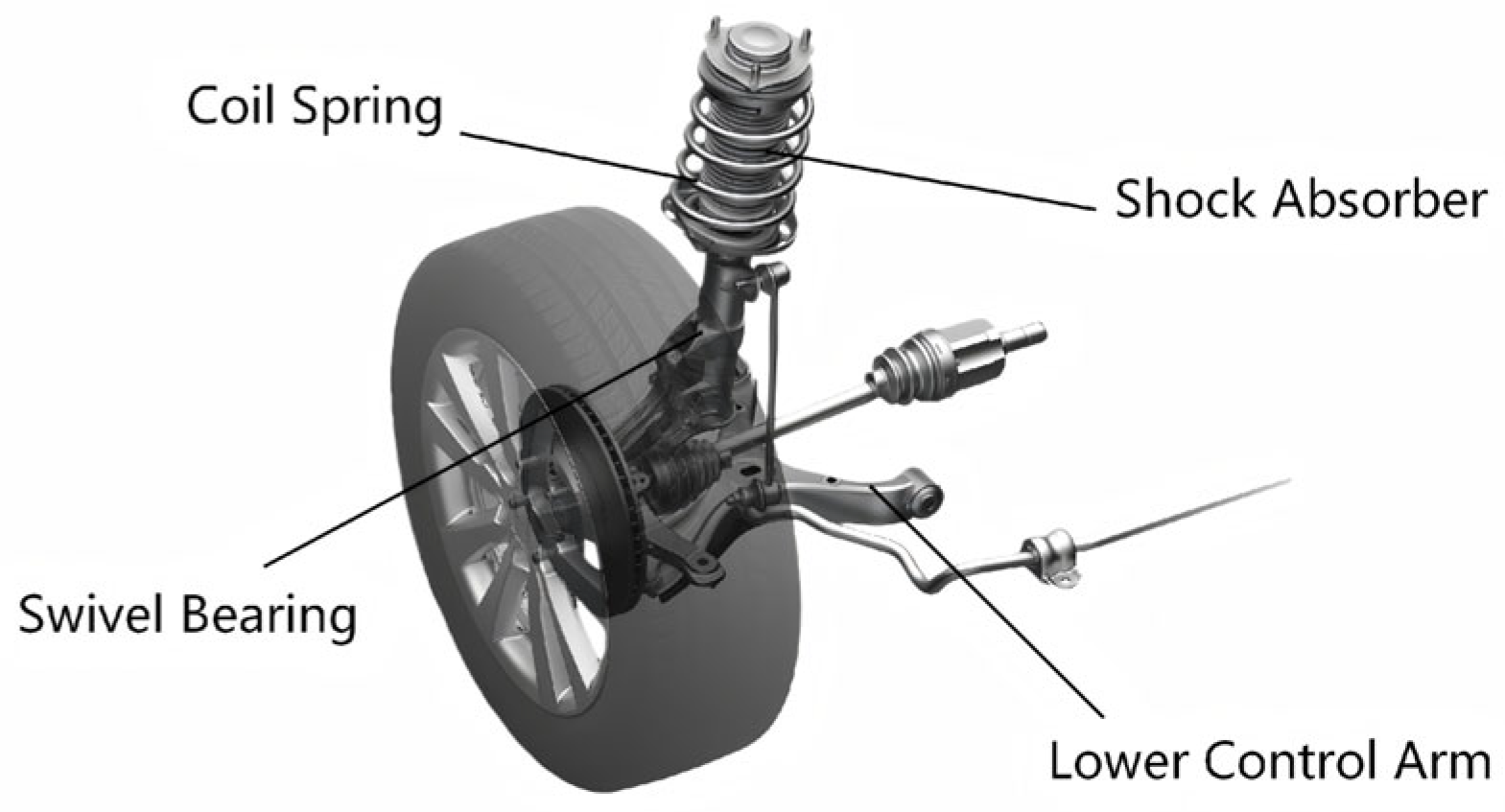
The suspension system mechanically connects the frame or load-bearing platform to the traveling mechanism. Its traditional configuration comprises elastic elements such as leaf or coil springs, damping elements such as hydraulic shock absorbers, and guidance mechanisms including various linkages, as shown in Figure 12.
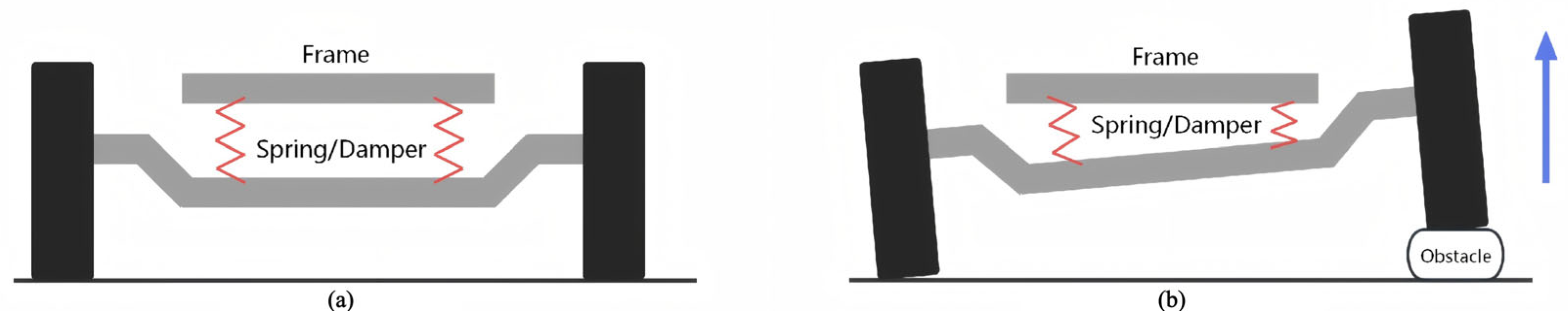
Figure 13 illustrates the operating principle. When a wheel encounters road irregularities, the elastic element stores and releases energy to counteract the impact while the damper dissipates vibrational energy as heat via internal fluid resistance. The guidance mechanism constrains wheel motion to predetermined trajectories.
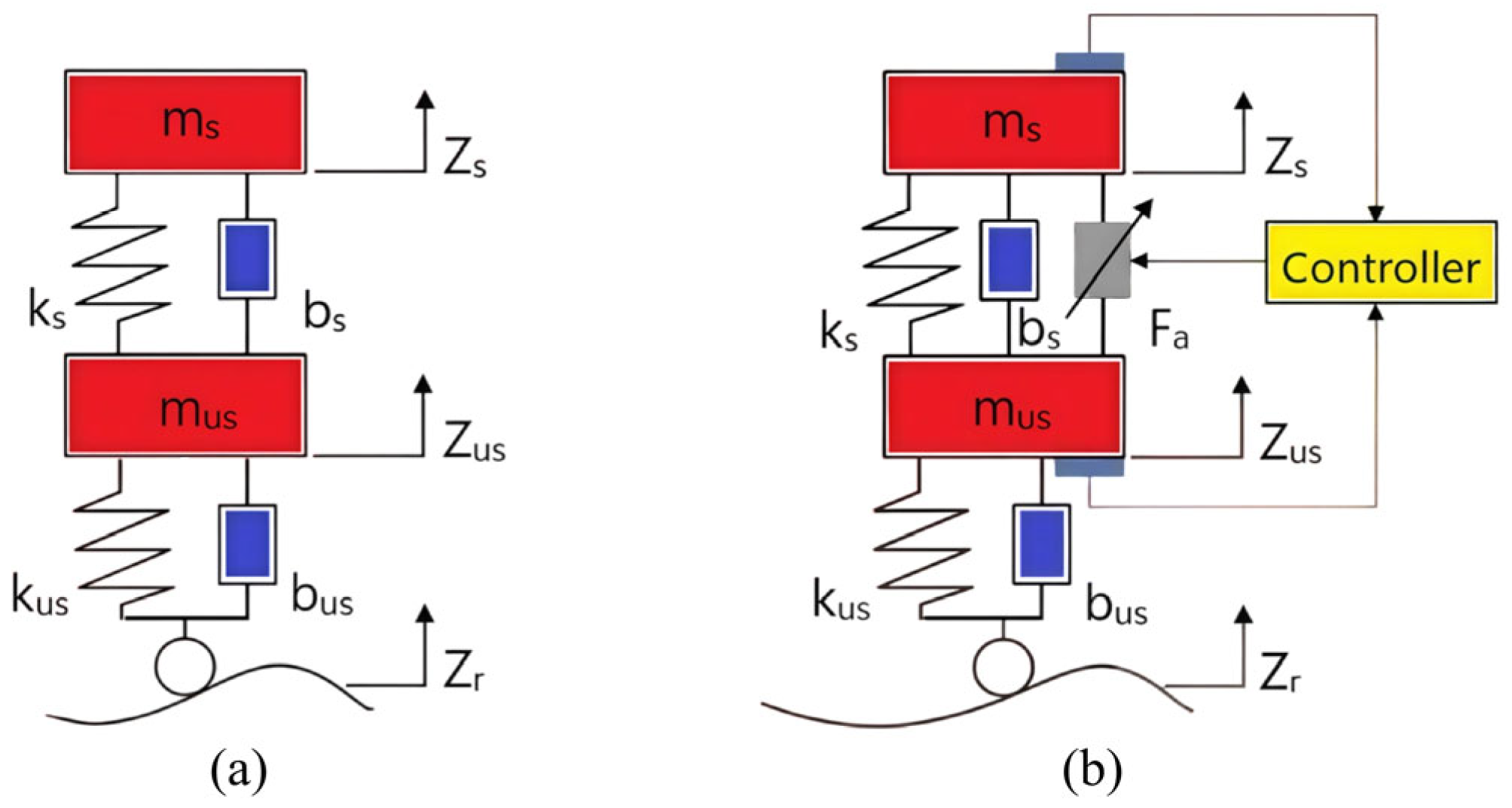
To quantify performance and facilitate controller design, the quarter-car model shown in Figure 14 is commonly used. This two-degree-of-freedom model abstracts the chassis as sprung mass (ms), and the wheel assembly as unsprung mass (mus), connected by a linear spring (ks) and damper (bs). The tire is represented by vertical stiffness (kus), with road displacement input (zr). Figure 14a shows the passive suspension, while Figure 14b introduces an actuator generating active control force (Fa) between the masses, enabling performance beyond passive limits [113,114].
The equations of motion are derived from Newton’s second law. For the passive configuration in Figure 14a,
m s   z ¨ s = k s ( z s z us ) b s ( z · s z · us )
m us   z ¨ us = k s ( z s z us ) + b s ( z · s z · us ) k us ( z us z r )
For the active configuration in Figure 14b,
m s   z ¨ s = k s ( z s z us ) b s ( z · s z · us ) + F a
m us   z ¨ us = k s ( z s z us ) + b s ( z · s u s ) k us ( z us z r ) F a
In hilly and mountainous agricultural scenarios, the suspension system plays a decisive role. It provides vibration damping and cushioning, directly affecting operator comfort and protecting onboard instruments. It also maintains optimal wheel–ground contact, improving traction and braking efficiency on loose or rugged surfaces. However, traditional passive suspensions have fixed stiffness and damping, limiting their adaptability to varying loads and slopes [115].
Suspension systems are categorized by their adaptability. Passive suspensions dissipate input energy but cannot adjust to changing conditions. Active or semi-active suspensions use sensors, controllers, and actuators to inject external energy, actively counteracting vibrations and body motions, thus achieving superior ride comfort and handling stability on complex terrain.
To overcome these limitations, suspension technology is evolving toward adjustable and intelligent active control. Air suspensions adjust vehicle height and stiffness via air spring pressure. Hydro-pneumatic suspensions combine gas spring elasticity with hydraulic damping. Bockhop et al. [116] characterized an off-road vehicle hydraulic lift arm suspension. Tests showed that an accumulator precharge of 83 bar and an orifice diameter of 6 mm provided the best overall performance. Larger accumulator volumes (4–8 L) were best for high-amplitude field events, while the smallest volume (2 L) proved best for normal field operation. Advanced semi-active systems, for example, those employing magnetorheological or electrorheological dampers, along with fully active systems integrate high-precision sensors and fast actuators. They dynamically adjust damping forces or output actuation forces within milliseconds based on real-time body acceleration, suspension travel, and wheel load, using control algorithms such as Skyhook, model predictive control, or nonlinear strategies [117]. Huang et al. [118] designed a servo electric cylinder-based active suspension leveling system for small agricultural machinery using a Fuzzy PID algorithm. Simulations showed that the system maintained a chassis height error within ±0.05 m, a chassis height change rate within ±0.2 m/s, and a response time of ≤0.8 s. Chai et al. [119] used a DEM-FMBD bidirectional coupling simulation method for a tracked combine harvester. The displacement and tilt angle deviation of hydraulic cylinders was less than 5%, and the deviation between simulated and actual maximum dynamic stress under multiple working conditions ranged from 7% to 15%. Adopting the middle height adjustment strategy reduced the extreme value of dynamic stress by 21.98%. This enables precise and rapid attitude stabilization, laying the foundation for high-precision leveling and stable operations [120]. The development of such systems increasingly relies on high-fidelity simulation tools like multibody dynamics modeling combined with physical experiments to assess fundamental stability limits, for example, rollover thresholds, and to de-risk designs of both passive structures and active control strategies [121].

5.2. Leveling Control

The leveling control system ensures that agricultural machinery operating on hilly and mountainous terrain maintains a level working platform on sloped and uneven ground, thereby guaranteeing operational precision and overall vehicle stability. By integrating attitude sensing, intelligent decision-making, and hydraulic or electric actuation, the system forms a closed-loop control circuit that dynamically compensates for terrain slope in real time, keeping critical implements such as spray booms and harvesting arms at their preset optimal working attitude. Its effective application significantly mitigates degraded work quality, efficiency loss, and overturning risks caused by vehicle tilt [122]. Accurate quantification of these stability limits, particularly rollover thresholds under various configurations, is fundamental to designing and calibrating such stability-assisting systems. Karaca et al. [123] investigated the effects of CoG shifts caused by implements on rollover stability of a narrow-track vineyard tractor using multibody dynamics. The model was validated with a special rollover platform (mean absolute percentage error of 11%). Lateral and vertical CoG shifts significantly affected rollover behavior, and high-positioned equipment significantly reduced the lateral rollover threshold.
From a technological implementation perspective, current developments in leveling systems are primarily reflected in two dimensions: mechanism innovation and algorithm advancement. The frontier of this field now incorporates sensitivity analysis and multi-objective genetic optimization into the mechanical design stage to systematically balance key performance metrics like actuator force, leveling speed, and energy consumption. Jiang et al. [124] designed an omnidirectional-leveling system with a “three-layer frame” structure. A novel QBP-PID Control algorithm (combining Q-learning, BP neural network, and PID) reduced the leveling time to 2.8 s for 20° lateral leveling and 3.2 s for 25° longitudinal leveling with no overshoot. In dynamic tests, the body inclination angle could be maintained within ±1.5°. Concurrently, novel hierarchical architectures have emerged at the control level, such as controllers that employ reinforcement learning as a meta-optimizer to dynamically tune the parameters of a neural network-based PID regulator, thereby achieving enhanced adaptability and precision on complex terrain [125,126]. Furthermore, cooperative control is being actively explored. For example, synchronization control systems for tractor body and implement posture utilize neural network PID algorithms to address the coupling between chassis attitude and attached tools, improving overall operational accuracy in hilly and mountainous areas [127].
In terms of mechanisms, technology has evolved from basic integral tilting to active adjustment configurations based on multi-point independent support [128,129]. Hydraulic three-point or four-point leveling mechanisms have become the mainstream solution for medium to large operation platforms due to their powerful output force and wide compensation range [130]; scissor-lift mechanisms are widely used in lifting platforms for their compact structure and high load capacity; and mechanisms such as parallel four-bar linkages are integrated into specialized chassis for rapid lateral attitude correction due to their precise motion trajectory and high stiffness [131]. More advanced omnidirectional-leveling chassis architectures, such as those employing multi-layer hinged frames, achieve comprehensive adaptive compensation for both lateral and longitudinal slopes, demonstrating excellent terrain traversal capability [132].
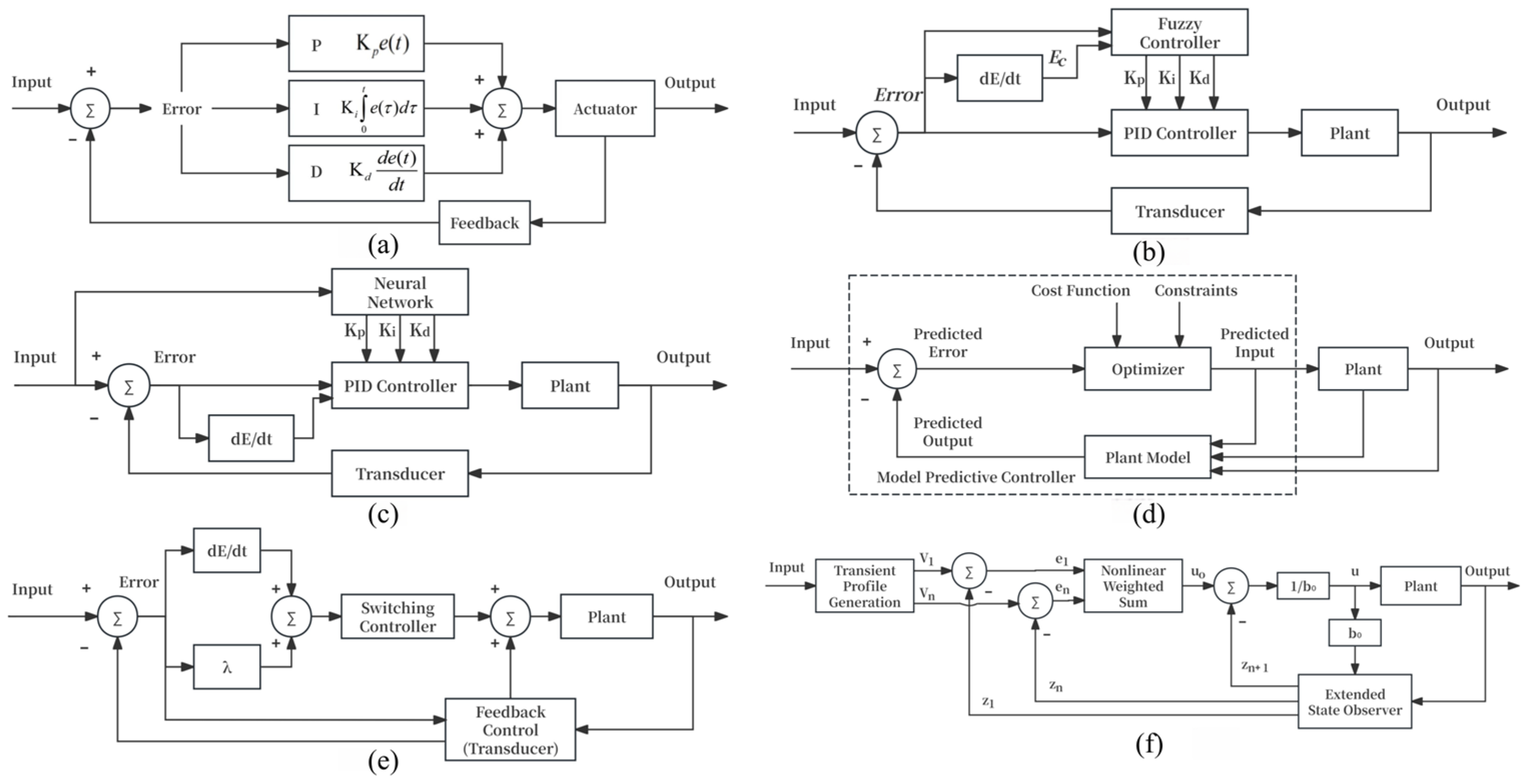
At the control strategy level, the core objectives are to enhance dynamic response speed, steady-state accuracy, and anti-interference capability [133]. To address the significant dynamic effects and complex external disturbances prevalent in hilly and mountainous environments, a series of enhanced control algorithms have been developed and applied. Figure 15 illustrates the core schematic structures of several mainstream control algorithms.
PID Control, with its straightforward structure and high reliability, remains a reliable choice in many scenarios, particularly in well-integrated systems where its parameters are tuned for specific operational benchmarks [134]. Fuzzy PID Control incorporates expert knowledge into fuzzy rules to achieve adaptive parameter tuning [135]. Neural Network PID Control leverages self-learning capabilities to optimize dynamic processes. MPC excels in handling system constraints through rolling optimization, while SMC offers strong robustness against disturbances [136]. Additionally, Active Disturbance Rejection Control (ADRC) has gained attention for its ability to estimate and compensate for total disturbances in real time using an Extended State Observer (ESO), reducing dependence on a precise system model [137].
Each algorithm has its performance focus, as shown in Table 3, and the selection requires comprehensive consideration of system complexity, cost, and specific operational requirements [138].

5.3. Steering Control

Steering control systems are the core execution units for directional control and trajectory tracking of agricultural chassis operating in hilly and mountainous terrain. Their performance directly determines path-tracking accuracy, handling stability, and terrain traversal capability on complex terrain [139]. These systems correct travel direction by generating the necessary steering torque through the adjustment of steering wheel angles or coordination of speed differences between the walking devices on both sides. Based on the locomotion mechanism type, they are primarily categorized into two major classes: wheeled steering systems and tracked steering systems [140,141].
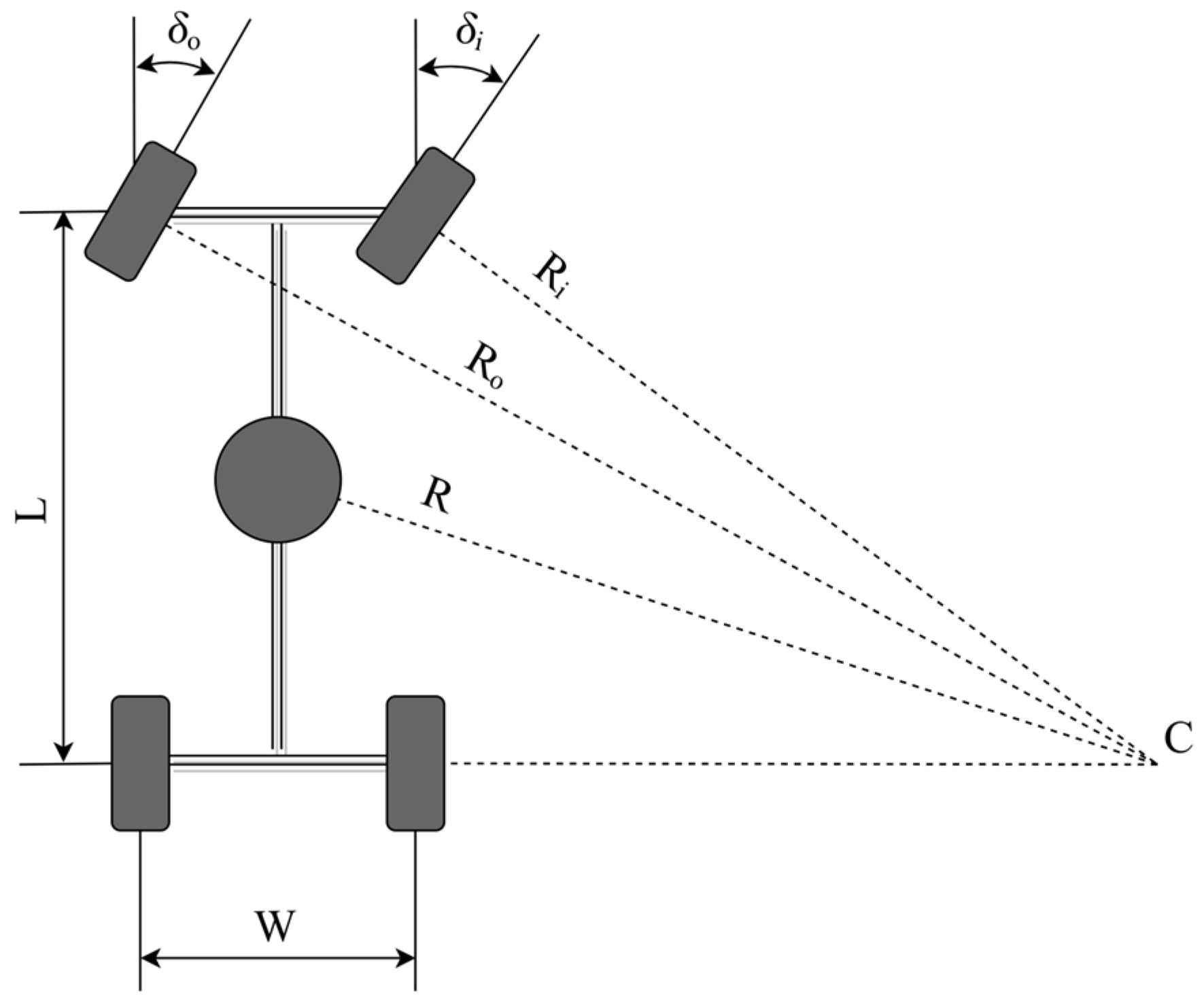
Wheeled steering systems primarily achieve steering by changing the deflection angle of the wheels. Their kinematic design is often based on or compared with the Ackermann steering model, a fundamental geometric principle that ensures all wheels roll about a common instantaneous center during a turn, thereby minimizing tire scrub [142]. As illustrated in Figure 16, this model defines the ideal relationship between the inner (δi) and outer (δo) wheel angles based on the wheelbase (L) and track width (W).
The core relationship is given by:
cot δ cot δ = W L
While this model provides an idealized kinematic foundation for low-speed, high-adhesion conditions, its direct application on complex terrain faces significant limitations. Slip is inevitable on soft or uneven ground, causing the actual turning center to deviate from the kinematic prediction. Consequently, pure Ackermann geometry is often a reference rather than a strict control target [144]. Modern control strategies incorporate dynamic compensation for slip and implement optimized or modified steering angle maps to balance maneuverability, stability, and tire wear [145].
Advanced wheeled steering configurations in hilly and mountainous applications include front-wheel, rear-wheel, and all-wheel steering. To enhance maneuverability and stability, articulated steering and four-wheel steering technologies have seen focused development. Articulated steering, achieved through relative deflection between the front and rear frames, can significantly reduce the turning radius, making it particularly suitable for narrow terraces and orchard environments. Four-wheel steering enhances low-speed maneuverability and high-speed lane-change stability while ensuring straight-line driving stability by coordinating the steering actions of the front and rear axles. At the control level, electro-hydraulic power steering and steer-by-wire technologies are gradually being adopted. These technologies replace traditional mechanical and hydraulic connections with motors and controllers, enabling faster response speeds and lower energy consumption, and providing control interfaces for advanced driver assistance systems [146].
Tracked steering systems primarily rely on speed differences between the tracks on both sides to achieve steering. Based on the kinematic relationship between the two tracks during turning, steering mechanisms can be classified into two fundamental types: independent steering and differential steering. Independent steering maintains the original speed of the outer track while reducing the speed of the inner track. This category encompasses various implementations, including steering clutches, brake steering, and independent drive steering, where drive motors on both sides are independently controlled to achieve precise turning radius control and pivot steering, representing a development direction for intelligent unmanned chassis. Differential steering, in contrast, reduces the speed of one track while increasing the speed of the other by an equal amount, keeping the vehicle’s average speed unchanged during the turn. This type is typically realized through differential mechanisms or dual-flow transmission systems. Slip and skid during steering are the main factors affecting control accuracy. Therefore, advanced control algorithms based on slip ratio estimation and torque distribution are crucial for improving the steering accuracy and efficiency of tracked vehicles on soft and rugged ground [147].
The current developmental core of steering control technology lies in the intelligence of control algorithms and the precision of actuators. Regardless of whether the system is wheeled or tracked, control strategies have moved beyond simple angle-based servo control. MPC is used to optimize multi-objective performance during steering, such as minimizing path error and reducing slip and energy consumption. SMC, valued for its strong robustness against parameter variations and external disturbances, is applied to ensure steering stability under sudden changes in adhesion conditions.
Furthermore, steering systems are undergoing deep coordinated control with other vehicle systems. By sharing vehicle state and road surface information, the steering controller can proactively or coordinately adjust the states of systems such as drive and brake. For example, it can apply slight braking to the inner wheel or adjust driving force distribution during steering to enhance steering response and overall vehicle stability, collectively building an integrated chassis control system adapted to complex terrain [148].

5.4. Braking Control

Braking control systems, serving as the ultimate safeguard for the driving safety of agricultural chassis in hilly and mountainous terrain, have the core function of achieving controllable deceleration and reliable parking under complex conditions such as steep slopes, slippery surfaces, and frequent start–stop operations. By integrating mechanical, hydraulic, and electronic control technologies, the system converts braking commands into precise braking torque. Its performance is directly related to the operational safety, work efficiency, and terrain adaptability of the entire machine [149].
Current braking technology exhibits a diversified development landscape. In the realm of mechanical braking, the research focus has shifted beyond traditional structural reinforcement towards in-depth optimization of material science and environmental adaptability. The application of new bio-based friction materials and advanced anti-corrosion surface treatments has significantly enhanced the reliability, wear resistance, and service life of braking components under harsh conditions such as mud, water, and dust.
Hydraulic braking systems, leveraging their rapid dynamic response characteristics and flexible pressure regulation capabilities, have become the mainstream choice for medium- to high-power agricultural machinery in hilly and mountainous areas. These systems are typically combined with dual-circuit redundant designs to enhance fail-safe performance. Furthermore, through coordinated control with traction management systems like differential locks, they achieve optimized braking force distribution on surfaces with complex adhesion, effectively preventing loss of control caused by wheel lock-up on one side. To further enhance braking stability under challenging conditions, anti-lock braking systems (ABSs) have been integrated into hydraulic braking architectures. By continuously monitoring wheel speed and modulating brake pressure, the ABS prevents wheel lock-up during braking, thereby maintaining vehicle steerability and directional stability on slippery or uneven surfaces—a critical capability for hilly and mountainous terrain where sudden braking on steep slopes or loose soil can otherwise lead to uncontrollable skidding.
As a cutting-edge direction of technological evolution, electro-hydraulic composite braking systems are attracting increasing attention. By introducing a synergistic working mechanism between motor regenerative braking and hydraulic friction braking, this system achieves precise allocation and coordinated control of braking torque. Its layered control architecture and intelligent energy management algorithms not only enable the recovery of part of the kinetic energy while ensuring braking safety and comfort, but also provide a new technical pathway for electric or hybrid agricultural chassis to overcome range limitations [150]. Overall, various braking technologies are undergoing deep integration at the levels of system architecture, control strategy, and energy management, leveraging their respective performance characteristics to jointly build a comprehensive braking safety system that meets the complex demands of hilly and mountainous terrain.

6. Navigation Integration

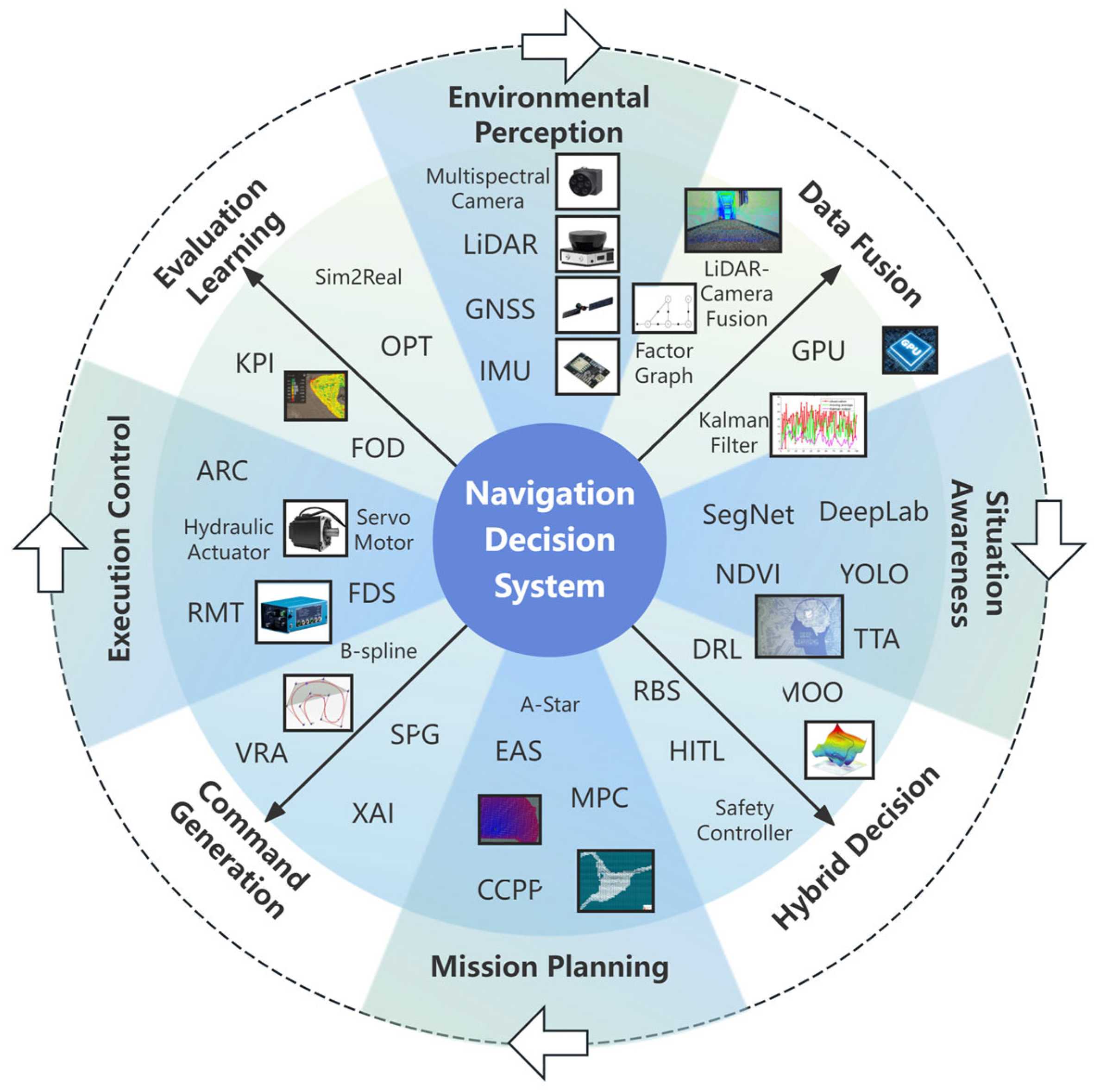
Autonomous navigation and path tracking systems constitute the core enabling technologies for achieving intelligent and autonomous operation of agricultural machinery in hilly and mountainous terrain. By integrating high-precision positioning, multi-source environmental perception, intelligent path planning, and robust tracking control, this system forms a complete “perception–decision–control” closed loop. It aims to overcome multiple challenges posed by undulating slopes, localized signal obstruction, and unstructured environments, ultimately enabling the high-precision and high-efficiency autonomous execution of operational paths.

6.1. Positioning and Perception

High-precision, high-reliability positioning and environmental perception are prerequisites for the operation of navigation systems, especially in hilly and mountainous areas where Global Navigation Satellite System (GNSS) signals are susceptible to obstruction and terrain features are complex. The current technological system has evolved from reliance on single sensors to a collaborative perception and positioning architecture based on multi-source information fusion.
At the positioning level, the integration of satellite navigation and inertial navigation represents a typical technological approach to address intermittent signals and dynamic interference. Satellite positioning provides absolute geographic coordinates in open areas, but its signals are prone to obstruction on complex terrain. Inertial navigation deduces movement based on its own sensors, offering high short-term accuracy but suffering from cumulative errors. Tightly or deeply coupling these two through filtering algorithms, such as Kalman filtering, achieves complementary advantages: satellite signals correct the drift of inertial navigation, while inertial navigation maintains short-term positioning during satellite signal outages. To further enhance reliability in scenarios with prolonged or complete absence of satellite signals, relative positioning technologies based on environmental features, such as visual odometry and LiDAR odometry, were introduced, forming a multi-source fusion positioning system that significantly improved the environmental adaptability and resilience of the positioning system [151]. Beyond the fusion of heterogeneous sensors, enhancing the fidelity of the vehicle’s own kinematic model—such as considering it as a multi-body system rather than a single rigid body for precise attitude determination—also constitutes a critical approach to mitigating positioning errors induced by complex vehicle motions on rough terrain [152].
At the level of environmental perception, to cope with the variable terrain, crops, and obstacles in hilly and mountainous areas, multi-modal sensor fusion has become a key technological direction for enhancing perceptual robustness and information completeness [153]. This system typically integrates sensors with different physical characteristics: Light Detection and Ranging (LiDAR) provides precise three-dimensional spatial structure information through active optical scanning, offering outstanding capabilities for perceiving terrain undulations and solid obstacle contours; vision cameras capture rich two-dimensional texture and spectral information, which, combined with computer vision algorithms, can accomplish semantic understanding tasks such as crop row detection and species classification; and millimeter-wave radar, leveraging its strong penetration and velocity measurement capabilities, excels at detecting mid- to long-range dynamic targets in dusty or foggy conditions. Through data-level, feature-level, or decision-level fusion strategies, the system can simultaneously acquire the geometric properties, semantic categories, and dynamic changes in the environment, forming a comprehensive environmental representation that supports navigation decision-making [154]. Currently, the research focus of perception algorithms has shifted from traditional feature engineering methods towards end-to-end perception models based on deep learning, aiming to achieve higher accuracy and stronger generalization in scene understanding within more complex, unstructured farmland environments. Liu et al. [155] used a BiSeNet semantic segmentation network to extract paddy field ridges. Field tests showed a real-time segmentation speed of 26.31 fps, pixel segmentation accuracy of 92.43%, and an average intersection ratio of 90.62%. The average distance error of the extracted navigation line was 0.071 m, with a standard deviation of 0.039 m, and the coordinate extraction time was about 100 ms, meeting the requirements for rice transplanters operating at 0.7 m/s.
Pursuing this goal of robust generalization, significant progress has been made in tightly coupled multimodal fusion and domain-adapted large-scale perception models. Notably, LiDAR–visual tightly coupled Simultaneous Localization and Mapping (SLAM) frameworks enable the simultaneous real-time construction of metrically accurate 3D maps and semantic segmentation, providing a unified representation that is essential for complex navigation reasoning. Xia et al. [156] proposed a tightly coupled multi-sensor SLAM framework integrating LiDAR, a camera, IMU, and GNSS. Evaluated on the M2DGR dataset and a mobile robot platform, the method outperformed the state-of-the-art LIO-SAM technique, reducing the root-mean-square error of absolute pose estimation by 2.86 and 3.23 in different environments. Concurrently, the adaptation of Vision Transformer (ViT) architectures to agriculture has resulted in efficient models capable of state-of-the-art performance in specific, challenging tasks such as fine-grained fruit maturity classification or early disease symptom detection under field conditions, thereby delivering deeper semantic understanding to the navigation system [157].

6.2. Path Tracking Control

Path tracking control serves as the critical bridge between high-level planning and low-level vehicle actuation. Its core function is to convert a reference path into precise steering and velocity commands for the chassis. Using real-time position and attitude feedback, the controller continuously computes the vehicle’s lateral and heading deviations from the desired path. Based on a specific control algorithm, it then determines the necessary steering angle or speed adjustments in real time, commanding the actuators to eliminate tracking errors and ensure a stable trajectory is followed.
The choice of control algorithm depends heavily on the vehicle chassis type and the characteristics of the operating environment. In structured or semi-structured scenarios with well-defined kinematics and relatively gentle terrain, geometric tracking algorithms—such as the Pure Pursuit algorithm and the Stanley Method—are widely adopted due to their intuitive structure and low computational burden [158]. These methods directly calculate steering commands through simple geometric relationships like look-ahead distance and lateral error, enabling reliable and smooth path following under low to medium-speed conditions. Recent efforts further simplified the deployment of such approaches in orchards and tea plantations by constructing navigation networks from low-precision aerial imagery with minimal manual waypoint annotation, significantly reducing the need for extensive prior mapping.
However, in hilly and mountainous environments where dynamic effects are significant and external disturbances are complex, path tracking faces multiple challenges such as wheel slip, time-varying loads, and terrain undulations [159]. To counteract these disturbances, methods such as steering compensation have been developed to directly mitigate lateral tracking errors induced by slopes and varying loads. Ou et al. [160] proposed a steering compensation method for tractors traveling on slopes. A steering compensator with an automatically adjustable compensation coefficient was integrated with a model predictive controller. The simulation results showed that the tractor traveled more smoothly with the compensator, effectively reducing static error and tracking the reference route more accurately. For unmanned and electrified agricultural platforms, the control paradigm is undergoing a further evolution: from focusing solely on tracking accuracy to achieving global co-optimization that balances motion control with energy efficiency. This shift addresses the critical conflict between drive system performance and energy consumption, necessitating intelligent, multi-objective coordination strategies. Xu et al. [161] proposed a multi-agent-based cooperative optimization control method for an unmanned electric tractor using improved DDPG and DQN algorithms. Bench tests showed that the method reduced total energy consumption by 38.8% on hard surfaces and 25.3% on off-road terrain, while maintaining lateral deviation during straight-line travel below 3.5 cm.
Advanced control methods currently at the forefront of research aim to enhance system robustness and adaptability. MPC constructs a predictive model that incorporates vehicle dynamics and constraints, then employs a rolling-horizon optimization strategy to determine the optimal control sequence [162]. Its explicit handling of actuator saturation, speed limits, and other constraints makes it particularly effective in complex dynamic environments. SMC, grounded in nonlinear control theory, forces the system state to converge to a desired trajectory by designing a specific sliding surface, offering rapid response and strong robustness. It offers inherent robustness against parameter variations and external disturbances, making it well suited for conditions with variable ground adhesion and intense interference [163]. Zhang et al. [164] proposed a composite sliding mode controller with an extended disturbance observer for four-wheel self-steering agricultural robots. In paddy field tests, the path offset was 0.0560 m and the heading offset was 1.2057°, meeting the control accuracy and robustness requirements for unstructured farmlands.
To further improve controller adaptability and tracking precision in highly unstructured and uncertain terrain, advanced algorithms are increasingly augmented with intelligent adaptation mechanisms. For example, key parameters of classical or model-based controllers—such as look-ahead distance in Pure Pursuit, weighting matrices in MPC, or switching gains in SMC—can be dynamically tuned using intelligent methods such as fuzzy logic or optimization-based approaches, depending on the specific control architecture [165]. Wang et al. [166] designed an adaptive path tracking controller with dynamic look-ahead distance optimization for crawler orchard sprayers. Field tests at 0.7 m/s gave an average absolute error of 2.15 cm and a maximum deviation of 4.08 cm. Autonomous navigation experiments showed a maximum deviation of 5.78 cm and a mean absolute error of 2.69 cm, with 97.32% of path deviations within ±5 cm. Neural networks can also be employed to learn and compensate for unmodeled dynamics online. These capabilities underpin multi-actuator coordinated control frameworks that holistically manage coupled dynamics—including wheel slip and vehicle attitude—to simultaneously optimize traction efficiency and operational stability on slopes [167]. Building on this foundation, adaptive control strategies can automatically adjust control parameters or structures based on real-time system response, further enhancing performance under varying conditions [168]. Such fusion approaches significantly enhance performance under extreme conditions, providing critical support for high-precision autonomous operation in hilly and mountainous terrain [169].
To translate this high-precision potential into reliable field performance, recent controller designs place greater emphasis on fidelity to real-world actuator constraints and embedded adaptability. This is exemplified by nonlinear model predictive control (NMPC) schemes that incorporate actuator dynamics and constraints, achieving high tracking accuracy on slopes while improving steering smoothness in field trials. Fu et al. [170] proposed an NMPC-based path tracking control strategy for autonomous vehicles with stable limit handling. The controller included constraints on front tire lateral force and rear tire slip angle, using the C/GMRES algorithm for efficiency. Simulations and HIL tests confirmed high-precision real-time path tracking. Complementing such model-based approaches, online self-tuning controllers have been successfully deployed on experimental platforms. These systems dynamically adjust core parameters (e.g., controller gains, look-ahead distance) based on real-time estimates of vehicle–terrain interaction, ensuring consistent and robust tracking across diverse and changing slope conditions without manual intervention [171].

6.3. Multi-Vehicle Coordination

Multi-vehicle coordination technology aims to systematically enhance the overall efficiency, coverage, and resource utilization of an operational system through task allocation, path planning, and coordinated movement among multiple intelligent agricultural machines. It represents a crucial development direction for large-scale precision farming. This technology extends the traditional single-machine independent operation mode to a systematic operational formation based on information exchange and collaborative decision-making, offering significant potential for addressing challenges such as scattered field plots and tight operational time windows in hilly and mountainous areas.
Current research and practice primarily revolve around three coordination architectures: centralized, distributed, and hybrid. Centralized coordination relies on a central control unit responsible for collecting global environmental information and the status of all robots, uniformly performing task decomposition, allocation, and conflict resolution. This method can theoretically achieve global optimal scheduling but imposes extremely high demands on communication network reliability, bandwidth, and the computational power of the central node, and carries the risk of a single point of failure. Distributed coordination operates without a central control node. Each agricultural machine makes local decisions autonomously based on its own perception information and limited communication with neighbors through negotiation mechanisms, such as market-based auctions or consensus algorithms. This approach offers better system scalability and robustness but struggles to guarantee global optimality and may suffer efficiency losses due to conflicts in local decisions. Hybrid coordination combines features of the former two. Typically, a central node issues macro-task instructions or global constraints, while individual machines perform autonomous local planning and coordination within this framework, seeking a balance between efficiency and flexibility [172].
At the implementation level, key technologies for multi-vehicle coordination include formation control and collaborative task planning. Formation control focuses on the ability of multiple agricultural machines to maintain specific geometric formations during movement, such as line, diamond, or triangle formations. Common control methods include leader–follower, virtual structure, and behavior-based approaches. These methods need to address issues like formation keeping, collision avoidance, and adaptation to terrain changes. Collaborative task planning focuses on how to efficiently decompose the overall operational task (e.g., tilling, seeding, or spraying of an entire field) and allocate it to different members of the vehicle group, while optimizing overall operational sequence, paths, and energy consumption, and avoiding overlap or omission of operational areas [173,174]. The foundational requirements for efficient coordination are reliable inter-vehicle communication and a unified spatiotemporal reference, often involving wireless ad hoc networks, high-precision timing, and positioning technologies to ensure state synchronization and action coordination among units [175]. Currently, research in this field is gradually expanding from theoretical simulations and small-scale field trials towards more challenging scenarios involving multi-vehicle heterogeneous coordination and human–robot collaboration in complex dynamic environments. Li et al. [176] proposed a human-guided active following mode with 3D spatial relative positioning for vehicles in hilly orchards. Field experiments with an optimal desired distance of 1 m and desired angle of 0° gave a root-mean-square error of relative distance of 0.045 m and relative angle of 2.591°, enabling the following vehicle to maintain synchronized motion with the guiding person.
Moving towards these challenging scenarios, validated implementations now emphasize decentralized algorithms that ensure robustness and scalability. For instance, distributed consensus-based formation control protocols have been successfully tested with small agricultural vehicle teams. These protocols maintain stable formations using only local neighbor-to-neighbor communication, demonstrating resilience even when individual communication links are unreliable. Marino et al. [177] proposed a decentralized reinforcement learning method (LGTC-IPPO) for multi-agent multi-resource allocation via dynamic cluster agreements. The experimental results showed that it achieved more stable rewards and better coordination as the number of agents or resource types increased. Wang et al. [178] proposed a distributed formation control approach for connected and autonomous vehicles combining a consensus algorithm and the potential field method. The simulation showed that a formation deployed with the proposed algorithm could handle abnormal situations and realize consensus within 12 s. For the coordination of heterogeneous fleets, distributed market-based auction mechanisms have proven effective in field demonstrations. They enable efficient, scalable task allocation that dynamically responds to the real-time status and capabilities of each agent, addressing a core challenge in practical multi-vehicle system deployment [179].

6.4. Intelligent Decision-Making

Intelligent decision-making serves as the core control hub of the agricultural machinery navigation system. It is responsible for high-level cognition and planning based on environmental perception, vehicle status, operational tasks, and agronomic knowledge, generating global strategies and local action commands. As the critical link connecting perception and control, it elevates autonomous navigation from simple path following to an intelligent operational system capable of task understanding and dynamic response. To present the interaction logic of each module within a unified decision-making framework, Figure 17 illustrates the architecture of the intelligent decision-making system.
The core functions of intelligent decision-making are manifested in global path planning and local behavioral decision-making. Global path planning requires generating efficient and safe paths covering target areas under the constraints of operational tasks and environmental models. Planning in agricultural contexts must be closely integrated with agronomic requirements, such as generating parallel operation paths based on crop row spacing, or optimizing turn strategies according to field shape and machinery performance, as well as solving multi-field traversal sequencing problems in fragmented terrains, aiming to achieve both operational efficiency and agronomic effectiveness [180]. Local behavioral decision-making handles unforeseen situations perceived in real time, including dynamic obstacles and unexpected static impediments. The system needs to promptly execute actions such as detouring, decelerating, or pausing based on predefined rules or real-time evaluations to maintain operational continuity and equipment safety.
Current implementations of decision systems are primarily based on rule-based and model-driven methods. These approaches rely on decision rule sets, state machines, or optimization-based scheduling algorithms constructed from expert knowledge, characterized by clear logic and strong interpretability. Liu et al. [181] proposed an optimal coverage path planning method for tractors in hilly areas based on an energy consumption model. The method balances operational efficiency and energy consumption, providing efficient path planning for large-area operations. With the deepening of research, data-driven methods are gradually being introduced to enhance system adaptability. Advanced machine learning techniques, particularly deep learning and reinforcement learning, have been employed to learn policies or predictive models from operational data, addressing uncertainty and complexity in unstructured environments. Badgujar et al. [182] developed deep learning-based vehicle behavior models for autonomous ground vehicles on sloping terrain. Using drawbar test data, a model combining multiple deep neural networks with a mixture of Gaussians predicted traction, mobility, and energy consumption as a function of velocity, drawbar, and slope, outperforming other machine learning models. System design necessitates a balance between the reliability of traditional methods and the flexibility of emerging approaches to ensure decision-making effectiveness and robustness in variable agricultural settings. Ultimately, the transition from algorithmic concepts to deployable solutions requires the development and rigorous experimental validation of integrated autonomous platforms under representative operational conditions, employing comprehensive quantitative metrics to assess navigation performance across diverse scenarios [183].
This imperative for robust and effective decision-making has spurred the development of hybrid architectures that strategically combine learning with safety guarantees, alongside efforts to enhance the interpretability of machine decisions [184]. A prominent direction is the use of hierarchical reinforcement learning or option frameworks, where high-level navigation policies are learned from data, while low-level, safety-critical actions are governed by pre-verified rules [185]. This approach has been effectively applied to complex tasks like autonomous obstacle avoidance in orchards, achieving a balance between adaptability and operational safety [186]. Furthermore, to foster necessary human trust and collaboration, techniques from Explainable AI (XAI) are being integrated. Methods such as SHapley Additive exPlanations (SHAP) are employed to attribute decision outcomes to key input features, thereby making the reasoning process of data-driven models more transparent and understandable to human experts [187,188].

7. Challenges

Agricultural chassis technology for hilly and mountainous areas has entered a new phase of system integration and intelligent coordination. However, significant gaps remain in four critical areas: collaborative control, energy management, operational accuracy, and long-term reliability. These challenges directly constrain the development of high-performance, terrain-adaptive chassis systems.

7.1. Weak Collaborative Control Among Subsystems

Multiple advanced subsystems—such as torque vectoring, active suspension, electronic differentials, and regenerative braking—have been developed individually, yet their real-time coordination remains poor. The energy management system often operates independently from steering load or slope resistance variations. Uncoordinated commands between active suspension and wheel slip control may suppress one disturbance while inducing new pitch or roll instability [189]. Similarly, torque vectoring in distributed electric drives, if not synchronized with leveling and braking controls, can generate conflicting actuation requests. The absence of a unified control architecture capable of resolving multi-actuator conflicts and describing “vehicle–terrain–task” interactions remains a fundamental bottleneck. Overcoming this requires hierarchical or distributed frameworks that enable real-time coordination among propulsion, steering, suspension, and braking subsystems [190].

7.2. Insufficient Energy Management and Power Efficiency

Under continuously variable slopes and loads, current power systems face multiple efficiency limitations. Hydraulic transmissions suffer from parasitic losses under partial loads and sensitivity to oil temperature variations. Pure electric systems encounter a trade-off between energy density and power density; prolonged climbing with repeated high-current discharge accelerates battery capacity fade, while inadequate thermal management under conditions of dust, vibration, and wide temperature ranges risks derating or safety hazards [191]. Hybrid systems exhibit suboptimal mode switching and energy-flow distribution that lag behind random terrain excitation. Overall power distribution efficiency remains low, with potential improvement still to be realized. Additionally, instantaneous power compensation under high-torque steep-slope conditions is insufficient, leading to frequent wheel slip or power interruptions. Addressing these issues requires real-time energy-flow models, multi-level storage systems that integrate supercapacitors with batteries, and predictive energy management algorithms [192].

7.3. Inadequate Real-Time Perception, Leveling, and Navigation Accuracy

Current leveling systems using basic PID Control exhibit slow responses and low precision, failing to achieve millisecond-level responses or maintain chassis angle error within a small range on steep slopes. Navigation systems lack multi-source fusion positioning modules specifically designed for hilly terrain, resulting in poor localization accuracy under canopies or in ravines where GNSS signals are obstructed. Most systems interpret terrain only geometrically, lacking real-time online identification of key dynamic parameters such as soil bearing capacity, shear strength, and adhesion coefficient [193]. Furthermore, there is a critical absence of real-time mapping models that correlate terrain features, load conditions, and energy consumption. These deficiencies become major obstacles to autonomous trafficability on steep slopes, where rollover risks increase dramatically. Solutions require integrating multi-modal sensing, including LiDAR, radar, and tactile sensors, with learning-based parameter estimation, as well as advanced controllers such as dual-loop Fuzzy PID with sliding mode observers and specialized MEMS tilt sensors [194].

7.4. Insufficient Long-Term Reliability and Field Validation

The demanding operating conditions in hilly and mountainous areas impose extreme requirements on equipment reliability. Most innovations remain confined to laboratory prototypes or short-term field demonstrations. Key components, including by-wire actuators, high-torque in-wheel motors, high-energy-density battery systems, and multi-modal fusion sensors, lack systematic characterization of their durability and performance degradation under prolonged exposure to high-intensity vibration shocks, dust–mud–water erosion, and damp–heat cyclic loads. Bridging the gap from theoretical feasibility to engineering reliability requires a full validation cycle encompassing failure mode analysis, robust design, and cross-seasonal large-scale testing. This comprehensive validation process is currently the most critical weakness in the industry–academia–research chain. Closing this gap demands standardized field testing protocols and accelerated life-testing methodologies tailored to hilly and mountainous operating conditions [195].

8. Future Development Trends

The core bottlenecks faced by current agricultural chassis for hilly and mountainous terrain stem from the failure of subsystems to achieve deep synergy and high performance within dynamic and variable landscapes. Consequently, future technological evolution must transcend the isolated optimization of individual-component performance, aiming to construct an intelligent operational system capable of understanding its environment, predicting changes, and self-adapting. This necessitates the deep coupling and global optimization of subsystems such as power, traveling, stability control, and navigation under a unified architecture. Beyond technological integration, realizing the full potential of such intelligent systems also requires the establishment of collaborative industrial ecosystems that enable scalable deployment, data valorization, and sustainable business models [196]. Collectively, these advancements will manifest as a systematic transformation across multiple dimensions—from intelligent infrastructure and energy systems to coordinated control, agronomic integration, and industrial collaboration.

8.1. Intelligent Infrastructure: From Centralization to Distribution

A fundamental bottleneck lies in the gap between computational capacity and the real-time demands of complex agricultural environments. Current centralized architectures struggle to balance processing power, latency, and scalability across fragmented plots and multi-vehicle operations. A direction for future study is to achieve a cloud-edge-device distributed intelligence framework that decouples computational tasks across layers: cloud for global model training and digital twin iteration, edge nodes for field-level coordination, and onboard controllers for low-latency execution. This architecture effectively balances computational complexity, real-time response performance, and system scalability [197]. Central to this infrastructure is the development of high-fidelity digital twins that evolve synchronously with physical chassis throughout their lifecycle. Beyond serving as virtual proving grounds for design optimization and control strategy validation, these twins must enable predictive environmental interaction—integrating multi-sensor fusion (LiDAR, multispectral vision, radar, tactile sensing) to construct holographic environmental fields that resolve soil properties, crop states, and terrain dynamics. By combining physical models with real-time data learning, the twin must perform rolling optimization and risk prediction, enabling the chassis to proactively plan trajectories, pre-allocate torque, and adjust posture before encountering terrain changes. The key challenge is achieving bidirectional real-time synchronization between physical and virtual entities, enabling field data to drive continuous model refinement while validated strategies are safely deployed to the field [198].

8.2. Energy Systems: From Passive Supply to Predictive Management

Energy systems in current agricultural chassis operate as passive suppliers, responding to power demands without strategic foresight—a limitation particularly acute in hilly terrain where energy demands fluctuate dramatically with slope and load conditions. The core challenge is to transform them into intelligent energy entities with predictive and optimization capabilities. This requires breakthroughs in two interconnected areas: First, we must achieve multi-source hybrid storage that integrates high-power-density batteries, high-energy-density fuel cells, and fast-response supercapacitors to establish a complementary energy foundation [199]. Second, and more critically, we must establish predictive energy management algorithms that synthesize real-time operational data, terrain preview, component health, and external grid signals to dynamically optimize internal power flow, striving for a global optimum that balances economy and low-carbon performance throughout the equipment’s lifecycle [200]. Beyond conventional braking recovery, future systems must capture slope potential energy, suspension vibration energy, and implement drag energy, establishing a synergistic micro-energy network that systematically elevates overall energy utilization efficiency [201].

8.3. Vehicle Dynamics: From Subsystem Independence to Whole-Body Coordination

Current chassis architectures treat stability, steering, and traction as independently managed subsystems, leading to suboptimal performance on complex terrain where these dynamics are inherently coupled. The fundamental challenge is to establish a unified whole-vehicle motion control framework that orchestrates drive, brake, steering, and suspension actuators in a coordinated manner. Achieving this requires breakthroughs in two technologies: terrain preview that integrates forward-looking perception with high-precision mapping to anticipate rollover and slip risks, and real-time stability boundary prediction that enables proactive planning of safe center-of-mass trajectories. This integrated approach must coordinate actuation across subsystems—for example, jointly implementing torque vectoring and active roll suppression during steering, or synchronizing suspension travel with drive torque output during obstacle crossing. This deeply synergistic control strategy can maintain vehicle posture and tire–ground contact forces within optimal ranges even on extreme slopes and rugged terrain, achieving fundamental improvements in operational safety and terrain trafficability [202].

8.4. Agronomic Coupling: From Mechanical Traction to Intelligent Execution

The ultimate value of a chassis system is measured not by its mechanical performance alone, but by the agronomic outcomes it delivers. The persistent challenge lies in bridging the gap between chassis control and crop production systems—a disconnect that limits the realization of precision agriculture’s full potential. Future systems must evolve toward agronomically aware execution terminals that embed crop growth models and production knowledge graphs into the decision-making framework. Based on real-time perception of terrain slope, canopy structure, fruit distribution density, and pest or disease characteristics, the system must dynamically adjust key operational parameters—including implement attitude relative to ground contour, travel speed, and application rates for pesticides or fertilizers. This capability directly links adaptive control to targeted agronomic outcomes such as weeding accuracy and crop safety, forming a precise closed loop that encompasses perception, decision-making, execution, and agronomic effect evaluation [203,204]. More fundamentally, the decision-making system must perform global optimization from a macro-system perspective encompassing soil, crop, and machine interactions, holistically evaluating factors such as soil compaction and operation timing impacts on crop development. This integrated approach aims to synergistically achieve soil conservation, increased crop yield, and resource efficiency alongside operational productivity.

8.5. Industrial Ecosystem: From Product Sales to Value Networks

The realization of value from intelligent chassis technology ultimately depends not on technical capabilities alone, but on the existence of an industrial ecosystem capable of translating technical efficacy into market value. The core challenge lies in overcoming the economic constraints that characterize hilly and mountainous agriculture: small-scale users, fragmented plots, and limited purchasing power [205]. Future business models must evolve from product sales to service-based delivery of operational efficacy, where specialized providers offer comprehensive managed services with payment based on area serviced or agronomic outcomes. This transformation requires establishing a trusted foundation for data valorization—a secure circulation framework that correlates equipment operational data, field response data, and market value to enable new services such as precision insurance and carbon credit certification. The key challenge is to create shared incremental revenue streams that align stakeholder interests, forming a self-sustaining ecosystem that overcomes the high cost barrier to mechanization while enabling continuous technological iteration based on real-world feedback.

8.6. Human–Machine Interaction: Balancing User Experience, Safety, and Trust

As agricultural chassis integrate higher levels of automation, effective human–machine interaction (HMI) becomes essential for ensuring operational safety, reducing cognitive load, and fostering user acceptance in hilly and mountainous environments [206,207]. Future HMI design should move beyond isolated manual controls toward an adaptive multimodal interface that facilitates intuitive collaboration. Key priorities include context-sensitive information presentation via augmented reality head-up displays, which overlay critical data such as chassis attitude, slip risk, and navigation confidence without diverting the operator’s gaze from the terrain, as well as multimodal feedback combining visual, auditory, and haptic cues to alert operators to rare events like GNSS signal loss or unexpected system interventions [208]. Adaptive control authority must allow seamless transitions among manual, assisted, and autonomous modes with clear explanations to maintain transparency. Trust calibration and explainability are equally vital, as operators accept a chassis decision more readily when they understand its rationale. Data-driven personalization strategies should also be adopted to account for user diversity, including differences in age, experience, and cognitive ability. Research priorities include robustness against field disturbances, low-latency communication, and standardized metrics such as takeover response time and mental workload [209]. Well-designed HMI bridges machine autonomy and human expertise, complementing the technological and industrial trends discussed in previous subsections.

Author Contributions

Conceptualization, X.W., Q.J. and Z.S.; methodology, X.W., Q.J., Z.S. and C.L.; software, X.W. and Q.J.; validation, X.W. and Q.J.; formal analysis, X.W. and Q.J.; investigation, X.W. and Q.J.; resources, X.W., Q.J., Z.S. and C.L.; data curation, X.W. and Q.J.; writing—original draft preparation, X.W. and Q.J.; writing—review and editing, X.W., Q.J., Z.S. and C.L.; visualization, X.W. and Q.J.; supervision, X.W., Q.J., Z.S. and C.L.; project administration, X.W., Q.J., Z.S. and C.L.; funding acquisition, Q.J., Z.S. and C.L. All authors have read and agreed to the published version of the manuscript.

Funding

This work was funded by the National Key R&D Program of China (No. 2023YFD2001104); the Nanjing Demonstration Project for Modern Agricultural Machinery Equipment and Technological Innovation (No. NJ[2024]04); and the Research and Development Project of Orchard Production Equipment for Hilly and Mountainous Areas (huaihua).

Data Availability Statement

Not applicable.

Acknowledgments

The authors would like to thank the editor and reviewers for their valuable suggestions for improving this paper.

Conflicts of Interest

The authors declare no conflicts of interest.

References

  1. Xue, G.; Peng, J.; Shen, H.; Wang, G.; Zheng, W.; Huang, S.; Huan, Z.; Hu, L.; Ding, W. Research Status and Prospects of Automatic Leveling Technology for Orchard Machinery. Sustainability 2025, 17, 5297. [Google Scholar] [CrossRef]
  2. Hu, W.; Zheng, Y.; Xia, P.; Liang, Z. The research progresses and future prospects of Tetrastigma hemsleyanum Diels et Gilg: A valuable Chinese herbal medicine. J. Ethnopharmacol. 2021, 271, 113836. [Google Scholar] [CrossRef]
  3. Cui, S.; Cao, L.; Chen, C.; Hu, C.; Shen, S.; Cao, G. Path research on the agricultural mechanization development in hilly and mountainous areas based on application scenarios. J. Intell. Agric. Mech. 2024, 5, 1–8. [Google Scholar] [CrossRef]
  4. Zhou, S. Regional Unbalanced Development: Theoretical Basis and Chinese Practice. Int. J. Glob. Econ. Manag. 2024, 4, 419–423. [Google Scholar] [CrossRef]
  5. Wu, Z.; Zeng, T.; Chen, H.; Zhang, X.; Yang, J.; Jin, S. Rural transformation in the hilly and mountainous region of southern China: Livelihood trajectory and cross-scale effects. Habitat. Int. 2024, 144, 103011. [Google Scholar] [CrossRef]
  6. Jiang, Y.; Wang, R.; Ding, R.; Sun, Z.; Jiang, Y.; Liu, W. Research Review of Agricultural Machinery Power Chassis in Hilly and Mountainous Areas. Agriculture 2025, 15, 1158. [Google Scholar] [CrossRef]
  7. Wang, W.; Chen, L.; Yang, Y.; Liu, L. Development and Prospect of Agricultural Machinery Chassis Technology. Trans. Chin. Soc. Agric. Mach. 2021, 52, 1–15. [Google Scholar]
  8. Liu, R.; Pan, Y.; Bao, H.; Liang, S.; Jiang, Y.; Tu, H.; Nong, J.; Huang, W. Variations in Soil Physico-Chemical Properties along Slope Position Gradient in Secondary Vegetation of the Hilly Region, Guilin, Southwest China. Sustainability 2020, 12, 1303. [Google Scholar] [CrossRef]
  9. Xv, X.; Ren, J.; Ming, Y. Impacts of mechanized farmland transformation on ecological landscape patterns in hilly regions of Zhong County, China. Sci. Rep. 2025, 15, 21702. [Google Scholar] [CrossRef]
  10. Wang, Y.; Liu, H.; Yang, T.; Lv, L.; Jiang, A.; Yan, H.; Jin, C. Research Status and Prospects of Key Technologies in Agricultural Machinery Chassis for Field Farming Operations. INMATEH Agric. Eng. 2025, 77, 100–114. [Google Scholar] [CrossRef]
  11. Zhao, Y.; Chen, X.; Song, Y.; Wang, G.; Zhai, Z. Energy and Fuel Consumption of a New Concept of Hydro-Mechanical Tractor Transmission. Sustainability 2023, 15, 10809. [Google Scholar] [CrossRef]
  12. Wang, J.; Cheng, Z.; Lin, J.; Xiao, M.; Lu, Z.; Wang, G. Research on Efficiency Characteristics Modeling and Control Strategy of Dual Continuously Variable Transmission System with Series Combination of “Drive Motor-Hydrostatic Transmission Device-Wet Multi-Clutch Power Shift Transmission” for Agricultural Tractor. Agriculture 2025, 15, 2583. [Google Scholar]
  13. Mocera, F.; Martini, V.; Somà, A. Comparative Analysis of Hybrid Electric Architectures for Specialized Agricultural Tractors. Energies 2022, 15, 1944. [Google Scholar] [CrossRef]
  14. Götz, K.; Pointner, M.; Mayr, L.; Mailhammer, S.; Lienkamp, M. Electrify the Field: Designing and Optimizing Electric Tractor Drivetrains with Real-World Cycles. World Electr. Veh. J. 2025, 16, 463. [Google Scholar] [CrossRef]
  15. Zhang, H.; Fang, Y.H.; Xue, C.; Liu, L.C. Design and Experimental Study of Direct-Connected Four-Wheel Drive Transmission System for Micro Cultivators. INMATEH Agric. Eng. 2025, 77, 17–29. [Google Scholar] [CrossRef]
  16. Shao, X.D.; Zheng, B.W.; Luo, Z.H.; Song, Z.H. Establishment and Validation of a Structural Dynamics Model with Power Take-Off Driveline for Agricultural Tractors. Agriculture 2022, 12, 1297. [Google Scholar] [CrossRef]
  17. Pascuzzi, S.; Anifantis, A.S.; Santoro, F. The Concept of a Compact Profile Agricultural Tractor Suitable for Use on Specialised Tree Crops. Agriculture 2020, 10, 123. [Google Scholar] [CrossRef]
  18. Pessina, D.; Facchinetti, D.; Santoro, F.; Febo, P.; Orlando, S.; Monarca, D.; Cecchini, M.; Cutini, M.; Gattamelata, D.; Laurendi, V.; et al. Design, Manufacturing, and Strength Test of a 4-post ROPS Fitted on a Very Low-Profile Tractor (TRACLAS Project). In Safety, Health and Welfare in Agriculture and Agro-Food Systems; Springer: Cham, Switzerland, 2022; pp. 468–476. [Google Scholar]
  19. Franceschetti, B.; Rondelli, V.; Capacci, E. Lateral Stability Performance of Articulated Narrow-Track Tractors. Agronomy 2021, 11, 2512. [Google Scholar] [CrossRef]
  20. Li, B.; Pan, J.; Li, Y.; Ni, K.; Huang, W.; Jiang, H.; Liu, F. Optimization Method of Speed Ratio for Power-Shift Transmission of Agricultural Tractor. Machines 2023, 11, 438. [Google Scholar] [CrossRef]
  21. Zhang, J.Y.; Liu, X.H.; Wei, H.J.; Liu, M.N.; Huang, W.L.; Yan, X.H. Study on Shifting Performance of Tractor Multi-Clutch under Different Engagement Rules. Agriculture 2024, 14, 254. [Google Scholar] [CrossRef]
  22. Agrawal, A. Review on Continuous Variable Transmission (CVT). In International Conference on Intelligent Emerging Methods of Artificial Intelligence & Cloud Computing; Springer: Cham, Switzerland, 2022; pp. 494–502. [Google Scholar]
  23. Neto, L.S.; Zimmermann, G.G.; Jasper, S.P.; Savi, D.; Sobenko, L.R. Energy Efficiency of Agricultural Tractors Equipped with Continuously Variable and Full Powershift Transmission Systems. Eng. Agric. 2022, 42, e20210052. [Google Scholar] [CrossRef]
  24. Alemanno, R.; Rossi, P.; Monarca, D.; Bencini, A. Evaluation of tractor performance, efficiency and fuel consumption in vineyard activities. Sci. Rep. 2025, 15, 8416. [Google Scholar] [CrossRef]
  25. Ergül, İ.; Türker, U. Determination of the Effect of the Technical Parameters Which Affect the Tractor Energy Efficiency. In 15th International Congress on Agricultural Mechanization and Energy in Agriculture; Springer: Cham, Switzerland, 2024; pp. 14–21. [Google Scholar]
  26. Rossi, C.; Pontara, D.; Falcomer, C.; Bertoldi, M.; Mandrioli, R. A Hybrid–Electric Driveline for Agricultural Tractors Based on an e-CVT Power-Split Transmission. Energies 2021, 14, 6912. [Google Scholar] [CrossRef]
  27. Chung, C.-T.; Wu, C.-H.; Hung, Y.-H. A design methodology for selecting energy-efficient compound split e-CVT hybrid systems with planetary gearsets based on electric circulation. Energy 2021, 230, 120732. [Google Scholar] [CrossRef]
  28. Shivam, M.; Arun, D.D.; Karuna, M.; Manjula, D. Efficiency analysis of dual motor powertrain with planetary gear set. Int. J. Emerg. Electr. Power Syst. 2023, 24, 601–608. [Google Scholar] [CrossRef]
  29. Wang, Z.L.; Kong, F.T.; Xie, Q.; Zhang, Y.Y.; Sun, Y.F.; Wu, T.; Chen, C.L. Design and Testing of a Crawler Chassis for Brush-Roller Cotton Harvesters. Agriculture 2024, 14, 1832. [Google Scholar] [CrossRef]
  30. Guo, T.; Zhang, D.D.; Lin, S.; Zhang, T.; Lu, M.D. Research on Hydraulic Drive Chassis of Tobacco Harvester in Southern Hilly Area. INMATEH Agric. Eng. 2025, 75, 819–830. [Google Scholar] [CrossRef]
  31. Ma, K.; Sun, D.; Sun, G.; Kan, Y.; Shi, J. Design and efficiency analysis of wet dual clutch transmission decentralised pump-controlled hydraulic system. Mech. Mach. Theory 2020, 154, 104003. [Google Scholar] [CrossRef]
  32. Yan, X.P.; Nie, S.L.; Ji, H.; Ma, Z.H.; Chen, B.J. A Novel Energy-Efficient Transmission System and Control Strategy for Hydraulic Machines. Int. J. Energy Res. 2023, 2023, 1–15. [Google Scholar] [CrossRef]
  33. Novakovic, B.Z.; Djordjevic, L.; Durdev, M.; Radovanovic, L.; Zuber, N.; Desnica, E.; Bakator, M. Effect of changes in hydraulic parameters and tank capacity of the hydraulic press system on the heating of the hydraulic oil. Eksploat. I Niezawodn. Maint. Reliab. 2024, 26, 190826. [Google Scholar] [CrossRef]
  34. Wang, H.F.; Yang, S.M.; Lu, T. Mechanical Transmission System of Loader Based on Hydraulic Hybrid Technology. Therm. Sci. 2021, 25, 4233–4240. [Google Scholar] [CrossRef]
  35. Fan, Q.; Zhang, J.; Li, R.; Fan, T. Review of Research on Hydrostatic Transmission Systems and Control Strategies. Processes 2025, 13, 317. [Google Scholar] [CrossRef]
  36. He, X.; Xiao, G.; Hu, B.; Tan, L.; Tang, H.; He, S.; He, Z. The applications of energy regeneration and conversion technologies based on hydraulic transmission systems: A review. Energy Convers. Manag. 2020, 205, 112413. [Google Scholar] [CrossRef]
  37. Cui, J. A hydraulic control system integrating adaptive and PWM algorithms for hydro-mechanical continuously variable transmission. Front. Mech. Eng. 2024, 10, 1431009. [Google Scholar] [CrossRef]
  38. Cheng, Z.; Chen, Y.T.; Li, W.J.; Zhou, P.F.; Liu, J.H.; Li, L.; Chang, W.J.; Qian, Y. Optimization Design Based on I-GA and Simulation Test Verification of 5-Stage Hydraulic Mechanical Continuously Variable Transmission Used for Tractor. Agriculture 2022, 12, 807. [Google Scholar] [CrossRef]
  39. Li, W.; Cheng, Z.; Yang, M. Configurational Comparison of a Binary Logic Transmission Unit Applicable to Agricultural Tractor Hydro-Mechanical Continuously Variable Transmissions and Its Wet Clutch Optimization Design Based on an Improved General Regression Neural Network. Agriculture 2025, 15, 877. [Google Scholar] [CrossRef]
  40. Song, D.F.; Yang, D.P.; Zeng, X.H.; Zhang, X.M.; Gao, F.W. A coordinated control of hydraulic hub-motor auxiliary system for heavy truck. Measurement 2021, 175, 109087. [Google Scholar] [CrossRef]
  41. Liu, H.; Geng, H.; Yang, G.; Huang, W.; Wang, X.; Quan, L. Research on flow measurement and control integrated strategy based on a flow sensor with active regulation. Measurement 2025, 249, 117055. [Google Scholar] [CrossRef]
  42. Wang, H.; Ge, S.S.; Guo, D.; Jiang, Y.J. Nonlinear dynamic analysis of power reflux hydraulic transmission system. J. Vibroengineering 2023, 25, 1011–1024. [Google Scholar] [CrossRef]
  43. Wu, W.; Luo, J.L.; Wei, C.H.; Liu, H.; Yuan, S.H. Design and control of a hydro-mechanical transmission for all-terrain vehicle. Mech. Mach. Theory 2020, 154, 104052. [Google Scholar] [CrossRef]
  44. Liu, P.; Kou, F.; Chen, Y.; Wang, G.; Lv, W.; Xing, L. A novel hybrid electromagnetic-hydraulically interconnected actuator suspension: Dynamic modeling, bench test and ride analysis. Mech. Syst. Signal Process. 2025, 236, 113028. [Google Scholar] [CrossRef]
  45. Meng, Z.W.; Zhang, H.X.; Yang, J.; Zhao, Q.H. Research on Matching of Power Transmission System of Electro-Hydraulic Hybrid Electric Vehicle. In Proceedings of the 2020 Asia Conference on Geological Research and Environmental Technology, Kamakura City, Japan, 10–11 October 2020. [Google Scholar]
  46. Baek, S.Y.; Baek, S.M.; Jeon, H.H.; Kim, W.S.; Kim, Y.S.; Sim, T.Y.; Choi, K.H.; Hong, S.J.; Kim, H.; Kim, Y.J. Traction Performance Evaluation of the Electric All-Wheel-Drive Tractor. Sensors 2022, 22, 785. [Google Scholar] [CrossRef]
  47. Ge, S.; Qiu, L.; Zhang, Z.; Wang, H.; Hu, M. Electromechanical coupling dynamic characteristics of electric drive system for electric vehicle. Nonlinear Dyn. 2024, 112, 6101–6136. [Google Scholar] [CrossRef]
  48. Sangeetha, E.; Ramachandran, V. Different Topologies of Electrical Machines, Storage Systems, and Power Electronic Converters and Their Control for Battery Electric Vehicles—A Technical Review. Energies 2022, 15, 8959. [Google Scholar] [CrossRef]
  49. Deepak, K.; Frikha, M.A.; Benômar, Y.; El Baghdadi, M.; Hegazy, O. In-Wheel Motor Drive Systems for Electric Vehicles: State of the Art, Challenges, and Future Trends. Energies 2023, 16, 3121. [Google Scholar] [CrossRef]
  50. Zhao, K.K.; Fan, X.B.; Huang, Z.P.; Yu, X.L.; Wang, L.H.; Peng, J.X. A review of drive torque distribution control for distributed drive electric vehicles. Proc. Inst. Mech. Eng. Part D J. Automob. Eng. 2025, 239, 5291–5315. [Google Scholar] [CrossRef]
  51. Zhang, B.W.; Song, Z.X.; Liu, S.Y.; Huang, R.D.; Liu, C.H. Overview of Integrated Electric Motor Drives: Opportunities and Challenges. Energies 2022, 15, 8299. [Google Scholar] [CrossRef]
  52. De Pinto, S.; Camocardi, P.; Sorniotti, A.; Gruber, P.; Perlo, P.; Viotto, F. Torque-Fill Control and Energy Management for a Four-Wheel-Drive Electric Vehicle Layout with Two-Speed Transmissions. IEEE Trans. Ind. Appl. 2017, 53, 447–458. [Google Scholar] [CrossRef]
  53. Xu, W.X.; Zhu, Y.J.; Zhang, Y.G.; Xiao, M.H.; Xu, L.Y.; Wei, W.B.; Wang, H.X. Multi-objective optimization design of the transmission system parameters of a dual-motor-driven electric tractor based on improved deep deterministic policy gradient algorithm. Int. J. Agric. Biol. Eng. 2025, 18, 100–114. [Google Scholar] [CrossRef]
  54. Wang, Y.L.; Yang, W.W.; Shen, Z.C.; Zhang, W.M.; Zhang, N.; Du, H.P. Overview of chassis integrated control for distributed drive electric mining trucks. Proc. Inst. Mech. Eng. Part D J. Automob. Eng. 2025. [Google Scholar] [CrossRef]
  55. Ning, G.X.; Su, L.D.; Zhang, Y.; Wang, J.; Gong, C.L.; Zhou, Y. Research on TD3-Based Distributed Micro-Tillage Traction Bottom Control Strategy. Agriculture 2023, 13, 1263. [Google Scholar] [CrossRef]
  56. Ling, H.; Wu, T.F.; Wu, Y.H.; Liu, Z.; Zhang, L.H.; Lv, X.R. Optimization of motion strategy for a micro multi-functional chassis based on RBF neural network in intercropping mode. Comput. Electron. Agric. 2025, 235, 19. [Google Scholar] [CrossRef]
  57. Xu, W.X.; Zhu, Y.J.; Xiao, M.H.; Liu, M.N.; Ye, L.L.; Yang, Y.P.; Liu, Z. Energy-saving and stability-enhancing control for unmanned distributed drive electric plant protection vehicle based on active torque distribution. Artif. Intell. Agric. 2026, 16, 495–513. [Google Scholar] [CrossRef]
  58. Nkwocha, C.L.; Adewumi, A.; Folorunsho, S.O.; Eze, C.; Jjagwe, P.; Kemeshi, J.; Wang, N. A Comprehensive Review of Sensing, Control, and Networking in Agricultural Robots: From Perception to Coordination. Robotics 2025, 14, 159. [Google Scholar] [CrossRef]
  59. Reynoso-Meza, G.; Carrillo-Ahumada, J.; Alves Ribeiro, V.H.; Marques, T. Multi-objective PID Controller Tuning for Multi-model Control of Nonlinear Systems. SN Comput. Sci. 2022, 3, 351. [Google Scholar] [CrossRef]
  60. Cho, S.; Shim, H.; Kim, Y.-S. Dynamical Sliding Mode Control for Robust Dynamic Positioning Systems of FPSO Vessels. J. Mar. Sci. Eng. 2022, 10, 474. [Google Scholar] [CrossRef]
  61. Idu, C.I.; Uyor, U.O.; Popoola, A.P.I.; Popoola, O.M.; Adams, S.M. A review of recent advances, current limitations, and remedies of lithium-ion batteries for advanced technological applications. Future Batter. 2025, 7, 100109. [Google Scholar] [CrossRef]
  62. Baek, S.Y.; Jeon, H.H.; Kim, W.S.; Kim, Y.S.; Park, C.G.; Kim, Y.J. Data Analysis and Traction Performance Evaluation of an Electric All-Wheel Drive Tractor During Agricultural Operation. J. Asabe 2024, 67, 1217–1229. [Google Scholar] [CrossRef]
  63. Zhu, Z.; Lai, L.H.; Sun, X.D.; Chen, L.; Cai, Y.F. Design and Analysis of a Novel Mechanic- Electronic-Hydraulic Powertrain System for Agriculture Tractors. IEEE Access 2021, 9, 153811–153823. [Google Scholar] [CrossRef]
  64. Fang, H.M.; Li, J.Y.; Zhang, Q.Y.; Cheng, G.S.; Lu, J.L.; Zhang, J. Design and Experiment for a Crawler Self-Propelled Potato Combine Harvester for Hilly and Mountainous Areas. Agriculture 2025, 15, 1748. [Google Scholar] [CrossRef]
  65. Gandhar, S.; Sharma, K.; Verma, N.; Goel, D.; Shubham, Y. Modelling of hybrid electric vehicle drive train using simulink. J. Inf. Optim. Sci. 2022, 43, 213–218. [Google Scholar] [CrossRef]
  66. Qiu, W.; Ashta, S.; Shaver, G.M.; Mazanec, J.; Kokjohn, S.; Johnson, S.C.; Rudolph, K.; Frushour, B.C. System configuration, control development, and in-field validation of a hybrid electric wheel loader featuring electrically-boosted engine. Control Eng. Pract. 2024, 150, 105989. [Google Scholar] [CrossRef]
  67. Kakichi, Y.; Pischinger, S.; Schaub, J.; Müller, A.; Kawano, R. Parallel-Series Hybrid Powertrain Concept for a Wheel Loader. In Heavy-Duty-, On- und Off-Highway-Motoren 2023; Springer Vieweg: Wiesbaden, Germany, 2025; pp. 120–133. [Google Scholar]
  68. Medzeveprytè, U.K.; Makaras, R.; Lukosevicius, V.; Kilikevicius, S. Application and Efficiency of a Series-Hybrid Drive for Agricultural Use Based on a Modified Version of the World Harmonized Transient Cycle. Energies 2023, 16, 5379. [Google Scholar] [CrossRef]
  69. Chen, P.T.; Yang, C.J.; Huang, K.D. Dynamic Simulation and Control of a New Parallel Hybrid Power System. Appl. Sci. 2020, 10, 5467. [Google Scholar] [CrossRef]
  70. Zhang, Y.X.; Yang, Y.L.; Zou, Y.E.; Liu, C.D. Powertrain Optimization and Performance Analysis of Series-Parallel Hybrid Transmissions With Clutches and Gears. IEEE Trans. Transp. Electrif. 2025, 11, 7859–7873. [Google Scholar] [CrossRef]
  71. Okawara, J.; Senoo, M.; Nishiwaki, T.; Yamashita, Y.; Machida, S.; Kagata, Y.; Konishi, M. Design of 1200-V RC-IGBTfor TOYOTA’s 5th generation HEV/PHEV systems. In Proceedings of the 2023 35th International Symposium on Power Semiconductor Devices and ICs (ISPSD), Hong Kong, China, 28 May–1 June 2023; pp. 151–154. [Google Scholar]
  72. Du, X.L.; Yang, C.; Wang, W.D.; Zha, M.J.; Chen, R.H.; Wang, M.Y. Expedited Distributed Convex Optimization Strategy for Energy Management of Series-Parallel Hybrid Electric Vehicles. IEEE-ASME Trans. Mechatron. 2026, 31, 490–502. [Google Scholar] [CrossRef]
  73. Cao, G.; Jiang, Y.; Zhang, J.; Yan, X.; Liu, M.; Xu, L.; Tao, Y. Research on Hierarchical Collaborative Control of Dual-Axis Drive Hybrid Electric Tractor for Hill and Mountain Terrain Considering Traction Efficiency and Energy Consumption Economy. World Electr. Veh. J. 2026, 17, 136. [Google Scholar] [CrossRef]
  74. Wang, S.; Wu, X.H.; Zhao, X.Y.; Zhang, S.B.; Wang, S.L.; Zhu, M.J.; Xie, B.; Song, Z.H.; Wang, D.Q. An integrated control strategy for reducing equivalent fuel consumption and improving traction efficiency of a distributed hybrid electric tractor considering farmland terrain adaptability. Energy 2025, 334, 137560. [Google Scholar] [CrossRef]
  75. Nayak, S.; Joshi, D.R.; Nayak, S. Leveraging supercapacitors to mitigate limitations and enhance the performance of battery energy storage systems: A simulation and experimental validation. Discov. Energy 2024, 4, 18. [Google Scholar] [CrossRef]
  76. Rashid Khan, H.; Latif Ahmad, A. Supercapacitors: Overcoming current limitations and charting the course for next-generation energy storage. J. Ind. Eng. Chem. 2025, 141, 46–66. [Google Scholar] [CrossRef]
  77. Li, S.; Zhou, Z.L. Research on a New Wheel Chassis Lifting and Handling Mechanism Based on Adaptive Control. In Proceedings of the 2025 5th Asia-Pacific Conference on Communications Technology and Computer Science, ACCTCS, Shenyang, China, 28 April 2025; pp. 1197–1200. [Google Scholar]
  78. Jin, Y.L.; Li, Y.N.; Zheng, L.; Li, G.X.; Huang, X.Y. Design and Implementation Process of an Intelligent Automotive Chassis Domain Controller System Based on AUTOSAR. Sensors 2025, 25, 5056. [Google Scholar] [CrossRef]
  79. Fu, Y.; Liu, Z.; Jiang, Y.X.; Leng, Y.C.; Tang, J.L.; Wang, R.Q.; Lv, X.R. Simulation and Experiment of the Smoothness Performance of an Electric Four-Wheeled Chassis in Hilly and Mountainous Areas. Sustainability 2023, 15, 16868. [Google Scholar] [CrossRef]
  80. Wang, L.F.; Wang, H. Design of the All-Wheel Drive Control System for Electric Vehicles. In Proceedings of the 2024 IEEE/WIC International Conference on Web Intelligence and Intelligent Agent Technology, WI-IAT, Bangkok, Thailand, 9–12 December 2024; pp. 704–707. [Google Scholar]
  81. Liu, Y.C.; Huang, X.T. Research on the crossing obstacle ability of wheeled vehicle on soft beach ground. J. Vib. Control 2024, 30, 5264–5273. [Google Scholar] [CrossRef]
  82. Uberti, S.; Beltrami, D.; Ferrari, M.; Iora, P. Agricultural tractor bogie axle adoption: Market opportunities and traction and ground pressure improvements through mobility metrics and simulations. J. Terramech. 2025, 117, 12. [Google Scholar] [CrossRef]
  83. Li, Z.; Li, C.; Zeng, Y.; Mai, C.D.; Jiang, R.P.; Li, J. Design and Realization of an Orchard Operation-Aid Platform: Based on Planting Patterns and Topography. Agriculture 2025, 15, 48. [Google Scholar] [CrossRef]
  84. Wang, P.X.; Rui, X.T.; Gu, J.J.; Huang, K.; Zhou, L.; Jiang, M. Fast parametric modeling of visualized simulation and design for tracked vehicle system. Adv. Eng. Softw. 2025, 201, 103852. [Google Scholar] [CrossRef]
  85. Xie, X.; Han, X.; Zhang, Z.; Qin, Y.; Li, Y.; Yan, Z. Structural design and test of arch waist dynamic chassis for hilly and mountainous areas. Int. J. Adv. Manuf. Technol. 2023, 127, 1921–1933. [Google Scholar] [CrossRef]
  86. Chen, Y.Z.; Wang, Z.Y.; Zhang, H.; Liu, X.L.; Li, H.; Sun, W.; Li, H.L. Investigation of the Traveling Performance of the Tracked Chassis of a Potato Combine Harvester in Hilly and Mountainous Areas. Agriculture 2024, 14, 1625. [Google Scholar] [CrossRef]
  87. Li, M.T.; Li, J.L.; He, L.; He, J.; Hu, L.; Lyu, C. Analysis of the track system in bumpy unstructured hard road environment by vibration test. Int. J. Agric. Biol. Eng. 2022, 15, 163–171. [Google Scholar] [CrossRef]
  88. Konieczna-Fulawka, M.; Koval, A.; Nikolakopoulos, G.; Fumagalli, M.; Moreu, L.S.; Vigara-Puche, V.; Müller, J.; Prenner, M. Autonomous Mobile Inspection Robots in Deep Underground Mining-The Current State of the Art and Future Perspectives. Sensors 2025, 25, 3589. [Google Scholar] [CrossRef] [PubMed]
  89. Ding, Z.; Li, Y.M.; Tang, H. Theoretical Model for Prediction of Turning Resistance of Tracked Vehicle on Soft Terrain. Math. Probl. Eng. 2020, 2020, 1–9. [Google Scholar] [CrossRef]
  90. Diao, S.Z.; Zhao, X.L.; Zhao, D.X.; Dong, Z.L. Hierarchical Control of Nonlinear Uncertain Active Suspension System Based on Extended State Observer. J. Vib. Eng. Technol. 2025, 13, 178. [Google Scholar] [CrossRef]
  91. Hou, X.Z.; Ma, Y.; Xiang, C.L. Design and comparative study of steering controller for tracked vehicle based on disturbance observation. Proc. Inst. Mech. Eng. Part D J. Automob. Eng. 2024, 238, 4216–4229. [Google Scholar] [CrossRef]
  92. Yang, F.Z.; Liu, Q.; Ji, Y.X.; Chu, H.L.; Duan, L.J.; Lin, Z.; Shou, Y.F.; Liu, Z.J. Development and validation of sloped ground pressure prediction model for a tracked tractor in hilly and mountainous environments. Soil. Tillage Res. 2024, 241, 11. [Google Scholar] [CrossRef]
  93. Li, Y.W.; Zang, L.G.; Shi, T.; Lv, T.; Lin, F. Design and Dynamic Simulation Analysis of a Wheel-Track Composite Chassis Based on RecurDyn. World Electr. Veh. J. 2022, 13, 12. [Google Scholar] [CrossRef]
  94. Tang, Y.J.; Chen, Y.Y.; Wang, W.H. Steering dynamic model and driving strategy of variable-configuration wheel-tracked unmanned ground vehicles by considering terramechanics. Proc. Inst. Mech. Eng. Part D J. Automob. Eng. 2025. [Google Scholar] [CrossRef]
  95. Kraus, D.; Baumann, D.; Vučinić, V.; Sax, E. Cloud-Enabled Reconfiguration of Electrical/Electronic Architectures for Modular Electric Vehicles. World Electr. Veh. J. 2025, 16, 111. [Google Scholar] [CrossRef]
  96. Hu, M.; Zeng, L.; Fu, G.; Zhou, A.; Li, Z.; Qin, D. Configuration Design and Optimization of a Novel Two-Mode Compound Power-Split Hybrid System. Int. J. Automot. Technol. 2021, 22, 909–920. [Google Scholar] [CrossRef]
  97. Jeong, Y.; Yim, S. Model Predictive Control-Based Integrated Path Tracking and Velocity Control for Autonomous Vehicle with Four-Wheel Independent Steering and Driving. Electronics 2021, 10, 2812. [Google Scholar] [CrossRef]
  98. Zhang, X.Y.; Li, C.; Feng, H.Q.; Jing, H.; Liu, J.H.; Lin, H.D.; Li, X.Y. The Coordinated Control Strategy of Wheel-Tracked Driving Force Allocation Based on Hierarchical Theory. IEEE Access 2025, 13, 153728–153740. [Google Scholar] [CrossRef]
  99. Li, B.; Pan, Z.; Liu, J.; Zhou, S.; Liu, S.; Chen, S.; Wang, R. Integrated Control of a Wheel–Track Hybrid Vehicle Based on Adaptive Model Predictive Control. Machines 2024, 12, 485. [Google Scholar] [CrossRef]
  100. Ma, J.H.; Zhu, M.Z.; Zhang, T.; Capello, E.; Yue, X.K. Flexibility and Granular Terrain Adaptability of a Linkage-Based Wheel-Legged Robot: LinkWheg. IEEE/ASME Trans. Mechatron. 2025, 30, 5319–5329. [Google Scholar] [CrossRef]
  101. Mei, X.; Wei, Y.L.; Guo, C.G.; Zhang, X.Y. Experimental research of wheel-legged robot crossing obstacles. Robotica 2025, 43, 2459–2479. [Google Scholar] [CrossRef]
  102. Pan, K.X.; Zhang, Q.; Wang, Z.Y.; Wang, S.B.; Zhou, A.B.; You, Y.; Wang, D.C. Method for the posture control of bionic mechanical wheel-legged vehicles in hilly and mountainous areas. Int. J. Agric. Biol. Eng. 2024, 17, 151–162. [Google Scholar] [CrossRef]
  103. Wan, Z.; Chen, S.; Gao, H.; Yu, Z.; Xiang, L.; Yang, L.; Zhang, W. A terrain-adaptive soft robot with closed-loop sensing and control. Sustain. Mater. Technol. 2026, 47, e01828. [Google Scholar] [CrossRef]
  104. Liu, Y.; Hu, T.; Guan, X.; Wang, Y.; Zhang, B.; Wang, Y.; Li, G. Adaptive MPC-Based Multi-Terrain Trajectory Tracking Framework for Mobile Spherical Robots. IEEE/ASME Trans. Mechatron. 2025, 30, 6785–6797. [Google Scholar] [CrossRef]
  105. Akwasi, A.M.; Chen, H.; Liu, J. Reinforcement Learning-Based Dynamic Programming Control for Robust Disturbance Rejection and Error Minimization in Dynamic Systems. In Proceedings of the 2025 4th Asia Conference on Algorithms, Computing and Machine Learning (CACML), Guangzhou, China, 28–30 March 2025; pp. 1–7. [Google Scholar]
  106. Wang, H.; Zhou, R.; Ding, L.; Liu, T.; Zhang, Z.; Xu, P.; Gao, H.; Deng, Z. Whole-Body Constrained Learning for Legged Locomotion via Hierarchical Optimization. IEEE Robot. Autom. Lett. 2025, 10, 7460–7467. [Google Scholar] [CrossRef]
  107. Wu, Z.; Zheng, K.; Ding, Z.; Gao, H. A survey on legged robots: Advances, technologies and applications. Eng. Appl. Artif. Intell. 2024, 138, 109418. [Google Scholar] [CrossRef]
  108. Ding, J.; Xiao, X.; Tsagaraki, N.; Huang, Y. Robust Gait Synthesis Combining Constrained Optimization and Imitation Learning. In Proceedings of the 2020 IEEE/RSJ International Conference on Intelligent Robots and Systems (IROS), Las Vegas, NV, USA, 25–29 October 2020. [Google Scholar]
  109. Carpentier, J.; Wieber, P.-B. Recent Progress in Legged Robots Locomotion Control. Curr. Robot. Rep. 2021, 2, 231–238. [Google Scholar] [CrossRef]
  110. Chowdhury, M.; Ali, M.; Habineza, E.; Reza, M.N.; Kabir, M.S.N.; Lim, S.J.; Choi, I.; Chung, S.O. Analysis of Rollover Characteristics of a 12 kW Automatic Onion Transplanter to Reduce Stability Hazards. Agriculture 2023, 13, 652. [Google Scholar] [CrossRef]
  111. Wang, L.L.; Zhu, J.H.; Liu, F.H.; He, Z.Z.; Lai, Q.H.; Zhu, Z.X.; Song, Z.H.; Li, Z. Algorithm and scale experiment of gyro-based tractor rollover control towards hilly farmland application. Comput. Electron. Agric. 2024, 220, 17. [Google Scholar] [CrossRef]
  112. Felaco, A.; Caputo, F.; Lamanna, G. Development of Numerical Simulation Techniques for the Analysis of a Rollover Tractor. Macromol. Symp. 2023, 411, 2300021. [Google Scholar] [CrossRef]
  113. Watanabe, M.; Prasad, A.; Sakai, K. Delayed feedback active suspension control for chaos in quarter car model with jumping nonlinearity. Chaos Solitons Fractals 2024, 186, 115236. [Google Scholar] [CrossRef]
  114. Karahan, M. Modeling and Simulation of an Active Car Suspension with a Robust LQR Controller under Road Disturbance, Parameter Uncertainty and Noise Disturbance. J. Electr. Syst. 2026, 22, 1–15. [Google Scholar]
  115. Belloni, M.; Vignati, M.; Sabbioni, E. Influence of Chassis Torsional Stiffness of an Agricultural Vehicle on Rollover Stability. In Proceedings of the 28th Symposium of the International Association of Vehicle System Dynamics, Ottawa, ON, Canada, 21 August–25 August 2023; pp. 11–21. [Google Scholar]
  116. Bockhop, T.; Adams, B.; McNaull, R.P.; Blaylock, K. Characterization and Analysis of an Off-Road Vehicle Hydraulic Lift Arm Suspension. J. Asabe 2025, 68, 591–606. [Google Scholar] [CrossRef]
  117. Watanabe, M.; Prasad, A. Fractional delayed feedback for semi-active suspension control of nonlinear jumping quarter car model. Chaos Solitons Fractals 2025, 199, 116973. [Google Scholar] [CrossRef]
  118. Huang, P.; Luo, Q.; Liu, Q.; Peng, Y.; Zheng, S.J.; Liu, J.K. Design and Simulation of Suspension Leveling System for Small Agricultural Machinery in Hilly and Mountainous Areas. Sensors 2025, 25, 7447. [Google Scholar] [CrossRef] [PubMed]
  119. Chai, X.Y.; Hu, J.P.; Ma, T.L.; Liu, P.; Shi, M.L.; Zhu, L.J.; Zhang, M.; Xu, L.Z. Construction and Characteristic Analysis of Dynamic Stress Coupling Simulation Models for the Attitude-Adjustable Chassis of a Combine Harvester. Agronomy 2024, 14, 1874. [Google Scholar] [CrossRef]
  120. Son, J.; Kim, Y.; Kang, S.K.; Ha, Y. Enhancing Tractor Stability and Safety through Individual Actuators in Active Suspension. Inventions 2024, 9, 29. [Google Scholar] [CrossRef]
  121. Karaca, M.; Carabin, G.; Temur, S.; Topaç, M.M.; Mazzetto, F. Integrating MBD Simulation and Experimentation for Enhanced Rollover Prevention Strategies in Agricultural Tractors. In Proceedings of the 2024 International Congress of Automotive and Transport Engineering, Brasov, Romania, 6–8 November 2024; pp. 188–199. [Google Scholar]
  122. Zhao, Y.C.; Zhang, Q.; Wang, S.B.; Wang, D.C.; You, Y. Research on a vehicle-mounted active leveling platform for an articulated unmanned tractor in hilly and mountainous areas. Proc. Inst. Mech. Eng. Part D J. Automob. Eng. 2025, 24. [Google Scholar] [CrossRef]
  123. Karaca, M.; Carabin, G.; Mazzetto, F. Evaluating implement-induced CoG shifts on tractor rollover stability: A multibody dynamics and experimental study across different machine orientations. Comput. Electron. Agric. 2026, 240, 18. [Google Scholar] [CrossRef]
  124. Jiang, Y.; Sun, Z.Y.; Wang, R.C.; Ding, R.K.; Ye, Q. Design and control of a new omnidirectional levelling system for hilly crawler work machines. Comput. Electron. Agric. 2024, 218, 15. [Google Scholar] [CrossRef]
  125. McClement, D.; Lawrence, N.; Loewen, P.; Forbes, M.; Backstrom, J.; Gopaluni, R. A Meta-Reinforcement Learning Approach to Process Control. IFAC Pap. 2021, 54, 685–692. [Google Scholar] [CrossRef]
  126. Bøhn, E.; Gros, S.; Moe, S.; Johansen, T.A. Optimization of the model predictive control meta-parameters through reinforcement learning. Eng. Appl. Artif. Intell. 2023, 123, 106211. [Google Scholar] [CrossRef]
  127. Zhou, M.; Xia, J.; Zhang, S.; Hu, M.; Liu, Z.; Liu, G.; Luo, C. Development of a Depth Control System Based on Variable-Gain Single-Neuron PID for Rotary Burying of Stubbles. Agriculture 2021, 12, 30. [Google Scholar] [CrossRef]
  128. Lü, X.R.; Liu, Z.; Lü, X.L.; Wang, X. Design and study on the leveling mechanism of the tractor body in hilly and mountainous areas. J. Eng. Des. Technol. 2024, 22, 679–689. [Google Scholar] [CrossRef]
  129. Jiang, H.; Xu, G.Y.; Zeng, W.; Gao, F.; Tang, X.H. Design and Lateral Stability Analysis of an Attitude Adjustment Tractor for Moving on Side Slopes. Appl. Sci. 2024, 14, 2220. [Google Scholar] [CrossRef]
  130. Zhao, Y.Q.; Liu, W.; Song, S.J.; Liu, P.; Wang, Y.H.; Zhang, G.H. Design of a Wheeled Adaptive Chassis Leveling System for Hilly and Mountainous Areas. Inmateh Agric. Eng. 2025, 75, 253–268. [Google Scholar] [CrossRef]
  131. Tan, H.W.; Wang, G.; Zhou, S.H.; Jia, H.L.; Zou, Z.B.; Qu, M.H. Development of a crawler chassis attitude adjustment device for a self-propelled maize harvester and experiment of fuselage leveling. Int. J. Agric. Biol. Eng. 2024, 17, 111–120. [Google Scholar] [CrossRef]
  132. Ding, R.K.; Qi, X.Y.; Chen, X.W.; Mei, Y.X.; Li, A.Z.; Wang, R.C.; Guo, Z.Y. Research on the Design of an Omnidirectional Leveling System and Adaptive Sliding Mode Control for Tracked Agricultural Chassis in Hilly and Mountainous Terrain. Agriculture 2025, 15, 1920. [Google Scholar] [CrossRef]
  133. Liu, G.; Wu, T.; Liu, Q.T.; Pang, J.G.; Zhang, J.Y.; Pan, W.J.; Zou, X.P. An adaptive self-leveling chassis system for improving the adaptability of sugarcane harvesters on hilly terrains. Smart Agric. Technol. 2026, 13, 14. [Google Scholar] [CrossRef]
  134. Chen, X.H.; Lu, X.L.; Wang, X.; Tu, X.Y.; Lu, X.R. Design and Study on the Adaptive Leveling Control System of the Crawler Tractor in Hilly and Mountainous Areas. Inmateh Agric. Eng. 2022, 66, 301–310. [Google Scholar] [CrossRef]
  135. Zhu, J.W.; Feng, T.C.; Kang, S.Y.; Chen, D.; Ni, X.D.; Wang, L. Design and Simulation of Steering Control Strategy for Four-Wheel Steering Hillside Tractor. Agriculture 2024, 14, 2238. [Google Scholar] [CrossRef]
  136. Wang, R.C.; Zhang, K.Q.; Ding, R.K.; Jiang, Y.; Jiang, Y.Y. A Novel Hydraulic Interconnection Design and Sliding Mode Synchronization Control of Leveling System for Crawler Work Machine. Agriculture 2025, 15, 137. [Google Scholar] [CrossRef]
  137. Xu, L.; Zhuo, S.; Liu, J.; Jin, S.; Huangfu, Y.; Gao, F. Advancement of Active Disturbance Rejection Control and Its Applications in Power Electronics. IEEE Trans. Ind. Appl. 2024, 60, 1680–1694. [Google Scholar] [CrossRef]
  138. Roy, R.; Islam, M.; Sadman, N.; Mahmud, M.A.; Gupta, K.D.; Ahsan, M.M. A Review on Comparative Remarks, Performance Evaluation and Improvement Strategies of Quadrotor Controllers. Technologies 2021, 9, 37. [Google Scholar] [CrossRef]
  139. Luan, Z.K.; Xu, K.H.; Zhao, W.Z.; Wang, C.Y. An Event-Triggered Steering Angle Collaborative Control Strategy for the Four-Wheel Independent Steering System. IEEE Trans. Veh. Technol. 2025, 74, 7468–7482. [Google Scholar] [CrossRef]
  140. Hang, P.; Chen, X.B. Towards Autonomous Driving: Review and Perspectives on Configuration and Control of Four-Wheel Independent Drive/Steering Electric Vehicles. Actuators 2021, 10, 184. [Google Scholar] [CrossRef]
  141. Jia, W.J.; Liu, X.X.; Zhang, C.Q.; Qiu, M.H.; Tan, Y.Y.; Yu, Z. Design of Zero-Differential Steering Controller for Tracked Vehicles With Hydraulic-Mechanical Transmission Based on Particle Swarm Optimization Algorithm. IEEE Access 2023, 11, 32187–32200. [Google Scholar] [CrossRef]
  142. Szántó, A.; Hajdu, S.; Deák, K. Survey of the Application Fields and Modeling Methods of Automotive Vehicle Dynamics Models. Int. J. Eng. Manag. Sci. 2020, 5, 196–209. [Google Scholar]
  143. Kang, Y.-H.; Pang, D.-C.; Zheng, D.-H. Optimal Dimensional Synthesis of Ackermann and Watt-I Six-Bar Steering Mechanisms for Two-Axle Four-Wheeled Vehicles. Machines 2025, 13, 589. [Google Scholar] [CrossRef]
  144. Zhang, H.J.; Zhang, Y.D.; Liu, C.K.; Zhang, Z.Y. Energy efficient path planning for autonomous ground vehicles with ackermann steering? Robot. Auton. Syst. 2023, 162, 104366. [Google Scholar] [CrossRef]
  145. Lin, C.J.; Chang, M.Y.; Tang, K.H.; Huang, C.K. Navigation Control of Ackermann Steering Robot Using Fuzzy Logic Controller. Sens. Mater. 2023, 35, 781–794. [Google Scholar] [CrossRef]
  146. Kahandawa, G.; Spark, I.; Jayawardena, A. Vehicles with cooperative redundancy of multiple steering systems: A hybrid shaft/hydrostatic drive system. Proc. Inst. Mech. Eng. Part D J. Automob. Eng. 2025, 239, 2192–2204. [Google Scholar] [CrossRef]
  147. Duan, L.J.; Zhang, L.H.; Kang, K.B.; Ji, Y.X.; Mu, X.D.; Wang, H.S.; Zhou, J.R.; Liu, Z.J.; Yang, F.Z. Performance Analysis and Experimental Validation of Small-Radius Slope Steering for Mountainous Crawler Tractors. Agronomy 2025, 15, 1956. [Google Scholar] [CrossRef]
  148. Zhang, Z.P.; Zhu, Z.X.; Han, B.; Lu, L.Q.; Yang, H.R.; Song, Z.H.; Li, Z.; Yang, Z.H. Enhancing stability and driving efficiency in tractor plowing operations on lateral slopes through independent braking and electronic Limited-Slip Differential: A Multi-Layer control strategy based on Multi-Channel time series prediction. Comput. Electron. Agric. 2025, 234, 110298. [Google Scholar] [CrossRef]
  149. Zhang, L.; Wang, Q.; Chen, J.; Wang, Z.P.; Li, S.H. Brake-by-wire system for passenger cars: A review of structure, control, key technologies, and application in X-by-wire chassis. eTransportation 2023, 18, 100292. [Google Scholar] [CrossRef]
  150. Xing, C.; Zhu, Y.; Bianchi, N.; Wang, J.; Lin, Y. Electromechanical Hybrid Control for In-Wheel-Driven Vehicles Considering Electromagnetic Active Suspension Energy Recovery Under Braking Condition. IEEE Trans. Transp. Electrif. 2025, 11, 11672–11682. [Google Scholar] [CrossRef]
  151. Moura, M.S.; Ruiz, X.; Serrano, D.; Rizzo, C. A Multisensor Factor-Graph SLAM Framework for Steep Slope Vineyards. In Proceedings of the 6th Iberian Robotics Conference (Robot), Coimbra, Portugal, 22–24 November 2023; pp. 386–397. [Google Scholar]
  152. Döring, K.; Heide, R.; Maier, M.; Oksanen, T. Terrain Compensation for Off-Road Vehicles Using Inertial Measurements in a Multi-Body System. In Proceedings of the IEEE 20th International Conference on Automation Science and Engineering (CASE), Bari, Italy, 28 August–1 September 2024; pp. 3894–3899. [Google Scholar]
  153. Hiraoka, R.; Aoyagi, Y.; Kobayashi, K. Automatic travelling of agricultural support robot for a fruit farm. Verification of effectiveness of real-time kinematic-global navigation satellite system and developed a simulator for specification design. J. Agric. Eng. 2023, 54. [Google Scholar] [CrossRef]
  154. Wang, P.; Hu, L.; He, J.; Man, Z.X.; Tu, T.P.; Yang, L.N.; Li, Y.Y.; Yi, Y.L.; Li, W.C.; Luo, X.W. Method for measuring the steering wheel angle of paddy field agricultural machinery by integrating RTK-GNSS and dual-MEMS gyroscope. Int. J. Agric. Biol. Eng. 2022, 15, 197–205. [Google Scholar] [CrossRef]
  155. Liu, M.H.; Wu, X.L.; Fang, P.; Zhang, W.Y.; Chen, X.F.; Zhao, R.M.; Liu, Z.P. Field Ridge Segmentation and Navigation Line Coordinate Extraction of Paddy Field Images Based on Machine Vision Fused with GNSS. Agriculture 2025, 15, 627. [Google Scholar] [CrossRef]
  156. Xia, Y.; Wu, H.; Zhu, L.; Qi, W.; Zhang, S.; Zhu, J. A multi-sensor fusion framework with tight coupling for precise positioning and optimization. Signal Process. 2024, 217, 109343. [Google Scholar] [CrossRef]
  157. Mehdipour, S.; Mirroshandel, S.A.; Tabatabaei, S.A. Vision transformers in precision agriculture: A comprehensive survey. Intell. Syst. Appl. 2026, 29, 200617. [Google Scholar] [CrossRef]
  158. Yang, W.W.; Gong, C.Q.; Luo, X.L.; Zhong, Y.; Cui, E.N.; Hu, J.H.; Song, S.Y.; Xie, H.Y.; Chen, W.M. Robotic Path Planning for Rice Seeding in Hilly Terraced Fields. Agronomy 2023, 13, 380. [Google Scholar] [CrossRef]
  159. Victor, S.; Robinet, A.; Ferradji, Y.; Melchior, P.; Gimbert, H. Tire modeling for an autonomous tractor suitable for soft soils. In Proceedings of the 12th IFAC Conference on Fractional Differentiation and its Application (ICFDA), Bordeaux, France, 9–12 July 2024; pp. 436–441. [Google Scholar]
  160. Ou, J.Y.; Fu, Q.; Tang, R.; Du, J.W.; Xu, L.H. Path Tracking Control of a Tractor on a Sloping Road with Steering Compensation. Agriculture 2023, 13, 2160. [Google Scholar] [CrossRef]
  161. Xu, W.X.; Zhu, Y.J.; Xiao, M.H.; Liu, M.N.; Yang, Y.P.; Yue, X.Y.; Chen, T. A multi-agent-based cooperative optimization control method for the motor energy consumption and tracking accuracy of an unmanned electric tractor. Eng. Appl. Artif. Intell. 2025, 159, 15. [Google Scholar] [CrossRef]
  162. Vella, A.D.; Zerbato, L.; Galvagno, E.; Vigliani, A. Advanced modelling of soft soil-tyre contact for off-road vehicle dynamics simulations. Veh. Syst. Dyn. 2025, 1–26. [Google Scholar] [CrossRef]
  163. Peng, H.; Ma, W.X.; Wang, Z.S.; Yuan, Z. Leveling Control of Hillside Tractor Body Based on Fuzzy Sliding Mode Variable Structure. Appl. Sci. 2023, 13, 6066. [Google Scholar] [CrossRef]
  164. Zhang, Y.F.; Shen, Y.; Liu, H.; He, S.W.; Khan, Z. A composite sliding mode controller with extended disturbance observer for 4WSS agricultural robots in unstructured farmlands. Comput. Electron. Agric. 2025, 232, 11. [Google Scholar] [CrossRef]
  165. Liu, H.Y.; Han, Z.H.; Bao, J.W.; Luo, J.H.; Yu, H.; Wang, S.; Liu, X.N. Intelligent Path Tracking for Single-Track Agricultural Machinery Based on Variable Universe Fuzzy Control and PSO-SVR Steering Compensation. Agriculture 2025, 15, 27. [Google Scholar] [CrossRef]
  166. Wang, X.; Zhang, B.; Du, X.T.; Hu, X.K.; Wu, C.D.; Cai, J.R. An Adaptive Path Tracking Controller with Dynamic Look-Ahead Distance Optimization for Crawler Orchard Sprayers. Actuators 2025, 14, 154. [Google Scholar] [CrossRef]
  167. Han, B.; Yang, H.R.; Zhang, Z.P.; Lu, L.Q.; Li, Z.; Song, Z.H.; Zhu, Z.X. Synergistic control of hilly tractor slip: A dual-parameter approach utilizing BP neural network. Proc. Inst. Mech. Eng. Part D J. Automob. Eng. 2025, 17. [Google Scholar] [CrossRef]
  168. Han, B.; Yang, H.R.; Lu, L.Q.; Zhang, Z.P.; Li, Z.; Song, Z.H.; Zhu, Z.X.; Yang, Z.H. Research on traction and lateral stability control algorithm of tractor’s plowing unit and field trials in hilly and mountainous areas. Comput. Electron. Agric. 2025, 238, 25. [Google Scholar] [CrossRef]
  169. Liu, F.C.; Chen, W.J.; Zhao, H.L. Adaptive Model Prediction of Unmanned Agricultural Machinery for Tracking Control in Mountain Environment. IEEE Access 2024, 12, 132175–132185. [Google Scholar] [CrossRef]
  170. Fu, T.; Zhou, H.; Liu, Z. NMPC-Based Path Tracking Control Strategy for Autonomous Vehicles With Stable Limit Handling. IEEE Trans. Veh. Technol. 2022, 71, 12499–12510. [Google Scholar] [CrossRef]
  171. Ma, J.; Xie, H.; Song, K.; Liu, H. Self-Optimizing Path Tracking Controller for Intelligent Vehicles Based on Reinforcement Learning. Symmetry 2022, 14, 31. [Google Scholar] [CrossRef]
  172. Zhang, N.; Li, Z.H.; Wang, C.; Wang, J.X.; Zhuang, W.C.; Wei, W.P.; Yin, G.D. A State-of-the-Art Review on the Revolution of Structure and Control of Vehicle Chassis System: From Tradition to Distributed Chassis System. Chin. J. Mech. Eng. 2025, 38, 1–22. [Google Scholar] [CrossRef]
  173. Wu, Y.Z.; Wen, Y.; Wu, Y.B.; Li, Y.G.; Zheng, X.M.; Chen, L.J. Static Task Allocation Method for Multi-Machines in Cooperative Operations Combining OGFR-GA and MLW-Prim. Sustainability 2024, 16, 6199. [Google Scholar] [CrossRef]
  174. Liu, H.Y.; Luo, J.H.; Yu, H.; Tang, J.C.; Wang, F.L.; Wang, S. Intelligent cooperative scheduling and path planning for tracked maize harvesters and grain trucks using an enhanced hybrid MOEA/ D-LSA algorithm. Comput. Electron. Agric. 2025, 239, 110952. [Google Scholar] [CrossRef]
  175. Guo, H.P.; Li, Y.; Wang, H.; Wang, T.W.; Rong, L.R.; Wang, H.Y.; Wang, Z.H.; Wang, C.S.; Zhang, J.; Huo, Y.B.; et al. Research on autonomous navigation system of greenhouse electric crawler tractor based on LiDAR. Front. Plant Sci. 2024, 15, 1377269. [Google Scholar] [CrossRef]
  176. Li, H.D.; Liu, P.Y.; Zhang, J.L.; Zhang, X.; Wei, W.J.; Wang, Y.Z. Research on human-guided active following mode with 3D spatial relative positioning for vehicles in hilly and mountainous orchards. Comput. Electron. Agric. 2024, 227, 17. [Google Scholar] [CrossRef]
  177. Marino, A.; Restrepo, E.; Pacchierotti, C.; Giordano, P.R. Decentralized Reinforcement Learning for Multi-Agent Multi-Resource Allocation via Dynamic Cluster Agreements. IEEE Robot. Autom. Lett. 2025, 10, 8123–8130. [Google Scholar] [CrossRef]
  178. Wang, Y.; Chu, D.; Li, H.; Lu, L. Formation Control for Connected and Autonomous Vehicles Based on Distributed Consensus Embedded With Risk Potential Field. IEEE Access 2023, 11, 45618–45631. [Google Scholar] [CrossRef]
  179. Braquet, M.; Bakolas, E. Greedy Decentralized Auction-based Task Allocation for Multi-Agent Systems. IFAC Pap. 2021, 54, 675–680. [Google Scholar] [CrossRef]
  180. Lou, X.D.; Li, Z. Field Traversal Path Planning for Agricultural Robots in Hilly Areas Based on Discrete Artificial Bee Colony Algorithm. Inmateh Agric. Eng. 2024, 72, 480–491. [Google Scholar] [CrossRef]
  181. Liu, T.; Li, J.M.; Yang, S.X.; Gong, Z.D.; Liu, Z.L.; Zhong, H.; Fu, Q. Optimal Coverage Path Planning for Tractors in Hilly Areas Based on Energy Consumption Model. Int. J. Robot. Autom. 2023, 38, 20–31. [Google Scholar] [CrossRef]
  182. Badgujar, C.; Das, S.; Figueroa, D.M.; Flippo, D.; Welch, S. Deep neural networks to predict autonomous ground vehicle behavior on sloping terrain field. J. Field Robot. 2023, 40, 919–933. [Google Scholar] [CrossRef]
  183. Silva, N.L.; Mendes, A.; Leonardi, F.; Silva, C.D.; Kitani, E.C.; Yoshioka, L.R.; Giacomini, R.C. Design and Experimental Validation of Modular Autonomous Driving Platform for Off-Road 8 × 4 Trucks in Agricultural Operation. IEEE Access 2025, 13, 158660–158678. [Google Scholar] [CrossRef]
  184. Alonge, M.; Isreal, O. Hybrid AI Models: Combining Machine Learning with Domain Knowledge. 2025.
  185. Huang, Z.; Liu, Q.; Zhu, F.; Zhang, L.; Wu, L. Hierarchical reinforcement learning with unlimited option scheduling for sparse rewards in continuous spaces. Expert. Syst. Appl. 2024, 237, 121467. [Google Scholar] [CrossRef]
  186. Liang, Z.; Wang, L.; Wang, H.; Zhang, B.; Liu, C. Autonomous obstacle avoidance and path planning for mobile robots in orchard environments combining with map construction and positioning methods. Comput. Electron. Agric. 2026, 244, 111514. [Google Scholar] [CrossRef]
  187. Coussement, K.; Abedin, M.Z.; Kraus, M.; Maldonado, S.; Topuz, K. Explainable AI for enhanced decision-making. Decis. Support. Syst. 2024, 184, 114276. [Google Scholar] [CrossRef]
  188. Li, M.; Sun, H.; Huang, Y.; Chen, H. Shapley value: From cooperative game to explainable artificial intelligence. Auton. Intell. Syst. 2024, 4, 2. [Google Scholar] [CrossRef]
  189. Belloni, M.; Vignati, M.; Sabbioni, E. Analysing the Effect of Chassis Torsional Flexibility on the Rollover Threshold of a Multi-Purpose Agricultural Vehicle. Vehicles 2024, 6, 415–432. [Google Scholar] [CrossRef]
  190. Feng, J.; Liang, J.; Lu, Y.; Zhuang, W.; Pi, D.; Yin, G.; Xu, L.; Peng, P.; Zhou, C. An Integrated Control Framework for Torque Vectoring and Active Suspension System. Chin. J. Mech. Eng. 2024, 37, 10. [Google Scholar] [CrossRef]
  191. Skrickij, V.; Kojis, P.; Šabanovič, E.; Shyrokau, B.; Ivanov, V. Review of Integrated Chassis Control Techniques for Automated Ground Vehicles. Sensors 2024, 24, 600. [Google Scholar] [CrossRef] [PubMed]
  192. Dascalu, A.; Sharkh, S.; Cruden, A.; Stevenson, P. Performance of a hybrid battery energy storage system. Energy Rep. 2022, 8, 1–7. [Google Scholar] [CrossRef]
  193. Xi, Z.Q.; Feng, T.; Liu, Z.J.; Xu, H.J.; Zheng, J.Y.; Xu, L.Y. Estimation of Soil Characteristic Parameters for Electric Mountain Tractor Based on Gauss-Newton Iteration Method. World Electr. Veh. J. 2024, 15, 217. [Google Scholar] [CrossRef]
  194. Karpman, E.; Kövecses, J.; Teichmann, M. Semi-empirical terramechanics modelling of rough terrain represented by a height field. J. Terramech. 2024, 115, 100975. [Google Scholar] [CrossRef]
  195. Hu, J.P.; Yu, Y.; Ma, T.L.; Liu, P.; Xu, L.Z. Design of attitude-adjustable chassis and dynamic stress analysis of key components for crawler combine harvester. J. Agric. Eng. 2025, 56, 13. [Google Scholar] [CrossRef]
  196. Herranz-Matey, I.; Ruiz-Garcia, L. Agricultural tractor efficiency development as a sustainable model and evaluating the implementation of its automation operations: A case study. Int. J. Agric. Sustain. 2025, 23, 2546703. [Google Scholar] [CrossRef]
  197. Lü, X.R.; Fu, Y.; Cheng, X.P.; Zhang, F.G.; Len, Y.; Han, D.D. Design and Performance Test of Remote Driving Control System of Small Agricultural Hydraulic Chassis. Inmateh Agric. Eng. 2024, 72, 255–264. [Google Scholar] [CrossRef]
  198. Yu, Y.; Yi, D.Z.; Wang, J.S.; Tan, X.Z.; Wang, X.M.; Dong, W.K.; Song, Y.S. Lightweight design of the chassis framework for a self-propelled peanut planter in hilly areas based on finite element analysis. Int. J. Agric. Biol. Eng. 2025, 18, 117–126. [Google Scholar] [CrossRef]
  199. Pozo-Palacios, J.; Khan, N.; Li, P.; Fiorati, S.; van de Ven, J.D. Comparison of diesel-powered hydrostatic and hydrogen fuel cell-powered series hybrid powertrains for agricultural sprayers. Proc. Inst. Mech. Eng. Part D J. Automob. Eng. 2025. [Google Scholar] [CrossRef]
  200. Yang, Q.H.; Wei, M.L.; Su, J.; Duan, Y.; Zhu, J.Y. Multi-objective optimization of hybrid agricultural powertrain via crowding-adaptive NSGA-II with dynamic population control. Energy 2025, 335, 138124. [Google Scholar] [CrossRef]
  201. Zhang, W.J.; Guo, Y.; Wang, G.S.; Ling, Q.H.; Chen, Z.W. Energy recovery and ride comfort analysis of mechanical-electrical-hydraulic regenerative suspension system for tracked vehicle. Proc. Inst. Mech. Eng. Part D J. Automob. Eng. 2025, 239, 4144–4158. [Google Scholar] [CrossRef]
  202. Xu, C.; Yue, M.; Qi, G.X.; Guo, L.; Zhao, X.D. Slope-climbing coordinated control strategy of trajectory tracking and stability regulation for tractor-trailer trucks. J. Vib. Control 2024, 30, 4783–4800. [Google Scholar] [CrossRef]
  203. Li, Y.M.; Huang, F.; Liu, C.L. Coordinated control of working implements-vehicle body for terrain adaptation of a robotized hilly tractor. Proc. Inst. Mech. Eng. Part C J. Eng. Mech. Eng. Sci. 2023, 237, 751–764. [Google Scholar] [CrossRef]
  204. Spaeth, M.; Saile, M.; Riehle, D.; Kirchhoff, C.; Gerhards, R. Development and evaluation of a sensor-based slope-compensation system for camera-guided hoeing in maize. Biosyst. Eng. 2024, 247, 91–96. [Google Scholar] [CrossRef]
  205. Kumar, P. Overview of Hill Agriculture: Challenges, Opportunities, and Sustainability. In Sustainable Mycorrhizal Cultivation: Innovations for Hillside Farming Systems; Siddiqui, Y., Kuca, K., Dhalaria, R., Eds.; Springer Nature: Singapore, 2026; pp. 1–37. [Google Scholar]
  206. Grobelna, I.; Mailland, D.; Horwat, M. Design of Automotive HMI: New Challenges in Enhancing User Experience, Safety, and Security. Appl. Sci. 2025, 15, 5572. [Google Scholar] [CrossRef]
  207. Wang, Y.G.; Lyu, N.; Wu, C.Z.; Du, Z.J.; Deng, M.; Wu, H.R. Investigating the impact of HMI on drivers’ merging performance in intelligent connected vehicle environment. Accid. Anal. Prev. 2024, 198, 107448. [Google Scholar] [CrossRef]
  208. Wang, Y.X.; Zhang, Y.X. Study on the Influence of the Total Front HMI Size in Intelligent Cabins on the Drivers’ Eye Movement Behavior. In Proceedings of the Virtual Reality and Mixed Reality; Euroxr 2024; Springer: Cham, Switzerland, 2025; pp. 68–78. [Google Scholar]
  209. Gong, Z.Y. Challenges and Opportunities of Automotive HMI. In Proceedings of the Hci International 2024—Late Breaking Papers; HCII 2024, PT VIII; Springer: Cham, Switzerland, 2025; pp. 23–35. [Google Scholar]
Figure 1. Overall framework of this review.
Agriculture 16 01223 g001
Figure 2. Keyword co-occurrence network of the retrieved literature.
Agriculture 16 01223 g002
Figure 3. PRISMA flowchart of the systematic review.
Agriculture 16 01223 g003
Figure 4. Literature analysis of agricultural chassis for hilly terrain (2015–2025). (a) Annual publications; (b) distribution of major contributing countries/regions.
Agriculture 16 01223 g004
Figure 5. Power transmission pathway of a mechanical drivetrain.
Agriculture 16 01223 g005
Figure 6. Energy transmission pathway of a hydraulic system [36].
Agriculture 16 01223 g006
Figure 7. Electromechanical energy pathway of an electric drive system [48,49].
Agriculture 16 01223 g007
Figure 8. Multi-source energy pathway of a hybrid powertrain.
Agriculture 16 01223 g008
Figure 9. Schematic diagram of the core structure of a wheeled chassis [81].
Agriculture 16 01223 g009
Figure 10. Schematic diagram of the core structure of a tracked undercarriage.
Agriculture 16 01223 g010
Figure 11. Schematic diagram of the bio-inspired structure of a legged locomotion mechanism.
Agriculture 16 01223 g011
Figure 12. Schematic diagram of a typical chassis suspension system structure.
Agriculture 16 01223 g012
Figure 13. Schematic diagram of the suspension system’s operating principle. (a) Flat road scenario; (b) Bumpy road scenario.
Agriculture 16 01223 g013
Figure 14. Schematic representations of the passive and active suspensions. (a) Passive suspension; (b) Active suspension.
Agriculture 16 01223 g014
Figure 15. Block diagram comparison of core control structures for leveling systems. (a) PID Control; (b) Fuzzy PID Control; (c) Neural Network PID Control; (d) Model Predictive Control (MPC); (e) Sliding Mode Control (SMC); (f) Active Disturbance Rejection Control (ADRC).
Agriculture 16 01223 g015
Figure 16. Schematic of the Ackermann steering geometry for a four-wheel vehicle [143].
Agriculture 16 01223 g016
Figure 17. Architecture of the intelligent decision-making system.
Agriculture 16 01223 g017
Table 1. Summary of inclusion and exclusion criteria.
Inclusion CriteriaExclusion Criteria
Agricultural chassis studies in hilly/mountainous terrainNon-agricultural or non-hilly terrain studies
Studies focusing on chassis design as the core research objectStudies that merely mention the topic of interest as background, not the research focus
Studies published in peer-reviewed SCI/EI/Scopus journalsNon-peer-reviewed or gray literature
Full text available in English Inaccessible or non-English publications
Table 2. Characteristics comparison of different power transmission systems.
System TypeEfficiencyRelative CostTerrain and Slope AdaptabilityImpact Load ResistanceCore Applications
Mechanical60–75%Low manufacturing cost, regular wear-part replacement neededSuitable for gentle slopes of ≤15° and flat terrain, poor adaptability on steep slopes and muddy conditionsHigh; rigid transmission withstands instantaneous impactContinuous heavy-load operation on gentle slopes (terraced fields, orchards)
Hydraulic70–80%Higher manufacturing costs, frequent fluid and seal servicingHigh adaptability for variable slopes of 15–20° as well as muddy and rough terrainsMedium; hydraulic components sensitive to pressure spikes, cushioning requiredHeavy-load and fine speed regulation on steep slopes (hillside plowing)
Electric80–90%Higher manufacturing costs, expensive battery replacementBest adaptability, theoretically capable on steep slopes of >25° and scattered small plotsLow to medium; motors and batteries sensitive to current surges, protection requiredPrecision operation on mountainous terrain, short-duration low-load tasks (smart plant protection, transport)
Hybrid75–85%High manufacturing costs, complex dual maintenance and costly batteryBalances medium-to-high slopes and complex conditions, offering best versatilityMedium; mechanical path resists impact, while electric drive path requires protectionLong-endurance variable-load operation (mountain transport, combined harvesting)
Table 3. Performance comparison of key control algorithms for leveling systems.
Algorithm TypeCore AdvantagesMain LimitationsTypical Applications
Classical PID ControlSimple structure, high reliability, easy implementationFixed parameters, limited adaptability to nonlinear systemsGentle terrain, stable load conditions
Fuzzy PID ControlNo precise model required, strong robustness, parameter adaptationRelies on expert experience, relatively high computational loadUndulating terrain, fluctuating load conditions
Neural Network PID ControlStrong nonlinear mapping, self-learning optimization, high steady-state accuracyRequires large training datasets, complex structure, prone to overfittingHigh-precision, highly dynamically intelligent platforms
Model Predictive Control (MPC)Rolling optimization, constraint handling, predictive controlHigh model accuracy requirements, complex computation, demanding hardwareComprehensive performance optimization for large high-end equipment
Sliding Mode Control (SMC)Insensitive to disturbances, fast response, strong robustnessChattering phenomenon, actuator wear, complex designHarsh environments, heavy equipment under strong disturbances
Active Disturbance Rejection Control (ADRC)Strong disturbance estimation and compensation, less dependent on precise modelParameter tuning is complex, performance sensitive to observer bandwidth and noiseSystems with significant and uncertain external disturbances
Disclaimer/Publisher’s Note: The statements, opinions and data contained in all publications are solely those of the individual author(s) and contributor(s) and not of MDPI and/or the editor(s). MDPI and/or the editor(s) disclaim responsibility for any injury to people or property resulting from any ideas, methods, instructions or products referred to in the content.