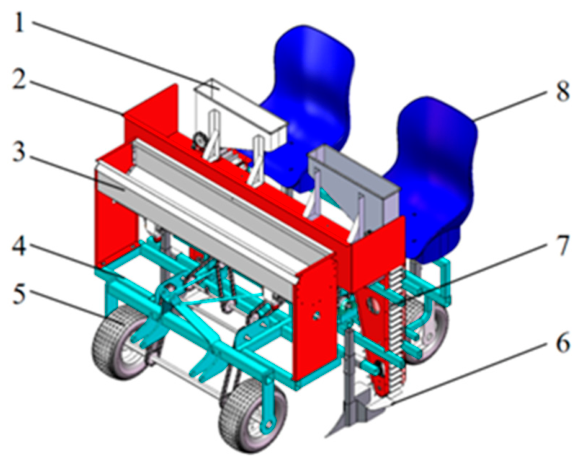
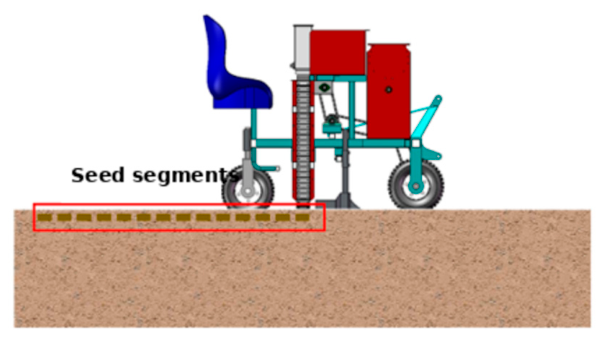
2.3. Design of the Automatic Seed Distribution Device and Chain-Driven Metering System
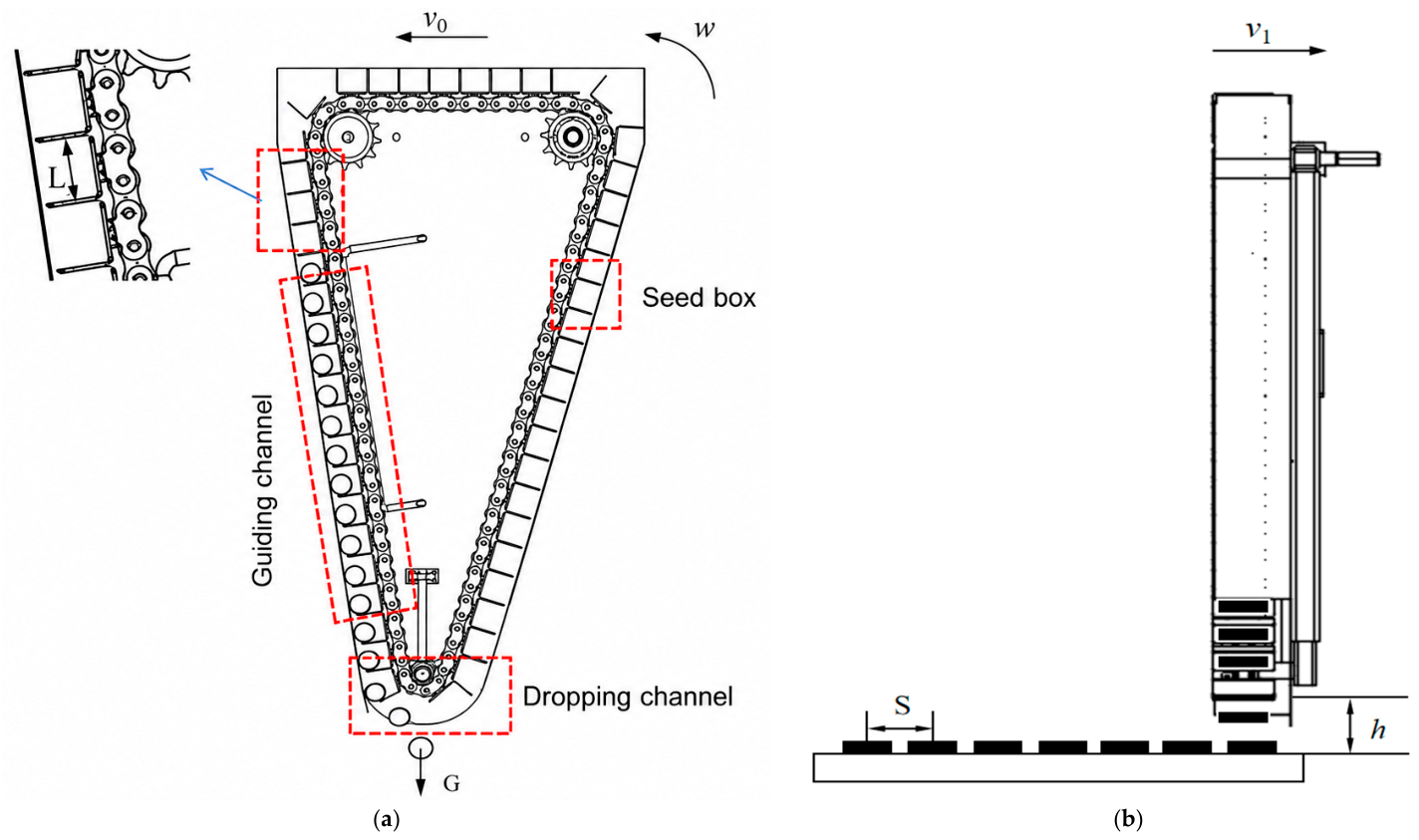
The automatic seed distribution device was designed to replace manual feeding and to provide a continuous and ordered supply of seed segments from the seed box to the chain-driven metering system. The geometric design was based on the measured seed segment dimensions rather than on a full derivation of simple dimensional relations. With a maximum seed segment diameter of 25 mm and a reserved clearance of 10 mm, the pickup-cavity diameter was determined as 35 mm. Considering the average seed segment length of 80 mm and a 20 mm axial allowance, the pickup-wheel width was set to 100 mm. A six-sided pickup wheel with a diameter of 120 mm was adopted to coordinate seed pickup with the subsequent metering process and to avoid excessive seed accumulation in the pickup region. Chain-based discrete metering has been used for potato, cassava, and garlic seed-metering devices, indicating that constrained chain conveying can improve seed transport stability when the seed-cup structure is matched to material geometry [
7,
9,
19].
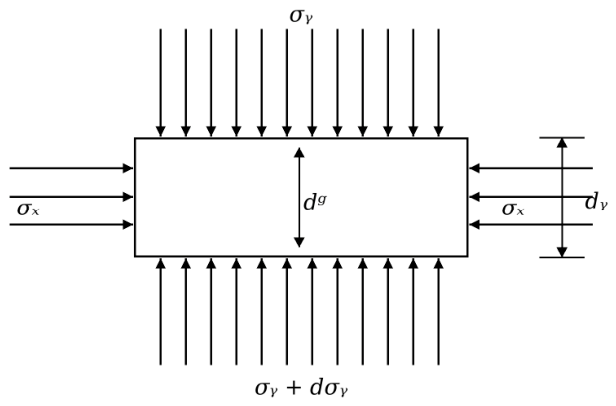
Because seed-box slope angle affects the flowability of slender seed segments and the stability of seed entry into the pickup cavity, a simplified seed-layer stress model was introduced to provide the theoretical basis for selecting this factor in the subsequent optimization test. The theoretical model was established using equivalent geometric parameters of the seed segments. Because Chinese yam seed segments are irregular biological materials, their geometric variability was not directly introduced into each equation. Instead, the measured mean values and dispersion indicators in
Table 2 were used to determine representative structural parameters. The model assumes that the seed segment layer can be simplified as a continuous granular layer, and that a single seed segment can be represented by an equivalent diameter and an average radius during stress and trajectory analysis. The influence of seed segment variability was further evaluated through bench verification and field validation. For a differential seed layer with cross-sectional area
As and perimeter
C at depth
y in the seed box, the vertical force balance can be expressed as:
where
σy is the vertical stress,
γ is the unit weight of the seed segments,
fs is the static friction coefficient between the seed segment and the seed-box wall,
K is the lateral pressure coefficient, and
y is the depth below the upper surface of the seed segment layer. Defining the hydraulic radius as
Rh =
As/
C, Equation (1) can be rearranged as:
Under the boundary condition
σy = 0 at
y = 0, the vertical stress is obtained as:
The relationship between the horizontal stress
σx and vertical stress
σy is described by the lateral pressure coefficient:
where
φ1 is the internal friction angle of the seed segments. The gravitational stress acting on an individual seed segment is expressed as:
where
G is the gravity of a single seed segment and
r1 is the average radius of the seed segment. The resultant seed-picking stress affected by the seed-box slope angle
θ can then be simplified as:
The calculated σp(θ) was integrated into the optimization workflow as a physical constraint rather than as a separate response variable. Specifically, the tested seed-box slope angle was limited to the range in which σp(θ) was sufficient to maintain a continuous seed supply but not high enough to cause excessive squeezing or mechanical damage according to the compression and shear tests. The response surface optimization then maximized the qualified-seeding index and minimized the multiple- and missed-seeding indices within this physically feasible range.
Equations (1)–(6) therefore explain why the seed-box slope angle was selected as a key factor: small θ values reduce the driving component for seed entry into the pickup cavity, whereas excessive θ values increase inter-segment compression and the probability of multiple picking.
The chain-driven metering system used a 10A chain with a pitch of 15.875 mm. To simplify assembly and improve synchronization, the driving and driven sprockets were designed as the same type. The sprocket center distance and the spacing between adjacent seed cups were set as 18 and 3 times the chain pitch, respectively, corresponding to 285.75 mm and 47.625 mm. Forty-nine seed cups were uniformly arranged on each chain. The pitch diameter of the driving sprocket was 41.23 mm, and the spacing between adjacent metering units was 220 mm.
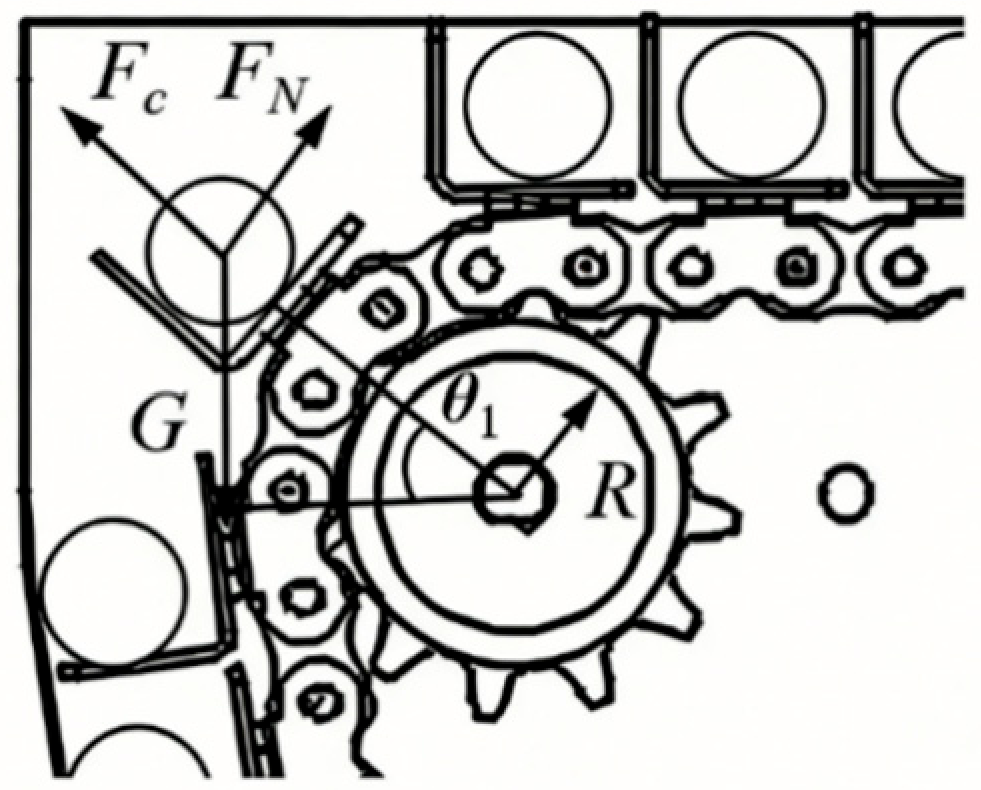
During conveying over the sprocket, the seed segment is affected by gravity, normal force, friction, and centrifugal force. To reduce the risk of seed detachment or collision, the sprocket radius
R should satisfy the following stability condition:
where
v is the seed-cup linear velocity,
g is gravitational acceleration,
μ is the friction coefficient between the seed segment and the seed cup, and
θ1 is the central friction angle of the sprocket. With
v = 0.50 m s
−1 and
μ = 0.273, the calculated lower limit of
R was approximately 0.023 m; therefore, a larger radius was selected to improve conveying stability.
After the seed segment leaves the seed cup, it has an initial horizontal velocity and then drops under gravity. Neglecting air resistance, the seed-dropping trajectory can be described by:
where
x and
y are the horizontal and vertical displacements, respectively,
v1 is the seed-cup linear velocity, and
t is the seed-dropping time. This relationship explains why seed-dropping height was selected as another key factor in the response surface optimization.
The theoretical plant spacing
sp was determined by the machine operating speed
v0, seed-cup spacing
L, and seed-cup linear velocity
v1:
Within the operating-speed range of 0.10–0.25 m s
−1 and seed-cup linear-velocity range of 0.20–0.60 m s
−1, the theoretical plant spacing was 90–130 mm, which satisfied the agronomic spacing requirement for Chinese yam planting.
Figure 3,
Figure 4 and
Figure 5 show the seed-picking stress state, conveying force analysis, and the seed guiding/dropping process, respectively.
2.4. Experimental Design and Evaluation Indicators
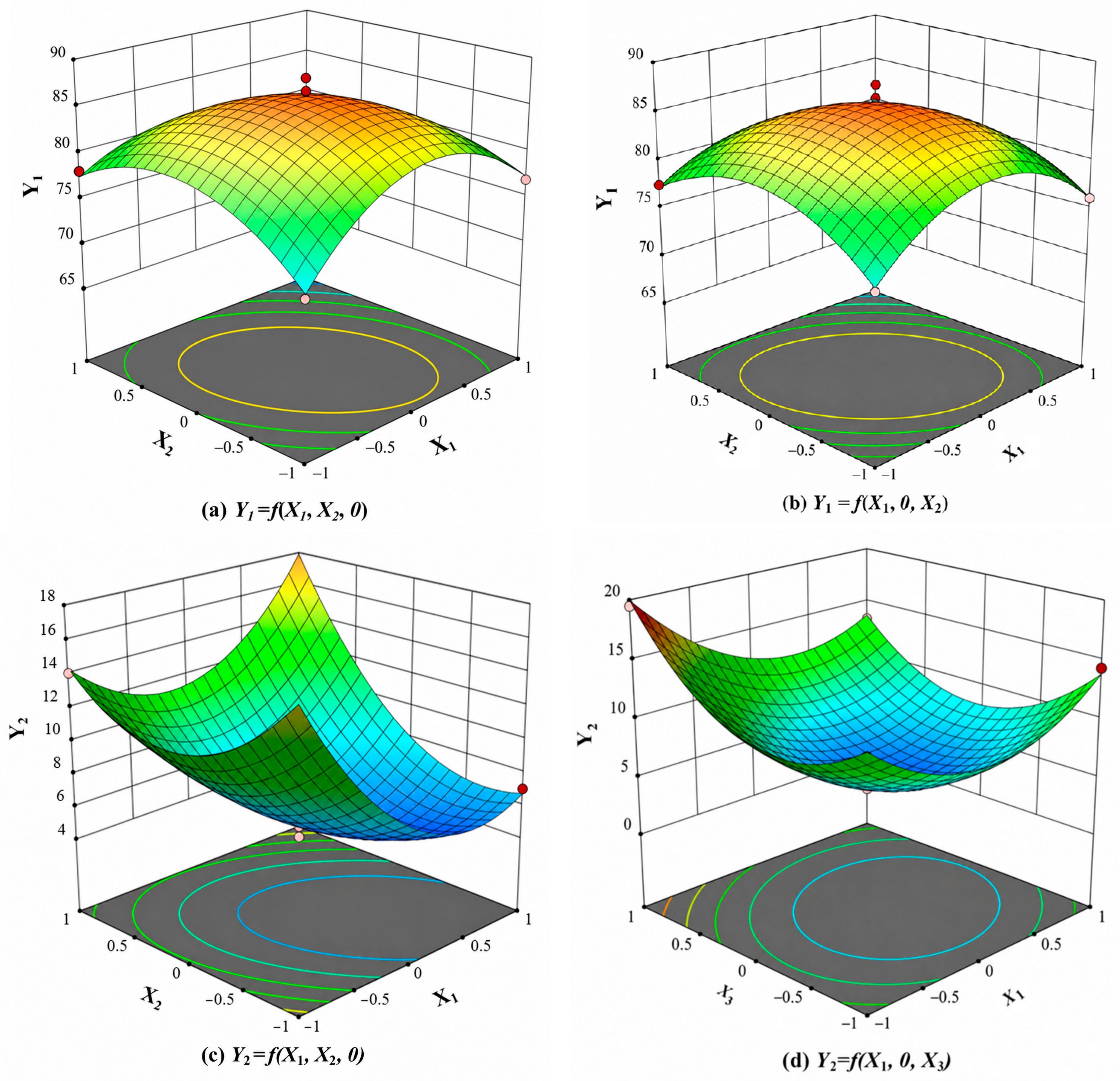
Based on preliminary single-factor tests and analysis of the operating process, operating speed, seed-dropping height, and seed-box slope angle were selected as the key factors. A three-factor, three-level response surface optimization test was conducted on the seed-metering bench. The qualified-seeding index
Y1, multiple-seeding index
Y2, and missed-seeding index
Y3 were used as the evaluation indicators. The qualified-seeding index was defined as the proportion of seed segments whose plant spacing fell within the agronomically acceptable range. The multiple-seeding index was defined as the proportion of intervals containing two or more seed segments, and the missed-seeding index was defined as the proportion of intervals without a seed segment. The indicators were calculated as follows:
where
N is the total number of evaluated intervals,
n1 is the number of qualified intervals,
n2 is the number of multiple-seeding intervals, and
n0 is the number of missed-seeding intervals.
The single-factor tests were repeated three times at each factor level, and the effects of individual factors were evaluated using one-way analysis of variance. For each test run, the evaluated intervals were recorded after the seed-metering system reached stable operation. To reduce systematic bias, the order of treatments was adjusted between repeated runs where possible. The statistical analysis assumed independent observations within each treatment, and differences among factor levels were evaluated using one-way ANOVA in IBM SPSS Statistics (version 27.0; IBM Corp., Armonk, NY, USA). The response surface experimental design, regression analysis, model analysis of variance, and parameter optimization were conducted using Design-Expert software (version 13.0; Stat-Ease Inc., Minneapolis, MN, USA) Fisher’s F-test was used to evaluate statistical significance, with
p < 0.05 considered significant and
p < 0.01 considered highly significant (
Table 4).
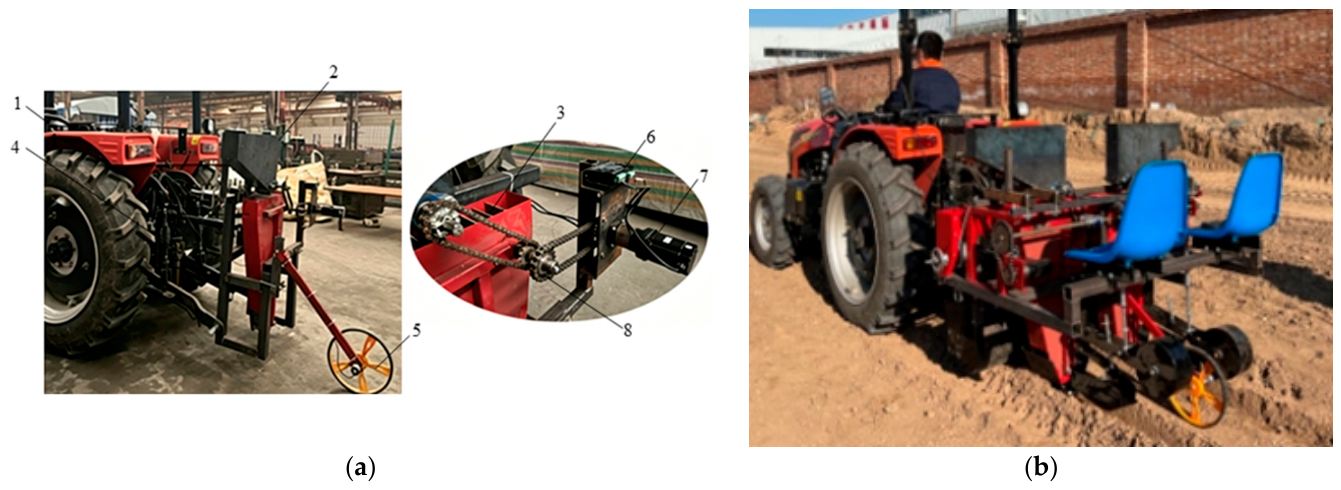
The bench-test platform consisted of a self-developed precision seeding control terminal, a self-developed automatic seed distribution device, a self-developed seed-metering system, a chain-transmission device, a DM9045 stepper motor driver, a VICTOR 62PG015.048-0486 stepper motor (Shenzhen Victor Motor Co., Ltd., Shenzhen, China), and a high-speed imaging system (
Figure 6a). It allowed the operating speed, seed-dropping height, and seed-box slope angle to be adjusted. Field validation was conducted at the experimental base of Hebei Nonghaha Machinery Group Co., Ltd. (Shenze, Hebei, China). The soil was loam with a moisture content of 18–22% and a soil firmness of 1.2–1.5 MPa. The prototype was matched with an SD3004 tractor (Shandong Sadin Heavy Industry Co., Ltd., Weifang, China) for field validation (
Figure 6b). The test field had been deep-tilled and leveled before validation. The seed material was Xiaobaizui Chinese yam seed segments from Shenze County, Shijiazhuang, China; approximately 20 kg of seed segments were prepared, with individual segment mass controlled at 30–50 g. To facilitate seed-spacing observation and data recording, the fertilizer box was kept empty and the covering and compaction devices were removed during the validation run. Video recording was used to identify multiple and missed seedings and to cross-check the field measurements.




 ,
,