Article

The Design and Optimization of a Multi-Channel Fertilizer Spreading System Based on EDEM Simulation and the CNN-LSTM–Attention Algorithm


College of Engineering, China Agricultural University, 17 Qinghua East Road, Beijing 100083, China
*
Author to whom correspondence should be addressed.
Agriculture 2026, 16(11), 1208; https://doi.org/10.3390/agriculture16111208
Submission received: 31 March 2026 / Revised: 28 April 2026 / Accepted: 29 April 2026 / Published: 29 May 2026
(This article belongs to the Section Agricultural Technology)

Abstract

To achieve the objectives of a variable spreading width and uniform fertilizer distribution in different operating environments, such as orchards and greenhouses, this study proposes a multi-channel fertilizer spreading method and designs a multi-channel fertilizer spreading system. The system mainly consists of a fertilizer delivery device and multi-channel spreading fertilizer disc. Based on the fertilizer delivery requirements, the fertilizer delivery device was designed using kinematic theories and the EDEM software. To address the optimization problem of the fin angle (λ), EDEM simulation is combined with machine learning methods, the multi-channel fertilizer spreading system was simulated using EDEM, and a spreading model was established based on the CNN-LSTM–Attention algorithm using simulation data. The model was employed to optimize the fin angle (λ), with spreading uniformity and width as the evaluation metrics. The optimization yielded a fin angle of λ = 34.15°, a coefficient of variation (Cv) of transverse distribution uniformity of 9.29%, and a spreading width of 3.0 m. The optimization results were validated through a combination of EDEM simulation and field tests. The EDEM simulations indicated a Cv of transverse distribution uniformity of 7.66% and an effective spreading width of 2.95 m. Field test results show a spreading width of 2.97 m and an average Cv of transverse distribution uniformity of 10.21%. The model optimization results align well with both the EDEM simulation and field test outcomes, providing new insights into researching fertilizer spreading methods.

1. Introduction

Fertilization has a significant impact on crop yield and quality and is one of the most important means to promote agricultural production. In particular, the application of organic fertilizers not only increases soil organic matter but also improves soil structure and enhances soil water conservation capabilities [1,2].
With the increasing use of organic fertilizers, scholars both domestically and internationally have conducted in-depth research on organic fertilizer spreaders. According to fertilizer spreading methods, organic fertilizer spreaders can be classified into three types: centrifugal disc spreaders, spiral spreaders, and hammer blade spreaders [3]. Germany’s AMAZONE (Hasbergen, Lower Saxony, Germany) and U.S. John Deere (Des Moines, IA, USA) stand as quintessential examples of centrifugal disc-type fertilizer spreaders [4].
Centrifugal disc spreaders are commonly used, and numerous scholars have conducted extensive research to improve the performance of centrifugal fertilizer spreading mechanisms. Shi et al. utilized the EDEM software to analyze the spreading performance of a centrifugal fertilizer disc, exploring the effects of the disc height, rotational speed, and fertilizer vane angle on spreading performance; blade length and blade horizontal projection angle are considered fundamental structural parameters for centrifugal fertilizer spreaders [5]. These parameters are used to investigate the impact of the spreader disc’s structural parameters on the uniformity of fertilizer distribution. Additionally, the spreader disc is optimized to further enhance the uniformity of fertilization [6,7]. In addition to analyzing the influence of the structural and operational parameters of the centrifugal disc spreader on the uniformity of fertilization, the fertilizer input parameters also affect the uniformity of distribution in centrifugal disc fertilizer spreaders. The position of fertilizer feed determines how the fertilizer is subjected to forces within the centrifugal disc, which in turn affects the spread width and uniformity of fertilization [8]. Furthermore, the feed rate, feed angle, and feed position angle are also correlated with the uniformity of fertilization [9,10]. García-Ramos and Yang considered the structure and mechanism of a designed centrifugal disc spreader and selected and analyzed key parameters such as spreading height, disc blade position angle, and fertilizer drop position angle to optimize the dual-disc centrifugal fertilizer spreader, thereby improving the uniformity of fertilizer distribution [11,12]. The above research focused on the structure and operating parameters of the centrifugal fertilizer disc. Sharipov et al. considered the influence of terrain on the uniformity of fertilizer distribution, with the hope of developing a control system to adjust the tilt angle and operating parameters of the centrifugal fertilizer spreading mechanism to ensure uniformity of spreading [13]. Shi et al. developed a centrifugal variable-rate fertilizer spreader and used real-time spectral information to evaluate the effects of variable fertilization, providing guidance for controlling the spreader to ensure uniform fertilization [14]. Cool et al. developed image-based technology to determine the spreading pattern of a centrifugal fertilizer spreader, with the aim of improving the uniformity of fertilization [15]. The aforementioned research provides a theoretical basis for the optimization of centrifugal fertilizer spreaders, contributing to the advancement of centrifugal fertilization technology.
Spiral fertilizer spreaders come in two types, horizontal axis and vertical axis, with a spreading width of up to 20 m and high spreading efficiency. Faced with the issues of large viscosity, poor fluidity, and difficulties in spreading after organic fertilizers agglomerate, some researchers designed a vertical organic fertilizer spiral spreading device with a spreading blade, studying the effects of the spiral axis rotational speed, the spreading disc tilt angle, and the spiral blade pitch on the spreading width and uniformity of fertilization [16]. Yu et al. analyzed and optimized the fertilization volume, work efficiency, and fertilization uniformity under different operating speeds, push plate speeds, and spiral rotational speeds of a spiral fertilizer spreader [17]. To address issues such as the caking of organic fertilizers and their uniform mixing with soil, a spiral conveyor equipped with paddle blades was utilized for the pulverization of organic fertilizers and the enhancement of their mixing performance with soil [18].
In recent years, the application of machine learning in the agricultural field has become increasingly widespread. When combined with the EDEM simulation software, the complementary strengths of both technologies demonstrate excellent performance in model development and parameter optimization. This is especially true in the field of agricultural machinery, where they have been used for model construction and multi-parameter optimization [19]. The integration of advanced technologies, such as soil proximal sensin, remote sensing, and machine learning, has revolutionized agricultural practices, particularly for corn yield prediction [20]. Von Bloh et al. presented a method to transfer domain knowledge from the Decision Support System for Agrotechnology transferred framework (DSSAT) using the Nwheat crop simulation process model in neural networks and random forest for predicting wheat yield at the field scale [21]. In the field of agricultural machinery, Nielsen et al. proposed a vibration-based machine learning technique to detect changes in roller gaps. This method optimizes the biomass pellet manufacturing process by detecting variations in roller gaps in the Rotating Ring Die Pelletizing (RRDP) technology [22]. Fan et al. proposed a multi-parameter control method for maize threshing based on the feed rate, random forest, and a support vector machine, and multiple linear regression machine learning algorithms were used to estimate the threshing performance indices for different feed rates. The algorithm (random forest) was used to construct a control model, aiming to optimize the overall machine performance [23].
Based on the analysis of the above literature, it can be concluded that traditional centrifugal disc fertilizer spreaders, spiral and hammer fertilizer spreaders have a large width for fertilizer spreading, generally ranging from 8 m to 12 m. Under different fertilization methods and operating conditions, the Cv of transverse distribution uniformity ranges from 10% to 20%, with some reaching 26%. Moreover, the fertilization width is generally not adjustable. When reducing the width of fertilizer spreading, it is difficult to ensure the uniformity of fertilizer spreading. Moreover, the large size of the machine requires a larger working space, making it difficult to meet the requirements for fertilizer spreading width in small field plots, orchards and greenhouses. At present, research on fertilizer spreaders mainly focuses on field operations and exhibits a trend towards larger and more intelligent development [24]. There is a research gap in terms of small width fertilization and adjustable fertilization width to ensure uniform fertilization. Therefore, based on the requirement of achieving an adjustable fertilizer spreading width and ensuring uniform fertilizer spreading, this study proposes a multi-channel fertilizer spreading method to improve the adaptability of various fertilizer spreading needs.
In this study, a theoretical analysis of the multi-channel fertilizer spreading method was first conducted. A multi-channel spreading model was established using EDEM, and simulation experiments were performed. Based on the data from these simulations, a multi-channel fertilizer spreading model was constructed using machine learning techniques. This model was then used to design and optimize the relevant parameters of the multi-channel fertilizer spreading process.

2. Materials and Methods

2.1. Working Principle

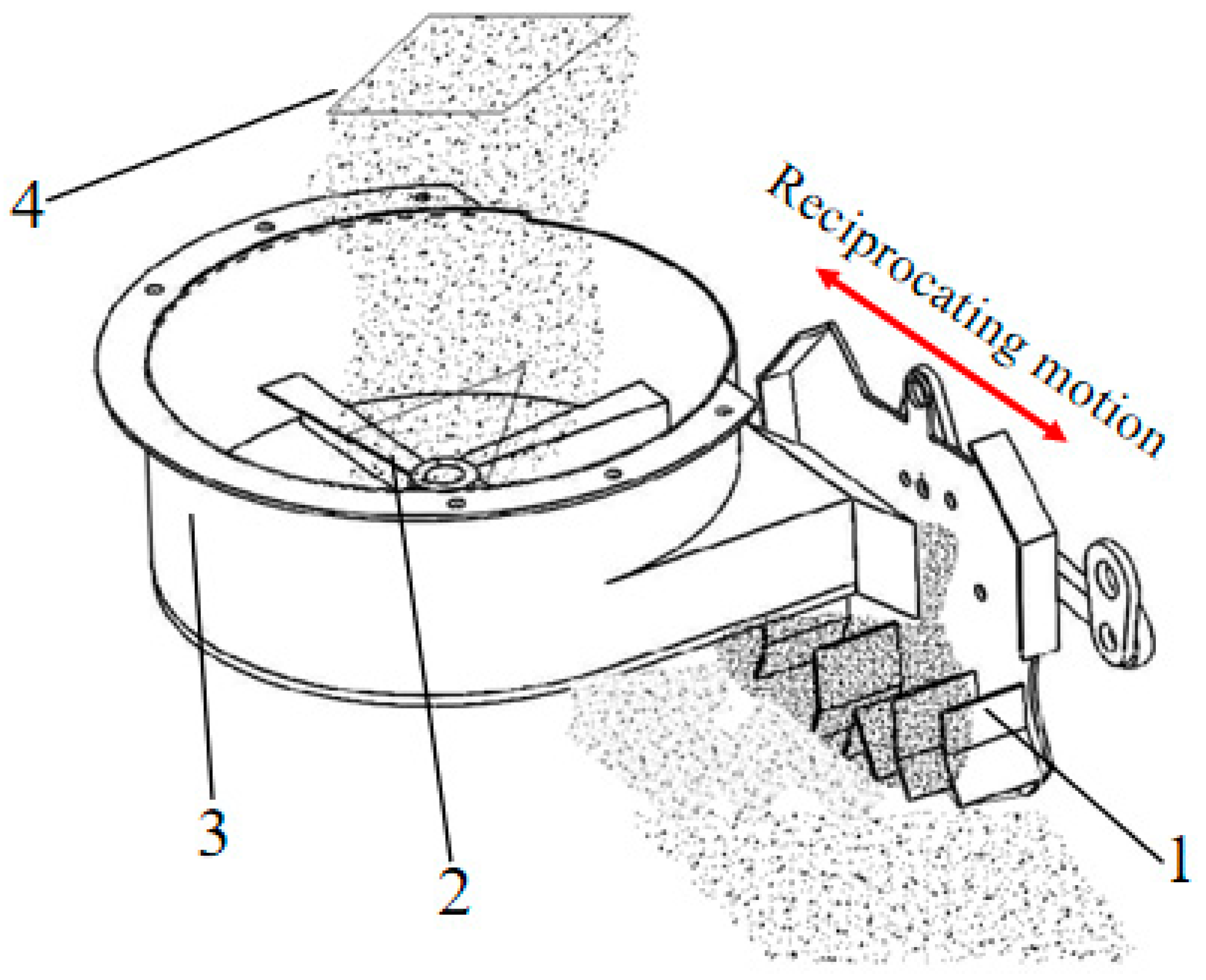
The working principle of the multi-channel fertilizer spreading system is shown in Figure 1. Here, the fertilizer box is omitted, leaving only the fertilizer falling outlet (4), the multi-channel fertilizer spreading disc (1), the fertilizer conveying chamber (3), and the fertilizer box fixed on the frame. The fertilizer conveying device (2) is installed in the fertilizer conveying chamber (3) through bearings. The operation of the multi-channel fertilizer spreading system can be divided into three concurrent processes: fertilizer enters the fertilizer conveying chamber through the fertilizer falling outlet (4) and is sent to the multi-channel fertilizer spreading disc (1) through the fertilizer conveying device (2). The spreading disc is equipped with vertical fins, which create channels for fertilizer distribution. The fertilizer is then divided by the fins to enter different spreading channels. Under the continuous reciprocating motion of the spreading disc, the fertilizer oscillates back and forth between the channels. Coupled with gravity and the action of the multi-channel spreading tablet, the fertilizer is scattered onto the ground.

2.2. Fertilizer Conveying Device Design and Analysis

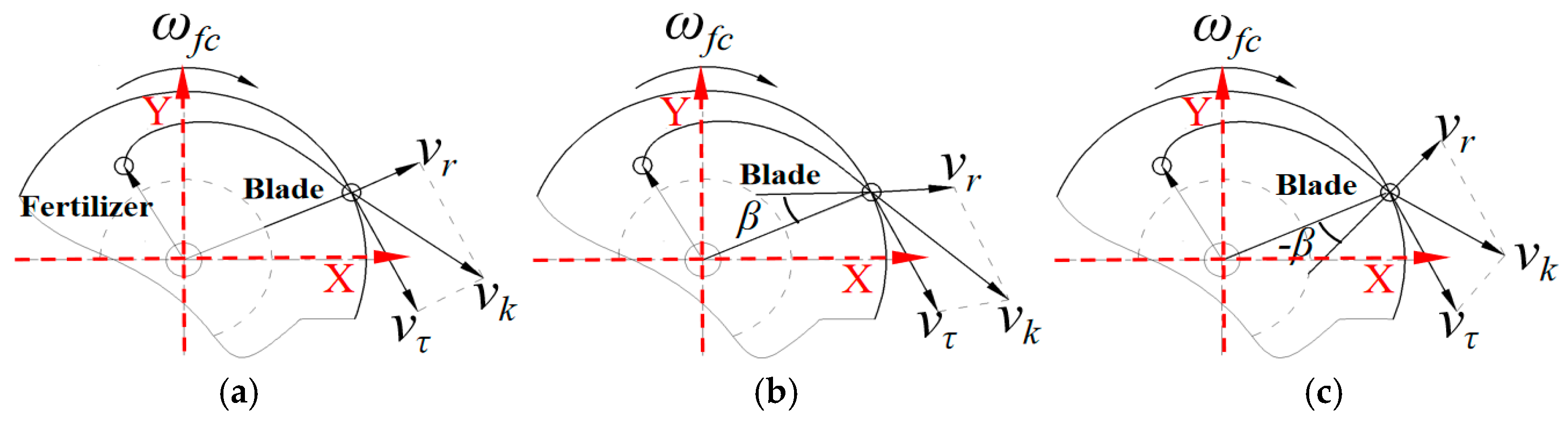
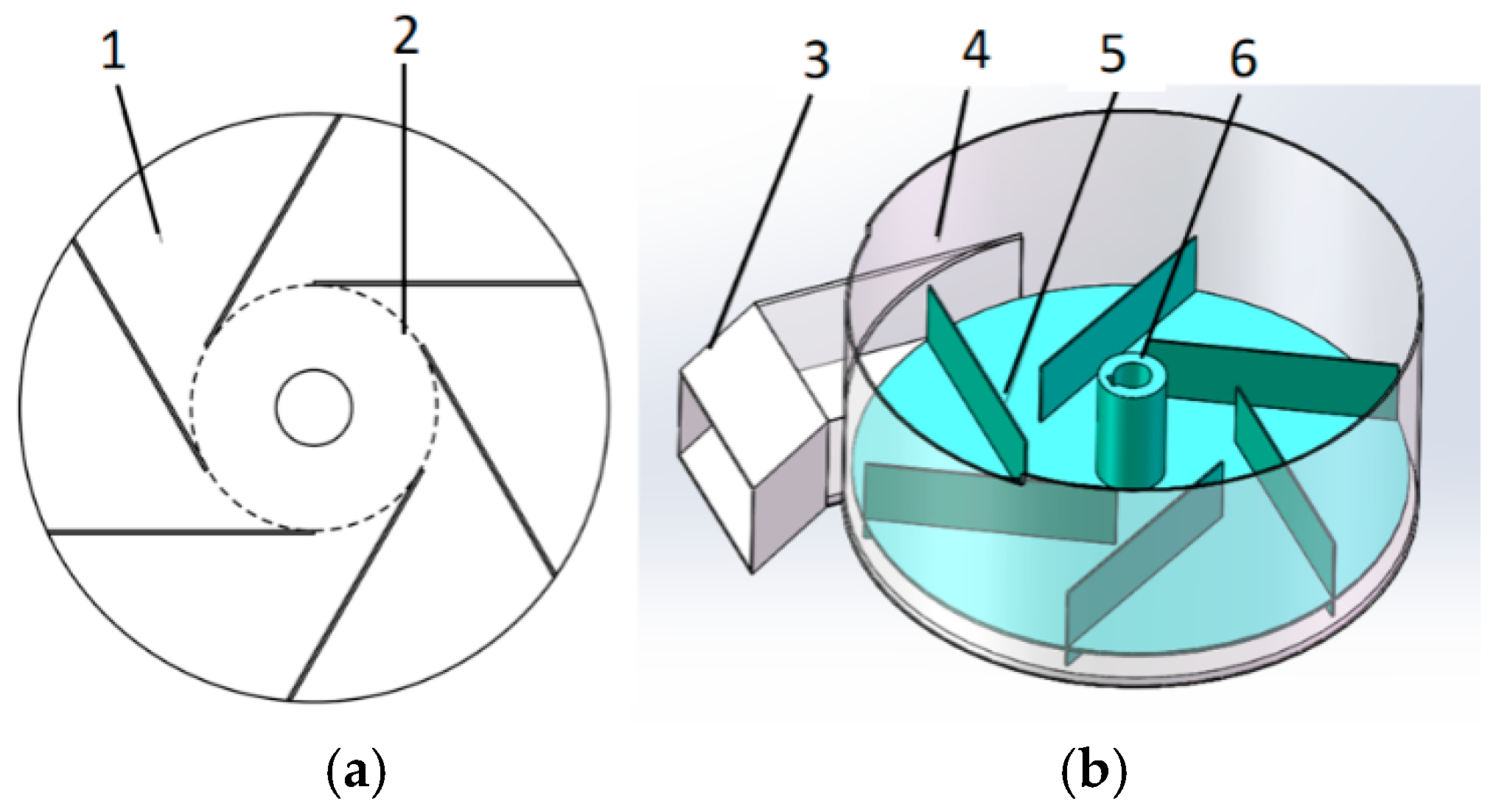
The fertilizer conveying device is one of the core components of the spreading system. The primary function of the conveying device is to uniformly transport the fertilizer that falls from the feed port to the receiving area of the multi-channel spreading disc, and uniform fertilizer transport can ensure the working performance of the multi-channel spreading disc. Considering the spatial layout of the spreading system and the physical characteristics of organic fertilizers, this study utilizes a centrifugal fertilizer conveying device. The centrifugal disc is a critical component of the delivery device, and the arrangement of the blades on the centrifugal disc mainly comes in three forms: radial, forward-leaning, and backward-leaning, as shown in Figure 2. Due to the action of centrifugal inertial forces, the fertilizer leaves the centrifugal disc. Kinematic theories are applied to theoretically analyze the motion state of the fertilizer on the three types of centrifugal discs [25].
Upon departing from the centrifugal disc blades, the velocity of the fertilizer granules is denoted as vk. This velocity can be decomposed into the tangential velocity (vτ) and the velocity (vr) along the direction of the blade. The instantaneous motion analysis of the three types of blades is depicted in Figure 2.
When β = 0, the velocity (vk) of the fertilizer granules leaving the centrifugal disc blades can be expressed as follows:
v k = v τ + v r
Equations (2) and (3) respectively represent the velocity of the fertilizer granules leaving the centrifugal disc blades when β > 0 and β < 0,
v k = v r cos β + v r sin β + v τ
v k = v r cos β v r sin β + v τ
From the analysis of Equations (1)–(3), it is evident that when the amount of fertilizer dispensed from the hopper is constant, and the centrifugal disc speed is fixed, adopting a backward-leaning blade arrangement with β < 0 results in a relatively slower fertilizer discharging speed from the centrifugal disc, thereby providing better continuity of fertilizer delivery. Based on the commonly used number of blades on centrifugal feeders, the centrifugal disc is chosen to have 6 blades. The conveying capacity, Q (t/h), of the centrifugal fertilizer conveying device is related to the density of the conveying material, ρ0 (t/m3); the filling coefficient of the conveying mechanism, z; the volume of a single material tank, Vd (m3); the number of material slots on the centrifugal disc, K; and the rotational rotor speed, N (r/min). It can be represented by Equation (4):
Q = 60 ρ 0 z V d K N
The blades on the centrifugal disc are uniformly arranged on the disc, with the outer edge of the blades coinciding with the edge of the centrifugal disc. The inner edge of the blades is tangential to the common tangential circle of the blades. Rq is the radius of the centrifugal disc, m; Vs is the total volume of the material tank on the centrifugal disc, m3; and Hy is the height of the centrifugal blade, m. When calculating the radius (Ry) of the common tangential circle of the blades, the annular area between the common tangential circle of the centrifugal blades and the edge of the centrifugal disc is approximated as the base area of the fertilizer filling zone. Therefore, the radius (Ry) of the common tangential circle of the centrifugal blades can be represented as
R y = R q 2 H y π V s
Based on the literature [26] and the maximum operating conditions, it can be concluded that the conveying capacity of the centrifugal disc should meet 2250 kg/h. It is determined that the fertilizer discharge nozzle is a rectangle of 100 mm by 50 mm, thus the height of the centrifugal blade is Hy = 50 mm. The density of the fertilizer has been determined to be 0.81 t/m3. Typically, the material filling coefficient for blade feeders is taken to be between 0.4 and 0.8. Due to the space between the centrifugal disc and the outlet of the feed box, the filling performance of the trough is relatively poor; therefore, a filling coefficient of 0.3 was selected [27]. Through calculations, the radius of the common tangential circle of the centrifugal blades was determined to be Ry = 72 mm. At this time, the resulting blade trailing angle is β = 35°. Based on the parameters above, the model of the centrifugal fertilizer conveying device is illustrated in Figure 3.

2.3. Multi-Channel Fertilizer Spreading Disc Design and Analysis

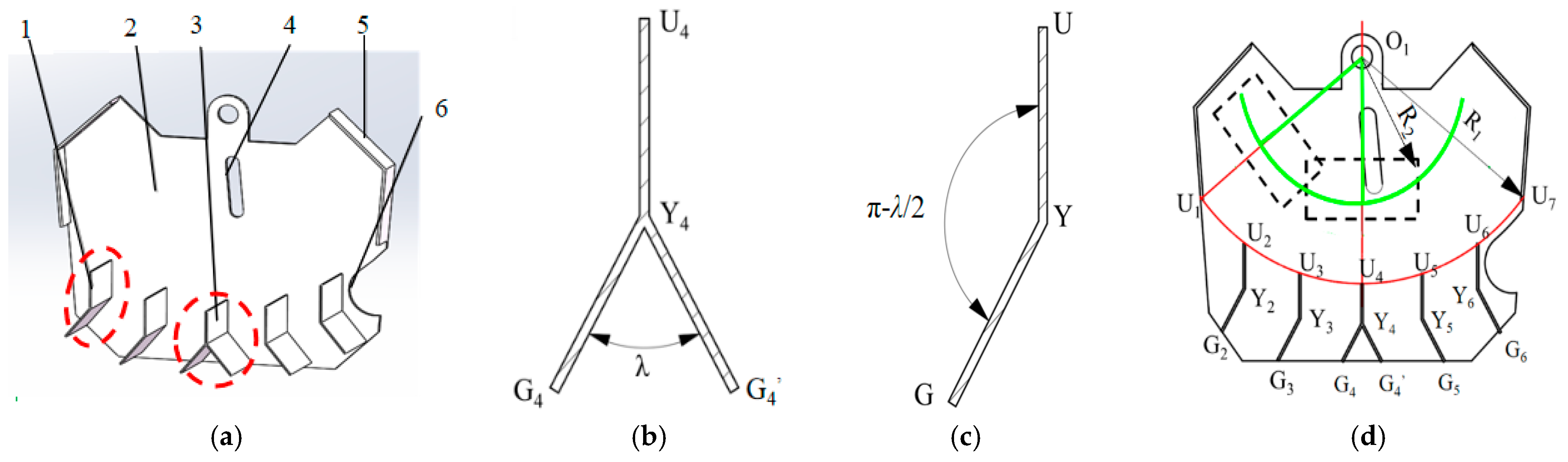
Based on the objective of achieving uniformly broad fertilizer spreading, this study innovatively designed a multi-channel spreading disc, as shown in Figure 4a. The multi-channel spreading disc is composed of a receiving plate, fins, and a leakage prevention board, among other components. The fins include two types: center fins and edge fins. An adjustment groove is designed on the receiving plate primarily for altering the length of the rocker in the crank–rocker mechanism, which allows for adjustments of the spreading width. Depending on the mounting position of the rocker, to ensure that the spread of the fertilizer is symmetrically adjustable about the central axis of the machine, the adjustment groove is inclined at a certain angle to the vertical axis of the spreading disc. To prevent the fertilizer from flying out from the edges of the receiving plate and impacting the uniformity of spreading, leakage prevention boards are designed on both sides of the receiving plate. An arc-shaped groove on the receiving plate ensures that there is no interference with the crankshaft during the reciprocating motion of the spreading disc. Figure 4b shows the structure of the center fin, which is composed of three line segments: U4Y4, Y4G4, and Y4G4′, with the angle between Y4G4 and Y4G4′ being λ. As illustrated in Figure 4c, the edge fin consists of the segments UY and YG. To ensure that the YG segment is parallel to the lower half of the center blade, the angle between the two segments of the edge fin is λπ/2. The length and height of fin UY section and YG section were determined to be 30 mm and 50 mm respectively according to the fertilizer amount.
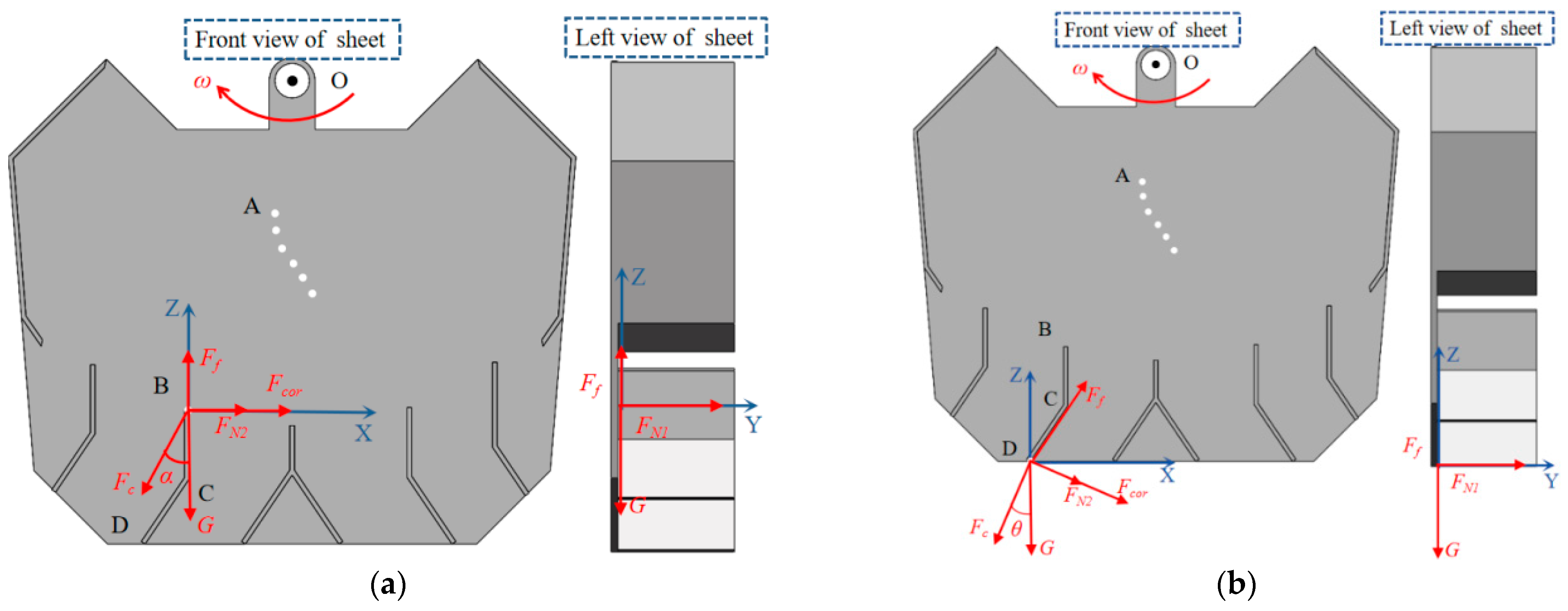
The delivery and spreading of fertilizer is a dynamic process, during which the position of the fertilizer discharge nozzle relative to the spreading disc changes periodically with the reciprocating swing of the spreading disc, as shown in Figure 4d. The dashed rectangle in the figure represents the discharge nozzle of the fertilizer delivery device, and the green arc with radius R2 indicates the extreme position of the discharge nozzle relative to the spreading disc. The fertilizer reaches the receiving plate at a certain initial speed and, under the combined action of the force exerted by the receiving plate and the gravitational field, enters the fertilizer diversion area constituted by the upper-half segments of fins U2Y2, U3Y3, U4Y4, U5Y5, and U6Y6. After being diverted by the upper segments of the fins, the fertilizer enters the agitated spreading area formed by the various fertilizer flow channels. The first point of contact between the fertilizer and the spreading disc is point A (point A is the intersection of the green arc with radius R2 and the U4Y4 extension line), and the contact points between the segmented fins and the fertilizer spreading disc are points B, C, and D, respectively. Under the action of centrifugal force generated by the swing of the disc and gravity, the fertilizer particles accelerate towards the fins. The forces acting on the fertilizer at this moment are shown in Figure 5: the gravitational force (G), the centrifugal force (FC), the Coriolis force (Fcor), the supporting force (FN1) exerted by the fertilizer spreading disc on the fertilizer particles, the supporting force (FN2) exerted by the fins on the particles, and the total frictional force (Ff) exerted by the spreading disc on the fertilizer particles. Based on the principle of conservation of energy, the velocities at points B, C, and D can be derived. When the particles reach the fertilizer receiving disc from the discharge nozzle, the speed perpendicular to the fertilizer spreading disc instantly becomes 0. At this time, the impact force is equal to the support force (FN1) applied to the fertilizer particles by the fertilizer receiving disc. During the fertilizer movement, due to the lack of relative motion perpendicular to the fertilizer spreading disc and the absence of external forces, the fertilizer receiving disc generates support force for the fertilizer, so FN1 can be neglected. After derivation, the velocities at points B, C, and D can be expressed as follows (the derivation process is shown in Appendix A):
v B = 2 R 1 R 2 g cos α + ω 2 R 1
v c = 2 l 1 g + ω 2 R 3 cos α 2 μ ω 2 R 1 R 2 g cos α + ω 2 R 1 + μ ω 2 R 1 sin α + 2 R 1 R 2 g cos α + ω 2 R 1
v D = 2 l 2 g cos θ + ω 2 R 4 cos θ 2 μ ω v c + μ ω 2 R 4 sin θ + v C
where point O is the rotation center of the fertilizer spreading disc; l1 is the length of BC, m; R3 is the length of OC, m; l2 is the length of CD, m; μ is the friction coefficient between the fertilizer particles and the fertilizer spreading disc; R4 is the length of OD, m; α is the angle between the centrifugal force experienced by the fertilizer entering the flow channel and the BC section of the fins, rad; and θ is the angle between the centrifugal force and gravity experienced by fertilizer particles when they leave the flow channel, rad.
By analyzing the force and velocity of the fertilizer, it can be concluded that the fertilizer is accelerated by gravity and centrifugal force when it falls onto the fertilizer spreading disc. Under the coordinated action of the swing of the fertilizer spreading disc and the fertilizer spreading fins, the direction of fertilizer throwing changes. From Formulas (6)–(8), it can be seen that the angle (α) is the key factor determining the velocity size, while α = λ/2 indicates that the fin angle (λ) is the decisive factor determining the velocity size. The speed and direction of fertilizer throwing directly determine the width of the fertilizer spreading. It is difficult to theoretically analyze the uniformity of the fertilizer after being spread by the fertilizer spreading disc. Therefore, studying the performance of the fertilizer spreading disc requires EDEM simulation experiments.
The reciprocating motion of the multi-channel spreading disc is achieved by a crank–rocker mechanism, with each section of the fin being 30 mm in length and 50 mm in width. Based on the previously designed maximum working efficiency of the spreader, the time (t0) for the spreader to cover a unit area can be expressed as follows:
t 0 = S d B 2 v
where Sd is the working area, m2; B2 is the fertilizer spreading width, m; and v is the forward speed, m/s.
For each revolution of the crank, the multi-channel fertilizer spreading disc reciprocates once to complete a fertilization process, hence the crank speed, ω (r/s), in the crank–rocker mechanism can be expressed by Formula (10),
ω = M Z M S t
where MZ is the required fertilizer application amount for the work area, kg/hm2; MS is the single application amount of the multi-channel fertilizer spreader, kg; and t is the working time, s.
Based on the position of the outlet of the fertilizer delivery device, it is ensured that the fertilizer discharge nozzle is within the movement range of the receiving plate. The maximum swinging angle of the spreading disc was determined to be 60°. According to the maximum working conditions for fertilizer spreading, the rotational speed of the crank was calculated to be 2.8 r/s. The angle of the fins is an important parameter affecting the uniformity and width of fertilizer spreading. Moreover, the state of the fertilizer in the agitated spreading zone is not unique, and the related motion parameters are challenging to measure. Therefore, EDEM simulation was used to optimize the design of the multi-channel spreading disc.

2.4. Discrete Element Virtual Simulation Parameters and Model Settings

In recent years, discrete element simulation (DES) technology has been extensively applied to the auxiliary design of agricultural machinery, particularly in the design of fertilizer spreaders. The use of DES to simulate the motion state of fertilizers offers references for the optimization of mechanical structures, thereby enhancing the efficiency of research and development [28,29]. To validate the performance of the centrifugal fertilizer conveying device and to observe the behavior of the fertilizer more intuitively during the delivery process, simulation experiments of the centrifugal conveying device were conducted using the EDEM 2020.2 (Altair EDEM 2022.2. Version:8.2.0) software. During an EDEM simulation, the physical parameters of the materials in the model have a significant impact on the simulation results. For this experimental setup, commercial organic fertilizer was chosen as the subject of the experiment. Cow manure commercial organic fertilizer was purchased from an agricultural materials station, and its particle size was measured. According to the measurement, the particle size distribution was as follows: less than 1 mm accounted for 36.6%, 1~3 mm for 26.2%, 3~5 mm for 15.54%, and greater than 5 mm for 21.66%. The density of the cow manure commercial organic fertilizer was 810 kg/m3, according to the method described in reference [30], and the intrinsic parameters of the cow manure commercial organic fertilizer were measured. Poisson’s ratio of the fertilizer was determined to be 0.25, and the shear modulus was 7.85 × 10⁶ Pa. To improve the efficiency and accuracy of the simulation, the particles were simplified to spheres with a chosen equivalent diameter of 2.6 mm. Fertilizer particles with a random distribution ranging from 0.5 to 1.5 times the equivalent diameter were generated in EDEM. Referring to the relevant literature [9,31,32] and considering the physical characteristics of the organic fertilizer, the simulation parameters were set as shown in Table 1.
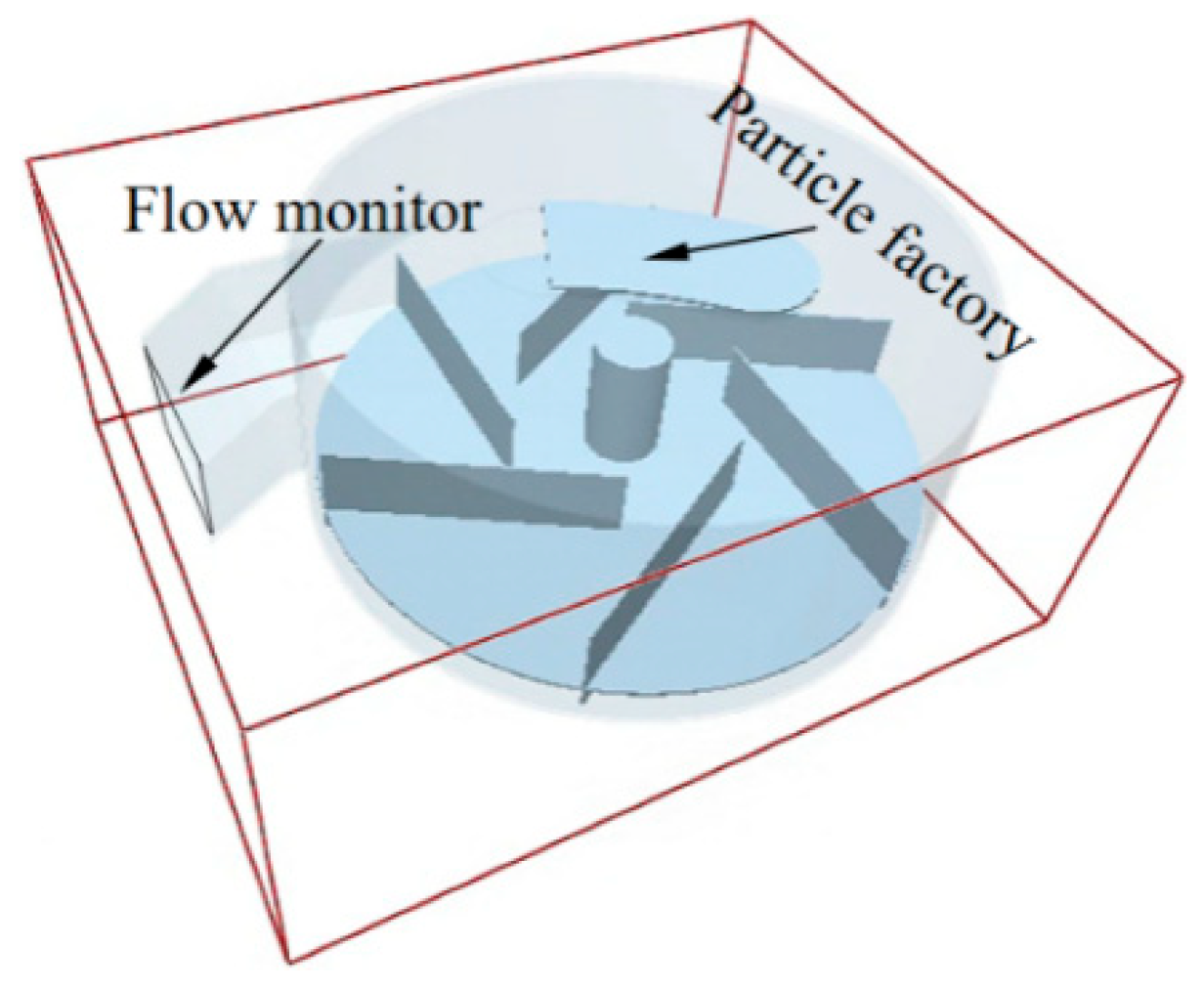
The centrifugal fertilizer model diagram of the centrifugal fertilizer delivery device was imported into the EDEM software, and the major components affecting the motion of fertilizer particles were created. A particle factory with the same shape as the falling outlet was established, as illustrated in Figure 6. The outlet particle factory’s settings included a 20% margin, with particles being generated at a rate of 5000 per second, and an initial particle velocity set at 0.3 m/s. For the inter-particle contact model, the Bonding contact model was chosen for soil particles, and the Hertz–Mindlin with JKR contact model was utilized for organic fertilizer particles. The simulation duration was set to 5 s. A mass flow monitor was placed at the outlet of the fertilizer feeding device to monitor the mass flow rate at the outlet, which is used to evaluate the continuity and uniformity of the fertilizer delivery.
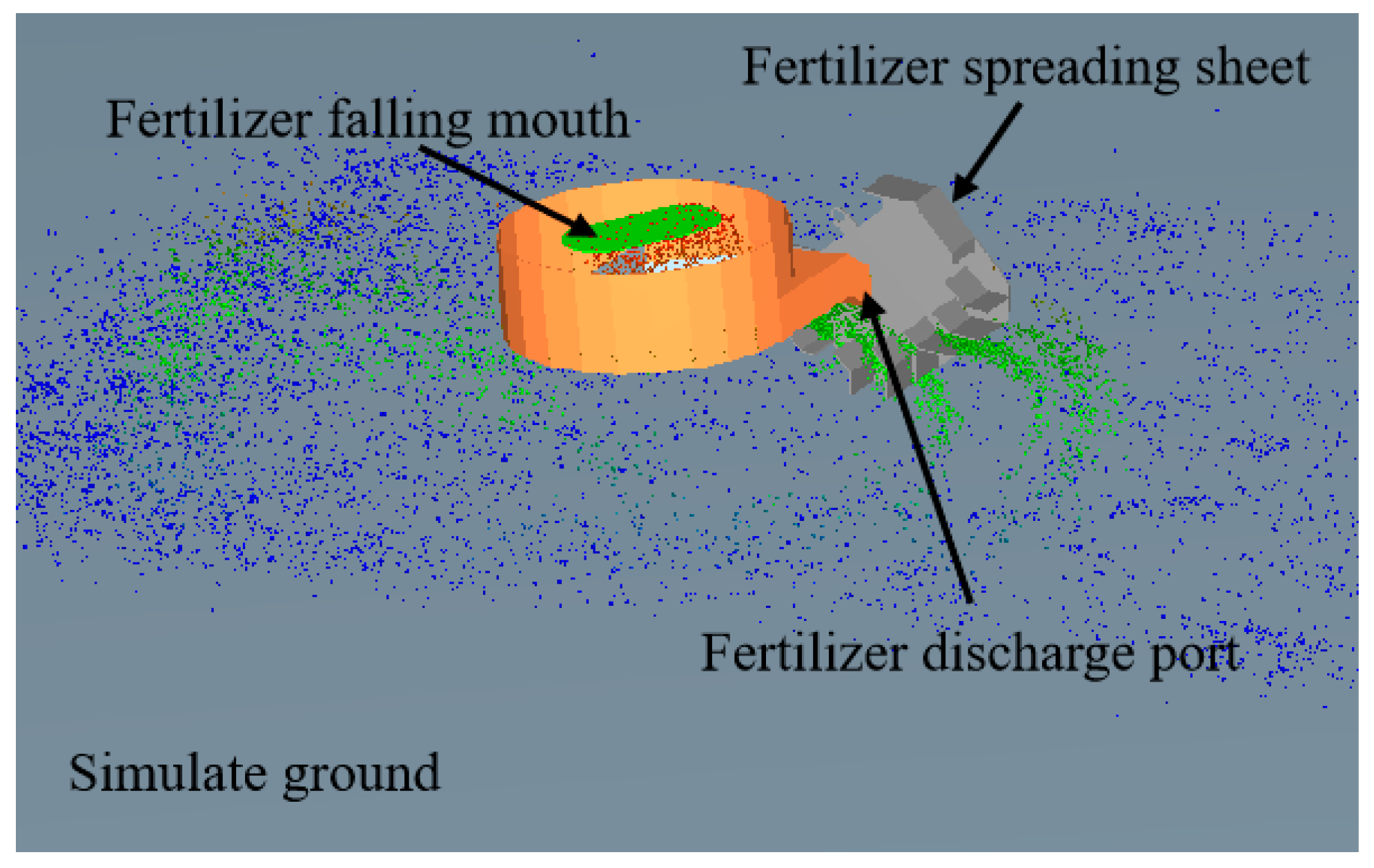
In the EDEM simulation experiment for multi-channel fertilizer spreading, a virtual ground was set up below the spreading device to simulate the condition of fertilizer falling to the ground, and the model was imported into EDEM according to the relative position of the spreading device to the ground. The ground model was sized at 3 m × 6 m, with the 6 m width representing the direction of the spreading width. The Grid Bin Group feature was used to set up the grid, and after the simulation ended, data on the mass of particles within the grid were collected. The particle parameters and basic model settings in the multi-channel spreading simulation were consistent with those in the fertilizer feeding device simulation. The particle factory generated a total of 50,000 particles at a rate of 10,000 per second. The reciprocating swinging frequency of the spreading disc was 2.8 Hz, and the maximum swing angle of the fertilizer spreading disc was 60°. According to preliminary experiments, when the swing angle of the fertilizer spreading disc is less than 20°, the width of the fertilizer spreader is too small and does not meet the design requirements; therefore, the swing amplitude of the fertilizer spreading disc is divided into three levels: 20°, 40°, and 60°. The movement speed was set at 0.7 m/s. The simulation model is shown in Figure 7. The data obtained from the multi-channel fertilizer spreading experiments will be used for machine learning to develop a multi-channel spreading model.

2.5. Machine Learning Algorithms

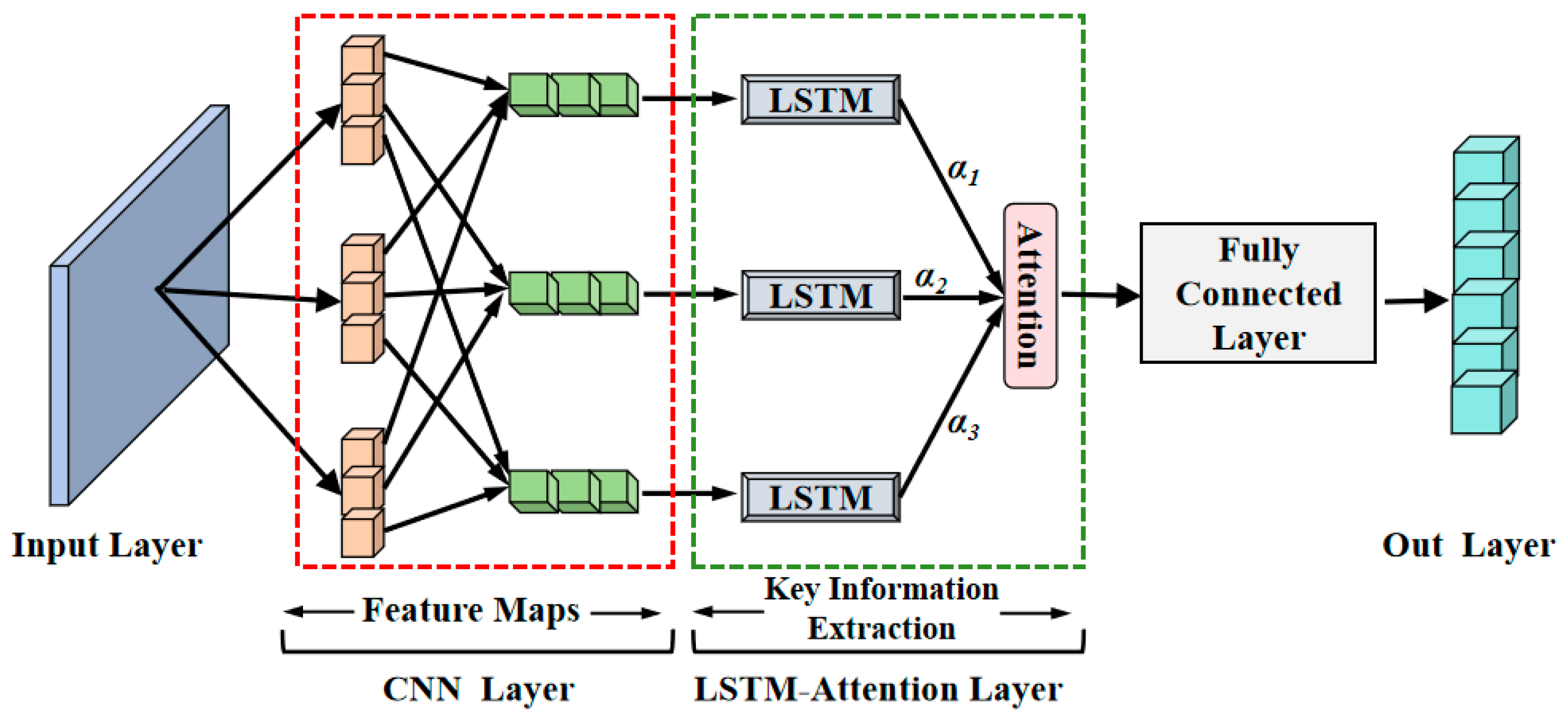
An analysis of the multi-channel fertilizer spreading system indicates that the factors affecting spreading effectiveness mainly include the angle of the spreading fins and the swing angle of the spreading disc. The evaluation indicators for spreading effectiveness are spreading width and uniformity, forming a multi-parameter, multi-objective model. The EDEM spatial grid data are not static spatial data but spatiotemporal coupling data characterized by “spatial distribution–temporal evolution.” The core logic for adapting the LSTM model is as follows: First, as a gated recurrent neural network, LSTM can capture long-term dependencies in time series data through its gating mechanism, making it highly suitable for the dynamic temporal evolution of EDEM grid features (angle λ, unit grid mass, and grid coordinates) as they vary with simulation time, thereby extracting the essential temporal patterns. Second, after serialization + time window processing, the grid data are transformed into spatial sequence evolution over time steps, to which LSTM exhibits natural adaptability for learning such temporal spatial sequences. Third, a composite CNN-LSTM architecture is employed. Specifically, convolutional layers first extract local spatial features from the grid data, which are then enhanced via attention weighting to emphasize core spatial features. Subsequently, the LSTM layer learns the temporal evolution patterns. This enables a hierarchical modeling approach of “spatial feature extraction first, followed by temporal feature learning. Compared with traditional statistical analysis methods, deep learning has advantages in analyzing non-linear relationships of variables. It is difficult to determine whether there is a linear relationship between the parameters of the fertilization model established in this study. And the amount of data is large; therefore, using deep learning methods is more suitable, and the accuracy of the model is higher.
After exporting the EDEM simulation data, the first step is to perform data filtering, removing grids with a unit grid quality of 0 to ensure the validity of the data. Due to the fact that the exported data are grouped according to the angle of the fin, the fin angle values are introduced in one-to-one correspondence with each grid for the excluded data. Enhance all data through linear interpolation to expand the sample size and improve the robustness of model training. The training set, test set, and validation set are divided into a ratio of 7:2:1, with the loss of the test set during the training process as the core evaluation metric. Real-time monitoring of model performance is conducted to ensure that the selected model has true temporal prediction ability, as shown in Figure 8.
In terms of input settings, the model adopts a sliding time window mechanism, with a window length of 5 and an input feature dimension of 1, that is, the input tensor [batch, 5, 1]. In the convolution module, the model includes one layer of one-dimensional convolution (Conv1D), with a kernel size of 1 and a stride of 1, and padding = 0. The number of input channels is 1, and the number of output channels is 16. After convolutional layers, Relu is used to enhance non-linear expression ability, and then MaxPooling1D, with a pooling kernel size of 5, is used to compress the time dimension from 5 to 1. To reduce the risk of overfitting, a Dropout layer is added after the pooling layer, with a deactivation probability of 0.01.
In the time series modeling section, a 3-layer bidirectional LSTM (BiLSTM) is used, with an input dimension of 16 and 6 hidden units. Due to the adoption of a bidirectional structure, the output dimension of LSTM is 32. After LSTM output, the final time-step features are extracted through a dimension compression operation to obtain [B, 32]. In the output layer, a 1-layer fully connected layer (Linear) is used, with an input dimension of 32 and an output dimension of 1, and the Tanh activation function is used to generate the final prediction result.
Key parameters of the training process are as follows: use of the Adam optimizer, with a learning rate of 0.001; the loss function is the mean squared error loss (MSELoss); training batch size, 256; total training rounds, 100; the training process incorporates gradient pruning, with a maximum gradient norm of 1.0; data loading in non-shuffle mode (shuffle = False), with 2 working processes; there is no early stopping mechanism, and a fixed stopping criterion of 100 rounds of training was adopted. The optimal model preservation condition is to minimize the mean square error loss of the test set.

2.6. Design of Field Experiment

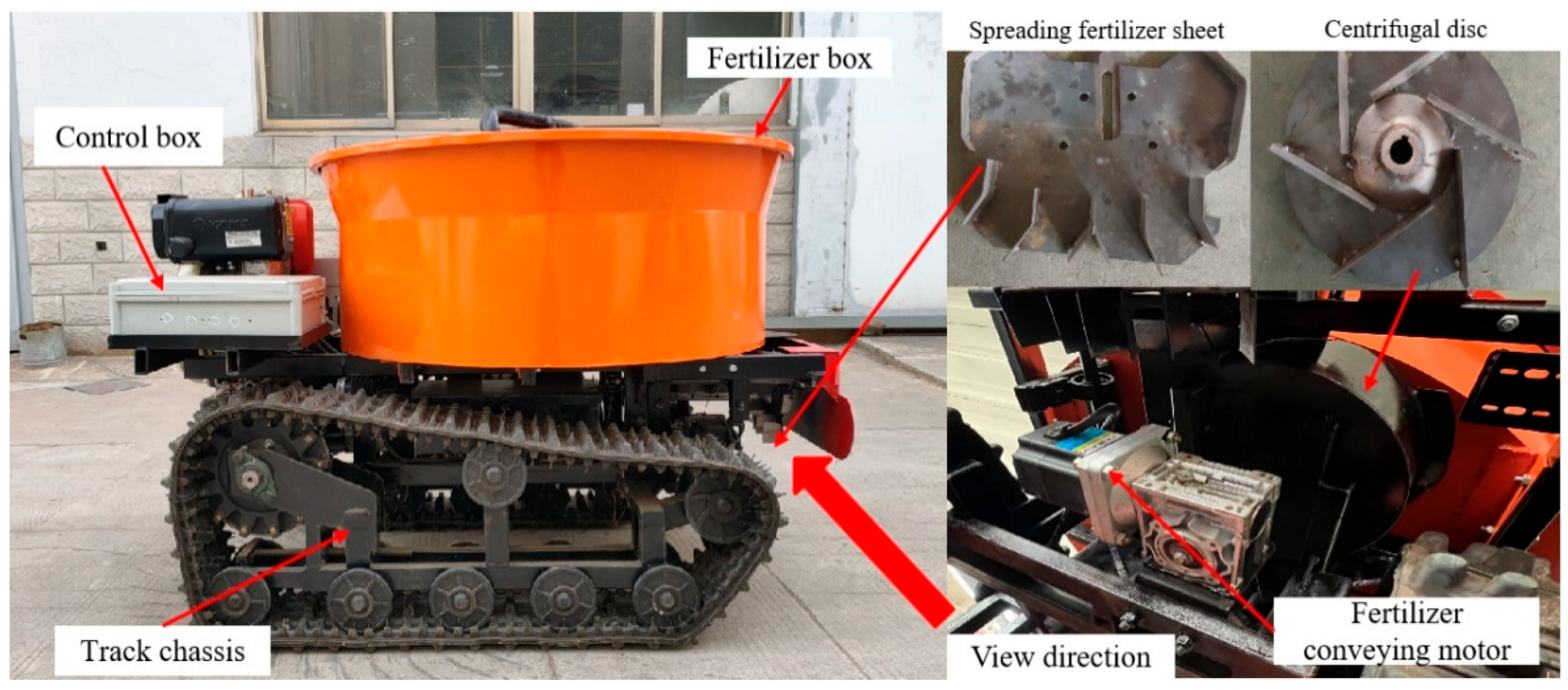
To verify the reliability of the simulation test and optimization results, a multi-channel fertilizer spreading test platform was constructed based on a tracked chassis according to the optimized parameters, and field trials were conducted to validate the actual spreading effectiveness of the multi-channel spreading method, as shown in Figure 9. The field tests were carried out in February 2025 at Yancheng Xinmingyue Machinery Co., Ltd., Yancheng, China, with a temperature of 10–15 °C and a wind speed of less than 2 m/s, which meets the allowable test wind speed of the ASABE standard. The fertilizer used in the test was commercial organic cow manure fertilizer purchased from the agricultural materials station. The field tests included evaluations of both the uniformity of the fertilizer distribution and the width of fertilizer spreading.

2.6.1. Fertilization Uniformity Test

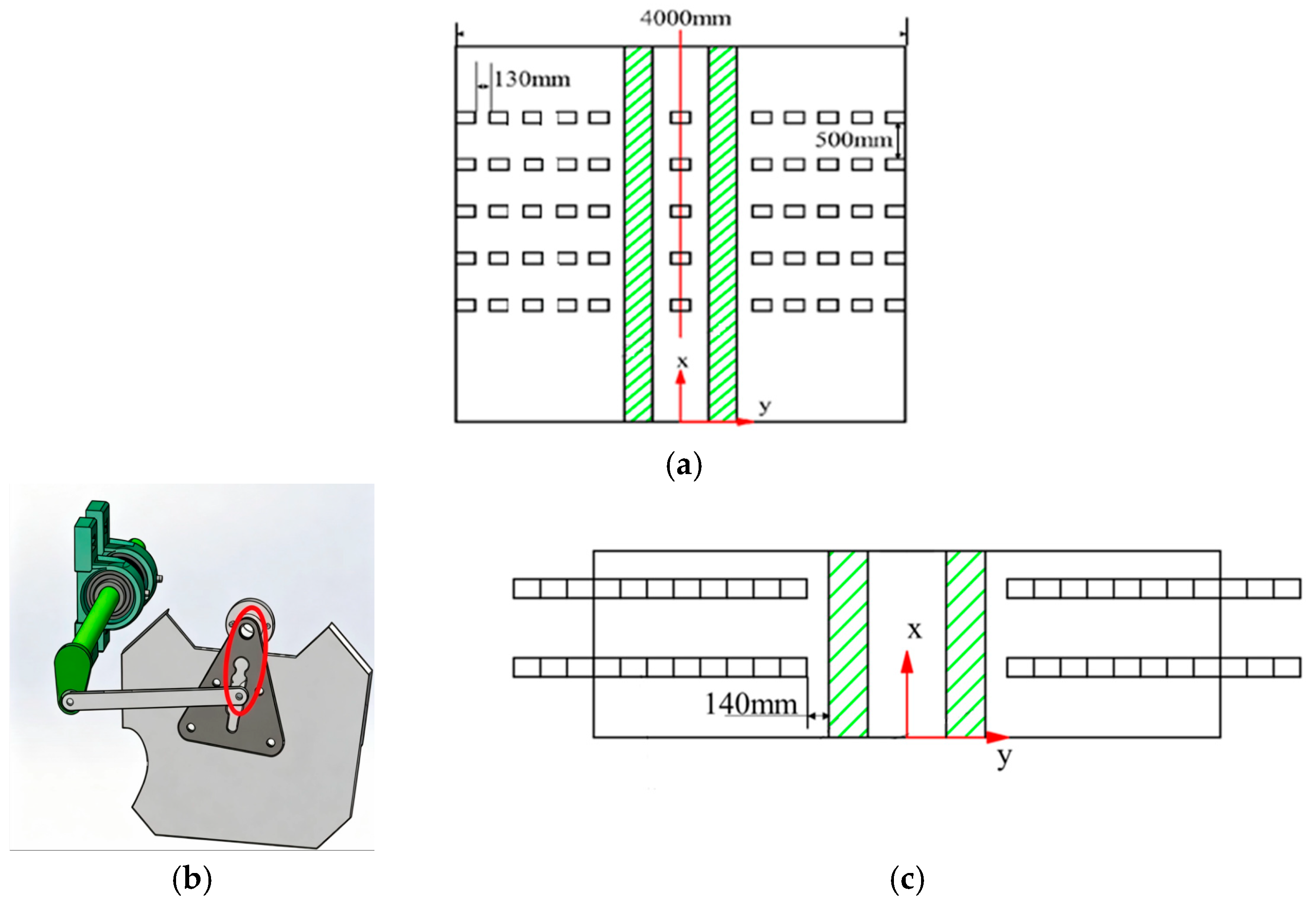
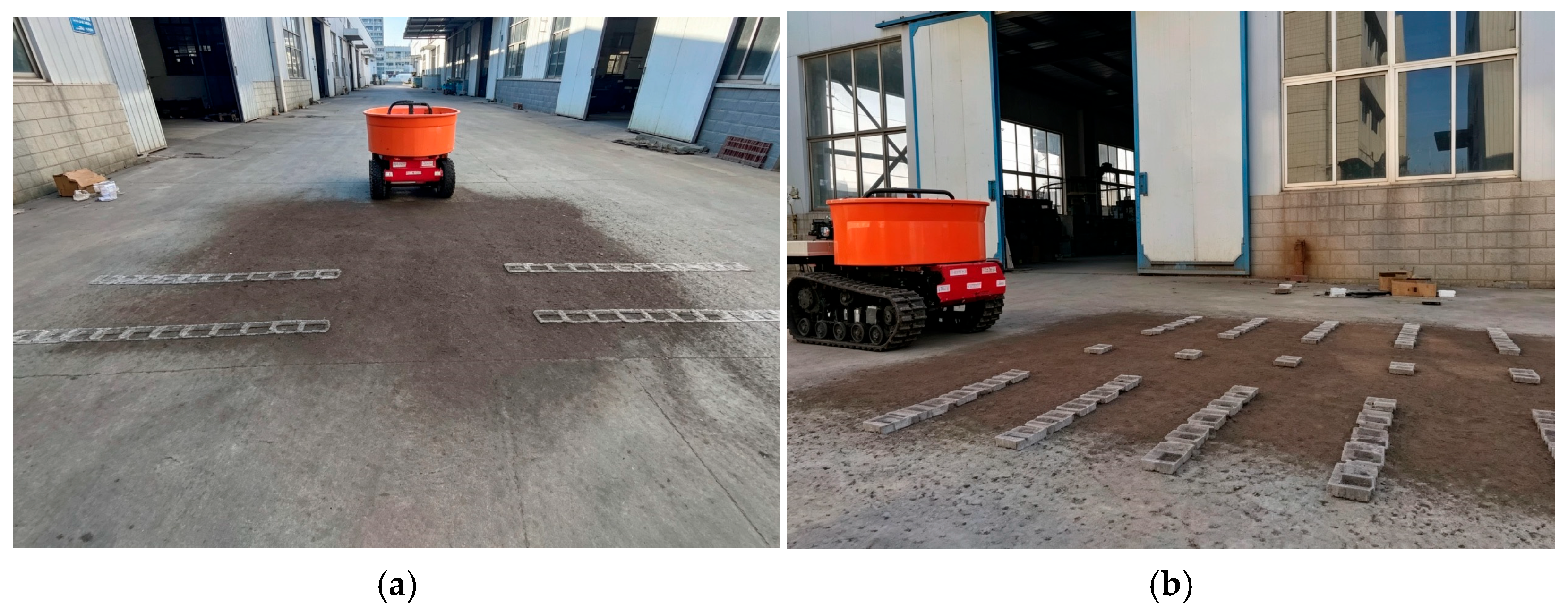
According to the ASABE test standard, the test area was set up with the machine’s forward direction as the x-axis. Eleven collection boxes were symmetrically placed along the y-axis concerning the machine’s centerline for each row, with a total of 5 rows, forming a 4 m × 6 m test area, as shown in Figure 10a. The collection box numbers on the left side of the machine’s centerline are left 1 to left 4, the one on the centerline is labeled as center, and those on the right side are numbered accordingly. The data of each column are used as a fertilizer mass data group, and the uniformity in the fertilizer spread width direction was calculated based on the 11 data points. The machine’s forward speed was set to 0.7 m/s, the fertilizer delivery device’s rotational speed was 100 r/min, and the crank rotational speed in the fertilizer spreading component drive device was 168 r/min. After the fertilizer spreader starts, it first goes through a stable zone before entering the test area. The purpose of the stable zone is to ensure the stable operation of the fertilizer spreader’s systems so that when entering the test area, the fertilizer can be spread stably, each test group is repeated three times, and the variation coefficient (Cv) of transverse distribution uniformity is calculated.

2.6.2. Fertilizer Spreading Width Test

The variation in the spreading width is mainly determined by the swing angle of the spreading disc, and the change in the swing angle of the spreading disc is achieved by adjusting the length of the rocker through the adjustment slot on the receiving plate, as shown in Figure 10b. Referring to the fertilizer spreading uniformity scheme, the direction in which the machine moves forward is defined as the x-axis, and the spreading width direction is defined as the y-axis. Collection boxes are set up in the spreading width direction within the test area, as illustrated in Figure 10c. After the fertilizer spreading machinery passes through the test area, the fertilizer in the collection boxes is weighed. Collection boxes on both sides that contain less than half the amount of fertilizer than the central collection box were identified, and their distances from the center were measured. The average of the two measured distances is defined as the effective spreading width. The machine’s forward speed, the rotational speed of the fertilizer delivery device, and the crank rotational speed were the same as those in the fertilizer spreading uniformity test. The outlet aperture setting was at 80%, and the lengths of the rocker were set at 45 mm, 55 mm, 65 mm, 75 mm, 85 mm, 95 mm, and 105 mm for a total of seven test groups. Each test was repeated three times to obtain an average value.

3. Results and Discussion

3.1. Analysis of EDEM Simulation Experiment Results for Fertilizer Conveying Equipment

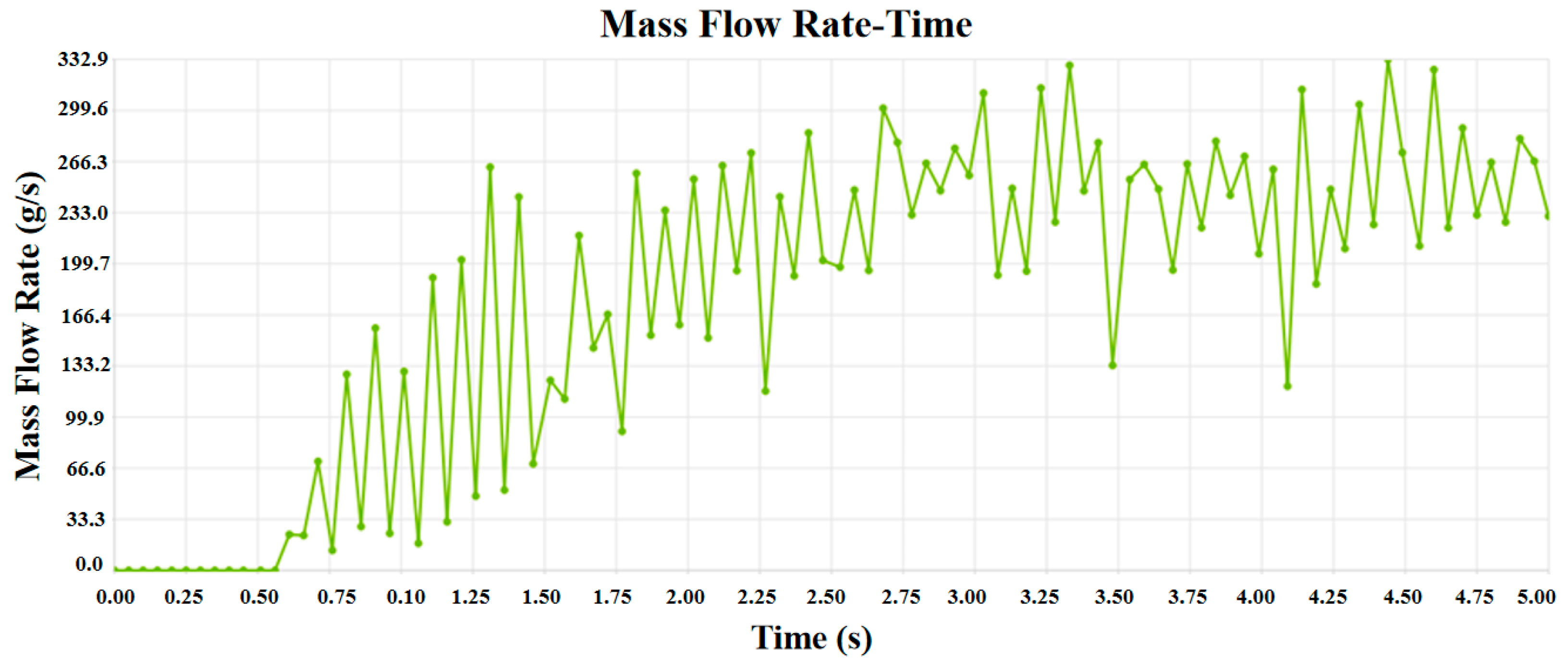
In the EDEM simulation experiment for the fertilizer delivery device, to precisely evaluate the uniformity of the device, a mass flow sensor was used to collect data on the amount of fertilizer at the fertilizer discharge nozzle. Figure 11 presents a line graph monitored by the mass flow sensor, showing the amount of fertilizer at the nozzle. The graph reveals that as the simulation begins, the amount of fertilizer at the outlet starts to increase from zero, with a relatively stable output of fertilizer commencing at 1.25 s. Observing the entire simulation experiment, the output flow rate of the fertilizer at the outlet shows considerable fluctuations and an irregular distribution, indicating poor uniformity of the fertilizer feeding device at this time, which would directly influence spreading uniformity.
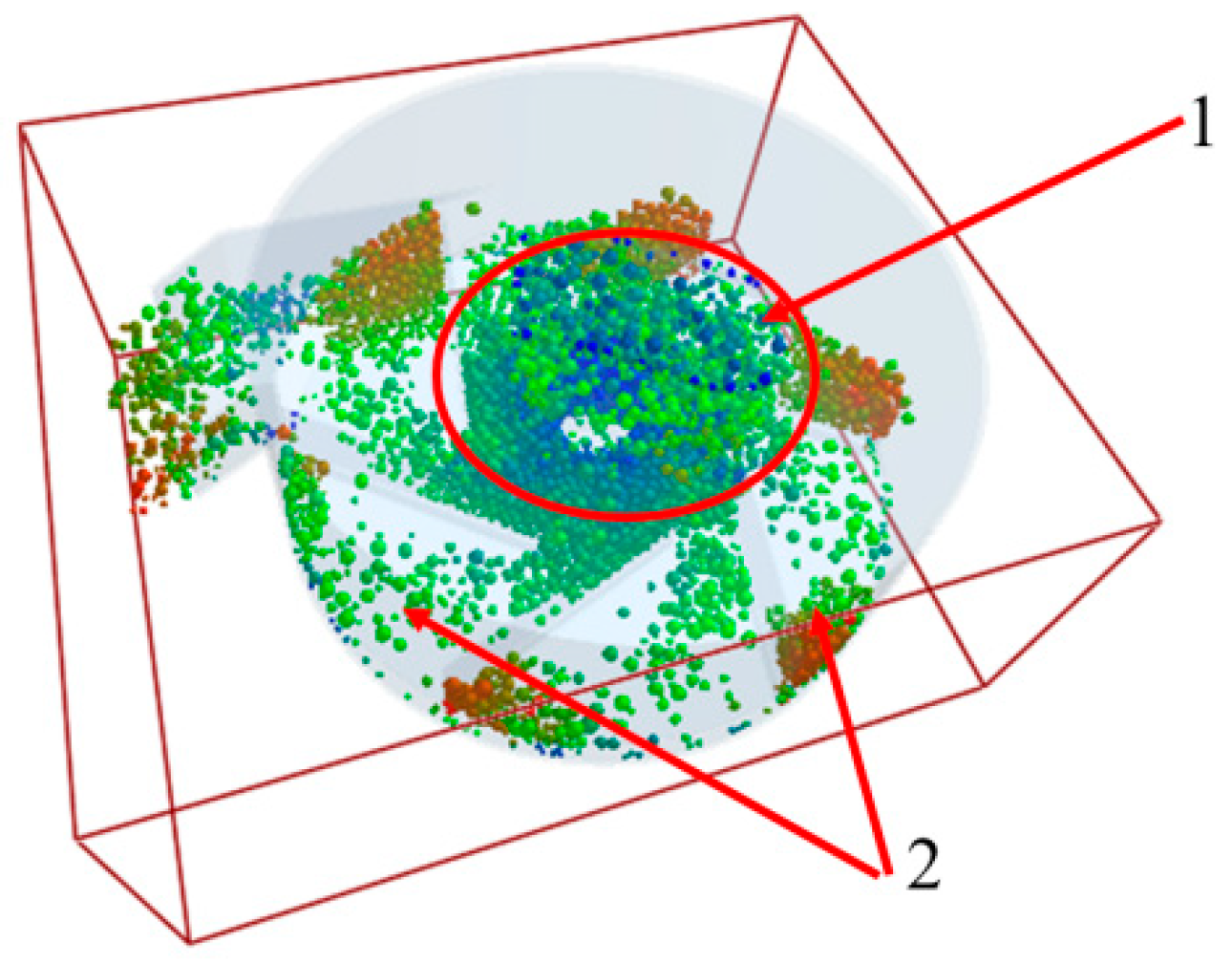
To investigate the reasons behind the poor uniformity of the fertilizer delivery device, an analysis of the EDEM simulation process was conducted. The distribution of fertilizer in the delivery device is depicted in Figure 12, where 1 indicates the central area of the fertilizer feeding device, and 2 points to the edge area of the blades within the device. It can be observed from Figure 12 that during the transportation process, the fertilizer tends to aggregate in the center, and each centrifugal blade delivers an uneven amount of fertilizer. The main cause of this phenomenon is due to the backward-tilted blades used on the centrifugal disc; there are no centrifugal blades in the middle area of the disc, resulting in less centrifugal force acting on the fertilizer in this area. It becomes difficult for the fertilizer to enter the grooves between the centrifugal blades under the action of centrifugal force, leading to randomness in the entry of fertilizer into the grooves and causing poor uniformity in the delivery device.
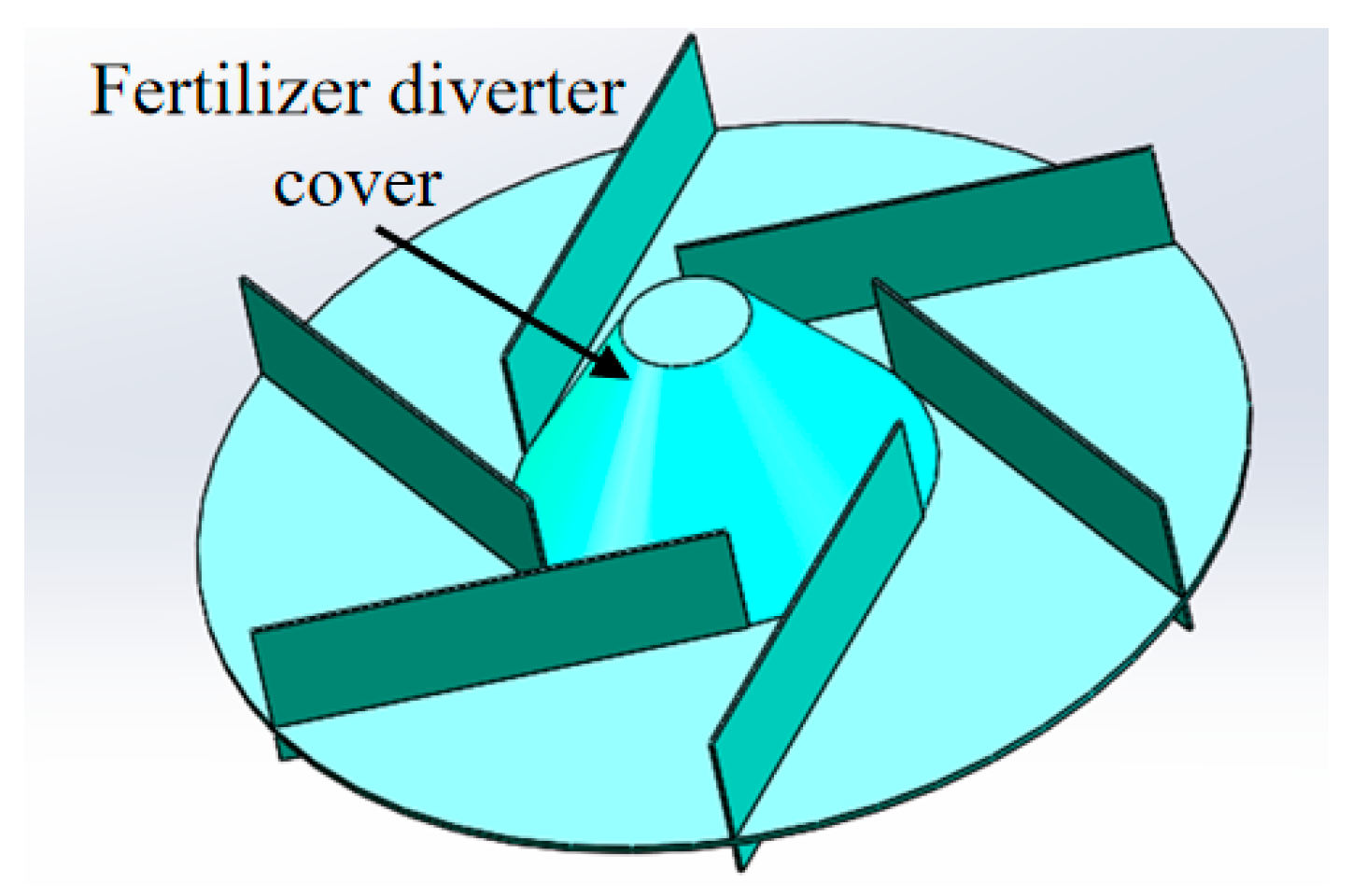
In response to the issues identified during the simulation, the centrifugal disc was optimized. To ensure that the fertilizer falling from the outlet is uniformly and rapidly distributed into the centrifugal area of the delivery device, a conical fertilizer diverter cover was designed at the center of the centrifugal disc. The shape of the fertilizer diverter cover is frustoconical, with the top radius matching the radius of the drive shaft sleeve, and the bottom radius aligned with the radius of the circle tangent to the installation of the centrifugal blades. The optimized centrifugal disc is shown in Figure 13. The improved fertilizer delivery device was then re-simulated in the EDEM software [33].
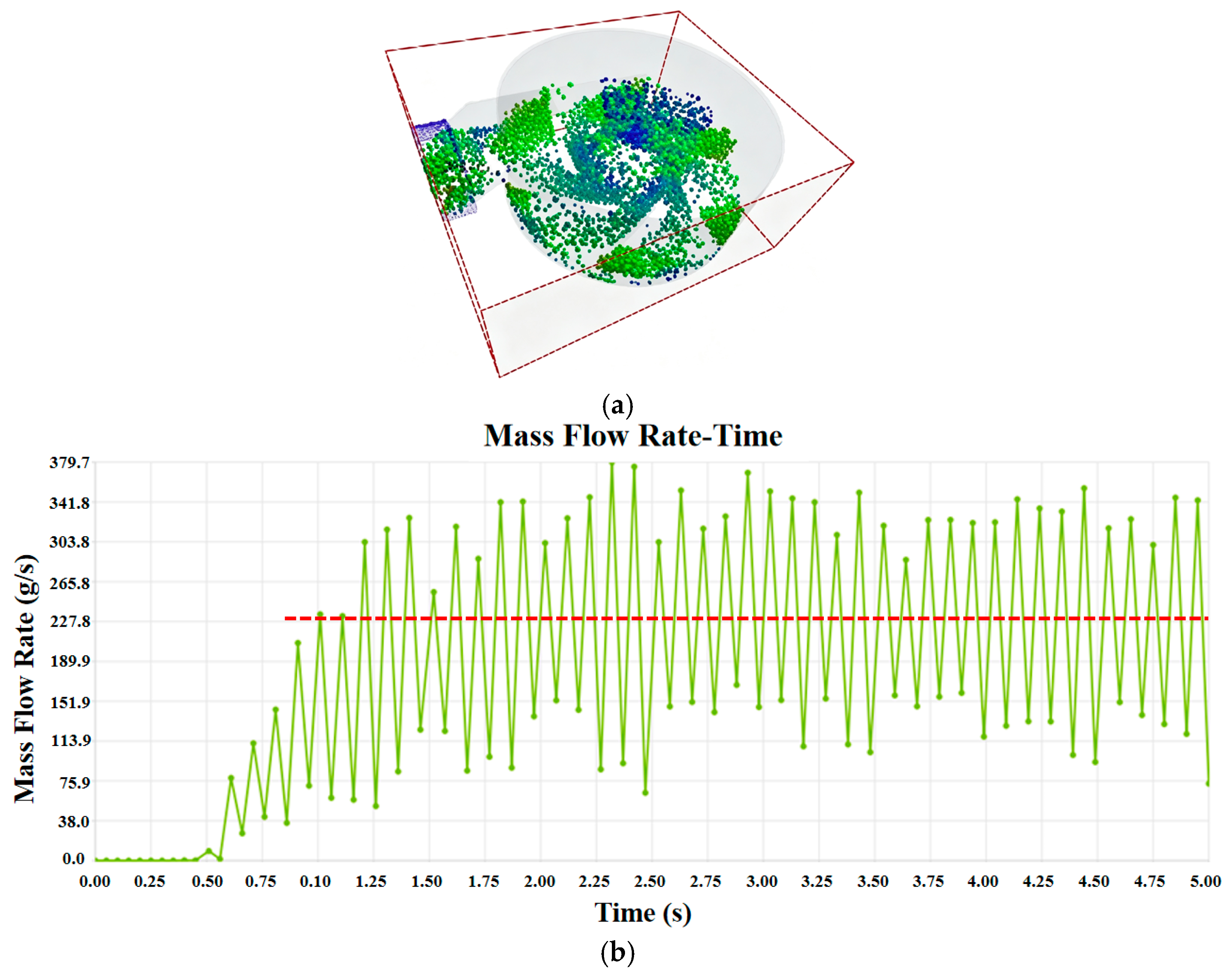
The simulation process of the optimized fertilizer delivery device is shown in Figure 14a. Compared with the fertilizer distribution at the same moment before optimization, the distribution of particles within the delivery device is significantly improved post-optimization. After falling from the hopper, the particles smoothly enter the centrifugal area of the delivery device thanks to the effect of the fertilizer diverter cover. The fertilizer is uniformly distributed between the centrifugal blades into the grooves, thereby completing the transportation process efficiently. Figure 14b shows a line graph of the mass at the outlet over time detected by the mass flow sensor after optimization. Compared with Figure 11, the fluctuations in the amount of fertilizer after optimization are more regular, with a symmetric distribution centered around 227.8 g/s. The average flow rate within 1.5–5 s is 271.9 g/s, and the average flow rate within 1.5–5 s shown in Figure 11 is 233.9 g/s. The optimized flow rate is 16.2% higher than before optimization, and the fertilizer transport capacity is stronger.

3.2. Multi-Channel Fertilizer Spreading EDEM Simulation and CNN-LSTM–Attention Algorithm Analysis

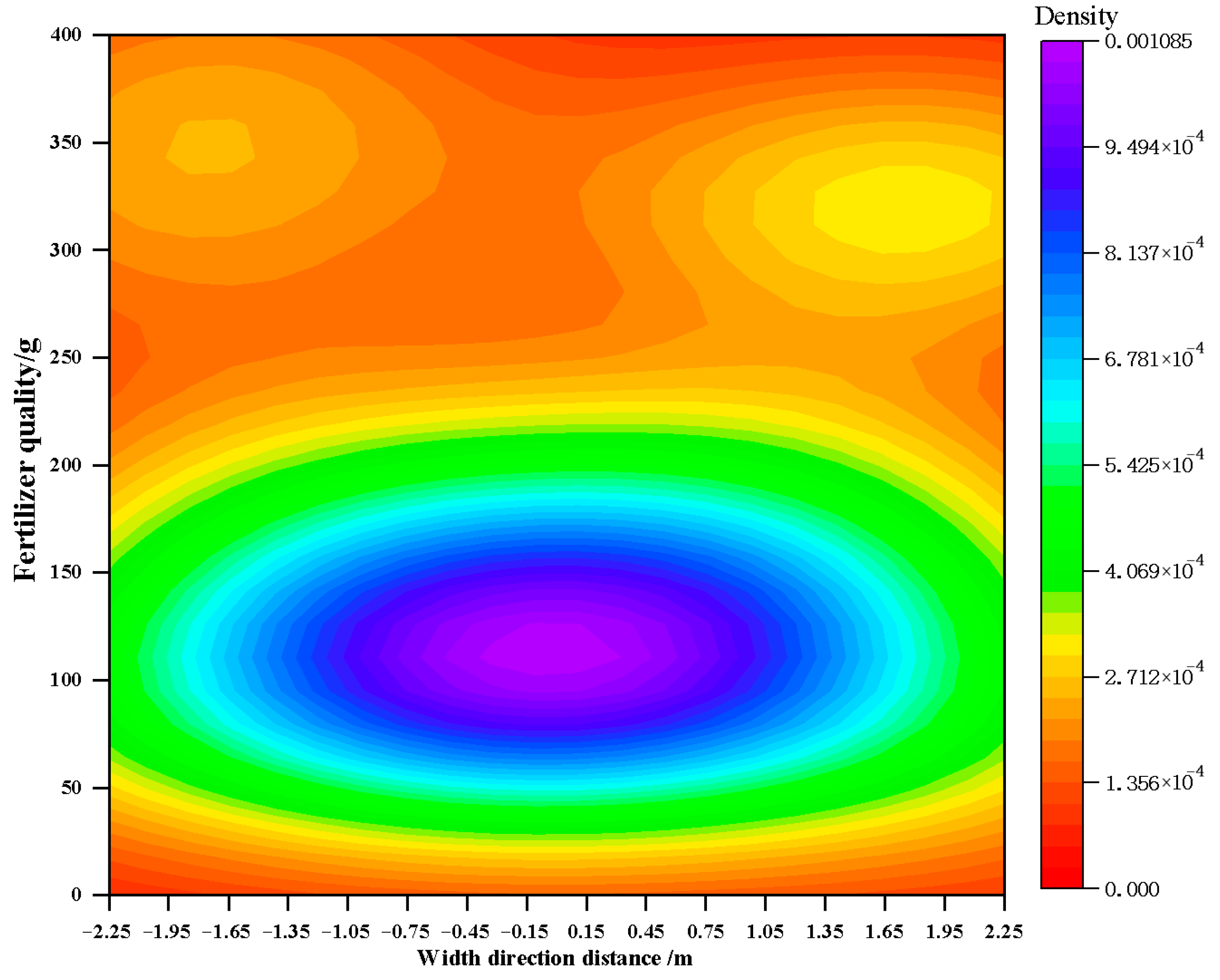
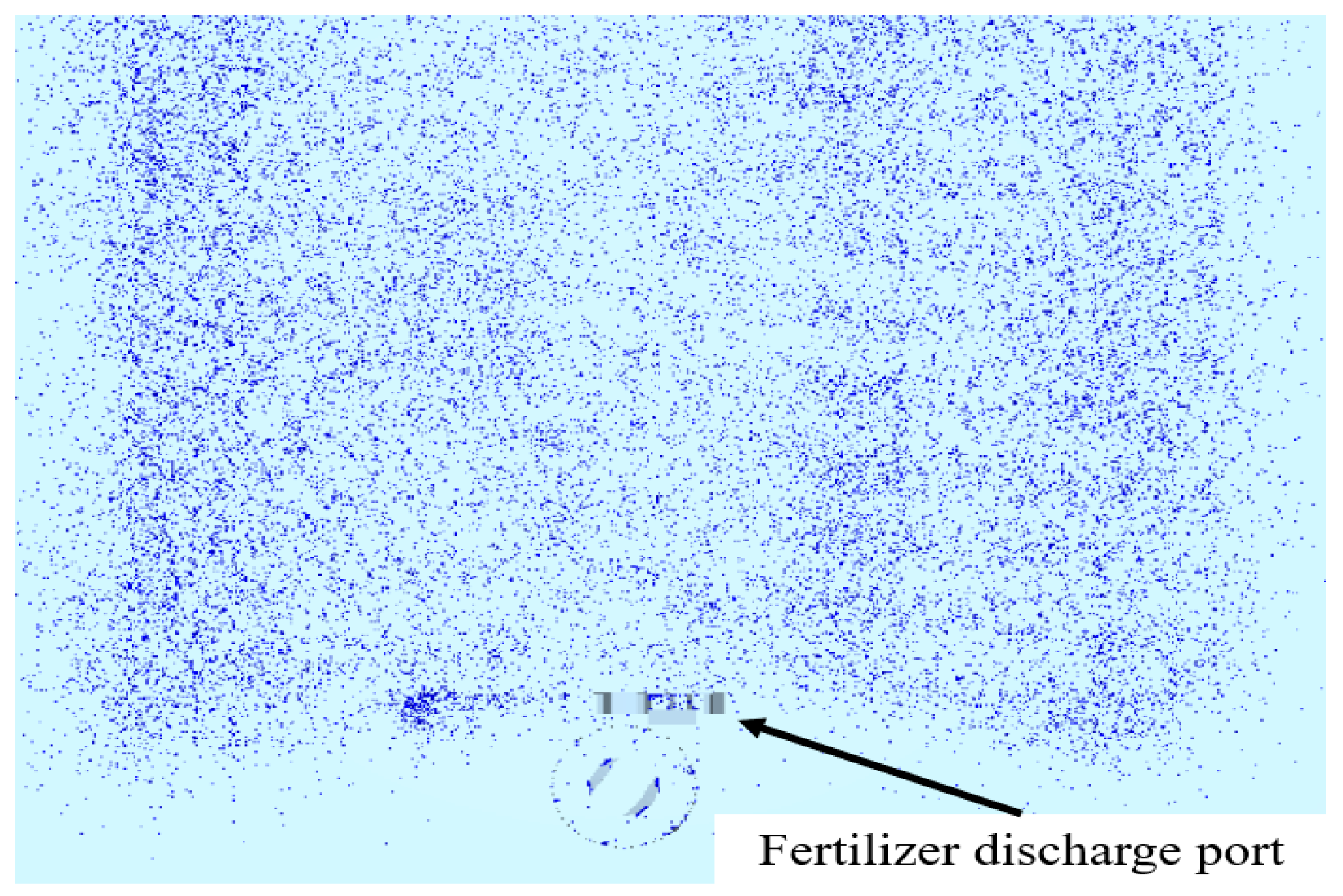
To enhance the efficiency of the simulation calculations and to prevent unpredictable situations due to setup errors, a preliminary experiment was conducted on the established model before the formal multi-channel spreading EDEM simulation. The preliminary experiment allowed for the identification of any issues with the model and the design of the spreading disc, which could then be corrected and optimized. During the preliminary experiment, the fin angle (λ) was set to 90°. After the simulation, particle mass data within the grid were collected and analyzed using Origin 2018 (OriginLab. Version: 95C; Northampton, MA, USA), resulting in the creation of a scatter density distribution diagram as shown in Figure 15.
An analysis of Figure 15 indicates that when λ = 90°, the spreading width can reach 4.5 m. Observing the density distribution of the fertilizer mass along the spreading width, the transverse uniformity of the fertilizer is relatively poor, exhibiting an evident pattern where more fertilizer is distributed along the edges of the spreading width and less in the middle. Between −1.05 m and −1.05 m lies a region of high mass density distribution of fertilizer, with masses ranging between 90 g and 140 g. Two peaks of fertilizer mass occur within the regions of −1.65 m and −1.95 m, and 1.65 m and −1.95 m, with the maximum fertilizer mass reaching 322 g. The Cv for the transverse distribution uniformity of the fertilizer particles was calculated to be 64.5%, which is significantly different from the expected spreading effect.
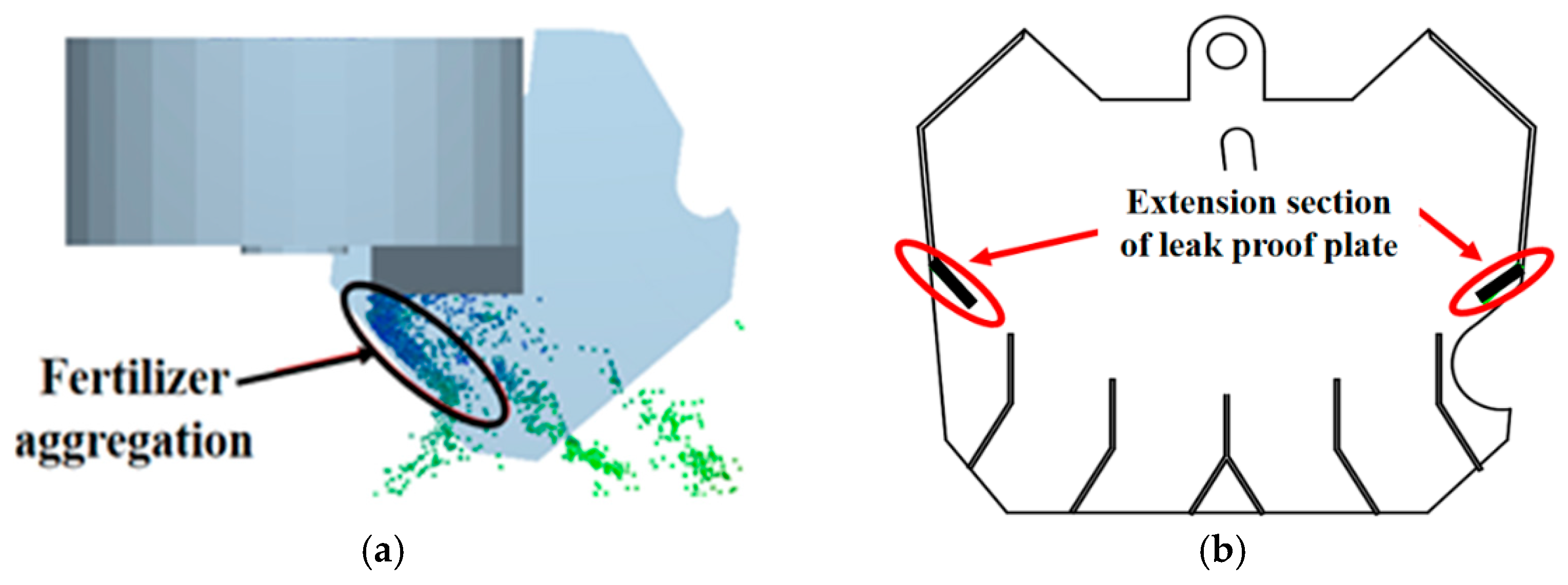
To clarify the reasons for poor transverse uniformity, an analysis of the simulation process and the spreading disc was undertaken. The simulation revealed that during the operation of the spreading disc, to achieve uniform fertilizer distribution across all channels, each channel entrance was designed to be consistent in size. Leakage prevention boards were added to the edges of the disc during the reciprocating swinging motion of the spreading disc, as shown in Figure 16a. As a result of this gathering action, most of the fertilizer flowed towards the two outermost channels, leading to a larger amount of fertilizer on the outer sides and a larger Cv for the transverse distribution of fertilizer particles. To mitigate the gathering effect of the leakage prevention boards, the boards were optimized by extending the lower edges, as shown in Figure 16b, to reduce the area of the two outermost channel entrances to half their original size in order to decrease the impact of the gathering effect. A simulation was run with all other parameters unchanged, and the analysis calculated the Cv for the transverse distribution uniformity of the fertilizer particles to be 47.4%. Although this was a significant improvement, it still did not meet the spreading requirements; therefore, further analysis was needed on the impact of the fin angle (λ) on the uniformity of spreading.
To establish a multi-channel fertilizer spreading model, the fin angle (λ) was set to 30°, 45°, 60°, 75°, and 90°, and the swing angle of the spreading plate was divided into three levels, resulting in a total of 15 sets of EDEM simulation experiments. The Grid Bin Group function was used to set the grid number to 7200, meaning each experiment generated 7200 data points. After completing the spreading simulations, the data were used for machine learning.
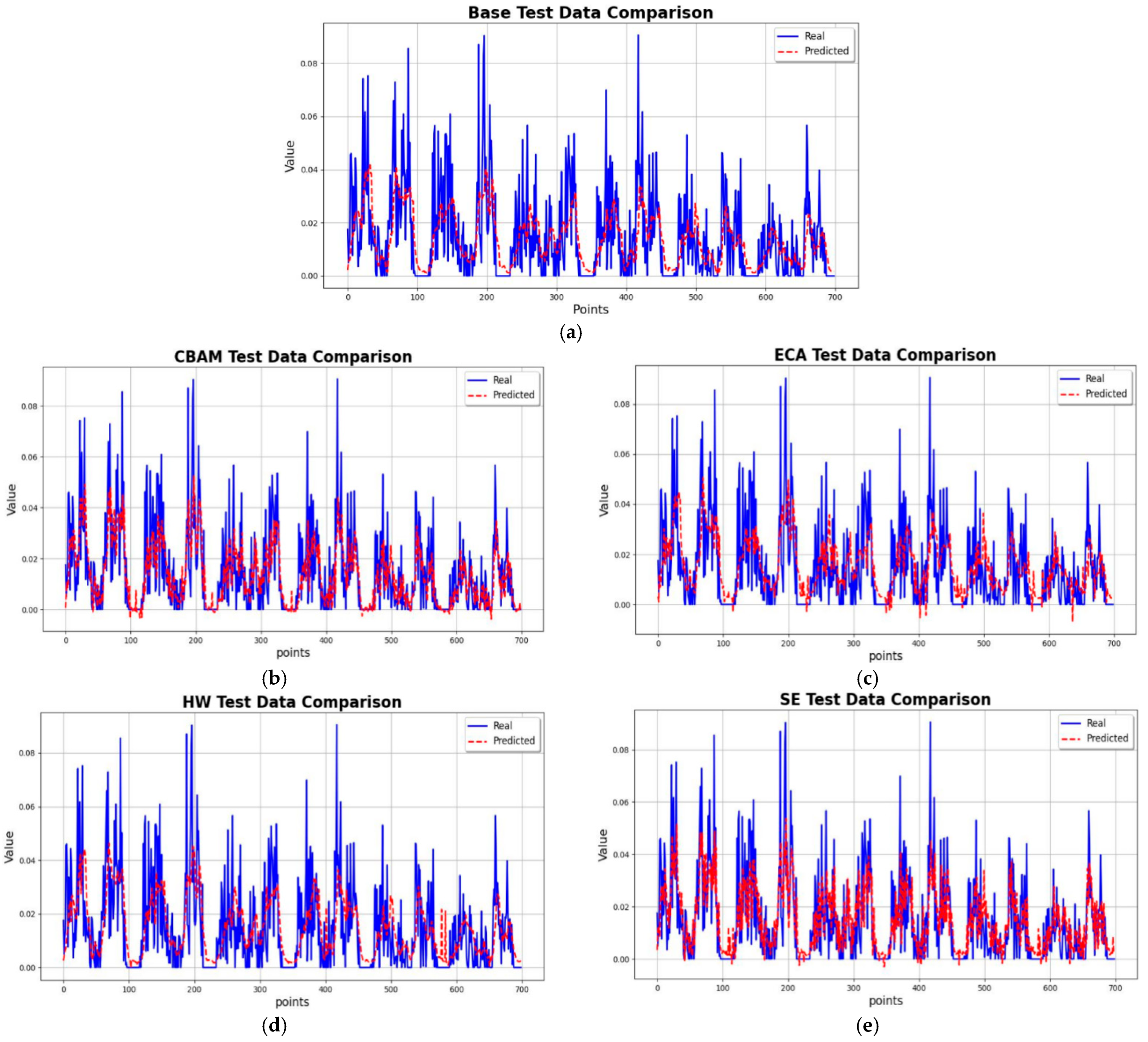
In this study, multi-parameter modeling is involved, and according to the EDEM simulation results, local accumulation of fertilizer occurs; therefore, both local and global features need to be comprehensively considered in the modeling process. Additionally, due to the large volume of data, computational power must be taken into account. Based on these characteristics, four types of attention mechanisms were introduced: the Convolutional Block Attention Module (CBAM), Efficient Channel Attention (ECA), Squeeze-and-Excitation Networks (SEs), and Height and Width Attention (HW). To evaluate the performance of the fertilizer spreading model under different attention mechanisms, four parameters were used: Eval Loss, R-squared (R2), Root Mean Squared Error (RMSE), Mean Absolute Error (MAE), as shown in Table 2. Based on the CNN-LSTM–Attention algorithm, under the four different attention mechanisms, a comparison between the model’s predicted values and the actual values is shown in Figure 17.
Eval Loss is a metric used to assess a model’s performance on a validation or test set, reflecting the prediction error on unseen data. A lower Eval Loss indicates more accurate predictions on the validation set. R-squared (R2) describes the extent to which input variables explain the variability of output variables. The Root Mean Square Error (RMSE) quantifies the overall deviation between predicted and actual values. In this study, if all red points closely align with the blue line, the RMSE would approach 0, indicating highly accurate predictions. The Mean Squared Error (MSE) is similar to RMSE, but RMSE is more sensitive to larger errors due to its squaring process, which amplifies their impact. The Mean Absolute Error (MAE) treats all errors equally and is less sensitive to large errors. The combination of RMSE and MAE provides a more comprehensive evaluation of model errors.
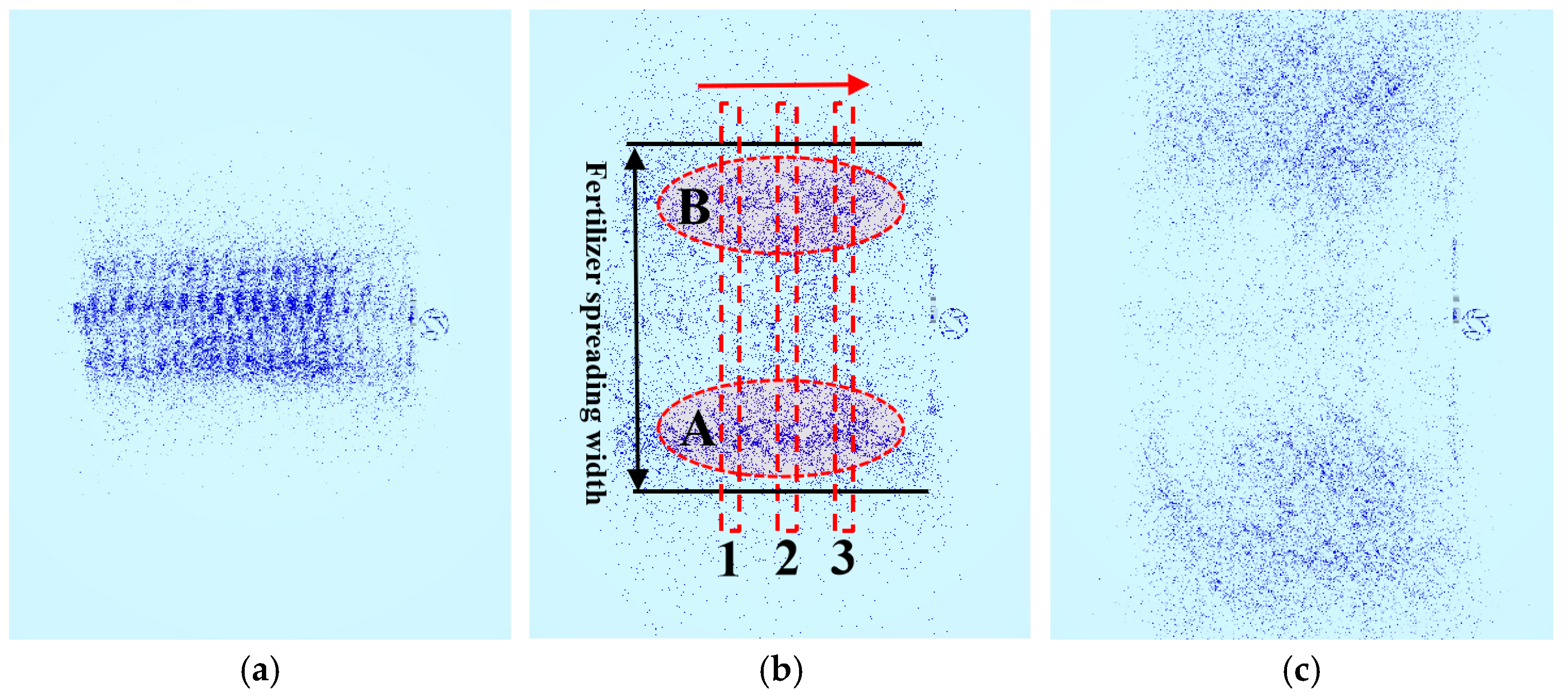
From the analysis in Table 2, it can be seen that the evaluation parameters Eval Loss, RMSE, and MAE of the algorithm with the attention mechanisms are all smaller than those of the basic algorithm, while the value of R2 being larger than that of the basic algorithm. However, there are significant differences in the model predictions under the different attention mechanisms, which relate to the characteristics of multi-channel fertilizer spreading and the features of each attention mechanism. Taking a fin angle of λ = 45° as an example, the simulation results for the fertilizer spreading disc swing angles of 20°, 40°, and 60° are shown in Figure 18. In Figure 18a–c, as the swing angle increases, the uniformity of spreading gradually deteriorates, showing fertilizer accumulation at both ends along the spreading width, as seen in regions A and B in Figure 18b. Over time, the distribution of fertilizer within the dashed areas 1, 2, and 3 is similar, indicating a recurring pattern of fertilizer distribution along the spreading width unit area from the start of spreading. This is why the CNN-LSTM–Attention algorithm is used for fitting the fertilizer spreading model. Figure 18c shows the fertilizer distribution at a swing angle of 60°, which is similar to the distribution at 40°. The characteristics of the attention mechanisms are analyzed as follows: The CBAM mechanism consists of two key parts, the Channel Attention Module (CAM) and the Spatial Attention Module (SAM), which are particularly effective at capturing local features and global structures of the data. The core idea of ECA is to learn inter-channel dependencies through 1D convolutional layers, indicating that the model should not have too many parameters when using the ECA attention mechanism. The HW attention mechanism is better at capturing local features but performs poorly in global data analysis. Like CBAM, the SE attention mechanism introduces channel attention but focuses solely on the relationships within the channel dimension.
In this study, the development of the fertilizer spreading model involves parameters such as the position of the fertilizer collection grid, the mass of fertilizer within the grid, the fin angle, and the fertilizer spreading disc swing angle. The core of the model is to explore the spatial dispersion pattern of fertilizers, which includes two key factors: first, where the spatial location is and second, how much fertilizer is present at that location. Based on the above physical model, various attention performances can be analyzed. ECA is pure channel attention that amplifies local features. In this study, the ECA attention mechanism considers data with less fertilizer as important features. As shown in Figure 17c, the predictions under the ECA attention mechanism exhibit significant deviations, especially when the fertilizer distribution is sparse, resulting in more negative values compared to other algorithms. The values of the four evaluation parameters in Table 2 also indicate that the model built with the ECA attention mechanism is the worst. Although the HW attention mechanism is suitable for multi-parameter modeling, it focuses more on local features in the modeling process for pure spatial attention. It is sensitive to local fertilizer aggregation data and lacks consideration for the correlation between features. From the fertilizer spreading simulation, it is evident that as the swing angle increases, the uniformity of the spreading deteriorates, leading to severe local accumulation. An excessive focus on local features can result in significant model deviations. As shown in Figure 17d, the predicted distribution of sparse fertilizer significantly diverges from the actual trend, especially around the 580th prediction point, where there is a substantial discrepancy with the actual values. The data in Table 2 also show that while the model built with the HW attention mechanism is better than that built with the ECA mechanism, it is inferior to others. Both SE and ECA are pure channel attention, but SE uses fully connected layers to capture relationships between data, while ECA uses one-dimensional convolution to capture relationships between data. Therefore, SE is superior to ECA in building models based on all fertilizer data, as evidenced by the evaluation indicators in Table 2. Compared with the CBAM attention mechanism, SE lacks a spatial attention module, which leads to a lack of exploration of fertilizer distribution characteristics in spatial positions, resulting in the CBAM attention mechanism model being superior to the SE attention mechanism model. As seen in Figure 17b, the prediction trend of the model with the CBAM attention mechanism aligns closely with the actual values. Based on the evaluation parameters in Table 2, the algorithm incorporating the CBAM attention mechanism is optimal, and the developed model can be used for further research.
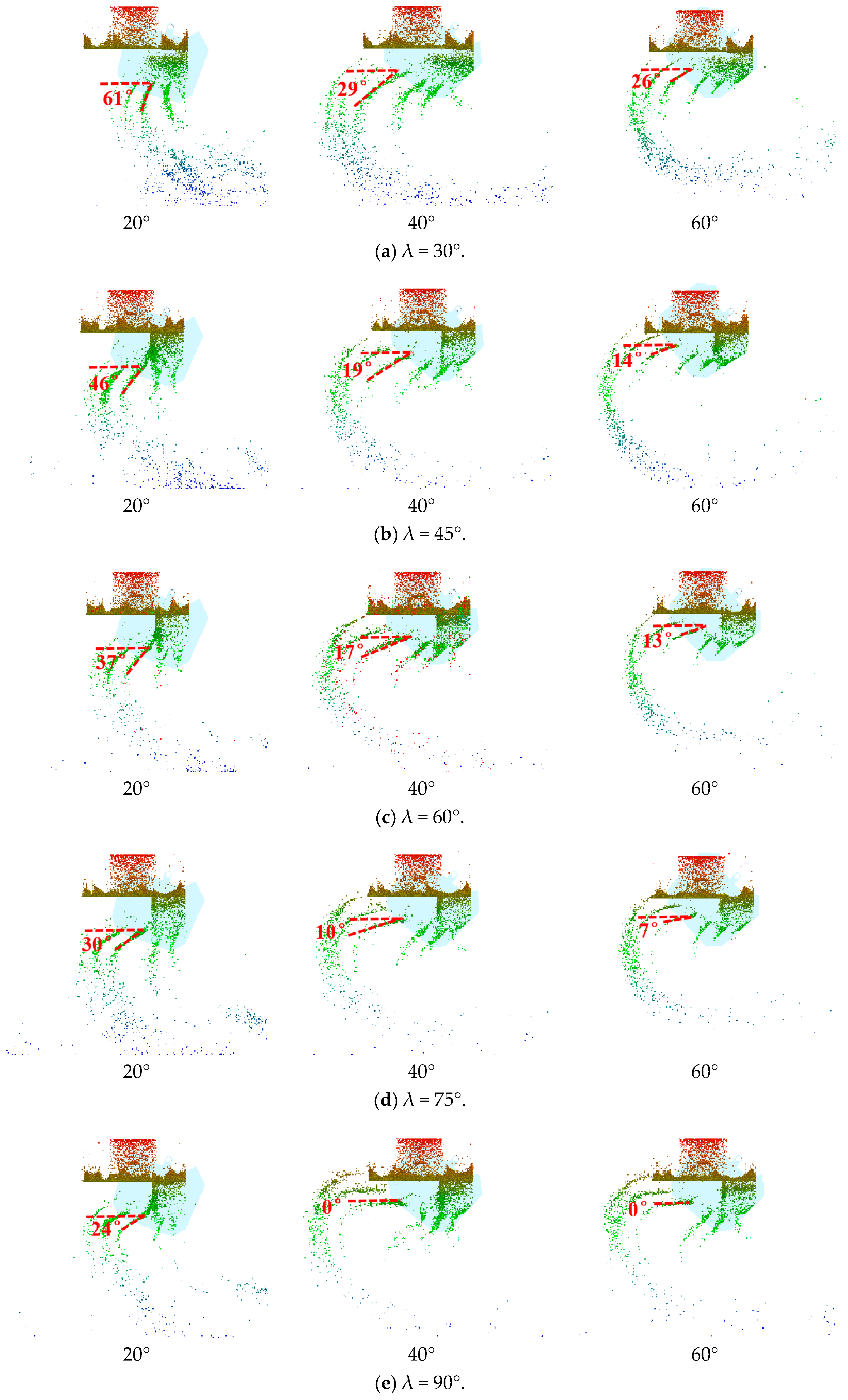
Through an analysis of the fertilizer spreading simulation results, Figure 19 shows the effect of different fin angles (λ) and swing angles on the fertilizer ejection. To more intuitively analyze the patterns, the fertilizer ejection angle is obtained when the spreading disc reaches the leftmost limit position. The angle between the fertilizer ejection and the horizontal line is considered the fertilizer ejection angle. When the ejection speed is constant, the ejection angle directly affects the spreading width. As shown in Figure 19, with the fin angle increasing from 30° to 90°, and with the swing angle remaining unchanged, the fertilizer ejection angle decreases. When the swing angle of the spreading disc is 20°, the fertilizer ejection angle is 61° with a fin angle of 30°, and it decreases to 24° when the fin angle is 90°. This implies that the horizontal velocity component of the fertilizer is greater during ejection, leading to an increase in the spreading width.
When the fin angle remains constant, the fertilizer ejection angle decreases as the swing angle increases. Analyzing the simulation process, two main factors cause this phenomenon: (1) The increase in swing position reduces the angle between the spreading fins and the horizontal line, thus leading to a decrease in the fertilizer ejection angle. (2) At the swing endpoint, the fertilizer particles continue to move due to inertia, causing the ejection angle to further decrease. It is important to note that the change in the fertilizer ejection angle is mainly influenced by the fin angle. When the fin angle is 90°, the fertilizer ejection angle does not change as the swing angle increases from 40° to 60°. However, when the fin angle is 75°, the fertilizer ejection angle decreases by 4° as the swinging angle increases from 40° to 60°, and so on.
As the fertilizer ejection angle decreases, the spreading width increases, which aligns with the fertilizer spreading simulation results shown in Figure 18. However, the fertilizer ejection angle alone is insufficient to analyze the spreading effect. After the fertilizer is ejected, its motion is influenced not only by the ejection angle but also by the combined effects of forces such as gravity and centrifugal force; therefore, the spreading effect requires further analysis.
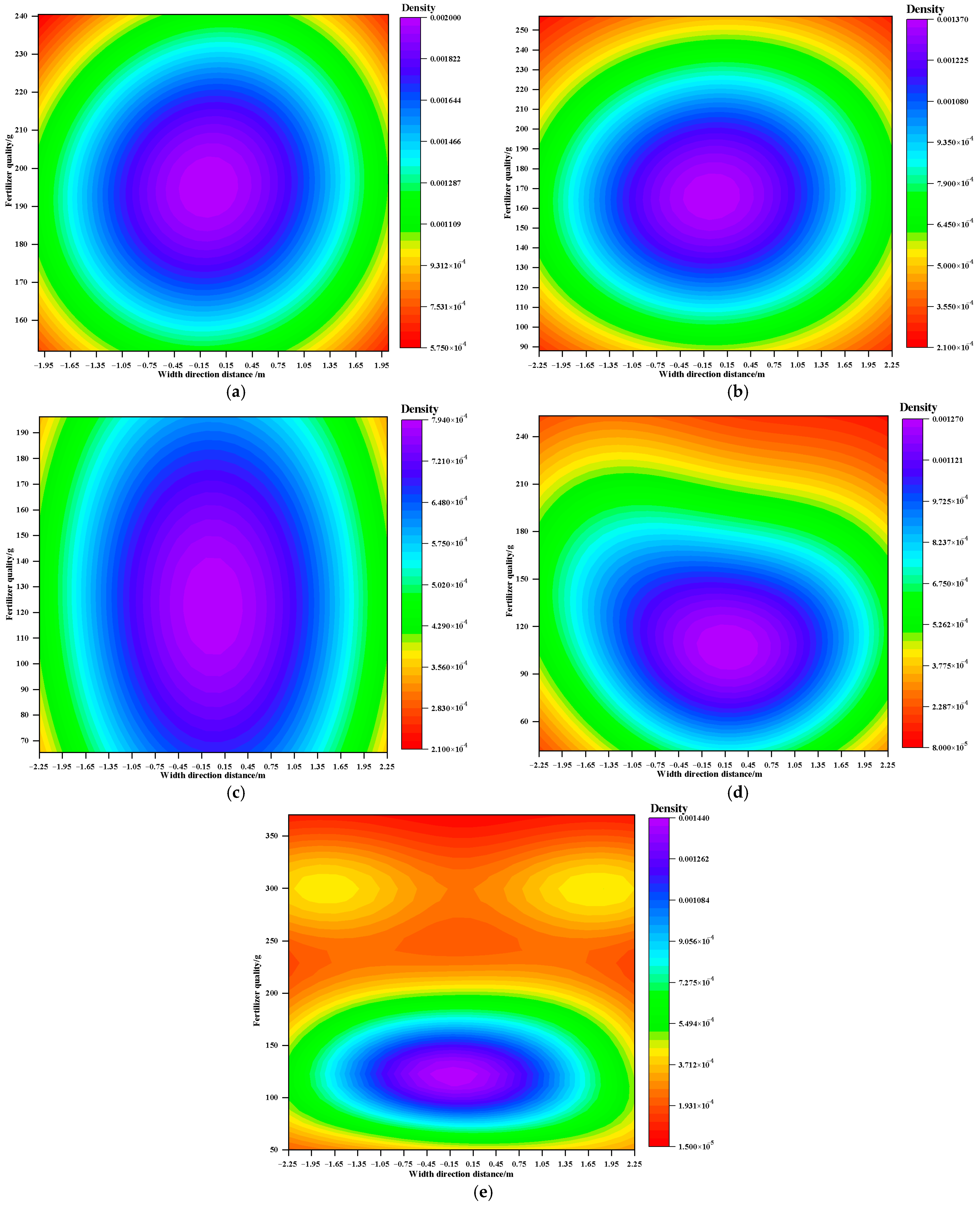
By analyzing the simulation results of fertilizer spreading, it is evident that different fin angles result in variations in spreading width and uniformity. However, when the fin angle is fixed, increasing the swing angle of the spreading disc leads to the same trend in changes to both spreading width and uniformity, as shown in Figure 18. Smaller swing angles result in narrower spreading widths and better uniformity. As the swing angle increases, the spreading width also increases, but the uniformity deteriorates. Considering the performance of the fertilizer spreading structure and spreading effect, the data for a 40° swing angle are used to analyze the mass distribution of fertilizer along the spreading width and the Cv for transverse distribution uniformity of the fertilizer. A density map illustrating the distribution of fertilizer mass along the spreading width was then created, as shown in Figure 20.
Respectively, the fertilizer mass distribution density diagrams along the width direction when λ is 60°, 75°, and 90°. As the fin angle increases, the dispersion of the fertilizer mass along the width direction increases. In Figure 20c, when λ = 60°, the maximum effective spread width can reach 3.9 m. In Figure 20d, when λ = 75°, the maximum effective spread width can reach 3.9 m, and the fertilizer distribution presents a phenomenon of gathering at the width edge. In Figure 20e, when λ = 90°, the effective fertilizer spread width can exceed 4.5 m, and the fertilizer mass distribution along the width direction obviously appears as two peaks at the edge. In order to objectively evaluate the uniformity of transverse distribution of fertilizer, the Cv of the uniformity of transverse distribution of fertilizer under the above fin angles was calculated, and the results are shown in Table 3.
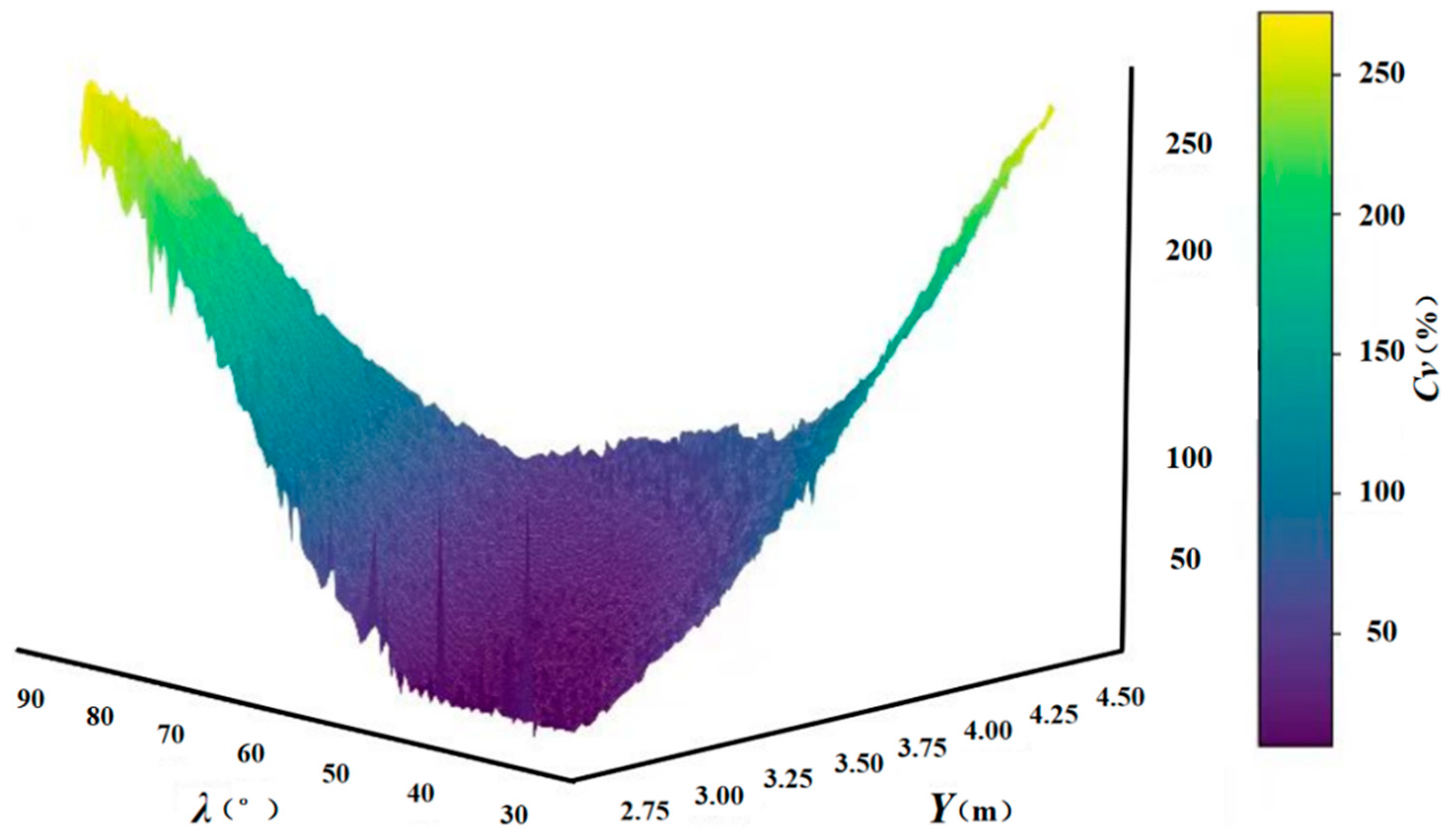
According to the analysis of Table 3, it can be concluded that the Cv of the uniformity of transverse distribution of fertilizer increases with an increase in the fin angle (λ). When the fin angle λ = 30°, the Cv of the uniformity of transverse distribution of fertilizer is 10.89%, which has a relatively good effect. However, the effective spread width of fertilizer does not meet the design requirements. When the fin angle (λ) increases, the spreading width increases, but the spreading uniformity deteriorates. To find the optimal fin angle, the fertilizer spreading model established using the CNN-LSTM-CBAM algorithm was employed to identify the relationship between the Cv of transverse distribution uniformity, the fin angle (λ), and the spreading width, as shown in Figure 21.

3.3. Optimization Analysis of Fin Angle (λ)

An analysis of Figure 21 indicates that to achieve good transverse distribution uniformity of fertilizer while expanding the spreading width, the fin angle (λ) is a critical factor. If the fin angle (λ) remains constant, an increase in spreading width leads to a rapid deterioration of transverse distribution uniformity. Moreover, when the fin angle (λ) increases, and the spreading width is relatively small, localized fertilizer accumulation may occur, also resulting in a worse Cv. To determine the optimal fin angle (λ) while considering both the spreading width and the Cv of transverse distribution uniformity, constraints were set with spreading width ≥ 3.0 m and Cv ≤ 10%. Solving within the model established in Figure 21, the result obtained was a fin angle of λ = 34.15°, with a spreading width of 3.0 m and a Cv of 9.29%. To verify the accuracy of this optimization, the fin angle (λ) was adjusted to 34.15° based on the optimization result, and a new spreading model was established. The model was then imported into EDEM for simulation experiments under unchanged conditions. The results of the spreading simulation experiment are shown in Figure 22.
Considering the comprehensive fertilization effect and the requirement of fertilization width, when λ = 34.15°, the simulation experiment results of fertilization are shown in Figure 22. The longitudinal distribution of fertilizer is relatively uniform, with no obvious fertilizer aggregation phenomenon. The Cv of the uniformity of transverse distribution of fertilizer is 7.66%, and the effective spreading width is 2.95 m, with a spreading width error of 1.67% compared to the CNN-LSTM-CBAM-based spreading model and a transverse distribution uniformity (Cv) error of 21.9%. However, the Cv obtained from the EDEM simulation experiment is superior. To verify the reliability of both the EDEM simulation and the CNN-LSTM-CBAM-based spreading model, field tests were conducted on the multi-channel fertilizer spreading system, considering the precision of mechanical processing and with the fin angle (λ) in the field tests set to 34°.

3.4. Analysis of Field Performance Test Results

Field performance tests were conducted according to the experimental design scheme, and the results of the fertilizer spreading uniformity test are shown in Table 4.
An analysis of the fertilizer spreading uniformity test results shows that the Cv for uniformity in the spreading width direction for the three tests were 10.2%, 6.25%, and 14.2%, respectively, with an average coefficient of variation of 10.21%. This is not significantly different from the Cv of 7.66% and 9.29% obtained from the EDEM simulation and the CNN-LSTM-CBAM-based spreading model. Errors due to a 0.15° difference in fin angle are not excluded, but the difference is small enough to demonstrate that the simulation and optimization results are relatively accurate. The uniformity of fertilizer spreading is shown in Figure 23a, where it can be observed that the fertilizer is uniformly distributed on the ground after passing through the multi-channel spreading system. There is no significant fertilizer accumulation or blank areas within the effective spreading width, consistent with the simulation results shown in Figure 22.
From the analysis of the test results in Table 5, it can be concluded that the spreading width is inversely proportional to the rocker length, with the spreading width decreasing as the rocker length increases. Within the range of 45 mm to 105 mm in rocker length, the spreading width can be adjusted between 1.2 m and 3.0 m. When the rocker length is set to 45 mm, the corresponding swing amplitude of the fertilizer spreading disc is 40°, and at this point, the working parameters of the spreader are consistent with the EDEM fertilizer spreading simulation parameters. The spreading width in the EDEM simulation is 3.0 m, and the field test results for the fertilizer spreading width are shown in Figure 23b. The average spreading width from multiple actual tests is approximately 2.97 m, and the relative error is 1.0%. The combination of simulation and test results validates the rationality of the multi-channel fertilizer spreading system parameter design, and the spreading performance meets the fertilization requirements.
According to the modern planting agriculture of orchards (pear, peach, and apple), the row spacing of fruit trees is 4 m, and the plant spacing is between 3 m and 4 m. The width of ridges planted in greenhouses is generally between 1 m and 2 m, depending on the crops. The multi-channel spreading fertilizer system studied has a fertilizer spreading width that can be adjusted between 1.2 m and 3.0 m according to the operating conditions, and the Cv for lateral fertilizer spreading is good (Cv ≤ 10.21%) at each fertilizer spreading width, avoiding the occurrence of missed or repeated fertilization. The existing fertilizer applicator has a fixed width for spreading fertilizer. The Cv for lateral fertilizer spreading ranges from 10% to 20%, with some reaching 26% [34]. Compared with existing fertilizer spreaders, it not only achieves an adjustable fertilizer spreading width but also improves fertilizer uniformity.

4. Conclusions

(1) In order to meet the requirements of different fertilizer spreading widths and uniformity under various operating environments, combined with a centrifugal fertilizer delivery device, a multi-channel fertilizer spreading system was developed, which solves the problem of ensuring uniform fertilizer spreading while adjusting the fertilizer spreading width and fills the gap in research related to small width fertilization and an adjustable fertilizer spreading width while ensuring uniform fertilizer spreading.
(2) With the goal of achieving uniform continuous fertilizer delivery, we analyzed the movement of fertilizer particles on the centrifugal disc and determined a backward-leaning layout for the centrifugal blades. A model of the fertilizer delivery device was established using the EDEM software for simulation testing to optimize the design of the fertilizer diverter cover hood on the centrifugal disc. Using EDEM simulation data, a fertilizer spreading model was established based on the CNN-LSTM-CBAM algorithm. Although R2 is relatively low, the predicted values of the established model are basically consistent with the trend of the actual values. The fin angle (λ) was optimized with spreading uniformity and width as the evaluation indices. The optimization resulted in a fin angle of λ = 34.15°, yielding a transverse distribution uniformity (Cv) of 9.29% and a spreading width of 3.0 m.
(3) The optimization results were validated using a combination of EDEM simulation and field testing. The EDEM simulation indicated a transverse distribution uniformity (Cv) of 7.66% and an effective spreading width of 2.95 m. Compared with the model optimization results, the fertilizer spreading width differed by 0.5 m, and the Cv of fertilizer lateral distribution uniformity differed by 2.34%. Field test results show an average spreading width of 2.97 m across three trials, with a relative error of 1% compared to the model optimization. The average Cv was 10.21%, which was 0.21% higher than the target Cv, within the allowable error range. The multi-channel fertilizer spreading system can basically meet fertilizer spreading needs and provides new ideas for fertilizer spreading research. How to form a reliable spreader with a multi-channel spreading fertilizer system and exploring the impact of different types of fertilizers and different terrains on the fertilizer spreading effect will be the next research directions.

Author Contributions

Conceptualization and funding acquisition, X.Z.; Data curation, project administration and writing—original draft, X.C.; Resources and formal analysis, S.Z.; Software and algorithm, Y.W. All authors have read and agreed to the published version of the manuscript.

Funding

This work was supported by the China Foundation for Rural Development—New Great Wall Science and Technology Backyard Support Plan Project.

Institutional Review Board Statement

Not applicable.

Data Availability Statement

The data presented in this study are available on request from the corresponding author.

Acknowledgments

The authors would like to acknowledge the contributions from Yancheng Xinmingyue Machinery Manufacture Co., Ltd.

Conflicts of Interest

The authors declare no conflicts of interest.

Abbreviations

The following abbreviations are used in this manuscript:
EDEMDiscrete Element Method
CNNConvolutional Neural Network
LSTMLong Short-Term Memory
CvVariation Coefficient
CBAMConvolutional Block Attention Module
ECAEfficient Channel Attention
SEsSqueeze-and-Excitation Networks
HWHeight and Width Attention
RMSERoot Mean Squared Error
MAEMean Absolute Error

Appendix A

The magnitude of each force of the fertilizer particles at point B can be expressed as follows:
G = m g F C = m ω 2 R 1 F c o r = 2 m ω v B F N 2 = F c o r F C sin α = 2 m ω v B m ω 2 R 1 sin α F f = μ F N 2 = 2 m μ ω v B m μ ω 2 R 1 sin α
With reference to the theorem of kinetic energy:
1 2 m v B 2 1 2 m v A 2 = F C ( R 1 R 2 ) + G ( R 1 R 2 ) cos α
v B = 2 ( R 1 R 2 ) ( g cos α + ω 2 R 1 )
With reference to the theorem of kinetic energy:
1 2 m v C 2 1 2 m v B 2 = G l 1 + F C l 1 cos α F f 1 l 1 = m g l 1 + m ω 2 R 3 l 1 cos α 2 m μ ω v B m μ ω 2 R 1 sin α l 1
v C = 2 l 1 ( g + ω 2 R 3 cos α 2 μ ω 2 ( R 1 R 2 ) ( g cos α + ω 2 R 1 ) ) + μ ω 2 R 1 sin α + 2 ( R 1 R 2 ) ( g cos α + ω 2 R 1 )
With reference to the theorem of kinetic energy:
1 2 m v D 2 1 2 m v C 2 = G l 2 cos θ + F C l 2 F f l 2 = m g l 2 cos θ + m ω 2 R 4 l 2 cos θ ( 2 m μ ω v C m μ ω 2 R 4 sin θ ) l 2
v D = 2 l 2 ( g cos θ + ω 2 R 4 cos θ - μ ω v C + μ ω R 4 sin θ ) + v C

References

  1. Han, J.; Dong, Y.; Zhang, M. Chemical Fertilizer Reduction with Organic Fertilizer Effectively Improve Soil Fertility and Microbial Community from Newly Cultivated Land in the Loess Plateau of China. Appl. Soil. Ecol. 2021, 165, 103966. [Google Scholar] [CrossRef]
  2. Yi, X.; Yu, L.; Chang, S.-H.-E.; Yin, C.; Wang, H.; Zhang, Z. The Effects of China’s Organic-Substitute-Chemical- Fertilizer (OSCF) Policy on Greenhouse Vegetable Farmers. J. Clean. Prod. 2021, 297, 126677. [Google Scholar] [CrossRef]
  3. Liu, B.; Xiao, H.; Song, Z.; Mei, S. Present state and trends of fertilizing machine in orchard. J. Agric. Mech. Res. 2017, 39, 263–268. [Google Scholar] [CrossRef]
  4. Chen, Y.; Long, H.; Liu, Z. Actuality and measures of fertilization technology and machinery in China. J. Agric. Mech. 2015, 37, 255–260. [Google Scholar] [CrossRef]
  5. Shi, Y.; Chen, M.; Wang, Y.; Odhiambo, M.O.; Ding, W. Numerical Simulation of Spreading Performance and Distribution Pattern of Centrifugal Variable-Rate Fertilizer Applicator Based on DEM Software. Comput. Electron. Agric. 2018, 144, 249–259. [Google Scholar] [CrossRef]
  6. Lv, J.; Shang, Q.; Yang, Y.; Li, Z.; Li, J.; Liu, Z. Performance analysis and experiment on granular fertilizer spreader with Swing disc. Trans. Chin. Soc. Agric. Eng. 2016, 32, 16–24. [Google Scholar] [CrossRef]
  7. Villette, S.; Piron, E.; Cointault, F.; Chopinet, B. Centrifugal Spreading of Fertiliser: Deducing Three-Dimensional Velocities from Horizontal Outlet Angles Using Computer Vision. Biosyst. Eng. 2008, 99, 496–507. [Google Scholar] [CrossRef]
  8. Przywara, A. The Impact of Structural and Operational Parameters of the Centrifugal Disc Spreader on the Spatial Distribution of Fertilizer. Agric. Agric. Sci. Proc. 2015, 7, 215–222. [Google Scholar] [CrossRef]
  9. Hwang, S.-J.; Nam, J.-S. DEM Simulation Model to Optimise Shutter Hole Position of a Centrifugal Fertiliser Distributor for Precise Application. Biosyst. Eng. 2021, 204, 326–345. [Google Scholar] [CrossRef]
  10. Villette, S.; Piron, E.; Miclet, D.; Martin, R.; Jones, G.; Paoli, J.-N.; Gée, C. How Mass Flow and Rotational Speed Affect Fertiliser Centrifugal Spreading: Potential Interpretation in Terms of the Amount of Fertiliser per Vane. Biosyst. Eng. 2012, 111, 133–138. [Google Scholar] [CrossRef]
  11. García-Ramos, F.J.; Boné, A.; Serreta, A.; Vidal, M. Application of a 3-D Laser Scanner for Characterising Centrifugal Fertiliser Spreaders. Biosyst. Eng. 2012, 113, 33–41. [Google Scholar] [CrossRef]
  12. Yang, L.; Chen, L.; Zhang, J.; Sun, H.; Liu, H.; Li, M. Analysis of Uniformity of Centrifugal Disc Spreading. Trans. Chin. Soc. Agric. Mach. 2019, 50, 108–114. [Google Scholar] [CrossRef]
  13. Sharipov, G.M.; Heiß, A.; Eshkabilov, S.L.; Griepentrog, H.W.; Paraforos, D.S. Considering Field Topography in the Model-Based Assessment of a Centrifugal Spreader’s Variable Rate Application Accuracy. Comput. Electron. Agric. 2023, 213, 108234. [Google Scholar] [CrossRef]
  14. Shi, Y.; Chen, M.; Wang, X.; Yang, H.; Yu, H.; Hao, X. Efficiency Analysis and Evaluation of Centrifugal Variable-Rate Fertilizer Spreading Based on Real-Time Spectral Information on Rice. Comput. Electron. Agric. 2023, 204, 107505. [Google Scholar] [CrossRef]
  15. Cool, S.; Pieters, J.; Mertens, K.C.; Hijazi, B.; Vangeyte, J. A Simulation of the Influence of Spinning on the Ballistic Flight of Spherical Fertiliser Grains. Comput. Electron. Agric. 2014, 105, 121–131. [Google Scholar] [CrossRef]
  16. Lv, J.; Sun, Y.; Li, J.; Li, Z.; Liu, Z. Design and test of vertical spiral organic fertilizer spreading device. Trans. Chin. Soc. Agric. Eng. 2020, 36, 19–28. [Google Scholar] [CrossRef]
  17. Yu, Z.; Xiong, B.; Gao, J.; Jiang, B.; Wang, X. Simulation modeling and experimental research on influencing factors for sprinkling performance of double spiral manure spreader. J. Agric. Mech. Res. 2019, 41, 143–148. [Google Scholar] [CrossRef]
  18. Yuan, Q.; Xu, L.; Ma, S.; Niu, C.; Yan, C.; Zhao, S. The Effect of Paddle Configurations on Particle Mixing in a Soil-Fertilizer Continuous Mixing Device. Powder Technol. 2021, 391, 292–300. [Google Scholar] [CrossRef]
  19. Mandal, D.; Siqueira, R.D.; Longchamps, L.; Khosla, R. Machine Learning and Fluorosensing for Estimation of Maize Nitrogen Status at Early Growth-Stages. Comput. Electron. Agric. 2024, 225, 109341. [Google Scholar] [CrossRef]
  20. Bantchina, B.B.; Qaswar, M.; Arslan, S.; Ulusoy, Y.; Gündoğdu, K.S.; Tekin, Y.; Mouazen, A.M. Corn Yield Prediction in Site-Specific Management Zones Using Proximal Soil Sensing, Remote Sensing, and Machine Learning Approach. Comput. Electron. Agric. 2024, 225, 109329. [Google Scholar] [CrossRef]
  21. Von Bloh, M.; Lobell, D.; Asseng, S. Knowledge Informed Hybrid Machine Learning in Agricultural Yield Prediction. Comput. Electron. Agric. 2024, 227, 109606. [Google Scholar] [CrossRef]
  22. Nielsen, M.K.; Nielsen, S.K.; Tambo, T. A Vibration-Based Machine Learning Approach for Roller Gap Detection in Biomass Pellet Production. Biosyst. Eng. 2024, 248, 283–296. [Google Scholar] [CrossRef]
  23. Fan, C.; Zhang, D.; Yang, L.; Cui, T.; He, X.; Qiao, M.; Sun, J.; Dong, J. A Multi-Parameter Control Method for Maize Threshing Based on Machine Learning Algorithm Optimisation. Biosyst. Eng. 2023, 236, 212–223. [Google Scholar] [CrossRef]
  24. Reyes, J.F.; Esquivel, W.; Cifuentes, D.; Ortega, R. Field Testing of an Automatic Control System for Variable Rate Fertilizer Application. Comput. Electron. Agric. 2015, 113, 260–265. [Google Scholar] [CrossRef]
  25. Sharipov, G.M.; Heiß, A.; Eshkabilov, S.L.; Griepentrog, H.W.; Paraforos, D.S. Variable Rate Application Accuracy of a Centrifugal Disc Spreader Using ISO 11783 Communication Data and Granule Motion Modeling. Comput. Electron. Agric. 2021, 182, 106006. [Google Scholar] [CrossRef]
  26. Ren, W.; Wu, Z.; Li, M.; Lei, X.; Zhu, S.; Chen, Y. Design and Experiment of UAV Fertilization Spreader System for Rice. Trans. Chin. Soc. Agric. Mach. 2021, 52, 88–98. [Google Scholar]
  27. Dun, G.; Liu, W.; Du, J.; Zhou, C.; Mao, N.; Ji, W. Optimal design and experiment of arc-groove double-spiral fertilizer discharge device. Trans. Chin. Soc. Agric. Mach. 2022, 53, 118–125. [Google Scholar]
  28. Gu, F.W.; Zhao, Y.Q.; Wu, F.; Hu, Z.C.; Shi, L.L. Simulation Analysis and Experimental Validation of Conveying Device in Uniform Crushed Straw Throwing and Seed-Sowing Machines Using CFD-DEM Coupled Approach. Comput. Electron. Agric. 2022, 193, 106720. [Google Scholar] [CrossRef]
  29. Zhou, B.; Ma, S.; Li, W.; Wu, Z.; Qian, J.; Huo, P.; Yang, S. CFD-DEM Coupling Simulation and Parameter Optimisation of Sugarcane Harvester Extractor. Biosyst. Eng. 2025, 250, 80–93. [Google Scholar] [CrossRef]
  30. Chen, G.; Wang, Q.; Li, H.; He, J.; Lu, C.; Xu, D.; Sun, M. Experimental Research on a Propeller Blade Fertilizer Transport Device Based on a Discrete Element Fertilizer Block Model. Comput. Electron. Agric. 2023, 208, 107781. [Google Scholar] [CrossRef]
  31. Han, S.; Qi, J.; Kan, Z.; Li, Y.; Meng, H. Parameters calibration of discrete element for deep application of bulk manure in xinjiang orchard. Trans. ASABE 2021, 52, 101–108. [Google Scholar]
  32. Van Liedekerke, P.; Tijskens, E.; Dintwa, E.; Rioual, F.; Vangeyte, J.; Ramon, H. DEM Simulations of the Particle Flow on a Centrifugal Fertilizer Spreader. Powder Technol. 2009, 190, 348–360. [Google Scholar] [CrossRef]
  33. Singh, A.; Rajput, A.S.; Kapil, S.; Das, M. Parameter Sensitivity Analysis of Centrifugal Spreaders for Dispersing Metallic Powders and Material Property Evaluation for DEM Simulation. Powder Technol. 2022, 411, 117958. [Google Scholar] [CrossRef]
  34. Liu, M.; Zhao, Q.; Han, S.; Song, Z.; Li, F.; Yan, Y. Development and Test of Self-walking Mulberry Garden Integrated Machine with Variable Proportion and Directional Disperse Fertilization. Trans. Chin. Soc. Agric. Mach. 2022, 53, 120–130. [Google Scholar]
Figure 1. 1 Multi-channel fertilizer spreading disc, 2 fertilizer conveying device, 3 fertilizer conveying chamber, and 4 fertilizer falling outlet.
Agriculture 16 01208 g001
Figure 2. An analysis chart of fertilizer particle velocity. ωfc: the rotational speed of the fertilizer conveying device, r/min. β: blade inclination angle of the centrifugal disc. (a) β = 0 (radial); (b) β > 0 (forward-leaning); (c) β < 0 (backward-leaning).
Agriculture 16 01208 g002
Figure 3. Structural diagram of centrifugal fertilizer conveying device: (a) layout diagram of centrifugal blades; (b) model diagram of centrifugal fertilizer conveying device (1 centrifugal disc, 2 centrifuge blade cotangential circle, 3 fertilizer discharge nozzle, 4 cover shell, 5 centrifugal blade, and 6 drive shaft sleeve).
Agriculture 16 01208 g003
Figure 4. Structure diagram of multi-channel fertilizer spreading disc: (a) structure diagram of fertilizer spreading disc; (b) center fin structure diagram; (c) edge fin structure diagram; (d) schematic diagram of relative movement between fertilizer discharge nozzle and multi-channel fertilizer spreading disc (1 edge fins, 2 fertilizer receiving plate, 3 center fin, 4 adjustment groove, 5 leakage prevention board, and 6 arc groove).
Agriculture 16 01208 g004
Figure 5. Force analysis of fertilizer on the spreading disc. (a) fertilizer just enters the flow channel; (b) fertilizer is thrown out from the flow channel.
Agriculture 16 01208 g005
Figure 6. EDEM simulation model of fertilizer conveying device.
Agriculture 16 01208 g006
Figure 7. EDEM simulation model for multi-channel fertilizer spreading.
Agriculture 16 01208 g007
Figure 8. Diagram of the CNN-LSTM–Attention principle.
Agriculture 16 01208 g008
Figure 9. Multi-channel fertilizer spreader constructed on a tracked chassis, including the optimized centrifugal disc and spreading fertilizer disc.
Agriculture 16 01208 g009
Figure 10. Field test schemes: (a) schematic illustration of the collection boxes’ placement for field testing of fertilizer spreading uniformity; (b) the length adjustment device for the rocker arm; (c) schematic illustration of the collection boxes’ placement for field testing of fertilizer spreading width.
Agriculture 16 01208 g010
Figure 11. Fluctuation chart of fertilizer mass flow rate at the discharge outlet.
Agriculture 16 01208 g011
Figure 12. Fertilizer distribution in the delivery device during the EDEM simulation of the fertilizer delivery device: 1 central fertilizer agglomeration phenomenon; 2 uneven fertilizer distribution at the edges.
Agriculture 16 01208 g012
Figure 13. Structure diagram of optimized centrifugal disc.
Agriculture 16 01208 g013
Figure 14. Simulation results of optimized centrifugal disc fertilizer transportation; (a) distribution map of fertilizer in optimized fertilizer delivery device; (b) the fluctuation chart of fertilizer quality at the discharge outlet after optimization.
Agriculture 16 01208 g014
Figure 15. Pre-experimental fertilizer mass density distribution along width in multi-channel fertilizer spreading system EDEM simulation at λ = 90°.
Agriculture 16 01208 g015
Figure 16. Simulation process of multi-channel fertilizer spreading and optimization of fins: (a) fertilizer aggregation phenomenon observed during EDEM simulation before fin optimization; (b) structure diagram of optimized fertilizer spreading disc.
Agriculture 16 01208 g016
Figure 17. Comparison of predicted and real values of the multi-channel fertilizer spreading model under different attention mechanisms.
Agriculture 16 01208 g017
Figure 18. Simulation results of fertilizer spreading with a fin angle of λ = 45°. (a) The fertilizer spreading disc swing angle is 20°, (b) the fertilizer spreading disc swing angle is 40°, and (c) the fertilizer spreading disc swing angle is 60°.
Agriculture 16 01208 g018
Figure 19. Fertilizer throwing angle under different fins and swing angles (the angle between the fertilizer ejection and the horizontal line).
Agriculture 16 01208 g019
Figure 20. Fertilizer mass distribution density along the spread width direction: (a) fertilizer mass distribution density along the spread width direction when λ = 30°; (b) fertilizer mass distribution density along the spread width direction when λ = 45°; (c) fertilizer mass distribution density along the spread width direction when λ = 60°; (d) fertilizer mass distribution density along the spread width direction when λ = 75°; (e) fertilizer mass distribution density along the spread width direction when λ = 90°.
Agriculture 16 01208 g020
Figure 21. 3D response plot of the Cv for fertilizer transverse distribution uniformity based on fin angle (λ) and spreading width (Y).
Agriculture 16 01208 g021
Figure 22. EDEM simulation result of multi-channel fertilizer spreading system at λ = 34.15°.
Agriculture 16 01208 g022
Figure 23. Test site: (a) field test effectiveness diagram for fertilizer distribution uniformity with λ = 34.15°; (b) field test effectiveness diagram for fertilizer spreading width with the rocker at 45 mm.
Agriculture 16 01208 g023
Table 1. Inherent parameters of fertilizer and working components in EDEM simulation.
Collision Recovery CoefficientStatic Friction CoefficientDynamic Friction Coefficient
Particle–Particle0.50.90.2
Particle–65 Mn0.40.60.1
Particle–Ground0.0210.8
Shear Modulus (Pa)Poisson’s RatioDensity (kg/m3)
Organic fertilizer particles7.85 × 1060.25810
65 Mn7 × 10100.37810
Ground1.1 × 1080.511250
Table 2. The evaluation parameters of different prediction models.
ModelEval LossR-Squared (R2)Root Mean Squared Error
(RMSE)
Mean Absolute Error
(MAE)
Base0.00019550.268750.0142730.010256
CBAM0.00016080.496410.0129670.009023
ECA0.00018780.295390.0140110.010166
HW0.00018030.324590.0137170.0098443
SE0.00017020.363770.0133130.009758
Table 3. The Cv of fertilizer transverse distribution uniformity in EDEM simulation.
λ30°45°60°75°90°
Cv (%)10.8919.927.6136.347.4
Table 4. Statistical results of field test data on fertilizer distribution uniformity.
Number of TestsSample Quality (g)Cv
L4L3L2L1CenterR1R2R3R4
134.286.378.752.481.652.476.785.842.710.2%
244.073.673.582.781.061.645.568.457.66.25%
377.588.169.254.447.752.561.779.372.414.2%
Table 5. Statistical analysis of field test data on fertilizer spreading width.
Number of TestsSpread Fertilizer Width (mm)
455565758595105
12900286024002160203015001250
23080280024002100177016401240
32950273025502160176015001240
Average value2976.72796.72450.021401853.31546.71243.3
Disclaimer/Publisher’s Note: The statements, opinions and data contained in all publications are solely those of the individual author(s) and contributor(s) and not of MDPI and/or the editor(s). MDPI and/or the editor(s) disclaim responsibility for any injury to people or property resulting from any ideas, methods, instructions or products referred to in the content.