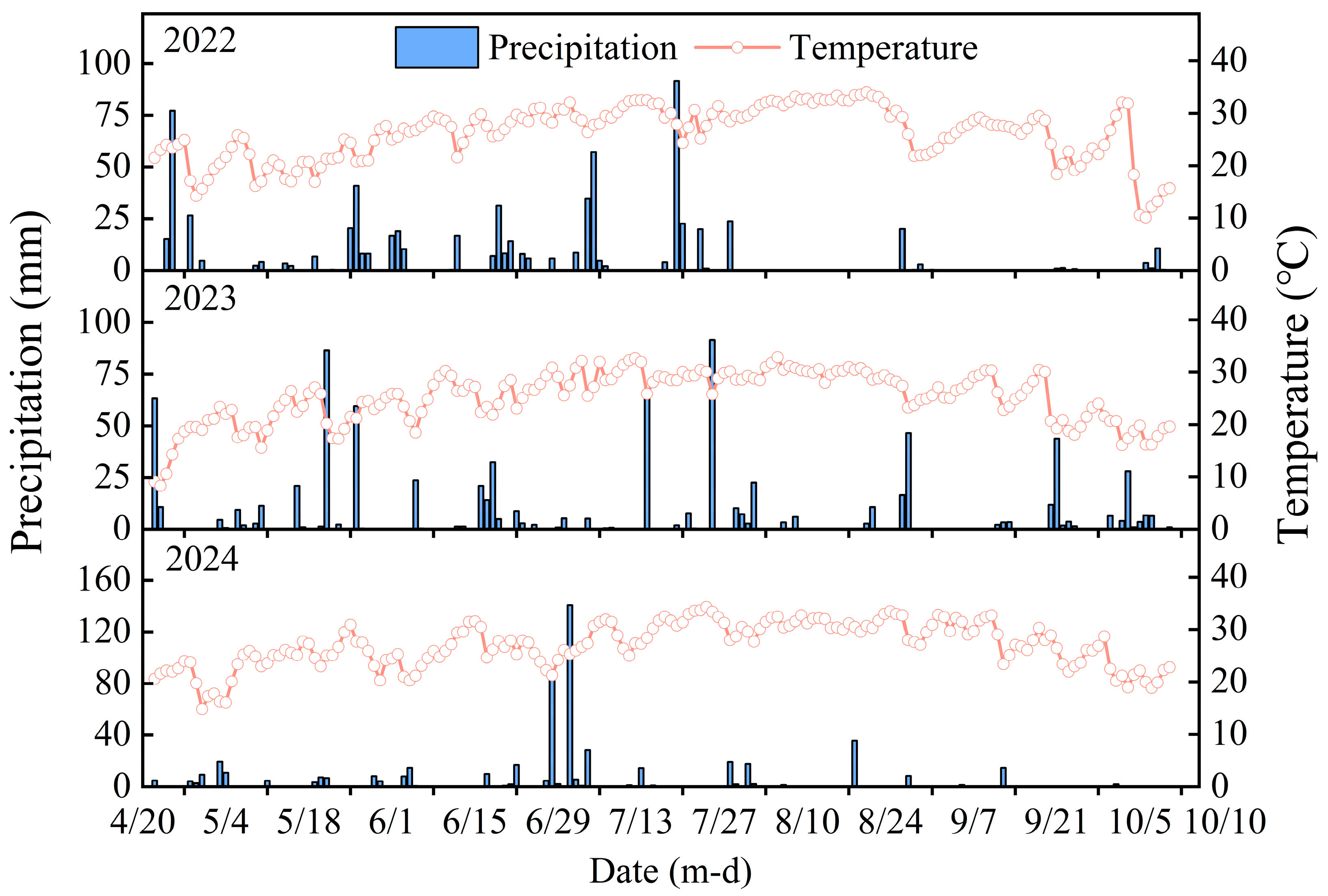
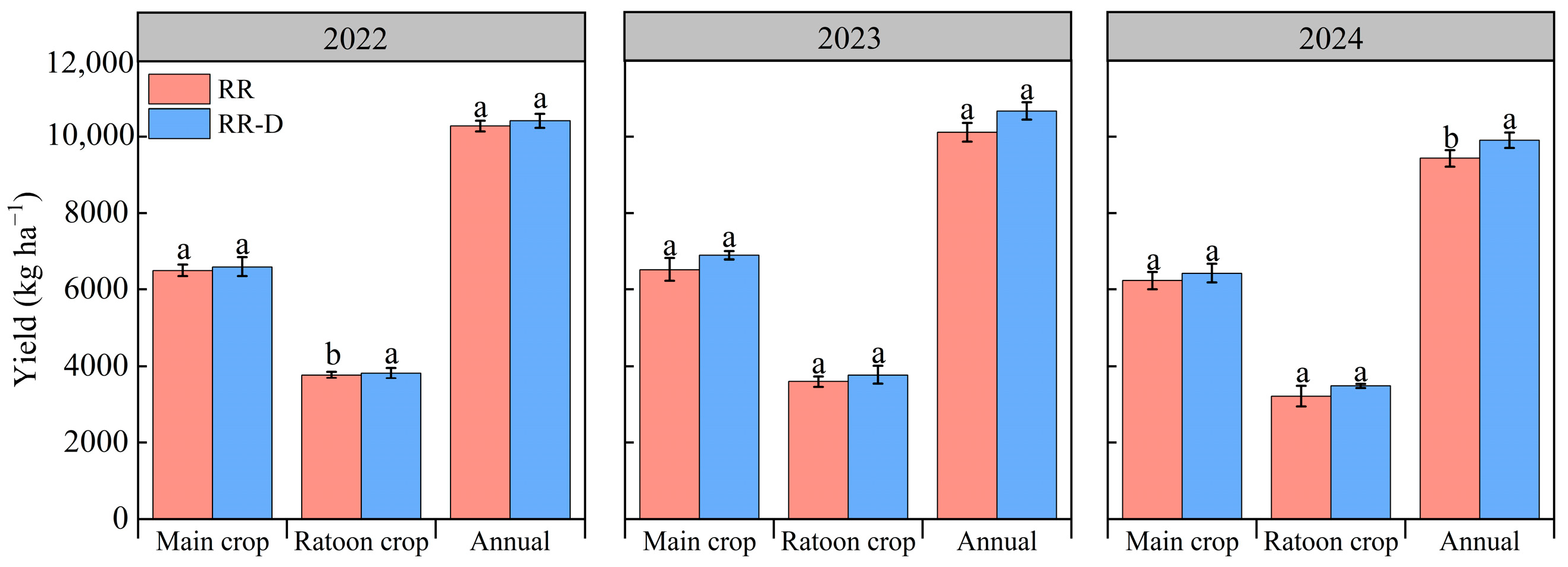
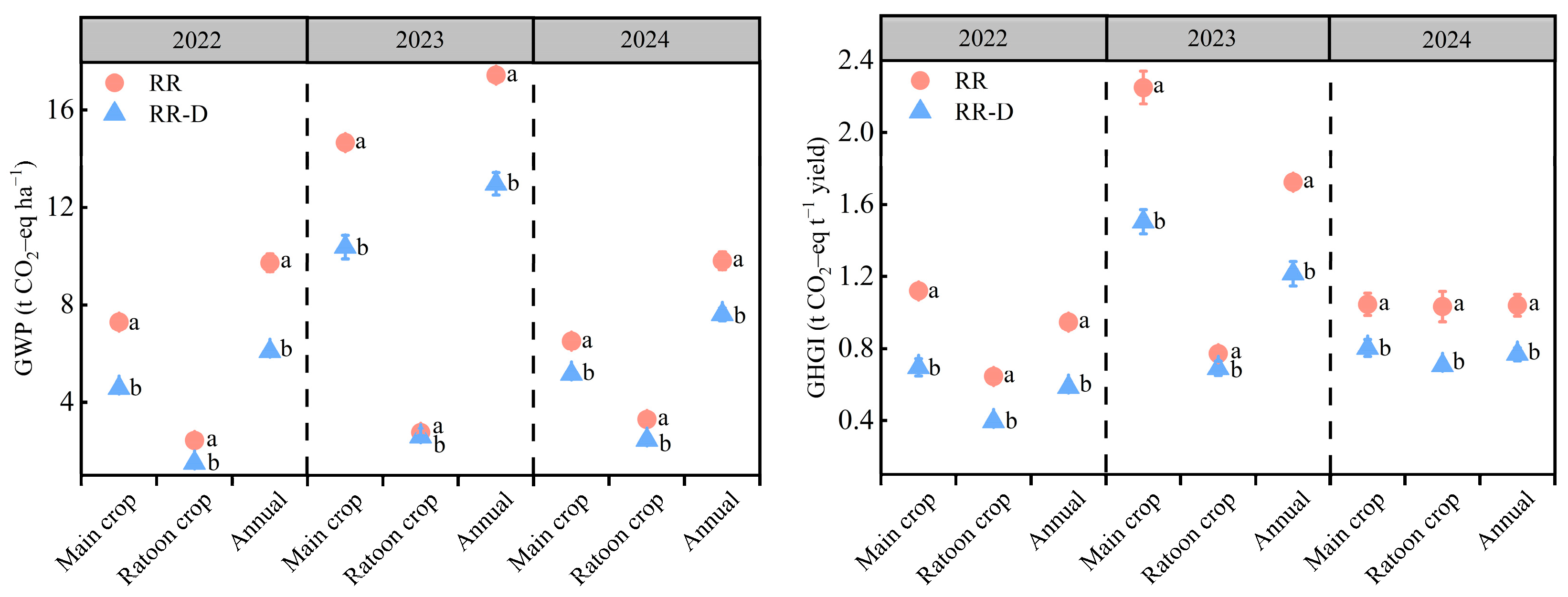
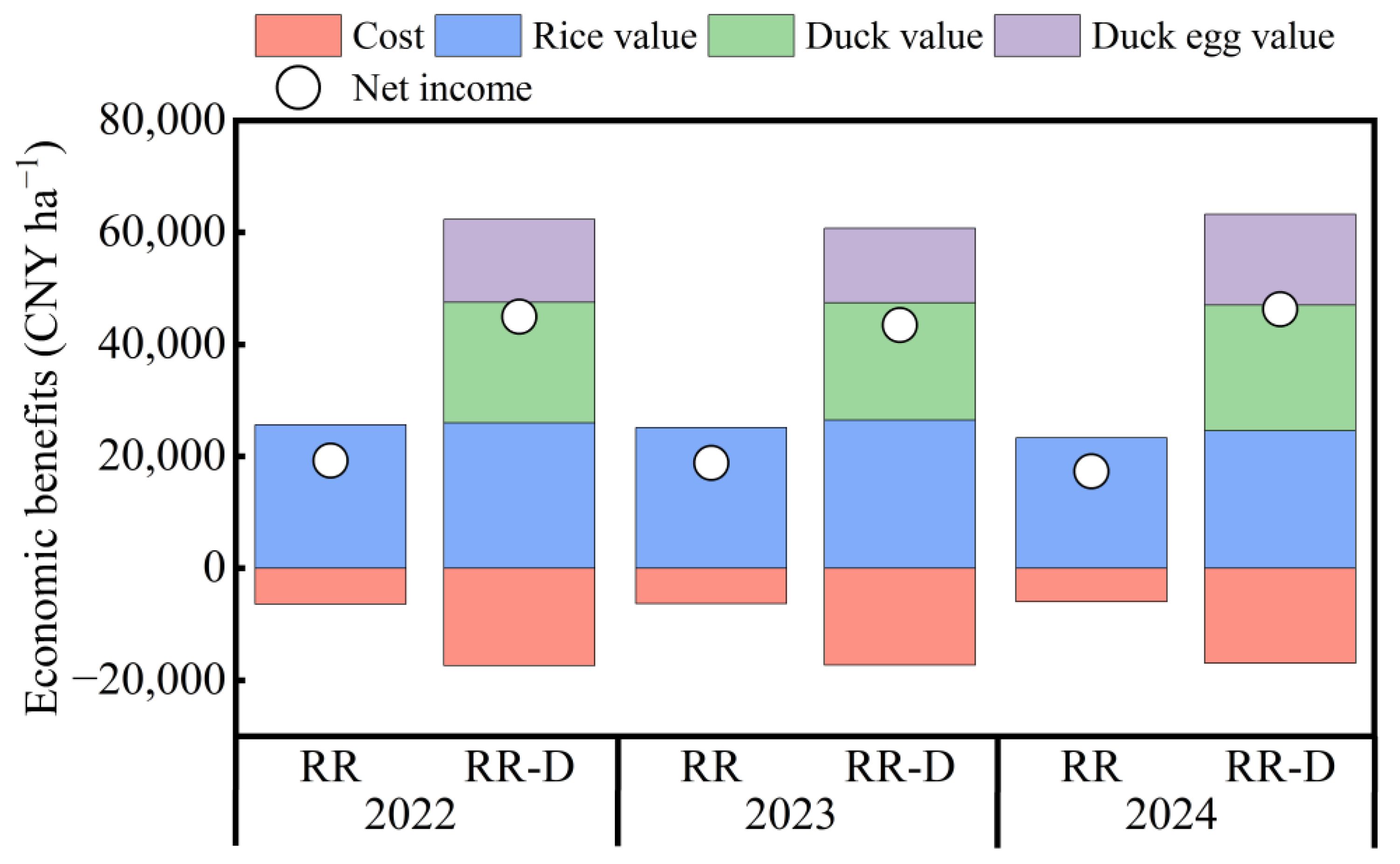
Assessment of Greenhouse Gas Emissions, Economic Benefits, and Emergy-Based Sustainability in Ratoon Rice–Duck Coculture in the Jianghan Plain
 ,
, 
Abstract
1. Introduction
2. Materials and Methods
2.1. Experimental Site
2.2. Experimental Design
2.3. Yield Measurement
2.4. Gas Collection and Analysis
2.5. Emergy Analysis
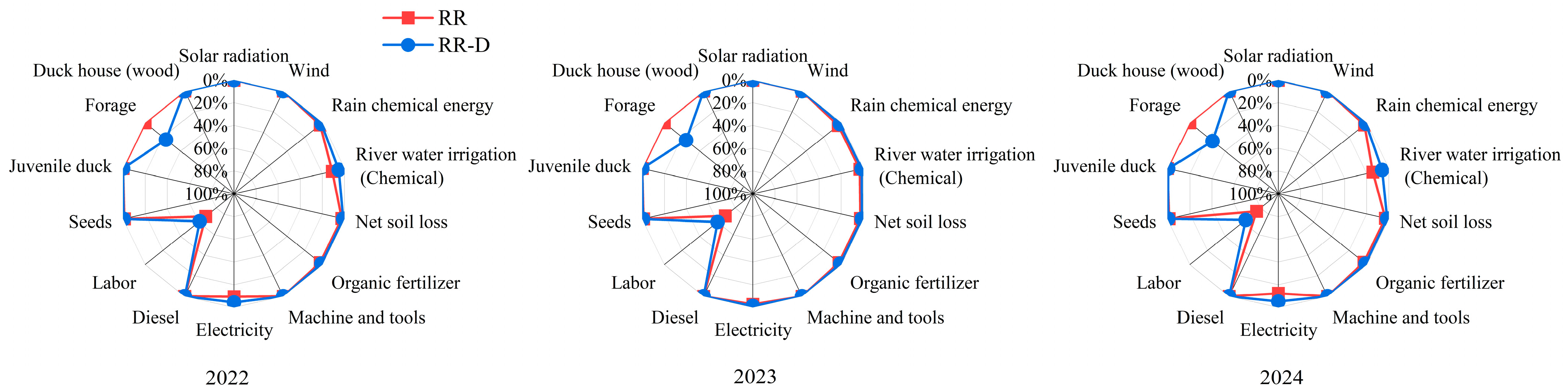
- Free local renewable resources (LR), including solar radiation, wind energy, rain chemical energy, and river water irrigation (chemical energy). Solar radiation, wind energy, and rain chemical energy data were obtained from the local meteorological station adjacent to the experimental site. Total irrigation water was diverted from external rivers and measured by volumetric water meters, with no overlapping calculation with the chemical energy of rainfall. All parameters were calculated according to the formulae specified in the EMA (Emergy Analysis) methodology.
- Free local non-renewable resources (LN), mainly referring to net soil loss.
- Economic imported resources (F), including organic fertilizer, machines and tools, electricity, diesel, labor, rice seeds, juvenile duck, forage, and duck house (wood). All input quantities are derived from 3-year field management records.
- Renewable economic imported resources (FR) refers to the renewable proportion of economic imported resources (F). It is calculated via standardized renewable natural factors (RNF) summarized from published literature [16,18,19], which are universally acknowledged standard parameters for emergy research in rice agroecosystems.
- Non-renewable fraction of economic imported resources (FN): Non-renewable proportion of economic imported resources (F).
- Total emergy input (U): Sum of LR, LN, and F, representing the total emergy input of the agricultural system. U is directly computed from measured field inputs without hypothetical assumptions.
- Renewable emergy ratio (%R)
- 2.
- Emergy yield ratio (EYR)
- 3.
- Environmental loading ratio (ELR)
- 4.
- Emergy sustainability index (ESI)
- 5.
- Unit emergy value per economic benefit (UEVBenefits)
2.6. Statistical Analysis
3. Results
3.1. Yield
3.2. Greenhouse Gas Cumulative Emissions
3.3. Global Warming Potential and Greenhouse Gas Emission Intensity
3.4. Economic Benefits
3.5. Emergy Input Structure
3.6. Emergy Sustainability Indices
4. Discussion
4.1. Effects of Two Systems on Greenhouse Gas Emissions
4.2. Effects of Two Systems on Economic Benefits
4.3. Effects of Two Systems on Sustainability and Future Development Strategy
5. Conclusions
Supplementary Materials
Author Contributions
Funding
Data Availability Statement
Conflicts of Interest
References
- He, A.B.; Wang, W.Q.; Jiang, G.L.; Sun, H.J.; Jiang, M.; Man, J.G.; Gui, K.H.; Huang, J.L.; Peng, S.B.; Nie, L.X. Source-sink regulation and its effects on the regeneration ability of ratoon rice. Field Crops Res. 2019, 236, 155–164. [Google Scholar] [CrossRef]
- Zhou, Y.J.; Ji, Y.L.; Zhang, M.; Xu, Y.Z.; Li, Z.; Tu, D.B.; Wu, W.G. Exploring a sustainable rice-cropping system to balance grain yield, environmental footprint and economic benefits in the middle and lower reaches of the Yangtze River in China. J. Clean. Prod. 2023, 404, 136988. [Google Scholar] [CrossRef]
- Ding, Z.J.; Hu, R.; Cao, Y.X.; Li, J.T.; Xiao, D.K.; Hou, J.; Wang, X.X. Integrated assessment of yield, nitrogen use efficiency and ecosystem economic benefits of use of controlled-release and common urea in ratoon rice production. J. Integr. Agric. 2024, 23, 3186–3199. [Google Scholar] [CrossRef]
- Zhou, Y.; Liu, K.; Harrison, M.T.; Fahad, S.; Gong, S.L.; Zhu, B.; Liu, Z.Y. Shifting rice cropping systems mitigates ecological footprints and enhances grain yield in central China. Front. Plant Sci. 2022, 13, 895402. [Google Scholar] [CrossRef] [PubMed]
- Xu, Q.; Wang, X.L.; Xiao, B.; Hu, K.L. Rice-crab coculture to sustain cleaner food production in Liaohe River Basin, China: An economic and environmental assessment. J. Clean. Prod. 2019, 208, 188–198. [Google Scholar] [CrossRef]
- Zhou, Y.; Harrison, M.T.; Liu, K.; Xiao, L.; Zhu, J.; Wang, M.; Li, H.X.; Yao, G.X.; Liu, J.; Zhu, B.; et al. Field distribution characteristics and influencing factors of crayfish in ricecrayfish integrative system. Aquaculture 2023, 571, 739456. [Google Scholar] [CrossRef]
- Yu, H.Y.; Zhang, X.C.; Shen, W.Y.; Yao, H.Y.; Meng, X.T.; Zeng, J.Y.; Zhang, G.B.; Zamanien, K. A meta-analysis of ecological functions and economic benefits of co-culture models in paddy fields. Agric. Ecosyst. Environ. 2023, 341, 108195. [Google Scholar] [CrossRef]
- Du, C.C.; Hu, L.L.; Yuan, S.; Xu, L.; Wang, W.B.; Cui, K.H.; Peng, S.B.; Huang, J.L. Ratoon rice-duck co-culture maintains rice grain yield and decreases greenhouse gas emissions in central China. Eur. J. Agron. 2023, 149, 126911. [Google Scholar] [CrossRef]
- Gao, P.L.; Wang, H.Y.; Sun, G.J.; Xu, Q.; Dou, Z.; Dong, E.J.; Wu, W.G.; Dai, Q.G. Integrated emergy and economic evaluation of the dominant organic rice production systems in Jiangsu province, China. Front. Plant Sci. 2023, 14, 1107880. [Google Scholar] [CrossRef]
- Du, C.C.; Yang, D.S.; Hu, L.L.; Zhu, J.J.; Wang, W.B.; Zhao, W.L.; Peng, S.B.; Yuan, S.; Huang, J.L. Feeding ducks in ratoon rice field reduces weed competition with ratoon rice in central China. Field Crops Res. 2025, 334, 110147. [Google Scholar] [CrossRef]
- Huo, W.R.; Weng, K.Q.; Gu, T.T.; Luo, X.; Zhang, Y.; Zhang, Y.; Xu, Q.; Chen, G.H. Effects of integrated rice-duck farming system on duck carcass traits, meat quality, amino acid, and fatty acid composition. Poult. Sci. 2021, 100, 101107. [Google Scholar] [CrossRef]
- Suh, J. Theory and reality of integrated rice–duck farming in Asian developing countries: A systematic review and SWOT analysis. Agric. Syst. 2014, 125, 74–81. [Google Scholar] [CrossRef]
- Yang, C.R.; Han, N.; Liu, M.T.; Wei, C.H.; Mao, R.L.; Chen, C.Q. Effects of long-term different-scale rice-duck farming on the growth and yield of paddy rice. J. Sci. Food Agric. 2024, 104, 3729–3735. [Google Scholar] [CrossRef]
- Fonseca, A.M.P.; Marques, C.A.F.; Pinto-Correia, T.; Guiomar, N.; Campbell, D.E. Emergy evaluation for decision-making in complex multifunctional farming systems. Agric. Syst. 2019, 171, 1–12. [Google Scholar] [CrossRef] [PubMed]
- Kim, Y.; Lee, M.; Hong, J.; Lee, Y.S.; Wee, J.; Lee, W.K.; Kraxner, F.; Cho, K. Emergy-based sustainability assessment of the rice cropping system under scaled-down intensification: Insights from a case study on South Korea (2003–2021). J. Clean. Prod. 2025, 525, 146553. [Google Scholar] [CrossRef]
- Ding, Z.J.; Hu, R.; Styles, D.; Wang, X.L.; Tian, Y.B.; Cao, Y.X.; Hou, J. Optimized ratoon rice system to sustain cleaner food production in Jianghan Plain, China: A comprehensive emergy assessment. Environ. Sci. Pollut. Res. 2022, 29, 24639–24650. [Google Scholar] [CrossRef] [PubMed]
- Jin, Z.Q.; Zhang, B.Y.; Chen, Q.Q.; Chen, M.L.; Duan, S.F.; Luo, Y.Y.; Yan, S.B.; Li, X.S.; Matthew, T.H.; Shi, S.J.; et al. Comprehensive evaluation of sustainability of dry direct-seeded, wet direct-seeded, and transplanted rice-wheat rotation systems in the middle and lower reaches of the Yangtze river based on emergy analysis. Field Crops Res. 2026, 337, 110260. [Google Scholar] [CrossRef]
- Ulgiati, S.; Brown, M.T. Emergy and ecosystem complexity. Commun. Nonlinear Sci. Numer. Simul. 2009, 14, 310–321. [Google Scholar] [CrossRef]
- Zhou, Y.; Yan, X.Y.; Gong, S.L.; Li, C.W.; Zhu, R.; Zhu, B.; Liu, Z.Y.; Wang, X.L.; Cao, P. Changes in paddy cropping system enhanced economic profit and ecological sustainability in central China. J. Integr. Agric. 2022, 21, 566–577. [Google Scholar] [CrossRef]
- Li, J.; Liu, H.M.; Yang, D.L.; Zhang, G.L. Emergy Evaluation of three Rice Wetland Farming Systems in the Taihu Lake Catchment of China. Wetlands 2017, 38, 1121–1132. [Google Scholar] [CrossRef]
- Thavaprakaash, N. Rice-duck integrated systems enhanced production of organic rice and ducks, and improved soil and plant nutrient dynamics. Biol. Agric. Hortic. 2026, 42, 68–86. [Google Scholar] [CrossRef]
- IPCC. Climate Change 2021: The Physical Science Basis. Contribution of Working Group I to the Sixth Assessment Report of the Intergovernmental Panel on Climate Change; Masson-Delmotte, V., Zhai, P., Pirani, A., Connors, S.L., Péan, C., Berger, S., Caud, N., Chen, Y., Goldfarb, L., Gomis, M.I., et al., Eds.; Cambridge University Press: Cambridge, UK; New York, NY, USA, 2021. [Google Scholar] [CrossRef]
- Odum, H.T. Emergy in ecosystems. In Ecosystem Theory and Application; Polunin, N., Ed.; John Wiley and Sons: New York, NY, USA, 1986. [Google Scholar]
- Brown, M.T.; Ulgiati, S. Energy quality, emergy, and transformity: H.T. Odum’s contributions to quantifying and understanding systems. Ecol. Model. 2004, 178, 201–213. [Google Scholar] [CrossRef]
- Aulakh, M.S.; Bodenbender, J.; Wassmann, R.; Rennenberg, H. Methane transport capacity of rice plants. II. Variations among different rice cultivars and relationship with morphological characteristics. Nutr. Cycl. Agroecosyst. 2000, 58, 367–375. [Google Scholar] [CrossRef]
- Xu, G.; Liu, X.; Wang, Q.; Yu, X.; Hang, Y. Integrated rice-duck farming mitigates the global warming potential in rice season. Sci. Total Environ. 2017, 575, 58–66. [Google Scholar] [CrossRef]
- Sheng, F.; Cao, C.; Li, C. Integrated rice-duck farming decreases global warming potential and increases net ecosystem economic budget in central China. Environ. Sci. Pollut. Res. 2018, 25, 22744–22753. [Google Scholar] [CrossRef]
- Wei, H.; Bai, W.; Zhang, J.; Chen, R.; Xiang, H.; Quan, G. Integrated rice-duck farming decreases soil seed bank and weed density in a paddy field. Agronomy 2019, 9, 259. [Google Scholar] [CrossRef]
- Sun, G.; Sun, M.; Du, L.; Zhang, Z.; Wang, Z.; Zhang, G.; Nie, S.; Xu, H.; Wang, H. Ecological rice-cropping systems mitigate global warming–a meta-analysis. Sci. Total Environ. 2021, 789, 147900. [Google Scholar] [CrossRef]
- Das, S.; Adhya, T.K. Effect of combine application of organic manure and inorganic fertilizer on methane and nitrous oxide emissions from a tropical flooded soil planted to rice. Geoderma 2014, 213, 185–192. [Google Scholar] [CrossRef]
- Yang, B.; Ma, Y.; Zhang, C.; Jia, Y.; Li, B.; Zheng, X. Cleaner production technologies increased economic benefits and greenhouse gas intensity in an eco-rice system in China. Sustainability 2019, 11, 7090. [Google Scholar] [CrossRef]
- Mosier, A.R.; Halvorson, A.D.; Reule, C.A.; Liu, X.J. Net Global Warming Potential and Greenhouse Gas Intensity in Irrigated Cropping Systems in Northeastern Colorado. J. Environ. Qual. 2006, 35, 1584–1598. [Google Scholar] [CrossRef]
- Khumairoh, U.; Lantinga, E.A.; Handriyadi, I.; Schulte, R.P.O.; Groot, J.C.J. Agro-ecological mechanisms for weed and pest suppression and nutrient recycling in high yielding complex rice systems. Agric. Ecosyst. Environ. 2021, 313, 107385. [Google Scholar] [CrossRef]
- Fu, H.; Li, N.; Cheng, Q.Y.; Liao, Q.; Nie, J.X.; Yin, H.L.; Shu, C.H.; Li, L.L.; Wang, Z.L.; Sun, Y.J.; et al. Energy, environmental, and economic benefits of integrated paddy field farming. Energy 2024, 297, 131251. [Google Scholar] [CrossRef]
- Bhattacharyya, P.; Sinhababu, D.P.; Roy, K.S.; Dash, P.K.; Sahu, P.K.; Dandapat, R.; Neogi, S.; Mohanty, S. Effect of fish species on methane and nitrous oxide emission in relation to soil C, N pools and enzymatic activities in minted shallow lowland rice-fish farming system. Agric. Ecosyst. Environ. 2013, 176, 53–62. [Google Scholar] [CrossRef]
- Zhang, L.X.; Ulgiati, S.; Yang, Z.F.; Chen, B. Emergy evaluation and economic analysis of three wetland fish farming systems in Nansi Lake area, China. J. Environ. Manag. 2011, 92, 683–694. [Google Scholar] [CrossRef] [PubMed]
- Xi, Y.G.; Qin, P. Emergy evaluation of organic rice-duck mutualism system. Ecol. Eng. 2009, 32, 1677–1683. [Google Scholar] [CrossRef]



| Year | Treatment | Main Crop | Ratoon Crop | Annual Total | |||
|---|---|---|---|---|---|---|---|
| CH4 | N2O | CH4 | N2O | CH4 | N2O | ||
| 2022 | RR | 263.80 ± 11.52 a | 0.61 ± 0.03 b | 87.83 ± 3.09 a | 0.23 ± 0.01 b | 351.62 ± 13.63 a | 0.84 ± 0.04 b |
| RR-D | 160.71 ± 5.90 b | 0.87 ± 0.02 a | 52.03 ± 2.86 b | 0.38 ± 0.02 a | 212.74 ± 4.01 b | 1.26 ± 0.04 a | |
| 2023 | RR | 528.41 ± 3.23 a | 1.47 ± 0.09 b | 97.37 ± 2.52 a | 0.51 ± 0.02 b | 625.78 ± 0.71 a | 1.98 ± 0.10 b |
| RR-D | 367.63 ± 17.89 b | 1.66 ± 0.02 a | 89.17 ± 1.17 b | 0.69 ± 0.01 a | 456.80 ± 17.23 b | 2.35 ± 0.04 a | |
| 2024 | RR | 236.20 ± 7.64 a | 0.47 ± 0.00 b | 118.73 ± 6.44 a | 0.34 ± 0.01 b | 354.92 ± 13.40 a | 0.81 ± 0.01 b |
| RR-D | 178.79 ± 6.32 b | 1.21 ± 0.00 a | 84.83 ± 3.58 b | 0.59 ± 0.01 a | 263.62 ± 9.65 b | 1.80 ± 0.01 a | |
| F value | Treatment (T) | 1141.43 *** | 775.82 *** | 122.84 *** | 580.49 *** | 945.98 *** | 881.12 *** |
| Year (Y) | 519.17 *** | 445.04 *** | 228.40 *** | 779.60 *** | 619.24 *** | 670.90 *** | |
| T × Y | 40.50 *** | 83.11 *** | 26.82 *** | 17.53 *** | 17.89 *** | 75.20 *** | |
| Year | Treatment | Output Value | Cost | |||||||||
|---|---|---|---|---|---|---|---|---|---|---|---|---|
| Rice Value | Duck Value | Duck Egg Value | Juvenile Duck Cost | Seedling Cost | Fertilization Labor | Daily Field Management | Duck Farming Labor | Organic Fertilizer | Forage | Electricity | ||
| 2022 | RR | 25,630 | - | - | - | 3300 | 750 | 300 | - | 1800 | - | 181 |
| RR-D | 25,972 | 21,600 | 14,750 | 833 | 3300 | 750 | 500 | 2341 | 1800 | 7612 | 181 | |
| 2023 | RR | 25,125 | - | - | - | 3300 | 750 | 280 | - | 1800 | - | 169 |
| RR-D | 26,495 | 21,000 | 13,275 | 833 | 3300 | 750 | 480 | 2341 | 1800 | 7612 | 169 | |
| 2024 | RR | 23,323 | - | - | - | 3300 | 750 | 80 | - | 1800 | - | 48 |
| RR-D | 24,573 | 22,500 | 16,225 | 833 | 3300 | 750 | 280 | 2341 | 1800 | 7612 | 48 | |
| Item | RNF a | 2022 Emergy (sej ha−1) | 2023 Emergy (sej ha−1) | 2024 Emergy (sej ha−1) | |||
|---|---|---|---|---|---|---|---|
| RR | RR-D | RR | RR-D | RR | RR-D | ||
| Free local renewable resources (LR) | |||||||
| 1. Solar radiation | 1 | 1.15 × 10¹³ | 1.15 × 10¹³ | 9.37 × 10¹² | 9.37 × 10¹² | 1.14 × 10¹³ | 1.14 × 10¹³ |
| 2. Wind | 1 | 2.71 × 10¹² | 2.71 × 10¹² | 7.01 × 10¹² | 7.01 × 10¹² | 1.06 × 10¹³ | 1.06 × 10¹³ |
| 3. Rain chemical energy | 1 | 2.33 × 10¹⁴ | 2.33 × 10¹⁴ | 2.86 × 10¹⁴ | 2.86 × 10¹⁴ | 1.85 × 10¹⁴ | 1.85 × 10¹⁴ |
| 4. River water irrigation (Chemical) | 1 | 8.97 × 10¹⁴ | 8.97 × 10¹⁴ | 2.57 × 10¹⁴ | 2.57 × 10¹⁴ | 9.62 × 10¹⁴ | 9.62 × 10¹⁴ |
| Free local non-renewable resources (LN) | |||||||
| 5. Net soil loss | 0 | 2.07 × 10¹⁴ | 2.07 × 10¹⁴ | 2.11 × 10¹⁴ | 2.16 × 10¹⁴ | 2.14 × 10¹⁴ | 2.14 × 10¹⁴ |
| Economic imported resources (F) | |||||||
| 6. Organic fertilizer | 0 | 2.32 × 10¹⁴ | 2.32 × 10¹⁴ | 2.32 × 10¹⁴ | 2.32 × 10¹⁴ | 2.32 × 10¹⁴ | 2.32 × 10¹⁴ |
| 7. Machine and tools | 0 | 2.81 × 10¹² | 2.81 × 10¹² | 2.81 × 10¹² | 2.81 × 10¹² | 2.81 × 10¹² | 2.81 × 10¹² |
| 8. Electricity | 0.09 | 7.69 × 10¹⁴ | 7.69 × 10¹⁴ | 2.20 × 10¹⁴ | 2.20 × 10¹⁴ | 8.22 × 10¹⁴ | 8.22 × 10¹⁴ |
| 9. Diesel | 0 | 2.75 × 10⁹ | 2.75 × 10⁹ | 2.75 × 10⁹ | 2.75 × 10⁹ | 2.75 × 10⁹ | 2.75 × 10⁹ |
| 10. Labor | 0.6 | 5.48 × 10¹⁵ | 1.05 × 10¹⁶ | 5.48 × 10¹⁵ | 9.96 × 10¹⁵ | 4.98 × 10¹⁵ | 9.96 × 10¹⁵ |
| 11. Seeds | 1 | 9.33 × 10¹³ | 9.33 × 10¹³ | 9.33 × 10¹³ | 9.33 × 10¹³ | 9.33 × 10¹³ | 9.33 × 10¹³ |
| 12. Juvenile duck | 0 | – | 4.46 × 10¹¹ | – | 4.46 × 10¹¹ | – | 4.46 × 10¹¹ |
| 13. Forage | 0 | – | 4.07 × 10¹⁵ | – | 4.07 × 10¹⁵ | – | 4.07 × 10¹⁵ |
| 14. Duck house (wood) | 1 | – | 1.93 × 10¹³ | – | 1.93 × 10¹³ | – | 1.93 × 10¹³ |
| Emergy flows | |||||||
| Free local renewable resources (LR) | 1.14 × 10¹⁵ | 1.14 × 10¹⁵ | 5.59 × 10¹⁴ | 5.59 × 10¹⁴ | 1.17 × 10¹⁵ | 1.17 × 10¹⁵ | |
| Free local non-renewable resources (LN) | 2.07 × 10¹⁴ | 2.07 × 10¹⁴ | 2.11 × 10¹⁴ | 2.16 × 10¹⁴ | 2.14 × 10¹⁴ | 2.27 × 10¹⁴ | |
| Economic imported resources (F) | 6.58 × 10¹⁵ | 1.57 × 10¹⁶ | 6.03 × 10¹⁵ | 1.46 × 10¹⁶ | 6.13 × 10¹⁵ | 1.52 × 10¹⁶ | |
| Renewable fraction of purchased inputs (FR) | 3.45 × 10¹⁵ | 6.48 × 10¹⁵ | 3.40 × 10¹⁵ | 6.11 × 10¹⁵ | 3.16 × 10¹⁵ | 6.16 × 10¹⁵ | |
| Non-renewable fraction of purchased inputs (FN) | 3.13 × 10¹⁵ | 9.21 × 10¹⁵ | 2.63 × 10¹⁵ | 8.49 × 10¹⁵ | 2.97 × 10¹⁵ | 9.04 × 10¹⁵ | |
| Renewable emergy flows (LR + FR) | 4.59 × 10¹⁵ | 7.63 × 10¹⁵ | 3.96 × 10¹⁵ | 6.67 × 10¹⁵ | 4.32 × 10¹⁵ | 7.33 × 10¹⁵ | |
| Non-renewable emergy flows (LN + FN) | 3.33 × 10¹⁵ | 9.41 × 10¹⁵ | 2.84 × 10¹⁵ | 8.71 × 10¹⁵ | 3.19 × 10¹⁵ | 9.26 × 10¹⁵ | |
| Total emergy input (U) | 7.93 × 10¹⁵ | 1.70 × 10¹⁶ | 6.80 × 10¹⁵ | 1.54 × 10¹⁶ | 7.51 × 10¹⁵ | 1.66 × 10¹⁶ | |
| Index | 2022 | 2023 | 2024 | |||
|---|---|---|---|---|---|---|
| RR | RR-D | RR | RR-D | RR | RR-D | |
| UEVBenefits | 4.11 × 10¹¹ | 3.79 × 10¹¹ | 3.61 × 10¹¹ | 3.54× 10¹¹ | 4.33 × 10¹¹ | 3.58 × 10¹¹ |
| %R | 57.95 | 44.76 | 58.26 | 43.37 | 57.56 | 44.18 |
| EYR | 1.21 | 1.09 | 1.13 | 1.05 | 1.23 | 1.09 |
| ELR | 0.73 | 1.23 | 0.72 | 1.31 | 0.74 | 1.26 |
| ESI | 1.66 | 0.88 | 1.57 | 0.81 | 1.66 | 0.86 |
Disclaimer/Publisher’s Note: The statements, opinions and data contained in all publications are solely those of the individual author(s) and contributor(s) and not of MDPI and/or the editor(s). MDPI and/or the editor(s) disclaim responsibility for any injury to people or property resulting from any ideas, methods, instructions or products referred to in the content. |
© 2026 by the authors. Licensee MDPI, Basel, Switzerland. This article is an open access article distributed under the terms and conditions of the Creative Commons Attribution (CC BY) license.
Share and Cite
Zhou, Y.; Li, C.; Wang, W.; Zhang, Z.; Luo, Q.; Nie, J.; Zhu, B.; Liu, Z.; Ding, Z. Assessment of Greenhouse Gas Emissions, Economic Benefits, and Emergy-Based Sustainability in Ratoon Rice–Duck Coculture in the Jianghan Plain. Agriculture 2026, 16, 1172. https://doi.org/10.3390/agriculture16111172
Zhou Y, Li C, Wang W, Zhang Z, Luo Q, Nie J, Zhu B, Liu Z, Ding Z. Assessment of Greenhouse Gas Emissions, Economic Benefits, and Emergy-Based Sustainability in Ratoon Rice–Duck Coculture in the Jianghan Plain. Agriculture. 2026; 16(11):1172. https://doi.org/10.3390/agriculture16111172
Chicago/Turabian StyleZhou, Yong, Changchun Li, Wenjian Wang, Zuolin Zhang, Qiao Luo, Jiangwen Nie, Bo Zhu, Zhangyong Liu, and Zijuan Ding. 2026. "Assessment of Greenhouse Gas Emissions, Economic Benefits, and Emergy-Based Sustainability in Ratoon Rice–Duck Coculture in the Jianghan Plain" Agriculture 16, no. 11: 1172. https://doi.org/10.3390/agriculture16111172
APA StyleZhou, Y., Li, C., Wang, W., Zhang, Z., Luo, Q., Nie, J., Zhu, B., Liu, Z., & Ding, Z. (2026). Assessment of Greenhouse Gas Emissions, Economic Benefits, and Emergy-Based Sustainability in Ratoon Rice–Duck Coculture in the Jianghan Plain. Agriculture, 16(11), 1172. https://doi.org/10.3390/agriculture16111172