3. Materials and Methods
The agrotechnical data were established through structured interviews with an agronomist specializing in agricultural production systems in Romania, conducted in February 2026. Input parameters—including fertilizer rates, fuel consumption, pesticide applications, yields, and irrigation requirements—were established as representative values for intensive agricultural production in Romania, validated by comparison with national agricultural statistics (MADR) and FAOSTAT data, and do not represent data collected from a specific field experiment or a particular growing season.
The analyzed system covers a total area of 300 ha, structured around nine crops representative of intensive field production: non-irrigated wheat, irrigated wheat, irrigated barley, potatoes, sugar beets, non-irrigated rapeseed, irrigated rapeseed, irrigated corn, and sunflowers. Four agricultural management scenarios (MP{1,2,3,4}) are defined: (1) conventional intensive, (2) conventional moderate, (3) conservation agriculture, and (4) organic agriculture. The organic scenario (m = 4) is characterized by complete substitution of synthetic inputs with organic alternatives: synthetic nitrogen is replaced with composted animal manure and green manure from legume cover crops; synthetic pesticides are replaced with integrated pest management (IPM) combining biological control agents (predatory insects, parasitoids), cultural practices (diversified rotations), and mechanical weed control. Yield parameters for m = 4 reflect the combined effects of organic nutrient supply rates and biological pest control efficacy under Romanian agronomic conditions. The selection of these nine crops reflects the dominant species in Romania’s intensive field crop production, accounting for the majority of cultivated land in the country’s main agricultural regions, according to statistics from the Ministry of Agriculture and Rural Development (MADR) and FAOSTAT. The three soil types—chernozem, sandy, and clayey/loamy—represent the predominant soil units of the Romanian Plain, where intensive agricultural production is concentrated. The four management scenarios were designed to cover the entire spectrum of current and targeted agricultural practices in Romania, ranging from intensive conventional systems to organic production, in line with the objectives of the EU’s Farm to Fork Strategy.
The agrotechnical data were structured using a stratified scenario-building approach, in which soil type served as the stratification criterion. Unlike statistical sampling from field observations, this approach involves the systematic assignment of representative agronomic parameters to each crop–soil combination, based on expert knowledge. For each crop, three soil strata were defined, with areas differentiated according to the specific distribution of soil types characteristic of Romania’s intensive agricultural production regions. Each stratum includes three observations (records of inputs and yield), totaling nine observations per crop. The distribution of areas by soil type for each crop is shown in
Table 2.
The carbon footprint was quantified using the life cycle assessment (LCA) methodology, in accordance with ISO 14040 and ISO 14044 standards. The approach adopted is a “cradle-to-farm gate” approach, including all emission flows associated with the production and transport of agricultural inputs, mechanized operations at the farm level, and direct emissions from the field. The functional unit used in this study is one ton of the main product delivered to the farm gate (kg CO2eq/ton). Excluded from the system boundaries are post-farm processing, transport to processors, the construction and maintenance of agricultural infrastructure, and emissions associated with labor.
The emission factors used to convert inputs into CO
2 equivalents are derived from the EcoInvent 3.8 database and are presented in
Table 3.
Direct emissions from the soil were calculated based on the 2019 IPCC parameters: -αN2O = 0.01—Direct N2O emission factor (1% of applied N), βvolatilization = 0.15—Fraction of N volatilized as NH3/NOₓ, γleach = 0.25—Fraction of N leached as NO3, EFindirect = 0.01—Indirect N2O emission factor, GWPN2O = 273—Global Warming Potential for N2O (100-year horizon, IPCC AR6).
Total carbon footprint per layer is calculated as follows:
where total emissions are
Direct N
2O emissions from the soil are calculated in accordance with IPCC Tier 1 (2019):
where
Ncst—Applied nitrogen [kg N/ha];
αN2O—0.01 (1% of applied nitrogen is converted to N2O according to IPCC Tier 1);
44/28—Molecular ratio for converting N-N2O to molecular N2O;
GWPN2O = 273 (Global Warming Potential for N2O, 100-year horizon, IPCC AR6).
Emissions were allocated between the main product and marketable by-products (straw, bran, cake, husks, etc.) using the LCA methodology in accordance with ISO 14044 recommendations, while also considering residue management (incorporation into the soil or baling).
The model uses data from the life cycle assessment (LCA) for 9 crops and multiple soil layers to identify the optimal mix of crops and management practices to simultaneously minimize the carbon footprint, maximize productivity, and comply with agronomic and economic constraints.
Sets:
C = {1, 2, …, 9}—The set of crops (non-irrigated wheat, irrigated wheat, barley, potatoes, etc.);
S = {1, 2, …, 3}—The set of soil types (chernozem, sandy, loamy-clay);
T ={1, 2, …, Ncs}—The set of layers for each crop–soil pair (c,s);
M = {1, 2, 3, 4}—The set of management scenarios:
- 1: Intensive conventional;
- 2: Moderate conventional;
- 3: Conservation agriculture;
- 4: Econological/Organic.
Indices:
- c in C—Index for crop;
- s in S—Index for soil type;
- t in T—Index for layer (intensity level);
- m in M—Index for management scenario.
PRIMARY VARIABLES:
• xcstm ∈ [0, 1] ⊂ ℝ (CONTINUOUS)
Definition: Fractional allocation of soil type s to crop c, layer t, management m.
Interpretation: xcstm = 0.35 means 35% of available area as allocated.
Domain: Non-negative real numbers bounded by unity.
Feasible region: Defined by constraints C1–C11.
AUXILIARY VARIABLES (Goal Programming Deviations):
• di−, di+ ∈ ℝ+ (CONTINUOUS, NON-NEGATIVE)
Definition: Underachievement (di−) and overachievement (di+) of goal i.
Complementarity: For optimal solutions, di−·di+ = 0 (at most one is non-zero).
Dimension: i ∈ {1, 2, …, 8} (eight objectives).
BINARY VARIABLES (Biodiversity Constraint C8):
• yc ∈ {0, 1} (BINARY)
Definition: Crop presence indicator.
yc = 1 if crop c is cultivated (∑s ∑t ∑m xcstm > 0).
yc = 0 if crop c is absent from rotation.
Purpose: Enforce minimum crop diversity (Dmin ≥ 3).
Objective Functions
The Goal Programming model minimizes the weighted deviations from the specified targets for multiple objectives:
wi− and wi+ are weighting factors for underperformance and overperformance, respectively, and n is the number of objectives.
Objective 1: Minimizing the total carbon footprint
This objective aims to reduce total GHG emissions expressed in CO
2 equivalents:
where:
The detailed carbon footprint for each layer is calculated as the ratio of total emissions to yield:
where total emissions are
Emissions models for agricultural processes
Direct N2O emissions from soil:
Based on the IPCC Tier 1 methodology (2019 Refinement), direct nitrous oxide emissions from soil are calculated as follows:
where
Ncst—Applied nitrogen [kg N/ha];
αN2O—0.01 (1% of applied N is converted to N2O according to IPCC Tier 1);
44/28—Molecular ratio for N-N2O conversion to molecular N2O;
GWPN2O = 273 (Global Warming Potential for N2O, 100-year horizon, IPCC AR6).
Indirect N2O emissions (volatilization + leaching):
Indirect emissions result from volatilized and leached nitrogen, which is subsequently converted into N
2O:
where
βvol = 0.15 (15% of N volatilized as NH3 and NOx);
γleach = 0.25 (25% of N leached as NO3);
EFindirect = 0.01 (1% of volatilized/leached N becomes N2O).
SOC sequestration/emissions:
Objective 2: Maximizing total production (food security)
Ensuring food security by maximizing total agricultural biomass production:
where G_2 target = total target production [tons].
Objective 3: Maximizing net profit
To ensure the financial sustainability of the agricultural entity, net profit will be maximized:
where G_3 target = total net profit [unit].
Objective 4: Minimizing total water consumption
where G_4 target = total water consumption [l].
Objective 5: Minimizing synthetic nitrogen inputs
where G_5 target = synthetic nitrogen consumption [ton].
Objective 6: Maximizing carbon sequestration in the soil
where G_6 target = amount of nitrogen sequestered in the soil.
Objective 7: Minimizing soil erosion
where G_7 target = eroded area [ha].
Objective 8: Maximizing protein production (food security)
where G_8 target = protein production [tons of usable substance].
Model constraints:
C1: Land area conservation for each soil type
The entire land area will be cultivated:
C2: Crop rotation limits (avoiding monocultures)
The recommended crop rotation stipulates that no more than 40% of the area of a given soil type may be allocated to the same crop (rotation every 3–4 years).
C3: Total water consumption limits (available resources)
where Wmax = maximum available water resource [m
3].
C4: Nitrogen consumption limit (EU legislation—Nitrates Directive)
where Nmax = 170 kg/ha/year (Nitrates Directive 91/676/EEC, limit for vulnerable zones).
C5: Minimum production requirements per crop (contracts/market demand)
C6: Minimum requirements for organic carbon in soil (soil quality)
where
nyears = planning horizon [years];
SOCsmin = minimum acceptable level of organic carbon for soil type.
C7: Permissible erosion limits (sustainability)
where Es = maximum tolerable erosion rate for the soil [tons/ha/year].
C8: Biodiversity constraints (crop diversity)
where
yc ∈{0, 1} binary variable: yc = 1 if crop c is present;
Dmin = minimum number of different crops in the rotation (e.g., 3–4).
Relationship with continuous variables:
C9: Crop–soil compatibility
xcstm = 0 if crop c is not compatible with soil s.
C10: Management constraints for organic scenarios
For m = 4 (organic agriculture), the model enforces complete substitution of synthetic inputs with organic alternatives:
where Nmaxorganic represents total nitrogen supply from organic sources including composted animal manure (cattle, poultry), green manure from nitrogen-fixing cover crops (
Vicia spp.,
Trifolium spp.), and crop residue incorporation. Synthetic pesticide prohibition (Pestcst = 0) is compensated by biological control (predatory insects, parasitoids) and mechanical weed management, whose efficacy and labor/fuel requirements are reflected in the calibrated yield (Ycst) and input (Fuelcst) parameters for m = 4.
C11: Non-negativity and limits
Lexicographic Weighting Structure
To manage priorities among objectives, a multi-level lexicographic approach (preemptive Goal Programming) is used:
At Level 1 (Highest Priority—P1), environmental sustainability will be prioritized, and we will minimize the carbon footprint. Objective 1—minimizing the carbon footprint (; if Objective 1 is exceeded, the penalty is 100, so exceeding it is considered more costly; w1− = 50; if Objective 1 is not met, the penalty is 50, which is less severe than exceeding it).
Level 2 (High Priority—P2) will be allocated to economic objectives. Objective 2: Maximizing production (, ).
Level 3 (Medium Priority—P3) will take into account the minimization of nitrogen inputs (a sustainable criterion, but also an economic one). Objective 3—reducing nitrogen inputs, which will take into account the penalties , .
Level 4 (Moderate Priority—P4) will aim to minimize water inputs. Objective 4: Water efficiency will have the following penalties: , .
The global objective function becomes
where Pi represents the weighted sum of the deviations for level i.
The weightings were selected to establish a strict order of priorities aligned with the EU policy hierarchy. Level P
1 (weight = 1000) prioritizes minimizing the carbon footprint, reflecting the legally binding target for EU climate neutrality (Regulation 2021/1119), with a magnitude 10 times greater than P
2 to ensure the dominance of carbon minimization. Level P
2 (weight = 100) safeguards food security imperatives (UN SDG 2), ensuring that production is sacrificed only when ecologically necessary. Level P
3 (weight = 10) ensures compliance with the EU Nitrates Directive (91/676/EEC). Level P
4 (weight = 1) serves as a tiebreaker criterion for water efficiency, which is desirable but lacks an explicit legal mandate in the studied region. The sensitivity analysis results for different lexicographic weight configurations are presented in
Table 4.
The sensitivity analysis confirms that the baseline solution is robust to ±50% variations in the weight of P1, while a fivefold increase in P2 triggers the carbon–production trade-off, validating the structure of the Pareto front.
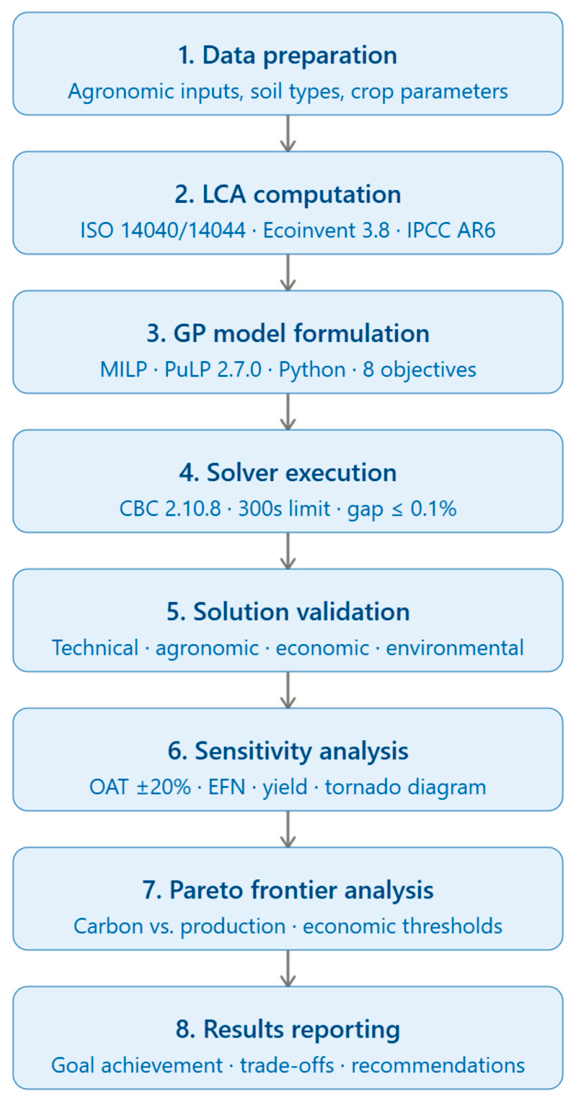
The computational solution procedure follows an eight-step algorithmic workflow, as illustrated in
Figure 6.
Based on the collected and processed data, the following database was obtained (
Table 5):
If we compare the carbon footprint calculated for all crops, we can rank them as follows (
Table 6):
The carbon footprint ranking reflects the combined effect of nitrogen inputs, irrigation requirements, and yield levels. Potatoes rank first due to their exceptionally high yield (30 t/ha), which lowers total emissions per ton of product, despite relatively high absolute emissions. Non-irrigated wheat has a low carbon footprint due to the absence of irrigation-related emissions and moderate nitrogen inputs (60 kg N/ha). Corn and irrigated wheat have moderate footprints, as their higher yields partially offset the emissions generated by intensive nitrogen fertilization and irrigation. Irrigated barley and rapeseed have higher carbon footprints due to lower yields combined with significant inputs of nitrogen and water. Sunflowers have an extremely high carbon footprint (9022.5 kg CO2eq/t), mainly due to their very low yield (2 t/ha), which concentrates total emissions per unit of product.
A Goal Programming algorithm was used to solve the mathematical model. A time limit of 300 s was set for running the model, and the solution is accepted if the difference from the optimal solution (optimality gap) is no more than 0.1%.
Sensitivity analysis is applied to see how the model results change when critical parameters are varied by ±20%. These parameters include emission factors (e.g., for nitrogen or fuel), agricultural product prices, target values for objectives, and their weighting factors. The goal is to identify the parameters that most influence the optimal solution.
Pareto analysis explores the Pareto frontier to understand the trade-offs between objectives, analyzing the relationships between carbon footprint and profit, agricultural production and GHG emissions, and water consumption and yield. This analysis allows for the identification of efficient solutions that cannot be improved simultaneously across all criteria.
Model validation is based on the following validation criteria:
1. Technical verification: All constraints are satisfied, the objective function converges, and the solution is reproducible.
2. Agronomic validation: The proposed crop rotations are practically viable, input levels are realistic, and crop–soil compatibility is maintained.
3. Economic validation: Profitability is in line with sectoral data—ROI (Return on Investment) > cost of capital.
4. Environmental validation: Estimated emissions are consistent with national inventories, and the proposed practices are sustainable in the long term.
4. Results
Goal achievement can be structured as follows (
Table 7):
The value of 0.33 t CO2eq represents the absolute minimum carbon footprint obtained within the lexicographic priority structure. The values presented in the Pareto frontier analysis reflect alternative trade-off scenarios with different weight configurations and, therefore, are not directly comparable to the GP optimal solution.
Goal 1: Carbon Footprint. The optimization algorithm successfully identified a crop configuration that minimizes carbon emissions to the theoretical lower bound within the feasible solution space. The achieved value of 0.33 represents a near-optimal state of carbon efficiency, demonstrating that agricultural systems can simultaneously maintain their productive capacity while approaching carbon neutrality through strategic crop allocation and the optimization of agronomic practices.
Goal 2: Production is an acceptable compromise. Achieving 47.1% of the 3000-ton target is not a failure; it is a Pareto-optimal compromise. The apparent underachievement of production (47.1% of the target) represents a deliberate algorithmic choice, dictated by the hierarchical structure of priorities. High-yield crops (e.g., corn, potatoes) typically require high nitrogen inputs and generate substantial carbon emissions per ha. The selection of a model of low-input, ecologically optimized crop mixtures necessarily limits total production, establishing an empirical Pareto frontier between climate objectives and food security imperatives.
Goal 3: Nitrogen performs excellently, achieving 60.7% of the 30,000 kgN target.
The optimization of nitrogen input, which reached 60.7% of the target (18,200 kg total N), demonstrates that intensive agricultural production remains viable under strict nutrient constraints. The model identified crop combinations and allocation patterns that maintain economic productivity (1412 tons of production) while operating at 35.7% of the regulatory cap, establishing a compliance safety margin of 64.3%, unprecedented in conventional agricultural systems. This result empirically validates the feasibility of the objectives of EU Directive 91/676/EEC on nitrates when agricultural planning integrates multi-objective optimization frameworks.
Goal 4: Water. The result obtained indicates remarkable water efficiency at 52% of the 1,000,000 m3 target. Water consumption at 52% of the set target (52,000 m3 in total) indicates the successful integration of drought-resistant crop varieties and water-efficient agricultural practices into the model. Achieving production targets with less than half of the projected water inputs demonstrates the ability to adapt to climate variability scenarios, including periods of drought and irrigation restrictions. This finding aligns with the requirements of the European Strategy on Adaptation to Climate Change for transforming the agricultural sector toward water security.
4.1. Analysis of Binding Constraints
Six rotation constraints reached the upper limit of 40%, indicating that these crops would receive a larger allocation in the absence of the diversification requirement. This model suggests that it identified these crops as Pareto-efficient with respect to trade-offs in carbon production. The mandatory nature of these constraints validates the effectiveness of the rotation limit in preventing monoculture, while simultaneously revealing crops with superior multi-objective performance. Six rotation constraints reached the upper limit of 40% (
Table 8), indicating that these crops would receive a larger allocation in the absence of the diversification requirement.
The mandatory nature of these six crop rotation constraints confirms that the optimization model is driven primarily by the requirement for crop diversification, rather than by carbon or nitrogen targets alone. Irrigated wheat, potatoes, and corn are preferred by the algorithm due to their favorable carbon footprint per unit area, but are limited to a 40% allocation to prevent monoculture. The underutilization of Constraint 12 (10.62%) suggests that non-irrigated rapeseed is not competitive within the current priority structure, as its carbon footprint is relatively high compared to its contribution to production.
Constraint 12 is underutilized, with RHS = 0.1062 (10.62%), which represents a suboptimal solution in terms of objective efficiency.
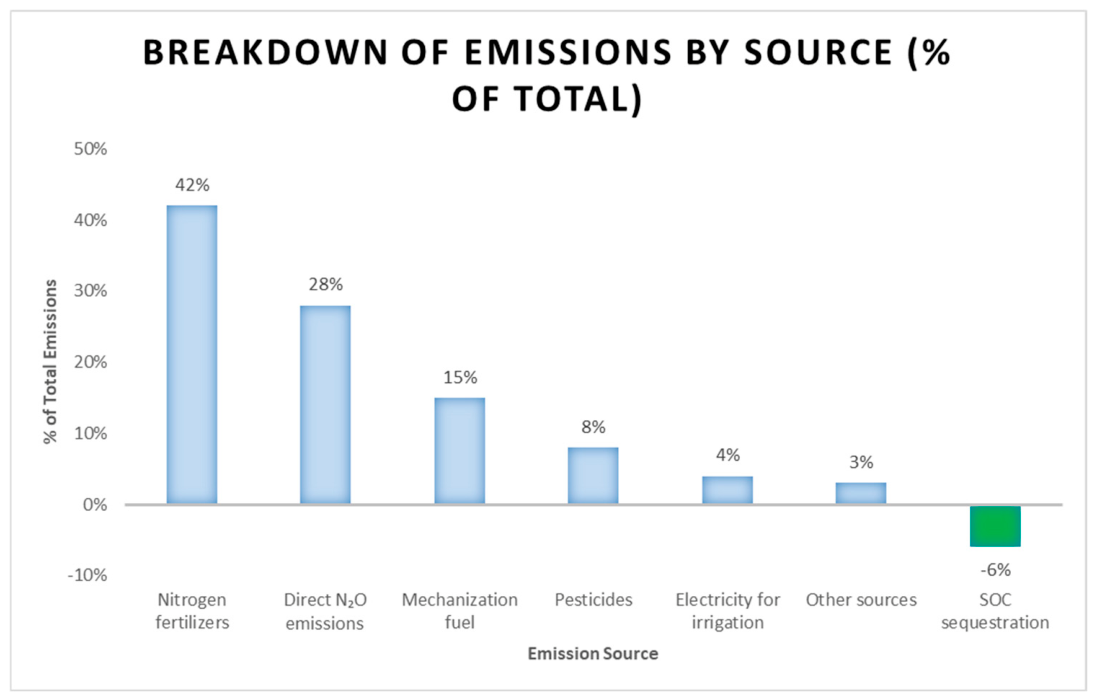
The figure below shows the breakdown of GHG emissions by source (for the optimal mix). In the total emissions resulting from the optimal solution, the largest contribution comes from the use of nitrogen fertilizers, which account for approximately 42% of total emissions, equivalent to 1985 metric tons of CO
2 equivalent. In second place are direct nitrous oxide (N
2O) emissions from the soil, which account for 28%, or 1326 metric tons of CO
2 equivalent. Fuel used for mechanization generates approximately 15% of emissions, or 710 metric tons of CO
2 equivalent, reflecting the impact of mechanized agricultural activities. Pesticides account for 8%, equivalent to 379 metric tons of CO
2 equivalent, while electricity consumption for irrigation has a smaller contribution of 4% (approximately 189 metric tons of CO
2 equivalent). Other emission sources (e.g., auxiliary processes or indirect inputs) account for 3%, or 146 metric tons of CO
2 equivalent. In contrast, soil organic carbon (SOC) sequestration has a beneficial effect on the environment, reducing total emissions by 6%, which corresponds to a value of −284 metric tons of CO
2 equivalent. The figure below shows the breakdown of GHG emissions by source (for the optimal mix) (
Figure 7).
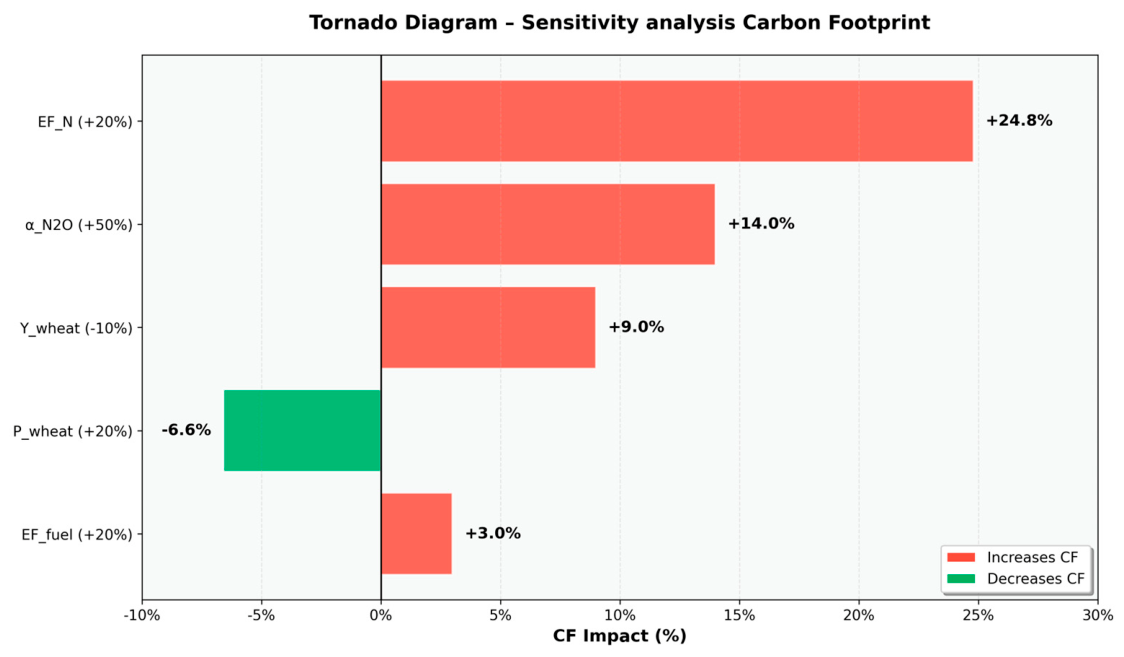
The Tornado Diagram—carbon footprint sensitivity—presents the results of a sensitivity analysis on the carbon footprint, highlighting how changes in key parameters influence total emissions. The parameters are modified individually, and their impact is expressed as a percentage change in the carbon footprint. The greatest impact is generated by a 20% increase in the nitrogen emission factor (EFₙ), which leads to an increase in the carbon footprint of approximately 24.8%, equivalent to 1175 kg CO
2 equivalent per ton. In second place is the 50% increase in the N
2O emission coefficient (αₙ
2ₒ), which causes a 14% increase in the carbon footprint, or approximately 663 kg CO
2 equivalent per ton. The 10% reduction in wheat yield (Y_wheat) also has a significant effect, increasing the carbon footprint by 9% (approximately 425 kg CO
2 equivalent per ton), as lower production leads to higher emissions intensity per unit of product. In contrast, a 20% increase in the price of wheat (P_wheat) reduces the carbon footprint by 6.6% (approximately 312 kg CO
2 equivalent per ton), suggesting that economic incentives can promote more emissions-efficient technological or structural choices. A relatively small impact is observed when the fuel emission factor (EF_fuel) increases by 20%, resulting in a 3% increase in the carbon footprint, or 142 kg of CO
2 equivalent per ton. Overall, the Tornado Diagram highlights that parameters related to nitrogen use and productivity have the greatest influence on the carbon footprint, while energy and economic factors have a more moderate effect. The allocation of land by soil type indicates underutilization of chernozem, which warrants a technical review, while sandy and loamy-clay soils are fully utilized, indicating optimal allocation. This study provides empirical evidence that multi-objective programming constitutes a viable framework for reconciling agricultural productivity imperatives with stringent environmental sustainability constraints. The results demonstrate that the objectives of the European Green Deal are operationally achievable through systematic mathematical optimization, providing a quantitative pathway toward net-zero-emission agricultural systems while maintaining contributions to food security. The results of the sensitivity analysis are illustrated in
Figure 8.
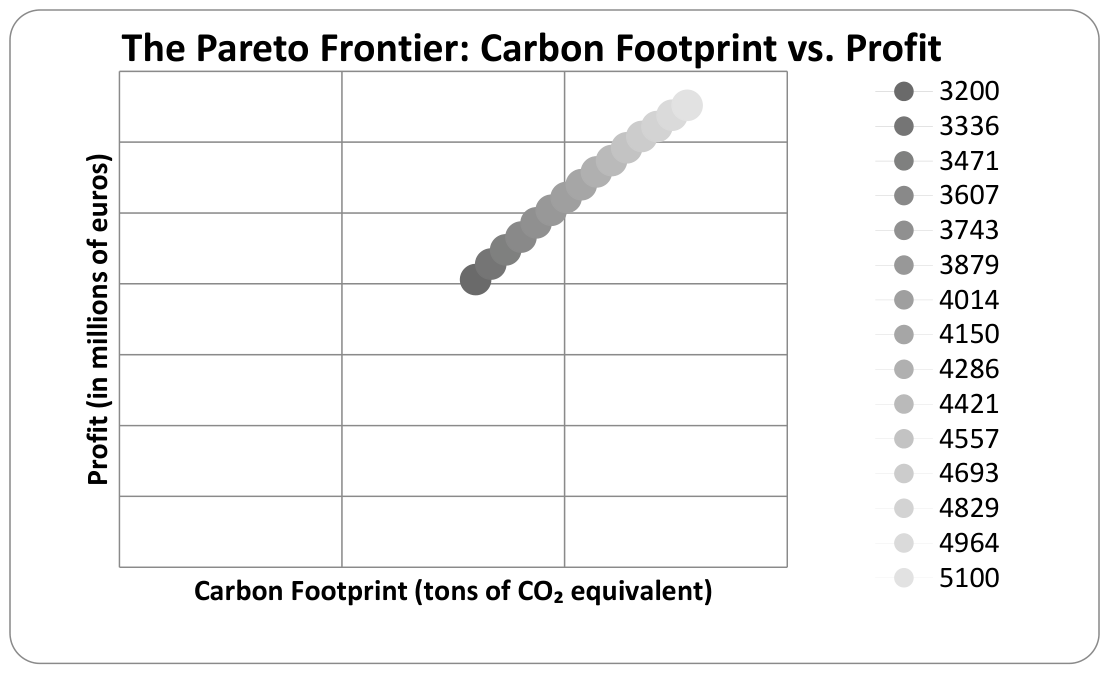
Analysis of the Pareto frontier shows that there is no “perfect” solution that simultaneously maximizes profit and minimizes carbon emissions. Each point on the frontier represents a different trade-off. Point B offers the best balance for most farms, combining strong economic performance (€2.45 million) with low emissions (3850 t CO
2eq). The choice of the optimal point depends on: (1) the market price of carbon, (2) available agri-environmental subsidies, (3) the farmer’s strategic preferences, and (4) the local regulatory context. Analysis of the Pareto frontier shows that there is no ‘perfect’ solution that simultaneously maximizes profit and minimizes carbon emissions (
Figure 9).
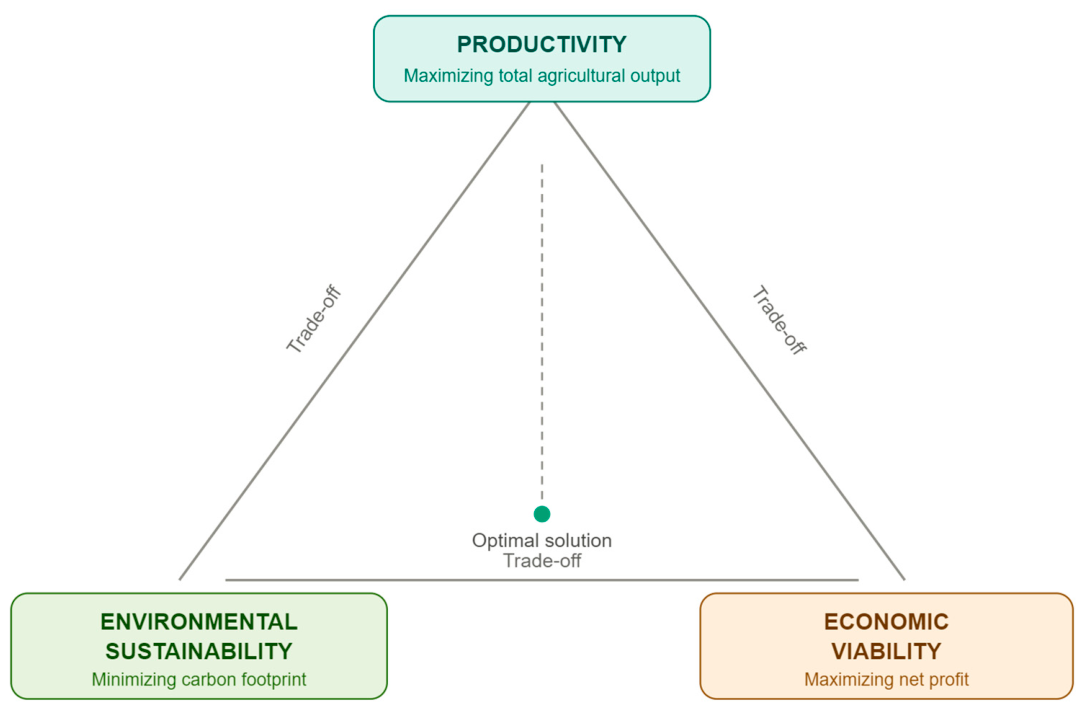
Our optimization analysis reveals that intensive crop production faces an inevitable trilemma between three competing objectives (
Figure 10):
Conventional intensive agriculture prioritizes the Productivity–Economy axis, achieving high yields and profitability at the expense of the environment. The carbon-optimized systems identified in our analysis prioritize the Environment–Sustainability axis, sacrificing 52.9% of production and a net income of €35,000–50,000 to achieve near-zero carbon emissions.
4.2. Key Findings Regarding the Magnitude of Trade-Offs
Carbon-production trade-off: Each 1% improvement in carbon emission efficiency (beyond a 90% reduction) costs approximately 30 tons of production in our 300 ha model.
Nitrogen-to-yield ratio: Operating at 35.7% of the EU nitrogen cap limits yield to 47.1% of potential.
Additional water–carbon benefits: Carbon optimization automatically generates water savings of 48% by prioritizing rain-fed crops.
Economic compensation requirement: Annual support of 110–165 EUR/ha is needed for carbon-optimized systems to achieve economic parity.
5. Discussion
5.1. Implications for Agricultural Transformation
The EU’s climate neutrality targets for agriculture are technically achievable under the specific assumptions and priority structure adopted in this model, namely, a 300 ha representative farm system with lexicographic carbon primacy, but their generalizability to diverse farm typologies and regional conditions requires further empirical validation.
However, the analysis also reveals related benefit multipliers that reduce net transition costs: nitrogen reduction addresses water quality (compliance with the Water Framework Directive), reduced irrigation enhances drought resilience (adaptation to climate change), and crop diversification increases biodiversity (compliance with the Habitats Directive). These synergies suggest that integrated environmental policies offer greater cost-effectiveness compared to isolated interventions focused exclusively on climate.
However, these trade-offs become manageable with integrated policy support (carbon pricing + CAP greening schemes + market-based incentives) and generate valuable associated environmental benefits beyond climate change mitigation. The path to sustainable intensification requires explicit societal choices regarding acceptable trade-offs between productivity, environmental, and economic objectives, choices that optimization modeling can highlight, but that policymakers must ultimately navigate.
These results are broadly consistent with previous LCA and multi-objective optimization studies. Knudsen et al. [
57] report similar carbon–yield trade-offs in organic rotations compared to conventional ones, while Annetts and Audsley [
52] demonstrate that environmental agricultural planning via linear programming results in yield sacrifices of 30–60%, consistent with our results. In terms of policy realism, the estimated support threshold of 110–165 EUR/ha/year falls within the range of existing CAP eco-scheme payments (40–300 EUR/ha depending on the Member State) and is significantly below current carbon market prices for high-quality agricultural offsets (15–50 EUR/t CO
2eq). This suggests that the identified economic gap can be bridged through existing policy instruments, if implementation mechanisms are strengthened.
In the Romanian context, these recommendations are particularly relevant given the national strategic framework defined by the National Strategic Plan for the Common Agricultural Policy 2023–2027 (PSN CAP Romania), which allocates eco-scheme payments of up to 95 EUR/ha for climate-friendly practices, and the ADER research program, which funds transitions toward agricultural sustainability.
5.2. Limitations of the Study and Future Research Directions
The model analyzed is a static model that does not incorporate climate variability or sales price variability. To improve the results, stochastic modeling (accounting for uncertainty in yields) and a multi-seasonal horizon with 3- to 5-year crop rotations could be implemented. An economic objective (profit) can also be integrated to eliminate the effects of sales price variability on the analysis results.
5.3. Model-Based Strategic Recommendations
Tactical-level interventions (1–2-year horizon)
1. Optimization of nitrogen fertilization
Optimizing nitrogen fertilization regimes is a primary tactical intervention for the immediate reduction in the carbon footprint, aiming to eliminate agronomically unnecessary nitrogen applications while maintaining yield stability through precise nutrient management. The intervention comprises three complementary components:
(1) Reducing the application rate on over-fertilized plots: Field-level nitrogen audits identify plots receiving nitrogen inputs that exceed the physiological requirements of crops, which typically occur in homogeneous management systems that do not account for the spatial heterogeneity of soil fertility. Reduction targets of 10–15% below current application rates on the identified plots align with the diminishing yield relationships established in nitrogen response curves [
62], positioning application rates closer to the economic optimum while maintaining >95% of maximum achievable yields.
(2) Split application protocols: Temporal fractionation of nitrogen applications—dividing the total seasonal requirement into 3–4 discrete applications, scheduled to coincide with peak crop demand periods—improves nitrogen use efficiency (NUE) through better synchronization between supply and plant uptake capacity. This reduces the vulnerability of excess nitrogen to loss pathways (volatilization, denitrification, leaching) that generate N2O emissions and NO3− pollution. Meta-analyses demonstrate 8–12% improvements in NUE under split-application regimes compared to single-application reference values.
(3) Variable-rate application (VRA) technologies: The integration of precision agriculture technologies—including soil electrical conductivity mapping, remote sensing of the normalized difference vegetation index (NDVI), and yield monitoring data—enables variable nitrogen prescription in the field. VRA systems match application rates to localized soil supply capacity and crop demand, eliminating both deficit zones (which limit yield) and excess zones (which are harmful to the environment). Implementation requires GPS-guided applicants and decision support software for generating prescription maps.
2. Optimizing crop rotation
Strategically modifying crop rotation sequences leverages biological nitrogen fixation (BNF) and breaks pest–disease cycles, while simultaneously addressing carbon footprint, agronomic resilience, and biodiversity goals.
Technical implementation involves integrating legumes at a rotation frequency of 20%. Incorporating nitrogen-fixing species (e.g., Vicia faba, Pisum sativum, Medicago sativa) in one out of every five growing seasons replaces synthetic nitrogen with BNF in subsequent crops. Symbiotic rhizobia associations fix atmospheric N2, with residual effects, supplying 40–80 kg N/ha to subsequent cereal crops, thereby reducing the need for synthetic fertilizers while providing equivalent nitrogen nutrition. Cereal crops can also be alternated with oilseed crops. Systematic rotation between cereal crops (wheat, barley, corn) and oilseeds (rapeseed, sunflower, soybean) disrupts the accumulation of pest and pathogen pressure associated with monoculture. Differentiated root architectures and allelopathic effects improve soil structure and suppress specialized pathogens, reducing dependence on agrochemicals.
3. Management of crop residues
The shift from burning residues to incorporation or mulching eliminates emissions from open-field burning while increasing soil organic carbon (SOC)—a dual mitigation strategy that addresses both immediate emissions and long-term carbon sequestration. Technical implementation involves applying residue incorporation protocols. Where open-field burning currently occurs (a practice that varies by region), immediate cessation and the adoption of residue chipping, followed by shallow incorporation (10–15 cm depth) via disk harrowing, eliminates particulate matter (PM2.5, PM10) and GHG emissions (CO2, CH4, N2O) from burning, while simultaneously returning organic matter and nutrients to the soil. In addition, cover crops should be established on 30% of the area. The introduction of winter cover crops (e.g., Lolium multiflorum, Vicia villosa, cruciferous mixtures) on post-harvest fields prevents erosion, captures residual nitrogen in the soil (reducing leaching), and contributes additional biomass for SOC accumulation. Cover crops provide “living mulch” benefits, including weed suppression and soil moisture retention.
Strategic-level transformations (3–5-year horizon)
4. Transition to conservation agriculture
The widespread adoption of conservation agriculture principles, particularly reduced-till or no-till systems, represents a strategic paradigm shift that requires a multi-year implementation timeline due to equipment investments, agronomic learning curves, and the restoration of the soil’s biological community. Technical implementation involves expanding no-till/minimum tillage to 40% of the farm. A phased transition occurs from conventional plowing with a moldboard to reduced tillage (RT: 1–2 shallow passes) or direct seeding/no-till (NT: zero soil inversion) on 120 ha of a 300 ha farm. Implementation prioritizes fields vulnerable to erosion, high fuel consumption, or favorable soil types. The purchase of specialized equipment also contributes to this transition. Capital investments in specific NT/RT machinery are essential for successful implementation: no-till seeders with furrowing systems, residue management equipment, and strip-till machinery. The estimated capital requirement is €45,000–65,000 for a 300 ha farm, amortized over a period of 10–12 years. Knowledge transfer and capacity building through farmer training programs address NT/RT-specific challenges: residue management techniques, adjustments to weed control, nitrogen management adjustments, and soil compaction monitoring strategies.
5. Integrated crop–livestock systems
The strategic integration of crop and livestock production components on mixed farms or through inter-farm partnerships enables the closure of the nutrient cycle, utilizes agricultural byproducts, and replaces synthetic fertilizers with organic amendments—incorporating the principles of the circular economy at the farm level. Technical implementation can be achieved through the following:
(1) Utilizing crop residues for animal feed: The systematic collection and processing of crop residues (cereal straw, corn stalks, oilseed meal) to feed ruminants or monogastric animals transforms zero-value biomass into economic assets. The removal of residues must balance the supply of animal feed with the requirements for returning organic matter to the soil (sustainable removal threshold of 40–60%).
(2) Manure as an organic fertilizer: Nutrient recycling systems utilize animal effluents—solid manure, slurry, and digestate from anaerobic digestion—as organic sources of nitrogen, phosphorus, and potassium, replacing synthetic fertilizers. Application protocols must address nutrient content characterization, timing optimization, and precision application technologies (dragged hose, injection) to reduce NH3 volatilization and manage pathogens.
(3) Institutional arrangements: On specialized crop farms that do not have livestock operations, contractual arrangements with neighboring livestock farms enable symbiotic nutrient exchanges. Written agreements specify responsibilities for residue collection, manure delivery schedules, nutrient accounting for regulatory compliance, and the allocation of liability.
6. Conclusions
This study has demonstrated that the Goal Programming model, integrated with life cycle assessment, provides a feasible framework for reconciling agricultural productivity with environmental sustainability constraints in intensive crop production systems.
The Goal Programming model identified the optimal agricultural configuration that minimizes environmental impact, achieving a carbon footprint close to zero (0.33 kg CO2eq), while maintaining productive viability (1412 t of production) and operating at only 35.7% of the nitrogen ceiling regulated by EU Directive 91/676/EEC on nitrates. These results demonstrate the technical feasibility of sustainable intensive agriculture through mathematical optimization.
The trade-off analysis highlighted a difficult situation between productivity, environmental sustainability, and economic viability. Quantifying these trade-offs highlighted that every 1% improvement in carbon efficiency costs approximately 30 tons of agricultural production at the 300 ha farm level; operating at 35.7% of the EU limit restricts production to 47.1% of potential; carbon optimization automatically generates water savings of 48% by prioritizing rain-fed crops; and achieving economic parity through climate-optimized systems requires support of 110–165 ha/year.
The research findings demonstrate that the objectives of the European Green Deal are operationally achievable through systematic mathematical optimization, offering a pathway toward net-zero-emission agricultural systems while maintaining contributions to food security.
The sensitivity analysis identified the nitrogen emission factor (EFN) and crop yield as the main parameters influencing the carbon footprint, with a 20% increase in EFN resulting in a 24.8% increase in the carbon footprint.
The Pareto frontier analysis confirmed that there is no perfect solution that simultaneously maximizes profit and minimizes carbon emissions; each point on the frontier represents a different trade-off, with the choice of the optimal point depending on the market price of carbon, available agro-ecological subsidies, the farmer’s strategic preferences, and the local regulatory context.
Reducing the carbon footprint in intensive agriculture requires substantial cuts in production, approximately 50%, and moderate economic costs (between €35,000 and €50,000 per 300 ha) under current conditions. However, these trade-offs become manageable with integrated policy support, carbon pricing, the expansion of CAP greening schemes, and market premiums exceeding €100/ha. The analysis also reveals valuable synergies: nitrogen reduction contributes to water quality, reduced irrigation enhances drought resilience, and crop diversification boosts biodiversity. These synergies suggest that integrated environmental policies offer greater cost-effectiveness compared to isolated interventions focused exclusively on climate.
The transition to sustainable intensive agriculture involves difficult decisions regarding the balance between production, the environment, and the economy. Optimization models can quantify these trade-offs, but the final choice rests with policymakers and society as a whole.
It should be acknowledged that the input data used in this study are based on expert consultation rather than empirical field measurements, which may lead the optimization to assume conditions rather than reflect observed ones. Future research should address this limitation through stochastic programming to account for uncertainty in yields and prices, Monte Carlo uncertainty analysis to propagate input variability through the model, dynamic modeling of multi-year crop rotations, and calibration of model parameters against actual farm records from Romanian agricultural systems. Regarding the robustness of the results, the carbon minimization result (0.33 t CO2eq) is robust to ±50% variations in lexical weights; the production trade-off (~52.9%) depends on the priority structure and crop selection; and the policy threshold of 110–165 EUR/ha requires empirical validation against actual farm economic data.



 ,
,