Review

Plant Invasion Driven by Heavy Metals and Microplastics: From Mechanisms to Agroecological Management Implications


1
State Key Laboratory of Ecological Safety and Sustainable Development in Arid Lands, Xinjiang Institute of Ecology and Geography, Chinese Academy of Sciences, Urumqi 830011, China
2
University of Chinese Academy of Sciences, Beijing 101400, China
3
Shandong Provincial Key Laboratory of Water and Soil Conservation and Environmental Protection, College of Resources and Environment, Linyi University, Linyi 276001, China
*
Author to whom correspondence should be addressed.
Agriculture 2026, 16(10), 1087; https://doi.org/10.3390/agriculture16101087
Submission received: 23 March 2026 / Revised: 13 May 2026 / Accepted: 14 May 2026 / Published: 15 May 2026
(This article belongs to the Section Ecosystem, Environment and Climate Change in Agriculture)

Abstract

Biological invasions and environmental pollution are the two primary threats facing contemporary agricultural ecosystems, and their interaction exacerbates agroecological risks and undermines agricultural sustainability. This study was conducted to systematically elucidate how heavy metals (HMs) and microplastics (MPs) alter the relative advantages of invasive plants in ecosystems, clarify the ecological processes involved, and propose recommendations for the protection of farmland ecosystems. The main conclusions are as follows: (1) Pollution acts as an environmental filter that negatively affects native species, including crops, while creating relative advantages for invasive plants with high tolerance and adaptive physiological mechanisms. (2) Pollution stress enables invasive plants to gain a competitive advantage over native plants through highly plastic resource allocation strategies, prioritization of growth, and more powerful allelopathic effects. (3) Pollution systematically amplifies the advantage of invasive plants by altering the strength of plant–soil feedback (PSF) and driving the restructuring of rhizosphere microbial communities. (4) Invasive plants can be used to produce biochar, which can then be applied in farmland ecosystems for the control of invasive plants and remediation of soil pollution. The framework constructed in this study indicates that heavy metal and microplastic pollution may enhance the invasion of alien plants, posing a serious threat to agroecosystem health and food security. However, using invasive plants as feedstock to produce biochar may offer a solution to the intertwined challenges of plant invasion and environmental pollution.

1. Introduction

Biological invasions and environmental pollution are two convergent major threats facing contemporary agricultural ecosystems that deeply impact both ecological security and agricultural production. These two crises are intensifying, primarily due to the environmental disturbance caused by increasing human activity in the context of the Anthropocene [1]. Environmental pollution, notably from heavy metals (HMs) and microplastics (MPs), has become widely accumulated in global farmland soils, emerging as a critical abiotic stress factor. Research indicates that approximately 14% to 17% of agricultural soils worldwide are contaminated with HMs, most of which are from agricultural application of sewage sludge produced by industrial activities, along with agricultural pesticides and fertilizers [2,3]. MPs are an emerging contaminant originating primarily from agricultural plastic sheeting and other industrial or domestic sources. They leach into the soil following the abrasion of these agricultural plastic films [4]. HMs and MPs can be absorbed by plants from the soil through the roots [5,6], while leaves may also absorb pollutants from atmospheric deposition via stomata or the cuticle, posing increasing risks from residue in farmlands [7,8,9,10]. These two types of pollutants can exert multilevel inhibitory effects on plant growth by interfering with physiological processes, metabolic balance, and molecular regulatory networks [11]. Concurrently, global economic integration and trade have accelerated the transboundary spread of species, diversifying invasion pathways and expanding their scale [12,13]. On a global scale, biological invasions have been recognized as one of the primary drivers of biodiversity loss and ecosystem degradation [14]. Research has shown that the global annual cost of invasive species is estimated at USD 420 billion, and continues to increase. Agricultural departments were the bearers of the greatest cost due to invasive species in at least 37% of the countries assessed [15,16].
Instead of isolating species, pollution produced by humans often creates “opportunity windows” for biological invasions [17]. More evidence suggests that, under the stress of HM and MP pollution, invasive plants frequently exhibit higher tolerance and adaptive capacity compared to native plants [18,19]. The mechanisms by which HMs and MPs drive plant invasions are complex and multifaceted. For instance, invasive plants can sustain growth under pollution stress by enhancing antioxidant defenses, regulating metal transport and vacuolar sequestration, and modifying biomass allocation strategies [20]. This suggests that HMs and MPs may not impose equal ecological pressure on invasive and native plants. They not only directly affect individual plants but also profoundly alter the plant–soil feedback (PSF) system by reshaping soil physicochemical properties and microbial community structure [21]. Moreover, MPs can act as vectors for HMs, modifying their bioavailability and thereby producing synergistic ecological effects [22].
Although the research in this area is growing, our current understanding remains fragmented. Findings often vary depending on the study organism, pollution type, and experimental scale employed. Moreover, most previous studies and reviews have only focused on single pollution factors or lack a systematic “environment–plant–microbe” theoretical framework, leaving a gap regarding invasive plant responses to pollution stress and their cascading ecological and agricultural consequences. A literature search of the Web of Science using the keywords “heavy metals”, “microplastics”, “farmland”, and “invasive plants” yielded 403 articles. After excluding articles irrelevant to the topic (ecology/botany/invasive plants), those with duplicate or entirely identical content, low-quality articles (such as insufficient replicates), a total of 134 articles remained for inclusion in this review. This narrative review aims to describe the positive correlation between HMs and MPs and the establishment and spread of invasive plants, and to provide a conceptual framework for developing management and restoration strategies for biological invasions in polluted ecosystems, including agroecosystems.

2. HMs and MPs Establish an Environmental Filter to Shape Pollution-Tolerant Plant Communities

2.1. The Pollution Filter Exerts Asymmetric Filtering on Invasive Plants and Native Plants

Environmental factors function as an environmental filter by differentially selecting for plants based on their physiological tolerance and functional traits [23]. HMs such as Cd, Cr, and Pb exert systemic impacts on plant physiological homeostasis by interfering with photosynthesis, inhibiting root development, disrupting cell membrane integrity, and inducing the excessive accumulation of reactive oxygen species (ROS) [24,25,26]. MPs exert their ecological effects on the agroecosystem through both physical and chemical pressures. They alter soil structure, increasing porosity and disrupting water retention capacity, inducing drought-like stress in plants [27]. They can also block seed surfaces or root hair pores, restricting water and nutrient uptake and consequently inhibiting seedling emergence and establishment [28]. At the physiological level, MPs induce ROS accumulation, disrupt ion homeostasis, and reduce photosynthetic efficiency, exacerbating plant growth pressure [29].
Under the selective pressure exerted by HMs and MPs, invasives and natives are often affected asymmetrically. Some invasive weeds, such as Pennisetum purpureum, Paspalum dilatatum, Galinsoga quadriradiata, Erigeron canadensis, and Erigeron annuus, are characterized by high tolerance, enabling them to exhibit better growth characteristics in the presence of HMs and MPs, such as increased biomass and survival probabilities [30,31]. Invasive plants have more advantages than native ones due to species specificity. The invasive species Phytolacca americana exhibits a high capacity for Cd bioconcentration and adaptability to Cd pollution in contaminated soils, which is attributed to its high translocation factor [32]. Some invasive weeds possess more effective metal detoxification and vacuolar sequestration mechanisms under HM contamination, decreasing the damage from HMs [20]. However, native plants frequently adopt an avoidance strategy by reducing growth under pollution stress, which might lead to a disadvantage in resource competition [20]. Similarly, studies indicate that MPs exert significant inhibitory effects on the antioxidant activity and biomass accumulation of native plants, whereas their impact on invasive plants is relatively limited [33]. Furthermore, MP particles can block seed pores, negatively affecting the seed germination rate of native plants, while the seed germination of invasive plants was not affected [34].
Admittedly, some native plants are defined as hyperaccumulators and can detoxify HMs, such as Phytolacca acinose [35]. However, studies often ignore the importance of concentration in plants. For instance, the invasive plant Phytolacca americana exhibits more growth advantages than Phytolacca acinose under high Cd pollution stress, which means that native plants may be more sensitive to pollutants than invasive species [36]. It cannot be ruled out that the invasion advantage will decrease when the pollution concentration is extremely high. One study showed that, when the copper concentration reached 2430 mg/kg, both the invasive plant Reynoutria japonica and the native plant Urtica dioica exhibited 100% mortality, indicating that all plants are severely inhibited under extremely high concentrations [37]. The competitive ability of invasive species was reduced under Zn and Cu treatments, but the ultimate outcome of successful invasion remained unchanged, suggesting that the invasion advantage may be weakened at high concentrations [38]. Additionally, the tolerance of different plants to different HMs varies significantly, exhibiting a high degree of species specificity [39,40]. What makes it more complex is the involvement of factors such as the phenotypic plasticity of invasive plants and PSF, making it currently impossible to determine the threshold at which each HM promotes invasion. Moreover, the studies retrieved so far lack investigations on different MP concentrations, and instead mostly simulate highly polluted environments from these two pollutants.

2.2. Competitive Advantages of Invasive Plants Under the Filter

Resource availability significantly influences biomass accumulation and trait multifunctionality in both woody and herbaceous plants [41,42]. However, different plants exhibit varying resource use efficiencies. Globally common crops such as rice, wheat, maize, and soybean often show low resource use efficiency in farmland, typically leading to a high-input but low-return trend in agroecosystems [43]. Studies have shown that invasive plants generally possess higher resource use efficiency than natives [44]. For example, Shi et al. found that the invasive plant Solanum rostratum prefers to adopt the C-strategy in competition, taking resources from native plants, rapidly expanding its population size, and gaining invasive advantages [45]. Environmental fluctuations such as resource pulses are more conducive to the invasion of alien plants such as Conyza canadensis, potentially due to the stronger adaptability of invasive plants to resource variability [46]. Under HM or MP stress, invasive plants tend to allocate more resources towards rapidly increasing plant height and crown width to enhance their spatial preemption capacity [1,47,48]. This is consistent with the predictions of the Evolution of Increased Competitive Ability (EICA) hypothesis [49]. Furthermore, HMs and MPs might significantly influence the resources available in the soil by affecting nutrient flux, cycling, and related gene expression [50,51,52]. This might facilitate the selection of plants with high resource use efficiency, which can pass the environmental filters.
Studies have demonstrated that Amaranthus retroflexus in Cd-contaminated environments, and four invasive weeds (Paspalum dilatatum, Sphagneticola trilobata, Pennisetum purpureum, and Alternanthera philoxeroides) in MP-contaminated environments, exhibit stronger resource acquisition capabilities compared to native plants [40,47]. Their advantages are due to the trait and strategy plasticity of invasive species. At the morphological level, invasive plants exhibit greater plasticity in above-ground and below-ground biomass allocation under pollution stress [53]. For instance, invasives may expand the proportion of root allocated and thickness [54,55] in response to resource patches in soils contaminated with HMs or MPs. The invasive plant counteracts the negative effects of PE-MPs by achieving a higher root-to-shoot ratio and root mass fraction than native plants [56]. Under high-concentration HM pollution, invasive weeds like Alternanthera philoxeroides may reduce biomass allocation to roots to minimize pollutant uptake and alleviate toxicity, while its native congener Alternanthera sessilis lacks this function [57]. Additionally, as the diversity of MPs increases, invasive plants suffer greater negative impacts than native plants, possibly due to their root biomass allocation [54]. The result indicates that the root- and biomass-allocated plasticity of invasives was species- and condition-specific, rather than showing a constant trend. For instance, in the invasive plant Alternanthera philoxeroides, the leaf biomass ratio increased but stolon mass ratio decreased under Cd stress [58]. This specificity of biomass allocation is even manifested at different geographic scales within the same species, as exemplified by Phytolacca americana [59]. Alternatively, when facing copper stress, Alternanthera philoxeroides exhibited two forms of root plasticity, silence and escape; above the threshold of 500 mg/kg, its root length decreased, yet root biomass increased and the belowground root system expanded [60]. Invasive plants may also show plasticity in their leaves and photosynthate. The leaves of invasive grasses might have significantly greater areas, crown width, chlorophyll contents, and photosystem II efficiency, thereby enhancing light capture and utilization [30,38]. Similarly, the invasive plant Ageratina adenophora can maintain basic N allocation by adjusting photosynthetic pigment ratios and energy allocation rather than pursuing maximum photosynthetic rates, providing a continuous energy source for individual growth [61]. This again shows that the plasticity of invasives is specific, which might indicate that Ageratina adenophora is also stronger and more flexible than native species.
The Novel Weapons Hypothesis (NWH) proposes that native species are sensitive to the allelochemicals of alien plants, conferring a stronger competitive advantage to invasive populations in the introduced range than in their native range [62]. Notably, HMs and MPs might modify patterns of plant–plant interactions, particularly through allelopathy as a competitive defense tool. Research indicates that HM or MP stress may enhance the synthesis and release of allelochemicals in some invasive plants such as Phytolacca americana, Alternanthera philoxeroides and Lactuca sativa as a response to pest and disease pressure, while simultaneously inhibiting the physiological activities of neighboring plants [63,64,65]. Research has shown that Cu and Pb can significantly intensify the independent allelopathy of Solidago canadensis and the co-allelopathy of two invasive Asteraceae species but weaken the independent allelopathy of Conyza canadensis [39]. Importantly, these secondary metabolites may persist in the soil and function for extended periods due to the strong adsorption capacity of MPs or the chelation of HM ions, creating more opportunities for invasive species to establish a growth advantage [66,67]. However, under Cd stress, the enhanced insect resistance of Alternanthera philoxeroides is mainly attributed to Cd accumulation and mechanical defense, rather than changes in leaf-specialized metabolites (including allelochemicals) [68]. This implies that allelochemicals remain unchanged, but the defense strategy differs, which indicates that the allelochemical plasticity of invasive plants was also specificity.

2.3. Invasive Plants Expand Their Advantage by Reshaping the Rhizosphere Microenvironment

Rhizosphere microorganisms and nutrients profoundly affect plant growth, defense, and competition through PSF [69,70]. However, the effects of soil microorganisms on different plants are unequal. The feedback relationship between plants and microbiomes in the soil can facilitate invasive species while inhibiting natives, an idea known as the Enhanced Mutualism Hypothesis (EMH) [71,72,73,74]. A global meta-analysis showed that HMs significantly alter soil SOC, soil enzyme activities, microbial diversity, microbial respiration, and microbial biomass carbon, which may disturb soil environmental and microbial activity [75,76]. The structure of the soil microbiome and environment is also disturbed by MPs, which can reduce bacterial biodiversity, change soil pore structure, and reduce water retention capacity. They can even establish a special microecosystem known as the “Plastisphere” [77,78,79]. Furthermore, invasive plants can disrupt the native plant rhizosphere microbial mutualistic network, causing natives to fall into a competitive disadvantage [80]. Some evidence indicates that invasive plants may have more advantages than natives under polluted conditions. For instance, the invasive plant Phytolacca americana can cope with Mn pollution by modulating the composition of its root volatile organic compounds (VOCs) and recruiting pollution-tolerant microbes such as Bacillus [81]. By comparing the PSF indices (home/away) under different Cd concentrations, it was found that the PSF of the invasive species Phytolacca americana remained consistently near 0, whereas in native species it increased with rising Cd concentration, and its minimum value remained above 0. This indicates that Cd pollution significantly amplifies the relative difference in PSF indices between these two species, demonstrating at the PSF level that the presence of Cd may increase invasion advantage [36]. Erigeron canadensis also becomes more resistant to Cd and Pb by altering the rhizosphere microbial community and recruiting key taxa with metal resistance and plant growth-promoting abilities, including Lysobacter, Corynebacterium, Humicola, and Colletotrichum [82]. Additionally, under PVC-MP and PLA-MP stress, invasive plants selectively enriched Arthrobacter, Sphingomonas, Microvirga, and Azospirillum in their rhizosphere, which can enhance the tolerance of invasive plants to MP stress [31]. These studies suggest that PSF is a key indicator that increases the advantages of invasive plants under pollution stress.
In addition, soil properties can influence pollutants. For example, a field study showed that soil pH was positively correlated with Cd and As concentrations, affecting metal bioavailability, plant uptake, and PSF processes [79,83]. Soil organic matter and nutrient elements such as N, P, and K increased with the invasion of Prosopis juliflora, while HMs contents in the soil decreased, which may be related to legume specificity and root adsorption [36]. Furthermore, soil texture also profoundly influences the spatial distribution of HMs, mainly due to the adsorptive capacity of clay [84]. Research indicates that changes in soil salinity caused by reclamation increase the accumulation of Cr, Cu, Pb, and Zn in Spartina alterniflora and Phragmites australis [85]. Moreover, a higher proportion of clay leads to greater retention of MPs in sediments [86]. Therefore, soil properties such as pH, nutrients, organic matter, clay proportion, and salinity all affect the spatial distribution and bioavailability of heavy metals in soil, thereby complicating the filtering of invasive and native plants by pollutant-shaped environmental filters.

2.4. Combined Pollution Stress Shapes a Stronger Filter, but the Direction of Invasion Is Uncertain

Whether in the natural environment or farmland, HMs and MPs do not act on their own but often co-act as combined pollutants, causing more severe ecological and agricultural crises [87]. In facility agriculture, the coexistence of HMs and MPs is far from a simple additive state, and involves complex physical, chemical, and biological interactions, significantly affecting each other’s migration and transformation pathways as well as overall ecotoxicity [88]. Due to their large specific surface area and diverse surface functional groups, MPs can absorb HMs such as Cd, Pb, and Zn, modifying their mobility and bioavailability in soil and water [89,90]. This complexity renders combined pollution a central challenge in understanding and predicting farmland invasion dynamics, as well as in assessing ecological risks. Javed indicated that Cd weakens the competitiveness of native species, creating favorable conditions for invasive plants, which has been verified under conditions of single pollutants (MPs or Cd) as well as combined MP-Cd pollution [91]. However, some studies have shown different results. Feng found that the presence of MPs suppresses the contribution of Cd to invasion success [92]. Due to the scarcity of literature that simultaneously contains the keywords “heavy metals”, “microplastics”, and “invasive plants”, it is currently not possible for us to determine whether the combined pollution of HMs and MPs has a positive or negative effect on the invasive success of alien plants. Notably, the combined pollution of HMs and MPs does increase toxicity to plants, demonstrating that the environmental filtering effect remains under stress [93]. MPs cause the actual exposure levels of plants and microorganisms to HMs to deviate from predictions based on single-pollutant conditions [94]. Consequently, traditional prediction methods based on pollution intensity or species traits struggle to accurately capture invasion potential under combined pollution scenarios [95,96].

2.5. A Conceptual Model of Environmental Filters for the Facilitation of Invasion by HMs and MPs: Taking Agroecosystems as an Example

Farmland was chosen as an example primarily because agroecosystems are more prone to biological invasions than other ecosystems [97,98]. Agroecosystems have suffered from intense human disturbance for a long time, which is a key reason why it is prone to invasion [99,100]. Moreover, crops in farmland are often monotonous, with low levels of biodiversity, which also makes alien plants more likely to thrive and spread rampantly in agricultural fields, according to the Biotic Resistance Hypothesis (BRH) [101]. Additionally, agricultural fertilization results in significantly higher soil nitrogen and phosphorus levels than in natural habitats, enabling many invasive plants to rapidly exploit these enriched resources and thereby suppress native plants in competition [102,103].
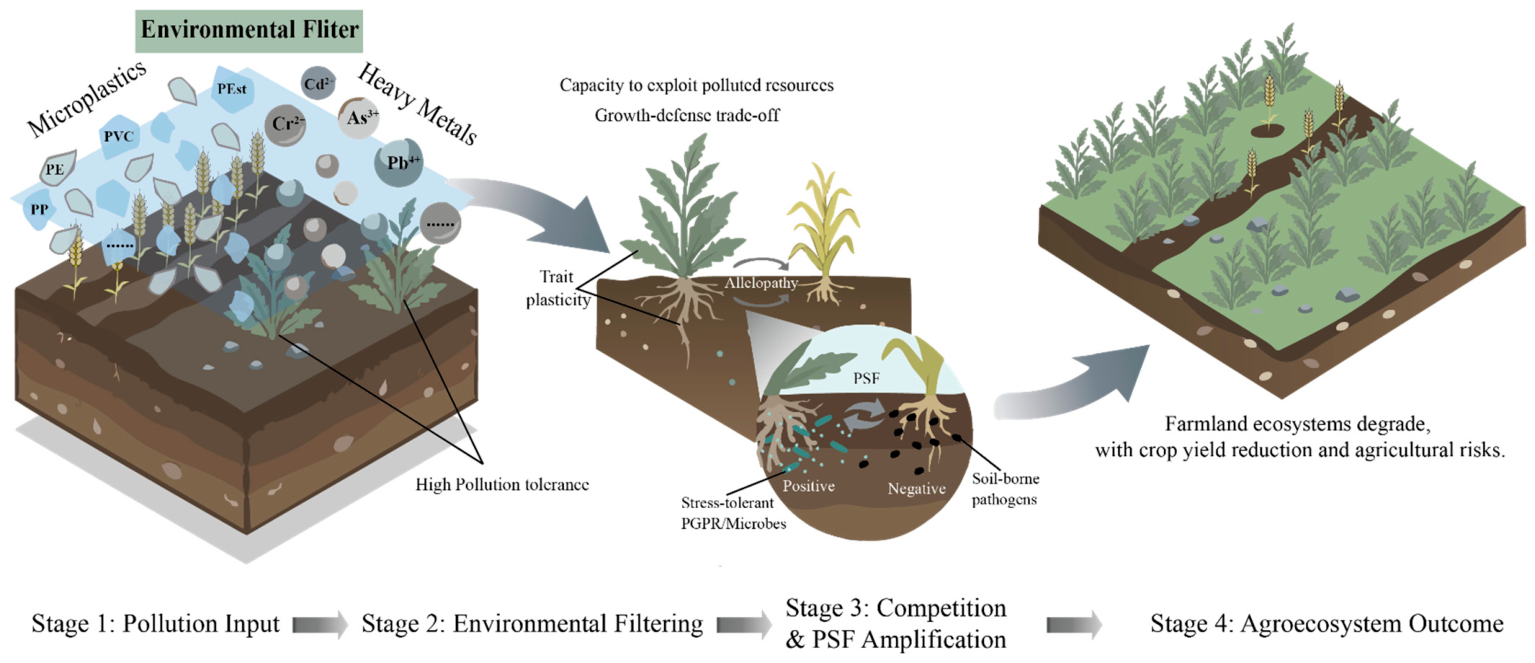
Synthesizing the preceding sections, we construct a conceptual mechanistic framework illustrating how pollution drives biological invasions in agroecosystems (Figure 1). This framework emphasizes that, within farmland environments, HM and MP contamination systematically facilitates the colonization and expansion of invasive weeds through a series of mutually reinforcing ecological processes, ultimately threatening agricultural production. Firstly, HM and MP pollution acts as an environmental filter, screening the farmland biotic community. High-intensity pollution stress eliminates crops and native plants with weak tolerance, while creating survival opportunities for invasive weeds equipped with pollutant tolerance and adaptive mechanisms, altering the initial composition of field vegetation. Secondly, pollution stress reshapes the rules of interspecific competition within farmlands. Leveraging their highly plastic resource allocation strategies, growth-prioritizing tactics, and potentially enhanced allelopathic effects, invasive weeds can gain an advantage under HMs and MPs, progressively encroaching upon the living space of crops. More importantly, pollution further amplifies this invasive advantage through PSF mechanisms. Pollution-induced changes in the soil environment drive the restructuring of rhizosphere microbial communities. Invasive weeds are often capable of domesticating or attracting pollution-tolerant microorganisms that help alleviate stress and facilitate nutrient acquisition, establishing positive feedback. These processes form self-reinforcing positive feedback over temporal scales. This feedback progressively diminishes the resistance and resilience of farmland ecosystems to subsequent disturbances, rendering contaminated farmlands not only more susceptible to invasion but also, once occupied by invasive weeds, increasingly difficult to restore to a crop-dominated healthy state. Such farmland may become trapped in a long-term vicious cycle, severely undermining land productivity for agriculture and the capacity to deliver ecological services.

3. Invasive Plant Management and Potential Application Value

3.1. Control Strategies for Alien Invasive Plants

Given the significant threat that invasive plants pose to ecosystems, including farmland, research related to the prevention and control of alien plant invasions has gradually increased. The use of chemical methods, such as clopyralid, can effectively suppress the invasive grass Hieracium caespitosum and successfully restore the competitive ability of native grasses, increasing their cover by 7–65% [104]. However, chemical control may pose risks to the environment, impair soil nitrogen fixation, and exacerbate the hazards of microplastics, posing a serious threat to food security [105,106]. A study has shown that the application of selective herbicides may lead to the emergence of other invasive species and require long-term spraying management [107]. The use of biological methods may reduce environmental pollution; for example, the Sclerotium rolfsii SC64 strain effectively controls Solidago canadensis and significantly restores biodiversity during the process [108]. Alternatively, natural enemies of invasive plants can be utilized. In Australia, researchers have explored the use of D. quadrijuga, a natural enemy of H. amplexicaule in its native range, as a biocontrol agent because it has shown effective local suppression of the plant’s populations [109]. However, if not properly managed, biological control can cause even more severe ecological crises. Due to the lack of corresponding resistance in native species, specialist pathogens from the native range may preferentially infect native species, or may spread from invasive plants to natives and crops, leading to disease outbreaks with serious ecological and economic consequences [110]. Even the introduction of insects can result in enemy spillover effects, severely endangering ecological security [111]. Mechanical or physical methods, such as regular mowing, can suppress invasive plants like Erigeron annuus and Solidago canadensis [112,113]. The manual uprooting of Datura stramonium by farmers can also reduce the harm caused by invasive plants in farmlands [114]. Such approaches are environmentally friendly but have low efficiency and may require more monitoring and management measures for agricultural invasive species, for example, by using machine learning combined with human footprint data to predict high-risk areas [115]. Promoting sustainable agricultural activities and reducing suitable habitats for invasive plants and effectively prevents weed infestation in farmlands through intercropping [115,116].
Furthermore, controlling cultivation methods and farm size is also crucial. Large-scale farms practicing monoculture are more susceptible to specific invasive plants [117,118], and on some farms, the use of the same herbicide across multiple crop cycles makes the emergence of “superweeds” more likely [119]. Mechanized farming facilitates the spread of invasive plants. For example, Galzania can be rapidly spread across vast areas by heavy machinery [120].

3.2. Invasive Plants as Valuable Resources: Potential Benefits for Crops and the Remediation of HMs and MPs Pollution

The contributions of invasive plants to agriculture are not entirely negative. Endophytes isolated from certain invasive plants, such as Phragmites australis, can promote rice growth [121]. Composting using Ageratina adenophora as a raw material can promote barley growth [122]. Additionally, some research has indicated that invasive species can be used to remediate environmental pollution. For instance, Bidens pilosa and Lantana camara have been demonstrated to absorb and accumulate heavy metals such as Cu, Zn, and Cd from contaminated soils [123,124]. However, this method may pose serious ecological uncontrollability. The invasives may escape from treatment sites and further encroach upon the living space of native plants (including crops) in surrounding farmlands, exacerbating the simplification of farmland community structure and biodiversity loss [125,126]. Conversely, biochar produced from invasive plants may provide enhanced risk manageability and be more eco-friendly, effectively reducing pollution. The addition of biochar derived from Alternanthera philoxeroides can reduce HMs, particularly Cd, in livestock sludge [127]. Biochar produced from Mikania micrantha and Parthenium hysterophorus can effectively alleviate Cd toxicity in cereal crops such as wheat [128,129]. Furthermore, a biochar composite material primarily made from Ageratina adenophora can remove over 65% of Cd from farmlands [130]. Moreover, the Cd ion removal efficiency of such invasive plant-derived biochar even increases with the diversity of the invasive plants used [131]. Biochar prepared from the invasive plant Solidago canadensis L. and applied to agricultural soil contaminated with PE-MPs and PLA-MPs can increase microbial biomass, inorganic nitrogen, and enzyme activities [132].

3.3. Invasive Plants in Farmlands May Foster a Sustainable Positive Cycle of Agroecosystems Centered on Income Generation: A Conceptual Model

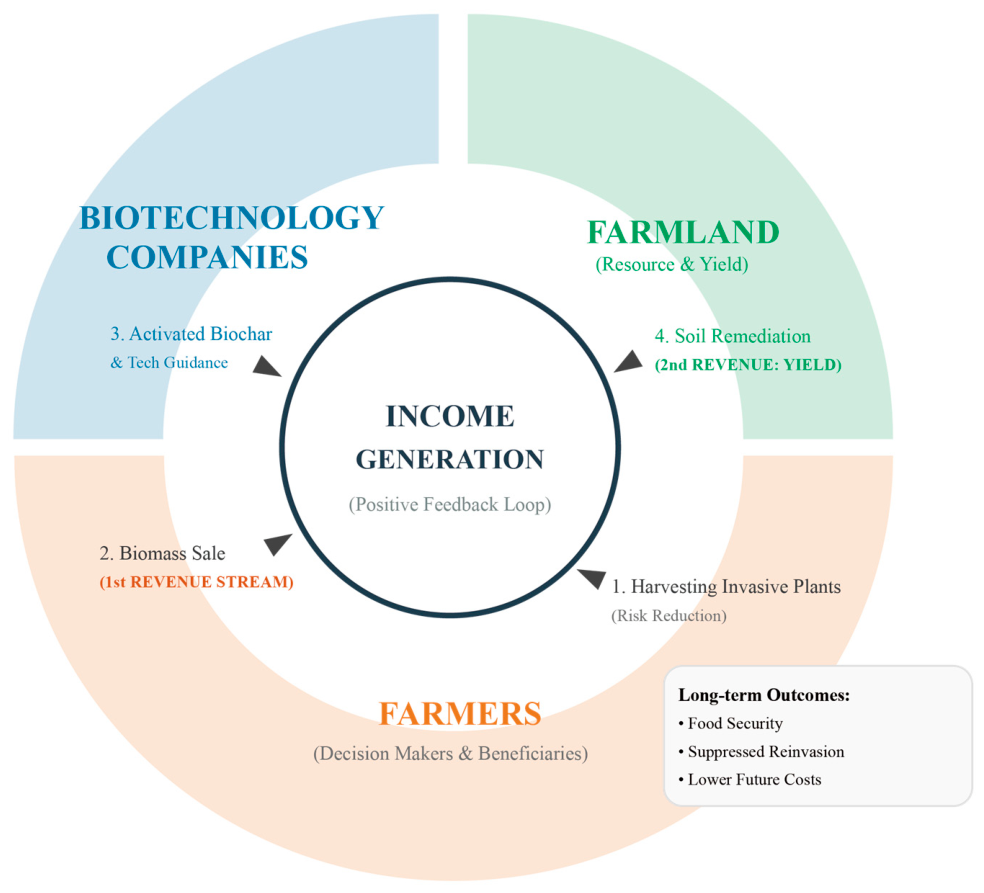
Given the strong soil remediation capacity and crop detoxification and yield-enhancing effects, as well as the promising application prospects and economic benefits of biochar derived from invasive plants [133], we propose a positive feedback loop framework centered on income generation, with farmers, farmland and biotechnology companies as key actors, and invasive plants and biochar as the pathways (Figure 2). This framework aims to transform invasive plants from waste into a resource. Farmers actively harvest invasive plants to reduce ecological risks to farmland, creating conditions for subsequent yield-enhancing experiments. They then sell the harvested invasive plants to biotechnology companies, generating direct income as a first revenue stream. The companies produce activated biochar from the invasive plants and sell it back to farmers, while also providing guidance on its application. In this process, companies earn profits and farmers obtain remediation materials. Finally, farmers apply the biochar to remediate contaminated farmlands, which ensures food security, suppresses the reinvasion of exotic plants, increases crop yields, and generates a second income stream from yield gains, while also reducing future harvesting costs.

4. Research Gaps and Future Directions

The conceptual framework of pollution-driven plant invasions constructed in this review provides a systematic perspective for understanding how HM and MP contamination facilitates the alien plants invasion in ecosystems, especially agroecosystems. In addition, we propose a tripartite win-win agricultural management framework centered on invasive plant-derived biochar to reduce farmland pollution while generating income. However, the research area still has several gaps that need to be addressed through future interdisciplinary research.

4.1. The Synergistic or Antagonistic Effects of Combined Pollution Remain Unclear

Although studies have shown that HMs and MPs often co-occur in the environment, the synergistic or antagonistic mechanisms through which they affect invasive plants are still lacking systematic investigation. Existing evidence is even contradictory, indicating that we are currently unable to predict invasion risks under combined pollution. Future research should develop predictive models for invasion risk under combined pollution based on controlled experiments, integrating multiple factors such as the type, concentration, aging degree of HMs and MPs, and soil properties. Machine learning or process-based models for invasion risk prediction should be developed to support early warning in agroecosystems.

4.2. The Threshold Effect Between Pollution Concentration and Invasion Success Has Not Been Quantified

Most current studies employ simulations with high pollution concentrations, and there is a lack of investigation into the variation in invasion advantage across different pollution gradients. Some studies suggest that extremely high concentrations may suppress all plants, indicating the existence of a “promotion–inhibition” threshold, yet the specific threshold under each pollution type remains undetermined. Future efforts should conduct multi-factor, multi-scale, long-term field empirical research, establish cross-regional long-term monitoring networks, and combine controlled experiments with field surveys to explore the spatiotemporal dynamics of pollution-driven invasions.

4.3. Lack of Long-Term Field Observational Data to Validate Successional Trajectories and Management Consequences

Most current conclusions are derived from short-term controlled experiments, which struggle to reflect the long-term dynamics of pollution–invasion interactions under the influence of agricultural cropping cycles, climatic fluctuations, and management practice interventions. Establishing long-term positioning observation studies is crucial for assessing whether pollution-induced invasive advantages will continuously expand, reach equilibrium, or potentially be counteracted by well-adapted pollution-tolerant crop varieties or rotation systems. Such research constitutes an indispensable scientific foundation for predicting the long-term ecological and economic impacts of invasions and for optimizing adaptive farmland management strategies.

4.4. Species Specificity and Geographic Variation Are Underestimated

Different invasive plants exhibit highly species-specific responses to HMs and MPs, and even significant differences exist among different geographic populations of the same species. This specificity poses a challenge to constructing general models. Future research should deeply analyze the molecular mechanisms underlying “plant–microorganism–soil” interactions, using multi-omics techniques such as metagenomics, metabolomics, and transcriptomics to reveal how invasive plants regulate rhizosphere microbial communities under pollution stress, thereby enhancing their adaptability and competitiveness.

4.5. The Synergy Between Pollution-Driven Invasion Management and Resource Utilization Remains to Be Explored

Although invasive plant-derived biochar has shown potential in pollution remediation, its long-term effectiveness, economic feasibility, and ecological safety in real farmland environments have not been systematically evaluated. Future studies should formulate agricultural management strategies under coupled pollution–invasion scenarios, proposing graded management schemes adapted to different pollution levels and invasion pressures, such as buffer strip design, crop rotation adjustments, and timing of biochar application.

5. Conclusions

This study proposes a conceptual model of pollution-driven biological invasion and a tripartite win-win farmland management model centered on biochar. The main conclusions are as follows:
(1)
HMs and MPs, as pollution stressors, shape an environmental filter. Invasive plants, owing to their high tolerance, high competitiveness (primarily driven by their plasticity, high resource use efficiency, and allelochemicals), and rhizosphere-specific enrichment of detoxifying microorganisms, pass through this filter more easily than native plants, thereby leading to invasion success. This theoretical framework is also applicable to agroecosystems.
(2)
In agriculture, invasive plants can be turned from waste into treasure. Through the active harvesting of invasive plants by farmers and their sale to biotechnology companies, and the subsequent production of invasive plant-derived biochar by these companies for sale back to farmers, it is possible to remediate contaminated farmland, control invasions, and increase crop yield and farmers’ incomes.
Future research should focus on the effects of combined pollution stress on invasive plants; the development of predictive models for invasion under pollution stress; long-term dynamic tracking of plant–soil feedback (PSF) changes in invasive plants under pollution stress; and the formulation of more rational agricultural management policies for graded pollution management and invasion control.

Author Contributions

Writing—original draft preparation, Z.W.; writing—review and editing, Z.W., K.S. and H.S.; visu-alization, C.Z., L.W. and Y.D.; supervision, H.S.; funding acquisition, H.S. All authors have read and agreed to the published version of the manuscript.

Funding

This research was funded by the Xinjiang Talent Development Fund (XJRC-2025-KJ-PY-KJLJ-099), the Xinjiang Uygur Autonomous Region, Regional Coordinated Innovation Project (Shanghai Cooperation Organization Science and Technology Partnership Program, 2023E01012), the National Key Research and Development Program of China (2024YFE0214200), the Third Xinjiang Scientific Expedition Program (2022xjkk1505), and Xinjiang Branch of Chinese Academy of Sciences Rural Revitalization Project, No. XJFY-XCZX-2024011.

Data Availability Statement

No new data were created or analyzed in this study. Data sharing is not applicable to this article.

Acknowledgments

During the preparation of this manuscript, the authors used DeepSeek-V3 to assist in adjusting the organizational framework and clarifying the presentation of details. The authors have reviewed and edited the output and take full responsibility for the content of this publication.

Conflicts of Interest

The authors declare no conflicts of interest.

References

  1. Thakur, M.; Gu, Z.; van Kleunen, M.; Zhou, X. Invasion impacts in terrestrial ecosystems: Global patterns and predictors. Science 2025, 390, 381–385. [Google Scholar] [CrossRef]
  2. Hou, D.; Jia, X.; Wang, L.; McGrath, S.; Zhu, Y.; Hu, Q.; Zhao, F.; Bank, M.; O’Connor, D.; Nriagu, J. Global soil pollution by toxic metals threatens agriculture and human health. Science 2025, 388, 316–321. [Google Scholar] [CrossRef]
  3. Sharma, J.; Kumar, N.; Singh, N.; Santal, A. Phytoremediation technologies and their mechanism for removal of heavy metal from contaminated soil: An approach for a sustainable environment. Front. Plant Sci. 2023, 14, 1076876. [Google Scholar] [CrossRef]
  4. deSouza, M.; Kloas, W.; Zarfl, C.; Hempel, S.; Rillig, M. Microplastics as an emerging threat to terrestrial ecosystems. Glob. Change Biol. 2018, 24, 1405–1416. [Google Scholar] [CrossRef]
  5. Ghuge, S.; Nikalje, G.; Hong, S. Comprehensive mechanisms of heavy metal toxicity in plants, detoxification, and remediation. J. Hazard. Mater. 2023, 450, 131039. [Google Scholar] [CrossRef]
  6. Wang, W.; Yuan, W.; Xu, E.; Li, L.; Zhang, H.; Yang, Y. Uptake, translocation, and biological impacts of micro(nano)plastics in terrestrial plants: Progress and prospects. Environ. Res. 2022, 203, 111867. [Google Scholar] [CrossRef] [PubMed]
  7. Deng, Y.; Zeng, Z.; Feng, W.; Liu, J.; Yang, F. Characteristics and migration dynamics of microplastics in agricultural soils. Agriculture 2024, 14, 157. [Google Scholar] [CrossRef]
  8. Ren, S.; Wang, K.; Zhang, J.; Li, J.; Zhang, H.; Qi, R.; Xu, W.; Yan, C.; Liu, X.; Zhang, F.; et al. Potential sources and occurrence of macro-plastics and microplastics pollution in farmland soils: A typical case of China. Crit. Rev. Environ. Sci. Technol. 2024, 54, 533–556. [Google Scholar] [CrossRef]
  9. Ejaz, U.; Khan, S.; Khalid, N.; Ahmad, Z.; Jehangir, S.; Fatima, R.; Lho, L.; Han, H.; Raposo, A. Detoxifying the heavy metals: A multipronged study of tolerance strategies against heavy metals toxicity in plants. Front. Plant Sci. 2023, 14, 1154571. [Google Scholar] [CrossRef] [PubMed]
  10. Li, Y.; Zhang, J.; Xu, L.; Li, R.; Zhang, R.; Li, M.; Ran, C.; Rao, Z.; Wei, X.; Chen, M.; et al. Leaf absorption contributes to accumulation of microplastics in plants. Nature 2025, 641, 666–673. [Google Scholar] [CrossRef]
  11. He, Z.; Wang, Y.; Fu, Y.; Qin, X.; Lan, W.; Shi, D.; Tang, Y.; Yu, F.; Li, Y. Potential impacts of polyethylene microplastics and heavy metals on Bidens pilosa L. growth: Shifts in root-associated endophyte microbial communities. J. Hazard. Mater. 2025, 490, 137698. [Google Scholar] [CrossRef] [PubMed]
  12. Wu, X.; Yang, K.; Zheng, F.; Xu, G.; Fan, Z.; Clements, D.; Yang, Y.; Yang, S.; Jin, G.; Zhang, F.; et al. Effects of Acmella radicans invasion on soil seed bank community characteristics in different habitats. Plants 2024, 13, 2644. [Google Scholar] [CrossRef]
  13. Roy, R.; Hossain, A.; Sultana, S.; Deb, B.; Ahmod, M.; Sarker, T. Microplastics increase cadmium absorption and impair nutrient uptake and growth in red amaranth (Amaranthus tricolor L.) in the presence of cadmium and biochar. BMC Plant Biol. 2024, 24, 608. [Google Scholar] [CrossRef]
  14. Roy, H.; Pauchard, A.; Stoett, P.; Renard Truong, T. (Eds.) IPBES Invasive Alien Species Assessment: Full Report (Version 4); IPBES Secretariat: Bonn, Germany, 2024. [Google Scholar] [CrossRef]
  15. Soto, I.; Courtois, P.; Pili, A.; Tordoni, E.; Manfrini, E.; Angulo, E.; Bellard, C.; Briski, E.; Buřič, M.; Cuthbert, R.; et al. Using species ranges and macroeconomic data to fill the gap in costs of biological invasions. Nat. Ecol. Evol. 2025, 9, 1021–1030. [Google Scholar] [CrossRef]
  16. Turbelin, A.; Hudgins, E.; Catford, J.; Cuthbert, R.; Diagne, C.; Kourantidou, M.; Roiz, D.; Courchamp, F. Biological invasions as burdens to primary economic sectors. Glob. Environ. Change 2024, 87, 102858. [Google Scholar] [CrossRef]
  17. Zalasiewicz, J.; Adeney Thomas, J.; Waters, C.; Turner, S.; Head, M. The meaning of the Anthropocene: Why it matters even without a formal geological definition. Nature 2024, 632, 980–984. [Google Scholar] [CrossRef] [PubMed]
  18. Wan, J.; Bonser, S.; Pang, C.; Fazlioglu, F.; Rutherford, S. Adaptive responses to living in stressful habitats: Do invasive and native plant populations use different strategies? Ecol. Lett. 2023, 27, e14419. [Google Scholar] [CrossRef] [PubMed]
  19. Wang, Z.; He, M.; Meng, Z.; Lang, J.; Lu, X.; Xue, Q.; Liang, L.; Mo, X. Nitrogen deposition modulates invasibility and stability of plant communities in microplastic-contaminated wetlands. Glob. Ecol. Conserv. 2024, 56, e03314. [Google Scholar] [CrossRef]
  20. Li, J.; Leng, Z.; Wu, Y.; Du, Y.; Dai, Z.; Biswas, A.; Zheng, X.; Li, G.; Mahmoud, E.; Jia, H. Interactions between invasive plants and heavy metal stresses: A review. J. Plant Ecol. 2022, 15, 429–436. [Google Scholar] [CrossRef]
  21. Huang, F.; Chen, L.; Yang, X.; Jeyakumar, P.; Wang, Z.; Sun, S.; Qiu, T.; Zeng, Y.; Chen, J.; Huang, M.; et al. Unveiling the impacts of microplastics on cadmium transfer in the soil-plant-human system: A review. J. Hazard. Mater. 2024, 477, 135221. [Google Scholar] [CrossRef]
  22. Oni, B.; Agu, K.; Sanni, S. Occurrence of microplastics in terrestrial habitats: Hazards and pollution abatement. Pedosphere 2025, 36, 317–341. [Google Scholar] [CrossRef]
  23. Cornwell, W.; Ackerly, D. Community assembly and shifts in plant trait distributions across an environmental gradient in coastal California. Ecol. Monogr. 2009, 79, 109–126. [Google Scholar] [CrossRef]
  24. Khan, K.; Khan, R.; Liu, Z.; Ali, S.; Naseer, M.; Shah, M.; Ahmad, H.; Zhou, X. Melatonin mitigates nickel oxide nanoparticles induced phytotoxicity in soybean by reducing metal accumulation, enhancing antioxidant defense and promoting nitrogen assimilation. J. Hazard. Mater. 2025, 485, 136861. [Google Scholar] [CrossRef]
  25. Li, R.; Qin, M.; Yan, J.; Jia, T.; Sun, X.; Pan, J.; Li, W.; Liu, Z.; El-Sheikh, M.; Ahmad, P.; et al. Hormesis effect of cadmium on pakchoi growth: Unraveling the ROS-mediated IAA-sugar metabolism from multi-omics perspective. J. Hazard. Mater. 2025, 487, 137265. [Google Scholar] [CrossRef] [PubMed]
  26. Zhang, H.; Xu, Z.; Guo, K.; Huo, Y.; He, G.; Sun, H.; Guan, Y.; Xu, N.; Yang, W.; Sun, G. Toxic effects of heavy metal Cd and Zn on chlorophyll, carotenoid metabolism and photosynthetic function in tobacco leaves revealed by physiological and proteomics analysis. Ecotoxicol. Environ. Saf. 2020, 202, 110856. [Google Scholar] [CrossRef]
  27. Lozano, Y.; Aguilar-Trigueros, C.; Onandia, G.; Maaß, S.; Zhao, T.; Rillig, M. Effects of microplastics and drought on soil ecosystem functions and multifunctionality. J. Appl. Ecol. 2021, 58, 988–996. [Google Scholar] [CrossRef]
  28. Pignattelli, S.; Broccoli, A.; Piccardo, M.; Terlizzi, A.; Renzi, M. Effects of polyethylene terephthalate (PET) microplastics and acid rain on physiology and growth of Lepidium sativum. Environ. Pollut. 2021, 282, 116997. [Google Scholar] [CrossRef]
  29. Zhu, R.; Zhang, Z.; Zhang, N.; Zhong, H.; Zhou, F.; Zhang, X.; Liu, C.; Huang, Y.; Yuan, Y.; Wang, Y.; et al. A global estimate of multi-ecosystem photosynthesis losses under microplastic pollution. Proc. Natl. Acad. Sci. USA 2025, 122, e2423957122. [Google Scholar] [CrossRef]
  30. Ilyas, M.; Shah, S.; Lai, Y.; Sher, J.; Bai, T.; Zaman, F.; Bibi, F.; Koul, M.; Wani, S.; Majrashi, A.; et al. leaf functional traits of invasive grasses conferring high-cadmium adaptation over natives. Front. Plant Sci. 2022, 13, 869072. [Google Scholar] [CrossRef] [PubMed]
  31. Wang, Y.; Luo, X.; Yue, M.; Song, B.; Karhu, K.; Razavi, B.S. Rhizosphere keystone microbiomes promote invasive plant growth under PLA and PVC microplastic stress: A comparative study with native species. Environ. Sci. Technol. 2025, 59, 20201–20215. [Google Scholar] [CrossRef]
  32. Chen, X.; Pan, Z.; Li, N.; Chen, J.; Du, N.; Xu, Y.; Wang, Y. From invasion to remediation: Phytolacca americana outcompetes congeners through superior cadmium hyperaccumulation and stress resilience in contaminated soils. Ecotoxicol. Environ. Saf. 2025, 304, 119135. [Google Scholar] [CrossRef]
  33. Li, X.; Qin, H.; Tang, N.; Li, X.; Xing, W. Microplastics enhance the invasion of exotic submerged macrophytes by mediating plant functional traits, sediment properties, and microbial communities. J. Hazard. Mater. 2024, 469, 134032. [Google Scholar] [CrossRef]
  34. Lozano, Y.; Landt, L.; Rillig, M. Plastic particles and their additives promote plant invasion through physicochemical mechanisms on seed germination. J. Ecol. 2025, 113, 275–288. [Google Scholar] [CrossRef]
  35. De Long, J.; Heinen, R.; Heinze, J.; Morriën, E.; Png, G.; Sapsford, S.; Teste, F.; Fry, E. Plant-soil feedback: Incorporating untested influential drivers and reconciling terminology. Plant Soil. 2023, 485, 7–43. [Google Scholar] [CrossRef]
  36. Zhu, Y.; Chen, J.; Ming, Y.; Zhang, J.; Zhang, S.; Liu, Y.; Li, B.; Wu, J.; Siemann, E.; Xu, Y. Effects of cadmium pollution on plant-soil feedback between invasive plant Phytolacca americana and native plant Phytolacca acinose. J. Plant Ecol. 2025, 19, rtaf144. [Google Scholar] [CrossRef]
  37. Schmitz, D.; Girardi, J.; Jamin, J.; Bundschuh, M.; Geng, B.; Feldmann, R.; Rösch, V.; Riess, K.; Schirmel, J. Copper Uptake and Its Effects on Two Riparian Plant Species, the Native Urtica dioica, and the Invasive Fallopia japonica. Plants 2023, 12, 481. [Google Scholar] [CrossRef]
  38. Chen, Y.; Wang, X.; Li, M.; Liu, L.; Xiang, C.; Li, H.; Sun, Y.; Wang, T.; Guo, X. Impact of trace elements on invasive plants: Attenuated competitiveness yet sustained dominance over native counterparts. Sci. Total Environ. 2024, 927, 172292. [Google Scholar] [CrossRef]
  39. Xu, Z.; Xu, J.; Chen, P.; Zhong, S.; Xu, Z.; Yu, Y.; Wang, C.; Du, D. Heavy metal pollution is more conducive to the independent invasion of Solidago canadensis L. than the co-invasion of two Asteraceae invasive plants. Acta Oecologica 2023, 120, 103934. [Google Scholar] [CrossRef]
  40. Zhang, R.; Guo, Y.; Lai, Y.; Zhao, T.; Li, G.; Yan, Z.; Wang, Y.; Rillig, M. Microplastics promote the invasiveness of invasive alien species under fluctuating water regime. J. Appl. Ecol. 2024, 61, 2281–2293. [Google Scholar] [CrossRef]
  41. Chen, X.; Reich, P.; Taylor, A.; An, Z.; Chang, S. Resource availability enhances positive tree functional diversity effects on carbon and nitrogen accrual in natural forests. Nat. Commun. 2024, 15, 8615. [Google Scholar] [CrossRef]
  42. Bondaruk, V.; Xu, C.; Wilfahrt, P.; Yahdjian, L.; Yu, Q.; Borer, E.; Jentsch, A.; Seabloom, E.; Smith, M.; Alberti, J.; et al. Aridity modulates grassland biomass responses to combined drought and nutrient addition. Nat. Ecol. Evol. 2025, 9, 937–946. [Google Scholar] [CrossRef]
  43. Liu, J.; Wang, H.; Penuelas, J.; Mou, J.; Delgado-Baquerizo, M.; Sardans, J.; Coello, F.; Quan, Z.; Qiu, T.; Li, Y.; et al. Global-scale prevalence of low nutrient use efficiency across major crops. Nat. Commun. 2025, 16, 11036. [Google Scholar] [CrossRef]
  44. Shen, X.; Ge, M.; Handel, S.; Wang, W.; Jin, Z.; Kirkwood, N. Advancing environmental design with phytoremediation of brownfield soils using spontaneous invasive plants. Sci. Total Environ. 2023, 883, 163635. [Google Scholar] [CrossRef]
  45. Shi, K.; Zhou, T.; Zhang, C.; Liao, H.; Shao, H. CSR strategy shifts under biotic resistance and grazing drive invasion success of Solanum rostratum in northern China. J. Ecol. 2026, 114, e70228. [Google Scholar] [CrossRef]
  46. Sun, Y.; Ren, Z.; Müller-Schärer, H.; Callaway, R.; van Kleunen, M.; Huang, W. Increasing and fluctuating resource availability enhances invasional meltdown. Ecology 2024, 105, e4387. [Google Scholar] [CrossRef] [PubMed]
  47. Wang, S.; Wei, M.; Cheng, H.; Wu, B.; Du, D.; Wang, C. Indigenous plant species and invasive alien species tend to diverge functionally under heavy metal pollution and drought stress. Ecotoxicol. Environ. Saf. 2020, 205, 111160. [Google Scholar] [CrossRef]
  48. Li, J.; He, Y.; Li, Y.; Siemann, E.; Li, B.; Xu, Y.; Wang, Y. Invasive plants exhibit stronger root-shoot ratio plasticity than natives under abiotic stress: Insights from meta-analysis and experiments. J. Plant Ecol. 2025, rtaf217. [Google Scholar] [CrossRef]
  49. Notzold, B. Evolution of increased competitive ability in invasive nonindigenous plants: A hypothesis. J. Ecol. 1995, 83, 887–889. [Google Scholar] [CrossRef]
  50. Huang, D.; Wang, X.; Yin, L.; Chen, S.; Tao, J.; Zhou, W.; Chen, H.; Zhang, G.; Xiao, R. Research progress of microplastics in soil-plant system: Ecological effects and potential risks. Sci. Total Environ. 2022, 812, 151487. [Google Scholar] [CrossRef] [PubMed]
  51. Elrys, A.; Wen, Y.; Feng, D.; El-Mekkawy, R.; Kong, M.; Qin, X.; Dan, X.; Zhu, Q.; Tang, S.; Wu, S.; et al. Cadmium inhibits carbon and nitrogen cycling through soil microbial biomass and reduces soil nitrogen availability. J. Hazard. Mater. 2025, 489, 137524. [Google Scholar] [CrossRef] [PubMed]
  52. Zhang, Y.; Cai, C.; Gu, Y.; Shi, Y.; Gao, X. Microplastics in plant-soil ecosystems: A meta-analysis. Environ. Pollut. 2022, 308, 119718. [Google Scholar] [CrossRef]
  53. Chen, X.; Zhu, D.; Liu, S.-Y.; Sun, M.; Ye, M.; Wang, L.; Lin, D.; Zhang, T.; Rillig, M.; Zhu, Y. Unique plastisphere viromes with habitat-dependent potential for modulating global methane cycle. Nat. Commun. 2025, 16, 8098. [Google Scholar] [CrossRef]
  54. Fu, Y.; van Kleunen, M.; Ma, K.; Liu, Y. The more microplastic types pollute the soil, the stronger the growth suppression of invasive alien and native plants. J. Ecol. 2024, 112, 1444–1457. [Google Scholar] [CrossRef]
  55. Cui, Y.; Zhang, Q.; Tang, T.; Deng, X.; Zhang, L.; Liu, P.; He, C.; Zhang, Y. Intra- and interspecific competition altered the competitive strategies of Alternanthera philoxeroides and Trifolium regens under cadmium contamination. Forests 2022, 13, 2105. [Google Scholar] [CrossRef]
  56. Okundi, J.; Yuan, L.; Li, G.; Du, D.; Li, J. Antagonistic Interaction Between Microplastics and herbivory on the growth of native and invasive plants. Plants 2025, 14, 2692. [Google Scholar] [CrossRef]
  57. Wang, Y.; Chen, C.; Xiong, Y.; Wang, Y.; Li, Q. Combination effects of heavy metal and inter-specific competition on the invasiveness of Alternanthera philoxeroides. Environ. Exp. Bot. 2021, 189, 104532. [Google Scholar] [CrossRef]
  58. Zhang, R.; Chen, Z.; Lyu, W.; Hu, Y.; Yang, J.; Xin, J.; Wang, X.; Si, C. Effects of fragmentation, cadmium, and nutrients on the growth of a wetland invasive plant Alternanthera philoxeroides. Plant Species Biol. 2023, 38, 180–191. [Google Scholar] [CrossRef]
  59. Yan, Z.; Zhou, Y.; Lai, Y.; Liu, Y.; Li, Y.; Wang, Y.; Li, B.; Wang, Y. Latitudinal trends in an invasive plant: Genetic differentiation, phenotypic plasticity, and the effects of heavy metals and herbivores on growth, defence and reproductive characteristics. Ann. Bot. 2025, 135, 437–450. [Google Scholar] [CrossRef] [PubMed]
  60. Wang, L.; Li, K.; Huang, X.; Xin, X.; Wright, A.; Li, Z.; Zhao, L. Multifaceted adaptive strategies of Alternanthera philoxeroides in response to soil copper contamination. Land 2025, 15, 31. [Google Scholar] [CrossRef]
  61. Feng, Y.; Lei, Y.; Wang, R.; Callaway, R.; Valiente-Banuet, A.; Inderjit; Li, Y.; Zheng, Y. Evolutionary tradeoffs for nitrogen allocation to photosynthesis versus cell walls in an invasive plant. Proc. Natl. Acad. Sci. USA 2009, 106, 1853–1856. [Google Scholar] [CrossRef]
  62. Callaway, R.; Ridenour, W. Novel weapons: Invasive success and the evolution of increased competitive ability. Front. Ecol. Environ. 2004, 2, 436–443. [Google Scholar] [CrossRef]
  63. Lu, Y.; Wang, Y.; Wu, B.; Wang, S.; Wei, M.; Du, D.; Wang, C. Allelopathy of three Compositae invasive alien species on indigenous Lactuca sativa L. enhanced under Cu and Pb pollution. Sci. Hortic. 2020, 267, 109323. [Google Scholar] [CrossRef]
  64. Wang, Y.; Yu, H.; Chen, C.; Xiong, Y.; Wang, J.; Wang, Y. Beneficial effects of cadmium on plant defense of an invasive plant. Environ. Exp. Bot. 2022, 204, 105101. [Google Scholar] [CrossRef]
  65. Zhou, Y.; Chen, C.; Xiong, Y.; Xiao, F.; Wang, Y. Heavy metal induced resistance to herbivore of invasive plant: Implications from inter- and intraspecific comparisons. Front. Plant Sci. 2023, 14, 1222867. [Google Scholar] [CrossRef]
  66. Tian, B.; Ding, J.; Huang, W.; Siemann, E. Escaping enemies enhances invader mutualisms: Role of metabolites. Trends Ecol. Evol. 2025, 40, 945–948. [Google Scholar] [CrossRef] [PubMed]
  67. Zhu, S.; Zhao, W.; Sun, S.; Yang, X.; Mao, H.; Sheng, L.; Chen, Z. Community metagenomics reveals the processes of cadmium resistance regulated by microbial functions in soils with Oryza sativa root exudate input. Sci. Total Environ. 2024, 949, 175015. [Google Scholar] [CrossRef]
  68. Lin, T.; He, W.; Yang, M.; Wang, X.; Vrieling, K.; Chen, G. Soil cadmium pollution facilitated the invasion of alligator weed through enhanced herbivore resistance and competitive ability over a congeneric species. Plant Cell Environ. 2024, 47, 585–599. [Google Scholar] [CrossRef]
  69. Luo, C.; He, Y.; Chen, Y. Rhizosphere microbiome regulation: Unlocking the potential for plant growth. Curr. Res. Microb. Sci. 2025, 8, 100322. [Google Scholar] [CrossRef] [PubMed]
  70. Liu, X.; Zeng, J.; Xie, P.; Shen, Q.; Yuan, J. Microbial damper: Rhizosphere microbiomemitigates stress-inducedplant growth-defense conflicts. Cell Rep. 2026, 45, 117278. [Google Scholar] [CrossRef]
  71. Lai, Y.; Yan, Z.; Xiao, F.; Zhou, Y.; Liu, Y.; Li, Y.; Wang, Y.; Wu, J.; Siemann, E.; Xu, Y.; et al. Temporal changes in plant-soil feedbacks between the invasive Phytolacca americana and congeneric native and non-invasive alien plants. Oikos 2025, 2025, e10772. [Google Scholar] [CrossRef]
  72. Van der Putten, W.; Bardgett, R.; Bever, J.; Bezemer, T.; Casper, B.; Fukami, T.; Kardol, P.; Klironomos, J.; Kulmatiski, A.; Schweitzer, J.A.; et al. Plant-soil feedbacks: The past, the present and future challenges. J. Ecol. 2013, 101, 265–276. [Google Scholar] [CrossRef]
  73. Reinhart, K.; Callaway, R. Soil biota and invasive plants. New Phytol. 2006, 170, 445–457. [Google Scholar] [CrossRef]
  74. Sun, Z.; He, W. Evidence for Enhanced Mutualism Hypothesis: Solidago canadensis Plants from Regular Soils Perform Better. PLoS ONE 2010, 5, e15418. [Google Scholar] [CrossRef]
  75. Zeng, K.; Huang, X.; Guo, J.; Dai, C.; He, C.; Chen, H.; Xin, G. Microbial-driven mechanisms for the effects of heavy metals on soil organic carbon storage: A global analysis. Environ. Int. 2024, 184, 108467. [Google Scholar] [CrossRef]
  76. Wang, Z.; Deng, G.; Hu, C.; Hou, X.; Zhang, X.; Fan, Z.; Zhao, Y.; Peng, M. Microbial diversity and community assembly in heavy metal-contaminated soils: Insights from selenium-impacted mining areas. Front. Microbiol. 2025, 16, 1561678. [Google Scholar] [CrossRef]
  77. Huang, S.; Huang, C.; Xiao, Y. Microplastics reduce soil bacterial alpha diversity and network stability. Soil. Biol. Biochem. 2026, 215, 110085. [Google Scholar] [CrossRef]
  78. Aralappanavar, V.; Mukhopadhyay, R.; Yu, Y.; Liu, J.; Bhatnagar, A.; Praveena, S.M.; Li, Y.; Paller, M.; Adyel, T.; Rinklebe, J. Effects of microplastics on soil microorganisms and microbial functions in nutrients and carbon cycling-A review. Sci. Total Environ. 2024, 924, 171435. [Google Scholar] [CrossRef]
  79. Zettler, E.; Mincer, T.; Amaral-Zettler, L. Life in the “Plastisphere”: Microbial Communities on Plastic Marine Debris. Environ. Sci. Technol. 2013, 47, 7137–7146. [Google Scholar] [CrossRef]
  80. Coats, V.C.; Rumpho, M.E. The rhizosphere microbiota of plant invaders: An overview of recent advances in the microbiomics of invasive plants. Front. Microbiol. 2014, 5, 368. [Google Scholar] [CrossRef] [PubMed]
  81. Jin, J.; Lin, T.; Liu, D.; Wang, Y.; Xu, X.; Xu, Y.; Siemann, E.; Li, B. Changes in soil microbiome mediated by root vola-tiles enhanced manganese tolerance of an Invasive plant species. Plant Cell Environ. 2025, 48, 6605–6617. [Google Scholar] [CrossRef]
  82. Lan, W.; Zhou, Y.; Duan, S.; Yang, F.; Xiao, Y.; Yang, H. Rhizosphere microbiome-mediated cadmium and lead mobilization in Erigeron canadensis across a regional contamination gradient: Trade-offs between diversity loss and functional gene enrichment. Ecotoxicol. Environ. Saf. 2025, 306, 119341. [Google Scholar] [CrossRef] [PubMed]
  83. Chintapenta, L.; Ommanney, K.; Ozbay, G. Presence and Plant Uptake of Heavy Metals in Tidal Marsh Wetland Soils. Front. Public Health 2022, 10, 821892. [Google Scholar] [CrossRef]
  84. Mohanraj, R.; Akil Prasath, R.; Rajasekaran, A. Assessment of Vegetation, Soil Nutrient Dynamics and Heavy Metals in the Prosopis juliflora Invaded Lands at Semi-Arid Regions of Southern India. CATENA 2022, 216, 106374. [Google Scholar] [CrossRef]
  85. Li, J.; Leng, Z.; Jia, H.; Wei, L.; Yuguda, T.; Du, D. Effect of Seawall Embankment Reclamation on the Distribution of Cr, Cu, Pb and Zn Pollution in Invasive Spartina alterniflora and Native Phragmites australis Coastal Saltmarshes of East China. Biology 2023, 12, 253. [Google Scholar] [CrossRef]
  86. Veloso, R.; Gonçalves, L.; Henriques, R. Effect of Grain Size on Microplastic Occurrence and Spatial Distribution in the Cávado River. Reg. Stud. Mar. Sci. 2026, 95, 104863. [Google Scholar] [CrossRef]
  87. Wang, H.; Huang, G.; He, X.; Shan, G.; Li, Z.; Ding, M.; Feng, C.; Yan, C. Agricultural plastic films reshape soil microplastic distribution, nitrogen cycle and ecological risks in facility agriculture. J. Hazard. Mater. 2025, 500, 140391. [Google Scholar] [CrossRef] [PubMed]
  88. Fan, Z.; Li, R.; Ding, Y.; Yang, Q.; Liu, W.; Li, H.; Xu, Y. Composite contaminations dilemma in facility agriculture: Pollution characteristics, risk assessment, and sustainable control strategies. Biocontaminant 2025, 1, e023. [Google Scholar] [CrossRef]
  89. An, Q.; Zhou, T.; Wen, C.; Yan, C. The effects of microplastics on heavy metals bioavailability in soils: A meta-analysis. J. Hazard. Mater. 2023, 460, 132369. [Google Scholar] [CrossRef]
  90. Liu, B.; Zhao, S.; Qiu, T.; Cui, Q.; Yang, Y.; Li, L.; Chen, J.; Huang, M.; Zhan, A.; Fang, L. Interaction of microplastics with heavy metals in soil: Mechanisms, influencing factors and biological effects. Sci. Total Environ. 2024, 918, 170281. [Google Scholar] [CrossRef]
  91. Javed, Q.; Sun, J.; Černe, M.; Iqbal, B.; Bouhadi, M.; Heath, D.J.; He, F.; Ullah, M.S.; Akbar, R.; Du, D. The effect of native plant diversity on the success of invasive Species in polluted soils. Ecotoxicology 2025, 34, 1211–1227. [Google Scholar] [CrossRef]
  92. He, F.; Sun, J.; Wan, J.S.; Nawaz, M.; Javed, Q.; Pan, L.; Khattak, W.A.; Bo, Y.; Xiang, Y.; Ren, G.; et al. Microplastics and cadmium affect invasion success by altering complementarity and selection effects in native community. Sci. Total Environ. 2024, 921, 171135. [Google Scholar] [CrossRef]
  93. An, Q.; Wen, C.; Yan, C. Meta-analysis reveals the combined effects of microplastics and heavy metal on plants. J. Hazard. Mater. 2024, 476, 135028. [Google Scholar] [CrossRef]
  94. Ma, L.; Zhang, L.; Zhang, S.; Zhou, M.; Huang, W.; Zou, X.; He, Z.; Shu, L. Soil protists are more resilient to the combined effect of microplastics and heavy metals than bacterial communities. Sci. Total Environ. 2024, 906, 167645. [Google Scholar] [CrossRef]
  95. Bartz, R.; Kowarik, I. Assessing the environmental impacts of invasive alien plants: A review of assessment approaches. NeoBiota 2019, 43, 69–99. [Google Scholar] [CrossRef]
  96. Pyšek, P.; Richardson, D.M. Invasive species, environmental change and management, and health. Annu. Rev. Environ. Resour. 2010, 35, 25–55. [Google Scholar] [CrossRef]
  97. Meroni, M.; Ng, W.; Rembold, F.; Leonardi, U.; Atzberger, C.; Gadain, H.; Shaiye, M. Mapping Prosopis juliflora in West Somaliland with Landsat 8 Satellite Imagery and Ground Information. Land Degrad. Dev. 2017, 28, 494–506. [Google Scholar] [CrossRef]
  98. Xie, Y.; Xie, X.; Weng, F.; Nong, L.; Lin, M.; Ou, J.; Wang, Y.; Mao, Y.; Chen, Y.; Qian, Z.; et al. Distribution Patterns and Environmental Determinants of Invasive Alien Plants on Subtropical Islands (Fujian, China). Forests 2024, 15, 1273. [Google Scholar] [CrossRef]
  99. Wei, H.; Wu, X.; Bai, L. Alien Flora on Weizhou Island, Northern South China Sea: Inventory Invasion Risk Assessment. Diversity 2025, 17, 508. [Google Scholar] [CrossRef]
  100. Chen, C.; Huang, D.; Wang, Q.H.; Wu, J.Y.; Wang, K. Invasions by alien plant species of the agro-pastoral ecotone in northern China: Species-specific and environmental determinants. J. Nat. Conserv. 2016, 34, 133–144. [Google Scholar] [CrossRef]
  101. Kennedy, T.; Naeem, S.; Howe, K.; Knops, J.; Tilman, D.; Reich, P. Biodiversity as a barrier to ecological invasion. Nature 2002, 417, 636–638. [Google Scholar] [CrossRef]
  102. Standish, R.; Cramer, V.; Hobbs, R. Land-use legacy and the persistence of invasive Avena barbata on abandoned farmland. J. Appl. Ecol. 2008, 45, 1576–1583. [Google Scholar] [CrossRef]
  103. Hu, L.; Qiu, J.; Zhu, X.; Ren, C.; Wang, K.; Yimingniyazi, A. Ecological stoichiometric characteristics of Solanum rostratum organs in different habitats. Front. Plant Sci. 2025, 16, 1673588. [Google Scholar] [CrossRef]
  104. Wallace, J.; Prather, T.; Wilson, L. Plant Community Response to Integrated Management of Meadow Hawkweed (Hieracium caespitosum) in the Pacific Northwest. Invasive Plant Sci. Manag. 2010, 3, 268–275. [Google Scholar] [CrossRef]
  105. Wang, H.; Ren, W.; Xu, Y.; Sun, Y.; Hu, W.; Li, Y.; Huang, Y.; Chen, T.; Teng, Y. Long-term herbicide residues compromise nitrogen fixation and diazotrophic community stability in agricultural black soils. Agric. Ecosyst. Environ. 2026, 399, 110160. [Google Scholar] [CrossRef]
  106. Guan, X.; Dai, Y.; Li, X.; Han, Z.; Li, X.; Su, Z.; Wang, X.; Wang, L.; Xu, M. Acetochlor promotes the aging of mulch-derived microplastics in soil by altering the plastisphere microbial community. J. Hazard. Mater. 2025, 494, 138641. [Google Scholar] [CrossRef]
  107. Allen, E.; Cox, R.; Tennant, T.; Kee, S.; Deutschman, D. Landscape restoration in southern California forblands: Response of abandoned farmland to invasive annual grass control. Isr. J. Plant Sci. 2005, 53, 237–245. [Google Scholar] [CrossRef]
  108. Zhang, Y.; Yang, X.; Zhu, Y.; Li, L.; Zhang, Y.; Li, J.; Song, X.; Qiang, S. Biological Control of Solidago canadensis Using a Bioherbicide Isolate of Sclerotium rolfsii SC64 Increased the Biodiversity in Invaded Habitats. Biol. Control 2019, 139, 104093. [Google Scholar] [CrossRef]
  109. Roberts, J.; Peerzada, A.; Bajwa, A. Biology, Ecology, Impacts and Management of the Invasive Weed, Blue Heliotrope (Heliotropium amplexicaule Vahl)—A Review. Sustainability 2024, 16, 5923. [Google Scholar] [CrossRef]
  110. Patejuk, K.; Najberek, K.; Pacek, P.; Bocianowski, J.; Pusz, W. Fungal Phytopathogens: Their Role in the Spread and Management of Invasive Alien Plants. Forests 2024, 15, 2214. [Google Scholar] [CrossRef]
  111. Le Falchier, E.; Telmadarrehei, T.; Rafter, M.; Minteer, C. One Size Does Not Fit All: Classical Weed Biological Control across Continents. Biol. Control 2024, 200, 105661. [Google Scholar] [CrossRef]
  112. Yong, X.; Liu, H.; Li, Z.; Du, S.; Zhang, Z.; Meng, X.; Wu, X.; Wang, Y. Maternal Mowing Effect on Seed Traits of an Invasive Weed, Erigeron annuus in Farmland. Sains Malays. 2015, 44, 347–354. [Google Scholar] [CrossRef]
  113. Zhang, H.; Goncalves, P.; Copeland, E.; Qi, S.; Dai, Z.; Li, G.; Wang, C.; Du, D. Invasion by the weed Conyza canadensis alters soil nutrient supply and shifts microbiota structure. Soil. Biol. Biochem. 2020, 143, 107739. [Google Scholar] [CrossRef]
  114. Otabor, J.; Egbon, I.; Toews, M.; Uyi, O. The Double-Edged Sword: Local Perspectives on the Spread, Impact, Management, and Uses of the Invasive Chromolaena odorata in Southern Nigeria. Sustainability 2025, 17, 3514. [Google Scholar] [CrossRef]
  115. Lima, C.; Campos, J.; Regos, A.; Honrado, J.; Fernandes, P.; Freitas, T.; Santos, J.; Vicente, J. Fire suppression and land-use strategies drive future dynamics of an invasive plant in a fire-prone mountain area under climate change. J. Environ. Manag. 2024, 359, 120997. [Google Scholar] [CrossRef]
  116. Gu, C.; Bastiaans, L.; Anten, N.; Makowski, D.; van der Werf, W. Annual Intercropping Suppresses Weeds: A Meta-Analysis. Agric. Ecosyst. Environ. 2021, 322, 107658. [Google Scholar] [CrossRef]
  117. Gretchen, B.; Adrian, M. Adjacent land-use intensification facilitates plant invasions into indigenous shrubland fragments. N. Z. J. Ecol. 2024, 48, 3569. [Google Scholar] [CrossRef]
  118. Heckman, R.; Halliday, F.; Wilfahrt, P.; Mitchell, C. Effects of Native Diversity, Soil Nutrients, and Natural Enemies on Exotic Invasion in Experimental Plant Communities. Ecology 2017, 98, 1409–1418. [Google Scholar] [CrossRef]
  119. Ofosu, R.; Agyemang, E.; Márton, A.; Pásztor, G.; Taller, J.; Kazinczi, G. Herbicide Resistance: Managing Weeds in a Changing World. Agronomy 2023, 13, 1595. [Google Scholar] [CrossRef]
  120. Shahzad, B.; Adnan, M.; Bajwa, A. What’s Wrong with Gazanias? A Review of the Biology and Management of Weedy Gazania Species. Plants 2025, 14, 915. [Google Scholar] [CrossRef]
  121. Verma, S.; Kingsley, K.; Bergen, M.; Kowalski, K.; White, J. Fungal Disease Prevention in Seedlings of Rice (Oryza sativa) and Other Grasses by Growth-Promoting Seed-Associated Endophytic Bacteria from Invasive Phragmites australis. Microorganisms 2018, 6, 21. [Google Scholar] [CrossRef]
  122. Liu, H.; Zhao, Q.; Cheng, Y. Composted invasive plant Ageratina adenophora enhanced barley (Hordeum vulgare) growth and soil conditions. PLoS ONE 2022, 17, e0275302. [Google Scholar] [CrossRef]
  123. Li, Y.; Luo, S.; Fu, Y.; Tang, C.; Qin, X.; Shi, D.; Lan, W.; Tang, Y.; Yu, F. Phosphate-solubilizing bacteria facilitate rhizo-spheric processes of Bidens pilosa L. in the phytoremediation of cadmium-contaminated soil: Link between phosphorus availability and cadmium accumulation. J. Hazard. Mater. 2025, 491, 137997. [Google Scholar] [CrossRef]
  124. Chen, J.; Wang, B.; Huang, J.; Deng, S.; Wang, Y.; Blaney, L.; Brennan, G.; Cagnetta, G.; Jia, Q.; Yu, G. A machine-learning approach clarifies interactions between contaminants of emerging concern. One Earth 2022, 5, 1239–1249. [Google Scholar] [CrossRef]
  125. Godoy, O.; Valladares, F.; Castro-Díez, P. Multispecies comparison reveals that invasive and native plants differ in their traits but not in their plasticity. Funct. Ecol. 2011, 25, 1248–1259. [Google Scholar] [CrossRef]
  126. Livingstone, S.W.; Isaac, M.E.; Cadotte, M.W. Invasive dominance and resident diversity: Unpacking the impact of plant invasion on biodiversity and ecosystem function. Ecol. Monogr. 2020, 90, e01425. [Google Scholar] [CrossRef]
  127. Xiao, T.; Zhou, P.; Liu, Y.; Zhang, K.; Liu, F.; Guo, G.; Ni, F.; Deng, Y. Impact of pyrolysis temperature on heavy metals environmental risk in biochar derived from co-pyrolysis of Alternanthera philoxeroides and sludge. J. Environ. Chem. Eng. 2024, 12, 114841. [Google Scholar] [CrossRef]
  128. Rana, M.; Chen, H.; Deng, S.; Imran, M.; Abdellah, Y.; Li, W.; Lin, J.; Li, J.; Wang, R. Biological Insights into Alleviating Heavy Metal Toxicity through the Simultaneous Supply of Biochar Biofilters Derived from the Mikania micrantha and Molybdenum Nanoparticles. Biochar 2025, 7, 23. [Google Scholar] [CrossRef]
  129. Gul, F.; Khan, I.; Li, G.; Ullah, R.; Ibrahim, M.; Ullah, K.; Khan, Z.; Du, D. Co-Application of Parthenium Biochar and Urea Effectively Mitigate Cadmium Toxicity during Wheat Growth. Ecotoxicol. Environ. Saf. 2024, 285, 117092. [Google Scholar] [CrossRef]
  130. Li, S.; Wu, Y.; Li, X.; Liu, Q.; Li, H.; Tu, W.; Luo, X.; Luo, Y. Enhanced Remediation of Cd-Contaminated Soil Using Electrokinetic Assisted by Permeable Reactive Barrier with Lanthanum-Based Biochar Composite Filling Materials. Environ. Technol. 2023, 44, 3050–3062. [Google Scholar] [CrossRef] [PubMed]
  131. Wang, X.; Zheng, W.; Yuan, H.; van Kleunen, M.; Yu, F.; Li, M. Biochar Produced from Diverse Invasive Species Improves Remediation of Cadmium-Contaminated Soils. Biol. Invasions 2024, 26, 2595–2606. [Google Scholar] [CrossRef]
  132. Iqbal, B.; Nazir, M.; Lou, J.; Wang, Y.; Jho, E.; Ye, M.; Sun, M.; Raheem, A.; Inamullah; Memon, M.; et al. Remediation of Microplastics-Contaminated Agricultural Soils by Unmodified and Modified Biochar Derived from Solidago canadensis L. Process. Saf. Environ. Prot. 2026, 198, 107153. [Google Scholar] [CrossRef]
  133. Yang, L.; Deng, Y.; Shu, Z.; Chen, Q.; Yang, H.; Tan, X. Application of Invasive Plants as Biochar Precursors in the Field of Environment and Energy Storage. Front. Environ. Sci. 2022, 10, 902915. [Google Scholar] [CrossRef]
Figure 1. The mechanisms by which invasive plants gain advantages under HM and MP pollution in farmland.
Agriculture 16 01087 g001
Figure 2. Conceptual diagram of a tripartite win-win scenario among farmers, biotechnology companies, and farmland through invasive plant-derived biochar.
Agriculture 16 01087 g002
Disclaimer/Publisher’s Note: The statements, opinions and data contained in all publications are solely those of the individual author(s) and contributor(s) and not of MDPI and/or the editor(s). MDPI and/or the editor(s) disclaim responsibility for any injury to people or property resulting from any ideas, methods, instructions or products referred to in the content.