1. Introduction
An interdisciplinary approach is necessary to inform choices for agricultural practice from a sustainable perspective [
1]. Tillage operations aim to achieve the soil’s needed characteristics, in terms of friability, compaction, fragmentation, water content, and carbon capture, for optimal crop emergence and growth [
2,
3,
4,
5]. Soil surface roughness (SSR) contains significant information to qualify soil condition and tillage outcome [
6,
7,
8,
9]. It also influences water infiltration or runoff and soil erosion [
10,
11] at a small scale. Numerous studies have therefore focused on surface roughness parameterization, soil height changes, and soil cloddiness characterization, at the meter scale, for example, in recent research [
12,
13,
14,
15,
16,
17,
18,
19,
20,
21,
22,
23,
24,
25,
26]. Delineating the clods and holes or small depressions is thus a means to characterize the irregularities of the soil surface at this scale. It has long been recognized that micro-topography must be considered when mapping within-field variability [
27].
Segmenting soil clods is a complex task because they can be dimly demarcated, embedded with another piece of relief or with each other. This is especially true long after tillage and among rough surfaces such as ploughings [
18,
28]. Several approaches were attempted, including on soil profiles [
29], on 2D images [
21,
30,
31,
32,
33,
34,
35], and on 2.5D Digital Elevation Models (DEMs) [
18,
28,
36,
37] or depth images [
24]. Pre-sieved clods were used in some studies due to the complexity of the clod segmentation problem. According to ref. [
24], depth images are more pertinent than RGB images for clod segmentation. For that purpose, several approaches have been proposed: contour-based methods [
24,
36], adapted watershed [
37], dynamic contours [
37], and wavelet-based methods [
18,
28].
Segmenting soil depressions has also been addressed in the literature at different scales [
38,
39,
40,
41,
42,
43,
44]. At the interrill scale, micro-topography determines overland flow initiation. According to ref. [
45], several configurations of extreme micro-topography type can be envisaged. These are: river-type (with connected pattern of depressions), random-type or crater-type (with connected crests that isolate the depressions). In reality, micro-topographies are often combinations of these intermediate forms. Depressions are mainly isolated from each other just after tillage and form crater-type topographies. In ref. [
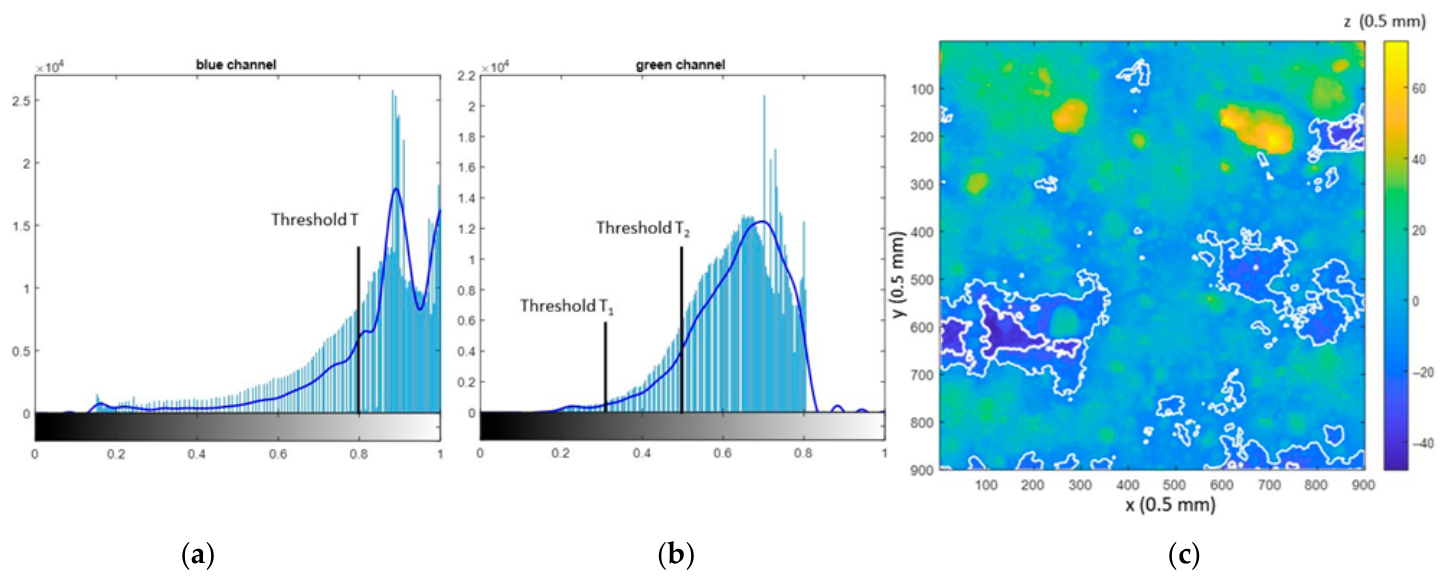
46], depression geometry was approximated by spherical cups, and plasticine cup-made surfaces were created for hydrological modeling. Depression storage or dead storage may be estimated by segmenting a surface DEM. Indeed, 2.5D DEMs are particularly well adapted to estimate small closed depressions, because it can be done by thresholding the elevations. For that purpose, RGB images, where color represents elevations, are appropriate to use. Histogram-based methods are quick and simple, often efficient, segmentation methods. They are particularly apt in the case of small datasets without ground truth if the regions of interest can be isolated by thresholding. Histogram thresholding methods are often based on grayscale images or on images transformed into the HSV or Lab color space when lighting and saturation are important. If the colors represent heights, there is no need to switch to the HSV or Lab color space. Thresholding the RGB channels independently is the simplest method for selecting colors related to depressions. It is a way to perform adaptive thresholding for heights. This approach is well adapted to the segmentation of depressions but not suitable for the segmentation of soil clods that may have a tilted base, different sizes, and lay at different heights. For that purpose, the boundary-based geometrical approach used in ref. [
18] is more suited.
In ref. [
47], it has been noted that the use of photogrammetry to assess post-tillage soil quality in agricultural fields has received limited attention. In particular, automatic delineation of soil clods and depressions remains largely unexplored in 2.5D DEMs of diverse surfaces recorded in the field at the meter scale. This study addresses this gap and presents computational techniques for interpreting measurement and quantifying roughness features at the within-field scale in order to assess soil surface spatial variability. First, a wavelet-based segmentation algorithm [
18], originally developed in controlled experiments, is adapted to identify soil clods under field conditions. Second, a novel algorithm, specifically designed to segment two levels of soil depressions, is proposed. Both methods are applied here for the first time to field-acquired 2.5D DEMs, enabling the derivation of roughness feature volumes. These methods will be useful for assessing surface condition in soil monitoring.
4. Discussion
As shown in
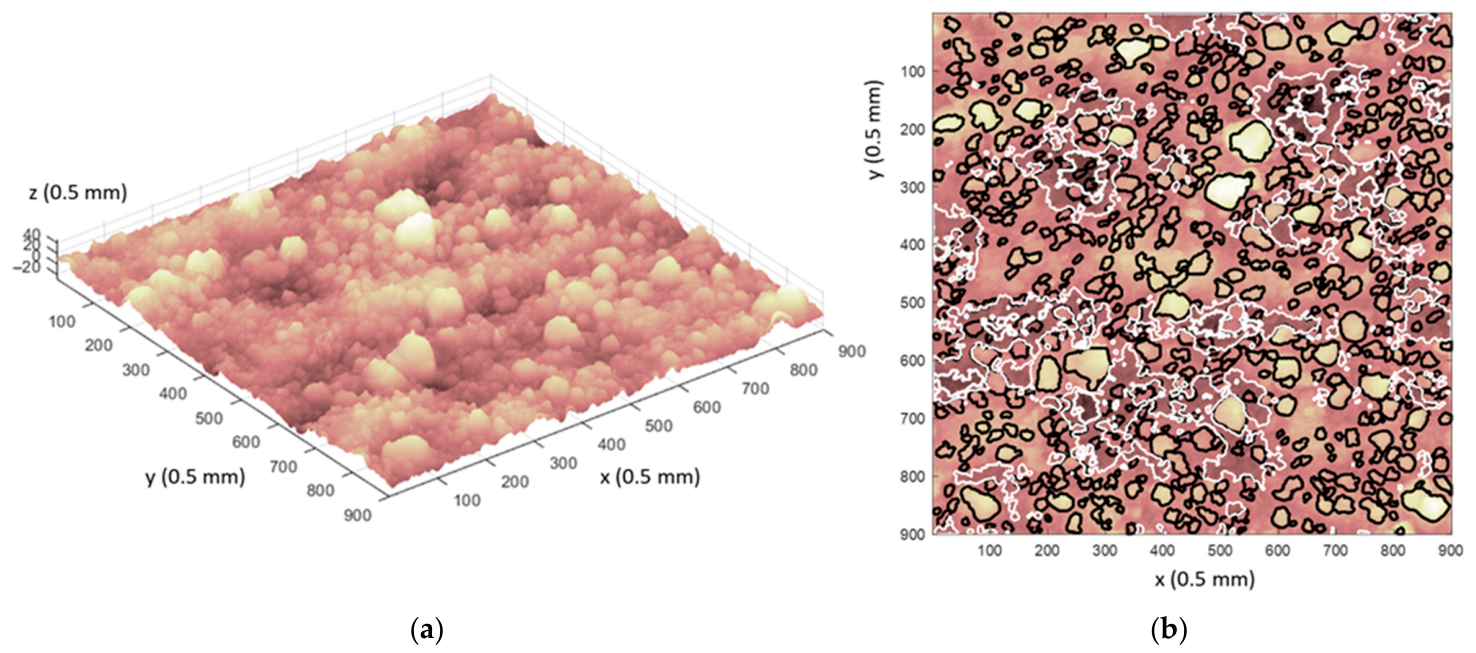
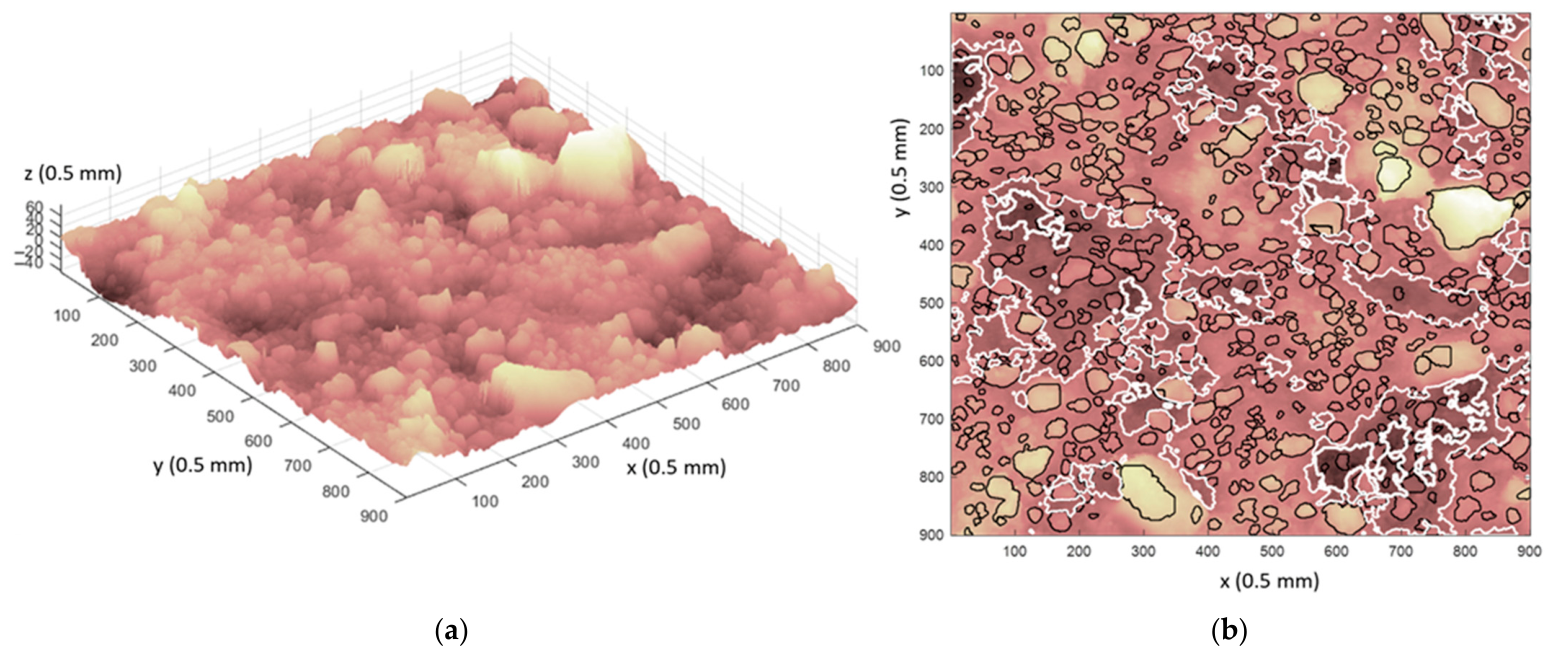
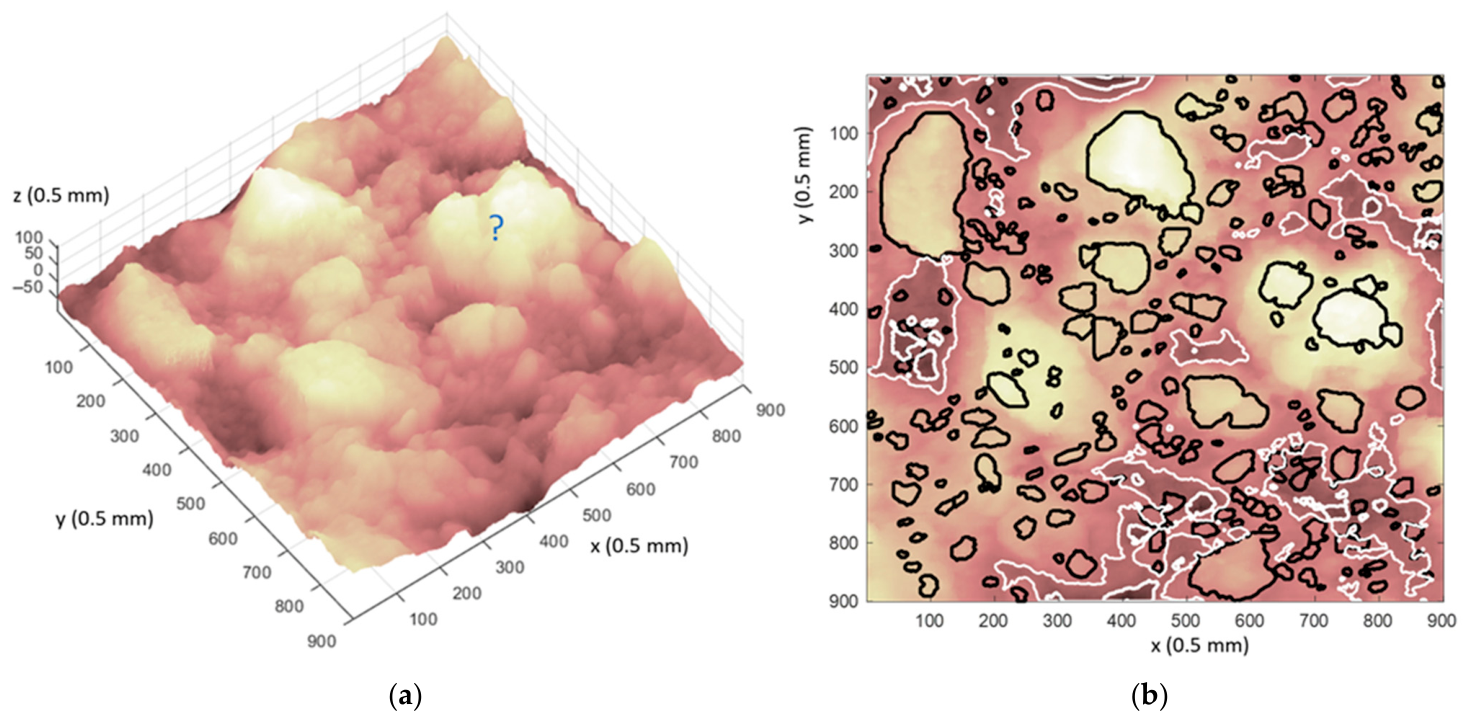
Table 1, the standard deviations of elevations are typical for the roughness of small, medium, and large soil surfaces measured in the field. Note that the DEMs were acquired a few months after tillage operations, which resulted in lower elevation standard deviations than those immediately after tillage. The probability density functions (PDFs) of elevations are positively skewed, indicating that having more clods than depressions is consistent. Finally, the kurtoses are greater than three, with one exception, indicating that the elevation PDFs are not Gaussian. In total, there are approximately 2800 clods, of which 1250 were analyzed individually to estimate quantitative indices. These indices are therefore statistically meaningful.
In the literature, the wavelet-based clod segmentation algorithm was evaluated on handmade soil surfaces of sieved clods (laboratory surfaces) in ref. [
18]. It showed strong performance and robustness, with average overlap rates (IoU indices) ranging between 55.1% and 79.9%, for instance evaluation, i.e., clod by clod. This corresponded to goodness of agreement (i.e., reflecting probability of having a high IoU) between 65.1% and 86.1% when compared with other methods. The equivalent diameters derived from this method and manual segmentation yielded a very good regression equation of 0.93x + 1.9 mm, with R
2 = 99%. This method was also evaluated on both real and laboratory surfaces in ref. [
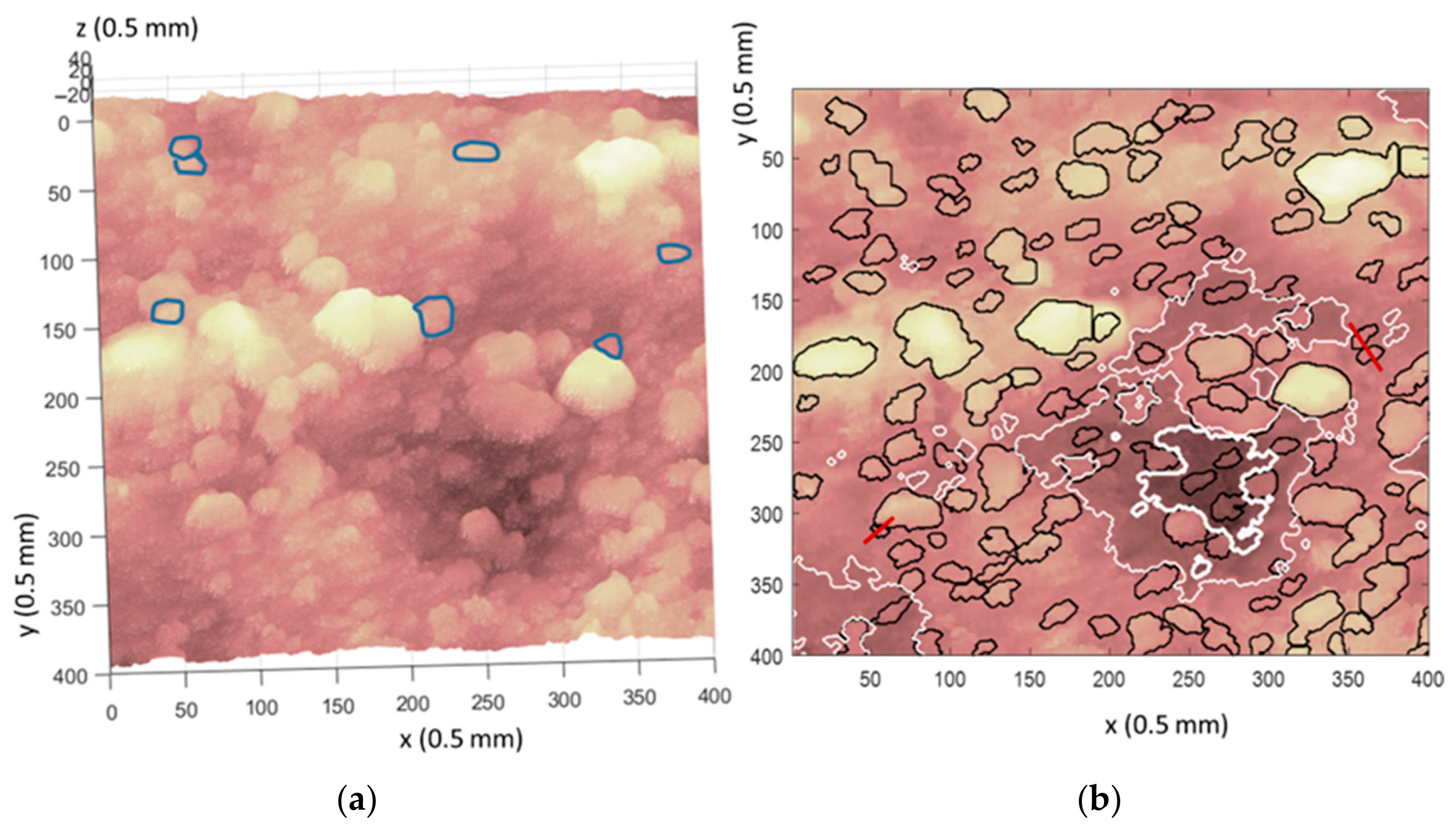
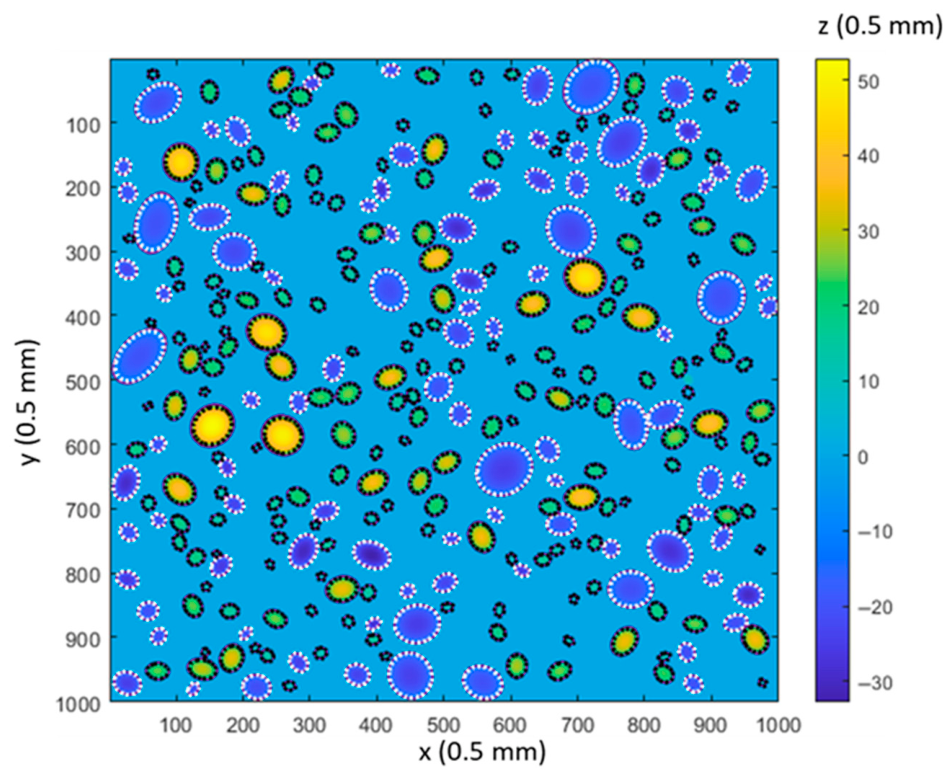
28] for the detection task, resulting in a sensitivity or recall of 83.6% and a precision of 93.6%, yielding an F1-score of 88.3%. Note that in the cited paper, the precision was mistakenly called specificity, and only the detection of clods was performed. In the present study, for in-field DEMs, the average recall, precision and F1-score were, respectively, 92.0%, 96.7%, and 94.2%, showing the scalability of the method. For simulation, IoU ranged from 84.2% to 87.9%. These results were thus better due to the relevance of steps 2 and 3 of the segmentation algorithm, which were specifically designed for clod delineation.
In ref. [
21], for 2D images segmentation using deep learning under laboratory conditions, mean IoU values ranged from 41.3% to 79.3% depending on clod size class, with an average of 55.7%. This was lower than the proposed method, highlighting the complexity of the clod segmentation problem. Note that in the present study, the simulated surface was less realistic than laboratory or field surfaces. However, the excellent visual agreement of the boundaries for seedbeds and ploughed surfaces demonstrates the robustness of the method when applied in real conditions. In ref. [
34], deep learning was also used for soil block identification. Average precision, recall, and F1-score were 87.3%, 87.8% and 88%, respectively, but only for the training dataset. These results are again lower than those obtained in the present study. In ref. [
35], a preliminary study on deep-learning-based clod segmentation was proposed. It resulted in the detection of 103 clods on a 2D image. While segmented clod areas were presented, only the clod fraction (i.e., the ratio of total clod area to image area) was evaluated, and no assessment of the clod boundaries was provided.
To the best of our knowledge, no segmentation of depressions has been published at the small scale addressed in the present article. Topographic depressions have instead been studied at a meter-scale resolution. In ref. [
44], karst depressions were segmented on 30 m resolution DEMs using deep learning with DEMs and derived variables as inputs. The best result achieved an F1-score of 85.1% and an IoU of 74.0%. The method presented in the present paper based on millimeter-scale resolution achieved better IoU values with an average of 91.8% on simulated surfaces, and visually comparable agreement on in-filed surfaces. Quantifying the segmentation of depressions remains challenging. Using a higher threshold on the green channel would have produced more extensive depressions. However, we have chosen to keep closed contours possibly modellable. Ultimately, the surface will be considered as the sum of clods, holes and depressions, supported by a base surface, as was the case for the simulated surface.
Clod segmentation proved more challenging than depression segmentation, leading to a more complex algorithm for clod detection. Optimal results were obtained for fine seedbeds, with excellent performance (F1-score and recall of 96.2% and 95.2%). However, performance was less strong (F1-score and recall of 90.1% and 84.2%), although still robust, for coarser ploughed surfaces. In that case, distinguishing between clods and the supporting terrain remains ambiguous and warrants further investigation. Several factors may contribute to this difficulty:
- (1)
The number of singular values allocated to the deterministic component may need adjustment for rougher surfaces;
- (2)
The choice of mother wavelet (e.g., Daubechies 9) and its family number may not be optimal for such surfaces;
- (3)
Higher family numbers introduce more oscillations, potentially complicating the delineation of large clod contours.
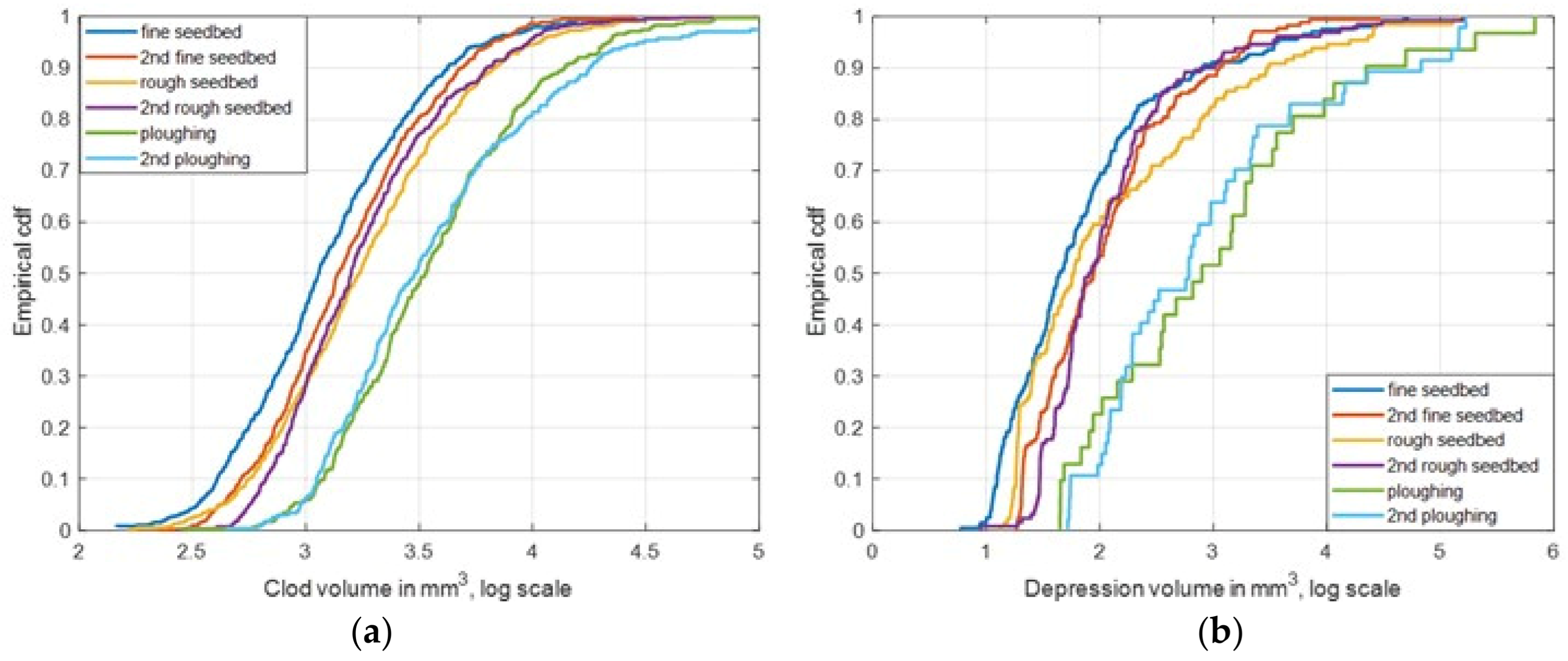
Clods and depressions can be characterized by their size. In this study, this was done using volumes without any assumption about shape. For the simulated surface, for which the true volumes are known, the errors in the total volume occupied by clods and depressions were estimated at 6.9% and 2.3%, respectively, with a slight underestimation in each case. CDF plots are useful for characterizing tillage and surface conditions. Moreover, the spatial variability in clod volumes, quantified by the coefficient of variation, is highly discriminative of the roughness resulting from tillage operations and weathering. Indeed, the coefficients of variation were 1.42 and 1.13 for fine seedbeds, 2.13 and 2.68 for rough seedbeds, and 3.77 and 3.49 for ploughed surfaces, showing similar values across surface replications and an increasing order of magnitude as the surface becomes coarser.
The proposed segmentation methods thus provide a powerful tool for the quantitative assessment of agricultural surfaces, enabling precise characterization of soil clods and depressions while addressing both research and practical management needs. They allow for the derivation of morphometric indicators (size, shape, spatial distribution) and support automated classification of surface conditions. This will facilitate temporal monitoring of post-tillage evolution. The added value of the 2.5D representation compared to 2D lies in the ability to compute volumes of clods and depressions. Future applications may include hydrological and erosion studies, such as estimating water retention capacity and the spatio-temporal evolution of surface roughness. The combination of millimeter-scale resolution with meter-scale coverage also makes these methods relevant for remote sensing applications. They further open the way to surface modeling and the estimation of radar signatures using electromagnetic simulations [
12].
5. Conclusions
This study explored automatic DEM interpretation to assess post-tillage soil quality and presented computational methods for quantifying field-scale roughness features. Two segmentation methods for delineating clods and small depressions were evaluated, and their application for studying spatial variability was demonstrated. Field-measured DEMs confirmed the relevance of the proposed approaches, with indices outperforming those reported in the literature.
These methods enable both global statistics on clod and depression size and shape, and precise localization of these features. They not only improve the quantitative characterization of soil surface roughness, but also pave the way for operational applications, including automated classification and high-resolution temporal monitoring of surface condition. Their unique combination of field-scale coverage and millimeter-scale resolution offers strong potential for advancing hydrological modeling, erosion assessment, and remote sensing of soil surface conditions.
Future work will focus on modeling clods and depressions to complete the characterization of surface roughness and simulate realistic soil surfaces, including the support structure of these features and deterministic components of the surface.