Article

Impact of China’s Foreign Direct Investment on Food Security in Sub-Saharan Africa: Mechanism and Heterogeneity Analysis
Agricultural Information Institute, Chinese Academy of Agricultural Sciences, Beijing 100081, China
*
Author to whom correspondence should be addressed.
Agriculture 2026, 16(10), 1043; https://doi.org/10.3390/agriculture16101043
Submission received: 9 April 2026 / Revised: 6 May 2026 / Accepted: 6 May 2026 / Published: 11 May 2026
(This article belongs to the Topic Food Security and Healthy Nutrition)

Abstract

As a major source of investment in Africa, the rapid growth of China’s Foreign Direct Investment (FDI) in Africa has exerted a profound influence on regional development and food security. Based on multinational panel data of African countries from 2006 to 2024, this paper systematically investigates the impact, transmission mechanisms, and heterogeneous characteristics of China’s FDI on food security in Africa. The empirical results show that China’s FDI in Africa has a significant positive effect on food security. Mechanism analysis indicates that China’s FDI improves food security indirectly, mainly through upgrading infrastructure and promoting agricultural technology spillovers. Moderating effect analysis reveals that a sound governance environment and strong absorptive capacity amplify its positive impact, whereas a less diversified industrial structure (a low share of secondary industry) weakens its effectiveness. This paper provides policy implications for optimizing the layout of China’s investment in Africa and promoting the sustainable development of Africa’s food system.

1. Introduction

For developing economies, foreign direct investment (FDI) serves as a vital source to compensate for domestic capital shortfalls, helping to alleviate funding constraints, drive industrial development, and enhance production efficiency [1]. However, differing developmental priorities and investment rationales among FDI home countries result in varied impacts of FDI within host nations [2,3,4]. Since the implementation of the Going Global Strategy, China’s outward FDI has expanded continuously. Particularly, after the launch of the Belt and Road Initiative, the geographical scope and sectoral depth of China’s overseas investments have continued to broaden. China’s outward FDI has expanded continuously since the Going Global Strategy and the Belt and Road Initiative. According to the existing literature, China’s outward FDI exhibits three core characteristics: it prioritises infrastructure (transport, energy, water, communications); it is described as emphasising long-term empowerment without attaching political conditionalities; and it integrates technology transfer with local capacity building [5,6]. These features make Chinese investment particularly relevant for addressing infrastructure bottlenecks in developing economies.
Sub-Saharan Africa (SSA) is not only a key region for China’s outward foreign direct investment, but also one of the most rapidly growing and steadily expanding markets for China’s overseas investment. According to statistics released by the Ministry of Commerce of China, China’s direct investment flow to SSA reached 4.88 billion US dollars in 2024, with the cumulative investment stock exceeding 50 billion US dollars, covering 53 SSA countries and regions. Investment in the infrastructure sector accounted for more than 40%, involving a series of key projects such as railways, ports, hydropower stations, and communication networks, which have become a core driving force behind the upgrading of SSA’s infrastructure. However, it is noteworthy that SSA also faces the most severe food security challenges in the world. As clearly stated in The State of Food Security and Nutrition in the World 2024 by the Food and Agriculture Organization of the United Nations (FAO), nearly 282 million people in SSA currently suffer from severe food insecurity, accounting for more than 60% of the global total. Among them, the malnutrition rate in SSA reaches 21.7%, far exceeding the global average of 9.2%, and the stunting rate of children under five in the region exceeds 30%. At present, SSA’s food self-sufficiency rate is less than 60%, and the food import dependence of some countries exceeds 80%. Meanwhile, due to inadequate infrastructure, SSA’s food distribution costs are 30% to 50% higher than the global average, further exacerbating the fragility and risks of food security in the region. If the current trend is not reversed in time, it is projected that by 2030, approximately 582 million people worldwide will face chronic undernourishment, half of whom will be in SSA.
The root causes of food insecurity in SSA are complex, stemming from the interplay of natural factors and societal contradictions. On the natural front, SSA faces arid climates, frequent extreme weather events, and recurring locust infestations and droughts. Compounded by ecological fragility, degraded farmland, and water scarcity, these conditions severely undermine the stability of agricultural production. On the societal front, inadequate infrastructure remains a core shortcoming [7]. Inadequate transportation networks hinder cross-regional grain distribution, while insufficient water conservancy infrastructure limits irrigation coverage to less than 10%. Energy shortages constrain the adoption of agricultural mechanization. Simultaneously, most SSA nations grapple with outdated agricultural techniques, extensive farming practices, low rates of seed improvement and fertilizer application, and inefficient production. Compounded by conflicts, geopolitical instability, heavy debt burdens, and ambiguous land tenure, these factors continuously squeeze agricultural investment, resulting in long-term stagnation of food production capacity.
Chinese FDI in SSA focuses on infrastructure as its core area. According to the white paper, “China and Africa in the New Era: A Partnership of Equals,” Chinese companies over the last quarter century have helped African countries build or upgrade more than 10,000 km of railways, nearly 100,000 km of highways, roughly 1000 bridges, almost 100 ports and 66,000 km of power transmission and distribution. Regarding its impact on food security, from a direct impact perspective: in addition to improving transport networks to reduce distribution costs and constructing water conservancy facilities to enhance production conditions, Chinese investment also helps effectively reduce post-harvest food losses and improve food reserve stability through the construction of storage and cold-chain facilities. Upgraded energy infrastructure guarantees the power supply for agricultural mechanization, irrigation, and food processing, connecting the entire chain of production, processing, and distribution [8]. From an indirect impact perspective: on the one hand, Chinese investment is highly concentrated in economic infrastructure such as railways, highways, ports, power stations, and communications. Such investment directly lowers overall logistics and transaction costs, laying the foundation for agricultural commercialization, industrialization, and equal access to public services. On the other hand, investment projects create substantial local employment and increase household income, while expanding rural infrastructure and improving food accessibility [9]. Therefore, Chinese foreign direct investment in SSA helps SSA countries build the foundational conditions and endogenous drivers for economic growth.
Existing literature has mostly focused on the motives of China’s investment in SSA and its impact on economic growth. Brautigam et al. (2019) [10], Claassen et al. (2011) [11], Edinger and Pistorius (2011) [12] and Utesch-Xiong and Kambhampati (2022) [13] have discussed that China’s FDI in SSA is driven by resource-seeking motives while contributing to economic growth. A large body of research has also examined the relationship between Chinese capital inflows and SSA’s economic growth, arguing that Chinese FDI promotes SSA’s industrialization, though such effects depend on the absorptive capacity of SSA countries [13,14,15,16,17]. Some studies have focused on the link between Chinese aid, agricultural cooperation, and food security in SSA. Brautigam (2011) [18], Siméon et al. (2022) [19] and Yuan et al. (2025) [20] argue that agricultural investment projects led by Chinese state-owned enterprises help improve SSA’s food system and local production conditions. In summary, the existing literature suffers from three main limitations. First, most studies remain at the descriptive or single-case level, lacking systematic, cross-country empirical evidence on the food-security effects of Chinese FDI. Second, even when quantitative methods are used, the transmission mechanisms—through which Chinese FDI could affect food security—are rarely formally tested. Third, potential heterogeneity arising from host-country characteristics (institutions, human capital, industrial structure) is largely ignored. This paper directly addresses these gaps by providing a multi-country panel analysis, explicitly testing two transmission channels (infrastructure and agricultural technology spillovers), and examining three moderating conditions.
The primary objective of this paper is to systematically examine the impact of Chinese foreign direct investment (FDI) on food security in sub-Saharan Africa (SSA), with a focus on its mechanisms and heterogeneous effects. This study adopts the operational definition of SSA as used in the World Bank’s World Development Indicators (WDI) database, which excludes the North African Arab countries (Algeria, Egypt, Libya, Morocco, Tunisia) and covers the geographical area of African countries and territories south of the Sahara Desert. Based on data availability, this study constructs a panel dataset covering 35 SSA countries (see Section 3.2 for the full list and selection criteria). This paper has the following innovations: First, while existing literature mostly focuses on the impact of aid and agricultural cooperation on food security, this paper incorporates Chinese FDI to SSA into the analytical framework of food security and systematically investigates its effects, providing a new perspective for relevant research. Second, it explores the mechanistic role of Chinese FDI in affecting food security, so as to more accurately reveal the structural and long-term impacts of new-type international cooperation on food security. Third, it tests the heterogeneity of the effects. By analyzing heterogeneous impacts under different country characteristics and development conditions, it provides targeted empirical evidence for optimizing the structure of Chinese investment in SSA and enhancing its food security effects.

2. Theoretical Analysis and Hypothesis

2.1. Food Insecurity in SSA and the Impact of External Capital

Food security has long been one of the core challenges facing SSA’s economic and social development. From the perspective of the structural characteristics of SSA’s food security, existing theoretical and empirical studies generally agree that its dilemma is not caused by a single factor, but by the combination of multiple factors such as sluggish economic development, low agricultural productivity, inadequate infrastructure, and frequent external shocks [21,22]. In particular, as the region with the largest concentration of food-insecure people in the world, SSA has a food supply system that is highly dependent on natural conditions. Agricultural production, dominated by smallholder farming, has weak risk resilience, and the growth rate of food production has long been out of balance with population growth [23]. Meanwhile, food insecurity and malnutrition have created a significant overlapping effect in SSA, characterized by the coexistence of insufficient calorie intake and micronutrient deficiencies [24]. This vicious cycle further exacerbates the intergenerational transmission of poverty and insufficient human capital accumulation, forming a “path lock-in” for food security: food insecurity restricts the improvement of human capital, while low human capital in turn limits agricultural productivity and economic development, ultimately entrenching the food security dilemma.
External capital and international aid have long been considered important external sources for addressing SSA’s food security challenges. Based on international aid theory and FDI spillover theory, various forms of external intervention—including official development assistance, concessional loans, and foreign direct investment—have been deployed to support agricultural development and food systems in the region [25]. A substantial body of literature has examined the effectiveness of these interventions. On the one hand, short-term food aid has been shown to play an irreplaceable role in mitigating acute food shortages caused by natural disasters and conflicts, rapidly filling supply gaps and preventing humanitarian crises [26]. On the other hand, the long-term development impact of external capital has been subject to considerable debate. Some studies indicate that aid and investment models that attach institutional reform conditions may not always align with the highly heterogeneous development needs of SSA countries, and in some cases, they may inadvertently weaken local agricultural capacity or create dependency [24]. Moreover, the sectoral composition of foreign capital matters: investment concentrated in resource extraction or finance may generate fewer spillovers to agriculture and food systems compared to investment in infrastructure, agro-processing, or rural development [27]. However, the performance of external capital is not determined solely by its source (Western vs. non-Western). Rather, the effectiveness of any investment or aid depends on its design, sectoral focus, alignment with local development priorities, and the host country’s absorptive capacity and institutional environment. These insights provide a useful backdrop for understanding the potential and limitations of different external actors—including China—in contributing to food security in SSA.

2.2. Theoretical Mechanisms of FDI’s Impact on Host Countries’ Food Security

2.2.1. Mechanisms of FDI’s Impact on Host Countries’ Economic Development

This study draws on three interrelated theoretical strands: endogenous growth theory, technology spillover theory, and FDI spillover theory. Endogenous growth theory [28,29] argues that long-run economic growth is primarily driven by knowledge accumulation, human capital, and technological innovation, rather than by exogenous factors. Within this framework, FDI can act as a vehicle for transferring knowledge and technology, thereby promoting productivity growth in host countries. Technology spillover theory [30,31] focuses on how foreign firms’ advanced technologies unintentionally diffuse to local firms through demonstration effects, labour mobility, and backward/forward linkages. This body of literature emphasises that spillovers are not automatic but depend on the absorptive capacity of domestic firms and the host country’s institutional environment. FDI spillover theory [32,33] synthesises these insights, examining the specific channels through which foreign investment affects host economies—including capital formation, employment, competition, and export promotion. A central conclusion is that the net effect of FDI on development is contingent on host-country characteristics such as infrastructure, human capital, and governance.
Against this theoretical backdrop, the impact of FDI on host countries’ economic development is mainly realised through capital injection, technology diffusion, and management-experience transfer—mechanisms that have been empirically verified in many developing-country studies [34].
From the perspective of capital supplementation, FDI can effectively alleviate capital shortages, expand production scale, and improve total factor productivity through capital deepening, thereby providing sustained momentum for growth. From the perspective of technology spillovers, the entry of multinational enterprises typically introduces advanced production technologies, management models, and market concepts. These generate demonstration and competition effects for local firms, promoting technological upgrading and industrial transformation [35]. From the perspective of employment and income distribution, FDI directly creates jobs, raises labour skills and income levels, and stimulates employment in upstream and downstream industries through industrial linkages, creating a multiplier effect. Moreover, the additional tax revenue generated by FDI can strengthen public finances and enhance government capacity to invest in education, health care, and infrastructure [36,37].
Nevertheless, the economic effects of FDI are not uniformly positive. Their outcomes are constrained by the type of investment, the host country’s industrial structure, institutional environment, and absorptive capacity. For example, resource-seeking FDI may trigger the “resource curse” and exacerbate economic monoculture [38]. A weak institutional environment and inadequate intellectual-property protection can limit the realisation of technology-spillover effects. Kottaridi and Stengos (2010) [35] further emphasise that positive spillovers materialise only when the host country possesses a certain level of human capital and basic infrastructure.

2.2.2. Transmission Pathways of FDI’s Impact on Food Security

Based on the logical chain of “economic growth—livelihood improvement—food security”, the impact of FDI on food security is mainly realized through indirect pathways. By acting through intermediary mechanisms such as improved infrastructure and agricultural technology diffusion, FDI exerts a systematic influence on multiple dimensions of food security [39]. Existing studies generally agree that infrastructure and technology constitute key supports for the modernization transformation of food systems in developing countries, and their improvement directly affects food production efficiency, circulation costs, and market stability.
In terms of transmission pathways, the first pathway is infrastructure improvement. FDI promotes the construction of transportation, energy, communication and logistics systems, which can significantly reduce the flow costs of production factors, improve the transportation conditions of agricultural inputs and the market accessibility of agricultural products, thereby enhancing the efficiency of the food system. Relevant studies show that FDI drives infrastructure investment and urbanization, promotes industrial restructuring and cross-sectoral labor mobility, which in turn raises household income, improves households’ ability to purchase food, and enhances food accessibility. This effect is particularly significant in low-income countries [25,40]. Meanwhile, improved infrastructure can facilitate food market integration and circulation network optimization, reduce regional grain price volatility, and strengthen the stability of the food supply system [41]. Notably, FDI in key areas such as transportation, logistics and warehousing helps reduce post-harvest food loss and frictional costs in circulation, thereby improving the overall efficiency of the food system [42].
The second channel is the agricultural technology spillover channel. Based on the framework of technology diffusion theory and endogenous growth theory, foreign direct investment can optimize agricultural input, promote the popularization and application of modern technologies such as agricultural mechanization and digitalization, accelerate the process of agricultural commercialization and industrialization, thereby improving agricultural production efficiency and optimizing the food supply structure [43]. Multinational enterprises not only introduce advanced production equipment and management experience to host countries, but also promote local agricultural actors to learn, absorb and apply advanced technologies through demonstration effects, market competition, and labor mobility. This gradually transforms traditional agricultural production modes and raises the output level per unit input. However, the effectiveness of this channel shows significant heterogeneity across countries. In countries with relatively low industrialization levels and a large share of agriculture in the economy, technology introduction has a more pronounced effect on improving food security. In contrast, in resource-based economies, FDI tends to flow more into the extractive and primary processing sectors, resulting in relatively limited technology spillovers to the agricultural sector. Its positive impact is thus easily weakened by problems such as excessive economic specialization [44].

2.3. Mechanisms and Heterogeneity Analysis of the Impact of China’s FDI on Food Security in SSA

2.3.1. Characteristics and Adaptability of China’s FDI in SSA

From a comparative perspective based on the theories of “North–South Cooperation” and “South–South Cooperation,” China’s FDI in SSA demonstrates development-oriented features that differ in certain respects from those of traditional Western investors. According to the literature, China’s FDI in SSA tends to concentrate more heavily in infrastructure and productive sectors such as transportation, energy, communication facilities, and industrial parks, with the stated aim of addressing infrastructure bottlenecks and unlocking endogenous development potential [5]. This “infrastructure-first” orientation aligns with the development priorities of many SSA countries. Empirical studies have found that infrastructure improvement can reduce agricultural production and food circulation costs, thereby contributing to food security [45,46,47]. Additionally, China’s investment model often integrates trade, project contracting, and financial cooperation, potentially amplifying the economic and livelihood effects of infrastructure investment through industrial chain linkages [48]. Some researchers also note that Chinese FDI is relatively less sensitive to the institutional environment of host countries, which may allow it to operate in contexts where Western capital is more cautious, thus providing external support for countries with weak institutional foundations but urgent development needs [49].
Nevertheless, a growing body of critical literature points to limitations and negative consequences associated with Chinese FDI in SSA. Ndhlovu (2025) [50] argues that while Chinese investments have created employment and facilitated technology and knowledge transfers, they have also been associated with rivalries over farmland, farmland depletion, and the crowding out of peasant farmers, negatively affecting local livelihoods.
Environmental concerns have also been raised, including pollution of water bodies due to unregulated use of chemicals and inorganic fertilizers, which can harm both human health and ecosystems. Dreher et al. (2021) [45] caution that the benefits of China’s infrastructure projects, while positive on aggregate, may not be evenly distributed, and local smallholders may not always be adequately integrated into the value chains created by these projects. Furthermore, some studies point out that China’s FDI in SSA remains heavily skewed toward infrastructure and extractive industries, with the share of investment flowing directly to agriculture being relatively limited compared to the sector’s needs. This structural pattern may result in insufficient direct support for smallholder farmers, and the environmental and social sustainability of some projects has been questioned [18,50]. These critical perspectives suggest that the actual impact of Chinese FDI on food security is likely to be context-dependent and heterogeneous, a point that will be further explored in the empirical analysis.

2.3.2. Mechanisms and Heterogeneity of China’s FDI in Affecting SSA’s Food Security

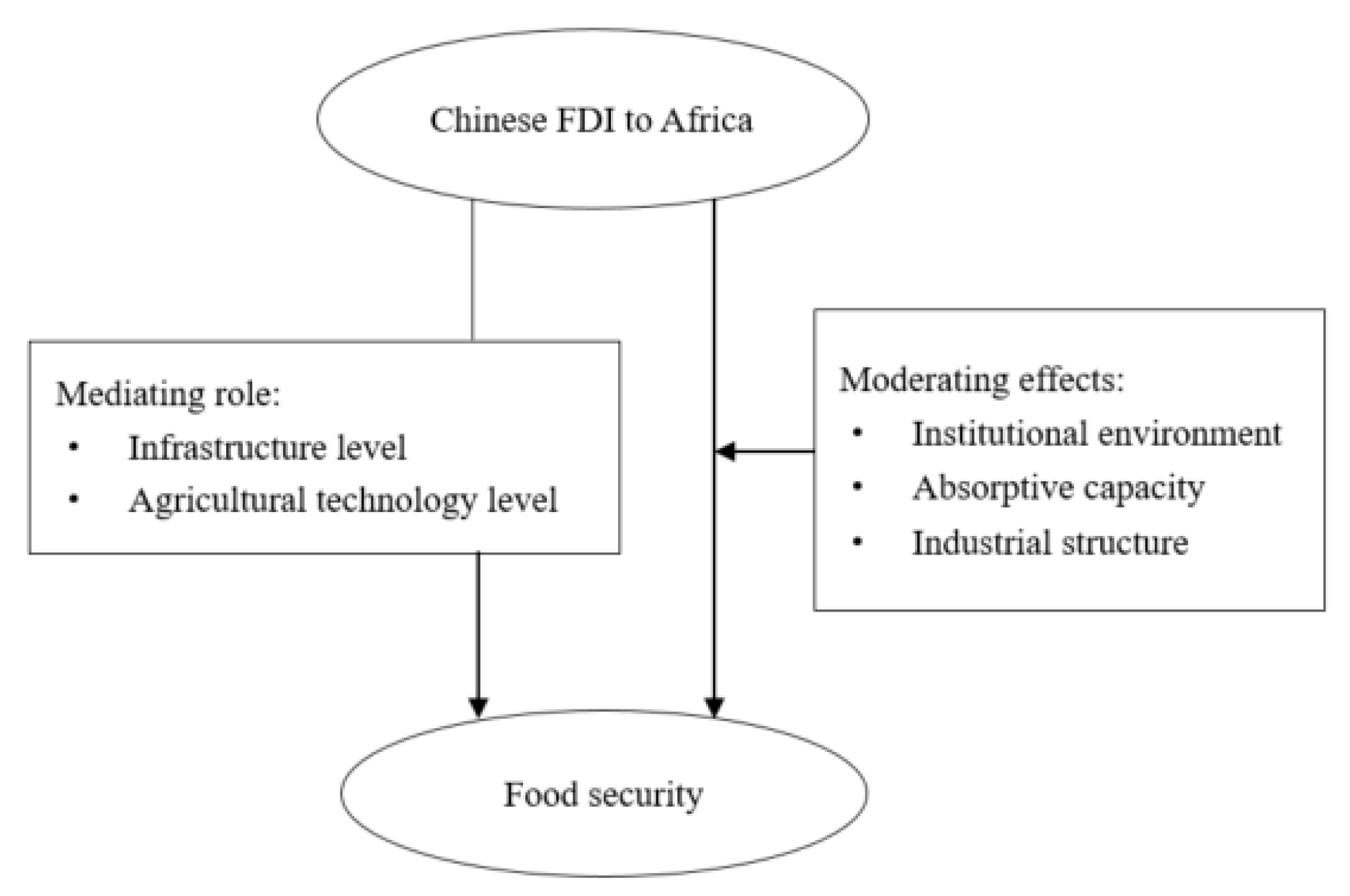
Based on the above theories, the impact of Chinese FDI on food security in SSA can be mainly summarized into the following two mechanisms, as illustrated in Figure 1.
In terms of functioning mechanisms, the first mechanism operates on food security by improving infrastructure. China’s FDI in SSA in transportation, energy, and logistics systems directly upgrades the transportation conditions of agricultural production materials and the grain storage and circulation system, reduces transaction costs and post-harvest losses of agricultural products from production to consumption, and thus enhances the stability and resilience of the food supply system. A well-developed transportation and logistics network helps strengthen connectivity between rural areas and urban markets, improves agricultural product market accessibility, and provides essential support for large-scale agricultural operations and regional grain redistribution [25,40]. In practice, China’s infrastructure investment has generated representative demonstration effects in many SSA countries. For instance, the Addis Ababa–Djibouti Railway, with deep Chinese participation, connects Addis Ababa and the Port of Djibouti, greatly shortening the transportation cycle for inland agricultural products to access regional and international markets, effectively lowering logistics costs, and providing critical channel support for cross-regional grain redistribution and emergency supply. In East SSA, the Mombasa–Nairobi Railway, built with Chinese enterprise participation, links Mombasa and Nairobi, promoting the development of agricultural processing, storage, and cold-chain logistics along the line, and significantly improving grain circulation efficiency. In the energy sector, China’s FDI also plays a key supporting role. Through the construction of hydropower stations, photovoltaic power stations, and power transmission and transformation projects, Chinese investment effectively eases the long-standing energy constraints facing SSA agricultural production, providing stable electricity for irrigation systems, the promotion of agricultural mechanization, and agricultural product processing, thereby enhancing the continuity and risk resilience of agricultural production [41]. On this basis, improved infrastructure also drives the development of manufacturing and basic industries, creates substantial employment, raises household incomes, strengthens families’ ability to purchase food, and improves food accessibility. Meanwhile, the tax revenue growth brought by FDI enhances fiscal capacity, providing funding for agricultural technology extension, rural education, and public health, thereby indirectly optimizing the food and nutrition structure through improved public services [51].
The second mechanism affects food security through agricultural technology spillovers. Through the construction of agricultural technology demonstration centers, implementation of technical training programs, and investment in supporting industries, China has localized the promotion of agricultural technologies suitable for SSA’s natural conditions and production environments, such as high-yield and stress-resistant crop varieties, water-saving irrigation techniques, and intensive planting patterns, thereby directly raising per-unit grain yields and reducing production risks. Since 2006, China has established agricultural technology demonstration centers in many SSA countries, conducting experimental demonstrations and technical training focusing on major grain crops such as rice, maize, and cereals. An operational model of “demonstration planting + farmer training + enterprise participation” has been formed, enabling the rapid diffusion of advanced technologies in a visualized manner. Relevant studies show that such cooperation models help alleviate the technological constraints and information asymmetry long faced by smallholder farmers in SSA. Meanwhile, China’s investment in industrial parks and digital infrastructure also provides long-term technological support for agricultural production and the modernization of the food system through information technology diffusion, management experience transfer, and optimized resource allocation [43,52]. For example, relying on the construction of communication networks and digital platforms, some regions have gradually achieved shared agricultural product price information, coordinated agricultural input supply, and remote technical guidance, improving the organization and informatization of agricultural production. The communication infrastructure projects participated in by enterprises such as Huawei Technologies Co., Ltd. have also objectively laid the foundation for the digital transformation of agriculture.
The impact of FDI on the food security of host countries varies with the level of economic development. It can therefore be inferred that the food security effect of China’s FDI in SSA will exhibit heterogeneity. In general, the sources of heterogeneity mainly include three aspects: First, the institutional environment. In countries with stronger policy stability and implementation capacity, the technology spillover and industrial linkage effects of FDI are more likely to be fully realized [49]. Second, absorptive capacity. Countries with higher levels of human capital and better infrastructure can more fully absorb the positive spillover effects of FDI [53,54]. Third, the industrial structure. In countries with a low share of secondary industry (i.e., a less diversified industrial structure), the capacity to absorb and diffuse productivity spillovers from FDI—particularly in terms of employment generation, infrastructure utilization, and backward linkages to agriculture—is relatively weak. Consequently, the positive effect of FDI on food security is more limited in such economies. Conversely, a higher level of industrialization (a larger secondary sector) strengthens the multiplier effect of FDI on income, employment, and rural–urban market integration, thereby amplifying its contribution to food security [55,56].
Based on the above theoretical analysis and mechanism decomposition, combined with findings from existing literature, this paper puts forward the following research hypotheses:
Hypothesis 1.
China’s FDI has a significantly positive impact on food security in SSA countries.
Hypothesis 2.
The impact of China’s FDI on SSA’s food security is transmitted mainly through two indirect pathways: infrastructure empowerment and agricultural technology spillover.
Hypothesis 3.
The impact of China’s FDI on SSA’s food security exhibits heterogeneity, and institutional environment, absorptive capacity, and industrial structure significantly moderate this effect.

3. Methodology and Data

3.1. Equation Specification

The core objective of this paper is to reveal the impact, transmission mechanism, and heterogeneous characteristics of China’s outward foreign direct investment on food security in SSA countries. Given the dynamic nature of food security indicators and the potential endogeneity between FDI and development outcomes, this study adopts a dynamic panel data approach. The baseline model estimates the average effect of China’s FDI on food security, while extended specifications are employed to conduct mechanism tests and moderation analyses.
To accomplish this goal, we first develop a multivariate modeling framework, as follows:
f o o d s e c i t = f ( f o o d s e c i , t 1 , f d i c h n i , t 3 , X i t )
where f o o d s e c i t represents the level of food security of SSA countries; f d i c h n i , t 3 denotes China’s FDI stock in SSA, lagged by three periods to capture delayed effects and mitigate simultaneity bias; X i t denotes a set of control variables; i represents the countries; t represents the years 2006–2024. To handle potential data instability and reduce heteroscedasticity issues, each variable is converted to its logarithmic form:
l n f o o d s e c i t = β 0 + β 1 l n f o o d s e c i , t 1 + β 2 l n f d i c h n i , t 3 + β l n X i t + ε i t
where β 1 and β 2 denote the coefficients for the lagged term of food security and Chinese FDI, and β is a vector of coefficients for control variables, while ε i t represents the error term, which is assumed to be independent and identically distributed.
Regarding the selection of econometric methods, traditional static panel estimation may lead to significant bias in the results due to potential dynamic persistence of the dependent variable, endogeneity of the core explanatory variable, and interference from unobserved country heterogeneity. First, food security in SSA countries shows obvious time persistence. Malnutrition rates are often affected by historical food supply conditions, long-term poverty levels, and structural constraints, resulting in persistent changes. Therefore, it is necessary to include the lagged term of the dependent variable in the model. Traditional static panel estimators (FE, RE) suffer from Nickell bias when a lagged dependent variable is included [57]. Moreover, Chinese FDI may be endogenous due to reverse causality and omitted variables. To address these issues, we employ System GMM [58], which combines differences and level equations and uses lagged variables as instruments. This method is standard for dynamic panels with a short time dimension [59].
For the specific estimation strategy, this paper adopts System GMM rather than Difference GMM. The Difference GMM proposed by Arellano and Bond (1991) [60] eliminates individual fixed effects through first-differencing the model and uses lagged level variables as instruments. However, subsequent studies show that when the dependent variable is highly persistent and the time dimension is short, the instruments relied on by Difference GMM may be weak, leading to large estimation bias and low efficiency [58]. To overcome this problem, Blundell and Bond (1998) [58] developed the System GMM method on the basis of Difference GMM. This method augments the differenced equation with a level equation, using lagged differences as instruments for the level equation, thereby significantly strengthening the correlation of instruments and improving estimation accuracy. System GMM has clear advantages over Difference GMM and traditional panel estimators in cases where the time dimension is short, the dependent variable is highly persistent, and explanatory variables are endogenous, as it effectively reduces bias and improves efficiency [58,61]. The research sample in this paper exhibits typical macro panel characteristics: a large number of countries (large N) and a relatively limited time span (small T). Moreover, the malnutrition rate shows significant dynamic persistence, and China’s FDI to SSA and some control variables may suffer from endogeneity. Therefore, System GMM is highly applicable both theoretically and empirically. Meanwhile, this paper employs FE, feasible generalized linear squares (FGLS) and Difference GMM regressions as benchmark references to compare with System GMM results and verify the robustness of the conclusions.

3.2. Variables and Data Source

This study focuses on issues at the country level, so a country-level panel dataset is used.

3.2.1. Dependent Variable

This paper takes the Prevalence of Undernourishment (PoU) as the core dependent variable to measure food security in SSA countries. This indicator reflects the proportion of a country’s population suffering from long-term insufficient caloric intake. PoU primarily captures the caloric dimension of food insecurity, specifically the proportion of the population whose habitual dietary energy intake falls below the minimum requirement for an active and healthy life. As such, it does not directly reflect other critical dimensions of food security, including dietary diversity, micronutrient adequacy, food safety, or the stability dimension of the food system [24]. However, several considerations justify the use of PoU as the core dependent variable in this study. First, in the context of SSA, where chronic hunger—i.e., persistent caloric insufficiency—remains the most immediate and widespread food security challenge, PoU is a highly policy-relevant indicator [62]. Second, PoU is a well-documented and comparable indicator across countries, allowing consistent panel analysis over a longer time horizon than many alternative measures. Third, while caloric intake is but one dimension, it is a foundational one: improvements in food security often begin with caloric adequacy before progressing to quality and diversity concerns. The data are sourced from the World Development Indicators (WDI).

3.2.2. Core Independent Variable

The use of FDI stock rather than flow indicators is mainly based on the following considerations: First, the economic and social effects of infrastructure-oriented investment usually feature obvious cumulativeness and time lags. Second, the stock indicator can more stably reflect the long-term capital presence formed by China in host countries. Third, the introduction of lagged terms helps to alleviate reverse causality and is more consistent with the actual transmission logic through which FDI affects food security.
We choose to use the three-year lag for Chinese FDI, and the reasons are as follows. Infrastructure projects (e.g., transport, energy, and logistics) typically require several years from initiation to completion before they can exert tangible effects on agricultural production, food circulation, and ultimately nutrition outcomes. Similarly, agricultural technology spillovers—such as the adoption of improved seeds, irrigation techniques, or management practices—take time to diffuse among local farmers and materialize in productivity gains. Based on these mechanisms and following the practice in related literature (e.g., Dreher et al., 2021 [45]; Mensah & Traore, 2024 [62]), we adopt a three-year lag as the baseline to capture the medium-term cumulative impact of Chinese FDI on food security.

3.2.3. Control Variables

To avoid omitted variable bias, this paper introduces a set of control variables to characterize macroeconomic conditions, demographic structure, resource endowment, institutional environment, and external shocks in SSA countries.
Economic development level (pgdp) is measured by per capita GDP in current US dollars. Agricultural development (agri) is measured by the share of agricultural value-added in GDP, reflecting the structural position of agriculture in the national economy. Foreign capital inflows from other countries (fdirow) is measured by net FDI inflows from non-Chinese sources to SSA countries, to control for the overall impact of global capital flows and avoid attributing general FDI effects to Chinese investment. This variable is also lagged by three periods. Demographic factors include population growth rate (grpop) and urbanization rate (urban). Rapid population growth may intensify pressure on food demand, while urbanization may improve food access through changes in income structure and market integration. Natural resource endowment (resource) is measured by the share of mineral resource exports (fuels, ores, and metals) in total exports, to control for the “resource curse” effect. All the above data are sourced from the World Bank. Institutional governance (institute) adopts the Worldwide Governance Indicators (WGI) issued by the World Bank, specifically the government effectiveness index, to control for the impact of the institutional environment on public resource allocation.
This paper selects the following 35 countries to form the panel data: Angola, Benin, Botswana, Burkina Faso, Cape Verde, Cameroon, Central African Republic, Chad, Comoros, Democratic Republic of the Congo, Republic of the Congo, Côte d’Ivoire, Ethiopia, Gambia, Ghana, Guinea, Guinea-Bissau, Kenya, Liberia, Madagascar, Malawi, Mali, Mauritania, Mauritius, Mozambique, Namibia, Niger, Rwanda, Senegal, South Africa, Tanzania, Togo, Uganda, Zambia, Zimbabwe, from 2006 to 2024. Descriptive statistics of the variables are presented in Table 1. The sample selection follows several criteria: First, the core variables (prevalence of undernourishment and the stock of Chinese OFDI) must meet the minimum data requirements for panel analysis over the period 2006–2024. Second, small island nations (e.g., Seychelles, São Tomé and Príncipe) are excluded because their economic structures and agricultural bases differ significantly from those of mainland economies, and including them could introduce uncontrollable heterogeneity. Third, countries with severe disruptions in data reporting (e.g., South Sudan, Eritrea, Somalia) are also excluded. Similar sample selection logic can be found in related studies. For example, Mutawakil (2024) [63], in an empirical study on the impact of economic sanctions on food production in Sub-Saharan Africa, used panel fixed-effects models to analyze data from 36 SSA countries. The sample selection approach of this study is consistent with that used in the aforementioned study.

4. Results of the Empirical Analysis

4.1. Benchmark Regression

For the two-step System GMM estimation, we apply the Windmeijer (2005) [64] finite-sample correction. The number of instruments is kept below the number of countries (33 instruments for N = 35) to avoid over-fitting. Diagnostic tests for the System GMM estimator indicate that the model is well specified. The AR(2) test fails to reject the null of no second-order serial correlation (p = 0.245), and the Hansen J-test (p = 0.934) does not reject the validity of the instruments. These results support the consistency of the SYS-GMM estimates.
The results of the benchmark dynamic panel regression in Table 2 show that Chinese direct investment in SSA can significantly reduce the prevalence of malnutrition in SSA, indicating a significant negative correlation between them. Based on the system GMM results (column 4 of the table), the coefficient of the lagged Chinese FDI stock (lnfdichn) is −0.097. This implies that, holding other factors constant, a 1% increase in China’s FDI stock in SSA is associated with an average decrease of approximately 0.097% in the prevalence of undernourishment. This finding suggests that Chinese FDI generally helps strengthen the resilience of SSA’s food supply and improve residents’ access to food, thus playing a positive role in enhancing nutritional outcomes. The underlying logic is that investment focused on infrastructure can effectively improve public basic conditions such as transportation and energy, and boost efficiency in agricultural production, storage, transportation and circulation. This conclusion is largely consistent with theoretical expectations in existing studies. Previous research has widely confirmed that infrastructure development can significantly improve market connectivity, lower circulation and transaction costs, facilitate better market integration for smallholder farmers, and thereby exert positive effects on agricultural output and the functioning of the food system [65,66]. Meanwhile, relevant literature on FDI driving economic structural transformation and optimal allocation of production factors in host countries also provides indirect support for the findings of this paper. For instance, Utouh and Kitole (2024) [67] point out that FDI can promote industrial restructuring and productivity improvement in host countries through the inflow of capital, technology and production factors, thereby raising overall welfare and enhancing market connectivity in low-income economies.
Regarding the control variables, per capita GDP has a significant negative effect on the prevalence of undernourishment, indicating that higher economic development enhances households’ ability to access food and improves nutritional outcomes. This finding is consistent with existing studies on food security and economic growth, showing that food security is closely linked to poverty reduction and income growth. A classic review by Barrett (2010) [65] pointed out that food insecurity largely reflects poverty, limited resource access, and barriers to market participation.
The share of agricultural value-added in GDP has a significant positive effect on undernourishment. In developing countries, a higher agricultural share often implies low agricultural productivity and inefficient resource allocation, which may lead to insufficient food supply or price volatility [68]. This result suggests that simply raising the share of agriculture does not automatically improve food security; deeper progress in agricultural technology and industrial structural upgrading is indispensable.
Capital inflows from other countries also significantly reduce undernourishment, indicating that FDI from other sources promotes food access through channels such as income, employment, and market depth. This is consistent with numerous empirical studies of FDI, agricultural production, or economic growth in SSA, which argue that FDI has the potential to strengthen local productive capacity and generate income spillovers [69]. However, compared with China’s FDI, capital from other countries may focus more on traditional industries or resource-seeking investment, with relatively limited synergistic contributions to infrastructure improvement and agricultural production networks.
In terms of demographic factors, population growth has a significant positive effect on undernourishment, reflecting that rapid population growth increases pressure on food and nutrition demand in a resource-constrained environment and weakens households’ food access. This aligns with the conventional understanding of the dynamic relationship between food security and population growth by Barrett (2010) [65]: when population expands rapidly amid limited productive capacity, growth in food demand tends to outpace supply. The positive effect of the urbanization rate may indicate that changes in food demand structure, urban-rural income gaps, and uneven social services during rapid urbanization can intensify food distribution pressures in the short run, rather than automatically improving food security, unless accompanied by effective supporting public policies.
The positive effect of the share of natural resource exports in total exports on undernourishment reflects part of the logic of the “resource curse”: resource dependence may weaken the vitality of other productive sectors and impose structural pressures on the food system. The development economics literature suggests that when resource exports become overly dominant in an economy, they can lead to resource misallocation, declining institutional efficiency, and weakened growth drivers, thereby hindering improvements in human capital and social welfare [70]. Such a “resource curse” is particularly evident in many resource-dependent SSA countries, consistent with the findings of this study.
For the institutional variable, the coefficient of government effectiveness is negative but statistically insignificant, suggesting that, after controlling for other factors, government effectiveness alone does not have a robust direct association with undernourishment in this sample.

4.2. Robustness Checks

To ensure the reliability of the baseline regression findings, this paper conducts the following robustness checks. First, the dependent variable is replaced to verify results from the production and supply dimension of food security. The prevalence of undernourishment used in the baseline regression focuses on the access and utilization dimensions of food security. To test whether the conclusions hold across other core dimensions of food security, the Food Production Index from the Food and Agriculture Organization (FAO) is adopted as an alternative dependent variable for re-estimation. This index comprehensively reflects changes in net food output, including crops and livestock, directly corresponding to the availability dimension of food security [71]. If the core explanatory variable also exerts a significant positive effect on this production index, it indicates that the main findings do not depend on a single welfare indicator but remain consistent across different conceptual pillars of food security, thereby enhancing the universality and robustness of the research conclusions. Second, the core explanatory variable is replaced using a measure of relative economic impact for re-testing. The logarithm of China’s OFDI stock used in the baseline model measures the absolute scale of investment without accounting for large differences in the economic size of host countries. To control for economic scale effects and more accurately capture the relative importance of Chinese investment in the local economic structure, the ratio of China’s OFDI stock to host country GDP is constructed as a new core explanatory variable. This measure is commonly used in the economic literature to assess the economic penetration and potential impact of foreign direct investment [72]. Third, the estimation method is changed. To strengthen the credibility of causal inference, the dynamic panel model is further re-estimated using the bias-corrected least-squares dummy variable estimator (LSDVC) [73]. LSDVC obtains consistent estimators by directly estimating and correcting the finite-sample bias of the LSDV estimator, and often exhibits superior finite-sample properties in short panel data [74].
Table 3 illustrates the results of the robustness checks, with column 1, column 2 and column 3 representing the results of the regression of replacing the dependent variable, the regression of replacing the independent variable and the regression of LSDV. The results show that the positive effect of China’s FDI remains statistically significant and positive. This indicates that the main findings of this paper do not depend on the statistical properties of a single welfare indicator or absolute values, thus enhancing the robustness of the research conclusions.

5. Mechanism Analysis

5.1. Empirical Specification of Mechanism Models

Following the main regression, to verify Hypothesis 2, this paper further explores the economic and social mechanisms through which China’s FDI affects food security in SSA; that is, to test the potential transmission channels. Regarding the research methodology, although the mediation analysis model has long been used to examine transmission mechanisms between variables, traditional mediation models rely on excessively strong causal assumptions [75]. Mediation effects are prone to bias in the presence of endogeneity and dynamic structures [76]. Moreover, in macro comparative studies, the goal of mechanism analysis is not to precisely decompose “proportional effects”. As emphasized by Nunn and Qian (2014) [77], the core of macro mechanism testing is to verify “whether a plausible transmission path exists and enjoys statistical support”, rather than to quantify exactly what share of the total effect is explained by a particular mechanism. For the above reasons, this paper does not adopt the traditional mediation effect decomposition method. Instead, it uses the framework of mechanism regressions and indirect validation, which is more consistent with the norms of macro empirical research.
Following the studies of Nunn and Qian (2014) [77] and Acemoglu et al. (2019) [78], this paper tests whether potential mechanisms hold through a set of sequential regressions. Specifically, this paper selects several mechanism variables reflecting key transmission channels, including infrastructure level and agricultural productivity, and estimates regression equations of the following form:
l n m e c h a n i s m i t = γ 0 + γ 1 l n f d i c h n i , t 3 + γ 2 l n m e c h a n i s m i , t 1 + γ l n X i t + ε i t
where m e c h a n i s m i t represents alternative channel variables, including the level of infrastructure and agricultural productivity. The set of control variables X i t is identical to that used in the baseline regressions, ensuring consistency across empirical specifications. For the estimation method, System GMM is still used as the baseline regression, with Difference GMM for reference. We recognise that this indirect-validation approach does not quantify the relative contribution of each channel to the overall food-security effect of Chinese FDI; it can only confirm whether a pathway is statistically supported. This is a limitation, but one that is inherent in macro-level mechanism analysis where strict causal mediation is difficult to establish. Nevertheless, it provides a more transparent and less assumption-heavy alternative to traditional mediation models.

5.2. Mechanism Variables

To identify the transmission channels through which China’s FDI affects food security, this paper selects the following two mechanism variables:
(1)
Infrastructure level. A comprehensive proxy variable for infrastructure is constructed using indicators related to transportation, energy, or water supply, with its lagged term introduced to capture the long-term cumulative effect.
Infrastructure construction is usually embodied in the change in material conditions such as railways, highways, airports, energy, and communication. Empirical analysis needs a variable to represent the level of infrastructure, but a single index cannot reflect the true and comprehensive development of infrastructure. In reference to the relevant research [79,80], this paper selects transportation, energy, and communication as the production infrastructure indicators, coupled with urban and rural living infrastructure indicators. Each indicator is divided into two sub-indicators. Transport infrastructure indicators include the total railway mileage per 10,000 people, and air traffic per 10,000 people; energy infrastructure includes the oil equivalent per capita energy consumption and per capita electricity consumption (KWH); communication infrastructure indicators include the number of internet users per 100 people and the rental of mobile wireless telephones per 100 people; urban infrastructure indicators include the proportion of the urban population with access to improved water sources and the proportion of those with access to improved sanitation; rural infrastructure indicators include the proportion of the rural population with access to improved water sources and the proportion of those with access to improved sanitation facilities. All data originate from the World Bank Database. The above data are used to construct the infrastructure index by the weighting method. And the equation is constructed as follows:
I N F R A i t = j i n f r a j i t × w j
where INFRAit is the infrastructure index, infrajit the score of a certain infrastructure index j, Wj the weightage of this infrastructure indicator, i is the country and t the year. The value of i n f r a j i t is obtained by means of polarization, and the formula is as follows:
i n f r a j i t = Z j i t M i n Z M a x Z M i n Z × 100
where Zjit is the value of a certain infrastructure index j of country i in year t, MinZ is the minimum value of index j, and MaxZ is the maximum value.
When setting wj, the four infrastructures are assigned equal weights, i.e., 0.25, and the weight of each sub-indicator is set to 0.125. The calculation based on this shows that the index of infrastructure level ranges from 0 to 100. And the numeric value is proportional to the infrastructure level. The infrastructure indicators and corresponding weights are listed in the Table 4.
(2)
Agricultural technology level. Measured by agricultural total factor productivity (TFP).
TFP avoids the bias and shortcomings of single-factor productivity, which cannot fully reflect the productivity of factor inputs. It can comprehensively capture the level of production technology and reflect the impact of FDI on food supply capacity through indirect technology spillovers and optimized factor allocation. The SSA agricultural TFP data used in this paper are sourced from the international agricultural productivity database of the United States Department of Agriculture (USDA).

5.3. Mechanism Regression Results

The results of the mechanism analysis are represented in Table 5. In terms of economic magnitude, the SYS-GMM estimates imply that a 1% increase in China’s FDI stock is associated with a 0.108% increase in the infrastructure index and a 0.078% increase in agricultural TFP. These coefficients are both statistically and economically significant, indicating that Chinese FDI contributes meaningfully to improving SSA’s infrastructure and agricultural productivity. Chinese direct investment has significantly contributed to the improvement of SSA’s infrastructure, verifying the positive role of Chinese capital in enhancing transportation, energy, and logistics systems in host countries. As pointed out by Mensah and Traore (2024) [62], well-developed road networks, electricity supply, and digital facilities help reduce transaction costs across agricultural production, supply, and marketing, improve market access for agricultural products, and thus strengthen the overall efficiency of the food system. In fact, inadequate infrastructure has long been a key obstacle constraining agricultural productivity and market integration in SSA, and the inflow of Chinese FDI has to some extent alleviated this structural bottleneck. These findings are consistent with the analysis by Dreher et al. (2021) [45] based on data on China’s aid and investment in SSA, which also highlights the catalytic effect of China’s infrastructure projects in SSA on regional connectivity and economic activities. In summary, the empirical results support the existence of the infrastructure-enabled mechanism, indicating that Chinese direct investment has reduced food production and circulation costs by improving SSA’s physical infrastructure, laying an important foundation for enhancing local food security.
On the other hand, China’s FDI has a significantly positive impact on agricultural total factor productivity (TFP) in SSA, indicating that Chinese capital inflows help improve the overall production efficiency and technological level of SSA’s agricultural sector. This conclusion is supported by consistent empirical evidence in the existing literature. Hu et al. (2021) [9], using spatial econometric analysis, find that Chinese investment in SSA has significant advantages in technology diffusion and production efficiency improvement, mainly reflected in high technological adaptability and local cooperation. Lawal et al. (2025) [81] note that China’s FDI has significantly promoted agricultural value-added and production efficiency in SSA by advancing the agricultural input market, popularizing agricultural machinery, and building technical training systems. In practice, China has localized the promotion of agricultural technologies suitable for SSA natural conditions through agricultural technology demonstration centers, cultivation promotion programs, agricultural machinery exports, and supporting training systems, effectively easing long-standing technological constraints and factor misallocation. Therefore, the empirical results of this paper confirm that China’s FDI enhances agricultural TFP by promoting agricultural technology diffusion and production mode upgrading, strengthens food production capacity from the supply side, and provides long-term endogenous momentum for improving food security.

6. Moderation and Heterogeneity Analysis

6.1. Moderation Model Specification

To examine the conditional characteristics of China’s FDI impact on food security in SSA and verify Hypothesis 3, this paper introduces interaction terms between the moderating variables and the core explanatory variable, and constructs the following equation:
l n f o o d s e c i t = α + β 1 l n f d i c h n i , t 3 + β 2 l n M o d e r a t o r i t + θ l n f d i c h n i , t 3 × l n M o d e r a t o r i t + β l n X i t + ε i t
where M o d e r a t o r i t denotes the moderating variable, representing institutional environment, absorptive capacity, and industrial structure, respectively. The institutional environment is measured by control of corruption or government effectiveness from the Worldwide Governance Indicators (WGI), to test whether institutional quality amplifies or constrains the effect of FDI. Absorptive capacity is represented by human capital h u m a n i t , measured by secondary school enrollment rate, reflecting the host country’s potential to absorb foreign capital and technology. Industrial structure is measured by the share of secondary industry value-added in GDP s t r u c i t , to capture the moderating effect of economic structural differences on the food security impact of FDI. To facilitate the interpretation of the interaction term and to mitigate potential multicollinearity between the interaction term and its constituent variables, all continuous variables—including the lag of Chinese FDI (lnfdichn) and the respective moderator variable (e.g., lngov, lnhuman, lnstruc)—were centered at their sample means before constructing the interaction term. As a result, the coefficient for the main effect of Chinese FDI captures its marginal effect on food security when the moderator variable is at its mean value (zero after centering). After estimation, the products of the centered variables were used in the moderation regression.

6.2. Moderation Results and Interpretation

Estimation results based on the dynamic panel interaction model in Table 6 show that the impact of Chinese direct investment in SSA on food security depends on the host country’s structural characteristics, including institutional environment, absorptive capacity, and industrial structure. Regarding the moderating effect at the institutional level, the interaction term between Chinese FDI and government efficiency is statistically significantly negative. This implies that improved institutional arrangements can effectively strengthen the positive contribution of Chinese investment to food security and further reduce the prevalence of malnutrition. The underlying logic is that countries with higher government effectiveness usually have stronger capabilities in allocating public resources and managing projects, enabling them to more smoothly convert external capital into agricultural infrastructure, storage and logistics networks, and rural public services. This in turn effectively improves food production conditions and market circulation efficiency. Conversely, in countries with weak institutions, corruption and administrative inefficiency may lead to the misappropriation or misallocation of investment resources, weakening the positive impact of FDI on food security. This finding is highly consistent with existing studies on the relationship between institutional quality and the developmental effects of FDI. Acemoglu et al. (2019) [78] emphasize that institutional quality determines the actual economic returns of external capital by shaping property rights protection and policy stability. Empirical studies on developing countries by Alfaro et al. (2010) [82] and Bénassy-Quéré et al. (2007) [83] both find that sound governance significantly strengthens the contribution of FDI to economic growth and industrial upgrading. This study extends these conclusions to the field of food security, showing that institutional quality not only affects the economic performance of FDI but also directly determines the extent to which its welfare-improving effects can be realized.
Second, the coefficient of the interaction term between China’s FDI and absorptive capacity is significantly negative, indicating that the higher the level of human capital, the stronger the effect of China’s FDI in reducing the prevalence of undernourishment. Higher education levels improve laborers’ ability to understand modern agricultural technologies, production management models, and market operation mechanisms, facilitating the local adaptation of foreign capital and technology. Against this background, China’s FDI not only improves basic agricultural conditions through capital investment but also promotes agricultural production efficiency via knowledge spillovers and skills transfer, thereby strengthening food supply capacity. This finding is consistent with human capital theory and research on FDI spillover effects. Borensztein et al. (1998) [72] first pointed out that the growth-enhancing effect of FDI depends on a minimum human capital threshold in the host country. Li and Liu (2005) [84] further confirmed that education level is an important prerequisite for effective technology diffusion from FDI. In the agricultural sector, Reardon et al. (2003) [85] noted that human capital accumulation helps farmers in developing countries better integrate into modern food systems. From the perspective of food security, this study verifies the key mediating role of human capital in the transmission mechanism of China’s FDI, enriching the application scope of relevant literature.
Third, the coefficient of the interaction term between China’s FDI and the share of secondary industry value-added in GDP is significantly negative, indicating that in economies with higher industrialization levels, China’s FDI has a stronger improving effect in reducing undernourishment. A more developed secondary industry usually implies a more complete infrastructure network, stronger industrial supporting capacity, and a more mature factor market, which provide important support for agricultural production, agro-processing, and the development of circulation systems. Under such conditions, China’s FDI in energy, transportation, industrial parks, and other fields can more easily form synergies with the local industrial system, thereby improving the overall efficiency of the agricultural industrial chain. Regarding the relationship between FDI and industrial structure, Alfaro et al. (2010) [82] found that the more developed the manufacturing and industrial base, the more obvious the driving effect of FDI on the real economy. The results of this study show that the maturity of industrial structure not only affects the impact of FDI on growth and employment, but also significantly shapes its indirect contribution to food security.
Overall, the regression results of the moderating effects show that the impact of China’s FDI on food security in SSA is not linear or universally applicable, but significantly depends on the host country’s institutional quality, human capital level, and industrial development stage. A sound institutional environment provides the institutional guarantee for FDI to exert its developmental effects; high absorptive capacity lays the human foundation for technology diffusion and efficiency improvement; and a rational industrial structure creates the practical conditions for the deep integration of capital and the real economy.

7. Conclusions and Policy Implications

7.1. Conclusions

Based on panel data of SSA countries from 2006 to 2024, this paper employs dynamic econometric methods such as system GMM to systematically investigate the impact and mechanisms of China’s direct investment in SSA on food security. The empirical results show that China’s FDI has significantly reduced the prevalence of malnutrition in SSA countries on the whole. Mechanism analysis indicates that China’s FDI improves food security indirectly, mainly through two channels: upgrading infrastructure and promoting agricultural technology spillovers. Analysis of the moderating effects reveals that institutional quality, human capital, and industrial structure play significant moderating roles in the food security effect of China’s FDI. Countries with a better institutional environment, stronger absorptive capacity, and higher industrialization levels are more capable of translating foreign investment into improvements in food security.

7.2. Policy Implications

The empirical results show that China’s direct investment has significantly reduced the prevalence of malnutrition in SSA countries overall, providing solid empirical support for China to further deepen investment cooperation with SSA. Going forward, the strategic investment layout should be further optimized on this basis. On the one hand, China should continue to leverage its traditional advantages in infrastructure and production capacity cooperation and maintain the steady growth of investment in SSA. On the other hand, differentiated investment guidance strategies should be implemented in light of the food security conditions and development needs of various SSA countries. In countries facing severe food security and prominent malnutrition challenges, the proportion of investment directly related to the food system, such as agricultural value chains, storage and logistics, and rural infrastructure, can be appropriately increased to enhance the livelihood orientation of investment. Meanwhile, SSA governments can play an active role by aligning their national development plans with potential Chinese investment projects, prioritizing food security in their policy agendas, and creating a stable and predictable policy environment that encourages long-term collaboration.
The mechanism analysis verifies the two core transmission channels: “infrastructure empowerment” and “agricultural technology spillover”. Therefore, future investment in SSA should pay greater attention to the coordination and integration of these two types of input. In the planning stage of infrastructure projects such as transportation, energy, and water conservancy, their supporting roles in agricultural development and grain circulation should be considered simultaneously to enhance the systemic integration effect of investment. In terms of agricultural technology cooperation, drawing on China’s mature experience in seed breeding, farmland management, agricultural product processing, and other fields, SSA’s agricultural technology capacity can be improved through technology demonstration, personnel training, joint research and development, and other approaches. In particular, for countries with a high share of agriculture but weak infrastructure, priority should be given to the coordinated investment in infrastructure and agricultural technologies to fully leverage their superimposed effects. To maximize the benefits, SSA countries should proactively establish local training programs, strengthen agricultural extension systems, and facilitate knowledge transfer from Chinese projects to local farmers and small-scale producers, thereby enhancing their own absorptive capacity and ensuring that technology spillovers reach those who need them most.
The moderating effect analysis reveals that the positive impact of Chinese FDI on food security is not unconditional but depends to a certain extent on the host country’s institutional environment, human capital level, and industrial structure characteristics. This finding suggests that improving the development effectiveness of China’s investment requires joint efforts with SSA countries in their institutional development and capacity building. In investment cooperation practices, for countries with sound institutional environments and strong governance capacity, large-scale comprehensive projects can be promoted to fully leverage their advantages in resource conversion efficiency. For countries with relatively weak institutional foundations but strong development aspirations, support for capacity building can be integrated, and elements such as technical training and management experience sharing can be embedded into investment projects to help enhance their independent development capacity. Meanwhile, host countries are encouraged to improve the business environment, strengthen investment in human capital, and promote industrial structure diversification, so as to create favorable conditions for foreign investment to exert greater effects. Critically, SSA governments are not passive recipients but active partners. They can take ownership by establishing transparent regulatory frameworks, investing in complementary infrastructure (e.g., rural feeder roads and market information systems), and fostering local entrepreneurship to link Chinese-funded projects with domestic agricultural value chains. Such agency ensures that the benefits of FDI are not only sustained but also broadly shared across society.

7.3. Limitations and Future Research

While this study provides systematic evidence on the impact of Chinese FDI on food security in SSA, several limitations should be acknowledged. First, our dependent variable, the prevalence of undernourishment, captures only the caloric dimension of food security. It does not directly reflect dietary diversity, micronutrient adequacy, or other dimensions such as food safety and stability. Future research could incorporate more comprehensive indicators, such as the Food Insecurity Experience Scale (FIES) or dietary diversity scores, to provide a fuller assessment. Second, due to data constraints, our analysis is conducted at the national aggregate level. This may mask subnational heterogeneity in both FDI distribution and food security outcomes. Finer-grained subnational data would allow for a more precise identification of localized effects. Third, while we have attempted to address endogeneity using system GMM and lag structures, causal inference remains challenging with observational data. Future studies could explore quasi-experimental designs or instrumental variable strategies to strengthen causal identification. Fourth, our sample covers 35 SSA countries based on data availability, which may not be fully representative of the entire region, and small island nations are excluded. Finally, the mechanism analysis relies on a limited set of intermediate variables; additional channels—such as changes in food prices, women’s empowerment, or climate resilience—could be examined in future work. Despite these limitations, we believe our findings offer a robust and nuanced understanding of the role of Chinese FDI in African food security.

Author Contributions

Conceptualization, methodology, and writing—original draft, J.W. Visualization, data curation and funding acquisition, X.Z. Writing—review & editing and visualization, X.D. All authors have read and agreed to the published version of the manuscript.

Funding

National Social Science Foundation of China “Research on the Poverty Alleviation Effects and Enhancement Strategies of China’s Agricultural Investment in Africa” (22CJL024).

Data Availability Statement

Due to the extensive data processing, harmonization across multiple sources, and construction of variables, the final dataset is not directly publicly available but can be provided by the corresponding author upon reasonable request.

Acknowledgments

The authors would like to express sincere gratitude to all individuals and institutions that provided non-financial support during the preparation of this manuscript.

Conflicts of Interest

The authors declare that there are no conflicts of interest.

References

  1. Soumaré, I.; Gohou, G.; Kouadio, H. Comparative study of the characteristics of FDI from China to Africa versus developed countries. Transnatl. Corp. Rev. 2016, 8, 165–177. [Google Scholar] [CrossRef] [Scilit]
  2. Anwar, A.; Iwasaki, I. Institutions and FDI from BRICS countries: A Meta-analytic review. Empir. Econ. 2022, 63, 417–468. [Google Scholar] [CrossRef] [Scilit]
  3. Chang, P.; Chen, Y. Informal institutions and comparative advantage of south-based MNEs: Theory and evidence. J. Dev. Econ. 2021, 148, 102566. [Google Scholar] [CrossRef] [Scilit]
  4. Pattnaik, C.; Singh, D.; Gaur, A.S. Home country learning and international expansion of emerging market multinationals. J. Int. Manag. 2020, 27, 100781. [Google Scholar] [CrossRef] [Scilit]
  5. McCauley, J.F.; Pearson, M.M.; Wang, X. Does Chinese FDI in Africa inspire support for a China model of development? World Dev. 2022, 150, 105738. [Google Scholar] [CrossRef] [Scilit]
  6. Sutherland, D.; Anderson, J.; Bailey, N.; Alon, I. Policy, institutional fragility, and Chinese outward foreign direct investment: An empirical examination of the belt and road initiative. J. Int. Bus. Policy 2020, 3, 249–272. [Google Scholar] [CrossRef] [Scilit]
  7. Gutman, J.; Sy, A. Financing African Infrastructure: Can the World Deliver? Brookings Institution: Washington, DC, USA, 2015. [Google Scholar]
  8. Wolf, C.; Cheng, S.-K. Chinese FDI in Angola and Ethiopia: Between Flying Geese and Resource Colonialism? Industrial Development, Construction and Employment in Africa; Working Paper 2 July 2018; SOAS University of London: London, UK, 2018. [Google Scholar]
  9. Hu, D.; You, K.; Esiyok, B. Foreign direct investment among developing markets and its technological impact on host: Evidence from spatial analysis of Chinese investment in Africa. Technol. Forecast. Soc. 2021, 166, 120593. [Google Scholar] [CrossRef] [Scilit]
  10. Brautigam, D.; Diao, X.; McMillan, M.S.; Silver, J. Chinese Investment in Africa: How Much Do We Know? IFPRI Working Papers, Synthesis Pieces 2; UK Aid: London, UK, 2019. [Google Scholar]
  11. Claassen, C.; Loots, E.; Bezuidenhout, H. Chinese Foreign Direct Investment in Africa; Working Paper 261; Economic Research Southern Africa: Cape Town, South Africa, 2011. [Google Scholar]
  12. Edinger, H.; Pistorius, C. Aspects of Chinese investment in the African resources sector. J. S. Afr. Inst. Min. Metall. 2011, 111, 501–510. [Google Scholar]
  13. Utesch-Xiong, F.; Kambhampati, U.S. Determinants of Chinese foreign direct investment in Africa. J. Afr. Bus. 2022, 23, 833–850. [Google Scholar] [CrossRef] [Scilit]
  14. Adisu, K.; Sharkey, T.; Okoroafo, S.C. The impact of Chinese investment in Africa. Int. J. Bus. Manag. 2010, 5, 3–9. [Google Scholar] [CrossRef] [Scilit]
  15. Bo, H.; Lawal, R.; Sakariyahu, R. China’s infrastructure investments in Africa: An imperative for attaining sustainable development goals or a debt-trap? Br. Account. Rev. 2024, 101472. [Google Scholar] [CrossRef] [Scilit]
  16. Doku, I.; Akuma, J.; Owusu-Afriyie, J. Effect of Chinese foreign direct investment on economic growth in Africa. J. Chin. Econ. Foreign 2017, 10, 162–171. [Google Scholar] [CrossRef] [Scilit]
  17. Koomson-Abekah, I.; Nwaba, E.C. Africa-China investment and growth link. J. Chin. Econ. Foreign 2018, 11, 132–150. [Google Scholar] [CrossRef] [Scilit]
  18. Brautigam, D. Chinese Development Aid in Africa: What, Where, Why, and How Much? Social Sciences Academic Press: Beijing, China, 2011. [Google Scholar]
  19. Siméon, N.; Li, X.; Xiao, S. China’s agricultural assistance efficiency to Africa: Two decades of Forum for China-Africa Cooperation creation. J. Agric. Food Res. 2022, 9, 100329. [Google Scholar] [CrossRef] [Scilit]
  20. Yuan, W.; Guan, W.; Zhang, G.; Xu, X.; Li, S. Transnational financial assistance and enhancement of agricultural production value: A perspective based on China–Africa agricultural cooperation practices. China Agric. Econ. Rev. 2025, 17, 551–563. [Google Scholar] [CrossRef] [Scilit]
  21. Baro, M.; Deubel, T.F. Persistent hunger: Perspectives on vulnerability, famine, and food security in sub-Saharan Africa. Annu. Rev. Anthropol. 2006, 35, 521–538. [Google Scholar] [CrossRef] [Scilit]
  22. Muzari, W. Agricultural productivity and food security in sub-Saharan Africa. Int. J. Sci. Res. 2016, 5, 1769–1776. [Google Scholar]
  23. FAO; IFAD; UNICEF; World Food Programme; WHO. The State of Food Security and Nutrition in the World 2022: Repurposing Food and Agricultural Policies to Make Healthy Diets More Affordable; FAO: Rome, Italy, 2022. [Google Scholar]
  24. Clapp, J.; Moseley, W.G.; Burlingame, B.; Termine, P. Viewpoint: The case for a six-dimensional food security framework. Food Policy 2022, 106, 102164. [Google Scholar] [CrossRef] [Scilit]
  25. Clapp, J. Food self-sufficiency: Making sense of it, and when it makes sense. Food Policy 2017, 66, 88–96. [Google Scholar] [CrossRef] [Scilit]
  26. UNICEF. The State of Food Security and Nutrition in the World 2021; FAO: Roma, Italy, 2021. [Google Scholar]
  27. Connolly-Boutin, L.; Smit, B. Climate change, food security, and livelihoods in sub-Saharan Africa. Reg. Environ. Change 2016, 16, 385–399. [Google Scholar] [CrossRef] [Scilit]
  28. Grossman, G.M.; Helpman, E. Innovation and Growth in the Global Economy; MIT Press: Cambridge, MA, USA, 1991. [Google Scholar]
  29. Romer, P.M. Endogenous technological change. J. Political Econ. 1990, 98, S71–S102. [Google Scholar] [CrossRef] [Scilit] [PubMed]
  30. Arrow, K.J. The economic implications of learning by doing. Rev. Econ. Stud. 1962, 29, 155–173. [Google Scholar] [CrossRef] [Scilit] [PubMed]
  31. Cohen, W.M.; Levinthal, D.A. Absorptive capacity: A new perspective on learning and innovation. Adm. Sci. Q. 1990, 35, 128–152. [Google Scholar] [CrossRef] [Scilit]
  32. Blomström, M.; Kokko, A. Multinational corporations and spillovers. J. Econ. Surv. 1998, 12, 247–277. [Google Scholar] [CrossRef] [Scilit]
  33. Görg, H.; Greenaway, D. Much ado about nothing? Do domestic firms really benefit from foreign direct investment? World Bank Res. Obs. 2004, 19, 171–197. [Google Scholar] [CrossRef] [Scilit]
  34. Elboiashi, H. The effect of FDI on economic growth and the importance of host country characteristics. J. Econ. Int. Financ. 2015, 7, 25–41. [Google Scholar]
  35. Kottaridi, C.; Stengos, T. Foreign direct investment, human capital and non-linearities in economic growth. J. Macroecon. 2010, 32, 858–871. [Google Scholar] [CrossRef] [Scilit]
  36. Djokoto, J.G.; Agyei Henaku, K.A.A.-O.; Badu-Prah, C. Welfare effects of agricultural foreign direct investment in developing countries. Front. Sustain. Food Syst. 2022, 6, 748796. [Google Scholar] [CrossRef] [Scilit]
  37. Hayat, A. Foreign direct investments, institutional quality, and economic growth. J. Int. Trade Econ. Dev. 2019, 28, 561–579. [Google Scholar] [CrossRef] [Scilit]
  38. Hayat, A.F. DI and economic growth: The role of natural resources? J. Econ. Stud. 2018, 45, 283–295. [Google Scholar] [CrossRef] [Scilit]
  39. Zhao, Y.; Chen, Y. Global patterns of agricultural investment and food security: Evidence from the FDI markets database. Foods 2023, 12, 1827. [Google Scholar] [CrossRef] [Scilit]
  40. Aloui, Z.; Maktouf, S. The Impact of foreign direct investment and political stability on food security: Evidence from Sub-Saharan African Countries. Comp. Econ. Stud. 2024, 66, 289–328. [Google Scholar] [CrossRef] [Scilit]
  41. Ben, H.T.; El Bilali, H.; Daher, B. Sustainable and resilient food systems in times of crises. Front. Nutr. 2025, 12, 1564950. [Google Scholar] [CrossRef] [Scilit]
  42. Bjornlund, V.; Bjornlund, H.; van Rooyen, A. Why food insecurity persists in sub-Saharan Africa: A review of existing evidence. Food Secur. 2022, 14, 845–864. [Google Scholar] [CrossRef] [Scilit] [PubMed]
  43. Han, Y.; Smith, R.B.W.; Wu, L. The impacts of foreign direct investment on total factor productivity: An empirical study of agricultural enterprises. China Agric. Econ. Rev. 2024, 16, 20–37. [Google Scholar] [CrossRef] [Scilit]
  44. Saleh, E.A. The effects of economic and financial crises on FDI: A literature review. J. Bus. Res. 2023, 161, 113830. [Google Scholar] [CrossRef] [Scilit]
  45. Dreher, A.; Fuchs, A.; Parks, B.; Strange, A.M.; Tierney, M.J. Aid, China, and growth: Evidence from a new global development finance dataset. Am. Econ. J. Econ. Policy 2021, 13, 135–174. [Google Scholar] [CrossRef] [Scilit]
  46. Khan, A.; Safdar, S.; Khan, G. Infrastructure Development and Food Security. NUST J. Soc. Sci. Humannities 2025, 11, 43–57. [Google Scholar] [CrossRef] [Scilit]
  47. Anami, A. China’s Belt and Road Initiative (BRI) and its role in developing Africa’s economies. Case study: Kenya’s Standard Gauge Railway (SGR), Kenya. Magna Sci. Adv. Res. Rev. 2024, 10, 1–13. [Google Scholar] [CrossRef] [Scilit]
  48. Okoh, J.O. Institutional quality, foreign direct investment and sustainable economic growth in emerging African economies. Int. J. Dev. Emerg. Econ. 2024, 12, 41–66. [Google Scholar] [CrossRef] [Scilit]
  49. Luo, C.; Chen, Z. Why has China invested heavily in countries with weak market environments? A new explanation and implications for China-Africa economic cooperation. China Econ. Rev. 2024, 88, 102245. [Google Scholar] [CrossRef] [Scilit]
  50. Ndhlovu, E. Agriculture, Autonomous Development, and Prospects for Industrialization in Africa; Springer Nature: Berlin/Heidelberg, Germany, 2025; pp. 1–320. [Google Scholar]
  51. Sylvaire, D.D.Y.; Qing, W.H.; Ran, C.H.; Kassai, D.L.; Vincent, N.; Douce, D.A.C.; Frank, O.; Nicaise, N.P.; Traore, F.; Boris, A.F. The impact of China’s foreign direct investment on Africa’s inclusive development. Soc. Sci. Humanit. Open 2022, 6, 100276. [Google Scholar] [CrossRef] [Scilit]
  52. Ezeoha, A.E.; Obi, A.; Ezeruigbo, C. The mobile phone revolution, the Internet and rural electricity: What are the implications for food security in Africa? Inf. Dev. 2020, 36, 603–622. [Google Scholar] [CrossRef] [Scilit]
  53. Fu, X. Foreign direct investment, absorptive capacity and regional innovation capabilities: Evidence from China. Oxf. Dev. Stud. 2008, 36, 89–110. [Google Scholar] [CrossRef] [Scilit]
  54. Wu, J.Y.; Hsu, C.C. Foreign direct investment and income inequality: Does the relationship vary with absorptive capacity? Econ. Model. 2012, 29, 2183–2189. [Google Scholar] [CrossRef] [Scilit]
  55. Garcia, R.; Araujo, V.; Mascarini, S. How industrial diversity shapes the effects of foreign direct investment spillovers on regional innovation. Int. Reg. Sci. Rev. 2023, 46, 98–122. [Google Scholar] [CrossRef] [Scilit]
  56. Ning, L.; Wang, F. Does FDI bring environmental knowledge spillovers to developing countries? The role of the local industrial structure. Environ. Resour. Econ. 2018, 71, 381–405. [Google Scholar] [CrossRef] [Scilit]
  57. Nickell, S. Biases in dynamic models with fixed effects. Econometrica 1981, 49, 1417–1426. [Google Scholar] [CrossRef] [Scilit]
  58. Blundell, R.; Bond, S. Initial conditions and moment restrictions in dynamic panel data models. J. Econom. 1998, 87, 115–143. [Google Scholar] [CrossRef] [Scilit]
  59. Roodman, D. How to do xtabond2: An introduction to difference and system GMM in Stata. Stata J. 2009, 9, 86–136. [Google Scholar] [CrossRef] [Scilit]
  60. Arellano, M.; Bond, S. Some tests of specification for panel data: Monte Carlo evidence and an application to employment equations. Rev. Econ. Stud. 1991, 58, 277–297. [Google Scholar] [CrossRef] [Scilit]
  61. Bond, S.R. Dynamic panel data models: A guide to micro data methods and practice. Port. Econ. J. 2002, 1, 141–162. [Google Scholar] [CrossRef] [Scilit]
  62. Mensah, J.T.; Traore, N. Infrastructure quality and FDI inflows: Evidence from the arrival of high-speed internet in Africa. World Bank Econ. Rev. 2024, 38, 1–23. [Google Scholar] [CrossRef] [Scilit]
  63. Mutawakil, M.R. Investigating the Effects of Economic Sanctions on Food Production in Target Countries: Evidence from Sub-Saharan Africa. Master’s Thesis, Erasmus University Rotterdam, Rotterdam, The Netherlands, 2024. [Google Scholar]
  64. Windmeijer, F. A finite sample correction for the variance of linear efficient two-step GMM estimators. J. Econom. 2005, 126, 25–51. [Google Scholar] [CrossRef] [Scilit]
  65. Barrett, C.B. Measuring food insecurity. Science 2010, 327, 825–828. [Google Scholar] [CrossRef] [Scilit]
  66. Benassai-Dalmau, R.; Voukelatou, V.; Schifanella, R.; Fiandrino, S.; Paolotti, D.; Kalimeri, K. Unequal Journeys to Food Markets: Continental-Scale Evidence from Open Data in Africa. arXiv 2025, arXiv:2505.07913. [Google Scholar] [CrossRef] [Scilit]
  67. Utouh, H.M.L.; Kitole, F.A. Forecasting effects of foreign direct investment on industrialization towards realization of the Tanzania development vision 2025. Cogent Econ. Financ. 2024, 12, 2376947. [Google Scholar] [CrossRef] [Scilit]
  68. de Graaff, J.; Kessler, A.; Nibbering, J.W. Agriculture and food security in selected countries in Sub-Saharan Africa: Diversity in trends and opportunities. Food Secur. 2011, 32, 195–213. [Google Scholar] [CrossRef] [Scilit]
  69. Owens, T.; Williams, P.; Molina, T. Evaluating the Impact of Foreign Direct Investment on African Agriculture. J. Afr. Dev. 2025, 6, 4–6. [Google Scholar]
  70. Njangang, H.; Tadadjeu, S.; Keneck-Massil, J. Natural Resources and Undernourishment in Developing Countries? Is There a Curse? Environ. Resour. Econ. 2024, 87, 1887–1921. [Google Scholar] [CrossRef] [Scilit]
  71. Osabohien, R.; Osabuohien, E.; Urhie, E. Food security, institutional framework and technology: Examining the nexus in Nigeria using ARDL approach. Curr. Nutr. Food Sci. 2018, 14, 154–163. [Google Scholar] [CrossRef] [Scilit] [PubMed]
  72. Borensztein, E.; De Gregorio, J.; Lee, J. How does foreign direct investment affect economic growth? J. Int. Econ. 1998, 45, 115–135. [Google Scholar] [CrossRef] [Scilit]
  73. Bruno, G.S.F. Estimation and inference in dynamic unbalanced panel-data models with a small number of individuals. Stata J. 2005, 5, 473–500. [Google Scholar] [CrossRef] [Scilit]
  74. Kiviet, J.F. On bias, inconsistency, and efficiency of various estimators in dynamic panel data models. J. Econom. 1995, 68, 53–78. [Google Scholar] [CrossRef] [Scilit]
  75. Imai, K.; Keele, L.; Tingley, D. A general approach to causal mediation analysis. Psychol. Methods 2010, 15, 309–334. [Google Scholar] [CrossRef] [Scilit] [PubMed]
  76. Acharya, A.; Blackwell, M.; Sen, M. Explaining causal findings without bias: Detecting and assessing direct effects. Am. Political Sci. Rev. 2016, 110, 512–529. [Google Scholar] [CrossRef] [Scilit]
  77. Nunn, N.; Qian, N. US food aid and civil conflict. Am. Econ. Rev. 2014, 104, 1630–1666. [Google Scholar] [CrossRef] [Scilit]
  78. Acemoglu, D.; Naidu, S.; Restrepo, P.; Robinson, J.A. Democracy does cause growth. J. Political Econ. 2019, 127, 47–100. [Google Scholar] [CrossRef] [Scilit] [PubMed]
  79. Straub, S.; Terada-Hagiwara, A. Infrastructure and Growth in Developing Asia. Asian Dev. Rev. 2011, 28, 119–156. [Google Scholar] [CrossRef] [Scilit]
  80. Mitra, A.; Sharma, C.; Véganzonès-Varoudakis, M.-A. Infrastructure, ICT and Firms’ Productivity and Efficiency: An Application to the Indian Manufacturing. In Globalization of Indian Industries: Productivity, Exports and Investment; De Beule, F., Narayanan, K., Eds.; Springer: Singapore, 2016; pp. 17–41. [Google Scholar]
  81. Lawal, A.A.; Xijuang, H.; Zololo, U. Foreign Direct Investment and Agricultural Growth: Panel Data Evidence on Chinese FDI Inflows in African Countries. Asian J. Agric. Dev. 2025, 22, 37–56. [Google Scholar]
  82. Alfaro, L.; Chanda, A.; Kalemli-Ozcan, S.; Sayek, S. Does foreign direct investment promote growth? Exploring the role of financial markets on linkages. J. Dev. Econ. 2010, 91, 242–256. [Google Scholar] [CrossRef] [Scilit]
  83. Bénassy-Quéré, A.; Coupet, M.; Mayer, T. Institutional determinants of foreign direct investment. World Econ. 2007, 30, 764–782. [Google Scholar] [CrossRef] [Scilit]
  84. Li, X.; Liu, X. Foreign direct investment and economic growth: An increasingly endogenous relationship. World Dev. 2005, 33, 393–407. [Google Scholar] [CrossRef] [Scilit]
  85. Reardon, T.; Timmer, C.P.; Barrett, C.B.; Berdegué, J. The rise of supermarkets in Africa, Asia, and Latin America. Am. J. Agric. Econ. 2003, 85, 1140–1146. [Google Scholar] [CrossRef] [Scilit]
Figure 1. The relationships between Chinese FDI and food security in SSA.
Agriculture 16 01043 g001
Table 1. The summary of variable descriptive statistics.
VariableObsMeanStd.Dev.MinMax
lnfoodsec6652.8250.6420.9174.153
lnfdichn6659.1742.2160.01113.524
lnpgdp6657.1090.8855.4939.877
lnagri6652.8040.8370.4574.370
lnfdirow66512.5901.6825.15316.544
lngrpop6650.7900.699−6.0791.753
lnurban6653.6190.4022.5024.341
lnresource6651.0372.513−9.7504.459
lninstitute665−1.2480.933−3.9310.556
Table 2. Benchmark regression results.
Variables(1)(2)(3)(4)
OLSFGLSDIF-GMMSYS-GMM
l.lnfoodsec 1.051 ***1.127 ***
(0.054)(0.044)
lnfdichn−0.074 **−0.064 ***−0.048 ***−0.097 ***
(0.011)(0.002)(0.006)(0.013)
lnpgpd−0.077 ***−0.481 ***−0.024 ***−0.021 ***
(0.055)(0.002)(0.003)
lnagri0.421 **0.264 ***0.027 *0.101 ***
(0.208)(0.050)(0.015)(0.043)
lnfdirow−0.102 ***−0.099 ***−0.085 ***−0.099 **
(0.020)(0.019)(0.002)(0.023)
lngrpop0.0130.159 ***0.012 **0.015 ***
(0.048)(0.046)(0.005)(0.007)
lnurban0.024 ***0.175 ***0.048 ***0.058 ***
(0.078)(0.066)(0.011)(0.019)
lnresource0.017 *0.0080.0010.011 ***
(0.010)(0.011)(0.003)(0.003)
lngov−0.026−0.021−0.038−0.049
(0.034)(0.024)(0.031)(0.051)
Constant11.951 ***7.511 *** −0.083 ***
(2.699)(1.272) (0.016)
AR(1) 0.0000.000
AR(2) 0.4230.245
Sargan test 0.9520.934
Notes: *, ** and *** indicate significance at the 10%, 5% and 1% level, respectively. The same below.
Table 3. Results of the robustness check.
Variables(1)(2)(3)
lnfoodprodlnfoodseclnfoodsec
l.lnfoodsec 1.127 ***0.998 ***
(0.015)(0.122)
l.lnfoodprod1.113 ***
(0.269)
lnfdichn0.107 *** −0.084 ***
(0.037) (0.007)
lnfdichn/gdp−0.108 ***
(0.013)
lnpgpd0.112 ***−0.221 ***−0.124 ***
(0.021)(0.030)(0.022)
lnagri0.118 *0.0970.052
(0.066)(0.128)(0.036)
lnfdirow0.131 ***−0.143 ***−0.183 ***
(0.025)(0.018)(0.029)
lngrpop−0.0220.113 **0.098 *
(0.018)(0.049)(0.055)
lnurban−0.101 ***0.139 ***0.200 **
(0.031)(0.016)(0.098)
lnresource−0.077 **0.0440.103 **
(0.032)(0.043)(0.042)
lngov0.024−0.009 **−0.039 **
(0.211)(0.004)(0.016)
Constant−0.424 ***−0.732 ***
(0.077)(0.079)
AR(1)0.0000.000
AR(2)0.5430.153
Sargan test0.9240.975
Notes: *, ** and *** indicate significance at the 10%, 5% and 1% level, respectively.
Table 4. Indicators and weights for constructing infrastructure index.
IndicatorWeightSub-IndicatorWeight
Transport infrastructure0.25Railway mileage (km) per 10,000 people0.125
Air transport volume per 10,000 people0.125
Energy infrastructure0.25Energy consumption per capita (oil equivalent)0.125
Electricity consumption per capita (kWh)0.125
Communication infrastructure0.25Internet users per 100 people0.125
Mobile cellular telephone subscriptions per 100 people0.125
Rural infrastructure0.25Rural population with access to improved water sources (%)0.125
Rural population with access to improved sanitation facilities (%)0.125
Table 5. Results of the mechanism analysis.
Variablesinfraatfp
SYS-GMMDIF-GMMSYS-GMMDIF-GMM
l.lninfra0.667 ***0.522 ***
(0.080)(0.128)
l.atfp 0.710 ***0.512 ***
(0.068)(0.123)
lnfdichn0.108 ***0.068 ***0.078 ***0.058 ***
(0.021)(0.009)(0.003)(0.009)
lnpgpd0.151 ***0.108 ***0.017 ***0.019 ***
(0.036)(0.012)(0.003)(0.004)
lnagri0.0020.036−0.108 *−0.230 *
(0.002)(0.043)(0.058)(0.124)
lnfdirow0.177 ***0.205 ***0.0880.004
(0.058)(0.022)(0.095)(0.008)
lngrpop0.0210.0440.0380.032
(0.045)(0.046)(0.029)(0.033)
lnurban0.033 **0.076 ***−0.094 ***−0.120 ***
(0.014)(0.025)(0.029)(0.037)
lnresource0.088 **0.020 **−0.023 **−0.011 **
(0.042)(0.010)(0.011)(0.005)
lngov0.1130.0040.0250.012
(0.115)(0.039)(0.029)(0.014)
Constant2.505 ** 1.903 ***
(1.110) (0.571)
AR(1)0.0230.0070.0250.007
AR(2)0.4780.3270.4420.459
Sargan test0.9210.9450.9410.963
Notes: *, ** and *** indicate significance at the 10%, 5% and 1% level, respectively.
Table 6. Results of the heterogeneity analysis.
Variables(1)(2)(3)
l.lninfra0.706 ***0.713 ***0.624 ***
(0.088)(0.211)(0.114)
lnfdichn−0.078 ***−0.099 ***−0.013 ***
(0.018)
lngov−0.018
(0.014)
lnfdichn × lngov−0.011 ***
(0.003)
lnhuman −0.177 **
(0.073)
lnfdichn × lnhuman −0.233 ***
(0.044)
lnstruc 0.051 **
(0.024)
lnfdichn × lnstruc −0.069 ***
(0.015)
lnpgpd−0.137 ***−0.186 ***−0.208 ***
(0.022)(0.047)(0.040)
lnagri0.183 **0.0770.081
(0.076)(0.079)(0.062)
lnfdirow−0.067 ***−0.102 ***−0.049 **
(0.022)(0.019)(0.022)
lngrpop0.047 **0.025 **0.045 *
(0.020)(0.012)(0.025)
lnurban0.061 ***0.062 ***0.037 ***
(0.012)(0.017)(0.010)
lnresource0.014 *0.0200.017
(0.008)(0.013)(0.017)
Constant2.490 **2.945 ***3.473 ***
(1.120)(1.209)(1.233)
AR(1)0.0170.0040.003
AR(2)0.3880.4100.279
Sargan test0.8990.9040.912
Notes: *, ** and *** indicate significance at the 10%, 5% and 1% level, respectively.
Disclaimer/Publisher’s Note: The statements, opinions and data contained in all publications are solely those of the individual author(s) and contributor(s) and not of MDPI and/or the editor(s). MDPI and/or the editor(s) disclaim responsibility for any injury to people or property resulting from any ideas, methods, instructions or products referred to in the content.