Article

Effect of a Long-Term Integrated Multi-Crop Rotation and Cattle Grazing on No-Till Hard Red Spring Wheat (Triticum aestivum L.) Production, Soil Health, and Economics

by
Songul Senturklu
1,2,
Douglas Landblom
1,* and
Larry J. Cihacek
3
1
Dickinson Research Extension Center, North Dakota State University, Dickinson, ND 58601, USA
2
Animal Science Department, Canakkale Onsekiz Mart University, Biga Meslek Yuksek Okula, Canakkale 17200, Turkey
3
School of Natural Resource Sciences, North Dakota State University, Fargo, ND 58108, USA
*
Author to whom correspondence should be addressed.
Agriculture 2026, 16(1), 73; https://doi.org/10.3390/agriculture16010073 (registering DOI)
Submission received: 22 November 2025 / Revised: 24 December 2025 / Accepted: 24 December 2025 / Published: 29 December 2025

Abstract

Integrated crop grazing systems can improve farm profitability due to enterprise complementarity. Utilizing the supply of N from legumes, livestock manure, and plant residues will result in improving grain yield and quality. A long-term 12-year integrated systems study evaluated continuous spring wheat (HRSW-CTRL) with spring wheat (HRSW-ROT) grown in a five-crop rotation: (1) spring wheat, (2) seven-species cover crop, (3) forage corn, (4) field pea/forage barley mix, and (5) sunflower. Yearling beef cattle steers grazed the field pea/forage barley mix, unharvested corn, and a seven-species cover crop. Spring wheat was marketed as a cash crop. Contrary to expectations, HRSW-ROT did not significantly increase grain yield or improve quality over HRSW-CTRL. Improved soil fertility was observed in the HRSW-ROT plots throughout the study relative to SOM, N, P, and K. However, the rotation with grazing management significantly reduced input costs but resulted in negligible gross and net returns over the 12-year period. Year-to-year weather variability was the cause of the differences between the two production management methods.

1. Introduction

Spring wheat has been traditionally produced in the semi-arid rain-fed region of the northern Great Plains. In many cases, it has been grown under a crop–fallow management system on the same tracts of land for 30 to 50 years or more. The crop–fallow system was designed for water capture and utilized intensive tillage for weed control. This encouraged nutrient mineralization from native soil organic matter (SOM) and encouraged soil erosion, resulting in a decline in SOM and soil fertility over time. National concerns about soil degradation by long-term erosion resulted in legislation directed at reducing erosion rates and maintaining soil productivity. The 1985 Farm Bill required maintaining residue on the soil surface on highly erodible lands for farmers to be eligible for conservation assistance by the USDA-NRCS [1]. This was a driver for change in cropping practices by which maintaining a soil residue cover also conserved soil moisture and enabled farmers to continuously crop their land rather than cropping it in alternating years. Also, during this time, improved plant genetics [2] resulted in higher yields and nutrient uptake, increasing crop nutrient demand and additional fertilizer use to maintain yield.
Farmer and ranch enterprises produce commodities for sale and receive the price offered for certain grades and qualities. The price offered for a given commodity produced is based on supply and demand, and since commodities are traded on the world stage, the price is generally not determined locally. Not only do producers have no control over the price they receive for the products they produce, but they also have little control over the price they pay for one of the costliest inputs, fertilizer, which is also influenced by world markets [3]. Therefore, maintaining or improving soil productivity while maintaining crop yields and enterprise profitability are desired outcomes in farming and ranching operations.
Management practices that improve soil OM content discourage intensive tillage and monoculture farming practices and encourage replacement with no-till (NT) crop management, diverse complementary crop rotations that build both below and above ground biomass, and systems that include livestock grazing. Cropping systems with livestock grazing make building and sustaining soil OM and soil health easier than diverse cropping systems without livestock grazing [4,5,6]. Diverse systems grown in the northern Great Plains semi-arid region include (1) both warm- and cool-season legume, broadleaf, and grass crops, (2) diverse cover crop mixes of seven or more species, and (3) grazing a sequence of annual forages with yearling steers, which supports greater profitability than conventional beef production methods [7]. A wide array of crop species are at the farmer/rancher’s disposal to establish rotations that fit their individual needs for income diversity and livestock production while (1) building and maintaining soil OM and soil health [8,9], (2) increasing N credits from manure and legume crops [10], (3) strategically sequencing crops in the rotation with low and high water use requirements [11], (4) improving soil aggregation [12], (5) enhancing water infiltration and holding capacity [13], and (6) controlling insect and soil diseases that are impacted by spatial separation [14].
Multi-crop cropping systems that promote or enhance microbial and fungal interactions within the plant root rhizosphere (e.g., soil health). When coupled with livestock grazing, multi-crop systems can help maintain soil tilth and health over multiple cropping seasons. We hypothesize that by utilizing the supply of N from legumes, livestock manure, and decaying plant residue, the rotation system can maintain yield and reduce input costs, demonstrating long-term economic viability. The objectives of this integrated systems study using a comparison of continuous no-till (NT) spring wheat with NT spring wheat in a rotation were to (1) evaluate the sustainability of the wheat production in a rotation system vs. a continuous system with minimal application of exogenous fertilizer, (2) evaluate spring wheat grain yield and quality, economics and net return to the two systems, and (3) evaluate soil fertility trends between the systems.

2. Materials and Methods

2.1. Cropping Systems

2.1.1. Research Site and Design

The integrated systems study was conducted at the North Dakota State University, Dickinson Research Extension Center, ranch headquarters located 3.2 km south and 4.8 km west of Manning, North Dakota, 58601 (47°11′43″ N, 102°53′51″ W). The semi-arid region of the northern Great Plains where this research study was conducted are characterized as having cold, windy winters, comfortable spring and fall seasons, and warm, dry summers (Kӧppen—BSk; cold, semi-arid climate).
Prior to initiation of this investigation, the study area was cropped in alternating strips of forage-type silage corn and oats harvested for hay. For the crop year immediately preceding initiation of study, the entire study area was seeded to hard red spring wheat (HRSW) and harvested in August 2010. Two major soil types, a Wyola (fine, smectitic, frigid Vertic Argiustolls) (Blocks 1 and 2) [15] and a Vebar–Parshall complex (coarse-loamy, mixed, superactive, frigid Typic Haplustolls and coarse-loamy, mixed, superactive, frigid Pachic Haplustolls) [16,17] (Block 3) were identified on the landscape and used to assign three replication blocks (Figure 1) with six crop plots 1.74 hectares in size (31.32 ha total) to each replication. The plot size was designed to provide an adequate area to provide grazing for eight 370 kg yearling beef cattle for 21 to 28 days. Crop sequencing information was obtained from the USDA-ARS Crop Sequence Calculator (Updated Ver. 3.0) to determine the rotation sequence of crops in the rotation. Crop treatments were rotated between plots, with only the continuous hard red spring wheat (HRSW) being seeded on the same plot each year. The entire study was managed under no-till (NT) culture.

2.1.2. Rotation Crop Sequence and Planting Method

Within each treatment block, one continuous HRSW control treatment (HRSW-CTRL) was compared to HRSW grown during five-year rotation (HRSW-ROT). The cropping sequences, crops, species mix, seeding rate, and specific management information are shown in Table 1. Weeds were controlled using a pre-plant burndown with glyphosate and post-emergence chemical applications applied appropriately to the specific crops (specifically HRSW, corn, and sunflower) with a pickup-mounted field sprayer (15.24 m booms, 93.5 L water ha−1). A preplant chemical burndown of glyphosate was applied prior to the pea-barley, triticale-hairy vetch, and cover crop plantings; however, post-emergence chemicals were not applied to these crops after emergence.

2.1.3. Hard Red Spring Wheat Harvest and Forage Sample Collection

Spring wheat yields were obtained at maturity from a diagonal plot field cut using a small-plot combine manufactured by Kincade Equipment, Haven, KS, USA. The winter triticale/hairy vetch crop was windrowed using a Case IH self-propelled windrower (Case IH, Headquarters, Racine, WI, USA). Four (4) grab samples were collected from three equidistant locations along a diagonal transect as previously described and stored in pre-weighed paper bags for transport to the forage laboratory. The samples were dried as previously described, ground using a Wylie Laboratory Mill (Thomas Scientific, Swedesboro, NJ, USA), and forwarded to the NDSU-NL for nutrient analysis. The seven-species cover crop and pea-barley forage samples were collected using the same sample location technique previously described for the other crops. For solid-seeded standing crops, e.g., cover/forage crops, a one-quarter m2 metal frame was placed in the crop, and all forage within the frame was clipped to ground level, placed in pre-weighed paper bags, and dried at 40 °C.
Forage corn yield was determined each year by collecting whole plants from three replicate equidistant sample locations along a diagonal corner-to-corner transect. At each sample location, a 4.93 m row of corn was removed with a machete to a stubble height of 12.7 cm and transported to the forage laboratory for further sample processing. Approximately one-third of the plants were chopped using a Snapper forage chopper (Model LS5000, Snapper, Inc., Parker Ford, PA, USA). The chopped corn was subsequently subsampled, placed in pre-weighed paper bags, and dried at 40 °C.
The sunflower crop sampling procedure was similar to that used for forage corn except that the whole plant was not harvested. After a 4.97 m row of sunflower plants within the equidistant diagonal transect was identified and marked off, the mature heads were removed from each stalk, placed in a cloth bag, weighed, dried, and threshed using a stationary threshing machine, and dry matter seed weight was obtained. All dried grain and forage samples were forwarded to the NDSU Animal Science Nutrition Laboratory (NDSU-NL) for further processing and analysis of quality factors. Other than crude protein [18] for wheat grain, we are not reporting other forage or crop quality factors in this paper.

2.2. Rotation Crop Beef Cattle Grazing

During this comparative spring wheat production management method investigation, beef cattle grazed three of the five diverse rotation crops, i.e., field pea–forage barley mix, unharvested forage-type silage corn, and the seven-species cover crop mix. Annual forage grazing procedures and animal responses resulting from these grazing studies have been described and summarized by Senturklu et al. [7,19]. Prior to annual forage grazing readiness, yearling steers grazed triple-replicated crested wheatgrass (Agropyron cristatum L.) and triple-replicated native range pastures consisting of the following grass species: western wheatgrass (Pascopyrum smithii L.), green needlegrass (Nassella viridula), blue grama (Bouteloua gracilis), needleandthread (Stipa comate), buffalograss (Bouteloua dactyloides), prairie sandreed (Calamovilfa longifolia), and little bluestem (Schizachyrium scoparium) until the first annual forage crop, field pea–forage barley mix, was ready for grazing approximately the second week of July each year.

2.3. Beef Cattle Manure and Urine

Beef cattle grazing replaced mechanical harvesting of field pea-barley mix, forage corn, and multi-species cover crop as hay or silage. Over the course of the twelve-year study, multiple yearling steer and breeding heifer investigations have been published [7,19,20,21] from which manure and urine patches have contributed to soil nutrient supply. Manure and urine N contributions were not sampled directly. However, estimates of N addition to soil from solid manure and urine patches were estimated from multiple sources [22,23,24,25] and corrected for volatilization and leaching losses [26,27,28,29] to provide the animal-derived N contribution to the cropping system.

2.4. Soil and Climate Data

Soil fertility was monitored with annual soil tests collected each fall beginning in 2010. Soils were sampled at three depths (0–15, 15–30, and 30–60 cm) using a handheld soil probe. Samples were air-dried and delivered to the North Dakota State University Soil Testing Laboratory for analysis. Soil samples were analyzed for pH, NO3-N, organic matter, P (ppm), K (ppm), soluble salts (mmoles/cm), Zn (ppm), Fe (ppm), Mn (ppm), Cu (ppm), S (SO4-S, kg/ha), Cl (kg/ha), and calcium carbonate equivalent (CCE) (%) [30]. Based on soil test laboratory results and an HRSW yield goal of 2700 kg ha−1, NO3-N and chloride fertilization were recommended during the first three years of the study and discontinued for the remaining years of the study due to soil test levels being adequate to achieve the target yield goal.
Soil test nitrate-N (NO3-N) from a given year’s fall sampling was credited as being available to the subsequent season’s HRSW crop, while the soil test values following a HRSW crop were both considered as residual N or credited as being available to the following HRSW crop in the continuous wheat culture. For the HRSW in the rotation, the fall soil test NO3-N values for the crop preceding the HRSW crop were credited as being available to the HRSW crop, and the soil test values following the rotational HRSW were considered as residual available N for the following crop. Thus, the data were grouped as pre-crop N and post-crop N. The difference between the two values was due to crop uptake or excess N not used by the crop.
Monthly weather data (April through October) was obtained from the North Dakota Agricultural Weather Network (NDAWN) over the twelve-year study [31]. Weather data include precipitation and temperature (Daily: Max, Min, and Average; Monthly: Max, Min, and Average). Precipitation during the growing period, April through August, in the semi-arid region of western North Dakota for the 12-year period between 2011 and 2022 (Table A2) was variable but differed when separated into two six-year periods. The first six years were considered wet years, whereas the second six years were dry years. Precipitation for the 2011–2016 April–August period averaged 62.7 mm compared to 48.9 mm for 2017–2022 crop years. Coinciding with wetter precipitation differences between the first- and second-six-year periods, maximum and minimum temperatures for the first-six-year growing season periods from April through October were cooler than the second-six-years, which were warmer (1st six years: Max: 15.03 °C, Min 3.95 °C; Min: 2nd six years: Max: 20.56 °C, Min: 7.04 °C) in the semi-arid region of western North Dakota. [31]. Monthly data is reported in Table A1.

2.5. Crop Budgets and Economic Analysis

Crop budget direct expenses for the HRSW-CTRL, HRSW-ROT, dual cover crop (winter triticale and hairy vetch), forage corn, field pea-barley mix, and sunflower were prepared each year of the investigation for economic analysis. Expenses included in the budget were seed, fertilizer, herbicide chemicals, fuel and oil, repairs, crop insurance, machine depreciation, land rent, and operating interest were used to determine total input cost. Actual dollars were used for the analysis, and operating interest was calculated annually, coinciding with operating loan interest rate charged by local agricultural banks each year of the investigation. Gross return and net return over total input cost were calculated for the HRSW-CTRL and crops grown in the HRSW-ROT.

2.6. Statistical Analysis

The data were analyzed as a randomized complete block design using the PROC MIXED procedure of SAS V9.4 [32] with treatment and year as independent variables and grain yield, grain quality, soil test values, and economic factors as dependent variables. Significance was reported at the p < 0.05. p < 0.01 or p < 0.001 levels. In certain instances, significance was also reported at the p < 0.10 level because at this level, the differences observed could have a reasonable impact on agronomic or economic results.

3. Results

3.1. Hard Red Spring Wheat Grain Yield, Test Weight, and Quality

Hard red spring wheat yield and quality were separated into two six-year periods and combined for the 12-year period (Table 2). For the first six-year period, the yield for HRSW-CTRL was similar to that of HRSW-ROT grown in the 5-year rotation. However, there was a significant year effect (p < 0.001), given the long-term nature of the investigation. Spring wheat grain yield fluctuated during the first six years such that HRSW-CTRL was greater during years one through three, and the HRSW-ROT soil nutrient supply increased during years four through six, resulting in a trend approaching significance for the interaction between the spring wheat production methods and years of production (p < 0.10). Yield results for the second six-year period (2017–2022) followed the precipitation difference previously described, such that the precipitation over the period was lower, and mean maximum and minimum temperatures were greater, resulting in lower grain yield between the HRSW-CTRL and HRSW-ROT, but the difference was not significant. The year effect for the second six-year period was not significant, and subsequently, the Trt × Yr interaction also did not differ between production management methods.
The grain test weight (Table 3) across both six-year periods and for the entire 12-year investigation did not differ; nonetheless, there was a consistent Yr effect for all yield and quality factors measured (p = 0.001).
The grain protein percent for the first six-year period showed no difference between the two production management methods. There was, however, a consistent and significant Yr effect (p < 0.001), but the Trt × Yr interaction did not differ. Grain protein content in the second six-year period was greater for the HRSW-ROT management method compared to the HRSW-CTRL (p < 0.0001), and there was a consistent Yr (p < 0.001) and Trt × Yr interaction (p < 0.05) such that grain protein was consistently greater for HRSW-ROT compared to the HRSW-CTRL. Collectively, over the entire 12-year investigation, grain protein content tended to be greater for the HRSW-ROT treatment but did not differ from the HRSW-CTRL. Overall, the Trt × Yr interaction was greater for spring wheat grown in rotation (p < 0.01), which is likely due to the contribution of the legumes, legume residues and manure, and N mineralization from these N-containing materials.

3.2. Hard Red Spring Wheat Economics

Annual economic analysis was conducted for each replication of crops grown in the HRSW-CTRL and HRSW-ROT system for the two six-year periods and the entire 12 years (Table 4). Regardless of the two six-year periods or for all twelve years, the input cost was significantly lower for HRSW-ROT grown in the five-crop rotation (p < 0.001) compared to the HRSW-CTRL. When comparing gross returns, there was no difference between treatments regardless of the period or for the entire 12-year investigation.
The net return per hectare for HRSW-ROT tended to be greater for the two six-year periods, as well as for the twelve years of the study. While there was a trend for net returns to be greater across periods for the HRSW-ROT, the difference was not significant, except for the Trt × Yr net return interaction during the second six-year period.

3.3. Soil Fertility

The data summarized in Table 5 shows that the HRSW-ROT had slightly higher pre-crop N than the continuous HRSW-CTRL, but the difference was not significant. However, the post-crop N soil test values show significantly lower values (p < 0.05) in the rotational wheat than in the continuous wheat. This is confirmed by a small difference between the pre- and post-crop N values for the HRSW-CTRL, but a much larger difference in the HRSW-ROT over the 12-year period.
At the beginning of the study, soil NO3-N was relatively high in the continuous HRSW-CTRL plots but declined within the first three years. After that, however, the NO3-N levels appeared to stabilize near the levels shown in Table 5. Over ten years of soil testing, the within-season pre-crop and post-crop NO3-N differences were only reduced by 5.4 kg ha−1. The differences were likely made up by N mineralization from soil organic matter in the period after harvest (August–October), moderated by late-season soil moisture and temperature.
The 0.24% higher protein (Table 3) and 135 kg ha−1 greater yield in HRSW- ROT over the 12-year period reflects the 19.3 kg ha−1 decrease in pre-crop versus post-crop NO3-N due to greater availability and uptake of N by the crop. However, the soil test N in the HRSW-ROT wheat averaged 7.1 kg ha−1 greater than the HRSW-CTRL wheat. This greater amount of N in the rotation is likely due to two factors: (1) N fixation and residue decomposition of legume plant materials occurring at three points during the rotation cycle (triticale/hairy vetch, multi-specie cover crop and pea/barley phases) and, (2) grazing animal manure and urine deposition, also occurring three times during a 5-year rotation period. Nitrogen mineralization from legume and manure decomposition occurs even at times when no crops are growing, but soil temperature and moisture availability are suitable for microbial activity.
Data summarized in Table 6 compares the effects of cropping and grazing management across growing conditions and treatment interactions over the 12-year period of the study. Hard red spring wheat in rotation with other crops and grazing versus continuous HRSW clearly demonstrated significantly higher levels in pH, OM, and P (p < 0.05) as well as K and Cl (p < 0.10). The higher soil test levels for the rotation treatment are likely due to the return of nutrients in animal manure and urine to the fields; in effect, a form of recycling of nutrients taken up by the crops and crop biomass through the animals. The animals were also provided with free choice mineral supplements, which contained components such as calcium carbonate (CaCO3), calcium monophosphate (Ca(H2PO4)), magnesium carbonate (MgCO3), potassium chloride (KCl), potassium sulfate (K2SO4), salt (NaCl), and other mineral constituents that are also components of fertilizers and plant nutrition programs in crop production.
Year effects were all significant at the p < 0.05 or 0.001 levels. These reflect the differences in seasonal weather patterns (particularly rainfall) as well as crop effects in the rotation and whether a particular crop was grazed. The greatest effects were on soil pH, K, and SO4-S levels. Interactions between management, treatment, and year were observed for all soil test factors except soil pH and soil test P levels. The strongest interaction (p < 0.05 or 0.01) was observed for OM, K, SO4-S, and Cl. A small interactive effect (p < 0.10) was observed for NO3-N, mainly due to the year effect (effects of grazing and seasonal precipitation). Since no N fertilizer was applied after the third year of the study, soil NO3-N levels were controlled by manure and urine spreading during the grazing periods. In addition, conditions favorable for N mineralization from soil OM during seasons where soil moisture was adequate for consistent microbial activity also contributed to N availability. With the levels of SOM in this study, N mineralization from SOM can contribute as much as 50 to 67 kg N ha−1 yr−1 under favorable conditions [20,21].

3.4. Beef Cattle Manure and Urine Spreading

Since manure and urine were not sampled directly, estimates of N addition to soil from manure and urine patches are summarized in Table 6 for the twelve-year study. Livestock diet composition and forage consumption contain varying amounts of nitrogen, of which 70–95% [27,30,33] is excreted as solid waste and liquid urine. From these resources shown in Table 6, the estimated kg ha−1 of solid manure DM from corn, pea–barley mix, and cover crop (546, 228, and 114 kg ha−1, respectively) resulted in a combined total N of 6.54 kg ha−1 spread across the three crops during a single growing season. Using an estimated N volatilization rate of 45%, primarily as ammonia (NH3), the manure N available for crop use was calculated to be 3.59 kg ha−1. Table 6 also provides for the calculation of N from animal urine. Daily urine patch volume was estimated to be 1.2 L per day per animal, and daily urine N content to be 7.1 g N L−1. Accounting for N losses from urine due to leaching, volatilization, and soil immobilization, urine N contribution in the corn, pea-barley mix, and cover crop is 10.5, 4.4, and 2.2 kg ha−1, respectively, during a single growing season. Although N from grazing animal manure and urine was not distributed uniformly across the field landscape, the N contribution from manure and urine combined with potentially fixed N from legumes and legume residues and N mineralization from SOM contributed to the significant N difference between the HRSW-ROT and HRSW-CTRL soil tests shown in Table 5.

4. Discussion

4.1. Effects on Grain Quality

Hard red spring wheat yield, quality, and economics were influenced by multiple factors, most including N sourced from legumes, beef cattle manure, and decomposition of organic matter from roots and litter. The objective was to determine the extent to which HRSW yield could be sustained through crop rotation with minimal use of exogenous chemical N fertilizer. This study showed that yields were similar between the two systems, but the HRSW-ROT system produced higher grain protein, which can result in increased protein premium payments. Integrated crop and livestock systems are complex, especially when considering agroecosystem carbon inputs and outputs enhanced due to livestock grazing [34,35].
The diverse HRSW-ROT cropping sequence was designed to capitalize on the strategic placement of a crop mix with legumes before a high N requirement crop (corn and sunflower) as a means to maintain or improve SOM [36,37] and facilitate N mineralization for the subsequent crop. As such, a dual cover crop consisting of winter triticale-hairy vetch planted in September and harvested for hay the next spring was followed by a seven-species cover crop consisting of 26.0% legume species that preceded forage corn planted the next spring. Following corn, a 60% field pea-40% forage barley mix was grown that preceded oil-type sunflower. During one complete 5-year rotation, N mineralization from leguminous crop residues and SOM supplied nutrients to crops in the rotation, resulting in greater amounts of post-crop soil residual N (19.3 kg ha−1, p < 0.05) (Table 5), which was available for the HRSW in the rotation. While legumes served an essential role in the soil–plant–nutrient supply, there was an additive effect from the distribution of manure and urine from grazing livestock that enhanced N supply to the cropping system.

4.2. Soil Fertility and Soil Health

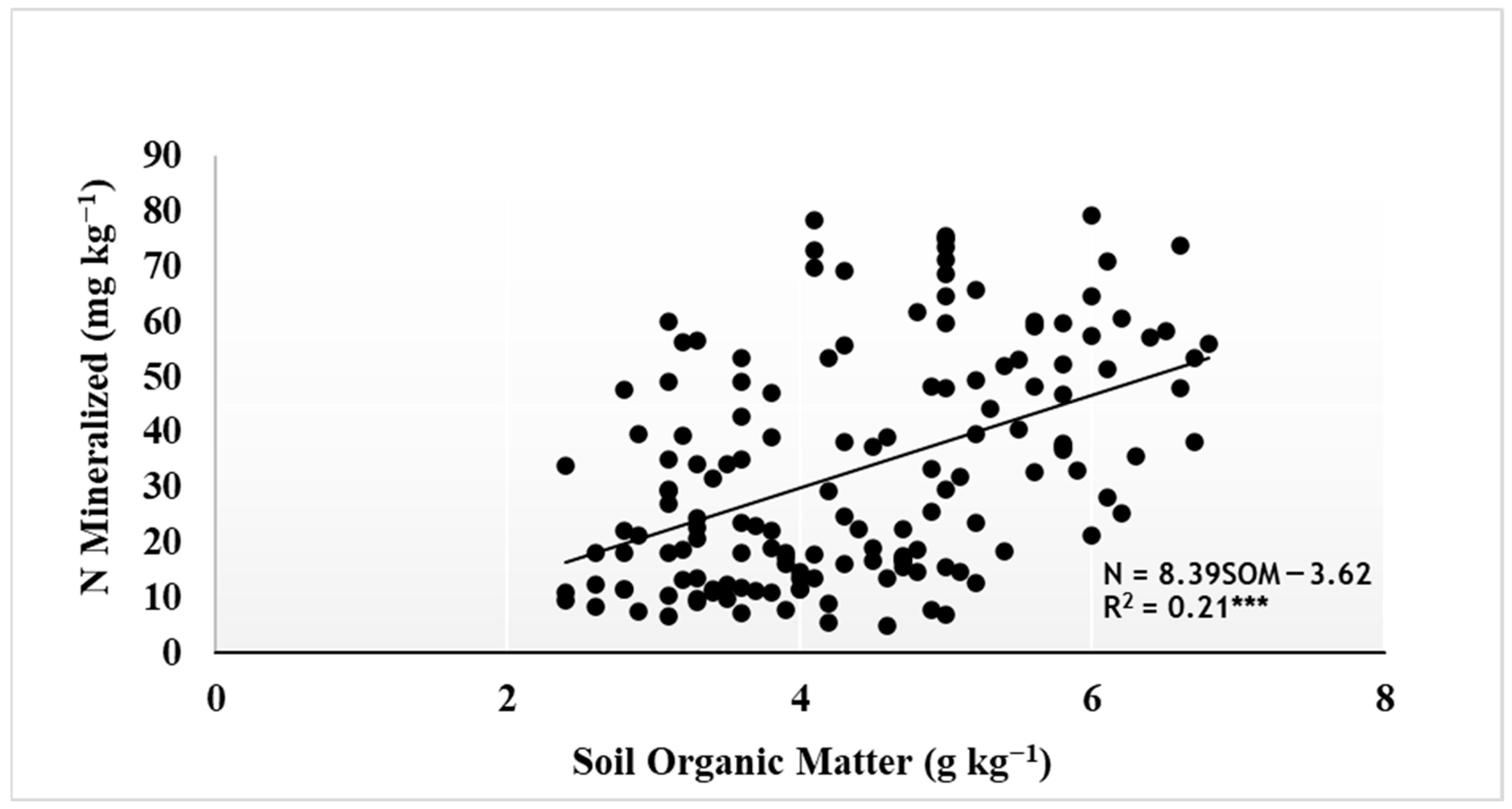
Growing spring wheat continuously on the same land, as a monoculture, requires external fertilizer input to meet a specific yield goal [38]. However, for sustainable crop production without importing exogenous N and other essential nutrients, crop diversification is necessary for success, and the strategic inclusion and placement of legumes within the rotation has proven to reduce N fertilizer use and decrease N2O emissions [39,40]. The results reported here agree with these researchers and others. It is common knowledge that the most important and critical factor relating to healthy, quality soil is the level of SOM. One extremely useful laboratory measurement for determining N availability from SOM is to measure NH4+-N using procedures adopted from [41,42,43]. Linear regression analysis on N mineralization data from soil samples obtained from this study [20] showed potential N mineralization to be 8.4 mg N % SOM−1 kg−1 of soil (Appendix A, Figure A1). The low R2 value (R2 = 0.21) is highly significant (p < 0.001) due to the large number of data points (n = 148) collected over the long-term period of this study. This data represents potential nutrient availability from SOM alone within the context of a diverse multi-crop system to produce spring wheat.
Although the focus was on spring wheat grown in this diverse system, the interconnectivity of the other crops grown and livestock production value were financially rewarding. Exporting crops as grain or oilseed off the farm removes nutrients from the cropping system, which, under conventional farming systems, needs to be replaced with fertilizer and other crop amendments “imported” from off farm. The results of this project point toward mechanisms within the HRSW-ROT system that promote sustaining or increasing SOM from root and crop residue, and manure. Reducing soil disturbance via NT farming minimizes soil water loss and reduces soil aeration, which promotes more dependence on residue and SOM mineralization and promotes establishment and maintenance of a soil environment that aids in the conversion and cycling of nutrients [44]. Maintaining low soil disturbance and plant diversity can help maintain active populations of soil microorganisms, such as arbuscular mycorrhizal fungi (AMF), that assist plants in obtaining H2O and nutrients and assist in maintaining soil structure.
Diverse crop rotations are also important in the semi-arid region, where NT farming is used extensively to assist with maintaining a desirable soil pH ranging between 6.5 and 7.5. No-till and monocultures, i.e., spring wheat grown continuously on the same land resource, can develop low soil pH caused by repeated use of acid-forming NH4+-N fertilizers, resulting in reduced crop performance [45]. Enhancing natural soil nutrient cycling utilizing soil health principles without the addition of acid-based fertilizers encourages desirable pH balance and system homeostasis can lower input costs [46].

4.3. Weather and Grain Yield

For capturing the soil health benefits from utilizing agricultural system diversity (animal, plant, soil) using nutrient cycling, storing soil water in the semi-arid region of the northern Great Plains is essential for crop production. In this region, atmospheric high-pressure systems often restrict critical water-laden weather systems from supplying timely precipitation for rain-fed crop production during the early growing season between April and June. Since timely rains are always a concern for agricultural producers, conserving soil moisture is paramount, and, therefore, NT seeding and planting procedures are used almost exclusively. Comparing long-term (24 years) NT to conventional and reduced tillage in the rain-fed region of the Great Plains, NT sorghum yield was 120% of conventional tillage, and reduced tillage sorghum yield was 55% greater than conventional [47]. Tillage meta-analysis [48] showed that using NT resulted in better crop performance compared to conventional tillage under drier semi-arid rain-fed conditions. However, the difference was not as pronounced for NT under moist, higher-rainfall conditions and was dependent on the amount of time a given system was in production [49]. Given that limited annual precipitation is common to semi-arid environments, the 12 years of data in this study were separated into two 6-year periods. The first six years were wetter than the last six years, as evidenced by the six-year yield average differences (first six years: 2601 and 2702 kg ha−1 for HRSW-CTRL and HRSW-ROT, respectively; second six years: 1823 and 1992 kg ha−1 for HRSW-CTRL and HRSW-ROT, respectively).
Although this study evaluated all treatments and crops without N fertilization, neighboring North Dakota annual county averages [50] for spring wheat during the same 12 years of this study likely received N fertilization. These county average values were used to compare with yields from this study. For the first six “wet” years, the county average was 2480 kg ha−1, the HRSW-CTRL yield was 5% greater, and the HRSW-ROT yield was 9% greater than the county average. Precipitation shortfall was well pronounced in the spring wheat yield measured over the course of the subsequent six “dry” years. During the dry years, the county average was 2259 kg ha−1. The HRSW-CTRL yield was 19% lower, and the HRSW-ROT yield was 12% lower than the county average. However, in each case, the HRSW-ROT yields were higher than the HRSW-CTRL. This was likely due to heat and moisture stress reducing the yield of the crop in spite of the improved fertility in the HRSW-ROT plots.
A critical factor associated with raising crops based on holistic cropping management is the effect dryness has on microbial critical mass. To estimate the difference in critical microbial biomass between wet and dry seasons, phospholipid fatty acid (PLFA) analysis, total microbial biomass (MB), AMF, and soil pH were conducted by Ward Laboratories [15] for the years 2016–2020. Although this span of years was during the dry period of the study, there were years nestled amongst the dry years that were wetter. Reduced availability of soil moisture for nutrient solubility and translocation likely impacted microbial activity and severely hindered the availability of soil nutrients for crop production. Comparing reduced soil properties due to exceptional drought and dry soil in 2017 to moist soil in 2019, PLFA MB, AMF, soil pH, and soluble salt reflect the effect of soil dryness for HRSW-ROT and HRSW-CTRL treatments. Adopted from [51] (Table A1) shows the inhibition effect due to dryness on microbial biomass, AMF, pH, and soluble salt. Interestingly, as dryness ensued, soluble salt concentration increased, and soil pH declined. However, soil wetting due to increased rainfall increased soil MB and AMF, and soluble salt concentration was diluted, and pH moved towards neutral.
Economic contrasts in this spring wheat management investigation fully reveal the long-term environmental impact on wheat production. This has been illustrated by effects on microbial factors within the predominantly wet or dry seasons. There are five principles that influence soil health and soil productivity. These include (1) providing soil armor to protect the soil surface from wind and water erosion as well as compaction due to animal hoof action, (2) using seeding and planting equipment that minimizes soil disturbance (NT), (3) incorporating a multi-crop rotation and cover crops providing to maximize plant diversity, (4) including plants known to maintain live roots continuously within the diverse crop mix, (5) and whenever possible, including livestock grazing [52]. Since this research, conducted in the semi-arid region of the northern Great Plains, employed all five of the soil health principles without the addition of exogenous N fertilizer, the economic ramifications were an important consideration for reducing crop input costs.
Systems complexity has numerous underlying aspects that lend credence to reducing N fertilizer input. For example, acid-forming N fertilizer application combined with NT seeding and planting practices contributes to soil pH decline over time. A common remedy for low pH soils is to apply lime [45]. Using a recommended minimum rate of 5.5 Mt ha−1 costing USD112.00 Mt−1, liming would cost USD619.67 ha−1 and would need to be repeated in five to seven years based on annual pH soil testing. This expense is paid for up front in the year of application and would sharply increase input cost; however, when averaged over a 6-year period, the annual lime expense would be USD103.28. Since acid-based fertilizers combined with NT cropping can cause a decrease in soil pH over time, the cultural employment of diverse crop rotations, the reduction of fertilizer application, and the utilization of natural nutrient cycling can lessen the chance of a low soil pH problem developing. Crop rotation diversity and a wide array of environmentally adapted crops have been shown to have a greater effect on soil organic carbon and residual N than that from N fertilizer [53].

4.4. System Considerations

Diverse multi-crop rotations with frequent legume crops preceding high input crops, i.e., corn and sunflower as in this study, can yield financially rewarding returns without the negative impact and need for fertility regeneration expense commonly associated with conventional cropping practices. Meanwhile, SOM levels are maintained or improved, providing for improved soil health and nutrient cycling (Table 6). Current N fertilizer recommendations for spring and durum wheat in North Dakota include adjustments for tillage, SOM levels, and residual soil NO3-N determined by soil tests [54]. Fertilizer N recommendations are based on regional soil productivity indices and a soil NO3-N test to a depth of 60 cm. Additional adjustments can be made if a field is in an early stage of NT management (<5 years) with an addition of 22 kg N ha−1 or mature NT (>5 years) with a reduction of 56 kg N ha−1 from the recommended rate. Another 56 kg N ha−1 can be subtracted from the recommended rate if SOM is >50 g N kg−1 soil. Based on the transition of this study from young to mature no-till during the 12 period, we were able to utilize the 56 kg N ha−1 credit for our spring wheat production program. The observation that 18.4 kg N ha−1 was mineralized from each percentage of SOM in our study, with an average SOM of 36 to 40 g kg−1 soil, provided an additional 66 to 74 kg N ha−1 available for spring wheat production. With an average soil test of approximately 40 kg N ha−1 (Table 6) added to the tillage and SOM credits, 162 to 170 kg N ha−1 was available for the wheat crop. This provided adequate N for up to a potential 3695 kg ha−1 wheat crop, provided the seasonal growing conditions (primarily precipitation) were ideal. However, due to the variability in season-to-season precipitation during the study period, this potential was not reached. Availability of N during the season in this study was directly related to moisture and N mineralization at times when adequate moisture is also available for biological activity in the soil. The greater NO3-N decline between the pre- and post-crop soil samplings (Table 5) reflects greater crop uptake and improved N cycling efficiency in HRSW-ROT and not soil depletion by the wheat crop. Grazing also increased soil P, K, and Cl in the HRSW-ROT over HRSW-CRTL management, likely due to the return of manure and urine back to the soil.
The first four principles of soil health have generally been accepted by farmers to improve the health and quality of their soils. The fifth soil health principle is the integration of livestock grazing, which requires the availability of livestock on the farm or to the farming operation. Yearling steers originating from the Dickinson Research Extension Center’s beef cow herd were used to directly link the grazing animal to the diverse cropping system. Economically, the diverse rotation provided income from rotation crops as well as from the livestock that grazed the rotation crops (field pea/barley mix, forage corn, and multi-species cover crop) prior to delayed feedlot entry. The combined economic value of the rotation crops compared to the HRSW-CTL has been summarized by [46]. In that report, the 5-year net return from the diverse rotation crops was USD2035 as compared to USD1514 for the HRSW-CTL, a 25.6% advantage for the HRSW-ROT system. Large frame (LF) and small frame (SF) yearling steers grazed the integrated system crops for approximately 212 days. Paralleling the integrated system steer grazing starting date, control yearling steers were delivered to the University of Wyoming Sustainable Agriculture Research and Education feedlot for growing and finishing. Grazing steers grazed for 212 days and were on high-energy finishing diets for 82.0 days. Delayed feedlot entry grazing [7] in the integrated system not only reduced the number of days on feed in the feedlot by 62.4% (p < 0.01), but finishing cost for the SF and LF grazing steers was lower (SF: USD355 less, LF: USD427 less; p < 0.01) showed the economic value of extended integrated system grazing and delayed feedlot entry. The significantly higher returns for the diverse cropping system enhanced the system’s profitability (Table 4). In a region of highly variable climatic conditions, a cropping system such as this produces greater long-term system stability and reduces economic risk to the farmer.

5. Conclusions

A long-term 12-year integrated systems study evaluated spring wheat grown continuously (HRSW-CTRL) on the same land resource when compared to spring wheat grown in a five-crop rotation (HRSW-ROT): (1) spring wheat, (2) seven-species cover crop, (3) forage corn, (4) field pea/forage barley mix, and (5) sunflower. Yearling beef cattle steers graze the field pea/forage barley mix, unharvested corn, and a seven-species cover crop. Over the 12-year period, HRSW-ROT showed a 6% grain yield advantage over HRSW-CTRL. In addition, when considering the entire cropping and grazing system over a 5-year rotation period, the HRSW-ROT has shown a 25.6% economic advantage over the HRSW-CTRL system. The central hypothesis for this study was that crop nutrient needs would be supported by N from legumes, livestock manure and urine, and crop residue decomposition, resulting in similar grain yields, but at a lower cost. The diverse crop rotation supported higher spring wheat yield and protein content, although the differences were not significant. Economically, input costs for spring wheat grown in the diverse rotation were reduced, thereby increasing gross and net returns per hectare. However, the differences were not significant. Over the 12-year period, variability due to wet and dry production years contributed to a significant year effect, resulting in production variability. The two spring wheat production management methods were similar, but the integration of beef cattle grazing and forage production added value to the rotation system.
Recently, cropping systems in this semi-arid region have successfully replaced HRSW with millet (Setaria italica L.), canola (Brassica napus L.), and soybean (Glycine max (L.) Merr.). Including cash crops such as this and evaluating them in place of HRSW would provide farmers with additional flexibility and value-added within their enterprises. This would allow them to utilize the nitrogen made available from legumes in integrated crop grazing systems and enhance the profitability of their operations. Farmers who want to establish a diverse crop rotation with grazing need to create a crop grazing plan with special consideration focused on crop complementarity in the proposed system. When integrating a cropping system with grazing, consideration must be given to establishing infrastructure for livestock water and fencing.

Author Contributions

Conceptualization and methodology, D.L. and L.J.C.; investigation, resources, data curation, data analysis, and writing, D.L., S.S. and L.J.C.; supervision, project administration, and funding acquisition, D.L. All authors have read and agreed to the published version of the manuscript.

Funding

Due to the long-term nature of the research, the research was funded by multiple sources: Annually by the North Dakota Agricultural Experiment Station, Sustainable Agricultural Research and Education Grants, USDA/NIFA/SARE LNC11-335 Award No. 2011-38640-30539 and LNC16-381 Award No. 2016-38640-25381 (CFDA No. 10.215), USDA/NIFA/AFRI A1601-Small and Medium Sized Farms Award No. 2021-69006-33883 (CFDA No. 10.310). The research was also partially supported by NDSU Hatch Project No. FARG008572 contributing to Multistate Research Project NC-1178 (Land Use and Management Practices Impacts on Soil Carbon and Related Agroecosystems Services) of the National Institute of Food and Agriculture, U.S. Department of Agriculture.

Institutional Review Board Statement

Due to the long-term nature of this systems research, yearling steers and heifers were utilized for grazing of annual forage and native range treatments received the following North Dakota State University Institutional Animal Care and Use Committee protocol approvals: A0933 (3 March 2009), A19013 (13 August 2018), A16015 A15017 (14 September 2014), (18 September 2015), and (20 January 2021). Following initial protocol approval, protocols and any changes to the initial approval were reviewed annually and approved.

Data Availability Statement

Data is contained within the article.

Acknowledgments

The authors acknowledge the countless hours invested by the NDSU-Dickinson Research Extension Center ranch crew who planted and harvested crops, applied herbicides, managed livestock that grazed selected fields, maintained fences and waterers, and calved cows to produce the yearling steers and heifers used for this long-term research investigation.

Conflicts of Interest

There are no conflicts of interest.

Abbreviations

The following abbreviations are used in this manuscript:
AMFarbuscular mycorrhizal fungi
HRSW-CTRLhard red spring wheat control
HRSW-ROThard red spring wheat rotation
Nnitrogen
Pphosphorus
SOMsoil organic matter
NDSU-NLNorth Dakota State University Nutrition Laboratory

Appendix A

Table A1. Seasonal temperature and rainfall measurements for study site in the semi-arid region of western North Dakota, USA [31].
Year
MonthRain
& Temp 1
201120122013201420152016201720182019202020212022
AprilRain (mm)42.260.526.727.715.287.433.012.234.315.06.6105.7
Temp (Max)8.514.76.32.613.612.312.17.712.210.612.05.9
Temp (Min)−1.40.5−4.7−9.6−1.5−2.2−1.9−6.7−0.3−4.2−3.2−3.8
MayRain (mm)174.540.1191.8110.741.957.421.331.064.036.8128.880.5
Temp (Max)14.619.718.7−17.817.920.820.27.415.018.618.017.6
Temp (Min)4.44.44.4−17.83.24.84.3−17.82.23.43.13.9
JuneRain (mm)54.611056.6128.3118.949.832.3107.466.027.927.251.3
Temp (Max)22.725.622.6−17.824.526.426.026.923.527.227.723.7
Temp (Min)10.811.210.4−17.811.111.39.111.810.510.611.310.1
JulyRain (mm)59.250.354.115.072.991.718.351.140.967.826.294.2
Temp (Max)28.131.727.5−17.828.728.732.528.227.328.331.628.9
Temp (Min)14.215.312.1−17.813.513.013.012.513.313.114.314.1
Aug. 2Rain (mm)68.620.871.4126.042.947.267.814.0119.465.041.47.1
Temp (Max)27.127.827.8−17.828.328.725.629.026.829.128.329.5
Temp (Min)13.212.212.3−17.811.212.710.411.711.912.611.813.5
Sep. 3Rain (mm)44.75.362.050.834.367.657.946.7231.121.83.623.6
Temp (Max)22.124.423.9−17.824.321.122.018.020.422.026.325.6
Temp (Min)6.77.38.8−17.88.48.16.95.48.15.98.29.4
Oct. 4Rain (mm)11.259.785.11.849.845.72.016.832.06.668.646.7
Temp (Max)15.511.310.4−17.815.213.613.610.98.010.215.313.5
Temp (Min)1.7−0.6−0.5−17.82.11.1−1.0−2.1−2.8−3.32.71.3
MeansRain (mm)65.049.578.265.853.763.833.239.984.034.443.258.5
Temp (Max)19.822.219.6−14.921.821.721.718.319.020.922.820.7
Temp (Min)8.58.37.9−17.88.28.57.13.67.27.18.68.7
1 Temp: temperature; 2 Aug.: August; 3 Sep.: September; 4 Oct.: October.
Table A2. A comparison of selected microbial and physical properties for 2017 vs. 2019 [47].
TreatmentYearMicrobial
Biomass
AMFpHSoluble Salt
(ng g−1 soil)(mg kg−1) (dS m2)
HRSW-CTRL20171466455.90.22
201944851256.00.07
HRSW-ROT20171527516.40.25
201944621177.00.08
Figure A1. Nitrogen mineralizable potential as influenced by soil organic matter [20]. Each 1% increase in soil organic matter will potentially mineralize 18.8 kg N ha−1. *** indicate significance at <0.001.
Agriculture 16 00073 g0a1

References

  1. Natural Resources Conservation Service (NRCS); United States Department of Agriculture (USDA). Leveraging Farm Policy for Conservation: Passage of the 1985 Farm Bill. Available online: https://www.nrcs.usda.gov/sites/default/files/2022-09/stelprdb1044129-leveraging-farm-policy.pdf (accessed on 20 February 2025).
  2. University of Illinois Urbana-Champaign. Crop Genetic Improvement. Available online: https://cropsciences.illinois.edu/research-outreach/research-areas/plant-improvement/crop-genetic-improvement (accessed on 20 February 2025).
  3. Sellers, S.; Nunes, V. Synthetic nitrogen fertilizer in the U.S. Farmdoc Dly. 2021, 17, 24. Available online: https://farmdocdaily.illinois.edu/2021/02/synthetic-nitrogen-fertilizer-in-the-us.html (accessed on 20 February 2025).
  4. Edwards, C.A. Crop Rotations in Sustainable Production Systems. In Sustainable Agricultural Systems; Environment & Agriculture, Environment and Sustainability; Edwards, C.A., Rattan, L., Patrick, M., Robert, H.M., Housesitting, G., Soil and Water Conservation Society, Eds.; CRC Press: Boca Raton, FL, USA, 2020; Volume 1, 712p. [Google Scholar] [CrossRef]
  5. Kumar, S.; Sieverding, H.; Lai, L.; Thandiwe, N.; Wienhold, B.; Redfearn, D.; Archer, D.; Ussiri, D.; Faust, D.; Landblom, D.; et al. Facilitating Crop–Livestock Reintegration in the Northern Great Plains. Agron. J. 2019, 5, 2141–2156. [Google Scholar] [CrossRef]
  6. Magdoff, F.; Harold, V.E. Organic Matter—The Key to Healthy Soils. Organic Matter: What It Is and Why It’s so Important. In Building Soils for Better Crops Sustainable Soil Management, 3rd ed.; Handbook Series Book 10; Sustainable Agriculture Research and Education (SARE) Program: Athens, GA, USA, 2021; pp. 2–9. Available online: https://www.sare.org/wp-content/uploads/Building-Soils-for-Better-Crops.pdf (accessed on 10 June 2025).
  7. Senturklu, S.; Landblom, D.G.; Paisley, S.; Wachenheim, C.; Maddock, R. Frame Score, Grazing and Delayed Feedlot Entry Effect on Performance and Economics of Beef Steers from Small- and Large-Framed Cows in an Integrated Crop-Livestock System. Animals 2021, 11, 3270. [Google Scholar] [CrossRef]
  8. McDaniel, M.D.; Grandy, A.S.; Tiemann, L.K.; Weintraub, M.N. Crop rotation complexity regulates the decomposition of high and low quality residues. Soil Biol. Biochem. 2014, 78, 243–254. [Google Scholar] [CrossRef]
  9. Halvorson, A.D.; Black, A.L.; Krupinsky, J.M.; Merrill, S.D.; Wienhold, B.J.; Tanaka, D.L. Spring wheat response to tillage and N fertilization in rotation with sunflower and winter wheat. Agron. J. 2000, 92, 136–144. [Google Scholar] [CrossRef]
  10. The North Platte Natural Resources District. Agricultural Best Management Practices. Nitrogen Credits for Manure & Legume Crops. Available online: https://www.npnrd.org/programs/best-management-practices/nitrogen-credits-for-manure-and-legume-crops.html (accessed on 20 March 2025).
  11. Merrill, S.; Tanaka, D.; Hanson, J.D. Soil Water Depletion and Recharge under Ten Crop Species and Applications to the Principles of Dynamic Cropping Systems. Agron. J. 2007, 99, 931–938. [Google Scholar] [CrossRef]
  12. Hirsch, P.R.; Mauchline, T.H. Who’s who in the plant root microbiome? Nat. Biotechnol. 2012, 30, 961–962. [Google Scholar] [PubMed]
  13. Schlegel, A.J.; Assefa, Y.; Lucas, A.; Haag, C.; Thompson, R.; Stone, L.R. Soil Water and Water Use in Long-Term Dryland Crop Rotations. Agron. J. 2019, 111, 2590–2599. [Google Scholar] [CrossRef]
  14. Krupinsky, J.; Joseph, M.; Karen, L.B.; Marcia, P.; McMullen, B.; Gossen, D.; Kelly, T.; Turkington, T. Managing Plant Disease Risk in Diversified Cropping Systems. Agron. J. 2002, 94, 198–209. [Google Scholar] [CrossRef]
  15. Soil Survey Staff. Official Series Description—Wyola Series. 2022. USAD-NRCS. Available online: https://soilseries.sc.egov.usda.gov/OSD_Docs/W/Wyola.html (accessed on 7 November 2025).
  16. Soil Survey Staff. Official Series Description—Vebar Series. 2001. USDA NRCS. Available online: https://soilseries.sc.egov.usda.gov/OSD_Docs/V/Vebar.html (accessed on 7 November 2025).
  17. Soil Survey Staff. Official Series Description—Parshall Series. 1998. USDA-NRCS. Available online: https://soilseries.sc.egov.usda.gov/OSD_Docs/P/Parshall.html (accessed on 7 November 2025).
  18. Lynch, J.M.; Barbano, D.M. Kjeldahl Nitrogen Analysis as a Reference Method for Protein Determination in Dairy Products. J. Aoac Int. 1999, 82, 1389–1398. [Google Scholar] [CrossRef] [PubMed]
  19. Senturklu, S.; Landblom, D.G.; Maddock, R.; Petry, T.; Wachenheim, C.; Paisley, S. Effect of yearling steer sequence grazing of perennial and annual forages in an integrated crop and livestock system on grazing performance, delayed feedlot entry, finishing performance, carcass measurements, and systems economics. J. Anim. Sci. 2018, 96, 2204–2218. [Google Scholar] [CrossRef] [PubMed]
  20. Senturklu, S.; Landblom, D.; Stokka, G.; Cihacek, L. Alternative Intensive Animal Farming Tactics That Minimize Negative Animal Impact and Improve Profitability. In Intensive Animal Farming—A Cost-Effective Tactic; Manzoor, S., Abubakar, M., Eds.; IntechOpen: London, UK, 2022. [Google Scholar] [CrossRef]
  21. Senturklu, S.; Landblom, D.G.; Hanna, L.; Parman, B.; Perry, G.A.; Paisley, S. Non-traditional beef heifer management effect on synchronized fixed-time AI and delayed feedlot entry of non-pregnant heifers. In Proceedings of the 2025 ASAS-CSAS Annual Meeting, Hollywood, FL, USA, 6–10 July 2025; Available online: https://2025asasannual.eventscribe.net/searchGlobal.asp (accessed on 15 June 2025).
  22. Midwest Plan Service. Livestock Waste Facilities Handbook; Livestock Wastes Subcommittee of the Midwest Plan Service Facilities Handbook; MWPS: Ames, IA, USA, 1985; Available online: https://archive.org/details/livestockwastefa0000unse (accessed on 10 June 2025).
  23. Miller, R. How Much Manure Will My Animals Produce? Available online: https://extension.usu.edu/smallfarms/files/How_Much_Manure.pdf (accessed on 20 April 2025).
  24. Euken, R. Characteristics and value of manure from bedded confinement buildings for beef production. In Proceedings of the Cattle Feeder’s Conference: A New Era of Management, Iowa Beef Center, Iowa State University, Ames, IA, USA, 10–11 June 2009; Available online: https://www.iowabeefcenter.org/CattlemenConference/beddedconfinementmanure.pdf (accessed on 20 April 2025).
  25. National Research Council. Soil and Water Quality: An Agenda for Agriculture; National Academy Press: Washington, DC, USA, 1993; Available online: https://nap.nationalacademies.org/read/2132/chapter/10 (accessed on 25 April 2025).
  26. Whitehead, D.C. Nutrient Elements in Grasslands: Soil–Plant–Animal Relationships; CABI Pub.: New York, NY, USA, 2000; pp. 15–40. [Google Scholar] [CrossRef]
  27. Selbie, D.R.; Buckthought, L.E.; Shepherd, M.A. The challenge of the urine patch for managing nitrogen in grazed pasture systems. Adv. Agron. 2015, 129, 229–292. [Google Scholar]
  28. Nanthi, B.; Adriano, D.; Mahimairaja, S. Distribution and bioavailability of trace elements in livestock and poultry manure by-products. Crit. Rev. Environ. Sci. Technol. 2004, 5, 1. [Google Scholar] [CrossRef]
  29. Abbasi, M.; Adams, W. Gaseous N emission during simultaneous nitrification and denitrification in grassland soil associated with mineral N fertilization to a grassland soil under field Conditions. Soils Biol. Biochem. 2000, 32, 1250–1259. [Google Scholar] [CrossRef]
  30. Nathan, M.; Gelderman, R. Recommended Chemical Soil Test Procedures for the North Central Region; North Central Regional Research; Publication No. 221, 1001; Missouri Agricultural Experiment Station, University of Missouri Extension: Columbia, MO, USA, 2015; Available online: https://aesl.ces.uga.edu/sera6/PUB/MethodsManualFinalSERA6.pdf (accessed on 7 November 2025).
  31. North Dakota Agricultural Weather Network. North Dakota State University, Fargo, ND, USA. 2. Available online: https://ndawn.ndsu.nodak.edu/ (accessed on 25 April 2025).
  32. The Statistical Analysis System, SAS. Data Quality Acceleratorjo System Requirements for SAS® 9.4 Foundation for Microsoft Windows; SAS Inst. Inc.: Cary, NC, USA, 2016; Available online: https://www.sas.com/content/dam/SAS/documents/technical/training/ko/ko_kr-94-sreq32.pdf (accessed on 22 April 2025).
  33. Cihacek, L.; Senturklu, S.; Landblom, D.G. Mineral N Cycling in an Integrated Crop-Grazing System. In The Dickinson Research Extension Center Annual Report; Dickinson Research Extension Center: Dickinson, ND, USA, 2018. Available online: https://www.ndsu.edu/agriculture/sites/default/files/2022-10/33.%20Nitrogen%20mineralization_Cihacek%20et%20al.pdf (accessed on 30 March 2025).
  34. Alghamdi, R.; Cihacek, L.; Landblom, D.; Senturklu, S. Soil Health Using Haney Biological Analysis in Calcareous Soils in Semi-Arid Environments. In Proceedings of the ASA, CSSA, SSSA International Annual Meeting, St. Louis, MO, USA, 29 October–1 November 2023; Available online: https://scisoc.confex.com/scisoc/2023am/meetingapp.cgi/Paper/153051 (accessed on 10 April 2025).
  35. Landblom, D.; Senturklu, S.; Cihacek, L. Effect of Drought and Subsequent Precipitation (2016–2020) on Soil pH, Microbial Biomass, and Plant Nutrient Change in the Semi-Arid Region of Western North Dakota, USA. In Proceedings of the EGU General Assembly, Vienna, Austria, 14–19 April 2024; Available online: https://meetingorganizer.copernicus.org/EGU24/EGU24-7094.html (accessed on 10 April 2025).
  36. Conceição, P.C.; Dieckow, J.; Bayer, C. Combined role of no tillage and cropping systems in soil carbon stocks and stabilization. Soil Tillage Res. 2013, 129, 40–47. [Google Scholar] [CrossRef]
  37. Hobley, E.U.; Honermeier, B.; Don, A.; Gocke, M.I.; Amelung, W.; Kögel-Knabner, I. Decoupling of subsoil carbon and nitrogen dynamics after long-term crop rotation and fertilization. Agric. Ecosyst. Environ. 2018, 265, 363–373. [Google Scholar] [CrossRef]
  38. Zhao, W.; Qu, Y.; Zhang, L.; Kaiyuan, L. Spatial-aware SAR-optical time-series deep integration for crop phenology tracking. Remote Sens. Environ. 2022, 276, 113046. [Google Scholar] [CrossRef]
  39. Notz, I.; Topp, C.F.; Schuler, J.; Alves, S.; Gallardo, L.A.; Dauber, J.; Haase, T.; Hargreaves, P.R.; Hennessy, M.; Iantcheva, A.; et al. Transition to legume-supported farming in Europe through redesigning cropping systems. Agron. Sustain. Dev. 2023, 43, 12. [Google Scholar] [CrossRef]
  40. Ditzler, L.; van Apeldoorn, D.F.; Pellegrini, F.; Antichi, D.; Barberi, P.; Rossing, W.A.H. Curent research on the ecosystem service potential of legume inclusive cropping systems in Europe. A review. Agron. Sustain. Dev. 2021, 41, 26. [Google Scholar] [CrossRef]
  41. Waring, S.A.; Bremner, J.M. Effect of soil mesh-size on estimation of mineralizable nitrogen in soils. Nature 1964, 202, 1141. [Google Scholar] [CrossRef]
  42. Keeney, D.R. Nitrogen availability indices. In Methods of Soil Analysis, Part 2, Chemical and Microbiological Properties, 2nd ed.; Agronomy 9; Page, A.L., Miller, R.H., Keeney, D.R., Eds.; Soil Science Society of America and American Society of Agronomy: Madison, WI, USA, 1982; pp. 711–733. [Google Scholar] [CrossRef]
  43. Bundy, L.G.; Meisinger, J.J. Nitrogen availability indices. In Methods of Soil Analysis, Part 2, Microbiological and Biochemical Properties; SSSA Book Series No. 5; Weaver, R.W., Angle, S., Bottomley, P., Bezdicek, D., Smith, S., Tabatabai, A., Wollum, A., Eds.; Soil Science Society of America: Madison, WI, USA, 1994; pp. 951–984. [Google Scholar] [CrossRef]
  44. Miller, R.M.; Jastrow, J.D. Mycorrhizal Fungi Influence Soil Structure. In Arbuscular Mycorrhizas: Physiology and Function; Kapulnik, Y., Douds, D.D., Eds.; Springer: Dordrecht, The Netherlands, 2000. [Google Scholar] [CrossRef]
  45. Cihacek, L.; Augustin, C.; Buetow, R.R.; Landblom, D.G.; Alghamdi, R.; Senturklu, S. What is Soil Acidity? In NDSU Extension Extending Knowledge. SF2012; North Dakota State University: Fargo, ND, USA, 2021; Available online: https://www.ndsu.edu/agriculture/sites/default/files/2024-05/sf2012.pdf (accessed on 30 June 2025).
  46. Landblom, D.G.; Senturklu, S.; Cihacek, L.; Brevik, E. Effect of Five-Year Dry Cycle and Drought on Crop Rotation and Soil Physical and Microbial Property Changes for the Period 2016–2020 in Western North Dakota; Annual Report of the Dickinson Research Extension Center; Dickinson Research Extension Center: Dickinson, ND, USA, 2016; Available online: https://www.ndsu.edu/agriculture/sites/default/files/2022-10/Effect%20of%20HRSW-5Crop%20Rotation-Crp%20Prod_V4%20FINAL_8-23-17.pdf (accessed on 30 June 2025).
  47. Schlegel, A.J.; Assefa, Y.; Haag, L.A.; Thompson, C.R.; Stone, L.R. Long-term tillage on yield and water use of grain sorghum and winter wheat. Agron. J. 2018, 110, 269–280. [Google Scholar] [CrossRef]
  48. Pittelkow, C.M.; Liang, X.; Linquist, B.A.; van Groenigen, K.J.; Lee, J.; Lundy, M.E. Productivity limits and potentials of the principles of conservation agriculture. Nature 2015, 517, 365. [Google Scholar] [CrossRef] [PubMed]
  49. Rusinamhodzi, L.; Corbeels, M.; Wijk, M.T.V.; Rufino, M.C.; Nyamangara, J.; Giller, K.E. A meta-analysis of long-term effects of conservation agriculture on maize grain yield under rain-fed conditions. Agron. Sustain. Dev. 2011, 31, 657–673. [Google Scholar] [CrossRef]
  50. United States Department of Agriculture; USDA. National Agricultural Statistics Service North Dakota Field Office County Extension Offices. Available online: https://www.nass.usda.gov/Statistics_by_State/North_Dakota/index.php (accessed on 14 July 2025).
  51. Landblom, D.G.; Senturklu, S.; Cihacek, L.; Steffan, J. Effect of Extreme Drought on Crop Rotation and Soil Physical and Microbial Property Changes for the period 2016–2019 in Western North Dakota. In Annual Report of the Dickinson Research Extension Center; Dickinson Research Extension Center: Dickinson, ND, USA, 2019; Available online: https://www.ndsu.edu/agriculture/sites/default/files/2022-10/Effect%20of%20Drought-CropRotation-MicrobialChange%202016-2019_FINAL_3-23-2020.pdf (accessed on 29 April 2025).
  52. McDaniel, M.D.; Middleton, T.A. Putting the soil health principles to the test in Iowa. Soil Sci. Soc. Am. J. 2024, 88, 2238–2253. [Google Scholar] [CrossRef]
  53. Schmer, M.R.; Jin, V.L.; Wienhold, B.J.; Becker, S.M.; Varvel, G.E. Long-term rotation diversity and nitrogen effects on soil organic carbon and nitrogen stocks. Agrosyst. Geosci. Environ. 2020, 3, e20055. [Google Scholar] [CrossRef]
  54. Franzen, D.W. North Dakota Fertilizer Recommendation Tables. In NDSU Extension Bulletin SF882; North Dakota State University: Fargo, ND, USA, 2023; Available online: https://www.ndsu.edu/agriculture/sites/default/files/2023-10/sf882.pdf (accessed on 15 April 2025).
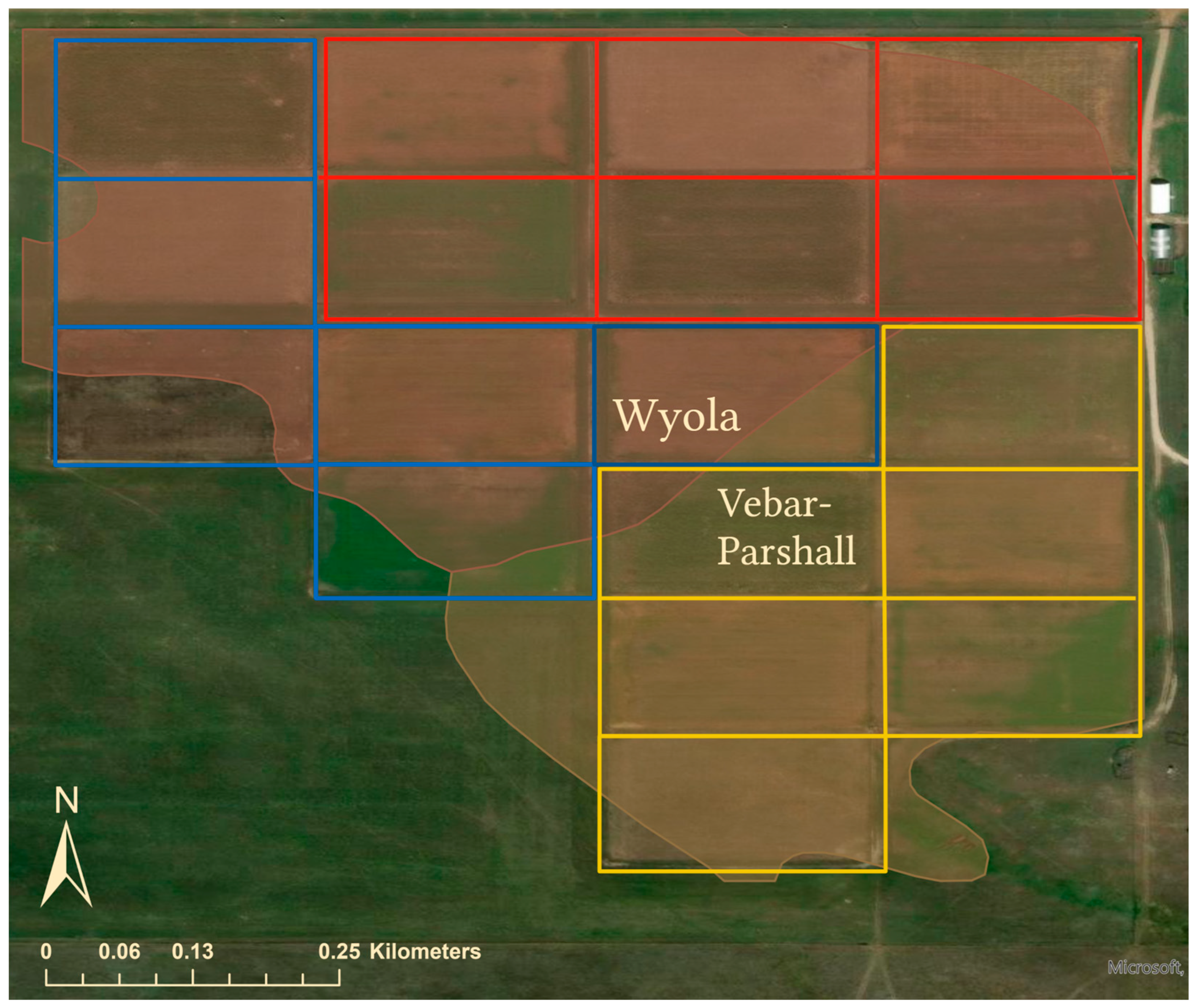
Figure 1. Map showing replicated field block arrangement in relation to soil types. Block 1 Denoted by red outline; Block 2 denoted by blue outline; Block 3 denoted by yellow outline. Image by M. Batool.
Agriculture 16 00073 g001
Table 1. Crop year sequence, crops, species mix, and seeding rate of crops in the cropping systems study.
Year/
Sequence
Crop(s)Species MixSeeding RateComments
Continuous Cropping
1–5Hard Red Spring Wheat (Triticum aestivum L.)100%105 kg ha−1
Rotation Cropping
1Hard Red Spring Wheat100%105 kg ha−1
1–2Dual Cover Crop: Seeded September 10–15 after wheat harvest. Harvested for hay during the first two weeks the following June.
-Triticale (Triticale hexaploid)78%89.7 kg ha−1
-Hairy vetch (Vicia villosa L.)22%24.7 kg ha−1
2Seven Specie Cover Crop Mix: Residual vegetation from harvested hay crops terminated with glyphosate. Cover crops seeded in June and seasonal growth grazed in August–September time frame. Seeded crop percentage determined by crop seed size.
-Field pea (Pisum sativum arvense L.)40%
-Oat (Avena sativa L. var. Everleaf)40%
-Hairy vetch10%
-Canola (Brassica napus L.)2%
-Kale (Brassica napus L. var. pabularia)2%
-Turnip (Brassica rapa L. var. rapa)2%
-Sunflower (Helianthus annus L.)4%
3Silage Corn (Zea mays L.)100%46,930–49,400 plants ha−195-day maturity variety seeded in mid-May.
4Field pea (Pisum sativum L. var. Arvika) and forage barley (Hordeum vulgare L. var. Stockford)60%
40%
27.2 kg ha−1
18.1 kg ha−1
Seeded in May/June time frame.
5Sunflower100%46,930–49,400 plants ha−1Seeded in mid-May/June time frame.
Table 2. Twelve-year yields and quality factors for hard red spring wheat in a long-term integrated crop-livestock system separated into two 6-year periods.
Grain Yield and QualityHRSW
CTRL 1
HRSW
ROT 2
SEM 3p-Value 4
TrtYrTrt × Yr
First 6 Years
Yields, kg ha−126012702122ns<0.001<0.10
Test Wt., kg136.7135.71.23ns<0.01ns
Protein, %13.913.40.37<0.10<0.001ns
Second 6 Years
Yields, kg ha−11823199286.3ns<0.05ns
Test Wt., kg136.4135.70.54ns<0.001ns
Protein, %11.912.90.24<0.001<0.001<0.05
12 Years
Yields, kg ha−12212234779.8ns<0.001<0.10
Test Wt., kg136.6135.70.59ns<0.001ns
Protein, %12.913.20.25ns<0.001<0.01
1 HRSW-CTRL: hard spring wheat control; 2 HRSW-ROT: hard spring wheat rotation; 3 SEM: pooled standard error of the mean; 4 p-values: Trt; (treatment), Yr; (year), and Tr × Yr; (treatment × year interaction), ns = not significant.
Table 3. A comparison of input cost, gross, and net returns and statistics for hard spring wheat separated into two 6-year periods, and for the 12-year study period.
Economic FactorHRSW
CTRL 1
HRSW
ROT 2
SEM 3p-Value 4
TrtYrTrt × Yr
First 6 Years
Input Cost, USD Ha−1455.82413.721.91<0.001<0.001<0.001
Gross Return, USD Ha−1597.38596.9366.61ns<0.001ns
Net Return, USD Ha−1141.56183.2167.47ns<0.001ns
Second 6 Years
Input Cost, USD Ha−1392.79380.760.04<0.001<0.001<0.001
Gross Return, USD Ha−1398.08432.3837.07ns<0.01ns
Net Return, USD Ha−157.2569.2273.28ns<0.05≤0.05
12 Years
Input Cost, USD Ha−1424.31397.240.96<0.001<0.001<0.001
Gross Return, USD Ha−1497.73514.7549.46ns<0.001ns
Net Return, USD Ha−199.42126.2268.10ns<0.001ns
1 HRSW-CTRL: hard spring wheat control; 2 HRSW-ROT: hard spring wheat rotation; 3 SEM: pooled standard error of the mean; 4 p-Values: Trt; (treatment), Yr; (year), and Tr × Yr; (treatment × year interaction), ns = not significant.
Table 4. Soil test nitrate-N mean levels pre-crop, post-crop, and the difference due to in-season crop uptake for hard red spring wheat grown in continuous wheat culture or in a five-year rotation culture over twelve years.
HRSW CultureSoil Test Nitrate-N (kg ha−1)
Pre-CropPost-CropDifference
HRSW-CTRL48.343.65.4
HRSW-ROT55.433.619.3
p-valuens<0.05<0.05
Table 5. A comparison of annual soil test values in hard red spring wheat plots under grazing management averaged over a 12-year period.
Management TreatmentSoil Test Values
pH aOrganic Matter (g kg−1)NO3-N (kg ha−1)Olsen-P (mg kg−1)K (mg kg−1)SO4-S (kg ha−1)Cl (kg ha−1)
HRSW-CRTL5.85 ± 0.4836 ± 10.139.4 ± 20.421.5 ± 7.5348 ± 15337.3 ± 17.341.7 ± 27.2
HRSW-ROT6.07 ± 0.6740 ± 10.440.8 ± 23.426.2 ± 9.9389 ± 18038.5 ± 13.552.7 ± 34.2
p TRT<0.05<0.01ns<0.01<0.10ns<0.10
p YR<0.001<0.05<0.05<0.05<0.001<0.001<0.05
p TRT×YRns<0.01<0.10ns<0.005<0.05<0.05
a ±value denotes standard deviation.
Table 6. Annual estimate of N available from animal manure dry matter production on the grazed crops in the five-crop rotation [30,33].
Nitrogen SourceGrazed Crop 1
CORNPEA/BLYC/CROP
Animal Number888
Crop Grazing Days723015
Manure
Estimated DM Manure Production, kg ha−1546228114
Estimated DM Manure N, kg ha−14.01.70.8
Estimated DM Manure Remaining after N Volatilization Loss of (45%)2.20.90.5
Urine
Estimated Annual Urine Patch N, kg ha−14.92.01.0
Daily Urine Patch Volume, l1.21.21.2
Daily N, g/ll7.17.17.1
Annual Urine Patch N, kg4.92.11.0
Annual Urine Patch 13% NH3 Loss, g6.42.71.3
Annual Urine Patch 13% NH3 Loss, g ha−115.86.63.3
Annual Urine Patch 2% N2O Loss, g9.84.12.0
Annual Urine Patch 2% N2O Loss, g ha−124.310.15.0
Annual Urine Patch 20% NH3 Leaching, kg1.00.40.2
Annual Urine Patch 20% NH3 Leaching, kg ha−12.41.00.5
Annual Urine Patch 41% NH3 Leaching, kg2.00.10.4
Annual Urine Patch 41% NH3 Leaching, kg ha−15.00.21.0
Annual Urine Patch 26% N Soil Immobilization, kg1.30.50.3
Annual Urine Patch 26% N Soil Immobilization, kg ha−13.21.30.7
Total Urine Patch N Leaching, Forage Uptake, and Soil Immobilization, kg4.31.80.9
Total Urine Patch N Leaching, Forage Uptake, and Soil Immobilization, kg ha−110.54.42.2
1 PBLY: pea barley; CCRP: cover crop.
Disclaimer/Publisher’s Note: The statements, opinions and data contained in all publications are solely those of the individual author(s) and contributor(s) and not of MDPI and/or the editor(s). MDPI and/or the editor(s) disclaim responsibility for any injury to people or property resulting from any ideas, methods, instructions or products referred to in the content.