Application of Navigation Path Planning and Trajectory Tracking Control Methods for Agricultural Robots


 ,
, 
Abstract
1. Introduction
1.1. Scope, Novelty, and Contributions
- (1)
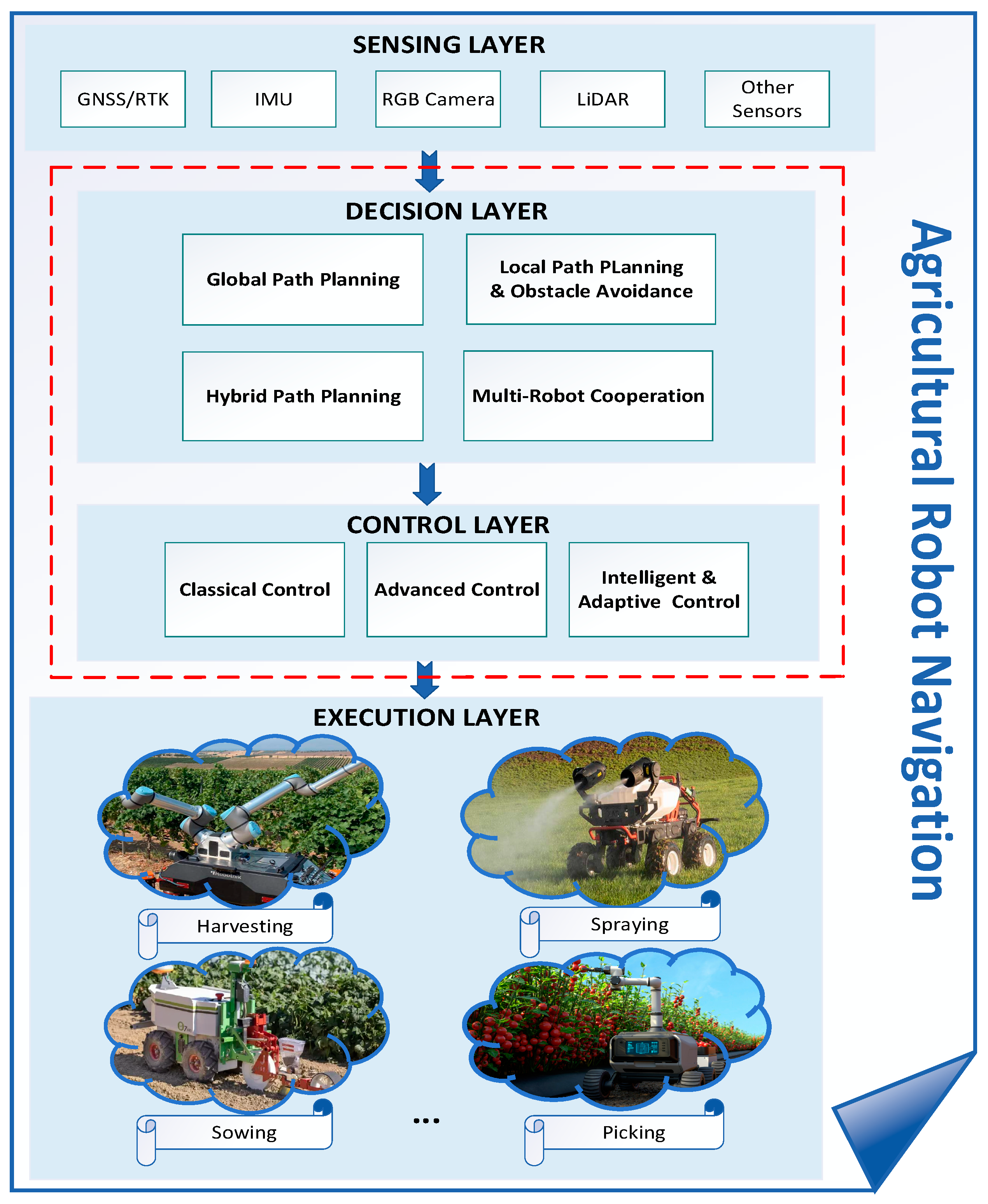
- A coupled “decision–execution” synthesis that jointly reviews planning and tracking control methods as an integrated navigation stack;
- (2)
- A structured comparison matrix that summarizes strengths, limitations, and deployment constraints of major method families;
- (3)
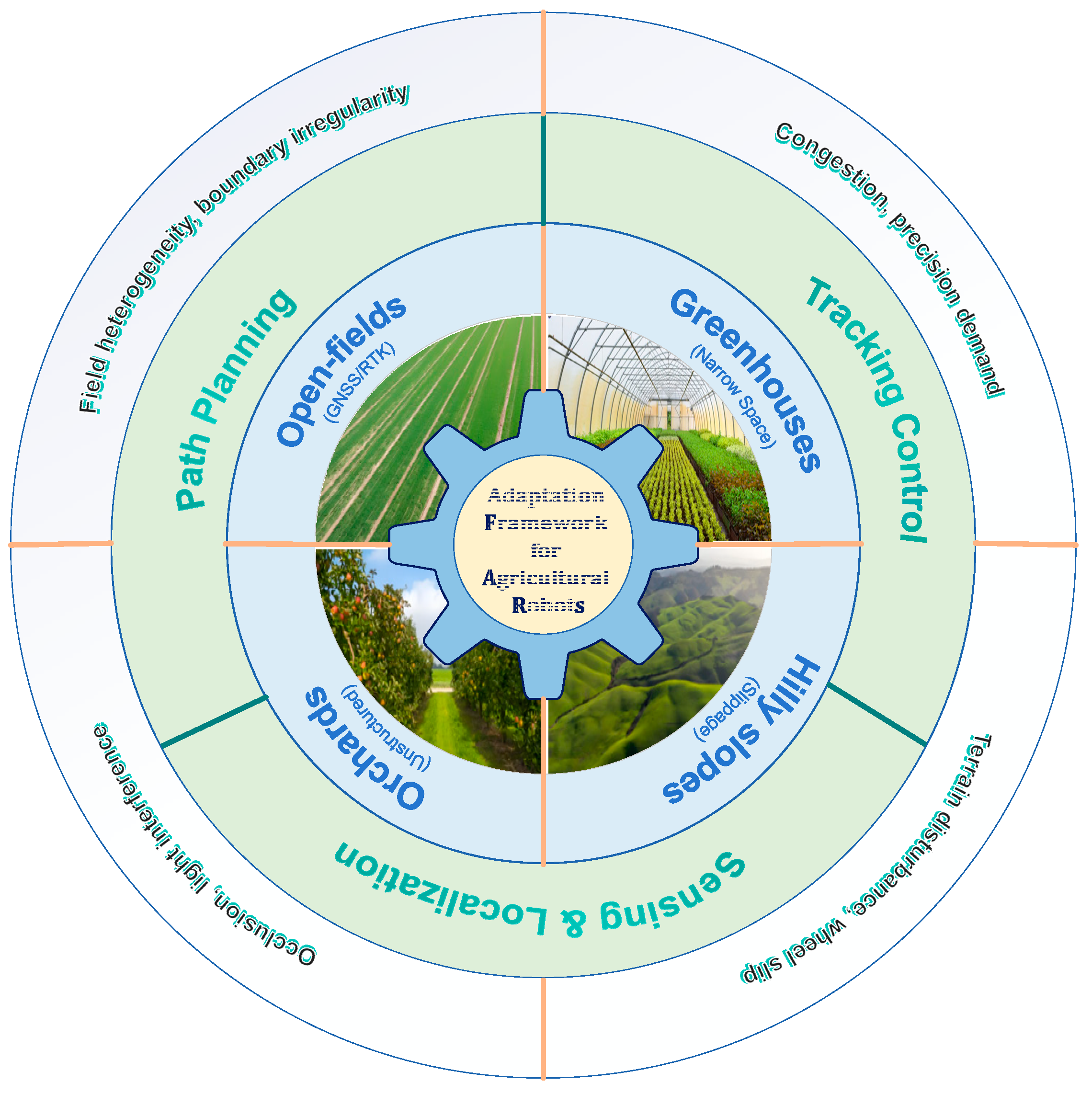
- A scenario–constraint–performance adaptability framework that maps algorithm selection to four representative agricultural scenarios (open-fields, orchards, greenhouses, and hilly slopes);
- (4)
- A consolidated discussion of evaluation metrics, reproducibility barriers, and engineering maturity requirements for long-term field deployment.
1.2. Review Methodology
- (1)
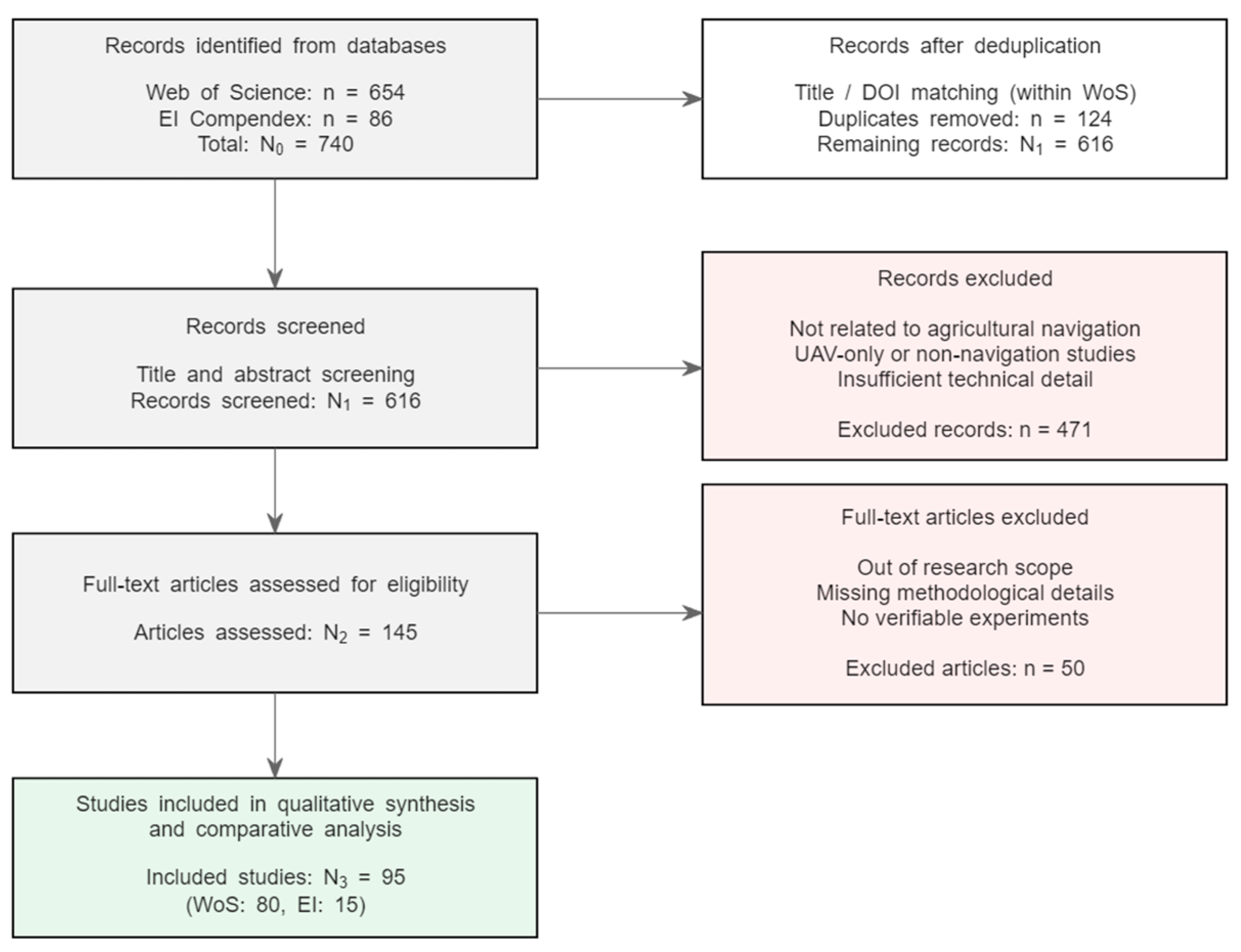
- Information sources and record accounting. The initial search retrieved 740 records in total, including 654 records from Web of Science and 86 records from EI Compendex. EI Compendex was used to supplement EI-indexed Chinese literature not covered by Web of Science. Because the Web of Science search involved iterative refinement of keyword combinations, partial overlaps occurred across different query rounds. All records were therefore exported into a single library and deduplicated using title and DOI matching within Web of Science. After removing 124 duplicate records, 616 unique records (N1 = 616) remained for further screening;
- (2)
- Eligibility criteria. Studies were included if they (i) proposed, evaluated, or implemented path planning and/or trajectory tracking control methods applicable to agricultural robots or agricultural machinery navigation, and (ii) provided sufficient technical details, including algorithmic descriptions, evaluation settings, and outcome metrics, to enable method-level comparison. Studies were excluded if they (i) were unrelated to mobile robotics or navigation, (ii) lacked technical interpretability due to insufficient methodological detail, or (iii) had no accessible full text for verification;
- (3)
- Screening procedure. Title and abstract screening excluded 471 records, primarily due to topic mismatch (e.g., non-agricultural robotics, UAV-only navigation, or purely theoretical planning without navigation implementation) or insufficient technical content. Full-text assessment was subsequently conducted on 145 articles (N2 = 145). Among these, 50 studies were excluded because of ineligible research scope, missing methodological details, or unverifiable experimental results. The final corpus therefore comprised 95 included studies (N3 = 95), including 80 papers retrieved from Web of Science and 15 EI-indexed Chinese studies (see Figure 3);
- (4)
- Data extraction and coding. For each included study, we systematically extracted information on scenario type (open-fields, orchards, greenhouses, and hilly slopes), sensing and localization modality, planning paradigm, controller type, robot platform, evaluation setting (simulation or field experiments), and key performance indicators. These attributes were used to qualitatively categorize and compare the included studies throughout the subsequent sections, enabling a structured analysis of methodological trends, representative solutions, and remaining research gaps.
1.3. Paper Organization
2. Path Planning Algorithm
2.1. Global Path Planning
2.1.1. Complete Coverage Path Planning
2.1.2. Point-to-Point Path Planning
2.2. Local Path Planning and Real-Time Obstacle Avoidance
2.2.1. Perception and Multi-Sensor Fusion
2.2.2. Classical Algorithm
2.2.3. Algorithm Based on Reinforcement Learning
2.2.4. Algorithm Based on Fuzzy Logic
2.3. Hybrid Path Planning Strategy
- (1)
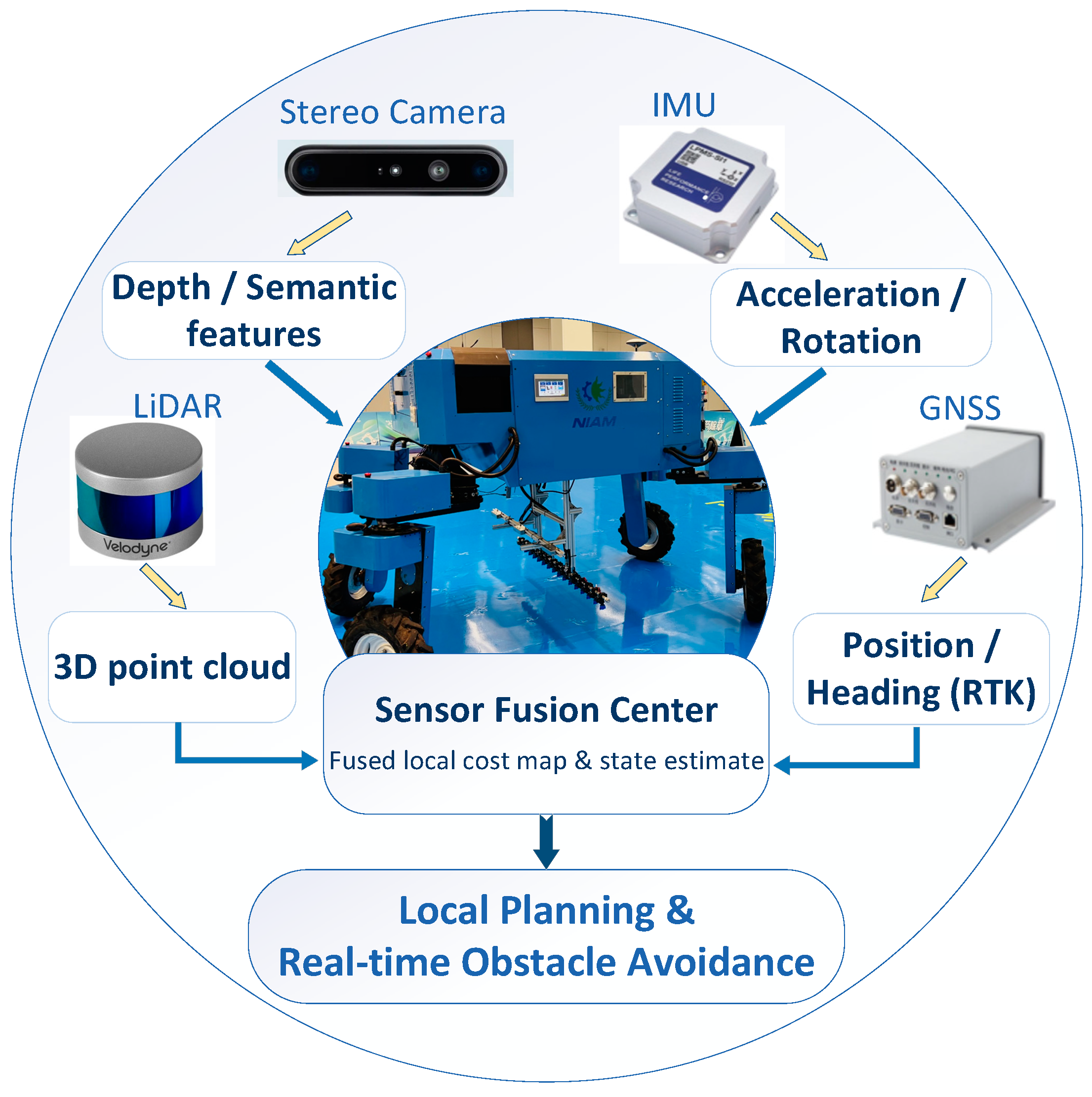
- Hierarchical architectures integrating global and local planning. The global planner generates a coarse overall path based on prior maps, ensuring overall goal reachability and optimality; the local planner handles real-time perception data, managing dynamic obstacles and unknown terrain to achieve real-time obstacle avoidance and trajectory tracking;
- (2)
- Integration of optimization methods with search/sampling algorithms. As discussed in Section 2.1.2, these approaches leverage search algorithms for rapid exploration of high-dimensional spaces, then employ optimization algorithms to post-process initial paths. This achieves path smoothing, length reduction, and decreased motion cost;
- (3)
- Complementary integration of learning methods with traditional planning algorithms. Neural networks and reinforcement learning methods enhance traditional planning algorithms’ understanding and prediction capabilities in complex environments—such as identifying crop growth states, predicting dynamic obstacle intentions, or adapting to slippery/uneven terrain—while traditional planners maintain foundational stability and safety guarantees.
2.4. Multi-Robot Collaborative Path Planning
- (1)
- Centralized Planning. A central control unit collects all environmental information and robot states, uniformly assigning tasks and planning paths. This approach theoretically achieves globally optimal solutions and avoids conflicts. However, it demands extremely high reliability and bandwidth from communication networks, places heavy computational burdens on the central unit, and carries single-point-of-failure risks. Failure of the central node or communication links can paralyze the entire system;
- (2)
- Distributed Planning. Without a central node, each robot autonomously makes decisions based on its own sensory data and limited communication with neighboring robots. Typical approaches include task allocation via auction mechanisms and collaborative decision-making using consensus algorithms. Distributed methods offer robust system resilience and scalability, remaining functional even with individual node failures. However, they struggle to guarantee global optimality and may even degrade system performance due to local decision conflicts. Huo et al. [40] developed a safety detection model and collaborative turning strategy for master-slave tracking operations, effectively mitigating collision risks during headland turns;
- (3)
- Hybrid Planning. Combining features of both approaches, a central node typically assigns macro-level tasks while robots autonomously plan local details. This scheme balances overall efficiency with local flexibility but requires more complex system design and clear delineation of decision-making responsibilities between central and local entities.
2.5. Summary and Comparison
2.6. Unified Evaluation Metrics and Experimental Conditions
3. Trajectory Tracking Control Methods
3.1. Modeling and Uncertainties
3.2. Classical Control Algorithms
3.3. Advanced Control Algorithms
3.4. Intelligent and Adaptive Control Algorithms
3.5. Summary and Comparison
4. Applications and Challenges
4.1. Typical Application Scenarios
4.1.1. Open-Fields
4.1.2. Orchards
4.1.3. Greenhouses
4.1.4. Hilly Slopes
4.2. Common Challenges Currently Faced
- (1)
- Generality and robustness of environmental perception and understanding. Current perception algorithms are predominantly trained on specific datasets, exhibiting severely limited generalization capabilities across different crops, growth stages, weather/lighting conditions, and regional field types. For instance, a crop row detection model trained on early-summer wheat fields may experience drastic performance degradation in late-autumn cornfields or foggy dawn conditions. Developing perception models with strong generalization capabilities represents a core challenge in achieving agricultural robot universality;
- (2)
- Cross-scenario adaptability of navigation systems. Existing systems are largely tailored for specific environments. A navigation system designed for open fields cannot directly operate in orchards or on slopes. Developing adaptive frameworks that automatically recognize scene changes and dynamically adjust perception, planning, and control parameters is essential for advancing intelligent agricultural robots. This requires algorithms with online learning and adaptive adjustment capabilities;
- (3)
- The “Sim-to-Real” gap and distribution shift. The phenomenon of “simulation excellence but field failure” fundamentally stems from the distributional shift between training and deployment domains. Root Cause Analysis: First, perception systems struggle with illumination dynamics; while simulators typically employ uniform lighting, real-world high-contrast shadows at noon are often misclassified by vision systems as obstacles (False Positives), causing frequent emergency stops. Second, control policies are limited by simplified contact physics; standard simulators use rigid-body Coulomb friction, ignoring soft-soil sinkage and bulldozing effects, which leads to theoretically aggressive strategies causing immobilization in real mud. Empirical Data Analysis indicates that End-to-End Deep Reinforcement Learning (DRL) agents trained in static environments suffer a performance drop of over 40% in lateral accuracy when facing unmodeled wind gusts or uneven terrain, with error rates spiking nonlinearly under variable lighting. Improvement Strategies: To bridge this gap, frameworks must shift from “open-loop training” to “closed-loop adaptation.” Key measures include: (i) Implementing Domain Randomization during training to apply broad perturbations to lighting textures and friction coefficients, thereby expanding the policy’s robustness boundary; (ii) Utilizing CycleGAN (Cycle-Consistent Generative Adversarial Network) -based style transfer to align simulation imagery with realistic field visual features; (iii) Deploying Online Meta-Learning modules that fine-tune network weights in real-time using actual field interaction data, enabling intelligent algorithms to continuously evolve within unstructured reality;
- (4)
- Balancing computational complexity and real-time performance. Many advanced algorithms demand substantial computational resources, yet agricultural robots are typically battery-powered with limited computational capacity and power budgets on onboard platforms. Streamlining, optimizing, and hardware-accelerating these algorithms to meet real-time requirements on low-power embedded platforms represents a critical engineering challenge;
- (5)
- Practical implementation of multi-robot coordination systems. While multi-robot coordination theoretically offers substantial efficiency gains, its actual deployment faces significant hurdles. Communication latency, bandwidth constraints, and reliability issues become particularly pronounced in large-scale farmland. Task allocation and path planning among agricultural robots of different models and functionalities further complicate coordination. Additionally, the absence of unified standards and communication protocols hinders interoperability between devices from different manufacturers;
- (6)
- Lack of long-term reliability validation and cross-seasonal performance assessment. Current validation frameworks suffer from the limitations of “snapshot” evaluations, relying predominantly on single-instance, short-duration experimental data that fail to reveal cumulative errors and system fatigue during extended operations. Agricultural environments exhibit significant long-term time-varying characteristics: the transition across growth cycles (from bare soil at sowing to full canopy at harvest) causes drastic drifts in visual feature distribution; prolonged continuous operation leads to sensor dust accumulation, lens fogging, and thermal noise, which significantly degrade perception confidence; and dynamic changes in soil moisture (alternating between dry compaction and post-rain mud) fundamentally alter the tire-terrain adhesion model. Therefore, validation standards must shift from simple “tracking accuracy” to lifecycle “long-term autonomy” assessment. Future research must incorporate longitudinal comparative experiments across seasons and adopt “Mean Time Between Interventions” and “Failure Recovery Rate under Extreme Weather (glare/heavy rain)” as core metrics for engineering maturity, demonstrating the continuous reliability of algorithms throughout the real-world agricultural production cycle;
- (7)
- Cost–Benefit Tradeoffs. Ultimately, any technology must pass the test of economic viability for widespread adoption. Currently, high-precision navigation systems (incorporating advanced sensors like LiDAR and RTK-GNSS) remain costly. The key market challenge lies in reducing total system costs through technological innovations—such as low-cost sensor fusion solutions and algorithm optimization—to achieve a return on investment attractive to the broad farming community.
4.3. Operationalizing the Scenario–Constraint–Performance Adaptability Framework
4.4. Summary and Comparison
5. Future Development Trends
6. Conclusions and Recommendations
- (1)
- Standardize evaluation and reporting. Future studies should move beyond simple tracking error metrics and systematically report hardware configurations, computational latency, and failure cases under adverse conditions (e.g., high slip or sensor occlusion) to enable reproducible and meaningful comparisons;
- (2)
- Adopt scenario-specific benchmarking. Validation protocols should be tailored to representative agricultural scenarios, such as U-turn efficiency in orchards or stability and slip resistance on sloped terrain, and contribute to open and shared agricultural navigation datasets;
- (3)
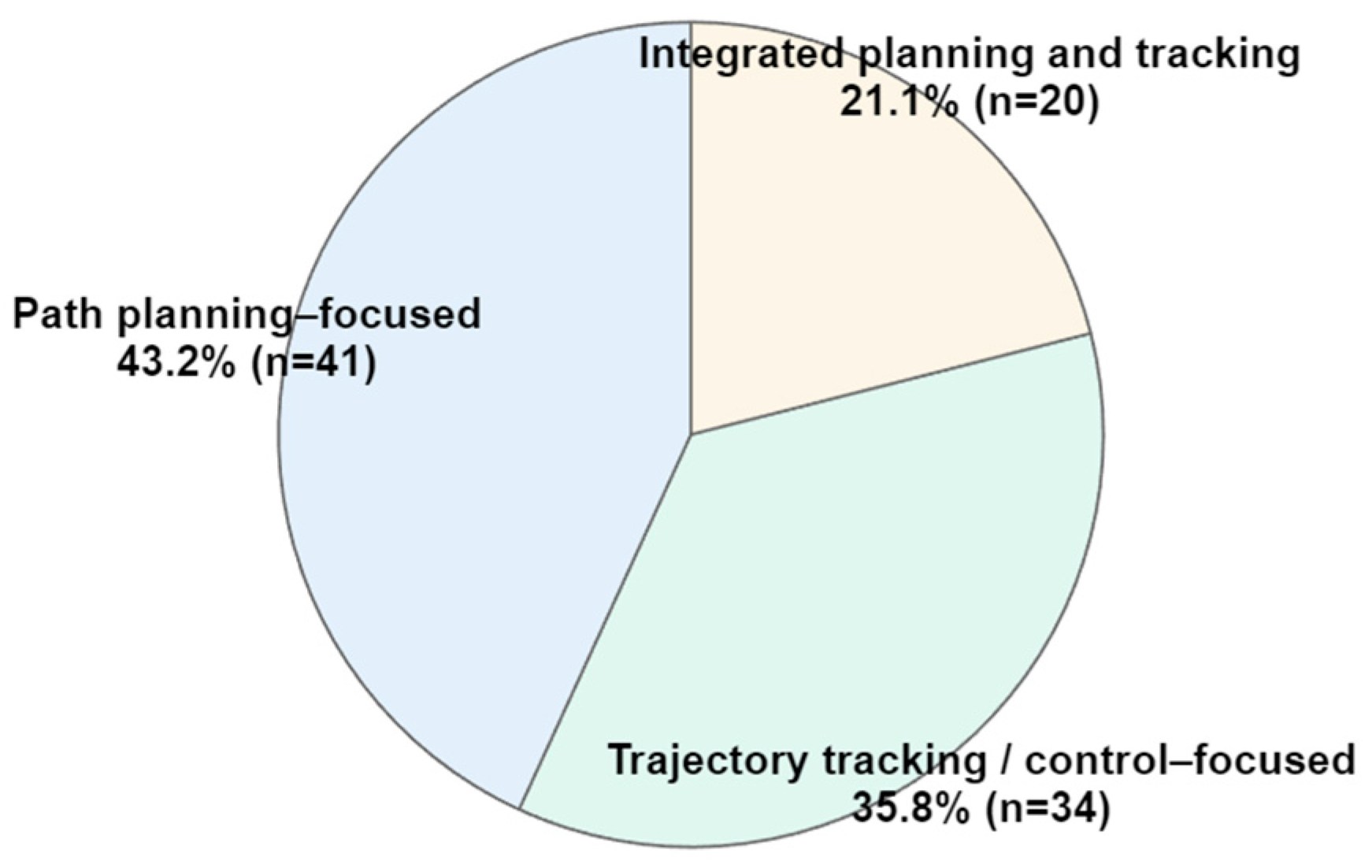
- Strengthen planning–control co-design. Navigation should be treated as an integrated pipeline, with explicit quantification of trade-offs between planning horizon, control frequency, and onboard computational resources to support deployment on embedded platforms;
- (4)
- Prioritize safety-aware robustness. Beyond nominal accuracy, integrating slip-aware modeling, uncertainty-aware decision-making, and constraint handling is essential for safe operation in human–robot co-working environments and complex agricultural topographies.
Author Contributions
Funding
Data Availability Statement
Acknowledgments
Conflicts of Interest
References
- Jiang, A.; Ahamed, T. Development of an Autonomous Navigation System for Orchard Spraying Robots Integrating a Thermal Camera and LiDAR Using a Deep Learning Algorithm under Low- and No-Light Conditions. Comput. Electron. Agric. 2025, 235, 110359. [Google Scholar] [CrossRef]
- Sánchez-Ibáñez, J.R.; Pérez-del-Pulgar, C.J.; García-Cerezo, A. Path Planning for Autonomous Mobile Robots: A Review. Sensors 2021, 21, 7898. [Google Scholar] [CrossRef]
- Vu, C.-T.; Chen, H.-C.; Liu, Y.-C. Toward Autonomous Navigation for Agriculture Robots in Orchard Farming. In Proceedings of the 2024 IEEE International Conference on Recent Advances in Systems Science and Engineering (RASSE), Taichung, Taiwan, 6–8 November 2024; pp. 1–8. [Google Scholar]
- Abanay, A.; Masmoudi, L.; Benkhedra, D.; Amraoui, K.E.; Lghoul, M.; Jimenez, J.-G.; Moreno, F.-A. A Transformation Model for Vision-Based Navigation of Agricultural Robots. Cogn. Robot. 2025, 5, 140–151. [Google Scholar] [CrossRef]
- Xie, B.; Liu, J.; He, M.; Wang, J.; Xu, Z. Research Progress on Autonomous Navigation Technology of Agricultural Robot. In Proceedings of the 2021 IEEE 11th Annual International Conference on CYBER Technology in Automation, Control, and Intelligent Systems (CYBER), Jiaxing, China, 27–31 July 2021; pp. 891–898. [Google Scholar]
- Shi, Y.; Cheng, X.; Xi, X.; Shan, X.; Jin, Y.; Zhang, R. Research progress on the path tracking control methods for agricultural machinery navigation. Trans. Chin. Soc. Agric. Eng. 2023, 39, 1–14. (In Chinese) [Google Scholar]
- Xiao, M.; Tian, F.; Wei, W.; Zhu, Y.; Li, D.; Zhang, P.; Geng, G. Research on Path Tracking Control Methods for Tractor Operating Units: A Review. Chin. J. Rice Sci. 2025, 39, 423–439. (In Chinese) [Google Scholar]
- Liu, L.; Liu, H.; Wang, X.; Li, J.; Wang, P.; Liu, S.; Zou, J.; Yang, X. Application of Path Planning and Tracking Control Technology in Mower Robots. Agronomy 2024, 14, 2473. [Google Scholar] [CrossRef]
- Bai, Y.; Zhang, B.; Xu, N.; Zhou, J.; Shi, J.; Diao, Z. Vision-Based Navigation and Guidance for Agricultural Autonomous Vehicles and Robots: A Review. Comput. Electron. Agric. 2023, 205, 107584. [Google Scholar] [CrossRef]
- Wang, L.; Huang, W.; Li, H.; Li, W.; Chen, J.; Wu, W. A Review of Collaborative Trajectory Planning for Multiple Unmanned Aerial Vehicles. Processes 2024, 12, 1272. [Google Scholar] [CrossRef]
- Chakraborty, S.; Elangovan, D.; Govindarajan, P.L.; ELnaggar, M.F.; Alrashed, M.M.; Kamel, S. A Comprehensive Review of Path Planning for Agricultural Ground Robots. Sustainability 2022, 14, 9156. [Google Scholar] [CrossRef]
- Chien, J.-C.; Chang, C.-L.; Yu, C.-C. Fast Path Planning Method for Agricultural Robot Automatic Guidance Based on Cubic Spline Interpolation in Strip Farming. In Proceedings of the 2022 International Conference on System Science and Engineering (ICSSE), Taichung, Taiwan, 26–29 May 2022; pp. 64–67. [Google Scholar]
- Saeed, R.A.; Tomasi, G.; Govindarajan, G.; Vidoni, R.; Von Ellenrieder, K.D. Metrology-Aware Path Planning for Agricultural Mobile Robots in Dynamic Environments. In Proceedings of the 2021 IEEE International Workshop on Metrology for Agriculture and Forestry (MetroAgriFor), Trento-Bolzano, Italy, 3–5 November 2021; pp. 448–453. [Google Scholar]
- Santos, L.C.; Santos, F.N.; Solteiro Pires, E.J.; Valente, A.; Costa, P.; Magalhaes, S. Path Planning for Ground Robots in Agriculture: A Short Review. In Proceedings of the 2020 IEEE International Conference on Autonomous Robot Systems and Competitions (ICARSC), Ponta Delgada, Portugal, 15–17 April 2020; pp. 61–66. [Google Scholar]
- Chithra, V.; Brindha, S.; Girish, S.; Mehul, K.; Sachin, M.P.; Bharathwaj, S. Zigbee Based Navigation of an Agricultural Robot Using Track Planning and Shape Recognizing Algorithm. In Proceedings of the 2025 International Conference on Computing and Communication Technologies (ICCCT), Chennai, India, 16–17 April 2025; pp. 1–5. [Google Scholar]
- Wang, N.; Han, Y.; Wang, Y.; Wang, T.; Zhang, M.; Li, H. Research Progress of Agricultural Robot Full Coverage Operation Planning. Trans. Chin. Soc. Agric. Mach. 2022, 53, 1–19. (In Chinese) [Google Scholar]
- Pour Arab, D.; Spisser, M.; Essert, C. 3D Hybrid Path Planning for Optimized Coverage of Agricultural Fields: A Novel Approach for Wheeled Robots. J. Field Robot. 2025, 42, 455–473. [Google Scholar] [CrossRef]
- Choton, J.C.; Prabhakar, P. Optimal Multi-Robot Coverage Path Planning for Agricultural Fields Using Motion Dynamics. In Proceedings of the 2023 IEEE International Conference on Robotics and Automation (ICRA), London, UK, 29 May–2 June 2023; pp. 11817–11823. [Google Scholar]
- Jo, Y.; Son, H.I. Field Evaluation of a Prioritized Path-Planning Algorithm for Heterogeneous Agricultural Tasks of Multi-UGVs. In Proceedings of the 2024 IEEE International Conference on Robotics and Automation (ICRA), Yokohama, Japan, 13–17 May 2024; pp. 11891–11897. [Google Scholar]
- Zhang, X.; Guo, Y.; Yang, J.; Li, D.; Wang, Y.; Zhao, R. Many-Objective Evolutionary Algorithm Based Agricultural Mobile Robot Route Planning. Comput. Electron. Agric. 2022, 200, 107274. [Google Scholar] [CrossRef]
- Höffmann, M.; Patel, S.; Büskens, C. Optimal Guidance Track Generation for Precision Agriculture: A Review of Coverage Path Planning Techniques. J. Field Robot. 2024, 41, 823–844. [Google Scholar] [CrossRef]
- Tang, Y.; Zakaria, M.A.; Younas, M. Path Planning Trends for Autonomous Mobile Robot Navigation: A Review. Sensors 2025, 25, 1206. [Google Scholar] [CrossRef]
- Zhou, J.; He, Y. Research Progress on Navigation Path Planning of Agricultural Machinery. Trans. Chin. Soc. Agric. Mach. 2021, 52, 1–14. (In Chinese) [Google Scholar]
- Sun, Y.; Cui, B.; Ji, F.; Wei, X.; Zhu, Y. The Full-Field Path Tracking of Agricultural Machinery Based on PSO-Enhanced Fuzzy Stanley Model. Appl. Sci. 2022, 12, 7683. [Google Scholar] [CrossRef]
- Liu, L.; Wang, X.; Xie, J.; Wang, X.; Liu, H.; Li, J.; Wang, P.; Yang, X. Path Planning and Tracking Control of Orchard Wheel Mower Based on BL-ACO and GO-SMC. Comput. Electron. Agric. 2025, 228, 109696. [Google Scholar] [CrossRef]
- Jiang, Q.; Shen, Y.; Liu, H.; Khan, Z.; Sun, H.; Huang, Y. A Hybrid Path Planning Algorithm for Orchard Robots Based on an Improved D* Lite Algorithm. Agriculture 2025, 15, 1698. [Google Scholar] [CrossRef]
- Hu, Y.; Chen, X.; Wang, X.; Tang, P.; Xi, H.; Feng, Y.; Dong, G. Path Planning for Robot with a Parallel Sampling RRT Algorithm and Trajectory Optimization. In Proceedings of the 2024 3rd International Conference on Artificial Intelligence, Human-Computer Interaction and Robotics (AIHCIR), Hong Kong, China, 15–17 November 2024; pp. 105–110. [Google Scholar]
- Ye, L.; Wu, F.; Zou, X.; Li, J. Path Planning for Mobile Robots in Unstructured Orchard Environments: An Improved Kinematically Constrained Bi-Directional RRT Approach. Comput. Electron. Agric. 2023, 215, 108453. [Google Scholar] [CrossRef]
- Xiao, J.; Wang, T.; Wang, N.; Li, S.; Li, H.; Zhang, M. Research progress of the obstacle detection and obstacle avoidance technology for agricultural robots. Trans. Chin. Soc. Agric. Eng. 2025, 41, 35–49. (In Chinese) [Google Scholar]
- Han, C.; Wu, W.; Luo, X.; Li, J. Visual Navigation and Obstacle Avoidance Control for Agricultural Robots via LiDAR and Camera. Remote Sens. 2023, 15, 5402. [Google Scholar] [CrossRef]
- Affonso, F.; Tommaselli, F.A.G.; Capezzuto, G.; Gasparino, M.V.; Chowdhary, G.; Becker, M. CROW: A Self-Supervised Crop Row Navigation Algorithm for Agricultural Fields. J. Intell. Robot. Syst. 2025, 111, 28. [Google Scholar] [CrossRef]
- Shi, Y.; Huang, S.; Li, M. An Improved Global and Local Fusion Path-Planning Algorithm for Mobile Robots. Sensors 2024, 24, 7950. [Google Scholar] [CrossRef]
- Yang, J.; Ni, J.; Li, Y.; Wen, J.; Chen, D. The Intelligent Path Planning System of Agricultural Robot via Reinforcement Learning. Sensors 2022, 22, 4316. [Google Scholar] [CrossRef]
- Jaramillo-Martínez, R.; Chavero-Navarrete, E.; Ibarra-Pérez, T. Reinforcement-Learning-Based Path Planning: A Reward Function Strategy. Appl. Sci. 2024, 14, 7654. [Google Scholar] [CrossRef]
- Fu, B.; Yao, X. Research and Application of an Improved TD3 Algorithm in Mobile Robot Environment Perception and Autonomous Navigation. In Proceedings of the 2024 3rd International Conference on Robotics, Artificial Intelligence and Intelligent Control (RAIIC), Mianyang, China, 5–7 July 2024; pp. 158–162. [Google Scholar]
- Kang, J.; Zhang, Z.; Liang, Y.; Chen, X. Autonomous Navigation of Agricultural Robots Utilizing Path Points and Deep Reinforcement Learning. In Proceedings of the 2024 International Joint Conference on Neural Networks (IJCNN), Yokohama, Japan, 30 June–5 July 2024; pp. 1–8. [Google Scholar]
- Liu, L.; Wang, X.; Wang, X.; Xie, J.; Liu, H.; Li, J.; Wang, P.; Yang, X. Path Planning and Tracking Control of Tracked Agricultural Machinery Based on Improved A* and Fuzzy Control. Electronics 2024, 13, 188. [Google Scholar] [CrossRef]
- Lytridis, C.; Bazinas, C.; Pachidis, T.; Chatzis, V.; Kaburlasos, V.G. Coordinated Navigation of Two Agricultural Robots in a Vineyard: A Simulation Study. Sensors 2022, 22, 9095. [Google Scholar] [CrossRef] [PubMed]
- Wang, N.; Yang, X.; Wang, T.; Xiao, J.; Zhang, M.; Wang, H.; Li, H. Collaborative Path Planning and Task Allocation for Multiple Agricultural Machines. Comput. Electron. Agric. 2023, 213, 108218. [Google Scholar] [CrossRef]
- Zhai, Z.; Wang, X.; Wang, L.; Zhu, Z.; Du, Y.; Mao, E. Collaborative Path Planning for Autonomous Agricultural Machinery of Master Slave Cooperation. Trans. Chin. Soc. Agric. Mach. 2021, 52, 542–547. (In Chinese) [Google Scholar]
- Wang, Q.; He, J.; Lu, C.; Wang, C.; Lin, H.; Yang, H.; Li, H.; Wu, Z. Modelling and Control Methods in Path Tracking Control for Autonomous Agricultural Vehicles: A Review of State of the Art and Challenges. Appl. Sci. 2023, 13, 7155. [Google Scholar] [CrossRef]
- Ruslan, N.A.I.; Amer, N.H.; Hudha, K.; Kadir, Z.A.; Ishak, S.A.F.M.; Dardin, S.M.F.S. Modelling and Control Strategies in Path Tracking Control for Autonomous Tracked Vehicles: A Review of State of the Art and Challenges. J. Terramech. 2023, 105, 67–79. [Google Scholar] [CrossRef]
- Emmi, L.; Fernández, R.; Gonzalez-de-Santos, P. An Efficient Guiding Manager for Ground Mobile Robots in Agriculture. Robotics 2023, 13, 6. [Google Scholar] [CrossRef]
- Kurdi, M.M.; Elzein, I.A. Trajectory and Motion for Agricultural Robot. In Proceedings of the 2022 International Conference on Decision Aid Sciences and Applications (DASA), Chiangrai, Thailand, 23–25 March 2022; pp. 1430–1434. [Google Scholar]
- Chen, L.L. Research on Robot Motion Control and Trajectory Tracking Based on Agricultural Seeding. Comput. Opt. 2023, 47, 179–184. [Google Scholar]
- He, J.; Liu, S.; Man, Z.; Yue, M.; Wang, J.; Wang, P.; Hu, L. Curve Path Tracking Control of Agricultural Machinery Automatic Driving Based on Full State Feedback Control. Trans. Chin. Soc. Agric. Mach. 2025, 56, 145–154. (In Chinese) [Google Scholar]
- Zhu, Q.; Cheng, J.; Chen, X.; Yang, C.; Gao, Y.; Shao, G. Review on Path Tracking Control of Unmanned Articulated Steering Vehicles. Trans. Chin. Soc. Agric. Mach. 2024, 55, 1–21. (In Chinese) [Google Scholar]
- Yan, J.; Zhang, W.; Liu, Y.; Pan, W.; Hou, X.; Liu, Z. Autonomous Trajectory Tracking Control Method for an Agricultural Robotic Vehicle. Int. J. Agric. Biol. Eng. 2024, 17, 215–224. [Google Scholar] [CrossRef]
- Wen, J.; Yao, L.; Zhou, J.; Yang, Z.; Xu, L.; Yao, L. Path Tracking Control of Agricultural Automatic Navigation Vehicles Based on an Improved Sparrow Search-Pure Pursuit Algorithm. Agriculture 2025, 15, 1215. [Google Scholar] [CrossRef]
- Xu, R.; Li, C. A Modular Agricultural Robotic System (MARS) for Precision Farming: Concept and Implementation. J. Field Robot. 2022, 39, 387–409. [Google Scholar] [CrossRef]
- Ahn, J.; Shin, S.; Kim, M.; Park, J. Accurate Path Tracking by Adjusting Look-Ahead Point in Pure Pursuit Method. Int. J. Automot. Technol. 2021, 22, 119–129. [Google Scholar] [CrossRef]
- Amertet, S.; Gebresenbet, G.; Alwan, H.M. Optimizing the Performance of a Wheeled Mobile Robots for Use in Agriculture Using a Linear-Quadratic Regulator. Robot. Auton. Syst. 2024, 174, 104642. [Google Scholar] [CrossRef]
- Xu, L.; Hou, J.; Yan, X.; Liu, M.; Zhang, J.; Tao, Y. Research on Path Tracking of Intelligent Hybrid Articulated Tractor Based on Corrected Model Predictive Control. World Electr. Veh. J. 2025, 16, 161. [Google Scholar] [CrossRef]
- Elham, E.; Meng, Y.; Bai, G.; Gu, Q.; Wang, G.; Chang, X.; Huang, J.; Zheng, Y. Path tracking for car-like robots based on feed-forward nonlinear model predictive control. Chin. J. Eng. 2025, 47, 101–112. (In Chinese) [Google Scholar]
- Han, M.; He, H.; Shi, M.; Liu, W.; Cao, J.; Wu, J. Research on Learning-Based Model Predictive Path Tracking Control for Autonomous Vehicles. Automot. Eng. 2024, 46, 1197–1207. (In Chinese) [Google Scholar]
- Ding, C.; Ding, S.; Wei, X.; Ji, X.; Sun, J.; Mei, K. Disturbance-Observer-Based Barrier Function Adaptive Sliding Mode Control for Path Tracking of Autonomous Agricultural Vehicles with Matched-Mismatched Disturbances. IEEE Trans. Transp. Electrific. 2024, 10, 6748–6760. [Google Scholar] [CrossRef]
- Yang, W.; Ding, S.; Ding, C. Fast Supertwisting Sliding Mode Control with Antipeaking Extended State Observer for Path-Tracking of Unmanned Agricultural Vehicles. IEEE Trans. Ind. Electron. 2024, 71, 12973–12982. [Google Scholar] [CrossRef]
- Liu, H.; Zou, S.; Tang, J.; Han, Z.; Yu, H.; Wang, S. Path Tracking Control Algorithm for Tracked Agricultural Chassis Based on Parameter-pre-tuned Super-twisting Sliding Mode Control. Trans. Chin. Soc. Agric. Mach. 2025, 56, 136–144. (In Chinese) [Google Scholar]
- Sun, J.; Wang, Z.; Ding, S.; Xia, J.; Xing, G. Adaptive Disturbance Observer-Based Fixed Time Nonsingular Terminal Sliding Mode Control for Path-Tracking of Unmanned Agricultural Tractors. Biosyst. Eng. 2024, 246, 96–109. [Google Scholar] [CrossRef]
- Huang, P.; Zhang, Z.; Luo, X. Feedforward-plus-Proportional–Integral–Derivative Controller for Agricultural Robot Turning in Headland. Int. J. Adv. Robot. Syst. 2020, 17, 1729881419897678. [Google Scholar] [CrossRef]
- He, Y.; Zhou, J.; Sun, J.; Jia, H.; Liang, Z.; Awuah, E. An Adaptive Control System for Path Tracking of Crawler Combine Harvester Based on Paddy Ground Conditions Identification. Comput. Electron. Agric. 2023, 210, 107948. [Google Scholar] [CrossRef]
- Zheng, S.; Xu, S.; Rai, R. Trailer-Referenced Autonomous Navigation of Agricultural Tractor–Trailer Systems. Comput. Electron. Agric. 2025, 237, 110514. [Google Scholar] [CrossRef]
- Liu, W.; Guo, R.; Zhao, J. Fuzzy predictive function control for the path tracking of transplanters using feedback linearization. Trans. Chin. Soc. Agric. Eng. 2024, 40, 51–61. (In Chinese) [Google Scholar]
- He, Z.; Bao, Y.; Yu, Q.; Lu, P.; He, Y.; Liu, Y. Dynamic Path Planning Method for Headland Turning of Unmanned Agricultural Vehicles. Comput. Electron. Agric. 2023, 206, 107699. [Google Scholar] [CrossRef]
- Ji, X.; Ding, S.; Wei, X.; Cui, B. Path Tracking of Unmanned Agricultural Tractors Based on a Novel Adaptive Second-Order Sliding Mode Control. J. Frankl. Inst. 2023, 360, 5811–5831. [Google Scholar] [CrossRef]
- Zhu, D.; Shi, M.; Wang, Y.; Xue, K.; Liao, J.; Xiong, W.; Kuang, F.; Zhang, S. Path Tracking Control Method for Automatic Navigation Rice Transplanters Based on VUFC and Improved BAS Algorithm. Robotica 2023, 41, 3116–3136. [Google Scholar] [CrossRef]
- Li, Y.; Wu, T.; Xiao, Y.; Gong, L.; Liu, C. Path Planning in Continuous Adjacent Farmlands and Robust Path-Tracking Control of a Rice-Seeding Robot in Paddy Field. Comput. Electron. Agric. 2023, 210, 107900. [Google Scholar] [CrossRef]
- Chen, D.; Wang, Q.; Lin, Y.; Ma, Z.; Sun, L.; Yu, G. Path Tracking Control of Paddy Field Weeder Integrated with Satellite and Visual Methods. Comput. Electron. Agric. 2025, 234, 110257. [Google Scholar] [CrossRef]
- Santos, L.; Santos, F.; Mendes, J.; Costa, P.; Lima, J.; Reis, R.; Shinde, P. Path Planning Aware of Robot’s Center of Mass for Steep Slope Vineyards. Robotica 2020, 38, 684–698. [Google Scholar] [CrossRef]
- Zhang, W.; Sun, T.; Li, Y.; He, C.; Xiu, X.; Miao, Z. Optimal Motion Planning and Navigation for Nonholonomic Agricultural Robots in Multi-Constraint and Multi-Task Environments. Comput. Electron. Agric. 2025, 238, 110822. [Google Scholar] [CrossRef]
- Peng, C.; Wei, P.; Fei, Z.; Zhu, Y.; Vougioukas, S.G. Optimization-based Motion Planning for Autonomous Agricultural Vehicles Turning in Constrained Headlands. J. Field Robot. 2024, 41, 1984–2008. [Google Scholar] [CrossRef]
- Monsalve, G.; Belhadj Ltaief, N.; Amoriya, V.; Cardenas, A. Kinematic Navigation Control of Differential Drive Agricultural Robot. In Proceedings of the 2022 IEEE International Conference on Electrical Sciences and Technologies in Maghreb (CISTEM), Tunis, Tunisia, 26–28 October 2022; pp. 1–6. [Google Scholar]
- Xie, X.; Li, Y.; Zhao, L.; Jin, X.; Wang, S.; Han, X. Method for the Fruit Tree Recognition and Navigation in Complex Environment of an Agricultural Robot. Int. J. Agric. Biol. Eng. 2024, 17, 221–229. [Google Scholar] [CrossRef]
- Cao, G.; Zhang, B.; Li, Y.; Wang, Z.; Diao, Z.; Zhu, Q.; Liang, Z. Environmental Mapping and Path Planning for Robots in Orchard Based on Traversability Analysis, Improved LeGO-LOAM and RRT* Algorithms. Comput. Electron. Agric. 2025, 230, 109889. [Google Scholar] [CrossRef]
- Sánchez, J.A.S.; López-González, E.; Magid, E.; Martínez-García, E.A. Double Spiraliform Path Planning and Tracking for Agricultural Mobile Robotics: A Modeling and Simulation Study. Comput. Electron. Agric. 2025, 237, 110715. [Google Scholar] [CrossRef]
- Sun, Z.; Hu, S.; Xie, H.; Li, H.; Zheng, J.; Chen, B. Fuzzy Adaptive Recursive Terminal Sliding Mode Control for an Agricultural Omnidirectional Mobile Robot. Comput. Electr. Eng. 2023, 105, 108529. [Google Scholar] [CrossRef]
- Willekens, A.; Temmerman, S.; Wyffels, F.; Pieters, J.G.; Cool, S.R. Development of an Agricultural Robot Taskmap Operation Framework. J. Field Robot. 2025, 42, 4256–4287. [Google Scholar] [CrossRef]
- Fujinaga, T. Autonomous Navigation Method for Agricultural Robots in High-Bed Cultivation Environments. Comput. Electron. Agric. 2025, 231, 110001. [Google Scholar] [CrossRef]
- Yang, Y.; Li, Y.; Wen, X.; Zhang, G.; Ma, Q.; Cheng, S.; Qi, J.; Xu, L.; Chen, L. An Optimal Goal Point Determination Algorithm for Automatic Navigation of Agricultural Machinery: Improving the Tracking Accuracy of the Pure Pursuit Algorithm. Comput. Electron. Agric. 2022, 194, 106760. [Google Scholar] [CrossRef]
- Cui, L.; Le, F.; Xue, X.; Sun, T.; Jiao, Y. Design and Experiment of an Agricultural Field Management Robot and Its Navigation Control System. Agronomy 2024, 14, 654. [Google Scholar] [CrossRef]
- Zhou, B.; Su, X.; Yu, H.; Guo, W.; Zhang, Q. Research on Path Tracking of Articulated Steering Tractor Based on Modified Model Predictive Control. Agriculture 2023, 13, 871. [Google Scholar] [CrossRef]
- Wang, Z.; Huang, P.; Wu, X.; Liu, J. Field-Validated VIO-MPC Fusion for Autonomous Headland Turning in GNSS-Denied Orchards. Smart Agric. Technol. 2025, 12, 101373. [Google Scholar] [CrossRef]
- Li, Z.; Liu, X.; Wang, H.; Song, J.; Xie, F.; Wang, K. Research on Robot Path Planning Based on Point Cloud Map in Orchard Environment. IEEE Access 2024, 12, 54853–54865. [Google Scholar] [CrossRef]
- Li, J.; Wang, S.; Zhang, W.; Li, H.; Zeng, Y.; Wang, T.; Fei, K.; Qiu, X.; Jiang, R.; Mai, C.; et al. Research on Path Tracking for an Orchard Mowing Robot Based on Cascaded Model Predictive Control and Anti-Slip Drive Control. Agronomy 2023, 13, 1395. [Google Scholar] [CrossRef]
- Shen, Y.; Shen, Y.; Zhang, Y.; Huo, C.; Shen, Z.; Su, W.; Liu, H. Research Progress on Path Planning and Tracking Control Methods for Orchard Mobile Robots in Complex Scenarios. Agriculture 2025, 15, 1917. [Google Scholar] [CrossRef]
- Raikwar, S.; Fehrmann, J.; Herlitzius, T. Navigation and Control Development for a Four-Wheel-Steered Mobile Orchard Robot Using Model-Based Design. Comput. Electron. Agric. 2022, 202, 107410. [Google Scholar] [CrossRef]
- Chen, B.; Gong, L.; Yu, C.; Du, X.; Chen, J.; Xie, S.; Le, X.; Li, Y.; Liu, C. Workspace Decomposition Based Path Planning for Fruit-Picking Robot in Complex Greenhouse Environment. Comput. Electron. Agric. 2023, 215, 108353. [Google Scholar] [CrossRef]
- Kulathunga, G.; Yilmaz, A.; Huang, Z.; Hroob, I.; Singh, J.; Guevara, L.; Cielniak, G.; Hanheide, M. Navigating Narrow Spaces: A Comprehensive Framework for Agricultural Robots. IEEE Robot. Autom. Lett. 2025, 10, 9296–9303. [Google Scholar] [CrossRef]
- Pour Arab, D.; Spisser, M.; Essert, C. Complete Coverage Path Planning for Wheeled Agricultural Robots. J. Field Robot. 2023, 40, 1460–1503. [Google Scholar] [CrossRef]
- Xu, L.; Chen, R.; Yuan, H. Path Tracking Control Method for Wheeled Tractors with Slope Disturbance. Trans. Chin. Soc. Agric. Mach. 2023, 54, 421–430. (In Chinese) [Google Scholar]
- Song, Y.; Xue, J.; Zhang, T.; Sun, X.; Sun, H.; Gao, W.; Chen, Q. Path Tracking Control of Crawler Tractor Based on Adaptive Adjustment of Lookahead Distance Using Sparrow Search Algorithm. Comput. Electron. Agric. 2025, 234, 110219. [Google Scholar] [CrossRef]
- Zhao, X.; Lu, E.; Tang, Z.; Luo, C.; Xu, L.; Wang, H. Trajectory Prediction Method for Agricultural Tracked Robots Based on Slip Parameter Estimation. Comput. Electron. Agric. 2024, 222, 109057. [Google Scholar] [CrossRef]
- Miao, Z.; Zhu, Z.; Zhang, W.; Xue, Z.; Sun, T.; Zhang, Y.; Xie, T.; He, C.; Li, N.; Yuan, J.; et al. Key Technologies and Development Trends of Embodied Intelligence Agricultural Robots. Trans. Chin. Soc. Agric. Mach. 2025, 56, 212–239. (In Chinese) [Google Scholar]
- Yan, H.; Li, F.; Zhu, Y.; Li, L.; Wu, H.; Fang, X. Path Planning Method for Robotic Operation Platforms in Controlled Traffic Farming. Trans. Chin. Soc. Agric. Mach. 2025, 56, 155–166. (In Chinese) [Google Scholar]
- Zhang, W.; Hu, L.; Wang, H.; Zhang, G.; Luo, X.; Zhang, Z. Improved Pure Pursuit Agricultural Machinery Navigation Curve Path Tracking Method Based on B-spline Optimization. Trans. Chin. Soc. Agric. Mach. 2024, 55, 42–51+115. (In Chinese) [Google Scholar]



| Architecture | Core Mechanism | Optimality and Efficiency | Scalability | Robustness and Fault Tolerance | Application Scenarios |
|---|---|---|---|---|---|
| Centralized | Central server possesses global information and computes planning for all robots | Theoretically globally optimal, but computationally complex | Poor | Low | Small-scale, structured environments with robust communication infrastructure |
| Distributed | Robots make independent decisions based on local information and peer-to-peer negotiation | Typically locally optimal, with no guarantee of global performance and potential for oscillation | Excellent | High | Large-scale, dynamic environments with limited communication capabilities |
| Hybrid | Central node assigns high-level tasks, robots perform local autonomous planning | Balancing overall efficiency with local flexibility | Good | Medium | Medium-to-large-scale environments requiring both global coordination and localized responsiveness |
| Method Categories | Core Mechanism | Planning Scope | Optimality Guarantees | Implementation Complexity | Applicable Scenarios | Representation Methods |
|---|---|---|---|---|---|---|
| Geometric Decomposition | Terrain decomposition with geometric rules; generates parallel rows | Global | Coverage-complete, not distance-optimal | Low | Regular fields with static or sparse obstacles | ox-tracing/bow-shaped path, Partitioning Method |
| Meta-Heuristics | Population evolution to iteratively optimize paths | Global | Approximate, no guarantee | High | Irregular plots, complex coverage tasks | GA, SA, PSO, ACO |
| Graph Search | Static Planning: Global search on fixed maps | Global | Globally optimal | Medium | Structured fields, static obstacles | Dijkstra, A* |
| Dynamic Replanning: Incremental search for changing environments | Global | Optimal under known information | Medium to High | Dynamic fields with new obstacles | D*, D* Lite | |
| Sampling Optimization | Random sampling to build feasible paths | Global/ Local | Approximately optimal | Medium to High | High-dimensional or complex constraints | RRT, RRT*, PRM |
| Local Classics | Real-time obstacle avoidance from sensor data | Local | Not guaranteed | Low to Medium | Unknown or dynamic environments | DWA, APF, VFH |
| Fuzzy Logic | Sensor–rule mapping via fuzzy inference | Local | Not guaranteed | Medium | High-uncertainty environments | FL |
| Data-Driven | Learning-based mapping from perception to control | Local/ Global | Data-dependent | Very High | Unstructured, highly dynamic settings | RL, DRL (DQN, PPO, DDPG) |
| Hybrid Methods | Combines global optimality with local reactivity | Global + Local | Global reference; local non-optimal | Very High | Large-scale, dynamic, high-uncertainty fields | CCPP + DWA, A* + APF |
| Category | Control Algorithms | Core Mechanism | Model Dependency | Computational Complexity | Applicable Scenarios |
|---|---|---|---|---|---|
| Classic Algorithms | PID | Linear error-based feedback | None | very low | Low-speed linear tracking; moderate-precision tasks |
| PPC | Kinematic forward-point steering | Weak (Kinematic Only) | low | Moderate-speed tracking with gentle curvature | |
| Stanley | Nonlinear heading–lateral error fusion | Weak (Kinematic Only) | low | Ground vehicles; mid–high speed tracking | |
| Advanced Algorithms | LQR | Optimal linear control minimizing quadratic cost | Strong (Precise linear model) | Offline: high; Online: low | Structured, flat environments |
| MPC | Predictive optimization with rolling horizon | Strong | high | High-precision field tracking; slopes | |
| SMC | Nonlinear Sliding manifold tracking under disturbances | Medium | Medium | High disturbance environments, slopes | |
| ADRC | ESO-based active and nonlinear disturbance rejection | Weak | Medium | Slippery soil; varying loads | |
| Intelligent Adaptive Algorithms | AC | Online controller adjustment via nonlinear parameter adaptation | Medium | Medium | Time-varying dynamics (load, inertia) |
| NN | Nonlinear Neural network model approximation | None | Inference: Medium; Training: extremely high | Highly nonlinear, difficult-to-model systems | |
| RL/DRL | Learning optimal linear/nonlinear strategies via interaction | None | Inference: Medium; Training: extremely high | Dynamic, unstructured environments | |
| FL | Fuzzy rule-based nonlinear control | None | Medium | High-uncertainty real-time control |
| Author (Year) | Main Methods | Lateral Error | Coverage | Calculation Time | Field Trials | Advantages | Disadvantages |
|---|---|---|---|---|---|---|---|
| He (2023) [64] | Dynamic Head-to-Ground Turn Optimization | 0.02 m | - | - | Yes | Enhanced head-to-ground efficiency and stability | Needs adaptation for complex obstacles |
| Ji (2023) [65] | Adaptive SMC | Lowest MAE/RMS | - | - | No | High tracking accuracy; reduced chattering | Simulation only; needs real-world validation |
| Zhu (2023) [66] | FL + improved Beetle Antennae Search | Lower mean steady-state error than PPC | - | Offline optimization reduces real-time computation load | Yes | Higher accuracy and stability; avoids real-time performance issues via offline optimization | Performance depends on the accuracy of the offline simulation model |
| Li (2023) [67] | SMC with a nonlinear observer | Avg: 0.0247 m | - | - | Yes | robust tracking in paddy fields with slip and disturbances; no overshooting | Assumes standardized rectangular farmlands |
| Chen (2025) [68] | a 3D fuzzy controller for dynamic preview distance and a feedback compensator | Standard deviation of lateral offset reduced by 11.3% to 40.4% | - | - | Yes | Improves navigation accuracy and stability; robust against skidding and off-track driving | Not applicable in scenarios where a satellite navigation baseline cannot be established |
| Santos (2020) [69] | extended A* | - | - | 0.24–0.26 s | Yes | Generates safer paths on steep slopes to avoid dangerous postures | Path length may be longer than standard A*; memory usage needs optimization for larger areas |
| Zhang (2025) [70] | Segmented Bézier curves in a convex QP problem, with MPC and PID | Max: 0.0400 m | - | 50–200 ms | Yes | Generates high-order continuous and feasible trajectories for multi-task scenarios; ensures high-precision tracking | Primarily targets static environments without integrating real-time perception |
| Peng (2024) [71] | pattern-based or Hybrid A* | <0.1 m | - | 8.2–12.3 s | Yes | Generates smooth, collision-free, kinematically feasible trajectories in constrained, irregular headlands with obstacles | Slower than classic pattern-based planners; may fail in extremely narrow spaces under time limits |
| Monsalve (2022) [72] | PID | Small line error | - | - | No | Low-cost system using fewer sensors (odometry-based) than vision-based alternatives | Performance at turning points needs improvement; susceptible to wheel slip |
| Xie (2024) [73] | Visual navigation + improved LQR | Avg: 0.0102 m | - | >38 fps for detection | Yes | Good robustness and accuracy | Cannot autonomously perform U-turns |
| Cao (2025) [74] | Improved RRT* | - | - | 0.357–0.565 s | Yes | Robust mapping and localization in complex orchards; plans safe and smooth paths | High computational demand; difficult for long-term, large-scale mapping |
| Sánchez (2025) [75] | Double spiraliform path planning with SMC | Avg: <0.012 m | generates double spiraliform coverage paths | - | No | Generates efficient paths for complex fields | Chattering is present; idealized simulation without real-world validation |
| Sun (2023) [76] | Fuzzy Adaptive Recursive Terminal SMC | RMSE for circular path: <0.046 m | - | - | Yes | High tracking precision and strong robustness; chattering is alleviated by the fuzzy system | Dead-reckoning errors can accumulate over long trajectories |
| Willekens (2025) [77] | PPC + PID | 0.01 m | - | - | Yes | Open-source, high accuracy, multi-robot support | Complex, requires specific hardware |
| Fujinaga (2025) [78] | Hybrid waypoint + cultivation bed navigation using LiDAR | ±0.05 m | 94.73% | - | Yes | No infrastructure needed, robust in dynamic environments | No obstacle handling, LiDAR affected by sunlight, static map |
| Yang (2022) [79] | Optimal goal point algorithm for path tracking | Avg: 0.052 m; Max: 0.061 m | - | - | Yes | Improves tracking accuracy, adaptive look-ahead point | Not specified |
| Operating Scenarios | Environmental Characteristics | Sensing and Localization | Path Planning | Tracking Control | Technical Challenges |
|---|---|---|---|---|---|
| Open-fields | Regularly shaped, open terrain | GNSS/RTK Dominant | CCPP and geometric methods | Geometry and Optimization-Based Control | Plot heterogeneity and complex boundaries reduce efficiency |
| Orchards | Unstructured environment with numerous obstructions | LiDAR/Vision-Based with Multimodal Fusion | Primarily focuses on local paths and dynamic obstacle avoidance | Robust Control (SMC/MPC), Adaptive Algorithms | Significant occlusion and light interference compromise perception stability |
| Greenhouses | Confined space with dense pathways | High-Precision Vision and UWB Positioning | Routine path planning and obstacle avoidance | Fine-Tuning Control, with MPC being the most widely applied | Channel congestion makes balancing obstacle avoidance and positioning accuracy difficult |
| Hilly slopes | Significant topographic undulations and pronounced slope disturbances | IMU Combined with LiDAR/Vision | Slope-constrained path planning | Robust Control (including gradient disturbance terms), Nonlinear Algorithms | Severe slippage and strong dynamic disturbances |
Disclaimer/Publisher’s Note: The statements, opinions and data contained in all publications are solely those of the individual author(s) and contributor(s) and not of MDPI and/or the editor(s). MDPI and/or the editor(s) disclaim responsibility for any injury to people or property resulting from any ideas, methods, instructions or products referred to in the content. |
© 2025 by the authors. Licensee MDPI, Basel, Switzerland. This article is an open access article distributed under the terms and conditions of the Creative Commons Attribution (CC BY) license.
Share and Cite
Ye, F.; Le, F.; Cui, L.; Han, S.; Gao, J.; Qu, J.; Xue, X. Application of Navigation Path Planning and Trajectory Tracking Control Methods for Agricultural Robots. Agriculture 2026, 16, 64. https://doi.org/10.3390/agriculture16010064
Ye F, Le F, Cui L, Han S, Gao J, Qu J, Xue X. Application of Navigation Path Planning and Trajectory Tracking Control Methods for Agricultural Robots. Agriculture. 2026; 16(1):64. https://doi.org/10.3390/agriculture16010064
Chicago/Turabian StyleYe, Fan, Feixiang Le, Longfei Cui, Shaobo Han, Jingxing Gao, Junzhe Qu, and Xinyu Xue. 2026. "Application of Navigation Path Planning and Trajectory Tracking Control Methods for Agricultural Robots" Agriculture 16, no. 1: 64. https://doi.org/10.3390/agriculture16010064
APA StyleYe, F., Le, F., Cui, L., Han, S., Gao, J., Qu, J., & Xue, X. (2026). Application of Navigation Path Planning and Trajectory Tracking Control Methods for Agricultural Robots. Agriculture, 16(1), 64. https://doi.org/10.3390/agriculture16010064