Article

Effect of Nitrogen Sources on the Phenological Phases of Italian Zucchini Under Salt Stress
by
Gleydson de Freitas Silva
1,
Tayd Dayvison Custódio Peixoto
2,
Miguel Ferreira Neto
1,
Antônio Gustavo de Luna Souto
1,
Ricardo André Rodrigues Filho
1,
Kariolania Fortunato de Paiva Araújo
1,
Jussiara Sonally Jácome Cavalcante
1,
Kleane Targino Oliveira Pereira
1,
Rômulo Carantino Lucena Moreira
1,
Pedro Dantas Fernandes
3,
Nildo da Silva Dias
1,
Josinaldo Lopes Araújo Rocha
3,
Alberto Soares de Melo
4,
Alex Álvares da Silva
5 and
Francisco Vanies da Silva Sá
5,*
1
Department of Agronomic and Forest Sciences, Universidade Federal Rural do Semi-Árido, Mossoró 59625-900, RN, Brazil
2
Center of Agrarian and Biological Sciences, Universidade Estadual Vale do Acaraú, São Benedito 62370-000, CE, Brazil
3
Academic Unit of Agricultural Engineering, Universidade Federal de Campina Grande, Campina Grande 58429-900, PB, Brazil
4
Department of Biological Sciences, Universidade Estadual da Paraíba, Campina Grande 58429-900, PB, Brazil
5
Department of Agrarian and Exact, Universidade Estadual da Paraíba, Catolé do Rocha 58884-000, PB, Brazil
*
Author to whom correspondence should be addressed.
Agriculture 2026, 16(1), 62; https://doi.org/10.3390/agriculture16010062 (registering DOI)
Submission received: 13 November 2025 / Revised: 18 December 2025 / Accepted: 22 December 2025 / Published: 27 December 2025
(This article belongs to the Special Issue Advanced Cultivation Technologies for Horticultural Crops Production)

Abstract

Salt stress is one of the most significant abiotic factors limiting plant growth and crop productivity worldwide, especially in arid and semiarid regions. We aimed to investigate nitrogen fertilization strategies using nitrate and ammoniacal sources during different phenological phases of Italian zucchini cv. Caserta to alleviate salt stress. The experiment was conducted in a greenhouse using a randomized block design with four replications. The treatments were as follows: T1 = entire cycle with nitrate nitrogen + 0.50 dS m−1 (control); T2 = entire cycle with nitrate nitrogen + 4.5 dS m−1 (salt stress); T3 = 50% nitrate nitrogen + 50% ammoniacal nitrogen + 4.50 dS m−1; T4 = ammoniacal nitrogen during the vegetative phase + nitrate nitrogen during the reproductive phase + 4.50 dS m−1; T5 = nitrate nitrogen during the vegetative phase + ammoniacal nitrogen during the reproductive phase + 4.50 dS m−1; T6 = entire cycle with ammoniacal nitrogen + 4.50 dS m−1. Under salt stress conditions, Italian zucchini cv. Caserta showed a leaf area of 5783 cm2 compared to an average of 4521 cm2 under salt stress. Similarly, production per plant reached 1361 g in the control, while under salt stress it averaged only 442 g. However, under salt stress, T2 resulted in higher production compared with T3, T4, T5 and T6, although it was still lower than T1. The use of ammoniacal nitrogen throughout the cycle or during the reproductive phase caused flower abortion. Under salt stress, the application of ammoniacal nitrogen during the vegetative phase (T4) or a 1:1 ammonium–nitrate ratio throughout the cycle (T3) resulted in yields that were comparable to those achieved with nitrate-only fertilization (T2).

1. Introduction

Zucchini (Cucurbita pepo L.) is a Cucurbitaceae of enormous importance for agricultural production in Brazil, with a stronger presence in family farming systems [1]. This crop is also one of the most economically and nutritionally valuable vegetables, being rich in calcium, phosphorus, iron, and fiber [2].
According to Guerra et al. [3], the cultivation of Italian zucchini remains more prominent in Brazil’s Central-Southern region, while the semiarid Northeast stands out as a major hub for the cultivation of pumpkins (Cucurbita moschata) and squash (Cucurbita maxima). This scenario highlights the need for further research into the responses of Italian zucchini to salinity and water stress, as well as the growth and development conditions in these regions, considering both water quality and mineral nutrition for plants.
In 2018, Brazil’s zucchini production was estimated at 228,500 tons, with approximately 75% of this total concentrated in the Southeast region [4]. Guerra et al. [3] observed a lack of studies on zucchini cultivation in the Northeast, either in open fields or protected environments. The Northeast is characterized by high temperatures and low annual rainfall, prompting farmers to seek alternative water sources for vegetable production. However, these water sources often have inferior quality due to high levels of soluble salts [2].
Salt stress is one of the leading abiotic factors limiting plant growth and crop yields globally, particularly in arid and semiarid regions [5,6]. In such areas, the natural process of soil salinization, driven by prevailing environmental conditions, is further exacerbated by the need for irrigation, often carried out with water containing high concentrations of soluble salts [7,8].
The use of saline water in agricultural production in arid and semiarid regions is primarily due to challenges in capturing and storing freshwater for irrigation. As a result, saline water from shallow wells, which is more cost-effective to extract than water from deep wells, is commonly used. However, the electrical conductivity of these water sources exceeds 4.0 dS m−1 [9]. For Italian zucchini, Sousa et al. [10] determined that the tolerance threshold for irrigation water salinity is 3.1 dS m−1.
Studies by Munns & Tester [11], Syvertsen & Garcia-Sanchez [12], and Sá et al. [13] have shown that the excessive accumulation of salts, particularly sodium chloride (NaCl), in plants can hinder their growth and yield due to ionic toxicity and nutrient imbalances. To address these issues, various studies have been conducted to develop management strategies that enhance plant performance in saline environments, especially strategies aimed at improving nutrient absorption and assimilation [14]. Among these strategies, nitrogen nutrition using specific nitrogen (N) forms has proven promising for acclimating plants to salinity. The interaction between salinity and nitrogen nutrition has been shown to improve plant physiology, growth, and yield under salt stress conditions [15].
With regard to nitrogen, Bazzo [16] emphasizes that this nutrient is positively correlated with high crop yields, primarily because nitrogen (N) is one of the key elements directly involved in plant growth and development. The inorganic nitrogen sources most absorbed by plants are ammonium (NH4+) and nitrate ions (NO3), with the latter being considered the primary source of mineral nitrogen for plant growth [17]. According to Cordeiro, Rodrigues, and Echer [18], urea is more easily commercialized and widely used among farmers. However, it has a high potential for reduced efficiency due to its rapid volatilization and leaching, leading to economic losses for producers and less efficient fertilizer use by plants.
The effects of nitrogen fertilization on the different phenological stages of Italian zucchini are still not well understood, and there is limited research on how the nitrogen sources and their proportions affect crop performance throughout the growth cycle. Since nitrogen is crucial for plant growth and yield, managing its application may help reduce the negative impacts of salinity. We hypothesized that using different nitrogen sources and proportions at specific phenological stages can alleviate salt stress and improve physiological responses, growth, and yield in Italian zucchini. In this context, we assessed fluorescence, chlorophyll content, gas exchange, growth, and yield of Italian zucchini cv. Caserta under conditions of salt stress while employing different nitrogen fertilization strategies.

2. Materials and Methods

2.1. Location and Experimental Design

The experiment was conducted in a greenhouse covered with transparent material to minimize interference with light and solar radiation, with its sides protected with 50%, at the Agricultural Sciences Center of the Federal Rural University of the Semi-Arid Region (UFERSA) in Mossoró-RN, Brazil, located at 5°11′ S and 37°20′ W, at an altitude of 18 m, from november to december 2022. The Mossoró region, where the study was carried out, has a BSh climate type, classified as a hot semi-arid climate according to Köppen’s classification system [19]. During the experimental period, the maximum and minimum temperatures recorded were 44.2 and 20.4 °C, with maximum and minimum humidity of 86 and 22%, respectively.
The research was conducted in a randomized block design with six treatments: T1 = complete cycle with nitric nitrogen (NO3) under low salinity (0.50 dS m−1; control); T2 = complete cycle with NO3 under saline stress (4.50 dS m−1); T3 = complete cycle using a 50% NO3 and 50% ammoniacal nitrogen (NH4+) ratio under saline stress; T4 = NH4+ in the vegetative phase and nitric nitrogen in the reproductive phase under saline stress; T5 = nitric nitrogen in the vegetative phase and ammoniacal nitrogen in the reproductive phase under saline stress; T6 = complete cycle with NH4+ under saline stress, with four replications.

2.2. Plant Material and Soil Characteristics

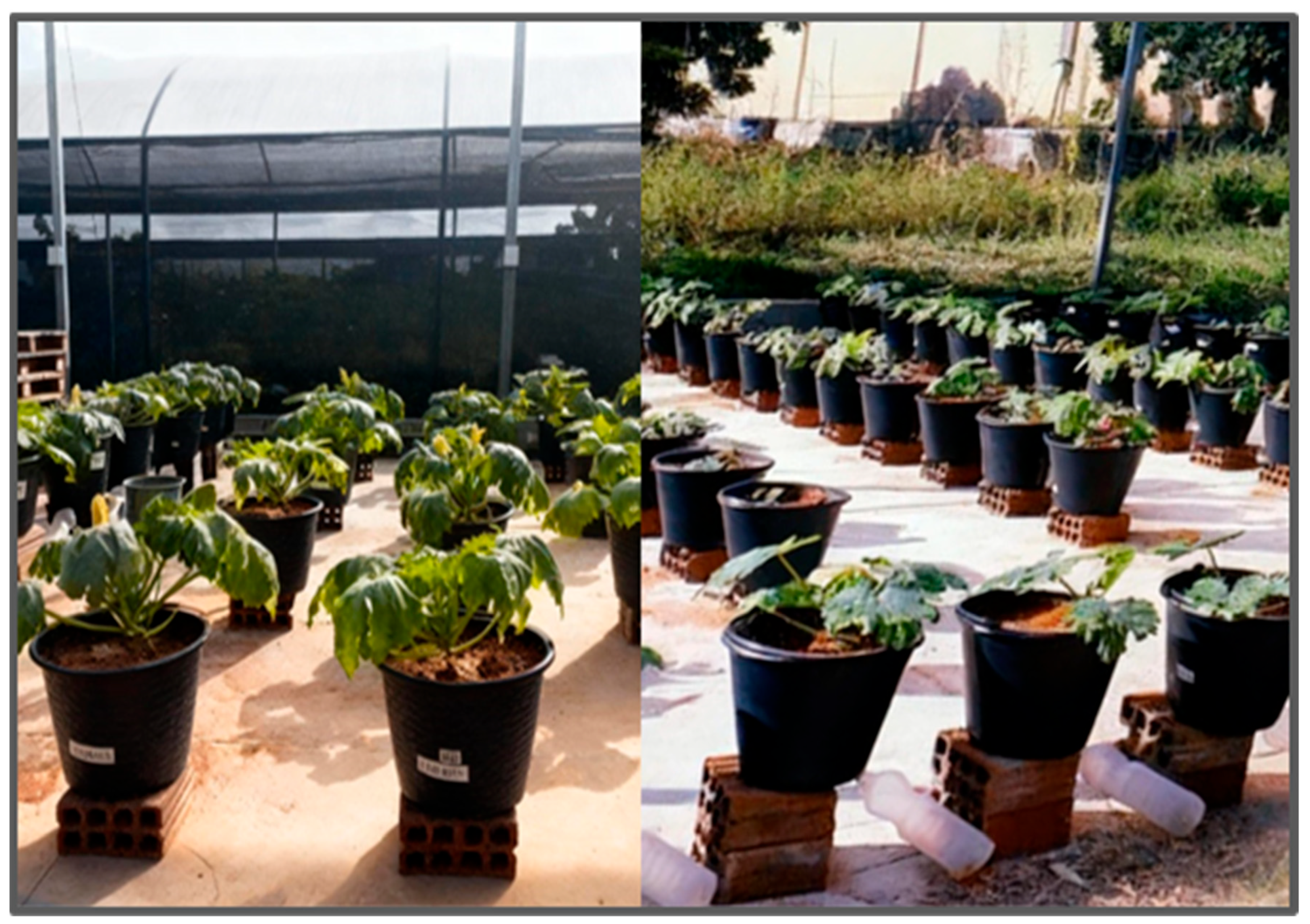
The sowing of Italian zucchini cv. Caserta was carried out in 12-dm3 plastic pots filled with soil (Figure 1). At the bottom of the pots, a 0.02 m layer of gravel and a piece of geotextile fabric were added to prevent soil loss. Initially, the soil was irrigated with water according to the treatments, bringing it close to its maximum water-holding capacity. Subsequently, four seeds were sown per pot at a depth of 0.03 m. Approximately 15 days after sowing, when the seedlings had developed two true leaves, thinning was performed, leaving one plant per pot. Each experimental unit consisted of two pots, each containing one plant, totaling two plants per replication and 48 plants in the entire experiment (Figure 1).
The soil used was an Oxisol (Latossolo), collected from the 0.00–0.30 m layer at the Rafael Fernandes Experimental Farm of UFERSA, located in the Alagoinha district, Mossoró, Brazil. Soil samples were collected, crumbled, sieved (2 mm), and characterized for physical and chemical attributes related to fertility, following the methodology of EMBRAPA [20], as shown in Table 1.
After the physical and chemical characterization, soil acidity was corrected using calcium hydroxide (Ca(OH)2), containing 54% calcium, to raise the base saturation (V%) to 90%. Fertilization was performed by applying 300 mg of phosphorus pentoxide (P2O5), 150 mg of potassium oxide (K2O), and 100 mg of nitrogen (N) per dm3 of soil [21] divided into six applications throughout the cycle. The phosphorus dose was applied at planting in the form of monosodium phosphate (NaH2PO4). Nitrogen (N) and potassium (K) were applied via fertigation in six fractionated doses: three during the vegetative phase and three during the reproductive phase, which began with the appearance of the first flower buds, at 30 DAS (days after sowing). Applications were carried out at 10, 17, and 24 DAS (vegetative applications) and 31, 38, and 45 DAS (reproductive applications) (Table 2).

2.3. Fertilization and Irrigation Management

Urea was used as the ammoniacal N source for nitrogen fertilization, whereas calcium nitrate (14% N and 16% Ca) and potassium nitrate (13% N and 44% K2O) were used as nitrate N sources. Potassium nitrate and potassium chloride (60% K2O) served as potassium sources. Calcium chloride dihydrate was used to equalize the calcium dose applied via calcium nitrate. In treatment T6, a nitrification inhibitor (Dicyandiamide—DCD) at 10% of the ammoniacal N dose was added to the solution to prevent the nitrification of NH4+. Micronutrient fertilization was carried out via foliar application with the fertilizer Liqui-Plex Fruit® (5% N, 1% Ca, 5.3% S, 1% B, 0.05% Cu, 5% Mn, 0.1% Mo, and 5% Zn). This fertilizer was applied once during the vegetative phase and once during the reproductive phase in all treatments, at a rate of 3 mL per liter of solution, following the manufacturer’s recommendations.
The plants were irrigated with low-salinity water (electrical conductivity—ECw = 0.50 dS m−1) from the local water supply and moderately saline water (ECw = 4.5 dS m−1) obtained by mixing saline reject and local supply water, to prepare 100 L of solution at 4.5 dS m−1, we used 44.7 L of saline reject water + 54.3 L of local water supply. The saline reject (ECw = 9.50 dS m−1) was collected from a desalination system treating artesian well water at the Jurema settlement, located in the rural area of Mossoró, Brazil (Table 3).
Irrigation was carried out starting from sowing, twice a day—early in the morning and late in the afternoon. The amount of water applied during each irrigation session was calculated as the difference between the volume applied during the day and the amount leached (lysimetry) in a pot designated for this purpose in each treatment (Figure 1). A drip irrigation system was used, equipped with self-compensating drippers with a flow rate of 1.4 L h−1. The irrigation volume was applied according to the treatment throughout the entire crop cycle and is detailed in Table 4.

2.4. Parameters Evaluated

2.4.1. Leaf Gas Exchange, Chlorophyll Fluorescence, Electrolyte Leakage, and Photosynthetic Pigments

Fifty days after sowing (DAS), the third leaf from the apex was selected for the determination of leaf gas exchange between 7:00 a.m. and 11:00 a.m. This was performed using an infrared gas analyzer (IRGA) (“LCPro+”—ADC Bio Scientific Ltd, Hertfordshire, UK.), operating with a temperature set to 25 °C, an irradiation of 1200 μmol photons m−2 s−1, and an airflow rate of 200 mL min−1 under atmospheric CO2 levels. The following variables were measured: CO2 assimilation rate (AN), leaf transpiration rate (E), stomatal conductance (gs), internal CO2 concentration (Ci), and leaf temperature (Tl).
Subsequently, chlorophyll a fluorescence was assessed in the same leaves used for gas exchange measurements. The plants were evaluated using a pulse-modulated fluorometer (model OS5p, Opti Science) under the Fv/Fm protocol for dark-adapted conditions. Under these conditions, the following variables were determined: initial fluorescence (Fo), maximum fluorescence (Fm), variable fluorescence (Fv = Fm − Fo), and maximum quantum efficiency of PSII (Fv/Fm). The protocol was conducted after dark-adapting the leaves for 30 min, with readings taken between 7:00 a.m. and 11:00 a.m. using the device’s clip to ensure all acceptors were oxidized, allowing the reaction centers to remain open.
Evaluations under light conditions were also conducted using the Yield protocol. An actinic light source with a multi-flash saturating pulse, coupled to a clip for measuring photosynthetically active radiation (PAR-Clip), was used to determine the following variables: initial fluorescence before the saturation pulse (F’), maximum fluorescence after light adaptation (Fm’), electron transport rate (ETR), and quantum efficiency of photosystem II (Y (II)). Additional calculations included minimal fluorescence in illuminated tissues (Fo’) [22], photochemical quenching coefficient using the lake model (qL), quantum yield of regulated photochemical quenching (Y (NPQ)), and quantum yield of non-regulated photochemical quenching (Y (NO)) [23].
During the same period, membrane integrity was determined by measuring electrolyte leakage (EE), expressed as a percentage (%). This analysis was performed on selected leaf samples following the methodology described by Singh et al. [24]. From these same leaves, 0.625 cm diameter leaf disks were extracted to determine chloroplastic pigments, measured in µm cm−2: chlorophyll a (Chl a), chlorophyll b (Chl b), and carotenoids (Carot). Pigment extraction was performed using a dimethyl sulfoxide solution saturated with CaCO3, as described by Wellburn [25].

2.4.2. Growth and Production

At 50 DAS, during the reproductive phase, plant growth parameters were evaluated by measuring plant height (PH), stem diameter (SD), and the number of leaves (NL). Plant height, in cm, was measured from the base to the apical bud using a measuring tape. The stem diameter, in mm, was measured with a digital caliper 2 cm above the base. The number of leaves was counted, considering fully expanded leaves with a minimum length of 5 cm.
At 50 DAS, the leaf area (LA) was also determined. To estimate the leaf area, the width of all leaves with a minimum width of 5 cm was measured. The individual leaf area was calculated using Equation (1) suggested by Fialho et al. [26], and these values were summed to determine the total leaf area.
A F = 47.3647 + 0.6211 L 2
where
AF—leaf area, cm2.
L—leaf width, cm.
The shoot dry mass (SDM) was measured at 75 days after sowing (DAS). Plants were placed in labeled paper bags and dried in a forced-air circulation oven at 65 °C for 72 h until a constant mass was reached. Afterward, the samples were weighed on a semi-analytical digital scale (precision < 0.001 g).
Crop production was evaluated from 50 to 75 DAS, as the growth cycle of the Italian zucchini typically spans this period. Production was assessed by determining the number of fruits per plant (NFP), obtained by counting the total fruits produced by each plant. The average fruit mass (AFM) was measured using a semi-analytical balance, with values expressed in grams. The longitudinal (LD) and transversal (TD) fruit diameters were measured with a measuring tape, with results expressed in centimeters. The transversal diameter was determined as the average of three measurements per fruit: the base, the middle, and the top. Production per plant (PP) was calculated as the multiplication of the number of fruits per plant by the average fruit mass per plant, with results expressed in grams.

2.5. Statistical Analysis

Significant differences between treatments were determined using analysis of variance (ANOVA) with the F-test at 5% and 1% significance levels. When a significant treatment effect was detected (p ≤ 0.05), means were compared using Tukey’s test at the 5% significance level. All analyses were conducted using SISVAR statistical software, version 5.6 [27].

3. Results

3.1. Leaf Gas Exchange, Electrolyte Leakage, Photosynthetic Pigments, and Chlorophyll Fluorescence

A significant treatment effect was observed for the CO2 assimilation rate (p ≤ 0.05) and stomatal conductance (p ≤ 0.05). However, no significant effects (p > 0.05) were found for internal CO2 concentration, transpiration, leaf temperature, or the maximum quantum efficiency of photosystem II due to saline irrigation and nitrogen fertilization at different phenological stages of the Italian zucchini cultivar ‘Caserta’ (Table 5).
Irrigation with water at 0.5 dS m−1 and 100% nitrogen in nitrate form (T1) resulted in the highest CO2 assimilation rate, with an average value of 17.43 µmol CO2 m−2 s−1. However, this did not differ statistically from treatments T3 (12.47 µmol CO2 m−2 s−1) and T5 (13.31 µmol CO2 m−2 s−1). The lowest assimilation rate (AN) was observed in treatment T6 (irrigation with water at 4.5 dS m−1 and 100% ammoniacal nitrogen), which showed a value of 10.41 µmol m−2 s−1. This represented a 40.27% reduction compared to the control (T1) and did not differ statistically from the other saline stress treatments (Table 5).
For stomatal conductance, treatment T1 showed the highest mean value (0.24 mol CO2 m−2 s−1), but it was not significantly different from T2, T3, T4, and T5 (Table 5). Conversely, treatment T6 showed the lowest mean value (0.13 mol CO2 m−2 s−1), representing a 45.83% reduction compared to the control, but it was not significantly different from T2, T3, T4, and T5 (Table 5).
A significant effect of treatments was observed on electrolyte leakage (EL) (p ≤ 0.001), as well as on chlorophyll a (p ≤ 0.01), chlorophyll b (p ≤ 0.001), and carotenoid levels (p ≤ 0.001) (Table 6).
Electrolyte leakage was highest in treatment T6 (66.72%), though this did not differ significantly from T2 (54.00%) and T5 (52.99%). The lowest EL value was observed in T1 (22.61%), indicating less cellular membrane damage in Italian zucchini plants (Table 6). Under saline stress, treatment T3 (47.65%) showed the lowest EL value, with a 28.58% reduction in membrane damage compared to T6.
The chlorophyll a (Chl a) content was highest in the control treatment (T1, 11.01 µm cm−2). The lowest value was observed in T6 (6.14 µm cm−2), which represented a 44.23% reduction compared to the control. Treatments 2, 3, 4, 5 and 6 did not show significant differences among themselves (Table 6).
The chlorophyll b (Chl b) content was also highest in T1 (2.59 µm cm−2), but it was not significantly different from T2 (1.92 µm cm−2) and T5 (1.91 µm cm−2). The lowest value was recorded in T3 (0.94 µm cm−2), although it did not differ statistically from T4 (1.66 µm cm−2) or T6 (1.17 µm cm−2). Treatment T3 resulted in a 29.52% reduction in chl b compared to T1 (Table 6).
Carotenoids were highest in T1 (3.23 µm cm−2), and the lowest value was observed in T6 (1.86 µm cm−2). However, T6 did not differ significantly from the other saline stress treatments. The reduction in carotenoid content between T1 and T6 was approximately 42.41% (Table 6).
No significant effect (p > 0.05) was observed between the treatments tested on the quantum efficiency of PSII, electron transport rate, initial fluorescence in the light phase, photochemical quenching coefficient, regulated photochemical extinction quantum yield, or non-regulated photochemical extinction quantum yield was observed for the Italian zucchini cultivar ‘Caserta’ (Table 7).

3.2. Growth and Production

The treatments had a significant effect on plant height (PH, p ≤ 0.05), stem diameter (SD, p ≤ 0.001), number of leaves (NL, p ≤ 0.05), shoot dry mass (SDM, p ≤ 0.01) and leaf area (LA, p ≤ 0.01) by F-test. However, no significant differences were observed in PH among treatments in the Tukey test (p ≤ 0.05) (Table 8).
The highest mean SD (18.08 mm) was recorded in the control treatment using water with 0.5 dS m−1 electrical conductivity and 100% nitrate-based fertilization (T1). However, this result did not differ statistically from treatments T3 and T5. The lowest stem diameter (12.90 mm) was observed in the treatment using water with 4.5 dS m−1 electrical conductivity and 100% ammonium-based fertilization (T6), representing a 28.65% reduction compared to the control, T6 showed no statistically significant difference compared to treatments T2 and T4 (Table 8).
For the NL, treatment T1 exhibited the highest mean, with approximately 21 leaves. However, this value did not differ statistically from treatments T2, T3, and T4. The NL in T1 was significantly higher than in treatments T5 and T6 (p ≤ 0.05). Percentagewise, the NL in T1 exceeded T5 and T6 by 30.23% and 25.58%, respectively (Table 8).
For shoot dry mass (SDM), the highest value was recorded in T1, with an average of 38.66 g, which did not differ statistically from treatments T2 and T3 (p ≤ 0.05). Plants in treatment T6 showed the lowest SDM values (20.05 g), reflecting a 48.14% reduction compared to the control, but without statistical differences from treatments T2, T3, T4 and T5 (p ≤ 0.05) (Table 8).
With regard to leaf area (LA), the control treatment recorded the highest value, 5783.15 cm2, higher than all other treatments. Conversely, all treatments exhibited reductions in LA compared to the control, regardless of the nitrogen fertilization strategy adopted (Table 8).
The treatments significantly affected (p ≤ 0.001) the number of fruits per plant (NFP), average fruit mass (AFM), longitudinal fruit diameter (LD), transverse fruit diameter (TD), and production per plant (PP) (Table 9).
The Italian zucchini plants (cv. Caserta) showed no fruit production in treatments T5 and T6, which involved ammonium-based fertilization. Toxicity symptoms were observed, particularly during the reproductive phase (Table 9). The highest number of fruits was recorded in treatment T1, with an average of three fruits per plant. Treatments T2, T3, and T4 produced two fruits per plant, reflecting a reduction of approximately 38.46% compared to T1.
The highest average fruit mass was observed in T1, with a value of 421.20 g. Among the treatments that produced fruits, T3 showed the lowest average fruit mass (199.28 g), which was not statistically different from T4. This represents a reduction of approximately 52.69% compared to the control (Table 9).
Salt stress reduced fruit size, as evidenced by decreases in both longitudinal and transverse fruit diameters for Italian zucchini cv. Caserta (Table 9). For longitudinal fruit diameter, T1 (control) achieved the highest value (22.00 cm), while T3 recorded the lowest (16.75 cm). However, T3 was not statistically different from treatments T2 and T4, showing a 23.86% reduction compared to T1 (Table 9). Regarding transverse fruit diameter, T1 had the highest average (5.63 cm), which was not statistically different from T2. Treatment T4 had the lowest average (4.35 cm), not differing statistically from T3. This represents a 22.73% reduction between the largest and smallest transverse fruit diameters (Table 9).
In terms of PP, treatment T1 showed the highest value, 1360.98 g (Table 9) compared to the other treatments (p ≤ 0.05). Treatments T2, T3, and T4, which were equal to each other (p ≤ 0.05), showed an average reduction of 67.50% compared to the control, while T5 and T6 showed a 100% reduction as these treatments did not reach the production target.

4. Discussion

Excess salt impairs cellular expansion in plants by reducing water absorption, adversely affecting growth, development, and crop yield [8,28]. Based on the results, nitrogen management strategies that consider the proportions of nitrate- and ammonium-based fertilizers may improve the responses of Italian zucchini (cv. Caserta) under salt stress. Ammonium-based fertilization negatively affects Italian zucchini production. However, applying this type of fertilization during specific growth stages may mitigate adverse effects. It has been observed that the application of ammonium-based nitrogen during the reproductive stage of zucchini induces flower abortion and should therefore be avoided. However, when ammonium and nitrate nitrogen are applied in a 1:1 ratio, their use is permissible throughout the crop cycle. The exclusive application of nitrate-based nitrogen poses no restrictions at any stage of crop development.
Zucchini plants in treatments T3 and T5 had photosynthetic rates similar to those in the control (Table 5). However, leaf area and yield per plant were reduced under salt stress (Table 8). These results suggest that nitrogen fertilization, despite improving photosynthesis, was insufficient to counteract the effects of salinity on growth and yield. This outcome reflects the stress conditions imposed on the plants, which likely redirected energy reserves toward acclimation, including osmotic adjustment [29].
Ionic homeostasis under salt stress involves sodium exclusion from leaves and roots, compartmentalization of sodium and chloride in vacuoles, production of compatible solutes for osmotic adjustment, and regulation of K+, Na+, Cl, and nitrogen forms (NO3 and NH4+) [28]. Energy consumption for homeostasis, though essential, reduces crop growth and productivity, especially when photosynthetic activity is suppressed by salt stress. This phenomenon has been reported for various crops, including Italian zucchini [30,31,32,33,34]
With regard to electrolyte leakage, treatment T6 exhibited the highest value at 66.72%, not differing significantly from treatments T2 and T5 (Table 6). Conversely, treatment T1 presented the lowest value at 22.61%, significantly differing from treatments T3 and T4. The percentage of cellular electrolyte leakage can serve as an indicator of cell membrane stability, and elevated levels may indicate cell death [35]. Under salt stress, treatments with exclusive use of nitrogen in the ammoniacal form caused greater damage to membrane integrity, showing no statistical difference from treatments using nitrate fertilization exclusively, corroborating Fernandes et al. [34].
Irrigation with moderately saline water (4.5 dS m−1) inhibited the photosynthetic pigments (chlorophyll and carotenoids) in zucchini squash cv. Caserta (Table 6). Over time, the excessive accumulation of salts in young leaves can adversely affect the photosynthetic process, leading to losses of vital photosynthetic pigments essential for converting light energy into chemical energy [8]. Under irrigation conditions with water at an EC of 4.5 dS m−1, despite no significant differences among nitrogen application methods, T2 (irrigation with 4.5 dS m−1 water + 100% nitrate fertilization) exhibited the highest levels of photosynthetic pigments. This benefit is attributed to the nitrate applied as Ca(NO3)2 and KNO3, which provides calcium (Ca2+) and potassium (K+) in addition to nitrogen (N), reducing sodium (Na+) absorption through competitive inhibition at the same non-selective transport sites used by calcium and potassium [36,37].
Treatment T3, on the other hand, showed the lowest value of photosynthetic pigments compared to other treatments, whereas treatments T4 and T6 did not differ significantly (Table 6). These results indicate higher concentrations of chlorophyll b, even under saline water conditions, when nitrate-based fertilization was exclusively used, differing from the results of Fernandes et al. [34], who evaluated nitrate and ammonium fertilization in zucchini squash cv. Caserta grown hydroponically under salt stress. They observed increased foliar chlorophyll b levels when ammonium nitrogen was used as the nitrogen source. Regarding foliar carotenoid levels, the control treatment (T1) had the highest result, while treatment T6 recorded the lowest, though it did not differ from treatments T2, T3, T4, and T5 (Table 8).
The reduction in foliar carotenoid content in zucchini squash cv. Caserta is associated with salt stress caused by irrigation with 4.5 dS m−1 water, which affects carotenoid synthesis and, consequently, modulates plant growth under such conditions. Under stress, carotenoids act as structural pigments of the antenna complex, serving as photoprotectors of the photosynthetic apparatus against excessive light [38]. They dissipate energy in a way that neutralizes reactive oxygen species to maintain the stability of cellular structures [39]. These findings differ from those reported by Fernandes et al. [34], who found no significant effects of ECw on chlorophyll a and carotenoid levels.
Although no significant effects were observed on Fv/Fm, Y, ETR, Fo’, qL, YNPQ, and YNO in zucchini squash under salt stress, reductions in CO2 assimilation rates were noted. These results suggest that the decrease in zucchini photosynthesis under salt stress was not solely due to stomatal effects, as only treatment T6 exhibited gs values lower than those of the control treatment. Therefore, the reduction in CO2 assimilation rates observed in this study corroborates the observed decreases in chlorophyll a and carotenoid levels, along with increased damage to plasma membranes. Oxidative stress reduced the amount of photosynthetic pigments in light-harvesting systems, such as photosystem II (P680) and photosystem I (P700), thereby lowering the CO2 assimilation rate in zucchini squash cv. Caserta under salt stress. The lack of differences in Fv/Fm and ETR indicates that the PSII photochemical apparatus was functioning normally. However, the decline in CO2 assimilation suggests limitations in the later stages of photosynthesis, such as CO2 diffusion or biochemical processes like Rubisco activity and RuBP regeneration. Thus, despite preserved electron flow and no photoinhibition, the plant could not convert energy into carbon fixation, leading to a disconnect between photochemical variables and CO2 assimilation.
Fertilization exclusively with the ammoniacal source under irrigation conditions with moderately saline water (4.5 dS m−1) negatively affected the growth of Italian zucchini, leading to reductions in stem diameter, number of leaves, and shoot dry mass. These reductions were particularly significant in treatments where ammonium was applied alongside irrigation with 4.5 dS m−1 water during the reproductive phase and throughout the crop cycle (Table 8). Urea in the soil can undergo hydrolysis, releasing ammonium ions (NH4+), which may compete with other essential cations, such as calcium, magnesium, and sulfur, causing nutrient imbalances and exacerbating the deleterious effects of toxic salts on plants [40]. Moreover, excessive urea application can contribute to soil acidification, and when converted to ammonia (NH3+), it may become toxic to plants, damaging the root system and interfering with nutrient uptake [40].
The low leaf area of zucchini under salt stress (Table 8) reflected its reduced capacity for synthesizing photoassimilates due to decreased photosynthetic rates (Table 5), which negatively impacted fruit production per plant (Table 9). This pattern of reduced growth, photosynthesis, and production of Italian zucchini under saline conditions has been reported by Souza et al. [41], Fernandes et al. [34,42], and Sousa et al. [10].
The literature demonstrates that ionic and biochemical homeostasis and the production of zucchini fertilized with nitrate surpass those fertilized with ammoniacal sources when irrigated with water at 6.5 dS m−1 [34,43,44,45]. These studies identified flower abortion, which prevented fruit formation in plants fertilized with NH4+. According to Fernandes et al. [42], the excessive use of NH4+ can cause toxicity in Italian zucchini plants. This toxicity can manifest in various symptoms, including reduced growth, leaf chlorosis, and marginal leaf burn. The underlying reason for these symptoms is an alteration in the plant’s ionic balance, as excessive NH4+ inhibits the absorption of other cations such as K+, Mg2+, and Ca2+. The study also found that using NH4+ as the sole fertilizer is toxic to zucchini plants, particularly during the flowering stage. Consequently, only plants fertilized with NO3 were able to reach the fruiting stage.
When salt concentrations exceed the tolerance threshold, salinity becomes detrimental to agricultural crops, resulting in inhibited growth, as observed in Italian zucchini, and leading to yield losses [46]. The deleterious effect of saline/water stress on the growth of zucchini, cultivar Caserta, has been reported by Sousa et al. [10], showing reductions in height, leaf area, number of leaves, and stem diameter when irrigated with water at 2.5 dS m−1. Souza et al. [41] observed that the use of saline water resulted in reduced zucchini productivity at levels starting from 5.0 dS m−1. Biomass accumulation in zucchini is negatively affected under saline stress starting at an ECw of 2.5 dS m−1 [47].
Treatments with salt stress and ammoniacal fertilization during the reproductive phase, as well as salt stress and 100% ammoniacal fertilization throughout the entire cycle, did not result in fruit production due to ammonium toxicity during the reproductive phase of zucchini (Table 6). Fernandes et al. [34] reported flower abortion and the absence of fruit formation in Italian zucchini plants fertilized exclusively with an NH4+ source. Similarly, this study found that the exclusive use of ammoniacal fertilization during the reproductive phase of zucchini causes flower abortion and prevents fruit formation. However, the application of ammoniacal nitrogen only during the vegetative phase or in combination with nitrate sources did not result in plant toxicity.
When evaluating the use of biostimulants to improve the productivity and quality of zucchini fruits under salt stress, Souza et al. [41] observed no significant difference in the number of fruits per plant (NFP) between irrigation water salinities of 0.5 and 5.0 dS m−1. However, they reported significant differences in the average fruit mass and the transverse diameter of the fruits. Fernandes et al. [42] found that increasing ECw from 0.5 to 6.5 dS m−1 reduced the number of fruits per plant by 71.5%, even in treatments fertilized with both nitrate and ammonium.
The highest average fruit mass (AFM) was observed in the control treatment. Among the treatments producing fruits under salt stress, treatment T2 had the highest AFM (Table 6). Under salt stress conditions, a reduction in average fruit mass is commonly observed, as Souza et al. [41] noted in Italian zucchini, reporting a 25.15% decrease in AFM in the treatment subjected to salt stress (EC = 5.0 dS m−1). Similarly, Fernandes et al. [34] reported a 57.60% reduction in AFM in Italian zucchini under salt stress compared to the control.
A reduction in the longitudinal diameter of the fruits was observed by Fernandes et al. [42] in Italian zucchini under salt stress, with average losses of 43.70% compared to the control treatment. The transverse diameter of zucchini fruits was also affected by nitrogen fertilization under saline water stress, showing the lowest values. However, in the treatment with exclusive nitrate fertilization (T2), this reduction did not differ statistically from the control. Comparing treatments with moderately saline water (EC = 5.0 dS m−1) to those with low salinity water (EC = 0.5 dS m−1) in Italian zucchini production, Souza et al. [41] reported an 8.93% decrease in fruit transverse diameter. Similarly, Fernandes et al. [42] observed a 38.20% reduction in transverse diameter in treatments with saline water.
Exclusive nitrate fertilization in Italian zucchini cv. Caserta, when irrigated with moderately saline water (T2), resulted in higher yields compared to ammoniacal fertilization (Table 6). However, the findings of the present study reveal that under saline conditions, it is feasible to use 50% nitrogen fertilization in the ammoniacal form and 50% in the nitrate form, or 100% ammoniacal nitrogen during the vegetative phase, without causing toxicity issues. This strategy allowed the plants to complete their growth cycle and produce yields similar to those fertilized exclusively with nitrate nitrogen.
Although the present study did not evaluate enzyme activity and oxidative stress, studies evaluating these processes have demonstrated that high NH4+ supply saturates the activity of glutamine synthetase, the enzyme responsible for incorporating NH4+ into glutamate for amino acid and protein synthesis [48], in addition to increasing cytoplasmic pH through the overproduction of OH ions [49]. The reproductive phase requires substantial energy for bud differentiation and flower formation, which may limit the metabolic capacity necessary for NH4+ assimilation by enzymes such as glutamine synthetase, glutamate synthase, and glutamate dehydrogenase [49].
Despite fertilization, zucchini exhibited a less effective physiological response under saline conditions compared with the control treatment [50,51,52]. This reduced performance can be explained by the osmotic and ionic constraints imposed by salinity. High salt concentrations decrease the soil osmotic potential, limiting water uptake by the roots and inducing plant water stress. As a consequence, stomatal closure occurs, restricting gas exchange processes and reducing photosynthetic efficiency [8]. In parallel, plants subjected to salinity accumulate potentially toxic ions such as Na+ and Cl, which impair membrane integrity and disrupt nutrient uptake pathways in the roots. Together, these osmotic and ionic effects compromise plant metabolism and help explain the lower effectiveness of zucchini fertilization under saline stress.

5. Conclusions

The findings of this study indicate that under salt stress conditions (ECw 4.5 dS m−1), the CO2 assimilation, growth, and yield of Italian zucchini cv. Caserta were adversely affected, regardless of the nitrogen source used. Under salt stress, cv. Caserta showed an average decrease in leaf area (5783 to 4521 cm2) and production per plant (1361 to 442 g). Nitrate fertilization resulted in higher yields compared to ammonium. The continuous application of ammonium nitrogen, or its use during the reproductive phase, led to flower abortion. However, under salinity, supplying ammonium only during the vegetative stage (T4) or using a 1:1 ammonium-to-nitrate ratio throughout the growth cycle (T3) produced yields that were similar to those achieved with nitrate-only fertilization (T2). While salt stress did not affect photochemical efficiency, it significantly reduced the levels of photosynthetic pigments. These findings are specific to the salinity conditions studied, and future research should explore how various nitrogen sources, ratios, salinity levels, and growth stages influence the performance of Italian zucchini cv. Caserta.

Author Contributions

Conceptualization, methodology, investigation, data curation, writing—original draft preparation, G.d.F.S., M.F.N., A.G.d.L.S., T.D.C.P. and F.V.d.S.S.; writing—review and editing, formal analysis, visualization, methodology, investigation, R.A.R.F., K.F.d.P.A., J.S.J.C., K.T.O.P., R.C.L.M., N.d.S.D., P.D.F., J.L.A.R., A.S.d.M. and A.Á.d.S. Supervision, project administration, funding acquisition, M.F.N., N.d.S.D. and F.V.d.S.S. All authors have read and agreed to the published version of the manuscript.

Funding

This study was financed in part by the Coordenação de Aperfeiçoamento de Pessoal de Nível Superior—Brasil (CAPES), Finance Code 001.

Data Availability Statement

All data are presented in the paper.

Conflicts of Interest

The authors declare no conflicts of interest.

References

  1. Costa, I.B.C.; Bonfim, F.P.G.; Pasa, M.C. Agricultura familiar: Estudo de caso do sistema produtivo em comunidade rural do estado do mato grosso, brasil. Braz. J. Dev. 2023, 9, 26754–26765. [Google Scholar] [CrossRef]
  2. Dantas, M.V.; Lima, G.S.; Gheyi, H.R.; Pinheiro, F.W.A.; Silva, P.C.C.; Soares, L.A.A. Gas exchange and hydroponic production of zucchini under salt stress and H2O2 application. Rev. Caatinga 2022, 35, 436–449. [Google Scholar] [CrossRef]
  3. Guerra, A.M.N.M.; Silva, M.G.M.; Evangelista, R.S.; Santos, E.B.; Nogueira, W.P. Produção de cultivares de abobrinha italiana a pleno sol e sombreada no nordeste brasileiro. Agropecuária Técnica 2020, 41, 1–7. [Google Scholar] [CrossRef]
  4. IBGE—Instituto Brasileiro de Geografia e Estatística. Número de Estabelecimentos Agropecuários e Quantidade Produzida por Produtos da Horticultura—Resultados Preliminares 2018; IBGE: Rio de Janeiro, Brazil, 2019. [Google Scholar]
  5. Fadl, M.E.; Jalhoum, M.E.M.; Abdelrahman, M.A.E.; Ali, E.A.; Zahra, W.R.; Abuzaid, A.S.; Fiorentino, C.; D’antonio, P.; Belal, A.A.; Scopa, A. Soil salinity assessing and mapping using several statistical and distribution techniques in arid and semi-arid ecosystems, Egypt. Agronomy 2023, 13, 583. [Google Scholar] [CrossRef]
  6. Wang, N.; Chen, S.; Huang, J.; Frappart, F.; Taghizadeh, R.; Zhang, X.; Wigneron, J.; Xue, J.; Xiao, Y.; Peng, J.; et al. Global soil salinity estimation at 10 m using multi-source remote sensing. J Remote Sens. 2024, 4, 0130. [Google Scholar] [CrossRef]
  7. Cirillo, C.; Rouphael, Y.; Caputo, R.; Raimondi, G.; Sifola, M.I.; de Pascale, S. Effects of high salinity and the exogenous of an osmolyte on growth, photosynthesis and mineral composition in two ornamental shrubs. J. Hortic. Sci. Biotechnol. 2016, 91, 14–22. [Google Scholar] [CrossRef]
  8. Acosta-Motos, J.R.; Ortuño, M.F.; Vicente, A.B.; Vivancos, P.D.; Blanco, M.J.S.; Hernandez, J.A. Plant responses to salt stress: Adaptive mechanisms. Agronomy 2017, 7, 18. [Google Scholar] [CrossRef]
  9. Medeiros, J.F.; Terceiro Neto, C.P.C.; Dias, N.S.; Gheyi, H.R.; Silva, M.V.T.; Loiola, A.T. Salinidade e ph de um argissolo irrigado com água salina sob estratégias de manejo. Rev. Bras. Agric. Irrig. 2017, 11, 1407–1419. [Google Scholar] [CrossRef]
  10. Sousa, H.C.; Sousa, G.G.; Cambissa, P.B.C.; Lessa, C.I.N.; Goes, G.F.; Silva, F.D.B.; Abreu, F.S.; Viana, T.V.A. Gas exchange and growth of zucchini crop subjected to salt and water stress. Rev. Bras. Eng. Agrícola Ambient. 2022, 26, 815–822. [Google Scholar] [CrossRef]
  11. Munns, R.; Tester, M. Mechanism of salinity tolerance. Annu. Rev. Plant Biol. 2008, 59, 651–681. [Google Scholar] [CrossRef]
  12. Syvertsen, J.P.; Garcia-Sanchez, F. Multiple abiotic stresses occurring with salinity stress in citrus. Environ. Exp. Bot. 2014, 103, 128–137. [Google Scholar] [CrossRef]
  13. Sá, F.V.S.; Brito, M.E.B.; Silva, L.A.; Moreira, R.C.L.; Fernandes, P.D.; Figueiredo, L.C. Fisiologia da percepção do estresse salino em híbridos de tangerineira—Sunki comum sob solução hidropônica salinizada. Comun. Sci. 2015, 6, 463–470. [Google Scholar] [CrossRef]
  14. Sá, F.V.S.; Gheyi, H.R.; Lima, G.S.; Paiva, E.P.; Lacerda, C.F.; Fernandes, P.D. Saline water, nitrogen and phosphorus on water relations and physiological aspects of west indian cherry. Comun. Sci. 2018, 9, 430–437. [Google Scholar] [CrossRef]
  15. Santos, J.B.; Gheyi, H.R.; Lima, G.S.; Xavier, D.A.; Cavalcante, L.F.; Centeno, C.R.M. Morfofisiologia e produção do algodoeiro herbáceo irrigado com águas salinas e adubado com nitrogênio. Comun. Sci. 2016, 7, 86–96. [Google Scholar] [CrossRef]
  16. Bazzo, J.H.B.; Riede, C.R.; Arruda, K.M.A.; Cardoso, C.P.; Franzoni, I.; Fonseca, I.C.B.; Zucareli, C. Performance of white oat cultivars in response to nitrogen fertilization and trinexapac-ethyl. Semin. Ciências Agrárias 2019, 40, 2121–2135. [Google Scholar] [CrossRef]
  17. Blanger, B.R.; Lobo, F.A.; Genuncio, G.C.; Possamai, A.C.S. Avaliação de um método para estimar a absorção radicular do nitrato em arroz. Rev. Ibero Am. Ciências Ambient. 2021, 12, 1–19. [Google Scholar] [CrossRef]
  18. Cordeiro, C.F.S.; Rodrigues, D.R.; Echer, F.R. Cover crops and controlled-release urea decrease need for mineral nitrogen fertilizer for cotton in sandy soil. Field Crop. Res. 2022, 276, 108387. [Google Scholar] [CrossRef]
  19. Alvares, C.A.; Stape, J.L.; Sentelhas, P.C.; de Moraes Gonçalves, J.L.; Sparovek, G. Köppen’s climate classification map for Brazil. Meteorol. Z. 2013, 22, 711–728. [Google Scholar] [CrossRef]
  20. Embrapa—Empresa Brasileira de Pesquisa Agropecuária. Manual de Análises Químicas de Solos, Plantas e Fertilizantes, 2nd ed.; Embrapa Informação Tecnológica: Brasília, Brazil, 2009. [Google Scholar]
  21. Novais, R.F.; Neves, J.C.L.; Barros, N.F. Ensaio em ambiente controlado. In Métodos de Pesquisa em Fertilidade do Solo; Oliveira, A.J., Garrido, W.E., Araújo, J.D., Lourenço, S.; Orgs.Embrapa-Sea: Brasília, Brazil, 1991; pp. 189–254. [Google Scholar]
  22. Oxborough, K.; Baker, N.R. An instrument capable of imaging chlorophyll a fluorescence from leaves at very low irradiance and at cellular and subcellular levels of organization. Plant Cell Environ. 1997, 20, 1473–1483. [Google Scholar] [CrossRef]
  23. Kramer, D.M.; Johnson, G.; Kiirats, O.; Edwads, G.E. New fluorescence parameters for the determination of qa redox state and excitation energy fluxes. Photosynth. Res. 2004, 79, 209–218. [Google Scholar] [CrossRef]
  24. Singh, H.P.; Batish, D.R.; Kohli, R.K.; Arora, K. Arsenic-induced root growth inhibition in mung bean (phaseolus aureus roxb.) is due to oxidative stress resulting from enhanced lipid peroxidation. Plant Growth Regul. 2007, 53, 65–73. [Google Scholar] [CrossRef]
  25. Wellburn, A.R. The spectral determination of chlorophyll a and b, as well as total carotenoids, using various solvents with spectrophotometers of different resolution. J. Plant Physiol. 1994, 144, 307–313. [Google Scholar] [CrossRef]
  26. Fialho, G.S.; Dalvi, L.P.; Dalvi, N.B.C.; Kuhlcamp, K.T.; Effgen, E.M. Prediction of the leaf area in zucchini fruit: A nondestructive, exact, simple, fast and practical method. Rev. Bras. Agropecuária Sustentável 2011, 1, 59–63. [Google Scholar]
  27. Ferreira, D.F. Sisvar: A computer analysis system to fixed effects split plot type designs. Rev. Bras. Biom. 2019, 37, 529–535. [Google Scholar] [CrossRef]
  28. Munns, R.; Day, D.A.; Fricke, W.; Watt, M.; Arsova, B.; Barkla, B.J.; Bose, J.; Byrt, C.S.; Chen, Z.; Foster, K.J.; et al. Energy costs of salt tolerance in crop plants. New Phytol. 2020, 225, 1072–1090. [Google Scholar] [CrossRef]
  29. Lira, E.; Souza, J.; Galdino, L.; Macêdo, C.; Silva, A.; Melo, Y.; Santos, I.; Arriel, M.; Meneses, C.; Maia, J. Changes in reserve mobilization caused by salinity could interfere in the initial growth of Jatropha curcas. Sustainability 2021, 13, 7446. [Google Scholar] [CrossRef]
  30. Sá, F.V.S.; Gueyi, H.R.; Lima, G.S.; Paiva, E.P.; Silva, L.A.; Moreira, R.C.L.; Fernandes, P.D.; Dias, A.S. Ecophysiology of west indian cherry irrigated with saline water under phosphorus and nitrogen doses. Biosci. J. 2019, 35, 211–221. [Google Scholar] [CrossRef]
  31. Sá, F.V.S.; Gheyi, H.R.; Lima, G.S.; Pinheiro, F.W.A.; Paiva, E.P.; Moreira, R.C.L.; Silva, L.A.; Fernandes, P.D. The right combination of n-p-k fertilization may mitigate salt stress in custard apple (annona squamosa L.). Acta Physiologiae Plantarum 2021, 43, 59. [Google Scholar] [CrossRef]
  32. Silva, F.H.; Morais, P.L.D.; Albuquerque, C.C.; Albuquerque, M.T.; Dias, N.S. Physiological aspects of melon (cucumis melo l.) as a function of salinity. J. Plant Growth Regul. 2021, 40, 1298–1314. [Google Scholar] [CrossRef]
  33. Praxedes, S.S.C.; Ferreira Neto, M.; Loiola, A.T.; Santos, F.J.Q.; Umbelino, B.F.; Silva, L.A.; Moreira, R.C.L.; Melo, A.S.; Lacerda, C.F.; Fernandes, P.D.; et al. Photosynthetic responses, growth, production, and tolerance of traditional varieties of cowpea under salt stress. Plants 2022, 11, 1863. [Google Scholar] [CrossRef]
  34. Fernandes, C.S.; Sá, F.V.S.; Ferreira Neto, M.; Dias, N.S.; Reges, L.B.L.; Gheyi, H.R.; Paiva, E.P.; Silva, A.A.; Melo, A.S. Ionic homeostasis, biochemical components and yield of Italian zucchini under nitrogen forms and salt stress. Braz. J. Biol. 2022, 82, e233567. [Google Scholar] [CrossRef] [PubMed]
  35. Hatsugai, N.; Katagiri, F. Quantification of plant cell death by electrolyte leakage assay. Bio-Protocol 2018, 5, e2758. [Google Scholar] [CrossRef] [PubMed]
  36. Raddatz, N.; Morales de Los Ríos, L.; Lindahl, M.; Quintero, F.J.; Pardo, J.M. Coordinated transport of nitrate, potassium, and sodium. Front. Plant Sci. 2020, 11, 247. [Google Scholar] [CrossRef]
  37. Pathak, J.; Ahmed, H.; Kumari, N.; Pandey, A.; Rajneesh, R.P. Role of calcium and potassium in amelioration of environmental stress in plant. In Protective Chemical Agents in the Amelioration of Plant Abiotic Stress; John Wiley & Sons, Ltd.: Chichester, UK, 2020; pp. 535–562. [Google Scholar] [CrossRef]
  38. Leiva-Ampuero, A.; Agurto, M.; Matus, J.T.; Hoppe, G.; Huidobro, C.; Inostroza-Blancheteau, C.; Reyes-Díaz, M.; Stange, C.; Canessa, P.; Vega, A. Salinity impairs photosynthetic capacity and enhances carotenoid-related gene expression and biosynthesis in tomato (Solanum lycopersicum L. cv. micro-tom). PeerJ 2020, 8, e9742. [Google Scholar] [CrossRef]
  39. Kopsell, D.A.; Kopsell, D.E.; Curran-Celentano, J. Carotenoid pigments in kale are influenced by nitrogen concentration and form. J. Sci. Food Agric. 2007, 87, 900–907. [Google Scholar] [CrossRef]
  40. Han, J.; Shi, J.; Zeng, L.; Xu, J.; Wu, L. Effects of nitrogen fertilization on the acidity and salinity of greenhouse soils. Environ. Sci. Pollut. Res. Int. 2015, 22, 2976–2986. [Google Scholar] [CrossRef]
  41. Souza, M.W.L.; Torres, S.B.; Oliveira, F.A.; Marques, I.C.S.; Pereira, K.T.O.; Guimarães, T.T. Saline-water irrigation and plant growth regulator application on zucchini fruit yield and quality. Rev. Bras. Eng. Agrícola Ambient. 2020, 24, 679–684. [Google Scholar] [CrossRef]
  42. Fernandes, C.S.; Ferreira Neto, M.; Dias, N.S.; Reges, L.B.L.; Silva, L.A.; Moreira, R.C.L.; Silva, A.Á.; Paiva, E.P.; Fernandes, P.D.; Sá, F.V.S. The appropriate source of nitrogen for italian zucchini under salt stress conditions. J. Soil Sci. Plant Nutr. 2022, 22, 560–570. [Google Scholar] [CrossRef]
  43. Nobre, R.G.; Gheyi, H.R.; Soares, F.A.L.; Cardoso, J.A.F. Produção de girassol sob estresse salino e adubação nitrogenada. Rev. Bras. Ciência Solo 2011, 35, 929–937. [Google Scholar] [CrossRef]
  44. Lima, G.S.; Nobre, R.G.; Gheyi, H.R.; Soares, L.A.A.; Silva, A.O. Crescimento e componentes de produção da mamoneira sob estresse salino e adubação nitrogenada. Engenharia Agrícola 2014, 34, 854–866. [Google Scholar] [CrossRef]
  45. Ribeiro, P.H.P.; Silva, S.; Dantas Neto, J.; Oliveira, C.S.; Chaves, L.H.G. Crescimento e componentes de produção do girassol em função da irrigação com água salina e adubação nitrogenada. Rev. Eng. Agric. 2015, 23, 48–56. [Google Scholar] [CrossRef]
  46. Dantas, M.V.; Lima, G.S.; Greyi, H.R.; Pinheiro, F.W.A.; Silva, L.A.; Fernandes, P.D. Summer squash morphophysiology under salt stress and exogenous application of h2o2 in hydroponic cultivation. Comun. Sci. 2021, 12, e3464. [Google Scholar]
  47. Canjá, J.F.; Azevedo, J.; Sousa, G.G.; Magalhaes, C.L.; Viana, T.V.A. Initial growth of zucchini irrigated with saline water in soil with biofertilizers. Agro@mbiente On-Line 2021, 15, 1–15. [Google Scholar] [CrossRef]
  48. Roosta, H.R.; Schjoerring, J.K. Effects of ammonium toxicity on nitrogen metabolism and elemental profile of cucumber plants. J. Plant Nutr. 2007, 30, 1933–1951. [Google Scholar] [CrossRef]
  49. Taiz, L.; Zeiger, E.; Møller, I.M.; Murphy, A. Plant Physiology and Development, 6th ed.; Sinauer Associates: New York, NY, USA, 2015. [Google Scholar]
  50. Volkov, V.; Beilby, M.J. Salinity tolerance in plants: Mechanisms and regulation of ion transport. Front. Plant Sci. 2017, 8, 1795. [Google Scholar] [CrossRef] [PubMed]
  51. Wan, Q.; Hongbo, S.; Zhaolong, X.; Jia, L.; Dayong, Z.; Yihong, H. Salinity tolerance mechanism of osmotin and osmotin-like proteins: A promising candidate for enhancing plant salt tolerance. Curr. Genom. 2017, 18, 553–556. [Google Scholar] [CrossRef]
  52. Liang, W.; Ma, X.; Wan, P.; Liu, L. Plant salt-tolerance mechanism: A review. Biochem. Biophys. Res. Commun. 2018, 495, 286–291. [Google Scholar] [CrossRef]
Figure 1. Italian zucchini cv. Caserta conducted in a plant nursery.
Agriculture 16 00062 g001
Table 1. Chemical and physical analysis of the soil used in the experiment.
pHOM
(%)
PK+Na+Ca2+Mg2+Al3+H + AlSBCECVESP
---------------------- (cmolc dm−3) ------------------------ % ---
5.31.72.10.130.052.70.90.01.83.785.58682.0
ECse
dS m−1
ds
kg dm−3
SandSiltClay
-------------------------------------- (g kg−1) --------------------------------------
0.11.682030150
OM—organic matter; SB—sum of bases; V—base saturation; ESP—Exchangeable Sodium Percentage; ECse—electrical conductivity of the soil saturation extract; Ds—soil density; CEC—cation exchange capacity.
Table 2. Amount and sources of fertilizers used for each development phase of the Italian zucchini cv. Caserta.
TreatmentsDose per Plant
Vegetative PhaseReproductive Phase
T12.01 g KNO3 + 2.31 g CaNO32.01 g KNO3 + 2.31 g CaNO3
T22.01 g KNO3 + 2.31 g CaNO32.01 g KNO3 + 2.31 g CaNO3
T32.01 g KNO3 + 0.66 g Urea + 0.39 g CaNO32.01 g KNO3 + 0.66 g Urea + 0.39 g CaNO3
T41.32 g Urea + 1.5 g KCl2.01 g KNO3 + 2.31 g CaNO3
T52.01 g KNO3 + 2.31 g CaNO31.32 g Urea + 1.5 g KCl
T61.32 g Urea + 1.5 g KCl1.32 g Urea + 1.5 g KCl
T1 = Nitrate fertilization throughout the cycle + 0.50 dS m−1 (Control); T2 = Nitrate fertilization throughout the cycle + 4.50 dS m−1 (ECw of 4.50 dS m−1, salt stress); T3 = 50% nitrate fertilization + 50% ammoniacal fertilization throughout the cycle + 4.50 dS m−1; T4 = Ammoniacal fertilization during the vegetative phase + nitrate fertilization during the reproductive phase + 4.50 dS m−1; T5 = Nitrate fertilization during the vegetative phase + ammoniacal fertilization during the reproductive phase + 4.50 dS m−1; T6 = Ammoniacal fertilization throughout the cycle + 4.50 dS m−1.
Table 3. Physicochemical characterization of the water sources used in the experiment.
Water SourcesParameters
pHECK+Na+Mg2+Ca2+ClCO32−HCO3SAR
dS m−1---------------------- mmolc L−1-----------------------(mmolc L−1)0.5
17.570.500.313.791.200.832.400.603.203.76
27.109.500.8354.1324.2037.80116.000.003.409.70
1—local supply water; 2—saline waste; EC—electrical conductivity; SAR—sodium adsorption rate.
Table 4. Water and salt amounts applied via irrigation to the Italian zucchini cv. Caserta.
TreatmentsIrrigation VolumeSalts Applied via Irrigation
L per Plantg per Plant
T112.504.00
T212.6836.51
T312.6136.32
T412.8537.00
T512.7336.67
T612.3435.55
T1 = Nitrate fertilization throughout the cycle + 0.50 dS m−1 (Control); T2 = Nitrate fertilization throughout the cycle + 4.50 dS m−1 (ECw of 4.50 dS m−1, salt stress); T3 = 50% nitrate fertilization + 50% ammoniacal fertilization throughout the cycle + 4.50 dS m−1; T4 = Ammoniacal fertilization during the vegetative phase + nitrate fertilization during the reproductive phase + 4.50 dS m−1; T5 = Nitrate fertilization during the vegetative phase + ammoniacal fertilization during the reproductive phase + 4.50 dS m−1; T6 = Ammoniacal fertilization throughout the cycle + 4.50 dS m−1.
Table 5. Summary of the analysis of variance (F-values) and Tukey’s test for the gas exchange variables and quantum yield efficiency of PSII in the Italian zucchini cultivar ‘Caserta’ irrigated with saline water and fertilized with nitrogen sources at different phenological phases.
F-Test (p-Value)
Sources of VariationAN (µmol CO2 m−2 s−1)Gs (mol CO2 m−2 s−1)Ci (µmol CO2 mol−1)E (mmol m−2 s−1)Tl (°C)Fv/Fm
Blocks0.0116 ns0.0000 **0.0002 **0.0048 **0.00001 **0.2761 ns
Treatments0.0140 *0.0400 *0.4502 ns0.0751 ns0.2942 ns 0.6749 ns
Means ± EP
T117.43 ± 1.08 a0.24 ± 0.03 a215.75 ± 24.27 a2.94 ± 0.33 a32.90 ± 1.28 a0.807 ± 0.001 a
T211.79 ± 1.59 b0.19 ± 0.05 ab250.50 ± 26.75 a2.43 ± 0.33 a32.53 ± 1.07 a0.807 ± 0.002 a
T312.47 ± 1.79 ab0.22 ± 0.05 ab258.00 ± 28.25 a2.64 ± 0.33 a32.20 ± 1.07 a0.811 ± 0.004 a
T411.27 ± 1.41 b0.16 ± 0.05 ab227.50 ± 40.63 a2.08 ± 0.32 a32.28 ± 1.38 a0.808 ± 0.004 a
T513.31 ± 2.35 ab0.18 ± 0.04 ab242.25 ± 20.83 a2.34 ± 0.28 a31.98 ± 1.32 a0.810 ± 0.002 a
T610.41 ± 0.82 b0.13 ± 0.02 b228.25 ± 19.96 a2.05 ± 0.13 a32.75 ± 1.08 a0.802 ± 0.008 a
DMS5.580.0973.180.981.380.01
**, * and ns = significant at 1%, 5%, and not significant, respectively, by the F-test; T1 = entire cycle with nitrate-N + 0.50 dS m−1 (control); T2 = entire cycle with nitrate-N + 4.5 dS m−1 (salt stress); T3 = 50% nitrate-N + 50% ammonium-N + 4.50 dS m−1; T4 = ammonium-N in the vegetative phase + nitrate-N in the reproductive phase + 4.50 dS m−1; T5 = nitrate-N in the vegetative phase + ammonium-N in the reproductive phase + 4.50 dS m−1; T6 = entire cycle with ammonium-N + 4.50 dS m−1. Identical letters in the column do not differ by the Tukey test at a 5% probability level. Standard Error (SE), n = 4. Means followed by identical letters in the column do not differ by the Tukey test at 5% probability.
Table 6. Summary of variance analysis by F-values and Tukey’s test for electrolyte leakage (EL) and leaf chlorophyll (Chl a and Chl b) and carotenoid (Carot) content in Italian zucchini cv. Caserta, irrigated with saline water and nitrogen sources at different phenological phases.
F-Test (p-Value)
Sources of VariationEL (%)Chl a (µm cm−2)Chl b (µm cm−2)Carot (µm cm−2)
Blocks0.3507 ns0.3445 ns0.1214 ns0.3888 ns
Treatments0.0000 **0.0012 **0.0001 **0.0007 **
Means ± SE
T122.61 ± 1.25 c11.01 ± 0.58 a2.59 ± 0.12 a3.23 ± 0.25 a
T254.00 ± 3.63 ab7.73 ± 0.33 b1.93 ± 0.28 ab2.12 ± 0.07 b
T347.65 ± 1.63 b5.97 ± 0.37 b0.94 ± 0.13 c2.00 ± 0.02 b
T449.02 ± 1.71 b6.88 ± 0.45 b1.66 ± 0.18 bc2.21 ± 0.12 b
T552.99 ± 4.70 ab7.69 ± 1.14 b1.91 ± 0.22 ab2.30 ± 0.22 b
T666.72 ± 6.30 a6.14 ± 0.90 b1.17 ± 0.11 bc1.86 ± 0.22 b
DMS16.743.140.770.79
** and ns = significant at 1% and not significant, respectively, by the F-test; T1 = entire cycle with nitrate-N + 0.50 dS m−1 (control); T2 = entire cycle with nitrate-N + 4.5 dS m−1 (salt stress); T3 = 50% nitrate-N + 50% ammonium-N + 4.50 dS m−1; T4 = ammonium-N in the vegetative phase + nitrate-N in the reproductive phase + 4.50 dS m−1; T5 = nitrate-N in the vegetative phase + ammonium-N in the reproductive phase + 4.50 dS m−1; T6 = entire cycle with ammonium-N + 4.50 dS m−1. Identical letters in the column do not differ by the Tukey test at a 5% probability level. Standard Error (SE), n = 4. Means followed by identical letters in the column do not differ by the Tukey test at 5% probability.
Table 7. Summary of variance analysis by F-values and Tukey’s test for PSII quantum efficiency, electron transport rate, initial leaf fluorescence during the light phase, photochemical quenching coefficient, quantum yield of regulated photochemical quenching, and quantum yield of non-regulated photochemical quenching in Italian zucchini cv. Caserta, irrigated with saline water and nitrogen sources at different phenological phases.
F-Test (p-Value)
Sources of VariationYETR (µmol e m−2 s−1)Fo’
Blocks0.4065 ns0.2127 ns0.1110 ns
Treatments0.7472 ns0.0797 ns0.2371 ns
Means ± SE
T10.74 ± 0.01 a38.55 ± 5.49 a1.77 ± 0.05 a
T20.72 ± 0.02 a18.75 ± 3.01 a1.56 ± 0.07 a
T30.68 ± 0.04 a25.13 ± 6.10 a1.50 ± 0.06 a
T40.72 ± 0.02 a16.20 ± 1.66 a1.64 ± 0.12 a
T50.70 ± 0.05 a27.83 ± 9.09 a1.70 ± 0.11 a
T60.72 ± 0.02 a20.73 ± 3.72 a1.69 ± 0.10 a
DMS0.1323.560.37
F-Test (p-Value)
Sources of VariationqLYNPQYNO
Blocks0.0555 ns0.5115 ns0.1607 ns
Treatments0.2323 ns0.7969 ns0.4812 ns
Means ± SE
T10.0097 ± 0.0006 a0.2203 ± 0.0040 a0.0424 ± 0.0021 a
T20.0072 ± 0.0005 a0.2259 ± 0.0131 a0.0505 ± 0.0031 a
T30.0063 ± 0.0012 a0.2614 ± 0.0321 a0.0612 ± 0.0114 a
T40.0081 ± 0.0010 a0.2340 ± 0.0192 a0.0493 ± 0.0042 a
T50.0088 ± 0.0018 a0.2516 ± 0.0379 a0.0501 ± 0.0089 a
T60.0088 ± 0.0013 a0.2287 ± 0.0141 a0.0494 ± 0.0053 a
DMS0.00450.10820.0285
ns = not significant by the F-test; T1 = entire cycle with nitrate-N + 0.50 dS m−1 (control); T2 = entire cycle with nitrate-N + 4.5 dS m−1 (salt stress); T3 = 50% nitrate-N + 50% ammonium-N + 4.50 dS m−1; T4 = ammonium-N in the vegetative phase + nitrate-N in the reproductive phase + 4.50 dS m−1; T5 = nitrate-N in the vegetative phase + ammonium-N in the reproductive phase + 4.50 dS m−1; T6 = entire cycle with ammonium-N + 4.50 dS m−1. Identical letters in the column do not differ by the Tukey test at a 5% probability level. Standard Error (SE), n = 4. Means followed by identical letters in the column do not differ by the Tukey test at a 5% probability.
Table 8. Summary of variance analysis using F-values and Tukey test for biometric variables of Italian zucchini, cultivar Caserta, irrigated with saline water and fertilized with nitrogen sources at different phenological stages.
F-Test (p-Value)
Sources of VariationPH (cm)SD (mm)NL (unit)SDM (g)LA (cm2)
Blocks0.1235 ns0.0405 *0.8804 ns0.3030 ns0.2787 ns
Treatments0.0372 *0.0002 **0.0156 *0.0015 **0.0003 **
Means ± SE
T118.75 ± 1.11 a18.08 ± 0.78 a21.50 ± 1.32 a38.66 ± 3.87 a5783.15 ± 452.79 a
T217.13 ± 1.05 a14.18 ± 0.34 bc19.00 ± 1.08 ab29.72 ± 0.73 ab4181.51 ± 130.17 b
T315.25 ± 0.85 a15.60 ± 1.05 ab17.25 ± 0.63 ab28.56 ± 2.63 ab3702.79 ± 247.33 b
T415.00 ± 1.08 a14.43 ± 0.53 bc18.00 ± 1.78 ab26.58 ± 2.35 b3457.96 ± 241.10 b
T514.75 ± 1.18 a15.58 ± 0.35 ab15.00 ± 0.41 b27.40 ±1.98 b3526.85 ± 485.78 b
T615.13 ± 0.43 a12.90 ± 0.67 c16.00 ± 0.41 b20.05 ± 1.06 b3216.46 ± 141.05 b
DMS4.102.575.2510.491.402.82
**, * and ns = significant at 1%, 5%, and not significant, respectively, by the F-test; T1 = entire cycle with nitrate-N + 0.50 dS m−1 (control); T2 = entire cycle with nitrate-N + 4.5 dS m−1 (salt stress); T3 = 50% nitrate-N + 50% ammonium-N + 4.50 dS m−1; T4 = ammonium-N in the vegetative phase + nitrate-N in the reproductive phase + 4.50 dS m−1; T5 = nitrate-N in the vegetative phase + ammonium-N in the reproductive phase + 4.50 dS m−1; T6 = entire cycle with ammonium-N + 4.50 dS m−1. Identical letters in the column do not differ by the Tukey test at a 5% probability level. Standard Error (SE), n = 4. Means followed by identical letters in the column do not differ by the Tukey test at a 5% probability level.
Table 9. Summary of variance analysis using F-values and Tukey test for production variables of Italian zucchini, cultivar Caserta, irrigated with saline water and fertilized with nitrogen sources at different phenological stages.
F-Test (p-Value)
Sources of VariationNFP (Unit)AFM (g)LD (cm)TD (cm)PP (g)
Blocks0.4199 ns0.8003 ns0.4106 ns0.9409 ns0.3749 ns
Treatments0.00001 **0.00001 **0.00001 **0.00001 **0.00001 **
Means ± SE
T13.25 ± 0.25 a421.20 ± 15.88 a22.00 ± 0.35 a5.63 ± 0.21 a1360.98 ± 74.69 a
T22.00 ± 0.00 b254.80 ± 13.05 b18.00 ± 1.15 b5.10 ± 0.06 a509.60 ± 26.10 b
T32.00 ± 0.00 b199.28 ± 2.36 c16.75 ± 0.43 b4.43 ± 0.17 b398.55 ± 4.72 b
T42.00 ± 0.00 b209.40 ± 1.45 c17.20 ± 0.41 b4.35 ± 0.15 b418.80 ± 2.89 b
T50.00 ± 0.00 c0.00 ± 0.00 d0.00 ± 0.00 c0.00 ± 0.00 c0.00 ± 0.00 c
T60.00 ± 0.00 c0.00 ± 0.00 d0.00 ± 0.00 c0.00 ± 0.00 c0.00 ± 0.00 c
DMS0.4641.272.520.631470.43
** and ns = significant at 1% and not significant, respectively, by the F-test; T1 = entire cycle with nitrate-N + 0.50 dS m−1 (control); T2 = entire cycle with nitrate-N + 4.5 dS m−1 (salt stress); T3 = 50% nitrate-N + 50% ammonium-N + 4.50 dS m−1; T4 = ammonium-N in the vegetative phase + nitrate-N in the reproductive phase + 4.50 dS m−1; T5 = nitrate-N in the vegetative phase + ammonium-N in the reproductive phase + 4.50 dS m−1; T6 = entire cycle with ammonium-N + 4.50 dS m−1. Identical letters in the column do not differ by the Tukey test at a 5% probability level. Standard Error (SE), n = 4. Means followed by identical letters in the column do not differ by the Tukey test at a 5% probability level.
Disclaimer/Publisher’s Note: The statements, opinions and data contained in all publications are solely those of the individual author(s) and contributor(s) and not of MDPI and/or the editor(s). MDPI and/or the editor(s) disclaim responsibility for any injury to people or property resulting from any ideas, methods, instructions or products referred to in the content.