Article

Development and Testing of a Tiered Differential Apparatus for Smart Assessment of Impurity Rate in Mechanically Collected Sugarcane

1
Agricultural Machinery Research Institute, Chinese Academy of Tropical Agricultural Sciences, Zhanjiang 524013, China
2
Key Laboratory of Tropical Agricultural Machinery, Ministry of Agriculture and Rural Affairs, Zhanjiang 524091, China
3
Guangxi Research Institute of Metrology & Test, Nanning 530000, China
4
College of Mechanical and Energy Engineering, Shaoyang University, Shaoyang 422200, China
5
College of Engineering, South China Agricultural University, Guangzhou 510642, China
*
Authors to whom correspondence should be addressed.
These authors contributed equally to this work.
Agriculture 2026, 16(1), 45; https://doi.org/10.3390/agriculture16010045
Submission received: 25 November 2025 / Revised: 21 December 2025 / Accepted: 23 December 2025 / Published: 24 December 2025
(This article belongs to the Section Agricultural Technology)

Abstract

China is the world’s third-largest sugarcane producer. When mechanically harvested sugarcane enters the sugar mill, impurity rate detection is required. However, due to the piling up of sugarcane, significant errors may occur in the detection results. Therefore, this research addresses the issue of low accuracy in machine vision detection due to the dense stacking of sugarcane. An innovative graded device was developed, featuring a three-stage progressive geometric constraint system with roller-belt gaps of 100 mm, 45 mm, and 33 mm, alongside differential traction with speed ratios of 3:1, 4:1, and 5:1. Utilizing the normal distribution characteristic for the diameter of 500 sugarcane stalks, the gap parameters were refined through a dynamic stiffness model. Through power validation and multi-factor orthogonal experiments, the study uncovered the interactive influences of sugarcane weight, primary conveyor belt speed, and speed ratio on the single-layer rate and area ratio. Our findings indicate that sugarcane weight is the primary determinant of the material’s single-layer rate, while the speed ratio is crucial for managing sugarcane distribution density, more so than the primary conveyor belt speed. Notably, increasing the speed ratio from 3:1 to 5:1 results in a decrease in area ratio from 26.8% to 22.0%. After utilizing the graded differential device, the average accuracy of machine vision detection achieved 94.90%, with only two misidentifications on average. In comparison to the control group, detection accuracy improved by 26.93%, misidentifications dropped by about 81.80%, and detection speed was recorded at 55.5 ms. These outcomes confirm that the device not only enhances detection accuracy but also significantly lowers the misidentification rate, thereby creating a stable, clear, and efficient detection environment.

1. Introduction

Sugarcane, a type of perennial grass belonging to the poaceae family, is mainly grown in tropical and subtropical climates and plays a crucial economic role in numerous nations and regions [1]. Its high sugar concentration makes it a key ingredient in sugar manufacturing. Moreover, the byproduct known as bagasse, produced during the sugar extraction process, can be utilized to create various products, including paper, fiberboard, and animal feed, showcasing its versatile uses [2,3]. China ranks as the third-largest producer of sugarcane worldwide, with a significant need for mechanized farming methods [4,5,6]. However, while mechanical harvesting enhances efficiency, it has also resulted in a notable increase in impurity levels. These impurities significantly impact both the sugar yield and the economic returns of sugar production [7,8]. Additionally, they can shorten the lifespan of processing equipment, raise production expenses, and diminish the sugar output from the primary crop [9]. At present, sugar mills continue to depend on manual methods for identifying impurities in the harvested sugarcane, which leads to challenges such as inefficiency, high rates of error, and a lack of scientific rigor, creating conflicts among sugar mills, harvesting crews, and sugarcane growers [10].
To address this inconsistency, researchers typically employ image processing or machine vision techniques for detection across different phases [11,12,13]. However, the use of supplementary devices is crucial to improve the effectiveness and precision of impurity identification [14,15,16,17]. For example, Zheng [18] carried out detection during the harvesting phase by creating an experimental setup that mimics the placement of the detection apparatus at the discharge point of a segmented sugarcane harvester. Detection takes place as sugarcane descends from the discharge area, where experimental data is gathered and compared against the actual impurity levels to confirm the detection outcomes. This approach may be influenced by the considerable dust present within the harvester during real harvesting, potentially affecting the detection accuracy. Conversely, Zheng [19] also conducted detection during the entry processing phase, designing a lifting and transport mechanism to assess the impurity rate in sugarcane. This apparatus features an image capture system that photographs sugarcane on the drum assembly, while the lifting mechanism continuously raises the transported sugarcane to the imaging zone. The objective is to determine the proportion of the area occupied by impurities in each image frame, compute the average ratio over time to create a temporal variation curve, and then align this curve with a standard reference. If the overlap degree is less than or equal to the standard threshold, the impurity rate is classified as high; otherwise, it is considered acceptable. This technique may face challenges due to stacking during the lifting process, which can diminish the image area ratio and result in an underestimation of detection outcomes. To tackle the issue of stacked sugarcane, Zhang [20] devised a rapid detection system for impurity levels in mechanically harvested sugarcane through segmental sampling. Samples must be arranged in a box and spread out for transport to the imaging system for image capture. The camera setup includes two units positioned equidistantly above and below, capturing images of impurity details on both the upper and lower surfaces of the sugarcane. These images are sent to a computer, where a deep learning model is utilized for training, assigning varying weight values to different impurities. Ultimately, the impurity content in the sugarcane segments is assessed based on the area ratio. Although this method addresses the stacking problem, it necessitates manual flattening of the samples, resulting in relatively low operational efficiency. Additionally, Jiang [21] eliminated impurities from mechanically harvested raw sugarcane using an air selection device prior to weighing, successfully achieving impurity content detection. However, in real-world applications, the substantial weight of sugarcane samples places significant demands on the accuracy and responsiveness of the weighing equipment.
While existing research has made certain progress in the field of sugarcane detection, it generally suffers from limitations. These approaches often only partially address the mutual occlusion caused by densely stacked sugarcane, or focus on improving detection speed at the expense of accuracy, or enhance accuracy but cannot handle real-time, large-scale detection scenarios. Overall, no solution has yet emerged that can systematically and simultaneously overcome the following three major challenges: occlusion due to stacking, insufficient detection accuracy, and low detection efficiency.
Therefore, addressing the problems identified in existing solutions, this paper proposes a hierarchical differential-speed device. This device utilizes a combination of a slow-speed conveyor belt and multi-stage adjustable baffles to gradually evacuate and orderly spread out the piled sugarcane, effectively eliminating stacking occlusion. Subsequently, the sugarcane falls in a single layer onto a high-speed conveyor belt, achieving rapid and stable transportation to the detection station. This fundamentally resolves the stacking issue at the source, significantly enhances conveying and detection efficiency, and provides the detection system with clear and stable target input, thereby fundamentally improving recognition accuracy and systematically overcoming the three key challenges in automated sugarcane detection.

2. Materials and Methods

2.1. Structure and Working Principle of Grading Differential Device

The differential grading apparatus outlined in this document is fundamentally made up of a tri-tier grading framework and a differential transmission mechanism. This tri-tier framework utilizes uniform ‘gate’ design elements, each incorporating a central element that consists of a rotating roller shaft and a stationary support. The primary role of this roller shaft is to significantly minimize the frictional resistance encountered by materials as they enter each grading element.
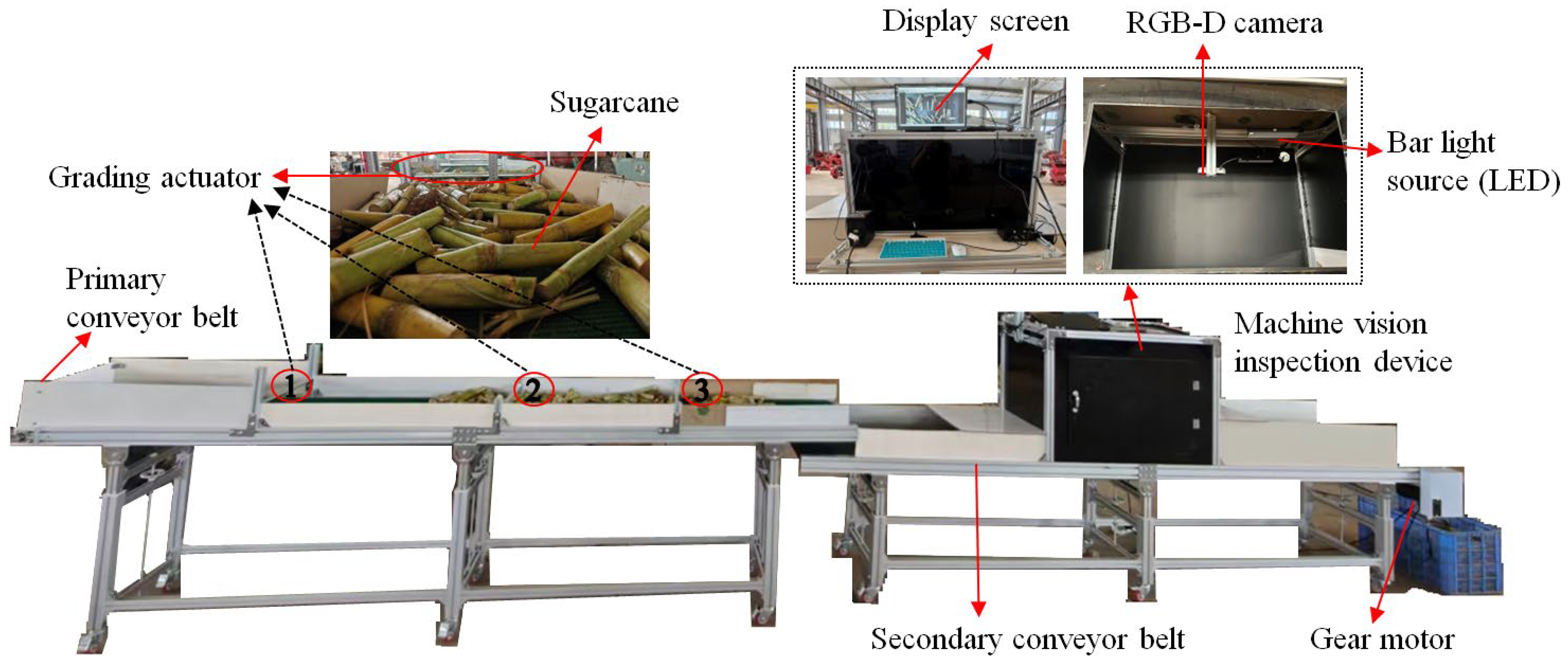
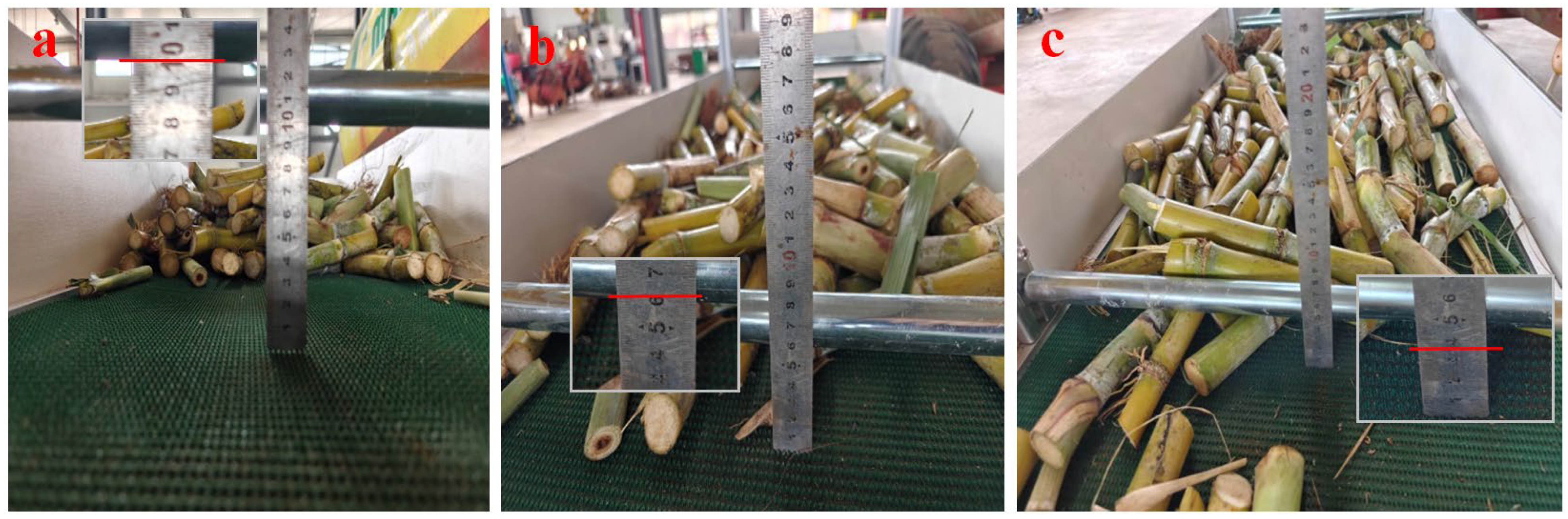
The three-tiered system is aligned with the direction of material transport and is mounted on a low-speed primary conveyor belt. The essential grading mechanism relies on the progressively decreasing gap between the roller axis and the conveyor belt’s working surface at the entry points of adjacent units. When sugarcane enters the first grading unit in a stacked formation (usually four layers), the uppermost layer is effectively removed due to the constraints of the gap and mechanical forces, while the remaining three layers proceed to the second grading unit. This process continues in the second unit, where the material layers are further reduced. After passing through the third grading unit, the material is transformed into a continuous single-layer configuration. Once the grading and thinning are complete, the single-layer sugarcane is moved to a secondary conveyor belt system, which operates at a higher speed than the primary belt. This increase in speed is intended to mitigate the challenges associated with the high stacking density of the single-layer sugarcane on the imaging detection system. The dense arrangement complicates the image recognition algorithms, leading to issues like overlapping target segmentation and unclear feature extraction, which can heighten the risk of misidentification and errors in the final recognition outcomes. By employing high-speed transport and leveraging the traction from the speed differential between the conveyor belts, the physical spacing between adjacent sugarcane stems can be effectively enhanced, significantly lowering the material’s surface density in the detection zone. This vital enhancement improves the imaging conditions for optical sensors, establishing a solid physical basis for subsequent high-accuracy and low-error-rate machine vision recognition. The differential intelligent detection device for sugarcane impurity rate classification is shown in Figure 1.

2.2. Key Parameter Design

To meet the production requirements of sugar mills and address the issue of excessively high density after flattening caused by the initial stacking layers of sugarcane (4 layers, total thickness ≤ 110 mm), the design must satisfy three conditions: (1) Layer control: output a continuous single layer after three-stage processing, with a thickness ≤ 4 mm; (2) Density optimization: the proportion of sugarcane material occupying the conveyor belt area before and after processing ≤ 25%, meeting image recognition requirements; (3) Damage rate < 3%.

2.2.1. Geometric Distribution of Sugarcane Diameter

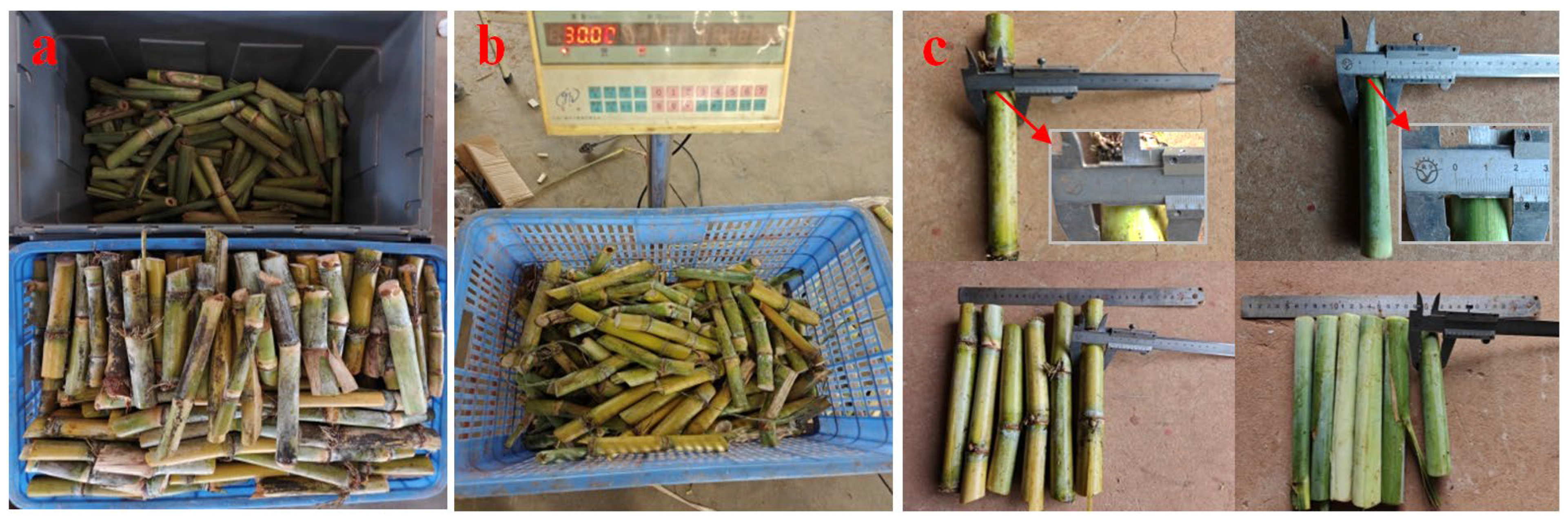
In order to assess the physical characteristics of sugarcane for the design of the roller-belt gap in the grading differential apparatus, 500 samples of the mature Yuetang 94–128 variety (aged between 8 to 10 months) were randomly collected from the sugarcane cultivation site at the Agricultural Machinery Research Institute of the Chinese Academy of Tropical Agricultural Sciences (located at 110°16′ E longitude and 21°9′ N latitude). A caliper was utilized to measure the diameter of the sugarcane samples, with the measurements conducted in a controlled environment of 25 ± 3 °C to prevent inaccuracies from thermal expansion of the stalks due to temperature variations, as illustrated in Figure 2.
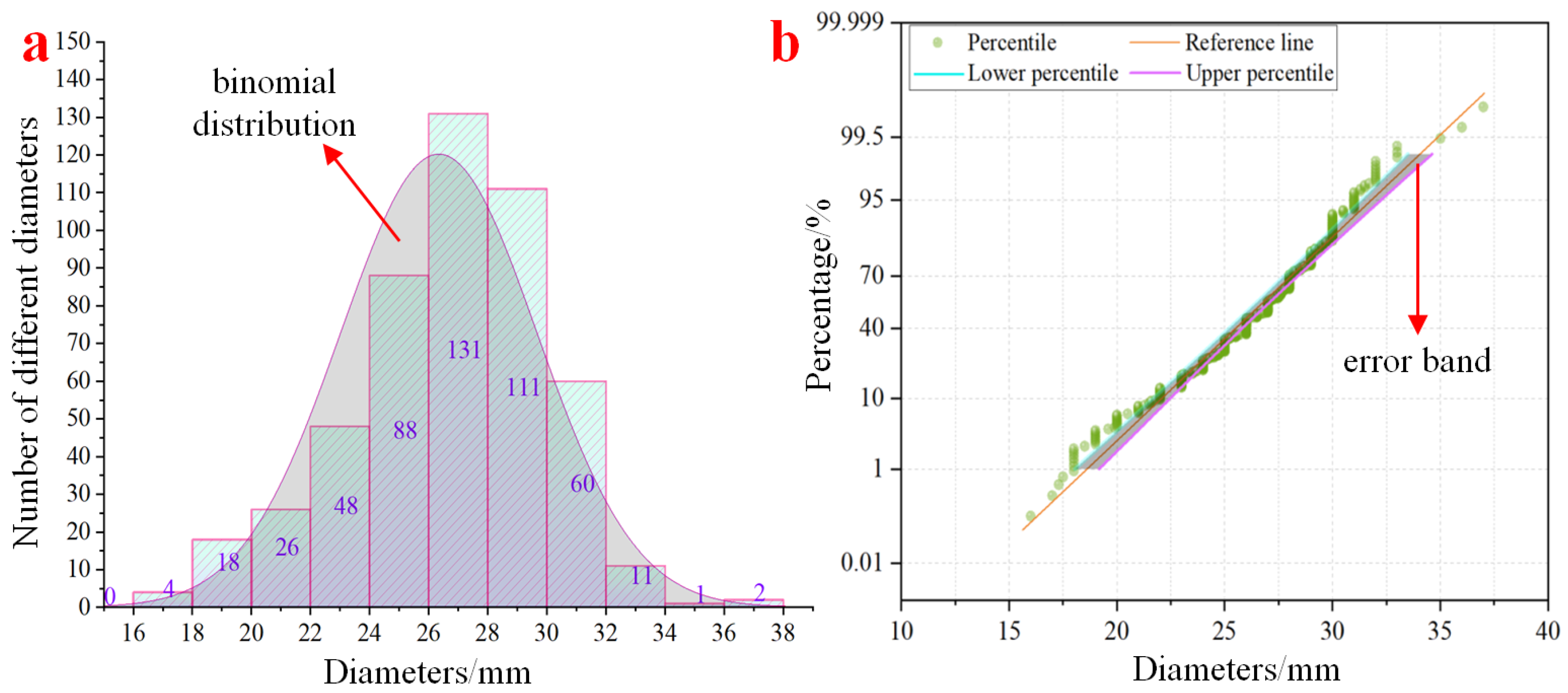
The analysis of 500 valid data entries during the preprocessing phase yielded the following findings: the smallest diameter measured is 16.0 mm, while the largest is 38.0 mm. The average diameter is calculated to be 26.3 mm, with a standard deviation of 3.3 mm, resulting in a coefficient of variation (CV) of 10.98%. The frequency distribution histogram (Figure 3a) illustrates a unimodal and symmetric distribution, with the primary peak occurring between 26 mm and 28 mm (frequency of 131, representing 26.2%), and a secondary peak found in the 28 mm to 30 mm range (frequency of 111, or 22.2%). The interval from 24 mm to 26 mm comprises 17.6%, and collectively, these three intervals make up 66.0% of the total sample, indicating that the sugarcane diameters predominantly fall between 24 mm and 30 mm. To confirm the type of distribution, the sample data was evaluated using OriginPro 2018C software and subjected to the Kolmogorov–Smirnov test (K-S test, significance level θ = 0.05) for normality assessment. The computed statistic Dn = 0.028, with a critical value D0.05 ≈ 0.061, suggests that since Dn is less than D0.05, the sugarcane diameters conform to a normal distribution. Additional validation through a probability plot (Figure 3b) reveals a strong linear correlation coefficient R2 = 0.991 between the sample quantiles and the theoretical normal quantiles, indicating a close fit to a normal distribution. Consequently, it is concluded that the diameter of the sugarcane follows a normal distribution N (26.3, 3.32). This distribution characteristic is crucial for informing the design of the roller-belt gap Gn.

2.2.2. Geometric Constraint Equations

At the heart of the grading mechanism lies the geometric connection between the roller-belt and the diameter of the sugarcane, denoted as Di. This relationship is founded on the laminated structure of the sugarcane and principles of rigid body constraints [22]. The mathematical model representing this relationship is formulated as a double-layer inequality (1).
i = 1 k 1 D i m i n + δ c G n i = 1 k D i m a x δ r
where: n = a graded series.
k = the maximum number of layers that can be passed.
D i m a x   &   D i m i n = the upper and lower limits of sugarcane diameter.
δc = the curvature compensation term to ensure that the sugarcane group can pass through the gap without blocking under the action of force.
δr = a dispersion correction term, which is used to offset the random fluctuation of layer thickness caused by the discreteness of sugarcane size.
However, the preconditions for the establishment of the equation are
(1) Every layer of sugarcane can be represented as a direct cylinder, with the distance between the centers of the layers meeting the following criteria:
h i = D i + D i + 1 2 + Δ h
where: hi = the center distance between layers.
Di & Di+1 = the diameter of sugarcane.
Δh = sugarcane skin roughness compensation.
(2) The reaction force of the round roller to sugarcane should meet the stripping conditions:
F r j = k 4 m j g s i n φ
where: Fr = the reaction force of the round roller on the sugarcane.
mj = the quality of sugarcane.
g = the acceleration of gravity, which is set at 9.8 m/s2.
φ = the inlet angle.
Under actual harvesting conditions, non-ideal characteristics of sugarcane, such as curvature, morphological differences between internodes, and broken stalks, can lead to the partial failure of the geometric constraints in the hierarchical model (Equation (1)) established based on an idealized “stacked rigid cylinder”: the actual passage height of curved cane may exceed its equivalent diameter, periodic abrupt changes in internode diameter can breach the original upper and lower diameter limits, and broken stalks are prone to causing uncontrolled stacking numbers due to posture instability or the formation of clusters. These issues may trigger risks of insufficient grading, over-grading, or system blockage, necessitating the enhancement of model robustness through dynamic parameter correction and adaptive adjustment.

2.2.3. Gap Parameter Derivation

The grading interval Gn for sugarcane diameter must simultaneously meet two constraints, as determined by its statistical distribution properties.
(1) Geometric passability constraint (lower bound):
G n > i = 1 k - 1 D i m i n
Ensure that the lower k − 1 layer of sugarcane can pass without being blocked.
(2) Layer stripping constraint (upper limit):
G n < i = 1 k D i m a x
Prevents the k layer and any layers above it from being stripped, as illustrated in Figure 4.
The specific parameter calculation process is as follows:
The objective for the initial gap G1 is to remove the uppermost layer (from layer 4 to layer 3) while satisfying the specified criteria.
i = 1 3 D i m i n < G 1 < i = 1 4 D i m i n
That is 78 mm < G1 < 104 mm.
Due to the unpredictable nature of sugarcane’s shape and layout, a safety margin coefficient of α = 1.08 is applied and integrated into Formula (7). This leads to a calculation of G1 as 98.2 mm, which is approximated to G1 = 100 mm.
G 1 = α × i = 1 3 D i m i n + i = 1 4 D i m i n 2
The constraint condition for the second-level gap G2, which involves the target stripping layer transitioning from layer 3 to layer 2, is as follows:
i = 1 2 D i m i n < G 2 < i = 1 3 D i m i n
That is 52 mm < G1 < 78 mm.
Based on the probability model with a confidence level of 95%, the cut-off value is
G 2 = μ D 2 + 2 σ D 2
μ D 2 = μ + σ Φ 1 k n + 1
σ D 2 = k n k + 1 n + 1 2 n + 2
where: μD(2) = the expected value of the second order statistic.
σD(2) is the standard deviation of the second-order statistic.
By replacing the values, we find that μD(2) equals 36 mm and σD(2) is 3.3 mm. Consequently, G2 is calculated to be 42.6 mm, which rounds up to 45 mm.
The constraint for the third-level gap G3, which pertains to the output from layer 2 to layer 1, is as follows:
D m a x < G 3 < 2 D m i n
Based on the statistical measurements of sugarcane thickness, a theoretical inconsistency arises with the range of 38 mm < G3 < 32 mm, leading to the implementation of the dynamic stiffness adjustment technique.
G 3 = β E D a v g ρ v b e l t 2
where: β = the empirical correction coefficient (considering the randomness of sugarcane arrangement, vibration interference and other factors), which is set at 0.5 [23].
E = the elastic modulus of sugarcane [24], which is 15 MPa.
Davg = the average diameter of sugarcane.
ρ = sugarcane density.
vbelt = the running speed of the conveyor belt, which is set at 0.3 m/s.
As a result, by inputting the data, G3 is determined to be 31.38 mm, which rounds up to 33 mm.

2.2.4. Differential Transmission System

The mechanism takes advantage of the varying speeds of two conveyor belts to provide inertial acceleration to a single layer of sugarcane as it moves from the slower primary belt to the faster secondary belt. This process effectively increases the gap between neighboring sugarcane stalks. The distance separating the stalks can be determined using the velocity–displacement formula associated with uniformly accelerated linear motion. This distance indicates the displacement as the sugarcane transitions from speed v1 on the primary belt to speed v2 on the secondary belt, which can be calculated accordingly.
Δ S = v 2 2 v 1 2 a
where: ΔS = the separation distance.
a = the acceleration of sugarcane.
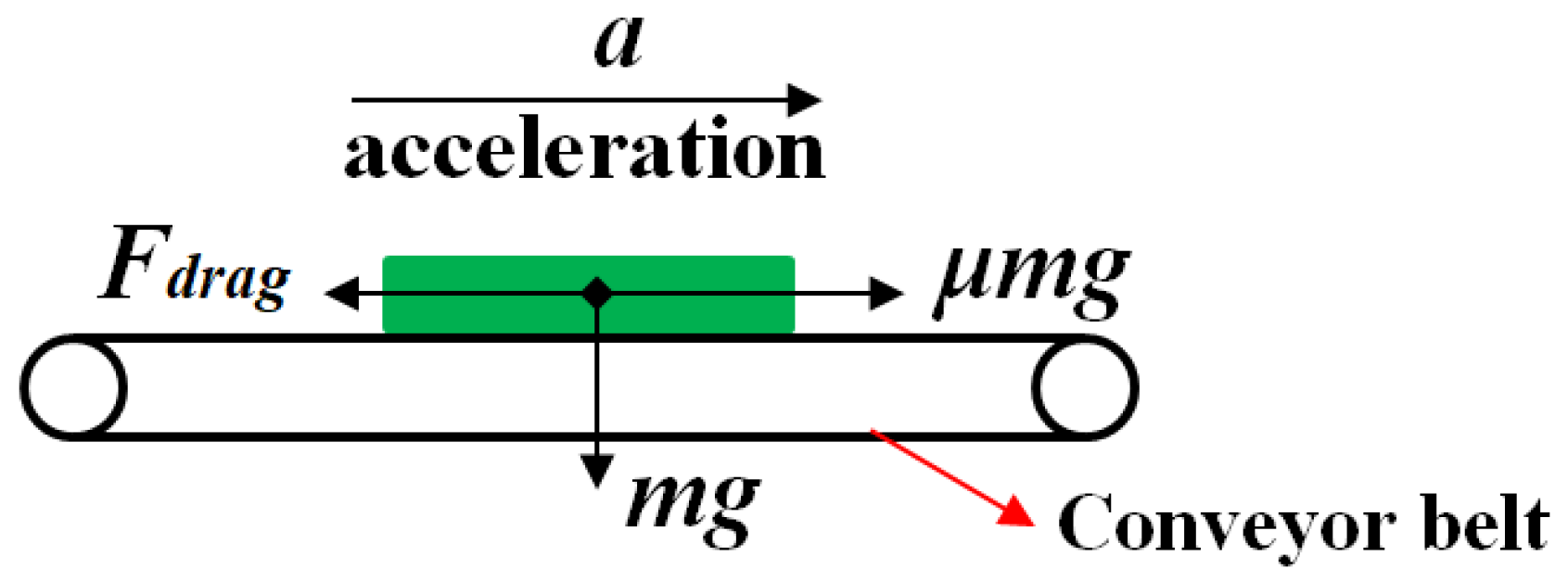
The speed at which sugarcane moves along the secondary conveyor belt is influenced by the combined effects of friction and resistance, illustrated in Figure 5. The formula for this calculation is provided below.
a = μ k m g F d r a g m
where: μk = the dynamic friction coefficient between sugarcane and the surface of the secondary conveyor belt, which is set at 0.6.
Fdrag = air resistance, which can be ignored.
To achieve the required minimum separation distance for image detection, the minimum velocity of the secondary conveyor belt can be calculated by inserting ΔS = ΔSmin into Equation (14). The detailed relationship is expressed as follows:
v 2 v 1 2 + 2 a Δ S m i n
The constraint condition of the velocity ratio is shown in Formula (17).
v 2 v 1 1 + 2 a Δ S m i n v 1 2

2.3. Conveyor Belt Motor Power

The motor’s driving force for the conveyor belt must be precisely aligned with the requirements for transporting materials. This is primarily to counteract the friction between the materials and the belt, as well as the inherent resistance of the belt during operation. The formula for this calculation is
P = P m + P b η 0
where: Pm = the friction power of the material.
Pb = the resistance power of the conveyor belt itself.
η0 = the transmission efficiency, which is set at 0.85.
If we consider that the entire mass of the material conveyed in a single instance is 40 kg, the frictional force exerted by the material on the main conveyor belt is.
P m = μ k 1 m m g v 1
By replacing the values with μk1 = 0.6, v1 = 0.3 m/s, g = 9.8 m/s2, and Pm = 70.56 W, the result can be derived.
The energy needed to counteract the sliding resistance between the substance and the conveyor belt is
P b = μ b m b g v 1
By substituting the data μb = 0.25, mb = 15 kg, Pb = 11.03 Kw can be obtained.
In conclusion, the primary conveyor belt’s total driving power is determined to be 81.59 watts, while the secondary conveyor belt’s total driving power is found to be 77.54 watts. The disparity in power output between the two belts arises from variations in material quality. The primary belt consists of four layers of sugarcane, which is four times denser than the material used in the secondary belt, compensating for the latter’s higher speed. Despite the secondary conveyor’s rapid movement, its lower material quality and reduced dynamic friction coefficient result in comparable total power outputs. Both conveyor belts are powered by a 120-watt deceleration motor (model 5IK90RGU-CF from Shenghe Motor Co., Ltd., located in Shenzhen, Guangdong, China), which has a 30% power margin to handle static friction during startup and to maintain stable operation under full load and other conditions.

3. Result and Discussion

3.1. Performance Test of Grading Differential Device

In order to assess the durability of the differential gear across various load conditions (related to sugarcane quality) and speeds, this research utilizes an L9 (34) orthogonal experimental framework. This framework incorporates three primary independent factors, each evaluated at three distinct levels: sugarcane quality (M) at 10 kg, 15 kg, and 20 kg; the speed of the main conveyor belt (v1) at 0.1 m/s, 0.2 m/s, and 0.3 m/s; and the ratio of the secondary conveyor belt speed (k) at 3:1, 4:1, and 5:1. The process of conducting the experiments is depicted in Figure 6. All tests are performed under roller-belt gap settings that are meticulously calibrated based on the theoretical model. A key performance metric for the device is the single-layer rate following the final grading section (G3) of the sugarcane, which reflects the device’s efficiency in achieving a proper single-layer distribution of the sugarcane flow.
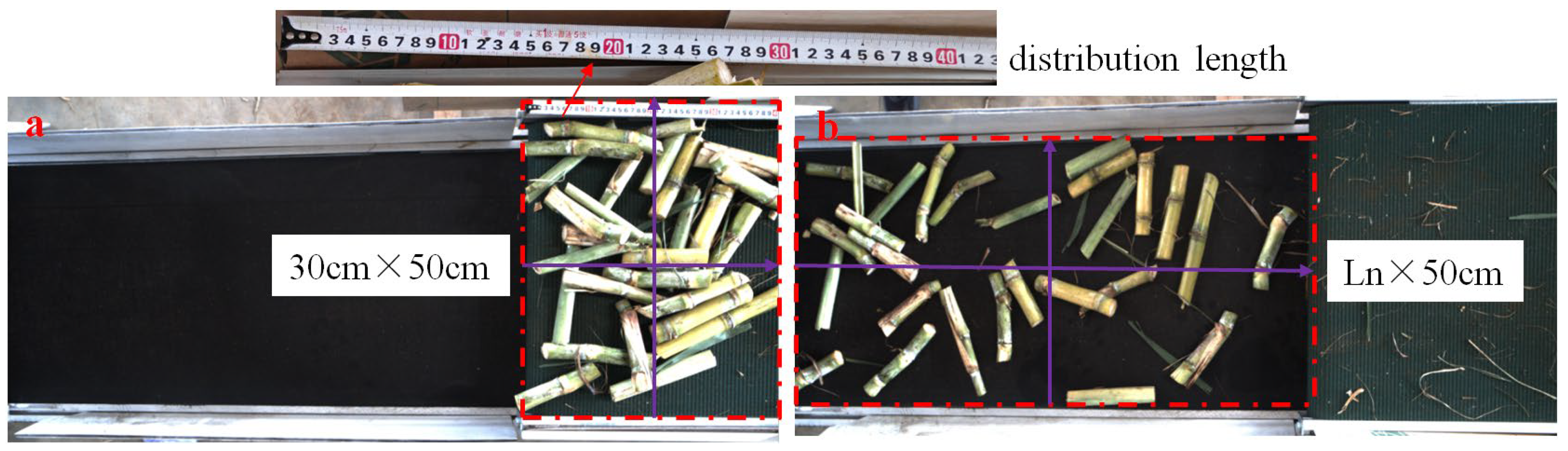
This research presents a new critical metric for performance assessment—the area ratio of sugarcane within the handover zone of the transfer belt. The method for quantification is outlined as follows: at the conclusion of the primary transfer belt, within a specified area (30 cm × 50 cm) where sugarcane is set to drop onto the secondary transfer belt (which has a consistent width of 50 cm), actual samples of sugarcane are collected (averaging 28 stems). Next, the length (Ln) that the sugarcane spans after it reaches the secondary transfer belt is recorded, and the corresponding coverage area (Ln × 50 cm) is computed. The area ratio is established as the proportion of the primary sampling area (30 cm × 50 cm) to the coverage area of the secondary transfer belt. A lower area ratio signifies a wider spacing of sugarcane on the secondary transfer belt, which notably diminishes the occlusion effect on the visual detection system and improves accuracy; in contrast, a higher ratio indicates a more compact arrangement of sugarcane, leading to increased detection inaccuracies. The findings related to this metric are illustrated in Figure 7, Table 1 and Table 2. The experimental results are shown in Table 3.

3.1.1. Analysis of the Single Layer Rate of Sugarcane

Utilizing the data from the experimental results in Table 2, a variance analysis technique [25] was applied to assess the importance of different factors influencing the single-layer rate of sugarcane, with findings detailed in Table 4. At a significance threshold of α1 = 0.05, the weight of the sugarcane was found to be highly significant, highlighting its crucial role in determining the single-layer rate. Conversely, the F-value associated with the speed of the primary conveyor belt was notably low, and the corresponding p-value surpassed 0.05, indicating a lack of statistical significance and suggesting that its effect on the single-layer rate is minimal.
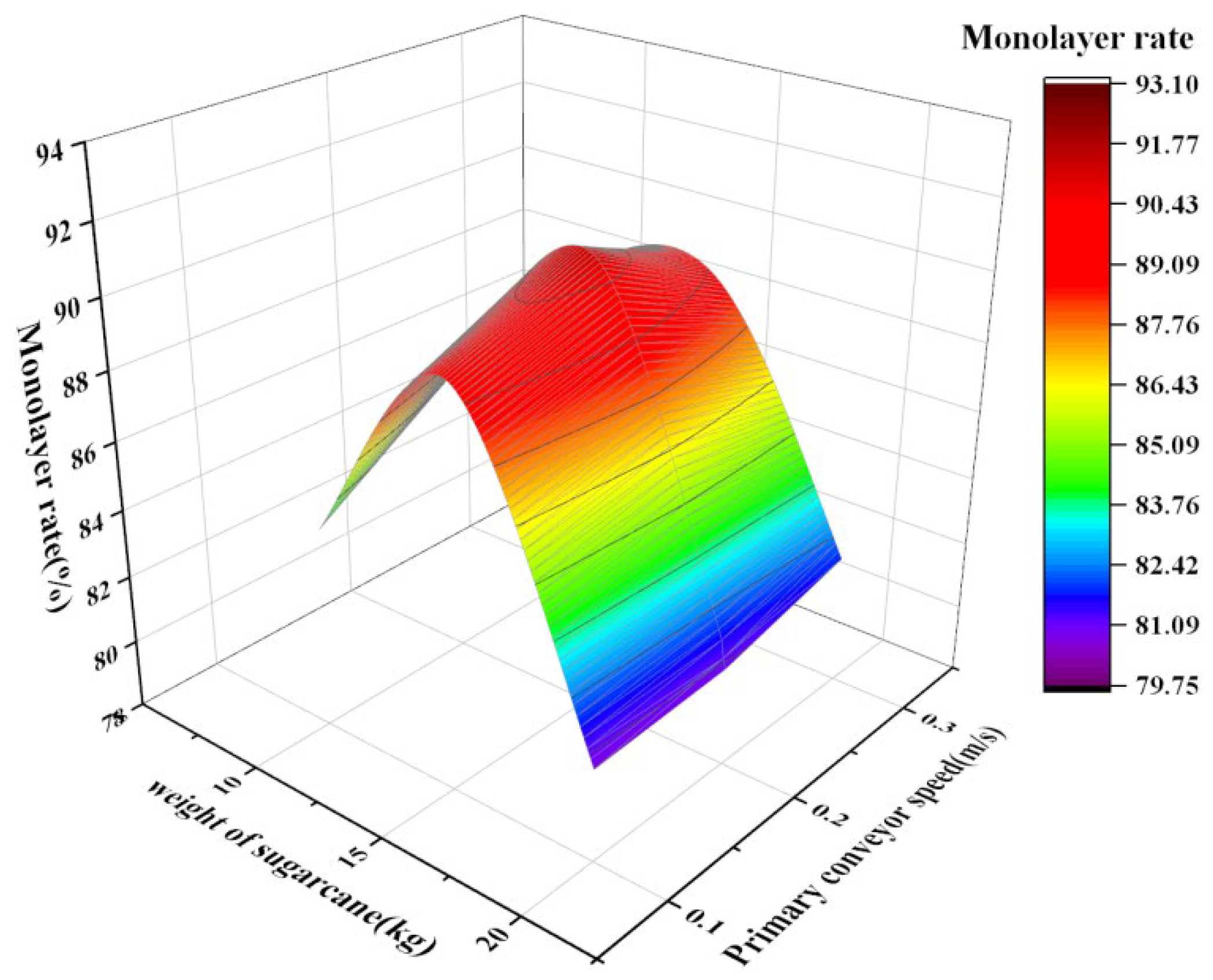
Further analysis of the effects of the three independent variables A, B, and C on the single-layer rate was conducted using Response Surface Methodology (RSM), with the results presented in Figure 8. Response surface methodology can clearly demonstrate the changing trend of response values when multiple factors vary simultaneously, providing a basis for the collaborative optimization of multiple factors. The conclusions are as follows: (1) The highest single-layer rate was achieved with the combination of medium load and medium speed. This is because sugarcane accumulation on the conveyor belt reached an appropriate thickness at these settings, allowing the grading mechanism to effectively peel apart the layered sugarcane, avoiding peeling failures caused by excessively light loads (leading to slippage) or excessively heavy loads (resulting in compression). Furthermore, the residence time of the sugarcane within the grading structure was precisely sufficient to meet the requirement for sequential layer-by-layer peeling. (2) Both excessively light and excessively heavy loads led to a decrease in the single-layer rate. An overly sparse distribution of sugarcane on the conveyor prevented the roller-belt gap of the grading mechanism from making effective contact, resulting in incomplete peeling and reducing the single-layer rate to below 85%. Conversely, excessive accumulation caused severe inter-layer compression; the grading mechanism was unable to fully separate the multi-layered sugarcane, lowering the single-layer rate to approximately 80%. (3) Both excessively high and low speeds reduced the single-layer rate. Prolonged residence time within the grading structure caused sugarcane pile-up and jamming, hindering the smooth passage of subsequent sugarcane and decreasing the single-layer rate below 83%. Conversely, insufficient residence time led to inadequate peeling, reducing the single-layer rate below 88%. Notably, the response surface reached its peak value at A = 15 kg and B = 0.2 m/s, achieving a maximum single-layer rate of 93.10%.

3.1.2. Analysis of the Area Ratio of Sugarcane

The analysis of variance results for the sugarcane area proportion index are presented in Table 4. The results indicate that, at a significance level of α1 = 0.05, both B (F = 19.78039, p = 8.005051 × 10⁻⁴) and C (F = 93.1098, p = 8.287864 × 10⁻⁶) exert highly significant effects on the area proportion. In contrast, sugarcane mass exhibited no significant influence on this metric. Notably, the substantially higher F-value and smaller p-value for C compared to B demonstrate that C plays a more dominant role in regulating sugarcane distribution density.
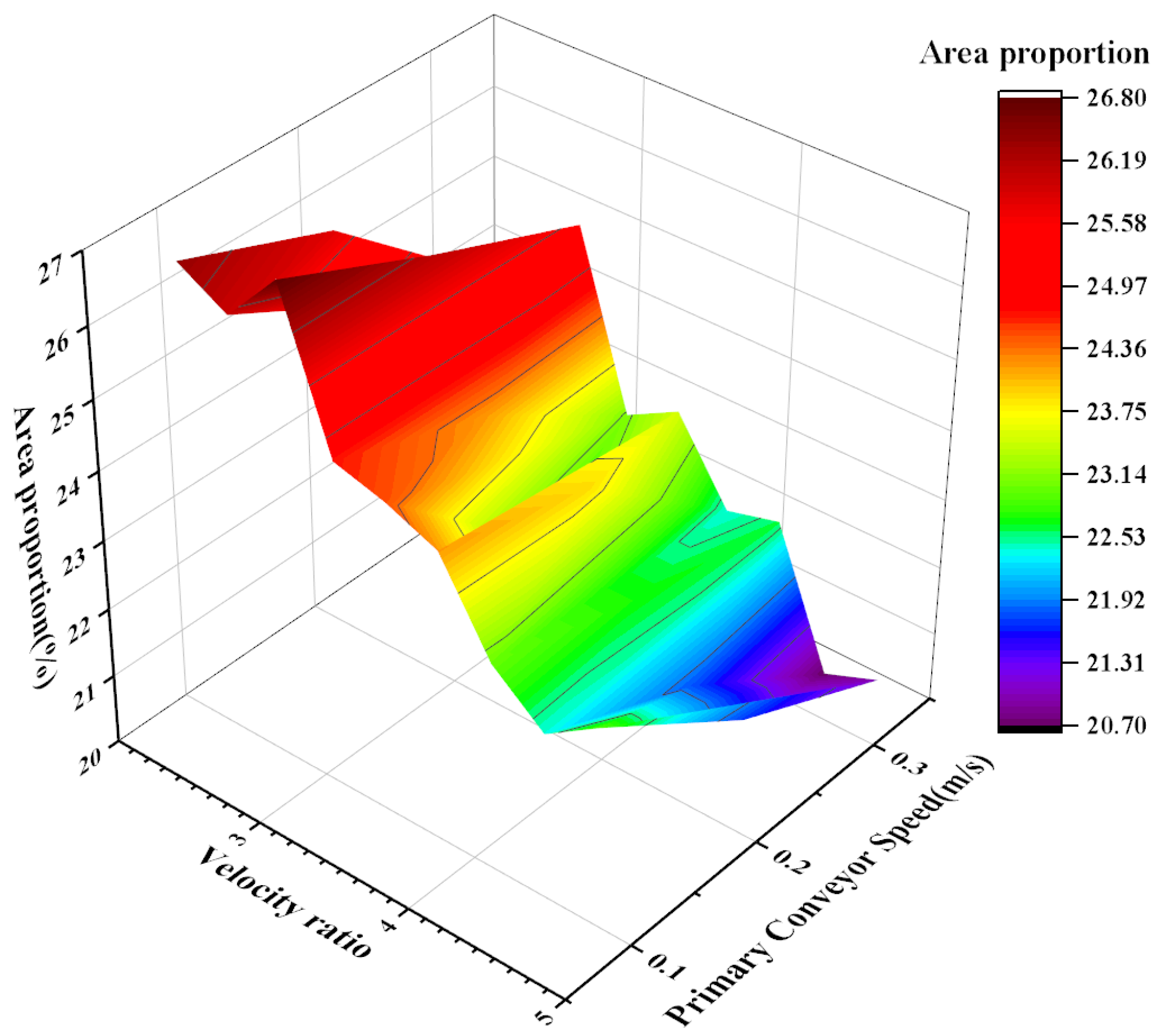
Similarly, the effects of A, B, and C on the area proportion were analyzed using the response surface methodology [26], with results shown in Figure 9. As indicated in Table 5, C is the key factor while B is secondary. Specifically, a smaller C value reduces sugarcane acceleration on the secondary conveyor, decreasing the separation distance and increasing the area proportion. The area proportion peaked when C = 3:1, indicating poorer separation efficacy at this ratio. Conversely, larger C values shorten transit time through the grading mechanism, potentially impairing layer-by-layer peeling. However, the separation efficiency on the secondary conveyor compensates for the reduced grading effectiveness caused by high primary speed. For example:
At speed ratio = 5:1, increasing B from 0.1 m/s to 0.3 m/s reduced the area proportion from 26.8% to 23% (Δ = −3.8%).
At speed ratio = 3:1, increasing B from 0.1 m/s to 0.3 m/s reduced the area proportion from 24% to 20.7% (Δ = −3.3%), demonstrating a smaller reduction magnitude.
The evaluation of the experimental findings reveals that the graded differential device successfully tackles the challenge of dense initial stacking of sugarcane, resulting in effective single-layer separation and a more uniform low-density distribution. By employing both layer-by-layer and inertial separation techniques, a peak single-layer rate of 93.1% was recorded with a sugarcane weight of 15 kg and a primary conveyor belt speed of 0.2 m/s. Additionally, the speed ratio, which significantly impacts area proportion, decreases the area proportion from 26.8% to 22% as it rises, thereby enhancing the conditions for machine vision detection.

3.2. Machine Vision Inspection Test Results and Analysis

To assess the impact of the differential speed mechanism on machine vision detection, a smart detection system for sugarcane containing impurities was mounted on the secondary conveyor belt, followed by a comparative study for quantitative evaluation. The study comprised two groups: the experimental group, where sugarcane underwent processing via the differential speed device to produce a single-layer low-density output, with grading parameters established at 100 mm, 45 mm, and 33 mm; and the control group, which involved unprocessed sugarcane with an initial stacking layer count of four, along with sample parameters detailed in Table 6.
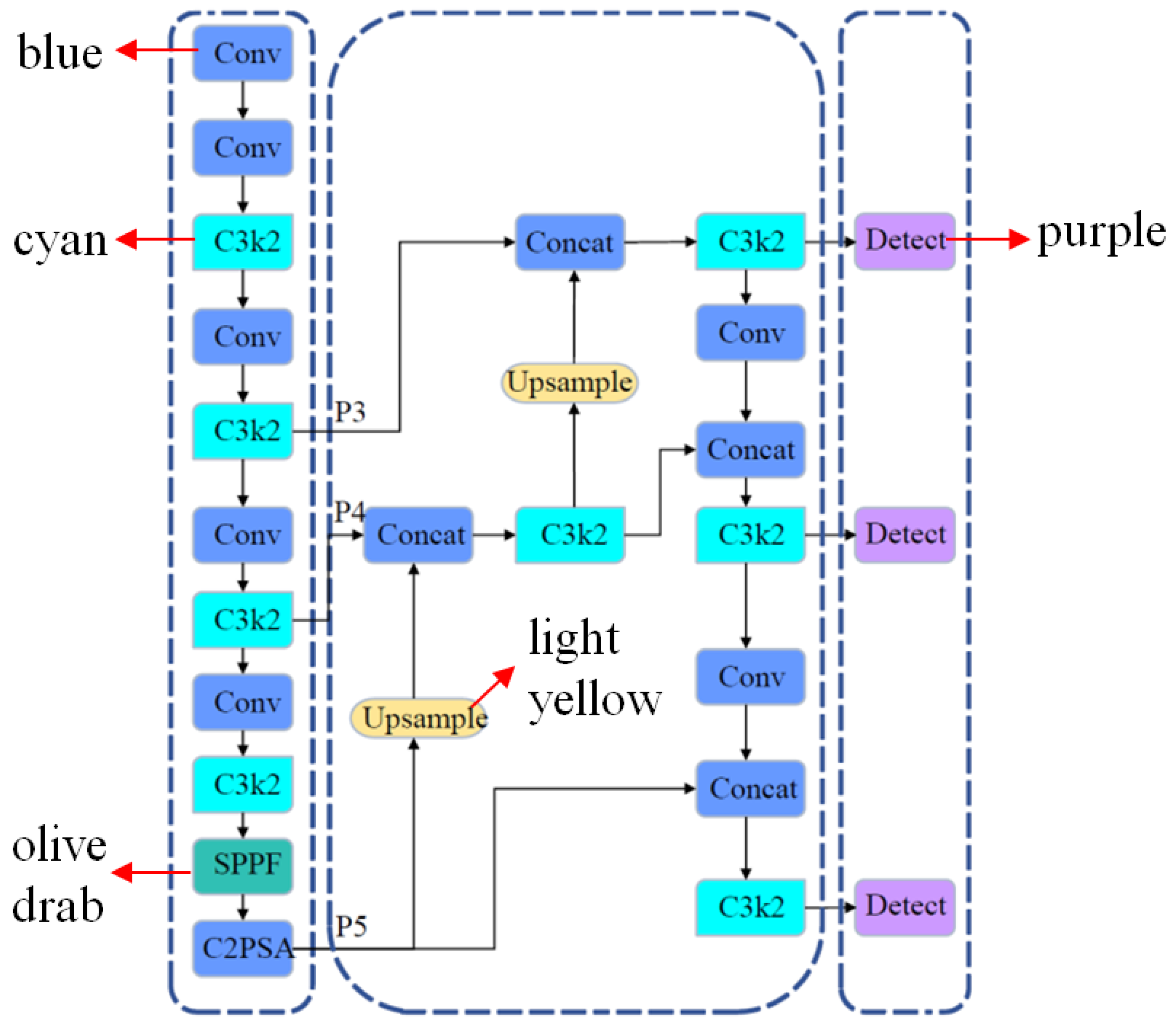
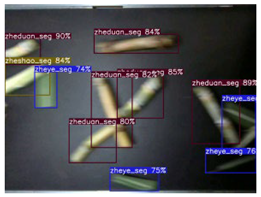
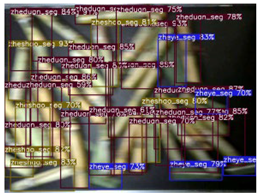
The detection system utilizes the YOLOV11n model [27,28] for object recognition, as depicted in Figure 10. The dataset, which was previously assembled, has been enhanced for the current study [29]. The hardware setup features an Intel(R) Xeon(R) Gold 6256 CPU running at 3.60 GHz and an NVIDIA RTX A6000 (which was produced by Xi’an Kunlong Computer Technology Co., Ltd., Xi’an, China) graphics card with 48 GB of VRAM. The operating system in use is Ubuntu 20.04, with CUDA 11.8 and CUDNN 8.6.0 installed. Training of the model occurs within an Anaconda virtual environment that includes essential libraries like PyTorch 2.0.1 and OpenCV 4.10, using Python 3.10 for coding. The training parameters are set to 200 epochs, a batch size of 32, an image dimension of 640 × 640, a learning rate of 0.01, the AdamW optimizer, and 4 workers. Testing is performed on the NVIDIA Jetson NX, which runs JetPack 5.1, has CUDA 11.4 and CUDNN 8.6.0, and is equipped with 16 GB of VRAM.
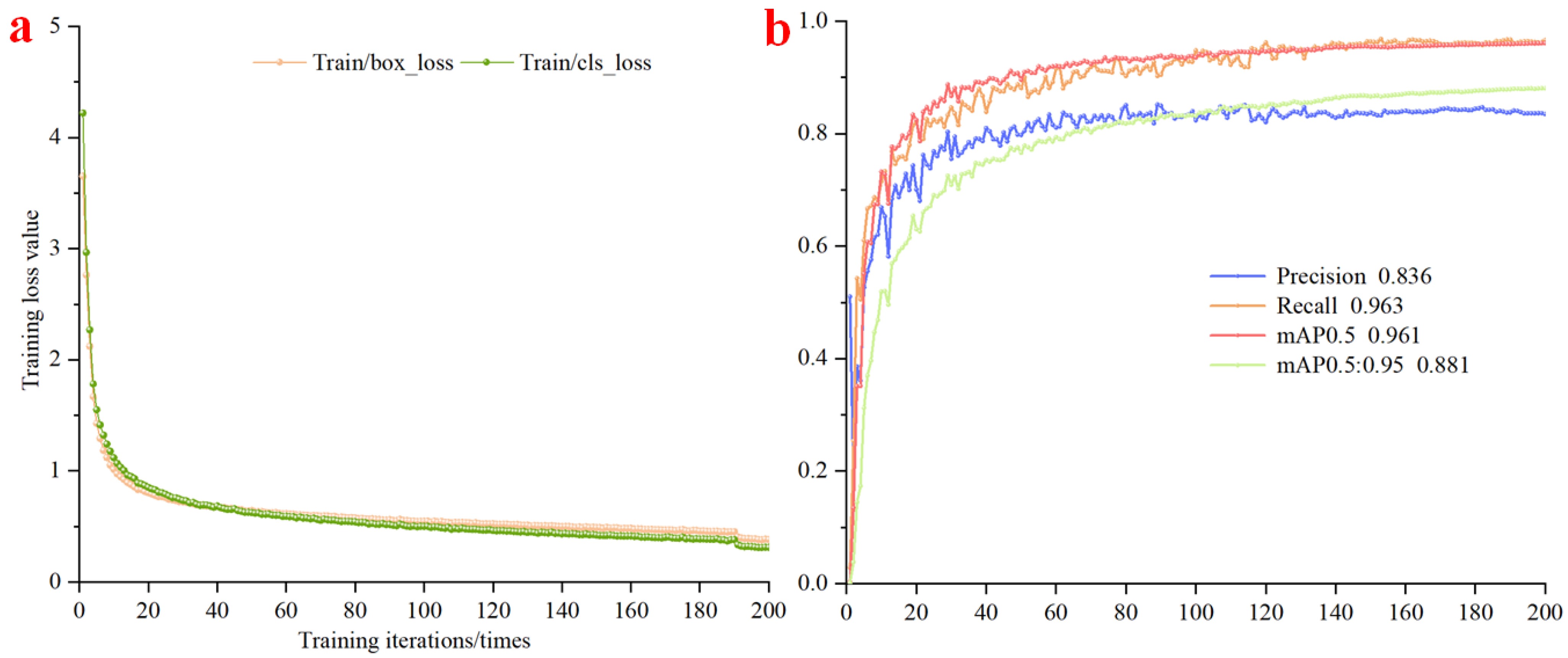
The training methodology is depicted in Figure 11a, showcasing the trends in losses for both bounding box regression and classification. Initially, there is a swift reduction in losses, which is then followed by a more gradual decrease before reaching a stable state. This pattern suggests that the training of the model is both effective and convergent, demonstrating strong performance in classification tasks. Figure 11b presents the training outcomes, where all metrics show a quick rise initially, followed by consistent fluctuations. The precision stands at 83.6%, recall at 96.3%, and mAP0.5 at 0.961. These findings imply that the model is capable of accurately identifying nearly all positive samples, and when bounding box matching conditions are relaxed (IoU ≥ 0.5), it shows high accuracy in both localization and classification.
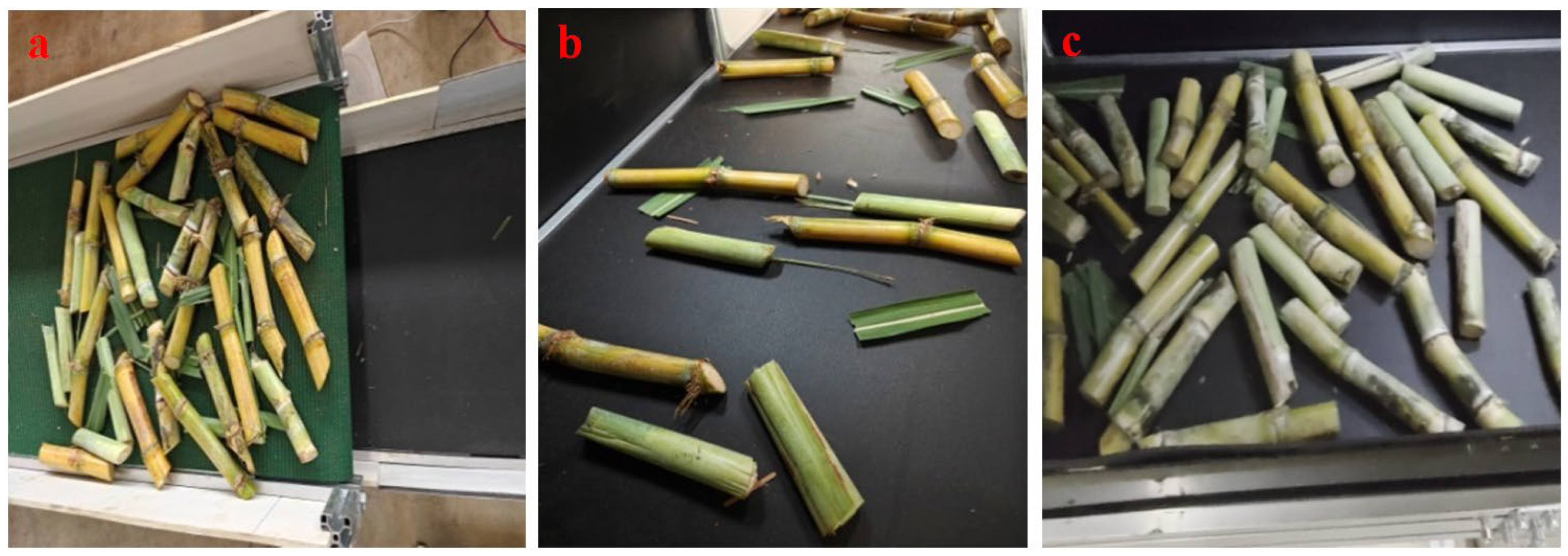
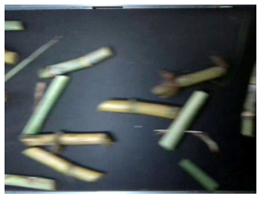
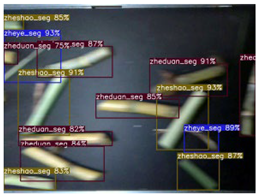
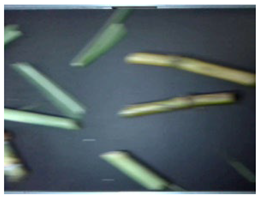
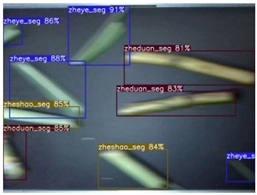
Following the training outcomes, a set of 180 sugarcane samples, which were not part of the training process, was chosen for validation purposes. This specific group underwent testing after being processed with a graded differential apparatus (see Figure 12a,b) and was then compared to direct detection using the detection apparatus (refer to Figure 12c). The evaluation of this experiment relied on accuracy and the frequency of misidentifications as key metrics.
Table 7 and Table 8 present the findings from the experiments. The experimental group achieved an average accuracy of 94.90% over three trials, with merely 2 instances of misidentification. In comparison, the treatment group recorded an average accuracy of 67.97% and around 11 misidentifications across the same number of trials. This data reveals that the experimental group’s recognition accuracy surpasses that of the treatment group by a notable 26.93%, while the average misidentifications are significantly lower, showing a decrease of about 81.8% compared to the treatment group.
To conclude, the graded differential apparatus enhances the transport conditions of sugarcane harvested by machines, ensuring a reliable and distinct setting for assessing impurity levels. This advancement not only boosts detection precision but also greatly minimizes the chances of misidentification. The findings strongly support the efficacy of the graded differential apparatus in measuring impurity levels in mechanically harvested sugarcane, thereby strengthening the technological basis for smart impurity detection in this context.

4. Discussion

This research introduces a novel mechanism that combines geometric constraints with varying traction to facilitate the layered separation of sugarcane materials through a three-tiered roller belt gap design. Furthermore, it leverages the inertial force produced during sudden changes in speed to effectively increase the distance between the materials. This integrated method addresses the challenge of low accuracy in machine vision detection of impurities in densely stacked sugarcane. In the initial phase of the study, 500 samples of Yuetang 94–128 were gathered and analyzed using OriginPro 2018C software. The analysis, along with the Kolmogorov–Smirnov normality test, confirmed that the sugarcane diameter adheres to a normal distribution (μ = 26.3 mm, σ = 3.3 mm).
Building on the previously established groundwork, tests were carried out to evaluate the performance of the differential drive mechanism alongside machine vision detection assessments. The findings reveal that, at a significance threshold of α = 0.05, the weight of the sugarcane is a crucial determinant of the single-layer material rate; additionally, both the primary conveyor belt speed and the gear ratio exert a substantial influence on the material dispersion area ratio. Importantly, the F-statistic for the gear ratio is markedly greater than that for the conveyor belt speed, with a lower p-value, underscoring the gear ratio’s more significant role in managing the sugarcane distribution density. With optimized settings (sugarcane weight at 15 kg and conveyor belt speed at 0.2 m/s), the single-layer rate reached a maximum of 93.1%; concurrently, increasing the gear ratio from 3:1 to 5:1 led to a decrease in the area proportion from 26.8% to 22.0%, thereby enhancing the conditions for effective machine vision detection. The detection outcomes further indicate that the experimental group’s average accuracy was 94.90%, with only 2 instances of misidentification, while the control group achieved an average accuracy of just 67.97%, with 11 misidentified cases. This improvement translates to a 26.93% increase in recognition accuracy and an approximate 81.80% reduction in misidentifications, alongside a detection speed of 55.5 ms. These results convincingly demonstrate that the device not only enhances detection accuracy but also significantly lowers the rate of misidentifications.
Current techniques and devices for identifying impurities in sugarcane face several challenges. For example, Zheng’s [18] method positions the detection apparatus at the rapid discharge point of the segmented sugarcane harvester, rendering it vulnerable to the influences of swift material flow and a dusty setting, which can compromise detection precision. Zheng’s [19] technique employs a lifting transport system to regulate the detection volume, enhancing accuracy but failing to eliminate material accumulation. Zhang’s [20] approach tackles the accumulation problem by manually distributing the material and using a dual-camera sampling box for detection; however, this leads to reduced operational efficiency. In contrast, the collaborative mechanism introduced in this research successfully addresses the limitations of these previous methods, facilitating effective and intelligent detection of impurity levels in sugarcane.
It is necessary to point out the technical limitations of this study. First, the experiments were based solely on a single sugarcane variety (Yuetan 94–128), and the parameters of the roller-belt clearance were fixed. This lacks adaptability to other sugarcane varieties and requires manual adjustment of the clearance. Second, the study assumed sugarcane as rigid cylindrical bodies and neglected the effects of deformation during actual operation. However, in real-world operations, sugarcane materials can experience blockages at the roller-belt clearance, requiring manual intervention for clearance, which challenges the continuity and efficiency of the detection process. Third, the uniform acceleration assumption neglects air resistance. At higher conveyor speeds, the separation distance between sugarcane stalks becomes denser. These limitations provide direction for optimizing the next generation of the device.
Future research should focus on the following: (1) integrating LiDAR or a real-time stereo vision system to measure the contour of sugarcane bundles and dynamically adjust the spacing between rollers, as well as the roller-belt clearance via servo motors to enhance adaptability across multiple varieties; (2) incorporating an automatic anti-blocking mechanism to ensure smooth material flow and maintain detection efficiency. The methodological framework established in this study holds significant potential for technological transfer and can be extended to the intelligent sorting and detection of other near-cylindrical agricultural materials, such as cassava and bamboo poles.


5. Conclusions

(1)
A total of 500 parameters were gathered and assessed for the sugarcane variety Yutang 94–128. The analysis of this data was performed with OriginPro 2018C software, and a normality assessment was carried out using the Kolmogorov–Smirnov test. The findings indicated that the sugarcane diameter adheres to a normal distribution. This characteristic of distribution offers essential data support for the future design of the roller-belt gap.
(2)
Utilizing the geometric arrangement of sugarcane along with the principles of rigid body constraints, a mathematical model was developed to establish a relationship between the roller-belt and the diameter of the sugarcane, factoring in the distribution traits of the diameter parameters. An examination of the conditions and forces involved in the transfer of sugarcane from the primary to the secondary conveyor belt was performed, and the power needed post-loading of the conveyor belt was determined. The chosen motor model guarantees consistent system performance during both full load and startup scenarios.
(3)
Tests were carried out to evaluate the performance of the grading differential device alongside machine vision detection. Our findings reveal that, at a significance level of α = 0.05, the weight of the sugarcane plays a crucial role in influencing the single-layer rate of the material. Additionally, the speed ratio is found to be more important than the speed of the primary conveyor belt in managing the distribution density of the sugarcane. The results indicate that the grading differential device not only enhances the conditions for material distribution for machine vision detection but also boosts recognition accuracy by 26.93%, leading to a reduction in misidentified cases by about 81.80%.

Author Contributions

S.Z. and Y.D.: Formal analysis, Writing—original draft. S.F.: Writing—review and editing, Funding acquisition. P.C. and B.Y.: Writing—review and editing, X.W.: Conceptualization. Z.L.: Methodology. F.H. and S.Q.: Investigation, Funding acquisition. Y.P. and J.L.: Data curation. All authors have read and agreed to the published version of the manuscript.

Funding

This work was supported by Hainan Provincial Natural Science Foundation of China (grant number 324MS095 and 522QN385); the Science and Technology Project of Market Supervision Administration, Guangxi (GSJKJZC2024-3); and Key Research and Development Program of Guangxi Province (JF2504240003).

Data Availability Statement

The data presented in this study are available upon request from the corresponding author due to a confidentiality cooperation agreement having been signed.

Acknowledgments

The authors would like to thank their college and laboratory, as well as the reviewers who provided helpful suggestions for this manuscript.

Conflicts of Interest

The authors declare no conflicts of interest.

References

  1. Huang, W.M.; Kong, J.J.; Kan, Z.; Yao, W. Visual Analysis of Sugarcane Industry Chain Research at Home and Abroad. Chin. J. Trop. Agric. 2025, 45, 137–147. [Google Scholar]
  2. Pang, C.W.; Zhou, Q. Research Progress on Processing and Utilization of Sugar By Products. J. Anhui Agric. Sci. 2025, 45, 137–147. [Google Scholar]
  3. Peng, H.F.; He, J.R.; Li, H.; Jin, X.D.; Li, W.G.; Huang, B.Z.; Yu, K.X. Evaluation on Feeding Value of Sugarcane Bagasse. Chin. Agric. Sci. Bull. 2021, 37, 129–133. [Google Scholar]
  4. Wu, C.W.; Zhang, Y.B.; Li, X.D.; Zhang, H.Z. The Situation of the Sugar Seed Industry in China During the 14th Five-Year Plan and Development Suggestions for the 15th Five-Year Plan. Sugar Crops China 2025, 47, 69–77. [Google Scholar]
  5. Liu, Q.T.; Huang, Y.; Jiang, J.L.; Wu, T. Technology and Eqwipment of Sugarcane H larvesting Mechanization Review. Trans. Chin. Soc. Agric. Mach. 2024, 55, 1–21. [Google Scholar]
  6. Li, J.X.; Mo, D.Y.; Tang, X.G. Analysis of the current status and trends of sugarcane promotion research in China based on bibliometrics. Guangxi Sugar Ind. 2025, 45, 295–300. [Google Scholar]
  7. Chen, C.P.; Ma, S.L.; Li, Z.J. Research, Testing, and Analysis of Pre impurity Removal Equipment for Sugarcane. Farm Mach. 2016, 7, 124–126. [Google Scholar]
  8. Ou, K.W.; Lu, Y.F.; Nong, Z.M.; Pang, X.H.; Zhou, Q.G.; Lv, P.; Cheng, Q.; Zhu, P.J. Comparative Analysis and Determination of Defoliation and Impurity Rate of Different Varieties of Sugarcane. Chin. J. Trop. Agric. 2020, 40, 91–96. [Google Scholar]
  9. Liu, J.; Chen, J. Optimization of Sugar Extraction Process and Quality Improvement Strategy for Sugarcane. China Food Saf. Mag. 2024, 25, 168–170. [Google Scholar]
  10. Qin, N.; Lu, Y.A.; Huang, M.C.; Chen, Y.Z.; Yang, J.Y.; Huang, J.G.; Song, Q.M.; Liang, Y.N.; Wei, L.M.; Huang, Y.S. The Discussion on the Combination of Artificial and AI in the Current Sugarcane Mechanical Harvest Stage. Sugarcane Canesugar 2021, 50, 17–23. [Google Scholar]
  11. dos Santos, L.J.; Filletti, É.R.; Pereira, F.M.V. Artificial intelligence method developed for classifying raw sugarcane in the presence of the solid impurity. Eclética Química 2021, 46, 49–54. [Google Scholar]
  12. Guedes, W.N.; Pereira, F.M.V. Raw sugarcane classification in the presence of small solid impurity amounts using a simple and effective digital imaging system. Comput. Electron. Agric. 2019, 156, 307–311. [Google Scholar] [CrossRef]
  13. Guedes, W.N.; dos Santos, L.J.; Filletti, É.R.; Pereira, F.M.V. Sugarcane Stalk Content Prediction in the Presence of a Solid Impurity Using an Artificial Intelligence Method Focused on Sugar Manufacturing. Food Anal. Methods 2019, 13, 140–144. [Google Scholar] [CrossRef]
  14. Chen, X.; Guan, Z.H.; Li, H.T.; Mu, S.L.; Zhang, M.; Wu, C.Y. Design and experiment of impurity detection system for rapeseed combine harvester. J. Chin. Agric. Mech. 2022, 43, 127–134. [Google Scholar]
  15. Chen, M.; Jin, C.Q.; Mo, G.W.; Liu, S.K.; Xu, J.S. Online Detection Method of Impurity Rate in Wheat Mechanized Harvesting Based on Improved U—Net Model. Trans. Chin. Soc. Agric. Mach. 2023, 54, 73–82. [Google Scholar]
  16. Wang, J.W.; Tang, T.Y.; Tang, H.; Xu, C.S.; Zhou, W.Q.; Wang, Q. Design and Experiment of On-line Detection Device for Capacitive Paddy Rice Moisture Content of Combine Harvester. Trans. Chin. Soc. Agric. Mach. 2021, 52, 143–152. [Google Scholar]
  17. Peng, W.; Wang, Q.; Liao, Q.X.; Wang, H.; Xu, Y. Development of the portable device for rapeseed quality detection based on near-infrared spectroscopy. Trans. Chin. Soc. Agric. Eng. 2024, 40, 13–22. [Google Scholar]
  18. Zheng, J.L.; Huang, S.X.; Zheng, D.K.; Xu, X.X.; Liu, W.Q.; Chen, S.; Yang, D.T. Experimental Study on Impurity Content Detection Method of Machine—Harvested Sugarcane Based on Improved YOLOv5. J. Agric. Mech. Res. 2025, 5, 1–8. [Google Scholar]
  19. Zheng, S.; He, F.G.; Deng, G.R. An Intelligent Identification Method for Impurities in Mechanically Harvested Sugarcane. 202210667390.2, 7 March 2023. [Google Scholar]
  20. Zhang, Z.G.; Jiang, C.Y.; Huang, H.X. A Rapid Detection Device for Impurity Content in Sugarcane Harvested by a Segmented Machine. 202211298537.1, 20 January 2023. [Google Scholar]
  21. Jiang, J.L.; Zhi, T.; Liang, S.; Zou, X.P.; Liu, Q.T. Design and Test of Rapid Detection Device for Impurity Content of Sugarcane Billets Harvested by Chopping Harvester. Sugarcane Canesugar 2023, 52, 37–46. [Google Scholar]
  22. Li, X.; Zhou, K.M. Analytic Method of Structural Geometrical Construction Analysis Based on Kinematics. J. Huaqiao Univ. (Nat. Sci.) 2022, 43, 297–302. [Google Scholar]
  23. Wu, J.; Ye, M.Y.; Zhang, T.F. Design and experiment of an intelligent fresh tea leaves grading device. J. Chin. Agric. Mech. 2025, 46, 139–145. [Google Scholar] [CrossRef]
  24. Ma, Q.S.; Li, T.J.; Xue, W.; Zhao, Y.; Huang, X.; Wang, Q.Q. Experimental analysis of mechanical properties of sugarcane stalks. J. Anhui Sci. Technol. Univ. 2024, 38, 51–57. [Google Scholar]
  25. Feng, X.J.; Chen, S.W.; Jing, F.L.; Zhang, M.Q.; Liu, W.Q.; Pang, S.; Wu, R.; Yang, J.B. Effects of Plastic Film Mulching and Fertilization on Sugarcane Emergence Based on Two-way Analysis of Variance. China Trop. Agric. 2025, 46, 54–63. [Google Scholar]
  26. Li, Z.Y.; Xu, Y.J.; Yang, L.F. Chaotic Response Surface Method for Non-Gaussian Stochastic Analysis. Appl. Math. Mech. 2025, 46, 855–866. [Google Scholar]
  27. Li, S.P.; Liu, J.J.; Wang, H.; Wang, B.Y.; Li, K.H. Sugarcane Bud Detection Method Based on YOLO 11n-EWL. Trans. Chin. Soc. Agric. Mach. 2025, 56, 1–11. [Google Scholar]
  28. Jing, T.T.; Cao, Y.D.; Chen, X.; Wang, D.X. Improved YOLOv11 Algorithm for Aerial Small Target Detection in UAVs. Comput. Eng. Appl. 2025, 61, 1–12. [Google Scholar]
  29. Zhou, S.L.; Li, G.J.; He, F.G.; Zheng, S.; Dai, Y.; Deng, G.R. Research on YOLOv8 Algorithm Classification and Recognition of Sugarcane Impurities in Machine Harvesting. J. Anhui Agric. Sci. 2025, 53, 200–204. [Google Scholar]
Figure 1. Schematic Diagram of the Overall Structure of the Hierarchical Differential-Speed Intelligent Detection Device for Mechanically Harvested Sugarcane Impurity Rate.
Agriculture 16 00045 g001
Figure 2. Sugarcane diameter measurement. (a) Sugarcane material sample; (b) Sampling and weighing; (c) Measure diameter.
Agriculture 16 00045 g002
Figure 3. Sugarcane diameter normal distribution map and probability map. (a) Normal distribution curve; (b) Probabilistic graphical model.
Agriculture 16 00045 g003
Figure 4. Schematic diagram of the separation of stacked sugarcane after passing through the three-stage grading mechanism.
Agriculture 16 00045 g004
Figure 5. Stress analysis of sugarcane on conveyor belt.
Agriculture 16 00045 g005
Figure 6. Sugarcane differential grading process. (a) G1; (b) G2; (c) G3.
Agriculture 16 00045 g006
Figure 7. The area proportion of sugarcane after the two-stage conveyor belt. (a) Sugarcane on the primary conveyor belt; (b) Sugarcane on the secondary conveyor belt.
Agriculture 16 00045 g007
Figure 8. Response surface analysis results of A and B on single layer rate.
Agriculture 16 00045 g008
Figure 9. Response surface analysis results for the effects of B and C on the area proportion.
Agriculture 16 00045 g009
Figure 10. YOLOV 11n target detection model.
Agriculture 16 00045 g010
Figure 11. Training loss value and results. (a) Loss value; (b) Training results.
Agriculture 16 00045 g011
Figure 12. Treatment group test process. (a) Dense sugarcane material on the primary conveyor belt; (b) Sparse sugarcane material on secondary conveyor belt; (c) Dense sugarcane materials are transported on the secondary conveyor belt.
Agriculture 16 00045 g012
Table 1. Key parameters of the hierarchical differential-speed device.
ItemParameter
Roller diameter4 cm, installed parallel to the conveyor belt
Number of rollers3
Roller spacing100 cm
Primary conveyor belt (L × W × H)400 cm × 50 cm × 80 cm
Secondary conveyor belt (L × W × H)400 cm × 50 cm × 70 cm
Table 2. Factor-level table.
Level(A) Sugarcane Weight (kg)(B) Primary Conveyor Belt Speed (m/s)(C) Speed Ratio
1100.13:1
2150.24:1
3200.35:1
Table 3. Experimental plan and results.
Test NumberABCSingle Layer Rate (%)Area Ratio (%)
111184.526.4
212187.925.8
313187.524.2
42118826.0
522192.325.1
623188.523.7
73118026.8
832180.826.1
933181.525.5
1011282.624.7
1112285.824.2
1213290.123.1
1321289.324.5
1422293.122.8
1523288.923.5
1631282.324.2
1732280.523.9
1833281.622.4
1911384.723.0
2012386.422.7
2113386.622.6
2221390.422.4
2322387.722.2
2423389.421.7
2531379.822.9
2632381.421.7
2733382.421.2
Table 4. The significance of three factors on the monolayer rate and the regression analysis.
TypeQuadratic SumMean SquareF-Valuedp-ValueDegrees of FreedomSum of Squared ResidualsUpper Limit of 95% Confidence IntervalLower Limit of 95% Confidence Interval
A343.88074171.9403747.893023.53 × 10−525302.7896388.121598.62665
B13.720746.860371.910920.2097125408.591379.9568388.43577
C1.149630.574810.160110.8547125419.2451977.8917894.12303
Table 5. Significance of three factors on area proportion and regression analysis.
TypeQuadratic SumMean SquareF-Valuedp-ValueDegrees of FreedomSum of Squared ResidualsUpper Limit of 95% Confidence IntervalLower Limit of 95% Confidence Interval
A2.195561.097783.874510.066582571.4311121.5821326.68454
B11.208895.6044419.780398.0050510 × 10−42560.4977823.7131326.97576
C52.7622226.3811193.10982.87864 × 10−62518.9977828.8835332.33870
Table 6. Test scheme.
CategoryExperimental GroupTreatment GroupConditional Variable
Sugarcane samplesYuetang 94–128Yuetang 94–128The variety and growth period are consistent
Number of samples135 (randomly divided into 3 groups)135 (randomly divided into 3 groups)135 (randomly divided into 3 groups)
Surface density80 segments per square meter80 segments per square meterThe laying area is the same (50 cm × 60 cm)
Secondary conveyor belt speed (v2)1.5 m/s1.5 m/s1.5 m/s
Light sourceStrip LEDStrip LEDConsistent hardware and algorithms
Table 7. Experimental process.
Serial NumberGroups
1Manual 1Test 1Control 1
Agriculture 16 00045 i001Agriculture 16 00045 i002Agriculture 16 00045 i003
2Manual 2Test 2Control 2
Agriculture 16 00045 i004Agriculture 16 00045 i005Agriculture 16 00045 i006
3Manual 3Test 3Control 3
Agriculture 16 00045 i007Agriculture 16 00045 i008Agriculture 16 00045 i009
Table 8. Experimental results.
NumberNameCount of Sugarcane Stalk SectionsCount of Cane TopsCount of LeavesSum of All ComponentsEvaluation Metric
Accuracy λ/%Number of Misidentifications τ
1Manual 126716491000
Test 1287155093.023
Control 126553667.5613
2Manual 2211114461000
Test 22311134791.673
Control 218753061.6816
3Manual 323711401000
Test 323711401000
Control 323873874.675
Disclaimer/Publisher’s Note: The statements, opinions and data contained in all publications are solely those of the individual author(s) and contributor(s) and not of MDPI and/or the editor(s). MDPI and/or the editor(s) disclaim responsibility for any injury to people or property resulting from any ideas, methods, instructions or products referred to in the content.