Article

Interaction of Bacillus amyloliquefaciens BV03 and Phosphorus Sources on Corn Physiology, Nutrition, and Yield


by
Lusiane de Sousa Ferreira
,
Hariane Luiz Santos
,
Gustavo Ferreira da Silva
,
Melina Rodrigues Alves Carnietto
,
Carlos Henrique de Castro Nogueira
and
Marcelo de Almeida Silva
*
Laboratory of Ecophysiology Applied to Agriculture (LECA), Department of Crop Production, School of Agricultural Sciences, São Paulo State University (UNESP), Botucatu 18610-034, SP, Brazil
*
Author to whom correspondence should be addressed.
Agriculture 2026, 16(1), 44; https://doi.org/10.3390/agriculture16010044
Submission received: 4 November 2025 / Revised: 9 December 2025 / Accepted: 22 December 2025 / Published: 24 December 2025
(This article belongs to the Section Crop Production)

Abstract

The use of Bacillus spp. in combination with mineral fertilizers represents a sustainable alternative to conventional agricultural practices. This study evaluated the effects of inoculation with Bacillus amyloliquefaciens BV03 (Ba) on corn fertilized with phosphorus (P) sources of different solubilities. Two experiments were conducted under greenhouse conditions in a completely randomized design, following a 2 (without and with Ba) × 4 [control (without P, –P), triple superphosphate (TSP), Bayóvar natural phosphate (BNP), and Pratápolis natural phosphate (PNP)] factorial arrangement. Plant growth parameters, chlorophyll a fluorescence, gas exchange, photosynthetic pigments, nutritional status, biomass accumulation, and grain yield were assessed. Corn responses to Ba inoculation varied with P source and season. Inoculation with Ba, Ba + TSP, and Ba + BNP at sowing enhanced biometric traits (height, stem diameter, and leaf area); physiological parameters (Fv’/Fm’, ΦPSII, ETR, E, gs, WUE); biochemical variables (Chl a, Chl b, and carotenoids); nutritional contents (N, P, K, Ca, and Mg); and yield traits. Overall, our results highlight the potential of Bacillus amyloliquefaciens BV03, alone or in combination with triple superphosphate or Bayóvar natural phosphate, as a sustainable alternative for phosphorus fertilization to improve corn growth and development.

1. Introduction

Corn (Zea mays L.) is one of the most widely cultivated crops worldwide, playing a vital role in food security, the economy, and the production of animal feed and biofuels. The United States, China, and Brazil are the leading producers of corn [1]. In Brazil, corn occupies approximately 20.9 million hectares and produces 115.9 million tons in the 2023/24 growing season [2]. High productivity requires highly technical management practices to improve the production environment, particularly by enhancing soil fertility and its physical and biological properties [3].
Phosphorus (P) is an essential nutrient for plant metabolism and plays a fundamental role in biochemical processes such as protein activation, photosynthesis, and energy transfer [4,5]. Mineral P sources are classified according to their solubility in water or citric acid, which determines their availability to plants. Water-soluble sources, such as monoammonium phosphate, diammonium phosphate, and triple superphosphate, provide rapid P availability and are ideal for high-value crops [6]. In contrast, citric acid-soluble sources, such as natural phosphates, release P more slowly and are more suitable for acidic soils or conditions where a longer residual effect is desired [7]. However, approximately 75% of the P applied through fertilizers becomes unavailable to plants due to abiotic processes such as adsorption and precipitation, limiting plant growth [8]. Moreover, although essential for modern agriculture, excessive fertilizer use compromises biodiversity and soil health, reduces food quality, generates environmental impacts, and accelerates the depletion of global P reserves [9,10,11,12].
Given this scenario, the sustainable intensification of agricultural production requires technologies that optimize fertilizer use [7,13]. In Brazil, the high demand for phosphate fertilizers and the reliance on imported sources highlight the need to explore alternative, low-solubility P sources, such as national and imported sedimentary deposits [14]. In this context, the use of phosphate rocks as low-solubility fertilizers has been encouraged to mitigate environmental impacts, although their agronomic efficiency largely depends on solubilization processes mediated by soil microorganisms [15].
Among microorganisms with this potential, plant growth-promoting rhizobacteria stand out for enhancing physiological homeostasis by improving water uptake, regulating hormone balance, inducing antioxidant defenses, and optimizing nutrient acquisition [16,17,18]. These bacteria synthesize phytohormones such as indole-3-acetic acid, ethylene, cytokinins, and gibberellins, fix atmospheric nitrogen, and produce 1-aminocyclopropane-1-carboxylate (ACC) deaminase [19,20]. They also contribute to nutrient acquisition through phosphate solubilization and siderophore production, as well as to heavy-metal detoxification, stress tolerance, and phytopathogen control [21,22,23,24,25].
The genus Bacillus deserves special attention due to its role in nutrient cycling and modulating plant physiology and nutrition [26,27,28]. Bacillus species produce antimicrobial, nematicidal, and insecticidal compounds and can activate plant defense mechanisms [29,30,31,32]. They also regulate plant growth [33], increase microbial diversity [34,35], and contribute to phytoremediation [36,37]. Furthermore, Bacillus spp. modulate soil exoenzymatic activities that favor plant growth [11] and enhance phosphorus availability in corn, as observed for B. subtilis (B70) and B. pumilus (B32) [38]. Improvements in mineral uptake, regulation of antioxidant enzymes, and biomass accumulation have also been reported [39,40].
In this context, using phosphate-solubilizing bacteria (PSB) is a promising strategy to enhance P availability, as plant P use efficiency remains relatively low, ranging from 15% to 30% [41,42]. Phosphate-solubilizing microorganisms play a key role in P mobilization and desorption in the rhizosphere, increasing its bioavailability through the secretion of organic acids and phosphatases [43,44]. Recent studies have demonstrated that Bacillus strains are highly efficient in P solubilization, biological nitrogen fixation, and mitigating nutritional and environmental stresses, ultimately leading to yield gains [45,46,47].
Among species of this genus, Bacillus amyloliquefaciens has emerged as a widely used rhizobacterium that stimulates plant growth [48,49,50]. Its potential includes biocontrol activity, enzyme production, and environmental protection [51], as well as improved nutrient uptake efficiency and effects on microbial communities [50]. However, despite these advances, studies investigating the interaction between B. amyloliquefaciens and various P sources in corn cultivation remain scarce, particularly in tropical soils, where P dynamics are complex, and forecasts suggest that global phosphate supply will fall short of demand by 2040 [9].
We hypothesize that B. amyloliquefaciens BV03 enhances P solubilization and plant availability, although its effect depends on the P source’s solubility, which may influence corn development. This study, therefore, aimed to evaluate the effects of B. amyloliquefaciens BV03 applied at sowing, in association with phosphorus sources of varying solubility, on corn development, physiology, biochemistry, biomass, nutrition, and productivity.

2. Materials and Methods

2.1. Site Description

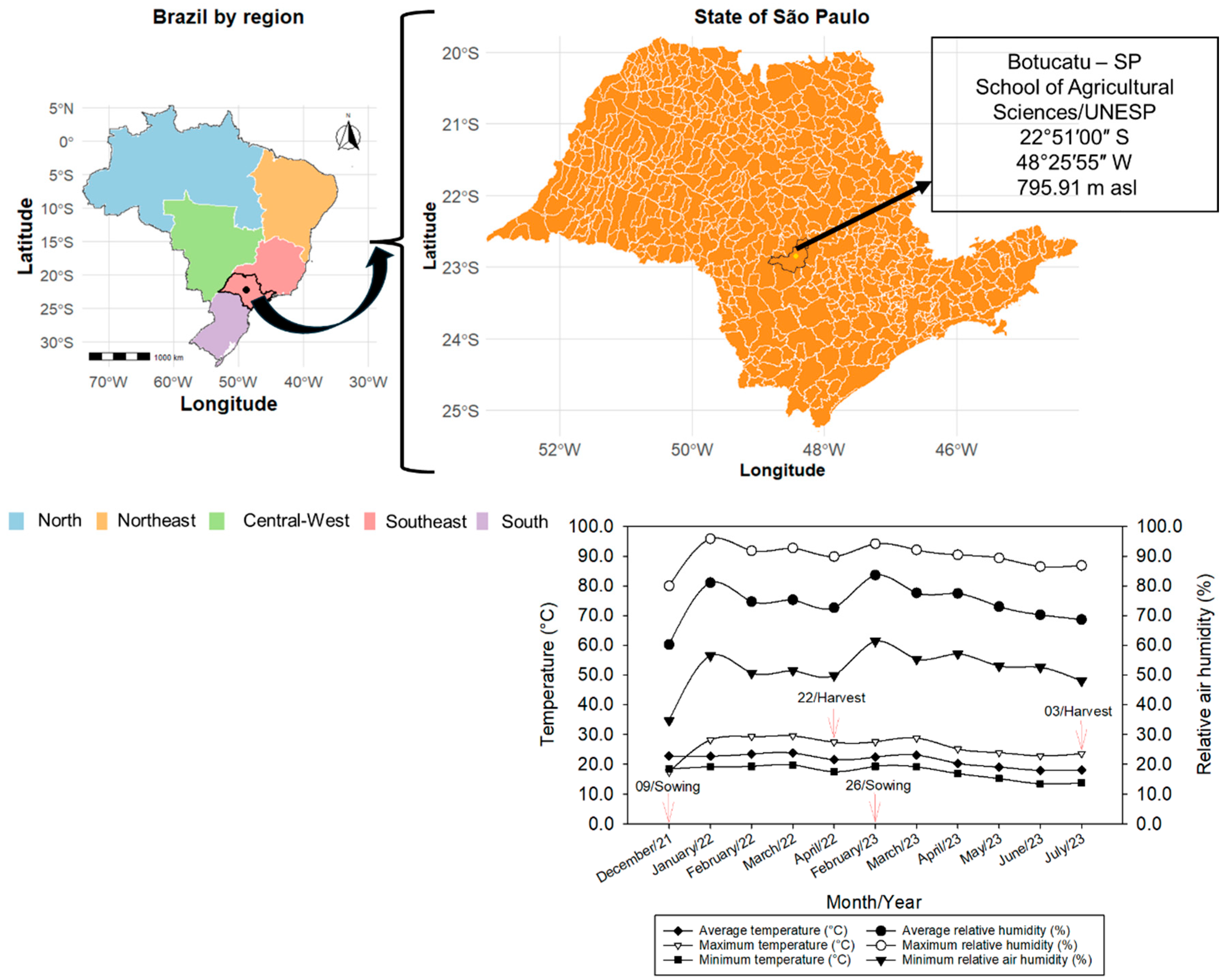
The trials were conducted in a greenhouse at the Department of Crop Production, School of Agricultural Sciences, UNESP, Botucatu, SP, Brazil, located at 22°51′00″ S, 48°25′55″ W, at 795.91 m above sea level. According to the Köppen climate classification [52], the region has hot, humid summers and cold, dry winters (Aw). During the experimental periods, the greenhouse conditions were as follows: in the 2021/22 season, we employed minimum and maximum temperatures of 13.0 ± 5.4 °C and 26.3 ± 8.5 °C, respectively, with an average relative humidity (RH) of 72.8 ± 15.9%; in the 2022/23 season, we employed minimum and maximum temperatures of 16.2 ± 6.5 °C and 25.2 ± 5.1 °C, respectively, and an RH of 75.1 ± 12.4% (Figure 1).

2.2. Soil Characteristics

The soil used was collected from an area of the experimental farm at the School of Agricultural Sciences, UNESP. Soil fertility was characterized at the beginning of each cropping season. In 2021/22, the soil contained 211.01 g kg−1 clay, 20.13 g kg−1 silt, and 769.45 g kg−1 sand, and was classified as a medium-textured Aluminic Red Latosol. In 2022/23, it contained 185.75 g kg−1 clay, 66.73 g kg−1 silt, and 747.52 g kg−1 sand. Granulometric analyses were performed on the 0.00–0.20 m soil layer before trial setup [53].
The chemical properties of the soil in 2021/22 were as follows: pH (CaCl2) = 4.4; cation exchange capacity (CEC) = 35 mmolc dm−3; sum of bases (SB) = 5 mmolc dm−3; base saturation (V%) = 13%; organic matter (O.M.) = 12 g dm−3; H + Al = 31 mmolc dm−3; Al3+ = 2 mmolc dm−3; P (resin) = 12 mg dm−3; exchangeable K = 1.1 mmolc dm−3; Ca = 2.0 mmolc dm−3; S = 13 mmolc dm−3; Mg = 2.0 mmolc dm−3; Zn (DTPA) = 1.0 mg dm−3; Cu (DTPA) = 2.0 mg dm−3; Mn (DTPA) = 8.9 mg dm−3; Fe (DTPA) = 28 mg dm−3; and B (hot water) = 0.2 mg dm−3. In 2022/23, the soil had: pH (CaCl2) = 5.19; CEC = 63.93 mmolc dm−3; SB = 40.39 mmolc dm−3; V% = 63.2%; O.M. = 31.5 g dm−3; H + Al = 23.54 mmolc dm−3; Al3+ = 0.0 mmolc dm−3; P (resin) = 8.67 mg dm−3; exchangeable K = 1.46 mmolc dm−3; Ca = 32.15 mmolc dm−3; S = 4.48 mmolc dm−3; Mg = 6.78 mmolc dm−3; Zn (DTPA) = 1.53 mg dm−3; Cu (DTPA) = 1.89 mg dm−3; Mn (DTPA) = 4.77 mg dm−3; Fe (DTPA) = 120.42 mg dm−3; and B (hot water) = 0.25 mg dm−3 [54].

2.3. Experimental Design, Treatments, and Agronomic Management

The experiment was carried out using a completely randomized factorial design (2 × 4), combining two inoculation treatments (absence or presence of Bacillus amyloliquefaciens BV03, Ba) and four phosphorus sources [control without P (–P), triple superphosphate (TSP, 42% P2O5), Bayóvar natural phosphate (BNP, 25% P2O5), and Pratápolis natural phosphate (PNP, 12% P2O5)], with four replicates in duplicate, totaling 64 experimental units. Seed treatment was performed using the B. amyloliquefaciens BV03 biological product at a concentration of 3.0 × 10⁹ CFU mL−1, marketed as NO-NEMA and registered with MAPA (Brazilian Ministry of Agriculture, Livestock, and Supply) under number 34518BV03. The product is recommended for seed or foliar application at 4 mL per kg of seed, in accordance with commercial guidelines (Vittia, São Joaquim da Barra, SP, Brazil). This inoculant exhibits microbiological nematicidal and fungicidal activity, high spatial and nutritional competitiveness in soil, and promotes plant protection through root biofilm formation and the production of secondary metabolites.
Fertilization was performed according to soil chemical analysis and recommendations for corn cultivation (Bulletin 100) [55], with nitrogen and potassium applied in split doses; topdressing was performed 24 days after sowing (DAS), when plants had five fully expanded leaves. The recommended rates of N, P, and K at sowing for the 2021/22 and 2022/23 seasons were 90/120 kg ha−1 N, 70/120 kg ha−1 P2O5, and 70/100 kg ha−1 K2O, respectively (Table 1).
The study used 21 dm3 pots (30.2 cm in height, with upper and lower diameters of 34.9 and 27.8 cm, respectively, and a surface area of 0.307 m2), filled with 20 dm3 of soil. Sowing was carried out on 9 December 2021 and 26 February 2023, using four seeds per pot of the B2401PWU hybrid. B2401PWU is a super-early hybrid produced by Brevant® (Avaré, SP, Brazil) Seeds, suitable for both grain and silage production and characterized by excellent root quality. It is recommended for cultivation during both the summer and off-season periods and is considered a good option for rainfed systems due to its high yield potential and good leaf and stem health.
After germination, thinning was carried out, leaving one plant per pot. Harvesting occurred at physiological maturity (R6), 127 DAS, on 22 April 2022, and 3 July 2023. Localized drip irrigation was used, and pest and disease management followed the crop’s requirements as proposed by [56,57].

2.4. Evaluations

2.4.1. Biometrics

At the V10 (ten fully developed leaves) and R1 (silking and pollination) phenological stages, plant height, stem diameter, and leaf area were assessed. Plant height was measured from the plant base to the collar of the first fully expanded leaf using a graduated tape (IRWIN®, 5 m, Niterói, RJ, Brazil). Fully expanded green leaves were counted. Leaf area was determined on the third fully expanded leaf (leaf + 3) from the apex toward the base by measuring the maximum width (middle third) and the length of the leaf blade, following the methodology described by [58]. Stem diameter was measured at the middle third of the first internode using a digital caliper (MeterMall, 150 mm, 0.1 mm precision, Marysville, OH, USA).

2.4.2. Physiological Assessments

At R1, chlorophyll a fluorescence parameters were measured, including the effective photochemical efficiency of photosystem II (PSII) (Fv’/Fm’), effective quantum yield of PSII (ΦPSII), electron transport rate (ETR), photochemical quenching (qP), and non-photochemical quenching (qN). Gas exchange measurements included net CO2 assimilation rate (A), stomatal conductance (gs), transpiration rate (E), and intercellular CO2 concentration (Ci). Water use efficiency (WUE) was calculated as A/E, and carboxylation efficiency (CE) as A/Ci.
Fluorescence and gas exchange measurements were performed on the first leaf below the flag leaf (+1) using an infrared gas analyzer (LI-COR Biosciences, LI-6400XT, Lincoln, NE, USA). Gas exchange assessments were conducted between 8:30 and 12:00 h under constant photosynthetically active radiation (PAR) of 1,500 μmol photons m−2 s−1, ambient CO2 concentration (~420 ppm), and ambient temperature and humidity (Figure 1).
Fluorescence variables were assessed using a 6400-40 leaf chamber fluorometer coupled to the IRGA LI-6400XT (LI-COR Biosciences, LI-6400XT, Lincoln, NE, USA). Maximum fluorescence (Fm′) was determined with a saturation pulse of 7,000 μmol photons m−2 s−1 for 0.8 s, while actinic light was set at 200 μmol photons m−2 s−1.

2.4.3. Photosynthetic Pigments

Chlorophyll a (Chl a), chlorophyll b (Chl b), and carotenoid contents were determined at R1 from three leaf discs (0.28 cm2 each) collected with a punch. Discs were immersed in dimethylformamide in the dark for 24 h. A 1:1 dilution of the extract in deionized water was prepared, and absorbance was measured at 480, 647, and 664 nm using a spectrophotometer (Shimadzu UV–2700, Kyoto, Japan). Pigment concentrations were calculated following [59].

2.4.4. Leaf Nutritional Diagnosis

At R1, the middle third of the leaf below and opposite the ear was collected, excluding the midrib, according to [60]. Samples were dried in a forced-air oven at 60 °C (FANEM, 330, São Paulo, SP, Brazil) until constant weight, then ground in a Willey mill (Marconi, MA 340, Piracicaba, SP, Brazil). Nitrogen (N) was extracted by sulfuric digestion and determined by the Kjeldahl method. Potassium (K), calcium (Ca), magnesium (Mg), sulfur (S), phosphorus (P), iron (Fe), zinc (Zn), manganese (Mn), boron (B), and copper (Cu) were extracted by nitroperchloric digestion [61]. Sulfur, P, and B were quantified by spectrophotometry, whereas K, Ca, Mg, Fe, Zn, Mn, and Cu were determined using atomic absorption spectrophotometry [62,63].

2.4.5. Plant Biomass and Yield

Shoot dry matter (SDM) and root dry matter (RDM) were collected at physiological maturity (R6). The shoot comprised the stem, leaf sheath, leaves, tassel, straw, and cob, excluding the grains. Roots were carefully separated from the soil and washed. Plant materials (roots and shoots) were dried in a forced-air circulation oven (FANEM, 330, São Paulo, SP, Brazil) at 65 °C until constant weight was reached. Samples were weighed separately using a precision balance (Balmak, ELC-6/15/30, Santa Bárbara do Oeste, SP, Brazil) to determine SDM and RDM in grams. The shoot-to-root dry matter ratio (SDM/RDM) was then calculated.
Grain yield was determined as the mass of grains per plant. Ears were manually harvested from each experimental unit, threshed, and separated from straw and cobs. Grains were weighed on a precision scale and expressed in grams per plant, adjusted to 13% moisture according to the Rules for Seed Analysis (RAS) [64].

2.5. Statistical Analysis

Data were first tested for homogeneity of variances using Bartlett’s test and for normality of residuals using the Shapiro–Wilk test at a 5% significance level in R software version 4.2.1 [65], with the ExpDes.pt package version 1.2.2 [66]. Spearman’s rank correlation and Principal Component Analysis (PCA) were also performed using the same software.
The variables used in the Spearman correlation and PCA included: plant height, stem diameter, total leaf area, effective photochemical efficiency of PSII (ΦPSII), effective quantum yield of PSII (Fv’/Fm’), electron transport rate (ETR), photochemical quenching (qP), non-photochemical quenching (qN), leaf vapor pressure deficit (VpdL), net CO2 assimilation (A), transpiration rate (E), stomatal conductance (gs), intercellular CO2 concentration (Ci), instantaneous water-use efficiency (WUE), intrinsic carboxylation efficiency (CE), chlorophyll a (Chl a), chlorophyll b (Chl b), carotenoids (Car), shoot dry matter (SDM), root dry matter (RDM), and leaf contents of N, P, K, Ca, Mg, S, B, Cu, Fe, Mn, and Zn. All variables were evaluated at the V10 (ten fully developed leaves), R1 (silking), and R6 (physiological maturity) phenological stages.
After verifying that the assumptions were met, the data were subjected to two-way ANOVA (F-test), and means were compared using Tukey’s test at p < 0.05 in AgroEstat software version 1.0 [67]. Figures were prepared using SigmaPlot version 14.0 [68] (San Jose, CA, USA).

3. Results

3.1. Impact of Bacillus amyloliquefaciens Inoculation and Phosphorus Sources on Corn Morphological Parameters

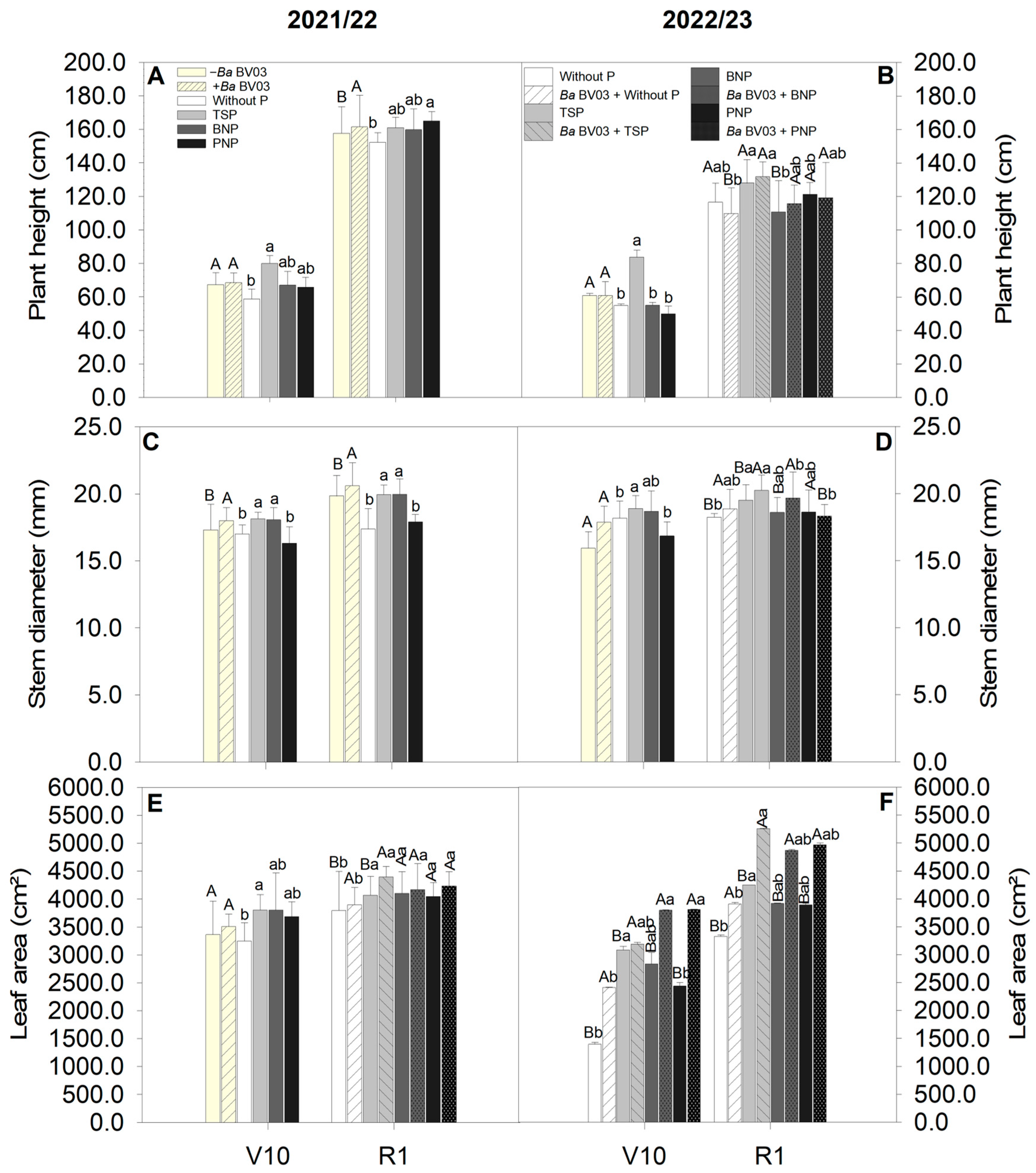
In the 2021/22 crop season, at the V10 stage, isolated effects of the evaluated factors were observed. Plant height reached 68.43 cm with Bacillus amyloliquefaciens BV03 (Ba) inoculation, compared with 67.26 cm without inoculation. Among the P sources, the TSP promoted the greatest plant height (79.95 cm), representing a 36.2% increase over the control (Figure 2A). At the R1 stage, the overall mean plant height was 159.53 ± 5.87 cm. Inoculated plants reached 161.42 cm, while non-inoculated ones reached 157.64 cm, corresponding to a 2.3% reduction. The PNP source produced the tallest plants (165.10 cm), exceeding the control (–P) by 8.5% (152.21 cm) (Figure 2A).
In 2022/23, TSP promoted the highest plant height at V10 (83.75 cm), whereas the control produced shorter plants (54.87 cm) (Figure 2B). At the R1 stage, a significant interaction between P sources and inoculation was observed. The Ba + TSP combination produced the tallest plants (131.75 cm), while for BNP, inoculation increased height by 4.5% (Figure 2B).
In the 2021/22 season, corn seeds treated with Ba produced stems with a diameter of 18.00 mm at the V10 stage, compared with 17.31 mm for non-inoculated plants. Among P sources, BNP and TSP promoted the largest diameters (18.16 mm and 18.13 mm, respectively), surpassing the control (17.01 mm) (Figure 2C). At R1, Ba inoculation increased the mean stem diameter to 20.59 mm, compared with 19.83 mm in untreated plants. The BNP source produced the thickest stems (19.96 mm), followed by TSP (19.91 mm), resulting in an average increase of 11.4% compared with the control (–P) (Figure 2C).
In 2022/23, TSP again recorded the largest stem diameter at V10 (18.89 mm), whereas PNP recorded the smallest (16.84 mm), corresponding to a 23.1% reduction (Figure 2D). At the R1 stage, Ba inoculation without P addition and Ba + TSP produced the largest diameters (18.85 mm and 20.23 mm, respectively), greater than their non-inoculated counterparts (18.23 mm and 19.50 mm). Inoculation increased BNP stem diameter from 18.60 mm to 19.67 mm (Figure 2D).
At V10, in 2021/22, the mean leaf area of Ba-inoculated plants was 3785.64 ± 208.77 cm2. Significant effects were observed only for P sources, with TSP producing the largest leaf area (3800.54 cm2), a 16.9% increase compared with the control (Figure 2E). At R1, a significant interaction between P sources and Ba inoculation was found, with an overall mean of 4075.92 ± 196.06 cm2. Combining Ba with the control (–P) produced a total leaf area of 3898.29 cm2, whereas the non-inoculated control reached 3793.72 cm2, a 14.9% variation. Inoculation increased leaf area for TSP by 16.9% (Figure 2E).
In 2022/23, the leaf areas of inoculated plants were 2413.37 cm2 (control –P), 3189.52 cm2 (TSP), 3796.69 cm2 (BNP), and 3810.43 cm2 (PNP) at V10, compared with 1394.43, 3082.38, 2831.08, and 2437.08 cm2 for the corresponding non-inoculated treatments (Figure 2F). At R1, the combinations of Ba with control (–P), BNP, and PNP resulted in leaf areas of 3907.62, 4867.39, and 4967.89 cm2, respectively, all higher than the same treatments without inoculation. For TSP, inoculation increased leaf area by 30.2% (Figure 2F).

3.2. Impact of Bacillus amyloliquefaciens Inoculation and Phosphorus Sources on Corn Physiology

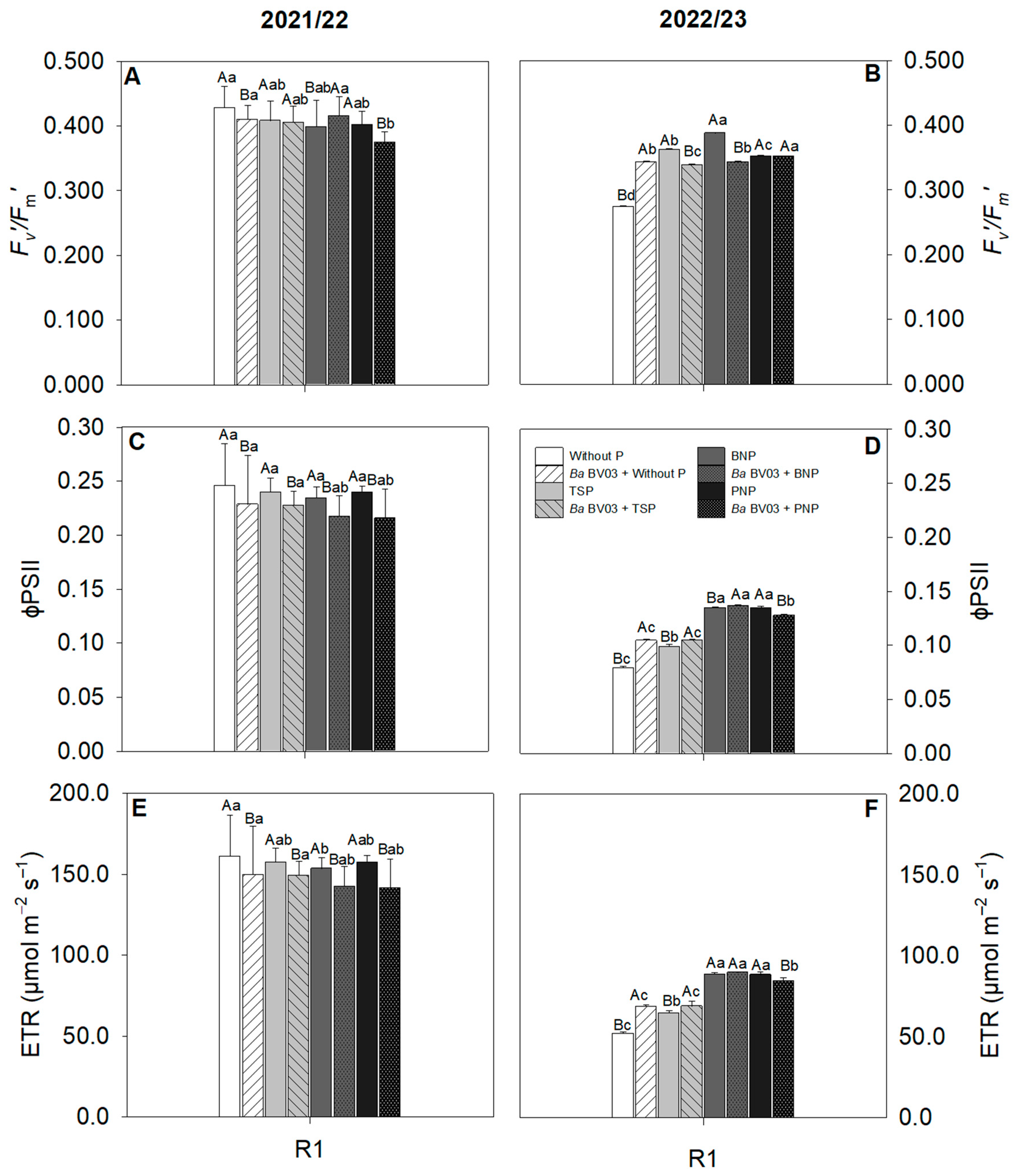
In the 2021/22 season, the combination Ba + BNP resulted in the highest Fv’/Fm’ value (0.415) at the R1 stage, representing a 4.1% increase compared with BNP without Ba (0.399) (Figure 3A). In the 2022/23 season, Ba inoculation without P addition resulted in an average Fv’/Fm’ of 0.343, while the absence of Ba (control) led to a 20.1% reduction in this variable (Figure 3B).
In 2021/22, plants without Ba inoculation exhibited higher ΦPSII values than those inoculated with Ba, with averages of 0.245 (control), 0.239 (TSP), 0.234 (BNP), and 0.239 (PNP). In contrast, inoculated plants showed values of 0.228, 0.227, 0.217, and 0.216, respectively (Figure 3C). In 2022/23, inoculated plants without P addition and those combined with TSP and BNP exhibited higher ΦPSII values than the corresponding non-inoculated treatments: 0.104, 0.104, and 0.136 versus 0.079, 0.099, and 0.134, respectively (Figure 3D).
Regarding the ETR, in 2021/22, non-inoculated plants (control, TSP, BNP, and PNP) showed higher values, averaging 161.16, 157.30, 153.58, and 157.36 µmol m−2 s−1, respectively. Inoculation with Ba reduced ETR by 7.0%, 5.2%, 7.2%, and 10.0% for the control, TSP, BNP, and PNP treatments, respectively (Figure 3E). Conversely, in 2022/23, Ba-inoculated plants exhibited the highest ETR values under treatments without P (68.74 µmol m−2 s−1), TSP (69.01 µmol m−2 s−1), and BNP (89.67 µmol m−2 s−1), corresponding to increases of 32.3%, 6.7%, and 1.1% compared with their respective non-inoculated controls (Figure 3F).
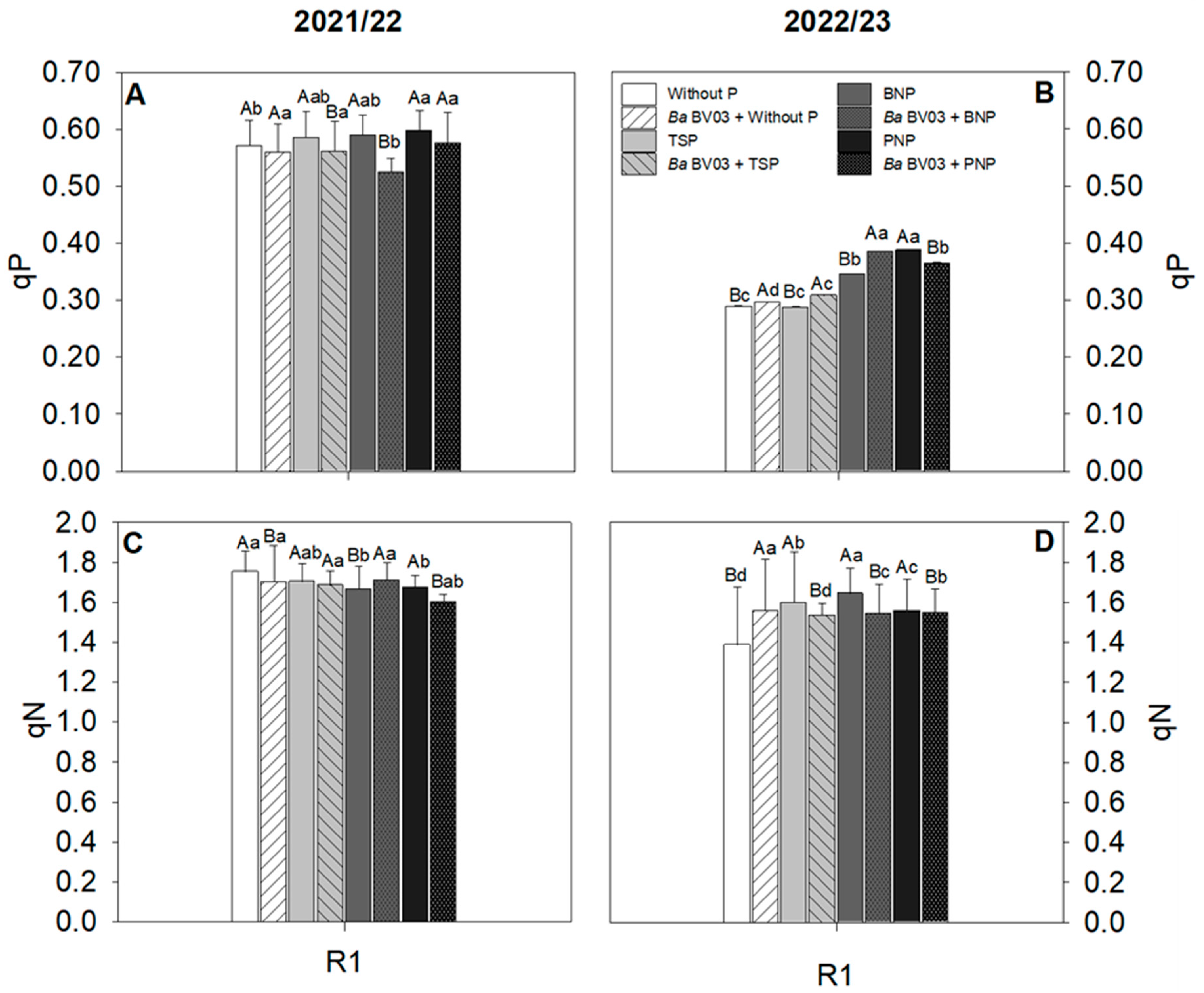
In 2022/23, inoculation with Ba in the control (–P) resulted in an average of 0.296, 2.5% higher than the non-inoculated control (0.289). Similarly, inoculation with Ba increased ΦPSII by 7.8% in the TSP treatment. Under the BNP source, Ba inoculation raised ΦPSII from 0.345 to 0.384, representing an 11.2% increase (Figure 4B).
Regarding qN, in the 2021/22 season, the Ba + BNP combination promoted a 1.24% increase compared with the treatment without Ba (1.667) (Figure 4C). In the 2022/23 season, Ba + control (–P) resulted in a 12.2% increase in qN (1.557) compared with the non-inoculated control (1.387) (Figure 4D).
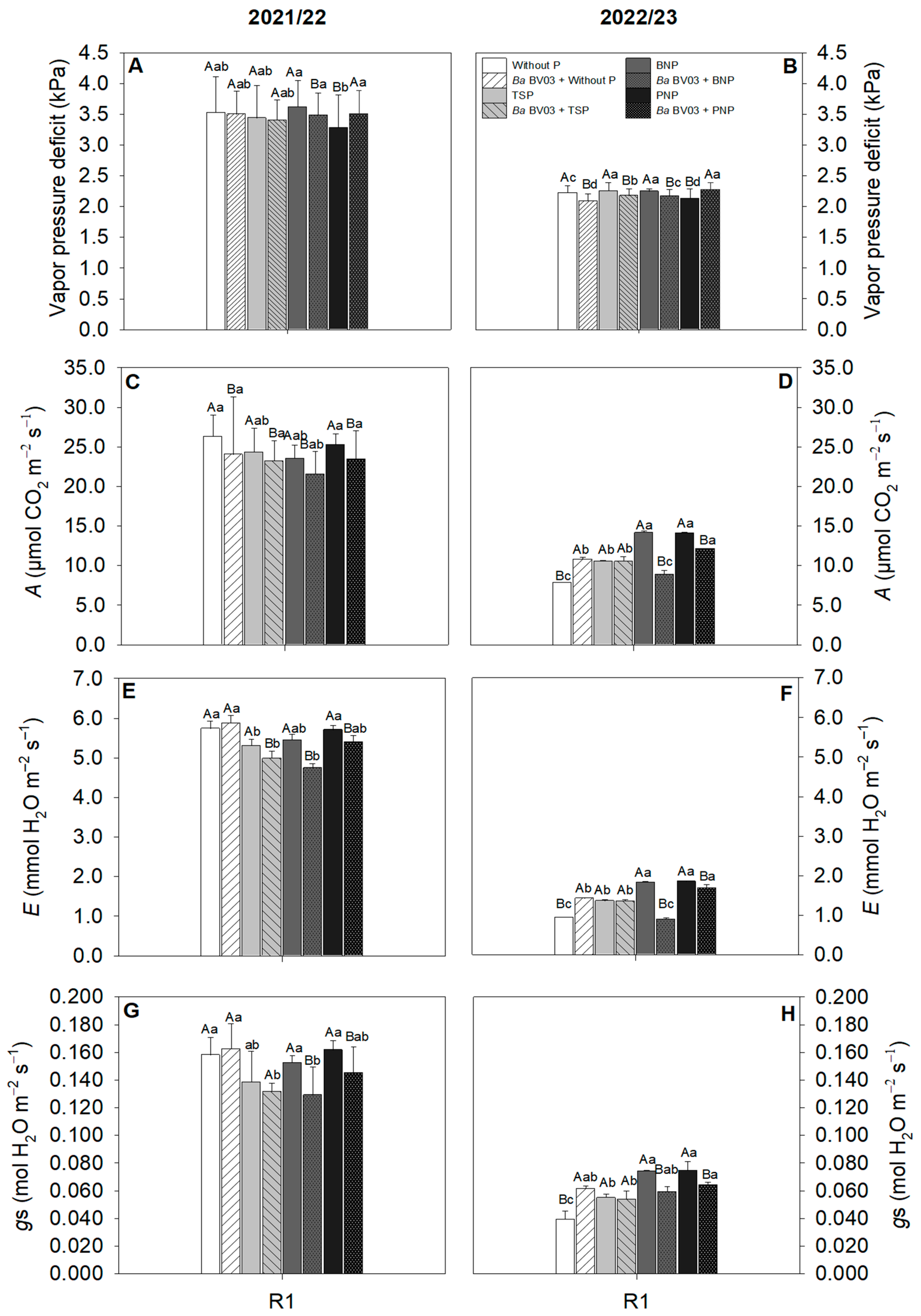
Ba + PNP provided the highest VpdL (3.50 kPa) in the 2021/22 season, whereas the treatment without Ba showed 3.28 kPa, representing an increase of approximately 6.7% (Figure 5A). In 2022/23, Ba + PNP also exhibited the highest average VpdL (2.27 kPa), while the lowest value was observed for PNP (2.13 kPa), corresponding to a 6.8% variation (Figure 5B).
In the 2021/22 season, inoculation with Ba reduced the A by 8.5%, 3.7%, 7.9%, and 7.4% in the control, TSP, BNP, and PNP, respectively, resulting in averages of 26.57, 24.35, 23.45, and 25.50 µmol CO2 m−2 s−1 (Figure 5C). In contrast, during the 2022/23 season, Ba + control recorded 10.79 µmol CO2 m−2 s−1, while the control without Ba reached 7.81 µmol CO2 m−2 s−1, an increase of 38.1%. However, the highest CO2 assimilation rates were observed in the BNP and PNP treatments (14.17 and 14.12 µmol CO2 m−2 s−1, respectively), compared with 8.88 and 12.13 µmol CO2 m−2 s−1 for Ba + BNP and Ba + PNP, representing reductions of 37.4% and 14.1%, respectively (Figure 5D).
In 2021/22, the highest E were observed in Ba without P and Ba + PNP, with averages of 5.87 and 5.60 mmol H2O m−2 s−1, respectively. Among the non-inoculated treatments, the control and PNP reached 5.49 and 5.35 mmol H2O m−2 s−1, respectively (Figure 5E). In the 2022/23 season, Ba inoculation promoted a 51.9% increase in E, with an average of 1.42 mmol H2O m−2 s−1 compared with 0.936 mmol H2O m−2 s−1 in the control without Ba (Figure 5F).
At the R1 stage in 2021/22, the highest gs values were observed in plants without Ba under BNP and PNP (0.152 and 0.166 mol H2O m−2 s−1, respectively), whereas the same treatments with Ba showed lower values (0.127 and 0.145 mol H2O m−2 s−1), corresponding to reductions of 16.9% and 12.7% (Figure 5G). In 2022/23, Ba + control increased gs to 0.061 mol H2O m−2 s−1, compared with 0.039 mol H2O m−2 s−1 in the control without Ba, an increase of 56.9% (Figure 5H).
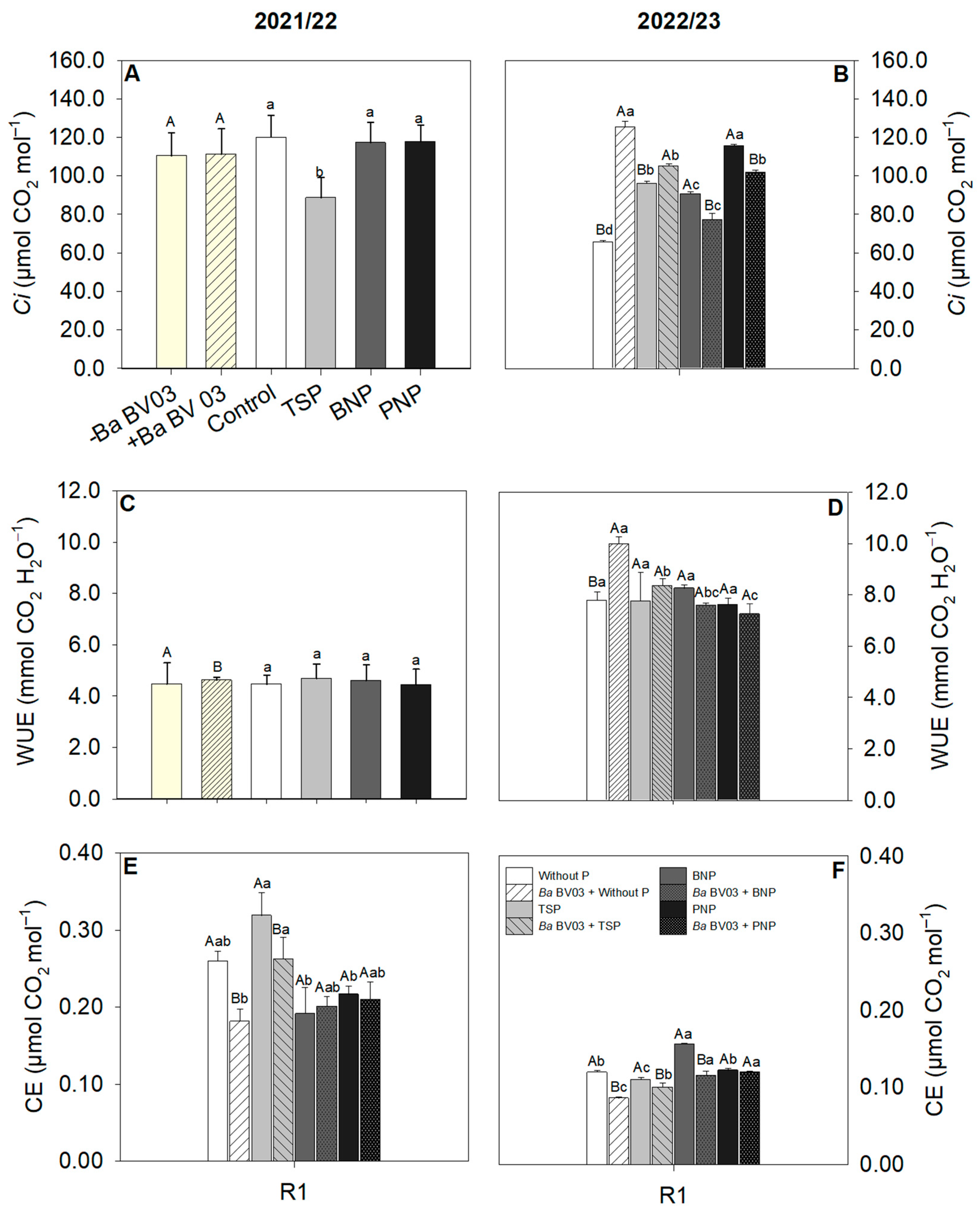
Among the P sources, the control recorded 119.90 µmol CO2 mol−1, which was statistically similar to PNP (117.43 µmol CO2 mol−1) and BNP (117.10 µmol CO2 mol−1) (Figure 6A). In the 2022/23 season, Ba inoculation resulted in a Ci of 125.22 µmol CO2 mol−1, while the control without Ba showed 65.48 µmol CO2 mol−1, representing a 47.7% reduction. The Ba + TSP treatment increased Ci (104.93 µmol CO2 mol−1) compared with TSP without Ba (95.89 µmol CO2 mol−1), an increase of 9.4%. Conversely, Ba + BNP and Ba + PNP exhibited lower Ci values (77.21 and 101.70 µmol CO2 mol−1, respectively) compared with BNP and PNP without Ba (90.63 and 115.58 µmol CO2 mol−1), corresponding to decreases of 17.4% and 13.6%, respectively (Figure 6B).
Inoculation with Ba slightly increased WUE in 2021/22, with an average of 4.61 compared with 4.45 in non-inoculated plants, an increase of approximately 3.6%. In the 2022/23 season, Ba + control and Ba + TSP exhibited WUE values of 9.97 and 8.34 mmol CO2 H2O−1, respectively, representing reductions of 7.8% and 7.7% relative to their respective treatments without Ba (Figure 6D).
In 2021/22, the control treatment had a CE of 0.255, which decreased to 0.183 with Ba inoculation, a 28.3% reduction. Similarly, Ba + TSP resulted in a 15.9% decrease compared with TSP alone (from 0.319 to 0.268 µmol CO2 mol−1), while Ba + PNP reduced CE by 6.1% compared with PNP (from 0.216 to 0.203 µmol CO2 mol−1) (Figure 6E). In 2022/23, the highest CE values were observed for Ba + BNP and BNP (0.115 and 0.119 µmol CO2 mol−1, respectively), surpassing the control (0.086 µmol CO2 mol−1) and TSP (0.100 µmol CO2 mol−1). BNP alone also exceeded the control, with values of 0.156 and 0.119, respectively (Figure 6F).
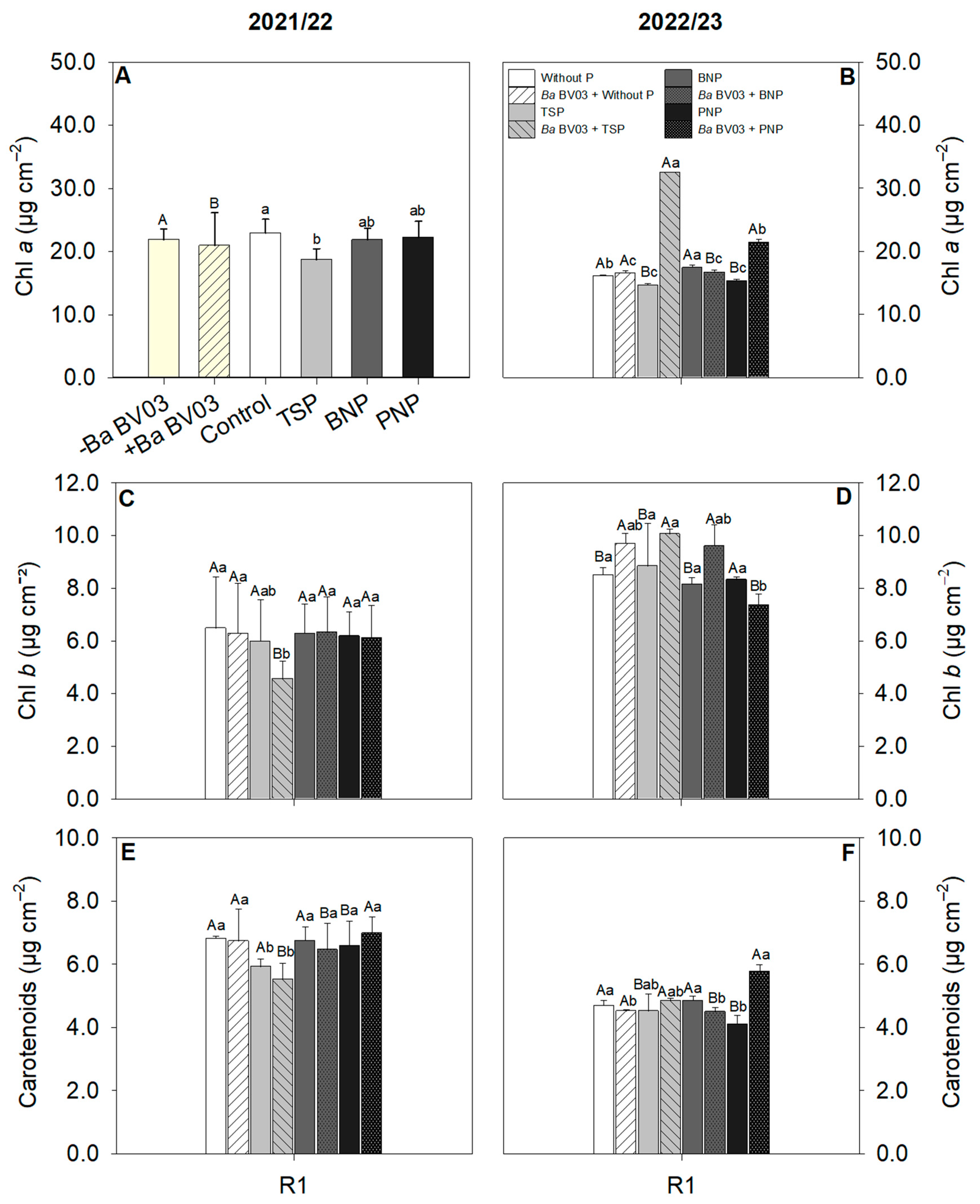
In the 2021/22 crop season, the isolated factors influenced Chl a concentration. Plants without Ba showed an average of 21.89 µg cm−2, whereas Ba inoculation reduced it to 20.93 µg cm−2. Among the P sources, the control exhibited the highest Chl a concentration (22.90 µg cm−2), exceeding TSP (18.68 µg cm−2) (Figure 7A). In the 2022/23 crop season, Ba + TSP and Ba + PNP reached 32.44 µg cm−2 and 21.35 µg cm−2, representing increases of 95.9% and 28.9%, respectively, compared with the overall mean (18.80 µg cm−2). BNP achieved 17.40 µg cm−2, higher than the control (16.12 µg cm−2), TSP (14.64 µg cm−2), and PNP (15.25 µg cm−2).
In 2022/23, the highest Chl b concentrations were recorded in Ba + control, Ba + TSP, and Ba + BNP treatments, with 9.68, 10.06, and 9.60 µg cm−2, respectively (Figure 7D).
In 2021/22, Ba + PNP resulted in the highest carotenoid concentration (6.98 µg cm−2), a 6.1% increase compared with PNP alone (6.58 µg cm−2) (Figure 7E). In 2022/23, Ba + PNP promoted a 40.5% increase compared with PNP, while Ba + TSP increased carotenoid content by 7.1% compared with TSP (Figure 7F).

3.3. Nutrient Content of Corn Leaves

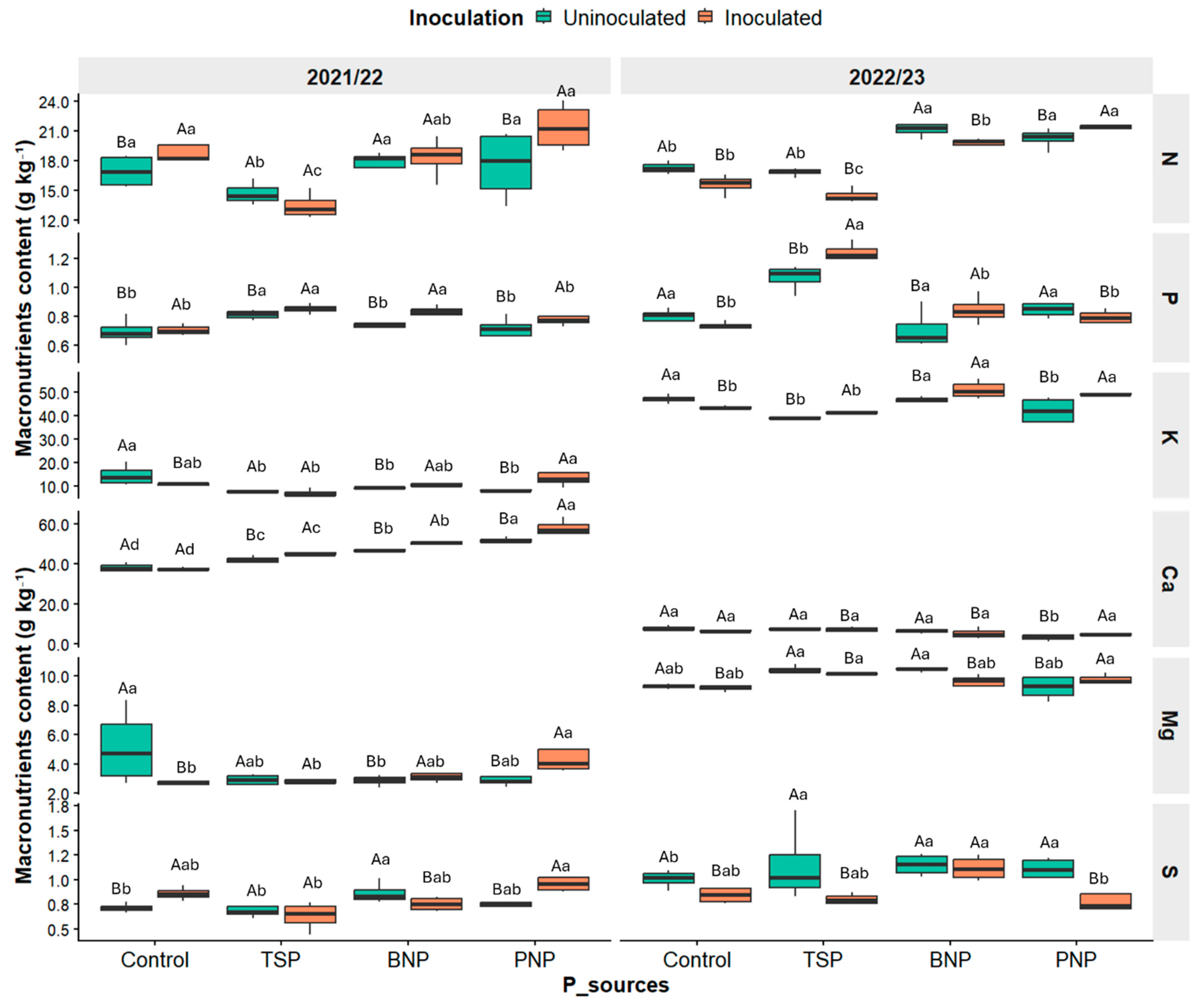
In the 2021/22 crop season, inoculation with Ba + PNP resulted in 21.82 g N kg−1, representing a 62.6% increase compared with PNP (13.42 g kg−1), while Ba + control reached 19.38 g N kg−1, an increase of 14.2% compared with the control (16.92 g kg−1) (Figure 8). In 2022/23, Ba + PNP again exhibited the highest N content (21.25 g kg−1) compared with PNP (20.21 g kg−1), a 5.1% increase (Figure 8).
Phosphorus content was enhanced by Ba inoculation in 2021/22 for all treatments: control (0.70 vs. 0.69), TSP (0.85 vs. 0.80), BNP (0.82 vs. 0.72), and PNP (0.78 vs. 0.68) (Figure 8). In 2022/23, the highest P contents were observed in Ba + TSP (1.24) and Ba + BNP (0.84), representing increases of 20% and 20% compared with TSP (1.06) and BNP (0.70), respectively (Figure 8).
Potassium levels were increased by Ba in 2021/22 when combined with BNP (7.85 vs. 7.43 g kg−1) and PNP (14.27 vs. 6.66 g kg−1), corresponding to increases of 5.6% and 114.3%, respectively (Figure 8). In 2022/23, the highest K contents were observed in Ba + TSP (40.90 g kg−1), Ba + BNP (50.91 g kg−1), and Ba + PNP (49.09 g kg−1), representing increases of 18.1%, 14.6%, and 13.9%, respectively, compared with the control (43.10 g kg−1).
Calcium levels were also improved by Ba inoculation in 2021/22, with increases of 28.0%, 23.5%, and 34.1% in PNP (57.91 g kg−1), BNP (51.58 g kg−1), and TSP (50.23 g kg−1), respectively, compared with the same treatments without Ba (Figure 8). In 2022/23, Ba + PNP reached 49.01 g kg−1, exceeding PNP alone (32.23 g kg−1) by 52.1%.
Magnesium content was enhanced by Ba inoculation in 2021/22 for BNP and PNP, with increases of 8.4% and 53.8%, respectively, compared to treatments without Ba (Figure 8). In 2022/23, Ba + PNP showed 9.75 g kg−1 Mg, higher than PNP alone (9.20 g kg−1), representing a 7.0% increase.
Finally, S content in 2021/22 was higher under Ba + PNP (0.95 g kg−1) compared with PNP alone (0.63 g kg−1), and in Ba + control (0.86 g kg−1) compared with the control (0.71 g kg−1) (Figure 8).
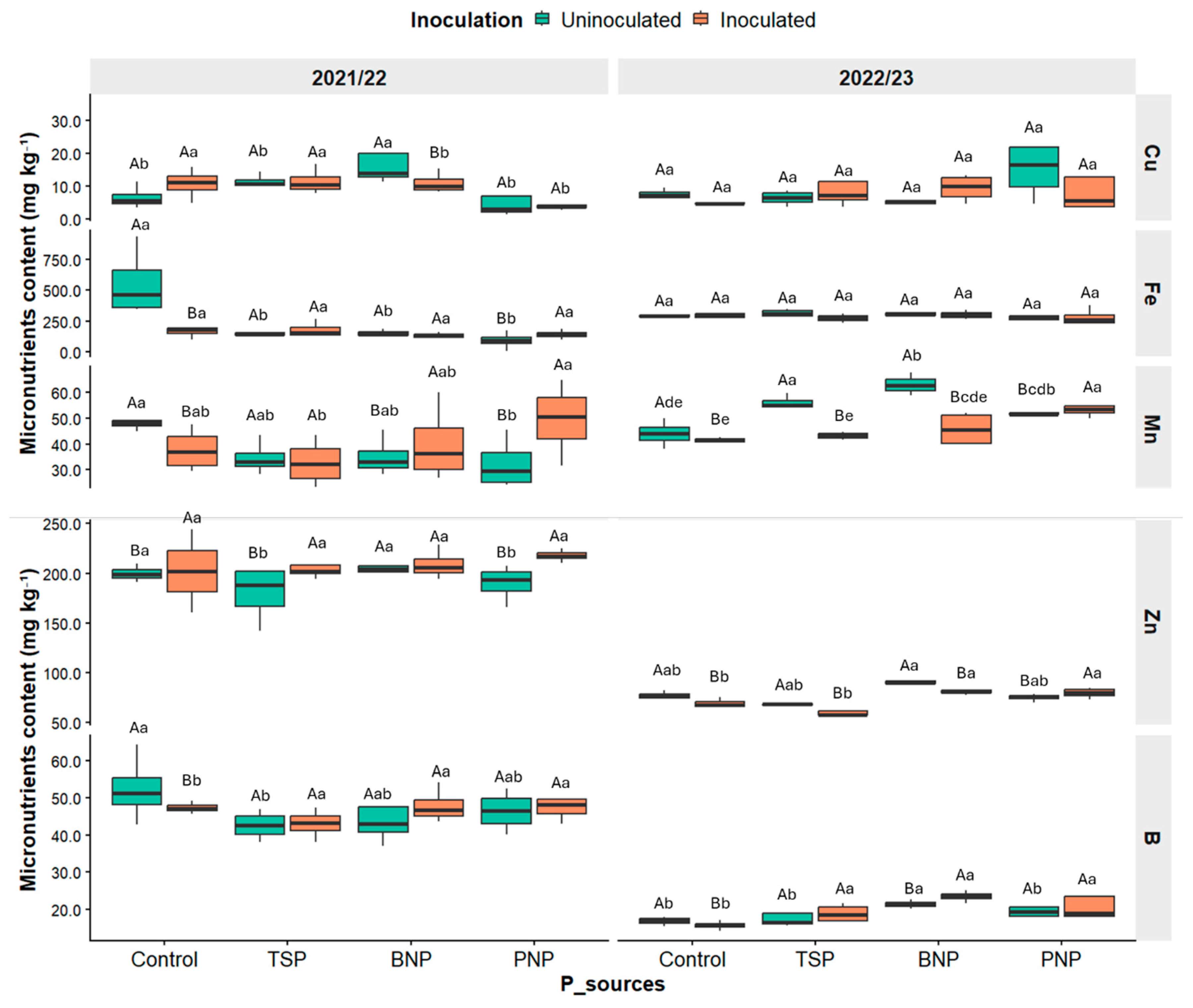
In 2021/22, Fe concentrations increased with Ba + TSP and Ba + PNP, reaching 177.37 and 142.53 mg kg−1, respectively, compared with 144.79 and 92.30 mg kg−1 in TSP and PNP without inoculation. In 2022/23, Ba + BNP increased B content to 23.25 mg kg−1, compared to 21.33 mg kg−1 without Ba (Figure 9).
Manganese levels were elevated in 2021/22 when Ba was combined with BNP (39.79 mg kg−1) and PNP (49.51 mg kg−1), corresponding to increases of 13.8% and 53.5% compared with BNP (34.97 mg kg−1) and PNP (32.21 mg kg−1), respectively (Figure 9). In 2022/23, only the Ba + PNP combination slightly increased Mn content to 53.03 mg kg−1, 2.1% higher than PNP alone (51.91 mg kg−1).
Inoculation with Ba enhanced Zn concentrations when combined with the control, TSP, and PNP in 2021/22. The highest Zn content was observed in Ba + PNP (217.73 mg kg−1), representing a 6.5% increase over PNP alone. Ba + TSP and Ba + control also promoted increases to 208.45 and 204.50 mg kg−1, compared to 201.53 and 199.95 mg kg−1 in TSP and the control, respectively. In 2022/23, only Ba + PNP increased Zn content (79.57 mg kg−1), 6.2% higher than PNP alone (Figure 9).

3.4. Impact of Bacillus amyloliquefaciens Inoculation and Phosphorus Sources on Corn Biomass and Yield

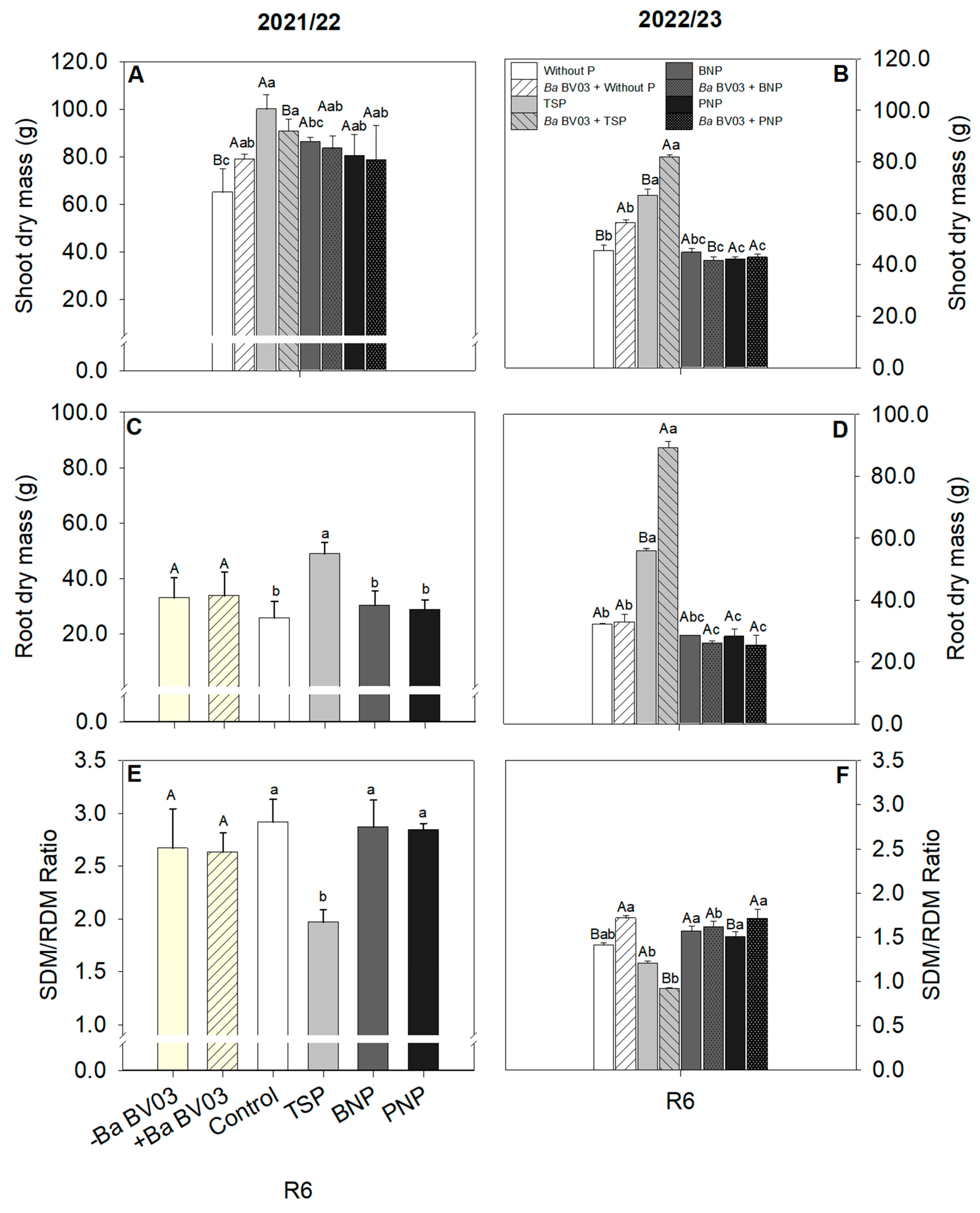
In the 2021/22 crop season, inoculation with Ba increased SDB from 65.08 g to 78.87 g plant−1, representing a 21.2% increase (Figure 10A). In 2022/23, Ba + control (56.29 g) and Ba + TSP (81.75 g) provided increases of 24.1% and 22.2%, respectively, compared with their non-inoculated counterparts (45.34 and 66.87 g) (Figure 10B).
No effect of Ba on RDM was observed in 2021/22. However, the TSP produced 49.01 g of RDM, representing a 91.3% increase over the control (25.62 g) (Figure 10C). In 2022/23, the combination of Ba + TSP yielded 89.12 g of RDM, a 247.8% increase compared with TSP without inoculation (Figure 10D).
The SDB/RDM ratio averaged 2.65 (±0.23) in 2021/22 and 1.45 (±0.057) in 2022/23, indicating a 45.3% reduction between crop seasons. In 2021/22, no differences were observed between inoculated and non-inoculated plants, with mean ratios of 2.66 and 2.63, respectively (Figure 10E). Among P sources, the control, BNP, and PNP treatments recorded the highest ratios (2.91, 2.87, and 2.84 g, respectively), which differed from TSP (1.97 g). In the 2022/23 crop season, Ba inoculation increased the SDB/RDM ratio by 22.1% in the control and by 13.3% in the PNP treatments (Figure 10F).
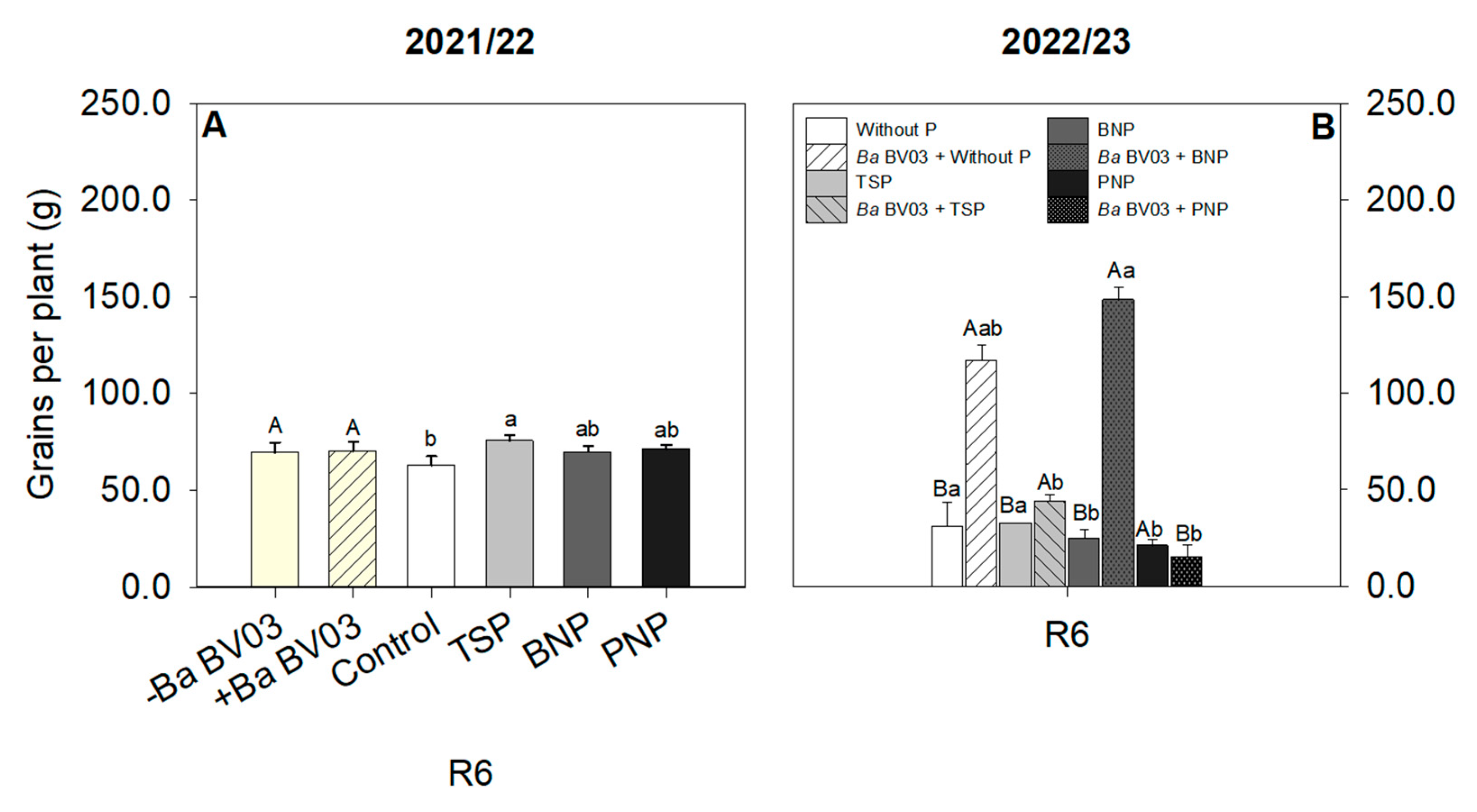
In the 2021/22 crop season, Ba inoculation did not affect grain mass per plant (Figure 11A). Among the P sources, TSP yielded the highest grain mass (75.54 g plant−1), exceeding the control (62.88 g plant−1) by 20.1%. In the 2022/23 crop season, Ba inoculation resulted in a 377% increase in grain mass per plant compared with the uninoculated control (Figure 11B). Inoculated plants also showed higher grain production when Ba was combined with BNP (148.24 g plant−1) and TSP (43.73 g plant−1), corresponding to increases of 606.8% and 134.2%, respectively, relative to their uninoculated counterparts.

3.5. Pearson’s Correlation Matrix and Principal Component Analysis (PCA)

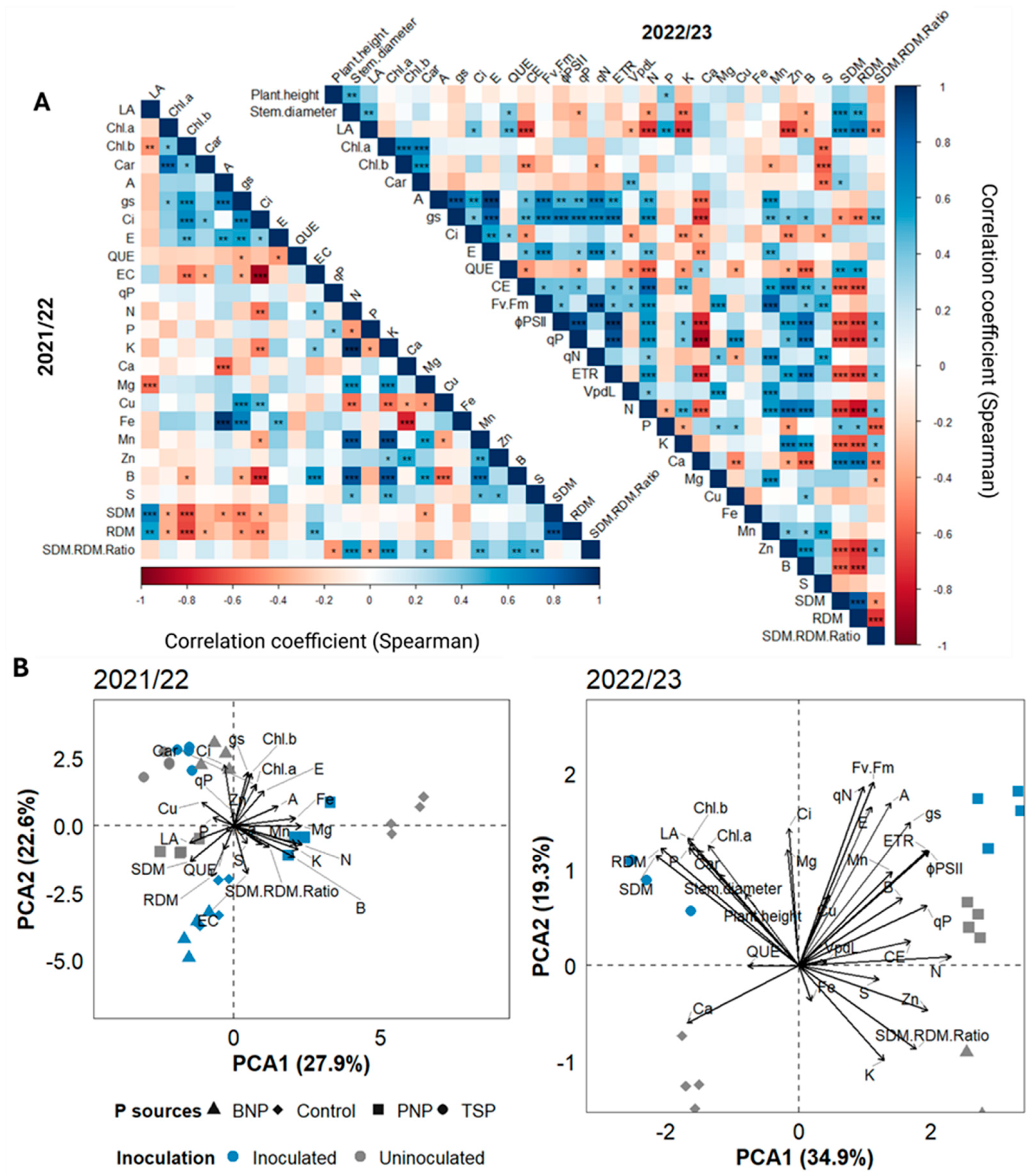
The correlation analysis revealed that, in both crop seasons, physiological variables such as A, gs, and E were positively associated with biomass production (SDM, RDM), indicating that higher gas exchange efficiency promoted greater dry matter accumulation (Figure 12A). In the 2022/23 crop season, these correlations were stronger. Also, they encompassed photochemical parameters (Fv’/Fm’, ΦPSII) and N, K, Ca, Mg, and Zn nutrient levels, suggesting that improved nutrition enhanced photosynthetic and productive performance. Conversely, in 2021/22, negative correlations were observed between biomass and micronutrients, including B, S, Fe, and Mn.
Principal component analysis (PCA) revealed distinct patterns in the distribution of treatments across crop seasons (Figure 12B). In the 2021/22 crop season, the first two axes accounted for 50.5% of the total variation, with PCA1 primarily associated with physiological (A, gs, E, WUE) and productive (SDM, RDM) variables, while PCA2 was mainly influenced by photosynthetic pigments (chlorophyll a and b, carotenoids) and micronutrients. Treatments were broadly dispersed, with no apparent clustering by P source or inoculation. In the 2022/23 crop season, the first two axes explained 54.2% of the variation, with PCA1 strongly linked to biomass (SDM, RDM, SDM/RDM), macronutrients (N, P, K, Ca, Mg), and photochemical variables (Fv’/Fm’, ΦPSII), highlighting a positive integration among physiological, nutritional, and productive traits. In this season, treatment separation along PCA1 was more pronounced, particularly for combinations of P source and inoculation, indicating a consistent influence of these practices on plant performance.

4. Discussion

4.1. Effects of Bacillus amyloliquefaciens and Phosphorus Sources on Corn Growth and Development

Inoculation with Bacillus amyloliquefaciens (Ba) effectively promoted corn growth, particularly when combined with triple superphosphate (TSP) or Bayóvar reactive phosphate (BNP), with consistent effects observed across both crop seasons. The association of Ba with these P sources increased plant height, stem diameter, and leaf area in both years. Phosphorus is crucial in crop growth and productivity, influencing key physiological processes and plant metabolism [69,70].
These findings are consistent with previous studies demonstrating the positive effects of P sources and Bacillus spp. on corn growth. Silva et al. [71] reported that TSP promoted the highest plant height, stem diameter, and shoot biomass in Brazilian tropical soils compared with alternative sources, including precipitated phosphorus and reactive phosphate rock. Similar growth-promoting effects were observed by [72] with Bacillus sp. 13B41, and by Oliveira et al. [73] with Bacillus proteolyticus (UFNB FA72A2-1), which improved several traits, including biomass accumulation, chlorophyll content, and P uptake. Under field conditions, Ferrarezi et al. [74] also confirmed that inoculation with Bacillus thuringiensis strains (RZ2MS9) increased plant height and stem diameter by up to 2.8% and 9%, respectively.
The enhanced growth observed with Ba + TSP may be attributed to this fertilizer’s higher solubility and greater P availability. The increased effects of TSP inoculation reported by [75] are consistent with findings by [76,77], who noted that inoculants are generally more effective when applied alongside fertilizers. Positive interactions between microorganisms and phosphate rocks have also been reported for corn [78,79]. Among the evaluated sources, BNP exhibited high agronomic efficiency [14], whereas Brazilian sedimentary phosphate, such as PNP, showed lower efficiency.
Bacillus amyloliquefaciens possesses multiple plant growth–promoting traits, including nitrogen fixation, phosphate solubilization, and the production of siderophores, phytohormones, and antimicrobial compounds [51]. The use of alternative P sources, such as BNP, in combination with Bacillus megaterium (B119) or Bacillus subtilis (B2084), has been shown to increase plant dry mass [75,80], underscoring the importance of integrating less-soluble P sources with phosphate-solubilizing microorganisms to enhance nutrient-use efficiency. Furthermore, microbial inoculation can improve the P availability from natural phosphates across different crops. In maize, long-term applications of natural phosphate alter the rhizosphere microbial community, favoring groups associated with P solubilization [79]. In millet, endophytic Bacillus strains have shown the potential to stimulate plant growth and nutrient uptake under low P availability [81]. Similarly, in sorghum, inoculation with phosphate-solubilizing bacteria improves the performance of genotypes grown under P-limiting conditions [82]. Therefore, combining natural phosphates with phosphate-solubilizing bacteria is a sustainable alternative to conventional fertilization practices, improving corn nutrition and reducing production costs [83].

4.2. Effects of Bacillus amyloliquefaciens Inoculation and Phosphorus Sources on Corn Physiology

Inoculation with B. amyloliquefaciens (Ba) induced physiological and biochemical adjustments in corn, as reflected in the coordinated modulation of net CO2 assimilation, water-use efficiency, and photosynthetic pigment content across P management practices involving TSP, BNP, and PNP. Consistent with plant growth responses, the results indicate that the association of Ba with TSP and BNP enhanced photochemical efficiency, electron transport, and the coupling between gas exchange and carbon metabolism, resulting in greater photosynthetic stability and optimized water use. Similarly, in corn, B. amyloliquefaciens has been reported to increase photosynthetic activity by improving P and N uptake [84].
The Fv’/Fm’ and ΦPSII ratios were higher in inoculated plants, particularly those combined with TSP, indicating a greater capacity to convert light energy into chemical energy in PSII reaction centers. Higher ETR and qP values accompanied this increase. Elevated ETR reflects a more oxidized state of the quinone acceptor (QA), promoting an efficient electron flow derived from absorbed light energy. At the same time, higher qP values indicate a greater proportion of photons directed toward photochemical processes [84]. Conversely, qN showed a moderate increase under BNP and a pronounced rise under PNP. The qN mechanism prevents free radical formation and oxidative damage to cellular structures [85,86]. Lower qN values indicate reduced dissipation of light energy as heat, thereby improving photochemical efficiency [87]. Overall, the ability to convert absorbed light energy into chemical energy directly influences photosynthetic performance and can be assessed through chlorophyll a fluorescence parameters such as ΦPSII, ETR, qP, and qN [88].
Enhancement of the photosynthetic apparatus by plant growth-promoting bacteria (PGPR) can be evaluated through key fluorescence parameters, including the initial, maximum, and effective quantum efficiency of PSII and its potential activity [89,90]. The fluorescence parameters (Fv’/Fm’, ΦPSII, and ETR) demonstrated that Ba, particularly when applied alone or with PNP, maintained PSII integrity across both crop seasons. Higher ΦPSII and ETR values denote improved efficiency in light energy utilization for photosynthesis, consistent with A and CE data, suggesting that the photosynthetic machinery operated effectively under the evaluated conditions.
In the 2021/22 crop season, inoculation with Ba did not consistently increase net CO2 assimilation (A), with moderate reductions observed regardless of the P source. The increase in gs and E observed in inoculated plants, even without consistent increases in A, indicates that the action of Ba BV03 was more closely related to water regulation than to enhancements in photosynthetic biochemistry. Greater stomatal opening promotes thermal dissipation and water balance through transpiration but does not necessarily result in higher CO2 assimilation. This is particularly evident in C4 species such as corn, whose Kranz anatomy and CO2-concentrating mechanism in the bundle sheath allow them to maintain high photosynthetic rates even under moderate gs values. In this crop, limitations in A are much more strongly associated with P-dependent processes, such as ATP regeneration, triose-phosphate cycling, and Rubisco carboxylation capacity, than with stomatal regulation. Thus, the effects of inoculation suggest an adaptive response aimed at maintaining water homeostasis rather than directly stimulating CO2 fixation capacity.
In the 2022/23 crop season, Ba + control showed higher A and gs, indicating that under more favorable environmental conditions and lower vapor pressure deficit (VPD), inoculation may have improved stomatal function (Figure 1). This interannual variation reinforces the environment- and P source-dependent nature of the physiological response to inoculation.
The variable behavior of A in inoculated plants may be related to the metabolic modulation induced by the microorganism. Bacillus spp. are known to influence plant metabolism by producing phytohormones and enhancing nutrient uptake [91,92,93]. According to [94], these effects are primarily mediated by signaling molecules that adjust energy metabolism and resource allocation. The occasional increase in carboxylation efficiency (CE) observed in specific treatments suggests that certain combinations of P source and inoculant may enhance carbon fixation capacity. In corn, the C4-type anatomy, characterized by the release of concentrated CO2 within bundle sheath chloroplasts, minimizes photorespiratory losses and may reduce variation in A across treatments [95], which could explain the limited response to Ba under certain conditions.
Inoculation also influenced plant water relations, as reflected by variations in WUE. In 2021/22, the higher gs and E values observed under inoculation indicate an adaptive stomatal response to maintain water balance. In contrast, in 2022/23, the increased WUE in some Ba treatments suggests improved water use optimization. Similarly, Yang et al. [96,97] reported that P supply can enhance corn growth and resource-use efficiency, particularly when combined with growth-promoting microorganisms.
At the biochemical level, Ba and Ba combined with P sources modulated the synthesis of photosynthetic pigments. In 2021/22, the Ba + PNP increased carotenoid content, whereas in 2022/23, the highest Chl a and b concentrations were observed in Ba + TSP and Ba + BNP, indicating greater light-harvesting capacity. Carotenoid accumulation likely played a photoprotective role by dissipating excess excitation energy via the qN pathway. Maintaining high pigment levels under inoculation supports the hypothesis that B. amyloliquefaciens contributes to the regulation of N and P metabolism, both essential for chlorophyll biosynthesis [98].
High CO2 fixation rates by Rubisco require substantial chemical energy in the form of ATP and NADPH, generated in the photochemical phase of photosynthesis through the efficient capture and transfer of light energy by photosystems I and II [99]. Therefore, maintaining high pigment concentrations and improved fluorescence parameters under inoculation with B. amyloliquefaciens suggests enhanced energy conversion and utilization efficiency. Moreover, the combined use of phosphate-solubilizing microorganisms and natural P sources has proven to improve phosphorus use efficiency and optimize gas exchange and crop productivity [100].
These findings support the hypothesis that the interaction between Ba and phosphorus sources alters corn physiological balance, integrating effects on photosynthetic efficiency, water use, and photoprotection. The Ba + TSP stood out for combining superior morphological and biochemical performance, suggesting stronger synergy between the inoculant and the soluble P source. Although the impact of Ba on CO2 assimilation varied with seasonal conditions, its consistent influence on the photosynthetic apparatus and water relations highlights its role in enhancing the physiological stability of corn.

4.3. Effects of Bacillus amyloliquefaciens Inoculation and Phosphorus Sources on Nutritional Status

Inoculating corn seeds with Ba altered leaf concentrations of macro- and micronutrients, with the magnitude of these changes depending on the P source (TSP, BNP, or PNP) and the crop season. In general, the interaction of Ba with TSP or BNP enhanced nutrient uptake, resulting in increases in N, P, K, Ca, Mg, S, Cu, Zn, and Mn content. The application of phosphate-solubilizing bacteria (PSB) represents a promising strategy to convert insoluble phosphates into plant-available forms by mineralizing organic P and solubilizing inorganic P, mediated by the production of organic and phytic acids [101,102,103,104,105].
PSB enhances soil fertility and nutrient uptake, thereby stimulating plant growth. They can also modify root system morphology, increasing the surface area for nutrient uptake, as reported by Tariq and Ahmed [43], who found that Bacillus bingmayongensis (KH3), a phosphate-solubilizing phytostimulant, effectively enhanced corn growth and served as a sustainable alternative to chemical fertilizers.
Using Ba combined with PNP, a source with lower initial solubility, resulted in higher leaf P and K concentrations in 2021/22, increased Ca and Mg, and elevated Fe and Mn levels. The nutrient contents of P, K, Ca, Mg, Cu, Fe, Mn, Zn, and B remained within the adequate ranges reported for corn leaves [55]. Several Bacillus species isolated from corn rhizospheres, including B. amyloliquefaciens, B. megaterium, and B. subtilis, are known phosphate solubilizers that can improve P bioavailability [106,107,108].
The correlation patterns observed suggest that inoculation with Ba enhanced physiological and nutritional efficiency, particularly in the 2022/23 crop season. Adequate P supply and Ba inoculation were essential for optimizing corn agronomic performance. Overall, integrating bioinoculants and phosphate fertilization strategies demonstrated strong potential to enhance physiological and nutritional processes throughout the crop seasons, with effects modulated by the solubility and reactivity of the P sources.

4.4. Effects of Bacillus amyloliquefaciens Inoculation and Phosphorus Sources on Plant Biomass and Yield of Corn

Inoculation with Ba distinctly affected biomass allocation in corn, depending on the P source applied. For shoot dry mass (SDM), the highest values were observed with Ba + TSP during the 2022/23 crop season, consistent with the morphological, fluorescence, gas exchange, and pigment results. This increase suggests that inoculation enhances physiological processes associated with carbon assimilation and vegetative growth under high soluble P availability. Ref. [14] also reported that Bayóvar sedimentary phosphate provided SDM equivalent to that obtained with TSP, whereas PNP did not promote corn growth.
Regarding root dry mass (RDM), plants treated with Ba + TSP showed increases of 20–30%. Ferreira et al. [80] found that TSP, alone or combined with Bacillus megaterium and Bacillus subtilis, increased leaf number, plant height, stem diameter, shoot and root dry mass, and total biomass. Under conditions of limited P availability, plants can modify their root architecture to expand the exploitable soil volume and enhance nutrient uptake [109]. This adaptation includes increased root hair development and uptake capacity, which may reach up to 50% [110,111]. Plant growth-promoting bacteria can further stimulate root development and nutrient acquisition [112,113].
The SDM/RDM ratio reflected these morphological adjustments. The association of B. amyloliquefaciens with TSP reduced this ratio by increasing investment in root growth, driven by the higher availability of soluble P in soils with initially low P content. This effect also supported increased shoot biomass. This pattern aligns with the hypothesis that the Ba–plant association modulates biomass partitioning in response to P availability and solubility, favoring shoot development when P is readily available and enhancing root growth when greater soil exploration is required. Similarly, Carnietto et al. [114] observed a higher RDM/SDM ratio in sugarcane (C4 species) inoculated with Bacillus subtilis and Bacillus licheniformis, reinforcing the plant’s adaptive strategy to optimize development under varying nutrient conditions.
In 2021/22, grain productivity did not differ between inoculated and non-inoculated plants. Still, it responded to TSP, indicating that the effect of Ba BV03 was comparable to that of a highly soluble P source. However, in 2022/23, Ba alone and Ba combined with TSP/BNP resulted in significant increases in grain yield, demonstrating that the physiological and nutritional improvements observed in this study translated into agronomic gains. In agriculture, B. amyloliquefaciens has shown strong potential as both a biofertilizer and a biocontrol agent [115]. PGPR belonging to the genus Bacillus, whether in association with plant roots or freely inhabiting the rhizosphere, contribute substantially to plant establishment, development, and productivity [116].
The correlation matrix reinforces this interpretation by showing that physiological variables, particularly A, gs, WUE, Fv’/Fm’, and ETR, were positively correlated with productive and nutritional attributes. Elements such as P, Mg, Fe, and Zn also stood out, indicating that nutrient uptake and balance were crucial for sustaining physiological performance. Moreover, the shoot-to-root dry matter ratio (SDM/RDM) was associated with productivity, underscoring the importance of the root system in supporting photosynthetic activity.
Principal Component Analysis (PCA) complements this interpretation by showing that, whereas in 2021/22 treatments clustered less distinctly, reflecting the limited overall response, in 2022/23 a clear separation between groups was observed. This indicates that P sources and Ba BV03 inoculation significantly altered the plants’ nutritional and physiological profiles. Variables such as A, gs, WUE, Fv’/Fm’, Mg, and Zn contributed most strongly to discriminating the treatments, demonstrating that productivity gains were associated with the integrated functioning of physiological processes and the adequate supply of nutrients.
Bacillus amyloliquefaciens (Ba) is widely recognized in the literature for its ability to promote plant growth and provide biocontrol benefits. In our study, its application, alone or in combination with TSP and BNP sources, also demonstrated potential as an effective agricultural management strategy. However, it was not possible to deepen the analyses required to confirm other direct and indirect mechanisms previously described for this species. Therefore, further studies, particularly long-term evaluations under field conditions, are recommended to substantiate the evidence obtained here and to enhance our understanding of the stability of these effects across different environments and management systems.

5. Conclusions

Inoculating corn seeds with Bacillus amyloliquefaciens (Ba), either alone or in combination with phosphorus (P) sources, elicited variable responses depending on the P source and crop season. Although Ba did not consistently enhance the net CO2 assimilation rate, it positively influenced variables related to water balance, such as stomatal conductance, transpiration, and water-use efficiency. These effects indicate physiological adjustments aimed at maintaining homeostasis under different environmental conditions.
At the photochemical level, inoculation, notably when combined with triple superphosphate (TSP) and Bayóvar natural phosphate (BNP), increased Fv’/Fm’, ΦPSII, and ETR values, suggesting greater efficiency in light energy conversion and utilization, as well as enhanced photoprotection. The higher chlorophyll and carotenoid contents observed in Ba + TSP and Ba + BNP indicate improved light absorption and dissipation of excess energy.
Inoculation with Ba, whether associated with P sources, also contributed to greater biomass accumulation and higher levels of essential nutrients (N, P, K, Ca, and Mg), reflecting a beneficial integration between physiological processes and mineral nutrition.
Overall, the results demonstrate that B. amyloliquefaciens modulates corn’s physiological, nutritional, and productive performance, with combinations of TSP and BNP showing the strongest synergistic effect between the inoculant and the P source. Therefore, Ba inoculation is a promising and sustainable strategy to enhance phosphorus use efficiency and promote balanced corn growth.

Author Contributions

Conceptualization, L.d.S.F. and M.d.A.S.; Methodology and Software, L.d.S.F., H.L.S., G.F.d.S., M.R.A.C. and C.H.d.C.N.; Validation, L.d.S.F. and M.d.A.S.; Formal Analysis, L.d.S.F. and M.d.A.S.; Investigation, L.d.S.F., H.L.S. and G.F.d.S.; Resources, M.d.A.S.; Data Curation, L.d.S.F.; Writing—Original Draft, L.d.S.F., H.L.S., G.F.d.S. and M.d.A.S.; Writing—Review & Editing, L.d.S.F., H.L.S. and M.d.A.S.; Visualization, L.d.S.F.; Supervision, M.d.A.S.; Project Administration, M.d.A.S.; Funding Acquisition, M.d.A.S. All authors have read and agreed to the published version of the manuscript.

Funding

This work was supported by the National Council for Scientific and Technological Development (CNPq) through the “Research Productivity” grant for M.d.A.S. (Proc. 307457/2022–2) and the “Scientific Initiation” grant for G.F.d.S. (Proc. 122673/2023-9), the Coordination for the Improvement of Higher Education Personnel (CAPES) for the PhD scholarships of L.d.S.F. and M.R.A.C. (funding code 001); and the São Paulo Research Foundation (FAPESP) for the scholarship of H.L.S. (Proc. 2023/12102-4). Technical support was also provided by Vittia (São Joaquim da Barra, SP, Brazil), which supplied the product used in the study.

Data Availability Statement

The raw data supporting the results of this study are available from the corresponding author upon reasonable request.

Conflicts of Interest

The authors declare no conflicts of interest.

References

  1. Food and Agriculture Organization of the United Nations—FAO. Available online: https://www.fao.org/faostat/en/#data/QCL/visualize (accessed on 6 September 2025).
  2. Brazilian Institute of Geography and Statistics—IBGE. Available online: https://www.ibge.gov.br/explica/producao-agropecuaria/milho-em-grao/mt (accessed on 6 September 2025).
  3. Conde-Barajas, E.; Negrete-Rodríguez, M.d.l.L.X.; Álvarez-Bernal, D.; Gámez-Vázquez, F.P.; Lastiri-Hernández, M.A.; Patiño-Galván, H.; Silva-Martínez, G.A.; Tristán-Flores, F.E.; Bedolla-Rivera, H.I. Maize cultivation and its relationship with soil quality: A focus on soil quality index methodologies. Land 2025, 14, 861. [Google Scholar] [CrossRef]
  4. Lan, P.; Li, W.; Schmidt, W. Omics’ approaches towards understanding plant phosphorus acquisition and use. In Annual Plant Reviews: Phosphorus Metabolism in Plants, 1st ed.; Plaxton, W.C., Lambers, H., Eds.; Wiley: New York, NY, USA, 2015; Volume 8, pp. 65–98. [Google Scholar]
  5. Yue, Z.; Chen, C.; Liu, Y.; Chen, X.; Chen, Y.; Hu, C.; Zheng, M.; Zhang, J.; He, L.; Ma, K.; et al. Phosphorus solubilizing Bacillus altitudinis WR10 alleviates wheat phosphorus deficiency via remodeling root system architecture, enhancing phosphorus availability, and activating the ASA-GSH cycle. Plant Soil 2023, 492, 367–379. [Google Scholar] [CrossRef]
  6. Sutardi, G.M.; Aziz, S.A.; Aswidinnoor, H.; Anda, M. Fertilizante inteligente: The improver-based NPK coating increased the yield and quality of rice in vertisol rice soil. J. Saudi Soc. Agric. Sci. 2025, 24, 34. [Google Scholar] [CrossRef]
  7. Ribeiro, C.; Carmo, M. Why are unconventional materials answers to sustainable agriculture. MRS Energy Sustain. 2019, 6, 7. [Google Scholar] [CrossRef]
  8. Mei, C.; Chretien, R.L.; Amaradasa, B.S.; He, Y.; Turner, A.; Lowman, S. Characterization of phosphate-solubilizing bacterial endophytes and promotion of plant growth in vitro and in greenhouse. Microorganisms 2021, 9, 1935. [Google Scholar] [CrossRef]
  9. Nedelciu, C.E.; Ragnarsdottir, K.V.; Schlyter, P.; Stjernquist, I. Global phosphorus supply chain dynamics: Assessing regional impact to 2050. Glob. Food Secur. 2020, 26, 100426. [Google Scholar] [CrossRef]
  10. Mantea, L.-E.; El-Sabeh, A.; Mihasan, M.; Stefan, M. Bacillus safensis P1.5S Exhibits Phosphorus-Solubilizing Activity Under Abiotic Stress. Horticulturae 2025, 11, 388. [Google Scholar] [CrossRef]
  11. Iqbal, Z.; Ahmad, M.; Raza, M.A.; Hilger, T.; Rasche, F. Phosphate-Solubilizing Bacillus sp. Modulate Soil Exoenzyme Activities and Improve Wheat Growth. Microb. Ecol. 2024, 87, 31. [Google Scholar] [CrossRef]
  12. Garske, B.; Heyl, K.; Ekardt, F. How economic instruments address the sustainable use of nutrients: The example of phosphorus governance. Environ. Sci. Eur. 2025, 37, 9. [Google Scholar] [CrossRef]
  13. Amorim, M.B.; Tiecher, T.; Fontoura, S.M.V.; Fink, J.; Bayer, C. Efficiency and availability of phosphorus in subtropical oxisols under no-tillage. J. Soil Sci. Plant Nutr. 2025, 25, 1089–1104. [Google Scholar] [CrossRef]
  14. Ramos, J.F.K.; Alves, B.J.R.; Alonso, J.M.; Teixeira, P.C.; Benites, V.M. Characterization and agronomic efficiency of natural and recovered phosphates in tropical soil with corrected acidity. Rev. Bras. Cienc. Solo 2025, 49, e0240099. [Google Scholar] [CrossRef]
  15. Favaro, C.P.; Klaic, R.; Bettiol, W.; Ribeiro, C.; Farinas, C.S. Bio-based composite granules with simultaneous biocontrol and phosphorus fertilization functions: Results of a laboratory-scale in vitro evaluation. Biotechnol. Prog. 2022, 38, e3242. [Google Scholar] [CrossRef] [PubMed]
  16. Fadiji, A.E.; Orozco-Mosqueda, M.d.C.; de los Santos-Villalobos, S.; Santoyo, G.; Babalola, O.O. Recent developments in the application of drought-adaptive rhizobacteria promoting plant growth for drought mitigation. Plants 2022, 11, 3090. [Google Scholar] [CrossRef] [PubMed]
  17. Tanveer, Y.; Yasmin, H.; Nosheen, A.; Farah, M.A.; Altaf, M.A. Synergizing Bacillus halotolerans, Pseudomonas sihuiensis and Bacillus atrophaeus with folic acid for enhanced drought resistance in wheat by metabolites and antioxidants. BMC Plant Biol. 2024, 24, 1003. [Google Scholar] [CrossRef]
  18. Patani, A.; Patel, M.; Islam, S.; Yadav, V.K.; Prajapati, D.; Yadav, A.N.; Sahoo, D.K.; Patel, A. Recent advances in Bacillus-mediated plant growth enhancement: A paradigm shift in redefining crop resilience. World J. Microbiol. Biotechnol. 2024, 40, 77. [Google Scholar] [CrossRef]
  19. Zhu, Y.; Wang, Y.; He, X.; Li, B.; Du, S. Plant growth-promoting rhizobacteria: A good companion for heavy metal phytoremediation. Chemosphere 2023, 338, 139475. [Google Scholar] [CrossRef]
  20. Alshegaihi, R.M.; Alatawi, A.; Alenezi, M.A. Ameliorative Effects of Plant Growth Promoting Rhizobacteria and Arbuscular Mycorrhizal Fungi on Cu Stress in Maize (Zea mays L.) with a Focus on Oxidative Damage, Antioxidant Responses, and Gene Expression. J. Soil Sci. Plant Nutr. 2024, 24, 2437–2455. [Google Scholar] [CrossRef]
  21. Gupta, S.; Pandey, S. ACC deaminase-producing bacteria with multifaceted plant growth-promoting traits relieve salinity stress in French bean (Phaseolus vulgaris) plants. Front. Microbiol. 2019, 10, 1506. [Google Scholar] [CrossRef]
  22. Misra, S.; Chauhan, P.S. ACC deaminase-producing rhizosphere competent Bacillus spp. mitigate salt stress and promote Zea mays growth by modulating ethylene metabolism. 3 Biotech 2020, 10, 119. [Google Scholar] [CrossRef]
  23. Cherif-Silini, H.; Silini, A.; Chenari Bouket, A.; Alenezi, F.N.; Luptakova, L.; Bouremani, N.; Belbahri, L. Tailoring Next Generation Plant Growth Promoting Microorganisms as Versatile Tools beyond Soil Desalinization: A Road Maptowards Field Application. Sustainability 2021, 13, 4422. [Google Scholar] [CrossRef]
  24. Kar, S.; Mishra, S.K.; Misra, S.; Agarwal, R.; Kumar, S.; Chauhan, P.S. Endophytic Alkalotolerant Plant Growth-Promoting Bacteria Render Maize (Zea mays L.) Growth Under Alkaline Stress. Curr. Microbiol. 2024, 81, 43. [Google Scholar] [CrossRef] [PubMed]
  25. Ashajyothi, M.; Mahadevakumar, S.; Venkatesh, Y.N.; Sarma, P.V.S.R.N.; Danteswari, C.; Balamurugan, A.; Prakash, G.; Khandelwal, V.; Tarasatyavathi, C.; Podile, A.R.; et al. Comprehensive genomic analysis of Bacillus subtilis and Bacillus paralicheniformis associated with the pearl millet panicle reveals their antimicrobial potential against important plant pathogens. BMC Plant Biol. 2024, 24, 197. [Google Scholar] [PubMed]
  26. Saxena, A.K.; Kumar, M.; Chakdar, H.; Anuroopa, N.; Bagyaraj, D.J. Bacillus species in soil as a natural resource for plant health and nutrition. J. Appl. Microbiol. 2020, 128, 1583–1594. [Google Scholar] [CrossRef] [PubMed]
  27. Silva, M.A.; Santos, H.L.; Ferreira, L.S.; Nogueira, C.H.C.; Carnietto, M.R.A.; Santos, K.P.O. Interaction between Bacillus spp. and graphene oxide: Impacts on physiological and nutritional modulation for improving sugarcane drought resilience. Plant Physiol. Biochem. 2025, 228, 110299. [Google Scholar] [CrossRef]
  28. Nayak, S.K. Multifaceted applications of Bacillus probiotic species in aquaculture with special reference to Bacillus subtilis. Rev. Aquac. 2021, 13, 862–906. [Google Scholar] [CrossRef]
  29. Sivasakthi, S.; Usharani, G.; Saranraj, P. Biocontrol potential of plant growth-promoting bacteria (PGPR)-Pseudomonas fluorescens and Bacillus subtilis: A review. Afr. J. Agric. Res. 2014, 9, 1265–1277. [Google Scholar]
  30. Wan, T.; Zhao, H.; Wang, W. Effects of the biocontrol agent Bacillus amyloliquefaciens SN16-1 on the rhizosphere bacterial community and tomato growth. J. Phytopathol. 2018, 166, 324–332. [Google Scholar] [CrossRef]
  31. Poveda, J.; González-Andrés, F. Bacillus as a source of phytohormones for use in agriculture. Appl. Microbiol. Biotechnol. 2021, 105, 8629–8645. [Google Scholar] [CrossRef]
  32. Velmurugan, S.; Ashajyothi, M.; Charishma, K.; Kumar, S.; Balamurugan, A.; Javed, M.; Karwa, S.; Ganesan, P.; Subramanian, S.; Gogoi, R.; et al. Improving defense against rice blast disease: Revealing the role of leaf endophytic firmicutes in antifungal antibiosis and induced systemic resistance. Microb. Pathog. 2023, 184, 106326. [Google Scholar] [CrossRef]
  33. Hashem, A.; Tabassum, B.; Allah, A.E.F. Bacillus subtilis: A plant growth-promoting rhizobacterium that also impacts biotic stress. Saudi J. Biol. Sci. 2019, 26, 1291–1297. [Google Scholar] [CrossRef]
  34. Erlacher, A.; Cardinale, M.; Grosch, R.; Grube, M.; Berg, G. The impact of the pathogen Rhizoctonia solani and its beneficial counterpart Bacillus amyloliquefaciens on the microbiome of indigenous lettuce. Front. Microbiol. 2014, 21, 175. [Google Scholar] [CrossRef] [PubMed]
  35. Caballero, P.; Macías-Benítez, S.; Revilla, E.; Tejada, M.; Parrado, J.; Castaño, A. Effect of subtilisin, a protease of Bacillus sp., on soil biochemical parameters and microbial biodiversity. Eur. J. Soil Biol. 2020, 101, 103244. [Google Scholar] [CrossRef]
  36. Hashmi, I.; Bindschedler, S.; Junier, P. Firmicutes. In Beneficial Microbes in Agroecology; Amaresan, N., Kumar, M.S., Annapurna, K., Kumar, K., Sankaranarayanan, A., Eds.; Academic Press: Cambridge, MA, USA, 2020; pp. 363–396. [Google Scholar]
  37. Li, Q.; Xing, Y.; Fu, X.; Ji, L.; Li, T.; Wang, J.; Chen, G.; Qi, Z.; Zhang, Q. Biochemical mechanisms of phytoextraction facilitated by Bacillus subtilis rhizospheric by alfalfa under cadmium stress—Microbial diversity and metabolomics analyses. Ecotoxicol. Environ. Saf. 2021, 212, 112016. [Google Scholar] [CrossRef] [PubMed]
  38. Bini, D.; Mattos, B.B.; Figueiredo, J.E.F.; Marriel, I.E.; Santos, C.A.; Santos, F.C.; Oliveira-Paiva, C.A. Evaluation of parameters for the development of phosphate-solubilizing Bacillus inoculants. Braz. J. Microbiol. 2024, 55, 737–748. [Google Scholar] [CrossRef]
  39. Singh, M.; Sharma, J.G.; Giri, B. Microbial inoculants improve growth in Zea mays L. under drought stress by up-regulating antioxidant, mineral acquisition, and ultrastructure modulations. Symbiosis 2023, 91, 55–77. [Google Scholar] [CrossRef]
  40. Santos, H.L.; Ferreira da Silva, G.; Carnietto, M.R.A.; Silva, G.F.D.; Fernandes, C.N.; Ferreira, L.S.; Silva, M.A. Improving sugarcane biomass and phosphorus fertilization through phosphate-solubilizing bacteria: A photosynthesis-based approach. Plants 2025, 14, 2732. [Google Scholar] [CrossRef]
  41. Dhillon, J.; Torres, G.; Driver, E.; Figueiredo, B.; Raun, W.R. World phosphorus use efficiency in cereal crops. Agron. J. 2017, 109, 1670–1677. [Google Scholar] [CrossRef]
  42. Silva, A.M.M.; Estrada-Bonilla, G.A.; Lopes, C.M.; Matteoli, F.P.; Cotta, S.R.; Feiler, H.P.; Cardoso, E.J.B.N. Does organomineral fertilizer combined with phosphate-solubilizing bacteria in sugarcane modulate the microbial community and soil functions? Microb. Ecol. 2022, 84, 539–555. [Google Scholar] [CrossRef]
  43. Tariq, A.; Ahmed, A. Phosphate solubilization potential of PSB: An advance approach to enhance phosphorous availability for phytostimulation. Environ. Sci. Pollut. Res. 2024, 31, 56174–56193. [Google Scholar] [CrossRef]
  44. Tao, Y.H.M.; Luo, Y.W.J.; Luo, X. The role of proton excreted by Advenella kashmirensis DF12 during ammonium assimilation in phosphate solubilization. World J. Microbiol. Biotechnol. 2024, 40, 346. [Google Scholar] [CrossRef]
  45. McDowell, R.W.; Pletnyakov, P.; Haygarth, P.M. Phosphorus applications adjusted for optimal crop yields can help sustain global phosphorus reserves. Nat. Food 2024, 5, 332–339. [Google Scholar] [CrossRef] [PubMed]
  46. Illakwahhi, D.T.; Vegi, M.R.; Srivastava, B.B.L. Phosphorus’ future insecurity, the horror of depletion, and sustainability measures. Int. J. Environ. Sci. Technol. 2024, 21, 9265–9280. [Google Scholar] [CrossRef]
  47. Kumar, S.; Diksha; Sindhu, S.S.; Kumar, R. Harnessing phosphate-solubilizing microorganisms for mitigation of nutritional and environmental stresses, and sustainable crop production. Planta 2025, 95, 261. [Google Scholar]
  48. Luo, L.; Zhao, C.; Wang, E.; Raza, A.; Yin, C. Bacillus amyloliquefaciens as an excellent agent for biofertilizer and biocontrol in agriculture: An overview of its mechanisms. Microbiol. Res. 2022, 259, 127016. [Google Scholar] [CrossRef]
  49. Li, H.Z.; Peng, J.; Yang, K.; Zhang, Y.; Chen, Q.-L.; Zhu, Y.-G.; Cui, L. Single-cell exploration of active phosphate-solubilizing bacteria across diverse soil matrices for sustainable phosphorus management. Nat. Food 2024, 5, 673–683. [Google Scholar] [CrossRef]
  50. Yang, K.; Dai, X.; Maitikadir, Z.; Zhang, H.; Hao, H.; Yan, C. Comparative genome analysis of endophytic Bacillus amyloliquefaciens MR4: A potential biocontrol agent isolated from wild medicinal plant root tissue. J. Appl. Genet. 2024, 65, 907–923. [Google Scholar] [CrossRef]
  51. Ngalimat, M.S.; Yahaya, R.S.; Baharudin, M.M.A.; Yaminudin, S.M.; Karim, M.; Ahmad, S.A.; Sabri, S. A review on the biotechnological applications of the operational group Bacillus amyloliquefaciens. Microorganisms 2021, 9, 614. [Google Scholar] [CrossRef]
  52. Franco, J.R.; Dal Pai, E.; Calça, M.V.C.; Raniero, M.R.; Dal Pai, A.; Sarnighausen, V.C.R.; Sánchez-Román, R.M. Atualização da normal climatológica e classificação climática de Köppen para o município de Botucatu-SP. Irriga 2023, 28, 77–92. [Google Scholar] [CrossRef]
  53. Teixeira, P.C.; Donagemma, G.K.; Fontana, A.; Teixeira, W.G. Manual of Soil Analysis Methods, 3rd ed.; Embrapa: Brasília, Brazil, 2017; p. 574. [Google Scholar]
  54. Raij, B.V.; Andrade, J.C.; Cantarella, H.; Quaggio, J.A. Análise Química Para Avaliação da Fertilidade de Solos Tropicais; IAC: Campinas, Brazil, 2001; pp. 5–39. [Google Scholar]
  55. Duarte, A.P.; Cantarella, H.; Quaggio, J.A. Maize (Zea mays). In Recommendations for Fertilization and Liming for the State of São Paulo-B100, 3rd ed.; Cantarella, H., Quaggio, J.A., Mattos, D., Jr., Boaretto, R.M., van Raij, B., Eds.; Agronomic Institute of Campinas: Campinas, Brazil, 2022; Volume 1, pp. 199–205. [Google Scholar]
  56. Cruz, I. Manejo de Pragas da Cultura do Milho; Cruz, J.C., Karam, D., Monteiro, M.A.R., Magalhães, P.C., Eds.; Embrapa Milho e Sorgo: Sete Lagoas, Brazil, 2008; pp. 303–362. [Google Scholar]
  57. Casela, C.R.; Ferreira, A.S.; Almeida Pinto, N.F.J. Doenças na Cultura do Milho; Cruz, J.C., Karam, D., Monteiro, M.A.R., Magalhães, P.C., Eds.; Embrapa Milho e Sorgo: Sete Lagoas, Brazil, 2008; pp. 215–256. [Google Scholar]
  58. Elings, A. Estimation of Leaf Area in Tropical Maize. Agron. J. 2000, 92, 436–444. [Google Scholar] [CrossRef]
  59. Wellburn, A.R. The spectral determination of chlorophylls a and b, as weel as total carotenoids, using various solvents with spectrophotometers of different resolution. J. Plant Physiol. 1994, 144, 307–313. [Google Scholar] [CrossRef]
  60. Malavolta, E. Manual of Mineral Nutrition of Plants; Agronômica Ceres: São Paulo, Brazil, 2006; p. 631. [Google Scholar]
  61. AOAC. Official Methods of Analysis of AOAC International; AOAC International: Rockville, MD, USA, 2016. [Google Scholar]
  62. Malavolta, E.; Vitti, G.C.; Oliveira, S.A. Avaliação do Estado Nutricional das Plantas–Princípios e Aplicações, 2nd ed.; Associação Brasileira Para Pesquisa da Potassa e do Fosfato: Piracicaba, Brazil, 1997. [Google Scholar]
  63. Silva, D.J.; Queiroz, A.D. Análise de Alimentos: Métodos Químicos e Biológicos, 3rd ed.; Universidade Federal de Viçosa: Viçosa, Brazil, 2002. [Google Scholar]
  64. Ministry of Agriculture, Livestock and Supply. Rules for Seed Analysis; Ministry of Agriculture, Livestock and Supply: Brasília, Brazil, 2009; 395p. [Google Scholar]
  65. R Development Core Team. 2021. Available online: http://www.R-project.org (accessed on 30 June 2025).
  66. Ferreira, E.; Cavalcanti, P.; Nogueira, D. ExpDes: An R Package for ANOVA and Experimental Projects. Appl. Math. 2014, 5, 2952–2958. [Google Scholar] [CrossRef]
  67. Barbosa, J.C.; Maldonado Júnior, W. AgroEstat Version 1.0.—System for Statistical Analysis of Agronomic Trials; São Paulo State University: Jaboticabal, Brazil, 2011. [Google Scholar]
  68. Sigmaplot, version 14; Systat Software Inc.: San Jose, CA, USA, 2017.
  69. Iqbal, A.; Zhang, D.Q.; Xiling, W.; Wang, X.; Song, M. Integrative physiological, transcriptomic and metabolomic analysis reveals the involvement of carbon and flavonoid biosynthesis in low phosphorus tolerance in cotton. Plant Physiol. Biochem. 2023, 196, 302–317. [Google Scholar] [CrossRef] [PubMed]
  70. Aquino, A.C.B.; Mendes, L.W.; Pellegrinetti, T.A.; Alleoni, L.R.F. Microbial communities in the rhizosphere of tropical soils cultivated with corn as a function of nitrogen and phosphorus fertilizers. Braz. J. Microbiol. 2025, 56, 1949–1965. [Google Scholar] [CrossRef] [PubMed]
  71. Silva, L.J.R.; Silva, A.P.R.; Sandim, A.D.S.; Deus, A.C.F.; Antonangelo, J.A.; Büll, L.T. Evaluation of the agronomic efficiency of alternative sources of phosphorus applied in Brazilian tropical soils. Sci. Rep. 2024, 14, 8526. [Google Scholar] [CrossRef]
  72. Amezquita-Aviles, C.; Coronel-Acosta, C.B.; Santos-Villalobos, S.; Santoyo, G.; Parra-Cota, F.I. Characterization of native plant growth-promoting bacteria (PGPB) and their effect on the development of maize (Zea mays L.). Biotecnia 2022, 24, 15–22. [Google Scholar] [CrossRef]
  73. Oliveira, E.P.; Soares, P.P.S.; Correia, A.J.; França, R.S.; Miguel, D.L.; Nóbrega, R.S.A.; Leal, P.L. Humic substances and plant growth-promoting bacteria enhance corn (Zea mays L.) development. S. Afr. J. Bot. 2024, 166, 539–549. [Google Scholar] [CrossRef]
  74. Ferrarezi, J.A.; Aniceto, R.M.; Carvalho-Estrada, P.A.; Tschoeke, B.A.; Andrade, P.A.; Lopes, B.M.; Batista, B.D.; Bonatelli, M.L.; Jussie, E.O.; Azevedo, J.L.; et al. Effects of inoculation with plant growth-promoting rhizobacteria from the Brazilian Amazon on the bacterial community associated with maize in field. Appl. Soil Ecol. 2022, 170, 104297. [Google Scholar] [CrossRef]
  75. Santos, F.C.; Reis, D.P.; Gomes, E.A.; Ladeira, D.A.; de Oliveira, A.C.; Melo, I.G.; de Souza, F.F.; Mattos, B.B.; Campos, C.N.; de Oliveira-Paiva, C.A. Influence of phosphorus-solubilizing microorganisms and phosphate additives on pearl millet growth and nutrient use efficiency in different types of soils. Afr. J. Microbiol. Res. 2022, 16, 95–103. [Google Scholar]
  76. Oliveira-Paiva, C.A.; Marriel, I.E.; Gomes, E.A.; Cota, L.V.; Santos, F.C.; Sousa, S.M.; Lana, U.G.P.; Oliveira, M.C.; Mattos, B.B.; Alves, V.M.C.; et al. Recomendação Agronômica de Cepas de Bacillus subtilis (CNPMS B2084) e Bacillus megaterium (CNPMS B119) na Cultura do Milho; Embrapa Milho e Sorgo. Circular Técnica. 260; Embrapa: Sete Lagoas, Brazil, 2020; p. 18. [Google Scholar]
  77. Sousa, S.M.; Oliveira, C.A.; Andrade, D.L.; Carvalho, C.G.; Ribeiro, V.P.; Pastina, M.M.; Marriel, I.E.; Lana, U.G.P.; Gomes, E.A. Tropical Bacillus strains inoculation enhances maize root surface area, dry weight, nutrient uptake and grain yield. J. Plant Growth Regul. 2021, 40, 867–877. [Google Scholar] [CrossRef]
  78. Manzoor, M.; Kaleem, A.M.; Sultan, T. Isolation of Phosphate Solubilizing Bacteria from Maize Rhizosphere and Their Potential for Rock Phosphate Solubilization–Mineralization and Plant Growth Promotion. Geomicrobiol. J. 2017, 34, 81–95. [Google Scholar] [CrossRef]
  79. Silva, U.C.; Medeiros, J.D.; Leite, L.R.; Morais, D.K.; Cuadros-Orellana, S.; Oliveira, C.A.; Lana, U.G.P.; Gomes, E.A.; Santos, V.L. Long-term rock phosphate fertilization affects the microbial communities of the corn rhizosphere. Front. Microbiol. 2017, 8, 1266. [Google Scholar] [CrossRef]
  80. Ferreira, C.B.; França, C.C.R.; e Sá, J.M.; Costa, R.Q.; Barbosa, G.M.; Nunes, H.B. Crescimento de milho em função da aplicação de fertilizantes fosfatados associados a bactérias solubilizadoras de fósforo. Rev. Soc. Ambiente 2023, 4, 56–66. [Google Scholar]
  81. Ribeiro, V.P.; de Marriel, I.E.; Sousa, S.M.; Lana, U.G.P.; Mattos, B.B.; Oliveira, C.A.; Gomes, E.A. Endophytic strains of Bacillus increase pearl millet growth and nutrient uptake under low P. Braz. J. Microbiol. 2018, 49, 40–46. [Google Scholar]
  82. Mattos, B.B.; Marriel, I.E.; de Sousa, S.M.; Lana, U.G.P.; Schaffert, R.E.; Gomes, E.A.; Oliveira, C.A. Response of sorghum genotypes to inoculation with phosphate-solubilizing bacteria. Braz. J. Maize Sorghum 2020, 19, e1177. [Google Scholar] [CrossRef]
  83. Leite, R.A.; Costa, E.M.; Michel, D.C.; Leite, A.A.; Oliveira-Longatti, S.M.; Lima, W.; Konstantinidis, K.T.; Moreira, F.M.S. Genomic insights into organic acid production and plant growth promotion by different species of phosphate-solubilizing bacteria. World J. Microbiol. Biotechnol. 2024, 40, 311. [Google Scholar] [CrossRef] [PubMed]
  84. Vinci, G.; Cozzolino, V.; Mazzei, P.; Monda, H.; Savy, D.; Drosos, M.; Piccolo, A. Effects of Bacillus amyloliquefaciens and different phosphorus sources on maize plants as revealed by NMR and GC-MS based metabolomics. Veg. Soil 2018, 429, 437–450. [Google Scholar] [CrossRef]
  85. Khalaj, M.A.; Roosta, H.R. Evaluation of Nutrient Uptake and Flowering of Gerbera in Response of Various Growing Media. World. J. Environ. Biosci. 2019, 8, 12–18. [Google Scholar]
  86. Ruban, A.V.; Wilson, S. The mechanism of non-photochemical quenching in plants: Localization and driving forces. Plant Cell. Physiol. 2021, 62, 1063–1072. [Google Scholar] [CrossRef]
  87. Taiz, L.; Zeiger, E.; Moller, I.; Murphy, A. Fundamentals of Plant Physiology; Artmed: Porto Alegre, Brazil, 2021. [Google Scholar]
  88. Han, L.J.; Fan, D.Y.; Wang, X.P.; Xu, C.Y.; Xia, X.L.; Chow, W.S. The protective role of non-photochemical quenching in PSII photo-susceptibility: A case study in the field. Plant Cell. Physiol. 2023, 64, 43–54. [Google Scholar] [CrossRef]
  89. Maxwell, K.; Johnson, G.N. Chlorophyll fluorescence—A practical guide. J. Exp. Bot. 2000, 51, 659–668. [Google Scholar] [CrossRef]
  90. Baker, N.R. Chlorophyll fluorescence: A probe of photosynthesis in vivo. Annu. Rev. Plant Biol. 2008, 59, 89–113. [Google Scholar] [CrossRef] [PubMed]
  91. Demmig-Adams, B.; Adams, W.W., III. Photoprotection in an ecological context: The remarkable complexity of thermal energy dissipation. New Phytol. 2006, 172, 11–21. [Google Scholar] [CrossRef] [PubMed]
  92. Shivay, Y.S.; Prasanna, R.; Mandi, S.; Kanchan, A.; Simranjit, K.; Nayak, S.; Baral, K.; Sirohi, M.P.; Nain, L. Inoculation of cyanobacteria increases the efficiency of nutrient use and the grain quality of basmati rice in the rice intensification system. ACS Agric. Sci. Technol. 2022, 2, 742–753. [Google Scholar] [CrossRef]
  93. Liu, Q.; Wu, K.; Song, W.; Zhong, N.; Wu, Y.; Fu, X. Improving Crop Nitrogen Use Efficiency Toward Sustainable Green Revolution. Annu. Ver. Plant Bio. 2022, 73, 523–551. [Google Scholar] [CrossRef]
  94. Puga-Freitas, R.; Blouin, M. A review of the effects of soil organisms on plant hormone signalling pathways. Environ. Exp. Bot. 2015, 114, 104–116. [Google Scholar] [CrossRef]
  95. Flexas, J.; Ribas-Carbó, M.; Diaz-Espejo, A.; Galmés, J.; Medrano, H. Conductance of the mesophyll to CO2: Current knowledge and future perspectives. Plant Cell Environ. 2008, 31, 602–621. [Google Scholar] [CrossRef]
  96. Wang, X.J.; Sale, P.; Wood, J.L.; Reddy, P.; Franks, A.E.; Clark, G.; Jin, J.; Rochfort, S.; Hunt, J.; Tang, C. Organic amendments increase the transpiration efficiency of corn plants through changes in soil microbial abundance and leaf hormones. Plant Soil 2024, 497, 549–565. [Google Scholar] [CrossRef]
  97. Yang, Q.; Zhang, H.; Zhang, X.; Geng, S.; Zhang, Y.; Miao, Y.; Li, L.; Wang, Y. Optimized phosphorus application increases canopy photothermal responses, phosphorus accumulation, and yield in summer maize. Agronomy 2025, 15, 514. [Google Scholar] [CrossRef]
  98. Khan, N.; Ali, S.; Shahid, M.A.; Mustafa, A.; Sayyed, R.Z.; Curá, J.A. Insights into the interactions between roots, rhizosphere, and rhizobacteria to improve plant growth and tolerance to abiotic stresses: A review. Cells 2021, 10, 1551. [Google Scholar] [CrossRef]
  99. Zhang, K.; Liu, Z.; Shan, X.; Li, C.; Tang, X.; Chi, M.; Feng, H. Physiological properties and chlorophyll biosynthesis in a Pak-choi (Brassica rapa L. ssp. chinensis) yellow leaf mutant, pylm. Acta Physiol. Plant. 2017, 39, 22. [Google Scholar] [CrossRef]
  100. Rawat, P.; Das, S.; Shankhdhar, D.; Shankhdhar, S.C. Phosphate-solubilizing microorganisms: Mechanism and their role in phosphate solubilization and uptake. J. Soil Sci. Plant Nutr. 2021, 21, 49–68. [Google Scholar] [CrossRef]
  101. Gao, J.; Luo, Y.; Wei, Y.; Huang, Y.; Zhang, H.; He, W.; Sheng, H.; An, L. Screening of plant growth-promoting bacteria (PGPB) from the rhizosphere and soil of Caragana microphylla in different habitats and their effects on the growth of Arabidopsis seedlings. Biotechnol. Biotechnol. Equip. 2019, 33, 921–930. [Google Scholar] [CrossRef]
  102. Lobo, C.B.; Tomás, M.S.J.; Viruel, E.; Ferrero, M.A.; Lucca, M.E. Development of low-cost formulations of plant growth-promoting bacteria for use as inoculants in beneficial agricultural technologies. Microbiol. Res. 2019, 219, 12–25. [Google Scholar] [CrossRef] [PubMed]
  103. Amaral Leite, A.; Souza Cardoso, A.A.; Almeida Leite, R.; Oliveira-Longatti, S.M.; Filho, J.F.L.; Souza Moreira, F.M.; Melo, L.C.A. Selected bacterial strains increase the availability of phosphorus from biochar-based phosphate fertilizer. Ann. Microbiol. 2020, 70, 6. [Google Scholar] [CrossRef]
  104. Tariq, A.; Ahmed, A. Phosphate-solubilizing rhizobacteria as a sustainable management strategy in agrobiology. In Sustainable Management of Natural Resources; Suratman, M.N., Azlin Ariff, R.E., Eds.; IntechOpen: Rijeka, Croatia, 2022. [Google Scholar]
  105. Severo, H.C.; Arauco, A.M.d.S.; Nunes, R.W.F.; Monteiro, G.N.; Duarte, M.H.F.; Silva, A.P.d.M.; Ferreira, A.C.; Luz, M.R.; Miranda, R.S.; Araújo, A.S.F.; et al. The co-inoculation of arbuscular mycorrhizal fungi and Bacillus subtilis improves morphological characteristics, growth and nutrient uptake in maize under limited phosphorus availability. Sci. Rep. 2025, 15, 25448. [Google Scholar] [CrossRef]
  106. Babu, S.V.; Triveni, S.; Reddy, R.S.; Sathyanarayana, J. Screening of corn rhizoperic phosphate solubilizing isolates for plant growth-promoting traits. Int. J. Curr. Microbiol. App. Sci 2017, 6, 2090–2101. [Google Scholar] [CrossRef]
  107. Bomfim, C.S.G.; Silva, V.B.; Cursino, L.H.S.; Mattos, W.S.; Santos, J.C.S.S.; Souza, L.S.B.; Dantas, B.F.; Freitas, A.D.S.; Fernandes-Júnior, P.I. Endophytic bacteria that naturally inhabit commercial corn seeds occupy different niches and are efficient plant growth promoters. Symbiosis 2020, 81, 255–269. [Google Scholar] [CrossRef]
  108. Nascimento, R.C.; Cavalcanti, M.I.P.; Correia, A.J.; Escobar, I.E.C.; Freitas, A.D.S.; Nóbrega, R.S.A.; Fernandes-Júnior, P.I. Bacteria associated with corn from the Brazilian semi-arid region boost plant growth and grain yield. Symbiosis 2021, 83, 347–359. [Google Scholar] [CrossRef]
  109. Bilyera, N.; Hummel, C.; Daudin, G.; Santangeli, M.; Zhang, X.; Santner, J.; Lippold, E.; Schlüter, S.; Bertrand, I.; Wenzel, W.; et al. Co-localised phosphorus mobilization processes in the rhizosphere of field-grown maize jointly contribute to plant nutrition. Soil Biol. Biochem. 2022, 165, 108497. [Google Scholar] [CrossRef]
  110. Daly, K.R.; Keyes, S.D.; Masum, S.; Roose, T. Image-based modelling of nutrient movement in and around the rhizosphere. J. Exp. Bot. 2016, 67, 1059–1070. [Google Scholar] [CrossRef]
  111. Ruiz, S.; Koebernick, N.; Duncan, S.; Fletcher, D.M.; Scotson, C.; Boghi, A.; Marin, M.; Bengough, A.G.; George, T.S.; Brown, L.K.; et al. Significance of root hairs at the field scale–modelling root water and phosphorus uptake under different field conditions. Plant Soil 2019, 447, 281–304. [Google Scholar] [CrossRef]
  112. Etesami, H.; Alikhani, H.A. Fungi and bacteria that promote the growth of halotolerant plants as an alternative strategy to improve nutrient availability for plants grown under salt stress. In Agriculture in Saline Soil by Halotolerant Microorganisms; Kumar, M., Etesami, H., Kumar, V., Eds.; Springer: Singapore, 2019; pp. 103–146. [Google Scholar]
  113. Ercole, T.G.; Savi, D.C.; Adamoski, D.; Kava, V.M.; Hungria, M.; Galli-Terasawa, L.V. Diversity of maize rhizobacteria (Zea mays L.) with the potential to promote plant growth. Braz. J. Microbiol. 2021, 52, 1807–1823. [Google Scholar] [CrossRef]
  114. Carnietto, M.R.A.; Santos, H.L.; Ferreira, L.S.; Silva, G.F.; Silva, M.A. Soil texture affects the efficiency of Bacillus subtilis and Bacillus licheniformis in the physiological and biochemical modulation of sugarcane tolerance to water deficit. Plant Physiol. Biochem. 2025, 225, 109997. [Google Scholar] [CrossRef]
  115. Bataeva, Y.V.; Pokhilenko, V.D.; Dunaitsev, I.A.; Tekutov, A.R.; Kalmantaev, T.A. Prospects for application of Bacillus amyloliquefaciens in biocontrol, metabolic engineering, and protein expression. Appl. Biochem. Microbiol. 2025, 61, 443–456. [Google Scholar] [CrossRef]
  116. Vishwakarma, S.K.; Ilyas, T.; Shahid, M.; Malviya, D.; Kumar, S.; Singh, S.; Johri, P.; Singh, U.B.; Singh, H.V. Bacillus spp.: Nature’s gift to agriculture and humankind. In Applications of Bacillus and Bacillus Derived Genera in Agriculture, Biotechnology and Beyond; Mageshwaran, V., Singh, U.B., Saxena, A.K., Singh, H.B., Eds.; Springer: Singapore, 2024; Volume 51. [Google Scholar] [CrossRef]
Figure 1. Location of the experiment and the minimum, average, and maximum temperatures and relative humidity during the 2021/22 and 2022/23 crop seasons. Source: Meteorological Station, Lageado Farm, Botucatu, SP, Brazil.
Agriculture 16 00044 g001
Figure 2. Plant height (A,B), stem diameter (C,D), and total leaf area (E,F) of corn at the phenological stages of ten fully developed leaves (V10) and silking and pollination (R1), as affected by Bacillus amyloliquefaciens BV03 (Ba) inoculation and phosphorus (P) sources during the 2021/22 and 2022/23 crop seasons. Means ± standard error of the mean followed by the same letter within each evaluation period do not differ according to Tukey’s test (p ≤ 0.05, n = 4). Uppercase letters compare inoculation (without vs. with Ba) within each P source; lowercase letters compare P sources within each inoculation treatment.
Agriculture 16 00044 g002
Figure 3. Effective photochemical efficiency of PSII (Fv’/Fm’) (A,B), effective quantum yield of PSII (ΦPSII) (C,D), and electron transport rate (ETR) (E,F) in corn at the silking and pollination (R1) phenological stage, as affected by Bacillus amyloliquefaciens BV03 (Ba) inoculation and phosphorus (P) sources during the 2021/22 and 2022/23 crop seasons. Means ± standard error of the mean followed by the same letter within each evaluation period do not differ according to Tukey’s test (p ≤ 0.05, n = 4). Uppercase letters compare inoculation (without vs. with Ba) within each P source; lowercase letters compare P sources within each inoculation treatment.
Agriculture 16 00044 g003
Figure 4. Photochemical quenching (qP) (A,B) and non-photochemical quenching (qN) (C,D) in corn at the silking and pollination (R1) phenological stage, as affected by Bacillus amyloliquefaciens BV03 (Ba) inoculation and phosphorus (P) sources during the 2021/22 and 2022/23 crop seasons. Means ± standard error of the mean followed by the same letter within each evaluation period do not differ according to Tukey’s test (p ≤ 0.05, n = 4). Uppercase letters compare inoculation (without vs. with Ba) within each P source; lowercase letters compare P sources within each inoculation treatment.
Agriculture 16 00044 g004
Figure 5. Vapor pressure deficit (A,B), net CO2 assimilation (A) (C,D), transpiration rate (E) (E,F), and stomatal conductance (gs) (G,H) of corn at the silking and pollination (R1) phenological stage, as affected by Bacillus amyloliquefaciens BV03 (Ba) inoculation and phosphorus (P) sources during the 2021/22 and 2022/23 crop seasons. Means ± standard error of the mean followed by the same letter within each evaluation period do not differ according to Tukey’s test (p ≤ 0.05, n = 4). Uppercase letters compare inoculation (without vs. with Ba) within each P source; lowercase letters compare P sources within each inoculation treatment.
Agriculture 16 00044 g005
Figure 6. Intercellular CO2 concentration (Ci) (A,B), instantaneous water use efficiency (WUE) (C,D), and intrinsic carboxylation efficiency (CE) (E,F) of corn at the silking and pollination (R1) phenological stage, as affected by Bacillus amyloliquefaciens BV03 (Ba) inoculation and phosphorus (P) sources during the 2021/22 and 2022/23 crop seasons. Means ± standard error of the mean followed by the same letter within each evaluation period do not differ according to Tukey’s test (p ≤ 0.05, n = 4). Uppercase letters compare inoculation (without vs. with Ba) within each P source; lowercase letters compare P sources within each inoculation treatment.
Agriculture 16 00044 g006
Figure 7. Chlorophyll a (Chl a) (A,B), chlorophyll b (Chl b) (C,D), and carotenoids (E,F) of corn at the silking and pollination (R1) phenological stage, as affected by Bacillus amyloliquefaciens BV03 (Ba) inoculation and phosphorus (P) sources during the 2021/22 and 2022/23 crop seasons. Means ± standard error of the mean followed by the same letter within each evaluation period do not differ according to Tukey’s test (p ≤ 0.05, n = 4). Uppercase letters compare inoculation (without vs. with Ba) within each P source; lowercase letters compare P sources within each inoculation treatment.
Agriculture 16 00044 g007
Figure 8. Nitrogen (N), phosphorus (P), potassium (K), calcium (Ca), magnesium (Mg), and sulfur (S) concentrations in corn plants at the silking and pollination (R1) phenological stage, as affected by Bacillus amyloliquefaciens BV03 (Ba) inoculation and phosphorus (P) sources during the 2021/22 and 2022/23 crop seasons. Means ± standard error of the mean followed by the same letter within each evaluation period do not differ according to Tukey’s test (p ≤ 0.05, n = 4). Uppercase letters compare inoculation (without vs. with Ba) within each P source; lowercase letters compare P sources within each inoculation treatment.
Agriculture 16 00044 g008
Figure 9. Boron (B), copper (Cu), iron (Fe), manganese (Mn), and zinc (Zn) concentrations in corn plants at the silking and pollination (R1) phenological stage, as affected by Bacillus amyloliquefaciens BV03 (Ba) inoculation and phosphorus (P) sources during the 2021/22 and 2022/23 crop seasons. Means ± standard error of the mean followed by the same letter within each evaluation period do not differ according to Tukey’s test (p ≤ 0.05, n = 4). Uppercase letters compare inoculation (without vs. with Ba) within each P source; lowercase letters compare P sources within each inoculation treatment.
Agriculture 16 00044 g009
Figure 10. Shoot dry mass (SDM) (A,B), root dry mass (RDM) (C,D), and shoot-to-root dry matter ratio (E,F) of corn at the physiological maturity (R6) phenological stage, as affected by Bacillus amyloliquefaciens BV03 (Ba) inoculation and phosphorus (P) sources during the 2021/22 and 2022/23 crop seasons. Means ± standard error of the mean followed by the same letter within each evaluation period do not differ according to Tukey’s test (p ≤ 0.05, n = 4). Uppercase letters compare inoculation (without vs. with Ba) within each P source; lowercase letters compare P sources within each inoculation treatment.
Agriculture 16 00044 g010
Figure 11. Grain mass per plant of corn (A,B) at the physiological maturity (R6) phenological stage, as affected by Bacillus amyloliquefaciens BV03 (Ba) inoculation and phosphorus (P) sources during the 2021/22 and 2022/23 crop seasons. Means ± standard error of the mean followed by the same letter within each evaluation period do not differ according to Tukey’s test (p ≤ 0.05, n = 4). Uppercase letters compare inoculation (without vs. with Ba) within each P source; lowercase letters compare P sources within each inoculation treatment.
Agriculture 16 00044 g011
Figure 12. Pearson’s correlation matrix (A) and Principal Component Analysis (PCA) (B) of morphophysiological, biochemical, nutritional, and biomass-related variables of corn as affected by Bacillus amyloliquefaciens BV03 (Ba) inoculation and phosphorus (P) sources during the 2021/22 and 2022/23 crop seasons (n = 4). Asterisks indicate the significance level of the correlations (p < 0.05: *; p < 0.01: **; p < 0.001: ***). Phosphorus sources (P sources) are represented by different symbols: BNP (▲ triangles), Control (◆ diamonds), PNP (■ squares), and TSP (● circles). Inoculation treatments are indicated by symbol color, with blue representing inoculated plants and gray representing non-inoculated plants. Within the plot area, this color coding allows the identification of the effects of inoculation treatments associated with each phosphorus source.
Agriculture 16 00044 g012
Table 1. Treatments, phosphorus sources, and fertilizer rates applied per pot.
TreatmentsPlanting Fertilization
2021/222022/232021/222022/232021/222022/23
P2O5NKCl
Without P90 kg ha−1
(0.7 g pot−1)
120 kg ha−1
(1.4 g pot−1)
70 kg ha−1
(1.0 g pot−1)
100 kg ha−1
(0.874 g pot−1)
Ba + Without P
TSP70 kg ha−1120 kg ha−1
Ba + TSP(1.8 g pot−1)(3.0 g pot−1)
BNP70 kg ha−1120 kg ha−1
Ba + BNP(3.0 g pot−1)(5.04 g pot−1)
PNP70 kg ha−1120 kg ha−1
Ba + PNP(6.3 g pot−1)(10.5 g pot−1)
Disclaimer/Publisher’s Note: The statements, opinions and data contained in all publications are solely those of the individual author(s) and contributor(s) and not of MDPI and/or the editor(s). MDPI and/or the editor(s) disclaim responsibility for any injury to people or property resulting from any ideas, methods, instructions or products referred to in the content.