Article

Adsorption/Desorption Behaviour of the Fungicide Cymoxanil in Acidic Agricultural Soils

by
Manuel Conde-Cid
1,2,3,
Antía Gómez-Armesto
1,2,3,
Vanesa Lalín-Pousa
1,2,
Manuel Arias-Estévez
1,2,* and
David Fernández-Calviño
1,2
1
Departamento de Bioloxía Vexetal e Ciencias do Solo, Área de Edafoloxía e Química Agrícola, Facultade de Ciencias, Universidade de Vigo, As Lagoas s/n, 32004 Ourense, Spain
2
Instituto de Agroecoloxía e Alimentación (IAA), Universidade de Vigo, Campus Auga, 32004 Ourense, Spain
3
REQUIMTE/LAQV, Instituto Superior de Engenharia do Instituto Politécnico Do Porto, Rua Dr. António Bernardino de Almeida, 431, 4200-072 Porto, Portugal
*
Author to whom correspondence should be addressed.
Agriculture 2026, 16(1), 41; https://doi.org/10.3390/agriculture16010041
Submission received: 18 November 2025 / Revised: 22 December 2025 / Accepted: 23 December 2025 / Published: 24 December 2025

Abstract

This study investigates the adsorption/desorption behaviour of the widely used fungicide cymoxanil in twelve acidic agricultural soils, providing the first comprehensive assessment of its retention dynamics. Cymoxanil exhibited low adsorption, with Kd(ads) values ranging from 0.57 to 4.40 L kg−1 and adsorption percentages between 18.7 and 65.9% at the highest tested concentration, suggesting high mobility and bioavailability in soils and, consequently, a potential environmental and human health risk. Hysteresis was observed, with desorption percentages for the highest initial concentration ranging from 2.4% to 32.6%, indicating that part of the adsorbed compound remained relatively strongly retained. Adsorption was positively correlated with desorption parameters, reflecting a statistical association whereby soils with higher adsorption tended to exhibit lower desorption. Among soil physicochemical properties, pH appeared to play a key role in controlling cymoxanil retention, as higher pH was associated with greater adsorption and lower desorption in the studied soils. Organic matter, clay content, and exchangeable base cations also appeared to influence cymoxanil behaviour, although to a lesser extent than pH. In this regard, soils richer in organic matter and clay, and with higher effective cation exchange capacity (eCEC), tended to display greater retention. Overall, cymoxanil adsorption appears to be largely governed by physisorption mechanisms—electrostatic interactions, cation exchange, and hydrophobic partitioning—while the observed hysteresis suggests that specific interactions, such as hydrogen bonding and π-π interactions, may also contribute to retention without implying irreversible chemisorption.

1. Introduction

Pesticides play a crucial role in ensuring the food production needed to meet the demands of a continuously expanding global population [1], primarily by reducing yield losses and sustaining high crop productivity [2]. Consequently, global pesticide consumption has risen sharply over recent decades, increasing from 1.8 million tons in 1990 to 3.7 million tons in 2022 [3]. However, their intensive use has raised concerns due to potential environmental and human health impacts [4], especially considering that only 5–15% of applied pesticides reach the target pest, with the remainder dispersing into the environment and potentially affecting non-target compartments and organisms [5,6,7].
Once in the soil, pesticides undergo various physical, chemical, and biological processes, including adsorption/desorption, volatilisation, degradation, runoff, leaching, and plant uptake [8,9]. Among these, adsorption/desorption, together with degradation, is a key process governing pesticide fate, influencing their mobility, bioavailability, degradation, and uptake by soil organisms and crops [8,9,10]. Consequently, adsorption/desorption largely determines environmental persistence, transfer to other compartments, risks to non-target organisms, and potential entry into the food chain.
The extent of the adsorption process strongly depends on both the physicochemical properties of the soil (such as organic matter content, soil pH, soil texture, cation exchange capacity, ionic strength, soil moisture, and soil temperature, among others) and the characteristics of the pesticide (including molecular size, hydrophobicity, solubility, electrical charge, etc.) [8,11]. Among the different physicochemical properties of the soil, soil pH and the content and nature of soil organic matter and clay are generally considered the most influential factors in the pesticide adsorption/desorption process [8,12].
Cymoxanil (2-cyano-N-((ethylamino)carbonyl)-2-(methoxyimino)acetamide), an aliphatic nitrogen compound, is a broad-spectrum, systemic, and foliar-applied fungicide [13]. Due to its high efficacy, cymoxanil has been extensively used since 1977 to prevent and control late blight, downy mildew, and powdery mildew in a wide range of crops, such as potatoes, grapes, tomatoes, cucumbers, hops, sugar beet, peppers, and lettuce, among others [14,15,16].
During treatment, primarily as a spray, up to 8% of the applied cymoxanil is deposited directly onto the soil [17]. Moreover, cymoxanil is not readily biodegradable [16]. In this context, Álvarez-Martín et al. [18], who investigated cymoxanil dissipation in vineyard soils under laboratory conditions, reported that less than 60% of the compound was mineralised after 102 days of incubation, indicating its potential environmental persistence. Consequently, in areas of intensive fungicide use, cymoxanil residues are frequently detected in agricultural soils at concentrations of up to 140 µg kg−1 [4,19,20,21], demonstrating its accumulation in terrestrial ecosystems and potential risks to soil organisms. In this regard, several studies have shown that cymoxanil is moderately toxic to earthworms [16] and to soil microorganisms, leading to reductions in both their abundance and diversity [22]. Furthermore, due to its polar nature, cymoxanil exhibits high mobility in soils and, therefore, a high potential for transport to water bodies [23,24]. In fact, cymoxanil has been detected in surface waters in regions with intensive agricultural activities in Spain at concentrations of up to 900 ng L−1, exceeding the 100 ng L−1 limit established by EU legislation [25]. This corroborates that, once in the soil, cymoxanil can be transported by leaching or runoff into aquatic ecosystems, thereby polluting them and negatively impacting aquatic organisms. Accordingly, various studies have demonstrated that cymoxanil is also highly toxic to most aquatic organisms [16]. Furthermore, this raises concerns regarding its potential entry into the food chain, which may pose risks to human health, including effects on gastrointestinal function and immune response, with hypothetical associations proposed for neurodegenerative diseases and cancer [26,27].
Despite the potential risks associated with the presence of cymoxanil in soils, as well as the key role of the adsorption/desorption process in governing the environmental behaviour and fate of pesticides, studies on the adsorption and desorption of cymoxanil in soils remain extremely scarce. To date, only two studies have investigated its adsorption in soils. In this context, Álvarez-Martín et al. [23] examined cymoxanil adsorption in three alkaline agricultural soils with similar characteristics (pH 7.49–7.84; total organic carbon (TOC) 0.67–1.00%). Similarly, Vischetti et al. [24] investigated cymoxanil adsorption in a single alkaline vineyard soil with low organic matter content (1.1% TOC). Importantly, neither study assessed desorption, a process that is crucial for understanding the environmental behaviour and fate of pesticides.
Accordingly, it is essential to investigate cymoxanil adsorption and desorption in soils with different characteristics in order to identify the key physicochemical properties that govern its mobility and, consequently, its bioavailability. In addition, in the present study, acidic soils were selected for scientifically relevant reasons. In particular, temperate-humid regions, where fungicide use is highest, are experiencing trends toward increased soil acidification due to climatic factors and intensive management practices [28,29]. Therefore, studying cymoxanil behaviour under acidic conditions provides critical information on its environmental fate in scenarios that are both agriculturally and ecologically relevant. Furthermore, by focusing on acidic soils, this work complements previous research conducted exclusively in alkaline soils, contributing to a more complete understanding of cymoxanil-soil interactions across a broader pH spectrum.
This knowledge will facilitate the development of concrete and effective strategies to prevent and/or mitigate the negative impacts of cymoxanil on ecological and human health, while also supporting more informed policy decisions regarding its use.

2. Materials and Methods

2.1. Soils

To carry out the present study, twelve agricultural soil samples were selected from a previous sampling campaign conducted by Lalín-Pousa et al. [30]. All samples were collected in 2022 from crop plots in A Limia (Galicia, Spain), a region characterised by intensive agriculture, where potato is the main crop and is commonly rotated with wheat.
Soil samples were collected using an Edelman probe from the 0–20 cm soil layer. In each plot, 15–20 subsamples were taken and thoroughly mixed to obtain a single representative composite sample (approximately 3 kg per plot). In the laboratory, all samples were air-dried, sieved through a 2 mm mesh, homogenised using a riffle splitter (Retsch, Haan, Germany), and stored in airtight polyethylene containers at room temperature in a dark and dry environment until analysis. These storage conditions minimised moisture uptake, light exposure, and microbial activity, thereby preserving the physicochemical properties relevant to adsorption/desorption experiments.
Although all soils originated from the same geographical area, they exhibited substantial differences in physicochemical properties. This variability reflects their development on the former Antela Lake basin, where spatial differences in sediment deposition, organic matter dynamics, and hydrodynamic conditions generated heterogeneous soils. In addition, long-term and highly intensive agricultural management, characterised by elevated fertilisation rates and repeated applications of mineral fertilisers and organic amendments associated with intensive crop production and livestock farming, has further accentuated differences in soil pH and organic matter content [31,32].
According to the IUSS Working Group WRB (2022) [33], all soils studied were classified as Phaeozems. They were identified as Haplic Phaeozems (Anthric) or Stagnic Phaeozems (Anthric) depending on the presence of signs of temporary waterlogging.
Regarding soil physicochemical properties, soil pH was measured in both distilled water (pHW) and 1 M KCl (pHKCl) solutions using a pH meter (Crison, Barcelona, Spain), with a soil-to-solution ratio of 1:5 according to ISO guidelines [34]. Total organic carbon (TOC) and total nitrogen (N) contents were determined by elemental analysis using a ThermoFinnigan 1112 Series NC analyser (ThermoFinnigan, The Netherlands) after fine grinding of the soil samples. The effective cation exchange capacity (eCEC) was determined by extracting exchangeable base cations (Na+, K+, Mg2+, and Ca2+) with 0.2 M NH4Cl, following the unbuffered salt extraction method described by Sumner and Miller [35]. Exchangeable aluminium (Al3+) was extracted with 1 M KCl [36], and eCEC was calculated as the sum of exchangeable base cations and Al3+. Calcium, magnesium, sodium and potassium were quantified by flame atomic absorption/emission spectrometry (AAnalyst 200, PerkinElmer, Waltham, MA, USA), while aluminium was determined by microwave plasma-atomic emission spectrometry using an MP-AES 4210 instrument (Agilent Technologies, Santa Clara, CA, USA). Soil texture was characterised by isolating the sand fraction (2–0.05 mm) through wet sieving and quantifying the silt (0.05–0.002 mm) and clay (<0.002 mm) fractions using the international Robinson pipette method. All measurements were performed in triplicate.
Finally, the electrokinetic properties of the soils were determined using an electrophoretic analyser (Zetasizer Nanoseries 3600, Malvern Instruments, Malvern, UK), with results expressed as Z-potential values, following the method described by Rodríguez-López et al. [37]. The fine soil fraction was isolated using a 0.05 mm mesh sieve, and 50 mg of this fraction was suspended in 15 mL of 0.01 M NaNO3. The pH of each suspension was adjusted with HNO3 or NaOH to cover a range of 3–9, and suspensions were agitated for 1 h before transferring 700 µL aliquots to the instrument for Z-potential determination. Measurements were obtained at ten different pH values for each soil, with all experiments performed in duplicate.

2.2. Chemicals and Reagents

Cymoxanil (2-cyano-N-((ethylamino)carbonyl)-2-(methoxyimino)acetamide), with a stated purity of 99.7%, was purchased from Sigma-Aldrich (St. Louis, MO, USA). The main physicochemical properties of cymoxanil are summarised in Table S1 (Supplementary Materials). To minimise hydrolysis and photodegradation, cymoxanil solutions were always freshly prepared in Milli-Q water immediately prior to each experiment.
All other reagents were of analytical grade and high purity (≥98% for CaCl2·6H2O, ≥99.5% for NH4Cl, ≥99.5% for KCl, 68–70% for HNO3, and ≥98% for NaOH) and were obtained from Panreac (Barcelona, Spain), with the exception of methanol, which was of HPLC grade and supplied by Fisher Scientific (Madrid, Spain). All solutions were prepared using Milli-Q water obtained with a Direct-Q 5UV purification system (Merck Millipore, Billerica, MA, USA).

2.3. Adsorption and Desorption Experiments

The adsorption and desorption behaviour of cymoxanil in soils was investigated using batch equilibrium experiments, following the guidelines established by the United States Environmental Protection Agency (USEPA) [38] and the Organisation for Economic Co-operation and Development (OECD) [39]. For the adsorption experiments, 2 g of each air-dried soil sample were placed in polypropylene centrifuge tubes and mixed with 5 mL of cymoxanil solutions prepared at different initial concentrations (ranging from 2.5 to 100 µM). All solutions contained 0.01 M CaCl2 to maintain a constant ionic background. The soil-solution suspensions were agitated in the dark at room temperature (20 ± 2 °C) for 24 h using a rotary shaker operating at 50 rpm. Previous studies have indicated that a contact time of 24 h is sufficient to reach adsorption equilibrium [23,24]. After equilibration, the samples were centrifuged at 2665 g for 10 min using a Rotina 35R centrifuge (Hettich Zentrifugen, Tuttingen, Germany). The supernatants were then filtered through 0.45 µm nylon syringe filters. Preliminary tests confirmed that no significant loss of cymoxanil occurred during the filtration process. Cymoxanil concentrations in the filtrates were subsequently determined by high-performance liquid chromatography (HPLC) (see Section 2.4). The amount of cymoxanil adsorbed onto the soil was calculated as the difference between the initial concentration added and the equilibrium concentration measured in solution.
Desorption experiments were conducted using the soil residues obtained after the adsorption step. The residues were weighed to determine the combined mass of soil and occluded solution, and the volume of occluded solution was estimated from the difference between the total residue mass and the dry soil mass. Each residue was then resuspended in 5 mL of 0.01 M CaCl2. The suspensions were subjected to the same procedure as described for adsorption, including shaking, centrifugation, and filtration. Cymoxanil concentrations in the filtrates were measured by HPLC, and the amount desorbed was calculated after correcting for the contribution of cymoxanil present in the occluded solution. Throughout both adsorption and desorption experiments, the pH was left unadjusted, as it represents an intrinsic soil property influencing adsorption processes.
Control samples containing cymoxanil but no soil were prepared to assess potential losses due to abiotic degradation or non-specific adsorption to laboratory materials (e.g., centrifuge tubes and filters). These controls were prepared in duplicate for each initial concentration tested. In all cases, observed losses were consistently below 5%, indicating that microbial activity or other degradation processes did not significantly affect cymoxanil concentrations over the duration of the experiments. In addition, following OECD recommendations [39], blank samples consisting of soil and 0.01 M CaCl2 solution (without cymoxanil) were prepared to check for analytical artefacts and potential matrix effects. Based on these blanks, the presence of cymoxanil residues in the soils prior to the experiments was ruled out.
All adsorption and desorption experiments were performed in duplicate, and the variability between replicates was consistently below 10%. These experiments were conducted in 2024.

2.4. Cymoxanil Analysis

Cymoxanil concentrations were quantified using high-performance liquid chromatography (HPLC) with a Dionex Ultimate U3000 system (Thermo Fisher Scientific, Waltham, MA, USA) equipped with a quaternary pump, autosampler, column oven, and UV-Vis detector. Chromatographic separation was achieved on a Luna C18 column (150 mm × 4.6 mm, 5 µm) fitted with a guard cartridge (Phenomenex, Torrance, CA, USA). The mobile phase consisted of Milli-Q water (A) and methanol (B) mixed at a ratio of 1:1 (v/v) and operated under isocratic conditions. The flow rate was set at 0.7 mL min−1, the injection volume was 50 µL, and detection was performed at 240 nm. The column temperature was maintained at 50 °C. Cymoxanil eluted at 5.7 ± 0.1 min, and the total run time was 15 min.
Prior to HPLC analysis, all supernatants obtained after centrifugation during the adsorption and desorption experiments (see Section 2.3) were filtered through 0.45 µm nylon syringe filters. Samples were injected directly without further dilution, as the calibration range encompassed all measured concentrations.
The analytical method was validated following standard procedures. The limit of detection (LOD) and limit of quantification (LOQ) were 0.23 µM and 0.76 µM, respectively, and were calculated based on signal-to-noise ratios according to the following equations (Equations (1) and (2)):
L O D =   3   ×   H e i g h t   s i g n a l   t o   n o i s e   ×   C o n c e n t r a t i o n   o f   t h e   s t a n d a r d H e i g h t   o f   s i g n a l   p e a k   f o r   t h e   s t a n d a r d
L O Q = 10 × H e i g h t   s i g n a l   t o   n o i s e × C o n c e n t r a t i o n   o f   t h e   s t a n d a r d H e i g h t   o f   s i g n a l   p e a k   f o r   t h e   s t a n d a r d
Calibration curves were prepared daily using eight concentration levels in Milli-Q water covering the full range of sample concentrations. Each calibration level was injected in triplicate, and unweighted linear regression consistently produced coefficients of determination (R2) greater than 0.999. Instrument stability was verified by reinjecting a mid-range calibration standard every ten samples, with no significant signal drift observed. Method precision was assessed by intra-day repeatability (triplicate injections, RSD < 3%) and inter-day reproducibility of calibration slopes (variation < 5%). Matrix effects were evaluated by spiking soil supernatants at three concentration levels, resulting in recoveries between 92% and 104%.
A representative calibration curve is provided in the Supplementary Materials (Figure S1).

2.5. Data Analysis and Statistics

Based on the experimental data, adsorption and desorption curves were constructed. For adsorption, the amount of cymoxanil retained by the soil (qads, µmol kg−1) was plotted against its equilibrium concentration in solution (Ceq, µmol L−1). For desorption, the amount of cymoxanil remaining adsorbed after a desorption cycle (qdes, µmol kg−1) was plotted against the equilibrium concentration in the desorption solution (Cdes, µmol L−1), after correcting for the mass of pesticide contained in the occluded solution (Voc, L) retained within the soil matrix.
The amount of pesticide adsorbed during the adsorption step (qads µmol kg−1) was calculated according to Equation (3):
q a d s = C 0 V C e q V m
where C0 (µmol L−1) is the initial solution concentration, Ceq (µmol L−1) is the equilibrium concentration, V (L) is the volume of solution added (0.005 L), and m (kg) is the dry mass of soil (0.002 kg).
The amount of pesticide remaining adsorbed after the desorption step (qdes, µmol kg−1) was calculated using Equation (4):
q d e s = [ q a d s m + C e q V o c C d e s V + V o c ] m
where Voc (L) represents the volume of occluded solution retained within the soil, experimentally determined for each soil.
Both adsorption and desorption data were described using the Linear and Freundlich models, expressed as follows:
Linear model:
q a d s = K d C e q
q d e s = K d C d e s
Freundlich model:
q a d s = K F C e q 1 / n
q d e s = K F C d e s 1 / n
where Kd (L kg−1) is the distribution coefficient derived from the linear model, KF (L1/n µmol1−1/n kg−1) is the Freundlich affinity coefficient, and n (dimensionless) is the Freundlich linearity index. The quality of model fitting was evaluated using the coefficient of determination (R2) and by visual inspection of residual plots to identify any systematic deviations.
The percentages of adsorption (%Ads) and desorption (%Des) were calculated according to Equations (9) and (10), respectively:
% A d s =   C 0   C e q C 0   ×   100
% D e s = C d e s ( V + V o c ) q a d s m + ( C e q V o c ) × 100
Model fitting was performed using IBM SPSS Statistics (version 25). The same software was used to conduct Pearson’s bivariate correlation analyses between adsorption/desorption parameters and soil physicochemical properties, as well as multiple linear regression analyses to identify the main predictors of cymoxanil adsorption and desorption behaviour.
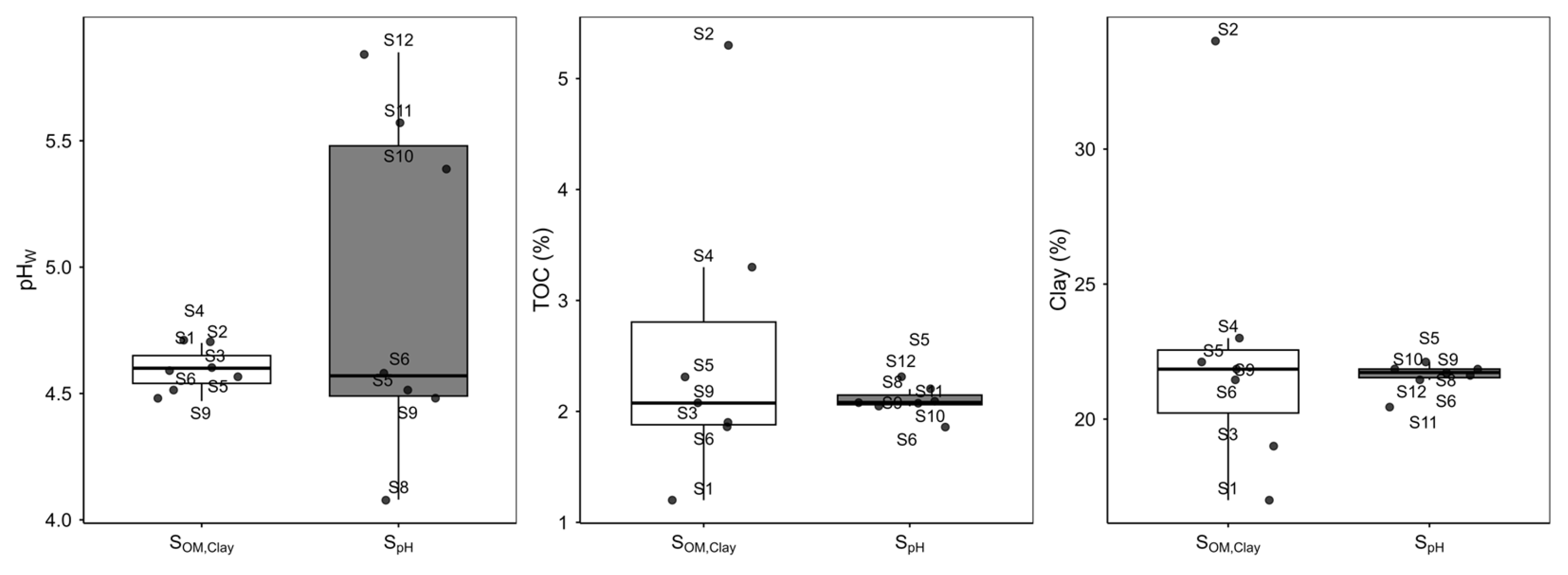
In addition to the general statistical analyses performed using all soils (n = 12), a complementary approach was applied to further explore the influence of specific soil properties. To this end, soils were grouped according to predefined physicochemical criteria. One group included soils with similar pHW values but variable total organic carbon (TOC) and clay contents (hereafter referred to as SOM,Clay soils), whereas the second group comprised soils with similar TOC and clay contents but differing pHW values (hereafter referred to as SpH soils).
Soils falling within ±0.5 standard deviations of the mean for the non-target variables were initially selected, and the most contrasting subsets were subsequently selected. Wilcoxon rank-sum tests were applied to confirm statistically significant differences in the variable of interest while verifying homogeneity in the remaining properties. Boxplots were then generated to visualise the distributions of pHW, TOC, and clay content in each group, with individual soil samples labelled for clarity. All these statistical analyses and graphical representations were performed using R software (version 4.5.2).

3. Results and Discussion

3.1. Physicochemical Properties of Soils

Table 1 and Table 2 present the main physicochemical properties of the soils studied. All soils were highly acidic, with pHW values ranging from 3.9 to 5.9 (mean 4.8 ± 0.6) and pHKCl ranging from 3.1 to 4.5 (mean 3.9 ± 0.5). The very low pHKCl values observed suggest the presence of substantial exchangeable acidity, likely associated with H+ and Al3+ species.
These soils exhibited considerable variability in organic matter content, with total organic carbon (TOC) ranging from 1.2% to 5.3% (mean 2.4 ± 1.0%) and total nitrogen (N) ranging from 0.13% to 0.51% (mean 0.21 ± 0.10%). Similarly, the effective cation exchange capacity (eCEC) showed substantial variability among samples, ranging from 1.49 to 11.64 cmolc kg−1 (mean 3.95 ± 2.87 cmolc kg−1). Overall, these relatively low eCEC values are consistent with the acidic nature of the soils and indicate a limited cation retention capacity.
Calcium was the dominant exchangeable cation in most soils, except for soils 5, 7, 8, and 9, where potassium predominated. This pattern is consistent with the long-term intensive agricultural management of the area, including repeated applications of K-rich mineral fertilisers and organic amendments, the release of K from mica- and feldspar-rich parent materials, and the preferential leaching of Ca under the humid Atlantic climate. Together, these factors explain the relatively high exchangeable K contents (e.g., 2.96 cmolc kg−1 in Soil 2) and the comparatively low Ca levels observed (Table 2).
Regarding soil texture, sand was the dominant fraction in all cases, ranging from 41% to 64% (mean 52 ± 6%), followed by silt (19–33%, mean 27 ± 5%) and clay (17–34%, mean 22 ± 4%). According to the USDA soil texture classification, the soils ranged from sandy loam to sandy clay loam (Table 1).
With respect to clay mineralogy, although it was not directly determined in the present study, previous investigations in the A Limia region indicate that these soils are generally dominated by 1:1 dioctahedral phyllosilicates, mainly kaolinite and halloysite, with minor amounts of vermiculite and traces of gibbsite [40]. Primary minerals commonly include muscovite, quartz, albite, and microcline [41]. The predominance of low-activity clay minerals in the region likely contributes to the relatively low eCEC values observed in several of the studied soils.

3.2. Adsorption Behaviour of Cymoxanil in Soils

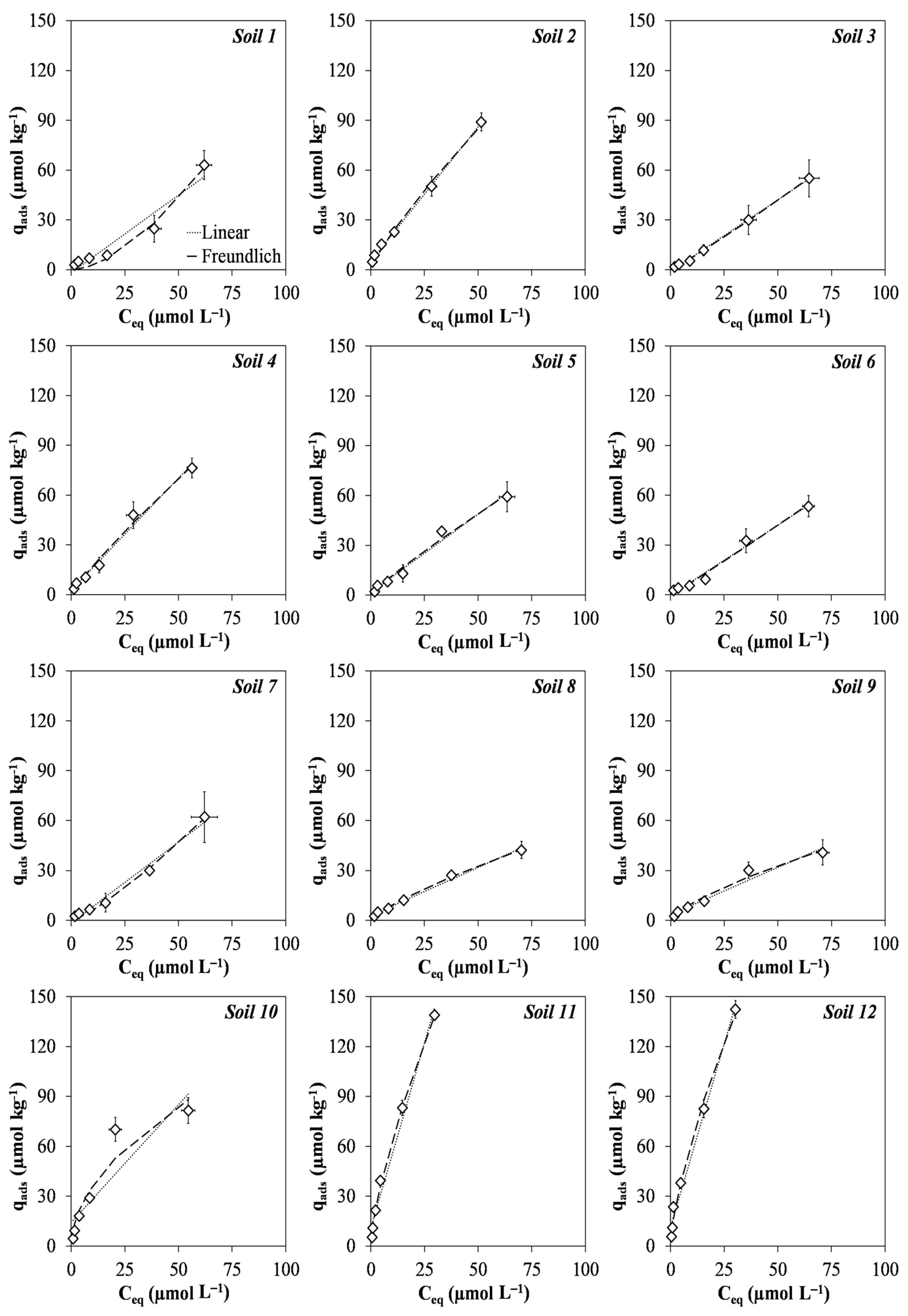
Figure 1 presents the adsorption curves obtained for the twelve soils examined in this study. All adsorption experiments were conducted without pH adjustment, so the measured pH values during adsorption closely reflected the intrinsic soil pH (Table S2). In all cases, the amount of fungicide adsorbed increased with the increasing initial concentration of fungicide added. Moreover, no adsorption plateau was observed for any of the soils within the tested concentration range (0–100 µM), indicating that the apparent maximum adsorption capacity was not reached under the experimental conditions applied.
With respect to the shape of the adsorption curves, most soils exhibited Giles Type-C or Type-L curves [42]. Specifically, soils 2 to 7 exhibited Giles Type-C curves, which were nearly linear, indicating a constant partitioning of the fungicide between soil and solution (Figure 1). Such curves are characteristic of interactions between hydrophobic compounds and soil organic matter [43], suggesting that organic matter may contribute to cymoxanil adsorption. In contrast, soils 8 to 12 displayed Giles Type-L adsorption curves [42], reflecting a progressive decrease in available adsorption sites as the fungicide concentration increased (Figure 1), consistent with previous observations by Álvarez-Martín et al. [23].
Considering all soils, soils 11 and 12, which exhibited higher pH values (Table 1), showed greater adsorption, as evidenced by the steeper slopes of their adsorption curves (Figure 1). This pattern suggests that soil pH may play a key role in controlling cymoxanil adsorption.
Given the linear or near-linear character of the adsorption curves, both the Linear and Freundlich models were used to describe the adsorption data, as they are commonly applied in the literature and allow direct comparison with previous studies [23,24,30,44,45]. The Langmuir model was not applied, as the adsorption curves did not indicate a clear maximum adsorption capacity (Figure 1).
Table 3 summarises the adsorption parameters obtained from fitting the experimental data to the Linear and Freundlich models. The Freundlich model generally provided a better fit, with R2 values exceeding 0.921 in all cases (Table 3). This finding is consistent with results reported by Álvarez-Martín et al. [23] and by Vischetti et al. [24], who also successfully applied the Freundlich model to describe cymoxanil adsorption in soils. By contrast, R2 values for the Linear model were generally lower, ranging from 0.766 to 0.988 (mean 0.958) (Table 3), although the model still described most adsorption curves adequately. In this regard, both models have been widely used to characterise the adsorption of organic fungicides in soils [40,45,46,47,48].
The distribution coefficient (Kd) represents the ratio of solute adsorbed, in this case cymoxanil, per unit mass of soil to its equilibrium concentration. It assumes that adsorption occurs on homogeneous surfaces with energetically equivalent sites. High Kd values (≥100) indicate strong adsorption, low mobility, and limited bioavailability, while low values indicate weaker retention, higher mobility, and potentially greater bioavailability [49,50]. By contrast, the Freundlich model accounts for surface heterogeneity and variable site energies. The Freundlich affinity coefficient (KF) reflects adsorption capacity, and the exponent (1/n) describes the distribution of site energies and the degree of non-linearity. Specifically, 1/n < 1 indicates non-linear, high-affinity adsorption, whereas values close to 1 suggest near-linear behaviour. Owing to its flexibility, the Freundlich model generally provides a better fit to experimental adsorption data [51,52,53].
Across all soils studied (n = 12), Kd(ads) values were consistently low, ranging from 0.57 to 4.46 L kg−1 (mean 1.58 ± 1.37 L kg−1). Similarly, KF(ads) values were also low but more variable, spanning 0.06–12.96 L1/n µmol1−1/n kg−1 (mean 4.06 ± 4.97 L1/n µmol1−1/n kg−1) (Table 3). Previous studies have likewise reported low adsorption parameters for cymoxanil; however, most of these studies were conducted in neutral to alkaline vineyard soils, which differ markedly from the acidic agricultural soils examined here. For example, Vischetti et al. [24], who investigated the adsorption of cymoxanil in an alkaline vineyard soil (pHW 8.2) with a low organic matter content (1.1% TOC), reported a KF(ads) value of 0.33 L1/n µmol1−1/n kg−1. Similarly, Álvarez-Martín et al. [23], who examined cymoxanil adsorption in three alkaline vineyard soils (pHW 7.5–7.8) with TOC contents ranging from 0.7 to 1.0%, reported Kd(ads) values between 0.12 and 0.33 L kg−1, and KF(ads) values between 0.29 and 1.01 L1/n µmol1−1/n kg−1 (Table 4).
Compared with other fungicides, and based on the adsorption parameters obtained, cymoxanil exhibits a soil affinity similar to that of metalaxyl, but lower than that reported for several other widely used fungicides (Table 4). This moderate affinity, which is further supported by the adsorption percentages observed at the highest tested concentration (18.7–65.9%, Table 3), may indicate a tendency for moderate to high soil mobility, suggesting a potential risk of leaching into groundwater, although further transport experiments would be necessary to confirm this behaviour [64]. Such mobility could potentially contribute to water contamination and the incidental entry of cymoxanil into the food chain. The relatively low adsorption of cymoxanil to soil particles also implies higher bioavailability, which may affect non-target soil organisms, influence soil biodiversity, and alter soil ecosystem services [8,10]. In addition, this bioavailability could facilitate plant uptake, representing another pathway for cymoxanil to enter the food chain [65]. Overall, the observed low adsorption capacity suggests that cymoxanil could pose potential ecological and human health risks, although these implications remain indicative rather than definitive.
With regard to the Freundlich linearity coefficient (1/nads), the values obtained ranged from 0.53 to 1.68, with a mean of 0.93 ± 0.31 (Table 3). More specifically, soils 2 to 7 exhibited values close to 1, ranging from 0.82 to 1.26, thereby confirming the linear nature of the adsorption curves obtained (Giles Type-C) (Figure 1). In contrast, for soils 8 to 12, the 1/nads values were considerably below 1, ranging from 0.53 to 0.79, confirming the concave character of the adsorption curves (Giles Type-L) (Figure 1).

3.3. Desorption Behaviour of Cymoxanil in Soils

Figure S2 (Supplementary Materials) shows the desorption curves of cymoxanil after a single desorption cycle for the twelve soils examined in this study. As with adsorption, desorption experiments were conducted without pH adjustment; however, in all cases, the pH values measured during desorption were slightly higher than those recorded during adsorption (Table S2). The resulting desorption curves were either linear or near-linear. It should be emphasised that the desorption curves reflect only one desorption cycle, and therefore, the observed retention may not represent long-term behaviour. In constructing the desorption curves, the amount of fungicide retained in the soil after a desorption cycle is plotted against the equilibrium concentration of fungicide in solution. Consequently, a steeper slope of the desorption curve reflects reduced desorption of the fungicide.
The desorption curves obtained (Figure S2) exhibited steeper slopes than those observed for the adsorption curves (Figure 1), suggesting the presence of hysteresis; that is, a portion of the fungicide initially adsorbed remains bound to the soil after a desorption cycle [66,67]. Although no studies on cymoxanil desorption have been reported to date, hysteresis has previously been documented for the adsorption of several widely used agricultural fungicides, including propiconazole [62], difenoconazole [62], metalaxyl [59], penconazole [59], tebuconazole [47], cyprodinil [57], and fludioxonil [57].
Table 5 presents the desorption parameters obtained by fitting the experimental data to the Freundlich and Linear models, both of which satisfactorily described the desorption curves, as indicated by coefficients of determination (R2) exceeding 0.902 (Table 5).
Kd(des) values ranged from 4.67 to 87.80 L kg−1 (mean 32.75 ± 28.11 L kg−1), while KF(des) values ranged from 6.01 to 85.05 L1/n µmol1−1/n kg−1 (mean 32.91 ± 27.98 L1/n µmol1−1/n kg−1) (Table 5). These desorption parameters were consistently higher than those obtained for adsorption (Table 3), reflecting the partial irreversibility of the adsorption process under the conditions tested [68]. In fact, desorption percentages at the highest initial concentration (100 µM) were relatively low, ranging from 2.4% to 32.6% relative to the amount initially adsorbed (Table 5). This suggests that, despite the overall low adsorption capacity of the soils for cymoxanil, a fraction of the initially adsorbed fungicide remains relatively strongly retained after a single desorption cycle. Similar behaviour has been observed for other fungicides, including tebuconazole, propiconazole, penconazole, cyprodinil, and fludioxonil [47,57,59], with desorption percentages ranging from 1.5% to 40.9% following a desorption cycle.

3.4. Influence of Soil Properties on Cymoxanil Adsorption Behaviour

Table 6 presents Pearson’s r values for the correlations between adsorption and desorption parameters and the main physicochemical properties of the soils.
As shown in Table 6, both adsorption parameters (Kd(ads) and KF(ads)) were positively and significantly correlated only with soil pHW (r = 0.844, p < 0.01 for Kd(ads); r = 0.920, p < 0.01 for KF(ads)). It should be emphasised that these correlations are derived from a relatively small dataset (n = 12) and should be interpreted cautiously, particularly given the potential interdependence and multicollinearity among soil properties.
Overall, these results indicate that soils with higher pH values tend to exhibit greater adsorption capacity, suggesting that soil pH is strongly associated with cymoxanil adsorption within the range of soils investigated. In agreement with these observations, multiple linear regression analysis revealed that pHW accounted for 68.3% of the variance in Kd(ads) (Equation (11)) and 83.0% of the variance in KF(ads) (Equation (12)):
Kd(ads) = −(7.935 ± 1.925) + (2.004 ± 0.403) × pHW
Adjusted R2 = 0.683; F = 24.745; p = 0.001
KF(ads) = −(33.591 ± 5.121) + (7.932 ± 1.072) × pHW
Adjusted R2 = 0.830; F = 54.782; p = 0.000
Given the limited sample size and simple structure of the regression models, these results should be viewed as indicating strong statistical associations rather than demonstrating a dominant or exclusive role of pH in controlling cymoxanil adsorption.
Although the effect of pH on cymoxanil adsorption has not been previously investigated, soil pH has been identified as a key factor in the adsorption of a variety of organic fungicides, including propiconazole [62], difenoconazole [62], carbendazim [69,70], metalaxyl [71], and penconazole [71].
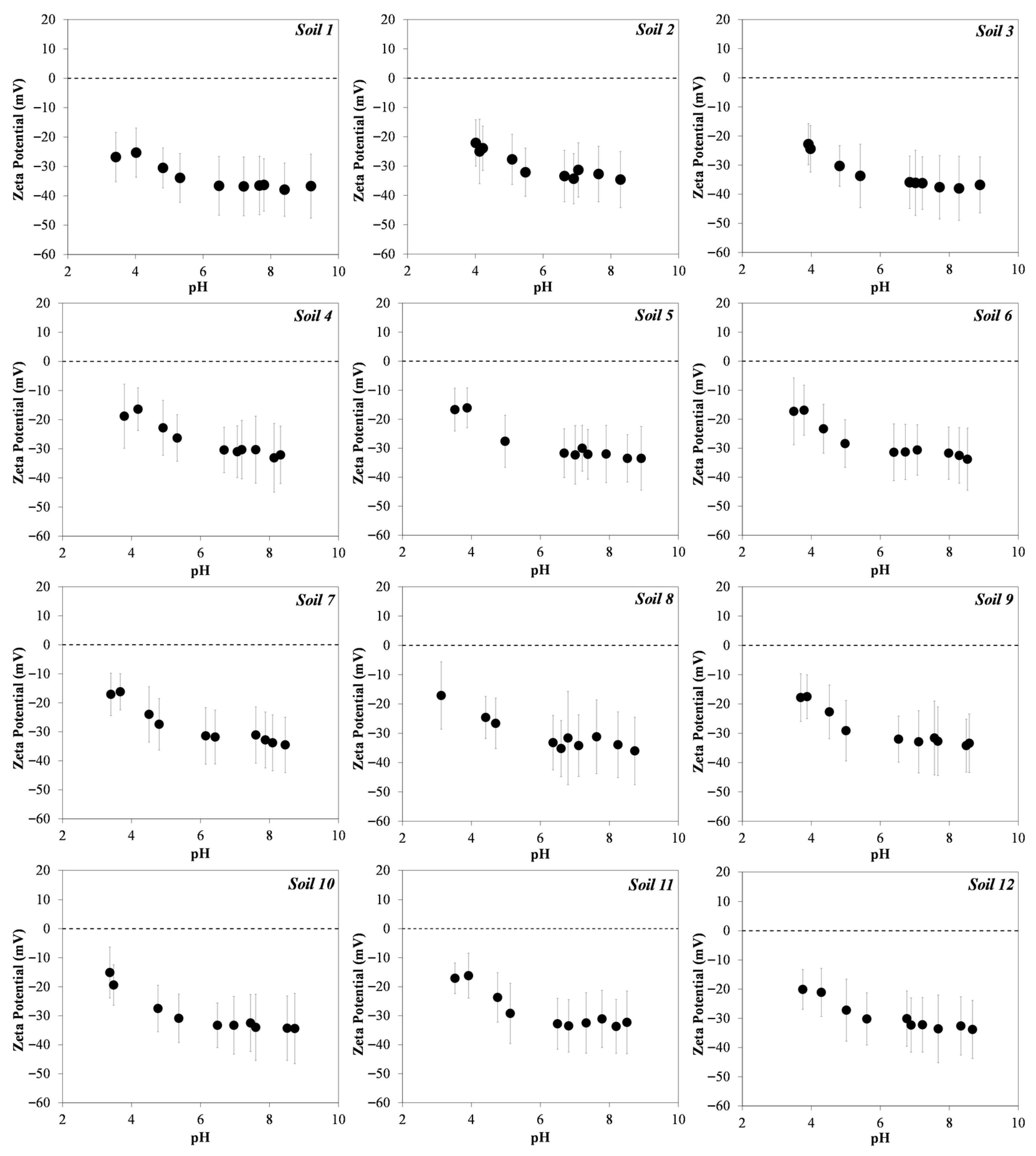
The adsorption behaviour of ionic organic compounds, including pesticides, is strongly influenced by pH, as it affects both the properties of the adsorbate, in this case, cymoxanil, and the characteristics of soil constituents, particularly in variable-charge soils [72,73]. Cymoxanil exhibits amphoteric behaviour with a pKa of 9.7 (Table S1, Supplementary Materials), indicating that under the acidic conditions of the soils studied, the molecule is expected to carry a partial positive charge due to protonation of its amine group. Simultaneously, an increase in pH results in a higher density of variable negative charges on clay mineral and organic matter surfaces [74]. This trend is supported by Z-potential measurements obtained for the soils examined here (Figure 2), which remain consistently negative across the investigated pH range (approximately 3–9), reflecting the predominance of negative surface charges. Moreover, as pH increases, the Z-potential becomes more negative, suggesting a higher proportion of variable-charge soil constituents and an associated increase in negatively charged sites on soil colloid surfaces [37,75].
These findings are consistent with previous studies on soils from the same agricultural region [76], where 1H-NMR spectroscopy confirmed the presence of negatively charged functional groups in soil organic matter, particularly carboxyl and carbonyl moieties. FTIR analyses further revealed O-H groups at clay mineral edges, as well as C-O-C, C=O, and CH2OH groups associated with organic matter adsorbed onto clay surfaces. These functional groups can gain or lose protons depending on pH, thereby generating variable negative charges [76,77]. While these spectroscopic results were not obtained directly in the present study, they provide relevant contextual information that supports plausible adsorption pathways rather than direct confirmation.
Consequently, under higher pH conditions, electrostatic interactions between positively charged cymoxanil molecules and negatively charged sites on both clay and organic matter surfaces are hypothesised to be enhanced, potentially contributing to overall adsorption.
Importantly, these results suggest that, in addition to pH, other soil components, particularly organic matter and clay, may also influence cymoxanil adsorption due to their role in providing adsorption sites and determining surface charges. However, when all soils are analysed together, the dominant effect of pH may obscure the contribution of these other properties.
To further explore the potential influence of factors other than pH, soils were divided into two statistically defined groups. The first group (SOM,Clay soils) included soils with similar pH values (4.6 ± 0.1, range 4.5–4.7) but varying organic matter (TOC 2.6 ± 1.4%, range 1.2–5.3%) and clay content (23 ± 5%, range 17–34%). Wilcoxon tests confirmed that TOC and clay differed significantly within this group (p = 0.042), while pH appeared statistically homogeneous (p = 0.769). The second group (SpH soils) comprised soils with similar organic matter (TOC 2.1 ± 0.1%, range 2.0–2.2%) and clay content (22 ± 1%, range 20–22%) but differing pH values (4.9 ± 0.7, range 4.1–5.9). In this group, pH was significantly heterogeneous (p = 0.042), whereas TOC (p = 0.772) and clay (p = 0.384) appeared statistically homogeneous.
These groups, and their respective variability in pH, TOC, and clay content, are illustrated in Figure 3 using boxplots, providing a visual summary of the differences and homogeneity within each soil group. It should be noted that this grouping is exploratory and intended to aid interpretation rather than to establish a definitive classification of soils.
Table 7 presents Pearson’s r values for correlations between adsorption/desorption parameters and the main physicochemical properties of the soils when analysed separately.
For the group with similar organic matter and clay but differing pH (SpH soils), both adsorption parameters (Kd(ads) and KF(ads)) were positively and significantly correlated with pHW (r = 0.879, p < 0.01 for Kd(ads); r = 0.959, p < 0.01 for KF(ads)) (Table 7), as expected. Additionally, both Kd(ads) and KF(ads) were positively and significantly correlated with Mge (r = 0.758, p < 0.05 for Kd(ads); r = 0.904, p < 0.01 for KF(ads)) and Ke (r = 0.774, p < 0.05 for Kd(ads); r = 0.847, p < 0.05 for KF(ads)). Moreover, KF(ads) was also positively and significantly correlated with pHKCl (r = 0.827, p < 0.05), Cae (r = 0.888, p < 0.01), and eCEC (r = 0.882, p < 0.01), and negatively with Ale (r = −0.894, p < 0.01) (Table 7), suggesting that the soil cation exchange complex also exerts a discernible influence on cymoxanil adsorption.
Conversely, for the group with similar pH but differing organic matter and clay contents (SOM,Clay soils), both Kd(ads) and KF(ads) correlated positively and significantly with total nitrogen (r = 0.872, p < 0.05 for Kd(ads); r = 0.888, p < 0.01 for KF(ads)) and TOC (r = 0.858, p < 0.05 for Kd(ads); r = 0.919, p < 0.01 for KF(ads)) (Table 7). Moreover, Kd(ads) was also positively correlated with pHW (r = 0.892, p < 0.01), all exchangeable base cations (r = 0.892, p < 0.01 for Cae; r = 0.854, p < 0.05 for Mge; r = 0.858, p < 0.05 for Ke; r = 0.893, p < 0.01 for Nae), and consequently with eCEC (r = 0.902, p < 0.01) (Table 7). In addition, KF(ads) was positively and significantly correlated with clay content (r = 0.899, p < 0.01) (Table 7), indicating that these soil properties may contribute to adsorption under more constrained conditions, although these relationships should be interpreted cautiously given the small number of observations.
Taken together, these subgroup analyses suggest that, while pH shows a strong association with cymoxanil adsorption, other soil properties such as organic matter, clay content, and eCEC may also contribute to adsorption behaviour within these soils. However, these relationships should be interpreted cautiously due to the exploratory nature of the analysis and the limited sample size.
Furthermore, these results are consistent with previous research on other fungicides. For example, Bermúdez-Couso et al. [40] found positive correlations between metalaxyl adsorption parameters and soil organic matter, clay content, and eCEC in sixteen acidic soils dedicated to potato cultivation in north-western Iberia. Similarly, Piwowarczyk et al. [46] reported positive correlations between the Freundlich affinity coefficient (KF(ads)) and both TOC and eCEC for chlorothalonil in five Irish soils.
With respect to cymoxanil specifically, although studies remain limited, Álvarez-Martín et al. [23] observed a positive correlation between KF(ads) and TOC in soils amended with spent mushroom substrate. In addition, Vischetti et al. [24] emphasised the key role of organic carbon in enhancing cymoxanil adsorption in both agricultural soils and organic biomixes.
Moreover, these results indicate that, besides electrostatic interactions, cymoxanil could potentially associate with soil organic matter through hydrophobic partitioning, as suggested by the shapes of the adsorption curves [43] and its moderate (log KOW = 0.67; Table S1). In support of this, previous 1H-NMR analyses of soils from the same region [76] identified aliphatic and aromatic structures, including methyl and methylene groups, as well as protons bound to unsaturated carbons and aromatic rings, which may provide potential sites for hydrophobic interactions [78,79,80].
Furthermore, eCEC was found to positively influence cymoxanil adsorption, suggesting a possible interaction between the fungicide and soil constituents through cation exchange, displacing base cations bound to negatively charged sites on clay minerals and organic matter [30,80], although direct experimental confirmation in this study is lacking.
Finally, the hysteresis observed during the cymoxanil adsorption/desorption process, in which a portion of the initially adsorbed fungicide remained strongly retained, may indicate the presence of stronger or more specific interactions, such as hydrogen bonding, π-π stacking, or other associations with functional groups in soil organic matter [76]. However, this should not be interpreted as direct evidence of chemisorption or irreversible binding, and further experiments would be required to confirm such mechanisms.

3.5. Influence of Soil Properties on Cymoxanil Desorption Behaviour

With regard to desorption, and similarly to what was observed for adsorption, when all soils were analysed together (n = 12), both Kd(des) and KF(des) were positively and significantly correlated only with pHW (r = 0.895, p < 0.01 for Kd(des); r = 0.920, p < 0.01 for KF(des)) and pHKCl (r = 0.636, p < 0.05 for Kd(des); r = 0.632, p < 0.05 for KF(des)) (Table 6), suggesting that soils with higher pH may exhibit lower desorption of cymoxanil. However, as with adsorption, these correlations should be interpreted cautiously and not as evidence of direct causation, due to the limited sample size and potential multicollinearity among soil variables.
In agreement with these observations, multiple linear regression analysis revealed that pHW accounted for 78.1% of the variance in Kd(des) (Equation (13)) and 83.2% of the variance in KF(des) (Equation (14)):
Kd(des) = −(174.531 ± 32.940) + (43.669 ± 6.893) × pHW
Adjusted R2 = 0.781; F = 40.132; p = 0.000
KF(des) = −(179.348 ± 28.711) + (44.716 ± 6.008) × pHW
Adjusted R2 = 0.832; F = 55.391; p = 0.000
However, when soils were analysed in separate groups, one with similar pH but differing TOC and clay (SOM,Clay soils), and another with similar TOC and clay but differing pH (SpH soils), it was observed that, in addition to pH, other soil properties appeared to be associated with cymoxanil desorption, reflecting patterns similar to those observed for adsorption. In this sense, for the SpH soils, both Kd(des) and KF(des) correlated positively and significantly with pHW (r = 0.943, p < 0.01 for Kd(des); r = 0.950, p < 0.01 for KF(des)) and pHKCl (r = 0.784, p < 0.05 for Kd(des); r = 0.792, p < 0.05 for KF(des)), as well as with exchangeable Ca (r = 0.842, p < 0.05 for Kd(des); r = 0.820, p < 0.05 for KF(des)), exchangeable Mg (r = 0.876, p < 0.05 for Kd(des); r = 0.852, p < 0.05 for KF(des)), exchangeable K (r = 0.871, p < 0.05 for Kd(des); r = 0.832, p < 0.05 for KF(des)) and eCEC (r = 0.858, p < 0.05 for Kd(des); r = 0.828, p < 0.05 for KF(des)). Conversely, correlations with exchangeable Al were negative (r = −0.826, p < 0.05 for Kd(des); r = −0.822, p < 0.05 for KF(des)) (Table 7).
In contrast, for the group with similar pH but differing organic matter and clay content (SOM,Clay soils), both Kd(des) and KF(des) correlated positively and significantly with pHW (r = 0.832, p < 0.05 for Kd(des); r = 0.833, p < 0.05 for KF(des)), Cae (r = 0.832, p < 0.05 for Kd(des); r = 0.811, p < 0.05 for KF(des)), Mge (r = 0.784, p < 0.05 for Kd(des); r = 0.762, p < 0.05 for KF(des)), Ke (r = 0.795, p < 0.05 for Kd(des); r = 0.780, p < 0.05 for KF(des)), Nae (r = 0.837, p < 0.05 for Kd(des); r = 0.819, p < 0.05 for KF(des)), eCEC (r = 0.852, p < 0.05 for Kd(des); r = 0.832, p < 0.05 for KF(des)), total N (r = 0.867, p < 0.05 for Kd(des); r = 0.838, p < 0.05 for KF(des)) and TOC (r = 0.868, p < 0.05 for Kd(des); r = 0.837, p < 0.05 for KF(des)) (Table 7).
These results suggest that, in addition to pH, soil properties such as organic matter content, exchangeable base cations, and the associated eCEC may influence cymoxanil desorption, with soils exhibiting higher organic matter and eCEC tending to retain more fungicide. Overall, the soil properties affecting desorption were the same as those governing adsorption, in agreement with previous studies on other fungicides [45,47,57]. Notably, adsorption parameters were also positively and significantly correlated with desorption parameters (r = 0.931, p < 0.01 for Kd; r = 0.926, p < 0.01 for KF; Figure S3), indicating a general tendency for soils with higher adsorption to show lower desorption. Furthermore, slightly higher pH values during desorption compared with adsorption could have contributed to somewhat enhanced retention, thereby contributing to reduced desorption.
These observations suggest that the mechanisms involved in adsorption may also be relevant to desorption, although differences in reversibility may occur. While a portion of cymoxanil may desorb through relatively weak physical interactions, a fraction could remain strongly retained due to potentially stronger or more specific interactions with soil components. Functional groups in soil organic matter, such as hydroxyl, amine, carbonyl, and aromatic moieties, could participate in hydrogen bonding, π-π interactions, or other specific associations, which may limit the extent of desorption. Therefore, although adsorption and desorption processes are likely related, the strength and reversibility of the interactions involved may differ, potentially leading to hysteresis and partial retention, without implying irreversible chemisorption.
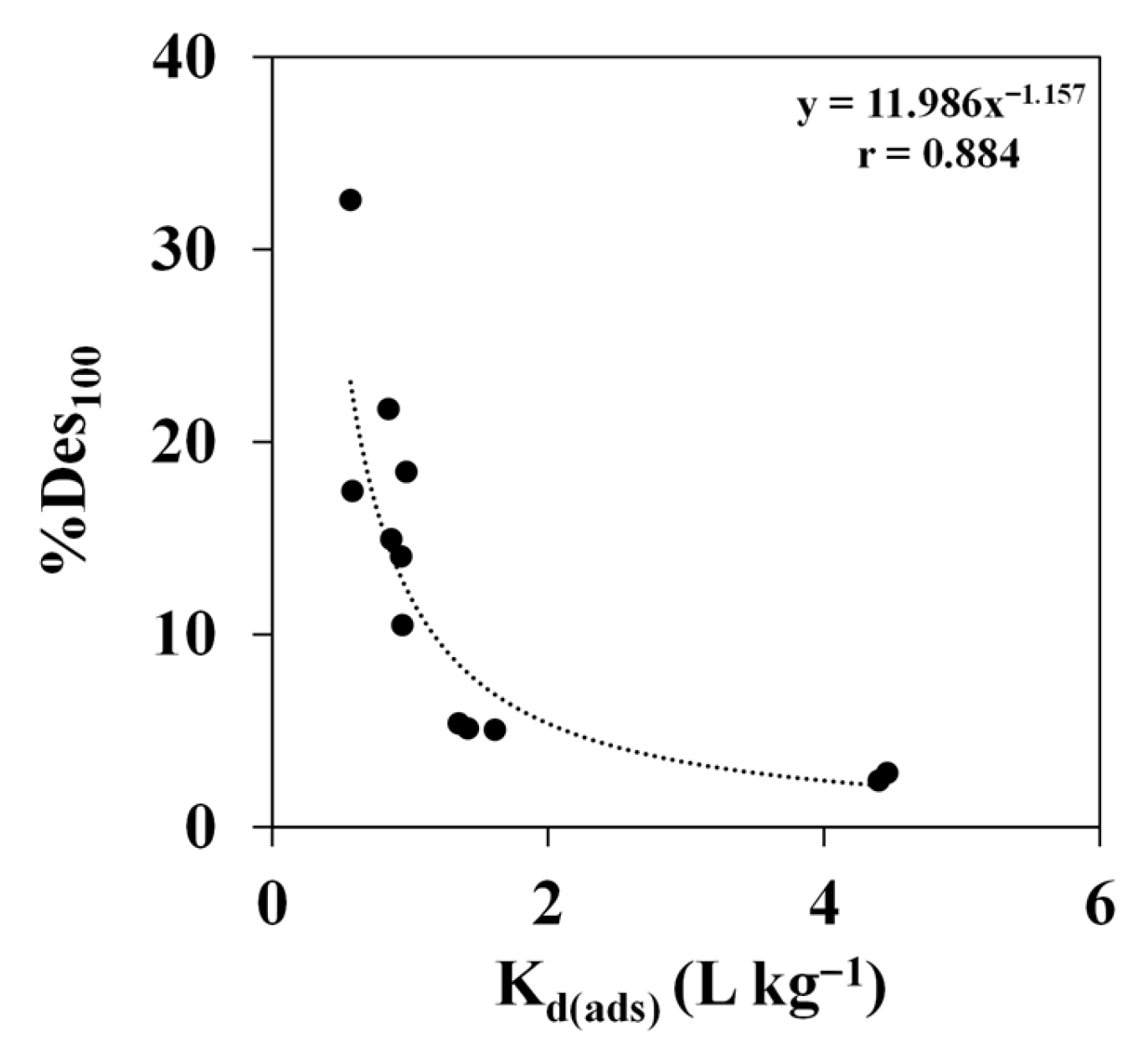
Finally, a significant correlation (r = 0.884, p < 0.01) was found between the desorption percentage at the highest initial concentration (%Des100) and the adsorption distribution coefficient Kd(ads) (Figure 4), suggesting that, for Kd(ads) values above ~1 L kg−1, cymoxanil desorption remains low and relatively constant, suggesting that the extent of desorption is largely determined by the strength of initial adsorption [80].

4. Conclusions

The present study shows that cymoxanil exhibited relatively low adsorption in the agricultural soils examined, which were highly acidic and generally characterised by low cation exchange capacity. These soil properties, typical of the study area, likely limit the availability of adsorption sites and may contribute to the relatively high mobility and bioavailability of cymoxanil within the soil.
Among the soil properties examined, soil pH appeared to be the most influential factor affecting the adsorption and desorption behaviours of cymoxanil, with soils of higher pH exhibiting greater retention, characterised by increased adsorption and reduced desorption. Other soil characteristics, including organic matter content, clay content, and concentrations of exchangeable basic cations, may also contribute to retention, particularly when comparing soils with similar pH values; in such cases, higher levels of these constituents were generally associated with enhanced retention. Adsorption appears to be largely controlled by physisorption mechanisms, such as electrostatic interactions, cation exchange, and hydrophobic partitioning, whereas the observed hysteresis suggests that specific interactions, including hydrogen bonding and π-π interactions, could also play a role, potentially influencing the reversibility of adsorption. Overall, the results indicate that soils with lower pH, organic matter, and clay content may be more susceptible to cymoxanil mobility. Despite these insights, some limitations should be noted: a single desorption cycle was performed, the mechanisms underlying hysteresis were not directly confirmed, and soil mineralogy was not determined, while the pH range was somewhat limited. Collectively, these findings provide a more comprehensive understanding of the factors controlling cymoxanil behaviour in soils, highlighting that very acidic soils with low sorption capacity may require particular attention in risk assessment and management strategies.

Supplementary Materials

The following supporting information can be downloaded at https://www.mdpi.com/article/10.3390/agriculture16010041/s1. Figure S1: Calibration curve for cymoxanil used for HPLC analysis. Standard solutions at concentrations of 0.5, 1, 2.5, 5, 10, 20, 50, and 100 µM were prepared and analysed. This curve is provided as an example to illustrate the methodology; Figure S2: Desorption curves for cymoxanil in the twelve soils examined in this study. qdes (µmol kg−1), amount of cymoxanil retained by the soil; Cdes (µmol L−1), concentration of cymoxanil in the solution at equilibrium after a desorption cycle. In all cases, the size of the standard error is less than that of the symbols (n = 2); Figure S3: Correlations between Kd(des) (L kg−1) and Kd(ads) (L kg−1) (a), and between KF(des) (L1/n µmol1−1/n kg−1) and KF(ads) (L1/n µmol1−1/n kg−1) (b), tanking into account all the studied soils (n = 12); Table S1: Main physicochemical properties of cymoxanil; Table S2: Average pH values ± standard deviation at which the adsorption (pHads) and desorption (pHdes) of cymoxanil occurred in each soil.

Author Contributions

M.C.-C.: conceptualisation, methodology, investigation, data curation, writing—original draft preparation, writing—review and editing, visualisation; A.G.-A.: methodology, writing—review and editing, supervision; V.L.-P.: methodology, formal analysis, data curation; M.A.-E.: investigation, resources, supervision, project administration, funding acquisition; D.F.-C.: investigation, resources, supervision, project administration, funding acquisition. All authors have read and agreed to the published version of the manuscript.

Funding

This work was supported by the Spanish Ministry of Science and Innovation through NextGenerationEU funds [grant number TED2021-129483B-100]. The authors wish to acknowledge the financial support of the Consellería de Cultura, Educación e Universidade (Xunta de Galicia, Santiago de Compostela, Spain) through contract ED431C2021/46-GRC awarded to the BV1 research group at the University of Vigo (Ourense, Spain). Manuel Conde-Cid holds a postdoctoral fellowship (ED481B-2025/055) funded by the Xunta de Galicia, while Antía Gómez-Armesto holds a postdoctoral contract funded by the University of Vigo (Campus Auga 1625/160733). We are grateful to CACTI Ourense (UVIGO) for performing the analyses. Funding for the open access publication charge was provided by the University of Vigo/CISUG.

Institutional Review Board Statement

Not applicable.

Data Availability Statement

The data presented in this study are available upon request from the corresponding author due to privacy concerns regarding the owners of the agricultural plots.

Conflicts of Interest

The authors declare that they have no conflicts of interest. The funders had no role in the design of the study; in the collection, analysis, or interpretation of data; in the writing of the manuscript; or in the decision to publish the results.

References

  1. Zhao, S.; Nigar, R.; Zhong, G.; Li, J.; Geng, X.; Yi, X.; Tian, L.; Bing, H.; Wu, Y.; Zhang, G. Occurrence and fate of current-use pesticides in Chinese forest soils. Environ. Res. 2024, 255, 119087. [Google Scholar] [CrossRef] [PubMed]
  2. OECD-FAO. OECD-FAO Agricultural Outlook 2012; OECD Publishing: Paris, France, 2012. [Google Scholar] [CrossRef]
  3. FAOSTAT. Pesticide Use. Food and Agriculture Organization of the United Nations. 2024. Available online: https://www.fao.org/faostat/en/#data/RP (accessed on 6 March 2025).
  4. Silva, V.; Mol, H.G.J.; Zomer, P.; Tienstra, M.; Ritsema, C.J.; Geissen, V. Pesticide residues in European agricultural soils—A hidden reality unfolded. Sci. Total Environ. 2019, 653, 1532–1545. [Google Scholar] [CrossRef] [PubMed]
  5. Singh, N.K.; Sanghvi, G.; Yadav, M.; Padhiyar, H.; Christian, J.; Singh, V. Fate of pesticides in agricultural runoff treatment systems: Occurrence, impacts and technological prodress. Environ. Res. 2023, 237, 117100. [Google Scholar] [CrossRef] [PubMed]
  6. Sarker, A.; Kim, D.; Jeong, W.-T. Environmental Fate and Sustainable Management of Pesticides in Soils: A Critical Review Focusing on Sustainable Agriculture. Sustainability 2024, 16, 10741. [Google Scholar] [CrossRef]
  7. Nuruzzaman, M.; Bahar, M.M.; Naidu, R. Diffuse soil pollution from agriculture: Impacts and remediation. Sci. Total Environ. 2025, 962, 178398. [Google Scholar] [CrossRef]
  8. Arias-Estévez, M.; López-Periago, E.; Martínez-Carballo, E.; Simal-Gándara, J.; Mejuto, J.-C.; García-Río, L. The mobility and degradation of pesticides in soils and the pollution of groundwater resources. Agric. Ecosyst. Environ. 2008, 123, 247–260. [Google Scholar] [CrossRef]
  9. Rasool, S.; Rasool, T.; Gani, K.M. A review of interactions of pesticides within various interfaces of intrinsic and organic residue amended soil environment. Chem. Eng. J. Adv. 2022, 11, 100301. [Google Scholar] [CrossRef]
  10. Ren, X.; Zeng, G.; Tang, L.; Wang, J.; Wan, J.; Liu, Y.; Yu, J.; Yi, H.; Ye, S.; Deng, R. Sorption, transport and biodegradation—An insight into bioavailability of persistent organic pollutants in soil. Sci. Total Environ. 2018, 610–611, 1154–1163. [Google Scholar] [CrossRef]
  11. Gavrilescu, M. Fate of Pesticides in the Environment and its Bioremediation. Eng. Life Sci. 2005, 5, 497–524. [Google Scholar] [CrossRef]
  12. Ćwieląg-Piasecka, I. Soil Organic Matter Composition and pH as Factors Affecting Retention of Carbaryl, Carbofuran and Metolachlor in Soil. Molecules 2023, 28, 5552. [Google Scholar] [CrossRef]
  13. Ahmed, M.S.; Massoud, A.H.; Derbalah, A.S.; Al-Brakati, A.; Al-Abdawani, M.A.; Eltahir, H.A.; Yanai, T.; Elmahallawy, E.K. Biochemical and Histopathological Alterations in Different Tissues of Rats Due to Repeated Oral Dose Toxicity of Cymoxanil. Animals 2020, 10, 2205. [Google Scholar] [CrossRef] [PubMed]
  14. Varodi, C.; Pogăcean, F.; Coros, M.; Magerusan, L.; Stefan-van Staden, R.-I.; Pruneanu, S. Hydrothermal Synthesis of Nitrogen, Boron Co-Doped Graphene with Enhanced Electro-Catalytic Activity for Cymoxanil Detection. Sensors 2021, 21, 6630. [Google Scholar] [CrossRef] [PubMed]
  15. Fan, J.; Li, L. Residues, dissipation, and dietary risk assessment of oxadixyl and cymoxanil in cucumber. Front. Environ. Sci. 2022, 10, 917334. [Google Scholar] [CrossRef]
  16. PPDB, Pesticide Properties DataBase, University of Hertfordshire. 2025. Available online: https://sitem.herts.ac.uk/aeru/ppdb/en/Reports/196.htm (accessed on 6 March 2025).
  17. Druart, C.; Millet, M.; Scheifler, R.; Delhomme, O.; Raeppel, C.; de Vaufleury, A. Snails as indicators of pesticide drift, deposit, transfer and effects in the vineyard. Sci. Total Environ. 2011, 409, 4280–4288. [Google Scholar] [CrossRef]
  18. Álvarez-Martín, A.; Sánchez-Martín, M.J.; Pose-Juan, E.; Rodríguez-Cruz, S. Effect of different rates of spent mushroom substrate on the dissipation and bioavailability of cymoxanil and tebuconazole in an agricultural soil. Sci. Total Environ. 2016, 550, 495–503. [Google Scholar] [CrossRef]
  19. Acosta-Dacal, A.; Hernández-Marrero, M.E.; Rial-Berriel, C.; Díaz-Díaz, R.; Bernal-Suárez, M.M.; Zumbado, M.; Henríque-Hernández, L.A.; Boada, L.D.; Luzardo, O.P. Comparative study of organic contaminants in agricultural soils at the archipelagos of the Macaronesia. Environ. Pollut. 2022, 301, 118979. [Google Scholar] [CrossRef]
  20. Hasnaki, R.; Ziaee, M.; Mahdavi, V. Pesticide residues in corn and soil of corn fields of Khuzestan, Iran, and potential health risk assessment. J. Food Compos. Anal. 2023, 115, 104972. [Google Scholar] [CrossRef]
  21. Polat, B.; Tiryaki, O. Determination of fungicide residues in soil using QuEChERS coupled with LC-MS/MS, and environmental risk assessment. Environ. Monit. Assess. 2023, 195, 986. [Google Scholar] [CrossRef]
  22. Tkach, Y.; Bunas, A.; Starodub, V. The Effect of Chemicals of Plant Protection Products on Soil Microbiocenoses. Sci. Horiz. 2021, 24, 26–35. [Google Scholar] [CrossRef]
  23. Álvarez-Martín, A.; Rodríguez-Cruz, M.S.; Soledad-Andrades, M.; Sánchez-Martín, M.J. Application of a biosorbent to soil: A potential method for controlling water pollution by pesticides. Environ. Sci. Pollut. Res. 2016, 23, 9192–9203. [Google Scholar] [CrossRef]
  24. Vischetti, C.; Monaci, E.; Casucci, C.; De Bernardi, A.; Cardinali, A. Adsorption and Degradation of Three Pesticides in a Vineyard Soil and in an Organic Biomix. Environments 2020, 7, 113. [Google Scholar] [CrossRef]
  25. Herrero-Hernández, E.; Andrades, M.S.; Álvarez-Martín, A.; Pose-Juan, E.; Rodríguez-Cruz, M.S. Occurrence of pesticides and some of their degradation products in waters in a Spanish wine region. J. Hydrol. 2013, 486, 234–245. [Google Scholar] [CrossRef]
  26. Mi, S.; Ji, L.; Yu, H.; Guo, Y.; Cheng, Y.; Yang, F.; Yao, W.; Xie, Y. Zero-Background Surface-Enhanced Raman Scattering Detection of Cymoxanil Based on the Change of the Cyano Group afterUltraviolet Irradiation. J. Agric. Food Chem. 2021, 69, 520–527. [Google Scholar] [CrossRef] [PubMed]
  27. Amaral, L.; Mendes, F.; Côrte-Real, M.; Rego, A.; Outeiro, T.F.; Chaves, S.R. A versatile yeast model identifies the pesticides cymoxanil and metalaxyl as risk factors for synucleinopathies. Chemosphere 2024, 364, 143039. [Google Scholar] [CrossRef]
  28. Chen, Z.; Yin, Y.; Gong, H.; Wang, H.; Ying, H.; Zhang, H.; Cui, Z. National-Scale Assessment of Soil pH Change in Chinese Croplands from 1980 to 2018. Agronomy 2025, 15, 2775. [Google Scholar] [CrossRef]
  29. Zamanian, K.; Taghizadeh-Mehrjardi, R.; Tao, J.; Fan, L.; Raza, S.; Guggenberger, G.; Kuzyakov, Y. Acidification of European croplands by nitrogen fertilization: Consequences for carbonate losses, and soil health. Sci. Total Environ. 2024, 924, 171631. [Google Scholar] [CrossRef]
  30. Lalín-Pousa, V.; Conde-Cid, M.; Díaz-Raviña, M.; Arias-Estévez, M.; Fernández-Calviño, D. Acetamiprid retention in agricultural acid soils: Experimental data and prediction. Environ. Res. 2025, 268, 120835. [Google Scholar] [CrossRef]
  31. González-Prieto, S.; Romero-Estonllo, M. Soil physico-chemical changes half a century after drainage and cultivation of the former Antela lake (Galicia, NW Spain). Catena 2022, 217, 106522. [Google Scholar] [CrossRef]
  32. Regasa, A.; Haile, W.; Abera, G. Effects of lime and vermicompost application on soil physicochemical properties and phosphorus availability in acid soils. Sci. Rep. 2025, 15, 25544. [Google Scholar] [CrossRef]
  33. IUSS Working Group WRB. World Reference Base for Soil Resources. International Soil Classification System for Naming Soils and Creating Legends for Soil Maps, 4th ed.; International Union of Soil Sciences (IUSS): Vienna, Austria, 2022. [Google Scholar]
  34. ISO 10390:2021; Soil, Treated Biowaste and Sludge-Determination of pH. International Organization for Standardization: Geneva, Switzerland, 2021.
  35. Sumner, M.E.; Miller, W.P. Cation exchange capacity and exchange coefficients. In Methods of Soil Analysis. Part 3: Chemical Methods; Sparks, D.L., Ed.; SSSA Book Series No. 5; Soil Science Society of America: Madison, WI, USA, 1996; pp. 1201–1229. [Google Scholar]
  36. Lin, C.; Coleman, N.T. The Measurement of Exchangeable Aluminum in Soils and Clays. Soil Sci. Soc. Am. J. 1960, 24, 444–446. [Google Scholar] [CrossRef]
  37. Rodríguez-López, L.; Santás-Miguel, V.; Cela-Dablanca, R.; Núñez-Delgado, A.; Álvarez-Rodríguez, E.; Rodríguez-Seijo, A.; Arias-Estévez, M. Sorption of Antibiotics in Agricultural Soils as a Function of pH. Span. J. Soil Sci. 2024, 14, 12402. [Google Scholar] [CrossRef]
  38. USEPA. Fate, Transport and Transformation Test Guidelines. OPPTS 835.1230. Adsorption/Desorption (Batch Equilibrium); United States Environmental Protection Agency: Washington, DC, USA, 2008. [Google Scholar]
  39. OECD. Test No. 106: Adsorption—Desorption Using a Batch Equilibrium Method, OECD Guidelines for the Testing of Chemicals, Section 1; OECD Publishing: Paris, France, 2000. [Google Scholar] [CrossRef]
  40. Bermúdez-Couso, A.; Fernández-Calviño, D.; Pateiro-Moure, M.; Garrido-Rodríguez, B.; Nóvoa-Muñoz, J.C.; Arias-Estévez, M. Adsorption and Desorption Behavior of Metalaxyl in Intensively Cultivated Acid Soils. J. Agric. Food Chem. 2011, 59, 7286–7293. [Google Scholar] [CrossRef] [PubMed]
  41. Conde-Cid, M.; Fernández-Calviño, D.; Fernández-Sanjurjo, M.J.; Núñez-Delgado, A.; Álvarez-Rodríguez, E.; Arias-Estévez, M. Adsorption/desorption and transport of sulfadiazine, sulfachloropyridazine, and sulfamethazine, in acid agricultural soils. Chemosphere 2019, 234, 978–986. [Google Scholar] [CrossRef] [PubMed]
  42. Giles, C.H.; Smith, D.; Huitson, A. A general treatment and classification of the solute adsorption isotherm. I. Theoretical. J. Colloid Interface Sci. 1974, 47, 755–765. [Google Scholar] [CrossRef]
  43. Calvet, R. Adsorption of Organic Chemicals in Soils. Environ. Health Perspect. 1989, 83, 145–177. [Google Scholar] [CrossRef]
  44. Sharipov, U.; Kočárek, M.; Jursík, M.; Nikodem, A.; Borůvka, L. Adsorption and degradation behavior of six herbicides in different. Environ. Earth Sci. 2021, 80, 702. [Google Scholar] [CrossRef]
  45. Conde-Cid, M.; Santás-Miguel, V.; Campillo-Cora, C.; Pérez-Novo, C.; Fernández-Calviño, D. Retention of propiconazole and terbutryn on acid sandy-loam soils with different organic matter and Cu concentrations. J. Environ. Manag. 2019, 248, 109346. [Google Scholar] [CrossRef]
  46. Piwowarczyk, A.A.; Holden, N.M. Adsorption and Desorption Isotherms of the Nonpolar Fungicide Chlorothalonil in a Range of Temperate Maritime Agricultural Soils. Water Air Soil Pollut. 2012, 223, 3975–3985. [Google Scholar] [CrossRef]
  47. Mosquera-Vivas, C.S.; Martinez, M.J.; García-Santos, G.; Guerrero-Dallos, J.A. Adsorption-desorption and hysteresis phenomenon of tebuconazole in Colombian agricultural soils: Experimental assays and mathematical approaches. Chemosphere 2018, 190, 393–404. [Google Scholar] [CrossRef]
  48. Chang, H.; Wu, T.; Lin, W.; Gu, X.; Zhou, R.; Li, Y.; Li, B. Adsorption–desorption and leaching behavior of benzovindiflupyr in different soil types. Ecotoxicol. Environ. Saf. 2024, 282, 116724. [Google Scholar] [CrossRef]
  49. Wauchope, R.D.; Yeh, S.; Linders, J.B.H.J.; Kloskowski, R.; Tanaka, K.; Rubin, B.; Katayama, A.; Kördel, W.; Gerstl, Z.; Lane, M.; et al. Pesticide soil sorption parameters: Theory, measurement, uses, limitations and reliability. Pest Manag. Sci. 2002, 58, 419–445. [Google Scholar] [CrossRef] [PubMed]
  50. Doucette, W.J. Quantitative structure-activity relationships for predicting soil-sediment sorption coefficients for organic chemicals. Environ. Toxicol. Chem. 2003, 22, 1771–1788. [Google Scholar] [CrossRef] [PubMed]
  51. Sparks, D.L. Environmental Soil Chemistry, 2nd ed.; Academic Press: San Diego, CA, USA, 2003. [Google Scholar]
  52. Barrow, N.J. The description of sorption curves. Eur. J. Soil Sci. 2008, 59, 900–910. [Google Scholar] [CrossRef]
  53. Ayawei, N.; Ebelegi, A.N.; Wankasi, D. Modelling and Interpretation of Adsorption Isotherms. J. Chem. 2017, 2017, 3039817. [Google Scholar] [CrossRef]
  54. Kodešová, R.; Kočárek, M.; Kodeš, V.; Drábek, O.; Kozáka, J.; Hejtmánková, K. Pesticide adsorption in relation to soil properties and soil type distribution in regional scale. J. Hazard. Mater. 2011, 186, 540–550. [Google Scholar] [CrossRef]
  55. Han, L.; Ge, Q.; Mei, J.; Cui, Y.; Xue, Y.; Yu, Y.; Fang, H. Adsorption and Desorption of Carbendazim and Thiamethoxam in Five Different Agricultural Soils. Bull. Environ. Contam. Toxicol. 2019, 102, 550–554. [Google Scholar] [CrossRef]
  56. Patakioutas, G.; Albanis, T.A. Adsorption–desorption studies of alachlor, metolachlor, EPTC, chlorothalonil andpirimiphos-methyl in contrasting soils. Pest Manag. Sci. 2002, 58, 352–362. [Google Scholar] [CrossRef]
  57. Arias, M.; Torrente, A.C.; López, E.; Soto, B.; Simal-Gándara, J. Adsorption-Desorption Dynamics of Cyprodinil and Fludioxonil in Vineyard Soils. J. Agric. Food Chem. 2005, 53, 5675–5681. [Google Scholar] [CrossRef]
  58. Vitoratos, A.; Fois, C.; Danias, P.; Likudis, Z. Investigation of the Soil Sorption of Neutral and Basic Pesticides. Water Air Soil Pollut. 2016, 227, 397. [Google Scholar] [CrossRef]
  59. Arias, M.; Paradelo, M.; López, E.; Simal-Gándara, J. Influence of pH and Soil Copper on Adsorption of Metalaxyl and Penconazole by the Surface Layer of Vineyard Soils. J. Agric. Food Chem. 2006, 54, 8155–8162. [Google Scholar] [CrossRef]
  60. Rütters, H.; Höllrigl-Rosta, A.; Kreuzig, R.; Bahadir, M. Sorption Behavior of Prochloraz in Different Soils. J. Agric. Food. Chem. 1999, 47, 1242–1246. [Google Scholar] [CrossRef]
  61. Thorstensen, C.W.; Lode, O.; Eklo, O.M.; Christiansen, A. Sorption of Bentazone, Dichlorprop, MCPA, and Propiconazolein Reference Soils from Norway. J. Environ. Qual. 2001, 30, 2046–2052. [Google Scholar] [CrossRef]
  62. Wang, F.; Cao, D.; Shi, L.; He, S.; Li, X.; Fang, H.; Yu, Y. Competitive Adsorption and Mobility of Propiconazole and Difenoconazole on Five Different Soils. Bull. Environ. Contam. Toxicol. 2020, 105, 927–933. [Google Scholar] [CrossRef] [PubMed]
  63. Vallé, R.; Dousset, S.; Billet, D.; Benoit, M. Sorption of selected pesticides on soils, sediment and straw from a constructed agricultural drainage ditch or pond. Environ. Sci. Pollut. Res. 2014, 21, 4895–4905. [Google Scholar] [CrossRef] [PubMed]
  64. Fouad, M.R.; Abdel-Raheem, S.A.A. An overview on the fate and behavior of imidacloprid in agricultural environments. Environ. Sci. Pollut. Res. 2024, 31, 61345–61355. [Google Scholar] [CrossRef] [PubMed]
  65. Pullagurala, V.L.R.; Rawat, S.; Adisa, I.O.; Hernandez-Viezcas, J.A.; Peralta-Videa, J.R.; Gardea-Torresdey, J.L. Plant uptake and translocation of contaminants of emerging concern in soil. Sci. Total Environ. 2018, 636, 1585–1596. [Google Scholar] [CrossRef]
  66. Barriuso, E.; Laird, D.A.; Koskinen, W.C.; Dowdy, R.H. Atrazine desorption from smectites. Soil Sci. Soc. Am. J. 1994, 58, 1632–1638. [Google Scholar] [CrossRef]
  67. Huang, W.; Weber, W.J. A distributed Reactivity Model for Sorption by Soils and Sediments. 10. Relationships between Desorption, Hysteresis, and the Chemical Characteristics of Organic Domains. Environ. Sci. Technol. 1997, 31, 2562–2569. [Google Scholar] [CrossRef]
  68. Conde-Cid, M.; Nóvoa-Muñoz, J.C.; Núñez-Delgado, A.; Fernández-Sanjurjo, M.J.; Arias-Estévez, M.; Álvarez-Rodríguez, E. Experimental data and modeling for sulfachloropyridazine and sulfamethazine adsorption/desorption on agricultural acid soils. Micropor. Mesopor. Mat. 2019, 288, 109601. [Google Scholar] [CrossRef]
  69. Berglöf, T.; Van Dung, T.; Kylin, H.; Nilsson, I. Carbendazim sorption–desorption in Vietnamese soils. Chemosphere 2002, 48, 267–273. [Google Scholar] [CrossRef]
  70. Paszko, T. Effect of pH on the adsorption of carbendazim in Polish mineral soils. Sci. Total Environ. 2012, 435–436, 222–229. [Google Scholar] [CrossRef]
  71. Gondar, D.; López, R.; Antelo, J.; Fiol, S.; Arce, F. Effect of organic matter and pH on the adsorption of metalaxyl and penconazole by soils. J. Hazard. Mater. 2013, 260, 627–633. [Google Scholar] [CrossRef]
  72. Monkiedje, A.; Spiteller, M. Sorptive behavior of the phenylamide fungicides, mefenoxam and metalaxyl, and their acid metabolite in typical Cameroonian and German soils. Chemosphere 2002, 49, 659–668. [Google Scholar] [CrossRef] [PubMed]
  73. Campan, P.; Samouelian, A.; Richard, A.; Négro, S.; Lagacherie, M.; Voltz, M. Pedological factors affecting pesticide retention in a series of tropical volcanic ash soils in the French West Indies. Geoderma Reg. 2024, 38, e00830. [Google Scholar] [CrossRef]
  74. Barrow, N.J. Reaction of Anions and Cations with Variable-Charge Soils. Adv. Agron. 1986, 38, 183–230. [Google Scholar] [CrossRef]
  75. Pérez-Novo, C.; Bermúdez-Couso, A.; López-PEriago, E.; Fernández-Calviño, D.; Arias-Estévez, M. The effect of Phosphate on the Sorption of Copper by Acid Soils. Geoderma 2009, 150, 166–170. [Google Scholar] [CrossRef]
  76. Conde-Cid, M.; Ferreira-Coelho, G.; Fernández-Calviño, D.; Núñez-Delgado, A.; Fernández-Sanjurjo, M.J.; Arias-Estévez, M.; Álvarez-Rodríguez, E. Single and simultaneous adsorption of three sulfonamides in agricultural soils: Effects of pH and organic matter content. Sci. Total Environ. 2020, 744, 140872. [Google Scholar] [CrossRef]
  77. Álvarez-Esmorís, C.; Conde-Cid, M.; Ferreira-Coelho, G.; Fernández-Sanjurjo, M.J.; Núñez-Delgado, A.; Álvarez-Rodríguez, E.; Arias-Estévez, M. Adsorption/desorption of sulfamethoxypyridazine and enrofloxacin in agricultural soils. Sci. Total Environ. 2020, 706, 136015. [Google Scholar] [CrossRef]
  78. Kah, M.; Brown, C.D. Prediction of the Adsorption of Ionizable Pesticides in Soils. J. Agric. Food Chem. 2007, 55, 2312–2322. [Google Scholar] [CrossRef]
  79. Rath, S.; Fostier, A.H.; Pereira, L.A.; Dionisio, A.C.; Ferreira, F.O.; Doretto, K.M.; Peruchi, L.M.; Viera, A.; Neto, O.F.O.; Bosco, S.M.D.; et al. Sorption behaviors of antimicrobial and antiparasitic veterinary drugs on subtropical soils. Chemosphere 2019, 214, 111–122. [Google Scholar] [CrossRef]
  80. Conde-Cid, M.; Fernández-Calviño, D.; Núñez-Delgado, A.; Fernández-Sanjurjo, M.J.; Arias-Estévez, M.; Álvarez-Rodríguez, E. Estimation of adsorption/desorption Freundlich’s affinity coefficients for oxytetracycline and chlortetracycline from soil properties: Experimental data and pedotransfer functions. Ecotoxicol. Environ. Saf. 2020, 196, 110584. [Google Scholar] [CrossRef]
Figure 1. Adsorption curves of cymoxanil in the twelve soils examined in this study. qads (µmol kg−1), amount of cymoxanil adsorbed to the soil; Ceq (µmol L−1), concentration of cymoxanil in the solution at equilibrium. Initial cymoxanil concentrations ranged from 2.5 to 100 µM. Contact time was 24 h, at room temperature (20 ± 2 °C), with duplicate measurements for each concentration (n = 2). Error bars represent twice the standard deviation; if bars are not visible, they are smaller than the symbols. Adsorption data were fitted using Linear and Freundlich models.
Agriculture 16 00041 g001
Figure 2. Variation in Zeta-potential (mV) with pH for the fine soil fraction obtained from the 12 samples analysed in this study. The error bars denote the corresponding standard deviations.
Agriculture 16 00041 g002
Figure 3. Distribution of soil groups based on pH in water (pHW), organic carbon content (TOC), and clay content. Boxplots show the range and variability of each parameter for the two groups. SpH, soils with similar TOC and clay contents but variable pHW; SOM,Clay, soils with similar pHW but variable TOC and clay contents.
Agriculture 16 00041 g003
Figure 4. Potential relationship between the percentage of cymoxanil desorption for the initial concentration of 100 µM (%Des100) and the distribution coefficient obtained for cymoxanil adsorption (Kd(ads)).
Agriculture 16 00041 g004
Table 1. Mean values (±standard deviation) of pH in water (pHW), pH in 0.1 M KCl (pHKCl), total nitrogen (N), total organic carbon (TOC), sand, silt, and clay, as well as soil textural classes assigned according to the USDA soil texture classification based on particle size distribution, for the 12 soils studied.
SoilpHWpHKClNTOCSand SiltClayTexture
%
14.6 ± 0.14.1 ± 0.00.13 ± 0.011.2 ± 0.164 ± 519 ± 217 ± 1Sandy loam
24.7 ± 0.04.5 ± 0.10.51 ± 0.045.3 ± 0.341 ± 226 ± 134 ± 1Clay loam
34.6 ± 0.04.0 ± 0.00.17 ± 0.011.9 ± 0.258 ± 523 ± 219 ± 2Sandy loam
44.7 ± 0.14.2 ± 0.00.29 ± 0.023.3 ± 0.257 ± 320 ± 123 ± 1Sandy clay loam
54.5 ± 0.03.1 ± 0.00.20 ± 0.012.3 ± 0.245 ± 133 ± 122 ± 1Loam
64.6 ± 0.13.9 ± 0.00.16 ± 0.011.9 ± 0.153 ± 426 ± 221 ± 2Sandy clay loam
73.9 ± 0.13.3 ± 0.10.18 ± 0.012.1 ± 0.152 ± 228 ± 119 ± 1Sandy loam
84.1 ± 0.03.3 ± 0.00.18 ± 0.012.1 ± 0.146 ± 232 ± 122 ± 1Loam
94.5 ± 0.13.3 ± 0.00.18 ± 0.012.1 ± 0.151 ± 328 ± 222 ± 1Sandy clay loam
105.4 ± 0.04.1 ± 0.00.18 ± 0.032.0 ± 0.348 ± 130 ± 122 ± 1Loam
115.6 ± 0.14.1 ± 0.00.18 ± 0.022.1 ± 0.256 ± 623 ± 220 ± 2Sandy clay loam
125.9 ± 0.14.3 ± 0.10.21 ± 0.012.2 ± 0.247 ± 431 ± 322 ± 2Loam
Table 2. Mean values (±standard deviation) of exchangeable Ca, Mg, K, Na, and Al, as well as the effective cation exchange capacity (eCEC), for the 12 soils studied.
SoilCaeMgeKeNaeAleeCEC
cmolc kg−1
11.79 ± 0.110.52 ± 0.091.45 ± 0.120.22 ± 0.030.48 ± 0.024.46 ± 0.19
25.91 ± 0.231.68 ± 0.132.96 ± 0.140.57 ± 0.080.52 ± 0.0311.64 ± 0.31
31.77 ± 0.050.52 ± 0.071.15 ± 0.090.25 ± 0.040.92 ± 0.054.61 ± 0.13
42.76 ± 0.140.61 ± 0.041.39 ± 0.060.32 ± 0.031.43 ± 0.106.51 ± 0.19
50.18 ± 0.040.21 ± 0.030.65 ± 0.060.06 ± 0.010.40 ± 0.031.49 ± 0.08
60.76 ± 0.080.31 ± 0.050.62 ± 0.090.10 ± 0.020.24 ± 0.022.05 ± 0.13
70.23 ± 0.070.21 ± 0.040.84 ± 0.080.06 ± 0.010.33 ± 0.041.68 ± 0.11
80.70 ± 0.090.31 ± 0.060.79 ± 0.050.10 ± 0.010.35 ± 0.032.24 ± 0.12
90.45 ± 0.080.23 ± 0.020.63 ± 0.090.06 ± 0.010.33 ± 0.041.7 ± 0.12
101.67 ± 0.130.60 ± 0.091.00 ± 0.100.15 ± 0.020.11 ± 0.023.53 ± 0.19
111.28 ± 0.090.49 ± 0.070.93 ± 0.080.09 ± 0.010.16 ± 0.022.95 ± 0.14
122.16 ± 0.070.76 ± 0.101.42 ± 0.040.12 ± 0.020.06 ± 0.014.51 ± 0.13
Table 3. Values for the parameters corresponding to the fitting of cymoxanil adsorption data to the Linear and Freundlich models, as well as the adsorption percentages for the highest tested initial concentration (100 µM).
SoilLinearFreundlich%Ads100
Kd(ads)R2KF(ads)1/n(ads)R2
10.93 ± 0.130.9120.06 ± 0.071.68 ± 0.260.97528.9
21.62 ± 0.030.9983.38 ± 0.720.82 ± 0.060.99340.9
30.86 ± 0.020.9970.59 ± 0.071.09 ± 0.030.99925.9
41.35 ± 0.080.9842.30 ± 0.610.87 ± 0.070.99035.4
50.94 ± 0.070.9811.53 ± 0.530.89 ± 0.090.98427.2
60.84 ± 0.060.9790.70 ± 0.301.05 ± 0.110.98426.2
70.97 ± 0.070.9780.34 ± 0.111.26 ± 0.080.99528.7
80.58 ± 0.030.9901.51 ± 0.200.79 ± 0.030.99719.4
90.57 ± 0.060.9471.96 ± 0.620.72 ± 0.080.97718.7
101.42 ± 0.340.76610.79 ± 3.960.53 ± 0.100.92137.4
114.46 ± 0.290.98312.60 ± 0.840.71 ± 0.020.99865.9
124.40 ± 0.240.98612.96 ± 1.920.70 ± 0.050.99365.3
Kd (L kg−1), distribution coefficient; KF (L1/n µmol1−1/n kg−1), Freundlich affinity coefficient; 1/n (dimensionless), Freundlich linearity index; R2, coefficient of determination; %Ads100, adsorption percentage at the highest tested concentration (100 µM).
Table 4. Kd(ads) and KF(ads) values determined for other commonly used organic fungicides in agricultural soils.
FungicidepHWTOCKd(ads)KF(ads)Reference
Azoxystrobin4.8–8.60.0–5.0 2.4–18.5[54]
Benzovindiflupir4.5–8.70.2–2.61.5–16.72.3–17.9[48]
Carbendazin5.2–7.40.3–2.9 1.5–19.5[55]
Chlorothalonil5.9–6.22.7–4.734.2–101.617.7–78.2[46]
Chlorothalonil6.2–7.90.3–6.1 96.3–1356.9[56]
Cymoxanil4.1–5.91.2–5.30.6–4.40.1–13.0This work
Cymoxanil7.5–7.80.7–1.00.1–0.30.3–1.0[23]
Cymoxanil8.21.1 0.3[24]
Cyprodinil5.3–7.42.7–4.954.0–110.0 [57]
Difenoconazole4.1–8.40.8–3.8 14.8–98.9[58]
Fludioxonil5.3–7.42.7–4.962.0–213.0 [57]
Metalaxyl4.3–5.71.1–16.60.0–3.10.2–6.3[40]
Metalaxyl5.3–7.42.7–4.9 1.0–2.3[59]
Penconazole5.3–7.42.7–4.9 41.7–94.5[59]
Prochloraz5.4–8.90.3–6.110.0–648.6 [58]
Prochloraz5.3–7.80.5–4.4 56.0–552.0[60]
Propiconazole4.5–5.20.3–4.84.6–28.98.3–69.4[45]
Propiconazole2.9–6.31.4–37.7 27.0–1277.0[61]
Propiconazole4.1–8.40.8–3.8 2.9–28.7[62]
Quinoxyfen5.4–8.90.3–6.17.9–182.8 [58]
Tebuconazole5.1–6.00.7–13.07.9–289.28.1–283.4[47]
Tebuconazole7.5–7.91.2–1.5 5.8–10.9[63]
Triadimefon5.4–8.90.3–6.15.9–79.6 [58]
pHW, pH in water; TOC, total organic carbon.
Table 5. Values for the parameters corresponding to the adjustment of cymoxanil desorption data to the Linear and Freundlich models, as well as the desorption percentages for the highest tested initial concentration (100 µM).
SoilLinearFreundlich%Des100
Kd(des)R2KF(des)1/n(des)R2
115.27 ± 1.030.97818.01 ± 1.470.88 ± 0.070.98814.1
247.25 ± 3.680.97043.25 ± 2.771.15 ± 0.120.9815.0
314.51 ± 1.340.95915.85 ± 1.980.91 ± 0.110.97115.0
441.01 ± 3.060.97338.59 ± 2.551.16 ± 0.140.9835.4
522.19 ± 1.650.97323.93 ± 1.780.91 ± 0.090.98210.5
68.59 ± 0.790.95911.53 ± 1.470.83 ± 0.090.97921.7
710.79 ± 0.510.9898.57 ± 0.861.15 ± 0.070.99518.4
812.91 ± 1.660.92210.07 ± 1.971.18 ± 0.210.93717.5
94.67 ± 0.270.9836.01 ± 1.000.88 ± 0.110.97832.6
1049.33 ± 4.920.95250.58 ± 3.580.94 ± 0.140.9635.1
1178.68 ± 5.740.97483.44 ± 4.800.92 ± 0.110.9782.8
1287.80 ± 12.780.90285.05 ± 9.411.11 ± 0.290.9242.4
Kd (L kg−1), distribution coefficient; KF (L1/n µmol1−1/n kg−1), Freundlich affinity coefficient; 1/n (dimensionless), Freundlich linearity index; R2, coefficient of determination. %Des100, desorption percentage at the highest tested concentration (100 µM).
Table 6. Pearson’s r values for correlations between adsorption and desorption parameters and soil physicochemical properties (n = 12).
AdsorptionDesorption
Kd(ads)KF(ads)Kd(des)KF(des)
pHW0.844 **0.920 **0.895 **0.920 **
pHKCl0.5030.4670.636 *0.632 *
Cae0.2000.1480.4090.363
Mge0.2720.2410.4690.424
Ke0.1770.0790.3570.306
Nae−0.051−0.1150.1640.119
Ale−0.343−0.479−0.229−0.255
eCEC0.1390.0620.3480.299
N0.0770.020.2800.220
TOC0.0570.0140.2630.203
Sand−0.036−0.198−0.183−0.13
Silt0.0170.2170.0500.022
Clay0.0380.0670.2410.188
Kd (L kg−1), distribution coefficient; KF (L1/n µmol1−1/n kg−1), Freundlich affinity coefficient; pHW, pH in water; pHKCl, pH in 0.1 M KCl; Cae, exchangeable calcium; Mge, exchangeable magnesium; Ke, exchangeable potassium; Nae, exchangeable sodium; Ale, exchangeable aluminium; eCEC, effective cation exchange capacity; N, total nitrogen; TOC, total organic carbon. Bold values indicate statistically significant correlations. * Significant at p < 0.05; ** Significant at p < 0.01.
Table 7. Pearson’s r values for correlations between adsorption and desorption parameters and different soil properties for each group of soils.
Similar OM and Clay Contents, Different pHW (SpH soils) (n = 7)Similar pHW, Different OM and Clay Contents (SOM,Clay soils) (n = 7)
AdsorptionDesorptionAdsorptionDesorption
Kd(ads)KF(ads)Kd(des)KF(des)Kd(ads)KF(ads)Kd(des)KF(des)
pHW0.879**0.959 **0.943 **0.950 **0.892 **0.3830.832 *0.833 *
pHKCl0.7350.827 *0.784 *0.792 *0.7320.1950.6070.603
Cae0.7350.888 **0.842 *0.820 *0.892 **0.6420.832 *0.811 *
Mge0.758 *0.904 **0.876 **0.852 *0.854 *0.6500.784 *0.762 *
Ke0.774 *0.847 *0.871 *0.832 *0.858 *0.5830.795 *0.780 *
Nae0.2450.5740.4490.4240.893 **0.5770.837 *0.819 *
Ale−0.736−0.894 **−0.826 *−0.822 *0.4400.1900.5280.522
eCEC0.7440.882 **0.858 *0.828 *0.902 **0.6280.852 *0.832 *
N0.4710.4170.5420.5010.872 *0.888 **0.867 *0.838 *
TOC0.2210.1630.2920.2650.858 *0.919 **0.868 *0.837 *
Sand0.3770.2600.2030.263−0.352−0.750−0.385−0.362
Silt−0.320−0.216−0.148−0.209−0.2120.278−0.146−0.149
Clay−0.677−0.500−0.523−0.5640.7480.899 **0.7350.702
Kd (L kg−1), distribution coefficient; KF (L1/n µmol1−1/n kg−1), Freundlich affinity coefficient; pHW, pH in water; pHKCl, pH in 0.1 M KCl; Cae, exchangeable calcium; Mge, exchangeable magnesium; Ke, exchangeable potassium; Nae, exchangeable sodium; Ale, exchangeable aluminium; eCEC, effective cation exchange capacity; N, total nitrogen; TOC, total organic carbon. Bold values indicate significant correlations. * Significant at p < 0.05; ** Significant at p < 0.01.
Disclaimer/Publisher’s Note: The statements, opinions and data contained in all publications are solely those of the individual author(s) and contributor(s) and not of MDPI and/or the editor(s). MDPI and/or the editor(s) disclaim responsibility for any injury to people or property resulting from any ideas, methods, instructions or products referred to in the content.