Article

Climatic Variability and Adaptive Zoning of Maize Cultivation in High-Latitude Cold Regions

1
College of Landscape Architecture, Changchun University, Changchun 130022, China
2
Forest Sciences Centre, University of British Columbia, Vancouver, BC V6T1Z4, Canada
*
Author to whom correspondence should be addressed.
Agriculture 2026, 16(1), 40; https://doi.org/10.3390/agriculture16010040
Submission received: 20 November 2025 / Revised: 22 December 2025 / Accepted: 22 December 2025 / Published: 24 December 2025
(This article belongs to the Section Ecosystem, Environment and Climate Change in Agriculture)

Abstract

Climate change induces widespread effects on crop production, influencing multiple developmental stages and associated agronomic outcomes. Using long-term meteorological data from Jilin Province, Northeast China, this study examined temporal and spatial variations in climatic conditions through trend analysis, Mann–Kendall tests, and inverse distance weighting interpolation. A fuzzy comprehensive evaluation model was applied to classify maize cultivation suitability into four levels across major production areas, with Level I representing the most suitable regions, Level II highly suitable regions, Level III moderately suitable regions, and Level IV low suitable regions. Changes in suitable areas were analyzed before and after abrupt climatic shifts. From 1976 to 2020, Jilin Province experienced a significant rise in annual mean temperature, a marked decline in sunshine duration, and a slight increase in precipitation. The area of Level I suitability remained stable, while Level II expanded to approximately 1.3 times its original area. Conversely, Level III and IV areas decreased by 4.59% and 28.77%, respectively, compared with the pre-transition period. Spatially, the most suitable maize cultivation areas shifted from central to northern and eastern Jilin due to climatic warming. Although rising temperatures enhanced thermal conditions for maize production, reduced sunshine and variable precipitation constrained further expansion. These findings provide a scientific basis for optimizing maize variety selection and cropping structure in high-latitude regions, supporting yield improvement and sustainable development of the maize industry under a changing climate.

1. Introduction

In recent years, global climate change has become a major concern for the international community. Climate change not only constrained agricultural development and destabilized farming systems but also significantly altered crop cultivation patterns [1]. Maize ranked among the world’s most widely cultivated and highest-yielding food crops. In 2024, its global production exceeded 1.2 billion tonnes, accounting for over 35% of the total global grain output [2]. As one of China’s primary staple crops, maize accounted for 40.38% of the nation’s total grain output, making its production crucial for safeguarding national food security [3]. The Northeast region, blessed with fertile black soil, boasted extensive maize cultivation areas. The region’s output accounted for over one-third of the national total and contributed to more than 40% of China’s maize production, while its yield per unit area exceeded the national average by 10% [4].
Maize cultivation and production were influenced not only by varietal characteristics but also by factors such as climate change, pests and diseases, soil properties, cultivation methods, and field management [5,6]. Studies confirmed that climate change significantly constrains maize growth, development, and yield [7,8]. Throughout its growth cycle, maize was influenced by temperature, moisture, and light. Excessively high temperatures and low precipitation could reduce photosynthesis, increase transpiration, limit nutrient supply, delay development, and shift tasseling and harvest times, ultimately affecting yield [9,10,11]. Research indicated that maize yield increased with rising temperatures within a certain range, while also exhibiting a close correlation with precipitation patterns [11,12,13]. Numerous studies demonstrated that changes in climatic factors had led to shifts in maize’s suitable growing area [5,14,15]. In recent years, rising temperatures enhanced maize’s thermal suitability, but combined with reduced daylight hours, also altered its photoperiodic adaptability. Precipitation instability further challenged suitable growing areas [16,17]. Analyzing the spatiotemporal variations in climate factors supported optimized planning of such areas and precision regulation of maize production under climate change.
Numerous scholars have conducted research on the climatic suitability zoning of crops, employing diverse classification methodologies. Some researchers utilized spatial technologies, including Geographic Information Systems (GIS) and RStudio (4.2.2), to integrate and analyze multidimensional climatic factors [18]. In this approach, the analytic hierarchy process (AHP) served as a core method. This approach was used to construct a multidimensional evaluation index system encompassing climate, topography, soil, and land use (e.g., ≥10 °C accumulated temperature, annual precipitation, slope gradient, soil organic matter content, and irrigation guarantee rate) [19,20]. It determined the weight of each factor through a combination of qualitative and quantitative approaches. After consistency testing, the comprehensive suitability evaluation results were generated using GIS spatial overlay analysis [18,19,21]. Addressing the fuzzy characteristics of the relationship between climatic factors and crop growth, some scholars adopted fuzzy membership function methods and fuzzy comprehensive evaluation as key research tools [22]. Researchers constructed membership functions for key climatic factors such as light, temperature, and precipitation based on crop ecological traits [23,24]. They calculated climatic suitability using geometric mean methods, weighted average methods, and other approaches to classify suitability levels. The fuzzy comprehensive evaluation method fully accounted for the fuzziness of evaluation indicators and their impact on crops, overcoming the absolute limitations of traditional “either-or” evaluations [25]. Through technical treatments like sigmoid membership functions, it produced results that better aligned with actual agricultural production conditions, enhancing scientific rigor and objectivity [26].
Jilin Province lies within China’s black soil belt, characterized by fertile land and abundant climatic resources. As one of the world’s three major golden maize belts, maize serves as a vital grain crop in this region [27]. Driven by growing global food demand, maize cultivation area in Jilin had increased steadily since 1976, reaching 4.469 million hectares by 2022. This represented 10.38% of China’s total maize acreage that year, an expansion of 2.089 million hectares since 2000. Total production reached 32.579 million tons, accounting for 11.75% of China’s national maize output [3]. Planting areas were primarily concentrated in the central and western plains of Jilin Province, with limited cultivation in the southern mountainous and hilly regions [28]. Research has consistently shown that temperature and precipitation are fundamental in shaping crop planting systems worldwide. These factors define the spatial arrangement of cropping patterns and agro-climatic zones while directly influencing crop phenology and yield [29,30]. This climate-driven logic is universal, evident across diverse systems from the maize belts of North America and Northeast China to the rice-growing regions of Southeast Asia [18,31]. Consequently, research on maize cultivation in Jilin Province has focused on the impact of climatic factors on yield. This research aims to develop replicable technical solutions that provide a reference for national climate change adaptation and hold significant implications for global maize production development [11]. This study focuses on Jilin Province with the following objectives: (1) to analyze the temporal variation and detect abrupt changes in key climatic factors; (2) to examine the spatial distribution patterns and long-term trends of these climate variables; (3) to assess changes in maize cultivation suitability across different levels before and after the identified climate shifts. The findings will enhance land utilization efficiency, enable timely adjustments to maize cropping patterns, and provide reliable theoretical foundations for rational maize cultivation and agricultural development in high-latitude regions, thereby promoting the high-quality development of the maize industry in these areas.

2. Materials and Methods

2.1. Overview of the Study Area

Jilin Province (45°52′~46°18′ N, 121°38′~131°19′ E) is located in the central part of Northeast China, exhibiting a stepped topography with higher elevations in the southeast and lower in the northwest (Figure 1). The region exhibits significant seasonal and regional variations in climatic factors, including temperature, precipitation, wind speed, atmospheric pressure, sunshine duration, and the frequency of meteorological disasters [28]. The annual average sunshine duration ranges from 2259 to 3016 h, with precipitation between 400 and 600 mm [32]. Approximately 80% of annual precipitation occurs during summer, with eastern regions receiving higher rainfall than other areas, demonstrating distinct spatiotemporal heterogeneity. The annual average temperature ranges from 2 °C to 6 °C. Summer temperatures in the plains typically exceed 23 °C, while winter averages drop below −11 °C [32]. Jilin’s terrain slopes from east to west, with plains dominating the central and western regions and mountainous areas predominating in the east. Jilin Province predominantly features a temperate continental humid climate (Köppen type Dwa), characterized by distinct seasons with rainfall and heat occurring in the same season. Winters are cold and dry, while summers are warm and rainy. In the eastern mountainous areas, the climate transitions to a temperate continental humid climate with cooler summers due to higher elevations [33]. As a major grain production base, Jilin Province boasts soils under the Chinese Soil Classification System centered on 8 major groups with distinct regional differentiation: dark brown soil and albic soil dominate the east, black soil and chernozem concentrate in the central region, and meadow soil, aeolian sandy soil, and saline-alkali soil prevail in the west [34]. Endowed with nutrient-rich and uniformly textured soils, the province is highly suitable for cultivation [35]. By 2023, Jilin’s maize cultivation area had reached 4.544 million hectares, with a yield of 33.763 million tons. This accounted for 72.2% of the province’s total crop planting area and 80.6% of its total crop production. Compared to 2000, the cultivation area increased by 28.8% and production rose by 20.0% [32].

2.2. Research Methods

2.2.1. Inverse Distance Weighted Interpolation Method

Inverse distance weighting (IDW) interpolation was used to generate a spatial distribution map of climate data covering the entire Jilin Province. IDW was a spatial interpolation method selected for its effectiveness and computational efficiency. This method performed weighted averaging based on the distance between interpolation points and sample points, with closer distances receiving greater weighting [36]. The interpolation results were validated through residual analysis. The calculation formula is:
λ i = d i a i = 1 n d i a
where λi represents the weight value, di represents the distance between the interpolation point (x0, y0) and the known sample point (xi, yi), a represents any real number. The interpolation formula is:
z ¯ x 0 , y 0 = λ i z x i , y i
where Z (x0, y0) represents the interpolation point, Z (xi, yi) denotes the known sample point value, and λi indicates the weight value of the known sample point.

2.2.2. M-K Mutation Test Method

The M-K test was employed to analyze significant turning points in the temporal trends of climate factors, thereby identifying the timing of abrupt changes across different climate variables. The M-K test, proposed by Mann (H.B. Mann) and Kendall (M.G. Kendall), served as an effective tool for extracting trend changes in sequences [37]. This method analyzes two statistical sequences: the forward statistic (UF) and the backward statistic (UB). The intersection point of these curves was used to clearly identify the specific time periods of abrupt changes in the time series.

2.2.3. Trend Analysis of Meteorological Variables

To quantify the interannual variation trends of key meteorological variables across Jilin Province, this study adopted the Sen’s slope estimator for trend detection [38]. As a classic non-parametric statistical method, it is widely applied to the trend analysis of time-series data, particularly for meteorological observation datasets.
β = M e d i a n x j x i j i , 1 < i < j < n
where β denotes the slope; i and j represent the corresponding years; a positive value of β (β > 0) indicates an upward trend in the time series of the meteorological dataset, while a negative value (β < 0) indicates a downward trend.
To further evaluate the statistical significance of the identified trends, this study combined the Sen’s slope estimator with the Mann–Kendall test, a non-parametric hypothesis testing method, setting the significance level at p < 0.05. If the calculated p-value is less than 0.05, the trend is considered statistically significant [39].

2.2.4. Fuzzy Comprehensive Evaluation Method

The fuzzy comprehensive evaluation method was used to investigate the suitability of maize cultivation area in Jilin Province before and after the identified year of abrupt climate change, based on meteorological factors. To examine the impact of meteorological factors on maize cultivation suitability, three key climate variables with significant influence on maize distribution were selected: annual mean temperature (Tave), annual precipitation (Pre), and annual sunshine duration (Sun).
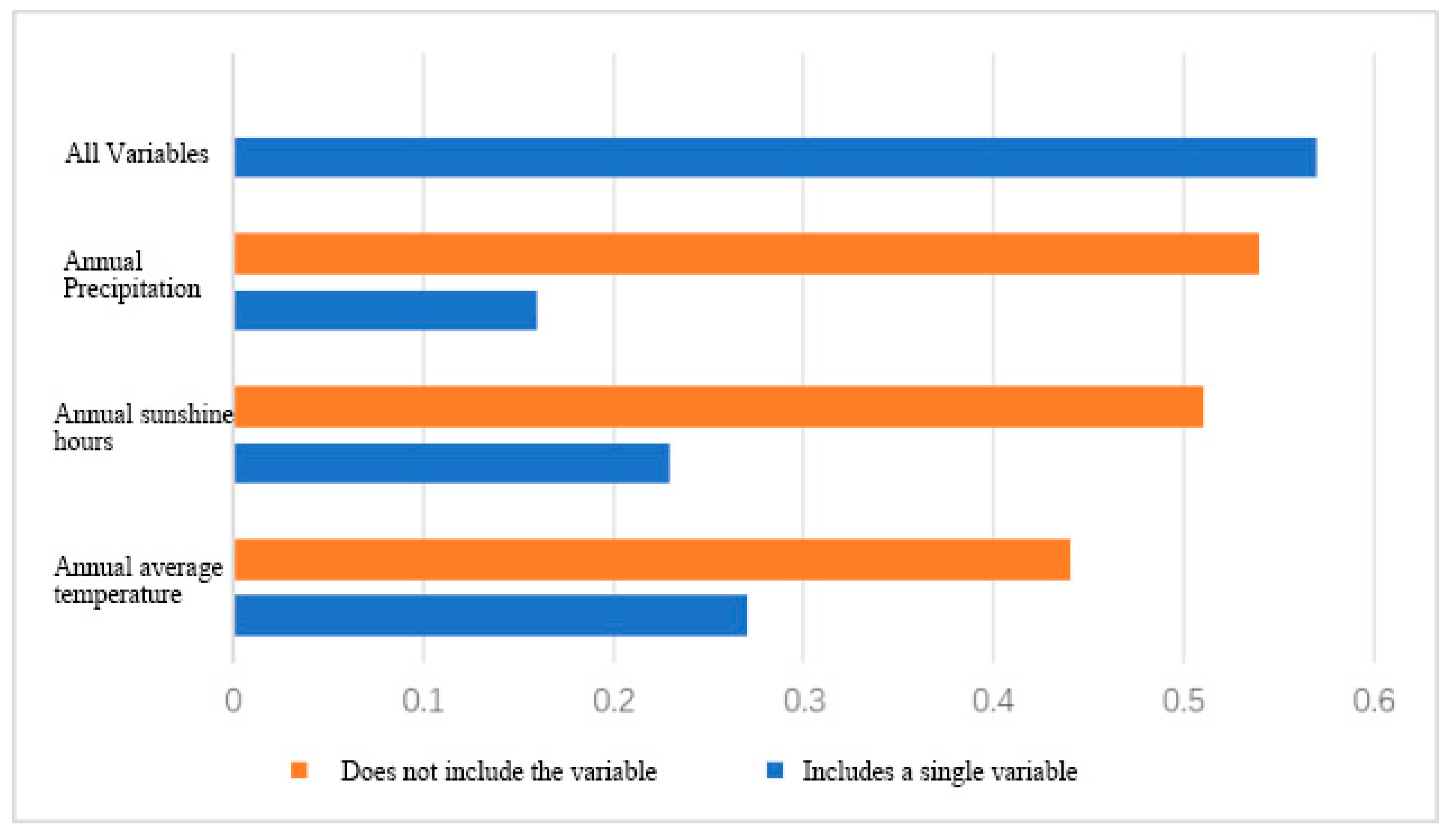
Determination of evaluation indicator weights: The weights of the evaluation indicators were determined using the MaxEnt model with its Jackknife module. Annual average temperature, annual sunshine duration, and annual precipitation were assessed as key indicators for maize cultivation zoning. The contribution scores for annual mean temperature, annual sunshine duration, and annual precipitation were 0.16, 0.23, and 0.27 (Figure 2).
w i = a i i = 1 3 a i
After incorporating these contribution rates into Formula (3) and normalizing them so that their sum equals 1, the final weight values for annual mean temperature, annual sunshine duration, and annual precipitation are 0.41, 0.35, and 0.24, respectively.
A comprehensive review of the literature and relevant indicators for maize cultivation in Jilin Province was conducted based on studies by Sánchez et al., Wanyama, Jia, and others [40,41,42]. Building on this foundation, climatic factors were categorized by integrating the overall climatic characteristics of Jilin Province—specifically, regional annual precipitation, mean temperature, and sunshine duration—with the growth requirements of maize. The year with the highest factor weight was identified as the climatic factor transition year. Finally, the threshold values for each suitability level were determined based on this categorization and the identified transition years, as presented in Table 1. These thresholds were defined with reference to medium-maturity maize varieties commonly cultivated in Jilin Province.
Determination of Membership Degrees: This study employed a descending semi-trapezoidal membership function to calculate the membership degree, where γij denoted the membership degree of the ith zoning factor at the jth level. The calculation formulas for Level I, II, III, and IV were as follows:
Formula for Calculating Level I Suitability:
y i 1 = 1 , x i v i 1 ( x i v i 1 ) ( v i 1 v i 2 ) , v i 1 x i v i 2 0 , x i v i 2
Formula for Calculating Level II Suitability:
y i 2 = 0 , x i v i 1   a n d   x i v i 3 ( x i v i 2 ) ( v i 2 v i 1 ) , v i 1 x i v i 2 ( x i v i 3 ) ( v i 2 v i 3 ) , v i 2 x i v i 3
Formula for Calculating Level III Suitability:
y i 3 = 0 , x i v i 2 ( x i v i 2 ) ( v i 2 v i 3 ) , v i 2 x i v i 3 1 , x i v i 3
Formula for Calculating Level IV Suitability:
y i 4 = 0 , x i v i 3 ( x i v i 3 ) ( v i 3 v i 4 ) , v i 3 x i v i 4 1 , x i v i 4
In the formula, xi represented the actual value of the ith zoning factor, and vij denoted the standard initial value of the ith zoning factor at level j (where *j* = I, II, III, or IV, corresponding to the suitability levels).
The fuzzy composition operator M(·, ⊕) was applied to the evaluation matrices of all 49 districts (counties) to calculate composite scores for the periods before and after the identified climate transition. Each district was assigned a score based on its suitability level, as follows: Level I (4 points), Level II (3 points), Level III (2 points), and Level IV (1 point).
b j = m i n 1 , i = 1 m ( w i · r i j ) ,   j = 1 ,   2 , ,   n
Classification of Ecological Suitability Levels: Following the classification methods of Pilevar A R (2020) [43], Wanyama D (2021) [41], and Król-Badziak A (2024) [44], maize cultivation areas in Jilin Province were classified into four suitability levels: The four levels are defined as follows: Level I (≥3.0 points), Level II (2.6–2.9 points), Level III (2.4–2.5 points), and Level IV (<2.4 points).

2.3. Data Sources

The meteorological data were sourced from the National Meteorological Science Data Sharing Platform (China Meteorological Data Sharing Service Network, http://data.cma.cn/), specifically from the “China Ground Climate Data Daily Value Dataset (V3.0)”. Data from 49 meteorological observation stations within Jilin Province (Figure 1) were selected, covering daily precipitation (mm), temperature (°C), and sunshine duration (h) for the period 1976–2020. Geographic information data were sourced from the National Geographic Information Resource Catalog Service System (https://www.webmap.cn/) and the Geospatial Data Cloud (https://www.gscloud.cn/), primarily including Jilin Province’s administrative boundaries and DEM data.

3. Results

3.1. Temporal Variation Characteristics and Abrupt Change Analysis of Major Climatic Factors in Jilin Province

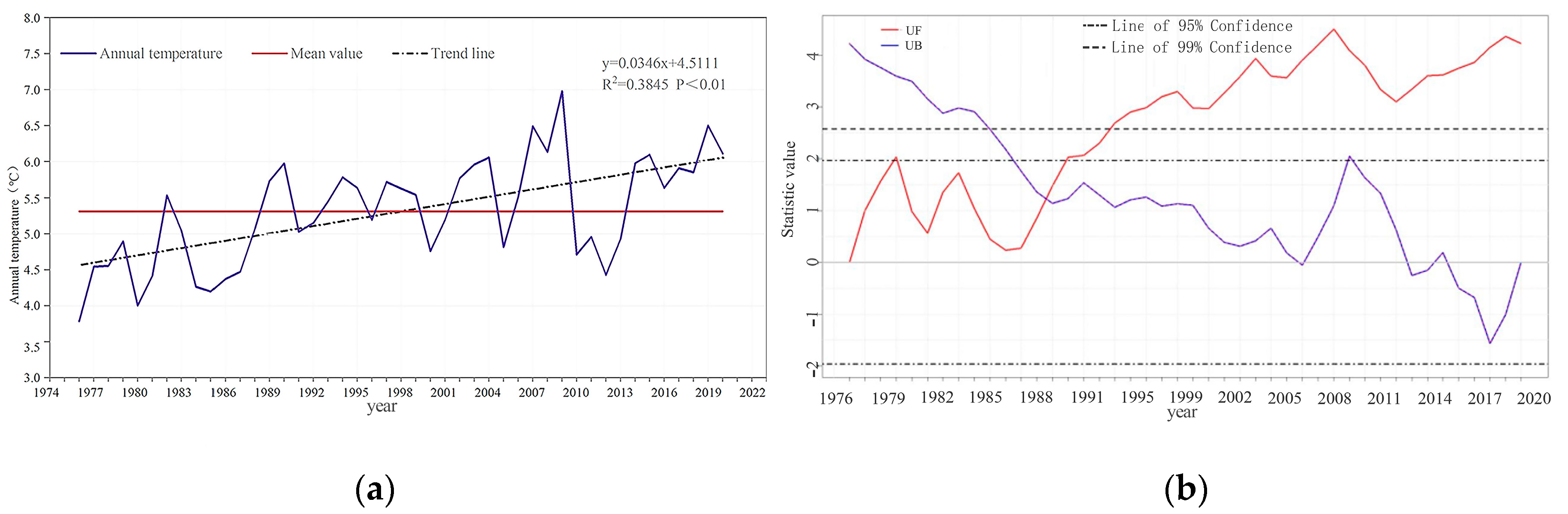
As illustrated in Figure 3a, the long-term mean temperature in Jilin Province during 1976 to 2020 was 5.3 °C. The highest annual mean temperature (6.9 °C) occurred in 2009, while the lowest (3.8 °C) was recorded in 1976. Annual temperature values fluctuated around the trend line within a range of 3.5 °C to 7 °C, exhibiting a significant warming trend of 0.34 °C per decade. Over the 45-year period, the cumulative increase reached 2.33 °C. As shown in Figure 3b, no clear warming trend was observed from 1976 to 1989. A distinct warming phase began from 1990 to 1994, when the UF curve rose above the zero line and reached the significance threshold (α = 0.05), indicating the onset of significant warming around 1990. Since 1995, the warming trend has become more pronounced, with UF values exceeding the 99% confidence level. Moreover, the intersection of the UF and UB curves in 1988 signified an abrupt shift in the annual mean temperature, suggesting that year as a critical transition point in the regional climate.
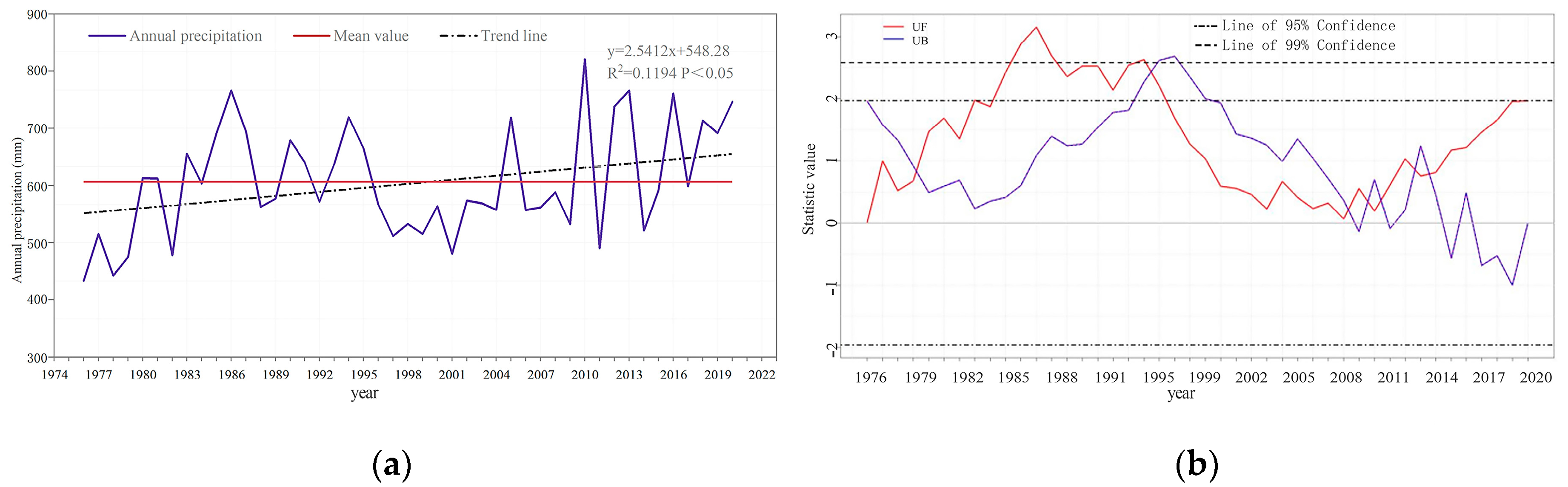
Figure 4a revealed that annual precipitation in the study area fluctuated between 400 and 850 mm from 1976 to 2020. The long-term average was 607.94 mm, with a significant upward trend of 2.54 mm per year. Annual precipitation peaked in 2010 (820.5 mm) and reached its lowest point in 1976 (433.56 mm), resulting in a difference of 386.94 mm between the maximum and minimum values. Despite alternating peaks and troughs throughout the study period, an overall upward trend was maintained. The M-K breakpoint test results shown in Figure 4b indicated that the UF statistic remained consistently above zero throughout the entire study period, confirming the overall increasing trend. The UF and UB curves intersected in five years: 1979, 1995, 2009, 2012, and 2014. However, after significance testing, only the intersection in 1995 was statistically significant (p < 0.05). Thus, 1995 was identified as the abrupt change year for annual precipitation.
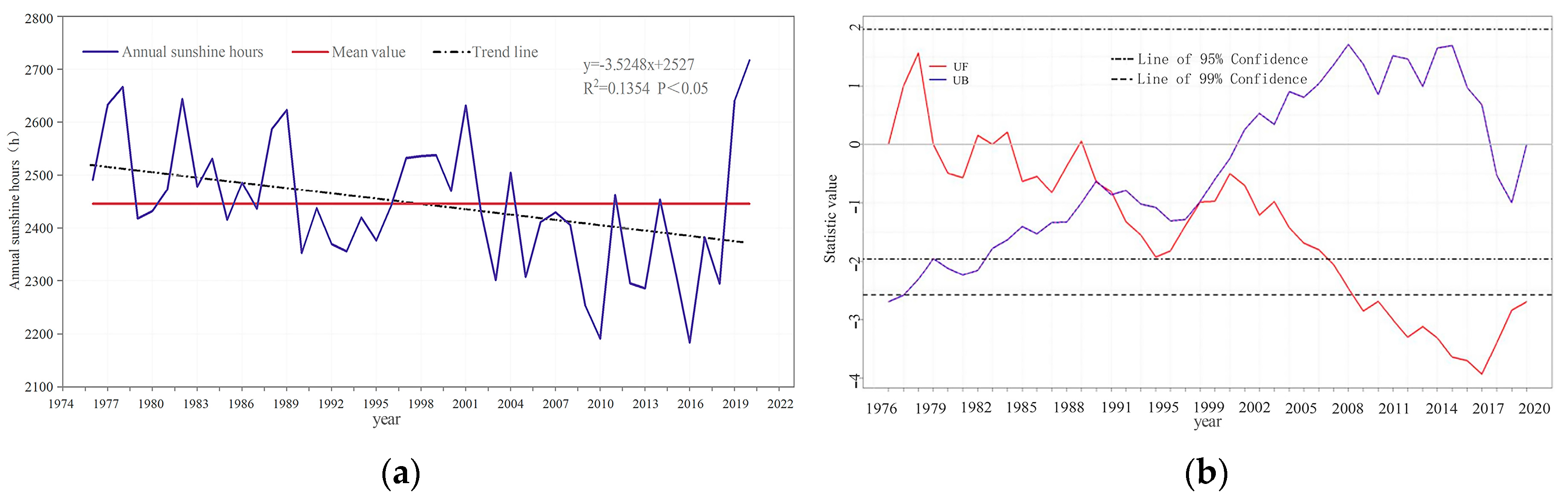
Figure 5a showed that the multi-year average annual total sunshine duration in the study area from 1976 to 2020 was 2445.93 h, with values ranging between 2100 and 2750 h. The maximum sunshine duration was recorded in 2020 (2717.14 h), whereas the minimum occurred in 2016 (2184.47 h). Overall, the annual sunshine duration exhibited a significant decreasing trend over the study period, with considerable interannual fluctuations around both the trend line and the mean. The M-K test results in Figure 5b indicated that the annual average sunshine duration exhibited significant abrupt-change characteristics. In the M-K abrupt change test, the UF curve and UB curve intersected distinctly in 1990. Based on the test principle, 1990 was determined to be the abrupt change year for the study area’s annual average sunshine duration.

3.2. Spatial Variation Characteristics of Main Climatic Factors in Jilin Province

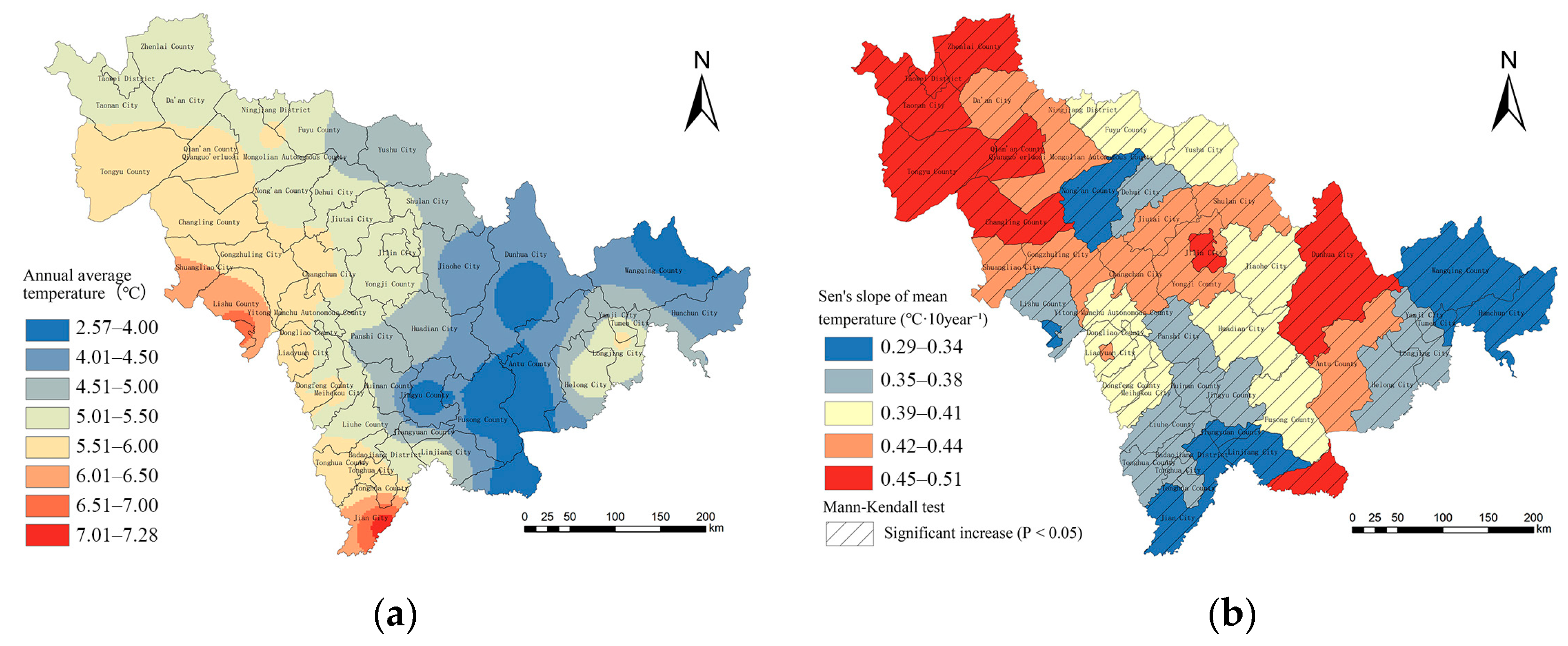
As shown in Figure 6a, the spatial distribution of the annual mean temperature in Jilin Province was characterized by higher values in the western and southern regions and lower values in the eastern and northern regions. The annual mean temperature ranged from 6.5 °C to 7.2 °C in the warmer western and southern regions (e.g., around Shuangliao City and Jian City), compared to a range of 2.5 °C to 3.5 °C in the colder eastern regions (e.g., near Changbai Korean Autonomous County). The spatial trend analysis in Figure 6b, complemented by spatial correlation analysis, revealed a spatially coherent pattern of temperature change across the province. Overall, the annual mean temperature across the province showed a significant upward trend, although the rate of increase varied regionally. The increasing trend was significantly stronger in the northwestern regions than in the southeastern mountainous areas. In the central plains, the rate of increase exceeded 0.42 °C per decade. The most modest increases were observed in the eastern mountains, where Wangqing County recorded the lowest rate of increase (0.29 °C per decade). This represented a 1.76-fold difference between the maximum and minimum trend rates observed across the province.
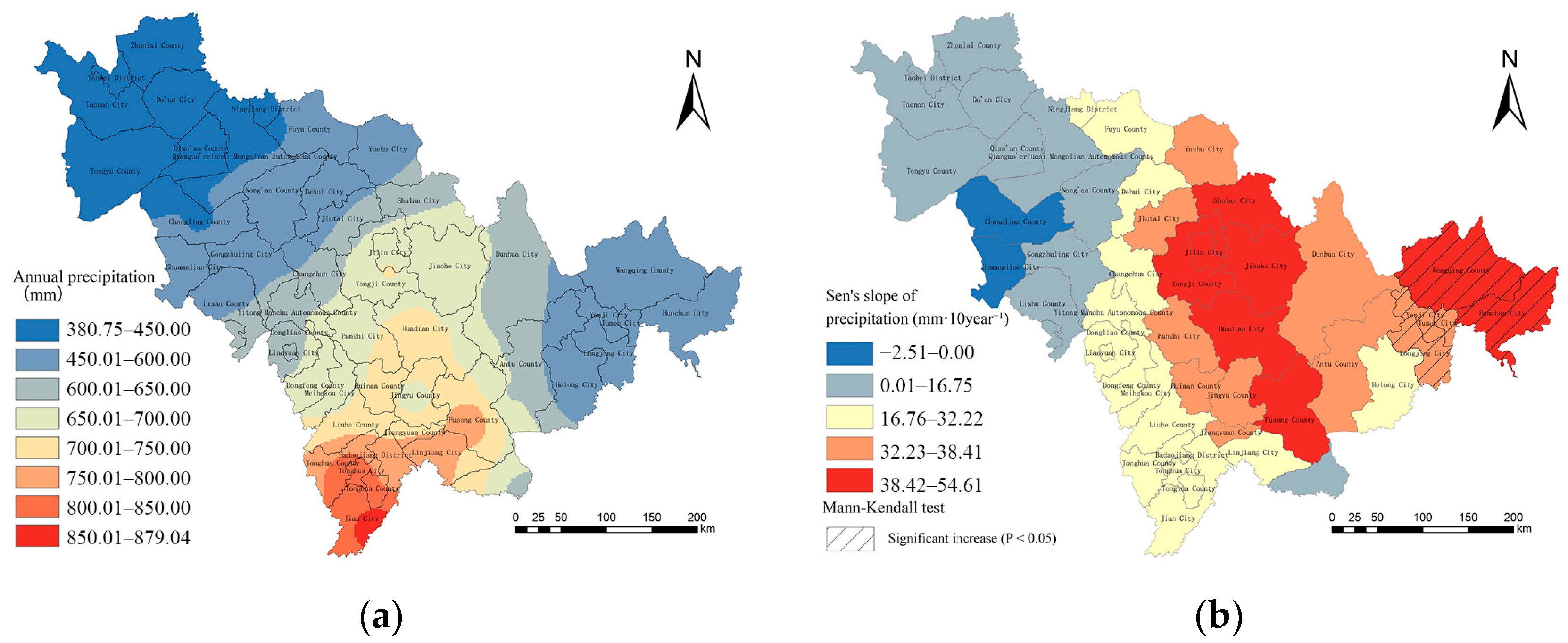
As shown in Figure 7a, the spatial distribution of long-term average annual precipitation in Jilin Province, Jilin Province demonstrated a gradient increase from northwest to southeast, with overall annual precipitation ranging between 380 and 880 mm. The southern regions (e.g., the vicinity of Jilin City) recorded relatively high annual precipitation, with values between 780 and 880 mm. In contrast, the northwestern areas (e.g., near Zhenlai County and Tongyu County) received less precipitation, typically amounting to 380 to 480 mm annually. As shown in Figure 7b, the spatial trend of precipitation indicated that the long-term precipitation tendency in Jilin Province gradually increased from west to east. A decreasing trend was observed in some areas, particularly in the northwest, where precipitation declined at rates ranging from 2.54 to 3.87 mm per year. Most areas, however, exhibited an increasing trend. This was particularly pronounced in parts of the central and southeastern regions, where increases reached 38.43 to 54.62 mm per year.
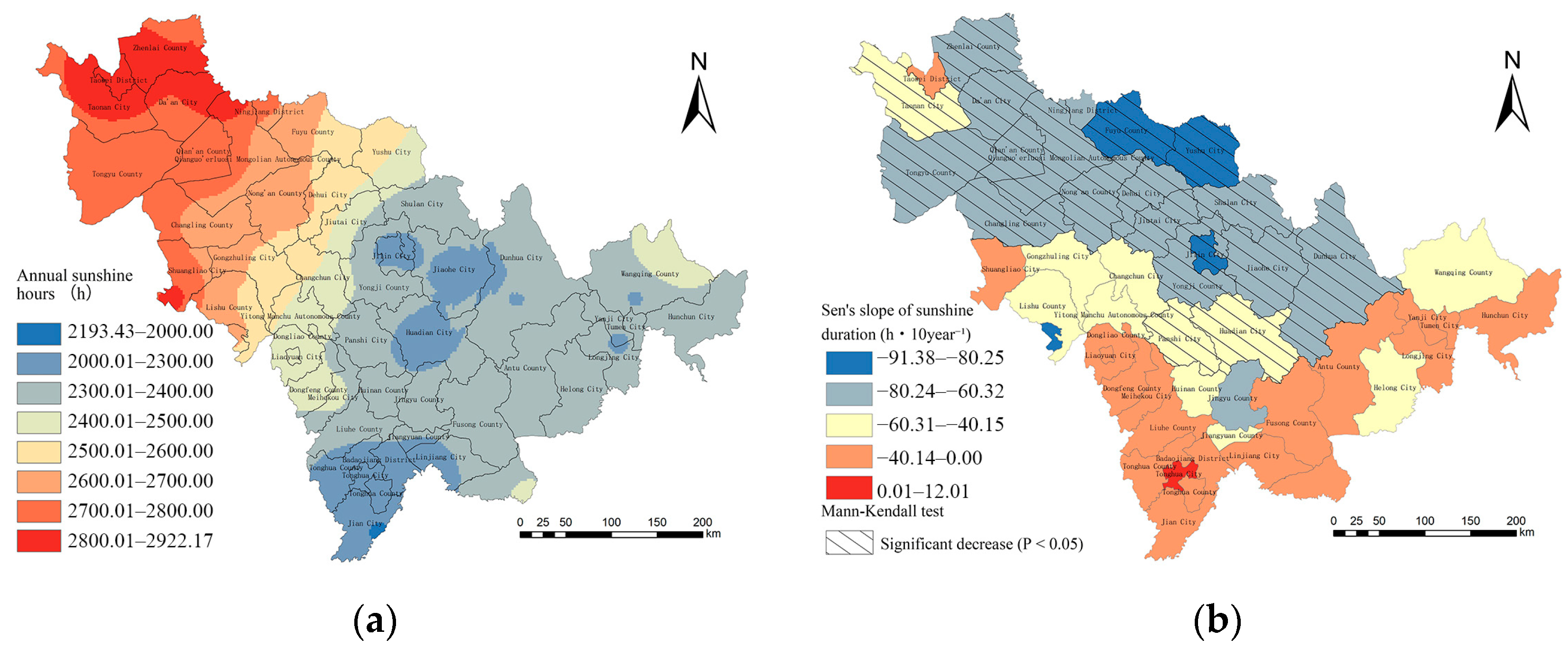
As shown in Figure 8a, the long-term average annual sunshine hours in Jilin Province exhibited a spatial pattern characterized by higher values in the northwest and lower values in the southeast, with a provincial range of approximately 2200 to 2950 h. The northwestern region (e.g., areas surrounding Da’an City) received relatively abundant sunshine, with most areas recording more than 2600 h and some exceeding 2800 h. By contrast, the southeastern region (e.g., near Jilin City) had comparatively less sunshine, generally below 2400 h. Figure 8b showed the slope of annual sunshine duration, indicating a general decreasing trend across Jilin Province. This decline was more pronounced in the southeast than in the northwest. Some areas, notably Fuyu County, experienced significant reductions, with rates ranging from −91.38 to −77.90 h per year. Only a few regions showed relatively minor decreases.

3.3. Maize Suitability Zoning Before and After Mutation in Jilin Province

As shown in Table 2, the area of Level I suitable areas for maize cultivation in Jilin Province prior to the climatic transition was 44,449.21 km2, accounting for 23.27% of the province’s total area. Level II suitable areas covered 37,473.91 km2 (19.62%), which were 6975.3 km2 less than the Level I suitable areas. The most extensive classification was Level III (marginally suitable), which accounted for 81,773.95 km2, or 42.81% of the total area. In contrast, Level IV suitable areas were the most spatially restricted, covering 27,316.54 km2 (14.30%). Spatially, and prior to the 1988 transition, Level I suitable areas were concentrated primarily within the central plains (Figure 9a). These areas were concentrated in counties and cities such as Nong’an County, Shuangliao City, and Longjing City on the eastern edge of the central plains. Level II areas typically formed a transitional belt surrounding Level I areas and were also found in favorable local environments, such as the river valleys of the eastern mountains and the well-irrigated sections of the western plains. Prominent examples were Changling County and Yongji County in the central region; Tonghua City and Jiangyuan County in the southeast; and Da’an City together with Ningjiang District in the northwest. Level III suitable areas were predominantly identified in the southeast and northwest regions, such as Taobei District and Wangqing County. Level IV areas were largely confined to the eastern regions, including Dunhua City and Antu County.
As shown in Table 2, following the climatic shift, the area of Level I suitable areas changed to 44,638.51 km2. This represented a slight increase of only 0.426% compared to the pre-transition period, indicating no significant net change. The Level II suitable areas expanded by 11,421.11 km2 (a 30.45% increase), bringing their total to 48,895.02 km2 and raising their proportion of the provincial area to 25.60%. Conversely, the Level III suitable areas contracted by 3753.07 km2 (a 4.59% decrease), resulting in a total area of 78,020.88 km2, which accounted for 40.85% of the province. Finally, the Level IV suitable areas were reduced to 19,459.21 km2, constituting only 10.19% of the total area. This represented a decrease of 7857.33 km2, meaning the Level IV suitable areas shrank by 28.77% compared to their pre-transition extent.
As shown in Figure 9, around 1988, Level I suitable areas were primarily located in the climatically favorable central and western plains. Compared to the period before 1988, Changchun City and Jingyu County transitioned to Level I suitable areas, while Panshi City and Longjing City shifted from Level I to Level II suitable areas. Level II suitable areas, previously confined to scattered parts of the central and eastern regions, exhibited a clear eastward expansion after the transition. This expansion incorporated new zones such as parts of Yushu City and Fusong County, while areas like Da’an City and Ningjiang District were no longer classified as Level II. Level III suitable areas were primarily found in the northwestern plains and southeastern regions, but experienced a net contraction compared to the pre-transition period. This net change resulted from some areas being upgraded from Level IV to Level III (e.g., Dunhua City, Huinan County), while others were downgraded from Level III to Level IV (e.g., Meihekou City). After 1988, Level IV areas remained concentrated in the eastern and northwestern regions, with minimal overall shift in their spatial extent. Notably, Ningjiang District was downgraded directly from Level II to Level IV. In contrast, the suitability of Tumen City, Antu County, and Jilin City remained unchanged.

4. Discussion

4.1. Changes in Climatic Factors Affecting Maize Suitability

Against the backdrop of global warming, Jilin Province has experienced significant climatic changes over the past 45 years, with a cumulative temperature increase of 2.32 °C. Shifts in thermal resources, along with changes in extreme weather events, precipitation dynamics, and sunshine duration, have collectively contributed to a shift in the province’s overall climate toward a “warmer and wetter” trend, exerting a dual impact on maize production [45]. Persistent warming has, to some extent, improved thermal conditions for maize growth and development, potentially extending the growing season and enabling the cultivation of late-maturing, high-yielding varieties. Extreme high temperatures not only directly disrupt key physiological processes—such as photosynthesis and pollination—leading to reduced kernel set and grain weight, but also, through persistent warming, contribute to recurrent spring droughts in central and western regions. These combined effects threaten maize from seedling emergence to grain filling, ultimately resulting in significant yield loss [46,47]. Moderate precipitation supports grain filling rate and dry matter accumulation, while water stress (drought or waterlogging) restricts nutrient uptake and transport, inhibits root development, and exacerbates yield loss by disrupting reproductive growth [48,49]. Ample sunlight enhances photosynthetic efficiency, supporting higher yields, whereas low light conditions limit the accumulation of photosynthetic products and cause stem elongation [30]. When combined with other abiotic stresses, low light further reduces yield potential [49].
Overall, these complex climatic changes present both opportunities and challenges for maize production and regional food security in Jilin Province. Improved thermal conditions offer potential for yield enhancement through variety adjustment. However, the increased frequency of extreme weather events (droughts and floods), uneven precipitation distribution, and reduced sunshine duration collectively heighten production risks and uncertainties [50]. Therefore, developing targeted climate-resilient maize production strategies is imperative to address these dynamically changing conditions and safeguard regional food security [45].

4.2. Climate Suitability Zoning for Maize Cultivation

The precision of maize cultivation suitability zoning fundamentally depends on the scientific selection of climatic factors. Early research primarily focused on key growth requirements, employing indicators such as accumulated temperature ≥10 °C, frost-free period, July mean temperature, and active accumulated temperature ≥0 °C to assess suitability, thereby establishing a zoning framework centered on thermal conditions [51,52,53]. As research has progressed, the distinct influence of dominant climatic factors across different regions has become increasingly apparent. For instance, studies on three major maize-producing regions in China (the North China spring maize region, the Huang-Huai-Hai summer maize region, and the southwestern mountainous maize region) have identified solar radiation as the dominant factor influencing cultivation suitability, challenging the conventional view that thermal factors are the sole primary determinant [20]. Meanwhile, research has shown that precipitation carries the greatest weight among climatic factors during the growing season, underscoring how the spatial distribution of suitable cultivation areas shifts significantly with variations in rainfall [41]. In summary, both temperature and precipitation exert substantial influence on maize growth, establishing them as crucial factors for delineating suitable cultivation areas.
Building on Jilin Province’s specific climate characteristics and maize growth requirements, this study moves beyond the limitations of single-factor and traditional combined thermal factor analyses. It integrates three key climatic factors—annual precipitation, sunshine duration, and annual mean temperature—to establish a multi-factor synergistic suitability zoning system. This approach provides a more comprehensive reflection of the integrated impact of climate conditions on maize cultivation. The study indicates that, with 1988 as the climatic shift year, the suitable maize cultivation area in Jilin Province underwent significant spatial restructuring before and after the shift. The total area of Level III and Level IV suitability areas decreased markedly, while Level I and Level II areas expanded. This shift demonstrates a trend of gradual optimization and eastward expansion into the mountainous regions and northward into the plains. This pattern aligns closely with previous findings by scholars who, based on heat index analysis, concluded that maize cultivation ranges are shifting northward and expanding eastward under climate change [54,55,56].
Based on climatic characteristics and suitability assessment, the optimal balance of temperature, moisture, and light in Level I suitable areas fully meets the growth and development requirements of maize, making these regions the core production areas for high and stable yields in Jilin Province. Level II suitable areas receive comparatively higher annual precipitation than Level I areas. However, this potential advantage is counteracted by challenges such as increased soil erosion due to excessive precipitation, insufficient heat accumulation, and elevated risks of low-temperature frost, all of which limit maize productivity. Level III suitable areas are mainly distributed in the northern plains. These regions are characterized by high annual average temperatures and abundant sunshine but suffer from low precipitation. Consequently, inadequate moisture leads to frequent droughts, making water scarcity the primary constraint on maize growth and causing significant yield instability. Level IV suitable areas are located in the northeastern mountainous regions. They experience low annual average temperatures and are frequently affected by frost and hail disasters, rendering them highly vulnerable to cold damage. Such climatic conditions severely restrict maize growth, posing extremely high cultivation risks.
Driven by ongoing climate warming, the spatial distribution of maize-suitable areas in Jilin Province is projected to follow a distinct trajectory. Areas with suitable thermal conditions are expected to continue their expansion northward and eastward, thereby broadening the potential scope for cultivation. However, this expansion may be counteracted by a contraction of sunlight-suitable areas due to declining sunshine duration. Furthermore, increasing interannual variability in precipitation is likely to intensify the risks of both drought and flood events. In the coming decades, compound stress scenarios characterized by concurrent high temperatures and water scarcity are likely to emerge. Overall, the suitable maize cultivation area in Jilin Province is projected to expand gradually. Concurrently, improved thermal conditions are expected to increase the suitability for late-maturing, high-yield varieties.

4.3. Uncertainty Analysis

Maize cultivation and growth constitute a complex biological process involving the synergistic interaction of multiple factors. However, climatically suitable regions are not always optimal for cultivation, as climate is only one critical element. Numerous scholarly studies have confirmed the significance of non-climatic factors. For instance, current climatic suitability for maize has been assessed alongside soil improvement and cropping systems as key indicators for maize suitability zoning. Six indicators—slope, soil, depth, pH, texture, carbonate content, and salinity—were used to evaluate suitability, with slope identified as the primary influence due to its effects on soil-water conservation and fertility [57]. Additionally, improved agronomic management can significantly boost maize yields, representing an indispensable consideration for zoning [58]. Jilin Province’s unique geographical environment provides a foundation for maize production. Within its administrative boundaries, surface elevation ranges from 2 to 2667 m (Figure 1), with most areas situated below 300 m. Low elevation areas offer higher maize suitability owing to abundant heat resources, while high elevation regions present poorer adaptability due to lower temperatures and elevated frost risks [59]. Gentle slopes (≤5°) facilitate agricultural practices and enhance water-nutrient retention, thereby ensuring optimal growing conditions, whereas steep slopes are susceptible to soil erosion, which constrains maize growth and development [60]. Aspect further modulates the local microclimate: south-facing and southeast-facing sunny slopes provide ample sunlight and moderate temperatures to improve pollination efficiency, while north-facing and northwest-facing shaded slopes suffer from insufficient illumination and excessive humidity, leading to a marked decline in maize suitability [61]. In summary, factors such as soil properties, water resources, topography, and agronomic practices collectively form a complex system influencing maize production. A holistic approach that integrates these elements is therefore essential for scientific and effective suitability zoning.
This study focuses solely on three climatic factors—temperature, precipitation, and sunshine duration-to delineate suitable maize-growing areas in Jilin Province. Although the findings generally align with the province’s actual cultivation distribution and provide preliminary guidance for industry planning, this approach has notable limitations. First, the exclusion of critical non-climatic factors—such as soil properties, hydrology, and topography—means that the zoning results cannot fully capture the complexities of actual planting conditions. Second, the accuracy of the zoning is constrained by the spatiotemporal resolution of the climate data employed and the uncertainties inherent in future climate projections. Future studies should therefore integrate non-climatic elements, such as topography and key soil properties (e.g., texture and nutrient content), to develop a multi-factor comprehensive evaluation model. Such an integrated approach will enable more scientific and precise suitability zoning and planting layout optimization, thereby providing a more robust theoretical foundation for the sustainable development of the maize industry in Jilin Province.

5. Conclusions and Recommendations

This study investigates the impacts of climatic factors on maize cultivation zoning in the cold region of Jilin Province under climate change. It integrates ArcGIS (10.8), the Mann–Kendall (M-K) mutation test, and a fuzzy comprehensive evaluation model to systematically analyze the spatiotemporal variations and abrupt change characteristics of key climatic factors. Based on this analysis, the suitability of maize cultivation across the province was assessed and zoned. The main conclusions and recommendations derived from the study are as follows:

5.1. Main Research Conclusions

(1) Between 1976 and 2020, the three core climatic factors in Jilin Province exhibited significant temporal trends, each with distinct abrupt change points. The annual mean temperature displayed a fluctuating yet overall upward trend, thereby providing a more abundant thermal resource for maize growth. Annual precipitation showed a slight increase; however, this modest rise was insufficient to counterbalance the pronounced spatial imbalances in its distribution. Concurrently, sunshine duration demonstrated a continuous decline, with the resultant weakening of light conditions posing potential constraints on maize photosynthesis and dry matter accumulation.
(2) Spatially, Jilin Province exhibits pronounced regional heterogeneity in annual mean temperature, precipitation, and sunshine duration. The spatial patterns of temperature and sunshine duration are generally congruent, both characterized by a “higher in the west and north, lower in the east and south” distribution. This pattern results in superior thermal and light conditions in the central and western plains, contrasting with the relative deficits in the eastern mountainous and hilly areas.
(3) Amid intensifying global warming, the spatial distribution of suitable maize cultivation areas in Jilin Province has undergone significant restructuring following climatic abrupt changes. The most suitable areas are now concentrated in the central plains of Jilin Province and are gradually expanding into the northern plains and eastern mountainous regions with better suitability conditions. This observed spatial shift is consistent with previous findings that maize cultivation ranges are moving northward and eastward under climate warming and aligns with the actual evolving patterns of maize cultivation in the province.

5.2. Suggestions for Maize Cultivation Optimization

(1) To mitigate the constraints imposed by regional climatic factors—namely temperature, precipitation, and sunshine duration—differentiated technical strategies should be implemented to enhance the adaptability of maize cultivation. In regions with elevated temperatures and insufficient precipitation and sunshine, planting late-maturing varieties or delaying sowing can improve maize’s utilization of thermal resources. Concurrently, enhanced field management coupled with supplemental irrigation can secure adequate water for maize growth. Alternatively, the development and adoption of drought-resistant varieties can mitigate the adverse effects of rainfall insufficiency. Driven by climate warming, maize varieties in Jilin Province are shifting towards medium- to late-maturing types, progressively replacing early-maturing varieties. Additionally, rational adjustment of planting areas and densities can modify field microclimates, promote the efficient use of agricultural climate resources, and ultimately elevate the overall standard of maize cultivation in the province.
(2) It is recommended to formulate tailored cultivation and industrial development strategies based on the specific natural and climatic conditions of each suitability zone. Level I suitable areas are predominantly located in the central plain black soil region, characterized by flat terrain, fertile soil, and overall favorable natural conditions. For this region, it is advised to actively leverage these ecological and climatic advantages to appropriately expand the maize cultivation area. Medium-maturity maize varieties should be selected, while planting practices should account for climate variability and intensify field management to maximize the yield-enhancing effects of warming temperatures. Level II suitable areas are distributed around Level I areas or are situated in favorable river valleys of the eastern mountains and well-irrigated sections of the western plains. This zone is suitable for medium- to late-maturing maize varieties. Rational fertilization practices should be implemented to maintain soil fertility and ensure an adequate nutrient supply for maize growth. Within Level III suitable areas, the semi-arid northwest requires enhanced irrigation techniques to compensate for precipitation deficits or the cultivation of drought-resistant varieties. In the eastern semi-mountainous areas, straw or plastic mulching can be applied to increase soil temperatures, thereby alleviating low-temperature stress and ensuring sustained cultivation. Level IV areas are primarily located in the eastern mountainous regions of Jilin Province. Given the generally unfavorable conditions for maize cultivation, it is recommended to adjust the agricultural industrial structure to enable more rational land use. Promoting the integrated development of agriculture, forestry, and animal husbandry will facilitate the efficient utilization of land resources.

Author Contributions

Conceptualization, J.H. and C.Z.; methodology, N.F. and C.Z.; software, J.H. and S.J.; validation, J.H. and N.F.; investigation, J.H.; writing—original draft preparation, J.H. and N.F.; writing—review and editing, J.H., C.Z., N.F. and S.J.; funding acquisition, C.Z. All authors have read and agreed to the published version of the manuscript.

Funding

This research was funded by the Doctoral Talent Research Start-up Fund of Changchun University grant number ZKQD202301.

Data Availability Statement

The data supporting the results presented in this study are available from the corresponding author upon reasonable request.

Conflicts of Interest

The authors declare no conflicts of interest.

References

  1. You, N.; Till, J.; Lobell, D.B.; Zhu, P.; West, P.C.; Kong, H.; Li, W.; Sprenger, M.; Villoria, N.B.; Li, P.; et al. Climate-driven global cropland changes and consequent feedbacks. Nat. Geosci. 2025, 18, 639–645. [Google Scholar] [CrossRef]
  2. Wang, J.; Liu, W.; Yin, D. Impacts of integrated meteorological and agricultural drought on global maize yields. Agric. Water Manag. 2025, 318, 109727. [Google Scholar] [CrossRef]
  3. National Bureau of Statistics of China. China Statistical Yearbook-2023. Available online: https://www.stats.gov.cn/ (accessed on 24 May 2025).
  4. Gong, D.; Gong, W. Impacts of climate change on maize production and countermeasures in Northeast China. J. Agro-Environ. Sci. 2020, 10, 35–38. [Google Scholar]
  5. Ramirez-Cabral, N.Y.Z.; Kumar, L.; Shabani, F. Global alterations in areas of suitability for maize production from climate change and using a mechanistic species distribution model (CLIMEX). Sci. Rep. 2017, 7, 5910. [Google Scholar] [CrossRef] [PubMed]
  6. Frich, P.; Alexander, L.V.; Della-Marta, P.; Gleason, B.; Haylock, M.; Tank, A.M.G.K.; Peterson, T. Observed coherent changes in climatic extremes during the second half of the twentieth century. Clim. Res. 2002, 19, 193–212. [Google Scholar] [CrossRef]
  7. Tao, F.; Zhang, Z. Impacts of climate change as a function of global mean temperature: Maize productivity and water use in China. Clim. Change 2010, 105, 409–432. [Google Scholar] [CrossRef]
  8. Liu, Y.; Zhang, J.; Pan, T.; Chen, Q.; Qin, Y.; Ge, Q. Climate-associated major food crops production change under multi-scenario in China. Sci. Total Environ. 2022, 811, 151393. [Google Scholar] [CrossRef]
  9. Xie, M. A Meta-Analysis on the Effects of Meteorological, Soil, and Field Management Factors on Maize Nitrogen Use Efficiency; Water Resources and Civil Engineering College, Inner Mongolia Agricultural University: Hohhot, China, 2011. [Google Scholar]
  10. Daryanto, S.; Wang, L.; Jacinthe, P.-A. Global Synthesis of Drought Effects on Maize and Wheat Production. PLoS ONE 2016, 11, e0156362. [Google Scholar] [CrossRef]
  11. Lobell, D.B.; Field, C.B. Global scale climate–crop yield relationships and the impacts of recent warming. Environ. Res. Lett. 2007, 2, 014002. [Google Scholar] [CrossRef]
  12. Chen, C.; Wang, E.; Yu, Q.; Zhang, Y. Quantifying the effects of climate trends in the past 43 years (1961–2003) on crop growth and water demand in the North China Plain. Clim. Change 2009, 100, 559–578. [Google Scholar] [CrossRef]
  13. Li, Y.; Guan, K.; Schnitkey, G.D.; DeLucia, E.; Peng, B. Excessive rainfall leads to maize yield loss of a comparable magnitude to extreme drought in the United States. Glob. Change Biol. 2019, 25, 2325–2337. [Google Scholar] [CrossRef] [PubMed]
  14. Król-Badziak, A.; Kozyra, J.; Rozakis, S. Assessment of Suitability Area for Maize Production in Poland Related to the Climate Change and Water Stress. Sustainability 2024, 16, 852. [Google Scholar] [CrossRef]
  15. Ojara, M.A.; Yunsheng, L.; Ongoma, V.; Mumo, L.; Akodi, D.; Ayugi, B.; Ogwang, B.A. Projected changes in East African climate and its impacts on climatic suitability of maize production areas by the mid-twenty-first century. Environ. Monit. Assess. 2021, 193, 831. [Google Scholar] [CrossRef]
  16. Meng, Q.; Chen, X.; Lobell, D.B.; Cui, Z.; Zhang, Y.; Yang, H.; Zhang, F. Growing sensitivity of maize to water scarcity under climate change. Sci. Rep. 2016, 6, 19605. [Google Scholar] [CrossRef] [PubMed]
  17. Yang, X.; Menefee, D.; Cui, S.; Rajan, N.; Fletcher, A. Assessing the impacts of projected climate changes on maize (Zea mays) productivity using crop models and climate scenario simulation. Crop Pasture Sci. 2021, 72, 969–984. [Google Scholar] [CrossRef]
  18. Alsafadi, K.; Bi, S.; Abdo, H.G.; Almohamad, H.; Alatrach, B.; Srivastava, A.K.; Al-Mutiry, M.; Bal, S.K.; Chandran, M.A.S.; Mohammed, S. Modeling the impacts of projected climate change on wheat crop suitability in semi-arid regions using the AHP-based weighted climatic suitability index and CMIP6. Geosci. Lett. 2023, 10, 20. [Google Scholar] [CrossRef]
  19. Choudhary, K.; Boori, M.S.; Shi, W.; Valiev, A.; Kupriyanov, A. Agricultural land suitability assessment for sustainable development using remote sensing techniques with analytic hierarchy process. Remote Sens. Appl. Soc. Environ. 2023, 32, 101051. [Google Scholar] [CrossRef]
  20. Zhao, J.; Yang, X. Spatial patterns of yield-based cropping suitability and its driving factors in the three main maize-growing regions in China. Int. J. Biometeorol. 2019, 63, 1659–1668. [Google Scholar] [CrossRef]
  21. Yalew, S.G.; van Griensven, A.; Mul, M.L.; van der Zaag, P. Land suitability analysis for agriculture in the Abbay basin using remote sensing, GIS and AHP techniques. Model. Earth Syst. Environ. 2016, 2, 101. [Google Scholar] [CrossRef]
  22. Liu, D.; Du, C.; Yu, C. Ecological suitability evaluation and regionalization of maize in Heilongjiang Province. J. Maize Sci. 2009, 17, 160–163. [Google Scholar] [CrossRef]
  23. Mi, C.; Zhang, X.; Li, S.; Yang, J.; Zhu, D.; Yang, Y. Assessment of environment lodging stress for maize using fuzzy synthetic evaluation. Math. Comput. Model. 2011, 54, 1053–1060. [Google Scholar] [CrossRef]
  24. Gasser, P.Y.; Smith, C.A.S.; Brierley, J.A.; Schut, P.H.; Neilsen, D.; Kenney, E.A. The use of the land suitability rating system to assess climate change impacts on corn production in the lower Fraser Valley of British Columbia. Can. J. Soil Sci. 2016, 96, 256–269. [Google Scholar] [CrossRef]
  25. Li, X.-H.; Sheng, K.; Wang, Y.-H.; Dong, Y.-Q.; Jiang, Z.-K.; Sun, J.-S. Influence of furrow irrigation regime on the yield and water consumption indicators of winter wheat based on a multi-level fuzzy comprehensive evaluation. Open Life Sci. 2022, 17, 1094–1103. [Google Scholar] [CrossRef]
  26. He, Z.; Hong, T.; Cai, Z.; Yang, Z.; Li, M.; Zhang, Z. Determination of amount of irrigation and nitrogen for comprehensive growth of greenhouse cucumber based on multi-level fuzzy evaluation. Int. J. Agric. Biol. Eng. 2021, 14, 35–42. [Google Scholar] [CrossRef]
  27. Li, X.; Shi, Z.; Xing, Z.; Wang, M.; Wang, M. Dynamic evaluation of cropland degradation risk by combining multi-temporal remote sensing and geographical data in the Black Soil Region of Jilin Province, China. Appl. Geogr. 2023, 154, 102920. [Google Scholar] [CrossRef]
  28. Bao, L.; Yu, L.; Yu, E.; Li, R.; Cai, Z.; Yu, J.; Li, X. Improving the simulation of maize growth using WRF-Crop model based on data assimilation and local maize characteristics. Agric. For. Meteorol. 2025, 365, 110478. [Google Scholar] [CrossRef]
  29. Lobell, D.B.; Schlenker, W.; Costa-Roberts, J. Climate Trends and Global Crop Production Since 1980. Science 2011, 333, 616–620. [Google Scholar] [CrossRef]
  30. Liu, X.; Wang, X.; Wang, X.; Gao, J.; Luo, N.; Meng, Q.; Wang, P. Dissecting the critical stage in the response of maize kernel set to individual and combined drought and heat stress around flowering. Environ. Exp. Bot. 2020, 179, 104213. [Google Scholar] [CrossRef]
  31. Kenny, G.J.; Harrison, P.A.; Olesen, J.E.; Parry, M.L. The effects of climate change on land suitability of grain maize, winter wheat and cauliflower in Europe. Eur. J. Agron. 1993, 2, 325–338. [Google Scholar] [CrossRef]
  32. Jilin Provincial Bureau of Statistics. Jilin Statistical Yearbook. 2024. Available online: http://tjj.jl.gov.cn/tjsj/tjnj/2024/enter.htm (accessed on 27 May 2025).
  33. Peel, M.C.; Finlayson, B.L.; McMahon, T.A. Updated world map of the Koppen-Geiger climate classification. Hydrol. Earth Syst. Sci. 2007, 11, 1633–1644. [Google Scholar] [CrossRef]
  34. Shi, X.Z.; Yu, D.S.; Xu, S.X.; Warner, E.D.; Wang, H.J.; Sun, W.X.; Zhao, Y.C.; Gong, Z.T. Cross-reference for relating Genetic Soil Classification of China with WRB at different scales. Geoderma 2010, 155, 344–350. [Google Scholar] [CrossRef]
  35. Zou, T.; Chang, Y.; Chen, P.; Liu, J. Spatial-temporal variations of ecological vulnerability in Jilin Province (China), 2000 to 2018. Ecol. Indic. 2021, 133, 108429. [Google Scholar] [CrossRef]
  36. Chen, F.-W.; Liu, C.-W. Estimation of the spatial rainfall distribution using inverse distance weighting (IDW) in the middle of Taiwan. Paddy Water Environ. 2012, 10, 209–222. [Google Scholar] [CrossRef]
  37. Wang, Y.; Gu, X.; Yang, G.; Yao, J.; Liao, N. Impacts of climate change and human activities on water resources in the Ebinur Lake Basin, Northwest China. J. Arid Land 2021, 13, 581–598. [Google Scholar] [CrossRef]
  38. Sen, P.K. Estimates of the Regression Coefficient Based on Kendall’s Tau. J. Am. Stat. Assoc. 1968, 63, 1379–1389. [Google Scholar] [CrossRef]
  39. Mann, H.B. Nonparametric Tests against Trend. Econometrica 1945, 13, 245–259. [Google Scholar] [CrossRef]
  40. Sánchez, B.; Rasmussen, A.; Porter, J.R. Temperatures and the growth and development of maize and rice: A review. Glob. Change Biol. 2013, 20, 408–417. [Google Scholar] [CrossRef]
  41. Wanyama, D.; Mighty, M.; Sim, S.; Koti, F. A spatial assessment of land suitability for maize farming in Kenya. Geocarto Int. 2019, 36, 1378–1395. [Google Scholar] [CrossRef]
  42. Jia, C.; Wang, L.; Luo, X.; Zhou, W.; Chen, Y.; Sun, G. Evaluation of suitability areas for maize in China based on GIS and its variation trend on the future climate Condition. In Ecosystem Assessment and Fuzzy Systems Management; Springer International Publishing: Cham, Switzerland, 2014; pp. 285–299. [Google Scholar]
  43. Pilevar, A.R.; Matinfar, H.R.; Sohrabi, A.; Sarmadian, F. Integrated fuzzy, AHP and GIS techniques for land suitability assessment in semi-arid regions for wheat and maize farming. Ecol. Indic. 2020, 110, 105887. [Google Scholar] [CrossRef]
  44. Król-Badziak, A.; Kozyra, J.; Rozakis, S. Evaluation of Climate Suitability for Maize Production in Poland under Climate Change. Sustainability 2024, 16, 6896. [Google Scholar] [CrossRef]
  45. Li, J.; Yang, X.; Jin, X. Analysis of climate change characteristics in Jilin Province from 1991 to 2022 and its impact on agriculture. J. Agric. Catastrophol. 2023, 13, 195–197. [Google Scholar]
  46. Wang, H.; Wang, G.; Guo, Y. Impacts of Meteorological Disasters on Maize Cultivation in Jilin Province and Response Strategies. South Agric. 2022, 16, 205–208. [Google Scholar] [CrossRef]
  47. Ayub, M.; Ashraf, M.Y.; Kausar, A.; Saleem, S.; Anwar, S.; Altay, V.; Ozturk, M. Growth and physio-biochemical responses of maize (Zea mays L.) to drought and heat stresses. Plant Biosyst.—Int. J. Deal. All Asp. Plant Biol. 2020, 155, 535–542. [Google Scholar] [CrossRef]
  48. Behera, S.; Kar, I.; Yadav, A.; Sahu, A. Exploring Waterlogging Challenges, Causes and Mitigating Strategies in Maize (Zea mays L.). J. Agron. Crop Sci. 2025, 211, e70109. [Google Scholar] [CrossRef]
  49. Zhao, J.; Yang, X.; Liu, Z.; Lv, S.; Wang, J.; Dai, S. Variations in the potential climatic suitability distribution patterns and grain yields for spring maize in Northeast China under climate change. Clim. Change 2016, 137, 29–42. [Google Scholar] [CrossRef]
  50. Chen, J.; Ren, B.; Zhao, B.; Liu, P.; Zhang, J. The environment, especially the minimum temperature, affects summer maize grain yield by regulating ear differentiation and grain development. J. Integr. Agric. 2024, 23, 2227–2241. [Google Scholar] [CrossRef]
  51. Liu, J.; Zhang, S.; Li, Y. GIS-based climatic suitability regionalization for spring maize in Tuoli County. Xinjiang Agric. Sci. Technol. 2018, 4, 6–10. [Google Scholar] [CrossRef]
  52. He, Q.; Zhou, G. The climatic suitability for maize cultivation in China. Chin. Sci. Bull. 2011, 57, 395–403. [Google Scholar] [CrossRef]
  53. Hu, Z.; Yao, X.; Hu, S. Climate suitability regionalization of double-cropping silage maize in Hebei Province based on effective accumulated temperature. Chin. J. Eco-Agric. 2025, 33, 1–13. [Google Scholar] [CrossRef]
  54. Wang, P.; Liang, H.; Li, Y. Impacts of climate warming on the development stages and planting distribution of spring maize in the three provinces of Northeast China. Resour. Sci. 2011, 33, 1976–1983. [Google Scholar]
  55. Liu, Z.; Yang, X.; Chen, F.; Wang, E. The effects of past climate change on the northern limits of maize planting in Northeast China. Clim. Change 2012, 117, 891–902. [Google Scholar] [CrossRef]
  56. He, Q.; Zhou, G.; Sui, X. Decadal dynamics of potential spring maize planting distribution in China from 1961 to 2010. Chin. J. Ecol. 2012, 57, 267–275. [Google Scholar] [CrossRef]
  57. AbdelRahman, M.A.E.; Yossif, T.M.H.; Metwaly, M.M. Enhancing land suitability assessment through integration of AHP and GIS-based for efficient agricultural planning in arid regions. Sci. Rep. 2025, 15, 31370. [Google Scholar] [CrossRef] [PubMed]
  58. Sun, S.; Lin, X.; Sassenrath, G.F.; Ciampitti, I.; Gowda, P.; Ye, Q.; Yang, X. Dryland maize yield potentials and constraints: A case study in western Kansas. Food Energy Secur. 2021, 11, e328. [Google Scholar] [CrossRef]
  59. Kaspar, T.C.; Pulido, D.J.; Fenton, T.E.; Colvin, T.S.; Karlen, D.L.; Jaynes, D.B.; Meek, D.W. Relationship of Corn and Soybean Yield to Soil and Terrain Properties. Agron. J. 2004, 96, 700–709. [Google Scholar] [CrossRef]
  60. Wang, C.; Zhang, Z.; Zhang, J.; Tao, F.; Chen, Y.; Ding, H. The effect of terrain factors on rice production: A case study in Hunan Province. J. Geogr. Sci. 2019, 29, 287–305. [Google Scholar] [CrossRef]
  61. Yu, Z.; Zhang, X.; Liu, J.; Lei, G. Long-term effects of soil erosion on dryland crop yields in the Songnen Plain, Northeast China. Soil Use Manag. 2024, 40, e13044. [Google Scholar] [CrossRef]
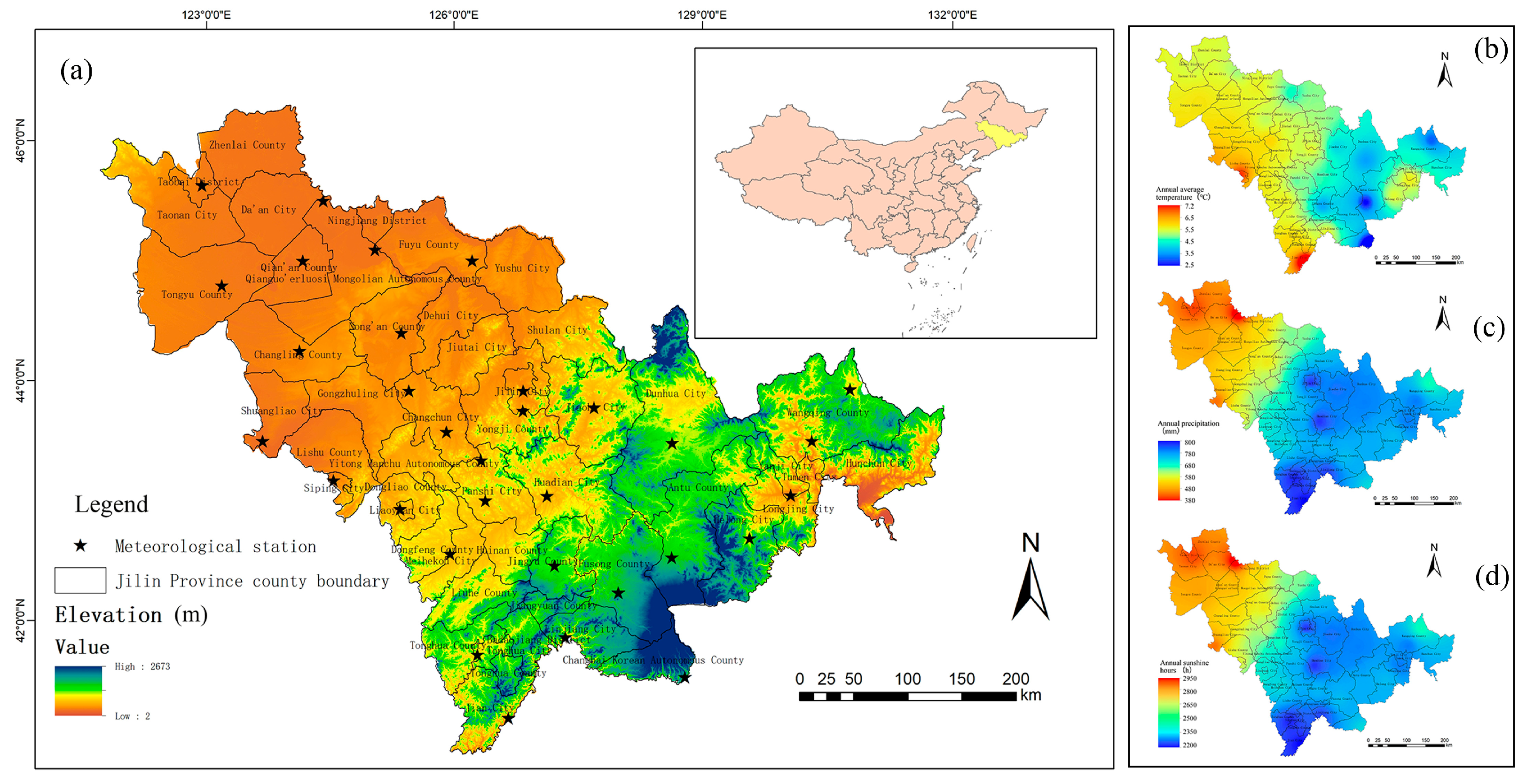
Figure 1. (a) Spatial distribution of elevation and meteorological stations in Jilin Province; (b) Spatial distribution of annual mean temperature (1976–2020); (c) Spatial distribution of annual precipitation (1976–2020); (d) Spatial distribution of annual sunshine duration (1976–2020).
Agriculture 16 00040 g001
Figure 2. Contribution scores for each climate factor.
Agriculture 16 00040 g002
Figure 3. Temporal and spatial variation characteristics of annual mean temperature from 1976 to 2020: (a) Annual average temperature time variation; (b) M-K test results for annual mean temperature.
Agriculture 16 00040 g003
Figure 4. Temporal and spatial variation characteristics of annual precipitation from 1976 to 2020: (a) Annual precipitation time variation; (b) M-K test results for annual precipitation.
Agriculture 16 00040 g004
Figure 5. Spatiotemporal variation characteristics of annual sunshine hours from 1976 to 2020: (a) Annual sunshine duration variations; (b) M-K test results for annual sunshine duration.
Agriculture 16 00040 g005
Figure 6. Spatial variation characteristics of annual mean temperature from 1976 to 2020: (a) Gradient distribution of annual mean temperature; (b) Annual mean temperature trend rate.
Agriculture 16 00040 g006
Figure 7. Spatial variation characteristics of annual precipitation from 1976 to 2020: (a) Gradient distribution of annual precipitation; (b) Annual precipitation trend rate.
Agriculture 16 00040 g007
Figure 8. Spatial variation characteristics of annual sunshine hours from 1976 to 2020: (a) Gradient distribution of annual sunshine hours; (b) Annual sunshine hours trend rate.
Agriculture 16 00040 g008
Figure 9. Maize suitability zoning before and after mutation: (a) Suitability level classification before mutation; (b) Suitability level classification after mutation.
Agriculture 16 00040 g009
Table 1. Boundary values for each evaluation level.
NormAnnual Average Temperature (°C)Annual Sunshine Hours (h)Annual Precipitation (mm)
Level I suitable6.5~7.52000~2300450~600
Level II suitable5.5~6.52300~2500600~700
Level III suitable4~5.52500~28000~450, 700~850
Level IV suitable<4>2800>850
Table 2. Area statistics of maize suitable areas in Jilin Province before and after climatic mutation.
NormArea Before Mutation (km2)Total Area
Ratio (%)
Area After
Mutation (km2)
Total Area
Ratio (%)
p-Valuet-Value
Level I suitable44,449.2123.27%44,638.5123.37%0.001 ***3.696
Level II suitable37,473.9119.62%48,895.0225.60%0.010 **3.033
Level III suitable81,773.9542.81%78,020.8840.85%0.003 **3.398
Level IV suitable27,316.5414.30%19,459.2110.19%0.2211.399
Note: Statistical significance was determined by t-test, ** p < 0.01, *** p < 0.001.
Disclaimer/Publisher’s Note: The statements, opinions and data contained in all publications are solely those of the individual author(s) and contributor(s) and not of MDPI and/or the editor(s). MDPI and/or the editor(s) disclaim responsibility for any injury to people or property resulting from any ideas, methods, instructions or products referred to in the content.