Article

Integrated Transcriptome and Metabolome Analysis Revealed the Molecular Mechanisms of Cold Stress in Japonica Rice at the Booting Stage

1
Frontiers Science Center for Molecular Design Breeding, Beijing Key Laboratory of Crop Genetic Improvement, College of Agronomy and Biotechnology, China Agricultural University, Beijing 100193, China
2
Rice Research Institute of Heilongjiang Academy of Agricultural Sciences, Jiamusi 154026, China
*
Authors to whom correspondence should be addressed.
These authors contributed equally to this work.
Agriculture 2026, 16(1), 19; https://doi.org/10.3390/agriculture16010019 (registering DOI)
Submission received: 19 November 2025 / Revised: 12 December 2025 / Accepted: 17 December 2025 / Published: 21 December 2025
(This article belongs to the Section Crop Production)

Abstract

Japonica rice is susceptible to cold stress at the booting stage, yet the systematic molecular mechanisms underlying varietal disparities in cold tolerance at this stage remain poorly understood. To fill this research gap, cold-tolerant LG1934 (V3) and cold-sensitive KD8 (V6) were subjected to low-temperature treatment (15 °C) for 0 h (T1), 72 h (T3), and 120 h (T5) at the booting stage, followed by analyses of agronomic traits, antioxidant physiology, metabolome, transcriptome, and weighted gene co-expression network analysis (WGCNA). Phenotypic results showed that low temperature was the main driver of differences in panicle length, seed setting rate, and grain weight between the two varieties, with V3 exhibiting significantly stronger cold tolerance. Under cold stress, V3 maintained higher activities of superoxide dismutase (SOD), peroxidase (POD), and catalase (CAT), accompanied by lower O2 accumulation and higher contents of malondialdehyde (MDA), H2O2, and proline compared to V6. Metabolomic analysis identified 56 differential accumulated metabolites (DAMs), with amino acids and their derivatives (notably L-aspartic acid) as key contributors. RNA-seq analysis identified 472 common differentially expressed genes (DEGs) that were enriched in alanine, aspartate, and glutamate metabolism, with 20 transcription factors (TFs) from TCP, WRKY, and bHLH families screened. The WGCNA revealed nine DEM-correlated modules, with orange and pink modules positively associated with L-aspartic acid. Eleven core TFs were identified, among which OsPCF5 acted as a hub regulator that activated OsASN1 transcription to promote L-aspartate biosynthesis, enhancing ROS scavenging and cold tolerance. This study systematically demonstrated the cold tolerance molecular network in japonica rice at the booting stage, highlighting the antioxidant system and L-aspartate-mediated pathway, and the core genes provided valuable resources for cold-tolerance breeding.

1. Introduction

Rice (Oryza sativa L.) is an important staple crop worldwide, playing a crucial role in safeguarding global food security [1]. As an important ecotype of O. sativa, japonica rice is widely grown in temperate regions, including Northeast China, Japan, and South Korea, yet its tropical ancestry confers inherent susceptibility to low-temperature stress [2,3]. Throughout the entire growth cycle of japonica rice, the booting stage is the most cold-sensitive critical phenological stage, coinciding with pollen mother cell meiosis and anther development, and even short-term exposure (e.g., 12–24 h) to low temperatures of 12–17 °C can cause pollen sterility and a drastic reduction in seed setting rate, leading to yield losses of up to 10–50% in severe cases [4,5]. As global climate change intensifies, increasingly frequent low-temperature events are occurring in temperate regions, where major japonica rice-producing areas suffer annual yield reductions averaging 30–40% due to cold stress [6]. Consequently, the identification of molecular mechanisms of cold tolerance in japonica rice at the booting stage and the mining of cold-tolerant gene resources has become an urgent need for rice stress-resistant breeding and production practice.
The response mechanisms to cold stress in plants were multi-level and networked regulatory processes involving the synergistic interaction of physiological metabolism, signal transduction, and the expression of cold-tolerance-related genes [7,8]. At the physio-biochemical aspects, low-temperature stress disrupted cell membrane fluidity and integrity, inducing the accumulation of reactive oxygen species (ROS) such as superoxide anion (O2) and hydrogen peroxide (H2O2), which further caused protein oxidation, DNA damage, and disruption of the photosynthetic system [9]. To alleviate ROS toxicity, plants have evolved an antioxidant scavenging system centered on superoxide dismutase (SOD), peroxidase (POD), and catalase (CAT): SOD converts O2 into H2O2, which is subsequently decomposed into harmless H2O and O2 by POD and CAT [10]. Meanwhile, osmoregulatory compounds such as proline (Pro) accumulated to enhance stress resistance by maintaining cell osmotic pressure and stabilizing enzyme activity [9]. Previous studies have confirmed that the SOD, POD, and CAT activities of cold-tolerant rice varieties were rapidly activated under low temperatures, significantly reducing ROS accumulation [9,11].
In the molecular regulation aspect, the identification of numerous cold-tolerance-related genes has provided crucial clues for analyzing cold tolerance mechanisms [12]. The G-protein regulator CHILLING-TOLERANCE DIVERGENCE1 (COLD1), coupled with the Gα subunit (RGA1), activates Ca2+ channels for initiating early cold signal perception in O. sativa [13]. Additionally, in recent years, researchers have reported multiple genetic loci associated with cold tolerance in japonica rice at the booting stage via mapping quantitative trait loci (QTL), such as cold tolerance-related QTLs located on chromosome 4 [14,15,16]. To date, only a few booting-stage cold tolerance genes have been successfully isolated and validated, including CTB1, CTB4a, and CTB5 (which regulate anther GA homeostasis), and OsAPXa (which participates in ROS scavenging) [15,17,18]. Similarly, transcription factors (TFs) bind to cis-regulatory elements of downstream genes to activate cascades in cold tolerance pathways [11]. For instance, OsWRKY24 regulates the expression of genes involved in starch and sucrose metabolism, maintaining carbon metabolic balance under low temperatures [19]. Meanwhile, OsPCF5 (PCF transcription factor 5) and OsTCP1 (TCP family TFs) suppress rice anther development by regulating jasmonic acid (JA) biosynthesis, with OsPCF5 recognized as a negative regulator in rice cold stress responses [20,21]. Additionally, transcription factor families MYB, bHLH, and AP2/ERF form a regulatory network for cold tolerance gene expression via cross-regulation, ensuring plants mounted rapid and precise responses to low temperatures [22,23,24]. Although these studies had uncovered partial cold tolerance pathways, most were limited to single-gene validation or single-omics profiling, and failed to establish direct links between TFs, metabolic pathways, and cold phenotypes, leaving the specific TF-mediated metabolic mechanisms largely uncharacterized.
Recently, an increasing number of reports on the integrated analysis of transcriptomics and metabolomics have emerged, covering various traits such as growth and development, biotic stress, and abiotic stress [25]. Yang et al. [26] successfully constructed a metabolic regulatory network for major tissues and organs throughout the rice growth cycle using metabolomics and transcriptomics data, and genes involved in regulating the accumulation of lignin and glycerophospholipids were accurately identified. Liu et al. [27] combined metabolomics and transcriptomics data to reveal that JAMYB directly bound to the AC motifs of key phenylpropanoid pathway genes (PAL6, PAL7, C4H1) and activated their expression, which mediated rice resistance to brown planthoppers. Qiang et al. [28] analyzed the toxicity mechanism of nano-TiO2-Cd in rice using transcriptomics and metabolomics approaches. Additionally, RNA-seq combined with weighted gene co-expression network analysis (WGCNA) could be employed to deeply explore trait-related functional modules and key genes [29]. Wang et al. [30] identified expression profiles and hub genes in Cd-accumulating and non-accumulating rice varieties responding to Cd stress through WGCNA. In summary, these representative studies demonstrated that integrated transcriptomics and metabolomics analysis efficiently identified critical plant metabolites and their regulatory genes [31]. However, for the booting stage of japonica rice, how to identify key genes regulating cold tolerance through transcriptome-metabolome association remains to be further explored.
Two japonica rice varieties with similar genetic backgrounds but markedly distinct cold sensitivities were employed as experimental materials in this study. After exposing them to low-temperature treatment (15 °C) at the booting stage, this study integrated agronomic trait assessment, antioxidant physiological index measurements, and transcriptome and metabolome data analysis to address the following objectives: (1) To clarify differences in the impacts of booting-stage cold stress on agronomic traits and antioxidant systems between the two varieties; (2) To identify key differentially accumulated metabolites (DAMs), differentially expressed genes (DEGs), and enriched pathways associated with the cold response; (3) To characterize core modules and hub genes highly correlated with cold tolerance phenotypes. The findings are anticipated to provide a theoretical framework for systematically dissecting the molecular network underlying cold tolerance in japonica rice during the booting stage, while also offering critical gene resources for molecular breeding of cold-tolerant varieties.

2. Materials and Methods

2.1. Plant Materials and Cultivation

The experimental materials were two rice varieties with similar growth periods (135 days from sowing to maturity), the cold-tolerant variety Longgeng 1934 (LG1934, V3) bred by the Rice Research Institute of Heilongjiang Academy of Agricultural Sciences (RRI-HLJAAS), and the cold-sensitive variety Kendao 8 (KD8, V6) from Rice Research Institute of Heilongjiang Academy of Land Reclamation Sciences [32]. The experiment was conducted using pot cultivation, and seeds were sown in plastic pots (30 cm in radius, 25 cm in height) filled with approximately 12 kg of air-dried loam soil. Sowing was performed in April 2024 under controlled greenhouse conditions at the RRI-HLJAAS, and the seedlings were transplanted into pots (30 cm in radius, 25 cm in height) at the 3-leaf stage (25 days after sowing), with nine plants per pot and 30 pots for each rice variety. The greenhouse was maintained at a day/night temperature of 28 °C/22 °C, relative humidity of 60–70%, and a 16 h light/8 h dark photoperiod. When plants reached the booting stage 45 days after transplanting, they were transferred to an artificial climate chamber for low-temperature stress treatment. Three treatments were set: T1 (0 h), T3 (72 h), and T5 (120 h) of low-temperature treatment at 15 °C, with 10 pots per treatment. All treatments were cultured under an alternating photoperiod of 16 h light/8 h dark, with relative humidity of 80%/70% (day/night) and light intensity of 12,000 lx. After low-temperature treatment, plants were transferred to normal environmental conditions, which were maintained at a day/night temperature of 28 °C/22 °C, relative humidity of 60–70%, and a 16 h light/8 h dark photoperiod until maturity (100 days from the booting stage to maturity). At harvest, panicle length, seed setting rate, and grain weight of 3 plants per pot were measured for each treatment.

2.2. Determination of Antioxidant-Related Enzyme Activities and Substances

Samples were collected at 0, 72, and 120 h of low-temperature treatment. Three young panicles (at the early booting stage with panicle length reaching 2–3 cm) were selected from 3 plants from 3 different pots per treatment, with three biological replicates. These samples were treated with liquid nitrogen and subsequently stored in a −80 °C freezer for the determination of antioxidant-related enzyme activities and associated substances in young panicles. The activity of SOD was determined according to the nitroblue tetrazolium (NBT) photoreduction method described by Li et al. [33]. The POD activity was assayed using the guaiacol method [34]. The CAT activity was measured via the ultraviolet absorption method [35]. The content of O2 was determined following the method of Huang et al. [36]. The MDA and Pro contents were assayed by the thiobarbituric acid and ninhydrin hydrate method [37]. The content of H2O2 was measured with a commercial kit (Abbikne, Scientific Co., Ltd., Atlanta, GA, USA) [38].

2.3. Widely Targeted Metabolome Sampling and Analysis

Similarly, young panicles (at the early booting stage with panicle length reaching 2–3 cm) for metabolomic analysis were collected from 3 plants with consistent phenotypes in 3 different pots at 0 h, 72 h, and 120 h of cold treatment, with 3 biological replicates per treatment. The samples were immediately frozen in liquid nitrogen and stored at −80 °C. The frozen samples were transported in dry ice to a commercial service provider (Genedenovo Biotechnology Co., Ltd., Guangzhou, China) for metabolite extraction and detection. Freeze-dried samples were ground using a grinder (MM400, Retsch, Haan, Germany). The powder (~100 mg) was weighed and extracted overnight at 4 °C with 1 mL of methanol aqueous solution (70%) containing lidocaine (0.1 mg/L) as an internal standard. The extract was purified using a 0.22 μm filter (SCAA-104, ANPEL, Shanghai, China) for subsequent analysis.
Purified samples were analyzed using a UPLC-MS/MS system (Shim-pack UFLC SHIMADZU CBM30A system, Shimadzu, Kyoto, Japan). The sample extract (2 μL) was injected into an ACQUITY UPLC HSS T3 C18 column (2.1 mm × 100 mm, 1.8 μm, Waters, Milford, MA, USA) at a column temperature of 40 °C and a flow rate of 0.4 mL/min. The mobile phase and detection program were referenced to Guo et al. [39]. The eluate was connected to a QTRAP 6500+ mass spectrometer (SCIEX, AB SCIEX, Framingham, MA, USA) for analysis. The system was equipped with an ESI-Turbo ion spray interface, operated in positive ion mode, and the detection data were filtered, compared, and calculated using Analyst 1.6.1 software (AB Sciex).
Metabolites were identified by matching with internal databases and public databases (MassBank, KNApSAcK, HMDB [40], MoTo DB, and METLIN [41]). Multivariate analysis was performed using R packages (www.r-project.org), including orthogonal partial least squares discriminant analysis (OPLS-DA). DAMs were analyzed using Variable Importance in Projection (VIP) scores. Meanwhile, t-tests were used as univariate analysis to screen for differential metabolites between the two groups (p < 0.05, VIP ≥ 1). KEGG metabolic pathways (http://www.kegg.jp/kegg/pathway.html (accessed on 27 February 2025)) and compound databases (https://www.kegg.jp/kegg/compound (accessed on 17 February 2025)) were used for metabolome enrichment and annotation.

2.4. Transcriptome Sequencing and Differential Expression Gene Analysis

Fresh young panicles (at the early booting stage with panicle length reaching 2–3 cm) from 3 plants (3 different pots) per treatment were collected with 3 biological replicates, rapidly frozen in liquid nitrogen, and stored at −80 °C. The samples were sent to Genedenovo Biotechnology Co., Ltd. (Guangzhou, China) for RNA extraction and transcriptome sequencing. The total RNA was isolated using the TRIzol® reagent (Invitrogen, Carlsbad, CA, USA). The concentration, purity, and integrity of RNA were evaluated using an Agilent 2100 Bioanalyzer (Agilent Technologies, Palo Alto, CA, USA) and agarose gel electrophoresis. Subsequently, the cDNA libraries were constructed in accordance with the protocol provided by Invitrogen, and sequencing was performed using the Illumina HiSeq 2500 platform. Quality-controlled data were assembled and aligned to the reference genome of O. sativa ssp. japonica (Nipponbare) (https://www.ebi.ac.uk/ena/data/view/GCA_001433935.1 (accessed on 15 February 2025)) using HISAT2 2.4 with RNA-strandedness and default parameters [42]. Gene counts were obtained through FeatureCounts analysis, and gene expression levels were quantified by calculating the Fragments Per Kilobase of transcript per Million mapped reads (FPKM).
To identify differentially expressed genes (DEGs) between cold-tolerant and cold-sensitive varieties under cold stress, DESeq2 was used for data analysis. p-values were adjusted for multiple hypothesis testing using the False Discovery Rate (FDR). DEGs were filtered based on the following thresholds: |log2FC| > 1 and FDR < 0.05 (statistically significant). To characterize transcriptional changes, Gene Ontology (GO) enrichment analysis and Kyoto Encyclopedia of Genes and Genomes (KEGG) pathway analysis were performed. The functional analysis of DEGs was conducted using OmicShare tools (https://www.omicshare.com/tools (accessed on 9 October 2025)) [43].

2.5. Construction of Co-Expression Networks and Mining of Candidate Hub Genes

Firstly, the upregulated DEGs (the activation of positive regulatory pathways in V3) at distinct time points were filtered to remove low-expression genes (FPKM ≥ 1 in at least 3 samples) for constructing co-expression network modules. Subsequently, data analysis was performed using the R package (V 1.69) of WGCNA to construct a sample clustering tree, and an appropriate soft-thresholding power (β) for gene correlation scale-free network construction was selected to establish a gene co-expression similarity matrix [44].
Through WGCNA, the correlation between formed gene modules and antioxidant-related physiological traits and DAMs was analyzed. Specific modules associated with DAMs were selected, and GO enrichment and KEGG pathway analysis diagrams of specific modules were drawn using OmicShare tools (https://www.omicshare.com/tools (accessed on 15 October 2025)) to gain insight into gene functions in DAMs-related specific modules [43]. The TFs were defaulted as cold tolerance-related hub genes, which were common to both DAM-related core modules and upregulated DEGs. Integrating gene-gene interaction regulatory relationships, a cold tolerance candidate gene interaction network was constructed using Cytoscape software (Version 3.9.1) [45].

2.6. Data Analysis

Experimental data of agronomic traits and physiological and biochemical parameters were recorded and organized using Microsoft Excel 2021, and graphs were plotted using GraphPad Prism 9.0 software. Differences between treatment data were analyzed by t-test and one-way analysis of variance (one-way ANOVA) with the least significant difference (LSD) test as the post hoc test for significant results using Statistix V8.0 and visualized with GraphPad Prism 10, following the method described by Guo et al. [39].

3. Results

3.1. Phenotypic Analysis

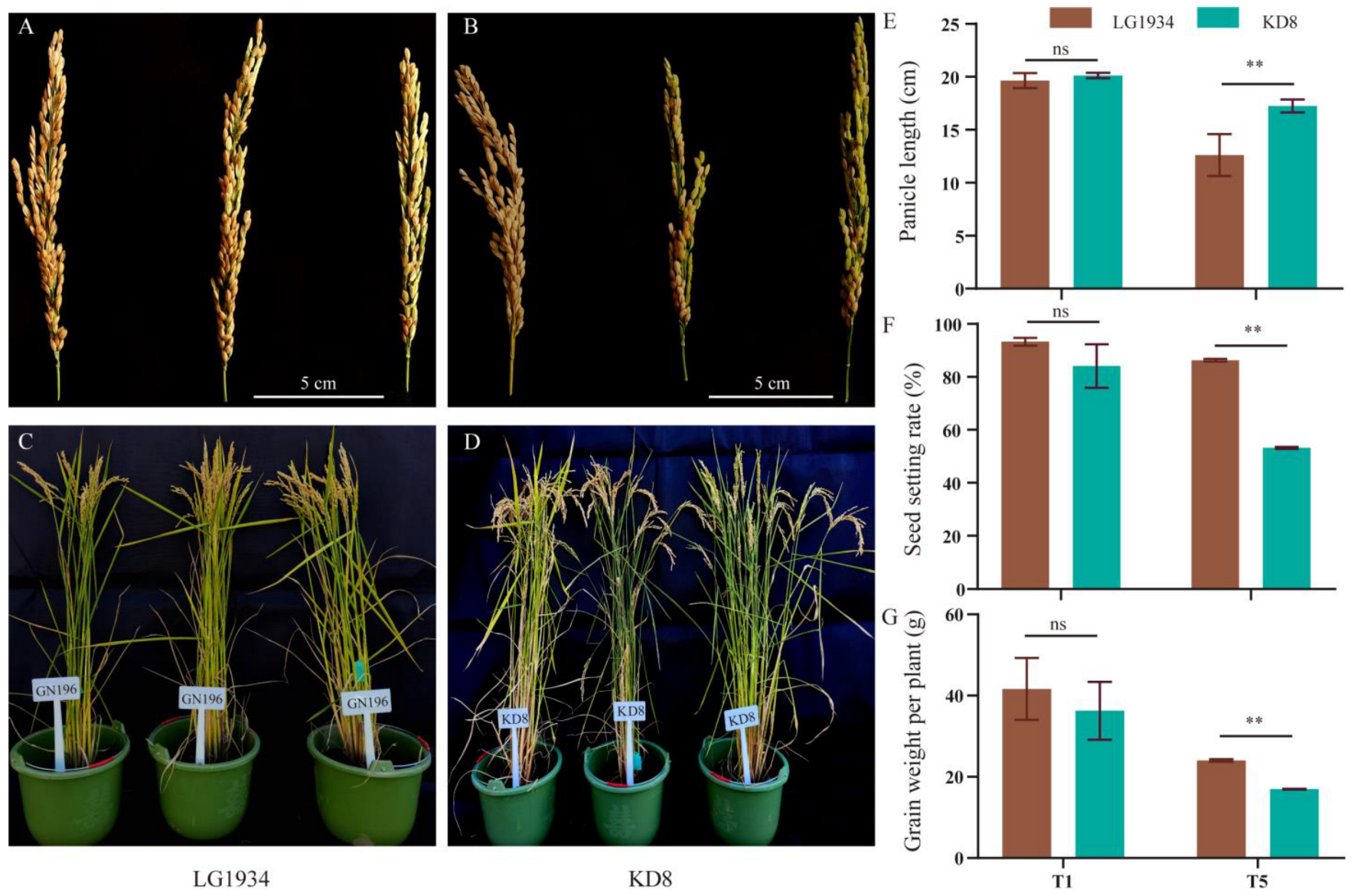
Rice yield component analysis showed that low-temperature treatment at the booting stage directly affected agronomic traits at maturity. As shown in Figure 1, without low-temperature treatment, the panicle length, seed setting rate, and grain weight of LG1934 (V3) and KD8 (V6) were 19.33 cm vs. 20.12 cm, 93.27% vs. 85.04%, and 42.64 g vs. 38.05 g, respectively, with no significant differences between the varieties. After 120 h of low-temperature treatment at 12 °C at the booting stage, compared to V6, V3 exhibited significantly higher seed setting rate and grain weight, with increases of 62.26% and 41.66%, respectively. In contrast, the panicle length of V3 significantly decreased by 26.82% after 120 h of low-temperature treatment. These results indicate that there were no significant differences in agronomic traits between V3 and V6 under normal conditions; low temperature was the main cause of differences in panicle length, seed setting rate, and grain weight, and the cold tolerance of V3 at the booting stage was significantly stronger than that of V6.

3.2. Effects of Low-Temperature Treatment on the Antioxidant System

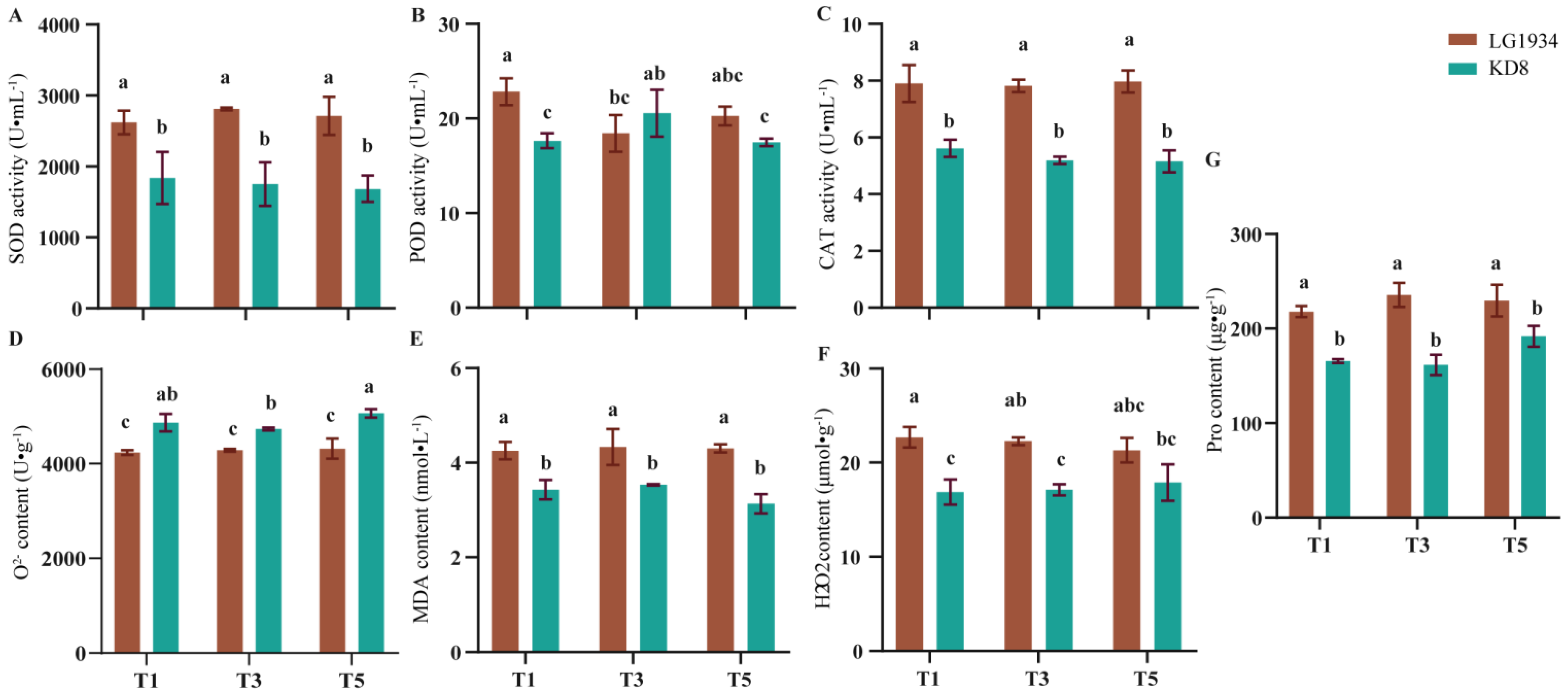
The results of the antioxidant system (Figure 2) showed that under cold stress, a large amount of reactive oxygen species accumulated in the cells of V6, but the antioxidant enzyme activity of V3 increased to scavenge reactive oxygen radicals. As shown in Figure 2A, compared to V6, the SOD activity in young panicles of V3 was significantly increased by 42.54%, 60.44%, and 61.17% after 0, 72, and 120 h of cold stress, respectively. As shown in Figure 2B, compared to V6, the POD activity in young panicles of V3 was significantly increased by 29.38% and 15.83% after 0 and 120 h of cold stress, respectively. As shown in Figure 2C, CAT activity differed significantly under cold stress for 0, 72, and 120 h, and the CAT activity of V3 was 40.81%, 50.61%, and 54.55% higher than that of V6, respectively. In addition, under cold stress for the same duration, compared to V6, V3 had lower O2 content but significantly higher MDA, H2O2, and Pro contents. As shown in Figure 2D, the O2 content of V3 was significantly reduced by 12.96%, 9.43%, and 14.74% compared to V6. As shown in Figure 2E–G, compared to V6, the MDA content of V3 was significantly increased (p < 0.05) by 24.16%, 22.57%, and 37.35%, respectively; meanwhile, the H2O2 content was significantly increased (p < 0.05) by 34.52%, 30.22%, and 19.23%; similarly, the Pro content was significantly increased by 31.55%, 45.80%, and 19.65%. Notably, this accumulation of MDA and H2O2 in V3 might be accompanied by consistently higher SOD, POD, and CAT activities. These results indicate that under cold stress, the antioxidant activity of cold-tolerant varieties showed a similar trend to agronomic traits: the better the agronomic traits, the stronger the antioxidant capacity.

3.3. Identification of Metabolites in Cold-Tolerant and Cold-Sensitive Rice Under Low-Temperature Stress

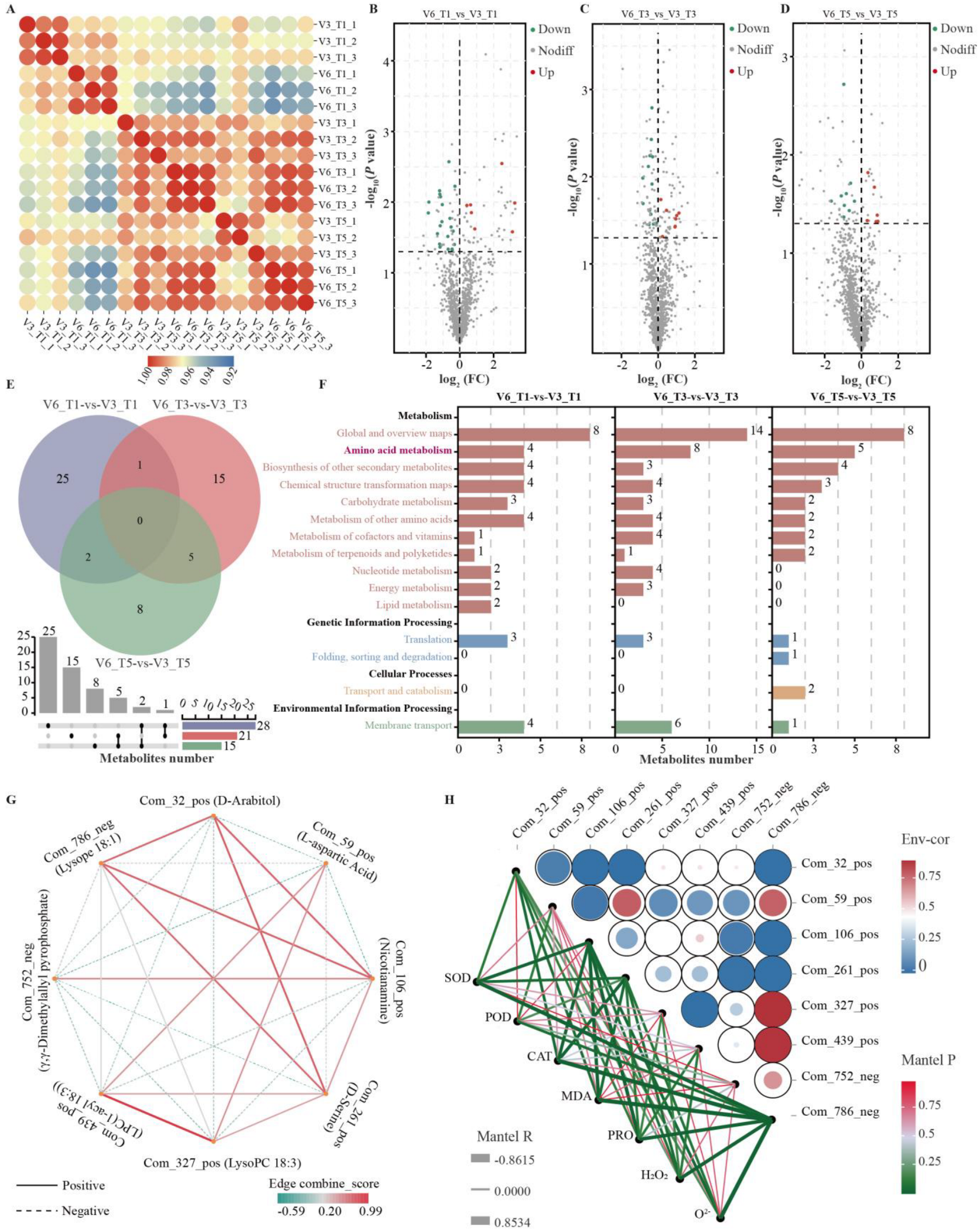
To explore the chemical basis underlying the differences between cold-tolerant and cold-sensitive varieties, widely targeted metabolomics was used to comprehensively analyze metabolites in young panicles of the two varieties under low-temperature treatment for 0, 72, and 120 h. Correlation analysis between samples by comparing metabolite peaks detected in young panicles of V3 and V6 under cold stress at different times showed that the R values of all samples were ≥0.90, further verifying the reliability of the data (Figure 3A). Multivariate statistical analysis (OPLS-DA VIP values) and univariate statistical analysis (t-test p values) were used for qualitative analysis of detected metabolites in young panicles of V3 and V6. Differential metabolites were screened using VIP ≥ 1 and t-test p < 0.05. The results showed that a total of 56 metabolites across 13 classes were detected in young panicles of the two varieties at three time points, namely amino acids and their derivatives, lipids, carbohydrates and their derivatives, alkaloids and their derivatives, organic acids and their derivatives, alcohols and polyols, terpenoids, flavonoids, phenylpropanoids and polyketides, phenolic acids, phenols and their derivatives, and phytohormones (Figure 3B–D, Table S1). Venn diagram analysis of three comparison groups (V6_T1 vs. V3_T1, V6_T3 vs. V3_T3, and V6_T5 vs. V3_T5) identified 8 DAMs, namely Com_32_pos, Com_59_pos, Com_106_pos, Com_261_pos, Com_327_pos, Com_439_pos, Com_752_neg, and Com_786_neg (Figure 3E, Table S2). Subsequently, KEGG annotation showed that global and overview maps, amino acid metabolism, and biosynthesis of other secondary metabolites were the most representative pathways (Figure 3F). To investigate the relationships between differential metabolites, the Pearson correlation coefficients were calculated between any two differential metabolites, and a total of 28 correlations were identified (Figure 3G, Table S3). The differential metabolite correlation network diagram showed that the absolute values of Pearson correlation coefficients of 4 DAMs (Com_106_pos, Com_32_pos, Com_327_pos, and Com_261_pos) were greater than 0.5. Amino acids and their derivatives had the most significant metabolite correlations, followed by carbohydrates and their derivatives. In addition, correlation analysis between antioxidant indicators and differential metabolites showed that Com_59_pos (L-aspartic acid) exhibited a weak positive correlation with SOD, CAT, and Pro (Figure 3H, Table S4). These results further indicate that amino acids and their derivatives are likely important substances contributing to the stronger cold tolerance of V3 compared to V6.

3.4. Effects of Low-Temperature Stress on the Transcriptome of Cold-Tolerant and Cold-Sensitive Rice

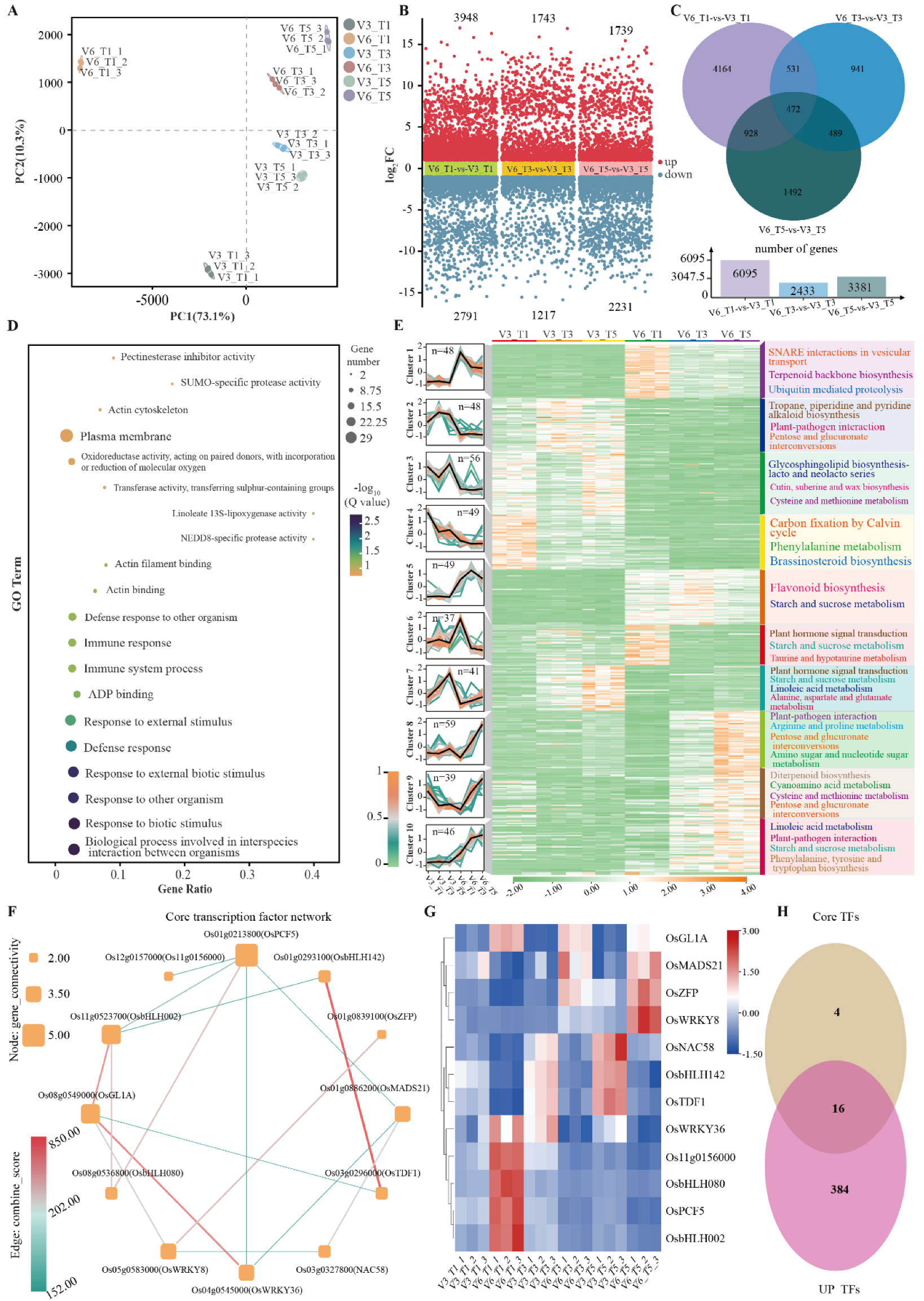
To investigate gene expression related to cold sensitivity under low-temperature stress, an in-depth comprehensive transcriptomic profile of V3 and V6 was compared via RNA-seq. Rice at the booting stage was treated at 12 °C for 0, 72, and 120 h, and young panicle samples with 3 biological replicates were collected for RNA sequencing. Transcriptomic comparative analysis was performed on young panicles of V3 and V6 under low-temperature stress at different time points. Through RNA-seq and data filtering, 18 samples generated 52.63 GB of raw data, with filtered reads reaching 7.37 × 10⁸. The average values of Q20, Q30, and GC content were 97.54%, 93.54%, and 48.82%, respectively. These results indicate that the sequencing data in this study were of large quantity and high quality (Table S5). To visualize the differences and similarities among all samples, Fragments Per Kilobase of transcript per Million mapped reads (FPKM) of all detected genes were used for Principal Component Analysis (PCA). PCA results showed that the variances of V3 and V6 samples were 73.10% and 10.30%, respectively, and there was significant similarity between the three biological replicates in each treatment sample, indicating the reliability and reproducibility of the data (Figure 4A).
Differentially expressed genes (DEGs) between V3 and V6 at each cold treatment time point were identified by DESeq2 comparison between groups (|Log2FoldChange| > 1, Padj < 0.05). Compared to V6, a large number of DEGs were identified in V3 at time points T1, T3, and T5 (Figure 4B). In particular, at time point T1, V3 induced more significant transcriptional changes compared to V6 (3948 upregulated, 2791 downregulated). To obtain more detailed information on transcriptional changes in V3 and V6 under cold treatment, overlaps of DEGs between each time point were identified. Among them, 472 DEGs were co-regulated in both varieties (Figure 4C, Table S6). Subsequently, Gene Ontology (GO) enrichment and Kyoto Encyclopedia of Genes and Genomes (KEGG) pathway functional analyses were performed on the 472 DEGs to understand the biological relevance behind these genes. GO enrichment analysis showed that genes involved in interspecies interaction between organisms (GO:0044419), response to biotic stimulus (GO:0009607), and response to external biotic stimulus (GO:0043207) were the most enriched, followed by defense response (GO:0006952) and response to external stimulus (GO:0009605) (Figure 4D). Based on the FPKM of these DEGs, Series Test of Cluster and hierarchical clustering were performed to generate a global view of expression levels at each time point in V3 and V6 (Figure 4E). Trend analysis results showed that 41 genes in Cluster7 continuously increased in expression in young panicles of both V3 and V6, but their expression levels in V6 were lower than those in V3, indicating that these genes may play important roles in rice cold tolerance. In addition, KEGG analysis showed that these DEGs were mainly associated with alanine, aspartate and glutamate metabolism, linoleic acid metabolism, starch and sucrose metabolism, and plant hormone signal transduction.
The transcription factors play key roles in plant responses to cold stress. Among the 472 common DEGs, a total of 20 transcription factors were identified, mainly from families such as WRKY, TCP, bHLH, MYB, NAC, and AP2/ERF (Table S6). A regulatory network was constructed using these transcription factors as core genes and genes from Cluster7 by Cytoscape software, identifying 11 core TFs (Figure 4F,G). Among them, OsPCF5 (Os01g0213800) and OsGL1 (Os08g0549000) were most closely associated with Cluster7 genes (Table S7), and the KEGG pathway of associated genes was amino sugar and nucleotide sugar metabolism. In addition, these transcription factors overlapped with common TFs of upregulated genes in the three comparison groups V6_T1 vs. V3_T1, V6_T3 vs. V3_T3, and V6_T5 vs. V3_T5 (Figure 4H, Table S8).

3.5. Integrated Analysis of Differential Metabolites and Genes in Response to Cold Stress

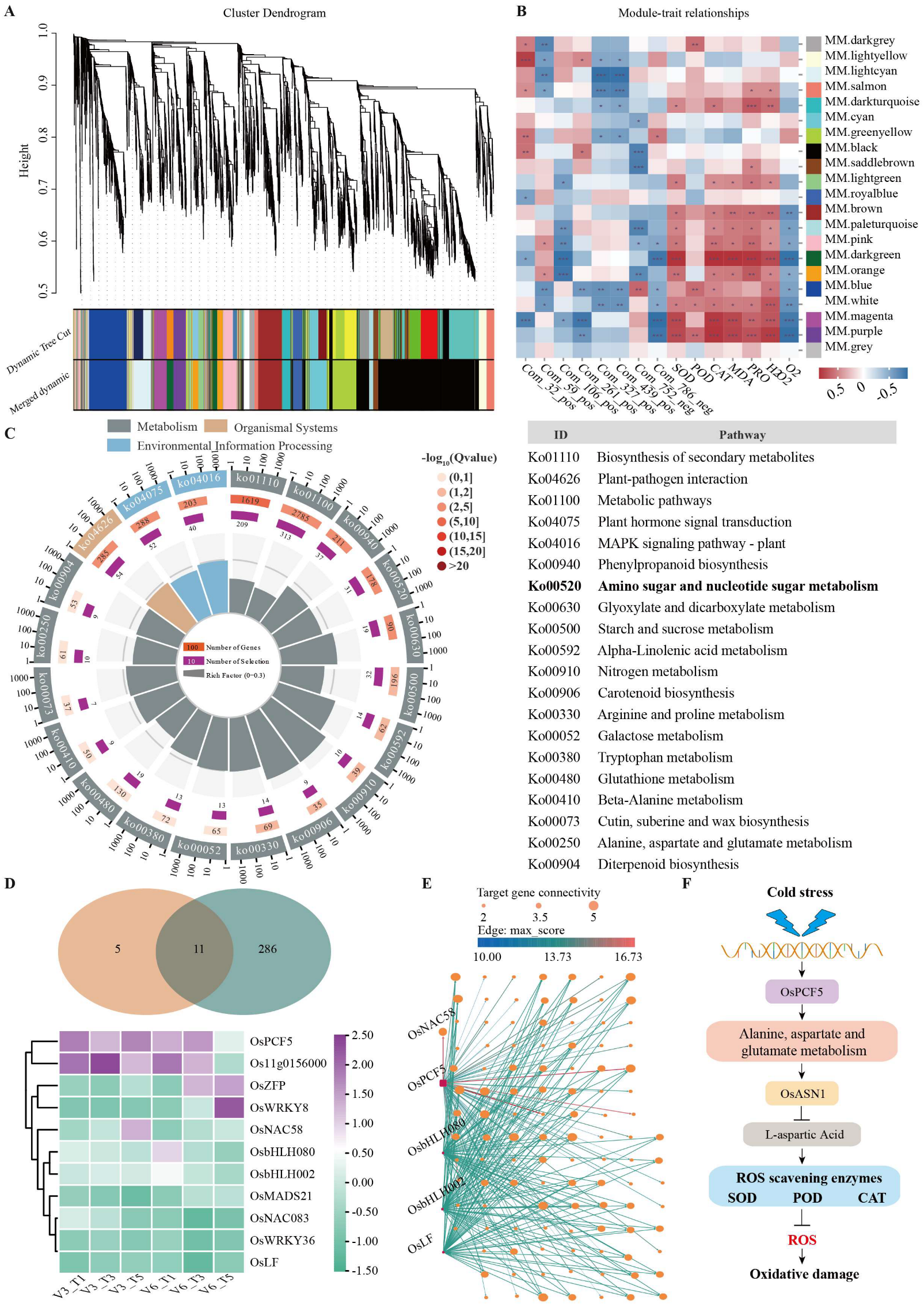
Subsequently, WGCNA was used to gain insight into the regulatory mechanisms of DEM changes and co-expression networks with related DEGs under cold stress. Based on 5339 upregulated DEGs identified at cold treatment time points T1, T3, and T5 (Table S9), WGCNA generated 21 co-expression modules (Figure 5A,B). The heatmap of module-trait correlations (Figure 5B) showed that all modules (except ‘grey’) have significant correlations with DAMs (Figure 5B, Table S10). Among them, the orange and pink modules were significantly positively correlated with Com_59_pos (L-aspartic acid) (Figure 5B and Figure S1). In addition, KEGG analysis showed that the top 5 pathways were biosynthesis of secondary metabolites, metabolic pathways, phenylpropanoid biosynthesis, amino sugar and nucleotide sugar metabolism, and glyoxylate and dicarboxylate metabolism (Figure 5C, Table S10). Furthermore, 297 TFs were identified in genes from the 9 modules, and 11 of these TFs overlapped with TFs selected from Cluster7 (Figure 5D). Cluster heatmap results of the 11 TFs showed that the dynamic expression patterns of transcription factors OsPCF5, Os11g0156000 (B3 gene family), and OsNAC58 were consistent with the cold tolerance phenotype of V3. The transcriptional regulatory network diagram showed that OsPCF5 was highly connected with 74 DEGs from the orange and pink modules (Figure 5E, Table S11), indicating a core regulatory role in genes from the orange and pink modules. Subsequently, based on KEGG annotation and expression changes, Os03g0291500 (Asparagine Synthetase 1, OsASN1) in the alanine, aspartate and glutamate metabolism pathway was ultimately identified, which plays a key role in L-aspartic acid formation (Table S12). To validate the regulatory link between OsPCF5 and OsASN1, we analyzed the 2000 bp upstream promoter sequence of OsASN1 using the MEME Suite. A conserved TCP-binding cis-element (GGNCCCAC) was identified at positions −1827 to −1837 bp, indicating that OsPCF5 (a TCP family TF) can potentially bind directly to the OsASN1 promoter to modulate its transcription (Figure S2). Thus, it is speculated that OsPCF5, induced by cold stress signals, regulated changes in L-aspartate content by modulating OsASN1 expression, consequently modulating the capacity of the antioxidant system to scavenge ROS (Figure 5F).

4. Discussion

The molecular regulatory network underlying cold tolerance in japonica rice at the booting stage was systematically analyzed using agronomic trait assessment, antioxidant physiological measurements, and integrated transcriptomic-metabolomic analyses in this study. Not only were the critical roles of the antioxidant system and the L-aspartate-mediated metabolic pathway in cold tolerance regulation clarified, but core candidate genes and regulatory pathways were also further identified via WGCNA. This research has provided new theoretical foundations and genetic resources for investigating cold tolerance mechanisms and advancing molecular breeding in japonica rice.

4.1. Effects of Low Temperature at Booting Stage on Rice Agronomic Traits

The phenotypic analysis in this study revealed that cold stress at the booting stage exerted a critical influence on the agronomic performance of rice varieties, despite the genetic similarity between V3 (cold-tolerant) and V6 (cold-sensitive). Under normal growth conditions, no significant differences were observed between V3 and V6 in panicle length, seed setting rate, and grain weight per plant. However, divergent responses emerged following 120 h of cold treatment: V3 maintained significantly higher seed setting rates and grain weight per plant, whereas its panicle length was markedly shortened. The stability of V3 in seed setting rate and grain weight under cold stress likely reflected an enhanced protective mechanism for its reproductive development. This finding was fully consistent with previous research concluding that pollen exhibits high sensitivity to cold. Saito et al. [16] found that low temperatures disrupt normal meiosis in rice pollen mother cells, causing pollen sterility. Huang et al. further confirmed that under booting-stage cold stress, abnormal programmed degradation of the anther tapetum blocks nutrient supply to developing pollen, ultimately triggering a sharp drop in seed setting rate [46]. Notably, compared with V6, the panicle length of V3 was significantly shortened under cold stress. Low-temperature stress inhibited the biosynthesis of gibberellin (GA), a key regulator of internode elongation and spikelet enlargement [47]. The stronger growth inhibition in V3 might reflect its priority in allocating resources to reproductive organs (e.g., maintaining grain weight) rather than vegetative organs (e.g., panicle axis elongation).

4.2. Impact of Cold Stress on Rice Antioxidant System

The accumulation of ROS induced by low-temperature stress was identified as a key inducer of plant cell damage. However, the core function of the antioxidant system was not merely ROS scavenging, but the establishment of a systematic cold response through the dual regulation of “scavenging-signaling” [48]. In this study, under cold stress, the activities of SOD, POD, and CAT in V3 were consistently significantly higher than those in V6. Such efficient enzyme activities directly reduced the accumulation of O2, thereby avoiding irreversible damages such as protein oxidation and DNA breakage induced by O2 [49]. Notably, the MDA and H2O2 in V3 were significantly higher than those in V6. As a product of membrane lipid peroxidation, the moderate accumulation of MDA could enhance cell membrane fluidity and resist low-temperature-induced damage to membrane structures [50]. Meanwhile, as a key signaling molecule, H2O2 activated the transcription of cold-tolerant genes such as MKK6 and COR through the MAPK phosphorylation cascade [51,52]. Additionally, increased Pro content in V3 not only maintained cellular osmotic pressure but also directly participated in oxidative stress response as a ROS scavenger. Thus, the antioxidant system of cold-tolerant varieties achieved precise adaptation to cold stress through regulated ROS accumulation.

4.3. Regulatory Role of Aspartate and Its Metabolic Pathway in Rice Cold Tolerance

Integrated metabolomic and transcriptomic analyses revealed that the specific accumulation of L-aspartic acid (Com_59_pos) and the targeted activation of the alanine-aspartate-glutamate metabolic pathway collectively supported the booting-stage cold-tolerance phenotype of V3, which distinguished it from V6. As a central node of amino acid metabolism, L-aspartic acid provides key substrates for the synthesis of cold-tolerance-related proteins [53]. This is consistent with studies showing that exogenous aspartic acid improves cold tolerance in strawberries [54], figs [55], and perennial ryegrass [56]. In addition, the accumulation of L-aspartic acid promoted the production of antioxidant enzymes (e.g., SOD, CAT) and cold-tolerance-associated functional proteins, directly enhancing ROS scavenging capacity [57]. Furthermore, L-aspartic acid participates in the synthesis of osmotic adjustment substances such as proline and glutamate, and its increased content can provide sufficient precursors for the osmotic adjustment system, maintaining cell homeostasis [57].
Importantly, integrated transcriptomic-metabolomic analysis further showed that the L-aspartate anabolism pathway (i.e., the alanine-aspartate-glutamate metabolic pathway) was significantly enriched [58]. Meanwhile, OsASN1 (Os03g0291500), a key gene involved in L-aspartate synthesis, exhibited a variety-specific expression pattern–it decreased first and then increased in V3, while it increased first and then decreased in V6. This observation was similar to the study conducted by Jiang et al. [59], in which the maize transcription factor ZmICE1 regulated amino acid metabolism and ROS levels by suppressing ZmAS (ASPARAGINE SYNTHETASES) expression, thereby modulating maize responses to low temperatures.

4.4. Co-Expression Network Analysis Revealed Core Cold-Tolerance Candidate Genes and Regulatory Pathways

Although a few booting-stage cold tolerance genes, such as CTB1 [60] and CTB4a [17], have been identified, this study screened new cold tolerance candidate transcription factors by WGCNA. Eleven core TFs were identified (such as OsPCF5, OsNAC58) from 472 cold-responsive DEGs [61]. Among them, OsPCF5 (TCP family), as a core regulatory factor, was highly connected with DEGs in the gene modules (orange, pink) associated with L-aspartic acid and was co-expressed with OsASN1, suggesting that it might act as an upstream switch to regulate cold-tolerance metabolic pathways [20,58]. Additionally, the identification of TFs from families such as WRKY, bHLH, and AP2/ERF aligned with previously reported cold-tolerance transcriptional regulatory networks [23,24,62]. Conclusively, these TFs provide a high-quality candidate pool for subsequent functional validation of cold-tolerance genes.
Although the molecular mechanism of cold tolerance in japonica rice at the booting stage was systematically analyzed in this study, several limitations remained. Firstly, the analysis was primarily confined to omics profiling of young panicle tissues, excluding organs such as roots and leaves. Secondly, functional validation of core genes remained insufficient, preventing a clear determination of their roles in cold tolerance. Future studies will edit core genes via CRISPR-Cas9 technology to clarify their direct functions in rice cold tolerance.

5. Conclusions

This study systematically characterized the molecular mechanisms of cold tolerance in japonica rice at the booting stage using integrated transcriptomic and metabolomic approaches. The results showed that the cold-tolerant variety maintained a higher seed setting rate and grain weight under cold stress by enhancing antioxidant capacity, accumulating L-aspartic acid, and activating core transcription factors. The alanine-aspartate-glutamate metabolic pathway, centered on L-aspartic acid, and the regulatory network mediated by core TFs such as OsPCF5 play key roles in cold tolerance. These findings deepen our understanding of the complex regulatory networks governing cold tolerance in japonica rice at the booting stage and provide important gene resources and theoretical support for molecular breeding of cold-tolerant japonica rice varieties.

Supplementary Materials

The following supporting information can be downloaded at: https://www.mdpi.com/article/10.3390/agriculture16010019/s1, Figure S1: GO and KEGG enrichment analysis of module genes significantly correlated with DAMs in Orange (A,C) and Pink module (B,D), showing the top 20 pathways of DEGs related to cold stress; Figure S2: Identification of conserved TCP1-binding motifs within promoters; Table S1: The differentially expressed metabolites in V6_T1-vs-V3_T1, V6_T3-vs-V3_T3, and V6_T5-vs-V3_T5; Table S2: The common differential metabolites between the two groups; Table S3: The Pearson’s correlation coefficient between differential metabolites; Table S4: The Pearson’s correlation coefficient between DAMs and antioxidant physiological indexes; Table S5: Overview of RNA-seq data volume; Table S6: The common DEGs among groups; Table S7: The TFs and target gene prediction analysis; Table S8: The TFs of the upregulated genes of V6_T1-vs-V3_T1, V6_T3-vs-V3_T3, and V6_T5-vs-V3_T5 in the three comparison groups; Table S9: The upregulated DEGs of V6_T1-vs-V3_T1, V6_T3-vs-V3_T3, and V6_T5-vs-V3_T5 in the three comparison groups; Table S10: The DEGs significantly associated with DEMs in module-trait associations; Table S11: The hub TFs and target gene prediction analysis; Table S12: The DEGs significantly associated with OsPCF5.

Author Contributions

Conceptualization, W.M. and Z.G.; methodology, W.M. and Z.G.; formal analysis, W.M. and Z.G.; investigation, P.L., H.C. and Y.C.; data curation, X.Z. and X.H.; writing—original draft, W.M. and Z.G.; writing—review and editing, Y.F., J.L. and Z.L.; funding acquisition, Y.F., J.L. and Z.L. All authors have read and agreed to the published version of the manuscript.

Funding

This work was supported by the Science and Technology Innovation 2030—Major Project (2022ZD0400404); the Heilongjiang Province Agricultural Science and Technology Innovation Leapfrog Project—Agricultural Science and Technology Basic Innovation Project (Outstanding Youth Program) (CX25JC63, CX23JQ02); The China Postdoctoral Science Foundation (Grant No. 2022MD713751); the Open Project of Key Laboratory of Germplasm Innovation and Physioecology of Food Crops in Cold Regions, Ministry of Education (CXSTOP202403).

Institutional Review Board Statement

Not applicable.

Data Availability Statement

The raw data of RNA-seq were deposited in the NGDC database (Accession no. PRJCA051137). The other relevant data are presented in this paper or Supplemental Materials.

Conflicts of Interest

The authors declare that there is no conflict of interest.

References

  1. Wing, R.A.; Purugganan, M.D.; Zhang, Q. The rice genome revolution: From an ancient grain to Green Super Rice. Nat. Rev. Genet. 2018, 19, 505–517. [Google Scholar] [CrossRef] [PubMed]
  2. Wang, D.; Liu, J.; Li, C.; Kang, H.; Wang, Y.; Tan, X.; Liu, M.; Deng, Y.; Wang, Z.; Liu, Y.; et al. Genome-wide association mapping of cold tolerance genes at the seedling stage in rice. Rice 2016, 9, 61. [Google Scholar] [CrossRef]
  3. Ma, H.; Zhu, X.; Cao, T.; Li, S.; Guo, E.; Shi, Y.; Guan, K.; Li, E.; Sun, R.; Wang, X.; et al. Responses of rice cultivars with different cold tolerance to chilling in booting and flowering stages: An experiment in Northeast China. J. Agron. Crop Sci. 2023, 209, 864–875. [Google Scholar] [CrossRef]
  4. Wang, J.; Chen, N.; Li, J.; Li, C.; Fu, G.; Liu, F.; Zhao, H.; Liu, Y.; Jiang, W.; Xia, T.; et al. Integrated transcriptome and co-expression network analysis revealed the molecular mechanism of cold tolerance in japonica rice at booting stage. Front. Plant Sci. 2025, 16, 1629202. [Google Scholar] [CrossRef]
  5. Li, J.; Guo, H.; Lou, Q.; Zeng, Y.; Guo, Z.; Xu, P.; Gu, Y.; Gao, S.; Xu, B.; Han, S.; et al. Natural variation of indels in the CTB3 promoter confers cold tolerance in japonica rice. Nat. Commun. 2025, 16, 1613. [Google Scholar] [CrossRef]
  6. Andaya, V.C.; Mackill, D.J. Mapping of QTLs associated with cold tolerance during the vegetative stage in rice. J. Exp. Bot. 2003, 54, 2579–2585. [Google Scholar] [CrossRef] [PubMed]
  7. Zhang, M.; Zhao, R.; Huang, K.; Huang, S.; Wang, H.; Wei, Z.; Li, Z.; Bian, M.; Jiang, W.; Wu, T.; et al. The OsWRKY63–OsWRKY76–OsDREB1B module regulates chilling tolerance in rice. Plant J. 2022, 112, 383–398. [Google Scholar] [CrossRef]
  8. Örvar, B.L.; Sangwan, V.; Omann, F.; Dhindsa, R.S. Early steps in cold sensing by plant cells: The role of actin cytoskeleton and membrane fluidity. Plant J. 2000, 23, 785–794. [Google Scholar] [CrossRef]
  9. Ding, Y.; Shi, Y.; Yang, S. Advances and challenges in uncovering cold tolerance regulatory mechanisms in plants. New Phytol. 2019, 222, 1690–1704. [Google Scholar] [CrossRef] [PubMed]
  10. Ding, Y.; Yang, S. Surviving and thriving: How plants perceive and respond to temperature stress. Dev. Cell 2022, 57, 947–958. [Google Scholar] [CrossRef]
  11. Fang, Y.; Guo, D.; Wang, Y.; Wang, N.; Fang, X.; Zhang, Y.; Li, X.; Chen, L.; Yu, D.; Zhang, B.; et al. Rice transcriptional repressor OsTIE1 controls anther dehiscence and male sterility by regulating JA biosynthesis. Plant Cell 2024, 36, 1697–1717. [Google Scholar] [CrossRef]
  12. Jung, J.H.; Barbosa, A.D.; Hutin, S.; Kumita, J.R.; Gao, M.; Derwort, D.; Silva, C.S.; Lai, X.; Pierre, E.; Geng, F.; et al. A prion-like domain in ELF3 functions as a thermosensor in Arabidopsis. Nature 2020, 585, 256–260. [Google Scholar] [CrossRef]
  13. Ma, Y.; Dai, X.; Xu, Y.; Luo, W.; Zheng, X.; Zeng, D.; Pan, Y.; Lin, X.; Liu, H.; Zhang, D.; et al. COLD1 confers chilling tolerance in rice. Cell 2015, 160, 1209–1221. [Google Scholar] [CrossRef]
  14. Xu, L.M.; Zhou, L.; Zeng, Y.W.; Wang, F.M.; Zhang, H.L.; Shen, S.Q.; Li, Z.C. Identification and mapping of quantitative trait loci for cold tolerance at the booting stage in a japonica rice near-isogenic line. Plant Sci. 2008, 174, 340–347. [Google Scholar] [CrossRef]
  15. Saito, K.; Hayano-Saito, Y.; Maruyama-Funatsuki, W.; Sato, Y.; Kato, A. Physical mapping and putative candidate gene identification of a quantitative trait locus Ctb1 for cold tolerance at the booting stage of rice. Theor. Appl. Genet. 2004, 109, 515–522. [Google Scholar] [CrossRef] [PubMed]
  16. Saito, K.; Miura, K.; Nagano, K.; Hayano-Saito, Y.; Araki, H.; Kato, A. Identification of two closely linked quantitative trait loci for cold tolerance on chromosome 4 of rice and their association with anther length. Theor. Appl. Genet. 2001, 103, 862–868. [Google Scholar] [CrossRef]
  17. Zhang, Z.; Li, J.; Pan, Y.; Li, J.; Zhou, L.; Shi, H.; Zeng, Y.; Guo, H.; Yang, S.; Zheng, W.; et al. Natural variation in CTB4a enhances rice adaptation to cold habitats. Nat. Commun. 2017, 8, 14788. [Google Scholar] [CrossRef]
  18. Sato, Y.; Masuta, Y.; Saito, K.; Murayama, S.; Ozawa, K. Enhanced chilling tolerance at the booting stage in rice by transgenic overexpression of the ascorbate peroxidase gene, OsAPXa. Plant Cell Rep. 2011, 30, 399–406. [Google Scholar] [CrossRef]
  19. Jun, S.H.; Yu, D.J.; Im, D.; Kim, S.J.; Hur, Y.Y.; Chung, S.W.; Lee, H.J. Searching for cold hardiness related genes based on transcriptome profiling in grapevine canes during cold acclimation and deacclimation. J. Horticul. Sci. Biotech. 2025, 100, 458–472. [Google Scholar] [CrossRef]
  20. Sun, B.; Shen, Y.; Zhu, L.; Yang, X.; Liu, X.; Li, D.; Zhu, M.; Miao, X.; Shi, Z. OsmiR319-OsPCF5 modulate resistance to brown planthopper in rice through association with MYB proteins. BMC Biol. 2024, 22, 68. [Google Scholar] [CrossRef]
  21. Yang, C.; Li, D.; Mao, D.; Liu, X.; Ji, C.; Li, X.; Zhao, X.; Cheng, Z.; Chen, C.; Zhu, L. Overexpression of microRNA319 impacts leaf morphogenesis and leads to enhanced cold tolerance in rice (Oryza sativa L.). Plant Cell Environ. 2013, 36, 2207–2218. [Google Scholar] [CrossRef]
  22. Figueroa, P.; Browse, J. Male sterility in Arabidopsis induced by overexpression of a MYC5-SRDX chimeric repressor. Plant J. 2015, 81, 849–860. [Google Scholar] [CrossRef] [PubMed]
  23. Qi, T.; Huang, H.; Song, S.; Xie, D. Regulation of jasmonate-mediated stamen development and seed production by a bHLH-MYB complex in Arabidopsis. Plant Cell 2015, 27, 1620–1633. [Google Scholar] [CrossRef] [PubMed]
  24. Sun, M.; Shen, Y.; Chen, Y.; Wang, Y.; Cai, X.; Yang, J.; Jia, B.; Dong, W.; Chen, X.; Sun, X. Osa-miR1320 targets the ERF transcription factor OsERF096 to regulate cold tolerance via JA-mediated signaling. Plant Physiol. 2022, 189, 2500–2516. [Google Scholar] [CrossRef] [PubMed]
  25. Bai, Y.; Yang, C.; Halitschke, R.; Paetz, C.; Kessler, D.; Burkard, K.; Gaquerel, E.; Baldwin, I.T.; Li, D. Natural history–guided omics reveals plant defensive chemistry against leafhopper pests. Science 2022, 375, eabm2948. [Google Scholar] [CrossRef]
  26. Yang, C.; Shen, S.; Zhou, S.; Li, Y.; Mao, Y.; Zhou, J.; Shi, Y.; An, L.; Zhou, Q.; Peng, W.; et al. Rice metabolic regulatory network spanning the entire life cycle. Mol. Plant 2022, 15, 258–275. [Google Scholar] [CrossRef]
  27. Liu, M.; Li, H.; Chen, Y.; Wu, Z.; Wu, S.; Zhang, J.; Sun, R.; Lou, Y.; Lu, J.; Li, R. The MYC2-JAMYB transcriptional cascade regulates rice resistance to brown planthoppers. New Phytol. 2025, 246, 1834–1847. [Google Scholar] [CrossRef]
  28. Qiang, L.; Zhao, N.; Liao, K.; Sun, X.; Wang, Q.; Jin, H. Metabolomics and transcriptomics reveal the toxic mechanism of Cd and nano TiO2 coexposure on rice (Oryza sativa L.). J. Hazard. Mater. 2023, 453, 131411. [Google Scholar] [CrossRef]
  29. Lin, Z.; Wang, Z.; Zhang, Y.; Tan, S.; Masangano, M.; Kang, M.; Cao, X.; Huang, P.; Gao, Y.; Pei, X.; et al. Gene expression modules during the emergence stage of upland cotton under low-temperature stress and identification of the GhSPX9 cold-tolerance gene. Plant Physiol. Biochem. 2024, 218, 109320. [Google Scholar] [CrossRef]
  30. Wang, Q.; Zeng, X.; Song, Q.; Sun, Y.; Feng, Y.; Lai, Y. Identification of key genes and modules in response to Cadmium stress in different rice varieties and stem nodes by weighted gene co-expression network analysis. Sci. Rep. 2020, 10, 9525. [Google Scholar] [CrossRef]
  31. Yu, T.; Ma, X.; Zhang, J.; Cao, S.; Li, W.; Yang, G.; He, C. Progress in transcriptomics and metabolomics in plant responses to abiotic stresses. Curr. Issues Mol. Biol. 2025, 47, 421. [Google Scholar] [CrossRef]
  32. Song, X.; Tang, S.; Liu, H.; Meng, Y.; Luo, H.; Wang, B.; Hou, X.L.; Yan, B.; Yang, C.; Guo, Z.; et al. Inheritance of acquired adaptive cold tolerance in rice through DNA methylation. Cell 2025, 188, 4213–4224. [Google Scholar] [CrossRef]
  33. Li, M.; Ashraf, U.; Tian, H.; Mo, Z.; Pan, S.; Anjum, S.A.; Duan, M.; Tang, X. Manganese-induced regulations in growth, yield formation, quality characters, rice aroma and enzyme involved in 2-acetyl-1-pyrroline biosynthesis in fragrant rice. Plant Physiol. Biochem. 2016, 103, 167–175. [Google Scholar] [CrossRef] [PubMed]
  34. Cheng, S.; Fang, Z.; Wang, C.; Cheng, X.; Huang, F.; Yan, C.; Zhou, L.; Wu, X.; Li, Z.; Ren, Y. Modulation of 2-Acetyl-1-pyrroline (2-AP) accumulation, yield formation and antioxidant attributes in fragrant rice by exogenous methylglyoxal (MG) application. J. Plant Growth Regul. 2023, 42, 1444–1456. [Google Scholar] [CrossRef]
  35. Xie, W.; Kong, L.; Ma, L.; Ashraf, U.; Pan, S.; Duan, M.; Tian, H.; Wu, L.; Tang, X.; Mo, Z. Enhancement of 2-acetyl-1-pyrroline (2AP) concentration, total yield, and quality in fragrant rice through exogenous γ-aminobutyric acid (GABA) application. J. Cereal Sci. 2020, 91, 102900. [Google Scholar] [CrossRef]
  36. Huang, S.; Yang, X.; Chen, G.; Wang, X. Application of glutamic acid improved As tolerance in aromatic rice at early growth stage. Chemosphere 2023, 322, 138173. [Google Scholar] [CrossRef]
  37. Rao, G.; Ashraf, U.; Huang, S.; Cheng, S.; Abrar, M.; Mo, Z.; Pan, S.; Tang, X. Ultrasonic seed treatment improved physiological and yield traits of rice under lead toxicity. Environ. Sci. Pollut. Res. 2018, 25, 33637–33644. [Google Scholar] [CrossRef] [PubMed]
  38. Huang, S.; Rao, G.; Ashraf, U.; Deng, Q.; Dong, H.; Zhang, H.; Mo, Z.; Pan, S.; Tang, X. Ultrasonic seed treatment improved morpho-physiological and yield traits and reduced grain Cd concentrations in rice. Ecotox. Environ. Safe. 2021, 214, 112119. [Google Scholar] [CrossRef]
  39. Guo, Z.; Cai, L.; Liu, C.; Zhang, Y.; Wang, L.; Liu, H.; Feng, Y.; Pan, G.; Ma, W. Comparative metabolome profiling for revealing the effects of different cooking methods on glutinous rice Longjing57 (Oryza sativa L. var. Glutinosa). Foods 2024, 13, 1617. [Google Scholar] [CrossRef]
  40. Wishart, D.S.; Jewison, T.; Guo, A.C.; Wilson, M.; Knox, C.; Liu, Y.; Djoumbou, Y.; Mandal, R.; Aziat, F.; Dong, E.; et al. HMDB 3.0—The Human Metabolome Database in 2013. Nucleic Acids Res. 2013, 41, 801–807. [Google Scholar] [CrossRef]
  41. Zhu, Z.-J.; Schultz, A.W.; Wang, J.; Johnson, C.H.; Yannone, S.M.; Patti, G.J.; Siuzdak, G. Liquid chromatography quadrupole time-of-flight mass spectrometry characterization of metabolites guided by the METLIN database. Nat. Protoc. 2013, 8, 451–460. [Google Scholar] [CrossRef] [PubMed]
  42. Shang, L.; He, W.; Wang, T.; Yang, Y.; Xu, Q.; Zhao, X.; Yang, L.; Zhang, H.; Li, X.; Lv, Y.; et al. A complete assembly of the rice Nipponbare reference genome. Mol. Plant 2023, 16, 1232–1236. [Google Scholar] [CrossRef]
  43. Mu, H.; Chen, J.; Huang, W.; Huang, G.; Deng, M.; Hong, S.; Ai, P.; Gao, C.; Zhou, H. OmicShare tools: A zero-code interactive online platform for biological data analysis and visualization. iMeta 2024, 3, e228. [Google Scholar] [CrossRef] [PubMed]
  44. Langfelder, P.; Horvath, S. WGCNA: An R package for weighted correlation network analysis. BMC Bioinform. 2008, 9, 559. [Google Scholar] [CrossRef]
  45. Shannon, P.; Markiel, A.; Ozier, O.; Wang, J.; Ramage, D.; Amin, N.; Schwikowski, B.; Ideker, T. Cytoscape: A software environment for integrated models of biomolecular interaction networks. Genome Res. 2003, 13, 2498–2504. [Google Scholar] [CrossRef]
  46. Huang, B.; Fan, Y.; Cui, L.; Li, C.; Guo, C. Cold stress response mechanisms in anther development. Int. J. Mol. Sci. 2023, 24, 30. [Google Scholar] [CrossRef]
  47. Shah, S.H.; Islam, S.; Mohammad, F.; Siddiqui, M.H. Gibberellic acid: A versatile regulator of plant growth, development and stress responses. J. Plant Growth Regul. 2023, 42, 7352–7373. [Google Scholar] [CrossRef]
  48. Ying, Z.; Fu, S.; Yang, Y. Signaling and scavenging: Unraveling the complex network of antioxidant enzyme regulation in plant cold adaptation. Plant Stress 2025, 16, 100833. [Google Scholar] [CrossRef]
  49. Meng, L.; Zhou, H.; Tan, L.; Li, Q.; Hou, Y.; Li, W.; Kafle, S.; Liang, J.; Aryal, R.; Liang, Z.; et al. VaWRKY65 contributes to cold tolerance through dual regulation of soluble sugar accumulation and reactive oxygen species scavenging in Vitis amurensis. Hortic. Res. 2025, 12, uhae367. [Google Scholar] [CrossRef]
  50. Guan, Y.; Hwarari, D.; Korboe, H.M.; Ahmad, B.; Cao, Y.; Movahedi, A.; Yang, L. Low temperature stress-induced perception and molecular signaling pathways in plants. Environ. Exp. Bot. 2023, 207, 105190. [Google Scholar] [CrossRef]
  51. Liu, W.C.; Song, R.F.; Qiu, Y.M.; Zheng, S.Q.; Li, T.T.; Wu, Y.; Song, C.P.; Lu, Y.T.; Yuan, H.M. Sulfenylation of ENOLASE2 facilitates H2O2-conferred freezing tolerance in Arabidopsis. Dev. Cell 2022, 57, 1883–1898. [Google Scholar] [CrossRef]
  52. Xie, G.; Kato, H.; Sasaki, K.; Imai, R. A cold-induced thioredoxin h of rice, OsTrx23, negatively regulates kinase activities of OsMPK3 and OsMPK6 in vitro. FEBS Lett. 2009, 583, 2734–2738. [Google Scholar] [CrossRef]
  53. Han, M.; Sun, S.; Feng, J.; Wang, S.; Liu, X.; Si, Y.; Hu, Y.; Su, T. Investigation of stimulated growth effect by application of L-aspartic acid on poplar. Ind. Crops Prod. 2024, 209, 118023. [Google Scholar] [CrossRef]
  54. Koehler, G.; Rohloff, J.; Wilson, R.C.; Kopka, J.; Erban, A.; Winge, P.; Bones, A.M.; Davik, J.; Alsheikh, M.K.; Randall, S.K. Integrative “omic” analysis reveals distinctive cold responses in leaves and roots of strawberry, Fragaria × ananassa ‘Korona’. Front. Plant Sci. 2015, 6, 826. [Google Scholar] [CrossRef] [PubMed]
  55. Byeon, S.E.; Lee, J. Differential responses of fruit quality and major targeted metabolites in three different cultivars of cold-stored figs (Ficus carica L.). Sci. Hortic. 2020, 260, 108877. [Google Scholar] [CrossRef]
  56. Lei, S.; Rossi, S.; Huang, B. Metabolic and physiological regulation of aspartic acid-mediated enhancement of heat stress tolerance in Perennial Ryegrass. Plants 2022, 11, 199. [Google Scholar] [CrossRef]
  57. Han, M.; Zhang, C.; Suglo, P.; Sun, S.; Wang, M.; Su, T. l-Aspartate: An essential metabolite for plant growth and stress acclimation. Molecules 2021, 26, 1887. [Google Scholar] [CrossRef]
  58. Luo, L.; Qin, R.; Liu, T.; Yu, M.; Yang, T.; Xu, G. OsASN1 plays a critical role in asparagine-dependent rice development. Int. J. Mol. Sci. 2019, 20, 130. [Google Scholar] [CrossRef]
  59. Jiang, H.; Shi, Y.; Liu, J.; Li, Z.; Fu, D.; Wu, S.; Li, M.; Yang, Z.; Shi, Y.; Lai, J.; et al. Natural polymorphism of ZmICE1 contributes to amino acid metabolism that impacts cold tolerance in maize. Nat. Plants 2022, 8, 1176–1190. [Google Scholar] [CrossRef]
  60. Chen, L.; Zhao, Y.; Xu, S.; Zhang, Z.; Xu, Y.; Zhang, J.; Chong, K. OsMADS57 together with OsTB1 coordinates transcription of its target OsWRKY94 and D14 to switch its organogenesis to defense for cold adaptation in rice. New Phytol. 2018, 218, 219–231. [Google Scholar] [CrossRef]
  61. Park, S.R.; Kim, H.S.; Lee, K.S.; Hwang, D.J.; Bae, S.C.; Ahn, I.P.; Lee, S.H.; Kim, S.T. Overexpression of rice NAC transcription factor OsNAC58 on increased resistance to bacterial leaf blight. J. Plant Biotechnol. 2017, 44, 149–155. [Google Scholar] [CrossRef]
  62. Ross, C.A.; Liu, Y.; Shen, Q.J. The WRKY gene family in rice (Oryza sativa). J. Integr. Plant Biol. 2007, 49, 827–842. [Google Scholar] [CrossRef]
Figure 1. Effects of cold stress at the booting stage on rice agronomic traits. (A,B) Panicle length of rice at maturity after 0 and 120 h of cold treatment at the booting stage. (C,D) Appearance of rice at maturity after 0 and 120 h of cold treatment at the booting stage. (EG) Panicle length, seed setting rate, and grain weight of rice at maturity after 0 and 120 h of cold treatment (**, p < 0.01; ns, p > 0.05, t-test for pairwise comparisons between V3 and V6 under the same treatment condition).
Agriculture 16 00019 g001
Figure 2. The antioxidant enzyme activities and contents of oxidative stress markers in young rice panicles under cold stress. (AC) SOD, POD, and CAT activities of young rice panicles under cold stress. (DG) The O2, MDA, H2O2, and Pro contents of young rice panicles under cold stress. Different letters above the bars indicated significant differences (p < 0.05) as determined by LSD tests. Capped bars represented the standard error of the mean (SEM).
Agriculture 16 00019 g002
Figure 3. Effects of cold stress at the booting stage on rice metabolites. (A) Correlation between identified metabolites in samples of two rice varieties at different time points. (BD) Volcano plots showing DAMs screened according to VIP ≥ 1 and p < 0.05. Red dots, upregulated DAMs; Green dots, downregulated DAMs; Grey dots, non-differential metabolites. (E) Overlapping DAMs among groups (VIP ≥ 1, p < 0.05). (F) KEGG enrichment pathways of overlapping DAMs. (G) Network correlation diagram among overlapping DAMs. Nodes represented metabolite proportions in each group. Line thickness indicated the strength of the correlation combine score. Color denoted correlation nature (red = positive, green = negative). (H) Correlation heatmap between overlapping DAMs and antioxidant enzyme activities and substances. Pearson correlation analysis and Mantel test were used to evaluate correlation coefficients (r values) and significance (p values). The heatmap reflected correlation values; darker colors and larger grids indicated greater absolute correlation values. Closer to red indicated a stronger positive correlation, while a shift toward blue indicated a stronger negative correlation. The network diagram showed the relationships among overlapping DAMs, antioxidant enzyme activities, and substances. Thicker lines indicated stronger correlations. Line colors reflected significance: red for positive correlation and green for negative correlation. The size of dots represented the strength of the correlation: the larger the dot, the stronger the correlation.
Agriculture 16 00019 g003
Figure 4. Transcriptomic changes in cold-tolerant rice (LG1934) and cold-sensitive rice (KD8) under cold stress. (A) The PCA of all gene transcripts generated by LG1934 and KD8 at different time points under cold treatment. (B) Statistics of upregulated and downregulated DEGs in LG1934 and KD8 at different time points under cold treatment. The initial set of DEGs, comprising two categories of genes: rice genes (e.g., Os01g0168100) and transcripts with IDs prefixed by MSTRG. (C) Venn diagram analysis of common and specific DEGs (only rice genes) among different paired comparisons. (D) GO enrichment analysis of common DEGs (472). (E) Mfuzz analysis of common DEGs, with gene expression profiles and KEGG enrichment analysis per cluster. (F,G) Co-expression network and expression profiles of key TFs under cold treatment. (H) Venn diagram analysis of key TFs and all upregulated TFs in comparison groups.
Agriculture 16 00019 g004
Figure 5. WGCNA results. (A) Cluster dendrogram tree of gene co-expression modules, with major branches forming 21 modules marked with different colors. (B) Relationships between modules and key indicators. Each row and column represented a module, and a metabolite/physiological indicator, respectively. “*, **, ***” represented the significance, with more asterisks indicating greater significance. (C) KEGG enrichment analysis of module genes significantly correlated with DAMs, showing the top 20 pathways of DEGs related to cold stress. (D) Venn diagram analysis and expression profiles of hub TFs. (E) Co-expression network of hub TFs and genes from the orange and pink modules. (F) Proposed model of oxidative stress regulation under cold treatment.
Agriculture 16 00019 g005
Disclaimer/Publisher’s Note: The statements, opinions and data contained in all publications are solely those of the individual author(s) and contributor(s) and not of MDPI and/or the editor(s). MDPI and/or the editor(s) disclaim responsibility for any injury to people or property resulting from any ideas, methods, instructions or products referred to in the content.