


Abstract
The manipulator is a key component for harvesting citrus and other fruit crops. A study of the dynamic characteristics and energy consumption modelling of its joints is the foundation for optimising the manipulator’s load parameters and achieving efficient operation. To address the issues of the 6-DOF citrus-picking manipulator’s high degrees of freedom and complex structure, which lead to complex dynamic characteristics and an unclear energy transfer and consumption mechanism, the electromechanical coupling dynamics and energy consumption of the joint system are systematically studied using bond graphs. Firstly, the bond graph model is constructed by combining it with the joint system’s physical structure. On this basis, the corresponding dynamic characteristic state equation and energy consumption model are established. Secondly, the dynamic response and energy consumption characteristics of the joint system are analysed, revealing the system’s energy consumption and dynamic characteristics under different working conditions. Finally, the effectiveness and precision of the proposed model in describing the dynamic behaviour of the joint system and energy consumption are verified through experiments. The model provides a theoretical basis and a new research perspective for optimizing joint parameters, load solutions, and energy efficiency of the harvesting manipulator.
1. Introduction
Citrus is one of the four major fruit crops worldwide due to its desirable flavour and high nutritional value, and its production ranks first among fruit crops globally [1,2]. In recent years, both the planting scale and yield of citrus have increased steadily. In China, citrus production reached 64.338 million tons in 2023, accounting for 19.65% of total fruit production [3,4]. However, with the continuous outflow of the rural labour force and rising labour costs, manual citrus harvesting has become increasingly expensive and inefficient, forming a major bottleneck that constrains the development of the citrus industry [5]. In this context, developing citrus-picking robots suitable for orchard environments is an effective approach to promote automation and intelligent harvesting. Such robots can alleviate labour shortages while improving orchard management, increasing productivity, and reducing overall operating costs [6].
Robotic harvesting is a key direction for agricultural automation and intelligence, and extensive studies have been conducted on the harvesting of various fruit crops. Au, C et al. developed a dual-arm kiwifruit harvesting robot and analysed its workspace to support automated harvesting and mitigate labour shortages [7]. Lytridis, C et al. proposed a cooperative grape-harvesting system consisting of two heterogeneous robots and demonstrated the operational workflow to ensure safe and effective collaboration [8]. Liu et al. developed a robot for nighttime greenhouse tomato harvesting to reduce fruit damage during the harvesting process [9]. For citrus harvesting, Yin et al. designed and integrated a citrus-harvesting robot that achieved continuous harvesting with an overall success rate of 87.2%, providing a basis for future commercialization [10]. Choi et al. proposed an artificial-intelligence-driven citrus-harvesting system in which an end-effector and manipulator perform autonomous harvesting operations [11]. Wang et al. presented a method to analyze and evaluate the stability of human grasping of citrus fruit, offering guidance for end-effector design [12].
The manipulator is a core subsystem of a citrus-picking robot. Therefore, an in-depth investigation of manipulator joint dynamics not only helps reveal internal mechanical behavior and the mechanisms of energy transfer and dissipation, but also provides an essential basis for motion control optimization and energy-efficiency improvement [13,14,15,16,17]. Vidussi et al. proposed a method incorporating new performance indicators and established a dynamic model for manipulators [18]. In harvesting robotics, Zhang et al. designed a strawberry-picking robot and performed dynamic analysis [19]. Lou et al. proposed a 6-DOF dragon-fruit-picking robot and established its dynamic model [20].
In addition, the energy consumption level and working efficiency of the manipulator are key indicators that directly affect the overall performance and economic viability of the harvesting robot. An accurate energy consumption model is of both theoretical importance and engineering value for improving the intelligence and energy efficiency of citrus-picking robots [21,22,23]. Wang et al. proposed time–space-based and space-based neural networks to predict energy consumption and joint torque, respectively [24]. Feng et al. developed a mathematical model for the total energy consumption of cyclic pick-and-place tasks to maximize energy savings [25]. Abdelhedi, F et al. proposed a control strategy to minimize the energy consumption of robotic motions [26]. Hrabar, I et al. developed and tested a manipulator for steep-vineyard operations and estimated its energy consumption during field tasks [27].
Nevertheless, existing studies on the dynamics and energy consumption of harvesting manipulators are often limited to modelling methods within a single energy domain. For multi-energy-domain systems, conventional approaches typically require separate modelling of each domain and the introduction of intermediate variables to couple the sub-models, which increases the number of equations and leads to cumbersome computation. For manipulators with high degrees of freedom, strong nonlinearity, and pronounced coupling, modelling joint dynamics and energy consumption remains challenging, limiting further understanding and optimisation of system-level energy efficiency and dynamic behaviour.
Bond graph theory provides a unified graphical modelling framework for multi-energy-domain systems. With a compact structure, bond graphs explicitly describe component interactions and energy conversion pathways, offering advantages in dynamic analysis and energy dissipation research for complex coupled systems [28,29]. The port characteristics of the bond graph facilitate the modular encapsulation and connection of subsystems, enabling the construction of complex hierarchical models (such as modelling manipulators, end effectors, and drive units separately before combining them). Its causal relationship assignment mechanism flexibly adapts to different analysis objectives (such as simulation requirements or controller design), significantly enhancing model reusability and expansion efficiency. Phillips, JR et al. combined the Lagrangian and Kane methods to define a complete bond graph element that enables representations in partially Hamiltonian and partially Lagrangian forms [30]. Liu and Zhang employed bond graph theory to analyse energy consumption characteristics in CNC machine tool systems [31,32]. Zhou et al. established a bond graph model for a single-ring gear system to compute its dynamic characteristics [33]. Rodriguez-Guillen et al. modelled the dual-mass transmission system of a wind turbine using bond graphs, addressing dimensional inconsistency in traditional formulations [34]. Grava, AM et al. proposed a bond graph model for metal detectors integrating electrical, magnetic, and mechanical components, and suggested that the approach is extensible to other complex systems [35]. Wu et al. applied bond graphs to model a gearbox with multiple clutch types and verified the effectiveness of the method [36]. Harvesting robots similarly exhibit the complexity of multi-domain energy coupling, presenting even greater challenges due to their unstructured working environments and intermittent high loads. Secondly, optimising the energy consumption of harvesting robots presents an urgent practical necessity for enhancing the endurance of mobile platforms and reducing operational costs. Therefore, integrating bonding graphs with specific dynamic models of harvesting robots to construct a unified bonding graph model for energy consumption analysis represents a robust and essential technical pathway to address current research gaps and achieve precise energy consumption prediction and optimisation.
Despite these advances, bond-graph-based studies have mainly focused on industrial machine tools, transmission systems, and general complex machinery. Research on electromechanically coupled robotic manipulators—particularly joint-level dynamic characteristics and energy consumption modelling for agricultural harvesting manipulators—remains limited. Compared with conventional manipulator dynamics, energy analyses, and design optimisation studies, developing a bond-graph-based joint model provides a complementary and potentially more transparent approach to quantify energy transfer and dissipation mechanisms. Accordingly, this paper investigates joints V and VI of a citrus-picking manipulator as representative cases. A bond graph model of the joint system is established, and the dynamic characteristics and energy consumption behaviour are analysed to support subsequent optimisation of joint parameters and load-related configurations. The main contributions are summarised as follows:
- A bond graph model of the citrus-picking manipulator joint system is established. Based on bond graph theory, the state-space equations describing the joint dynamics and an energy consumption model are derived for joints V and VI, clarifying component interactions and energy conversion relationships.
- The dynamic responses and energy consumption characteristics of the joint system are investigated under different operating conditions. Using the derived models and simulation results, the joint dynamic behaviour and energy consumption patterns are quantified and interpreted.
- Experimental validation is conducted to verify the proposed model. Results obtained from a dedicated test platform demonstrate that the model can accurately capture joint dynamics as well as energy transfer and dissipation, providing a theoretical basis for optimizing joint parameters and load allocation of the harvesting manipulator.
The remainder of this paper is organized as follows. Section 2 establishes the bond graph model for joints V and VI and derives the corresponding state-space equations and energy consumption model. Section 3 presents simulations and analyses of dynamic responses and energy consumption under representative conditions, followed by experimental validation. Section 4 concludes the paper and discusses future research directions
2. Materials and Methods
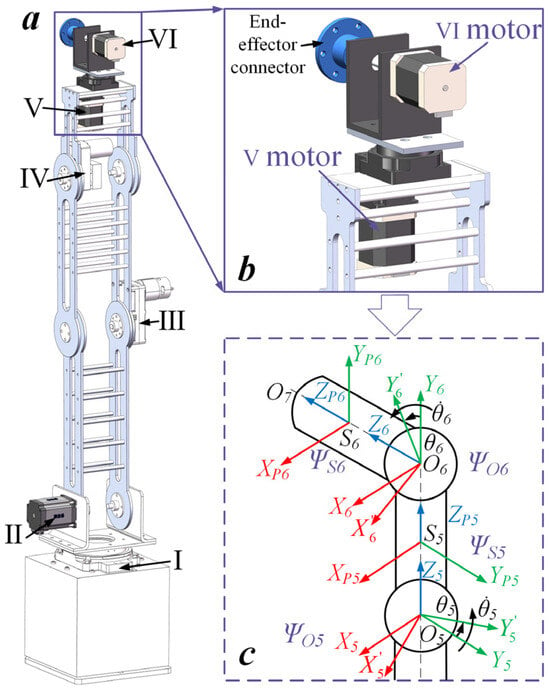
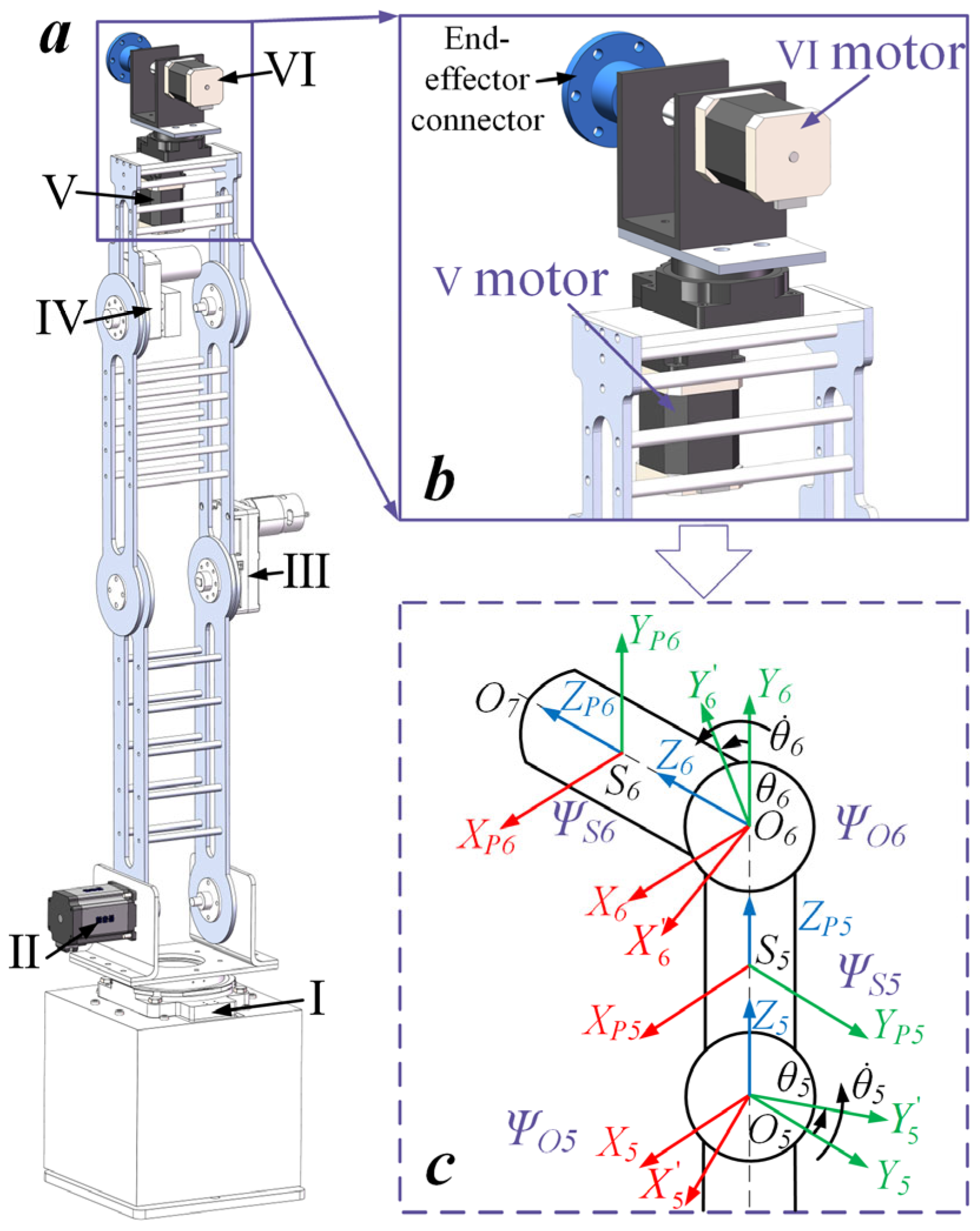
In this section, a physical model of the citrus-picking manipulator joint system is established (Figure 1). Based on the identified energy domains, a bond graph model for joints V and VI is constructed. The resulting model is then used to derive the coupled dynamic equations and the corresponding energy consumption formulations for the two joints.
Figure 1.
(a) Manipulator joint 3D modelling, (b) 3D model of the enlarged V and VI joints, (c) Coordinate systems of the V and VI joints.
The first joint of the 6-DOF citrus-picking manipulator is a load-bearing rotary joint at the base, primarily carrying the inertial load associated with the arm’s overall reach. Joints II–IV have no link twist angles and mainly serve to extend the arm and enlarge the workspace. By contrast, joints V and VI have a 90° link twist angle and are a major source of manipulator flexibility; moreover, joint VI directly interfaces with the end-effector. Joint V is the first joint beyond the base with a 90° twist angle and acts as a key transition joint that transmits the end-effector load to the upstream structure. From a dynamic viewpoint, the end-effector inertia is reflected onto joints V and VI with an amplification effect. A terminal load of mass me generates a gravitational moment of megL6 at the VI joint, while the moment at the V joint can be amplified to meg (L5 + L6cosθ6) (where L5 and L6 represent the rod lengths, and θ6 represents the joint angle). Therefore, torque output accuracy at joints V and VI directly affects end-effector positioning accuracy and force control during fruit contact. For these reasons, joints V and VI are selected as the study objects to characterise joint dynamics and energy consumption and to support load-parameter optimisation.
2.1. Physical Model
A simplified yet physically consistent representation of the joint system is required for electromechanical bond-graph modelling. A three-dimensional model of the manipulator is developed, and coordinate frames for joints V and VI are defined as shown in Figure 1. Figure 1a presents the overall 3D model; Figure 1b provides an enlarged view of joints V and VI; and Figure 1c shows the associated coordinate systems. Taking the rotation centre Oi (i = 5, 6) of the revolute pair as the coordinate origin, the coordinate system XiYiZi is established as the dynamic system ΨOi fixed on each rod, and the Zi axis is the direction of the fixed axis of the revolute pair; then, Zi = Xi × Yi. The absolute coordinates of the centre of mass Si of each rod are XSi, YSi, and ZSi, and the coordinate system XsiYsiZsi is established as the dynamic system Ψsi fixed on each rod, coincident with its principal axis of inertia, and its Zsi axis direction coincides with the principal axis of inertia of the rod.
2.2. Bond Graph Model
2.2.1. System Energy Field
The bond graph model of an analogue physical system may be regarded as composed of fields connected by junction structures, lacking distinct power or energy characteristics. The nine fundamental bond graph elements used to model analogue systems can be categorised into four classes: dissipative fields (R) that consume system power; energy storage fields (C and I)that are energy-conserving; source fields (Se and Sf) that supply power to the system; and junction structures (0-junction, 1-junction, TF, and GY) that conserve power.
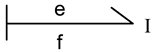
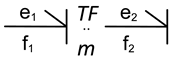
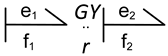
Among these, R represents resistive elements, which are dissipative bond graph components, such as resistors in circuits or dampers in mechanical systems. C denotes capacitive elements, representing components where a static relationship exists between potential variables (force, torque, voltage) and generalised displacements (displacement, angular displacement, charge), such as capacitors and springs. I denotes an inertial element, representing a static relationship between flow variables (velocity, angular velocity, current) and generalised momentum (momentum, angular momentum, magnetic flux), such as inductors and mass blocks. Se denotes a potential source, representing the environment’s potential action, such as voltage sources and pressure sources. Sf denotes a flow source, representing the environment’s flow action, such as current sources and velocity sources. 0-junctions serve as common-potential junctions, linking potential variables of identical form and magnitude within physical effect. The 1-junction serves as a common-flux junction, linking flux variables of identical form and equal magnitude within physical effects. TF denotes a transformer, representing the transformation relationship between potential variables and flux variables during system energy transfer, such as transformers or reduction gears. Where the transformer modulus is a function, it is termed a modulated transformer (MTF). GY denotes a gyrator, representing the transformation relationship between potential variables and flux variables during system energy transfer. Examples include DC motors, where a gyrator with a modular function is termed a modulated gyrator (MGY).
In the agricultural sector, key enabling technologies address core challenges faced by agricultural robots, including environmental complexity, task diversity, system hybridity, and strong interactivity. bond graphs systematise and theorise the design process, fundamentally enhancing the performance, energy efficiency, and reliability of agricultural robots. They constitute an indispensable component in the realisation of precise, intelligent, and sustainable agricultural equipment.
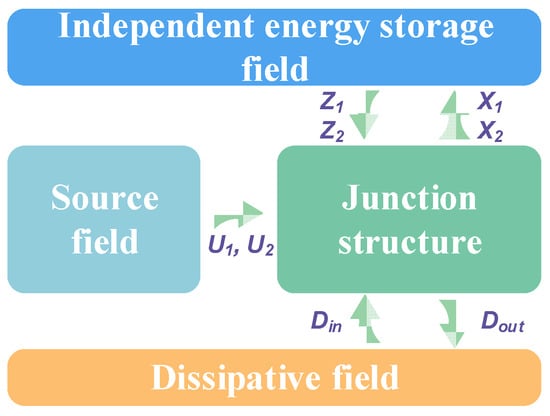
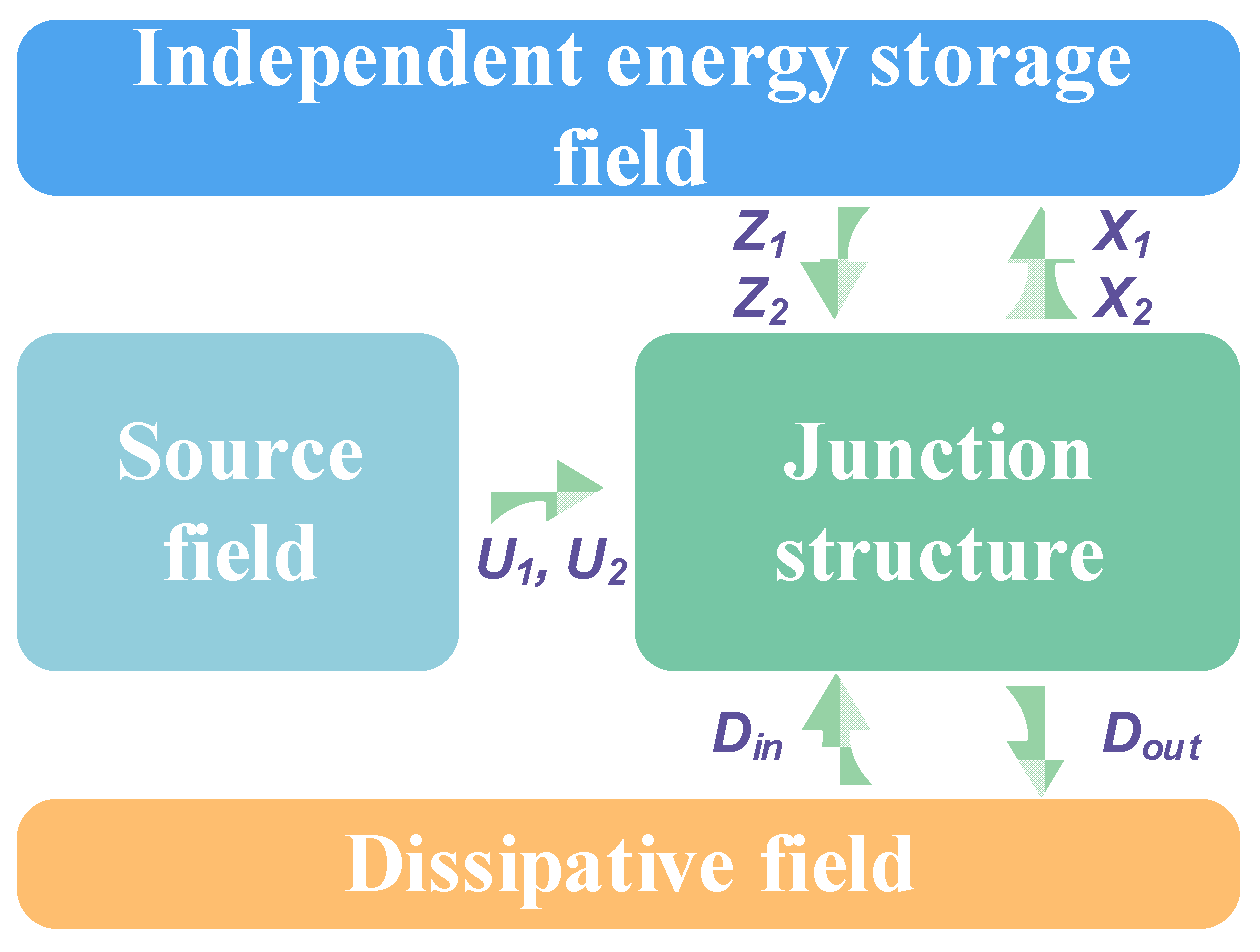
The joint system of the citrus-picking manipulator can be divided into different forms of energy fields according to the functions of its basic components: source field, dissipation field, independent energy storage field, and junction structure, as shown in Figure 2. Independent energy storage field is an energy storage field with integral causality, which may be subdivided into an inertial field comprising multiple inertial elements and a capacitive field comprising multiple capacitive elements. Assume that the energy variable vector Xi1 corresponds to the independent motion and the energy variable Xi2 corresponds to the dependent motion in the independent energy storage field of the system, and the corresponding common energy variable vectors are Zi1, Zi2, respectively. Xi1 is the system’s state variable. The input and output vectors of the dissipative field are Din and Dout, respectively. The external source input vector U = [U1 U2]T, where U1 represents the known source input acting on the system; U2 represents the motion pair constraint reaction force input by the external source.
Figure 2.
Manipulator system energy field.
The motion relationship between the independent velocity vector and the dependent velocity vector-namely, the independent linear velocities of points O6 and O7 at joints V and VI of the manipulator in Figure 1c, the centres of mass S5 and S6 of each link, and the dependent linear velocities generated by the rotation of joint V, the angular velocities at points O5 and O6, can be determined to obtain a junction structure consisting of the bond graph elements MTF, MGY, 1-junction, and 0-junction. The capacitive field, inertial field, resistive field, and source field can then be added to the junction structure to obtain a multi-energy domain system bond graph model.
2.2.2. Bond Graph Model of the Manipulator Joint System
In this work, viscoelastic dissipation becomes significant mainly under high-frequency vibration or rapid transient conditions. Since the investigated motion planning operates at frequencies well below those that induce pronounced viscoelastic behaviour, the associated dissipation is considered negligible compared with dominant inertial and friction-related effects. In addition, Coulomb friction and minor non-ideal coupling effects are not included in the present model to reduce parameter uncertainty; incorporating these effects will be addressed in future experimental studies.
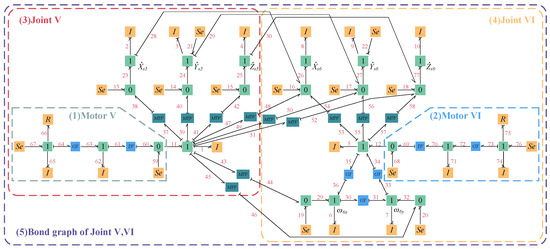
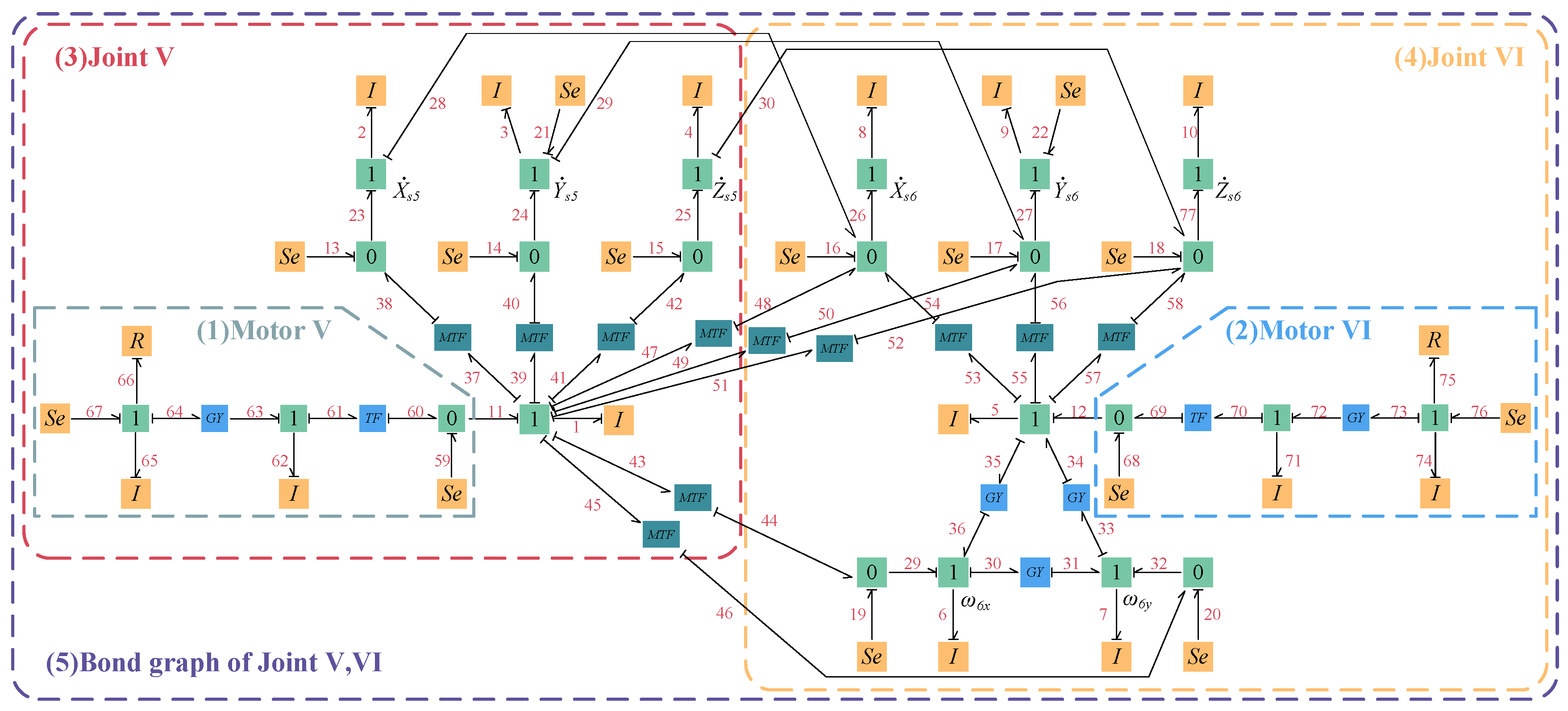
To facilitate calculations, the multi-port system is studied as a whole and is regarded as consisting of junction structures and interconnected fields. That is, a standard bond graph is specified, assuming that each bond in the bond graph has at least one end connected to a junction element 0-junction, 1-junction, MTF, or MGY. To partition the citrus harvesting manipulator system into interconnected domains of differing properties, a standard bond graph must be defined. It is assumed that each bond in the diagram connects at least one end to a junction-type component: 0-junction, 1-junction, MTF, or MGY. To derive this bond graph, one need only introduce a virtual bond—valued either 0 or 1—onto each bond failing to satisfy this assumption. Such junctions preserve the relationships between systems. Virtual junctions function identically to regular junctions: 0-junctions share the same bond potential variables and sum to zero in current variables, while 1-junctions share the same bond current variables and sum to zero in potential variables. Introducing these junctions ensures each field connects to a junction structure, preventing direct field-to-field links that would create algebraic ring issues, as illustrated in Figure 2. Having defined the standard form of the bond graph, bonds can be categorised as external or internal. External bonds connect fields to junction-type structures, with one end linked to R, C, I, Se, or Sf, and the other end connected to a junction. Internal bonds are components within junction-type structures, connecting solely to junction-type elements. According to the above mentioned method, the bond graph model of the V and VI joint system of the citrus-picking manipulator is established, as shown in Figure 3.
Figure 3.
Bond graph model of joints V and VI.
Parts (1)–(2) are the bond graph models of the drive motors at joints and , respectively. Parts (3)–(4) are the bond graph models of the joint systems V and VI of the citrus-picking manipulators, respectively. The power flow direction and the bond graph of the joint systems V and VI are shown in part (5).
To merely construct a bond graph model upon confirming the bond graph element representation of mechanical variables within the manipulator system is insufficient. For the purpose of facilitating the concise expression and accurate calculation of the mathematical model, it becomes imperative to perform augmentation on the initial bond graph model. In the following, the fundamental principles and core functionalities of the augmented bond graph will be elaborated in conjunction with the specific context of manipulator systems.
Numbering the bond graph serves to identify variables with bond graph elements. Numbers, sorted from number 1, represent Bond sequences. Figure 3 also illustrates a bond numbering diagram. I1 denotes the inertial element connected to bond number 1, Se13 represents the potential source connected to bond number 13. MTF and MGY denote two-port elements, MTF37,38 representing converters connected to bonds numbered 37 and 38, respectively, where the arrow direction points from 37 to 38. MGY30,31 denotes the converter connecting bonds numbered 30 and 31, with the arrow pointing from 30 to 31, and so forth. The dominant direction of energy flow is defined as the positive direction. Causality is represented by a short line drawn perpendicular to the connecting line at one end. All bond graph elements in this model are integral causal relationships.
2.3. Equation of State
State-space equations describe the relationship between system inputs and internal states and constitute a fundamental component of control-oriented mathematical modelling.
2.3.1. Manipulator Joint Speed
According to the mechanism kinematics, the velocity relationship for link 5 can be written as:
where v5 is the end velocity of rod 5, which is also the absolute velocity of the end effector mounting point O6, vs5 is the absolute velocity of the centre of mass of rod 5, ω5 is the absolute angular velocity of rod 5, and is the relative angular velocity of rod 5. In contrast Ls5 represents the distance from the centre point O5 of the V joint’s pivot to the centre of mass S5 of rod 5.
Similarly, the following velocity relationship is obtained for rod 6:
where v6 is the end velocity of rod 6, which is also the absolute velocity of the end effector mounting point O7, vs6 is the absolute velocity of the centre of mass of rod 6, ω6 is the absolute angular velocity of rod 6, and is the relative angular velocity of rod 6, In contrast Ls6 represents the distance from the centre point O6 of the VI joint’s pivot to the centre of mass S6 of rod 6.
2.3.2. Junction Structural Equation
In the electromechanical joint system, effort variables (force/torque in the mechanical domain and voltage in the electrical domain) and flow variables (linear/angular velocity in the mechanical domain and current in the electrical domain) are selected to formulate the state-space representation.
Obtaining the junction structure equation of the system is the key to obtaining the state equation. Each multi-port converter MTF is an ideal element that reflects the instantaneous energy conservation of the input and output. The modulus can be directly obtained from Equations (1) and (2). The Euler dynamic relationship between the torque and angular momentum on each rod is represented by a triangular ring formed by three circular converters MGY. The Eulerian relationship between torque and angular momentum on each member is represented by a triangular loop formed by three MGY. The bond diagram shown in Figure 3 satisfies the velocity-angular velocity constraint relationship while also describing the corresponding relationship between forces and moments. As the core function of the MGY is to transform angular velocity into angular momentum and generate gyroscopic forces, the rotator MGY sums the torques from inertial elements. According to Newton’s Second Law (the sum of applied torques equals the rate of change in angular momentum), this sum equals the applied torque, constituting a direct graphical representation of Euler’s equations. The MGY rotator depicted in the bond diagram represents the explicit and modular characterisation of the gyroscopic term within Eulerian dynamics under the framework of energy-power conservation. From the perspective of energy conservation, the bond graph model shown in Figure 3 satisfies the velocity constraint relationship and also describes the relationship between the corresponding forces and torques.
This model can be divided into different forms of energy fields, and its independent energy storage field equation is as follows:
In Equation (3), Xi1 denotes the vector of energy variables capable of independent motion within the independent energy storage field, while Xi2 represents the vector of energy variables undergoing non-independent motion. The corresponding vectors are Zi1 and Zi2, respectively. Xi1 and Xi2 are column vectors of dimensions m1 and m2, respectively, while Fi1 and Fi2 are constant matrices of dimensions m1 × m1 and m2 × m2 (i = 5, 6).
Its resistive field equation is
In the equation, the input and output vectors of the dissipative field are Din and Dout, respectively, both being m3 column vectors, and R is an m3 × m3 matrix.
When modelling complex systems using traditional key diagram methods, state equations encounter intricate algebraic cycles where another must determine the velocity of one rigid body. It creates an algebraic dependency loop requiring simultaneous solution during time integration, manifesting as differential causality in the key diagram. Therefore, treating constraint reaction vectors as external potential sources, constraint forces as input signals, and velocities as output signals eliminates such algebraic loops. This approach embodies the principle of virtual work within computational mechanics. Constraint forces perform zero work on virtual displacements. Consequently, a constrained system may be viewed as a free system coupled with a constraint force field. Calculating constraint forces requires only kinematic information, without dynamic coupling. The reaction constraint force vectors for the kinematic pairs in the keyed system shown in Figure 3 are defined as follows:
Treating each element as an unknown potential source, as shown in Figure 3, and adding it to the corresponding 0-junction can eliminate differential causality and complex junction structures. FOiX, FOiY, and FOiZ are the components of the anti-constraint forces at joints O5 and O6 in the directions of the coordinate axes of the fixed coordinate system X0Y0Z0. TiX and TiY represent the components of the torque acting on the corresponding rod at joints O5 and O6 in the X-axis and Y-axis of the dynamic system XpiYpiZpi, respectively. TiZ is the driving torque acting on the corresponding rod at joints O5 and O6, where i = 5, 6.
In the equation, p1–p74 denote the generalised momentum of inertia elements; for linear inertia elements, within the integral causal relationship, the flow variable is proportional to the generalised momentum, characterised by the following equation. Le is the motor winding inductance; Re is the motor resistance; Je is the electronic rotor moment of inertia; Te is the motor electromagnetic torque constant; Iixx, Iiyy, and Iizz are the inertia parameters of each rod; iei is the motor current; and is the relative angular velocity of the motor without deceleration by the reducer, where i = 5, 6. n = 2, 3, 4, 6, 7, 8, 9, 10, 62, 71.
Dissipated field input vector:
Output vector:
The following equation expresses the input variables of the manipulator system:
In the equation, U1 denotes the potential source vector, Se21 and Se22 represent the masses of rods 5 and 6, respectively, while Se67 and Se76 denote the motor voltages of joints V and VI, respectively.
From Equations (3)–(5), it follows that:
Since 0-junction, 1-junction, MTF, and MGY satisfy power conservation, junction structures likewise conserve power with a constant power flow direction. Within the bonding graph, each variable can be represented by other variables via the junction structure matrix J. As shown in Figure 2, the structural equation of the joint system of the V and VI joints of the citrus-picking manipulator can be written as follows:
Based on the constraint relationship of the internal junction structure of the system bond graph, the flow sum is calculated for the 0-junction corresponding to the constraint reaction force.
From Equations (1) and (2), and through analysis of the mechanism’s motion, the coefficient matrix can be obtained:
The coefficient matrix J of each junction structure is a function of the rod displacement. From the bond graph model in Figure 3, the coefficient matrix J of each junction structure can be determined, and the coefficient matrix TL of the above formula is obtained through mechanism motion analysis.
2.3.3. Dynamic Characteristics State Equation of the Manipulator
Through the algebraic processing of Equations (3) and (4), Equations (16)–(18), the following can be obtained:
Once again through algebraic operations. The system dynamic characteristic state equation can then be obtained:
Due to space constraints, the omitted portions of the formula may be found in the Appendix A.
2.4. Energy Consumption Model
The output power of the joint motor in a manipulator joint system is defined as the power consumed by the system’s non-motor components. Its expression can be derived from the dynamic equation of the joint system, as shown below:
The output power of the joint motor, denoted as Pi (t), is defined by the product of the motor’s adequate output torque Ti (t) and its angular velocity ωi (t), where i = 5, 6.
According to the dynamic characteristic state equation of the citrus-picking manipulator joints, the power of each joint can be obtained as follows:
The total power model of the manipulator joints V and VI is
Therefore, the energy consumption model of the manipulator joints V and VI is
3. Results and Discussion
Simulink, as a graphical simulation environment within MATLAB R2023b, supports parameterised modelling and visual simulation analysis of multi-domain dynamic systems. By adjusting system parameters, it enables efficient system analysis and optimisation. Therefore, this section first systematically transforms the established bond graph model into a modular block diagram representation, which is subsequently processed into a form compatible with Simulink. Based on this model, the dynamic behaviour of joints V and VI of the citrus-picking manipulator is simulated and analysed.
3.1. Block Diagram Model of the Manipulator Joint System
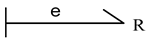
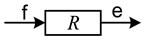
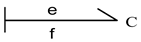
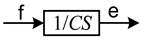
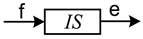
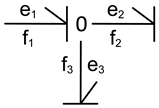
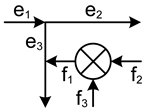
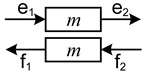
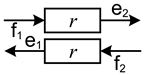
Directly simulating and analysing bond graph models in Simulink presents significant challenges. As an alternative, block diagrams are widely used as signal flow diagrams in the field of signal transmission. The bond graph is a power flow diagram, with each bond containing dual signals. Consequently, each bond graph element that specifies a causal relationship corresponds to a block diagram unit. Table 1 lists the correspondence between bond graph elements and block diagram units.
Table 1.
Block diagram unit representation of bond graph element.
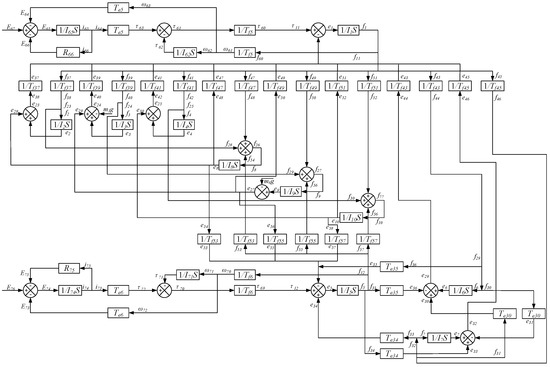
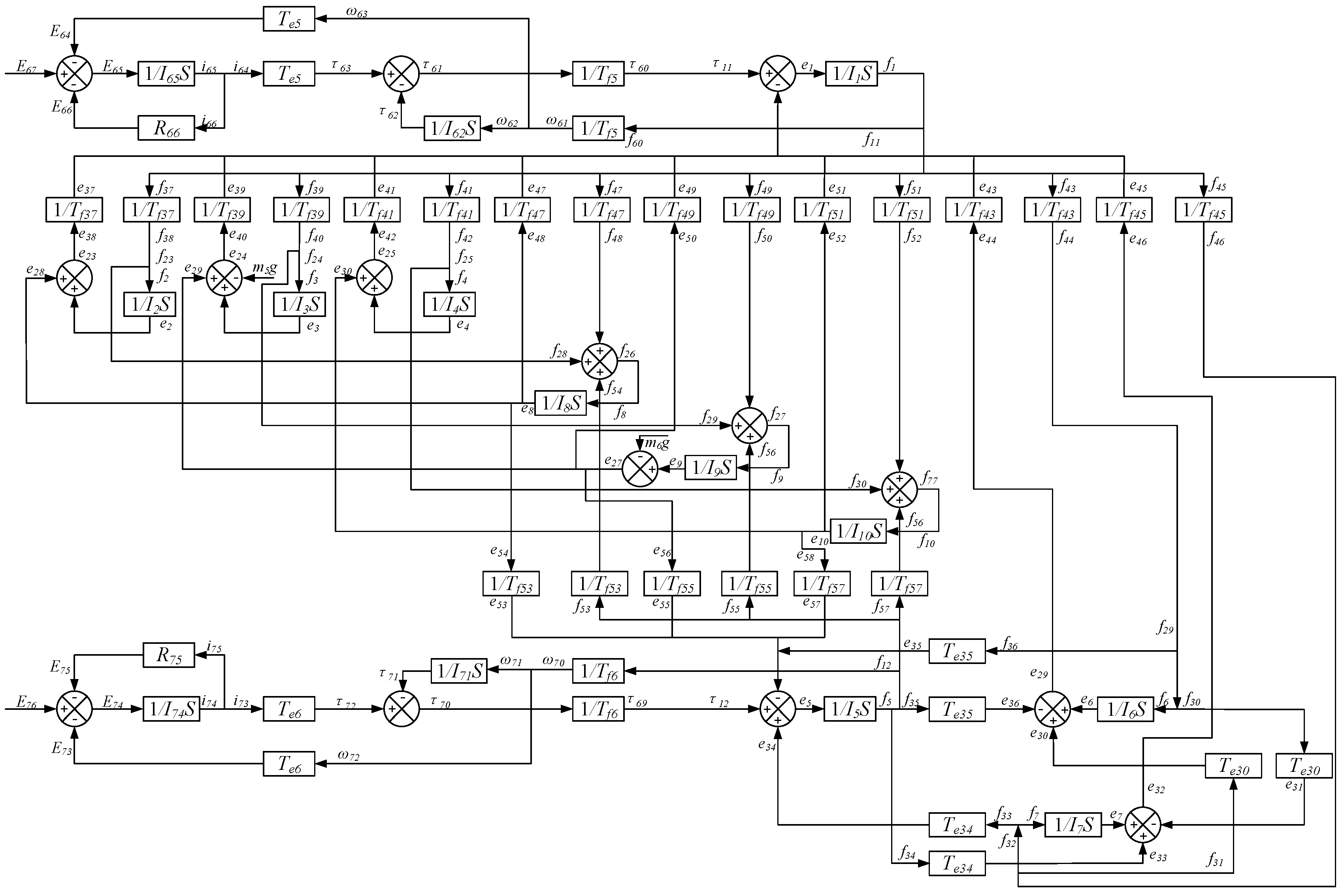
Based on the corresponding relationship, convert the model shown in Figure 3 into a block diagram model, as shown in Figure 4.
Figure 4.
Block diagram model of joints V and VI.
3.2. Manipulator Condition Parameters
The structural parameters of the mechanism, such as mass, length, and moment of inertia, can be obtained through SolidWorks 2024 modelling and the assignment of material properties. The structural parameters of each rod of the manipulator are shown in Table 2.
Table 2.
Rod structure parameters.
The basic parameters of the motor are shown in Table 3.
Table 3.
Basic parameters of the electric motor.
3.3. Matlab-Simulink Solution Analysis
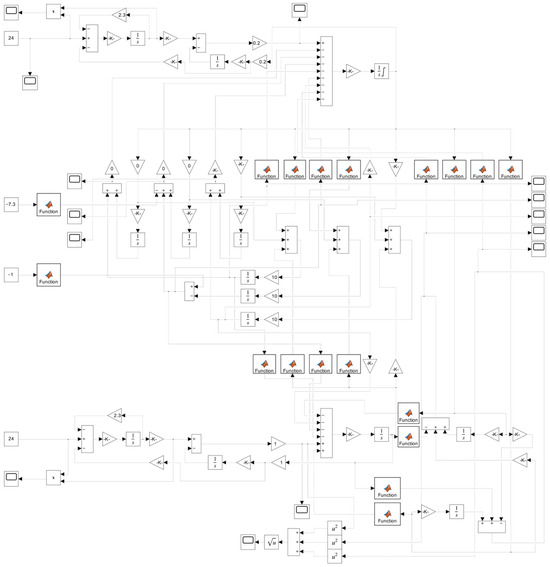
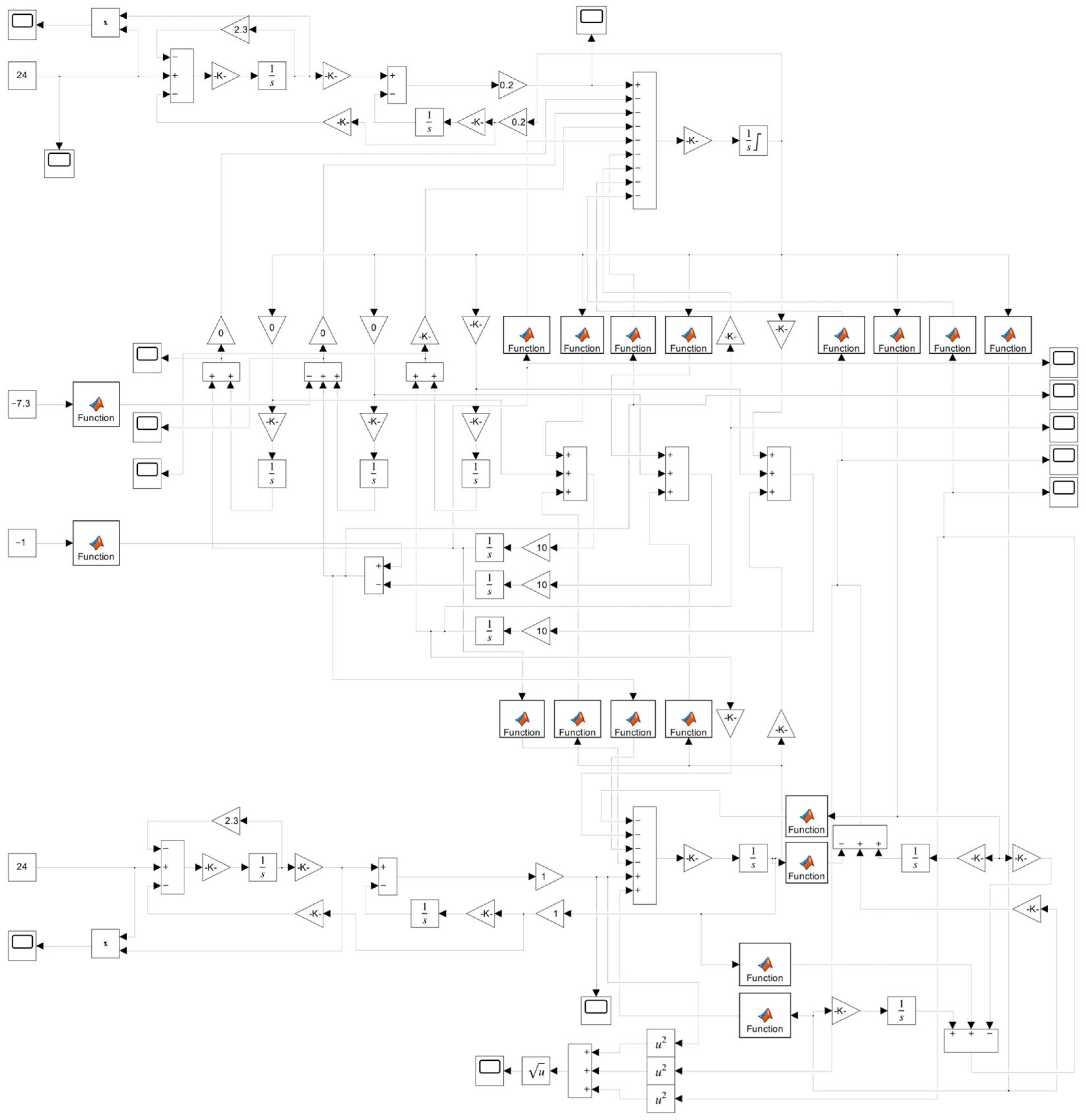
In Simulink, the simulation adopts graphical module modelling. Therefore, the block diagram model needs to be processed into a recognizable and simulable form. A custom module can be used to represent each bond graph element. The dynamic simulation model of the manipulator joint system is shown in Figure 5.
Figure 5.
Dynamic simulation model of joints V and VI.
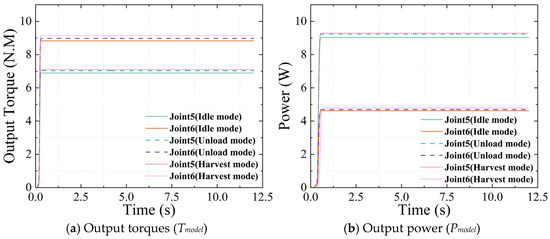
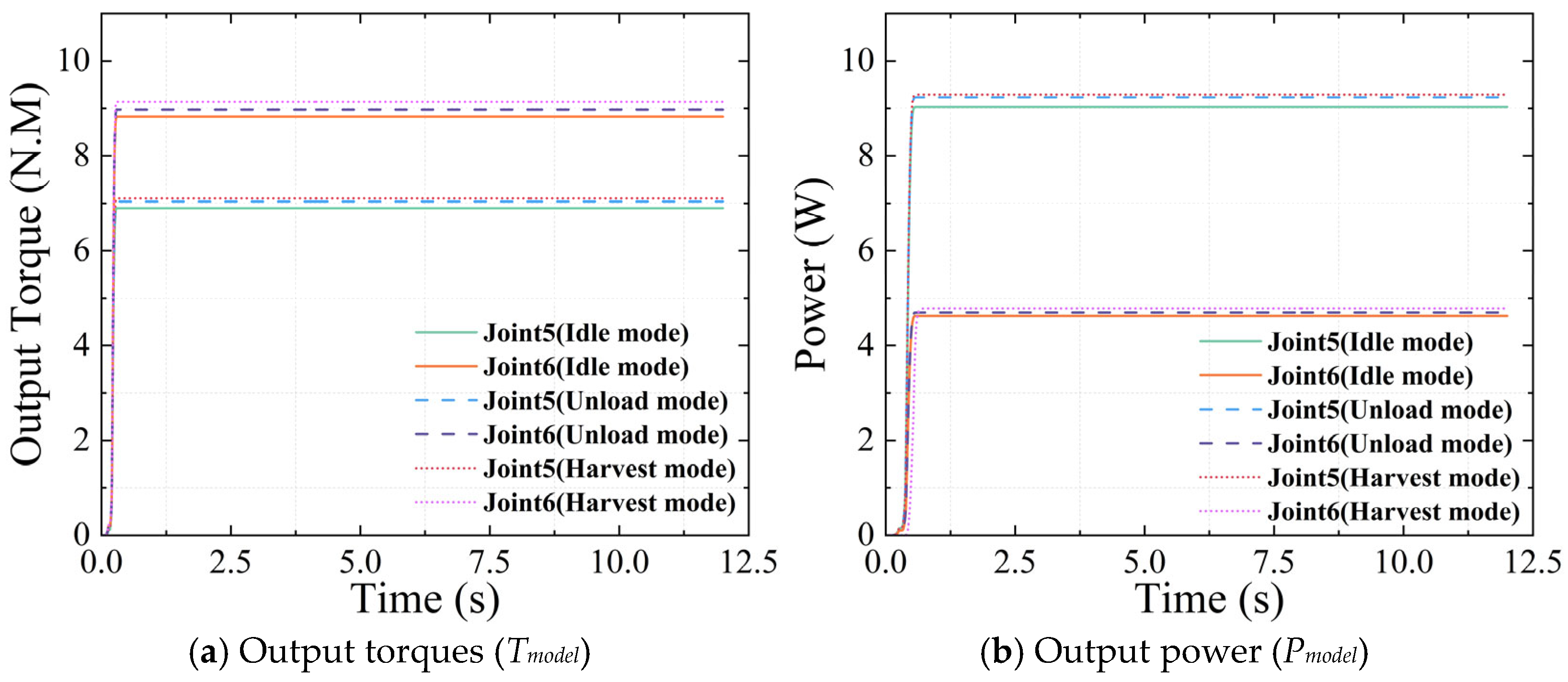
According to reference [10], the average cycle time for citrus harvesting is 10.9 s. However, based on the actual conditions of the manipulator, the operational time is set to 12 s, the V joint rotates 180°, and the VI joint rotates 360°. Meanwhile, three separate load conditions were set for comparison:—Idle mode, where no end-effector is attached and only the weight of the manipulator’s own links is considered;—Unload mode, in which an end-effector is connected but no grasping operation takes place; and—Harvest mode, where the manipulator grasps a citrus fruit. Upon measurement, the end-effector weighs 1.05 kg, while the citrus fruit harvested weighs 0.285 kg. These weights were entered into the previously mentioned model for simulation. From the simulation, the output torque and working power of each motor can be obtained, as shown in Figure 6.
Figure 6.
Simulated output torque and power.
Tmodel represents the theoretical output torque of the model, and Pmodel represents the theoretical output power of the model. Since the set speed is constant, but there is a rapid acceleration process starting from 0, the output torque and output power will also have a rapid increase process starting from 0 and tend to stabilise after some time. The stable value is the output torque and power of the V and VI joint systems of the citrus-picking manipulator. Under three distinct load conditions, it is evident that both the system’s output torque and power increase with greater load. A detailed comparative analysis will follow experimental investigations.
3.4. Results
To verify the precision of modelling of the V and VI joint system of the citrus-picking manipulator, a complete manipulator was built as an experimental platform. Connect the motors of the V and VI joints to the electrical parameter tester to validate their dynamic characteristics and energy consumption properties under the aforementioned three load conditions.
3.4.1. Experimental Setup
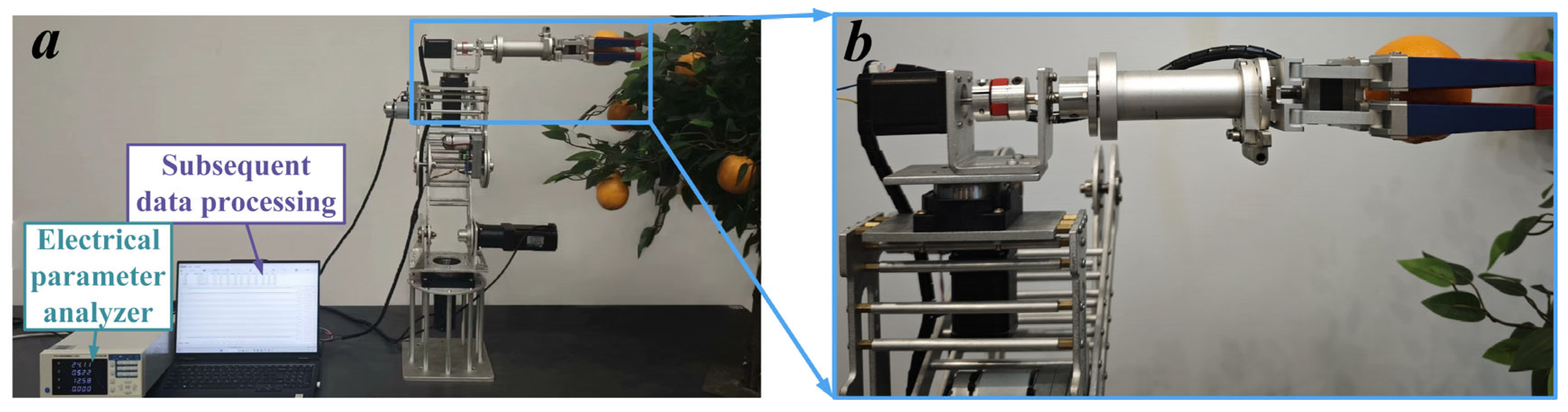
Figure 7 illustrates the wiring configuration of the electrical parameter tester alongside an actual view of the manipulator in standby mode. This study primarily analyses the dynamic characteristics and energy consumption of joints V and VI under Idle mode, Unload mode, and Harvest mode. The three load states are depicted in Figure 8. The motor is connected to the electrical parameter tester (product model: YP9901YP2012; Current range: 5 mA–20 A; Voltage range: AC + DC 3–600V; Power factor: 0–1; Frequency: 40–400 Hz) to collect electrical parameters during the experiment.
Figure 7.
(a) Electrical parameter tester connection (b) Manipulator standby mode.
Figure 8.
Three load modes.
The software settings of the electrical parameter tester are shown in Table 4. The sampling mode is interval sampling.
Table 4.
Electrical parameter tester software settings.
3.4.2. Experimental Procedures
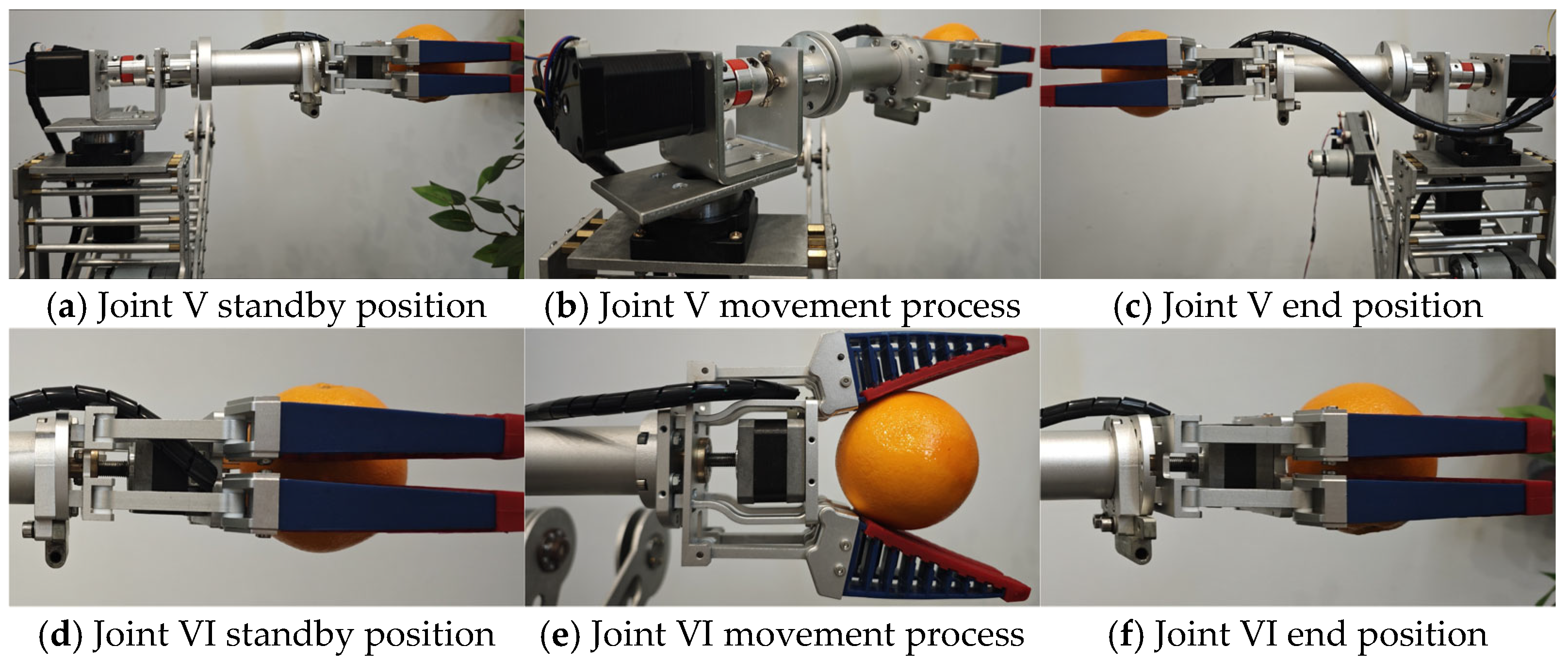
In the experiment, the rotational process of the citrus-picking manipulator’s joints was simulated to match the simulation. Under three load conditions, the V joint was set to rotate 180° within 12 s; however, after reduction by the gearbox, the motor speed was 12.5 r/min. Joint VI rotated one complete revolution at 5 r/min. Taking harvest mode as an example, the experimental process is illustrated in Figure 9. Figure 9a–c and 9d–f, respectively, depict the entire motion sequence from standby to completion for Joints V and VI during harvest mode.
Figure 9.
V, VI joint standby position, movement process, and ending position (Taking harvest mode as an example).
To evaluate the precision of the experiment, five independent experiments were performed under the same conditions, with 20 measurements collected in each group.
3.5. Discussion
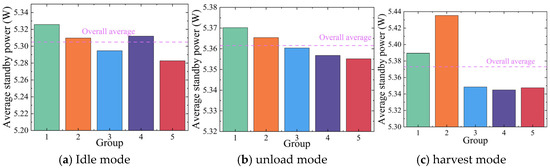
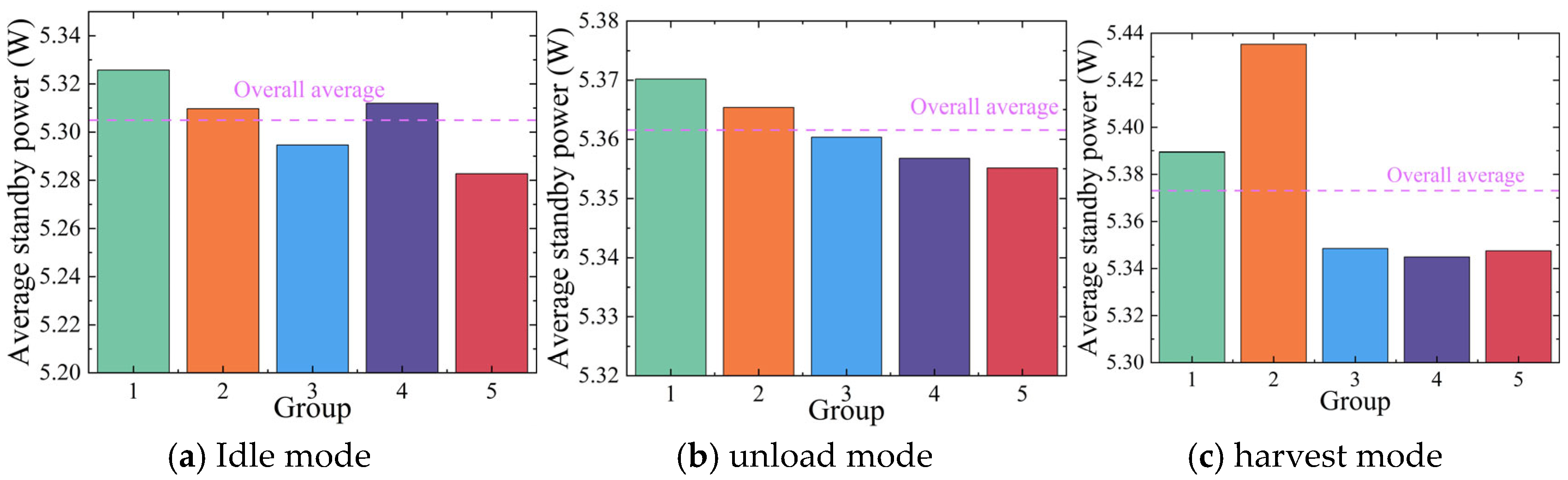
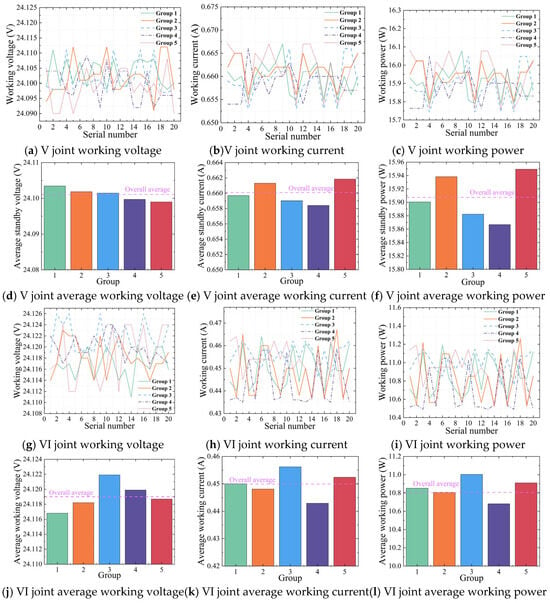
Through experimentation, the standby electrical parameters (voltage, current) for three distinct modes of the V and VI joints of the citrus harvesting manipulator were obtained, enabling calculation of their standby power as illustrated in Figure 10. The figure demonstrates that standby power remains relatively stable when the manipulator is in standby mode. Multiple test sets revealed that in Idle mode, the average standby power across all sets ranged from 5.295 W to 5.326 W, with an overall average of 5.305 W. In unload mode, the average standby power across all sets ranged from 5.355 W to 5.37 W, with an overall average of 5.362 W. In harvest mode, the average standby power consumption across all groups ranged from 5.345 W to 5.435 W, with an overall average of 5.373 W. Consequently, it can be concluded that when the manipulator is in standby mode, its voltage, current, and power consumption all remain relatively stable.
Figure 10.
Electrical parameters of V and VI joints for the citrus-picking manipulator in standby position.
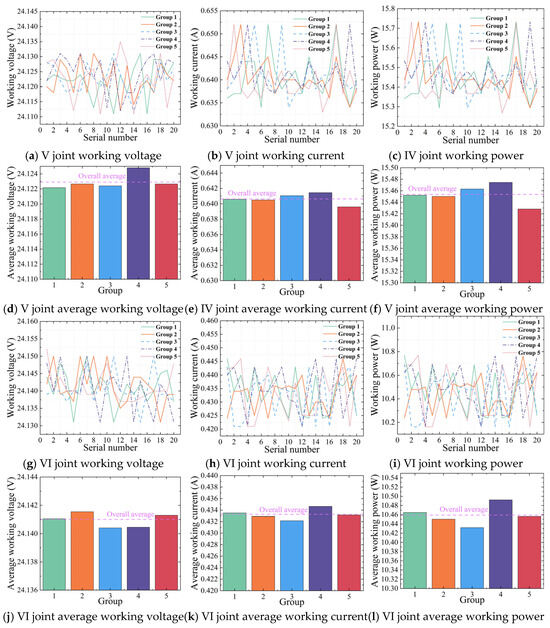
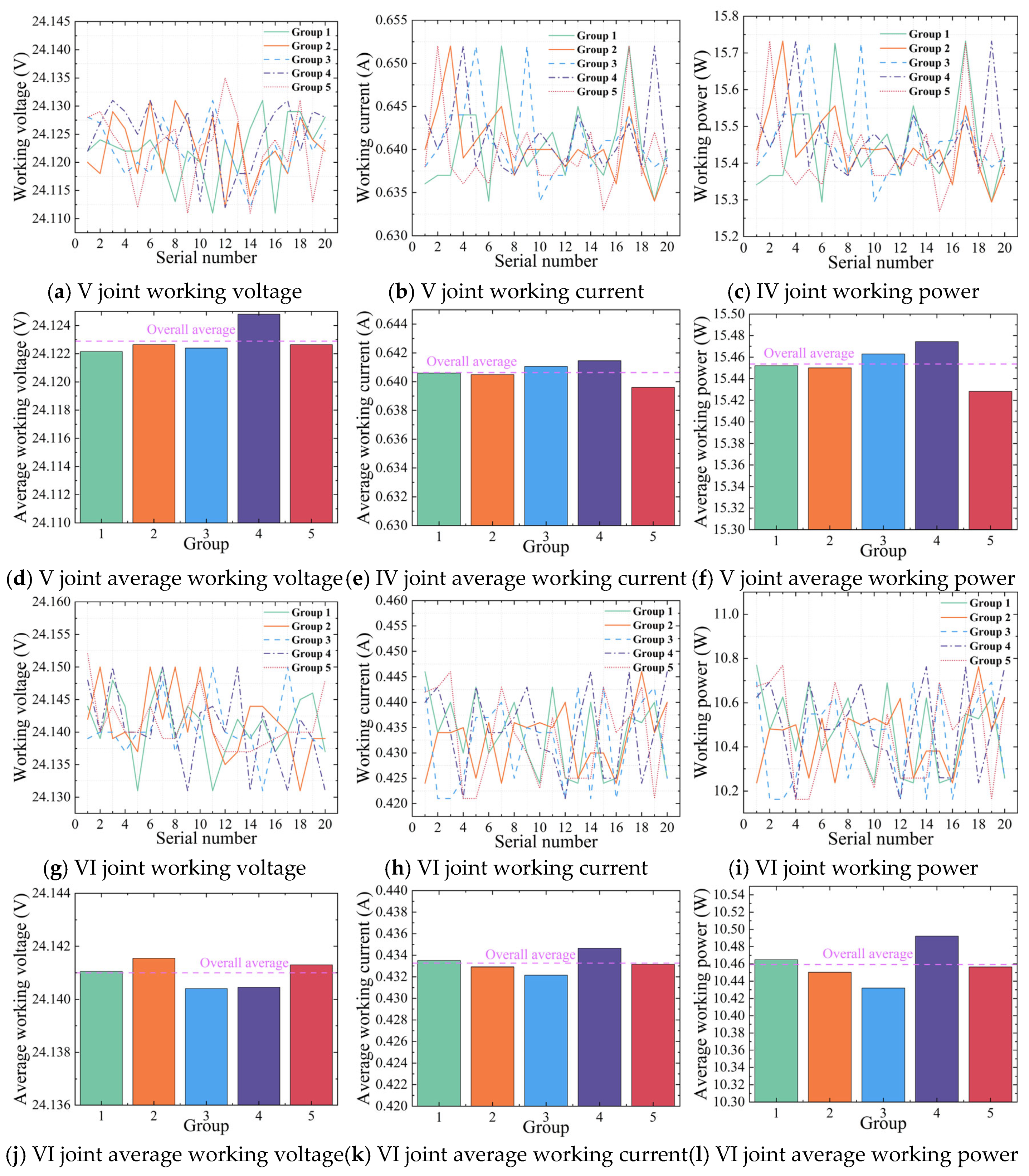
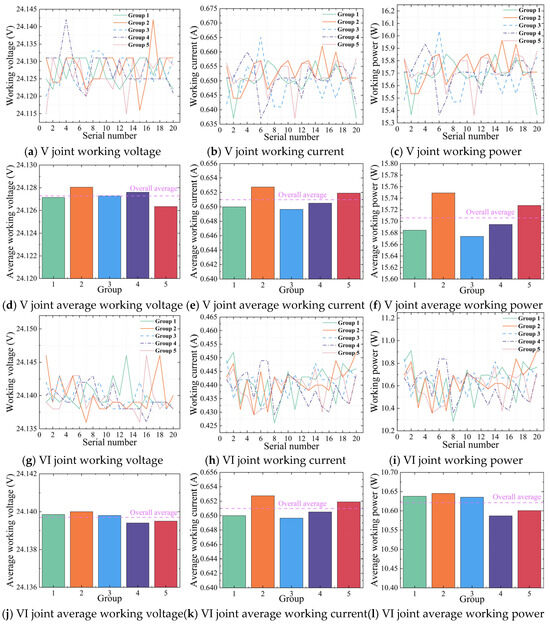
By consulting motor manufacturers, examining relevant motor parameters, and reviewing literature [32], this study assumes a motor working efficiency of 90% to account for actual complex working conditions and additional energy losses not reflected in the model. Data acquisition was conducted on both joint systems under three distinct load conditions. In idle mode, the operational electrical parameters for the V and VI joints are shown in Figure 11. As illustrated, under identical working conditions, the average working voltage for the V joint across multiple test groups ranged from 24.122 V to 24.125 V, with an overall average of 24.123 V. The average working current for each group ranged from 0.640 A to 0.641 A, with an overall average of 0.641 A. The average working power for each group ranged from 15.428 W to 15.474 W, with an overall average of 15.453 W. The average working voltage for each group for the VI joint from 24.140 V to 24.142 V, with an overall average of 24.141 V. The average working current for each group ranged from 0.432 A to 0.435 A, with an overall average of 0.433 A. The average working power for each group ranged from 10.432 W to 10.492 W, with an overall average of 10.459 W.
Figure 11.
Electrical parameters in idle mode.
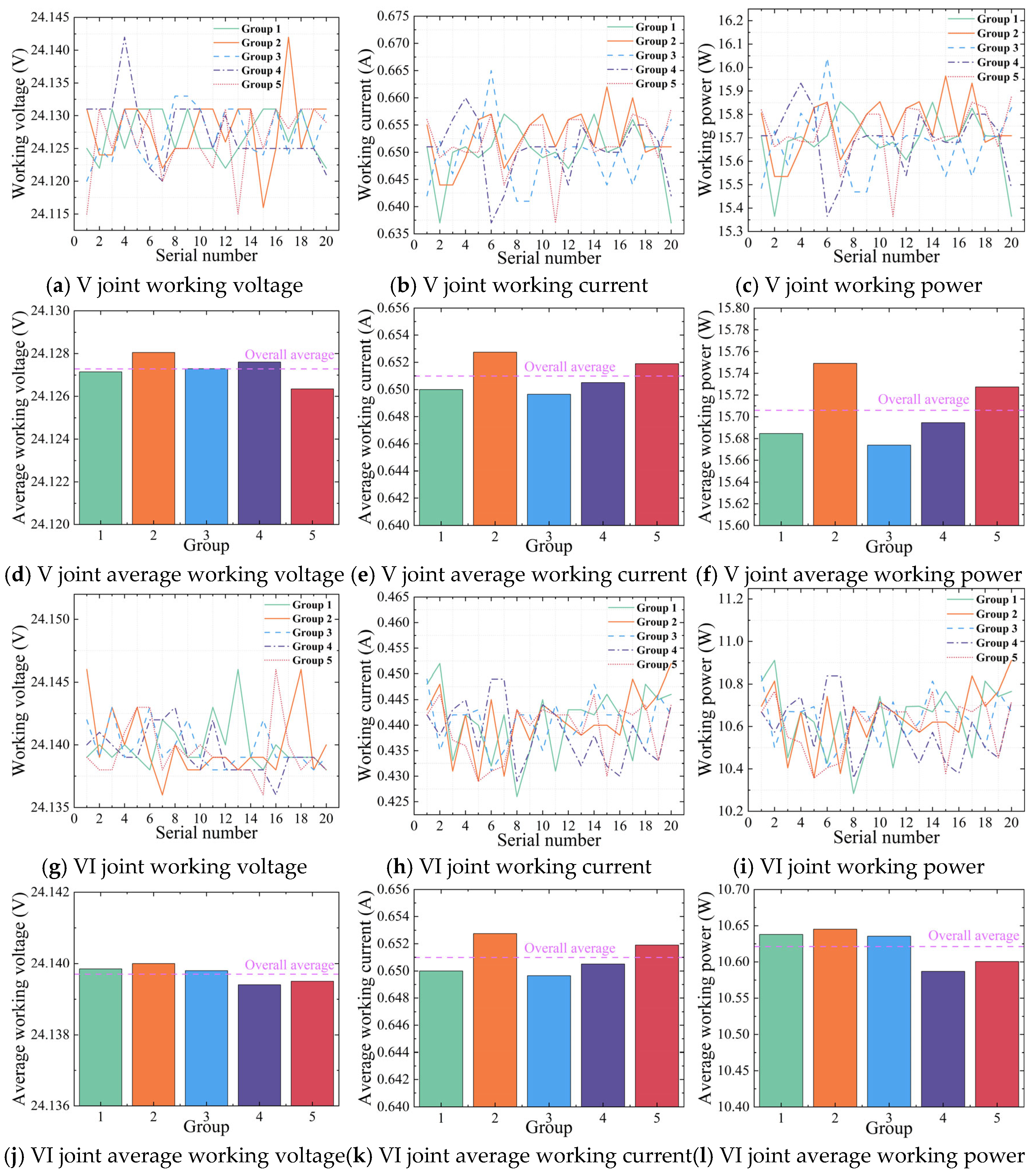
In unload mode, the operational electrical parameters for the V and VI joints are shown in Figure 12. As illustrated, under identical working conditions, the average working voltage for the V joint across multiple test groups ranged from 24.126 V to 24.128 V, with an overall average of 24.123 V. The average working current for each group ranged from 0.650 A to 0.653 A, with an overall average of 0.651 A. The average working power for each group ranged from 15.674 W to 15.749 W, with an overall average of 15.706 W. The average working voltage for each group in Section VI ranged from 24.139 V to 24.140 V, with an overall average of 24.140 V. The average working current for each group ranged from 0.439 A to 0.441 A, with an overall average of 0.440 A. The average working power for each group ranged from 10.587 W to 10.645 W, with an overall average of 10.621 W.
Figure 12.
Electrical parameters in unload mode.
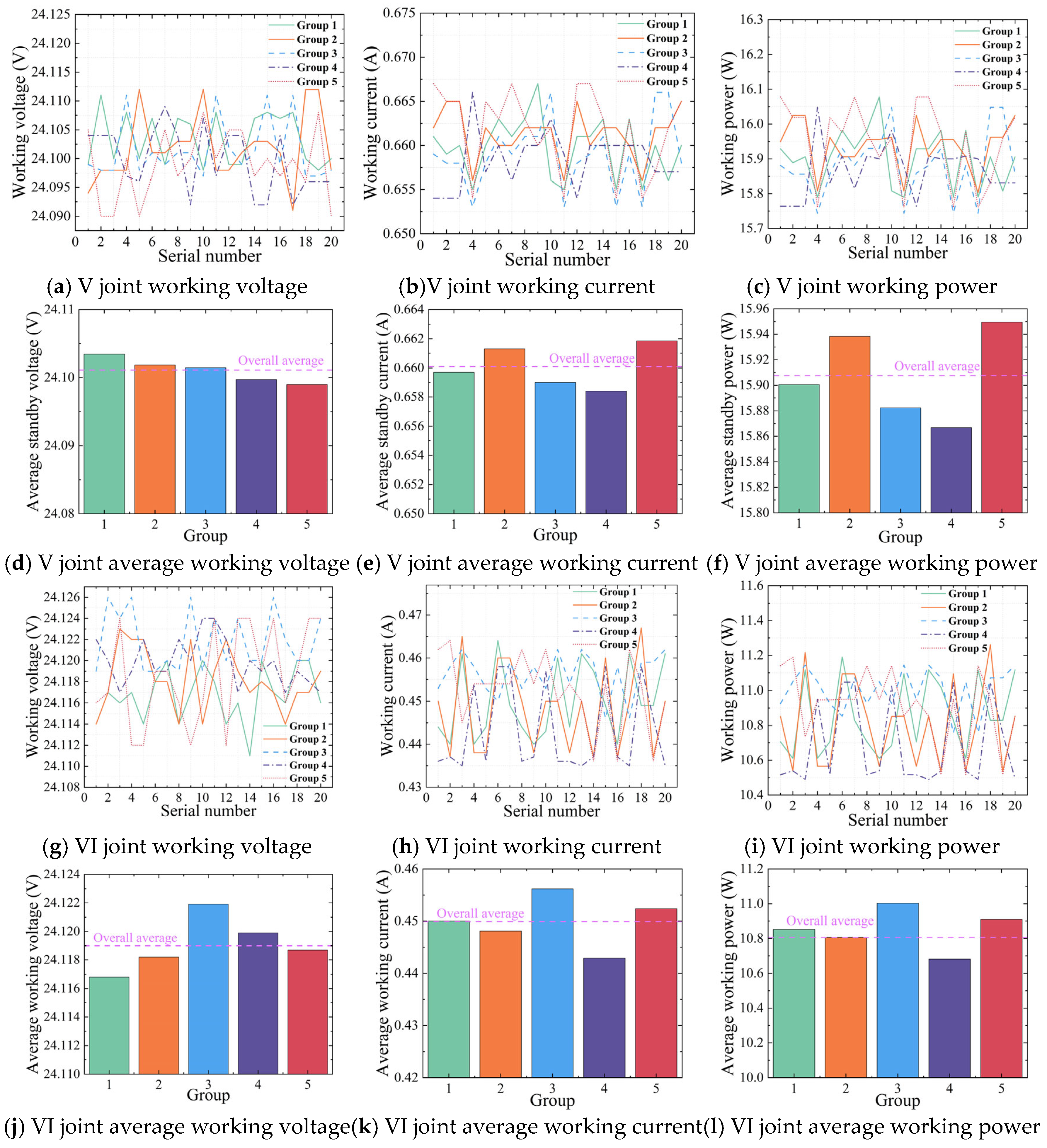
In harvest mode, the operational electrical parameters for the V and VI joints are shown in Figure 13. As illustrated, under identical working conditions, the average working voltage for the V joint across multiple test groups ranged from 24.099 V to 24.103 V, with an overall average of 24.101 V. The average working current across all groups ranged from 0.658 A to 0.662 A, with an overall average of 0.660 A. The average working power across all groups ranged from 15.867 W to 15.950 W, with an overall average of 15.908 W. The average working voltage for each group in the VI joint from 24.117 V to 24.122 V, with an overall average of 24.119 V. The average working current for each group ranged from 0.443 A to 0.456 A, with an overall average of 0.450 A. The average working power for each group ranged from 10.681 W to 11.004 W, with an overall average of 10.806 W.
Figure 13.
Electrical parameters in harvest mode.
However, despite the identical testing conditions, several factors may contribute: millivolt-level transient fluctuations in the laboratory power supply output, minor delays in joint load response during sampling intervals, and potential intermittent contact issues in wiring due to cable movement induced by motor rotation. It will all lead to fluctuations in the data. However, these marginal deviations are considered negligible in practical applications. It can be concluded that, when the manipulator is in working state, the voltage, current, and power are relatively stable, and their average values can be used for subsequent data analysis.
When the system is running, the sum of the motor rotation power and the system’s standby power can be regarded as the working power of the manipulator’s joint system V and VI. The motor rotational power is derived computationally by taking the difference between the mean operational power and the mean standby power of joint systems V and VI in the citrus-picking manipulator. It follows that: in idle mode, the rotational power of the V joint motor is 10.148 W, with an adequate output power of 9.1332 W; the calculated rotational power of the VI joint motor is 5.154 W, corresponding to an adequate output power of 4.6386 W. In unload mode, the rotational power of the V joint motor is 10.344 W, with an adequate output power of 9.3096 W; the calculated rotational power of the VI joint motor is 5.259 W, corresponding to an adequate output power of 4.7331 W. In harvest mode, the rotational power of the V joint motor is 10.5344 W, with an adequate output power of 9.481 W; the calculated rotational power of the VI joint motor is 5.4326 W, corresponding to an adequate output power of 4.8893 W.
The effective output power and output speed of a motor determine its effective output torque. As shown in the following formula:
where Tea denotes the effective output torque, Pea represents the effective output power, and ne signifies the rotational speed of the motor.
Table 5.
Effective Pea and Tea of the motor.
Using Equation (33) to calculate the prediction error (ΔE) reflects the exactitude of the bond graph model.
Among them, Emodel is the model output value, and Emeasured is the actual measurement value.
Table 6 shows the comparison results and errors between the theoretical output values of the model and the actual measured values.
Table 6.
Comparison results and error values between model output and measured values.
Table 5 demonstrates that the dynamic simulation and energy consumption model of joints V and VI in the citrus harvesting manipulator exhibits high consistency with actual measurement data regarding output torque and power. The output torque of both joints increases with rising load, while power consumption also escalates. According to the fundamental formula for power in rotating machinery, an increase in the motor’s output torque will directly result in a proportional increase in its output mechanical power, provided the system maintains constant rotational speed. It corresponds to the motor requiring greater electrical power from the supply to overcome increased external loads or execute acceleration commands, subsequently converting this into enhanced mechanical output. It indicates a positive correlation between the manipulator joint’s output torque and energy expenditure relative to its load. In idle mode without an end-effector attached, the relative error between the simulated output torque and the effective output torque for Joint V is 1.061%, while the relative error between the simulated output power and the effective output power is 1.126%. For joint VI, the relative error between simulated and effective output torque was 0.33%, while the relative error between simulated and effective output power was 0.331%. In unload mode with only the end-effector connected, the relative error between simulated and effective output torque for joint V was 1.122%, and the relative error between simulated and effective output power was 1.258%. The relative error between the simulated output torque and the effective output torque for joint VI was 0.883%, while the relative error between the simulated output power and the effective output power was 0.861%. During the harvest mode for picking citrus fruits, the relative error between the simulated output torque and the effective output torque at joint V was 1.888%, while the relative error between the simulated output power and the effective output power was 2.002%. For joint VI, the relative error between simulated output torque and effective output torque was 2.109%, while the relative error between simulated output power and effective output power was 2.218%. All relative errors remained below 3%, validating the model’s reliability. Errors may stem from friction, inertia, or real-time load variations, resulting in minor deviations.
From the error distribution perspective, as the load gradually increases, the relative errors in both output torque and power consumption also rise. This occurs because the load introduces weight and consequently other non-ideal errors. This is evident when the system operates in Harvest mode, where both Joint V and Joint VI exhibit a sudden increase in relative error. In Unload mode, although the load is increased, the weight distribution is relatively uniform, and the end-effector employed exhibits axial symmetry. This arrangement causes the end-effector and rod 6 to share a common principal axis of inertia. Conversely, in Harvest mode, the task involves grasping citrus fruit. The fruit’s weight is concentrated at the front end of the end-effector. Furthermore, citrus fruits are predominantly ellipsoidal in shape. Due to the fruit’s pose, its centre of mass typically does not coincide with the principal axis of inertia formed by link 6 and the end-effector. This causes oscillation during rotation, increasing the motor’s required anti-vibration torque and thereby elevating power consumption.
4. Conclusions
The analysis of dynamic characteristics and energy consumption in the joint system of citrus harvesting manipulators constitutes a fundamental basis for elucidating their dynamic behaviour and mechanisms of energy transfer and dissipation. This research provides theoretical groundwork for optimising the end-effector load design, thereby contributing to enhancing the overall efficiency of harvesting operations. Accordingly, this paper employs Bond diagram theory to model the V and VI joint systems of citrus harvesting manipulators. Initially, the state equations and energy consumption model for the manipulator’s joint system were established. To investigate the dynamic characteristics and energy consumption patterns of the joint system in depth, Bond graph theory was integrated with the fundamental physical properties of the joints. A dynamic simulation model was developed using MATLAB-Simulink. Once established, this model can compute the system’s dynamic characteristics and energy consumption by inputting the lengths and masses of individual members, motor parameters, and load conditions. This enables a series of adjustments to the structure and model parameters to achieve optimal energy control for the manipulator. Similarly, by specifying a given energy consumption level or required torque, the parameters of the preceding manipulator can be determined conversely. Under identical operating conditions, a comparative analysis was conducted on the dynamic response and energy consumption distribution of the system model. Ultimately, experiments validated the dynamic characteristics and energy consumption distribution of the citrus-picking manipulator’s V and VI joint systems under load conditions. Experimental results demonstrate that the dynamic characteristics and energy consumption model of joints V and VI exhibit high consistency with corresponding simulation data, measured output torque, and power values. Relative errors are maintained below 3%, effectively validating the precision and reliability of the constructed model. This model provides a robust theoretical foundation and effective technical support for in-depth research into the dynamic behaviour and energy consumption distribution of citrus harvesting robotic grippers, as well as for addressing and optimising system performance under load conditions.
As a complex multi-domain energy system, the manipulator’s linkage mechanism exhibits significant dynamic coupling effects among its internal energy-consuming components. Future research should focus on integrating additional energy domains to establish a comprehensive Bond graph model for the joint system of citrus-picking manipulators. This model will facilitate systematic, in-depth investigations into the dynamic characteristics and energy consumption behaviour of field harvesting machinery under real-world conditions, while providing crucial theoretical support for the precise acquisition and optimisation of manipulator load parameters. This paper constitutes the initial phase of theoretical modelling and validation, aiming to establish a core framework. Consequently, mechanical losses and viscoelastic dissipation have been neglected. However, subsequent experimental validation and practical application phases must incorporate these elements into the model and undertake parameter identification.
Author Contributions
Methodology, J.X., Y.Z., C.C., C.L. and G.X.; Investigation, J.X., Y.Z., C.C., C.L. and G.X.; Conceptualization, J.X., Y.Z., C.C., C.L. and G.X.; Writing—original draft, J.X.; Supervision, L.L.; Conceptualization, L.L.; Writing—review and editing, L.L.; Funding acquisition, L.L. All authors have read and agreed to the published version of the manuscript.
Funding
This research was funded by [National Natural Science Foundation of China] grant number [No. 52475542]; [Science Fund for Distinguished Young Scholars of Chongqing Municipality] grant number [CSTB2022NSCQ-JQX0030]; [Fundamental Research Funds for the Central Universities] grant number [Swu-XDJH202302].
Institutional Review Board Statement
Not applicable.
Data Availability Statement
The original contributions presented in this study are included in the article. Further inquiries can be directed to the corresponding author.
Conflicts of Interest
The authors declare no conflicts of interest.
Appendix A. State Equation Specific Matrix
References
- Zhang, Y.; Li, L.; Chun, C.; Wen, Y.; Xu, G. Multi-scale feature adaptive fusion model for real-time detection in complex citrus orchard environments. Comput. Electron. Agric. 2024, 219, 108836. [Google Scholar] [CrossRef] [Scilit]
- World Citrus Organisation. The World Citrus Organisation Northern Hemisphere Citrus Forecast Shows Recovery in Citrus Production; World Citrus Organisation: Madrid, Spain, 2023. [Google Scholar]
- Zhang, Y.; Li, L.; Chun, C.; Wen, Y.; Li, C.; Xu, G. Data-driven Bayesian Gaussian mixture optimized anchor box model for accurate and efficient detection of green citrus. Comput. Electron. Agric. 2024, 225, 109336. [Google Scholar] [CrossRef] [Scilit]
- Zhang, G.; Li, L.; Zhang, Y.; Liang, J.; Chun, C. Citrus pose estimation under complex orchard environment for robotic harvesting. Eur. J. Agron. 2024, 162, 127418. [Google Scholar] [CrossRef] [Scilit]
- Bao, X.; Shi, X.; Ma, X.; Leng, J.; Ma, Z.; Ren, M.; Li, S. Design and experiment of citrus picking system based on dual robot collaboration. J. Eng. 2024, 2024, e12419. [Google Scholar] [CrossRef] [Scilit]
- Ferreira, M.D. Harvesting citrus: Challenges and perspectives in an automated world. In Achieving Sustainable Cultivation of Tropical Fruits; Burleigh Dodds Science Publishing: Cambridge, UK, 2020; pp. 43–64. [Google Scholar]
- Au, C.; Barnett, J.; Lim, S.; Duke, M. Workspace analysis of Cartesian robot system for kiwifruit harvesting. Ind. Robot. Int. J. Robot. Res. Appl. 2020, 47, 503–510. [Google Scholar] [CrossRef] [Scilit]
- Lytridis, C.; Bazinas, C.; Kalathas, I.; Siavalas, G.; Tsakmakis, C.; Spirantis, T.; Badeka, E.; Pachidis, T.; Kaburlasos, V. Cooperative Grape Harvesting Using Heterogeneous Autonomous Robots. Robotics 2023, 12, 147. [Google Scholar] [CrossRef] [Scilit]
- Liu, L.; Yang, Q.; He, W.; Yang, X.; Zhou, Q.; Addy, M. Design and Experiment of Nighttime Greenhouse Tomato Harvesting Robot. J. Eng. Technol. Sci. 2024, 56, 340–352. [Google Scholar] [CrossRef] [Scilit]
- Yin, H.; Sun, Q.; Ren, X.; Guo, J.; Yang, Y.; Wei, Y.; Huang, B.; Chai, X.; Zhong, M. Development, integration, and field evaluation of an autonomous citrus-harvesting robot. J. Field Robot. 2023, 40, 1363–1387. [Google Scholar] [CrossRef] [Scilit]
- Choi, D.; Park, J.; Yoo, J.; Ko, K. AI-driven adaptive grasping and precise detaching robot for efficient citrus harvesting. Comput. Electron. Agric. 2025, 232, 110131. [Google Scholar] [CrossRef] [Scilit]
- Wang, L.; Xu, P.; Li, J.; Ekaterina, S.; Wang, B. Stability analysis of human hand grasping for the design of pneumatic muscle-driven end effector targeting citrus picking. Comput. Electron. Agric. 2025, 239, 110942. [Google Scholar] [CrossRef] [Scilit]
- Yao, J.; Gu, W.; Feng, Z.; Chen, L.; Xu, Y.; Zhao, Y. Dynamic analysis and driving force optimization of a 5-DOF parallel manipulator with redundant actuation. Robot. Comput. Manuf. 2017, 48, 51–58. [Google Scholar] [CrossRef] [Scilit]
- Chen, X.; Zhao, F. Dynamic response investigation of high-speed structural redundant parallel manipulator considering multiple spatial revolute joints with radial and axial clearances. Mech. Based Des. Struc. Mach. 2024, 52, 6633–6659. [Google Scholar] [CrossRef] [Scilit]
- Bayro-Corrochano, E.; Medrano-Hermosillo, J.; Osuna-González, G.; Uriostegui-Legorreta, U. Newton–Euler modeling and Hamiltonians for robot control in the geometric algebra. Robotica 2022, 40, 4031–4055. [Google Scholar] [CrossRef] [Scilit]
- Nodargi, N.; Bisegna, P. A variational-based non-smooth contact dynamics approach for the seismic analysis of historical masonry structures. Comput. Methods Appl. Mech. Eng. 2024, 432, 117346. [Google Scholar] [CrossRef] [Scilit]
- Gu, S.; Chen, J.; Tian, Q. An implicit asynchronous variational integrator for flexible multibody dynamics. Comput. Methods Appl. Mech. Eng. 2022, 401, 115660. [Google Scholar] [CrossRef] [Scilit]
- Vidussi, F.; Boscariol, P.; Scalera, L.; Gasparetto, A. Local and Trajectory-Based Indexes for Task-Related Energetic Performance Optimization of Robotic Manipulators. J. Mech. Robot. 2021, 13, 021018. [Google Scholar] [CrossRef] [Scilit]
- Zhang, Y.; Zhang, K.; Yang, L.; Zhang, D.; Cui, T.; Yu, Y.; Liu, H. Design and simulation experiment of ridge planting strawberry picking manipulator. Comput. Electron. Agric. 2023, 208, 107690. [Google Scholar] [CrossRef] [Scilit]
- Lou, K.; Wang, Z.; Zhang, B.; Xu, Q.; Fu, W.; Gu, Y.; Liu, J. Analysis and Experimentation on the Motion Characteristics of a Dragon Fruit Picking Robot Manipulator. Agriculture 2024, 14, 2095. [Google Scholar] [CrossRef] [Scilit]
- Jung, S.; Jeon, H.; Park, K. Power estimation models of a 7-axis manipulator with simulated manufacturing applications. Int. J. Adv. Manuf. Technol. 2024, 134, 4161–4185. [Google Scholar] [CrossRef] [Scilit]
- Wang, T.; Yao, S.; Zhu, S. Energy-saving trajectory optimization of a fluidic soft manipulator. Smart Mater. Struct. 2022, 31, 115011. [Google Scholar] [CrossRef] [Scilit]
- Ruzarovsky, R.; Horak, T.; Bocak, R. Evaluating Energy Efficiency and Optimal Positioning of Industrial Robots in Sustainable Manufacturing. J. Manuf. Mater. Process. 2024, 8, 276. [Google Scholar] [CrossRef] [Scilit]
- Wang, Z.; Li, X.; Jiang, P.; Wang, X.; Yuan, H. Energy consumption modeling based on operation mechanisms of industrial robots. Robot. Comput. Manuf. 2025, 94, 102971. [Google Scholar] [CrossRef] [Scilit]
- Feng, Y.; Ji, Z.; Gao, Y.; Zheng, H.; Tan, J. An energy-saving optimization method for cyclic pick-and-place tasks based on flexible joint configurations. Robot. Comput. Manuf. 2021, 67, 102037. [Google Scholar] [CrossRef] [Scilit]
- Abdelhedi, F.; Khlif, R.; Nouri, A.; Derbel, N. Fuzzy fractional order sliding mode control for optimal energy consumption-transient response trade-off in robotic systems. Fractals 2024, 32, 2450094. [Google Scholar] [CrossRef] [Scilit]
- Hrabar, I.; Vasiljevic, G.; Kovacic, Z. Estimation of the Energy Consumption of an All-Terrain Mobile Manipulator for Operations in Steep Vineyards. Electronics 2022, 11, 217. [Google Scholar] [CrossRef] [Scilit]
- Chun, H.; Taylor, N.; Stokes, A. Energy-Based Abstraction for Soft Robotic System Development. Adv. Intell. Syst. 2021, 5, 2000264. [Google Scholar] [CrossRef] [Scilit]
- Ragusila, V.; Emami, M. Modelling of a robotic leg using bond graphs. Simul. Model. Pract. Theory 2014, 40, 132–143. [Google Scholar] [CrossRef] [Scilit]
- Phillips, J.; Amirouche, F. Kane’s equations for nonholonomic systems in bond-graph-compatible velocity and momentum forms. Multibody Syst. Dyn. 2023, 59, 45–68. [Google Scholar] [CrossRef] [Scilit]
- Liu, W.; Li, L.; Cai, W.; Li, C.; Li, L.; Chen, X.; Sutherland, J. Dynamic characteristics and energy consumption modelling of machine tools based on bond graph theory. Energy 2020, 212, 118767. [Google Scholar] [CrossRef] [Scilit]
- Zhang, Y.; Li, L.; Liu, W.; Li, L.; Cai, W.; Sutherland, J. Dynamics analysis and energy consumption modelling based on bond graph: Taking the spindle system as an example. J. Manuf. Syst. 2022, 62, 539–549. [Google Scholar] [CrossRef] [Scilit]
- Zhou, X.; Cui, Y. Dynamic characteristics of single-loop gear system based on bond graph method. J. Vibroeng. 2022, 24, 604–614. [Google Scholar] [CrossRef] [Scilit]
- Rodríguez-Guillén, J.; Salas-Cabrera, R.; García-Vite, P. Bond Graph as a formal methodology for obtaining a wind turbine drive train model in the per-unit system. Int. J. Electr. Power Energy Syst. 2021, 124, 106382. [Google Scholar] [CrossRef] [Scilit]
- Grava, A.; Marian, M.; Grava, C.; Curila, S.; Trip, N. Bond-graph analysis and modelling of a metal detector as an example of electro-magnetic system. Ain Shams Eng. J. 2023, 14, 102204. [Google Scholar] [CrossRef] [Scilit]
- Wu, J.; Yan, H.; Liu, S.; Zhang, Y.; Tan, W. Bond Graph-Based Approach to Modeling Variable-Speed Gearboxes with Multi-Type Clutches. Appl. Sci. 2022, 12, 6181. [Google Scholar] [CrossRef] [Scilit]



Disclaimer/Publisher’s Note: The statements, opinions and data contained in all publications are solely those of the individual author(s) and contributor(s) and not of MDPI and/or the editor(s). MDPI and/or the editor(s) disclaim responsibility for any injury to people or property resulting from any ideas, methods, instructions or products referred to in the content. |
© 2025 by the authors. Licensee MDPI, Basel, Switzerland. This article is an open access article distributed under the terms and conditions of the Creative Commons Attribution (CC BY) license.