Abstract
Carbon sequestration by vegetation and soil conservation are vital components in balancing greenhouse gas emissions and enhancing terrestrial ecosystem carbon sinks. They also represent an efficient pathway towards achieving carbon neutrality objectives and addressing numerous environmental challenges arising from global warming. Soil and water conservation, as crucial elements of ecological civilisation development, constitute a key link in realising carbon neutrality. This study systematically quantifies and forecasts the spatiotemporal characteristics of carbon sink capacity in soil and water conservation within the study area of Puding County, a typical karst region in Guizhou Province, China. Following a research approach of “mechanism elucidation–model construction–categorised estimation”, we established a carbon sink calculation system based on the dual mechanisms of vertical biomass carbon fixation via vegetative measures and horizontal soil organic carbon (SOC) retention using engineering measures. This system combines forestry, grassland, and engineering, with the aim of quantifying regional carbon sinks. Machine learning regression algorithms such as Random Forest, ExtraTrees, CatBoost, and XGBoost are used for backtracking estimation and optimisation modelling of soil and water conservation as carbon sinks from 2010 to 2022. The results show that the total carbon sink capacity of soil and water conservation in Puding County in 2017 was 34.53 × 10⁴ t, while the contribution of engineering measures was 22.37 × 10⁴ t. The spatial distribution shows a pattern of “higher in the north and lower in the south”. There are concentration hotspots in the central and western regions. Model comparison demonstrates that the Random Forest and extreme gradient boosting regression models are the best models for plantations/grasslands and engineering measures, respectively. The LSTM model was applied to predict carbon sink variables over the next ten years (2025–2034), showing that the overall situation is relatively stable, with only slight local fluctuations. This study solves the problem of the lack of quantitative data on soil and water conservation as carbon sinks in karst areas and provides a scientific basis for regional ecological governance and carbon sink management. Our findings demonstrate the practical significance of promoting the realisation of the “double carbon” goal.
1. Introduction
In September 2020, China announced its carbon peak and carbon neutrality objectives at the seventy-fifth session of the United Nations General Assembly [1], pledging to reach peak carbon dioxide emissions by 2030 and striving to achieve carbon neutrality by 2060 [2]. The Intergovernmental Panel on Climate Change (IPCC) report states that global carbon emissions must be controlled, while also noting that terrestrial ecosystems serve as a significant sink for CO2, effectively mitigating global warming [3]. In 2021, the Chinese government explicitly mandated ‘strengthening the restoration and management of degraded land, and implementing comprehensive measures to combat desertification, rock desertification, and soil erosion’ [4]. Soil and water conservation, as a vital component of ecological civilisation development, constitutes a crucial element in achieving carbon neutrality [5]. Incorporating soil and water conservation as carbon sinks into voluntary greenhouse gas emission reduction trading mechanisms, alongside establishing comprehensive evaluation indicators and accounting methods to assess the carbon sink capacity of soil and water conservation, imposes new and heightened demands on soil and water conservation efforts [6]. This provides fresh developmental perspectives and clarifies key pathways for soil and water conservation work in the future. Soil erosion in China predominantly occurs in ecologically fragile regions with complex natural conditions and relatively underdeveloped economies [7], as well as in less developed areas [8]. Implementing soil and water conservation measures in these regions not only effectively combats erosion but also significantly enhances the carbon sink functionality of soil and water conservation [9,10]. Consequently, strengthening the carbon sink capacity of soil and water conservation represents an indispensable component in achieving carbon neutrality and building a beautiful China.
Numerous scholars have conducted extensive research on the theoretical and technical requirements of soil and water conservation as carbon sinks, primarily focusing on the mechanisms and pathways of their carbon sequestration, efficacy assessments, monitoring and measurement, and the impact of different conservation measures on ecosystem carbon sink capacity. Regarding the qualitative aspects of soil and water conservation’s carbon sink capacity, Were et al. [11] contend that it involves capturing atmospheric carbon dioxide through plant photosynthesis, converting it into plant biomass, and subsequently adding organic carbon to wetland sediments via plant mortality and decomposition. Li et al. [6] systematically analysed the disciplinary application foundations and synergistic mechanisms of soil and water conservation as carbon sinks, concluding that its effects are achieved through multiple synergistic pathways, involving the combined participation of three major categories of conservation measures: vegetative, engineering, and agronomic. In karst areas, two pathways of soil–water carbon sequestration have been discovered. One is the vegetative measure using the “biological pump”: plants fix carbon dioxide through photosynthesis, then store the carbon in biomass and then transfer it to the soil through litter decomposition and root exudates. The other is the engineering measure in karst areas using “mechanical consolidation”: change the micro-topography, reduce the slope, lower the surface runoff velocity and sediment transport, intercept soil particles rich in organic carbon, and prevent the mineralisation/release of organic carbon due to erosion. “Avoiding emissions” plays a key role in the net carbon sink function of erodible lands. According to this mechanism, this study adopts the method of “mechanism clarification–model construction–classification quantification”. Regarding quantitative research on soil and water conservation as carbon sinks, Nayak et al. [12] conducted studies on soil organic carbon (SOC) fractionation using spectroscopic methods for SOC measurement, eddy covariance techniques for carbon sequestration assessment, and life cycle analysis (LCA) for evaluating soil carbon storage Cotrufo et al. [13] provided insights into soil carbon sequestration, particularly regarding particulate and mineral-associated organic matter, which aids in understanding the role and impact of soil carbon cycling within soil and water conservation measures. Wenhong C et al. [14] developed a soil carbon sequestration estimation methodology for China’s soil and water conservation measures, focusing on vegetative measures, engineering measures, and tillage practices. Following a ‘mechanism explanation–model construction–categorisation estimation’ approach, they estimated that the carbon sink capacity of soil and water conservation in China accounts for approximately 4% to 6% of the nation’s terrestrial ecosystem carbon sinks.
Guizhou Province, as a typical karst province in southwestern China, suffers from severe soil erosion due to its unique topography and climatic conditions. It ranks among the nation’s key provinces for comprehensive soil erosion and rock desertification control [15]. Soil and water conservation measures in Guizhou Province, through the combined effects of vegetative measures (afforestation and grass planting), engineering measures (slope and gully protection, gully management, and flood drainage), and cultivation practices (returning plant residues to fields and conservation tillage), have increased ground vegetation coverage, reduced soil erosion, and enhanced the carbon sink capacity of soil and water conservation [16]. Current research on soil and water conservation as carbon sinks largely remains qualitative, with relatively few quantitative studies. While qualitative research is undoubtedly important, incorporating quantitative approaches is essential to better guide the future development of qualitative studies. Quantitative research on soil and water conservation as carbon sinks in Guizhou Province holds great importance. Such studies help elucidate the potential and current status of carbon sequestration in soil and water conservation within karst desertification areas, providing clearer insights into the impact of conservation measures on ecosystem carbon storage capacity [6,17]. Quantitative analysis of the carbon sink capacity of Guizhou’s soil and water conservation can guide the implementation of soil erosion control measures while effectively promoting soil improvement efforts to enhance the carbon storage potential of soil.
In summary, research on terrestrial ecosystem carbon sequestration has primarily focused on ecosystems such as forests [18], grasslands [19], deserts [20], wetlands [21], and farmland [22], while studies on soil and water conservation as carbon sink remain relatively scarce. Soil and water conservation as carbon sinks refers to the capacity for carbon sequestration processes generated to prevent and control soil erosion [23]. Compared to other ecosystem carbon sinks, soil and water conservation possesses significant ecological and social value [24], exhibiting characteristics such as trans-regional scope, multi-stakeholder involvement, and multi-ecosystem engagement. Specific measures generating carbons sinks in soil and water conservation include vegetative, engineering, and agricultural conservation practices [25]. For instance, by reducing soil erosion and organic carbon loss, soil and water conservation measures prevent carbon emissions, thereby enhancing ecosystem carbon sequestration capacity [26]. In quantitative research on soil and water conservation as carbon sinks, scholars commonly rely on previous research references or survey statistics for estimation. However, this approach suffers from drawbacks such as widespread data inaccessibility, low data precision, and the diversity of indicator systems for assessing the carbon sink capacity of soil and water conservation.
This study adopts a methodology of ‘mechanism elucidation–model construction–categorised quantification’, using vegetative measures, engineering measures, and cultivation measures as entry points for the soil and water conservation carbon sink quantification system. While cultivation measures are a component of the theoretical framework, they were not quantified in this study due to the lack of high-precision spatial data in the study area. This study focuses on carbon sink mechanisms and quantification techniques. By integrating parameters such as vegetation indices and texture characteristics, machine learning regression algorithms are employed to reconstruct long-term time series of carbon sink quantities of soil and water conservation, and LSTM models are used to predict the carbon sink level of future soil organic carbon (SWC). These research results have reference value for improving the carbon sink accounting system and are important for promoting the development and transaction of soil organic carbon sinks and helping to achieve China’s “double carbon” goal.
2. Materials and Methods
2.1. Study Area Overview
The study area is in Puding County (Figure 1c), Guizhou Province (Figure 1b), China (Figure 1a). Its latitude range is from 16°26′36″ N to 26°31′42″ N, and its longitude range is from 105°27′49″ E to 105°58′51″ E. The area measures 1079 square kilometres and belongs to a subtropical monsoon humid climate. The annual precipitation is 1378.2 millimetres, and the annual average temperature is 15.1 degrees Celsius. The terrain shows a tendency of inclining from the highlands in the north and south to the lowlands in the middle. There are many karst landforms in Puding County, with relatively thin soil, and the intensity of land use is relatively high. The soil cover exhibits high spatial heterogeneity and is primarily classified as Rendzic leptosols (Lime soil) and Calcaric cambisols (Yellow soil) according to the World Reference Base (WRB) classification system. Due to the rapid hydrological leakage in karst areas, the soil formation rate is slow, resulting in shallow soil profiles (typically ranging from 20 to 50 cm) with a discontinuous distribution. These soils are characterised by a heavy clay texture, high stoniness, and rich calcium content. The soil organic carbon (SOC) content varies significantly depending on land use and micro-topography, typically ranging from 15 to 45 g/kg. Karst outcrops cover 61.92% of the county’s total area, contributing significantly to Guizhou Province’s status as one of China’s regions most severely affected by rock desertification—exhibiting the largest affected area, most diverse types, deepest degradation, and gravest consequences. As early as 2008, Puding County was designated a ‘National Pilot County for Comprehensive Rock Desertification Control’ [27]. By 2015, Puding County had achieved further progress in combating rock desertification. Through measures such as returning farmland to forests and grasslands, implementing closed-mountain afforestation and grassland restoration, constructing water conservancy projects, and developing under-forest economies, once barren land gradually transformed into fertile fields, and wilderness gradually became oases. Moreover, Puding County actively pioneered new approaches to comprehensive rock desertification management. Through collaborations with multiple research institutions and academic bodies, it initiated several integrated projects in watersheds such as the Shuimuhe, Haoyunhe, Gaoyanghe, and Chengguan Xiahe rivers. Consistently adhering to a holistic approach encompassing mountains, waterways, forests, farmland, and roads, the county strengthened multi-project, systematic, specialised, and technical implementation. This forged a novel model for karst rock desertification management tailored to Puding’s specific conditions [28].
Figure 1.
Map of the study area. (a) China. (b) Guizhou Province. (c) Puding County (study area).
2.2. Data Sources
To ensure clarity regarding the origin and application of the multi-source data used in this study, we have categorised the datasets into subsections and summarised them in Table 1.
2.2.1. Rock Desertification and Soil Data
The core dataset for identifying land management measures is the Second Round of Rock Desertification Data for Puding County. These vector data were obtained from the National Centre for Ecological Science Data and include boundaries for comprehensive control projects, the Grain for Green Program, and natural forest conservation projects. Based on the attribute data, patches for vegetative measures (forestry and grass) and engineering measures were extracted to serve as the ground truth for carbon sink accounting. The baseline year for measure implementation was set as 2010, with 2017 serving as the statistical benchmark year. Soil data, including soil types and properties, were sourced from the Harmonized World Soil Database (HWSD). The soil organic carbon (SOC) mass fraction data were derived from the specific dataset for Puding County published by Dandan et al. [29], which provides high-precision local soil parameters.
2.2.2. Meteorological and Remote Sensing Data

Meteorological data (precipitation, temperature, sunshine duration) for the period 2010–2022 were acquired from the National Meteorological Information Centre. Due to the spatial discontinuity of station data, Kriging interpolation was employed to generate continuous raster surfaces. Vegetation parameters, specifically Net Primary Productivity (NPP), were obtained from NASA’s MODIS products (MOD17A3) with a resolution of 500 m. Digital Elevation Model (DEM) data, which are used to calculate slope and extract topographic features, were acquired from the ALOS satellite via NASA’s Earth Science Data website with a high resolution of 12.5 m. Additionally, atmospheric humidity data were sourced from the high-resolution dataset provided by Zhang et al. [30], and carbon density reference data were obtained from the 2010s China Terrestrial Ecosystem Carbon Density Dataset [31].
Table 1.
Summary of data sources and characteristics.
Table 1.
Summary of data sources and characteristics.
| Data Category | Dataset Name/Source | Resolution/Scale | Time Coverage | Purpose in Study | Reference |
|---|---|---|---|---|---|
| Basic Geography | Rock Desertification Data (2nd Round) | Vector (1:10,000) | 2010, 2017 | Extraction of vegetation and engineering patches | [32] |
| DEM | 12.5 m | 2017 | Slope calculation; topographic analysis | [33] | |
| Meteorology | National Meteorological Information Centre | Station Data | 2010–2022 | Interpolation of rainfall and temperature | [34] |
| Atmospheric Humidity Index | 1 km | 2010–2022 | Environmental factor modelling | [30] | |
| Remote Sensing | MODIS NPP & Vegetation Indices | 500 m | 2010–2022 | Biological carbon fixation estimation | [35] |
| Soil Properties | Harmonized World Soil Database (HWSD) | 1 km | 2017 | Soil type identification | [36] |
| Soil Organic Carbon Mass Fraction | Plot Data | 2016 | SOC calculation parameters | [29] | |
| Carbon Parameters | China Terrestrial Ecosystem Carbon Density | Tabular Data | 2000–2014 | Reference for carbon density baselines | [31] |
2.3. Methods
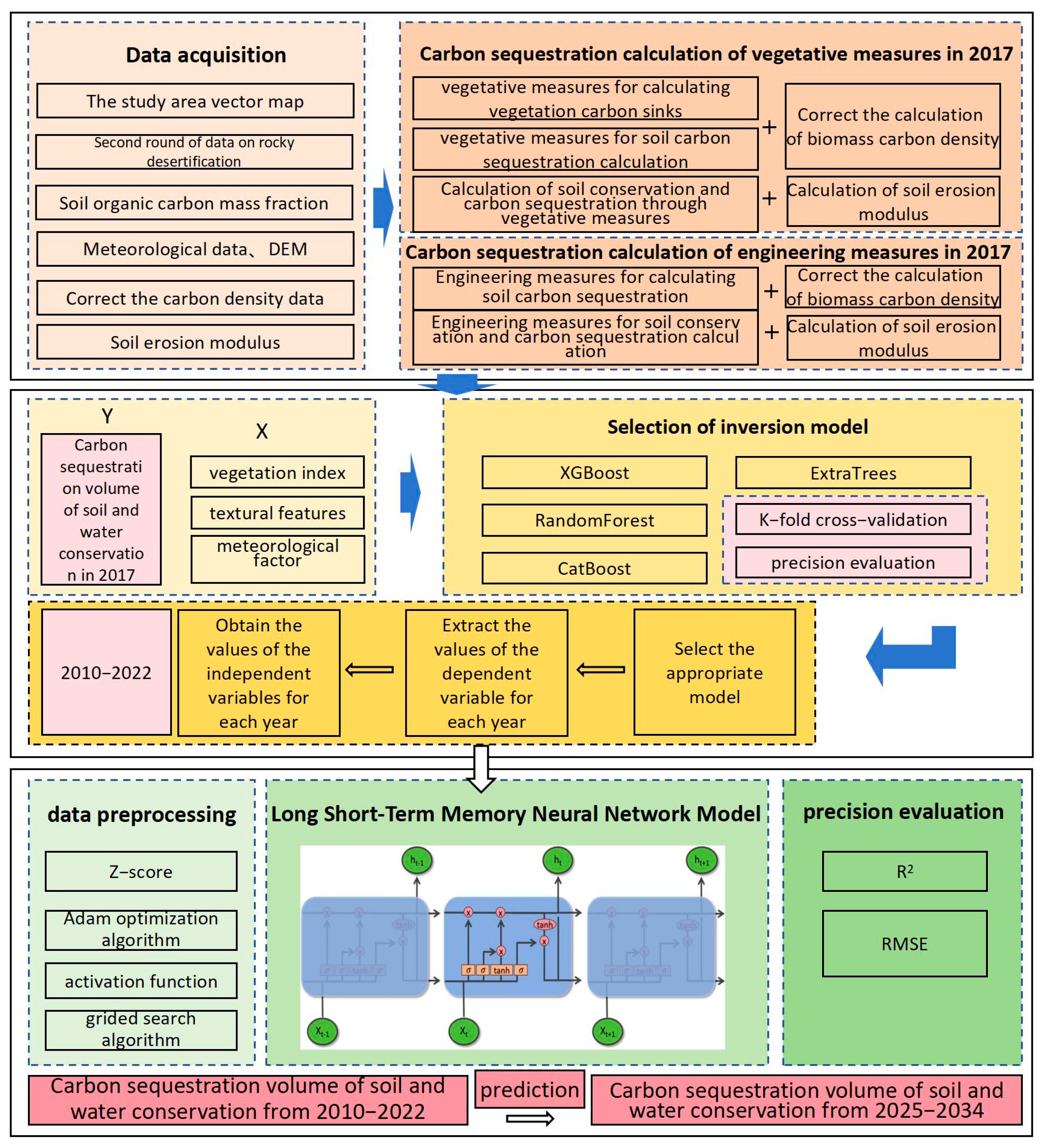
The overall methodological framework of this study, encompassing data processing, carbon sink inversion, and future prediction, is illustrated in Figure 2.
Figure 2.
Flow diagram.
2.3.1. Methodology for Assessing the Carbon Sequestration Capacity of Soil and Water Conservation
The methodology employed by our research institute for quantifying the carbon sink capacity of soil and water conservation derives from the assessment framework established by Cao et al. [14]. This study focuses on the data of Puding County and quantifies two key types, namely vegetative measures (forestry, grassland) and engineering measures. This system starts from vegetative, engineering, and cultivation measures, and follows the research pathway of ‘mechanism interpretation–model construction–classification evaluation’. Considering carbon sequestration in soil and water conservation a complex process, we set out to study the carbon sequestration mechanism and perform a quantitative evaluation. Soil and water conservation measures (including vegetative and soil carbon sequestration) can enhance carbon sequestration. Vegetation sequesters carbon by increasing plant biomass; soil stores carbon by increasing its soil organic matter content. Soil conservation measures mainly enhance carbon sequestration by reducing soil erosion and preventing the loss of soil organic carbon, specifically by intercepting soil organic matter and capturing organic carbon from sediments. Such measures not only contribute to maintaining soil organic matter stability but also play a significant role in preserving soil carbon storage. Considering operational feasibility and data accessibility, the carbon sequestration increase from soil and water conservation is calculated using the carbon fixation rate method. Carbon sequestration through soil retention is calculated by multiplying the amount of soil retained by the organic carbon content.
Total carbon sequestration in soil and water conservation (Q, t/a):
where Qtotal represents the total carbon sequestration capacity of soil and water conservation measures, t/a; Qveg represents the vegetative carbon sequestration capacity (derived from forestry and grass measures), t/a; Qsoil represents the soil carbon sequestration capacity (derived from soil retention effects), t/a.
The increase in carbon sequestration in soil and water conservation (, t/a) is calculated based on different types of soil and water conservation measures.
where represents the carbon sequestration capacity of vegetation under soil and water conservation forestry and vegetative measures, t/a; represents the soil carbon sequestration capacity of vegetative measures for soil and water conservation, t/a; represents the soil carbon sequestration capacity of engineering measures for soil and water conservation, t/a; represents the carbon fixation rate of trees and shrubs for soil and water conservation, t/(hm2·a); represents the current carbon density of vegetative measures; and represents the carbon density of vegetative measures n years ago, t/hm2. In this study, carbon fixed within the biomass of trees and shrubs—such as flowers, twigs, and leaves—is not included in vegetation carbon sequestration due to seasonal litterfall or removal, whereby this carbon returns to the atmosphere or soil [37]. represents the area of water and soil conservation among tree and shrub forests, hm2; represents the area of terraced land conversion, hm2; and represents the soil carbon sequestration rate of terraced land conversion, t/(hm2·a).
The carbon sequestration capacity of soil conservation (, t/a) is calculated based on different types of soil conservation measures.
where represents the soil retention and carbon sequestration capacity of afforestation and grassland measures for soil and water conservation, t/a; represents the soil retention and carbon sequestration capacity of engineering measures for soil and water conservation, t/a; k represents the type of afforestation and grassland measure for soil and water conservation; represents the soil retention capacity of the kth type of afforestation and grassland measure for soil and water conservation, t/a; represents the mass fraction of soil organic carbon, g/kg; is the change in the soil erosion modulus before and after implementing afforestation and vegetative measures (comparing the current year with the baseline year), t/(hm2·a). For Puding County, the current year for calculating the soil erosion modulus is 2017, and the baseline year is 2010; is the area of the kth type of afforestation and vegetative measures, hm2; represents the soil conservation volume for the slope-to-terraced conversion project, t/a; represents the mass fraction of soil organic carbon in the slope-to-ridge conversion area, km2; represents the area of sloping land converted into terraces, km2; is the soil erosion rate of the sloping land that has not been transformed into terraces, t/(km2·a); is the soil erosion rate of the sloping land after it has been transformed into terraces, also measured in tons per (square kilometer per year); is the factor of water and soil conservation measures in the commonly used soil loss equation in China.
The soil conservation measure factor E reflects the inhibitory effect of soil conservation measures on soil erosion. However, due to the scarcity and uncertainty of actual statistical data, this factor has proven difficult to calculate. Previous research indicates that slope gradient significantly influences the soil conservation measure factor [38]. Determining the specific erosion factor (E factor) of engineering patches at the regional scale is limited by fine-grained field data. Slope is the main topographic driving factor of soil erosion in karst mountainous areas. The E factor is calculated based on slope according to the method of Lufafa et al. [39]. This method assumes that the efficiency of soil and water conservation measures is inversely proportional to the steepness of the slope.
where S represents the percentage gradient.
To accurately quantify the soil carbon sink variables (GF,k and GT) in Formulae (7) and (8), we integrated global spatial data and local field data. The soil profile in the karst rocky desertification area is relatively shallow, and the surface soil is eroded and lost, so the SOC calculation depth is based on the surface layer of 0–20 cm. We used the ‘space–attribute linkage’ method to coordinate multi-source data. In terms of spatial distribution, we used the HWSD (1 km) dataset to divide the main soil types into categories according to their spatial range. Soil types in Puding County, Guizhou Province include Rendzic Leptosols, Calcaric Cambisols, etc. For attribute assignment, we adopted the local dataset based on field sampling in Puding County published by Dandan et al. [29] in 2023, which was used to assign values to the soil organic carbon mass fraction (g/kg). Compared with the HWSD default data, these local data have higher attribute accuracy, presenting a uniform state in space under the same soil type. The average value of SOC in the local dataset is assigned to the corresponding soil polygon identified by the HWSD map, thereby generating a spatial distribution map of the SOC quality fraction in the study area.
2.3.2. A Method for Calculating the Carbon Sink Volume of Soil and Water Conservation Based on Machine Learning
When selecting machine learning models for soil and water conservation carbon sinks, traditional simple linear regression methods often fail to capture and reflect the complex relationship between conservation measures and carbon sequestration due to their limited simplicity. Consequently, the introduction of machine learning regression algorithms, particularly ensemble learning approaches, enables more intelligent and scientific analysis of deeper insights into the carbon sink capacity of soil and water conservation. This enhances the predictive accuracy and generalisation capability of the models. Among the numerous machine learning regression algorithms available, XGBoost [40], Random Forest [41], CatBoost [42], and ExtraTrees [43] stand out as the preferred choices for estimating the carbon sink capacity of soil and water conservation due to their outstanding performance and generalisation capabilities.
This study selected the following ten vegetation indices as modelling factors for vegetation index variables: Normalised Difference Vegetation Index (NDVI) [44], Ratio Vegetation Index (RVI) [45], Difference Vegetation Index (DVI) [46], Ratio Vegetation Index 1 (RVI54) [45], Ratio Vegetation Index 2 (RVI64) [45], Soil-Adjusted Vegetation Index (SAVI) [45], Normalised Land Index (NLI) [47], Atmospheric Resistivity Vegetation Index (ARVI) [48], Enhanced Vegetation Index (EVI) [49], and Modified Soil-Adjusted Vegetation Index (MSAVI) [50].
Texture feature extraction in this study was conducted using ENVI 5.3 software, employing a statistical approach. Eight texture features with high relevance to remote sensing imagery were selected for this study. The texture feature settings were configured to extract data from a 3 × 3 window, with stride and texture direction set to 1 and 135°, respectively [51]. The green band, red band, and near-infrared band were selected for texture feature extraction. The green and red bands, respectively, correspond to the reflectance peak and chlorophyll absorption trough of vegetation, while the near-infrared band reflects high vegetation reflectance. These bands are primarily used to monitor vegetation growth and health conditions. The combination of these three bands provides rich textural information, helping to enhance vegetation features and suppress non-vegetation information, thereby improving the effectiveness of texture feature extraction.
Given that the estimation of carbon sink capacity is a regression problem involving continuous numerical variables rather than a classification task, this study employed the coefficient of determination (R2), mean absolute error (MAE), and root mean square error (RMSE) to assess the accuracy and reliability of the model [52].
Here, denotes the observed value, denotes the predicted value, denotes the predicted value, denotes the mean of the observed values, denotes the absolute error between the observed and predicted values, and n denotes the sample size.
2.3.3. Method for Predicting Carbon Sink Volume in Soil and Water Conservation
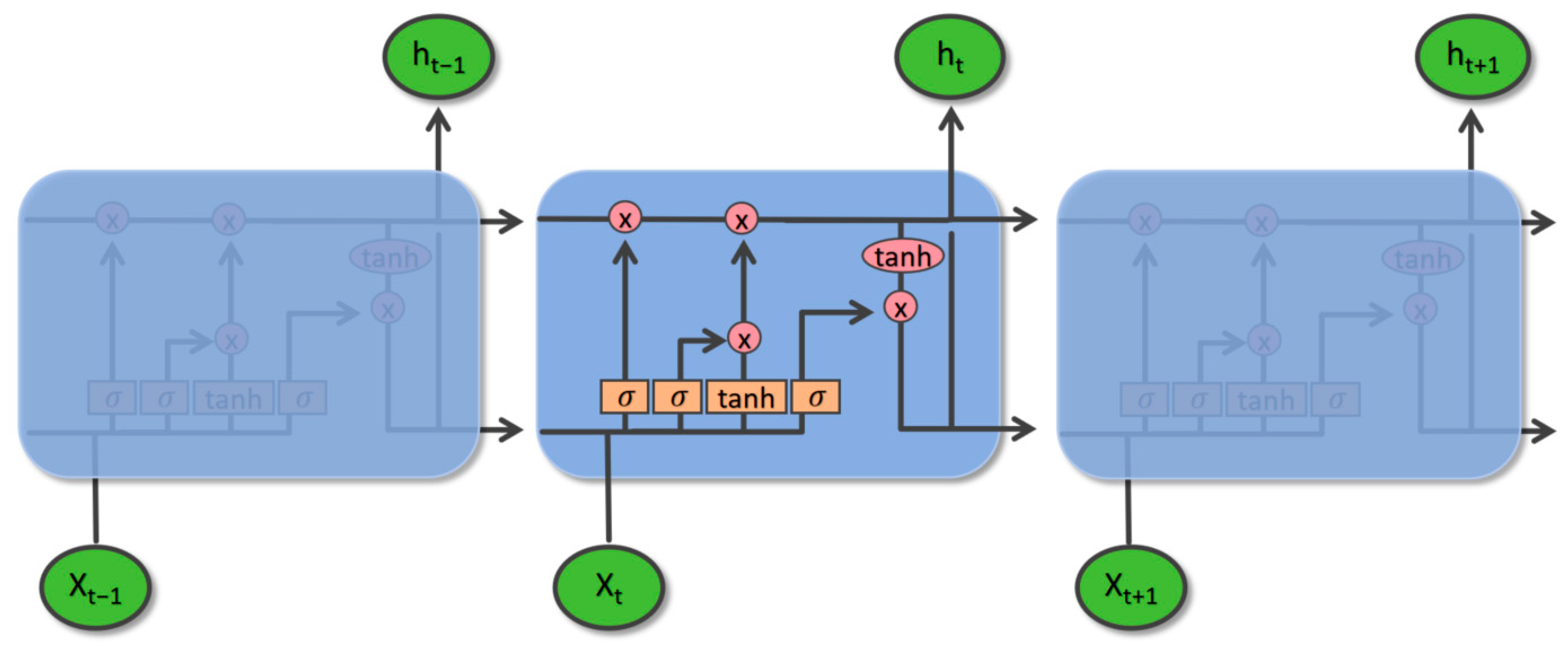
Long Short-Term Memory (LSTM, as shown in Figure 3) neural networks constitute a specialised type of recurrent neural network [53] designed to address the issues of vanishing gradients and exploding gradients encountered by conventional recurrent neural networks (RNNs) when processing lengthy sequential data. In this study, the Long Short-Term Memory (LSTM) model was employed for modelling and forecasting purposes.
Figure 3.
Long Short-Term Memory (LSTM) neural network architecture diagram.
The dataset contains the reconstructed annual carbon sink time series from 2010 to 2022. The original time-series data were normalised to [0, 1] using Min-Max scaling to improve training efficiency and then transformed into a supervised learning format using a sliding window. A 3-year backward window was selected, and the carbon sink values of the previous three years were used as input features to predict the value of the next year. The recursive multi-step prediction method was used to generate the prediction period from 2025 to 2034. We used the data from 2022 to 2022 to predict the carbon sink volume for 2025 first, and then input the predicted result of 2025 into the sliding window (replacing the oldest data) to predict the carbon sink volume for 2026. This process was repeated recursively until the predicted result for 2034 was obtained. We used the grid search algorithm to find the optimal hyperparameters (learning rate, hidden units) that would reduce the error.
3. Results
3.1. Analysis of Soil and Water Conservation Carbon Sink Capacity Results
3.1.1. Overall Carbon Sink Capacity of Soil and Water Conservation in Puding County
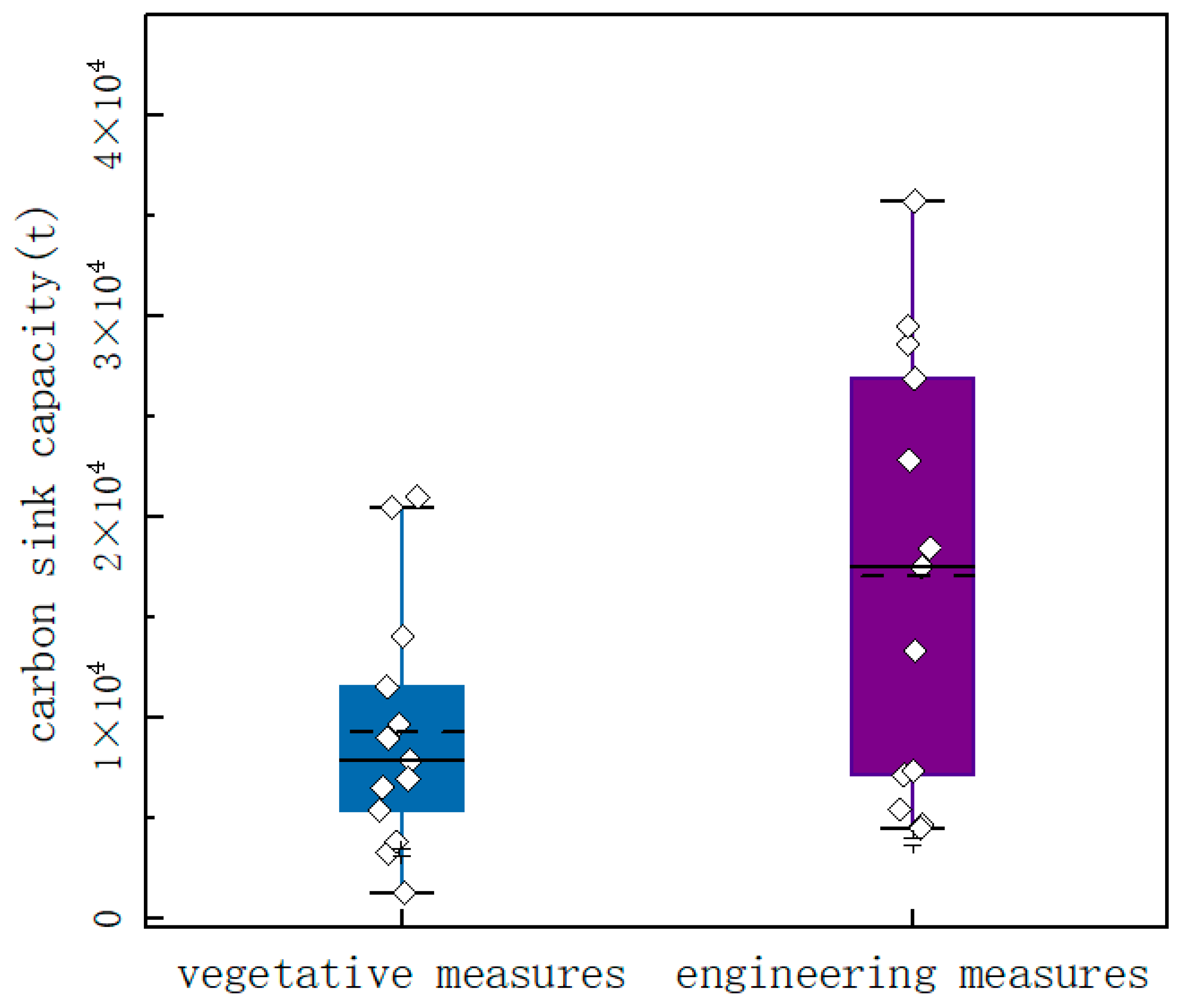
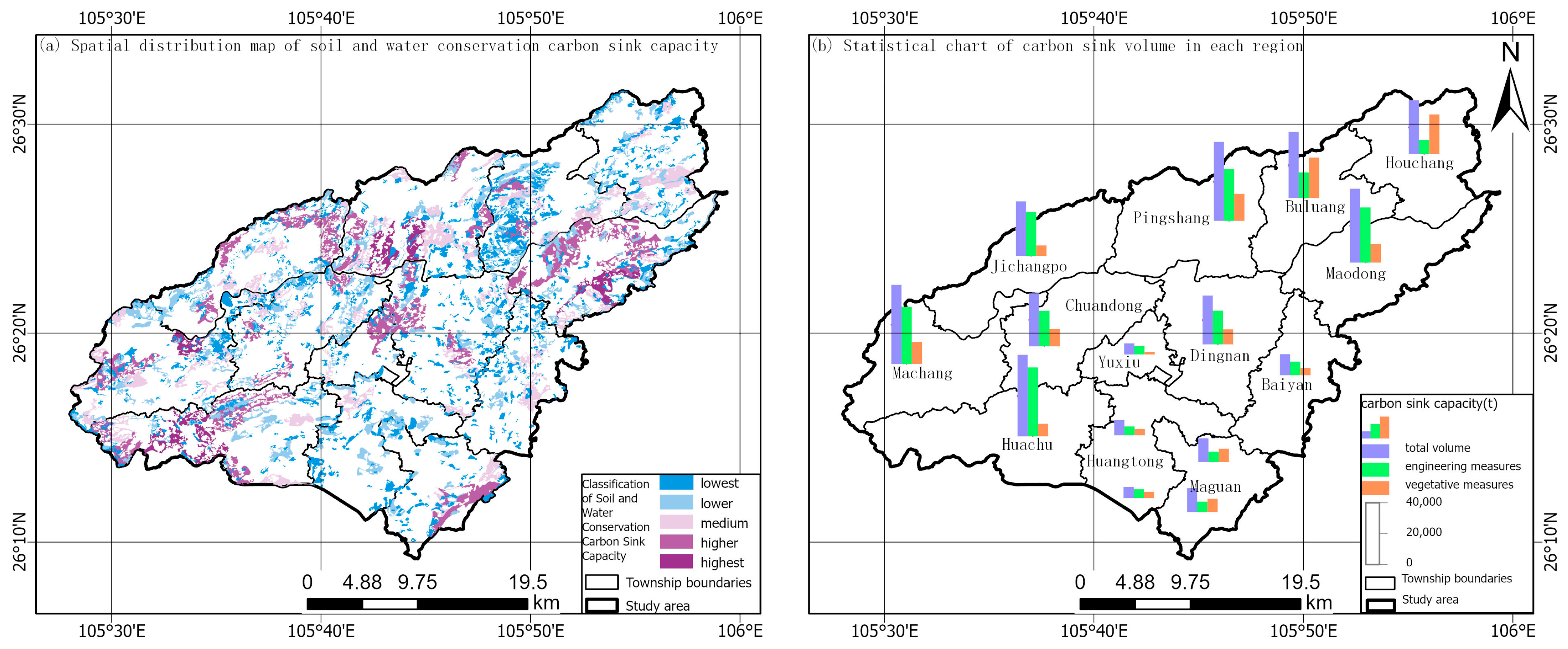
Calculations indicate that in 2017, the carbon sink capacity of Puding County’s soil and water conservation amounted to 34.53 × 10⁴ t, comprising 12.16 × 10⁴ t from vegetative measures and 22.37 × 10⁴ t from engineering measures (Table 2). Considering spatial heterogeneity and model uncertainty, the variability of the estimates is presented in Table 2 (Mean ± SD) and visually illustrated in Figure 4 using boxplots. Figure 5a presents the spatial distribution map of soil and water conservation carbon sink capacity in Puding County, categorised into five tiers using the natural breakpoint method: <200 t represents the lowest capacity, 200–600 t denotes relatively low capacity, 600–1200 t indicates medium capacity, 1200–3000 t represents higher carbon sequestration capacity, and >3000 t denotes the highest capacity. The map illustrates the spatial distribution of carbon sequestration capacity across different regions of Puding County. Figure 5b presents the spatial statistical map of the total carbon sink of soil and water conservation, vegetative measures, and engineering measures across townships in Puding County. Overall, there is an obvious spatial heterogeneity distribution, which indicates that the carbon sink capacity of the county is unbalanced. The areas with a high carbon sink and relatively high carbon sink capacity (marked in dark purple and purple) are mainly located in the western and central-eastern areas of the map. The vegetation in these areas is relatively rich, and the capacity of soil and water conservation to sequester carbon is acceptable. There are spatial differences in soil properties (spatial het), which is relatively crucial. The background values of soil organic carbon in the northern region are usually higher, and the soil is thicker. In the southern region, there are more cases of rock exposure, and the soil is thinner. Under the same protection measures, the carbon sink per unit area in the north is higher. Areas with a low and medium carbon sink capacity (light purple and light blue) are located in the south and north of the map, highlighted in blue. Such a pattern is significant for the ecosystem services of Xiaopuding and the formulation of relevant policies.
Table 2.
Statistical results of carbon sink capacity of soil and water conservation in Puding County for 2017. TCS is total carbon sink volume, CSD is carbon sink density within measure areas, CSCV is carbon sequestration capacity of vegetative measures, CSCV_D is carbon sink density of vegetative measures within measure areas, CSCE is carbon sink capacity of engineering measure, and CSCE_D is carbon sink density of engineering measures within measure areas.
Figure 4.
Boxplots illustrating the spatial variability of carbon sink capacity across different townships in Puding County in 2017. The plot compares vegetative measures and engineering measures. The horizontal line within the box represents the median, the box boundaries indicate the interquartile range (25th–75th percentiles), and the whiskers extend to the minimum and maximum values. Each scattered point represents an individual township, highlighting the significant spatial heterogeneity.
Figure 5.
In this figure, (a) shows the spatial distribution map of soil and water conservation carbon sink capacity in Puding County and (b) presents the spatial statistical map of the total carbon sink of soil and water conservation, vegetative measures, and engineering measures across townships in Puding County.
As depicted in the soil and water conservation carbon sink statistics map of Puding County (Figure 5b), Huachu Town exhibits the highest total carbon sink capacity, followed by Machang Town, while Yuxiu Subdistrict demonstrates the lowest capacity. Based on the implementation of vegetative measures, the highest carbon sink volume was recorded in Brown Township, followed by Houchang Township, with the lowest volume in Yuxiu Subdistrict. Regarding the implementation of engineering measures, the highest carbon sink volume was observed in Houchang Township, followed by Machang Town, with the lowest volume again in Yuxiu Subdistrict.
3.1.2. Analysis of Outcomes of Vegetative Measures
Extracting vegetative measures from the second stone desertification dataset of Puding County, a total of 1220 patches were identified. The combined area of these vegetative patches spans 98.74 km2, with a total carbon sequestration capacity of 12.16 × 10⁴ t.
The total carbon sink from vegetative measures in Puding County comprises vegetation carbon sequestration, soil carbon sequestration, and soil conservation and carbon fixation. The vegetation carbon sink amounts to 10.11 × 10⁴ t, the soil carbon sink totals 1.38 × 10⁴ t, and the soil conservation and carbon fixation amount is 0.67 × 10⁴ t. Among these three, the carbon sequestration capacity of the vegetation carbon sink is the largest, whereas the carbon sequestration capacity of the soil carbon sink and soil conservation is relatively small. Vegetation relies on photosynthesis to absorb carbon dioxide and fix it within the plant body, which represents the main carbon sink of vegetative measures. The soil carbon sink is smaller than the vegetation carbon sink, but it is the largest carbon pool in the terrestrial ecosystem, characterised by its large carbon storage, long retention time, stable mechanism, etc. In vegetative measures, improvements in soil structure will affect the decomposition of organic matter and soil respiration, regulating the soil carbon cycle and leading to increases in soil carbon sinks of forests and grasslands. Soil conservation carbon sinks account for the smallest proportion among the three, but they can have obvious cumulative effects and long-term impacts.
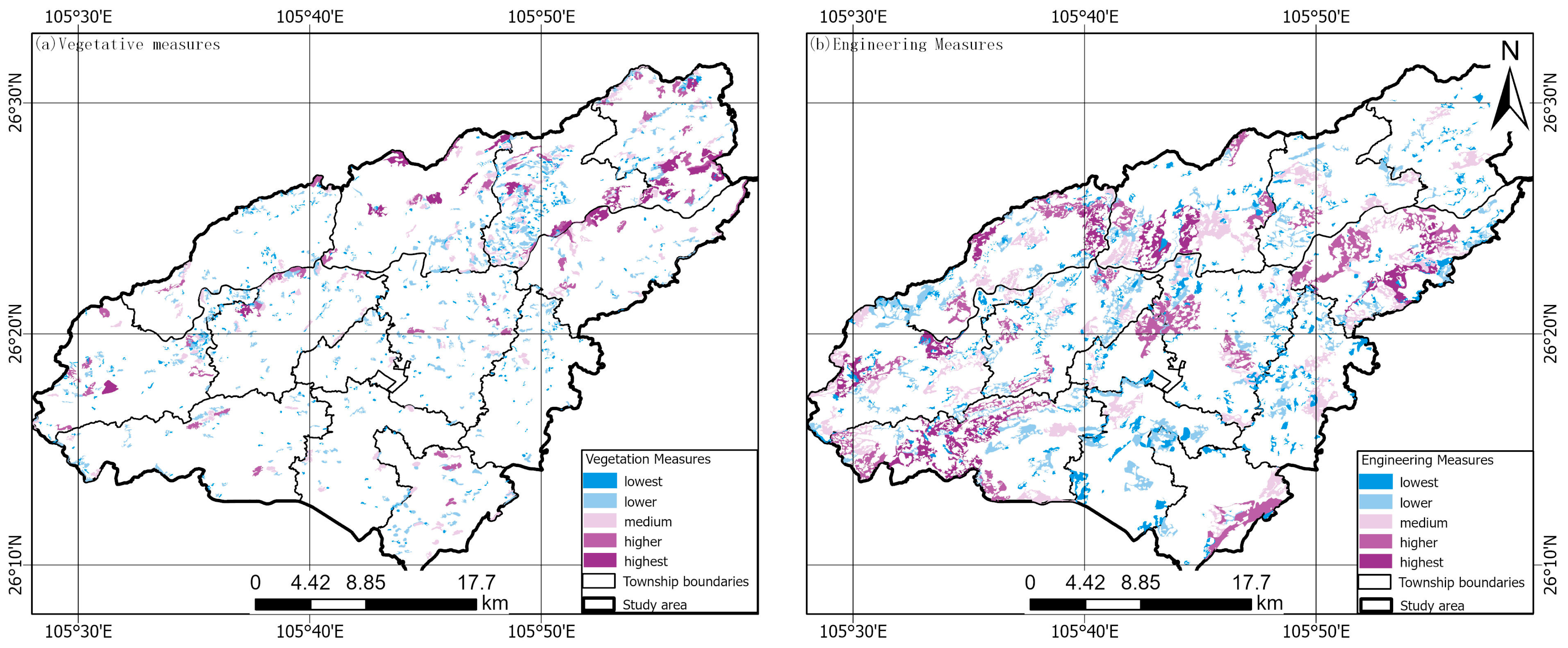
Figure 6a presents the classification of carbon sequestration via vegetative measures in Puding County. The categories of the plots in this figure have spatial differences, and the overall distribution shows a trend of higher carbon sequestration in the north and lower in the south. The proportion of high carbon sequestration (dark purple) in the north is relatively large because of the high vegetation density and good soil site conditions. The fertile Rendzic Leptosols in the north are conducive to the growth of vegetation and the development of root systems, promoting carbon sequestration in the vertical direction. The carbon sink in the south is low, partly because of serious soil degradation and a lower initial organic carbon pool, which limits the rapid accumulation of carbon. These areas may represent the key points for soil and water conservation and ecological protection. In the western region, the patches are fragmented but densely clustered. This problem reflects that large-scale implementation is restricted by the terrain, and fragmented plots are needed for soil and water conservation and carbon sequestration. Conversely, the fragmented patches in the southern region are few and have low coverage, which may indicate the potential of undeveloped carbon sequestration. Regarding carbon sequestration classification by vegetative measures, blue patches indicate carbon sequestration <50 t, classified as low level, with small, scattered patches across various regions; light blue patches indicate 50–150 t, classified as low to medium level, predominantly distributed in central and western Puding County; light purple denotes medium-level (150–300 t) carbon sequestration, predominantly in the northern regions; and purple indicates higher-level carbon sequestration (300–600 t), scattered across northern and western areas. The highest level of carbon sequestration (>600 t) is largely concentrated in the northern part of Puding County, characterised by larger, denser patches. Spatially identifying high-value and low-value carbon sink zones enables more targeted resource allocation and conservation measures.
Figure 6.
(a) shows the spatial distribution map of carbon sequestration capacity classified for afforestation and vegetative measures in Puding County; (b) depicts the spatial distribution map of carbon sequestration capacity classified for engineering measures in Puding County.
3.1.3. Analysis of Outcomes of Engineering Measures
In 2017, Puding County’s engineering measures comprised 760 plot areas, covering a total area of 222.93 km2. The carbon sequestration capacity of these engineering measures amounted to 22.37 × 10⁴ tonnes. Compared with the statistical results for vegetative measures, the number of plot areas was 460 fewer. However, the plot area exceeded the vegetative measure plot area by 124.19 km2. In terms of carbon sequestration capacity, the engineering measures yielded 10.20 × 10⁴ tonnes more than the vegetative measures.
Figure 6b illustrates the carbon sequestration classification results for engineering measures in Puding County. The natural breakpoint classification method was employed, dividing outcomes into five tiers: <200 represents the lowest carbon sequestration capacity; 200–600 denotes relatively low capacity; 600–1300 indicates medium capacity; 1300–2500 indicates higher carbon sequestration capacity; and >2500 denotes the highest carbon sequestration capacity. Engineering measures exhibit greater spatial continuity and density. Spatially, most patches are concentrated in extensive areas of the west and centre, with fewer patches in the north and south. In terms of patch size, scattered patches are uncommon, with most forming contiguous clusters. Correlating with terraced land conversion through engineering measures, these terraces predominantly exhibit concentrated, contiguous distributions on hillsides in a regular pattern. Consequently, the extracted patches align with terraced land characteristics. Regarding measure classification, carbon sink capacity across all engineering measure tiers shows relatively uniform spatial distribution. Areas with the lowest carbon sink capacity are sparsely distributed, primarily in the south. Areas with low carbon sequestration capacity predominantly occur in the western regions, areas south of the western regions, and the northeastern regions. Areas with medium carbon sequestration capacity are concentrated in the northeast of Puding County and extensively distributed along the county’s boundaries. Areas with high carbon sequestration capacity are largely situated in the central region of Puding County. Areas with the highest carbon sequestration capacity are scattered across the northern, western, and eastern parts of Puding County.
3.2. Annual Carbon Sink Capacity Inversion Results Based on Machine Learning
In the training of machine learning models, the carbon sink volume of soil and water conservation in Puding County in 2017 was employed as the dependent variable factor. Machine learning models were trained using this alongside independent variable factors. Due to differing algorithms for vegetative measures and engineering measures, separate modelling was conducted. The sample size for vegetative measures was 1220, while that for engineering measures was 760. By comparing and validating the Random Forest, ExtraTrees, CatBoost, and XGBoost regression models, the optimal model was selected to estimate the carbon sink capacity of soil and water conservation in Puding County from 2010 to 2022.
3.2.1. Modelling Factor Screening
Using SPSS PRO software (https://www.spsspro.com/analysis/index, accessed on 15 August 2025), Pearson correlation analysis was conducted on the 41 independent variables extracted for carbon sequestration from vegetative measures versus engineering measures in soil and water conservation carbon sinks, as shown in Table 3. Factors exhibiting highly significant correlations (p < 0.01) with carbon sink capacity were extracted, as shown in Table 4 (Pearson correlation coefficients between independent variables and carbon sink capacity for vegetative measures) and Table 5 (Pearson correlation coefficients between independent variables and carbon sink capacity for engineering measures). The Pearson correlation coefficients of some vegetation indices (such as EVI, RVI) are low, but the statistical significance is high (p < 0.001). This indicates that in the karst area, the relationship between these remote sensing indices and the carbon sink capacity is complex and highly nonlinear, rather than a simple linear dependence. This observation supports the notion that using machine learning algorithms (such as Random Forest) can capture nonlinear interactions and high-dimensional features more effectively than traditional linear regression. For the extracted independent variables, the feature selection–Random Forest feature importance method was employed. From the original features of the Pearson correlation coefficient factors, a subset of the most effective features was selected to reduce data dimensionality and enhance model performance. The final modelling factors for the carbon sink capacity of vegetative measures are presented in Table 6, while those for engineering measures are shown in Table 7.
Table 3.
Independent variable factors.
Table 4.
Pearson correlation coefficients between independent variable factors and carbon sequestration capacity of vegetative measures.
Table 5.
Pearson correlation coefficients between independent variable factors and carbon sink quantities from engineering measures.
Table 6.
Importance of independent variable factors for vegetative measures.
Table 7.
Characteristics and importance of independent variable factors for engineering measures.
Feature importance ranking shows that there are different driving factors for different index types: vegetation indices (in Table 6), spectral indices (such as EVI accounting for 12.30%), and texture features (for example, correlation accounting for 17.70%). The EVI is relatively sensitive to canopy structure and atmospheric/soil background noise. In karst areas with high soil exposure, it is relatively good for quantifying biomass. Texture correlation can reflect the spatial uniformity of the canopy, showing that the model depends on vegetation biological vitality and structural continuity. Texture variance (B5_Variance, 20.90%) is the most critical predictor in engineering measurement (Table 7), far exceeding simple spectral indicators. Ecology is consistent with physics. Engineering measures such as terraces and check dams do not have the ‘chlorophyll signal’ of plants, instead changing the surface roughness and creating regular geometric patterns. The texture variables capture high-frequency spatial changes, like the edges of terraces, enabling the extreme Random Forest model to distinguish engineering structures from natural slopes. This verifies the effectiveness of integrating texture features to monitor non-vegetation protection measures.
3.2.2. Model Validation and Comparison
In this study, the Random Forest (RF), extreme gradient boosting (ExtraTrees), gradient boosting tree (CatBoost), and gradient boosting regression tree (XGBoost) models were selected as the basic models for estimating the carbon sink capacity of soil and water conservation. In order to find the most suitable model for estimating the carbon sink, these four models were verified and compared. When verifying the carbon sink model of soil and water conservation for vegetative measures, the evaluation results fully reflect the prediction performance and goodness of fit of the model according to multiple indicators. Before model training, the sample data are processed and divided into a training set (accounting for 70%) and a validation set (accounting for 30%). When the model is trained, using 5-fold cross-validation combined with a grid search to adjust hyperparameters can prevent overfitting. The results in Table 8 and Table 9 reflect the performance of the model in terms of the reserved test set. The R2 value (the test set is 0.31 to 0.55) shows that the model has a moderate degree of prediction accuracy. There are challenges in remote sensing inversion in fragmented karst areas and uncertainties are brought about by mixed pixels and complex terrain. However, the root mean square error and mean absolute error of the training set and test set are stable. Although the pixel-level accuracy is low, the model is still stable and reliable for the regression trend and spatial patterns. Parameters are adjusted according to the results of the initial experiments with different models, such as modifying the learning rate (lr) or the number of decision trees (dec trees number). Table 9 presents the evaluation of the comprehensive accuracy of soil conservation, water conservation, and carbon sequestration for vegetative measures using the training set and the validation set with the four models. Among the four models, Random Forest is most accurate and stable in calculating the carbon sink quantity using vegetation indices and was thus selected. The R2 of the test set is reduced, but the RMSE remains stable (the training set is 0.30, and the test set is 0.32). In the test, the mean absolute error (MAE) is also stable (0.21 vs. 0.23). The stable error indicators indicate that the model can ensure prediction accuracy during quantitative inversion.
Table 8.
Accuracy assessment of carbon sink quantification models for vegetative measures (unit: 104 t).
Table 9.
Accuracy evaluation of the model used for calculating the carbon sink capacity of soil and water conservation based on engineering measures (unit: 104 t).
Table 9 presents the evaluation of the accuracy of the carbon sink estimation model for soil and water conservation measures. Random Forest (RF), extreme gradient boosting (ExtraTrees), gradient boosting decision tree (CatBoost), and gradient boosting tree (XGBoost) were adopted. Due to the different calculation methods of carbon sinks for vegetative and engineering measures, there are differences in the fitting results of the estimation models. The extreme gradient boosting regression model in the table has a better overall performance. The R2 of the training set is 0.62, and the R2 of the test set is 0.55, with relatively high accuracy. MAE (mean absolute error) and RMSE (root mean square error) are two indicators that can better reflect the accuracy and stability of the model. Among the engineering measures, the performance of the ExtraTrees regression model is relatively stable. The R2 of the training set (0.62) is not much different from the R2 of the test set (0.55), and the RMSE slightly increases from 0.59 to 0.67. This stability shows that the ExtraTrees model avoids overfitting and has strong generalisation ability, which is suitable for long-term prediction. Other models such as XGBoost and Random Forest have a relatively large decline in performance on the test set, so they are discarded.
3.2.3. Inversion Results of Soil and Water Conservation Carbon Sink from 2010 to 2022
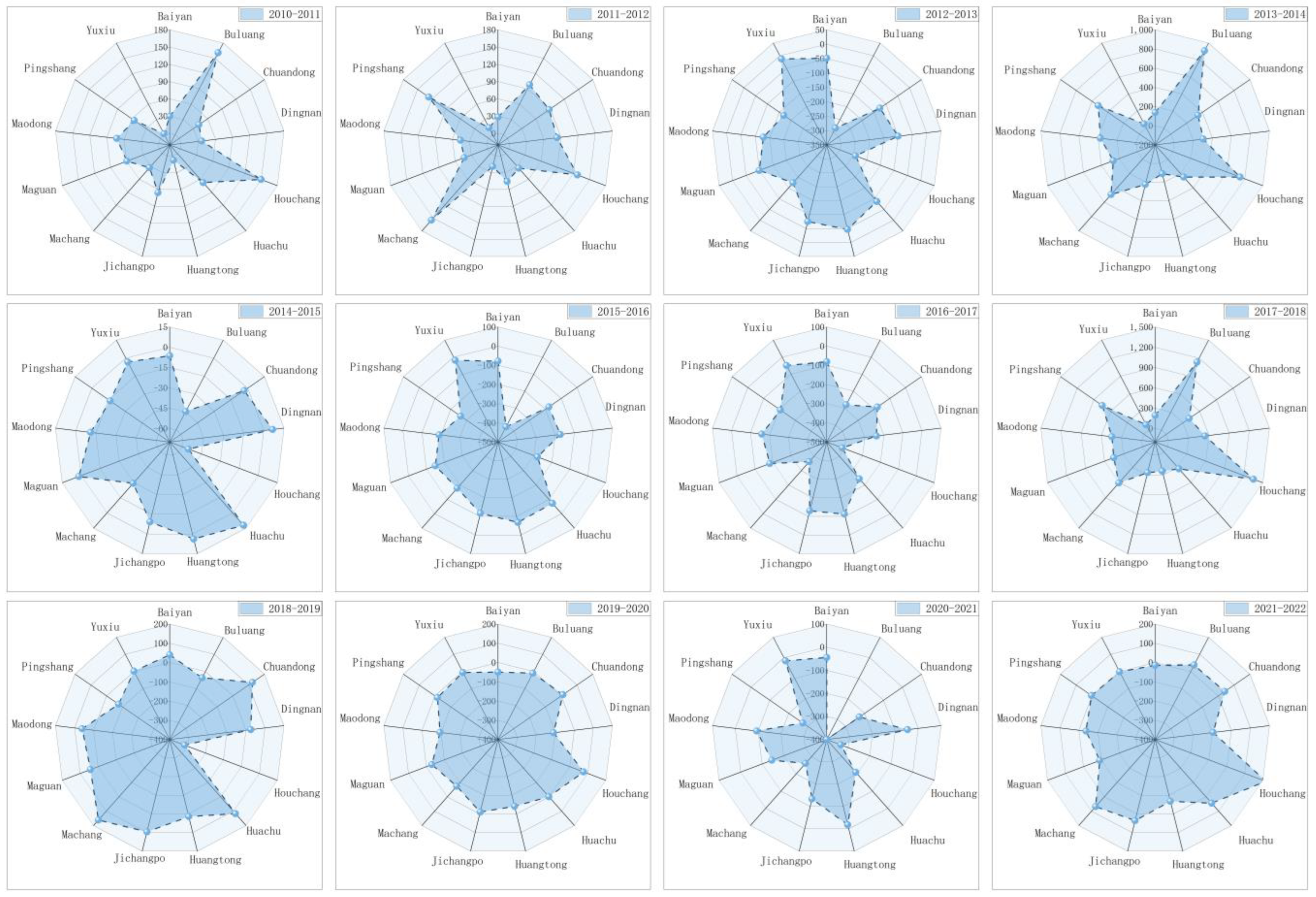
This study employed a Random Forest regression model to estimate the carbon sequestration capacity of vegetative measures in Puding County from 2010 to 2022. The machine learning results for total carbon sequestration capacity are presented in Figure 7. The research results show a fluctuating upward trend: It reached the lowest value of 12.14 × 10⁴ t in 2010, and then gradually recovered to a local peak in 2014. After that, the carbon sequestration capacity decreased again until 2016, after which it increased and reached a peak of 12.78 × 10⁴ t in 2019. After this peak, the carbon sequestration volume decreased slightly, but it was still at a relatively high level in 2022. This fluctuation is related to many factors and has no obvious cycle, but there is roughly a peak every 4 years.
Figure 7.
A radar chart showing the changes in carbon sink volume of vegetative measures in Puding County from 2010 to 2022 (unit: t).
Reviewing Guizhou Province’s 2019 Soil and Water Conservation Bulletin suggests that the 2019 peak may correlate with investments in national key soil and water conservation projects that year. While township-level statistics are unavailable, Anshun City’s data indicate substantial investment in 2019. In 2019, provincial-level national key soil and water conservation projects spanned nine prefectures and cities, encompassing 35 initiatives including productive orchards, conservation forests, grassland restoration, and restricted-access management. Anshun City implemented three projects that year, covering 45.77 km2. Central government investment amounted to CYN 13.08 million, with local investment reaching CYN 8.4428 million, bringing the total investment to over CYN 20 million. Soil and water conservation systems have been progressively refined. Supporting documents issued by the Guizhou Provincial Department of Water Resources, such as the “Notice on Implementing Regional Soil and Water Conservation Assessment Systems for Development Zones in Guizhou Province” and the “Notice on Issuing the Commitment (Filing) Process for Soil and Water Conservation Plans in Guizhou’s Production and Construction Projects,” have enabled the province to comprehensively implement regional assessment systems. This has gradually standardised and optimised the commitment filing and approval process for soil and water conservation plans, enhanced institutional and service frameworks, and fully advanced supervision and management efforts. Under conditions of refined management, clear regulations, and mature facilities, the upward trajectory of carbon sink trends from vegetative measures aligns with existing circumstances.
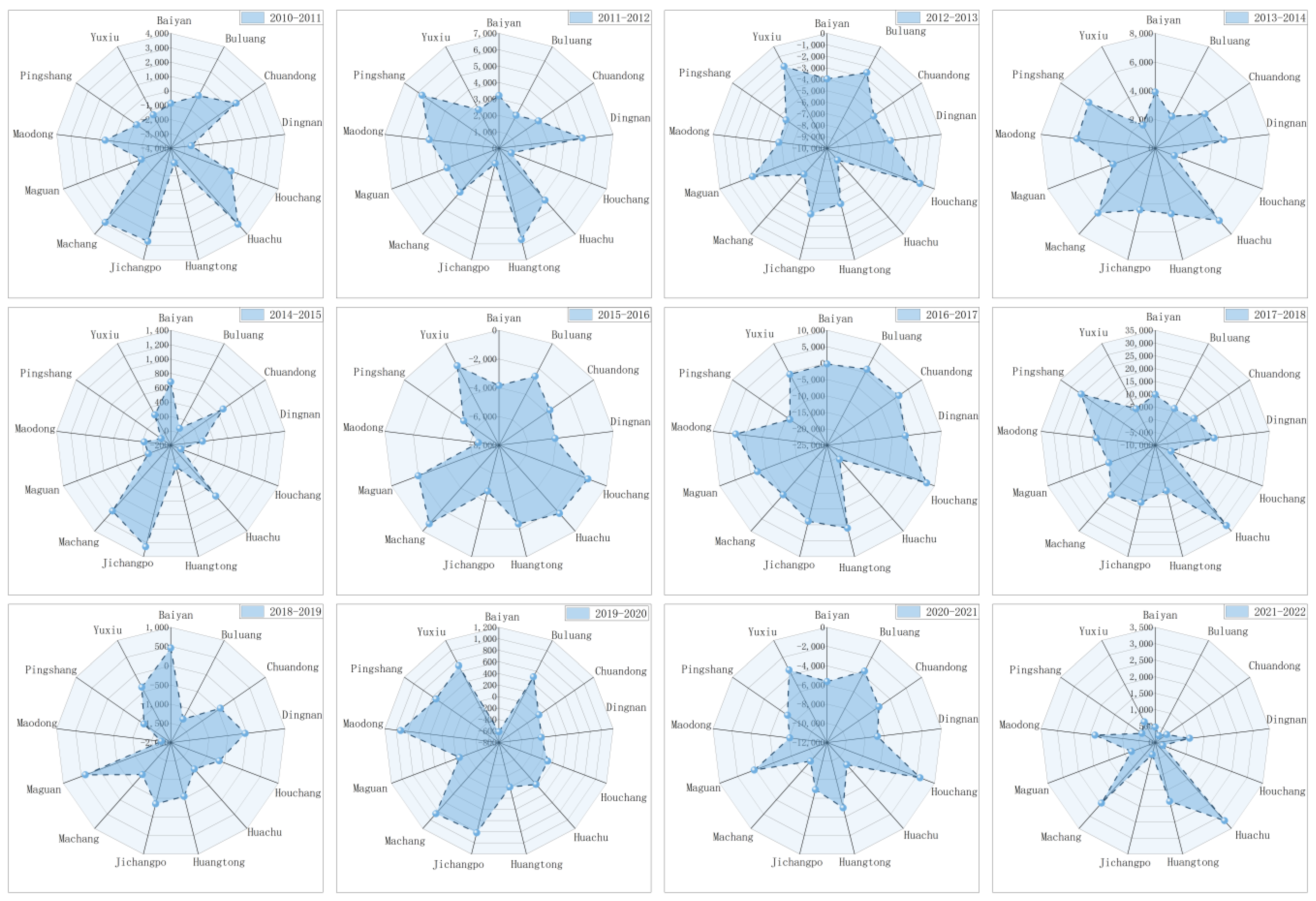
The machine learning calculation results for the total carbon sequestration capacity of engineering measures, using the ExtraTrees regression model for estimation in Puding County from 2010 to 2022, are presented in Figure 8. This reveals significant fluctuations in carbon sequestration levels during this period, exhibiting an overall trend of fluctuating upward movement. In 2010, carbon sequestration commenced at a relatively low baseline of 18.85 × 10⁴ t. There was a certain degree of growth in 2012, followed by many fluctuations from 2012 to 2016, suggesting a lack of stability. The carbon sink volume increased significantly after 2016, reaching a peak of 30.70 × 10⁴ t in 2018. It remained at a high level from 2018 to 2020 and then decreased slightly after 2020. It showed an upward trend again from 2020 to 2022. The carbon sink level in this stage reflects the key role of engineering measures in carbon management. One should focus on continuously monitoring and evaluating the impact of engineering measures on carbon sinks, and long-term sustainability should be considered when formulating policies and strategies. In 2022, the dynamic monitoring data on soil erosion from Guizhou Province’s Soil and Water Conservation Monitoring Station underwent review and verification by the Ministry of Water Resources before being formally released for application. Regarding information platform-based monitoring, efforts continued to deepen the integrated development of soil and water conservation with information technology. Aligned with smart soil and water conservation construction requirements, the service capabilities of Guizhou’s soil and water conservation big data platform were continuously enhanced and improved. Throughout 2022, the informatised supervision of soil and water conservation for construction projects was maintained, achieving full coverage of remote sensing monitoring for the fifth consecutive year. The steady advancement of informatised soil and water conservation has not only reduced management costs but also significantly enhanced the efficiency of related operations.
Figure 8.
Radar chart showing the changes in carbon sequestration volume of engineering measures in Puding County from 2010 to 2022 (unit: t).
3.3. Projected Soil and Water Conservation Carbon Sink Capacity for 2025–2034
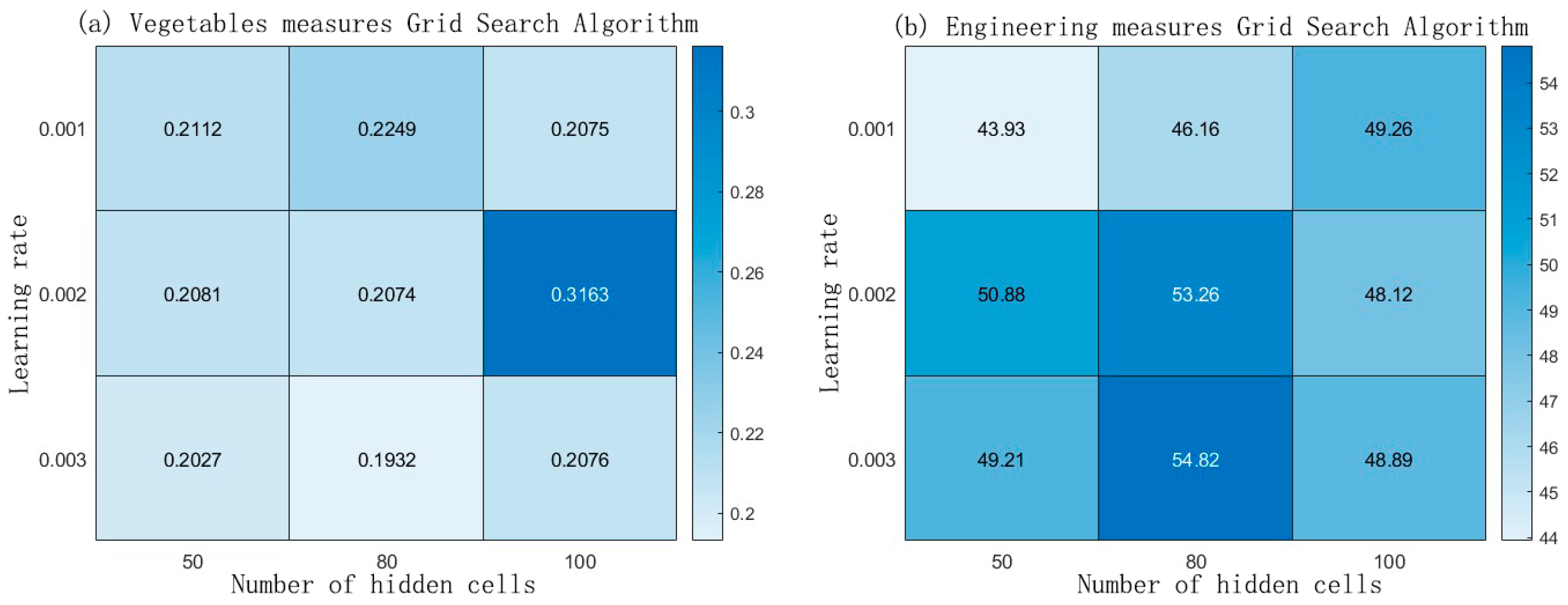
In this study predicting the carbon sequestration capacity of soil and water conservation measures in Puding County, the Long Short-Term Memory (LSTM) model was employed for modelling and forecasting. To optimise model performance, a grid search algorithm was used to tune key parameters, as illustrated in Figure 9a, primarily including the learning rate and number of hidden units. By systematically traversing different parameter combinations, the algorithm sought configurations that minimised the model’s prediction error.
Figure 9.
Grid search algorithm.
Meticulous parameter tuning of the LSTM model’s key parameters via the grid search algorithm effectively enhanced the model’s carbon sink prediction performance under various soil and water conservation measures. The learning rate of the vegetative model is 0.002, and the number of hidden units is 80; the learning rate of the environment model is 0.001, and the number of hidden units is 50. These configurations can achieve the minimum root mean square error (RMSE) and improve the accuracy and reliability. After parameter adjustment is completed, the model begins training, as shown in Figure 9b.
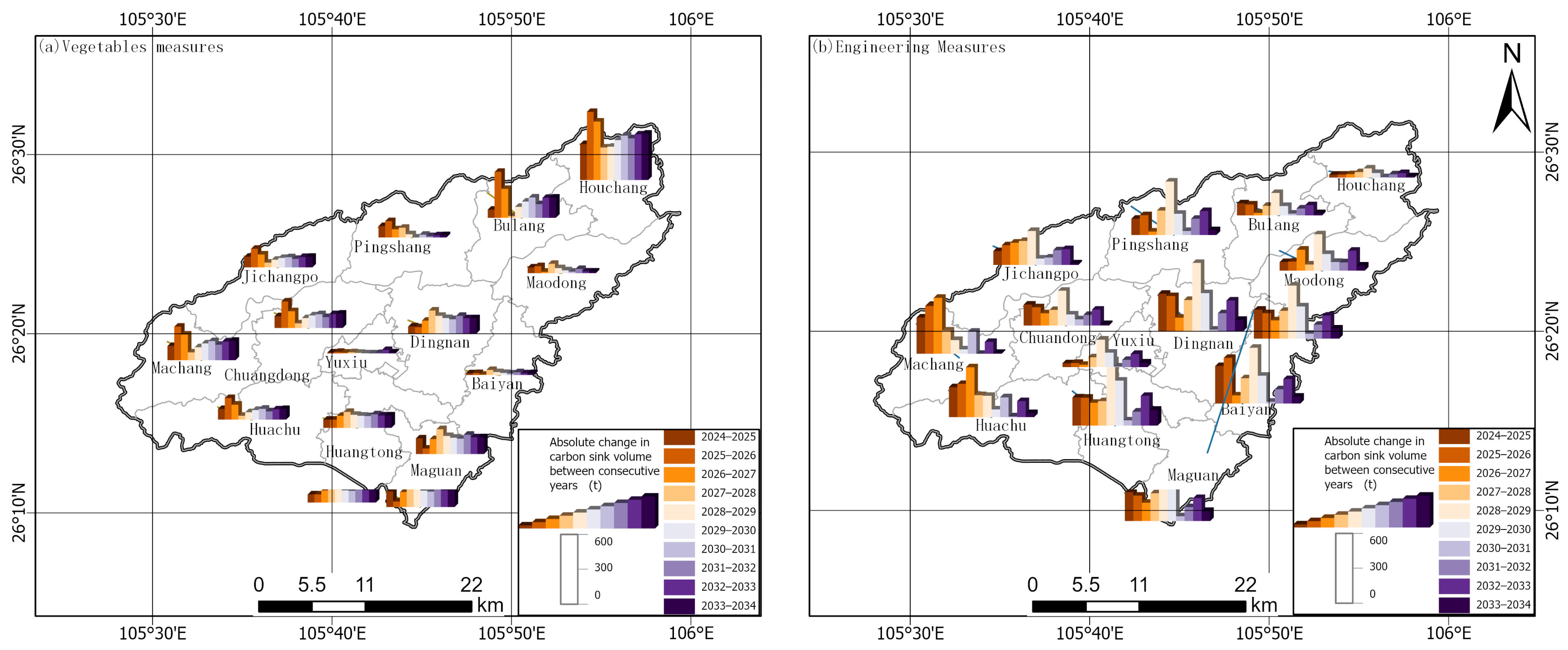
Figure 10a presents the spatial distribution of the absolute value of changes in soil and water conservation carbon sinks in adjacent years (2025–2034). This figure reveals the differences in the magnitude of carbon sink changes over a ten-year period among townships, which is important for regional ecological management. High–low-fluctuation areas are identified in terms of space; high fluctuations are concentrated in Houchang, Bulang, Machang, Dingnan, Maguan and other places. The absolute value of carbon sink change in Houchang Miao Township is the highest, perhaps because of the adjustment of land use, the cycle of vegetation restoration, or the relatively high sensitivity to climate change. The terrain or poor soil here may increase the uncertainty of the effect of vegetation measures. Low-volatility areas, which offer good ecological protection, include Pingshan Town, Maodong Township, Yuxiu Subdistrict, and Baiyan Town. The carbon sink change in Yuxiu Subdistrict is the smallest and remains relatively stable. This may be related to the mature grassland or forest coverage and stable management, which consolidate the carbon sink. In the future, Yuxiu Subdistrict plans to focus on urban green spaces or natural forests to maintain this status. The resilience of the ecosystem to disturbances is increasing year by year, and the interannual fluctuations are naturally reduced. Baiyan Town may have reduced human disturbances due to continuous ecological protection investments. Our research can be applied in similar places to make carbon sinks more stable.
Figure 10.
Spatial distribution map of absolute values for annual changes in soil and water conservation carbon sink from 2025 to 2034.
Figure 10b presents the spatial distribution of the absolute values of carbon sink fluctuations in adjacent years from 2025 to 2034, showing the spatial heterogeneity and temporal dynamics of urban carbon sink variables in the next ten years under engineering measures. In terms of space, high-value areas are concentrated in Machang, Huaqiu, Huangtong Subdistrict, Maguan, Baiyan, Dingnan Subdistrict, and Pingshang Town. This may be due to the phased implementation of major regional projects, such as mine ecological restoration and water conservancy infrastructure construction, policy changes, or sudden environmental events. Specific verification still needs to rely on field data. Low-value areas include Houchang, Maodong, Bulang Town, and Yuxiu Subdistrict. The fluctuations in these areas are generally relatively stable, which may be because of long-term planning and ecological adaptive engineering design, and the impact of project intervention on carbon sinks is relatively small. The chart presents the changes in annual towns. Jichangpo Town has a regular and obvious periodic fluctuation from 2025 to 2029, which may be related to planning measures such as terraced fields and reforestation, reflecting the progress of planned ecological management. Pingshang, Dingnan Subdistrict, Baiyan, Huangtong Subdistrict, and Maguan Town have a large absolute difference from 2028 to 2029, and there are very obvious yellow areas in the chart. This may be because the abnormal climate or cumulative pollution effect leads to obvious fluctuations in carbon sinks in the short term.
To achieve precise carbon sink management, future ecological regional planning should adopt differentiated strategies for high-volatility areas. Enhanced ecological monitoring during construction periods is recommended for engineering-intensive zones like Machang Town and Huachu Town, with dynamic carbon sink accounting models used to evaluate intervention effectiveness. Early warning mechanisms should be established for areas with sudden peak fluctuations, such as Huangtong Subdistrict and Pingshang Town, to mitigate carbon sink reversal risks. Future research may further integrate township-level socio-economic data to deepen our understanding of the human–land coupling mechanisms underlying the carbon sink effects of engineering measures, thereby providing a scientific anchor for achieving regional dual carbon goals.
4. Discussion
4.1. Research Limitations
Soil and water conservation constitutes a vital component of ecological civilisation development, a key measure for managing fragile regions and an effective means of enhancing ecosystem quality and stability [54]. Conducting research into soil and water conservation’s carbon sink capacity and optimising integrated soil erosion management models hold significant theoretical and practical implications for improving ecosystem quality and carbon sink functioning [55]. However, due to temporal and technical constraints, this study exhibits certain limitations. To address gaps in soil and water conservation carbon sink accounting, attention should be directed towards the role of these carbon sinks in mitigating climate change and reducing carbon dioxide emissions. This requires exploring underlying mechanisms, ensuring that accounting encompasses not only vertical carbon sequestration through vegetation and soil sinks but also recognising the horizontal role of soil conservation in carbon retention [56]. Soil and water conservation measures play a crucial role in mitigating carbon emissions by reducing soil erosion and organic carbon mineralisation, thereby preventing the release of soil organic carbon into the atmosphere as carbon dioxide. Regarding natural and anthropogenic influencing factors, greater attention must be paid to the role of human actions in implementing measures. For instance, conservation agriculture practices (such as straw incorporation and contour farming) significantly enhance soil carbon sequestration capacity by reducing surface disturbance and soil erosion. Furthermore, policy support and social capital participation provide crucial safeguards for enhancing soil and water conservation carbon sinks. Research on soil and water conservation’s carbon sink capacity, particularly within production and construction projects, remains relatively underdeveloped. Future studies should refine carbon sink accounting for soil and water conservation, clarify the carbon contributions of different measures, and strengthen dynamic monitoring and assessment of regional carbon sink capacity.
The ExtraTrees model is applied to engineering indicators, and the R2 value on the test set is 0.55. This value represents the explained partial variance of the model and also captures the internal differences in engineering indicators (such as terraces, small water conservancy projects) using sensitive remote sensing data in vulnerable karst areas. Vegetation has unique spectral characteristics captured by the NDVI. There is no unique signal for soil moisture measurement, and it is easily confused with bare soil or background rocks. The R2 of the model is at a medium level; the RMSE is 0.67 and the MAE is 0.54, which are within the controllable range, ensuring the statistical correlation of quantitative inversion enabling identification of regional trends or spatial patterns. Therefore, the prediction results from 2025 to 2034 should be used as indicators of the long-term evolution trend or spatial distribution for ecological government decision-making, not as the absolute precise values of specific small places. Future research may use high-resolution drone images or models constructed using deep learning algorithms to accurately extract the texture features of vegetation structures.
This study quantifies the carbon sink of vegetative and engineering measures. The model does not consider tillage measures (such as conservation tillage) because these measures are relatively scattered and difficulties in matching with desertification data remain. Future research needs to integrate agricultural census data, enabling a more comprehensive assessment to be performed.
4.2. Uncertainties in the Soil Carbon Sequestration Methodology Framework
Currently, diverse methodologies exist for accounting for the carbon sink capacity of soil and water conservation, with no unified and explicit methodological framework yet established [6,23]. This primarily stems from the complex formation mechanisms of such carbon sinks, which involve multiple factors and processes that a single accounting method struggles to comprehensively address. Furthermore, the study area features a wide variety of soil and water conservation measures, exhibiting significant spatial heterogeneity. Due to variations in climatic conditions, geographical location, and ecosystem characteristics across different regions [57], soil and water conservation measures are tailored to local conditions, necessitating corresponding adjustments to accounting methodologies. For instance, southern regions predominantly employ vegetative measures alongside small watershed management, whereas northern regions place greater emphasis on engineering measures such as terraced fields and silt-trapping dams [58]. Eastern regions, characterised by economic development and high land use intensity, often combine ecological restoration with conservation agriculture, whereas western regions concentrate on vegetation restoration and ecological reconstruction. This spatial heterogeneity necessitates methods that account for regional variations to ensure scientific rigour and accuracy in results. Consequently, future soil and water conservation carbon sink accounting could adopt a distributed approach, dividing complex regions into multiple homogeneous accounting units. These units would be accounted for separately before aggregation, thereby enhancing the precision of the accounting process.
It is relatively simple to estimate the soil conservation factor (E) using the slope-based equation (E = 0.2 + 0.03 S). Future research needs to rely on field observations to build a local E-factor database, so that the calculation of soil conservation effects under level and slope can be more accurate.
Finally, there is uncertainty in the spatial resolution of soil data. Local high-precision sampling data are used to assign attributes, and the spatial range of the HWSD dataset, with a resolution of 1 km, is used. This relatively coarse resolution limits the ability of the model to capture micro-soil heterogeneity within townships, especially in fragile karst terrain. Future research should use soil maps with higher resolutions, such as the data from the national soil survey, which has a scale of 1:50,000, as this can improve spatial precision.
4.3. The Application Value of Soil and Water Conservation Carbon Sinks
By integrating high-resolution or ultra-high-resolution imagery with machine learning methodologies, precise monitoring of dynamic changes in soil and water conservation measures can be achieved [59]. Acquiring high-resolution imagery from different time periods enables accurate identification of shifts in land cover types, such as vegetation restoration, soil erosion control, and engineering construction activities. Furthermore, by integrating multi-source remote sensing imagery—including optical and radar data—with advanced data fusion techniques, richer surface information can be extracted, providing more comprehensive data support for modelling [60]. This multi-source data fusion monitoring approach not only enhances monitoring accuracy and timeliness but also establishes scientific grounds for optimising soil and water conservation measures and ecosystem management. Moreover, this approach offers a foundation for achieving precise management of soil and water conservation carbon sinks in future ecological regional planning [61].
The application value of soil and water conservation carbon sinks has been significantly expanded through the empowerment of remote sensing technology. By integrating high-resolution or ultra-high-resolution imagery to achieve precise monitoring of dynamic changes in soil and water conservation measures, it not only enables accurate identification of land cover alterations such as vegetation restoration and soil erosion control but also directly supports the quantitative assessment and enhancement of carbon sink capacity [62]. Utilising multi-source remote sensing data (such as optical and radar imagery) alongside advanced data fusion techniques enables the extraction of richer surface parameters, including vegetation biomass and spatial distribution of soil organic carbon, thereby providing a comprehensive and precise data foundation for constructing carbon sink models. This high-precision, high-timeliness monitoring approach renders the implementation outcomes of soil and water conservation measures measurable and reportable. It not only optimises the deployment of ecological governance projects but also provides scientific grounds for ecosystem carbon sink management, carbon trading, and ecological compensation mechanisms at the regional scale. Consequently, it demonstrates significant application value in addressing climate change and advancing green development. The core of this study is the quantification of carbon sink biophysics, and the results provide the necessary data for the evaluation of future economic values. Future research can combine the quantified results with the current prices in the carbon market to evaluate the monetary value of soil and water conservation, thus contributing to the development of ecological compensation mechanisms.
4.4. Mechanistic Analysis of the Carbon Sink Dominance of Engineering Measures
Our results show that in 2017, the carbon sink capacity of engineering measures (22.37 × 10⁴ t) exceeded that of vegetative measures (12.16 × 10⁴ t). This phenomenon of ‘hard’ exceeding ‘soft’ is explained by two key karst environment mechanisms. First, the implementation scale is key. In the data for rock deserts, the total area of engineering measures in Puding County is 222.93 square kilometres, and the area of vegetative measures is 98.74 square kilometres. The extensive terraced fields and sloping land projects leave more space for carbon sink retention. Moreover, the mechanism of soil conservation is equally important. In karst ecosystems, the soil layer is thin and easily eroded. Engineering measures, especially turning sloping land into terraces, will change the slope and intercept surface water flow. By retaining soil to prevent erosion, these measures can store soil organic carbon (SOC). Studies have shown that in the terrace ecosystem, the soil carbon pool is 2 to 3 times the vegetation biomass pool. Therefore, engineering measures prevent the physical loss of topsoil and play the role of a ‘preservation sink’, retaining the carbon that vegetation takes decades to accumulate.
In the background of Puding’s carbon sink, we compared the results with existing research on karst ecosystems in southwest China and globally. This study estimates that the average carbon sequestration capacity of vegetative measures is about 12.31 t·hm−2·a−1. This value is usually higher than the average level of natural karst forests in southwest China (3–8 t·hm−2·a−1) [14,16]. In Puding, ‘grain for green’ artificial afforestation grows faster and has higher carbon accumulation than natural succession under similar geological conditions. In terms of engineering measures, the capacity of 10.03 t·hm−2·a−1 plays an important role in soil and water conservation. Different from biological carbon sequestration, which is limited by physical growth rate, engineering measures such as terraced fields reduce soil and water loss. Puding County belongs to a typical case of ‘project-driven’ carbon protection, which is different from international soil and water loss control research [12]. The intensive rocky desertification control project has transformed the area from a carbon source to a carbon sink. In conclusion, Puding County has a relatively high carbon sink capacity in the karst area. This is not accidental; it is the direct result of continuous high-intensity ecological governance, reflecting the effectiveness of the integrated protection and restoration strategy for mountains, rivers, forests, farmlands, lakes, grasslands, and deserts.
4.5. Influence of Soil Heterogeneity on Carbon Sink Spatial Patterns
The spatial distribution of carbon sinks in Puding County shows a trend of ‘higher in the north and lower in the south’. On the one hand, this is because there are differences in the implementation density of ecological protection measures. On the other hand, it is fundamentally restricted by regional soil ecological conditions.
First of all, soil depth and gravel content are key points of limitation. There are Rendzic Leptosols in the north and local Calcaric Cambisols. The profiles of these soils are relatively thick and with relatively little debris. “Fine-textured” soil is the physical basis for SOC storage. When implementing projects such as terraces, the topsoil, which is rich in organic matter, can be intercepted, thereby increasing carbon storage [15,29,57].
On the contrary, the environment is composed of ‘skeleton soil’ in the south, as well as serious rock desertification. Due to the high permeability of karst fractures, soil coverage shows a discontinuous and shallow state. Although vegetative and engineering measures have been implemented, the carbon sink efficiency is inhibited because the soil volume is limited and the water retention capacity is poor. The high content of gravel reduces the proportion of fine soil combined with the organic matter layer.
5. Conclusions
This study quantifies and predicts the carbon sink capacity of soil conservation in Puding, Guizhou, China. The results show that soil conservation measures strengthen the carbon sequestration capacity of terrestrial ecosystems. In 2017, the total capacity of soil carbon sink in Puding was 345,300 t, and the carbon sink capacity of engineering measures was larger than that of vegetative measures. Its spatial distribution is heterogeneous, with the carbon sink in the north higher than that in the south, and the west and the centre becoming the agglomeration areas of high carbon sink values. Through multi-model comparison, the Random Forest and ExtraTrees regression models were identified as optimal for estimating carbon sequestration from afforestation/grassland restoration and engineering measures, respectively. The reconstructed carbon sequestration capacity for 2010–2022 exhibited a fluctuating upward trend consistent with official bulletin data, validating the methodology’s reliability. Further application of the LSTM model to forecast carbon sinks over the next decade indicates that both afforestation/grassland restoration and engineering measures will generally stabilise, with only minor localised fluctuations anticipated. This study not only addresses the lack of quantitative data on soil and water conservation’s carbon sinks in karst regions but also provides a scientific basis for regional ecological governance and carbon sink management, holding significant practical value for advancing carbon neutrality objectives.
Author Contributions
Conceptualization, M.L. and G.Y.; writing—original draft preparation, M.L. and L.X.; methodology, M.L. and L.X.; software, R.M., L.L. and T.W.; validation, S.H. and Q.Y.; reources, G.Y.; data curation, M.L., R.D., Z.Z. and R.M.; visualization, L.L.; supervision, G.Y.; project administration, M.L., Z.Z. and R.D.; funding acquisition, G.Y. All authors have read and agreed to the published version of the manuscript.
Funding
This research was supported by Guizhou Province Innovation Platform Guizhou Province Innovation Platform Project (No. Qiankehe platform CXPTXM [2025]002), Guizhou Provincial Key Technology R&D Program (No. Qiankehe platform ZSYS [2025]014), Guizhou Provincial Major Scientific and Technological Program (No. Qiankehe Major [2022]001), Guizhou Provincial Basic Research Program (Natural Science) (No. Qiankehe base-ZK [2024]normal 445) and “Special Project for the Engineering Breakthrough of Technical Equipment for Natural Disaster Prevention and Mitigation (2025)”.
Institutional Review Board Statement
Not applicable.
Data Availability Statement
The data presented in this study are available on request from the corresponding author.
Conflicts of Interest
The authors declare no conflicts of interest.
References
- Jiang, J.A.; Chen, S.L. Exploring the Pathways of Achieving Carbon Peaking and Carbon Neutrality Targets in the Provinces of the Yellow River Basin of China. Sustainability 2024, 16, 6553. [Google Scholar] [CrossRef]
- Xu, G.Y.; Zang, L.M.; Schwarz, P.; Yang, H.L. Achieving China’s carbon neutrality goal by economic growth rate adjustment and low-carbon energy structure. Energy Policy 2023, 183, 14. [Google Scholar] [CrossRef]
- Meinshausen, M.; Lewis, J.; McGlade, C.; Gütschow, J.; Nicholls, Z.; Burdon, R.; Cozzi, L.; Hackmann, B. Realization of Paris Agreement pledges may limit warming just below 2 °C. Nature 2022, 604, 304–309. [Google Scholar] [CrossRef]
- Liu, Z.; Deng, Z.; He, G.; Wang, H.L.; Zhang, X.; Lin, J.; Qi, Y.; Liang, X. Challenges and opportunities for carbon neutrality in China. Nat. Rev. Earth Environ. 2022, 3, 141–155. [Google Scholar] [CrossRef]
- Hao, Y.F.; Mao, J.F.; Bachmann, C.M.; Hoffman, F.M.; Koren, G.; Chen, H.S.; Tian, H.Q.; Liu, J.G.; Tao, J.; Tang, J.Y.; et al. Soil moisture controls over carbon sequestration and greenhouse gas emissions: A review. npj Clim. Atmos. Sci. 2025, 8, 14. [Google Scholar] [CrossRef]
- Zhiguang, L.; Haiyan, W.; Junxiong, W. Mechanisms, pathways and characteristics of carbon sinks related to soil and water conservation from perspective of carbon peak and carbon neutralization. Bull. Soil Water Conserv. 2022, 42, 312–317. [Google Scholar]
- Zhou, Q.L.; Chen, W.; Wang, H.T.; Wang, D.L. Spatiotemporal evolution and driving factors analysis of fractional vegetation coverage in the arid region of northwest China. Sci. Total Environ. 2024, 954, 16. [Google Scholar] [CrossRef]
- Li, Y.Y.; Zhang, J.B.; Zhu, H.; Zhou, Z.M.; Jiang, S.; He, S.Y.; Zhang, Y.; Huang, Y.C.; Li, M.F.; Xing, G.R.; et al. Soil Erosion Characteristics and Scenario Analysis in the Yellow River Basin Based on PLUS and RUSLE Models. Int. J. Environ. Res. Public Health 2023, 20, 1222. [Google Scholar] [CrossRef]
- Zhai, J.J.; Wang, L.; Liu, Y.; Wang, C.Y.; Mao, X.G. Assessing the effects of China’s Three-North Shelter Forest Program over 40 years. Sci. Total Environ. 2023, 857, 12. [Google Scholar] [CrossRef] [PubMed]
- Yu, Y.H.; Deng, H.; Gao, S.P.; Wang, J.L. Drought Evolution in the Yangtze and Yellow River Basins and Its Dual Impact on Ecosystem Carbon Sequestration. Agriculture 2025, 15, 1552. [Google Scholar] [CrossRef]
- Were, D.; Kansiime, F.; Fetahi, T.; Hein, T. Carbon Dioxide and Methane Fluxes from a Tropical Freshwater Wetland Under Natural and Rice Paddy Conditions: Implications for Climate Change Mitigation. Wetlands 2021, 41, 12. [Google Scholar] [CrossRef]
- Nayak, A.K.; Rahman, M.M.; Naidu, R.; Dhal, B.; Swain, C.K.; Nayak, A.D.; Tripathi, R.; Shahid, M.; Islam, M.R.; Pathak, H. Current and emerging methodologies for estimating carbon sequestration in agricultural soils: A review. Sci. Total Environ. 2019, 665, 890–912. [Google Scholar] [CrossRef]
- Cotrufo, M.F.; Ranalli, M.G.; Haddix, M.L.; Six, J.; Lugato, E. Soil carbon storage informed by particulate and mineral-associated organic matter. Nat. Geosci. 2019, 12, 989. [Google Scholar] [CrossRef]
- Wenhong, C.; Xiaoming, Z.; Yong, Z.; Bing, L.; Yousheng, W. Connotation of carbon sink in soil and water conservation and its calculation method. Sci. Soiland Water Conserv. 2024, 22, 1–11. [Google Scholar] [CrossRef]
- Jincheng, H.; Zaike, G. The Current Situation, Problems and Countermeasures of Soil Erosion in Guizhou Province. China’s Soil Water Conserv. 2024, 8, 17–19. [Google Scholar]
- Maoqi, N.; Jie, R.; Yu, D.; Songping, L. Exploration and Suggestions on Carbon Sequestration and Emission Reduction Paths for Soil and Water Conservation in Guizhou. China’s Soil Water Conserv. 2024, 6, 71–74. [Google Scholar]
- Jieming, Z.; Guangju, Z.; Qiu, J.; Yonge, Z. A Review of Carbon Sequestration by Soil and Water Conservation Plant Measures. China’s Soil Water Conserv. 2024, 2, 6–12. [Google Scholar]
- Zhang, J.; Yang, H.; Zeng, Y.; Al Hassan, S.; Jui, M.A.; Gu, L.J.E. Preliminary Comparative Effects of Close-to-Nature and Structure-Based Forest Management on Carbon Sequestration in Pinus tabuliformis Plantations of the Loess Plateau, China. Ecol. Evol. 2025, 15, e71809. [Google Scholar] [CrossRef]
- Chang, G.H.; Wang, J.X.; Liu, P.L.; Wang, Q.; Han, F.X.; Wang, C.; Sumpradit, T.; Gao, T.P. Key Influencing Factors in the Variation in Livestock Carbon Emissions in the Grassland Region of Gannan Prefecture, China (2009–2024). Agriculture 2025, 15, 1300. [Google Scholar] [CrossRef]
- Mamtimin, A.; Amar, G.; Wang, Y.; Peng, J.; Sayit, H.; Gao, J.C.; Zhang, K.; Song, M.Q.; Aihaiti, A.; Wen, C.; et al. Assessment of CO2 fluxes in the hinterland of the Gurbantunggut Desert and its response to climate change. J. Environ. Manag. 2025, 375, 124351. [Google Scholar] [CrossRef] [PubMed]
- Mei, W.X.; Dong, H.Y.; Qian, L.W.; Yan, J.F.; Hu, Y.; Wang, L. Effects of anthropogenic disturbances on the carbon sink function of Yangtze River estuary wetlands: A review of performance, process, and mechanism. Ecol. Indic. 2024, 159, 111643. [Google Scholar] [CrossRef]
- Song, S.X.; Su, M.J.; Kong, L.Q.; Kong, M.L.; Ma, Y.X. Assessing the Economic Value of Carbon Sinks in Farmland Using a Multi-Scenario System Dynamics Model. Agriculture 2025, 15, 69. [Google Scholar] [CrossRef]
- Yu, D.; Yong, L.; Songping, L. Calculation of carbon sink capacity of soil and water conservation measures in Guizhou. Sci. Soil Water Conserv. 2025, 23, 23–32. [Google Scholar] [CrossRef]
- Guangqian, W. “Lucid waters and lush mountains are invaluable assets”: Pathways and prospects for ecological GDP in the Yellow River Basin. Bull. Chin. Acad. Sci. 2025, 40, 1143–1156. [Google Scholar] [CrossRef]
- Ming, H.; Yulu, W. Building of an Evaluation IndexSystem for the Quality of Soil and Water Conservation Carbon Sink in the Yellow River Basin. Yellow River 2024, 46, 109–115. [Google Scholar]
- Ruan, J.L.; Li, Z.X.; Zhang, X.P.; Jian, X.; Wang, D.P. Optimal vegetation coverage from the perspective of ecosystem services in the Qilian Mountains. Environ. Res. Commun. 2024, 6, 115023. [Google Scholar] [CrossRef]
- Yang, P.; Tang, Y.Q.; Zhou, N.Q.; Wang, J.X.; She, T.Y.; Zhang, X.H. Characteristics of red clay creep in karst caves and loss leakage of soil in the karst rocky desertification area of Puding County, Guizhou, China. Environ. Earth Sci. 2011, 63, 543–549. [Google Scholar] [CrossRef]
- Xuelian, D.; Shijie, W.; Qianghui, X.; Tao, P.; Anyun, C.; Lin, Z.; Xianli, C. Evaluation on effect of small catchment comprehensive control in karst rocky desertification areas based on fuzzy comprehensive evaluation method: A case study of the Chenjiazhai catchment in Puding county, Guizhou Province. Carsologica Sin. 2016, 35, 586–593. [Google Scholar]
- Dandan, L.; Xinyu, Z.; Yang, Y.; Shuang, L.; Zhiming, G.; Shuo, L.; Tao, P. A dataset of soil microbial enzyme activities and nitrogen cyclingfunctional genes in Puding County of Guizhou Province. Chin. Sci. Data 2023, 8, 162–176. [Google Scholar]
- Zhang, H.; Luo, M.; Zhan, W.F.; Zhao, Y.Q.; Yang, Y.J.; Ge, E.R.; Ning, G.C.; Cong, J. HiMIC-Monthly: A 1 km high-resolution atmospheric moisture index collection over China, 2003–2020. Sci. Data 2024, 11, 425. [Google Scholar] [CrossRef] [PubMed]
- Chen, Z.X.; Chen, L.K.; Lu, R.; Lou, Z.H.; Zhou, F.R.; Jin, Y.C.; Xue, J.; Guo, H.C.; Wang, Z.; Wang, Y.Y.; et al. A national soil organic carbon density dataset (2010–2024) in China. Sci. Data 2025, 12, 1480. [Google Scholar] [CrossRef] [PubMed]
- National Ecosystem Science Data Center. Available online: http://www.nesdc.org.cn (accessed on 15 August 2025).
- Earth Observing System Data and Information System (EOSDIS), Distributed Active Archive Centers (DAACs), National Aeronautics and Space Administration (NASA). Available online: https://www.nasa.gov/ (accessed on 15 August 2025).
- China Meteorological Science Data Center. Available online: http://data.cma.cn/ (accessed on 15 August 2025).
- Search NASA’s 1.8 billion+ Earth observations. Available online: https://search.earthdata.nasa.gov/ (accessed on 15 August 2025).
- National Data Center for Tibetan Plateau Science. Available online: https://data.tpdc.ac.cn/ (accessed on 15 August 2025).
- Fatichi, S.; Pappas, C.; Zscheischler, J.; Leuzinger, S. Modelling carbon sources and sinks in terrestrial vegetation. New Phytol. 2019, 221, 652–668. [Google Scholar] [CrossRef]
- Jin, F.M.; Yang, W.C.; Fu, J.X.; Li, Z. Effects of vegetation and climate on the changes of soil erosion in the Loess Plateau of China. Sci. Total Environ. 2021, 773, 12. [Google Scholar] [CrossRef] [PubMed]
- Lufafa, A.; Tenywa, M.M.; Isabirye, M.; Majaliwa, M.J.G.; Woomer, P.L. Prediction of soil erosion in a Lake Victoria basin catchment using a GIS-based Universal Soil Loss model. Agric. Syst. 2003, 76, 883–894. [Google Scholar] [CrossRef]
- Cui, L.L.; Chen, Y.H.; Yuan, Y.; Luo, Y.; Huang, S.Q.; Li, G.S. Comprehensive evaluation system for vegetation ecological quality: A case study of Sichuan ecological protection redline areas. Front. Plant Sci. 2023, 14, 14. [Google Scholar] [CrossRef]
- Huang, M.; Gong, D.H.; Zhang, L.; Lin, H.; Chen, Y.; Zhu, D.Y.; Xiao, C.J.; Altan, O. Spatiotemporal dynamics and forecasting of ecological security pattern under the consideration of protecting habitat: A case study of the Poyang Lake ecoregion. Int. J. Digit. Earth 2024, 17, 26. [Google Scholar] [CrossRef]
- Hancock, J.T.; Khoshgoftaar, T.M. CatBoost for big data: An interdisciplinary review. J. Big Data 2020, 7, 45. [Google Scholar] [CrossRef]
- Richardson, G.; Foreman, N.; Knudby, A.; Wu, Y.L.; Lin, Y.W. Global deep learning model for delineation of optically shallow and optically deep water in Sentinel-2 imagery. Remote Sens. Environ. 2024, 311, 17. [Google Scholar] [CrossRef]
- Mao, D.H.; Wang, Z.M.; Luo, L.; Ren, C.Y. Integrating AVHRR and MODIS data to monitor NDVI changes and their relationships with climatic parameters in Northeast China. Int. J. Appl. Earth Obs. Geoinf. 2012, 18, 528–536. [Google Scholar] [CrossRef]
- Ren, H.R.; Zhou, G.S. Estimating green biomass ratio with remote sensing in arid grasslands. Ecol. Indic. 2019, 98, 568–574. [Google Scholar] [CrossRef]
- Abd-El Monsef, H.; Smith, S.E. A new approach for estimating mangrove canopy cover using Landsat 8 imagery. Comput. Electron. Agric. 2017, 135, 183–194. [Google Scholar] [CrossRef]
- Gantumur, B.; Wu, F.L.; Vandansambuu, B.; Munaa, T.; Itiritiphan, F.; Zhao, Y. Land Degradation Assessment of Agricultural Zone and Its Causes: A Case Study in Mongolia. In Proceedings of the Conference on Remote Sensing for Agriculture, Ecosystems, and Hydrology XX, Berlin, Germany, 10–13 September 2018. [Google Scholar]
- Liu, Y.; Lin, J.Q.; Yue, H. Soil respiration estimation in desertified mining areas based on UAV remote sensing and machine learning. Earth Sci. Inform. 2023, 16, 3433–3448. [Google Scholar] [CrossRef]
- Radocaj, D.; Jurisic, M. A Phenology-Based Evaluation of the Optimal Proxy for Cropland Suitability Based on Crop Yield Correlations from Sentinel-2 Image Time-Series. Agriculture 2025, 15, 859. [Google Scholar] [CrossRef]
- Ren, H.; Feng, G. Are soil-adjusted vegetation indices better than soil-unadjusted vegetation indices for above-ground green biomass estimation in arid and semi-arid grasslands? Grass Forage Sci. 2015, 70, 611–619. [Google Scholar] [CrossRef]
- Mao, P.; Qin, L.J.; Hao, M.Y.; Zhao, W.L.; Luo, J.Y.; Qiu, X.; Xu, L.J.; Xiong, Y.J.; Ran, Y.L.; Yan, C.H.; et al. An improved approach to estimate above-ground volume and biomass of desert shrub communities based on UAV RGB images. Ecol. Indic. 2021, 125, 107494. [Google Scholar] [CrossRef]
- Ewing, J.; Oommen, T.; Thomas, J.; Kasaragod, A.; Dobson, R.; Brooks, C.; Jayakumar, P.; Cole, M.; Ersal, T. Terrain Characterization via Machine vs. Deep Learning Using Remote Sensing. Sensors 2023, 23, 5505. [Google Scholar] [CrossRef] [PubMed]
- Liu, X.; Zhou, R.X.; Qi, D.F.; Xiong, Y.H. A Novel Methodology for Credit Spread Prediction: Depth-Gated Recurrent Neural Network with Self-Attention Mechanism. Math. Probl. Eng. 2022, 2022, 257865. [Google Scholar] [CrossRef]
- Fu, Y.Y.; Zhang, W.J.; Gao, F.; Bi, X.; Wang, P.; Wang, X.J. Ecological Security Pattern Construction in Loess Plateau Areas—A Case Study of Shanxi Province, China. Land 2024, 13, 709. [Google Scholar] [CrossRef]
- Chen, S.Q.; Ji, Z.Z.; Lu, L.H. A Method for Identifying Key Areas of Ecological Restoration, Zoning Ecological Conservation, and Restoration. Land 2025, 14, 1439. [Google Scholar] [CrossRef]
- Yang, W.; Min, Z.; Yang, M.X.; Yan, J. Exploration of the Implementation of Carbon Neutralization in the Field of Natural Resources under the Background of Sustainable Development-An Overview. Int. J. Environ. Res. Public Health 2022, 19, 14109. [Google Scholar] [CrossRef]
- Alavi-Murillo, G.; Diels, J.; Gilles, J.; Willems, P. Soil organic carbon in Andean high-mountain ecosystems: Importance, challenges, and opportunities for carbon sequestration. Reg. Environ. Change 2022, 22, 128. [Google Scholar] [CrossRef]
- Fu, B.J. Ecological and environmental effects of land-use changes in the Loess Plateau of China. Chin. Sci. Bull.-Chin. 2022, 67, 3768–3779. [Google Scholar] [CrossRef]
- Liu, J.; Yang, Z.; Li, L.; Chu, X.; Wei, S.; Lian, J.J.E. Predicting Aboveground Carbon Storage in Different Types of Forests in South Subtropical Regions Using Machine Learning Models. Ecol. Evol. 2025, 15, e71499. [Google Scholar] [CrossRef]
- Ghosh, A.; Rakshit, S.; Tikle, S.; Das, S.; Chatterjee, U.; Pande, C.B.; Alataway, A.; Al-Othman, A.A.; Dewidar, A.Z.; Mattar, M.A. Integration of GIS and Remote Sensing with RUSLE Model for Estimation of Soil Erosion. Land 2023, 12, 116. [Google Scholar] [CrossRef]
- Kim, Y.I.; Park, W.H.; Shin, Y.; Park, J.W.; Engel, B.; Yun, Y.J.; Jang, W.S. Applications of Machine Learning and Remote Sensing in Soil and Water Conservation. Hydrology 2024, 11, 183. [Google Scholar] [CrossRef]
- Salma, K.; Ahmed, A.; Abdellah, A.; Salma, E. Estimation and mapping of water erosion and soil loss: Application of Gavrilovic erosion potential model (EPM) using GIS and remote sensing in the Assif el mal Watershed, Western high Atlas. China Geol. 2024, 7, 672–685. [Google Scholar] [CrossRef]
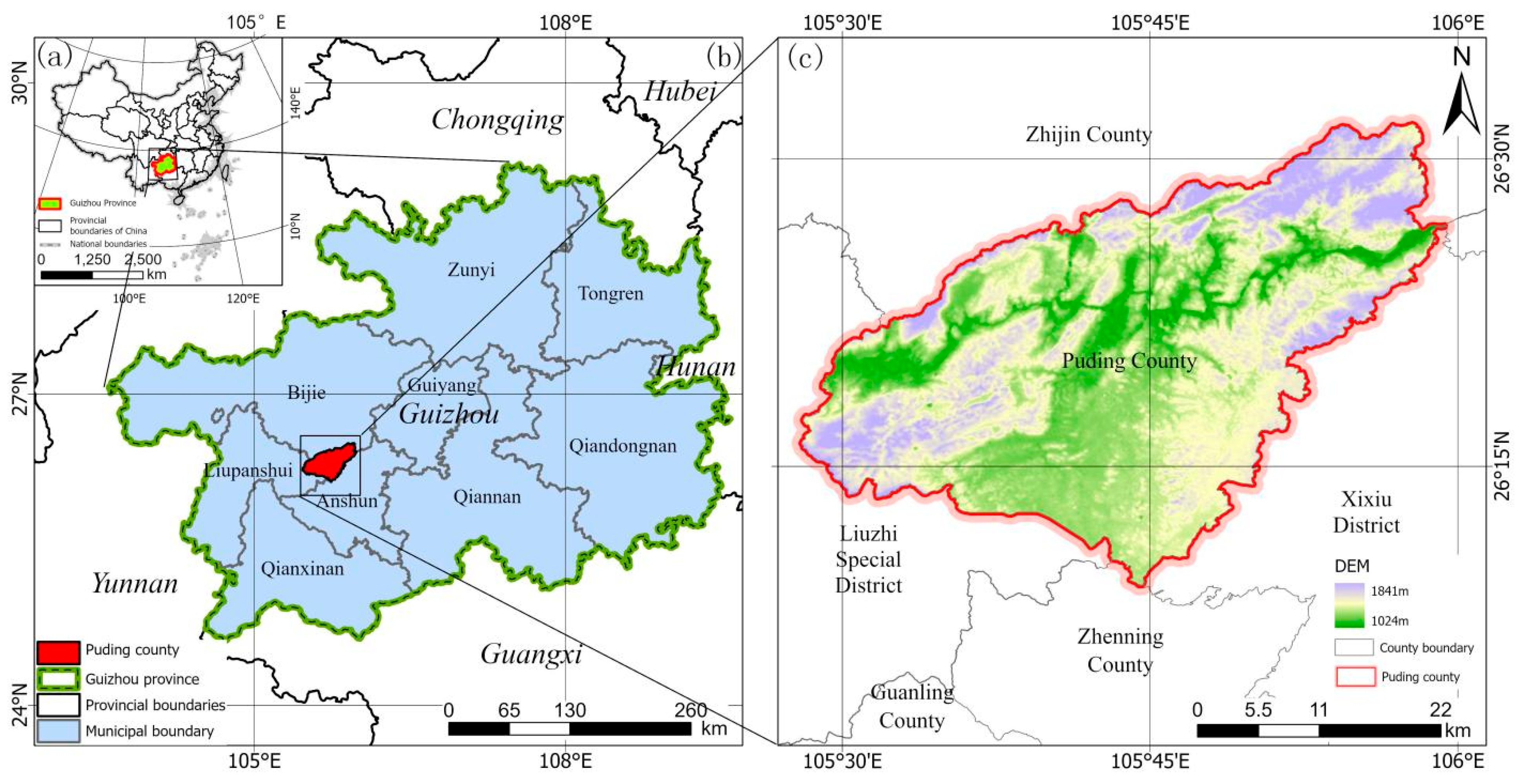
Disclaimer/Publisher’s Note: The statements, opinions and data contained in all publications are solely those of the individual author(s) and contributor(s) and not of MDPI and/or the editor(s). MDPI and/or the editor(s) disclaim responsibility for any injury to people or property resulting from any ideas, methods, instructions or products referred to in the content. |
© 2025 by the authors. Licensee MDPI, Basel, Switzerland. This article is an open access article distributed under the terms and conditions of the Creative Commons Attribution (CC BY) license.