Article

Agricultural Policies, Crop Type, Tillage Systems and Fertilization as Drivers of Soil Carbon Sequestration in Romania


Faculty of Agriculture, Agroeconomy Department, “Ion Ionescu de la Brad” Iasi University of Life Sciences, Mihail Sadoveanu Alley 3, 700490 Iași, Romania
*
Author to whom correspondence should be addressed.
Agriculture 2026, 16(1), 12; https://doi.org/10.3390/agriculture16010012

Submission received: 2 October 2025 / Revised: 18 November 2025 / Accepted: 12 December 2025 / Published: 19 December 2025
(This article belongs to the Section Ecosystem, Environment and Climate Change in Agriculture)

Abstract

Soil carbon (C) sequestration is a key component of European climate change mitigation strategies, and it forms part of the Common Agricultural Policy (CAP) and Good Agricultural and Environmental Conditions (GAEC) standards. Using national data for Romania (2005–2024), this paper aims to quantify how crop type, tillage system (conventional, minimum-till and no-till), and nitrogen fertilization influence soil humic carbon (Ch) in wheat, maize, sunflower and rapeseed cropping systems. Carbon inputs from residues, roots, and rhizodeposition were calculated in R based on Intergovernmental Panel on Climate Change (IPCC) coefficients, then tested in Statistical Package for the Social Sciences (SPSS) (factorial ANOVA, multiple regression, Pearson correlations). The results showed that both crop type and tillage systems significantly influence humic carbon values, with the highest values obtained in oilseed crops and in conservation systems (minimum-till and no-till). Among the quantitative factors, nitrogen fertilization had the most pronounced positive effect on carbon fluxes, while yield and precipitation had less influence. The conclusions indicate that the adoption of conservative soil management, in line with CAP objectives and GAEC standards, can support the increase of carbon stocks, with the need for contextual assessment of economic performance and pedoclimatic conditions.

1. Introduction

Agriculture today finds itself at the intersection of two major global challenges. On one hand, it is one of the sectors most exposed to the effects of climate change, through droughts, heat waves, and extreme weather events that reduce production stability and affect food security [1]. On the other hand, agricultural activities contribute approximately 10–12% of global anthropogenic greenhouse gas emissions (GHG), while the entire agri-food system (from production to processing, transport, distribution, and waste management) accounts for approximately one-third of global anthropogenic emissions [2,3,4]. This converse role makes agriculture both a victim and a solution in the fight against climate change. Agricultural land has the potential to function as a carbon sink by accumulating organic matter, which offers both climate benefits (atmospheric carbon dioxide (CO2) capture) and agronomic advantages by improving the health and resilience of agroecosystems [5,6]. Sustainable soil management thus becomes a vital component of the transition to sustainable and climate-neutral agriculture.
Due to the challenges faced by the agriculture sector, the Common Agricultural Policy (CAP) is a fundamental policy of the European Union (EU), with the main objective of ensuring food security and a fair level of income for farmers through coordinated management of agricultural production at the European level. Simultaneously, CAP aims to improve the competitiveness of the agricultural sector, protect the environment, and ensure the sustainable use of natural resources, contributing to climate change adaptation and the balanced development of rural areas [7,8,9]. However, while these goals are defined, several studies highlight that the practical outcomes of CAP often fall short of its ambitions. The environmental delivery and effectiveness of CAP measures remain limited across Member States [10]. Existing research shows that sustainability-oriented measures, such as crop rotation requirements or conditionality standards, may generate environmental benefits only partially, while also leading to economic trade-offs for farmers [11,12].
In the current strategic framework (2023–2027), CAP builds on the reform process initiated in 1992 by MacSharry Reform and consolidated in 2003 by Fischler Reform, when direct payments were made conditional on compliance with environmental requirements and Good Agricultural and Environmental Condition (GAEC) was introduced as a mandatory element to ensure sustainable agricultural practices. The transition from a policy focused on increasing productivity to one that integrates sustainability objectives, the protection of natural resources and social responsibility has thus been gradual. The current framework does not change the direction of this evolution, but it reorganizes and consolidates by introducing national strategic plans, which allow interventions to be adapted to the agricultural and climatic specificities of each Member State, while maintaining the common objectives established at the European Union level. GAEC standards specify the conditions for accessing financial support and form the basis for a more coherent, performance-oriented framework than its predecessors [13,14].
In Romania, the application of these standards is regulated by Joint Order No. 54/570/32/2023 of the Ministry of Agriculture and Rural Development, which adapts European requirements to national soil and climate conditions. Among these, GAEC 5, GAEC 6, and GAEC 7 include requirements designed to maintain soil fertility and carbon stabilization, aiming to prevent erosion and structural degradation, maintain vegetation cover during sensitive periods, and ensure crop rotation [15,16]. GAEC standards are not just administrative requirements, but, to a certain extent, can have effects on soil biophysical processes. Beyond the European regulatory framework, it is necessary to assess the effects of these practices specific to the national conditions of Romania, in order to scientifically substantiate agricultural and environmental policies on the sustainable use of agricultural resources.
The assessment of these processes is currently one of the principal areas of international research, with numerous studies analyzing the performance of different crop systems in relation to organic carbon storage and dynamics. Recent research shows that soil conservation practices, such as reduced tillage (MT) or no-till (NT), can help maintain and increase soil organic carbon and reduce accelerated mineralization [17,18]. Residue management also has a major impact on soil improvement, and leaving straw on the soil surface significantly increases carbon inputs [19,20]. However, the results are not uniform. Some studies show clear increases in carbon in NT, especially in the topsoil (0–30 cm) [21,22], while others report limited or neutral effects when analyzing deeper profiles or different pedoclimatic conditions, and critical assessments point to the real limitations of carbon sequestration through these practices [23,24,25].
There is also controversy regarding the impact on productivity. Some studies report moderate decreases (≈5–10%) in NT, especially in cereals [26], while others show comparable or even more stable yields when conservation practices are combined with adequate fertilization and efficient crop management [27,28]. In Romania, conservation systems have been assessed in long-term experiments and have shown positive effects on organic matter and soil structure. However, their widespread adoption remains limited due to farmers’ perceptions of potential yield losses and the lack of adequate economic incentives. In addition, the interactions between crop type, tillage system, nitrogen fertilization, and rainfall on stored carbon are insufficiently documented at the national level, although these factors directly control both the amount of biomass returned to the soil and the rate of carbon humification [29,30].
Given Romania’s specific soil and climate conditions, studies comparing the effects of tillage systems (conventional tillage—CT, minimum tillage—MT, and no-till—NT) on humified carbon dynamics and agricultural production levels are still limited, and the existing results do not allow clear conclusions to be drawn regarding the superiority of one of the systems. This paper provides additional scientific evidence on how agricultural practices can simultaneously contribute to carbon sequestration and maintain farm performance under the specific conditions in Romanian agriculture by analyzing the effect of the crop system on agricultural yields and humified carbon (Ch) content. The results obtained aim to contribute to a better understanding of how agricultural practices influence soil fertility and production stability, providing useful benchmarks for the effective implementation of GAEC standards and for the scientific basis of the Common Agricultural Policy’s objectives on the sustainable use of natural resources in Romania.

2. Materials and Methods

2.1. Research Framework and Study Period

The study aims to assess how crop type, farming system, nitrogen fertilization, and precipitation determine the level of humified carbon in the soil and is based on information collected over a period of 20 years (2005–2024) by the National Institute of Statistics (INS), Bucharest, Romania in relation to developments in Romanian agriculture. Four crops specific to the Romanian agricultural system were selected: winter wheat, maize, sunflower, and winter rapeseed, which represent over 70% of the country’s cultivated area and form the basis of the country’s food security and the agricultural trade balance [31,32]. In addition, these crops have been frequently used in international carbon balance assessments and play a significant role in discussions on adapting cultivation practices to climate change [5].
For each crop, comparative analyses of conventional (CT) and conservation (MT, NT) systems were performed in terms of two quantitative factors (nitrogen and precipitation) that influence carbon inputs and stabilization.
To compare and assess the benefits of tillage systems on humified carbon dynamics and agricultural production levels, the following working hypotheses were formulated:
H1. 
Conservative systems (MT and NT) result in greater carbon sequestration in the soil than conventional tillage systems (CT) due to greater residue retention and reduced accelerated mineralization of organic matter.
H2. 
High agricultural yields and the application of conservation systems maximize the supply of humified carbon (Ch) by increasing the quantity of residue values returned to the soil and by stabilizing them more efficiently.
H3. 
Higher doses of N applied lead to increased yields and, implicitly, to intensified carbon sequestration.
H4. 
Years with favorable rainfall patterns are associated with higher agricultural yields and, implicitly, with a higher level of carbon sequestration, while dry years reduce both yields and carbon fluxes entering the soil.
By testing these four hypotheses, the research aims to clarify not only the differences between farming systems but also how production, fertilization, and climate interact in determining C stocks, thus contributing to the development of sustainable agricultural policies.

2.2. Datta Collection

The database built for analysis integrated information from national and international sources. Data on cultivated areas (S), total production (Q), and average yields (Qm) were extracted from the TEMPO-Online database of the National Institute of Statistics (INS) (series AGR108A/B, AGR109A/B, and AGR110A), which is also the source of reporting to Eurostat (Statistical office of the European Union), Luxembourg, and Food and Agriculture Organization of the United Nations (FAO), Rome, Italy. For the fertilization analysis, INS series (AGR104A and AGR105A) on the total amount of chemical fertilizers and fertilized areas were used, based on which the average nitrogen dose (dN) was derived, expressed as tons of active substance per hectare [33]. The series of average annual precipitation (P, mm) was taken from the Our World in Data (OWID), Oxford, UK database [34]. This source was chosen because it provides complete coverage of the period analyzed and is comparable with other international datasets. The values were correlated with the corresponding agricultural years to assess the role of climatic factors in the variation in yields and carbon fluxes.
Based on these series, the basic indicators for the study were calculated: Ch [kg C ha−1] and carbon dioxide equivalent (CO2e) [kg CO2e ha−1] representing the amount of humified carbon per hectare and GHG. The estimation of C flows required the use of a set of crop-specific coefficients, synthesized from the literature: straw/grain ratio (RPR), root/above-ground ratio (R:S), carbon fraction (Cfrac), retained residue fraction (RET), humification coefficient (h), rhizodeposition (RD), integrated into a meta-analysis based on IPCC guidelines [35,36], from recent studies and syntheses [19,34,35,36,37,38,39,40,41,42,43,44,45,46,47,48,49]. The average values used are presented in Table 1.

2.3. Adjustment of Yields Under Tillage Systems

The yields reported by the INS were considered, and the reference values for CT (QCT). To capture the effect of conservation practices on yields, these were adjusted by set percentages for MT and NT, and based on international studies and long-term studies in Romania. Global literature indicates that NT tends to moderately reduce average yields in temperate climates, while MT maintains or may slightly increase them, depending on the crop, soil, and water regime. The results of a meta-analysis [26] estimate an average of −5% for NT globally, with variations across crops and contexts. The results are consistent with European syntheses, which report more noticeable decreases in cereals in humid climates and more nuanced effects in oilseeds [18,28].
In Romania, researchers have been documenting the effects of CT/MT/NT on soil properties, energy efficiency, and yields in wheat, maize, and soybeans since 2000 in multi-year experiments in Transylvania. The results show that MT maintains or slightly improves yields, and NT frequently reaches levels close to CT in favorable years, with reduced outputs in cold years or on heavy soils [30,50,51].
Based on these results, differentiated percentage adjustments were applied to crops, relative to the INS values considered for the conventional system (QCT). Thus, for wheat, yields were increased by 4% in MT and reduced by 10% in NT; for corn, they were increased by 5% in MT and reduced by 11% in NT; for sunflower, the values were adjusted by +5% MT and −8% NT, and for rapeseed by +6% in MT and −9% in NT. These values fall within the ranges reported in the international literature [18,26,28] and are corroborated by Romanian studies [30,52,53].
Thus, the adjustments obtained were used to generate yields under minimum tillage (QMT) and no-tillage (QNT), which constituted the input for calculating carbon fluxes (Section 2.5), so that the carbon balance explicitly reflects the differences in technology (CT vs. MT vs. NT) both in terms of residue inputs and yields.

2.4. Calculation of Carbon Inputs

The estimation of C fluxes followed the methodology proposed in the literature, adapted to the crops analyzed and the tillage systems. The calculation process included several successive steps, each based on the coefficients summarized in Table 1.
In the first stage, for each crop and year, the quantity of above-ground residues (straw) was determined, starting from grain production ( Q g r a i n ) and applying the straw/grain ratio (RPR) according to the IPCC methodology [35] and synthesis studies [20]:
Q i , t s t r a w = j = 1 n Q i , t , j s t r a w · φ i , t , j R P R · α j ,       i , t ,
Equation (1) estimated the plant mass remaining on the soil surface after harvesting by crop (wheat, maize, sunflower, rapeseed).
The second step was to determine the total above-ground and below-ground biomass, given that a significant part of C comes from roots. Equation (2) was used to calculate the total above-ground biomass (AGR) and Equation (3) was used to determine the below-ground biomass (BGR) by applying the root/above-ground ratio (R:S), according to Bolinder, M.A. [34,37] and Mokany, K. [39]:
A G R i , t = j = 1 n Q i , t , j g r a i n + Q i , t , j s t r a w · β j ,       i , t ,
B G R i , t = j = 1 n A G R i , t · φ i , t , j R : S · γ j ,       i , t ,
Using Equation (3), the quantity of underground organic matter was determined by the aerial production, respecting the proportions reported in the literature.
The third stage consisted of determining carbon inputs into the soil by converting biomass into carbon equivalent and adjusting for the fraction of residues retained on the surface (RET). Calculations were made separately for aerial residues (CAGR)—Equation (4) [18,35,36], root biomass (CBGR)—Equation (5) [37,38] and rhizodeposits (CRD)—Equation (6) [41,49,54].
C A G R , i , t = j = 1 n Q i , t s t r a w · δ i C · θ i , j , t R E T ,       i , t ,
C B G R , i , t = j = 1 n B G R i , t , j · δ i C · ,       i , t ,
C R D , i , t = j = 1 n B G R i , t , j · λ i R D · η j ,       i , t ,
C I N , i , t = j = 1 n C A G R , i , t , j + C B G R , i , t , j + C R D , i , t , j ,       i , t ,
In Equation (7), CIN represents total carbon inputs [kg C ha−1 an−1], the gross amount of carbon that enters the soil–crop system annually from residues, roots and rhizodeposits.
In the last step, these inputs were transformed into humified carbon (Ch), that part of the C that stabilizes in the long term in soil organic matter. For this, the humification coefficient (h) was applied in Equation (8) [46,48,54]:
C h , i , t = j = 1 n C I N , i , t , j · μ i , t , j h ,       i , t ,
In parallel, to facilitate comparisons with international greenhouse gas balances, Ch was converted into CO2 equivalent (CO2e), using the universal stoichiometric factor in Equation (9) [35]:
C O 2 e , i , t = j = 1 n C h , i , t , j · 44 12 ,       i , t ,
The result of these steps was the indicator Ch [kg C ha−1], which expresses the annual amount of humified carbon per hectare. This indicator was subsequently used as a dependent variable in the statistical analyses carried out in SPSS, where differences between crops and tillage systems and the influence of quantitative factors (fertilization, precipitation, and yields) were evaluated.

2.5. Statistical Analysis

Statistical analyses were carried out in two complementary stages, using both RStudio (version 2025.05.0+496) and IBM SPSS Statistics (version 31.0). This dual approach allowed the separation of the data calculation and preparation process (in R version 2025.05.0+496) from the inferential analysis and hypothesis testing (in SPSS version 31.0).

2.5.1. Data Processing and Carbon Calculations in R

Quantitative calculations of carbon flows were performed in R, using the readxl, dplyr, tidyr, and strings packages [52,53,55]. These tools enabled: the integration of data series from INS (areas, production, fertilization) and OWID (precipitation); the application of specific coefficients (RPR, R:S, Cfrac, RET, RD, h); the implementation of formulas for estimating C flows; the adjustment of yields for MT and NT systems, according to the studies presented above; the generation of derived indicators, such as QMT, QNT, Ch, and CO2e. The final datasets were exported in CSV format and used as input for inferential analyses in SPSS [56].

2.5.2. Inferential Statistical Analysis in SPSS

The data processed and aggregated in R formed the basis for the inferential analysis performed in IBM SPSS Statistics. In a first step, descriptive statistics were generated: means, standard deviations, and confidence intervals for the Ch indicator, broken down by crop type and tillage system. This step provided a preliminary overview of the variability and distribution of the data, facilitating the subsequent testing of hypotheses.
To test hypothesis H1, according to which crop type and tillage system significantly influence stored carbon, a factorial ANOVA model (univariate GLM) was applied, with Ch as the dependent variable and Crop and Tillage System as fixed factors. The homogeneity of the variances was verified using Levene’s Test, and for each effect, the F values, significance levels (p), and effect size (partial η2) were reported, according to the methodological recommendations in the statistical literature [57,58,59]. To identify specific differences between groups, Bonferroni and Tukey HSD post hoc tests were also carried out, which allowed the establishment of pairs of crops and systems with significant differences.
In addition, multiple linear regression models were constructed to evaluate the relationship between Ch and quantitative predictors (dN, P, Qm)—H2, H3. The models were formulated to capture both individual and combined effects. Regression coefficients, p-values, and explanatory power (R2 and adjusted R2) were reported, and the validity of the models was verified using standard diagnostic plots (residual histogram, P–P plot, and scatterplot of residuals versus predicted values) according to the recommendations of Kutner, M.H. et al. (2005) [58].
For hypothesis H4, which investigates the role of rainfall, Pearson correlations were calculated between average production (Qm) and annual precipitation (P). In cases where the distribution did not follow normality, the results were checked and confirmed by Spearman coefficients, ensuring the robustness of the testing. In all analyses, the significance threshold was set at p < 0.05, and the results were reviewed and interpreted using the literature and research objectives.

3. Results

3.1. Descriptive Statistics of Yields and Carbon Inputs

The descriptive analysis highlighted clear differences between crops and tillage systems in terms of humified carbon (Ch) levels. The average values summarized in Table 2 show that the conservative systems MT and NT led to higher values compared to the conventional system CT, confirming hypothesis H1 that conservative practices contribute to higher carbon storage in the soil.
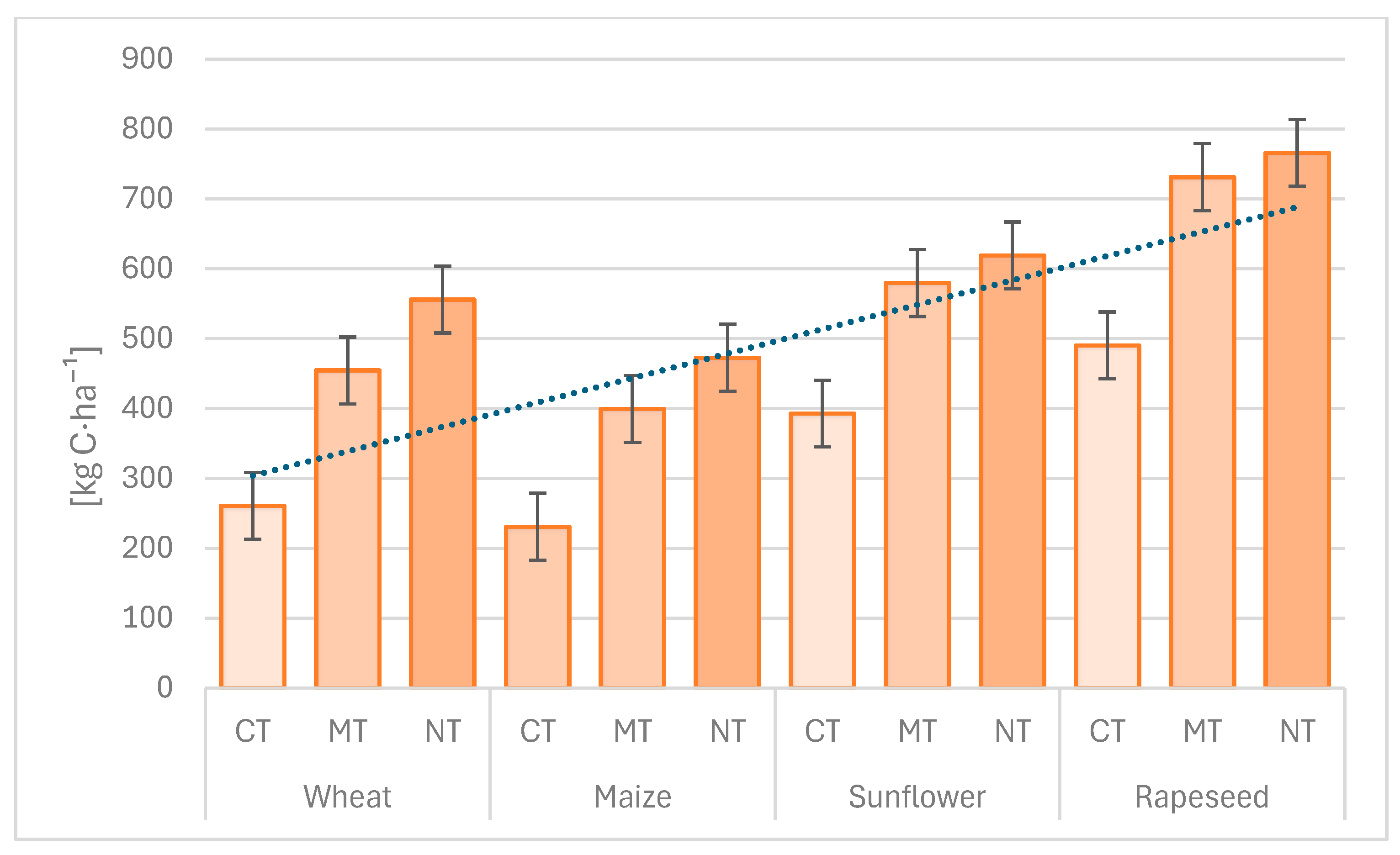
The results showed that rapeseed recorded the highest average values of humified carbon, reaching 731 kg C·ha−1 under MT and 766 kg C·ha−1 under NT, compared to 490 kg C·ha−1 in CT. This increase was explained by the high volume of total biomass generated by the crop and the high ratio of plant residues to grain production (RPR), specific to oilseed plants. In addition, a large proportion of the stems remains on the soil after harvesting, which is reflected in a very high soil residue retention coefficient (RET). Tillage systems have different effects on the humification coefficient (h) and the rhizodeposition coefficient (RD). Thus, the two indicators reach their maximum value in the case of the NT system.
Sunflower shows a similar evolution, with Ch values increasing from 231 kg C·ha−1 in CT to 473 kg C·ha−1 in NT. This increase reflects a similar behavior to that of rapeseed, determined by the high level of total biomass and a high rate of residue retention on the soil, which leads to good carbon stabilization even under conventional conditions.
In wheat, the average amount of humified carbon increased from 393 kg C·ha−1 (CT) to 556 kg C·ha−1 (NT), and in maize from 261 kg C·ha−1 (CT) to 556 kg C·ha−1 (NT). In the case of cereals, these increases are explained by the variation in the residue retention coefficient (RET). RET increases significantly in conservative systems. Higher values of humification coefficients (h) and rhizodeposition (RD) further contribute to soil carbon stabilization, but to a lesser extent than in oilseed crops.
Therefore, differences between crops and systems reflect the specific interaction between residue retention parameters, biomass-to-yield ratio, and carbon stabilization processes. These results appear to confirm that the effect of the tillage system on carbon sequestration is strongly influenced by the type of crop and its physiological and technological characteristics.
These differences are reaffirmed by SPSS analysis, where the estimated marginal means (EMM) for Ch showed the same trends (Figure 1). The distribution of values confirms the considerable increase in values in conservative systems. In the case of wheat and maize, there is a significant jump between CT and NT, suggesting that residue retention plays a central role in carbon stabilization. In sunflower and rapeseed, the differences between MT and NT are smaller, indicating a high storage capacity even in the case of CT.
From the above, it appears that the results for the Romanian agriculture are on par with the trends reported in the international literature, according to which conservation practices, especially NT, increase carbon input into the soil due to reduced mineralization and better residue retention [19,21,25,28].
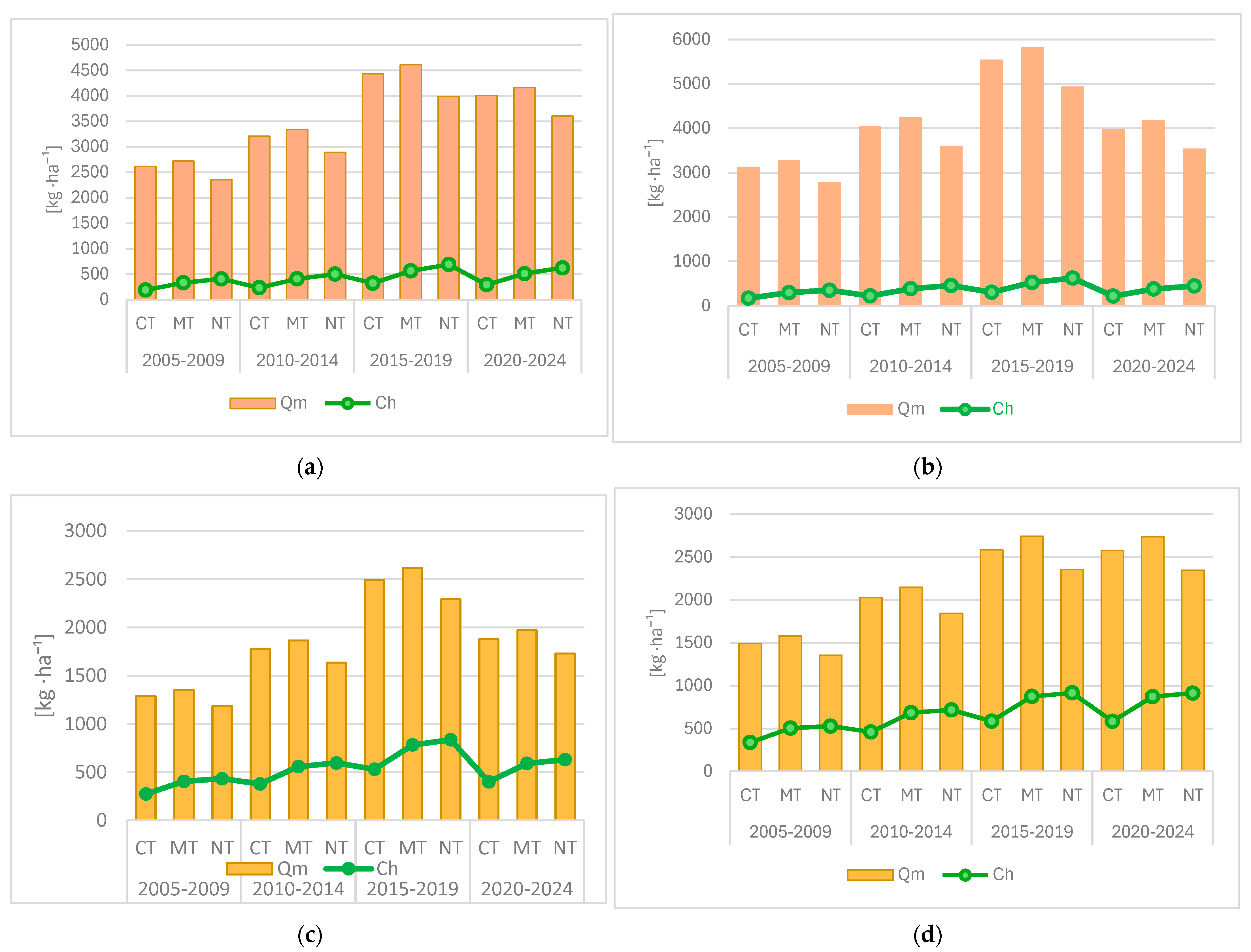
The differences highlighted by the descriptive analysis reflect the cumulative impact of farming systems on the level of humified carbon (Ch) in the soil. In order to assess the consistency of these trends over time and to highlight the dynamics of carbon accumulation processes, the evolution of the Qm and Ch indicators was analyzed over the entire observation period (2005–2024), depending on the crop and the tillage system applied. The data was summarized as five-year averages, corresponding to the four distinct periods (2005–2009, 2010–2014, 2015–2019, and 2020–2024). Figure 2 shows the temporal evolution of yields (Qm) and humified carbon (Ch) in CT, MT, and NT systems for the crops analyzed (a–d).
The diagrams show an overall increase in Qm and Ch values from the first to the third period, followed by stabilization in 2020–2024. In the CT system, the values remain significantly lower and more variable, while in the conservative systems, there is a progressive accumulation of humified carbon.
The differences between crops are noticeable: wheat and maize show more pronounced variability in yields but a stable evolution of Ch, while sunflower and rapeseed show higher absolute values of Ch and a reduced difference between MT and NT. Oilseed crops are thus distinguished by a high sequestration potential, associated with the large volume of residues and the efficiency of their conversion into stable carbon, without significant production losses.
Time series analysis confirms the positive correlation between average yields (Qm) and humified carbon (Ch) levels, but the amplitude of variations is lower for Ch, highlighting the resilience of organic carbon to production fluctuations. These findings reinforce hypothesis H1, according to which plant residue retention and reduced tillage intensity are the determining factors for the increase and stabilization of humified carbon, while contributing to the sustainability and resilience of agroecosystems in the context of current climate change.

3.2. Effect of Crop Type and Tillage System (ANOVA Results)

The results of the factorial ANOVA model (univariate GLM), with Ch as the dependent variable and the fixed factors Culture and System, show that both main effects are statistically significant (p < 0.001), while their interaction is not significant (p = 0.838). The model has a high explanatory power (Adjusted R2 = 0.523), indicating that half of the variation in Ch is determined by these two factors. The results indicates that soil carbon sequestration processes are predominantly controlled by the biological and technological mechanisms associated with each crop and by the potential intensity of mechanical soil disturbance.
The effect of crop type was strong (F(3,240) = 47.916, p < 0.001, η2p = 0.375), demonstrating systematic differences in the ability of species to contribute to stable carbon stocks. The estimated mean values show that rapeseed had the highest level of humified carbon (M = 662.5 kg C·ha−1), followed by sunflower (M = 530.6 kg C·ha−1), wheat (M = 423.8 kg C·ha−1), and maize(M = 367.7 kg C·ha−1). Bonferroni post hoc tests confirmed significant differences between all pairs, except for the wheat– maize relationship, where the difference was not significant (p = 0.212).
These differences can also be explained by the morphophysiological and technological characteristics of each crop, which determine variations in the total volume of biomass generated and the amount of plant residues returned to the soil. Oil crops, characterized by a high residue/production ratio (RPR) and a higher proportion of slow-decomposing plant debris (high degree of lignification of plant debris), contribute to increasing carbon inputs and maintaining it in stable forms in the long term. In contrast, cereal crops have less persistent plant structures (more easily degradable tissue structures) and a lower residue retention rate, which explains the lower levels of humified carbon.
The effect of the tillage system was also significant (F(2,240) = 69.623, p < 0.001, η2p = 0.367). Conservative systems significantly increased carbon storage, from 343.8 kg C ha−1 in CT to 541.2 kg C ha−1 in MT and 603.4 kg C ha−1 in NT. The differences between CT and MT (−197.4, p < 0.001) and CT and NT (−259.6, p < 0.001) were significant, and NT significantly exceeded MT (+62.2, p = 0.022).
This trend reflects the known mechanisms of organic matter conservation under conditions of reduced tillage intensity, by decreasing the aeration of the arable layer and, implicitly, the rate of organic carbon mineralization, while increasing the retention of plant residues on the surface and improving soil structure. The stabilization of aggregates formed in conservative systems further contributes to protecting organic matter from rapid decomposition, which leads, over time, to the gradual accumulation of humified carbon (Ch) [60,61,62]. This effect is highlighted by the higher average values recorded in MT and NT compared to the CT, indicating the essential role of reduced tillage in maintaining carbon balance in agricultural soils in Romania.
The Culture × System interaction was not significant (F = 0.459, p = 0.838), indicating that the positive effect of conservative systems was very important regardless of culture. However, the absolute values suggest a more pronounced increase in wheat and maize in NT compared to sunflower and rapeseed, where MT and NT generated similar values.
The lack of statistical significance of the interaction can be explained by the nature of the data aggregated at the national level, which mitigates local soil and climate variations. In the absence of detailed regional differentiation, crop-specific variations are levelled out, and the common effects of conservation practices become dominant. The ANOVA results are summarized in Table 3, where F values, significance levels (p), and effect sizes (η2) are reported. The color representation highlights the higher intensity of the effects associated with crop type and tillage system, confirming their dominance over the dynamics of humified carbon in agricultural soils, while the interaction between these factors plays a secondary role.
The ANOVA analysis confirms that crop type and tillage system are primary determinants of carbon sequestration through their cumulative action on input fluxes and organic matter stabilization processes. The results validate hypothesis H1 and provide a solid empirical basis for further quantitative analysis in multiple regression models (Section 3.3), where the relationships between Ch and climatic and fertilization factors will be examined.

3.3. Multiple Regression Models for Ch

To test hypotheses H2, H3, and H4 on carbon storage, multiple linear regression models were constructed, with Ch [kg C·ha−1] as the dependent variable and the predictors: tillage system, Qm, dN, and P as independent variables.
Model 1—Effect of the system of works and average yield (System × Qm)
The model generated a coefficient of determination R2 = 0.247, indicating that approximately 24.7% of the variation in Ch values was explained by these two predictors. The model is statistically significant (F(2,249) = 40.78; p < 0.001), and the analysis of the variables shows that: The system has a positive and significant influence (B = 129.82 ± 14.49; p < 0.001) and Qm has a positive but insignificant contribution (B = 0.010 ± 0.009; p = 0.262). The moderate value of the R2 coefficient (0.247) indicates a significant but partial relationship, indicating that it does not fully capture the complexity of the phenomenon, as there are other variables not included in the analysis that contribute to the variability of carbon fluxes (soil type, regional climate deviations, management intensity).
The positive result for the System shows that Ch values increase steadily as we move from CT to MT and then to NT. This result confirms the favorable impact of conservation systems on the maintenance and accumulation of organic carbon in the soil. With reduced tillage intensity and the maintenance of plant residues on the surface, carbon losses through mineralization are reduced, and organic matter is better stabilized in soil aggregates. At the same time, it reduces tillage limits erosion and improves soil structure, which further contributes to increased Ch values. In contrast, the conventional system, based on plowing and repeated tillage, promotes the oxidation of organic matter and the release of carbon, leading to lower values of the indicator.
The lack of statistical significance for the Qm variable (p = 0.262) indicates that the level of agricultural production does not directly explain the Ch values. Even though higher yields can generate larger amounts of biomass, a sizeable portion of the carbon fixed through photosynthesis is quickly returned to the atmosphere through respiration and decomposition. This suggests that the level of production is not a direct predictor of carbon fluxes, but only an indirect associated factor, whose influence may be mediated by other technical, pedological, and biological processes. Therefore, the model suggests that soil management practices might play a higher role than the level of production in controlling carbon fluxes at the agricultural system level.
Model 2—Effect of nitrogen dose and average yield (dN × Qm)
The generated model is statistically significant (F(2,249) = 14.84; p < 0.001), with a coefficient of determination R2 = 0.106. This shows that approximately 10.6% of the variation in Ch values is explained by these two predictors. The analysis of individual coefficients indicates a positive and significant influence for dN (B = 12,748.93 ± 2383.38; p < 0.001), while Qm has a negative but insignificant effect (B = −0.007 ± 0.010; p = 0.492). The relatively low value of the R2 coefficient (0.106) shows that the relationship between N and Ch is significant but modest, meaning that fertilization explains only part of the variations in carbon fluxes. An increase in dN does not automatically lead to a proportional accumulation of carbon, as the pedological processes involved are also dependent on other factors, such as soil type, organic matter content, or precipitation.
These results suggest that N fertilization contributes to an increase in Ch values, but the effect is partial and does not fully explain the observed variability. The increase in Ch values with increased N input can be explained by the stimulation of soil biological activity and the increase in the amount of plant biomass, which, through decomposition, contributes to carbon stabilization. However, the relationship between N and Ch should be interpreted with caution, as excessive fertilization leads to accelerated mineralization of organic matter and losses in the form of N2O emissions, reducing the net benefit to the carbon balance [63]. Furthermore, throughout the value chain, obtaining N consumes significant non-renewable resources, and it is a significant source of greenhouse gases [64]. In this context, the use of organic amendments (manure, compost, or plant residues) can be a sustainable alternative, capable of improving aggregate stability and microbial activity, promoting the accumulation and stabilization of organic carbon in the soil [65,66]. However, the effect of these practices depends on the type, dose, and frequency of application, as well as on soil and climate conditions, and can range from moderate increases in SOC to temporary losses of N in the form of N2O.
The lack of statistical significance for Qm (p = 0.492) suggests that the level of production does not directly determine the values of Ch, indicating that carbon accumulation and storage processes are potentially controlled by the interaction between fertilization and soil properties rather than by crop productivity. The results show that dN is a significant factor in the variation of carbon fluxes, as its effect depends on balanced nutrient management and its integration into conservation tillage systems that promote organic matter stabilization and maintain agroecosystem sustainability. In the absence of an optimal dosing strategy, excessive nitrogen application can lead to intensified organic matter mineralization processes, reducing carbon storage efficiency and generating losses in the form of N2O emissions, with negative implications for the greenhouse gas balance.
Model 3—Effect of precipitation and average yield (P × Qm)
The analysis generated a marginally significant relationship between precipitation (P) and the Ch indicator, with the model close to the threshold of statistical significance (F(2,249) = 3.01; p = 0.052) and explaining approximately 2.4% of the variation in Ch values (R2 = 0.024). The coefficient for P is negative and significant (B = −0.432 ± 0.172; p = 0.014), while Qm has a positive but insignificant effect (B = 0.007 ± 0.010; p = 0.491).
The results show that precipitation intensity has a negative influence on Ch values, suggesting that higher rainfall may be associated with increased carbon losses from the soil. This effect can be explained by the physical and biochemical processes that occur under conditions of increased humidity: leaching and transport of soluble organic compounds, accelerated mineralization of organic matter, and reduced soil aeration, which can stimulate anaerobic microbial activity and the conversion of organic carbon into unstable forms. Under these conditions, additional water input can facilitate the degradation and loss of stored carbon, leading to lower Ch values [67,68,69]. On the other hand, the lack of statistical significance for Qm (p = 0.491) indicates that the level of production does not independently explain the Ch values. Even though high yields can generate higher amounts of plant residues, their contribution to carbon storage depends on moisture conditions and the soil’s ability to stabilize the resulting organic compounds (pedoclimatic and hydrological factors).
The information used in this study was limited; therefore, the results require further studies and investigations. In this study, precipitation and yield values were considered as national averages, which do not capture the significant spatial variability between Romania’s agroclimatic regions. Rainfall patterns vary between areas, and the processes of leaching, mineralization, and carbon stabilization are highly dependent on local soil and climate conditions. This aggregation of data at the national level may attenuate the actual relationships between climatic factors and carbon fluxes, partly explaining the low value of the R2 coefficient and the modest effect of precipitation.
The data in Table 3 consolidate the analysis of the relationships identified in the three multiple regression models, thus providing an overview of the interdependence between variables. It summarizes the linear relationships between Ch and the main predictors analyzed in the models: system (of works), dN, Qm, and P.
The correlation matrix confirms the trends observed in the individual models, highlighting moderate positive correlations between Ch and System (r = 0.497) and Ch and dN (r = 0.325), which supports the importance of management factors on carbon fluxes. These relationships indicate that conservative systems and balanced fertilization contribute to maintaining higher levels of carbon stored in the soil. In contrast, the weak correlations between Ch and P (r = −0.043) or Qm (r = 0.062) reflect the limited influence of climatic factors and productivity on the variation in the indicator, in line with the results obtained in models 2 and 3.
By including all the variables analyzed, this representation provides an integrated view of the general relationships within the study and supports the statistical consistency of the regression analyses. In addition, the low values of correlations between independent predictors (r < 0.15 in most cases) indicate the absence of collinearity, confirming the robustness of the models and the validity of the conclusions. The correlation matrix supports the overall interpretation that management factors, in particular the system of cultivation and nitrogen fertilization, are the main determinants of carbon fluxes, while climatic factors act as indirect influences, dependent on the pedoclimatic context.
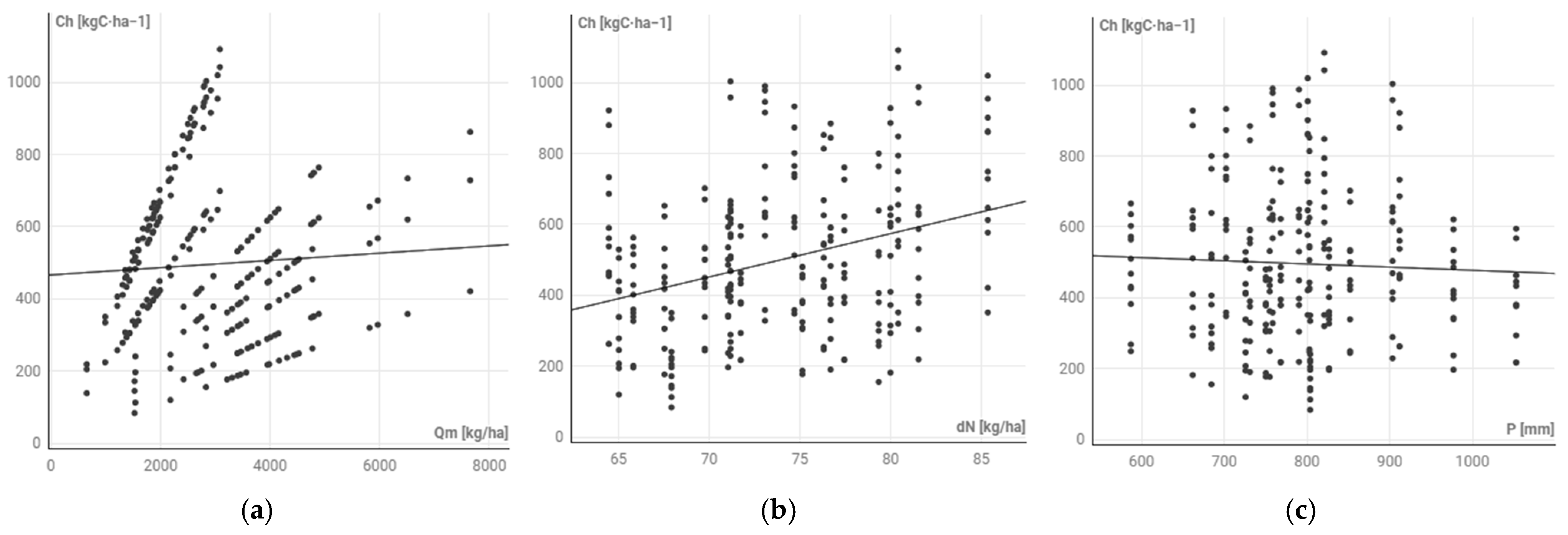
To complement the matrix analysis and visually highlight the direction and intensity of the bivariate relationships between the Ch indicator and the predictors analyzed. Figure 3 shows a simple linear regression between Ch and each independent variable. These graphs illustrate how Ch values vary according to average yield (Qm), nitrogen dose (dN), and rainfall regime (P), confirming the trends observed in the multiple regression models and in the correlation matrix.

3.4. Correlations Between Ch and Climatic and Fertilization Factors

Pearson’s correlation analysis showed different relationships between the Ch indicator (kg C·ha−1) and the quantitative factors included in the study (Table 4). A strong association was identified between Ch and dN (kg N ha−1), with a positive and statistically significant correlation (r = 0.324, p < 0.05). This result confirms the role of nitrogen fertilization in increasing carbon fluxes by stimulating biomass production and plant residue input.
The average yield, Qm (kg/ha), showed a very weak and insignificant positive correlation (r = 0.062, p = 0.628), suggesting that the direct influence of yields on Ch is low and strongly mediated by other factors, particularly the tillage and fertilization system.
Precipitation, P (mm), showed a weak and insignificant negative correlation (r = −0.043, p = 0.350), indicating an indirect and variable influence of the rainfall regime on carbon storage, conditioned by the crop and the management technology applied.
These results confirm that nitrogen fertilization is the quantitative factor with the greatest influence on humified carbon, while yields and rainfall patterns play a more complex role, mediated by interaction with the crop and tillage technology. To further examine the relationships between humified carbon (Ch) and quantitative factors independent of the tillage system, Pearson correlation coefficients between Ch and the quantitative variables are reported in Table 5.

4. Discussion

4.1. Crop Type as a Determinant of Soil Carbon Storage

The differences observed between crops in terms of humified carbon (Ch) values confirm that crop type is a significant determinant of soil capacity to accumulate and store carbon. The higher values observed for oil crops (rapeseed and sunflower) compared to cereals (wheat and maize) suggest their superior capacity to provide carbon inputs through a biomass richer in organic compounds and a more developed root system. This distribution is consistent with studies reported by the IPCC (2006, 2019) [35,36], Bolinder et al. (2007) [37,69] and Pausch & Kuzyakov (2018) [41], which have shown that oilseeds contribute significantly to the increase in stabilized carbon in the soil through rhizodeposition and residues with a higher C:N ratio [35,36,70,71].
The results obtained in this study support hypothesis H1 and confirm the experimental observations made in Turda, Cluj, Romania, where rapeseed and sunflower crops led to increases in total organic carbon content compared to wheat and corn. These findings indicate that structural and biochemical differences between crops, in particular the proportion of root biomass and plant residue dynamics, are determining factors for carbon storage.
However, the results of statistical models (R2 ≤ 0.24) suggest that the influence of crop type is only partial and strongly conditioned by the management context. The effect of crop type is amplified in systems with conservative tillage and diversified rotations, but becomes marginal in intensive systems, where mineralization and structural disturbance of the soil are more pronounced. This interdependence indicates that the impact of crop type on carbon should not be considered in isolation, but in relation to agronomic practices and local pedoclimatic conditions.
The international literature supports this integrative perspective: studies by Lal (2020) [27,70] and Poeplau & Don (2015) [71] show that the crop impacts on carbon storage depend more on rotation, soil cover, and organic inputs than on the species itself. Thus, the adoption of complex rotations combining oilseeds, cereals, and legumes maximizes carbon inputs and optimizes the C:N ratio, leading to more efficient stabilization of organic matter [72,73].
The results of this study contribute to understanding how crop choice can support strategies to increase soil carbon stocks, but also confirm that positive effects cannot be separated from management practices. Crop type is therefore a functional component of a sustainable agricultural system, a factor which, in combination with conservation tillage and balanced fertilization, contributes to maintaining ecological functions and the resilience of agroecosystems.
The results obtained scientifically support the regulatory framework of the Common Agricultural Policy (CAP 2023–2027) and provide practical relevance. GAEC 7 (crop rotation) and GAEC 6 (maintaining minimum soil cover) standards aim precisely to maximize the role of crop types in carbon stabilization, not by selecting a single species, but by combining them in diversified sequences that balance carbon and nitrogen inputs. In particular, the inclusion of oilseeds and legumes in cereal rotations ensures constant soil cover and contributes to the stabilization of organic matter, in line with the CAP’s climate-neutral agriculture objectives.

4.2. Impact of Tillage Systems on Carbon Sequestration

The results of the study highlight the role of tillage systems as the main determinant of humified carbon (Ch) fluxes, confirming hypothesis H2 that conservative practices contribute to carbon sequestration and improved soil stability. Ch values increased progressively with the transition from CT to MT and NT, with an average difference of approximately 130 kg C·ha−1 with each shift to a more conservative system (B = 129.82 ± 14.49; p < 0.001). This trend reflects the fact that reducing soil tillage intensity limits carbon losses through mineralization and promotes the accumulation of stable organic matter.
The mechanisms behind this effect are well documented in the international literature and include reduced aeration and oxidation of organic matter, increased soil aggregation, and retention of plant residues on the surface [60,74]. In NT and MT systems, residues contribute to the formation of stable aggregates that protect organic compounds from rapid microbial decomposition. This process of “physical carbon protection” is a key element of sustainable sequestration and explains why conservative practices tend to improve organic carbon content in the long term [75]. The results of the present study are consistent with the meta-analysis by Pittelkow et al. (2015) [17], which demonstrated a steady increase in organic carbon in the 0–30 cm layer under NT, as well as with the results obtained in Romania by Rusu et al. (2014) and Calistru et al. (2024), who reported 10–20% increases in organic matter in soils managed with reduced tillage [30,74].
In practical terms, conservation systems contribute not only to increasing carbon stocks but also to maintaining structure, reducing erosion, and improving the resilience of the agroecosystem [59]. However, they should be considered as part of an integrated package of sustainable practices. The beneficial effects of NT and MT can be amplified using organic amendments, crop rotations, and balanced nutrient management [73,76], approaches recommended by European soil directives and the objectives of the Common Agricultural Policy (CAP 2023–2027).
Therefore, the results confirm hypothesis H2, but highlight the partial and conditional nature of the relationship between tillage system and carbon sequestration. Conservative systems act as a catalyst for organic stability, but their maximum impact is only achieved in synergy with other sustainable practices.

4.3. Quantitative Drivers: Yields, Fertilization, Precipitation

The analysis of multiple regression models showed that quantitative factors: nitrogen fertilization (dN), average yield (Qm), and rainfall regime (P) exert distinct but complementary influences on humified carbon (Ch) values. Of these, dN proved to be the most important positive predictor (p < 0.001), only partially confirming hypothesis H3. The increase in Ch values observed with the application of N reflects an indirect effect, determined by the stimulation of vegetative growth and the increase in biomass returned to the soil. However, the low coefficient of determination (R2 = 0.106) shows that N input explains only part of the observed variation, indicating that mineral fertilization does not automatically lead to an increase in carbon stocks. This result suggests that fertilization acts more as a catalyst for biological processes, whose efficiency depends on environmental conditions and available organic inputs.
The results correlate with the international literature, which shows that nitrogen fertilization promotes carbon accumulation only in systems where there is a complementary organic input (plant residues, compost, manure). Practices such as straw incorporation or the application of organic amendments are recognized as being much more effective in increasing soil aggregation, stimulating the organic carbon cycle, and improving carbon stability [63,66,75,77,78]. In the absence of these organic sources, excessive fertilization can even accelerate mineralization and carbon loss, reducing sequestration efficiency.
Average yield (Qm) showed a weak and insignificant association with Ch (p = 0.492), suggesting that agricultural production levels do not directly determine carbon fluxes. A sizeable portion of the biomass produced is removed and lost through harvesting. The positive impact on carbon stocks depends more on the proportion of residues retained in the field and on conditions that favor humification, confirming the conclusions of Poeplau & Don (2015) [71] regarding the indirect nature of the relationship between yield and SOC.
Regarding precipitation (P), model 3 indicated a negative and marginally significant relationship (p = 0.052; R2 = 0.024), suggesting that higher rainfall may be associated with increased carbon losses through processes such as leaching of soluble organic compounds and accelerated mineralization of organic matter. The results regarding rainfall only partially confirm hypothesis H4, indicating that precipitation may act as a limiting or disruptive factor rather than a direct determinant of carbon storage. These results demonstrate that the quantitative factors analyzed: fertilization, production, and precipitation act synergistically, but the effect of fertilization is dependent on the climatic and management context. The increase in humified carbon is not an automatic result of intensified fertilization, but rather of the balance between nutrient inputs, water availability, and residue management practices. From this perspective, hypotheses H3 and H4 are only partially proven, highlighting the importance of an integrated approach.

4.4. Implications for Policy and Sustainable Agriculture

The results obtained highlight direct implications for European and national agricultural policies, confirming the relevance of the directions set by the Common Agricultural Policy (CAP 2023–2027) and GAEC standards. The increase in humified carbon content in the soil under conservative systems (MT and NT), compared to the conventional system, supports the objectives of maintaining soil cover, reducing tillage intensity, and increasing organic matter [9,78]. At the same time, nitrogen fertilization has confirmed its role as a determining factor in stimulating carbon fluxes, but its application must be conducted rationally to avoid losses and secondary N2O emissions [54].
The results highlight an important trade-off: no-till systems can contribute to increasing carbon stocks when integrated with diversified rotations, plant cover, and organic inputs, but they can lead to lower yields in cereal crops. This situation explains farmers’ reluctance to adopt these practices on a large scale and highlights the need for economic and technical support mechanisms to compensate for initial productivity losses. Payment programs for ecosystem services or incentives provided through the CAP can play an important role in facilitating the transition to sustainable agricultural systems without compromising the economic viability of farms [78,79].
However, the impact of these results goes beyond the economic sphere, targeting the long-term sustainability of agroecosystems. The adoption of conservation tillage systems not only contributes to carbon storage but also improves soil resilience to drought and extreme events by increasing water retention capacity and reducing erosion [27]. Maintaining or increasing soil carbon stocks is a strategic priority for the CAP 2023–2027, being integral to the requirements for sustainable land management. Implementing these principles helps reduce agricultural vulnerability to climate change and strengthen the ecological functions of soil by optimizing the balance between productivity and sustainability. Some research [80,81] has highlighted that innovation and investment in farmer training and research are necessary to increase agricultural performance in the EU, while also noting the trade-off between economic growth and environmental sustainability, which highlights the need for integrated policies and financial mechanisms to encourage the adoption of sustainable practices.
In Romania, where the four crops analyzed (wheat, maize, sunflower, and rapeseed) account for over 70% of arable land, the consistent application of conservation practices could transform agriculture from a net emitter into a mitigating factor in climate change. This transition would bring additional benefits, such as reduced input costs, increased functional soil biodiversity, and enhanced economic sustainability for farmers through the integration of agroecological principles in the CAP. Coca et al. [80] showed that the environmental performance of farms in Romania and other EU Member States, as assessed by the gross soil nutrient balance (B_NUTR), is closely linked to agricultural intensification, highlighting the need for integrated policies that stimulate sustainable practices without compromising economic competitiveness.

4.5. Limitations and Perspectives

The result of this study has certain limitations, which will require further study and consideration. First, the analysis was conducted using generalized information at the national level, which may screen regional variations determined by soil type, rainfall patterns, or specific technological practices. Second, the coefficients used to estimate carbon fluxes are largely derived from international literature and meta-analyses, which introduces a degree of uncertainty regarding their adaptability to the pedoclimatic conditions in Romania. However, choosing this approach ensures comparability with international studies and alignment with IPCC methodological standards (2006, 2019) [35,36].
To overcome these limitations, future research should focus on a regional-level study to test the results obtained at the national level and highlight the variability of carbon fluxes depending on the specific pedoclimatic conditions and agricultural practices in each area. This approach should allow for an assessment of how GAECs influence farm performance, both in terms of carbon storage and economic sustainability. To ensure the credibility and comparability of the data, the results can then be analyzed and validated using carbon simulation models (RothC and AMG), which will allow for a more accurate estimation of the dynamics of organic carbon in the soil depending on the different agricultural management systems. This approach has the potential to contribute to the scientific basis for recommendations on sustainable agricultural practices and their adaptation to the regional diversity of agriculture in Romania.

5. Conclusions

The study demonstrated that both crop type and tillage system significantly influence the level of humified carbon. Rapeseed and sunflower generated the highest values, and the adoption of conservation tillage (minimum-till and no-till) led to consistent increases in carbon stocks compared to the conventional system. However, the reduction in cereal yields in the no-till system highlights the need for financial or compensatory support mechanisms to ensure the economic feasibility of these practices for farmers.
Among the quantitative factors analyzed, nitrogen fertilization proved to be the main determinant of carbon fluxes, while production and precipitation had contextual and variable effects. These results suggest that integrating conservative soil management into the Common Agricultural Policy and GAEC standards can partially contribute to European climate objectives and the promotion of sustainable agricultural practices.
In the long term, the expansion of regional studies and the calibration of coefficients to local soil and climate conditions will enable the formulation of policies that are better adapted to the specificities of Romanian agroecosystems, thus strengthening the role of agriculture as a vector for climate change mitigation.

Author Contributions

Conceptualization, G.-M.I. and G.S.; methodology, G.-M.I. and G.S.; software, G.-M.I.; validation, G.S. and O.C.; formal analysis, G.-M.I. and G.S.; investigation, G.-M.I.; data curation, G.-M.I.; writing—original draft preparation, G.-M.I.; writing—review and editing, G.S. and O.C.; visualization, G.-M.I.; supervision, G.S. and O.C.; project administration, O.C.; funding acquisition, O.C. All authors have read and agreed to the published version of the manuscript.

Funding

This research was funded by the Romanian Ministry of Agriculture and Rural Development, through the ADER Program, Funding Contract No. 19.1.3/29.01.2024 “Online platform for the implementation of the concept of CARBON CREDITS at the level of agricultural entities”.

Data Availability Statement

The data used in this study are publicly available from official sources. Agricultural statistics were obtained from TEMPO-Online INS (http://statistici.insse.ro/tempoins/, accessed on 3 July 2025) and climate data were obtained from Our World in Data (https://ourworldindata.org, accessed on 5 July 2025). Further inquiries can be directed to the corresponding author.

Acknowledgments

During the preparation of this manuscript, the authors used Artificial Intelligence Large Language Models such as ChatGPT 4o for summarizing the main findings against large bodies of text. The authors have reviewed and edited the output and take full responsibility for the content of this publication.

Conflicts of Interest

The authors declare no conflicts of interest. The funders had no role in the design of the study; in the collection, analyses, or interpretation of data; in the writing of the manuscript; or in the decision to publish the results.

Abbreviations

The following abbreviations are used in this manuscript:
CTConventional tillage
MTMinimum tillage
NTNo-till
CCarbon
ChHumified carbon
CO2eCarbon dioxide equivalent
CO2Carbon dioxide
GHGGreenhouse gas emissions
CAPCommon Agricultural Policy
GAECGood agricultural and environmental conditions
NNitrogen
dNNitrogen dose
PPrecipitation
QTotal production
QmAverage yields
QCTYield under conventional tillage
QMTYield under minimum tillage
QNTYield under no-tillage
SCultivated area
RPRStraw/grain ratio
R:SRoot/above-ground ratio
CfracCarbon fraction
RETRetained residue fraction
hHumification coefficient
RDRhizodeposition
AGRAbove-ground biomass
BGRBelow-ground biomass
CAGRCarbon in above-ground biomass
CBGRCarbon in below-ground biomass
CRDCarbon from rhizodeposits
CINTotal carbon inputs
EMMEstimated marginal means
GLMGeneral Linear Model
INSNational Institute of Statistics
OWIDOur World in Data
IPCCIntergovernmental Panel on Climate Change
FAOFood and Agriculture Organization of the United Nations
EUEuropean Union

References

  1. Intergovernmental Panel On Climate Change (IPCC). Climate Change 2022—Impacts, Adaptation and Vulnerability: Working Group II Contribution to the Sixth Assessment Report of the Intergovernmental Panel on Climate Change, 1st ed.; Cambridge University Press: Cambridge, UK, 2023; ISBN 9781009325844. [Google Scholar]
  2. Food and Agriculture Organization of the United Nations (FAO). Knowledge Repository; FAO: Rome, Italy, 2023; Available online: https://openknowledge.fao.org/handle/20.500.14283/cc2672en (accessed on 22 September 2025).
  3. Intergovernmental Panel on Climate Change (IPCC). Climate Change 2022—Mitigation of Climate Change: Working Group III Contribution to the Sixth Assessment Report of the Intergovernmental Panel on Climate Change (IPCC), 1st ed.; Cambridge University Press: Cambridge, UK, 2023; ISBN 9781009157926. [Google Scholar]
  4. Crippa, M.; Solazzo, E.; Guizzardi, D.; Monforti-Ferrario, F.; Tubiello, F.N.; Leip, A. Food Systems Are Responsible for a Third of Global Anthropogenic GHG Emissions. Nat. Food 2021, 2, 198–209. [Google Scholar] [CrossRef] [PubMed]
  5. Lal, R. Soil Carbon Sequestration Impacts on Global Climate Change and Food Security. Science 2004, 304, 1623–1627. [Google Scholar] [CrossRef]
  6. Paustian, K.; Lehmann, J.; Ogle, S.; Reay, D.; Robertson, G.P.; Smith, P. Climate-Smart Soils. Nature 2016, 532, 49–57. [Google Scholar] [CrossRef]
  7. European Commission. Key Objectives of the CAP 2023–2027; Directorate-General for Agriculture and Rural Development: Brussels, Belgium; European Union: Brussels, Belgium, 2023; Available online: https://agriculture.ec.europa.eu/common-agricultural-policy/cap-overview/cap-glance/key-policy-objectives-cap-2023-27_ro (accessed on 22 September 2025).
  8. European Parliament and the Council. Regulation (EU) 2021/2115 of the European Parliament and of the Council of 2 December 2021 Establishing Rules on Support for Strategic Plans to Be Drawn up by Member States under the Common Agricultural Policy (CAP Strategic Plans) and Financed by the European Agricultural Guarantee Fund (EAGF) and by the European Agricultural Fund for Rural Development (EAFRD), and Repealing Regulations (EU) No 1305/2013 and (EU) No 1307/2013. Off. J. Eur. Union 2021, L 435, 1–186. Available online: https://eur-lex.europa.eu/eli/reg/2021/2115/oj (accessed on 8 August 2025).
  9. European Parliament and the Council. Regulation (EU) 2021/2116 of the European Parliament and of the Council of 2 December 2021 on the Financing, Management and Monitoring of the Common Agricultural Policy and Repealing Regulation (EU) No 1306/2013. Off. J. Eur. Union 2021, L 435, 187–262. Available online: https://eur-lex.europa.eu/eli/reg/2021/2116/oj (accessed on 8 August 2025).
  10. Pe’er, G.; Bonn, A.; Bruelheide, H.; Dieker, P.; Eisenhauer, N.; Feindt, P.H.; Hagedorn, G.; Hansjürgens, B.; Herzon, I.; Lomba, Â.; et al. Action Needed for the EU Common Agricultural Policy to Address Sustainability Challenges. People Nat. 2020, 2, 305–316. [Google Scholar] [CrossRef]
  11. Cappella, M.T.; Nerozzi, L.; Benini, M.; Detti, P.; Blasi, E. Evaluating the Economic and Land Use Consequences of Sustainability-Driven CAP Reforms: Insights from an Optimization Approach in Italian Cereal Farms. Land Use Policy 2025, 158, 107720. [Google Scholar] [CrossRef]
  12. Cortignani, R.; Dono, G. Greening and Legume-Supported Crop Rotations: An Impacts Assessment on Italian Arable Farms. Sci. Total Environ. 2020, 734, 139464. [Google Scholar] [CrossRef]
  13. European Commission; Directorate-General for Agriculture and Rural Development. Approved 28 CAP Strategic Plans (2023–2027): Summary Overview for 27 Member States Facts and Figures; European Commission: Brussels, Belgium, 2023; Available online: https://agriculture.ec.europa.eu/common-agricultural-policy/income-support/conditionality (accessed on 9 August 2025).
  14. Ministry of Agriculture and Rural Development (MADR). National Strategic Plan (NSP) 2023–2027 Under the Common Agricultural Policy; Ministry of Agriculture and Rural Development, Government of Romania: Bucharest, Romania, 2024; Available online: https://www.madr.ro/docs/dezvoltare-rurala/plan-national-strategic/2024/PS-PAC-2023-2027-v7.1-aprobata.pdf (accessed on 11 August 2025).
  15. Ministry of Agriculture and Rural Development (MADR). Farmer’s Guide on Conditionality—2025; MADR: Bucharest, Romania, 2025; Available online: https://madr.ro/docs/dezvoltare-rurala/agro-mediu/2025/Ghidul-Fermierului-privind-Conditionalitatea.pdf (accessed on 11 August 2025).
  16. Ministry of Agriculture and Rural Development (MADR). Joint Order No. 54/570/32/2023 on the Implementation of GAEC Standards in Romania. Monitorul Oficial al României, Part I, No. 292 bis/April 2023; Government of Romania: Bucharest, Romania, 2023; Available online: https://www.madr.ro/docs/dezvoltare-rurala/plan-national-strategic/2024/ordinul-nr-54-570-32-2023.pdf (accessed on 11 August 2025).
  17. Pittelkow, C.M.; Liang, X.; Linquist, B.A.; Van Groenigen, K.J.; Lee, J.; Lundy, M.E.; Van Gestel, N.; Six, J.; Venterea, R.T.; Van Kessel, C. Productivity Limits and Potentials of the Principles of Conservation Agriculture. Nature 2015, 517, 365–368. [Google Scholar] [CrossRef] [PubMed]
  18. Soane, B.D.; Ball, B.C.; Arvidsson, J.; Basch, G.; Moreno, F.; Roger-Estrade, J. No-till in Northern, Western and South-Western Europe: A Review of Problems and Opportunities for Crop Production and the Environment. Soil Tillage Res. 2012, 118, 66–87. [Google Scholar] [CrossRef]
  19. Lal, R. Residue Management, Conservation Tillage and Soil Restoration for Mitigating Greenhouse Effect by CO2-Enrichment. Soil Tillage Res. 1997, 43, 81–107. [Google Scholar] [CrossRef]
  20. Wilhelm, W.W.; Johnson, J.M.F.; Hatfield, J.L.; Voorhees, W.B.; Linden, D.R. Crop and Soil Productivity Response to Corn Residue Removal. Agron. J. 2004, 96, 1–17. [Google Scholar] [CrossRef]
  21. Ogle, S.M.; Swan, A.; Paustian, K. No-till Management Impacts on Crop Productivity, Carbon Input and Soil Carbon Sequestration. Agric. Ecosyst. Environ. 2012, 149, 37–49. [Google Scholar] [CrossRef]
  22. Six, J.; Conant, R.T.; Paul, E.A.; Paustian, K. Stabilization Mechanisms of Soil Organic Matter: Implications for C-Saturation of Soils. Plant Soil 2002, 241, 155–176. [Google Scholar] [CrossRef]
  23. Powlson, D.S.; Stirling, C.M.; Jat, M.L.; Gerard, B.G.; Palm, C.A.; Sanchez, P.A.; Cassman, K.G. Limited Potential of No-till Agriculture for Climate Change Mitigation. Nat. Clim. Change 2014, 4, 678–683. [Google Scholar] [CrossRef]
  24. Luo, Z.; Wang, E.; Sun, O.J. Can No-Tillage Stimulate Carbon Sequestration in Agricultural Soils? A Meta-Analysis of Paired Experiments. Agric. Ecosyst. Environ. 2010, 139, 224–231. [Google Scholar] [CrossRef]
  25. Schlesinger, W.H.; Amundson, R. Managing for Soil Carbon Sequestration: Let’s Get Realistic. Glob. Change Biol. 2019, 25, 386–389. [Google Scholar] [CrossRef]
  26. Pittelkow, C.M.; Linquist, B.A.; Lundy, M.E.; Liang, X.; van Groenigen, K.J.; Lee, J.; van Gestel, N.; Six, J.; Venterea, R.T.; van Kessel, C. When Does No-till Yield More? A Global Meta-Analysis. Field Crops Res. 2015, 183, 156–168. [Google Scholar] [CrossRef]
  27. Lal, R. Regenerative Agriculture for Food and Climate. J. Soil Water Conserv. 2020, 75, 3. [Google Scholar] [CrossRef]
  28. Van Den Putte, A.; Govers, G.; Diels, J.; Gillijns, K.; Demuzere, M. Assessing the Effect of Soil Tillage on Crop Growth: A Meta-Regression Analysis on European Crop Yields under Conservation Agriculture. Eur. J. Agron. 2010, 33, 231–241. [Google Scholar] [CrossRef]
  29. Rusu, T.; Gus, P.; Bogdan, I.; Moraru, P.I.; Pop, A.I.; Clapa, D.; Marin, D.I.; Oroian, I.; Pop, L.I. Implications of Minimum Tillage Systems on Sustainability of Agricultural Production and Soil Conservation. J. Food Agric. Environ. 2009, 7, 335–338. [Google Scholar]
  30. Rusu, T. Energy Efficiency and Soil Conservation in Conventional, Minimum Tillage and No-Tillage. Int. Soil Water Conserv. Res. 2014, 2, 42–49. [Google Scholar] [CrossRef]
  31. National Institute of Statistics (INSSE). Producția Vegetală la Principalele Culturi în Anul 2023 [Crop Production for MainCrops in 2023]; INSSE: Bucharest, Romania, 2024; Available online: https://insse.ro/cms/sites/default/files/field/publicatii/productia_vegetala_la_principalele_culturi_in_anul_2023_0.pdf (accessed on 3 July 2025).
  32. Eurostat (Statistical Office of the European Union). Crop Production in EU—Standard Humidity; European Commission: Luxembourg, 2024; Available online: https://ec.europa.eu/eurostat/databrowser/view/apro_cpsh1/default/table (accessed on 17 July 2025).
  33. National Institute of Statistics (INSSE). TEMPO-Online Statistical Database; INSSE: Bucharest, Romania, 2025; Available online: http://statistici.insse.ro/shop/?lang=en (accessed on 3 July 2025).
  34. Our World in Data. Annual Precipitation Data; Global Change Data Lab: Oxford, UK, 2024; Available online: https://ourworldindata.org/grapher/average-precipitation-per-year (accessed on 5 July 2025).
  35. Intergovernmental Panel on Climate Change (IPCC). 2006 IPCC Guidelines for National Greenhouse Gas Inventories; IPCC: Geneva, Switzerland, 2006; Available online: https://www.ipcc-nggip.iges.or.jp/public/2006gl/ (accessed on 22 October 2025).
  36. Intergovernmental Panel on Climate Change (IPCC). 2019 Refinement to the 2006 IPCC Guidelines for National Greenhouse Gas Inventories; IPCC: Geneva, Switzerland, 2019; Available online: https://www.ipcc-nggip.iges.or.jp/public/2019rf/ (accessed on 1 September 2025).
  37. Bolinder, M.A.; Janzen, H.H.; Gregorich, E.G.; Angers, D.A.; VandenBygaart, A.J. An Approach for Estimating Net Primary Productivity and Annual Carbon Inputs to Soil for Common Agricultural Crops in Canada. Agric. Ecosyst. Environ. 2007, 118, 29–42. [Google Scholar] [CrossRef]
  38. Ågren, G.I. The C:N:P Stoichiometry of Autotrophs—Theory and Observations. Ecol. Lett. 2004, 7, 185–191. [Google Scholar] [CrossRef]
  39. Mokany, K.; Raison, R.J.; Prokushkin, A.S. Critical Analysis of Root:Shoot Ratios in Terrestrial Biomes. Glob. Change Biol. 2006, 12, 84–96. [Google Scholar] [CrossRef]
  40. Clivot, H.; Mouny, J.-C.; Duparque, A.; Dinh, J.-L.; Denoroy, P.; Houot, S.; Vertès, F.; Trochard, R.; Bouthier, A.; Sagot, S.; et al. Modeling Soil Organic Carbon Evolution in Long-Term Arable Experiments with AMG Model. Environ. Model. Softw. 2019, 118, 99–113. [Google Scholar] [CrossRef]
  41. Pausch, J.; Kuzyakov, Y. Carbon Input by Roots into the Soil: Quantification of Rhizodeposition from Root to Ecosystem Scale. Glob. Change Biol. 2018, 24, 1–12. [Google Scholar] [CrossRef]
  42. Jones, D.L.; Hodge, A.; Kuzyakov, Y. Plant and Mycorrhizal Regulation of Rhizodeposition. New Phytol. 2004, 163, 459–480. [Google Scholar] [CrossRef] [PubMed]
  43. FAO. Emissions from Crops: Methodology and Data; FAOSTAT: Rome, Italy, 2024; Available online: https://www.fao.org/faostat/en/#data/ (accessed on 15 August 2025).
  44. Kätterer, T.; Bolinder, M.A.; Andrén, O.; Kirchmann, H.; Menichetti, L. Roots Contribute More to Refractory Soil Organic Matter than Above-Ground Crop Residues, as Revealed by a Long-Term Field Experiment. Agric. Ecosyst. Environ. 2011, 141, 184–192. [Google Scholar] [CrossRef]
  45. Rasse, D.P.; Rumpel, C.; Dignac, M.-F. Is Soil Carbon Mostly Root Carbon? Mechanisms for a Specific Stabilisation. Plant Soil 2005, 269, 341–356. [Google Scholar] [CrossRef]
  46. Menichetti, L.; Kätterer, T.; Bolinder, M.A. A Bayesian Modeling Framework for Estimating Equilibrium Soil Organic C Sequestration in Agroforestry Systems. Agric. Ecosyst. Environ. 2020, 303, 107118. [Google Scholar] [CrossRef]
  47. Dijkstra, F.A.; Zhu, B.; Cheng, W. Root Effects on Soil Organic Carbon: A Double-edged Sword. New Phytol. 2021, 230, 60–65. [Google Scholar] [CrossRef] [PubMed]
  48. Parton, W.J.; Schimel, D.S.; Cole, C.V.; Ojima, D.S. Analysis of Factors Controlling Soil Organic Matter Levels in Great Plains Grasslands. Soil Sci. Soc. Am. J. 1987, 51, 1173–1179. [Google Scholar] [CrossRef]
  49. Hirte, J.; Leifeld, J.; Abiven, S.; Oberholzer, H.-R.; Mayer, J. Below Ground Carbon Inputs to Soil via Root Biomass and Rhizodeposition of Field-Grown Maize and Wheat at Harvest Are Independent of Net Primary Productivity. Agric. Ecosyst. Environ. 2018, 265, 556–566. [Google Scholar] [CrossRef]
  50. Rusu, T. The Influence of Minimum Tillage Systems Upon the Soil Properties, Yield and Energy Efficiency in Some Arable Crops. J. Cent. Eur. Agric. 2005, 6, 287–294. [Google Scholar]
  51. Smith, P.; Soussana, J.; Angers, D.; Schipper, L.; Chenu, C.; Rasse, D.P.; Batjes, N.H.; Van Egmond, F.; McNeill, S.; Kuhnert, M.; et al. How to Measure, Report and Verify Soil Carbon Change to Realize the Potential of Soil Carbon Sequestration for Atmospheric Greenhouse Gas Removal. Glob. Change Biol. 2020, 26, 219–241. [Google Scholar] [CrossRef] [PubMed]
  52. R Core Team. R: A Language and Environment for Statistical Computing; R Foundation for Statistical Computing: Vienna, Austria, 2025; Available online: https://cran.r-project.org/doc/manuals/r-release/fullrefman.pdf (accessed on 19 August 2025).
  53. Wickham, H.; François, R.; Henry, L.; Müller, K. dplyr: A Grammar of Data Manipulation; R Project: Vienna, Austria, 2023; Available online: https://CRAN.R-project.org/package=dplyr (accessed on 27 August 2025).
  54. R: The R Project for Statistical Computing. Available online: https://www.r-project.org/ (accessed on 22 September 2025).
  55. IBM Corp. IBM SPSS Statistics for Windows; Version 29.0; IBM Corp.: Armonk, NY, USA, 2025; Available online: https://www.ibm.com/products/spss-statistics (accessed on 4 September 2025).
  56. Cohen, J. Statistical Power Analysis for the Behavioral Sciences, 2nd ed.; Reprint; Psychology Press: New York, NY, 2009; ISBN 9780805802832. [Google Scholar]
  57. Lakens, D. Calculating and Reporting Effect Sizes to Facilitate Cumulative Science: A Practical Primer for t-Tests and ANOVAs. Front. Psychol. 2013, 4, 863. [Google Scholar] [CrossRef]
  58. Kutner, M.H.; Nachtsheim, C.J.; Neter, J.; Li, W. Applied Linear Statistical Models, 5th ed.; McGraw-Hill: Boston, MA, USA, 2005; ISBN 9780071122214. [Google Scholar]
  59. Six, J.; Elliott, E.T.; Paustian, K. Soil Structure and Soil Organic Matter: I. Distribution of Aggregate Size Classes and Aggregate-Associated Carbon under Different Tillage and Native Vegetation. Soil Sci. Soc. Am. J. 2000, 64, 681–689. [Google Scholar] [CrossRef]
  60. West, T.O.; Post, W.M. Soil Organic Carbon Sequestration Rates by Tillage and Crop Rotation: A Global Data Analysis. Soil Sci. Soc. Am. J. 2002, 66, 1930–1946. [Google Scholar] [CrossRef]
  61. Blanco-Canqui, H.; Lal, R. Soil-Profile Distribution of Carbon and Associated Properties under No-Till and Plow-Till. Agric. Ecosyst. Environ. 2011, 141, 260–268. [Google Scholar] [CrossRef]
  62. Shcherbak, I.; Millar, N.; Robertson, G.P. Global Meta-Analysis of the Nonlinear Response of Soil Nitrous Oxide (N2O) Emissions to Fertilizer Nitrogen. Proc. Natl. Acad. Sci. USA 2014, 111, 9199–9204. [Google Scholar] [CrossRef] [PubMed]
  63. Hijbeek, R.; Whitmore, A.P.; Powlson, D.S. Fertiliser Use and Soil Carbon Sequestration: Trade-Offs and Opportunities; Centre for Climate Change, Agriculture and Food Security (CCAFS)—International Fertilizer Association (IFA) 2019; International Fertilizer Association: Paris, France, 2019; Available online: https://www.fertilizer.org/wp-content/uploads/2023/01/2019_CCFAS_Fertilizer_Use_Soil_Carbon_Sequestration.pdf (accessed on 19 September 2025).
  64. Wang, X.; Zhang, W.; Yu, C.; Li, J.; Chen, W. Organic Amendments Increase Soil Organic Carbon Sequestration through Improving Soil Aggregate Stability and Microbial Activity: A Meta-Analysis. Sci. Total Environ. 2021, 775, 145896. [Google Scholar] [CrossRef]
  65. Wu, Y.; Liang, C.; Wang, Y.; Huang, S.; Xu, M. Meta-Analysis of Long-Term Organic Amendment Effects on Soil Carbon Dynamics and Greenhouse Gas Emissions in Croplands. Glob. Change Biol. 2024, 30, e16849. [Google Scholar] [CrossRef]
  66. Patriche, C.V.; Nistor, M.-M.; Mihai, B.-A.; Drobot, R.; Bălteanu, D.; Dinescu, R.; Sfîcă, L.; Apostol, L.; Chendeș, V. Simulation of Rainfall Erosivity Dynamics in Romania under Climate Change Scenarios. Sustainability 2023, 15, 1469. [Google Scholar] [CrossRef]
  67. Wang, Y.; Fu, B.; Lü, Y.; Chen, L.; Song, C. Effects of Precipitation on Soil Organic Carbon Storage and Leaching in Loess Plateau Soils. Catena 2012, 94, 155–161. [Google Scholar] [CrossRef]
  68. Zhang, Q.; Liu, Y.; Chen, Y.; Sun, P.; Wu, D. Effects of Soil Moisture and Temperature on Soil Organic Carbon Mineralization in Different Land Use Types. Soil Tillage Res. 2019, 187, 166–173. [Google Scholar] [CrossRef]
  69. Bolinder, M.A.; Andren, O.; Katterer, T.; de Jong, R.; VandenBygaart, A.J.; Angers, D.A.; Parent, L.-E.; Gregorich, E.G. Soil Carbon Dynamics in Canadian Agricultural Ecoregions: Quantifying Climatic Influence on Soil Biological Activity. Agric. Ecosyst. Environ. 2007, 122, 461–470. [Google Scholar] [CrossRef]
  70. Lal, R. Managing Soils for Negative Feedback to Climate Change and Increasing Food Security. Soil Sci. Plant Nutr. 2020, 66, 1–9. [Google Scholar] [CrossRef]
  71. Poeplau, C.; Don, A. Carbon Sequestration in Agricultural Soils via Cultivation of Cover Crops—A Meta-Analysis. Agric. Ecosyst. Environ. 2015, 200, 33–41. [Google Scholar] [CrossRef]
  72. Kögel-Knabner, I.; Amelung, W.; Cao, Z.; Fiedler, S.; Frenzel, P.; Jahn, R.; Kalbitz, K.; Kölbl, A.; Schloter, M. Biogeochemistry of Paddies and Uplands: Organic Matter Cycling and Soil Formation. Soil 2018, 4, 1–22. [Google Scholar] [CrossRef]
  73. Wiesmeier, M.; Urbanski, L.; Hobley, E.; Lang, B.; von Lützow, M.; Marin-Spiotta, E.; van Wesemael, B.; Rabot, E.; Ließ, M.; Garcia-Franco, N.; et al. Soil Organic Carbon Storage as a Key Function of Soils—A Review of Drivers and Indicators at Various Scales. Geoderma 2019, 333, 149–162. [Google Scholar] [CrossRef]
  74. Calistru, A.E.; Filipov, F.; Cara, I.G.; Cioboată, M.; Țopa, D.; Jităreanu, G. Tillage and straw management practices influence soil nutrient distribution: A case study from North-Eastern Romania. Land 2024, 13, 625. [Google Scholar] [CrossRef]
  75. Lugato, E.; Panagos, P.; Bampa, F.; Jones, A.; Montanarella, L. A New Baseline of Organic Carbon Stock in European Agricultural Soils Using a Modelling Approach. Glob. Change Biol. 2013, 20, 313–326. [Google Scholar] [CrossRef]
  76. European Parliamentary Research Service (EPRS). Environment and the Common Agricultural Policy; European Union: Brussels, Belgium, 2024; Available online: https://www.europarl.europa.eu/RegData/etudes/BRIE/ (accessed on 12 September 2025).
  77. Wang, L.; Liu, S.; Ma, G.; Wang, C.; Sun, J. Soil organic carbon and nitrogen storage under a wheat (Triticum aestivum L.)—Maize (Zea mays L.) cropping system in Northern China was modified by nitrogen application rates. PeerJ 2022, 10, e13568. [Google Scholar] [CrossRef]
  78. Li, Z.; Zhang, Q.; Li, Z.; Qiao, Y.; Du, K.; Yue, Z.; Tian, C.; Leng, P.; Cheng, H.; Chen, G.; et al. Responses of soil greenhouse gas emissions to no-tillage: A global meta-analysis. Sustain. Prod. Consum. 2023, 36, 479–492. [Google Scholar] [CrossRef]
  79. COWI; Ecologic Institute; IEEP. Annexes to Technical Guidance Handbook—Setting Up and Implementing Result-Based Carbon Farming Mechanisms in the EU; Report to the European Commission, DG Climate Action on Contract No. CLIMA/C.3/ETU/2018/007; COWI: Kongens Lyngby, 2021; Denmark; Available online: https://www.ecologic.eu/sites/default/files/publication/2021/CarbonFarming_CaseStudies.pdf (accessed on 19 September 2025).
  80. Coca, O.; Stefan, G.; Mironiuc, M. Empirical Evidences Regarding the Relationship between Innovation and Performance in the Agriculture of European Union. Sci. Pap. Ser. Manag. Econ. Eng. Agric. Rural Dev. 2017, 17, 99–110. [Google Scholar]
  81. Coca, O.; Mironiuc, M.; Pânzaru, R.L.; Cretu, A.; Stefan, G. Exploring the Statistical Association between the Economic, Environmental and Innovative Areas of Performance: The Case of European Union Agriculture. Rom. Agric. Res. 2020, 37, 253–261. [Google Scholar] [CrossRef]
Figure 1. Estimated marginal means (EMM) of humified carbon (Ch, kg C·ha−1) by crop and tillage system. Error bars: ±SE.
Agriculture 16 00012 g001
Figure 2. Temporal evolution of crop yields (Qm, kg·ha−1) and humified carbon (Ch, kg C·ha−1) under tillage systems (CT—Conventional Tillage, MT—Minimum Tillage, NT—No-Tillage) for: (a) wheat, (b) maize, (c) sunflower, and (d) rapeseed.
Agriculture 16 00012 g002
Figure 3. Relationships between humified carbon (Ch, kg C·ha−1) and predictor variables: (a) crop yield (Qm), (b) nitrogen dose (dN), (c) precipitation (P).
Agriculture 16 00012 g003
Table 1. Coefficients used for the estimation of carbon fluxes by crop type and tillage system.
CoefficientsTillage SystemCrop
WheatMaizeSunflowerRapeseed
RETCT0.30.20.950.95
MT0.450.30.950.95
NT0.60.40.950.95
hCT0.20.20.20.2
MT0.280.280.280.28
NT0.340.340.340.34
RDCT0.030.030.030.03
MT0.050.050.050.05
NT0.070.070.070.07
RPRCT/MT/NT1122
R:SCT/MT/NT0.250.20.150.2
CfracCT/MT/NT0.450.450.450.45
Table 2. Descriptive statistics of mean humified carbon (Ch, kg C·ha−1) by crop and tillage system.
CropTillage SystemMeanSDMinMax
WheatConventional392.9125.6139.2647
Minimum-till579.7185.3205.4954.6
No-till619.1197.9219.31019.5
MaizeConventional260.964.9113.1358.5
Minimum-till454.5113196.9624.5
No-till556138.3240.9764
SunflowerConventional230.97884.1421.3
Minimum-till399.4134.9145.4728.7
No-till472.7159.7172.1862.5
RapeseedConventional490.4126.7224.5698.8
Minimum-till731.2188.9334.71042
No-till765.8197.9350.61091.4
Table 3. Results of the factorial ANOVA for the effects of crop type and tillage system on Ch.
SourcedfFpPartial η2
Crop347.916<0.0010.375
System269.623<0.0010.367
Crop × System60.4590.8380.011
Error240---
Table 4. Pearson correlation matrix among quantitative variables (System—tillage system; Qm—mean yield; dN—nitrogen dose; P—precipitation) influencing humified carbon (Ch).
ChSystemQmdNP
Ch10.4970.0620.325−0.043
System0.49710.0880.146−0.037
Qm0.0620.08810.031−0.033
dN0.3250.1460.0311−0.045
P−0.043−0.037−0.033−0.0451
Table 5. Pearson correlation matrix between humified carbon (Ch) and quantitative factors.
ChQmdNP
Ch10.0620.324−0.043
Qm0.06210.312−0.033
dN0.3240.3121−0.254
P−0.043−0.033−0.2541
Disclaimer/Publisher’s Note: The statements, opinions and data contained in all publications are solely those of the individual author(s) and contributor(s) and not of MDPI and/or the editor(s). MDPI and/or the editor(s) disclaim responsibility for any injury to people or property resulting from any ideas, methods, instructions or products referred to in the content.