Article

The V-Type H+-Transporting ATPase Gene PoVHA-a3 from Portulaca oleracea Confers Salt Tolerance in Arabidopsis thaliana Through the Modulation of BR-ABA Signaling Balance

1
Anhui Provincial Key Lab of the Conservation and Exploitation of Biological Resources, Anhui Normal University, Wuhu 241000, China
2
Jiangsu Coastal Area Institute of Agricultural Sciences, Yancheng 224002, China
3
School of Agriculture and Environment, University of Western Australia, Crawley, WA 6009, Australia
*
Author to whom correspondence should be addressed.
These authors contributed equally to this work.
Agriculture 2026, 16(1), 10; https://doi.org/10.3390/agriculture16010010 (registering DOI)
Submission received: 11 November 2025 / Revised: 12 December 2025 / Accepted: 17 December 2025 / Published: 19 December 2025
(This article belongs to the Section Crop Genetics, Genomics and Breeding)

Abstract

Vacuolar H+-ATPases play crucial roles in plant ion homeostasis and stress adaptation, yet the functional characterization of their subunit genes in purslane remains limited. In this study, PoVHA-a3, encoding a tonoplast-localized V-ATPase a3 subunit, was identified as a key salt-responsive gene through transcriptomic analysis. Integrated bioinformatic analysis and molecular docking simulations predicted specific binding of NAC3, MYB1, and bHLH62 to the PoVHA-a3 promoter, suggesting their synergistic role in regulating PoVHA-a3 expression. Under salt stress, PoVHA-a3 transgenic Arabidopsis lines exhibited elevated endogenous abscisic acid levels and upregulation of signaling genes (AtNCED3, AtRD29A, AtCOR15A), while the brassinosteroid signaling pathway was suppressed, as indicated by the reduced expression of AtBZR1 and AtEXPA8. Meanwhile, the transgenic lines demonstrated enhanced ATP levels, respiratory rate, and V-ATPase activity. In addition, PoVHA-a3 expression led to greater accumulation of osmoprotectants (proline, soluble sugars and proteins), higher activities of antioxidant enzymes, and reduced levels of oxidative stress indices. Furthermore, a significantly lower shoot Na+/K+ ratio was observed in transgenic plants, indicating improved ion homeostasis. In conclusion, this study demonstrates that PoVHA-a3 acts as a pivotal positive regulator of salt tolerance in purslane, providing a valuable genetic resource for enhancing salt tolerance in crops through genetic engineering.

1. Introduction

Purslane (Portulaca oleracea L.) is a highly resilient and widely distributed halophyte with abundant natural resources, thriving in diverse habitats across the globe [1]. The exceptional tolerance of P. oleracea to salinity and drought stems from a highly efficient and unique molecular mechanism for stress resistance, underscoring its remarkable evolutionary adaptation [2]. Moreover, purslane has been revealed in recent studies to possess both edible [3] and medicinal properties [4]. Hence, purslane is a candidate for identifying crucial salt-tolerance genes and uncovering the mechanisms of plant adaptation to environmental stress. Among the various strategies plants employ to cope with salt stress, maintaining cellular ion homeostasis is a central process, and the V-type H+-ATPase (VHA) located on the vacuolar membrane plays the role of an engine in this mechanism [5]. VHA is a highly conserved multi-subunit complex whose core function is to utilize energy derived from ATP hydrolysis to pump protons (H+) from the cytosol into the vacuolar lumen against their concentration gradient, thereby establishing and maintaining an electrochemical proton gradient across the vacuolar membrane [6]. This proton gradient not only underpins vacuolar pH homeostasis but also provides the driving force for a range of secondary transporters. Crucially, it energizes the vacuolar membrane-localized Na+/H+ antiporters (NHXs), which utilize this gradient to sequester excess cytotoxic Na+ from the cytosol into the vacuole. This process effectively alleviates ionic toxicity in the cytoplasm and constitutes the first line of defense in plant salt tolerance [7]. In fact, some plants exhibiting high salt tolerance, such as Aeluropus lagopoides [8] and Mesembryanthemum crystallinum [9], showed higher V-ATPase activity under salt stress. Therefore, in-depth investigation of the VHA function in the salt-tolerant species of P. oleracea holds significant theoretical importance for elucidating the underlying mechanisms of plant salt tolerance.
In recent years, a lot of research has been conducted to elucidate the mechanisms underlying salt homeostasis in plants, revealing that VHA enhances plant adaptability by coordinately regulating multiple physiological processes [10]. At the level of ion homeostasis, VHA contributes to cytoplasmic pH regulation by pumping protons into the lumen of organelles or the apoplast, and its activity directly determines the efficiency of vacuolar Na+ compartmentalization [11]. At the level of redox homeostasis, the function of VHA is closely associated with reactive oxygen species (ROS) metabolism. The maintenance of its activity helps sustain the cellular energy status and influences the activity of antioxidant enzymes, such as superoxide dismutase (SOD) and peroxidase (POD) [12]. This coordinated regulation enables the efficient scavenging of excess ROS accumulated under salt stress, thereby mitigating oxidative damage. In addition, recent studies have shown that the transcriptional regulation of VHA is affected by multiple stress-responsive transcription factors (TFs). By directly binding on the promoter regions of VHA subunit genes, these transcription factors regulate the abundance of V-ATPase at the transcriptional level [13]. Importantly, through these regulatory mechanisms, VHA integrates higher-order salt tolerance responses by modulating phytohormone pathways, including abscisic acid (ABA) [14], methyl jasmonate (MeJA) [15], salicylic acid (SA) [16], and brassinosteroid (BR) [17], which are vital for plant stress adaptation.
Among various phytohormones, BR and ABA are regarded as a pair of key antagonistic factors that regulate the balance between plant growth and stress responses [18]. BR primarily functions to promote cell elongation, division, and overall plant growth and development. Recent studies have revealed that BR also plays a complex and nuanced role in plant stress resistance. Appropriate BR signaling can enhance stress tolerance by improving photosynthetic efficiency, maintaining cell membrane stability, and regulating stress-responsive gene expression. However, dysregulated BR signaling may promote futile growth processes that consume energy and resources otherwise allocated to stress adaptation, thereby compromising overall stress resilience [19]. In contrast, ABA, a central stress-responsive phytohormone, activates signaling pathways that rapidly induce stomatal closure to reduce water loss and initiate the widespread expression of stress-protective genes, shifting the plant into a survival-oriented state [20]. Additionally, VHA can directly interact with both BR [21] and ABA [14] signaling pathways, thus serving as a key molecular switch that facilitates the transition from growth to stress resistance mode. However, a comprehensive functional analysis of VHA genes, particularly one elucidating their role in multi-level regulatory mechanisms conferring salt tolerance, remains limited in P. oleracea.
Therefore, to systematically investigate the functions of the VHA gene family in the salt stress response of P. oleracea, this study first identified the most salt-responsive VHA member, PoVHA-a3, through transcriptomic-wide screening and expression profiling. A comprehensive bioinformatic characterization, including nucleotide and amino acid sequence analysis, multiple sequence alignment, and phylogenetic reconstruction, was subsequently performed. To decipher the transcriptional regulatory network governing PoVHA-a3 expression, we analyzed its promoter and predicted potential interacting TFs within its co-expression module. These computational predictions thus provide a testable hypothesis regarding the transcriptional regulation of PoVHA-a3, with future work aimed at experimental validation, including co-immunoprecipitation (Co-IP), chromatin immunoprecipitation-qPCR (ChIP-qPCR), and electrophoretic mobility shift assays (EMSAs).
The subcellular localization of PoVHA-a3 was confirmed, and its transcript levels were validated under salt stress. To functionally characterize the function PoVHA-a3 in plants, we compared the salt stress responses of wild-type (WT) and PoVHA-a3 expression Arabidopsis thaliana lines. Phenotypic and physiological assessments included seed germination rate, root length, fresh weight, water content, Na+/K+ ratio, and chlorophyll content. To elucidate the underlying physiological mechanisms, we measured V-ATPase enzyme activity and cellular ATP levels. Given the pivotal role of VHA in hormone signaling, we specifically investigated its interplay with BR and ABA pathways by quantifying endogenous levels of BR and ABA, as well as analyzing the expression of key biosynthesis and signaling genes. Furthermore, to determine the impact on redox homeostasis, the activities of major antioxidant enzymes (superoxide dismutase SOD, catalase CAT, and ascorbate peroxidase APX) and the levels of non-enzymatic osmolytes were assessed, alongside quantitative measurements of ROS accumulation. In summary, this study provides the first comprehensive functional characterization of a VHA gene, PoVHA-a3 from P. oleracea. We demonstrated that PoVHA-a3 enhanced salt tolerance not only by optimizing ion homeostasis and antioxidant defense but also, more importantly, through a novel mechanism involving the modulation of BR-ABA signaling balance. Our findings thus establish PoVHA-a3 as a key genetic resource and provide a mechanistic foundation for improving crop salt tolerance through molecular breeding.

2. Materials and Methods

2.1. Plant Materials

Here, seeds of the salt-tolerant purslane cultivar ‘Machixian-1’, a homozygous line maintained by the Jiangsu Coastal Area Institute of Agricultural Sciences [22], were sown (2 March 2025) in the germplasm nursery (33°53′ N, 120°45′ E). After reaching the three-leaf-one-bud stage, seedlings were transferred to a growth chamber programmed with a 28 °C/20 °C (day/night) temperature regime, 75% relative humidity, 380 µmol/mol CO2, and a 12 h photoperiod under a light intensity of 620 µmol·m−2·s−1. To explore the transcriptional dynamics underlying salt adaptation, 20-day-old seedlings were subjected to 150 mM NaCl for 72 h. Aboveground (shoot) and underground (root) tissues were harvested at 0 h (CK), 36 h (T1), and 72 h (T2), rapidly frozen in liquid nitrogen, and prepared for RNA-seq analysis. Each time point included six biological replicates, with three technical replicates each. In addition, the visualization analysis of FPKM values of genes was generated using the “heatmap illustration” function in Tbtools II software (version 2.376, South China Agricultural University, Guangzhou, China).
For functional validation, the PoVHA-a3 gene was introduced into A. thaliana ecotype ‘Columbia-0’ via the floral dip method [23]. The coding sequence (CDS) of PoVHA-a3 was inserted into the multiple cloning sites of pCAMBIA1301 under the control of the CaMV 35S promoter. Homozygous T3 transgenic lines were selected on hygromycin (50 mg·L−1) after two generations of selfing. Surface-sterilized seeds of WT and PoVHA-a3 transgenic A. thaliana lines were germinated on solid MS medium (30 seeds per plate) and subsequently transplanted into soil (nine plants per pot). Plants were cultivated under controlled conditions: 22 °C, 60% humidity, and a 16 h light/8 h dark cycle with a photosynthetic photon flux density of 54 µmol·m−2·s−1.

2.2. Cloning and Bioinformatic Characterization of PoVHA-a3

Total RNA was isolated from P. oleracea and A. thaliana tissues using the Beyozol Total RNA Extraction Kit (R0011, Beyotime Biotech Co., Ltd., Shanghai, China), and its concentration and purity were measured with a NanoDrop Lite spectrophotometer (Thermo Scientific, Waltham, MA, USA). First-strand cDNA was reverse-transcribed from 1 μg of total RNA using a commercial cDNA synthesis kit (D7180S, Beyotime Biotech Co., Ltd., Shanghai, China). The CDS of PoVHA-a3 was amplified via PCR with specific primers (Supplementary Table S1), and the resulting product was confirmed by Sanger sequencing (Anhui General Biotech, Chuzhou, China). The CDS of PoVHA-a3 and its deduced amino acid sequence were retrieved from the P. oleracea transcriptome data and aligned against the NCBI genome database (BioProject: PRJNA868526). To examine sequence conservation, the PoVHA-a3 protein sequence was compared with VHA-a homologs from other plant species using ClustalW in Omega software (v1.2.4, Hinxton, Cambridge, UK). A phylogenetic tree was reconstructed with MEGA 11 (v11.0.13, Tempe, AZ, USA) using the Neighbor-Joining (NJ) method to infer evolutionary relationships. In addition, to predict TF binding to the PoVHA-a3 promoter, we used AlphaFold3 (version 3.0.1, Google DeepMind, London, UK) [24] to model candidate TF DNA-binding domains and promoter fragments. Protein-DNA docking was performed to evaluate the interaction likelihood and identify key binding sites based on structural confidence.

2.3. Subcellular Localization of PoVHA-a3 and Selection of Transgenic Lines

To precisely determine the intracellular distribution of PoVHA-a3, subcellular localization analysis was performed via Agrobacterium-mediated transient transformation in Nicotiana tabacum leaf epidermal cells [25]. An experimental construct expressing a 35S:PoVHA-a3-mCherry fusion protein driven by the enhanced 35S promoter was generated, while a reported tonoplast marker (35S:VAM3-GFP) was used as a positive control to provide a reliable localization reference [26]. Agrobacterium strains carrying the respective constructs were infiltrated into N. benthamiana leaves. The experimental group expressed the target fusion protein, and the positive control group confirmed tonoplast labeling. After infiltration, plants were kept in the dark for 48 h to allow sufficient protein expression. Leaf epidermal peels were then examined using confocal laser scanning microscopy. mCherry and GFP signals were excited at 561 nm and 488 nm, respectively, with corresponding emission filters. Sequential scanning was applied to prevent crosstalk between channels. High-resolution fluorescence and brightfield images were acquired separately for the experimental and control groups.
To validate the successful integration and stable expression of the exogenous PoVHA-a3 gene in transgenic Arabidopsis plants, this study conducted molecular-level identification and analysis of the obtained T3 generation homozygous overexpression lines. First, eight transgenic lines (lines #1, #2, #3, #6, #11, #13, #14 and #20) exhibiting high expression levels and genetic stability were selected from multiple independent transgenic lines as experimental materials, with WT Arabidopsis plants serving as the negative control. At the transcriptional level, a combined strategy of semi-quantitative RT-PCR and quantitative real-time PCR (qRT-PCR) was employed for detection. In the qRT-PCR analysis, the relative mRNA expression levels of PoVHA-a3 were normalized against the expression of internal reference genes (AtPP2A and AtUBQ10), providing accurate quantitative data. This approach enabled the selection of transgenic lines with optimal expression levels for subsequent functional studies. The primer sequences used in this study are listed in detail in Supplementary Table S1.

2.4. Salt Tolerance Analysis of PoVHA-a3 Expression Arabidopsis Plants

The salt tolerance during the seed germination of A. thaliana was analyzed according to a previously reported method [27]. Surface-sterilized seeds of WT and homozygous PoVHA-a3 expression A. thaliana lines (25 seeds per line) were sown on solid MS medium supplemented with different concentrations of NaCl (0, 125, 150, and 200 mM). After stratification at 4 °C for 2 d, the plates were transferred to a light incubator. Germination rates were recorded after 5 days of cultivation to evaluate the inhibitory effects of salt stress on seed germination.
We conducted an in vitro salt tolerance assessment of seedlings using a previously reported system [28]. WT and transgenic seeds (five seeds per line) were sown on MS medium supplemented with different NaCl concentrations (0, 100, and 125 mM). All plates were stratified at 4 °C for 2 days and then transferred to a growth chamber set at 22 °C under a 16 h light/8 h dark photoperiod with a light intensity of 54 µmol·m−2·s−1 for vertical cultivation. After 12 days of growth, the overall seedling development and root system architecture were systematically evaluated. Primary root length and fresh weight per plant were measured and recorded. Each treatment included three independent biological replicates and three technical replicates.
To comprehensively elucidate the overall physiological function of the PoVHA-a3 gene in Arabidopsis mature plants under salt stress, a salt tolerance analysis at the seedling stage was conducted using an established soil-based cultivation system [29]. One-week-old WT and PoVHA-a3 expression seedlings with uniform growth (four seedlings per pot) were transplanted into pots containing sterilized nutrient soil and cultivated under controlled light and temperature conditions, with regular irrigation of 1/2 Hoagland nutrient solution. After a two-week acclimatization period, salt treatment was initiated: the experimental group was irrigated with 150 mM NaCl solution every two days for two weeks, while the control group continued to receive an equal amount of nutrient solution. For each genotype, three biological replicates were established, with each replicate consisting of three technical replicates. To quantitatively assess stress tolerance, key physiological indices were systematically measured after the stress period, including the water loss rate [30], Na+/K+ ratio [31], and total chlorophyll content [32] of the leaves.

2.5. Analysis of Physiological Indices and Gene Expression in Arabidopsis Under Salt Stress

Mature Arabidopsis plants subjected to a two-week 150 mM NaCl treatment were harvested for the analysis of physiological indices and relative gene expression. To quantify the respiratory intensity of WT and PoVHA-a3-expressing Arabidopsis lines under salt stress, O2 uptake rate was measured using the Oxytherm + P liquid-phase oxygen electrode (Hansatech Instruments, Lynn, Norfolk, UK). To directly assess the functional activity of the V-ATPase proton pump, its enzymatic activity was determined by the molybdenum blue method [33]. In brief, total protein was extracted from the leaves of WT and PoVHA-a3-expressing Arabidopsis plants. The reaction was initiated by adding ATP (5 mM) to the protein solution in an assay buffer (Tris-HCl containing 5 mM Mg2+). A control group, in which V-ATPase was specifically inhibited by 1 µM concanamycin A, was included. After a 30 min incubation at 30 °C, the reaction was terminated with 500 µL of a sulfuric acid-ammonium molybdate mixture. Subsequently, 100 µL of ascorbic acid was added for color development, and the absorbance was measured at 660 nm. To evaluate the impact of V-ATPase enzymatic activity on cellular energy homeostasis, we quantified the ATP content in Arabidopsis leaves using a luciferase-luciferin bioluminescence assay [34]. Briefly, 100 mg of fresh leaf tissue was rapidly frozen in liquid nitrogen and ground to a fine powder. The powder was homogenized in ice-cold extraction buffer (100 mM Tris-acetate, pH 7.8, containing 2 mM EDTA) by vortexing. The homogenate was centrifuged at 12,000× g for 10 min at 4 °C. The resulting supernatant was collected and diluted 10-fold with an assay buffer (25 mM Tris-HCl, pH 7.8). A standard curve was generated using high-purity ATP (20-306, Sigma-Aldrich Trading Co., Ltd., Shanghai, China) dissolved in sterile ultrapure water to prepare a 1 mM stock solution, which was subsequently diluted with extraction buffer to concentrations of 0, 10, 50, 100, 500, and 1000 nM. ATP levels in the samples were determined by measuring the relative light units (RLUs) with a luciferase assay kit (11699695001, Sigma-Aldrich Trading Co., Ltd., Shanghai, China). The RLU values were converted to absolute ATP concentrations based on the standard curve and normalized to the fresh weight of the tissue sample.
Endogenous BR and ABA levels were assayed using Plant hormone ELISA kits purchased from Mlbio Biotech Co., Ltd., Shanghai, China. In brief, 100 mg of fresh leaf tissue from WT and transgenic Arabidopsis plants were pulverized in liquid nitrogen. The resulting powder was homogenized in pre-chilled Tris-HCl buffer (50 mM, pH 7.5) by vortexing, followed by centrifugation at 12,000× g for 10 min at 4 °C. For the competitive ELISA, standard solutions at serial concentrations and the prepared sample extracts were added to the microplate wells pre-coated with antigen. Subsequently, a specific primary antibody against BR or ABA was added to each well. The plate was incubated at 37 °C for 1 h in the dark to allow the free hormones in the samples to compete with the immobilized antigens for antibody binding. After incubation, the wells were thoroughly washed to remove any unbound components. A colorimetric reaction was then initiated by adding 3,3′,5,5′-tetramethylbenzidine (TMB) solution. Then, the absorbance was immediately measured at 450 nm using a microplate reader.
To investigate whether PoVHA-a3 influenced plant salt tolerance by modulating the BR signaling pathway, we analyzed the relative expression levels of key BR-related genes via qRT-PCR. The genes assessed included a BR biosynthesis gene, constitutive photomorphogenic 1 (COP1), a downstream response gene, expansin A8 (EXPA8), and the core transcription factor brassinazole-resistant 1 (BZR1) [35]. The potential influence of PoVHA-a3 heterologous expression on the antagonistic relationship between BR and ABA signaling was also examined. This was achieved by quantifying the transcript levels of selected ABA pathway genes, including nine-cis-epoxycarotenoid dioxygenase (NCED3, a biosynthesis gene), responsive to desiccation 29a (RD29A, an early signaling response gene), and cold-regulated 15A (COR15A, a downstream functional gene) [36]. The primer information of these above genes is listed in Supplementary Table S1.
We evaluated the capacity of the enzymatic ROS-scavenging system by measuring the activities of key antioxidant enzymes in the leaves of WT and transgenic Arabidopsis plants. The enzyme activity assays included SOD activity (using the NBT reduction method), CAT activity (via ultraviolet absorption of H2O2), and APX activity (based on the H2O2-dependent substrate consumption assay) [25]. We also assessed the non-enzymatic antioxidant capacity by measuring the levels of proline (acid ninhydrin colorimetry), soluble sugars (anthrone-sulfuric acid method), and soluble proteins (Coomassie brilliant blue binding assay) in the leaves of WT and transgenic Arabidopsis plants [30]. In addition, we assessed oxidative stress by quantifying the levels of key biomarkers in Arabidopsis leaves, including malondialdehyde (MDA) content via the thiobarbituric acid (TBA) method as an indicator of membrane lipid peroxidation, hydrogen peroxide (H2O2) content by potassium iodide colorimetry, and superoxide anion (O2) production by the hydroxylamine oxidation method [37].

2.6. Statistical Analyses

Three independent biological replicates, each consisting of three technical replicates, were included for all treatments to enhance the reliability of the results. Statistical analyses were performed to compare gene expression levels and physiological indices among different purslane developmental stages and transgenic A. thaliana lines, utilizing Student’s t-test and one-way ANOVA. Significance levels were defined as follows: p ≤ 0.05 (*) for significant, and p ≤ 0.01 (**) for extremely significant. In cases of multiple comparisons, significant differences (p ≤ 0.05) were indicated by distinct lowercase letters (a, b, c, d et al.).

3. Results

3.1. Identification and Bioinformatic Analysis of PoVHA-a3

Based on the transcriptome dataset (NCBI accession No. PRJNA1290847) derived from P. oleracea subjected to salt stress at three time points (CK, T1, T2) (Figure 1A), 12 genes encoding V-type H+-transporting ATPase gene (VHAs) were identified. These genes, annotated via NCBI BLAST (version 2.2.28, NCBI, Bethesda, MD, USA) as PoVHA-a1, PoVHA-a2, PoVHA-a3, PoVHA-b2, PoVHA-c1, PoVHA-c2, PoVHA-d1, PoVHA-d2, PoVHA-e1, PoVHA-e2, PoVHA-f, and PoVHA-h, were further analyzed for their expression patterns. Transcriptomic profiling of the PoVHA family (Figure 1B) revealed considerable variation in expression abundance (FPKM values) across members under salt treatment. Among them, PoVHA-a3 displayed markedly elevated transcript levels. Expression analysis also indicated clear tissue specificity for PoVHA-a3, with significantly higher FPKM values in leaves relative to roots, implying a leaf-predominant physiological role under the tested salt stress conditions. Moreover, under salt stress, PoVHA-a3 expression was consistently upregulated compared to CK, supporting its potential function in mediating salt response of P. oleracea. Taken together, these results position PoVHA-a3 as a central member of the VHA gene family and a key candidate gene implicated in salt adaptation, justifying its selection for subsequent functional investigation.
Bioinformation analysis revealed that the PoVHA-a3 gene featured a 2460-nucleotide CDS that encoded an 820-amino-acid protein. The deduced protein had a molecular weight of 93.18 kDa and a theoretical pI of 5.62, consistent with an acidic nature (Supplementary Figure S1). At the same time, multiple sequence alignment and phylogenetic analysis were conducted to characterize the sequence features and evolutionary relationships of PoVHA-a3 from P. oleracea. The alignment (Supplementary Figure S2A) indicated that the PoVHA-a3 protein shared high amino acid sequence conservation with VHA-a3 homologs from diverse plant species, such as Amaranthus tricolor, Spinacia oleracea, Cornus florida, Malania oleifera, Prosopis cineraria, Humulus lupulus, and Sesamum indicum. Highly conserved regions were predominantly located within transmembrane domains and key functional motifs associated with proton transport and ATP hydrolysis. In contrast, sequence divergence was observed in certain variable regions at the N- and C-termini, potentially indicative of lineage-specific functional adaptations of V-ATPase. The NJ phylogenetic tree constructed from the above amino acid sequences (Supplementary Figure S2B) further revealed that all VHA-a3 homologs formed a distinct and well-supported clade, consistent with the characteristics of the vacuolar membrane-localized VHA-a3 subunit. Notably, PoVHA-a3 protein showed the closest phylogenetic affinity to VHA-a3 from Amaranthus tricolor (NCBI accession No. XP_057527691.1), and clustered within the same subclade as VHA-a3 from Spinacia oleracea (NCBI accession No. XP_021849943.1). This result strongly supports the accurate evolutionary classification of PoVHA-a3 and its functional identity as a key component of the vacuolar proton pump. In addition, AlphaFold3 prediction yielded an atomic-level model of the PoVHA-a3 protein, which exhibited characteristic structural elements such as transmembrane helices and cytoplasmic domains. The model showed that the protein’s core comprised numerous densely packed α-helices arranged perpendicular to the presumed membrane plane, forming the basis for membrane integration and proton conduction. The cytoplasmic side featured extended loop and helical structures that constituted a soluble region. An irregular internal cavity, enclosed by the transmembrane helices and spanning the membrane, was observed. This feature aligned with established V-ATPase a-subunit structures and was identified as the putative proton translocation pathway (Figure 1C).
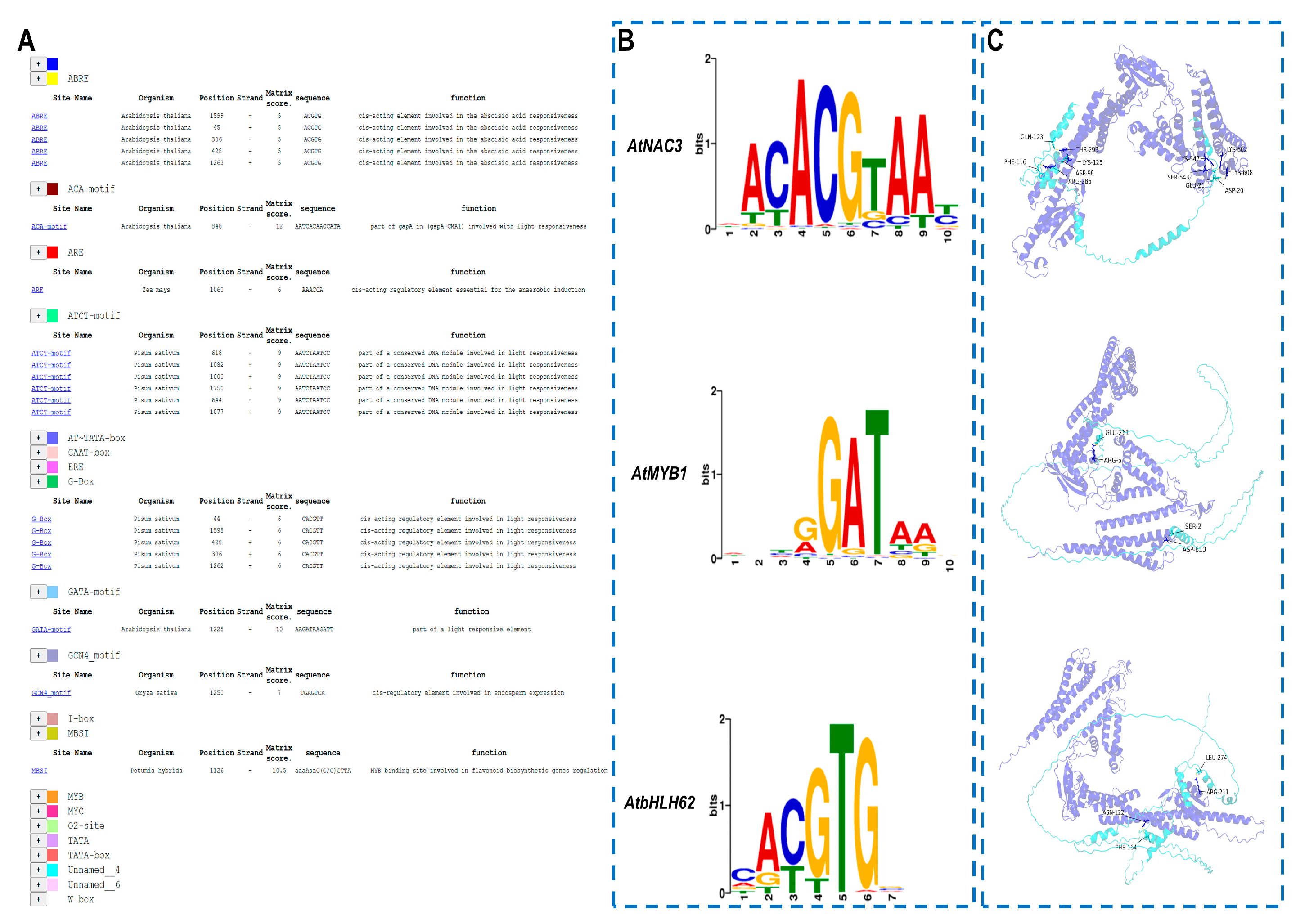
In the promoter region of PoVHA-a3 gene, multiple specific DNA motifs were identified, including several abscisic acid-responsive elements (ABREs) with the conserved sequence ACGTG. These ABRE motifs were distributed at various positions along the promoter sequence, with start sites located at positions of 45, 306, 428. Additionally, other functional cis-acting elements were detected, such as the G-box (CACGTG) involved in light responsiveness, the anaerobic response element ARE (TGGTTT), and the MYB transcription factor binding site MBS (TAACTG). Core promoter elements, including the TATA-box and CAAT-box, were also present (Figure 2A). Based on the prediction and analysis of the A. thaliana transcription factor family, three representative transcription factors, AtNAC3 (NAC family), AtMYB1 (MYB family), and AtbHLH62 (bHLH family), were selected, and sequence logos of their specific binding motifs were generated. Statistical analysis of the position weight matrix revealed that AtNAC3 exhibited significantly higher scores for guanine or cytosine at specific positions, suggesting that these sites may serve as core interaction residues. AtMYB1 showed a strong preference for thymine or adenine at the 2nd and 6th positions, displaying typical binding characteristics of the MYB family. For AtbHLH62, strict preferences for the half-site NTG were observed at the 5th and 6th positions, consistent with the structural binding features of the bHLH family (Figure 2B). Additionally, as shown in Figure 2C, molecular docking and structural simulation revealed that the NAC domain of AtNAC3 and the cytosolic domain of the PoVHA-a3 protein formed multiple hydrogen bonds and hydrophobic interactions. The basic residues (Lys, Arg) of AtMYB1 formed salt bridges with the acidic residues (Asp, Glu) in PoVHA-a3 protein, which likely underpins the specificity of their interaction. AtbHLH62 engaged with the aromatic residues (Phe, Tyr) of PoVHA-a3 protein via its bHLH dimerization domain, thereby stabilizing the complex conformation.

3.2. Subcellular Localization and Functional Characterization of PoVHA-a3 in Salt Tolerance

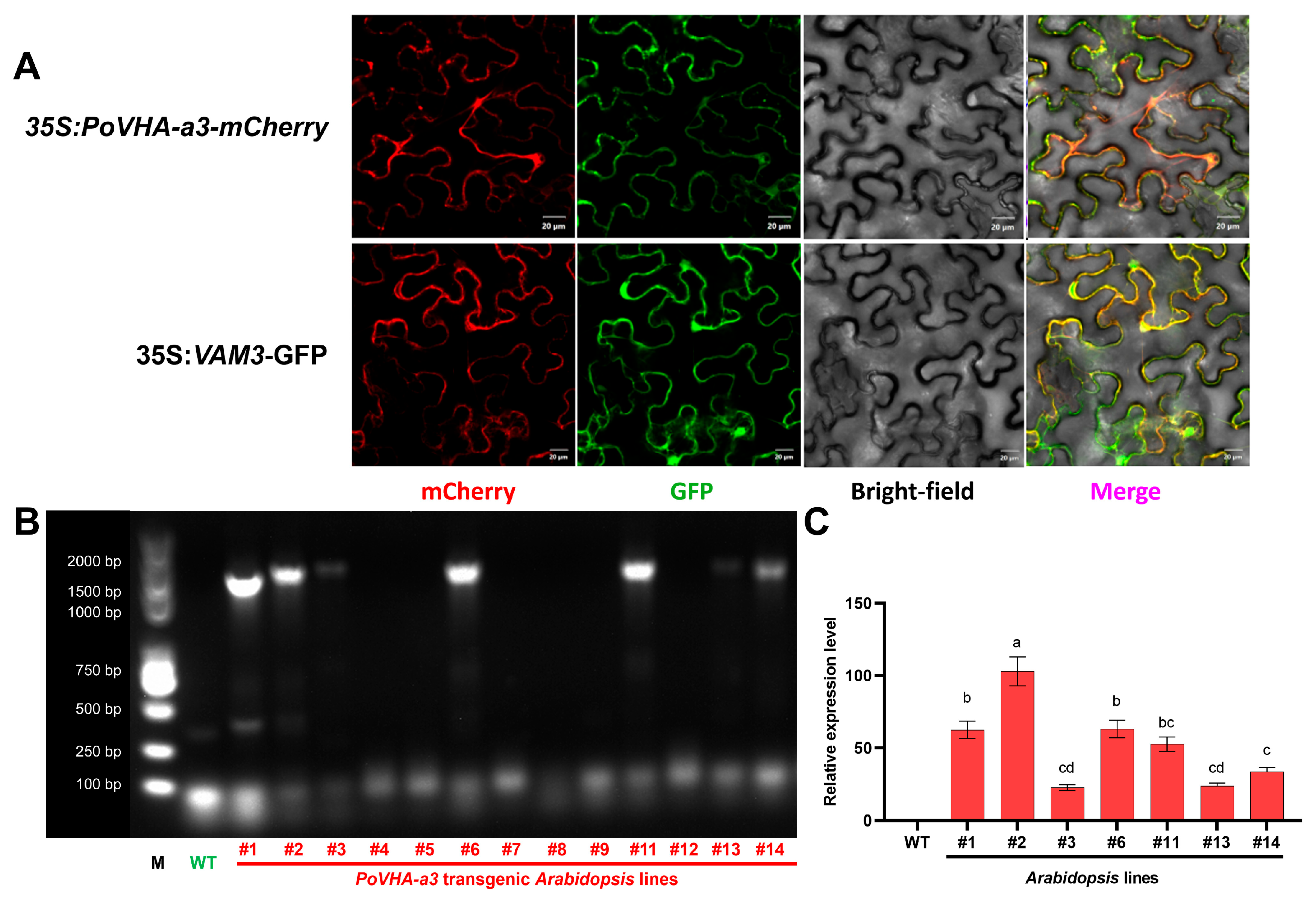
To delineate the subcellular compartmentalization of PoVHA-a3 protein, 35S:PoVHA-a3-mCherry and 35S:VAM3-GFP (control group, vacuolar membrane marker) were expressed in N. benthamiana leaf epidermal cells, and their fluorescence signals were compared. As shown in Figure 3A, under the mCherry channel, the 35S:PoVHA-a3-mCherry fusion protein exhibited a distinct ring-shaped red fluorescence signal outlining the boundaries of large intracellular compartments, indicating specific localization to the membrane enclosing these structures. In the GFP channel, the 35S:VAM3-GFP fusion protein, a known vacuolar membrane marker, produced a green-fluorescent ring at the tonoplast, providing a reference for vacuolar membrane localization. In the merged channel, combined with bright-field imaging, the mCherry and GFP signals were observed to co-localize precisely at the vacuolar boundary, demonstrating that the subcellular localization of PoVHA-a3 protein was consistent with that of VAM3 and confirming its tonoplast localization. In addition, to identify PoVHA-a3 expression Arabidopsis lines for salt tolerance assays, T3 transgenic Arabidopsis lines were screened using semi-quantitative RT-PCR and qRT-PCR to detect high expression levels of PoVHA-a3. As shown in Figure 3B, semi-quantitative RT-PCR analysis confirmed the transcription of the PoVHA-a3 gene in half-examined transgenic Arabidopsis lines (lines #1, #2, #3, #6, #11, #13, #14), as evidenced by the amplification of a specific band of the predicted size. Furthermore, qRT-PCR revealed significantly higher PoVHA-a3 transcript levels in lines #1, #2, and #6 compared to the other transgenic lines (Figure 3C). Based on their strong expression, these three lines were selected for subsequent functional studies.
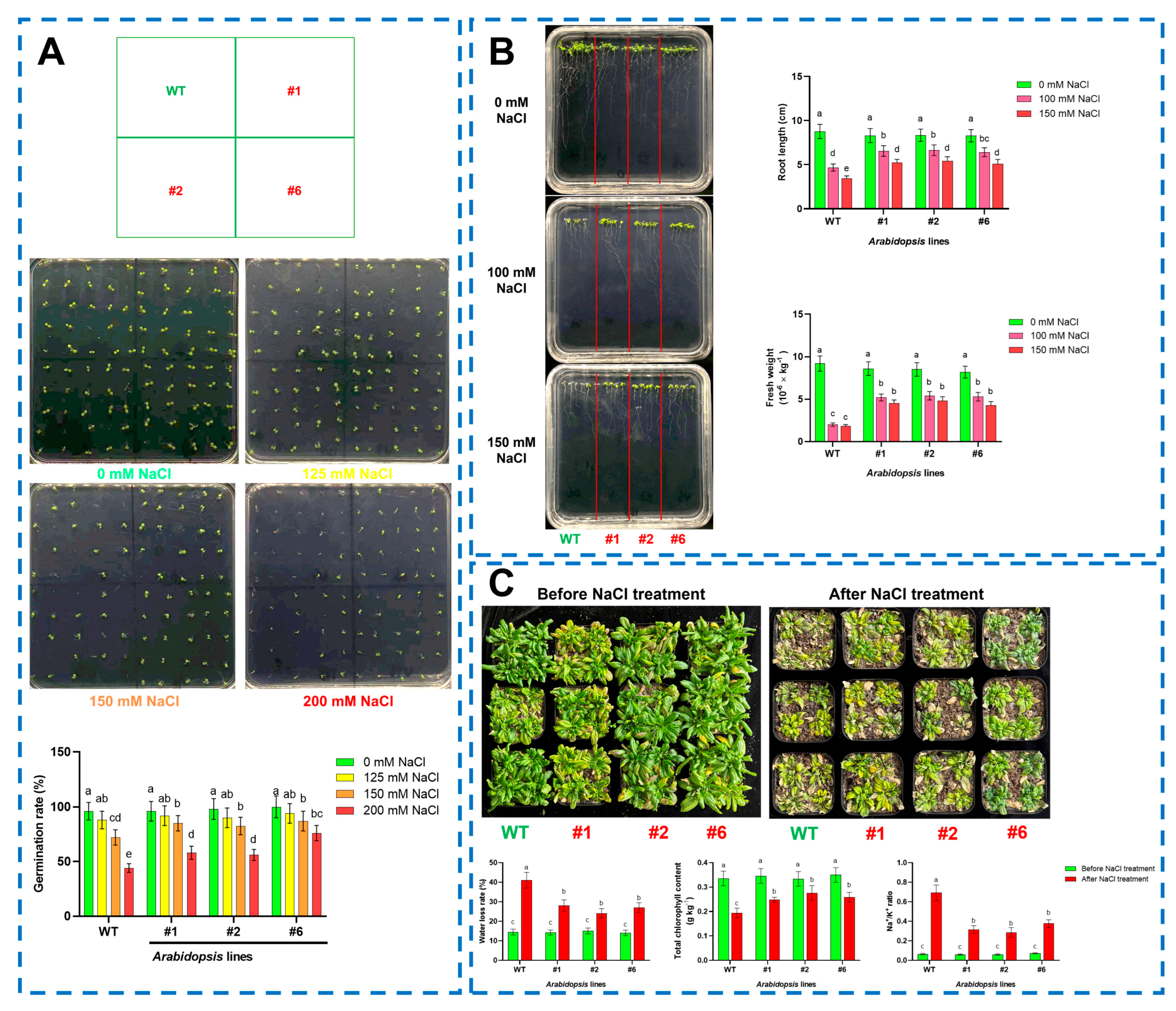
The seed germination assay under salt stress demonstrated that increasing NaCl concentration was significantly correlated with decreased germination rates, and ectopic expression of PoVHA-a3 significantly improved salt tolerance in transgenic Arabidopsis lines. At a moderate stress level of 125 mM NaCl treatment, germination rates of the WT and PoVHA-a3 transgenic lines started to differentiate, with #6 showing a higher rate (92.25%) than WT (88.13%). Exposure to 150 mM NaCl revealed a significant transgenic advantage, as lines #1, #2, and #6 displayed germination rates of 85.37%, 82.53%, and 87.16%, respectively, all significantly surpassing WT rate of 72.33%. Under the extreme stress of 200 mM NaCl treatment, the germination rate of line #6 reached 76%, which was 72.76% higher than that of WT (44.35%) (Figure 4A). These data confirm that PoVHA-a3 expression effectively maintained seed germination under high-salinity conditions.
The role of PoVHA-a3 in salt tolerance was investigated at the seedling stage by comparing WT and transgenic Arabidopsis lines (lines #1, #2, #6) under control and salt-stress conditions. Under non-stress conditions, all genotypes displayed comparable growth. Exposure to 100 mM NaCl stress induced noticeable phenotypic variation. The root length and fresh weight of WT plants were reduced to 4.68 cm and 2.12 × 10⁻⁶ kg per plant, respectively. The transgenic lines, however, demonstrated enhanced capacity to maintain growth. It was noteworthy that line #2 displayed the most significant tolerance, with root length and fresh weight measurements of 6.64 cm and 5.4 × 10⁻⁶ kg per plant, which exceeded WT values by 40.42% and 135.73%, respectively. At the higher stress level of 150 mM NaCl, root growth in WT plants was strongly suppressed, reaching only 3.43 cm. In contrast, the transgenic lines (lines #1, #2, #6) maintained significantly longer roots, measuring 5.21 cm, 5.43 cm, and 5.16 cm, respectively. Line #2 showed the most notable enhancement, with a root length that exceeded WT by 58.81%. A similar trend was observed for fresh weight, which declined under salt stress but remained higher in transgenic plants. The fresh weight of WT was reduced to 1.81 × 10⁻⁶ kg per plant, while transgenic lines #1, #2, and #6 attained 4.52 × 10⁻⁶, 4.83 × 10⁻⁶, and 4.36 × 10⁻⁶ kg per plant, respectively. It was found that under 150 mM NaCl, line #2 accumulated 2.67 times the fresh weight of WT (Figure 4B).
To further functionally characterize the role of PoVHA-a3 in salt tolerance, a physiological analysis was performed using mature soil-grown plants of WT and PoVHA-a3 transgenic Arabidopsis lines. It was observed that before salt stress, no visible differences in morphology, including leaf color, expansion, and overall plant size, were observed between the WT and transgenic lines, confirming that PoVHA-a3 expression does not affect the normal growth of A. thaliana. Furthermore, the physiological response to NaCl stress varied markedly between genotypes. In WT plants, the loss of cellular Na+/K+ ratio homeostasis was manifested as severe salt damage, including rosette growth inhibition, leaf wilting, and extensive chlorosis, collectively pointing to a critical breakdown in water balance and photosynthetic function (Figure 4C). The data showed that under salt stress, the Na+/K+ ratio in WT plants increased to 0.69, while the transgenic lines #1, #2, and #6 exhibited significantly lower ratios of 0.31, 0.28, and 0.37, respectively. This indicated that PoVHA-a3 expression effectively reduced cytosolic Na+ toxicity and maintained higher K+ levels, thereby supporting enzyme activity and cellular metabolism. Meanwhile, the water loss rate in WT reached 41.86%, whereas the transgenic lines #1, #2, and #6 showed significantly lower rates of 28.35%, 24.17%, and 27.25%, respectively, suggesting that PoVHA-a3 expression helped maintain cellular water balance and reduced dehydration-induced wilting. Additionally, under salt stress, the chlorophyll content in WT decreased to 0.19 g kg−1, while the transgenic lines retained higher levels of #1 (0.25 g kg−1), #2 (0.29 g kg−1), and #6 (0.24 g kg−1). This demonstrated that PoVHA-a3 expression helped protect chloroplast structure and function, sustaining photosynthetic efficiency and delaying leaf chlorosis.

3.3. The Effect of PoVHA-a3 on Energy Production of Arabidopsis Under Salt Stress

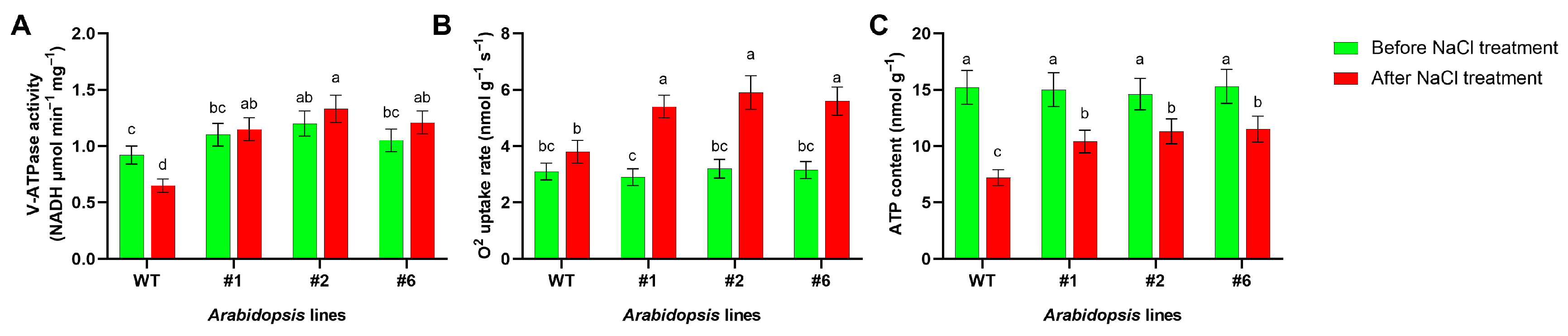
To investigate the effect of PoVHA-a3 expression on endogenous V-ATPase activity in Arabidopsis, we measured the V-ATPase enzymatic activity in leaves of WT and transgenic lines. Under normal conditions, V-ATPase activity was comparable between WT and transgenic plants. However, after salt treatment, this enzyme activity in WT decreased significantly to 0.65 μmol min−1 mg−1, whereas all transgenic lines maintained considerably higher activity levels, with line #1 at 1.15 μmol min−1 mg−1, #2 at 1.33 μmol min−1 mg−1, and #6 at 1.21 μmol min−1 mg−1, with line #2 exhibiting the highest activity. These results indicate that PoVHA-a3 expression helped sustain efficient V-ATPase operation under salt stress, thereby facilitating precise energy allocation for proton gradient establishment and enhanced stress resistance (Figure 5A). To investigate the effect of PoVHA-a3 expression on respiration intensity in Arabidopsis, we measured the O2 uptake rate in leaf tissues as an indicator of respiratory rate. Under normal growth conditions, the basal O2 uptake rates were comparable across the WT and transgenic lines, #1, #2, and #6 showed rates of 2.92, 3.24, and 3.15 nmol·g−1·s−1, respectively. These results suggest that PoVHA-a3 expression did not alter the basal energy metabolism of Arabidopsis plants under normal conditions. Under salt stress, however, O2 uptake rates increased markedly in all lines, with a more elevation in transgenic plants compared to WT. The O2 uptake rate of WT plants increased only to 3.82 nmol·g−1·s−1, whereas those of lines #1, #2, and #6 rose to 5.43, 5.93, and 5.61 nmol·g−1·s−1, respectively. Among the transgenic lines, #2 displayed the highest O2 uptake rate under salt stress (Figure 5B). In addition, we measured the ATP content in the leaves of WT and PoVHA-a3 transgenic lines to explore the impact of changes in respiration rate and V-ATPase activity on intracellular energy production. The data showed that under salt stress, the ATP content in WT plants significantly decreased from 15.2 nmol g−1 to 7.22 nmol g−1, indicating severe impairment of their energy metabolism system. In contrast, the ATP content in transgenic lines #1, #2, and #6 declined only to 10.4, 11.3, and 11.5 nmol g−1, respectively, all of which were significantly higher than that in WT. Among these, line #2 maintained the highest ATP level (Figure 5C). These findings suggest that under salt stress, PoVHA-a3 expressing Arabidopsis plants enhanced respiratory intensity to synthesize more ATP, while maintaining high V-ATPase activity to allocate energy for establishing a proton gradient that drives stress resistance mechanisms. As a result, these plants exhibited higher cellular ATP levels, contributing to their higher salt tolerance.

3.4. The Effect of PoVHA-a3 on Aba-Br Antagonism in Arabidopsis Under Salt Stress

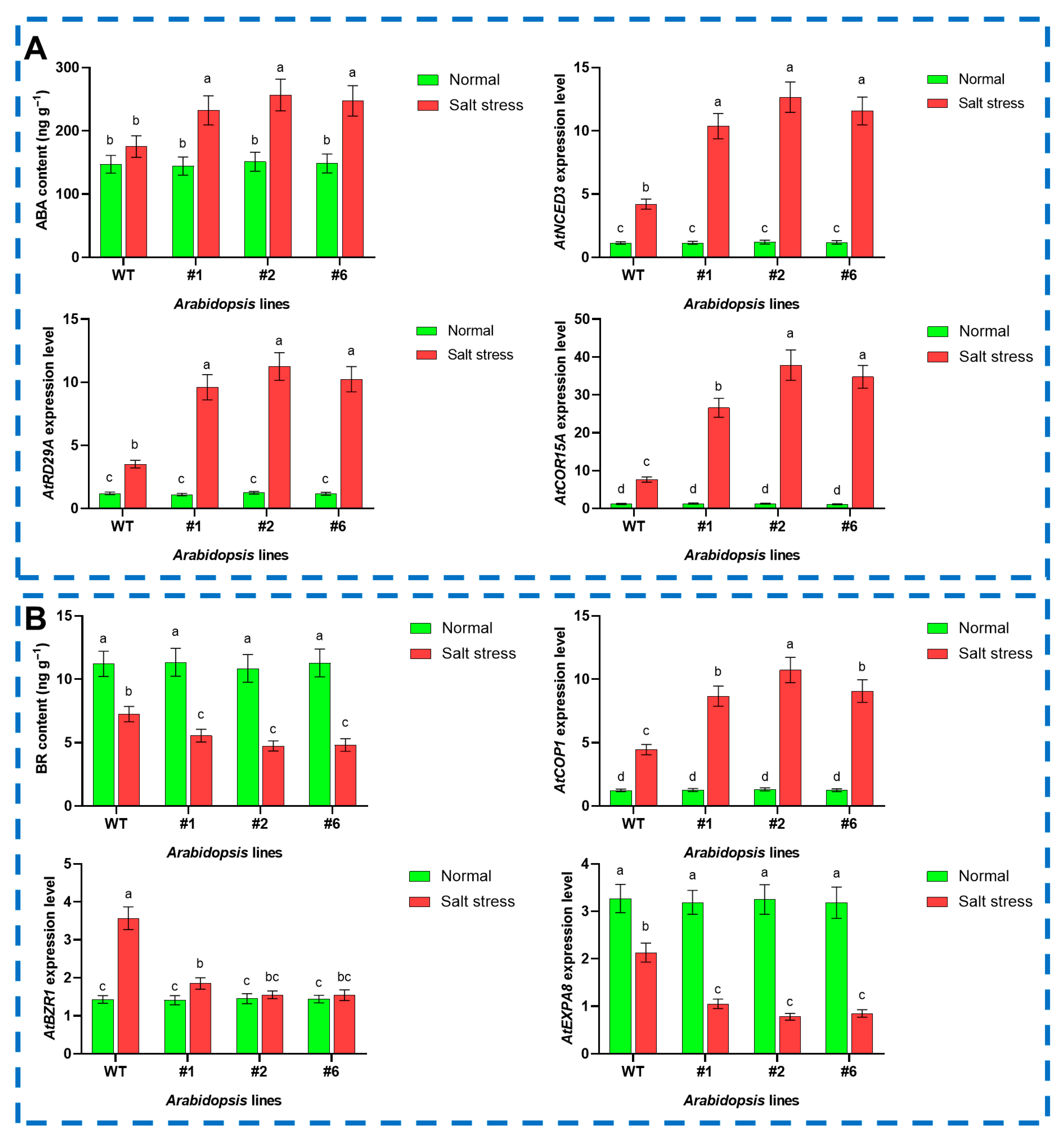
The presence of multiple ABA-responsive elements (ABREs) in PoVHA-a3 promoter, as identified by in silico analysis, posits a potential link between ABA signaling and PoVHA-a3 function (Figure 2). To investigate the interaction mechanism between PoVHA-a3 and phytohormone, we conducted physiological and molecular analyses on the biosynthesis and signal transduction of ABA and BR. As shown in Figure 6A, salt stress treatment significantly induced the accumulation of endogenous ABA in both WT and PoVHA-a3 transgenic Arabidopsis plants. Compared to WT, all transgenic lines (lines #1, #2, #6) exhibited a more pronounced ABA accumulation response under salt stress. Quantitative analysis revealed that endogenous ABA content was significantly higher in the transgenic lines than in WT under salt stress. Notably, line #2 showed the most significant increase, with an ABA level of 256.72 ng·g−1, which was 1.47-fold that of WT (175.24 ng·g−1). The ABA contents in lines #1 and #6 were 232.33 ng·g−1 and 247.46 ng·g−1, corresponding to 1.33-fold and 1.41-fold increases over WT, respectively. At the molecular level, salt stress also markedly upregulated the expression of core components of the ABA signaling pathway. The relative expression level of AtNCED3, which encodes a rate-limiting enzyme in ABA biosynthesis, was higher in the transgenic lines than in WT. Among them, line #2 displayed the highest relative expression level of AtNCED3, reaching 3.01-fold that of WT. Furthermore, the expression levels of AtRD29A (an early responsive ABA gene) and AtCOR15A (a downstream functional gene) followed a similar trend. In line #2, the expression levels of AtRD29A and AtCOR15A were 11.25 and 37.86, respectively, representing 3.20-fold and 4.94-fold increases compared to WT.
We also observed that PoVHA-a3 transgenic lines exhibited greater suppression at multiple nodes of the BR signaling pathway under salt stress (Figure 6B). Quantitative analysis showed that salt stress led to a reduction in endogenous BR levels, with a more dramatic decrease in transgenic plants. Specifically, the BR content in line #2 was reduced to 4.74 ng·g−1, only 65.12% of that in WT (7.25 ng·g−1). The BR contents in lines #1 and #6 were 5.56 ng·g−1 and 4.82 ng·g−1, equivalent to 0.77-fold and 0.66-fold of the WT level, respectively. At the molecular level, the relative expression of AtCOP1, which encodes an E3 ubiquitin ligase, was 2.41-fold higher in line #2 compared to WT. Correspondingly, the expression of the key BR signaling transcription factor AtBZR1 and its direct downstream target AtEXPA8 was significantly suppressed in transgenic lines. In line #2, the relative expression levels of AtBZR1 and AtEXPA8 were as low as 1.55 and 0.78, respectively, representing only 0.43-fold and 0.37-fold of the WT levels. These data demonstrate that PoVHA-a3 expression systemically attenuated the BR-mediated signaling pathway under salt stress by upregulating AtCOP1 and coordinately suppressing the AtBZR1-AtEXPA8 signaling module.

3.5. The Effect of PoVHA-a3 on Ros Scavenging in Arabidopsis Under Salt Stress

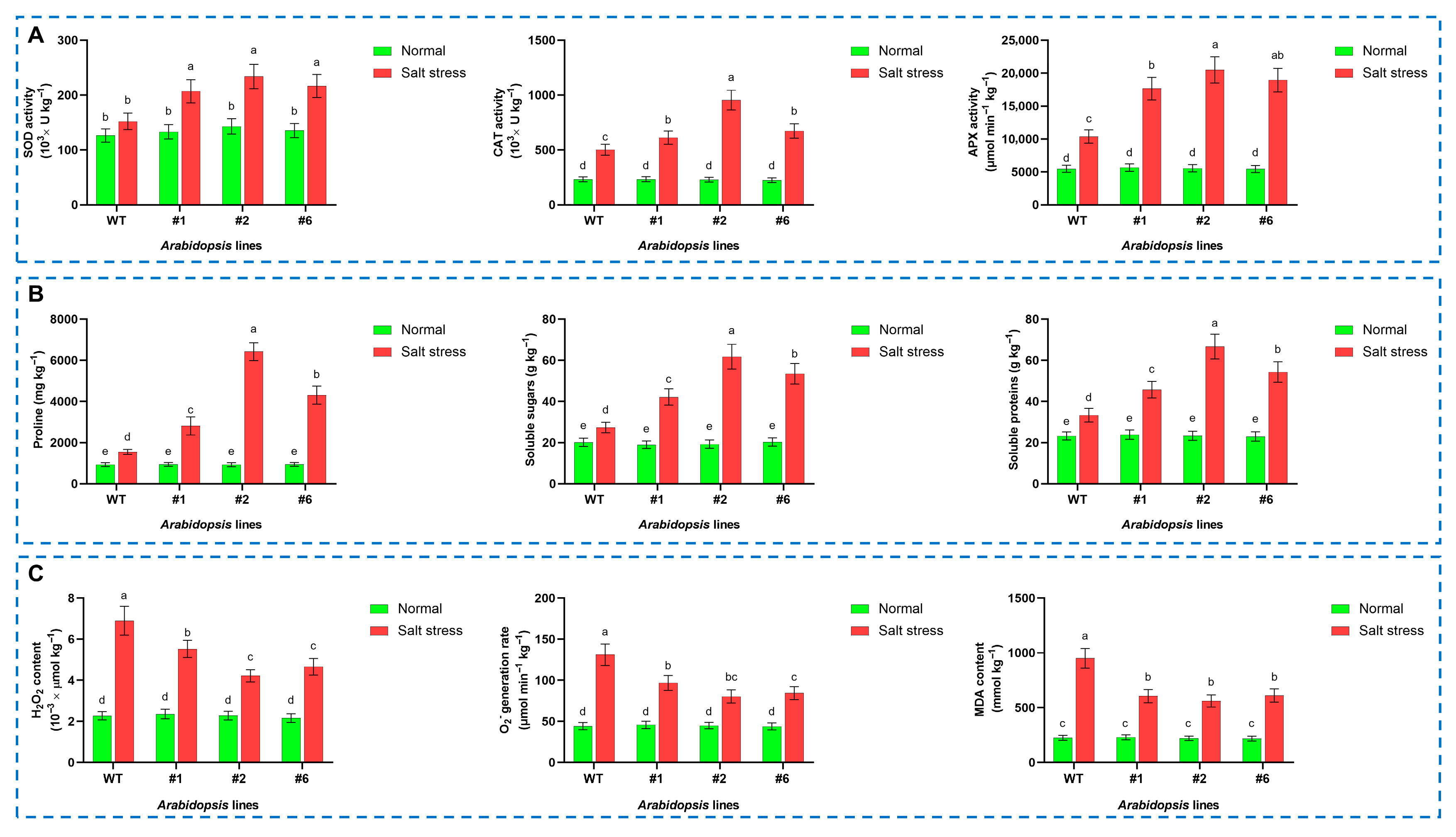
Given that ABA accumulation contributes to the scavenging of excess ROS induced by salt stress through enzymatic and non-enzymatic systems, we systematically compared antioxidant enzyme activities, osmolyte contents, and ROS levels in WT and PoVHA-a3 transgenic Arabidopsis plants. Under normal conditions, no significant differences were observed between WT and transgenic lines in terms of SOD, CAT, and APX activities, proline, soluble sugar, and soluble protein contents, as well as levels of H2O2, O2 production rate, and MDA. However, following salt stress treatment, the transgenic plants exhibited significantly higher antioxidant enzyme activities than WT. Among all transgenic lines, line #2 showed the most prominent enhancement, with the activities of SOD, CAT, and APX being 1.54, 1.90, and 1.97 times higher than those in WT plants, respectively (Figure 7A). Meanwhile, as shown in Figure 7B, transgenic lines accumulated significantly higher levels of proline, soluble sugars, and soluble proteins. Specifically, line #2 exhibited a proline content of 6423.04 mg·kg−1, which was 4.15-fold higher than that of WT (1548.42 mg·kg−1). Its soluble sugars and soluble proteins contents reached 61.76 g·kg−1 and 66.73 g·kg−1, representing 2.4-fold and 1.8-fold increases over WT levels, respectively. In addition, salt stress induced ROS excessive accumulation in WT plants. In contrast, PoVHA-a3 transgenic lines, particularly line #2, exhibited a marked advantage in mitigating oxidative damage (Figure 7C). The H2O2 content in line #2 under salt stress was only 61.11% of the WT level. The O2 generation rate in line #2 was reduced by 38.75% compared to WT. Furthermore, the MDA level in line #2 was merely 43% of the WT value. These results demonstrate that PoVHA-a3 expression enhanced antioxidant capacity in transgenic Arabidopsis lines, enabling more effective scavenging of excess ROS induced by salt stress through both enzymatic and non-enzymatic systems, thereby leading to improved salt tolerance.

4. Discussion

4.1. Synergistic Regulation of PoVHA-a3 Expression by TFs in Response to Salt Stress

Plant salt tolerance is coordinated by a complex regulatory mechanism, mediated through the precise transcriptional regulation achieved when activated TFs bind to cis-acting elements in stress-responsive gene promoters [38]. In this study, the promoter region of the PoVHA-a3 gene was found to hold a variety of cis-acting elements implicated in stress responses, such as ABRE and MBS. This observation indicates that PoVHA-a3 expression may be regulated by a complex transcriptional regulatory network involving multiple TF families, including NAC, MYB, and bHLH (AtNAC3, AtMYB1, AtbHLH62), thereby pointing to a potential mechanism for integrating diverse environmental signals. Thus, it is hypothesized that NAC, MYB, and bHLH TFs function synergistically or in a cascade during the initial salt stress period, thereby collectively activating PoVHA-a3 expression. The potential for divergent DNA-binding specificities between species necessitates the functional validation of precise regulatory interactions in the native context of P. oleracea, for which knockout of these TFs is required to determine their role in controlling PoVHA-a3 expression. NAC, bHLH, MYB, and WRKY function as central regulators in plant salt tolerance, orchestrating adaptive responses in ion homeostasis, osmotic adjustment, and signaling to confer resilience under saline conditions [39]. In Triticum aestivum, the promoter of TaNAC071 A contains a specific 108 bp insertion with two MYB cis-elements, enabling direct binding by the transcription activator TaMYBL1 to initiate gene transcription and collectively improve wheat drought resistance [40]. In addition, the stress responses mediated by TFs are characterized by specificity and diversity. This is exemplified by MYBs, which recognize specific DNA sequences via their R2R3 domains and often interact with ABRE elements under salt stress to integrate ABA signaling pathways [41]. Here, our results demonstrate that these TFs could specifically bind to the PoVHA-a3 promoter via their characteristic DNA-binding domains (the basic residues of the NAC domain, the helix-turn-helix structure of MYB, and the leucine zipper of bHLH). The binding stability arises from hydrogen bonds, salt bridges, and hydrophobic interactions, which collectively drive the assembly of a stable transcription initiation complex. Interestingly, transcriptomic analysis of P. oleracea under salt stress revealed a distinct regulatory strategy for the V-ATPase complex. Unlike the coordinated upregulation of multiple subunits observed in glycophytes like T. aestivum [42], most PoVHA subunits in purslane maintained stable transcript levels. This suggests that purslane may rely on a high constitutive level of V-ATPase activity, which is precisely fine-tuned under stress through the specific induction of key regulatory subunits such as PoVHA-a3. This targeted regulation, potentially complemented by post-translational mechanisms, may represent an efficient adaptation for rapid stress acclimation in halophytes, highlighting a more refined regulatory logic compared to glycophytes.
In Arachis hypogaea, AhNAC3, a nuclear-localized transactivator, enhances drought tolerance in transgenic tobacco by activating protective genes and promoting proline-mediated osmotic adjustment [43]. The MYB-like transcription factor Salt-Related MYB1 (AtSRM1) acts as a negative regulator of seed germination under saline conditions in Arabidopsis by modulating ABA homeostasis [44]. Additionally, phytosulfokine α enhanced chilling tolerance in postharvest peach fruit by activating PpbHLH62, which directly upregulates the expression of PpGAD4, PpP5CS, and PpOAT [45]. These reports indicate that PoVHA-a3 acts as an integral component within the conserved NAC/MYB/bHLH transcriptional network, orchestrating the integration of multiple stress signaling pathways to enhance the salt tolerance of P. oleracea. They also offer testable hypotheses for future mechanistic studies, particularly through experimental approaches such as ChIP-qPCR and Co-IP that would provide direct evidence for these regulatory interactions. Furthermore, isolation of the PoVHA-a3 promoter for driving reporter expression in transgenic purslane will allow for visual mapping of its salt-stress-induced expression pattern and functional dissection of predicted cis-regulatory elements.

4.2. PoVHA-a3 Enhanced Ion Compartmentalization and Osmotic Adjustment Capacity by Optimizing Energy Metabolism

Here, the results from protein 3D structure prediction and subcellular localization experiments confirmed that the protein encoded by PoVHA-a3 was localized to the vacuolar membrane. This finding suggests that, as a V-ATPase complex a subunit, PoVHA-a3 may affect vacuolar ion compartmentalization and pH homeostasis by regulating proton pump activity. The Arabidopsis V-ATPase, which generated turgor pressure for cell growth and ion homeostasis, required its B subunit AtVAB3, as evidenced by the disrupted ionic balance and salt stress hypersensitivity in the AtVAB3 mutant [46]. In addition, it has been demonstrated that the PutVHA-c gene from Puccinellia tenuiflorais primarily localized to the endosomal compartments. Its overexpression in transgenic Arabidopsis has been shown to enhance V-ATPase activity, thereby promoting plant growth [47]. Similarly, in our study, it was found that the expression of PoVHA-a3 in Arabidopsis significantly increased V-ATPase activity, respiratory rate, and ATP levels under salt stress. Therefore, a positive feedback loop is formed whereby increased V-ATPase activity drives ATP consumption, which is compensated for by an enhanced respiratory rate. This metabolic coupling allows for transgenic lines (lines #1, #2, and #6) to sustain higher ATP levels under salt stress, thus providing the energy basis for their enhanced resistance physiology. In addition, the promoted ATP biosynthesis and respiratory rate resulting from PoVHA-a3 expression suggest an enhancement in energy metabolism, which may furnish the requisite ATP supply for the increased V-ATPase activity observed, given the ATP-dependent nature of this proton pump [48]. In plants, by generating an increased proton motive force, the enhanced V-ATPase activity powers the vacuolar Na+/H+ antiporters to compartmentalize excess Na+ from the cytoplasm into the vacuole [49]. This is critical for maintaining a low cytosolic Na+ environment and a stable Na+/K+ ratio, effectively shielding intracellular enzymes, particularly those in the mitochondrial respiratory chain, from Na+ toxicity [50]. Therefore, in this study, the enhanced respiratory rate is a physiological consequence of improved ion homeostasis, indicating the protective effect of PoVHA-a3 expression on respiratory substrates and mitochondrial function. Furthermore, we found that under salt stress, the leaves of PoVHA-a3 transgenic Arabidopsis lines exhibited a significant reduction in the Na+/K+ ratio compared to WT. This phenomenon indicates that PoVHA-a3 optimized cellular energy metabolism, which was attributed to enhanced V-ATPase activity, an increased respiratory rate, and elevated ATP production. Sufficient energy supply thus ensures the maintenance of stable ion homeostasis within the cell. In addition, the observed salt tolerance in our transgenic lines correlates with PoVHA-a3 expression and V-ATPase activity, and future protein-level quantification using Western blot or ELISA will offer additional validation.
In addition to ion compartmentalization, sufficient energy supply also provides an energy basis for the synthesis and accumulation of osmoregulatory substances [51]. In this study, assessment of osmotic adjustment under salt stress revealed that the PoVHA-a3 transgenic lines (line #1, #2, #6) surpassed WT in accumulating proline, soluble sugars, and soluble proteins, with the highest accumulation coinciding with the strongest PoVHA-a3 expression in line #2, underscoring PoVHA-a3’s role in enhancing osmotic adjustment capacity. These findings also indicate that the active accumulation of osmoregulatory substances in PoVHA-a3 transgenic plants significantly decreased cellular osmotic potential, which explains the observed reduction in water loss rate. This mechanism maintains a water potential gradient conducive to environmental water absorption under saline conditions, allowing plants to sustain cell turgor and essential physiological functions [52]. Additionally, it has been reported that in certain halophytes, a key component of salt tolerance involves the synthesis of diverse osmoregulatory substances [53]. These solutes facilitate the control of ion and water movement, aid in the removal of oxygen free radicals, and enable plants to cope with stress via an energy-saving mechanism [54]. Our key future objective is therefore to accurately determine the compartment-specific distribution and functional contribution of these osmolytes in purslane, which will yield crucial insights into the precise mechanisms of their synergistic function. A key direction for future research will be to determine the subcellular compartmentation of osmolytes, particularly the partitioning between cytoplasmic and vacuolar pools, to fully understand how P. oleracea optimizes osmotic adjustment at the cellular level.

4.3. PoVHA-a3 Modulates the Aba-Br Antagonistic Balance to Attenuate Ros Accumulation

A key challenge for plants under salt stress is balancing the energy demands of growth against those of survival [55]. The antagonistic interaction between the stress hormone ABA and the growth-promoting hormone BR is crucial for this balancing mechanism [18]. While traditionally viewed as antagonistic, emerging evidence indicates their interaction can be context-dependent, exhibiting synergy under certain conditions to optimize the response [56]. The antagonistic interaction between ABA and BR signaling serves as a key mechanism for plants to prioritize their resource allocation. Stress-induced ABA signaling curbs BR-driven growth to conserve energy for stress responses [57], whereas under favorable conditions, BR signaling represses ABA pathways to fine-tune the balance between growth and defense [58]. The interplay between ABA and BR signaling is contingent on concentration and timing. It shifts from synergy under mild stress to antagonism under severe conditions, thereby optimizing resource allocation between growth and defense processes [59]. In our study, the data demonstrated that under salt stress, in the PoVHA-a3 transgenic lines, particularly line #2, the endogenous ABA content was significantly higher than that in WT. Consistent with this, the expression of AtNCED3, a gene encoding the rate-limiting enzyme for ABA biosynthesis, was strongly induced. Furthermore, a substantial upregulation was observed in the transcript levels of the early ABA-responsive gene AtRD29A and the late functional gene AtCOR15A. Together, these results demonstrate that PoVHA-a3 expression systemically activates the ABA signaling pathway, enhancing the pathway from hormone biosynthesis to downstream stress-responsive gene expression. In addition, the expression of PoVHA-a3 led to a significant decrease in endogenous BR content under salt stress, which was associated with the upregulation of the E3 ligase gene AtCOP1 (2.41-fold) and the downregulation of the BR signaling master regulator AtBZR1 (0.43-fold) and its target AtEXPA8 (0.37-fold). This series of molecular events demonstrated that PoVHA-a3-mediated activation of ABA signaling ultimately suppressed the BR-dependent growth pathway in Arabidopsis.
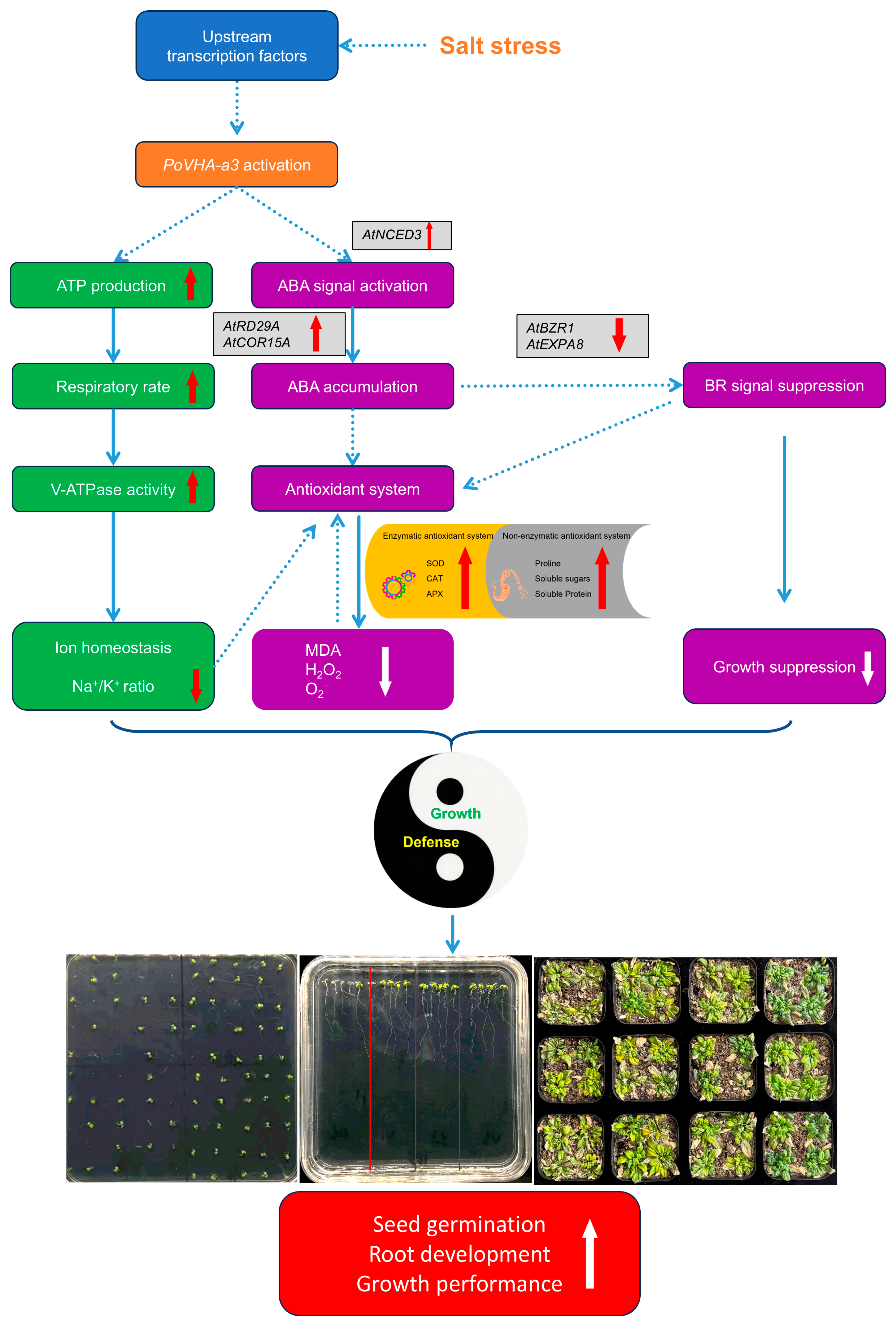
In this study, we observed that enhanced ABA signaling occurred with the activation of both enzymatic and non-enzymatic antioxidant defense systems in PoVHA-a3 transgenic lines. In transgenic Arabidopsis lines, the activities of key antioxidant enzymes were significantly higher than those in WT. Notably, the upregulation of APX, a core component of the ascorbate-glutathione (ASA-GSH) cycle, also reflects the coordinated regulation of glutathione metabolism by ABA [60]. Concurrently, the accumulation of osmoprotectants conferred on the transgenic plants, particularly line #2, with an enhanced capacity to scavenge ROS. Consequently, these combined adaptations led to a marked reduction in the content of MDA, a key indicator of membrane lipid peroxidation, thereby preserving cellular membrane integrity and photosynthetic apparatus function [61]. This protective effect was directly evidenced by the higher chlorophyll content and lower water loss rate observed in the transgenic plants under salt stress (Figure 8).

5. Conclusions

Overall, this study identified and characterized PoVHA-a3, a gene encoding a vacuolar H+-ATPase a3 subunit from P. oleracea, as an important regulator conferring comprehensive salt tolerance in Arabidopsis. Subcellular localization confirmed its tonoplast-specific targeting, where it enhances salt tolerance through the coordinated regulation of hormonal signaling and physiological processes. This was characterized by concurrent potentiation of the ABA signaling pathway (evidenced by increased ABA levels and upregulation of AtNCED3, AtRD29A, and AtCOR15A) alongside an attenuation of BR-mediated growth signaling. Simultaneously, transgenic plants exhibited increased ATP levels, which was associated with increased respiratory rate and enhanced V-ATPase activity. This led to a significantly reduced Na+/K+ ratio. Under salt stress, transgenic plants also exhibited reinforced antioxidant defense, with elevated antioxidant enzyme activities leading to reduced oxidative damage, alongside concurrent osmolyte accumulation. These adjustments collectively resulted in enhanced seed germination, vigorous root growth, increased biomass, decreased water loss rate, and maintained higher chlorophyll content. Therefore, our work elucidates the pivotal role of PoVHA-a3 in coordinating energy metabolism, hormonal balance, and antioxidant defense to enhance salt tolerance, and future studies should focus on validating the predicted TF regulatory network and developing PoVHA-a3-based genetic markers for purslane breeding programs.

Supplementary Materials

The following supporting information can be downloaded at: https://www.mdpi.com/article/10.3390/agriculture16010010/s1, Figure S1: The nucleotide and encoded amino acid sequence of PoVHA-a3; Figure S2: (A) Multiple sequence alignment of PoVHA proteins, and colored blocks show distribution of conserved residues. (B) NJ phylogenetic tree constructed based on VHA-a3 protein sequences, showing evolutionary relationships between PoVHA-a3 and VHA-a3 proteins from different plant species, including AtVHA-a3 (NCBI accession No. XP_057527691.1) from Amaranthus tricolor, SoVHA-a3 (XP_021849943.1) from Spinacia oleracea, CfVHA-a3 (XP_059653743.1) from Cornus florida, MoVHA-a3 (XP_057966146.1) from Malania oleifera, PcVHA-a3 (XP_054786272.1) from Prosopis cineraria, HlVHA-a3 (XP_062076854.1) from Humulus lupulus, and SiVHA-a3 (XP_011088459.1) from Sesamum indicum. Table S1: Primer information for gene amplification and qRT-PCR determination.

Author Contributions

J.X. and G.S.: Data curation, Investigation, Writing—original draft, Formal analysis. S.H. and J.D.: Investigation. T.H., X.Z., Z.Z. and L.H.: Data curation. Y.Q. and Z.Z.: Funding acquisition, Conceptualization, Project administration, Supervision, Writing—review. All authors have read and agreed to the published version of the manuscript.

Funding

We thank all the participants involved in this study. This work was supported by the National Natural Science Foundation of China (31571673), Anhui Provincial Natural Science Foundation (2308085MC86), Yancheng City Key Laboratory Project of Salt-alkali Land Comprehensive Utilization (YCBM202403-06) and Yancheng City Basic Research Program Youth Fund (YCBK2024014).

Data Availability Statement

The data presented in this study are available on request from the corresponding author.

Conflicts of Interest

The authors declare no conflicts of interest.

References

  1. Wang, M.; Li, C.; Li, J.; Hu, W.; Yu, A.; Tang, H.; Li, J.; Kuang, H.; Zhang, H. Extraction, Purification, Structural Characteristics, Biological Activity and Application of Polysaccharides from Portulaca oleracea L. (Purslane): A Review. Molecules 2023, 28, 4813. [Google Scholar] [CrossRef]
  2. Carrascosa, A.; Pascual, J.A.; Ros, M.; Petropoulos, S.A.; Alguacil, M.D.M. Agronomical Practices and Management for Commercial Cultivation of Portulaca oleracea as a Crop: A Review. Plants 2023, 12, 1246. [Google Scholar] [CrossRef] [PubMed]
  3. Iranshahy, M.; Javadi, B.; Iranshahi, M.; Jahanbakhsh, S.P.; Mahyari, S.; Hassani, F.V.; Karimi, G. A review of traditional uses, phytochemistry and pharmacology of Portulaca oleracea L. J. Ethnopharmacol. 2017, 205, 158–172. [Google Scholar] [CrossRef]
  4. Jalali, J.; Ghasemzadeh Rahbardar, M. Ameliorative effects of Portulaca oleracea L. (purslane) on the metabolic syndrome: A review. J. Ethnopharmacol. 2022, 299, 115672. [Google Scholar] [CrossRef]
  5. Li, Y.; Zeng, H.; Xu, F.; Yan, F.; Xu, W. H+-ATPases in Plant Growth and Stress Responses. Annu. Rev. Plant Biol. 2022, 73, 495–521. [Google Scholar] [CrossRef]
  6. Falhof, J.; Pedersen, J.T.; Fuglsang, A.T.; Palmgren, M. Plasma Membrane H+-ATPase Regulation in the Center of Plant Physiology. Mol. Plant 2016, 9, 323–337. [Google Scholar] [CrossRef]
  7. Sze, H.; Chanroj, S. Plant Endomembrane Dynamics: Studies of K+/H+ Antiporters Provide Insights on the Effects of pH and Ion Homeostasis. Plant Physiol. 2018, 177, 875–895. [Google Scholar] [CrossRef]
  8. Ahmed, M.Z.; Shimazaki, T.; Gulzar, S.; Kikuchi, A.; Gul, B.; Khan, M.A.; Koyro, H.W.; Huchzermeyer, B.; Watanabe, K.N. The influence of genes regulating transmembrane transport of Na+ on the salt resistance of Aeluropus lagopoides. Funct. Plant Biol. 2013, 40, 860–871. [Google Scholar] [CrossRef] [PubMed]
  9. Cosentino, C.; Di Silvestre, D.; Fischer-Schliebs, E.; Homann, U.; De Palma, A.; Comunian, C.; Mauri, P.L.; Thiel, G. Proteomic analysis of Mesembryanthemum crystallinum leaf microsomal fractions finds an imbalance in V-ATPase stoichiometry during the salt-induced transition from C3 to CAM. Biochem. J. 2013, 450, 407–415. [Google Scholar] [CrossRef] [PubMed]
  10. Silva, P.; Gerós, H. Regulation by salt of vacuolar H+-ATPase and H+-pyrophosphatase activities and Na+/H+ exchange. Plant Signal. Behav. 2009, 4, 718–726. [Google Scholar] [CrossRef]
  11. Nidhi; Iqbal, N.; Khan, N.A. Synergistic effects of phytohormones and membrane transporters in plant salt stress mitigation. Plant Physiol. Biochem. 2025, 221, 109685. [Google Scholar] [CrossRef]
  12. Xu, Z.; Ge, Y.; Zhang, W.; Zhao, Y.; Yang, G. The walnut JrVHAG1 gene is involved in cadmium stress response through ABA-signal pathway and MYB transcription regulation. BMC Plant Biol. 2018, 18, 19. [Google Scholar] [CrossRef] [PubMed]
  13. Miao, R.; Russinova, E.; Rodriguez, P.L. Tripartite hormonal regulation of plasma membrane H+-ATPase activity. Trends Plant Sci. 2022, 27, 588–600. [Google Scholar] [CrossRef] [PubMed]
  14. Xu, Z.; Zhao, Y.; Ge, Y.; Peng, J.; Dong, M.; Yang, G. Characterization of a vacuolar H+-ATPase G subunit gene from Juglans regia (JrVHAG1) involved in mannitol-induced osmotic stress tolerance. Plant Cell Rep. 2017, 36, 407–418. [Google Scholar] [CrossRef]
  15. Liu, J.; Ji, Y.; Zhou, J.; Xing, D. Phosphatidylinositol 3-Kinase Promotes Activation and Vacuolar Acidification and Delays Methyl Jasmonate-Induced Leaf Senescence. Plant Physiol. 2016, 170, 1714–1731. [Google Scholar] [CrossRef]
  16. Yang, X.; Gong, P.; Li, K.; Huang, F.; Cheng, F.; Pan, G. A single cytosine deletion in the OsPLS1 gene encoding vacuolar-type H+-ATPase subunit A1 leads to premature leaf senescence and seed dormancy in rice. J. Exp. Bot. 2016, 67, 2761–2776. [Google Scholar] [CrossRef]
  17. Jiang, Y.T.; Yang, L.H.; Zheng, J.X.; Geng, X.C.; Bai, Y.X.; Wang, Y.C.; Xue, H.W.; Lin, W.H. Vacuolar H+-ATPase and BZR1 form a feedback loop to regulate the homeostasis of BR signaling in Arabidopsis. Mol. Plant 2023, 16, 1976–1989. [Google Scholar] [CrossRef] [PubMed]
  18. Wang, Q.; Yu, F.; Xie, Q. Balancing growth and adaptation to stress: Crosstalk between brassinosteroid and abscisic acid signaling. Plant Cell Environ. 2020, 43, 2325–2335. [Google Scholar] [CrossRef]
  19. Nolan, T.M.; Vukašinović, N.; Liu, D.; Russinova, E.; Yin, Y. Brassinosteroids: Multidimensional Regulators of Plant Growth, Development, and Stress Responses. Plant Cell 2020, 32, 295–318. [Google Scholar] [CrossRef]
  20. Bulgakov, V.P.; Wu, H.C.; Jinn, T.L. Coordination of ABA and Chaperone Signaling in Plant Stress Responses. Trends Plant Sci. 2019, 24, 636–651. [Google Scholar] [CrossRef]
  21. Malik, S.; Walley, J.W. Unveiling a new regulator: Vacuolar V-ATPase mediates brassinosteroid signaling in Arabidopsis. Mol. Plant 2024, 17, 227–229. [Google Scholar] [CrossRef]
  22. Xing, J.C.; Zhao, B.Q.; Dong, J.; Liu, C.; Wen, Z.G.; Zhu, X.M.; Ding, H.R.; He, T.T.; Yang, H.; Wang, M.W.; et al. Transcriptome and Metabolome Profiles Revealed Molecular Mechanisms Underlying Tolerance of Portulaca oleracea to Saline Stress. Russ. J. Plant Physiol. 2020, 67, 146–152. [Google Scholar] [CrossRef]
  23. Clough, S.J.; Bent, A.F. Floral dip: A simplified method for Agrobacterium-mediated transformation of Arabidopsis thaliana. Plant J. 1998, 16, 735–743. [Google Scholar] [CrossRef]
  24. Abramson, J.; Adler, J.; Dunger, J.; Evans, R.; Green, T.; Pritzel, A.; Ronneberger, O.; Willmore, L.; Ballard, A.J.; Bambrick, J.; et al. Accurate structure prediction of biomolecular interactions with AlphaFold 3. Nature 2024, 630, 493–500. [Google Scholar] [CrossRef]
  25. Sun, M.; Qiao, H.X.; Yang, T.; Zhao, P.; Zhao, J.H.; Luo, J.M.; Liu, F.F.; Xiong, A.S. DcMYB62, a transcription factor from carrot, enhanced cadmium tolerance of Arabidopsis by inducing the accumulation of carotenoids and hydrogen sulfide. Plant Physiol. Biochem. 2024, 216, 109114. [Google Scholar] [CrossRef]
  26. Bottanelli, F.; Foresti, O.; Hanton, S.; Denecke, J. Vacuolar transport in tobacco leaf epidermis cells involves a single route for soluble cargo and multiple routes for membrane cargo. Plant Cell 2011, 23, 3007–3025. [Google Scholar] [CrossRef]
  27. Li, Y.; Zhou, J.; Li, Z.; Qiao, J.; Quan, R.; Wang, J.; Huang, R.; Qin, H. SALT AND ABA RESPONSE ERF1 improves seed germination and salt tolerance by repressing ABA signaling in rice. Plant Physiol. 2022, 189, 1110–1127. [Google Scholar] [CrossRef]
  28. Yang, T.; Gan, L.; Peng, X.; Peng, X.; Li, L.; Huang, Y.; Xiong, F.; Wei, M. Overexpression of cassava MeAMY1 and MeBAM3 genes enhance drought and salt stress tolerance in transgenic Arabidopsis. Plant Physiol. Biochem. 2025, 226, 110058. [Google Scholar] [CrossRef] [PubMed]
  29. Jiang, W.; Wang, Z.; Li, Y.; Liu, X.; Ren, Y.; Li, C.; Luo, S.; Singh, R.M.; Li, Y.; Kim, C.; et al. FERONIA regulates salt tolerance in Arabidopsis by controlling photorespiratory flux. Plant Cell 2024, 36, 4732–4751. [Google Scholar] [CrossRef] [PubMed]
  30. Sun, M.; Xu, Q.Y.; Zhu, Z.P.; Liu, P.Z.; Yu, J.X.; Guo, Y.X.; Tang, S.; Yu, Z.F.; Xiong, A.S. AgMYB5, an MYB transcription factor from celery, enhanced β-carotene synthesis and promoted drought tolerance in transgenic Arabidopsis. BMC Plant Biol. 2023, 23, 151. [Google Scholar] [CrossRef] [PubMed]
  31. Bhuria, M.; Goel, P.; Kumar, S.; Singh, A.K. AtUSP17 negatively regulates salt stress tolerance through modulation of multiple signaling pathways in Arabidopsis. Physiol. Plant. 2022, 174, e13635. [Google Scholar] [CrossRef]
  32. Xu, Y.; Yu, Z.; Zhang, S.; Wu, C.; Yang, G.; Yan, K.; Zheng, C.; Huang, J. CYSTM3 negatively regulates salt stress tolerance in Arabidopsis. Plant Mol. Biol. 2019, 99, 395–406. [Google Scholar] [CrossRef]
  33. Kabała, K.; Janicka-Russak, M.; Kłobus, G. Different responses of tonoplast proton pumps in cucumber roots to cadmium and copper. J. Plant Physiol. 2010, 167, 1328–1335. [Google Scholar] [CrossRef]
  34. Shi, Z.; Zhang, Y.; Wang, X.; Pang, H.; Jia, L.; Sun, K.; Zhang, J.; Du, J.; Feng, H. Extracellular ATP sensing in living plant tissues with a genetically encoded, ratiometric fluorescent sensor. New Phytol. 2023, 238, 1343–1350. [Google Scholar] [CrossRef]
  35. Sharma, A.; Ramakrishnan, M.; Khanna, K.; Landi, M.; Prasad, R.; Bhardwaj, R.; Zheng, B. Brassinosteroids and metalloids: Regulation of plant biology. J. Hazard. Mater. 2022, 424, 127518. [Google Scholar] [CrossRef]
  36. Nakashima, K.; Yamaguchi-Shinozaki, K. ABA signaling in stress-response and seed development. Plant Cell Rep. 2013, 32, 959–970. [Google Scholar] [CrossRef]
  37. Ben Rejeb, K.; Lefebvre-De Vos, D.; Le Disquet, I.; Leprince, A.S.; Bordenave, M.; Maldiney, R.; Jdey, A.; Abdelly, C.; Savouré, A. Hydrogen peroxide produced by NADPH oxidases increases proline accumulation during salt or mannitol stress in Arabidopsis thaliana. New Phytol. 2015, 208, 1138–1148. [Google Scholar] [CrossRef]
  38. Zhu, J.K. Salt and drought stress signal transduction in plants. Annu. Rev. Plant Biol. 2002, 53, 247–273. [Google Scholar] [CrossRef] [PubMed]
  39. Admas, T.; Shu, J.; Shalmani, A.; Pan, R.; Zhang, W. Salt stress-responsive transcription factors provide insights to enhance barley improvement: A review. Planta 2025, 262, 56. [Google Scholar] [CrossRef] [PubMed]
  40. Mao, H.; Li, S.; Chen, B.; Jian, C.; Mei, F.; Zhang, Y.; Li, F.; Chen, N.; Li, T.; Du, L.; et al. Variation in cis-regulation of a NAC transcription factor contributes to drought tolerance in wheat. Mol. Plant 2022, 15, 276–292. [Google Scholar] [CrossRef] [PubMed]
  41. Bai, Q.; Huang, Y.; Shen, Y. The Physiological and Molecular Mechanism of Abscisic Acid in Regulation of Fleshy Fruit Ripening. Front. Plant Sci. 2020, 11, 619953. [Google Scholar] [CrossRef] [PubMed]
  42. Kang, C.; Sun, F.; Yan, L.; Li, R.; Bai, J.; Caetano-Anollés, G. Genome-Wide Identification and Characterization of the Vacuolar H+-ATPase Subunit H Gene Family in Crop Plants. Int. J. Mol. Sci. 2019, 20, 5125. [Google Scholar] [CrossRef] [PubMed]
  43. Liu, X.; Liu, S.; Wu, J.; Zhang, B.; Li, X.; Yan, Y.; Li, L. Overexpression of Arachis hypogaea NAC3 in tobacco enhances dehydration and drought tolerance by increasing superoxide scavenging. Plant Physiol. Biochem. 2013, 70, 354–359. [Google Scholar] [CrossRef] [PubMed]
  44. Wang, T.; Tohge, T.; Ivakov, A.; Mueller-Roeber, B.; Fernie, A.R.; Mutwil, M.; Schippers, J.H.; Persson, S. Salt-Related MYB1 Coordinates Abscisic Acid Biosynthesis and Signaling during Salt Stress in Arabidopsis. Plant Physiol. 2015, 169, 1027–1041. [Google Scholar] [CrossRef]
  45. Bao, Y.Q.; Zeng, Y.; Zhao, L.Y.; Liu, Y.; Zhao, Y.Q.; Xiao, L.H.; Wu, Z.G.; Zheng, Y.H.; Jin, P. Phytosulfokine α treatment induces osmotic regulation to alleviate postharvest chilling injury of peach fruit by PpbHLH62. Postharvest Biol. Technol. 2025, 230, 113746. [Google Scholar] [CrossRef]
  46. Li, W.; Luo, L.; Gu, L.; Li, H.; Zhang, Q.; Ye, Y.; Li, L. Vacuolar H+-ATPase subunit VAB3 regulates cell growth and ion homeostasis in Arabidopsis. Plant J. 2022, 112, 664–676. [Google Scholar] [CrossRef]
  47. Zhou, A.; Takano, T.; Liu, S. The role of endomembrane-localized VHA-c in plant growth. Plant Signal. Behav. 2018, 13, e1382796. [Google Scholar] [CrossRef]
  48. Lu, W.; Guo, C.; Li, X.; Duan, W.; Ma, C.; Zhao, M.; Gu, J.; Du, X.; Liu, Z.; Xiao, K. Overexpression of TaNHX3, a vacuolar Na⁺/H⁺ antiporter gene in wheat, enhances salt stress tolerance in tobacco by improving related physiological processes. Plant Physiol. Biochem. 2014, 76, 17–28. [Google Scholar] [CrossRef]
  49. Lv, S.; Jiang, P.; Tai, F.; Wang, D.; Feng, J.; Fan, P.; Bao, H.; Li, Y. The V-ATPase subunit A is essential for salt tolerance through participating in vacuolar Na+ compartmentalization in Salicornia europaea. Planta 2017, 246, 1177–1187. [Google Scholar] [CrossRef]
  50. Lang, T.; Deng, S.; Zhao, N.; Deng, C.; Zhang, Y.; Zhang, Y.; Zhang, H.; Sa, G.; Yao, J.; Wu, C.; et al. Salt-Sensitive Signaling Networks in the Mediation of K+/Na+ Homeostasis Gene Expression in Glycyrrhiza uralensis Roots. Front. Plant Sci. 2017, 8, 1403. [Google Scholar] [CrossRef]
  51. Alvarez, M.E.; Savouré, A.; Szabados, L. Proline metabolism as regulatory hub. Trends Plant Sci. 2022, 27, 39–55. [Google Scholar] [CrossRef] [PubMed]
  52. Per, T.S.; Khan, N.A.; Reddy, P.S.; Masood, A.; Hasanuzzaman, M.; Khan, M.I.R.; Anjum, N.A. Approaches in modulating proline metabolism in plants for salt and drought stress tolerance: Phytohormones, mineral nutrients and transgenics. Plant Physiol. Biochem. 2017, 115, 126–140. [Google Scholar] [CrossRef]
  53. Kumari, A.; Das, P.; Parida, A.K.; Agarwal, P.K. Proteomics, metabolomics, and ionomics perspectives of salinity tolerance in halophytes. Front. Plant Sci. 2015, 6, 537. [Google Scholar] [CrossRef] [PubMed]
  54. Sobhanian, H.; Motamed, N.; Jazii, F.R.; Nakamura, T.; Komatsu, S. Salt stress induced differential proteome and metabolome response in the shoots of Aeluropus lagopoides (Poaceae), a halophyte C(4) plant. J. Proteome Res. 2010, 9, 2882–2897. [Google Scholar] [CrossRef]
  55. Zhou, H.; Shi, H.; Yang, Y.; Feng, X.; Chen, X.; Xiao, F.; Lin, H.; Guo, Y. Insights into plant salt stress signaling and tolerance. J. Genet. Genom. 2024, 51, 16–34. [Google Scholar] [CrossRef]
  56. Steber, C.M.; McCourt, P. A role for brassinosteroids in germination in Arabidopsis. Plant Physiol. 2001, 125, 763–769. [Google Scholar] [CrossRef]
  57. Zhou, J.; Liu, D.; Wang, P.; Ma, X.; Lin, W.; Chen, S.; Mishev, K.; Lu, D.; Kumar, R.; Vanhoutte, I.; et al. Regulation of Arabidopsis brassinosteroid receptor BRI1 endocytosis and degradation by plant U-box PUB12/PUB13-mediated ubiquitination. Proc. Natl. Acad. Sci. USA 2018, 115, E1906–E1915. [Google Scholar] [CrossRef]
  58. Yoshida, T.; Fujita, Y.; Sayama, H.; Kidokoro, S.; Maruyama, K.; Mizoi, J.; Shinozaki, K.; Yamaguchi-Shinozaki, K. AREB1, AREB2, and ABF3 are master transcription factors that cooperatively regulate ABRE-dependent ABA signaling involved in drought stress tolerance and require ABA for full activation. Plant J. 2010, 61, 672–685. [Google Scholar] [CrossRef]
  59. Li, Q.; Xu, F.; Chen, Z.; Teng, Z.; Sun, K.; Li, X.; Yu, J.; Zhang, G.; Liang, Y.; Huang, X.; et al. Synergistic interplay of ABA and BR signal in regulating plant growth and adaptation. Nat. Plants 2021, 7, 1108–1118. [Google Scholar] [CrossRef]
  60. Gill, S.S.; Tuteja, N. Reactive oxygen species and antioxidant machinery in abiotic stress tolerance in crop plants. Plant Physiol. Biochem. 2010, 48, 909–930. [Google Scholar] [CrossRef]
  61. Alché, J.D. A concise appraisal of lipid oxidation and lipoxidation in higher plants. Redox Biol. 2019, 23, 101136. [Google Scholar] [CrossRef] [PubMed]
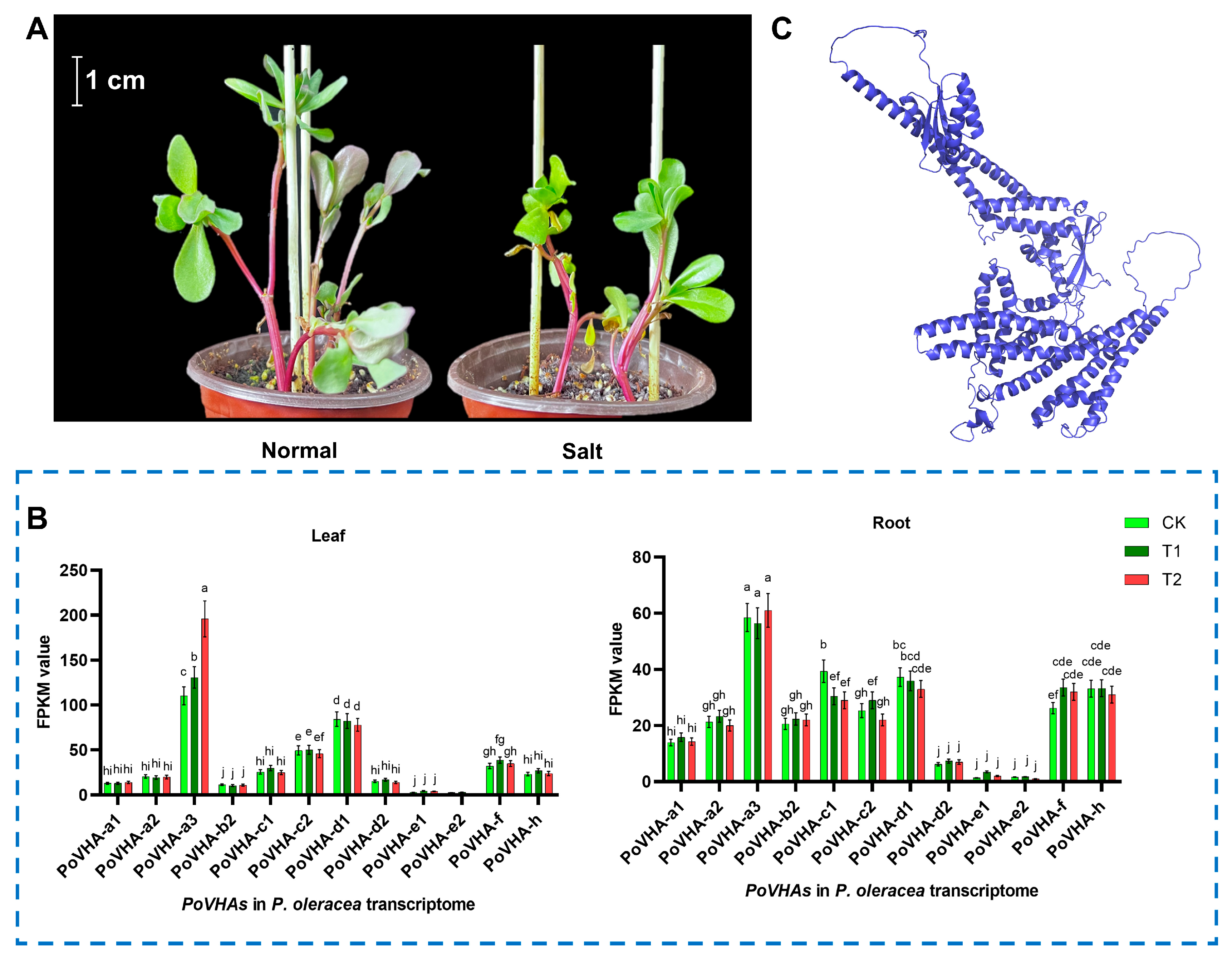
Figure 1. Identification and Bioinformatic Analysis of PoVHA-a3 from purslane. (A) Phenotypic observation of purslane seedlings under normal and salt stress conditions. (B) Transcriptome expression profiles (FPKM values) of PoVHA gene family in purslane leaf and root tissues under control (CK) and salt stress treatments (T1, T2). One-way ANOVA followed by multiple comparison tests was performed. Letters (a, b, c, d, et al.) denote statistically significant differences among all compared groups at the p ≤ 0.05 level. (C) 3D structure prediction of PoVHA-a3 protein, and blue lines show protein folding conformation.
Agriculture 16 00010 g001
Figure 2. Analysis of cis-acting elements in PoVHA-a3 promoter and TF binding characteristics. (A) Statistics of cis-acting element types in PoVHA-a3 promoter region. Bars of different colors represent the quantitative distribution of distinct element types, including ABRE, MYB, bHLH, and others. (B) Sequence logo diagrams display the DNA binding preferences of TFs AtNAC3, AtMYB1, AtbHLH62, with letter height indicating nucleotide conservation. The total height of the stacked letters (A, T, C, G) at each position indicates the sequence conservation at that site, and the height of individual letters represents the relative frequency of that nucleotide. (C) Molecular docking simulation reveals potential interaction mechanisms between PoVHA-a3 protein and TFs, including AtNAC3, AtMYB1, and AtbHLH62 proteins. The proteins are shown in different colors to distinguish PoVHA-a3 from each TF, highlighting their predicted binding interfaces.
Agriculture 16 00010 g002
Figure 3. Subcellular localization of PoVHA-a3 in Arabidopsis and molecular identification of PoVHA-a3 transgenic lines. (A) Co-localization analysis of PoVHA-a3 protein with the tonoplast marker VAM3 protein. The panel shows the fluorescence signals of the PoVHA-a3-mCherry fusion protein and the tonoplast marker protein VAM3-GFP in N. benthamiana leaf epidermal cells observed by confocal laser scanning microscopy. Bright-field figure shows the bright-field image, and merge figure shows the overlay of fluorescence channels for co-localization analysis. (B) Molecular identification of PoVHA-a3 transgenic Arabidopsis lines. Transgenic Arabidopsis lines were identified by semi-quantitative RT-PCR analysis. The electrophoretogram shows the detection of PoVHA-a3 transcripts (1710 bp size of PCR product) in different independent T3 homozygous transgenic lines, with WT serving as a negative control. (C) Analysis of relative expression levels of PoVHA-a3 gene in WT and transgenic lines. The relative expression levels of the PoVHA-a3 gene in different transgenic lines were detected and compared using qRT-PCR. In addition, three independent biological replicates were performed, and each experiment included three technical repetitions. Data are shown as the mean ± SD. Significant differences (p ≤ 0.05) were determined by one-way ANOVA followed by Tukey’s test, and are denoted by different lowercase letters (a, b, c, d).
Agriculture 16 00010 g003
Figure 4. Comprehensive evaluation of Arabidopsis growth and physiological responses under salt stress. (A) Analysis of seed germination characteristics in WT and PoVHA-a3 transgenic Arabidopsis lines under different salt concentrations. The panel shows the seed germination of WT and three transgenic lines (lines #1, #2, #6) under gradient salt concentrations (0, 125, 150, 200 mM NaCl). The schematic diagram in the upper illustrates the experimental treatment. (B) Effects of salt stress on seedling growth in WT and PoVHA-a3 transgenic Arabidopsis lines (lines #1, #2, #6) under different salt concentrations. The inhibitory effects of different NaCl concentrations (0, 100, 150 mM) on WT and PoVHA-a3 transgenic Arabidopsis seedling growth were analyzed. Primary root length and fresh weight were measured after 7-day exposure to 0, 125, or 150 mM NaCl (n = 5 seedlings per line). (C) Physiological adaptive responses of mature WT and PoVHA-a3 transgenic Arabidopsis plants to salt stress. The changes in key physiological indices (water loss rate, total chlorophyll content, and Na+/K+ ratio) of Arabidopsis leaves were assayed. Three independent biological replicates were performed, and each experiment included three technical repetitions. Data are shown as the mean ± SD. Significant differences (p ≤ 0.05) were determined by one-way ANOVA followed by Tukey’s test, and are denoted by different lowercase letters (a, b, c, d, e).
Agriculture 16 00010 g004
Figure 5. Changes in energy metabolism-related parameters in Arabidopsis under salt stress. Determination of (A) V-ATPase activity, (B) O2 uptake rate, and (C) ATP content in WT and PoVHA-a3 transgenic Arabidopsis lines (lines #1, #2, #6) before and after salt stress treatment. Three independent biological replicates were performed, and each experiment included three technical repetitions. Data are shown as the mean ± SD. Significant differences (p ≤ 0.05) were determined by one-way ANOVA followed by Tukey’s test, and are denoted by different lowercase letters (a, b, c, d).
Agriculture 16 00010 g005
Figure 6. Analysis of ABA and BR signaling pathway-related indices in Arabidopsis under salt stress. (A) Analysis of ABA content and signaling pathway gene expression. Endogenous ABA content and the expression levels of key ABA signaling pathway genes (AtNCED3, AtRD29A, AtCOR15A) in WT and PoVHA-a3 transgenic Arabidopsis lines (lines #1, #2, #6) under normal and salt stress conditions. (B) Analysis of BR content and signaling pathway gene expression. Endogenous BR content and the expression levels of key BR signaling pathway genes (AtCOP1, AtBZR1, AtEXPA8) in WT and PoVHA-a3 transgenic Arabidopsis lines (lines #1, #2, #6) under normal and salt stress conditions. Data are shown as the mean ± SD. Significant differences (p ≤ 0.05) were determined by one-way ANOVA followed by Tukey’s test, and are denoted by different lowercase letters (a, b, c, d).
Agriculture 16 00010 g006
Figure 7. Analysis of antioxidant system and oxidative damage in Arabidopsis under salt stress. Determination of (A) antioxidant enzyme (SOD, CAT, APX) activity, (B) osmolytes (proline, soluble sugars, soluble proteins) content, and (C) oxidative damage indices (H2O2 content, O2 generation rate, MDA content) in WT and PoVHA-a3 transgenic Arabidopsis lines (lines #1, #2, #6) under normal and salt-stress conditions. Data are shown as the mean ± SD. Significant differences (p ≤ 0.05) were determined by one-way ANOVA followed by Tukey’s test, and are denoted by different lowercase letters (a, b, c, d, e).
Agriculture 16 00010 g007
Figure 8. Potential regulatory mechanism of PoVHA-a3 promoting plant salt tolerance. In this predicted model, the solid line represents mechanistically established pathways supported by direct experimental evidence from this study. Dashed line indicates predicted interactions based on high-confidence computational analyses (including gene co-expression, molecular docking) and literature support, which require future experimental validation. Boxes are color-coded to distinguish core physiological processes, signaling pathways, or molecular components.
Agriculture 16 00010 g008
Disclaimer/Publisher’s Note: The statements, opinions and data contained in all publications are solely those of the individual author(s) and contributor(s) and not of MDPI and/or the editor(s). MDPI and/or the editor(s) disclaim responsibility for any injury to people or property resulting from any ideas, methods, instructions or products referred to in the content.