


Abstract
Anti-Poverty Programmes (APPs) are closely linked to rural livelihoods, yet comparative evidence on how participants and non-participants differ in livelihood-capital composition and income-generation patterns remains limited in ecologically fragile pastoral regions. This study draws on a cross-sectional household survey conducted in Northern Tibet in July 2020, covering 696 households—including 225 APP participants and 471 non-participants. Using the Sustainable Livelihoods Framework and the entropy weight method, we construct multidimensional livelihood-capital indices (human, social, natural, physical, and financial capital) and compare the two groups. We further apply Ordinary Least Squares (OLS) regressions to examine factors associated with per capita net income. The results reveal substantial heterogeneity in livelihood capital and income across both groups. APP participants exhibit higher human-capital scores, largely driven by a higher share of skills training, whereas they show disadvantages in physical and financial capital relative to non-participants. Natural capital shows no statistically significant difference between the two groups under the local grassland contracting regime. Significant differences are observed and identified in certain dimensions of social capital. Regression results suggest that income is positively associated with skills training, contracted grassland endowment, and fixed assets, with skills training showing the strongest association. For participants, herd size and labour capacity are not statistically significant correlates of income; for non-participants, larger herds and greater labour capacity are associated with lower income. Taken together, the findings indicate that APP participation is associated with stronger capability-related capital (notably training) alongside persistent constraints in productive assets and financial capacity. Policy implications include improving the relevance and quality of training, strengthening cooperative governance and market linkages, and designing complementary packages that connect skills, inclusive finance, and productive asset accumulation. Given the cross-sectional design and administratively targeted certification of programme participation, the results should be interpreted as context-specific associations rather than strict causal effects.
1. Introduction
Poverty eradication remains a central objective of the global development agenda, with increasing recognition that short-term income growth alone is insufficient to ensure long-term livelihood sustainability [1,2,3,4]. As anti-poverty policies have progressively shifted from income transfers toward capacity-building and resilience enhancement, evaluating whether such interventions contribute to sustainable livelihoods has become a critical research concern. A key challenge lies in distinguishing temporary poverty alleviation effects from enduring improvements in households’ livelihood systems, particularly in ecologically fragile regions where environmental constraints may limit the conversion of policy support into sustainable outcomes.
Existing studies on anti-poverty programmes have primarily emphasized short-term income effects, while comparatively less attention has been paid to their multidimensional and long-term implications for livelihood sustainability. In particular, empirical evidence remains limited on how Anti-Poverty Programmes (APPs) influence different forms of livelihood capital and whether these effects differ systematically between programme participants and non-participants. This gap is especially pronounced in ecologically vulnerable regions, where livelihood strategies are tightly constrained by environmental fragility and institutional conditions. Without comparative analyses that explicitly examine participant and non-participant households within a unified analytical framework, it remains difficult to assess whether APP participation is associated with patterns consistent with sustainable livelihood transformations rather than merely correlating with short-term relief. Although recent studies have begun to explore differentiated programme impacts on livelihood outcomes, comprehensive participant–non-participant comparisons that integrate multidimensional livelihood assets remain scarce [5].
The Sustainable Livelihoods Framework (SLF) offers a comprehensive theoretical lens for addressing this challenge by conceptualizing livelihoods as the outcome of interactions among multiple forms of capital—human, social, natural, physical, and financial [6,7]. Rather than treating income as a singular indicator of welfare, SLF emphasizes households’ capacity to mobilize diverse assets to cope with shocks and pursue sustainable development pathways. Recent scholarship has further refined the SLF to better capture dynamic interactions between livelihood assets, vulnerability contexts, and environmental constraints in the 21st century, reinforcing its relevance for ecologically fragile regions [8]. In the context of poverty alleviation, this framework is particularly valuable for disentangling how policy interventions affect different dimensions of livelihood capital and how these effects translate into income outcomes. While SLF has been widely applied in rural development studies, existing research often focuses on individual capital components—most commonly financial or human capital—without systematically examining the full set of livelihood assets or their differentiated impacts across household groups [9,10,11].
These limitations are especially evident in studies of the Tibetan Plateau, one of the world’s most ecologically fragile and socio-economically distinctive regions. Northern Tibet, characterized by high altitude, harsh climatic conditions, and pasture-based livelihoods, has been a focal area of China’s anti-poverty initiatives [12]. Despite a growing body of region-specific research, existing studies tend to address isolated aspects of poverty alleviation or environmental change [12,13,14,15], with limited integration of multidimensional livelihood capital analysis [16,17]. As a result, how APP participation status is associated with different forms of livelihood capital—and whether these association patterns operate differently for participating and non-participating herder households—remains insufficiently understood.
To address these gaps, this study adopts the Sustainable Livelihoods Framework to conduct a comparative analysis of herder households in Northern Tibet. Using household survey data, it systematically examines differences in the five forms of livelihood capital between APP participants and non-participants and investigates how these capitals shape household income outcomes. Methodologically, the study employs the entropy weight method to construct objective, multidimensional livelihood capital indices and applies ordinary least squares (OLS) regression with group-specific heterogeneity analysis to identify differentiated income-generation association patterns across household groups. The theoretical expectation, grounded in SLF, is that APPs are expected to be associated with higher human and social capital through training, institutional participation, and improved access to public services, while their effects on financial and physical capital depend on households’ capacity to translate improved capabilities into productive assets under existing ecological and structural constraints. Recent empirical evidence further suggests that the interaction between livelihood capital endowments and livelihood strategies plays a critical role in shaping poverty outcomes, underscoring the importance of a multidimensional analytical approach [18].
Accordingly, this study addresses the following research questions:
- (1)
- How do the multidimensional livelihood capitals of APP participants in Northern Tibet differ from those of non-participants when measured using entropy-weighted capital indices?
- (2)
- What are the key determinants of household income among herder households, and how do these determinants vary between APP participants and non-participants?
- (3)
- How can the observed differences in livelihood-capital profiles between APP participants and non-participants be plausibly explained in light of APP-related interventions and local structural constraints?
By integrating a comparative research design with a multidimensional livelihood framework, this study contributes to a more nuanced understanding of how anti-poverty programmes affect livelihood sustainability in ecologically fragile regions. The findings provide theoretical and methodological insights into the differentiated impacts of APPs and offer policy-relevant evidence for improving the design of poverty alleviation strategies under conditions of environmental vulnerability.
2. Materials and Methods
2.1. Study Area
The Northern Tibet region, located between 29°53′–36°32′ N and 78°41′–92°16′ E, covers approximately 595,000 km2 and is characterized by an average elevation exceeding 4500 m. This area is considered an ecologically fragile zone, often referred to as the “Third Pole” due to its significant role in global climate regulation and water resources. Historically, Northern Tibet has been predominantly inhabited by Tibetan herders who rely on livestock farming as their primary source of income. The harsh climatic conditions, including low temperatures, high ultraviolet radiation, and limited precipitation, create substantial challenges for traditional pastoral livelihoods. These communities have developed intricate knowledge systems and adaptive strategies to manage the region’s unique ecological and climatic conditions [19]. However, in recent decades, the region has faced increasing pressures from environmental degradation, climate change, and socio-economic transformations, leading to heightened vulnerability among herder households [12]. These structural challenges were further compounded by the COVID-19 pandemic, which emerged in early 2020 and disrupted market access, mobility, and non-pastoral income opportunities in many rural and pastoral areas across China. Although Northern Tibet experienced relatively low infection rates compared with urban regions, pandemic-related restrictions and broader economic slowdowns may nonetheless have affected household livelihoods and local economic conditions.
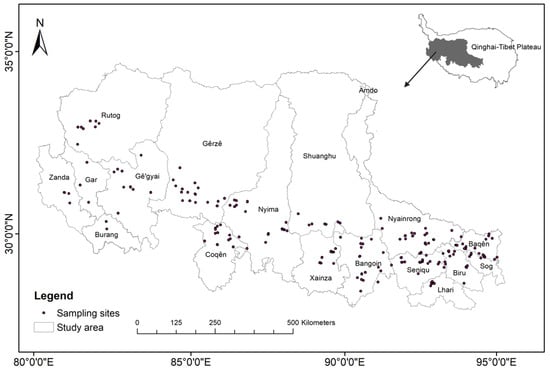
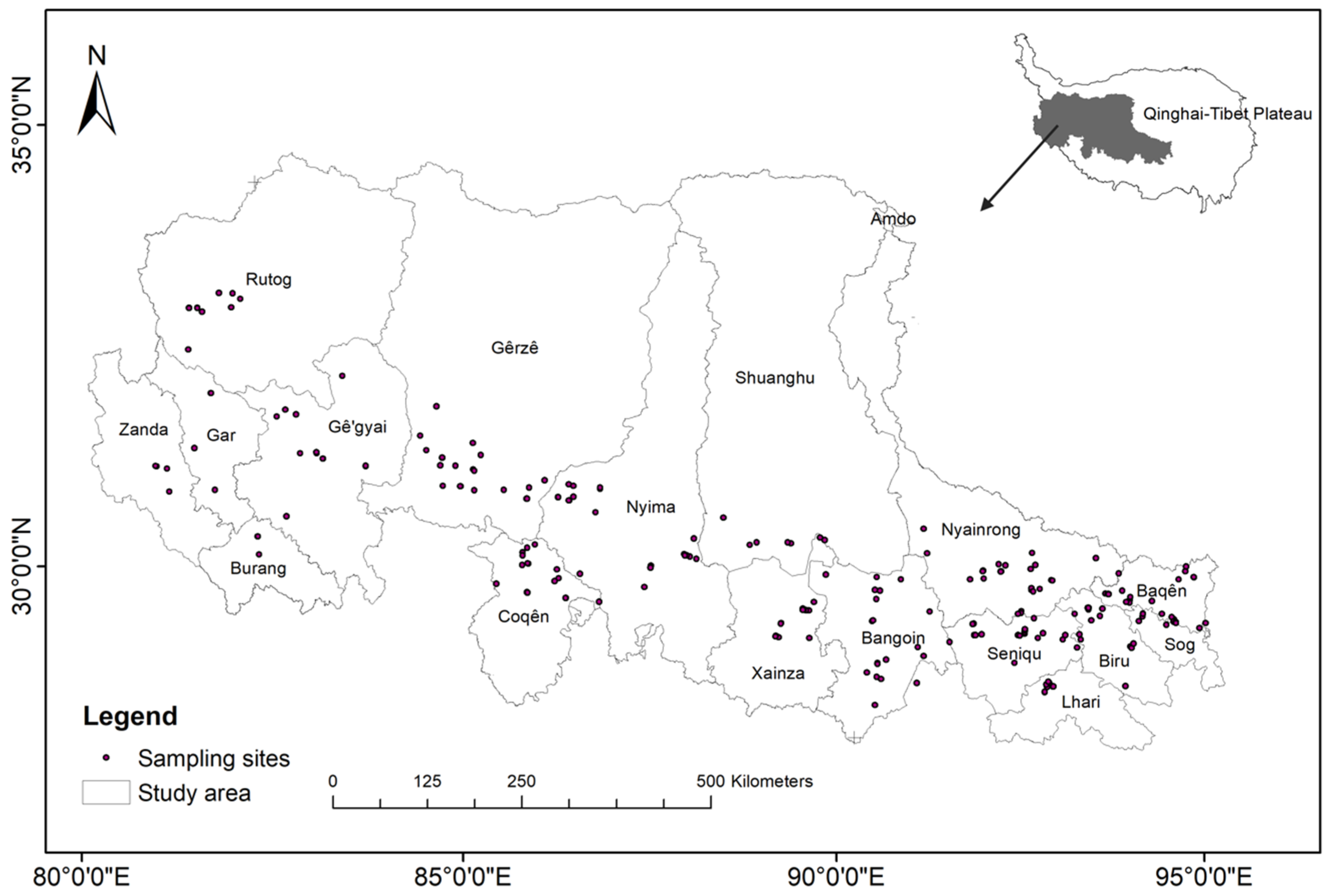
To address these challenges, the Chinese government has implemented various Anti-Poverty Programmes (APPs) aimed at improving the livelihoods of rural populations in ecologically sensitive regions. These initiatives focus on enhancing infrastructure, providing financial support, promoting education and skill development, and encouraging sustainable land management practices [5]. Against the backdrop of the COVID-19 pandemic, such programmes may have played an important stabilizing role by supporting household income and employment opportunities, while their implementation and effectiveness may also have been shaped by pandemic-related constraints. Despite these efforts, there remains a significant gap in understanding the longer-term implications of these programmes for livelihood sustainability, especially within the unique environmental and socio-economic context of Northern Tibet [20] (Figure 1).
Figure 1.
Study area and survey sites.
The APPs analysed in this study encompass a range of targeted interventions, including direct transfers to eligible households, vocational training initiatives, and infrastructure investments in rural communities. In Tibet, these APPs were integral to China’s “Decisive Battle Against Poverty” strategy (2015–2020). In practice, many programme components were rolled out and intensified during 2018–2020, and household enrolment was based on administrative certification using predefined eligibility criteria—primarily income thresholds supplemented by multidimensional poverty indicators—rather than purely voluntary participation. Following 2020, several of these policies continued under the framework of “consolidating and expanding the achievements of poverty alleviation while effectively integrating with rural revitalization.” The household survey for this study was conducted in July 2020, capturing socioeconomic information at a late implementation stage for many programme components. Because the timing of administrative certification and programme roll-out varies across households, the duration of programme exposure is heterogeneous; thus, this study focuses on comparing post-enrolment livelihood-capital profiles and income-generation patterns between participants and non-participants, and the results should be interpreted as context-specific differences and associations rather than a causal evaluation of long-term programme effects.
2.2. Household Data Collection
The primary data set used in this study was collected through a field survey conducted in Northern Tibet in the Tibetan Autonomous Region (TAR), China. Household interviews were carried out in July 2020, during the COVID-19 pandemic. To align with the administrative targeting mechanism described above, we constructed the sampling frame using village-level rosters provided by local officials, including (i) households administratively certified as APP participants under the targeted poverty alleviation system and (ii) households not certified for participation in the same villages (hereafter “non-participants”). Based on this frame, we implemented a stratified random sampling strategy (county–township–village–household). Following the stratified design, we selected townships, then villages, and finally households within each village roster; in each village, at least 10 households were surveyed. In total, 760 households in 76 villages were visited. After cleaning the data, verifying completeness, reconciling counts, and screening for outliers, we retained 696 valid questionnaires (225 participants and 471 non-participants), yielding a validity rate of 91.58%. The disproportionate share of non-participants reflects the targeting logic and phased implementation of APPs in Northern Tibet rather than sampling bias, as program eligibility was restricted by policy thresholds and fiscal quotas. Prior to data collection, we consulted development agencies and relevant officials to understand key livelihood issues and to refine the questionnaire and variable selection for local relevance. The questionnaire covered household socioeconomic characteristics and pastoral households’ livelihood assets. To ensure spatial coverage, the survey included households across counties in the study area, considering local socioeconomic development, transportation accessibility, and fieldwork logistics. Public health precautions were observed in accordance with local COVID-19 prevention guidelines. While no major disruptions to data collection were encountered, pandemic-related conditions may have influenced household economic activities, income sources, and livelihood strategies at the time of the survey; therefore, the data reflect household livelihood conditions within a pandemic context. To address language barriers during interviews, we employed 10 Tibetan college students who had received standard household-survey training as interpreters to facilitate communication with local farmers and herders. We prioritized interviewing the household head; when unavailable, the respondent was the oldest member knowledgeable about the household’s current livelihood conditions. Interviews lasted approximately one hour. As contextual reference, we also obtained information from village leaders on administrative-village infrastructure, socioeconomic and policy changes, and production activities. Before full deployment, we piloted the instrument with 30 households to identify and correct problems in question wording.
A primary methodological challenge in comparing APP participants with non-participants is the potential for selection bias, which may arise from both the administrative certification criteria and the behavioral characteristics of households. As previously mentioned, APP participation was determined primarily by predefined eligibility thresholds, most notably household income levels, supplemented by multidimensional poverty indicators such as livelihood fragility and dependency ratios. Although these criteria standardize the certification process, they may still be correlated with unobservable household attributes (e.g., risk preferences, informal social networks, or the motivation to seek external support). Such correlations create the possibility that APP participants differ systematically from non-participants even before programme exposure, thereby confounding straightforward comparative analyses. While our empirical approach accounts for a wide range of observable covariates, we acknowledge that unobserved self-selection cannot be entirely controlled for and may limit the causal interpretation of the observed differences. Acknowledging these limitations informs our analytical strategy and necessitates caution when interpreting the results, rather than attributing all observed differences solely to programme status.
It is important to clarify that the objective of this study is not to establish a strict causal estimate of the impacts of APPs, but rather to conduct a comparative and mechanism-oriented analysis of livelihood capital composition and income-generation patterns between APP participants and non-participants. Given that programme participation was administratively determined based on predefined eligibility criteria—primarily income thresholds and multidimensional poverty indicators—participants and non-participants may differ systematically prior to programme exposure. While this raises the possibility of selection bias, our analytical focus lies in identifying structural differences in livelihood capital endowments and examining how these differences translate into heterogeneous income-generation mechanisms under the local policy context. Although APP participation may involve selection effects, the inclusion of extensive livelihood capital controls and village-level fixed characteristics partially mitigates this concern. This comparative approach allows us to assess whether APPs are associated with distinct livelihood pathways, rather than attributing observed differences exclusively to causal programme effects (Table 1).
Table 1.
Demographic characteristics for sample households in 2020 survey of the North Tibet.
2.3. Methodology
2.3.1. Livelihood Capital Index
According to the UK Department for International Development’s (DFID) classic classification of household livelihood capital, household livelihood capital can be further subdivided into human, natural, physical, financial, and social capital [21,22]. This study adopts this classification, drawing upon prior scholarly research [16,23,24] and the specific context of the study area to determine the Livelihood Capital Index (LCI). We then develop indicators to assess five types of assets for local households. The index system and descriptive statistics for the livelihood asset assessment are as follows:
(1) Natural capital refers to the natural resources upon which households rely to provide both tangible and intangible goods and services [25]. In the context of herder households in Northern Tibet, grassland constitutes the most critical natural resource. Therefore, indicators of natural capital include both the quantity and quality of per capita contracted grassland.
(2) Physical capital, which forms the solid foundation for the sustainable livelihoods of rural households, includes housing, agricultural machinery, and durable consumer goods for both life and production [26,27]. Fieldwork and interviews with farmers in this watershed revealed that the availability of housing, the number of domestic livestock, and the quantity of agricultural machinery and durable consumer goods are critical components of physical capital that significantly influence household livelihoods. A household’s physical capital is a primary determinant of its agricultural productivity.
(3) Financial capital refers to the financial resources that individuals use to achieve their livelihood objectives. The primary sources of financial capital are income, savings, and loans. It encompasses the resources that households depend on when responding to extreme events, such as cash flow and production systems [25]. In this study, indicators of financial capital include household income, medical expenses, and credit.
(4) Social capital refers to the social resources that rural households derive from their geographical and industrial relationships, reflecting the channels available to them. In this context, social capital includes whether a household has a member in the village committee, participates in a cooperative production organization, and the distance from the residence to the town. A farmer’s social acceptability refers to their relationships with other farmers and participation in farmers’ associations [28], which may enhance opportunities for involvement in decision-making processes or securing employment.
(5) Human capital, given the specific context of this watershed, is proxied in this study by the number of individuals aged 16 to 64 who are capable of working (excluding students), the highest education level within the family, the proportion of family members who have received skill training, and the dependency ratio [29,30].
2.3.2. Data Analysis
This study employs the entropy weight method to evaluate herders’ livelihood capitals, estimate the Livelihood Capital Index (LCI), and identify the factors influencing herders’ income using an OLS linear regression model.
- (1)
- Livelihood Capital Index (LCI) Calculation
The entropy weight method is applied to calculate the weight of each indicator and derive the household capital index by weighted summation. The entropy weight method was selected for three main reasons. First, livelihood capital assessment involves multiple indicators with heterogeneous units and distributions, and no strong theoretical or empirical basis exists for assigning subjective or equal weights across dimensions. The entropy method determines weights endogenously based on the degree of information variation, thereby reducing subjectivity. Second, compared with dimension-reduction techniques such as principal component analysis, entropy weighting preserves the original indicator structure and enhances interpretability, which is particularly important for policy-oriented livelihood analysis. Third, the primary objective of this study is to compare relative differences in livelihood capital between groups rather than to construct an absolute welfare index. In this context, entropy weighting provides a transparent and robust approach that has been widely adopted in sustainable livelihood research [31,32]. The steps for applying the entropy method are as follows:
Index Standardization
Data were standardized using the range standardization method. Formulas (1) and (2) were used to process the data for the positive and negative indicators, respectively, and the original data were normalized to [0–1]. In the following equations, represents the standardized value, represents the original index, is the maximum value of the index, and is the minimum value of the index.
Index Weight Calculation
We determined the weight of each index through the entropy method using Equations (3)–(6).
LCI Calculation
The LCI is derived by weighted summation of the standardized values and weights (Equation (7)). Higher LCI values indicate greater sustainability of herders’ livelihoods. Because our focus is on relative comparisons between groups within the same sample, rather than on absolute capital levels, the sensitivity of entropy weights to sample composition is less likely to bias the main conclusions.
We also use the independent-sample T-test to compare livelihood capital indicators between participants and non-participants, with significance at p < 0.05.
- (2)
- Income Determinants for Herders
The OLS linear regression model is employed to analyze the effect of key livelihood capital types on herder household income. The OLS framework is employed to maintain model transparency and facilitate interpretation of coefficient signs and magnitudes across groups. Given the study’s comparative and mechanism-focused objective, this approach allows for a clear identification of heterogeneous income-generation patterns associated with different livelihood capital endowments. In the OLS linear regression model, Y is a dependent variable which of net income per capita. Based on insights from field research and contextual expertise, the dependent variable was regressed on seven explanatory variables, including one dummy variable (i.e., whether the household participates in a cooperative production organization). In addition, three variables that affect herders’ income but are not the focus of this analysis were included as control variables (i.e., the family’s highest education level, dependency ratio, and distance from the residence to the town). The model is defined as:
where = Net income per capita. to are explanatory variables including per capita grassland area, herd size, fixed asset value, labor capacity, skill training, cooperative participation, and credit rating. to are control variables: family’s highest education level, dependency ratio, and distance to town. Log transformation is applied to eliminate heteroskedasticity for variables related to income, grassland area, herd size, asset value, and others.
In addition to subgroup regressions, we estimate pooled OLS models including an APP-participation indicator and interaction terms between participation and key livelihood-capital variables. These interaction coefficients provide formal tests of whether income–capital associations differ between participants and non-participants in a cross-sectional, administratively targeted context.
where is per capita net household income; indicates APP participation; denotes the covariate, with as additional controls. Log transformations are applied to income- and scale-related variables. and capture baseline and differential effects, respectively, and is the error term.
We estimate OLS models with the dependent variable being the natural logarithm of per capita net household income, ln (). To accommodate possible zero values and reduce right-skewness in scale variables, we apply the natural logarithm transformation ln (+1) to contracted grassland area (x1), herd size (x2), fixed asset value (x3), dependency ratio (z2), and distance to town (z3). Skills training (x5) is measured as a share on a 0–1 scale, and thus a 0.01 change corresponds to a one percentage-point increase. Standard errors are heteroskedasticity-robust (HC1).
- (3)
- Multicollinearity Test
To assess multicollinearity, variance inflation factors (VIFs) were computed using Stata 16.0. Results show that all VIFs are below 5, indicating no multicollinearity, and validating the use of OLS regression analysis. In addition, robustness checks using alternative model specifications yielded consistent coefficient signs and significance levels, suggesting that the main findings are not driven by specific functional-form assumptions.
3. Results
3.1. Differences in Livelihood Assets Between APP Participants and Non-Participants
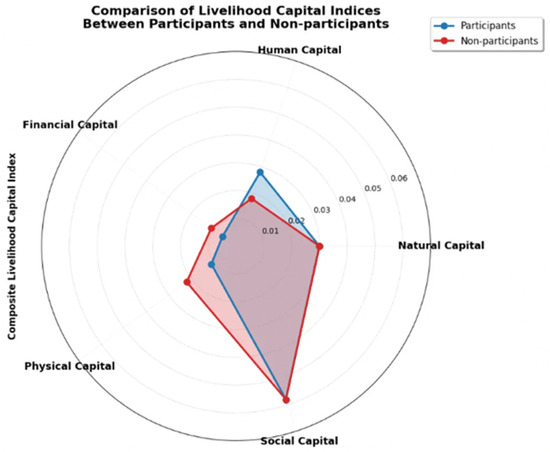
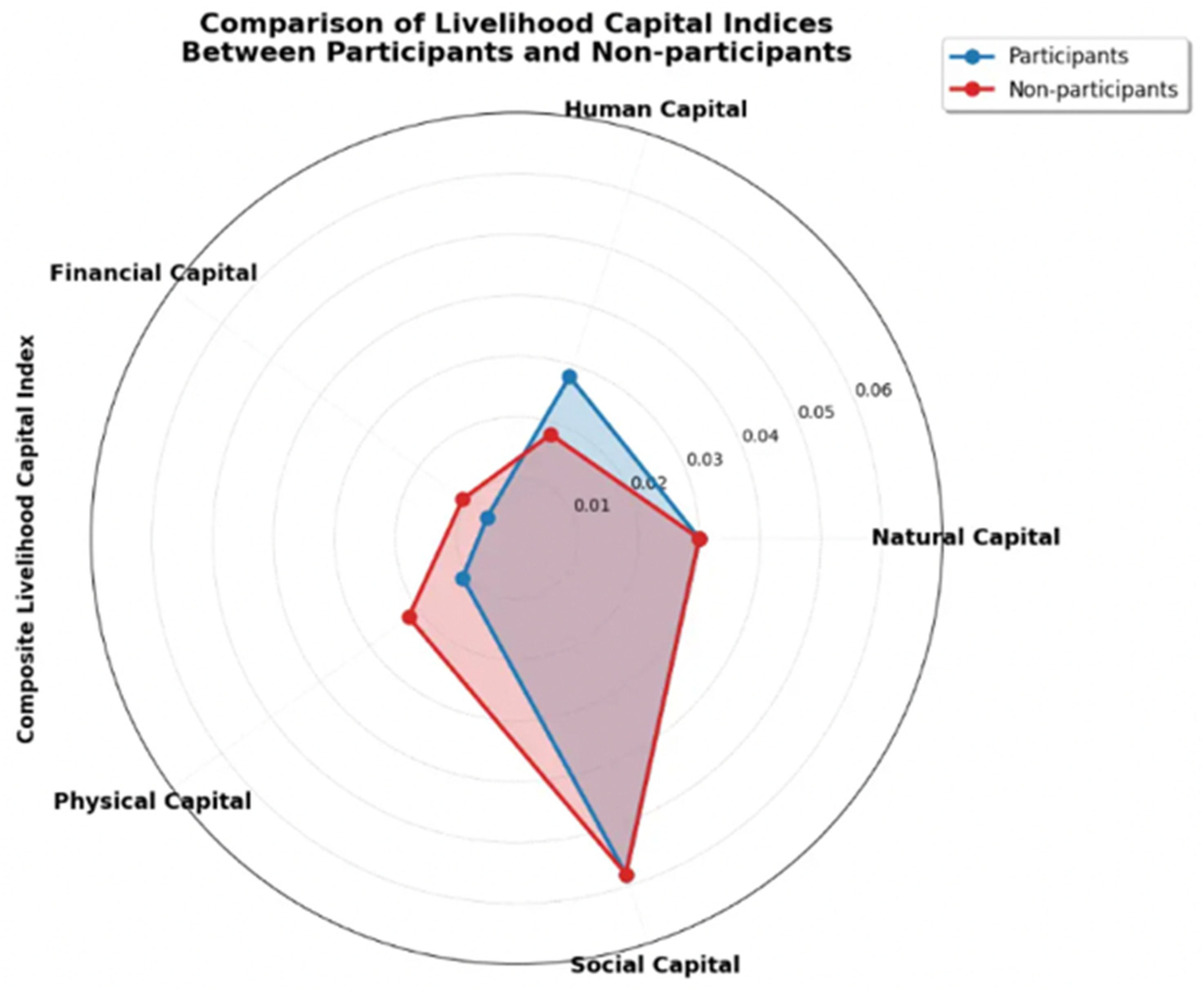
Figure 2 and Table 2 report the Livelihood Capital Index (LCI) and the two-sample t-test results for each livelihood-capital indicator. Overall, both livelihood capital and income display substantial heterogeneity across households, and the group means of APP participants and non-participants differ in a systematic way across several dimensions. As shown in Figure 2 and Table 2, APP participants have a higher human-capital index on average, whereas they have lower financial and physical capital. By contrast, the difference in natural capital between the two groups is not statistically distinguishable. For social capital, the composite index exhibits only limited net separation; however, clear compositional differences emerge across its sub-dimensions, indicating that the two groups differ more in internal structure than in the overall aggregate level.
Figure 2.
Pentagon of livelihood capitals by participation status. Note: This figure presents the average composite livelihood capital indices for participants and non-participants across five dimensions: natural, human, financial, physical, and social capital. All values are normalized composite indices ranging from 0 to 1, with higher values indicating higher levels of livelihood capital. The radial axis reports index values.
Table 2.
Comparison of livelihood capital between participants and non-participants.
Within human capital, neither the highest education level in the household nor the dependency ratio shows a statistically distinguishable difference between participants and non-participants. In contrast, household labour capacity is higher among non-participants, whereas the share of households receiving skills training is higher among participants; these offsetting patterns jointly translate into a higher overall human-capital score for participants at conventional significance levels.
Regarding physical capital, non-participants report larger household area, larger herd size, and higher fixed-asset value than participants, consistent with a higher physical-capital index for non-participants. In terms of financial capital, non-participants likewise show advantages in key components, while medical expenses are not statistically distinguishable across the two groups. In particular, net per capita income and credit ratings are lower among participants than among non-participants, aligning with the lower financial-capital scores observed for participants.
For social capital, although the aggregate index differs only modestly, the internal composition differs noticeably: leadership scores are higher among non-participants, while participation in cooperatives and other participation organisations is lower among non-participants. Finally, the distance from the residence to town does not differ in a statistically distinguishable way between the two groups. Further details are provided in Table 2 and Figure 2.
3.2. Factors Affecting the Income of the Herder Households in North Tibet
To examine factors associated with herders’ income, this study employs an OLS regression model to identify key correlates of per capita net income. A summary of the findings is presented in Table 3. The results indicate that per capita contracted grassland area, fixed asset value, and the proportion of skills training are positively and significantly associated with income for both participant and non-participant households (p < 0.01). Based on the standardised coefficients, the proportion of skills training shows the largest association with income among the included covariates.
Table 3.
OLS estimates of log per capita net household income by APP participation status.
For APP participants, the share receiving skills training (x5, measured on a 0–1 scale) is positively and statistically significantly associated with income. A one percentage-point (0.01) increase in the skills-training share is associated with approximately a 0.86% higher per capita income (semi-elasticity approximation). Fixed assets and contracted grassland endowment are also positively associated with income. By contrast, herd size, cooperative membership, and loan credit rating are not statistically significant correlates of participants’ income, and labour capacity shows at most a weak negative association.
For non-participants, skills training remains positively and statistically significantly associated with income: A one percentage-point (0.01) increase in the skills-training share is associated with approximately a 0.74% higher per capita income (semi-elasticity approximation). Fixed assets and contracted grassland endowment are also positively associated with income. Herd size is negatively associated with income, and labour capacity is significantly negative: One additional working-age labourer is associated with about a 5.6% lower per capita income (semi-elasticity approximation). Cooperative membership and loan credit rating are not statistically significant correlates of income among non-participants.
To formally test whether income associations differ by programme status, we estimate a pooled OLS model with interaction terms between APP participation and each explanatory variable (Table 4). The interaction coefficient δ provides a direct test of slope differences between participants and non-participants (H0: δ = 0). Overall, heterogeneity is limited, and statistically significant differences are concentrated in fixed assets and the dependency ratio: the positive association between fixed assets and income is significantly weaker among participants, while the negative association between the dependency ratio and income is significantly attenuated among participants. By contrast, slope differences in herd size, labour capacity, and skills training are not statistically significant in the pooled interaction tests.
Table 4.
Pooled OLS with APP participation interactions (tests of slope differences).
4. Discussion
4.1. Differences Associated with APP Participation: The Paradox of Capability Building and Asset Lag
This study examines programme-related livelihood differences through a comparative analysis of APP participants and non-participants. The results reveal a salient pattern: participant households exhibit relatively stronger capability-related capital (human and some elements of social capital), while they remain disadvantaged in productive capital (financial and physical capital) relative to non-participants. This section provides an in-depth interpretation of this paradox using the Sustainable Livelihoods Framework. Rather than attributing all observed differences exclusively to programme effects, we interpret the patterns as differences associated with programme status in a context where participation is administratively targeted, and the data are cross-sectional. From a sustainable-livelihoods perspective, capability-oriented capital (human and social capital) is expected to strengthen households’ capacity to pursue diversified livelihood strategies. However, our findings suggest that the observed “capabilities-to-activities” transformation pathway may be constrained by structural barriers, including limited effective household labour supply and deficits in community leadership.
4.1.1. Effectiveness and Limitations of Capacity Building: Human and Social Capital
APP participants exhibit stronger human-capital scores in Northern Tibet, with the most prominent difference driven by a significantly higher proportion of skills training (p < 0.01). This pattern is consistent with the broader literature suggesting that government-led training can strengthen human capital in remote areas, and that better-educated or trained herders may be better positioned to diversify livelihoods or adopt new technologies [33,34,35,36]. Correspondingly, in our survey, trained households report a higher likelihood of engaging in sideline activities beyond pastoralism, such as tourism transport and handicrafts. However, an important constraint emerges despite higher training participation, the overall household labour capacity of participants is significantly lower than that of non-participants (p < 0.01). This indicates that capability gains at the individual level may coexist with household-level structural constraints on effective labour supply. As the administratively identified target group, participant households may face stronger baseline vulnerability, such as deeper poverty, heavier disease burdens, or caregiving responsibilities. Deep-seated factors including health constraints, family care responsibilities—particularly those constraining women’s labour—and educational disparities may offset the potential gains from training, thereby limiting the expansion of effective household labour scale [16,37,38]. These findings suggest that, beyond skills training, broader measures may be required to relax labour-capacity constraints. Policies could focus on expanding access to healthcare and formal education, as well as developing local employment opportunities to stabilise the community workforce [39]. Furthermore, targeted interventions addressing the specific constraints faced by labour-constrained households could strengthen the practical translation of training into livelihood gains [40,41,42]. In summary, while skills training is strongly associated with higher human-capital scores among APP participants, integrating skills development with strategies that expand effective household labour participation is likely important for sustained livelihood improvement.
At the social-capital level, the composite index shows limited overall difference between the two groups (p > 0.05), yet the internal structure differs. Participants report higher participation in cooperative participation organizations, which may expand formal networks and potentially facilitate information access and market entry. Consistent with extant research, social resources—encompassing community networks and trust—can support resource acquisition and collective action, thereby strengthening resilience [43,44]. However, non-participants exhibit significantly higher leadership scores. This pattern suggests that increases in formal organisational participation among participants do not necessarily translate into core elements of informal social capital, notably community leadership and prestige. Such attributes may be shaped by long-standing traditions, family reputation, and personal charisma. Consequently, structural barriers—such as lower education levels and traditional gender norms—may be associated with participants’ weaker voice in community decision-making [45]. The results imply that efforts to promote community participation may be complemented by leadership development initiatives. Integrating leadership training into poverty-alleviation-related programmes could strengthen households’ capacity to engage in local decision-making, thereby consolidating social capital and improving livelihood outcomes. In summary, although participants are more embedded in formal organisations, strengthening informal leadership and voice may be necessary to translate social participation into broader livelihood benefits.
4.1.2. Persistent Lag in Productive Capital: Financial and Physical Capital
In contrast to capability-related differences, APP participants remain disadvantaged in financial and physical capital relative to non-participants, which may constrain their ability to translate capabilities into sustained income generation. The data show that non-participants have higher per capita income indices and significantly higher credit ratings (p < 0.01), while participants’ credit ratings are concentrated at the lower tier (see Table 2). This pattern is consistent with persistent liquidity constraints and income-generation bottlenecks among vulnerable households [46]. Related research likewise indicates that financial capital can mediate households’ livelihood adaptability, although the transformation from policy support to durable financial capacity is often uneven [38,47]. Our findings align with this perspective: even when programmes provide support through multiple channels, participants may still display a weak internal “financial capacity-building” base [48]. Taken together, financial capital may remain a binding constraint. This disparity underscores the potential value of prioritising interventions that improve access to financial services and inclusive financial products aligned with local production cycles. The World Bank similarly emphasises that access to financial services can enhance rural productivity and stimulate small businesses, thereby supporting rural development [49].
The disparity in physical capital is also pronounced: non-participants outperform participants on indices for housing area, herd size, and fixed-asset value (see Table 2). This substantial gap suggests that productive asset accumulation may remain difficult for administratively targeted households, potentially because limited resources are allocated to basic consumption needs or to indirect costs associated with sustaining livelihoods, thereby limiting productive investment [21,22,50]. More broadly, the complementarity of physical and financial capital is important for livelihood transformation. Evidence indicates that access to credit can improve agricultural production efficiency, particularly among low-income households [51]. From a policy perspective, expanding access to credit may enable households to invest in income-generating activities and accumulate assets. Concurrently, promoting asset-building programmes and encouraging savings and investment in physical assets may accelerate material-capital accumulation. Consequently, policy packages that connect training, credit, and productive assets may help convert capability gains into more durable livelihoods, shifting from short-term support toward productive empowerment [52].
No significant differences in natural capital—measured by per capita grassland area and quality—were detected between the two groups. This pattern likely reflects the region’s inherent ecological constraints and relatively stable grassland contracting policies, which operate as common background conditions. As a result, households may pursue livelihood improvements primarily by enhancing the efficiency and coordination of other forms of capital rather than expanding natural capital [53,54].
4.2. Determinants of Herder Household Income: Analysing Common Drivers and Group Heterogeneity
Taken together, the results suggest that APP participation is associated with differences in the ways livelihood capital relates to household income. Rather than implying a definitive structural transformation, the findings point to contrasting income-generation patterns: participants show a tendency toward greater reliance on skills-related and programme-linked channels, whereas non-participants appear more reliant on traditional asset-based strategies. This section examines the key correlates of herder household income in Northern Tibet and discusses how these correlates differ by programme status within a cross-sectional, administratively targeted context. The analysis identifies both common income correlates and pronounced group heterogeneity associated with programme participation.
4.2.1. Core Income Correlates
OLS regression results indicate that skills training, fixed assets, and per capita contracted grassland area are three correlates consistently associated with higher income among herder households in Northern Tibet. Among the examined factors, skills training is consistently associated with higher household income across both groups. Although its standardised coefficient is relatively larger than those of other variables, this should be interpreted as an indicative association rather than evidence of a singular or dominant causal effect. In this context, skills training represents an enabling component of human capital that likely operates jointly with physical, financial, and natural capital rather than as an isolated driver of income growth. The consistently large and significant coefficient on skills training across both groups suggests that households with greater training exposure tend to report higher income, a pattern broadly consistent with human-capital theory whereby acquired skills can facilitate more efficient livestock practices or access to higher-return non-agricultural sectors (e.g., construction and services) [37]. More broadly, improved access to non-local employment facilitated by skills acquisition may also enable labour migration and remittance flows, which have been widely recognised as an important pathway for poverty reduction and food security in low-income households [55]. Fixed assets, a core component of physical capital [56,57,58], are also positively associated with income, consistent with the role of productive assets in improving production efficiency (e.g., upgrading livestock shelters) and reducing transaction costs (e.g., through vehicle ownership) [59,60]. Per capita grassland area underpins natural capital and is positively associated with income, reflecting its role in shaping resource endowments and production potential in pastoral livelihoods [61]. Taken together, these correlates constitute a central set of income-related factors for herder households in Northern Tibet [62,63,64].
Cooperative membership (x6) shows no statistically significant association with per capita income in either subgroup regression (Table 3). This result should be interpreted cautiously: in this study, cooperative participation is measured as membership status rather than cooperative performance or service quality, and thus the estimate reflects whether “joining per se” correlates with income under the baseline specification. A plausible explanation is that the income payoff of membership may depend on governance capacity and market linkages—features not directly observed in the current dataset—so heterogeneity across cooperatives could attenuate the average association. In addition, our social-capital results suggest compositional differences in organisational embedding and leadership across groups, which may shape how effectively collective arrangements translate into economic returns. Policy-wise, strengthening cooperative governance (e.g., transparency and member participation) and improving market connectivity may increase the likelihood that organisational participation translates into measurable livelihood benefits, while future data collection incorporating cooperative service provision and performance indicators would enable a more direct test of these mechanisms.
4.2.2. Key Finding: Heterogeneity in Income Correlates Across Groups
The study’s most salient finding is the pronounced divergence in income-correlation patterns between APP participants and non-participants. These differences are consistent with the interpretation that programme targeting, and associated support channels may be linked to heterogeneous livelihood strategies [65,66]. The pooled interaction results (Table 4) indicate that statistically significant heterogeneity is concentrated in fixed assets and the dependency ratio, whereas slope differences in herd size, labour capacity, and skills training are not statistically significant. Given the administrative targeting and cross-sectional design, these findings should be viewed as differential associations rather than definitive causal effects. This evidence therefore supports a limited form of group heterogeneity in income–capital association patterns, rather than a broad-based structural shift.
Participants: A Skills-Related and Programme-Linked Income Pattern
For participant households, income is most strongly associated with skills training (alongside fixed assets and contracted grassland area), whereas traditional factors—such as household labour capacity and herd size—are not statistically significant. This pattern is consistent with a livelihood profile in which income is less tightly linked to the simple expansion of primary production factors and more closely aligned with capability-related endowments. Skills training may support access to more diversified employment opportunities and complement pastoral income sources [17]. Related evidence suggests vocational training can improve labour-market outcomes, including higher employment rates and greater labour earnings [45,67]. Nevertheless, given the cross-sectional design and administrative targeting, these interpretations should be viewed as plausible mechanisms rather than definitive causal pathways. Concurrently, policy subsidies may provide critical liquidity, alleviating initial capital constraints and supporting both consumption and early-stage investment [49,68]. Specifically, productive-investment subsidies could help essential resources enabling herders to develop small-scale livestock production (e.g., family ranches and other income-generating activities [68], thereby reducing dependence on inefficient pastoral [69,70]. Our findings show that income generation patterns differ significantly between households involved in effective cooperatives and those in ineffective cooperatives. Households in effective cooperatives, which have better market access and stronger governance, report higher income levels. In contrast, households involved in ineffective cooperatives, which lack strong leadership and face limited market opportunities, show little to no income improvement. This heterogeneity underscores the importance of cooperative characteristics, such as governance and market integration, in influencing income outcomes.
Non-participants: Asset Reliance and Diminishing Returns to Traditional Factor Expansion
For non-participants, the negative coefficients on herd size and household labour capacity suggest that, under local constraints, simply expanding livestock numbers and labour inputs may not translate into higher per capita net income. One plausible interpretation is diminishing marginal returns to traditional pastoral production when households face constraints such as limited market access, inadequate infrastructure, and low technological efficiency. Households with larger labour endowments may remain predominantly engaged in low-productivity pastoral activities, leading to disguised unemployment and limited marginal returns [67]. Moreover, weak transport infrastructure and information frictions may prevent livestock and labour endowments from being effectively converted into market-oriented production and income [71].
In contrast, APP participants do not display this pattern in the regressions, as herd size and labour capacity are not statistically significant. This difference is consistent with the possibility that programme-linked channels (e.g., training, and institutional support) are associated with a livelihood pathway less dependent on factor expansion alone. We have not found studies that systematically compare participant and non-participant households under comparable poverty-alleviation policies in other parts of China; the closest evidence comes from evaluations of the nationwide Targeted Poverty Alleviation (TPA) program or its subcomponents (e.g., relocation) [72,73]. Hence, the external validity of our findings should be assessed with harmonized evaluations in other provinces.
5. Conclusions
This study provides a comparative, cross-sectional assessment of how China’s APPs are associated with differences in livelihood-capital composition and income-related outcomes among herder households in Northern Tibet. The findings indicate a persistent mismatch between capability-related capital—particularly skills training—and continued constraints in financial and physical capital. Taken together, these patterns suggest that, while APP participation is associated with differences in livelihood orientation and income-generation patterns, structural constraints may limit the extent to which enhanced capabilities translate into sustained income gains. Given administrative targeting and the cross-sectional nature of the data, these patterns should be interpreted as associations rather than causal programme effects.
From a policy perspective, the findings suggest that the performance of anti-poverty programmes should not be assessed solely by income growth, but also by their potential to reshape livelihood pathways and relax binding constraints. In this context, policies focusing exclusively on asset accumulation may be less effective if they do not address complementary capability and institutional conditions, whereas interventions that combine skills development with supporting institutional arrangements may be more conducive to sustainable livelihood trajectories. The results underscore the importance of aligning capability enhancement with productive-capital formation and of moving from one-size-fits-all approaches toward more targeted and differentiated empowerment strategies. Four priority areas emerge. First, improving the quality, relevance, and labour-market alignment of skills training is important for livelihood diversification, particularly by consolidating training-related capability gains among participants. Second, expanding access to well-designed, context-appropriate credit products may help alleviate liquidity constraints and foster productive investment, especially when integrated with asset-building initiatives that translate skills into more durable economic returns. Third, enhancing cooperative governance and strengthening market linkages may improve the likelihood that social organisation translates into economic value, addressing the currently limited income association of cooperative participation in the baseline estimates. Fourth, continued investment in transport, market, and information infrastructure remains vital to reduce persistent path dependence among non-participants and to enable more efficient use of labour and physical assets.
The findings are relevant to discussions surrounding the SDGs, particularly in terms of how policy-related channels may be associated with livelihood reconstruction in disadvantaged pastoral regions. First, the observed association between programme status, capability-related capital, and income patterns is consistent with pathways that can support long-term poverty reduction through strengthening households’ productive capacities, aligning with SDG 1 (No Poverty). Second, the robust positive association between skills training and household income highlights the potential importance of adult vocational capacity building, which is relevant to SDG 4 (Quality Education), especially in remote pastoral areas where access to formal education and labour-market opportunities remains limited. Third, the persistent disadvantage of participants in financial and physical capital points to the importance of more inclusive and differentiated policy design; addressing these constraints may help mitigate structural inequalities, supporting SDG 10 (Reduced Inequalities). Overall, the findings suggest potential synergies across multiple SDGs and highlight the value of integrated approaches that jointly consider poverty reduction, human-capital development, and inequality reduction.
While this study provides valuable insights into livelihood differences associated with APP participation among herder households in Northern Tibet, several limitations should be acknowledged. First, the cross-sectional design constrains causal inference, as it captures a single snapshot of household livelihoods without reflecting temporal dynamics. Second, potential endogeneity and selection bias may remain, as unobserved household characteristics can influence both administrative certification and income outcomes. Third, the reliance on retrospective, self-reported income data may introduce measurement error and recall bias. Fourth, because the sample is region-specific to Northern Tibet and the livelihood-capital indicators reflect the area’s socio-economic and environmental context, the findings may have limited generalisability to other pastoral regions in China or elsewhere. Finally, the study is based on a single-round survey and cannot capture dynamic changes in livelihood strategies over time. Future research would benefit from longitudinal or mixed methods approaches to strengthen causal interpretation and to incorporate broader geographic and socio-economic contexts.
Author Contributions
Conceptualization, H.Z. and C.Y.; methodology, H.Z. and C.Y.; software, H.Z.; validation, H.Z.; formal analysis, H.Z.; investigation, H.Z.; resources, H.Z.; data curation, H.Z.; writing—original draft preparation, H.Z. and C.W.; writing—review and editing, H.Z. and S.L. and W.S.; visualization, H.Z.; supervision, C.Y.; project administration, C.Y.; funding acquisition, C.Y. All authors have read and agreed to the published version of the manuscript.
Funding
The research was supported by the Science and Technology Projects of Xizang Autonomous Region and Lhasa city, Forage-ARS-XAR, China (Grant Nos. XZ20251ZY0086, E55M0801AL, XZ202501ZY0149, LSKJ202320), and the APC was funded by (E55M0801AL).
Institutional Review Board Statement
Not applicable.
Data Availability Statement
The data presented in this study are available in this article.
Conflicts of Interest
The authors declare no conflicts of interest.
References
- Fan, J.; Luo, S.; Jintrawet, A.; Fan, X.; Guo, R. A Framework of Development-Oriented Poverty Alleviation Implementation Projects in Rural China: The Case of Jinggu County. Agriculture 2022, 12, 1417. [Google Scholar] [CrossRef] [Scilit]
- Castaneda Aguilar, R.A.; Cojocaru, A.; Howton, E.L.A.; Lakner, C.; Nguyen, M.C.; Schoch, M.; Yang, J.; Yonzan, N. Poverty and Shared Prosperity 2020: Reversals of Fortune. 2020. Available online: https://openknowledge.worldbank.org/handle/10986/34496 (accessed on 10 January 2025).
- Griggs, D.; Stafford-Smith, M.; Gaffney, O.; Rockstroem, J.; Oehman, M.C.; Shyamsundar, P.; Steffen, W.; Glaser, G.; Kanie, N.; Noble, I. Sustainable Development Goals for People and Planet. Nature 2013, 495, 305–307. [Google Scholar] [CrossRef] [Scilit]
- Olaiya, H.B.A.; Adediran, H.B. Transforming Our World: The 2030 Agenda for Sustainable Development & International Decade for People of African Descent; Bibliographies; United Nations: New York, NY, USA, 2015. [Google Scholar]
- Zhou, S.; Chen, S. The Impact of the Anti-Poverty Relocation and Settlement Program on Farmers’ Livelihood: Perspective of Livelihood Space. Sustainability 2023, 15, 8604. [Google Scholar] [CrossRef] [Scilit]
- Ansoms, A.; McKay, A. A Quantitative Analysis of Poverty and Livelihood Profiles: The Case of Rural Rwanda. Food Policy 2010, 35, 584–598. [Google Scholar] [CrossRef] [Scilit]
- Gentle, P.; Maraseni, T.N. Climate Change, Poverty and Livelihoods: Adaptation Practices by Rural Mountain Communities in Nepal. Environ. Sci. Policy 2012, 21, 24–34. [Google Scholar] [CrossRef] [Scilit]
- Natarajan, N.; Newsham, A.; Rigg, J.; Suhardiman, D. A Sustainable Livelihoods Framework for the 21st Century. World Dev. 2022, 155, 105898. [Google Scholar] [CrossRef] [Scilit]
- Liu, Y.; Liu, J.; Zhou, Y. Spatio-Temporal Patterns of Rural Poverty in China and Targeted Poverty Alleviation Strategies. J. Rural. Stud. 2017, 52, 66–75. [Google Scholar] [CrossRef] [Scilit]
- Liu, Y.; Xu, Y. A Geographic Identification of Multidimensional Poverty in Rural China under the Framework of Sustainable Livelihoods Analysis. Appl. Geogr. 2016, 73, 62–76. [Google Scholar] [CrossRef] [Scilit]
- Zhou, Y.; Guo, Y.; Liu, Y. Comprehensive Measurement of County Poverty and Anti-Poverty Targeting after 2020 in China. Acta Geogr. Sin. 2018, 73, 1478–1493. [Google Scholar]
- Wang, J.; Wang, Y.; Li, S.; Qin, D. Climate Adaptation, Institutional Change, and Sustainable Livelihoods of Herder Communities in Northern Tibet. Ecol. Soc. 2016, 21, art5. [Google Scholar] [CrossRef] [Scilit]
- Zhang, Q.; Zhao, X.; Tang, H. Vulnerability of Communities to Climate Change: Application of the Livelihood Vulnerability Index to an Environmentally Sensitive Region of China. Clim. Dev. 2019, 11, 525–542. [Google Scholar] [CrossRef] [Scilit]
- Ding, W.; Ren, W.; Li, P.; Hou, X.; Sun, X.; Li, X.; Xie, J.; Ding, Y. Evaluation of the Livelihood Vulnerability of Pastoral Households in Northern China to Natural Disasters and Climate Change. Rangel. J. 2014, 36, 535–543. [Google Scholar] [CrossRef] [Scilit]
- Yan, J.; Zhang, Y.; Zhang, L.; Wu, Z.Y. Livelihood Strategy Change and Land Use Change—Case of Danzam Village in Upper Dadu River Watershed, Tibetan Plateau of China. Chin. Geogr. Sci. 2009, 19, 231–240. [Google Scholar] [CrossRef] [Scilit]
- Hua, X.; Yan, J.; Zhang, Y. Evaluating the Role of Livelihood Assets in Suitable Livelihood Strategies: Protocol for Anti-Poverty Policy in the Eastern Tibetan Plateau, China. Ecol. Indic. 2017, 78, 62–74. [Google Scholar] [CrossRef] [Scilit]
- Wang, P.; Yan, J.; Hua, X.; Yang, L. Determinants of Livelihood Choice and Implications for Targeted Poverty Reduction Policies: A Case Study in the YNL River Region, Tibetan Plateau. Ecol. Indic. 2019, 101, 1055–1063. [Google Scholar] [CrossRef] [Scilit]
- Lu, Y.; Chen, L.; Meng, Y. How Do Public Services Supply, Livelihood Capital, and Livelihood Strategies Affect Subjective Poverty? PLoS ONE 2023, 18, e0292651. [Google Scholar] [CrossRef] [Scilit] [PubMed]
- Xu, Z.; Wei, Z.; Jin, M. Causes of Domestic Livestock–Wild Herbivore Conflicts in the Alpine Ecosystem of the Chang Tang Plateau. Environ. Dev. 2020, 34, 100495. [Google Scholar] [CrossRef] [Scilit]
- Li, T.; Cai, S.; Singh, R.K.; Cui, L.; Fava, F.; Tang, L.; Xu, Z.; Li, C.; Cui, X.; Du, J.; et al. Livelihood Resilience in Pastoral Communities: Methodological and Field Insights from Qinghai-Tibetan Plateau. Sci. Total Environ. 2022, 838, 155960. [Google Scholar] [CrossRef] [Scilit]
- Context, V. Sustainable Livelihoods Guidance Sheets; The Department for International Development: London, UK, 2000.
- Scoones, I. Sustainable Rural Livelihoods: A Framework for Analysis; Subsidy self; Institute of Development Studies: Brighton, UK, 1998. [Google Scholar]
- Eakin, H.; Bojórquez-Tapia, L.A. Insights into the Composition of Household Vulnerability from Multicriteria Decision Analysis. Glob. Environ. Change 2008, 18, 112–127. [Google Scholar] [CrossRef] [Scilit]
- Piya, L.; Joshi, N.P.; Maharjan, K.L. Vulnerability of Chepang Households to Climate Change and Extremes in the Mid-Hills of Nepal. Clim. Change 2016, 135, 521–537. [Google Scholar] [CrossRef] [Scilit]
- Pandey, R.; Jha, S.K.; Alatalo, J.M.; Archie, K.M.; Gupta, A.K. Sustainable Livelihood Framework-Based Indicators for Assessing Climate Change Vulnerability and Adaptation for Himalayan Communities. Ecol. Indic. 2017, 79, 338–346. [Google Scholar] [CrossRef] [Scilit]
- Su, Z.; Aaron, J.R.; Guan, Y.; Wang, H. Sustainable Livelihood Capital and Strategy in Rural Tourism Households: A Seasonality Perspective. Sustainability 2019, 11, 4833. [Google Scholar] [CrossRef] [Scilit]
- Wu, X.; Qi, X.; Yang, S.; Ye, C.; Sun, B. Research on the Intergenerational Transmission of Poverty in Rural China Based on Sustainable Livelihood Analysis Framework: A Case Study of Six Poverty-Stricken Counties. Sustainability 2019, 11, 2341. [Google Scholar] [CrossRef] [Scilit]
- Blackmore, I.; Iannotti, L.; Rivera, C.; Waters, W.F.; Lesorogol, C. A Formative Assessment of Vulnerability and Implications for Enhancing Livelihood Sustainability in Indigenous Communities in the Andes of Ecuador. J. Rural Stud. 2023, 97, 416–427. [Google Scholar] [CrossRef] [Scilit]
- Fang, Y.; Fan, J.; Shen, M.; Song, M. Sensitivity of Livelihood Strategy to Livelihood Capital in Mountain Areas: Empirical Analysis Based on Different Settlements in the Upper Reaches of the Minjiang River, China. Ecol. Indic. 2014, 38, 225–235. [Google Scholar] [CrossRef] [Scilit]
- Islam, K.; Nath, T.K.; Jashimuddin, M.; Rahman, M.d.F. Forest Dependency, Co-Management and Improvement of Peoples’ Livelihood Capital: Evidence from Chunati Wildlife Sanctuary, Bangladesh. Environ. Dev. 2019, 32, 100456. [Google Scholar] [CrossRef] [Scilit]
- Yu, P.; Zhang, J.; Wang, Y.; Wang, C.; Zhang, H. Can Tourism Development Enhance Livelihood Capitals of Rural Households? Evidence from Huangshan National Park Adjacent Communities, China. Sci. Total Environ. 2020, 748, 141099. [Google Scholar] [CrossRef] [Scilit]
- Paul, S.; Das, T.K.; Pharung, R.; Ray, S.; Mridha, N.; Kalita, N.; Ralte, V.; Borthakur, S.; Burman, R.R.; Tripathi, A.K.; et al. Development of an Indicator Based Composite Measure to Assess Livelihood Sustainability of Shifting Cultivation Dependent Ethnic Minorities in the Disadvantageous Northeastern Region of India. Ecol. Indic. 2020, 110, 105934. [Google Scholar] [CrossRef] [Scilit]
- Li, Q.; Zander, P. Resilience Building of Rural Livelihoods in PES Programmes: A Case Study in China’s Loess Hills. Ambio 2020, 49, 962–985. [Google Scholar] [CrossRef] [Scilit]
- Fan, Y.; Shi, X.; Li, X.; Feng, X. Livelihood Resilience of Vulnerable Groups in the Face of Climate Change: A Systematic Review and Meta-Analysis. Environ. Dev. 2022, 44, 19. [Google Scholar] [CrossRef] [Scilit]
- Duan, Y.; Chen, S.; Zeng, Y.; Wang, X. Factors That Influence the Livelihood Resilience of Flood Control Project Resettlers: Evidence from the Lower Yellow River, China. Sustainability 2023, 15, 2671. [Google Scholar] [CrossRef] [Scilit]
- Yamoah, F.A.; Kaba, J.S. Integrating Climate-Smart Agri-Innovative Technology Adoption and Agribusiness Management Skills to Improve the Livelihoods of Smallholder Female Cocoa Farmers in Ghana. Clim. Dev. 2022, 16, 169–175. [Google Scholar] [CrossRef] [Scilit]
- Zhang, H.; Yang, M. Does Farmers’ Participation in Skills Training Improve Their Livelihood Capital? An Empirical Study from China. Agriculture 2025, 15, 679. [Google Scholar] [CrossRef] [Scilit]
- Li, X.; Luo, Y.; Wang, H. Effects of Targeted Poverty Alleviation on the Sustainable Livelihood of Poor Farmers. Sustainability 2023, 15, 6217. [Google Scholar] [CrossRef] [Scilit]
- Liu, J.; Huang, F.; Wang, Z.; Shuai, C. What Is the Anti-Poverty Effect of Solar PV Poverty Alleviation Projects? Evidence from Rural China. Energy 2021, 218, 119498. [Google Scholar] [CrossRef] [Scilit]
- Vemuri, A.W.; Costanza, R. The Role of Human, Social, Built, and Natural Capital in Explaining Life Satisfaction at the Country Level: Toward a National Well-Being Index (NWI). Ecol. Econ. 2006, 58, 119–133. [Google Scholar] [CrossRef] [Scilit]
- Dagum, C.; Slottje, D.D.J. A New Method to Estimate the Level and Distribution of Household Human Capital with Application. Struct. Change Econ. Dyn. 2000, 11, 67–94. [Google Scholar] [CrossRef] [Scilit]
- Fajnzylber, P.; Acosta, P.; Lopez, J.H. The Impact of Remittances on Poverty and Human Capital: Evidence from Latin American Household Surveys; World Bank: Washington, DC, USA, 2007. [Google Scholar]
- Xie, H.; Shi, J.; Leng, K. Differences in Farmland Abandonment Behavior among Farming Households and Influencing Factors from the Perspective of Family Life Cycle: A Case Study of the Hilly and Mountainous Areas in Jiangxi Province. Resour. Sci. 2023, 45, 2170–2182. [Google Scholar] [CrossRef] [Scilit]
- De Moraes, A.R.; Farinaci, J.S.; Prado, D.S.; de Araujo, L.G.; Dias, A.C.E.; Ummus, R.E.; Seixas, C.S. What Comes after Crises? Key Elements and Insights into Feedback Amplifying Community Self-Organization. Ecol. Soc. 2023, 28, 7. [Google Scholar] [CrossRef] [Scilit]
- Zou, H.; Li, S.; Zou, H.; Sun, W.; Niu, Y.; Yu, C. Livelihood Sustainability of Herder Households in North Tibet, China. Sustainability 2022, 14, 5166. [Google Scholar] [CrossRef] [Scilit]
- Zhu, C.; Zhou, Z.; Ma, G.; Yin, L. Spatial Differentiation of the Impact of Transport Accessibility on the Multidimensional Poverty of Rural Households in Karst Mountain Areas. Environ. Dev. Sustain. 2022, 24, 3863–3883. [Google Scholar] [CrossRef] [Scilit]
- Zhong, F.; Ying, C.; Fan, D. Public Service Delivery and the Livelihood Adaptive Capacity of Farmers and Herders: The Mediating Effect of Livelihood Capital. Land 2022, 11, 1467. [Google Scholar] [CrossRef] [Scilit]
- Liu, Y.; Qian, Z.; Kong, H.; Wu, R.; Zheng, P.; Qin, W. Impacts of Eco-Poverty Alleviation Policies on Farmer Livelihood Changes and Response Mechanisms in a Karst Area of China from a Sustainable Perspective. Sustainability 2023, 15, 2618. [Google Scholar] [CrossRef] [Scilit]
- Andrews, C.; Montesquiou, A.D.; Sanchez, I.A.; Dutta, P.V.; Paul, B.V.; Samaranayake, S.; Heisey, J.; Clay, T.; Chaudhary, S. The State of Economic Inclusion Report 2021; World Bank Publication: Washington, DC, USA, 2021. [Google Scholar]
- Moser, C.; Felton, A. The Construction of an Asset Index Measuring Asset Accumulation in Ecuador. Chronic Poverty Res. Cent. Work. Pap. 2007, 87, 1646417. [Google Scholar] [CrossRef] [Scilit]
- Jonas, N.; Christian, M. Transforming South African Agriculture: The Role of Credit in Supporting Value Chain Sustainability. Agriculture 2025, 15, 620. [Google Scholar] [CrossRef] [Scilit]
- Zhang, D.L.; Wang, W.X.; Zhou, W.; Zhang, X.L.; Zuo, J. The Effect on Poverty Alleviation and Income Increase of Rural Land Consolidation in Different Models: A China Study. Land Use Policy 2020, 99, 17. [Google Scholar] [CrossRef] [Scilit]
- Quandt, A. Measuring Livelihood Resilience: The Household Livelihood Resilience Approach (HLRA). World Dev. 2018, 107, 253–263. [Google Scholar] [CrossRef] [Scilit]
- Pour, M.D.; Barati, A.A.; Azadi, H.; Scheffran, J. Revealing the Role of Livelihood Assets in Livelihood Strategies: Towards Enhancing Conservation and Livelihood Development in the Hara Biosphere Reserve, Iran. Ecol. Indic. 2018, 94, 336–347. [Google Scholar] [CrossRef] [Scilit]
- Yearwood, J.; Akseer, N.; Kandru, G.; Bhutta, Z.A. Food Security Lessons from Exemplars in Stunting Reduction. Handb. Food Secur. Soc. 2023, 183–201. [Google Scholar] [CrossRef] [Scilit]
- Li, M.; Huo, X.; Peng, C.; Qiu, H.; Shangguan, Z.; Chang, C.; Huai, J. Complementary Livelihood Capital as a Means to Enhance Adaptive Capacity: A Case of the Loess Plateau, China. Glob. Environ. Change 2017, 47, 143–152. [Google Scholar] [CrossRef] [Scilit]
- Wang, X.; Peng, L.; Xu, D.; Wang, X. Sensitivity of Rural Households’ Livelihood Strategies to Livelihood Capital in Poor Mountainous Areas: An Empirical Analysis in the Upper Reaches of the Min River, China. Sustainability 2019, 11, 2193. [Google Scholar] [CrossRef] [Scilit]
- Kuang, F.; Jin, J.; He, R.; Wan, X.; Ning, J. Influence of Livelihood Capital on Adaptation Strategies: Evidence from Rural Households in Wushen Banner, China. Land Use Policy 2019, 89, 104228. [Google Scholar] [CrossRef] [Scilit]
- Yang, X.; Guo, S.L.; Deng, X.; Xu, D.D. Livelihood Adaptation of Rural Households under Livelihood Stress: Evidence from Sichuan Province, China. Agriculture 2021, 11, 506. [Google Scholar] [CrossRef] [Scilit]
- Su, F.; Song, N.; Shang, H.; Fahad, S. Do Poverty Alleviation Measures Play Any Role in Land Transfer Farmers Well-Being in Rural China? J. Clean. Prod. 2023, 428, 139332. [Google Scholar] [CrossRef] [Scilit]
- Qian, Q.; Wang, J.; Zhang, X.; Wang, S.; Li, Y.; Wang, Q.; Watson, A.E.; Zhao, X. Improving Herders’ Income through Alpine Grassland Husbandry on Qinghai-Tibetan Plateau. Land Use Policy 2022, 113, 105896. [Google Scholar] [CrossRef] [Scilit]
- Zhang, Y.; Niu, B.; Zhang, X. Subsidy-Dominated Non-Farm Income Improves Herder Household Livelihoods and Promotes Income Equality in North Tibet, China. Sustainability 2024, 16, 3681. [Google Scholar] [CrossRef] [Scilit]
- Tian, Y.; Jiang, G.; Wu, S.; Zhou, D.; Zhou, T.; Tian, Y.; Chen, T. Cropland-Grassland Use Conversions in the Agro-Pastoral Areas of the Tibetan Plateau: Spatiotemporal Pattern and Driving Mechanisms. Ecol. Indic. 2023, 146, 109819. [Google Scholar] [CrossRef] [Scilit]
- Yang, H.J.; Gou, X.H.; Yin, D.C.; Du, M.M.; Liu, L.Y.; Wang, K. Research on the Coordinated Development of Ecosystem Services and Well-Being in Agricultural and Pastoral Areas. J. Environ. Manag. 2022, 304, 114300. [Google Scholar] [CrossRef] [Scilit]
- Assan, J.K. Livelihood Diversification and Sustainability of Rural Non-Farm Enterprises in Ghana. J. Manag. Sustain. 2014, 4, 1. [Google Scholar] [CrossRef] [Scilit]
- Ellis, F. The Determinants of Rural Livelihood Diversification in Developing Countries. J. Agric. Econ. 2000, 51, 289–302. [Google Scholar] [CrossRef] [Scilit]
- Janzen, S. Anti-Poverty Programmes Build Resilience. Nat. Clim. Change 2022, 12, 612–613. [Google Scholar] [CrossRef] [Scilit]
- Macours, K.; Premand, P.; Vakis, R. Transfers, Diversification and Household Risk Strategies: Can Productive Safety Nets Help Households Manage Climatic Variability? Econ. J. 2022, 132, 2438–2470. [Google Scholar] [CrossRef] [Scilit]
- Yu, Y.; Wu, Y.; Wang, P.; Zhang, Y.; Yang, L.E.; Cheng, X.; Yan, J. Grassland Subsidies Increase the Number of Livestock on the Tibetan Plateau: Why Does the “Payment for Ecosystem Services” Policy Have the Opposite Outcome? Sustainability 2021, 13, 6208. [Google Scholar] [CrossRef] [Scilit]
- Ho, P.; Azadi, H. Rangeland Degradation in North China: Perceptions of Pastoralists. Environ. Res. 2010, 110, 302–307. [Google Scholar] [CrossRef] [Scilit]
- Zhang, Z.; Wu, J. How Do Market-Based Rangeland Institutional Reforms Affect Herders Engagement with Credit Loans within the Pastoral Regions of the Tibetan Plateau? J. Rural. Stud. 2020, 73, 1–9. [Google Scholar] [CrossRef] [Scilit]
- Zhang, L.; Xie, L.; Zheng, X. Across a Few Prohibitive Miles: The Impact of the Anti-Poverty Relocation Program in China. J. Dev. Econ. 2023, 160, 102945. [Google Scholar] [CrossRef] [Scilit]
- Chang, Q.; Ma, W.; Vatsa, P.; Li, J. Has the Targeted Poverty Alleviation Program Improved Household Welfare in Rural China? J. Policy Model. 2022, 44, 1041–1056. [Google Scholar] [CrossRef] [Scilit]

Disclaimer/Publisher’s Note: The statements, opinions and data contained in all publications are solely those of the individual author(s) and contributor(s) and not of MDPI and/or the editor(s). MDPI and/or the editor(s) disclaim responsibility for any injury to people or property resulting from any ideas, methods, instructions or products referred to in the content. |
© 2025 by the authors. Licensee MDPI, Basel, Switzerland. This article is an open access article distributed under the terms and conditions of the Creative Commons Attribution (CC BY) license.