Article

Transforming South African Agriculture: The Role of Credit in Supporting Value Chain Sustainability


by
Nomonde Jonas
1,* and
Mzuyanda Christian
2
1
School of Agricultural Economics, Mahikeng Campus, North-West University, Mahikeng 2745, South Africa
2
School of Agricultural Sciences, Mbombela Campus, University of Mpumalanga, Mbombela 1200, South Africa
*
Author to whom correspondence should be addressed.
Agriculture 2025, 15(6), 620; https://doi.org/10.3390/agriculture15060620

Submission received: 14 February 2025 / Revised: 10 March 2025 / Accepted: 13 March 2025 / Published: 14 March 2025
(This article belongs to the Section Agricultural Economics, Policies and Rural Management)

Abstract

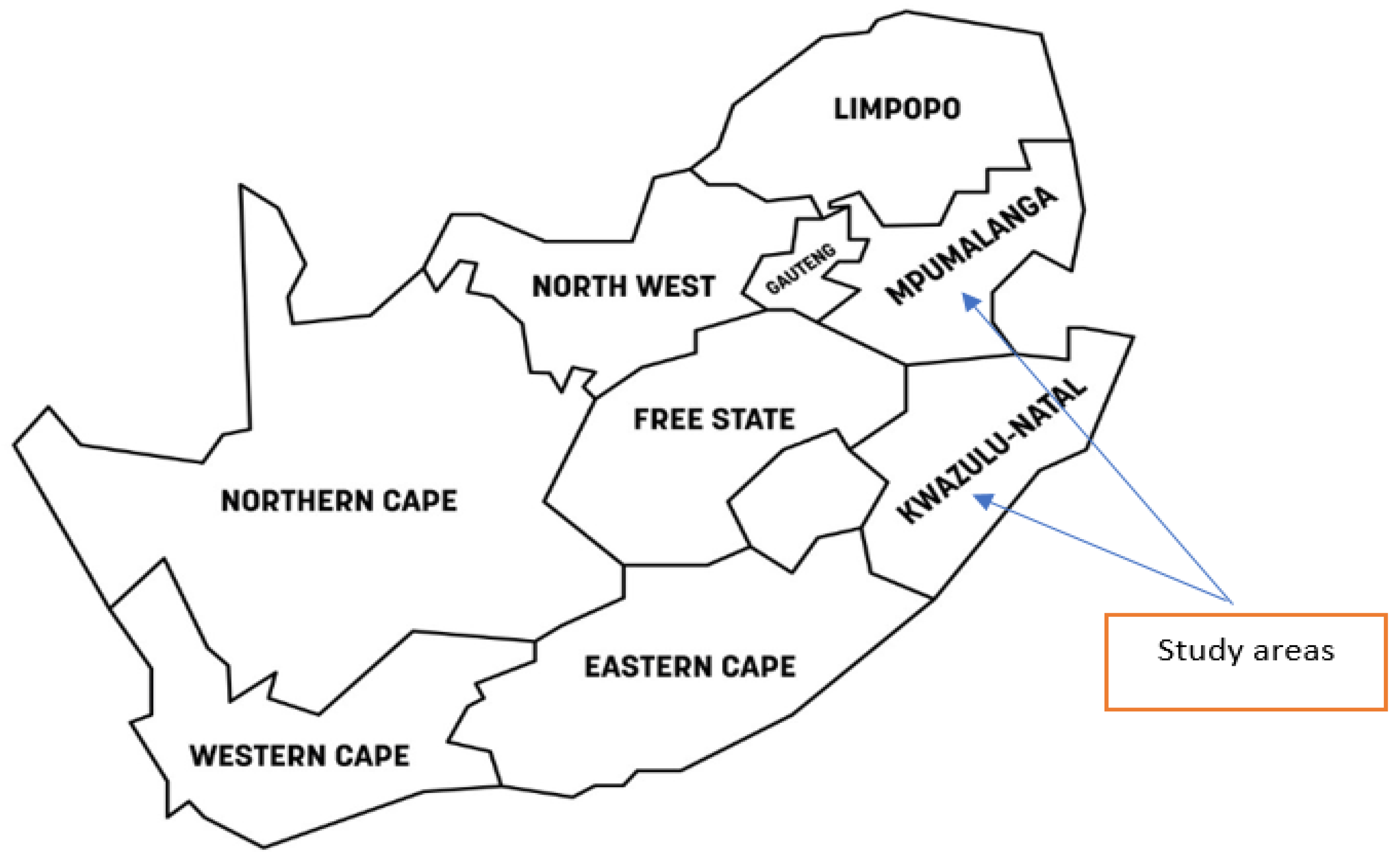
Access to credit is essential for transforming South Africa’s agricultural sector, particularly in enhancing value chain sustainability. This study investigated the role of credit access in supporting smallholder farmers’ value chain sustainability, as part of a broader project focused on developing a credit risk model for South African farmers. Data were collected from 223 SAFDA farmers in KwaZulu-Natal and Mpumalanga using a structured questionnaire. The average treatment effects (ATEs) of a propensity score matching (PSM) model was used to estimate the impacts of credit on the following four key variables: farm ownership, farm size, farm income, and farm assets. The results showed that farm ownership was associated with credit access, as ownership provided 1.84 times the chances of loan approval. Additionally, farm income increased by ZAR 2,849,398 for credit recipients compared to non-recipients. This income boost enhances market linkages and food value chain sustainability. This study rejects the hypothesis that credit access has no impact on smallholder farmers, highlighting its vital role in promoting agricultural development and value chain growth. It is recommended that policymakers enhance credit access and risk mitigation strategies to further support smallholder farmers. To improve access to credit for smallholder farmers in South Africa, we recommend the following measures: (1) establishing credit guarantee schemes in partnership with financial institutions to reduce lending risks; and (2) implementing financial education programs for smallholder farmers to enhance their debt management skills. Credit access has the potential to promote positive change across economic, social, and environmental aspects, improving not only the livelihoods of smallholder farmers but also contributing to broader sustainable development goals.
Keywords: transforming; credit access; value-chains; smallholder farmer; propensity score matching transforming; credit access; value-chains; smallholder farmer; propensity score matching