Article

What Is the Future of Agriculture in Small Island Developing States? The Case of Mauritius
by
Roshini Brizmohun
1,
Ellen Hillbom
2,*,
Rajeshreebhye Mahadea-Nemdharry
3 and
Ibrahim Wahab
4
1
Faculty of Agriculture, University of Mauritius, Moka 80837, Mauritius
2
Department of Economic History, Lund University, 220 07 Lund, Sweden
3
Mauritian Sugar Industry Research Institute, Réduit 80835, Mauritius
4
School of Global Studies, Gothenburg University, 413 14 Göteborg, Sweden
*
Author to whom correspondence should be addressed.
Agriculture 2025, 15(24), 2611; https://doi.org/10.3390/agriculture15242611
Submission received: 16 October 2025 / Revised: 28 November 2025 / Accepted: 11 December 2025 / Published: 17 December 2025
(This article belongs to the Section Agricultural Economics, Policies and Rural Management)

Abstract

Small Island Developing States (SIDS) face ongoing challenges in balancing agricultural sustainability with economic growth due to limited land resources, rapid urbanisation, climate change, and reliance on food imports. This study explores the evolution of land use and the future of agriculture in Mauritius from 2002 to 2022, using satellite imagery, policy reviews, and stakeholder interviews. Findings show a 9% decrease in agricultural and non-agricultural vegetation cover, alongside a doubling of built-up areas from 10% to 20%, indicating continued land conversion pressures. The analysis highlights major barriers to agricultural sustainability, including declining food self-sufficiency, an ageing farming population, and slow movements towards sustainable practices caused by low profitability and weak institutional support. Diverging priorities among government agencies, sugar companies, smallholder farmers, and NGOs further hinder coordinated policy efforts. To address these challenges, the study identifies strategies for aligning economic and environmental goals through integrated land-use planning, boosting productivity, and providing targeted support for sustainable ecological farming systems. Policy recommendations include protecting agricultural land, encouraging agroecological practices, alleviating labour shortages, and promoting multi-stakeholder engagement within policy development. Overall, this research enhances understanding of land-use dynamics and agricultural resilience in SIDS, offering practical insights for policymakers and practitioners working towards sustainable food systems amid spatial and climatic constraints.

1. Introduction

Small Island Developing States (SIDS) are generally open to global trade and highly reliant on imports of both unprocessed and processed foods, as well as agricultural inputs [1,2]. The COVID-19 pandemic exposed the vulnerability of this system, raising concerns about low food self-sufficiency [3,4] and demonstrating the importance of well-functioning agro-industries that can redirect production to meet new and unforeseen needs [5]. However, expanding agricultural output is complicated by SIDS’ initial geographic conditions, which include limited landmass and agricultural resources, often coupled with high population densities. Additionally, given the small consumer base and typically low incomes, the profitability of domestic food production is challenged by competition from inexpensive imports. Meanwhile, the growth of manufacturing, shipping, ICT, services, and urbanisation transforms limited agricultural land into factories, ports, infrastructure, office buildings, and residential developments. Sectoral changes also create competition for labour, making it increasingly difficult for agriculture to secure the human capital needed, both for unskilled and skilled work [1,6,7] (Chapter 2).
Another threat to agriculture is that SIDS are on the frontline of climate change, resulting in distorted agricultural seasons and recurring extreme weather events like droughts, floods, and cyclones [8,9]. These events cause damage to agricultural resources while necessitating adaptation measures, investment in new farming technologies, and a shift to more resilient crop varieties [10,11]. Additionally, following the negative impacts of previous Green Revolution activities, such as excessive use of chemical fertilizers and pesticides, soil erosion, and biodiversity loss [12], there is a growing call to rethink the approach to agricultural productivity and to develop ecological farming systems [13].
Against this backdrop, we examine changes in land use and opportunities to develop sustainable agricultural production in Mauritius. The country provides an informative case for several reasons. At independence, it was a plantation economy almost entirely reliant on growing sugar cane, processing sugar products, and burning bagasse (the fibrous residue after the processing of sugarcane) for energy. However, over the past half-century, the economy has undergone a structural transformation with a growing dominance of the industry and service sectors, as well as a modernisation of the sugar sector [14,15,16]. With the growth of alternative productive sectors, such as light (garment) manufacturing, tourism, finance, and ICT, the relative importance of agriculture, forestry, and fishing—measured as the value-added share of GDP—decreased from 19.7% in 1976 to 4.3% in 2024 [17]. Nevertheless, agriculture remains economically important, and the sugar sector has substantial multiplier effects in generating foreign exchange, conducting research and development, and investing within and beyond agriculture [18,19]. There are, however, several concerns and competing interests regarding the future of the sector.
In recent decades, declining global sugar prices and the dismantling of the Sugar Protocol, which took effect in 2009, have undermined the profitability of the sugar sector. This has resulted in a higher opportunity cost of land in other sectors, leading to an increased conversion of agricultural land into built-up areas. While successive governments have approved land conversions to support economic growth and sectoral change, sugar corporations have proactively adopted new technology, manufactured and marketed specialised sugars, and invested in tourism, real estate, property development, and renewable energy to maintain profits [19]. Meanwhile, Mauritius imports 77.4% of all food and, following the COVID-19 pandemic, there has been a lively debate regarding the conditions for national food security, prompting the government to heighten its ambition to improve food self-sufficiency [20]. Finally, a growing awareness of the grand challenges of climate change, biodiversity loss, and the importance of healthy diets has led policymakers, academics, researchers, agricultural producers, and urban consumers to advocate for the development of sustainable domestic agricultural solutions that provide healthy, home-grown foods [18,21].
Consequently, the state has shifted from heavily taxing the sugar sector to providing subsidies for medium- and small-scale sugarcane growers to safeguard production and support diversification into food crops by both corporations and smallholders. To realise its ambitions, the government has introduced several supportive agricultural policies [22,23]. In the latest ‘Strategic Plan (2024–2030) for the Food Crop and Livestock Sectors’ [24], there is a reaffirmation of the commitment to promote sustainability, equity, community, and resilience within the agriculture sector. It proposes a national land policy to preserve agricultural land for food security and highlights the need to enhance local production and develop the agro-industrial sector beyond sugar. However, the current population density of approximately 640 persons per km2, one of the highest in the world, causes scholars and development agencies to wonder if Mauritius has sufficient land resources to realise all its ambitious policies for agricultural growth [25,26].
In this context, a comprehensive study providing evidence of land-use changes over time, along with an investigation into different stakeholder positions, is long overdue. Over the past half-century, agriculture has been modernised, alternative sectors have developed, and urbanisation has advanced in a laissez-faire manner. Research is essential to support the development of comprehensive, long-term strategies that determine how much land should be allocated to agricultural activities, identify which actors can continue in the sector, and explore how to promote sustainable agriculture. Focusing on the period from the turn of the millennium to the present, we pose the following research questions: How has land use changed over time? What are the vested interests and strategies of stakeholders? What are potential pathways for the future of agriculture?
We conduct a mixed-methods study. For the quantitative component answering the first research question, we use satellite imagery data to map land-use changes between 2002 and 2022. The qualitative component addressing the second research question involves reviewing secondary sources, such as existing studies and policy documents produced by the Mauritian government and international organisations, as well as analysing primary data, including semi-structured interviews with a range of stakeholders and participant observations. Finally, we discuss the development of the agricultural sector and land-use changes, as well as diverse perspectives on the future of farming. We focus on the challenges faced by SIDS like Mauritius when striving for food self-sufficiency and sustainable agriculture amidst competition from other sectors. Our findings reveal that processes of change and critical past decisions have led to multiple new concerns, which can be grouped into four broader issues that are not unique to Mauritius but are common to SIDS generally: (1) Limited agricultural land is repurposed for alternative uses and increasingly abandoned. (2) Food self-sufficiency remains a challenge, with ongoing reliance on imports of food and inputs for the agro-processing industry. (3) The agrarian labour force is ageing as younger generations leave the sector seeking alternative employment. (4) The transition to sustainable agriculture is slow due to low profitability and limited government support for ecological farming. We conclude with some policy recommendations to address these challenges.

2. Method and Data

2.1. Quantitative Component: Mapping Land Use Changes

The quantitative component provides the findings presented in Section 4.1, where we examine land-use changes over time to answer our first research question.
We map mainland Mauritius, which has a surface area of about 1879 square km, but exclude the smaller islands, such as Rodrigues and St Brandon, which form part of the Republic of Mauritius. To track land-use changes over time, we analyse Landsat 7 ETM+ data collected on 25 January 2002 and Landsat 8–9 OLI imagery captured on 16 January 2022. We selected these datasets based on two main criteria. First, they had minimal cloud cover over land (<1% and 1.6%, respectively), which improves accuracy and strengthens our results. Second, they were acquired around the same period of the year, reducing noise from seasonal variations, especially since sugarcane, the primary crop, is harvested between June and December. We acknowledge the limitations of relying on two time points, which are 20 years apart and might not capture non-linear trends, inflexion points, or nuanced changes over the two decades. However, we opted to rely on them because of the dearth of a usable quality dataset (based on the criteria of date of capture and cloud cover). Considering our interest in understanding the implications of sectoral change on land use, and the limitations of the available data, we classify land into six cover types.
  • Agriculture—cultivated fields, including sugarcane and food crops.
  • Built-up Areas—roads, buildings, artificial structures, etc.
  • Mountains, Forests and Reserves—mountains, private and public forests, and reserves.
  • Other Vegetation—all vegetation that is not sugarcane and food crops.
  • Water Bodies—rivers, lakes, reservoirs, etc.
  • Clouds—cloud cover.
Image analysis was conducted using Object-Based Image Analysis (OBIA) techniques, where segmentation is essential to convert pixels with similar features into objects. The Landsat images (2002 and 2022) were segmented into objects using the Multiresolution Segmentation (MRS) algorithm, which locally minimises the average heterogeneity of image objects for a specified resolution. MRS performs better than other OBIA algorithms and achieves higher classification accuracy [27].
After completing the segmentation process, classification was performed on the objects, considering both their spectral properties (i.e., how they reflect light in various bands) and other contextual features like texture, size, spatial relationships, and various vegetation indices (NDVI, NDRE, Chlorophyll Index, etc.). This led to a more accurate and meaningful classification, especially important in complex landscapes where pixels alone cannot capture all the details of objects. The image analysis was carried out using eCognition Developer Software, version 10.3 (Trimble, Defines AG, Munich, Germany). Google Maps, field expertise, and local knowledge of mainland Mauritius’ land cover were also essential for achieving an accurate classification result [28].
An additional limitation of the present study relates to the relatively coarser spatial resolution of Landsat datasets—30 m spatial resolution—vis-à-vis the predominance of smallholder farms in Mauritius and what this means for the ability of the data to adequately capture them. Future studies might explore using other satellite datasets with higher spatial resolutions and capture denser data by using time series datasets.

2.2. Qualitative Component: Collecting Written, Oral, and Observational Materials

The qualitative component includes various sources that document developments and strategies, and reflect stakeholder perspectives. In Section 4.2, we use this material to further explore land-use changes and to address our second research question.
First, we reviewed relevant prior research and policy documents, including briefs and reports from the Government of Mauritius, state agencies, and multinational organisations such as UNDP and the World Bank. These secondary sources offer valuable insights into how the agricultural sector has evolved over time and the subsequent responses from the government and other stakeholders. The material guided the selection of key informants and the phrasing of interview questions, and was used to construct the analysis’s narrative.
We conducted 21 interviews with various stakeholders over the course of one year, from March 2023 to March 2024 (see Table 1). Two respondents were interviewed more than once. The selection was based on respondents’ knowledge, experience, and positions within relevant government organisations, corporations, farmers’ associations, and NGOs. Using this purposive convenience sampling, we captured a wide range of relevant stakeholders’ experiences. We met the respondents in person at their offices, homes, or agricultural fields, and the conversations took place in English, French or Mauritian Creole, depending on respondents’ preferences. The interviews were semi-structured with prepared questions and follow-ups on the answers deemed especially interesting. Instead of replicating the same questions, we tailored them to suit each respondent’s expertise. The average interview duration was approximately 60 min (range: 40–90 min). All interviews were audio-recorded with participants’ informed consent and subsequently transcribed verbatim. In line with standard procedure, identifying information was removed during transcription, and each participant was assigned an anonymised code for referencing, ensuring confidentiality.
Finally, we conducted numerous participant observations. The first author (Roshini Brizmohun) has several years of professional experience as a researcher in the Mauritian agricultural sector, which provided in-depth contextual knowledge and facilitated access to key policy and practitioner forums. In this capacity, she actively participated in and systematically observed discussions held in national and international platforms where the future of agriculture in Mauritius was debated. (Examples of forums are: ‘Pathway for a green, fair and resilient food system in the Republic of Mauritius’ organised by the UN in June 2021, ‘Pathways to a Sustainable Food Sys-tem for a Healthier Tomorrow’ organised by FAREI in March 2023, the ‘High-Level Event on FAO African Small Island Developing States (SIDS)’ organised by the Food and Agriculture Organization in November 2023, and ‘Les Assises de L’agriculture’ organised by the Economic Development Board of Mauritius in collaboration with the Ministry of Agro-Industry and Food Security in March 2023). These events emphasised the fragility of food systems on small islands, including their vulnerability to external and internal shocks. Her role included systematic note-taking, analytical reflection, and integrating insights from these forums into the research design, stakeholder selection, and thematic analysis. A similar approach was applied during participant observations of crops and agricultural practices when visiting farms operated by medium- and small-scale producers, as well as an NGO-managed demonstration farm.
Data analysis followed a reflexive thematic analysis approach. Transcripts and observation notes were maintained in a journal tracking the research. This process was iterative, involving systematic data coding and refining themes. An initial open phase generated preliminary codes, which were then grouped into higher-order categories through axial coding. These categories were further refined into overarching themes through iterative comparison across cases. Coding decisions were documented in an audit trail to enhance transparency and reflexivity. Thematic saturation was assessed during data collection. After approximately 18 interviews, no substantially new themes emerged, and the final three interviews confirmed the stability of the coding framework. Hence, the sample size was considered sufficient to capture the diversity of perspectives across stakeholder groups. We acknowledge the limitations of purposive convenience sampling, including its potential to introduce selection bias and restrict the representativeness of the findings. However, this approach was appropriate for an exploratory, in-depth qualitative study aimed at capturing rich, context-specific insights from key actors directly involved in the Mauritian agricultural sector.
Finally, to corroborate information, the qualitative material collected from previous studies, policy documents, interviews, or workshops and meetings was triangulated with other quantitative and qualitative data, previous research, and theoretical propositions to enhance the credibility and trustworthiness of the findings.

3. Beyond Agricultural Transformation

During the colonial era, the institutional setup of Mauritius’ land and labour markets favoured settlers, and sugarcane production was concentrated within a plantation system. As sugar was a global crop susceptible to competition, the estates invested in research and development from the early 20th century onwards [29]. With the gradual demise of colonialism, the large-scale farming units evolved into a ‘modern plantation system’ [30] (pp. 89–92). While the sugar sector remains export-oriented, it also exhibits newer features such as corporate ownership and financing, professional management, specialisation and standardisation, and integration with a modernising processing industry and global value chains [14]. Today, around 85% of agricultural land is freehold land privately owned by sugar corporations, tracing their origins back to the colonial era. Over time, they have been instrumental in modernising the agricultural sector, diversifying into large-scale food crop production and investing in alternative sectors, such as tourism and manufacturing [31].
The remaining agricultural land is managed by medium-scale farmers who cultivate sugarcane and smallholders are primarily involved in food production. Theoretical arguments supporting the smallholder sector’s economic viability and potential productivity experienced a revival around the turn of the millennium. Inspired by the Asian Green Revolution, these arguments were based on two main principles: first, that smallholders relying on family labour are efficient producers [32], and second, that broad-based economic growth can be driven through increased smallholder commercialisation [33,34]. The fact that smallholders now produce most tropical cash crops worldwide, while the plantation system declines, is evidence of their potential [30]. However, in Mauritius, medium-scale sugarcane planters and small-scale farmers engaged in vegetable cultivation face challenges in improving productivity and reaching profitability. Consequently, many are leaving the sector, selling or abandoning their land [18,19].
In mainstream agricultural transformation literature, a modernising agricultural sector that produces surplus capital and labour shifts resources into alternative sectors, primarily industry but also services. In this scenario, agriculture is the main driver of structural transformation, leading to a decline in the relative economic importance of the sector itself [35,36]. (Appendix B contains a table summarizing key theoretical terminology). Mauritius partly fits this theoretical model. The modernisation of the sugar sector and the sugar boom in the 1980s provided sugar corporations with substantial profits to invest in non-agriculture sectors. Meanwhile, medium- and small-scale farmers have consistently struggled to improve their production and productivity. Therefore, while capital from the sugar sector has played a significant role, structural change has not been preceded by or driven solely by an overall dynamic agricultural transformation [14,16,18,19].
Despite the growth of alternative productive sectors, agriculture can sustain a vital role by contributing to more efficient production, for example, through mechanisation, and by diversifying into more value-added production, including agro-processing [37]. Substantial empirical evidence demonstrates how benefits from a thriving agricultural sector and higher agricultural incomes support non-farm rural and urban growth through various linkages. These can be grouped into four categories, all relevant to developments in Mauritius. Production linkages—forward linkages occur as agricultural products enter non-farm processing, and backward linkages happen as farmers purchase inputs like machinery, fertilisers, and fuel from suppliers. Consumption linkages—farmers spend their surplus on local consumer goods and services. Factor market linkages—farmers engage in non-farm activities during the agricultural off-season, and investments flow reciprocally between farm and non-farm sectors. Productivity linkages—indirect benefits emerge when increased agrarian productivity enhances food security, lowers food prices, and enables better nutrition for the non-farm population, alongside knowledge flows and political stability [38].
Innovations in transport, from the transport revolution in the late 19th century to the present, combined with increasing global consumer demand, have led to continuously expanding international trade, including agricultural products, staples, and luxury crops [39]. Global trade in agricultural products has historically offered Mauritius vital opportunities. At independence in 1968, 99% of export revenues derived from raw sugar and related products [40], and in 2023, the sector’s exports were valued at US $232.44 million [41]. Simultaneously, by strengthening consumption linkages, rising (rural) incomes have driven up imports of cheaper food, consumer goods, and farm inputs, benefiting national food security and enhancing urban livelihoods but also exerting pressure on, and potentially out-competing, domestic food production. Periods of disruptions in global trade, such as the financial crisis of 2007–2008 and the COVID-19 pandemic, have revealed the underlying vulnerabilities of such an open system reliant on external sources. Consequently, this has intensified calls for securing food security through maintaining a baseline of food self-sufficiency [18,42,43].
Continued domestic agricultural production can also play a dynamic role in diversification into value-added sectors such as horticulture and agro-processing, although they differ from the broader manufacturing sector due to their reliance on perishable raw materials, often of varying quality and quantity [37]. These specific challenges motivate agro-industry enterprises to produce inputs through long-term supply relationships, secure raw materials, improve efficiency, develop farming systems, and more [44]. Mauritius’ sugar industry exemplifies such cross-sector activities, involving the cultivation of sugarcane, processing of refined sugar and molasses into rum, and utilisation of bagasse for biofuels [45,46]. Over time, the contribution of agro-processing to GDP is expected to increase relative to the production of agricultural raw materials [38]. Hence, although sugar revenues only account for 1% of Mauritius’ GDP, the sugar sector exerts a larger multiplier effect than the combined impact of the textile and financial sectors and is a significant source of foreign exchange [19] (p. 4). With larger, more capital-intensive units that increasingly dominate national, regional, and global markets, agro-processing promotes technological change and supports the development of new productive activities within agriculture and industry [47].
As we consider different methods to develop profitable agriculture, a global trend emerges of people leaving the sector due to both push- and pull factors. On one side, increasing distress among farmers struggling to maintain their livelihoods leads to de-agrarianisation in rural areas, driven by the need to find supplementary incomes [48]. In many locations, farmers ‘straddle’ between agriculture and rural and urban off-farm and non-farm activities to diversify their income sources and build assets over time [49]. Conversely, farmers often leave rural areas and agriculture either gradually or suddenly, seeking employment in alternative economic sectors with higher wages or incomes [50]. In Mauritius, the share of agriculture in total employment has steadily declined along with sectoral change, from 15% in 1991 to 5% in 2023 [17]. This movement is mainly driven by young people, resulting in an ageing farming population. Such a shift may adversely affect overall productivity as farming is physically demanding and creates a succession challenge for the older generation [51]. The increasing occurrence of abandoned valuable farmland has been observed in several countries undergoing structural transformation. It is especially worrying for nations with limited agricultural land, struggling to achieve food self-sufficiency [52].
Nevertheless, the arguably greatest challenge facing agriculture is related to environmental sustainability and planetary boundaries [53]. Throughout the agricultural transformation, increased efficiency has come at the expense of biodiversity loss [54]. Additionally, awareness of and compliance with environmental sustainability differ considerably within the business models of global agro-food value chains [55]. Various schools of thought have called for developing regenerative or sustainable agriculture based on an overall ecological farming system. However, there are important trade-offs between achieving greater utility, productivity, and profitability for the national economy and farmers individually, and meeting broader environmental sustainability objectives [56]. Nonetheless, if implemented correctly, agroecological practices can actively contribute to protecting, rather than destroying, biodiversity [54].

4. Results: Land Convergence and Interest Groups

4.1. Land-Use Change

Since the Portuguese arrived in the early 16th century, the influx of migrants, population growth, and expansion of economic activities have led to significant loss of natural ecosystems and major land-use changes. From the 17th century onwards, natural forests were steadily depleted to create space for sugar plantations, and today, less than 1.3% remain [57]. Historically, more than 70,000 hectares were planted with sugarcane, but since independence in 1968, non-agricultural sectors such as manufacturing, tourism, and finance have expanded. Since the 1990s, declining profitability in the sugar sector has led to a decrease in annual production, initially by 0.8% per year and from 2002 by 3.61% per year [19] (p. 4). Consequently, agricultural land has increasingly been diverted to competing uses such as industrial zones, offices, residential areas, and infrastructure.
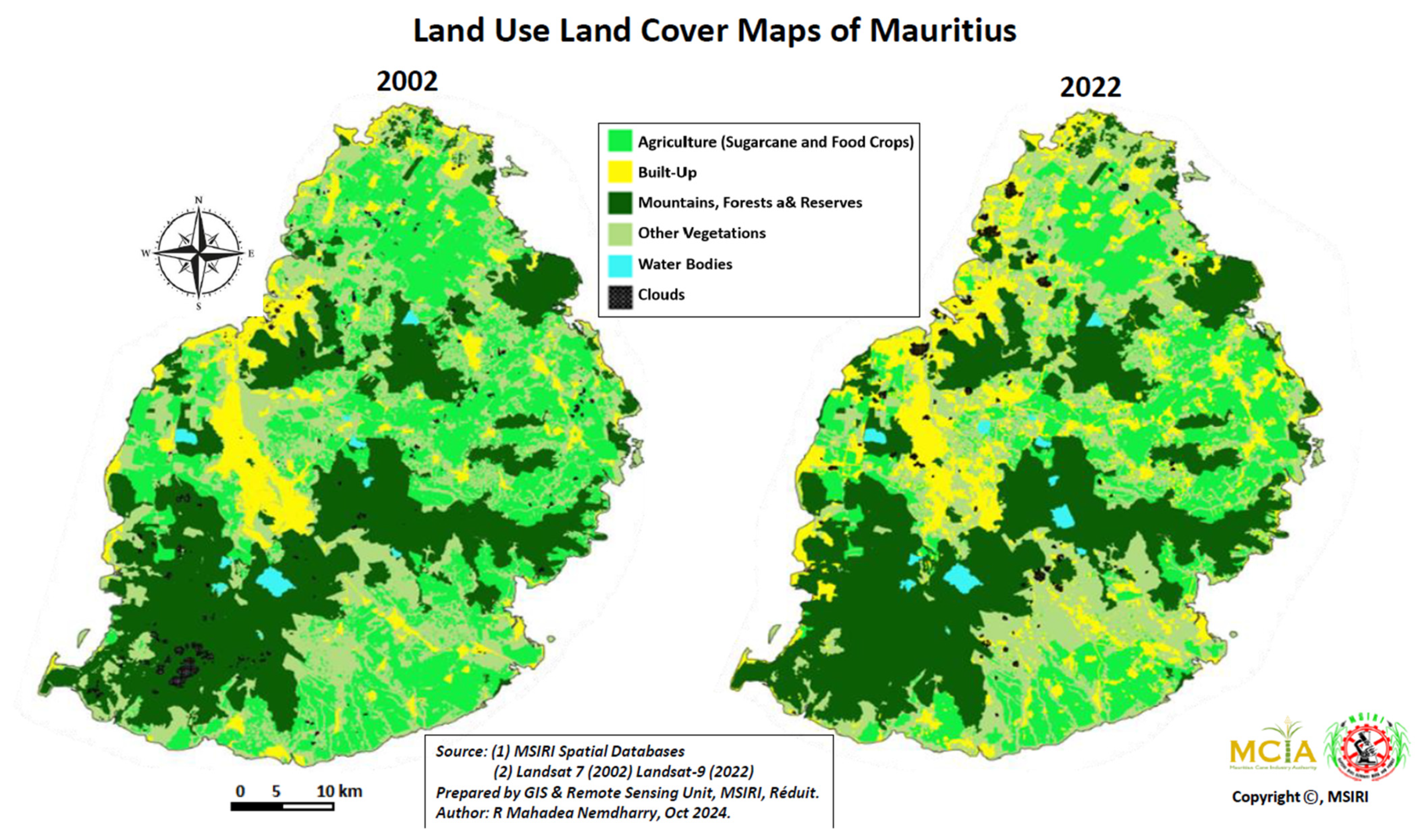
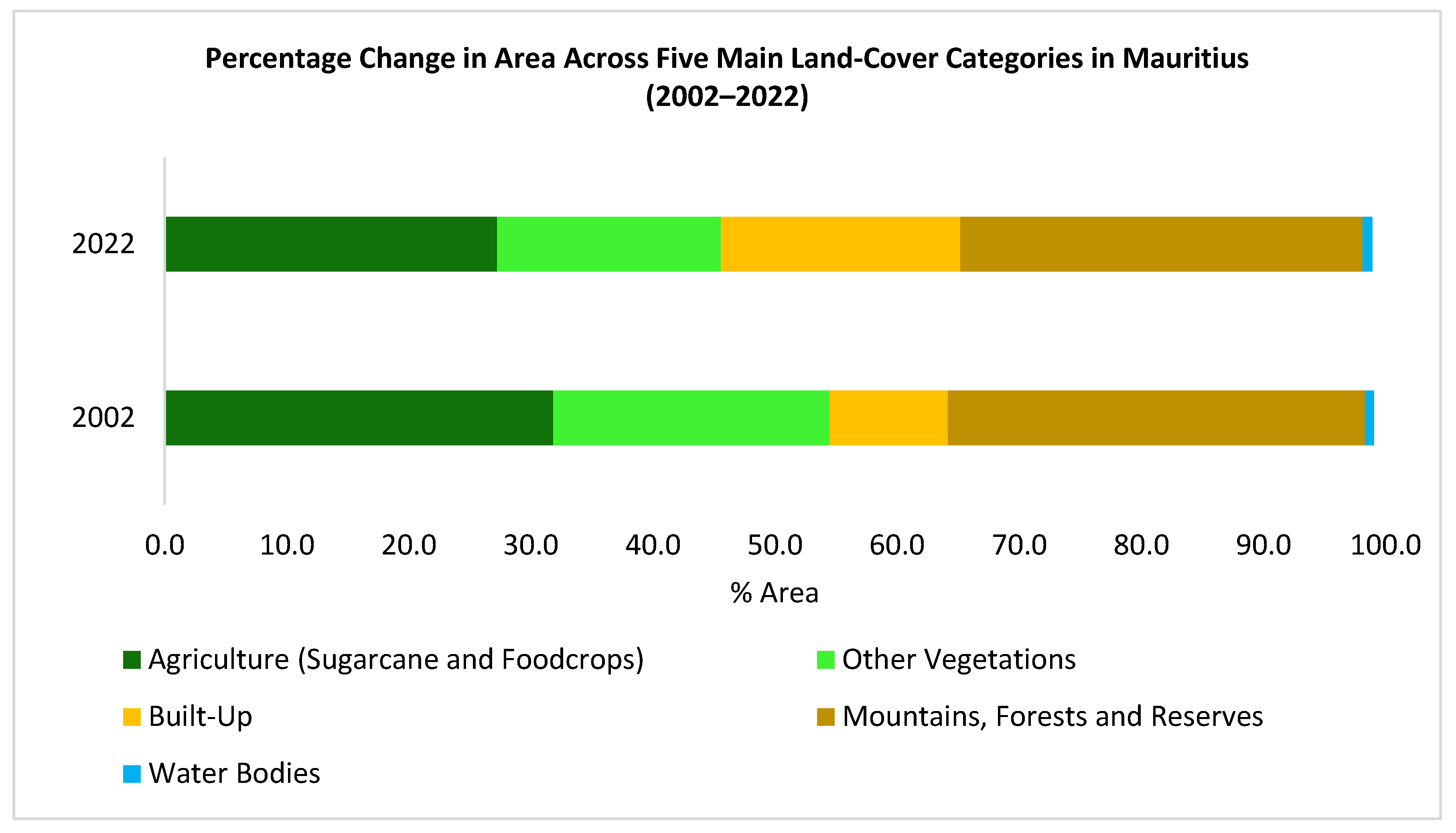
SIDS generally face significant gaps in essential statistics [58]. The most recent official land-use data published by Statistics Mauritius dates from 2005, so up-to-date statistics on land-use change are absent from publicly available documentation. While state agencies analyse satellite imagery and document areas under sugarcane, this information is mainly used for internal purposes and sector-specific analysis rather than for comprehensive and inclusive discussions about the rate of land change (interviews GO1, GO2, PSA2). Based on satellite data discussed in Section 2.2, Figure 1 illustrates our recording of overall land-use change from 2002 to 2022, and further details are provided in Figure 2 (for accuracy assessment, see Appendix A).
Across the two-decade study period, water-covered areas exhibited remarkable stability, increasing only marginally from 1335 ha in 2002 to 1460 ha in 2022. This minimal change is due to the building of the Midlands Dam in 2003 and the Bagatelle Dam in 2017 [59].
In sharp contrast, built-up land underwent the most substantial transformation, more than doubling from 17,998 ha to 36,475 ha between 2002 and 2022. This rapid expansion underscores the intensification of urbanisation and infrastructure development, likely driven by population growth, economic activities, and the spatial spread of settlements. The magnitude of this increase highlights a major shift in land-use priorities, with built-up areas replacing other land-cover types at an unprecedented rate.
Simultaneously, multiple vegetated land-cover classes experienced notable declines. Agricultural land, including sugarcane plantations and a range of food crop fields, decreased markedly, falling from 59,289 ha to 50,746 ha. This reduction may reflect a transition away from agrarian land uses due to urban encroachment, changes in agricultural policies, or declining economic viability of farming in certain areas. Non-agricultural vegetation, encompassing grasslands, shrub lands, and other natural or semi-natural vegetated areas, also contracted substantially, decreasing from 42,182 ha to 34,132 ha. The persistence of this trend indicates a broader pattern of ecosystem conversion and fragmentation beyond strictly agricultural landscapes.
Mountain and forest reserve areas demonstrated comparatively minor losses, declining from 63,665 ha to 61,397 ha. The relatively small reduction (2268 ha) suggests that protected status may offer some degree of resilience against land-use conversion. Nevertheless, even limited encroachment into these reserves raises concerns about long-term conservation outcomes, biodiversity protection, and ecosystem services.
When analysed collectively, the data show that the expansion of built-up land (an increase of 18,477 ha) is broadly counterbalanced by the combined loss of agricultural and non-agricultural vegetation (a reduction of 16,593 ha). Because forest reserves contributed only modestly to the overall decline, it is reasonable to infer that most newly built-up areas originated from lands that were either actively cultivated or held potential for agriculture or natural vegetation. This pattern reflects a systematic conversion of vegetated landscapes into urbanised spaces.
Finally, the “Clouds” category, which covers 1784 ha in 2002 and 2043 ha in 2022, represents areas temporarily obscured in satellite imagery. Since this class accounts for only 1.1% of the total landmass, its presence introduces only minimal uncertainty. Because it does not materially affect the overall interpretation of land-cover change trends, we exclude it from Figure 2.
Although nearly all virgin forests have vanished, mountains and forest reserves cover 33% of Mauritius. Due to geographic conditions and institutional barriers, land conversion is expected to remain limited in the future. Our analysis shows that over the past twenty years, the proportion of agricultural land and other vegetation has declined by 9%, from 54% to 45%. Meanwhile, built-up areas have doubled from 10% to 20%. The fact that the drivers of this trend, such as the expansion of non-agricultural economic sectors and growing residential developments, are ongoing indicates a continuation of the irreversible conversion of agricultural land. Although current levels are already concerning, the increasing rate of land conversion and the loss of high-potential farmland are even more troubling. If this trend continues without regulation, Mauritius could become a predominantly cemented island with a significantly diminished agricultural sector within a few decades.

4.2. Stakeholder Interests

Over the past two decades, an average of 2000 hectares of land has been converted from sugarcane cultivation each year [19]. The number of farmers planting sugarcane has decreased from 27,000 to 12,000, with most of those leaving being smallholders. While some of the loss in sugarcane land is due to on-farm diversification, we showed in Section 4.1 that much of the agricultural land has been converted into built-up areas. In this section, we follow up on our results by discussing different stakeholder interests expressed in previous studies, policy documents, and interviews. We first present the government’s perspective on sugar-cane production and food self-sufficiency, then large corporations’ production of sugar and food crops, challenges faced by medium- and small-scale landholders, climate change awareness, and, finally, the attitudes towards agroecological practices.
The government previously relied on the Sugar Industry Efficiency Act (SIE Act) [60] to safeguard the future of sugarcane production and limit land conversion. Nevertheless, in 2016, an amendment was made to ease the restrictions on land conversion [61]. To counter these trends, recent government budgets have allocated funds to rehabilitate abandoned lands and provide financial incentives to encourage smallholder sugarcane growers to remain active. There has been some success, with 3500 hectares re-planted over the last three years [47]. Still, the 2022 estimates of total land under sugarcane amounted to 42,000 hectares, leading the Mauritius Cane Industry Authority (MCIA) to propose in a National Biomass Framework that regulations be reviewed to ‘lock’ 45,000 hectares for sugarcane, or else it would be impossible to meet sugar production needs and secure sufficient bagasse for clean energy generation [46].
Meanwhile, recent disruptions in global food supply chains, caused by events such as the COVID-19 pandemic and the war in Ukraine, have led the Mauritian government to gradually expand food production, improve food self-sufficiency, and promote sustainable farming practices. This aligns with a general trend discussed by Clapp [42]. The goals are outlined in the ‘Strategic Plan for Food Crop and Livestock Sectors 2024–2030’, where the vision is stated: “To build a vibrant non-sugar agriculture and agribusiness sector that utilises natural resources sustainably, contributes significantly to national food security and safety, empowers producers to achieve higher productivity gains, and improves the welfare of the farming community.” [18] (p. ix). In pursuit of this, the document highlights strategic crops such as potatoes and onions, along with a comprehensive list of actions. The ambition to promote both sugar and food production raises the question of which segments of agricultural producers should be targeted to achieve the best outcome. The ‘modern plantations’ [5,31] or the medium- and small-scale producers [32,33,34]?
Currently, 85% of Mauritius’ agricultural land is dedicated to sugarcane [18] (p. 2), with most of it owned by large sugar corporations that aim to reduce costs and save labour, and primarily cultivate the crop using mechanised methods to stay competitive. The cane is processed in sugar mills, and while the production by medium- and small-scale growers remains significant, the dominant suppliers are the sugar estates. In the late 19th century, Mauritius had 259 mills, but by 1990, only 17 remained. Since then, declining sugarcane production and improved efficiency have further reduced this number to just three mills, which the sector struggles to sustain [19] (p. 7). Due to the international sugar market and high production costs, sugarcane has become less competitive. Nevertheless, because of agro-processing’s contribution to technological change and the economy [47], there is widespread consensus among sugarcane producers that the area devoted to sugarcane must be maintained at a certain level to ensure the continued operation of the remaining mills. To offset low profitability, companies have diversified into products such as ethanol and pharmaceutical alcohol, a sector that expanded and proved beneficial for Mauritius during the COVID-19 pandemic (interviews PSA1, PSA2, SC1, SC2). The recent National Biomass Framework, which aims to achieve a 60% renewable energy mix by 2030 through increased utilisation of subsidised biomass and other green sources, offers a potential solution for the continued cultivation of sugarcane. Planters’ growing reliance on bagasse sales [19,46] (interviews GO1, GO2, SC1, SC2) supports Fukase and Martin’s [37] arguments that the development of a new value-added sector creates additional opportunities to generate revenue.
The corporate sector has also diversified into food crops, mainly potatoes, and livestock, primarily deer, using land unsuitable for mechanised sugarcane and forest areas. These efforts are driven by a search for additional income and efficient land use, but, as with the government, the sugar estates also recognise the importance of food self-sufficiency strategies and, at times, have shifted sugarcane land to food crops upon the government’s request. Still, due to the shortage of affordable labour, some sugar estates have abandoned parts of their land where mechanisation is not feasible (interviews SC1, SC2). This supports Corsi and Salvoni’s [50] argument that the agricultural sector is increasingly losing out in the competition with other sectors over labour. In sum, the boards of sugar corporations must weigh various economic considerations when deciding whether to maintain agricultural land to optimise sugarcane production or to sell or convert land for non-agricultural uses, such as real estate and education hubs, to break even (interviews PS1, PS2, SC1, SC2).
Our interviews with farmers’ associations (interviews FA1, FA2, FA3) and farmers (interviews F1, F2, F3) highlight six main and often interconnected reasons why medium- and small-scale landholders abandon or sell their land. (1) The high cost of agricultural production combined with the lack of affordable labour. (2) Uncertain prices and marketing difficulties for food crops. (3) A lack of interest among youths in inheriting farms when opportunities in other sectors or abroad offer higher earnings. (4) Succession disputes that cause land conflicts and undivided land, which hinder investments and farming. (5) Climate change and unpredictable weather leading to higher temperatures and less water, challenging traditional farming methods. (6) Reduced productivity, caused by multiple factors such as weather variations, soil health decline, less vigorous crop varieties, water scarcity, and outbreaks of pests and diseases. We recognise their struggles from previous research, including obstacles to recruiting labour [50], difficulties in securing sufficient incomes [48], the exodus of the younger generations [51], vulnerability to climate change and extreme weather [8,9], and investment costs involved in adopting new farming methods [10,11]. As farmers, besides growing sugarcane, also cultivate various food crops, their departure results in decreased national food crop output and deteriorating food self-sufficiency. Without viable business models guaranteeing better incomes and working conditions to motivate the younger generation to take over, this trend is likely to persist.
To varying degrees and in different ways, all stakeholders show concern about the challenges faced by the agricultural sector related to climate change and biodiversity loss [53], as well as the health benefits of locally produced foods. Government organisations express a relatively high level of formal recognition, as reflected in national policy documents and strategic plans, as well as in interviews. It is largely framed in terms of national food security, climate resilience, and international policy commitments [18], (interviews GM1, GM2, GO1, GO2). Meanwhile, the private sector exhibits a more practice-oriented awareness, primarily focused on productivity, risk management, and compliance with emerging environmental standards. This is evidenced, for example, by the Mauritius Chamber of Agriculture’s implementation of the Smart Agriculture project aimed at reducing agro-chemical use in food crop production (interviews PSA1, PSA2, SC1, SC2). Conversely, farmers’ associations and individual producers demonstrate a strong experiential awareness of environmental change through direct observations of changing rainfall patterns, soil degradation, and pest pressure. However, their primary concern remains economic viability. While many recognise the long-term benefits of ecological farming, they perceive low short-term profitability as a critical barrier. Hence, they tend to prioritise immediate livelihood security and therefore call for targeted subsidies and support for viable business models [62], (interviews F1, F2, F3, FA1, FA2, FA3). For instance, F1 holds a degree from the University of Mauritius’ Faculty of Agriculture and has adopted ecological farming practices, but to earn a living, he must straddle agriculture and non-farm employment [49].
A limited number of local NGOs are also working to promote ecological farming. One initiative was to create a platform for communities and corporations to connect and form partnerships to develop innovations in sustainable food systems. Unfortunately, there has been limited progress since the initial launch due to a lack of stakeholder commitment (interviews NGO4, NGO5, NGO6). Another NGO with broader engagement in overall sustainable development in Mauritius promotes agroecological practices among impoverished urban dwellers. At their demonstration farm, they teach vulnerable families how to grow traditional food crops using sustainable methods, thereby improving household food security. The scale of their activities is limited, but impactful for those they serve. However, they complain that NGOs and local communities are not included when the government invites stakeholders to discuss the future of ecological farming (interviews NGO1, NGO2, NGO3; participant observation). The concept of ‘urban farming’ is gaining traction worldwide, either as a subsistence livelihood strategy or associated with modern technologies and high efficiency. However, in Mauritius, it remains relatively limited and continues to be linked with poverty alleviation, resilience, and risk spreading, reflecting limited income opportunities for impoverished households.

5. Discussion: The Future of Agriculture

Our results in Section 4 revealed several complexities and contradictions paving the way for us to tackle the final research question and discuss the future of agriculture in Mauritius.
On one hand, there are numerous linkages—production, consumption, factor markets, and productivity [38]—worth preserving between the agricultural sector and the rest of the economy. This raises concerns regarding the current rate of conversion of agricultural land to alternative uses, and stakeholders generally agree on the benefits of preserving and protecting the agricultural sector. Additionally, there is a keen awareness of the vulnerability caused by low food self-sufficiency and the threats of climate change and biodiversity loss. As a result, stakeholders are willing to produce healthy, local food and are interested in promoting sustainable agriculture, including adopting agroecological practices. However, the gap between the goals and visions, on one side, and the incentives, opportunities, and actions of stakeholders at all levels, on the other, remains significant.
Taken together, our mapping of the ongoing conversion of agricultural land to build-up areas (Section 4.1) and the concerns expressed by stakeholders (Section 4.2) show that the government must promote legislation that develops and fosters long-term, inclusive, and holistic sustainable agricultural strategies based on national interests while protecting a range of interests. Balancing the interests of multiple sectors is especially important in countries with limited landmass, such as SIDS, where agricultural land ‘lost’ to other uses, including industrial facilities, residences, and infrastructure, cannot be reclaimed [63]. Hence, there is first a need for an overarching long-term land-use plan for the country, including deciding how much land should be reserved for future agricultural purposes. The latest recommendation from MCIA is to reserve 45,000 ha for sugarcane production [46]. Considering approximately 85,000 ha of land with potential for various agricultural activities (50,746 ha for agriculture and 34,132 ha for other vegetation) (see Section 4.1), there should also be an opportunity to allocate land for increased domestic food production (interviews GM1, GM2). During this process, soil fertility and land suitability must be considered, and, depending on the future profitability of the sugar sector, current producers want to see options to replace sugarcane with alternative crops explored (interviews FA1, FA2, FA3, SC1, SC2).
Mauritius’s general narrative is that the country’s development relies on negotiations among its diverse population. However, sugar corporations’ interests dominate the agricultural sector due to their substantial land holdings and production [31], while medium- and small-scale planters, NGOs, and local communities struggle to be included in discussions (interviews F2, F3, FA1, FA2, FA3, NGO2, NGO3). In its policies, the government has tried to balance various interests and initiatives without clearly prioritising any of them. For instance, the ‘Accompanying Measures to Restore Abandoned Cane Lands’ (ALMS scheme) and a ‘Cane Replantation Scheme’ exist to encourage all farmers to replant sugarcane for higher productivity. However, since neither the modern plantation system nor medium- and small-scale growers currently generate enough profit to sustain participation in global competition [19,30], (interviews PSA1, PSA2), such programs have limited impact on corporations’ and farmers’ decisions (interviews F1, F2, F3, SC1, SC2).
Simultaneously, the government expresses ambitions to enhance Mauritius’ food self-sufficiency (interviews GM1, GM2). The current national target is to raise food production (crops, meat, honey) by 6% annually over the next seven years, while also promoting sustainable agriculture and encouraging entrepreneurship and agro-processing [18] (Section 6). This vision is ambitious and requires significant budget allocations, subsidies, and the potential to shield domestic markets from international competition. So far, smallholders have not met expectations to become efficient food producers [32], and during our fieldwork, they repeatedly stated their need for alternative conditions and incentives to turn current failures into successes (interviews FA1, FA2, FA3). A further benefit for Mauritius is that shorter food chains and increased consumption of locally produced traditional foods can improve the population’s health (interview GM2). Supporters of protectionist policies defend states’ rights to insulate themselves from the uncertainties of global markets that threaten their food supply chains, although this may impose high costs on governments, taxpayers, and consumers [42,64].
Access to affordable labour remains a challenge for the agricultural sector. Mauritius’ fertility rates declined sharply from 6.2 children per woman in 1960 to 2 in 1985 and 1.4 in 2023, resulting in −0.1% population growth rates in the same year [17]. Currently, there are not enough Mauritians of working age to meet the demands of various economic sectors. Additionally, young Mauritians are becoming increasingly educated and primarily seek employment in white-collar sectors such as government, services, and finance [65]. These changes are in line with what can be expected in countries undergoing structural transformation [50] and demographic transition. Other sectors, including textile, hospitality, and construction, have addressed labour shortages for low-skilled workers by recruiting migrant workers. Agriculture has recently followed suit, supported by various labour market reforms [18] (Section 11.14). However, farmers note that because salary levels are high relative to profit margins and additional costs are associated with providing housing for migrant labour, they often remain unable to fulfil their labour requirements (interviews F2, F3, F4).
In the sugar sector, labour regulations and farmworkers’ trade unions have a long history and hold a significant influence. This has greatly impacted and safeguarded salary levels, which are 23% higher than in the manufacturing sector [19] (p. 6). To reduce their dependence on labour availability and costs, sugarcane companies have responded by mechanising their cane production. Meanwhile, their food production continues to rely on manual labour, but the same workers cannot, according to regulations, be employed in both sugarcane and food production (interviews SC1, SC2). Still, the high labour costs are most detrimental for medium- and small-scale farmers who cannot afford to invest in machinery, and rely on migrant labour for their mixed-farming activities (interviews F2, F3, FA1, FA2, FA3, SC2). Various solutions to these issues were discussed in the interviews. Further labour market reforms are desirable for employers (interview SC12), but they could worsen conditions for sugarcane workers. While subsidising farm labour in the food crop sector is a short-term, potentially costly measure, subsidising mechanisation for medium- and small-scale producers might also be expensive but would represent a long-term investment in productivity growth (interviews PSA1, PSA2).
Agricultural transformation theory assumes a consistent search for innovative agricultural opportunities to generate higher revenue through viable business models [36]. In Mauritius, the corporate sector is currently expanding production of speciality sugars, which fetch higher prices in the international market, and farmers are experimenting with alternative high-value crops, such as hemp, for the nutraceutical industry. Simultaneously, sugar estates find themselves in a ‘sugar trap’ as they must maintain a certain acreage under sugarcane production to keep the few remaining mills operating (interview SC1). Still, technological change is continuously shaping the production of all crops as corporations, for example, are digitalising and using drones to improve productivity. The shift to labour-saving technology and more capital-intensive production, in turn, increases the demand for skilled labour with higher-level training (interviews GO1, SC2). Meanwhile, medium- and small-scale farmers struggle to afford innovative technology and risk being outcompetited (interviews F2, F3, FA1, FA2, FA3).
Biomass (bagasse) is currently the most profitable agricultural product, and it does not require altering how sugarcane is grown or the adjacent agro-processing [19]. According to the government’s ambitions outlined in the National Biomass Framework, investments in bioelectricity production require increased biomass production to reach the target of 60% renewable energy by 2030 [46]. To achieve this, planters (small-, medium-, and large-scale) receive MUR 3300 (about USD 70) for the bagasse per tonne of sugar produced. By planting sugarcane varieties with higher bagasse biomass, growers can both contribute to renewable energy and earn substantial incomes (interview FA1). Another effort to produce clean energy involves converting agricultural land into photovoltaic farms [66]. Since bagasse is often mixed with coal when the biomass is insufficient, using agricultural land to generate solar energy is a more environmentally sustainable option.
Agro-processing serves as an important link between agriculture and industry, fostering sectoral change and structural transformation [37,47], and, compared to many countries in the Global South, Mauritius’ sugar sector has been highly advanced at an early stage [14,16]. Now, the expanding markets across the African continent are expected to open for more agro-food products, and the African Continental Free Trade Area (AfCFTA) could provide additional opportunities for Mauritius to engage in trade with the mainland (interviews PSA1, SC1). Inspired by the Export Processing Zones that contributed to expanding the light manufacturing (garment) industry during the 1970s–80s, there are proposals to now establish agro-processing zones and position the country as a regional agro-industrial hub [18] (Section 9.3.1).
Given its dominant position, the corporate sector plays a crucial role in shaping the future of sustainable agriculture and ecological farming. On the positive side, there is a growing awareness of the Grand Challenges related to climate change and biodiversity loss. Discussions around agroecological practices are widespread, and corporations have made progress in adopting more sustainable farming techniques (interviews SC1, SC2). A recent example is the EU-funded Smart Agriculture project, implemented by the Chamber of Agriculture, which aimed to support farmers in transitioning to more agroecological production systems (interview PSA1). However, the debate around moving towards sustainable agriculture and ecological farming has been ongoing for over a decade, yet the transition remains slow overall. Stakeholder interviews suggest various reasons for this delay. The most common concern among producers of all land sizes and crops is the lack of viable business models, alongside the call for government efforts to reduce the costs associated with shifting to agroecological practices (interviews F1, F2, F3, FA1, FA2, FA3, PSA1, PSA2, SC1, SC2). Until farmers see higher returns, they remain hesitant or unable to make the transition, citing several underlying factors behind the high costs. The concerns are universally expressed—from corporations to small-scale planters, by the private sector representatives and farmers’ associations. Firstly, the main inputs, such as seeds, compost, and biological control products, are largely imported and expensive. Secondly, the labour-intensive nature of many agroecological practices makes it challenging to affordably hire farmhands. Additionally, small- and medium-scale farmers report that climate change has made drought a recurring issue during summer months, and agriculture is deprioritised during water shortages. Policies that restrict water supply to agriculture during shortages further discourage farmers. Current challenges underscore the urgent need for improved water efficiency, including the adoption of water-saving technologies and wastewater recycling (interviews F1, F2, F3, FA1, FA2, FA3, NGO2, NGO3, PSA1, PSA2, SC1, SC2).
Shifting from the supply to the demand side, the current trend shows an increase in the importation of processed foods rather than the consumption of homegrown crops (interview FA1). Meanwhile, consumers’ awareness of the benefits of leading healthy lifestyles and the demand for sustainable food products is gradually growing. However, concerns exist about the excessive use of agrochemicals in Mauritius’ agricultural production, leading to scepticism about locally produced foods [67,68]. Additionally, ecologically produced foods tend to be expensive [69] and therefore inaccessible to lower-income groups. It was suggested to us that greater regulation of agrochemicals and shorter supply chains could encourage consumers to buy more healthy, home-grown foods, thereby incentivising the production of local crops and steering farmers towards agroecological practices (interview F1).
Still, the future of agriculture relies heavily on new generations of farmers seeing opportunities in the sector [51]. Currently, young people engaging in food production using agroecological methods often face declining revenues and struggle to recover investments (interview F1). The lack of interest among younger generations in succeeding their parents also leads to the loss of traditional practices when they are not passed down. An appealing economic model for innovative, sustainable agricultural production and new technologies is needed to keep youths in agriculture [51], (interviews FA1, FA2, FA3). Meanwhile, agroecological practices for urban agriculture with low input costs are promoted to garden farmers to supplement both incomes and nutrition through traditional foods. While these efforts can significantly improve household livelihoods, their overall impact on the wider agricultural sector remains uncertain [64], (interviews NGO2, NGO3).
Finally, during the fieldwork, we discussed with stakeholders a range of additional schemes that have emerged to promote sustainable agriculture, but their impacts remain uncertain (interviews GM1, GM2, PSA1, PSA2). For example, to promote a circular economy, the government encourages nutrient recycling through compost-making as an alternative to chemical fertilisers [70]. Companies are also testing the commercialisation of seaweed-based compost. Additionally, the government has introduced financial incentives and other mechanisms in the agriculture sector, such as the ‘Biofarming Scheme’ [71]. It appears that farmers who have adopted or shifted to biofarming are willing to forgo initial revenue to gain experience with suitable production methods, even if their productivity drops (interview F1). Meanwhile, the government is developing the Organic Bill to establish the necessary legislation for recognising organic products in Mauritius. However, until certification is established, low revenues from such produce will remain a barrier.

6. Conclusions

Our study was motivated by the need for small island states to develop long-term plans to effectively manage their limited land resources and make foresighted decisions about their agricultural sectors. Using Mauritius as our case study, we explored this through three interconnected research questions addressing: (1) land conversions, (2) stakeholder interests and strategies, and (3) the potential future of agriculture. The findings are case-specific, and our contribution is empirical rather than theoretical, yet the study provides principal insights for SIDS research.
First, our satellite data showed that between 2002 and 2022, agricultural and non-agricultural vegetation cover decreased by 9% of the total landmass, while built-up areas doubled from 10% to 20%. These findings underscore the urgency for SIDS to develop strategic land use policies and actively govern their scarce land resources. Second, although the government has introduced several policies indicating strong ambitions for agricultural production, it mainly adopts a hands-off approach focused on national growth and sectoral change. The corporate sector plays a vital role in driving agricultural and structural transformation, utilising land resources to increase profits, whether through agricultural outputs like sugarcane and food crops or via alternative economic activities. Meanwhile, medium- and small-scale farmers and their successive generations are leaving agriculture due to low profits and better employment opportunities elsewhere. The dispersed interests and strategies highlight the need for governments to step up and work towards inclusive agricultural development that caters to the needs of all stakeholders. Finally, there are widespread concerns about the ‘cementing of the island’, the lack of food self-sufficiency, climate change, biodiversity loss, and the desirability of growing healthy, locally produced traditional foods. There is a contradiction in the simultaneous concern for the future of agriculture and the parallel dismantling of the sector. Our discussion in Section 5 identified several potential pathways forward, but they must address key challenges, above all, improving profitability, making the sector attractive to future generations, adapting to climate change, and preserving biodiversity.
The economic, social, and environmental sustainability of the agricultural sector is under increasing threat. Challenges encountered in this study include more frequent extreme weather events, disrupted food supply chains, low profitability compared to other economic sectors, young people’s preference for desk jobs and urban lifestyles, and the slow transition into ecological farming systems. All these issues require more research, from the global to the local level, seeking both uniform and specific solutions. We own the limitations of our study as we recognise the value of better quality satellite data and larger number of interviews to avoid selection bias and ensure better representativeness. Still, we hope the study serves as a call to raise awareness around the urgency for Mauritius and other SIDS’ governments and societies to tackle these challenges.
Based on our findings, we propose the following policy recommendations. From the government’s side, firstly, better statistics and transparency about land conversion are needed for a fact-based debate. Secondly, more explicit policies are required to facilitate discussion and decision-making on the necessary trade-offs between different agricultural and economic activities. Importantly, with its ownership of land and capital (both physical and financial), the corporate sector is a critical player that must act as a positive force—balancing narrow political and economic interests while developing and implementing more sustainable farming practices. Market structures must ensure that all agricultural producers—corporations as well as medium- and small-scale farmers—operate as viable businesses earning reasonable profits. The production aimed at increasing food self-sufficiency and expanding ecological agriculture must be based on sustainable business models. Furthermore, to encourage the younger generation to stay in agriculture, the sector must become attractive in terms of income and provide competitive working conditions through new technologies. Additionally, other stakeholders such as NGOs and local communities must be given a stronger voice to promote inclusive and sustainable development.

Author Contributions

Conceptualization, R.B., E.H. and I.W.; methodology, R.B., E.H., R.M.-N. and I.W.; software, R.M.-N. and I.W.; validation, R.B., E.H. and I.W.; formal analysis, R.B., E.H., R.M.-N. and I.W.; investigation, R.B., E.H. and I.W.; data curation, R.B., E.H., R.M.-N. and I.W.; writing—original draft preparation, R.B., E.H., R.M.-N. and I.W.; writing—review and editing, R.B., E.H., R.M.-N. and I.W.; visualization, R.M.-N.; project administration, E.H.; funding acquisition, E.H. All authors have read and agreed to the published version of the manuscript.

Funding

Hillbom and Wahab received financial support from the Swedish Research Council for the project Sustainable Development of Small Island States, no. VR-2019-04117.

Data Availability Statement

The original contributions presented in this study have been included in the article. Further inquiries can be directed to the corresponding author.

Conflicts of Interest

The authors declare no conflicts of interest. The funders had no role in the design of the study; in the collection, analyses, or interpretation of data; in the writing of the manuscript; or in the decision to publish the results.

Appendix A. Accuracy Assessment

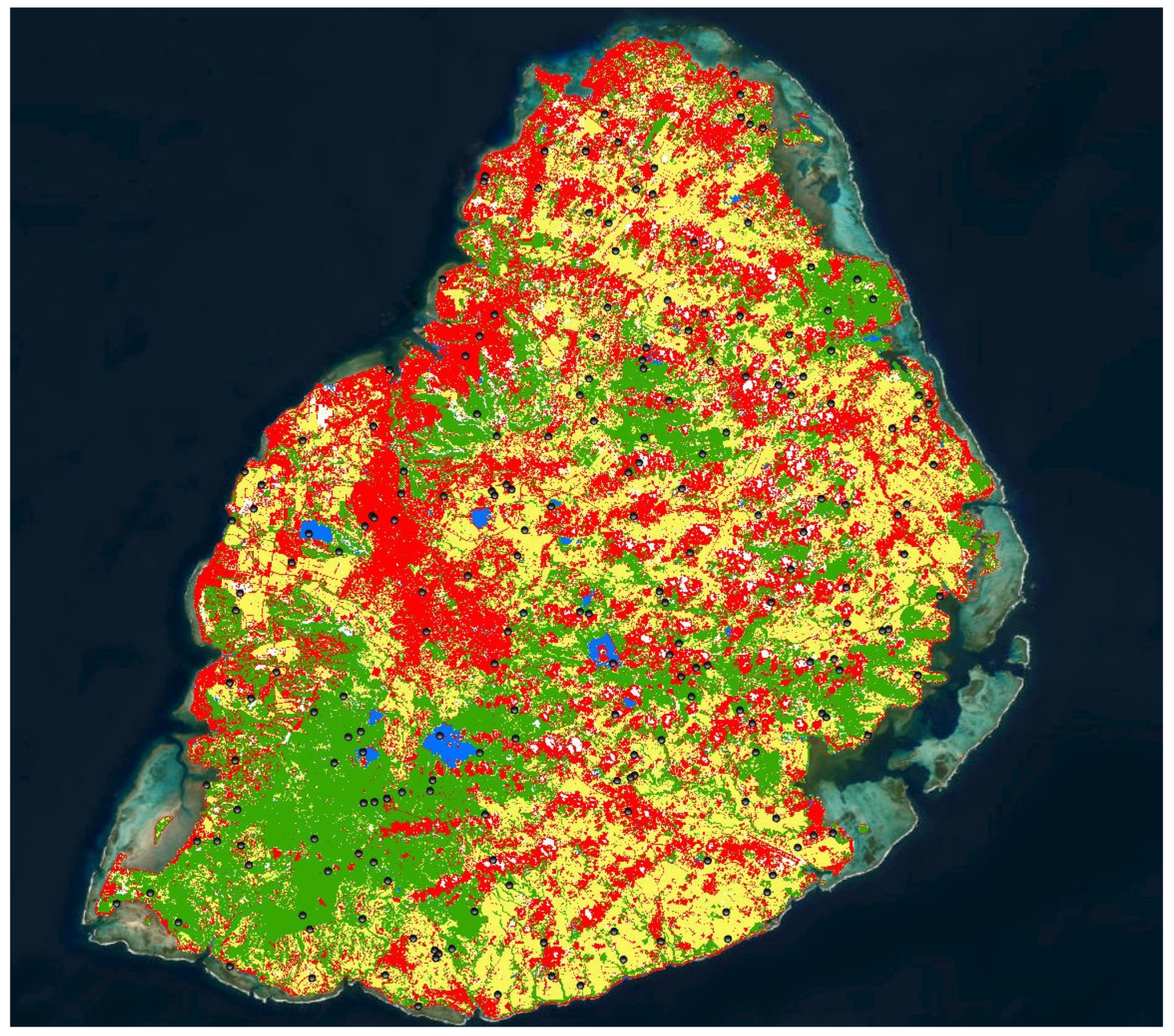
An accuracy assessment was carried out to evaluate how well the classification matches the source imagery or the ground truth dataset. This was only done for the 2022 classification, as that is when we have reliable ground truth data for comparison. We chose Stratified Random sampling and selected 206 random points (see Figure A1 below), instead of a minimum of 50 samples per land use class, due to the limited areas of some classes such as water bodies or clouds. Using 50 points per land use class would overrepresent water surfaces and significantly underrepresent other classes like forests and built-up areas.
Figure A1. Stratified random sampling points for the 2022 classified imagery. The points are randomly assigned over water surfaces (blue), built up areas (red), forests (green) and agricultural or cultivated surfaces (yellow). NB: White patches represent cloud cover.
Agriculture 15 02611 g0a1
Using the ground truth data embedded in the ArcGIS (version 2.8) interface, the grndtrth column in the attribute table was populated after the classified column had been hidden to avoid biasing the class assignment. Table A1 below shows the confusion matrix for the classification results. The overall coefficient of agreement (kappa) has a decent accuracy of 62%. This has been diluted by the low producer accuracy (40%) and user accuracy (33%) for land use class for ‘Others’ which is mainly for cloud cover and its shadows which are not present in the groundtruth dataset. Still, the main land uses of interest for the study show very high producer accuracies: 91% for Developed/Built-up areas, 86% for water surfaces, and 74% for forests; and high User Accuracies: 93% for Forests, 86% for agricultural fields, and 67% for water bodies.
Table A1. Confusion Matrix showing the accuracy of the classification results for Mauritius.
Classified
Class NameWaterDeveloped/
Built-Up
OthersForestAgricultural FieldsTotalUser AccuracyKappa
GroundtruthWater6.001.000.000.002.009.000.670.00
Developed/Built-up1.0032.003.0011.0018.0065.000.490.00
Others0.000.004.003.005.0012.000.330.00
Forest0.000.001.0053.003.0057.000.930.00
Agricultural Fields0.002.002.005.0054.0063.000.860.00
Total7.0035.0010.0072.0082.00206.000.000.00
Producer Accuracy0.860.910.400.740.660.000.720.00
Kappa0.000.000.000.000.000.000.000.62

Appendix B. Terminology

Table A2. Summary of key terminology.
TerminologyDefinition
Agricultural transformationBroader processes of change in the agricultural sector from a low-technology and low-productive system to technological change (mechanization, improved farm inputs, etc.), leading to productivity increase, diversification into higher-value crops and livestock, and more market orientation.
Agroecological practicesPractical methods applying ecological farming system principles, working with natural processes to create sustainable, resilient, and environmentally friendly agricultural systems, for example, crop rotation, intercropping, and the use of organic fertilizers.
Agro-industryIndustrial production of farm inputs, such as chemical fertilizers, and processing of agricultural products.
Agro-processingTurning agricultural raw materials into processed marketable products, either through industrial and highly mechanized production, for example, milling, or artisanal low technology processes, for example, local jam and cheese.
Ecological farmingThe overall farming system that aims for sustainable agricultural production, aligning with natural processes and ecosystems, for example, maintains soil fertility and protects biodiversity.
Sustainable agricultureMeeting current food and fibre needs without compromising the abilities of future generations to do the same while balancing environmental health, economic viability, and social well-being.
Structural transformationLong-term processes through which an economy shifts from being based primarily on the agricultural sector to one dominated by, first, industry and, later, services.

References

  1. Briguglio, L. Small Island Developing States and their economic vulnerabilities. World Dev. 1995, 23, 1615–1632. [Google Scholar] [CrossRef]
  2. Guell, C.; Brown, C.R.; Navunicagi, O.W.; Iese, V.; Badrie, N.; Wairiu, M.; Ville, A.S.; Unwin, N.; the Community Food and Health (CFaH) team; Kiran, S.; et al. Perspectives on strengthening local food systems in Small Island Developing States. Food Secur. 2022, 14, 1227–1240. [Google Scholar] [CrossRef] [PubMed]
  3. Chaurasia, J.; Parajuli, M.; Khadka, G.B. Changing approach to food self-sufficiency on the scenario of the pandemic “COVID-19”. Environ. Ecosyst. Sci. 2020, 4, 43–46. [Google Scholar] [CrossRef]
  4. FAO. FAO’s Work with Small Island Developing States. 2019. Available online: https://openknowledge.fao.org/items/d223560b-05e8-4d64-b97a-73433161adaf/full (accessed on 5 November 2023).
  5. Hnatenko, I.; Shtuler, I.; Romashko, O.; Rubezhanska, V.; Bugay, G.B. The innovative potential of agro-processing enterprises in the context of resource conservation and crisis management. J. Hyg. Eng. Des. 2021, 35, 61–66. Available online: https://keypublishing.org/jhed/wp-content/uploads/2022/09/04.-Full-paper-Iryna-Hnatenko-1.pdf (accessed on 5 November 2024).
  6. Connell, J. Islands at Risk?: Environments, Economies and Contemporary Change; Edward Elgar Publishing: Cheltenham, UK, 2013. [Google Scholar]
  7. Terauds, K.; Zhuawu, C. Alternative Development Strategies for SIDS. Building Competitiveness in New Industries. Commonwealth. 2021. Available online: https://unctad.org/system/files/official-document/aldcinf2021d2_en.pdf (accessed on 13 March 2023).
  8. Scandurra, G.; Romano, A.; Ronghi, M.; Carfora, A. On the Vulnerability of Small Island Developing States: A Dynamic Analysis. Ecol. Indic. 2018, 84, 382–392. [Google Scholar] [CrossRef]
  9. Thomas, A.; Baptiste, A.; Martyr-Koller, R.; Pringle, P.; Rhiney, K. Climate Change and Small Island Developing States. Annu. Rev. Environ. Resour. 2020, 45, 1–27. [Google Scholar] [CrossRef]
  10. Lowitt, K.; Ville, A.S.; Lewis, P.; Hickey, G.M. Environmental change and food security: The special case of Small Island Developing States. Reg. Environ. Change 2015, 15, 1293–1298. [Google Scholar] [CrossRef]
  11. Praveen, B.; Sharma, P. A review of literature on climate change and its impacts on agriculture productivity. J. Public Aff. 2019, 19, e1960. [Google Scholar] [CrossRef]
  12. John, D.A.; Babu, G.R. Lessons from the aftermaths of green revolution on food system and health. Front. Sustain. Food Syst. 2021, 5, 644559. [Google Scholar] [CrossRef]
  13. Vanbergen, A.J.; Aizen, M.A.; Cordeau, S.; Garibaldi, L.A.; Garratt, M.P.; Kovács-Hostyánszki, A.; Young, J.C. Transformation of agricultural landscapes in the Anthropocene: Nature’s contributions to people, agriculture and food security. Adv. Ecol. Res. 2020, 63, 193–253. [Google Scholar] [CrossRef]
  14. Meisenhelder, T. The Developmental State in Mauritius. J. Mod. Afr. Stud. 1997, 35, 279–297. [Google Scholar] [CrossRef]
  15. Rodrik, D. An African Growth Miracle? J. Afr. Econ. 2016, 27, 10–27. [Google Scholar] [CrossRef]
  16. Subramanian, A.; Roy, D. Who Can Explain the Mauritian Miracle: Meade, Romer, Sachs, or Rodri? IMF Working Papers, 01/116; International Monetary Fund: Washington, DC, USA, 2001; Available online: https://www.imf.org/en/publications/wp/issues/2016/12/30/who-can-explain-the-mauritian-miracle-meade-romer-sachs-or-rodrik-15215 (accessed on 3 November 2024).
  17. World Bank. World Bank Indicators. 2025. Available online: https://data.worldbank.org/indicator (accessed on 20 November 2025).
  18. Ministry of Agro Industry and Food Security. Strategic Plan Food Crop and Livestock 2024–2030. 2024. Available online: https://agriculture.govmu.org/Documents/Strategic%20Plan%202024-2030/Strategic%20Plan%20-%2030.09.2024%20FINAL.pdf (accessed on 3 November 2024).
  19. World Bank. Mauritius: Sugar Cane Sector Review—Policy Note. The World Bank Group. 2020. Available online: https://www.mcia.mu/wp-content/uploads/2022/04/Mauritius-Sugarcane-Sector-Review-Policy-Note.pdf (accessed on 24 March 2024).
  20. Singh, L. How the UN is Assisting Mauritius to Secure Its Food Systems. Africa Renewal Magazine. 20 July 2023. Available online: https://www.un.org/africarenewal/magazine/july-2023/how-un-assisting-mauritius-secure-its-food-systems (accessed on 17 November 2024).
  21. UNDP. PDE-2022-Mauritius. 2022. Available online: https://mptf.undp.org/project/00132329 (accessed on 28 October 2024).
  22. Bank of Mauritius. Strategic Plan for the Non-Sugar Agricultural Sector: 2003–2007. 2003. Available online: https://www.bom.mu/pdf/Research_and_Publications/Annual_Report/AnnualRep2003/Box1_2003_pg24_25.pdf (accessed on 24 October 2023).
  23. Government of Mauritius. Strategic Plan (2016–2020) for the Food Crop, Livestock, and Forestry Sectors. 2016. Available online: https://mauritius-chamber-of-agriculture.org/wp-content/uploads/2018/10/Strategic-Plan-2016–2020-for-The-Food-Crop-Livestock-Forestry-Sectors-1.pdf (accessed on 28 October 2023).
  24. Government of Mauritius. Strategic Plan Food Crop and Livestock Sectors 2024–2030. 2024. Available online: https://agriculture.govmu.org/Slider/SitePages/Stra.aspx (accessed on 5 November 2024).
  25. Kaudeer, B.N.; Venkannah, S. Revisiting the urban definition for the island of Mauritius. In WIT Transactions on Ecology and the Environment; Passerini, G., Ricci, S., Eds.; WIT Press: Southampton, UK, 2020; Volume 249, pp. 11–20. [Google Scholar]
  26. UNDESA. Population density in Africa as of 2023 by country. In By Statistica; United Nations Department of Economic and Social Affairs: New York, NY, USA, 2022. [Google Scholar]
  27. Kavzoglu, T.; Tonbul, H. A comparative study of segmentation quality for multi-resolution segmentation and watershed transform. In Proceedings of the 8th International Conference on Recent Advances in Space Technologies (RAST), Istanbul, Turkey, 19–22 June 2017. [Google Scholar]
  28. Nigel, R.; Rughooputh, S.D.; Boojhawon, R. Land cover of Mauritius island. J. Maps 2015, 11, 217–224. [Google Scholar] [CrossRef]
  29. Allen, R.B. The slender, sweet thread: Sugar, capital and dependency in Mauritius, 1860–1936. J. Imp. Commonw. Hist. 1988, 16, 177–200. [Google Scholar] [CrossRef]
  30. Byerlee, D.; Viswanathan, P.K. Plantations and economic development in the twentieth century: The end of an era? In Agricultural Development in the World Periphery: A Global Economic History Approach; Pinilla, V., Willebald, H., Eds.; Palgrave Macmillan: Cham, Switzerland, 2018; pp. 89–117. [Google Scholar]
  31. Jogee, D. FAO TCP/MAR/3403 Support to Census of Agriculture Land Analysis Report. 2016. Available online: https://www.fao.org/fileadmin/templates/ess/ess_test_folder/World_Census_Agriculture/Country_info_2010/New_documents2010/MAU_ENG_REP_2014.pdf (accessed on 17 November 2024).
  32. Haggblade, S.; Hazell, P. Successes in African Agriculture; IFPRI/Johns Hopkins University Press: Baltimore, MD, USA, 2010. [Google Scholar]
  33. Dorward, A.; Kydd, J.; Morrison, J.; Urey, I. A policy agenda for pro-poor agricultural growth. World Dev. 2004, 32, 73–89. [Google Scholar] [CrossRef]
  34. Jayne, T.S.; Zulu, B.; Nijhoff, J.J. Stabilizing food markets in eastern and southern Africa. Food Policy 2006, 31, 328–341. [Google Scholar] [CrossRef]
  35. Mellor, J.W. Agriculture on the Road to Industrialization; Johns Hopkins University Press: Baltimore, MD, USA, 1995. [Google Scholar]
  36. Timmer, P. A World Without Agriculture: The Structural Transformation Process in Historical Perspective; The American Enterprise Institute Press: Washington, DC, USA, 2009. [Google Scholar]
  37. Fukase, E.; Martin, W. Agro-processing and horticultural exports from Africa. In Industries Without Smokestacks: Industrialization in Africa Reconsidered; Newfarmer, R.S., Page, J., Tarp, F., Eds.; Oxford University Press: Oxford, UK, 2018; pp. 90–112. [Google Scholar]
  38. Haggblade, S.; Hazell, P.; Dorosh, P.A. Sectoral growth linkages between agriculture and the rural nonfarm economy. In Transforming the Rural Nonfarm Economy: Opportunities and Threats in the Developing World; Haggblade, S., Hazell, P., Reardon, T., Eds.; John Hopkins University Press: Baltimore, MD, USA, 2007; pp. 141–182. [Google Scholar]
  39. Findlay, R.; O’Rourke, K.H. Power and Plenty: Trade, War, and the World Economy in the Second Millennium; Princeton University Press: Princeton, NJ, USA, 2009. [Google Scholar]
  40. Meade, J.E. Mauritius: A case study in Malthusian economics. Econ. J. 1961, 71, 521–534. [Google Scholar] [CrossRef]
  41. United Nations. COMTRADE Database. 2024. Available online: https://comtradeplus.un.org/ (accessed on 5 November 2024).
  42. Clapp, J. Food self-sufficiency: Making sense of it, and when it makes sense. Food Policy 2017, 66, 88–96. [Google Scholar] [CrossRef]
  43. Mellor, J.W.; Lele, U.J. Growth linkages of the new foodgrain technologies. Indian J. Agric. Econ. 1973, 28, 35–55. [Google Scholar]
  44. Henson, S.; Cranfield, J. Building the political case for agro-industries and agribusiness in developing countries. In Agro-Industries for Development; da Silva, C.A., Baker, D., Shepherd, A.W., Jenane, Eds.; CABI: Wallingford, UK, 2009; pp. 10–45. [Google Scholar]
  45. MCIA. Mauritius Cane Industry Authority Report and Account 2021–2022. 2021. Available online: https://www.mcia.mu/annual-reports/ (accessed on 17 November 2023).
  46. Purmessur, S. National Biomass Framework: Potential Sources & Recommendations. Mauritius Cane Industry Authority. 2023. Available online: https://www.mcia.mu/wp-content/uploads/2023/06/National-Biomass-Framework.pdf (accessed on 23 March 2024).
  47. Reardon, T. Global food industry consolidation and rural agroindustrialization in developing economies. In Transforming the Rural Nonfarm Economy: Opportunities and Threats in the Developing World; Haggblade, S., Hazell, P., Reardon, T., Eds.; John Hopkins University Press: Baltimore, MD, USA, 2007; pp. 199–215. [Google Scholar]
  48. Bryceson, D.F. De-Agrarianisation and Rural Employment Network; ASC Working Paper 43; African Studies Centre Leiden: Leiden, The Netherlands, 1999. [Google Scholar]
  49. Fibaek, M.M. Rural differentiation and rural change: Microlevel evidence from Kenya. J. Agrar. Change 2021, 21, 747–775. [Google Scholar] [CrossRef]
  50. Corsi, A.; Salvioni, C. Once part-timer always part-timer? Causes for persistence in off farm work state of farmers. Bio-Based Appl. Econ. 2017, 6, 159–182. [Google Scholar] [CrossRef]
  51. Zou, B.; Mishra, A.K.; Luo, B. Aging population, farm succession, and farmland usage: Evidence from rural China. Land Use Policy 2018, 77, 437–445. [Google Scholar] [CrossRef]
  52. Lee, J.; Oh, Y.G.; Yoo, S.H.; Suh, K. Vulnerability assessment of rural aging community for abandoned farmlands in South Korea. Land Use Policy 2021, 108, 105544. [Google Scholar] [CrossRef]
  53. Steffen, W.; Broadgate, W.; Deutsch, L.; Gaffney, O.; Ludwig, C. The trajectory of the Anthropocene: The great acceleration. Anthr. Rev. 2015, 2, 81–98. [Google Scholar] [CrossRef]
  54. Dudley, N.; Alexander, S. Agriculture and biodiversity: A review. Biodiversity 2017, 18, 45–49. [Google Scholar] [CrossRef]
  55. Ponte, S. Business, Power and Sustainability in a World of Global Value Chains; Zed Books Ltd.: London, UK, 2019. [Google Scholar]
  56. Harwood, R.R. A history of sustainable agriculture. In Sustainable Agricultural Systems; Edwards, C.A., Lal, R., Madden, P., Miller, R., House, G., Eds.; CRC Press: Boca Raton, FL, USA, 1990; pp. 3–19. [Google Scholar]
  57. Koenig, X.G.; Deenapanray, P.N. Land use and environmental degradation in the island state of Mauritius: Governance and problem conceptions. Land Use Policy 2024, 146, 107332. [Google Scholar] [CrossRef]
  58. Hillbom, E.; Palacio, A.; Tegunimataka, A. How do Small Island Developing States meet the Sustainable Development Goals? J. Sustain. Dev. 2023, 16, 17–37. [Google Scholar] [CrossRef]
  59. Ministry of Energy and Public Utilities. 2025. Available online: https://publicutilities.govmu.org/Pages/Water%20Sector/WRU.aspx#:~:text=Bagatelle%20Dam&text=The%20construction%20of%20the%20dam,Terre%20Rouge%20and%20River%20Cascade (accessed on 25 November 2025).
  60. Republic of Mauritius. Sugar, Industry, Efficiency Act. 2021. Available online: https://gpd.govmu.org/HomeDownloadSection/90_The%20SIT_Election%20of%20Directors%20and%20Representatives_Amd%20No.%202_Reg%202021.pdf (accessed on 12 November 2023).
  61. FAO. Sugar Industry Efficiency (Reduction Factor) Regulations 2017 (GN No. 34 of 2017). 2017. Available online: https://www.fao.org/faolex/results/details/en/c/LEX-FAOC166415 (accessed on 17 November 2023).
  62. Mauritius Chamber of Agriculture Vers la Réduction de L’utilisation des Produits Phytosanitaires en Cultures Vivrières à Maurice. 2022. Available online: https://mauritius-chamber-of-agriculture.org/wp-content/uploads/2022/07/Vers-la-reduction-de-lutilisation-des-produits-phytosanitaires-en-cultures-vivrieres-a-Maurice.pdf (accessed on 17 November 2023).
  63. Connell, J.; Lowitt, K.; Saint Ville, A.; Hickey, G.M. Food security and sovereignty in Small Island Developing States: Contemporary crises and challenges. In Food Security in Small Island States; Connell, J., Lowitt, K., Saint Ville, A., Hickey, G.M., Eds.; Springer Nature: Singapore, 2020; pp. 1–23. [Google Scholar]
  64. Marrero, A.; Mattei, J. Reclaiming traditional, plant-based, climate-resilient food systems in small islands. Lancet Planet. Health 2022, 6, e171–e179. [Google Scholar] [CrossRef]
  65. Ministry of Labour, Industrial Relations and Employment. National Employment Policy for Mauritius. 2014. Available online: https://mauritiusjobs.govmu.org/documents/downloads/NATIONAL%20EMPLOYMENT%20POLICY%20FOR%20MAURITIUS.pdf (accessed on 17 November 2023).
  66. Ministry of Public Utilities. Renewable Energy Roadmap 2030 for the Electricity Sector Review. 2022. Available online: https://climate-laws.org/document/renewable-energy-roadmap-2030-for-the-electricity-sector_7117 (accessed on 17 December 2023).
  67. FAO. FAOSTAT Analytical Brief 16. Pesticides use Global, Regional and Country Trends 1990–2018. 2021. Available online: https://openknowledge.fao.org/server/api/core/bitstreams/323bbf39-1345-4c52-a447-1e26224b7ff5/content (accessed on 17 December 2023).
  68. Rughoonauth, N. The Scourge of Pesticides Overuse in Mauritius—How Far Are We Going in the Ongoing Ecological Disaster? 2021. Available online: https://charlestelfaircentre.com/the-scourge-of-pesticides-overuse-in-mauritius-how-far-are-we-in-the-ongoing-ecological-disaster/ (accessed on 17 December 2024).
  69. Germani, A.; Vitiello, V.; Giusti, A.M.; Pinto, A.; Donini, L.M.; del Balzo, V. Environmental and economic sustainability of the Mediterranean Diet. Int. J. Food Sci. Nutr. 2014, 65, 1008–1012. [Google Scholar] [CrossRef]
  70. Hardowar, M.S.; Ramasawmy, B. Promoting Sustainable Urban Food Systems in Mauritius by Enhancing Urban and Peri-Urban Agriculture with Circular Economy Approaches. UN PAGE Mauritius. 2022. Available online: https://admin.un-page.org/wp-content/uploads/2024/06/page-mauritius-urban-food-systems-study-final.pdf (accessed on 30 October 2024).
  71. Ramessur, T. Environmental governance in Mauritius: Evidence from the Environmental Performance Index. In Handbook of Governance in Small States; Briguglio, L., Moncada, S., Veenendaal, Eds.; Routledge: London, UK; New York, NY, USA, 2020; pp. 211–230. [Google Scholar]
Figure 1. Land cover detection map of Mauritius, 2002 and 2022. Source: Based on Landsat 7 and 8 imagery from https://earthexplorer.usgs.gov/. Data downloaded 2 January 2024.
Agriculture 15 02611 g001
Figure 2. Area under the different land cover classes over mainland Mauritius, 2002 and 2022 (%).
Agriculture 15 02611 g002
Table 1. Summary of stakeholders, respondents, and acronyms.
StakeholderRespondentsNr.Acronym
Government of MauritiusFood and Agricultural Research and Extension Institute
Ministry of Agro-Industry and Food Security
2GM1
GM2
Government organizationsMauritius Cane Industry Authority2GO1
GO2
Sugar corporationsOmnicane
MEDINE
2SC1
SC2
Private sector associationsMauritius Chamber of Agriculture
Business Mauritius
3PSA1
PSA2
PSA3
Farmers’ associationsPlanters Reform Association (sugar growers)
Medium-scale and small-scale farmers (vegetable growers)
3FA1
FA2
FA3
NGOsEco Sud
Regeneration Mauritius
6NGO1
NGO2
NGO3
NGO4
NGO5
NGO6
Sugar and vegetable producersMedium- and small-scale farmers3F1
F2
F3
Total 21
Disclaimer/Publisher’s Note: The statements, opinions and data contained in all publications are solely those of the individual author(s) and contributor(s) and not of MDPI and/or the editor(s). MDPI and/or the editor(s) disclaim responsibility for any injury to people or property resulting from any ideas, methods, instructions or products referred to in the content.