Article

Design and Experiment of Axial Flow Threshing and Cleaning Device for Roller Brush Type Castor Harvesting Machine
1
College of Mechanical and Electrical Engineering, Fujian Agriculture and Forestry University, Fuzhou 350100, China
2
Nanjing Institute of Agricultural Mechanization, Ministry of Agriculture and Rural Affairs, Nanjing 210014, China
3
Graduate School of Chinese Academy of Agricultural Sciences, Beijing 100083, China
4
Inner Mongolia Engineering Research Center of Intelligent Agricultural Machinery Equipment for Alpine Economic Characteristic Crops in Eastern Inner Mongolia, Tongliao 028000, China
5
College of Engineering, Inner Mongolia Minzu University, Tongliao 028000, China
*
Author to whom correspondence should be addressed.
Agriculture 2025, 15(24), 2578; https://doi.org/10.3390/agriculture15242578
Submission received: 28 October 2025 / Revised: 9 December 2025 / Accepted: 10 December 2025 / Published: 12 December 2025
(This article belongs to the Section Agricultural Technology)

Abstract

In order to alleviate the problems of lack of research on threshing and cleaning equipment and poor operational performance of castor harvester, an axial-flow threshing and cleaning device was designed and evaluated for a roller brush type castor harvester. This paper introduces the overall machine structure and elaborates on the working principles of the castor threshing and cleaning device. It clarifies the design and analysis of key components such as the conveyor design, rod-tooth structure design, collision force analysis between the fruit and rod-tooth, concave sieve design, and guide plate design. The main indicators for evaluating the castor threshing and cleaning device include the impurity rate, damage rate, and separation loss rate. Based on the previous experimental research, the working parameters of castor threshing and cleaning device are tested and studied by using the Box–Behnken central combined test method. The three-factor three-level quadratic regression orthogonal test design is carried out based on the forward speed, roller rotational speed, and threshing gap of concave sieve. A response surface mathematical model was established, analyzing the impact of various factors on work quality and conducting comprehensive optimization of influencing factors. The experimental results indicate that the significance order of factors affecting the impurity rate was forward speed > roller rotational speed > threshing gap of concave sieve; the significance order for damage rate was roller rotational speed > threshing gap of concave sieve > forward speed; and the significance order for separation loss rate was roller rotational speed > forward speed > threshing gap of concave sieve. The field test results show that the optimal working parameter combination is forward speed of 0.87 m∙s−1, roller rotational speed of 462 r∙min−1, and threshing gap of concave sieve of 30 mm, with an impurity rate of 2.95%, a damage rate of 1.75%, and a separation loss rate of 0.49%. The research findings can provide references for the structural improvement and operational parameter optimization of the castor harvester’s threshing and cleaning device.

1. Introduction

Castor belongs to the Euphorbiaceae family and is an important chemical raw material and strategic resource, characterized by properties such as high-temperature stability, low-temperature non-solidification, and self-polymerization [1,2]. Castor can be cultivated in harsh soil conditions such as drought, saline–alkali, and weak acidity. It has low requirements for the growing environment and a simple planting model, with advantages including low input costs and relatively high economic benefits. It is one of the important cash crops for increasing farmers’ income [3].
The main product of castor is castor oil, which is currently the only renewable plant oil in nature that can replace petroleum products [4]. Castor oil can be used to produce various derivative products and is widely applied in aviation, the chemical industry, automotive, fragrance, and pharmaceutical fields. It is an industrial plant oil source with comprehensive development potential [5]. Castor oil meal can also be used as fertilizer, feed, and raw material for activated carbon and photographic film [6]. After entering the 20th century, castor production developed rapidly. With the advancement of new technologies and processes in the petrochemical industry, reliance on and demand for castor oil will continue to grow, presenting broad prospects for its development and utilization [7]. Castor bean production in countries such as India, Mozambique, China, and Brazil accounts for nearly 80% of the world’s total castor bean production [8]. Castor oil and its derivative products have been widely used in Europe, China, India, and other countries [9]. As one of the major producers and consumers of castor beans, China’s total castor production falls far short of domestic demand, necessitating large annual imports of castor raw materials from India [10]. Therefore, to expand castor cultivation areas and increase yield, the mechanization of castor harvesting and production has become an urgent priority.
Currently, the mechanization level of castor harvesting in China is relatively low, mainly relying on modified machines from similar crops for harvesting [5]. There is a lack of efficient and low-loss castor harvesting machinery, and the operational performance of such equipment still needs to be improved [10]. In recent years, there have been research reports on castor harvesters in China and other countries. Most harvesting principles are based on modifications of grain or corn harvesters, utilizing the threshing and cleaning devices from grain harvesters for harvesting operations, which cannot fully adapt to the characteristics of castor crops [11]. However, as a key component of combine harvesters, threshing and separating mechanisms have been extensively studied by scholars worldwide.
Guozhong Zhang et al. [12] developed a drum-type axial flow threshing device for rice. Experimental comparisons showed that it reduced the average power consumption by 5% to 15% compared to traditional cylindrical threshing rollers. By optimizing the straight-headed threshing teeth to bent-headed ones, the threshing power consumption was further reduced, improving the threshing performance of the roller. Jiaxin Kang et al. [13,14] addressed issues such as poor soybean separation quality and high energy consumption in southern regions by designing a two-stage combined threshing roller with adjustable speed difference between the two stages. Compared to traditional threshing rollers, the operational efficiency increased by approximately 10%. Yuejiang Teng et al. [15] designed a longitudinal axial-flow segmented threshing and separation device, which can achieve adjustable threshing intensity of the concave sieve and 360° separation. Through experimental optimization of relevant parameters, the test results showed that the machine’s breakage rate, impurity rate, and loss rate were effectively reduced. Yaoming Li et al. designed a vertically adjustable concave sieve clearance adjustment device and a roller load pressure monitoring system, which can adjust the threshing gap according to the pressure exerted on the concave sieve, thereby reducing the loss rate [16]. Zhang et al. designed a rotary concave sieve, where the cyclic rotation of the grid cooperates with the threshing roller to thresh rice, effectively reducing roller clogging [17]. Yibo Li et al. designed a rubber composite threshing rod tooth. Experimental research showed that the rubber composite rod tooth had the best comprehensive performance in terms of threshing wear resistance, with a significantly lower grain breakage rate compared to traditional carbon steel spike teeth [18]. Ni Chen et al. designed a coaxial differential threshing roller, developed both bow-tooth differential and rod-tooth differential threshing rollers, and optimized the roller parameters to reduce grain damage [19,20].
Scholars have conducted extensive research on threshing and cleaning devices for crops such as rice, soybeans, and corn. Through the design of novel threshing roller structures, optimization of rod tooth geometry and materials, and the adoption of two-stage differential speed threshing methods, researchers have sought to reduce power consumption and enhance the quality of threshing and separation operations. Considering the characteristics of castor plants, such as tall stature, numerous branches and stems, large fruit size, and the fact that castor is an oil crop prone to causing roller blockage if damaged, an axial-flow threshing and cleaning device was designed based on the conventional combine harvester. At present, China faces a shortage of dedicated castor harvesting equipment, particularly in the realm of threshing and cleaning systems for castor combine harvesters, leading to suboptimal field performance. Leveraging established threshing and separation technologies used for rice, corn, and soybeans, this study analyzed the threshing process of castor fruits and optimized key parameters such as threshing rod spacing and guide plate angle. Multi-objective optimization experiments were carried out to investigate the effects of forward speed, roller rotational speed, and threshing gap of concave sieve on operational performance. Correlation models were established between various operational indicators and influencing factors, leading to the identification of an optimal set of working parameters. This research provides a valuable reference for enhancing the performance of threshing and cleaning systems in castor harvesting machinery.

2. Materials and Methods

2.1. Machine Structure and Operating Principle

2.1.1. Overall Structure

The threshing and cleaning device in this study is not only suitable for the threshing and cleaning operations of roller brush type castor harvesters but also applicable to other forms of castor harvesters. A mobile test bench was designed based on a roller-brush type castor harvester, with its structure shown in Figure 1. It mainly consists of a picking platform, suspension device, cab, conveying device, hydraulic system, chassis traveling system, fruit collection box, and threshing and cleaning device.

2.1.2. Operating Principle of Threshing and Cleaning Device

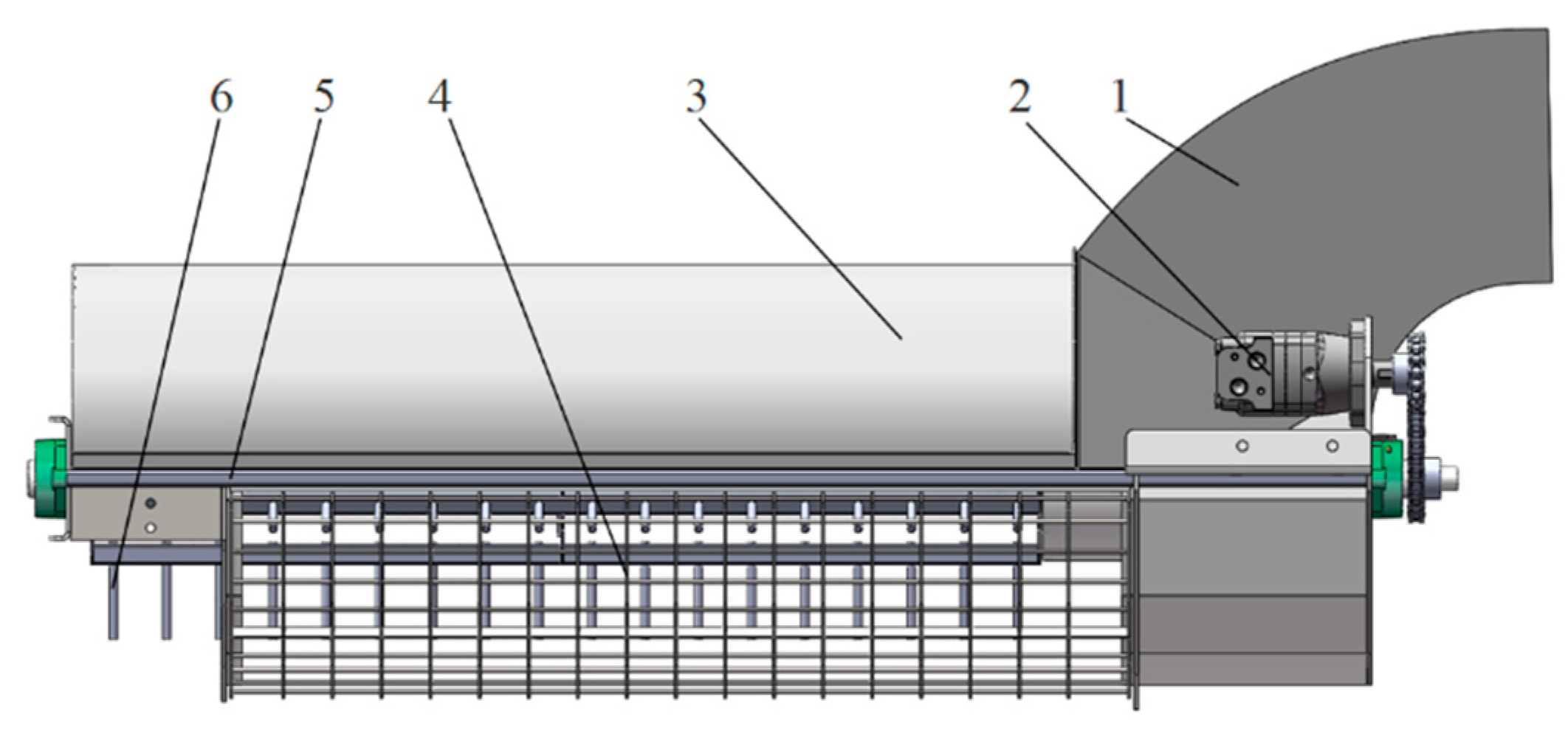
The threshing and cleaning device is the main component of the roller brush type castor harvester. It mainly consists of material feeding device, auger-rod-tooth roller, frame, arc-shaped top plate, semi-circular screen, and hydraulic motor. The main targets of the threshing and cleaning device are the material harvested by the roller brush type castor harvester, which mainly includes broken plants, long stalks, petioles, castor fruits, weeds, and other light impurities. The device is fixed above the fruit collection box. During the operation of the castor harvester, the harvested mixture and broken stems are transported to the material input port of the cleaning device through the conveyor channel. Under the action of the propulsion auger, they are pushed into the cleaning device. Under the disturbance of the finger mechanisms, castor fruits and castor beans pass through the semicircular sieve mesh by gravity and fall into the collection box. Impurities such as stems and petioles are discharged from the rear outlet under the combined action of the finger components on the curved top plate, completing the cleaning operation, as shown in Figure 2. The power for the device is transmitted from the hydraulic motor via chain drive, and the rotation speed is adjusted through the hydraulic system.

2.2. Design and Calculation of Key Components

2.2.1. Design of Auger-Rod-Tooth Roller

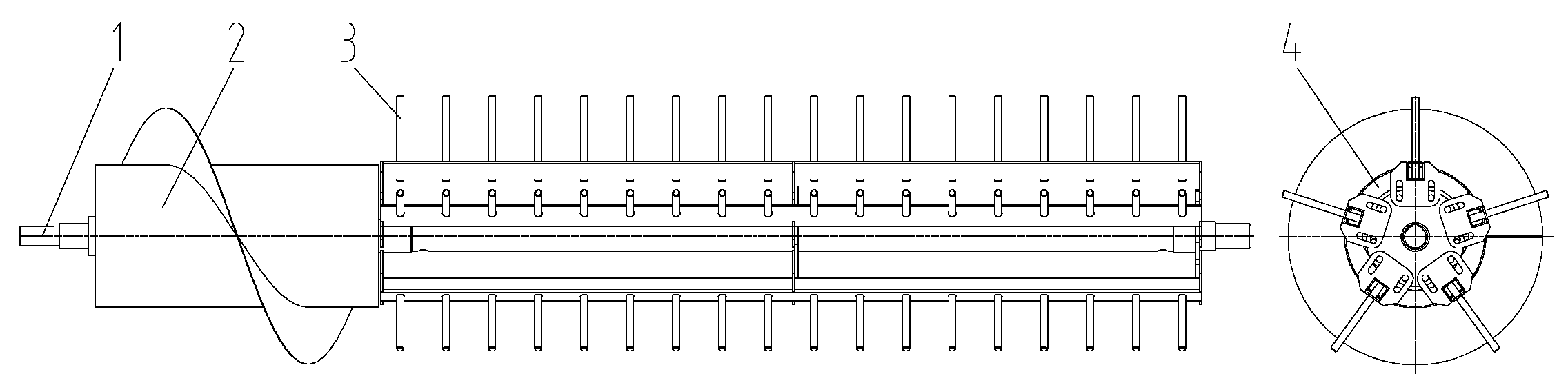
The auger-rod-tooth roller is the core component of the threshing and cleaning device. The front auger feeds materials into the separation sieve plate, while the rear rod teeth separate impurities such as castor fruits and stalks from the materials. The middle section provides connection and fixation, sharing the same main shaft. As shown in Figure 3, the rod tooth roller is mainly composed of a spiral conveyor, main shaft, rod teeth, and disc wheels. To reduce the overall machine weight and decrease power consumption, the pusher shaft is designed as a hollow shaft, with shaft ends welded on both sides for transmission and support.
  • Spiral conveyor design
The function of the spiral conveyor is to push the conveyed materials into the threshing and cleaning separation chamber. Castor fruits are typical fragile crops. To facilitate material conveying and avoid blockage problems at the front end of the roller, a single-screw structure is adopted [21]. The kinematic characteristics of materials during the spiral conveying process are analyzed, and the influence of parameters such as the helix angle and the pitch of the spiral blade is explored.
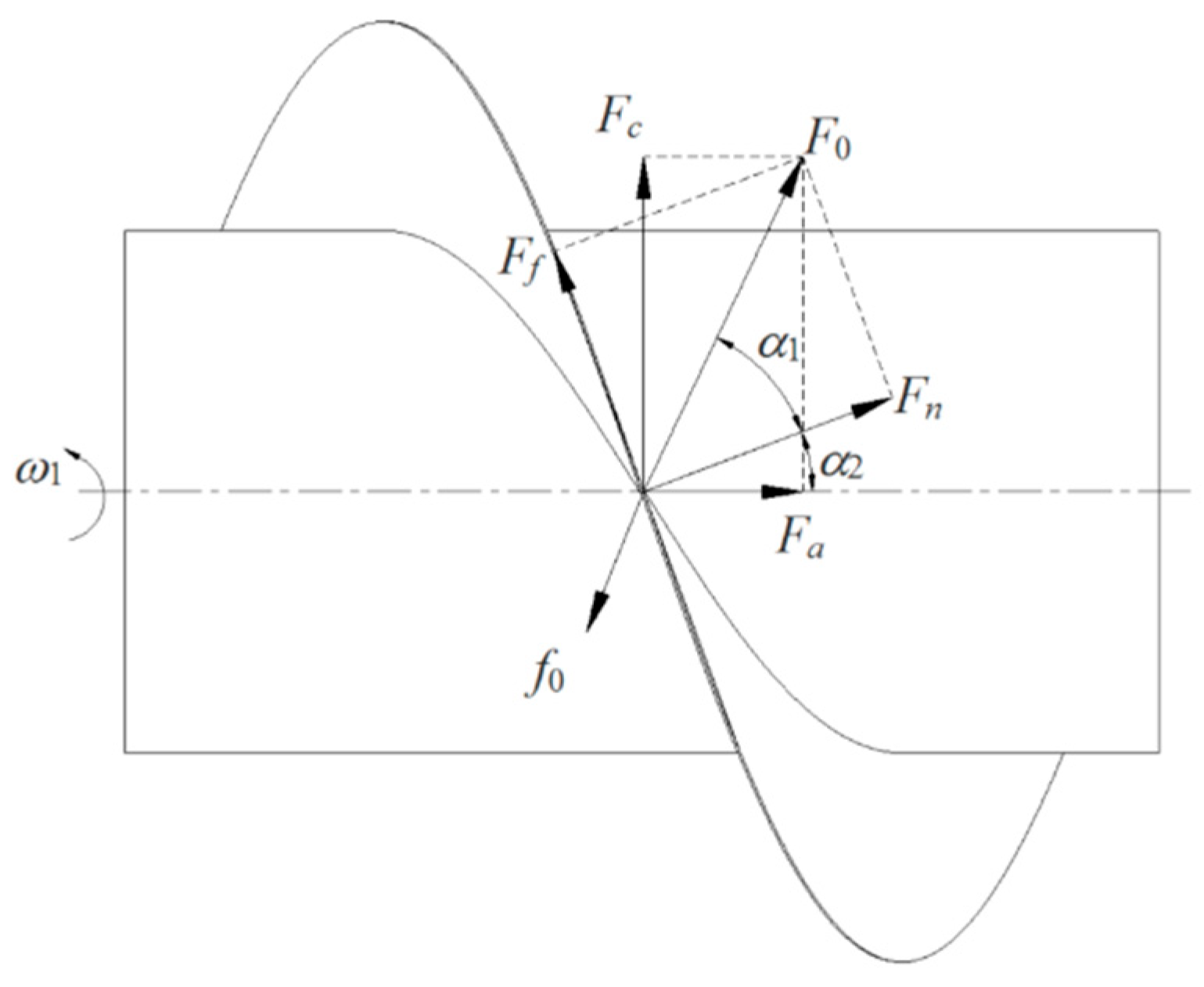
Figure 4 illustrates the force conditions during material conveying. In the figure, the resultant force of the spiral blade acting on the material is F0, and the friction force is f0. The normal force of the spiral blade is Fn, and the tangential friction force is Ff. α1 is the friction angle between the spiral blade and the material. The resultant force is decomposed into the axial force Fa and the axial force Fc.
F a = F 0 cos ( α 1 + α 2 ) F c = F 0 sin ( α 1 + α 2 ) α 1 = a r c tan μ e α 2 = a r c tan S e π D e
where α2 is the helix angle of the spiral blade, (°); μe is the friction coefficient between the spiral blade and the material; Se is the pitch of the spiral blade, m; and De is the outer diameter of the spiral blade, m.
The material moves along the axial direction of the spiral blade. It is necessary to ensure that the axial force is greater than the resistance, and the following condition must be satisfied:
F n cos α 2 > F f sin α 2 F f = μ 1 F n = F n tan α 1
where μ1 is the friction coefficient between the spiral blade and the material.
From Equation (2), it can be obtained that
α 2 < π 2 α 1
The friction coefficient μe between the castor fruits and the steel plate is taken as 0.4 [22]. Calculation shows that α1 is 21.8°, so the helix angle of the spiral blade should be less than 78.2°, and the helix angle is determined to be 15.5°.
The production efficiency (conveying capacity) qe of the spiral conveyor is calculated using the following equation:
q e = π 24 D e + 2 λ 1 2 + d e 2 ψ S e n 1 γ C 1 × 10 10
where De is the outer diameter of the conveyor blade, mm; de is the shaft diameter of the conveyor blade, mm; Se is the pitch of the conveyor blade, mm; λ1 is the clearance between the conveyor blade and the housing, mm; n1 is the rotational speed of the conveyor, r·min−1; ψ is the fill factor during material conveying, generally taken as 0.3 to 0.4; γ is the bulk density of the material, kg·m−3; and C1 is the inclination coefficient of the conveyor, taken as 1 since the conveying angle is 0°.
From Equation (4), it can be obtained that
n 1 24 q e π D e + 2 λ 1 2 + d e 2 ψ S e γ C 1 × 10 10
Considering operational requirements and space constraints, the designed conveyor blade has an outer diameter of 460 mm, shaft diameter of 300 mm, and pitch of 400 mm. According to the Agricultural Machinery Design Manual, the clearance between the blade and the housing is determined to be 5 mm. The fill factor during material conveying is set at 0.3. The actual measured bulk density of the material is 148 kg∙m−3. Based on the normal operating forward speed of the machine in the field, the average feeding rate is determined to be 3.0 kg∙s−1, and calculations show that the speed of the spiral conveyor should be greater than 41.53 r∙min−1. The spiral conveyor is coaxial with the rod-tooth roller. The rotational speed of the rod-tooth roller is generally greater than 300 r∙min−1, so the spiral conveyor is designed to meet the operational requirements of the device.
2.
Rod-Tooth Structure Design
The common types of threshing device teeth mainly include rod teeth, rasp rod teeth, bow-shaped teeth, and knife-shaped teeth. Compared with other crops, castor fruits have an additional layer of pod skin covering the seeds and contain a large number of stems and petioles during harvesting, which is unfavorable for fruits separation. Therefore, rod teeth with higher separation efficiency are selected. The rod-tooth roller mainly consists of rod-tooth fixing rods and spoke discs and is designed as an open roller with a simple structure and easy processing.
The working height of the designed rod-tooth roller is set at 100 mm, with a diameter of 10 mm. The number of rod teeth Z2 is calculated based on the production efficiency of the device. The cylindrical rods are evenly distributed on the tooth shaft, and the number of rod teeth is calculated using the following equation:
Z 2 1 β 2 q e 0.6 q d
where qe is the feeding rate of the test bench, kg∙s−1; β2 is the proportion of fruits in the feeding material; and qd is the allowable feeding load per rod tooth, kg∙s−1.
The target feed rate of the test rig was set at 3.0 kg∙s−1. The proportion of fruits in the feed material β2 is taken as 0.6, and the allowable feed burden per rod tooth is taken as 0.025 kg∙s−1. According to Equation (6), Z2 ≥ 80 was calculated. Considering actual working requirements and spatial constraints, the number of rod teeth was determined to be 90.
The roller length L2 is determined according to the following equation:
L 2 = l 1 Z 2 n 2 1 + 2 l 2
where n2 is the number of rod-tooth rows; l1 is the tooth trace distance, mm; l2 is the distance from the tooth to the end face, mm. According to the spatial distance, the number of rod-tooth rows is 5, the tooth trace distance between adjacent rod teeth is 70 mm, and the distance from the tooth to the end face is 40 mm. From Equation (7), the calculated roller length L2 is 1242 mm, and the actual design value is 1270 mm.
3.
Force analysis of seed and rod tooth collision
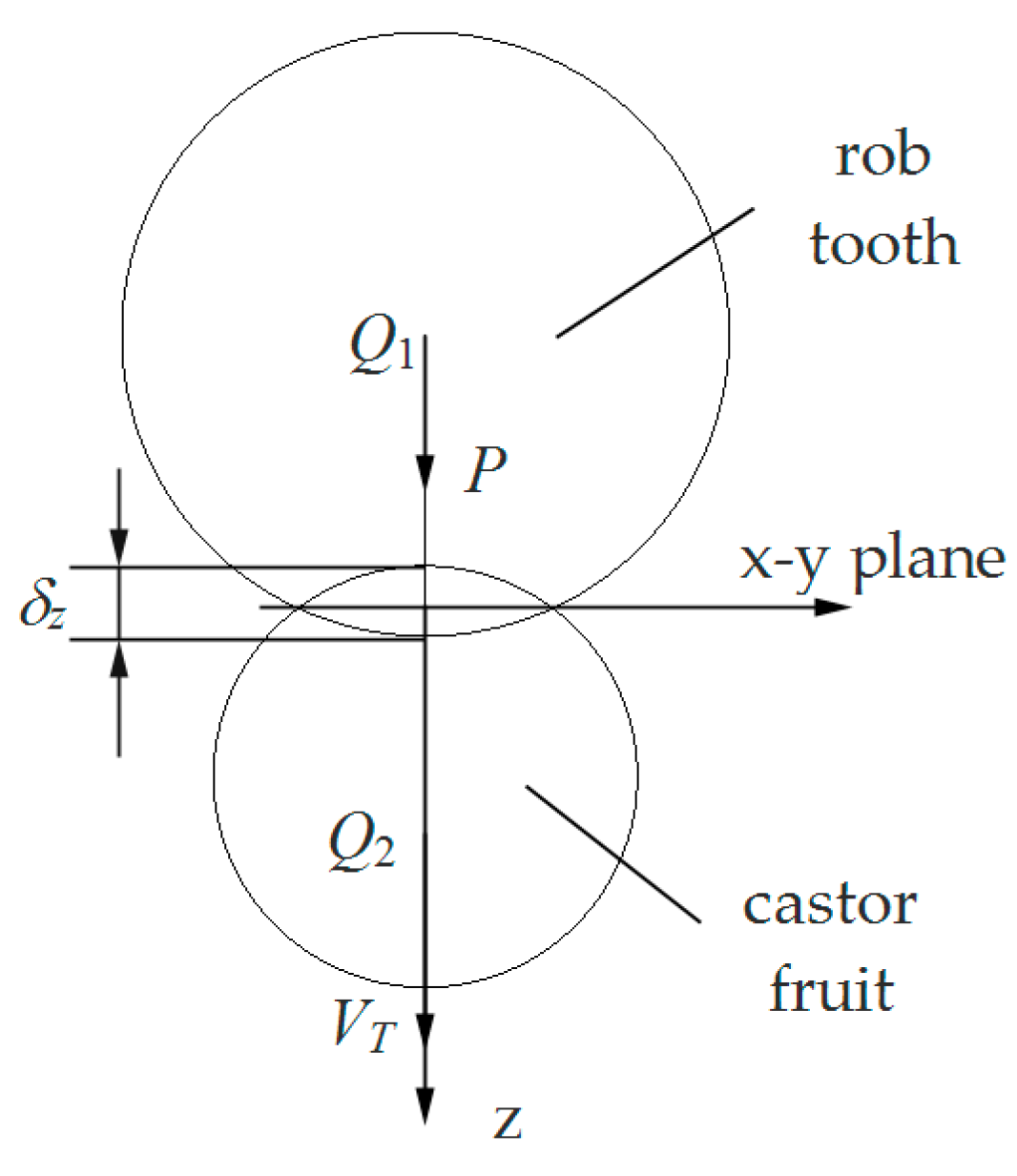
During the castor threshing and cleaning process, the collision between castor fruits and rod teeth has a significant impact on the quality of the harvesting operation, affecting the damage rate and impurity content. Existing studies suggest that during collision impacts, castor fruits undergo two stages: elastic deformation and destructive damage. Therefore, the analysis focuses on the most critical elastic deformation stage [23]. Assuming castor fruits are uniform spheres, neglecting other non-collision forces during impact, the deformation during contact is much smaller than the size of castor fruits [24]. As shown in Figure 5, taking the collision contact point as the initial origin, the radial plane of the tooth as the x-y plane, and the axial direction of the tooth pointing toward the concave sieve as the z-axis, a Cartesian coordinate system is established according to the right-hand rule [25].
The interaction between castor fruits and rod tooth is shown in Figure 5. As the rotational speed of the rod-tooth roller increases, the linear velocity of the rod tooth becomes higher, resulting in a higher fruit damage rate, according to Hertz Contact Theory:
1 R b = 1 R 1 + 1 R 2 E * = 1 μ 1 E 1 + 1 μ 2 E 2
where Rb is the equivalent radius, mm; R1 is the radius of the fruit contact area; R2 is the radius of the rod-tooth contact area, mm; μ1 is the Poisson’s ratio of the castor fruit; μ2 is the Poisson’s ratio of the rod-tooth; E* is the equivalent elastic modulus, MPa; E1 is the elastic modulus of the castor fruit, MPa; and E2 is the elastic modulus of the rod-tooth, MPa.
When the fruit collides with the rod tooth, the maximum contact force on the contact area is
P 0 = ( 6 P E * 2 π 3 R b 2 ) 1 3
where P0 is the maximum contact force in the contact area, MPa, and P is the normal load during the seed collision process, N.
The deformation amount δz of the seed along the normal direction of the contact plane is
δ z = ( 9 P 2 16 R b E * 2 ) 1 3
By combining the above equations, we obtain
δ z = P 0 2 π 2 R b 4 E * 2
During the collision process, the critical condition for the fruit to remain undamaged is as follows: the maximum contact force P0 should be less than the ultimate strength limit of the castor fruit under uniaxial compression. During the collision, the castor fruit and the rod tooth undergo elastic deformation, causing a displacement δz between the centers of the two objects. Since the initial velocity of the fruit is 0, the relationship between the relative velocity VT between the fruit and the rod tooth and the displacement δz is
V T = d δ z d t
The solution is
m 1 + m 2 m 1 m 2 P = d V T d t = d 2 δ z 2 d t 2
1 m = 1 m 1 + 1 m 2
where m is the equivalent mass, kg; m1 is the mass of the rod tooth, kg; and m2 is the mass of the fruit, kg.
At this time, the maximum compression δ*z is
δ * z = ( 15 m P V z 2 16 R 1 / 2 E * ) 2 5
By combining Equations (9) and (15), the maximum force P0* during contact is obtained:
P 0 * = 30 1 5 π ( E * R b 3 4 ) 4 5 ( m V z 2 ) 1 5
During the contact process, the maximum contact force of castor fruits is positively correlated with the relative contact velocity of the rod tooth and their equivalent mass but negatively correlated with the equivalent radius of curvature. Therefore, when the rod teeth rotate at higher speeds, the deformation of the castor fruit is greater, making it easier for the fruits to separate, but at the same time, the fruits are more likely to break. Thus, the rotational speed of the rod-tooth roller shaft has a significant impact on the operating performance.
Castor fruits’ separation primarily relies on the centrifugal force exerted by the rod teeth on the material. Castor fruits are relatively large and prone to breakage, so a relatively low rotational speed is beneficial for separation and can reduce the damage rate. The roller rotational speed is calculated by Equation (17):
n g = 6 × 10 4 v g π D e
where ng is the roller rotational speed, r∙min−1, and vg is the roller linear speed, generally ranging from 10 to 14 m∙s−1. The corresponding roller rotational speed range can be calculated as 382 to 535 r∙min−1.

2.2.2. Concave Sieve Design

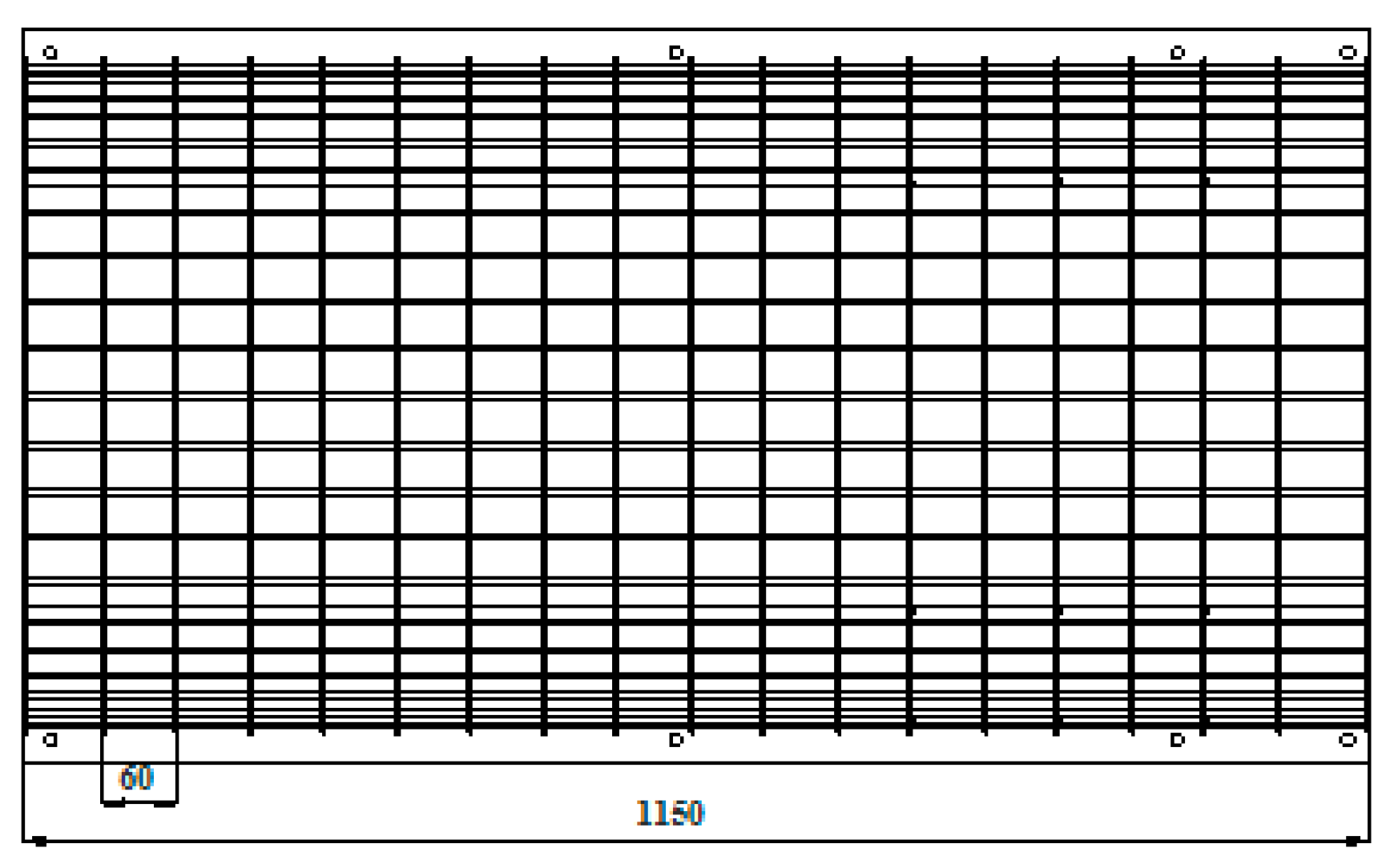
In the device, the coordination between the concave sieve and the rod-tooth roller is one of the key factors affecting the cleaning quality. Taking into account the characteristics of impurities and fruit screening, a grid-type screen plate with a high aperture rate, good separation effect, and high structural strength was selected. As shown in Figure 6, based on the average size of castor fruits and preliminary experimental research, the concave sieve spacing was designed to be 60 mm and its length to be 1150 mm [26].
The area and arc length of the concave sieve have a significant impact on the operation of the device and are also related to the feed rate. The area of the concave sieve can be calculated using the following equation.
A s = B s l s ( 1 β 2 ) q e 0.6 q a
where As is the concave sieve area, m2; Bs is the width of the sieve, m, with a design value of 1.15 m; ls is the arc length of the sieve, m; qe is the feeding rate of the device, kg∙s−1, with a design value of 3.0 kg∙s−1; β2 is the proportion of fruits in the material, taken as 0.6; and qa is the allowable feeding rate per unit area, kg∙(s∙m2)−1, taken as 2.5 kg·(s·m2)−1.
From Equation (18), the arc length ls of the concave sieve can be obtained:
l s ( 1 β 2 ) q e 0.6 q a B s
Substituting the relevant values, the calculation yields ls ≥ 0.70 m.
According to the calculation formula for concave sieve arc length and wrap angle αs,
l s = π α s D s 360
where αs is the wrap angle of the concave sieve, with a design value of 170° and Ds is the diameter of the concave sieve, designed as 0.51 m based on structural dimensions. Substituting into the above equation, the arc length ls of the concave sieve is calculated to be 0.756, which meets the design requirements.

2.2.3. Deflector Design

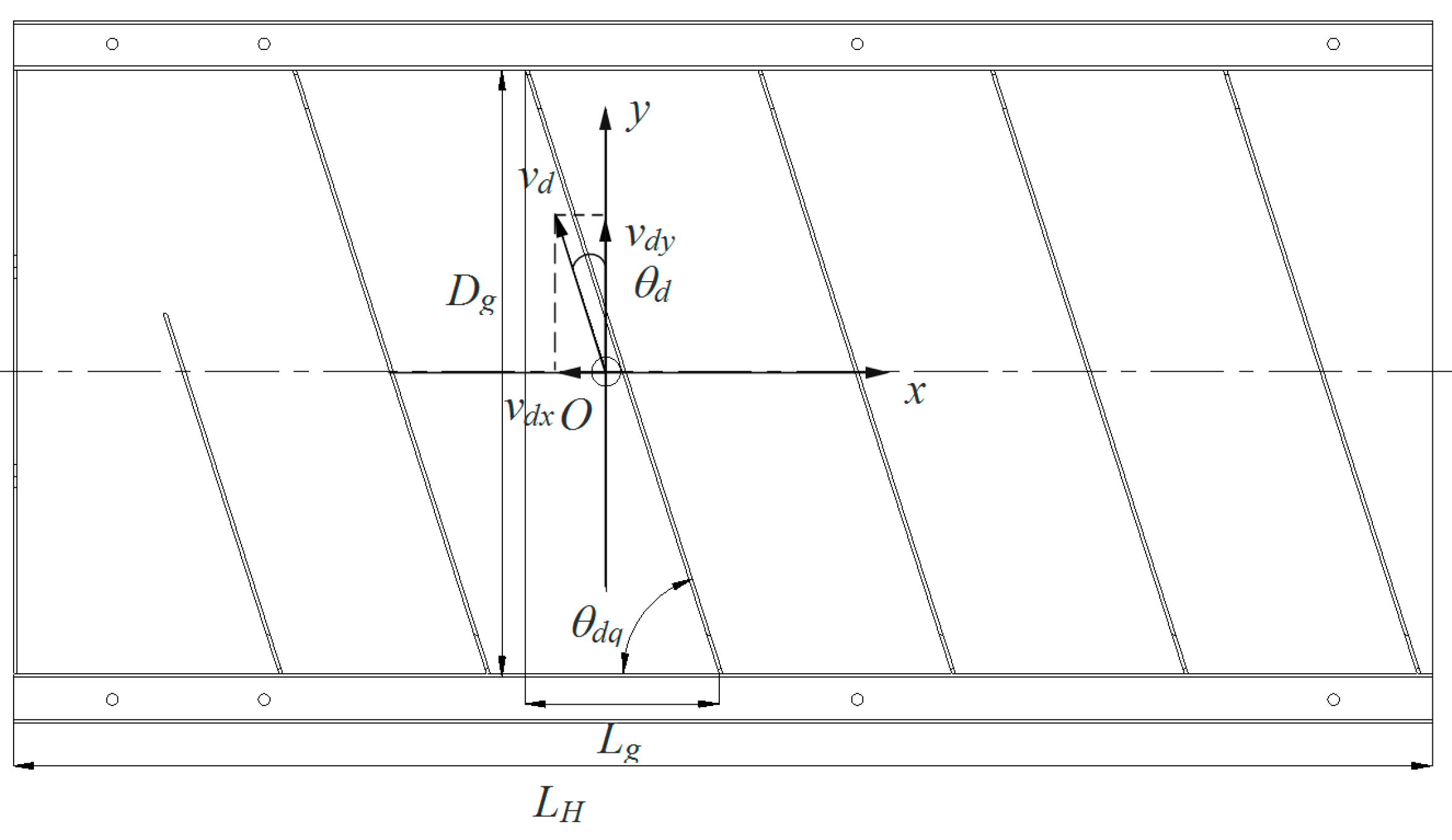
In the device, the top cover above the roller and the concave sieve form a cylindrical cleaning chamber. The inner wall of the top cover is designed with spiral guide plates to achieve axial movement of impurities such as stalks. As shown in Figure 7, to achieve axial movement of the material along the guide plate, the angle θdq between the guide spiral and the horizontal direction must be greater than the sliding friction angle of the guide spiral blade. Thus, the helix angle of the guide spiral must satisfy the following equation:
θ d 90 ° a r c tan μ e
where θd is the lifting angle of the guide helical blade (°) and μe is the friction coefficient between the helical blade and the material, taken as 0.4 [27]; the lifting angle of the guide helical blade should be less than 78.2°.
tan θ d q = tan 90 ° θ d = D g L g L H L g n g
where ng is the number of flow-guiding spiral blades, in units.
From Equation (22), we obtain
θ d a r c tan L g n g D g
The diameter of the upper cover plate of the flow guide device is determined by the diameter of the concave sieve, with a value of 510 mm. The length of the upper cover is related to the length of the threshing roller, with a value of 1270 mm. The designed number of diversion spiral blades is six, and the guide lift angle of the spiral blades is determined to be 30°.

2.3. Experimental Conditions, Factors, and Indicators

2.3.1. Experimental Conditions

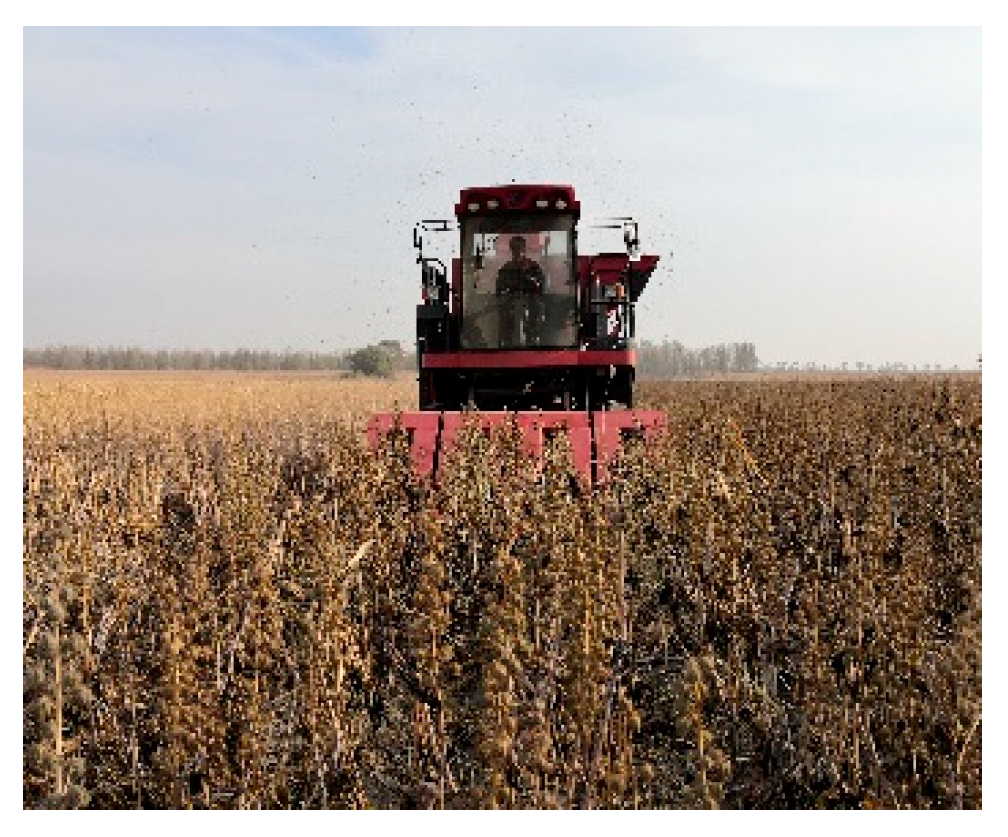
In October 2024, a field trial was conducted at the castor planting base in Tumote Left Banner, Hohhot City, Inner Mongolia Autonomous Region. The test field is level and free of weeds, and the castor fruits are fully mature, with little variation in plant height. The variety planted was a dwarf type suitable for mechanized harvesting. The test field measured 200 m in length and 40 m in width. The row spacing was 700 mm, the plant spacing was 550 mm, and the average plant height was 1200 mm. The average moisture content of castor plants was 19.36%, and the average stem diameter was 21.4 mm. The field trial situation of the machinery is shown in Figure 8.

2.3.2. Experimental Factors

The experiment measured the impact of different structures and operating parameters of the threshing and cleaning device on the quality of castor harvesting. The quality of castor fruits threshing and cleaning operations is primarily reflected in three indicators: impurity rate, damage rate, and separation loss rate. Many factors influence the threshing and cleaning process of castor fruits, such as forward speed during harvesting, roller rotational speed, rod-tooth spacing, threshing gap of concave sieve, leaf removal effectiveness, and moisture content of castor fruits and plants. Based on preliminary tests, the forward speed, roller rotational speed, and threshing gap of concave sieve were selected as parameters for optimization experiments. Within the operating speed range of the machine, set the forward speed at three levels: 0.6, 0.8, and 1.0 m∙s−1 based on actual conditions. The roller rotational speed was determined using Equation (17) and set at three levels: 400, 475, and 550 r·min−1 according to practical considerations. The threshing gap of concave sieve refers to the distance between the threshing roller teeth and the concave sieve.
Based on the actual spatial distance and the size of castor fruits, the gap is set to 15, 25, and 35 mm by adjusting the installation position of the teeth. The experimental factors and levels are shown in Table 1.

2.3.3. Experimental Indicators

According to the agricultural industry standard NY/T 4365-2023 “Castor Harvester Operational Quality” [28], combined with standards such as GB/T 5262-2008 “Agricultural Machinery Testing Conditions-general Rules for Measuring Methods” [29] and GB/T 8097-2008 “Equipment for Harvesting—Combine harvesters–Test Procedure” [30], field tests were conducted on the roller-brush-type castor harvester threshing and cleaning mobile test bench. The tests used impurity rate Y1, damage rate Y2, and separation loss rate Y3 as evaluation indicators for the threshing and cleaning device.
(1) Impurity rate measurement method: Randomly sample three portions from the layered and partitioned material box of the castor harvester, each portion not less than 2000 g. After thoroughly mixing them together, take out three samples of 500 g each. Pick out impurities such as branches, stems, leaves, and weeds, weigh them, and calculate the impurity rate. The result is taken as the arithmetic mean of the three samples.
Y 1 = W 1 W 0 × 100 %
where Y1 is the impurity rate, %; W1 is the mass of impurities in the sample, g; and W0 is the mass of the sample, g.
(2) Damage rate measurement method: Randomly sample three portions from the layered and partitioned material box of the castor harvester, each portion not less than 2000 g. After thoroughly mixing them together, take out three samples of 500 g each. Shell each sample to obtain the kernels and weigh them, then pick out the damaged kernels and weigh them separately. Pick out the damaged grains and weigh them, calculate the damage rate, and take the arithmetic mean of the results from the three samples.
Y 2 = W P W 2 × 100 %
where Y2 is the damage rate, %; Wp is the mass of damaged grains, g; and W2 is the mass of sample grains, g.
(3) Determination method for separation loss rate: Select three measurement points within the area where the machine is operating stably. At each point, select an area along the forward direction of operation with the width of the harvester header and a length of 5 m. Use breathable woven bags to collect impurities from the rear end along with lost fruits and seeds. After removing impurities, weigh the mass of lost fruits and beans, calculate the separation loss rate for each measurement point, and take the arithmetic mean of the results. The equation for calculating separation loss rate is:
Y 3 = M 2 M 1 × 100 %
where Y3 is the separation loss rate, %; M1 is the average total mass of castor fruits that should be collected in the test area, g; and M2 is the average mass of entrainment loss after operation, g.

3. Results

3.1. Experiment Results

Based on the Box–Behnken experimental principle, a three-factor three-level experiment was designed. The experimental plan includes 17 test points, consisting of 12 analytical factors and 5 center points for error estimation. The response values of the evaluation indicators, including the impurity rate Y1, damage rate Y2, and separation loss rate Y3 for each experimental scheme and their models are shown in Table 2 [31].

3.2. Regression Model Establishment and Significance Testing

Based on the data samples in Table 2, multivariate regression fitting analysis was performed using Design-Expert 13 software to seek optimal working parameters. A quadratic polynomial response surface regression model was established for impurity rate Y1, damage rate Y2, and separation loss rate Y3 with respect to three independent variables: forward speed X1, roller rotational speed X2, and the threshing gap of concave sieve X3. Variance analysis was conducted on the regression model, and the results are shown in Table 3.
As shown in Table 3, the p-values of impurity rate Y1, damage rate Y2, and separation loss rate Y3 in the response surface model are all less than 0.01, indicating that the regression model is highly significant. The lack-of-fit terms are all greater than 0.05, indicating that the regression equation has a high degree of fit. The coefficient of determination R2 values were 0.9792, 0.9904, and 0.9866, respectively, indicating that these three models can explain over 95% of the evaluation metrics [32]. Therefore, this model can optimize the analysis of parameters for the threshing and cleaning device.
The p-value reflects the influence of each parameter on the regression equation. p < 0.01 indicates that the parameter has a highly significant effect on the model, while p < 0.05 indicates that the parameter has a significant effect on the model. In the impurity rate Y1 model, the six regression terms X1, X2, X3, X1X3, X22, and X32 have a highly significant impact on the model (p < 0.01). In the damage rate Y2 model, the six regression terms X1, X2, X3, X12, X22, and X32 have a highly significant impact on the model (p < 0.01), while X2×3 has a significant impact on the model (p < 0.05). In the separation loss rate Y3 model, the four regression terms X1, X2, X3, and X22 have a highly significant impact on the model (p < 0.01). Based on ensuring model p < 0.01 and lack-of-fit term p > 0.05, insignificant regression terms in the model were eliminated, and models Y1, Y2, and Y3 were optimized [33], as shown in Equations (27)–(29).
Y 1 = 2.85 + 0.578 X 1 + 0.403 X 2 0.345 X 3 0.245 X 1 X 3 + 0.265 X 2 2 + 0.255 X 3 2
Y 2 = 2.05 0.166 X 1 + 0.521 X 2 0.32 X 3 + 0.095 X 2 X 3 + 0.195 X 1 2 + 0.190 X 2 2 + 0.242 X 3 2
Y 3 = 0.308 + 0.169 X 1 0.18 X 2 + 0.099 X 3 + 0.204 X 2 2
By analyzing the F-values of each factor in Table 3, the order of importance of the three factors on impurity rate from high to low is forward speed, roller rotational speed, threshing gap of concave sieve; for the damage rate it is roller rotational speed, threshing gap of concave sieve, and forward speed; and for the separation loss rate it is roller rotational speed, forward speed, and threshing gap of concave sieve. This indicates that among the experimental factors, forward speed has the greatest impact on impurity content, while roller rotational speed and threshing gap of concave sieve have relatively smaller effects. The roller rotational speed has the greatest impact on both impurity rate and separation loss rate, while forward speed and threshing gap of concave sieve have relatively smaller effects.

3.3. Analysis of the Impact of Interaction Factors on Performance

According to the analysis results of the above regression equation, fix one factor at the intermediate level to analyze the interaction effects of the other two factors on the evaluation index. By creating response surface plots and contour plots, analyze the impact of the interaction among forward speed X1, roller rotational speed X2, and threshing gap of concave sieve X3 on the response value.
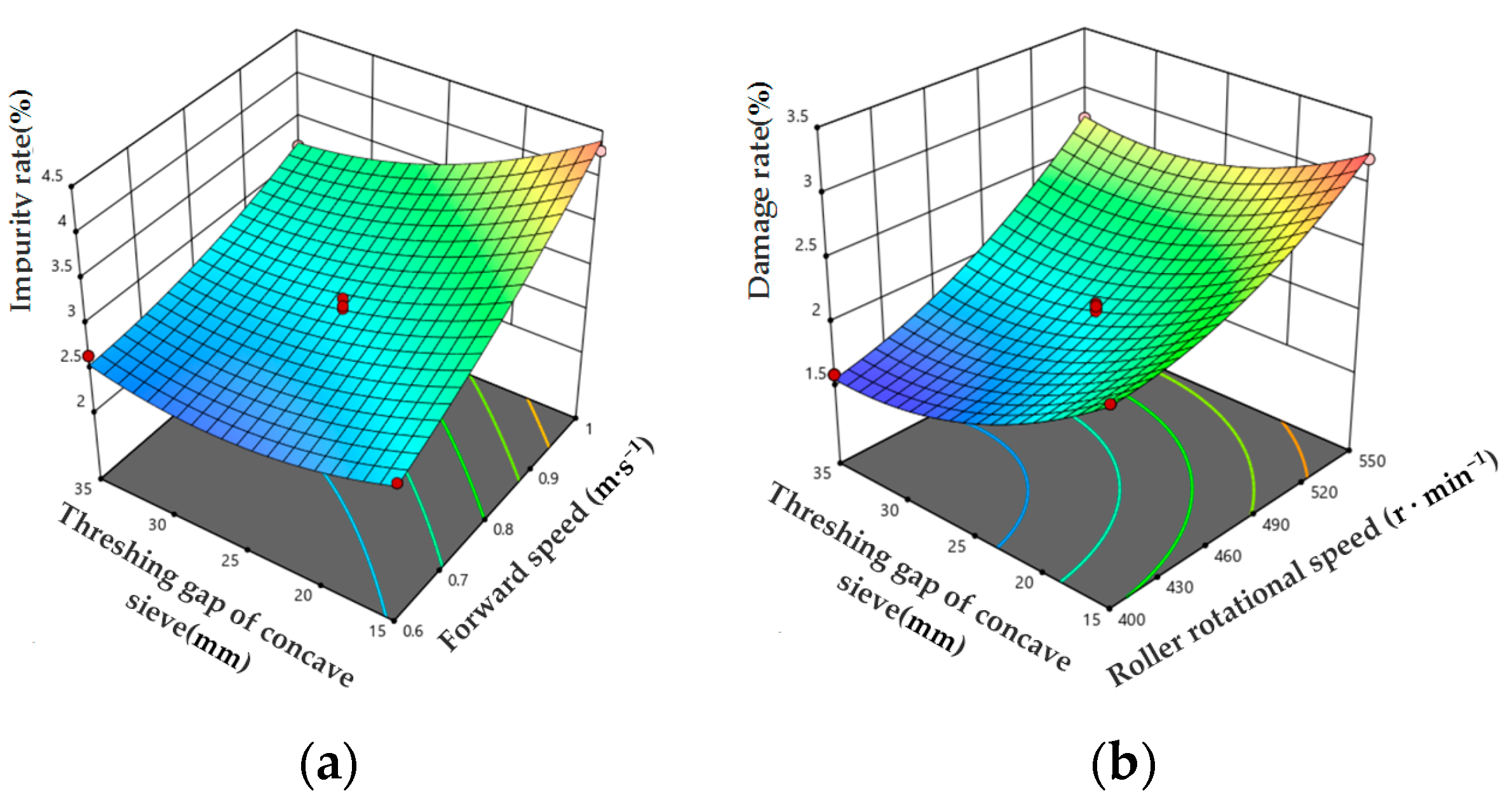
Figure 9a shows the response surface diagram of the interaction between forward speed and threshing gap of concave sieve on the impurity rate when the roller rotational speed is at an intermediate level, i.e., 475 r·min−1. Analysis of the equation’s significance level p-value indicates that the interaction between these two factors is highly significant. As shown in Figure 9a, the impurity rate increases with the forward speed. This is because as the forward speed increases, the feeding amount of the device increases, and the spatial density of fruits in the threshing and cleaning chamber relatively increases. Consequently, the compression between fruits and collision between threshing components relatively increases, resulting in increased fruit damage and more impurities, thus increasing the impurity rate. The impurity rate first decreases and then tends to level off with the increase in the threshing gap of concave sieve. This is because as the gap increases, crop mobility increases, the intensity of action of threshing components on the material decreases, impurities decrease, and impurity rate decreases. After the threshing gap of concave sieve reaches a certain value and reaches the optimal operating quality, this changing trend weakens.
Figure 9b shows the response surface diagram of the interaction between roller rotational speed and threshing gap of concave sieve on damage rate when the forward speed is at an intermediate level, i.e., 0.8 m·s−1. Analysis of the equation’s significance level p-value indicates that the interaction between these two factors is highly significant. As shown in Figure 9b, the damage rate increases with the increase in roller rotational speed. As the rotating speed increases, more energy is converted into threshing energy when threshing components collide with fruits, resulting in an increased damage rate. The damage rate shows a decreasing trend with the increase in the concave sieve threshing gap. This is because as the concave sieve gap increases, the density of material flow space decreases, and the rubbing and squeezing effect between fruits and threshing components reduces, leading to a decrease in damage rate.

3.4. Parameter Optimization and Validation Experiment

3.4.1. Parameter Optimization

To achieve optimal performance of the castor fruits threshing and cleaning device, it is necessary to maintain low impurity rate, damage rate, and separation loss rate. The influence patterns of various factors and their interactions on the experimental indicators differ. In order to find the optimal parameter combination, considering that the effects of each factor on the response values vary, multi-objective optimization must be conducted [34].
This research focuses on optimizing the mechanism operation and structural parameters of the castor fruits threshing and cleaning device, aiming to achieve low impurity rate, low damage rate, low separation loss rate, and high forward speed. An optimization model was established, and the regression equation was analyzed, resulting in the following mathematical model:
m a x X 1 1 X i 1   ( i = 1,2 , 3 ) m i n Y j   ( j = 1,2 , 3 ) 0 Y j 1   ( j = 1,2 , 3 )
In order to obtain the optimal working parameters of each factor, Design-Expert software was used to optimize and solve each parameter. The optimal parameter combination for the castor fruits threshing and cleaning device was obtained as follows: forward speed is 0.87 m·s−1, roller rotational speed of 461.98 r·min−1, and threshing gap of concave sieve of 28.64 mm. At this time, the impurity rate was 2.87%, the damage rate was 1.83%, and the separation loss rate was 0.45%.

3.4.2. Experimental Verification

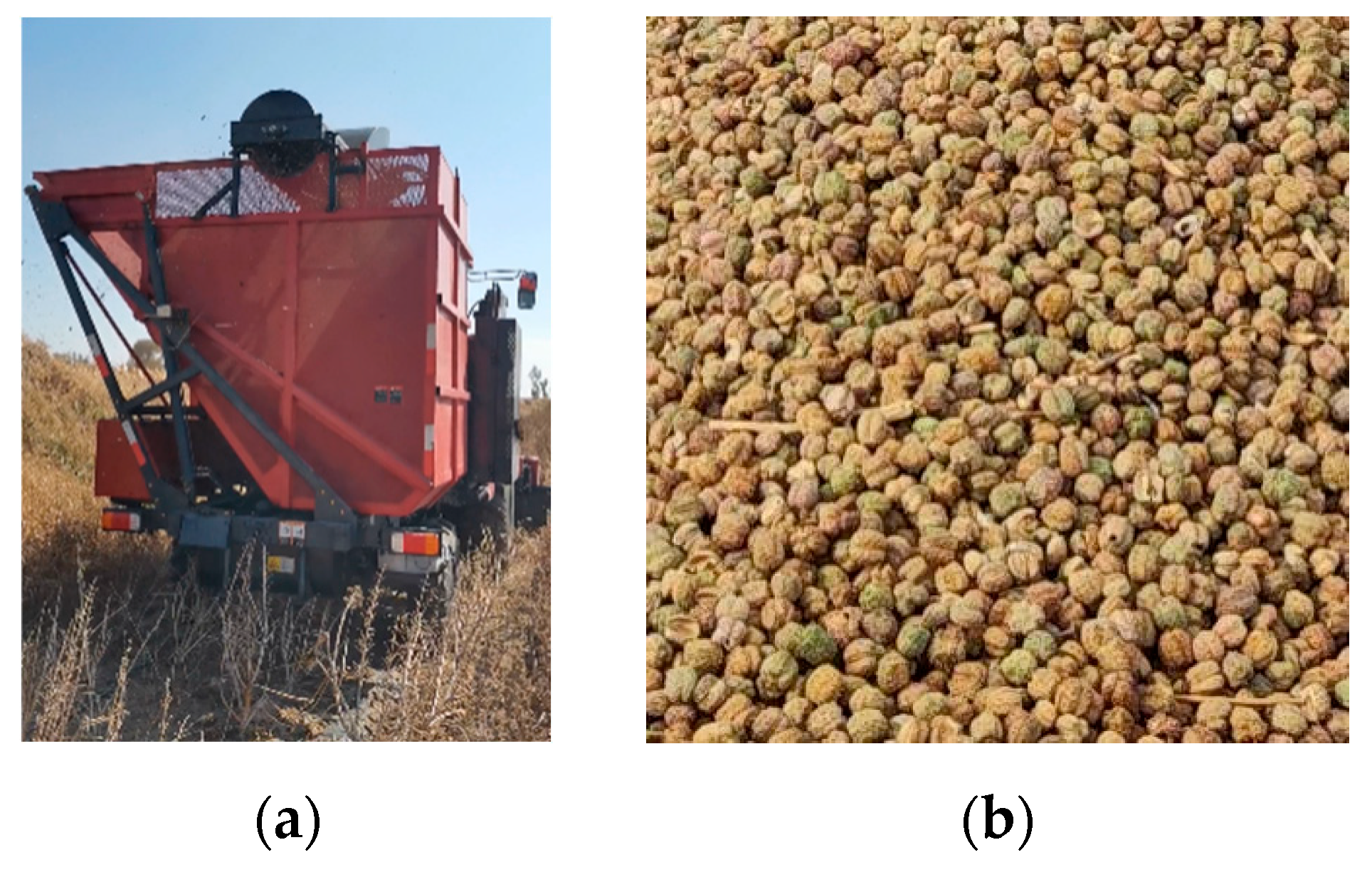
To verify the accuracy of the model predictions, experiments were conducted using the above parameters in the same castor test field, with the experiment repeated three times and the average value taken. Considering the rationality and feasibility of the mechanical structure, the theoretical values were rounded. The forward speed was set at 0.87 m·s−1, the roller rotational speed at 462 r·min−1, and the threshing gap of concave sieve at 30 mm. Under these conditions, the impurity rate was 2.95%, the damage rate was 1.75%, and the separation loss rate was 0.49%. The relative errors compared to the theoretical optimized values were 2.71%, 4.57%, and 8.16%, respectively, indicating high reliability of the parameter optimization model. The operational effect of the machinery is shown in Figure 10. The results of the field experiment are compared with the Agricultural Industry Standard NY/T 4365-2023 [28] in Table 4. The experimental results of the device in this study meet the requirements of the relevant standard.
Researchers in Greece and Brazil conducted field trials on castor bean combine harvesters, the results of which showed a comprehensive impurity rate of 3.6% and a damage rate of 4.4% [35]. The loss rate of castor beans during the cleaning process was 0.41% [8]. Compared with the analysis of this study, the data of the test indicators are relatively close, indicating the rationality and reliability of the results of this study.

4. Discussion

Based on the characteristics of castor plants such as tall height, multiple branches, large castor fruits size, and high oil content in castor beans, which can easily cause roller blockages after damage, an axial-flow threshing and cleaning device was designed. To address the issues of high impurity rate and poor operational efficiency during roller-brush castor harvesting, this paper focuses on the design and analysis of key components of the threshing and cleaning device for the roller-brush castor harvester. Using response surface methodology for parameter optimization, it effectively reduces problems such as excessive impurities, high damage rates, and significant separation loss rate during the threshing and cleaning process.
Currently, there is a lack of research on castor threshing and cleaning devices in China. This study conducted analysis and optimization of key parameters based on the threshing and cleaning devices of rice and wheat combine harvesters. Future work will focus on innovation and research regarding threshing teeth and threshing roller structures. Additionally, this paper primarily focuses on studying a single dwarf variety suitable for mechanized harvesting. Subsequent research will expand to include different varieties from various regions to improve the adaptability of the machinery.

5. Conclusions

To improve the operational quality of the threshing and cleaning device, this study conducted multi-objective optimization experiments to investigate the effects of forward speed, roller rotational speed, and threshing gap of concave sieve on operational quality. Mathematical models were established between experimental factors and operational quality indicators, including impurity rate, damage rate, and separation loss rate. By analysis, the significance order of each factor’s impact on impurity content, damage rate, and separation loss rate was determined, along with the influence patterns of interactive factors on performance. A parameter optimization model for the castor threshing and cleaning device was developed, yielding the optimal parameter combination for impurity rate, damage rate, and separation loss rate. Field experiments were conducted to verify this parameter combination, resulting in an impurity rate of 2.95%, damage rate of 1.75%, and separation loss rate of 0.49%. The verification confirms that the predictive model meets the optimization requirements of the castor threshing and cleaning device parameters. This study provides technical support for the research of castor combine harvesters, while the threshing and cleaning technology for castor is expected to evolve towards higher efficiency and intelligence. Operational conditions will be monitored in real time, and parameters will be adjusted according to operating quality tracking, further improving operating performance and reducing power consumption.

Author Contributions

Conceptualization, T.W., F.K. and S.Z.; methodology, F.K., T.W. and B.Z.; software, Q.X. and Y.S.; validation, B.Z. and H.Z.; writing—original draft preparation, T.W., F.K. and S.Z.; writing—review and editing, T.W., Y.S. and Q.X. All authors have read and agreed to the published version of the manuscript.

Funding

This research was funded by the Open Fund of the Inner Mongolia Engineering Research Center of Intelligent Agricultural Machinery Equipment for Alpine Economic Characteristic Crops in Eastern Inner Mongolia (Grant No. MDK2025080, MDK2025077); Agricultural Science and Technology Innovation Program of Chinese Academy of Agricultural Sciences (Grant No. CAAS-ASTIP-31-NIAM-05); and the Natural Science Foundation Project of the Inner Mongolia Autonomous Region (Grant No. 2024LHMS05037).

Institutional Review Board Statement

Not applicable.

Data Availability Statement

The date presented in this study are available on demand from the first author at (wuteng@caas.cn).

Acknowledgments

We greatly appreciate the careful and precise reviews by the anonymous reviewers and editors.

Conflicts of Interest

The authors declare no conflicts of interest.

References

  1. Merkouropoulos, G.; Kapazoglou, A.; Drosou, V.; Jacobs, E.; Krolzig, A.; Papadopoulos, C.; Hilioti, Z. Dwarf hybrids of the bioenergy crop Ricinus communis, suitable for mechanized harvesting reveal differences in morphophysiological characteristics and seed metabolic profiles. Euphytica 2016, 210, 207–219. [Google Scholar] [CrossRef]
  2. Wei, H.L.; Li, X.M.; Li, M.; Huang, H. Leaf shape simulation of castor bean and its application in nondestructive leaf area estimation. Int. J. Agric. Biol. Eng. 2019, 12, 135–140. [Google Scholar] [CrossRef]
  3. Kong, F.T.; Wu, T.; Zhang, B.; Zhao, H.Y.; Sun, Y.F.; Chen, C.L.; Xie, Q. Edge curve fitting and optimization of the wave-type cutting disc for castor. Trans. Chin. Soc. Agric. Eng. 2024, 40, 66–75. [Google Scholar] [CrossRef]
  4. Kong, F.T.; Wang, D.F.; Shi, L.; Wu, T.; Chen, C.L.; Sun, Y.F.; Xie, Q. Design and experiment of disc-cutting picking device of castor. Trans. Chin. Soc. Agric. Eng. 2021, 37, 1–9. [Google Scholar] [CrossRef]
  5. Liu, L.; Wu, T.; Kong, F.T.; Sun, Y.F.; Chen, C.L.; Xie, Q.; Shi, L. Optimized design and experiment of the picking mechanism for brush-roller castor harvesters. Trans. Chin. Soc. Agric. Eng. 2021, 37, 19–29. [Google Scholar] [CrossRef]
  6. Sun, Z.J.; LV, L.Y.; Wu, Y.P. Castor industry development: From cultivation to product exploitation. J. Chin. Agric. Univ. 2012, 17, 204–214. [Google Scholar] [CrossRef]
  7. Wu, T.; Kong, F.T.; Shi, L.; Xie, Q.; Sun, Y.F.; Chen, C.L. Power Consumption Influence Test of Castor Disc-Cutting Device. Agriculture 2022, 12, 1535. [Google Scholar] [CrossRef]
  8. Latterini, F.; Stefanoni, W.; Cavalaris, C.; Karamoutis, C.; Karamoutis, C.; Pari, L. Effectiveness of Three Terminating Products on Reducing the Residual Moisture in Dwarf Castor Plants: A Preliminary Study of Direct Mechanical Harvesting in Central Greece. Agronomy 2022, 12, 146. [Google Scholar] [CrossRef]
  9. Pari, L.; Suardi, A.; Stefanoni, W.; Latterini, F.; Palmieri, N. Environmental and Economic Assessment of Castor Oil Supply Chain: A Case Study. Sustainability 2020, 12, 6339. [Google Scholar] [CrossRef]
  10. Wu, T.; Kong, F.T.; Shi, L.; Chen, C.L.; Sun, Y.F.; Xie, Q. Analysis of the development status of Ricinus communis production technology. J. Chin. Agric. Mach. Chem. 2019, 40, 77–81. [Google Scholar] [CrossRef]
  11. Stefanoni, W.; Latterini, F.; Malkogiannidis, V.; Salpiggidis, V.; Alexopoulou, E.; Pari, L. Mechanical Harvesting of Castor Bean (Ricinus communis L.) with a Combine Harvester Equipped with Two Different Headers: A Comparison of Working Performance. Energies 2022, 15, 2999. [Google Scholar] [CrossRef]
  12. Xie, G.; Zhang, G.Z.; Fu, J.W.; Zhou, Y.; Wang, Y.; Gao, Y.; Wang, W.K.; Mohamed, A. Comparing power consumption of drum and cylindrical rod-tooth longitudinal axial flow threshing roller. J. Huazhong Agric. Univ. 2021, 40, 77–81. [Google Scholar] [CrossRef]
  13. Kang, J.X.; Wang, X.S.; Xie, F.P.; Luo, Y.; Li, Q.; Huang, X.J. Experiments and analysis of the differential threshing cylinder for soybean with different maturities. Trans. Chin. Soc. Agric. Eng. 2023, 39, 38–49. [Google Scholar] [CrossRef]
  14. Kang, J.X. Design and Mechanism Research on Threshing and Separation Device for Southern Soybean Combine Harvester. Ph.D. Thesis, Hunan Agricultural University, Changsha, China, 2022. [Google Scholar] [CrossRef]
  15. Teng, Y.J.; Jin, C.Q.; Chen, Y.P.; Liu, P.; Yin, X.; Wang, T.E.; Yu, K. Design and optimization of segmented threshing device of combine harvester for rice and wheat. Trans. Chin. Soc. Agric. Eng. 2020, 36, 1–12. [Google Scholar] [CrossRef]
  16. Li, Y.M.; Wang, J.P.; Xu, L.Z.; Tang, Z.; Xu, Z.H.; Wang, K.J. Design and experiment on adjusting mechanism of concave clearance of combine harvester cylinder. Trans. Chin. Soc. Agric. Mach. 2018, 49, 68–75. [Google Scholar] [CrossRef]
  17. Zhang, Z.Z.; Xie, F.P.; Tian, L.Q.; Liu, Z.H.; Looh, G.A.; Wang, X.S. Design and performance test of rotary grate concave threshing and separating unit of head-feeding combine harvester. Appl. Eng. Agric. 2022, 38, 303–312. [Google Scholar] [CrossRef]
  18. Li, Y.B.; Jiang, J.J.; Xu, Y.; Cui, T.; Su, Y.; Qiao, M.M. Preparation and threshing performance tests of rubber composite nail teeth under maize with high moisture content. Trans. Chin. Soc. Agric. Mach. 2020, 51, 158–167. [Google Scholar] [CrossRef]
  19. Chen, N.; Xiong, Y.S.; Chen, D.J.; Xu, J.D.; Zhao, Y. Design and test on the Coaxial differential-speed Axial-flow threshing rotor of combine harvester. Trans. Chin. Soc. Agric. Mach. 2010, 41, 67–71. Available online: http://www.j-csam.org/jcsam/article/abstract/20101041?st=article_issue (accessed on 3 December 2025).
  20. Wang, Z.M.; Lv, P.M.; Chen, N.; Li, H.; Liu, Z.H.; Chen, D.J. Design and experiment on axial-flow differential-speed threshing-separating-cleaning unit. Trans. Chin. Soc. Agric. Mach. 2016, 47, 53–61. [Google Scholar] [CrossRef]
  21. Lian, G.D.; Zong, W.Y.; Wei, W.; Ma, L.N.; Cheng, Y.F.; Wei, X.X. Design and experiment of cutting threshing integrated type header for harvesting of edible sunflower. Trans. Chin. Soc. Agric. Mach. 2023, 54, 122–131+154. [Google Scholar] [CrossRef]
  22. Hou, J.M.; Yao, E.C.; Li, J.P.; Bai, J.B.; Yang, Y.; Zhu, H.J. Motion analysis and experiment on shelling process of kneading and pressing castor shelling machine. Trans. Chin. Soc. Agric. Mach. 2020, 51, 220–232. [Google Scholar] [CrossRef]
  23. Xu, L.Z.; Li, Y.M.; Ding, L.F. Contacting mechanics analysis during impact process between rice and threshing component. Trans. Chin. Soc. Agric. Eng. 2008, 24, 146–149. Available online: https://kns.cnki.net/kcms2/article/abstract?v=QSPvTk9Jgi1ldbPOkoja5DkbicR9CzqiGWm7icJ1ZipDDU6hOFR-_BdTc3iGWz_zu1BhMKOO1UiNA1lny4NXghPs_iNUACp7_Nxtcpe7H7L1P96SEJCQFREGR7VxsAnbtQp-oCrEAcfgF1qsU5wjX1N1mxXjwxsksRbcK4-jwnLXgAGZOkwtTA==&uniplatform=NZKPT&language=CHS (accessed on 3 December 2025).
  24. Liu, W.R.; Zhou, Y.; Xu, H.M.; Fu, J.W.; Zhang, N.; Xie, G.; Zhang, G.Z. Optimization and experiments of the drum longitudinal axial threshing cylinder with rod tooth for rice. Trans. Chin. Soc. Agric. Eng. 2023, 39, 34–45. [Google Scholar] [CrossRef]
  25. Yang, G.; Chen, Q.M.; Xia, X.F.; Chen, J.N.; Song, Z.Y. Design and optimization of the key components for 4DL-5A faba bean combine harvester. Trans. Chin. Soc. Agric. Eng. 2021, 37, 10–18. [Google Scholar] [CrossRef]
  26. Xu, N.; Shang, S.Q.; Wang, D.W.; He, X.N.; Gao, Z.; Liu, J.Q.; Zhang, Y.D.; Guo, P. Design and research of spike tooth type peanut picking device with longitudinal axial flow. J. Agric. Mech. Res. 2020, 42, 197–201. [Google Scholar] [CrossRef]
  27. Hou, J.M.; Li, J.P.; Yao, E.C.; Bai, J.B.; Yang, Y.; Zhu, H.J. Calibration and analysis of discrete element parameters of typical castor. J. Shenyang Agric. Univ. 2019, 50, 565–575. Available online: https://kns.cnki.net/kcms2/article/abstract?v=X84Xx1LLloKoUrKvP8gRWbceCmj5NvpS9p9qQ64oHuQZELtMMV8YUy4GhgFiSPSIh_nqcED-9PSzhBqMfyUM0geIe8jURLQdTKEf4N3vlMadeg7Bchvmz275TR8Qt22OYb5cJTJ-2RFgIFcgpZyA5tBQBTy2aSwDJtL6zKMF7M33XhZ6cZmAqg==&uniplatform=NZKPT&language=CHS (accessed on 3 December 2025).
  28. NY/T 4365-2023; National Agricultural Industry Standards, Operating Quality for Castor Harvester. China Agricultural Publishing House: Beijing, China, 2023.
  29. GB/T 5262-2008; National Standard, Agricultural Machinery Testing Conditions-General Rules for Measuring Methods. Standards Press of China: Beijing, China, 2008.
  30. GB/T 8097-2008; National Standard, Equipment for Harvesting -Combine harvesters- Test Procedure. Standards Press of China: Beijing, China, 2008.
  31. Wang, B.L.; Hu, Z.C.; Gu, F.W.; Wu, F.; Cao, M.Z.; Sun, Y.J. Analysis and evaluation of the experimental effect of double-disc knife-cutting device for carrot combine harvester. Agriculture 2025, 15, 682. [Google Scholar] [CrossRef]
  32. Kang, J.X.; Wang, X.S.; Xie, F.P.; Hou, J.; Li, Q.; Liu, A.W. Optimization and experiment of oil sunflower combined harvester cleaning device. Trans. Chin. Soc. Agric. Eng. 2025, 41, 11–21. [Google Scholar] [CrossRef]
  33. Zhang, X.J.; Zhang, Y.H.; Shi, Z.L.; Ma, S.T.; Huang, S.; Cheng, J.P. Optimization and experiment of oil sunflower combined harvester cleaning device. Trans. Chin. Soc. Agric. Mach. 2022, 53, 103–113. Available online: http://www.j-csam.org/jcsam/article/abstract/20220811?st=search (accessed on 3 December 2025).
  34. Jin, C.Q.; Guo, F.Y.; Xu, J.S.; Li, Q.L.; Chen, M.; Li, J.J.; Yin, X. Optimization of working parameters of soybean combine harvester. Trans. Chin. Soc. Agric. Eng. 2019, 35, 10–22. [Google Scholar] [CrossRef]
  35. Severino, L.; Silva, C.; Oliveira, M. Seed quality and efficiency of mechanical harvest of castor crop at commercial scale. Ind. Crops Prod. 2025, 235, 121787. [Google Scholar] [CrossRef]
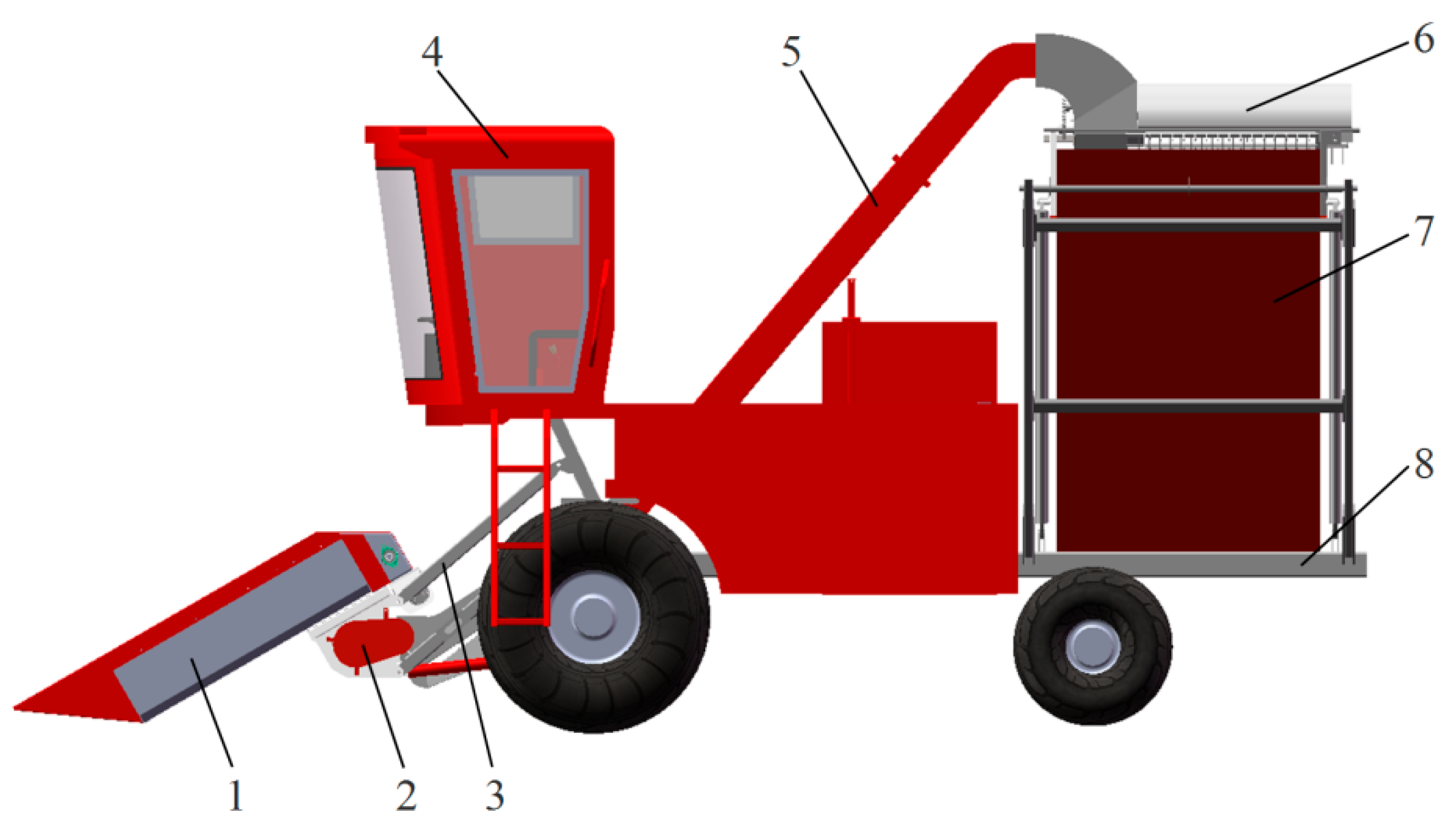
Figure 1. Schematic diagram of the mobile axial flow threshing and cleaning test bench. 1. Picking platform, 2. Hydraulic system, 3. Suspension device, 4. Cab, 5. Conveying device, 6. Threshing and cleaning device, 7. Fruit collection box, 8. Chassis traveling.
Agriculture 15 02578 g001
Figure 2. Schematic diagram of threshing and cleaning test device. 1. Material feeding device, 2. Hydraulic motor, 3. Arc-shaped top plate, 4. Semi-circular screen, 5. Frame, 6. Auger-rod-tooth roller.
Agriculture 15 02578 g002
Figure 3. Schematic diagram of Auger-rod-tooth roller. 1. Main shaft, 2. Screw conveyor, 3. Rod teeth, 4. Disc wheel.
Agriculture 15 02578 g003
Figure 4. Force diagram of the castor fruits during spiral conveying.
Agriculture 15 02578 g004
Figure 5. Schematic diagram of the collision between the rod tooth and the castor fruit. Q1 is the centroid of the rod tooth; Q2 is the centroid of the castor fruit; VT is the velocity at the collision point between the rod tooth and the fruit, m∙s−1; P is the normal interaction force, N; δz is the normal displacement between the centroid of the rod tooth and the fruit, mm.
Agriculture 15 02578 g005
Figure 6. Grid-type concave sieve.
Agriculture 15 02578 g006
Figure 7. Material velocity analysis of deflector. θdq is the angle between the flow-guiding spiral and the horizontal direction, (°); Dg is the diameter of the flow-guiding device upper cover, mm; Lg is the x-direction length of a single flow-guiding spiral blade, mm; LH is the length of the flow-guiding device upper cover, mm; vd is the material movement speed, m∙s−1; vdy is the y-direction component of the material movement speed, m∙s−1; vdx is the x-direction component of the material movement speed, m∙s−1.
Agriculture 15 02578 g007
Figure 8. Field operation of mobile axial flow threshing and cleaning test bench.
Agriculture 15 02578 g008
Figure 9. Effects of interactive factors on impurity rate and breakage. (a) x2 = 475 r∙min−1, interaction between x1 and x3; (b) x1 = 0.8 m∙s−1, interaction between x2 and x3.
Agriculture 15 02578 g009
Figure 10. Field operation effect of mobile test bench. (a) Test bench field trial; (b) post-harvest castor fruits.
Agriculture 15 02578 g010
Table 1. Factors and levels of test.
LevelsForward Speed x1
(m∙s−1)
Roller Rotational Speed x2 (r∙min−1)Threshing Gap of Concave Sieve x3 (mm)
−10.640015
00.847525
11.055035
Table 2. Experiment design and response values.
No.LevelsResponse Values
Forward Speed
X1/(m∙s−1)
Roller Rotational Speed X2/(r∙min−1)Threshing Gap of Concave Sieve X3/(mm)Impurity Rate Y1/(%)Damage Rate Y2/(%)Separation Loss Rate Y3/(%)
1−1−102.272.050.55
21−103.291.720.89
3−1102.913.080.22
41104.492.880.51
5−10−12.792.950.11
610−14.292.680.42
7−1012.662.420.25
81013.181.890.66
90−1−13.322.390.62
1001−14.173.190.24
110−112.721.580.81
120113.252.760.46
130002.982.070.26
140002.821.920.32
150002.862.050.37
160002.682.110.26
170002.892.090.33
Note: X1, X2, and X3 are the corresponding level values of x1, x2, and x3, respectively. The same applies below.
Table 3. Variance analysis of regression equation.
SourceImpurity Rate Y1Damage Rate Y2Separation Loss Rate Y3
Sum of SquaresDegree
of Freedom
F ValueSignificant Level pSum of
Squares
Degree
of Freedom
F ValueSignificant Level pSum of
Squares
Degree
of Freedom
F ValueSignificant Level p
Model5.97936.64<0.0001 **3.89979.90<0.0001 **0.7550957.26<0.0001 **
X12.671147.50<0.0001 **0.2211140.830.0004 **0.22781155.50<0.0001 **
X21.30171.65<0.0001 **2.171401.41<0.0001 **0.25921176.93<0.0001 **
X30.9522152.640.0002 **0.81921151.28<0.0001 **0.0780153.250.0002 **
X1X20.078414.330.07590.004210.78020.40640.000610.42660.5345
X1X30.2401113.270.0083 **0.016913.120.12060.002511.710.2327
X2X30.025611.420.27300.036116.670.0364 *0.000210.15360.7068
X120.070613.900.08870.1597129.490.0010 **0.004012.760.1405
X220.2946116.280.0050 **0.1516128.000.0011 **0.17441119.02<0.0001 **
X320.2727115.080.0060 **0.2471145.630.0003 **0.001911.270.2974
Residual0.12667 0.03797 0.01037
Lack of fit0.078332.160.23540.015430.91490.50950.001230.17250.9097
Pure error0.04834 0.02254 0.00914
Total6.0916 3.9316 0.765216
Note: p < 0.01 (highly significant, **); p < 0.05 (significant, *).
Table 4. Comparison of test results of performance indices.
ItemsImpurity Rate
(%)
Damage Rate
(%)
Separation Loss Rate (%)
Theoretical optimized values2.871.830.45
Test average values2.951.750.49
Relative error (%)2.714.578.16
Standard values [28]72/
Disclaimer/Publisher’s Note: The statements, opinions and data contained in all publications are solely those of the individual author(s) and contributor(s) and not of MDPI and/or the editor(s). MDPI and/or the editor(s) disclaim responsibility for any injury to people or property resulting from any ideas, methods, instructions or products referred to in the content.