Article

Design and Performance Testing of a Motorized Machine-Mounted Self-Leveling Platform for Hilly Orchards


1
Nanjing Institute of Agricultural Mechanization, Ministry of Agriculture and Rural Affairs, Nanjing 210014, China
2
Graduate School of Chinese Academy of Agriculture, Beijing 100083, China
3
School of Mechanical Engineering, Nanjing Institute of Technology, Nanjing 211167, China
*
Authors to whom correspondence should be addressed.
Agriculture 2025, 15(23), 2512; https://doi.org/10.3390/agriculture15232512
Submission received: 23 October 2025 / Revised: 23 November 2025 / Accepted: 2 December 2025 / Published: 3 December 2025
(This article belongs to the Section Agricultural Technology)

Abstract

To address issues such as attitude instability, insufficient adaptability, and poor operational quality of precision operation equipment caused by complex terrain conditions in hilly orchards, this study designed an electric carrier Self-Leveling Platform based on the 3-RRS parallel configuration. Focusing on the stability requirements of the operation plane, an automatic leveling control strategy was proposed with the constant center height of the moving platform as an additional constraint condition. Based on the inverse kinematics solution of the 3-RRS Parallel Mechanism, the analytical mapping relationship between the fuselage attitude and the compensation angle of the leveling leg crank was derived, and based on this, the working space of the Self-Leveling Platform and the maximum compensation angles of the moving platform in the pitch and roll directions were calculated. Key structural parameters were optimized using a multi-objective genetic algorithm, followed by the completion of a 3D model design and modal simulation analysis to verify the effectiveness of the structural design. Finally, leveling performance tests were conducted on a prototype. The results showed that the platform can achieve omnidirectional automatic leveling, with a maximum leveling time of 1.593 s and a maximum steady-state error of 0.62° under typical slope and load conditions. Analysis of variance results further indicated that there are significant differences in the leveling performance of the 3-RRS parallel configuration of the Self-Leveling Platform in the pitch and roll directions, demonstrating anisotropic characteristics. This study provides an effective solution for attitude stability control of orchard operation equipment in hilly areas and offers theoretical reference and technical support for the application of the 3-RRS parallel configuration in the agricultural equipment field.

1. Introduction

Global orchards are widely distributed in hilly areas, and among major fruit-producing countries, orchards on hilly terrain account for a relatively high proportion. Relevant data show that in 2023, China’s fruit harvest area accounted for 23.40% of the global harvest area [1], with more than 60% distributed in hilly regions [2]. The complex terrain conditions in such areas pose severe challenges to the full mechanization of orchard production, resulting in a significantly lower level of mechanization in hilly regions compared to plains. Using county-level data from China as an example, the comprehensive mechanization rate of crop cultivation and harvesting in hilly and mountainous counties is only 46.87%, which is 33.87% lower than that of non-hilly counties [3]. In recent years, the rapid development of precision operation equipment such as orchard harvesting robots [4], precision target-oriented plant protection machines [5], and orchard spectral information collection devices [6] has placed higher demands on the inclination and stability of the working plane during operations. During mechanized work in hilly orchards, complex slopes can easily cause calibration errors between the base coordinate system of such precision equipment and the geodetic coordinate system. These errors propagate through the motion chain to the end effector, reducing positioning accuracy and operational efficiency [7]. To address these issues, applying automatic leveling technology can improve the adaptability of precision operation equipment in hilly orchard environments to a certain extent [8], thereby promoting the rapid and high-quality development of full-process mechanization in hilly orchards.
In the field of agricultural machinery, automatic leveling technology has undergone continuous development, resulting in a relatively well-established technical system. In countries such as the United States and Canada, where large-scale field operations dominate, the chassis leveling technology of medium and large agricultural machinery is highly mature and widely applied. John Deere (Moline, IL, USA) has equipped its combine harvesters [9] and self-propelled sprayers [10] with automatic body leveling systems, which can actively adjust the vehicle’s posture during operation to maintain balance. Denis et al., from Clermont University, France, proposed an online adaptive observer based on lateral load transfer (LLT) estimation to assess the rollover risk of grape harvesters on complex terrains and to drive the leveling system to control the vehicle’s posture [11]. Zhen Li et al. conducted research on the dynamic stability of tractors and proposed an evaluation method capable of effectively predicting lateral stability [12]. Sun et al. proposed a crawler-type combine harvester leveling chassis based on four-point hydraulic lifting and verified, through modeling and prototype testing, the effectiveness of the chassis in sloped field operations [13]. Yang Tengxiang designed an omnidirectional leveling chassis for crawler-type combine harvesters, capable of manually or automatically adjusting the ground clearance and tilt angle of the chassis [14].
Meanwhile, in many countries and regions, including China, hilly farmland accounts for a high proportion of the territory. Automatic leveling agricultural machinery for small hilly plots is still in the early stages of research, development, and application. Yang Fuzeng and others from the Northwest A&F University proposed a lateral leveling scheme based on a parallelogram mechanism and a longitudinal leveling scheme based on a dual-frame mechanism, and designed a remote-controlled omnidirectional leveling mountain crawler tractor capable of achieving lateral and longitudinal leveling on terrain with slopes of 0–15° laterally and 0–10° longitudinally [15,16]. Wang Ruochen and others from Jiangsu University proposed a hydraulic omnidirectional leveling scheme based on a point-line composite support “three-layer frame,” and designed an omnidirectional leveling crawler machine with a maximum leveling angle of up to 20° [17,18,19]. Liu Pingyi and others from China Agricultural University proposed a pre-detection active leveling method for agricultural chassis in hilly and mountainous areas, achieving real-time dynamic active leveling by mounting a height-distance sensor at the front of the frame [20]. Lv Fengyu and others designed an omnidirectional attitude-adjustment agricultural tracked chassis with both horizontal and vertical leveling functions, with a leveling error of ≤±1.5° [21]. Masao Nozawa from Japan and others designed a self-propelled orchard work platform with leveling capability, which can operate normally on a slope of 15° [22]. The Jang team from Kyungpook National University in South Korea developed a tracked automatic leveling lift platform that can maintain the work platform within a leveling accuracy range of ±0.5° when the body tilt reaches ±20° [23].
In summary, existing research mainly focuses on the driving stability and rollover prevention of agricultural machinery [24], while there is a clear lack of development and research on automatic leveling systems for lightweight, simplified machinery in hilly areas [17]. For precise operation scenarios in hilly orchards, traditional leveling systems driven by hydraulic cylinders or electric push rods have limitations in response speed and stability, making it difficult to meet the demands of equipment such as harvesting robotic arms, LiDAR, and spectrometers for rapid and stable leveling of the working plane. To address these issues, this study designs an electric onboard Self-Leveling Platform based on a 3-RRS parallel configuration, and proposes a leveling control strategy with constraints of keeping the relative height between the center point of the moving platform and the ground unchanged, and maintaining the moving plane parallel to the terrestrial coordinate system. A multi-objective genetic algorithm is used to optimize key structural parameters, upon which 3D model design and simulation analysis are completed. Finally, prototype field tests are conducted to verify the leveling performance, providing a technical reference for the design and development of agricultural machinery leveling systems in hilly and mountainous areas.

2. Materials and Methods

2.1. Operational Scenario and System Architecture

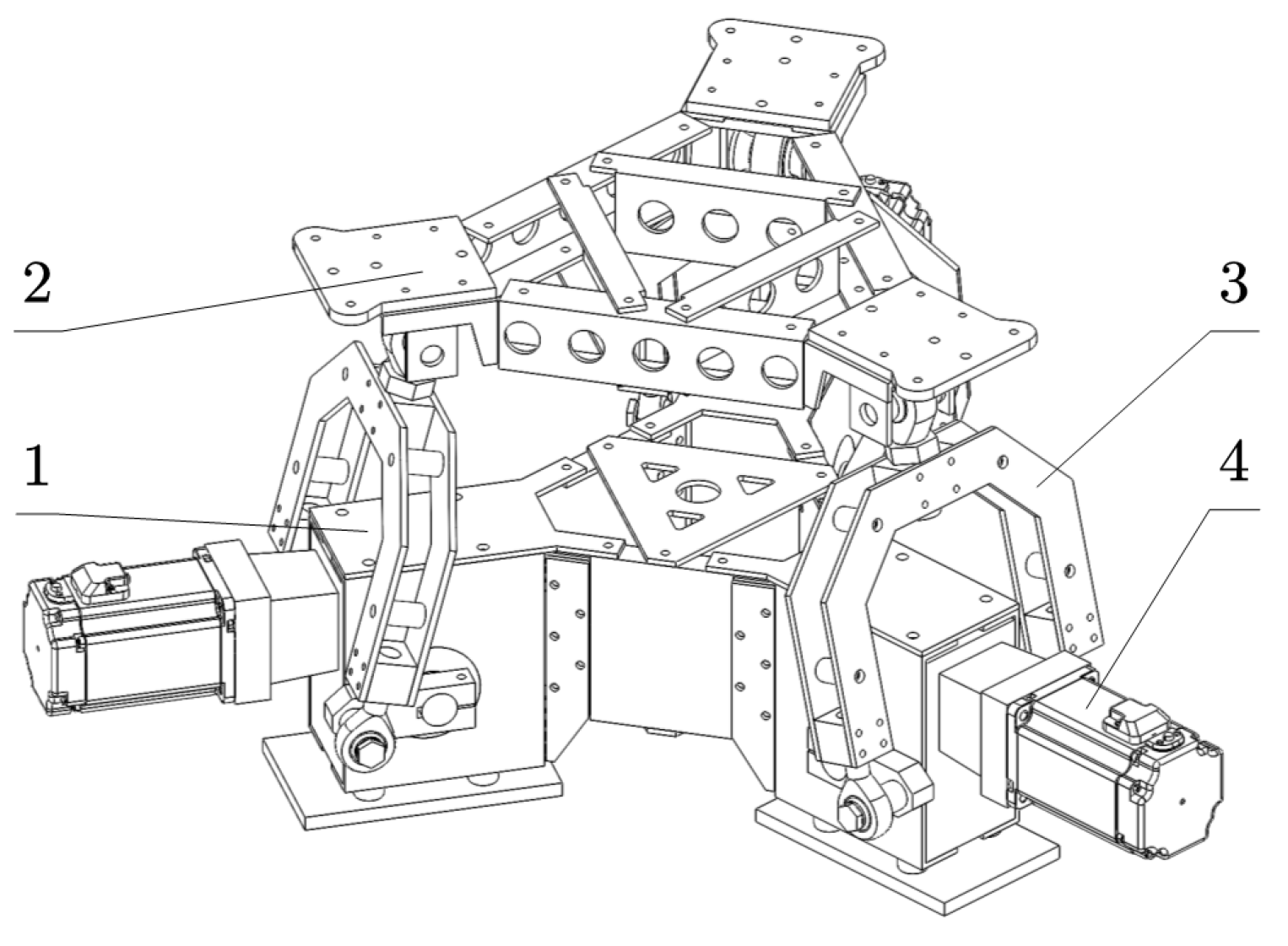
In response to the need for rapid response and high stability of automatic leveling systems in precision operation scenarios of hilly orchards, this study designs the orchard electric machine-mounted Self-Leveling Platform based on the 3-RRS parallel configuration, as shown in Figure 1. The whole machine is composed of a base platform, a moving platform, and leveling support legs, where the base platform is rigidly connected to the main chassis, and the leveling legs connect the moving platform to the base platform. The moving platform is responsible for carrying equipment that requires automatic leveling, such as fruit-picking robotic arms, LiDAR, and spectrometers. Self-Leveling Platform adjusts the posture of the moving platform by controlling the movement of the three leveling legs, thereby keeping the working plane of the moving platform-mounted equipment horizontal. The parallel structure formed by the three support legs has strong stability, meeting the automatic leveling function while avoiding the occurrence of ‘virtual leg’ phenomena during leveling control (i.e., the phenomenon where redundant support legs become suspended and thus lose function) [25].
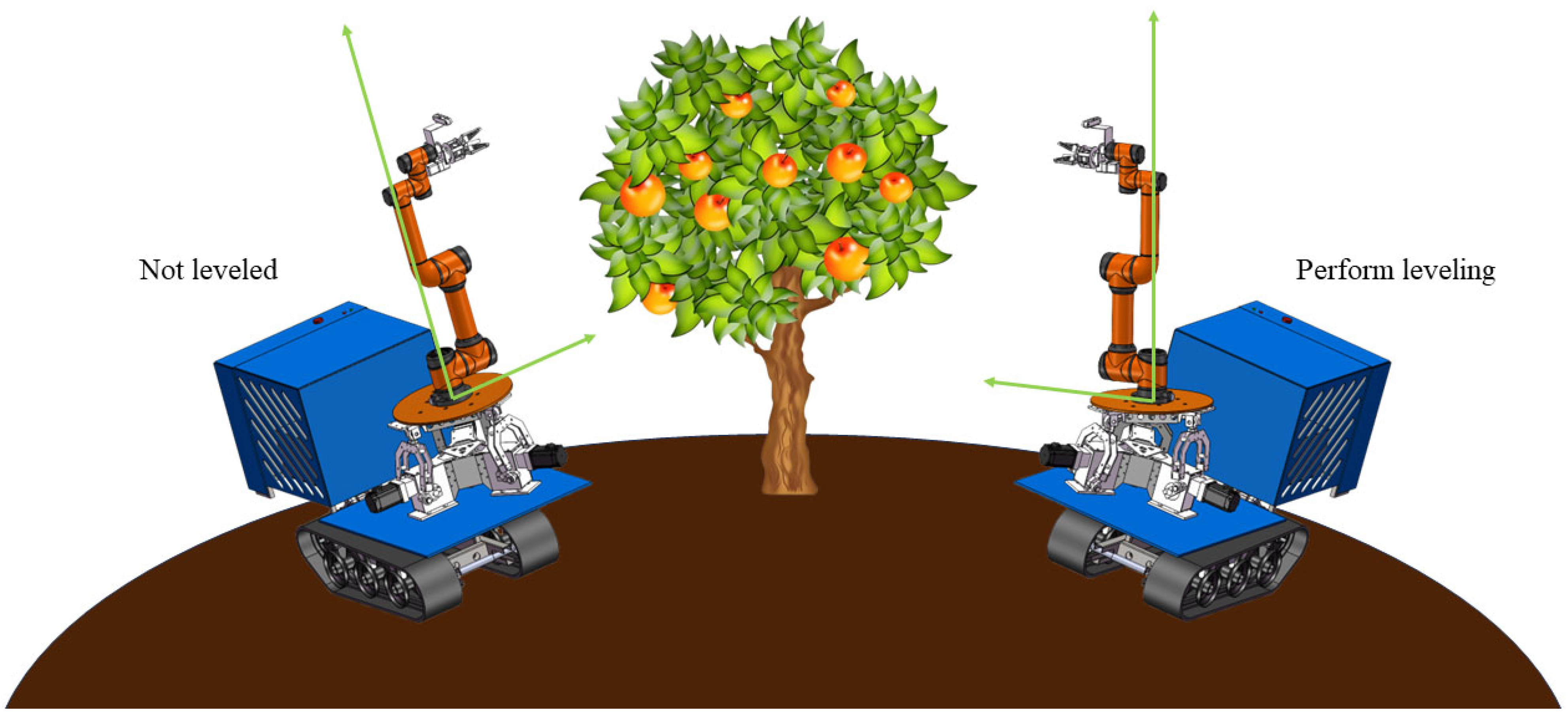
For the mechanized operation scenarios of hilly orchards, to improve the compactness of the Self-Leveling Platform‘s design and shorten the large idle stroke between the base platform caused by using hydraulic cylinders or electric push rods as actuators in traditional parallel platforms, this study designed the leveling support legs of the Self-Leveling Platform based on the crank–rocker mechanism. By converting the rotary motion of the servo motor into the swinging of the rocker, the extension and retraction functions of the support legs are achieved, significantly reducing the height and space occupancy of the legs when not in working state, thereby effectively eliminating the inherent idle stroke of traditional linear actuators. Meanwhile, the inherent motion characteristics of the crank–rocker mechanism enable the support legs to have both high response speed and good force transmission efficiency during leveling, providing a structural basis for the Self-Leveling Platform to perform fast and precise leveling under dynamic loads. The working scenario of the Self-Leveling Platform equipped with a picking mechanical arm is shown in Figure 2.
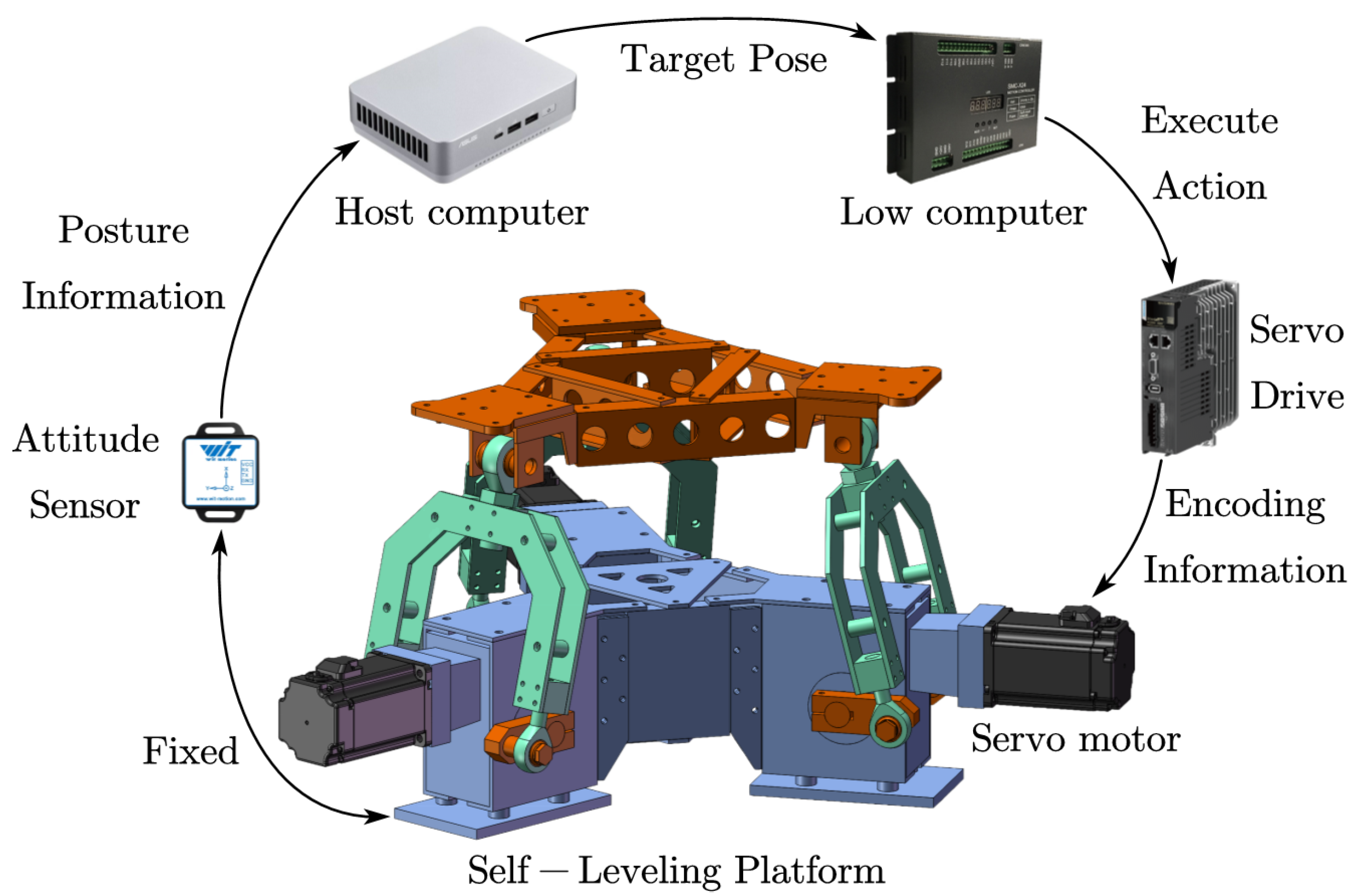
In hilly areas with slopes exceeding 15°, it is not advisable to use medium or large machinery for mechanized operations [26]. The slope of typical hilly orchards is generally below 15° [27]. To accommodate the slope distribution of hilly orchards while also addressing extreme operating conditions, this study proposes that the design target for the Self-Leveling Platform is omnidirectional leveling, with pitch and roll leveling angles ≥ 20°. When equipment equipped with a Self-Leveling Platform operates on sloped terrain such as hilly orchards, an attitude sensor installed on the base platform first transmits the real-time vehicle attitude data to the upper control unit. Based on the current vehicle attitude, the upper control unit calculates the crank compensation angles for the three sets of crank-and-rocker legs of the Self-Leveling Platform, and sends the target leg positions to the lower control unit. The lower control unit then controls the servo drivers to rotate the servo motors to the corresponding angles, and, after torque amplification and speed reduction via a gear reducer, drives the crank-and-rocker legs to adjust the moving platform to a horizontal posture. The complete leveling workflow is shown in Figure 3.

2.2. Research on Automatic Leveling Control Strategy

2.2.1. Control Strategy

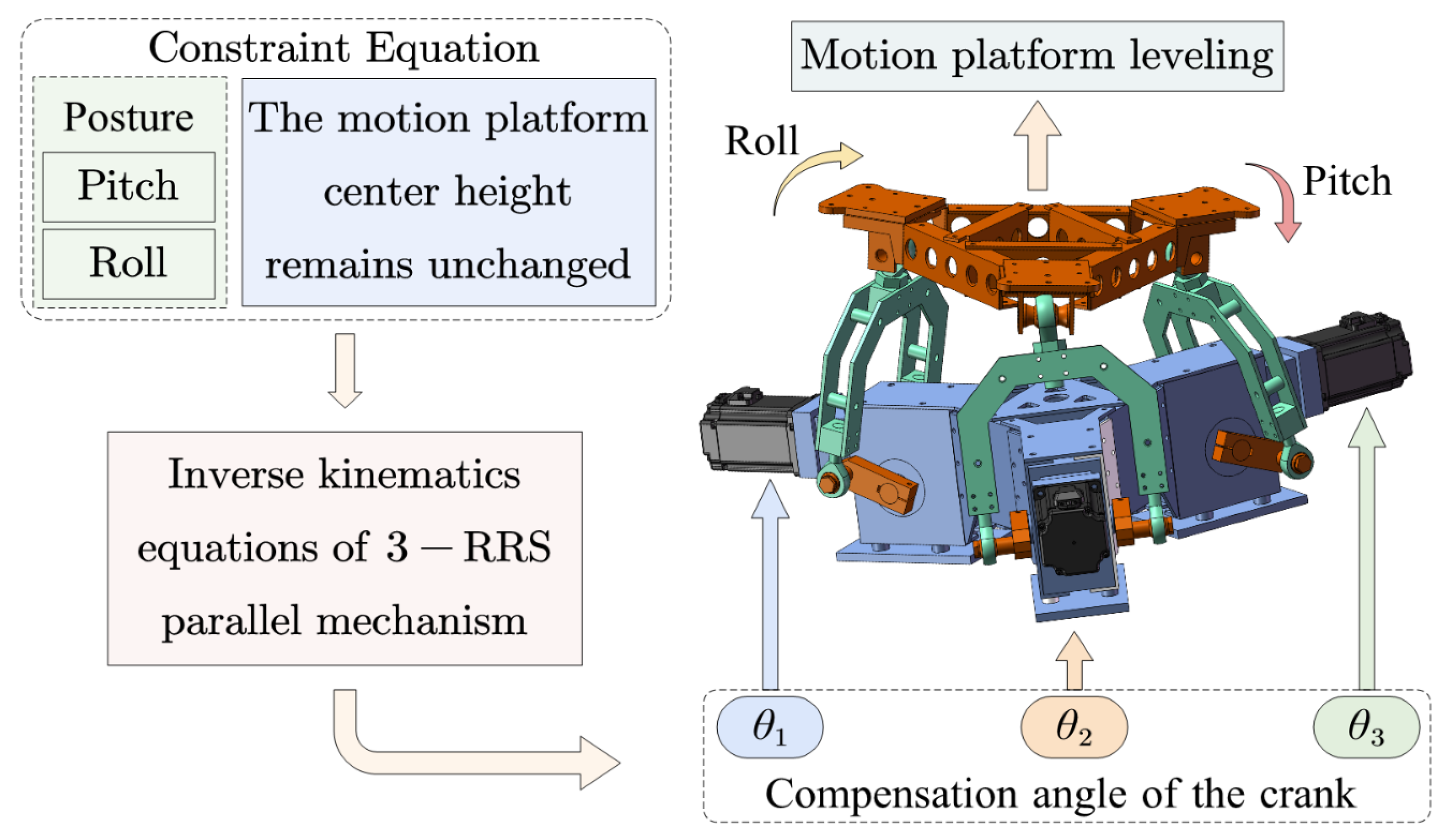
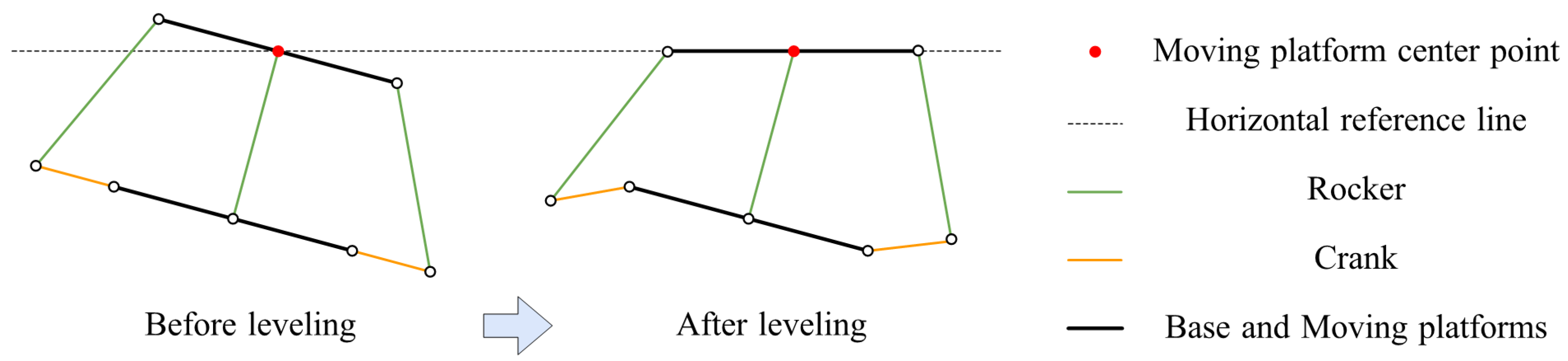
A reasonable control strategy can effectively improve the response speed and stability of the automatic leveling system [28]. Based on the geometric characteristics of the 3-RRS Parallel Mechanism, this study proposes a leveling control strategy with the additional constraint of keeping the height of the Moving platform center point constant (as shown in Figure 4). First, a kinematic inverse solution model of the Self-Leveling Platform 3-RRS parallel configuration is established. Combined with the additional constraint equations, an analytical mapping relationship between the crank compensation angles of the three leveling support legs and the body attitude is constructed. Then, according to the body attitude, the compensation angles of the crank in the three legs are calculated in real time to realize automatic leveling control of the Self-Leveling Platform.
The core control objectives of the above control strategy are threefold: the pitch angle (pitch) of the moving platform is zero, the roll angle (roll) is zero, and the relative height between the center point of the moving platform and the ground remains constant. The control effect is shown in Figure 5. When the slope of the ground or external disturbances cause Self-Leveling Platform to tilt randomly, the control system first acquires the body attitude information through attitude sensors, then uses the inverse kinematics of the 3-RRS parallel configuration together with the constraint equations of the dynamic and static plane spacing to solve for the three compensation angles of crank needed to achieve the control objectives, thereby driving the actuators to restore the moving platform to a level state. Since the relative height between the center of the moving platform and the ground is kept constant during the solving process, the degree of freedom in the vertical direction is eliminated, making the calculated combination of leg lengths unique. This strategy effectively improves the operational stability of the equipment mounted on the moving platform, reduces measurement and targeting errors caused by height fluctuations and base tilt, and meets the requirements for working plane stability and operational accuracy in high-precision operations within hilly orchard environments.

2.2.2. Kinematic Analysis

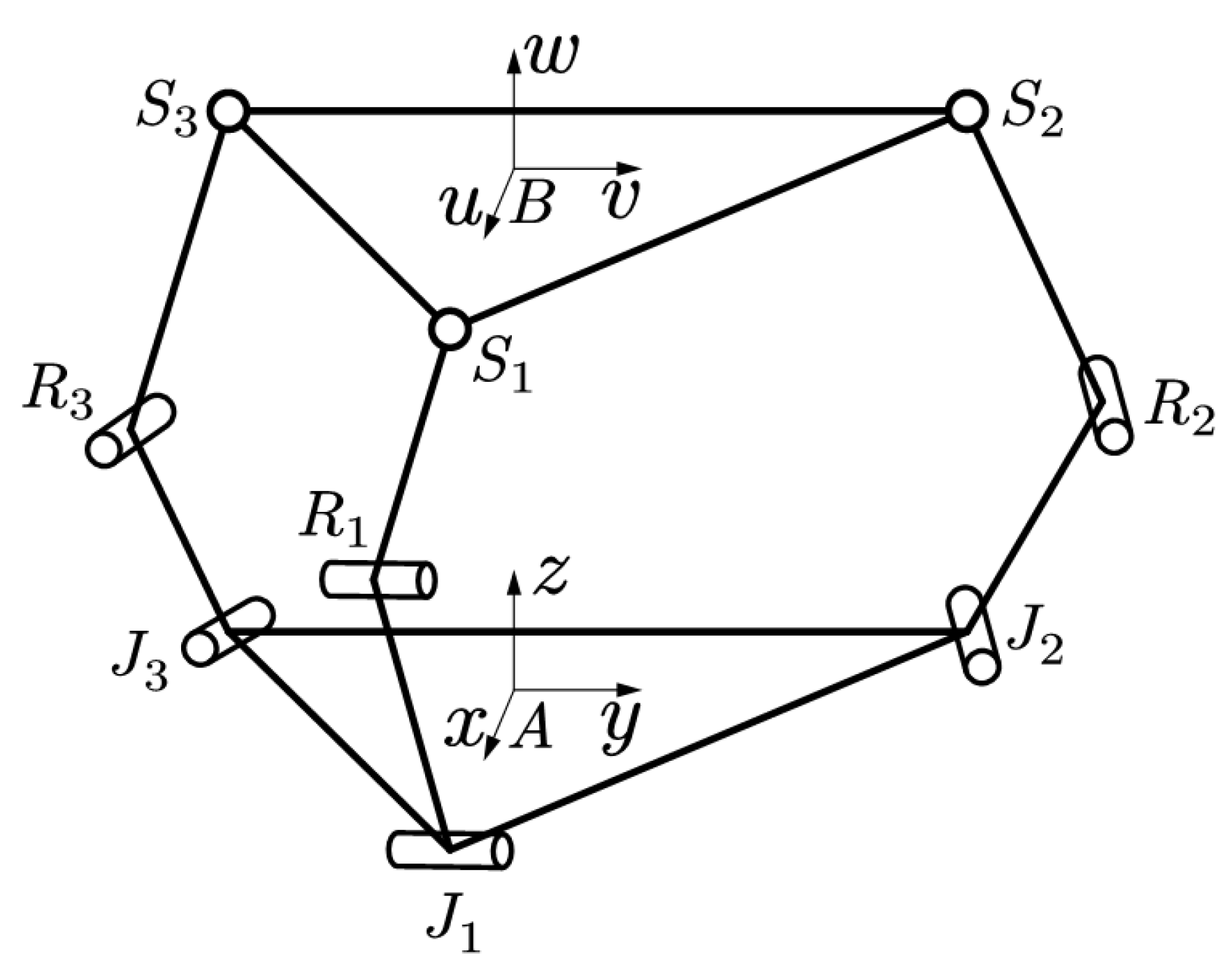
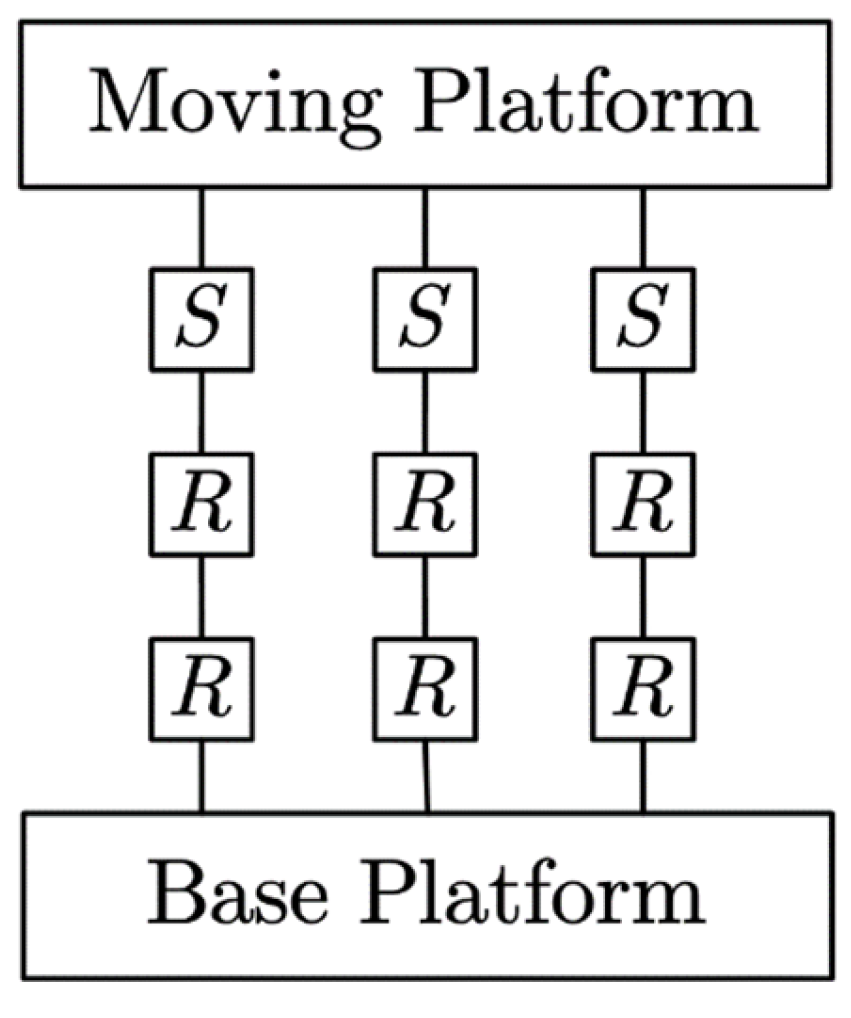
The 3-RRS parallel configuration of the Self-Leveling Platform is based on the reduced-degree-of-freedom Parallel Mechanism proposed by Stewart in 1965 [29]. The schematic diagram of the mechanism is shown in Figure 6. It is composed of base platform J1J2J3, moving platform S1S2S3, and three identical leveling legs JiRiSi (i = 1,2,3). Each leg consists of two rigid links and one revolute joint, connected to the base platform via a revolute joint (R), and to the moving platform via a spherical joint (S). Both base platform J1J2J3 and moving platform S1S2S3 are equilateral triangles. Taking the circumcenter A of triangle base platform J1J2J3 and the circumcenter B of triangle moving platform S1S2S3 as origins, coordinate systems A-xyz and B-uvw are, respectively, established. The extended lines of the x-axis and u-axis pass through point J1 in plane J1J2J3 and point S1 in plane S1S2S3, respectively. The z-axis and w-axis are perpendicular to planes J1J2J3 and S1S2S3, respectively, and the y-axis in A-xyz and v-axis in B-uvw both follow the right-hand rule. The A-xyz coordinate system is a fixed coordinate system relative to the stationary chassis body, while the B-uvw coordinate system is a moving coordinate system.
According to the revised Grübler-Kutzbach (G-K) formula
F = k n g 1 + i = 1 g f i + λ + ζ
where F is the degree of freedom of the mechanism; k is the order of the mechanism; n is the number of moving components; g is the number of kinematic pairs; fi is the degree of freedom of the i-th kinematic pair; λ is the number of common constraints; and ζ is the local degree of freedom.
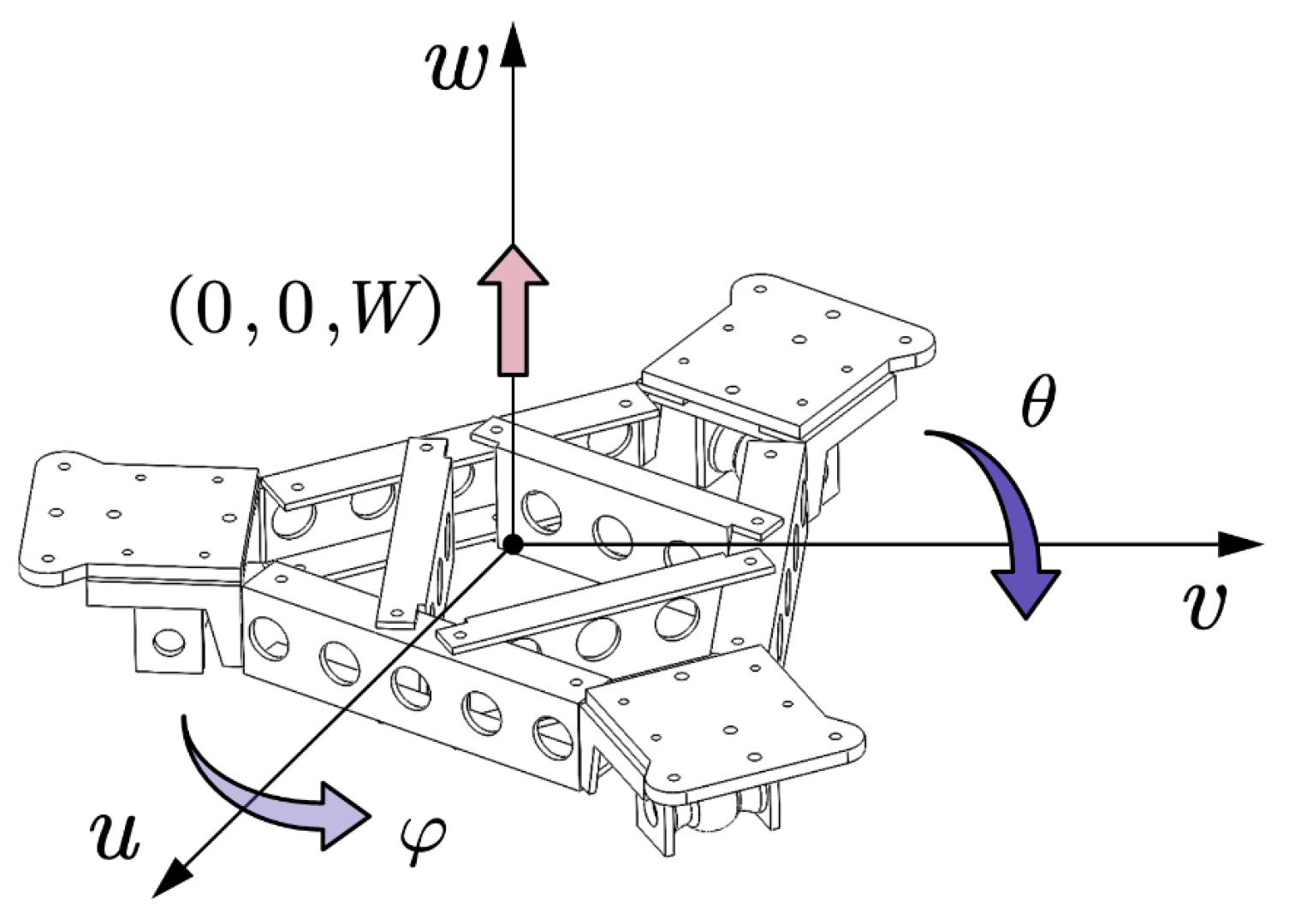
By substituting the corresponding values into Equation (1), it can be calculated that the degrees of freedom of Self-Leveling Platform are 3, that is, moving platform in the moving coordinate system B-uvw has three degrees of freedom: rotation angle φ (roll) around the u-axis, rotation angle θ (pitch) around the v-axis, and displacement W along the w-axis (as shown in Figure 7).
In this study, the Z-Y-X type Euler angles (RPY angles) are used to perform rotational transformation of the Self-Leveling Platform moving coordinate system, following the rotation sequence around the moving coordinate system axes wvu. The moving coordinate system is defined to first rotate around the w-axis (which has no degree of freedom in this direction due to the characteristics of the 3-RRS mechanism), then rotate by θ around the new v-axis, and finally rotate by φ around the new u-axis. The rotation matrix for transforming from the Self-Leveling Platform moving coordinate system B-uvw to the fixed coordinate system A-xyz can be described as follows:
R ( θ , φ ) = R v ( θ ) R u ( φ ) = cos θ sin θ sin φ sin θ cos φ 0 cos φ sin φ sin θ cos θ sin φ cos θ cos φ
where Ru(φ) is the rotation matrix of the moving platform when it rotates by an angle φ around the u-axis, and Rv(θ) is the rotation matrix of the moving platform when it rotates by an angle θ around the v-axis.
A constraint equation was constructed to keep the position of the moving platform’s center point constant before and after leveling. When establishing the displacement matrix for the coordinate transformation from the driven coordinate system to the static coordinate system, we fully considered the vertical displacement generated after leveling, and included this displacement compensation in the calculation when determining the compensation angle for the three legs of the crank, thereby obtaining a corrected position matrix of the moving platform center point. This equation thus serves as the required supplementary constraint equation. In addition, to simplify the calculation, this study approximates the rotation center of the moving coordinate system during the leveling process as the static coordinate system center A.
The moving coordinate system B-uvw rotates around the center point A of the fixed coordinate system A-xyz, with the initial center point coordinates of the moving platform as
M 0 = [ 0 , 0 , h 0 ] T
where h0 is the distance between the moving part in the initial state of the Self-Leveling Platform and the center point of the base platform and M0 is the initial position vector of the center point B of the moving platform in the A-xyz coordinate system before leveling.
The equivalent leg length at this moment is
h 0 = d 2 l 2
where l is the length of the crank in the leveling support leg, and d is the length of the rocker in the leveling support leg.
The displacement matrix for the transformation from the moving coordinate system B-uvw to the stationary coordinate system A-xyz is:
M = R M 0 = h 0 sin θ cos φ sin φ cos θ cos φ
where M is the position vector [x, y, z]T of point B at the center of the moving platform in the A-xyz coordinate system; R is the rotation matrix from the moving coordinate system B-uvw to the fixed coordinate system A-xyz.
From simultaneous Equations (3) and (4), it can be obtained that the distance between the moving point of the Self-Leveling Platform in the initial position state and the center point of the base platform is
M 0 = h 0 cos θ cos φ
The coordinate of the articulation point Ji between the support leg and base platform in the static coordinate system A-xyz is
J i = r cos λ i r sin λ i 0
where r is the base platform and moving platform circumscribed circle radius, and λi is the circumferential angle between the moving base platform and the joint point of the i-th leg, where λ1 = 0°, λ2 = 120°, and λ3 = 240°.
The coordinates of the hinged point Si between the support leg and moving platform in the moving coordinate system B-uvw are
S i u v w = r cos λ i r sin λ i 0
where Siuvw is the position coordinate of the i-th leg’s joint point with the moving platform in the local coordinate system B-uvw of the moving platform.
The coordinates transformed into the stationary coordinate system A-xyz are
S i = P + R S i u v w
where Si is the articulation point (spherical joint connection point) between the i-th supporting leg and moving platform, and P is the displacement matrix from the driven coordinate system B-uvw to the static coordinate system A-xyz.
The equivalent leg vector and its components are
L i = S i J i = X i Y i Z i
where Xi is the displacement of the i-th leg vector Li in the x-axis direction of the static coordinate system; Yi is the displacement of the i-th leg vector Li in the y-axis direction of the static coordinate system; and Zi is the displacement of the i-th leg vector Li in the z-axis direction of the static coordinate system.
From the simultaneous Equations (7)–(10), the explicit components of the equivalent strut vector can be obtained as
X i = h 0 sin θ cos φ + r cos λ i cos θ + r sin λ i sin θ sin φ r cos λ i Y i = h 0 sin φ + r sin λ i cos φ r sin λ i Z i = h 0 cos θ cos φ r cos λ i sin θ + r sin λ i cos θ sin φ
When θ = φ = 0, Xi = Yi = 0, and Zi = h0, the Self-Leveling Platform is in its initial state, that is, the crank of the three support legs is coplanar with the static plane.
Express the constraint in the form of a phase difference, defining the equivalent leg length between Ji and Si in the i-th leg as
D i = L i = X i 2 + Y i 2 + Z i 2
where Di is the spatial distance between Ji and Si in the i-th supporting leg.
The projection length of the i-th supporting leg in the static plane is
R x y , i = X i 2 + Y i 2
where Rxy,i is the projection length of the i-th leg in the xy plane of the static coordinate system.
The azimuth angle of the i-th leg in the plane is
γ i = arctan 2 ( Y i , X i )
Then,
X i = R x y , i cos γ i Y i = R x y , i sin γ i
The coordinates of endpoint Ri of the crank in the i-th support leg in the static coordinate system are
R i = J i + l cos α i sin α i 0
Length constraint by the rocker is
| S i R i | = d
By simultaneously solving Equations (13)–(17), we obtain
R x y , i cos ( α i γ i ) = D i 2 + l 2 d 2 2 l
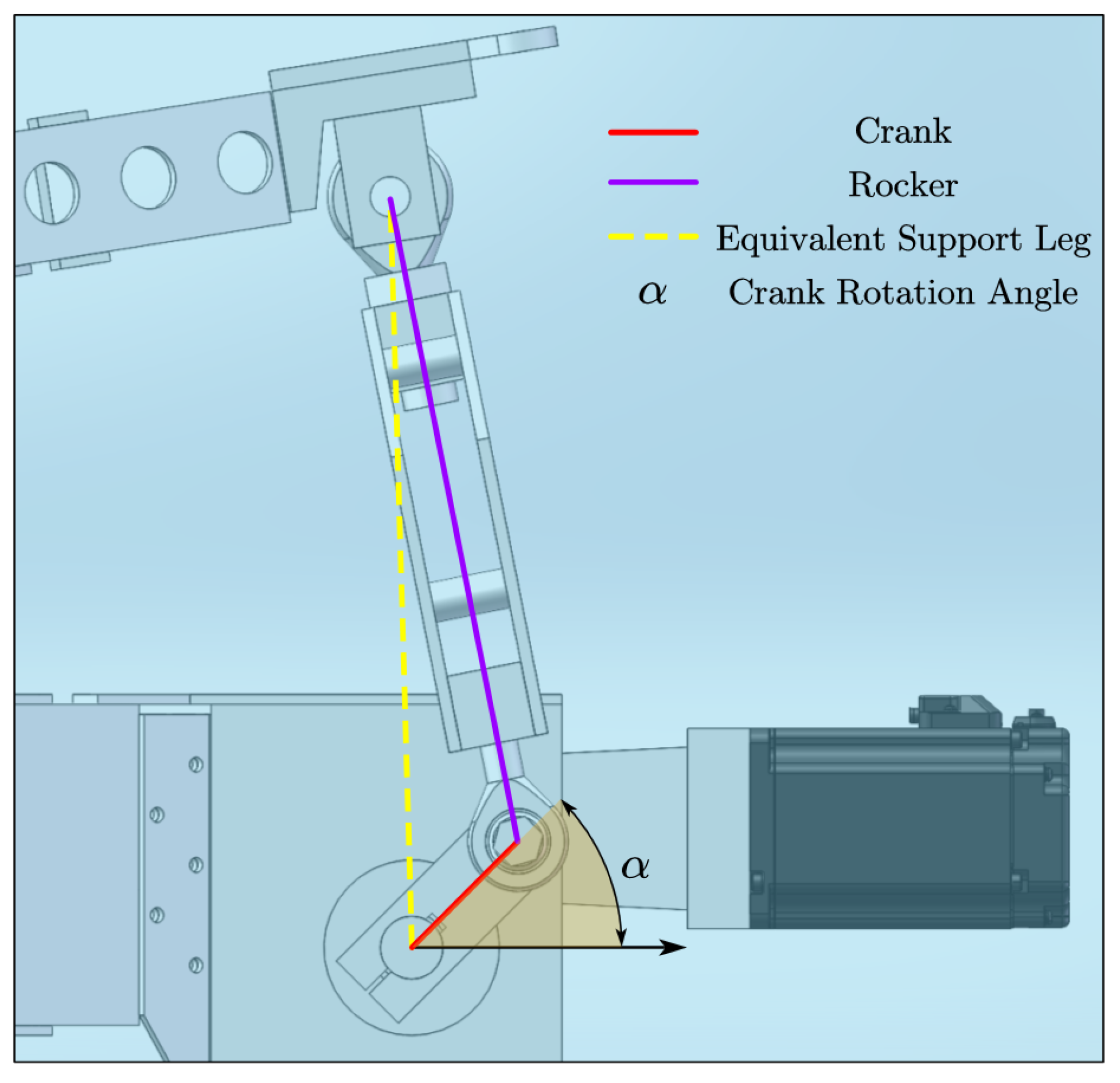
where αi is the crank rotation angle of the i-th leg, that is, the direction angle from Ji to Ri, with the convention that when the crank is coplanar with the static plane, and the crank is abducted, αi = 0.
Order is
C i = D i 2 + l 2 d 2 2 l R x y , i
Only when |Ci| ≤ 1 is satisfied does the rotation angle of the crank have a real solution; thus, from Equation (18), two sets of closed-form solutions for the rotation angle of the crank can be obtained:
α i = γ i ± arccos ( C i )
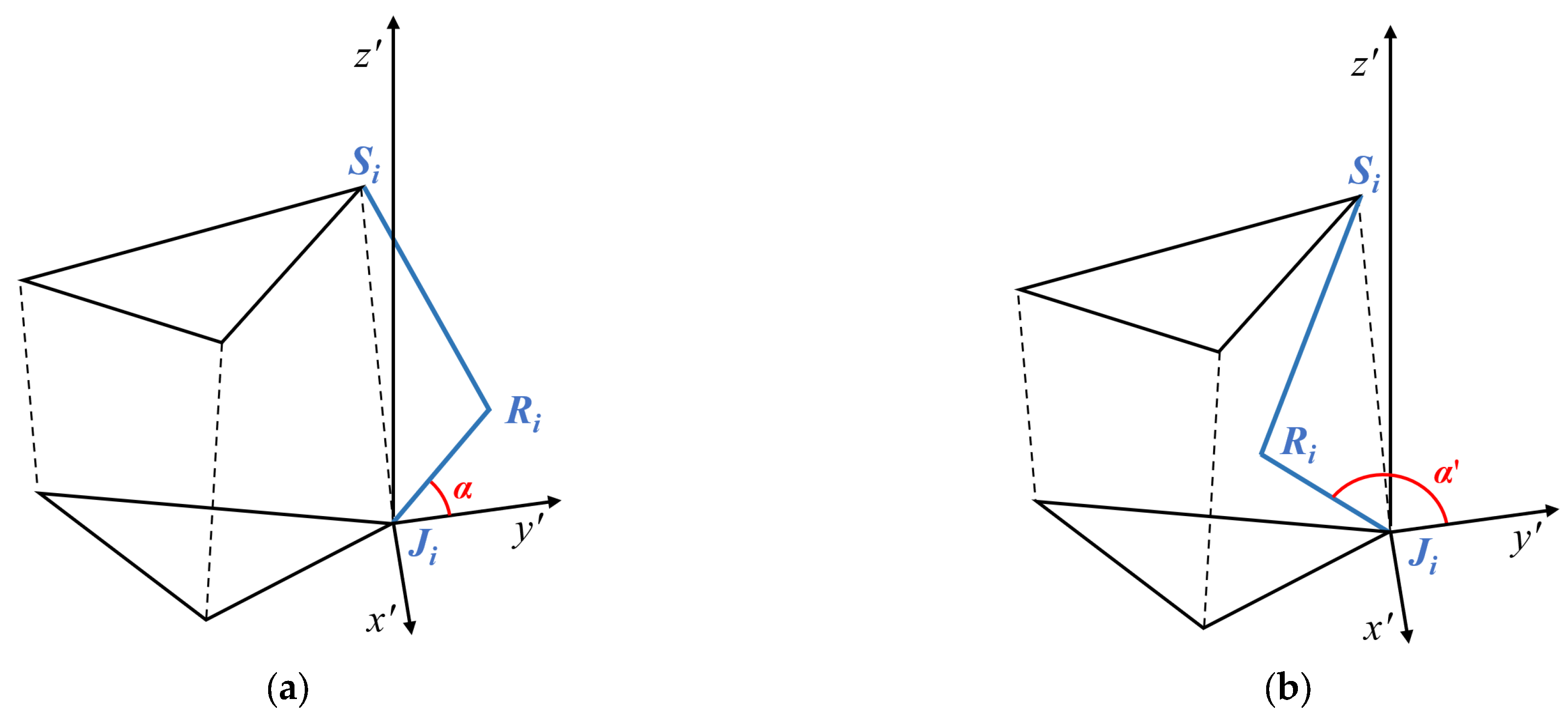
Taking a single support leg as an example, the two solutions for the compensation angle of the leg crank are shown in Figure 8a,b. By sequentially discarding the interference solution α′ of each support leg, as shown in Figure 8b, and by inverting α, the compensation angles of each leg crank can be derived, ensuring that the moving platform remains horizontal and at a constant height when the body pitch angle is θ, and the roll angle is φ.

2.3. Leveling Actuator Design and Analysis

2.3.1. Leveling Outrigger Design

Self-Leveling Platform uses three crank-and-rocker (R–R–S) support legs with identical configurations, arranged at equal intervals of 120°, as leveling actuators. The distribution of kinematic pairs is shown in Figure 9. Each leg consists of a driving revolute pair (R) on the base platform side, a passive revolute pair (R) in the middle, and a terminal spherical pair (S) on the moving platform side connected in series. In the control process of the Self-Leveling Platform, the control variable is the crank rotation angle α, as shown in Figure 10. To avoid interference between the legs and the Self-Leveling Platform body, the crank rotation angle is limited to the range [−90°, +90°].
During operation of the Self-Leveling Platform, the three leveling support legs are first reset to their initial position, meaning that the crank of all three legs is coplanar with the static plane. At this moment, the rotation angle αi of each leg’s crank is 0° (i = 1,2,3). Subsequently, the instantaneous tilt angle of the body measured by the attitude sensors is used to calculate in real time the compensation angles αi for each leg’s crank, and synchronously drive the crank of the legs, thereby controlling the moving platform to remain horizontal. The crank–rocker (R–R–S) configuration of the leveling legs provides smooth, nearly linear geometric gain in the vicinity of small angular changes. The spherical joint connecting the legs to the moving plane provides ample attitude freedom for the moving plane, helping to ensure smooth attitude transitions and avoid transient shocks. Compared with parallel support legs that use hydraulic cylinders or electric push rods as actuators, the crank–rocker mechanism driven by servo motors offers higher response speed. During long-term operation, the high-resolution encoders built into the servo motors enable closed-loop control, fundamentally avoiding the cumulative errors caused by open-loop stepper motors in electric push rods or by temperature variations and internal leakage in hydraulic cylinders, thus ensuring pose accuracy during extended operation. Meanwhile, the crank-and-rocker mechanisms feature a simple structure and are easy to maintain, which helps reduce costs while ensuring structural rigidity and control accuracy.

2.3.2. Structural Parameter Optimization

Based on the characteristics of the 3-RRS parallel configuration, and in order to optimize the structural parameters of Self-Leveling Platform, this study selects three key structural parameters of Self-Leveling Platform (the circumscribed circle radius r of the moving part, crank length l, and rocker length d) as optimization design variables, with the comprehensive leveling performance of the leveling support leg crank as the optimization objective, to carry out structural parameter optimization design. Among optimization algorithms, the multi-objective genetic algorithm (NSGA-II) stands out for its wide application, strong convergence of solution sets, and fast computation, making it suitable for solving nonlinear optimization problems [30]. Therefore, this study adopts the NSGA-II algorithm to optimize the key structural parameters of the Self-Leveling Platform.
To establish a multi-objective optimization function, the following equation is used:
min f ( X ) = [ N ( X ) , T ( X ) ]
where f(X) is the multi-objective optimization function; X is the optimization design variable; X = (r, l, d); N(X) is the crank input torque; and T(X) is the leveling time.
Based on the set range of structural parameters, we establish the boundary constraints for dimensional optimization:
160 r 220 50 l 80 180 d 250
where r is the circumscribed circle radius of the moving platform and base platform; l is the length of the crank; and d is the length of the rocker.
The crowding distance expression of the NSGA-II algorithm is
δ i p = p = 1 G | f p ( X i + 1 ) f p ( X i 1 ) | f p max f p min , i { 2 , 3 , , n 1 }
where δ i p is the crowding distance of the i-th individual in the p-th objective function; G is the number of objective optimization functions; f p is the value of the p-th objective function; f p max is the maximum value of all individuals under the p-th objective function; and f p min is the minimum value of all individuals under the p-th objective function.
We set the crossover probability of the NSGA-II genetic algorithm to 0.95, the crossover distribution index to 22, the population size to 350, and the maximum number of iterations to 600. After iterative solving, the Pareto optimal solution set was obtained [17]. Under the constraints of attitude coverage, singularity, and minimum clearance, and taking into account both the input torque value (the torque value applied to the crank input terminal) and leveling time (time required for moving platform to return to the attitude recovery level under constant load) of the crank leveling outrigger, as well as engineering design experience and structural planning, the key structural parameters (r, l, d) of Self-Leveling Platform were determined to be 200 mm, 60 mm, and 220 mm, respectively.

2.4. Workspace and Modal Analysis

2.4.1. Workspace Analysis

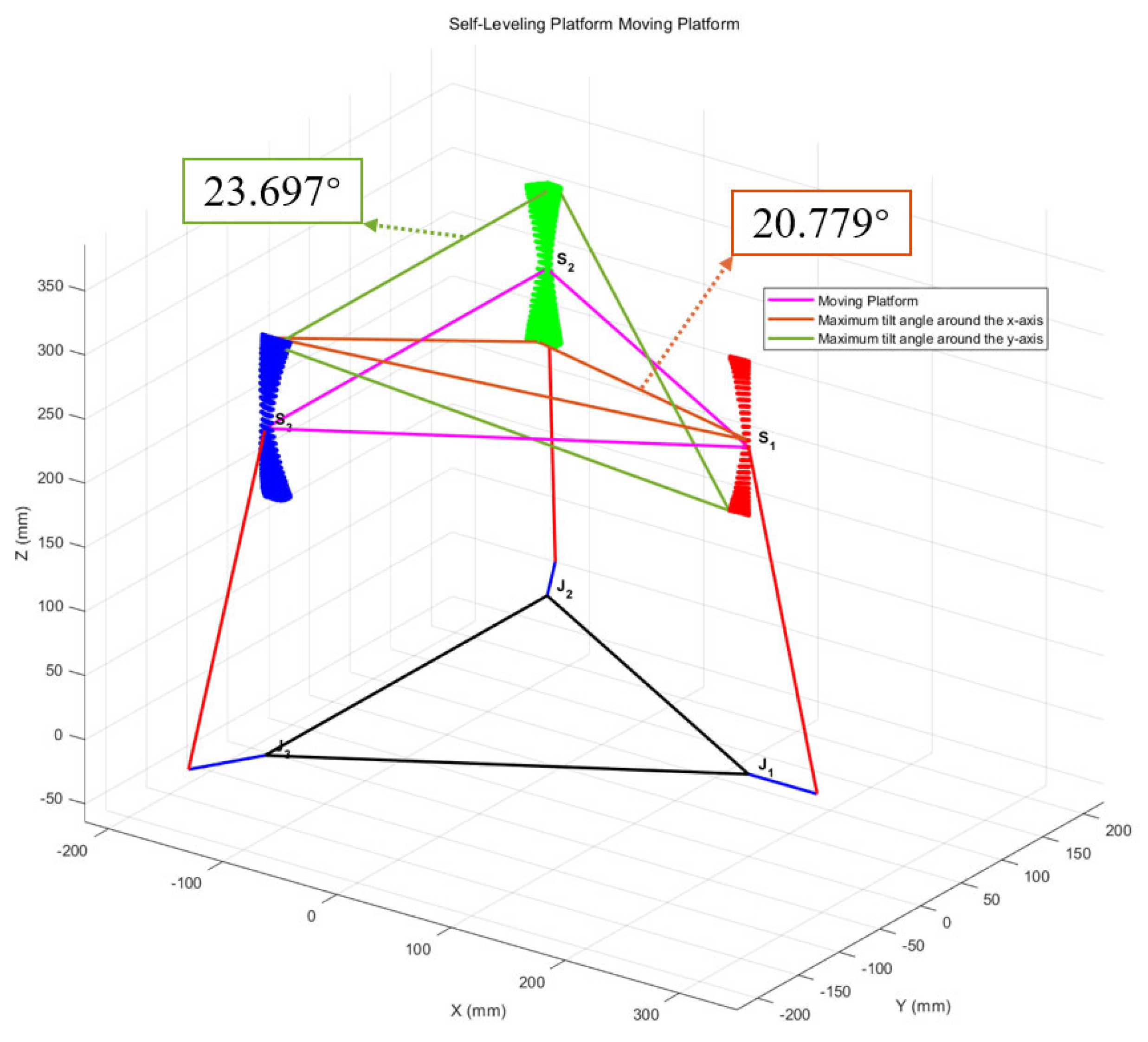
To evaluate the leveling capability of the Self-Leveling Platform, a workspace analysis of the 3-RRS parallel configuration of the Self-Leveling Platform was carried out in MATLAB R2022b using the “driving space scanning and geometric constraint inverse solution” method. First, the mechanism parameters of the Self-Leveling Platform were defined, and a geometric model was established. Then, within the limit range, the crank rotation angles of the three legs were traversed for all combinations in fixed 2° steps, and the three crank endpoints corresponding to each combination were calculated. Next, the roll, pitch, and moving platform center coordinates of the platform were solved using the least-squares numerical iteration method [31], ensuring that the length constraints of the three connecting rods were satisfied simultaneously. The feasibility criterion was based on the residual threshold and the displacement range of the moving platform center point to filter out reasonable solutions. The coordinates of the three moving platform vertices were then recorded, forming the point cloud set of the three moving platform endpoints, as shown in Figure 11.
On the basis of completing the point cloud set plotting, the moving platform normal vector was obtained from the three moving platform vertices of each feasible solution set, and the roll and pitch angles of the moving platform in the current pose were further solved. The maximum roll angle posture of the moving platform (triangles formed by the brown line segments in Figure 11) and the maximum pitch angle posture (triangles formed by the green line segments in Figure 11) were retrieved, while the initial positions of the Self-Leveling Platform and moving platform were as shown by the triangles formed by the magenta line segments in Figure 11. The analysis results show that the Self-Leveling Platform has full omnidirectional leveling capability, with a theoretical maximum leveling angle range of 20.779° along the moving platform roll direction and 23.697° along the moving platform pitch direction. In actual testing, except for a few extreme cases (such as ultra-high load, intense vibration, or instantaneous impact), the reachable workspace can meet the leveling requirements under typical hilly orchard working scenarios.

2.4.2. Modal Analysis

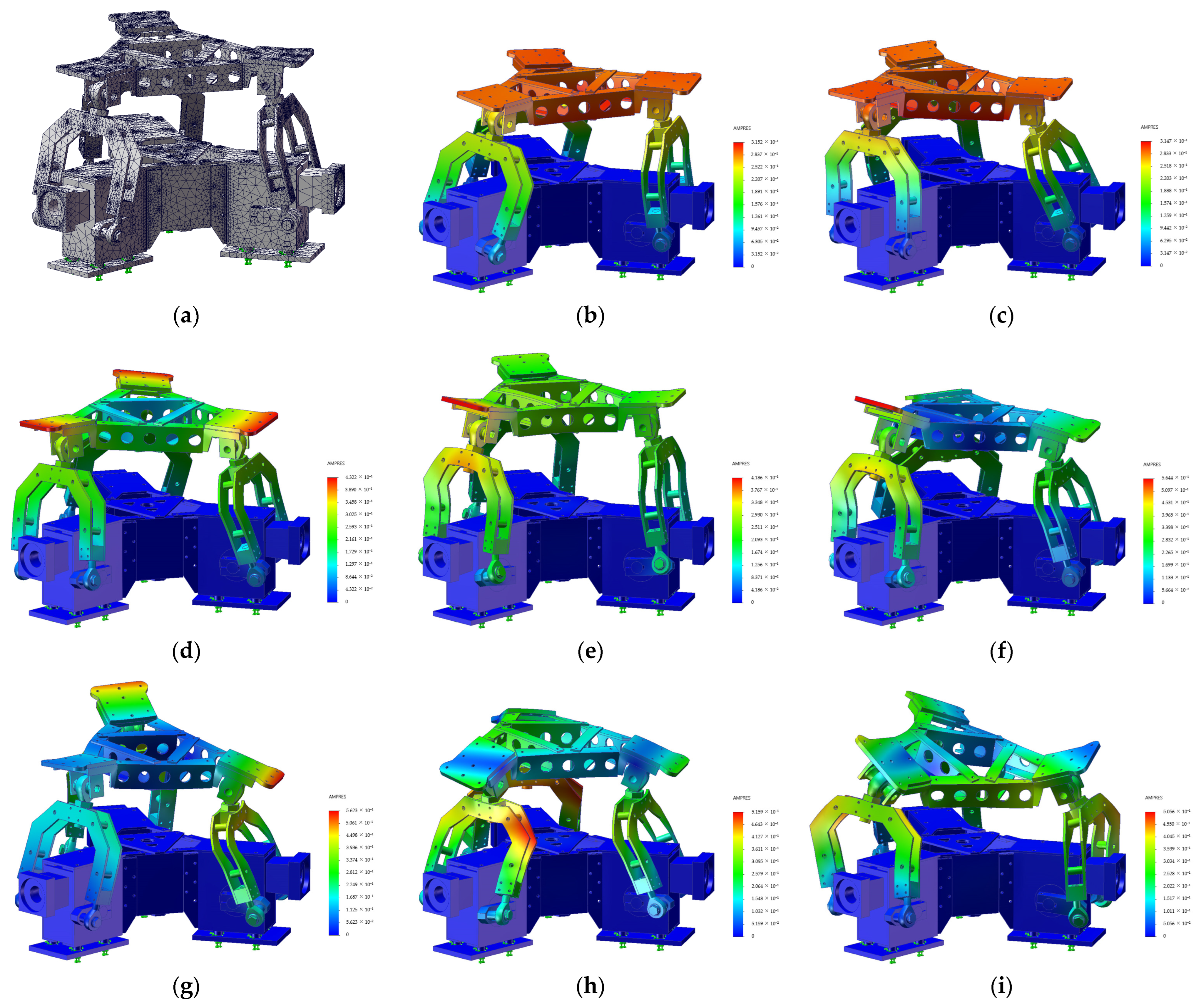
Modal analysis is commonly used to study the dynamic characteristics of machinery. A mode refers to the inherent characteristics of the machine. In structural design, modal analysis is often required to determine the natural frequencies and mode shapes of the mechanism to avoid resonance problems [32]. The leveling support legs of the Self-Leveling Platform belong to an assembled structure with rods and multiple coupling pairs. In high-frequency leveling scenarios, they are prone to coupling with low-order bending or torsional modes, leading to amplified attitude vibrations and increased local fatigue risk. Through modal analysis, the most responsive natural frequencies and mode shapes can be identified during the design stage, preventing resonance from affecting the leveling performance. Following the processing procedure of static stress analysis, preprocessing was performed on the simplified Self-Leveling Platform whole machine, and meshing was completed in the initial static no-load state (Figure 12a). Using the eight-order modal analysis method, the modal analysis case was run to obtain the first eight mode shapes of the Self-Leveling Platform, as shown in Figure 12b–i.
The natural frequencies and mode shape characteristics of the first eight modes are shown in Table 1.
The results of the modal analysis indicate that the first eight natural frequencies of the Self-Leveling Platform are distributed between 115.85 and 462.57 Hz, with the 1st-order natural frequency being 115.85 Hz, the 3rd-order at 159.88 Hz, and the 4th–8th orders concentrated in the 400–463 Hz range. Due to the inherent geometric symmetry of the Self-Leveling Platform 3-RRS configuration [33], the natural frequencies of the first and second orders, the fifth and sixth orders, and the seventh and eighth orders are close to each other among the first eight orders. The main vibration modes of the first eight modes of the Self-Leveling Platform are manifested as bending and torsional deformation of the moving platform and the leveling support legs. As the modal order increases, the natural frequency of each mode gradually increases, while the dynamic characteristics of the mechanism are more influenced by the lower-order vibration frequencies and modes [34]. Furthermore, the leveling control bandwidth of the Self-Leveling Platform is far lower than the lowest-order natural frequency, so the Self-Leveling Platform will not be affected by resonance during the leveling process.

2.5. Experimental Evaluation and Results

2.5.1. Test Plan

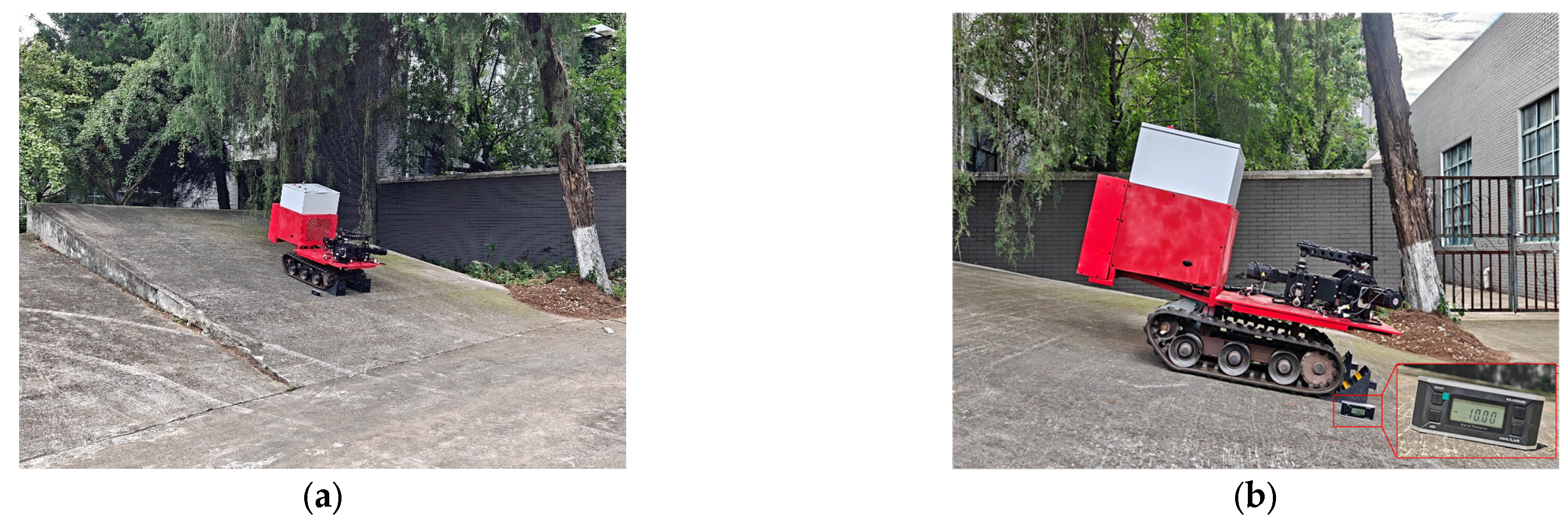
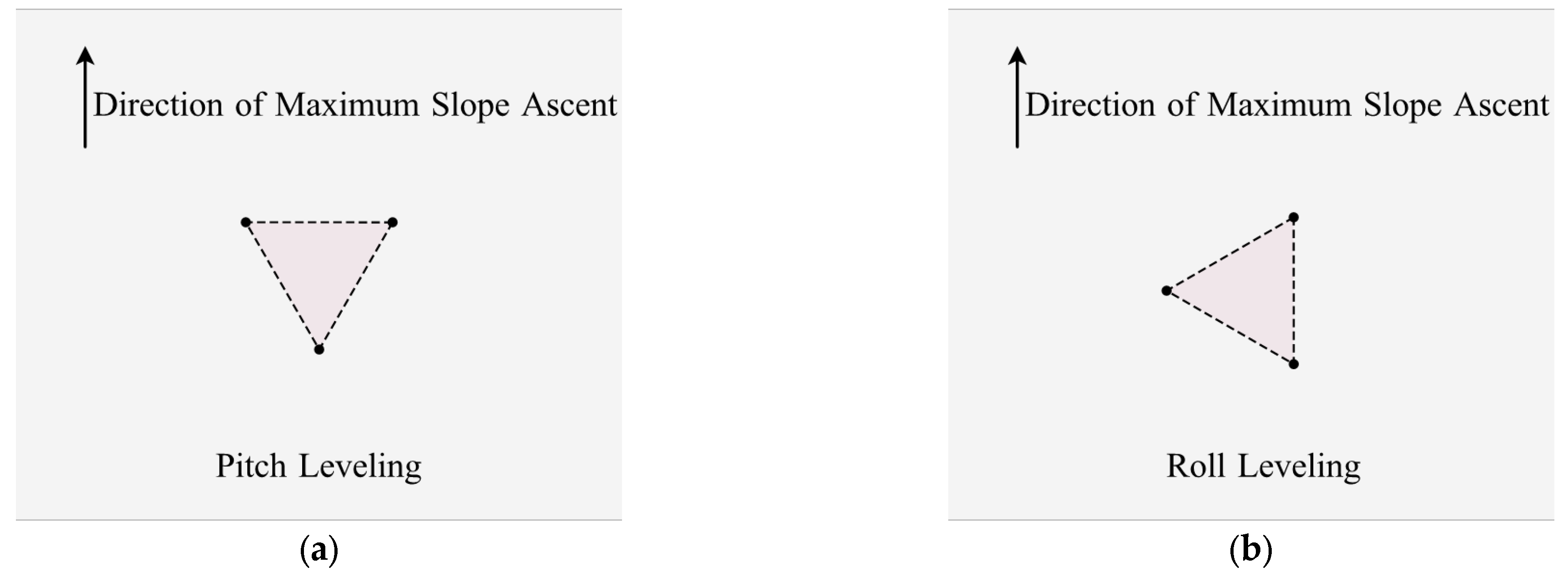
In July 2025, the Self-Leveling Platform leveling performance test was conducted at the Hilly Equipment Test Site of the Nanjing Institute of Agricultural Mechanization, Ministry of Agriculture and Rural Affairs. The Self-Leveling Platform was mounted on the test chassis, and two attitude sensors (WT9011DCL-BT50) were fixed on the static plane (mounting surface) and dynamic plane (workload surface) of the Self-Leveling Platform, respectively, to collect the attitude angles of the Self-Leveling Platform before and after leveling adjustment, and calibrate the attitude sensor parameters after installation. The experimental variables in this study were site slope and workload. Due to limited test site conditions and safety considerations, combined with the target working scenario of the Self-Leveling Platform, this study selected four typical slope scenarios: 5°, 8°, 10°, and 15°. The test site is shown in Figure 13, where fixed-weight sandbags were used to simulate workloads, with four load scenarios: 0 kg, 20 kg, 50 kg, and 80 kg. This study set two leveling modes: pitch leveling (Figure 14a), where one leg of the Self-Leveling Platform is parallel to the direction of maximum slope ascent; and roll leveling (Figure 14b), where one leg of the Self-Leveling Platform was oriented perpendicular to the direction of maximum slope ascent. The test evaluated the leveling performance of the Self-Leveling Platform under different slope scenarios and load conditions, and analyzed the mechanism characteristics of the Self-Leveling Platform 3-RRS parallel configuration during the automatic leveling process, providing references for further optimization design and practical application of the Self-Leveling Platform [35].

2.5.2. Pitch Leveling Performance Test

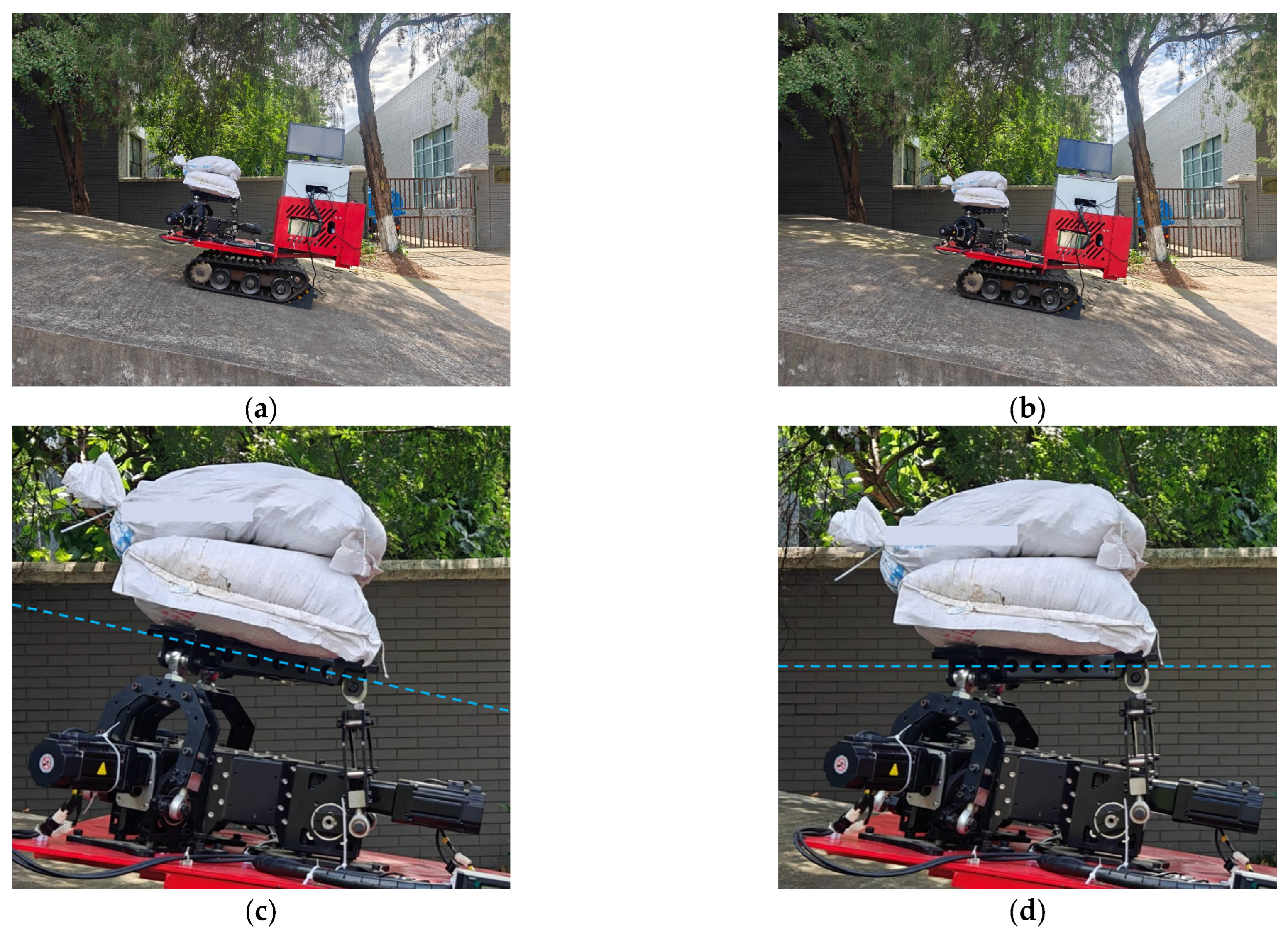
The pitch leveling test aimed to verify the leveling performance of the Self-Leveling Platform along the pitch direction of the fuselage. During the test, the test chassis equipped with the Self-Leveling Platform was driven to the area with a uniform slope in the center of each test slope surface, ensuring that the vehicle’s travel direction was parallel to the direction of the maximum slope rise (Figure 15). At the start of the test, the Self-Leveling Platform was first reset to its initial pose, and the inclination of the working plane along the pitch direction of the fuselage was recorded. Then, the automatic leveling function of the Self-Leveling Platform was activated, and the inclination of the working plane along the pitch direction of the fuselage after Self-Leveling Platform leveling was measured and recorded, along with the time required from the start of leveling until the moving platform reached stability, referred to as the leveling response time. After the moving platform had stabilized, the inclination of the moving platform along the pitch direction of the fuselage was measured and recorded as the leveling error. To improve the reliability of the test data, each set of tests was repeated three times. The pitch leveling data of the Self-Leveling Platform obtained from the tests are shown in Table 2.
The results of the pitch leveling performance test show that under typical slope inclinations of 5°, 8°, 10°, and 15°, and typical working load scenarios of 0 kg, 20 kg, 50 kg, and 80 kg, the Self-Leveling Platform can achieve stable automatic leveling. The maximum average leveling time is 1.593 s, and the maximum average steady-state error is 0.62°, both occurring in the pitch leveling scenario of a 15° slope with an 80 kg working load. Overall, for the Self-Leveling Platform in pitch leveling, as the slope and load increase, the time required for leveling and the steady-state error tend to increase.

2.5.3. Roll Leveling Performance Test

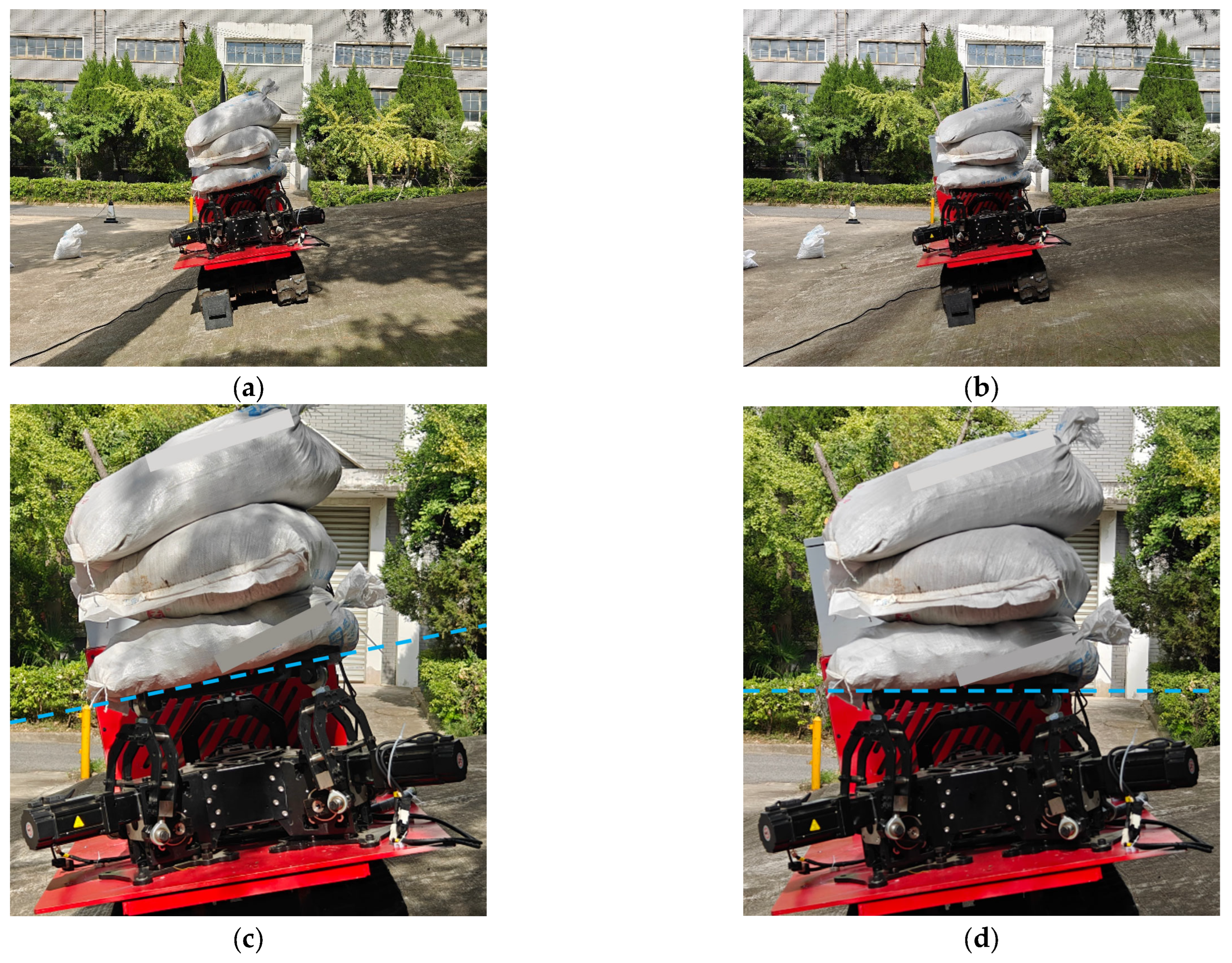
The roll leveling test aimed to verify the leveling performance of the Self-Leveling Platform along the vehicle body’s roll direction. During the test, the test chassis carrying the Self-Leveling Platform was driven to the central area of each test slope where the gradient was uniform, ensuring that the vehicle’s travel direction was perpendicular to the direction of maximum slope ascent (Figure 16). At the beginning of the test, the Self-Leveling Platform was first reset to its initial pose, and the inclination angle of the working plane along the vehicle body’s roll direction was recorded. Then, the automatic leveling function of the Self-Leveling Platform was activated to measure and record the inclination angle of the working plane along the roll direction after leveling by the Self-Leveling Platform, as well as the time required from the start of leveling until the moving plane stabilized, which was recorded as the leveling response time. After moving platform had stabilized, moving platform’s inclination angle along the roll direction was measured and recorded as the leveling error. To improve the reliability of the test data, each set of tests was repeated three times. The roll leveling data of the Self-Leveling Platform obtained from the tests are shown in Table 3.
The roll leveling performance test results indicate that under typical slope inclinations of 5°, 8°, 10°, and 15°, and typical working load scenarios of 0 kg, 20 kg, 50 kg, and 80 kg, the Self-Leveling Platform can achieve stable automatic leveling. The maximum average leveling response time was 1.508 s, and the maximum average leveling error was 0.58°, occurring in the roll leveling scenarios of a 15° slope with an 80 kg working load and a 15° slope with a 20 kg working load, respectively. Overall, for roll leveling, the Self-Leveling Platform shows an increasing trend in leveling time and steady-state error with increasing slope and load.

2.5.4. Results Analysis

To thoroughly investigate the variation patterns and main influencing factors of the Self-Leveling Platform‘s leveling performance (response time, leveling error) under different slope and load conditions, a two-factor ANOVA was conducted on the above test results. Using IBM SPSS Statistics 27 software, at a significance level of α = 0.05, a two-factor ANOVA was performed separately on the leveling time and leveling error for different slope and load combinations under both pitch leveling and roll leveling modes, in order to examine the significance of each factor’s impact. The analysis results are shown in Table 4 and Table 5, respectively.
The results show that in the pitch leveling mode, both slope and load have significant main effects on leveling time and leveling error (p < 0.001), with a significant interaction between them (p < 0.05). As the slope and load increase, the leveling response time is noticeably extended, with an average leveling time reaching 1.593 s under conditions of 15° slope and 80 kg load. Leveling error also increases significantly with greater slope and load, reaching a mean value of 0.62° under high slope combined with high load conditions. Although leveling performance slightly declines under extreme operating conditions, the system can still complete leveling within about 2 s and maintain platform attitude error within 1°, indicating that the Self-Leveling Platform exhibits good rapidity and precision in the pitch direction, essentially meeting the requirements for rapid leveling and horizontal stability in precision operations in hilly orchards.
In the roll leveling mode, the main effects of slope and load on leveling response time are both significant (p < 0.01), but their interaction is not significant (p > 0.05), indicating that the influence of slope changes on response time is relatively independent and is not significantly amplified by load changes. The load response curves under different slopes are basically parallel, suggesting that load is the dominant factor affecting the roll leveling time. Regarding leveling error, both slope and load show significant main effects (p < 0.001), with a significant interaction (p < 0.01), meaning that the greater the slope, the more pronounced the effect of load changes on error. Overall, roll leveling demonstrates relatively good stability in response speed, but its error is more evidently affected by the combined effect of slope and load.
In summary, under the “moving platform constant center height” control strategy, the leveling performance of the 3-RRS parallel Self-Leveling Platform exhibits configuration anisotropy and is influenced by the slope–load coupling effect. In pitch leveling mode, a high slope combined with high load significantly extends the response time and increases the leveling error; whereas in roll leveling mode, the response time is mainly affected by the load (with no obvious slope–load interaction), but the leveling error still increases due to the combined effect of slope and load. The main cause of these differences lies in the attitude control characteristics of the 3-RRS Parallel Mechanism. When the platform is tilted, the condition number of the Jacobian matrix changes, resulting in uneven sensitivity and equivalent stiffness distribution between the pitch and roll leveling directions. In the pitch direction, the torque arm changes considerably, and the equivalent stiffness is sensitive to attitude changes, making this direction more susceptible to external load and slope variation; whereas in the roll direction, the leg distribution is relatively symmetrical, and the change in the Jacobian matrix’s condition number is small, hence it shows overall higher stability and disturbance resistance.

3. Discussion

In the research of automatic leveling technology for agricultural machinery, existing work mainly focuses on overall vehicle driving stability and rollover warning and prevention under extreme operating conditions [22]. Therefore, slow heavy-load devices such as hydraulic cylinders are often used as leveling actuators, leaving considerable room for improvement in leveling time. For example, Sun Zeyu et al. introduced QBP neural network PID control to an omnidirectional leveling crawler-type working machine, achieving lateral and longitudinal leveling times of 2.8 s and 3.2 s, respectively, in static tests [19]. Yang Tengxiang used a hydraulic system as the main power source for chassis attitude adjustment in an omnidirectional leveling crawler-type combine harvester, with an average automatic leveling time of 4.2 s across eight main directions in static tests [14]. In contrast, this study adopts motor-driven crank–rocker support legs as leveling actuators, significantly improving response speed and control accuracy while meeting load requirements, and enabling the moving platform to be restored to horizontal within 1.6 s after tilt detection by the attitude sensor in test scenarios. Similarly, Ding Renkai et al. used servo electric cylinders as actuators in the leveling system and applied adaptive sliding mode control, which significantly shortened leveling response time and improved leveling speed and control stability [36]. A comparison of various typical leveling schemes is shown in Table 6.
In automatic leveling technology, different configurations can be classified into series leveling schemes and parallel leveling schemes. Series schemes typically adopt segmented leveling mechanisms based on layered or axis-separated designs, such as the parallel four-bar + dual chassis series remotely controlled omnidirectional leveling mountain crawler tractor proposed by Sun Jingbin et al. [15], and the “three-layer chassis” hydraulic leveling crawler platform developed by Wang Ruochen et al. at Jiangsu University [18]. In such series structures, roll and pitch leveling are executed at different tiers, which increases mechanism inertia and control delay. The coordinated actions of the structures in each tier and multiple hydraulic cylinders must be completed sequentially or step-by-step, and the multi-layer frame connections make the entire leveling system structurally complex and heavier. This can cause coupled vibrations or impacts during rapid attitude adjustments. By contrast, the Self-Leveling Platform proposed in this study controls the pitch and roll of the moving platform simultaneously through the parallel closed-loop motion of three support legs, allowing for rapid overall leveling. In test scenarios, it can restore the moving platform to a horizontal state within 1.6 s, with a steady-state error of less than 0.7°. The leveling speed and error are significantly better than those of series cylinder leveling schemes. In parallel leveling schemes, configurations are classified by the number of support legs into three-leg, four-leg, and six-leg schemes [7]. Traditional four-leg support platforms are statically indeterminate structures, and their leveling control is an over-constrained problem prone to the “virtual leg” phenomenon during leveling. To address this, Liu Aibing et al. proposed applying compensatory driving to the passive leg, simplifying the four-point support leveling problem into a quasi-three-point support leveling problem, thereby achieving stable and safe attitude control [25]. However, that system still strictly belongs to a “four-leg” leveling system. In contrast, the Self-Leveling Platform proposed in this study is a “three-leg” system, which does not experience the “virtual leg” phenomenon during leveling.
This study derives an analytical mapping relationship between the fuselage attitude and the compensation angle of the leveling support leg crank, providing a theoretical basis for the application of the 3-RRS Parallel Mechanism in automatic leveling of agricultural machinery. Nevertheless, there are still limitations in integrating theory with practice: first, the prototype test was only conducted on a simulated slope, without considering the complex environment of a real orchard, and due to site constraints, the maximum leveling angle of Self-Leveling Platform was not tested; second, durability tests on key mechanical components have not yet been carried out, and the robustness of the control system under dynamic and sudden loads remains to be verified. To address these issues, future research will focus on testing extreme leveling performance in real orchard scenarios, and by optimizing structural design parameters and the control system, laying a foundation for comprehensively improving the adaptability and operational reliability of the equipment.
In addition, future work will further explore the integration of the Self-Leveling Platform with autonomous orchard vehicles, precision target spraying, and dynamic harvesting operations of orchard robots in precision agriculture scenarios, achieving coordinated optimization of equipment posture stability and intelligent operation processes. Through linked control and information sharing, the autonomous decision-making capability and overall operational efficiency of agricultural equipment in hilly orchard environments will be improved.

4. Conclusions

This study addresses the technical requirements for automatic leveling control in hilly orchard scenarios and develops a Self-Leveling Platform electric onboard system based on a 3-RRS Parallel Mechanism. The key structural parameters of the Self-Leveling Platform were optimized using the multi-objective genetic algorithm NSGA-II. A leveling control strategy with the constant central height of the moving platform as an additional constraint is proposed. Combined with the inverse kinematics solution of the 3-RRS parallel configuration, the analytical mapping relationship between the posture of the moving platform and the compensation angle of the leveling support leg crank was derived. The prototype was designed, and its leveling performance was experimentally verified under typical slope and load conditions. The main conclusions of this study are as follows:
(1)
The automatic leveling system based on 3-RRS Parallel Mechanism, along with the leveling control strategy that uses the constant central height of the moving platform as an additional constraint, can meet leveling control requirements under test conditions. Under slope inclinations of 5°, 8°, 10°, and 15°, and loads of 0 kg, 20 kg, 50 kg, and 80 kg, the Self-Leveling Platform can achieve stable automatic leveling under both longitudinal (pitch) and lateral (roll) tilt conditions. The maximum leveling response time is 1.593 s, and the maximum leveling error is 0.62°.
(2)
Experiments and variance analysis indicate that the 3-RRS parallel configuration of Self-Leveling Platform exhibits anisotropy in pitch and roll directions: the equivalent stiffness in the pitch direction is sensitive to changes in posture, and more responsive to slope and load; in the roll direction, the symmetrical distribution of support legs and smaller variation in the Jacobian matrix condition number make the system overall more stable and more resistant to disturbances. This result can provide a reference for structural optimization and control strategy design of three-leg leveling systems.

Author Contributions

Conceptualization, L.H. and W.D.; methodology, W.D.; software, G.W. and H.S.; validation, G.X., H.S. and Z.Z.; formal analysis, W.D. and H.S.; investigation, G.X. and Z.H.; resources, H.L. and Y.S.; data curation, G.X. and H.S.; writing—original draft preparation, G.X.; writing—review and editing, W.D. and H.S.; visualization, G.X.; supervision, L.H.; project administration, H.L.; funding acquisition, W.D. All authors have read and agreed to the published version of the manuscript.

Funding

This research was funded by Jiangsu agricultural machinery R & D manufacturing promotion and application integration pilot project (Grant No. JSYTH01); Jiangsu agricultural machinery R & D manufacturing promotion and application integration pilot project (Grant No. JSYTH08); Central Public-interest Scientific Institution Basal Research Fund (Grant No. S202308); Jiangsu Agricultural Science and Technology Innovation Fund (Grant No. CX(24)1023); National Key Research and Development Program of China (Grant No. 2023YFD2000303).

Institutional Review Board Statement

Not applicable.

Data Availability Statement

The data presented in this study are available on request from the corresponding author.

Conflicts of Interest

The authors declare no conflicts of interest.

References

  1. Faostat. Available online: https://www.fao.org/faostat/zh/#data/QCL (accessed on 12 October 2025).
  2. Hu, Z.; Zhang, M.; Luo, W.; Pang, Y.; Lang, F.; Li, Q. Advancing agricultural mechanization in China’s hilly and mountainous areas: Key strategies and technological focus. Trans. CSAE 2025, 41, 39–50. [Google Scholar] [CrossRef]
  3. Zhang, Z. Some Important Problems and Measures of Farmland Construction Suitable for Mechanization in Hilly and Mountainous Areas During the 14th Five-year Plan Period. Chin. Rural Econ. 2020, 13–28. [Google Scholar] [CrossRef]
  4. Liu, C.; Gong, L.; Yuan, J.; Li, Y. Current Status and Development Trends of Agricultural Robots. Trans. Chin. Soc. Agric. Mach. 2022, 53, 1–22+55. [Google Scholar] [CrossRef]
  5. Li, W.; Jang, S.; Xu, P.; Ma, H.; Yang, S.; Zheng, Y. Design and Experiment of Self-Propelled Small Target Following Sprayer for Hilly Orchard. Trans. Chin. Soc. Agric. Mach. 2023, 54, 188–197. [Google Scholar] [CrossRef]
  6. Nie, Z. Design and Experiment of Automatic Omnidirectional Leveling Platform for Orchard Spectral Data Collection in Hilly Mountainous Areas. Master’s Thesis, Southwest University, Chongqing, China, 2023. [Google Scholar]
  7. Xue, G.; Peng, J.; Shen, H.; Wang, G.; Zheng, W.; Huang, S.; Huan, Z.; Hu, L.; Ding, W. Research Status and Prospects of Automatic Leveling Technology for Orchard Machinery. Sustainability 2025, 17, 5297. [Google Scholar] [CrossRef]
  8. Li, Z.; Fan, G.; Zhang, H.; Qin, F. Analysis on the present situation and tendency of automatic leveling in agricultural machinery. J. Chin. Agric. Mech. 2019, 40, 48–53. [Google Scholar] [CrossRef]
  9. Ahmadi, I. Dynamics of Tractor Lateral Overturn on Slopes under the Influence of Position Disturbances (Model Development). J. Terramech. 2011, 48, 339–346. [Google Scholar] [CrossRef]
  10. Xiong, H. Introduction to the John Deere R4038 Self-Propelled Sprayer. Mod. Agric. 2014, 49. [Google Scholar] [CrossRef]
  11. Denis, D.; Thuilot, B.; Lenain, R. Online Adaptive Observer for Rollover Avoidance of Reconfigurable Agricultural Vehicles. Comput. Electron. Agric. 2016, 126, 32–43. [Google Scholar] [CrossRef]
  12. Li, Z.; Mitsuoka, M.; Inoue, E.; Okayasu, T.; Hirai, Y.; Zhu, Z. Parameter Sensitivity for Tractor Lateral Stability against Phase I Overturn on Random Road Surfaces. Biosyst. Eng. 2016, 150, 10–23. [Google Scholar] [CrossRef]
  13. Sun, Y.; Xu, L.; Jing, B.; Chai, X.; Li, Y. Development of a Four-Point Adjustable Lifting Crawler Chassis and Experiments in a Combine Harvester. Comput. Electron. Agric. 2020, 173, 105416. [Google Scholar] [CrossRef]
  14. Yang, T. Design and Test of Posture Controlled Chassis for Caterpillar Combine. Master’s Thesis, Chinese Academy of Agricultural Sciences, Beijing, China, 2020. [Google Scholar]
  15. Sun, J.; Chu, G.; Pan, G.; Meng, C.; Liu, Z.; Yang, F. Design and Performance Test of Remote Control Omnidirectional Leveling Hillside Crawler Tractor. Trans. Chin. Soc. Agric. Mach. 2021, 52, 358–369. [Google Scholar] [CrossRef]
  16. Sun, J.; Meng, C.; Zhang, Y.; Chu, G.; Zhang, Y.; Yang, F.; Liu, Z. Design and Physical Model Experiment of an Attitude Adjustment Device for a Crawler Tractor in Hilly and Mountainous Regions. Inf. Process. Agric. 2020, 7, 466–478. [Google Scholar] [CrossRef]
  17. Jiang, Y.; Sun, Z.; Wang, R.; Ding, R.; Ye, Q. Design and Control of a New Omnidirectional Levelling System for Hilly Crawler Work Machines. Comput. Electron. Agric. 2024, 218, 108661. [Google Scholar] [CrossRef]
  18. Wang, R.; Su, Z.; Ding, R.; Sun, Z.; Jang, Y.; Guo, Z. Omnidirectional Leveling System of Crawler Machine Based on Sliding Mode Synchronous Position Control. Trans. Chin. Soc. Agric. Mach. 2024, 55, 394–401. [Google Scholar] [CrossRef]
  19. Sun, Z.; Xia, C.; Jang, Y.; Guo, Y.; Wang, R. Omnidirectional Leveling Control of Crawler Machine Based on QBP-PID. Trans. Chin. Soc. Agric. Mach. 2023, 54, 397–406. [Google Scholar] [CrossRef]
  20. Liu, P.; Ke, C.; Ke, T.; Li, H.; Wei, W.; Zhao, C. Design and Experiment of Pre-detection Active Leveling Agricultural Chassis for Hilly Area. Trans. Chin. Soc. Agric. Mach. 2020, 51, 371–378. [Google Scholar] [CrossRef]
  21. Lv, F.; Li, X.; He, C.; Ding, L.; Sun, A. Design and test of agricultural machinery crawler chassis with omnidirectional attitude adjustment. J. Chin. Agric. Mech. 2024, 45, 132–137. [Google Scholar] [CrossRef]
  22. Nozawa, M. Development and Improvement of Mobile Work Platform for Use in Apple Orchards. Jpn. J. Farm Work Res. 2006, 41, 68–73. [Google Scholar] [CrossRef][Green Version]
  23. Jang, I.-J. Development of a Lifting Utility with Balance-Controlled Platform. J. Biosyst. Eng. 2011, 36, 171–179. [Google Scholar] [CrossRef][Green Version]
  24. Zheng, Y.; Jang, S.; Cheng, B.; Lv, H.; Wan, C.; Kang, F. Review on Technology and Equipment of Mechanization in Hilly Orchard. Trans. Chin. Soc. Agric. Mach. 2020, 51, 1–20. [Google Scholar] [CrossRef]
  25. Liu, A.; Wu, J.; Zhang, F.; Yang, W.; Wang, H.; Gang, X. Studies on a Statically Determinate Leveling Control Strategy for a Statically Indeterminate Four-Leg Support Vehicle-Borne Platform. Mech. Based Des. Struct. Mach. 2023, 51, 7131–7148. [Google Scholar] [CrossRef]
  26. Sun, J.; Liu, Z.; Yang, F.; Sun, Q.; Liu, Q.; Luo, P. Research Review of Agricultural Equipment and Slope Operation Key Technologies in Hilly and Mountains Region. Trans. Chin. Soc. Agric. Mach. 2023, 54, 1–18. [Google Scholar] [CrossRef]
  27. Ding, R.; Qi, X.; Chen, X.; Mei, Y.; Li, A. The Current Development Status of Agricultural Machinery Chassis in Hilly and Mountainous Regions. Appl. Sci. 2025, 15, 7505. [Google Scholar] [CrossRef]
  28. Xiang, B.; Mu, Q. Gimbal Control of Inertially Stabilized Platform for Airborne Remote Sensing System Based on Adaptive RBFNN Feedback Model. IFAC J. Syst. Control 2021, 16, 100148. [Google Scholar] [CrossRef]
  29. Stewart, D. A Platform with Six Degrees of Freedom. Proc. Inst. Mech. Eng. 1965, 180, 371–386. [Google Scholar] [CrossRef]
  30. Han, H.; Yu, R.; Li, B.; Zhang, Y. Multi-Objective Optimization of Corrugated Tube Inserted with Multi-Channel Twisted Tape Using RSM and NSGA-II. Appl. Therm. Eng. 2019, 159, 113731. [Google Scholar] [CrossRef]
  31. Lv, W.; Tao, L.; Hu, Y. On the Real-Time Calculation of the Forward Kinematics of a Suspended Cable–Driven Parallel Mechanism with 6-Degree-of-Freedom Wave Compensation. Adv. Mech. Eng. 2017, 9, 1687814017706264. [Google Scholar] [CrossRef]
  32. Wang, X.; Hong, T.; Fang, W.; Chen, X. Optimized Design for Vibration Reduction in a Residual Film Recovery Machine Frame Based on Modal Analysis. Agriculture 2024, 14, 543. [Google Scholar] [CrossRef]
  33. Yuan, X.; Wang, W.; Pang, H.; Zhang, L. Analysis of Vibration Characteristics of Electro-Hydraulic Driven 3-UPS/S Parallel Stabilization Platform. Chin. J. Mech. Eng. 2024, 37, 96. [Google Scholar] [CrossRef]
  34. Yao, Y.; Du, Y.; Zhu, Z.; Mao, E.; Song, Z. Vibration characteristics analysis and optimization of corn combine harvester frame using modal analysis method. Trans. CSAE 2015, 31, 46–53. [Google Scholar] [CrossRef]
  35. Fan, G.; Wang, Y.; Zhang, X.; Zhao, J.; Song, Y. Design and experiment of automatic leveling control system for orchards lifting platform. Trans. CSAE 2017, 33, 38–46. [Google Scholar] [CrossRef]
  36. Ding, R.; Qi, X.; Chen, X.; Mei, Y.; Li, A.; Wang, R.; Guo, Z. Research on the Design of an Omnidirectional Leveling System and Adaptive Sliding Mode Control for Tracked Agricultural Chassis in Hilly and Mountainous Terrain. Agriculture 2025, 15, 1920. [Google Scholar] [CrossRef]
Figure 1. Three-dimensional model of the Self-Leveling Platform: 1. Base platform; 2. Moving platform; 3. Leveling support leg; 4. Servo motor.
Agriculture 15 02512 g001
Figure 2. Illustration of the leveling operation scenario of an orchard electric vehicle-mounted Self-Leveling Platform equipped with a picking robotic arm.
Agriculture 15 02512 g002
Figure 3. Diagram of the Self-Leveling Platform leveling workflow.
Agriculture 15 02512 g003
Figure 4. Leveling control strategy diagram.
Agriculture 15 02512 g004
Figure 5. Leveling control effect diagram.
Agriculture 15 02512 g005
Figure 6. Diagram of the 3-RRS Parallel Mechanism.
Agriculture 15 02512 g006
Figure 7. Schematic of the three degrees of freedom for the moving platform.
Agriculture 15 02512 g007
Figure 8. Schematic of ‘concave–convex solution’ for crank rotation angle. (a) Crank rotation angle ‘convex’ solution α; (b) Crank rotation angle ‘concave’ solution α′.
Agriculture 15 02512 g008
Figure 9. Diagram of the motion pair distribution of the Self-Leveling Platform 3-RRS parallel configuration.
Agriculture 15 02512 g009
Figure 10. Crank compensation angle α.
Agriculture 15 02512 g010
Figure 11. Analysis of the working space of the Self-Leveling Platform.
Agriculture 15 02512 g011
Figure 12. Self-Leveling Platform modal analysis. (a) Divide the grid; (b) First mode shape; (c) Second-order mode shape; (d) Third-order mode shape; (e) Fourth-order mode shape; (f) Fifth-order mode shape; (g) Sixth-order mode shape; (h) Seventh mode shape; (i) Eighth mode shape.
Agriculture 15 02512 g012
Figure 13. Leveling test site. (a) Schematic of the test site; (b) Site slope diagram.
Agriculture 15 02512 g013
Figure 14. Diagram of the distribution positions of leveling support legs for the Self-Leveling Platform during pitch and roll leveling. (a) Pitch leveling diagram; (b) Roll leveling diagram.
Agriculture 15 02512 g014
Figure 15. Self-Leveling Platform pitch leveling test. (a) Before leveling, (b) After leveling; (c) Local enlarged view before leveling; (d) Locally enlarged view after leveling. The dashed line in the figure represents the projection of the dynamic plane onto the illustrated plane.
Agriculture 15 02512 g015
Figure 16. Self-Leveling Platform roll leveling test. (a) Before leveling; (b) After leveling; (c) Local enlarged view before leveling; (d) Locally enlarged view after leveling. The dashed line in the figure represents the projection of the dynamic plane onto the illustrated plane.
Agriculture 15 02512 g016
Table 1. Resonant frequencies of Self-Leveling Platform modal analysis.
Order (n)Natural Frequency (Hz)
1115.85
2115.92
3159.88
4400.25
5409.98
6411.57
7461.28
8462.57
Table 2. Pitch leveling test data.
No.Slope Angle (°)Load (kg)Avg. Leveling Time (s)Avg. Steady-State Error (°)
1500.6060.15
2200.4850.27
3500.8130.18
4800.7120.15
5800.8960.35
6200.9930.39
7501.2020.19
8801.2810.33
91000.8850.29
10200.9930.46
11501.2000.09
12801.4040.25
131500.8080.37
14200.8680.54
15501.0770.53
16801.5930.62
Table 3. Roll Leveling Test Data.
No.Slope Angle (°)Load (kg)Avg. Leveling Time (s)Avg. Steady-State Error (°)
1500.6790.10
2200.6320.05
3500.7200.05
4801.2370.00
5800.7050.22
6200.8260.25
7501.0610.12
8801.2790.18
91000.8000.02
10200.7140.16
11501.0800.00
12801.3190.12
131500.7210.43
14200.7230.58
15501.2150.46
16801.5080.49
Table 4. Two-factor ANOVA results for pitch leveling.
Source of VariationSSdfMSFp
Panel A: Dependent Variable: Leveling Time (s)
Slope1.79730.59925.694<0.001
Load1.60730.53622.977<0.001
Slope × Load0.48190.0532.2920.041
Error0.746320.023
Total4.63047
Panel B: Dependent Variable: Leveling Error (°)
Slope0.69130.23066.932<0.001
Load0.18430.06117.792<0.001
Slope × Load0.22190.0257.145<0.001
Error0.110320.003
Total1.20647
Note: GLM–univariate (full factorial). SS = sum of squares (type III); df = degrees of freedom; MS = mean square; α = 0.05 (two-tailed); p < 0.001 is uniformly denoted as “<0.001”; The denominator degrees of freedom for F is error df = 32, numerator degrees of freedom: slope/load = 3, slope × load = 9; each unit was repeated n = 3.
Table 5. Two-factor ANOVA results for roll leveling.
Source of VariationSSdfMSFp
Panel A: Dependent Variable: Leveling Time (s)
Slope0.32630.1095.0380.006
Load3.05931.02047.231<0.001
Slope × Load0.28490.0321.4630.204
Error0.691320.022
Total4.36047
Panel B: Dependent Variable: Leveling Error (°)
Slope1.47330.491222.492<0.001
Load0.06630.0229.919<0.001
Slope × Load0.06790.0073.3840.005
Error0.071320.002
Total1.67647
Note: Same as Table 4.
Table 6. Comparison of performance parameters of typical leveling schemes.
NameLeveling PerformanceReferences
A posture-controlled chassis of the tracked combine harvesterThe horizontal adjustment range is −6.1 to 6.9°, and the vertical adjustment range is −5.9 to 6.7°. The average time consumed is 4.2 s, and the steady-state error is less than or equal to 0.67°.[14]
A composite Q-learning BP neural network PID (QBP PID) omnidirectional leveling control algorithmThe 20° lateral leveling time is 2.8 s, the 25° longitudinal leveling time is 3.2 s; the steady-state error is less than 1.5°.[19]
An innovative omnidirectional leveling system based on a “double-layer frame” crawler-type agricultural chassisThe 20° lateral leveling time is 2.6 s, with a steady-state error less than or equal to 1.2°; the 25° longitudinal leveling time is 2.8 s, with a steady-state error less than or equal to 0.9°.[35]
Automatic leveling platform based on 3-RRS Parallel MechanismWhen unloaded, the 15° lateral (roll) leveling time is 0.73 s, with a steady-state error of no more than 0.43°; the 15° longitudinal (pitch) leveling time is 0.81 s, with a steady-state error of no more than 0.37°.This study
Disclaimer/Publisher’s Note: The statements, opinions and data contained in all publications are solely those of the individual author(s) and contributor(s) and not of MDPI and/or the editor(s). MDPI and/or the editor(s) disclaim responsibility for any injury to people or property resulting from any ideas, methods, instructions or products referred to in the content.