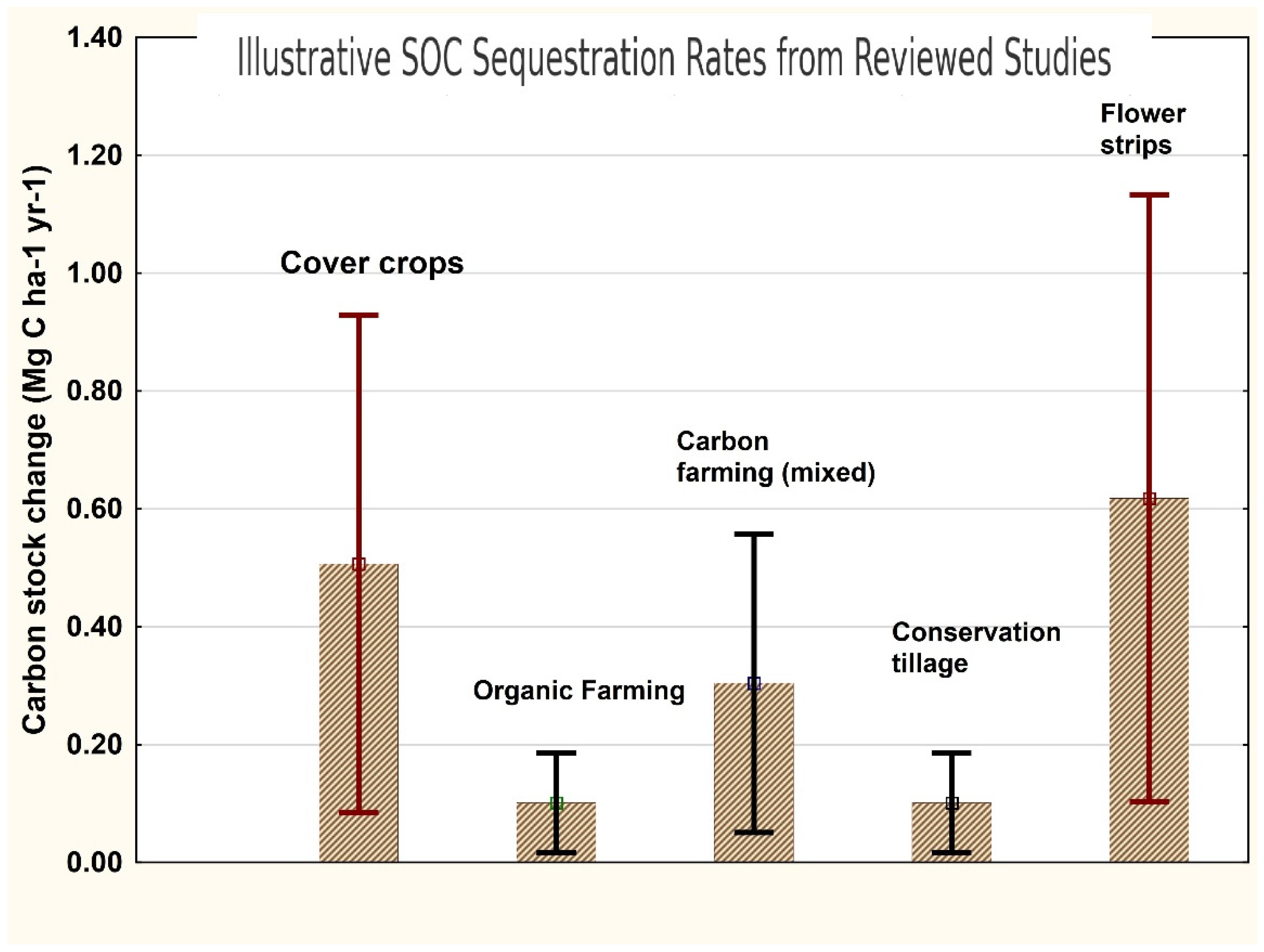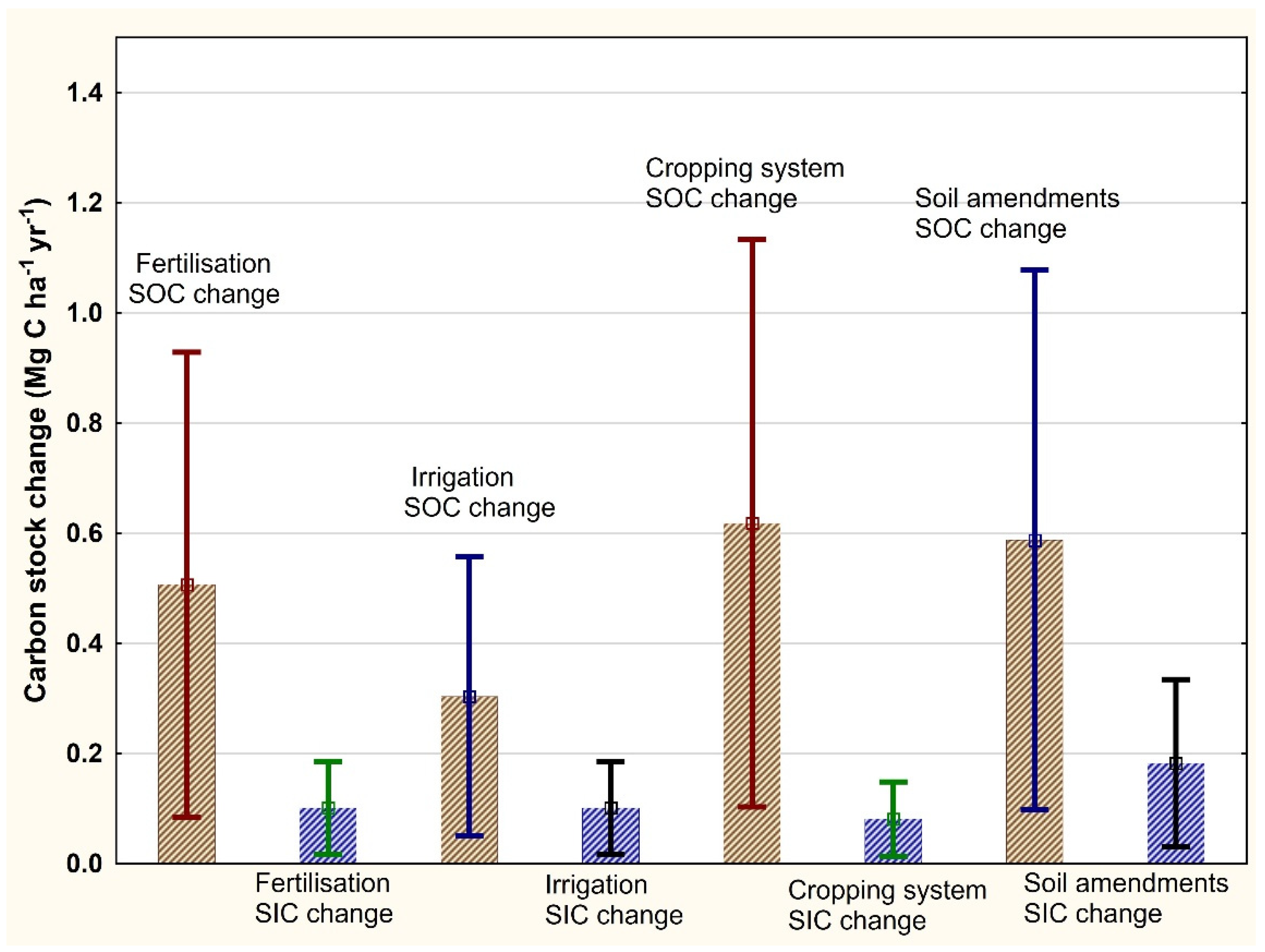

Advances in Understanding Carbon Storage and Stabilization in Temperate Agricultural Soils

 ,
,  ,
,  ,
, 
Abstract
1. Introduction
2. Materials and Methods
2.1. Phase I: Bibliometric Analysis
- Automated duplicate removal
- -
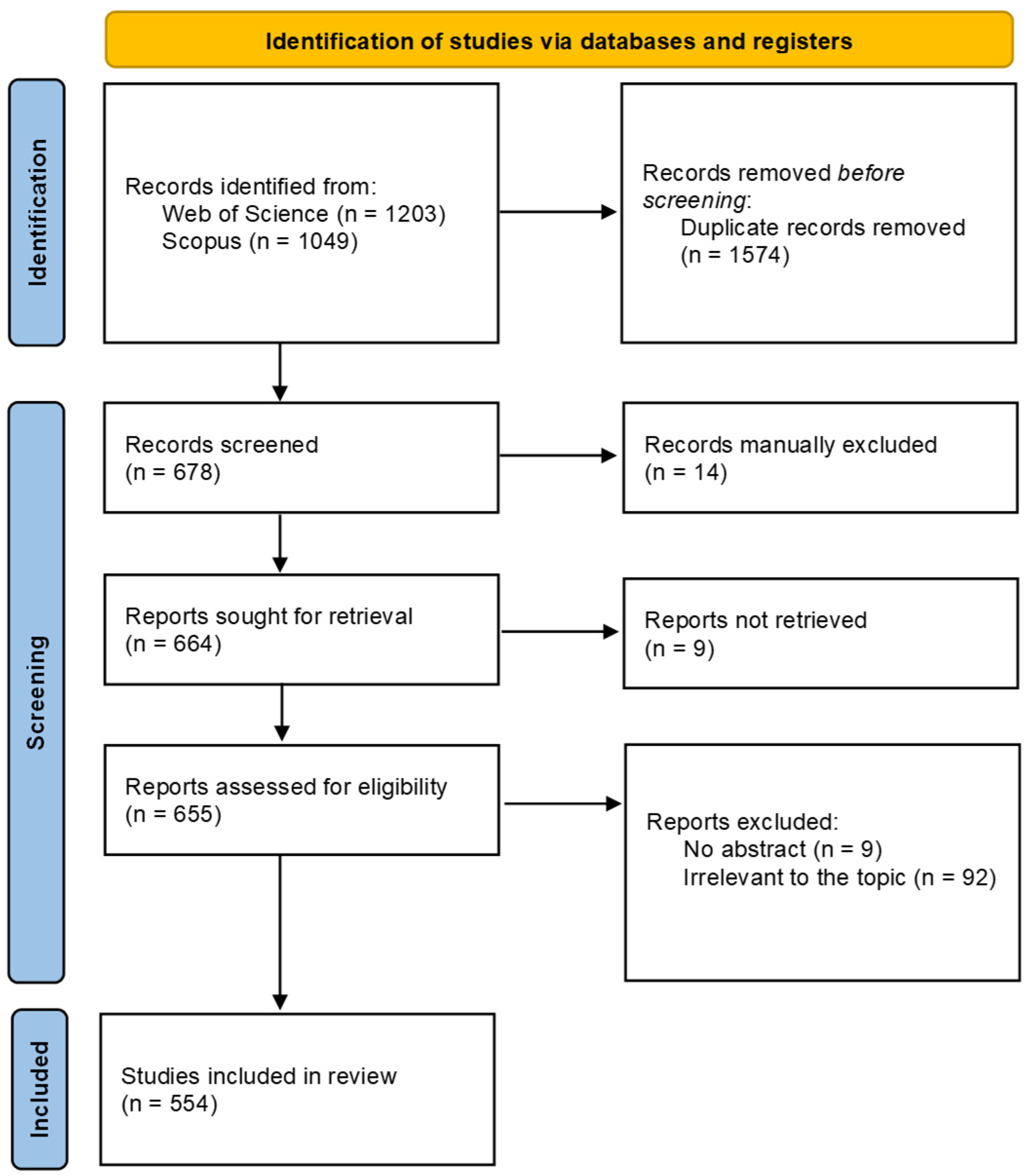
- Matching DOI, exact title string, and first author fields. This step removed 1574 duplicates.
- Manual duplicate verification
- -
- Applied to records lacking DOIs, with inconsistent metadata, or with variant titles.
- -
- Title/first-author/year checks flagged.
Final dataset after de-duplication: 678 unique records.All modifications were recorded in a data audit log, including DOI corrections, removal decisions, and metadata adjustments.Screening procedure and PRISMA compliance:Screening was conducted in two stages (title/abstract → full text), fully aligned with PRISMA 2020 [22].Reviewer roles- -
- Reviewer A and Reviewer B independently screened all titles and abstracts.
- -
- Records marked “potentially relevant” by either reviewer proceeded to full-text screening.
- -
- Reviewer C adjudicated any disagreements.
Eligibility criteria:Inclusion criteria:- -
- Peer-reviewed journal articles or reviews
- -
- English language
- -
- Focus on carbon storage, carbon stabilization, or SOC dynamics in temperate agricultural soils
- -
- Studies presenting measurements, modeling, or conceptual analysis directly relevant to SOC sequestration
- -
- Sufficient metadata available (title, abstract, bibliographic details)
Exclusion criteria:Reason for exclusion:Code A = Out of scope (topic not related to temperate agricultural soils);Code B = Not peer-reviewed (editorials, conference abstracts, theses);Code C = Full text inaccessible;Code D = Non-English;Code E = No relevance to SOC sequestration (e.g., climate studies with no soil data);Code F = Insufficient methodological detail in abstract for assessment.During screening:- -
- Title/abstract stage exclusions: 9 articles
- -
- Full-text stage exclusions: 92 articles
- -
- Final dataset for analysis: 554 publications
- Correction of metadata discrepancies
- -
- Standardization of author names, institutions, and country fields
- -
- Manual correction of OCR or export errors in titles/abstracts
- Keyword harmonization
- -
- Merging of synonyms (e.g., “soil carbon stocks”, “SOC stocks”, “soil C stocks”)
- -
- Removal of generic or irrelevant keywords (“climate change”, “management” when non-specific)
- Citation normalization
- -
- Fractional counting was applied to multi-author publications to avoid institutional inflation.
- Documentation
- -
- All corrections logged in the data audit file, ensuring transparency and reproducibility.
Visualization tools and analysis- -
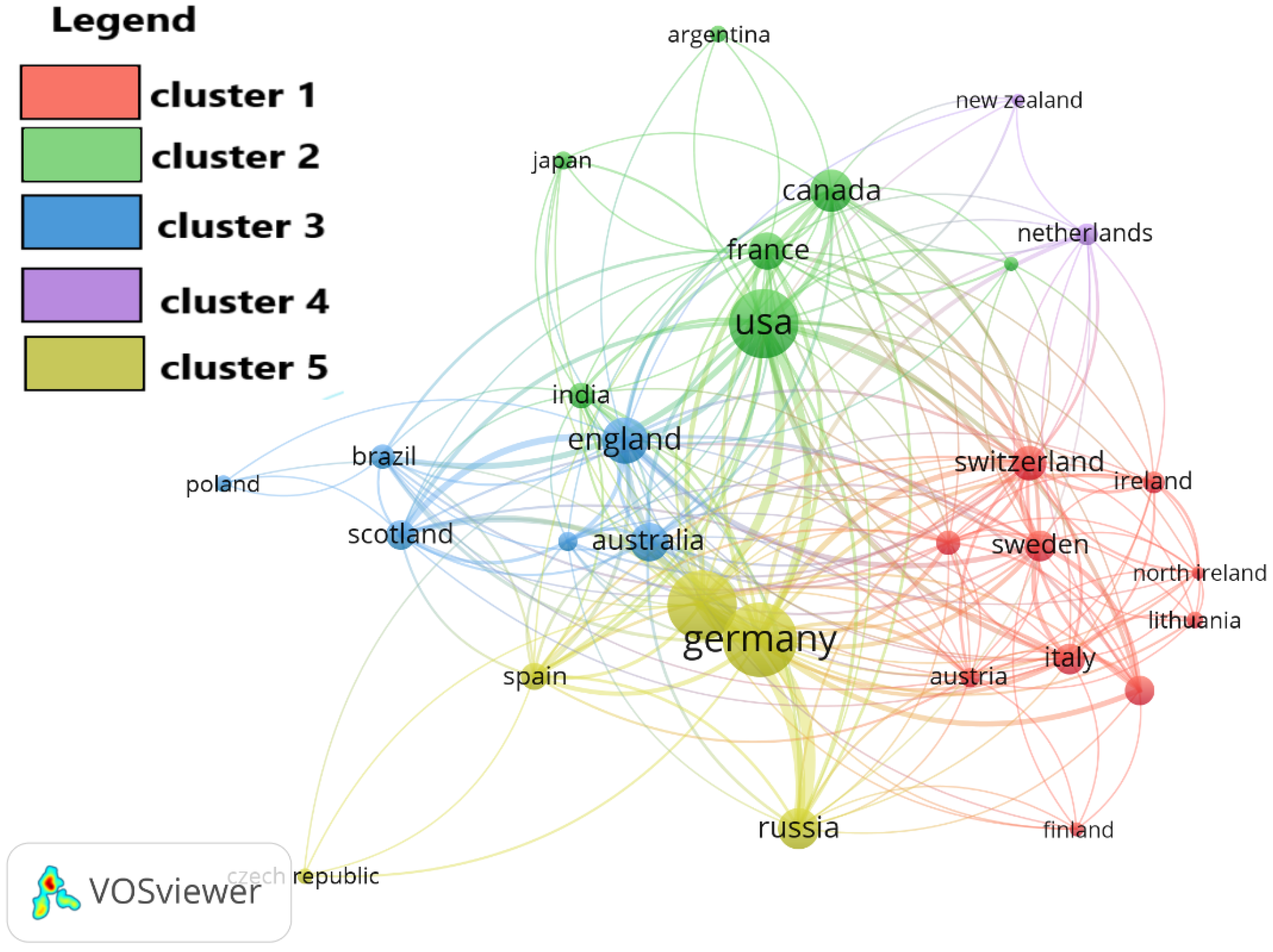
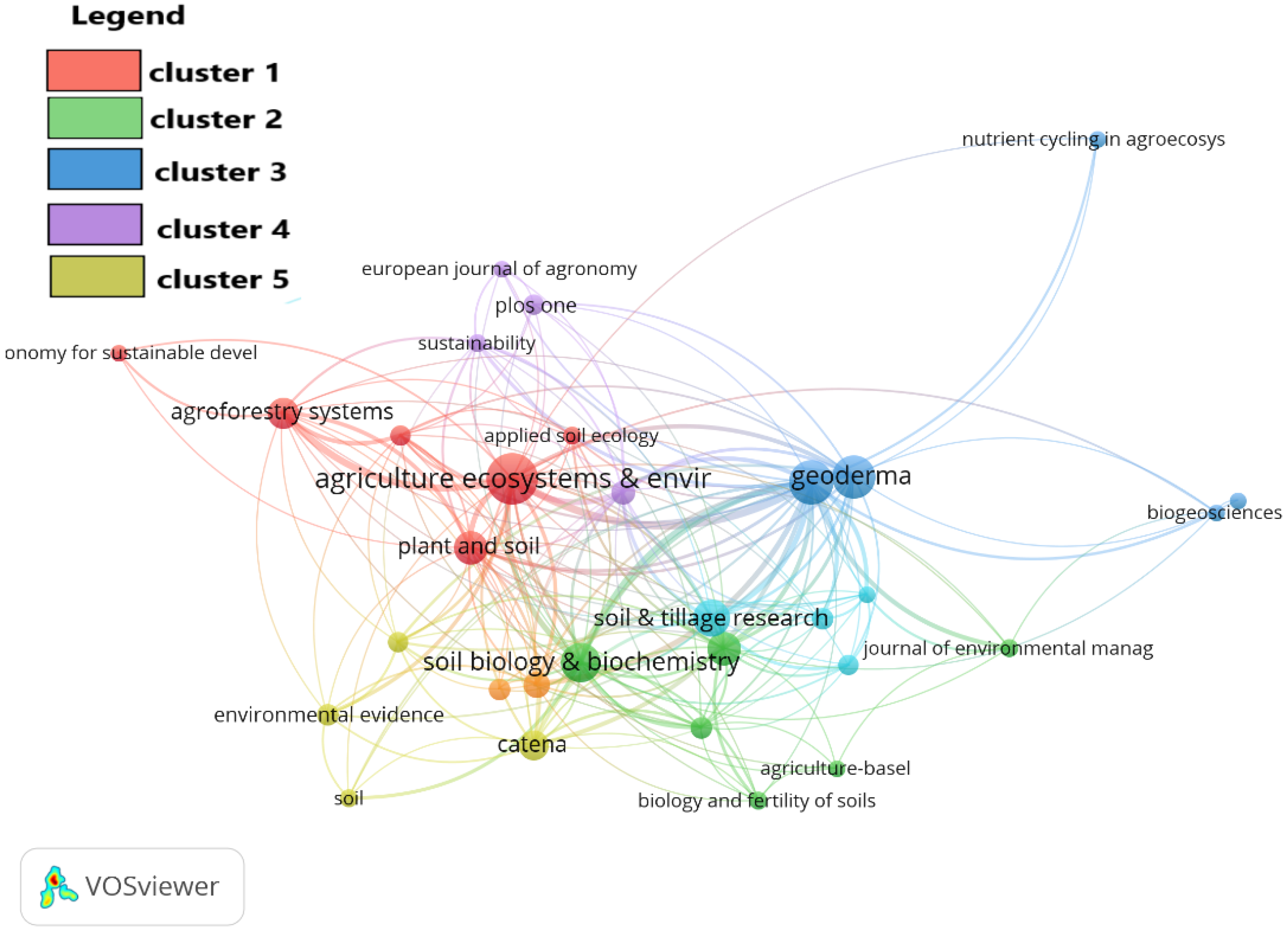
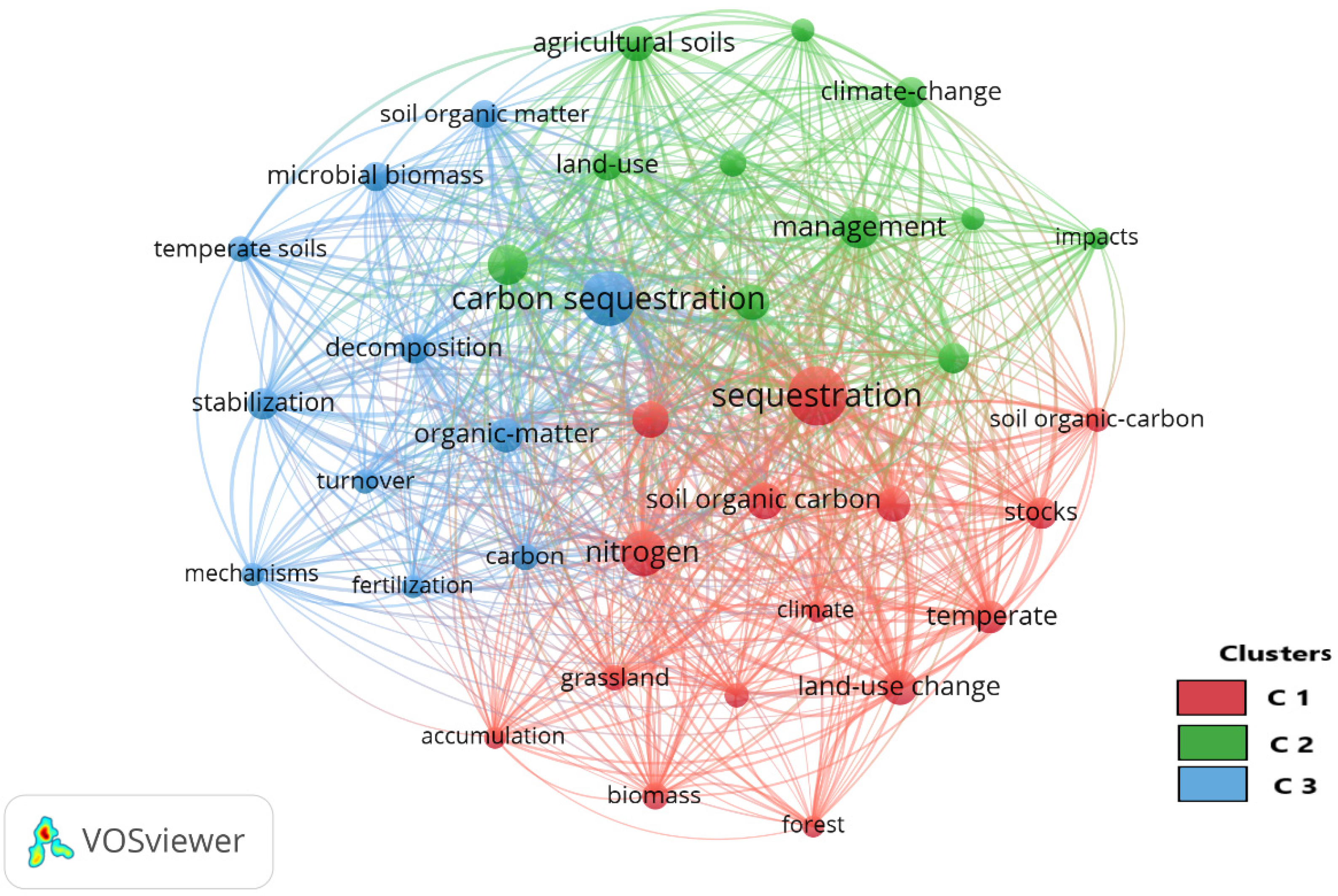
- VOSviewer 1.6.20: Co-authorship analysis, co-citation networks, keyword co-occurrence mapping;
- -
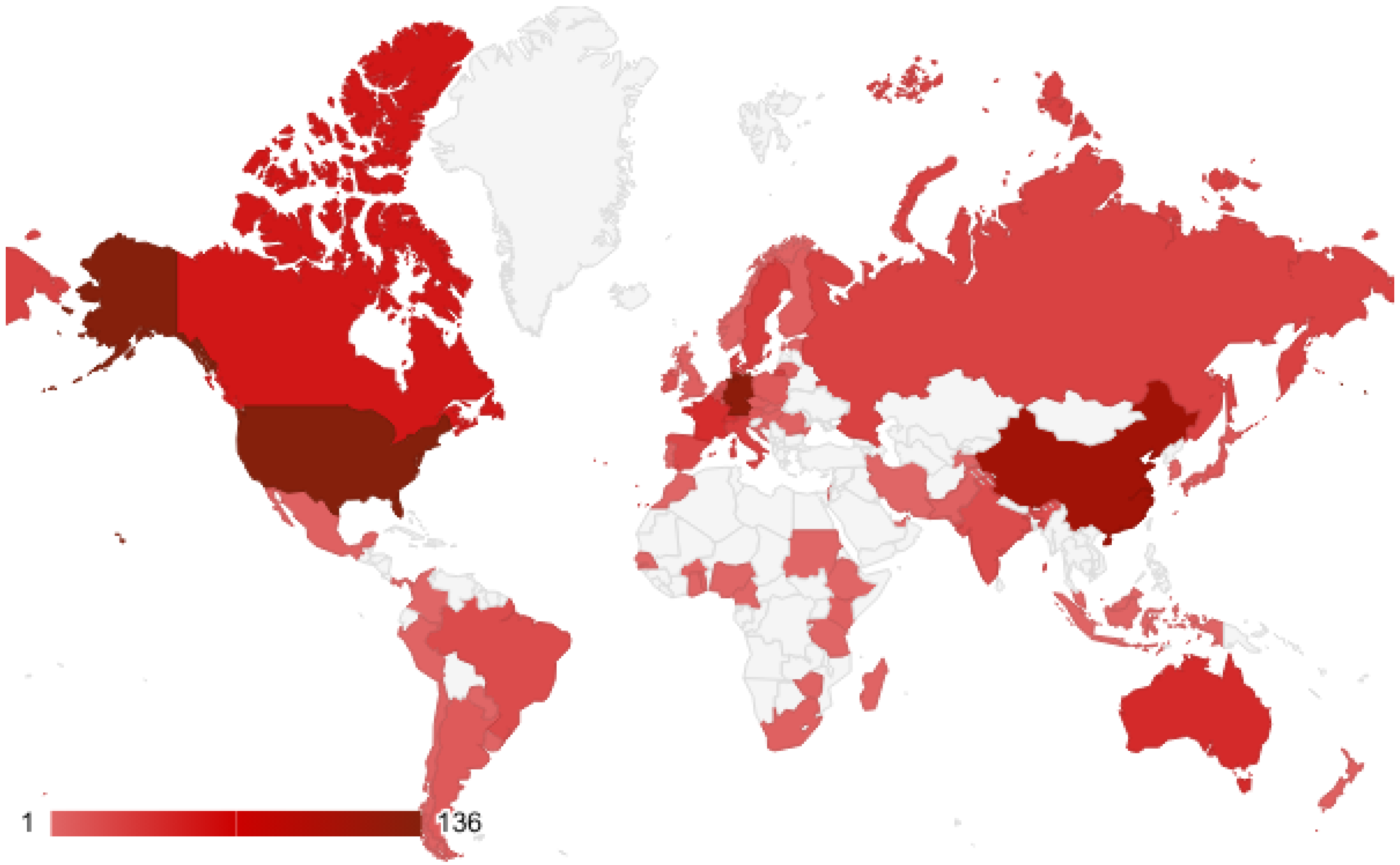
- Geochart: Global distribution of publications by country;
- -
- Microsoft Excel 2024: Data cleaning, tabulation, and descriptive statistics.
Outcome of Phase IPhase I provided a robust, reproducible quantitative mapping of the research field, identifying:- -
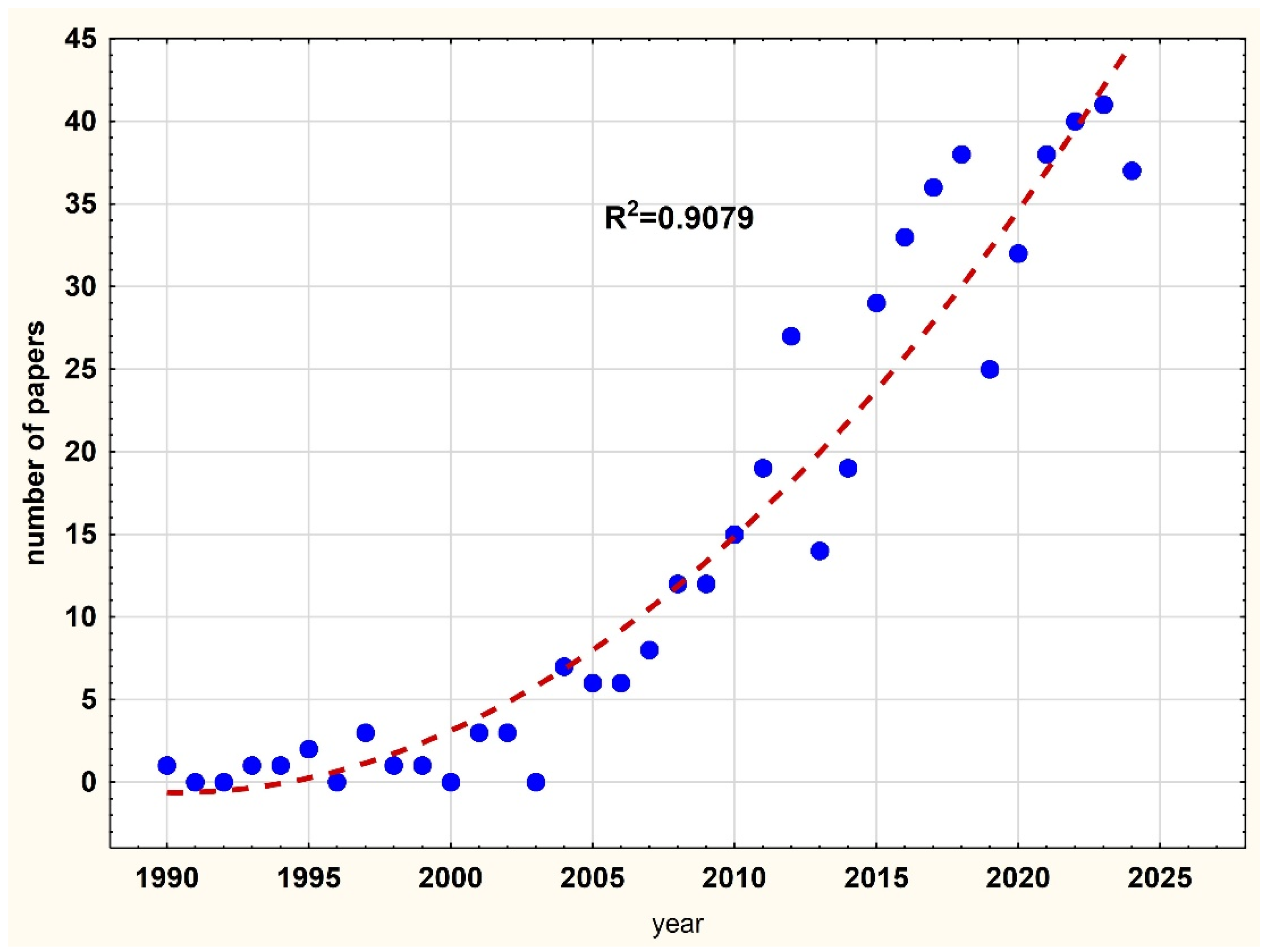
- Growth trends in SOC–related publications (1990–2024)
- -
- Geographic and institutional hotspots
- -
- Key authors and collaboration networks
- -
- Thematic clusters (e.g., stabilization mechanisms, modeling approaches, long-term experiments)
Bibliometric analyses were performed using Web of Science Core Collection (v.5.35), Scopus, Microsoft Excel 2024 [23], and Geochart [24]. In addition, VOSviewer (v.1.6.20) was used to construct visual networks for co-authorship, co-citation, and keyword co-occurrence analyses [25].- -
- These findings structured and informed the qualitative content synthesis in Phase II.
2.2. Phase II: Qualitative Content Synthesis
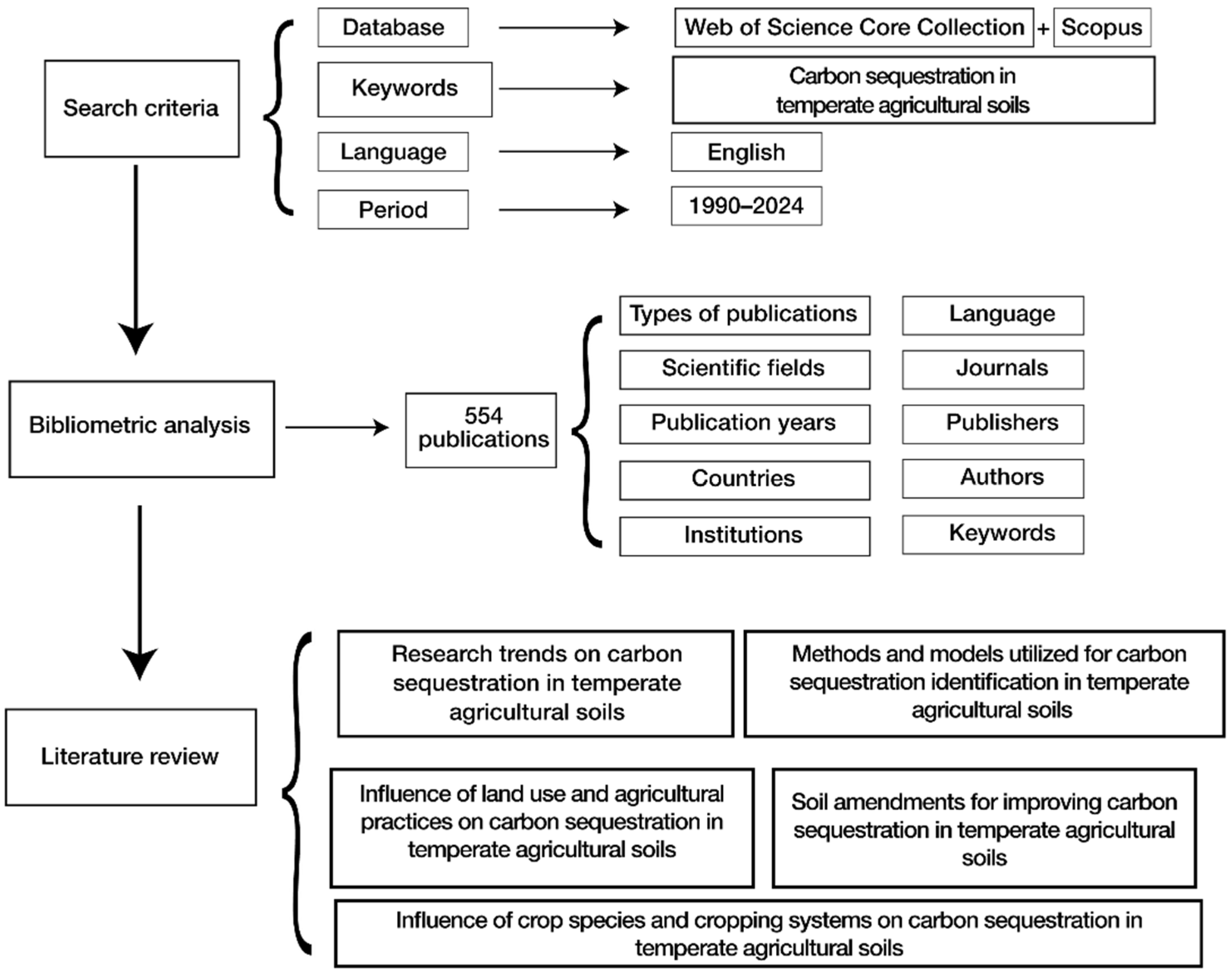
- Research trends and conceptual evolution in carbon sequestration within temperate agricultural soils.
- Methods and modeling approaches for quantifying and assessing carbon sequestration.
- Effects of land-use and agricultural management on SOC storage.
- Role of soil amendments in enhancing carbon stabilization.
- Influence of crop species and cropping systems on soil carbon dynamics.
2.3. Integration of the Two Phases
3. Results
3.1. Bibliometric Review
3.2. Literature Review
3.2.1. Research Trends on Carbon Sequestration in Temperate Agricultural Soils
3.2.2. Methods and Models Utilized for Carbon Sequestration Identification in Temperate Agricultural Soils
3.2.3. Influence of Land-Use and Agricultural Practices on Carbon Sequestration in Temperate Agricultural Soils
3.2.4. Soil Amendments for Improving Carbon Sequestration in Temperate Agricultural Soils
3.2.5. Influence of Crop Species and Cropping Systems on Carbon Sequestration in Temperate Agricultural Soils
3.2.6. Conceptual Summary—Processes and Drivers of Carbon Sequestration in Temperate Agricultural Soils
4. Discussion
4.1. Bibliometric Review
4.2. Insights and Challenges in Carbon Sequestration in Temperate Agricultural Soils
4.3. Advances and Challenges in Modeling Carbon Sequestration in Temperate Agricultural Soils
4.4. Drivers, Mechanisms, and Variability of Carbon Sequestration in Temperate Agricultural Soils
Differentiating Organic and Inorganic Carbon Dynamics in Temperate Farmlands
4.5. Evaluating the Role of Soil Amendments in Carbon Sequestration Under Temperate Agricultural Systems
4.5.1. Comparative Effectiveness of Soil Amendments in Temperate Systems
4.5.2. Influence of Residue and Fertilizer Management
4.5.3. Effects of Combined Amendments and Soil Interactions
4.5.4. Soil Chemistry and Amendment Side Effects
4.5.5. Environmental and Management Factors
4.5.6. Synthesis and Implications
4.6. Comparative Effects of Crop Types and Management on Carbon Sequestration
Meta-Synthesis of Soil Carbon Storage and Agronomic Drivers
4.7. Research Gaps and Future Directions
5. Conclusions
Author Contributions
Funding
Data Availability Statement
Conflicts of Interest
References
- Bera, A.; Sharma, R. Carbon sequestration in agricultural soils: Strategies for climate change mitigation—A review. Int. J. Adv. Biochem. Res. 2024, 8, 76–83. [Google Scholar]
- Lal, R.; Antle, J. Agricultural soils in climate change mitigation: Comparing action-based and results-based programmes for carbon sequestration. Clim. Change 2024, 177, 130. [Google Scholar]
- Francaviglia, R.; Renzi, G.; Farina, R. Management of cover crops in temperate climates influences soil organic carbon stocks: A meta-analysis. Eur. J. Agron. 2022, 132, 126387. [Google Scholar]
- Abiven, S.; Lehmann, J. Biochar’s effect on the soil carbon cycle: A rapid review and meta-analysis. Biochar 2024, 6, 88. [Google Scholar] [CrossRef]
- Deng, L.; Shangguan, Z.; Sweeney, S. Soil organic carbon sequestration in temperate agroforestry systems: A meta-analysis. Agric. Ecosyst. Environ. 2022, 323, 107689. [Google Scholar] [CrossRef]
- Organisation for Economic Co-Operation and Development (OECD). Soil Carbon Sequestration by Agriculture: Issues and Options; OECD Publishing: Paris, France, 2022; Available online: https://www.oecd.org/en/publications/soil-carbon-sequestration-by-agriculture_63ef3841-en.html (accessed on 12 June 2025).
- Poeplau, C.; Don, A.; Vesterdal, L.; Leifeld, J.; Van Wesemael, B.; Schumacher, J.; Gensior, A. Temporal dynamics of soil organic carbon after land-use change in the temperate zone—Carbon response functions as a model approach. Glob. Change Biol. 2011, 17, 2415–2427. [Google Scholar] [CrossRef]
- Cotrufo, M.F.; Wallenstein, M.D.; Boot, C.M.; Denef, K.; Paul, E. The Microbial Efficiency-Matrix Stabilization (MEMS) framework integrates plant litter decomposition and soil organic matter stabilization: Do labile plant inputs form stable soil organic matter? Glob. Change Biol. 2013, 19, 988–995. [Google Scholar] [CrossRef]
- Lehmann, J.; Kleber, M. The contentious nature of soil organic matter. Nature 2015, 528, 60–68. [Google Scholar] [CrossRef]
- Six, J.; Conant, R.T.; Paul, E.A.; Paustian, K. Stabilization mechanisms of soil organic matter: Implications for C-saturation of soils. Plant Soil 2002, 241, 155–176. [Google Scholar] [CrossRef]
- Schmidt, M.W.I.; Torn, M.S.; Abiven, S.; Dittmar, T.; Guggenberger, G.; Janssens, I.A.; Kleber, M.; Kögel-Knabner, I.; Lehmann, J.; Manning, D.A.; et al. Persistence of soil organic matter as an ecosystem property. Nature 2011, 478, 49–56. [Google Scholar] [CrossRef]
- Jastrow, J.D.; Amonette, J.E.; Bailey, V.L. Mechanisms controlling soil carbon turnover and their potential application for enhancing carbon sequestration. Clim. Change 2007, 80, 5–23. [Google Scholar] [CrossRef]
- Loveland, P.; Webb, J. Is there a critical level of organic matter in the agricultural soils of temperate regions: A review. Soil Tillage Res. 2003, 70, 1–18. [Google Scholar] [CrossRef]
- Freibauer, A.; Rounsevell, M.D.; Smith, P.; Verhagen, J. Carbon sequestration in the agricultural soils of Europe. Geoderma 2004, 122, 1–23. [Google Scholar] [CrossRef]
- Chataut, G.; Bhatta, B.; Joshi, D.; Subedi, K.; Kafle, K. Greenhouse gases emission from agricultural soil: A review. J. Agric. Food Res. 2023, 11, 100533. [Google Scholar] [CrossRef]
- Dincă, L.; Spârchez, G.; Dincă, M. Romanian’s forest soil GIS map and database and their ecological implications. Carpathian J. Earth Environ. Sci. 2014, 9, 133–142. [Google Scholar]
- Enescu, C.M.; Mihalache, M.; Ilie, L.; Dincă, L.; Constandache, C.; Murariu, G. Agricultural benefits of shelterbelts and windbreaks: A bibliometric analysis. Agriculture 2025, 15, 1204. [Google Scholar] [CrossRef]
- Spârchez, G.; Dincă, L.-C.; Marin, G.; Dincă, M.; Enescu, R.-E. Variation of eutric cambisols’ chemical properties based on altitudinal and geomorphological zoning. Environ. Eng. Manag. J. 2017, 16, 2911–2918. [Google Scholar] [CrossRef]
- Dincă, L.; Dincă, M.; Vasile, D.; Spârchez, G.; Holonec, L. Calculating organic carbon stock from forest soils. Not. Bot. Horti Agrobot. Cluj-Napoca 2015, 43, 568–575. [Google Scholar] [CrossRef][Green Version]
- Clarivate.com. Web of Science Core Collection. Available online: https://clarivate.com/products/scientific-and-academic-research/research-discovery-and-workflow-solutions/webofscience-platform/web-of-science-core-collection/ (accessed on 20 June 2025).
- Elsevier. Scopus. Available online: https://www.elsevier.com/products/scopus (accessed on 20 June 2025).
- Page, M.J.; McKenzie, J.E.; Bossuyt, P.M.; Boutron, I.; Hoffmann, T.C.; Mulrow, C.D.; Shamseer, L.; Tetzlaff, J.M.; Akl, E.A.; Brennan, S.E.; et al. The PRISMA 2020 Statement: An updated guideline for reporting systematic reviews. BMJ 2021, 372, n71. [Google Scholar] [CrossRef]
- Microsoft Corporation. Microsoft Excel. Available online: https://www.microsoft.com/en-us/microsoft-365/excel?legRedir=true&CorrelationId=3bb60ab0-fe13-41a4-812b-2627667cf346 (accessed on 26 June 2025).
- Google. Geochart. Available online: https://developers.google.com/chart/interactive/docs/gallery/geochart (accessed on 23 June 2025).
- VOSviewer. Available online: https://www.vosviewer.com/ (accessed on 22 June 2025).
- Rodrigues, L.; Hardy, B.; Huyghebeart, B.; Fohrafellner, J.; Fornara, D.; Barančíková, G.; Leifeld, J. Achievable agricultural soil carbon sequestration across Europe from country-specific estimates. Glob. Change Biol. 2021, 27, 6363–6380. [Google Scholar] [CrossRef]
- D’Angelo, E.M.; Kovzelove, C.A.; Karathanasis, A.D. Carbon sequestration processes in temperate soils with different chemical properties and management histories. Soil Sci. 2009, 174, 45–55. [Google Scholar] [CrossRef]
- Cai, A.; Feng, W.; Zhang, W.; Xu, M. Climate, soil texture, and soil types affect the contributions of fine-fraction-stabilized carbon to total soil organic carbon in different land uses across China. J. Environ. Manag. 2016, 172, 2–9. [Google Scholar] [CrossRef]
- Ding, X.; Zhang, B.; Wei, Z.; He, H.; Filley, T.R. Conversion of grassland into cropland affects microbial residue carbon retention in both surface and subsurface soils of a temperate agroecosystem. Biol. Fertil. Soils 2020, 56, 137–143. [Google Scholar] [CrossRef]
- Van De Vreken, P.; Gobin, A.; Baken, S.; Van Holm, L.; Verhasselt, A.; Smolders, E.; Merckx, R. Crop residue management and oxalate-extractable iron and aluminium explain long-term soil organic carbon sequestration and dynamics. Eur. J. Soil Sci. 2016, 67, 332–340. [Google Scholar] [CrossRef]
- Wan, D.; Ma, M.; Peng, N.; Luo, X.; Chen, W.; Cai, P.; Huang, Q. Effects of long-term fertilization on calcium-associated soil organic carbon: Implications for C sequestration in agricultural soils. Sci. Total Environ. 2021, 772, 145037. [Google Scholar] [CrossRef]
- Mayer, M.; Krause, H.M.; Fliessbach, A.; Mäder, P.; Steffens, M. Fertilizer quality and labile soil organic matter fractions are vital for organic carbon sequestration in temperate arable soils within a long-term trial in Switzerland. Geoderma 2022, 426, 116080. [Google Scholar] [CrossRef]
- Jian, J.; Du, X.; Reiter, M.S.; Stewart, R.D. A meta-analysis of global cropland soil carbon changes due to cover cropping. Soil Biol. Biochem. 2020, 143, 107735. [Google Scholar] [CrossRef]
- Agnihotri, R.; Sharma, M.P.; Prakash, A.; Ramesh, A.; Bhattacharjya, S.; Patra, A.K.; Kuzyakov, Y. Glycoproteins of arbuscular mycorrhiza for soil carbon sequestration: Review of mechanisms and controls. Sci. Total Environ. 2022, 806, 150571. [Google Scholar] [CrossRef]
- Guo, L.; Shen, J.; Li, B.; Li, Q.; Wang, C.; Guan, Y.; Tang, X. Impacts of agricultural land use change on soil aggregate stability and physical protection of organic C. Sci. Total Environ. 2020, 707, 136049. [Google Scholar] [CrossRef]
- Tautges, N.E.; Chiartas, J.L.; Gaudin, A.C.; O’Geen, A.T.; Herrera, I.; Scow, K.M. Deep soil inventories reveal that impacts of cover crops and compost on soil carbon sequestration differ in surface and subsurface soils. Glob. Change Biol. 2019, 25, 3753–3766. [Google Scholar] [CrossRef]
- Chung, H.; Grove, J.H.; Six, J. Indications for soil carbon saturation in a temperate agroecosystem. Soil Sci. Soc. Am. J. 2008, 72, 1132–1139. [Google Scholar] [CrossRef]
- Ouattara, B.; Ouattara, K.; Serpantié, G.; Mando, A.; Sédogo, M.P.; Bationo, A. Intensity cultivation induced effects on soil organic carbon dynamic in the western cotton area of Burkina Faso. Nutr. Cycl. Agroecosyst. 2006, 76, 331–339. [Google Scholar] [CrossRef]
- Agethen, S.; Knorr, K.H. Juncus effusus mono-stands in restored cutover peat bogs—Analysis of litter quality, controls of anaerobic decomposition, and the risk of secondary carbon loss. Soil Biol. Biochem. 2018, 117, 139–152. [Google Scholar] [CrossRef]
- Bolinder, M.A.; Kätterer, T.; Andrén, O.; Ericson, L.; Parent, L.E.; Kirchmann, H. Long-term soil organic carbon and nitrogen dynamics in forage-based crop rotations in Northern Sweden (63–64° N). Agric. Ecosyst. Environ. 2010, 138, 335–342. [Google Scholar] [CrossRef]
- Tiefenbacher, A.; Sandén, T.; Haslmayr, H.P.; Miloczki, J.; Wenzel, W.; Spiegel, H. Optimizing carbon sequestration in croplands: A synthesis. Agronomy 2021, 11, 882. [Google Scholar] [CrossRef]
- Huang, W.; Jiang, L.; Zhou, J.; Kim, H.S.; Xiao, J.; Luo, Y. Reduced erosion augments soil carbon storage under cover crops. Glob. Change Biol. 2025, 31, e70133. [Google Scholar] [CrossRef]
- Poeplau, C.; Begill, N.; Liang, Z.; Schiedung, M. Root litter quality drives the dynamic of native mineral-associated organic carbon in a temperate agricultural soil. Plant Soil 2023, 491, 439–456. [Google Scholar] [CrossRef]
- Ball, K.R.; Guo, Y.; Hallett, P.D.; Smith, P.; Moreno-Ramón, H.; Morris, N.L.; Malik, A.A. Soil organic and inorganic carbon interactions under tillage and cover cropping determine potential for carbon accumulation in temperate, calcareous soils. Soil Tillage Res. 2025, 247, 106369. [Google Scholar] [CrossRef]
- Chiti, T.; Gardin, L.; Perugini, L.; Quaratino, R.; Vaccari, F.P.; Miglietta, F.; Valentini, R. Soil organic carbon stock assessment for the different cropland land uses in Italy. Biol. Fertil. Soils 2012, 48, 9–17. [Google Scholar] [CrossRef]
- De Feudis, M.; Vianello, G.; Vittori Antisari, L. Soil organic carbon stock assessment for volunteer carbon removal benefit: Methodological approach in chestnut orchard for fruit production. Environments 2023, 10, 83. [Google Scholar] [CrossRef]
- Beisekenov, N.; Banakinaou, W.; Ajayi, A.D.; Hasegawa, H.; Tadao, A. Remote sensing-based soil organic carbon monitoring using advanced machine learning techniques under conservation agriculture systems. Smart Agric. Technol. 2025, 11, 101036. [Google Scholar] [CrossRef]
- Chabrillat, S.; Milewski, R.; Ward, K.; Foerster, S.; Guillaso, S.; Loy, C.; Demattê, J.A. Monitoring soil properties using EnMAP spaceborne imaging spectroscopy mission. In Proceedings of the 2023 IEEE International Geoscience and Remote Sensing Symposium (IGARSS), Pasadena, CA, USA, 16–21 July 2023; pp. 1130–1133. [Google Scholar]
- Zeraatpisheh, M.; White, A.; Darby, H.; Neher, D.A.; Faulkner, J.; Hancock, L.; Kretzler, B.; El-Naboulsi, N.; Turner, H.C.; von Wettberg, E.J.; et al. Spatial mapping and predictive modeling of soil organic carbon stocks in Vermont agricultural lands using machine learning and environmental variables. Comput. Electron. Agric. 2025, 237, 110727. [Google Scholar] [CrossRef]
- Segura, C.; Neal, A.L.; Castro-Sardiña, L.; Harris, P.; Rivero, M.J.; Cardenas, L.M.; Irisarri, J.G.N. Comparison of direct and indirect soil organic carbon prediction at farm field scale. J. Environ. Manag. 2024, 365, 121573. [Google Scholar] [CrossRef]
- Nicoloso, R.S.; Amado, T.J.; Rice, C.W. Assessing strategies to enhance soil carbon sequestration with the DSSAT-CENTURY model. Eur. J. Soil Sci. 2020, 71, 1034–1049. [Google Scholar] [CrossRef]
- Oelbermann, M.; Echarte, L.; Marroquin, L.; Morgan, S.; Regehr, A.; Vachon, K.E.; Wilton, M. Estimating soil carbon dynamics in intercrop and sole crop agroecosystems using the CENTURY model. J. Plant Nutr. Soil Sci. 2017, 180, 241–251. [Google Scholar] [CrossRef]
- Dechow, R.; Franko, U.; Kätterer, T.; Kolbe, H. Evaluation of the RothC model as a prognostic tool for the prediction of SOC trends in response to management practices on arable land. Geoderma 2019, 337, 463–478. [Google Scholar] [CrossRef]
- Studdert, G.A.; Monterubbianesi, M.G.; Domínguez, G.F. Use of RothC to simulate changes of organic carbon stock in the arable layer of a Mollisol of the southeastern Pampas under continuous cropping. Soil Tillage Res. 2011, 117, 191–200. [Google Scholar] [CrossRef]
- Ludwig, B.; Kuka, K.; Franko, U.; von Lützow, M. Comparison of two quantitative soil organic carbon models with a conceptual model using data from an agricultural long-term experiment. J. Plant Nutr. Soil Sci. 2008, 171, 83–90. [Google Scholar] [CrossRef]
- Taghizadeh-Toosi, A.; Christensen, B.T.; Hutchings, N.J.; Vejlin, J.; Kätterer, T.; Glendining, M.; Olesen, J.E. C-TOOL: A simple model for simulating whole-profile carbon storage in temperate agricultural soils. Ecol. Model. 2014, 292, 11–25. [Google Scholar] [CrossRef]
- Khalil, M.I.; Fornara, D.A.; Osborne, B. Simulation and validation of long-term changes in soil organic carbon under permanent grassland using the DNDC model. Geoderma 2020, 361, 114014. [Google Scholar] [CrossRef]
- Apezteguía, H.P.; Izaurralde, R.C.; Sereno, R. Simulation study of soil organic matter dynamics as affected by land use and agricultural practices in semiarid Córdoba, Argentina. Soil Tillage Res. 2009, 102, 101–108. [Google Scholar] [CrossRef]
- Herzfeld, T.; Heinke, J.; Rolinski, S.; Müller, C. Soil organic carbon dynamics from agricultural management practices under climate change. Earth Syst. Dyn. 2021, 12, 1037–1055. [Google Scholar] [CrossRef]
- Dinh, T.L.A.; Goll, D.; Ciais, P.; Lauerwald, R. Impacts of land-use change on biospheric carbon: An oriented benchmark using ORCHIDEE land surface model. Geosci. Model Dev. Discuss. 2024, 2024, 1–30. [Google Scholar] [CrossRef]
- Cambou, A.; Cardinael, R.; Kouakoua, E.; Villeneuve, M.; Durand, C.; Barthès, B.G. Prediction of soil organic carbon stock using visible and near infrared reflectance spectroscopy (VNIRS) in the field. Geoderma 2016, 261, 151–159. [Google Scholar] [CrossRef]
- Hutchinson, J.J.; Campbell, C.A.; Desjardins, R.L. Some perspectives on carbon sequestration in agriculture. Agric. For. Meteorol. 2007, 142, 288–302. [Google Scholar] [CrossRef]
- Crews, T.E.; Rumsey, B.E. What agriculture can learn from native ecosystems in building soil organic matter: A review. Sustainability 2017, 9, 578. [Google Scholar] [CrossRef]
- Baddeley, J.A.; Edwards, A.C.; Watson, C.A. Changes in soil C and N stocks and C:N stoichiometry 21 years after land use change on an arable mineral topsoil. Geoderma 2017, 303, 19–26. [Google Scholar] [CrossRef]
- Liang, C.; VandenBygaart, A.J.; MacDonald, D.; Liu, K.; Cerkowniak, D. Change in soil organic carbon storage as influenced by forestland and grassland conversion to cropland in Canada. Geoderma Reg. 2023, 33, e00648. [Google Scholar] [CrossRef]
- Raihan, F.; Shela, S.; Alam, M.; Ekramul Haque, M.; Chen, T.-W.; Horvatinec, J.; Ondrasek, G. Impact of Michelia champaca and Tectona grandis mono-species and their mixed plantation on chemical soil properties in a tropical semi-evergreen forest. Ann. For. Res. 2024, 67, 41–54. [Google Scholar] [CrossRef]
- Khan, R.W.A.; Quratulain, M.; Shaheen, H.; Hussain, K.; Mehmood, A.B. Local scale variations in soil organic carbon sequestration in lesser Himalayan coniferous and mixed forests: Implications for sustainability. J. Ecol. Environ. 2025, 49, 13–29. [Google Scholar] [CrossRef]
- Zhou, T.; Wang, C.; Zhou, Z. Nitrogen availability regulates tree mixture effects on soil organic carbon in temperate forests: Insights from a meta-analysis and long-term experiment. Glob. Ecol. Biogeogr. 2025, 34, e70073. [Google Scholar] [CrossRef]
- Błońska, E.; Piaszczyk, W.; Lasota, J. Emissions of CO2 from downed logs of different species and the surrounding soil in temperate forest. Ann. For. Res. 2022, 65, 47–56. [Google Scholar] [CrossRef]
- Şimonca, V.; Oroian, I.; Chira, D.; Tăut, I. Methods for quantification of the decline phenomenon and determination of the vulnerability degree for the oak stands in northwestern Transylvania, Romania. Not. Bot. Horti Agrobot. Cluj-Napoca 2017, 45, 623–631. [Google Scholar] [CrossRef]
- Fernández-Fernández, M.; Naves, P.; Musolin, D.L.; Selikhovkin, A.V.; Cleary, M.; Chira, D.; Paraschiv, M.; Gordon, T.; Solla, A.; Papazova-Anakieva, I.; et al. Pine pitch canker and insects: Regional risks, environmental regulation, and practical management options. Forests 2019, 10, 649. [Google Scholar] [CrossRef]
- Seaton, F.M.; Robinson, D.A.; Wood, C.M.; Benskin, C.M.; Rowe, R.L.; Hornigold, K.; Kirby, K.J.; Nichols, C.; Smart, S.M. Forest topsoil organic carbon declines under ash dieback. Glob. Change Biol. 2025, 31, e70430. [Google Scholar] [CrossRef] [PubMed]
- Şesan, T.E.; Oancea, F.; Toma, C.; Matei, G.M.; Matei, S.; Chira, F.; Chira, D.; Fodor, E.; Mocan, C.; Ene, M.; et al. Approaches to the study of mycorrhizas in Romania. Symbiosis 2010, 52, 75–85. [Google Scholar] [CrossRef]
- Yang, K.; Zhang, Q.; Zhu, J.; Wang, Q.; Gao, T.; Wang, G.G. Mycorrhizal type regulates trade-offs between plant and soil carbon in forests. Nat. Clim. Change 2024, 14, 91–97. [Google Scholar] [CrossRef]
- Shukla, S.; Didwania, N.; Choudhary, R. Arbuscular mycorrhizal fungi (AMF): A pathway to sustainable soil health, carbon sequestration, and greenhouse gas mitigation. J. Saudi Soc. Agric. Sci. 2025, 24, 22. [Google Scholar] [CrossRef]
- Chiaffarelli, G.; Tambone, F.; Vagge, I. The contribution of the management of landscape features to soil organic carbon turnover among farmlands. Soil Syst. 2024, 8, 95. [Google Scholar] [CrossRef]
- Dixon, R.K.; Winjum, J.K.; Andrasko, K.J.; Lee, J.J.; Schroeder, P.E. Integrated land-use systems: Assessment of promising agroforest and alternative land-use practices to enhance carbon conservation and sequestration. Clim. Change 1994, 27, 71–92. [Google Scholar] [CrossRef]
- Guillaume, T.; Bragazza, L.; Levasseur, C.; Libohova, Z.; Sinaj, S. Long-term soil organic carbon dynamics in temperate cropland–grassland systems. Agric. Ecosyst. Environ. 2021, 305, 107184. [Google Scholar] [CrossRef]
- Hu, T.; Taghizadeh-Toosi, A.; Olesen, J.E.; Jensen, M.L.; Sørensen, P.; Christensen, B.T. Converting temperate long-term arable land into semi-natural grassland: Decadal-scale changes in topsoil C, N, 13C and 15N contents. Eur. J. Soil Sci. 2019, 70, 350–360. [Google Scholar] [CrossRef]
- Arai, M.; Minamiya, Y.; Tsuzura, H.; Watanabe, Y.; Yagioka, A.; Kaneko, N. Changes in water-stable aggregate and soil carbon accumulation in a no-tillage with weed mulch management site after conversion from conventional management practices. Geoderma 2014, 221, 50–60. [Google Scholar] [CrossRef]
- Gocke, M.I.; Guigue, J.; Bauke, S.L.; Barkusky, D.; Baumecker, M.; Berns, A.E.; Hobley, E.; Honermeier, B.; Kögel-Knabner, I.; Koszinski, S.; et al. Interactive effects of agricultural management on soil organic carbon accrual: A synthesis of long-term field experiments in Germany. Geoderma 2023, 438, 116616. [Google Scholar] [CrossRef]
- Arai, M.; Wagai, R. Does rice paddy management increase soil organic carbon in the warm temperate and tropical regions? Geoderma Reg. 2024, 36, e00738. [Google Scholar] [CrossRef]
- Autret, B.; Mary, B.; Chenu, C.; Balabane, M.; Girardin, C.; Bertrand, M.; Beaudoin, N. Alternative arable cropping systems: A key to increase soil organic carbon storage? Results from a 16 year field experiment. Agric. Ecosyst. Environ. 2016, 232, 150–164. [Google Scholar] [CrossRef]
- Blanco-Moure, N.; Gracia, R.; Bielsa, A.C.; López, M.V. Long-term no-tillage effects on particulate and mineral-associated soil organic matter under rainfed Mediterranean conditions. Soil Use Manag. 2013, 29, 250–259. [Google Scholar] [CrossRef]
- Chaplot, V.; Abdalla, K.; Alexis, M.; Bourennane, H.; Darboux, F.; Dlamini, P.; Chivenge, P. Surface organic carbon enrichment to explain greater CO2 emissions from short-term no-tilled soils. Agric. Ecosyst. Environ. 2015, 203, 110–118. [Google Scholar] [CrossRef]
- Chen, T.; Zhang, Y.; Fu, J.; Yang, L.; Chi, Y.; Wu, P.; Wang, Y. No-tillage increased corn yields and carbon sequestration. Agron. J. 2020, 112, 4467–4481. [Google Scholar] [CrossRef]
- Denef, K.; Six, J.; Merckx, R.; Paustian, K. Carbon sequestration in microaggregates of no-tillage soils with different clay mineralogy. Soil Sci. Soc. Am. J. 2004, 68, 1935–1944. [Google Scholar] [CrossRef]
- Hermle, S.; Anken, T.; Leifeld, J.; Weisskopf, P. The effect of the tillage system on soil organic carbon content under moist, cold-temperate conditions. Soil Tillage Res. 2008, 98, 94–105. [Google Scholar] [CrossRef]
- Krauss, M.; Wiesmeier, M.; Don, A.; Cuperus, F.; Gattinger, A.; Gruber, S.; Steffens, M. Reduced tillage in organic farming affects soil organic carbon stocks in temperate Europe. Soil Tillage Res. 2022, 216, 105262. [Google Scholar] [CrossRef]
- Chan, K.Y.; Conyers, M.K.; Li, G.D.; Helyar, K.R.; Poile, G.; Oates, A.; Barchia, I.M. Soil carbon dynamics under different cropping and pasture management in temperate Australia: Results of three long-term experiments. Soil Res. 2011, 49, 320–328. [Google Scholar] [CrossRef]
- Fiorini, A.; Boselli, R.; Maris, S.C.; Santelli, S.; Ardenti, F.; Capra, F.; Tabaglio, V. May conservation tillage enhance soil C and N accumulation without decreasing yield in intensive irrigated croplands? Results from an eight-year maize monoculture. Agric. Ecosyst. Environ. 2020, 296, 106926. [Google Scholar] [CrossRef]
- Gadermaier, F.; Berner, A.; Fließbach, A.; Friedel, J.K.; Mäder, P. Impact of reduced tillage on soil organic carbon and nutrient budgets under organic farming. Renew. Agric. Food Syst. 2012, 27, 68–80. [Google Scholar] [CrossRef]
- Haddaway, N.R.; Hedlund, K.; Jackson, L.E.; Kätterer, T.; Lugato, E.; Thomsen, I.K.; Isberg, P.E. How does tillage intensity affect soil organic carbon? A systematic review. Environ. Evid. 2017, 6, 30. [Google Scholar] [CrossRef]
- Koga, N.; Tsuji, H. Effects of reduced tillage, crop residue management and manure application practices on crop yields and soil carbon sequestration on an Andisol in northern Japan. Soil Sci. Plant Nutr. 2009, 55, 546–557. [Google Scholar] [CrossRef]
- Shang-Qi, X.; Zhang, M.; Zhang, H.; Fu, C.; Guang-Li, Y.; Xiao-Ping, X. Soil organic carbon stocks as affected by tillage systems in a double-cropped rice field. Pedosphere 2013, 23, 696–704. [Google Scholar] [CrossRef]
- Jordon, M.W.; Smith, P. Modelling soil carbon stocks following reduced tillage intensity: A framework to estimate decomposition rate constant modifiers for RothC-26.3, demonstrated in north-west Europe. Soil Tillage Res. 2022, 222, 105428. [Google Scholar] [CrossRef]
- Novelli, L.E.; Caviglia, O.P.; Piñeiro, G. Increased cropping intensity improves crop residue inputs to the soil and aggregate-associated soil organic carbon stocks. Soil Tillage Res. 2017, 165, 128–136. [Google Scholar] [CrossRef]
- Bayliff, S.; Gardner, W.; Singh, J.P.; Fraser, L. Mowing management favors primary productivity and carbon sequestration without changing species diversity in a temperate hayfield in Central Interior British Columbia, Canada. PLoS ONE 2025, 20, e0317536. [Google Scholar] [CrossRef] [PubMed]
- Feng, S.; Tan, S.; Zhang, A.; Zhang, Q.; Pan, G.; Qu, F.; Zhang, X. Effect of household land management on cropland topsoil organic carbon storage at plot scale in a red earth soil area of South China. J. Agric. Sci. 2011, 149, 557–566. [Google Scholar] [CrossRef] [PubMed]
- Gattinger, A.; Muller, A.; Haeni, M.; Skinner, C.; Fliessbach, A.; Buchmann, N.; Niggli, U. Enhanced top soil carbon stocks under organic farming. Proc. Natl. Acad. Sci. USA 2012, 109, 18226–18231. [Google Scholar] [CrossRef] [PubMed]
- Petersson, T.; Antoniella, G.; Perugini, L.; Chiriaco, M.V.; Chiti, T. Carbon farming practices for European cropland: A review on the effect on soil organic carbon. Soil Tillage Res. 2025, 247, 106353. [Google Scholar] [CrossRef]
- Lessmann, M.; Ros, G.H.; Young, M.D.; de Vries, W. Global variation in soil carbon sequestration potential through improved cropland management. Glob. Change Biol. 2022, 28, 1162–1177. [Google Scholar] [CrossRef]
- López i Losada, R.; Hedlund, K.; Haddaway, N.R.; Sahlin, U.; Jackson, L.E.; Kätterer, T.; Isberg, P.E. Synergistic effects of multiple “good agricultural practices” for promoting organic carbon in soils: A systematic review of long-term experiments. Ambio 2025, 54, 1715–1728. [Google Scholar] [CrossRef]
- Tang, H.; Liu, Y.; Li, X.; Muhammad, A.; Huang, G. Carbon sequestration of cropland and paddy soils in China: Potential, driving factors, and mechanisms. Greenh. Gases Sci. Technol. 2019, 9, 872–885. [Google Scholar] [CrossRef]
- Badewa, E.A.; Yeung, C.C.; Whalen, J.K.; Oelbermann, M. Compost and biosolids increase long-term soil organic carbon stocks. Can. J. Soil Sci. 2023, 103, 483–492. [Google Scholar] [CrossRef]
- Poeplau, C.; Reiter, L.; Berti, A.; Kätterer, T. Qualitative and quantitative response of soil organic carbon to 40 years of crop residue incorporation under contrasting nitrogen fertilisation regimes. Soil Res. 2016, 55, 1–9. [Google Scholar] [CrossRef]
- Bell, M.J.; Worrall, F. Charcoal addition to soils in NE England: A carbon sink with environmental co-benefits? Sci. Total Environ. 2011, 409, 1704–1714. [Google Scholar] [CrossRef]
- Dil, M.; Oelbermann, M. Evaluating the long-term effects of pre-conditioned biochar on soil organic carbon in two southern Ontario soils using the century model. In Sustainable Agroecosystems in Climate Change Mitigation; Wageningen Academic: Wageningen, The Netherlands, 2014; pp. 249–268. [Google Scholar]
- Du, Z.L.; Zhao, J.K.; Wang, Y.D.; Zhang, Q.Z. Biochar addition drives soil aggregation and carbon sequestration in aggregate fractions from an intensive agricultural system. J. Soils Sediments 2017, 17, 581–589. [Google Scholar] [CrossRef]
- Greenberg, I.; Kaiser, M.; Gunina, A.; Ledesma, P.; Polifka, S.; Wiedner, K.; Ludwig, B. Substitution of mineral fertilizers with biogas digestate plus biochar increases physically stabilized soil carbon but not crop biomass in a field trial. Sci. Total Environ. 2019, 680, 181–189. [Google Scholar] [CrossRef]
- Abujabhah, I.S.; Bound, S.A.; Doyle, R.; Bowman, J.P. Effects of biochar and compost amendments on soil physico-chemical properties and the total community within a temperate agricultural soil. Appl. Soil Ecol. 2016, 98, 243–253. [Google Scholar] [CrossRef]
- Cooper, J.; Greenberg, I.; Ludwig, B.; Hippich, L.; Fischer, D.; Glaser, B.; Kaiser, M. Effect of biochar and compost on soil properties and organic matter in aggregate size fractions under field conditions. Agric. Ecosyst. Environ. 2020, 295, 106882. [Google Scholar] [CrossRef]
- Amoakwah, E.; Shim, J.; Kim, S.; Lee, Y.; Kwon, S.; Sangho, J.; Park, S. Impact of silicate and lime application on soil fertility and temporal changes in soil properties and carbon stocks in a temperate ecosystem. Geoderma 2023, 433, 116431. [Google Scholar] [CrossRef]
- Jin, S. Recommended nitrogen fertilization enhances soil carbon sequestration in China’s monsoonal temperate zone. PeerJ 2018, 6, e5983. [Google Scholar] [CrossRef]
- Li, S.; Li, W.; Ding, K.; Shi, X.; Kalkhajeh, Y.K.; Wei, Z.; Ma, C. Co-culture of rice and aquatic animals enhances soil organic carbon: A meta-analysis. Sci. Total Environ. 2024, 955, 176819. [Google Scholar] [CrossRef]
- Entry, J.A.; Sojka, R.E.; Shewmaker, G.E. Irrigation increases inorganic carbon in agricultural soils. Environ. Manag. 2004, 33 (Suppl. S1), S309–S317. [Google Scholar] [CrossRef]
- Buyanovsky, G.A.; Wagner, G.H. Changing role of cultivated land in the global carbon cycle. Biol. Fertil. Soils 1998, 27, 242–245. [Google Scholar] [CrossRef]
- Kim, K.; Daly, E.J.; Flesch, T.K.; Coates, T.W.; Hernandez-Ramirez, G. Carbon and water dynamics of a perennial versus an annual grain crop in temperate agroecosystems. Agric. For. Meteorol. 2022, 314, 108805. [Google Scholar] [CrossRef]
- Li, Y.E.; Shi, S.; Waqas, M.A.; Zhou, X.; Li, J.; Wan, Y.; Wilkes, A. Long-term (≥20 years) application of fertilizers and straw return enhances soil carbon storage: A meta-analysis. Mitig. Adapt. Strateg. Glob. Change 2018, 23, 603–619. [Google Scholar] [CrossRef]
- Bautista-Cruz, A.; Leyva-Pablo, T.; de León-González, F.; Zornoza, R.; Martínez-Gallegos, V.; Fuentes-Ponce, M.; Rodríguez-Sánchez, L. Cultivation of Opuntia ficus-indica under different soil management practices: A possible sustainable agricultural system to promote soil carbon sequestration and increase soil microbial biomass and activity. Land Degrad. Dev. 2018, 29, 38–46. [Google Scholar] [CrossRef]
- Bustamante–Silveira, M.; Siri–Prieto, G.; Mazzilli, S.R.; Carrasco-Letelier, L. Carbon footprint of four bioethanol cropping systems in a temperate region. Biofuels 2024, 15, 1029–1039. [Google Scholar] [CrossRef]
- Chahal, I.; Van Eerd, L.L. Cover crop and crop residue removal effects on temporal dynamics of soil carbon and nitrogen in a temperate, humid climate. PLoS ONE 2020, 15, e0235665. [Google Scholar] [CrossRef]
- Crème, A.; Rumpel, C.; Le Roux, X.; Romian, A.; Lan, T.; Chabbi, A. Ley grassland under temperate climate had a legacy effect on soil organic matter quantity, biogeochemical signature and microbial activities. Soil Biol. Biochem. 2018, 122, 203–210. [Google Scholar] [CrossRef]
- Dietz, C.L.; Jackson, R.D.; Ruark, M.D.; Sanford, G.R. Soil carbon maintained by perennial grasslands over 30 years but lost in field crop systems in a temperate Mollisol. Commun. Earth Environ. 2024, 5, 360. [Google Scholar] [CrossRef]
- Harbo, L.S.; Schulz, G.; Heinemann, H.; Dechow, R.; Poeplau, C. Flower strips as a carbon sequestration measure in temperate croplands. Plant Soil 2023, 482, 647–663. [Google Scholar] [CrossRef]
- Shimoda, S.; Wagai, R. Ecosystem dynamics after abandonment of rice paddy fields: Does alien plant invasion enhance carbon storage? Ecosystems 2020, 23, 617–629. [Google Scholar] [CrossRef]
- Bratu, I.; Dinca, L.; Schiteanu, I.; Mocanu, G.; Murariu, G.; Stanciu, M.; Zhiyanski, M. Sports in Natural Forests: A Systematic Review of Environmental Impact and Compatibility for Readability. Sports 2025, 13, 250. [Google Scholar] [CrossRef]
- Dincă, L.; Constandache, C.; Postolache, R.; Murariu, G.; Tupu, E. Timber Harvesting in Mountainous Regions: A Comprehensive Review. Forests 2025, 16, 495. [Google Scholar] [CrossRef]
- Enescu, C.M.; Mihalache, M.; Ilie, L.; Dincă, L.; Timofte, A.I.; Murariu, G. Afforestation of Degraded Lands: A Global Review of Practices, Species, and Ecological Outcomes. Forests 2025, 16, 1743. [Google Scholar] [CrossRef]
- Dincă, L.; Crisan, V.; Ienaşoiu, G.; Murariu, G.; Drăşovean, R. Environmental Indicator Plants in Mountain Forests: A Review. Plants 2024, 13, 3358. [Google Scholar] [CrossRef] [PubMed]
- Budău, R.; Timofte, C.S.C.; Mirisan, L.V.; Bei, M.; Dinca, L.; Murariu, G.; Racz, K.A. Living Landmarks: A Review of Monumental Trees and Their Role in Ecosystems. Plants 2025, 14, 2075. [Google Scholar] [CrossRef] [PubMed]
- Dincă, L.; Coca, A.; Tudose, N.C.; Marin, M.; Murariu, G.; Munteanu, D. The Role of Trees in Sand Dune Rehabilitation: Insights from Global Experiences. Appl. Sci. 2025, 15, 7358. [Google Scholar] [CrossRef]
- Murariu, G.; Dinca, L.; Munteanu, D. Trends and Applications of Principal Component Analysis in Forestry Research: A Literature and Bibliometric Review. Forests 2025, 16, 1155. [Google Scholar] [CrossRef]
- Dincă, L.; Murariu, G.; Lupoae, M. Understanding the ecosystem services of riparian forests: Patterns, gaps, and global trends. Forests 2025, 16, 947. [Google Scholar] [CrossRef]
- Bratu, I.; Dinca, L.; Constandache, C.; Murariu, G. Resilience and decline: The impact of climatic variability on temperate oak forests. Climate 2025, 13, 119. [Google Scholar] [CrossRef]
- Timis-Gansac, V.; Dinca, L.; Constandache, C.; Murariu, G.; Cheregi, G.; Timofte, C.S.C. Conservation biodiversity in arid areas: A review. Sustainability 2025, 17, 2422. [Google Scholar] [CrossRef]
- Murariu, G.; Stanciu, S.; Dinca, L.; Munteanu, D. GIS Applications in Monitoring and Managing Heavy Metal Contamination of Water Resources. Appl. Sci. 2025, 15, 10332. [Google Scholar] [CrossRef]
- Slepetiene, A.; Belova, O.; Fastovetska, K.; Dinca, L.; Murariu, G. Managing Boreal Birch Forests for Climate Change Mitigation. Land 2025, 14, 1909. [Google Scholar] [CrossRef]
- Achim, F.; Dinca, L.; Chira, D.; Raducu, R.; Chirca, A.; Murariu, G. Sustainable Management of Willow Forest Landscapes: A Review of Ecosystem Functions and Conservation Strategies. Land 2025, 14, 1593. [Google Scholar] [CrossRef]
- Vasile, D.; Petritan, A.-M.; Tudose, N.C.; Toiu, F.L.; Scarlatescu, V.; Petritan, I.C. Structure and spatial distribution of dead wood in two temperate old-growth mixed European beech forests. Not. Bot. Horti Agrobot. 2017, 45, 639–645. [Google Scholar] [CrossRef]
- Mustățea, M.; Clius, M.; Tudose, N.C.; Cheval, S. An enhanced Machado Index of naturalness. Catena 2022, 212, 106091. [Google Scholar] [CrossRef]
- Oprică, R.; Tudose, N.C.; Davidescu, S.O.; Zup, M.; Marin, M.; Comanici, A.N.; Criț, M.N.; Pitar, D. Gender inequalities in Transylvania’s largest peri-urban forest usage. Ann. For. Res. 2022, 65, 57–69. [Google Scholar] [CrossRef]
- Tudose, N.C.; Petritan, I.C.; Toiu, F.L.; Petritan, A.-M.; Marin, M. Relation between topography and gap characteristics in a mixed sessile oak–beech old-growth forest. Forests 2023, 14, 188. [Google Scholar] [CrossRef]
- Marin, M.; Clinciu, I.; Tudose, N.C.; Ungurean, C.; Mihalache, A.L.; Mărțoiu, N.E.; Tudose, O.N. Assessment of seasonal surface runoff under climate and land use change scenarios for a small forested watershed: Upper Tarlung Watershed (Romania). Water 2022, 14, 2860. [Google Scholar] [CrossRef]
- Davidescu, S.O.; Clinciu, I.; Tudose, N.C.; Ungurean, C. An evaluating methodology for hydrotechnical torrent-control structures condition. Ann. For. Res. 2012, 55, 125–143. [Google Scholar] [CrossRef]
- Mihalache, A.L.; Marin, M.; Davidescu, Ș.O.; Ungurean, C.; Adorjani, A.; Tudose, N.C.; Davidescu, A.A.; Clinciu, I. Physical status of torrent control structures in Romania. Environ. Eng. Manag. J. 2020, 19, 861–872. [Google Scholar] [CrossRef]
- Marin, M.; Tudose, N.C.; Ungurean, C.; Mihalache, A.L. Application of life cycle assessment for torrent control structures: A review. Land 2024, 13, 1956. [Google Scholar] [CrossRef]
- Naorem, A.; Jayaraman, S.; Dalal, R.C.; Patra, A.; Rao, C.S.; Lal, R. Soil inorganic carbon as a potential sink in carbon storage in dryland soils—A review. Agriculture 2022, 12, 1256. [Google Scholar] [CrossRef]
- Hu, J.; Song, X.D.; Yang, F.; Yang, S.H.; Yang, J.L.; Zhang, G.L. Soil inorganic carbon variations and thresholds of occurrence in an arid and semi-arid zone. Geoderma Reg. 2025, 43, e01023. [Google Scholar] [CrossRef]
- Wang, X.; Zhu, X.; Xu, M.; Wu, L.; Lu, T. Sources and relationships of inorganic carbon and organic carbon in arable soils of the west Loess Plateau. Geoderma 2025, 461, 117499. [Google Scholar] [CrossRef]
- Li, X.; Yang, T.; Hicks, L.C.; Hu, B.; Li, F.; Liu, X.; Wei, D.; Wang, Z.; Bao, W. Climate and soil properties drive soil organic and inorganic carbon patterns across a latitudinal gradient in southwestern China. J. Soils Sediments 2023, 23, 91–102. [Google Scholar] [CrossRef]
- Huang, Y.; Wei, F. Climate controls the global distribution of soil organic and inorganic carbon. Ecol. Indic. 2025, 175, 113514. [Google Scholar] [CrossRef]
- Apostol, E.N.; Stuparu, E.; Scarlatescu, V.; Budeanu, M. Testing Hungarian oak (Quercus frainetto Ten.) provenances in Romania. iForest 2020, 13, 9–15. [Google Scholar] [CrossRef]
- Besliu, E.; Curtu, A.L.; Apostol, E.N.; Budeanu, M. Using adapted and productive European beech (Fagus sylvatica L.) provenances as future solutions for sustainable forest management in Romania. Land 2024, 13, 183. [Google Scholar] [CrossRef]
- Budeanu, M.; Şofletea, N.; Petriţan, I.C. Among-population variation in quality traits in two Romanian provenance trials with Picea abies L. Balt. For. 2014, 20, 37–47. [Google Scholar]
- Budeanu, M.; Besliu, E.; Pepelea, D. Testing the radial increment and climate–growth relationship between Swiss stone pine European provenances in the Romanian Carpathians. Forests 2025, 16, 391. [Google Scholar] [CrossRef]
- Marcu, N.; Budeanu, M.; Apostol, E.N.; Radu, G.R. Valuation of the economic benefits from using genetically improved forest reproductive materials in afforestation. Forests 2020, 11, 382. [Google Scholar] [CrossRef]
- Şofletea, N.; Curtu, A.L.; Daia, M.L.; Budeanu, M. The dynamics and variability of radial growth in provenance trials of Norway spruce (Picea abies (L.) Karst.) within and beyond the hot margins of its natural range. Not. Bot. Horti Agrobot. Cluj-Napoca 2015, 43, 265–271. [Google Scholar] [CrossRef]



| Crt. No. | Journal | Documents | Citations | Total Link Strength |
|---|---|---|---|---|
| 1 | Agriculture, Ecosystems & Environment | 44 | 2942 | 153 |
| 2 | Global Change Biology | 34 | 6719 | 180 |
| 3 | Soil Use and Management | 10 | 1294 | 59 |
| 4 | Agroforestry Systems | 16 | 1352 | 57 |
| 5 | Geoderma | 32 | 1588 | 81 |
| 6 | Soil Biology & Biochemistry | 26 | 3794 | 91 |
| 7 | Plant and Soil | 19 | 2495 | 63 |
| 8 | Soil & Tillage Research | 23 | 1907 | 53 |
| 9 | European Journal of Soil Science | 12 | 821 | 45 |
| 10 | Canadian Journal of Soil Science | 7 | 163 | 30 |
| 11 | Science of the Total Environment | 19 | 1011 | 58 |
| 12 | Agronomy | 7 | 152 | 27 |
| Crt. No. | Keyword | Occurrences | Total Link Strength |
|---|---|---|---|
| 1 | sequestration | 228 | 1908 |
| 2 | carbon sequestration | 193 | 1488 |
| 3 | nitrogen | 142 | 1164 |
| 4 | management | 115 | 986 |
| 5 | matter | 104 | 861 |
| 6 | agricultural soils | 82 | 676 |
| 7 | soil organic carbon | 86 | 719 |
| 8 | temperate | 73 | 615 |
| 9 | dynamics | 88 | 721 |
| 10 | tillage | 63 | 583 |
| 11 | stocks | 66 | 554 |
| 12 | land-use change | 81 | 668 |
| 13 | organic-matter | 78 | 611 |
| 14 | organic-carbon | 81 | 669 |
| 15 | storage | 76 | 608 |
| Cur. No. | Studied Aspect | Location | Cited by | Research Method |
|---|---|---|---|---|
| 1 | Achievable agricultural soil carbon sequestration across Europe from country-specific estimates | General | Rodrigues et al., 2021 [26] | Model simulation |
| 2 | Carbon sequestration processes in temperate soils with different chemical properties and management histories | USA | D’Angelo et al., 2009 [27] | Laboratory experiment |
| 3 | Climate, soil texture, and soil types affect the contributions of fine-fraction-stabilized carbon to total soil organic carbon in different land-uses | China | Cai et al., 2016 [28] | Fractionation lab analyses |
| 4 | Conversion of grassland into cropland affects microbial residue carbon retention in both surface and subsurface soils of a temperate agroecosystem | China | Ding et al., 2020 [29] | Soil analysis |
| 5 | Crop residue management and oxalate-extractable iron and aluminium explain long-term soil organic carbon sequestration and dynamics | Belgium | Van de Vreken et al., 2016 [30] | Chemical fractionation |
| 6 | Effects of long-term fertilization on calcium-associated soil organic carbon: Implications for C sequestration in agricultural soils | China | Wan et al., 2021 [31] | Fractionation |
| 7 | Fertilizer quality and labile soil organic matter fractions are vital for organic carbon sequestration in temperate arable soils | Switzerland | Mayer et al., 2022 [32] | Laboratory soil fractionation |
| 8 | Global cropland soil carbon changes due to cover cropping | General | Jian et al., 2020 [33] | Meta-analysis |
| 9 | Glycoproteins of arbuscular mycorrhiza for soil carbon sequestration | India | Agnihotri et al., 2022 [34] | Biochemical study |
| 10 | Impacts of agricultural land-use change on soil aggregate stability and physical protection of organic C | China | Guo et al., 2020 [35] | Aggregate stability lab tests |
| 11 | Impacts of cover crops and compost on soil carbon sequestration | USA | Tautges et al., 2019 [36] | Long-term field experiment |
| 12 | Indications for soil carbon saturation in a temperate agroecosystem | USA | Chung et al., 2008 [37] | Long-term field experiment |
| 13 | Intensity cultivation induced effects on soil organic carbon dynamics | Burkina Faso | Ouatara et al., 2006 [38] | Long-term field experiment |
| 14 | Juncus effusus mono-stands in restored cutover peat bogs—the risk of secondary carbon loss | Germany | Agethen and Knorr, 2018 [39] | Restauration experiment |
| 15 | Long-term soil organic carbon dynamics in forage-based crop rotations | Sweden | Bolinder et al., 2010 [40] | Long-term field trial |
| 16 | Optimizing carbon sequestration in croplands | General | Tiefenbacher et al., 2021 [41] | Long-term field trial |
| 17 | Reduced erosion augments soil carbon storage under cover crops | USA | Huang et al., 2025 [42] | Review |
| 18 | Root litter quality drives the dynamics of native mineral-associated organic carbon in a temperate agricultural soil | Germany | Poeplau et al., 2023 [43] | Field experiment |
| 19 | Soil organic and inorganic carbon interactions under tillage and cover cropping determine potential for carbon accumulation in temperate, calcareous soils | China | Ball et al., 2025 [44] | Field trial |
| 20 | Soil organic carbon stock assessment for the different cropland land | Italy | Chiti et al., 2012 [45] | Regional survey |
| 21 | Soil organic carbon stock assessment for volunteer carbon removal benefit | Italy | De Feudis et al., 2023 [46] | Scenario assessment |
Disclaimer/Publisher’s Note: The statements, opinions and data contained in all publications are solely those of the individual author(s) and contributor(s) and not of MDPI and/or the editor(s). MDPI and/or the editor(s) disclaim responsibility for any injury to people or property resulting from any ideas, methods, instructions or products referred to in the content. |
© 2025 by the authors. Licensee MDPI, Basel, Switzerland. This article is an open access article distributed under the terms and conditions of the Creative Commons Attribution (CC BY) license (https://creativecommons.org/licenses/by/4.0/).
Share and Cite
Slepetiene, A.; Belova, O.; Fastovetska, K.; Dinca, L.; Murariu, G. Advances in Understanding Carbon Storage and Stabilization in Temperate Agricultural Soils. Agriculture 2025, 15, 2489. https://doi.org/10.3390/agriculture15232489
Slepetiene A, Belova O, Fastovetska K, Dinca L, Murariu G. Advances in Understanding Carbon Storage and Stabilization in Temperate Agricultural Soils. Agriculture. 2025; 15(23):2489. https://doi.org/10.3390/agriculture15232489
Chicago/Turabian StyleSlepetiene, Alvyra, Olgirda Belova, Kateryna Fastovetska, Lucian Dinca, and Gabriel Murariu. 2025. "Advances in Understanding Carbon Storage and Stabilization in Temperate Agricultural Soils" Agriculture 15, no. 23: 2489. https://doi.org/10.3390/agriculture15232489
APA StyleSlepetiene, A., Belova, O., Fastovetska, K., Dinca, L., & Murariu, G. (2025). Advances in Understanding Carbon Storage and Stabilization in Temperate Agricultural Soils. Agriculture, 15(23), 2489. https://doi.org/10.3390/agriculture15232489