Review

Advances and Future Trends in Electrified Agricultural Machinery for Sustainable Agriculture

1
School of Electrical and Information Engineering, Jiangsu University, Zhenjiang 212013, China
2
Key Laboratory for Theory and Technology of Intelligent Agricultural Machinery and Equipment, Jiangsu University, Zhenjiang 212013, China
3
Jiangsu Province and Education Ministry Co-Sponsored Synergistic Innovation Center of Modern Agricultural Equipment, Zhenjiang 212013, China
4
School of Automotive and Traffic Engineering, Jiangsu University, Zhenjiang 212013, China
*
Author to whom correspondence should be addressed.
Agriculture 2025, 15(22), 2367; https://doi.org/10.3390/agriculture15222367
Submission received: 5 October 2025 / Revised: 26 October 2025 / Accepted: 27 October 2025 / Published: 14 November 2025
(This article belongs to the Section Agricultural Technology)

Abstract

The global transition toward sustainable and intelligent farming has positioned Electrified Agricultural Machinery (EAM) as a central focus in modern equipment development. By integrating advanced electrical subsystems, high-efficiency powertrains, and intelligent Energy Management Strategies (EMSs), EAM offers considerable potential to enhance operational efficiency, reduce greenhouse-gas emissions, and improve adaptability across diverse agricultural environments. Nevertheless, widespread deployment remains constrained by harsh operating conditions, complex duty cycles, and limitations in maintenance capacity and economic feasibility. This review provides a comprehensive synthesis of enabling technologies and application trends in EAM. Performance requirements of electrical subsystems are examined with emphasis on advances in power supply, electric drive, and control systems. The technical characteristics and application scenarios of battery, series hybrid, parallel hybrid, and power-split powertrains are compared. Common EMS approaches (rule-based, optimization-based, and learning-based) are evaluated in terms of design complexity, energy efficiency, adaptability, and computational demand. Representative applications across tillage, seeding, crop management, and harvesting are discussed, underscoring the transformative role of electrification in agricultural production. This review identifies the series hybrid electronic powertrain system and rule-based EMSs as the most mature technologies for practical application in EAM. However, challenges remain concerning operational reliability in harsh agricultural environments and the integration of intelligent control systems for adaptive, real-time operations. The review also highlights key technical bottlenecks and emerging development trends, offering insights to guide future research and support the wider adoption of EAM.

1. Introduction

1.1. Research Background and Objectives

With the large-scale adoption of agricultural machinery, global crop yields have increased significantly, but issues such as fossil energy depletion and environmental pollution have become increasingly severe [1]. According to the Consultative Group on International Agricultural Research (CGIAR), agricultural machinery driven by Internal Combustion Engines (ICEs) consumes nearly 30% of global total energy and contributes about one-third of carbon emissions, with crop planting alone accounting for nearly 20% [2,3]. The Food and Agriculture Organization (FAO) of the United Nations has highlighted three key goals for sustainable agriculture: improving productivity and income, enhancing climate resilience, and reducing or eliminating greenhouse gas emissions [4,5]. Traditional agricultural machinery faces a trade-off between productivity gains and environmental protection. As an effective solution, EAM with efficient, safe, and clean power systems, coupled with intelligent control technologies, has become a global research focus [6,7]. Conventional machines suffer from complex structures, are costly to maintain, and rely on hydraulic transmission, which limits real-time precision control and hinders the advancement of precision agriculture [8,9]. In contrast, EAM adopts distributed electric drive technologies, enabling precise motor control, stronger robustness, and greater potential for intelligent upgrades [10,11]. These advantages make EAM increasingly essential for the development of intelligent and sustainable agriculture [12,13].
EAM typically consists of electrical, transmission, operation, and control systems, designed to meet diverse agricultural demands while improving efficiency and reducing energy consumption [14]. Benefiting from the breakthroughs in New Energy Vehicle (NEV) technology, the transfer of electrical and common technologies has greatly accelerated EAM development. The electrical system, comprising the motor, battery, and electronic control unit, is critical for EAM’s stable and safe operation [15,16]. However, due to technological bottlenecks in energy density and the lack of dedicated charging infrastructure for agricultural machinery, most EAM currently adopt hybrid power systems to address endurance issues. Electrification is also key to simplifying traditional agricultural machinery transmission systems [17,18]. Depending on the energy coupling configuration, hybrid drivetrains can be classified as series, parallel, or power-split, each with unique energy flow characteristics and efficiency curves [19,20,21,22]. EMSs are central to reducing energy consumption, as they dynamically allocate power among different energy sources according to demand and operating conditions, achieving single or multi-objective optimization of fuel consumption, emissions, operational quality, and system longevity [23,24,25,26].
In recent years, EAM research has expanded across all major stages of farming, including land preparation and tillage, seeding and planting, crop management, and harvesting [27,28,29,30]. While prototypes have demonstrated comparable operation quality to diesel-powered machines and achieved preliminary energy savings and emission reductions, agricultural machinery faces unique challenges compared with NEVs, including demands for low-speed, high-torque output, long endurance, strong seasonality, and adaptability to harsh and dynamic environments [31,32]. Furthermore, close coordination between the powertrain and working systems is essential to ensure high-quality task performance [33,34,35].
However, many applications focus on transferring technologies from NEVs, such as simple powertrain system substitution, without fully accounting for the critical technical mismatches between NEV-derived components and the distinctive operational requirements of EAM. This results in several inefficiencies, including low energy utilization, limited operational endurance, increased failure rates under harsh agricultural conditions, and challenges in coordinating the traction and implement systems. For instance, ref. [36] discusses the adaptation of NEV powertrains for agricultural machinery, where mismatches in energy output and durability led to performance issues under heavy agricultural loads. Similarly, ref. [37] highlights the transfer of NEV components into the traction systems of agricultural vehicles, where such systems experienced higher failure rates when subjected to the demanding and variable conditions of agricultural operations. Furthermore, ref. [38] provides an example of NEV-derived powertrains being tested in agricultural harvesters, revealing limitations in both energy efficiency and mechanical robustness under continuous use in the field. These cases demonstrate that while NEV technology can offer valuable components, their direct application to EAM requires careful consideration of the unique demands of agricultural environments. This results in several inefficiencies, including low energy utilization, limited operational endurance, increased failure rates under harsh agricultural conditions, and challenges in coordinating the traction and implement systems [39,40].
Although significant progress has been made internationally, with Hardware-in-the-Loop (HIL) experiments and field trials validating many prototypes, and several reviews have been published focusing on specific technologies or individual machine types, a comprehensive and system-level review of EAM is still lacking. This gap hinders the ability of researchers and practitioners to fully understand the state of the field and slows down the promotion and adoption of related technologies.

1.2. The Composition of This Paper

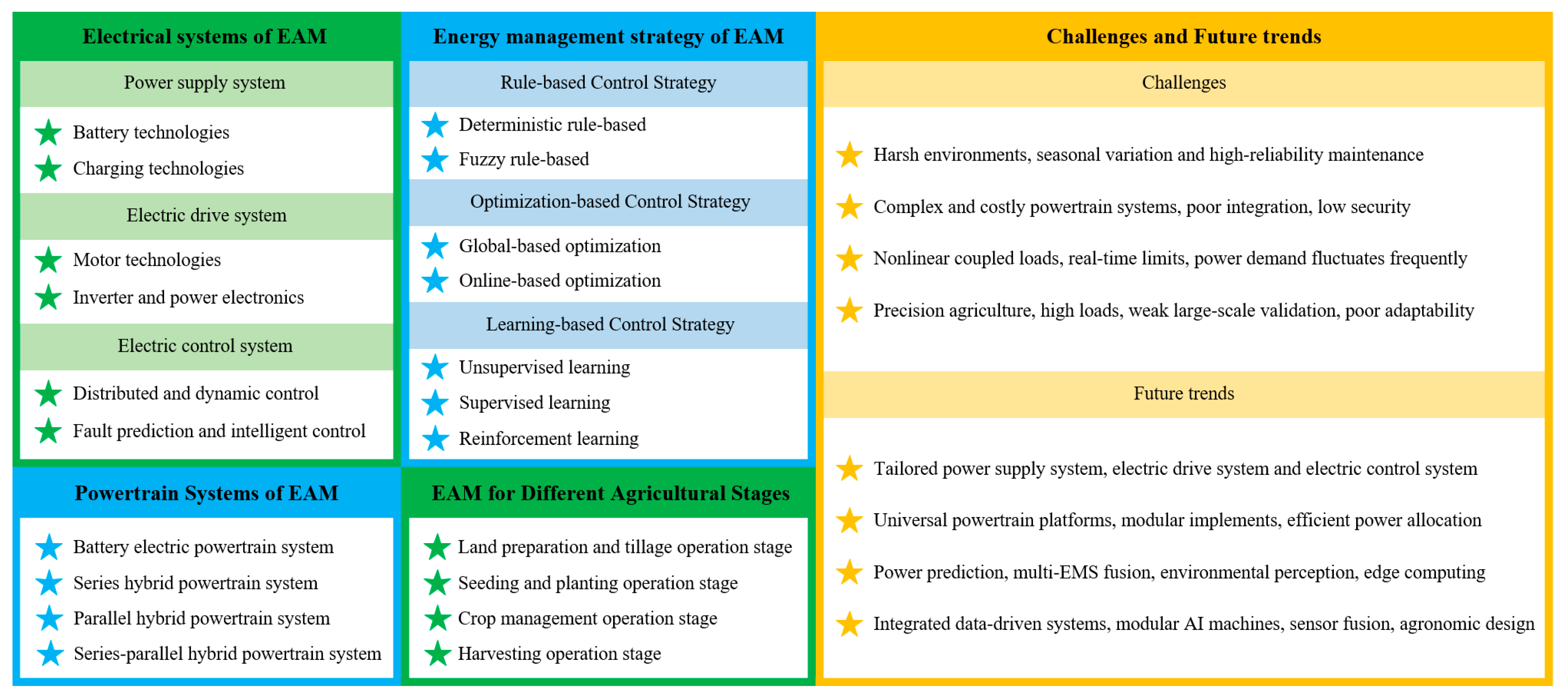
Aiming to fill this gap and to advance the development and broader application of EAM, this paper provides a comprehensive review of the research status of crucial enabling technologies and representative EAM at different stages of agricultural operations. The remainder of this paper is organized as follows. Section 2 reviews the current status of electrical systems in EAM, covering the power supply, electric drive, and electric control systems. Section 3 summarizes recent advances in EAM powertrain systems, emphasizing the advantages and limitations of various configurations. Section 4 examines the state of EMSs, comparing their applicability and constraints. Section 5 presents representative EAM developments across the major stages of agricultural operations. Section 6 discusses the key challenges and emerging trends in application and promotion, and outlines potential directions for future research. Finally, Section 7 concludes the paper. The overall framework is illustrated in Figure 1.

1.3. Literature Search Strategy and Selection Criteria

A comprehensive literature search was conducted to identify relevant studies on EAM and associated technologies. The following databases were used: IEEE Xplore, Web of Science and Google Scholar. A range of keyword combinations, including “electric agricultural machinery,” “hybrid agricultural machinery,” “energy management strategy,” “hybrid electric powertrain,” and “agricultural robot,” is used to identify pertinent studies. The time period covered was from 2016 to 2025. Studies were selected based on their focus on EAM, their publication in peer-reviewed journals or conference proceedings, and the availability of technical details related to powertrain architectures or EMSs. Studies were excluded if they did not focus on EAM or were purely theoretical, lacking empirical data. A total of 255 papers were retrieved through a keyword search, with 198 published in the past three years, accounting for 77%. This highlights the growing significance of research on EAM and the increasing attention it is receiving. Keyword and bibliometric analyses indicate that the research focus for EAM is primarily on developing electric systems, optimizing powertrain systems and efficient EMSs. Additionally, the performance validation of EAM in different agricultural operation stages is crucial. These four aspects will be analyzed in detail in the following sections.

2. Electrical Systems of EAM

Electrification of agricultural machinery represents a crucial step toward sustainable, intelligent, and low-carbon farming. At the center of this transformation is the “Three-electricity system”, comprising power supply, electric drive, and electric control, which together form the technological backbone of EAM. EAM operates under dusty, humid, and highly variable field conditions, characterized by frequent vibrations and severe mechanical shocks, whereas NEVs typically function on paved roads under relatively stable environments. Consequently, when NEV-based electrical systems are applied to EAM, they often encounter challenges in thermal management, insulation, and sealing. These subsystems play a critical role in determining overall energy efficiency, operational stability, environmental adaptability, and long-term economic viability [41,42]. This chapter reviews recent progress in each subsystem, highlights the key technical bottlenecks limiting large-scale adoption, and outlines future research directions to advance their application.

2.1. Power Supply System

Power supply system is a fundamental component of EAM, playing a decisive role in the industrialization of electric agricultural machinery. Its performance directly influences the efficiency, reliability, and adaptability of the equipment. Current research has primarily concentrated on two aspects: enhancing battery capacity and improving charging efficiency [43]. Unlike batteries in NEVs, which are designed for short-term high-power output and urban driving cycles, batteries for agricultural machinery must not only provide higher specific energy and power density but also deliver superior charge–discharge efficiency, strong seasonal adaptability, reduced operational costs, and long-term durability under complex and highly variable agricultural conditions [16].

2.1.1. Increase the Energy Density of the Battery

To increase the energy density of batteries, it is necessary to improve the performance of battery materials. Currently, most widely used batteries in EAM are lead–acid batteries and lithium-ion batteries. Lead–acid batteries, as a traditional technology, offer advantages such as low self-discharge rate, low cost, and stable operation. However, their limitations, including low energy density, short cycle life, and environmental risks associated with lead content and recycling challenges, restrict their application. In addition, their high weight proportion negatively affects the dynamic performance of EAM, so they are mainly used in small-scale machines such as rice and seedling transplanters [44,45]. In contrast, lithium-ion batteries, though more expensive, have been increasingly adopted in medium and large-scale equipment such as cotton pickers and tractors, owing to their high energy density, long service life, high working voltage, low self-discharge rate, and absence of memory effect. Among them, lithium iron phosphate (LiFePO4) and ternary lithium (NCM) batteries are the two dominant types. LiFePO4 batteries provide superior safety and cycle life but suffer from poor low-temperature performance, whereas NCM batteries offer higher energy density but face thermal safety concerns, such as thermal runaway under external shocks or overcharging [46,47].
For NCM-battery-equipped EAM subjected to high-frequency mechanical vibrations and impulsive loads, several multi-layer thermal safety strategies can be implemented to prevent thermal runaway while maintaining operational continuity. The strategies include optimized thermal management systems, redundant battery design, intelligent monitoring systems, shock-resistant battery pack design, and chemical additives and coatings [48]. The thermal management system is crucial for preventing overheating. Liquid or air cooling systems can effectively dissipate heat generated during high-load conditions. Additionally, thermal isolation layers or insulating materials within the battery pack can help maintain safe operating temperatures. To address the risks posed by mechanical vibrations and shocks, a redundant design can enhance the robustness of the battery pack. Distributing battery cells within the pack and incorporating shock-absorbing materials at key points can minimize the impact of external forces on the battery. A real-time monitoring system can track key parameters such as temperature, voltage, and pressure within the battery pack. If an anomaly is detected, the system can trigger safety protocols such as disconnecting the current or activating emergency cooling systems, preventing thermal runaway. The design of the EAM battery pack can include shock-resistant features such as elastic supports or vibration-dampening materials, reducing the mechanical stress on the battery and mitigating the risk of thermal runaway. Furthermore, using flame-retardant chemicals or coatings with enhanced thermal stability in the battery’s materials can improve the battery’s thermal resistance, reducing the risk of thermal runaway due to high temperatures.
Compared to NCM batteries, LiFePO4 batteries have superior thermal stability and a lower risk of thermal runaway, making them safer in high-frequency vibrations and impulsive loads. However, LiFePO4 batteries have a lower energy density and may require a larger volume to achieve the same range, impacting both cost and space utilization. NCM batteries provide higher energy density, enabling longer operational range. Nevertheless, in high-frequency vibration and shock environments, additional thermal management and protective measures are required, leading to higher costs. Cooling systems, shock-resistant designs, and intelligent monitoring systems contribute significantly to the overall expense. While LiFePO4 batteries have lower energy density and larger volume requirements, their superior thermal stability reduces the need for expensive thermal safety measures. Although the initial investment may be lower, the larger volume required for the same operational range could reduce space efficiency and increase overall system costs. NCM batteries offer higher energy density but come with higher thermal management costs, while LiFePO4 batteries, although safer and more thermally stable, sacrifice energy density for space and cost efficiency. A comparison of the characteristics of commonly used battery types in EAM is provided in Table 1.
Although lithium-ion batteries are widely used in electric vehicles, their energy density is approaching the theoretical limit [18]. The presence of liquid electrolytes can lead to side reactions, leakage, and capacity fading, while safety hazards such as fire and explosion further constrain their large-scale application in agricultural machinery [17]. All-solid-state batteries, which replace flammable liquid electrolytes with solid-state electrolytes, are regarded as a promising next-generation alternative. They offer enhanced safety, longer cycle life, and the potential for higher energy density [49,50]. In addition, recent advances in recycling strategies for solid-state systems underscore their role in promoting sustainable agricultural mechanization [51]. Nevertheless, significant challenges remain, particularly in developing cost-effective production methods and realizing large-scale industrialization [52]. Given the diverse and challenging agricultural environments, which are characterized by fluctuations in temperature, humidity, and soil conditions, it is crucial, in addition to addressing cost and industrialization challenges, to assess the applicability of various solid electrolytes (sulfides, oxides, and polymers) in EAM. Sulfide-based solid electrolytes offer high ionic conductivity and are widely considered for their superior performance at room temperature, but they suffer from issues related to moisture sensitivity and stability. Oxide-based electrolytes are known for their higher chemical stability and robustness, but they tend to have lower ionic conductivity compared to sulfides, making them less suitable for high-power applications in EAM. Polymer-based electrolytes are flexible and potentially lower in cost, but their conductivity is often lower than that of sulfides and oxides, limiting their efficiency for long-duration, high-load operations typical in agricultural machinery [50]. Future research should focus on improving the conductivity and stability of these electrolytes, and exploring hybrid solutions to combine the advantages of each type for more efficient and practical all-solid-state batteries in EAM.

2.1.2. Improve the Charging Efficiency of the Battery

Charging technology is fundamental for ensuring efficient operation and extending battery lifespan. Current approaches to improve the charging efficiency of the battery are generally categorized into conventional charging, fast charging, and battery swapping [53]. Conventional charging relies on onboard chargers to convert Alternating Current (AC) power from the grid into Direct Current (DC) for storage. While cost-effective and user-friendly, its slow speed makes it unsuitable for medium and large-scale agricultural machinery with high seasonal workloads, restricting its use mainly to small-scale equipment such as orchard sprayers and greenhouse inspection machines. Fast charging, supported by high-capacity infrastructure connected to the AC grid, employs methods such as constant-current, multi-stage constant-current, constant-voltage with current limiting, and pulse charging. Despite limited infrastructure in rural areas, the relatively fixed operating locations of agricultural machinery make the deployment of fast-charging stations feasible [54,55]. Recent material innovations, including interface engineering and advanced electrode composites, are also expected to further improve charging speed and efficiency. Meanwhile, battery swapping is gaining attention as a promising alternative. This method requires solutions for technical challenges in battery disassembly and installation, as well as intelligent optimization of swap-station networks [56]. Current research emphasizes automation, intelligent scheduling, and cost-effective deployment strategies in rural contexts, with future systems expected to incorporate intelligent control, shared platforms across equipment types, and networked operation to reduce costs and improve efficiency [57,58].
Despite significant advancements in battery and charging technologies, several challenges persist. The relatively low energy density of current batteries limits the operating range of large-scale machinery, while safety concerns under high loads and extreme environments affect reliability. Additionally, the lack of charging infrastructure in rural areas severely hampers the widespread deployment of EAM. The availability of charging stations and a stable energy supply vary greatly between regions, with urban areas typically having better infrastructure, whereas rural regions, particularly in developing countries, often lack the necessary facilities. Furthermore, the environmental impacts and recycling of battery materials require more attention [43]. Seasonal volatility in agricultural operations, particularly during high-demand periods such as sowing and harvesting, further complicates these issues. During these peak seasons, EAM must endure prolonged high-load operations, making it crucial to optimize energy management and charging infrastructure. This will ensure EAM’s continuous and efficient operation throughout the most demanding agricultural periods.
In the future, the power supply systems of EAM are expected to advance toward higher energy density, longer cycle life, and enhanced safety. Promising research directions include the development of solid-state batteries, advanced thermal management systems, and smart charging and swapping networks tailored to rural agricultural contexts.

2.2. Electric Drive System

The electric drive system is a core subsystem of EAM, responsible for converting electrical energy into mechanical power. It consists of key components including motors, motor controllers, inverters, and transmission mechanisms. EAM typically requires sustained, low-speed, high-torque performance for field operations, whereas NEV motors are optimized for medium-to-high-speed efficiency. Consequently, direct use of NEV motors can lead to reduced efficiency, overheating, and shortened service life under agricultural load profiles. The design and performance of this system are critical for determining the traction capacity, operational efficiency, and adaptability of agricultural machinery across diverse and complex working conditions.

2.2.1. Motor Technologies

The primary motor technologies applied in EAM include DC motors, AC induction motors, and permanent magnet synchronous motors (PMSMs) [59,60,61]. DC motors, once widely used in agricultural machinery, offer a simple structure, broad speed range, and low production cost. However, their dependence on mechanical commutators, high maintenance demands, and limited reliability have driven their gradual replacement by more advanced technologies. AC induction motors, valued for their robust design, low cost, and minimal maintenance requirements, have become increasingly common. With the advancement of inverter topologies and control strategies such as field-oriented control (FOC), AC induction motors can now deliver performance levels comparable to DC motors, though they still suffer from efficiency losses under partial loads and limited torque responsiveness. PMSMs, enabled by breakthroughs in rare-earth permanent magnet materials, have emerged as the dominant choice in recent years, offering superior power density, dynamic response, and efficiency. Nonetheless, challenges remain, particularly thermal effects and demagnetization risks at high speeds due to eddy-current heating, which undermine fault tolerance and long-term reliability [62]. Addressing the high energy consumption, emissions, and poor parameter adjustability of conventional combine harvesters, Zhu et al. [14] proposed a novel Series Hybrid Electric Combine Harvester (SHECH) employing distributed electric drive. The SHECH replaces the traditional drive system with seven PMSMs, significantly simplifying the transmission structure and improving overall efficiency. A comparison of the main motor types commonly adopted in EAM is provided in Table 2.
Agricultural machinery often requires high torque at low speeds, particularly during tasks such as plowing, towing, and harvesting. Therefore, motor designs must ensure substantial torque output and operational efficiency at low speeds. PMSM and Induction Motors are commonly selected for these applications due to their high torque capabilities [63]. Furthermore, agricultural machinery operates in uneven terrains and is frequently subjected to mechanical shocks and vibrations. As a result, motors must be designed with exceptional vibration resistance to ensure long-term reliability and stable performance in such environments. The use of elastic mounts and vibration-damping materials can effectively mitigate the impact of vibrations on the motor. Agricultural environments are characterized by dust, humidity, and fluctuating temperatures, making it essential for motors to be durable and reliable under harsh conditions. Effective sealing and anti-corrosion measures are particularly important, especially in wet or high-temperature settings. Additionally, high-power motors generate significant heat under heavy load conditions. To maintain safe operating temperatures, an efficient thermal management system is crucial. Both liquid and air cooling systems are commonly employed to prevent overheating. Moreover, motor designs must prioritize energy efficiency and minimize energy waste while ensuring seamless integration with the battery and powertrain systems. By optimizing the matching between the motor and the drive system, overall power transmission efficiency can be enhanced, and energy losses reduced.

2.2.2. Inverter and Power Electronics

Inverter technology is a critical component of electric drive systems, enabling the conversion of DC from batteries into AC for motor operation. Most current agricultural machinery relies on silicon-based Insulated-Gate Bipolar Transistor (IGBT) modules; however, these devices are constrained by limited switching frequency and power density. Wide-Bandgap (WBG) semiconductors such as Silicon Carbide (SiC) and Gallium Nitride (GaN) offer significant advantages, including higher breakdown voltage, faster switching, superior thermal tolerance, and lower losses [64]. SiC-based drives, in particular, have been shown to enable more compact and efficient motor control systems, making them a promising technology for next-generation agricultural machinery [65]. Nonetheless, SiC devices are more vulnerable to short-circuit failures, underscoring the need for advanced gate drive strategies and robust thermal management [66].
Agricultural machinery also presents operational demands distinct from automobiles. Field tasks typically require high torque at low speeds, whereas inter-field transport demands higher speeds, necessitating motors that balance efficiency, lightweight design, and fast torque response. Recent research has shifted from motor-level optimization to powertrain architectures. For example, Baek et al. [67] compared three e-powertrain configurations for a 55 kW electric tractor, namely single-motor, dual-motor, and dual-motor with a planetary gear set, under real workload data. Their results revealed that architecture selection critically impacts torque requirements, motor sizing, and overall system complexity, highlighting the importance of workload-specific designs rather than direct adoption of automotive configurations. Agricultural environments further impose harsh conditions, including dust, humidity, temperature fluctuations, and limited maintenance access. This necessitates motors with high robustness, fault tolerance, and maintainability. At present, most agricultural machinery still adapts motors and drive systems originally designed for automotive or construction machinery. However, increasing attention is being directed toward high-power, application-specific motors designed for agricultural workloads, where challenges such as thermal management under heavy loads and material durability for high torque remain critical. In addition, inverter reliability under fluctuating field conditions continues to be a pressing issue.
Electric drive systems are central to improving the efficiency and versatility of EAM. PMSMs currently dominate due to their superior performance, while SiC and GaN-based inverters are reshaping power electronics by enabling compact and efficient motor control. Future research will likely emphasize optimizing drive architectures through workload-oriented studies, advancing inverter reliability, and developing hybrid solutions to meet the demanding conditions of agricultural environments. In particular, the integration of WBG devices with intelligent thermal management, advanced gate driving, and fault-tolerant control strategies is expected to be a key breakthrough for next-generation EAM.

2.3. Electric Control System

The electric control system acts as the core supervisory and coordination hub of EAM, overseeing motor control, torque distribution, vehicle dynamics, safety functions, and supervisory management. Unlike traditional agricultural machinery that relies primarily on mechanical linkages, EAM depends on advanced control algorithms and Electronic Control Units (ECUs) to achieve adaptability, reliability, and efficiency under highly variable field conditions.

2.3.1. Distributed and Dynamic Control

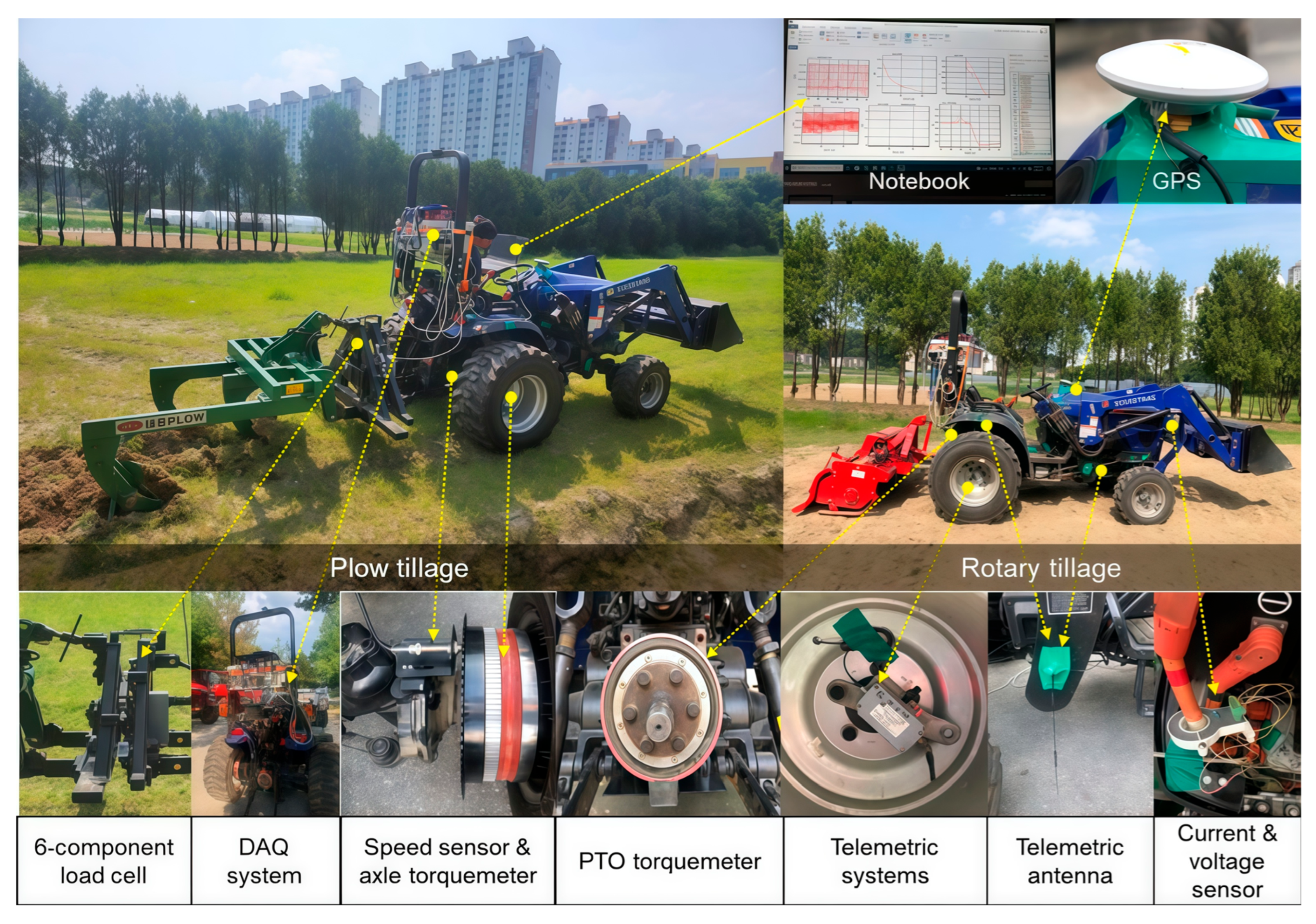
Distributed drive architectures eliminate mechanical differentials, enabling independent torque control for each wheel. Strategies such as electronic differential control, direct yaw moment control, and multi-objective coordination significantly enhance maneuverability and traction [68,69]. For instance, Baek et al. [70] experimentally assessed an all-wheel-drive electric tractor, providing benchmarks for distributed control optimization, while Zhang et al. [71] applied fuzzy control in dual-wheel drive tractors to improve lateral stability and path tracking. Deng et al. [72] developed a 25-horsepower Distributed-Drive Electric Tractor (DDET) for paddy and upland field applications, encompassing chassis drive system design, dynamic-performance analysis and evaluation, simulation in ADVISOR under various operating conditions, and prototype testing. Theoretical, simulation, and experimental results are consistent, showing good overall dynamic performance with about 5400 N traction and rapid acceleration to 28.15 km/h in 5.53 s.
Motor torque is a critical control variable in electric tractors [73,74,75]. Conventional Proportion–Integration–Differentiation (PID) methods have been enhanced with fuzzy logic and swarm intelligence. For instance, Liu et al. [76] applied a Particle Swarm Optimization (PSO)-based torque control method, improving energy conversion efficiency in electric tractors. Wang et al. [12] developed an optimal torque allocation strategy for dual-motor hybrid cotton pickers, which dynamically distributes torque between front and rear motors to reduce energy consumption. Moreover, predictive and learning-based algorithms have also gained traction. For example, Deng et al. [77] combined speed prediction with Model Predictive Control (MPC) to optimize plowing operations, while Feng et al. [78] applied Pontryagin’s minimum principle with workload forecasting for hybrid tractors. Collectively, these studies highlight the shift toward adaptive, data-driven torque control strategies capable of meeting the dynamic demands of agricultural environments.

2.3.2. Fault Prediction and Intelligent Control

Harsh agricultural conditions, such as dust, clogging, humidity, and fluctuating loads, necessitate robust fault prediction and diagnostic systems. Zhang et al. [79] developed a fuzzy speed control system for combine harvesters using a PSO–Support Vector Machine (SVM) hybrid model, which effectively predicted clogging and optimized operating speed. Zheng et al. [80] proposed an adaptive header control system based on an improved PSO–fuzzy PID algorithm to minimize cabbage head damage under variable operating conditions. Liang et al. [81] presented an improved dung beetle optimization-SVM model for Internet of Things (IoT) sensor fault detection, addressing drift and bias, while Zou et al. [82] emphasized the importance of integrating data-driven diagnostic methods in agricultural systems. Tao et al. [83] further introduced an observer-based open-transistor fault detection scheme for PMSM in-wheel motors, improving fault tolerance in electric machinery. These advances underline the critical importance of fault-tolerant control in maintaining system stability.
Advancements in IoT and precision agriculture have expanded electric control systems beyond individual machines. For example, Yu et al. [5] reviewed powertrain supervisory control in electric tractors, emphasizing data-driven integration between vehicle-level and supervisory layers. Mansoor et al. [84] analyzed IoT-enabled smart farming frameworks, identifying enablers such as soil and plant monitoring and real-time communication. To maintain data reliability, Liang et al. [81] highlighted IoT sensor fault diagnosis as a prerequisite for predictive maintenance and cooperative operation. These studies demonstrate that the IoT-enabled supervision systems are providing technical support for predictive maintenance, collaborative operations, and fleet-level optimization in EAM.
Adaptive torque control dynamically adjusts motor torque output based on real-time load and operational conditions, ensuring efficient operation under varying agricultural environments. Fault prediction systems, using sensor data and machine learning algorithms, monitor the system’s status and predict potential failures, thus reducing failure rates and optimizing maintenance schedules. This integration helps minimize repair costs and extend the machinery’s lifespan. EAM operates under harsh conditions such as muddy fields, fluctuating humidity, and temperature changes, requiring systems with high fault tolerance. Adaptive torque control can dynamically adjust torque output to avoid system failure due to excessive or insufficient load. At the same time, the fault prediction system can detect potential issues in real-time and adjust the control strategy to prevent complete system failure, enhancing the reliability of the machinery.
Furthermore, adaptive torque control optimizes energy usage and reduces waste, while intelligent control systems, employing optimization algorithms, adjust work strategies based on the demands of different operational stages, improving energy efficiency and task performance. The integration with fault prediction systems allows the intelligent control system to adjust the operational mode when potential faults are detected, further reducing unnecessary wear and enhancing long-term operational stability. The synergistic effects of adaptive torque control strategies, fault prediction and intelligent control systems lead to increased reliability, reduced failure rates, shorter downtime for repairs, and higher operational efficiency. When combined, these systems enable EAM to make intelligent decisions and adjustments based on real-time conditions, improving task performance and lowering overall operational costs.
Electric control systems are vital to ensuring safe, reliable, and efficient operation in EAM. Current research emphasizes distributed drive strategies, adaptive torque control, robust fault prediction, and IoT-based supervisory management. Future directions will likely focus on integrating Artificial Intelligence (AI) for adaptive learning, strengthening fault tolerance in extreme environments, and enabling cooperative multi-machine coordination, thereby laying the groundwork for intelligent, autonomous, and sustainable farming.

3. Powertrain Systems of EAM

In recent years, research on vehicles has demonstrated the feasibility and advantages of new energy technologies, providing critical insights and technical foundations for the electrification of agricultural machinery such as tractors and combine harvesters. From the perspective of energy sources, EAM powertrains can be broadly divided into battery-electric and hybrid systems. Hybrid systems are further classified into series, parallel, and power-split configurations, depending on their energy coupling mechanisms. Each architecture exhibits distinct energy flow patterns and efficiency characteristics, which play a decisive role in the design and optimization of EMSs. This chapter reviews recent progress in EAM powertrain research according to energy source type, compares the advantages and limitations of different architectures, and outlines future development trends.

3.1. Battery Electric Powertrain System

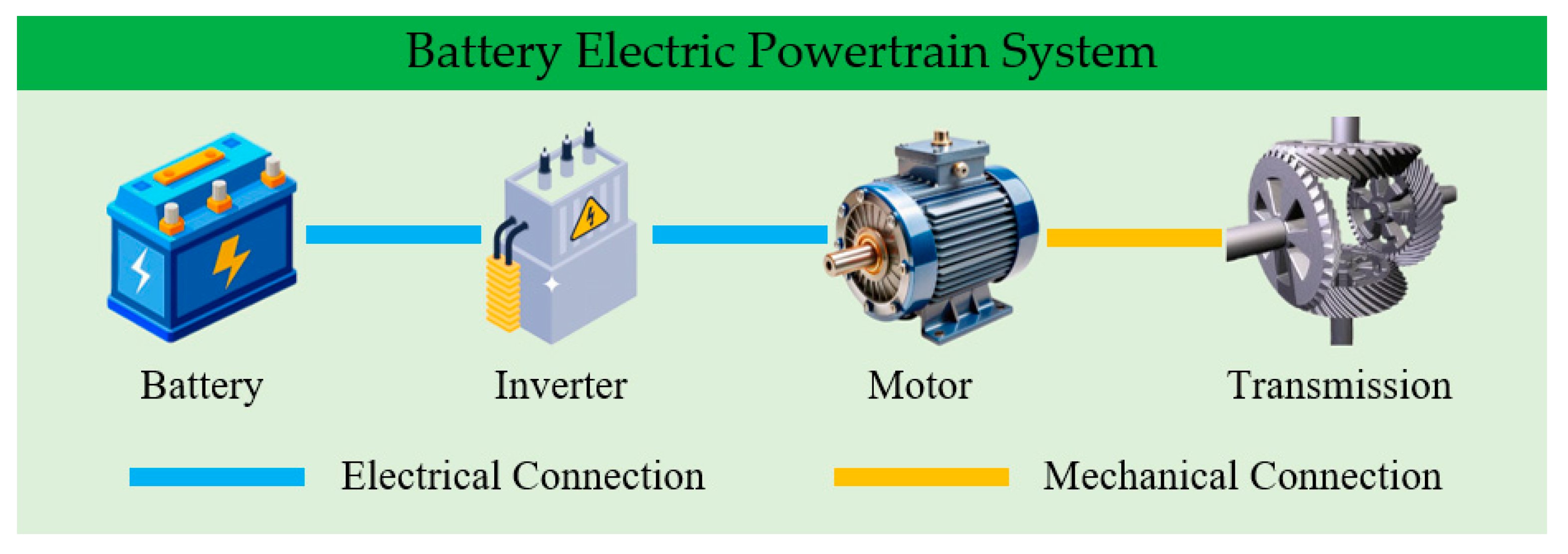
Battery electric agricultural machinery, powered exclusively by battery as the sole energy source, as shown in Figure 2, is characterized by zero emissions, low noise, and high energy efficiency. Owing to the simplification of transmission systems, distributed drive chassis architectures and electronic differential steering technologies have been widely adopted, improving maneuverability and off-road performance [85]. Current research has focused on extending battery endurance through advanced battery technologies and fast charging, designing low-speed, high-torque electric drives, and implementing multi-power-end dynamic balancing control strategies [15].
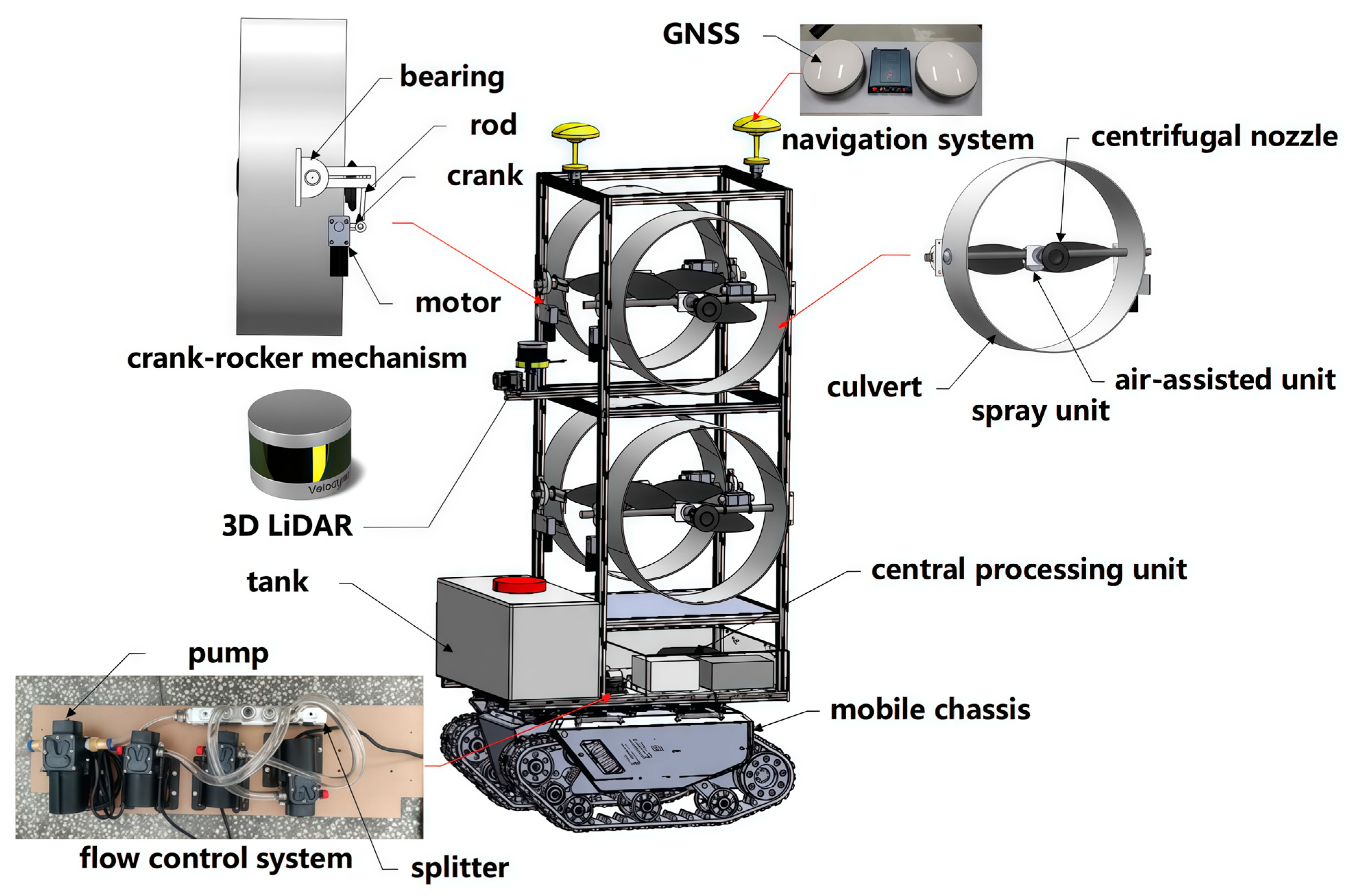
John Deere’s SESAM tractor, equipped with a 130 kWh battery that enables up to 4 h of continuous operation but requires 3 h for recharging and offers a lifespan of just over 3000 cycles. The Fendt e100 Vario, with a smaller 28 kWh battery and fast-charging capability, is more suitable for light-duty tasks on small farms, though adoption is limited by high initial costs and insufficient charging infrastructure [86]. To address the low-speed, high-torque characteristics of tractors, Xu et al. [87] proposed a dual-motor input with dual-planetary gear coupling output, which significantly outperforms traditional static designs and offers a new pathway for optimizing transmission in battery electric tractors. Additionally, Liu et al. [88] developed a battery-electric precision multi-variable spraying robot with a swinging fan structure, enabling variable flow, adjustable air volume, tunable droplet size, and flexible spray direction. Field tests showed pesticide usage was reduced by up to 83% while improving spraying effectiveness compared with conventional methods.

3.2. Hybrid Electric Powertrain Systems

In vast and sparsely populated agricultural regions, weak and unstable grid infrastructure presents a major barrier to large-scale deployment of charging facilities. Seasonal and cyclical fluctuations in electricity demand further limit charging efficiency. Additionally, the high cost of batteries, scarcity of raw materials, and complex manufacturing processes exacerbate challenges such as long charging times, poor environmental adaptability, and limited driving range, thereby restricting the widespread adoption of battery-electric systems. Consequently, hybrid powertrains have emerged as a key research focus, offering improved endurance and reduced costs [15].

3.2.1. Series Hybrid Electric Powertrain System

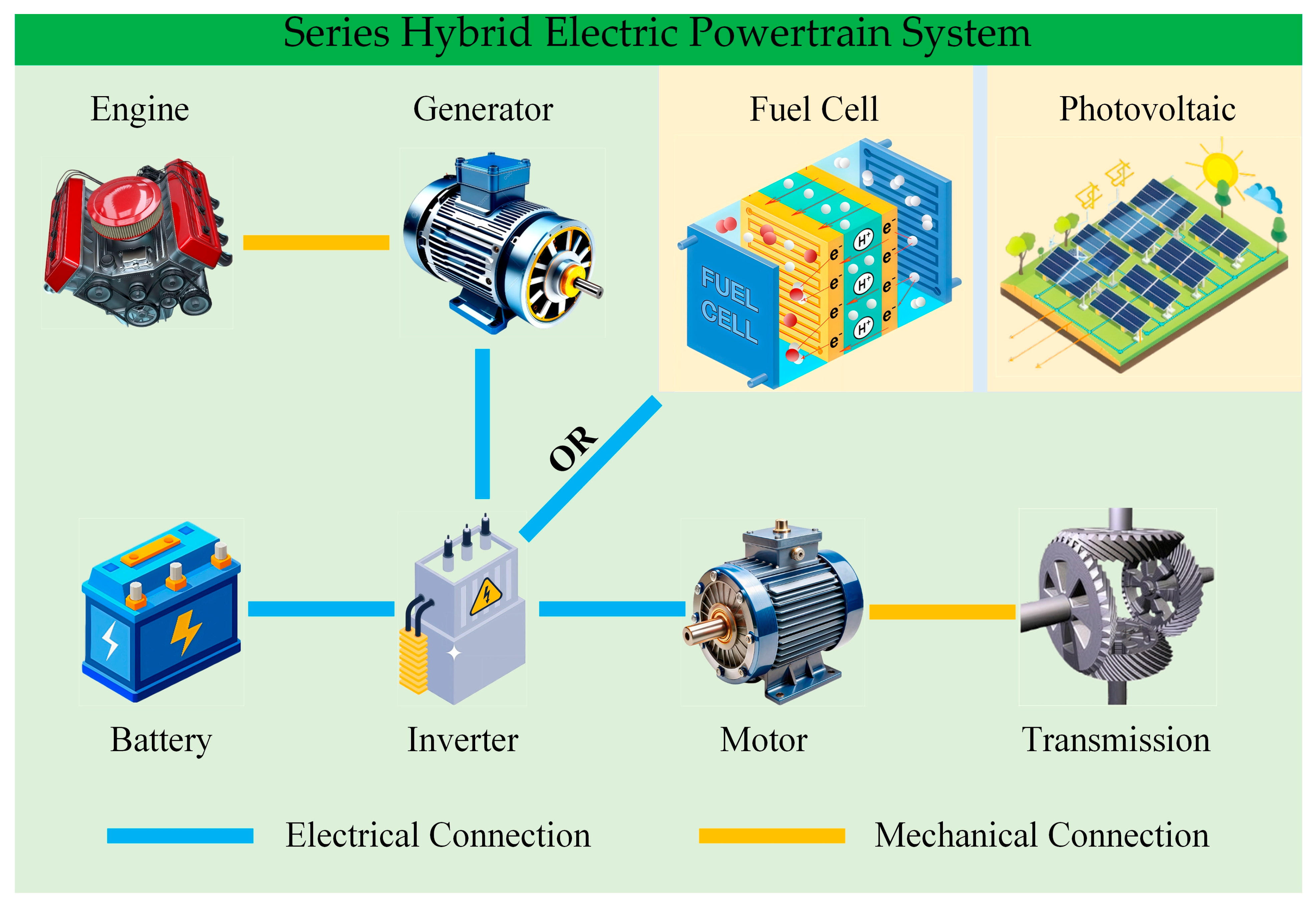
As illustrated in Figure 3, the series hybrid powertrain decouples the ICE from the mechanical drivetrain of the agricultural chassis. Instead of directly powering the drivetrain, the ICE drives a generator that converts mechanical energy into electrical energy. This electricity can either be used to drive the agricultural machinery directly or be stored in the battery. During acceleration or under heavy loads, the electric motor draws supplementary power from the battery to provide additional traction. Conversely, during braking or downhill operation, the motor functions in generator mode, converting kinetic energy into electricity and storing it in the battery, thereby enabling regenerative braking. The series configuration allows the ICE to consistently operate within its high-efficiency region, thereby improving overall fuel economy [89]. Compared with other configurations, its advantages include a simplified transmission system and more straightforward optimization of control strategies. For example, Zhu et al. [14] introduces a new type of SHECH based on distributed power drive technology, which significantly reduces the mechanical transmission structure and lowers fuel consumption. Estevez et al. [90] developed a series-connected hybrid tractor designed for orchard applications. By employing real field data and a two-level optimization program to refine both control strategies and component dimensions, they achieved a system with higher transmission efficiency compared to conventional transmission systems. To evaluate the performance of the series hybrid tractor transmission system, Abououf et al. [91] proposed a high-precision framework for assessing fuel consumption across multiple operating cycles and terrain conditions. The results indicated that, compared with conventional tractors, average fuel consumption was reduced by 31%, underscoring the potential advantages of hybrid power in agricultural applications. Nevertheless, because the ICE cannot directly drive the chassis, energy must undergo two conversion stages, generator and motor, resulting in reduced overall efficiency. Moreover, the need for large-capacity batteries and high-power electric motors substantially increases system costs.
Fuel cells represent another promising alternative, serving as energy converters that directly transform the chemical energy of hydrogen into electricity through electrochemical reactions [92,93]. Unlike conventional engines, fuel cells operate without mechanical work or thermodynamic cycles and are not constrained by the Carnot limit, thereby achieving relatively high energy conversion efficiency [20]. Additional advantages include low emissions, rapid refueling, and quiet operation. For instance, Lei et al. [94] reports on a hydrogen-powered tractor that achieves acceleration by directly increasing fuel cell output power, while refueling requires only half the time needed to recharge conventional electric powertrains. Li et al. [95] proposed a hierarchical progressive collaborative control strategy for the distributed drive system of fuel cell tractors. By incorporating steering angle and load information collected during field operations and validating the system through a HIL platform, their study demonstrated that this approach effectively optimized slip rate and hydrogen consumption under both farming and transportation conditions. This work provides a valuable reference for improving the energy efficiency and operational stability of fuel cell tractors. However, fuel cells still face critical challenges such as high cost, limited lifespan, safety concerns, and unfavorable output characteristics. Given the abundance of open farmland with ample solar resources, Photovoltaic (PV) modules can be integrated into EAM to recharge batteries and extend operational range [96,97]. Nevertheless, the intermittent nature of solar energy, combined with limitations in conversion efficiency and the restricted surface area of PV panels, makes it unsuitable for continuous, large-scale power supply [98,99]. Consequently, PV-assisted systems are currently most applicable to light-duty agricultural operations such as mowing, spraying, and field inspection, and their practical application scenarios remain relatively limited [100].

3.2.2. Parallel Hybrid Electric Powertrain System

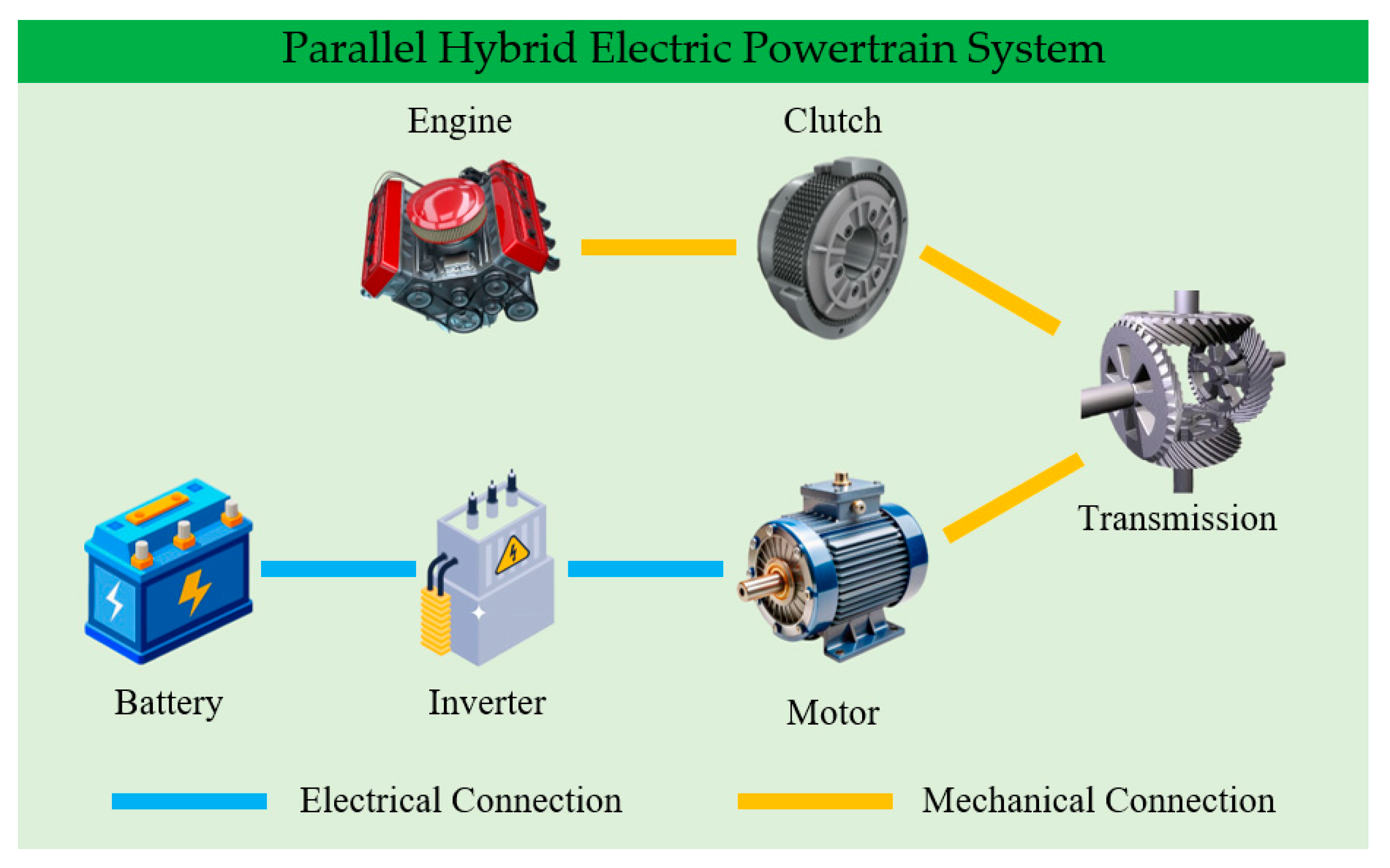
The defining feature of the parallel hybrid powertrain is that both the ICE and the electric motor deliver mechanical power to the chassis through a coupling device, as shown in Figure 4. In this configuration, the ICE and motor can drive the agricultural machinery either independently or jointly.
Since only a relatively small motor is required, costs are reduced while high peak power output can still be achieved. Under low-load conditions, such as start-up or light-duty operations, the clutch disengages and the motor alone propels the machine, thereby improving fuel economy given the ICE’s poor performance in these regimes [101,102]. Under high-load conditions, such as acceleration or climbing, the clutch engages, enabling the ICE and motor to operate simultaneously, with the motor providing supplementary torque. Because both units can function in parallel, the system offers rapid power response. Moreover, as both can directly transmit mechanical power to the chassis, energy losses in the mechanical coupling system are lower than those in the electrically coupled series configuration.
Nonetheless, the torque output of the ICE varies with operating conditions, preventing it from consistently running in its optimal fuel consumption region, thereby limiting overall fuel economy. Furthermore, the requirement for a transmission increases drivetrain complexity and complicates dynamic state transitions [103].

3.2.3. Series-Parallel Hybrid Electric Powertrain Systems

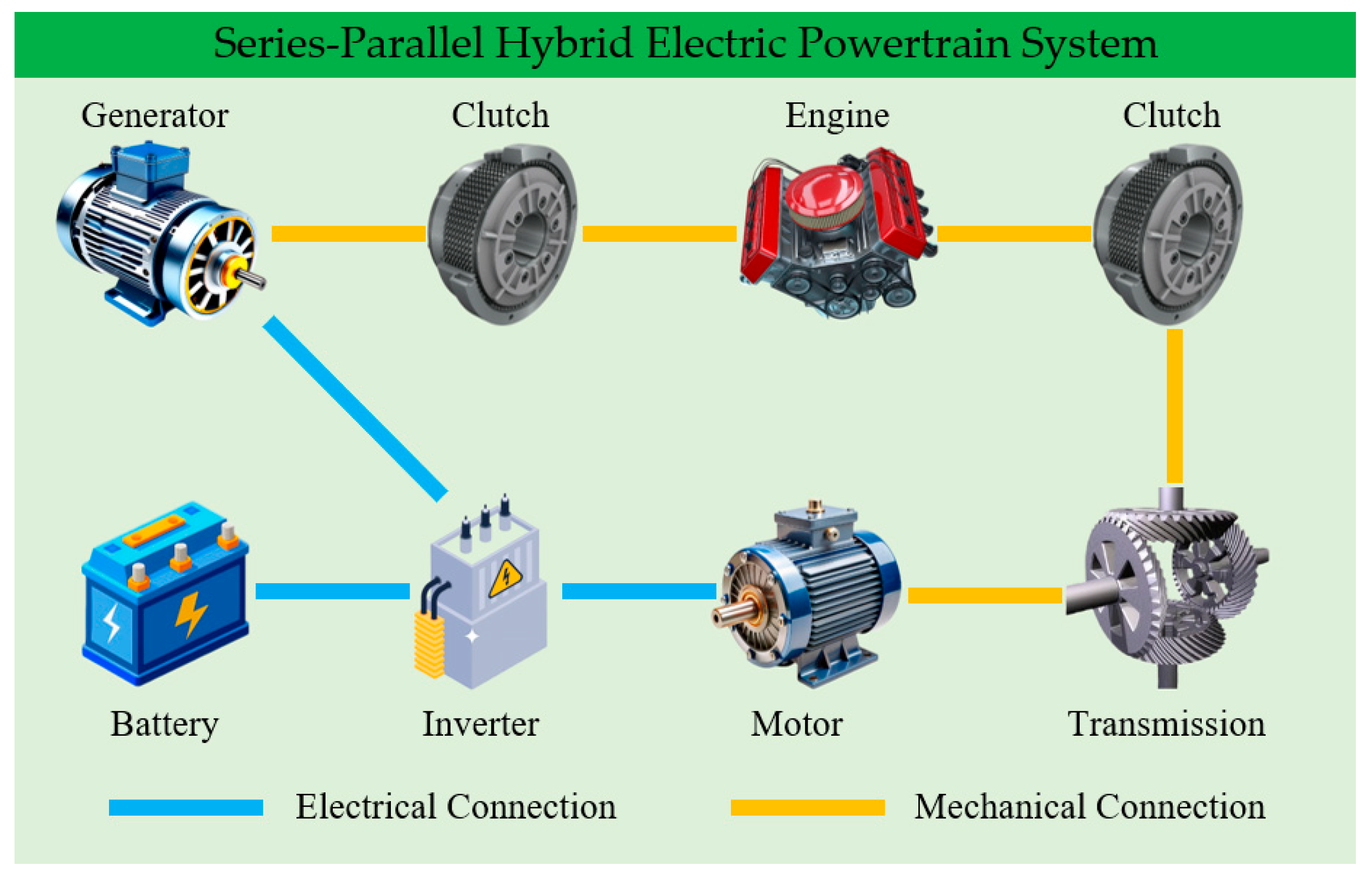
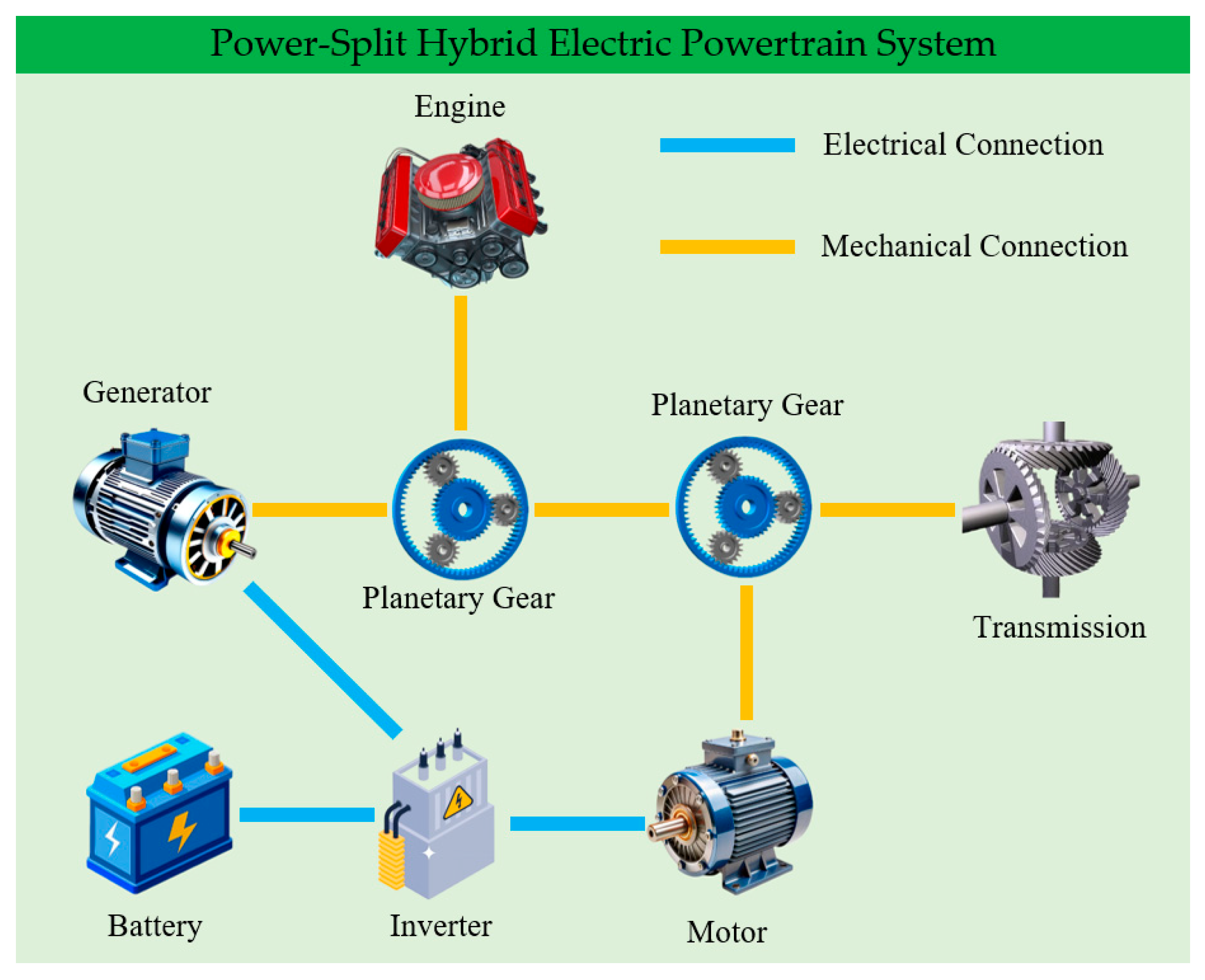
The series-parallel configuration combining series and parallel architectures integrates the advantages of both series and parallel systems. According to the different forms of energy coupling, it can be further divided into series-parallel and power-split hybrid electric powertrain system [104], which are, respectively, shown in Figure 5 and Figure 6.
In the series-parallel system, flexible switching between extended-range and parallel driving modes is achieved by controlling clutch engagement and disengagement. Specifically, the series mode is applied under low-load conditions, while the parallel mode is adopted during high-load operation. When the system output exceeds power demand, surplus energy generated by the engine-driven generator can be converted via an inverter and stored in the battery. In the power-split hybrid system, a planetary gear set functions as the power distribution mechanism, coupling the ICE, electric motor, and generator. This configuration enables dynamic adjustment of power flow based on operating conditions, thereby enhancing component efficiency, energy utilization, and overall system performance [105,106]. By decoupling engine speed and torque from vehicle load and driving speed, the ICE operating point is no longer constrained by external conditions. Moreover, part of the power can be transmitted directly to the drive axle without undergoing additional conversion, further improving overall energy efficiency. Despite these advantages, power-split configurations require more components than either series or parallel systems, leading to higher costs. In addition, they impose stricter requirements on clutch design and control strategies, thereby increasing system complexity [107,108,109].
The series hybrid configuration remains the mainstream design for agricultural machinery, owing to its relatively simple and reliable structural and control features. By contrast, parallel and power-split configurations are less common, particularly in large-scale agricultural equipment, where system complexity and the number of components are significantly greater. The series configuration also provides greater flexibility in the integration of subsystem drive motors. Compared with conventional fuel-powered machinery, electrified agricultural equipment offers faster power response, improved operational efficiency, and enhanced fuel economy [104]. Furthermore, electric Continuously Variable Transmission (e-CVT) technology can markedly improve field performance [106]. Relative to battery electric machinery, the inclusion of internal combustion engines or fuel cells as stable range extenders effectively enhances endurance while reducing initial acquisition costs. Driven by these advantages, leading manufacturers worldwide have begun actively exploring the development of EAM. Nevertheless, most efforts remain at the conceptual stage, and mature commercial products are still lacking. The primary barriers are endurance capability and economic feasibility, with endurance being the most critical factor restricting large-scale adoption. For battery electric agricultural machinery, endurance improvements largely depend on advances in battery energy density, while hybrid systems achieve extended range through the integration of fuel, solar energy, or fuel cells [15]. Among agricultural equipment, tractors, owing to their versatility and widespread adoption, are expected to spearhead this transition. Specifically, small- and medium-horsepower battery electric tractors, along with large-horsepower series hybrid tractors, are the most likely candidates for early adoption, considering both endurance and economic factors. Moreover, the rapid development of electric construction machinery, supported by the well-established industrial chain of NEVs, has created favorable conditions for advancing EAM. Looking ahead, it will be essential to fully leverage existing technological advantages to accelerate the research, development, and commercialization of such equipment. Table 3 presents a comparison of the powertrain systems employed in EAM.

4. Energy Management Strategy of EAM

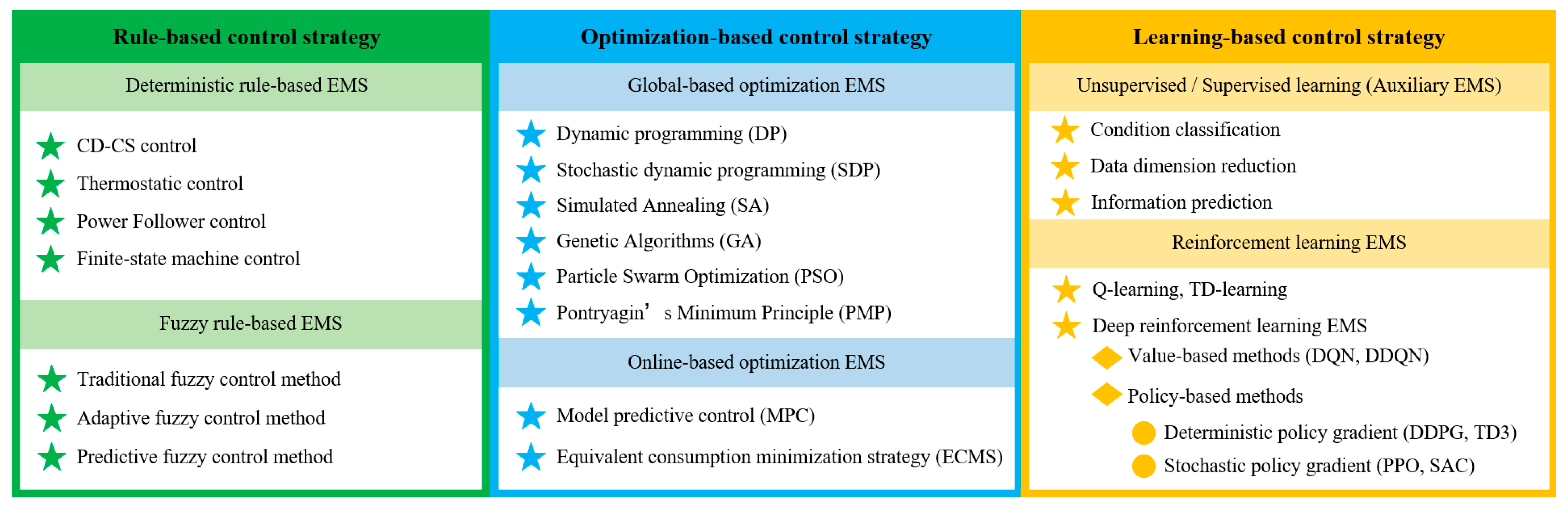
EMSs play a critical role in improving the fuel economy of EAM, maintaining system health, and reducing greenhouse gas emissions [110]. However, the development of efficient EMSs remains highly challenging due to the nonlinear complexity of power systems and the stringent real-time requirements of online applications. Unlike NEVs, which primarily focus on propulsion, EAM must operate with a wide variety of implements, such as harvesters, rotary tillers, plows, pesticide sprayers, straw crushers, and weeders, during field operations [111,112,113]. As a result, the power system must not only satisfy the demands of vehicle propulsion but also provide sufficient energy for various working tools. Achieving an optimal power distribution between the driving system and the implement power system is therefore a key research direction in EAM. Control-technology-based EMSs offer a feasible pathway to address this challenge [5,15,114]. At present, commonly employed strategies include rule-based, optimization-based, and learning-based approaches, as shown in Figure 7. Each of these methods exhibits distinct advantages and limitations, with performance outcomes varying across different operating conditions. Consequently, hybrid approaches that integrate and complement multiple strategies often yield superior control performance. This suggests that EMS methods should not be regarded as isolated, but rather as mutually reinforcing techniques with significant potential for synergy and integration [115,116,117].

4.1. Rule-Based Control Strategy

Rule-based EMSs are typically developed using engineering experience, numerical models, or experimental data to establish control rules. These methods offer advantages such as low computational requirements and straightforward implementation, making them among the most mature control strategies currently in use. However, their limitations are also evident, including a lack of global optimality, heavy reliance on extensive parameter calibration, and limited adaptability to diverse agricultural environments, operating conditions, and power system architectures. Depending on the form of the rules, this category can be further divided into deterministic rule-based EMSs and fuzzy rule-based EMSs [118,119].

4.1.1. Deterministic Rule-Based EMSs

Deterministic rule-based EMSs primarily rely on the engine’s economic operating region and the charge–discharge characteristics of the battery to define a high-efficiency state-of-charge (SOC) range. Typical input parameters include vehicle speed, total power demand, battery SOC, and the engine’s optimal operating zone, with control rules formulated under expert guidance. This approach enables mode switching and rational power distribution among multiple sources while meeting the power demands of field operations, thereby improving fuel economy. Representative strategies include charge-depleting/charge-sustaining (CD-CS), thermostatic control, power-following control, and finite-state machine control. For example, Vu et al. [120] designed a series-hybrid snow blower/tractor system with a downsized engine and rule-based EMS, demonstrating reduced emissions and fuel consumption in simulation, with applicability to various tractor-mounted implements. Similarly, Sun et al. [121] developed a fuel-cell-battery hybrid tractor with a rule-based EMS that balanced current between the fuel cell and battery to maintain SOC, mitigate fuel-cell degradation, and extend operating time. Marzougui et al. [122] developed a solar-powered mini vertical take-off and landing unmanned aerial vehicle employing a state-machine EMS to allocate solar power and store surplus energy as altitude energy, improving energy savings by 11.11%.
Thermostatic control can minimize fuel consumption and emissions by managing engine operation and storage, but it induces frequent switching and deep battery cycles. Power-following control improves overall system efficiency and battery durability relative to thermostatic control, but may not meet all load demands. To address these limitations, Xu et al. [123] proposed a thermostatic strategy integrated with fixed-point engine control and dynamic SOC threshold adjustment, which reduced fuel consumption and improved electric energy utilization; however, its adaptability under harsh conditions remained limited and posed risks of reduced battery lifespan. With the gradual shift from conventional fuel-battery configurations to diversified hybrid energy systems, frequency-decoupling techniques such as low-pass filtering and wavelet transforms have been introduced into power management. These methods allocate low-frequency loads to slow-dynamic sources and high-frequency, peak loads to fast-dynamic sources. Experimental studies show that this strategy not only meets the total power demands of agricultural machinery but also alleviates transient and peak-load stresses on the power system, significantly reducing performance degradation and potential damage to fuel cells under real-world operating conditions [24].

4.1.2. Fuzzy Rule-Based EMSs

The fuzzy rule-based EMS addresses uncertainty and ambiguity by emulating human decision-making processes and is particularly effective for complex, nonlinear, and multivariable systems that are difficult to model precisely [124]. Input variables such as battery SOC, driving speed, and power demand are processed through fuzzy logic to develop control strategies aimed at optimizing fuel economy and reducing emissions, with performance largely determined by the design of membership functions and fuzzy rules. To meet the endurance requirements of electric tractors during sowing operations, a precise energy-consumption model was developed and proposed a CD-CS EMS integrating fuzzy control with Nondominated Sorting Genetic Algorithm II (NSGA-II) optimization; HIL simulations and field tests showed significant extensions in battery life, reduced SOC decline, and stabilized power consumption variance, verifying its feasibility [125]. For a high-horsepower series hybrid tractor, an optimized fuzzy-control-based EMS with working-condition adaptability was proposed, employing a PSO-SVM model for real-time operating-condition recognition and Genetic Algorithms (GAs) for offline parameter optimization; simulation results showed a recognition error of only 1.19% and fuel consumption reductions of 6.96% and 3.38% compared with power-following and adaptive fuzzy control strategies, respectively [26]. To address the limitations of conventional EMSs under variable conditions, Zhao et al. [126] developed a fuzzy-following EMS to optimize tractor energy output and stabilize power delivery; CRUISE-Simulink co-simulations and field trials under light-load, plowing, and power-harrowing conditions confirmed stable SOC, enhanced fuel economy, and balanced power output, outperforming a powershift tractor in plowing efficiency and fuel consumption. Nevertheless, hybrid energy storage systems remain constrained by the reliance of fuzzy control on predefined rules derived from expert knowledge and mathematical models, which limits adaptability across highly variable agricultural operating conditions [127].
Both deterministic and fuzzy control strategies rely heavily on engineering expertise and struggle to achieve global optimality while accounting for multiple state variables. For instance, the design of fuzzy rules and membership functions is typically based on expert knowledge, posing challenges for designers without extensive practical experience. The main limitation of rule-based EMS lies in its inherent lack of optimality, which hinders achieving the best or near-best fuel economy. Nevertheless, compared with optimization-based methods, rule-based strategies offer high computational efficiency and therefore remain highly practical for real-world engineering applications.

4.2. Optimization-Based Control Strategy

The complex architecture of power systems in EAM presents significant challenges for control strategy development. Because fuel economy and power performance often conflict, model-based optimization methods are essential to achieve an effective balance between the two. In recent years, various optimization algorithms, predominantly numerical approaches, have been applied to energy management in agricultural machinery [128,129,130]. Based on the information used, these optimization-based strategies can be broadly categorized into global optimization and real-time optimization methods.

4.2.1. Global-Based Optimization EMSs

Global optimization is an offline approach aimed at obtaining optimal solutions by leveraging prior information collected over an entire operating cycle. Representative algorithms include Dynamic Programming (DP), Simulated Annealing (SA), GA, and Pontryagin’s Minimum Principle (PMP). These methods typically require detailed operating-condition data as input and use numerical computation to derive globally optimal solutions [131,132]. However, their high computational complexity makes them unsuitable for real-time applications. As a result, global optimization is often employed as a benchmark to evaluate and compare improved online strategies. The solution process generally involves formulating the optimization model, defining objective functions, imposing constraints on state variables, and solving the model numerically [133,134].
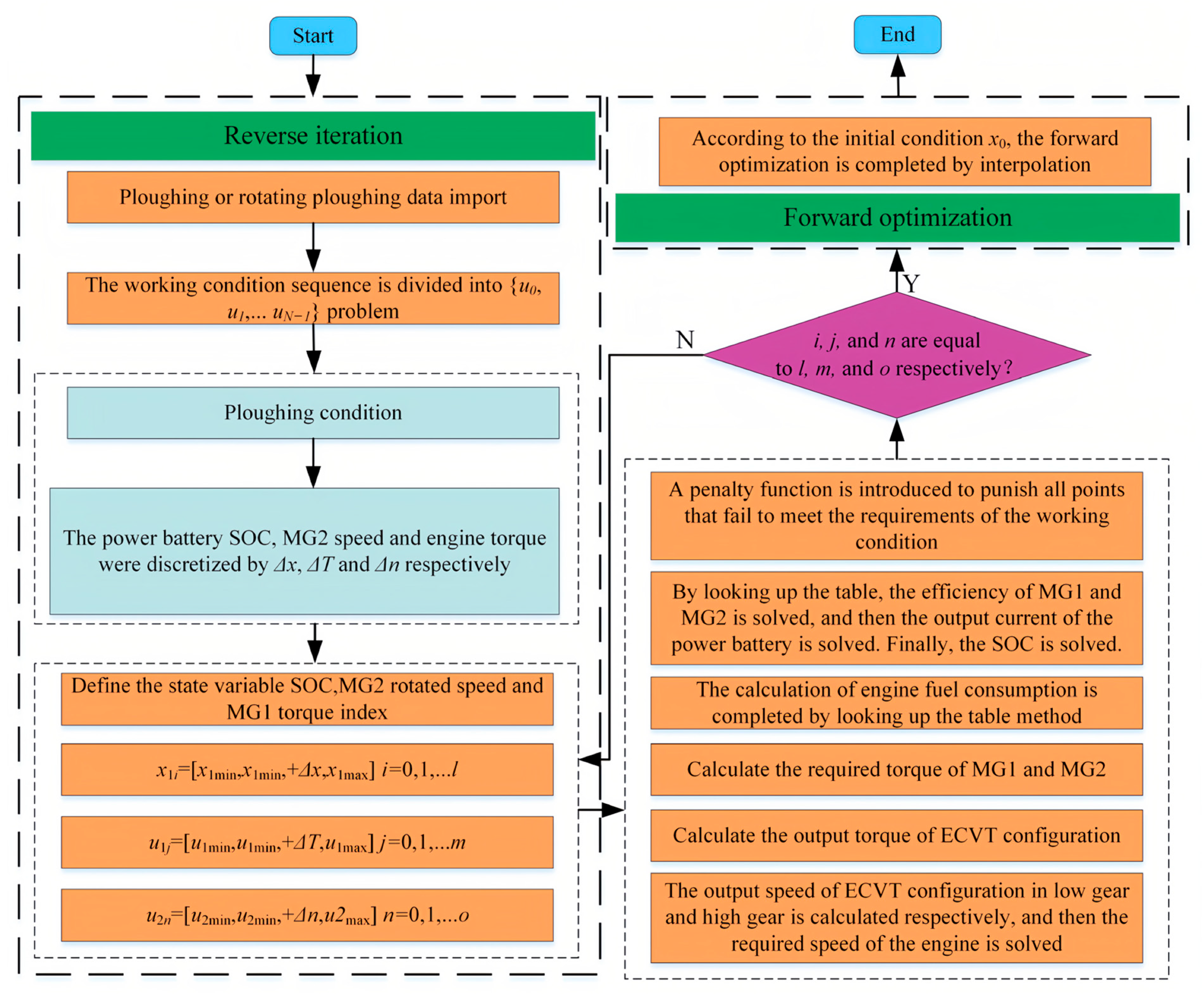
DP is the most widely used global optimization algorithm. Its principle is to decompose a complex problem into a series of simpler, structurally similar subproblems, which are then solved through exhaustive search to obtain a globally optimal solution. As a mature optimization method, DP can yield optimal solutions for problems of varying complexity. In agricultural machinery, DP-based control strategies are typically applied offline to address energy distribution problems and to generate optimal power allocation rules for specific operating conditions. For example, Zhang et al. [135] proposed a DP-based global optimal EMS for a diesel-electric parallel hybrid tractor equipped with a CVT. A tractor-rotary tillage coupling dynamics model was developed, and MATLAB 2022b simulations verified that the DP strategy enabled the diesel engine and motor to operate within their optimal regions, reducing total energy consumption costs by 16.89% compared with a power-following strategy under rotary tillage conditions. Zhang et al. [136] focused on a high-power series-parallel hybrid tractor with an output-split electronic CVT and proposed a Bellman-DP-based EMS under plowing conditions, as shown in Figure 8. Using equivalent fuel consumption as the performance index, simulations demonstrated that the DP strategy fully exploited low-cost electric energy, enhanced speed-torque decoupling, and improved secondary energy conversion, reducing equivalent fuel consumption by 26.87% compared with the optimal operating line strategy. Similarly, to overcome the limitations of experience-based EMS, Yan et al. [137] developed a DP-based strategy for series hybrid tractors under plowing, rotary tillage, and transportation conditions. With fuel consumption minimization as the objective, simulations showed that, compared with a power-following strategy, the DP-based EMS effectively optimized engine operation, reducing fuel consumption by 25.28%, 21.54%, and 13.24% under the three conditions, respectively, while moderately increasing battery SOC utilization.
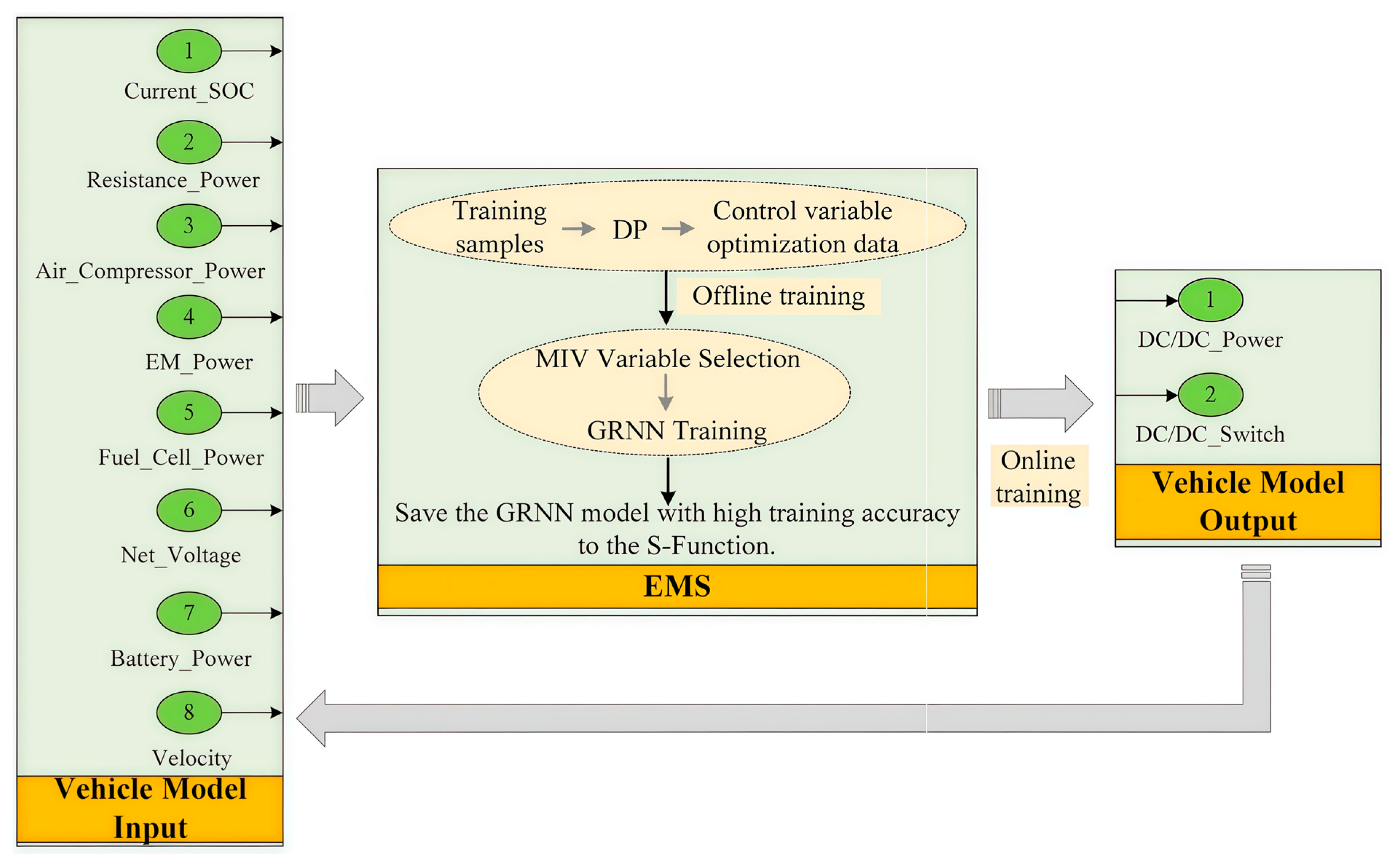
However, DP requires fine discretization of SOC and other state variables, leading to intensive interpolation workloads, and its computation time increases exponentially with the number of variables, restricting real-time applicability [138]. To address these limitations, Li et al. [139] proposed a hierarchical DP approach, combining DP-based upper-level optimization with a neural-network-assisted lower layer to enable real-time implementation and reduced training time, as shown in Figure 9. HIL validation confirmed its effectiveness, with hierarchical DP achieving 6.73% lower hydrogen consumption under plowing and 4.87% under transportation compared with power-following control. This work provides a solid theoretical foundation for tractor dynamic system modeling and energy management optimization.
Stochastic Dynamic Programming (SDP) extends DP by explicitly incorporating stochastic processes to address operational uncertainty. Unlike conventional DP, which depends on prior knowledge of operating conditions, SDP leverages the Markov property to predict state transition probabilities and iteratively learn optimal policies. For example, Guo et al. [140] proposed a real-time adaptive EMS that integrates SDP with an extremum-seeking algorithm to manage unpredictable operating conditions. This approach reduced peak battery loads, mitigated deep discharges, and minimized high-current events, thereby extending battery life. It also optimized energy allocation between the battery and supercapacitor, enabling the latter to handle rapid load fluctuations and regenerative braking. Similarly, Li et al. [141] developed a real-time adaptive EMS that combines the global optimization capability of SDP with the instantaneous optimization of extremum seeking, demonstrating real-time feasibility and improved tractor mileage. Nevertheless, SDP remains constrained by its reliance on state transition matrices derived from historical data, which imposes significant computational and storage burdens. Furthermore, the difficulty of accurately determining transition functions continues to hinder its large-scale real-time implementation.
In practice, agricultural environments are marked by pronounced randomness and uncertainty, making it virtually impossible to obtain precise information over an entire duty cycle. Moreover, the substantial computational demands of global optimization algorithms restrict their direct application in real-time EMSs. Consequently, offline optimization is frequently employed as a benchmark to guide the development and refinement of online control strategies [117,118]. Some studies have also attempted to transfer parameters derived from offline optimization to enhance rule-based EMS; however, these parameters generally deliver high performance only under specific cyclic conditions and exhibit poor adaptability to diverse and varying operating scenarios [119].
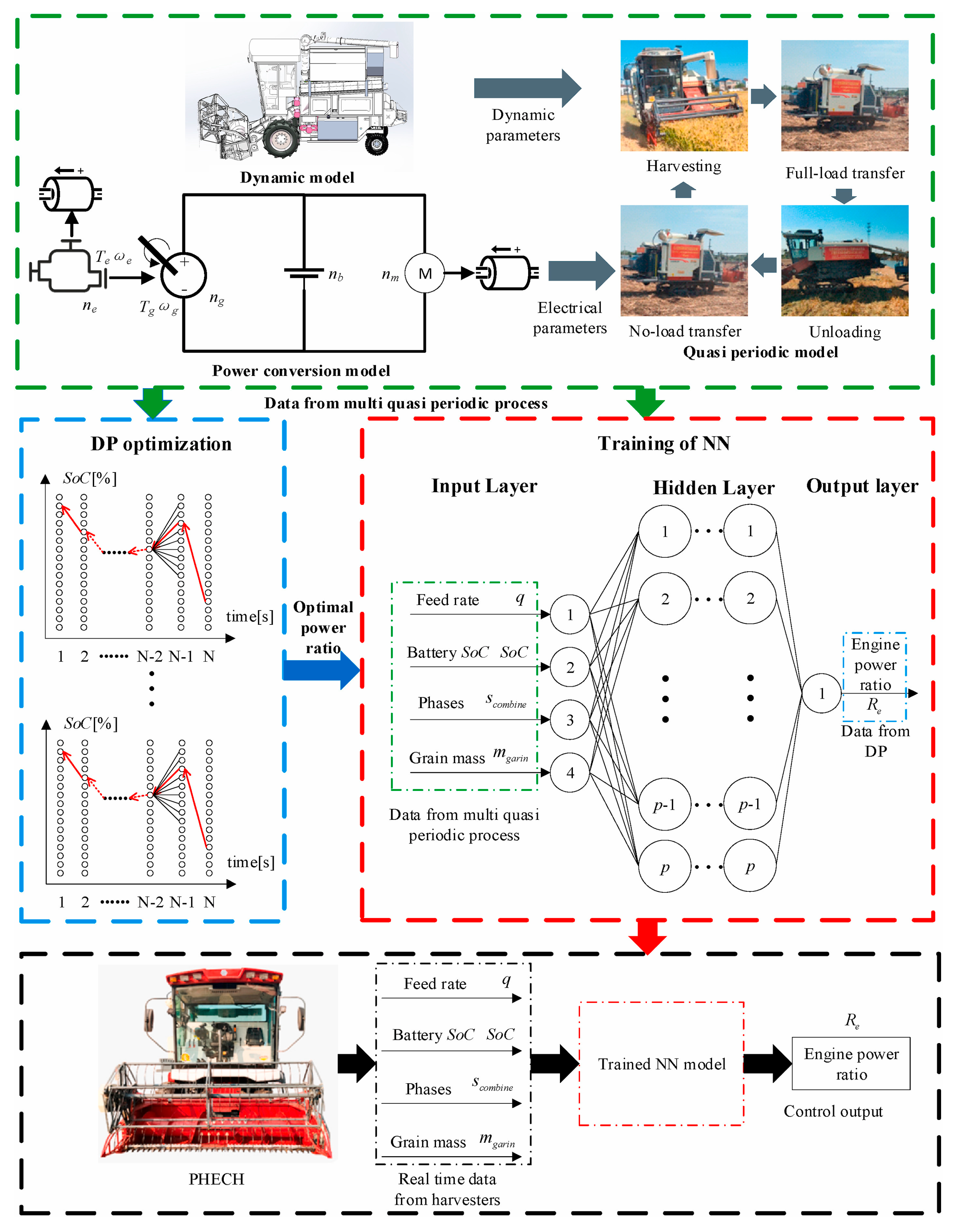
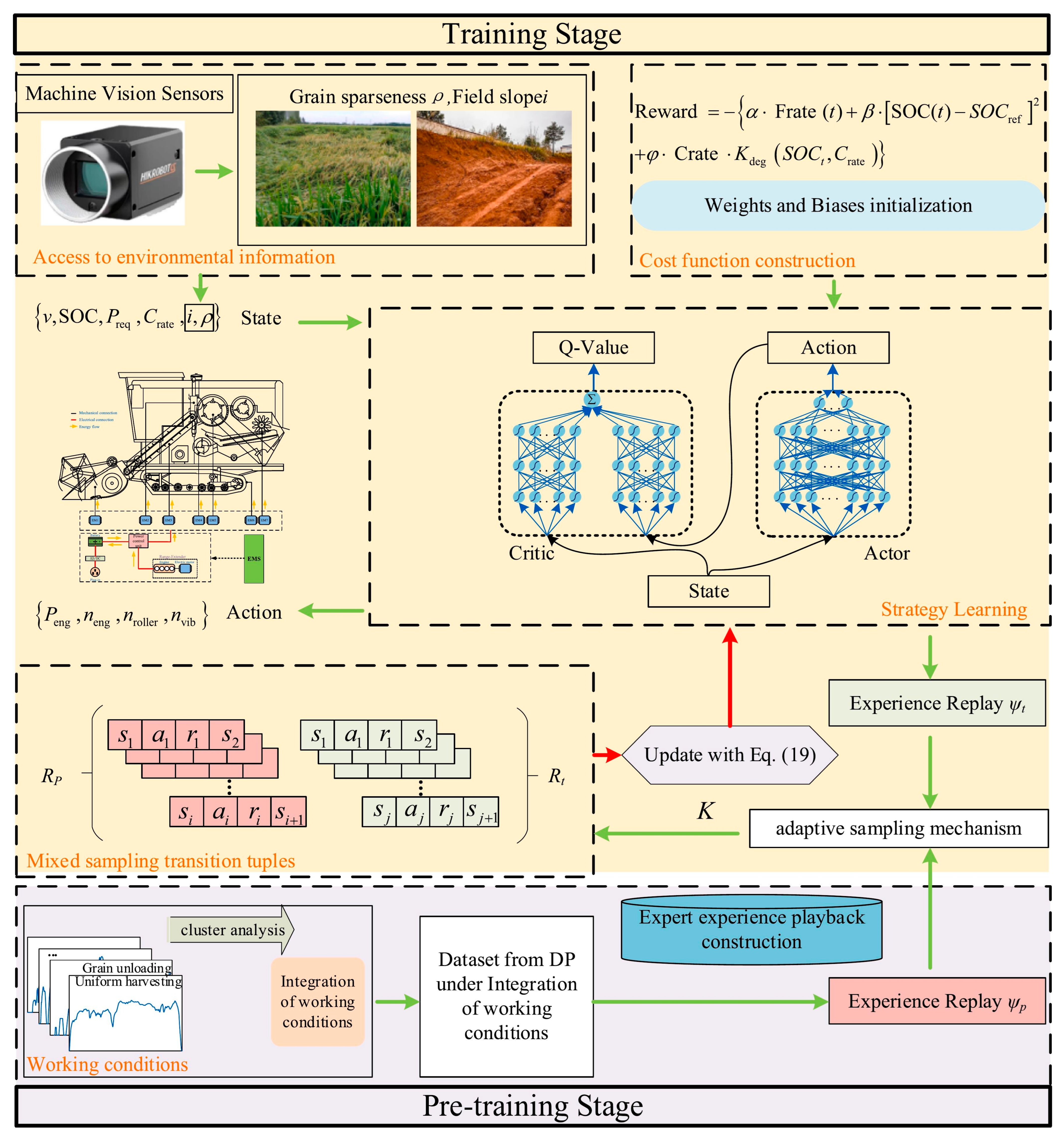
For example, Weng et al. [142] applied DP to derive optimal engine power ratio samples across various scenarios. Building on these samples, a Neural Network (NN) was developed to enhance the strategy’s economic and real-time performance. The findings indicate that the NN strategy achieves energy cost savings comparable to those of the DP approach. Wang et al. [143] developed a DP-based EMS, incorporating harvest quality constraints for the SHECH. The feasibility of the threshing quality constraints was analyzed and compared, serving as the benchmark for future real-time EMSs that consider harvest quality. Subsequently, the DP solution results are stored in a slow buffer area and integrated with the DDPG algorithm. These DP solutions guide the DRL agent during the training process. The results demonstrate that this EMS achieves 93% of the performance of the DP approach. Analogously, Li et al. [144] proposed an RL EMS for electric tractors, modeling power demand as a Markov process and optimizing power allocation between a lithium-titanate battery and a supercapacitor, achieving 94.3% of the performance of DP.

4.2.2. Online-Based Optimization EMSs

Unlike global-based optimization methods, online optimization control strategies focus on achieving real-time performance under limited computational and memory resources. They typically use instantaneous or short-term fuel consumption as the optimization objective. Representative approaches include MPC and the Equivalent Consumption Minimization Strategy (ECMS).
MPC, a key branch of predictive control, determines the optimal control action by simulating the system’s behavior over a defined prediction horizon. Typical solution techniques include dynamic programming, the generalized minimal residual method, nonlinear programming, and Pontryagin’s minimum principle [145]. Unlike global optimization approaches, MPC does not require prior knowledge of the complete driving cycle; instead, it combines the advantages of instantaneous and global optimization. By constructing a predictive model, minimizing a cost function, and continuously updating decisions based on real-time measurements, MPC achieves rolling optimization. For example, Curiel et al. [146] formulated an MPC-based EMS as a multi-objective optimization problem targeting power sharing, SOC regulation, fuel consumption minimization, and engine efficiency maximization, with secondary goals of mitigating battery degradation and temperature rise. Compared with a rule-based strategy, their approach achieved a balanced trade-off among objectives, reducing fuel consumption by up to 12.17%, lowering battery temperature by up to 23%, and decreasing battery degradation by more than 70% in some cases. Similarly, Radrizzani et al. [147] proposed a multi-objective MPC for minimizing fuel consumption while ensuring speed tracking by incorporating an engine-speed controller into the predictive model. Validated in a simulation environment experimentally representative of orchard vineyard tractors, this strategy demonstrated strong applicability to agricultural contexts. Nevertheless, MPC’s real-time implementation remains constrained by high computational demands and its dependence on accurate system modeling. Even so, compared with offline optimization algorithms, MPC offers greater adaptability to real-world conditions and delivers superior dynamic performance and robustness.
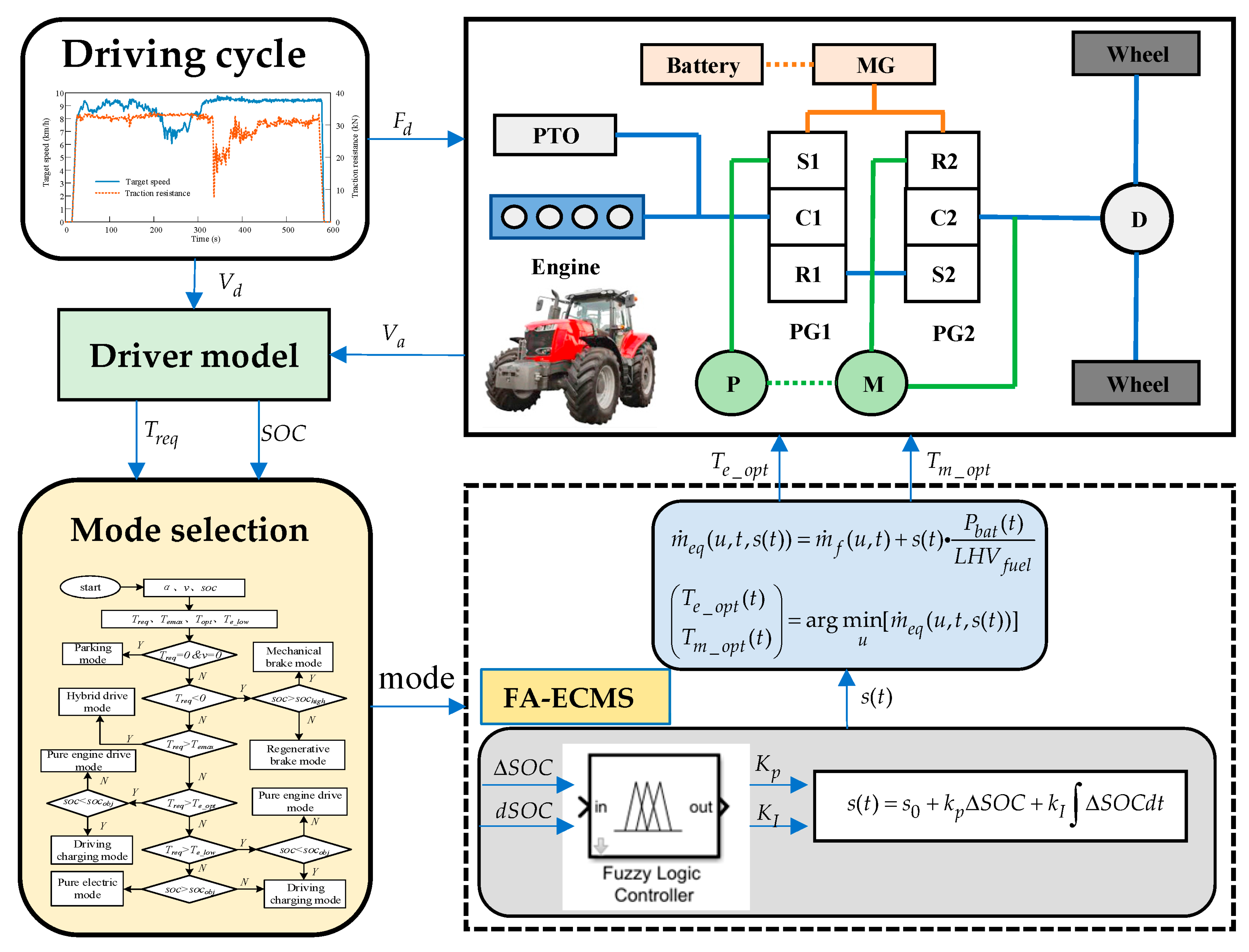
The ECMS allocates part of the energy cost to electrical energy by treating electricity consumption as equivalent to fuel consumption, with the equivalent cost depending on future operating conditions [148,149]. Zhang et al. [150] proposed an instantaneous optimization-based energy-saving control strategy for a parallel diesel-electric hybrid tractor, using engine and motor torques as control variables and battery SOC as the state variable. MATLAB simulations under rotary tillage and plowing conditions showed that the strategy effectively maintained both the engine and motor in their high-efficiency regions, reducing equivalent fuel consumption by 4.70% and 6.31%, respectively, compared with a power-following strategy. Wang et al. [12] developed a series hybrid power system for a six-row cotton picker featuring a two-speed gearbox and dual-motor drive, and evaluated its performance under power-following, ECMS, and Torque-Distribution ECMS (TD-ECMS) in MATLAB. The results showed that ECMS improved engine operating stability and reduced fuel consumption by 4.87%, while TD-ECMS further optimized dual-motor efficiency, yielding a 5.62% fuel-consumption reduction and enhanced overall economic performance. Radrizzani et al. [151] investigated a parallel hybrid tractor and proposed a modified ECMS-based EMS that explicitly incorporated speed-tracking requirements. Implemented on the tractor control unit and validated through extensive field experiments, this strategy delivered stable speed tracking and achieved an average fuel saving of 14%, consistent with simulation results. A major limitation of ECMS is its reliance on the equivalent factor, which is highly sensitive to environmental variations and consequently reduces system robustness. To address this challenge, Zhu et al. [23] developed a parallel hybrid high-horsepower tractor integrating an engine-motor dual power source with a hydro-mechanical continuously variable transmission and applied ECMS for power management. To enhance ECMS adaptability across different operating cycles, they proposed a fuzzy Adaptive ECMS (A-ECMS) incorporating SOC feedback fuzzy Proportional–Integral (PI) controller, as shown in Figure 10, validated under plowing and transport conditions, the A-ECMS achieved lower fuel consumption and improved battery SOC maintenance compared with conventional ECMS, demonstrating its potential to deliver more efficient and environmentally friendly hybrid agricultural tractors. However, A-ECMS still struggles to balance prediction accuracy with real-time performance, as its higher algorithmic complexity increases computational demand and may hinder real-time control.
In recent years, intelligent algorithms have been increasingly incorporated into EMSs to exploit swarm intelligence for identifying near-optimal solutions. These methods are often used in combination with other control strategies to iteratively optimize parameters for objectives such as fuel economy and cost reduction [152,153]. For example, Ghobadpour et al. [124] employed a GA to optimize the equivalent factor in ECMS, achieving an 8% reduction in fuel consumption under varying operating conditions and SOC levels. Likewise, Zhao et al. [154] proposed a DP-MPC-based EMS for a series diesel-electric hybrid tractor, where DP-derived optimal SOC trajectories under plowing, rotary tillage, and transportation served as constraints for MPC. Test results showed that, compared with a power-following strategy, the DP-MPC approach reduced fuel consumption by 7.97%, 13.06%, and 11.03% under the three conditions, reaching performance levels close to global DP and validating its effectiveness. Furthermore, Zhang et al. [35] proposed an instantaneous optimization algorithm to jointly optimize dual-motor torque distribution and the gear ratio of the power coupling device. Combined with a tractor mass-constraint algorithm and a GA-based parameter design method, simulations and HIL tests under plowing conditions demonstrated an 8.54% reduction in tractor mass and a 4.15% reduction in energy consumption compared with a rule-based design approach.
The boundary between global-based optimization and online-based optimization strategies in EMSs remains indistinct, as both are constrained by factors such as sampling periods, model accuracy, and parameter selection. Online-based optimization strategies generally fail to achieve true global optimality, whereas global optimization methods, though theoretically capable of delivering optimal energy allocation, are hindered by the lack of complete operational information and prohibitively high computational complexity, limiting their real-time applicability. Although advanced sensing technologies, such as high-precision maps, cameras, and LiDAR, can provide predictive information, real-time performance issues persist. A major drawback of optimization-based strategies is the exponential increase in computational complexity with the number of state and control variables, which is especially problematic given the cost-sensitive, low-power processors typically used in agricultural machinery. To address this challenge, offline calibration-based optimization has emerged as a practical solution. By generating multiple offline-optimized maps (MAPs), control strategies can be simplified without sacrificing accuracy, enabling real-time optimization during field operations by querying these MAPs based on state information and thereby enhancing the practicality of optimization-based EMSs.

4.3. Learning-Based Control Strategy

With the rapid advancement of big data, AI, and computational technologies, AI-based algorithms are increasingly applied to energy management problems, providing new avenues to address the limitations of traditional methods. These approaches, which have become a research hotspot in hybrid vehicle energy management, are now gradually extending into the agricultural domain. Unlike conventional methods, learning-based control strategies do not rely on expert knowledge to define control rules or on precise system models to compute optimal actions. Instead, they leverage advanced data-mining techniques and large-scale datasets to generate predictive insights or derive control strategies. The learning-based EMS continuously identifies typical load patterns through learning models, which can predict future power demands based on historical data, thereby planning the power distribution among the engine, motor, and battery in advance, reducing frequent startups and energy fluctuations. Typically, a learning-based EMS is formulated within a multi-objective optimization framework, dynamically adjusting weighting factors under varying operating conditions. During steady-state operation, the system prioritizes maximizing the engine’s efficiency. In contrast, when abrupt load changes occur, the EMS promptly modifies the weights to enhance motor control and transient torque output, thereby improving response speed and achieving an optimal balance between energy efficiency and dynamic performance. Among AI-based approaches, neural networks and reinforcement learning are the most widely employed in EMSs. Neural networks, in particular, show strong potential for predicting the operating states of agricultural machinery, which is an essential prerequisite for optimization-based EMSs [155,156,157]. Currently, learning-based EMSs can be broadly categorized into three groups: Unsupervised Learning (UL), Supervised Learning (SL), and Reinforcement Learning (RL).

4.3.1. Unsupervised Learning EMSs

UL is primarily used to uncover hidden patterns or cluster data during exploratory analysis and has been applied to driving cycle classification and data dimensionality reduction in hybrid power system EMSs [158]. For example, Shi et al. [159] proposed a low-computational-cost EMS for hybrid battery/ultracapacitor electric buses by combining K-means clustering of 16 typical driving conditions with offline dynamic programming to extract optimal control rules for online implementation. Simulations showed a 13.89% reduction in battery degradation and energy cost compared with conventional rule-based control. Similarly, Nguyen et al. [160] developed energy distribution in a hybrid energy storage system by integrating Driving Pattern Recognition (DPR) and co-state variable control into a PMP-based EMS. Using an Adaptive Network-based Fuzzy Inference System (ANFIS) for real-time DPR with clustering and neural network training, the strategy dynamically adapted control actions to different driving styles, reducing battery current Root Mean Square (RMS) and standard deviation by 11.4% and 29.4%, respectively, compared with conventional PMP. Zhang et al. [161] further proposed a Driving Pattern Personalized Reconstruction (DPPR) method to enhance velocity prediction accuracy and support a Predictive ECMS (P-ECMS) with strong adaptability to uncertain scenarios. By segmenting open-source driving cycles, clustering driving patterns, and training multi-ANFIS models, the approach achieved personalized velocity prediction and SOC stabilization comparable to DP while outperforming conventional ECMS, A-ECMS, and fuzzy logic strategies, reducing fuel consumption by up to 26.6%. However, these clustering approaches are highly dependent on historical data, which limits their adaptability to rapidly changing conditions and often results in locally rather than globally optimal solutions.

4.3.2. Supervised Learning EMSs

SL, in contrast, relies on labeled datasets to train predictive or classification models and can be broadly divided into regression and classification-based approaches [94]. Regression-based SL is often embedded within MPC frameworks to predict key variables such as velocity, engine torque, and battery power. For instance, ensemble methods like Back Propagation Neural Networks (BP-NN) and Radial Basis Function Neural Networks (RBF-NN) have been applied to speed prediction, with RBF-NNs outperforming Recurrent Neural Networks (RNNs) and BP-NNs in handling time-series data. These predictions provide essential inputs for MPC-based EMSs, enabling more accurate torque and power allocation. Classification-based SL, on the other hand, is widely used for driving mode, working mode, and operating condition classification to support adaptive EMSs. When combined with metaheuristic algorithms such as GA or PSO, hybrid approaches can be developed for driving mode recognition [162]. For example, Li et al. [163] proposed a semi-SL approach to improve the evaluation accuracy of agricultural machinery operations by expanding limited manually scored samples for model training. Using 33,000 deep sub-soiling operation data points, with 500 samples for training and 500 for testing, the least-squares support vector machine model achieved 94.43% accuracy with only training samples, which increased to 96.83% after applying the semi-supervised method. Similarly, Weng et al. [142] developed an energy management approach for plug-in hybrid electric combine harvesters that combines a quasi-periodic power estimation model with DP-derived engine power ratio samples to train an NN, as shown in Figure 11. The resulting strategy achieves over 11% energy cost savings, surpassing CD-CS and MPC-ECMS, while reducing computation time to about one-fifth of that required by DP, demonstrating both high economic efficiency and real-time applicability.

4.3.3. Reinforcement Learning EMSs

With the rapid advancement of intelligent technologies in EAM, RL-based EMSs have moved beyond their mature applications in the automotive field to become an emerging research hotspot in agriculture [164,165]. RL is a unique machine-learning paradigm that enables the direct development of EMSs from large-scale datasets. As one of the most effective approaches to adaptive control, RL-based EMS allows an agent to learn actions that maximize cumulative rewards through interaction with the environment, continuously improving performance via trial and error. In this framework, the powertrain’s fuel economy model, battery degradation model, and operating conditions typically define the environment, while the optimization algorithm and controller mapping mechanism act as the agent. A key advantage of RL over conventional optimization methods is its model-free policy optimization capability; once convergence is achieved, RL models can directly map states to optimal actions without online numerical computation, thereby offering strong potential for real-time applications [166,167].
An increasing number of EMS frameworks now integrate RL algorithms such as Q-learning and Temporal Difference (TD) learning, often within the Dyna framework, with Q-learning remaining the most widely applied [168]. For example, Li et al. [144] proposed a Q-network-based RL EMS for electric tractors, combining driving condition identification via a learning vector quantization neural network to enable real-time adaptation, as shown in Figure 12. By modeling power demand as a Markov process and optimizing power allocation between a lithium-titanate battery and a supercapacitor hybrid system, the strategy reduced energy loss and achieved a 13.28% decrease in total energy consumption compared with state-machine control, reaching 94.3% of the performance of DP. Similarly, Chen et al. [169] designed a dual-layer EMS for hybrid fuel cell-battery systems, in which the lower layer allocates power between two parallel fuel cell subsystems and the upper layer applies Q-learning to manage power sharing between the aggregated fuel cell output and the battery. Compared with conventional dual-layer strategies focused solely on fuel economy, the proposed method reduced system degradation by 41.57% and 24.64%, respectively, while incurring only marginal increases in fuel consumption. Furthermore, Yang et al. [170] developed an online EMS for fuel cell-lithium battery hybrids that integrates road-condition recognition using an ensemble learning-based classifier with fuzzy Q-learning for adaptive power allocation. By tailoring Q-learning action spaces to different road patterns and designing a reward function incorporating hydrogen cost and degradation, the method achieved superior adaptability. Simulation and hardware tests confirmed its effectiveness, showing reduced fuel consumption and system degradation compared with traditional RL-based strategies. However, conventional RL methods rely on low-dimensional discrete tables to represent control strategies and thus suffer from the “curse of dimensionality”, as the number of environmental states or discretization precision increases, storage and computational demands grow exponentially. Deep Reinforcement Learning (DRL) overcomes this limitation by using Deep Neural Networks (DNNs) to approximate value functions or policies directly, thereby greatly enhancing scalability and adaptability for complex agricultural applications.
DRL algorithms are broadly divided into value-based and policy-based approaches, both showing strong potential for complex energy management problems [171,172,173]. Value-based methods approximate the value of state-action pairs with DNNs, selecting the action of maximum value. Representative algorithms include Deep Q-Networks (DQN) and Double DQN (DDQN). Although these methods handle high-dimensional state inputs, they are constrained to discrete, relatively low-dimensional action spaces because all possible Q-values must be evaluated to select the optimal action. In contrast, policy-based DRL directly approximates the policy function, mapping optimal actions to current states without explicit value estimation, making it better suited to high-dimensional, continuous state-action spaces. Deterministic policy algorithms such as Deep Deterministic Policy Gradient (DDPG) and Twin Delayed DDPG (TD3) offer high sample efficiency in smooth environments, whereas stochastic policies such as Proximal Policy Optimization (PPO) and Soft Actor-Critic (SAC) provide stronger exploration under uncertainty [174,175,176]. Recent studies highlight DRL’s versatility for EMSs.
DRL-based EMS for a high-power diesel-electric hybrid tractor was developed by [177] by formulating a DDQN control framework using engine power as the control action and motor power and battery SOC as state variables. Dynamic models for plowing, rotary tillage, and transportation were built and validated on a HIL platform, showing that the DDQN strategy reduces equivalent fuel consumption by about 9–10% across working conditions compared with a power-following approach while maintaining acceptable SOC performance. To overcome the limitations of rule-based EMSs and unsuitable road-cycle profiles in hybrid tractors, a new working cycle incorporating the power take-off mechanism was constructed to better reflect actual operating conditions and proposed a SoftMax-DDPG-based EMS to improve search efficiency, thereby enhancing both algorithm performance and the energy-saving potential of hybrid tractors [178]. Wang et al. [143] proposed a novel SHECH configuration featuring a range extender and multiple distributed drives, together with an Expert-Guided (EG) DDPG EMS that incorporates harvest quality constraints, as shown in Figure 13. Field-load experiments show that, compared with conventional DDPG, the EG-DDPG strategy shortens training cycles by 26.7% and reduces fuel consumption by 6.4%, demonstrating improved learning efficiency and fuel economy. Su et al. [179] developed a deep DRL-based EMS for a series hybrid electric tracked vehicle by enhancing the SAC algorithm with Prioritized Experience Replay (PER). The proposed EMS demonstrates a 31.82% faster convergence and a 4.28% improvement in fuel economy over the standard SAC-based EMS, highlighting its effectiveness for hybrid electric vehicle power management. Tan et al. [180] developed a perception-guided DRL-based EMS for a series hybrid electric unmanned tracked vehicle that explicitly incorporates road roughness features extracted via random sample consensus and singular value decomposition. A deep transfer learning framework is further introduced to improve adaptability across off-road conditions, with experiments showing an 8.15% improvement in fuel economy and a 34.15% faster convergence compared with relearned strategies. By contrast, Q-learning remains simpler and more computationally efficient, relying on a Q-table to iteratively update state-action values within finite Markov decision processes, which makes it attractive for resource-constrained environments. However, its discrete nature restricts optimization in continuous action spaces, limiting effectiveness in complex control tasks.
To summarize, EMSs are central to optimizing power distribution among multiple energy sources, such as batteries, engines, and supercapacitors, to enhance the efficiency and sustainability of EAM. Current approaches can be broadly categorized into rule-based, optimization-based, and learning-based strategies. Rule-based methods are simple to implement and computationally efficient but require extensive manual calibration and lack optimality and adaptability. Optimization-based methods, including deterministic and stochastic approaches, can achieve near-global optimal control but depend heavily on accurate models and entail high computational costs, limiting their real-time applicability. Learning-based strategies, particularly DRL, have emerged as a major research hotspot, leveraging large-scale data to learn optimal state-action mappings for complex, dynamic operating conditions. DRL enables online learning, adaptive decision-making, and improved fuel economy and emissions performance; however, its robustness remains a challenge due to the sensitivity of DNNs to small disturbances. Incorporating deterministic expert rules and hybridizing DRL with optimization techniques such as GA, DP, and adaptive-DP, together with operating-condition prediction and energy optimization, has shown promise for enhancing stability, adaptability, and overall performance. Table 4 summarizes the strengths and limitations of these EMS approaches, providing a comprehensive comparison of their respective advantages and challenges.
Despite significant progress, most EMS research remains focused on tractors and plowing operations with large load variations, and many studies are still confined to simulations, HIL tests, or bench experiments. Large-scale field trials across diverse agricultural tasks are scarce, leaving few EMS approaches ready for real-world deployment. Large-scale field trials require significant financial investment for equipment, personnel, and extended testing periods, presenting substantial challenges for many research institutions. Agricultural environments are highly variable, with differences in soil types, climate, and crops, making it difficult to standardize experimental conditions. The unpredictability of these factors increases the complexity, cost, and duration of field trials. Furthermore, many agricultural regions lack the necessary infrastructure, such as charging stations, sensors, and data collection systems, to support large-scale trials, limiting the deployment of EAM technologies in real-world settings. Many EAM technologies are still in the research and development phase, lacking the stability and reliability needed for large-scale trials. As a result, testing is typically confined to laboratory settings or small-scale simulations. Additionally, the lack of standardization in agricultural machinery and EMS systems hinders compatibility across different systems and tasks, limiting the scalability and adaptability required for diverse agricultural applications.
Looking ahead, future research should prioritize hybrid approaches that integrate optimization, learning, and predictive control to balance accuracy and real-time performance. Advances in sensing, big data, and edge computing are also expected to drive more adaptive, robust, and field-ready EMS solutions, accelerating the transition from theory to practice in EAM.

5. EAM for Different Agricultural Operation Stages

Agricultural production is a complex system encompassing multiple stages, each with distinct operational requirements, power demands, and technological challenges [181]. Among these, land preparation and tillage, seeding and planting, crop management, and harvesting constitute the four fundamental processes of modern agriculture. The integration of new energy technologies into these stages has become a key driver for improving productivity, reducing dependence on fossil fuels, and mitigating environmental impacts. In contrast to traditional fuel-powered machinery, which is often constrained by low energy efficiency, high emissions, and limited adaptability, electric and hybrid systems enable more flexible power allocation, greater operational precision, and stronger compatibility with intelligent control methods [182,183,184]. In recent years, substantial research efforts have focused on developing electric and hybrid power systems tailored to the specific requirements of each stage, supported by advanced EMSs and intelligent control technologies [185]. This chapter systematically reviews progress in representative EAM across the four major agricultural stages. In land preparation and tillage operation stage, advancements in electric drive systems and intelligent control strategies have enhanced precision while reducing energy consumption. For seeding and planting operation stage, innovations in precision seeding and adaptive control have improved seed placement accuracy and operational efficiency [183]. In crop management operation stage, the integration of intelligent agricultural systems with EMSs has facilitated more precise and automated practices. Finally, in harvesting operation stage, the adoption of electric drives and automation technologies has boosted operational efficiency and minimized environmental impact. By examining technological innovations, application cases, and their respective advantages and limitations in tillage, seeding, crop management, and harvesting, it provides a comprehensive perspective on how electrification and hybridization are reshaping the entire agricultural production chain. The comprehensive analysis of EAM applications in primary stages of agriculture is provided in Table 5.

5.1. EAM for Land Preparation and Tillage Operation Stage

Land preparation and tillage are among the most energy-intensive stages of agricultural production, requiring high-power machinery to perform deep plowing, soil loosening, and leveling. These operations are characterized by high soil resistance and large load fluctuations, which place stringent demands on both the powertrain and the EMS [186]. Conventional fuel-powered tractors often suffer from excessive fuel consumption, high emissions, and noise under such conditions, limiting both economic and environmental performance [187]. In recent years, hybrid and electric tractors have shown significant promise in addressing these challenges [188]. Distributed drive systems and intelligent torque control strategies have enabled optimized traction performance under varying soil resistance, while advanced EMS approaches such as MPC and DP have improved energy distribution efficiency between engines and motors. Furthermore, the development of autonomous and electric-powered tillage machinery has enhanced operational precision and reduced dependence on manual labor, underscoring the pivotal role of new energy technologies in advancing sustainable and intelligent land preparation.
Tractors are the primary agricultural machinery for land preparation and cultivation [189]. To address the challenges of high emissions, low efficiency, and excessive noise associated with conventional tractors, extensive research has been conducted on new energy tractors [190]. Their development can generally be divided into three stages. In the early stage, tractors were powered by electric rails, featuring limited operating range and simple hand-held structures. The mid-stage introduced battery-powered systems, which improved practicality but provided relatively low power, restricting their application to light-load operations. In the current stage, hybrid power technologies have been widely adopted to enhance power performance and operational endurance, enabling tractors to meet the demands of high-load field conditions [43].
EMSs are critical to the performance of electric tractors, as increasingly complex operating scenarios impose stricter requirements on control systems. Drive system control regulates the operating states of the traction motor, Power Take Off (PTO) motor, and transmission, ensuring stable performance under diverse load conditions [191]. At the same time, in-depth research on autonomous navigation, intelligent connectivity, and the integration of digital agriculture is accelerating the evolution of new energy tractors toward intelligent, automated, and sustainable agricultural production. For example, Radrizzani et al. [151] proposed a modified ECMS for parallel hybrid tractors that explicitly incorporated speed-tracking requirements alongside fuel-saving objectives. Implemented on the tractor control unit and validated through extensive experiments, this strategy demonstrated stable closed-loop performance and an average fuel reduction of 14%, consistent with simulation results. Siddique et al. [192] developed a Kalman filter-based motor-speed controller for real-time axle torque prediction in single-motor electric tractors, as shown in Figure 14, achieving prediction accuracies of 99% and 97% for the front and rear axles, respectively. Compared with conventional methods, this approach effectively adapted to torque fluctuations, improved battery SOC efficiency, and enhanced traction suitability for plow tillage, underscoring its potential for energy-efficient control in unmanned agricultural vehicles. Because Automatic Navigation Systems (ANSs) are critical to the intelligence and reliability of autonomous tractors, Cui et al. [193] developed a Fuzzy Stanley Model (FSM)-based ANS validated through field tests, which improved path-tracking accuracy compared with the traditional Stanley model, reducing lateral tracking errors by 10–20% in both straight-line and whole-field navigation. Similarly, Zheng et al. [194] proposed a stereo vision-based 3D obstacle-detection module combined with a trailer-referenced Frenet Optimal Trajectory (FOT) planning algorithm, enabling accurate obstacle avoidance and coordinated tractor-trailer path tracking. Simulation and field validations demonstrated precise trajectory control and robust navigation, highlighting its potential for cost-effective and scalable deployment in precision farming. To further enhance the intelligence and navigation efficiency of electric crawler tractors in facility greenhouses, Guo et al. [195] proposed a hybrid path-planning algorithm combining an improved A* with Dynamic Window Approach (DWA). This method achieved smoother and more efficient paths than traditional A*, Dijkstra, and Rapidly exploring Random Trees (RRT) algorithms, while field tests confirmed reliable autonomous navigation and obstacle avoidance with a maximum lateral deviation of 11.2 cm.
The economic efficiency of EAM is a critical concern, especially given the high initial investment costs of tractors. In low-load operation scenarios such as orchards, tea gardens, and hillsides, micro-tractors are widely used for land preparation [196]. To mitigate excessive vibration in conventional designs, Huang et al. [197] developed a lithium battery-powered micro-tractor driven by a brushless DC motor and optimized the frame structure to improve handling comfort. Similarly, Lin et al. [198] enhanced operational safety by designing an ultra-wideband positioning system for electric micro-tractors in complex greenhouse environments, which significantly improved positioning stability, reduced errors, and enabled unmanned operation. Research on self-propelled electric tillers has also advanced, aiming to enhance rotary tillage efficiency in greenhouses while reducing operator workload and safety risks. For instance, Xiao et al. [199] proposed a fuzzy PID-based automatic tillage depth control system that integrates resistance and angle sensors with an electronically controlled hydraulic system, achieving a 24% improvement in depth stability and a 3% increase in soil breaking rate in simulation and field tests. Furthermore, Tao et al. [200] developed an adaptive real-time tillage depth control system based on Linear Active Disturbance Rejection Control (LADRC) for electric rotary tillers in tea garden intercropping. By combining posture and displacement sensors with a hybrid stepper motor, the system achieved precise closed-loop depth control, reducing tillage depth variation by 68.9% compared with fuzzy PID and ensuring reliable stability and accuracy.
Taken together, research on EAM for land preparation and tillage has achieved remarkable progress, spanning from the electrification and hybridization of tractors to the application of advanced EMSs and autonomous navigation systems. With the broad range of applications, tractors are the fastest-growing and most technologically advanced segment of EAM. A significant amount of research has focused on the battery electric powertrain system and hybrid electric powertrain systems of new energy tractors. However, due to operational requirements and range limitations, tractors with hybrid electric powertrain systems are primarily used for large-scale agricultural operations. By implementing rule-based and optimization-based EMSs, fuel economy can be improved, achieving a range comparable to that of traditional fuel-powered tractors. These innovations have effectively addressed key challenges such as high soil resistance, fluctuating loads, and the demand for precise tillage depth control, thereby improving energy efficiency, operational stability, and automation. Meanwhile, the development of electric micro-tractors and self-propelled tillers has expanded applications in orchards, greenhouses, and hilly terrains, further promoting sustainability across diverse farming contexts. Looking ahead, future research should prioritize the integration of intelligent EMSs with real-time soil condition sensing, cooperative multi-machine operation, and digital agriculture platforms. Such advancements are expected to drive the evolution of intelligent, energy-efficient, and fully autonomous tillage machinery, accelerating the large-scale adoption of EAM in sustainable agricultural production.

5.2. EAM for Seeding and Planting Operation Stage

Seeding and planting are critical stages in agricultural production, where precision in seed placement and depth control directly determines crop yield and quality [201]. Traditional mechanical seeders and transplanters often struggle to maintain uniformity under variable soil conditions and complex field topographies, leading to reduced efficiency and agronomic performance. The introduction of electrification has provided notable advantages, including precise motor control, simplified transmission, and enhanced adaptability to different crops and terrains. By integrating electric drives into precision seeders and transplanters, variable-rate operations can be achieved, allowing real-time adjustment of seed density, depth, and transplanting spacing according to soil conditions and agronomic requirements. Furthermore, intelligent navigation technologies such as Global Position System (GPS) and Beidou navigation system, combined with AI-based decision-making algorithms, have been increasingly applied to improve planting accuracy and operational reliability. Hybrid power systems further extend the endurance of precision planters and transplanters, ensuring consistent performance during long-duration field operations [202,203,204]. Collectively, these advances demonstrate the transformative potential of new energy technologies in achieving high-efficiency, low-emission, and intelligent seeding and planting operations.
Traditional seeders powered by fuel engines emit significant amounts of harmful gases and suffer from several limitations, including low seeding speed, unstable performance, and limited monitoring capability. In contrast, electric seeders offer distinct advantages such as higher precision, reduced seed damage, improved operational stability, and enhanced environmental and energy efficiency [205]. For example, Jin et al. [206] developed an electric seeder for small vegetable seeds that integrates electric drive with optical fiber detection technology to achieve high-precision, real-time monitoring. Its modular design supports rapid adjustment of row spacing and depth, and field tests with coriander, pakchoi, and radish demonstrated seeding accuracy of 95% and monitoring errors below 6% at speeds of 3–4 km/h, confirming its efficiency and adaptability. To further enhance expandability and accuracy, Yuan et al. [207] designed an oil-electric hybrid air-suction sorghum seeder for hilly and mountainous regions, where conventional duckbill planters typically suffer from seed damage and accuracy loss. The optimized hybrid system, integrated with a monitoring module, achieved a 95.95% pass rate in both bench and field tests, ensuring uniform spacing and meeting agronomic requirements. Similarly, to improve seeding accuracy under dynamic conditions such as acceleration, Zhai et al. [208] developed a maize seeding control system based on the Tracking Differentiator Filter-Optimal Tracking Control (TDF-OTC) method, as shown in Figure 15. By combining nonlinear speed input filtering with linear quadratic motor tracking, field trials achieved a 12.28% increase in qualification rate and a 14.99% reduction in spacing variation compared with PID control, highlighting its superior adaptability in variable operating conditions. Beyond hardware innovation, intelligent algorithms have been applied to optimize path planning for unmanned seeding machinery. Hu et al. [209] improved the Reeds-Shepp curve algorithm for unmanned rice direct-seeding systems by incorporating constraints such as turning radius, working width, and field ridge types. Field tests in rectangular, trapezoidal, and irregular rice fields achieved coverage rates of 96.44%, 95.47%, and 95.69%, respectively, significantly improving edge coverage and operational quality. Meanwhile, Utamima et al. [210] proposed the lovebird algorithm for path planning in precision seeding, which achieved up to three times faster runtime and reduced auxiliary travel by 14–28% compared with GA and ant colony optimization, demonstrating its potential as an efficient, resource-saving tool for time-sensitive precision agriculture.
The electric transplanting machine, driven by electric motors, offers lower energy consumption and environmentally friendly operation compared with conventional fuel-powered machines. Its development not only aligns with the modern goals of energy conservation, environmental protection, and sustainable agriculture but also plays a pivotal role in improving production efficiency while reducing environmental impact. To address the challenges of transplanting in hilly and mountainous regions, Ning et al. [211] proposed an electric self-propelled double-row transplanter for Angelica sinensis seedlings. By integrating chain-type delivery, mechanical clamping, and an STM32-based control system, the machine automated furrowing, seedling transfer, and soil covering, achieving an 88% transplanting success rate, 86% emergence, and 65% higher efficiency compared with manual labor. Building on this foundation, the same group [212] developed a compact electric automatic transplanter featuring a dual-layer seedling conveyor and a sector-expanding picking-depositing mechanism. Bench tests demonstrated near-perfect transplanting success, while field trials maintained over 88% success, confirming its feasibility for miniaturized, efficient, and high-precision transplanting. Further innovations have emphasized control and sensing. Yu et al. [213] designed an electronic mechanical control system for Chinese medicinal herb transplanters, combining STM32 control with a fuzzy PID algorithm to synchronize machine and transplanting speeds. Both simulations and field experiments validated reduced steady-state error and high qualification rates for Codonopsis pilosula and Astragalus, underscoring its potential for mechanized transplantation of traditional Chinese medicinal crops. Yao et al. [214] introduced a non-contact ultrasonic method to ensure consistent planting depth under variable ridge conditions, proposing point-to-point and line-to-point algorithms that achieved a 94.4% pass rate in field trials. Similarly, Zhong et al. [215] developed a mechatronic-hydraulic navigation system integrating path planning with finite state machine control to automate steering, clutching, and headland turning in rice transplanters. Field validations reported lateral errors below 6.3 cm and key-point errors of 7.2 cm, confirming its effectiveness for automated rice transplanting and its broader applicability to autonomous agricultural machinery.
In a nutshell, research on EAM for seeding and planting has made remarkable progress in electrification, hybridization, precision control, and intelligent navigation, significantly improving seeding accuracy, transplanting quality, and overall operational efficiency. Studies have been conducted on both battery electric powertrain system and hybrid electric powertrain systems planting and transplanting machines, with the majority being electric-powered. These studies primarily focus on navigation and autonomous operation, while research on EMSs remains limited, resulting in relatively low range. Electric and hybrid-powered seeders and transplanters not only contribute to energy conservation and environmental protection but also demonstrate strong adaptability to irregular and dynamic field conditions, supported by advanced control strategies and intelligent algorithms. Nevertheless, challenges remain, including high equipment costs, limited battery endurance for long-duration operations, and insufficient robustness of control systems under highly variable soils and terrains. Moreover, most current studies are limited to small-scale trials, with scarce large-scale, multi-crop validations. Looking ahead, future research should emphasize the development of integrated EMSs tailored to diverse crops and environments, lightweight and modular machinery designs to enhance versatility, and big-data-driven decision-making to improve agronomic adaptability. Large-scale field validation and the integration of energy-efficient power allocation with autonomous navigation will be key to achieving sustainable, scalable, and fully intelligent solutions for seeding and planting.

5.3. EAM for Crop Management Operation Stage

Crop management involves spraying, fertilization, weeding, and real-time field monitoring, tasks that are highly seasonal and demand lightweight, flexible, and frequently deployed machinery. In recent years, the emergence of electric sprayers, Unmanned Ground Vehicles (UGVs), and Unmanned Aerial Spraying Systems (UASSs) has highlighted the benefits of electrification in reducing chemical inputs and improving application precision [216,217,218]. Supported by intelligent control algorithms, new energy systems now enable fine regulation of droplet size, variable-rate spraying, and optimized spray trajectories, thereby lowering pesticide waste and mitigating environmental pollution. Moreover, solar-assisted and battery-powered robots have been widely developed for weeding and crop inspection, demonstrating the versatility of renewable-powered equipment in agricultural operations. When integrated with machine vision, DRL, and sensor networks, these systems provide real-time perception and adaptive decision-making, advancing the development of autonomous, precise, and energy-efficient crop management [219,220].
Traditional pest control in agriculture has long relied on manually operated diesel-powered sprayers, which are constrained by low automation, inability to adjust pesticide dosage in real time, significant chemical waste, operator health risks, and high maintenance costs. To overcome these drawbacks, researchers have developed new energy-powered intelligent spraying systems that integrate precision control, advanced perception, and autonomous navigation. For instance, Salas et al. [221] developed an orchard sprayer prototype with a variable-rate algorithm that dynamically adjusted spray volume based on canopy dimensions, shape, and leaf density. Equipped with six ultrasonic sensors and GNSS speed data, the system regulated nozzle flow via motorized valves, achieving precise application rates across diverse canopy structures and demonstrating stable pressure control in both laboratory and field tests. Similarly, Liu et al. [88] designed a precision multivariable spraying robot with a swing-fan structure, enabling dynamic adjustment of flow, air volume, droplet size, and spray direction up to 30°, as shown in Figure 16. By extracting target plants from orchard point clouds using an improved Density-Based Spatial Clustering of Applications with Noise (DBSCAN) algorithm, the robot reduced pesticide usage by 83% compared with conventional methods while enhancing spray effectiveness. In viticulture, Khan et al. [222] proposed an improved YOLOv7-based real-time detection system for precision spraying, capable of classifying grape leaves as healthy, unhealthy, or cluster bags. The incorporation of lightweight convolution, squeeze-and-excitation blocks, and adaptive optimization significantly improved accuracy, with field validation demonstrating a 65.96% increase in targeted spraying of unhealthy leaves. To address GNSS signal loss in orchards, Jiang et al. [223] developed a multi-sensor navigation system based on 3D LiDAR Simultaneous Localization and Mapping (SLAM). Using a coarse-to-fine registration strategy combining Normal Distributions Transform (NDT) and Iterative Closest Point (ICP), together with a ROS-based cooperative obstacle avoidance algorithm, the system achieved reliable mapping and navigation in peach orchards, maintaining lateral errors below 16 cm and heading deviations under 8°. Furthermore, Wang et al. [224] designed a self-adjusting pure pursuit algorithm for high-clearance sprayers, which dynamically optimized look-ahead distance using pose estimation and error minimization. Both simulation and field trials confirmed lateral error reductions exceeding 0.06 m and reduced parameter tuning compared with fixed-distance methods, thereby improving tracking precision and adaptability for rapid agricultural deployment.
Weeds substantially reduce crop yield by competing for nutrients, water, and light, while also serving as hosts for pests and diseases. Traditional weeding machinery, however, often suffers from low precision, leading to inadvertent crop damage. The advent of new energy-powered weeders, integrated with advanced sensors, electric actuators, and intelligent control algorithms, has enabled accurate weed detection and precise removal, thereby improving efficiency and crop protection. For instance, Sahu et al. [225] developed a solar-powered two-row paddy weeder incorporating a DC motor, solar panel, and storage system with maximum power point tracking. The system achieved 83% weeding efficiency with only 2–3% crop damage, while lowering operating costs by 41.2% compared with a Cono-weeder. However, its economic viability was limited under conditions of low annual utilization. Leveraging machine vision, Ju et al. [226] proposed an improved MW-YOLOv5s model integrating MobileViTv3 and generalized intersection over union for rice seedling recognition, achieving 90.05% precision and 92.32% Mean Average Precision (mAP). When embedded into an autonomous weeding machine, the system attained an 82.4% weed control rate with just 2.8% seedling injury, underscoring the role of AI-driven detection in paddy field protection. Similarly, Zheng et al. [227] introduced an electric swing-type intra-row weeding system using DL-based crop recognition, which achieved over 96% accuracy with minimal crop injury at low speeds. Although performance declined at higher speeds, the study demonstrated strong potential for intelligent intra-row weed removal, with future improvements expected through more advanced control algorithms. In specialty crops, Zhao et al. [228] developed an autonomous laser weeding robot for strawberry seedling cultivation, based on the DIN-LW-YOLO detection model. By integrating attention mechanisms, deformable convolutions, and feature fusion into YOLOv8-pose, the system achieved 88.5% and 85.0% mAP for seedling and weed recognition, respectively. Field validation demonstrated a 92.6% weed control rate with only 1.2% seedling injury, highlighting its effectiveness for precision weeding in high-value crops. In orchards, Jia et al. [229] designed an intelligent obstacle-avoidance weeding machine that combined hybrid sensors, depth-limiting and row-spacing mechanisms, and a hydraulic avoidance system. Structural optimization reduced chassis weight by 8%, and field trials achieved 84.6% weeding coverage with robust obstacle navigation. To further improve performance, Zhang et al. [230] proposed an active obstacle-avoidance system that integrated precise obstacle detection, coordinate conversion, and real-time hydraulic control, overcoming the limitations of conventional passive touch-rod methods. Field experiments confirmed 94.62% inter-row coverage with just 1.94% crop damage at an optimal speed of 0.46 m/s, demonstrating significant gains in orchard weed management efficiency. At the navigation level, Chen et al. [231] proposed a dynamic adaptive control algorithm that combined a 3D fuzzy controller with particle swarm optimization support vector regression-based steering angle prediction. Compared with traditional vision-based navigation, the method reduced lateral offset by 11.3–40.4% and heading deviation by 5.9–16.8%, thereby enhancing accuracy, stability, and adaptability for autonomous weeding operations.
Crop management machinery such as electric sprayers and autonomous weeders has made substantial progress, offering clear benefits in energy conservation, emission reduction, and operational accuracy. The primary power source is electric powertrain system, with some agricultural machinery also utilizing solar energy. While there is limited research on EMSs, there is more focus on autonomous operation and navigation. However, the electric powertrain system results in insufficient range and relatively short working hours. Intelligent control technologies, combined with AI-based recognition, autonomous navigation, and sensor fusion, enable real-time optimization of spray volume, droplet size, and weeding strategies, significantly improving input efficiency while minimizing crop damage and environmental impact. Renewable power sources such as solar energy further enhance flexibility and sustainability. However, challenges persist, including unstable perception under complex field conditions and the difficulty of integrating heterogeneous sensing and control systems. Future research should focus on multi-source sensor fusion, robust recognition algorithms, adaptive control mechanisms, and large-scale field validation, ultimately enabling reliable, scalable, and environmentally sustainable crop management EAM.

5.4. EAM for Harvesting Operation Stage

Harvesting is one of the most energy-intensive operations in agriculture, where efficiency and harvest loss reduction are critical due to short operational cycles [232]. Traditional agricultural equipment such as SHECH and picking robots are essential for maximizing productivity, but they face challenges such as limited battery capacity and long charging times, which hinder their large-scale application [233,234,235]. To address these limitations, hybrid configurations have been introduced, offering extended operating ranges and reduced fuel consumption. Hybrid energy systems in cotton pickers and combine harvesters strike a balance between efficiency, environmental performance, and economic feasibility. Advanced EMSs optimize real-time energy distribution under varying harvesting loads, ensuring effective operation [236,237]. In contrast, electric picking robots, designed for lighter loads, rely on battery-electric systems to provide precise control, while intelligent control technologies enhance adaptability in complex field environments. Recent advancements demonstrate that hybrid harvesting machinery reduces costs and emissions, while electric picking robots highlight the precision, automation, and sustainability benefits in specialized harvesting.
Traditional harvesters driven by hydraulic power face significant drawbacks, including highly coupled transmission structures, poor real-time adjustability, high fuel consumption, and reduced crop quality due to elevated impurity rates [238,239,240]. To address these challenges, Zhu et al. [14] proposed a novel SHECH integrating hybrid power with distributed electric drive, which enabled independent multi-motor control. Simulations and HIL tests demonstrated reduced fuel use, a 7.5% SOC recovery during unloading, and pure-electric operation of up to 10,000 m2, while improving transmission efficiency and component adaptability. Building on this, Qian et al. [69] developed a distributed electric-drive combine harvester with a circular coupling speed control strategy, which shortened adjustment time by 58.8%, achieved rapid responses within 0.5–0.7 s under sudden load changes, and enhanced synchronization and energy efficiency, laying the groundwork for advanced automation. Beyond technical redesign, alternative energy solutions have also been explored. Rabbani et al. [241] reviewed paddy harvesting practices in Bangladesh, identifying the inefficiency of labor-intensive manual methods and the environmental impact of diesel-powered harvesters. They proposed a solar-powered combine harvester and validated it through field trials, demonstrating the potential to reduce greenhouse gas emissions and long-term operational costs, thereby offering a sustainable pathway for future mechanization. Similarly, Ren et al. [242] developed a multiparameter collaborative optimization method for improving the header structure of electric rice reaper-binders in hilly terrain. Using kinematic analysis, dynamic simulation, and response surface methodology, they identified optimal structural parameters that reduced header loss by nearly 50% in field tests, confirming its effectiveness for low-loss rice harvesting in mountainous regions. Electrification has also advanced cotton harvesting. Wang et al. [12] designed a six-row series hybrid cotton picker that replaced hydraulic transmission with distributed electric drive and incorporated advanced ECMS. Simulation results showed stabilized engine operation, increased motor efficiency, and fuel savings of up to 5.62%, thereby improving both economic and operational performance. Parallel advances in navigation and automation have further strengthened harvesting efficiency. Zhang et al. [243] introduced an adaptive path-tracking system for crawler harvesters based on a multi-parameter optimized nonlinear PID algorithm, reducing steady-state deviation to 0.032 m and increasing cutter bar utilization above 91% in paddy fields. For large-wheeled harvesters, Zhang et al. [244] integrated feedforward PID with Look-Ahead Ackermann steering, achieving lateral deviations of 5 cm in straight-line tests and enhancing turn accuracy with a “three-cut” steering method, thus reducing crop damage and demonstrating robustness for production-scale autonomous harvesting. To improve autonomy, Sun et al. [245] proposed an operating-speed prediction and control method for unmanned rice harvesters, combining multi-source information with generative adversarial network-based data amplification. Field validation confirmed higher prediction accuracy and stable speed regulation, providing a practical solution for enhancing harvester adaptability and operational reliability.
Fruit and vegetable harvesting is a critical stage in agricultural production, significantly influencing storage quality and market sales efficiency. However, traditional hydraulic transmission systems lack the precision needed for fresh produce harvesting, resulting in heavy reliance on manual labor, high intensity, and seasonal workloads. With advancements in new energy technologies, electric intelligent harvesting robots, equipped with precise identification, flexible grasping, and non-destructive separation, offer promising alternatives to enhance efficiency and reduce labor dependence. For example, Zhong et al. [246] developed a fully autonomous mushroom harvesting robot that integrates a YOLOv5s-based vision system, multi-algorithm picking strategies, and a telescopic flexible end-effector. The robot achieved a 94.1% success rate and an average picking time of 4.23 s per mushroom, significantly improving efficiency and reducing breakage. Addressing the challenges of manual cabbage harvesting and the unsuitability of large fuel-powered machines for small farms, Sarkar et al. [247] designed a three-wheeled, walk-behind electric harvester equipped with a YOLOv8-based cabbage detection model for precise cutting and pushing. In polyhouse tests, the harvester achieved cutting efficiencies of 67.5–77.5% with a harvesting loss of 7.5–17.5%, as shown in Figure 17. Similarly, Liu et al. [248] designed a compact electric side-mounted cabbage harvester capable of extraction, leaf-stripping, clamping, conveying, root cutting, and boxing in one pass, working for three hours continuously with low harvest losses. In greenhouse solanaceous vegetable harvesting, Guan et al. [249] developed an uncrewed transport vehicle with a LiDAR-inertial fusion-based navigation system, achieving reliable autonomous movement and precise localization. For strawberry harvesting in elevated cultivation systems, Wang et al. [250] introduced a Prismatic-Prismatic-Revolute-Prismatic (P-P-R-P) continuous picking manipulator, achieving a 74.21% success rate and an average of 12.87 s per fruit. Similarly, Xie et al. [251] designed a dual-arm strawberry harvester for ridge cultivation, with field tests showing a 78.8% non-destructive and 87.2% destructive success rate, picking a berry every 4.5 s. Huang et al. [252] proposed a robotic grasper with a self-locking/unlocking joint mechanism and binary feedback motion control, enabling adaptive and non-destructive harvesting across diverse crops while minimizing fruit damage. Hou et al. [253] developed a robotic system for greenhouse tomato harvesting, achieving an 82.1% success rate with reduced fruit damage, taking an average of 9.8 s per bunch. For high-spindle apple orchards, Lei et al. [254] proposed a four-arm single-module parallel moving scheme to mitigate manipulator singularity, reducing singularity rates to 13.22% in field trials. Yu et al. [174] further enhanced apple harvesting by applying a variable impedance control strategy based on DDPG RL, reducing peak grasping force, adjustment time, and force fluctuations, thereby improving compliance and minimizing damage. These studies collectively highlight the potential of electric intelligent harvesting robots to enhance efficiency, reduce labor dependence, and enable non-destructive picking across various crop systems.
The integration of new energy technologies in harvesters, such as series hybrid combine harvesters and cotton pickers with distributed electric drives, has significantly enhanced energy efficiency, stability, and operational endurance through advanced EMSs. While most large agricultural machines, such as cotton and corn harvesters, use hybrid electric powertrain systems, fruit-picking robots and vegetable harvesters primarily rely on battery electric power system. Meanwhile, electric intelligent picking robots equipped with AI-based perception, flexible grasping, and non-destructive control have shown promising results in harvesting vegetables and fruits, reducing labor dependence and minimizing the damage. Despite these advancements, challenges remain, including extending battery life, improving adaptability in complex environments, and increasing picking success rates. Future research should prioritize hybrid-electric integration, advanced EMSs, and robust intelligent control systems to achieve fully autonomous, precise, and sustainable harvesting solutions.

6. Challenges and Future Trends

This review provides an overview of key enabling technologies for EAM, with a focus on electrical systems, powertrain systems, and EMSs, along with examples of their applications across major operational stages. While the review aims to cover the most relevant aspects, there are a few areas that are not addressed in depth. Related topics such as agronomic outcomes, full autonomy stacks, safety certification, policy, economic assessments, and lifecycle analysis are mentioned but not explored in detail. The review primarily draws upon peer-reviewed publications indexed in major scholarly databases, with gray literature, including patents, standards, and industry reports.
Significant breakthroughs in key technologies and complete systems of EAM offer promising pathways to reconcile higher agricultural productivity with environmental protection, advancing the shift toward sustainable agriculture. Nevertheless, harsh operating conditions, underdeveloped infrastructure, pronounced seasonality, highly variable loads, and diverse crops and cultivation patterns still hinder rapid progress. Most research remains confined to HIL testing or prototype demonstrations, with few mature products ready for large-scale commercialization. Drawing on a comprehensive literature review, this section highlights the practical requirements of field applications, systematically identifies the major challenges confronting EAM, and outlines potential solutions to accelerate its development. Detailed discussions of these challenges and proposed strategies are presented below:
  • Benefiting from rapid NEV advances, current EAM research often transfers NEV technologies without fully accounting for the harsh environmental adaptability, continuous high-load endurance, distinct power and torque profiles, and multi-system coordination between traction and implements of agricultural machinery. This limits practical applicability and heightens demands on protection, reliability, and maintainability of electrical systems. Future work should prioritize dedicated power supply, electric drive, and control architectures specifically designed for EAM. To cope with pronounced seasonality, batteries with high specific energy, high power density, and superior charge–discharge efficiency are needed to enable long-range traction, fast charging, and gradual deployment of purpose-built charging infrastructure. High-efficiency electric motors must match EAM’s low-speed, high-torque profiles while maximizing power density, vibration resistance, and durability under heavy loads. Likewise, control systems should coordinate motors, batteries, and the full powertrain in real time, integrating optimized layouts, state monitoring, fault prediction, and reliability verification. Such comprehensive optimization will ensure efficient, stable, and safe EAM operation under demanding agricultural conditions.
  • The exclusive use of batteries in EAM has been constrained by high-power and long-duration agricultural tasks; consequently, hybrid electric powertrains are increasingly regarded as a critical transitional pathway. Series configurations have been predominantly adopted because their architecture and control are simpler and more reliable, whereas parallel and power-split systems remain uncommon in large-scale equipment owing to greater complexity and component requirements. Nevertheless, most existing hybrids have merely been retrofitted from conventional fuel-based platforms, thereby limiting the integration of distributed electric drives and the establishment of robust electrical protection schemes. It has therefore been proposed that future research should focus on universal hybrid platforms adaptable to multiple field operations. Particular attention is expected to be directed to the electrification of implements through mechanical–electrical composite interfaces and quick-swap mechanisms, together with the resolution of coordination bottlenecks between traction and working systems. Moreover, advanced power-allocation strategies and energy-management systems reflecting dynamic agricultural load profiles, as well as multi-power output coordination methods, are anticipated to enhance operational performance and energy efficiency.
  • Despite notable progress, EMS development for EAM still encounters intertwined challenges. The nonlinear and coupled nature of hybrid and battery-electric powertrains demands simultaneous satisfaction of propulsion and implement-power needs under highly variable loads, making real-time control difficult. Short sampling periods, numerous state variables, and model uncertainties reduce the effectiveness of both global and online optimization. Rule-based strategies are simple but require extensive expert calibration and adapt poorly to diverse conditions, whereas optimization-based methods offer near-optimality yet are hindered by computational cost and model dependence on low-power processors. Learning-based approaches, especially DRL, provide adaptive decision-making but face robustness and data-scarcity issues. Future research should integrate rule-based heuristics, model-based optimization, and learning-based prediction, supported by high-precision sensing, predictive mapping, big-data analytics, and edge computing to enrich state information. Expanding EMS objectives beyond fuel economy to include dynamic response, battery health, lifecycle cost, and coordinated power allocation will enable scenario-aware, field-ready systems that enhance efficiency, longevity, and environmental performance across EAM applications.
  • Across the agricultural production chain, EAM has advanced in electrification, hybridization and intelligent control, yet still faces cross-cutting challenges. Limited integration of agronomic requirements restricts operational versatility, leaving most prototypes without large-scale, multi-crop validation to demonstrate economic and environmental benefits. Future research should move from isolated component optimization toward fully integrated, data-driven systems that embed agronomic considerations from the outset, thereby improving environmental adaptability, expanding task coverage, lowering farmers’ investment costs and accelerating large-scale adoption. In land preparation, intelligent EMSs coupled with real-time soil sensing, cooperative multi-machine operation and digital agriculture platforms can enable autonomous, energy-efficient traction under fluctuating loads. In seeding and planting, lightweight modular equipment and AI-driven decision algorithms enhance adaptability and technology transfer. In crop management, multi-sensor fusion and adaptive control optimize spraying and weeding. In harvesting, deeper hybrid-electric integration, high-energy-density storage and resilient control systems underpin fully autonomous, precise and sustainable operations.

7. Conclusions

In recent years, agricultural mechanization has rapidly advanced toward electrification and intelligence, with EAM emerging as a pivotal enabler of smart farming. Electrification and intelligence are mutually reinforcing: replacing conventional mechanical, hydraulic, and pneumatic linkages with signal-based drive-by-wire systems enhances automation, precision, and adaptability across all stages of farm operations. By integrating advanced electrical systems, diversified hybrid electric architectures, and multi-objective EMSs, EAM can improve operational efficiency, reduce greenhouse gas emissions, and align closely with sustainable agriculture goals.
However, most EAM designs are derived from NEV technology, yet they face significant limitations under high-power, long-duration agricultural conditions, including limited endurance, low energy utilization efficiency, high failure rates, and challenges in coordinating traction and implement systems. The suitability of battery-electric or hybrid-electric EAM largely depends on farm size and regional characteristics. Small-scale farms may benefit more from battery-electric EAM due to lower energy demands and smaller operational areas, while large-scale farms may require hybrid-electric EAM to meet higher-power needs and ensure longer operating times. Additionally, factors such as climate, energy availability, and infrastructure will be crucial in determining the optimal solution. Low battery energy density, high costs, limited recyclability, and underdeveloped rural charging infrastructure further hinder large-scale deployment. Power supply, electric drive, and control systems must also exhibit higher fault tolerance to endure dust, humidity, and load fluctuations with minimal maintenance. While current EMSs have been validated in simulations, they remain computationally intensive and model-dependent, limiting their robustness in real-world settings. The integration of renewable energy sources like photovoltaics and fuel cells is still in its early stages, with unresolved issues related to cost, lifespan, and stability.
Future EAM development must therefore move beyond simple transplantation of NEV technologies toward systematic, application-oriented designs. Priorities include high-reliability components specifically engineered for agricultural use; seamless subsystem integration at the whole-machine level; next-generation batteries and energy-supply systems with high specific energy, long life, and rapid charging; and modular hybrid or multi-energy platforms adaptable to diverse tasks. Advancing from fragmented electrification to fully integrated, data-driven platforms will ultimately enable EAM to achieve intelligent decision-making, precision operations, and sustainable, high-efficiency agriculture across multiple crops, scenarios, and life-cycle stages. Additionally, future research should focus on addressing the practical implementation challenges that impede the large-scale adoption of EAM. Key areas include developing charging infrastructure, ensuring a reliable energy supply in rural areas, and conducting extensive field trials to validate system performance under real-world agricultural conditions. Overcoming these challenges will be essential for the successful deployment of new energy technologies in the agricultural sector. Overall, the future development of EAM presents both significant opportunities and challenges. Through cross-disciplinary innovation and the establishment of unified standards, EAM is poised to become the core equipment and strategic backbone of sustainable and intelligent agriculture in the coming years.

Author Contributions

Conceptualization, Y.S. and F.Y.; methodology, F.Y. and J.W.; software, S.L. and Y.S.; validation, Y.S., F.Y., Z.K. and J.W.; formal analysis, S.L. and L.Z.; investigation, Y.S. and F.Y.; resources, Y.S. and S.L.; data curation, J.W. and L.Z.; writing—original draft preparation, Y.S. and F.Y.; writing—review and editing, F.Y. and Z.K.; visualization, L.Z.; supervision, Y.S.; project administration, H.L.; funding acquisition, H.L. All authors have read and agreed to the published version of the manuscript.

Funding

This study was supported by the Agricultural Engineering Division of Jiangsu University under Project No. NGXB20240102.

Institutional Review Board Statement

Not applicable.

Informed Consent Statement

Not applicable.

Data Availability Statement

Not applicable.

Conflicts of Interest

The authors declare no conflicts of interest.

References

  1. Balai, P.S.; Sheikh, A.; Rabha, G.; Das, S.; Kuli, B.K.; Raj, M. Revolutionizing Agricultural Machinery: The Role of AI, IoT, and Renewable Energy in Enhancing Efficiency and Sustainability. Int. J. Sci. Res. Sci. Technol. 2025, 12, 813–830. [Google Scholar] [CrossRef]
  2. Gorjian, S.; Ebadi, H.; Trommsdorff, M.; Sharon, H.; Demant, M.; Schindele, S. The Advent of Modern Solar-Powered Electric Agricultural Machinery: A Solution for Sustainable Farm Operations. J. Clean. Prod. 2021, 292, 126030. [Google Scholar] [CrossRef]
  3. Platis, D.P.; Anagnostopoulos, C.D.; Tsaboula, A.D.; Menexes, G.C.; Kalburtji, K.L.; Mamolos, A.P. Energy Analysis, and Carbon and Water Footprint for Environmentally Friendly Farming Practices in Agroecosystems and Agroforestry. Sustainability 2019, 11, 1664. [Google Scholar] [CrossRef]
  4. Gorjian, S.; Singh, R.; Shukla, A.; Mazhar, A.R. On-farm applications of solar PV systems. In On-Farm Applications of Solar PV Systems; Academic Press: Cambridge, MA, USA, 2020; pp. 147–190. [Google Scholar]
  5. Yu, Q.; He, X.; Liu, L.; Tan, Y.; Jiang, Z.; Pan, X.; Zhang, M.; Zhang, Z.; Xie, B.; Wen, C.; et al. A Review on the Powertrains and Energy Management Strategies of Electric Tractors. Innov. Energy 2025, 2, 100064-1–100064-19. [Google Scholar] [CrossRef]
  6. Wu, H.; Wu, C.; Zhou, H.; Hu, X.; Fang, X. Research of Innovation Directions and Implementation Path for Developing New Quality Productivity of Agricultural Equipment. Agric. Eng. 2025, 15, 1–6. [Google Scholar]
  7. Shen, Y.; Shen, Y.; Zhang, Y.; Huo, C.; Shen, Z.; Su, W.; Liu, H. Research Progress on Path Planning and Tracking Control Methods for Orchard Mobile Robots in Complex Scenarios. Agriculture 2025, 15, 1917. [Google Scholar] [CrossRef]
  8. Ling, L.; Xiao, Y.; Huang, X.; Wu, G.; Li, L.; Yan, B.; Geng, D. Design and Testing of Electric Drive System for Maize Precision Seeder. Agriculture 2024, 14, 1778. [Google Scholar] [CrossRef]
  9. Jiang, L.; Xu, B.; Husnain, N.; Wang, Q. Overview of Agricultural Machinery Automation Technology for Sustainable Agriculture. Agronomy 2025, 15, 1471. [Google Scholar] [CrossRef]
  10. Zhu, Y.; Zhang, S.; Tang, S.; Gao, Q. Research Progress and Applications of Artificial Intelligence in Agricultural Equipment. Agriculture 2025, 15, 1703. [Google Scholar] [CrossRef]
  11. Aarif, K.O.M.; Alam, A.; Hotak, Y. Smart Sensor Technologies Shaping the Future of Precision Agriculture: Recent Advances and Future Outlooks. J. Sens. 2025, 2025, 2460098. [Google Scholar] [CrossRef]
  12. Wang, J.; Mo, P.; Yin, B.; Huang, Y.; Zhu, Y. Simulation of the Energy Management Strategy for Six-Row Hybrid Cotton Pickers. Trans. Chin. Soc. Agric. Eng. 2024, 40, 126–134. [Google Scholar]
  13. Wu, H.; Wang, X.; Chen, X.; Zhang, Y.; Zhang, Y. Review on Key Technologies for Autonomous Navigation in Field Agricultural Machinery. Agriculture 2025, 15, 1297. [Google Scholar] [CrossRef]
  14. Zhu, Z.; Chai, X.; Xu, L.; Quan, L.; Yuan, C.; Tian, S. Design and Performance of a Distributed Electric Drive System for a Series Hybrid Electric Combine Harvester. Biosyst. Eng. 2023, 236, 160–174. [Google Scholar] [CrossRef]
  15. Yang, Y.; Wen, Y.; Sun, X.; Wang, R.; Dong, Z. A Review of Green Agriculture and Energy Management Strategies for Hybrid Tractors. Energies 2025, 18, 3224. [Google Scholar] [CrossRef]
  16. Lagnelöv, O.; Dhillon, S.; Larsson, G.; Nilsson, D.; Larsolle, A.; Hansson, P.A. Cost Analysis of Autonomous Battery Electric Field Tractors in Agriculture. Biosyst. Eng. 2021, 204, 358–376. [Google Scholar] [CrossRef]
  17. Mathusoothanaa, T.S.; Zindani, D.; Das, G.; Singh, G. Ranking of Structural Composite Batteries for Sustainable Agricultural Equipment. Mater. Today Proc. 2022, 71, 270–275. [Google Scholar] [CrossRef]
  18. Nasajpour-Esfahani, N.; Garmestani, H.; Bagheritabar, M.; Jasim, D.J.; Toghraie, D.; Dadkhah, S.; Firoozeh, H. Comprehensive Review of Lithium-Ion Battery Materials and Development Challenges. Renew. Sustain. Energy Rev. 2024, 203, 114783. [Google Scholar] [CrossRef]
  19. Xu, X.; Zhao, J.; Zhao, J.; Shi, K.; Dong, P.; Wang, S.; Liu, Y.; Guo, W.; Liu, X. Comparative Study on Fuel Saving Potential of Series-Parallel Hybrid Transmission and Series Hybrid Transmission. Energy Convers. Manag. 2022, 252, 114970. [Google Scholar] [CrossRef]
  20. Lajunen, A.; Kivekäs, K.; Freyermuth, V.; Vijayagopal, R.; Kim, N. Simulation-Based Assessment of Energy Consumption of Alternative Powertrains in Agricultural Tractors. World Electr. Veh. J. 2024, 15, 86. [Google Scholar] [CrossRef]
  21. Liu, J.; Xia, C.; Jiang, D.; Sun, Y. Development and Testing of the Power Transmission System of a Crawler Electric Tractor for Greenhouses. Appl. Eng. Agric. 2020, 36, 797–805. [Google Scholar] [CrossRef]
  22. Zhu, S.; Wang, B.; Pan, S.; Ye, Y.; Wang, E.; Mao, H. Task Allocation of Multi-Machine Collaborative Operation for Agricultural Machinery Based on the Improved Fireworks Algorithm. Agronomy 2024, 14, 710. [Google Scholar] [CrossRef]
  23. Zhu, Z.; Zeng, L.; Chen, L.; Zou, R.; Cai, Y. Fuzzy Adaptive Energy Management Strategy for a Hybrid Agricultural Tractor Equipped with HMCVT. Agriculture 2022, 12, 1986. [Google Scholar] [CrossRef]
  24. Zhu, Z.; Yang, Y.; Wang, D.; Cai, Y.; Lai, L. Energy Saving Performance of Agricultural Tractor Equipped with Mechanic-Electronic-Hydraulic Powertrain System. Agriculture 2022, 12, 436. [Google Scholar] [CrossRef]
  25. Wang, B.; Du, X.; Wang, Y.; Mao, H. Multi-Machine Collaboration Realization Conditions and Precise and Efficient Production Mode of Intelligent Agricultural Machinery. Int. J. Agric. Biol. Eng. 2024, 17, 27–36. [Google Scholar] [CrossRef]
  26. Yin, B.; Yun, L.; Xie, X.; Wang, J.; Huang, Y. Optimized Fuzzy Control Energy Management Strategy for Hybrid Tractors Considering Working Conditions Adaptation. J. Mech. Sci. Technol. 2025, 39, 1–13. [Google Scholar] [CrossRef]
  27. Xu, L.; Zhang, J.; Yan, X.; Zhao, S.; Wu, Y.; Liu, M. Review of Research for Agricultural Equipment Electrification Technology. Trans. Chin. Soc. Agric. Mach. 2023, 54, 1–12. [Google Scholar]
  28. Luo, Y.; Wei, L.; Xu, L.; Zhang, Q.; Liu, J.; Cai, Q.; Zhang, W. Stereo-Vision-Based Multi-Crop Harvesting Edge Detection for Precise Automatic Steering of Combine Harvester. Biosyst. Eng. 2022, 215, 115–128. [Google Scholar] [CrossRef]
  29. Hu, J.; Pan, J.; Dai, B.; Chai, X.; Sun, Y.; Xu, L. Development of an Attitude Adjustment Crawler Chassis for Combine Harvester and Experiment of Adaptive Leveling System. Agronomy 2022, 12, 717. [Google Scholar] [CrossRef]
  30. Wei, W.; Xiao, M.; Duan, W.; Wang, H.; Zhu, Y.; Zhai, C.; Geng, G. Research Progress on Autonomous Operation Technology for Agricultural Equipment in Large Fields. Agriculture 2024, 14, 1473. [Google Scholar] [CrossRef]
  31. Li, H.; Chen, L.; Zhang, Z. A Study on the Utilization Rate and Influencing Factors of Small Agricultural Machinery: Evidence from 10 Hilly and Mountainous Provinces in China. Agriculture 2022, 13, 51. [Google Scholar] [CrossRef]
  32. Chai, X.; Hu, J.; Ma, T.; Liu, P.; Shi, M.; Zhu, L.; Zhang, M.; Xu, L. Construction and Characteristic Analysis of Dynamic Stress Coupling Simulation Models for the Attitude-Adjustable Chassis of a Combine Harvester. Agronomy 2024, 14, 1874. [Google Scholar] [CrossRef]
  33. Tang, Z.; Wang, H.; Jing, T.; Liu, S.; Shen, C. Centroid Swinging Property of a Machine Body Undergoing Longitudinal Excitation in a Straw Compression Baler. Eng. Agrícola 2024, 44, e20230109. [Google Scholar] [CrossRef]
  34. Li, Y.; Liu, Y.; Ji, K.; Zhu, R. A Fault Diagnosis Method for a Differential Inverse Gearbox of a Crawler Combine Harvester Based on Order Analysis. Agriculture 2022, 12, 1300. [Google Scholar] [CrossRef]
  35. Zhang, J.; Shi, M.; Liu, M.; Wang, D.; Yan, X.; Xu, L.; Wu, Y. Design Method of Dual-Motor Electric Tractor Drive System Based on Mass Constraint Algorithm Under Uncertainty Using Mass. Energy 2025, 322, 135140. [Google Scholar] [CrossRef]
  36. Xu, Z.; Liu, J.; Wang, J.; Cai, L.; Jin, Y.; Zhao, S.; Xie, B. Realtime Picking Point Decision Algorithm of Trellis Grape for High-Speed Robotic Cut-and-Catch Harvesting. Agronomy 2023, 13, 1618. [Google Scholar] [CrossRef]
  37. Yuan, L.; Tang, Z.; Liu, S.; Wang, T.; Ding, Z. Design for Copying Grouser and Bionic Convex Hull Patterns on Track Surfaces of Crawler Combine Harvesters. Agriculture 2024, 14, 1079. [Google Scholar] [CrossRef]
  38. Gao, Y.; Hu, Y.; Yang, Y.; Feng, K.; Han, X.; Li, P.; Zhu, Y.; Song, Q. Optimization of Operating Parameters for Straw Returning Machine Based on Vibration Characteristic Analysis. Agronomy 2024, 14, 2388. [Google Scholar] [CrossRef]
  39. Wang, X.; Yao, S.; Li, P.; Chen, Y.; Hao, Q.; Huang, S.; Zhao, Y. Optimal Sizing of Fuel Cell Hybrid Electric Heavy-Duty Tractor with Minimum of Unit Mileage Cost. Energy Convers. Manag. 2025, 330, 119674. [Google Scholar] [CrossRef]
  40. Wang, S.; Wu, X.; Zhao, X.; Zhang, S.; Wang, S.; Zhu, M.; Xie, B.; Song, Z.; Wang, D. A Novel Energy Management Strategy Based on Game Theory for Distributed Hybrid Electric Tractor to Reduce Equivalent Fuel Consumption and Improve Traction Efficiency. Comput. Electron. Agric. 2025, 239, 110922. [Google Scholar] [CrossRef]
  41. Scolaro, E.; Beligoj, M.; Estevez, M.P.; Alberti, L.; Renzi, M.; Mattetti, M. Electrification of Agricultural Machinery: A Review. IEEE Access 2021, 9, 164520–164541. [Google Scholar] [CrossRef]
  42. Mocera, F.; Somà, A.; Martelli, S.; Martini, V. Trends and Future Perspective of Electrification in Agricultural Tractor-Implement Applications. Energies 2023, 16, 6601. [Google Scholar] [CrossRef]
  43. Liu, H.; Cheng, S.; Hu, L.; Chang, C.; Cao, G. Research Progress and Development Trend of Electric Agricultural Equipment. Trans. Chin. Soc. Agric. Eng. 2024, 40, 39–51. [Google Scholar]
  44. Anuradha, S.; Manimegalai, R.; Devasena, M. Challenges in Recycling Lead Acid Battery and Lithium-Ion Battery: A Comprehensive Review. In Proceedings of the 2024 International Conference on Smart Systems for Electrical, Electronics, Communication and Computer Engineering (ICSSEECC), Coimbatore, India, 28–29 June 2024; IEEE: New York, NY, USA, 2024; pp. 101–106. [Google Scholar]
  45. Moreda, G.P.; Muñoz-García, M.A.; Barreiro, P. High Voltage Electrification of Tractor and Agricultural Machinery—A Review. Energy Convers. Manag. 2016, 115, 117–131. [Google Scholar] [CrossRef]
  46. Fuchs, C.; Poehls, A.; Skau, K.; Kasten, J. Economics of Battery Use in Agriculture: Economic Viability of Renewable Energy Complemented with Batteries in Agriculture. Energies 2021, 14, 2430. [Google Scholar] [CrossRef]
  47. Jiangyi, H.; Fan, W. Design and Testing of a Small Orchard Tractor Driven by a Power Battery. Eng. Agríc. 2023, 43, e20220195. [Google Scholar] [CrossRef]
  48. Hu, X.; Wang, Y.; Feng, X.; Wang, L.; Ouyang, M.; Zhang, Q. Thermal Stability of Ionic Liquids for Lithium-Ion Batteries: A Review. Renew. Sustain. Energy Rev. 2025, 207, 114949. [Google Scholar] [CrossRef]
  49. Carey, J. Solid-State Batteries Could Revolutionize EVs and More—If They Can Surmount Technical and Financial Hurdles. Proc. Natl. Acad. Sci. USA 2024, 121, e2425219121. [Google Scholar] [CrossRef]
  50. Zhang, J.; Fu, J.; Lu, P.; Hu, G.; Xia, S.; Zhang, S.; Wang, Z.; Zhou, Z.; Yan, W.; Xia, W.; et al. Challenges and Strategies of Low-Pressure All-Solid-State Batteries. Adv. Mater. 2025, 37, 2413499. [Google Scholar] [CrossRef]
  51. Machín, A.; Cotto, M.C.; Díaz, F.; Duconge, J.; Morant, C.; Márquez, F. Environmental Aspects and Recycling of Solid-State Batteries: A Comprehensive Review. Batteries 2024, 10, 255. [Google Scholar] [CrossRef]
  52. Kebede, A.A.; Coosemans, T.; Messagie, M.; Jemal, T.; Behabtu, H.A.; Van Mierlo, J.; Berecibar, M. Techno-Economic Analysis of Lithium-Ion and Lead-Acid Batteries in Stationary Energy Storage Application. J. Energy Storage 2021, 40, 102748. [Google Scholar] [CrossRef]
  53. Zentani, A.; Almaktoof, A.; Kahn, M.T. A Comprehensive Review of Developments in Electric Vehicles Fast Charging Technology. Appl. Sci. 2024, 14, 4728. [Google Scholar] [CrossRef]
  54. Yao, Y.X.; Xu, L.; Yan, C.; Zhang, Q. Principles and Trends in Extreme Fast Charging Lithium-Ion Batteries. EES Batteries 2025, 1, 9–22. [Google Scholar] [CrossRef]
  55. Ji, G.; He, L.; Wu, T.; Cui, G. The Design of Fast Charging Strategy for Lithium-Ion Batteries and Intelligent Application: A Comprehensive Review. Appl. Energy 2025, 377, 124538. [Google Scholar] [CrossRef]
  56. Vani, B.V.; Kishan, D.; Ahmad, M.W.; Reddy, B.N.K. An Efficient Battery Swapping and Charging Mechanism for Electric Vehicles Using Bat Algorithm. Comput. Electr. Eng. 2024, 118, 109357. [Google Scholar] [CrossRef]
  57. Olt, J.; Ihnatiev, Y.; Lillerand, T.; Virro, I. Development of a Battery Swapping and Charging Unit in Servicing Station for Farming Robot: A Review. In International Symposium on Farm Machinery and Processes Management in Sustainable Agriculture; Springer Nature: Cham, Switzerland, 2024; pp. 333–345. [Google Scholar]
  58. Vyas, S.D.; Subash, V.K.; Mepani, M.; Venkatesh, S.; Sinha, A.; Guha, A.; Dey, S. Energy-and Safety-Aware Operation of Battery-Powered Autonomous Robots in Agriculture. IEEE Trans. AgriFood Electron. 2024, 2, 51–58. [Google Scholar] [CrossRef]
  59. Lappalainen, T.; Petrov, I.; Pyrhönen, J. Agricultural Tractor Electrical Propulsion Concept. Energy Convers. Manag. X 2025, 26, 100935. [Google Scholar] [CrossRef]
  60. Yang, S.; Zhai, C.; Gao, Y.; Dou, H.; Zhao, X.; He, Y.; Wang, X. Planting Uniformity Performance of Motor-Driven Maize Precision Seeding Systems. Int. J. Agric. Biol. Eng. 2022, 15, 101–108. [Google Scholar] [CrossRef]
  61. Hu, J.; Zhao, X.; Liu, W.; Yao, M.; Zhao, J. Development of a Seeding Control Method Based on Seed Height in the Hopper of a Precision Wheat Drill. Appl. Eng. Agric. 2021, 37, 1131–1138. [Google Scholar] [CrossRef]
  62. Gao, Y.; Feng, K.; Yang, S.; Han, X.; Wei, X.; Zhu, Q.; Chen, L. Design and Experiment of an Unmanned Variable-Rate Fertilization Control System with Self-Calibration of Fertilizer Discharging Shaft Speed. Agronomy 2024, 14, 2336. [Google Scholar] [CrossRef]
  63. Yaacob, A.Z.; Jamaluddin, M.H.; Shukor, A.Z.; Mansor, M.R. Powertrain Conversion of a Small Agricultural Tractor from Diesel Engine to Permanent Magnet Synchronous Motor. Int. J. Robot. Control Syst. 2025, 5, 1374–1421. [Google Scholar] [CrossRef]
  64. Morya, A.K.; Gardner, M.C.; Anvari, B.; Liu, L.; Yepes, A.G.; Doval-Gandoy, J.; Toliyat, H.A. Wide Bandgap Devices in AC Electric Drives: Opportunities and Challenges. IEEE Trans. Transp. Electrif. 2019, 5, 3–20. [Google Scholar] [CrossRef]
  65. Kumar, A.; Moradpour, M.; Losito, M.; Franke, W.T.; Ramasamy, S.; Baccoli, R.; Gatto, G. Wide Band Gap Devices and Their Application in Power Electronics. Energies 2022, 15, 9172. [Google Scholar] [CrossRef]
  66. Häberlen, O.; Deboy, G.; Friedrichs, P. Wide-Bandgap Power Semiconductors: Key Components to Save Our Planet. IEEE Electron Device Mag. 2025, 2, 22–29. [Google Scholar] [CrossRef]
  67. Baek, S.M.; Jeon, H.H.; Kim, W.S.; Kim, Y.S.; Kim, Y.J. Design and Analysis of a Power Transmission System for 55 kW Electric Tractor Using Agricultural Workload Data. Sci. Rep. 2025, 15, 28028. [Google Scholar] [CrossRef]
  68. Zhao, Z.; Huang, H.; Yin, J.; Yang, S.X. Dynamic Analysis and Reliability Design of Round Baler Feeding Device for Rice Straw Harvest. Biosyst. Eng. 2018, 174, 10–19. [Google Scholar] [CrossRef]
  69. Qian, Y.; Quan, L. Cooperative Control Strategy of Multi-Component Speed of Distributed Electric Drive Combine Harvester. Appl. Eng. Agric. 2025, 41, 205–215. [Google Scholar] [CrossRef]
  70. Baek, S.Y.; Baek, S.M.; Jeon, H.H.; Kim, W.S.; Kim, Y.S.; Sim, T.Y.; Choi, K.H.; Hong, S.J.; Kim, H.; Kim, Y.J. Traction Performance Evaluation of the Electric All-Wheel-Drive Tractor. Sensors 2022, 22, 785. [Google Scholar] [CrossRef]
  71. Zhang, Q.; Hu, C.; Li, R. Research on Distributed Dual-Wheel Electric-Drive Fuzzy PI Control for Agricultural Tractors. Agriculture 2024, 14, 1442. [Google Scholar] [CrossRef]
  72. Deng, X.; Sun, H.; Lu, Z.; Cheng, Z.; An, Y.; Chen, H. Research on Dynamic Analysis and Experimental Study of the Distributed Drive Electric Tractor. Agriculture 2022, 13, 40. [Google Scholar] [CrossRef]
  73. Liu, H.; Yan, S.; Shen, Y.; Li, C.; Zhang, Y.; Hussain, F. Model Predictive Control System Based on Direct Yaw Moment Control for 4WID Self-Steering Agriculture Vehicle. Int. J. Agric. Biol. Eng. 2021, 14, 175–181. [Google Scholar] [CrossRef]
  74. Yu, Y.; Hao, S.; Guo, S.; Tang, Z.; Chen, S. Motor Torque Distribution Strategy for Different Tillage Modes of Agricultural Electric Tractors. Agriculture 2022, 12, 1373. [Google Scholar] [CrossRef]
  75. Li, Y.; Qi, B.; Bao, E.; Tang, Z.; Lian, Y.; Sun, M. Design and Analysis of a Sowing Depth Detection and Control Device for a Wheat Row Planter Based on Fuzzy PID and Multi-Sensor Fusion. Agronomy 2025, 15, 1490. [Google Scholar] [CrossRef]
  76. Liu, M.; Xu, L.; Zhou, Z. Design of a Load Torque-Based Control Strategy for Improving Electric Tractor Motor Energy Conversion Efficiency. Math. Probl. Eng. 2016, 2016, 2548967. [Google Scholar] [CrossRef]
  77. Deng, X.; Wang, Z.; Lu, Z.; Zhang, K.; Sun, X.; Huang, X. Real-Time Energy-Efficient Control Strategy for Distributed Drive Electric Tractor Based on Operational Speed Prediction. Agriculture 2025, 15, 1398. [Google Scholar] [CrossRef]
  78. Feng, G.; Zhang, J.; Yan, X.; Dong, C.; Liu, M.; Xu, L. Research on Energy-Saving Control of Agricultural Hybrid Tractors Integrating Working Condition Prediction. PLoS ONE 2024, 19, e0299658. [Google Scholar] [CrossRef]
  79. Zhang, S.; Zang, C.; Yang, Z.; Tang, L.; Wang, K.; Wang, A.; Chen, W.; Song, Q.; Wei, X. Research on Fault Prediction and Speed Control System for Unmanned Combine Harvesters Based on IPSO-SVM and Fuzzy Logic. Front. Plant Sci. 2025, 16, 1577175. [Google Scholar] [CrossRef]
  80. Zheng, J.; Wang, X.; Huang, X.; Shi, Y.; Zhang, X.; Wang, Y.; Wang, D.; Wang, J.; Zhang, J. Adaptive Control System of Header for Cabbage Combine Harvester Based on IPSO-Fuzzy PID Controller. Comput. Electron. Agric. 2025, 232, 110044. [Google Scholar] [CrossRef]
  81. Liang, S.; Liu, P.; Zhang, Z.; Wu, Y. Research on Fault Diagnosis of Agricultural IoT Sensors Based on Improved Dung Beetle Optimization–Support Vector Machine. Sustainability 2024, 16, 10001. [Google Scholar] [CrossRef]
  82. Zou, X.; Liu, W.; Huo, Z.; Wang, S.; Chen, Z.; Xin, C.; Bai, Y.; Liang, Z.; Gong, Y.; Qian, Y.; et al. Current Status and Prospects of Research on Sensor Fault Diagnosis of Agricultural Internet of Things. Sensors 2023, 23, 2528. [Google Scholar] [CrossRef]
  83. Yukun, T.; Wang, X.; Zhang, L.; Bao, X.; Xue, H.; Yue, H.; Feng, H.; Yang, D. Fault Diagnosis of In-Wheel Motors Used in Electric Vehicles: State of the Art, Challenges, and Future Directions. Machines 2025, 13, 711. [Google Scholar] [CrossRef]
  84. Mansoor, S.; Iqbal, S.; Popescu, S.M.; Kim, S.L.; Chung, Y.S.; Baek, J.H. Integration of Smart Sensors and IoT in Precision Agriculture: Trends, Challenges, and Future Prospects. Front. Plant Sci. 2025, 16, 1587869. [Google Scholar] [CrossRef]
  85. Ramos, M.D.F.; Brandao, D.A.D.L.; Galo, D.P.; Cardoso Filho, B.D.J.; Pires, I.A.; Maia, T.A. A Study on the Performance of the Electrification of Hydraulic Implements in a Compact Non-Road Mobile Machine: A Case Applied to a Backhoe Loader. World Electr. Veh. J. 2024, 15, 127. [Google Scholar] [CrossRef]
  86. Herranz-Matey, I.; Ruiz-Garcia, L. Agricultural Tractor Efficiency Development as a Sustainable Model and Evaluating the Implementation of Its Automation Operations: A Case Study. Int. J. Agric. Sustain. 2025, 23, 2546703. [Google Scholar] [CrossRef]
  87. Xu, W.; Zhu, Y.; Zhang, Y.; Xiao, M.; Xu, L.; Wei, W.; Wang, H. Multi-Objective Optimization Design of the Transmission System Parameters of a Dual-Motor-Driven Electric Tractor Based on Improved Deep Deterministic Policy Gradient Algorithm. Int. J. Agric. Biol. Eng. 2025, 18, 100–114. [Google Scholar]
  88. Liu, H.; Du, Z.; Shen, Y.; Du, W.; Zhang, X. Development and Evaluation of an Intelligent Multivariable Spraying Robot for Orchards and Nurseries. Comput. Electron. Agric. 2024, 222, 109056. [Google Scholar] [CrossRef]
  89. Sun, Y.; Cao, Z.; Yan, W.; Lv, X.; Zhang, Z.; Zhao, D.A. TSO-HA*-Net: A Hybrid Global Path Planner for the Inspection Vehicles Used in Caged Poultry Houses. Agriculture 2025, 15, 532. [Google Scholar] [CrossRef]
  90. Estevez, M.A.P.; Frigola, J.M.; Llobet, J.A.; Alberti, L.; Renzi, M. Optimal Design of a Series Hybrid Powertrain for an Agricultural Tractor. Energy Convers. Manag. X 2024, 24, 100789. [Google Scholar] [CrossRef]
  91. Abououf, H.; Hanif, A.; Ahmed, Q.; Chandramouli, N.; Dickson, J.A. Evaluating the fuel consumption for series hybrid agricultural tractor under different operating scenarios. In Proceedings of the 2025 IEEE/AIAA Transportation Electrification Conference and Electric Aircraft Technologies Symposium (ITEC+EATS), Anaheim, CA, USA, 18–20 June 2025; IEEE: New York, NY, USA, 2025; pp. 1–6. [Google Scholar]
  92. Han, L.; Mao, H.; Kumi, F.; Hu, J. Development of a multi-task robotic transplanting work cell for greenhouse seedlings. Appl. Eng. Agric. 2018, 34, 335–342. [Google Scholar] [CrossRef]
  93. Pan, S.; Zabed, H.M.; Wei, Y.; Qi, X. Technoeconomic and environmental perspectives of biofuel production from sugarcane bagasse: Current status, challenges and future outlook. Ind. Crops Prod. 2022, 188, 115684. [Google Scholar] [CrossRef]
  94. Lei, S.; Li, Y.; Liu, M.; Li, W.; Zhao, T.; Hou, S.; Xu, L. Hierarchical energy management and energy saving potential analysis for fuel cell hybrid electric tractors. Energies 2025, 18, 247. [Google Scholar] [CrossRef]
  95. Li, X.; Xu, L.; Liu, M.; Yan, X.; Zhang, M. Research on torque cooperative control of distributed drive system for fuel cell electric tractor. Comput. Electron. Agric. 2024, 219, 108811. [Google Scholar] [CrossRef]
  96. Espitia, J.J.; Velázquez, F.A.; Rodriguez, J.; Gomez, L.; Baeza, E.; Aguilar-Rodríguez, C.E.; Flores-Velazquez, J.; Villagran, E. Solar energy applications in protected agriculture: A technical and bibliometric review of greenhouse systems and solar technologies. Agronomy 2024, 14, 2791. [Google Scholar] [CrossRef]
  97. Elwakeel, A.E.; El-Mesery, H.S.; Elbeltagi, A.; Salem, A.; Sabry, A.; Saleh, D.I.; Moustapha, E.; Abu-Taha, H.L.; Elkot, W.F. Development, drying characteristics, and environmental analysis of a PV operated automatic solar dryer for drying date. Front. Sustain. Food Syst. 2025, 9, 1531601. [Google Scholar] [CrossRef]
  98. Wu, X.; Zhu, X.; Tan, M.; Liu, H.; Ge, J. Nozzle structure optimization in a photovoltaic irrigation system. Irrig. Drain. 2025, 74, 900–914. [Google Scholar] [CrossRef]
  99. Wu, X.; Di, M.; Tan, M.; Liu, H. Optimal design of photovoltaic irrigation system with different nozzle numbers. Appl. Eng. Agric. 2021, 37, 1089–1095. [Google Scholar] [CrossRef]
  100. Rafsany, M.A.; Rizve, A.Z.; Paul, A.K. The multipurpose solar-electric tractor: A sustainable solution for farmers. In Proceedings of the 2024 IEEE International Conference on Power, Electrical, Electronics and Industrial Applications (PEEIACON), Rajshahi, Bangladesh, 12–13 September 2024; IEEE: New York, NY, USA, 2024; pp. 82–85. [Google Scholar]
  101. Yang, Q.; Cai, J.; Zhou, X.; Ahamd, I.; Hu, J.P.; Gu, J. The optimization of topological mechanism and dimension design of parallel transplanting machine in greenhouse. AMA Agric. Mech. Asia Afr. Lat. Am. 2021, 52, 61–66. [Google Scholar]
  102. Liu, X.; Wu, Y.; Zhang, J.; Zhao, Y.; Hu, Y.; Yan, X. Research on energy optimization control strategy for parallel hybrid tractor based on AIPSO. PLoS ONE 2025, 20, e0315369. [Google Scholar] [CrossRef]
  103. Li, J.; Wu, Z.; Li, M.; Shang, Z. Dynamic measurement method for steering wheel angle of autonomous agricultural vehicles. Agriculture 2024, 14, 1602. [Google Scholar] [CrossRef]
  104. Ai, Q.; Wei, H.; Zhai, Y.; Zhang, Y. An integrated control strategy of parallel-series hybrid electric powertrain systems for agricultural tractors. Renewable Energy 2025, 235, 123647. [Google Scholar] [CrossRef]
  105. Moreira, W.K.; Marini, V.K.; Giacomini, J.C.; Rech, C. Analysis and design of a hybrid propulsion system for an agricultural tractor-implement set. In Proceedings of the 2023 IEEE Energy Conversion Congress and Exposition (ECCE), Nashville, TN, USA, 29 October–2 November 2023; pp. 1921–1927. [Google Scholar]
  106. Rossi, C.; Pontara, D.; Falcomer, C.; Bertoldi, M.; Mandrioli, R. A hybrid–electric driveline for agricultural tractors based on an e-CVT power-split transmission. Energies 2021, 14, 6912. [Google Scholar] [CrossRef]
  107. Xu, L.; Chai, X.; Gao, Z.; Li, Y.; Wang, Y. Experimental study on driver seat vibration characteristics of crawler-type combine harvester. Int. J. Agric. Biol. Eng. 2019, 12, 90–97. [Google Scholar] [CrossRef]
  108. Liu, S.; Tang, Z.; Shen, C.; Wang, T.; Liang, Y. Effect of rice stubble on soil compaction properties of a crawler undergoing combine harvester harvesting. Eng. Agric. 2023, 43, e20230057. [Google Scholar] [CrossRef]
  109. Jiang, Y.; Wang, R.; Ding, R.; Sun, Z.; Jiang, Y.; Liu, W. Research review of agricultural machinery power chassis in hilly and mountainous areas. Agriculture 2025, 15, 1158. [Google Scholar] [CrossRef]
  110. Zhang, M.; Li, X.; Han, D.; Shang, L.; Xu, L. Energy management strategy for fuel cell hybrid tractor considering demand power frequency characteristic compensation. Sci. Rep. 2024, 14, 27844. [Google Scholar] [CrossRef] [PubMed]
  111. Liu, S.; Wu, Z.; Chen, X.; Li, Z. Deep reinforcement learning-based energy management strategy for hybrid electric agriculture tractor. In Proceedings of the 2023 5th International Conference on Intelligent Control, Measurement and Signal Processing (ICMSP), Chengdu, China, 19–21 May 2023; pp. 1095–1098. [Google Scholar]
  112. Liu, Z.; Mao, H.; Wang, Y.; Jiang, T.; Zuo, Z.; Chai, J.; Liu, C.; Shen, L.; Wei, S.; Ma, G. Design and experiment of a universal harvesting platform for cabbage and Chinese cabbage. Agriculture 2025, 15, 935. [Google Scholar] [CrossRef]
  113. Gao, Y.; Yang, Y.; Fu, S.; Feng, K.; Han, X.; Hu, Y.; Zhu, Q.; Wei, X. Analysis of vibration characteristics of tractor–rotary cultivator combination based on time domain and frequency domain. Agriculture 2024, 14, 1139. [Google Scholar] [CrossRef]
  114. Guan, X.; Shi, L.; Ge, H.; Ding, Y.; Nie, S. Development, design, and improvement of an intelligent harvesting system for aquatic vegetable Brasenia schreberi. Agronomy 2025, 15, 1451. [Google Scholar] [CrossRef]
  115. Yang, H.; Sun, Y.; Xia, C.; Zhang, H. Research on energy management strategy of fuel cell electric tractor based on multi-algorithm fusion and optimization. Energies 2022, 15, 6389. [Google Scholar] [CrossRef]
  116. Liu, M.; Li, Y.; Xu, L.; Wang, Y.; Zhao, J. General modeling and energy management optimization for the fuel cell electric tractor with mechanical shunt type. Comput. Electron. Agric. 2023, 213, 108178. [Google Scholar] [CrossRef]
  117. Pan, M.; Cao, S.; Zhang, Z.; Ye, N.; Qin, H.; Li, L.; Guan, W. Recent progress on energy management strategies for hybrid electric vehicles. J. Energy Storage 2025, 116, 115936. [Google Scholar] [CrossRef]
  118. Abbasi, A.R.; Baleanu, D. Recent developments of energy management strategies in microgrids: An updated and comprehensive review and classification. Energy Convers. Manag. 2023, 297, 117723. [Google Scholar] [CrossRef]
  119. Urooj, A.; Nasir, A. Review of intelligent energy management techniques for hybrid electric vehicles. J. Energy Storage 2024, 92, 112132. [Google Scholar] [CrossRef]
  120. Vu, N.L.; Messier, P.; Nguyễn, B.H.; Vo-Duy, T.; Trovão, J.P.F.; Desrochers, A.; Rodrigues, A. Energy-optimization design and management strategy for hybrid electric non-road mobile machinery: A case study of snowblower. Energy 2023, 284, 129249. [Google Scholar] [CrossRef]
  121. Sun, Y.; Xia, C.; Han, J. Research on energy management of fuel-cell electric tractor based on quadratic utility function. J. Energy Eng. 2023, 149, 04022044. [Google Scholar] [CrossRef]
  122. Marzougui, T.; Saenz, E.S.; Bareille, M. A Rule-Based Energy Management Strategy for Hybrid Powered eVTOL. J. Phys. Conf. Ser. 2023, 2526, 012024. [Google Scholar] [CrossRef]
  123. Xu, L.; Zhang, J.; Liu, M.; Zhou, Z.; Liu, C. Control algorithm and energy management strategy for extended range electric tractors. Int. J. Agric. Biol. Eng. 2017, 10, 35–44. [Google Scholar] [CrossRef]
  124. Ghobadpour, A.; Mousazadeh, H.; Kelouwani, S.; Zioui, N.; Kandidayeni, M.; Boulon, L. An intelligent energy management strategy for an off-road plug-in hybrid electric tractor based on farm operation recognition. IET Electr. Syst. Transp. 2021, 11, 333–347. [Google Scholar] [CrossRef]
  125. Wu, Z.; Wang, J.; Xing, Y.; Li, S.; Yi, J.; Zhao, C. Energy management of sowing unit for extended-range electric tractor based on improved CD-CS fuzzy rules. Agriculture 2023, 13, 1303. [Google Scholar] [CrossRef]
  126. Zhao, X.; Zhang, G.; Wang, J.; Xue, Z.; Liu, M.; Liu, Y. Study and verification of a fuzzy-following energy management strategy for hybrid tractors. World Electr. Veh. J. 2024, 16, 18. [Google Scholar] [CrossRef]
  127. Quattromini, N.F.; Ferrante, S.; Nuzzo, S.; Barater, D.; Lenzini, N.; Fiorati, S. Fuzzy Logic-Based Energy Management Strategy for a Hybrid Specialized Tractor. In Proceedings of the 2025 IEEE Workshop on Electrical Machines Design, Control and Diagnosis (WEMDCD), Valletta, Malta, 9–10 April 2025; pp. 1–6. [Google Scholar]
  128. İnci, M.; Büyük, M.; Demir, M.H.; İlbey, G. A review and research on fuel cell electric vehicles: Topologies, power electronic converters, energy management methods, technical challenges, marketing and future aspects. Renew. Sustain. Energy Rev. 2021, 137, 110648. [Google Scholar] [CrossRef]
  129. Munsi, M.S.; Chaoui, H. Energy management systems for electric vehicles: A comprehensive review of technologies and trends. IEEE Access 2024, 12, 60385–60403. [Google Scholar] [CrossRef]
  130. Guo, J.; He, H.; Jia, C.; Guo, S. The energy management strategies for fuel cell electric vehicles: An overview and future directions. World Electr. Veh. J. 2025, 16, 542. [Google Scholar] [CrossRef]
  131. Rezaei, H.; Abdollahi, S.E.; Abdollahi, S.; Filizadeh, S. Energy management strategies of battery–ultracapacitor hybrid storage systems for electric vehicles: Review, challenges, and future trends. J. Energy Storage 2022, 53, 105045. [Google Scholar] [CrossRef]
  132. Zhou, R.; Wang, L.; Deng, X.; Su, C.; Fang, S.; Lu, Z. Research on energy distribution strategy of tandem hybrid tractor based on the Pontryagin minimum principle. Agriculture 2024, 14, 440. [Google Scholar] [CrossRef]
  133. Lü, X.; He, S.; Xu, Y.; Zhai, X.; Qian, S.; Wu, T.; Wangpei, Y. Overview of improved dynamic programming algorithm for optimizing energy distribution of hybrid electric vehicles. Electr. Power Syst. Res. 2024, 232, 110372. [Google Scholar] [CrossRef]
  134. Altun, Y.E.; Kutlar, O.A. Energy management systems’ modeling and optimization in hybrid electric vehicles. Energies 2024, 17, 1696. [Google Scholar] [CrossRef]
  135. Zhang, J.; Feng, G.; Liu, M.; Yan, X.; Xu, L.; Shang, C. Research on global optimal energy management strategy of agricultural hybrid tractor equipped with CVT. World Electr. Veh. J. 2023, 14, 127. [Google Scholar] [CrossRef]
  136. Zhang, K.; Deng, X.; Lu, Z.; Wang, T. Research on the energy management strategy of a hybrid tractor OS-ECVT based on a dynamic programming algorithm. Agriculture 2024, 14, 1658. [Google Scholar] [CrossRef]
  137. Yan, X.; Zhao, Y.; Liu, X.; Liu, M.; Wu, Y.; Zhang, J. Research on energy management strategy for series hybrid tractor under typical operating conditions based on dynamic programming. World Electr. Veh. J. 2024, 15, 156. [Google Scholar] [CrossRef]
  138. Allam, M.; Linjama, M. Optimisation of series electric hybrid wheel loader energy management strategies using dynamic programming. Int. J. Heavy Veh. Syst. 2025, 32, 1–29. [Google Scholar] [CrossRef]
  139. Li, Y.; Liu, M.; Wang, Y.; Xu, L.; Lei, S. Energy management optimization and validation of a hydrogen fuel cell-powered agricultural tractor based on hierarchical dynamic programming. IEEE Access 2024, 12, 21382–21401. [Google Scholar] [CrossRef]
  140. Guo, R.; Xue, X.; Sun, Z.; Hong, Z. Clustered energy management strategy of plug-in hybrid electric logistics vehicle based on Gaussian mixture model and stochastic dynamic programming. IEEE Trans. Transp. Electrif. 2022, 9, 3177–3191. [Google Scholar] [CrossRef]
  141. Li, T.; Xie, B.; Wang, D.; Zhang, S.; Wu, L. Real-time adaptive energy management strategy for dual-motor-driven electric tractors. Trans. Chin. Soc. Agric. Mach. 2020, 51, 530–543. [Google Scholar]
  142. Weng, S.; Yuan, C.; He, Y.; Shen, J.; Chen, L.; Xu, L.; Zhu, Z.; Yu, Q.; Sun, Z. Neural network energy management strategy for plug-in hybrid electric combine harvesters based on quasi-periodic samples. Eng. Appl. Artif. Intell. 2024, 136, 109051. [Google Scholar] [CrossRef]
  143. Wang, F.; Xie, W.; Zhu, X.; Cai, Y. Novel energy management strategy based on expert-guidance DDPG for hybrid electric combine harvester. Comput. Electron. Agric. 2025, 236, 110475. [Google Scholar] [CrossRef]
  144. Li, L.; Chen, J.; Nie, J.; Gao, Z. Reinforcement learning energy management control strategy of electric tractor based on condition identification. Int. J. Electr. Power Energy Syst. 2025, 170, 110846. [Google Scholar] [CrossRef]
  145. Song, K.; Huang, X.; Cai, Z.; Huang, P.; Li, F. Research on energy management strategy of fuel-cell vehicles based on nonlinear model predictive control. Int. J. Hydrogen Energy 2024, 50, 1604–1621. [Google Scholar] [CrossRef]
  146. Curiel-Olivares, G.; Escobar, G.; Johnson, S.; Schacht-Rodríguez, R. MPC-based EMS for a series hybrid electric tractor. IEEE Access 2024, 12, 135999–136010. [Google Scholar] [CrossRef]
  147. Radrizzani, S.; Panzani, G.; Trezza, L.; Pizzocaro, S.; Savaresi, S.M. An add-on model predictive control strategy for the energy management of hybrid electric tractors. IEEE Trans. Veh. Technol. 2023, 73, 1918–1930. [Google Scholar] [CrossRef]
  148. Xu, W.; Liu, M.; Xu, L.; Zhang, S. Energy management strategy of hydrogen fuel cell/battery/ultracapacitor hybrid tractor based on efficiency optimization. Appl. Sci. 2022, 13, 151. [Google Scholar] [CrossRef]
  149. Ozturk, M.; Sandalci, T.; Buyuk, C.; Guclu, M.; Karagoz, Y. The effect of converting a conventional tractor into a hybrid drive tractor using the ECMS method on fuel consumption and emissions. Int. J. Energy Res. 2024, 2024, 8832086. [Google Scholar] [CrossRef]
  150. Zhang, J.; Feng, G.; Xu, L.; Yan, X.; Wang, W.; Liu, M. Energy-saving control of hybrid tractors based on instantaneous optimization. World Electr. Veh. J. 2023, 14, 27. [Google Scholar] [CrossRef]
  151. Radrizzani, S.; Panzani, G.; Savaresi, S.M. Simultaneous energy management and speed control in a hybrid tractor with experimental validation. IEEE Trans. Control Syst. Technol. 2024, 32, 1285–1297. [Google Scholar] [CrossRef]
  152. Zhang, J.; Shi, M.; Liu, M.; Li, H.; Zhao, B.; Yan, X. Dual-source cooperative optimized energy management strategy for fuel cell tractor considering drive efficiency and power allocation. Agriculture 2024, 14, 1455. [Google Scholar] [CrossRef]
  153. Weng, S.; Yuan, C.; He, Y.; Shen, J.; Xu, L.; Zhu, Z.; Yu, Q.; Yang, X. Energy optimization control of extended-range hybrid combines harvesters based on quasi-cycle power demand estimation. J. Agric. Eng. 2025, 56, e1819. [Google Scholar] [CrossRef]
  154. Zhao, Y.; Xu, L.; Zhao, C.; Xu, H.; Yan, X. Research on energy management strategy for hybrid tractors based on DP-MPC. Energies 2024, 17, 3924. [Google Scholar] [CrossRef]
  155. Mousaei, A.; Naderi, Y.; Bayram, I.S. Advancing state of charge management in electric vehicles with machine learning: A technological review. IEEE Access 2024, 12, 43255–43283. [Google Scholar] [CrossRef]
  156. Recalde, A.; Cajo, R.; Velasquez, W.; Alvarez-Alvarado, M.S. Machine learning and optimization in energy management systems for plug-in hybrid electric vehicles: A comprehensive review. Energies 2024, 17, 3059. [Google Scholar] [CrossRef]
  157. Jui, J.J.; Ahmad, M.A.; Molla, M.M.I.; Rashid, M.I.M. Optimal energy management strategies for hybrid electric vehicles: A recent survey of machine learning approaches. J. Eng. Res. 2024, 12, 454–467. [Google Scholar] [CrossRef]
  158. Lin, Y.; Liu, B.; Zhang, T.; Zhang, H.; Zhang, Z. Energy management strategy for electrically powered hydraulic vehicle based on driving mode recognition. Energy Sources Part A 2025, 47, 2480–2503. [Google Scholar] [CrossRef]
  159. Shi, J.; Xu, B.; Shen, Y.; Wu, J. Energy management strategy for battery/supercapacitor hybrid electric city bus based on driving pattern recognition. Energy 2022, 243, 122752. [Google Scholar] [CrossRef]
  160. Nguyen, C.T.P.; Nguyễn, B.H.; Trovão, J.P.F.; Ta, M.C. Optimal energy management strategy based on driving pattern recognition for a dual-motor dual-source electric vehicle. IEEE Trans. Veh. Technol. 2023, 73, 4554–4566. [Google Scholar] [CrossRef]
  161. Zhang, Y.; Li, Q.; Wen, C.; Liu, M.; Yang, X.; Xu, H.; Li, J. Predictive equivalent consumption minimization strategy based on driving pattern personalized reconstruction. Appl. Energy 2024, 367, 123424. [Google Scholar] [CrossRef]
  162. Yu, Q.; He, X.; Chen, Y.; Jiang, Z.; Tan, Y.; Liu, L.; Xie, B.; Wen, C. Multi-objective optimization for energy-efficient management of electric tractors via hybrid energy storage systems and scenario recognition. Appl. Energy 2025, 391, 125898. [Google Scholar] [CrossRef]
  163. Li, Y.; Zhao, B.; Zhang, W.; Wei, L.; Zhou, L. Evaluation of agricultural machinery operational benefits based on semi-supervised learning. Agriculture 2022, 12, 2075. [Google Scholar] [CrossRef]
  164. Li, Y.; He, H.; Khajepour, A.; Chen, Y.; Huo, W.; Wang, H. Deep reinforcement learning for intelligent energy management systems of hybrid-electric powertrains: Recent advances, open issues, and prospects. IEEE Trans. Transp. Electrif. 2024, 10, 9877–9903. [Google Scholar] [CrossRef]
  165. Chen, Y.; Yu, Z.; Han, Z.; Sun, W.; He, L. A decision-making system for cotton irrigation based on reinforcement learning strategy. Agronomy 2023, 14, 11. [Google Scholar] [CrossRef]
  166. Chen, Y.; Lin, M.; Yu, Z.; Sun, W.; Fu, W.; He, L. Enhancing cotton irrigation with distributional actor–critic reinforcement learning. Agric. Water Manag. 2025, 307, 109194. [Google Scholar] [CrossRef]
  167. Lu, X.; Gang, W.; Cai, S.; Tu, Z. Energy management strategy for a novel multi-stack integrated hydrogen energy storage system based on hybrid rules and optimization. Appl. Energy 2025, 381, 125189. [Google Scholar] [CrossRef]
  168. Yang, N.; Han, L.; Zhou, X.; Liu, R.; Liu, H.; Xiang, C. Online-learning adaptive energy management for hybrid electric vehicles in various driving scenarios based on dyna framework. IEEE Trans. Transp. Electrif. 2023, 10, 2572–2589. [Google Scholar] [CrossRef]
  169. Chen, Z.; Wu, X.; Mao, J.; Gao, L.; Yang, J.; Deng, P.; Ma, P.; Guo, X.; Fan, Z. Hierarchical energy management strategy for dual fuel cell systems in heavy-duty trucks based on multi-objective optimization. Energy Convers. Manag. 2025, 345, 120308. [Google Scholar] [CrossRef]
  170. Yang, D.; Wang, S.; Liao, Y.; Pan, R. An online energy management strategy for fuel cell vehicles based on fuzzy Q-learning and road condition recognition. IEEE Trans. Intell. Transp. Syst. 2024, 25, 12120–12130. [Google Scholar] [CrossRef]
  171. Xie, F.; Guo, Z.; Li, T.; Feng, Q.; Zhao, C. Dynamic task planning for multi-arm harvesting robots under multiple constraints using deep reinforcement learning. Horticulturae 2025, 11, 88. [Google Scholar] [CrossRef]
  172. He, H.; Meng, X.; Wang, Y.; Khajepour, A.; An, X.; Wang, R.; Sun, F. Deep reinforcement learning based energy management strategies for electrified vehicles: Recent advances and perspectives. Renew. Sustain. Energy Rev. 2024, 192, 114248. [Google Scholar] [CrossRef]
  173. Zhao, J.; Fan, S.; Zhang, B.; Wang, A.; Zhang, L.; Zhu, Q. Research status and development trends of deep reinforcement learning in the intelligent transformation of agricultural machinery. Agriculture 2025, 15, 1223. [Google Scholar] [CrossRef]
  174. Yu, X.; Ji, W.; Zhang, H.; Ruan, C.; Xu, B.; Wu, K. Grasping force optimization and DDPG impedance control for apple picking robot end-effector. Agriculture 2025, 15, 1018. [Google Scholar] [CrossRef]
  175. Wang, Z.; Zhang, S.; Luo, W.; Xu, S. Deep reinforcement learning with deep-Q-network based energy management for fuel cell hybrid electric truck. Energy 2024, 306, 132531. [Google Scholar] [CrossRef]
  176. He, X.; Yu, Q.; Jiang, Z.; Tan, Y.; Chen, Y.; Xie, B.; Wen, C. Dual-layer adaptive power management strategy for E-tractor incorporating operating information and deep reinforcement learning. Energy 2025, 319, 134942. [Google Scholar] [CrossRef]
  177. Wu, Z.; Chen, X.; Liu, S.; Li, Z. An Improved Deep Reinforcement Learning-Based Energy Management Strategy for Hybrid Electric Agricultural Tractor. In Proceedings of the 2024 6th International Conference on Power and Energy Technology (ICPET), Beijing, China, 12–15 July 2024; pp. 1368–1373. [Google Scholar]
  178. Wu, Y.; Zhao, Y.; Wen, C.; Zhang, J.; Yan, X. Research on energy management strategies for high-power diesel-electric hybrid tractors based on double deep Q-network. Sci. Rep. 2025, 15, 17130. [Google Scholar] [CrossRef]
  179. Su, Q.; Huang, R.; Kang, L.; He, H. Energy Management for Electrified Tracked Vehicles via Improved Soft Actor-Critic Algorithm. In Proceedings of the 2024 IEEE Vehicle Power and Propulsion Conference (VPPC), Washington, DC, USA, 7–10 October 2024; pp. 1–5. [Google Scholar]
  180. Tan, Y.; Xu, J.; Ma, J.; Li, Z.; Chen, H.; Xi, J.; Liu, H. A transferable perception-guided EMS for series hybrid electric unmanned tracked vehicles. Energy 2024, 306, 132367. [Google Scholar] [CrossRef]
  181. Jensen, T.A.; Antille, D.L.; Tullberg, J.N. Improving on-farm energy use efficiency by optimizing machinery operations and management: A review. Agric. Res. 2025, 14, 15–33. [Google Scholar] [CrossRef]
  182. Liu, J.; Abbas, I.; Noor, R.S. Development of deep learning-based variable rate agrochemical spraying system for targeted weeds control in strawberry crop. Agronomy 2021, 11, 1480. [Google Scholar] [CrossRef]
  183. Lin, J.; Ma, J.; Liu, K.; Huang, X.; Xiao, L.; Ahmed, S.; Dong, X.; Qiu, B. Development and test of an autonomous air-assisted sprayer based on single hanging track for solar greenhouse. Crop Prot. 2021, 142, 105502. [Google Scholar] [CrossRef]
  184. Ji, W.; Pan, Y.; Xu, B.; Wang, J. A real-time apple targets detection method for picking robot based on ShufflenetV2-YOLOX. Agriculture 2022, 12, 856. [Google Scholar] [CrossRef]
  185. Yang, H.; Ding, F.; Gu, F.; Wu, F.; Yu, Z.; Zhang, P.; Wang, J.; Hu, Z. Achieving the sustainable agricultural development goals by adopting the new energy electric agricultural machinery: An analysis of opportunities and challenges of China. Energies 2025, 18, 4211. [Google Scholar] [CrossRef]
  186. Guan, C.; Fu, J.; Xu, L.; Jiang, X.; Wang, S.; Cui, Z. Study on the reduction of soil adhesion and tillage force of bionic cutter teeth in secondary soil crushing. Biosyst. Eng. 2022, 213, 133–147. [Google Scholar] [CrossRef]
  187. Han, J.; Yan, X.; Tang, H. Method of controlling tillage depth for agricultural tractors considering engine load characteristics. Biosyst. Eng. 2023, 227, 95–106. [Google Scholar] [CrossRef]
  188. Zhu, Y.; Cui, B.; Yu, Z.; Gao, Y.; Wei, X. Tillage depth detection and control based on attitude estimation and online calibration of model parameters. Agriculture 2024, 14, 2130. [Google Scholar] [CrossRef]
  189. Lu, E.; Xue, J.; Chen, T.; Jiang, S. Robust trajectory tracking control of an autonomous tractor-trailer considering model parameter uncertainties and disturbances. Agriculture 2023, 13, 869. [Google Scholar] [CrossRef]
  190. Sun, J.; Wang, Z.; Ding, S.; Xia, J.; Xing, G. Adaptive disturbance observer-based fixed time nonsingular terminal sliding mode control for path-tracking of unmanned agricultural tractors. Biosyst. Eng. 2024, 246, 96–109. [Google Scholar] [CrossRef]
  191. Zhang, C.; Li, J.; Li, C.; Lin, P.; Shi, L.; Xiao, B. Electrification and smartification for modern tractors: A review of algorithms and techniques. Agriculture 2025, 15, 1943. [Google Scholar] [CrossRef]
  192. Siddique, M.A.A.; Jeon, H.H.; Baek, S.M.; Baek, S.Y.; Kim, Y.S.; Kim, W.S.; Park, M.J.; Park, J.D.; Yang, C.W.; Choi, J.Y. Real-time axle-torque prediction of agricultural electric tractors using a Kalman-algorithm-integrated predictive motor-speed controller. Comput. Electron. Agric. 2025, 239, 110908. [Google Scholar] [CrossRef]
  193. Cui, B.; Cui, X.; Wei, X.; Zhu, Y.; Ma, Z.; Zhao, Y.; Liu, Y. Design and testing of a tractor automatic navigation system based on dynamic path search and a fuzzy Stanley model. Agriculture 2024, 14, 2136. [Google Scholar] [CrossRef]
  194. Zheng, S.; Xu, S.; Rai, R. Trailer-referenced autonomous navigation of agricultural tractor–trailer systems. Comput. Electron. Agric. 2025, 237, 110514. [Google Scholar] [CrossRef]
  195. Guo, H.; Li, Y.; Wang, H.; Wang, C.; Zhang, J.; Wang, T.; Rong, L.; Wang, H.; Wang, Z.; Huo, Y. Path planning of greenhouse electric crawler tractor based on the improved A and DWA algorithms. Comput. Electron. Agric. 2024, 227, 109596. [Google Scholar] [CrossRef]
  196. Liu, W.; Yang, R.; Li, L.; Zhao, C.; Li, G. Energy and environmental evaluation and comparison of a diesel-electric hybrid tractor, a conventional tractor, and a hillside mini-tiller using the life cycle assessment method. J. Clean. Prod. 2024, 469, 143232. [Google Scholar] [CrossRef]
  197. Huang, G.; Wang, H.; Liang, X. Vibration Analysis on the Rack of Electric Mini-Tiller. J. Phys. Conf. Ser. 2022, 2218, 012068. [Google Scholar] [CrossRef]
  198. Lin, Y.; Chen, Q.; Zhang, H.; Ma, Y.; Zeng, W.; Wei, G.; Wang, H.; Xiao, M. Design and test of a positioning system for a greenhouse electric micro-tiller based on ultra-wideband. Mech. Sci. 2022, 13, 225–237. [Google Scholar] [CrossRef]
  199. Xiao, M.; Ma, Y.; Wang, C.; Chen, J.; Zhu, Y.; Bartos, P.; Geng, G. Design and experiment of fuzzy-PID based tillage depth control system for a self-propelled electric tiller. Int. J. Agric. Biol. Eng. 2023, 16, 116–125. [Google Scholar] [CrossRef]
  200. Tao, W.; Chen, B.; Yang, X.; Guo, B.; Xu, W.; Ke, S.; Huang, S. Design and experimental study of tillage depth control system for electric rotary tiller based on LADRC. Sci. Rep. 2025, 15, 1740. [Google Scholar] [CrossRef]
  201. Liu, W.; Zhou, J.; Zhang, T.; Zhang, P.; Yao, M.; Li, J.; Sun, Z.; Ma, G.; Chen, X.; Hu, J. Key technologies in intelligent seeding machinery for cereals: Recent advances and future perspectives. Agriculture 2024, 15, 8. [Google Scholar] [CrossRef]
  202. Ahmad, F.; Adeel, M.; Qui, B.; Ma, J.; Shoaib, M.; Shakoor, A.; Chandio, F.A. Sowing uniformity of bed-type pneumatic maize planter at various seedbed preparation levels and machine travel speeds. Int. J. Agric. Biol. Eng. 2021, 14, 165–171. [Google Scholar] [CrossRef]
  203. He, Y.; Zhu, Q.; Fu, W.; Luo, C.; Cong, Y.; Qin, W.; Meng, Z.; Chen, L.; Zhao, C.; Wu, G. Design and Experiment of a Control System for Sweet Potato Seedling-Feeding and Planting Device Based on a Pre-Treatment Seedling Belt. J. Agric. Eng. 2022, 53. [Google Scholar] [CrossRef]
  204. Zhou, M.; Yang, J.; Yin, J.; Wang, Z. Design method and experimental study of a rice transplanting mechanism with three planting arms constrained by differential noncircular gear trains. J. ASABE 2022, 65, 221–233. [Google Scholar] [CrossRef]
  205. Chen, J.; Zhang, H.; Pan, F.; Du, M.; Ji, C. Control system of a motor-driven precision no-tillage maize planter based on the CAN open protocol. Agriculture 2022, 12, 932. [Google Scholar] [CrossRef]
  206. Jin, X.; Li, Q.; Zhao, K.; Zhao, B.; He, Z.; Qiu, Z. Development and test of an electric precision seeder for small-size vegetable seeds. Int. J. Agric. Biol. Eng. 2019, 12, 75–81. [Google Scholar] [CrossRef]
  207. Yuan, X.; Huang, C.; Tao, G.; Yi, S.; Li, Y. Design and experiment of oil-electric hybrid air-suction sorghum plot seeder. Agriculture 2024, 14, 432. [Google Scholar] [CrossRef]
  208. Zhai, C.; Lu, C.; Li, H.; He, J.; Wang, Q.; Wang, C.; Jin, W.; Chen, L.; Chang, F.; Bi, J. An electric-driven maize seeding system: Improving the quality of accelerate seeding using tracking differential filtering–optimal tracking control (TDF-OTC) method. Comput. Electron. Agric. 2025, 236, 110488. [Google Scholar] [CrossRef]
  209. Hu, L.; Hou, K.; He, J.; Man, Z.; Xie, J.; Wang, P.; Tu, T.; Gao, R.; Zi, L.; Huang, Y.; et al. Multi-constraint improved RS path planning method for unmanned rice direct seeding machine. Comput. Electron. Agric. 2024, 224, 109236. [Google Scholar] [CrossRef]
  210. Utamima, A.; Sulastri, M.J.; Yuniarti, L.; Ansaripoor, A.H. Optimizing multi-machine path planning for crop precision seeding with Lovebird algorithm. Comput. Electron. Agric. 2025, 235, 110207. [Google Scholar] [CrossRef]
  211. Ning, M.; Sun, W.; Luo, J.; Zhang, L. Electric self-propelled double row transplanter for Angelica sinensis seedlings. Comput. Electron. Agric. 2025, 237, 110512. [Google Scholar] [CrossRef]
  212. Chen, M.; Xu, Y.; Han, C.; Li, D.; Yang, B.; Qiu, S.; Luo, Y.; Mao, H.; Ma, X. Design and testing of miniaturized electrically driven plug seedling transplanter. Agriculture 2025, 15, 1589. [Google Scholar] [CrossRef]
  213. Yu, Q.; Zhang, X.; Cao, G.; Gong, Y.; Chen, X. Design and experiment of electric control system for self-propelled Chinese herbal medicine materials transplanter. Agriculture 2025, 15, 621. [Google Scholar] [CrossRef]
  214. Yao, M.; Hu, J.; Chen, X.; Liu, W.; Yue, R.; Zhang, T.; Shi, J.; Wang, N.; Lv, J. Research on method of chassis height measurement and planting depth consistency of full-automatic transplanter for different soil surface roughness. Comput. Electron. Agric. 2025, 235, 110388. [Google Scholar] [CrossRef]
  215. Zhong, Z.; Yao, Y.; Zhu, J.; Liu, Y.; Du, J.; Yin, X. Automation of rice transplanter using agricultural navigation. Agriculture 2025, 15, 1125. [Google Scholar] [CrossRef]
  216. Wu, M.; Liu, S.; Li, Z.; Ou, M.; Dai, S.; Dong, X.; Wang, X.; Jiang, L.; Jia, W. A review of intelligent orchard sprayer technologies: Perception, control, and system integration. Horticulturae 2025, 11, 668. [Google Scholar] [CrossRef]
  217. Jiao, J.; Zang, Y.; Chen, C. Key technologies of intelligent weeding for vegetables: A review. Agriculture 2024, 14, 1378. [Google Scholar] [CrossRef]
  218. Wang, Y.; Zhang, Z.; Jia, W.; Ou, M.; Dong, X.; Dai, S. A review of environmental sensing technologies for targeted spraying in orchards. Horticulturae 2025, 11, 551. [Google Scholar] [CrossRef]
  219. Wang, G.; Li, Z.; Jia, W.; Ou, M.; Dong, X.; Zhang, Z. A review on the evolution of air-assisted spraying in orchards and the associated leaf motion during spraying. Agriculture 2025, 15, 964. [Google Scholar] [CrossRef]
  220. Zhu, C.; Hao, S.; Liu, C.; Wang, Y.; Jia, X.; Xu, J.; Guo, S.; Huo, J.; Wang, W. An efficient computer vision-based dual-face target precision variable spraying robotic system for foliar fertilisers. Agronomy 2024, 14, 2770. [Google Scholar] [CrossRef]
  221. Salas, B.; Salcedo, R.; Garcia-Ruiz, F.; Gil, E. Design, implementation and validation of a sensor-based precise airblast sprayer to improve pesticide applications in orchards. Precis. Agric. 2024, 25, 865–888. [Google Scholar] [CrossRef]
  222. Khan, Z.; Liu, H.; Shen, Y.; Yang, Z.; Zhang, L.; Yang, F. Optimizing precision agriculture: A real-time detection approach for grape vineyard unhealthy leaves using deep learning improved YOLOv7 with feature extraction capabilities. Comput. Electron. Agric. 2025, 231, 109969. [Google Scholar] [CrossRef]
  223. Jiang, S.; Qi, P.; Han, L.; Liu, L.; Li, Y.; Huang, Z.; Liu, Y.; He, X. Navigation system for orchard spraying robot based on 3D LiDAR SLAM with NDT_ICP point cloud registration. Comput. Electron. Agric. 2024, 220, 108870. [Google Scholar] [CrossRef]
  224. Wang, X.; Zhang, B.; Du, X.; Chen, H.; Zhu, T.; Wu, C. Self-adjusting look-ahead distance of precision path tracking for high-clearance sprayers in field navigation. Agronomy 2025, 15, 1433. [Google Scholar] [CrossRef]
  225. Sahu, G.; Raheman, H. Development of a solar energy operated weeder for wetland paddy crop. J. Renew. Energy Environ. 2022, 9, 10–20. [Google Scholar]
  226. Ju, J.; Chen, G.; Lv, Z.; Zhao, M.; Sun, L.; Wang, Z.; Wang, J. Design and experiment of an adaptive cruise weeding robot for paddy fields based on improved YOLOv5. Comput. Electron. Agric. 2024, 219, 108824. [Google Scholar] [CrossRef]
  227. Zheng, S.; Zhao, X.; Fu, H.; Tan, H.; Zhai, C.; Chen, L. Design and experimental evaluation of a smart intra-row weed control system for open-field cabbage. Agronomy 2025, 15, 112. [Google Scholar] [CrossRef]
  228. Zhao, P.; Chen, J.; Li, J.; Ning, J.; Chang, Y.; Yang, S. Design and testing of an autonomous laser weeding robot for strawberry fields based on DIN-LW-YOLO. Comput. Electron. Agric. 2025, 229, 109808. [Google Scholar] [CrossRef]
  229. Jia, W.; Tai, K.; Dong, X.; Ou, M.; Wang, X. Design of and experimentation on an intelligent intra-row obstacle avoidance and weeding machine for orchards. Agriculture 2025, 15, 947. [Google Scholar] [CrossRef]
  230. Zhang, H.; Meng, Z.; Wen, S.; Liu, G.; Hu, G.; Chen, J.; Zhang, S. Design and experiment of active obstacle avoidance control system for grapevine interplant weeding based on GNSS. Smart Agric. Technol. 2025, 10, 100781. [Google Scholar] [CrossRef]
  231. Chen, D.; Wang, Q.; Lin, Y.; Ma, Z.; Sun, L.; Yu, G. Path tracking control of paddy field weeder integrated with satellite and visual methods. Comput. Electron. Agric. 2025, 234, 110257. [Google Scholar] [CrossRef]
  232. Chen, Z.; Qian, Z.; Jin, C.; Yang, T. Research progress on control algorithms for grain combine harvesters. Appl. Sci. 2025, 15, 9176. [Google Scholar] [CrossRef]
  233. Zhang, Y.; Li, N.; Zhang, L.; Lin, J.; Gao, X.; Chen, G. A review on the recent developments in vision-based apple-harvesting robots for recognizing fruit and picking pose. Comput. Electron. Agric. 2025, 231, 109968. [Google Scholar] [CrossRef]
  234. Hua, W.; Zhang, Z.; Zhang, W.; Liu, X.; Hu, C.; He, Y.; Mhamed, M.; Li, X.; Dong, H.; Saha, C.K.; et al. Key technologies in apple harvesting robot for standardized orchards: A comprehensive review of innovations, challenges, and future directions. Comput. Electron. Agric. 2025, 235, 110343. [Google Scholar] [CrossRef]
  235. Looh, G.A.; Xie, F.; Wang, X.; Looh, A.N.; Hind, H. Grain kernel damage during threshing: A comprehensive review of theories and models. J. Agric. Eng. 2025, 56. [Google Scholar] [CrossRef]
  236. Tai, S.; Tang, Z.; Li, B.; Wang, S.; Guo, X. Cumin-harvesting mechanization of the Xinjiang cotton–cumin intercropping system: Review of the problem status and solutions. Agriculture 2025, 15, 809. [Google Scholar] [CrossRef]
  237. Zhu, X.; Xu, Y.; Han, C.; You, J.; Zhang, X.; Mao, H.; Ma, X. Design and experiment of in-situ bionic harvesting device for edible sunflower. Agriculture 2024, 14, 1169. [Google Scholar] [CrossRef]
  238. Ji, W.; He, G.; Xu, B.; Zhang, H.; Yu, X. A new picking pattern of a flexible three-fingered end-effector for apple harvesting robot. Agriculture 2024, 14, 102. [Google Scholar] [CrossRef]
  239. Yu, Y.; Xie, H.; Zhang, K.; Wang, Y.; Li, Y.; Zhou, J.; Xu, L. Design, development, integration, and field evaluation of a ridge-planting strawberry harvesting robot. Agriculture 2024, 14, 2126. [Google Scholar] [CrossRef]
  240. Qian, J.; Ma, S.; Xu, Y.; Li, W.; Wang, C.; Yang, S.; Wang, F. Experimental study on the sugarcane stubble base-cutting mechanism. Biosyst. Eng. 2024, 245, 122–134. [Google Scholar] [CrossRef]
  241. Rabbani, M.G.; Pramanik, M.S.; Chakrabartty, J. Illuminating the path to sustainable rice harvesting: A solar-based paddy harvester. Energy Strategy Rev. 2024, 53, 101389. [Google Scholar] [CrossRef]
  242. Ren, J.; Bao, D.; Liang, Z.; Yan, C.; Wu, J.; Wu, X.; Zheng, S. Parameter optimization design and experimental validation of a header for electric rice reaper binders employed in hilly regions. Agriculture 2025, 15, 1242. [Google Scholar] [CrossRef]
  243. Zhang, S.; Wei, X.; Liu, C.; Ge, J.; Cui, X.; Wang, F.; Wang, A.; Chen, W. Adaptive path tracking and control system for unmanned crawler harvesters in paddy fields. Comput. Electron. Agric. 2025, 230, 109878. [Google Scholar] [CrossRef]
  244. Zhang, S.; Liu, Q.; Xu, H.; Yang, Z.; Hu, X.; Song, Q.; Wei, X. Path tracking control of a large rear-wheel–steered combine harvester using feedforward PID and look-ahead Ackermann algorithms. Agriculture 2025, 15, 676. [Google Scholar] [CrossRef]
  245. Sun, J.; Zhou, J.; Yuan, L.; Jia, H.; Aurangzaib, M. Operation speed prediction and control of unmanned rice harvesters based on multi-source information and data amplification. Comput. Electron. Agric. 2025, 237, 110639. [Google Scholar] [CrossRef]
  246. Zhong, M.; Han, R.; Liu, Y.; Huang, B.; Chai, X.; Liu, Y. Development, integration, and field evaluation of an autonomous Agaricus bisporus picking robot. Comput. Electron. Agric. 2024, 220, 108871. [Google Scholar] [CrossRef]
  247. Sarkar, P.; Raheman, H. Development of an electric cabbage harvester: An eco-friendly solution for mechanical harvesting of cabbage. Clean Technol. Environ. Policy 2025, 27, 141–155. [Google Scholar] [CrossRef]
  248. Liu, Z.; Wang, E.; Mao, H.; Zuo, Z.; Peng, H.; Zhao, M.; Yu, Y.; Li, Z. Design and testing of an electric side-mounted cabbage harvester. Agriculture 2024, 14, 1741. [Google Scholar] [CrossRef]
  249. Guan, C.; Zhao, W.; Xu, B.; Cui, Z.; Yang, Y.; Gong, Y. Design and experiment of electric uncrewed transport vehicle for solanaceous vegetables in greenhouse. Agriculture 2025, 15, 118. [Google Scholar] [CrossRef]
  250. Wang, M.; Zhou, Z.; Wang, Y.; Xu, J.; Cui, Y. Design and experiment of facility elevated planting strawberry continuous picking manipulator. Comput. Electron. Agric. 2025, 228, 109703. [Google Scholar] [CrossRef]
  251. Xie, H.; Zhang, D.; Yang, L.; Cui, T.; He, X.; Zhang, K.; Zhang, Z. Development, integration, and field evaluation of a dual-arm ridge cultivation strawberry autonomous harvesting robot. J. Field Robot. 2025, 42, 1783–1798. [Google Scholar] [CrossRef]
  252. Huang, H.; Wang, R.; Huang, F.; Chen, J. Analysis and realization of a self-adaptive grasper grasping for non-destructive picking of fruits and vegetables. Comput. Electron. Agric. 2025, 232, 110119. [Google Scholar] [CrossRef]
  253. Hou, G.; Chen, H.; Niu, R.; Li, T.; Ma, Y.; Zhang, Y. Research on multi-layer model attitude recognition and picking strategy of small tomato picking robot. Comput. Electron. Agric. 2025, 232, 110125. [Google Scholar] [CrossRef]
  254. Lei, X.; Liu, J.; Jiang, H.; Xu, B.; Jin, Y.; Gao, J. Design and testing of a four-arm multi-joint apple harvesting robot based on singularity analysis. Agronomy 2025, 15, 1446. [Google Scholar] [CrossRef]
Figure 1. The framework of advances and future trends in EAM for sustainable agriculture.
Agriculture 15 02367 g001
Figure 2. The battery electric powertrain system.
Agriculture 15 02367 g002
Figure 3. The series hybrid electric powertrain system.
Agriculture 15 02367 g003
Figure 4. The parallel hybrid electric powertrain system.
Agriculture 15 02367 g004
Figure 5. The series-parallel hybrid electric powertrain system.
Agriculture 15 02367 g005
Figure 6. The power-split hybrid electric powertrain system.
Agriculture 15 02367 g006
Figure 7. Detailed classification of EMSs commonly used in EAM.
Agriculture 15 02367 g007
Figure 8. Solution flow of the OS-ECVT EMS for a hybrid tractor based on a DP algorithm [136].
Agriculture 15 02367 g008
Figure 9. The EMS flowchart of hierarchical DP used in hydrogen fuel cell-powered tractor [139].
Agriculture 15 02367 g009
Figure 10. EMS framework of the hybrid tractor [23].
Agriculture 15 02367 g010
Figure 11. Neural network EMS framework for hybrid electric combine harvester [142].
Agriculture 15 02367 g011
Figure 12. Q-network RL EMS based on condition identification of the electric tractor [144].
Agriculture 15 02367 g012
Figure 13. Structure of expert-guidance DDPG EMS of the hybrid electric combine harvester [143].
Agriculture 15 02367 g013
Figure 14. The electric driven tractor [192].
Agriculture 15 02367 g014
Figure 15. The electric driven high-6 precision maize planter [208].
Agriculture 15 02367 g015
Figure 16. The electric driven multivariable intelligent spraying robot [88].
Agriculture 15 02367 g016
Figure 17. The electric driven cabbage harvester [247].
Agriculture 15 02367 g017
Table 1. Comparison of commonly used battery types in EAM.
Battery
Type
Energy Density
(Wh/kg)
Cycle Life
(Cycles)
Relative Cost
(RMB/kWh)
Example DiagramBattery Characteristics
Lead–acid
Battery [43]
30500300Agriculture 15 02367 i001Moderate stability;
corrosive; prone to
overcharge-induced
failure
LiFePO4
Battery [43]
1805000900Agriculture 15 02367 i002Higher stability;
excellent thermal safety;
limited low-temperature
performance
NCM lithium
Battery [43]
25030001100Agriculture 15 02367 i003Lower stability;
high energy density;
vulnerable to thermal
runaway and fire risks
Table 2. Comparison of commonly used motor types in EAM.
Motor
Type
Working
Principle
EfficiencyPower
Density
Control and
Response
Maintenance
Requirements
Cost and Reliability Characteristics
DC
motor
Torque generated by interaction between stator field and
armature current, with
mechanical commutator
for current switching
Moderate,
affected by brush friction and copper loss
Low,
bulky
Wide speed range, fast
response
Frequent brush replacement, high maintenanceLow cost,
short lifespan
AC induction motorRotating stator field induces
rotor currents to generate
asynchronous torque
Lower under partial load, moderate
overall
Low, large volume and weightNarrow speed range, slow dynamicsMinimal maintenance, robust
structure
Low cost,
highly scalable
PMSMInteraction between stator
rotating field and rotor
permanent magnets
achieves synchronous rotation
High, superior to DC and
induction
motors
High,
compact and lightweight
Wide speed range, rapid dynamicsMaintenance-free, requires
advanced
controllers
High cost,
risk of
demagnetization
Table 3. Comparison of the powertrain systems employed in EAM.
Powertrain SystemsAdvantagesDisadvantages
Battery electricZero pollution gas emissions
Simplest powertrain with fewer components
High energy efficiency
Quiet operation and better drivability
High battery cost and weight
Infrastructure dependency
Long charging times compared to refueling
Less suitable for continuous operations
Series hybridFlexible components layout
Simplified mechanical components
Engine operating at optimal efficiency state
Allows CVT implementation
Multiple energy conversions lead to inefficiency
Higher weight, cost, and size
A large-capacity battery or generator needs to be equipped to ensure long-term operation
Parallel hybridThe battery capacity requirement is reduced
Sizing optimization available
Mechanical and electric propulsion
Reduced electrical chain and motor size
Complex torque distribution control strategies
Additional mechanical connection components increase the complexity of the system
Need frequent dynamic switching control
Series-parallel
(power-split)
hybrid
Able to switch the working modes
Adapted to various working environments
Balanced between efficiency and performance
Power-split is widely used in the automotive
The most complex control strategy
Higher Construction costs
Due to the adoption of the design, this system is larger in size and heavier in weight.
Table 4. Comparisons of EMSs of EAM.
EMS TypeAdvantagesDisadvantages
Deterministic
rule-based
Simple, reliable, and effective
Robust in known operating conditions
Low computational cost
Heuristic and experience-based
Poor adaptability
Lacks global optimality
Fuzzy rule-basedEasy to implement
Handles nonlinear systems
Low computational demand
Rule design subjective
Limited controllability for complex systems
Cannot guarantee global optimality
Global-based
optimization
Theoretically achieves global optimum
Benchmark for other EMS approaches
Requires prior knowledge of full conditions
High computational cost
Difficult to apply in real-time
Online-based
optimization
Better real-time performance
Adaptive to variations
Lower computational demand
Relies on accurate models
Requires convexity and hardware
Local optimum only
Unsupervised
learning
No labeled data needed
Automatic clustering
Improves efficiency via data reduction
Lower accuracy
Sensitive to parameters
Limited adaptability
Supervised learningHigh accuracy
Strong adaptability
Supports real-time prediction
Needs large labeled data
Sensitive to parameters
Poor interpretability
(Deep)Reinforcement learningModel-free control
Handles high-dimensional states
Adaptive and online learning
High training cost
Needs big datasets
Sensitive and less robust
Table 5. Comprehensive analysis of EAM applications in primary stages of agriculture.
Agricultural
Stages
Operation
Characteristics
Representative
Agricultural Machinery
Advantages of
Using EAM
Disadvantages of
Using EAM
Land
preparation and tillage
High soil resistance, continuous
high power demand and
large load fluctuations
Tractor and
mini-tiller
Simple operation,
large torque, quick start, fast response speed of the power
The hybrid power system has a complex structure and higher cost
Seeding
and planting
High precision, low speed,
intermittent operation, with the
requirement of accurate positioning
and minimal vibration.
Seeder and
transplanter
High control accuracy, low vibration, and
beneficial for
precise seeding
High-precision drive systems demand advanced electronic control, raising costs
Crop
management
High maneuverability, rapid
control response, requiring
frequent start-ups and stops
Weeder and
sprayer
Flexible operation,
the highest level of
intelligence, and no
exhaust emissions
Mainly battery
electric for small power demand, yet limited range
Harvesting
and picking
Continuous, high-intensity operations, high power requirements,
and simultaneous driving of
multiple process components
Harvester and
picker robot
Precise process component control delivers high work quality and low fuel consumptionMulti-components cause complex cooling, high cost, and hard maintenance
Disclaimer/Publisher’s Note: The statements, opinions and data contained in all publications are solely those of the individual author(s) and contributor(s) and not of MDPI and/or the editor(s). MDPI and/or the editor(s) disclaim responsibility for any injury to people or property resulting from any ideas, methods, instructions or products referred to in the content.