Abstract
Mastitis caused by Escherichia coli and Streptococcus uberis remains one of the leading causes of antimicrobial use in dairy cattle, contributing to resistance development and economic losses. This study evaluated the therapeutic potential of the natural flavonoid morin in clinical mastitis in dairy cows. The in vitro antimicrobial activity of morin (1–3% w/v) was assessed by disk diffusion, and the 3% formulation was selected for an in vivo field trial. Seventy-two Holstein–Friesian cows with mastitis caused by E. coli or S. uberis were randomly assigned to one of three intramammary treatments: 3% morin, phosphate-buffered saline, or an antibiotic, serving as a positive control. Somatic cell count (SCC) and clinical scores were monitored for seven days. In E. coli infections, morin significantly reduced somatic cell scores at 144 h and 168 h and improved clinical scores from 48 h onward, showing efficacy comparable to antibiotics. In S. uberis mastitis, morin induced clinical improvement at 96–168 h but resulted in slower and smaller SCC reduction than antibiotic control therapy. Phosphate-buffered saline produced no significant changes. These results indicate that morin exerts anti-inflammatory and supportive effects in bovine mastitis, particularly in Gram-negative infections, but is less effective against S. uberis. Further studies on pharmacokinetics, bacteriological cure rates, and optimized formulations are warranted to confirm its clinical utility.

1. Introduction
Mastitis is one of the most frequent and economically relevant diseases in dairy cattle [1]. The cost of a single clinical case has been estimated at 179–500 USD per cow [2,3,4]. Environmental pathogens, particularly Escherichia coli and Streptococcus uberis, are major etiological agents in dairy herds [5,6]. Analysis of the results obtained in 2013–2019 indicates that in north-eastern Poland in the years 2013–2019, the share of S. uberis bacteria in milk samples of clinically and sub-clinically changed quarters was 39–49 % of isolation [7]. Another authors report that S. uberis was isolated in 38 % and E. coli in 21 % of cases of clinical mastitis from three regions of Poland [8]. Mastitis remains the primary indication for antibiotic use in dairy cattle, contributing to the development of antimicrobial resistance. Although antimicrobial consumption in Europe has recently decreased, the need for effective approaches that reduce reliance on antibiotics while maintaining udder health remains a major priority.
Mastitis is the leading reason for antibiotic use in dairy cows, and the treatment of clinical cases is the most common indication for their application, which entails costs due to milk losses and contributes to the selection of resistant strains [9,10]. Despite the observed decline in total sales of veterinary antimicrobials in Europe, the consumption driven by mastitis remains high [11]. This phenomenon, in the context of the global antimicrobial resistance problem and the One Health concept, highlights the need for rationalization of therapy and the search for different alternatives [1,12,13].
Natural plant-derived compounds with antimicrobial or immunomodulatory activity are being explored as supportive options in mastitis therapy [11,14]. Flavonoid-based bioactives have attracted particular attention due to their ability to modulate inflammatory pathways and their suitability for use in dairy cows without the risk of milk residues [15]. Morin (2′,3,4′,5,7-pentahydroxyflavone) is a naturally occurring flavonoid found in plants of the Moraceae family and other botanical sources. It exhibits documented anti-inflammatory, antioxidant and immunomodulatory properties, including inhibition of NF-κB and MAPK signaling pathways [16]. In vitro studies in LPS-stimulated mammary epithelial cells have shown that morin reduces the expression of pro-inflammatory cytokines and helps preserve the integrity of the blood–milk barrier [17]. These biological effects provide a rationale for exploring morin as a supportive therapeutic option in bovine mastitis, particularly in infections where excessive inflammation drives clinical severity. However, clinical evidence on its effectiveness in dairy cows remains limited [16,18,19]. Therefore, the practical application of morin requires further investigation, especially clinical trials in target species. To date, there is a lack of in vivo data on its efficacy against mastitis caused by E. coli and S. uberis, which justifies the present study.
Given these gaps, we hypothesized that morin could be administered in mild and selected cases of clinical mastitis, and that its anti-inflammatory and antibacterial properties would reduce the severity of inflammatory changes in the mammary gland, manifested by a decrease in SCC in milk and improvement of the clinical condition of affected quarters. The aim of this study was to evaluate the effectiveness of topical morin treatment in clinical mastitis in dairy cows caused by two common environmental pathogens: E. coli (Gram-negative rod) and S. uberis (Gram-positive streptococcus).
2. Materials and Methods
2.1. Animals
The study enrolled Holstein–Friesian dairy cows (mean body weight 650 ± 50 kg; 3–7 years of age) from a single commercial herd in Liplas, Lesser Poland Voivodeship, Poland (49°57′ N, 20°13′ E). The trial was conducted from March 2025 to June 2025. Cows were kept in a deep-litter barn with straw and hay bedding. Stocking density was 80 to 100%, providing 9.3 to 13.9 m2 per cow. Bedding replacement was irregular, and grooming was performed every two days. The grooved barn floor was maintained to reduce slipping. No effective heat-abatement system was in place, which could allow thermal stress during warmer periods. These conditions were consistent across all study groups.
The cows were housed in a deep-litter barn with straw and hay bedding, under 80–100% stocking density, and had access to 9.3–13.9 m2 per cow. Bedding was replaced irregularly, and grooming was performed every two days. The barn floor was grooved and maintained to prevent slipping. No or improperly functioning heat abatement systems were present, which could contribute to thermal stress during warmer periods. These management practices and environmental factors were consistent for all cows throughout the whole study.
Cows were fed a balanced total mixed ration of protein concentrates, mixed cereals, maize and grass silages, straw, and mineral-vitamin supplements (Supplementary Table S1) offered ad libitum. Feed quality was generally good, with occasional mild spoilage. Feed bunk access averaged 0.56 to 0.75 m per cow, and bunks were cleaned regularly but not daily. Water was provided ad libitum at multiple locations (5–10 cm linear access per cow).
Eligibility of the cows was determined from monthly reports from the Polish Federation of Cattle Breeders and Dairy Farmers (SCC, age, days in milk, milk yield). Inclusion required multiparous cows ≤ 100 days in milk with a first episode of moderate clinical mastitis confined to a single quarter; the primary criterion was SCC > 400,000 cells/mL in the affected quarter [20]. Exclusion criteria included acute severe systemic illness, chronic comorbidities (clinical/subclinical ketosis, hypocalcemia), nutritional deficiencies, other infections, and advanced signs (udder-skin cyanosis, pathological inter-milking discharge). Udders were palpated to detect focal induration/nodularity indicative of chronic IMM inflammation, which warranted exclusion.
2.2. In Vitro Antimicrobial Susceptibility Testing of Morin
Morin (morin hydrate; cat. M4008, Sigma–Aldrich, Merck, Darmstadt, Germany) was dissolved in phosphate-buffered saline (PBS; Sigma–Aldrich) to final concentrations of 1%, 2%, and 3% (w/v). Solutions were prepared in an ultrasonic bath (Sonic-2, POLSONIC, Warsaw, Poland) at 37 °C with continuous agitation for 30 min until visually homogeneous. The best stability and solubility of morin were achieved at a neutral pH. The solution was prepared immediately before use to ensure stability and sterility. Antimicrobial activity was assessed by the disk diffusion method. The test panel comprised wild bovine-milk isolates of S. aureus and Streptococcus spp., E. coli ATCC 25848, and Listeria monocytogenes ATCC 13932. Mueller–Hinton agar (OXOID, Besintsyoke, UK) was used for S. aureus and E. coli. For Streptococcus spp. and Listeria monocytogenes, susceptibility was assessed on Mueller–Hinton agar supplemented with 5% defibrinated horse blood. Sterile 6 mm paper disks were impregnated with 10 µL of morin solution (yielding nominal loads of 0.10, 0.20, and 0.30 mg per disk for the 1%, 2%, and 3% preparations, respectively) and placed onto inoculated plates. Plates were incubated at 35 ± 2 °C for 18–24 h (with 5% CO2 for Streptococcus spp.); zones of inhibition were measured in millimeters.
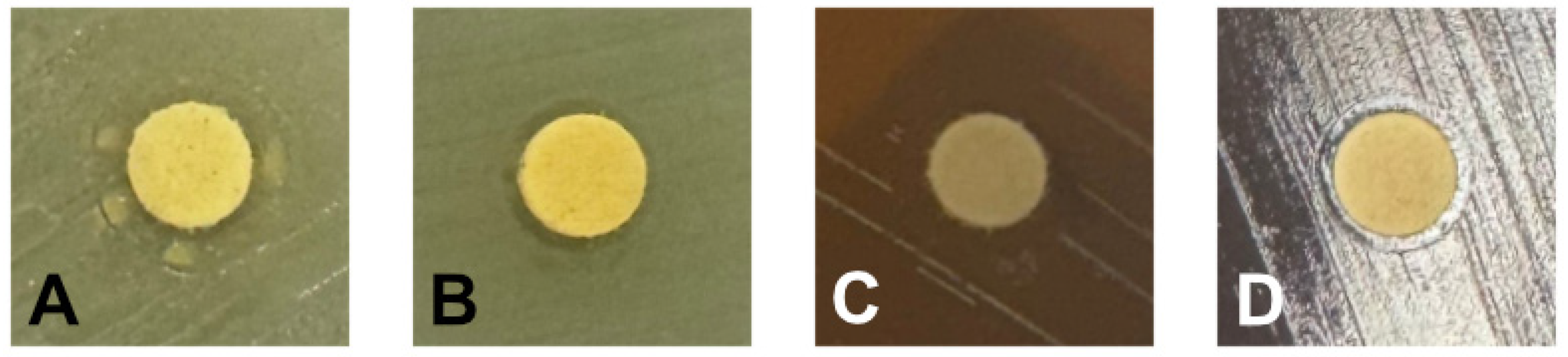
The results showed that morin produced weak zones of inhibition against all tested strains at all concentrations (Supplementary Figure S1), with the largest inhibition zone at the 3% concentration for Listeria monocytogenes (Figure 1). These findings confirm that morin does not exert strong direct bactericidal effects under standard in vitro conditions. Based on these in vitro findings, the 3% morin formulation was selected for the in vivo study.
Figure 1.
Disk-diffusion assays with 3% (w/v) morin against (A) S. aureus, (B) E. coli ATCC 25848, (C) L. monocytogenes ATCC 13932, and (D) Streptococcus spp. Clear inhibition zones are visible around morin disks. Results for 1% and 2% concentrations are provided in Supplementary Figure S1.
2.3. In Vivo Study Design
2.3.1. Enrollment and Pathogen Stratification
One hundred cows with clinical mastitis that met the predefined inclusion and exclusion criteria were initially enrolled. Herd records indicated that IMM infections in the study herd were predominantly caused by two environmental pathogens, E. coli and S. uberis. To confirm etiology, aseptic milk samples were collected at the screening time point (−72 h) into sterile, labeled tubes without preservatives, transported at 4 °C to a commercial microbiology laboratory, and the causative pathogen was detected by RT-qPCR using VetMAX™ MastiType Multi kits (Thermo Fisher Scientific, Waltham, MA, USA), enabling detection and differentiation of major 15 mastitis-causing pathogens, including S. aureus, non-aureus staphylococci, E. coli, S. uberis, and non-E. coli coliform bacteria, according to the manufacturer’s instructions. The same analysis was made post-treatment in all groups. Results were available within two days. All cases were monoinfections. Pathogen identification yielded 38 E. coli and 62 S. uberis cases. To ensure balanced group sizes, 36 cows were randomly selected within each pathogen stratum (total n = 72). No additional stratification by body weight, milk yield, or other production parameters was performed prior to randomization within each stratum.
To confirm the suitability of the antibiotic formulation used in the control group, antimicrobial susceptibility was determined using the standard disk diffusion method according to laboratory procedures. All disk diffusion assays were performed in duplicate, and both positive and negative control disks were included. The tests were conducted under standard laboratory conditions at the university microbiology laboratory, which routinely performs internal quality controls to ensure accuracy and reproducibility. The isolates exhibited high susceptibility to β-lactam antibiotics and bacitracin, whereas variable susceptibility and occasional resistance were observed among aminoglycosides, including neomycin. These results supported the selection of the fixed-combination treatment used in the Control group, containing tetracycline hydrochloride, neomycin sulfate, bacitracin, and prednisolone.
2.3.2. Pre-Treatment Observation and Baseline
Before allocation and group selection, all cows underwent a pre-treatment observation period at −72, −48, and −24 h, during which milk was sampled for SCC and verified using a 4 × 4Q Mastitis Detector (Dramiński S.A., Sząbruk, Poland; a 4-quarter device for detecting milk resistance). All milk samples were collected and analyzed for SCC according to a standardized protocol, as described previously [21]. The mean SCC across these three time points within each pathogen stratum was used to define the baseline. Baseline SCS values were comparable between quarters infected with E. coli (mean 7.27, 95% CI: 7.16–7.39) and those infected with S. uberis (mean 7.05, 95% CI: 6.92–7.19), indicating that treatment groups in both infection types started from a similar disease-associated baseline level. Post-randomization checks confirmed no significant between-group differences in SCC at 0 h, ensuring baseline equivalence before treatment initiation.
2.3.3. Treatment Groups
Within each pathogen stratum, cows were randomized (1:1:1) to one of three treatment regimens. The Morin group received IMM infusions of 3% morin in PBS, administered seven times at 24 h intervals (0, 24, 48, 72, 96, 120, and 144 h) at a dose of 5 mL per treatment via sterile IMM tubing syringes. The second group received IMM phosphate-buffered saline (PBS) alone at the same dose and time points (the PBS group). A third group, which received a fixed-combination treatment formulation, served as the positive control (Control); the 8 g formulation (tetracycline hydrochloride 200 mg, neomycin sulfate 250 mg, bacitracin 2000 IU, prednisolone 10 mg) was injected at 0 h, followed by a second dose 12 h later (two injections in total). PBS and morin solutions were prepared daily. No concomitant medications were permitted in the Morin or PBS arms. All IMM administrations were delivered into the affected quarter immediately after the morning milking; before administration, the udder skin and teat orifice were disinfected with Oxy-Foam D (EcoLab Inc., Saint Paul, MN, USA). All IMM infusions were performed under sterile conditions by a specialist in ruminant diseases, using sterile disposable gloves and individual sterile syringes for each cow to prevent cross-contamination. The attending veterinarian responsible for herd health continuously monitored and was aware of the treatment assignments; however, clinical assessments were conducted using standardized scoring criteria to minimize potential observer bias.
2.4. Physical Clinical Examinations
Throughout the study, udder condition and general health were monitored by a single, independent veterinarian not otherwise involved in the trial, who performed 24 hourly clinical examinations and standardized local-tolerance assessments related to the IMM administrations (morin, PBS, or antibiotic). Mastitis severity in the treated quarter was scored once daily at morning milking using a validated 4-point scale: score 0—normal milk and udder with no abnormalities; score 1—few clots in milk, no visible swelling, redness, heat, or pain on palpation; score 2—numerous clots with visible milk–whey separation and mild swelling, redness, heat, and pain; score 3—systemic illness (e.g., pyrexia) with watery milk and marked swelling, redness, heat, pain, and/or hardness of the affected quarter [22,23]. Scoring was performed daily during treatment (0 to 144 h), and concluded 24 h after the final morin/PBS administration (168 h); the same schedule was applied to cows in the Control group receiving the IMM antibiotic.
2.5. Milk Samples Collection and Analyses
Milk was sampled from the affected quarters according to a standardized protocol, immediately after mastitis scoring and before any IMM treatment (morin, PBS, or antibiotic). In total, 15 samples per cow were collected from 72 h before treatment (−72 h) through 24 h after the final administration (168 h). Before sampling, the udder was thoroughly washed and dried, teat orifices were disinfected with 70% ethanol, and the first 3–4 streams of milk were discarded. For SCC analysis, 30 mL of milk was collected into 50 mL tubes containing Broad Spectrum Microtabs II (Bentley Instruments, Chaska, MN, USA; bronopol 8 mg, natamycin 0.3 mg) to prevent spoilage and stabilize the sample during transport. Samples were kept on ice in insulated containers and transported chilled to the laboratory. Somatic cell counts were measured with a semi-automated BactoCount IBCm analyzer (Bentley Instruments) according to the manufacturer’s instructions within 12 h of collection to ensure sample stability.
Herd milk yield was continuously recorded; data from the month preceding mastitis diagnosis (pre-treatment) and the month following treatment completion were used for analysis.
2.6. Statistical Analysis
The resulting sample size was verified using Mead’s Resource Equation method [24]. For a design with three treatment groups (experimental unit = cow), the recommended range of E, the error degrees of freedom, is 10 ≤ E ≤ 20, which corresponds to n = 5–7 per group. The experiment involved a sample of n = 12 per group for each pathogen stratum, which yields E = 33, exceeding the minimum requirement and providing adequate statistical power with a buffer against potential attrition and individual variability.
All analyses were conducted in R (v. 4.5.1). Statistical significance was set at p < 0.05; a statistical trend toward significance was shown when 0.05 < p < 0.1. Analyses were performed separately within each pathogen stratum (E. coli and S. uberis); no pooling across strata and no multiplicity adjustment across strata were applied. All enrolled cows completed the study, and no missing data were recorded; therefore, all observations were included in the analyses.
For milk somatic cell data, SCC was log2-transformed to obtain the somatic cell score (SCS), improving symmetry and normality, as confirmed by the Shapiro–Wilk test. SCS trajectories were analyzed with a linear mixed-effects model including fixed effects for Group, Time (categorical), and Group × Time interaction, and a random intercept for Cow to account for repeated measures (lmer function from lmerTest package). Model adequacy was evaluated by visual inspection of residuals (approximate normality and homoscedasticity). Post hoc, estimated marginal means (emmeans) were used to assess within-group change versus a common baseline, as well as to perform pairwise between-group comparisons within each time point. All resulting p-values were adjusted for multiple comparisons using the Benjamini–Hochberg false discovery rate (FDR). Effect sizes (Cohen’s d) were derived from the mixed model residual variance (σ2), ensuring consistency with the model-based estimates and accounting for the repeated-measures structure. These effect sizes were used to quantify within-group change relative to baseline (baseline vs. each subsequent time point). Raw (non-relative to common baseline value) mean ± 95% CI values per group and time point are reported at the end of the treatment or when statistically different. The complete SCS data (raw means with corresponding 95% CI) are presented in Supplementary Table S2.
Mastitis score distributions at time point 0 h were compared between three treatment groups (n = 12 per group) within each pathogen stratum using Fisher’s exact test. Next, the ordinal clinical inflammation score was analyzed as an ordered outcome using a cumulative link mixed model (CLMM function from the ordinal package), with fixed effects for Group, Time (categorical; 0 h as reference), and Group × Time interaction, plus a random intercept for Cow. From the fitted CLMM, estimated marginal means (on the latent scale) were obtained and contrasted at each post-baseline time versus 0 h within each group; p-values were also FDR-adjusted. Effect sizes were not computed for this variable due to its ordinal nature and limited interpretability.
3. Results
3.1. Somatic Cell Count
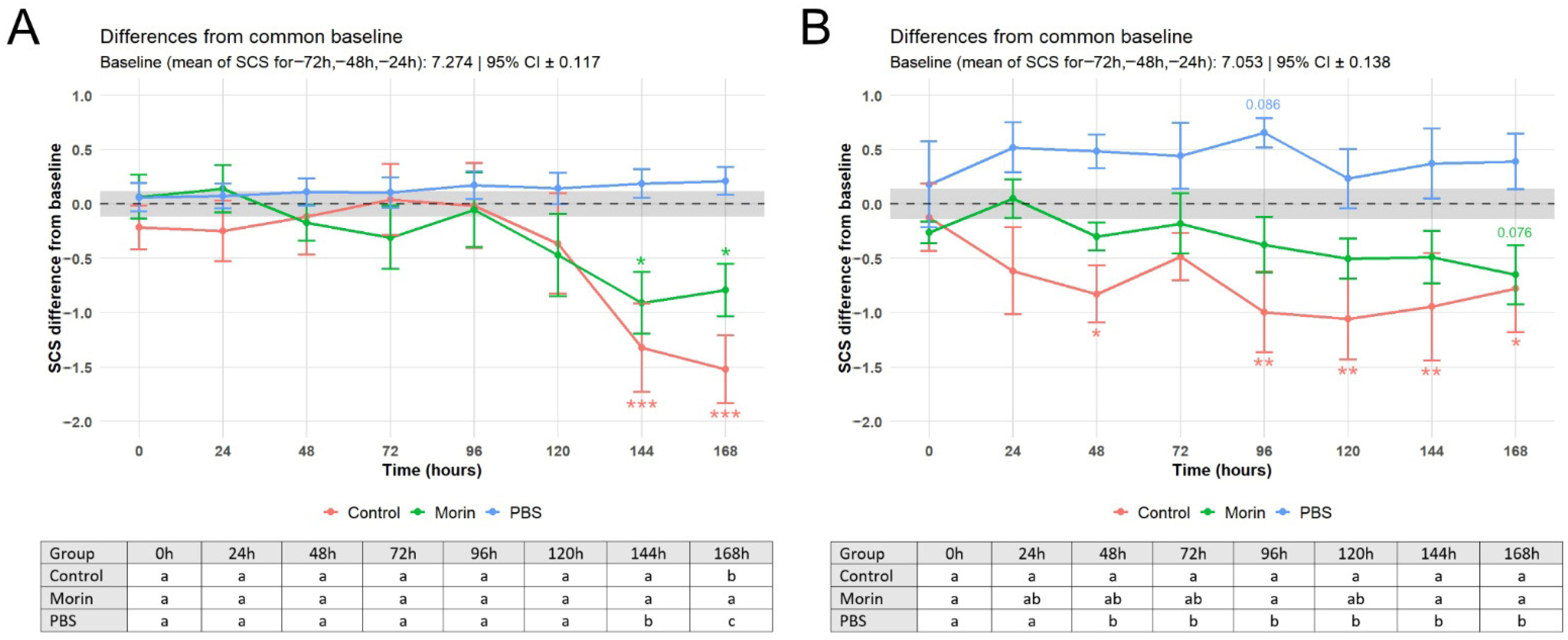
In cows infected with E. coli (Figure 2A), SCS dynamics differed markedly between treatment groups. In the Control group, values remained close to baseline until day 6, when a sharp and significant decline was observed at 144 h (p < 0.001, mean: 5.953, 95% CI: 5.059–6.846, ES: −2.103) and 168 h (p < 0.001, mean: 5.752, 95% CI: 5.063–6.441, ES: −2.422). The PBS group showed no significant changes at any time point (all p > 0.05, mean at 168 h: 7.483, 95% CI: 7.205–7.762). In the Morin group, SCS remained comparable to baseline during the first five days of treatment (24–120 h), but a progressive decrease became evident thereafter. At 144 h (p = 0.008, mean: 6.364, 95% CI: 5.738–6.989, ES: −1.449) and 168 h (p = 0.023, mean: 5.953, 95% CI: 5.059–6.846, ES: −1.263), Morin SCS was significantly reduced compared with baseline. Between-group comparisons further showed that groups did not differ during the early phase (0–120 h). However, at 144 h the PBS group displayed higher SCS than both Control and Morin, and by 168 h all groups differed. These findings indicate that Morin, like Control, was effective in reducing the SCS in E. coli mastitis.
Figure 2.
Changes in SCS over time relative to baseline (dotted line) in cows treated with 3% morin (Morin; IMM), IMM antibiotic (Control), or phosphate-buffered saline (PBS; IMM) for mastitis caused by (A) E. coli and (B) S. uberis. Asterixis denotes FDR-adjusted post hoc differences within-group vs. common baseline: * p < 0.05; ** p < 0.01; *** p < 0.001; numerical values denote trend p-values (0.05 < p < 0.1). The baseline 95% CI is shaded gray. Values are mean ± SEM. Inset tables summarize between-group differences at each time point; within a column (time point), groups sharing the same letter do not differ significantly (FDR-adjusted p > 0.05).
In quarters infected with S. uberis (Figure 2B), the Control group exhibited a gradual and consistent decline in SCS, with significant reductions observed from 48 h onward (p = 0.025, mean: 6.274, 95% CI: 5.394–7.154, ES: −1.110) and sustained through 96–168 h (all p = 0.033, mean at 168 h: 7.483, 95% CI: 7.205–7.762, ES:−1.044). The PBS group showed no consistent improvement, with only a transient, non-significant increase in SCS at 96 h (p = 0.086), and all other time points remained comparable to baseline. In the Morin group, no significant changes from baseline were detected during the first 6 days (144 h), but a downward trend emerged toward the end of the observation period, reaching a late, small decrease with a trend at 168 h (p < 0.076, mean: 6.400, 95% CI: 5.797–7.004). Between-group comparisons indicated that PBS consistently exhibited higher SCS than Control from 48 h onward (48–168 h), whereas Morin remained intermediate, and converged with Control by 144–168 h.
3.2. Clinical Score
Post-randomization analysis (global Fisher’s exact test) confirmed that the Score values measured at the 0 h time point also did not differ significantly between the groups, both for E. coli and S. uberis subgroups, ensuring baseline equivalence prior to treatment initiation. Notably, a score of 3 was not recorded in any animal at any time point in either group.
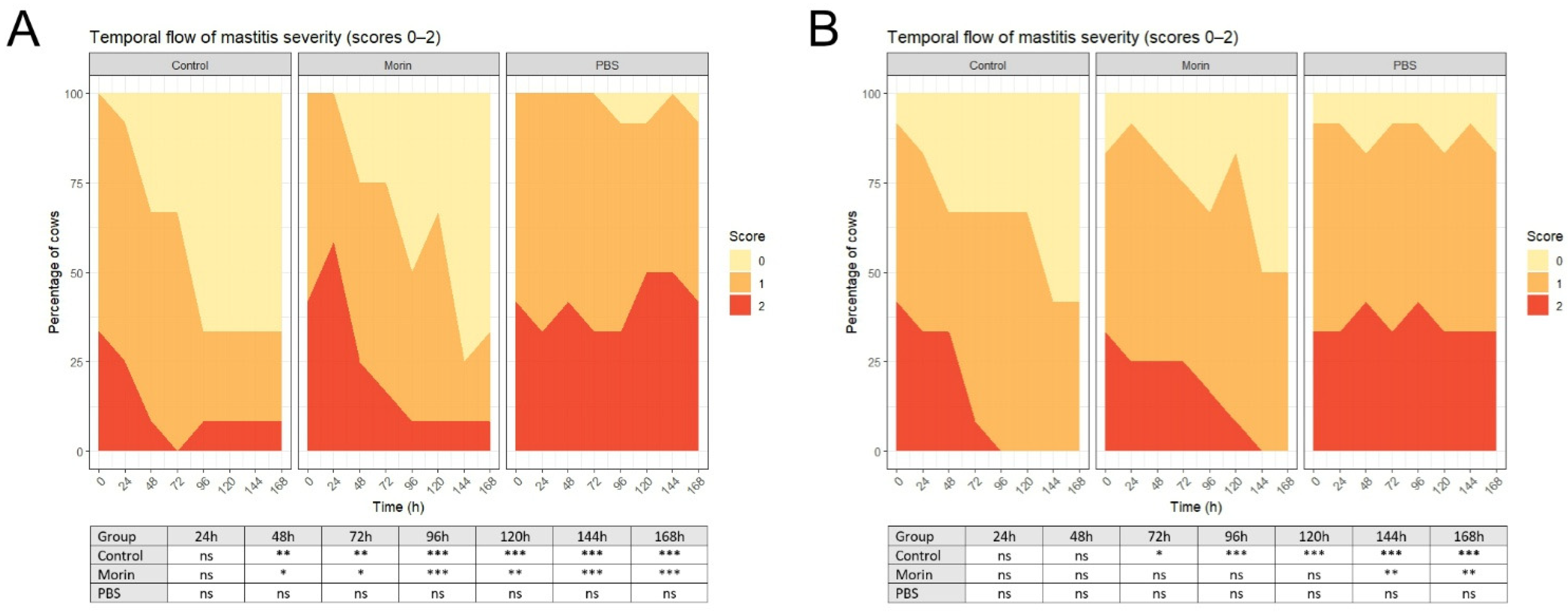
In cows infected with E. coli (Figure 3A), in the Control group, clinical scores significantly decreased from 48 h onward (p = 0.003), with a sustained and marked reduction observed between 96 and 168 h (all p < 0.001). In the Morin group, improvement was evident already at 48 h (p = 0.024) and remained significant throughout days 3–7 (p ≤ 0.011). In contrast, the PBS group showed no significant changes compared with baseline at any time point (all p > 0.05).
Figure 3.
Temporal distribution of mastitis severity scores (0–2) over the study period for mastitis caused by (A) E. coli and (B) S. uberis. Panels show Control (antibiotic), Morin (3% IMM), and PBS (IMM) groups; stacked areas represent the proportion of cows at each score at each time point. Inset tables summarize within-group changes versus corresponding baseline at time 0 h (FDR-adjusted): * p < 0.05; ** p < 0.01; *** p < 0.001; ns—non-significant (p > 0.05).
In cows infected with S. uberis (Figure 3B), in the Control group, no significant differences from baseline were detected until day 6, when scores significantly decreased at 144 h and 168 h (both p = 0.005). In the Morin group, a significant reduction appeared at 96 h (p = 0.038), became stronger at 144 h, and remained significant at 168 h (both p < 0.001). In contrast, the PBS group showed no significant changes compared with baseline at any time point (all p < 0.05).
3.3. Treatment-Related Local Tolerance and Safety, and Post-Treatment Analyses
No treatment-related adverse local reactions, such as teat irritation, increased pain sensitivity, or abnormal milk appearance beyond mastitis-associated changes, were observed in any group. No significant differences in milk yield were observed before and after treatment in any group. Post-treatment RT-qPCR analysis revealed the presence of S. uberis in milk from all three groups, whereas E. coli was no longer detected in any of the milk samples in any group.
4. Discussion
Studies on the efficacy of morin were conducted against two major pathogens causing clinical mastitis [4]. However, mastitis caused by these pathogens differs in terms of pathogenesis. E. coli mastitis is associated with endotoxin-induced inflammation, during which antibiotic therapy is not necessarily required; the main focus is on anti-inflammatory treatment [19,21]. In contrast, S. uberis mastitis involves udder colonization, and therefore antimicrobial therapy is essential [6,8,21].
The results of this study show that the therapeutic effectiveness of morin in the treatment of mastitis depended on the etiological agent and was generally lower than that of standard antibiotic therapy. Clear differences were observed in the course of mastitis caused by E. coli and S. uberis. Infections with E. coli were characterized by a rapid and pronounced increase in SCS, while S. uberis more often led to subacute or chronic forms with milder clinical signs and persistently elevated SCS.
In E. coli infections, clinical improvement appeared relatively early (48–72 h), whereas a reduction in SCS occurred only after several days. This discrepancy between the resolution of clinical signs and the normalization of SCS is typical for such infections, where clinical improvement usually precedes the cellular response in the mammary gland. In the antibiotic-treated group, clinical signs resolved more rapidly than in the morin group, particularly during the first days following E. coli infection. Cows receiving conventional therapy showed an earlier reduction in quarter swelling and redness. In the morin group, gradual clinical improvement was also observed, but the changes occurred more slowly.
A similar pattern was noted in the analysis of SCS. In E. coli infections, SCC in milk decreased to near-normal values in the antibiotic group by the end of the first week of treatment. In cows treated with morin, SCS remained elevated for a longer period, indicating a slower normalization of the inflammatory response. This finding is consistent with previous reports that in coliform mastitis, clinical recovery often precedes normalization of milk parameters.
In such cases, reducing antibiotic use aligns with current trends in the rationalization of antimicrobial therapy. For infections caused by Gram-negative pathogens, limiting antibiotic use in favor of supportive treatment may be considered, in line with the One Health concept and efforts to reduce the selective pressure for resistance. In mastitis caused by E. coli, the clinical picture typically reflects a brisk systemic inflammatory response: cows often present with high fever, depression, anorexia, occasional diarrhea, and signs of endotoxemia or incipient shock [25]. However, E. coli can cause both mild inflammation limited to a single quarter. [4]. Studies indicate that clinical mastitis caused by E. coli most often manifests as a short, single SCC peak on the lactation curve [26].
In contrast, mastitis caused by S. uberis usually has a milder and more chronic course. S. uberis less frequently induces a severe systemic reaction with fever. Overall, its clinical course tends to be milder and more prolonged than that of acute coliform mastitis [27,28]. In S. uberis infections, changes in SCC are more variable and prolonged. S. uberis can cause both acute mastitis (with an SCC spike similar to that of other pathogens) and subclinical infections that maintain elevated SCC over a longer period [26]. Overall, Gram-positive pathogens (streptococci, staphylococci) more often cause persistent, chronic elevation of SCC, whereas Gram-negative infections (e.g., E. coli) typically result in short-term SCC spikes associated with an acute episode of inflammation [28].
In this study, we specifically evaluated acute clinical environmental mastitis caused by E. coli and S. uberis. These infections are typically driven by a rapid inflammatory response and often show spontaneous clinical cure, especially in the case of E. coli, when inflammation is adequately managed through frequent milking and supportive therapy. In contrast, S. aureus mastitis is classified as contagious rather than environmental, is usually chronic and biofilm-associated, and rarely undergoes spontaneous cure due to bacterial intracellular persistence. Therefore, treatment strategies and expected clinical outcomes differ substantially between these pathogen groups.
Our observations from the present experiment reflect the well-known differences between Gram-negative and Gram-positive infections, with S. uberis more frequently presenting as subacute or chronic mastitis. Antibiotic therapy resulted in a gradual and systematic reduction in SCS, with clinical improvement occurring in parallel. The control IMM antibiotic was a combination therapy covering both Gram-negative (E. coli) and Gram-positive (S. uberis) pathogens, including tetracycline, neomycin, and bacitracin, with prednisolone to reduce inflammation. This reflects standard veterinary practice for clinical mastitis. The antimicrobial susceptibility profiles from Polish dairy herds show that S. uberis remains highly susceptible to bacitracin-based therapy, while exhibiting resistance to aminoglycosides such as neomycin [8]. This corresponds well with the fixed-combination antibiotic used as the Control treatment in our trial, where bacitracin likely contributed to the superior eradication of S. uberis. For E. coli, susceptibility to neomycin is variable, which may explain why the antibiotic advantage over morin was less pronounced in coliform mastitis.
These findings, presented above, mirror the characteristic course of streptococcal mastitis, which is marked by prolonged elevation of SCS. Treatment with morin led to clinical improvement; however, the reduction in SCS was clearly slower and less pronounced than in the antibiotic group, indicating the limited effectiveness of this compound against streptococcal infections. This is consistent with previous reports showing that S. uberis has a high capacity to persist within mammary tissue and requires targeted antibiotic therapy [28]. In the case of S. uberis, the differences between treatment groups were less pronounced, reflecting the milder, chronic nature of these infections. Nevertheless, antibiotic therapy also led to faster improvement of local inflammatory signs and a more pronounced decrease in SCS compared with morin treatment. In the morin group, some cows maintained elevated SCS until the end of the observation period. These findings suggest that although morin supports the alleviation of inflammatory symptoms, its effectiveness in eradicating infection is lower than that of standard antibiotic therapy, particularly in mastitis caused by S. uberis.
A comparison of our findings with literature reports from recent years confirms many of the observed patterns. First, the treatment of E. coli mastitis represents a special case in veterinary practice. It has been shown that in mild and moderate forms of inflammation caused by Gram-negative rods, the rate of spontaneous cure is high, and antibiotic therapy does not always significantly increase the cure rate compared with no treatment. For example, in clinical studies of mastitis caused by coliforms, no difference in the rate of bacteriological cure was found between cows receiving an antibiotic and untreated cows in many cases. The rapid and strong inflammatory response induced by E. coli often leads to bacterial elimination by the immune system even before the antibiotic takes effect [29]. On the other hand, there are also reports indicating the benefits of antibiotic therapy in coliform mastitis. Schukken et al. observed a higher cure rate of E. coli in cows treated with antibiotics (89%) compared with untreated cows (53%), although the authors noted the limited sample size and the need for further studies [30]. In our experiment, in the morin group, many E. coli cases were successfully controlled, which is consistent with the above observations on the high tendency for spontaneous cure of coliform infections. It is likely that morin, through its anti-inflammatory action, created conditions that supported the cow’s own defense mechanisms in combating the infection. The literature emphasizes the importance of supportive therapy in such situations. When antibiotics do not improve the prognosis (due to the high rate of spontaneous cure or bacterial resistance), symptomatic treatment becomes crucial [31]. In clinical practice, this is reflected, among other things, by the increasing use of non-steroidal anti-inflammatory drugs (NSAIDs) in the treatment of mastitis. According to a recent review, in Denmark, as many as 72% of veterinarians use anti-inflammatory treatment alone without antibiotics in mild cases of mastitis caused by Gram-negative pathogens [1,32]. NSAIDs, such as flunixin or meloxicam, reduce fever and pain and mitigate the effects of endotoxemia in coliform mastitis, which is often sufficient to improve the cow’s condition and allow the immune system to eliminate the pathogens [1]. Our results for E. coli (with morin showing clinical effectiveness comparable to antibiotics in moderately severe cases) are therefore consistent with the trend toward reducing antibiotic use in Gram-negative mastitis while applying intensive anti-inflammatory therapy. On the other hand, the situation is different for Gram-positive pathogens. Environmental streptococci, such as S. uberis, although capable of causing mastitis of varying severity (from subclinical to severe), are known for their lower tendency to be spontaneously eliminated from the mammary gland. These infections often require active intervention, as Gram-positive bacteria can hide within mammary tissue, form biofilms, and maintain chronic infection. Our data confirm that standard antibiotic therapy (bactericidal against S. uberis) was much more effective in eliminating infection than relying solely on the immunomodulatory effect of morin. The literature also indicates a significant advantage of antibiotic treatment in mastitis caused by streptococci. Comparative studies have reported significantly higher bacteriological cure rates in antibiotic-treated groups compared with untreated or placebo groups [29]. Moreover, the lack of effective treatment for streptococcal infection carries the risk of progression to a subclinical form with chronic elevation of SCC, which we observed in some cows receiving morin. Therefore, our results are not in contradiction with current recommendations; rather, they reinforce them. S. uberis remains a pathogen for which antibiotics are difficult to replace in effective treatment, although in the future, combining them with supportive therapies (e.g., using substances such as morin) may improve treatment outcomes.
A possible explanation for the observed differences is the distinct mechanism of action of morin compared with that of antibiotics and the resulting limitations. The antibiotic used in our study acted directly in a bactericidal manner, rapidly reducing the population of E. coli or S. uberis in the mammary gland. In contrast, morin is not a classical antimicrobial agent. The limited inhibition observed in vitro is consistent with previous reports indicating that its primary mechanism of action involves modulation of the host inflammatory response rather than direct antibacterial activity. As a natural flavonoid compound, morin exhibits documented antioxidant, antibacterial, and anti-inflammatory properties, with its influence on the host immune and inflammatory pathways likely being the key factor in the context of mastitis. This supports the rationale for evaluating morin as a supportive rather than curative therapy in mastitis [33].
Experimental models have shown that morin can significantly inhibit excessive inflammatory responses induced by endotoxins or bacteria. Jiang et al. [33] demonstrated in a murine model of LPS-induced (E. coli lipopolysaccharide) mastitis that morin administration reduced pathological changes in the mammary gland. It limited edema and neutrophil infiltration and significantly decreased the expression of pro-inflammatory cytokines (TNF-α, IL-1β, IL-6) and chemokines (CCL2, CXCL2) in the tissue [33]. At the same time, morin modulated key cellular signaling pathways: it inhibited the phosphorylation of transcription factors NF-κB (p65 subunit) and MAPK kinases (ERK1/2, p38), as well as reduced the activation of the NLRP3 inflammasome [17,33]. These effects translated into reduced production of inflammatory mediators and protection of mammary cells from damage caused by the immune response. Importantly, morin also demonstrated the ability to stabilize the blood-milk barrier. In the presence of morin, the inflammation-associated decrease in tight junction proteins (claudin-3, occludin) in mammary epithelial cells did not occur [33]. The preservation of tight junction integrity prevents excessive vascular permeability and the leakage of blood components into milk, and may also limit the translocation of bacterial toxins (e.g., E. coli endotoxin) into the systemic circulation [33]. In the clinical context, this translates into a lower risk of acute systemic reaction (toxemia) in treated animals. These mechanisms explain why, in our study, cows receiving morin showed a milder manifestation of inflammatory symptoms than would be expected in untreated mastitis. While morin did not kill the pathogens, it inhibited the immune response, reducing the harmful excessive inflammation, and at the same time, as suggested by the cited studies, it did not completely impair the defense mechanisms responsible for pathogen elimination. Such immunomodulatory action may be particularly beneficial in E. coli infections, where the intense inflammatory response and associated endotoxemia account for most clinical signs. In the case of S. uberis, the reduced severity of inflammation (resulting from morin activity) also provided relief to the tissue and decreased SCC, but it did not guarantee bacterial elimination, as these pathogens can persist in the mammary gland without antibiotic support. It is worth noting that studies on similar plant-derived compounds (e.g., cynarazoid C from Cynanchum atratum, peiminine, and farerol) have shown comparable effects, such as inhibition of NF-κB/MAPK pathways and alleviation of mastitis symptoms in experimental models [33]. Morin, therefore, fits into the broader context of searching for natural inhibitors of the inflammatory response that could support the treatment of mastitis.
When discussing the results of this study, certain limitations should be taken into account. First, the sample size was relatively small, which reduces statistical power and requires caution when generalizing conclusions to the entire cow population. Second, this experiment was designed as a short-term, proof-of-concept study aimed at evaluating early clinical improvement and inflammatory response within the first seven days after treatment initiation. Therefore, it does not allow for long-term assessment of relapse rates or chronic outcomes, which should be addressed in future trials. Another limitation concerns pharmacological aspects. Morin is a poorly soluble polyphenolic compound, which may limit its bioavailability. In our experiment, it was administered intramammarily; however, pharmacokinetics and concentrations in mammary tissue were not determined. It cannot be excluded that alternative administration routes, higher doses, or novel formulations could improve efficacy, which requires further investigation. Finally, multicentre studies under farm conditions are needed to validate the obtained results on a larger scale and to confirm the practical usefulness of morin in mastitis therapy.
Despite these limitations, the results obtained carry important implications for veterinary practice and future research directions. First, they confirm the potential of morin as an agent that can alleviate the course of mastitis. This may have applications as a supportive therapy, for example, in combination with an antibiotic or, in selected cases, even as an alternative to antibiotic treatment. This is particularly relevant in mastitis caused by Gram-negative pathogens, where, as discussed earlier, the key challenge is controlling inflammation and endotoxemia. According to current reviews, there is growing pressure to develop mastitis therapies independent of antibiotics; however, many of these approaches still lack fully documented clinical efficacy. Our study provides new data in this area, suggesting that morin may in the future become a valuable therapeutic option in mastitis treatment. Intensive care (fluid therapy, frequent milking), combined with morin administration in a cow with moderate E. coli mastitis and a veterinarian’s decision to withhold antibiotics, could lead to recovery with less systemic burden and without generating milk withdrawal, which has both economic and health significance. Moreover, the absence of detectable adverse local reactions suggested that IMM morin administration was well tolerated. However, further studies should include additional safety endpoints such as quarter milk yield and monitoring for subclinical tissue damage. Overall, the present findings bring us a step closer to this goal, demonstrating both the potential and the challenges of using morin in veterinary medicine.
It should be emphasized that this trial was conducted under commercial farm conditions with continuous on-farm monitoring. Although preliminary, these in vivo data validate efficacy under real-world exposure to environmental pathogens and multifactorial stressors (e.g., heat load, nutritional and periparturient challenges), alongside host-related determinants—such as genetic background and epigenetic regulation—that can modulate mastitis susceptibility and treatment response [34,35,36]. Hypothetically, morin could also enhance the effect of a reduced antibiotic dose, thereby limiting the use of chemotherapeutics while maintaining high treatment efficacy.
Before morin can enter practical use, further research is needed. Ideally, this should be performed under conditions of mastitis of varying severity, caused by different pathogens, and in cows at different stages of lactation, to confirm morin’s effectiveness in diverse scenarios. Such studies should monitor not only clinical and inflammatory parameters but also include regular milk cultures during and after therapy, in order to clearly determine whether morin ensures bacteriological cure. Future research should also establish the safety profile of morin, including whether it causes adverse effects in cows and whether potential residues in milk are safe for consumers. As a natural polyphenolic compound, morin likely does not carry the same risks as antibiotics (e.g., promoting resistant strains or leaving harmful residues in food); however, a formal evaluation of these aspects would be required before approval for use. Another future research direction should be the optimization of morin formulations.
Our results provide a starting point for more in-depth analyses. In the future, they will facilitate the design of clinical trials to determine the practical usefulness of morin under production conditions and indicate whether and how such therapy could be integrated into existing mastitis treatment protocols. The ultimate goal is to develop effective, safe, and environmentally friendly methods of combating mastitis that will reduce the dependence on antibiotics in dairy cattle farming [1].
5. Conclusions
This study demonstrated that morin, as a natural compound, can alleviate clinical signs of mastitis caused by E. coli and S. uberis. However, its efficacy in eliminating infection was lower than that of standard intramammary antibiotic therapy, particularly in S. uberis cases.
Morin may therefore serve as a supportive therapeutic option aimed at reducing udder inflammation and somatic cell counts, especially in Gram-negative infections where spontaneous cure rates are relatively high. Its use could contribute to lowering antibiotic consumption in dairy herds and improving cow welfare. Nevertheless, because a full bacteriological cure was not confirmed, morin should not be considered a replacement for antibiotics in infections with Gram-positive pathogens. Further research with extended follow-up and microbiological verification is needed to determine the appropriate clinical scenarios for its use. Morin may therefore serve as a supportive therapeutic option aimed at reducing udder inflammation and somatic cell counts, especially in Gram-negative infections where spontaneous cure rates are relatively high.
Supplementary Materials
The following supporting information can be downloaded at https://www.mdpi.com/article/10.3390/agriculture15222359/s1, Figure S1: Disk-diffusion assays with 1, 2, and 3% (w/v) morin against S. aureus, E. coli ATCC 25848, L. monocytogenes ATCC 13932, and Streptococcus spp.; Table S1: Basal components and nutritional values of the diets (kg/day); Table S2: Raw SCS data with 95% CI values.
Author Contributions
Conceptualization, M.K.; methodology, M.K., A.B. and T.G.; formal analysis, M.K. and M.S.; investigation, M.K.; resources, M.K., A.B., T.G. and E.T.; data curation, M.K. and M.B.; writing—original draft preparation, M.K.; writing—review and editing, A.B., T.G. and E.T.; visualization, M.K.; supervision, A.B. and T.G. All authors have read and agreed to the published version of the manuscript.
Funding
This research received no external funding.
Institutional Review Board Statement
The animal study protocol was approved by the Local Ethical Committee for Animal Experiments in Lublin (resolution No. 12/2024).
Data Availability Statement
The original contributions presented in this study are included in the article. Further inquiries can be directed to the corresponding author.
Conflicts of Interest
The authors declare no conflicts of interest.
Abbreviations
The following abbreviations are used in this manuscript:
| 95% CI | 95% Confidence interval |
| CLMM | Cumulative link mixed-effects model |
| ES | Effect size |
| FDR | False discovery rate |
| IMM | Intramammary |
| PBS | Phosphate-buffered saline |
| SCC | Somatic cell count |
| SCS | Somatic cell score |
References
- Li, X.; Xu, C.; Liang, B.; Kastelic, J.P.; Han, B.; Tong, X.; Gao, J. Alternatives to Antibiotics for Treatment of Mastitis in Dairy Cows. Front. Vet. Sci. 2023, 10, 1160350. [Google Scholar] [CrossRef] [PubMed]
- Krebs, I.; Zhang, Y.; Wente, N.; Leimbach, S.; Krömker, V. Severity of Clinical Mastitis and Bacterial Shedding. Pathogens 2023, 12, 1098. [Google Scholar] [CrossRef] [PubMed]
- Leite De Campos, J.; Gonçalves, J.L.; Kates, A.; Steinberger, A.; Sethi, A.; Suen, G.; Shutske, J.; Safdar, N.; Goldberg, T.; Ruegg, P.L. Variation in Partial Direct Costs of Treating Clinical Mastitis among 37 Wisconsin Dairy Farms. J. Dairy Sci. 2023, 106, 9276–9286. [Google Scholar] [CrossRef] [PubMed]
- Wieland, M. Mastitis in Cattle. In MSD Veterinary Manual; MSD Publications: Telangana, India, 2024; Available online: https://www.msdvetmanual.com/reproductive-system/mastitis-in-large-animals/mastitis-in-cattle (accessed on 6 November 2025).
- Bechtold, V.; Petzl, W.; Huber-Schlenstedt, R.; Sorge, U.S. Distribution of Bovine Mastitis Pathogens in Quarter Milk Samples from Bavaria, Southern Germany, between 2014 and 2023—A Retrospective Study. Animals 2024, 14, 2504. [Google Scholar] [CrossRef]
- Morales-Ubaldo, A.L.; Rivero-Perez, N.; Valladares-Carranza, B.; Velázquez-Ordoñez, V.; Delgadillo-Ruiz, L.; Zaragoza-Bastida, A. Bovine Mastitis, a Worldwide Impact Disease: Prevalence, Antimicrobial Resistance, and Viable Alternative Approaches. Vet. Anim. Sci. 2023, 21, 100306. [Google Scholar] [CrossRef]
- Kaczorek-Łukowska, E.; Małaczewska, J.; Wójcik, R.; Duk, K.; Blank, A.; Siwicki, A.K. Streptococci as the New Dominant Aetiological Factors of Mastitis in Dairy Cows in North-Eastern Poland: Analysis of the Results Obtained in 2013–2019. Ir. Vet. J. 2021, 74, 2. [Google Scholar] [CrossRef]
- Dobrut, A.; Siemińska, I.; Sroka-Oleksiak, A.; Drożdż, K.; Sobońska, J.; Mroczkowska, U.; Brzychczy-Włoch, M. Molecular and Phenotypic Identification of Bacterial Species Isolated from Cows with Mastitis from Three Regions of Poland. BMC Vet. Res. 2024, 20, 193. [Google Scholar] [CrossRef]
- Zhang, T.; Niu, G.; Boonyayatra, S.; Pichpol, D. Antimicrobial Resistance Profiles and Genes in Streptococcus Uberis Associated with Bovine Mastitis in Thailand. Front. Vet. Sci. 2021, 8, 705338. [Google Scholar] [CrossRef]
- Günther, J.; Koy, M.; Berthold, A.; Schuberth, H.-J.; Seyfert, H.-M. Comparison of the Pathogen Species-Specific Immune Response in Udder Derived Cell Types and Their Models. Vet. Res. 2016, 47, 22. [Google Scholar] [CrossRef]
- European Medicines Agency. European Sales and Use of Antimicrobials for Veterinary Medicine (ESUAvet); Annual Surveillance Report for 2023 (EMA/CVMP/ESUAVET/80289/2025); Publications Office of the European Union: Luxembourg, 2025; Available online: https://www.ema.europa.eu/en/documents/report/european-sales-use-antimicrobials-veterinary-medicine-annual-surveillance-report-2023_en.pdf (accessed on 6 November 2025).
- Aksoy, A.; Alazragi, R.; Alabdali, A.Y.M.; Aljazzar, R.; El Sadi, S.; Alostaz, M.; El Hindi, M. Antibacterial Activity of Metallic-Core Gold and Silver Nanoparticles against Some Animal Pathogens. Ann. Anim. Sci. 2023, 23, 473–479. [Google Scholar] [CrossRef]
- Romanek, J.; Trzcińska, M.; Samiec, M. Multi-Faceted Characterization of Mesenchymal Stem Cells and Their Application as a Powerful Tool for Agrobiotechnology, Assisted Reproductive Technologies, and Veterinary and Regenerative Biomedicine—A Review. Ann. Anim. Sci. 2024, 24, 367–377. [Google Scholar] [CrossRef]
- Kovačević, Z.; Samardžija, M.; Tomanić, D. A Review of Recent Developments in Essential Oil-Based Alternatives in Mastitis Treatment in Dairy Cows. Ann. Anim. Sci. 2025; in press. [Google Scholar] [CrossRef]
- Gutiérrez-Reinoso, M.A.; Uquilla, J.B.; Guamaní, J.L.; Caiza, Á.E.; Carrera, R.P.; Garcia-Herreros, M. Intramammary Infusion of Micronised Purified Flavonoid Fraction (MPFF) in Mastitis-Diagnosed Dairy Cows Naturally Infected by Staphylococcus Spp. in the Late Lactation. Vet. Sci. 2023, 10, 335. [Google Scholar] [CrossRef] [PubMed]
- Wang, J.; Guo, C.; Wei, Z.; He, X.; Kou, J.; Zhou, E.; Yang, Z.; Fu, Y. Morin Suppresses Inflammatory Cytokine Expression by Downregulation of Nuclear Factor-κB and Mitogen-Activated Protein Kinase (MAPK) Signaling Pathways in Lipopolysaccharide-Stimulated Primary Bovine Mammary Epithelial Cells. J. Dairy Sci. 2016, 99, 3016–3022. [Google Scholar] [CrossRef] [PubMed]
- Yu, S.; Liu, X.; Yu, D.; Changyong, E.; Yang, J. Morin Protects LPS-Induced Mastitis via Inhibiting NLRP3 Inflammasome and NF-κB Signaling Pathways. Inflammation 2020, 43, 1293–1303. [Google Scholar] [CrossRef] [PubMed]
- Yu, J.; Wan, K.; Sun, X. Improved Transdermal Delivery of Morin Efficiently Inhibits Allergic Contact Dermatitis. Int. J. Pharm. 2017, 530, 145–154. [Google Scholar] [CrossRef]
- Sales, L.S.; Hewitt, B.; Muchova, M.; Brighenti, F.L.; Kuehne, S.A.; Grant, M.M.; Milward, M.R. Anti-Inflammatory, Antioxidant, and Antimicrobial Evaluation of Morin. Arch. Oral Biol. 2025, 178, 106343. [Google Scholar] [CrossRef]
- Pyörälä, S. Indicators of Inflammation in the Diagnosis of Mastitis. Vet. Res. 2003, 34, 565–578. [Google Scholar] [CrossRef]
- Kocik, M.; Burmańczuk, A.; Grabowski, T.; Tomaszewska, E. Intramammary Pectin Therapy for Clinical Mastitis in Dairy Cows: A Field Pilot Study. Agriculture 2025, 15, 1760. [Google Scholar] [CrossRef]
- Balemi, A.; Gumi, B.; Amenu, K.; Girma, S.; Gebru, M.; Tekle, M.; Ríus, A.A.; D’Souza, D.H.; Agga, G.E.; Kerro Dego, O. Prevalence of Mastitis and Antibiotic Resistance of Bacterial Isolates from CMT Positive Milk Samples Obtained from Dairy Cows, Camels, and Goats in Two Pastoral Districts in Southern Ethiopia. Animals 2021, 11, 1530. [Google Scholar] [CrossRef]
- Kan, X.; Hu, G.; Liu, Y.; Xu, P.; Huang, Y.; Cai, X.; Guo, W.; Fu, S.; Liu, J. Mammary Fibrosis Tendency and Mitochondrial Adaptability in Dairy Cows with Mastitis. Metabolites 2022, 12, 1035. [Google Scholar] [CrossRef]
- Festing, M.F.W.; Altman, D.G. Guidelines for the Design and Statistical Analysis of Experiments Using Laboratory Animals. ILAR J. 2002, 43, 244–258. [Google Scholar] [CrossRef]
- Goulart, D.B.; Mellata, M. Escherichia Coli Mastitis in Dairy Cattle: Etiology, Diagnosis, and Treatment Challenges. Front. Microbiol. 2022, 13, 928346. [Google Scholar] [CrossRef] [PubMed]
- De Haas, Y.; Veerkamp, R.F.; Barkema, H.W.; Gröhn, Y.T.; Schukken, Y.H. Associations Between Pathogen-Specific Cases of Clinical Mastitis and Somatic Cell Count Patterns. J. Dairy Sci. 2004, 87, 95–105. [Google Scholar] [CrossRef] [PubMed]
- Cobirka, M.; Tancin, V.; Slama, P. Epidemiology and Classification of Mastitis. Animals 2020, 10, 2212. [Google Scholar] [CrossRef] [PubMed]
- Lavon, Y.; Leitner, G.; Kressel, Y.; Ezra, E.; Wolfenson, D. Comparing Effects of Bovine Streptococcus and Escherichia Coli Mastitis on Impaired Reproductive Performance. J. Dairy Sci. 2019, 102, 10587–10598. [Google Scholar] [CrossRef]
- Nankemann, F.; Leimbach, S.; Nitz, J.; Tellen, A.; Wente, N.; Zhang, Y.; Klocke, D.; Krebs, I.; Müller, S.; Teich, S.; et al. Antibiotic Treatment vs. Non-Antibiotic Treatment in Bovine Clinical Mastitis During Lactation with Mild and Moderate Severity. Antibiotics 2025, 14, 702. [Google Scholar] [CrossRef]
- Schukken, Y.H.; Bennett, G.J.; Zurakowski, M.J.; Sharkey, H.L.; Rauch, B.J.; Thomas, M.J.; Ceglowski, B.; Saltman, R.L.; Belomestnykh, N.; Zadoks, R.N. Randomized Clinical Trial to Evaluate the Efficacy of a 5-Day Ceftiofur Hydrochloride Intramammary Treatment on Nonsevere Gram-Negative Clinical Mastitis. J. Dairy Sci. 2011, 94, 6203–6215. [Google Scholar] [CrossRef]
- Ruegg, P.L. Making Antibiotic Treatment Decisions for Clinical Mastitis. Vet. Clin. N. Am. Food Anim. Pract. 2018, 34, 413–425. [Google Scholar] [CrossRef]
- Smith, G.W.; Davis, J.L.; Tell, L.A.; Webb, A.I.; Riviere, J.E. Extralabel Use of Nonsteroidal Anti-Inflammatory Drugs in Cattle. J. Am. Vet. Med. Assoc. 2008, 232, 697–701. [Google Scholar] [CrossRef]
- Jiang, A.; Zhang, Y.; Zhang, X.; Wu, D.; Liu, Z.; Li, S.; Liu, X.; Han, Z.; Wang, C.; Wang, J.; et al. Morin Alleviates LPS-Induced Mastitis by Inhibiting the PI3K/AKT, MAPK, NF-κB and NLRP3 Signaling Pathway and Protecting the Integrity of Blood-Milk Barrier. Int. Immunopharmacol. 2020, 78, 105972. [Google Scholar] [CrossRef]
- Bagnicka, E.; Brzozowska, P.; Żukowski, K.; Grochowska, R. The Association of Gene Polymorphisms with Milk Production and Mastitis Resistance Phenotypic Traits in Dairy Cattle. Ann. Anim. Sci. 2023, 23, 419–430. [Google Scholar] [CrossRef]
- Semik-Gurgul, E.; Ząbek, T.; Kawecka-Grochocka, E.; Zalewska, M.; Kościuczuk, E.; Bagnicka, E. Epigenetic States of Genes Controlling Immune Responsiveness in Bovine Chronic Mastitis. Ann. Anim. Sci. 2022, 22, 575–581. [Google Scholar] [CrossRef]
- Korwin-Kossakowska, A.; Ropka-Molik, K.; Ząbek, T.; Szmatoła, T.; Lewczuk, D.; Kościuczuk, E.; Marczak, S.; Bagnicka, E. Gene Expression Adjustment of Inflammatory Mechanisms in Dairy Cow Mammary Gland Parenchyma during Host Defense against Staphylococci. Ann. Anim. Sci. 2022, 22, 903–913. [Google Scholar] [CrossRef]
Disclaimer/Publisher’s Note: The statements, opinions and data contained in all publications are solely those of the individual author(s) and contributor(s) and not of MDPI and/or the editor(s). MDPI and/or the editor(s) disclaim responsibility for any injury to people or property resulting from any ideas, methods, instructions or products referred to in the content. |
© 2025 by the authors. Licensee MDPI, Basel, Switzerland. This article is an open access article distributed under the terms and conditions of the Creative Commons Attribution (CC BY) license (https://creativecommons.org/licenses/by/4.0/).