Article

Initial Validation of NPK Fertilizer Rates and Plant Spacing for Morkhor 60, a New Soybean Variety, in Sandy Soils: Enhancing Yield and Economic Returns


by
Thanaphon Patjaiko
1,
Tidarat Monkham
1,2,
Jirawat Sanitchon
1,2 and
Sompong Chankaew
1,2,*
1
Department of Agronomy, Faculty of Agriculture, Khon Kaen University, Khon Kaen 40002, Thailand
2
Plant Breeding Research Center for Sustainable Agriculture, Khon Kaen University, Khon Kaen 40002, Thailand
*
Author to whom correspondence should be addressed.
Agriculture 2025, 15(22), 2357; https://doi.org/10.3390/agriculture15222357

Submission received: 14 October 2025 / Revised: 7 November 2025 / Accepted: 12 November 2025 / Published: 13 November 2025
(This article belongs to the Special Issue Effect of Cultivation Practices on Crop Yield and Quality)

Abstract

Soybeans (Glycine max (L.) Merr.) are a vital global crop; however, Thailand currently imports 99% of its domestic requirement, highlighting the critical need for enhanced domestic production. Morkhor 60, a new high-yielding variety, lacks optimized agronomic management for cultivation in the challenging sandy soils of Northeast Thailand. This study evaluated the effects of NPK fertilizer rates and plant spacing on Morkhor 60 growth and yield through two independent experiments conducted in sandy soils over a four-season period (2022–2023). Results demonstrated that 23.44 kg ha−1 NPK provided optimal cost-effectiveness for Morkhor 60, achieving yields of 1238 kg ha−1 statistically comparable to higher rates (1286 kg ha−1) while reducing input costs by 50%. Plant spacing significantly affected productivity, with 30 × 20 cm spacing producing the highest yield (1775 kg ha−1), representing 41% improvement over the narrow spacing (20 × 20 cm: 1257 kg ha−1). The integrated management system (23.44 kg ha−1 NPK with 30 × 20 cm spacing) achieved 87.6% ground cover for moisture conservation and delivered net profits of 29,850 THB ha−1, with a benefit–cost ratio of 3.1. This research provides evidence-based agronomic recommendations for Morkhor 60 cultivation in sandy soil environments, contributing to Thailand’s soybean self-sufficiency through sustainable and economically viable production practices.

1. Introduction

Thailand faces critical challenges in achieving soybean self-sufficiency, as it currently imports approximately 99% of its requirements. This heavy dependence on imports creates economic vulnerabilities, foreign exchange pressures, and food security risks that could be mitigated through enhanced domestic production capacity. The northeastern region is characterized by extensive sandy soils, with extremely sandy soils (>85% sand content) covering approximately 16 million hectares [1]. These soils present both significant production potential and unique agronomic challenges due to low fertility, poor water retention, and challenging environmental conditions [2].
Sandy soils in northeastern Thailand typically exhibit low cation exchange capacity (<5 cmol kg−1), minimal organic matter content (<10 g kg−1), and rapid nutrient leaching characteristics [2]. Low clay content results in poor soil aggregation stability and water-holding capacity [1,3]. Variable rainfall patterns exacerbate these limitations, with the tropical savanna climate receiving 1100–1300 mm of annual rainfall that occurs erratically, characterized by two peaks in May–June and August–September [1,2]. Intra-seasonal drought is a common phenomenon [2], creating additional challenges for maintaining consistent crop performance. Understanding how newly developed varieties respond to these conditions is essential for developing practical management strategies that enhance productivity while ensuring economic viability for smallholder farmers.
In sandy soils, fertilizer management becomes particularly critical due to rapid nutrient leaching, low water-holding capacity, and poor retention of organic matter [1,2]. Nitrogen losses can reach substantial levels in coarse-textured soils, necessitating careful consideration of application timing, rates, and methods to optimize nutrient use efficiency while minimizing environmental impacts [4,5]. Recent research emphasizes the importance of balanced NPK fertilization, with long-term studies demonstrating significant yield increases when appropriate nutrient management strategies are implemented [6].
Plant spacing optimization is critical for maximizing soybean yield through balancing light interception, water use efficiency, and inter-plant competition dynamics [7,8,9]. Globally, recommended planting densities vary widely, from 150,000 to 200,000 plants ha−1 in parts of Europe to higher densities of 500,000–650,000 plants ha−1 in regions with short growing seasons or less fertile soils [10]. In Thailand, typical farmer practice for row spacing often involves wider rows (50 cm) to accommodate intercropping or machine passage, which results in lower populations (around 300,000 plants ha−1). However, research on determinate varieties like Morkhor 60 suggests that narrower row spacing (30 cm) combined with optimized in-row spacing is necessary to achieve the high densities (up to 500,000 plants ha−1) required to maximize light interception and yield potential under rain-fed conditions [11]. Optimizing spacing configurations can increase yields under high planting densities by creating favorable light environments that promote branching while reducing excessive plant height and competition stress [12]. Different cultivars exhibit varying responses to spacing treatments, with substantial variations in branch number and yield components observed under different planting densities [13].
Morkhor 60, developed by the Plant Breeding Research Center for Sustainable Agriculture at Khon Kaen University, represents a promising determinate variety bred explicitly for Thai conditions. This early-maturing variety (95–100 days) has demonstrated yield stability across diverse environments in northeastern Thailand [14] and adaptability to integrated rotation systems [11]. However, comprehensive agronomic optimization studies are lacking, particularly for sandy soil conditions where resource limitations and environmental stresses significantly impact crop performance. The specific NPK requirements, optimal plant density, and integrated management approaches for this variety remain uncharacterized, leaving farmers without evidence-based recommendations for maximizing its production potential.
The interaction between fertilizer rates and plant spacing in sandy soil environments represents a complex optimization challenge that has received limited attention for newly developed varieties. The specific morphological and physiological characteristics of new varieties such as Morkhor 60 may require different management approaches than those designed for older cultivars [15]. Recent advances in precision agriculture have highlighted the importance of variety-specific management optimization [16]. Furthermore, a crucial, yet often overlooked, component is the economic viability of these optimized systems. For smallholder farmer adoption, high-yield practices must translate into superior profitability, making the economic optimization of input use efficiency (NPK/seed density) a vital part of the overall management strategy, especially in resource-limited sandy soils. The precise NPK requirements for Morkhor 60 under sandy soil conditions, particularly balancing early growth promotion with cost-effectiveness, remain uncharacterized. Similarly, optimal plant density has not been systematically evaluated across different environmental conditions. The sequential experimental approach offers a robust methodology for developing integrated management packages that optimize multiple factors simultaneously. It accounts for their interactions, ensuring recommendations are based on a comprehensive understanding of factor interactions rather than isolated optimization of individual components. This integrated approach, which encompasses an economic analysis across various crop seasons, is crucial for providing practical, sustainable, and profitable recommendations.
We hypothesized that: (1) the Morkhor 60 soybean variety would respond optimally to intermediate NPK fertilizer rates, given its genetic potential for efficient nutrient use and the challenges of nutrient retention in sandy soils; (2) plant spacing could be optimized to balance individual plant productivity with population density, thereby maximizing area-based yield under sandy soil conditions; and (3) an integrated management approach combining optimal NPK rates with appropriate plant spacing would provide superior economic returns compared to conventional practices while enhancing environmental sustainability.
This study aimed to investigate the growth and yield response of the Morkhor 60 soybean variety to different NPK fertilizer rates and plant spacing in sandy soil areas through a sequential experimental approach. This research contributes to addressing Thailand’s soybean import dependence while providing a replicable framework for optimizing management practices for newly developed crop varieties in resource-constrained environments. The findings will support evidence-based policy development, extension programming, and farmer decision-making processes, which are essential for enhancing domestic soybean production capacity.

2. Materials and Methods

2.1. Plant Materials

This study examined four soybean genotypes with intermediate maturity characteristics (90–110 days to maturity). The genotypes included SJ 5 and CM 60, both developed by the Department of Agriculture, along with the certified variety Morkhor 60 and breeding line 223 × LH–85. These genotypes were selected for their compatibility with rotation cropping systems, as previously documented by Sritongtae et al. [14]. Seed material for all four genotypes was obtained from the Plant Breeding Research Center for Sustainable Agriculture at Khon Kaen University. Seeds were tested for viability (>85% germination).

2.2. Experimental Site and Soil Characteristics

Soil characterization was conducted at each experimental location before planting. Soil samples were collected from a depth of 0–15 cm at four randomly selected points within each experimental plot for chemical and physical analysis. Soil texture was determined using the hydrometer method [17]. Soil pH was measured in a 1:1 soil-to-water suspension [18]. Total nitrogen content was determined by micro-Kjeldahl digestion [19], available phosphorus was measured using Bray II extraction [20], and exchangeable potassium was analyzed by flame photometry following extraction with 1 M ammonium acetate at pH 7.0 [21]. Meteorological data, including daily maximum and minimum temperatures (°C), rainfall (mm), and relative humidity (%), were recorded at the Agronomy Field Crop Station weather monitoring facility. This facility is located within the Faculty of Agriculture at Khon Kaen University and is situated approximately 300 m from the experimental plots.

2.3. Experiment 1: NPK Fertilizer Rate Study

2.3.1. NPK Fertilizer Rate Experimental Design

The experimental design was a split-plot arrangement in a randomized complete block design (RCBD) with three replications. Main plot treatments consisted of three NPK fertilizer rates. These rates represented the application of a 1:1:1 ratio of nutrients (N: P2O5:K2O) at the following three levels: Control (0 kg ha−1): 0 kg N ha−1, 0 kg P2O5 ha−1, and 0 kg K2O ha−1. Intermediate Rate (23.44 kg ha−1): 23.44 kg N ha−1, 23.44 kg P2O5 ha−1, and 23.44 kg K2O ha−1. High Rate (46.88 kg ha−1): 46.88 kg N ha−1, 46.88 kg P2O5 ha−1, and 46.88 kg K2O ha−1. Subplot treatments consisted of four soybean varieties: 223 × LH–85, Morkhor60, Chiang Mai 60, and SJ5. Planting dates were: 31 August 2022 (rainy season), 12 December 2022 (dry season), 16 July 2023 (rainy season), and 9 December 2023 (dry season). Each experimental plot measured 3.0 × 4.0 m (12 m2), with a net harvesting area of 2.0 × 3.0 m (6 m2) to minimize border effects. Plant spacing was fixed at 50 × 20 cm (plants were spaced 50 cm between rows and 20 cm within the row) for all treatments, resulting in a plant population of 300,000 plants ha−1. Seeds were planted at a depth of 3 cm with 3–5 seeds per hill, and later thinned to 3 plants per hill at the V2 stage.

2.3.2. Fertilizer Application

NPK fertilizer treatments were applied using a commercial-grade granular fertilizer with a 15-15-15 (N-P2O5-K2O) formulation. The fertilizer was applied in two equal doses. The basal application, at planting, provided 0, 11.72, and 23.44 kg ha−1 of N, P2O5, and K2O, respectively. A second application, 30 days after planting (DAP), supplied an additional 0, 11.72, and 23.44 kg ha−1 of N, P2O5, and K2O, respectively, resulting in a total application rate of 0, 23.44, and 46.88 kg ha−1. Fertilizer was applied in furrows 5 cm apart from planting rows at a depth of 3 cm and covered with soil to prevent nutrient losses and volatilization.

2.4. Experiment 2: Plant Spacing Study

2.4.1. Plant Spacing Experimental Design

Based on the farmer practice, which identified 23.44 kg ha−1 as the optimal N, P2O5, and K2O for soybean production [11], Experiment 2 was conducted as a dependent study using this fixed fertilizer rate. The experimental design was a split-plot arrangement in RCBD with three replications. Main plot treatments consisted of four plant spacings: 20 × 20, 30 × 20, 40 × 20, and 50 × 20 cm (plants were spaced 50, 40, 30, and 20 cm between rows and 20 cm within the row). Subplot treatments consisted of the same four soybean varieties used in Experiment 1.
Planting dates and plot sizes were identical to Experiment 1. All plots received 23.44 kg ha−1 as the optimal amount of N, P2O5, and K2O fertilizer, as determined from the previous experiment. This dependent experimental approach ensured that spacing effects were evaluated under optimal nutritional conditions.

2.4.2. Spacing Implementation

Different plant spacing was achieved by adjusting the distance between rows while maintaining a 20 cm distance between plants within each row. This resulted in plant populations of 300,000, 375,000, 500,000, and 750,000 plants ha−1 for spacings of 50 × 20 cm, 40 × 20 cm, 30 × 20 cm, and 20 × 20 cm, respectively. Seeds were planted at a depth of 3 cm with 3–5 seeds per hill, and later thinned to 3 plants per hill at the V2 stage.

2.5. Crop Management

Fields were prepared by plowing to a depth of 20 cm, followed by harrowing and leveling. Supplemental irrigation was provided during the dry season using a sprinkler system to ensure adequate soil moisture for crop development. The initial symptom of soybean leaf flipping/rolling, a criterion for water deficit, necessitates irrigation [22]. Irrigation was applied twice a week, with a water application rate of 25–30 mm per irrigation event, resulting in an average of 24 to 28 supplementary irrigation events per dry-season crop cycle (based on a 12–14 week growth period). Recommended herbicides and insecticides were applied based on local pest and weed pressure.

2.6. Data Collection

2.6.1. Growth Parameters

Ten plants were randomly selected from each experimental unit for measurement of growth. Plant height was measured from the soil surface to the terminal node at five growth stages: V2 (second trifoliate), V4 (fourth trifoliate), R1 (beginning bloom), R6 (whole seed), and R8 (full maturity). Only plant height at R8 was shown in ANOVA.

2.6.2. Yield Components and Yield

At the R8 stage, yield components were measured on ten randomly selected plants per plot: number of nodes, number of pods on the main stem, number of branches, number of pods per branch, number of seeds per pod, and 100-seed weight. The 100-grain weight was determined from randomly selected seeds that were dried to a moisture content of 12%. For yield determination, plants were manually harvested from the 6 m2 net plot area. Seeds were threshed, cleaned, dried to 12% moisture content, and weighed to determine final seed yield expressed as kg ha−1.

2.6.3. Dry Matter Analysis (Experiment 1)

At the complete seed stage (R6), five plants were randomly sampled from each plot for dry weight analysis. The plants were separated into their respective components, including roots, leaves, stems, pods, and seeds, and then oven-dried at 80 °C for 72 h until a constant weight was achieved. They were then weighed. The percentage of dry matter allocated to different plant parts was calculated.

2.6.4. Ground Cover Assessment (Experiment 2)

Ground coverage data were obtained using high-angle photography at the R1 stage. A camera was positioned 2 m above the ground, and a steel frame measuring 1 × 1 m2 was placed on the ground to cover the soybean planting area. The ground cover was calculated by analyzing the images using Adobe Photoshop and GIMP 2.20.12 software. The percentage of ground cover was calculated as the ratio of the leaf area to the total ground area covered by the steel frame, following the method outlined by Pringgani et al. [23], as shown in Formula (1).
G r o u n d   c o v e r % = A r e a   o f   l e a f   f r o m   t h e   p i c t u r e T o t a l   g r o u n d   a r e a × 100

2.6.5. Economic Analysis

Economic analysis was conducted using local market prices: soybean grain at 25 THB kg−1, NPK fertilizer at 22 THB kg−1, labor costs at 300 THB day−1, and other fixed costs standardized across treatments. Net profit (NP) was calculated as gross income minus total production costs, following standard economic analysis procedures [24], as shown in formula 2.
NP = (Grain Yield × Grain Price) − (Fertilizer Cost + Labor Cost + Fixed Costs)

2.7. Statistical Analysis

For each experiment, analysis of variance (ANOVA) procedures appropriate for split-plot designs were conducted. Before conducting the ANOVA, the homogeneity of error variances was assessed using Bartlett’s test. Mean comparisons were performed using the least significant difference (LSD) test at a significance level of p ≤ 0.05. All statistical analyses were performed using R software version 4.3.0 [25].

3. Results

3.1. Soil Analysis and Weather Conditions

Both experiments were conducted at the Agronomy Field Crop Station, Khon Kaen University, Thailand (16°28′20.8″ N, 102°48’36.6″ E) during the 2022 and 2023 growing seasons. The experimental site is characterized by sandy soils, with sand content ranging from 69% to 80%, silt content from 13% to 21%, and clay content from 4% to 10%. Based on these proportions, the soils are classified as sandy to sandy loam according to the USDA soil texture classification. Chemical analysis revealed pH values between 5.5 and 6.2, electrical conductivity ranging from 0.01 to 0.04 dS m−1, cation exchange capacity between 2.95 and 3.70 cmol kg−1, organic matter content from 0.35% to 0.55%, total nitrogen content between 0.02% and 0.03%, available phosphorus ranging from 17.4 to 90.0 mg kg−1, and exchangeable potassium between 13.4 and 62.9 mg kg−1 (Table S1). These results indicate that the soils are slightly acidic, within the acceptable range for soybean cultivation. They have good drainage, low nutrient retention capacity, and relatively low fertility, typical of sandy soils in northeastern Thailand.
Weather conditions varied significantly across seasons and years, representing the climatic diversity typical of northeastern Thailand. During the 2022 rainy season, accumulated rainfall was 637.6 mm, with an average relative humidity of 72.9% and average maximum and minimum temperatures of 31.2 °C and 21.4 °C, respectively. The 2022 dry season received 118.6 mm of rainfall, with an average relative humidity of 65.0% and average maximum and minimum temperatures of 31.1 °C and 20.2 °C, respectively. In 2023, the rainy season received more rainfall (966.9 mm), with an average relative humidity of 78.0% and average maximum and minimum temperatures of 32.0 °C and 23.3 °C, respectively. The dry season experienced the lowest rainfall (39.9 mm), with a relative humidity of 59.5% and average maximum and minimum temperatures of 33.0 °C and 21.1 °C, respectively. Daily weather data were recorded using an automated weather station located within 500 m of the experimental plots (Figure S1).

3.2. Experiment 1: NPK Fertilizer Rate Effects

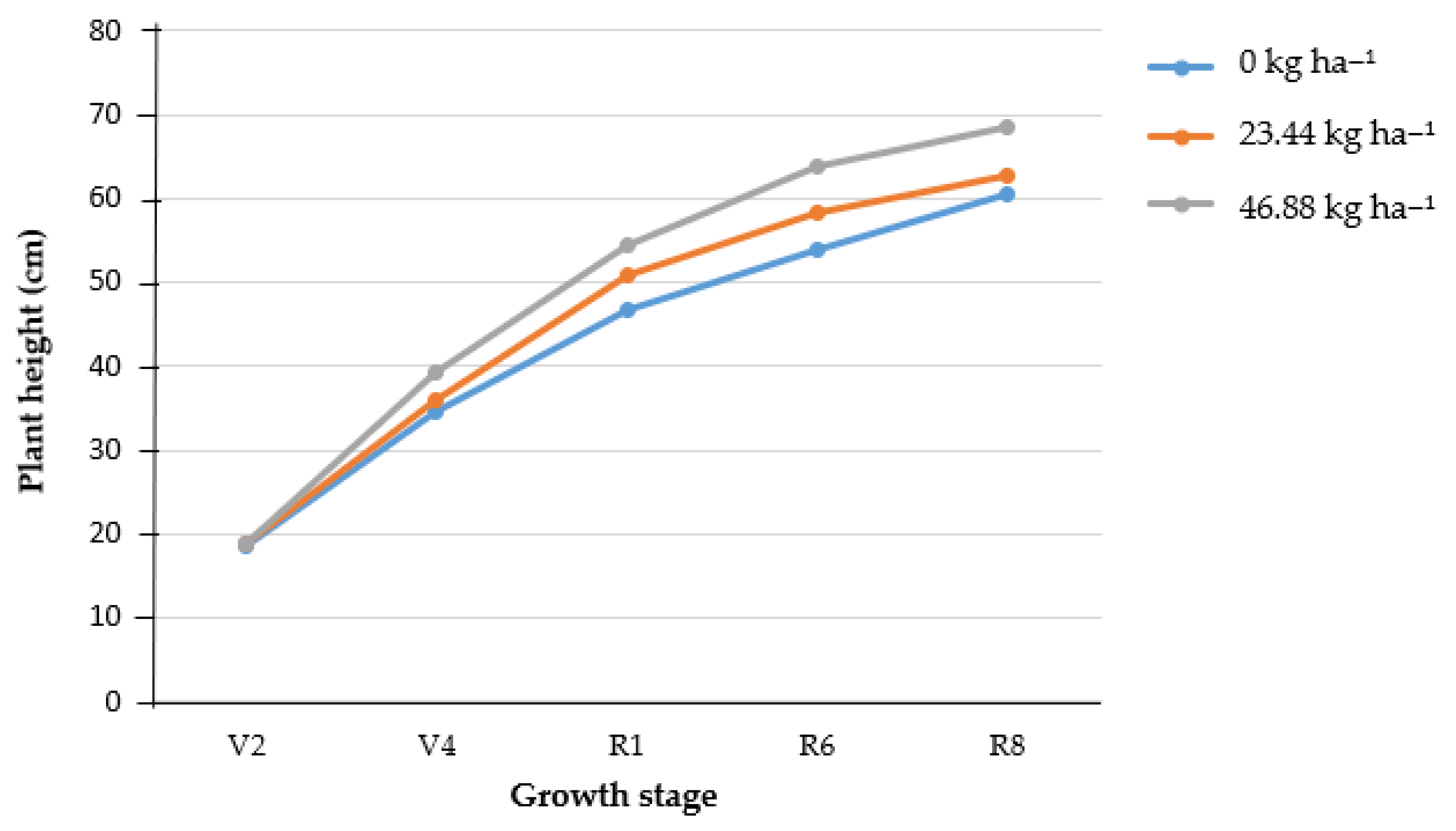
Plant height progression across growth stages (V2, V4, R1, R6, and R8) under different NPK fertilizer rates is shown in Figure 1. At the early V2 stage, plant height was nearly uniform across all NPK treatments, averaging approximately 19 cm. As growth progressed from V4 to R1, differences among treatments became increasingly apparent. Plants receiving 46.88 kg ha−1 NPK consistently achieved greater heights throughout development, reaching approximately 68–70 cm at R8. The intermediate rate (23.44 kg ha−1) showed moderate growth response, with final heights around 62–63 cm. The control treatment (0 kg ha−1) produced the shortest plants, achieving maximum heights of approximately 60 cm at maturity. The progressive height advantage with increasing NPK rates became most pronounced during reproductive stages (R1–R8), suggesting that fertilizer application particularly enhanced stem elongation during flowering and seed development phases.
This response suggests that NPK application promotes vegetative growth by enhancing nutrient availability.

3.2.1. Effects of NPK Rates on Growth and Yield Components

Analysis of variance for Experiment 1 revealed significant effects across factors and interactions (Table 1). Season (A) significantly affected all traits, indicating substantial environmental influence on soybean performance. NPK rate (B) significantly influenced plant height, number of pods on stem, number of pods per branch, seeds per pod, and grain yield, but not number of nodes, branches, or 100-seed weight. Variety (C) significantly affected all traits except the number of nodes. Significant interactions were observed between season and NPK rate (A × B) for all traits except plant height and the number of branches, suggesting that fertilizer response varied with environmental conditions. Season × variety interactions (A × C) were significant for all traits, indicating that seasonal conditions influenced the performance of each variety. NPK rate × variety interactions (B × C) were important for most traits, except for plant height, branch number, and grain yield.
The three-way interaction (A × B × C) was significant for plant height, pods per stem, pods per branch, seeds per pod, and 100-seed weight, but not for grain yield. This indicates complex interactions among season, fertilizer rate, and variety for specific growth components.
NPK fertilizer application significantly influenced growth and yield components across the four soybean varieties tested, with notable variety-specific responses observed (Table 1). For Morkhor 60, plant height increased progressively with NPK application rates, reaching 64.7 cm under control conditions (0 kg ha−1), 65.7 cm at 23.44 kg ha−1, and 68.2 cm at the highest rate (46.88 kg ha−1). However, these differences were not statistically significant among treatments. Pod development showed varied responses to NPK application. Morkhor60 produced 24.9 pods per plant on the main stem under control conditions. This number decreased slightly to 24.0 pods at 23.44 kg ha−1 before increasing to 26.3 pods at 46.88 kg ha−1. The number of pods per branch followed a similar pattern, with values of 28.2, 27.2, and 30.4 pods for the 0, 23.44, and 46.88 kg ha−1 treatments, respectively.
Seed development parameters demonstrated modest improvements with fertilizer application. For Morkhor60, the number of seeds per pod increased from 2.44 under control conditions to 2.50 at 23.44 kg ha−1 and 2.54 at 46.88 kg ha−1. The 100-grain weight remained relatively stable across treatments, measuring 14.65, 14.8, and 14.84 g for the three NPK rates, respectively. Yield responses varied among NPK treatments. Morkhor 60 achieved yields of 1186, 1239, and 1286 kg ha−1 for the 0, 23.44, and 46.88 kg ha−1 treatments, respectively. Notably, the intermediate rate (23.44 kg ha−1) produced yields statistically comparable to the highest rate while requiring 50% fewer inputs. Among other varieties, CM 60 showed the most pronounced yield response, increasing from 1052 kg ha−1 under control conditions to 1270 kg ha−1 at the highest NPK rate. In contrast, 223 × LH–85 and SJ5 exhibited minimal yield improvements with increased fertilization, suggesting lower nutrient responsiveness compared to the determinate varieties.

3.2.2. Dry Matter Partitioning

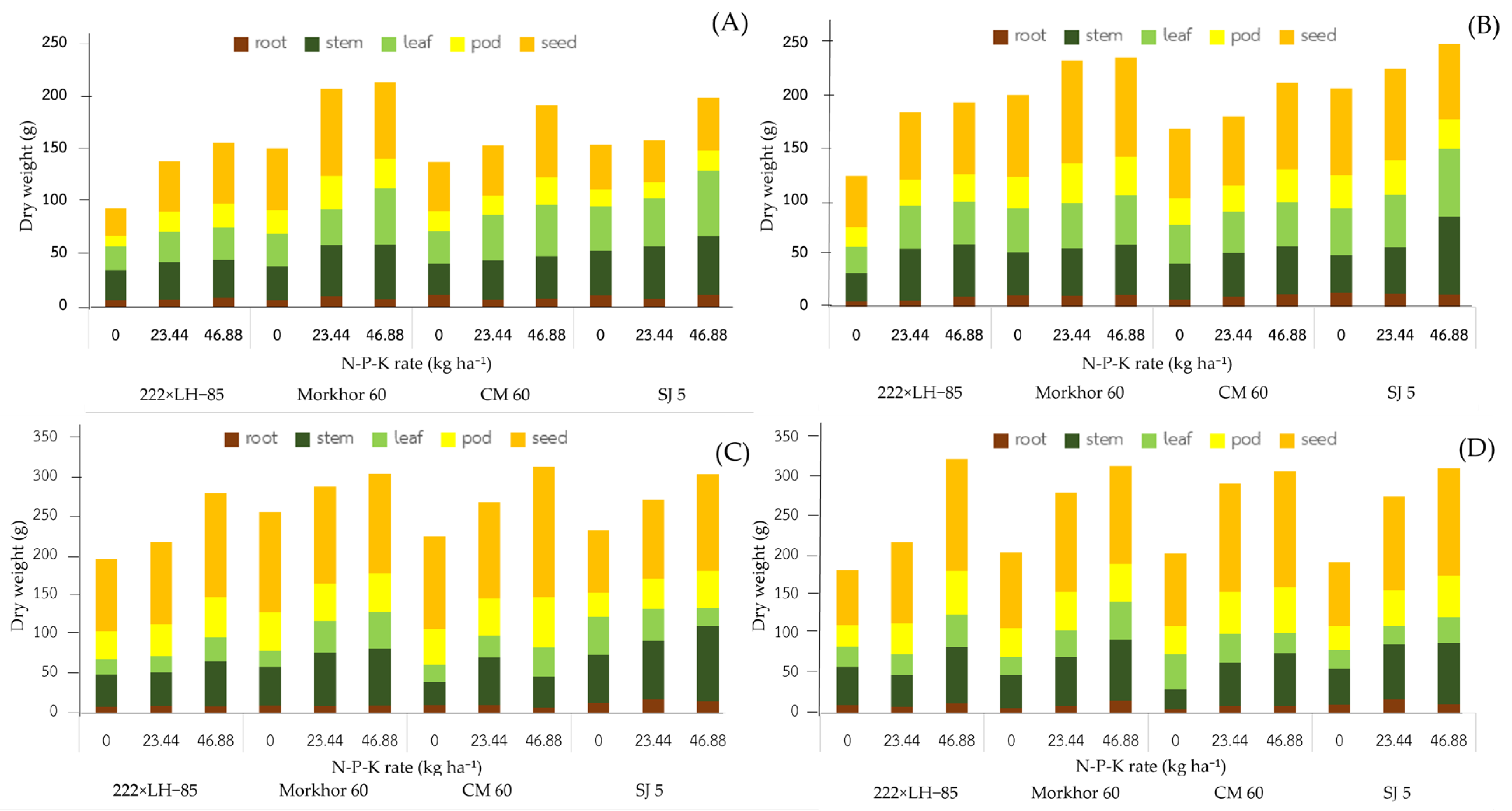
Dry matter accumulation and partitioning patterns varied considerably with NPK fertilizer rates, demonstrating critical physiological responses across seasons and varieties (Figure 2). Total dry matter accumulation increased with higher NPK rates, indicating enhanced biomass production under improved nutrient conditions. NPK fertilizer rates significantly shifted resource allocation among plant organs. Higher NPK rates promoted increased allocation to vegetative components (stems and leaves) at the expense of reproductive organs (seeds and pods), a consistent observation in both rainy and dry seasons.
Seed dry matter allocation showed a clear declining trend with increasing NPK rates. During the 2022 rainy season, seed allocation decreased from 45–50% under control conditions to 35–40% at the highest NPK rate. Similar patterns were observed in subsequent seasons, with dry seasons exhibiting slightly higher seed allocation compared to rainy seasons. Stem allocation showed the opposite trend, increasing from 20–25% under control to 30–35% under high NPK application. Leaf allocation remained stable at 15–25% across all NPK rates. Pod allocation exhibited variable responses, depending on the variety and season. Some varieties maintained a consistent allocation, while others showed slight increases with fertilizer application. This shift toward vegetative growth at higher NPK rates explains why maximum fertilizer rates did not translate to proportionally higher seed yields, supporting the economic optimization approach favoring intermediate NPK rates.

3.3. Experiment 2: Plant Spacing Effects

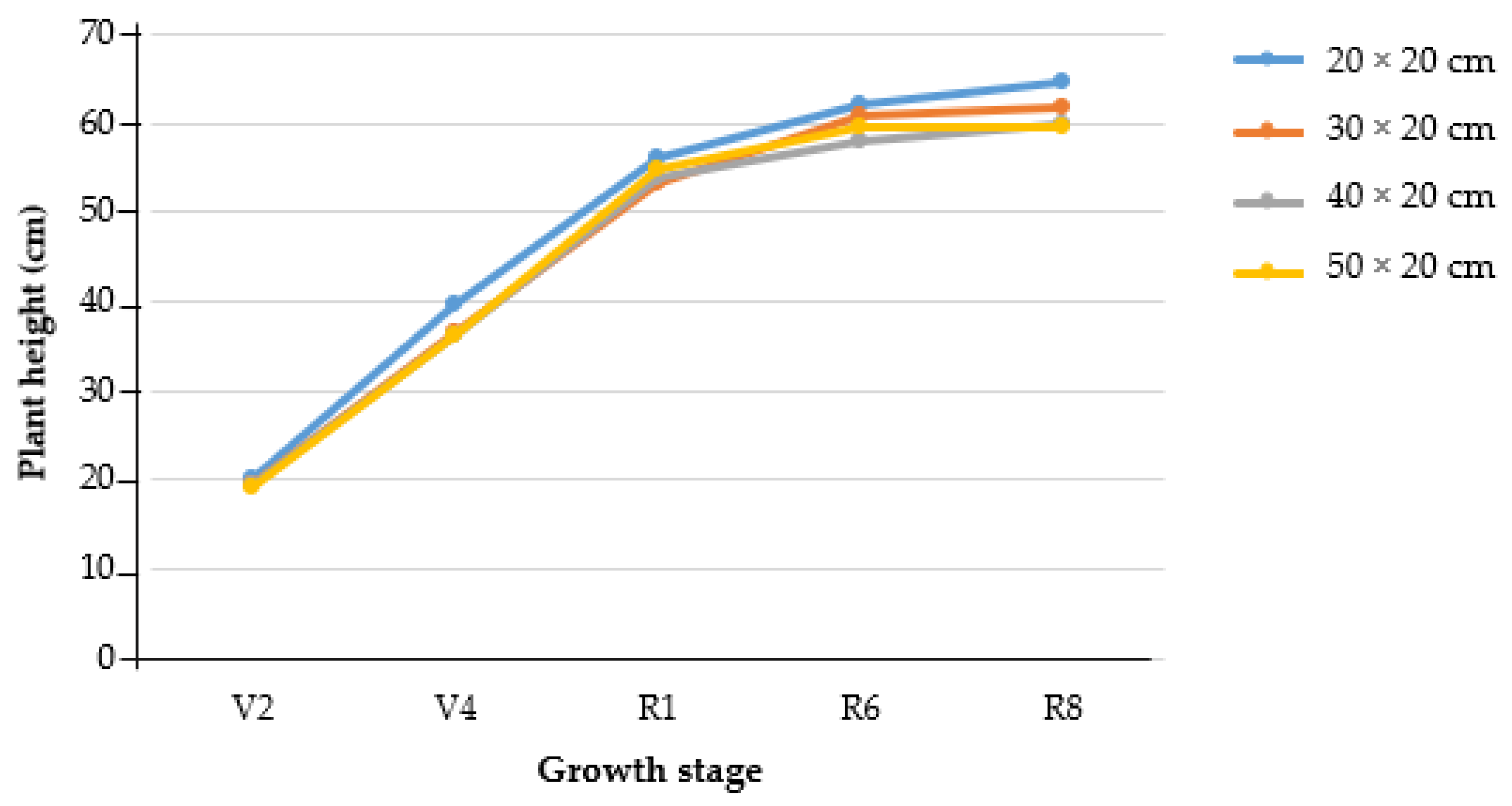
Plant height progression across growth stages (V2, V4, R1, R6, and R8) under different plant spacings is shown in Figure 3. Plant height increased steadily from V2 to R6, reaching maximum heights of 60–65 cm by R8 across all treatments. At early stages (V2–V4), plant height was uniform across all spacings. Differences became pronounced during reproductive stages (R1–R8). The 20 × 20 cm spacing produced the tallest plants (67 cm at R8), followed by 50 × 20 cm spacing (64 cm). Plants at 30 × 20 cm and 40 × 20 cm spacings showed moderate height development, reaching 62 cm and 60 cm, respectively, at maturity.
These height differences reflect varying degrees of competition for light resources. Taller plants in the 20 × 20 cm spacing represent etiolation responses, where dense populations compete for light by prioritizing stem elongation over lateral development. Wider spacings (40 × 20 and 50 × 20 cm) allowed for balanced growth without excessive competition-induced elongation. The 30 × 20 cm spacing achieved an optimal balance between light interception and reduced competition stress, contributing to efficient resource utilization despite not producing the tallest individual plants.

3.3.1. Effects of Plant Spacing on Growth and Yield Components

Analysis of variance for Experiment 2 revealed significant effects across measured traits (Table 2). Season (A) significantly affected all traits, indicating substantial environmental influence on soybean performance. Plant spacing (B) significantly influenced plant height, the number of nodes, the number of pods on the stem, the number of branches, and the number of pods per branch, but not 100-seed weight or grain yield. Variety (C) had a significant effect on all measured parameters, demonstrating genotypic differences in response to spacing. Significant interactions were observed between season and spacing (A × B) for all traits, indicating that spacing effects varied according to environmental conditions. Season × variety interactions (A × C) were significant for most traits, except for plant height, number of nodes, and seeds per pod. Spacing × variety interactions (B × C) were essential for most yield components, indicating that optimal spacing requirements varied among varieties. These interaction effects highlight the complexity of plant spacing optimization and emphasize the importance of considering environmental conditions and genetic background when developing spacing recommendations for soybean varieties.
Plant spacing had a significant impact on all growth and yield parameters (Table 2). For Morkhor 60, plant height was highest at narrow spacings of 20 × 20 cm (69.1 cm) and 30 × 20 cm (69.8 cm), decreasing to 66.4 cm at 40 × 20 cm and 63.8 cm at 50 × 20 cm. This height response reflects increased competition for light at higher plant densities, resulting in etiolation. The number of nodes per plant decreased with narrower spacing, with Morkhor 60 recording 11.1, 11.0, 10.7, and 9.9 nodes at 50 × 20 cm, 40 × 20 cm, 30 × 20 cm, and 20 × 20 cm spacings, respectively. Similarly, branching capacity declined from 4.8 branches per plant at 50 × 20 cm to 2.6 branches at 20 × 20 cm, indicating reduced lateral development under high plant density.
Yield components showed varied responses to spacing. The number of pods on the stem ranged from 13.0 (20 × 20 cm) to 17.7 (50 × 20 cm) for Morkhor 60, while pods per branch increased from 8.0 to 22.7 as spacing widened. Seeds per pod remained relatively stable (2.38–2.41) across spacings, and 100-seed weight varied from 14.07 to 15.06 g. Most critically, Morkhor 60 achieved maximum yield at 30 × 20 cm spacing (1774 kg ha−1), followed by 50 × 20 cm (1593 kg ha−1), 40 × 20 cm (1531 kg ha−1), and 20 × 20 cm (1257 kg ha−1), representing a 41% yield advantage of optimal over suboptimal spacing.

3.3.2. Ground Cover Analysis

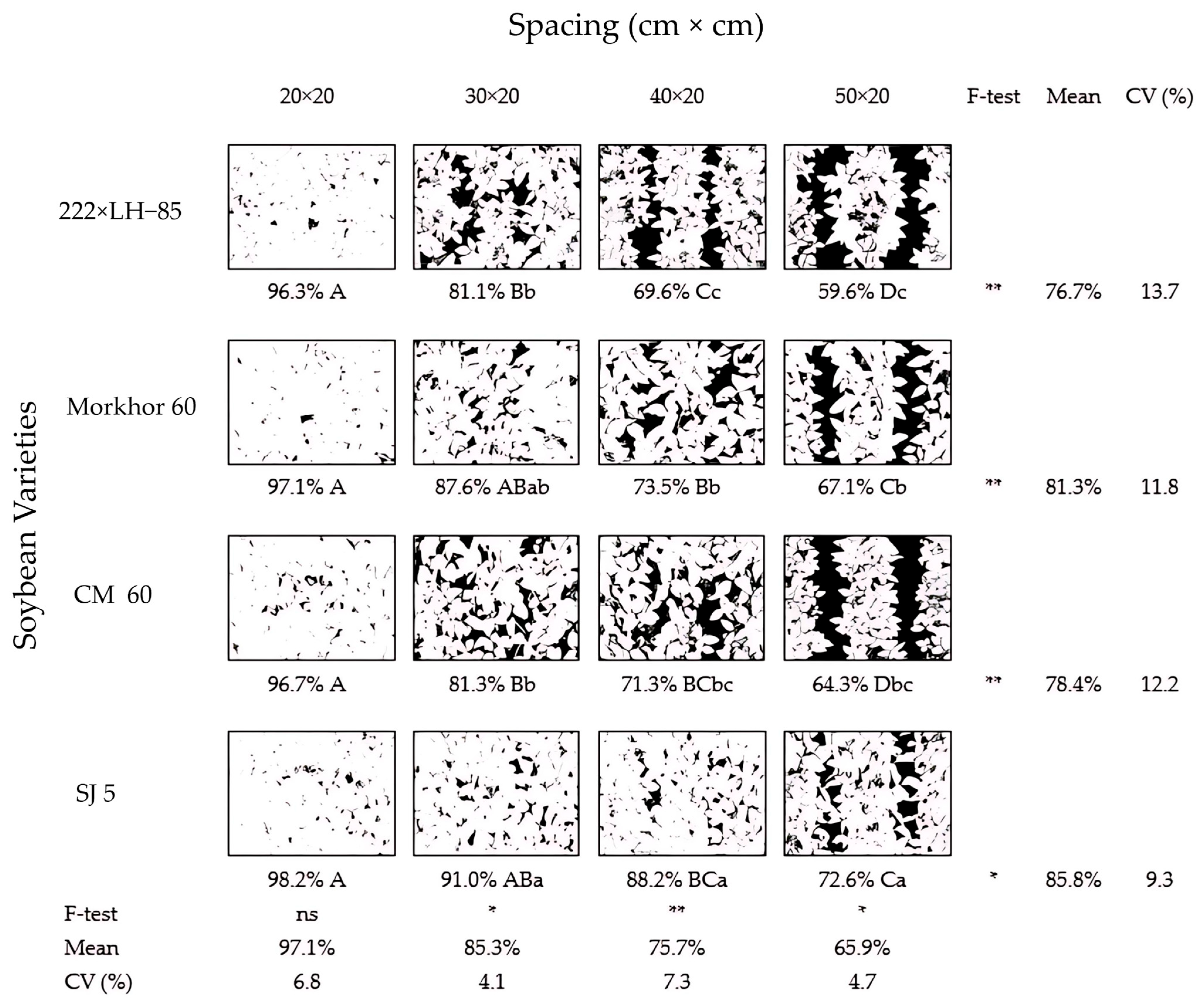
Ground cover at the R1 stage was significantly affected by plant spacing (Figure 4). The 20 × 20 cm spacing provided the highest ground cover across varieties, with Morkhor 60 achieving 97.1% coverage, followed by SJ 5 (98.2%), CM 60 (96.7%), and 223 × LH–85 (96.3%). The 30 × 20 cm spacing maintained excellent ground cover, with Morkhor 60 reaching 87.6%, SJ 5 (91.0%), CM 60 (81.3%), and 223 × LH–85 (81.1%) achieving similar results. As spacing increased, ground cover decreased progressively. At a 40 × 20 cm spacing, Morkhor 60 achieved 73.5% coverage, whereas at a 50 × 20 cm spacing, coverage further declined to 67.1%.
The statistical analysis revealed highly significant differences (p < 0.01) among spacing treatments for all varieties. The mean ground cover across varieties was highest at 20 × 20 cm spacing (97.1%), followed by 30 × 20 cm (85.3%), 40 × 20 cm (75.7%), and 50 × 20 cm (65.9%). For Morkhor 60, the optimal 30 × 20 cm spacing achieved 87.6% ground cover, providing excellent soil moisture conservation while maintaining optimal yield performance. This demonstrates the critical balance between ground coverage benefits for moisture retention in sandy soils and individual plant productivity, supporting the integrated management approach for sustainable soybean production.

3.4. Economic Benefits

Economic analysis revealed substantial benefits of optimized management practices (Table 3). In Experiment 1, the intermediate NPK rate (23.44 kg ha−1) achieved optimal cost-effectiveness for Morkhor 60, producing 1239 kg ha−1 yield with a benefit–cost ratio of 2.0 and net profit of 15,350 THB ha−1. Although the highest NPK rate (46.88 kg ha−1) increased yield to 1286 kg ha−1, the higher input costs reduced the benefit-cost ratio to 1.7 and net profit to 13,088 THB ha−1. The control treatment (0 kg ha−1 NPK) achieved the highest benefit–cost ratio (2.4) and net profit (17,463 THB ha−1) due to minimal input costs, despite lower yields.
In Experiment 2, plant spacing had a significant influence on profitability. For Morkhor 60, the 30 × 20 cm spacing produced the highest yield (1774 kg ha−1) and delivered the maximum net profit of 29,850 THB ha−1 with a benefit–cost ratio of 3.1. The 50 × 20 cm spacing achieved a slightly lower but still profitable return (26,225 THB ha−1, ratio 2.9). In comparison, narrow spacing (20 × 20 cm) resulted in reduced profitability (15,800 THB ha−1, ratio 2.0) due to lower yields despite similar input costs. Comparing varieties, CM 60 at 50 × 20 cm spacing achieved the highest net profit (29,625 THB ha−1) and benefit–cost ratio (3.2). In contrast, Morkhor 60 at 30 × 20 cm spacing delivered comparable economic performance, confirming the effectiveness of variety-specific spacing optimization.

4. Discussion

The development of high-yielding, environmentally adaptable crop varieties, such as Morkhor 60, is fundamental to enhancing agricultural productivity and food security in regions with challenging conditions, like northeastern Thailand’s sandy soils. However, genetic potential can only be realized through optimized agronomic management tailored to variety-specific characteristics. Our sequential experimental approach—first optimizing NPK fertilization across four seasons, then determining the ideal plant spacing under optimal nutrition—provides a robust framework that ensures spacing effects are evaluated without confounding by nutrient effects. Our findings demonstrate that Morkhor 60 achieves optimal cost-effectiveness at intermediate NPK inputs (23.44 kg ha−1) and responds dramatically to spacing optimization (30 × 20 cm), with spacing effects (a 41% yield range) substantially exceeding fertilization effects (an 8% yield range). The integrated system (87.6% ground cover, 1774 kg ha−1 yield, 29,850 THB ha−1 profit, benefit–cost ratio of 3.1) provides farmers with a practical and economically viable strategy for enhancing soybean production while maintaining sustainability.

4.1. NPK Fertilizer Optimization

The intermediate NPK rate (23.44 kg ha−1) achieved optimal economic efficiency for Morkhor 60 cultivation. While the highest rate (46.88 kg ha−1) produced a 3.8% yield increase over the intermediate rate (1286 vs. 1239 kg ha−1), this difference was not statistically significant (Table 1), yet it doubled the costs. The intermediate rate achieved a maximum yield of 96.3% at a 50% input cost, delivering superior profitability (15,350 vs. 13,088 THB ha−1, Table 3). This balance is crucial for smallholder farmers to maximize net returns within financial constraints. This finding is consistent with research in nutrient-poor tropical environments, where intermediate or sub-maximal fertilization rates are frequently recommended as the economically optimal choice, often achieving more than 95% of maximum yield while dramatically reducing input costs and environmental risk [26]. The physiological rationale for this optimal rate is multifaceted. Nitrogen drives vegetative growth and photosynthesis, phosphorus enables energy transfer and reproductive processes, and potassium regulates water balance [5]. Balanced NPK fertilization increases soybean yield by 5.1–18.6% over controls [6], validating our response pattern.
Soybeans fix atmospheric nitrogen through Rhizobium symbiosis, meeting 70–80% of nitrogen requirements [27]. The control yielded 1186 kg ha−1, indicating substantial BNF contribution. However, 23.44 kg ha−1 NPK provided crucial “starter nitrogen” before efficient nodulation, along with phosphorus and potassium that are unavailable from fixation [28]. This necessity for starter N in sandy or low-organic-matter soils is well-documented, supporting early vegetative growth until nodulation is fully effective, a phenomenon frequently observed in tropical acid soils [29]. Given sandy soil’s low organic matter and total nitrogen (0.02–0.03%, Table S1), this rate provides cost-effective insurance against early deficiencies. Crucially, seed dry matter allocation decreased from 44% at control to 39% at 46.88 kg ha−1, while stem allocation increased from 20–25% to 30–35% (Figure 2). This shift reveals that excessive nitrogen favors vegetative over reproductive growth [7], explaining why maximum NPK produced minimal yield gains despite enhanced biomass—a compelling physiological justification for intermediate rate optimization. This “luxury consumption” of N, leading to increased vegetative partitioning and a reduced harvest index at the highest NPK rate, has also been observed in other determinate soybean cultivars cultivated under high nutrient availability [30], reinforcing the need for nutrient budgeting.

4.2. Plant Spacing Optimization

Plant spacing exerted greater influence on yield than fertilization, with optimal spacing (30 × 20 cm) producing 1774 kg ha−1—41.1% advantage over poorest spacing (20 × 20 cm: 1257 kg ha−1) (Table 2). While direct comparison between the magnitude of yield variation in the sequential NPK and spacing experiments is inappropriate due to seasonal environmental differences, the data strongly suggest that plant geometry, rather than nutrient input (above the cost-effective baseline), is the primary leverage point for maximizing productivity in this variety. The non-significant yield difference observed between the intermediate (23.44 kg ha−1) and high (46.88 kg ha−1) NPK rates in Experiment 1 further supports the conclusion that: (1) The major yield constraint in this system is spatial competition (light/water) rather than nutrient supply (once the baseline is met). (2) The economically optimal rate (23.44 kg ha−1) successfully established the necessary nutrient base, making spacing the critical determinant of profitability. This dramatic response (517 kg ha−1 range) contrasts sharply with the modest NPK effects (100 kg ha−1 range), indicating that spacing is the primary determinant of productivity for this variety. This dominance of plant spacing in determining area-based yield over nutrient rate is a consistent finding for determinate varieties, especially in environments where water and light competition, rather than nutrient availability, are the primary limiting factors. Population density has a profound influence on soybean morphology and yield [7]. Optimized spacing creates favorable light environments promoting branching while reducing competition [13]. The 30 × 20 cm spacing balanced population density (500,000 plants ha−1) with individual productivity: 3.5 branches per plant, 69.8 cm height without excessive etiolation, 16.1 stem pods, 13.2 branch pods, and 87.6% ground cover for moisture conservation (Table 2, Figure 2). The ability of the 30 × 20 cm spacing to maintain a high number of branches per plant (3.5) while ensuring near-complete ground cover (87.6%) aligns with the concept of the “compensation zone,” where individual plant productivity compensates for moderate increases in density through efficient canopy architecture [31].
At 20 × 20 cm (750,000 plants ha−1), severe competition triggered etiolation—height increased to 69.1 cm while branching declined to 2.6 branches/plant, nodes decreased from 11.1 to 9.9, and branch pods dropped to 8.0. This reduction in branching limits the development of pod sites, thereby restricting individual plant yield potential [7]. Light competition prioritizes vertical growth over reproduction [8], particularly critical in determinate varieties like Morkhor 60, where limited vegetative periods make early resource allocation decisive for final yield. Though ground cover reached 97.1%, this benefit was negated by reduced individual productivity. Conversely, 50 × 20 cm spacing (300,000 plants ha−1) allowed maximum individual expression—4.8 branches, 17.7 stem pods, 22.7 branch pods—but the reduced population couldn’t compensate, yielding 1593 kg ha−1 with only 67.1% cover. This demonstrates that wider spacings promote branching, but the population cannot offset the lower density [7]. The 30 × 20 cm spacing optimally balanced individual productivity and population density [8], achieving maximum area-based yield through efficient resource capture.

4.3. Environmental and Seasonal Effects

Significant seasonal effects highlight the variability of rain-fed tropical agriculture. Rainfall varied dramatically from 39.9 mm (2023 dry) to 966.9 mm (2023 rainy), creating contrasting growth conditions that influenced development patterns. Rainy seasons promoted vegetative growth, while dry seasons enhanced reproductive components [7]. Season × NPK interactions indicate fertilizer response varies with environment. Rainy season moisture enhanced nutrient uptake efficiency, making NPK applications more effective for biomass accumulation [8]. Conversely, dry conditions with limited water availability constrained nutrient utilization, reducing responsiveness to higher rates. Similarly, season × spacing interactions demonstrate that spacing effects vary with environmental conditions. This variability highlights the need for multi-season, multi-year trials to develop robust, environmentally responsive recommendations. Regarding yield stability under climate change impacts, particularly drought conditions observed during the experiment, the Morkhor 60 variety offers promising characteristics. As an early-maturing variety (95–100 days), it has demonstrated yield stability across diverse environments in northeastern Thailand [14] and adaptability to integrated rotation systems [11]. The early maturity trait is particularly advantageous for drought escape strategy, potentially reducing exposure to late-season drought stress while maintaining stable yields.

4.4. Economic and Sustainability Implications

The integrated system (23.44 kg ha−1 NPK + 30 × 20 cm spacing) achieved net profits of 29,850 THB ha−1, with a benefit–cost ratio of 3.1, representing a 53% improvement in profitability (Table 3). This economic superiority stems from optimizing rather than maximizing inputs, avoiding diminishing returns while achieving near-maximum yields. Environmental benefits include: (1) reduced nutrient leaching through optimized fertilization—critical given sandy soil’s low CEC (2.95–3.70 cmol kg−1) and high leaching susceptibility [4]; (2) 87.6% ground cover providing living mulch effects that conserve moisture, suppress weeds, and reduce erosion; (3) enhanced BNF reducing synthetic nitrogen dependence and benefiting subsequent crops [27]. Integrated systems enhance soil microclimate, improve photosynthesis efficiency, and promote moisture conservation [32], validating our spacing strategy. This approach aligns with the principles of sustainable intensification, which aim to produce more food with fewer environmental impacts while maintaining ecosystem services [8].

4.5. Policy and Adoption Implications

These evidence-based recommendations have significant implications for Thailand’s national agricultural policy and food security strategy. The country’s heavy reliance on soybean imports creates economic vulnerabilities and puts pressure on its foreign exchange reserves. The focus of this study on soybeans, rather than other plant-based protein crops like peas, beans, or lentils, is strategically justified by several factors: (1) Established National Demand: Soybeans represent nearly 100% of Thailand’s plant-based protein import volume for industrial use (oil, animal feed, and food manufacturing), creating an immediate, large-scale market deficit that domestic production can address. (2) Dual-Purpose Value: Soybeans offer both a high-protein meal and high-value oil, whereas most alternative legumes are primarily single-purpose (protein). (3) Local Adaptation: Morkhor 60 is a locally bred variety with demonstrated adaptability to the challenging sandy soils of the Northeast [11,14], making it the most suitable and policy-relevant crop for immediate promotion in this key region. By providing farmers with scientifically validated, economically attractive management practices for locally adapted varieties such as Morkhor 60, policymakers can encourage increased domestic production while addressing multiple development objectives. The economic attractiveness of the optimized system (benefit–cost ratio of 3.1) provides strong incentives for farmer adoption without requiring subsidies or external support. This market-driven approach to technology adoption is more sustainable than subsidy-dependent programs, ensuring long-term viability [6]. The 41% yield advantage achieved through proper spacing alone demonstrates that significant productivity gains are possible through improved management practices, rather than relying on expensive external inputs.
Government extension services should prioritize the dissemination of these findings through demonstration plots, farmer field schools, and technical training programs. The sequential experimental methodology provides a replicable framework that can be adapted for optimizing management practices for other newly developed varieties and crops. Regional agricultural research centers could implement similar protocols to develop location-specific recommendations that account for local soil and climatic variations. Policy support for domestic soybean production could include preferential pricing for locally produced soybeans, quality premiums for high-protein varieties such as Morkhor 60, and targeted credit programs for soybean producers who implement evidence-based management practices. Such policies would stimulate rural economic development in soybean-producing regions, reduce import dependence, and enhance national food security.

5. Conclusions

This study successfully optimized the agricultural management of the Morkhor 60 soybean variety for sandy soil environments through an independent experimental approach. The research identified that an optimal NPK fertilizer rate of 23.44 kg ha−1 resulted in a yield of 1239 kg ha−1, which was statistically comparable to higher rates, while reducing input costs by 50%. This finding confirms Hypothesis 1, demonstrating that Morkhor 60 responds optimally in terms of cost-effectiveness and profit to intermediate nutrient inputs. The study also demonstrated that plant spacing exerted a dominant influence on productivity, with a 30 × 20 cm spacing producing the highest yield of 1775 kg ha−1. This represented a 41% yield advantage over suboptimal densities. This result confirms Hypothesis 2, validating that area-based yield can be maximized by optimally balancing individual plant productivity with population density in sandy soils. The integrated management package, which combines the optimal 23.44 kg ha−1 NPK rate with a 30 × 20 cm spacing, effectively addresses the constraints of sandy soil. This system achieved 87.6% ground cover for moisture conservation and delivered substantial economic benefits, with potential net profits of 29,850 THB ha−1 and a benefit–cost ratio of 3.1. This successful integration confirms Hypothesis 3, proving that the optimized system provides superior economic returns and enhances environmental sustainability compared to conventional practices. The findings of this research significantly contribute to enhancing domestic soybean production in Thailand’s vast sandy soil regions, offering a practical solution to reduce import dependency while ensuring both environmental sustainability and economic viability.

Supplementary Materials

The following supporting information can be downloaded at: https://www.mdpi.com/article/10.3390/agriculture15222357/s1, Figure S1: Weather conditions during the experimental period at the Agronomy Field Crop Station, Khon Kaen University, Thailand. Daily rainfall (mm), relative humidity (%), maximum temperature (°C), and minimum temperature (°C) are shown for: (A) rainy season 2022 (August–November); (B) dry season 2022–2023 (December–March); (C) rainy season 2023 (July–October); (D) dry season 2023–2024 (December–March). Data were recorded by an automated weather station located within 500 m of the experimental plots; Table S1: Soil physical and chemical characteristics of experimental sites before planting in the 2022 and 2023 growing seasons.

Author Contributions

Conceptualization, T.P., and S.C.; methodology, T.P., T.M. and S.C.; software, T.P.; validation, T.M., S.C. and J.S.; formal analysis, T.P.; investigation, S.C.; resources, S.C., T.M. and J.S.; data curation, T.P.; writing—original draft preparation, T.P. and S.C.; writing—review and editing, S.C.; visualization, T.M.; supervision, S.C.; project administration, S.C.; funding acquisition, S.C. All authors have read and agreed to the published version of the manuscript.

Funding

This work was financially supported by the Agricultural Research Development Agency (ARDA) support (Project no. PRP6605030490).

Institutional Review Board Statement

Not applicable.

Data Availability Statement

The original contributions presented in this study are included in the article and Supplementary Materials. Further inquiries can be directed to the corresponding author.

Acknowledgments

This research was supported by the Plant Breeding Research Center for Sustainable Agriculture, Khon Kaen University, for providing plant materials and research facilities, and the Agricultural Research Development Agency (ARDA) through financial support. The authors are grateful to Chompoonut Sritongtae and Sanit Lodthong, who initially supported the Morkhor 60 breeding program.

Conflicts of Interest

The authors declare that they have no conflicts of interest.

References

  1. Samahadthai, P.; Vityakon, P.; Saenjan, P. Effects of Different Quality Plant Residues on Soil Carbon Accumulation and Aggregate Formation in A tropical Sandy Soil in Northeast Thailand as Revealed by a 10-Year Field Experiment. Land Degrad. Dev. 2010, 21, 463–473. [Google Scholar] [CrossRef]
  2. Kheoruenromne, I.; Suddhiprakarn, A.; Kanghae, P. Properties, Environment and Fertility Capability of Sandy Soils in Northeast Plateau, Thailand. Kasetsart J. Nat. Sci. 1998, 32, 355–373. [Google Scholar]
  3. Arunrat, N.; Kongsurakan, P.; Sereenonchai, S.; Hatano, R. Soil Organic Carbon in Sandy Paddy Fields of Northeast Thailand: A Review. Agronomy 2020, 10, 1061. [Google Scholar] [CrossRef]
  4. Cameron, K.C.; Di, H.J.; Moir, J.L. Nitrogen losses from the soil/plant system: A review. Ann. Appl. Biol. 2013, 162, 145–173. [Google Scholar] [CrossRef]
  5. Zhang, Y.; Wang, H.; Lei, Q.; Luo, J.; Lindsey, S.; Zhang, J.; Zhai, L.; Wu, S.; Zhang, J.; Liu, X.; et al. Optimizing the nitrogen application rate for maize and wheat based on yield and environment on the Northern China Plain. Sci. Total Environ. 2018, 618, 1173–1183. [Google Scholar] [CrossRef]
  6. Li, M.; Zou, W.; Han, X.; Yan, J.; Chen, X.; Lu, X. Long-term balanced NPK fertilization increases soybean yield, grain nutrient and isoflavone contents, and improves the fertility of soybean fields. J. Plant Nutr. Fertil. 2024, 30, 2221–2229. [Google Scholar] [CrossRef]
  7. Cox, W.J.; Cherney, J.H. Growth and Yield Responses of Soybean to Row Spacing and Seeding Rate. Agron. J. 2011, 103, 123–128. [Google Scholar] [CrossRef]
  8. Gaspar, A.P.; Conley, S.P. Responses of canopy reflectance, light interception, and soybean seed yield to replanting suboptimal stands. Crop Sci. 2015, 55, 377–385. [Google Scholar] [CrossRef]
  9. Gaspar, A.P.; Mourtzinis, S.; Kyle, D.; Galdi, E.; Lindsey, L.E.; Hamman, W.P.; Matcham, E.G.; Kandel, H.J.; Schmitz, P.; Stanley, J.D.; et al. Defining optimal soybean seeding rates and associated risk across North America. Agron. J. 2020, 112, 2103–2114. [Google Scholar] [CrossRef]
  10. Prusiński, J.; Nowicki, R. Effect of planting density and row spacing on the yielding of soybean (Glycine max L. Merrill). Plant Soil Environ. 2020, 66, 616–623. [Google Scholar] [CrossRef]
  11. Taiyawong, A.; Monkham, T.; Sanitchon, J.; Choenkwan, S.; Srisawangwong, S.; Khodphuwiang, J.; Reewarabundit, S.; Chankaew, S. Yield Stability of Soybean Variety Morkhor 60 in Integrated Rotation Systems of Northeastern Thailand. Plants 2025, 14, 2503. [Google Scholar] [CrossRef]
  12. Li, R.; Xu, C.; Wu, Z.; Xu, Y.; Sun, S.; Song, W.; Wu, C. Optimizing canopy-spacing configuration increases soybean yield under high planting density. Crop J. 2025, 13, 233–245. [Google Scholar] [CrossRef]
  13. Xu, C.; Li, R.; Song, W.; Wu, T.; Sun, S.; Hu, S.; Han, T.; Wu, C. Responses of branch number and yield component of soybean cultivars tested in different planting densities. Agriculture 2021, 11, 69. [Google Scholar] [CrossRef]
  14. Sritongtae, C.; Monkham, T.; Sanitchon, J.; Lodthong, S.; Srisawangwong, S.; Chankaew, S. Identification of Superior Soybean Cultivars through the Indication of Specific Adaptabilities within Duo-Environments for Year-Round Soybean Production in Northeast Thailand. Agronomy 2021, 11, 585. [Google Scholar] [CrossRef]
  15. Corbellini, M.; Bobek, D.V.; de Toledo, J.F.F.; Ferreira, L.U.; Santana, D.C.; Gilio, T.A.S.; Teodoro, L.P.R.; Teodoro, P.E.; Tardin, F.D. Geographical adaptability for optimizing the recommendation of soybean cultivars in the Brazilian Cerrado. Sci. Rep. 2024, 14, 13076. [Google Scholar] [CrossRef] [PubMed]
  16. Zhong, Y.T.; Zhong, S.L. Development of precision agriculture techniques for soybean yield improvement. Biosci. Evid. 2024, 14, 260–269. [Google Scholar] [CrossRef]
  17. Kilmer, V.J.; Mullins, J.F. Improved stirring and pipetting apparatus for mechanical analysis of soil. Soil Sci. 1954, 77, 437–441. [Google Scholar] [CrossRef]
  18. Thomas, G.W. Soil pH and soil acidity. In Methods of Soil Analysis: Part 3 Chemical Methods; Sparks, D.L., Page, A.L., Helmke, P.A., Loeppert, R.H., Soltanpour, P.N., Tabatabai, M.A., Johnston, C.T., Sumner, M.E., Eds.; Book Ser No. 5; American Society of Agronomy: Madison, WI, USA, 1996; pp. 475–489. [Google Scholar] [CrossRef]
  19. Jackson, M.L. Nitrogen determination for soils and plant tissue. In Soil Chemical Analysis; Prentice-Hall of India Private Limited: New Delhi, India, 1967; pp. 83–203. [Google Scholar]
  20. Bray, R.A.; Kurtz, L.T. Determination of total organic and available form of phosphorus in soil. Soil Sci. 1954, 59, 39–45. [Google Scholar] [CrossRef]
  21. Pratt, P.E. Potassium. In Method of Soil Analysis, Part II.; Black, C.A., Ed.; American Society of Agronomy: Madison, WI, USA, 1965; pp. 1022–1030. [Google Scholar]
  22. Seleiman, M.F.; Al-Suhaibani, N.; Ali, N.; Akmal, M.; Alotaibi, M.; Refay, Y.; Dindaroglu, T.; Abdul-Wajid, H.H.; Battaglia, M.L. Drought Stress Impacts on Plants and Different Approaches to Alleviate Its Adverse Effects. Plants 2021, 10, 259. [Google Scholar] [CrossRef]
  23. Pringgani, A.M.; Khonghintaisong, J.; Gonkhamdee, S.; Songsri, P.; Jongrungklang, N. Ground covering characteristics of sugarcanes using high-angle images and their relationship with growth destructive sampling. Asian J. Plant Sci. 2023, 22, 434–443. [Google Scholar] [CrossRef]
  24. Sai, R.; Paswan, S. Influence of higher levels of NPK fertilizers on growth, yield, and profitability of three potato varieties in Surma, Bajhang, Nepal. Heliyon 2024, 10, e34601. [Google Scholar] [CrossRef] [PubMed]
  25. R Core Team. R: A Language and Environment for Statistical Computing; R Foundation for Statistical Computing: Vienna, Austria, 2023; Available online: http://www.R-project.org/ (accessed on 30 December 2023).
  26. Hickmann, C.; Resende, A.V.; Silva, C.A.; Lacerda, J.J.J.; Furtini Neto, A.E.; Moreira, S.G. Soybean response to NPK fertilization of sowing and potassium at topdressing in soil of improved fertility. Rev. Agrogeoambiental 2017, 9, 37–48. [Google Scholar] [CrossRef][Green Version]
  27. Hungria, M.; Mendes, I.C. Nitrogen fixation with soybean: The perfect symbiosis? In Biological Nitrogen Fixation; de Bruijn, F.J., Ed.; John Wiley & Sons: Hoboken, NJ, USA, 2015; pp. 1009–1024. [Google Scholar][Green Version]
  28. Salvagiotti, F.; Cassman, K.G.; Specht, J.E.; Walters, D.T.; Weiss, A.; Dobermann, A. Nitrogen uptake, fixation and response to fertilizer N in soybeans: A review. Field Crops Res. 2008, 108, 1–13. [Google Scholar] [CrossRef]
  29. Amante, G.; Wedajo, M.; Temteme, S. Soybean (Glycine max (L.) Merr.) response to application of mineral nitrogen and bradyrhizobia on Nitisols of Teppi, Southwest Ethiopia. Heliyon 2024, 10, e30540. [Google Scholar] [CrossRef]
  30. Rotundo, J.L.; Borrás, L.; Bruin, J.D.; Pedersen, P. Soybean nitrogen uptake and utilization in Argentina and United States cultivars. Crop Sci. 2024, 54, 1153–1165. [Google Scholar] [CrossRef]
  31. Yang, J.; Peng, X.; Ren, J.; Yang, X.; Zhang, K.; Li, Y.; Pu, T.; Yang, W.; Yong, T. Optimal interspecific distance maintains soybean yield by promoting canopy–root synergy in a maize–soybean relay strip cropping system. Crop J. 2025, in press. [CrossRef]
  32. Silva, L.M.; Habermann, E.; Costa, K.A.P.; Costa, A.C.; Silva, J.A.G.; Severiano, E.C.; Vilela, L.; Silva, F.G.; Silva, A.G.; Marques, B.S.; et al. Integrated systems improve soil microclimate, soybean photosynthesis and growth. Front. Plant Sci. 2024, 15, 1484315. [Google Scholar] [CrossRef]
Figure 1. Plant height progression of soybean across five growth stages (V2, V4, R1, R6, and R8) under three NPK fertilizer rates (0, 23.44, and 46.88 kg ha−1 of N, P2O5, and K2O). Data represent means averaged across four soybean varieties and four growing seasons (2022–2023).
Agriculture 15 02357 g001
Figure 2. Dry matter partitioning (g) among plant organs (root, stem, leaf, pod, and seed) of four soybean varieties under three NPK fertilizer rates (0, 23.44, and 46.88 kg ha−1 of N, P2O5, and K2O) at the R6 growth stage. (A) Rainy season 2022; (B) Rainy season 2023; (C) Dry season 2022; (D) Dry season 2023.
Agriculture 15 02357 g002
Figure 3. Plant height progression of soybean across five growth stages (V2, V4, R1, R6, and R8) under four plant spacing treatments (20 × 20, 30 × 20, 40 × 20, and 50 × 20 cm). Data represent means averaged across four soybean varieties and four growing seasons (2022–2023) at the optimal NPK rate of 23.44 kg ha−1.
Agriculture 15 02357 g003
Figure 4. Ground cover percentage (%) of four soybean varieties (223 × LH–85, Morkhor 60, CM 60, and SJ 5) at the 30 DAP or R1 growth stage under four plant spacing treatments (20 × 20, 30 × 20, 40 × 20, and 50 × 20 cm). Representative images show canopy coverage patterns. Uppercase letters indicate comparisons between different rows of the same varieties. Lowercase letters indicate comparisons between different varieties at the same row spacing. ** = significantly different at p < 0.01, * = significantly different at 0.05 < p < 0.01, ns = non-significant at p > 0.05 by LSD test.
Agriculture 15 02357 g004
Table 1. The interaction between season, NPK fertilizer rate, and varieties on plant height, number of nodes, number of pods on stem, number of branches, number of pods per branch, seed per pod, 100-grain weight, and grain yield.
FactorsPH
(Cm)
NN
(Nodes)
NPS
(Pods)
NB
(Branches)
NPB
(Pods)
NSP
(Seeds)
100 GW
(g)
GY
(Kg Ha−1)
Season (A)***************
NPK (B)**ns**ns***ns**
Varieties (C)**ns************
A × Bnsns**ns********
A × C****************
B × Cns***ns*****ns
A × B × C*ns**ns******ns
BCB × C interactions
0Morkhor 6064.7 bc 12.0 bc 24.9 bcd4.6 bcd28.2 cde2.44 bc14.65 de1186 abc
223 × LH–8555.9 e11.0 d16.0 f4.8 abc33.7 b2.33 d13.74 g894 f
CM 6057.1 e11.6 cd23.4 d3.5 g18.8 g2.41 c15.6 a1052 de
SJ563.9 cd 11.2 d20.8 e4.1 def23.8 f2.27 ef 13.78 g1043 e
23.44Morkhor6065.7 bc 11.9 bcd24.0 cd4.4 cde27.2 de2.5 ab14.8 d1239 abc
223 × LH–8558.8 e12.1 bc20.2 e5.2 a41.0 a2.4 c14.06 fg1126 cde
CM 6060.1 de11.6 cd26.6 b3.7 fg17.7 g2.43 c15.17 bc1103 de
SJ566.8 bc12.1 bc23.3 d4.8 ab32.5 b2.3 def13.78 g1171 bcde
46.88Morkhor6068.2 b12.3 abc26.3 bc4.7 bc30.4 bcd2.54 a14.84 cd1286 ab
223 × LH–8565.2 bc12.4 ab20.8 e4.9 ab38.0 a2.31 de13.99 g1165 bcd
CM 6066.4 bc12.1 bc30.7 a3.9 efg25.2 ef2.44 bc15.26 ab1270 ab
SJ574.5 a12.8 a25.6 bcd4.7 abc30.8 bc2.25 f14.36 ef1172 bcd
Mean63.91223.64.428.92.3814.51153
CV. A (%)17.77.323.228.722.62.73.336.3
CV. B (%)8.77.713.615.716.93.32.711.6
CV. C (%)7.96.511.81213.33314.2
CV = coefficient of variation; ** = significantly different at p < 0.01, * = significantly different at p > 0.01, 0.05, ns = non-significant at p > 0.05. Different letters following the means within a column indicate significant differences as determined by the least significant difference (LSD) test. PH = Plant height at R8 stage, NN = Number of nodes, NPS = Number of pods on stem, NB = Number of branches, NPB = Number of pods on branch, NSP = Number of seeds per pod, 100 GW = 100-grain weight (g), and GY = Grain yield (kg ha−1).
Table 2. The interaction between season, spacing, and varieties on plant height, number of nodes, number of pods on stem, number of branches, and number of pods per branch.
FactorPH
(Cm)
NN
(Nodes)
NPS
(Pods)
NB
(Branches)
NPB
(Pods)
NSP
(Seeds)
100 GW
(g)
GY
(Kg ha−1)
Season (A)****************
Spacing (B)************nsns
Varieties (C)****************
A × B***************
A × C***************
B × Cnsns******ns****
A × B × Cns********ns**ns
BCB × C interactions
20 × 20Morkhor 6069.1 a–c9.9 fg13.0 f2.6 jk8.0 i2.39 a–d14.07 gh1257 g
223 × LH–8557.5 fg9.5 g12.9 f3.2 gh10.6 h2.21 ef14.34 f–h1362 d–g
CM 6058.4 e–g10.0 e–g15.1 de2.3 k6.2 i2.29 c–e15.65 ab1603 a–d
SJ 574.2 a10.8 b–d14.1 ef2.9 hi10.0 h2.10 f13.97 gh1455 c–g
30 × 20Morkhor 6069.8 ab10.7 b–d16.1 b–e3.5 ef13.2 g2.41 a14.69 ef1774 a
223 × LH–8556.8 g10.4 c–f15.2 de3.9 cd15.9 de2.30 b–e13.25 I 1579 a–e
CM 6054.7 g10.3 d–f16.5 b–d2.8 ij10.2 h2.36 a–d15.92 a1611 a–c
SJ 565.9 b–d11.2 ab16.1 b–e3.8 de14.9 e–g2.20 ef14.27 f–h1322 fg
40 × 20Morkhor 6066.4 b–d11.0 a–c17.3 bc4.1 bc16.3 c–e2.39 a–d14.46 fg1531 b–f
223 × LH–8556.3 g10.4 c–f15.3 de3.9 cd18.1 bc2.39 a–d14.7 d–f1634 a–c
CM 6054.0 g10.3 d–f17.5 bc3.4 e–g13.7 fg2.40 a–c15.27 b–d1550 a–f
SJ 563.0 d–f11.5 a16.6 b–d4 b–d17.1 cd2.20 ef14.09 gh1329 fg
50 × 20Morkhor 6063.8 c–e11.1 ab17.7 b4.8 a22.7 a2.38 a–d15.06 c–e1593 a–e
223 × LH–8554.4 g10.6 b–e14.3 ef4.1 bc21.6 a2.40 ab14.26 gh1340 fg
CM 6056.3 g10.9 a–d21.2 a3.4 fg15.2 ef2.39 a–c15.59 a–c1729 ab
SJ 563.8 c–e10.8 b–d15.6 c–e4.3 b19.5 b2.28 de13.88 h1356 e–g
Mean61.510.615.93.614.62.3214.591501
CV. A (%)32.110.639.824.514.615.38.422.5
CV. B (%)9.88.117.212.113.45.64.417.9
CV. C (%)11.37.615.311.2165.9519.9
CV = coefficient of variation; ** = significantly different at p < 0.01, * = significantly different at p > 0.01, 0.05, ns = non-significant at p > 0.05. Different letters following the means within a column indicate significant differences as determined by the least significant difference (LSD) test. PH = Plant height at R8 stage, NN = Number of nodes, NPS = Number of pods on stem, NB = Number of branches, NPB = Number of pods on branch, NSP = Number of seeds per pod, 100 GW = 100-grain weight (g), and GY = Grain yield (kg ha−1).
Table 3. Economic analysis of NPK fertilizer rates (Experiment 1) and plant spacing treatments (Experiment 2) for Morkhor 60 and CM 60 soybean varieties.
Experimental/TreatmentYield
(Kg ha−1)
Gross Income
(THB Ha−1)
Production Costs
(THB Ha−1) *
Net Profit
(THB ha−1)
Benefit: Cost
Ratio
Experimental 1
VarietyNPK fertilizer Rate (kg ha−1 of N, P2O5, and K2O)
Morkhor 600118629,65012,18817,4632.4
23.44123930,97515,62515,3502.0
46.88128632,15019,06313,0881.7
CM 600105226,30012,18814,1132.2
23.44110327,57515,62511,9501.8
46.88127031,75019,06312,6881.7
Experimental 2
VarietySpacing (cm)
Morkhor 6020 × 20125731,42515,62515,8002.0
30 × 20177444,35014,50029,8503.1
40 × 20153138,27513,93824,3382.7
50 × 20159339,82513,60026,2252.9
CM 6020 × 20160340,07515,62524,4502.6
30 × 20161140,27514,50025,7752.8
40 × 20155038,75013,93824,8132.8
50 × 20172943,22513,60029,6253.2
* Note: Production costs comprised seeds, fertilizer, labor, fuel, and standardized operational expenses. Treatment cost differences in Experiment 1 resulted from varying NPK application rates, while Experiment 2 cost variations reflected different seeding rates corresponding to plant spacing treatments.
Disclaimer/Publisher’s Note: The statements, opinions and data contained in all publications are solely those of the individual author(s) and contributor(s) and not of MDPI and/or the editor(s). MDPI and/or the editor(s) disclaim responsibility for any injury to people or property resulting from any ideas, methods, instructions or products referred to in the content.