
You are currently viewing a new version of our website. To view the old version click .
Agriculture
  • Article
  • Open Access

28 October 2025

Structural Characteristics and Phenolic Composition of Maize Pericarp and Their Relationship to Susceptibility to Fusarium spp. in Populations and Inbred Lines

,
,
,
and
1
Programa de Maíz, Instituto Nacional de Investigaciones Forestales, Agrícolas y Pecuarias (INIFAP), Campo Experimental Centro Altos de Jalisco, Av. Biodiversidad 2470, Tepatitlán de Morelos 47600, Jalisco, Mexico
2
Tecnológico Nacional de México, Instituto Tecnológico José Mario Molina Pasque y Hernández, Unidad Académica Zapotlanejo, Av. Tecnológico No. 300, Predio Huejotitan, Zapotlanejo 45430, Jalisco, Mexico
3
Laboratorio de Microscopía y Fotografía de la Biodiversidad, Instituto de Biología, Universidad Nacional Autónoma de México (UNAM), Cto. Zona Deportiva S/N, C.U., Coyoacán 04510, Ciudad de México, Mexico
4
Laboratorio de Fitopatología, Campo Experimental Centro Altos de Jalisco, Tepatitlán de Morelos 47600, Jalisco, Mexico
This article belongs to the Special Issue Strategies to Improve the Security and Nutritional Quality of Crop Species—2nd Edition

Abstract

Maize (Zea mays L.) is one of the most widely cultivated cereals in the world, with multiple uses, including its role as a staple food for humans, as animal feed, and as a key industrial raw material. Its production is threatened by Fusarium spp., a widespread fungal pathogen that causes significant yield losses and contaminates grain with harmful toxins that constitute a health risk for consumers and animals. Among the grain characteristics reported as relevant for tolerance to this pathogen are pericarp thickness and composition, although results remain inconclusive. This study aims to evaluate the structural characteristics and phenolic composition of the pericarp in diverse native pigmented grain maize populations (NPMP) and inbred lines, and their relationship with susceptibility to Fusarium spp. Pigmented maize populations (EOGro, CTlax, EC149Pue, MGto, and ECMex) and inbred lines (B-50, B-50R, B-49 B-4A and B-5A) were used. All materials were grown at the same location, and tolerance to Fusarium spp. was assessed under natural and assisted infection using incidence (IN, %) and severity of infection (SI, %) as indicators. The phenolic composition (total soluble phenolics, phenolic acid fractions, insoluble phenolics, and phlobaphenes) and structural characteristics of the pericarp were determined, and proanthocyanidin content was quantified in the grain. Both IN and SI varied among genetic materials, with NPMP showing greater susceptibility than inbred lines, which had a thicker pericarp. Pericarp thickness was not correlated with IN, but it was relevant for SI, in both NPMP and inbred lines. Insoluble phenolics content was 31.4% higher in inbred lines compared with NPMP. High levels of proanthocyanidins and phlobaphenes were associated with greater tolerance to Fusarium spp. in some maize populations. Tolerance to Fusarium spp. was associated with pericarp thickness in inbred lines, whereas in native pigmented maize populations, it was linked to the accumulations of pigmented phenolics in pericarp.

1. Introduction

Maize (Zea mays L.) is one of the most important crops globally due to its nutritional, fodder, and industrial value [1]. However, its production and quality are threatened by diseases caused by fungi of the genus Fusarium, which not only induce ear rot but can also produce mycotoxins with harmful effects on human and animal health [2]. Susceptibility to Fusarium spp. varies among genotypes and may be influenced by structural traits of the grain, particularly the pericarp [3], as well as by the composition of phenolic compounds with antifungal or antioxidant activity [4,5].
Mexico is a center of genetic diversity for maize, with 64 recognized landraces comprising numerous populations that exhibit extensive variation in grain morphology and pigmentation. In particular, grains with hues ranging from pink to deep purple contain various phenolic compounds, most notably anthocyanins, proanthocyanidins, and phlobaphenes [6]. The prevalence of these compounds is associated with grain pigmentation: anthocyanins are predominant in blue-purple grains [7], proanthocyanidins in cherry-red grains, and phlobaphenes in purple and brick-red grains [8].
Phlobaphenes, in particular, have been associated with enhanced tolerance to Fusarium spp.-induced ear rots [4]. Rice varieties having red caryopside coat due to the presence of proanthocyanidins, showed higher resistance to the infection of Fusarium sporotrichioides [9]. In wheat, purple pericarp genotypes have demonstrated consistent resistance to Fusarium infection and reduced fumonisin accumulation [10]. Nonetheless ferulic acid does not have color, its presence is associated with antifungal activity [5,11], and in maize pericarp, high levels of this phenolic compound reduce the production of fumonisins [5].
The pericarp serves as the first physical barrier encountered by the pathogen during grain colonization. Traits such as its thickness, structural integrity, and degree of lignification have been identified as factors that constrain fungal penetration [12,13]. At the molecular level, genes in the ZmWAS2 family, involved in cell wall development, also regulate the accumulation of ferulic acid by modulating cellulose and lignin content [14]. Ferulic acid has been associated with resistance to fungal infection due to both its role in structural reinforcement and its inhibitory effect on fungal growth [3,5].
Nevertheless, the combined contribution of these structural and chemical attributes to grain resistance against Fusarium spp. remains insufficiently characterized in maize populations and inbred lines with contrasting susceptibility. In this context, the objective of the present study is to evaluate the structural characteristics and phenolic composition of the pericarp in diverse native pigmented maize populations and inbred lines, and their relationship with susceptibility to Fusarium spp. damage. The results aim to identify functional traits associated with resistance that could be incorporated as selection criteria in breeding programs targeting improved tolerance.

2. Materials and Methods

2.1. Genetic Materials

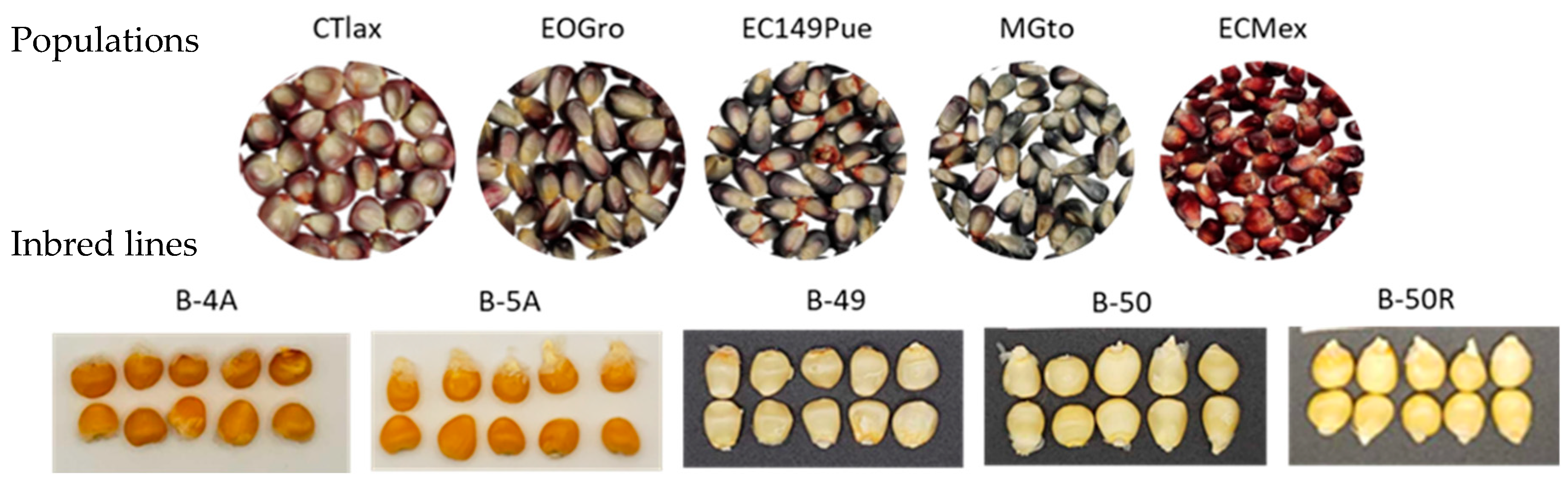
Native maize populations with blue-purple (MGto), cherry-red (EOGro, CTlax, EC149Pue), and brick-red (ECMex) maize grain colouration were used in this study, along with white grain inbred lines B-50, B-50R, and B-49, and yellow grain lines B-4A and B-5A. The grain of the native maize populations was obtained from the INIFAP germplasm bank, and seed multiplication was carried out at the Centro Altos de Jalisco Experimental Station, located in Tepatitlán de Morelos, Jalisco, Mexico (20°52′22″ N, 102°42′44″ W). The Maize Breeding Program at the same experimental station provided the inbred lines. Photographs of the grain samples used in the study are shown in Figure 1.
Figure 1. Photographs of maize grains from the populations (CTlax, EOGro, EC149Pue, MGto, and ECMex) and inbred lines (B-4A, B-5A, B-49, B-50, and B-50R) used in the study.

2.2. Evaluation of Native Maize Populations and Inbred Lines for Tolerance to Fusarium spp.

Native maize populations (NMP) and inbred lines were sown during the 2020 Spring–Summer (S/S) growing season at the Centro Altos de Jalisco Experimental Station. Sowing was realized manually, and fertilization was carried out at planting using urea and a Triple 17 (17-17-17) formulation. A pre-emergence herbicide was also applied. For each population, nine rows were planted, each 10 m long and 0.80 m wide. Each row contained 50 plants, spaced 20 cm apart. For each inbred line, three rows were sown using the same planting scheme as for the native populations. During crop development, foliar fertilizers were applied, and standard agronomic management practices were followed.
The incidence of disease caused by Fusarium spp. was evaluated under natural and assisted infection. For the latter, strains were isolated from damaged maize grains collected at a grain reception center in La Barca, Jalisco, a major commercial maize-producing area in Mexico. Strains exhibiting macro- and micro-morphological characteristics of Fusarium verticillioides, as described by Leslie and Summerell [15], were obtained. The five most virulent strains, identified in the field and reported by Zacamo-Velázquez et al. [16], were selected and used as a mixture. Inoculum was prepared according to Mesterházy et al. [17], and the toothpick technique was employed [16]. Each treatment (natural and assisted infection) consisted of three replications with 30 plants per replication. Infections were carried out at the reproductive R2 stage by inserting a toothpick colonized with fungal mycelium into the middle of the ear, deep enough to reach developing grains. As the molecular identity of the strains was not confirmed, they were designated as Fusarium spp.
The variables incidence (IN) and severity of infection (SI) were determined in the cobs of each treatment (maize populations and inbred lines) at maturity. The incidence (IN) was calculated by the ratio between the total number of cobs with the presence of infection and the total number of cobs (Equation (1)).
%   I N = N º   o f   c o b s   w i t h   p r e s e n c e   o f   i n f e c t i o n   T o t a l   n u m b e r   o f   c o b s × 100
To determine the severity of the infection (SI), the ratio between the infected cob area and the total cob area was used. This variable was calculated by Equation (2) [16]. After the evaluation, the cobs of each treatment were manually shelled, and the grain was placed in paper bags that were stored under refrigerated conditions.
%   S I = I n f e c t i o n   a r e a   i n   t h e   c o b   T o t a l   c o b   a r e a × 100

2.3. Pericarp Thickness in Maize Populations and Inbred Lines with Differential Susceptibility to Fusarium spp. Infection

From the treatment of natural infection, both of NMP and inbred lines, 20 healthy grains were randomly selected and soaked in warm water (~45 °C) for 20 min to facilitate manual pericarp separation. Using a scalpel, a circular incision was made around each grain, and with the aid of forceps, the pericarp layers from both the germinal and abgerminal sides were carefully removed. To measure pericarp thickness and its microstructural characteristics, the abgerminal surface of the grain was identified. Five pericarp layers were arranged on the abgerminal surface, and a reading was taken at the central part of the group of layers using a digital micrometer (Digimatic Series No. 293, Mitutoyo Co., Tokyo, Japan). Measurements were recorded in microns (µm). To obtain the thickness of one pericarp layer, the value obtained was divided by five. All determinations were made in triplicate. A sample of five pericarps of the abgerminal surface from each maize population or inbred line was subsequently used for microstructural studies [18].
The remaining pericarps from each sample were ground using a high-speed tissue homogenizer with grinding beads (Qiagen, TissueLyser II, Germantown, MD, USA). The resulting pericarp flour was dried in an oven at 40 °C for 24 h and then stored in a desiccator until phenolic compound analysis.

2.4. Scanning Electron Microscopy (SEM) of Pericarps from Maize Populations and Inbred Lines with Differential Susceptibility to Fusarium spp. Infection

The pericarps of each sample were soaked in hot water for two hours to prepare 1–2 mm high cross sections with a razor blade, which were then dried at room temperature for 24 h. The following day, sections of three different grains per treatment were placed perpendicularly in an aluminum sample holder on double-sided carbon adhesive tape, under a Leica EZ4 (Leica Microsystems, Wetzlar, Germany) stereoscopic microscope. Subsequently, the samples were coated with a thin layer of gold with the help of the Qourum equipment (Q150R ES, Quorum Technologies company, Sacramento, CA, USA) and were examined with a scanning electron microscope (SEM) (Hitachi, SUI510, Hitachi, Japan).

2.5. Phenolic Compounds in Grain and Pericarp of Maize Populations and Inbred Lines with Differential Susceptibility to Fusarium spp. Infection

2.5.1. Proanthocyanidins (PAs)

PAs were determined from whole grain previously defatted with petroleum ether and dried in an oven at 40 °C for 24 h. The grain was then ground in a cyclone mill (UDY Corporation, Fort Collins, CO, USA) equipped with a 0.05 mm mesh. Extraction was performed using 1 g of flour and 20 mL of solvent, consisting of acetone:water:acetic acid (75:24.5:0.5, v/v/v). The sample was placed in an ultrasonic bath (Branson Bath Cleaner, Model 1800, USA) for 15 min, followed by horizontal shaking for 60 min (Labfish, G10, USA). The mixture was centrifuged at 4000 rpm for 5 min, the supernatant recovered, and its volume recorded. Proanthocyanidins were quantified using the DMAC (4-dimethylaminocinnamaldehyde) method as described by Wallace and Giusti [19].

2.5.2. Soluble Phenolic Compounds (SPC)

The SPC were extracted from 200 mg of pericarp flour placed in an Erlenmeyer flask with 20 mL of 80% methanol. The mixture was sonicated for 15 min and then horizontally shaken (Labfish, G10, USA) for 105 min [20]. The suspension was filtered through Whatman No. 4 paper, its volume was recorded, and the extract was transferred to glass tubes. This extract was used to quantify total soluble phenolics (TSP) and free (FPA), glycosylated (GPA), and esterified (EPA) phenolic acid fractions. TSP quantification was performed using the Folin–Ciocalteu method [21]. For this, a mixture was prepared with an aliquot of the extract, Folin–Ciocalteu reagent, 19% sodium carbonate, and distilled water. After incubation of the samples at room temperature and darkness for 90 min, the absorbance was measured at 760 nm in a UV-Vis spectrophotometer (UV/Vis Model 25, Perkin-Elmer, Springfield, IL, USA). The results were expressed as micrograms of ferulic acid equivalent per gram of dry weight (µg FAE g−1 DW), using a standard curve prepared with ferulic acid (Sigma-Aldrich, St. Louis, MO, USA). All determinations were performed in duplicate.

2.5.3. Phenolic Acid Fractions

To obtain the phenolic acid fractions the method of Bakan et al. [22] was used with some modifications. Briefly, to attain the FPA fraction, the aqueous methanolic extract of SPC was adjusted to pH 2.0 and two extraction with ethyl acetate (15 mL each) were performed, with the organic phase recovered each time. The organic phases were pooled and evaporated to dryness under vacuum using a rotary evaporator. The dried residue of FPA was redissolved in 5 mL of methanol HPLC grade. The aqueous phase was then adjusted to 20 mL with distilled water and divided into two 10 mL aliquots. For the GPA fraction, 10 mL of 2N HCl was added to one aliquot and left for one hour at 4 °C. The other aliquot was used for the EPA fraction; 10 mL of 2N NaOH was added, and the mixture was left to react in darkness for 3 h. Afterwards, the pH of the extract was adjusted to 2.0 and processed in the same way as the FPA. Total phenolic acids in each fraction were quantified using the Folin–Ciocalteu assay.

2.5.4. Insoluble Phenolics (IP)

For the IP, the solid residue from SPC was suspended in 20 mL of 2 N NaOH and shaken for 3 h at 60 °C under a nitrogen atmosphere, according to Salinas-Moreno et al. [20]. Afterwards, the mixture was diluted to 100 mL with distilled water and left to rest at room temperature in darkness for 12 h. The mixture was then vigorously stirred with a magnetic stir bar for 2 min. A 25 mL aliquot was taken and diluted to 100 mL with distilled water; from this second dilution, 25 mL was adjusted to pH 2.0 with 4 M HCl. Extraction was carried out by three successive liquid–liquid extractions with ethyl acetate, collecting the organic phase each time. The combined fractions were concentrated to dryness under reduced pressure and temperature. The dry residue was redissolved in 5 mL of HPLC-grade methanol and analyzed by Folin-Ciocalteau method to quantify the total phenolics [21].

2.5.5. Phlobaphenes

The content of phlobaphenes was determined following the procedure described by Landoni et al. [4], with slight modifications. Twenty-five milligrams of pericarp flour were weighed into an Eppendorf tube, to which 200 µL of concentrated HCl was added. The mixture was vigorously vortexed for 1 min, then 800 µL of dimethyl sulfoxide (DMSO) was added and vortexed again for 1 min. The sample was centrifuged at 14,000 rpm for 5 min. A 200 µL aliquot of the supernatant was transferred to a test tube and adjusted to 3 mL with absolute methanol. The mixture was shaken, and absorbance was measured at 510 nm using a UV-Vis spectrophotometer. Results were expressed as absorbance units.
All determinations of phenolic compounds were performed in duplicate. For the native maize populations, the five samples were subjected to these phenolic compound analysis. While for the inbred lines, only four lines contrasting in infection incidence and severity values were used (B-50, B-50R, B-4A, and B-5A).

2.6. Statistical Analysis

With data on Fusarium spp. tolerance and pericarp thickness an analysis of variance (ANOVA) and Tukey’s mean comparison (p ≤ 0.05) were performed. In addition, Person’s correlations between Fusarium spp. tolerance data and pericarp thickness was carried out. The values of the phenolic variables determined in the pericarp of the populations and lines were also subjected to ANOVA analysis, and, when appropriate, Tukey’s test (p ≤ 0.05) was used for mean comparisons. All statistical analyses were conducted using the SAS software package for PCs (9.4 version).

3. Results and Discussion

3.1. Incidence, Severity, and Pericarp Thickness in Maize Populations and Inbred Lines

Table 1 summarizes the incidence (IN) and severity (SI) of Fusarium spp., under natural and assisted infection, along with pericarp thickness measured by a micrometer (EMC) and with the scanning electron microscopy (SEM), in maize populations and inbred lines. The IN showed similar values under natural and assisted infection in the majority of the genetic materials evaluated. The values of IN for populations under natural infection varied from 26.25 (EOGro) to 70.30% (CTlax), whereas under assisted infection the variation was of 62.42% (EC149Pue) to 92.31 (CTlax). Under the two infection procedures, population CTlax was de most susceptible. For inbred lines IN values under natural infection ranged from 18.51% (B-5A) to 100% (B-50 and B-50R). The range under assisted infection was similar to that obtained under natural infection (17.21 to 100%) with the same inbred lines at the extreme values.
Table 1. Incidence (IN) and severity of infection (SI) by Fusarium spp. under natural and assisted infection and pericarp thickness in maize grain populations and inbred lines.
For populations, the SI under natural infection ranged from 4.47% (EC149Pue) to 39.89% (CTlax), and under assisted infection, the values were of 6.65% (ECMex) to 48.93% (CTlax). Again, CTlax presented the highest SI values evidencing its susceptibility to the fungus. It is noticeable that maize populations EC149Pue and ECMex which have colored phenolics in their pericarp exhibited the lowest values of SI under the two procedures of evaluation. Briones-Reyes et al. [23] evaluated several maize populations under natural infection for Fusarium spp. and considered tolerant to this pathogen those populations with FER (Fusarium ear rot) between 27 and 41%. According to the information from these authors, the EC149Pue and ECMex populations can be considered as tolerant; however, we realized the evaluation only one year, and it is known that climatic conditions have strong influence on Fusarium incidence [24], and these results could change.
In inbred lines the values of SI were lower than in populations, both under natural and assisted infection (1.37 to 7.52%). The low values of SI is the result of the breeding selection under which have been subjected the inbred lines.
Regarding pericarp thickness, values obtained with the micrometer were consistently higher than those from scanning electron microscopy (SEM), except in sample B-50R, likely due to differences in sample preparation and measurement resolution. Populations displayed a micrometer-measured pericarp thickness variation of 70.1–103.3 µm, that is a wider range than that observed in inbred lines (64.2–89.4 µm). The range of values obtained in maize populations was higher than that reported by So [25] for South Korean dent maize accessions, where pericarp thickness ranged between 48.1 and 55.8 µm. This broader variation may reflects underlying genetic diversity within the studied populations. Pericarp thickness in the populations, as measured by SEM, ranged from 44.3 to 72.7 µm, while in the lines it ranged from 52.1 to 72.9 µm. In native maize of the Cacahuacintle and Palomero races, pericarp thickness values reported from microscopic sections analyzed with SEM were 26.7 and 87.0 µm, respectively [26]. On average, the populations had thinner pericarps than the lines when measured using SEM. Among the populations, the one with the thinner pericarp (CTlax) was the most susceptible to Fusarium damage, whereas the one with the thickest pericarp (ECMex) was the most tolerant.

3.2. Relationship Between Pericarp Thickness and Infection Parameters

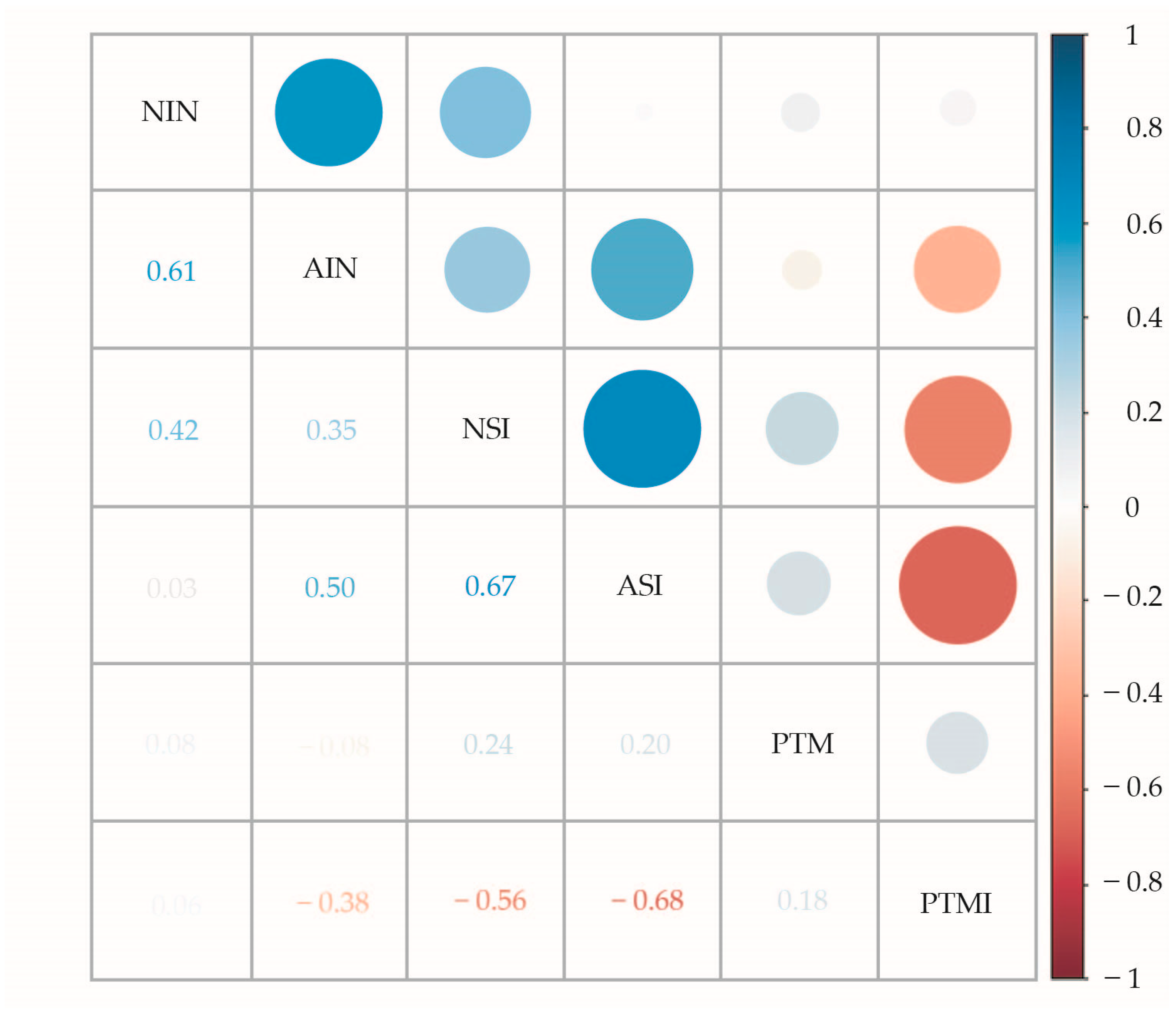
Pearson’s correlation values among the variables of IN, SI, and pericarp thickness of maize populations and inbred lines are presented in Figure 2. A significant positive correlation (r = 0.61) between NIN and AIN was observed. A positive correlation (r = 0.67) between the variables NSI and ASI was obtained, which means that under the conditions of the experiment and the location used in the present study, both natural infection and assisted infection render similar results.
Figure 2. Pearson correlation among the variables used for evaluating Fusarium spp. tolerance and the pericarp thickness. NIN: natural infection incidence, AIN: assisted infection incidence, NSI: natural infection severity, ASI: assisted infection severity, PTM: pericarp thickness micrometer, PTMI: pericarp thickness microscopy. Circle size and color represent the magnitude and direction of the correlations.
No relationship was observed between the pericarp thickness determined with the micrometer (PTM) and the variables of IN and SI. This result disagree with that of Hoenisch and Davis [27], who examined the relationship between IN and pericarp thickness evaluated with a micrometer in maize hybrids at the doughy to dent stages of maturity. They found that materials with greater pericarp thickness (37.8–56.2 µm) were less susceptible to Fusarium moniliforme infection.
A strong negative correlation (r = −0.68) was identified between ASI and PTMI; the correlation of this last variable and NSI was of r = −0.56, and a weak negative correlation (r = −0.38) was observed with ASI. According to these results, the pericarp thickness is related with Fusarium tolerance only when it is measured with the SEM, which offers higher resolution than the use of the micrometer.
However, to measure pericarp thickness with the SEM it is not a practical issue, and in order to have the option to use this grain trait as a criteria for selection in a breeding maize program it is necessary to evaluate the use of different micrometers, and probably, to make modifications in the way of taking the lectures.

3.3. Scanning Electron Microscopy (SEM) of Pericarps from Maize Populations and Lines with Different Susceptibility to Fusarium spp. Infection

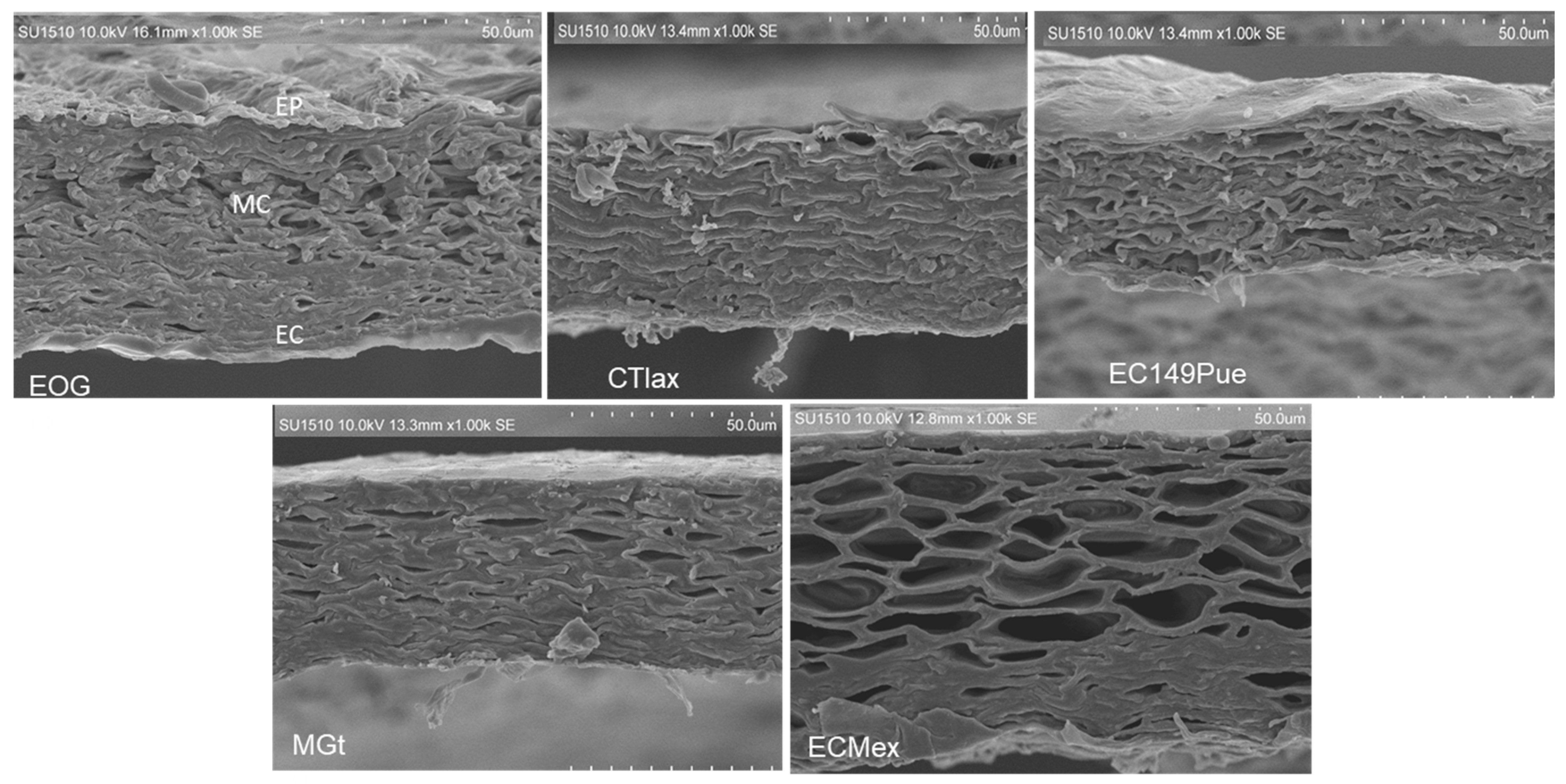
The maize grain pericarp constitutes the primary physical barrier protecting the grain from biotic and abiotic agents, as well as preventing dehydration. This structure is composed of the epicarp (EP), mesocarp (MC), cross cells, tube cells, and seed coat [28]. According to Kiesselbach and Walker [29], the outermost part of the pericarp primarily develops hollow cells with thick walls, whereas the inner part consists of compacted cells, resulting from pressure exerted by the growing endosperm during kernel development. The presence of hollow thick-walled cells was particularly observed in the ECMex sample, while the other samples showed flattened cells in the inner section of the pericarp (Figure 3).
Figure 3. Microphotographs of the pericarp of maize populations with different degrees of susceptibility to Fusarium spp. EP: epicarp, MC: mesocarp, EC: endocarp.
The thick pericarp cell walls observed in the ECMex sample may be related to pigment accumulation in this grain structure, which exhibited an intense red coloration. In contrast, the other native populations studied showed pericarps with light pigmentation (EC149Pue) or lacked pigments entirely, as observed in the MGto sample. Maize grains that accumulate pigments in the pericarp generally have thicker pericarps than those that do not [4]. However, an SEM study of five floury maize varieties from the Andean region of Peru reported a fully compacted pericarp cellular stratification, even in a variety accumulating anthocyanin-type pigments in this structure [30].
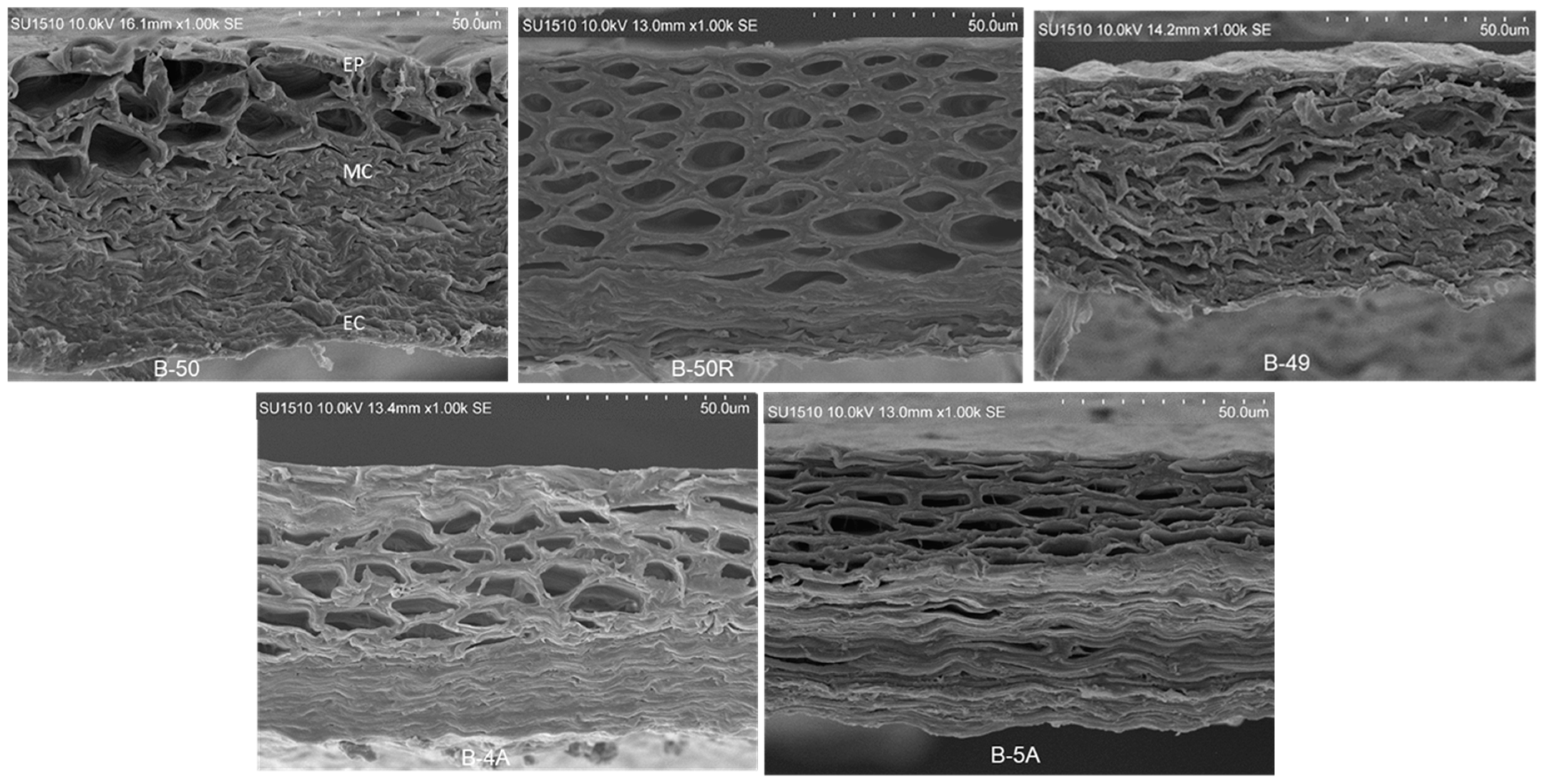
The pericarp of maize lines with both white and yellow kernels, lacking pigment, exhibited hollow, thick-walled cells in the epicarp (EP) and endocarp regions (EC), consistent with the description by Kiesselbach and Walker [29] (Figure 4). A similar cellular pattern was observed in the ECMex sample from the maize populations. It is possible that the presence of thick-walled cells with large lumens in these pericarp layers is associated with lower severity of disease infection (SDI) by Fusarium spp., a characteristic common to the maize inbred lines, which showed considerably lower SI compared to the populations. However, this relationship remains as hypothesis that should be evaluated in future studies with a larger sample size and controlled conditions.
Figure 4. Microphotographs of the pericarp of maize inbred lines with different degrees of susceptibility to Fusarium spp. EP: epicarp, MC: mesocarp, EC: endocarp.
The heritability of pericarp thickness ranges from 0.63 to 0.73, with the highest value observed for abgerminal thickness. The loci that primarily regulate this trait are qPT1-1 and qPT2-1, located on chromosomes 1 and 2, respectively [31]. However, in the present study, a significant relationship between pericarp thickness and Fusarium tolerance in maize was observed only when the measurement was performed using SEM, and not with the micrometer. Nevertheless, the high heritability of this grain characteristic facilitates its incorporation into maize breeding programs; however, it is necessary to determine the micrometer measurement conditions that best align with the values obtained using SEM.

3.4. Phenolic Compounds in the Pericarp of Maize Populations and Lines with Different Susceptibility to Fusarium spp. Infection

3.4.1. Populations

The quantification of total soluble phenolics, phenolic acids, and insoluble phenolics in the pericarp of the populations studied is shown in Table 2. A wide variation in total soluble phenolics (TSP) was observed (1294.1 to 28,191.6 µg ferulic acid equivalents/g DW). This variation is due to the presence of pigments in the pericarp of populations EC149Pue and ECMex, which are extracted with aqueous methanol and substantially increase TSP values. Encounter to, the pericarps of populations EOGro, CTlax, and MGto do not contain pigments, resulting in considerably lower values, that are in agreement with previous reports [27].
Table 2. Total soluble phenolics (TSP), phenolic acid fractions (FPA, GPA, and EPA), and insoluble phenolics (IP) in the pericarp of maize populations with different susceptibility to Fusarium spp. (values expressed as µg ferulic acid equivalents/g DW).
Within TSP are phenolic acids. The free phenolic acid fraction (FPA) ranged from 350.0 µg g−1 (MGto) to 1592.4 µg g−1 (ECMex); glycosylated phenolic acids (GPA) from 275.0 µg g−1 (MGto) to 1354.0 µg g−1 (ECMex); and esterified phenolic acids (EPA) from 476.7 µg g−1 (CTlax) to 750.5 µg g−1 (ECMex). The high values of FPA and GPA in the ECMex population may reflect contamination of these fractions by pericarp pigments during the liquid–liquid extraction stage with ethyl ether.
Insoluble phenolics (IP) ranged from 29,457.8 µg g−1 in EOGro to 39,451.3 µg g−1 in CTlax. These values are higher than those reported by Martínez-Fraca et al. [5], who studied 51 maize genotypes from different origins and found a variation of 4500 to 26,300 µg g−1. This difference can be attributed to the intensity of the alkaline hydrolysis applied to release esterified phenolic acids bound to cell wall components. Martínez-Fraca et al. [5] applied a moderate treatment (2 h at room temperature), although in our study the hydrolysis was stronger (3 h at 60 °C). The IP values obtained here are more comparable to those reported by Chateigner-Boutin et al. [32], who used a hydrolysis method similar to ours, and obtained ferulic acid values between 18,886 and 47,036 µg g−1. In maize pericarp, ferulic acid accounts for 95–98% of the total insoluble phenolics.
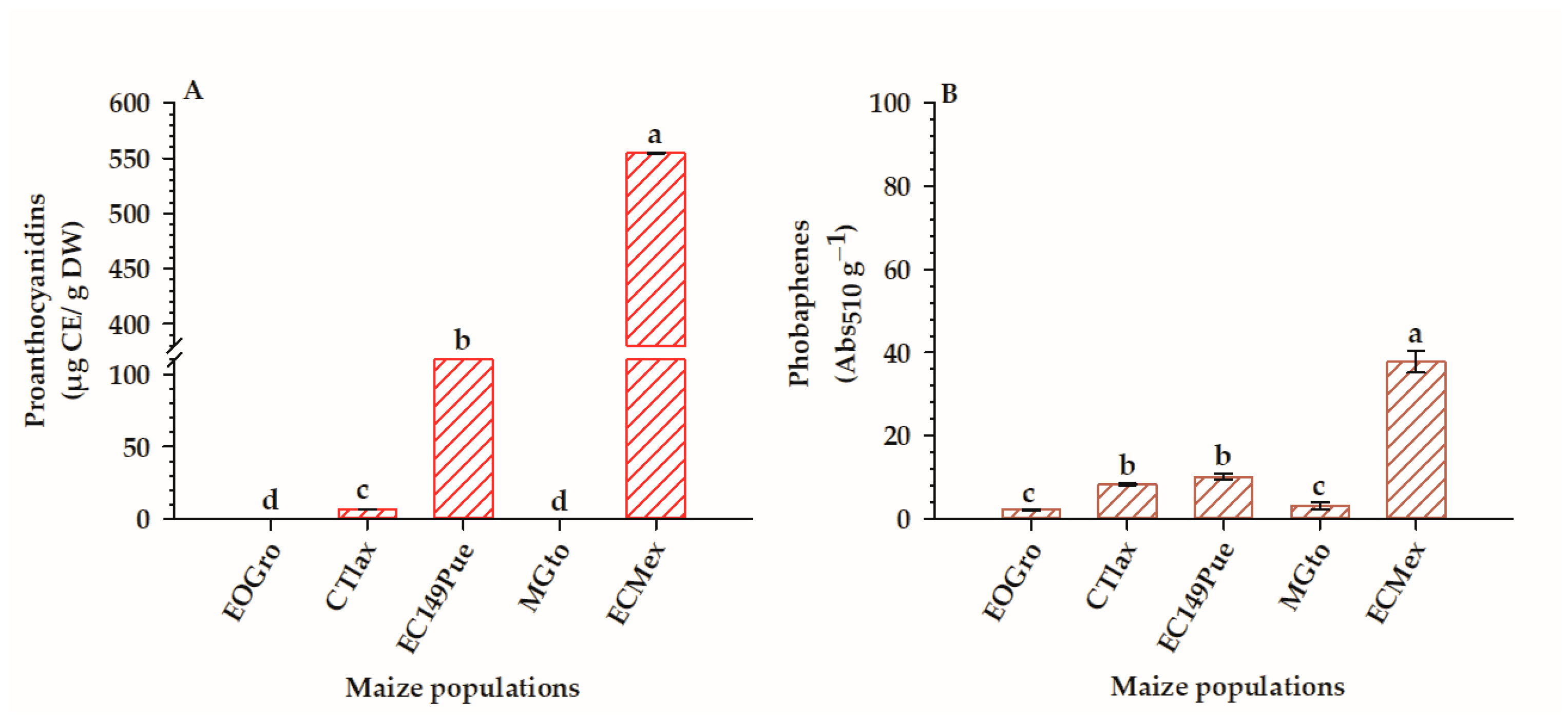
The levels of proanthocyanidins and phlobaphens in the pericarp of the maize populations are presented in Figure 5. The values were contrasting, particularly for PAs, since these phenolic compounds were not detected in EOGro with the analytical method used, and in the MGto population, the result was less than 1.0. On the other hand, high values were observed in EC149Pue and ECMex, particularly in the latter, which showed a content of 554.6 µg CE/g db (Figure 5A).
Figure 5. Content of proanthocyanidins (A) and phlobaphenes (B) in the pericarp of the maize populations analyzed. Different letters within each bar differ statistically (p ≤ 0.05).
Of the few studies conducted on PAs in maize, the one by Chen et al. [33] stands out, indicating that the grain pericarp concentrates the highest amount of PAs, predominantly in purple and red corn. According to these authors, the degree of polymerization of PAs in the pericarp of purple maize was less than 10, with a higher presence of monomers and dimers. A similar pattern was observed for red corn, but with a lower proportion of polymerized PAs. Additionally, the highest antioxidant activity of PAs was observed in those with a lower degree of polymerization.
The difficulty of purifying proanthocyanidin compounds with a degree of polymerization greater than five has limited the study of the biological activities of these phenolic compounds [34].
With respect to the phlobaphenes content, the lowest values (2.13 and 3.21 Abs 510nm) corresponded to the EOGro and MGto populations, while intermediate data were located in CTlax and EC149Pue (8.31 and 10.10 Abs 510nm), and the highest value was found in ECMex (37.77 Abs 510nm) (Figure 5B). The accumulation of phlobaphenes in the pericarp of maize grain has been related to a low incidence of damage by F. verticillioides [4,35].
The combined analysis of structural and chemical variables suggests relationships between pericarp composition and susceptibility to Fusarium spp. Populations with higher soluble phenolic content, particularly ECMex, tended to have low to moderate infection severity (6.65–7.80%) and a relatively low incidence (39.77–44.44%), compared to CTlax and MGto, which showed high incidence and severity (Table 1) along with low levels of soluble phenolics, especially phenolic acid fractions. This pattern supports the hypothesis that soluble fractions, rich in phenolic acids and color-associated metabolites such as proanthocyanidins and phlobaphenes, may contribute to limiting the spread of the infection.
Likewise, pericarp thickness appears to play a complementary role. ECMex, with the thickest pericarp, showed low severity, while CTlax, with a thin pericarp, registered high levels of IN and SI; nevertheless, it showed the highest content of insoluble phenols (39,451.3 μg g−1) in the pericarp (Table 2). It is not clear if pericarp thickness is associated with high levels of insoluble phenolics. Unless in CTlax it is not. The main phenolic acids in IP are ferulic and p-coumaric, and they are physically located in the cell walls [32] and can act as a mechanical and chemical barrier.

3.4.2. Inbred Lines

The inbred lines susceptible to Fusarium spp. (B-50 and B-50R) had lower total soluble phenol (TSP) values (p > 0.05) than the tolerant lines (B-4A and B-5A). In the tolerant lines, the highest value was found in line B-5A (Table 3). In the pericarp of the analyzed lines, TSPs are primarily composed of phenolic acids, as they do not contain phenolic pigments.
Table 3. Total soluble phenolics (TSP), phenolic acid fractions (FPA, GPA, and EPA), and insoluble phenolics (IP) in the pericarp of maize inbred lines with different susceptibility to Fusarium spp. (values are in µg ferulic acid equivalents/g DW).
Of the phenolic acid fractions quantified in the pericarp of the maize lines, only glycosylated phenolic acids (GPA) showed differences between susceptible and tolerant lines, with the highest values in the most susceptible lines. Insoluble phenols (IP) were higher (p ≤ 0.05) in the lines tolerant to fungal damage (B-4A and B-5A) compared to the susceptible ones. The IP values obtained in the pericarp of the lines are similar to those reported by Salinas-Moreno et al. [20] in brown midrib (bm) maize, including line B73, with a range of 34,117 to 39,875 µg gallic acid equivalents/g dry tissue. Although values above this range were recorded in the lines tolerant to the fungus, the difference could be attributed to the type of phenolic acid used as a standard for reporting the data and the intensity of alkaline hydrolysis employed to release ferulic acid bound to cell wall components as mentioned in previous paragraphs.
Ferulic acid is mainly esterified to cell wall components, but also forms diferulates that enhance the strength and resistance of the pericarp to penetration by fungal hyphae [36]. Although in vitro studies have demonstrated the inhibitory activity of ferulic acid on the growth and development of Fusarium verticillioides at concentrations between 0.25 and 0.50 mM [5], since it is present in the bound form in the pericarp, its participation would be more likely structural. Although it is hypothesized that the enzymes produced and released by the fungus in its attempt to establish itself in the grain could release ferulic acid and thus have a chemical role, ferulic acid’s mechanism of action focuses on the fungal cell membrane, whose functional structure is altered, causing its rupture and the subsequent release of intracellular fluids [11].
However, in the pericarp of the maize grain, the largest proportion of ferulic acid is bound to the cell wall polysaccharides (mainly hemicellulose and cellulose) by ester bonds. Therefore, its role in tolerance to Fusarium spp. is structural in nature, contributing to the physical resistance of the pericarp to penetration by fungal hyphae. This resistance is attributed to diferulates, formed by the crosslinking of ferulic acid molecules, which together with the cell wall components constitute a structural network [36].
Although the pericarp of the lines, which was translucent in all cases, was subjected to both phlobaphenes and proanthocyanidin analysis, the levels present were not detectable with the analytical methods applied to the pericarp of the populations.
It is noteworthy that the IP values in the pericarp of the lines were higher than those observed in the populations (Table 2), and the lines exhibited lower infection severity values than the populations (Table 1). Therefore, the pericarp of the lines may have a higher presence of diferulates, which have been associated with a pericarp that is more resistant to fungal damage [36].

4. Conclusions

The response of maize populations and inbred lines to Fusarium spp. was heterogeneous and explained by the interaction of structural and chemical mechanisms of the pericarp. The ECMex population and lines B-5A and B-4A showed the greatest tolerance, combining a thicker pericarp with high concentrations of soluble and insoluble phenols, as well as proanthocyanidins and phlobaphenes (ECMex). In contrast, materials with low phenolic content and thinner pericarp, such as populations CTlax and MGto, and lines B-50 and B-50R, were more susceptible.
Structural micrographs showing thicker pericarp cell walls in the inbred lines than in the populations reinforce the role of this structure as a physical barrier to fungal penetration. Furthermore, insoluble phenols were primarily associated with reduced incidence, while soluble phenols and condensed flavonoids contributed to limiting severity.
These results confirm that resistance to Fusarium spp. in native and inbred maize lines is a multifactorial trait, resulting from the convergence of physical barriers and chemical defenses.

Author Contributions

Conceptualization, Y.S.-M. and N.Y.Z.-V.; methodology, Y.S.-M., N.Y.Z.-V., and M.B.M.-G.; validation, M.B.M.-G.; formal analysis, Y.S.-M., N.Y.Z.-V. and J.I.-M.; investigation, Y.S.-M., and M.Á.M.-O.; data curation, Y.S.-M. and N.Y.Z.-V.; writing—original draft preparation, Y.S.-M. and M.Á.M.-O.; writing—review and editing, Y.S.-M., J.I.-M., N.Y.Z.-V., M.B.M.-G. and M.Á.M.-O. All authors have read and agreed to the published version of the manuscript.

Funding

This research received no external funding.

Institutional Review Board Statement

Not applicable.

Data Availability Statement

The original contributions presented in the study are included in the article, further inquiries can be directed to the corresponding author.

Acknowledgments

The authors express their gratitude to their educational institutions. Author NYZV thanks CONACYT (today SECHITI) for the scholarship granted (No. 727487) to carry out her doctoral studies. The assistance of Alberto Santillán Fernández in some statistical analysis is also appreciated.

Conflicts of Interest

The authors declare no conflicts of interest.

Abbreviations

The following abbreviations are used in this manuscript:
MPPGMaize populations with pigmented grains
INIFAPInstituto Nacional de Investigaciones Forestales, Agrícolas y Pecuarias
ILInbred lines
PAsProanthocyanidins
IN, %Incidence
SI, %Severity of infection
TSPTotal soluble phenolics
IPInsoluble phenolics
SEMScanning Electron Microscopy
TSPTotal soluble phenols
FPAFree phenolic acids
GPAGlycosylated phenolic acids
EPAEsterified phenolic acid
DWDry weight
HPLCHigh Performance Liquid Chromatography
PTMPericarp thickness measured with a Micrometer
PTMIPericarp thickness measured with scanning electron microscope
EPEpicarp
MCMesocarp
ECEndocarp
SDISeverity of disease infection
MSDMinimum significant difference
DMSODimethyl sulfoxide

References

  1. Erenstein, O.; Jaleta, M.; Sonder, K.; Mottaleb, K.; Prasanna, B.M. Global maize production, consumption and trade: Trends and R&D implications. Food Secur. 2022, 14, 1295–1319. [Google Scholar] [CrossRef]
  2. Santiago, R.; Cao, A.; Butrón, A. Genetic factors involved in fumonisin accumulation in maize kernels and their implications in maize agronomic management and breeding. Toxins 2015, 7, 3267–3296. [Google Scholar] [CrossRef]
  3. Giomi, G.M.; Sampietro, D.A.; Velazco, J.G.; Iglesias, J.; Fernández, M.; Oviedo, M.S.; Presello, D.A. Map overlapping of QTL for resistance to Fusarium ear rot and associated traits in maize. Euphytica 2021, 217, 81. [Google Scholar] [CrossRef]
  4. Landoni, M.; Puglisi, D.; Cassani, E.; Borlini, G.; Brunoldi, G.; Comaschi, C.; Pilu, R. Phlobaphenes modify pericarp thickness in maize and accumulation of the fumonisin mycotoxins. Sci. Rep. 2020, 10, 1417. [Google Scholar] [CrossRef] [PubMed]
  5. Martínez-Fraca, J.; de la Torre-Hernández, M.E.; Meshoulam-Alamilla, M.; Plasencia, J. In search of resistance against fusarium ear rot: Ferulic acid contents in maize pericarp are associated with antifungal activity and inhibition of fumonisin production. Front. Plant Sci. 2022, 13, 852257. [Google Scholar] [CrossRef] [PubMed]
  6. CONABIO. Base de Datos del Proyecto Global “Recopilación, Generación, Actualización y Análisis de Información Acerca de la Diversidad Genética de Maíces y sus Parientes Silvestres en México”. 2017. Available online: https://www.biodiversidad.gob.mx/diversidad/proyectoMaices (accessed on 25 June 2025).
  7. Salinas-Moreno, Y.; Santillán-Fernández, A.; de la Torre, I.A.; Ramírez-Díaz, J.L.; Ledesma-Miramontes, A.; Martínez-Ortiz, M.Á. Physical traits and phenolic compound diversity in maize with blue purple grain (Zea mays L.) of Mexican Races. Agriculture 2024, 14, 564. [Google Scholar] [CrossRef]
  8. Pilu, R.; Cassani, E.; Sirizzotti, A.; Petroni, K.; Tonelli, C. Effect of flavonoid pigments on the accumulation of fumonisin B1 in the maize kernel. J. Appl. Genet. 2011, 52, 145–152. [Google Scholar] [CrossRef]
  9. Gianinetti, A.; Finocchiaro, F.; Maisenti, F.; Kouongni Satsap, D.; Morcia, C.; Ghizzoni, R.; Terzi, V. The caryopsis of red-grained rice has enhanced resistance to fungal attack. J. Fungi 2018, 4, 71. [Google Scholar] [CrossRef] [PubMed]
  10. Trávníčková, M.; Chrpová, J.; Palicová, J.; Kozová, J.; Martinek, P.; Hnilička, F. Association between Fusarium head blight resistance and grain colour in wheat (Triticum aestivum L.). Cereal Res. Commun. 2024, 52, 1599–1611. [Google Scholar] [CrossRef]
  11. Yan, H.; Meng, X.; Lin, X.; Duan, N.; Wang, Z.; Wu, S. Antifungal activity and inhibitory mechanisms of ferulic acid against the growth of Fusarium graminearum. Food Biosci. 2023, 52, 102414. [Google Scholar] [CrossRef]
  12. Bily, A.C.; Reid, L.M.; Taylor, J.H.; Johnston, D.; Malouin, C.; Burt, A.J.; Bakan, B.; Regnault-Roger, C.; Pauls, K.P.; Arnason, J.T.; et al. Dehydrodimers of ferulic acid in maize grain pericarp and aleurone: Resistance factors to Fusarium graminearum. Phytopathology 2003, 93, 712–719. [Google Scholar] [CrossRef]
  13. Buanafina, M.M.d.O.; Morris, P. The impact of cell wall feruloylation on plant growth, responses to environmental stress, plant pathogens and cell wall degradability. Agronomy 2022, 12, 1847. [Google Scholar] [CrossRef]
  14. Xu, Y.; Fan, Y.; Liu, L.; Cao, J.; Zhou, J.; Liu, E.; Li, R.; Ma, P.; Yao, W.; Wu, J. Enhancing maize resistance to Fusarium verticillioides through modulation of cell wall structure and components by ZmXYXT2. J. Adv. Res. 2025, S2090–1232, 00121–00123. [Google Scholar] [CrossRef]
  15. Leslie, J.F.; Summerell, B.A. The Fusarium Laboratory Manual; John Wiley & Sons: Hoboken, NJ, USA, 2008. [Google Scholar] [CrossRef]
  16. Zacamo-Velázquez, N.Y.; Ireta-Moreno, J.; Salinas-Moreno, Y.; Gómez-Rodríguez, V.M.; Ramírez-Vega, H.; Martínez-Loperena, R. Variabilidad morfológica/patogénica de Fusarium verticillioides en la Ciénega/Chapala, México y evaluación de técnicas de inoculación. Agron. Mesoam. 2023, 34, 49679. [Google Scholar] [CrossRef]
  17. Mesterházy, Á.; Lemmens, M.; Reid, L.M. Breeding for resistance to ear rots caused by Fusarium spp. in maize—A review. Plant Breed. 2012, 131, 1–19. [Google Scholar] [CrossRef]
  18. Wolf, E. Three-dimensional structure determination of semi-transparent objects from holographic data. Opt. Commun. 1969, 1, 153–156. [Google Scholar] [CrossRef]
  19. Wallace, T.C.; Giusti, M.M. Evaluation of parameters that affect the 4-dimethylaminocinnamaldehyde assay for flavanols and proanthocyanidins. J. Food Sci. 2010, 75, C619–C625. [Google Scholar] [CrossRef]
  20. Salinas-Moreno, Y.; Scott, P.; Domínguez-López, A. Total phenolic acids and hydroxycinnamates in the grain tissues of brown midrib (bm) maize mutants. Cereal Res. Commun. 2025, 53, 969–978. [Google Scholar] [CrossRef]
  21. Singleton, V.L.; Rossi, J.A. Colorimetry of total phenolics with phosphomolybdic-phosphotungstic acid reagents. Am. J. Enol. Vitic. 1965, 16, 144–158. [Google Scholar] [CrossRef]
  22. Bakan, B.; Bily, A.C.; Melcion, D.; Cahagnier, B.; Regnault-Roger, C.; Philogène, B.J.; Richard-Molard, D. Possible role of plant phenolics in the production of trichothecenes by Fusarium graminearum strains on different fractions of maize kernels. J. Agric. Food Chem. 2003, 51, 2826–2831. [Google Scholar] [CrossRef]
  23. Briones-Reyes, D.; Castillo-González, F.; Chávez-Servia, J.L.; Aguilar-Rincón, V.H.; de León García-de Alba, C.; Ramírez-Hernández, A. Response of native maize from Mexican highlands to ear rot, under natural infection. Agron. Mesoam. 2015, 26, 74–85. [Google Scholar] [CrossRef][Green Version]
  24. Pfordt, A.; Ramos Romero, L.; Schiwek, S.; Karlovsky, P.; von Tiedemann, A. Impact of environmental conditions and agronomic practices on the prevalence of Fusarium species associated with ear-and stalk rot in maize. Pathogens 2020, 9, 236. [Google Scholar] [CrossRef]
  25. So, Y.-S. Pericarp thickness of Korean maize landraces. Plant Genet. Resour. 2019, 17, 87–90. [Google Scholar] [CrossRef]
  26. Narváez-González, E.D.; de Dios Figueroa-Cárdenas, J.; Taba, S.; Sánchez, F.R. Kernel microstructure of Latin American races of maize and their thermal and rheological properties. Cereal Chem. 2006, 83, 605–610. [Google Scholar] [CrossRef]
  27. Hoenisch, R.; Davis, R. Relationship between kernel pericarp thickness and susceptibility to Fusarium ear rot in field corn. Plant Dis. 1994, 78, 517–519. [Google Scholar] [CrossRef]
  28. Khalil, T.; Kramer, A. Histological and histochemical studies of sweet corn (Zea mays L.) pericarp as influenced by maturity and processing. J. Food Sci. 1971, 36, 1064–1069. [Google Scholar] [CrossRef]
  29. Kiesselbach, T.; Walker, E.R. Structure of certain specialized tissue in the kernel of corn. Am. J. Bot. 1952, 39, 561–569. [Google Scholar] [CrossRef]
  30. Salvador-Reyes, R.; Rebellato, A.P.; Pallone, J.A.L.; Ferrari, R.A.; Clerici, M.T.P.S. Kernel characterization and starch morphology in five varieties of Peruvian Andean maize. Food Res. Int. 2021, 140, 110044. [Google Scholar] [CrossRef]
  31. Gong, G.; Jia, H.; Tang, Y.; Pei, H.; Zhai, L.; Huang, J. Genetic analysis and QTL mapping for pericarp thickness in maize (Zea mays L.). BMC Plant Biol. 2024, 24, 338. [Google Scholar] [CrossRef]
  32. Chateigner-Boutin, A.-L.; Ordaz-Ortiz, J.J.; Alvarado, C.; Bouchet, B.; Durand, S.; Verhertbruggen, Y.; Barrière, Y.; Saulnier, L. Developing pericarp of maize: A model to study arabinoxylan synthesis and feruloylation. Front. Plant Sci. 2016, 7, 1476. [Google Scholar] [CrossRef]
  33. Chen, C.; Somavat, P.; Singh, V.; Gonzalez de Mejia, E. Chemical characterization of proanthocyanidins in purple, blue, and red maize coproducts from different milling processes and their anti-inflammatory properties. Ind. Crops Prod. 2017, 109, 464–475. [Google Scholar] [CrossRef]
  34. Zhou, H.-C.; Tam, N.F.-y.; Lin, Y.-M.; Ding, Z.-H.; Chai, W.-M.; Wei, S.-D. Relationships between degree of polymerization and antioxidant activities: A study on proanthocyanidins from the leaves of a medicinal Mangrove plant Ceriops tagal. PLoS ONE 2014, 9, e107606. [Google Scholar] [CrossRef]
  35. Bernardi, J.; Stagnati, L.; Lucini, L.; Rocchetti, G.; Lanubile, A.; Cortellini, C.; De Poli, G.; Busconi, M.; Marocco, A. Phenolic profile and susceptibility to Fusarium infection of pigmented maize cultivars. Front. Plant Sci. 2018, 9, 1189. [Google Scholar] [CrossRef] [PubMed]
  36. Santiago, R.; Barros-Rios, J.; Malvar, R.A. Impact of cell wall composition on maize resistance to pests and diseases. Int. J. Mol. Sci. 2013, 14, 6960–6980. [Google Scholar] [CrossRef] [PubMed]
Disclaimer/Publisher’s Note: The statements, opinions and data contained in all publications are solely those of the individual author(s) and contributor(s) and not of MDPI and/or the editor(s). MDPI and/or the editor(s) disclaim responsibility for any injury to people or property resulting from any ideas, methods, instructions or products referred to in the content.

Article Metrics

Citations

Article Access Statistics

Multiple requests from the same IP address are counted as one view.