1. Introduction
The term biochar refers to carbon-rich material produced specifically for soil application and environmental management [
1], given its various potential benefits (e.g., soil fertility, carbon sequestration, climate resilience). This material is obtained via pyrolysis—a thermochemical decomposition process of biomass under oxygen-limited conditions—resulting in a stable product, typically alkaline in pH and containing potential nutrients such as phosphorus (P), potassium (K), magnesium (Mg), and calcium (Ca) [
1]. Pyrolysis concentrates carbon in the form of fused aromatic ring structures, which confer a high degree of recalcitrance, enabling biochar to resist both biotic and abiotic degradation in soils for decades or even centuries.
Regarding biochar, key factors influencing its persistence in soils include the original feedstock (biomass type), peak pyrolysis temperature, and residence time. Lignocellulosic biomass and higher pyrolysis temperatures and durations ensure greater durability [
2,
3,
4]. In turn, the edaphoclimatic characteristics of an ecosystem also influence the persistence of biochar; for example, in soils with higher clay content also extends biochar residence time [
5].
Applying biochar to acidic soils promotes pH elevation, alters nutrient dynamics, and contributes to increased soil carbon stocks. This increase results both from the biochar’s recalcitrant fraction and from the reduced decomposition rate of organic matter—an effect associated with “negative priming”, particularly in clay-rich soils [
5].
The Intergovernmental Panel on Climate Change (IPCC) recognises biochar as one of the most robust and mature strategies for climate change mitigation and adaptation, given its ability to add value to agro-industrial residues without competing with food production [
6,
7]. Studies estimate that biochar could sequester up to 6.23% of total greenhouse gas (GHG) emissions across 155 countries over a 100-year timeframe. These benefits may be even greater in countries with abundant biomass resources, such as Brazil, where the potential reduction could reach 10% of national emissions [
8].
Contemporary scientific interest in biochar has emerged in the context of climate action becoming a global imperative [
9]. It originated from research into the fertility and resilience of anthropogenic soils in the Amazon, known locally as Terra Preta de Índio (TPI) and internationally as Amazonian Dark Earth (ADE) [
10]. In the Amazon Basin, TPI is concentrated in small fertile patches that cover no more than 3.2% of the territory [
6], within a region where approximately 75% of soils are acidic and considered of low fertility by modern agricultural standards [
11].
Evidence suggests that charcoal was deliberately incorporated into the soil via slow carbonisation of food and crop residues over centuries by Indigenous peoples [
12,
13,
14,
15]. Despite its Amazonian origins, agronomic use of biochar remains incipient in the region, being limited to small-scale agroecological crops and traditional agricultural practices [
16,
17].
Considering that (i) Brazilian agricultural production relies heavily on the importation of mineral inputs for soil fertility management [
18] and (ii) in the Amazon biome, distance and logistics raise the cost of acquiring agricultural inputs, the adoption of locally produced alternatives and the recovery of traditional knowledge—both of which biochar enables—are particularly promising. The region continues to host a wide diversity of Indigenous and traditional communities, which calls for solutions that respect their cultures and ways of life, while reducing reliance on exogenous inputs that would increase dependency [
19,
20].
Among the most abundant biomass types produced in the Amazon, acai (
Euterpe spp.) stands out. The fruit of this palm tree is widely consumed and has gained significant economic importance since the late 20th century [
21]. In 2022, approximately 1.7 million tonnes of fruit were produced [
22], generating an estimated 1.2 to 1.6 million tonnes of residues [
23].
The underutilisation of these residues represents a waste of raw material, while improper disposal causes environmental impacts and poses risks to public health, primarily through water pollution and greenhouse gas emissions resulting from decomposition [
24,
25]. However, research has demonstrated that using acai residues as biochar feedstock brings soil benefits such as pH elevation, increased available content of Ca, K, N, and P content, and improved cowpea yield [
26,
27].
Challenges remain for enabling agronomic use of this technology, particularly the development of appropriate techniques and production processes that allow for high-quality biochar production at scales sufficient to support practical use and adoption by farmers—especially for small-sized biomass [
4,
28,
29]. In this context, the technology developed in this study offers decentralisation potential, scalability, and applicability to agricultural systems in tropical regions.
Small-sized biomass, such as acai processing residues, accounts for a significant portion of agro-industrial waste and is dispersed across various territories [
30]. Simple pyrolysis systems allow for decentralised production and are capable of generating biochar with quality comparable to that of advanced industrial systems, with the feedstock being the main factor determining the product’s stability in soil [
2,
31,
32,
33].
This study aimed to assess the economic viability of biochar produced from acai residues for smallholder farmers in tropical regions, drawing on empirical data from biochar production processes and a field experiment evaluating its application, both in combination with and independent of lime.
The analysis is structured around two main components: (i) the costs associated with constructing a low-cost, mobile, handmade pyrolysis kiln prototype and producing biochar using this kiln [
32]; and (ii) the projected costs and revenues from one hectare of cowpea cultivation, based on a field experiment assessing the application of lime and biochar [
26,
27].
In addition, scenarios concerning biochar production and application were explored: (a) the potential effects of fractional biochar application on distributing production costs over time; (b) a comparative analysis of production costs between the developed kiln and a traditional earth-brick kiln, using secondary data [
17]; and (c) an estimation of the potential valuation of positive externalities resulting from the application of 12 t ha
−1 of biochar derived from acai residues.
By providing empirical evidence on both technical and economic dimensions, and by exploring different scenarios for biochar application, this study offers practical insights to support sustainable agricultural practices that integrate waste management, soil improvement, and climate change mitigation.
2. Materials and Methods
The project was carried out entirely at the premises of the partner institutions in the municipality of Manaus, AM, Brazil. Manaus is located in Western Amazonia, a region characterised by limited logistical infrastructure. The considerable distances between this area and the supply centres situated in Central Brazil significantly increase the costs of agricultural inputs. In this region, agriculture is still predominantly practised through traditional slash-and-burn systems, relying solely on the soil’s natural fertility.
The kiln was developed and constructed at the facilities of the National Institute for Amazonian Research (INPA) in October 2021, while the biomass carbonisation processes were carried out at the Federal Institute of Education of Amazonas (IFAM) (
Section 2.1. Biochar Production).
The field experiment was conducted at INPA’s Tropical Fruit Station (2°37′11.8″ S, 60°02′28.8″ W), located 41 km north of Manaus, in August 2022. This phase included the acquisition of commercial agricultural inputs and the calculation of revenues within the agronomic experiment. The experimental area had been under agricultural fallow with approximately 30 years of secondary vegetation cover, on a Ferralsol (WRB/FAO) (
Section 2.2. Field Experiment).
All values of this study were adjusted according to Brazil’s official inflation index—the Extended National Consumer Price Index (IPCA/IBGE)—up to February 2025 and converted using the average exchange rate of the US dollar on 28 February 2025.
2.1. Biochar Production
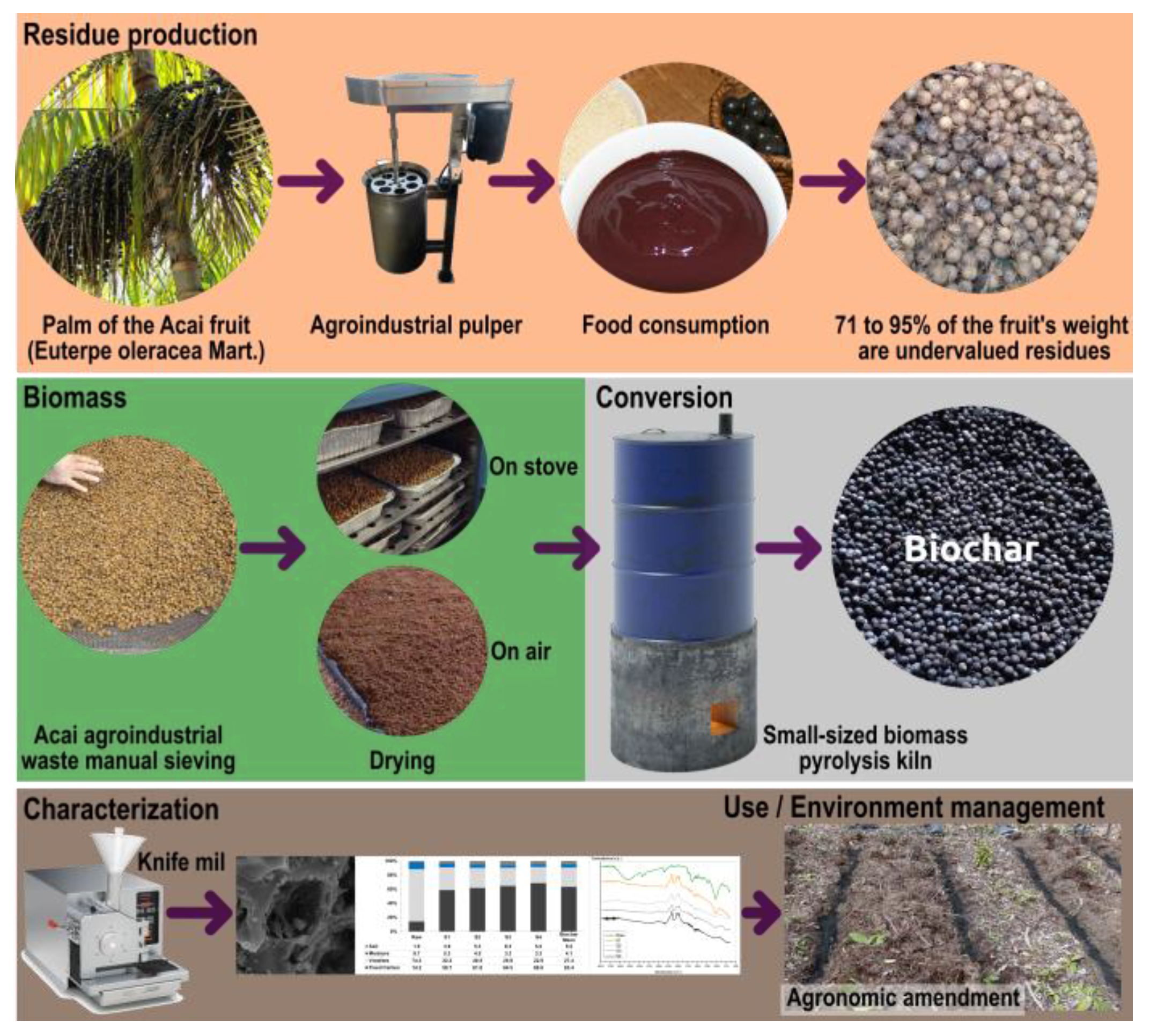
The amount of residue generated by the acai agro-industry ranges between 71% and 95% of the fruit’s weight [
23]. These residues were obtained from acai processing facilities in Manaus (AM), sieved, and oven-dried [
32]. Eighteen pyrolysis processes were carried out, converting approximately 750 kg of biomass into 190 kg of biochar, with an average yield of 25% [
32].
Figure 1 presents a summary diagram of the acai agro-industrial residue generation process and the biochar produced for use in agronomic experiments conducted in greenhouse and field conditions.
Fresh feedstock and four biochar samples from four different batches of the pyrolysis kiln were characterised—specifically from carbonisation processes numbered 1, 10, 16, and 17—hereafter referred to as S1, S2, S3, and S4 [
32]. The four production runs sampled had an average pyrolysis temperature of 431.7 °C and a residence time of 145 min, yielding approximately 13 kg of biochar per batch, with an average biochar-to-biomass conversion rate of 28% [
32]. The detailed development and construction of the kiln, biochar production, and characterisation have been previously published [
32].
Costs of Kiln Construction and Biochar Production
To systematically map the project’s costs, the Activity-Based Costing (ABC) methodology was employed based on the activities undertaken, including the identification of both capital costs (kiln construction) and variable costs (biochar production) [
34,
35]. All labour costs were estimated based on hourly rates proportional to the official minimum wage in Brazil, excluding taxes. For kiln construction, specialised blacksmith labour was contracted, and the hourly rate was based on six times the minimum wage for the year 2021 (USD 188). For the construction of the rustic shed, two minimum wages from 2021 were considered, and for biochar production, one minimum wage from 2022 was applied (USD 207).
Variable production costs included biomass sieving and drying, kiln assembly, monitoring, and cleaning. Considering the project’s focus on family farming, biochar production costs are presented both with and without the inclusion of labour among the variable costs.
The barrels used for the insulation compartment, pyrolysis chamber, volatile gas exhaust pipe, and the base kiln construction material were all sourced second-hand from industries within the Manaus industrial zone. The initial investment for constructing the pyrolysis kiln included the costs of subcontracted labour, materials for kiln assembly, and the necessary instruments for its operation, such as thermometers, thermocouples, an atmospheric burner, gas cylinders, and hoses (
Table S1).
Table S2 lists other equipment and accessories required for production, including the rustic shed infrastructure.
Costs that vary according to the volume produced include liquefied petroleum gas (LPG) fuel, production accessories, personal protective equipment (PPE), general expenses, and estimated labour hours—based on the time taken to produce biochar during the project—and are presented in
Table S3. Depreciation costs of the pyrolysis kiln were disregarded, as the equipment’s durability was not estimated.
2.2. Field Experiment
The agronomic experiment was conducted on a Ferralsol (WRB/FAO) and relevant physical and chemical properties of the soil included a pH of 4.1, soil organic carbon (SOC) content of 16 g kg
−1, potential acidity (H + Al) of 4.69 cmolc kg
−1, and a cation exchange capacity (CEC) of 1.35 cmolc kg
−1 [
26,
27]. The experiment assessed the combination of biochar application (0 and 12 t ha
−1) with three dolomitic limestone rates—0%, 75%, and 100% of the recommended amount to raise base saturation to 60%, equivalent to 0, 2.7, and 3.6 t ha
−1, respectively. The trial was conducted using cowpea (
Vigna unguiculata (L.) Walp). The experimental design followed a randomised block scheme with six treatments and four replicates [
26,
27].
All treatments received standard fertilisation in accordance with technical recommendations [
36], including nitrogen (N), phosphorus (P), potassium (K), and micronutrients. Crop yield was calculated based on the total production per plot, extrapolated for an estimated plant density of 150,000 plants per hectare. More detailed results of the field experiment, associated statistical analyses, and evaluations of changes in the soil–plant system are the subject of forthcoming publications [
26,
27].
Costs and Revenues
Based on the input cost data from the field trial and the productivity of each treatment [
27], the total input costs and expected revenues were calculated and projected for an area of one hectare for each of the treatments. The market price of cowpea was obtained from the Agricultural Price System of the National Supply Company [
37] for the month of June 2022. Wholesale prices in the state of Amazonas were USD 1.21 kg
−1, while retail prices averaged USD 1.30 kg
−1—approximately 7% higher than the wholesale value. Both price levels are presented in the estimates, since farmers may have different levels of market access. A two-way analysis of variance (ANOVA) was performed with the significance level set at
p < 0.05.
The control treatment, which received neither biochar nor limestone, was used as the baseline for comparisons, unless explicitly specified. As the project targets family farming, labour related to land preparation, planting, input application, sowing, irrigation, harvesting, and transportation were not included in the calculation of agronomic production costs.
2.3. Biochar Properties
The calcium carbonate equivalence (CaCO
3eq) of the four biochar samples—indicating their potential as a substitute for agricultural lime—was determined by titration of a biochar–hydrochloric acid (HCl) solution with 0.5 M NaOH until a pH of 7 was reached [
3,
38].
Nutrient content of the biochar was assessed using the Brazilian official methodology for organic fertilisers [
39]. Nitrogen (N) content was determined using catalytic sulphuric digestion (Raney alloy), followed by alkaline distillation, capture in boric acid, and titration with standardised acid solution; phosphorus (P) was quantified through molybdovanadophosphoric complex in an acidic medium, with spectrophotometric measurement following nitric-hydrochloric/nitroperchloric acid extraction of the sample, and potassium (K) was determined by flame photometry, followed by acid digestion and dilution to fixed volumes [
39].
Calcium (Ca), magnesium (Mg), zinc (Zn), copper (Cu), iron (Fe), and manganese (Mn) were extracted by nitric-hydrochloric digestion and determined by atomic absorption spectrometry, following acid digestion, dilution, and filtration. Chlorine (Cl) was determined by the Mohr method, involving extraction, removal of organic matter, and titration with standard silver nitrate solution using potassium chromate as the indicator. Boron (B) and sulphur (S) were extracted by nitric-hydrochloric digestion, with B determined by spectrophotometry using azomethine-H and S determined gravimetrically by precipitation as barium sulphate, followed by filtration, drying, and weighing of the precipitate [
39].
Results of these analyses were used to estimate the total nitrogen (N), phosphorus (P), and potassium (K) contents present in 12 t ha
−1 of acai residue biochar, corresponding to the application rate used in the field agronomic trial, in addition to the ICP-OES results [
32].
Biochar ash was obtained by thermal degradation in a laboratory muffle furnace at 750 °C for 8 h. It was digested in aqua regia, a mixture of concentrated nitric and hydrochloric acids (12:4 mL), at 105 °C for 60 min. After cooling, the digestates were diluted to 50 mL with deionised water, homogenised, and decanted after 24 h of settling. Elemental quantification was performed using inductively coupled plasma optical emission spectrometry (ICP-OES–Thermo Scientific iCAP 7000), calibrated with CPAchem certified reference materials (CRMs). Quality control included blanks and CRM recovery tests, and, for the ash samples, replicates could not be performed due to the limited quantity available.
The biochar had an average pH of 8.8, and the atomic ratios (details in
Table S4) indicated a highly aromatic material, with the mean O/C ratio lower than 0.2 appearing to provide a 1000-year biochar half-life in soil [
32]. According to the automatic system classification of International Biochar Initiative (IBI), further details are available through the Biochar Classification Tool Interface of IBI, accessible at:
https://biochar-international.org/biochar-classification-tool-interface/ (accessed on 10 June 2024), its Carbon Storage Class (CSC) was rated 4 on a scale from 1 to 5, indicating excellent longevity among biochars, with approximately 54% (538 g⋅kg
−1) expected to remain in the soil after 100 years [
32]. This estimate was used in the calculations for fractional biochar application and CO2eq adjusted over a 100-year period.
2.4. Scenarios
2.4.1. Fractional Biochar Application
To align the biochar production system implemented by this project with the reality of smallholder and family farmers in the region, different scenarios were proposed: a single application of 12 t ha−1 of biochar and fractional applications over 4, 7, and 10 years, until reaching the same cumulative stock of 12 t ha−1 in the soil.
The amount of biochar required for each application strategy, the quantity remaining in the soil after each time interval, and the total amount of raw material (sieved and dried biomass) needed to produce the required biochar are shown in
Table 1.
2.4.2. Traditional Kiln Comparison
For comparative purposes between different technologies, the construction and production costs of a traditional earth-brick kiln were calculated based on data from another study, which interviewed local charcoal producers who use traditional kilns [
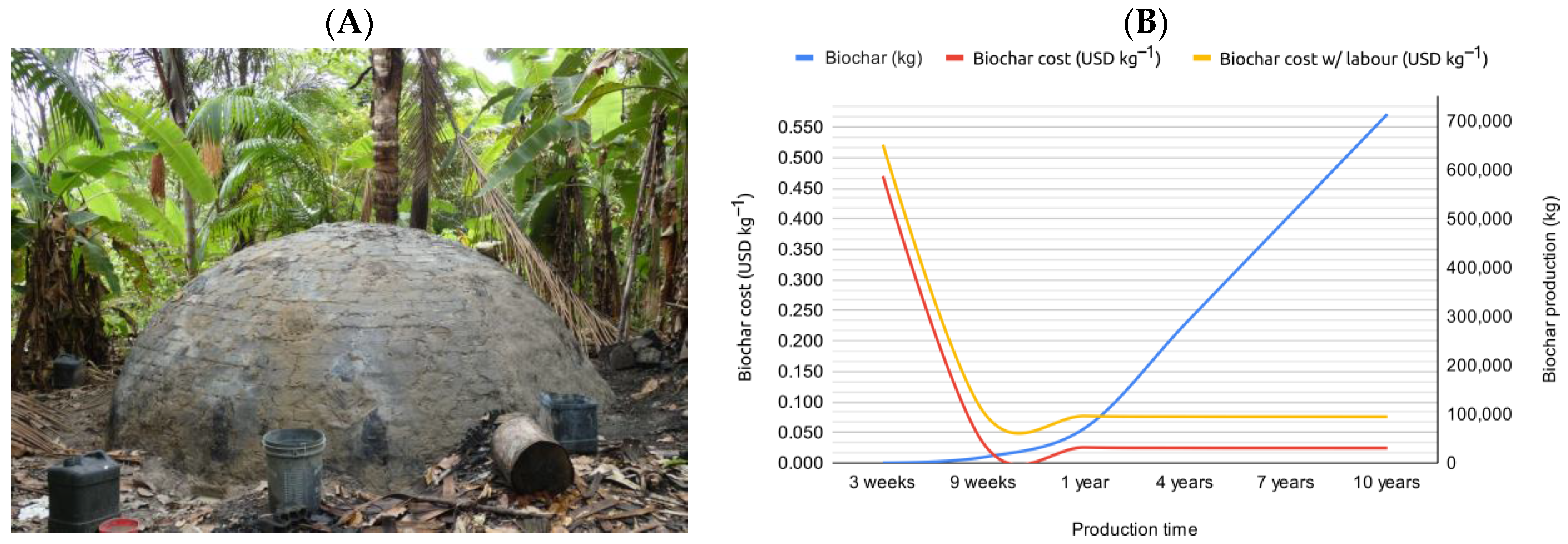
17]. The earth-brick pyrolysis kiln can be built at low cost using locally available raw materials such as earth and bricks and is traditionally used in the study region for charcoal production from wood, with an average temperature ranging from 470 to 600 °C.
The data available in the study and used for the calculations included the highest reported construction cost for the earth-brick kiln of USD 67, a batch duration of nine days, and an average production of 2.38 tonnes of charcoal per batch [
17]. The reported production costs were USD 38.4 for 100 sacks of charcoal, with an average weight of 23.8 kg of charcoal per sack, and 72 h of labour required per batch, with 8 working hours per day [
17]. The official Brazilian minimum wage at the time of the study was considered for the calculation of labour costs. The costs from this latter study were adjusted according to Brazil’s official inflation index—the Extended National Consumer Price Index (IPCA/IBGE)—from January 2009 to February 2025. Simple projections of the production costs of charcoal were then carried out, considering scenarios both with and without labour costs.
It is important to highlight that this traditional kiln requires adaptations to enable the production of high-quality biochar; therefore, this comparison serves solely to evaluate the potential economic benefits, economies of scale, and cost reductions that such kilns may offer, albeit with a considerable degree of uncertainty.
2.4.3. Valued Externalities
The mean Fixed Carbon content of 63.4% obtained from approximate analyses (
Table S4), and the estimates from the IBI Rating Tool of 538 g kg
−1 that should remain in the soil for at least 100 years [
32] were used to estimate both the total CO
2 equivalent (CO
2eq) and the CO
2eq adjusted over 100 years. To estimate the potential financial return from the application of 12 t ha
−1 of biochar, the values were multiplied by the CORCCHAR market price [
40,
41]. As of 26 February 2025, the CORCCHAR certificate was valued at USD 147.60 per tonne of CO
2, further information can be found on the Nasdaq Carbon Removal Platform, available at:
https://www.nasdaq.com/solutions/carbon-removal-platform (accessed on 1 December 2024).
CORCCHAR is the first pricing index for carbon removal certificates via biochar, established in mid-2021 through a partnership between the Finnish organisation Puro.Earth and Nasdaq. It is designed to value not only carbon sequestration but also the additional environmental benefits resulting from the proper incorporation of biochar into soils, such as improved soil health and ecosystem services [
40].
Although this study did not estimate emissions associated with the biomass, biochar production, transport, or application, the valuation assumes appropriate care in these processes. In this context, CORCCHAR certificates are valued above conventional carbon credits, offering greater financial incentives to farmers [
39].
Additionally, the amount of dolomitic limestone recommended per hectare (3609.04 kg ha
−1) was converted to calcium carbonate equivalence (CaCO
3eq: 3457.70 kg ha
−1) to estimate the potential cost savings from substituting lime with biochar, based on its liming capacity calculated as described in
Section 2.2, Biochar Properties.
To estimate the quantity of bio-oil produced during the thermal conversion of biomass, a mean yield of 7.5% was used, along with an inflation-adjusted value of USD 0.59 L
−1. This was converted to USD 0.49 kg
−1 using a density of 1.2 kg L
−1, based on values reported in the literature [
42,
43]. These parameters aim to approximate the early-stage reality of obtaining and valuing this important pyrolysis by-product in the study region, where such practices are still emerging.
Given that the present study is based on data from a replicated field experiment, with yield results utilised in an economic analysis dependent on multiple factors, a considerable degree of uncertainty is to be expected in the estimates obtained. This uncertainty, inherent both to the natural variability of agricultural systems and to the assumptions used in the economic analyses, must be duly acknowledged. Nevertheless, the article retains its merit in proposing practical and feasible solutions in the pursuit of the viability of biochar systems, although technical and technological challenges must still be overcome.
3. Results and Discussion
3.1. Kiln Construction and Operation
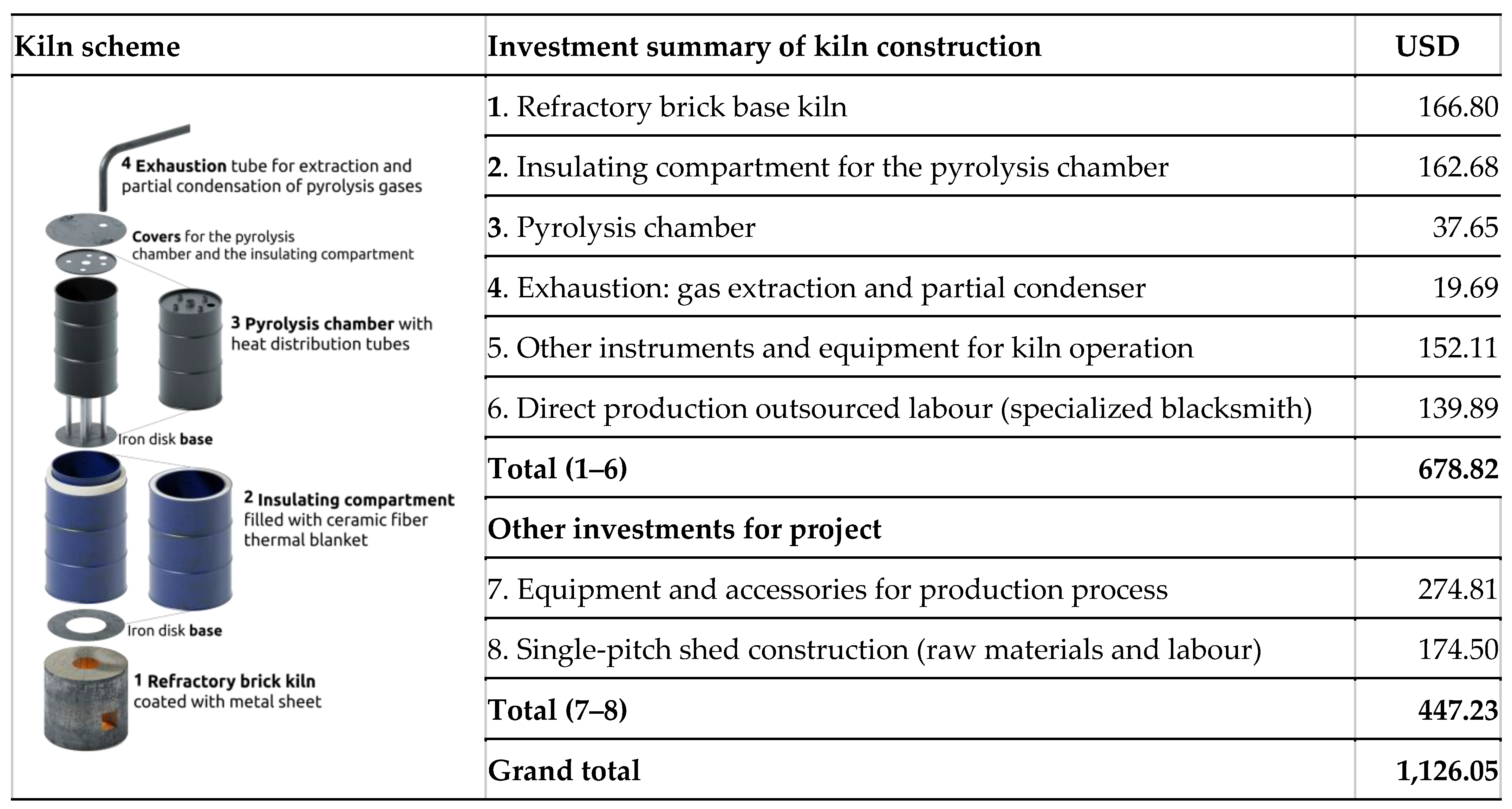
The assessment of the investment required for kiln construction is presented in
Figure 2. Further details on the materials and equipment acquired for direct use in the kiln can be found in
Table S1, while
Table S2 provides information on additional equipment, accessories, and the rustic shed built to house the kiln.
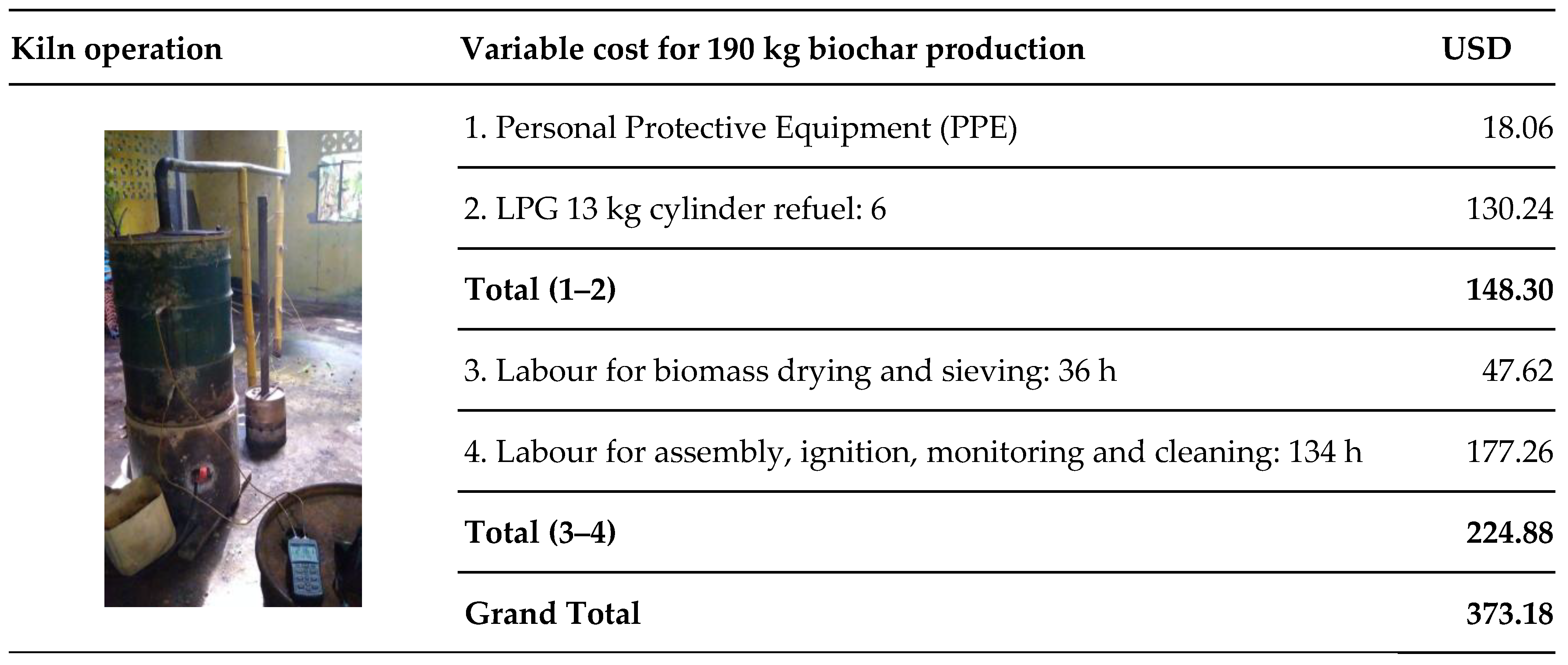
The calculation of variable costs for producing biochar from acai residues is presented in
Figure 3. It was based on the production of 190 kg of biochar through eighteen carbonisation processes, which converted approximately 750 kg of pre-sieved and dried biomass [
32].
Total LPG consumption was 65.6 kg for the production of 190 kg of biochar, equivalent to 3.64 kg of gas per batch. A total of 98 working hours were spent with the kiln in operation. Additionally, one hour before and one hour after each carbonisation cycle were allocated for setup, assembly, and cleaning, resulting in a total of 134 working hours.
Considering only the variable labour costs, approximately 20% were related to Phase 1 (biomass drying and sieving), and 80% to Phase 2 (conversion), mainly due to the monitoring required during the pyrolysis process. The cost of producing 190 kg of biochar was USD 6.71 kg−1 excluding labour. When labour is included, the cost increases to USD 7.89 kg−1, representing a 17.6% increase. This cost, however, may be disregarded in the context of small-scale family or subsistence farming. The cost of fuel (LPG) in Brazil is subsidised by the government and accounts for approximately 10% of the total cost of USD 1274.35, excluding labour.
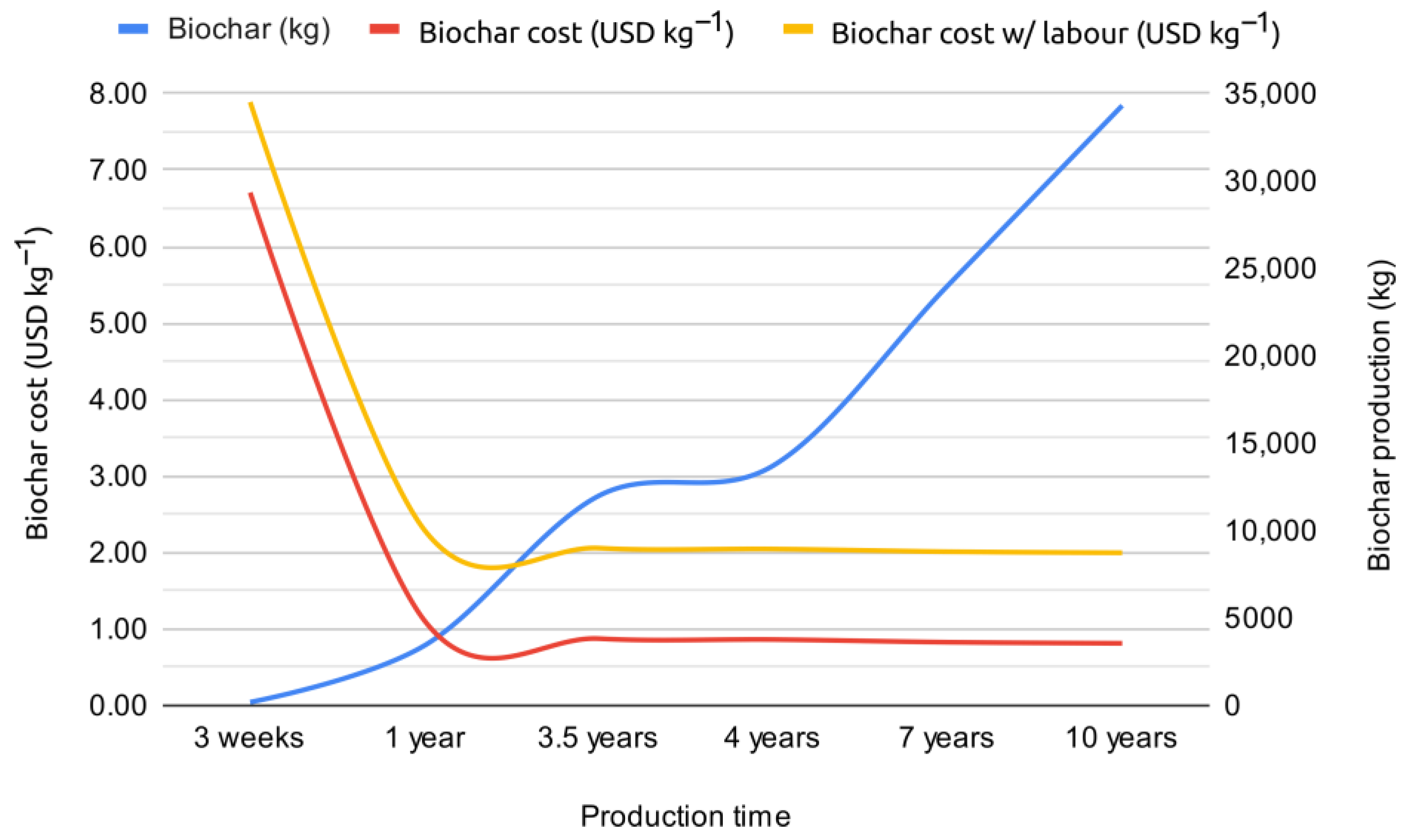
When projecting continuous use of the pyrolysis kiln over different timeframes, the cost per kilogram decreases (
Figure 4). Calculations assumed one batch per day, 22 working days per month, and 264 days per year, with an average yield of 13 kg of biochar per batch. Both labour-inclusive and labour-exclusive scenarios were considered, given the project’s relevance to small-scale rural producers. The time intervals considered were as follows: 3 weeks (required to produce 190 kg of biochar), 1 year, 3.5 years (the time needed to produce 12 tonnes of biochar—with a cost of USD 0.88 kg
−1 excluding labour and USD 2.78 kg
−1 including labour), 4 years, 7 years, and 10 years.
Analysis of the project’s 190 kg biochar production revealed that 75% of the costs were fixed—related to kiln construction, equipment acquisition, and infrastructure—15% were labour-related, 9% were fuel costs, and 1% were other variable costs. When projecting the production of 12 tonnes of biochar, 70% of the total cost is associated with labour, 16% with fuel, 11% with variable costs, and only 3% with fixed costs. This demonstrates that a key strategy for reducing costs at larger production scales is to invest in simple automation to monitor the pyrolysis process, which currently accounts for nearly 80% of the labour required.
Though medium- and long-term benefits of biochar application do exist, they are, however, rarely considered in the decision-making processes of smallholder and family farmers. Therefore, automation and monitoring techniques and technologies are essential to support the adoption of biochar. These farmers already operate with energy expenditure likely at the threshold of balancing the satisfaction of their needs with the preservation of their family well-being and leisure time [
19,
20].
As the kiln used is a prototype built from materials not ideally suited to withstand the high operating temperatures, its durability could not be assessed. It is estimated to last between 3 and 5 years, requiring maintenance that was not included in the cost calculations. A kiln made from 304 stainless steel—with double the capacity (200-litre pyrolysis chamber) and an expected lifespan of up to 30 years at temperatures up to 500 °C—was estimated to cost USD 1800, approximately 56% more than the prototype.
At present, biochar is not commercially available in the local market, making direct price comparisons difficult. However, as a reference, the average price of charcoal in Manaus is USD 1.18 kg−1. On national e-commerce platforms, biochar can be found at an average of USD 0.75 kg−1, excluding transport costs. Considering the production of 12 tonnes of biochar, the cost using the designed kiln was estimated at USD 2.06 kg−1, including labour. These comparisons suggest that the biochar produced—using fossil fuel in a kiln with a capacity 183 times smaller than traditional kilns used in the region—exceeds the average prices currently practised in the country.
The analysis indicates that, with the developed kiln, the cost of producing just 190 kg of biochar is extremely high (USD 6.71 kg−1 excluding labour, or USD 7.89 kg−1 including labour). However, when projecting continuous annual production (3432 kg year−1), this cost could be substantially reduced to USD 0.87 kg−1 (excluding labour) or USD 2.06 kg−1 (including labour). Based on the prices mentioned above, biochar produced using the developed kiln would only be competitive if labour costs are excluded, at a minimum annual production scale of approximately 3500 kg.
3.2. Costs and Cowpea Revenue
In the study conducted, the treatment with the highest revenue combined a dose of 12 t ha
−1 of biochar and 100% of the recommended liming rate, resulting in an 84.6% increase in production compared to the control treatment (
Table 2). Gross revenue generated by this increase was USD 867.
Due to the high production cost of biochar using the designed kiln, only the treatments without biochar proved economically viable. The control treatment—without the application of either biochar or dolomitic limestone—generated the highest net revenue, with an increase of up to 72% compared to the treatment with 100% liming. The high costs of agricultural inputs in the region—a matter discussed later (
Section 3.3.3. in “Potential Nutrients”)—together with the low added value of the crop, help explain why the control treatment resulted in higher net returns compared to those with greater productivity. This result is particularly relevant given the reality of smallholder and family farmers in the region, who typically do not use commercial inputs [
44,
45], suggesting that the traditional practice of avoiding inputs has economic justification.
However, the control treatment produced lower gross revenues compared to the treatment that received 12 t ha−1 of biochar. The isolated application of biochar resulted in a gross revenue increase of over 34%, corresponding to approximately USD 352 at retail prices and USD 329 at wholesale.
Acai residue biochar applied to Ferralsol soils contributed to improved soil fertility by reducing acidity and increasing available phosphorus and nitrogen levels [
46]. This effect is likely due to the liming capacity of the biochar, which may have enhanced nutrient availability for cowpea plants [
47]. The reduction in soil pH—both in active and exchangeable acidity—results from the presence of base cations, oxygen-containing functional groups, carbonates, and soluble organic matter [
47], all of which may improve plant nutrient uptake.
The treatment combining 12 t ha
−1 of biochar with 75% of the recommended lime dose achieved a revenue increase of 59.4%, similar to the 62.5% revenue increase observed with 100% of the recommended lime dose, compared to the control [
27]. These results suggest that biochar application may reduce lime requirements by 25%, equating to savings of approximately USD 208.
However, from an economic standpoint, this substitution increases production costs, as the application of 12 t ha
−1 of biochar produced using the designed kiln incurred significantly higher expenses, resulting in a negative economic return (a net loss of approximately USD 9685 ha
−1), thereby clearly demonstrating the economic infeasibility of this technology. Demonstrating the strong dependence on context and technology, another study reports that the agricultural use of biochar could be profitable with up to a 99% probability [
48]. By applying 10,000 kg ha
−1 of black spruce-derived biochar to beetroot crops, the authors observed an increase in yield from 2900 to 11,004 kg ha
−1, resulting in a net return of up to USD 4953 ha
−1 [
48].
3.3. Scenarios
3.3.1. Fractional Application
For the vast majority of smallholder and family farmers in the region, producing 12 tonnes of biochar presents a major challenge. This is due to both the labour-intensive nature and associated costs—as will be demonstrated below—and the volume of fresh biomass required, which may reach 49 tonnes (considering 15% losses during sieving and drying). In urban contexts, where these residues may be used by thermal power plants, it may be necessary to purchase acai processing residues, with prices reaching USD 7.7 t−1, excluding transport. By contrast, in rural areas of the Amazon region, such residues are typically obtainable at no cost.
Fractional application of biochar represents an alternative to high production costs, by spreading the required investment and labour over time. Biochar derived from lignocellulosic biomass, such as acai residues, exhibits high stability in the soil environment, making it suitable for gradual application while still providing cumulative long-term benefits.
Thus, dividing the application rate across 4, 7, or 10 annual intervals provides a more flexible solution. Over a 10-year period, it is estimated that only 2.4% of the biochar would degrade. Therefore, there are no significant disadvantages to fractional application, and further studies are needed to confirm whether the benefits will be proportional. Beyond reducing immediate costs, this strategy mirrors the continuous manner in which Indigenous peoples gradually incorporated charred biomass into soils—giving rise to Amazonian Dark Earths (ADE). This process involved the humification of various pyrogenic materials (both plant- and animal-derived), added continuously and artisanally over millennia.
With fractional application, the benefits of biochar are also delivered gradually, and their full impact still requires further study. It is not yet possible to conclude how fractional application affects cowpea productivity, as the experiment involved a single application.
Nevertheless, it is well known that acidic tropical soils exhibit rapid turnover of organic matter [
49], with fertility often declining within 2–3 years, even after the fallow period [
50]. This suggests that productivity observed in the control and non-biochar treatments is likely to decline in subsequent cropping cycles without further amendments. In this context, the addition of organic matter through biochar represents a viable strategy for sustaining agricultural productivity over longer periods, especially when applied fractionally. One study found that productivity gains from a single biochar application were maintained for at least six years [
51].
Based on IBI classification, the annual addition of 1.2 t of acai biochar would result in 11.7 t remaining in the soil after 10 years. In the single application scenario, 11.3 t would remain after the same period. This demonstrates that the agronomic benefits of biochar should be evaluated over the medium to long term, given its slow nutrient release, reduced leaching, increased water retention capacity, and other properties.
3.3.2. Comparison with Traditional Brick-Earth Kiln
The literature shows that a wide variety of kilns are capable of producing high-quality biochar [
52]. Here, we compare the costs and production estimates between the kiln designed in this study and a traditional brick-earth kiln model commonly used by charcoal producers in the region.
The estimated production costs for treatments using biochar produced in the traditional brick-earth kiln and the revenues derived from retail sales of cowpea are presented in
Table 3. Input costs reflect the commercial prices in Manaus, the capital of the state of Amazonas, based on the recommended quantities for cultivating one hectare of cowpea.
The production cost of 12 t of biochar, excluding labour from the variable costs, was USD 0.02 kg
−1 when using the traditional kiln, compared to USD 0.87 kg
−1 with the designed kiln. The use of traditional kiln for biochar production also resulted in an increase in gross revenue from cowpea cultivation of approximately 34% (around USD 352 ha
−1) in the biochar-only treatment compared to the control, with an additional cost of USD 292.60 ha
−1. This demonstrates a favourable cost–benefit balance, generating an additional net revenue of approximately USD 138 ha
−1. These results indicate that the use of the traditional kiln (
Figure 5A) may have promising potential for biochar production.
The treatment receiving biochar alone produced a net revenue that exceeded all other treatments. The treatments with lime at 75% and 100% of the recommended rates incurred additional total costs of USD 624 and USD 832 ha−1, respectively, resulting in lower net revenues. In comparison with the treatment using 100% liming, the biochar-only treatment would generate a 94% higher net revenue. Therefore, the isolated application of biochar is economically more advantageous, highlighting the competitive potential of this practice in comparison with the exclusive use of dolomitic limestone.
Comparing the four treatments that received liming at the same rate, it was observed that the presence of biochar improved productivity, though not enough to result in a higher net return. When combining the costs of both inputs (biochar + dolomitic limestone), the net revenue was lower in treatments that received both than in those that received only lime.
When accounting for labour remuneration, the production cost using the designed kiln to produce 12 t of biochar would reach USD 25,265, equivalent to approximately USD 2.06 kg
−1, over 3.5 years of work. Without labour costs, this figure would drop to USD 0.87 kg
−1. For the traditional kiln, production costs totalled USD 698, or approximately USD 0.08 kg
−1 over two months of work, and just USD 0.03 kg
−1 excluding labour. This highlights the importance of developing simple monitoring systems that can reduce the labour intensity required for biochar production. The projection of production costs, with and without labour, for traditional kilns and the quantity of biochar produced over time is illustrated in
Figure 5B.
Considering the Brazilian minimum wage in 2025 (about USD 260), a single application of 12 t ha−1 using the designed kiln represents the equivalent of approximately 40 minimum wages. If the application is fractioned over 4, 7, and 10 years, this figure is reduced to 10, 6, and 4 minimum wages, respectively. For the traditional kiln, the equivalent costs are substantially lower: 1.1, 0.3, 0.2, and 0.1 minimum wages for the single and fractional applications over 4, 7, and 10 years, respectively.
Notable differences were observed between the production costs associated with the designed kiln and those of the traditional brick-earth kiln. In terms of capacity, the latter processes approximately 9.5 t of biomass (wood) and produces about 2.4 t of charcoal per batch, with each batch requiring 9 to 10 days. In contrast, the designed kiln processes up to 45 kg of biomass and produces approximately 13 kg of biochar per batch, with an average cycle duration of 5 h and 30 min. In comparison with the local market prices cited in
Section 3.1, the traditional kiln presents competitive costs even at relatively small annual scales, indicating a clear short-term economic advantage in low-scale production.
3.3.3. Valuation of Externalities
Positive externalities associated with the application of 12 t ha
−1 of biochar to soil are summarised in
Table 4, including lime equivalence, ash contribution, ash composition, potential nutrient content, quantity of bio-oil produced, fixed carbon, and carbon credits. The values presented here should be regarded as references and may assist in the prioritisation of public policies for the sector; however, the estimates have not been validated through current protocols or market mechanisms.
The contributions of ash and potential nutrients presented here are simply proportional to the contents identified in the analytical results. The yield and value per kilogram of bio-oil used for the estimates were based on average figures found in the literature.
A significant contribution of ash is observed, and the value estimate presented here is noteworthy. If smallholder and family farmers were supported by government incentives enabling them to sell carbon credits, commercialise by-products such as bio-oil, and account for savings on dolomitic limestone, the application of 12 t ha−1 of biochar could yield approximately USD 2600 ha−1.
Liming Capacity
The average calcium carbonate equivalence (CaCO
3eq) of the acai residue biochar was 4.2% ± 0.83. These results classify the biochar as Liming Class 1 on a scale from 0 to 3, according to the IBI [
53]. Therefore, applying 12 t ha
−1 of this biochar adds 504 kg of CaCO
3eq to the soil, equivalent to 14.6% of the recommended dose to raise base saturation to 60%—a total value of approximately USD 121.26.
Carbon Credits
The designed kiln presented a production cost of USD 698 per tonne of CO
2 removed, while the traditional brick-earth kiln achieved a cost of just USD 25 per tonne of CO
2. Both kilns fall outside the range recommended in a European Parliament study, which set benchmark values between USD 109 and 146 per tonne of CO
2 removed [
54]. The cost per tonne of CO
2 removed with the designed kiln was approximately 3.8 times higher than the upper benchmark value of USD 146, whereas the traditional brick-earth kiln cost was around 3.3 times lower than the lower limit of USD 109.
The highest revenue identified through the valuation of externalities in this study was attributed to carbon credits, which could generate an income of USD 2217 from the proper application of 12 t ha−1 of biochar derived from acai agro-industrial residues. Although this represents only 21% of the production costs associated with the biochar produced using the developed kiln prototype, it is nearly six times the production cost of biochar using the traditional kiln.
Sub-products
One way to support the economic viability of biochar production is through the utilisation and valorisation of pyrolysis by-products, such as bio-oil and pyroligneous liquid, which could help offset production costs. Pyroligneous liquid can be used as a potent insecticide and repellent and has the potential to replace commercial agricultural inputs [
52,
55].
Successful recovery of these by-products also contributes to controlling greenhouse gas emissions during the thermal conversion of biomass. Part of the technical challenge lies in developing a low-cost, durable condensation system, which is complicated by material oxidation under high exhaust temperatures and potential clogging.
Potential Nutrients
In general, smallholder and family farmers in northern Brazil—who account for more than 80% of the region’s rural establishments—do not use commercial agricultural inputs in their production systems. Only 17% apply fertilisers and 23% use pesticides, reflecting a low-input, low-technology agricultural model [
44,
56,
57]. In addition, between 80% and 85% of the fertilisers used in Brazil are imported [
18].
Beyond the national dependency on imported fertilisers, the study region faces an additional burden known as the “Amazon Cost” (Custo Amazônia): the increased price of goods in the northern region of Brazil due to long distances and logistical constraints, especially compared to regions closer to major urban centres. For example, dolomitic limestone cost USD 0.32 kg
−1 for the implementation of this project in Manaus, whereas in São Paulo state, the price was only BRL 0.10 kg
−1—more than three times lower (Conab, 2023, values from 2022). Since this example comes from the state capital, prices in the interior are likely even higher. The State of Amazonas covers an area of 1,559,256 km
2 but has only 62 municipalities. Studies show that for high-value crops like coffee, fertilisation and soil correction in Amazonas can account for up to 40% of total production costs [
58,
59].
Table S5 presents the results of the elemental content identified through organic fertiliser analysis [
39], including fresh acai residue biomass, the resulting biochar samples, and the mean biochar content for each element.
Table S6 provides the estimated quantities of potential elements present in the fresh acai biomass, the mean of the produced biochar, and in the ash samples, based on ICP-OES analysis.
These realities highlight the potential importance of nutrient inputs from biochar for agricultural practices in the Amazon region. It is important to note, however, that these elements are not readily available to plants, as their release depends on mineralisation processes and interactions with the soil matrix over time, a complex process that needs further research [
60,
61].
For cowpea, nutrient removal at the end of the growing season is estimated at 30 kg ha
−1 of N, 80 kg ha
−1 of P, and 40 kg ha
−1 of K [
36]. Based on the agronomic characteristics of acai residue biochar, an application rate of 12 t ha
−1 would supply approximately 61 kg of N, 71 kg of P, and 172 kg of K (
Table 4).
3.4. Suggestions for Future Work–Kilns
With regard to the designed kiln model, it is recommended to build a second prototype with double the capacity, using more durable materials such as stainless steel (grades 304, 310) or refractory bricks. The insulating compartment could be integrated into the pyrolysis chamber body as a single unit to improve safety, enhance the durability of the thermal blanket, and so on. For the condensation system, copper tubing could be coiled around the exhaust pipe and connected to a water-cooled circulation system. It is also advised to test a version with a wood-fired lower chamber instead of LPG.
For the traditional brick-earth kiln, adaptations of furnace-kiln designs are suggested to allow for controlled burning or condensation of emissions. Installing thermocouples in representative locations should be considered. Temperature control could be improved by adding small, distributed burners, which may reduce the batch time and allow for higher operational temperatures. It is important to verify that these adaptations are suitable for producing biochar.
In both cases, low-cost and efficient condenser models are required. The implementation of simple sensing technologies should also be assessed, as these could reduce the labour intensity associated with process monitoring. Additionally, mixing different types of biomass may facilitate the pyrolysis of small-sized feedstocks, which constitute the majority of agro-industrial residues.
4. Conclusions
Although the biochar produced in the developed prototype kiln developed is not economically viable for smallholder and family farmers, it demonstrated suitability for biochar production at a scale larger than laboratory muffle furnaces, enabling field-scale agronomic experiments. The cost of biochar produced using the prototype kiln ranged from USD 0.87 to 2.06 kg−1, whereas that produced with the traditional earth-brick kiln could be up to 29 times lower, with costs as low as USD 0.03 to 0.08 kg−1. These costs must be evaluated in conjunction with the potential ecosystem services provided by the use of biochar derived from acai residues, in order to better capture the full value of the system’s benefits.
The isolated application of 12 t ha−1 of acai-derived biochar can result in a 34% increase in cowpea revenues, equivalent to up to USD 352 ha−1. The treatment without liming and without biochar (control treatment) may result in an increase in net revenue of up to 72% compared to the treatment with 100% liming, primarily due to the high cost of inputs in the region and the low added value of the test crop.
Using the traditional kiln, with its lower production costs, would lead to a net revenue approximately 13% higher for the biochar-only treatment compared to the control treatment. In comparison with the treatment using 100% liming, the biochar-only treatment would generate a 94% higher net revenue.
In terms of liming capacity, the combination of biochar with 75% of the recommended lime dose achieved revenue comparable to the full lime application, indicating potential input savings of approximately USD 208 ha−1. However, when this comparison is based on the calcium carbonate equivalence (CaCO3eq) determined in the biochar characterisation, the lime reduction attributable to the biochar would be approximately 14.5%, potentially representing a saving of USD 121 ha−1.
Among the other valued externalities estimated, carbon credits stand out as the most significant source of income that farmers could obtain. It is estimated that 12 t ha−1 of biochar derived from acai residues could generate approximately USD 2217 in CORCCHAR carbon credits, compared with USD 271 from the valuation of bio-oil production.
Finally, fractional application of biochar derived from acai agro-industrial residues—spread over 4 to 10 years—would likely retain over 97% of its carbon content in the soil, significantly reducing upfront investment and aligning more closely with smallholder realities and the Indigenous practices of gradual biomass incorporation that gave rise to ADE.
Nutrients contained in biochar tend to be released gradually through mineralisation, requiring further research. Its adoption in Amazonian communities may benefit from the knowledge of local charcoal producers, adding value to this activity. Annual fractional application of biochar is a key strategy for smallholder and family farmers that warrants more in-depth study.
Public policies that recognise the socio-environmental positive externalities of biochar systems and promote incentives for its application are essential for making it accessible to small-scale farmers. While the low cost of traditional kilns favours decentralised production, this also presents additional challenges to the formal recognition of carbon credits.
With productivity gains based on locally sourced inputs and labour, biochar has the potential to strengthen food security, generate rural income and employment, reduce dependency on external inputs, and enhance soil resilience within a circular agricultural model—thus contributing to several Sustainable Development Goals (SDGs) and to pillars 1, 2, 5, 6, and 7 of the FAO’s Decade of Family Farming—consistently aligned with the broader objectives of climate change adaptation and mitigation.






 ,
,