Article

Selection and Characterisation of Elite Mesorhizobium spp. Strains That Mitigate the Impact of Drought Stress on Chickpea


by
María Camacho
1,†,
Francesca Vaccaro
2,†,
Pilar Brun
1,
Francisco Javier Ollero
3,
Francisco Pérez-Montaño
3,
Miriam Negussu
2,
Federico Martinelli
2,*,
Alessio Mengoni
2,
Dulce Nombre Rodriguez-Navarro
1 and
Camilla Fagorzi
2,*
1
IFAPA Centro Las Torres Tomejil, 41200 Sevilla, Spain
2
Department of Biology, University of Florence, 50019 Sesto Fiorentino, Italy
3
Department of Microbiology, Faculty of Biology, Universidad de Sevilla, 41004 Seville, Spain
*
Authors to whom correspondence should be addressed.
These authors contributed equally to this work.
Agriculture 2025, 15(15), 1694; https://doi.org/10.3390/agriculture15151694
Submission received: 27 May 2025 / Revised: 18 July 2025 / Accepted: 30 July 2025 / Published: 5 August 2025
(This article belongs to the Special Issue Beneficial Microbes for Sustainable Crop Production)

Abstract

The chickpea (Cicer arietinum L.) is a key legume crop in Mediterranean agriculture, valued for its nutritional profile and adaptability. However, its productivity is severely impacted by drought stress. To identify microbial solutions that enhance drought resilience, we isolated seven Mesorhizobium strains from chickpea nodules collected in southern Spain and evaluated their cultivar-specific symbiotic performance. Two commercial cultivars (Pedrosillano and Blanco Lechoso) and twenty chickpea germplasms were tested under growth chamber and greenhouse conditions, both with and without drought stress. Initial screening in a sterile substrate using nodulation assays, shoot/root dry weight measurements, and acetylene reduction assays identified three elite strains (ISC11, ISC15, and ISC25) with superior symbiotic performance and nitrogenase activity. Greenhouse trials under reduced irrigation demonstrated that several strain–cultivar combinations significantly mitigated drought effects on plant biomass, with specific interactions (e.g., ISC25 with RR-98 or BT6-19) preserving over 70% of shoot biomass relative to controls. Whole-genome sequencing of the elite strains revealed diverse taxonomic affiliations—ISC11 as Mesorhizobium ciceri, ISC15 as Mesorhizobium mediterraneum, and ISC25 likely representing a novel species. Genome mining identified plant growth-promoting traits including ACC deaminase genes (in ISC11 and ISC25) and genes coding for auxin biosynthesis-related enzymes. Our findings highlight the potential of targeted rhizobial inoculants tailored to chickpea cultivars to improve crop performance under water-limiting conditions.

1. Introduction

The chickpea (Cicer arietinum L.) is an essential legume crop widely cultivated for its high nutritional value and adaptability to various environmental conditions. This legume is rich in proteins, fibres, and minerals, making it a valuable dietary component in many regions, especially in the Mediterranean basin [1]. Recent studies indicate that doubling plant-based foods while cutting back on meat and sugar supports both human and planetary health in a climate-challenged world. [2]. Increasing legume consumption also provides significant environmental benefits, as their cultivation enhances soil fertility, boosts nitrogen levels and organic matter content, and supports key ecosystem services—such as improved resilience to biotic stress, reduced reliance on pesticides and fertilizers, and greater support for pollinators. Therefore, it is essential to develop new knowledge and innovative biotechnological tools to fully utilize and enhance legume cultivation, addressing the growing challenges of drought and salinity exacerbated by climate change [3,4,5]. In this sense, the reduction in water availability poses a significant threat to legumes, as evidenced by the 60% decline in bean production under rainfed conditions globally and the 80% reduction in grain yield in certain arid regions [6]. Drought stress not only limits water uptake but also disrupts both short-term and long-term adaptation mechanisms in plant species facing climate change. Drought-resistant cultivars, even within the same species, exhibit an advantageous strategy by regulating carbohydrate allocation towards seed filling, helping to mitigate the impact of drought during the pod filling stage [5,6]. Moreover, the chickpea, like other legume crops, is key in low-input (sustainable) agriculture, since it forms a nitrogen-fixing symbiotic association with bacteria called rhizobia. This symbiosis establishes in specific root structures, called nodules, which are colonized by bacteria. Bacteria colonizing nodules penetrate into plant cells and differentiate into a form called bacteroid, where nitrogen fixation (the formation of ammonia from atmospheric dinitrogen) takes place [7,8]. Under this stressed condition, the inoculation with selected rhizobial strains can alleviate plant stress, hence playing a relevant role in plant tolerance. Data from the literature has shown that the specificity between rhizobia strains and plant species has been largely affected by the relative occurrence and distribution of the potential symbionts in the soils of different regions [9]. A vast characterization of chickpea rhizobia has been conducted in the last three decades in Europe, Africa, Asia, and Oceania [10]. Chickpea has traditionally been considered as a restrictive host for nodulation [7]. Classically, four rhizobia species belonging to the genus Mesorhizobium have been identified as chickpea symbionts, each with distinct characteristics and ecological adaptations [11]. M. ciceri was the first species described, isolated from chickpea nodules in Spain, and is known for its effectiveness in the neutral to slightly alkaline soils typical of Mediterranean regions [11]. Following this, M. mediterraneum was described, also from the Mediterranean region, distinguished by its ability to grow in slightly acidic conditions and adapt to drier soils with higher temperatures [12]. Interestingly, M. ciceri and M. mediterraneum have been found in chickpea nodules across many countries such as Spain, Portugal, Morocco, Tunisia, and India [7] but not in China where two other Mesorhizobium species were isolated from chickpea root nodules from saline–alkaline soils and were identified as Mesorhizobium. muleiense and Mesorhizobium wenxiniae [13,14]. Moreover, other species can nodulate chickpea such as Mesorhizobium amorphae, Mesorhizobium loti, Mesorhizobium tianshanense, Mesorhizobium oportunistum, Mesorhizobium abyssinicae, and Mesorhizobium shonense [7,15,16,17,18,19,20]. Additionally, rhizobia from other genera, such as Ensifer nodulating chickpea, have also been reported [21,22]. These works highlighted the high diversity in rhizobia strains of chickpea nodules and its possible agronomic effect on different agro-ecosystems and cultivation types and environments. However, selecting the correct rhizobial strain to be used as an inoculant is not an easy task. Mesorhizobium strains could contribute to plant growth promotion through multiple mechanisms. These bacteria may produce plant growth-promoting substances like auxins, cytokinins, and gibberellins, which enhance root and shoot development, nutrient uptake, and overall plant vigour [21,22,23]. In this sense, the enhanced root system improves the plant’s ability to acquire water and nutrients from the soil under starvation, thereby increasing its resilience to abiotic stresses. On the other hand, rhizobia strains expressing the 1-aminocyclopropane-1-carboxylate (ACC) deaminase enzyme have been reported to display an augmented symbiotic performance as a consequence of lowering the plant ethylene levels that inhibit the nodulation process during different stresses, such as drought conditions [24]. The selection of efficient Mesorhizobium strains that can effectively nodulate chickpea and sustain productivity under drought is, therefore, of great agronomic interest. However, it is important to note that the success of chickpea inoculation with Mesorhizobium strains is influenced by strain specificity and host compatibility. Thus, different Mesorhizobium strains exhibit varying degrees of compatibility with chickpea cultivars, which means that some strains are more effective in promoting nitrogen fixation and plant growth in certain chickpea varieties compared with others [8]. This emphasizes the significance of strain selection based on the specific chickpea cultivar and local soil conditions. Here, we aimed to identify and evaluate the plant cultivar-specific performance of a collection of Mesorhizobium strains in promoting chickpea growth under drought-stressed conditions. A combination of in vitro and greenhouse symbiotic tests with different chickpea cultivars and complete genome sequencing of three top-performing Mesorhizobium strains were performed to provide evidence for the potential use of these strains as elite inoculants for selected chickpea cultivars under water-limiting conditions.

2. Materials and Methods

2.1. Bacterial Strains, Culture Conditions, and Chickpea Cultivars

Mesorhizobium ISC strains were isolated from Cicer arietinum root nodules from different geographic areas of the south of Spain (Table 1) following the methodology described by Somasegaran and Hobben [25]. Briefly, surface-sterilized nodules were crushed on mannitol agar (YMA) medium. Then, the isolates were purified by repeated streaking on the same medium. These strains were grown at 28 °C on tryptone yeast (TY) medium [26] or modified yeast extract mannitol (YMB) medium [27]. Pure cultures were kept at −80 °C in YMB plus glycerol (1:1 vol:vol).
The majority of Cicer arietinum germplasms used in this work are recombinant inbred lines described previously [1], with three of them being registered cultivars. Two reference cultivars, Pedrosillano and Blanco Lechoso, were included for selecting the elite Mesorhizobium strains (Table 2).

2.2. Symbiotic Assays in Growth Chambers

Two experimental approaches were carried out in symbiotic assays in growth chambers.
Firstly, for the evaluation of the symbiotic phenotypes, the seven Mesorhizobium ISC strains were grown in YMB medium until the bacterial concentration reached about 109 cells mL−1. Bacterial concentration was checked by viable count of the cultures. Seeds of chickpea cv Pedrosillano and Blanco Lechoso were surface-sterilized for 5’ in a 3% Ca(ClO)2 solution and pre-germinated and placed in sterilized jars (Leonard jars) containing vermiculite and perlite substrates (3:1) and Farhäeus N-free solution, as previously described [28,29]. Each pre-germinated and sterilized seed was inoculated with 1 mL of bacterial culture. Growth conditions were 16 h at 26 °C in the light and 8 h at 18 °C in the dark, with 70% humidity. Nodulation test parameters (shoot and root dry weight, nodule number, and dry weight of nodules) were evaluated after 4 weeks. Nitrogenase activity in the nodules was estimated by acetylene reduction assays (ARAs) as described by Buendía-Clavería et al. [30]. Nodulation test experiments were replicated four times.
Secondly, chickpea seeds (Germplasms g_8, 11, 14, 20, 21, 29, 31, 33, 41, and 45, listed in Table 2) were surface-sterilized in 0.25% HgCl2 solution for 2 min and washed five times with sterile water. After the sterilization procedure, seeds were kept in a Petri dish in the dark at 26 °C until germination, then seedlings were placed in sterile polypropylene jars containing vermiculite/perlite (1:1) and nitrogen-free Farhäeus solution, and grown at 26 °C with a 16 h photoperiod. One-week-old plantlets were inoculated with 105 mL−1 appropriate Mesorhizobium ISC strain cells washed twice in NaCl 0.9%. Ten plants of the same cultivar were inoculated per strain and then grown for 5 weeks in the same conditions. After 5 weeks, the plants were harvested, and the shoot and root dry weights were measured, as reported also in Checcucci et al., 2018 [31]. To evaluate the influence of strains and plant genotypes, as well as the interaction of both factors, aerial part length and dry weight, a two-way permanova was run in R (v 4.4.1) using the ‘adonis2’ function of the Vegan package [32].

2.3. Symbiotic Assays in Greenhouse Under Drought Conditions

Plastic pots of 250 mL were filled up with a mixture of perlite/vermiculite (1:2). Chickpea seeds were surface-disinfected with Ca(ClO)2 for 5 min, rinsed with sterilized water at least five times, and germinated in agar/water (1%) at 28 °C. The test plant involved 10 chickpea genotypes (cv. 5-RIL33,5-RIL92, RR-33, RR-51,RR-98,BT3-13, BT3-23, BT5-7, BT6-17, and BT6-19), three mesorhizobia strains (Mesorhizobium spp. ISC11, ISC15 and ISC25), and two water regimes: full irrigation (control), with 200 mL water twice a week, and 30% of the control. For watering, 50% Rigaud and Puppo (1979) nutrient solution without nitrogen (N-free) was employed [33]. Pots were set up under greenhouse conditions, sowing with two pre-germinated seeds per plot. Four replicates were arranged per genotype × mesorhizobia × water regime combination. At the time of sowing, seeds were inoculated with 1 mL of a YMB stationary culture with about 109 cells mL−1 of the corresponding strain. After 4 weeks, plants were harvested and the following biometric measurements were performed: shoot and root dry weight, nodule number, and nodule fresh weight.

2.4. Genome Sequences and Annotation

Prior isolating total genomic DNA, the strains were grown to stationary phase at 30 °C in TY medium. DNA isolation was performed with a DNeasy® PowerLyzer® PowerSoil® Kit (Qiagen, Hessen, Germany). DNA quality control and long read sequencing were performed by the service company Macrogen Europe (Macrogen Europe, Amsterdam, The Netherlands) using a Pacific Biosciences Sequel II instrument (Pacific Biosciences, Menlo Park, CA, USA). Obtained reads were analyzed using HGAP v. Microbial Assembly 8 within the SMRT Link software ver. 8.0.0.80529 (Pacific Biosciences, Menlo Park, CA, USA) producing an oriC-oriented assembly by running the “microbial multiplexing” pipeline with default options. Annotation was performed by the NCBI Prokaryotic Genome Annotation Pipeline (PGAP) [34].

2.5. Genome Characterization and Mining

The taxonomic identification of strains from the genome sequence was performed using the Type (Strain) Genome Server (TYGS) [35]. Digital DNA–DNA hybridization (dDDH) values were computed with the Genome BLAST Distance Phylogeny approach. Formula d4 was used since it is independent of genome length and is thus robust against the use of incomplete draft genomes. The mapping of Kyoto Encyclopedia of Genes and Genomes (KEGG) pathways was performed using the KEGG Automatic Annotation Server (KAAS) on the KEGG web server [36]. Secondary metabolite gene clusters have been identified by AntiSMASH [37]. The Plant Growth-Promoting Traits Prediction tool (PGPT-Pred) from PLaBAse (https://plabase.cs.uni-tuebingen.de/, accessed on 29 July 2025 [38]) was used to allow genomic protein annotation (blastp + hmmer approach) mapping against the PGPT ontology (approx. 6900 bacterial plant growth-promoting traits). Pangenome analysis with Roary v3.13.0 was used to define core and dispensable/unique gene fractions against close relatives of each strain. For this purpose, sequences of close relative strains (Mesorhizobium-type strains belonging to the same groups of the three strains of the current work, on the basis of the phylogenetic tree obtained from TYGS analysis) were downloaded from the NCBI Genome Database. Genomes were reannotated with Prokka to ensure consistent annotation [39]. All genomes were downloaded on 8 December 2023. The three pangenomes of the Mesorhizobium strains were calculated using Roary 3.13 with a percentage identify threshold of 95% [40].

2.6. Identification and Phylogenetic Analysis of Common NodC and NifH Proteins

The sequences of NodC and NifH proteins were searched for in the Prokka Genome Annotation files of the three strains. Each protein sequence was provided as input to BLASTP against the Antimicrobial Resistance (AMR) protein database limited to Mesorhizobium sp (taxid:1871066). The amino acid sequences for each hit (regardless of e-value) belonging to Mesorhizobium spp.-type strains were collected. Alignments and phylogenies were built using MEGA11 [41]. The evolutionary history was inferred by using the maximum likelihood method and Jones–Taylor–Thornton (JTT) matrix-based model [42]. The tree is drawn to scale, with branch lengths measured in the number of substitutions per site.

3. Results

3.1. Phenotypic Analysis of Commercial Chickpea-Nodulating Strains Identifies ISC11, ISC15, and ISC25 as Elite Strains

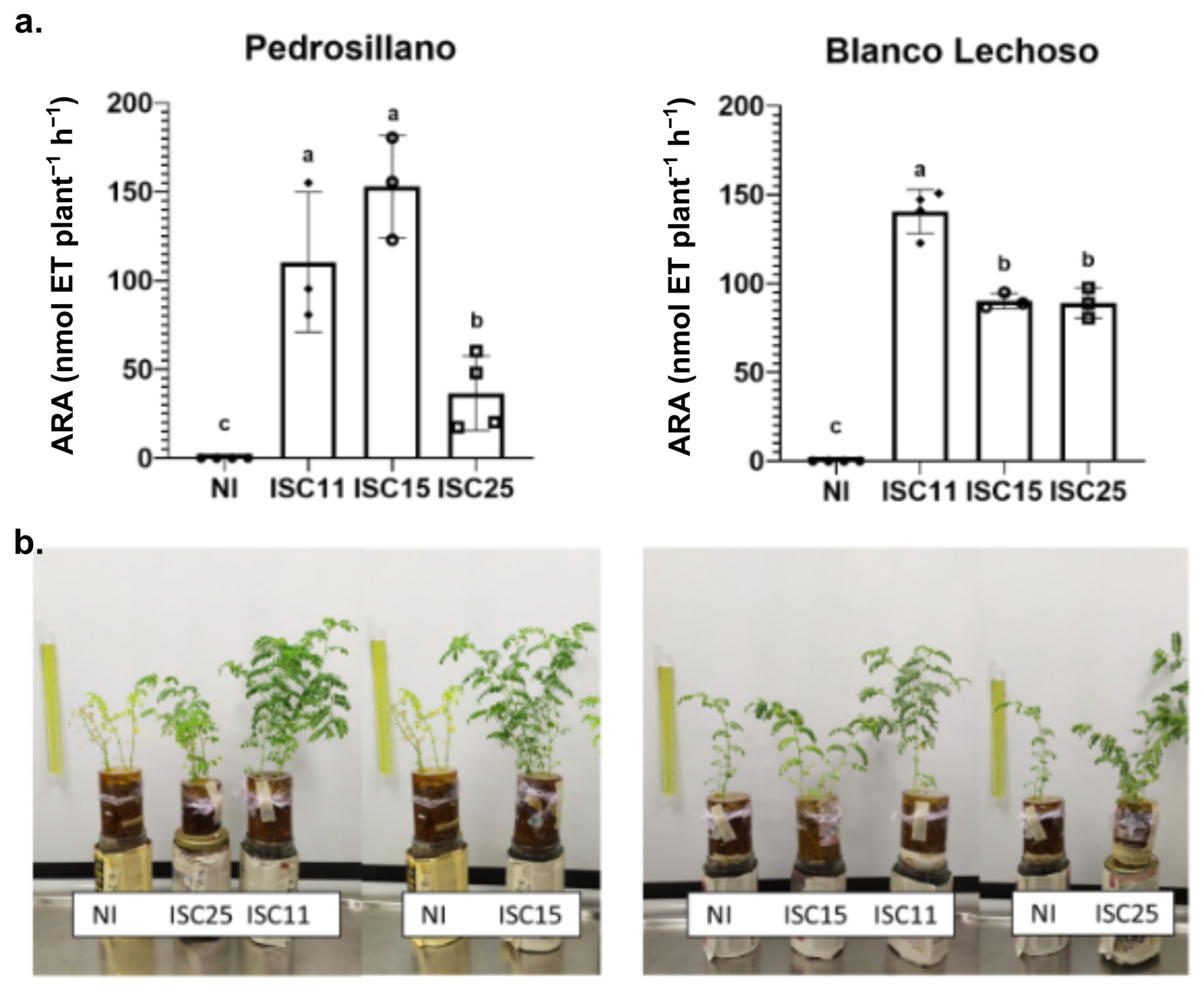
Ref. [29] was used to determine which of the seven Mesorhizobium ISC strains were elite rhizobia for nodulating with this legume. We studied their symbiotic behaviours with the two main commercial C. arietinum varieties sown in this Mediterranean country, namely Pedrosillano and Blanco Lechoso. Three different parameters were analyzed for each symbiotic partner: shoot dry weight, number of nodules, and nodule dry weight (Table 3). The best symbiotic performances in the Pedrosillano chickpea germplasm were displayed by strain ISC25, followed by strains ISC11, ISC15, and ISC6. Conversely, when seedlings of chickpea cv. Blanco Lechoso were inoculated with the same Mesorhizobium ISC strains, ISC11 showed the best values in the symbiotic parameters analyzed, especially in shoot dry weight, followed by ISC15. Additionally, the Mesorhizobium strain ISC25 also displayed an improved symbiotic performance, although the results were not significantly different to those obtained by strains ISC6, ISC18, and ISC24. Thus, three of the Mesorhizobium strains, ISC11, ISC15, and ISC25, were selected as elite rhizobia and inspected to determine their nitrogenase activity (estimated by ARA) in nodulation assays in Leonard jars with both chickpea commercial germplasms (Figure 1). According to our results, the best acetylene reduction abilities were found in nodules colonized by ISC11 or ISC15 in the case of Pedrosillano germplasm, and ISC11 for Blanco lechoso (Figure 1).

3.2. Genome Sequencing and Taxonomic Assignment of Mesorhizobium Elite Strains

The genome sizes for the three strains ranged from ~6.7 Mbp to ~7.3 Mbp, composed of a large chromosome and one or two plasmids (Table 4).
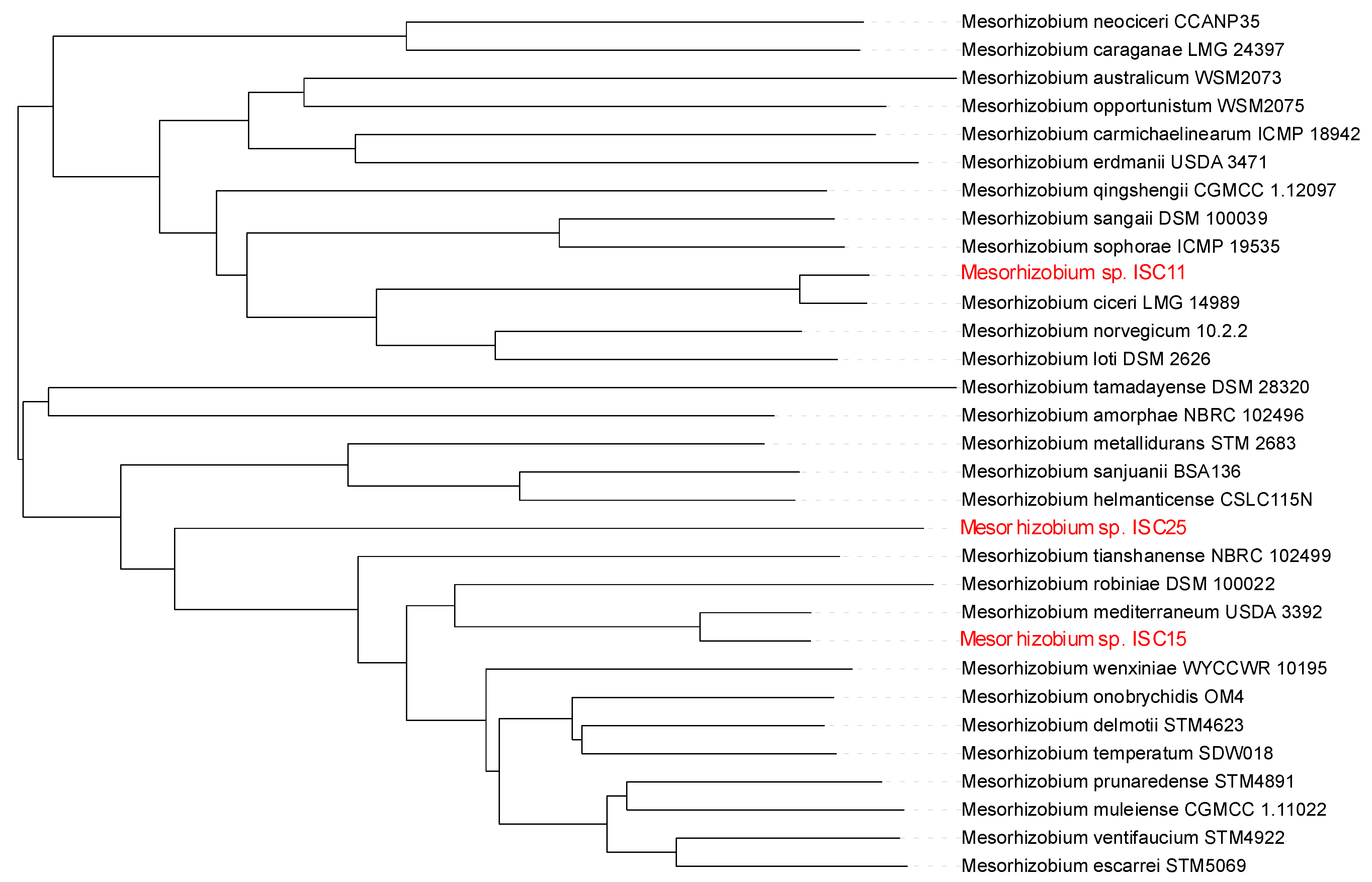
For each genome, in silico DNA–DNA hybridization (DDH) and genome-based phylogeny were computed to allow a robust taxonomic classification of the strains [33]. The results of the taxonomic assignment based on dDDH values are reported in Supplementary Dataset S1 and the genome-based phylogenetic tree is shown in Figure 2. The strains ISC11 and ISC15 belonged to the already-described species, M. ciceri and M. mediterraneum, respectively, which were already known as symbionts of chickpea. On the contrary, ISC25 showed only low dDDH values with known species (~30–40%), thereby supporting the hypothesis that it could constitute a novel species of chickpea-nodulating rhizobia.
To better evaluate the similarities between strains, we calculated the number of core and dispensable genes between the strains ISC11, ISC15, and ISC25 and their close relatives. The Roary computational pipeline was run for three groups of strains: group 1 (Mesorhizobium sp. ISC 11 and M. ciceri), group 2 (Mesorhizobium sp. ISC 15 and M. mediterraneum), and group 3 (Mesorhizobium sp. ISC 25, M. thianshianense, M. mediterraneum, M. onobrychidis, M. delmotii, M. temperatum, M. muleiense, M. ventifaucium, and M. escarrei). Strains ISC11 and ISC15 share, respectively, 27% and 33% of their genes with their close relatives M. ciceri and M. mediterraneum. ISC25 share 22% of genes with the strains belonging to its group (Supplementary Dataset S2). Based on these data we could assign ISC11 to M. cicero and ISC15 to M. mediterraneum, while ISC25 could deserve future taxonomic evaluation as a possible novel species.
Given the relevance to symbiotic nitrogen fixation and the genome diversity of strains, we checked for the presence of the common set of genes required for Nod-factor-dependent symbiotic interaction (nod genes) and nitrogen fixation (nif genes) and we then inspected the phylogeny of NodC and NifH to establish a possible common origin (Figure S1a,b). The results indicated that ISC11 and ISC15 share identical NifH proteins, clustering together with the M. mediterraneum ortholog. For NodC, ISC15 and ISC25 share the same sequence, which is very close to the ISC11 and M. ciceri ortholog. These results suggest that, though being genomically different species, these strains experienced some level of horizontal gene transfer of symbiotic elements.
To further inspect the presence of other genes potentially involved in plant growth promotion, we reannotate the genomes of ISC11, ISC15, and ISC25 using the PLaBAse ontology tool for plant growth-promoting traits. The results (Table 5, Supplementary Dataset S3) indicated for all strains the putative presence of several traits, other than symbiotic nitrogen fixation, which can help plant growth. To further check the presence of specific genes related to plant growth we analyzed the presence of the acdS gene, encoding for the ACC deaminase (1-aminocyclopropane-1-carboxylate deaminase) enzyme that is involved in reducing the ethylene levels in the plant, and the presence of pathways for the production of the phytohormones auxin indole-3-acetic acid (IAA) and cytokinin zeatin (Supplementary Material File, Figure S2). The strains ISC11 and ISC25 harboured the acdS gene, while no acdS gene was found in the genome of ISC15. Notably, ISC25 harboured two acdS genes, located in different genomic positions (Supplementary Material File, Table S1). Concerning potential IAA production, ISC11 harboured enzyme-converting indel-3-acetaldeyde to indole-3-acetate, though apparently no reaction for the production of such substrates seems to be present. ISC15 and ISC25 also harboured some enzymes for reactions involving IAA, but similarly to ISC11 no direct connection with tryptophan metabolism is present. The pathway for zeatin production was absent from all strains.
Finally, in relation to secondary metabolite gene clusters, no clusters were identified in ISC11, while in ISC15 only a cluster for the biosynthesis of homoserine lactone (i.e., involved in quorum sensing) was found. On the contrary, for ISC25, four putative systems for quorum sensing were identified (homoserine lactone), one Type III polyketide synthase (PKS), plus other possible products (RiPP, terpene, cofactors) (Supplementary Material File, Table S2).

3.3. Variability in Symbiotic Quality on Chickpea Accessions

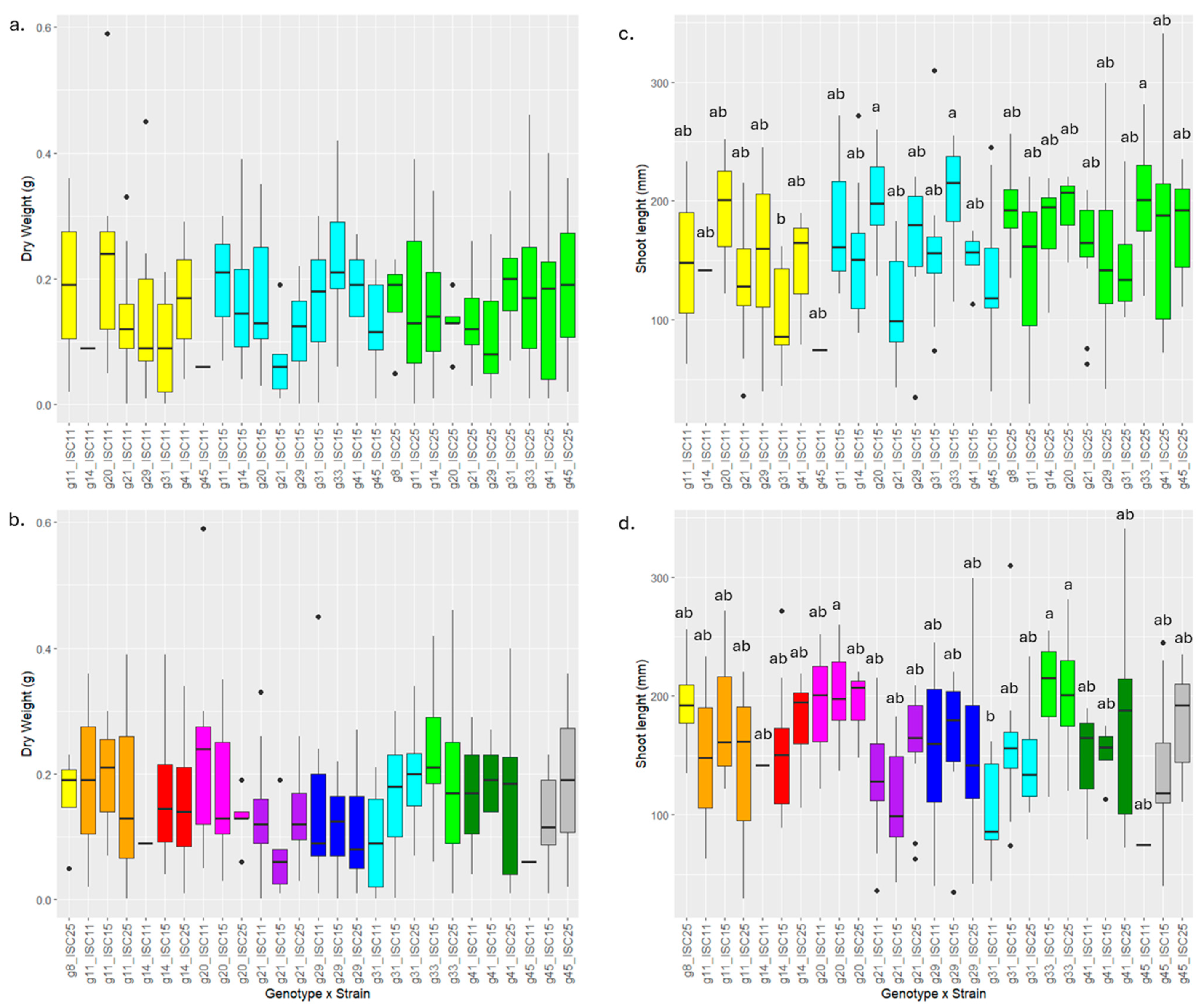
Given the high genomic diversity among the Mesorhizobium strains ISC11, ISC15, and ISC25, we further evaluated the extent of variability in symbiotic quality (as plant aerial part length and plant dry weight) under controlled conditions (plant growth chamber and inoculation in sterile substrate). In particular, we inspected the overall contribution of the strains, the host plant genotype (accession), and their interaction in symbiotic quality to determine the presence and the extent of a rhizobium genotype × plant genotype interaction. The results are reported in Figure 3 and Table S3. In general, the plant aerial part length showed a higher variability and ability to distinguish between accessions than plant dry weight, suggesting the hypothesis that differences could be due to the promotion of internodal separation than to the increase in biomass. The major effect of plant genotype on plant aerial part length was clear from the data shown in Table S3a. However, the Mesorhizobium strains also had a main effect on this parameter, as highlighted by the F statistics value. A statistically significant effect of the interaction between strain and accession was found for plant aerial length, indicating the presence of a genotype-by-genotype interaction. However, no effect on dry weight was observed (Table S3b). We cannot a priori exclude that testing in a pot and also using a larger set of accessions could result in evidence for genotype-by-genotype interaction also at the dry weight level and for the production and quality of seeds, as previously found in S. meliloti strains and varieties of the host plant alfalfa [44].

3.4. Mesorhizobium Elite Strains Differentially Support the Growth of Chickpea Cultivars Under Water Scarcity

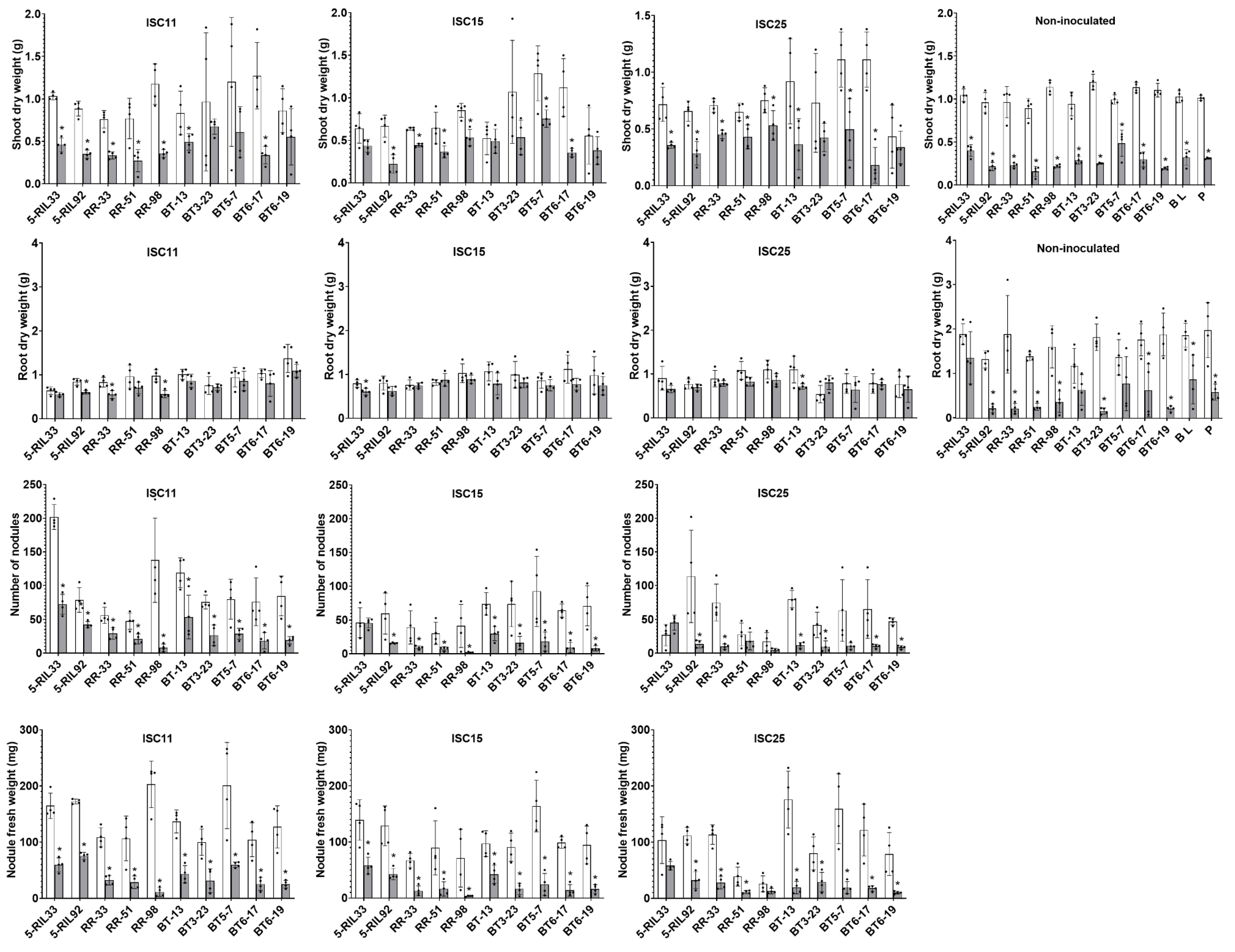
The data regarding the interactions between plant genotype, rhizobia genotype, and irrigation level are summarized in Table 6 and displayed in detail in Figure 4 and Supplementary Dataset S4. The summarized data illustrate the percentage values for each parameter under water shortage conditions, contrasted with the control plants. According to the analysis of shoot dry weights, the following recommendations can be established to tackle drought conditions in the different germplasms, since the percentage of reduction was at least less than 40% with respect to the control (percentage values higher than 60). Thus, the Mesorhizobium ISC11 strain only mitigated the effect of water scarcity with the cultivars BT3-23 and BT6-19. In case of the elite strains ISC15 and ISC25, five and four chickpea germplasms for each strain (5-RIL33, RR-33, RR-98, BT13, and BT6-19; and RR-33, RR-51, RR-98, and BT6-19 Kaveri, respectively) were satisfactorily employed as buffers under this stressful condition. On the other hand, genotypes 5-RIL92, BT5-7, and BT6-17 did not perform well under water shortage conditions, with the shoot dry weight reduction ranging from 50% to 85% regardless of the presence of rhizobial strains. Conversely, the BT3-23 and BT6-19 cultivars, which were adversely affected by water scarcity in the absence of rhizobia, were significantly impacted by the presence of the three Mesorhizobium elite strains.
Regarding the reduction in the root dry weight, the landscape was even more enlightening, since all G × G combinations strongly mitigate the effect of drought conditions with respect to the reduction percentages obtained for each cultivar in the absence of rhizobia (with the exception of 5-RIL33, in which the root growth was not affected by the water shortage) (Table 6, Figure 4 and Supplementary Dataset S4).
Finally, in drought-stressing conditions, the nodule development in all rhizobia–chickpea combinations was severely compromised, since both nodule parameters were strongly reduced under limited watering (Figure 4).

4. Discussion

The present study highlights the promising potential of selected Mesorhizobium strains (ISC11, ISC15, and ISC25) in enhancing chickpea performance under water-limiting conditions. Our multi-level approach—spanning from phenotypic screening and greenhouse trials to genome sequencing and functional annotation—enabled the identification of elite strains with cultivar-specific symbiotic efficiency and plant growth-promoting (PGP) traits. The importance of inoculating chickpea with appropriate rhizobial strains is especially significant in regions where native rhizobia are either absent or exhibit low compatibility with target cultivars [22]. This is crucial in the Mediterranean and semi-arid areas, where environmental constraints such as drought are intensifying due to climate change. By enabling efficient biological nitrogen fixation (BNF), the use of elite Mesorhizobium strains not only reduces the reliance on chemical fertilizers but also contributes to long-term soil fertility, thereby promoting sustainable agricultural practices. Actually, the utilization of selected Mesorhizobium strains for chickpea bioinoculation offers numerous environmental and economic benefits. Indeed, it is generally considered that when chickpeas are introduced into a new region where native chickpea rhizobia are not present, it is essential to inoculate plant material with specific rhizobia to benefit from symbiotic nitrogen fixation [7]. In general, by reducing the need for synthetic nitrogen fertilizers, symbiotic nitrogen fixation operated by Mesorhizobium in chickpea mitigates the negative environmental impacts associated with fertilizer runoff and emissions. Moreover, it contributes to soil health by promoting nutrient cycling and improving soil structure through the formation of root nodules and finally, the reduced input costs associated with fertilizers can lead to economic savings for farmers. However, the large variability in the symbiotic performances of indigenous Mesorhizobium strains risks producing inconsistent yields and important differences when using a non-inoculated seed [45].
Here we have reported the isolation and characterization of three novel Mesorhizobium strains (ISC11, ISC15, ISC25), belonging to the species M. ciceri, M. mediterraneum, and to a possibly novel species (ISC25) closely related to M. tianshanense, which requires further analysis to accurately determine its true taxonomic classification. The strain ISC25 highlights the under-explored microbial diversity associated with chickpea in Mediterranean soils (see for instance [46]) which opens opportunities for future bioprospecting. These strains show important symbiotic qualities over two commercial cultivars (Blanco Lechoso and Pedrosillano) and could led to increase chickpea yield under drought conditions. Functionally, all three elite strains displayed a repertoire of plant growth-promoting traits, including genes involved in stress control, nutrient acquisition, and plant signalling. Notably, ISC11 and ISC25 harboured the acdS gene, encoding ACC deaminase, which is known to mitigate ethylene-mediated stress responses in plants [47] and has been demonstrated to have effects on salt stress in chickpea [48]. This enzyme likely plays a central role in enhancing drought resilience. Furthermore, the presence of quorum sensing pathways and biosynthetic gene clusters, particularly in ISC25, may indicate additional regulatory or signalling functions beneficial to plant–microbe interactions [49]. These results are in accordance with the good behaviour showed by these strains under greenhouse experiments and reinforce the idea that in silico genome analyses are a good tool for detecting potential plant growth-promoting bacteria proposed by Flores-Felix et al. [50]. We further evaluated in ten chickpea accessions if the effects of inoculation could vary depending on the combination of plant genotype (accession) × bacterial genotype (strain) (G × G) in normal and water-limiting conditions. In fact, previous studies have reported for symbiotic rhizobia large variation in the host plant × rhizobial strain combinations in plant growth [44,51]. The comprehensive testing of the strains under controlled drought conditions revealed that rhizobial inoculation not only alleviates biomass loss in shoot tissues but has a more pronounced effect on root system maintenance. Notably, in seven of the ten chickpea cultivars tested (only the 5-RIL92, BT5-7 and BT6-17 cultivars did not respond positively to the presence of the selected mesorhizobia) at least one of the combinations with the Mesorhizobium strains significantly reduced the impact of water shortage on shoot growth. This effect was even more drastic in the case of root development, since in all G × G combinations, the reduction in weight was completely tackled under drought conditions. This could be a consequence of the general nitrogen levels of chickpea plants, since it is well known that the status of this nutrient has a profound influence on their sensitivity to subsequent water deprivation [52,53]. In legumes, nodulated plants exhibit a marked delay in drought-induced leaf senescence compared with non-nodulated plants by means of potassium concentration increase, a better balance in carbon partitioning between starch and sugars, and the enhancement of osmolyte reserves during drought. As a result, nodulated plants generally recover more effectively from drought than their non-nodulated counterparts [54]. This resilience in root biomass could be pivotal for long-term plant survival under water deficit scenarios, as roots play a fundamental role in water and nutrient uptake. The observation that nodulation was impaired under drought, yet biomass was preserved, points to additional plant growth promotion mechanisms beyond nitrogen fixation, such as hormonal modulation or enhanced water use efficiency. From an ecological and agronomic standpoint, these findings align with the broader goals of sustainable intensification and climate adaptation in agriculture [55]. By customizing inoculant strategies based on local chickpea germplasms and specific rhizobial strains, it is possible to maximize the symbiotic benefits and minimize the environmental risks associated with conventional fertilization practices.

5. Conclusions

The primary long-term goal of this research was to contribute to the support and enhancement of chickpea production, which serves as a key source of plant-based proteins, in the face of an increasingly arid and challenging Mediterranean environment. This study identifies and characterizes three elite Mesorhizobium strains with the capacity to significantly enhance chickpea growth under drought conditions through strain-specific symbiotic interactions and plant growth-promoting mechanisms. Our integrated phenotypic and genomic approach demonstrates the following:
-
ISC11 and ISC15 represent effective, well-characterized symbionts (M. ciceri and M. mediterraneum), while ISC25 may constitute a novel species with potential for bioinoculant development.
-
Rhizobial performance is strongly influenced by the chickpea cultivar, reinforcing the necessity of G × G screening to optimize biofertilizer application.
-
The presence of ACC deaminase and auxin-related genes in the elite strains suggests that they can mitigate abiotic stress not only via nitrogen fixation but also through hormonal balance and improved root architecture.
-
The strains demonstrated potential in buffering drought effects, particularly on root biomass, supporting their utility in semi-arid and drought-prone agroecosystems.
Future research should expand to field-level trials and examine seed yield and nutrient content as ultimate indicators of agronomic performance. Additionally, the long-term monitoring of soil microbiota in inoculated versus non-inoculated systems would offer insights into the ecological compatibility and sustainability of these bioinoculants. The approach and findings outlined here provide a solid foundation for developing cultivar-specific rhizobial inoculants tailored to the challenges of climate-resilient agriculture.

Supplementary Materials

The following supporting information can be downloaded at: https://www.mdpi.com/article/10.3390/agriculture15151694/s1, Supplementary Materials File; Supplementary Dataset S1: Taxonomic assignment based on dDDH values; Supplementary Dataset S2: Roary summary; Supplementary Dataset S3: Results from PLaBAse ontology analysis. The number of orthologs for each ontology is reported; Supplementary Dataset S4: Data regarding the interactions between plant and rhizobia genotypes, in normal irrigation and drought conditions; Table S1: Locus tags (PGAP NCBI annotation) of genes encoding the aminocyclopropane-1-carboxylate deaminase (acdS gene); Table S2: Secondary metabolite gene clusters after search with AntiSMASH 7.0; Figure S1: Phylogeny of NodC and NifH proteins. Phylogenetic trees obtained from NodC (a) and NifH (b) protein sequences of strains ISC11, ISC15, and ISC25 are reported. NodC and NifH proteins were first identified by BLASTp. Phylogenies were estimated with the maximum likelihood method with the JTT matrix and a bootstrap of n = 1000 replicates (see Section 2); Figure S2: Presence of genes for the pathway related to IAA and zeatin production in the sequenced strains. Maps from tryptophan metabolism (a) and zeatin production (b) of KEGG pathways obtained by KAAS annotation for ISC11, ISC15, and ISC25 strains. Green colours indicate the presence of an orthologous gene coding for the enzyme carrying out the reaction (EC enzymes codes are indicated). Blue boxes refer to the presence of the reaction into KEGG reference.

Author Contributions

Conceptualization, C.F., A.M., F.M., P.B. and D.N.R.-N.; investigation, all authors; writing—original draft preparation, F.V., C.F., A.M., M.C., M.N., F.J.O. and F.P.-M.; writing—review and editing, all authors. All authors have read and agreed to the published version of the manuscript.

Funding

This research was funded by the European Union under the Grant Agreement no. 101102316 (LEGU-MED project, Number: 2019-SECTION2-19). The Spanish Subproject is funded by AEI/10.13039/501100011033.

Institutional Review Board Statement

Not applicable.

Data Availability Statement

Sequences are deposited in NCBI database under BioProject PRJNA951646.

Acknowledgments

We acknowledge the contribution of Alice Cama and Greta Soldani in technically assisting the symbiotic assays and preliminary genome analyses.

Conflicts of Interest

The authors declare no conflicts of interest.

References

  1. Brun, P.; Camacho, M.; Perea, F.; Rubio, M.J.; Rodríguez-Navarro, D.N. Characterization of Spanish Chickpea Genotypes (Cicer arietinum L.): Proximate, Mineral, and Phenolic Compounds Composition. Eur. Food Res. Technol. 2024, 250, 1007–1016. [Google Scholar] [CrossRef]
  2. Goldstein, J. Faculty Opinions Recommendation of Food in the Anthropocene: The EAT-Lancet Commission on Healthy Diets from Sustainable Food Systems. Fac. Opin.—Post-Publ. Peer Rev. Biomed. Lit. 2019, 393, 447–492. [Google Scholar] [CrossRef]
  3. Beebe, S.E.; Rao, I.M.; Blair, M.W.; Acosta-Gallegos, J.A. Phenotyping Common Beans for Adaptation to Drought. Front. Physiol. 2013, 4, 35. [Google Scholar] [CrossRef] [PubMed]
  4. Polania, J.; Poschenrieder, C.; Rao, I.; Beebe, S. Estimation of Phenotypic Variability in Symbiotic Nitrogen Fixation Ability of Common Bean under Drought Stress Using 15N Natural Abundance in Grain. Eur. J. Agron. 2016, 79, 66–73. [Google Scholar] [CrossRef]
  5. Martinelli, F.; Ollero, F.J.; Giovino, A.; Perrone, A.; Bekki, A.; Sikora, S.; Nabbout, R.E.; Bouhadida, M.; Yucel, D.; Bazzicalupo, M.; et al. Proposed Research for Innovative Solutions for Chickpeas and Beans in a Climate Change Scenario: The Mediterranean Basin. Sustainability 2020, 12, 1315. [Google Scholar] [CrossRef]
  6. Cuellar-ortiz, S.M.; De La Paz Arrieta-montiel, M.; Acosta-gallegos, J.; Covarrubias, A.A. Relationship between Carbohydrate Partitioning and Drought Resistance in Common Bean. Plant Cell Environ. 2008, 31, 1399–1409. [Google Scholar] [CrossRef]
  7. Zhang, J.; Wang, J.; Zhu, C.; Singh, R.P.; Chen, W. Chickpea: Its Origin, Distribution, Nutrition, Benefits, Breeding, and Symbiotic Relationship with Mesorhizobium Species. Plants 2024, 13, 429. [Google Scholar] [CrossRef]
  8. Gunnabo, A.H.; Van Heerwaarden, J.; Geurts, R.; Wolde-Meskel, E.; Degefu, T.; Giller, K.E. Symbiotic Interactions between Chickpea (Cicer arietinum L.) Genotypes and Mesorhizobium Strains. Symbiosis 2020, 82, 235–248. [Google Scholar] [CrossRef]
  9. Andrews, M.; Andrews, M.E. Specificity in Legume-Rhizobia Symbioses. Int. J. Mol. Sci. 2017, 18, 705. [Google Scholar] [CrossRef]
  10. Zaw, M.; Rathjen, J.R.; Zhou, Y.; Ryder, M.H.; Denton, M.D. Symbiotic Effectiveness, Ecological Adaptation and Phylogenetic Diversity of Chickpea Rhizobia Isolated from a Large-Scale Australian Soil Collection. Plant Soil 2021, 469, 49–71. [Google Scholar] [CrossRef]
  11. Nour, S.M.; Fernandez, M.P.; Normand, P.; Cleyet-Marel, J. Rhizobium ciceri sp. nov., Consisting of Strains That Nodulate Chickpeas (Cicer arietinum L.). Int. J. Syst. Bacteriol. 1994, 44, 511–522. [Google Scholar] [CrossRef]
  12. Nour, S.M.; Cleyet-Marel, J.; Normand, P.; Fernandez, M.P. Genomic Heterogeneity of Strains Nodulating Chickpeas (Cicer arietinum L.) and Description of Rhizobium mediterraneum sp. nov. Int. J. Syst. Bacteriol. 1995, 45, 640–648. [Google Scholar] [CrossRef]
  13. Zhang, J.J.; Liu, T.Y.; Chen, W.F.; Wang, E.T.; Sui, X.H.; Zhang, X.X.; Li, Y.; Li, Y.; Chen, W.X. Mesorhizobium muleiense sp. nov., Nodulating with Cicer arietinum L. Int. J. Syst. Evol. Microbiol. 2012, 62, 2737–2742. [Google Scholar] [CrossRef]
  14. Zhang, J.; Guo, C.; Chen, W.; De Lajudie, P.; Zhang, Z.; Shang, Y.; Wang, E.T. Mesorhizobium wenxiniae sp. nov., Isolated from Chickpea (Cicer arietinum L.) in China. Int. J. Syst. Evol. Microbiol. 2018, 68, 1930–1936. [Google Scholar] [CrossRef] [PubMed]
  15. Spaink, H.P.; Kondorosi, A.; Hooykaas, P.J.J. The Rhizobiaceae: Molecular Biology of Model Plant-Associated Bacteria; Springer Science & Business Media: Berlin/Heidelberg, Germany, 2012. [Google Scholar]
  16. Rivas, R.; Laranjo, M.; Mateos, P.F.; Oliveira, S.; Martínez-Molina, E.; Velázquez, E. Strains of Mesorhizobium amorphae and Mesorhizobium tianshanense, Carrying Symbiotic Genes of Common Chickpea Endosymbiotic Species, Constitute a Novel Biovar (Ciceri) Capable of Nodulating Cicer arietinum. Lett. Appl. Microbiol. 2006, 44, 412–418. [Google Scholar] [CrossRef] [PubMed]
  17. Laranjo, M.; Alexandre, A.; Oliveira, S. Legume Growth-Promoting Rhizobia: An Overview on the Mesorhizobium Genus. Microbiol. Res. 2013, 169, 2–17. [Google Scholar] [CrossRef] [PubMed]
  18. Tena, W.; Wolde-Meskel, E.; Degefu, T.; Walley, F. Genetic and Phenotypic Diversity of Rhizobia Nodulating Chickpea (Cicer arietinum L.) in Soils from Southern and Central Ethiopia. Can. J. Microbiol. 2017, 63, 690–707. [Google Scholar] [CrossRef]
  19. Alexandre, A.; Brígido, C.; Laranjo, M.; Rodrigues, S.; Oliveira, S. Survey of Chickpea Rhizobia Diversity in Portugal Reveals the Predominance of Species Distinct from Mesorhizobium ciceri and Mesorhizobium mediterraneum. Microb. Ecol. 2009, 58, 930–941. [Google Scholar] [CrossRef]
  20. Laranjo, M.; Machado, J.; Young, J.P.W.; Oliveira, S. High Diversity of Chickpea Mesorhizobium Species Isolated in a Portuguese Agricultural Region. FEMS Microbiol. Ecol. 2004, 48, 101–107. [Google Scholar] [CrossRef]
  21. Romdhane, S.B.; Aouani, M.E.; Mhamdi, R. Inefficient nodulation of chickpea (Cicer arietinum L.) in the arid and Saharan climates in Tunisia by Sinorhizobium meliloti biovar medicaginis. Ann. Microbiol. 2007, 57, 15–20. [Google Scholar] [CrossRef]
  22. Romdhane, S.B.; De Lajudie, P.; Fuhrmann, J.J.; Mrabet, M. Potential Role of Rhizobia to Enhance Chickpea-Growth and Yield in Low Fertility-Soils of Tunisia. Antonie Van Leeuwenhoek 2022, 115, 921–932. [Google Scholar] [CrossRef]
  23. Yadav, P.; Chandra, R.; Anusandhan, N.P. Plant Growth Promoting Mesorhizobia as a Potential Inoculant for Chickpea (Cicer arietinum L.): A Review. Bhartiya Krishi Anusandhan Patrika 2022, 37, 328–333. [Google Scholar] [CrossRef]
  24. Nascimento, F.X.; Brígido, C.; Glick, B.R.; Oliveira, S. ACC Deaminase Genes Are Conserved among Mesorhizobium species Able to Nodulate the Same Host Plant. FEMS Microbiol. Lett. 2012, 336, 26–37. [Google Scholar] [CrossRef] [PubMed]
  25. Somasegaran, P.; Hoben, H. Methods in Legume-Rhizobium Technology; University of Hawaii NifTAL Project and MIRCEN, Department of Agronomy and Soil Science, Hawaii Institute of Tropical Agriculture and Human Resources, College of Tropical Agriculture and Human Resources: Maui-Paia, HI, USA, 1985. [Google Scholar]
  26. Beringer, J.E. R Factor Transfer in Rhizobium Leguminosarum. Microbiology 1974, 84, 188–198. [Google Scholar] [CrossRef] [PubMed]
  27. Schwartz, W.J.M. Vincent, A Manual for the Practical Study of the Root-Nodule Bacteria (IBP Handbuch No. 15 Des International Biology Program, London). XI u. 164 S., 10 Abb., 17 Tab., 7 Taf. Oxford-Edinburgh 1970: Blackwell Scientific Publ., 45 s. Z. Allg. Mikrobiol. 1972, 12, 440. [Google Scholar] [CrossRef]
  28. Del Cerro, P.; Rolla-Santos, A.A.P.; Gomes, D.F.; Marks, B.B.; Del Rosario Espuny, M.; Rodríguez-Carvajal, M.Á.; Soria-Díaz, M.E.; Nakatani, A.S.; Hungria, M.; Ollero, F.J.; et al. Opening the “Black Box” of nodD3, nodD4 and nodD5 Genes of Rhizobium Tropici Strain CIAT 899. BMC Genom. 2015, 16, 864. [Google Scholar] [CrossRef]
  29. Del Cerro, P.; Rolla-Santos, A.A.P.; Gomes, D.F.; Marks, B.B.; Pérez-Montaño, F.; Rodríguez-Carvajal, M.Á.; Nakatani, A.S.; Gil-Serrano, A.; Megías, M.; Ollero, F.J.; et al. Regulatory nodD1 and nodD2 Genes of Rhizobium Tropici Strain CIAT 899 and Their Roles in the Early Stages of Molecular Signaling and Host-Legume Nodulation. BMC Genom. 2015, 16, 251. [Google Scholar] [CrossRef]
  30. Buendia-Claveria, A.M.; Ruiz-Sainz, J.E.; Cubo-Sanchez, T.; Perez-Silva, J. Studies of Symbiotic Plasmids in Rhizobium trifolii and Fast-growing Bacteria That Nodulate Soybeans. J. Appl. Microbiol. 1986, 61, 1–9. [Google Scholar] [CrossRef]
  31. Checcucci, A.; diCenzo, G.C.; Ghini, V.; Bazzicalupo, M.; Becker, A.; Decorosi, F.; Döhlemann, J.; Fagorzi, C.; Finan, T.M.; Fondi, M.; et al. Creation and Characterization of a Genomically Hybrid Strain in the Nitrogen-Fixing Symbiotic Bacterium Sinorhizobium meliloti. ACS Synth. Biol. 2018, 7, 2365–2378. [Google Scholar] [CrossRef]
  32. R Core Team. R: A Language and Environment for Statistical Computing; R Foundation for Statistical Computing: Vienna, Austria, 2014. [Google Scholar]
  33. Puppo, A.; Rigaud, J. A Possible Reduction Pathway for Leghemoglobin in Vivo. FEBS Lett. 1979, 108, 124–126. [Google Scholar] [CrossRef]
  34. Tatusova, T.; DiCuccio, M.; Badretdin, A.; Chetvernin, V.; Nawrocki, E.P.; Zaslavsky, L.; Lomsadze, A.; Pruitt, K.D.; Borodovsky, M.; Ostell, J. NCBI Prokaryotic Genome Annotation Pipeline. Nucleic Acids Res. 2016, 44, 6614–6624. [Google Scholar] [CrossRef]
  35. Meier-Kolthoff, J.P.; Göker, M. TYGS Is an Automated High-Throughput Platform for State-of-the-Art Genome-Based Taxonomy. Nat. Commun. 2019, 10, 2182. [Google Scholar] [CrossRef]
  36. Moriya, Y.; Itoh, M.; Okuda, S.; Yoshizawa, A.C.; Kanehisa, M. KAAS: An Automatic Genome Annotation and Pathway Reconstruction Server. Nucleic Acids Res. 2007, 35, W182–W185. [Google Scholar] [CrossRef]
  37. Blin, K.; Shaw, S.; Augustijn, H.E.; Reitz, Z.L.; Biermann, F.; Alanjary, M.; Fetter, A.; Terlouw, B.R.; Metcalf, W.W.; Helfrich, E.J.N.; et al. AntiSMASH 7.0: New and Improved Predictions for Detection, Regulation, Chemical Structures and Visualisation. Nucleic Acids Res. 2023, 51, W46–W50. [Google Scholar] [CrossRef]
  38. Patz, S.; Gautam, A.; Becker, M.; Ruppel, S.; Rodríguez-Palenzuela, P.; Huson, D.H. PLaBAse: A Comprehensive Web Resource for Analyzing the Plant Growth-Promoting Potential of Plant-Associated Bacteria. bioRxiv 2021. bioRxiv:2021.12.13.472471. [Google Scholar] [CrossRef]
  39. Seemann, T. Prokka: Rapid Prokaryotic Genome Annotation. Bioinformatics 2014, 30, 2068–2069. [Google Scholar] [CrossRef] [PubMed]
  40. Page, A.J.; Cummins, C.A.; Hunt, M.; Wong, V.K.; Reuter, S.; Holden, M.T.G.; Fookes, M.; Falush, D.; Keane, J.A.; Parkhill, J. Roary: Rapid Large-Scale Prokaryote Pan Genome Analysis. Bioinformatics 2015, 31, 3691–3693. [Google Scholar] [CrossRef] [PubMed]
  41. Tamura, K.; Stecher, G.; Kumar, S. MEGA11: Molecular Evolutionary Genetics Analysis Version 11. Mol. Biol. Evol. 2021, 38, 3022–3027. [Google Scholar] [CrossRef]
  42. Jones, D.T.; Taylor, W.R.; Thornton, J.M. The Rapid Generation of Mutation Data Matrices from Protein Sequences. Bioinformatics 1992, 8, 275–282. [Google Scholar] [CrossRef] [PubMed]
  43. Lefort, V.; Desper, R.; Gascuel, O. FastME 2.0: A Comprehensive, Accurate, and Fast Distance-Based Phylogeny Inference Program. Mol. Biol. Evol. 2015, 32, 2798–2800. [Google Scholar] [CrossRef]
  44. Fagorzi, C.; Bacci, G.; Huang, R.; Cangioli, L.; Checcucci, A.; Fini, M.; Perrin, E.; Natali, C.; diCenzo, G.C.; Mengoni, A. Nonadditive Transcriptomic Signatures of Genotype-by-Genotype Interactions during the Initiation of Plant-Rhizobium Symbiosis. mSystems 2021, 6. [Google Scholar] [CrossRef]
  45. Kyei-Boahen, S.; Slinkard, A.E.; Walley, F.L. Evaluation of Rhizobial Inoculation Methods for Chickpea. Agron. J. 2002, 94, 851–859. [Google Scholar] [CrossRef]
  46. Romdhane, S.B.; Trabelsi, M.; Aouani, M.E.; De Lajudie, P.; Mhamdi, R. The Diversity of Rhizobia Nodulating Chickpea (Cicer Arietinum) under Water Deficiency as a Source of More Efficient Inoculants. Soil Biol. Biochem. 2009, 41, 2568–2572. [Google Scholar] [CrossRef]
  47. Singh, R.P.; Shelke, G.M.; Kumar, A.; Jha, P.N. Biochemistry and Genetics of ACC Deaminase: A Weapon to “Stress Ethylene” Produced in Plants. Front. Microbiol. 2015, 6, 937. [Google Scholar] [CrossRef]
  48. Br Igido, C.; Nascimento, F.X.; Duan, J.; Glick, B.R.; Oliveira, S. Expression of an Exogenous 1-Aminocyclopropane-1-Carboxylate Deaminase Gene in Mesorhizobium spp. Reduces the Negative Effects of Salt Stress in Chickpea. FEMS Microbiol. Lett. 2013, 349, 46–53. [Google Scholar] [CrossRef]
  49. Poppeliers, S.W.; Sánchez-Gil, J.J.; de Jonge, R. Microbes to Support Plant Health: Understanding Bioinoculant Success in Complex Conditions. Curr. Opin. Microbiol. 2023, 73, 102286. [Google Scholar] [CrossRef]
  50. Flores-Félix, J.D.; Velázquez, E.; Martínez-Molina, E.; González-Andrés, F.; Squartini, A.; Rivas, R. Connecting the Lab and the Field: Genome Analysis of Phyllobacterium and Rhizobium Strains and Field Performance on Two Vegetable Crops. Agronomy 2021, 11, 1124. [Google Scholar] [CrossRef]
  51. Cangioli, L.; Checcucci, A.; Mengoni, A.; Fagorzi, C. Legume Tasters: Symbiotic Rhizobia Host Preference and Smart Inoculant Formulations. Biol. Commun. 2021, 66, 47–54. [Google Scholar] [CrossRef]
  52. Radin, J.W.; Ackerson, R.C. Water Relations of Cotton Plants under Nitrogen Deficiency. Plant Physiol. 1981, 67, 115–119. [Google Scholar] [CrossRef]
  53. Radin, J.W.; Boyer, J.S. Control of Leaf Expansion by Nitrogen Nutrition in Sunflower Plants: Role of Hydraulic Conductivity and Turgor. Plant Physiol. 1982, 69, 771–775. [Google Scholar] [CrossRef]
  54. Staudinger, C.; Mehmeti-Tershani, V.; Gil-Quintana, E.; Gonzalez, E.M.; Hofhansl, F.; Bachmann, G.; Wienkoop, S. Evidence for a Rhizobia-Induced Drought Stress Response Strategy in Medicago truncatula. J. Proteom. 2016, 136, 202–213. [Google Scholar] [CrossRef]
  55. Pretty, J. Intensification for Redesigned and Sustainable Agricultural Systems. Science (1979) 2018, 362. [Google Scholar] [CrossRef]
Figure 1. Estimation of nitrogenase performance of Mesorhizobium elite strains. Results of the acetylene reduction assays (ARAs) on chickpea cv. Pedrosillano (left) and Blanco Lechoso (right) inoculated with ISC elite strains. (a) ARA per Leonard jar. Error bars show standard deviations of ISC11, ISC15, and ISC25 elite strains. Bars marked by the same letter are not significantly different (one-way ANOVA, p < 0.05). (b) Representative plants of each condition. NI, non-incolulated.
Agriculture 15 01694 g001
Figure 2. Genome-based taxonomy of elite ISC strains. Genome-based evolutionary analysis by maximum likelihood method of Mesorhizobium ISC11, ISC15, and ISC25 strains. Tree inferred with FastME 2.1.6.1 from Genome BLAST Distance Phylogeny (GBDP) distances calculated from genome sequences [43]. The branch lengths are scaled in terms of GBDP distance formula d5. The numbers above branches are GBDP pseudo-bootstrap support values > 60% from 100 replications, with an average branch support of 96.5%.
Agriculture 15 01694 g002
Figure 3. Variability in symbiotic quality among strains and chickpea accessions. Results from the in vitro test are reported. The figure shows the dry weight (a,b) and shoot length (c,d) measured for each plant inoculated with the different Mesorhizobium strains, harvested after 5 weeks of growth. Panels (a,c) evidence the effect of the inoculation with the three Mesorhizobium strains, while panels (b,d) show the effect of the ten plant genotypes. Multiple (pair-wise) comparisons were calculated using ANOVA and Tukey’s test; the compact letter indicates different groups based on Tukey’s test. No significant difference is obtained when measuring the dry weight of the plants—panels (a,b). Letters over the boxes in panels (c,d) show groups that are statistically different to each other.
Agriculture 15 01694 g003
Figure 4. Variability in symbiotic performance among strains and chickpea cultivars. Figure shows the shoot and root dry weight and the number and fresh weight of nodules measured for each plant inoculated with the different Mesorhizobium strains. Control and drought conditions are indicated as white and grey bars, respectively. Multiple comparisons were calculated using t test (p < 0.05). Asterisks indicate statistically significant differences between control and drought conditions for each G × G combination.
Agriculture 15 01694 g004
Table 1. Mesorhizobium spp. strains used in this work. Strain codes, cultivar of isolation, and geographical location in Spain of nodulated chickpea plants are reported.
Strain DenominationCultivar of IsolationOrigin (Location and Province)
ISC6PedrosillanoCarmona (Sevilla)
ISC11Non determinedHolguera (Cáceres)
ISC13Non determinedCañaveral (Cáceres)
ISC15PedrosillanoLa Roca (Badajoz)
ISC18Garbanzo de Valencia del VentosoFuente de Cantos (Badajoz)
ISC24PedrosillanoCarmona (Sevilla)
ISC25Blanco lechosoHuelva (Huelva)
Table 2. Chickpea germplasms used in this work and their origin.
Cultivar Type and Origin
PedrosillanoCommercial cultivar, Salamanca (Spain)
Blanco LechosoCommercial cultivar, Andalucía (Spain)
5-RIL33Recombinant inbred lines
5-RIL92Recombinant inbred lines
RR-33 ValekaRecombinant inbred lines, cultivar, Andalucía (Spain)
RR-51Recombinant inbred lines
RR-98 KasinRecombinant inbred lines, cultivar, Andalucía (Spain)
BT3-13Recombinant inbred lines
BT3-23Recombinant inbred lines
BT5-7Recombinant inbred lines
BT6-17 KaveriRecombinant inbred lines, cultivar, Andalucía (Spain)
BT6-19Recombinant inbred lines
22-2M2/1-4-3 (g_8)Mutagenic Pascià
4 ENEA/2-5-1 (g_11)Population Italy
6-1M2/4-3-5(g_14)Mutagenic Pascià
GSC-21-2 (g_20)Population Italy
GSC-30-1 (g_21)Population Italy
GSC-5-2 (g_29)Population Italy
GSC-35-3 (g_31)Population Italy
GSC-16-3 (g_33)Population Italy
FLIP03-112C (g_41)Recombinant inbred lines (X00TH51/FLIP98-52CxFLIP98-47C)
FLIP10-125C (g_45)Recombinant inbred lines (X04TH-85/X03TH-153XS01114)
Table 3. Symbiotic responses of chickpea commercial cultivars. The symbiotic quality of inoculation with ISC strains with Pedrosillano and Blanco lechoso chickpea varieties are reported in terms of number and dry weight of nodules and plant and shoot dry weight. Values are means of 4 independent replicates. In the same column, for each cultivar, data followed by the same letter are not significantly different (one-way ANOVA, p < 0.05).
Strains Number of Nodules Nodule Dry Weight (g) Shoot Dry Weight (g)
Pedrosillano
ISC691.0 ± 11.0 ab414.6 ± bc3.1 ± 0.3 ab
ISC11119.5 ± 4.5 a553.8 ± 70.0 ab4.1 ± 0.8 ab
ISC1385.0 ± 10.0 b122.8 ± 14.2 d0.6 ± 0.1 c
ISC1573.0 ± 3.4 bc416.5 ± 68.0 bc3.1 ± 0.5 ab
ISC1873.8 ± 8.0 bc274.0 ± 46.6 cd2.3 ± 0.6 bc
ISC2472.5 ± 14.9 bc251.6 ± 12.4 cd2.6 ± 0.7 abc
ISC25122 ± 10.1 a663.3 ± 140.8 a4.6 ± 1.2 a
Non-inoculated000.6 ± 0.1 c
Blanco lechoso
ISC657.3 ± 39 ab232 ± 11 ab2.7 ± 0.6 bcd
ISC1138.0 ± 24 b132.0 ± 6 b5.0 ± 1.3 a
ISC13101.0 ± 17 a201 ± 111 ab2.1 ± 0.6 cd
ISC1541 ± 10 b299 ± 77 a3.5 ± 0.4 b
ISC1821.0 ± 4 b136 ± 133 b2.6 ± 0.5 bcd
ISC2448.0 ± 15 b133 ± 17 b2.2 ± 0.1 bcd
ISC2519.0 ± 7 b190 ± 42 ab3.4 ± 0.4 bc
Non-inoculated001.5 ± 0.2 d
Table 4. Genome sequencing statistics and annotation. Genome size, number of contigs, and the number of coding sequences (CDS), ribosomal RNA (rRNA), transfer RNA (tRNA), and transfer-messenger RNA (tmRNA) genes are reported.
ISC11ISC15ISC25
Genome size (bp)6,719,9226,908,8437,259,116
n. of contigs/replicons223
CDS661265996961
rRNA366
tRNA515452
tmRNA111
Table 5. Number of genes of Mesorhizobium ISC11, ISC15, and ISC25 strains related to the ontologies for plant growth-promoting traits. Data from blast + hmmer annotation against the PLaBAse database.
ISC11ISC15ISC25
Biofertilization121111
Phytohormone/plant signal production111111
Plant immune response stimulation111
Colonizing plant system313031
Competitive exclusion182019
Stress control/biocontrol191919
Bioremediation777
Putative functions000
Table 6. Symbiotic parameters of chickpea genotypes under reduced watering. Percentage with respect to controls are reported. Root dry weight (RDW) and shoot dry weight (SDW) are reported. Treatments with a reduction higher than 60% (weight lower than 40%) in the SDW or RDW with respect to control conditions are highlighted in red. Values above 50 are indicated in red colour.
Chickpea
Genotypes
Mesorhizobium Strains
ISC11ISC15ISC25Non-inoculated
SDWRDWSDWRDWSDWRDWSDWRDW
5-RIL3344.686.368.076.649.572.738.271.8
5-RIL9239.571.533.378.443.390.322.516.0
RR-3344.166.069.798.364.088.023.711.0
RR-5135.473.256.6107.166.276.417.718.0
RR-9830.457.462.586.670.478.118.922.3
BT-1359.285.493.873.539.765.130.353.6
BT3-2369.995.050.081.858.2148.420.68.4
BT5-750.690.758.687.544.582.548.756.5
BT6-1726.577.731.769.416.298.226.135.0
BT6-1974.579.468.876.078.085.317.710.8
Percentage respect to control conditions (no water shortage)
Disclaimer/Publisher’s Note: The statements, opinions and data contained in all publications are solely those of the individual author(s) and contributor(s) and not of MDPI and/or the editor(s). MDPI and/or the editor(s) disclaim responsibility for any injury to people or property resulting from any ideas, methods, instructions or products referred to in the content.