Article

Responses of Broiler Breeder Hens to Dietary Digestible Lysine, Methionine+Cystine, and Threonine †

by
Michele B. de Lima
1,
Nilva K. Sakomura
2,
Cléber F. S. Oliveira
3,
Rita B. Vieira
2,
Jaqueline A. Pavanini
2 and
Edney P. da Silva
2,*
1
Department of Animal Production and Health, School of Veterinary Medicine, UNESP—São Paulo State University, Araçatuba 16050-680, Brazil
2
Department of Animal Sciences, College of Agriculture and Veterinary Sciences, UNESP—São Paulo State University, Jaboticabal 14884-900, Brazil
3
Department of Animal Sciences, Federal University of Paraiba, UFPB—Areia, Areia 58397-000, Brazil
*
Author to whom correspondence should be addressed.
This paper is a part of the Ph.D. Thesis of Cléber F. S. Oliveira, presented at University.
Agriculture 2025, 15(15), 1685; https://doi.org/10.3390/agriculture15151685
Submission received: 4 June 2025 / Revised: 25 July 2025 / Accepted: 27 July 2025 / Published: 4 August 2025
(This article belongs to the Section Farm Animal Production)

Abstract

To evaluate the response of broiler breeder hens submitted to different amino acid intakes of methionine+cystine, lysine, and threonine, and to determine the coefficients for egg output and body weight for maintenance. Three studies were performed using 160 broiler breeder hens housed individually in metabolic cages. A summit diet and a nitrogen-free diet were formulated. The levels ranged from 1.79 to 7.13, 2.49 to 8.3, and 2.04 to 6.79 g/kg of methionine+cystine, lysine, and threonine, respectively. The variables measured were feed intake, amino acid intake, rate of lay, egg weight, and egg output. The broken line model was used to evaluate the responses. It was verified that higher values of the rate of lay, egg weight, and egg output were observed for the higher concentrations of amino acids studied. A significant difference was observed for the variables rate of lay, egg weight, egg output, and body weight (p < 0.05) for the three amino acids evaluated. The amount of each amino acid required to produce one gram per egg was estimated at 12.4 mg, 14.5 mg, and 11.2 mg for methionine+cystine, lysine, and threonine, respectively. The values estimated by coefficient b that represent the amino acid for maintenance requirement were methionine+cystine, lysine, and threonine of 30.2, 32.2, and 42.4 mg/kg BW, respectively. The coefficients may be used to design additional models to study requirements nutrition in broiler breeders, allowing a better understanding of how these birds respond to different dietary amino acids.

1. Introduction

Broiler breeder hens have unique characteristics that allow nutritionists to establish adequate nutritional plans for these birds [1,2,3,4,5,6]. When fed less energy than recommended, these birds mobilize their body fat reserves to maintain egg production [1,2,3,7,8].
Bowmaker and Gous [9] demonstrated that birds fed diets containing 39.7 g of crude protein (CP) per kilogram consumed less protein than the maintenance requirement of 2.282 g CP per kg of metabolic body weight (BW0.75) [10].
Bowmaker and Gous [9] showed that birds fed with diets containing 39.7 g CP/kg ingested less protein than the maintenance requirement of 2.282 g CP/BWkg0.75 [10]. As a result, birds produced one egg per week, generating a deficit between protein input and output. This result indicates that, besides lipid mobilization, these birds also mobilized body protein [1,2,3].
Researchers use response values to methionine+cystine (Met+Cys), lysine (Lys), and threonine (Thr) intakes obtained with laying hens [11,12,13] to study these responses in broiler breeder [1,9,14]. This limitation impairs our understanding of how broiler breeders actually respond to these amino acids.
Several mathematical models can be applied to fit the responses to amino acid intake and to provide some important parameters applied in response modeling. These parameters are (a) mg of amino acids per gram of egg, and (b) mg per kg of body weight for maintenance [1,2,3,11,15,16]. Bowmaker and Gous [9] and Lima et al. [2] showed that broiler breeders at peak production were less efficient in the use of amino acid, when compared to laying hens [11,12] and thus presented a lower laying rate. The authors [2,9] expressed difficulties in estimating the maintenance requirement for broiler breeder hens.
A previous study with Met+Cys [17] done in post-peak production birds showed that age is an important parameter to be considered when evaluating the responses to amino acid intake [18]. Indeed, it has long been known that decreased utilization of amino acids is related to the maintenance of unproductive layers, which increase in number with advanced age [11,12,13]. However, no study has investigated the response to Met+Cys, Lys, and Thr in broiler breeders older than 60 weeks. It is hypothesized that broiler breeders over 60 weeks of age exhibit altered efficiency in the utilization of Methionine+Cysteine (Met+Cys), Lysine, and Threonine. These changes are expected to enable the estimation of precise coefficients. This study aimed to evaluate the response of post-peak production hens submitted to different intakes of Met+Cys, Lys, and Thr and to determine the coefficients for egg output and body weight maintenance in broiler breeders older than 60 weeks.

2. Materials and Methods

2.1. Animal Ethics and Welfare Committee, Hens and Experimental Design

All experimental procedures were approved by the Animal Ethics and Welfare Committee of UNESP (CEUA) under protocol number 007125-08, with the approval date being the 26 April 2013, in Jaboticabal-SP, Brazil. The trials were conducted at the Poultry Science Laboratory of Poultry Science in 2013, of the São Paulo State University, UNESP, Jaboticabal, São Paulo, Brazil with the objective of measuring the responses of broiler breeder hens to digestible Met+Cys, Lys and Thr with a view to determining the coefficients of response for egg output and body weight maintenance.
Two dose response studies were performed simultaneously (methionine+cystine and lysine trial), then the threonine trial.
A total of 160 broiler breeder hens of Cobb 500® genotype were used, being 56 birds for methionine+cystine and lysine trials (at 86 weeks of age) and 48 birds for threonine trial (at 60 weeks of age). The experimental design was a completely randomized design with eight treatments (seven increasing levels of amino acid and a validating diet) and seven replicates for Met+Cys and Lys trials and six replicates for Thr trial. In all trials, the hens were raised in the same poultry house with a negative-pressure system with controlled temperature of 21 °C and individually housed in metabolic cages measuring 50 × 50 × 50 cm equipped with individual feeders and nipple drinkers.

2.2. Bird Management

The birds were provided by a commercial farm situated in the state of Minas Gerais, Brazil. Two weeks before the beginning of the experiment, all birds were fed an adequate diet designed to meet the nutritional requirements of the birds during this period according to the recommendation of [19] at the rate of 150 g/d, and the rate of lay was monitored to provide a baseline for the experimental period. The experiment lasted ten weeks, the first six weeks being an adaptation period, and the last four weeks for data collection, and there was no mortality during the experimental period. The lighting program adopted during the experiment was 17 h of light with the average daily temperature maintained at 24 °C, and the daily management was performed according to the breeder guidelines [20].

2.3. Experimental Diets

A high-protein summit feed, based on corn and soybean meal, was formulated for each trial containing 7.13 g/kg of digestible Met+Cys, 8.30 g/kg of digestible Lys, and 6.79 g/kg of digestible Thr (Table 1). The contents of each limiting amino acid in the summit diets were calculated to provide 1.2 times the requirement of Met+Cys (4.58 g/kg), Lys (5.27 g/kg), and Thr (4.27 g/kg), respectively, according to the recommendations proposed by Rostagno et al. [19]. The other amino acids were included at a minimum of 1.4 times the requirement with the purpose of ensuring that the test amino acid studied was first limiting in the summit feed.
For each trial, a nitrogen-free diet was formulated to meet the same nutritional and energy levels as the high-protein summit diets, except for protein and amino acids. The nitrogen-free diets were used to dilute the high-protein summit diets, in appropriate proportions, to obtain the range of Met+Cys, Lys, and Thr (Table 2) contents required for each dilution series according to [21].
To confirm that the response of the hens was a function of the respective limiting factor, a control diet was included. A small quantity of the respective crystalline amino acid was added (0.106 g of L-Lysine, 0.070 g of DL-Methionine and 0.069 g of L-Threonine) (Table 2) to the diet with the lowest level of the amino acid tested (D7) sufficient to meet the level of the amino acid in the second-lowest level in the dilution series (D6).

2.4. Allocation of Diets and Measurements

The birds were fed 150 g of feed at the same time each morning, and at the end of the week, the leftovers were weighed to quantify the weekly consumption of the feed. The body weight of the birds was measured on the first, sixth, and tenth weeks of the experiment. The rate of lay was recorded daily, and egg weight was measured on three consecutive days each week.

2.5. Modeling of Responses

The individual responses (Y) were divided by the maximum individual response for each amino acid (Ymax). The responses for rate of production, egg weight, and egg output were analyzed as a percentage of the maximum response. The variable Yp represents the predicted response and varies according to the dependent variable under evaluation, such as rate of lay, egg weight, or other relevant production parameters, according to Equation (1).
Yp = Y/Ymax
Obtained for each amino acid and regressed together as a function of the relative intake to the maximum intake. The relative intake to the maximum (Ir) is calculated as 1 minus the relationship between the individual intake (I) by the maximum individual intake (Imax), according to Equation (2).
Ir = 1 − I/Imax
The data for the rate of lay and relative egg weight were adjusted together using the polynomial model with intercept equal to 1, as follows: Equation (3), as described by Morris and Gous [22].
Yp = 1 − A × Ir 2 − B × Ir
Conversion of dietary amino acids to egg output (a) and body maintenance (b). To determine the coefficients a and b, the intake for egg output (E) and body weight (BW) was used in the equations: Equation (4) and Equation (5), respectively, as described by Bowmaker and Gous [9]
a (mg/g) = [I − (b × BW)]/E
b (mg/kg) = [I − (a × E)]/BW
Based on these derivations, a linear model was fitted to the responses in egg output and body weight to amino acid intake, considering Equation (6).
I = a × E + b × BW
Net efficiency for deposition of amino acid in egg−To estimate the efficiency of utilization of the amino acid, the amount of amino acid deposited (Daa) in egg output was plotted as a function of the intake corrected (Ic) for maintenance of Met+Cys, Lys, and Thr. To calculate the deposition, the concentration of the amino acid was multiplied by the egg output. The concentration of the amino acids per unit of egg output was obtained from [23]. The corrected intakes (Ic) were obtained by subtracting the daily intake of the amino acid (iMet+Cys, iLys, and iThr) from their amino acid requirement for maintenance of body weight [24], according to Equations (7), (8), and (9), respectively.
IcMet+Cys = iMet+Cys − b × BW
IcLys = iLys − b × BW
IcThr = iThr − b × BW
The b values for Met+Cys, Lys, and Thr were calculated as described in the previous section (Equation (5)). The deposition of the amino acids (Daa) in eggs and the corrected intakes (Ic) of the amino acids were used to fit the broken line model with one inclination, according to Equation (10).
Daa = L + U × (R − Ic)
where Daa and Ic are the variables of the model and L, U, and R are the model parameters, meaning: maximum response for deposition (R), inclination (U), and intake for maximum deposition (R), respectively.
The efficiency of utilization (k) was obtained by relating the parameters k = L/R × 100 [16].

2.6. Statistical Analysis

The linear and quadratic coefficients of the polynomial model for rate of lay, egg weight, and relative egg output were estimated using the PROC NLIN procedure, and the coefficients a and b of the relationship between intake, egg output, and body weight. The linear and quadratic-plateau models were adjusted according to the procedures described by Robbins et al. [25]. The statistical analyses were performed using SAS software (Statistical Analysis System, version 9.2).

3. Results

The performance of birds fed different diets of Met+Cys, Lys, and Thr is given in Table 3, Table 4 and Table 5. Means and standard errors refer to data from the period from six to ten weeks of feeding the diet. D8 is the validating diet.
Feed intake was affected by different diets in all three trials (Table 3, Table 4 and Table 5). The Met+Cys (Table 3) and Lys (Table 4) trials had similar patterns of feed intake among the eight diets, whereas the Thr trial had a different pattern, with generally higher intake levels (Table 5). All birds received 150 g of feed per day. The maximum feed intake on an individual basis for Met+Cys, Lys, and Thr was 142, 136, and 150 g/bird d, respectively.
As shown in Table 3, Table 4 and Table 5, the maximum rate of lay was 62.8, 63.1, and 66.1 per 100 hen d, observed in the diets with higher levels of each amino acid (Met+Cys, Lys, and Thr, respectively). With lower levels of the amino acids in the diet, the rate of lay was reduced to 56%, 57% and 86% of the maximum rate of lay for the Met+Cys, Lys, and Thr trials, respectively. Diets with higher levels of amino acids showed lower variation in average rate of lay, even though egg weight variation did not differ between treatments. Reductions in egg weight were similar to those in the rate of lay. Although egg weight decreased, the reduction was 20%, 6% and 3% of the maximum egg weight recorded for the Met+Cys, Lys, and Thr trials, respectively.
Thus, egg weight was less affected than the rate of lay. The variation in egg output was lower than that observed for egg weight and rate of lay. The rate of lay and egg weight was expressed as a proportion of the maximum response obtained for each amino acid and plotted as a function of the maximal feed intake.
To obtain the best response, which is equal to 1 when Xr = 0, we considered Xr = 1 − (I/Imax), where I is the amino acid intake and Imax is the amino acid intake that provided maximum individual response. The data for Met+Cys, Lys, and Thr were analyzed together, and the rate of lay and egg weight showed coefficients of variation of 24% and 14%, respectively, relative to the maximum value. Using the quadratic-plateau model, the following equations were applied:
Rate of lay: Yp = 0.81 ± 0.02 − 1.48 ± 0.42 × (0.30 ± 0.07 − Xr)2; if Xr > 0.30, then we consider (0.30 − Xr)2 = 0.
Egg weight: Yp = 0.90 ± 0.01 − 2.60 ± 0.47 × (0.55 ± 0.03 − Xr)2; if Xr > 0.55, then we consider (0.55 − Xr)2 = 0.
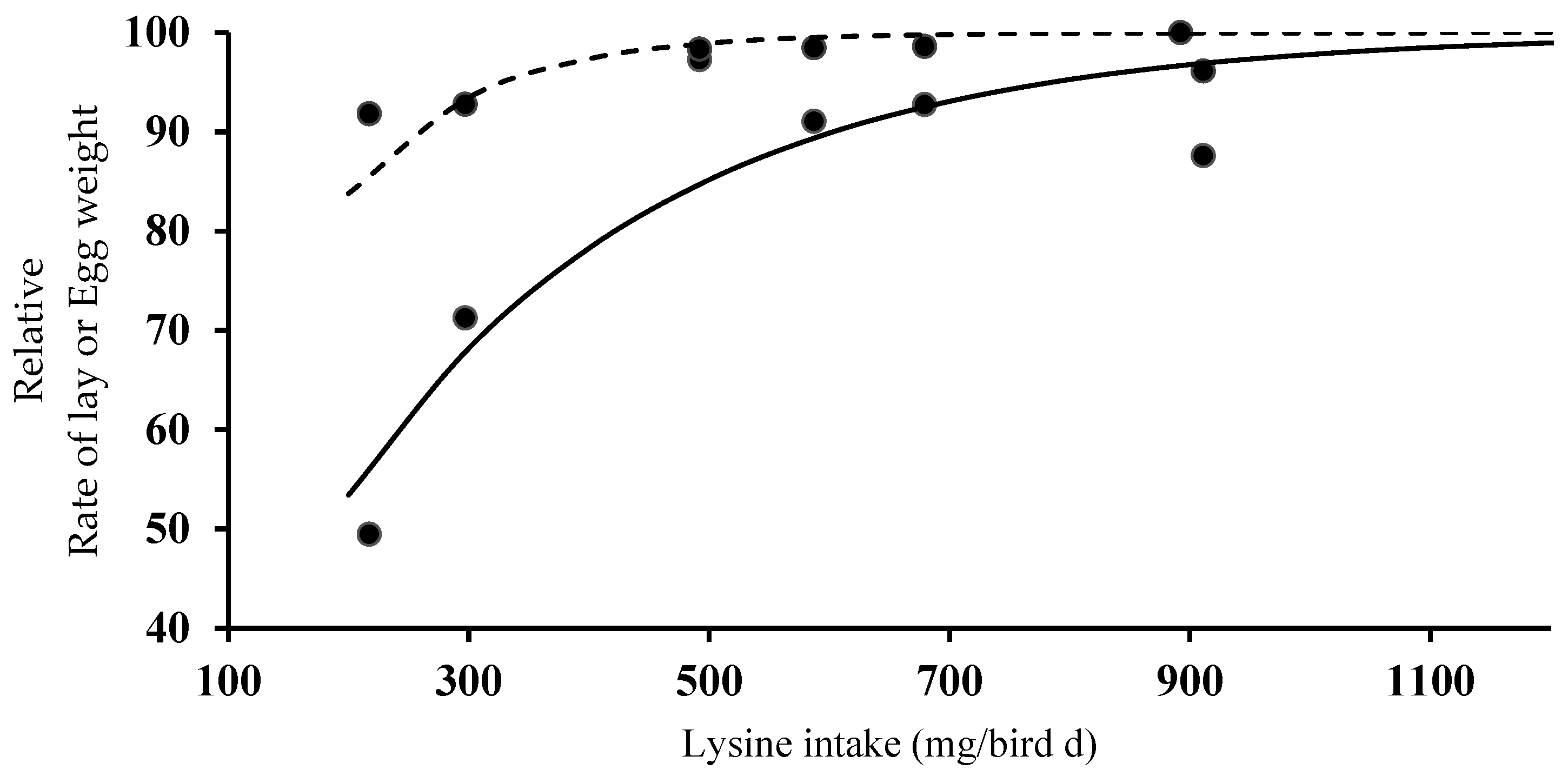
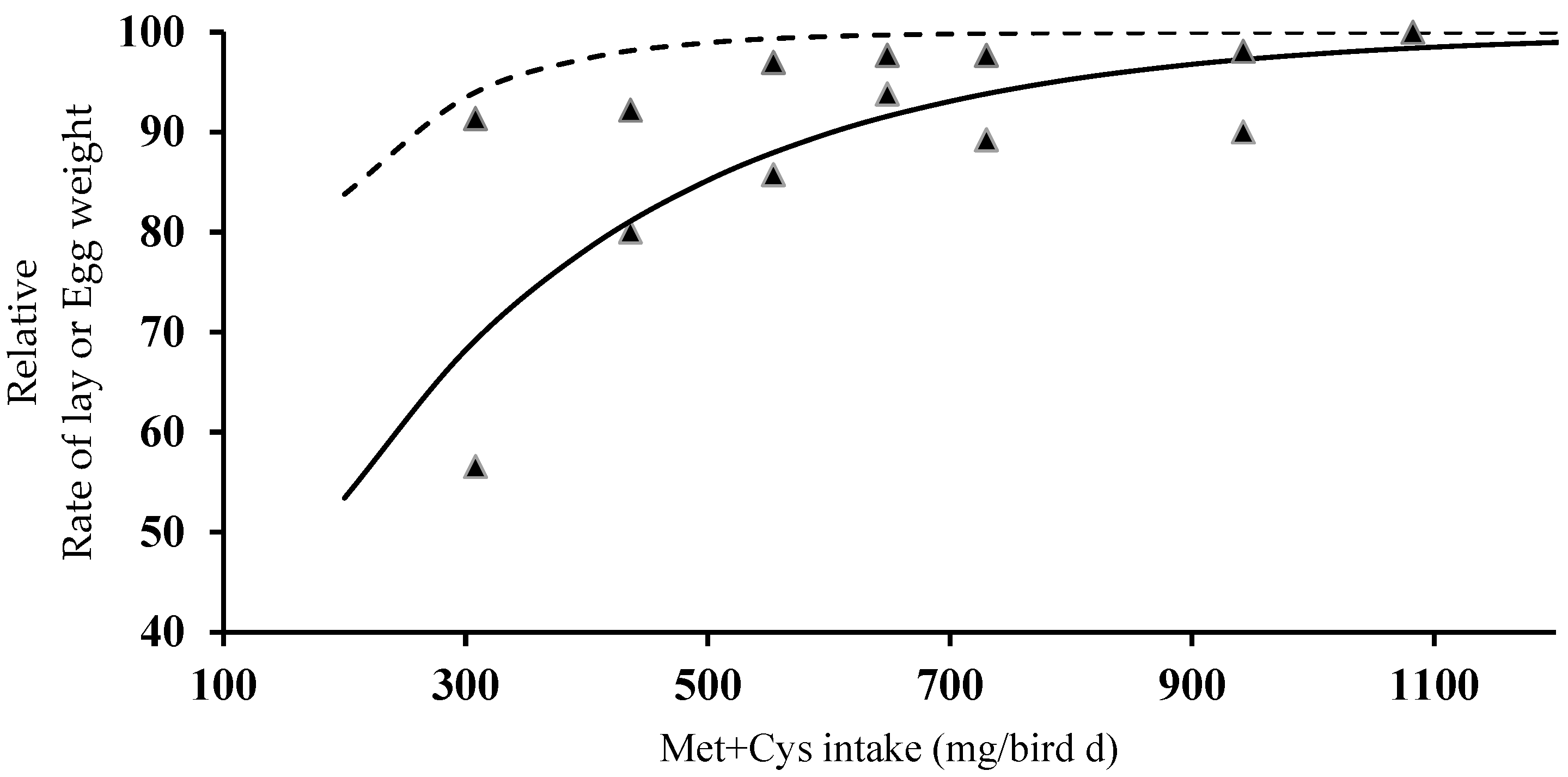
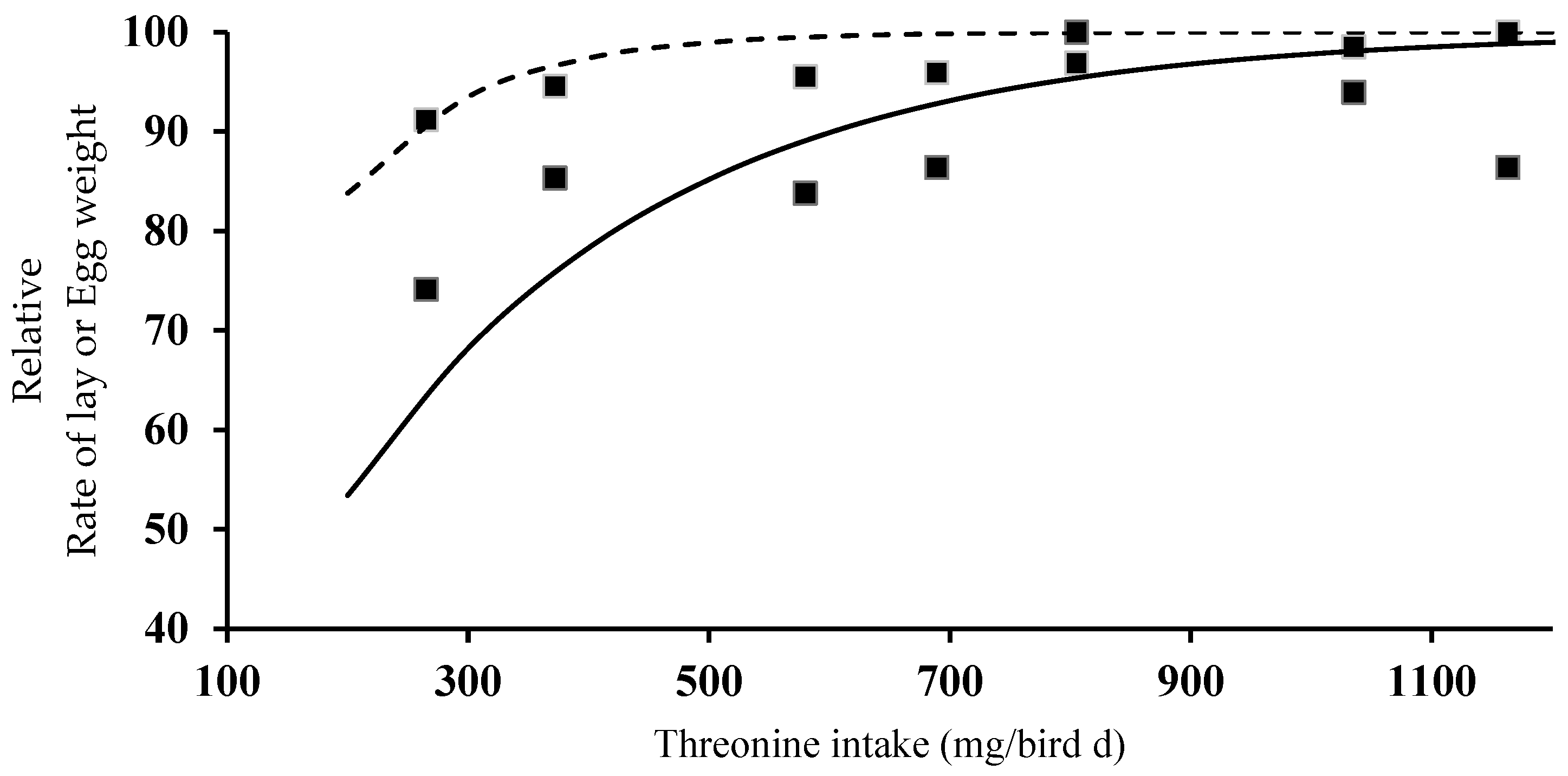
Observed and predicted values obtained for the rate of lay and egg weight are presented in Figure 1, Figure 2 and Figure 3. The standard error associated with the break point was 23% for the rate of lay and 5% for egg weight.
A regression model in which intake of Met+Cys, Lys, and Thr (mg/day) was considered as a function of egg output (E, g) and body weight (BW, kg) was used to determine the parameters a and b as follows:
iMet+Cys = 12.4 ± 4.1 × E + 30.2 ± 1.1 × BW
iLys = 14.5 ± 3.1 × E + 32.2 ± 0.9 × BW
iThr = 11.2 ± 6.3 × E + 42.4 ± 1.2 × BW
The variation coefficient for egg output was 33%, 21% and 56% for Met+Cys, Lys, and Thr, respectively. The ratio between the a coefficient of Met+Cys and Thr to that of Lys showed that the optimum ratio for egg output was 86% for Met+Cys (100 × 12.4/14.5) and 77% for Thr (100 × 11.2/14.5).
The variation coefficient for body maintenance was 4%, 3% and 3% for Met+Cys, Lys, and Thr, respectively. The ratio of the b coefficient for the amino acids resulted in values of optimum ratio for maintenance of 94% (100 × 30.23/32.2) for Met+Cys and 132% (100 × 42.4/32.2) for Thr, respectively.
The relationship between deposition of an amino acid in egg output (mg/bird d) and amino acid intake (mg/bird d) was fitted by the broken line model, according to the following equations:
DMet+Cys = 312.6 ± 12.5 − 0.43 ± 0.07 × (475.6 ± 47.9 − IcMet+Cys); if IcMet+Cys > 475.6 then we considered (475.6 − IcMet+Cys) = 0.
DLys = 364.4 ± 9.3 − 0.35 ± 0.06 × (546.8 ± 45.9 − IcLys); if IcLys > 546.8 then we considered (546.8 − IcLys) = 0.
DThr = 254.6 ± 12.4 − 0.18 ± 0.08 × (464.8 ± 133.3 − IcThr); if IcThr > 464.8 then we considered (464.8 − IcThr) = 0.
The errors associated with each parameter were higher for the slope (U) of the model, being 16%, 17% and 44% for Met+Cys, Lys, and Thr, respectively.
The maximum deposition predicted for the amino acid (L) by the model was higher for Lys, followed by Met+Cys and Thr. The intake for maximum deposition (R) was higher for Lys, followed by Thr and Met+Cys (547, 476 and 465 mg/bird day, respectively), resulting in a greater utilization efficiency (k) for Met+Cys, followed by Lys and Thr, with values of 0.67 mg/mg (k = 364.4/546.8), 0.66 mg/mg (k = 312.6/475.6) and 0.55 mg/mg (k = 255/465), respectively.
The ratio between the estimated intake of maximum deposition of Met+Cys and Thr to that of Lys indicated that the ideal ratio of amino acid deposition in the egg was 87% and 85% for Met+Cys and Thr, respectively.

4. Discussion

This study evaluated the response of post-peak production broiler breeders subjected to different intake levels of the amino acids Met+Cys, Lys, and Thr, and estimated the coefficients for egg output and body weight maintenance in hens older than 60 weeks. The results show the importance of evaluating the responses of broiler breeder hens at 60 weeks and older to amino acid intake. The methods used in this study to determine the response coefficients (a and b) might be used as a model in other studies.
Comparison of the validating diet D8 to D7 showed that the amino acid tested was limited in each trial, which was confirmed by the egg output response. This positive response was due to an increased rate of lay, because no response was observed in egg weight (Table 3). This finding agrees with that observed in other studies [1,2,3]. The variables feed intake and body weight were unchanged between D7 and D8.
D6 diets had the same concentration of the limiting amino acid as the D8 diets, but they had protein levels 35% higher than those of D7 and D8. Likewise, D6 had higher protein intake than D7 and D8, and showed improved responses for rate of lay, egg weight, egg output, and recovery in body weight (Table 3). This improvement was due to increased feed intake, corroborating the theory of regulation of intake and indicating an increase in voluntary intake when the concentration of a given nutrient in a balanced diet is lower [1,2,3,16].
As observed in the studies of Bowmaker and Gous [9], the birds consumed less than the provided 150 g/day. The maximum reduction in feed intake for Met+Cys, Lys, and Thr was 13%, 8% and 10%, respectively (Table 3). This reduction was less than that found by Bowmaker and Gous [9] of 33% for methionine and 37% for lysine.
The rate of lay in the present study differs from those in [9]. In the present study, the birds produced 32.7 (Met+Cys), 35.7 (Lys), and 49 (Thr) eggs in the last four weeks of the trial. Bowmaker and Gous [9] reported that in an equivalent period, the birds in their study produced 3.8 (lysine) and 2.4 (methionine) eggs, feeding diets with 39.7 g (lysine trial) and 40.5 g (methionine test) of CP/kg, which provided less protein intake than the requirement of 2.282 g CP/BWkg0.75 [10] to maintain the rate of lay. This low protein intake resulted in a mobilization of approximately −33 g (Met+Cys) and −45 g (Lys) of body protein. A higher deficit was observed in the present study: −92 g (Met+Cys) and −85 g (Lys) of body protein that were mobilized for maintenance and rate of lay.
An alternative to ensure that weight gain is zero is to use the partition coefficients obtained by multiple regression analysis, considering amino acid intake as a function of either egg output or body weight. The coefficient b, representing the amino acid maintenance requirement, had values for Met+Cys, Lys, and Thr of 30.2 ± 1.1, 32.2 ± 0.9, and 42.4 ± 1.2 mg/kg BW, respectively, which agree with other studies [26,27,28].
Heavier birds in the Met+Cys (5.59 kg), Lys (4.92 kg), and Thr (5.33 kg) trials used for maintenance the following values: 130 mg, 154 mg, and 224 mg, respectively. The amount of each amino acid required to produce one gram per egg was estimated at 12.4 mg, 14.5 mg, and 11.2 mg for Met+Cys, Lys, and Thr, respectively. Due to the lack of this information for these amino acids in the literature, these values were recalculated using the following partition for egg output: a = [I − (b × BW)]/E), with the coefficient b fixed as the value determined in this study and the values for I, BW and E obtained from the literature [9,17]. As a result, the value of a found for Lys was similar to those reported by [9,23,29] and lower than the calculated value (a = 43 ± 11 mg/g) described in [30]. Considering that methionine represents 52% of Met+Cys, the calculated value in [9], which was 12.9 ± 3.2 mg/g Met+Cys, and in [31], which was 13.0 ± 3.4 mg/g Met+Cys, are similar to the values found in this study but lower than the value calculated by [17], which was 21.1 ± 3.8 mg/g Met+Cys.
Due to the scarcity of information on Thr for broiler breeder hens, data from laying hens were used. The values for the coefficient a found for laying hens range from 7.4 to 9.4 mg/g, resulting in an average of 8.5 ± 0.7 mg of Thr per gram of egg [27,32,33,34], which is 33% lower than that observed in this study.
The ratios between the a coefficients of Met+Cys and Lys and of Thr and Lys were calculated to obtain the optimal ratio for egg output of 86 and 77% for Met+Cys/Lys and Thr/Lys, respectively. The same calculation was made using the estimated levels to maximize amino acid deposition in the egg, resulting in similar values of the optimum ratio: 87% for Met+Cys/Lys and 85% for Thr/Lys. These findings agree with those in other recommendations of [35].
Utilization efficiencies of Met+Cys, Lys, and Thr were similar to those determined for broiler breeder hens by [9,29,36]. For laying hens, the values of utilization efficiency are greater than those in this study (around 80%) [1]. One explanation for this difference can be attributed to the greater number of eggs produced per week (6–7 eggs) by laying hens, while broiler breeder hens produce two to four eggs per week. Bowmaker and Gous [9] demonstrated increases in utilization efficiency of 31% for methionine and of 21% for lysine when considering only birds with a rate of lay greater than 50%.
The relationships between amino acid intake and both rate of lay and egg weight, expressed as percentages of the maximum response, are shown in Figure 1, Figure 2 and Figure 3. Decreased amino acid intake has a greater effect on the rate of lay than on egg weight. The two variables should not be affected when the reduction in amino acid intake is less than 18%. As was previously observed by [22], the present study showed that many individuals attain the maximum egg weight value on diets with a low protein concentration. The minimum value of egg weight in this study was 80% of the highest values observed, and the largest reduction in amino acid intake did not change egg weight. Because the bird uses the limiting amino acid efficiently, an egg above the minimum weight can be laid. This observation agrees with findings in laying hens [22] and in broiler breeder hens [9].

5. Conclusions

The results support the hypothesis by demonstrating that broiler breeders over 60 weeks of age exhibit distinct amino acid utilization patterns. The estimated amino acid requirements for the production of one gram of egg mass were 12.4 mg for Met+Cys, 14.5 mg for Lys, and 11.2 mg for Thr. Additionally, the maintenance requirements, expressed per kilogram of body weight, were 30.2 mg for Met+Cys, 32.2 mg for Lys, and 42.4 mg for Thr. These results contribute to a more accurate understanding of amino acid utilization and support the formulation of diets that meet the physiological demands of aged breeders, thereby improving the efficiency of amino acid use for both egg production and body weight maintenance.

Author Contributions

Conceptualization, M.B.d.L., N.K.S. and E.P.d.S.; methodology, M.B.d.L., C.F.S.O., N.K.S. and E.P.d.S.; software, E.P.d.S.; validation, M.B.d.L., N.K.S., R.B.V. and J.A.P.; formal analysis, M.B.d.L., C.F.S.O. and E.P.d.S.; investigation, C.F.S.O., R.B.V., J.A.P. and E.P.d.S.; resources, N.K.S.; data curation, M.B.d.L. and C.F.S.O.; writing—original draft preparation, M.B.d.L. and E.P.d.S.; writing—review and editing, R.B.V., J.A.P. and E.P.d.S.; visualization, C.F.S.O., R.B.V. and J.A.P.; supervision, N.K.S. and E.P.d.S.; project administration, N.K.S.; funding acquisition, N.K.S. All authors have read and agreed to the published version of the manuscript.

Funding

To the São Paulo Research Foundation (FAPESP) by financial support (grant number 2008/50557-3).

Institutional Review Board Statement

All the experimental methods and techniques were approved by the Animal Ethics and Welfare Committee of UNESP—São Paulo State University, Campus Jaboticabal, Brazil (Protocol code 007125-08).

Data Availability Statement

The raw data supporting the conclusions of this article will be made available by the authors without undue reservations. The data presented in this study are available upon request from the corresponding author.

Conflicts of Interest

The authors declare no conflicts of interest.

Abbreviations

The following abbreviations are used in this manuscript:
DaaAmino acid deposited
BBody maintenance
BWBody weight
AConversion of dietary amino acids to egg output
IcCorrected intake
iLysDaily intake of Lysine
iMet+CysDaily intake of methionine+cystine
iThrDaily intake of Threonine
DMet+CysDeposition methionine+cystine
DLysDeposition of lysine
DThrDeposition of threonine
KEfficiency of utilization
EEgg output
EOEgg output
EWEgg weight
FIFeed intake
UInclination/slope
IIndividual amino acid intake
YIndividual responses
RIntake for maximum deposition
LAAILimiting amino acid intake
LysLysine
LMaximum deposition predicted for the amino acid
ImaxMaximum individual intake
YmaxMaximum individual response for each amino acid
RMaximum response for deposition
Met+CysMethionine+cystine
RLRate of lay
Ir Relative intake to the maximum
Thr Threonine

References

  1. Silva, E.P.; Sakomura, N.K.; Oliveira, C.F.S.; Costa, F.G.P.; Dorigam, J.C.P.; Malheiros, E.B. The optimal lysine and threonine intake for Cobb broiler breeder hens using Reading model. Livest. Sci. 2015, 174, 59–65. [Google Scholar] [CrossRef]
  2. Lima, M.B.; Sakomura, N.K.; Silva, E.P.; Dorigam, J.C.P.; Ferreira, N.T.; Malheiros, E.B.; Fernandes, J.B.K. The optimal digestible valine, isoleucine and tryptophan intakes of broiler breeder hens for rate of lay. Anim. Feed. Sci. Technol. 2018, 238, 29–38. [Google Scholar] [CrossRef]
  3. Lima, M.B.; Sakomura, N.K.; Silva, E.P.; Leme, B.B.; Malheiros, E.B.; Peruzzi, N.J.; Fernandes, J.B.K. Arginine requirements for maintenance and egg production for broiler breeder hens. Anim. Feed. Sci. Technol. 2020, 264, 114466. [Google Scholar] [CrossRef]
  4. Teofilo, G.F.d.S.; Morillo, F.A.H.; Kareem, D.U.; Lizana, R.R.; Bonagurio, L.P.; Camargos, R.d.S.; Van Milgen, J.; Macari, M.; Sakomura, N.K. Partitioning of energy intake in broiler breeders from 27 to 63 weeks old. Livest. Sci. 2024, 288, 105535. [Google Scholar] [CrossRef]
  5. Noetzold, T.L.; Obi, E.A.; Fancher, B.; Silva, M.; Thomson, A.; Zuidhof, M.J. Body weight optimization of broiler breeder hens. 1. Pullet growth, feed efficiency, carcass composition, and sexual maturation. Poult. Sci. 2024, 103, 104414. [Google Scholar] [CrossRef] [PubMed]
  6. Romero-Sanchez, H.; Enting, H.; van Eck, L.; van Emous, R.; Kroetz Neto, F.; Leentfaar, E.; Buresh, B. Achieving reproductive performance and quality chicks with modern broiler breeders. J. Appl. Poult. Res. 2025, 34, 100539. [Google Scholar] [CrossRef]
  7. Nonis, M.; Gous, R. Broiler breeders utilise body lipid as an energy source. S. Afr. J. Anim. Sci. 2012, 42, 369–378. [Google Scholar] [CrossRef]
  8. Alfaro-Wisaquillo, M.C.; Oviedo-Rondón, E.O.; Cordova-Noboa, H.A.; Caldas, J.V.; Quintana-Ospina, G.A.; Ospina-Rojas, I.C.; Martin, V.S. Effects of amino acid levels during rearing on Cobb 500 slow-feathering broiler breeders: 1. Growth and development. Poult. Sci. 2021, 100, 101327. [Google Scholar] [CrossRef]
  9. Bowmaker, J.E.; Gous, R.M. The response of broiler breeder hens to dietary lysine and methionine. Br. Poult. Sci. 1991, 32, 1069–1088. [Google Scholar] [CrossRef]
  10. Rabello, C.B.-V.; Sakomura, N.K.; Longo, F.A.; Junqueira, O.M.; Pacheco, C.R. Evaluation of a prediction equation of crude protein for broiler breeder hens. Rev. Bras. De Zootec. 2002, 31, 1193–1203. [Google Scholar] [CrossRef]
  11. Silva, E.P.; Malheiros, E.B.; Sakomura, N.K.; Venturini, K.S.; Hauschild, L.; Dorigam, J.C.P.; Fernandes, J.B.K. Lysine requirements of laying hens. Livest. Sci. 2015, 173, 69–77. [Google Scholar] [CrossRef]
  12. Palma Bendezu, H.C.; Sakomura, N.K.; Malheiros, E.B.; Silva, E.P.; Gous, R.M. The effect of feed protein content on the uniformity of production in laying hens. Anim. Prod. Sci. 2018, 58, 2308–2313. [Google Scholar] [CrossRef]
  13. Soares, L.; Sakomura, N.K.; Dorigam, J.C.D.P.; Liebert, F.; Sunder, A.; Nascimento, M.Q.D.; Leme, B.B. Optimal in-feed amino acid ratio for laying hens based on deletion method. J. Anim. Physiol. Anim. Nutr. 2019, 103, 170–181. [Google Scholar] [CrossRef] [PubMed]
  14. Dorigam, J.C.P.; Sakomura, N.K.; Sarcinelli, M.F.; Gonçalves, C.A.; de Lima, M.B.; Peruzzi, N.J. Optimal in-feed amino acid ratio for broiler breeder hens based on deletion studies. J. Anim. Physiol. Anim. Nutr. 2017, 101, 1194–1204. [Google Scholar] [CrossRef]
  15. de Lima, M.B.; Sakomura, N.K.; Dorigam, J.C.P.; da Silva, E.P.; Ferreira, N.T.; Fernandes, J.B.K. Maintenance valine, isoleucine, and tryptophan requirements for poultry. Poult. Sci. 2016, 95, 842–850. [Google Scholar] [CrossRef] [PubMed]
  16. Silva, E.P.d.; Sakomura, N.K.; Sarcinelli, M.F.; Dorigam, J.C.d.P.; Venturini, K.S.; Lima, M.B.d. Modeling the response of Japanese quail hens to lysine intake. Livest. Sci. 2019, 224, 69–74. [Google Scholar] [CrossRef]
  17. Gomes, P.C.; Lima, C.A.R.D.; Calderano, A.A.; Rostagno, H.S.; Albino, L.F.T. Effect of dietary levels of methionine + cystine on performance of broiler breeders. Rev. Bras. De Zootec. 2011, 40, 1014–1018. [Google Scholar] [CrossRef]
  18. Cerrate, S.; Halley, J.T.; Corzo, A.; Fancher, B.I. Effect of dietary amino acid density on broiler breeder reproductive performance. Poult. Sci. 2019, 98, 2072–2079. [Google Scholar] [CrossRef]
  19. Rostagno, H.S.; Albino, L.F.T.; Donzele, J.L.; Gomes, P.C.; Oliveira, R.F.; Lopes, D.C.; Ferreira, A.S.; Barreto, S.L.T.; Euclides, R.F. Brazilian Tables for Poultry and Swine: Composition of Feedstuffs and Nutritional Requirements; Animal Science Department UFV: Viçosa, Brazil, 2011. [Google Scholar]
  20. Matriz Cobb500 Empenamento Lento–Suplemento de Manejo. Available online: http://cobb.madebyprisma.com/assets/Cobb-Files/4c8ad3c5e8/Cobb500-Slow-Feather-Breeder-Supplement_Portuguese.pdf (accessed on 23 June 2025).
  21. Fisher, C.; Morris, T.R. The determination of the methionine requirement of laying pullets by a diet dilution technique. Br. Poult. Sci. 1970, 11, 67–82. [Google Scholar] [CrossRef]
  22. Morris, T.R.; Gous, R.M. Partitioning of the response to protein between egg number and egg weight. Br. Poult. Sci. 1988, 29, 93–99. [Google Scholar] [CrossRef]
  23. Fisher, C. Lysine: Amino acid requirements of broiler breeders. Poult. Sci. 1998, 77, 124–133. [Google Scholar] [CrossRef]
  24. Silva, E.P.D.; Sakomura, N.K.; Dorigam, J.C.D.P.; Malheiros, E.B.; Fernandes, J.B.K.; Araujo, J.A.D. A procedure to evaluate the efficiency of utilization of dietary amino acid for poultry. Acta Sci. Anim. Sci. 2014, 36, 163. [Google Scholar] [CrossRef]
  25. Robbins, K.R.; Saxton, A.M.; Southern, L.L. Estimation of nutrient requirements using broken-line regression analysis1. J. Anim. Sci. 2006, 84, E155–E165. [Google Scholar] [CrossRef] [PubMed]
  26. Gous, R.M.; Griessel, M.; Morris, T.R. Effect of dietary energy concentration on the response of laying hens to amino acids. Br. Poult. Sci. 1987, 28, 427–436. [Google Scholar] [CrossRef] [PubMed]
  27. Huyghebaert, G.; De Groote, G.; Butler, E.A.; Morris, T.R. Optimum isoleucine requirement of laying hens and the effect of age. Br. Poult. Sci. 1991, 32, 471–481. [Google Scholar] [CrossRef]
  28. Bonato, M.; Sakomura, N.; Siqueira, J.; Fernandes, J.; Gous, R. Maintenance requirements for methionine and cysteine, and threonine for poultry. S. Afr. J. Anim. Sci. 2011, 41, 209–222. [Google Scholar] [CrossRef]
  29. Harms, R.H.; Ivey, F.J. An Evaluation of the Protein and Lysine Requirement for Broiler Breeder Hens1. J. Appl. Poult. Res. 1992, 1, 308–314. [Google Scholar] [CrossRef]
  30. Ekmay, R.D.; De Beer, M.; Mei, S.J.; Manangi, M.; Coon, C.N. Amino acid requirements of broiler breeders at peak production for egg mass, body weight, and fertility. Poult. Sci. 2013, 92, 992–1006. [Google Scholar] [CrossRef]
  31. Hosseini, S.A.; Zaghari, M.; Lotfollahian, H.; Shivazad, M.; Moravaj, H. Reevaluation of Methionine Requirement Based on Performance and Immune Responses in Broiler Breeder Hens. J. Poult. Sci. 2012, 49, 26–33. [Google Scholar] [CrossRef]
  32. Ishibashi, T.; Ogawa, Y.; Itoh, T.; Fujimura, S.; Koide, K.; Watanabe, R. Threonine requirements of laying hens. Poult. Sci. 1998, 77, 998–1002. [Google Scholar] [CrossRef]
  33. Faria, D.E.; Harms, R.H.; Russell, G.B. Threonine requirement of commercial laying hens fed a corn-soybean meal diet. Poult. Sci. 2002, 81, 809–814. [Google Scholar] [CrossRef] [PubMed]
  34. Bregendahl, K.; Roberts, S.A.; Kerr, B.; Hoehler, D. Ideal Ratios of Isoleucine, Methionine, Methionine Plus Cystine, Threonine, Tryptophan, and Valine Relative to Lysine for White Leghorn-Type Laying Hens of Twenty-Eight to Thirty-Four Weeks of Age. Poult. Sci. 2008, 87, 744–758. [Google Scholar] [CrossRef] [PubMed]
  35. National Research Council (NRC), Nutrient Requirements of Poultry: 1994; National Academies Press: Washington, DC, USA, 1994.
  36. Nonis, M.K.; Gous, R.M. Threonine and lysine requirements for maintenance in chickens. South Afr. J. Anim. Sci. 2008, 38, 75–82. [Google Scholar]
Figure 1. The relationships between Lysine and relative rate of lay (Agriculture 15 01685 i001) and egg weight (Agriculture 15 01685 i002), where these are expressed as a proportion of the maximum rate of lay and maximum egg weight, respectively. p < 0.05.
Agriculture 15 01685 g001
Figure 2. The relationships between Methionine+cystine intake and relative rate of lay (Agriculture 15 01685 i001) and egg weight (Agriculture 15 01685 i002), where these are expressed as a proportion of the maximum rate of lay and maximum egg weight, respectively. p < 0.05.

Agriculture 15 01685 g002
Figure 3. The relationships between threonine intake and relative rate of lay (Agriculture 15 01685 i001) and egg weight (Agriculture 15 01685 i002), where these are expressed as a proportion of the maximum rate of lay and maximum egg weight, respectively. p < 0.05.
Agriculture 15 01685 g003
Table 1. Composition (g/kg) of the summit (high protein) and nitrogen-free basal feeds used in the lysine (Lys), methionine+cysteine (Met+Cys), and threonine (Thr) response trials.
Ingredients (g/kg)Met+Cys SummitLys SummitThr SummitNitrogen-Free
Soybean meal276222266
Corn557587555
Wheat bran (meal)21.59468.5
Corn starch 469
Corn gluten meal38
Rice husk 119
Sugar 150
Soybean oil3012.735.060
Dicalcium phosphate8.538.068.3714.2
Limestone62.763.857.459.3
Potassium chloride 12.7
Salt3.283.753.733.88
DL-Methionine0.542.702.42
L-Lysine HCl 0.34
L-Threonine0.291.560.01
L-Valine 0.890.27
L-Isoleucine 1.570.89
L-Tryptophan 0.210.04
Choline chloride0.70.700.70.7
Vitamin premix a11.0011
Mineral premix b0.50.50.50.5
BHT c0.10.10.10.1
Inert (Sand) 110
------------------------------------- Calculated nutrient content -----------------------------------
AMEn (MJ/kg)11.7211.7211.7211.72
Crude protein2061751872.10
Methionine+Cystine d7.138.148.20
Methionine d3.765.245.14
Lysine d9.768.309.64
Threonine d7.807.716.79
Tryptophan d2.082.022.05
Arginine d12.810.912.1
Valine d9.468.638.74
Isoleucine d8.468.328.40
Leucine d20.115.116.2
Histidine d5.434.594.98
a This premix supplied the following per kilogram of diet: Vit A 10,000 IU; Vit D3 2700 IU; Vit E 40 IU; Vit K3 2.0 mg; Vit B1 2.5 mg; Vit B2 7 mg; Vit B3 35 mg; Vit B5 15 mg; Vit B6 2.5 mg; Vit B12 0.020 mg; Folic Acid 0.9 mg; Biotin 0.11 mg; Selenium 0.36 mg. b This premix supplied the following per kilogram of diet: Cu 12 mg; Fe 60 mg; I 1.2 mg, Mn 84 mg; Zn 78 mg. c Butylated hydroxytoluene. d Digestible amino acid composition.
Table 2. Proportion of summit basal used with the corresponding protein-free basal in the methionine+cysteine (Met+Cys), lysine (Lys), and threonine (Thr) trials and the concentrations of limiting amino acid in the resultant feed.
FeedMet+Cys LimitingLys LimitingThr Limiting
SummitDilutionMet+CysSummitDilutionLysSummitDilutionThr
g/kgg/kgg/kgg/kgg/kgg/kgg/kgg/kgg/kg
D1100007.13100008.30100006.79
D29001006.429001007.488002005.43
D37003004.997003005.817003004.75
D46004004.286004004.986004004.07
D55005003.565005004.165005003.39
D63506502.494006003.324006002.72
D72507501.793007002.493007002.04
D8 a,b,c2507502.493007003.323007002.72
a D8Lys = 0.106 g L-Lysine HCl 780 g/kg added to D7Lys. b D8Met+Cys = 0.070 g DL-Methionine 990 g/kg added to D7Met+Cys. c D8Thr = 0.069 g L-Threonine 980 g/kg added to D7Thr.
Table 3. Mean and standard deviation (µ ± SD) feed intake (FI, g/bird d), limiting amino acid intake—Methionine+Cystine (LAAI, mg/bird d), rate of lay (RL, per 100/hen d), egg weight (EW, g), egg output (EO, g/bird d) and body weight (BW, kg) responses to treatments over the final 4-week.
DietAmino Acid
in Feed (g/kg)
FILAAIRLEWEOBW
D17.13133.2949.557.972.438.34.7
D26.42138.9891.762.869.944.15.0
D34.99136.1679.061.372.144.24.5
D44.28137.1586.660.269.341.74.3
D53.56137.9490.853.169.841.84.7
D62.49134.6335.245.266.231.14.1
D71.79121.2217.032.766.521.74.2
D8 a2.49 a 124.0308.445.262.829.14.0
Average 134.0581.653.369.537.74.5
SEM b 1.337.22.20.61.60.1
p-value
F-test ANOVA 0.0009<0.00010.00010.0305<0.00010.0016
Linear effect 0.0102<0.0001<0.00010.0013<0.00010.0004
Quadratic effect 0.00060.71430.00360.5104<0.00010.9319
a validating diet. b standard error of men.
Table 4. Mean and standard deviation (µ ± SD) feed intake (FI, g/bird d), limiting amino acid intake—Lysine (LAAI, mg/bird d), rate of lay (RL, per 100/hen d), egg weight (EW, g), egg output (EO, g/bird d) and body weight (BW, kg) responses to treatments over the final 4-week.
DietAmino Acid
in Feed (g/kg)
FILAAIRLEWEOBW
D18.30129.7950.963.170.942.74.5
D27.48126.0831.356.873.041.54.5
D35.81128.9661.056.371.640.34.4
D44.98131.6579.159.270.939.34.5
D54.16133.1488.454.170.838.34.5
D63.32131.2384.350.567.333.84.3
D72.49127.4280.335.766.724.04.1
D8 a3.32 a12235647.063.031.13.8
Average 129.7602.353.470.237.14.4
SEM b 0.633.31.60.61.20.040
p-value
F-test ANOVA 0.0044<0.0001<0.00010.0138<0.00010.0253
Linear effect 0.2697<0.0001<0.00010.0009<0.00010.0019
Quadratic effect 0.0331<0.00010.01290.06780.01080.0876
a validating diet. b standard error of men.
Table 5. Mean and standard deviation (µ ± SD) feed intake (FI, g/bird d), limiting amino acid intake—Threonine (LAAI, mg/bird d), rate of lay (RL, per 100/hen d), egg weight (EW, g), egg output (EO, g/bird d) and body weight (BW, kg) responses to treatments over the final 4-week.
DietAmino Acid
in Feed (g/kg)
FILAAIRLEWEOBW
D16.79149.21163.763.472.645.74.7
D25.43147.21034.964.370.744.14.5
D34.75147.4804.672.373.748.34.4
D44.07147.2689.167.071.447.44.7
D53.39148.7579.855.469.741.74.5
D62.72136.8372.256.468.237.94.0
D72.04135.3265.246.768.334.43.9
D8 a2.72 a143.9391.359.363.837.63.9
Average 144.3695.360.270.942.54.4
SEM b 1.750.92.20.71.40.08
p-value
F-test ANOVA 0.0818<0.00010.02260.04190.02410.0350
Linear effect 0.0082<0.00010.00400.01400.00400.0027
Quadratic effect 0.15100.03040.03780.12830.06020.2266
a validating diet. b standard error of men.
Disclaimer/Publisher’s Note: The statements, opinions and data contained in all publications are solely those of the individual author(s) and contributor(s) and not of MDPI and/or the editor(s). MDPI and/or the editor(s) disclaim responsibility for any injury to people or property resulting from any ideas, methods, instructions or products referred to in the content.