Article

Nonlinear Narrowband Active Noise Control for Tractors Based on a Momentum-Enhanced Volterra Filter


Electrical Engineering and Information College, Northeast Agricultural University, Harbin 150030, China
*
Author to whom correspondence should be addressed.
Agriculture 2025, 15(15), 1655; https://doi.org/10.3390/agriculture15151655
Submission received: 6 July 2025 / Revised: 24 July 2025 / Accepted: 29 July 2025 / Published: 1 August 2025
(This article belongs to the Section Agricultural Technology)

Abstract

Nonlinear narrowband low-frequency noise generated during tractors’ operation significantly affects operators’ comfort and working efficiency. Traditional linear active noise control algorithms often struggle to effectively suppress such complex acoustic disturbances. To address this challenge, this paper proposes a momentum-enhanced Volterra filter-based active noise control (ANC) algorithm that improves both the modeling capability of nonlinear acoustic paths and the convergence performance of the system. The proposed approach integrates the nonlinear representation power of the Volterra filter with a momentum optimization mechanism to enhance convergence speed while maintaining robust steady-state accuracy. Simulations are conducted under second- and third-order nonlinear primary paths, followed by performance validation using multi-tone signals and real in-cabin tractor noise recordings. The results demonstrate that the proposed algorithm achieves superior performance, reducing the NMSE to approximately −35 dB and attenuating residual noise energy by 3–5 dB in the 200–800 Hz range, compared to FXLMS and VFXLMS algorithms. The findings highlight the algorithm’s potential for practical implementation in nonlinear and narrowband active noise control scenarios within complex mechanical environments.

1. Introduction

With the continuous advancement in agricultural mechanization, tractors—being one of the most common types of power equipment—generate intense low-frequency noise during their operation. This not only poses a serious threat to the hearing health and comfort of operators but may also lead to fatigue, reduced attention, and compromised work efficiency and operational safety. Moreover, tractor noise contributes to environmental noise pollution, especially when operating in suburban or rural residential areas, where it increasingly affects the ecological environment and the quality of life of nearby residents [1,2,3,4,5,6]. Therefore, effectively reducing the noise generated by tractors—particularly the narrowband low-frequency noise from the engine, exhaust system, and mechanical structures—has become a critical issue in the field of tractor acoustic control. Active noise control (ANC) technology, with its superior performance in suppressing low-frequency noise, offers a feasible and efficient solution to address these challenges.
Traditional tractor noise control methods primarily include passive noise control, structural vibration isolation, and damping, as well as engine noise source optimization. Passive control techniques reduce noise transmission through the use of sound-insulating materials, acoustic foams, damping coatings, mufflers, and sealing structures. Structural vibration and isolation methods rely on rubber pads, spring supports, and optimized structural designs to minimize mechanical vibration and the radiation of structural noise. In addition, source-level control measures, such as optimizing engine combustion, improving gear meshing, and enhancing exhaust systems, are commonly employed. These traditional approaches offer several advantages, including technological maturity, ease of implementation, a relatively low cost, and independence from external power sources. They are particularly effective in controlling mid-to-high-frequency noise and are well suited for most basic tractor models [7,8,9,10,11]. However, they also exhibit significant limitations: a poor performance in low-frequency noise attenuation, bulky and heavy materials, limited design flexibility, and an inability to effectively handle nonlinear and nonstationary noise conditions. As a result, recent noise control research has increasingly shifted toward intelligent and adaptive technologies such as ANC systems, aiming to achieve more efficient and lightweight noise reduction solutions.
ANC systems are electroacoustic devices based on the principle of destructive interference, which suppress or even eliminate unwanted noise by generating an anti-noise signal that has the same amplitude but an opposite phase to the target noise [12,13]. Owing to their excellent performance in the attenuation of low-frequency noise and their promising applications in high-speed signal processing, ANC has become a significant research focus in the field of noise control [14,15,16,17,18,19,20]. Among various ANC algorithms, the Filtered-x Least Mean Square (FXLMS) algorithm, which is based on a linear finite impulse response (FIR) filter structure, has been widely adopted in both industry and academia due to its simple structure, high computational efficiency, and ease of implementation [21,22,23].
Based on the spectral characteristics of noise, ANC systems can be classified into broadband ANC and narrowband ANC [24,25]. Since noise generated by real-world devices such as fans, motors, and diesel engines typically exhibits narrowband characteristics, narrowband ANC techniques have attracted more extensive research and applications. This type of narrowband noise can be modeled as a superposition of sinusoidal components. Under ideal linear transmission paths, the weight parameters of these sinusoidal components can be effectively adjusted using the FXLMS algorithm to achieve precise noise cancellation. However, in practical applications, the transmission paths often exhibit nonlinear or non-minimum phase characteristics, which pose significant challenges for conventional linear algorithms, leading to a degraded noise reduction performance or even complete system failure [26,27].
To address noise control under nonlinear secondary path conditions, researchers have proposed a range of nonlinear ANC algorithms, among which the Volterra filter-based VFXLMS algorithm is one of the most representative [28,29,30]. By introducing higher-order convolution kernels, the algorithm enhances the system’s ability to model nonlinear relationships. The VFXLMS algorithm exhibits improved robustness in the presence of strong noise environments, making it a prominent solution in nonlinear ANC systems. In recent years, extensive studies have been conducted on the noise reduction mechanisms of Volterra filter structures, focusing on weight update strategies and network structures’ optimization. These developments have also been successfully extended to more complex applications, such as multi-channel ANC systems [31,32,33,34,35,36]. Although the VFXLMS algorithm enhances the modeling capability of nonlinear acoustic paths by introducing higher-order Volterra kernels and demonstrates a strong robustness in nonlinear ANC systems, it still has certain limitations. First, the algorithm has a high computational complexity, especially in high-order Volterra modeling, where a large number of nonlinear coefficients are involved, limiting its real-time applicability. Second, the VFXLMS algorithm exhibits a slow convergence when dealing with strongly nonstationary or dynamically changing noise environments, making it difficult to adapt quickly. In addition, its weight update strategy lacks support from historical information, which may lead to oscillations or convergence to local optima in complex paths. To address these issues, this paper proposes a momentum-enhanced M-VFXLMS algorithm, which introduces an inertia mechanism to improve the efficiency of weight updates, thereby accelerating convergence, reducing steady-state errors, and enhancing the system’s adaptability.
In this study, a reference signal was constructed by periodically superimposing multiple sinusoidal components and adding white noise to simulate different signal-to-noise ratio (SNR) conditions. An ANC system was then established, in which the primary path exhibits nonlinear characteristics based on the acoustic transmission properties of tractor noise, while the secondary path is modeled as a non-minimum phase system. The research focuses on key noise reduction strategies under complex tractor operating conditions. Theoretical analysis of the primary tractor noise signal indicates that, despite the nonlinear nature of the transmission path, the primary noise still exhibits pronounced narrowband characteristics and can be approximated as a quasi-periodic signal. The degree of periodicity depends on the SNR between the narrowband components and the broadband noise: higher SNRs enhance the periodic features, whereas lower SNRs significantly weaken them. Subsequently, real noise signals recorded under actual tractor operating conditions were used as the reference input to further evaluate the effectiveness of the proposed M-VFXLMS algorithm. The results confirm that the proposed algorithm demonstrates a significant suppression capability for nonlinear narrowband noise in the tractor environment.
The structure of this paper is organized as follows: Section 2 analyzes the spectral characteristics and nonlinear propagation behavior of tractor noise, highlighting the dominant frequency components and nonlinear distortions introduced during transmission. A nonlinear active noise control system based on a Volterra filter structure and introducing a momentum-enhanced M-VFXLMS algorithm is proposed to improve convergence speed and nonlinear modeling capability. Section 3 presents simulation studies, including performance evaluations under multi-frequency nonlinear path conditions and noise reduction simulations using real tractor noise recordings. Section 4 discusses the simulation results, focusing on the influence of parameters such as momentum factor and step size, as well as the algorithm’s computational complexity and adaptability. Section 5 concludes the paper and outlines future research directions for further optimization and broader applications of the proposed method.

2. Materials and Methods

2.1. Analysis of Tractor Noise Characteristics

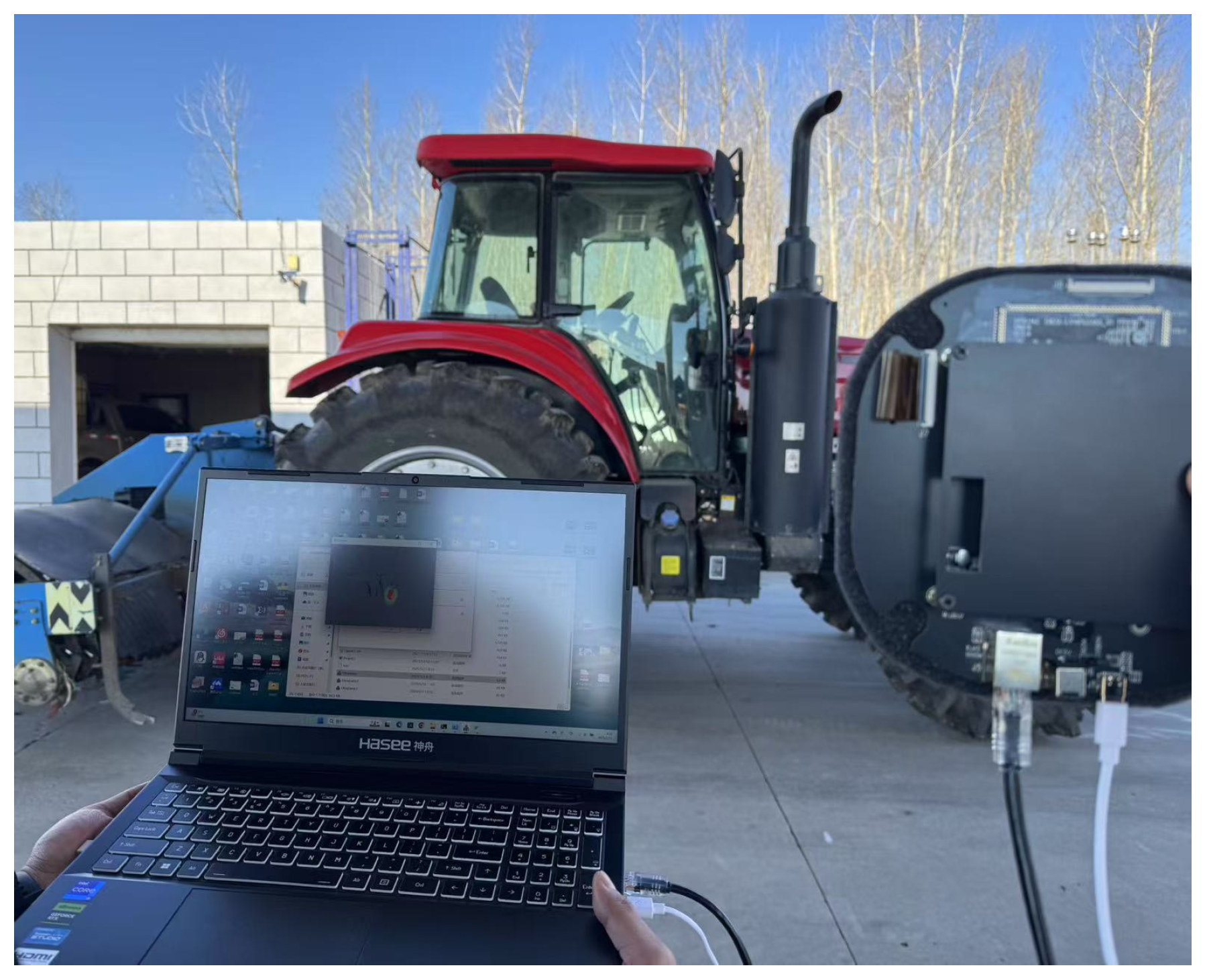
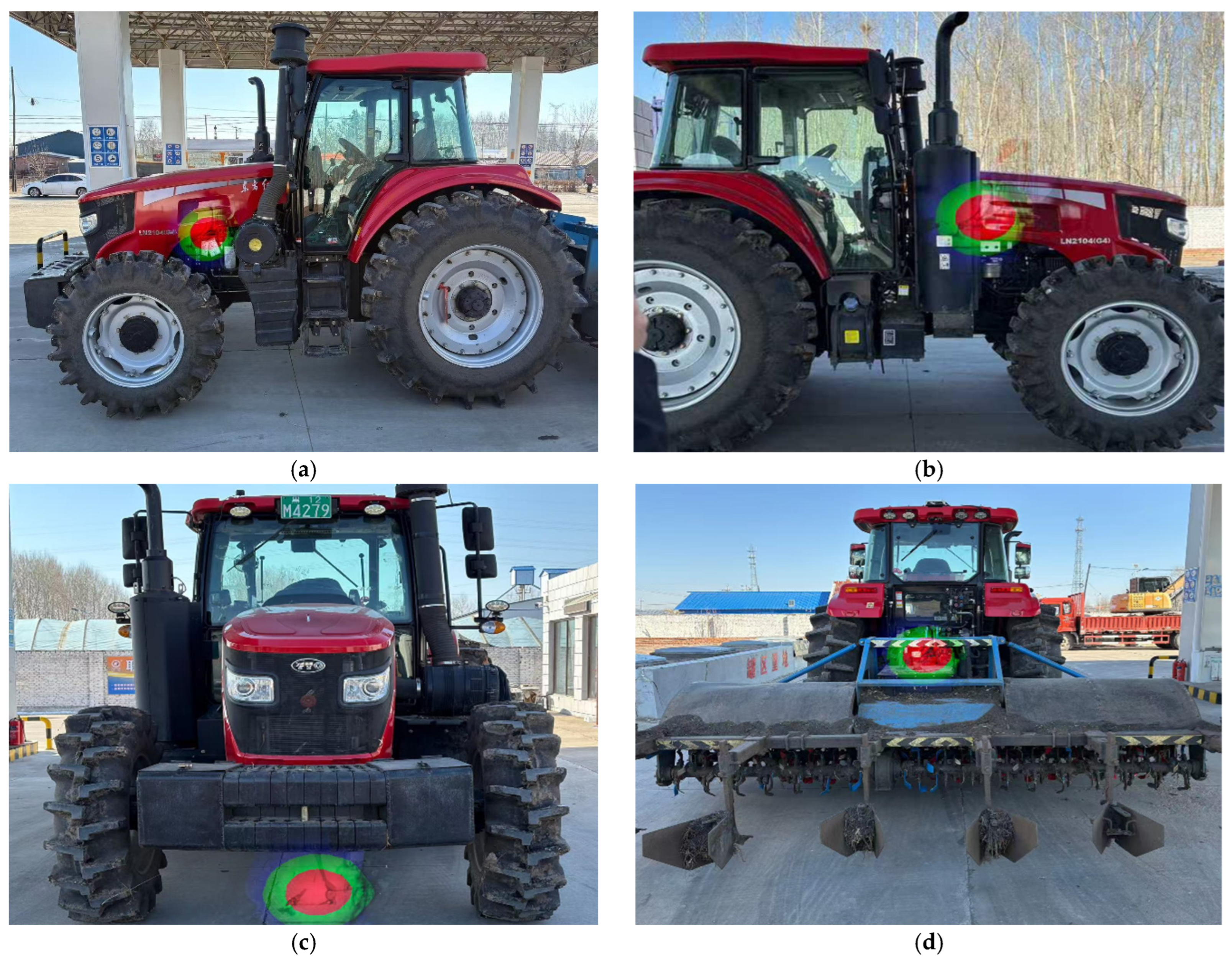
To further understand the spatial distribution and origins of tractor noise under real working conditions, a 128-channel multi-arm spiral microphone array acquisition system was employed to localize acoustic sources. As shown in Figure 1 and Figure 2, the acquisition system was deployed around a tractor model, and noise signals were recorded from the front, rear, left, and right directions. The analysis reveals that the major noise sources are concentrated near the engine compartment, with energy radiating outward from the high-intensity core region (marked in red) and gradually attenuating toward the periphery (green and blue zones). This directional radiation pattern confirms that engine combustion and related components are the dominant contributors to noise emissions. The results also suggest that noise propagates through both structural vibration and airborne paths, highlighting the need for integrated control strategies targeting engine noise, exhaust flow pulsation, and transmission resonance. These findings provide a realistic acoustic reference for validating the proposed nonlinear ANC algorithms in later simulation and field testing stages.
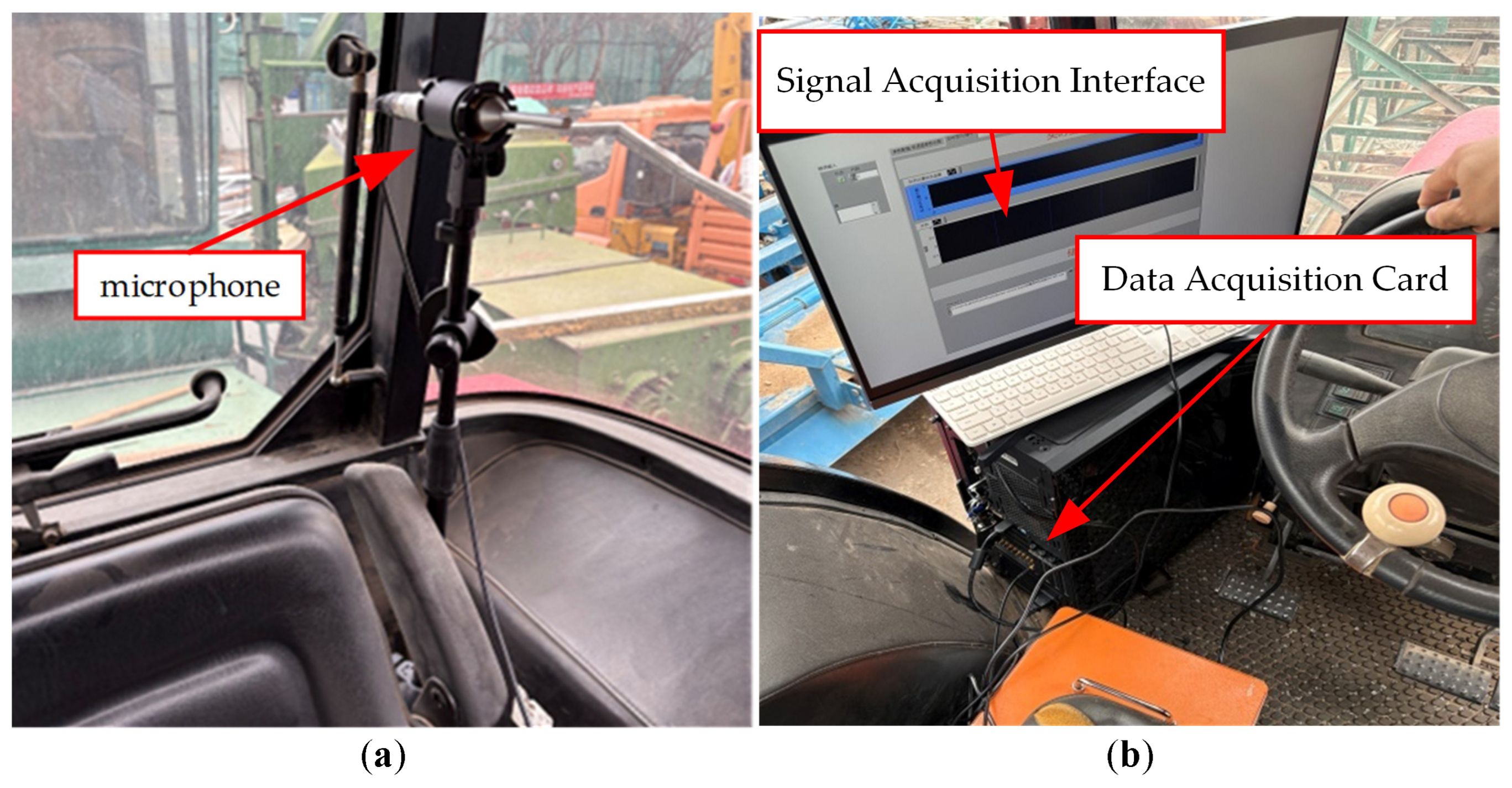
In this study, the LX-2104 tractor model manufactured by a certain company was selected. This tractor is equipped with a six-cylinder inline engine. Under operating conditions, noise data were collected using LabVIEW 2018 and a National Instruments PCI-4772 data acquisition card (National Instruments, Austin, TX, USA), with the sampling rate set to 8000 Hz. A sampling rate of 8000 Hz was selected to ensure the accurate acquisition of noise signals below 4 kHz, which covers the main frequency range of engine- and structure-borne noise in tractors. This rate also balances frequency resolution with computational efficiency for the real-time implementation of ANC. A standard microphone was positioned near the operator’s ear to capture the in-cabin acoustic environment. The Superlux ECM-888B (Superlux, Taipei, China) professional acoustic measurement microphone was selected for noise acquisition. Its sensitivity is specified as –43 dBV/Pa (equivalent to 7.1 mV/Pa) ± 3 dB at 1 kHz, with a reference sound pressure level of 1 Pa = 94 dB SPL. The detailed sensor layout is shown in Figure 3.
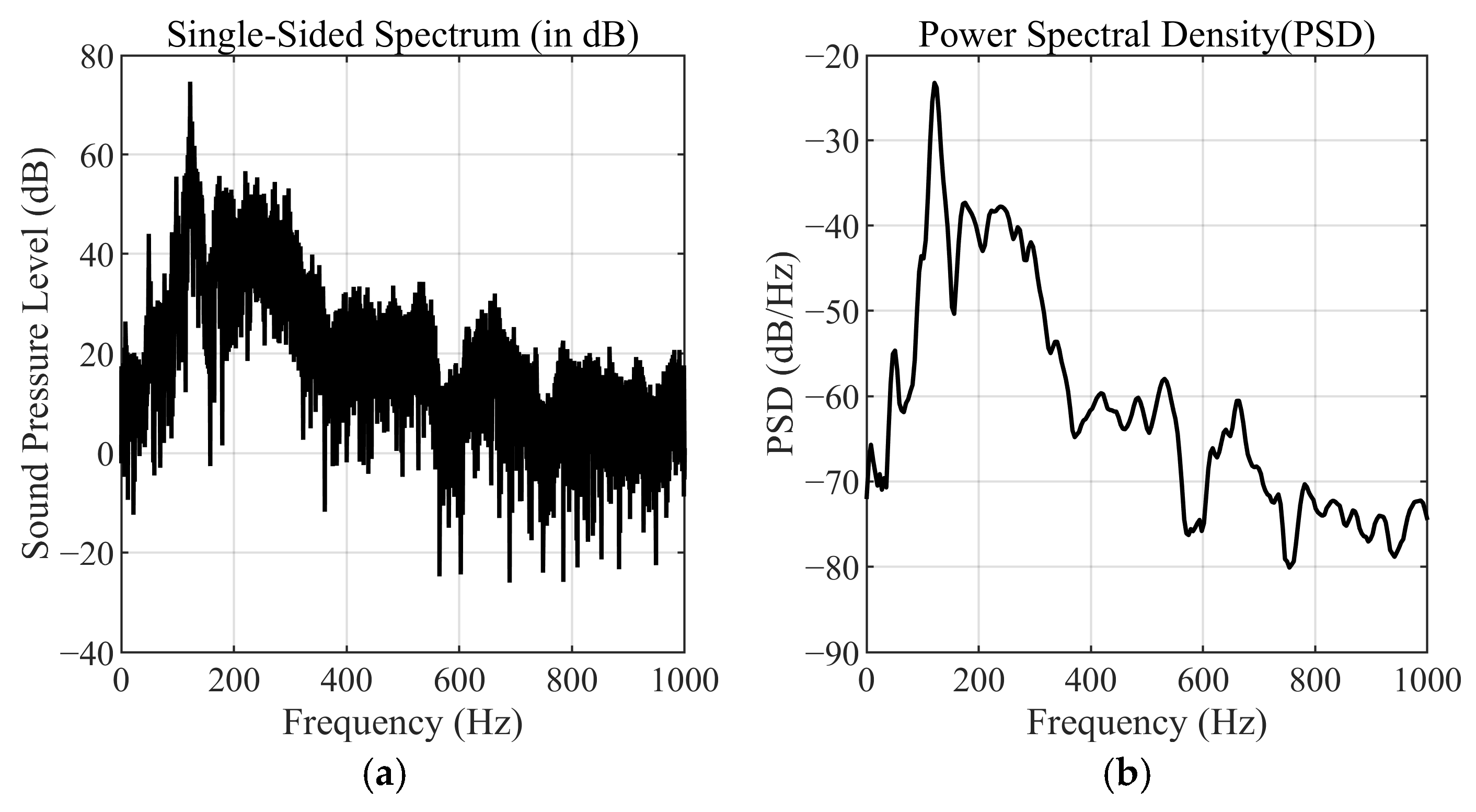
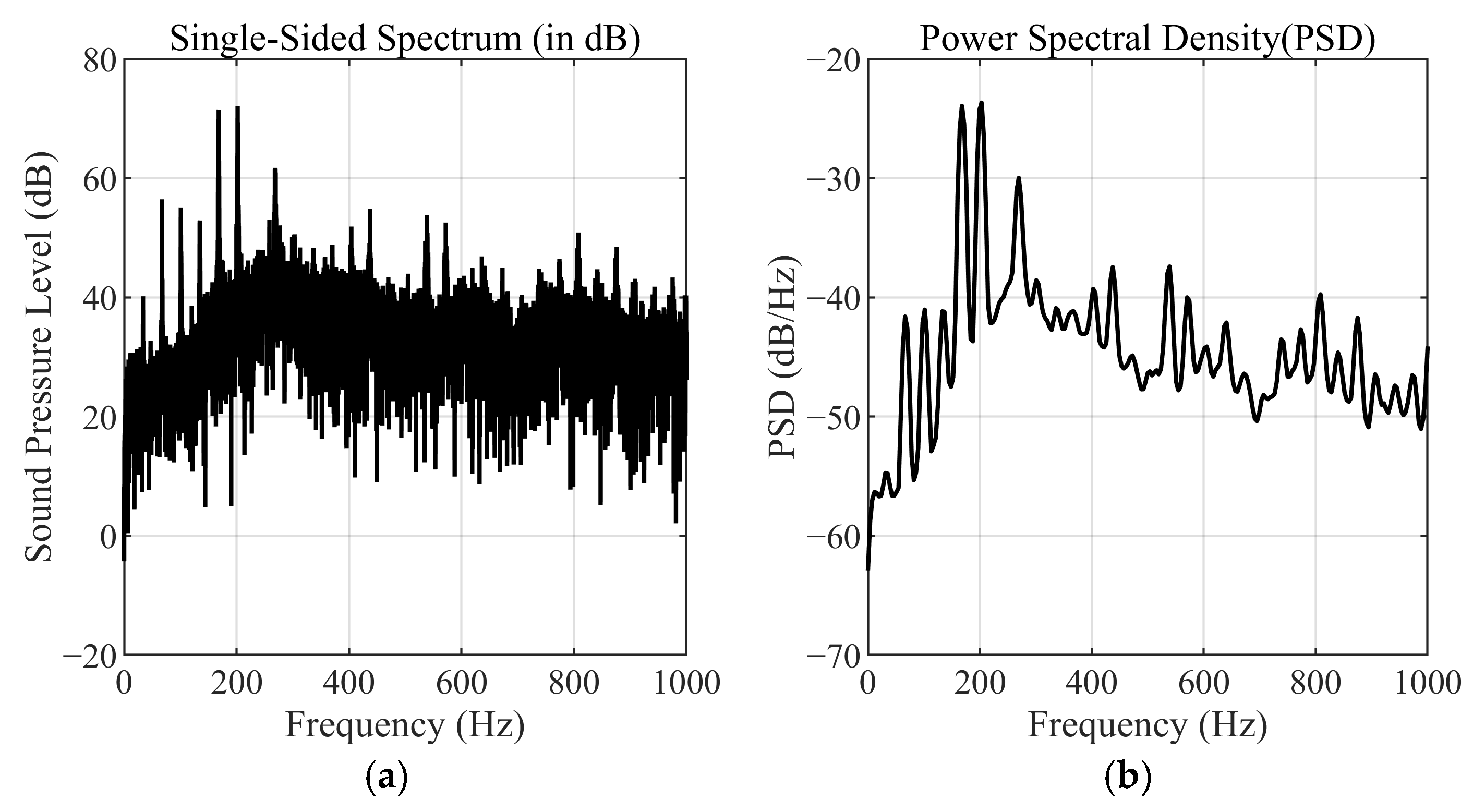
To further investigate the acoustic behavior of the tractor under engine start-up conditions, this study conducted spectral analysis on noise signals measured by microphones placed near the engine and at the driver’s ear position. Figure 4a and Figure 5a present the single-sided amplitude spectra of the measured signals in the 0–1000 Hz frequency range, while Figure 4b and Figure 5b display the corresponding power spectral density (PSD), which provides a more detailed representation of the energy distribution across frequencies. Together, these figures reveal the frequency structure and energy characteristics of tractor noise.
From the single-sided spectra on the left, it is clear that the tractor noise exhibits prominent low-frequency components, with a main peak around 73 Hz, corresponding to the engine cycle or crankshaft rotation. Additional harmonic peaks at 146 Hz and 219 Hz reflect a typical integer-multiple structure, indicating strong periodicity. Although the amplitude attenuates at higher frequencies, sparsely distributed narrowband components remain, suggesting the presence of modulation disturbances or mechanical resonances in the mid-to-high-frequency range.
The PSD plots on the right quantify the energy distribution across frequencies. Several distinct peaks appear in the low-frequency band (100–300 Hz), confirming that nonlinear periodic noise components are concentrated in this region. As the frequency increases, the PSD gradually flattens, though slight fluctuations persist, indicating the existence of nonstationary narrowband modulated noise.
A comparison between the spectra in Figure 4 and Figure 5 clearly reveals that the tractor noise undergoes significant nonlinear transformations as it propagates from the engine source to the vicinity of the driver’s ear. While some dominant frequency components remain consistent, the signal exhibits notable features such as nonlinear changes in harmonic amplitudes, spectral broadening, and the emergence of new frequency components during transmission. These phenomena indicate that the acoustic propagation is not purely linear but instead is affected by nonlinear coupling, material response, and dynamic structural characteristics, leading to spectral distortion. Such a nonlinear evolution challenges conventional ANC algorithms based on linear assumptions and highlights the necessity and validity of incorporating nonlinear modeling approaches, such as Volterra filters, in active noise control under complex acoustic transmission conditions.

2.2. Analysis of the Characteristics of Nonlinear Narrowband Primary Noise

In tractor ANC systems, the reference signal  x r ( n )  is typically derived from engine-generated noise, which is inherently periodic due to the rotational motion of mechanical components such as the crankshaft and camshaft. The reference signal can be modeled as a superposition of sinusoidal components with distinct frequencies  ω i ( n ) , which are typically obtained using a rotational speed sensor. These components represent the engine’s fundamental frequency and its harmonics.
x ( n ) = x r ( n ) + v ( n )
x r ( n ) = i = 1 q [ a i cos ( ω i ( n ) ) + b i sin ( ω i ( n ) ) ]
where  ( ω q ω q 1 ω 2 ω 1 ) q  denotes the number of frequency components in the reference signal.  a i , b i q = 1 q  denotes the Fourier coefficients associated with each frequency component  { ω i } q = 1 q v ( n )  is Gaussian white noise with a mean of 0 and a variance of  σ 2 = 0.05 , used to simulate environmental interference in the reference signal.
When this signal passes through the primary path—often composed of engine mounts, chassis structures, and transmission systems—it experiences nonlinear distortion due to mechanical nonlinearities such as friction, backlash, and varying stiffness. This process is mathematically described by a Taylor series expansion in Equation (3).
p ( n ) = t = 1 T ( c t , 0 x ( n ) + c t , 1 x ( n 1 ) + + c t , m x ( n m ) ) t = t = 1 T t 1 = 0 t t 2 = 0 t 1 t m = 0 t m 1 t ! t m ! ( t t 1 ) ! ( t m 1 t m ) ! ( c t , 0 x ( n ) ) t t 1 ( c t , 1 x ( n 1 ) ) t 1 t 2 ( c t , m x ( n m ) ) t m
Here,  T  denotes the order of the primary path. When  T = 1 , the primary path is linear; when  T 2 , it becomes nonlinear. As a result, the output signal  P ( n )  includes additional frequency components formed by a nonlinear mixing of the original frequencies. Substituting Equation (1) into function  ( ) k ( k > 1 ) , we obtain
( x ( n ) ) k = ( x r ( n ) + v ( n ) ) k = ( x r ( n ) ) k + φ ( n )
where
( x r ( n ) ) k = α ( n ) + j = 1 J ( l j , a cos ( d j ω 1 ( n ) ) + l j , b sin ( d j ω 1 ( n ) ) )
When  q = 1  and  k = 2
( x r ( n ) ) 2 = a 1 cos ( ω 1 ( n ) ) + b 1 sin ω 1 ( n ) 2 = a 1 2 + b 1 2 2 + a 1 2 b 1 2 2 cos ( 2 ω 1 ( n ) ) + a 1 b 1 sin ( 2 ω 1 ( n ) )
When  q = 1  and  k = 3
( x r ( n ) ) 3 = a 1 cos ( ω 1 ( n ) ) + b 1 sin ( ω 1 ( n ) ) 3 = 3 a 1 3 + 3 a 1 b 1 2 4 cos ( ω 1 ( n ) ) + 3 b 1 3 + 3 a 1 2 b 1 4 sin ( ω 1 ( n ) ) + a 1 3 3 a 1 b 1 2 4 cos 3 ω 1 n + 3 a 1 2 b 1 b 1 3 4 sin 3 ω 1 n
It can be further inferred that, when q = 1
( x r ( n ) ) k = α ( n ) + j = 1 J ( l j , a cos ( d j ω 1 ( n ) ) + l j , b sin ( d j ω 1 ( n ) ) )
Here,  α ( n )  is the constant term, while  J = U { | d j | k , | d j | 0 }  and  { l j , a , l j , b } j = 1 J  are the Fourier coefficients of each component. Similarly, when  q > 1 , it follows that
( x r ( n ) ) k = β ( n ) + j = 1 j ( l j , a cos ( d j , 1 ω 1 ( n ) + l j , b sin ( d j , 1 ω 1 ( n ) + d j , 2 ω 2 ( n ) + ) + d j , q ω q ( n ) ) )
Here,  β ( n )  is the constant term.  J = U i = 1 q d j , i k , i = 1 q d j , i 0  and  { l j , a , l j , b } j = 1 J  are the Fourier coefficients of their respective components.
Substituting Equation (9) into Equation (3) and further simplifying, we obtain:
p ( n ) = j = 1 J ( g j , a cos ( λ j , 1 ω 1 ( n ) + λ j , 2 ω 2 ( n ) + + λ j , q ω q ( n ) ) + g j , b sin ( λ j , 1 ω 1 ( n ) + λ j , 2 ω 2 ( n ) + ) + λ j , q ω q ( n ) ) + γ p ( n ) + ψ ( n )
Here,  γ p ( n )  is the constant term, and  ψ ( n )  is a function of the additive noise  v ( n ) . The constant component  γ p ( n )  cannot propagate through the air medium and, therefore, is not present in the actual primary noise. Ultimately, as shown in Equation (10), the output of the primary path after passing through the nonlinear system,  P ( n ) , retains its narrowband characteristics, but its spectral structure becomes more complex, exhibiting multiple harmonics and frequency combination components. Although the signal energy remains concentrated in the low-frequency range (i.e., narrowband), its frequency components are no longer limited to those of the original reference signal but rather include a mixture of higher-order components. This phenomenon is commonly observed in the measured noise spectra of operating tractors, where a dominant fundamental frequency is accompanied by multiple harmonic peaks, indicating that nonlinear processes have occurred during physical transmission.
This theoretical derivation clearly illustrates the formation mechanism of typical nonlinear narrowband noise in tractors: the reference signal, excited by periodic mechanical structures, is modulated by the nonlinear primary path, resulting in a more complex spectrum while remaining concentrated in the low-frequency region. This aligns with the nonlinear and narrowband nature of actual tractor noise and provides a theoretical foundation for the development of ANC algorithms tailored to tractor applications.
It is worth noting that while the primary output in formula (10) focuses on the nonlinear transformation of narrowband periodic components, real-world noise also contains broadband fluctuations, as illustrated in Figure 5. These components may originate from structural vibrations, airflow noise, or ambient disturbances. Although not explicitly modeled in the analytical derivation, such broadband noise is implicitly accounted for in the simulations and real data evaluations, ensuring the model’s practical applicability.

2.3. Design of a Nonlinear Active Noise Control Algorithm Based on the Volterra Structure

Based on an in-depth analysis of the spectral characteristics and predictability of nonlinear narrowband noise in tractors, a nonlinear adaptive filtering structure is designed in this study to achieve effective control of noise transmitted through nonlinear primary paths. First, a Volterra filter is employed to model the nonlinear characteristics of the acoustic path, thereby enhancing the system’s adaptability to complex noise environments. Building upon this model, a momentum-based optimization strategy is introduced to formulate the M-VFXLMS algorithm, aiming to improve both convergence speed and steady-state performance. This section provides a comprehensive overview of the structural design and algorithmic enhancements, focusing on the construction of the nonlinear filter and the mechanisms for performance optimization.

2.3.1. Nonlinear Narrowband ANC System for Tractor Noise Based on Volterra Filters

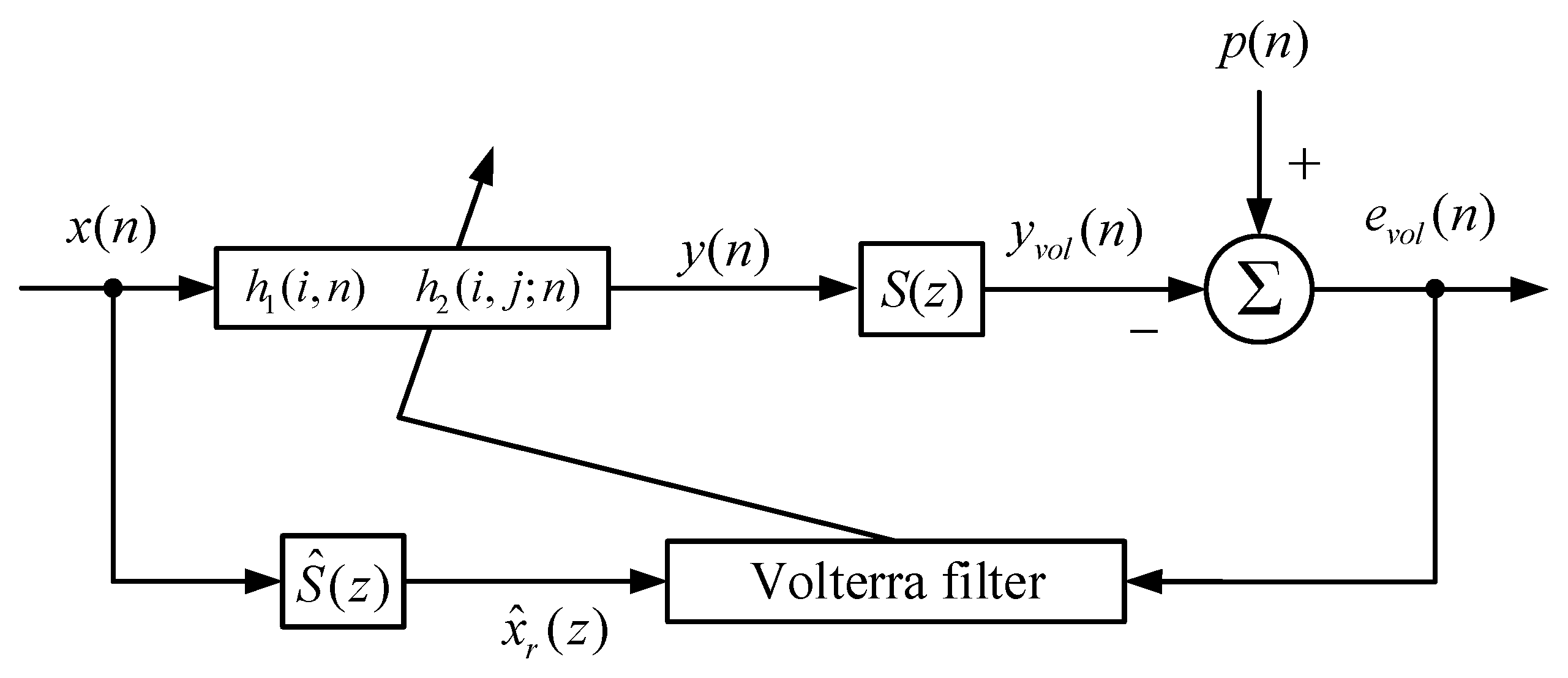
At present, commonly used nonlinear filters include morphological filters, homomorphic filters, order-statistics filters, Volterra filters, and polynomial filters. Among them, the Volterra filter, which is constructed based on Volterra series expansion, exhibits certain advantages due to its relatively simple structure. The Volterra series incorporates not only linear terms but also nonlinear terms in polynomial form, enabling the filter to effectively handle complex nonlinear noise environments. Compared with other nonlinear filtering approaches, the Volterra nonlinear filter generally demonstrates a superior noise suppression performance, making it a promising candidate for applications in ANC systems (Figure 6).
x ( n )  is the reference signal,  y ( n )  is the anti-noise signal, and  e ( n )  is the error signal.  S ( z )  represents the secondary path model. The nonlinear processing capability of the Volterra filter increases significantly with the order of the series expansion. However, this also leads to an exponential growth in computational complexity. Therefore, in practical applications, the Volterra filter is typically truncated to an appropriate order to balance performance and computational efficiency, enabling the construction of an efficient and practical model tailored to specific tasks. When only the first-order kernel is used, the Volterra filter reduces to a linear FIR filter. If the truncation order is greater than two, the Volterra filter is capable of simultaneously handling both linear and nonlinear noise components.
In ANC systems, employing a second-order Volterra filter can effectively meet the system’s requirements for nonlinear processing while avoiding an excessive computational burden that would compromise real-time performance. Therefore, an adaptive active noise control system based on a nonlinear Volterra filter can achieve efficient noise reduction with a favorable balance between accuracy and computational efficiency.
At this point, the output signal of the adaptive active noise control system based on the nonlinear Volterra filter is given by
y ( n ) = i = 0 L 1 1 h 1 ( i , n ) x ( n i ) + i = 0 L 2 1 j = i L 2 1 h 2 ( i , j ; n ) x ( n i ) x ( n j )
where
x ( n ) = i q ( a i cos ω i n + b i sin ω i n )
Here,  L 1  and  L 2  denote the filter lengths of the first-order and second-order kernel functions in the Volterra filter, respectively. The choice of filter length depends on the characteristics of the signal being processed. Meanwhile,  h 1 ( i , n )  and  h 2 ( i , j ; n )  represent the weights of the linear and nonlinear components of the filter, respectively. In this system, the error signal can be expressed as
e v o l ( n ) = p ( n ) y v o l ( n )
Here,  p ( n )  is the output of the reference signal  x ( n )  after passing through the actual primary acoustic path.  y v o l ( n )  is the cancellation signal generated by the nonlinear Volterra filter, and  y v o l ( n )  is the resulting anti-noise signal after  y ( n )  passes through the secondary path  S ( z ) .
The first-order and second-order coefficients of the second-order Volterra filter are updated separately using the LMS algorithm as follows:
h 1 ( i ; n + 1 ) = h 1 ( i ; n ) μ 1 e ν o l ( n ) x ( n i )
h 2 ( i , j ; n + 1 ) = h 2 ( i , j ; n ) μ 2 e v o l ( n ) x ( n i ) x ( n j )
Here,  μ 1  and  μ 2  represent the step sizes for updating the first-order and second-order kernel functions of the Volterra filter, respectively.
Approximating the nonlinear transmission path using a Volterra filter provides an effective solution to the nonlinear problems encountered in active noise control.

2.3.2. Momentum-Enhanced Volterra Filtered-x LMS Algorithm

The momentum technique can accelerate the gradient descent process by introducing an additional term into the VFXLMS algorithm, thereby enhancing its convergence characteristics. Based on this approach, the momentum-augmented M-VFXLMS algorithm is proposed.
Assuming the cost function of the FXLMS algorithm is denoted as  J ( n ) = e 2 ( n ) , the cost function formulation for the momentum-augmented M-VFXLMS algorithm is constructed as follows:
J M v o l ( n ) = i = 1 n λ v o l n i J ( i )
Here,  λ v o l  denotes the momentum factor, and  λ v o l [ 0 , 1 )  represents the gradient term. According to the gradient descent method, the weight update equations for the adaptive Volterra filter are given as follows:
h 1 ( i , n + 1 ) = h 1 ( i , n ) μ 3 ( n ) i = 1 n λ v o l n i J ( i ) = h 1 ( i , n ) μ 3 ( n ) J ( n ) μ 3 ( n ) i = 1 n 1 λ v o l n i J ( i )
h 2 ( i , j ; n + 1 ) = h 2 ( i , j ; n ) μ 4 ( n ) i = 1 n λ v o l n i J ( i ) = h 2 ( i , j ; n ) μ 4 ( n ) J ( n ) μ 4 ( n ) i = 1 n 1 λ v o l n i J ( i )
By analogy, we obtain
h 1 ( i , n ) = h 1 ( i , n 1 ) μ 3 ( n 1 ) λ v o l 1 i = 1 n 1 λ v o l n i J ( i )
h 2 ( i , j ; n ) = h 2 ( i , j ; n 1 ) μ 4 ( n 1 ) λ v o l 1 i = 1 n 1 λ v o l n i J ( i )
It can be derived that
λ v o l [ h 1 ( i , n ) h 1 ( i , n 1 ) ] = μ 3 ( n 1 ) i = 1 n 1 λ v o l n i J ( i )
λ v o l [ h 2 ( i , j ; n ) h 2 ( i , j ; n 1 ) ] = μ 4 ( n 1 ) i = 1 n 1 λ v o l n i J ( i )
Since the system is configured with a high sampling rate,  μ 3 ( n 1 )  can be approximated as  μ 3 ( n ) , and  μ 4 ( n 1 )  is approximately equal to  μ 4 ( n ) . Therefore,
λ v o l [ h 1 ( i , n ) h 1 ( i , n 1 ) ] = μ 3 ( n 1 ) i = 1 n 1 λ v o l n i J ( i ) μ 3 ( n ) i = 1 n 1 λ v o l n i J ( i )
λ v o l [ h 2 ( i , j ; n ) h 2 ( i , j ; n 1 ) ] = μ 4 ( n 1 ) i = 1 n 1 λ v o l n i J ( i ) μ 4 ( n ) i = 1 n 1 λ v o l n i J ( i )
By substituting Equation (23) into Equation (17), and Equation (24) into Equation (18), it can be derived that the weight update formula of the M-VFXLMS algorithm incorporating the momentum technique is given by
h 1 ( i ; n + 1 ) = h 1 ( i ; n ) μ 3 J ( n ) + λ v o l [ h 1 ( i ; n ) h 1 ( i ; n 1 ) ]
h 2 ( i , j ; n + 1 ) = h 2 ( i , j ; n ) μ 4 J ( n ) + λ v o l [ h 2 ( i , j ; n ) h 2 ( i , j ; n 1 ) ]
In this context,  λ v o l [ h 2 ( i , j ; n ) h 2 ( i , j ; n 1 ) ]  and  λ v o l [ h 2 ( i , j ; n ) h 2 ( i , j ; n 1 ) ]  represent the extra terms added due to the incorporation of momentum.
Based on the step-size update rule of the VFXLMS algorithm, the weight update equation of the momentum-augmented M-VFXLMS algorithm can be explicitly expressed as follows:
h 1 ( i ; n + 1 ) = h 1 ( i ; n ) μ 3 e ν o l ( n ) x ( n i ) + λ v o l [ h 1 ( i ; n ) h 1 ( i ; n 1 ) ]
h 2 ( i , j ; n + 1 ) = h 2 ( i , j ; n ) μ 4 e v o l ( n ) x ( n i ) x ( n j ) + λ v o l [ h 2 ( i , j ; n ) h 2 ( i , j ; n 1 ) ]

3. Results

To verify the effectiveness of the proposed M-VFXLMS algorithm in suppressing narrowband nonlinear noise, a comparative study was conducted against the FXLMS and VFXLMS algorithms under different primary path conditions and varying SNRs in the reference noise environment. For a consistent comparison, the performance was evaluated using the NMSE, which was smoothed using a moving average filter. The NMSE is defined as NMSE =  10 log 10 E e 2 ( n ) / σ p 2 , where  σ p 2  represents the variance of the primary noise. In the simulations, the final NMSE value for each algorithm was calculated as the average over 40 independent runs.
In this study, the residual error energy is defined as the average squared error over the steady-state evaluation window, given by
E = 1 N e v a n = N N e v a + 1 N e 2 ( n )
where  e ( n )  denotes the error signal,  N  is the total number of iterations, and  N e v a  represents the number of points used for evaluating steady-state performance. This definition provides a quantitative measure of residual noise suppression capability.
The sampling frequency of all signals was set to  f s = 2000 Hz. The secondary path in all simulations was modeled as a non-minimum phase FIR filter, whose transfer function is given by
S ( z ) = z 2 + 1.5 z 3 z 4
The secondary path estimate was obtained through offline training using white noise as the excitation signal. The order of the secondary path was set to  M ^ = 15 , and the final coefficients were determined by averaging the steady-state results of 40 independent training runs.

3.1. Impact of Different Momentum Factors on Algorithm Performance

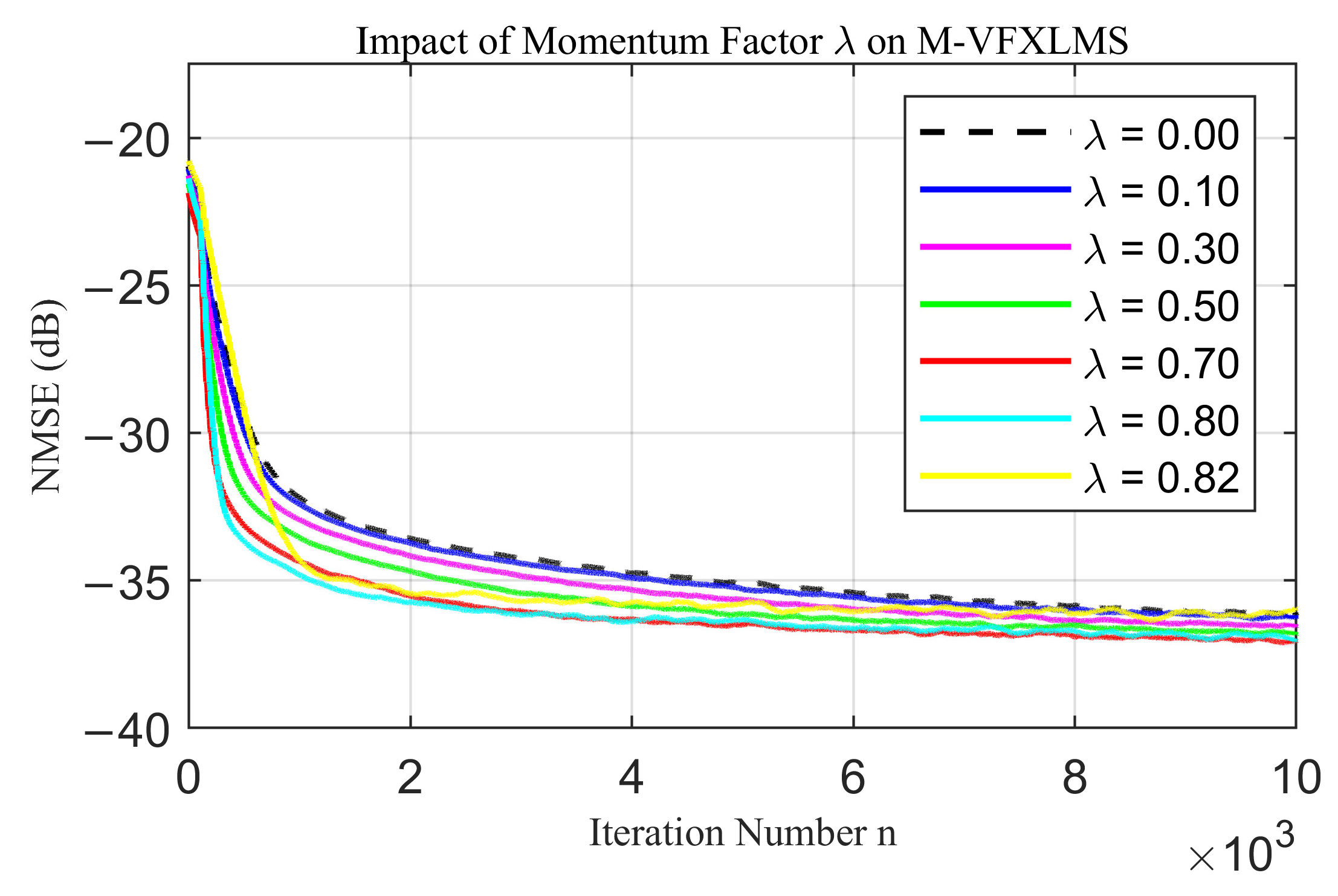
The momentum factor  λ v o l  serves as a crucial tuning parameter in the M-VFXLMS algorithm, directly affecting both the convergence speed and steady-state performance of the system. To thoroughly evaluate the influence of different momentum settings, seven representative values,  λ v o l = 0 λ v o l = 0.1 λ v o l = 0.3 λ v o l = 0.5 λ v o l = 0.7 λ v o l = 0.8  and  λ v o l = 0.82 , are selected for simulation experiments under identical noise and path conditions.
Figure 7 presents the NMSE curves with respect to iteration number for various momentum settings. It can be observed that moderate momentum values significantly accelerate the convergence process and yield lower steady-state errors. However, when  λ v o l  is increased beyond 0.8, the system begins to exhibit a degraded performance, potentially due to instability or excessive oscillations introduced by the dominant momentum term.
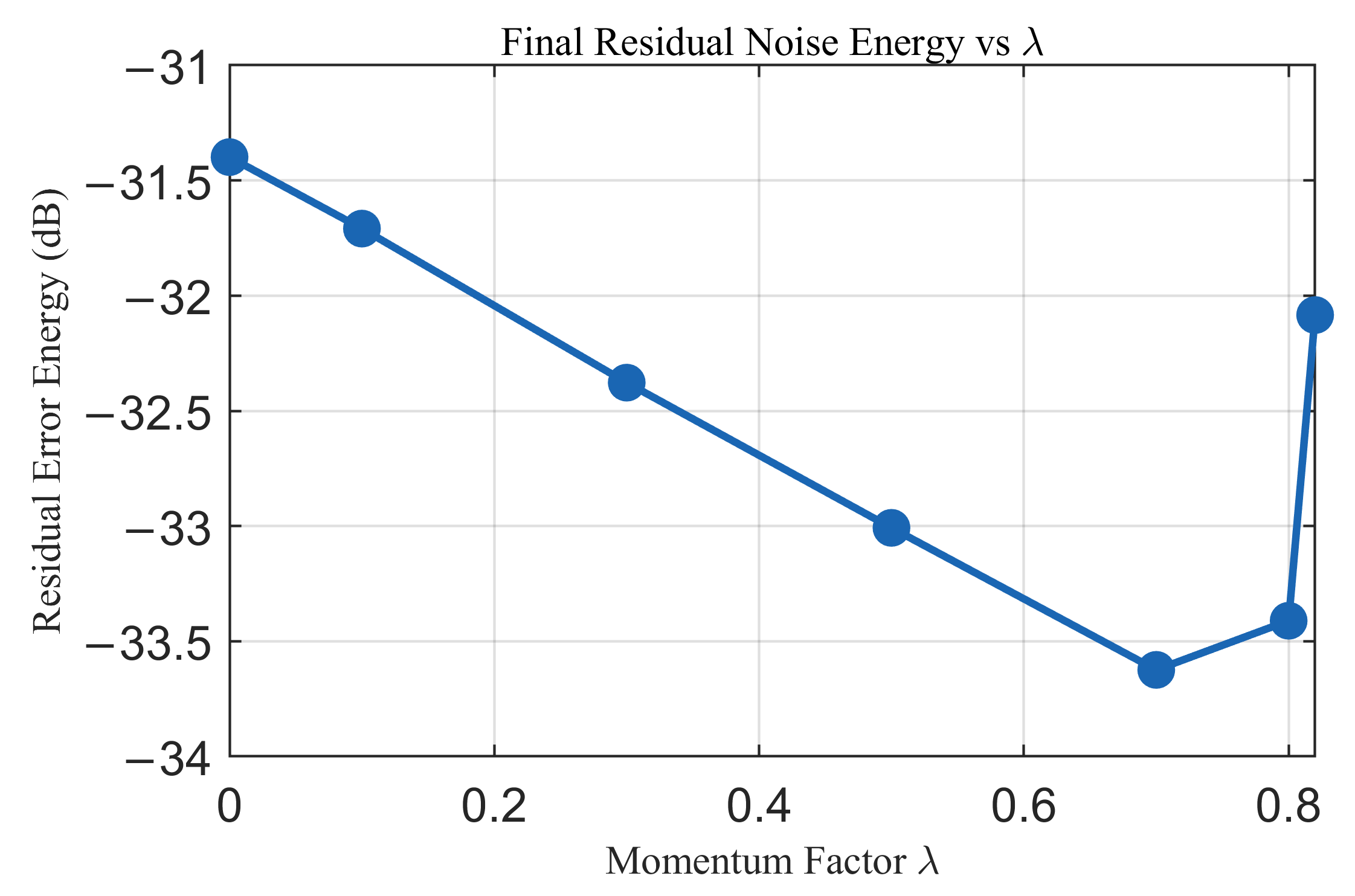
Figure 8 illustrates the final residual error energy associated with each momentum setting. A clear downward trend is evident as  λ v o l  increases from 0 to 0.7, with the lowest residual noise energy achieved near  λ v o l = 0.7 . Beyond this point, a noticeable increase in residual energy is observed for  λ v o l = 0.8  and  λ v o l = 0.82 , confirming that overly large momentum factors can impair the algorithm’s effectiveness in terms of control. In summary, there exists a trade-off between convergence speed and system stability with respect to the momentum factor. The proper selection of  λ v o l  is essential for ensuring both rapid adaptation and robust noise suppression in nonlinear ANC systems. The results shown in Figure 7 and Figure 8 provide valuable guidance for the parameter optimization of momentum-augmented M-VFXLMS algorithms.
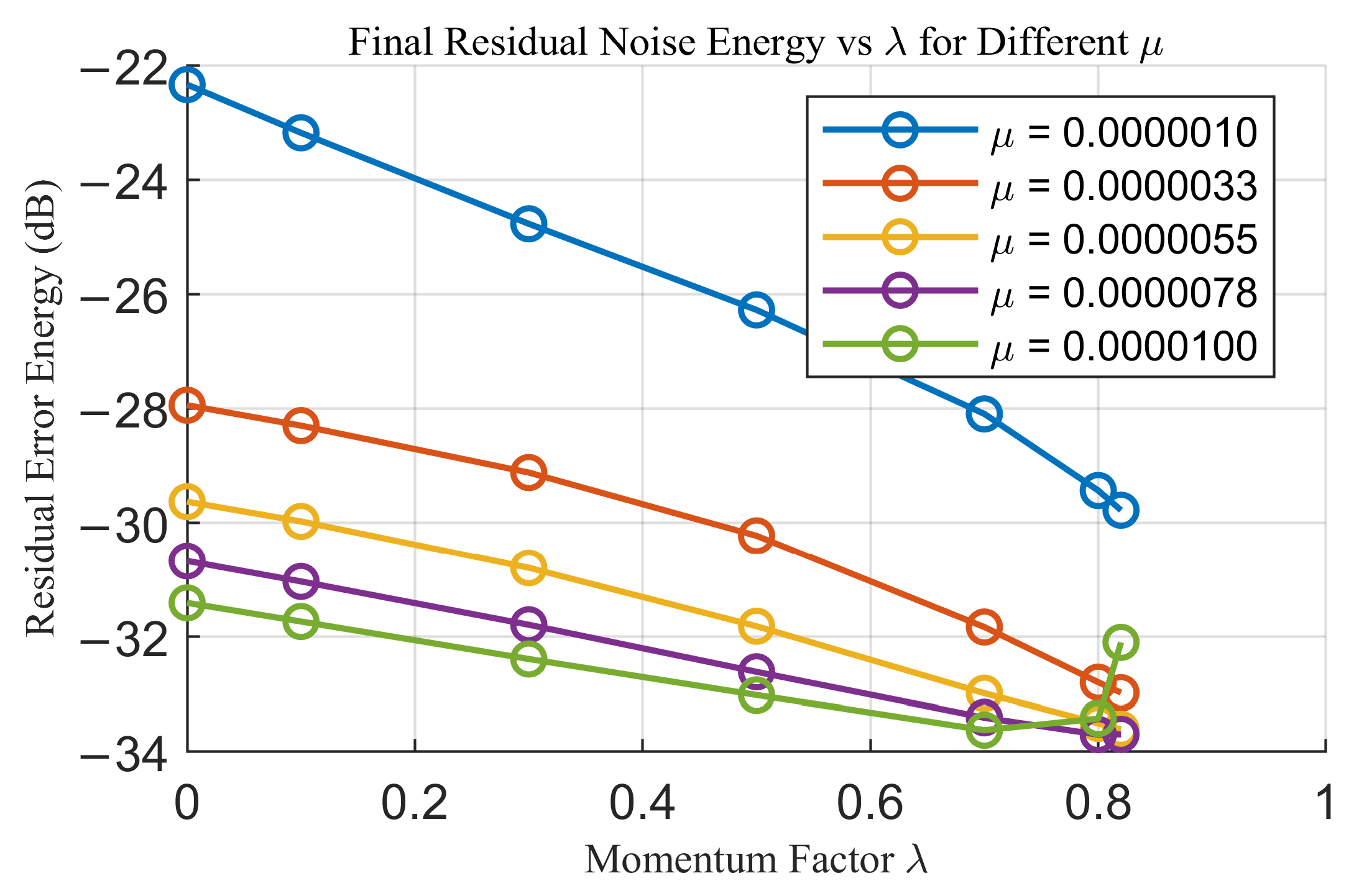
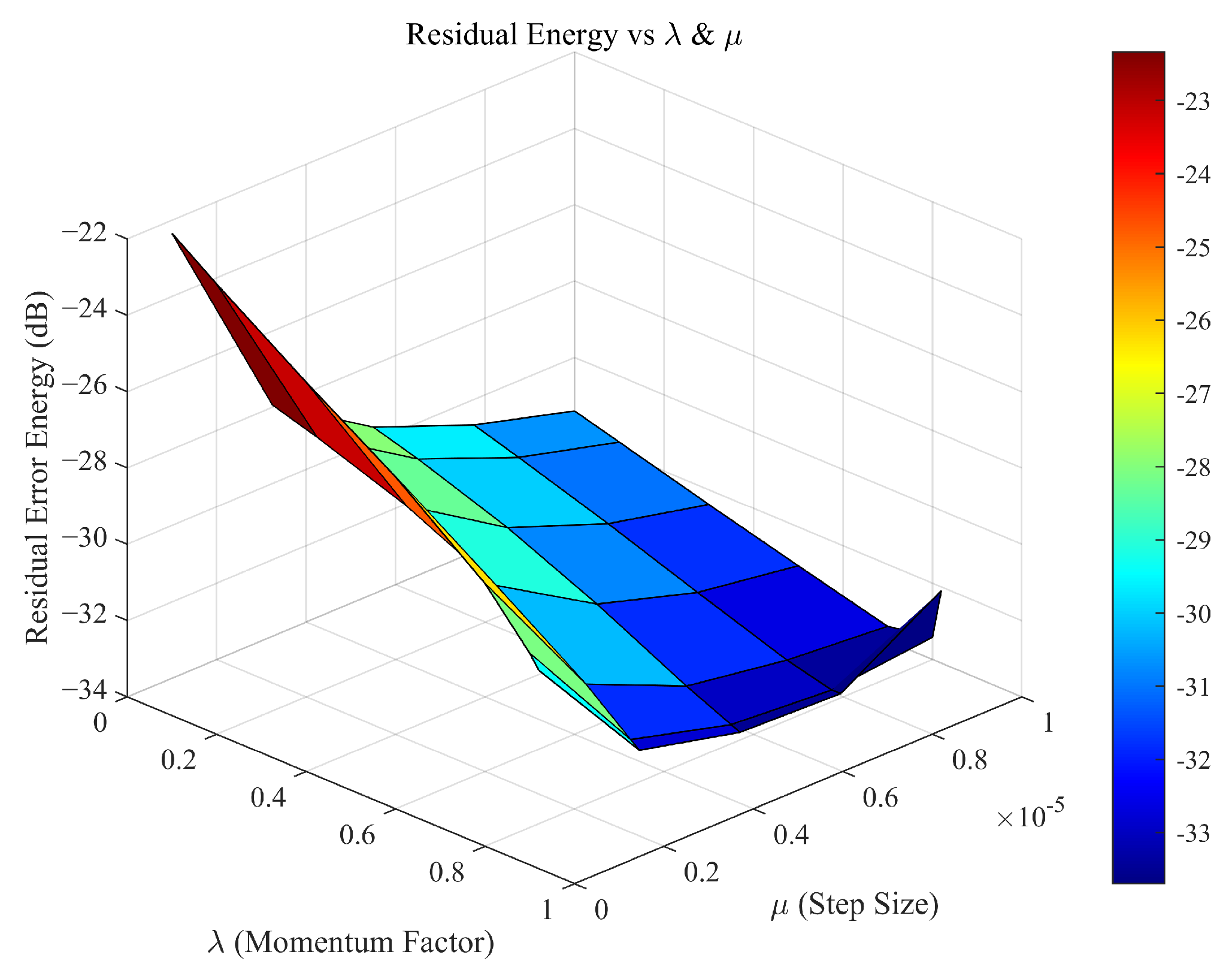
In addition to the momentum factor  λ v o l , the selection of the step size  μ  plays a pivotal role in determining the overall performance of the M-VFXLMS algorithm. As a core adaptation parameter, the step size governs both the convergence rate and stability of the adaptive filtering process. Specifically, an excessively small  μ  may lead to sluggish convergence, whereas an overly large  μ  can result in the instability or divergence of the system. To comprehensively assess the joint impact of  μ  and  λ v o l , a series of simulation experiments were conducted under various combinations of these parameters.
Figure 9 presents the residual error energy curves plotted against different values of the momentum factor  λ v o l  for multiple fixed step sizes  μ . The results indicate that, for each step size, increasing  λ v o l  generally leads to improved noise suppression, with optimal performance observed when  λ v o l  takes values between 0.7 and 0.8. Furthermore, it is evident that larger step sizes yield lower steady-state errors and a faster convergence, provided that the momentum factor is properly tuned.
To visualize the combined influence of both parameters, Figure 10 illustrates a three-dimensional surface plot of the residual error energy as a function of  λ v o l  and  μ . A clear downward trend along both dimensions confirms that a carefully selected pair of step size and momentum factor values is essential for achieving a desirable trade-off between convergence performance and algorithmic stability in nonlinear ANC systems.
The analysis results of Figure 9 and Figure 10 provide important guidance for the selection of parameters in subsequent simulations. A comprehensive analysis of both figures suggests that, in the design and implementation of future algorithms, priority should be given to setting the momentum factor within the range of 0.7 to 0.8, combined with a step size of approximately 0.00001, in order to achieve a favorable balance between convergence performance and system stability.

3.2. Noise Reduction Performance Simulation for a Second-Order Nonlinear Acoustic Path with Multi-Frequency Reference Signals

The signal-to-noise ratio (SNR) in this study is defined as
SNR = 10 log P s P n dB
where  P s  and  P n  denote the average power of the clean reference signal and the additive white noise, respectively. In the simulation scenarios, 20 dB and 40 dB conditions refer to the cases where the power of the additive noise  v ( n )  is adjusted such that the ratio  P s / P n  corresponds to 20 dB and 40 dB, respectively. These settings are used to evaluate the algorithm’s performance under moderate and high signal-to-noise conditions.
In this simulation, the reference signal consists of frequency components at  ω 1 = 0.1 π  (100 Hz),  ω 2 = 0.2 π  (200 Hz), and  ω 3 = 0.3 π  (300 Hz), with corresponding Fourier coefficients of  a 1 = 2 b 1 = 1 a 2 = 1 b 2 = 0.5 a 3 = 0.5 , and  b 3 = 0.1 . The transfer function of the primary path is given by
p ( n ) = x ( n 3 ) 0.3 x ( n 4 ) + 0.2 x ( n 5 ) + 0.8 x 2 ( n 5 )
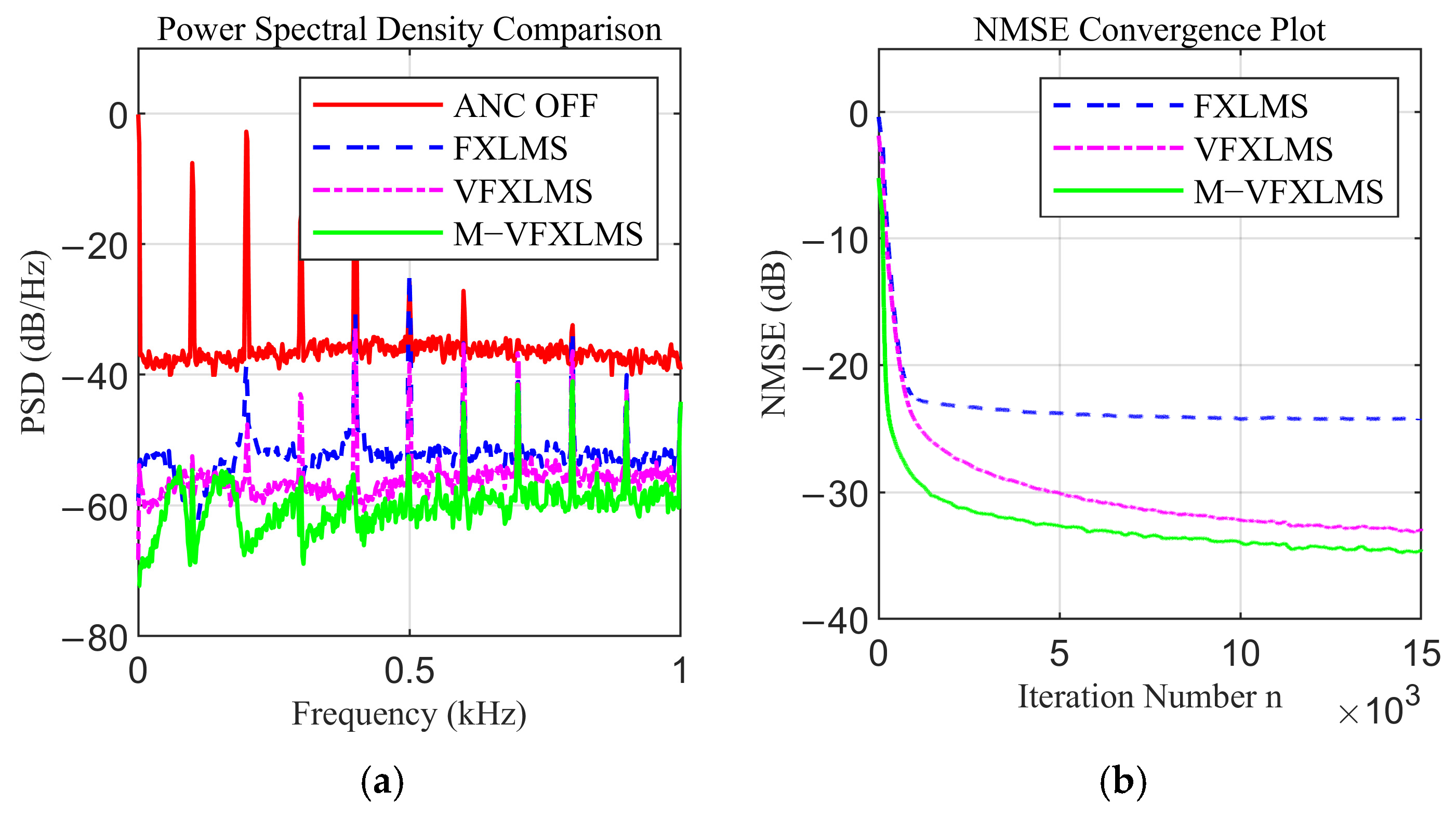
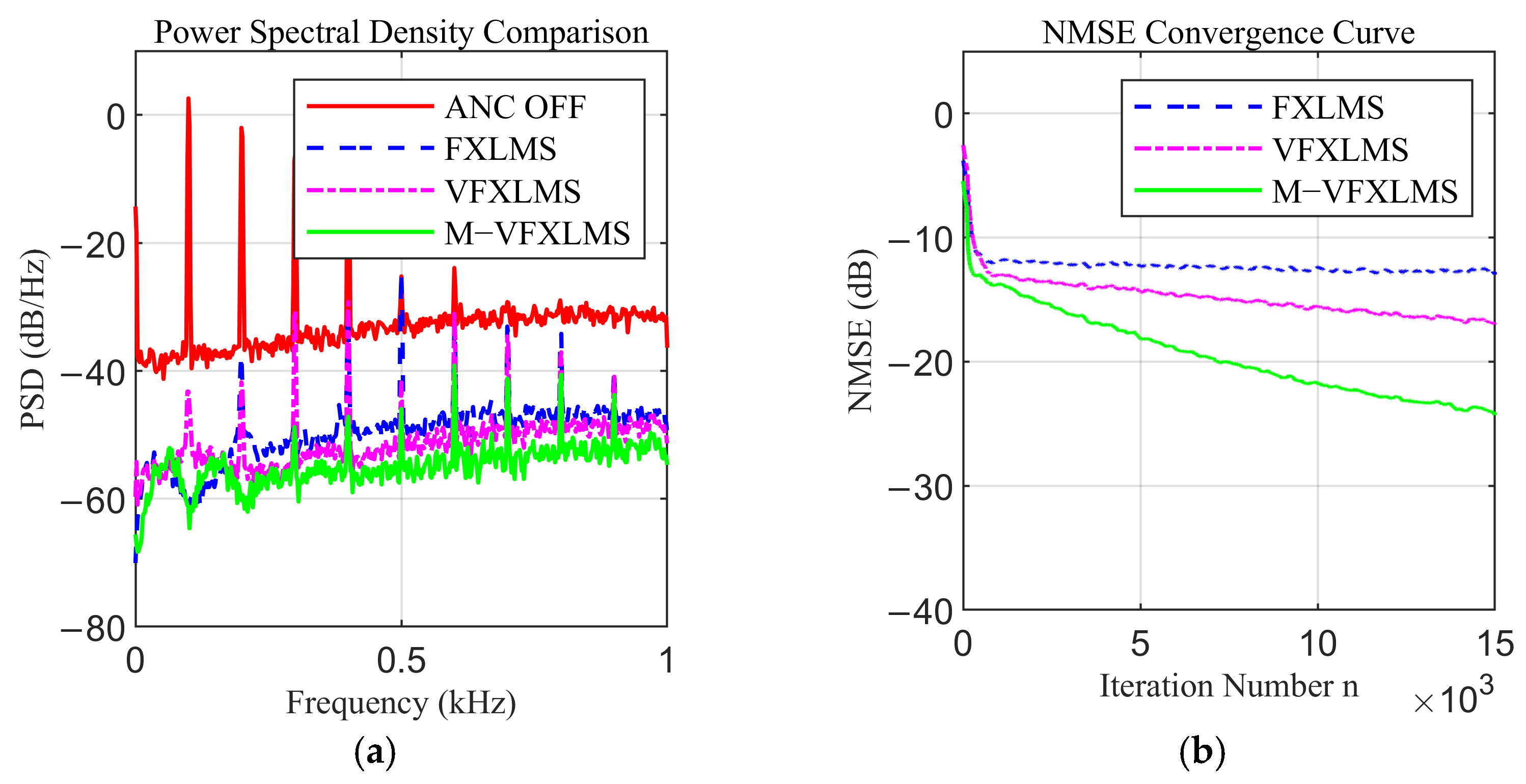
Under SNRs of 20 dB and 40 dB, all controller structures were configured with a filter order of 20. The step-size parameters are listed in Table 1. The simulation results for 20 dB and 40 dB SNRs are shown in Figure 11 and Figure 12, respectively. Figure 11a and Figure 12a present the PSD of the residual error signals for each structure after noise cancellation, while Figure 11b and Figure 12b show the corresponding comparisons of NMSE performance for different algorithms. From the PSD plots in Figure 11a and Figure 12a, it can be observed that the primary noise contains narrowband components at 100 Hz, 200 Hz, 300 Hz, 400 Hz, 500 Hz, and 600 Hz. In the ANC-OFF spectrum, where active control is disabled, several pronounced peaks appear, corresponding to narrowband interference components present in the reference signal. These peaks exhibit the highest energy, indicating the unprocessed spectral structure of the system. Although the FXLMS algorithm performs linear control, it still retains a considerable number of residual peaks, reflecting its limited effectiveness in handling nonlinear primary paths.
In Table 1 μ 3  and  μ 4  are determined based on system stability constraints, while the momentum factor  λ v o l = 0.7  is selected through simulation-based optimization to balance the performance.
In contrast, the VFXLMS algorithm, through the introduction of second-order Volterra modeling, significantly suppresses residual energy in several frequency bands—especially in the higher-frequency range—demonstrating improved performance. The M-VFXLMS algorithm shows the best overall performance across the entire frequency spectrum, with the lowest spectral energy. This improvement is attributed to the introduction of the momentum term, which accelerates convergence, enhances stability, and effectively suppresses nonlinear residual noise.
The NMSE curves further validate these findings: FXLMS exhibits slow convergence and high steady-state errors; VFXLMS converges faster and achieves lower error levels; and M-VFXLMS achieves the fastest convergence, ultimately stabilizing around −35 dB. This clearly demonstrates the robustness and efficiency of M-VFXLMS in nonlinear noise environments (Table 2 and Table 3).

3.3. Noise Reduction Performance Simulation for a High-Order Nonlinear Acoustic Path with Multi-Frequency Reference Signals

In this simulation, the reference signal is the same as that used in the previous section, while the primary path is modeled using a high-order nonlinear function.
p ( n ) = x ( n ) + 0.8 x ( n 1 ) + 0.3 x ( n 2 ) + 0.4 x ( n 3 ) 0.8 x ( n ) x ( n 1 ) + 0.9 x ( n ) x ( n 2 ) + 0.7 x ( n ) x ( n 2 ) x ( n 3 )
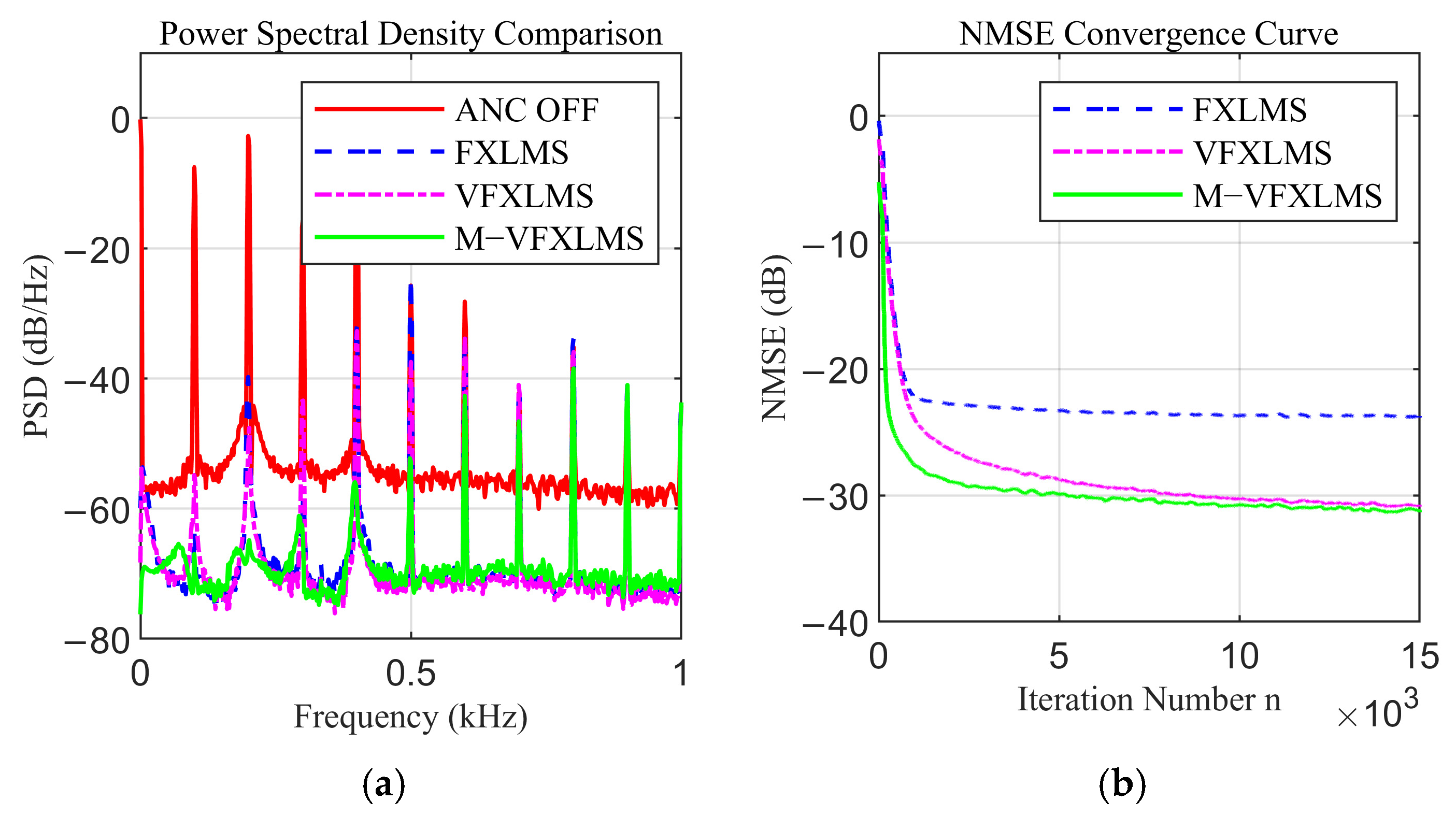
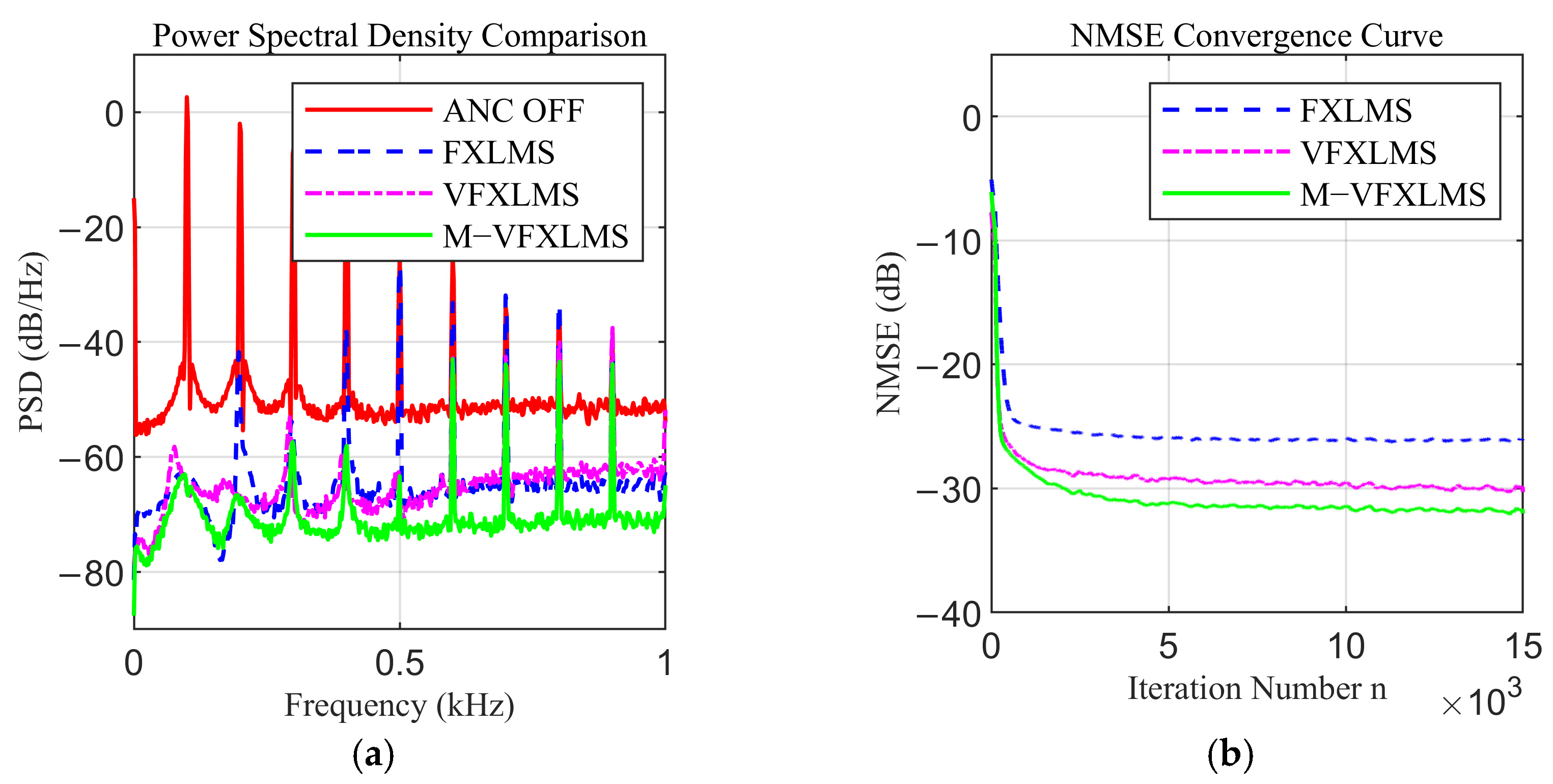
In this simulation, a comparative analysis is also performed under SNR conditions of 20 dB and 40 dB. The controller order for all structures is set to 20, and the step-size parameters are identical to those used in Simulation 1. Since the primary path is modeled as a third-order nonlinear function, the resulting primary noise contains nine narrowband frequency components: 100 Hz, 200 Hz, 300 Hz, 400 Hz, 500 Hz, 600 Hz, 700 Hz, 800 Hz, and 900 Hz. As shown in Figure 13a and Figure 14a, the PSD of the ANC-OFF condition exhibits significant peaks at all excitation frequencies, indicating the presence of strong narrowband interference components in the original signal. The conventional FXLMS algorithm demonstrates some suppression capability, but large residual peaks remain at multiple frequency points, suggesting that its linear structure cannot effectively model the nonlinear primary path.
The VFXLMS algorithm, by introducing second-order Volterra modeling, significantly reduces residual energy across several frequency bands, thereby improving noise reduction performance. The enhanced M-VFXLMS algorithm achieves the best overall suppression performance across the entire frequency range, with the lowest spectral energy. This result validates the effectiveness of the momentum mechanism in enhancing modeling robustness and suppressing nonlinear noise. Figure 13b and Figure 14b illustrate the NMSE convergence behavior of each algorithm. The FXLMS algorithm shows slow convergence and a relatively large steady-state error, stabilizing around −17 dB. With the inclusion of nonlinear modeling, VFXLMS converges faster and stabilizes around −27 dB. The M-VFXLMS algorithm consistently outperforms the others throughout the convergence process, ultimately stabilizing at approximately −33 dB, demonstrating an excellent convergence speed and steady-state accuracy. In summary, the M-VFXLMS algorithm is more effective in handling nonlinear paths and high-SNR input signals, making it the most advantageous solution for this complex modeling scenario (Table 4 and Table 5).

3.4. Noise Reduction Performance Simulation Using Measured In-Cabin Noise from a Tractor

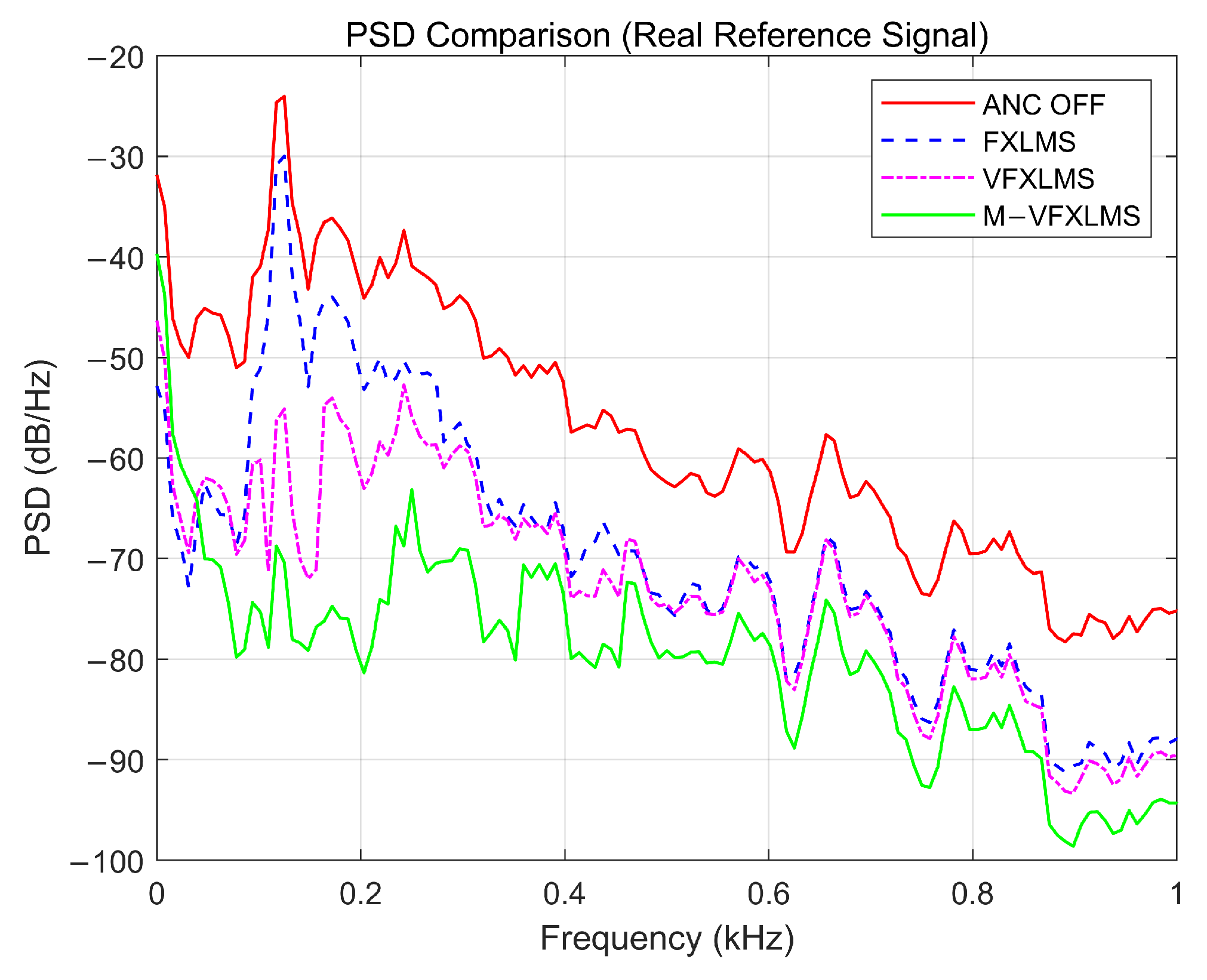
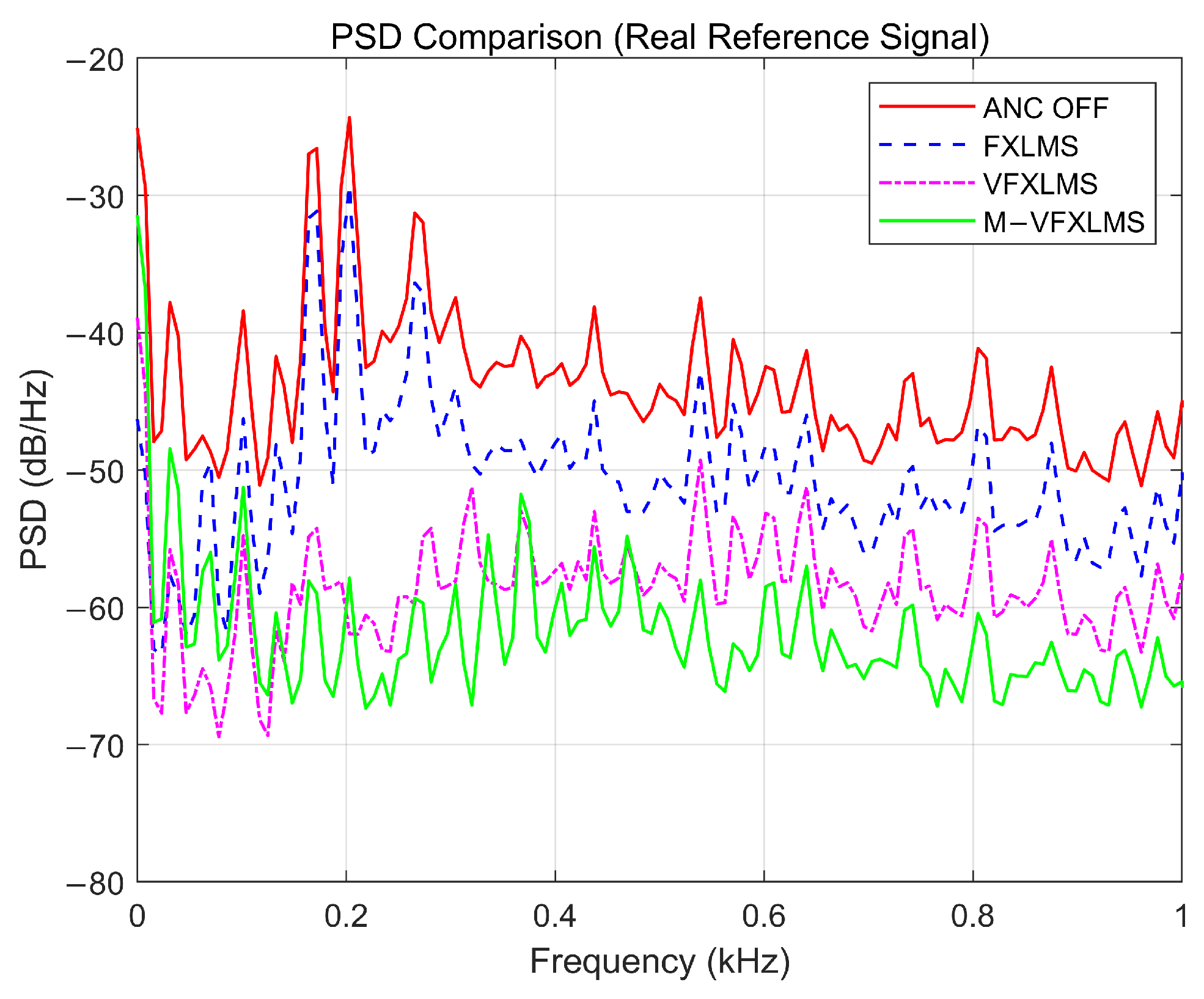
To evaluate the noise reduction performance of the proposed momentum-augmented nonlinear narrowband ANC system under typical tractor operating conditions, this study utilizes in-cabin noise signals collected under idling and loaded conditions as reference inputs for simulation. During data acquisition, two representative working conditions of the tractor were considered to reflect typical operating scenarios. In the idling condition, the engine was running at approximately 800 rpm without any external load. In the loaded condition, the engine operated under a moderate tillage load at a rotational speed of approximately 1500 rpm, with a rotary cultivator attached to simulate an actual agricultural workload. Figure 15 and Figure 16 compare the PSD results of three ANC algorithms—FXLMS, VFXLMS, and M-VFXLMS—against the ANC-OFF case, across a frequency range of 0–1 kHz.
The noise reduction performance under idling conditions is illustrated in Figure 15. The original noise exhibits distinct narrowband peaks between 100 and 300 Hz, indicating strong periodic mechanical excitations. The FXLMS algorithm achieves a limited suppression at specific frequencies, but its overall residual energy remains high due to its inability to effectively adapt to nonlinear secondary paths. The VFXLMS algorithm, which incorporates second-order Volterra modeling, shows an improved attenuation performance in the low-to-mid-frequency range, demonstrating a better nonlinear modeling capability. The M-VFXLMS algorithm, further enhanced by momentum optimization, achieves the lowest overall PSD curve across the spectrum, with a particularly notable attenuation between 200 and 800 Hz. This confirms its superior robustness and convergence in nonlinear narrowband noise scenarios under idle operation conditions.
The noise reduction performance under loaded conditions is illustrated in Figure 16.
The effectiveness of the three algorithms is again evaluated using real measured noise. The FXLMS algorithm continues to offer only marginal attenuation at selected frequencies, with a limited performance across the spectrum. VFXLMS improves upon this with a stronger suppression in the lower bands, although some residual peaks persist in the high-frequency region. The M-VFXLMS algorithm consistently outperforms both, maintaining the lowest PSD levels throughout the 0–1 kHz range. This indicates that the momentum mechanism effectively enhances both convergence rate and steady-state precision.
A comparative analysis of Figure 15 and Figure 16 under two typical operating conditions—idling and loaded—reveals that, in both scenarios, the FXLMS algorithm demonstrates a limited suppression at certain frequency points. However, due to its reliance on linear modeling, it struggles to effectively adapt to nonlinear secondary paths, resulting in a higher overall residual energy and limited noise reduction performance. The VFXLMS algorithm, incorporating a second-order Volterra structure, exhibits stronger suppression capabilities in the low-frequency band under both conditions, indicating an improved nonlinear modeling ability for narrowband noise. Nevertheless, residual peaks still persist in the high-frequency region. In contrast, the M-VFXLMS algorithm achieves the best frequency-domain noise reduction performance across both conditions. Its PSD curve consistently remains at the lowest level within the 0–1 kHz range, with a particularly significant attenuation observed between 200 and 800 Hz. This outcome confirms the notable advantages of the momentum mechanism in accelerating convergence and enhancing steady-state accuracy, thereby improving the robustness and practicality of the algorithm in complex nonlinear environments. Overall, the M-VFXLMS algorithm maintains an excellent noise suppression performance under both idling and loaded real-world noise inputs, highlighting its broad adaptability and promising engineering applicability in actual tractor operation scenarios.

4. Discussion

The proposed momentum-augmented Volterra-based M-VFXLMS algorithm demonstrates significant advantages in suppressing nonlinear narrowband noise. Extensive simulations and real-noise validations confirm the superior performance of the proposed method compared to conventional FXLMS and VFXLMS algorithms. The discussion of these findings is presented from multiple perspectives:
The M-VFXLMS algorithm integrates the nonlinear modeling capacity of Volterra filters with a momentum-based optimization mechanism. This hybrid strategy allows the system to more accurately represent nonlinear acoustic transmission paths and adapt to complex operating conditions. The momentum mechanism introduces inertia-like behavior into the weight update process by incorporating historical gradient information, which accelerates convergence and improves steady-state accuracy. This improvement is especially significant under multi-tone excitations and non-stationary noise scenarios. These findings align with previous studies such as those by Tan and Jiang, but this work extends them by enhancing convergence responsiveness through momentum augmentation.
In simulations involving second- and third-order nonlinear primary paths, the M-VFXLMS algorithm consistently demonstrated superior performance. For instance, under a 20 dB SNR, M-VFXLMS achieved a steady-state NMSE of −35 dB, outperforming VFXLMS (−27 dB) and FXLMS (−17 dB). In terms of PSD, M-VFXLMS achieved effective suppression over the 100–900 Hz frequency range, delivering a broader and deeper attenuation of residual narrowband components. Although a fixed momentum factor of  λ v o l = 0.7  was used for consistency, adaptive momentum adjustment based on error statistics or learning rate dynamics could further enhance convergence robustness in dynamic environments. This will be explored in future studies.
To evaluate the practical applicability of the proposed algorithm, real in-cabin noise signals collected from a tractor under two representative operating conditions—idling and loaded—were used as reference inputs. PSD analysis was conducted over the 0–1 kHz frequency range to compare the performance of different algorithms. The measured noise exhibited pronounced narrowband characteristics, with strong spectral peaks centered around 100–300 Hz and their harmonics, indicating typical periodic disturbances. Without active control, these narrowband components maintained high energy levels. When the M-VFXLMS algorithm was applied, the energy of multiple dominant frequency components was significantly reduced. In particular, in the 200–800 Hz range, the proposed algorithm achieved an additional attenuation of 3–5 dB compared to the VFXLMS method, highlighting its superior narrowband noise suppression capability. These results confirm the robustness and effectiveness of M-VFXLMS in mitigating periodic nonlinear disturbances in real mechanical environments, demonstrating a strong potential for practical engineering applications.
In addition to its steady-state performance, the robustness of the proposed M-VFXLMS algorithm was further evaluated under several challenging conditions. These include low-SNR environments, where the algorithm maintained a stable convergence and effective noise attenuation, as evidenced in Table 2 and Table 4. It was also tested under both second-order and high-order nonlinear primary paths, demonstrating a strong adaptability to complex acoustic transmission characteristics. Furthermore, while each tractor working condition exhibits a relatively stable frequency content, the algorithm design allows for reinitialization when switching between conditions, thereby maintaining a consistent performance. These results collectively validate the algorithm’s robustness against environmental noise, model mismatch, and nonlinearity, confirming its suitability for practical agricultural noise control applications.
In summary, the M-VFXLMS algorithm effectively combines nonlinear modeling and momentum-based adaptation, offering both theoretical significance and engineering practicality. It represents a viable and efficient solution for active noise control in nonlinear narrowband environments such as those found in modern agricultural machinery.

5. Conclusions

This study proposed an M-VFXLMS algorithm to address the challenge of suppressing nonlinear narrowband noise in tractor environments. The main findings are summarized as follows:
(1) The proposed M-VFXLMS algorithm integrates the nonlinear modeling capability of the Volterra filter with a momentum-based optimization strategy. This hybrid structure enhances the algorithm’s adaptability and modeling precision under nonlinear acoustic path conditions.
(2) Simulation results under both second- and third-order nonlinear primary paths demonstrate that the M-VFXLMS algorithm outperforms conventional FXLMS and VFXLMS methods in terms of convergence speed, steady-state error, and noise suppression accuracy. Specifically, it achieves lower NMSE and PSD levels across a range of test scenarios.
(3) When applied to measured in-cabin tractor noise under idle and loaded operating conditions, the M-VFXLMS algorithm consistently achieved the most significant attenuation of narrowband components, confirming its robustness and engineering applicability in complex mechanical environments.
In summary, the M-VFXLMS algorithm offers a promising solution for active noise control in nonlinear and narrowband noise scenarios. Its combined use of nonlinear filtering and momentum-driven adaptation provides both theoretical value and practical potential. Future research will focus on reducing its computational complexity and developing adaptive momentum tuning strategies to further improve its real-time implementation.

Author Contributions

Conceptualization, T.Z. and B.H.; Methodology, T.Z.; Software, S.Z. and B.H. Validation, Z.G. and K.S.; Writing—original draft, T.Z.; Writing—review and editing, T.Z. and B.H. All authors have read and agreed to the published version of the manuscript.

Funding

This research was funded by the National Natural Science Foundation of China under the grant number 61601140 and the Postdoctoral Initiation Foundation of Heilongjiang under the grant number 68641400.

Institutional Review Board Statement

Not applicable. For studies not involving humans or animals.

Data Availability Statement

The original contributions presented in this study are included in the article. Further inquiries can be directed to the corresponding author.

Conflicts of Interest

The authors declare no conflicts of interest.

References

  1. Mushtaq, S.A.; Dixit, J.D.; Muzamil, M.; Peerzada, H.A.; Dolma, S. Effect of tractor noise on operator and bystander’s health and its attenuation using noise protection devices. Agric. Eng. Int. CIGR J. 2025, 27, 1. [Google Scholar]
  2. Mushtaq, S.A.; Gul, A.; Dixit, J. Occupational Health Impacts of Tractor Noise and its Attenuation Through Ergonomic Interventions. J. Biosyst. Eng. 2025, 50, 225–239. [Google Scholar] [CrossRef]
  3. Han, H.W.; Kang, M.W.; Lee, S.H.; Seo, Y.H.; Cho, S.J.; Kim, J.G.; Park, Y.J. Root cause analysis of noise transfer in an entire tractor system using multi-layer operational transfer path analysis. Smart Agric. Technol. 2025, 10, 100754. [Google Scholar] [CrossRef]
  4. Barač, Ž.; Plaščak, I.; Radočaj, D.; Jurišić, M. The Impact of Noise on Agricultural Tractor Operator in Relation to Certain Operational Parameters: An Analytical Hierarchy Process (AHP) Approach. Agriculture 2025, 15, 466. [Google Scholar] [CrossRef]
  5. Santos, L.M.D.; Ferraz, G.A.S.; Batista, M.L.; Martins, F.; Barbosa, B.D. Characterization of noise emitted by a low-profile tractor and its influence on the health of rural workers. An. Acad. Bras. Ciênc. 2020, 92, e20200460. [Google Scholar] [CrossRef]
  6. Yonghui, Q. Research on Test Method of Tractor Noise Control. ACS Agric. Sci. Technol. 2016, 8, 74–77. [Google Scholar]
  7. Kaneko, M.; Saito, T. Study on Reduction of Boom Noise about a Tractor Cabin (Control of Acoustic Cavity Frequency using Acoustic Dynamic Absorber). Trans. Jpn. Soc. Mech. Eng. C 2006, 72, 765–771. [Google Scholar] [CrossRef]
  8. Guney, A. Tractor cabin interior noise control using the state-of-the-art noise and vibration measurement techniques. In Proceedings of the INTER-NOISE and NOISE-CON Congress and Conference Proceedings, Honolulu, HI, USA, 3 December 2006. [Google Scholar]
  9. Jing, X.; Zhanfeng, H.; Jianguo, Y. Noise control of small wheel tractor. J. Chin. Agric. Mech. 2015, 5, 218–220. [Google Scholar]
  10. Cerrato, G. Noise and Sound Quality Optimization of Agricultural Machine Cab. SAE Tech. Pap. 2010, 1, 13–14. [Google Scholar]
  11. Ravindran, V.; Prakash, B. Agricultural Tractor Noise Control; SAE Commercial Vehicle Engineering Congress: Rosemont, IL, USA, 1 October 2013. [Google Scholar]
  12. Kuo, S.M.; Morgan, D.R. Active Noise Control: A Tutorial Review. Proc. IEEE 1999, 87, 943–973. [Google Scholar] [CrossRef]
  13. Fuller, C.R.; Von Flotow, A.H. Active control of sound and vibration. Control. Syst. IEEE 1990, 15, 9–19. [Google Scholar] [CrossRef]
  14. Sun, M.L.; Lu, C.H.; Liu, Z.E.; Chen, W.; Shen, C.R.; Chen, H. A new feedforward and feedback hybrid active noise control system for excavator interior noise. Appl. Acoust. 2022, 197, 108872. [Google Scholar] [CrossRef]
  15. Chen, W.; Xie, L.P.; Guo, J.J.; Liu, Z.E.; Li, X.L.; Lu, C.H. A computationally efficient feedforward time–frequency-domain hybrid active sound profiling algorithm for vehicle interior noise. Mech. Syst. Signal Process. 2023, 194, 110279. [Google Scholar] [CrossRef]
  16. Shen, X.Y.; Shi, D.Y.; Gan, W.S.; Peksi, S. Adaptive-gain algorithm on the fixed filters applied for active noise control headphone. Mech. Syst. Signal Process. 2022, 169, 108641. [Google Scholar] [CrossRef]
  17. Zhang, Z.Q.; Wu, M.; Gong, C.; Yin, L.; Yang, J. Adjustable Structure for Feedback Active Headrest System Using the Virtual Microphone Method. Appl. Sci. 2021, 11, 5033. [Google Scholar] [CrossRef]
  18. Shi, D.Y.; Gan, W.S.; Lam, B.; Shen, X.Y. Comb-partitioned Frequency-domain Constraint Adaptive Algorithm for Active Noise Control. Signal Process. 2021, 188, 108222. [Google Scholar] [CrossRef]
  19. Zhang, J.H.; Zheng, C.S.; Zhang, F.J.; Li, X.D. A Low-Complexity Volterra Filtered-Error LMS Algorithm with a Kronecker Product Decomposition. Appl. Sci. 2021, 11, 9637. [Google Scholar] [CrossRef]
  20. Xiao, Y.; Wang, J. A new feedforward hybrid active noise control system. IEEE Trans. Signal Process 2011, 18, 591–594. [Google Scholar] [CrossRef]
  21. Wang, Y.S.; Liu, F.; Fu, Z.R.; Yang, L.X.; Wang, P.F. Convergence Analysis of the Phase-Scheduled-Command FXLMS Algrithm with Phase Error. Appl. Sci. 2023, 13, 8797. [Google Scholar] [CrossRef]
  22. Shen, X.Y.; Gan, W.S.; Shi, D.Y. Multi-channel wireless hybrid active noise control with fixed-adaptive control selection. J. Sound Vib. 2022, 514, 117300. [Google Scholar] [CrossRef]
  23. Shi, D.Y.; Lam, B.; Ooi, K.; Shen, X.Y.; Gan, W.S. Selective fixed-filter active noise control based on convolutional neural network. Signal Process. 2022, 190, 108317. [Google Scholar] [CrossRef]
  24. Xiao, Y.; Ikuta, A.; Ma, L.; Khorasani, K. Stochastic Analysis of the FXLMS-Based Narrowband Active Noise Control System. IEEE Trans. Audio Speech Lang. Process. 2008, 16, 1000–1014. [Google Scholar] [CrossRef]
  25. Xiao, Y.; Ma, L.; Hasegawa, K. Properties of FXLMS-based narrowband active noise control with online secondary-path modeling. IEEE Press 2009, 57, 2931–2949. [Google Scholar]
  26. Bouchard, M.; Paillard, B. Improved training of neural networks for the nonlinear active control of sound and vibration. IEEE Trans. Neural Netw. 1999, 10, 391–401. [Google Scholar] [CrossRef]
  27. Strauch, P.; Mulgrew, B. Active control of nonlinear noise processes in a linear duct. IEEE Trans. Signal Process. 1998, 46, 2404–2412. [Google Scholar] [CrossRef]
  28. Tan, L.; Jiang, J. Adaptive Volterra filters for active control of nonlinear noise processes. IEEE Trans. Signal Process. 2001, 49, 1667–1676. [Google Scholar] [CrossRef]
  29. Das, D.P.; Panda, G. Active mitigation of nonlinear noise processes using a novel filtered-s, LMS algorithm. IEEE Trans. Speech Audio Process. 2004, 12, 313–322. [Google Scholar] [CrossRef]
  30. Sicuranza, G.L.; Carini, A. Filtered-X affine projection algorithm for multichannel active noise control using second-order Volterra filters. IEEE Signal Process. Lett. 2004, 11, 853–857. [Google Scholar] [CrossRef]
  31. Lu, L.; Zhao, H. Adaptive Volterra filter with continuous lp-norm using a logarithmic cost for nonlinear active noise control. J. Sound Vib. 2015, 364, 14–29. [Google Scholar] [CrossRef]
  32. Guo, X.; Li, Y.; Jiang, J.; Dong, C.; Du, S.; Tan, L. Sparse Modeling of Nonlinear Secondary Path for Nonlinear Active Noise Control. IEEE Trans. Instrum. Meas. 2018, 67, 482–496. [Google Scholar] [CrossRef]
  33. Yu, Y.; Lu, L.; Yang, Z.X. Interpolated Individual Weighting Subband Volterra Filter for Nonlinear Active Noise Control. IEEE Trans. Circuits Syst. II Express Briefs 2023, 70, 816–820. [Google Scholar] [CrossRef]
  34. Peng, T.; Zhu, Q.; Tokhi, M.; Yao, Y. Physical configuration-based feedforward active noise control using adaptive second-order truncated Volterra filter. J. Low Freq. Noise Vib. Act. Control 2021, 40, 509–523. [Google Scholar] [CrossRef]
  35. Bai, L.; Li, M.; Lian, S.; Chen, K.; Lu, J. WaveNet-Volterra Neural Networks for Active Noise Control: A Fully Causal Approach. arXiv 2025, arXiv:2504.04450. [Google Scholar]
  36. Liu, Q.; Li, Z.; He, Y. Arobust adaptive decomposable Volterra filter based on the hyperbolic tangent Leclerc function and its performance analysis. Int. J. Adapt. Control Signal Process. 2024, 38, 2255–2271. [Google Scholar] [CrossRef]
Figure 1. Real-world connection of multi-channel acquisition system to tractor.
Agriculture 15 01655 g001
Figure 2. Multi-directional noise source localization results for tractor: (a) Distribution of left-side noise sources (red indicates high-intensity areas). (b) Energy attenuation characteristics of right-side noise sources. (c) Front-side noise radiation direction. (d) Rear-side noise diffusion range.
Agriculture 15 01655 g002
Figure 3. Schematic diagram of data acquisition equipment and standard microphone arrangement. (a) Microphone arrangement. (b) Data acquisition system.
Agriculture 15 01655 g003
Figure 4. Single-sided amplitude spectrum and power spectral density of tractor noise at the engine. (a) Single-sided amplitude spectrum. (b) Power spectral density.
Agriculture 15 01655 g004
Figure 5. Single-sided amplitude spectrum and power spectral density of noise near the tractor driver’s ear. (a) Single-sided amplitude spectrum. (b) Power spectral density.
Agriculture 15 01655 g005
Figure 6. Nonlinear NANC system based on Volterra filter.
Agriculture 15 01655 g006
Figure 7. Convergence performances of the proposed algorithm under different momentum factors  λ v o l .
Agriculture 15 01655 g007
Figure 8. Residual noise energy under different values of momentum factor  λ v o l .
Agriculture 15 01655 g008
Figure 9. Effect of momentum factor  λ v o l  on residual error energy under different step sizes.
Agriculture 15 01655 g009
Figure 10. Joint effect of momentum factor and step size on residual error energy.
Agriculture 15 01655 g010
Figure 11. Noise reduction performance under a second-order nonlinear primary path with SNR = 20 dB. (a) Power spectral density. (b) NMSE.
Agriculture 15 01655 g011
Figure 12. Noise reduction performance under a second-order nonlinear primary path with SNR = 40 dB. (a) Power spectral density. (b) NMSE.
Agriculture 15 01655 g012
Figure 13. Noise reduction performance under a high-order nonlinear primary path with SNR = 20 dB. (a) Power spectral density. (b) NMSE.
Agriculture 15 01655 g013
Figure 14. Noise reduction performance under a high-order nonlinear primary path with SNR = 40 dB. (a) Power spectral density. (b) NMSE.
Agriculture 15 01655 g014
Figure 15. PSD comparison of noise reduction algorithms using measured tractor noise under idling conditions.
Agriculture 15 01655 g015
Figure 16. PSD comparison of noise reduction algorithms using measured tractor noise under loaded conditions.
Agriculture 15 01655 g016
Table 1. Parameter settings for each algorithm in the simulation.
AlgorithmParameter Values
FXLMS L = 64 μ = 0.0006
VFXLMS L 1 = 20 ,   L 2 = 20
μ 1 = 0.0001 ,   μ 2 = 0.00009
M-VFXLMS L 3 = 20 L 4 = 20
μ 3 = 0.00001 ,   μ 4 = 0.00005
λ v o l = 0.7
Table 2. Residual PSD comparison of different algorithms at typical frequencies under second-order nonlinear path (SNR = 20 dB).
Algorithm100 Hz200 Hz300 Hz400 Hz500 Hz600 Hz700 Hz800 Hz
FXLMS54.3−38.5−48.9−30.8−24.5−35.2−41.7−33.6
VFXLMS−52.2−47.4−42.9−33.0−38.5−36.0−36.8−38.1
M-VFXLMS−54.4−64.3−55.3−59.3−52.3−44.2−43.2−40.9
Table 3. Residual PSD comparison of different algorithms at typical frequencies under second-order nonlinear path (SNR = 40 dB).
Algorithm100 Hz200 Hz300 Hz400 Hz500 Hz600 Hz700 Hz800 Hz
FXLMS−63.5−39.7−58.1−31.6−24.5−32.9−40.9−43.7
VFXLMS−54.8−47.5−43.4−36.5−37.4−35.8−42.3−35.9
M-VFXLMS−66.9−65.5−62.6−62.8−52.7−42.6−46.5−39.8
Table 4. Residual PSD comparison of different algorithms at typical frequencies under high-order nonlinear path (SNR = 20 dB).
Algorithm100 Hz200 Hz300 Hz400 Hz500 Hz600 Hz700 Hz800 Hz
FXLMS−61.1−37.5−44.2−29.2−24.6−31.0−32.4−34.2
VFXLMS−54.8−41.7−31.4−33.3−42.1−35.3−35.7−38.6
M-VFXLMS−64.3−60.3−49.2−47.6−45.9−38.9−41.1−41.1
Table 5. Residual PSD comparison of different algorithms at typical frequencies under high-order nonlinear path (SNR = 40 dB).
Algorithm100 Hz200 Hz300 Hz400 Hz500 Hz600 Hz700 Hz800 Hz
FXLMS−64.4−41.8−54.5−37.4−23.9−33.2−31.9−33.3
VFXLMS−65.4−66.7−67.3−63.2−62.6−42.8−42.6−40.1
M-VFXLMS−66.7−68.2−58.7−58.6−63.3−43.0−43.9−43.4
Disclaimer/Publisher’s Note: The statements, opinions and data contained in all publications are solely those of the individual author(s) and contributor(s) and not of MDPI and/or the editor(s). MDPI and/or the editor(s) disclaim responsibility for any injury to people or property resulting from any ideas, methods, instructions or products referred to in the content.