Article

Cost-Effective Thermal Mass Walls for Solar Greenhouses in Gobi Desert Regions

College of Horticulture, Gansu Agricultural University, Lanzhou 730070, China
*
Author to whom correspondence should be addressed.
Agriculture 2025, 15(15), 1618; https://doi.org/10.3390/agriculture15151618
Submission received: 27 June 2025 / Revised: 23 July 2025 / Accepted: 24 July 2025 / Published: 25 July 2025
(This article belongs to the Section Agricultural Technology)

Abstract

Gobi solar greenhouses (GSGs) enhance energy, food, and financial security in Gobi Desert regions through passive solar utilization. Thermal mass walls are critical for plant thermal comfort in GSGs but can lead to resource waste if poorly designed. This study pioneers the integration of payback period constrains into thermal mass wall optimization, establishing a new performance–cost trade-off approach for GSG wall design, balancing thermal performance and economic feasibility. We quantified energy-conserving benefits against wall-construction costs to derive the optimal inner-layer thicknesses under <25% GSG lifespan payback criteria. Three GSG thermal mass walls in China’s Hexi Corridor were optimized. For the concrete-layered, stone-layered, and pebble-soil walls, the optimum inner-layer thicknesses were 0.47, 0.65, and 1.24 m, respectively, with extra costs of 620.75, 767.60, and 194.56 RMB yuan; annual energy-conserving benefits of 82.77, 102.35, and 51.88 RMB yuan·yr−1; and payback periods of 7.5, 7.5, and 3.75 years. A dynamic thermal load analysis confirmed that GSGs with optimized walls required no heating during a sunny winter solstice night. Cooling loads of 33.15–35.27 kW further indicated the potential to maintain thermal comfort under colder weather conditions. This approach improves plant thermal comfort cost-effectively, advancing sustainable Gobi agriculture.

1. Introduction

Agricultural systems face significant threats from human-caused climate change, which has degraded 20–40% of global land [1]. To meet the needs of a projected 9 billion people by 2050, the agriculture sector must overcome climate crises and resource constraints for a 70% increase in food production [2].
In recent decades, intensive agricultural systems, such as greenhouses, have contributed greatly to global food production [3]. While achieving year-round production and boosting productivity, greenhouses demand 10–20 times more energy than open-field farming, mainly for heating during cold winters, cooling during hot summers, and artificial lighting [4,5]. According to statistics, heating alone constitutes >70% of the total energy consumption, primarily from unsustainable fossil fuels [2]. This high energy intensity and large capital investment limit greenhouse adoption in developing countries, especially in rural areas.
Against this background, Chinese solar greenhouses (CSGs) offer an opportunity to enhance food security while reducing energy consumption and capital investment [6,7]. Unlike conventional greenhouses, CSGs fully utilize solar energy to cope with cold durations. Their innovative design features a lightweight daylighting structure and thermal mass components that capture, store, and redistribute solar heat passively [8]. This passive agriculture system leverages free, renewable solar energy, enabling cost-effective and energy-efficient food production. Focusing solely on heating demand, conventional greenhouses consume approximately 3.6 times more energy (305.24 W/m2) than CSGs (84.26 W/m2) in northern China [9,10]. By 2022, CSGs spanned over 810,000 hectares in China, annually producing nearly 100 million tons of vegetables for domestic consumption and supporting millions of rural jobs [11].
The Hexi Corridor (92°13′–108°46′ E, 32°31′–42°57′ N) in northwestern China’s Gansu Province, a crucial segment of the Silk Road, faces severe desertification, with the Gobi Desert covering over 35% of its terrain [12,13]. Meanwhile, this region is rich in solar energy resources, with an annual cumulative sunshine duration of 2800–3300 h [14]. To derive agricultural development, local farmers have innovated Gobi solar greenhouses (GSGs), a variant of CSGs [15]. Adapted to the local environmental and economic conditions, these structures integrate soil-less culture systems with locally sourced Gobi pebble soils. This synergistic approach enables year-round crop production, generating an annual yield increase of 10–27 times and an average gross income increase of 10–30 times relative to conventional open-field production [13]. By 2023, GSGs covered 26,666.67 hectares with an annual production capacity reaching RMB 20 billion [16].
Theoretically, a well-designed GSG can maintain a favorable microclimate for crops without auxiliary heating at 40° latitude [17]. However, an indoor air temperature of below 10 °C occurs frequently in GSGs during the cold seasons (from November to April) of the Hexi Corridor, which inhibits the growth of thermophilic crops, such as tomato, cucumber, and pepper [18,19]. This issue arises from a poor structural design and extensive management practices, as the design and management of most GSGs rely on farmer experience rather than scientific, quantitative guidelines. Similar challenges affect CSGs in other regions.
The undesirable indoor temperature environment encourages agricultural practitioners to optimize greenhouse structures, enhance management practices, or add auxiliary heating, though the latter inevitably increases costs and environmental impacts. Supporting this, Decano-Valentin et al. [20] demonstrated economic losses and >86% environmental burden contributions from three greenhouse heating systems (thermal effluent absorption pumps, electric heat pumps, and kerosene boilers) throughout their life cycles. Although solar-based solutions like photovoltaic systems and phase-change materials offer fossil fuel substitution potential, their feasibility requires rigorous economic and environmental assessments [21,22]. Consequently, passive solutions have emerged as a prioritized solution across developing regions: Zhang et al. [15], Huang et al. [9], and Ghasemi Mobtaker et al. [23] highlighted the thermal mass wall as key to maintaining plant thermal comfort during cold periods, using numerical simulation, analytical solution, and steady-state analysis, respectively. In Jiuquan City, China, heat energy coming from the thermal mass walls offsets 22–53% heat loss of the greenhouse spaces [15]; in Jinan City, China, the heat from the thermal mass walls offsets 15% heat loss [9]; and in Tabriz, Iran, a thermal mass wall reduced the greenhouse heating demand by >30% [23]. These walls functioned through diurnal heat storage/release and thermal insulation: for the former, the wall stored solar energy in the form of heat during the daytime and then released heat to warm the greenhouse space during cold nights; for the latter, the wall minimized heat transfer between the interior and exterior environments.
GSG thermal mass walls typically feature trapezoidal cross-sections with layered construction: an inner layer functioning as both a thermal regenerator and load-bearing member, and an outer layer of loosely compacted Gobi pebble soils. While GSG operators in the Hexi Corridor empirically increased the wall thickness to enhance thermal performance marginally and prevent chilling injuries, this approach disproportionately raised construction costs. Therefore, a comprehensive method quantifying both the thermal performance and construction costs of the thermal mass wall is essential to evaluate the technical–economic feasibility and optimize GSG design efficiency.
In the scope of building thermal design, the steady-state and unsteady-state methods are widely used for assessing the building envelope thermal performance. Based on the steady-state method, the current Chinese civil building code prescribes thermal resistance values for opaque walls under different production scenarios, where thicker walls generally increase thermal resistance and insulation [24]. However, the unsteady-state heat transfer behavior of thermal mass walls is critical for GSGs, as thermal storage/release determines plant thermal comfort in the cold nighttime beyond mere insulation. Case studies have demonstrated unsteady-state solutions: Li et al. [25] analytically modeled heat transfer through a thermal mass wall in Lhasa, and optimized its thermal resistance and heat capacity to balance thermal storage/release and insulation performance; Wang et al. [26] numerically investigated the dynamic thermal performance of CGS walls in Xuzhou City and identified 1.1-m-thick soil wall as the most feasible solution; using data mining techniques, Briga-Sá et al. [8] developed a predictive model for indoor temperature and wall surface heat flux in a Trombe wall of specific dimensions: trained on high-frequency (30-s intervals) data, including indoor/outdoor temperatures, wall surface temperatures, heat flux, and solar radiation, the model enabled the rapid evaluation of the wall thermal performance.
The abovementioned thermal resistance and heat capacity depend on the wall thickness and materials. However, the asymmetric trapezoidal geometry of the GSG walls complicates the determination of the wall equivalent thickness. Numerical approaches are compute-intensive and prove impractical, while data-mining approaches require huge volumes of measured data. To address these limitations, the authors [27] presented a simplified heat-transfer calculation method for a trapezoidal cross-sectional wall, based on four principles: (1) the decomposition of arbitrary thermal excitations into sinusoidal components; (2) the dynamic thermal system associated to a thermal mass wall was linear; (3) the wall response to the sinusoidal input was frequency-dependent but time-invariant in linear systems; and (4) a linear system followed the superposition principle. This method enabled the rapid determination of dynamic heat transfer and thermal performance for GSG walls.
To enhance the technical–economic feasibility, besides wall thermal performance, a reliable analysis of GSG wall construction costs is needed. In energy economics, the principle is to maximize the effect at minimal cost [28,29,30]. For GSG walls, increasing the thickness raises construction costs but enhances energy conservation and reduces heating demand. Thus, an optimal technical–economic thickness for GSG walls exists. To optimize the technical–economic feasibility, this study develops a thermal performance–cost trade-off approach for GSG walls based on the simplified heat-transfer calculation method for trapezoidal cross-sectional walls. The extra cost and energy-conserving benefit attributable to various inner wall thicknesses are quantified. Under the constrained payback period, the approach identifies the optimum inner layer thickness of GSG walls, balancing energy conservation and economic feasibility. This approach contributes to achieve energy reduction and plant thermal comfort cost-effectively, thereby improving GSG design efficiency and promoting sustainable Gobi agriculture development.

2. Materials and Methods

2.1. Description of GSGs

2.1.1. Construction Site

The GSGs for technical–economic optimization were located in Dongdong town, Suzhou district, Jiuquan City (98°30′ E, 39°42′ N, altitude 1655 m), in the middle of the Hexi Corridor. The region exhibits a temperate continental climate with pronounced seasonal variation (hot summers, cold winters) and abundant solar radiation. Mean annual and winter temperatures are 7.3 °C and −7.1 °C, respectively, with approximately 150 frost-free days annually. The cumulative solar radiation exceeds 6.1 GJ m−2 yr−1, and the annual sunshine duration reaches approximately 3000 h. Despite minimal precipitation, irrigation agriculture is sustained by the Heihe River, fed by Qilian Mountain glacial meltwater [31].
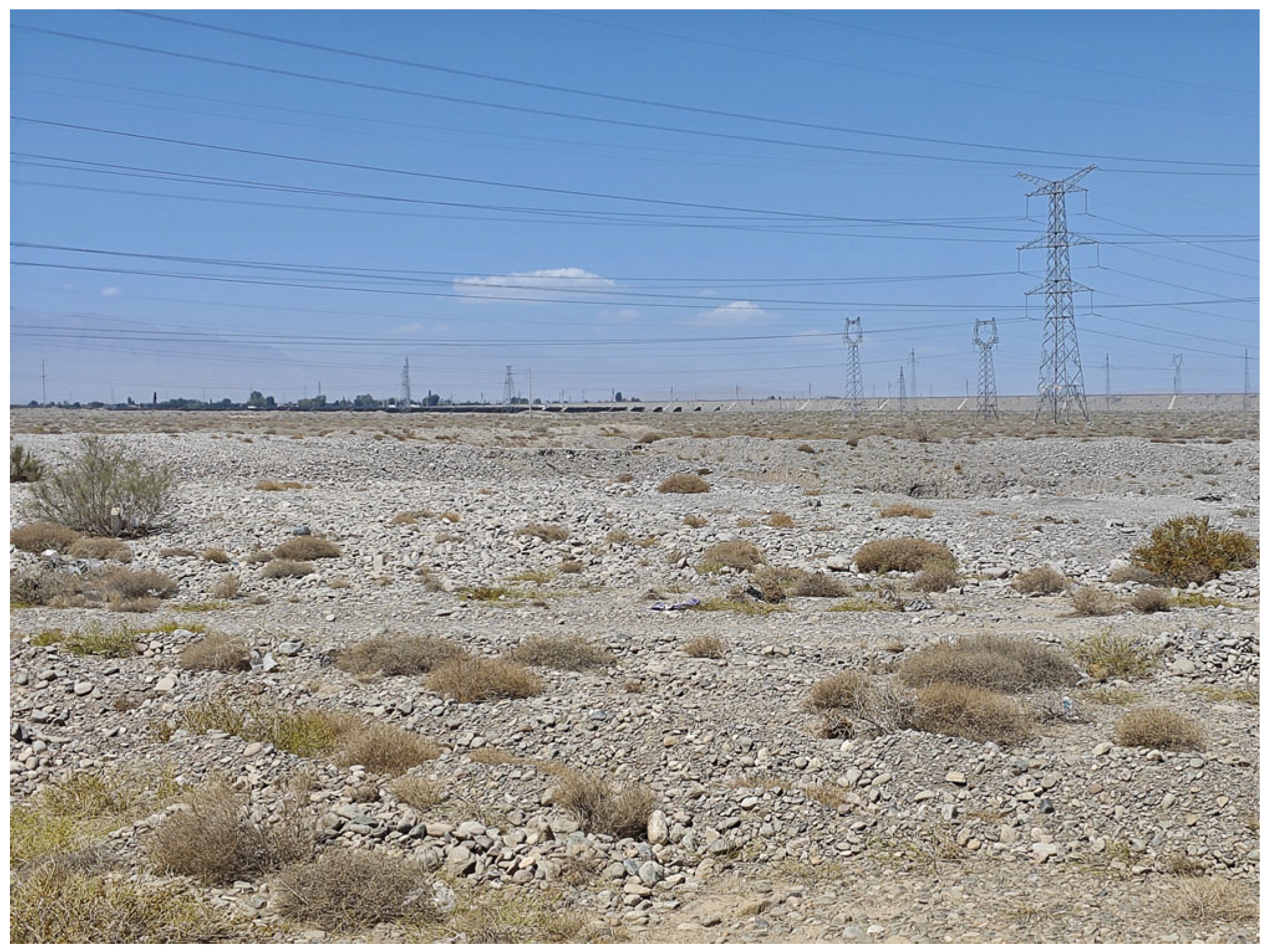
Jiuquan’s landscape is dominated by Gobi-oasis systems, with Dongdong Town bordering the expansive Gobi Desert (93% coverage). Geological surveys classify the site as semi-decertified pebble terrain, featuring shallow soils composed of grey pebbles (20–200 mm diameter; max 500 mm), interspersed with coarse sand, gravel, and trace clayey sediments (Figure 1) [32].

2.1.2. Details of the GSG Walls

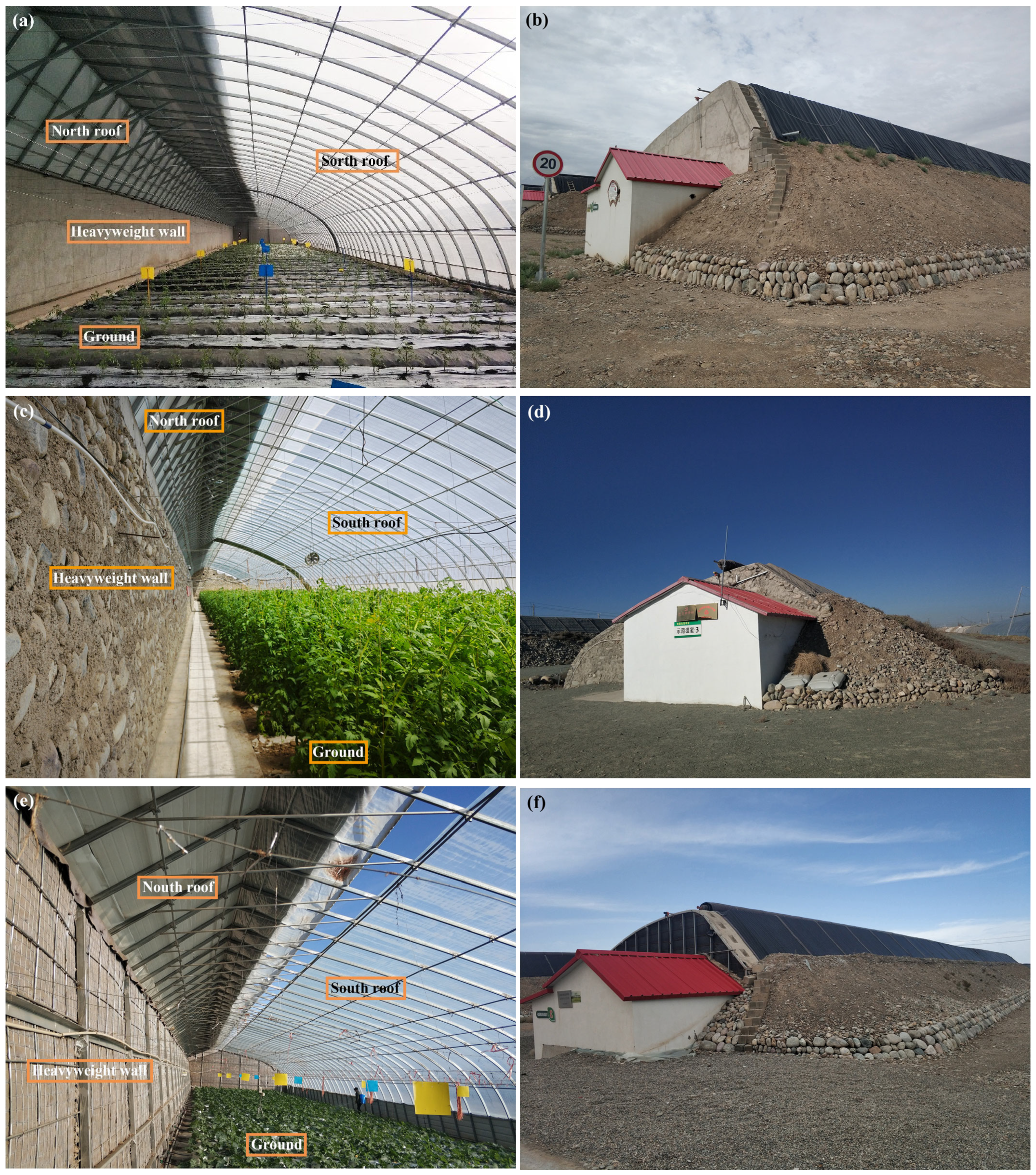
The studied GSGs had distinct regional characteristics. These structures were constructed on a semi-decertified pebble soil substrate, with a primary south–north orientation to maximize solar capture. The standardized design parameters included a 10 m span and a 4.9 m ridge height. Figure 2 shows the internal and external views of GSGs with different walls.
As shown in Figure 2, the GSG comprised four functional modules: (1) South roof. The south roof was constructed with an arched steel framework and was covered by a high-transparency polyolefin film (light transmittance >0.9) for daylighting, complemented by a retractable thermal blanket for nocturnal insulation; (2) North roof. The north roof was constructed with a 0.15-m-thick polystyrene insulation board (heat transfer coefficient: 0.26 W·m−2·K−1); (3) Ground. To address the limited cultivated-soil availability, the ground module incorporated solid substrate cultivation, with distinct planting (solid substrate) and aisle (trapezoidal) zones; and (4) Wall. Serving dual roles as a thermal regenerator and supporting member, the GSG wall was critical for maintaining thermal comfort and structural stability. Currently, the most common designs included concrete-layered, stone-layered, and pebble-soil walls, all featuring trapezoidal cross-sections and utilizing locally sourced Gobi pebble soils (Figure 2). However, no standardized thickness specifications exist for these structural configurations. The details of these wall systems are introduced below.
Concrete-Layered Wall
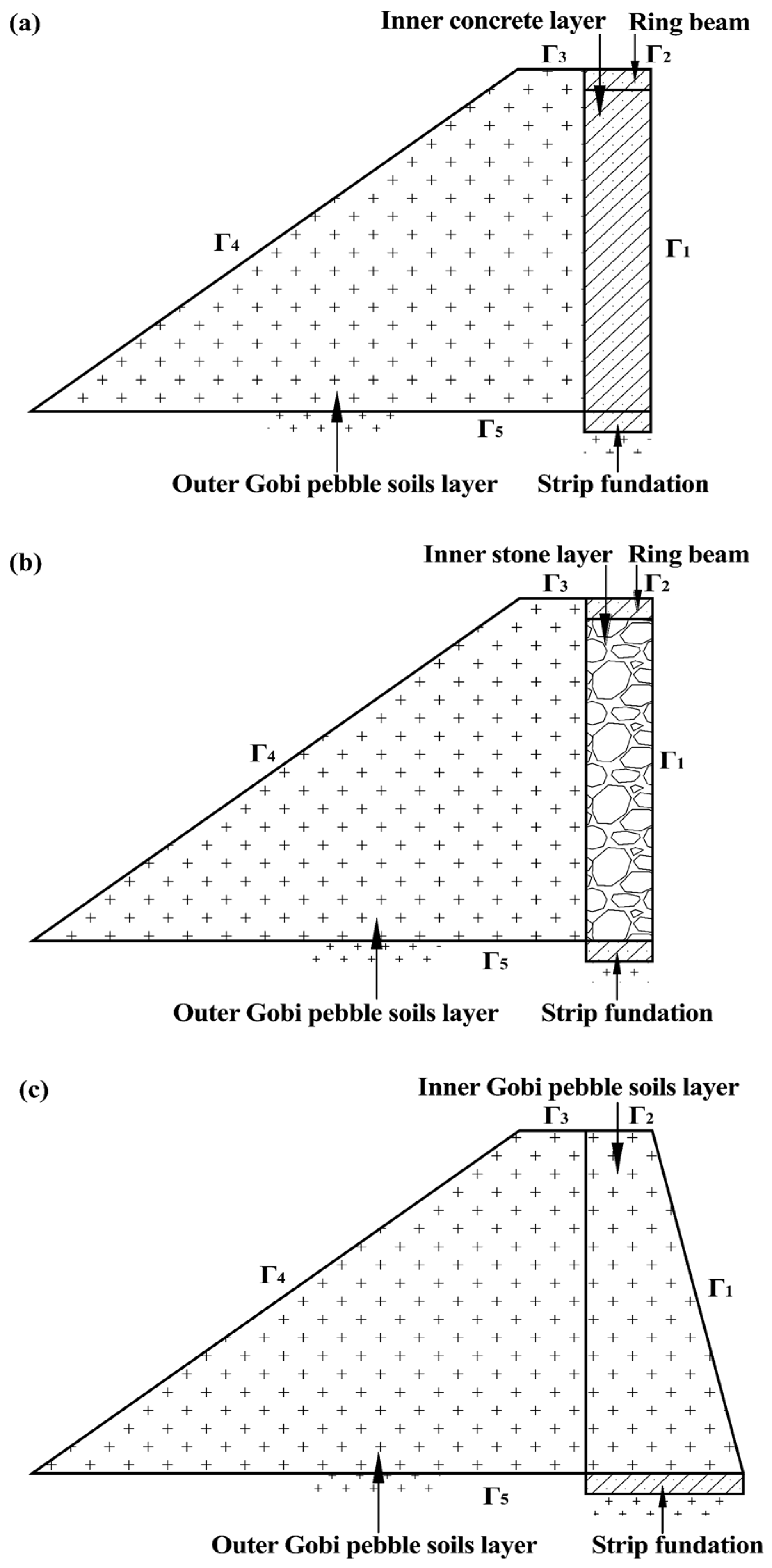
The concrete-layered wall consisted of two layers (Figure 3a): (1) an inner load-bearing layer of reinforced concrete (3.3 m height above grade, 0.3–1.5 m thickness), with a strip foundation below grade and a ring beam along the top edge of the wall (both 0.2 m height, matching wall width); and (2) an outer thermal-preservation layer of loosely compacted Gobi pebble soils, forming a trapezoidal cross-section (3.3 m height, 0.6 m top width, 5.0 m base width).
Stone-Layered Wall
The stone-layered wall consisted of two layers (Figure 3b): (1) an inner load-bearing layer of grouted Gobi pebbles (200–500 mm diameter) forming a rectangular cross-section (3.3 m height above grade, 0.6–1.5 m thickness), strengthened by a reinforced concrete strip foundation and ring beam (both 0.2 m height, matching wall width); and (2) an outer thermal-preservation layer of Gobi pebble soils with identical trapezoidal geometry (3.3 m height, 0.6 m top width, 5.0 m base width) to the concrete-layered wall.
Pebble-Soil Wall
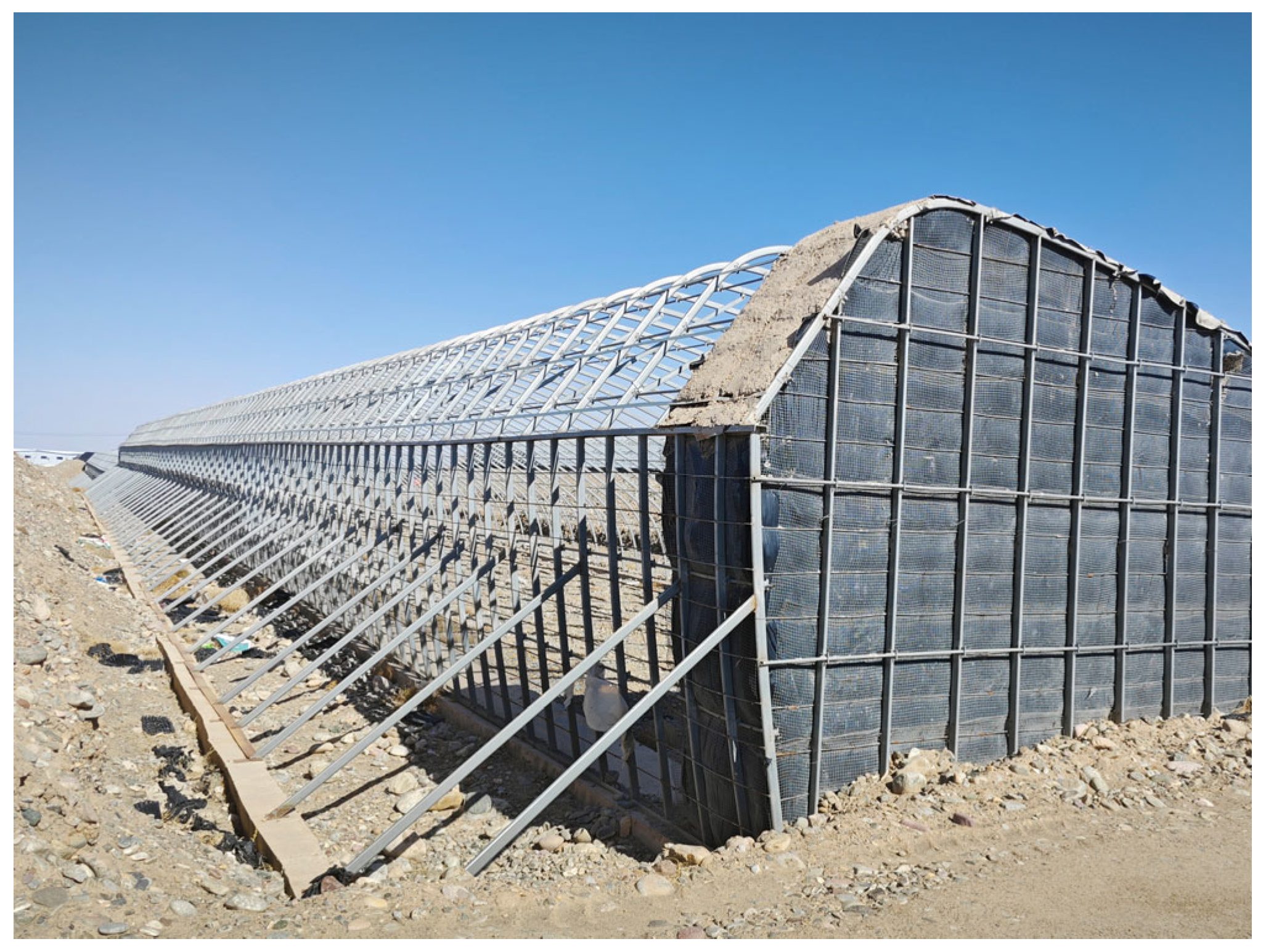
The pebble-soil wall was constructed by infilling a metal framework with locally sourced Gobi pebble soils (Figure 2e,f). Unlike cast-in-place concrete and masonry structures, the pebble-soil wall fill might experience gravitational settlement during operation. Thus, the internal surface of the pebble-soil wall was designed with a sloped profile to enhance the structural stability. The structural framework consisted of: (1) an upper and a lower steel channel (C100 mm × 50 mm × 5 mm) running longitudinally along the greenhouse; (2) multiple vertically oriented oval steel tubes (80 mm × 30 mm × 2.5 mm) connecting the channels with 1.8-m spacing; and (3) two parallel circular steel tubes (Φ25 mm × 2.5 mm) horizontally linking the oval tubes at 1.1 m and 2.2 m elevations. This assembly formed an 86° inclined internal surface, strengthened with steel mesh and black UV-stabilized geotextile to retain the filled Gobi pebble soils. Additional stability was achieved through diagonal bracing (40° inclination, 1.8 m spacing) using oval steel tubes (80 mm × 30 mm × 2.5 mm). The complete framework was anchored to a strip foundation prior to the mechanical filling of Gobi pebble soils using excavators. Figure 4 details the metallic structural configuration, highlighting the integration of load-bearing and retaining components.
The pebble-soil wall was functionally stratified into two structural layers (Figure 3c): (1) an inner load-bearing system comprising the primary metal framework and strip foundation, forming a right-trapezoidal section (3.3 m vertical height, 0.6–1.5 m average thickness); and (2) an outer thermal-preservation layer of loosely compacted Gobi pebble soils, maintaining geometric consistency with the concrete- and stone-layered GSG wall designs.

2.2. Thermal Performance–Cost Trade-Off Approach of the GSG Walls

Given that the three most common GSG wall types shared identical outer layers composed of loosely compacted Gobi pebble soils, the inner layer’s design emerged as the critical determinant of overall wall performance in both the technical and economic dimensions. The objectives of this section were to quantify the thermal performances and construction costs associated with these wall systems, and to determine the optimum inner-layer thickness that achieved an equilibrium between energy conservation and affordability.

2.2.1. Quantitative Estimation of the Wall Thermal Performance

During cold seasons, the GSG wall served as a thermal regenerator for passive solar utilization. Diurnal solar radiation transmitted through the transparent film covered on the south roof was absorbed by the wall’s internal surface and stored in the wall body, and the stored heat was released into the greenhouse space to offset greenhouse envelope losses in cold durations (mainly at night). The wall’s internal surface served as the primary heat exchange interface, enabling the quantitative thermal performance evaluation of the wall through the analysis of its dynamic heat transfer behaviors.
This study implemented Zhang et al.’s [27] simplified heat transfer calculation approach for trapezoidal cross-sectional walls, which employed a two-dimensional frequency-domain finite element (FDFE) methodology and demonstrated superior accuracy (RMSE < 19 W·m−2 and R2 > 0.9678) against measured surface heat fluxes. As shown in Figure 3, each greenhouse wall’s geometry was discretized into five boundary segments (Γ1, Γ2, Γ3, Γ4, Γ5), where the internal surfaces Γ1 and Γ2 interfaced with the indoor air, the external surfaces Γ3 and Γ4 with the outdoor air, and the bottom surface Γ5 with the underlying Gobi soils. The temperature evolution within the wall cross-section Ω was governed by the two-dimensional transient heat conduction partial differential equation (Equation (1)), the boundary condition equations (Equations (2) and (3)), and the initial condition equation (Equation (4)):
ρ c p T t   =   λ · T   in   Ω ,
λ T · n ^ = h d T T s a _ d     o n   Γ d           d = 1 ,   2 ,   3 ,   4
T = 10     o n   Γ d             d = 5 ,
T = T x ,   y     w h e n   t = 0 ,
where ρ, cp, and λ were the bulk weight, specific heat, and thermal conductivity of the wall material, respectively; T was temperature; t was time; (x, y) denoted the space coordinates. In Equation (3), T = 10 represented the temperature of the bottom surface Γ5. This constant temperature layer (10 °C) commonly existed at a depth of 0.6 m beneath the greenhouse floor [9,33].
For each boundary segment, the sol-air temperature Tsa, integrating solar radiation, heat convection, and long-wave radiation, was defined as follows:
T s a = T a + α I s ˙ I r ˙ / h ,
where Ta denoted the ambient air temperature; I s ˙ and I r ˙ denoted the solar radiation and net long-wave radiation densities reaching the surface, respectively; α was the solar radiation absorptivity factor. The adopted α was 0.73 for all surfaces expect the internal surface of the pebble-soil wall, where α equaled 0.9 due to its dark-colored surface. The combined surface heat transfer coefficients h were specified as 10.62, 16.96, and 2.08 W·m−2·K−1 for the internal, external, and bottom surfaces, respectively. Using the discrete Fourier series (DFS) method, the time series Tsa could be decomposed into sinusoidal components:
T s a = κ = 0 F A M κ · cos ω κ t + P A κ ,
where F denoted the total number of sinusoids, which equaled (S/2-1), with S being the sampling number. ω, AM, and PA represented the angular frequency, amplitude, and phase angle of the κ-th sinusoid, respectively.
The FDFE model was subsequently constructed. For each GSG wall, the FDFE model was constructed through cross-sectional triangulation, nodal numeration, variational formulation of the heat equation, and algebraic equation assembly (see reference [27] for implementation details).
Subsequently, the frequency-domain formulation of the thermal system of the wall was expressed through the complex-valued matrix equation:
K u T + j ^ v T + W u T + j ^ v T ω j ^ = u p + j ^ v p ,
where K and W were the stiffness and mass matrices, respectively, with elements determined by material properties and space coordinates; ω denoted angular frequency; u p + j ^ v p denoted the complexified sinusoids from the input excitation; u T + j ^ v T contained the nodal responses of the wall.
The thermal response characteristics could be determined through harmonic analysis by applying a unit–amplitude sinusoidal excitation at the wall surface. Solving the governing equation (Equation (7)) yielded the complex temperature field u T + j ^ v T across the wall cross-section. From the nodal solutions at the internal surface, three key thermal performance parameters were derived: frequency-dependent amplitude-damping factor γ, time lag ψ characterizing the thermal mass effect, and zero-frequency heat transfer resistance R. These parameters were computed for each angular frequency component extracted from the actual boundary thermal excitations. The complete dynamic thermal response was then reconstructed through inverse DFS with spectral superposition:
T ( x , y , t ) = κ = 0 F A M κ γ κ · cos ω κ t + P A κ ψ κ .
Finally, the dynamic heat flow qw (W) at the internal surface of the wall was calculated via Newton’s law of cooling:
q w t = A q 2 ˙ t + q 3 ˙ t + q 4 ˙ t + q 5 ˙ t q 1 ˙ t ,
where A was the area of the wall internal surface. q 1 ˙ , q 2 ˙ , q 3 ˙ , q 4 ˙ , and q 5 ˙ (W·m−2) were the internal surface heat fluxes generated by the thermal excitations in surface Γ1, Γ2, Γ3, Γ4, and Γ5, respectively. In which
q 1 ˙ t = A M 1 _ 0 R 1 + h 1 κ = 1 F 1 A M 1 _ κ cos ω 1 _ κ t + P A 1 _ κ A M 1 _ κ γ 1 _ κ cos ω 1 _ κ t + P A 1 _ κ ψ 1 _ κ ,
q 2 ˙ t = A M 2 _ 0 R 2 + h 1 κ = 1 F 2 A M 2 _ κ γ 2 _ κ cos ω 2 _ κ t + P A 2 _ κ ψ 2 _ κ ,
q 3 ˙ t = A M 3 _ 0 R 3 + h 1 κ = 1 F 3 A M 3 _ κ γ 3 _ κ cos ω 3 _ κ t + P A 3 _ κ ψ 3 _ κ ,
q 4 ˙ t = A M 4 _ 0 R 4 + h 1 κ = 1 F 4 A M 4 _ κ γ 4 _ κ cos ω 4 _ κ t + P A 4 _ κ ψ 4 _ κ ,
q 5 ˙ t = A M 5 _ 0 R 5 ,
where ω, AM, PA, and F in each equation were extracted from the sol-air temperature–time series of the five surfaces using the DFS method. When the final qw was positive, the wall released heat to warm the greenhouse space, whereas a negative qw indicated that the wall absorbed heat and cooled the space.
The thermal mass walls play a critical role in maintaining GSG functionality during cold seasons through diurnal heat storage and nocturnal release. However, due to conductive losses through the wall, the net heat flow available for greenhouse space heating represents only a fraction of the total absorbed solar energy. Thus, the daily total released heat Q (MJ·d−1), quantified as the time-integrated heat released into the greenhouse space across the interior surface in one day, serves as the primary index for evaluating the wall thermal performance:
Q = t 1 t 2 q w t / 10 6 ,
where t1 and t2 are the beginning and end times of the heat release duration during a day, respectively. Δt is the sampling interval.

2.2.2. Cost Estimation of the GSG Walls

The construction of GSG walls followed a standardized sequence of civil engineering operations: (1) site grading and levelling; (2) foundation excavation and preparation; (3) structural reinforcement assembly; (4) concrete casting; (5) stone masonry work; (6) structural metal working; and (7) back-filling. Each construction phase required labor, materials, and machinery, which were collectively termed the production inputs. The direct costs associated with these inputs were derived from the standardized construction quota databases published by the local construction department. For the economic analysis, we defined the extra cost of increased inner layer thickness as the primary economic performance index.
Extra Cost Estimation of the Concrete-Layered Wall
For the concrete-layered wall, increasing the inner layer thickness directly impacted four primary construction cost components: site levelling, foundation excavation, reinforcement assembly, and concrete casting. Thus, the extra cost could be expressed as:
C o s t e x = C L + C E + C C + C R .
The extra cost of site levelling CL:
C L = L · d · p L ,
where L was the wall length in the east–west direction; d was the inner layer thickness of the wall; pL was the price of mechanical site levelling.
The extra cost of foundation excavation CE:
C E = 0.2 · L · d · p E ,
where 0.2 was the depth of excavation, meters; pE was the price for Gobi pebble soil excavation.
The extra cost of concrete placement CC:
C C = 0.2 · L · d · p C F + 3.1 · L · d · p C W + 0.2 · L · d · p C B ,
where pCF, pCW, and pCB were the prices of the concrete castings of the strip foundation (0.2 m height), wall body (3.1 m height), and ring beam (0.2 m height), respectively.
The extra cost of the reinforcement assembly CR:
C R = 0.2 · L · d · 0.25 % + 3.1 · L · d · 0.15 % + 0.2 · L · d · 0.25 % · 7.85 · p R ,
where the three terms on the right-hand side denoted the reinforcement in the strip foundation, wall body, and ring beam, respectively, with reinforcement ratios of 0.25%, 0.15%, and 0.25%, respectively [34]. pR was the price of reinforcing bars. The density of the reinforcing bar was 7.85 t·m−3.
Extra Cost Estimation of the Stone-Layered Wall
For the stone-layered wall, increasing the inner layer thickness directly impacted five primary construction cost components: site levelling, foundation excavation, reinforcement assembly, concrete casting, and stone masonry. Thus, the extra cost could be expressed as:
C o s t e x = C L + C E + C C + C R + C S ,
where the costs of site levelling CL and foundation excavation CE could be calculated using Equations (17) and (18), respectively.
The extra cost of the concrete casting CC incurred in the construction of the strip foundation and ring beam was as follows:
C C = 0.2 · L · d · p C F + 0.2 · L · d · p C B .
Correspondingly, the extra cost of the reinforcement assembly CR:
C R = 0.2 · L · d · 0.25 % + 0.2 · L · d · 0.25 % · 7.85 · p R .
The extra cost of the stone masonry CS incurred in the wall body construction:
C S = 3.1 · L · d · p S ,
where pS was the price of stone-laying.
Extra Cost Estimation of the Pebble-Soil Wall
For the pebble-soil wall, increasing the inner layer thickness directly impacted five primary construction cost components: site levelling, foundation excavation, strip foundation pouring, wall body-filling, and structural metal installation. Thus, the extra cost of the pebble-soil wall was:
C o s t e x = C L + C E + C C + C R + C W + C M .
It should be noted that the inner layer of the pebble-soil wall had a right trapezoidal cross section with a right-side base angle of 86° (Figure 3c). Thus, the extra costs of the site levelling CL and foundation excavation CE can be calculated as follows:
C L = L · d + 3.3 · cos 86 ° 2 · p L ,
C E = 0.2 · L · d + 3.3 · cos 86 ° 2 · p E ,
where d was the average thickness of the inner wall layer, and 3.3 denoted the vertical height of the wall, meters.
The extra costs of the concrete casting CC and reinforcement assembly CR incurred in strip foundation pouring were as follows:
C c = 0.2 · L · d + 3.3 · cos 86 ° 2 · p C F ,
C R = 0.2 · L · d + 3.3 · cos 86 ° 2 · 0.25 % · 7.85 · p R .
The extra cost of wall body-filling CW:
C W = 3.3 · L · d · p E .
The price of wall-body filling was equivalent to the excavation cost of Gobi pebble soils, as the fill material was sourced directly from onsite excavation with no additional material procurement or transportation expenses.
For the structural metal working, only the quantity of the bracing oval steel tubes (80 mm × 30 mm × 2.5 mm) to support the metal framework varied with the inner layer thickness of the pebble-soil wall (Figure 4). Therefore, the extra cost of the structural metal working CM can be calculated as:
C M = L / 1.8 · 1.23 d · 4.8263 · p M / 1000 ,
where (L⁄1.8) was the number of oval steel tubes, 1.23d was the length of each oval steel tube obtained using the law of sine, and PM was the price of the metal structure manufacturing and installation. The weight of the oval steel tube was 4.8263 kg·m−1.

2.2.3. Determination of the Optimum Size of the GSG Wall

After defining the evaluation indices of the thermal and economic performances of the GSG walls, an optimization approach was formulated in this section to determine the optimum thickness of the inner layer of the GSG walls to enhance their energy conservation performance in an economical manner.
Saved Heat Quantity for Warming the Greenhouse Space
Under conditions where passive heat release from greenhouse walls proves insufficient to maintain plant thermal comfort, auxiliary heating systems become necessary, incurring additional energy consumption and increased costs. Several studies [26,35] demonstrated that an increased wall thickness enhanced heat storage and release capacity, facilitating more solar heat to be transferred from daytime to cold nighttime, thereby improving the energy conservation potential of the greenhouse and reducing the heating demand. This energy conservation potential enhancement can be quantified as the saved heat quantity Qsa attributable to the increased inner layer thickness: the total released heat difference between walls with an inner thicknesses of d meters and 0 m. In one day, Qsa (MJ·d−1) can be expressed as:
Q s a = t 1 t 2 q w t / 10 6 ,
where Δqw was the difference between the internal surface heat flows of the two walls.
Energy-Conserving Benefit Function
The saved heat quantity attributable to the increased inner-layer thickness must be converted to energy-conserving benefits, expressed in monetary terms, to match the economic index. This conversion was achieved through:
C o s t s a = Q s a · e / 3.6 ,
where e (RMB yuan·kWh−1) was the local electricity price.
According to the expressions for the extra cost of the wall in Section 2.2.2, two independent variables—the inner layer thickness d and wall length L—affected the economic performance of the GSG wall. However, Equations (9)–(14) showed that the daily saved heat quantity Qsa of the wall exhibited a complicated nonlinear relationship with multiple geometric and thermal parameters. Therefore, it was necessary to highlight the relationship between Qsa and the geometric parameters of the wall. A simple expression was established by curve fitting, in which Qsa was exponentially related to the inner surface thickness d and linearly related to the wall length L as follows:
Q s a = i a i e x p ( b i d ) L ,
where a and b were fitted parameters.
Then the corresponding daily energy-conserving benefit can be expressed as:
C o s t s a = i a i e x p b i d · L · e / 3.6 .
Payback Period
Having determined the extra cost associated with the increased inner layer thickness and the corresponding energy-conserving benefits, the payback period Y, which was the time that the wall will take for the energy savings accrued during the greenhouse operation phase to recover the extra cost, can be estimated as follows:
Y = C o s t e x / C o s t s a .
By substituting Equations (16), (21), (25), and (35) to Equation (36), the wall length L could be eliminated, and there were two independent variables in the payback period equation: inner layer thickness d and payback period Y.
The Final Optimum Approach
A reasonable payback period should not exceed a quarter of the lifetime of a building [30]. In general, the lifetime of a GSG is 30 years. Therefore, the optimization framework targeted a thickness range of the inner wall layer that satisfied a payback period of ≤7.5 years (25% of the GSG’s 30-year design time). Subsequently, economically feasible configurations were evaluated for their total released heat and energy-conserving benefits, to identify the optimum inner-wall-layer thickness that balances energy conservation and cost-effectiveness.

2.3. Simulation

Simulations were conducted to determine the optimum thickness of the inner layer of the three types of GSG walls based on the climate and economic situation in Jiuquan City in 2023–2024.

2.3.1. Data About the Simulation

Meteorological Data
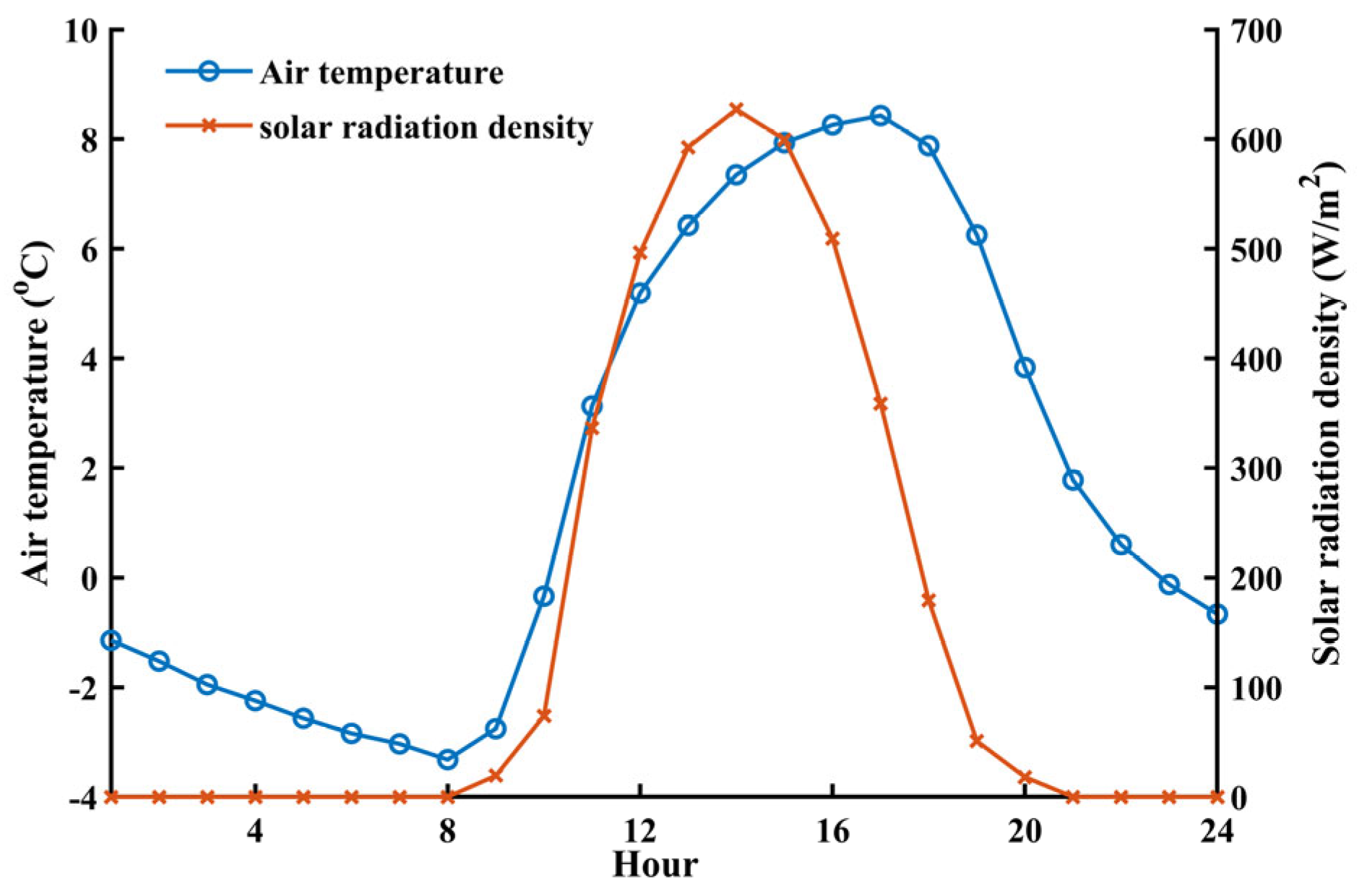
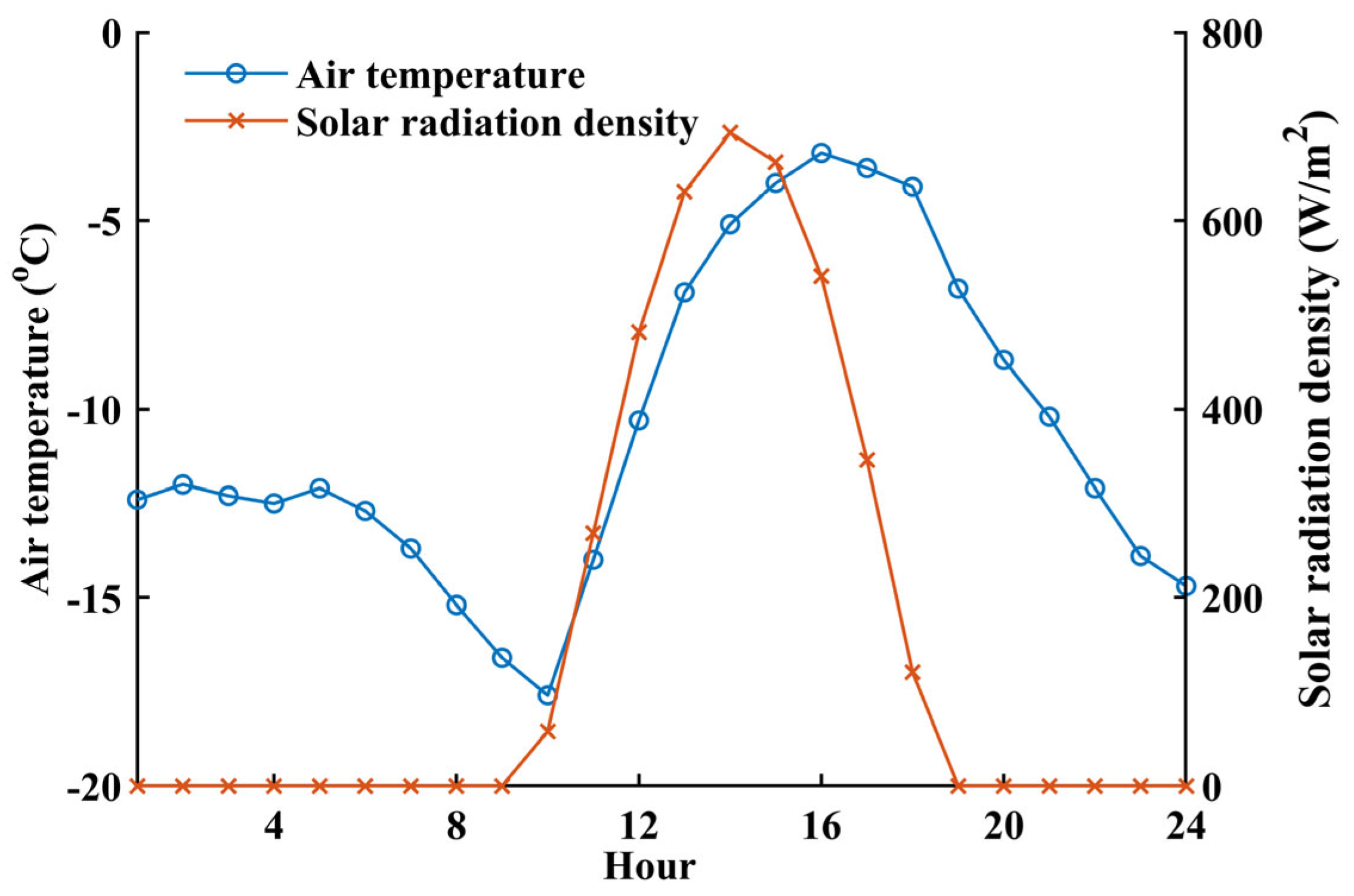
Given that the study area had a frost-free period of approximately 150 days, open-field crops were stressed by chilling injuries during the remaining 200 days. During these 200 days, the thermal mass wall ensured GSG production without auxiliary heating, by storing and releasing solar heat periodically. Therefore, meteorological data from 15 October 2023 to 15 May 2024 (212 days) in Jiuquan City were collected. This duration covered the entire frost period. The meteorological data included indoor and outdoor air temperatures and solar radiation reaching each surface of the greenhouse wall. The indoor air temperature was set at 25 °C in the daytime and at 15 °C in the nighttime, representing a standard design temperature range for most horticultural crops [9]. The outdoor air temperature was measured using a temperature data logger EL-USB-1-PRO (LASCAR Electronics Inc., Whiteparish, Britain), which has an accuracy of ±0.2 °C, recording at 1-h intervals. Solar radiation data were calculated using the CSG light environment model (MPE < 10.3% and R2 = 0.9756) developed by Zhang et al. [36]. The 212-day hourly meteorological dataset was processed to derive 24-h mean profiles of air temperature and solar radiation, generating a characteristic daily cycle representative of the mean cold-season microclimate in Jiuquan City (Figure 5).
Thermophysical Properties of Materials
The materials that affected the thermal performance of the studied GSG walls included reinforced concrete, stone, and Gobi pebble soils. The thermophysical properties of the first two materials were obtained from the literature [24,37]; and those of the last material were tested in a laboratory. The relevant data are presented in Table 1.
Price Data
The price data used in this study were collected from construction project quota files published by local construction departments [38]. The relevant data are presented in Table 2. Each price considered labors, materials, and machinery consumptions.

2.3.2. Functions of Simulation

For each type of GSG wall studied, an extra cost function and an energy-conserving benefit function were finally established. The wall length L and inner layer thickness d were the variables of all the functions.
For the concrete-layered wall, its extra cost function was:
C o s t e x = 1323.2 · L · d .
Its energy-conserving benefit function was:
C o s t s a = 71.2 · exp 0.3208 · d 71.2 · e x p 36.61 · d · L .
For the stone-layered wall, the extra cost and energy-conserving benefit functions were:
C o s t e x = 1185.3 · L · d ,
C o s t s a = 85.6 · exp 0.2759 · d 85.6 · e x p 46.29 · d · L .
For the pebble-soil wall, the extra cost and energy-conserving benefit functions were:
C o s t e x = 149.3515 · L · d + 8.756 · L ,
C o s t s a = 33.01 · exp 0.4338 · d 33.01 · e x p 1.559 · d · L .
The above energy-conserving benefit functions quantified the annual heating cost savings attributable to the wall thermal performance under Jiuquan’s characteristic cold-season climate conditions (15 October 2023 to 15 May 2024). Through the dimensional analysis, the wall length L could be eliminated by substituting the above equations into Equation (36). Therefore, the following work was performed on GSG walls with a unit length.

3. Results

The thermal performance–cost trade-off model was simulated multiple times for the three types of GSG walls commonly used in the Hexi Corridor. The results were analyzed with respect to the extra cost, energy-conserving benefit, and payback period resulting from the inner wall layers with different thicknesses. The optimum inner-layer thicknesses of the three types of walls were then determined based on the trade-off between the energy-conserving effort and economic feasibility.

3.1. Trade-Off Analysis of the Concrete-Layered Wall

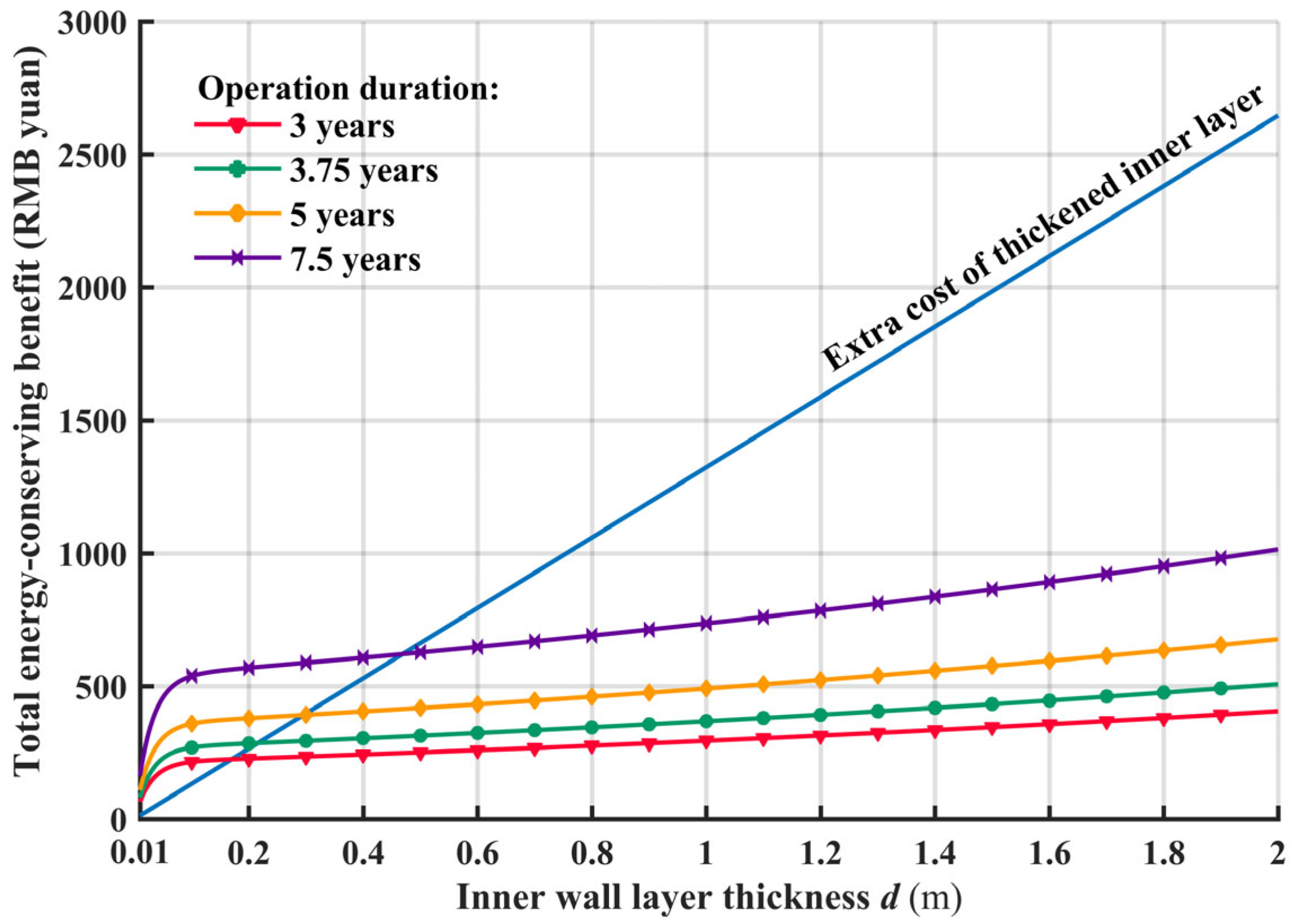
For the concrete-layered wall with a length of 1 m, Figure 6 illustrates the equilibrium between the linearly increasing extra costs and the piecewise-growing energy-conserving benefits of the wall with the inner layer thickness ranging from 0.01 m to 2.0 m. The extra cost linearly increased at a rate of 1323.2 RMB yuan·m−1, whereas the total energy-conserving benefit increased parabolically at 551.5 RMB yuan·m−1·yr−1 for the inner layer thickness ≤0.10 m and then transitioned to linear at 33.45 RMB yuan·m−1·yr−1. The extra cost curve intersected each total energy-conserving benefit curve at one point, providing the most reasonable thickness for the inner layer with a specific payback period constraint. For the periods of 3, 3.75, 5, and 7.5 years, which were one-tenth, one-eighth, one-sixth, and a quarter, respectively, of the general GSG lifetime; the inner layer thicknesses should be 0.17 m, 0.22 m, 0.30 m, and 0.47 m, respectively. Their extra costs were 225.17, 286.09, 391.45, and 620.75 RMB yuan, and the yield annual energy conserving benefits were 75.06, 76.29, 78.29, and 82.77 RMB yuan·yr−1, respectively. When the inner wall layer was increased to 0.6 m, the extra cost increase was 793.92:620.75 = 1.28 times higher, whereas the increase in the annual energy-conserving benefit was only 86.31:82.77 = 1.04 times, violating the 7.5-year-payback economic feasibility threshold.
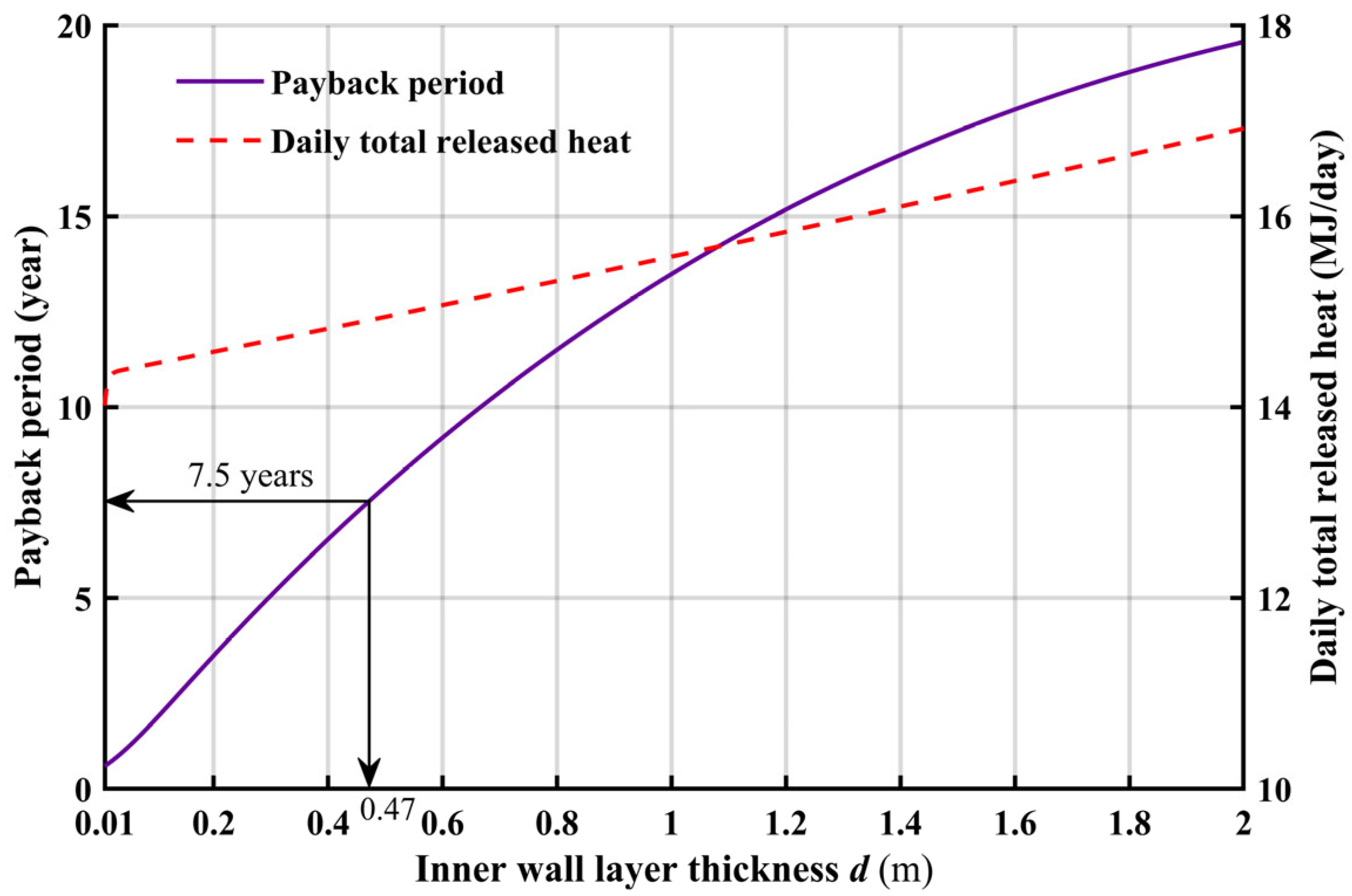
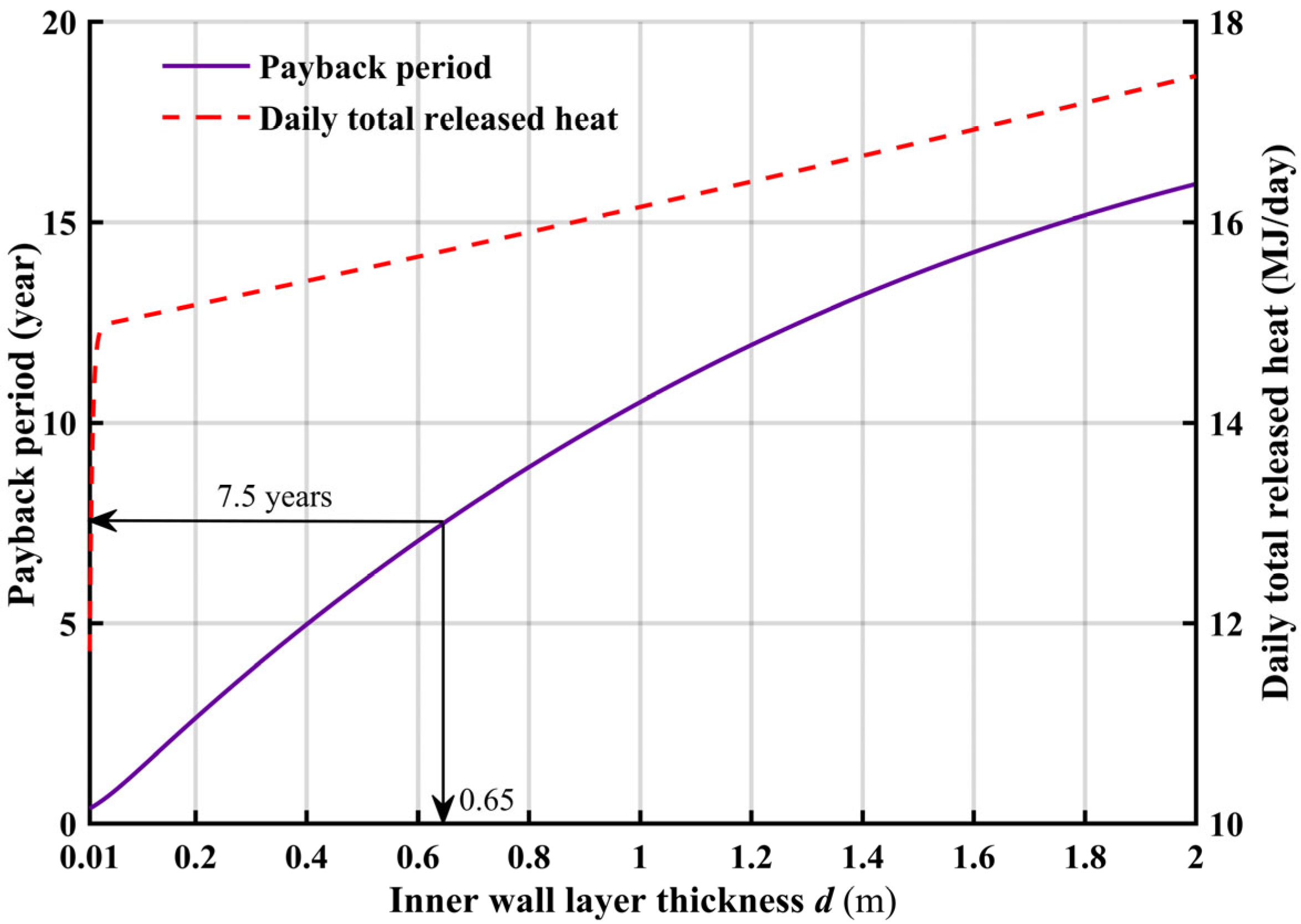
Figure 7 depicts the payback periods and the daily total released heat of the concrete-layered wall with its inner layer thickness ranging from 0.01 m to 2.0 m. The payback period and the daily total released heat of the wall progressively increased with the inner layer thickness. The 7.5-year-payback period appeared in the 0.47-m-inner layer, showing this as the upper limit for economic feasibility. Subsequently, we considered thermal performance. The thermal performance analysis within this economic-reasonable thickness range (0.01 m–0.47 m) revealed that the maximum daily total released heat was 14.91 MJ·d−1 at the right boundary, yielding a daily saved heat quantity of 3.28 MJ·d−1 and an annual energy-conserving benefit of 82.77 RMB yuan·yr−1. The optimum thickness of the inner layer of the GSG concrete-layered wall under Jiuquan’s current technical–economic conditions was therefore identified as: 0.47 m thickness, representing the equilibrium point where the energy-conserving benefits justify the extra costs.
While the minimum payback period with a value of 0.6 years occurred at the 0.01-m-inner wall layer, which is potentially attractive to investors—this configuration was technically unfeasible, because a 0.01-m-inner wall failed to meet the structural requirements for the load-bearing capacity in GSG applications.

3.2. Trade-Off Analysis of the Stone-Layered Wall

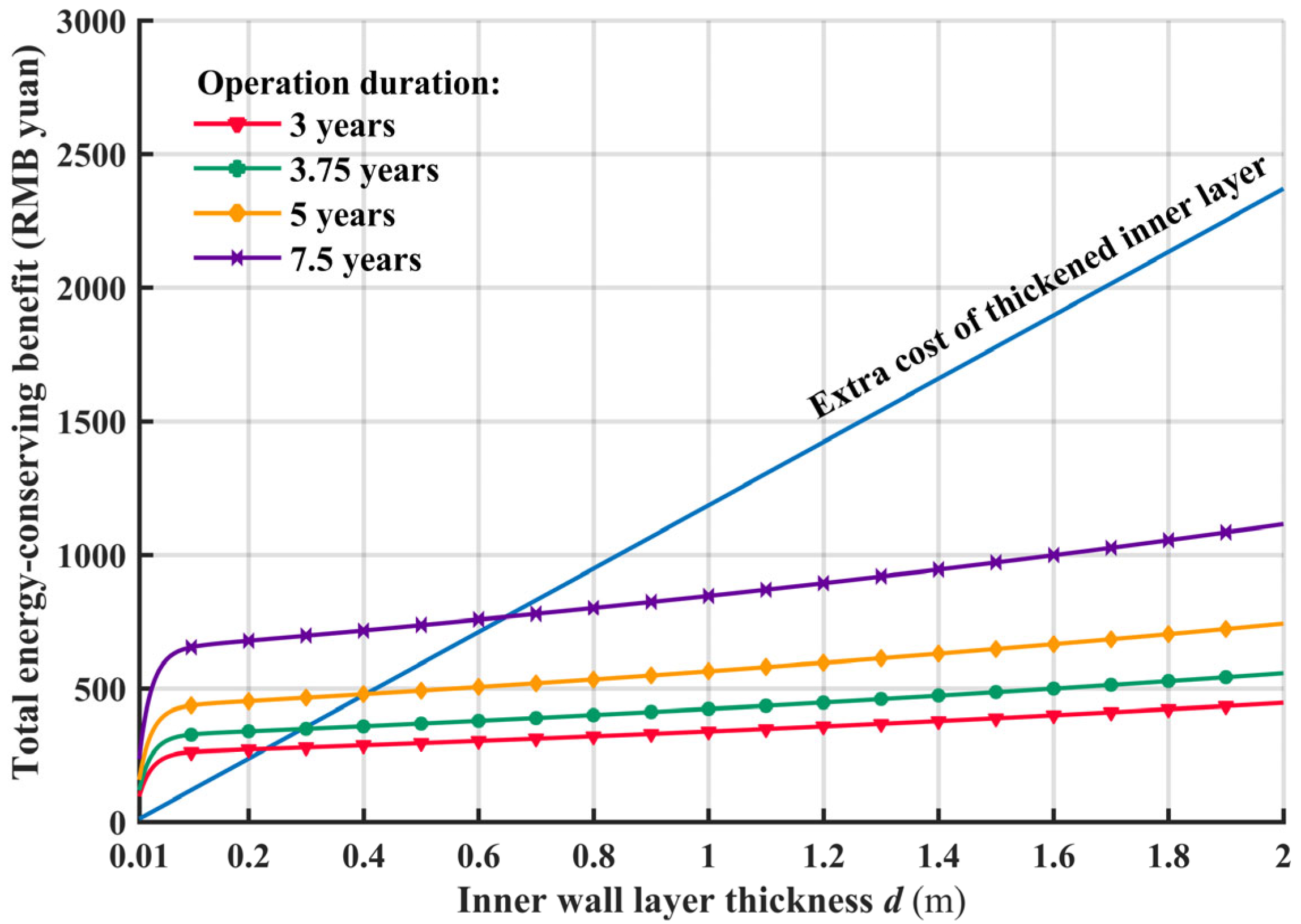
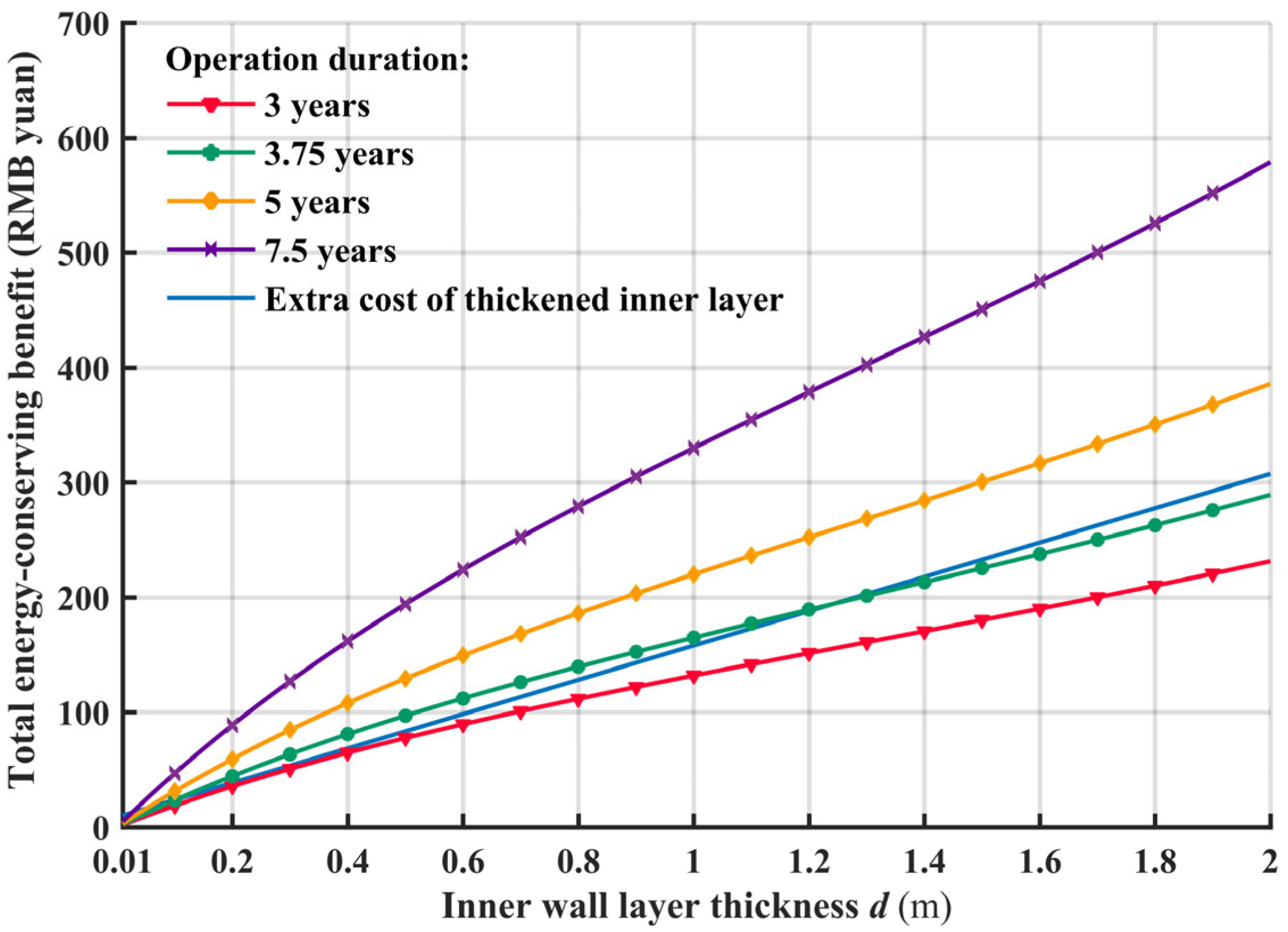
For the stone-layered wall with a length of 1 m and a thickness ranging from 0.01 m to 2.0 m, Figure 8 shows the extra cost and total energy-conserving benefit of the wall for varying durations of operation, with the cost–benefit dynamics being similar to the concrete-layered wall. The common points of the extra cost and each total energy-conserving benefit curves showed that the inner wall layers with thicknesses of 0.23 m, 0.27 m, 0.40 m, and 0.65 m had extra costs of 273.69, 322.99, 478.51, and 767.60 RMB yuan, which could be offset by the energy savings of the corresponding walls during 3, 3.75, 5, and 7.5 years, respectively. The 0.65-m-inner layer represented the economic threshold. When the inner layer thickness was beyond this point and increased to 0.75 m, the extra cost increase was 888.98:767.60 = 1.16 times higher, whereas the increase in the annual energy-conserving benefit was only 105.28:102.35 = 1.03 times, thereby exceeding the 7.5-year (25% of GSG lifespan) payback limit under Jiuquan’s current technical–economic conditions.
Furthermore, Figure 9 shows the correlation between the payback period and thickness of the inner layer of the stone-layered wall; the daily total released heat of these walls is also highlighted. Within the economic-reasonable thickness range (0.01 m–0.65 m), the maximal daily total released heat 15.72 MJ·d−1 appeared at the right boundary, yielding a daily saved heat quantity of 4.05 MJ·d−1 and an annual energy-conserving benefit of 102.35 yuan·yr−1. Thus, the optimum thickness of the inner layer of the GSG stone-layered wall under Jiuquan’s current technical–economic conditions was therefore identified as 0.65 m thickness.

3.3. Trade-Off Analysis of the Pebble-Soil Wall

Figure 10 presents the extra cost of the pebble-soil walls with the inner layers of various average thicknesses (0.01 m–2.0 m), and the total energy-conserving benefits of these walls for the operation duration of 3–7.5 years. Notably, the pebble-soil wall had an inclined internal surface with an angle of 86° and a 0.23-m-length horizontal projection; thus, the average thickness of the inner layer of the wall should not be less than 0.105 m.
In Figure 10, the common point of the extra cost curve and each total energy-conserving curve provided the optimum thickness of the inner wall layer for a specific payback period. For the 3-year payback period, one-tenth of the GSG lifetime, no feasible solution existed as the total energy-conserving benefits never offset the extra costs. For the 3.75-year payback period, one-eighth of the GSG lifetime, two feasible inner-layer thicknesses with 0.105 m and 1.24 m occurred, as the total energy-conserving benefit curve transected the extra cost curve at two points. The two solutions had the same payback period with different extra costs (24.38 and 194.56 RMB yuan) and annual energy-conserving benefits (6.50 and 51.88 RMB yuan·yr−1). For the 5- and 7.5-payback periods, a universal economic feasibility emerged, where all the inner layer thicknesses ranging from 0.105 m to 2 m yielded positive net benefits, with the total energy-conserving benefit exceeding the extra construction cost of the inner wall layer.
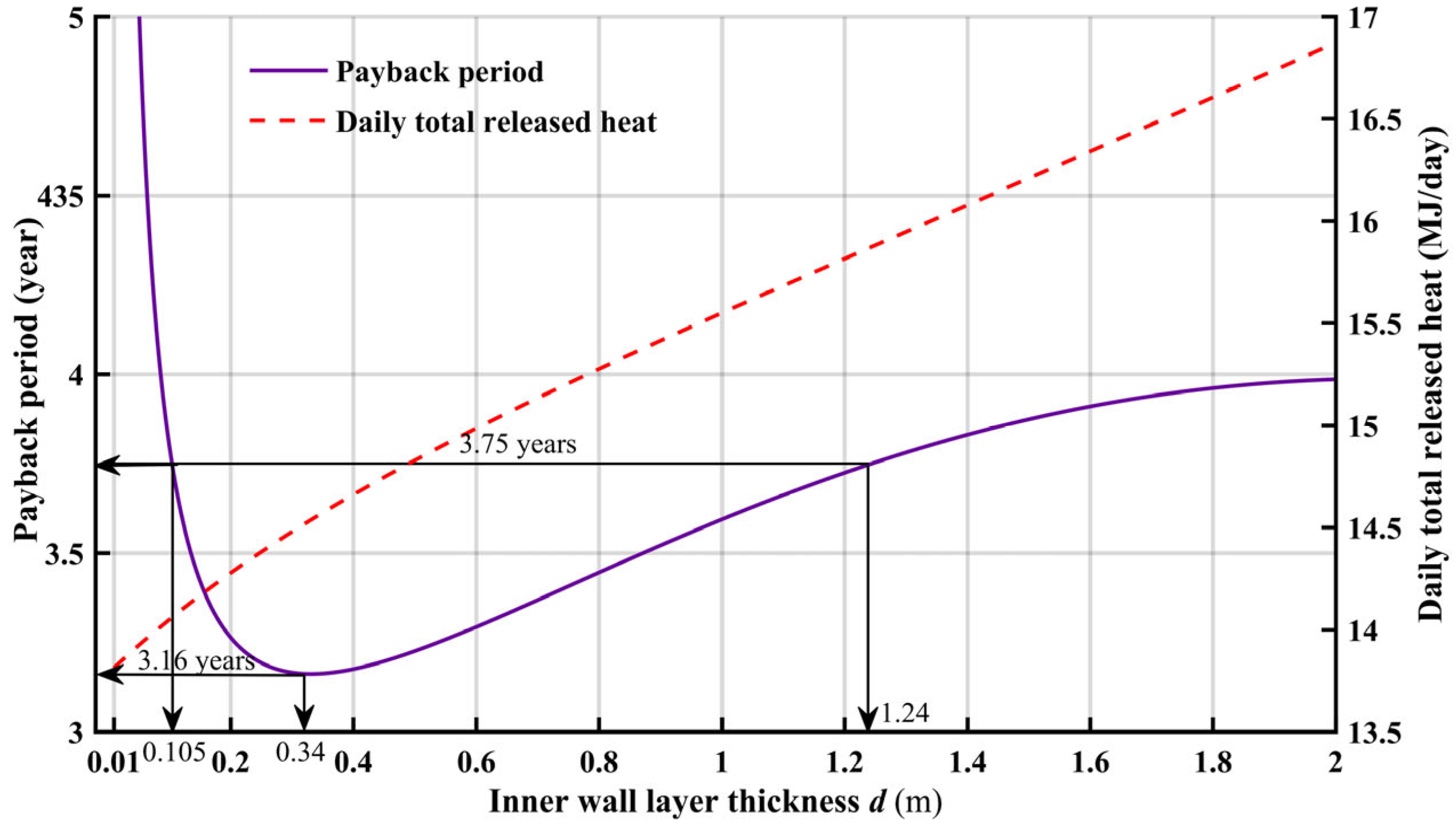
The payback period and daily total released heat of the pebble-soil walls with inner layers of different thicknesses are depicted in Figure 11. The payback period firstly decreased and then smoothly increased towards 4 years, whereas the daily total released heat continuously increased with the inner layer thickness at an average rate of 1.52 MJ·m−1. The minimum payback period of 3.16 years was found at an inner layer thickness of 0.34 m, which corresponded to a daily total released heat of 14.57 MJ·d−1. The three inner layers with average thicknesses of 0.105 m, 0.34 m, and 1.24 m, which were all reasonable in the structural and economic aspects, were compared. Their daily total released heats were 14.08, 14.57, and 15.88 MJ·d−1, respectively. To improve the solar energy efficiency and minimize heating costs, it is reasonable to use an inner layer with a thickness of 1.24 m in GSGs in Jiuquan City.

3.4. Uncertainty Analysis

As mentioned above, the price data used in this study were sourced from local government publications during 2019–2021. Given the inherent volatility due to policy adjustments, market fluctuations, and energy structure transitions, we conducted a Monte Carlo uncertainty analysis spanning multiple price scenarios. The economic variability was parameterized using China Statistical Yearbook ranges: material costs at −8% to +15% fluctuation and electricity prices at ±5% variation [39]. The Sobol sensitivity analysis was further employed to quantify the parameter influence on the optimal inner-layer thickness of the GSGs’ walls. The results are presented in Figure 12 and Table 3.
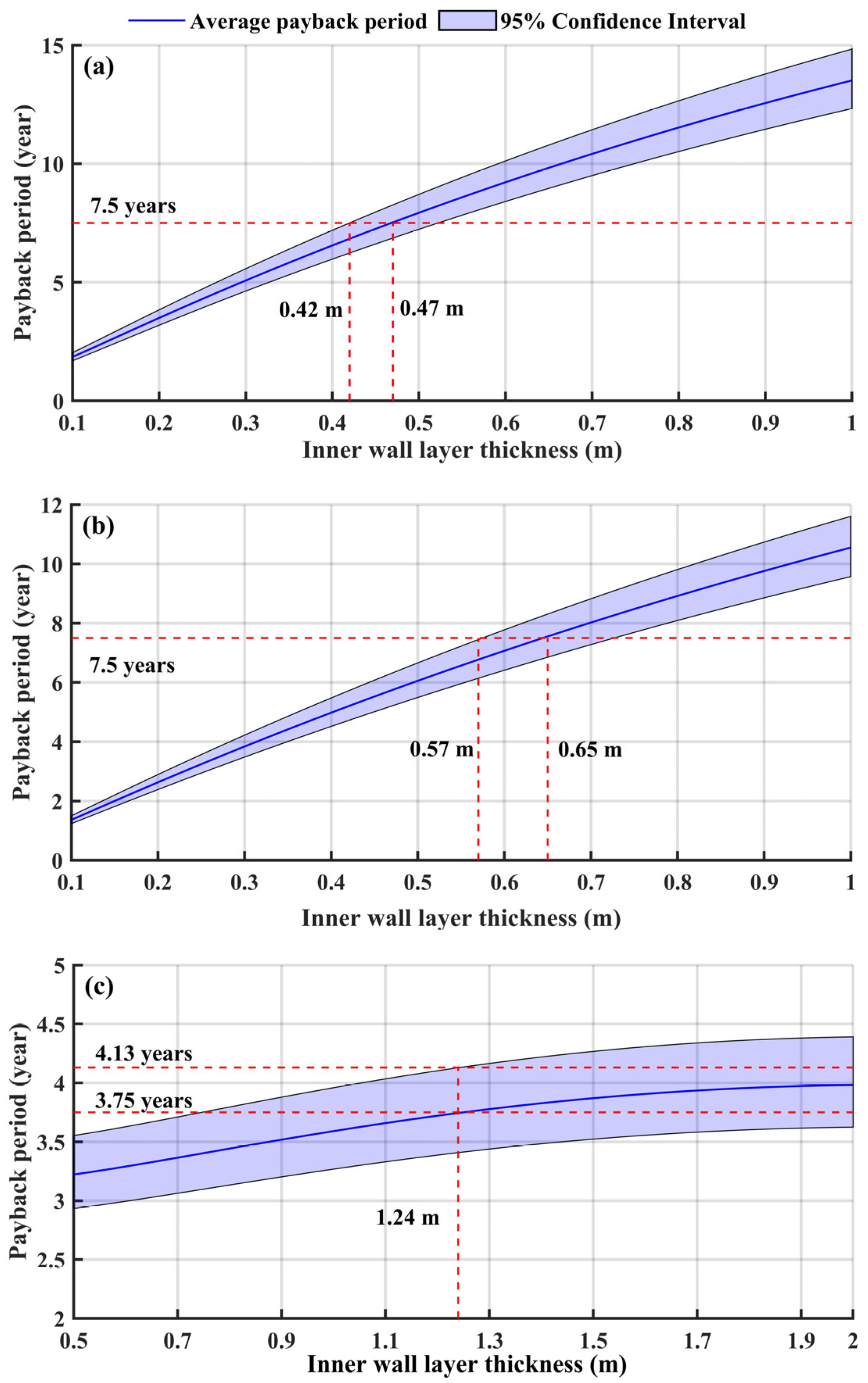
Monte Carlo simulations, constrained by a payback period threshold of <25% of the GSG lifespan, indicated that the optimal inner layer thicknesses for concrete- and stone-layered walls should not exceed 0.42 m and 0.57 m, respectively. These values represented economically conservative solutions for risk-averse scenarios. Crucially, the inner layer thicknesses determined in Section 3.1 and 3.2 (0.47 m for concrete-layered wall, 0.65 m for stone-layered wall) remained technically valid as they yielded net energy-saving benefits of 12.18 and 8.97 RMB yuan, respectively, demonstrating the probability of positive returns under market volatility. For pebble-soil walls, the optimal inner layer thickness of 1.24 m (identified in Section 3.3) had a payback period of 4.13 years under economic volatility, confirming its balance of thermal performance and economic feasibility.
The Sobol sensitivity analysis quantified material costs as the dominant uncertainty source, with first-order sensitivity indices (S1) of 0.540 (concrete-layered), 0.542 (stone-layered), and 0.576 (pebble-soil walls) (Table 3). The electricity price variability exhibited secondary yet significant influence (S1 = 0.424–0.460). Therefore, in the current low electricity price environment (0.4389 RMB yuan·kwh−1), it is not recommended to increase the wall thickness, but to improve the greenhouse thermal performance through auxiliary heating measures.

4. Discussion

Low temperatures have long restricted GSG overwintering production in the Hexi Corridor. Numerous experimental studies have reported that an indoor air temperature lower than 10 °C occurred frequently in various GSGs [18,19]. This temperature condition has a detrimental impact on the production of thermophilic horticultural plants, such as tomatoes, cucumbers, and peppers, which are the main varieties planted in the GSGs of the Hexi Corridor. It is well known that a thermal mass wall plays an important role in building the GSG thermal environment, as it stores and releases solar heat periodically to fill the greenhouse heat loss and maintains a suitable indoor thermal environment for crops during the cold period [7,26]. Thus, whether the thermal mass wall is well-designed determines the GSG agricultural productivity through its influence on the thermal environment.
This study optimized the structures of three typical GSG walls in the Hexi Corridor: concrete-layered, stone-layered, and pebble-soil wall, balancing thermal performance and economic feasibility under Jiuquan’s current technical–economic conditions. The optimum thicknesses of the inner layer of the three GSG walls were 0.47 m, 0.65 m, and 1.24 m, respectively. To illustrate the effectiveness of the optimized walls in developing plant thermal comfort, the thermal loads of the GSGs with these optimized walls were calculated using the GSG thermal-load prediction model developed by Zhang et al. [27]. Simulations were conducted during the sunny winter solstice (22 December), the standard reference day in the Chinese solar greenhouse design, featuring an outdoor air temperature from −17.6 °C to −3.2 °C and daytime average solar radiation of 421.07 W·m−2 (Figure 13). Throughout the simulation, indoor air temperatures were maintained at the greenhouse design specification of 15–25 °C.
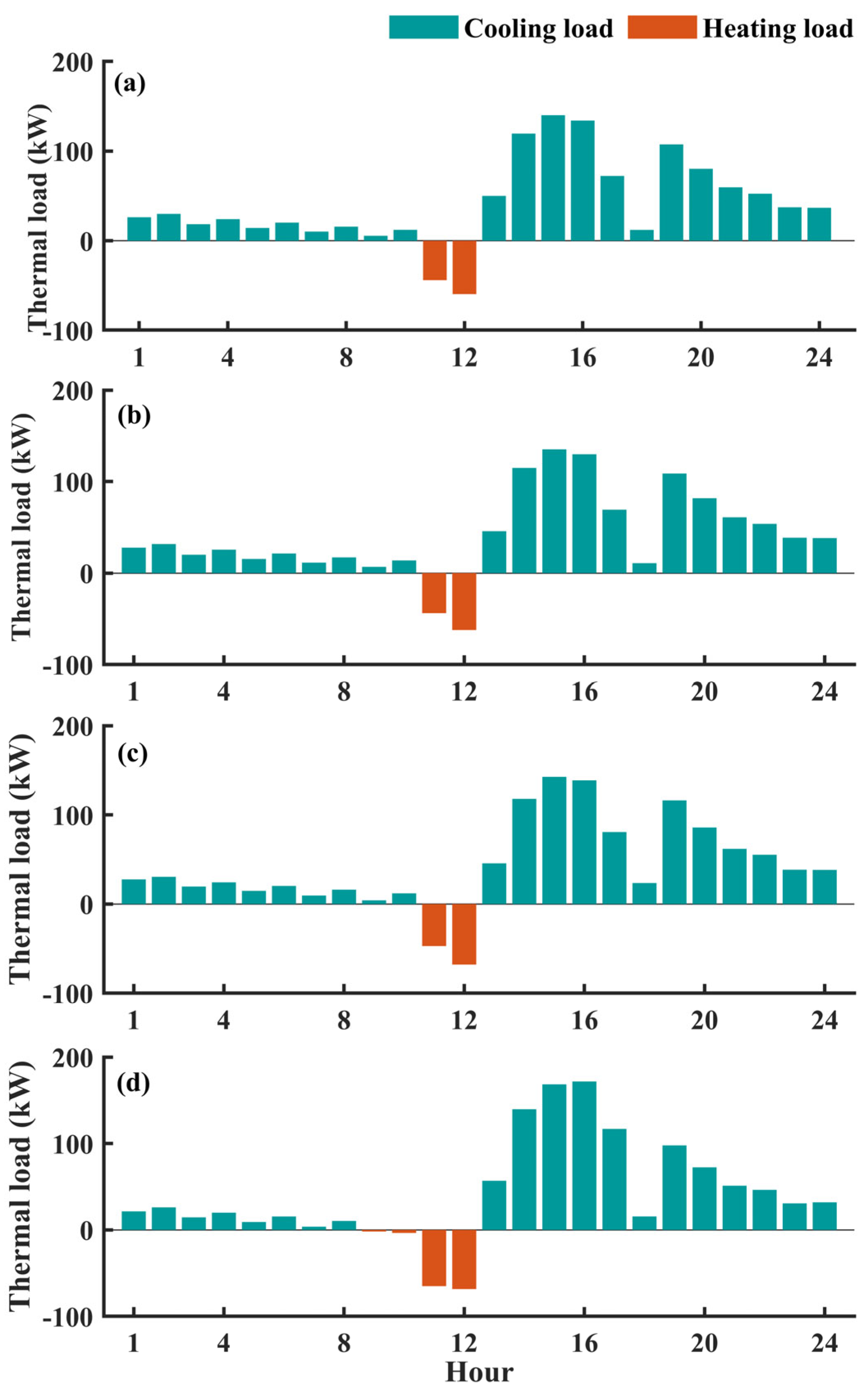
The dynamic thermal loads of the three GSGs are shown in Figure 14, where positive and negative values denote cooling and heating demands, respectively. The results showed that there was no heating demand throughout the day for the three GSGs with optimized walls, expect for the 2-h period (10:00–12:00) following thermal blanket opening. The nocturnal average thermal loads of 33.15, 34.43, and 35.27 kW of the three greenhouses with the concrete-layered, stone-layered, and pebble-soil walls, respectively, confirmed the maintenance of the indoor air temperature above the 15 °C setpoint throughout the nighttime when the greenhouse was well closed. These relatively large cooling loads revealed the GSG walls’ exceptional energy-conservation performance and potential to address even colder weather conditions.
In Figure 14d, the dynamic thermal load of a GSG featured a concrete-layered wall with a 0.8-m-thick inner layer, calculated in [27] under identical weather conditions, is presented. Compared with the optimized concrete-layered wall with a 0.47-m-thick inner layer in the present study, this wall extended the heating-demand period (8:00–12:00) of the GSG, and decreased the nocturnal average thermal load by 27.21 kW. This can be attributed to the thermal boundary condition settings of the concrete-layered wall. Zhang et al.’s [27] simplified boundary condition assumed that the entire wall top was exposed to outdoor air. Our refined model more accurately represented the actual boundary conditions by partitioning the wall top surface into indoor- and outdoor-exposed zones.
A comparative analysis of the three optimized GSG walls revealed that the pebble-soil wall with a 1.24-m-thick inner layer demonstrated superior thermal and economic performances, exhibiting 6.51% and 1.00% higher daily total released heat than the concrete-layered and stone-layered walls, respectively, while requiring 68.7% and 74.7% lower extra costs. Notably, the GSGs that adopt this configuration also achieved 6.40% and 2.44% greater nocturnal average cooling loads compared with GSGs with concrete-layered and stone-layered walls. Although all three designs maintained an effective thermal performance, the pebble-soil wall with a 1.24-m-thick inner layer was the most efficient strategy for economically sustainable GSG agricultural production in the Hexi Corridor.

5. Conclusions

The efficient design of GSG walls provides an opportunity to simultaneously strengthen solar energy utilization and reduce construction investment. This study proposed a thermal performance–cost trade-off approach for GSG walls, enhancing solar energy utilization while reducing construction costs. Under payback period constraints (<25% GSG lifespan), the optimal inner layer thicknesses of GSG walls were determined for the Hexi Corridor applications. For concrete-layered walls, the optimal 0.47 m inner layer requires a 620.75 RMB yuan extra cost but delivers 14.91 MJ·d−1 daily total heat release and 82.77 RMB yuan·yr−1 energy savings with a 7.5-year-payback period. For the stone-layered walls, the optimal 0.65 m inner layer requires a 767.60 RMB yuan extra cost but delivers 15.72 MJ·d−1 heat release and 82.77 RMB yuan·yr−1 energy savings with a 7.5-year payback. For the pebble-soil walls, the optimal 1.24 m inner layer requires only a 194.56 RMB yuan extra cost and provides 15.88 MJ·d−1 heat release, 51.88 RMB yuan·yr−1 savings, and a remarkable 3.75-year payback. Crucially, all the optimized walls eliminated heating demands during a sunny winter solstice night, with 33.15–35.27 kW nocturnal cooling loads confirming the potential to maintain thermal comfort even in colder weather conditions.
Overall, these optimized greenhouse walls exhibited superior energy conservation performance and were economically feasible. The pebble-soil wall with a 1.24-m-thick inner layer is the most cost-effective strategy to achieve plant thermal comfort for GSGs in the Hexi Corridor. Future research will implement a cradle-to-grave life cycle assessment for GSGs, integrating building energy simulation, cost accounting, and environmental impact evaluation to enhance GSG productivity and advance sustainable Gobi agriculture.

Author Contributions

Conceptualization, J.X.; methodology, X.Z. and J.X.; software, X.Z.; validation, X.Z. and N.M.; formal analysis, X.Z. and J.Z.; investigation, X.Z.; resources, J.X.; data curation, N.M. and Y.C.; writing—original draft preparation, X.Z.; writing—review and editing, J.Z. and J.L.; visualization, N.M. and Y.C.; funding acquisition, X.Z. and J.X. All authors have read and agreed to the published version of the manuscript.

Funding

This research was funded by the National Natural Science Foundation of China (grant number 32402660), the National Natural Science Foundation of China (grant number 32072657), and the Research Start-up Funds of Gansu Agricultural University (grant number GAU-KYQD-2020-9).

Data Availability Statement

The data that support the findings of this study are available from the corresponding author, Jianming Xie, upon reasonable request.

Conflicts of Interest

The authors declare no conflicts of interest.

Abbreviations

The following abbreviations are used in this manuscript:
AArea of the wall internal surface (m2)
AMSinusoidal amplitude (°C)
cpSpecific heat of building materials (J Kg−1 K −1)
CExtra cost (RMB yuan)
CostexExtra cost of a greenhouse wall with a thickened inner layer (RMB yuan)
CostsaEnergy-conserving benefit (RMB yuan)
dThickness of the inner wall layer (m)
eElectricity price (RMB yuan·kWh−1)
FTotal number of sinusoids
hCombined surface heat transfer coefficient (W m−2 K−1)
I s ˙ Solar radiation density (W m−2)
I r ˙ Long-wave radiation density (W m−2)
LWall length in the east–west direction (m)
PASinusoidal phase angle (rad)
qHeat flow (W)
q ˙ Heat flux (W·m−2)
pPrice (RMB yuan)
QDaily total released heat (MJ·d−1)
QsaSaved heat quantity (MJ·d−1)
RHeat transfer resistance (K W−1 m−2)
SSampling number
tTime (s)
TTemperature (°C)
TsaSol-air temperature (°C)
TaAir temperature (°C)
YPayback period
KStiffness matrix
WMass matrix
upReal part vector of the complexified input sinusoid
vpImaginary part vector of the complexified input sinusoid
uTReal part vector of the complexified responding sinusoid
vTImaginary part of the complexified responding sinusoid
αSolar radiation absorptivity factor
λThermal conductivity (W m−1 K−1)
ΓWall surface
ΔtSampling interval(s)
κAngular frequency index
γDamping factor
ρBulk weight (Kg m−3)
ψTime lag (rad)
ωAngular frequency (rad s−1)
ΩWall cross-section

References

  1. Bless, A.; Davila, F.; Plant, R. A genealogy of sustainable agriculture narratives: Implications for the transformative potential of regenerative agriculture. Agric. Hum. Values 2023, 40, 1379–1397. [Google Scholar] [CrossRef]
  2. FAO. “Energy-Smart” Food for People and Climate; FAO: Rome, Italy, 2011. [Google Scholar]
  3. Zhou, D.; Meinke, H.; Wilson, M.; Marcelis, L.F.M.; Heuvelink, E. Towards delivering on the sustainable development goals in greenhouse production systems. Resour. Conserv. Recy. 2021, 169, 105379. [Google Scholar] [CrossRef]
  4. Esen, M.; Yuksel, T. Experimental evaluation of using various renewable energy sources for heating a greenhouse. Energ. Build. 2013, 65, 340–351. [Google Scholar] [CrossRef]
  5. Ouazzani Chahidi, L.; Fossa, M.; Priarone, A.; Mechaqrane, A. Energy saving strategies in sustainable greenhouse cultivation in the mediterranean climate—A case study. Appl. Energy 2021, 282, 116156. [Google Scholar] [CrossRef]
  6. Ahamed, M.S.; Guo, H.; Tanino, K. Development of a thermal model for simulation of supplemental heating requirements in Chinese-style solar greenhouses. Comput. Electron. Agric. 2018, 150, 235–244. [Google Scholar] [CrossRef]
  7. Zhang, Y.; Henke, M.; Li, Y.; Xu, D.; Liu, A.; Liu, X.; Li, T. Towards the maximization of energy performance of an energy-saving Chinese solar greenhouse: A systematic analysis of common greenhouse shapes. Sol. Energy 2022, 236, 320–334. [Google Scholar] [CrossRef]
  8. Briga-Sá, A.; Leitão, D.; Boaventura-Cunha, J.; Martins, F.F. Trombe wall thermal performance: Data mining techniques for indoor temperatures and heat flux forecasting. Energy Build. 2021, 252, 111407. [Google Scholar] [CrossRef]
  9. Huang, L.; Deng, L.; Li, A.; Gao, R.; Zhang, L.; Lei, W. A novel approach for solar greenhouse air temperature and heating load prediction based on Laplace transform. J. Build. Eng. 2021, 44, 102682. [Google Scholar] [CrossRef]
  10. Lu, D.; Zhou, C.; Wang, L. Methods for calculation of heating load in gutter-connected glasshouse. Trans. Chin. Soc. Agric. Eng. 2020, 36, 235–242. [Google Scholar] [CrossRef]
  11. Jiang, L.; Zhang, C.; Wang, G.; Liu, T. Analysis of the Development and Current Situation of Gobi Agriculture in Northwest China. Agric. Eng. Technol. 2023, 43, 15–19. [Google Scholar] [CrossRef]
  12. Chen, J.; Liu, W.; Jiang, D.; Junwei, Z.; Ren, S.; Li, L.; Xiaokang, L.; Shi, X. Preliminary investigation on the feasibility of a clean CAES system coupled with wind and solar energy in China. Energy 2017, 127, 462–478. [Google Scholar] [CrossRef]
  13. Xie, J.; Yu, J.; Chen, B.; Feng, Z.; Lyu, J.; Hu, L.; Gan, Y.; Siddique, K.H.M. Gobi agriculture: An innovative farming system that increases energy and water use efficiencies. A review. Agron. Sustain. Dev. 2018, 38, 62. [Google Scholar] [CrossRef]
  14. Zhang, Z.; Dong, Z.; Li, J.; Qian, G.; Jiang, C. Implications of surface properties for dust emission from gravel deserts (gobis) in the Hexi Corridor. Geoderma 2016, 268, 69–77. [Google Scholar] [CrossRef]
  15. Zhang, X.; Lv, J.; Dawuda, M.M.; Xie, J.; Yu, J.; Gan, Y.; Zhang, J.; Tang, Z.; Li, J. Innovative passive heat-storage walls improve thermal performance and energy efficiency in Chinese solar greenhouses for non-arable lands. Sol. Energy 2019, 190, 561–575. [Google Scholar] [CrossRef]
  16. Guo, Z.; Wang, L.; Wang, J. Research on Rural Revitalization Planning Based on the Integrated Development of “Production, Life, and Ecology”: A Case of Dongdong Town in Suzhou District, Jiuquan. Urban. Archit. 2022, 19, 4–7. [Google Scholar] [CrossRef]
  17. Tong, G.; Christopher, D.M.; Li, T.; Wang, T. Passive solar energy utilization: A review of cross-section building parameter selection for Chinese solar greenhouses. Renew. Sustain. Energy Rev. 2013, 26, 540–548. [Google Scholar] [CrossRef]
  18. Li, H.; Mi, X.; SHI, J.; Zhang, Y.; Zhang, G. The model and effects of renovating old greenhouses for facility vegetables in the Jiuquan Gobi Desert. China Veg. 2024, 9, 1–5. [Google Scholar] [CrossRef]
  19. Luo, Q.; Cheng, J.; Wang, P.; Zhao, S. Research status of temperature control technology for solar greenhouses in non-arable land in northwest China. Gansu Sci. Technol. 2022, 42, 11–20. [Google Scholar] [CrossRef]
  20. Decano-Valentin, C.; Lee, I.; Yeo, U.; Lee, S.; Kim, J.; Park, S.; Choi, Y.; Cho, J.; Jeong, H. Integrated Building Energy Simulation–Life Cycle Assessment (BES–LCA) Approach for Environmental Assessment of Agricultural Building: A Review and Application to Greenhouse Heating Systems. Agronomy 2021, 11, 1230. [Google Scholar] [CrossRef]
  21. Notan, K.; Sanjeev Kumar, G. Progress and application of phase change material in solar thermal energy: An overview. Mater. Today Proc. 2020, 44, 271–281. [Google Scholar] [CrossRef]
  22. Sanjeev Kumar, G.; Saransh, P. A review of recent advances and the role of nanofluid in solar photovoltaic thermal (PV/T) system. Mater. Today Proc. 2020, 44, 782–791. [Google Scholar] [CrossRef]
  23. Ghasemi Mobtaker, H.; Ajabshirchi, Y.; Ranjbar, S.F.; Matloobi, M. Solar energy conservation in greenhouse: Thermal analysis and experimental validation. Renew. Energy 2016, 96, 509–519. [Google Scholar] [CrossRef]
  24. GB 50176-2016; Code for Thermal Design of Civil Building. China Architecture & Building Press: Beijing, China, 2016. Available online: https://www.mohurd.gov.cn/gongkai/zc/wjk/art/2017/art_17339_230579.html (accessed on 22 July 2022).
  25. Li, Z.; Xie, Y.; Zhao, Q. Thermal Design Method of Building Wall Considering Solar Energy Utilization and Thermal Insulation. Energy Build. 2021, 257, 111772. [Google Scholar] [CrossRef]
  26. Wang, J.; Li, S.; Guo, S.; Ma, C.; Wang, J.; Jin, S. Simulation and optimization of solar greenhouses in Northern Jiangsu Province of China. Energy Build. 2014, 78, 143–152. [Google Scholar] [CrossRef]
  27. Zhang, X.; Xie, J.; Zhang, J.; Li, J.; Ma, N.; Mao, E. Simplified heat-transfer calculation for the trapezoidal cross-section wall in Gobi solar greenhouses and greenhouse thermal-load prediction. Biosyst. Eng. 2023, 234, 46–65. [Google Scholar] [CrossRef]
  28. Hong, E.; Yi, J.S.; Lee, D. CTGAN-Based Model to Mitigate Data Scarcity for Cost Estimation in Green Building Projects. J. Manag. Eng. 2024, 40, 04024024. [Google Scholar] [CrossRef]
  29. Nyers, J.; Kajtar, L.; Tomić, S.; Nyers, A. Investment-savings method for energy-economic optimization of external wall thermal insulation thickness. Energy Build. 2015, 86, 268–274. [Google Scholar] [CrossRef]
  30. Raheem, A.A.; Issa, R.R.A.; Olbina, S. Environmental Performance and Economic Analysis of Different Glazing–Sunshade Systems Using Simulation Tools. J. Comput. Civ. Eng. 2016, 30, C5016001. [Google Scholar] [CrossRef]
  31. Guan, Q.; Wang, F.; Xu, C.; Pan, N.; Lin, J.; Zhao, R.; Yang, Y.; Luo, H. Source apportionment of heavy metals in agricultural soil based on PMF: A case study in Hexi Corridor, northwest China. Chemosphere 2018, 193, 189–197. [Google Scholar] [CrossRef]
  32. Lu, X.; Zhen, W.; Cheng, Y.; Tong, R. Experimental study on excavated foundation of transmission line gravelly soils in gobi area of Northwest China. Chin. J. Geotech. Eng. 2009, 31, 1779–1783. [Google Scholar] [CrossRef]
  33. Nawalany, G.; Bieda, W.; Radoń, J.; Herbut, P. Experimental study on development of thermal conditions in ground beneath a greenhouse. Energy Build. 2014, 69, 103–111. [Google Scholar] [CrossRef]
  34. GB 50010-2010; Code for Design of Concrete Structures. China Architecture & Building Press: Beijing, China, 2010. Available online: https://www.mohurd.gov.cn/gongkai/zc/wjk/art/2015/art_17339_225665.html (accessed on 2 February 2024).
  35. Leccese, F.; Salvadori, G.; Asdrubali, F.; Gori, P. Passive thermal behaviour of buildings: Performance of external multi-layered walls and influence of internal walls. Appl. Energy 2018, 225, 1078–1089. [Google Scholar] [CrossRef]
  36. Zhang, X.; Lv, J.; Xie, J.; Yu, J.; Zhang, J.; Tang, C.; Li, J.; He, Z.; Wang, C. Solar Radiation Allocation and Spatial Distribution in Chinese Solar Greenhouses: Model Development and Application. Energies 2020, 13, 1108. [Google Scholar] [CrossRef]
  37. Liu, C.; Ma, C.; Wang, P.; ZHAO, S.; Cheng, J.; Wang, M. Theoretical analysis and experimental verification of heat transfer through thick covering materials of solar greenhouse. Trans. Chin. Soc. Agric. Eng. 2015, 31, 102682. [Google Scholar] [CrossRef]
  38. DBJD25-67-2019; Gansu Province Construction and Decoration Engineering Budget Quota & Regional Base Price. Deparment of Housing and Urban-Rural Development of Gansu Province: Lanzhou, China, 2020. Available online: https://zjt.gansu.gov.cn/zjt/c108348/202105/b60ac9af9a2a42a698e3d151818fc0ec.shtml (accessed on 1 August 2023).
  39. National Bureau of Statistics of China. China Statistical Yearbook 2024; China Statistics Press: Beijing, China, 2024. Available online: https://www.stats.gov.cn/sj/ndsj/2024/indexch.htm (accessed on 12 May 2025).
Figure 1. Construction site of the Gobi solar greenhouses in the Hexi Corridor.
Agriculture 15 01618 g001
Figure 2. Internal and external views of the typical Gobi solar greenhouses in the Hexi Corridor: (a,b) Gobi solar greenhouse with a concrete-layered wall; (c,d) Gobi solar greenhouse with a stone-layered wall; (e,f) Gobi solar greenhouse with a pebble-soil wall.
Agriculture 15 01618 g002
Figure 3. Cross-sectional schematic diagram of the studied greenhouse walls: (a) concrete-layered wall; (b) stone-layered wall; (c) pebble-soil wall.
Agriculture 15 01618 g003
Figure 4. Metallic structure of the pebble-soil wall.
Agriculture 15 01618 g004
Figure 5. The 24-h mean profiles of air temperature and solar radiation characterizing the mean cold-season microclimate in Jiuquan City.
Agriculture 15 01618 g005
Figure 6. Extra cost and total energy-conserving benefit functions of the concrete-layered wall with a thickening inner layer.
Agriculture 15 01618 g006
Figure 7. Payback period and daily total released heat of the concrete-layered wall with a thickening inner layer.
Agriculture 15 01618 g007
Figure 8. Extra cost and total energy-conserving benefit functions of the stone-layered wall with a thickening inner layer.
Agriculture 15 01618 g008
Figure 9. Payback period and daily total released heat of the stone-layered wall with a thickening inner layer.
Agriculture 15 01618 g009
Figure 10. Extra cost and total energy-conserving benefit functions of the pebble-soil wall with a thickening inner layer.
Agriculture 15 01618 g010
Figure 11. Payback period and daily total released heat of the pebble-soil wall with a thickening inner layer.
Agriculture 15 01618 g011
Figure 12. Economic stability of the optimal inner-layer thicknesses of the Gobi solar greenhouse walls: (a) concrete-layered wall; (b) stone-layered wall; (c) pebble-soil wall.
Agriculture 15 01618 g012
Figure 13. Hourly outdoor air temperature and solar radiation of a sunny winter solstice (December 22) in Jiuquan City.
Agriculture 15 01618 g013
Figure 14. Temporal distribution of the Gobi solar greenhouse thermal load on a sunny winter solstice: (a) a greenhouse with a concrete-layered wall and a 0.47-m-thick inner layer; (b) a greenhouse with a stone-layered wall and a 0.65-m-thick inner layer; (c) a greenhouse with a pebble-soil wall and a 1.24-m-thick inner layer; (d) a greenhouse with a concrete-layered wall and a 0.8-m-thick inner layer.
Agriculture 15 01618 g014
Table 1. Thermophysical properties of building materials of the Gobi solar greenhouses.
Building MaterialsBulk Weight ρ (kg·m−3)Specific Heat Capacity cp (J·kg−1·K−1)Thermal Conductivity λ (W·m−2·K−1)
Reinforced concrete23009701.63
Stone24009202.04
Gobi pebble soils209515400.48
Table 2. Unit price list in the construction of the walls of Gobi solar greenhouses.
ParameterValue
PL3.8 RMB Yuan·m−2
PE12.37 RMB Yuan·m−3
PCF246.98 RMB Yuan·m−3
PCW310.84 RMB Yuan·m−3
PCB366.56 RMB Yuan·m−3
PR5198.18 RMB Yuan·t−1
PS327.58 RMB Yuan·m−3
PM9841.7 RMB Yuan·t−1
e0.4389 RMB Yuan·kwh−1
Table 3. Sensitivity analysis results of the optimal inner-layer thicknesses of the Gobi solar greenhouse walls related to price variability.
Wall Structure TypeParameterFluctuation RangeFirst-Order
Sensitivity Index S1
Rank
Concrete-layered wallmaterial cost−8% to +15%0.5401
electricity price±5%0.4612
Stone-layered wallmaterial cost−8% to +15%0.5421
electricity price±5%0.4602
Pebble-soil wallmaterial cost−8% to +15%0.5781
electricity price±5%0.4242
Disclaimer/Publisher’s Note: The statements, opinions and data contained in all publications are solely those of the individual author(s) and contributor(s) and not of MDPI and/or the editor(s). MDPI and/or the editor(s) disclaim responsibility for any injury to people or property resulting from any ideas, methods, instructions or products referred to in the content.