Article

Responses of Tomato Growth and Soil Environment Properties to Integrated Deficit Water-Biogas Slurry Application Under Indirect Subsurface Drip Irrigation

1
College of Energy and Power Engineering, Lanzhou University of Technology, Lanzhou 730050, China
2
Key Laboratory of Multi-Supply System with Solar Energy and Biomass, Lanzhou 730050, China
3
Collaborative Innovation Center for Supporting Technology of Northwest Low-Carbon Town, Lanzhou 730050, China
*
Author to whom correspondence should be addressed.
Agriculture 2025, 15(15), 1601; https://doi.org/10.3390/agriculture15151601
Submission received: 5 June 2025 / Revised: 6 July 2025 / Accepted: 22 July 2025 / Published: 25 July 2025
(This article belongs to the Section Agricultural Water Management)

Abstract

To explore the feasibility of integrated deficit water-biogas slurry irrigation under indirect subsurface drip irrigation, three deficit irrigation levels (60%FC, 70%FC, and 80%FC; FC represents field capacity) were established during the three growth stages of tomatoes. The results indicated that biogas slurry irrigation treatments increased the soil organic matter content in the root zone and water use efficiency (WUE) and reduced soil pH. As the degree of deficit increased, the plant height and stem diameter of tomatoes decreased significantly (p < 0.05), particularly during the seedling and flowering-fruiting stages. A mild deficit during the seedling stage was beneficial for subsequent plant growth, yielding maximum leaf area (6871.42 cm2 plant−1). Moderate deficit treatment at the seedling stage maximized yield, which was 19.79% higher than the control treatment in 2020 and 19.22% higher in 2021. The WUE of severe deficit treatment at the maturity stage increased by 26.6% (2020) and 31.04% (2021) compared to the control treatment. Comprehensive evaluation using TOPSIS combined with the weighted method revealed that severe deficit treatment at the maturity stage provided the best comprehensive benefits for tomatoes. In summary, deficit irrigation at different growth stages positively influenced tomato growth, quality, and soil environment in response to water-biogas slurry irrigation.

1. Introduction

Food security and water scarcity are two major challenges facing the world today [1,2,3]. Agriculture is one of the largest water consumers in all industries, but the utilization efficiency of irrigation water is only about 65%, which results in huge waste of water resources and an urgent need for agricultural water saving [4,5]. Especially in arid and semi-arid regions, such as the Loess Plateau in China, the contradiction between water scarcity and water consumption in agricultural production has emerged as a key factor limiting the sustainable development of agriculture [5,6]. The tomato (Solanum lycopersicum) is one of the most important vegetable crops globally, with a fresh fruit production of approximately 190 million tons in 2021 [7]. In the Loess Plateau of northwest China, factors such as water scarcity and low soil fertility have significantly hindered the improvement of tomato yield and quality [8]. Therefore, it is imperative to explore sustainable, organic, and efficient production models in this region to enhance tomato fruit quality and yield.
Deficit irrigation is a type of high water use efficiency irrigation technology that accurately supplies water to rhizosphere soil of crops according to the actual water demand at different growth stages of crops [9]. Moderate water shortage in the non-sensitive stage of crop growth promotes root growth, induces abscisic acid (ABA) secretion in plants, promotes photosynthetic efficiency and the stress resistance of crop growth, and thus achieves the effects of water saving, yield increase, and quality improvement [10,11]. Deficit irrigation has been widely used in horticultural landscape irrigation systems [12], field crops [13], and greenhouse crops [14] production. Meanwhile, the integrated application of water and fertilizer is a new breakthrough from the previous extensive single application mode of water or fertilizer. Water and nutrients are timely delivered to the root zone of crops by appropriately dissolving fertilizer in water, in order to save water and fertilizer, ameliorate agricultural non-point source pollution, etc. [15,16,17]. However, under deficit irrigation conditions, how to optimize the integrated application mode of water and fertilizer and its comprehensive effects on crop physiological ecology, yield quality, water and fertilizer efficiency, and soil environment still needs further exploration.
Fertilizer application not only achieves high yield of food crops but also brings a series of problems such as environmental pollution, groundwater pollution, and climate change [18]. However, as the product of anaerobic fermentation in biogas engineering, biogas slurry is a kind of high-quality organic fertilizer with sufficient reserve source [19]. Biogas slurry contains a variety of nutrients required for plant growth (microorganisms, organic matter, humus, amino acids, vitamins, and various enzymes) [20]. Biogas slurry has gradually attracted people’s attention due to its good water solubility and rapid absorption by crop roots as a liquid organic fertilizer. Previous studies have shown that biogas slurry application in farmland not only increases yield and improves quality [21], but also increases soil organic matter content, maintains soil fertility, and contributes to the formation of soil aggregate structure [22], thus improving the aeration and microbial activity of the rhizosphere soil environment. However, biogas slurry is high in water and low in fertilizer, coupled with the large viscosity leading to easy consolidation into film, which makes it easy to form surface runoff or difficult to hold water in deep irrigation, reducing water and fertilizer utilization efficiency.
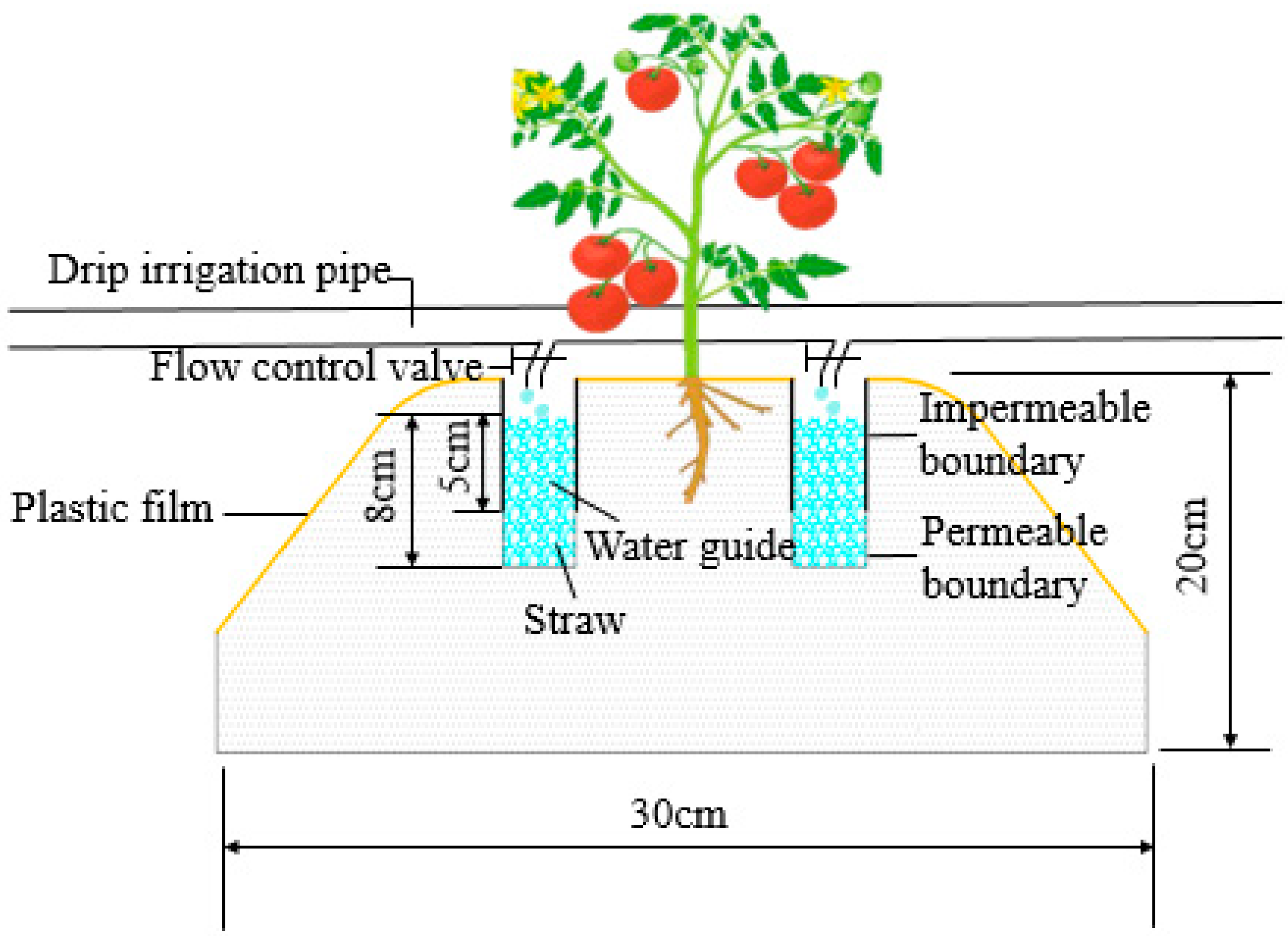
Indirect subsurface drip irrigation technology provides an innovative solution to overcome the above-mentioned bottlenecks in biogas slurry application, consisting of a common surface drip irrigation system and a water-guiding device in the rhizosphere soil under the drip head, and is a new and efficient water-saving technology that effectively solves the problems, such as large inter-plant evaporation and slow infiltration rate of traditional drip irrigation methods [23]. Indirect subsurface drip irrigation (Figure 1) technology does not need to bury irrigation pipes and wet the soil surface. Compared with ordinary surface drip irrigation, indirect subsurface drip irrigation effectively improves soil water content in the same soil layer [24,25] and also improves organic acids, soluble sugars, and VC contents in fruits [26]. More importantly, the “indirect” water delivery method employed in indirect underground drip irrigation allows water to infiltrate from the dripper into the surrounding soil via a water guide device. This approach effectively mitigates the issues of blockage and film formation that often arise when high-viscosity biogas slurry is directly discharged at the dripper. However, a significant scientific question remains: whether the integration of biogas slurry with indirect underground drip irrigation technology, particularly under deficit irrigation conditions, can synergistically enhance the utilization efficiency of biogas slurry, optimize crop responses, and improve the rhizosphere soil environment.
Accordingly, this study proposes a core scientific hypothesis: in the indirect underground drip irrigation system, the application of a deficit water-biogas slurry integrated irrigation strategy at different growth stages of tomatoes can effectively overcome the limitations imposed by the physical and chemical properties of biogas slurry. This is achieved by optimizing water and fertilizer supply in the root zone, which synergistically enhances tomato water use efficiency (WUE), improves fruit quality and yield, and promotes soil environmental health. To verify this hypothesis, in this study, a deficit irrigation system was applied to integrated water-biogas slurry application under indirect subsurface drip irrigation. With field capacity (FC) as the control standard, three water treatment limits (60%FC, 70%FC, and 80%FC) were set at different growth stages of tomato (seedling stage, flowering-fruiting stage, and maturity stage). By investigating tomato growth, fruit yield and quality, and soil environment, the appropriate integrated deficit water-biogas application model under indirect subsurface drip irrigation for improving fruit quality and efficiency of water and fertilizer was discussed. The evaluation model using fruit yield, quality, and water use efficiency as objective functions was established. This study will provide a key theoretical basis and technical support for the coordinated development of efficient biogas slurry resource utilization and water-saving agriculture in arid and semi-arid regions.

2. Materials and Methods

2.1. The Experimental Site Description

In this study, field experiments were carried out in vegetable greenhouses (103°56′ E, 37°01′ N) in Qilihe District, Lanzhou City, Gansu Province, from June to October 2020 and from March to July 2021 (Figure 1). The experimental area is at an altitude of 1836.7 m, a typical temperate continental climate. Average annual precipitation in the experimental site is 328.6 mm, mostly concentrated in summer (July–September). Average annual evaporation is 1201.29 mm. The inter-annual and diurnal temperature differences in the experimental site are large. The annual average temperature is 10.1 °C, and the annual average sunshine duration is 2445 h.
The clay, silt, and sand contents of the experimental soil are 36.43%, 45.18%, and 18.39% (mass percentage), respectively. Before the experiment, soil bulk density and field capacity (FC) were measured. In the experiments in 2020 and 2021, average soil bulk density of 0–1 m depth was 1.30 g cm−3, and average field water capacity was 20.0% and 20.6% (mass water content), respectively. Before the tomato was planted, 3–5 experimental soil points were randomly selected in the field to determine the basic soil physical and chemical properties of the 0–60 cm soil depth (Table 1). During the experiment, a small automatic weather station (Watch Dog 2900ET, Spectrum Technologies, Inc., Aurora, IL, USA) equipped in the solar greenhouse monitored the radiation amount, relative humidity, wind speed, and carbon dioxide concentration in real time.

2.2. Experimental Material

The tomato cultivar of the experiment was “Zhongyan-958F1” with indeterminate growth, which had the characteristics of a high fruit setting rate, good stress resistance, and high economic benefit. The biogas slurry used in the experiment was taken from the biogas of normal fermentation and gas production of the holstein superior dairy cow breeding center in Huazhuang town, Lanzhou city, Gansu province. The fermentation raw material of the biogas was cow dung. The biogas slurry was aerated and stood for 60 days until the physical and chemical properties were stable and reserved for use. Before the experiment, the long-standing biogas slurry was shaken well, and the large suspended particles in the biogas slurry were filtered out with 32 mesh (4 layers) gauze. The ratio (biogas slurry: water, volume ratio) was determined according to the concentration set. The physical and chemical properties and nutrient status of biogas slurry were determined before the experiment (Table 2), and measured once a month during the experiment to monitor the stability of physical and chemical properties and nutrient status of the biogas slurry.

2.3. Experimental Design

Experiments in both seasons were carried out in solar greenhouses (length × width × height = 50 m × 10.5 m × 4 m), and the covering material was PEP drip-free long-life film (transmittance 90%). The growth stage of the tomato was divided into the seedling stage, the flowering-fruiting stage, and the maturity stage. The seedling stage (9 June to 10 July 2020; 15 March to 13 April 2021) was the time from when the tomato was planted until the first ear of fruit blossomed (the flowering rate was about 80%); the flowering-fruiting stage (11 July to 13 August 2020; 12 April to 19 May 2021) was the time from the end of the seedling stage to when the first ear of fruit generally matured (the ripening rate reached 80%); and the maturity stage (14 August to 5 October 2020; 20 May to 11 July 2021) was the time from the end of the flowering-fruiting stage to the end of the experiment (the fruits on the second truss attained full ripeness). In addition, three lower limits of soil water control were set during each growth stage: 60%FC, 70%FC and 80%FC (FC, the field water capacity), and one control treatment was set for pure water irrigation and fertilizer application, with a total of 10 treatments (Table 3). Each treatment was repeated 3 times, using a random block design. The upper limit of soil moisture control for all treatments was 90%FC. Considering that the calibration accuracy of the Diviner2000 soil moisture sensor used is ±2%, a fluctuation range (2%) is set for the upper and lower limit of irrigation water for each treatment.

2.4. Field Management

The experiment adopted the local typical single-ridge furrow mulching planting mode, with a ridge height of 20 cm and a ridge surface width of 30 cm. Tomato seedlings cultivated artificially were transplanted to the ridges set up in advance. The transplantation parameters of each treatment were consistent (row spacing of 60 cm, plant spacing of 30 cm, and 11 plants in each row). The specific time of each tomato growth stage was shown in Table 4. 1:4 (biogas slurry: water, volume ratio) biogas slurry is beneficial to the growth of tomatoes [27], so the concentration of biogas slurry used for irrigation is 1:4. The application rate of fertilizers was determined by local farmers, specifically nitrogen fertilizer (urea) at 76 kg ha−1, phosphate fertilizer (diammonium phosphate) at 95.6 kg ha−1, and potassium fertilizer (potassium sulfate compound fertilizer) at 98.3 kg ha−1. Tomatoes were fertilized four times in the whole growth stage, which was consistent with the local farmers.
In order to ensure the accuracy of soil moisture control, a plastic film was set up, which was buried 1 m deep, separating the experimental area from the surrounding environment to prevent horizontal moisture from penetrating each other. In order to improve the survival rate of tomato seedlings after transplanting, 2000 mL of seedling protection water was provided in 3 days. The experiment was carried out after 3 days of slow seedling.
Integrated water-biogas slurry under indirect surface drip irrigation was adopted. The structure of the water guiding device was shown in Figure 1. Irrigation water was dribbled by a drip irrigation pipe with a regulating valve. Water reached the bottom of the root zone soil through the water guide device. The water guide device consisted of two parts. The upper part was the impermeable boundary (plastic PVC pipe), and the lower part was the permeable boundary with the straw filling. A soil sampler with a diameter slightly larger than the diameter of the water guide device (5 cm) was used to make holes on both sides of the tomato plant (5–8 cm from the root of the plant) before the installation of the water guide device; the holes’ depth was 10 cm. The PVC pipe was inserted into the hole. The prepared straw was loaded into the bottom of the hole. The straw was corn straw, which had a particle size of 0.5 cm and a loading density of 0.4 g cm−3. The PVC-pipe was slowly pulled out 3 cm upward to form a permeable boundary at the bottom without disturbing surrounding soil and straw [28]. Drip irrigation pipe was laid into a water guide device with an outlet tube, which had a flow velocity of 2 L h−1.
Figure 1. Indirect underground drip irrigation water guide device parameter diagram.
Agriculture 15 01601 g001
Irrigation water under each treatment was determined by the Equation (1) below:
W = S × H × γ (QmaxQmin)
where W (mL) is the one-time irrigation water amount; S (cm2) is the plot area (30 cm × 60 cm); H is the planned soil moisture depth, considering the growth characteristics of tomato roots at different growth stages [29], 10 cm, 30 cm, and 40 cm are selected for the seedling, flowering and fruiting, and maturity stages, respectively; γ is soil bulk density (1.3 g cm−3); and Qmax and Qmin are the largest and lowest limits of soil water content, respectively.

2.5. Measurement and Evaluation Methods

2.5.1. Soil Physical and Chemical Properties Measurement

Soil bulk density and field water capacity were measured by the cutting-ring method. Soil particle size distribution and specific surface area were measured using an automatic specific surface area spectrometer (LS 13 320 XR laser diffraction particle size analyzer, Beckman Coulter Life Sciences, Brea, CA, USA). Soil water content was measured once a day using Diviner 2000 (Australia). At the same time, the drying method was used to measure soil water content regularly during each tomato growth stage (every 7 days) for calibration instruments. Soil was taken into zip lock bags using a boring auger. Three points in each plot were selected randomly and mixed as a sample. Soil depth for sampling was 60 cm, which was spaced at intervals of 10 cm. Soil samples were naturally air-dried before testing. Soil pH was measured by a pH meter (Model PHS-3C, Shanghai Leici, Shanghai, China). Soil organic matter was determined by the K2Cr2O7 volumetric method [30].

2.5.2. Physicochemical Properties and Nutrients of Biogas Slurry Measurement

The electrical conductivity (EC) of biogas slurry was measured with a conductivity meter (Model DDS-307A, Shanghai Leici). The viscosity was measured by a viscometer (model SNB-1, Shanghai Leimi, Shanghai, China). PH was determined by a pH meter; organic matter in biogas slurry was determined by the K2Cr2O7 volumetric method. The NO3−-N and NH4+-N of biogas slurry were measured by the ultraviolet spectrophotometer method; total nitrogen was determined by the Kjeldahl method [31]. Total phosphorus of biogas slurry was measured by an ammonium molybdate spectrophotometer.

2.5.3. Tomato Growth Index Measurement

Plant height was measured from the ground of stem base to the top of the plant canopy using a meter rule with an accuracy of 1 mm. Stem diameter was measured at the base of tomato plants with a vernier caliper with an accuracy of 0.01 mm. In order to reduce the measurement errors, average stem diameter under a treatment was obtained according to the cross-bonded method. Plant height and stem diameter of tomato were measured every 4 days during the whole tomato growing stage. The intact tomato leaves were extracted at the end of the growing stage and covered with clean, transparent glass on the white paper to take pictures for leaf area determination [32]. The imported AutoCAD 2012 software was applied to calculate tomato leaf area using the convert coefficient method. On the day marking the conclusion of the various growth stages of the tomato plants, those exhibiting uniform growth were selected for destructive sampling in each treatment group. The roots, stems, leaves, and fruits were separated, dried to a constant weight in an oven at 75 °C, and the dry weight of each organ was accurately measured. Tomato taproot length was measured using a metric scale.

2.5.4. Tomato Fruit Quality Measurement

The second panicle of tomato fruit was used to determine fruit quality. About 5 fresh fruits with the same maturity (uniform size and bright red color) were randomly selected under each treatment. Fruit hardness was determined by a durometer (STEPS portable fruit hardness tester, Turoni s.r.l., Malsch, Germany); water content of fruit was measured by the drying method. Fruit soluble solids were measured by a handheld refractometer (GY-2 type). The fruit shape ratio was measured by a vernier caliper (longitudinal diameter/transverse diameter); Total soluble sugar of fruit was measured by anthrone chromogenic reaction (630 nm absorption peak using ultraviolet spectrophotometer). Organic acids were measured by standard liquid drop determination of sodium hydroxide. Fruit soluble protein was determined by the Bradford method (Coomassie brilliant blue G-250). Fruit vitamin C was titrated by 2, 6-dichlorophenol indophenol. Except for tomato fruit firmness, water content, and fruit shape ratio, all other fruit quality indexes were measured by deseeded fruit flesh.

2.5.5. Tomato Yield Determination and WUE Calculation

At the maturity stage of tomato, 3 plants were randomly selected to calculate tomato yield per plant. The mass of fresh fruit (excluding fruit stem) after picking was recorded by an electronic scale (accuracy of 0.01 g). The average value of total fruit weight per plant in different treatments was recorded as tomato yield.
WUE is calculated using Equation (2) [33].
WUE = Y/I
where WUE represents irrigation water use efficiency, kg/m3; Y represents tomato yield, kg/hm2; I represents irrigation water supply during the growth period, m3/hm2.

2.5.6. Evaluation Methods

In this study, entropy weight method was adopted firstly to determine the objective weights of each index of tomato [34]. In order to ensure the reliability of weights, the analytic hierarchy process was used to obtain the subjective weights of each index. The final weight was obtained by the combination weighting method. The comprehensive nutritional quality of tomato fruits was further evaluated with the TOPSIS (approximate ideal solution) to solve multi-objective and multi-level complex problems. The specific steps were as follows:
(1)
Establish the initial matrix W according to the measured values of tomato indexes:
W = w 11 w 1 n w m 1 w m n
where matrix W (m × n) is composed of m evaluation indicators and n evaluation objects. However, due to dimensional differences, in-depth comparisons cannot be made. Therefore, the initial matrix was normalized, and the decision matrix Z was obtained:
Z = z 11 z 1 n z m 1 z m n
where z i j = w i j / i = 1 m w i j , i [ 1 , m ] , j [ 1 , n ] .
(2)
Determine positive and negative ideal solutions (Z+, Z) according to decision proof:
Z + = z 1 + , z 2 + , z n + = max i ( Z i j ) , i [ 1 , m ] Z = z 1 , z 2 , z n = min i ( Z i j ) , i [ 1 , m ]
(3)
The weighted Euclidean distances (Ai+ and Ai) were calculated according to positive and negative ideal solutions:
A i + = j = 1 n Q w j ( z i j z j + ) 0.5 , i [ 1 , m ] A i = j = 1 n Q w j ( z i j z j ) 0.5 , i [ 1 , m ]
(4)
The final score Si was obtained according to weighted Euclidean distance:
S i = A i / A i + A i + ,   i [ 1 , m ]
In order to further ensure the scientific and rational weights calculation, the subjective weights obtained by the analytic hierarchy process and the objective weights obtained by the entropy weight method were combined to obtain combined weights (Wi). The combined weights were applied to the TOPSIS method for obtaining the final evaluation result. The calculation method of combined weight was:
W i = ( θ i × μ i ) / ( i = 1 n θ i × μ i ) , ( n = 1 , 2 , , 4 )
where θi is the local weight of each index. μi is the final weight of each index.

2.6. Statistical Analysis

The initial data were collected and calculated by Excel2010. The figures were drawn by AutoCAD2012 and Origin2019. The statistical analysis of variance analysis and Duncan multiple comparison (p < 0.05) was performed by SPSS26.0.

3. Results

3.1. Soil Properties

3.1.1. Soil Water Content

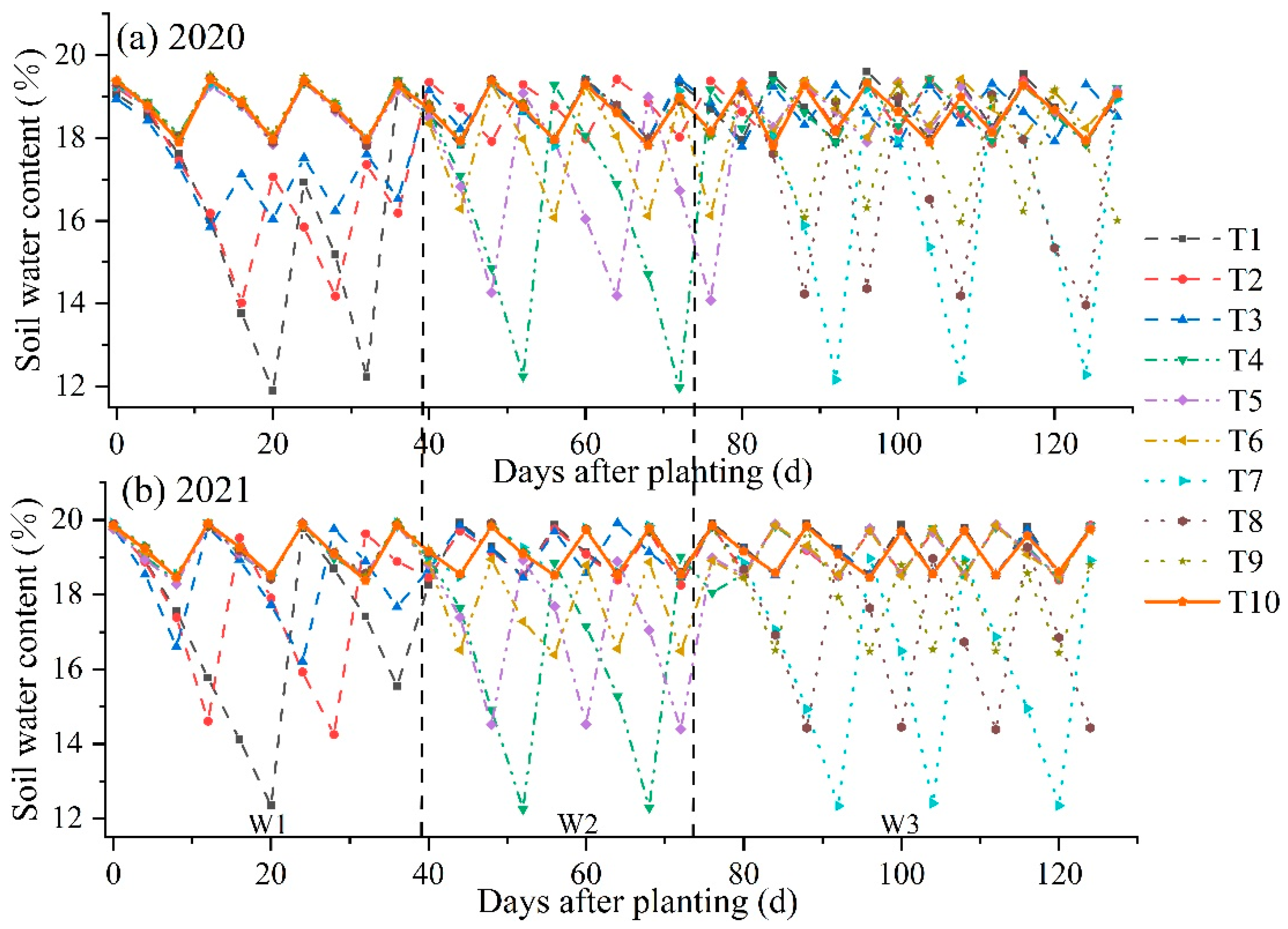
Soil water is a key controlling factor for crop yield formation. Severe deficit irrigation (60%FC) at each tomato growing stage resulted in the lowest soil moisture during the deficit stage of T1, T4, and T7 treatments in 2020 and 2021 (Figure 2). When deficit irrigation was conducted in the maturity stage in 2020, soil water content under T7 rapidly reduced by 5.89% within 12 days, and the irrigation times were 3, and the lowest soil water content was 12.14%. T8 and T9 treatments were irrigated 4 and 5 times, respectively. Under deficit irrigation in the maturity stage of tomato in 2021, the decrease rate of soil water content under each treatment was similar before the first irrigation. However, the water consumption rate under each treatment was different after the first irrigation reached the lower limit of water control. The irrigation times of severe deficit treatment (T7) were the least; only 3 times did they reach the lower limit of water control, and the irrigation times under T8 and T9 treatments were 4 and 5 times, respectively. Results indicated that tomato plants had greater water demand at the maturity stage, and the soil water consumption rate was different under different control limits.

3.1.2. Soil Organic Matter

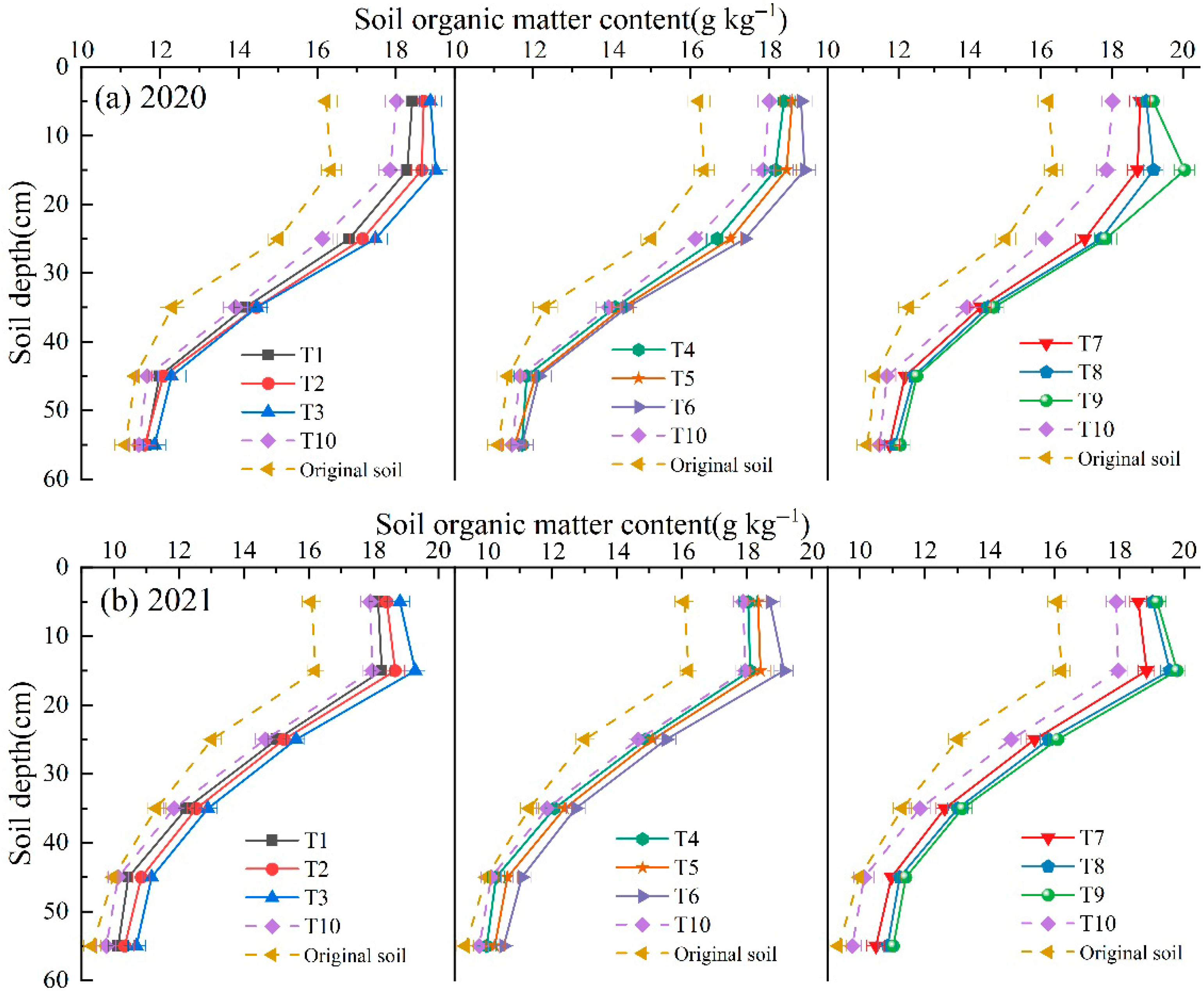
Soil organic matter is one of the important indexes to evaluate the quality of the soil environment. At the end of the experiment, soil samples of different soil depths were taken to determine soil organic matter. Figure 3 showed the influence of soil water-nutrient regulation in each tomato-growing stage on soil organic matter content in 2020 (a) and 2021 (b). Soil organic matter content was basically the same among all treatments before deficit irrigation, but soil organic matter under all treatments was significantly higher than that of the original experimental soil and T10 at the end of the experiment, especially at regulated deficit irrigation in the maturity stage. Soil organic matter in the 0–30 cm soil layer was significantly different among different treatments at the maturity stage, showing a variation pattern of T9 > T8 > T7 > T10 > original experimental soil. In soil depth of 10–20 cm, organic matter content under T9 was 9.24%, 25.00%, and 14.57% higher than that of T7, original experimental soil, and T10, respectively, indicating that irrigation could effectively improve organic matter content in the root zone soil, and the effect of biogas slurry irrigation was more obvious. In 2021, soil organic matter under T10 and that of the original experimental soil was significantly lower than other treatments, which further indicated that biogas liquid irrigation promoted the formation of soil organic matter. The difference between T9 and T8 was small, but both T9 and T8 were significantly higher than T7. Soil organic matter under T9 (19.77 g/kg) in the 10–20 cm soil layer was 4.99%, 10.08%, and 21.96% higher than under T7, T10, and that of the original experimental soil, respectively.
Overall, irrigation effectively increased soil organic matter in the root zone soil, and the biogas slurry irrigation was more beneficial to organic matter accumulation than pure water irrigation with fertilizers. In 2020 and 2021, soil organic matter was higher under moderate deficit treatment. Soil organic matter in the 10–20 cm soil layer all showed a pattern of T9 > T8 > T3 > T6 > T7 > T2 > T5 > T1 > T4 > T10> original soil at the end of the experiment. It was further indicated that suitable biogas slurry irrigation could increase soil organic matter content.

3.1.3. Soil pH

Biogas slurry used as irrigation material was alkaline, and the two-year average pH value was 7.7. The field soil was also alkaline, with an average pH of 7.97 from 0 to 60 cm soil layer. The change of soil pH was mainly the result of the imbalance of soil H+ or OH concentration caused by the chemical reaction accompanying the cycling of trace elements (carbon, nitrogen, sulfur elements, etc.) in soil. Table 4 showed soil pH variation at the end of the tomato maturity stage in 2020 and 2021. In the two-season experiment, soil pH under each treatment still maintained a trend of decreasing along with the deepening of soil depth. Under deficit irrigation at the fruit maturity stage, the decrease in soil pH under each treatment reduced, especially under severe deficit irrigation of T7. In all soil depths, after long-term continuous irrigation, soil pH under treatments was significantly lower than that of the original experimental soil. There was a large gap between biogas slurry irrigation treatment and original experimental soil, indicating that continuous biogas slurry irrigation had a great effect on reducing soil pH.
In 2020, T3 exhibited the lowest soil pH, while in 2021, T8 recorded a lower soil pH. Soil pH under all treatments showed a decreasing trend with the deepening of soil depth (0–60 cm), and the difference was the greatest in the upper soil depth of 0–30 cm, which had little effect on soil pH in 50–60 cm soil depth. The severe deficit irrigation (T1, T4, and T7) always maintained the largest soil pH, indicating that irrigation had a greater impact on soil in the root zone. Meanwhile, the decrease in soil pH under the biogas liquid irrigation was higher than under T10, further demonstrating the regulation effect of biogas liquid on soil pH in the root zone.

3.2. Tomato Growth Index

3.2.1. Plant Height and Stem Diameter

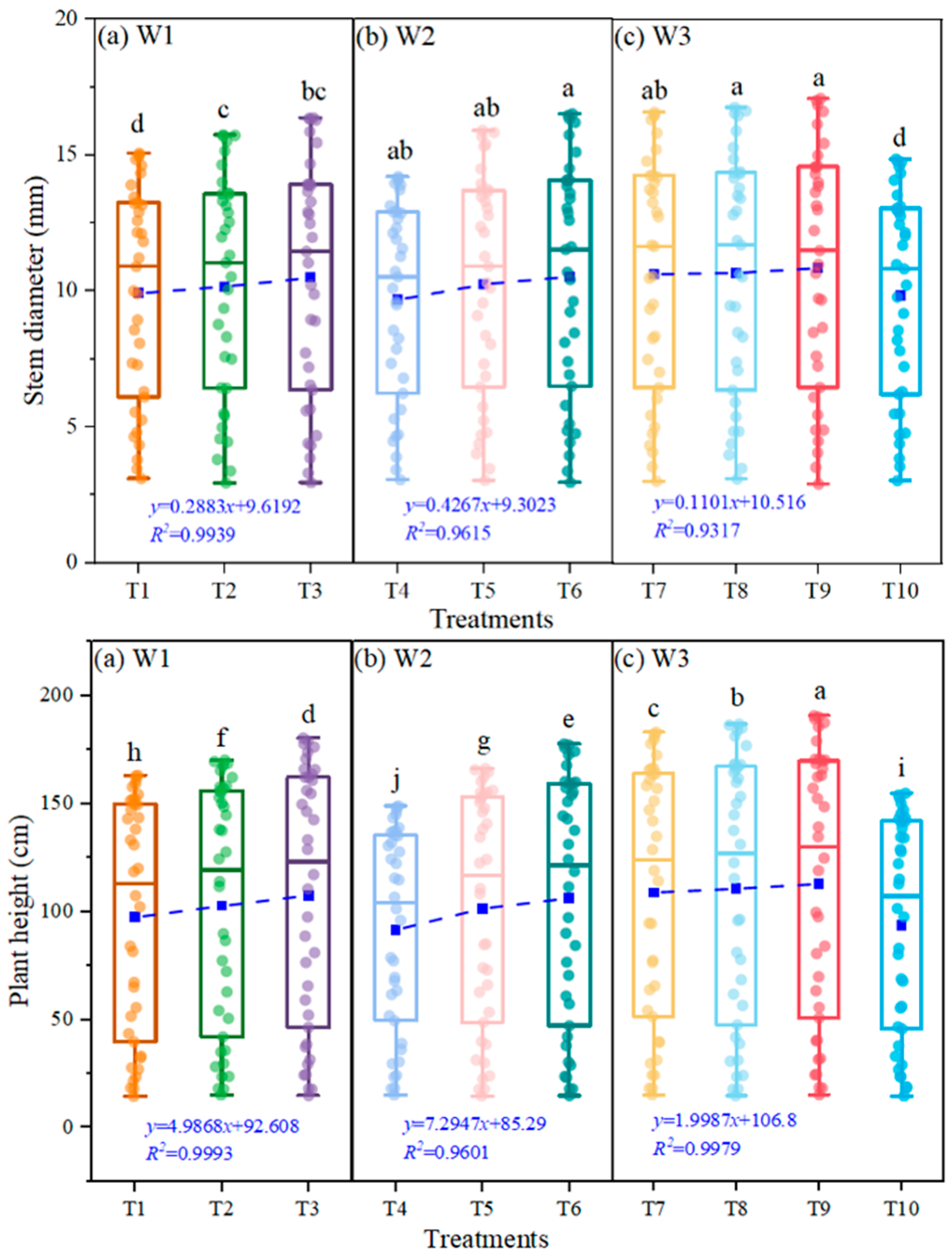
In the two growing seasons of tomatoes, the effects of different treatments on changes in tomato plant height and stem diameter were significantly different (p < 0.05) and showed obvious staged changes (Figure 4). Judging from the correlation between average plant height and stem diameter of tomato under different treatments and water deficit coefficient at different growing stages, the slope rule of the regression equation was: W2 > W1 > W3, that was to say: tomato seedlings were less sensitive to water and nutrient regulation, and there was little difference in both plant height and stem diameter between different treatments; after the flowering-fruiting stage, tomato plant height and stem diameter showed higher water and nutrient requirements, and there was a large difference in plant height between different treatments; in the maturity stage, tomato grew slowly, and different biogas slurry application amounts had little effect on plant height and stem diameter.
The maximum plant height was obtained under T3 in 2020 (180.5 cm) and 2021 (166.1 cm), 16.53% and 15.75% higher than under T10, respectively. The severe deficiency (T4) at the flowering-fruiting stage severely inhibited tomato growth, which was 3.89% (2020) and 4.21% (2021) lower than that under fertilizer control treatment, indicating that a severe lack of water and nutrients at the flowering-fruiting stage would cause irreversible damage to plant growth. Compared with fertilizer control treatment, biogas slurry irrigation significantly promoted plant growth (except T4); for example, plant height under T9 was 23.18% and 18.89% higher than under T10 (2020) and under T10 (2021). Similar to plant height, T9 obtained the maximum stem diameter of 17.11 mm in 2020 and that of 14.63 mm in 2021, which were 14.91% and 11.25% higher than T10, respectively.

3.2.2. Leaf Area

At the whole growth stage, the growth rate of leaf area firstly increased and then decreased. The flowering-fruiting stage was the main stage of tomato leaf area formation, and the regulation of water and nutrients had a great effect on leaf area (p < 0.05) (Table 5). At the seedling stage, plants showed strong vegetative growth, and leaf area growth was more sensitive to deficit irrigation, and it decreased with the increase in deficit degree. Leaf area under T3 was more than 10% and 30% higher than under T2 and T1, respectively, indicating that leaf area at the seedling stage was more sensitive to water and nutrients. In both 2020 and 2021, leaf area at the end of the growing stage reached 6928.46 cm2 in 2020 and 6814.37 cm2 in 2021 under T3, indicating that a slight deficit at the seedling stage was conducive to the later growth of plants. On the other hand, at the end of the growing stage, leaf area under each treatment was higher than under fertilizer control treatment (T10).

3.2.3. Dry Matter and Root-Shoot Ratio

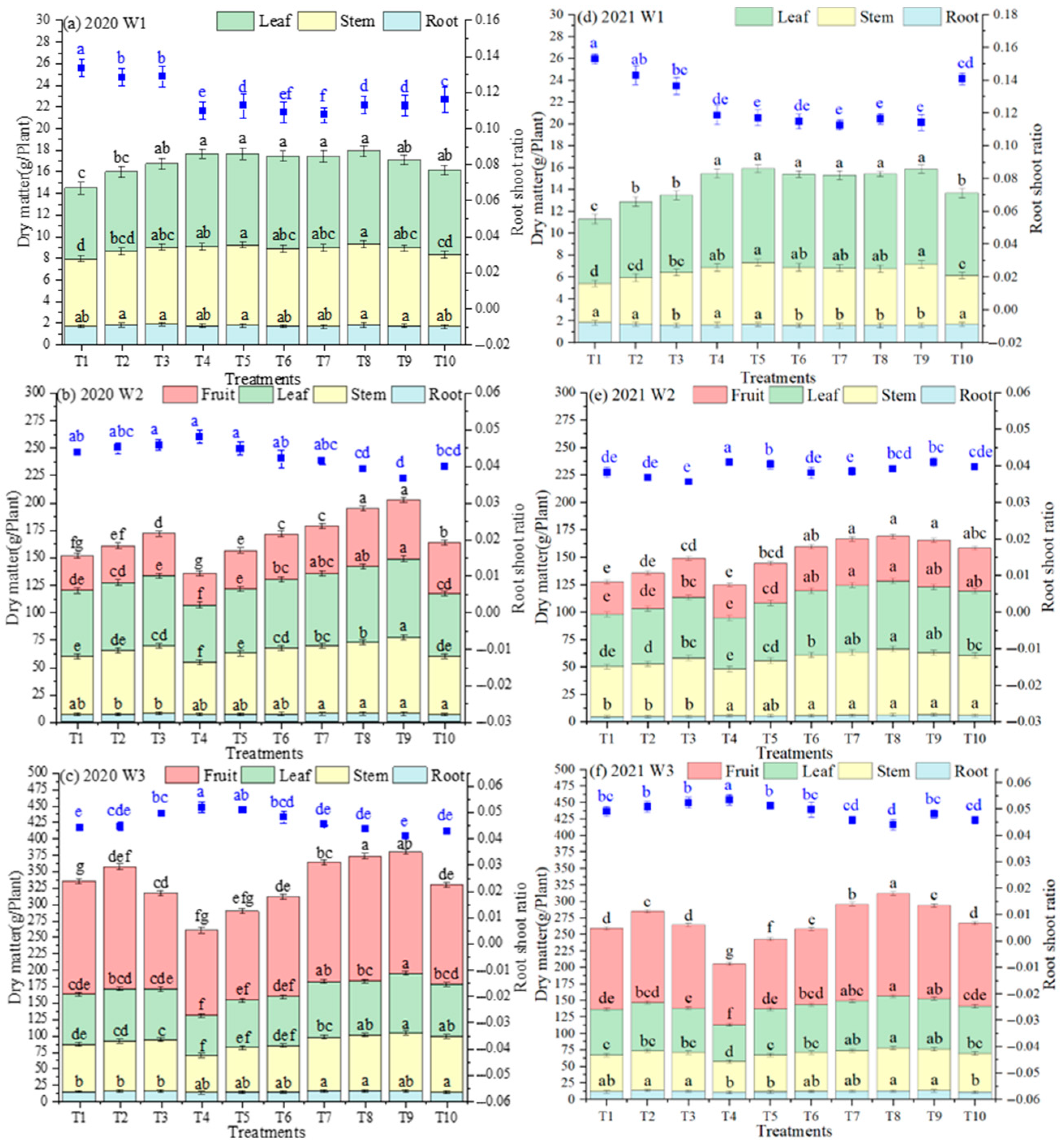
In Figure 5, total dry matter at the seedling stage presented a rule of T3 > T2 > T1. T3 obtained the total dry matter of 16.74 g/plant in 2020 and 13.48 g/plant in 2021, which was 4.76% and 15.45% in 2020 as well as 4.66% and 19.19% in 2021 higher than T2 and T1, respectively. The minimum total dry matter of 135.52 g/plant and 124.86 g/plant under T4 at the flowering-fruiting stage was obtained in 2020 and 2021, respectively. Total dry matter under T6 was 9.6% and 26.48% in 2020 as well as 10.46% and 27.82% in 2021, higher than under T5 and T4, respectively. The difference in total dry matter between treatments at the maturity stage was small, and total dry matter under T7 was the least. At the seedling stage, deficit irrigation had no significant effects on the dry matter of the stem and root but had significant effects on leaf dry matter. At the flowering-fruiting stage, deficit irrigation significantly affected the dry matter of leaf, stem, and root. 80% deficit irrigation obtained the largest total dry matter of the leaf, stem, and root. At the maturity stage, 70% deficit irrigation obtained the largest total dry matter of leaf, stem, and root.
When deficit water and nutrients were applied at the seedling stage, the root-shoot ratio of tomatoes increased with the increase in deficit lower limits (T1 > T2 > T3). T1 obtained the maximum root-shoot ratio of 0.134 in 2020 and 0.193 in 2021, which was 3.88% (2020) and 40.88% (2021) higher than T3. During the flowering and fruiting period, the root-shoot ratio of tomatoes increased with the increase in the lower limits of deficit irrigation. The root-shoot ratio reached the maximum value of 0.052 in 2020 and 0.057 in 2021 under T4 with severe deficit irrigation, which was 8.3% (2020) and 14.0% (2021) higher than under T6 with slight deficit treatment. When deficit water and nutrients were applied at the maturity stage, there was basically no effect on the root-shoot ratio of tomato plants.

3.3. Tomato Quality

Various water and fertilizer amounts at different tomato-growing stages had a great impact on tomato quality (Table 6), and there were significant differences among different treatments (p < 0.05). In 2020 and 2021, both soluble sugar and titratable acid of tomato fruits were the highest under T4, followed by T7. The highest sugar-acid ratio was obtained under T2. T7 had the highest vitamin C, soluble solid, soluble protein, and fruit hardness. T9 had the maximum fruit water and fruit shape ratio, indicating that moderate water and adequate nutrition at the maturity stage regulated the development of tomato fruit. It was worth noting that in the two experimental seasons, fruit quality indexes of tomatoes under the biogas slurry application were higher than under T10, indicating that biogas slurry irrigation effectively improved tomato fruit quality.

3.4. Yield and WUE

In Table 7, T2 obtained the highest yield per plant of 4.66 kg/plant in 2020 and 4.28 kg/plant in 2021, followed by T9, T10 had the smallest yield. In the two-season experiment, tomato fruit yield under T2 increased by 19.79% in 2020 and 19.22% in 2021 compared to under T10. Under deficit irrigation at the seedling stage, the yield per plant of T2 was 10.95% and 13.22% higher than that of T1 in 2020 and 2021, respectively. When deficit irrigation was carried out at flowering and fruit stages and maturity stages, the yield per tomato plant showed a trend of decreasing with the increase in deficit irrigation degrees. T6 increased fruit yield by 6.30% in 2020 and 5.66% in 2021 compared with T4. T9 improved fruit yield by 6.74% in 2020 and 5.01% in 2021 compared to T7.
Under deficit irrigation conditions at the seedling stage, T2 had the maximum WUE of 83.21 kg m−3 in 2020 and 81.03 kg m−3 in 2021, which increased by 9.01% and 11.48% in 2020 as well as 8.13% and 5.47% in 2021, respectively, compared with T1 and T3. Under deficit irrigation conditions at the flowering-fruit stage and maturity stage, WUE under T6 was 76.08 kg m−3 in 2020 and 82.46 kg m−3 in 2021, which was 11.36% in 2020 and 1.33% in 2021 lower than under T4. WUE under T9 was 74.62 kg m−3 in 2020 and 73.71 kg m−3 in 2021, reduced by 11.91% in 2020 and 14.65% in 2021 compared to under T7. T7 achieved the highest water use efficiency of 84.71 kg m−3 in 2020 and 86.37 kg m−3 in 2021, followed by T4, indicating that severe deficit irrigation (60%FC) at the maturity stage and flowering-fruiting stage effectively improved tomato water use efficiency.

3.5. Comprehensive Evaluation of Tomato Fruit Quality and Benefit

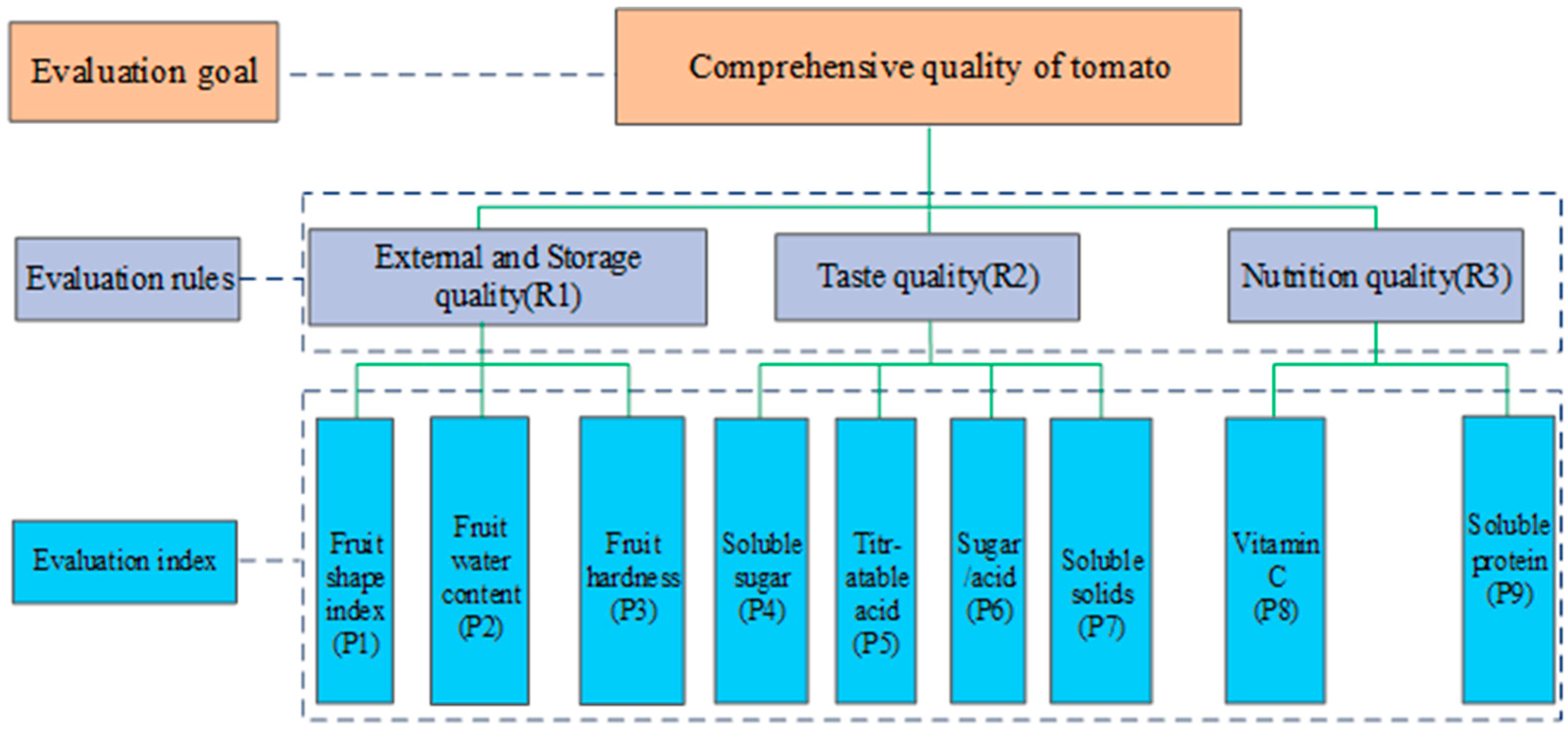
The entropy weight method is a commonly used method in multi-attribute decision-making, which can determine the importance of a certain index. The analytic hierarchy process (AHP) can subjectively reflect the importance of different indicators. The hierarchical evaluation model was shown in Figure 6, in order to ensure the operability and rationality of the evaluation model, the appearance quality and storage and transportation quality were weighted at the same level. In this study, the entropy weight method and analytic hierarchy process were used to determine the combined weight of each tomato fruit’s quality index. The TOPSIS was used to evaluate the comprehensive quality of tomato.
There were some differences in the weights of each single index of tomato obtained by different weighting methods (Table 8 and Table 9). In order to further ensure the scientificity and rationality of the calculation weights, the subjective weights obtained from the analytic hierarchy process and the objective weights obtained from the entropy weight method were combined to obtain the combined weights (Table 9). The combination weight was applied to the TOPSIS method for obtaining the final evaluation result (Table 10).
The combined evaluation method was used to evaluate the comprehensive benefits of tomatoes under different treatments (Table 10). The optimal deficit irrigation pattern of indirect subsurface drip irrigation with biogas slurry was obtained. T7 was the optimal treatment, followed by T5; however, T10 was the worst. There were significant differences between T7 and T10.
The comprehensive benefits of tomatoes were determined by multiple factors. The combined evaluation model obtained the optimal treatment among multiple index factors, and the results were reasonable and representative. This study adopted the combined evaluation method to evaluate the comprehensive benefits of tomatoes under different treatments and obtained the optimal biogas slurry application under deficit irrigation mode. The weights of each index were obtained according to the entropy weight method, including yield of 0.0070 and 0.0504, WUE of 0.0137 and 0.0922, and tomato comprehensive quality of 0.9793 and 0.8574 in 2020 and 2021, respectively. A combined evaluation was performed. In the two-season experiment, the comprehensive benefit evaluation results of tomatoes showed that T7 was the best treatment, followed by T5; however, T10 was the worst (Table 11). There was a significant difference between T7 and T10, indicating that deficit irrigation during the maturity stage effectively improved the comprehensive benefits of tomatoes, and the application of biogas slurry had a more obvious promoting effect than chemical fertilizers.
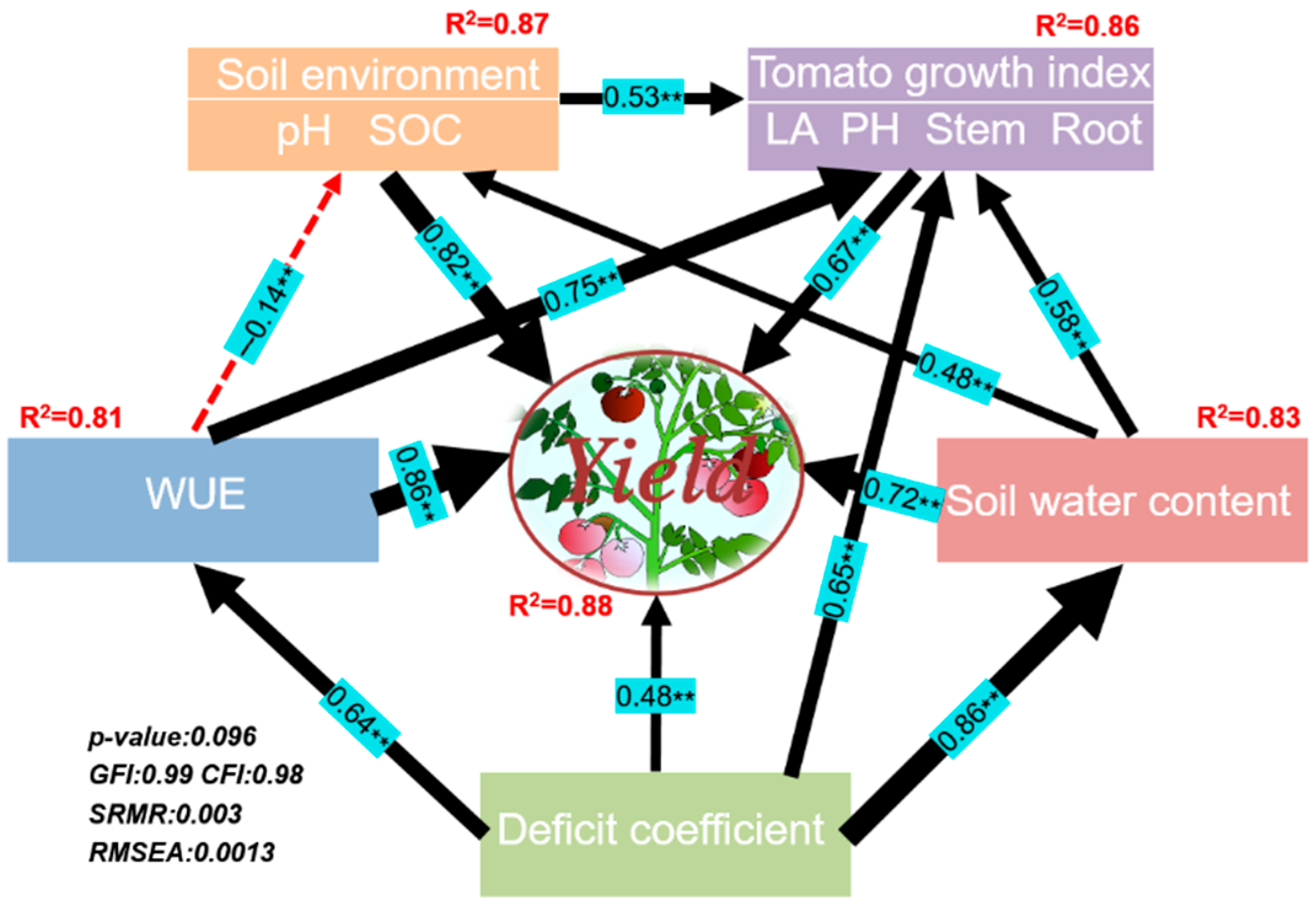
To more clearly quantify the ultimate impact of various types of indicators in this study on tomato yield, our structural equation model provides a solid data support foundation. As can be seen from Figure 7, among the factors that directly affect the formation of yield, the path coefficients from largest to smallest are water use efficiency (0.86), soil environment (0.82), soil water content (0.72), tomato growth index (0.67), and irrigation deficiency coefficient (0.48), which could be expressed as the increase in tomato yield coming from the improvement of soil environment and water use efficiency of deficit irrigation with biogas slurry. The average explanatory R2 was all above 0.8, indicating strong explanatory power, and the path coefficients were all significant (p < 0.001). Secondly, the indirect effect is also an indispensable factor. Soil moisture content promotes the formation of tomato yield by influencing the soil environment (0.39) and tomato growth indicators (0.39). The irrigation deficiency coefficient affects the yield of tomatoes by influencing their growth index (0.44). The deficiency coefficient promotes the increase in yield by influencing soil moisture (0.62). Water use efficiency increases the final yield of tomatoes by promoting the growth of aboveground and underground biomass (0.55) of tomatoes.

4. Discussion

4.1. Effects of Deficit Subsurface Drip Irrigation on Soil Environment Properties

The soil environment plays a decisive role in crop yield and biomass formation. Appropriate soil water content is conducive to the formation of soil aggregates and increases the porosity and oxygen content of rhizosphere soil, thus promoting crop root growth in the soil, improving water and nutrient utilization efficiency, and improving crop growth [35]. Biogas slurry, as a liquid, fast-acting organic fertilizer, is characterized by rapid solubility, high permeability, substantial water content, and relatively low nutrient concentration, which contributes positively to crop yield enhancement and soil quality improvement [36,37,38]. In soil depth of 10–20 cm, organic matter content under all biogas slurry deficit irrigation was higher than that of T10 and original experimental soil, respectively, indicating that biogas slurry irrigation had a great effect on the improvement of soil organic matter, which was mainly because biogas slurry contained a large number of organic matter residues and nutrients (Table 2). Also, for soil water content, the progressive increase in deficient irrigation leads to a corresponding decrease in soil moisture content throughout the profile, demonstrating that the deficiency coefficient serves as the primary determinant of soil moisture dynamics, as evidenced by structural equation modeling, which reveals direct and indirect path coefficients of 0.72 and 0.4, respectively (Figure 7). Concurrently, variations in soil pH, though not statistically significant, emerge as another consequential factor in biogas slurry irrigation systems, with the application of biogas slurry generally inducing a slight acidification in the surface soil layer [39]. This pH modification initiates a cascade of ecological responses, including alterations in soil aggregate stability and transformations in the habitat conditions for soil microbial communities, particularly fungi and bacteria, whose activity is profoundly influenced by soil pH [40,41]. The implementation of subsurface indirect drip irrigation further modulates these effects, ultimately inducing structural and environmental modifications across the soil profile that collectively enhance the growth performance of tomato plants, manifesting in improved yield and biomass production [42]. Han et al. (2025) [41] also found application of biogas slurry resulted in a significant decrease in soil pH by 7.4% compared to no biogas slurry. Jin et al. (2021) [43] indicated biogas slurry addition ameliorated the nutrient content of the soil and significantly increased the soil’s organic matter (p < 0.05). Mukhtiar et al. (2024) [44] reviewed that biogas slurry as an organic fertilizer benefited water-holding capacity and improved soil texture. These studies were consistent with Cui et al. (2020) [45], who pointed out that 75% ETc was the best irrigation system for tomato growth, which also testified that the appropriate amount of biogas slurry irrigation was the key to increasing crop production. The change of soil environment (soil physical and chemical properties) made it easy and accessible for crops to absorb soil nutrients and had different reactions at various growing stages with deficit irrigation. Otherwise, the common irrigation water was replaced by biogas slurry in this study, which made the “fertilization with water” proposed by previous scientists more convenient to achieve, which was beneficial for reducing fertilizer pollution, and water-biogas slurry irrigation also had a positive effect on long-term enhancement of soil fertility.

4.2. Effects of Deficit Subsurface Drip Irrigation on Agronomic Characteristics and Quality of Tomato

In the treatment of deficit irrigation at the seedling stage, tomato plant height, stem diameter, leaf area, and dry matter obtained better performance under T3. Results showed a strong rehydration effect after rehydration at later growing stages (flowering-fruiting stage and maturity stage), mainly because water and nutrition deficiency (soil organic matter) at the seedling stage was conducive to tomato “planting”, which would promote tomato growth and stalk robustness. Tomato plant height, stem diameter, leaf area, and dry matter at the flowering-fruiting stage decreased with the increase in the lower limits of deficit irrigation. However, there were certain damages to tomato growth, especially under T4 with severe deficit irrigation, which caused irreversible damage to tomato plant growth and made tomatoes grow slowly after rehydration in the later growing stage (maturity stage). As discussed above, biogas slurry is rich in organic matter and water, which greatly promotes the absorption of nutrients by crops [46]. Biogas slurry is different from normal chemical fertilizers, the nutrients of biogas slurry are generally absorbed by intermediate or final crops after fermentation, which plays a key role in improving the early reproductive and late vegetative growth of tomatoes [47]. Agronomic characteristics cover the key traits of tomato growth stage, plant height, leaf area, fruit weight, dry matter mass, etc., which represent the traits of crop varieties [48]. In our study, compared with the fertilizer control group, biogas slurry irrigation significantly promoted plant growth (except for T4), for example, T9 was 23.18% and 18.89% higher than T10 in 2020 and 2021, respectively. In 2020 and 2021, leaf area at the end of the growing stage was the maximum under T3 (6928.46 cm2 in 2020; 6814.37 cm2 in 2021) (Figure 5), indicating that a slight deficit irrigation at the seedling stage was conducive to the later growth of plants. As for dry matter, at the seedling stage, deficit irrigation had no significant effects on stem and root dry matter but had significant effects on leaf dry matter. At the flowering-fruiting stage, deficit irrigation had significant effects on leaf, stem, and fruit dry matter. 80%FC deficit irrigation obtained the largest total dry matter of leaf, stem, and root. At the maturity stage, 70%FC deficit irrigation obtained the largest total dry matter of leaf, stem, and root. That meant deficit irrigation at various tomato-growing stages had different effects on tomato growth. Similarly, Jiao et al. (2024) [49] reported moderate deficit irrigation reduced crop water consumption and increased the growth of leaf area and plant height during late vegetative and reproductive growing stages. Xu et al. (2021) [50] revealed that biogas slurry combination with chemical synthetic fertilizer significantly (p < 0.05) improved the growth of Italian ryegrass, and the Italian ryegrass dry matter was increased by more than 9% in comparison with only the chemical synthetic fertilizer group. Accordingly, deficit irrigation at different tomato-growing stages had obvious effects on plant height, stem diameter, leaf area per plant, dry matter accumulation, root-stem ratio, and root length. Suitable soil water and nutrients actively promoted tomato plant growth and reasonably redistributed the assimilated substances produced by photosynthesis in various organs of the tomato, which would affect crop yield and water use efficiency to a certain extent. Among treatments in this study, slight deficit irrigation (T3, T6, T9, 80%FC) was more conducive to tomato plant growth. Severe deficit irrigation (T4) during the flowering and fruit-setting growing stage was recommended to be avoided. In short, severe deficit irrigation had a great effect on tomato growth and even seriously inhibited the normal growth of tomato plants.
The fruit quality of the tomato is the most important index to evaluate the final benefit, including soluble sugar, titratable acid, soluble solids, vitamin C, soluble protein, fruit water content, etc. The fruit quality of tomatoes is evaluated in shape and taste from different aspects so as to determine the final benefit [51,52]. Moreover, the fruit quality of a tomato is a reflection of soil quality and environment. Sufficient water and nutrients from biogas slurry are provided to the tomato root area, improving tomato fruit quality during the flowering, fruit, and harvest stages [43]. Biogas slurry exhibits favorable solubility, facilitating the rapid uptake of essential nutrients for crop growth, while an optimal leaf area enhances photo assimilate translocation. Adequate water and nutrient availability promote efficient root absorption, thereby preventing excessive root proliferation and minimizing the diversion of photosynthetic products under resource-limited conditions [44]. Under the three deficient irrigation levels, compared with T10, the two-year average soluble sugar, titratable acid, sugar-acid ratio, vitamin C, soluble solids, soluble protein, and fruit hardness of 60%FC, 70%FC, and 80%FC increased by 13–16%, 12–24%, 9–23%, 11–19%, 8–17%, 5–17% and 17–26%, respectively (Table 6), indicating that water and nutrient deficiency at the tomato maturity stage effectively improved tomato fruit quality. T9 had the highest fruit water content and fruit shape ratio, indicating that moderate water and adequate nutrition at maturity regulated the development of tomato fruits. The above results elucidated that deficit irrigation played a vital role in fruit quality enhancement at flowering and fruit-bearing growing stages, and 60%FC deficit irrigation had the greatest effect on tomato quality. The slight deficit (80%FC) had the greatest effect on tomato fruit moisture and fruit shape index. Previous studies found soluble solids, vitamin C, and soluble sugar of tomato fruits were the lowest under 100% deficit irrigation. 75% deficit irrigation markedly reduced unmarketable fruits (small fruit shape index) [53], which was consistent with the current study. Teng et al. (2022) [54] investigated the soluble sugar contents of fruits in digested pig slurry treatment and found they were enhanced by 12.3% compared to mineral fertilizer treatment, which they attributed to digested pig slurry increasing the photosynthetic efficiency and source strength and regulating the activities of carbohydrate metabolism enzymes.

4.3. Effects of Deficit Subsurface Drip Irrigation on Tomato Yield, WUE, and Comprehensive Benefit

High yield is an ultimate goal of agricultural production. Water and nutrients applied to rhizosphere soil are the main sources for normal crop growth in recharge facilities [35]. Tomato yield formation results from synergistic interactions between soil properties and plant physiological processes, with biogas slurry irrigation providing dual benefits: its nutrient-rich composition and enhanced nutrient bioavailability from fermentation directly improve soil-plant nutrient cycling and water use efficiency [50]. Under the three deficient irrigation levels, compared with T10, the two-year tomato average yield of 60%FC, 70%FC, and 80%FC increased by 16%, 11%, and 9%, respectively (Table 7). Also, Liu et al. (2024) [55] observed the seed yield was significantly increased by 23.9% by promoting the dry matter accumulation and transportability, increasing the number of pods by 8.4%, and increasing the 1000-seed weight by 5.1%, respectively. Wang et al. (2025) [56] found tea yield significantly increased under the biogas slurry + green manure + formula fertilizer treatment by 11.97% compared to the control. This improvement in soil environment induces cascading effects that optimize rhizosphere microbial activity and crop nutrient uptake efficiency, while the high moisture content concurrently enhances fruit morphological development, collectively contributing to improved yield quality and economic returns and comprehensive benefit [41]. According to TOPSIS evaluation results and comprehensive benefit combination evaluation, deficit irrigation at the maturity stage (T7) obtained the best comprehensive quality and benefit (Table 11). This was consistent with the research results of Xu et al. (2024) [57] and Zhang et al. (2025) [58]. The enhancement of integrated agricultural benefits results from the synergistic effects of yield performance, water use efficiency, biomass accumulation, and soil nutrient dynamics, where T7 (60%FC maturity stage deficit irrigation) demonstrates that optimized slurry application during early growth stages effectively establishes both substantial aboveground biomass production and deep root system development. This provides new insights for promoting the theory of water-deficit irrigation by utilizing organic wastewater resources, which emphasizes the importance of irrigation during the emergence and mid-growing stages of crops.
As for the comprehensive benefit evaluation, the score under T4 was not the worst, which is mainly because the evaluation in this study mainly focused on indicators affecting the final benefit of tomatoes (yield, WUE, and tomato comprehensive quality). At the flowering-fruiting stage, although severe deficit irrigation caused a decrease in tomato yield, the decrease was small (T4 treatment only decreased by less than 3.00% compared to T2 treatment). However, WUE and fruit quality were greatly improved, and the overall benefit score of tomatoes was increased. On the contrary, although slight deficit irrigation (80%FC) at each stage was beneficial to tomato growth, there was no significant difference in the formation of yield, and it was not conducive to the improvement of tomato WUE and fruit quality. Moreover, prolonged excessive irrigation may lead to nutrient leaching from the root zone, while soil water saturation reduces capillary action, compromising optimal moisture retention capacity [59,60,61]. The application of biogas slurry irrigation, owing to its distinctive viscosity, abundant nutrient composition, and influence on soil pore water pressure, effectively maintained an enhanced moisture environment in the root zone, thereby optimizing overall tomato growth performance and yield, so the comprehensive optimal tomato benefits could be obtained [62,63,64]. Since deficit irrigation mainly pursued high WUE and great fruit quality, the comprehensive benefit evaluation index selected in this study had certain persuasion and credibility. Results obtained in the repeated experiments in two seasons were relatively consistent, so the evaluation results had certain reference and scientific value. According to the structural equation model, among the factors that directly affect the formation of yield, the path coefficients from largest to smallest are water use efficiency (0.86), soil environment (0.82), soil water content (0.72), tomato growth index (0.67), and irrigation deficiency coefficient (0.48) (Figure 7), which could be expressed as the increase in tomato yield coming from the improvement of soil environment and water use efficiency of deficit irrigation with biogas slurry. This also supported the objectivity of the above discussion: deficit irrigation with biogas slurry improved the yield by enhancing the soil environment and tomato water use efficiency.

4.4. Limitations of the Current Study and Future Outlook

The current research was an attempt to explore the response of tomato growth to water-nutrient deficit conditions at different growth stages. The variations in soil physical properties and microbial community structures under field irrigation conditions remain incompletely characterized. In the agroecosystem, elucidating the interactive mechanisms governing physical, chemical, and biological factors in agroecosystems remains a critical research priority.

5. Conclusions

(1)
Irrigation with biogas slurry effectively enhanced soil organic matter accumulation and reduced soil pH.
(2)
The effects of water and nutrient supply on tomato plant height and stem diameter were mainly concentrated at the seedling stage and flowering-fruiting stage. Both plant height and stem diameter decreased with the increase in deficit degree; severe water shortage at different growing stages resulted in significant decreases in leaf area.
(3)
Compared with the control group, biogas slurry irrigation significantly improved water use efficiency, and severe deficit irrigation at the maturity stage treatment obtained a maximum value, which was 26.60% in 2020 and 31.04% in 2021 higher than the control treatment.
(4)
Implementing deficit water-biogas slurry irrigation at various growth stages of tomatoes significantly enhances yield and comprehensive benefits. The comprehensive benefit evaluation indicates that severe deficit irrigation at the maturity stage treatment yields the highest comprehensive benefit, while control treatment demonstrates the least benefit. Consequently, it is advisable to utilize severe deficit water-biogas slurry integrated irrigation during the maturity stage to maximize the comprehensive benefits of tomato cultivation.

Author Contributions

Conceptualization, writing—original draft preparation, P.X.; project administration, resources, J.Z.; formal analysis, P.F. and Y.W.; review and editing, F.M. All authors have read and agreed to the published version of the manuscript.

Funding

This research was funded by the National Natural Science Foundation of China (52469011), the Funded by Key Laboratory of Degraded and Unused Land Consolidation Engineering, the Ministry of Natural Resources (SXDJ2024-08), the 2025 Gansu Provincial University Graduate Student “Innovation Star” Project (2025 CXZX-524), and the Gansu province science and technology plan funded project (24JRRA978). We duly acknowledge their support with thanks.

Institutional Review Board Statement

Not applicable.

Data Availability Statement

Data are contained within the article.

Conflicts of Interest

The authors declare no conflicts of interest.

References

  1. Kerr, R.B.; Kangmennaang, J.; Dakishoni, L.; Nyantakyi-Frimpong, H.; Lupafya, E.; Shumba, L.; Msachi, R.; Boateng, G.O.; Snapp, S.S.; Chitaya, A.; et al. Participatory agroecological research on climate change adaptation improves smallholder farmer household food security and dietary diversity in Malawi. Agric. Ecosyst. Environ. 2019, 279, 109–121. [Google Scholar] [CrossRef]
  2. Yawson, D.O.; Adu, M.O.; Armah, F.A.; Chiroro, C. Virtual water and phosphorus gains through rice imports to Ghana: Implications for food security policy. Int. J. Agric. Resour. Gov. Ecol. 2014, 10, 374–393. [Google Scholar] [CrossRef]
  3. Khasanov, S.; Kulmatov, R.; Li, F.D.; van Amstel, A.; Bartholomeus, H.; Aslanov, I.; Sultonov, K.; Kholov, N.; Liu, H.G.; Chen, G. Impact assessment of soil salinity on crop production in Uzbekistan and its global significance. Agric. Ecosyst. Environ. 2023, 342, 108262. [Google Scholar] [CrossRef]
  4. Ripoll, J.; Urban, L.; Staudt, M.; Lopez-Lauri, F.; Bidel, L.P.R.; Bertin, N. Water shortage and quality of fleshy fruits—Making the most of the unavoidable. J. Exp. Bot. 2014, 65, 4097–4117. [Google Scholar] [CrossRef] [PubMed]
  5. Calzadilla, A.; Rehdanz, K.; Tol, R.S.J. Water scarcity and the impact of improved irrigation management: A computable general equilibrium analysis. Agric. Econ. 2011, 42, 305–323. [Google Scholar] [CrossRef]
  6. Mutambara, S.; Darkoh, M.S.K.; Atlhopheng, J.R. A comparative review of water management sustainability challenges in smallholder irrigation schemes in Africa and Asia. Agric. Water Manag. 2016, 171, 63–72. [Google Scholar] [CrossRef]
  7. Lonjon, F.; Lai, Y.; Askari, N.; Aiyar, N.; Bundalovic-Torma, C.; Laflamme, B.; Wang, P.W.; Desveaux, D.; Guttman, D.S. The effector-triggered immunity landscape of tomato against Pseudomonas syringae. Nat. Commun. 2024, 15, 5102. [Google Scholar] [CrossRef] [PubMed]
  8. Lu, J.; Shao, G.; Wang, W.; Gao, Y.; Wang, Z.; Zhang, Y.; Wang, J.; Song, E. The role of hydraulic lift in tomato yield and fruit quality under different water and salt stresses. Agric. Water Manag. 2024, 299, 108899. [Google Scholar] [CrossRef]
  9. Lipan, L.; Martín-Palomo, M.J.; Sánchez-Rodríguez, L.; Cano-Lamadrid, M.; Sendra, E.; Hernández, F.; Burló, F.; Vázquez-Araújo, L.; Andreu, L.; Carbonell-Barrachina, A.A. Almond fruit quality can be improved by means of deficit irrigation strategies. Agric. Water Manag. 2019, 217, 236–242. [Google Scholar] [CrossRef]
  10. Li, X.L.; Liu, F.L.; Li, G.T.; Lin, Q.M.; Jensen, C.R. Soil microbial response, water and nitrogen use by tomato under different irrigation regimes. Agric. Water Manag. 2010, 98, 414–418. [Google Scholar] [CrossRef]
  11. Ramlow, M.; Foster, E.J.; Del Grosso, S.J.; Cotrufo, M.F. Broadcast woody biochar provides limited benefits to deficit irrigation maize in Colorado. Agric. Ecosyst. Environ. 2019, 269, 71–81. [Google Scholar] [CrossRef]
  12. Alvarez, S.; Gómez-Bellot, M.J.; Acosta-Motos, J.R.; Sánchez-Blanco, M.J. Application of deficit irrigation in Phillyrea angustifolia for landscaping purposes. Agric. Water Manag. 2019, 218, 193–202. [Google Scholar] [CrossRef]
  13. Yu, L.Y.; Zhao, X.N.; Gao, X.D.; Siddique, K.H.M. Improving/maintaining water-use efficiency and yield of wheat by deficit irrigation: A global meta-analysis. Agric. Water Manag. 2020, 228, 105906. [Google Scholar] [CrossRef]
  14. Zhang, H.X.; Chi, D.C.; Wang, Q.; Fang, J.; Fang, X.Y. Yield and Quality Response of Cucumber to Irrigation and Nitrogen Fertilization Under Subsurface Drip Irrigation in Solar Greenhouse. Agric. Sci. China 2011, 10, 921–930. [Google Scholar] [CrossRef]
  15. Wang, H.D.; Wu, L.F.; Cheng, M.H.; Fan, J.L.; Zhang, F.C.; Zou, Y.F.; Chau, H.W.; Gao, Z.J.; Wang, X.K. Coupling effects of water and fertilizer on yield, water and fertilizer use efficiency of drip-fertigated cotton in northern Xinjiang, China. Field Crops Res. 2018, 219, 169–179. [Google Scholar] [CrossRef]
  16. Rabat, N.E.; Hashim, S.; Majid, R.A. Effect of Different Monomers on Water Retention Properties of Slow Release Fertilizer Hydrogel. In Proceedings of the 4th International Conference on Process Engineering and Advanced Materials (ICPEAM), Kuala Lumpur, Malaysia, 15–17 August 2016; pp. 201–207. [Google Scholar]
  17. Bindon, K.; Dry, P.; Loveys, B. Influence of partial rootzone drying on the composition and accumulation of anthocyanins in grape berries (Vitis vinifera cv. Cabernet sauvignon). Aust. J. Grape Wine Res. 2008, 14, 91–103. [Google Scholar] [CrossRef]
  18. Cui, N.X.; Cai, M.; Zhang, X.; Abdelhafez, A.A.; Zhou, L.; Sun, H.F.; Chen, G.F.; Zou, G.Y.; Zhou, S. Runoff loss of nitrogen and phosphorus from a rice paddy field in the east of China: Effects of long-term chemical N fertilizer and organic manure applications. Glob. Ecol. Conserv. 2020, 22, e01011. [Google Scholar] [CrossRef]
  19. Islam, M.R.; Rahman, S.M.E.; Rahman, M.M.; Oh, D.H.; Ra, C.S. The effects of biogas slurry on the production and quality of maize fodder. Turk. J. Agric. For. 2010, 34, 91–99. [Google Scholar] [CrossRef]
  20. Liu, W.K.; Yang, Q.C.; Du, L.F. Soilless cultivation for high-quality vegetables with biogas manure in China: Feasibility and benefit analysis. Renew. Agric. Food Syst. 2009, 24, 300–307. [Google Scholar] [CrossRef]
  21. Zheng, J.; Zhang, P.A.; Zhu, C.Y.; Ma, J.; Wang, Y. Tomato Nutritional Quality Indexes under Various Biogas Slurry and Irrigation Schemes. Int. J. Agric. Biol. 2019, 22, 1271–1278. [Google Scholar] [CrossRef]
  22. López-Mosquera, M.E.; Moirón, C.; Carral, E. Use of dairy-industry sludge as fertiliser for grasslands in northwest Spain: Heavy metal levels in the soil and plants. Resour. Conserv. Recycl. 2000, 30, 95–109. [Google Scholar] [CrossRef]
  23. Meshkat, M.; Warner, R.C.; Workman, S.R. Comparison of water and temperature distribution profiles under sand tube irrigation. Trans. Asae 1998, 41, 1657–1663. [Google Scholar] [CrossRef]
  24. Zhao, W.X.; Zhang, Z.H.; Cai, H.J.; Shan, Z.J. Application of the steady-state principle of constant-head well permeameter to indirect subsurface drip irrigation. Can. J. Soil Sci. 2009, 89, 671–676. [Google Scholar]
  25. Ben-Gal, A.; Lazarovitch, N.; Shani, U. Subsurface drip irrigation in gravel-filled cavities. Vadose Zone J. 2004, 3, 1407–1413. [Google Scholar] [CrossRef]
  26. Sun, S.M.; Yang, P.L.; An, Q.X.; Xu, R.; Yao, B.L.; Li, F.Y.; Zhang, X.X. Investigation into surface and subsurface drip irrigation for jujube trees grown in saline soil under extremely arid climate. Eur. J. Hortic. Sci. 2016, 81, 165–174. [Google Scholar] [CrossRef]
  27. Zheng, J.; Qi, X.; Shi, C.; Yang, S.; Wu, Y. Tomato Comprehensive Quality Evaluation and Irrigation Mode Optimization with Biogas Slurry Based on the Combined Evaluation Model. Agronomy 2022, 12, 1391. [Google Scholar] [CrossRef]
  28. Ma, B. Study on Soil Water Movement Law of Biogas Slurry Indirect Underground Drip Irrigation. Master’s Thesis, Lanzhou University of Technology, Lanzhou, China, 2020. [Google Scholar]
  29. Wang, J.; Zheng, J.; Sa, Q.; Su, Z. Effects of biogas slurry as a substitute for nitrogen fertilizer on root characteristics and soil environment of greenhouse tomatoes. Water Sav. Irrig. 2025, 7, 1–11. [Google Scholar]
  30. Zornoza, R.; Acosta, J.A.; Gabarrón, M.; Gómez-Garrido, M.; Sánchez-Navarro, V.; Terrero, A.; Martínez-Martínez, S.; Faz, Á.; Pérez-Pastor, A. Greenhouse gas emissions and soil organic matter dynamics in woody crop orchards with different irrigation regimes. Sci. Total Environ. 2018, 644, 1429–1438. [Google Scholar] [CrossRef] [PubMed]
  31. Stafilov, T.; Spiric, Z.; Glad, M.; Barandovski, L.; Andonovska, K.B.; Sajn, R.; Antonic, O. Study of nitrogen pollution in the Republic of North Macedonia by moss biomonitoring and Kjeldahl method. J. Environ. Sci. Health Part A-Toxic/Hazard. Subst. Environ. Eng. 2020, 55, 759–764. [Google Scholar] [CrossRef] [PubMed]
  32. Liu, H.; Sun, J.S.; Duan, A.W.; Liang, Y.Y. Effects of water deficit on growth and physiological characteristics of tomato under drip irrigation in greenhouse. J. Irrig. Drain. 2010, 29, 53–57. [Google Scholar] [CrossRef]
  33. Ertek, A.; Şensoy, S.; Gedik, İ.; Küçükyumuk, C. Irrigation scheduling based on pan evaporation values for cucumber (Cucumis sativus L.) grown under field conditions. Agr. Water Manag. 2006, 81, 159–172. [Google Scholar] [CrossRef]
  34. Fei, Z.C. Research on Entropy Weight-Analytic Hierarchy Process and Grey-Analytic Hierarchy Process. Master’s Thesis, Tianjin University, Tianjin, China, 2009. [Google Scholar]
  35. Chen, J.; Kang, S.; Du, T.; Qiu, R.; Guo, P.; Chen, R. Quantitative response of greenhouse tomato yield and quality to water deficit at different growth stages. Agric. Water Manag. 2013, 129, 152–162. [Google Scholar] [CrossRef]
  36. Saleem, A.; Raza, M.A.S.; Tahir, M.A.; Iqbal, R.; Aslam, M.U.; Toleikiene, M.; Khan, M.S.; Alwahibi, M.S.; Elshikh, M.S.; Ditta, A. Impact of Biogas Slurry on Physiological and Antioxidant Mechanisms of Wheat Under Drought Stress. Pol. J. Environ. Stud. 2025, 34, 1721–1731. [Google Scholar] [CrossRef]
  37. Lu, Y.; Xiao, Q.; Wu, S.; Yuan, H.; Gao, T.; Cai, T.; Wu, X.; Ma, Y.; Liao, X. Partial Substitution of Nitrogen Fertilizer with Biogas Slurry Increases Rice Yield and Fertilizer Utilization Efficiency, Enhancing Soil Fertility in the Chaohu Lake Basin. Plants 2024, 13, 2024. [Google Scholar] [CrossRef] [PubMed]
  38. Zhao, Z.; Fu, L.; Yao, L.; Wang, Y.; Li, Y. Replacing Chemical Fertilizer with Separated Biogas Slurry to Reduce Soil Nitrogen Loss and Increase Crop Yield—A Two-Year Field Study. Agronomy 2024, 14, 1173. [Google Scholar] [CrossRef]
  39. Wang, Z.; Sanusi, I.A.; Wang, J.; Ye, X.; Kana, E.B.G.; Olaniran, A.O.; Shao, H. Developments and Prospects of Farmland Application of Biogas Slurry in China—A Review. Microorganisms 2023, 11, 2675. [Google Scholar] [CrossRef] [PubMed]
  40. Li, P.; Jiang, D.; Wang, S.; Zhang, X.; Zhang, Y.; Wang, Y.; Chen, Z.; Jiang, N. Effect of Biogas Slurry on the Nutrient Cycling and Micro-organisms Community in Two Types of Soil. BioResources 2025, 20, 1755–1770. [Google Scholar] [CrossRef]
  41. Han, Z.; Zheng, T.; Yan, W.; Rensing, C.; Wu, H.; Wu, W.; Wu, H. Substitution of chemical fertilizer by biogas slurry maintain wheat yields by regulating soil properties and microbiomes. Environ. Technol. Innov. 2025, 38, 104161. [Google Scholar] [CrossRef]
  42. Wang, J.; Du, Y.; Niu, W.; Han, J.; Li, Y.; Yang, P. Drip irrigation mode affects tomato yield by regulating root–soil–microbe interactions. Agric. Water Manag. 2022, 260, 107188. [Google Scholar] [CrossRef]
  43. Jin, Z.; Sun, R.; Ping, L.; Zhang, C.A.; Ying, M.; Ding, S. Evaluating the key factors of soil fertility and tomato yield with fresh and aged biogas slurry addition through greenhouse experiment. Biomass Convers. Biorefinery 2021, 13, 5073–5084. [Google Scholar] [CrossRef]
  44. Mukhtiar, A.; Mahmood, A.; Zia, M.A.; Ameen, M.; Dong, R.; Shoujun, Y.; Javaid, M.M.; Khan, B.A.; Nadeem, M.A. Role of biogas slurry to reclaim soil properties providing an eco-friendly approach for crop productivity. Bioresour. Technol. Rep. 2024, 25, 101716. [Google Scholar] [CrossRef]
  45. Cui, J.; Shao, G.; Lu, J.; Keabetswe, L.; Hoogenboom, G. Yield, quality and drought sensitivity of tomato to water deficit during different growth stages. Sci. Agric. 2020, 77, e20180390. [Google Scholar] [CrossRef]
  46. Wang, Z.; Sanusi, I.A.; Wang, J.; Ye, X.; Kana, E.G.; Olaniran, A.O. Biogas Slurry Significantly Improved Degraded Farmland Soil Quality and Promoted Capsicum spp. Production. Plants 2024, 13, 265. [Google Scholar] [CrossRef] [PubMed]
  47. Wang, H.; Wang, H.; Liang, X.; Wang, J.; Qiu, X.; Wang, C. Replacing chemical fertilizers with biogas slurry is an environment friendly strategy to reduce the risk of soil nitrogen leaching: Evidence from the HYDRUS model simulation. Agric. Ecosyst. Environ. 2024, 369, 109043. [Google Scholar] [CrossRef]
  48. Grozeva, S.; Nankar, A.N.; Ganeva, D.; Tringovska, I.; Pasev, G.; Kostova, D. Characterization of tomato accessions for morphological, agronomic, fruit quality, and virus resistance traits. Can. J. Plant Sci. 2021, 101, 476–489. [Google Scholar] [CrossRef]
  49. Jiao, F.; Ding, R.; Du, T.; Kang, J.; Tong, L.; Gao, J.; Shao, J. Multi-growth stage regulated deficit irrigation improves maize water productivity in an arid region of China. Agric. Water Manag. 2024, 297, 108827. [Google Scholar] [CrossRef]
  50. Xu, W.; Zhu, Y.; Wang, X.; Ji, L.; Wang, H.; Yao, L.; Lin, C. The Effect of Biogas Slurry Application on Biomass Production and Forage Quality of Lolium Multiflorum. Sustainability 2021, 13, 3605. [Google Scholar] [CrossRef]
  51. Wu, Y.; Yan, S.; Fan, J.; Zhang, F.; Zhao, W.; Zheng, J.; Guo, J.; Xiang, Y.; Wu, L. Combined effects of irrigation level and fertilization practice on yield, economic benefit and water-nitrogen use efficiency of drip-irrigated greenhouse tomato. Agric. Water Manag. 2022, 262, 107401. [Google Scholar] [CrossRef]
  52. Wu, Y.; Si, W.; Yan, S.; Wu, L.; Zhao, W.; Zhang, J.; Zhang, F.; Fan, J. Water consumption, soil nitrate-nitrogen residue and fruit yield of drip-irrigated greenhouse tomato under various irrigation levels and fertilization practices. Agric. Water Manag. 2023, 277, 108092. [Google Scholar] [CrossRef]
  53. Wu, Y.; Yan, S.; Fan, J.; Zhang, F.; Xiang, Y.; Zheng, J.; Guo, J. Responses of growth, fruit yield, quality and water productivity of greenhouse tomato to deficit drip irrigation. Sci. Hortic. 2021, 275, 109710. [Google Scholar] [CrossRef]
  54. Teng, Y.; Shang, B.; Tao, X. Effects of Digested Pig Slurry on Photosynthesis, Carbohydrate Metabolism and Yield of Tomato (Solanum lycopersicum L.). Agronomy 2022, 12, 2042. [Google Scholar] [CrossRef]
  55. Liu, C.; Nie, X.; Wang, Z.; Yang, H.; Wang, J.; Zhang, H.; Fan, Y.; He, L.; El-Badri, A.M.; Batool, M.; et al. Biogas slurry: A potential substance that synergistically enhances rapeseed yield and lodging resistance. Ind. Crops Prod. 2024, 222, 119643. [Google Scholar] [CrossRef]
  56. Wang, B.; Wang, S.; Li, G.; Fu, L.; Chen, H.; Yin, M.; Chen, J. Reducing nitrogen fertilizer usage coupled with organic substitution improves soil quality and boosts tea yield and quality in tea plantations. J. Sci. Food Agric. 2025, 105, 1228–1238. [Google Scholar] [CrossRef] [PubMed]
  57. Xu, J.; Li, X.; Wan, W.; Zhu, X.; Li, C.; Zhao, X.; Zhao, Y.; Pang, S.; Diao, M. Impact of regulated deficit irrigation on the dynamics of quality changes in processing tomato fruits during ripening. Agric. Water Manag. 2024, 304, 109068. [Google Scholar] [CrossRef]
  58. Zhang, X.; Yang, H.; Du, T. Study of regulated deficit irrigation regime based on individual fruit weight and quality response to water deficit duration: A case study in tomato. Agric. Water Manag. 2025, 307, 109232. [Google Scholar] [CrossRef]
  59. Saher, R.; Ott, T. Assessing the irrigation water requirement and irrigation water use at a house scale in Las Vegas Valley. Agric. Water Manag. 2025, 308, 109278. [Google Scholar] [CrossRef]
  60. Liu, J.; Bi, X.; Ma, M.; Jiang, L.; Du, L.; Li, S.; Sun, Q.; Zou, G.; Liu, H. Precipitation and irrigation dominate soil water leaching in cropland in Northern China. Agric. Water Manag. 2019, 211, 165–171. [Google Scholar] [CrossRef]
  61. Amare, D.G.; Zimale, F.A.; Sulla, G.G. Effect of irrigation regimes on nutrient uptake and nitrate leaching in maize (Zea mays L.) production at Birr-Farm, Upper Blue Nile, Ethiopia. Heliyon 2024, 10, e38005. [Google Scholar] [CrossRef] [PubMed]
  62. Lin, D.; Bi, W.; He, Y.; Ge, Y.; Mao, X. Optimizing irrigation amount and salinity level for sustainable cotton production and soil health. Agric. Water Manag. 2025, 316, 109581. [Google Scholar] [CrossRef]
  63. Wei, B.-M.; Han, J.-C.; Wang, H.-Y.; Zhang, Y.; Sun, Y.-Y.; Li, Z.-H.; Sun, X.-B. Effect of biogas slurry irrigation concentration on the calcareous soil properties and pepper growth. Soils Fertil. Sci. China 2017, 2, 42–47. [Google Scholar]
  64. Rittl, T.F.; Pommeresche, R.; Johansen, A.; Steinshamn, H.; Riley, H.; Løes, A.-K. Anaerobic digestion of dairy cattle slurry—Long-term effects on crop yields and chemical soil characteristics. Org. Agric. 2023, 13, 547–563. [Google Scholar] [CrossRef]
Figure 2. Effects of different treatments on soil water content. Note: W1, Seedling stage; W2, Flowering-fruiting stage; W3, Maturity stage. T1–T9 treatments were severe, moderate, and mild deficit irrigation at the seedling stage, flowering-fruiting stage, and maturity stage of tomato, respectively, and T10 was the control treatment.
Agriculture 15 01601 g002
Figure 3. Effects of different treatments on soil organic matter at the end of maturity stage: (a) 2020; (b) 2021. Note: T1–T9 treatments were severe, moderate, and mild deficit irrigation at the seedling stage, flowering-fruiting stage, and maturity stage of tomato, respectively, and T10 was the control treatment.
Agriculture 15 01601 g003
Figure 4. Effects of different treatments on tomato plant height and stem diameter: (a) W1; (b) W2; (c) W3. Note: W1, Seedling stage; W2, Flowering-fruiting stage; W3, Maturity stage. T1–T9 treatments were severe, moderate, and mild deficit irrigation at the seedling stage, flowering-fruiting stage, and maturity stage of tomato, respectively, and T10 was the control treatment. Values are means ± standard deviation (SD, three replications), and the different letters denote statistical significance at the 5% level.
Agriculture 15 01601 g004
Figure 5. Effects of different treatments on tomato dry matter and root-shoot ratio: (a) 2020 W1; (b) 2020 W2; (c) 2020 W3; (d) 2021 W1; (e) 2021 W2; (f) 2021 W3. Note: W1, Seedling stage; W2, Flowering-fruiting stage; W3, Maturity stage. T1–T9 treatments were severe, moderate, and mild deficit irrigation at the seedling stage, flowering-fruiting stage, and maturity stage of tomato, respectively, and T10 was the control treatment. Values are means ± standard deviation (SD, three replications), and the different letters denote statistical significance at the 5% level.
Agriculture 15 01601 g005
Figure 6. Hierarchical analysis model for comprehensive quality evaluation.
Agriculture 15 01601 g006
Figure 7. Illustration of the dominant factors on tomato yield of water use efficiency, soil environment, tomato growth index, and soil water content factors. Note: SOC, soil organic carbon; LA, leaf area; PH, plant height; WUE, water use efficiency. Red dashed lines represented negative effects; black solid lines represented positive effects; the numbers marked on the line represented standardized path coefficients; and the width of line indicated the size of path coefficient. All relationships were statistically significant (p < 0.001, **, p < 0.0001, ***). R2 represented the percentage of the dependent variable that the arrow points to, which could be explained in the modeler.
Agriculture 15 01601 g007
Table 1. Soil physical and chemical properties before the experiment.
Experimental YearSoil Depth
(cm)
pHSoil Total Nitrogen (g/kg)Soil Bulk Density (g/cm3)Soil Organic Carbon (g/kg)Soil Organic Matter (g/kg)
20200–108.031.0131.279.38216.22
10–207.991.0521.289.50916.36
20–307.970.9331.308.62415.02
30–407.950.8751.307.00612.31
40–507.940.8311.326.53911.36
50–607.920.6291.336.39211.12
20210–108.121.0251.279.30416.08
10–208.101.0611.299.33516.21
20–308.090.8951.307.40113.02
30–408.090.7791.316.41311.31
40–508.060.7681.315.6079.98
50–608.050.6071.325.2949.33
Table 2. Nutrients of biogas slurry used in the experiment.
Experimental YearpHTN
(g/L)
TP
(g/L)
N O 3 N (mg/L) N H 4 + N (mg/L)Organic Matter
(g/L)
EC (ds/m) Viscosity (Pa·s)
20207.781.0370.531429.623.0810.5824.361.88 × 10−3
20217.621.1020.546416.972.9210.2723.511.82 × 10−3
Note: Where TN is the Total Nitrogen, g/L; TP is the Total Phosphorus, g/L; N O 3 N is the Nitrate Nitrogen, mg/L; N H 4 + N is the Ammonium Nitrogen, mg/L.
Table 3. Deficit irrigation experiment scheme.
TreatmentsSeedling StageFlowering-Fruiting StageMaturity Stage
T160%90%90%
T270%90%90%
T380%90%90%
T490%60%90%
T590%70%90%
T690%80%90%
T790%90%60%
T890%90%70%
T990%90%80%
T10 (CK)90%90%90%
Note: Numerical values are the percentage of field water capacity (FC).
Table 4. Variation in soil pH in the root zone at the end of fruit maturity stage.
Soil Depth (cm)Initial SoilT1T2T3T4T5T6T7T8T9T10
20200–108.03 ± 0.027.87 ± 0.017.85 ± 0.007.83 ± 0.057.89 ± 0.017.87 ± 0.007.87 ± 0.027.87 ± 0.207.86 ± 0.057.85 ± 0.107.95 ± 0.03
10–207.99 ± 0.027.86 ± 0.207.84 ± 0.017.82 ± 0.497.87 ± 0.017.86 ± 0.017.85 ± 0.107.86 ± 0.017.85 ± 0.017.84 ± 0.017.93 ± 0.01
20–307.97 ± 0.1107.85 ± 0.077.83 ± 0.037.80 ± 0.057.86 ± 0.047.86 ± 0.027.85 ± 0.017.86 ± 0.017.84 ± 0.127.83 ± 0.027.92 ± 0.03
30–407.95 ± 0.0907.84 ± 0.067.82 ± 0.027.79 ± 0.047.85 ± 0.037.85 ± 0.037.84 ± 0.017.85 ± 0.107.84 ± 0.027.82 ± 0.037.92 ± 0.03
40–507.94 ± 0.087.84 ± 0.067.81 ± 0.017.78 ± 0.037.85 ± 0.037.84 ± 0.047.83 ± 0.017.85 ± 0.077.83 ± 0.017.81 ± 0.047.91 ± 0.04
50–607.92 ± 0.087.83 ± 0.077.81 ± 0.017.78 ± 0.027.84 ± 0.247.83 ± 0.017.83 ± 0.017.84 ± 0.017.83 ± 0.027.81 ± 0.047.90 ± 0.05
20210–108.12 ± 0.028.01 ± 0.027.98 ± 0.037.97 ± 0.067.99 ± 0.078.00 ± 0.017.98 ± 0.017.97 ± 0.037.95 ± 0.037.96 ± 0.018.02 ± 0.07
10–208.10 ± 0.027.99 ± 0.037.97 ± 0.147.95 ± 0.037.97 ± 0.087.98 ± 0.027.97 ± 0.077.96 ± 0.047.93 ± 0.027.94 ± 0.058.00 ± 0.01
20–308.09 ± 0.037.97 ± 0.067.96 ± 0.027.94 ± 0.047.96 ± 0.117.97 ± 0.047.95 ± 0.067.94 ± 0.057.92 ± 0.017.93 ± 0.087.99 ± 0.02
30–408.08 ± 0.067.96 ± 0.077.94 ± 0.037.93 ± 0.047.95 ± 0.027.95 ± 0.027.94 ± 0.107.93 ± 0.037.91 ± 0.027.91 ± 0.047.97 ± 0.03
40–508.06 ± 0.017.95 ± 0.027.94 ± 0.067.91 ± 0.127.95 ± 0.037.94 ± 0.077.94 ± 0.037.92 ± 0.027.91 ± 0.077.90 ± 0.047.96 ± 0.01
50–608.05 ± 0.007.95 ± 0.037.93 ± 0.027.91 ± 0.037.94 ± 0.047.93 ± 0.017.93 ± 0.047.92 ± 0.047.90 ± 0.027.89 ± 0.017.96 ± 0.02
Note: T1–T9 treatments were severe, moderate, and mild deficit irrigation at the seedling stage, flowering-fruiting stage, and maturity stage of tomato, respectively, and T10 was the control treatment.
Table 5. Effects of different treatments on leaf area per plant of tomato.
TreatmentsLeaf Area (cm2 Plant−1)
Seedling StageFlowering-Fruiting StageMaturity Stage
2020T11645.71 ± 38.32 h4937.15 ± 73.58 c6583.12 ± 78.76 c
T21984.69 ± 83.64 f5161.41 ± 82.50 b6754.43 ± 73.89 b
T32237.51 ± 80.22 e5225.38 ± 67.48 b6928.46 ± 87.44 a
T42501.31 ± 39.84 ab4519.21 ± 60.16 e6017.29 ± 82.26 e
T52389.56 ± 68.23 cd4766.52 ± 80.76 d6235.58 ± 79.23 d
T62412.67 ± 23.14 bc5137.69 ± 80.97 b6604.27 ± 77.48 c
T72579.68 ± 66.75 a5213.64 ± 57.44 b6189.51 ± 99.41 d
T82288.91 ± 70.08 de5181.42 ± 84.04 b6676.37 ± 93.19 bc
T92311.64 ± 47.79 cde5519.41 ± 80.30 a6812.54 ± 71.71 ab
T101852.13 ± 50.62 g4259.77 ± 87.44 f5827.63 ± 90.77 f
2021T11362.37 ± 46.96 f4765.28 ± 61.17 c6217.39 ± 76.00 d
T21629.79 ± 58.03 d4552.61 ± 51.88 d6597.51 ± 94.92 b
T31813.64 ± 38.57 bcd5164.29 ± 75.06 b6814.37 ± 85.18 a
T41892.83 ± 63.13 d3512.57 ± 43.40 g5327.64 ± 70.26 g
T51816.57 ± 52.72 d3991.42 ± 81.81 f5618.37 ± 87.54 f
T62033.15 ± 52.77 a4397.63 ± 77.14 e6119.08 ± 85.29 d
T71864.91 ± 46.22 cd5061.34 ± 71.57 b5927.16 ± 92.46 e
T81967.45 ± 50.57 ab5331.75 ± 71.16 a6394.51 ± 89.46 c
T91937.43 ± 47.99 bc5438.43 ± 62.90 a6617.24 ± 77.84 b
T101639.28 ± 58.03 e4495.62 ± 87.99 de5442.63 ± 61.71 g
Note: Values are means ± standard deviation (SD, three replications), and different letters denote statistical significance at the 5% level.
Table 6. Effects of different treatments on tomato quality.
YearTreatmentsExterior QualityFlavor QualityNutritional QualityStorage and Transportation Quality
Fruit Shape Index (−)Soluble Sugar (%)Titratable Acid (%)Sugar/Acid (−)Soluble Solids (%)Vitamin C (mg·100/g)Soluble Protein (mg/g)Fruit Water Content (%)Fruit Hardness (kg/cm2)
2020T10.7583.909 ± 0.16 d0.363 ± 0.01 ef10.769 ± 0.29 a5.66 ± 0.17 cd37.591 ± 0.56 cd0.964 ± 0.02 cde91.58 ± 0.26 ef5.98 ± 0.12 ef
T20.7853.956 ± 0.13 cd0.366 ± 0.01 e10.809 ± 0.26 a5.19 ± 0.14 fg36.462 ± 0.49 ef0.951 ± 0.03 cde91.71 ± 0.19 de5.85 ± 0.10 fg
T30.7993.931 ± 0.09 cd0.368 ± 0.02 e10.682 ± 0.13 ab5.11 ± 0.08 gh37.105 ± 0.25 de0.933 ± 0.02 cde91.89 ± 0.16 cde5.68 ± 0.14 g
T40.7764.385 ± 0.14 a0.435 ± 0.02 a10.080 ± 0.18 d5.85 ± 0.12 bc38.715 ± 0.70 ab0.981 ± 0.01 bcd91.26 ± 0.24 f6.22 ± 0.12 cd
T50.8064.115 ± 0.07 bc0.393 ± 0.01 cd10.471 ± 0.11 b5.54 ± 0.09 de38.003 ± 0.40 bc1.079 ± 0.17 ab92.01 ± 0.15 cd6.14 ± 0.06 de
T60.8393.829 ± 0.07 d0.387 ± 0.01 d9.894 ± 0.06 cd5.31 ± 0.02 efg36.162 ± 0.41 f0.871 ± 0.03 de92.88 ± 0.23 b5.42 ± 0.10 h
T70.8224.158 ± 0.09 b0.414 ± 0.02 b10.043 ± 0.08 c6.36 ± 0.10 a39.536 ± 0.42 a1.163 ± 0.06 a92.25 ± 0.23 c6.59 ± 0.12 a
T80.8553.967 ± 0.10 cd0.397 ± 0.02 c9.992 ± 0.14 c6.01 ± 0.08 b39.118 ± 0.32 a1.002 ± 0.01 bc93.06 ± 0.22 ab6.37 ± 0.15 bc
T90.8623.608 ± 0.06 e0.366 ± 0.02 e9.858 ± 0.03 cd5.39 ± 0.22 ef36.714 ± 0.56 ef0.897 ± 0.04 cde93.29 ± 0.23 a5.51 ± 0.12 ab
T100.7273.411 ± 0.04 f0.354 ± 0.01 f9.636 ± 0.02 d4.89 ± 0.20 h36.087 ± 0.42 f0.855 ± 0.03 f90.62 ± 0.14 g5.27 ± 0.11 h
2021T10.7003.688 ± 0.19 c0.298 ± 0.01 ede12.376 ± 0.23 a5.47 ± 0.15 cd37.105 ± 0.20 c0.891 ± 0.03 e93.49 ± 0.26 gh6.49 ± 0.12 c
T20.7073.801 ± 0.10 bc0.301 ± 0.01 cd12.628 ± 0.10 a5.11 ± 0.06 f36.018 ± 0.25 ef0.943 ± 0.02 d93.75 ± 0.20 fg6.63 ± 0.12 c
T30.7283.907 ± 0.11 b0.314 ± 0.01 c12.443 ± 0.10 a4.98 ± 0.11 f36.471 ± 0.36 de0.866 ± 0.01 e94.16 ± 0.19 de6.27 ± 0.08 d
T40.6854.305 ± 0.11 a0.376 ± 0.01 a11.449 ± 0.16 c5.66 ± 0.13 b38.009 ± 0.28 b0.998 ± 0.02 bc93.21 ± 0.19 hi6.94 ± 0.08 ab
T50.7194.202 ± 0.10 a0.337 ± 0.01 b12.469 ± 0.23 a5.58 ± 0.11 bc37.681 ± 0.48 b1.029 ± 0.02 b93.97 ± 0.21 ef6.89 ± 0.07 b
T60.7353.376 ± 0.08 d0.305 ± 0.01 cd11.069 ± 0.03 cd5.29 ± 0.07 e35.616 ± 0.21 f0.794 ± 0.01 fg94.52 ± 0.14 bc6.05 ± 0.18 e
T70.7424.271 ± 0.10 a0.381 ± 0.01 a11.210 ± 0.06 cd5.92 ± 0.09 a39.162 ± 0.17 a1.142 ± 0.02 a94.33 ± 0.17 cd7.13 ± 0.06 a
T80.7574.175 ± 0.09 a0.353 ± 0.01 b11.827 ± 0.20 b5.85 ± 0.04 a38.775 ± 0.27 a0.981 ± 0.02 c94.78 ± 0.17 b7.05 ± 009 ab
T90.7793.160 ± 0.15 e0.287 ± 0.01 de11.010 ± 0.04 d5.35 ± 0.05 de36.783 ± 0.28 cd0.815 ± 0.01 f95.27 ± 0.18 a5.98 ± 0.17 e
T100.6693.017 ± 0.03 e0.279 ± 0.02 e10.814 ± 0.55 d4.71 ± 0.13 g35.991 ± 0.28 ef0.781 ± 0.01 g92.97 ± 0.24 i5.76 ± 0.18 f
Note: Values are means ± standard deviation (SD, three replications), and different letters denote statistical significance at the 5% level.
Table 7. Effects of different treatments on tomato yield and water use efficiency.
TreatmentsIrrigation Volume (mm)Total Amount of Irrigation (mm)Yield (kg/plant)WUE(kg/m3)
W1W2W3
2020T145.62 ± 0.61 f96.58 ± 1.72 e163.48 ± 2.45 c305.68 ± 4.77 d4.20 ± 0.05 fg76.33 ± 0.37 d
T254.35 ± 1.47 e99.11 ± 0.49 de157.67 ± 2.42 d311.13 ± 4.38 d4.66 ± 0.07 a83.21 ± 0.09 b
T365.17 ± 1.21 a100.87 ± 1.96 cd170.33 ± 3.09 b336.37 ± 6.26 a4.52 ± 0.06 bc74.65 ± 0.49 e
T456.34 ± 1.59 cde72.24 ± 2.24 g142.24 ± 3.13 f270.82 ± 6.45 f4.13 ± 0.05 g84.72 ± 1.14 a
T557.11 ± 1.20 cd76.55 ± 1.66 f146.36 ± 1.30 ef280.02 ± 4.12 e4.26 ± 0.05 f84.52 ± 0.36 a
T655.49 ± 1.58 de106.64 ± 1.80 ab158.42 ± 1.95 d320.55 ± 4.82 bc4.39 ± 0.07 de76.08 ± 0.25 d
T756.23 ± 1.33 cde101.28 ± 1.95 cd124.51 ± 2.24 g282.02 ± 5.52 e4.30 ± 0.06 ef84.71 ± 0.58 a
T858.37 ± 0.72 bc103.84 ± 1.82 bc150.18 ± 2.2 e312.39 ± 4.80 cd4.45 ± 0.08 cd79.14 ± 0.15 c
T957.98 ± 1.95 bcd103.16 ± 1.56 c180.57 ± 2.57 a341.71 ± 5.58 a4.59 ± 0.08 ab74.62 ± 0.11 e
T1060.41 ± 1.77 b108.23 ± 1.61 a154.37 ± 2.32 d323.01 ± 5.24 b3.89 ± 0.07 h66.91 ± 0.17 f
2021T136.62 ± 0.63 e89.91 ± 2.17 d153.69 ± 2.21 c280.22 ± 4.97 d3.78 ± 0.77 fg74.94 ± 0.37 g
T245.79 ± 0.50 cd92.56 ± 2.29 cd155.11 ± 2.01 bc293.46 ± 4.79 c4.28 ± 0.07 a81.03 ± 0.17 e
T354.83 ± 0.35 a94.08 ± 1.13 bc151.88 ± 3.223 c300.79 ± 4.71 bc4.16 ± 0.05 b76.83 ± 0.40 f
T446.35 ± 0.48 ab68.73 ± 2.24 f131.57 ± 2.40 f246.65 ± 5.12 g3.71 ± 0.06 g84.76 ± 0.52 c
T546.52 ± 0.58 ab70.05 ± 1.03 f136.24 ± 1.43 e252.81 ± 3.03 fg3.85 ± 0.06 ef84.60 ± 0.31 b
T646.81 ± 0.27 ab76.19 ± 1.90 e141.09 ± 1.36 d264.09 ± 3.53 e3.92 ± 0.04 de82.46 ± 0.38 d
T747.02 ± 0.20 b96.37 ± 1.76 ab113.26 ± 2.20 g256.65 ± 4.15 ef3.99 ± 0.06 cd86.37 ± 0.27 a
T846.53 ± 0.53 ab95.98 ± 2.60 ab131.94 ± 2.98 f274.45 ± 6.10 d4.05 ± 0.08 c81.98 ± 0.33 d
T946.79 ± 0.57 ab97.11 ± 1.83 ab171.92 ± 2.99 a315.82 ± 5.38 a4.19 ± 0.06 ab73.71 ± 0.32 h
T1045.15 ± 0.93 d99.28 ± 1.38 a158.19 ± 2.51 b302.62 ± 4.82 b3.59 ± 0.08 h65.91 ± 0.37 i
Note: Values are means ± standard deviation (SD, three replications), and different letters denote statistical significance at the 5% level.
Table 8. Weights of tomato single quality indicators based on AHP.
LevelDecision MatrixLocal WeightUltimate WeightParameter Check
G-RIndicatorR1R2R3θiμiCR = 0.000
λmax = 3.000
R11.0001.2031.6610.4110.411
R20.8311.0001.3850.3420.342
R30.6020.7221.0000.2470.247
R-PIndicatorP1P2P3θiμiCR = 0.008
λmax = 3.017
P11.0002.0981.4020.4600.189
P20.4771.0000.9910.2510.103
P30.7131.0091.0000.2890.119
R-PIndicatorP4P5P6P7θiμiCR = 0.023
λmax = 4.077
P41.0001.0330.9860.6010.2210.076
P50.9681.0000.9290.8170.2270.078
P61.0141.0761.0001.5010.2820.096
P71.6641.2240.6661.0000.2700.092
R-PIndicatorP8P9θiμiCR = 0.000
λmax = 2.000
P81.0001.1080.5270.130
P90.9031.0000.4740.117
Note: CR was a consistency test parameter based on the judgment matrix, and CR < 0.1 met the consistency requirements. λmax was the maximum eigenvalue. θi was the local weight of each index. μi was the final weight of each index. G, R, and P represented the hierarchical structure of the tomato nutrition index. R1 was the external and storage quality, R2 was the taste quality, and R3 was the nutrition quality. P1 was the fruit shape index, P2 was the fruit water content, P3 was the fruit hardness, P4 was the soluble sugar, P5 was the titratable acid, P6 was the sugar/acid, P7 was the soluble solids, P8 was the vitamin C, and P9 was the soluble protein.
Table 9. Tomato single quality index weight and combination weights of tomato single quality indicators.
IndexYearFruit Shape Index (−)Soluble Sugar (%)Titratable Acid (%)Sugar/Acid (−)Soluble Solids (%)Vitamin C (mg·100/g)Soluble Protein (mg/g)Fruit Water Content (%)Fruit Hardness (kg/cm2)
single quality index weight20200.07960.13560.12240.04670.17890.03050.25560.00230.1484
20210.03450.25730.20460.05800.08310.01730.25330.00090.0910
combination weights of tomato single quality indicators20200.13990.09530.08830.04190.15360.03690.27820.00220.1638
20210.06660.19860.16220.5710.07840.02300.30280.00090.1104
Table 10. Evaluation results and ranking values of TOPSIS method.
YearTreatments A i + A i S i Rank
2020T10.04770.03340.41185
T20.05300.02810.34656
T30.05670.02480.30437
T40.03670.04900.57184
T50.02940.05100.63432
T60.06400.02350.26869
T70.01080.07390.87251
T80.03270.05010.60513
T90.06170.02520.29008
T100.07830.00000.000410
2021T10.02020.02940.59227
T20.01750.03060.63625
T30.02020.02980.59606
T40.00970.03630.78913
T50.00930.03530.79152
T60.02640.02750.51028
T70.00320.04060.92691
T80.01050.03490.76874
T90.02740.02730.49919
T100.03120.02670.461210
Table 11. Evaluation of comprehensive benefits of tomato.
YearTreatmentsYield (kg/Plant)WUE (kg/m3)Comprehensive Quality of TomatoCombined Evaluation ValueRank
2020T14.20 ± 0.05 fg76.33 ± 0.37 d0.4121.47846
T24.66 ± 0.07 a83.21 ± 0.09 b0.3591.51195
T34.52 ± 0.06 bc74.65 ± 0.49 e0.3441.35237
T44.13 ± 0.05 g84.62 ± 1.14 a0.5861.74953
T54.26 ± 0.05 f84.52 ± 0.36 a0.6151.80892
T64.39 ± 0.07 de76.08 ± 0.25 d0.3411.33619
T74.30 ± 0.06 ef84.71 ± 0.58 a0.8592.04511
T84.45 ± 0.08 cd79.14 ± 0.15 c0.5741.70794
T94.59 ± 0.08 ab74.62 ± 0.11 e0.3311.33848
T103.89 ± 0.07 h66.91 ± 0.17 f0.2560.944310
2021T13.78 ± 0.77 fg74.94 ± 0.37 g0.5947.60778
T24.28 ± 0.07 a81.03 ± 0.17 e0.6338.23226
T34.16 ± 0.05 b76.83 ± 0.40 f0.6077.80447
T43.71 ± 0.06 g83.56 ± 0.52 c0.8108.56783
T53.85 ± 0.06 ef84.60 ± 0.31 b0.7958.67282
T63.92 ± 0.04 de82.46 ± 0.38 d0.5158.23785
T73.99 ± 0.06 cd86.37 ± 0.27 a0.9298.71021
T84.05 ± 0.08 c81.98 ± 0.33 d0.7818.42184
T94.19 ± 0.06 ab73.71 ± 0.32 h0.4947.43529
T103.59 ± 0.08 h65.91 ± 0.37 i0.4596.653210
Note: Values are means ± standard deviation (SD, three replications), and different letters denote statistical significance at the 5% level.
Disclaimer/Publisher’s Note: The statements, opinions and data contained in all publications are solely those of the individual author(s) and contributor(s) and not of MDPI and/or the editor(s). MDPI and/or the editor(s) disclaim responsibility for any injury to people or property resulting from any ideas, methods, instructions or products referred to in the content.