


Introduction
We announce a second edition of the Special Issue “New Traits of Agriculture/Food Quality Interface”. The current challenges center around precision agriculture and food metrology from the point of view of monitoring food quality, addressing the promotion of diversity of agroecosystems and diets [1,2].
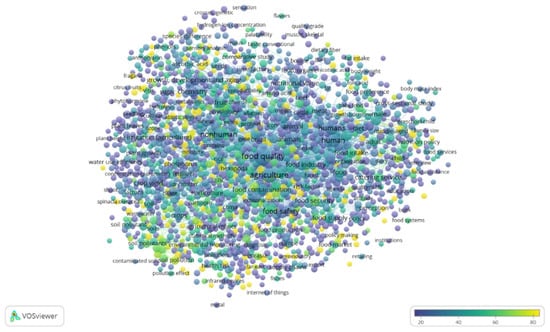
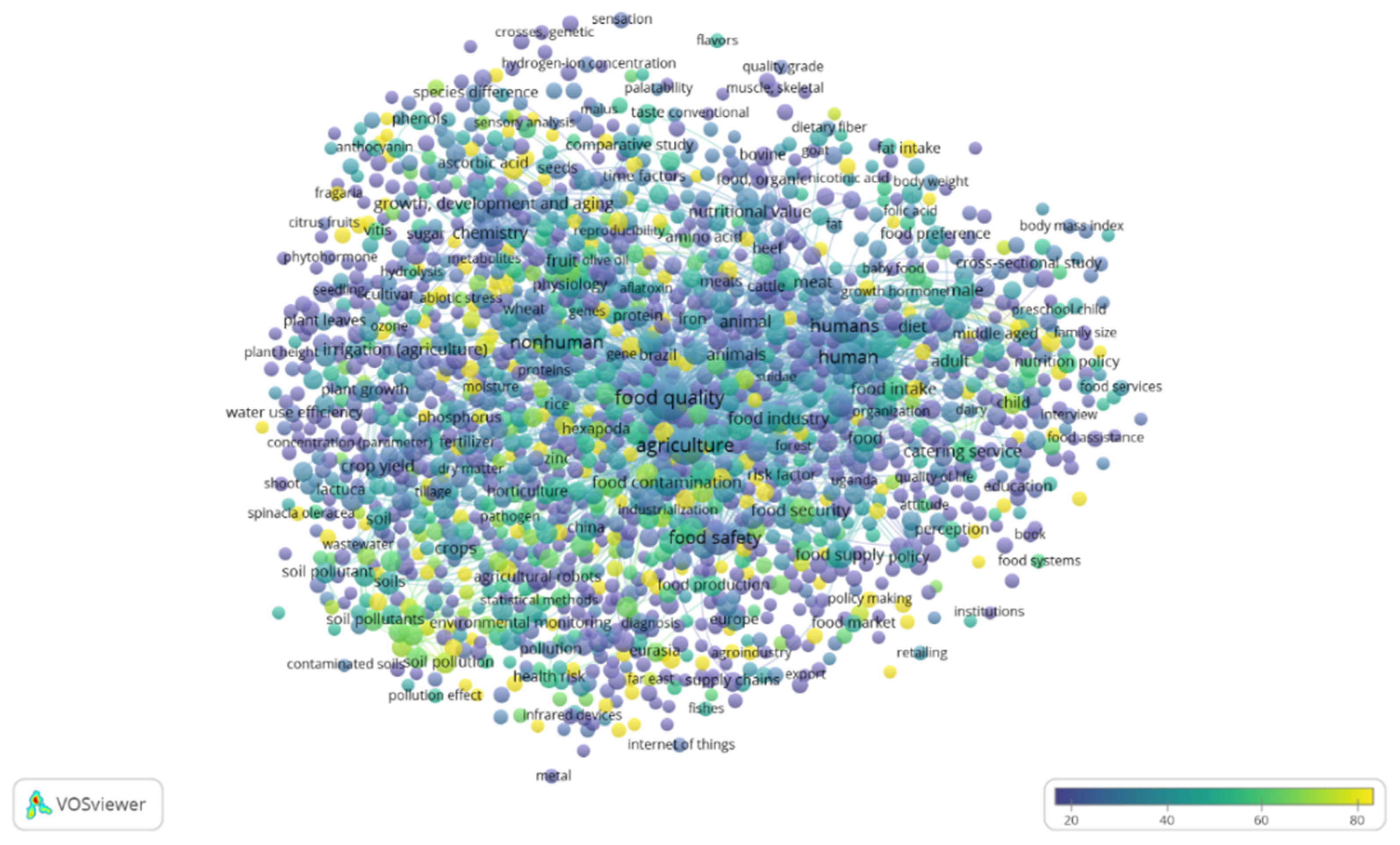
To give a current image of the interest of this topic, a search throughout the Scopus online database has been carried out using the string TITLE-ABS-KEY (“agriculture*” AND “food quality*”). The “full records and cited references” have been exported and processed using the VOSviewer software (version 1.6.16, 2020; www.vosviewer.com, accessed on 9 November 2021) [3,4,5]. The search returned 1974 publications covering the time range from 1974 to 2022, and a total of 1672 terms were identified as visualized in the term map in Figure 1. The top-recurring key terms are food quality, agriculture, human/s, nonhuman, food safety, chemistry, animals, fruit, food contamination, and food industry.
Figure 1.
Term map for the relationship of agriculture and food quality. Bubble size represents the number of publications. Bubble color represents the citations per publication (CPP). Two bubbles are closer to each other if the terms co-appeared more frequently (Bibliometric data were extracted from the Scopus online database and elaborated by the VOSviewer software).
The most cited paper is on the breeding technologies to increase crop production in a changing world [6]. The most recent document is the paper by Lang and Rodrigues [7] on appetite focused on a comparison of organic-certified versus non-certified natural foods, with focus on perceptions and motives and their influence on purchase behaviors.
This Special Issue is, therefore, addressed on modern research on the strict relationship of agriculture and food quality.
Author Contributions
A.D. and M.L. have made a substantial, direct, and intellectual contribution to the work, and approved it for publication. All authors have read and agreed to the published version of the manuscript.
Funding
This research received no external funding.
Conflicts of Interest
The authors declare no conflict of interest.
References
- Durazzo, A.; Souto, E.B.; Lombardi-Boccia, G.; Santini, A.; Lucarini, M. Metrology, agriculture and food: Literature quantitative analysis. Agriculture 2021, 11, 889. [Google Scholar] [CrossRef] [Scilit]
- Durazzo, A. The close linkage between nutrition and environment through biodiversity and sustainability: Local foods, traditional recipes, and sustainable diets. Sustainability 2019, 11, 2876. [Google Scholar] [CrossRef] [Scilit]
- Waltman, L.; van Eck, N.J.; Noyons, E.C. A unified approach to mapping and clustering of bibliometric networks. J. Informetr. 2010, 4, 629–635. [Google Scholar] [CrossRef] [Scilit]
- Van Eck, N.J.; Waltman, L. Software survey: VOSviewer, a computer program for bibliometric mapping. Scientometrics 2010, 84, 523–538. [Google Scholar] [CrossRef] [Scilit] [PubMed]
- Van Eck, N.J.; Waltman, L. Text mining and visualization using VOSviewer. ISSI Newslett. 2011, 7, 50–54. [Google Scholar]
- Tester, M.; Langridge, P. Breeding technologies to increase crop production in a changing world. Science 2010, 327, 818–822. [Google Scholar] [CrossRef] [Scilit] [PubMed]
- Lang, M.; Rodrigues, A.C. A comparison of organic-certified versus non-certified natural foods: Perceptions and motives and their influence on purchase behaviors. Appetite 2022, 168, 105698. [Google Scholar] [CrossRef] [Scilit] [PubMed]
Publisher’s Note: MDPI stays neutral with regard to jurisdictional claims in published maps and institutional affiliations. |
© 2021 by the authors. Licensee MDPI, Basel, Switzerland. This article is an open access article distributed under the terms and conditions of the Creative Commons Attribution (CC BY) license (https://creativecommons.org/licenses/by/4.0/).