Review

Mortierella Species as the Plant Growth-Promoting Fungi Present in the Agricultural Soils


1
Department of Industrial and Environmental Microbiology, Institute of Biological Sciences, Faculty of Biology and Biotechnology, Maria Curie-Sklodowska University, Akademicka 19, 20-033 Lublin, Poland
2
Department of Plant Physiology and Biophysics, Institute of Biological Sciences, Faculty of Biology and Biotechnology, Maria Curie-Sklodowska University, Akademicka 19, 20-033 Lublin, Poland
*
Author to whom correspondence should be addressed.
Agriculture 2021, 11(1), 7; https://doi.org/10.3390/agriculture11010007

Submission received: 4 December 2020 / Revised: 19 December 2020 / Accepted: 21 December 2020 / Published: 24 December 2020
(This article belongs to the Special Issue Plant-Microbe-Soil Interactions in Agroecosystems)

Abstract

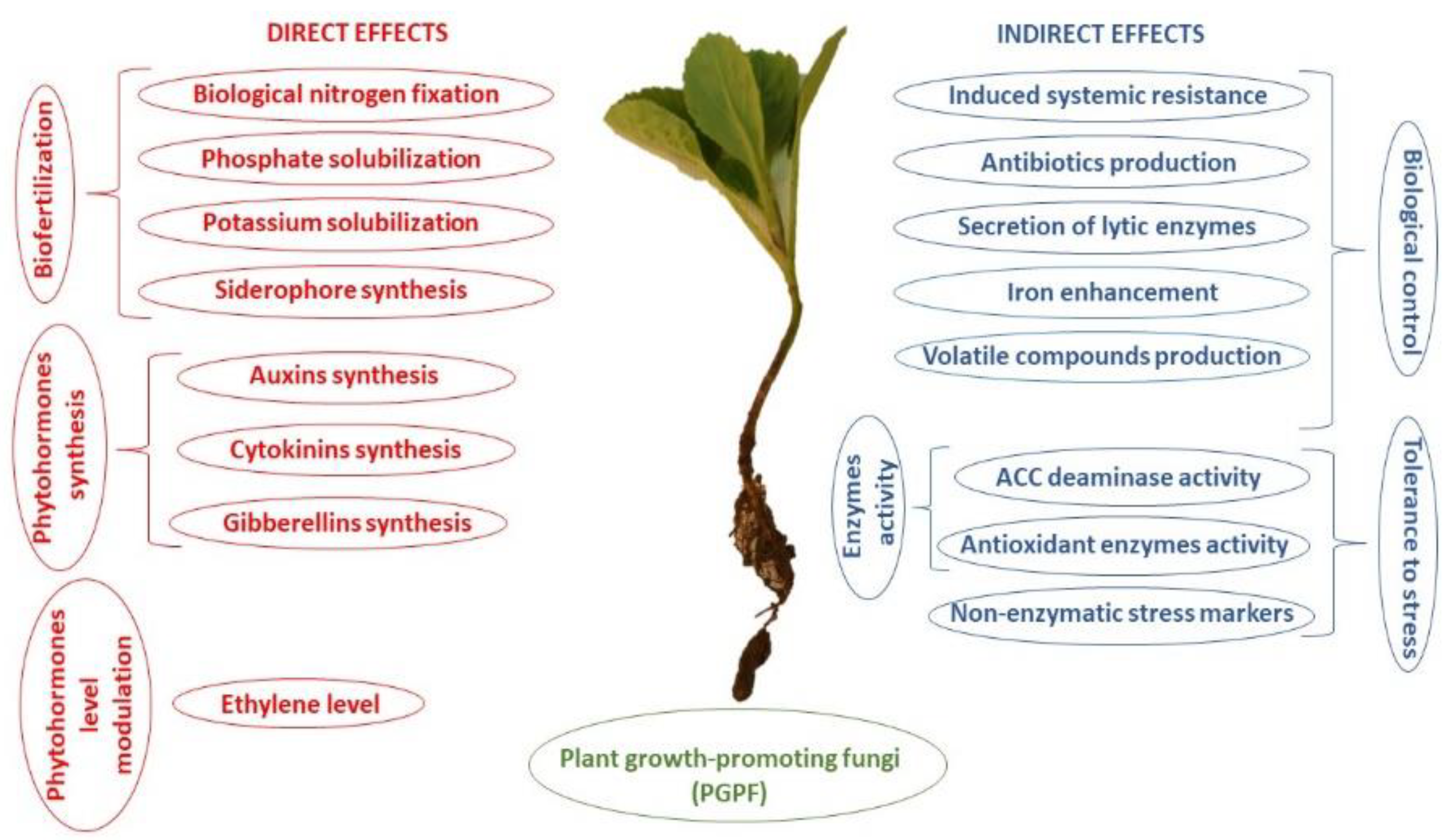
In the most recent scientific reports based on the DNA or RNA-analyses a widespread presence of the filamentous fungi, Mortierella in various environments has been shown. Some strains of this genus belong to the plant growth-promoting fungi (PGPF) and are found in the bulk soil, rhizosphere and plants tissues. These microorganisms are also often found in the extremely hostile environments, responsible for improving access to the bioavailable forms of P and Fe in the soils, the synthesis of phytohormones and 1-aminocyclopropane-1-carboxylate (ACC) deaminase, and last but not least the protection of agricultural plants from pathogens. Furthermore, earlier reports classified Mortierella spp. as the saprotrophic microorganisms isolated from the forest litter, and nowadays their status as a very valuable decomposers in the agricultural soils was confirmed. The key features like the ability to survive under very unfavorable environmental conditions and the utilization of carbon sources contained in polymers like cellulose, hemicellulose, chitin make these fungi efficient as the agricultural inoculants. The growing interest in the application of Mortierella spp. is mainly due to the potential use of this genus in the increase of the nutrient uptake efficiency, positive effect in crop protection against adverse conditions, and reduction of chemical fertilizers and pesticides applied. Moreover, activities of Mortierella species selected from the wild or cultivated plants influence the soil microbiota and support the performance of the beneficial microorganisms enhancing significantly crop yield.
Keywords: Mortierella; agricultural soils; plant growth-promoting fungi; endophytes; siderophores; phosphorus; phytohormones; phytoregulators; crop productivity Mortierella; agricultural soils; plant growth-promoting fungi; endophytes; siderophores; phosphorus; phytohormones; phytoregulators; crop productivity