Review

Aromatherapy for Managing Pain in Primary Dysmenorrhea: A Systematic Review of Randomized Placebo-Controlled Trials


1
Clinical Medicine Division, Korea Institute of Oriental Medicine, Daejeon 34054, Korea
2
Herbal Medicine Research Division, Korea Institute of Oriental Medicine, Daejeon 34054, Korea
3
Public Health & Research Development, National Center for Complementary and Alternative Medicine, Ministry of Health, Riyadh 11662, Saudi Arabia
4
Department of Nursing, Howon University, Gusan 54058, Korea
5
Department of Nursing, Chodang University, Muan-gun 58530, Korea
*
Author to whom correspondence should be addressed.
These authors contributed equally to this work.
J. Clin. Med. 2018, 7(11), 434; https://doi.org/10.3390/jcm7110434
Submission received: 22 September 2018 / Revised: 1 November 2018 / Accepted: 9 November 2018 / Published: 10 November 2018
(This article belongs to the Section Anesthesiology)

Abstract

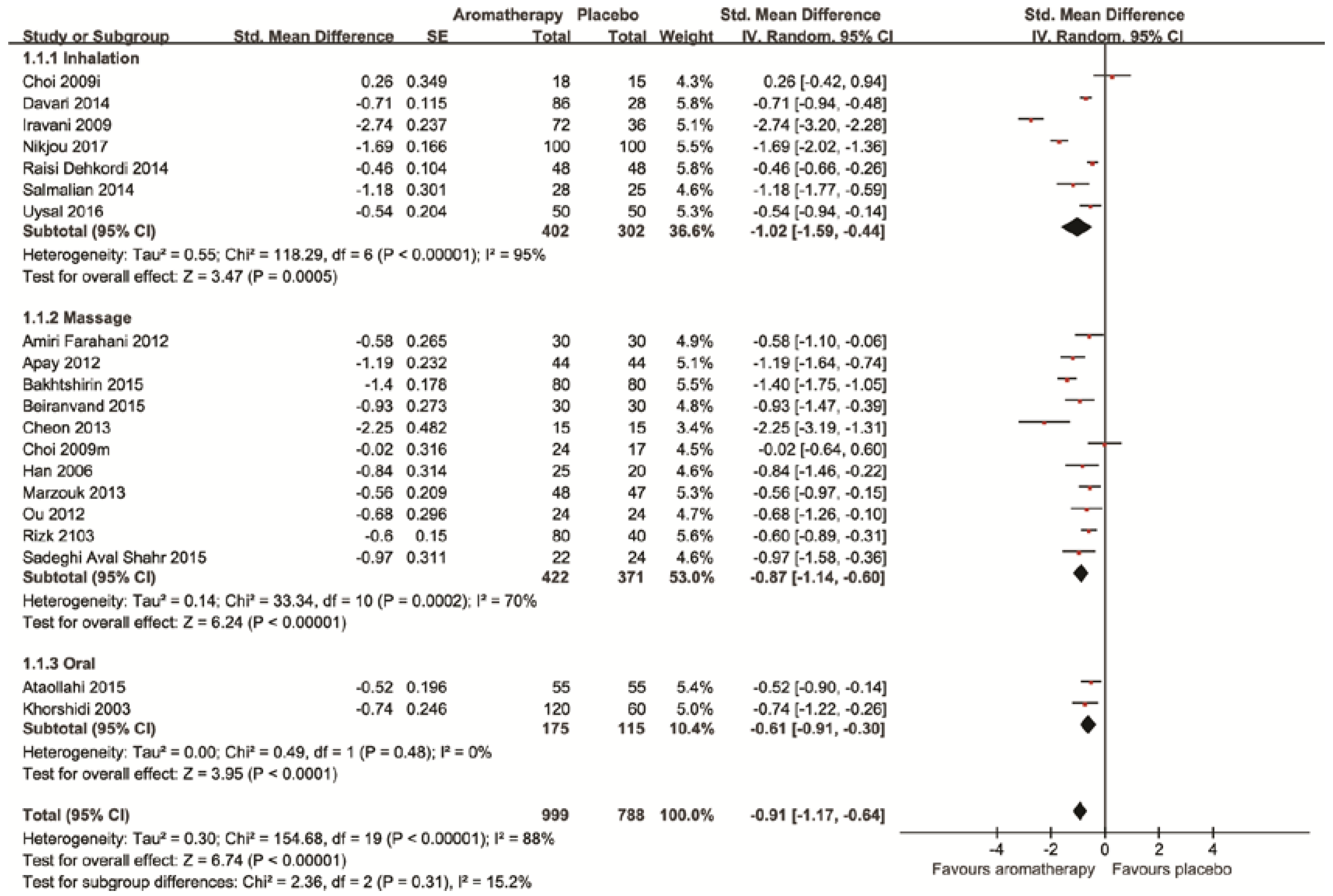
Aromatherapy, the therapeutic use of essential oils, is often used to reduce pain in primary dysmenorrhea. Eleven databases, including four English (PubMed, AMED, EMBASE, and the Cochrane Library) and seven Korean medical databases, were searched from inception through August 2018 without restrictions on publication language. Randomized controlled trials (RCTs) testing aromatherapy for pain reduction in primary dysmenorrhea were considered. Data extraction and risk-of-bias assessments were performed by two independent reviewers. All of the trials reported superior effects of aromatherapy for pain reduction compared to placebo (n = 1787, standard mean difference (SMD): −0.91, 95% CI: −1.17 to −0.64, p < 0.00001) with high heterogeneity (I2 = 88%). A sub-analysis for inhalational aromatherapy for the alleviation of pain also showed superior effects compared to placebo (n = 704, SMD: −1.02, 95% CI: −1.59 to −0.44, p = 0.0001, I2 = 95%). With regard to aromatherapy massage, the pooled results of 11 studies showed favorable effects of aromatherapy massage on pain reduction compared to placebo aromatherapy massage (n = 793, SMD: −0.87, 95% CI: −1.14 to −0.60, p < 0.00001, I2 = 70%). Oral aromatherapy had superior effects compared to placebo (n = 290, SMD: −0.61, 95% CI: −0.91 to −0.30, p < 0.0001, I2 = 0%). In conclusion, our systemic review provides a moderate level of evidence on the superiority of aromatherapy (inhalational, massage, or oral use) for pain reduction over placebo in primary dysmenorrhea.
Keywords: aromatherapy; essential oil; inhalation; pain; dysmenorrhea; systematic review; meta-analysis aromatherapy; essential oil; inhalation; pain; dysmenorrhea; systematic review; meta-analysis