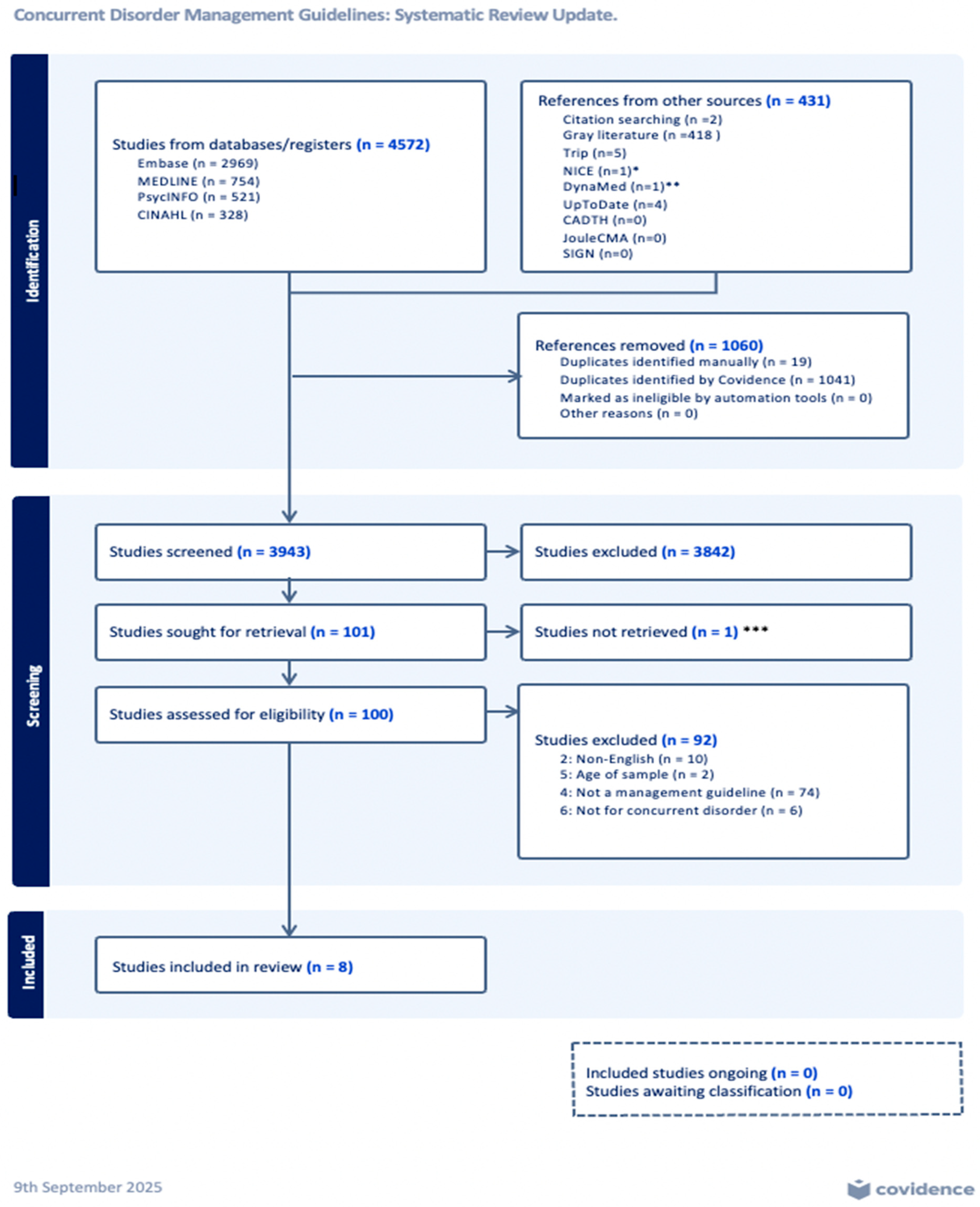
Concurrent (Dual) Disorder Management Guidelines: Systematic Review Update

 , ,
, ,
Abstract
1. Introduction
2. Materials and Methods
3. Results
3.1. Included to Appraise Guidelines
3.2. Guidelines Not Appraised
4. Discussion
5. Conclusions
Supplementary Materials
Author Contributions
Funding
Institutional Review Board Statement
Informed Consent Statement
Data Availability Statement
Conflicts of Interest
References
- Hakobyan, S.; Vasirian, S.; Lee-Cheong, S.; Krausz, M.; Honer, W.; Schütz, C. Concurrent Disorders Management Guidelines. J. Clin. Med. 2020, 9, 2406. [Google Scholar] [CrossRef]
- Torrens, M.; Mestre-Pintó, J.-I.; Domingo-Salvany, A. Comorbidity of Substance Use and Mental Disorders in Europe; The European Centre for Drugs and Drug Addiction: Lisabon, Portugal, 2015. [Google Scholar]
- Skinner, W.W.J.; O’Grady, P.O.C.; Bartha, C.; Parker, C. Concurrent Substance Use and Mental Health Disorders. An Information Guide; Centre for Addiction and Mental Health: Toronto, ON, Canada, 2010. [Google Scholar]
- Co-Center for Excellence (COCE). Definitions and Terms Relating to Co-Occurring Disorders; Overview Paper 1; Co-Occurring Center for Excellence (COCE): Rockville, MD, USA; Substance Abuse and Mental Health Services Administration (SAMHSA): Rockville, MD, USA, 2007.
- Brouwers, M.C.; Kerkvliet, K.; Spithoff, K. The AGREE Reporting Checklist: A Tool to Improve Reporting of Clinical Practice Guidelines. BMJ 2016, 352, i1152. [Google Scholar] [CrossRef]
- World Health Organization. Mental Health Atlas 2020; World Health Organization: Geneva, Switzerland, 2020. [Google Scholar]
- World Health Organization. World Mental Health Report: Transforming Mental Health for All; World Health Organization: Geneva, Switzerland, 2022. [Google Scholar]
- GBD 2019 Mental Disorders Collaborators. Global, Regional, and National Burden of 12 Mental Disorders in 204 Countries and Territories, 1990–2019: A Systematic Analysis for the Global Burden of Disease Study 2019. Lancet Psychiatry 2022, 9, 137–150. [Google Scholar] [CrossRef]
- Hendershot, C.S.; Le Foll, B. Substance Use and Concurrent Disorders: Current Context and the Need for Treatment Integration. Can. J. Psychiatry 2024, 70, 5–8. [Google Scholar] [CrossRef]
- Substance Abuse and Mental Health Services Administration. Key Substance Use and Mental Health Indicators in the United States: Results from the 2020 National Survey on Drug Use and Health; HHS Publication No. PEP21-07-01-003, NSDUH Series H-56; U.S. Department of Health and Human Services: Washington, DC, USA, 2021.
- Substance Abuse and Mental Health Services Administration. Key Substance Use and Mental Health Indicators in the United States: Results from the 2024 National Survey on Drug Use and Health; NSDUH Series H-60; U.S. Department of Health and Human Services: Washington, DC, USA, 2025.
- Taggart, N.; Kinner, S.A.; Young, J.T. The prevalence and correlates of dual diagnosis among adults in custody: A systematic review and meta-analysis. Drug Alcohol Depend. 2025, 272, 112675. [Google Scholar] [CrossRef]
- Hoy, N.; Lynch, S.J.; Waszczuk, M.A.; Reppermund, S.; Mewton, L. Transdiagnostic biomarkers of mental illness across the lifespan: A systematic review examining the genetic and neural correlates of latent transdiagnostic dimensions of psychopathology in the general population. Neurosci. Biobehav. Rev. 2023, 155, 105431. [Google Scholar] [CrossRef]
- Swedish Agency for Health Technology Assessment and Assessment of Social Services. Interventions for Adults with Co-Occurring Addictive and Psychiatric Disorders: A Systematic Review Including Health Economic and Ethical Aspects; SBU: Stockholm, Sweden, 2025. [Google Scholar]
- Scott, K.D.; Gorey, K.M. Concurrent disorders and treatment outcomes: A meta-analysis. J. Dual Diagn. 2025, 21, 251–265. [Google Scholar] [CrossRef]
- Del Casale, A.; Bronzatti, L.; Arena, J.F.; Gentile, G.; Lai, C.; Girardi, P.; Simmaco, M.; Borro, M. The Era of Precision Psychiatry: Toward a New Paradigm in Diagnosis and Care. Psychiatry Int. 2025, 6, 146. [Google Scholar] [CrossRef]
- Kas, M.J.; Hyman, S.; Williams, L.M.; Hidalgo-Mazzei, D.; Huys, Q.J.; Hotopf, M.; Cuthbert, B.; Lewis, C.M.; De Picker, L.J.; Lalousis, P.A.; et al. Towards a consensus roadmap for a new diagnostic framework for mental disorders. Eur. Neuropsychopharmacol. 2025, 90, 16–27. [Google Scholar] [CrossRef]
- Van Dellen, E. Precision psychiatry: Predicting predictability. Psychol. Med. 2024, 54, 1500–1509. [Google Scholar] [CrossRef]
- Shamseer, L.; Moher, D.; Clarke, M.; Ghersi, D.; Liberati, A.; Petticrew, M.; Shekelle, P.; Stewart, L.A.; The PRISMA-P Group. Preferred reporting items for systematic review and meta-analysis protocols (PRISMA-P) 2015: Elaboration and explanation. BMJ 2015, 349, g7647. [Google Scholar] [CrossRef]
- Moher, D.; Shamseer, L.; Clarke, M.; Ghersi, D.; Liberati, A.; Petticrew, M.; Shekelle, P.G.; Stewart, L.A. Preferred reporting items for systematic review and meta-analysis protocols (PRISMA-P) 2015 statement. Syst. Rev. 2015, 4, 1. [Google Scholar] [CrossRef]
- Page, M.J.; McKenzie, J.E.; Bossuyt, P.M.; Boutron, I.; Hoffmann, T.C.; Mulrow, C.D.; Shamseer, L.; Tetzlaff, J.M.; Akl, E.A.; Brennan, S.E.; et al. The PRISMA 2020 statement: An updated guideline for reporting systematic reviews. BMJ 2021, 372, n71. [Google Scholar] [CrossRef]
- PROSPERO. Concurrent Disorder Management Guidelines. Systematic Review Update. Available online: https://www.crd.york.ac.uk/PROSPERO/view/CRD420251076197 (accessed on 18 June 2025).
- McLennan, J.D. Dual Diagnosis: A Problematic Construct When Applied to Persons with Intellectual Disabilities. Can. J. Psychiatry 2018, 63, 597–601. [Google Scholar] [CrossRef]
- Tang, B.; Byrne, C.; Friedlander, R.; McKibbin, D.; Riley, M.; Thibeault, A. The Other Dual Diagnosis: Developmental Disability and Mental Health Disorders. BCMJ 2008, 50, 319–324. [Google Scholar]
- Covidence. 2025. Available online: https://www.covidence.org (accessed on 28 March 2026).
- Neyra, A.; Parro-Torres, C.; Ros-Cucurull, E.; Carrera, I.; Echarri, E.; Torrens, M. Management of schizophrenia and comorbid substance use disorders: Expert review and guidance. Ann. Gen. Psychiatry 2024, 23, 40. [Google Scholar] [CrossRef] [PubMed] [PubMed Central]
- Spencer, A.E.; Valentine, S.E.; Sikov, J.; Yule, A.M.; Hsu, H.; Hallett, E.; Xuan, Z.; Silverstein, M.; Fortuna, L. Principles of Care for Young Adults with Co-Occurring Psychiatric and Substance Use Disorders. Pediatrics 2021, 147, 229–239. [Google Scholar] [CrossRef] [PubMed] [PubMed Central]
- Substance Abuse and Mental Health Services Administration (SAMHSA). Substance Use Disorder Treatment for People with Co-Occurring Disorders: Updated 2020; Treatment Improvement Protocol (TIP) Series, No. 42.; Substance Abuse and Mental Health Services Administration (US): Rockville, MD, USA, 2020.
- Tourjman, S.V.; Buck, G.; Jutras-Aswad, D.; Khullar, A.; McInerney, S.; Saraf, G.; Pinto, J.V.; Potvin, S.; Poulin, M.J.; Frey, B.N.; et al. Canadian Network for Mood and Anxiety Treatments (CANMAT) Task Force Report: A Systematic Review and Recommendations of Cannabis use in Bipolar Disorder and Major Depressive Disorder. Can. J. Psychiatry 2023, 68, 299–311. [Google Scholar] [CrossRef] [PubMed] [PubMed Central]
- Substance Abuse and Mental Health Services Administration. Substance Use Disorder Treatment for People with Co-Occurring Disorders, Advisory; Publication No. PEP20-06-04-006; SAMHSA: Rockville, MD, USA, 2021.
- Roberts, N.P.; Lotzin, A.; Schäfer, I. Psychological treatment of PTSD with comorbid substance use disorder (SUD): Expert recommendations of the European Society for Traumatic Stress Studies (ESTSS). Eur. J. Psychotraumatol. 2023, 14, 2265773. [Google Scholar] [CrossRef] [PubMed] [PubMed Central]
- Substance Abuse and Mental Health Services Administration (SAMHSA). Treatment Considerations for Youth and Young Adults with Serious Emotional Disturbances/Serious Mental Illnesses and Co-Occurring Substance Use; Publication No. PEP20-06-02-001; National Mental Health and Substance Use Policy Laboratory, Substance Abuse and Mental Health Services Administration: Rockville, MD, USA, 2021.
- Marel, C.; Siedlecka, E.; Fisher, A.; Gournay, K.; Deady, M.; Baker, A.; Kay-Lambkin, F.; Teesson, M.; Baillie, A.; Mills, K.L. Guidelines on the Management of Co-Occurring Alcohol and Other Drug and Mental Health Conditions in Alcohol and Other Drug Treatment Settings, 3rd ed.; The University of Sydney: Sydney, Australia, 2022. [Google Scholar]
- World Health Organization. Mental Health Gap Action Programme (mhGAP) Guideline for Mental, Neurological and Substance Use Disorders; World Health Organization: Geneva, Switzerland, 2023. [Google Scholar]
- Crunelle, C.L.; van den Brink, W.; Moggi, F.; Konstenius, M.; Franck, J.; Levin, R.L.; van de Glind, G.; Demetrovics, Z.; Coetzeei, C.; Luderer, M.; et al. International Consensus Statement on Screening, Diagnosis and Treatment of Substance Use Disorder Patients with Comorbid Attention Deficit/Hyperactivity Disorder. Eur. Addict. Res. 2018, 24, 43–51. [Google Scholar] [CrossRef]
- Dreyer-Oren, S.E.; Amer, E.E.; Abrantes, A.M. Co-occurring depression and substance use disorders in young people. Psychiatr. Ann. 2024, 54, e253–e257. [Google Scholar] [CrossRef]
- Back, S.E.; Jarnecke, A.M.; Norman, S.B.; Zaur, A.J.; Hien, D.A. State of the Science: Treatment of comorbid posttraumatic stress disorder and substance use disorders. J. Trauma. Stress. 2024, 37, 803–813. [Google Scholar] [CrossRef] [PubMed]
- Wojnar, M.; Wierzbiński, P.; Samochowiec, J.; Rymaszewska, J.; Filipiak, K.J.; Wichniak, A.; Mróz, R.; Mamcarz, A.; Dudek, D. Management of nicotine dependence in patients with psychiatric disorders—Recommendations of the Polish Psychiatric Association—Part I. Psychiatr. Pol. 2024, 58, 403–418. [Google Scholar] [CrossRef] [PubMed]
- Patzelt, E.H.; Conway, S.; Mermin, S.A.; Jurist, J.; Choi-Kain, L.W. Enhancing the Social Network: Multimodal Treatment for Comorbid Borderline Personality Disorder and Alcohol Use Disorder. Am. J. Psychother. 2025, 78, 55–62. [Google Scholar] [CrossRef] [PubMed]
- American College of Surgeon Trauma Programs “Best Practices Guidelines Screening and Intervention for Mental Health Disorders and Substance Use and Misuse in The Acute Trauma Patient”. 2022. Available online: https://www.facs.org/media/nrcj31ku/mental-health-guidelines.pdf (accessed on 28 March 2026).
- British Columbia Centre for Substance Abuse; British Columbia Ministry of Health. Guideline for the Clinical Management of Opioid Use Disorder; British Columbia Centre for Substance Abuse: Columbia, UK; British Columbia Ministry of Health: Columbia, UK, 2023.
- Busch, G.; Seo, J.Y. Establishing a System of Care for Severe and Refractory Dual Disorder in the State of Hawai’i. Hawaii J. Health Soc. Welf. 2022, 81, 19–26. [Google Scholar] [PubMed] [PubMed Central]
- Wood, E.; Bright, J.; Hsu, K.; Goel, N.; Ross, J.W.G.; Hanson, A.; Teed, R.; Poulin, G.; Denning, B.; Corace, K.; et al. Canadian guideline for the clinical management of high-risk drinking and alcohol use disorder. CMAJ 2023, 195, E1364–E1379. [Google Scholar] [CrossRef] [PubMed] [PubMed Central]
- Dowling, F.G.; Lowe, S.M. Substance Use and Related Disorders Among Persons Exposed to the 9/11 Terrorist Attacks: Essentials for Screening and Intervention. Arch. Environ. Occup. Health 2023, 78, 261–266. [Google Scholar] [CrossRef]
- Bombardier, C.H.; Azuero, C.B.; Fann, J.R.; Kautz, D.D.; Richards, J.S.; Sabharwal, S. Management of Mental Health Disorders, Substance Use Disorders, and Suicide in Adults with Spinal Cord Injury: Clinical Practice Guideline for Healthcare Providers. Top. Spinal Cord. Inj. Rehabil. 2021, 27, 152–224. [Google Scholar] [CrossRef] [PubMed] [PubMed Central]
- NICE Guidelines “Depression in Adults: Treatment and Management”. 2022. Available online: https://www.nice.org.uk/guidance/ng222 (accessed on 28 March 2026).
- Correll, C.U.; Arango, C.; Fagiolini, A.; Giordano, G.M.; Leucht, S.; de Pablo, G.S. Finding the Right Setting for the Right Treatment During the Acute Treatment of Individuals with Schizophrenia: A Narrative Review and Clinical Practice Guideline. Neuropsychiatr. Dis. Treat. 2024, 20, 1293–1307. [Google Scholar] [CrossRef] [PubMed] [PubMed Central]
- Keepers, G.A.; Fochtmann, L.J.; Anzia, J.M.; Benjamin, S.; Lyness, J.M.; Mojtabai, R.; Servis, M.; Walaszek, A.; Buckley, P.; Lenzenweger, M.F.; et al. The American Psychiatric Association Practice Guideline for the Treatment of Patients with Schizophrenia. Am. J. Psychiatry 2020, 177, 868–872. [Google Scholar] [CrossRef] [PubMed]
- May, T.; Birch, E.; Chaves, K.; Cranswick, N.; Culnane, E.; Delaney, J.; Derrick, M.; Eapen, V.; Edlington, C.; Efron, D.; et al. The Australian evidence-based clinical practice guideline for attention deficit hyperactivity disorder. Aust. N. Z. J. Psychiatry 2023, 57, 1101–1116. [Google Scholar] [CrossRef] [PubMed] [PubMed Central]
- Drager, L.F.; Assis, M.; Bacelar, A.F.R.; Poyares, D.L.R.; Conway, S.G.; Pires, G.N.; de Azevedo, A.P.; Carissimi, A.; Eckeli, A.L.; Pentagna, Á.; et al. 2023 Guidelines on the Diagnosis and Treatment of Insomnia in Adults—Brazilian Sleep Association. Sleep Sci. 2023, 16, 507–549. [Google Scholar] [CrossRef] [PubMed] [PubMed Central]


| Title | Developed by | Country | Year | Population Targeted | |
|---|---|---|---|---|---|
| 1 | Management of Schizophrenia and Comorbid Substance Use Disorders: Expert Review and Guidance [26] | University Hospitals and Research Institutes in Spain | Spain | 2024 | People with schizophrenia and substance use disorders |
| 2 | Principles of Care for Young Adults with Co-Occurring Psychiatric and Substance Use Disorders [27] | Boston University, Boston Medical Centre, University of California | USA | 2021 | People with comorbid mental health and substance use disorders |
| 3 | Substance Use Disorder Treatment for People with Co-Occurring Disorder TIP 42 [28] | Substance Abuse and Mental Health Services Administration | USA | 2020 | People with co-occurring substance use disorders and mental health disorders |
| 4 | Canadian Network for Mood and Anxiety Treatments (CANMAT) Task Force Report: A Systematic Review and Recommendations of Cannabis use in Bipolar Disorder and Major Depressive Disorder [29] | Canadian Network for Mood and Anxiety Treatments (CANMAT) | Canada | 2023 | People with Bipolar Disorder, Major Depressive Disorder and Cannabis Use |
| 5 | SAMHSA Substance Use Disorder Treatment for People with Co-Occurring Disorders [30] | Substance Abuse and Mental Health Services Administration | USA | 2021 | People With Co-Occurring Disorders |
| 6 | Psychological Treatment of PTSD with Comorbid Substance Use Disorder (SUD): Expert Recommendations of the European Society for Traumatic Stress Studies (ESTSS) [31] | European Society for Traumatic Stress Studies | Europe | 2023 | People with PTSD with Comorbid Substance Use Disorder |
| 7 | Treatment Considerations for Youth and Young Adults with Serious Emotional Disturbances and Serious Mental Illnesses and Co-occurring Substance Use [32] | Substance Abuse and Mental Health Services Administration | USA | 2021 | Youth and Young Adults with Serious Emotional Disturbances and Serious Mental Illnesses and Co-occurring Substance Use |
| 8 | Guidelines on the Management of Co-Occurring Alcohol and other Drug and Mental Health Conditions in Alcohol and other Drug Treatment Settings [33] | Australian Government | Australia | 2022 | People with Co-Occurring Alcohol and other Drug and Mental Health Conditions in Alcohol and other Drug Treatment Settings |
| GUIDELINES (Please See Table 1: Included Guidelines) | 1 | 2 | 3 | 4 | 5 | 6 | 7 | 8 |
|---|---|---|---|---|---|---|---|---|
| DOMAIN 1. SCOPE AND PURPOSE | ||||||||
| 1. The overall objective(s) of the guideline is (are) specifically described. | 5 | 5 | 6 | 6 | 5 | 3 | 6 | 6 |
| 2. The health question(s) covered by the guideline is (are) specifically described. | 5 | 6 | 6 | 5 | 5 | 5 | 5 | 6 |
| 3. The population (patients, public, etc.) to whom the guideline is meant to apply is specifically described. | 2 | 4 | 5 | 5 | 3 | 3 | 6 | 7 |
| DOMAIN 2. STAKEHOLDER INVOLVEMENT | ||||||||
| 4. The guideline development group includes individuals from all relevant professional groups. | 2 | 4 | 7 | 6 | 2 | 4 | 5 | 6 |
| 5. The views and preferences of the target population (patients, public, etc.) have been sought. | 2 | 1 | 2 | 5 | 2 | 3 | 4 | 6 |
| 6. The target users of the guideline are clearly defined. | 1 | 2 | 7 | 3 | 3 | 2 | 6 | 6 |
| DOMAIN 3. RIGOR OF DEVELOPMENT | ||||||||
| 7. Systematic methods were used to search for evidence. | 6 | 2 | 2 | 6 | 1 | 3 | 6 | 2 |
| 8. The criteria for selecting the evidence are clearly described. | 4 | 1 | 1 | 6 | 1 | 4 | 6 | 1 |
| 9. The strength and limitations of the body of evidence are clearly described. | 1 | 2 | 1 | 7 | 1 | 4 | 5 | 4 |
| 10. The methods for formulating the recommendations are clearly described. | 1 | 1 | 4 | 7 | 1 | 2 | 6 | 5 |
| 11. The health benefits, side effects, and risks have been considered in formulating the recommendations. | 4 | 3 | 6 | 6 | 2 | 3 | 4 | 4 |
| 12. There is an explicit link between the recommendations and the supporting evidence. | 3 | 6 | 5 | 6 | 4 | 6 | 6 | 6 |
| 13. The guideline has been externally reviewed by experts prior to its publication. | 1 | 1 | 4 | 1 | 1 | 1 | 1 | 1 |
| 14. A procedure for updating the guideline is provided. | 1 | 1 | 2 | 1 | 1 | 1 | 1 | 2 |
| DOMAIN 4. CLARITY OF PRESENTATION | ||||||||
| 15. The recommendations are specific and unambiguous. | 3 | 5 | 6 | 6 | 5 | 6 | 6 | 7 |
| 16. The different options for management of the condition or health issue are clearly presented. | 3 | 2 | 5 | 6 | 4 | 4 | 6 | 7 |
| 17. Key recommendations are easily identifiable. | 2 | 3 | 6 | 5 | 6 | 4 | 6 | 7 |
| DOMAIN 5. APPLICABILITY | ||||||||
| 18. The guideline describes facilitators and barriers to its application. | 2 | 4 | 3 | 6 | 5 | 3 | 6 | 6 |
| 19. The guideline provides advice and/or tools on how the recommendations can be put into practice. | 4 | 5 | 6 | 6 | 4 | 2 | 5 | 6 |
| 20. The potential resource implications of applying the recommendations have been considered. | 2 | 4 | 3 | 2 | 4 | 2 | 6 | 5 |
| 21. The guideline presents monitoring and/or auditing criteria. | 1 | 1 | 2 | 1 | 1 | 1 | 5 | 5 |
| DOMAIN 6. EDITORIAL INDEPENDENCE | ||||||||
| 22. The views of the funding body have not influenced the content of the guideline. | 2 | 5 | 1 | 3 | 2 | 1 | 2 | 4 |
| 23. Competing interests of guideline development group members have been recorded and addressed. | 4 | 6 | 1 | 4 | 1 | 3 | 2 | 1 |
| 1. Rate the overall quality of this guideline. Lowest possible quality—1 Highest possible quality—7 | 3 | 4 | 5 | 5 | 3 | 3 | 5 | 6 |
| OVERALL CALCULATED BY DOMAIN AVERAGE | ||||||||
| 2. I would recommend this guideline for use. Yes—1, Yes with Modifications—2, No—3 | 2 | 2 | 2 | 2 | 2 | 2 | 2 | 2 |
| NOTES | ||||||||
| GUIDELINES (Please See Table 1: Included Guidelines) | 1 | 2 | 3 | 4 | 5 | 6 | 7 | 8 |
|---|---|---|---|---|---|---|---|---|
| DOMAIN 1. SCOPE AND PURPOSE | 4 | 5 | 6 | 5 | 4 | 4 | 6 | 6 |
| DOMAIN 2. STAKEHOLDER INVOLVEMENT | 2 | 2 | 5 | 5 | 2 | 3 | 5 | 6 |
| DOMAIN 3. RIGOR OF DEVELOPMENT | 3 | 2 | 3 | 6 | 2 | 3 | 6 | 4 |
| DOMAIN 4. CLARITY OF PRESENTATION | 3 | 3 | 6 | 6 | 5 | 5 | 6 | 7 |
| DOMAIN 5. APPLICABILITY | 2 | 4 | 4 | 4 | 4 | 2 | 6 | 6 |
| DOMAIN 6. EDITORIAL INDEPENDENCE | 3 | 6 | 1 | 4 | 2 | 2 | 2 | 3 |
| 1. Rate the overall quality of this guideline. Lowest possible quality—1 Highest possible quality—7 | 3 | 4 | 5 | 5 | 3 | 3 | 5 | 6 |
| 2. I would recommend this guideline for use. Yes—1, Yes with Modifications—2, No—3 | 2 | 2 | 2 | 2 | 2 | 2 | 2 | 2 |
| NOTES |
Disclaimer/Publisher’s Note: The statements, opinions and data contained in all publications are solely those of the individual author(s) and contributor(s) and not of MDPI and/or the editor(s). MDPI and/or the editor(s) disclaim responsibility for any injury to people or property resulting from any ideas, methods, instructions or products referred to in the content. |
© 2026 by the authors. Licensee MDPI, Basel, Switzerland. This article is an open access article distributed under the terms and conditions of the Creative Commons Attribution (CC BY) license.
Share and Cite
Hakobyan, S.; Allan, Z.; Lee-Cheong, S.; Adorjan, K.; Falkai, P.; Schütz, C.G. Concurrent (Dual) Disorder Management Guidelines: Systematic Review Update. J. Clin. Med. 2026, 15, 3123. https://doi.org/10.3390/jcm15083123
Hakobyan S, Allan Z, Lee-Cheong S, Adorjan K, Falkai P, Schütz CG. Concurrent (Dual) Disorder Management Guidelines: Systematic Review Update. Journal of Clinical Medicine. 2026; 15(8):3123. https://doi.org/10.3390/jcm15083123
Chicago/Turabian StyleHakobyan, Syune, Zachary Allan, Stephen Lee-Cheong, Kristina Adorjan, Peter Falkai, and Christian G. Schütz. 2026. "Concurrent (Dual) Disorder Management Guidelines: Systematic Review Update" Journal of Clinical Medicine 15, no. 8: 3123. https://doi.org/10.3390/jcm15083123
APA StyleHakobyan, S., Allan, Z., Lee-Cheong, S., Adorjan, K., Falkai, P., & Schütz, C. G. (2026). Concurrent (Dual) Disorder Management Guidelines: Systematic Review Update. Journal of Clinical Medicine, 15(8), 3123. https://doi.org/10.3390/jcm15083123