Depression in Opioid Use Disorder: A Tripartite Psychopathological Model for Dual Disorders

 ,
,  ,
, 

 ,
,  , ,
, ,  and
and 
Abstract
1. Introduction
2. Conceptual Approach
3. The Tripartite Model of Depressive States in Opioid Use Disorder
3.1. Substance-Induced Depression
3.2. Independent Mood Disorders and Bipolar-Spectrum Dual Depression
3.3. Addiction-Related Depression and the W/BT Dimension
4. Clinical Synthesis of the Tripartite Model
5. Discussion
5.1. Positioning the Model Within the Psychopathology of Addiction
5.2. Pharmacological and Therapeutic Implications
5.3. Diagnostic and Research Implications
6. Conclusions
Author Contributions
Funding
Institutional Review Board Statement
Informed Consent Statement
Data Availability Statement
Conflicts of Interest
References
- Santo, T., Jr.; Campbell, G.; Gisev, N.; Martino-Burke, D.; Wilson, J.; Colledge-Frisby, S.; Clark, B.; Tran, L.T.; Degenhardt, L. Prevalence of mental disorders among people with opioid use disorder: A systematic review and meta-analysis. Drug Alcohol Depend. 2022, 238, 109551. [Google Scholar] [CrossRef] [Scilit] [PubMed]
- Sarkar, S.; Pandit, M.; Negi, P.S.; Mathur, R.; Balhara, Y.P.S. Psychosocial correlates of depression and anxiety among treatment-seeking individuals with opioid dependence: A cross-sectional study. Front. Psychiatry 2025, 16, 1708666. [Google Scholar] [CrossRef] [Scilit] [PubMed]
- Nunes, E.V.; Levin, F.R. Treatment of Co-occurring Depression and Substance Dependence: Using Meta-analysis to Guide Clinical Recommendations. Psychiatr. Ann. 2008, 38, nihpa128505. [Google Scholar] [CrossRef] [Scilit] [PubMed]
- Nunes, E.V.; Levin, F.R. Treatment of depression in patients with alcohol or other drug dependence: A meta-analysis. JAMA 2004, 291, 1887–1896. [Google Scholar] [CrossRef] [Scilit] [PubMed]
- Bahji, A. Navigating the Complex Intersection of Substance Use and Psychiatric Disorders: A Comprehensive Review. J. Clin. Med. 2024, 13, 999. [Google Scholar] [CrossRef] [Scilit] [PubMed]
- Maremmani, A.G.I.; Cerniglia, L.; Cimino, S.; Bacciardi, S.; Rovai, L.; Pallucchini, A.; Spera, V.; Perugi, G.; Maremmani, I. Further Evidence of a Specific Psychopathology of Addiction. Differentiation from Other Psychiatric Psychopathological Dimensions (Such as Obesity). Int. J. Environ. Res. Public Health 2017, 14, 943. [Google Scholar] [CrossRef] [Scilit] [PubMed]
- Pani, P.P.; Trogu, E.; Vigna-Taglianti, F.; Mathis, F.; Diecidue, R.; Kirchmayer, U.; Amato, L.; Davoli, M.; Ghibaudi, J.; Camposeragna, A.; et al. Psychopathological symptoms of patients with heroin addiction entering opioid agonist or therapeutic community treatment. Ann. Gen. Psychiatry 2014, 13, 35. [Google Scholar] [CrossRef] [Scilit] [PubMed]
- Volkow, N.D.; Blanco, C. Substance use disorders: A comprehensive update of classification, epidemiology, neurobiology, clinical aspects, treatment and prevention. World Psychiatry 2023, 22, 203–229. [Google Scholar] [CrossRef] [Scilit] [PubMed]
- Koob, G.F.; Volkow, N.D. Neurobiology of addiction: A neurocircuitry analysis. Lancet Psychiatry 2016, 3, 760–773. [Google Scholar] [CrossRef] [Scilit] [PubMed]
- Volkow, N.D.; Koob, G.F.; McLellan, A.T. Neurobiologic Advances from the Brain Disease Model of Addiction. N. Engl. J. Med. 2016, 374, 363–371. [Google Scholar] [CrossRef] [Scilit] [PubMed]
- Koob, G.F. Addiction is a Reward Deficit and Stress Surfeit Disorder. Front. Psychiatry 2013, 4, 72. [Google Scholar] [CrossRef] [Scilit] [PubMed]
- Koob, G.F.; Le Moal, M. Addiction and the brain antireward system. Annu. Rev. Psychol. 2008, 59, 29–53. [Google Scholar] [CrossRef] [Scilit] [PubMed]
- American Psychiatric Association. Diagnostic and Statistical Manual of Mental Disorders, 5th ed.; Text Revision; American Psychiatric Association Publishing: Washington, DC, USA, 2022; Volume 5. [Google Scholar]
- Kosten, T.R.; George, T.P. The neurobiology of opioid dependence: Implications for treatment. Sci. Pract. Perspect. 2002, 1, 13–20. [Google Scholar] [CrossRef] [Scilit] [PubMed]
- Nunes, E.V.; Sullivan, M.A.; Levin, F.R. Treatment of depression in patients with opiate dependence. Biol. Psychiatry 2004, 56, 793–802. [Google Scholar] [CrossRef] [Scilit] [PubMed]
- Mohammadi, M.; Kazeminia, M.; Abdoli, N.; Khaledipaveh, B.; Shohaimi, S.; Salari, N.; Hosseinian-Far, M. The effect of methadone on depression among addicts: A systematic review and meta-analysis. Anal. Qual. Life Outcomes 2020, 18, 373. [Google Scholar] [CrossRef] [Scilit] [PubMed]
- Choudhary, H.; Bagri, S.; Thakur, M.R.; Balhara, Y.P.S.; Sarkar, S. A Systematic Review and Meta-Analysis of Dual Diagnosis Patient Profile in the Clinical Setting. J. Dual Diagn. 2025, 21, 378–390. [Google Scholar] [CrossRef] [Scilit] [PubMed]
- During, S.W.; Nordgaard, J.; Martensson, S. Stability of admission diagnoses; data from a specialized in-patient treatment facility for dual diagnosis. Nord. J. Psychiatry 2021, 75, 54–62. [Google Scholar] [CrossRef] [Scilit] [PubMed]
- Maremmani, A.G.I.; Dell’Osso, L.; Pacini, M.; Popovic, D.; Rovai, L.; Torrens, M.; Perugi, G.; Maremmani, I. Dual diagnosis and chronology of illness in 1090 treatment seeking Italian heroin dependent patients. J. Addctv. Dis. 2011, 30, 123–135. [Google Scholar] [CrossRef] [Scilit]
- Maremmani, A.G.I.; Rovai, L.; Rugani, F.; Bacciardi, S.; Massimetti, E.; Gazzarrini, D.; Dell’Osso, L.; Tang, F.; Akiskal, H.S.; Maremmani, I. Chronology of illness in dual diagnosis heroin addicts: The role of mood disorders. J. Affect. Disord. 2015, 179, 156–160. [Google Scholar] [CrossRef] [Scilit] [PubMed]
- Mueser, K.T.; Drake, R.E.; Wallach, M.A. Dual diagnosis: A review of etiological theories. Addict. Behav. 1998, 23, 717–734. [Google Scholar] [CrossRef] [Scilit] [PubMed]
- Maremmani, I.; Pacini, M.; Pani, P.P.; Perugi, G.; Deltito, J.; Akiskal, H. The mental status of 1090 heroin addicts at entry into treatment: Should depression be considered a ‘dual diagnosis’? Ann. Gen. Psychiatry 2007, 6, 31. [Google Scholar] [CrossRef] [Scilit] [PubMed]
- Maremmani, I.; Pani, P.P.; Canoniero, S.; Pacini, M.; Perugi, G.; Rihmer, Z.; Akiskal, H.S. Is the bipolar spectrum the psychopathological substrate of suicidality in heroin addicts? Psychopathology 2007, 40, 269–277. [Google Scholar] [CrossRef] [Scilit] [PubMed]
- Maremmani, I.; Pacini, M.; Perugi, G.; Deltito, J.; Akiskal, H. Cocaine abuse and the bipolar spectrum in 1090 heroin addicts: Clinical observations and a proposed pathophysiologic model. J. Affect. Disord. 2008, 106, 55–61. [Google Scholar] [CrossRef] [Scilit] [PubMed]
- Gold, A.K.; Otto, M.W.; Deckersbach, T.; Sylvia, L.G.; Nierenberg, A.A.; Kinrys, G. Substance use comorbidity in bipolar disorder: A qualitative review of treatment strategies and outcomes. Am. J. Addict. 2018, 27, 188–201. [Google Scholar] [CrossRef] [Scilit] [PubMed]
- Hunt, G.E.; Malhi, G.S.; Cleary, M.; Lai, H.M.; Sitharthan, T. Comorbidity of bipolar and substance use disorders in national surveys of general populations, 1990–2015: Systematic review and meta-analysis. J. Affect. Disord. 2016, 206, 321–330. [Google Scholar] [CrossRef] [Scilit] [PubMed]
- Messer, T.; Lammers, G.; Muller-Siecheneder, F.; Schmidt, R.F.; Latifi, S. Substance abuse in patients with bipolar disorder: A systematic review and meta-analysis. Psychiatry Res. 2017, 253, 338–350. [Google Scholar] [CrossRef] [Scilit] [PubMed]
- Maremmani, I.; Pacini, M.; Popovic, D.; Romano, A.; Maremmani, A.G.I.; Perugi, G.; Deltito, J.; Akiskal, K.; Akiskal, H.S. Affective Temperaments in Heroin Addiction. J. Affect. Disord. 2009, 117, 186–192. [Google Scholar] [CrossRef] [Scilit] [PubMed]
- Rihmer, Z.; Akiskal, K.K.; Rihmer, A.; Akiskal, H.S. Current research on affective temperaments. Curr. Opin. Psychiatry 2010, 23, 12–18. [Google Scholar] [CrossRef] [Scilit] [PubMed]
- Maremmani, I.; Maremmani, A.G.I.; Rugani, F.; Rovai, L.; Pacini, M.; Bacciardi, S.; Deltito, J.; Dell’osso, L.; Akiskal, H.S. Clinical presentations of substance abuse in bipolar heroin addicts at time of treatment entry. Ann. Gen. Psychiatry 2012, 11, 23. [Google Scholar] [CrossRef] [Scilit] [PubMed]
- Mariani, J.J.; Khantzian, E.J.; Levin, F.R. The self-medication hypothesis and psychostimulant treatment of cocaine dependence: An update. Am. J. Addict. 2014, 23, 189–193. [Google Scholar] [CrossRef] [Scilit] [PubMed]
- Khantzian, E.J. The self-medication hypothesis of addictive disorders: Focus on heroin and cocaine dependence. Am. J. Psychiatry 1985, 142, 1259–1264. [Google Scholar] [CrossRef] [Scilit] [PubMed]
- Ghaemi, S.N.; Hsu, D.J.; Soldani, F.; Goodwin, F.K. Antidepressants in bipolar disorder: The case for caution. Bipolar Disord. 2003, 5, 421–433. [Google Scholar] [CrossRef] [Scilit] [PubMed]
- Gitlin, M.J. Antidepressants in bipolar depression: An enduring controversy. Int. J. Bipolar Disord. 2018, 6, 25. [Google Scholar] [CrossRef] [Scilit] [PubMed]
- Maremmani, A.G.; Rovai, L.; Bacciardi, S.; Rugani, F.; Pacini, M.; Pani, P.P.; Dell’Osso, L.; Akiskal, H.; Maremmani, I. The long-term outcomes of heroin dependent-treatment-resistant patients with bipolar 1 comorbidity after admission to enhanced methadone maintenance. J. Affect. Disord. 2013, 151, 582–589. [Google Scholar] [CrossRef] [Scilit] [PubMed]
- Maremmani, I.; Nardini, R.; Zolesi, O.; Castrogiovanni, P. Methadone dosages and therapeutic compliance during a methadone maintenance program. Drug Alcohol Depend. 1994, 34, 163–166. [Google Scholar] [CrossRef] [Scilit] [PubMed]
- Ratheesh, A.; Davey, C.; Hetrick, S.; Alvarez-Jimenez, M.; Voutier, C.; Bechdolf, A.; McGorry, P.D.; Scott, J.; Berk, M.; Cotton, S.M. A systematic review and meta-analysis of prospective transition from major depression to bipolar disorder. Acta Psychiatr. Scand. 2017, 135, 273–284. [Google Scholar] [CrossRef] [Scilit] [PubMed]
- Goldstein, R.Z.; Volkow, N.D. Dysfunction of the prefrontal cortex in addiction: Neuroimaging findings and clinical implications. Nat. Rev. Neurosci. 2011, 12, 652–669. [Google Scholar] [CrossRef] [Scilit] [PubMed]
- Volkow, N.D.; Michaelides, M.; Baler, R. The Neuroscience of Drug Reward and Addiction. Physiol. Rev. 2019, 99, 2115–2140. [Google Scholar] [CrossRef] [Scilit] [PubMed]
- Everitt, B.J.; Robbins, T.W. Drug Addiction: Updating Actions to Habits to Compulsions Ten Years On. Annu. Rev. Psychol. 2016, 67, 23–50. [Google Scholar] [CrossRef] [Scilit] [PubMed]
- Koob, G.F. Drug Addiction: Hyperkatifeia/Negative Reinforcement as a Framework for Medications Development. Pharmacol. Rev. 2021, 73, 163–201. [Google Scholar] [CrossRef] [Scilit] [PubMed]
- Koob, G.F.; Vendruscolo, L.F. A conceptual framework for the intersection of hyperalgesia and hyperkatifeia in alcohol addiction. Alcohol 2025, 129, 1–13. [Google Scholar] [CrossRef] [Scilit] [PubMed]
- Rovai, L.; Maremmani, A.G.I.; Pacini, M.; Pani, P.P.; Rugani, F.; Lamanna, F.; Schiavi, E.; Mautone, S.; Dell’Osso, L.; Maremmani, I. Negative dimension in psychiatry. Amotivational syndrome as a paradigm of negative symptoms in substance abuse. Riv. Di Psichiatr. 2013, 48, 1–9. [Google Scholar] [CrossRef] [Scilit] [PubMed]
- Koob, G.F. Neurobiology of Opioid Addiction: Opponent Process, Hyperkatifeia, and Negative Reinforcement. Biol. Psychiatry 2020, 87, 44–53. [Google Scholar] [CrossRef] [Scilit] [PubMed]
- Maremmani, A.G.I.; Pani, P.P.; Rovai, L.; Bacciardi, S.; Maremmani, I. Toward the Identification of a Specific Psychopathology of Substance Use Disorders. Front. Psychiatry 2017, 8, 68. [Google Scholar] [CrossRef] [Scilit] [PubMed]
- Della Rocca, F.; Novi, M.; Maremmani, A.G.I.; Pani, P.P.; Miccoli, M.; Maremmani, I. Exploring the depressive syndrome of heroin use disorder patients. Relationships between worthlessness/being trapped, deficit reward and post-withdrawal syndromes. Heroin Addict. Relat. Clin. Probl. 2021, 23, 61–74. [Google Scholar]
- Maremmani, A.G.I.; Cerniglia, L.; Cimino, S.; Bacciardi, S.; Rovai, L.; Rugani, F.; Massimetti, E.; Gazzarrini, D.; Pallucchini, A.; Pani, P.P.; et al. Towards a specific psychopathology of heroin addiction. Comparison between Heroin Use Disorder and Major Depression patients. Heroin Addict. Relat. Clin. Probl. 2015, 17, 9–16. [Google Scholar]
- Tesselaar, D.R.M.; Schellekens, A.F.A.; Homberg, J.R.; Booij, J.; Guerrin, C. Psychiatric comorbidity in substance use disorders, a systematic review of neuro-imaging findings. Neurosci. Biobehav. Rev. 2025, 177, 106325. [Google Scholar] [CrossRef] [Scilit] [PubMed]
- Sinha, R. Stress and substance use disorders: Risk, relapse, and treatment outcomes. J. Clin. Investig. 2024, 134, e172883. [Google Scholar] [CrossRef] [Scilit] [PubMed]
- De Filippis, S.; Martinotti, G.; Nicoletti, F.; Mastrostefano, A.; Trovini, G.; Pugliese, A.; Di Nicola, M. Major Depression in Comorbidity with Substance use Disorders: Patients’ Features and Clinical-Neurobiological Rationale of Antidepressant Treatments. Curr. Neuropharmacol. 2025, 23, 256–275. [Google Scholar] [CrossRef] [Scilit] [PubMed]
- Degenhardt, L.; Clark, B.; Macpherson, G.; Leppan, O.; Nielsen, S.; Zahra, E.; Larance, B.; Kimber, J.; Martino-Burke, D.; Hickman, M.; et al. Buprenorphine versus methadone for the treatment of opioid dependence: A systematic review and meta-analysis of randomised and observational studies. Lancet Psychiatry 2023, 10, 386–402. [Google Scholar] [CrossRef] [Scilit] [PubMed]
- Pedrelli, P.; Iovieno, N.; Vitali, M.; Tedeschini, E.; Bentley, K.H.; Papakostas, G.I. Treatment of major depressive disorder and dysthymic disorder with antidepressants in patients with comorbid opiate use disorders enrolled in methadone maintenance therapy: A meta-analysis. J. Clin. Psychopharmacol. 2011, 31, 582–586. [Google Scholar] [CrossRef] [Scilit] [PubMed]
- Pani, P.P.; Vacca, R.; Trogu, E.; Amato, L.; Davoli, M. Pharmacological treatment for depression during opioid agonist treatment for opioid dependence. Cochrane Database Syst. Rev. 2010, CD008373. [Google Scholar] [CrossRef] [Scilit] [PubMed]
- Dorus, W.; Senay, E.C. Depression, demographic dimensions, and drug abuse. Am. J. Psychiatry 1980, 137, 699–704. [Google Scholar] [CrossRef] [Scilit] [PubMed]
- Shaw, B.F.; Steer, R.A.; Beck, A.T.; Schut, J. The structure of depression in heroin addicts. Br. J. Addict. Alcohol. Other Drugs 1979, 74, 295–303. [Google Scholar] [CrossRef] [Scilit] [PubMed]
- Rounsaville, B.J.; Tierney, T.; Crits-Christoph, K.; Weissman, M.M.; Kleber, H.D. Predictors of outcome in treatment of opiate addicts: Evidence for the multidimensional nature of addicts’ problems. Compr. Psychiatry 1982, 23, 462–478. [Google Scholar] [CrossRef] [Scilit] [PubMed]
- Strain, E.C.; Stitzer, M.L.; Bigelow, G.E. Early treatment time course of depressive symptoms in opiate addicts. J. Nerv. Ment. Dis. 1991, 179, 215–221. [Google Scholar] [CrossRef] [Scilit] [PubMed]
- Bertschy, G.; Baumann, P.; Eap, C.B.; Baettig, D. Probable metabolic interaction between methadone and fluvoxamine in addict patients. Ther. Drug Monit. 1994, 16, 42–45. [Google Scholar] [CrossRef] [Scilit] [PubMed]
- Iribarne, C.; Picart, D.; Dreano, Y.; Berthou, F. In vitro interactions between fluoxetine or fluvoxamine and methadone or buprenorphine. Fundam. Clin. Pharmacol. 1998, 12, 194–199. [Google Scholar] [CrossRef] [Scilit] [PubMed]
- Moreno Brea, M.R.; Rojas Corrales, O.; Gibert-Rahola, J.; Mico, J.A. Drug interactions of methadone with CNS-active agents. Actas Esp. Psiquiatr. 1999, 27, 103–110. [Google Scholar] [PubMed]
- DeMaria, P.A., Jr.; Serota, R.D. A therapeutic use of the methadone fluvoxamine drug interaction. J. Addict. Dis. 1999, 18, 5–12. [Google Scholar] [CrossRef] [Scilit] [PubMed]
- Mattick, R.P.; Breen, C.; Kimber, J.; Davoli, M. Methadone maintenance therapy versus no opioid replacement therapy for opioid dependence. Cochrane Database Syst. Rev. 2009, 2009, CD002209. [Google Scholar] [CrossRef] [Scilit] [PubMed]
- Kline, N.S.; Li, C.H.; Lehmann, H.E.; Lajtha, A.; Laski, E.; Cooper, T. Beta-endorphin—Induced changes in schizophrenic and depressed patients. Arch. Gen. Psychiatry 1977, 34, 1111–1113. [Google Scholar] [CrossRef] [Scilit] [PubMed]
- Falcon, E.; Browne, C.A.; Leon, R.M.; Fleites, V.C.; Sweeney, R.; Kirby, L.G.; Lucki, I. Antidepressant-like Effects of Buprenorphine are Mediated by Kappa Opioid Receptors. Neuropsychopharmacology 2016, 41, 2344–2351. [Google Scholar] [CrossRef] [Scilit] [PubMed]
- Jelen, L.A.; Stone, J.M.; Young, A.H.; Mehta, M.A. The opioid system in depression. Neurosci. Biobehav. Rev. 2022, 140, 104800. [Google Scholar] [CrossRef] [Scilit] [PubMed]
- Schreiber, S.; Keidan, L.; Pick, C.G. Treatment-Resistant Depression (TRD): Is the Opioid System Involved? Int. J. Mol. Sci. 2023, 24, 11142. [Google Scholar] [CrossRef] [Scilit] [PubMed]
- Riblet, N.B.; Young-Xu, Y.; Shiner, B.; Schnurr, P.P.; Watts, B.V. The efficacy and safety of buprenorphine for the treatment of depression: A systematic review and meta-analysis. J. Psychiatr. Res. 2023, 161, 393–401. [Google Scholar] [CrossRef] [Scilit] [PubMed]
- Wong, S.; Le, G.H.; Vasudeva, S.; Teopiz, K.M.; Phan, L.; Meshkat, S.; Kwan, A.T.H.; Rhee, T.G.; Ho, R.; Choi, H.; et al. Preclinical and clinical efficacy of kappa opioid receptor antagonists for depression: A systematic review. J. Affect. Disord. 2024, 362, 816–827. [Google Scholar] [CrossRef] [Scilit] [PubMed]
- Tucciarone, J.M.; Bandeira, I.D.; Blasey, C.; Kratter, I.H.; Ehrie, J.; Keller, J.; Pankow, H.; Chang, M.; Hawkins, J.; Evers, A.G.; et al. Low-Dose Buprenorphine Following Ketamine Treatment for Suicidal Ideation in Major Depressive Disorder: A Randomized, Double-Blind, Placebo-Controlled Trial. Am. J. Psychiatry 2026, 136, 409–419. [Google Scholar] [CrossRef] [Scilit] [PubMed]
- Votaw, V.R.; Rosen, R.L.; Peckham, A.D.; London, Z.; Philpotts, L.L.; Weiss, R.D.; McHugh, R.K.; Streck, J.M. Investigating the Effects of Buprenorphine Treatment on Depression Symptoms Among Adults with Opioid Use Disorder: A Scoping Review. J. Dual Diagn. 2026, 22, 158–190. [Google Scholar] [CrossRef] [Scilit] [PubMed]
- Hanania, T.; Manfredi, P.; Inturrisi, C.; Vitolo, O.V. The N-methyl-D-aspartate receptor antagonist d-methadone acutely improves depressive-like behavior in the forced swim test performance of rats. Exp. Clin. Psychopharmacol. 2020, 28, 196–201. [Google Scholar] [CrossRef] [Scilit] [PubMed]
- Nemeroff, C.B. Back to the Future: Esmethadone, the (Maybe) Nonopiate Opiate, and Depression. Am. J. Psychiatry 2022, 179, 83–84. [Google Scholar] [CrossRef] [Scilit] [PubMed]
- Popova, V.; Daly, E.J.; Trivedi, M.; Cooper, K.; Lane, R.; Lim, P.; Mazzucco, C.; Hough, D.; Thase, M.E.; Shelton, R.C.; et al. Efficacy and Safety of Flexibly Dosed Esketamine Nasal Spray Combined With a Newly Initiated Oral Antidepressant in Treatment-Resistant Depression: A Randomized Double-Blind Active-Controlled Study. Am. J. Psychiatry 2019, 176, 428–438. [Google Scholar] [CrossRef] [Scilit] [PubMed]
- Comai, S.; De Martin, S.; Mattarei, A.; Guidetti, C.; Pappagallo, M.; Folli, F.; Alimonti, A.; Manfredi, P.L. N-methyl-D-aspartate Receptors and Depression: Linking Psychopharmacology, Pathology and Physiology in a Unifying Hypothesis for the Epigenetic Code of Neural Plasticity. Pharmaceuticals 2024, 17, 1618. [Google Scholar] [CrossRef] [Scilit] [PubMed]


| Phenomenological Domain | Predominant Features of the W/BT Profile | Typical Presentation in Major Depression |
|---|---|---|
| Core subjective experience | Feeling trapped, emotionally overwhelmed, unable to move forward despite the desire to do so | Persistent depressed mood and pervasive sadness |
| Motivational profile | Feeling blocked, reduced initiative, difficulty completing even simple tasks | General loss of interest and reduced goal-directed activity |
| Cognitive experience | Cognitive inefficiency, poor concentration, “mind going blank”, subjective feeling of reduced mental effectiveness | Negative cognitions, pessimism, self-devaluation, hopelessness |
| Interpersonal experience | Heightened interpersonal sensitivity, feeling easily hurt, loneliness despite relationships | Social withdrawal mainly related to depressed mood and loss of interest |
| Relationship with reward | Hypophoria and reduced responsiveness to natural rewards, closely linked to addiction-related reward dysregulation | Anhedonia as part of the depressive syndrome |
| Suicidal ideation | Not a defining feature of the W/BT dimension (captured separately within the Violence/Suicide dimension) | May be present, particularly in severe depressive episodes |
| Domain | Proposed Clinical and Psychopathological Anchors |
|---|---|
| Context | Chronic or relapsing opioid use disorder. |
| Temporality | Depressive symptoms persist beyond acute intoxication, acute withdrawal, or the early stabilization phase. |
| Phenomenology | Predominance of the Worthlessness–Being Trapped (W/BT) dimension, characterized by hypophoria, motivational depletion, reduced initiative, cognitive inefficiency, feelings of worthlessness, interpersonal sensitivity, and a pervasive sense of being trapped. |
| Reward profile | Reduced responsiveness to natural rewards, persistent dysphoria, and motivational impairment consistent with chronic reward-system dysregulation. |
| Differential diagnosis | The clinical picture is not better explained by acute substance-induced depression, independent major depressive disorder, bipolar-spectrum depression, or isolated protracted withdrawal. |
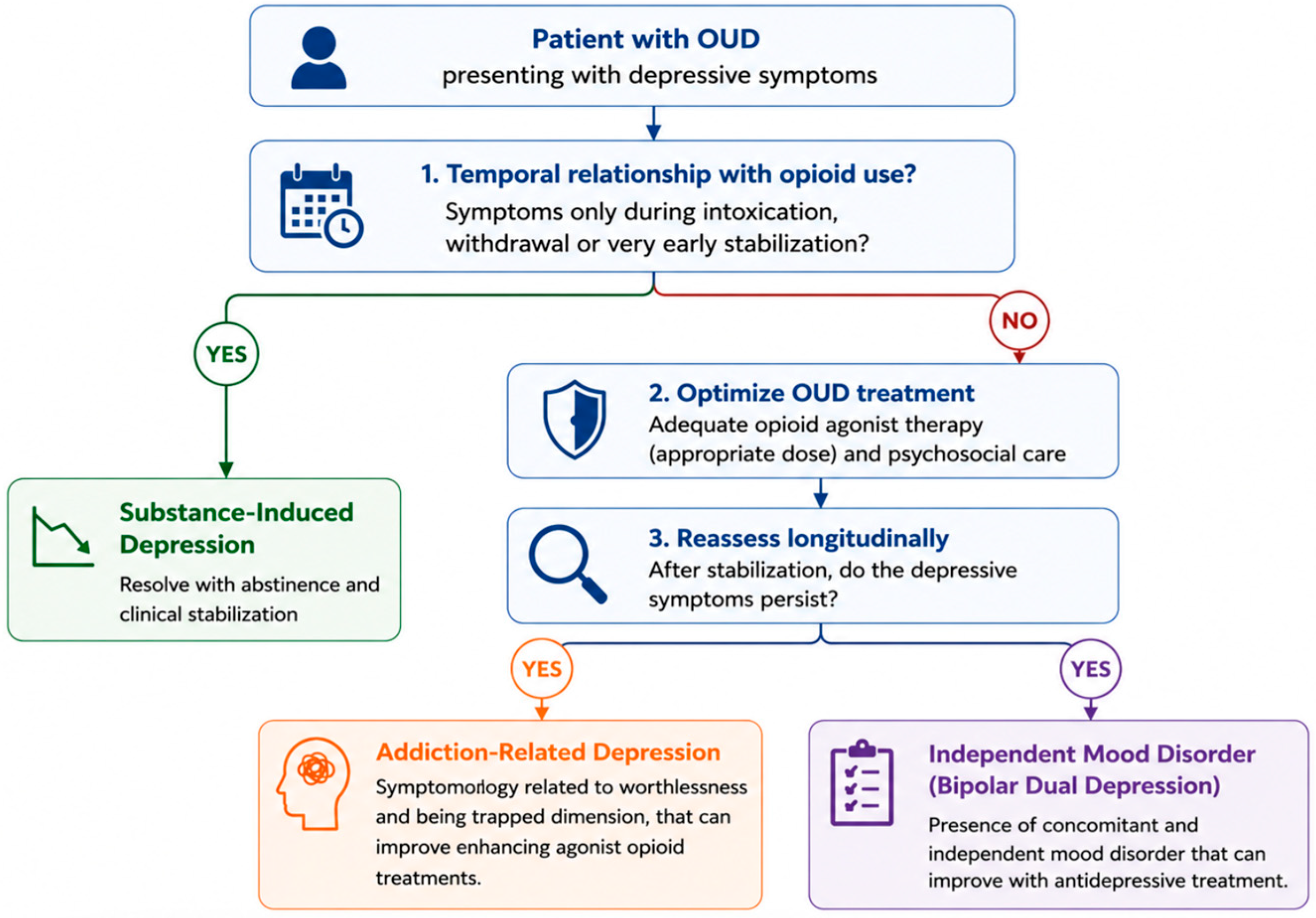
| Clinical Domain | Substance-Induced Depression | Addiction-Related Depression | Independent Mood Disorder (Bipolar Dual Depression) |
|---|---|---|---|
| Clinical context | Active use, intoxication, withdrawal, or early abstinence | Chronic or relapsing addictive process | Independent psychiatric disorder coexisting with OUD |
| Temporal relationship | Closely linked to substance exposure and expected to improve with stabilization | Persists beyond acute withdrawal and early stabilization | Persists independently of substance use and the addictive course |
| Predominant profile | Acute affective and withdrawal-related symptoms | W/BT profile, hypophoria, motivational depletion, and reward dysregulation | Established mood syndrome, often with bipolar-spectrum features |
| Initial clinical priority | Stabilize OUD and resolve acute substance-related effects | Optimize OAT and reassess reward-related and motivational symptoms | Stabilize OUD with OAT first and introduce antidepressant or mood-stabilizing treatment according to the independent mood disorder |
| Role of longitudinal reassessment | Confirm symptom remission or persistence after stabilization | Assess persistence and psychopathological organization after stabilization | Confirm longitudinal independence and bipolar-spectrum features |
Disclaimer/Publisher’s Note: The statements, opinions and data contained in all publications are solely those of the individual author(s) and contributor(s) and not of MDPI and/or the editor(s). MDPI and/or the editor(s) disclaim responsibility for any injury to people or property resulting from any ideas, methods, instructions or products referred to in the content. |
© 2026 by the authors. Licensee MDPI, Basel, Switzerland. This article is an open access article distributed under the terms and conditions of the Creative Commons Attribution (CC BY) license.
Share and Cite
Maremmani, A.G.I.; Della Rocca, F.; Bacciardi, S.; Cimino, S.; Cerniglia, L.; Pallucchini, A.; Carbone, M.G.; Miccoli, M.; Maremmani, I. Depression in Opioid Use Disorder: A Tripartite Psychopathological Model for Dual Disorders. J. Clin. Med. 2026, 15, 5476. https://doi.org/10.3390/jcm15145476
Maremmani AGI, Della Rocca F, Bacciardi S, Cimino S, Cerniglia L, Pallucchini A, Carbone MG, Miccoli M, Maremmani I. Depression in Opioid Use Disorder: A Tripartite Psychopathological Model for Dual Disorders. Journal of Clinical Medicine. 2026; 15(14):5476. https://doi.org/10.3390/jcm15145476
Chicago/Turabian StyleMaremmani, Angelo Giovanni Icro, Filippo Della Rocca, Silvia Bacciardi, Silvia Cimino, Luca Cerniglia, Alessandro Pallucchini, Manuel Glauco Carbone, Mario Miccoli, and Icro Maremmani. 2026. "Depression in Opioid Use Disorder: A Tripartite Psychopathological Model for Dual Disorders" Journal of Clinical Medicine 15, no. 14: 5476. https://doi.org/10.3390/jcm15145476
APA StyleMaremmani, A. G. I., Della Rocca, F., Bacciardi, S., Cimino, S., Cerniglia, L., Pallucchini, A., Carbone, M. G., Miccoli, M., & Maremmani, I. (2026). Depression in Opioid Use Disorder: A Tripartite Psychopathological Model for Dual Disorders. Journal of Clinical Medicine, 15(14), 5476. https://doi.org/10.3390/jcm15145476