Pericardial Effusion After Cardiac Surgery: Prevalence, Characteristics, Risk Factors and Management
 , and
, and
Abstract
1. Introduction
2. Materials and Methods
2.1. Study Population
2.2. Anamnestic and Clinical Data
2.3. Laboratory Data
2.4. Echocardiographic Evaluations
Therapy
2.5. Patient Follow-Up
2.6. Data Management
2.7. Statistical Methods
3. Results
4. Discussion
4.1. Prevalence of PEf and CT
4.2. Characteristics Associated with PEf Severity and Predictive of Progression to CT
4.2.1. Anamnestic Data
4.2.2. Type of Surgery
4.2.3. Post Surgery Complications (Number and Type)
4.2.4. Blood Samples Data and PPS
4.2.5. Not PEf-Targeted Therapy
4.2.6. PEf Management/Treatment
4.2.7. Follow Up
4.2.8. Limitations of the Study
5. Conclusions
Author Contributions
Funding
Institutional Review Board Statement
Informed Consent Statement
Data Availability Statement
Acknowledgments
Conflicts of Interest
Abbreviations
References
- Weitzman, L.B.; Tinker, W.P.; Kronzon, I.; Cohen, M.L.; Glassman, E.; Spencer, F.C. The incidence and natural history of pericardial effusion after cardiac surgery—An echocardiographic study. Circulation 1984, 69, 506–511. [Google Scholar] [CrossRef] [Scilit] [PubMed]
- Ikäheimo, M.J.; Huikuri, H.V.; Airaksinen, K.E.; Korhonen, U.R.; Linnaluoto, M.K.; Tarkka, M.R.; Takkunen, J.T. Pericardial effusion after cardiac surgery: Incidence, relation to the type of surgery, antithrombotic therapy, and early coronary bypass graft patency. Am. Heart J. 1988, 116, 97–102. [Google Scholar] [CrossRef] [Scilit] [PubMed]
- Pepi, M.; Muratori, M.; Barbier, P.; Doria, E.; Arena, V.; Berti, M.; Celeste, F.; Guazzi, M.; Tamborini, G. Pericardial effusion after cardiac surgery: Incidence, site, size, and haemodynamic consequences. Br. Heart J. 1994, 72, 327–331. [Google Scholar] [CrossRef] [Scilit] [PubMed] [PubMed Central]
- Maranta, F.; Cianfanelli, L.; Grippo, R.; Alfieri, O.; Cianflone, D.; Imazio, M. Post-pericardiotomy syndrome: Insights into neglected postoperative issues. Eur. J. Cardiothorac. Surg. 2022, 61, 505–514. [Google Scholar] [CrossRef] [Scilit] [PubMed]
- Imazio, M.; Brucato, A.; Ferrazzi, P.; Spodick, D.H.; Adler, Y. Postpericardiotomy syndrome: A proposal for diagnostic criteria. J. Cardiovasc. Med. 2013, 14, 351–353. [Google Scholar] [CrossRef] [Scilit] [PubMed]
- Schulz-Menger, J.; Collini, V.; Gröschel, J.; Adler, Y.; Brucato, A.; Christian, V.; Ferreira, V.M.; Gandjbakhch, E.; Heidecker, B.; Kerneis, M.; et al. 2025 ESC Guidelines for the management of myocarditis and pericarditis. Eur. Heart J. 2025, 46, ehaf192. [Google Scholar] [CrossRef] [Scilit] [PubMed]
- Lehto, J.; Kiviniemi, T. Postpericardiotomy syndrome after cardiac surgery. Ann. Med. 2020, 52, 243–264. [Google Scholar] [CrossRef] [Scilit] [PubMed] [PubMed Central]
- Kuvin, J.T.; Harati, N.A.; Pandian, N.G.; Bojar, R.M.; Khabbaz, K.R. Postoperative cardiac tamponade in the modern surgical era. Ann. Thorac. Surg. 2002, 74, 1148–1153. [Google Scholar] [CrossRef] [Scilit] [PubMed]
- Meurin, P.; Weber, H.; Renaud, N.; Larrazet, F.; Tabet, J.Y.; Demolis, P.; Ben Driss, A. Evolution of the postoperative pericardial effusion after day 15: The problem of the late tamponade. Chest 2004, 125, 2182–2187. [Google Scholar] [CrossRef] [Scilit]
- Imazio, M.; Adler, Y. Management of pericardial effusion. Eur. Heart J. 2013, 34, 1186–1197. [Google Scholar] [CrossRef] [Scilit] [PubMed]
- Imazio, M.; Trinchero, R.; Brucato, A.; Rovere, M.E.; Gandino, A.; Cemin, R.; Ferrua, S.; Maestroni, S.; Zingarelli, E.; Barosi, A.; et al. COlchicine for the Prevention of the Post-pericardiotomy Syndrome (COPPS): A multicentre, randomized, double-blind, placebo-controlled trial. Eur. Heart J. 2010, 31, 2749–2754. [Google Scholar] [CrossRef] [Scilit] [PubMed]
- Imazio, M.; Brucato, A.; Ferrazzi, P.; Pullara, A.; Adler, Y.; Barosi, A.; Caforio, A.L.; Cemin, R.; Chirillo, F.; Comoglio, C.; et al. Colchicine for prevention of postpericardiotomy syndrome and postoperative atrial fibrillation: The COPPS-2 randomized clinical trial. JAMA 2014, 312, 1016–1023. [Google Scholar] [CrossRef] [Scilit] [PubMed]
- van Osch, D.; Dieleman, J.M.; Bunge, J.J.; van Dijk, D.; Doevendans, P.A.; Suyker, W.J.; Nathoe, H.M.; Dexamethasone for Cardiac Surgery Study Group. Risk factors and prognosis of postpericardiotomy syndrome in patients undergoing valve surgery. J. Thorac. Cardiovasc. Surg. 2017, 153, 878–885.e1. [Google Scholar] [CrossRef] [Scilit] [PubMed]
- Lehto, J.; Kiviniemi, T.; Gunn, J.; Airaksinen, J.; Rautava, P.; Kytö, V. Occurrence of postpericardiotomy syndrome: Association with operation type and postoperative mortality after open-heart operations. J. Am. Heart Assoc. 2018, 7, e010269. [Google Scholar] [CrossRef] [Scilit]
- Imazio, M.; Brucato, A.; Rovere, M.E.; Gandino, A.; Cemin, R.; Ferrua, S.; Maestroni, S.; Barosi, A.; Simon, C.; Ferrazzi, P.; et al. Contemporary features, risk factors, and prognosis of the post-pericardiotomy syndrome. Am. J. Cardiol. 2011, 108, 1183–1187. [Google Scholar] [CrossRef] [Scilit]
- Pompilio, G.; Filippini, S.; Agrifoglio, M.; Merati, E.; Lauri, G.; Salis, S.; Alamanni, F.; Parolari, A. Determinants of pericardial drainage for cardiac tamponade following cardiac surgery. Eur. J. Cardiothorac. Surg. 2011, 39, e107–e113. [Google Scholar] [CrossRef] [Scilit] [PubMed]
- Gaudino, M.; Di Franco, A.; Rong, L.Q.; Cao, D.; Pivato, C.A.; Soletti, G.J.; Chadow, D.; Cancelli, G.; Perezgrovas Olaria, R.; Gillinov, M.; et al. Pericardial Effusion Provoking Atrial Fibrillation After Cardiac Surgery: JACC Review Topic of the Week. J. Am. Coll. Cardiol. 2022, 79, 2529–2539. [Google Scholar] [CrossRef] [Scilit] [PubMed]
- van Osch, D.; Nathoe, H.M.; Jacob, K.A.; Doevendans, P.A.; van Dijk, D.; Suyker, W.J.; Dieleman, J.M. Determinants of the postpericardiotomy syndrome: A systematic review. Eur. J. Clin. Investig. 2017, 47, 456–467. [Google Scholar] [CrossRef] [Scilit] [PubMed]
- Malektojari, A.; Tahmasebipour, R.; Fadaeihosein, M.; Ghazizadeh, S.; Ardali, F.; Haghighat, B.; Keshavarz, F.; Azari, Y.Y.; Javdan, F.; Shahsavari, E.; et al. Pharmacological preventions and treatments for pericardial complications after open heart surgeries. Heart 2025, 111, 353–361. [Google Scholar] [CrossRef] [Scilit] [PubMed]
- Meurin, P.; Tabet, J.Y.; Thabut, G.; Cristofini, P.; Farrokhi, T.; Fischbach, M.; Pierre, B.; Driss, A.B.; Renaud, N.; Iliou, M.C.; et al. Nonsteroidal anti-inflammatory drug treatment for postoperative pericardial effusion: A multicenter randomized, double-blind trial. Ann. Intern. Med. 2010, 152, 137–143. [Google Scholar] [CrossRef] [Scilit] [PubMed]
- Sevuk, U.; Baysal, E.; Altindag, R.; Yaylak, B.; Adiyaman, M.S.; Ay, N.; Alp, V.; Beyazit, U. Role of diclofenac in the prevention of postpericardiotomy syndrome after cardiac surgery. Vasc. Health Risk Manag. 2015, 11, 373–378. [Google Scholar] [CrossRef] [Scilit] [PubMed] [PubMed Central]
- Meurin, P.; Lelay-Kubas, S.; Pierre, B.; Pereira, H.; Pavy, B.; Iliou, M.C.; Bussiere, J.L.; Weber, H.; Beugin, J.P.; Farrokhi, T.; et al. Colchicine for Post-Operative Pericardial Effusion: Preliminary Results of the POPE-2 Study. J. Am. Coll. Cardiol. 2015, 66, 1198–1199. [Google Scholar] [CrossRef] [Scilit] [PubMed]
- Imazio, M.; Brucato, A.; Markel, G.; Cemin, R.; Trinchero, R.; Spodick, D.H.; Adler, Y. Meta-analysis of randomized trials focusing on prevention of the postpericardiotomy syndrome. Am. J. Cardiol. 2011, 108, 575–579. [Google Scholar] [CrossRef] [Scilit]
- Agarwal, S.K.; Vallurupalli, S.; Uretsky, B.F.; Hakeem, A. Effectiveness of colchicine for the prevention of recurrent pericarditis and post-pericardiotomy syndrome: An updated meta-analysis of randomized clinical data. Eur. Heart J. Cardiovasc. Pharmacother. 2015, 1, 117–125. [Google Scholar] [CrossRef] [Scilit] [PubMed]
- Lutschinger, L.L.; Rigopoulos, A.G.; Schlattmann, P.; Matiakis, M.; Sedding, D.; Schulze, P.C.; Noutsias, M. Meta-analysis for the value of colchicine for the therapy of pericarditis and of postpericardiotomy syndrome. BMC Cardiovasc. Disord. 2019, 19, 207, Erratum in BMC Cardiovasc. Disord. 2019, 19, 227. https://doi.org/10.1186/s12872-019-1195-z. [Google Scholar] [CrossRef] [Scilit] [PubMed] [PubMed Central]
- Deftereos, S.G.; Beerkens, F.J.; Shah, B.; Giannopoulos, G.; Vrachatis, D.A.; Giotaki, S.G.; Siasos, G.; Nicolas, J.; Arnott, C.; Patel, S.; et al. Colchicine in Cardiovascular Disease: In-Depth Review. Circulation 2022, 145, 61–78. [Google Scholar] [CrossRef] [Scilit] [PubMed] [PubMed Central]
- Imazio, M.; Nidorf, M. Colchicine and the heart. Eur. Heart J. 2021, 42, 2745–2760. [Google Scholar] [CrossRef] [Scilit] [PubMed] [PubMed Central]
- Bayes-Genis, A.; Adler, Y.; de Luna, A.B.; Imazio, M. Colchicine in Pericarditis. Eur. Heart J. 2017, 38, 1706–1709. [Google Scholar] [CrossRef] [Scilit] [PubMed]
- Mangileva, T.A.; Kazantseva, O.A.; Karaseva, I.V. Peculiarity of clinical course of postpericardiotomy syndrome in different methods of surgery and postoperative antithrombotic therapy. Kardiologiia 2021, 61, 53–59. [Google Scholar] [CrossRef] [Scilit] [PubMed]
- Imazio, M.; Hoit, B.D. Post-cardiac injury syndromes. An emerging cause of pericardial diseases. Int. J. Cardiol. 2013, 168, 648–652. [Google Scholar] [CrossRef] [Scilit] [PubMed]
- Imazio, M.; Lazaros, G. Corticosteroids for pericarditis: A warning but don’t throw the baby out with the bathwater. Hellenic J. Cardiol. 2019, 60, 364–365. [Google Scholar] [CrossRef] [Scilit] [PubMed]
- Imazio, M. Asymptomatic postoperative pericardial effusions: Against the routine use of anti-inflammatory drug therapy. Ann. Intern. Med. 2010, 152, 186–187. [Google Scholar] [CrossRef] [Scilit] [PubMed]
- Lehto, J.; Gunn, J.; Björn, R.; Malmberg, M.; Airaksinen, K.E.J.; Kytö, V.; Nieminen, T.; Hartikainen, J.E.K.; Biancari, F.; Kiviniemi, T.O. Adverse events and survival with postpericardiotomy syndrome after surgical aortic valve replacement. J. Thorac. Cardiovasc. Surg. 2020, 160, 1446–1456. [Google Scholar] [CrossRef] [Scilit] [PubMed]



| No PEf (n = 1770) | PEf (n = 382) | p | |
|---|---|---|---|
| Demographics | |||
| Age (years) | 69 ± 11 | 66 ± 11 | <0.0001 |
| Sex (male) | 1150 (65%) | 281 (74%) | <0.005 |
| Type of Surgery | |||
| CABG | 458 (26%) | 85 (22%) | Ns |
| VALVE | 894 (51%) | 162 (42%) | 0.0041 |
| AORTIC | 73 (4%) | 26 (7%) | 0.0233 |
| VALVE/AORTIC | 109 (6%) | 40 (10%) | 0.0026 |
| COMBINED | 175 (10%) | 63 (16%) | 0.0002 |
| Other | 56 (3%) | 6 (2%) | Ns |
| Hospital Stay | |||
| Overall hospital stay (days) | 32 ± 8 | 32 ± 13 | Ns |
| Cardiac surgery stay (days) | 9 ± 7 | 9 ± 9 | Ns |
| Rehabilitation stay (days) | 22 ± 10 | 22 ± 8 | Ns |
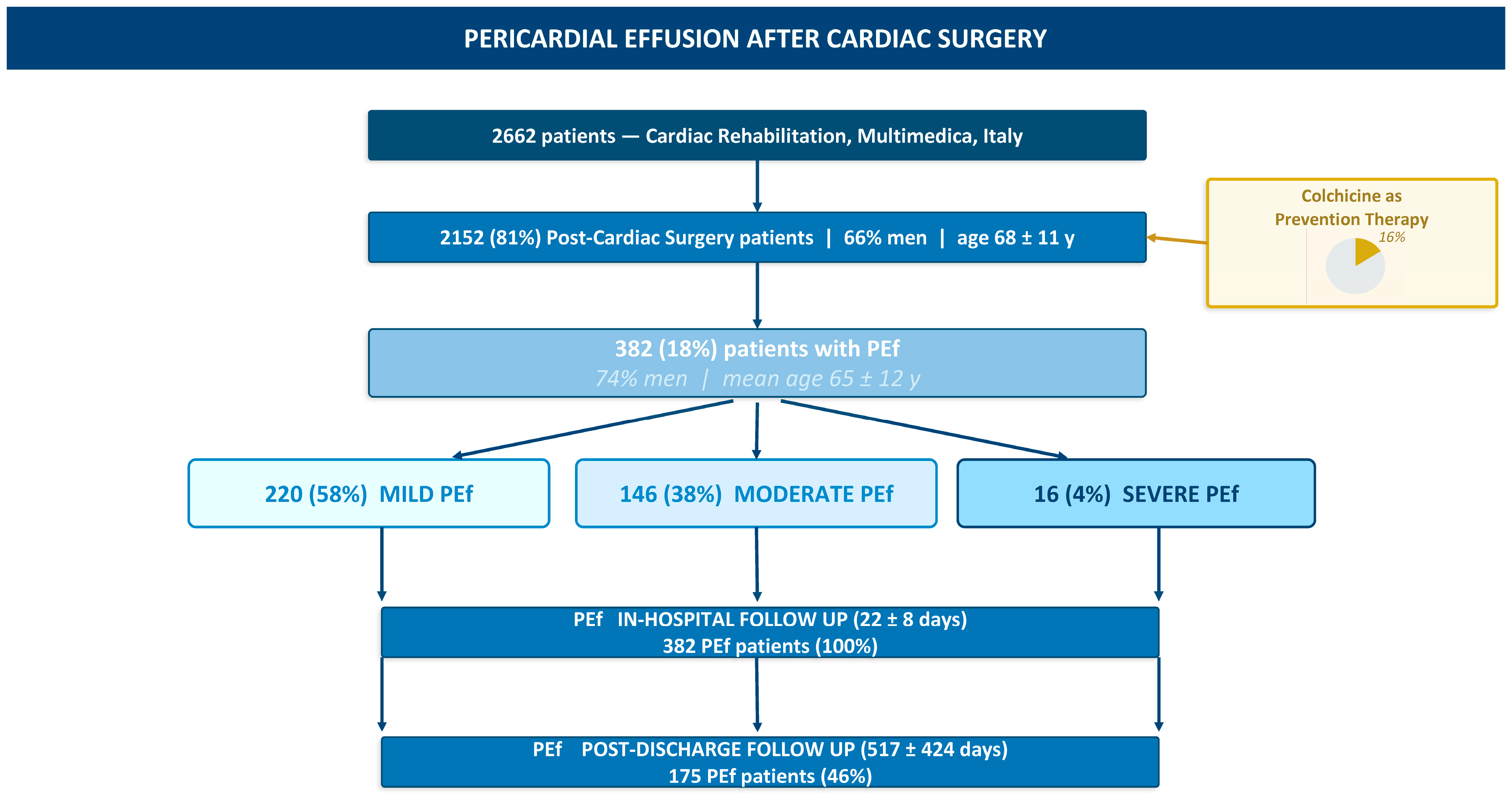
| PEf Total n = 382 | Mild PEf n = 220 (58%) | Moderate PEf n = 146 (38%) | Severe PEf n = 16 (4%) | Cardiac Tamponade n = 8 (2%) | p | |
|---|---|---|---|---|---|---|
| Surgery Data | ||||||
| CABG | 85 (22%) | 54 (25%) | 29 (20%) | 2 (13%) | 1 (13%) | Ns |
| Valve | 162 (42%) | 92 (42%) | 62 (42%) | 8 (50%) | 2 (25%) | Ns |
| Aortic | 26 (7%) | 10 (5%) | 15 (10%) | 1 (6%) | 1 (13%) | Ns |
| Valve/Aortic | 40 (10%) | 19 (9%) | 19 (13%) | 2 (13%) | 3 (38%) | Ns |
| Combined | 63 (16%) | 42 (19%) | 18 (12%) | 3 (19%) | 1 (13%) | Ns |
| Other | 6 (2%) | 3 (1%) | 3 (2%) | 0 (0%) | 0 | Ns |
| Aortic surgery involvement | 152 (59%) | 86 (58%) | 58 (59%) | 8 (73%) | 7 (88%) | Ns |
| Mitral surgery involvement | 106 (41%) | 62 (42%) | 41 (41%) | 3 (27%) | 0 | Ns |
| Special Procedures | ||||||
| REDO | 24 (6%) | 12 (5%) | 12 (8%) | 0 | 1 (13%) | Ns |
| Atrial fibrillation ablation | 14 (4%) | 7 (3%) | 7 (5%) | 0 | 0 | Ns |
| Left auricle occlusion | 35 (9%) | 15 (7%) | 17 (12%) | 3 (19%) | 0 | Ns |
| Mechanic valve | 17 (4%) | 9 (4%) | 7 (5%) | 1 (6%) | 0 | Ns |
| Urgency | 18 (5%) | 8 (4%) | 10 (7%) | 0 | 0 | Ns |
| Surgical Approach | ||||||
| Sternotomy | 335 (88%) | 189 (86%) | 130 (89%) | 16 (100%) | 8 (100%) | Ns |
| Minithoracotomy | 24 (6%) | 20 (9%) | 4 (3%) | 0 | 0 | <0.05 |
| Ministernotomy | 23 (6%) | 11 (5%) | 12 (8%) | 0 | 0 | Ns |
| Pre-Surgery Characteristics | PEf Total n = 382 | Mild PEf n = 220 (58%) | Moderate PEf n = 146 (38%) | Severe PEf n = 16 (4%) | Cardiac Tamponade n = 8 (2%) | p |
|---|---|---|---|---|---|---|
| BMI > 25 | 130 (47%) | 71 (46%) | 56 (50%) | 3 (27%) | 1 (33%) | Ns |
| BMI > 30 | 44 (16%) | 26 (17%) | 17 (15%) | 1 (9%) | 1 (33%) | Ns |
| LVEF (%) | 58 ± 10 | 58 ± 10 | 57 ± 10 | 58 ± 11 | 61 ± 7 | Ns |
| LVEF 40–50% | 56 (24%) | 28 (20%) | 24 (28%) | 4 (36%) | 2 (25%) | Ns |
| LVEF < 40% | 13 (6%) | 8 (6%) | 5 (6%) | 0 | 0 | Ns |
| CAD | 74 (19%) | 44 (20%) | 27 (18%) | 3 (19%) | 2 (25%) | Ns |
| Previous Endocarditis | 25 (7%) | 16 (7%) | 8 (5%) | 1 (6%) | 0 | Ns |
| Previous Pericarditis | 2 (1%) | 1 (0.5%) | 1 (1%) | 0 | 0 | Ns |
| Aortic dissection | 11 (3%) | 3 (1%) | 8 (5%) | 0 | 0 | Ns |
| Arrhythmic problems | 67 (18%) | 37 (17%) | 26 (18%) | 4 (25%) | 0 | Ns |
| Renal insufficiency | 38 (10%) | 22 (10%) | 16 (11%) | 3 (19%) | 1 (13%) | Ns |
| Peripheral vasculopathy | 32 (8%) | 21 (10%) | 10 (7%) | 1 (6%) | 2 (25%) | Ns |
| Neurologic problems | 38 (10%) | 19 (9%) | 17 (12%) | 2 (13%) | 1 (13%) | Ns |
| Allergies | 63 (16%) | 41 (19%) | 19 (13%) | 3 (19%) | 1 (13%) | Ns |
| Diabetes mellitus | 69 (18%) | 43 (20%) | 21 (14%) | 5 (31%) | 3 (38%) | Ns |
| Previous smoking | 127 (33%) | 68 (31%) | 50 (34%) | 9 (56%) | 3 (38%) | Ns |
| Arterial hypertension | 233 (61%) | 130 (59%) | 94 (64%) | 9 (56%) | 4 (50%) | Ns |
| Post-Surgery Data | PEf Total n = 382 | Mild PEf n = 220 (58%) | Moderate PEf n = 146 (38%) | Severe PEf n = 16 (4%) | Cardiac Tamponade n = 8 (2%) | p |
|---|---|---|---|---|---|---|
| Number of Complications (no. pts) | ||||||
| No complications | 32 (8%) | 21 (10%) | 10 (7%) | 1 (6%) | 0 (0%) | Ns |
| 1 complication | 80 (21%) | 45 (20%) | 31 (21%) | 4 (25%) | 0 (0%) | |
| 2 complications | 92 (24%) | 56 (25%) | 33 (23%) | 3 (19%) | 2 (25%) | |
| 3 complications | 91 (24%) | 45 (20%) | 44 (30%) | 2 (13%) | 3 (38%) | |
| 4+ complications | 87 (23%) | 53 (24%) | 28 (19%) | 6 (38%) | 3 (38%) | |
| Nature of Complications (no. pts) | ||||||
| Arrhythmias | 224 (59%) | 129 (59%) | 83 (57%) | 12 (75%) | 7 (88%) | Ns |
| POAF | 207 (54%) | 116 (53%) | 81 (55%) | 10 (63%) | 5 (63%) | Ns |
| Blood complications | 98 (26%) | 56 (25%) | 39 (27%) | 3 (19%) | 2 (25%) | Ns |
| Respiratory complications | 125 (33%) | 65 (30%) | 54 (37%) | 6 (38%) | 3 (38%) | Ns |
| Pneumothorax | 29 (8%) | 14 (6%) | 14 (10%) | 1 (6%) | 0 | Ns |
| Thoracentesis | 9 (2%) | 6 (3%) | 3 (2%) | 0 (0%) | 0 | Ns |
| Hemodynamic complications | 171 (45%) | 103 (47%) | 62 (42%) | 6 (38%) | 5 (63%) | Ns |
| Heart failure | 80 (21%) | 44 (20%) | 33 (23%) | 3 (19%) | 4 (50%) | Ns |
| Early PE | 54 (14%) | 27 (50%) | 22 (41%) | 5 (9%) | 4 (50%) | Ns |
| Infective complications | 117 (31%) | 68 (31%) | 45 (31%) | 4 (25%) | 2 (25%) | Ns |
| Renal complications | 42 (11%) | 25 (11%) | 13 (9%) | 4 (25%) | 1 (13%) | Ns |
| Hepatic complications | 17 (4%) | 8 (4%) | 8 (5%) | 1 (6%) | 1 (13%) | Ns |
| Wound complications | 24 (6%) | 13 (6%) | 9 (6%) | 2 (13%) | 0 | Ns |
| Neurologic complications | 5 (1%) | 3 (1%) | 2 (1%) | 0 (0%) | 0 | Ns |
| Post-Pericardiotomy Syndrome (PPS) Criteria (no. pts) | ||||||
| PPS criteria | 269 (70%) | 147 (67%) | 113 (77%) | 9 (56%) | 6 (75%) | <0.05 |
| Hyperpyrexia | 109 (29%) | 56 (25%) | 49 (34%) | 4 (25%) | 3 (38%) | Ns |
| Pleural effusion | 239 (63%) | 134 (61%) | 97 (68%) | 8 (53%) | 6 (86%) | Ns |
| Blood Chemistry | ||||||
| Hemoglobin (g/dL) | 10.3 ± 1.2 | 10.4 ± 1.2 | 10.1 ± 1.2 | 10.2 ± 1.2 | 10.2 ± 1.6 | Ns |
| Albuminemia (g/dL) | 2.9 ± 0.3 | 2.9 ± 0.3 | 2.9 ± 0.4 | 2.9 ± 0.2 | 2.8 ± 0.2 | Ns |
| C-reactive protein (mg/L) | 7.2 ± 5.1 | 6.9 ± 5.1 | 7.8 ± 5.1 | 4.5 ± 2.2 | 6.5 ± 3.7 | <0.05 |
| Echocardiographic Data | ||||||
| Septal wall thickness (mm) | 12.5 ± 1.8 | 12.4 ± 1.8 | 12.5 ± 1.7 | 13.2 ± 2.4 | 12.8 ± 1.9 | Ns |
| LV diastolic volume/BSA (mL/m2) | 52.9 ± 16.4 | 53.5 ± 16.9 | 52.2 ± 15.9 | 52.8 ± 16.9 | 54 ± 14 | Ns |
| LV ejection fraction (%) | 52.7 ± 8.4 | 52.6 ± 8.6 | 52.7 ± 7.8 | 55.2 ± 11.3 | 52 ± 9 | Ns |
| LV ejection fraction < 40% (no. pts) | 13 (6%) | 8 (6%) | 5 (6%) | 0 (0%) | 0 | Ns |
| Left atrial enlargement (no. pts) | 212 (61%) | 113 (57%) | 86 (64%) | 13 (93%) | 6 (86%) | <0.05 |
| E/A | 1 ± 0.3 | 1 ± 0.3 | 1.1 ± 0.4 | 1.2 ± 0.3 | 1.2 ± 0.6 | Ns |
| Mitral regurgitation (1–4 grade) | 0.8 ± 0.5 | 0.8 ± 0.5 | 0.8 ± 0.5 | 0.8 ± 0.5 | 1.1 ± 0.2 | Ns |
| Tricuspid regurgitation (1–4 grade) | 0.7 ± 0.6 | 0.7 ± 0.6 | 0.7 ± 0.5 | 0.8 ± 0.5 | 0.8 ± 0.6 | Ns |
| PE measurements (mm) | 13.7 ± 4.8 | 9.2 ± 1.2 | 14.7 ± 2.5 | 26.6 ± 3.5 | 22.5 ± 8.8 | <0.0001 |
| Circumferential (no. pts) | 252 (66%) | 159 (72%) | 85 (58%) | 8 (50%) | 5 (63%) | <0.01 |
| Loculated—left side (no. pts) | 55 (15%) | 22 (10%) | 26 (18%) | 7 (44%) | 1 (13%) | <0.001 |
| Loculated—light side (no. pts) | 75 (19%) | 39 (18%) | 35 (24%) | 1 (6%) | 2 (25%) | Ns |
| PEf Total n = 382 | Mild PEf n = 220 (58%) | Moderate PEf n = 146 (38%) | Severe PEf n = 16 (4%) | |
|---|---|---|---|---|
| In-Hospital Follow-Up (22 ± 8 days, 382 pts) | ||||
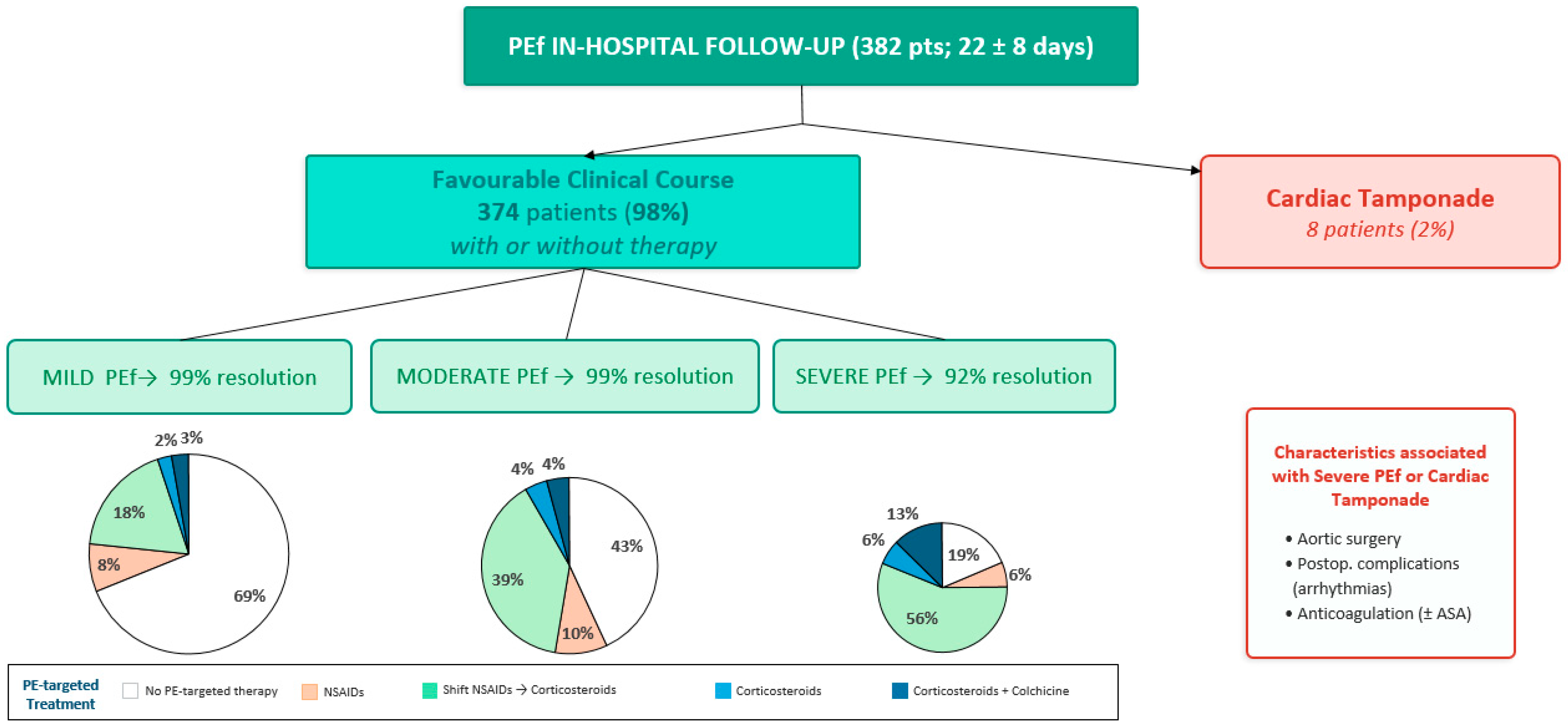
| Discharge (no. pts) | 374 (98%) | 217 (99%) | 145 (99%) | 12 (75%) |
| Urgent transfer due to CT (no. pts) | 8 (2%) | 3 (1%) | 1 (1%) * | 4 (25%) ° |
| Post-Discharge Follow-Up (517 ± 424 days, 175 pts) | ||||
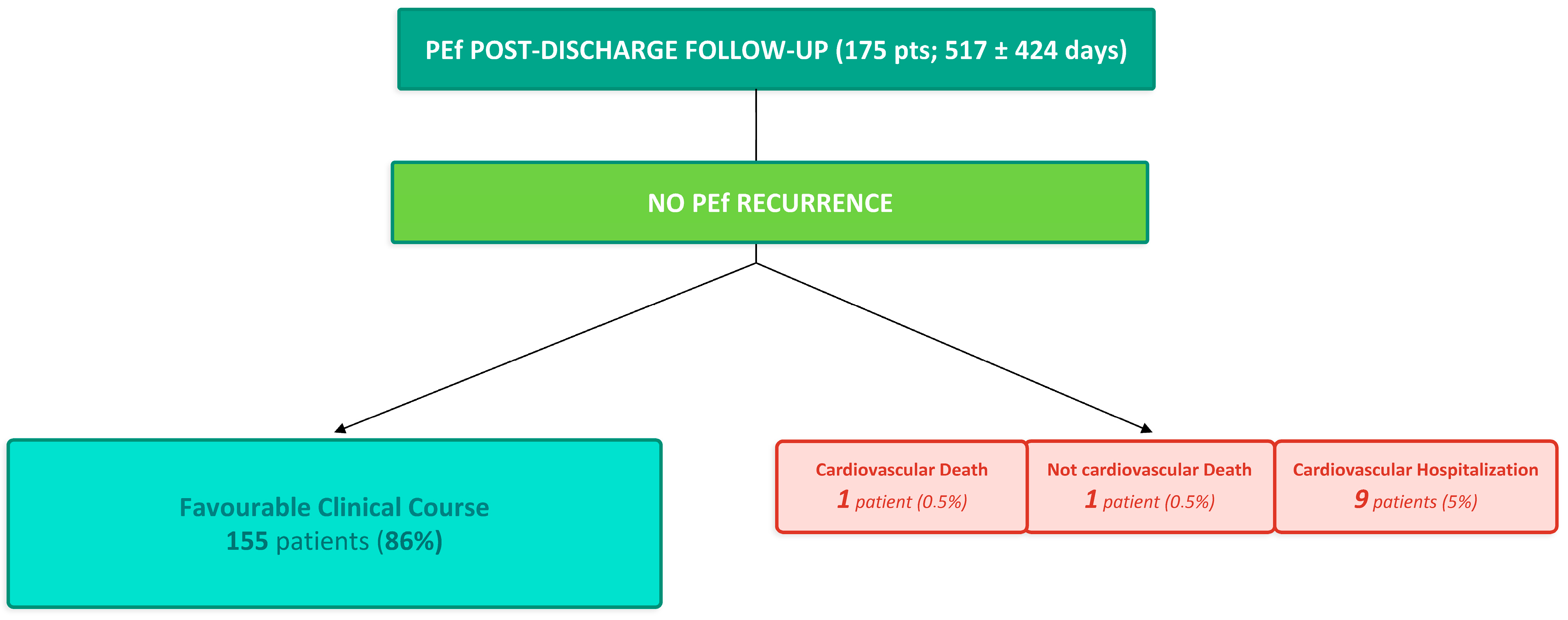
| Deaths (no. pts) | 2 | 2 | 0 | 0 |
| CV Hospitalizations (no. pts) | 9 | 5 | 4 | 0 |
| Heart failure | 4 | 3 | 1 | 0 |
| REDO (prosthetic valve infection) | 1 | 1 | 0 | 0 |
| Vascular problems | 2 | 1 | 1 | 0 |
| Arrhythmia problems | 2 | 0 | 2 | 0 |
| Therapy | PEf Total n = 382 | Mild PEf n = 220 (58%) | Moderate PEf n = 146 (38%) | Severe PEf n = 16 (4%) | Cardiac Tamponade n = 8 (2%) | p |
|---|---|---|---|---|---|---|
| General Medications (no. pts) | ||||||
| Beta-blockers | 330 (86%) | 195 (89%) | 123 (84%) | 12 (75%) | 6 (75%) | Ns |
| Diuretics | 266 (70%) | 158 (72%) | 98 (67%) | 10 (63%) | 6 (75%) | Ns |
| ACE-inhibitors/sartans | 126 (33%) | 72 (33%) | 49 (34%) | 5 (31%) | 3 (38%) | Ns |
| Mineralocorticoid receptor antagonists | 207 (54%) | 129 (58%) | 73 (50%) | 5 (31%) | 3 (38%) | Ns |
| Amiodarone | 147 (38%) | 81 (37%) | 59 (40%) | 7 (44%) | 5 (63%) | Ns |
| Antibiotics | 147 (38%) | 85 (39%) | 58 (40%) | 4 (25%) | 3 (38%) | Ns |
| Calcium antagonist | 22 (6%) | 11 (5%) | 9 (6%) | 2 (13%) | 0 | Ns |
| Enoxaparin (antithrombotic dose) | 8 (2%) | 5 (2%) | 2 (1%) | 1 (6%) | 3 (38%) | Ns |
| Anticoagulants (oral or subcutaneous) | 225 (59%) | 131 (60%) | 80 (55%) | 14 (88%) | 6 (75%) | <0.05 |
| Acetylsalicic acid | 225 (59%) | 138 (63%) | 79 (54%) | 8 (50%) | 5 (63%) | Ns |
| Anticoagulants + acetylsalicic acid | 87 (23%) | 57 (26%) | 24 (16%) | 6 (38%) | 3 (38%) | <0.05 |
| Dual antiplatelet therapy | 21 (5%) | 12 (5%) | 8 (6%) | 1 (6%) | 0 | Ns |
| PEf Prevention Therapy | ||||||
| Colchicine (pre-treatment) | 62 (16%) | 20 (9%) | 33 (23%) | 9 (56%) | 1 (13%) | <0.0001 |
| PEf Treatment Therapy | ||||||
| NSAIDs | 32 (8%) | 17 (8%) | 14 (10%) | 1 (6%) | 0 | Ns |
| Corticosteroids | 106 (28%) | 40 (18%) | 57 (39%) | 9 (56%) | 2 (13%) | <0.0001 |
| Corticosteroids + colchicine | 12 (3%) | 5 (2%) | 6 (4%) | 1 (6%) | 0 | Ns |
| Shift NSAIDs → corticosteroids | 14 (4%) | 6 (3%) | 6 (4%) | 2 (13%) | 0 | Ns |
| No PE-targeted therapy | 214 (56%) | 151 (69%) | 63 (43%) | 3 | 3 | <0.0001 |
| Urgent transfer | 3 | 3 | ||||
| Age/ Sex | Type of Surgery | Surgical Approach | PS Comps | First TTE PEf Severity | First TTE PEf Site | Early PEf | Coagulation Therapy | PEf Therapy | PS Day |
|---|---|---|---|---|---|---|---|---|---|
| 83/F | SAVR + ACBPG | Sternotomy | 3 | Mild | Loculated (right sections) | No | ASA + enoxaparin | No | 18 |
| 46/M | Bentall | Sternotomy | 3 | Mild | Circumferential | Yes | OAC + enoxaparin | No | 11 |
| 77/F | SAVR + aortic | Sternotomy | 5 | Mild | Circumferential | No | OAC | No | 15 |
| 70/M | Tirone David | Sternotomy | 4 | Moderate | Loculated (left sections) | Yes | ASA + OAC | Cortisone + Colchicine (3 days) | 12 |
| 82/M | SAVR + ACBPG | Sternotomy | 2 | Severe | Circumferential | No | ASA + OAC | Cortisone (10 days) | 25 |
| 37/M | SAVR + aortic | Sternotomy | 3 | Severe Tamponade | Circumferential | Yes | ASA + OAC | Urgent transfer | 14 |
| 80/F | ACBPG | Sternotomy | 4 | Severe Tamponade | Circumferential | Yes | OAC | Urgent transfer | 5 |
| 77/M | CABG | Sternotomy | 2 | Severe Tamponade | Loculated (right sections) | No | ASA + enoxaparin | Urgent transfer | 13 |
Disclaimer/Publisher’s Note: The statements, opinions and data contained in all publications are solely those of the individual author(s) and contributor(s) and not of MDPI and/or the editor(s). MDPI and/or the editor(s) disclaim responsibility for any injury to people or property resulting from any ideas, methods, instructions or products referred to in the content. |
© 2026 by the authors. Licensee MDPI, Basel, Switzerland. This article is an open access article distributed under the terms and conditions of the Creative Commons Attribution (CC BY) license.
Share and Cite
Cattadori, G.; Picozzi, A.; Tagliabue, E.; Muti Schuenemann, G.E.U.; Staine, T.; Chiodelli, R.; Scaglione, A.; Baronio, B.; Di Marco, S.; Anzà, C. Pericardial Effusion After Cardiac Surgery: Prevalence, Characteristics, Risk Factors and Management. J. Clin. Med. 2026, 15, 3101. https://doi.org/10.3390/jcm15083101
Cattadori G, Picozzi A, Tagliabue E, Muti Schuenemann GEU, Staine T, Chiodelli R, Scaglione A, Baronio B, Di Marco S, Anzà C. Pericardial Effusion After Cardiac Surgery: Prevalence, Characteristics, Risk Factors and Management. Journal of Clinical Medicine. 2026; 15(8):3101. https://doi.org/10.3390/jcm15083101
Chicago/Turabian StyleCattadori, Gaia, Anna Picozzi, Elena Tagliabue, Giovanna Elsa Ute Muti Schuenemann, Tiziana Staine, Roberta Chiodelli, Anna Scaglione, Barbara Baronio, Silvia Di Marco, and Claudio Anzà. 2026. "Pericardial Effusion After Cardiac Surgery: Prevalence, Characteristics, Risk Factors and Management" Journal of Clinical Medicine 15, no. 8: 3101. https://doi.org/10.3390/jcm15083101
APA StyleCattadori, G., Picozzi, A., Tagliabue, E., Muti Schuenemann, G. E. U., Staine, T., Chiodelli, R., Scaglione, A., Baronio, B., Di Marco, S., & Anzà, C. (2026). Pericardial Effusion After Cardiac Surgery: Prevalence, Characteristics, Risk Factors and Management. Journal of Clinical Medicine, 15(8), 3101. https://doi.org/10.3390/jcm15083101