Article

A Novel Approach to Determining Bone Loss Through Serum Uric Acid Levels: A Retrospective Multicenter Cohort Analysis


by
Ahmet Aydin
1,*,
Turkan Pasali Kilit
2,
Seher Kir
3,
Esref Arac
4,
Osman Ozudogru
5,
Nazmiye Serap Bicer
6,
Gulbin Seyman Cetinkaya
7,
Mehmet Selim Mamis
8,
Kadem Arslan
9,
Suleyman Bas
9,
Hatice Beyazal Polat
10,
Kamil Konur
10,
Omer Faruk Alakus
11,
Ihsan Solmaz
11,
Gizem Zorlu Gorgulugil
12,
Seyit Uyar
12,
Sabin Goktas Aydin
13,
Alihan Oral
14,
Nurhayat Ozkan Sevencan
15,
Ceren Cevik
15,
Betul Danapinar
15,
Cetin Uyanik
1,
Osman Erinc
16,
Ozgur Yilmaz
16,
Sevtap Bakir Kaliber
17,
Aynur Kamburoglu
17 and
Nizameddin Koca
17
add Show full author list remove Hide full author list
1
Department of Internal Medicine, Faculty of Medicine, Istanbul Medipol University, Istanbul 34214, Türkiye
2
Department of Internal Medicine, Kutahya Health Sciences University, Kutahya 43020, Türkiye
3
Department of Internal Medicine, Faculty of Medicine, Ondokuz Mayis University, Samsun 55270, Türkiye
4
Department of Internal Medicine, Faculty of Medicine, Dicle University, Diyarbakir 21010, Türkiye
5
Department of Internal Medicine, Faculty of Medicine, Erzincan Binali Yıldırım University, Erzincan 24100, Türkiye
6
Department of Internal Medicine, Kayseri City Hospital, Kayseri 38080, Türkiye
7
Department of Internal Medicine, İzmir Atatürk Research and Training Hospital, İzmir 35360, Türkiye
8
Department of Internal Medicine, Faculty of Medicine, Siirt University, Siirt 56100, Türkiye
9
Department of Internal Medicine, Sancaktepe Sehit Prof. Dr. Ilhan Varank Training and Research Hospital, Istanbul 34785, Türkiye
10
Department of Internal Medicine, Faculty of Medicine, Recep Tayyip Erdogan University, Rize 53020, Türkiye
11
Department of Internal Medicine, Diyarbakır Gazi Yasargil Training and Research Hospital, Diyarbakır 21010, Türkiye
12
Department of Internal Medicine, Antalya Training and Research Hospital, Antalya 07100, Türkiye
13
Department of Medical Oncology, Kanuni Sultan Suleyman Training and Research Hospital, Istanbul 34303, Türkiye
14
Department of Internal Medicine, Faculty of Medicine, Biruni University, Istanbul 34295, Türkiye
15
Department of Internal Medicine, Karabuk Training and Research Hospital, Karabuk 78200, Türkiye
16
Department of Internal Medicine, Kanuni Sultan Suleyman Training and Research Hospital, Istanbul 34303, Türkiye
17
Department of Internal Medicine, Bursa City Hospital, Bursa 16250, Türkiye
*
Author to whom correspondence should be addressed.
J. Clin. Med. 2026, 15(8), 3020; https://doi.org/10.3390/jcm15083020
Submission received: 8 March 2026 / Revised: 9 April 2026 / Accepted: 12 April 2026 / Published: 15 April 2026
(This article belongs to the Section Endocrinology & Metabolism)

Abstract

Background: Osteoporosis has a rising global incidence and social burden. Serum uric acid’s dual roles in oxidative stress and inflammation may influence bone health, but findings are inconsistent and require further research. This study aimed to evaluate the relationship between SUA levels and osteoporosis in a multicenter cohort obtained from different regions of Türkiye. Methods: This multi-center retrospective study included 3280 individuals, postmenopausal women and men aged 45 and older, from 16 centers in Türkiye. Individuals were excluded if they recently consumed alcohol, had severe renal dysfunction, certain hormonal or mineral disorders, specific medications, or certain menopausal statuses. Bone mineral density (BMD) at the hip and lumbar spine was measured using dual-energy X-ray absorptiometry (DXA), and participants were classified as normal or having osteopenia or osteoporosis based on T-score thresholds. Results: Overall, 34.8% were male, and 65.2% were female. For the lumbar spine, 36.8% had osteopenia, and 13.5% had osteoporosis; similarly, for the total hip, 40.8% had osteopenia, and 7.9% had osteoporosis. ROC analysis identified a threshold of 3.9 mg/dL serum uric acid (SUA) (AUC 0.374; p < 0.001), which was positively associated with both lumbar and total hip BMD. Osteoporosis rates were higher in patients with SUA < 3.9 mg/dL compared to those with SUA ≥ 3.9 mg/dL at the lumbar spine (29.1% vs. 14.2%, p < 0.001) and total hip sites (23.6% vs. 15.9%, p = 0.003). After adjustment for potential confounders, SUA was a significant independent predictor of osteoporosis in the lumbar spine (OR 0.70; p < 0.001) and the hip (OR 0.80; p < 0.001). Conclusions: Serum uric acid levels are inversely linked to bone mineral density and osteoporosis risk, indicating a potential role in bone health. However, due to study limitations, causal relationships remain unproven, and further research is needed.

1. Introduction

Osteoporosis is characterized by reduced bone mass, disrupted bone microarchitecture, and increased skeletal fragility, collectively resulting in diminished bone strength and an increased risk of fractures, with a 15–20% rise in mortality within one year of the fracture [1,2]. Osteoporosis remains clinically silent until a fracture occurs, with fractures reported in over 9 million of the 200 million newly diagnosed patients [1]. As life expectancy increases, such a fracture incidence causes a global health concern by imposing a major economic and social burden [3]. Decreased bone density is associated with age, gender, family history, and various factors such as smoking, malnutrition, low body mass index, low calcium intake, glucocorticoid usage, and alcohol consumption [4]. Although the exact mechanism remains unclear, oxidative stress alongside hormonal alterations and deficiencies in calcium and vitamin D is thought to suppress osteoblastic differentiation in bone cells while promoting osteoclastic differentiation, thereby enhancing bone resorption [5,6].
Serum uric acid (SUA), produced through xanthine oxidase during purine metabolism, can act as both an antioxidant and a pro-oxidant depending on the biological environment. While SUA significantly boosts circulating antioxidant defenses, elevated levels are associated with various health issues such as gout, kidney stones, hypertension, metabolic syndrome, cardiovascular diseases, and non-alcoholic fatty liver disease [7,8,9,10,11].
Growing evidence suggests SUA may have a broader role in oxidative stress and inflammation, sparking interest in its role in bone health and osteoporosis. While extracellular uric acid has antioxidant properties, its accumulation or cellular metabolism can increase oxidative stress and promote inflammation. This boosts osteoclast activity, inhibits osteoblasts, and, with uric acid-induced lower vitamin D synthesis and secondary hyperparathyroidism, can further enhance bone resorption [12].
The literature includes conflicting studies and meta-analyses. While some studies suggest that SUA is significantly positively correlated with bone mass [13,14,15], others do not support this hypothesis [16,17,18,19,20].
As the prevalence of osteoporosis continues to rise, there is an urgent need to identify reliable, low-cost biomarkers for early risk assessment and prevention. Serum uric acid is a promising candidate because of its key role in oxidative stress and inflammation, which influence bone remodeling. Nevertheless, studies on its effect on bone health are inconsistent, pointing to an important gap in our understanding.
We hypothesized that SUA levels are significantly associated with bone mineralization. To test this, we examined the relationship between serum uric acid and bone mineral density in postmenopausal women and men over 50 years across multiple regions of Türkiye to clarify its clinical relevance as a potential marker of osteoporosis risk.

2. Material Method

This multi-center retrospective study included 3280 individuals from 16 different centers in Turkey.
Individuals were not eligible for inclusion if they had consumed alcohol recently, defined as a daily intake of up to 14 g within the previous three months. Participants with marked renal dysfunction (eGFR < 30 mL/min/1.73 m2), known thyroid or parathyroid disease, or those receiving treatments that could influence hormonal balance or mineral metabolism, such as sex hormones, glucocorticoids, bisphosphonates, or calcium supplements, were also excluded. In addition, men younger than 50 years and women who had undergone surgical menopause or experienced menopause before age 40 were not included; however, a very small number of men aged <50 years (n = 4) were inadvertently enrolled, all of whom had normal BMD values. Patients with gout, a history of kidney stones, or those using medications likely to affect serum uric acid levels were excluded to avoid confounding of urate measurements. Patient demographics were obtained from hospital records. Laboratory findings were obtained at the time of the DXA scan.
Bone status at the total hip and lumbar spine (L1–L4) was evaluated by measuring bone mineral density (BMD, g/cm2) and assessing for osteoporosis using dual-energy X-ray absorptiometry (DXA) with a GE Lunar Prodigy Advance system, operated in accordance with the manufacturer’s guidelines. DXA measurements were obtained at the participating centers as part of routine clinical practice. BMD represents the quantity of mineralized bone within a defined skeletal area and was expressed both as an absolute value (g/cm2) and as a T-score. The T-score reflects the difference between an individual’s BMD and the mean peak bone mass of a healthy young reference population of the same sex, expressed in standard deviation units. Based on T-score values, participants were classified as having normal bone density (T ≥ −1.0), reduced bone mass (osteopenia; −2.5 < T < −1.0), or osteoporosis (T ≤ −2.5) [1].
This study was conducted in accordance with the ethical principles of the Declaration of Helsinki. Patients provided written informed consent, and the Local Ethics Committee approved the study in 20 February 2025 with decision number E-10840098-202.3.02-1588.

Statistical Analysis

Statistical evaluation was carried out using SPSS software (version 24.0; IBM Corp., Chicago, IL, USA). The distribution of continuous variables was examined using both the Kolmogorov–Smirnov and Shapiro–Wilk tests. Descriptive data are presented as medians with interquartile ranges for variables showing non-normal distribution, while categorical variables are reported as counts and percentages. Group differences in categorical variables were assessed using the chi-square test. For comparisons involving continuous variables, the Mann–Whitney U test or Kruskal–Wallis test was applied, as appropriate. To determine factors independently associated with osteoporosis, binary logistic regression analysis was performed. Receiver operating characteristic (ROC) curve analysis was used to establish the most informative serum uric acid threshold for predicting osteoporosis, with diagnostic performance evaluated by calculating sensitivity, specificity, positive and negative predictive values, and the area under the ROC curve. Associations between independent variables and survival outcomes were expressed using 95% confidence intervals. All statistical tests were two-tailed, and a p-value below 0.05 was considered indicative of statistical significance.

3. Results

A total of 3280 patients were included; 1141 (34.8%) were male and 2139 (65.2%) were female. The median age was 62 years (range, 45–94). Diabetes mellitus was present in 1257 patients (38.3%), hypertension in 1510 (46.0%), dyslipidemia in 1505 (45.9%), and a history of stroke in 158 (4.8%). Coronary artery disease was observed in 405 patients (12.3%). Alcohol use and smoking were reported in 183 (5.6%) and 626 (19.1%) patients, respectively. Also, 23 patients (0.7%) had a BMI < 18.5 kg/m2, 436 (13.2%) had a BMI of 18.5–24.9 kg/m2, 1126 (34.3%) had a BMI of 25.0–29.9 kg/m2, and 1514 (46.1%) had a BMI ≥ 30.0 kg/m2.
Overall, 1625 patients (49.5%) had normal lumbar bone mineral density (T-score ≥ −1.0), 1207 (36.8%) had osteopenia (T-score between −1.0 and −2.5), and 444 (13.5%) had osteoporosis (T-score ≤ −2.5). Four patients with lumbar prostheses were excluded from the L1–L4 DXA T-score analysis.
A total of 1682 patients (51.3%) had normal total hip bone mineral density (T-score ≥ −1.0), 1337 (40.8%) had osteopenia (T-score between −1.0 and −2.5), and 258 (7.9%) had osteoporosis (T-score ≤ −2.5). Three patients with hip prostheses were excluded from the total hip DXA analysis (Table 1).
The median values of laboratory results as SUA, calcium, phosphate, albümin, ALP, PTH, and 25-OH-D were 5.1 mg/dL (range, 1.3–12.9), 9.6 mg/dL (7.09–12.5), 3.50 mg/dL (1.74–6.51), 4.39 g/dL (3.0–5.6), 78 U/L (10–384), 50.0 pg/mL (10–180), and 19.5 ng/mL (2.3–111.8), respectively (Supplementary Table S1).
ROC curve analysis demonstrated an inverse discriminative ability of serum uric acid for the outcome, with an area under the curve (AUC) of 0.374 (standard error 0.014, 95% CI 0.346–0.402, p < 0.001). Using a cut-off value of 3.9 mg/dL, uric acid yielded a sensitivity of 74.1%, a specificity of 13.8%, and a corresponding Youden index of −0.1 (Figure 1).
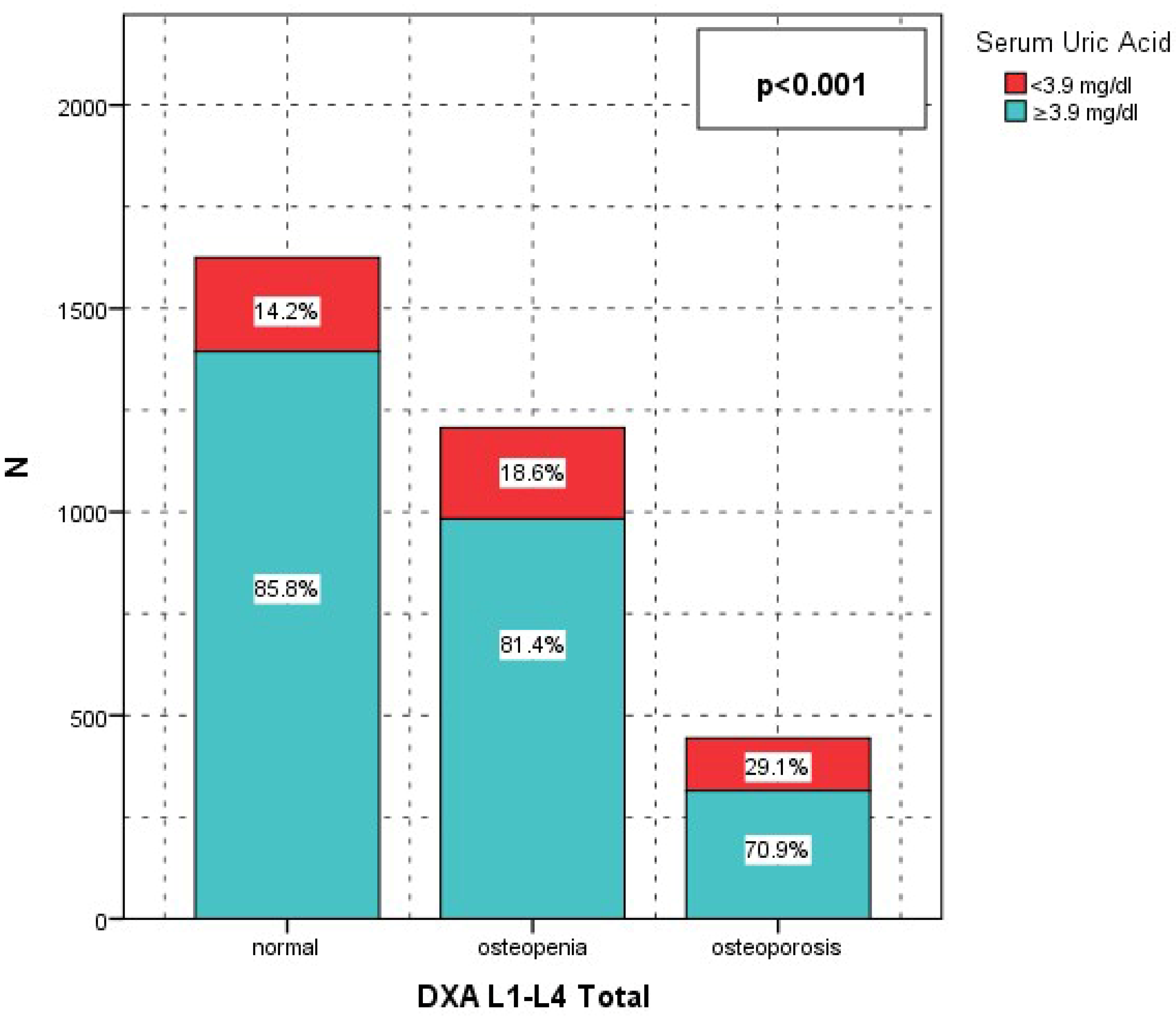
For lumbar spine BMD, the proportion of patients with SUA < 3.9 mg/dL increased progressively across worsening BMD categories: 231 (14.2%) in the normal group, 224 (18.6%) in the osteopenia group, and 129 (29.1%) in the osteoporosis group (p < 0.001). Conversely, SUA ≥ 3.9 mg/dL was more frequent among individuals with normal BMD (1394 [85.8%]) and decreased among those with osteoporosis (315 [70.9%]) (p < 0.001).
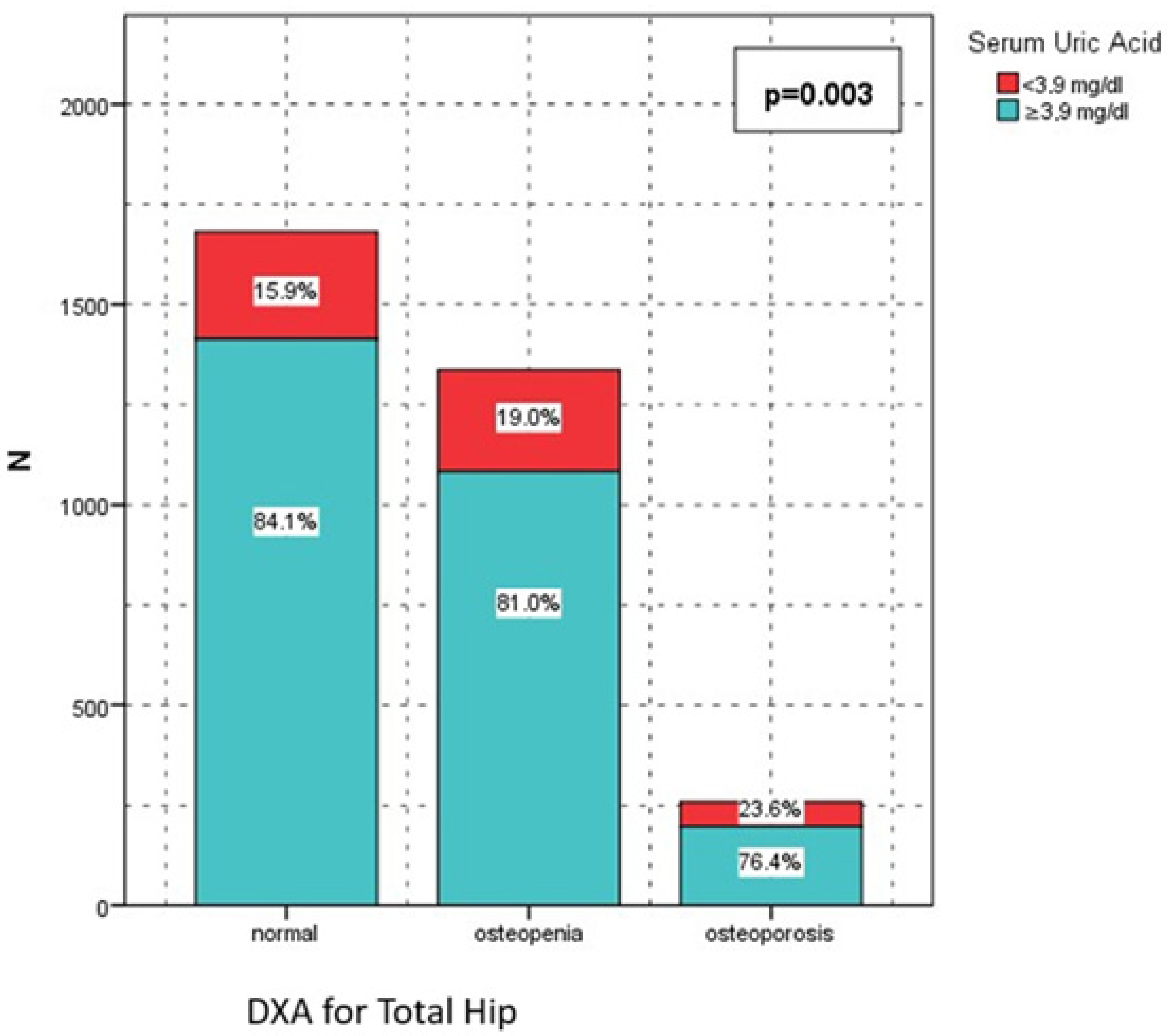
A similar pattern was observed for total hip BMD. The prevalence of SUA < 3.9 mg/dL was 268 (15.9%) in the normal group, 254 (19.0%) in the osteopenia group, and 61 (23.6%) in the osteoporosis group (p = 0.003). In contrast, SUA ≥ 3.9 mg/dL was most common among individuals with normal total hip BMD (1414 [84.1%]) and least common in those with osteoporosis (197 [76.4%]) (Figure 2 and Figure 3).
The inverse association between serum uric acid and osteoporosis prevalence remained consistent after stratification by sex (Supplementary Table S2).
BMI was significantly associated with both lumbar (L1–L4) and total hip DXA categories (both p < 0.001), with obese patients showing higher rates of normal BMD and lower rates of osteoporosis. Sex significantly influenced BMD distribution at both sites (p < 0.001), with females comprising a higher proportion of osteopenia and osteoporosis categories. Diabetes mellitus was significantly associated with BMD categories at the lumbar spine and total hip (p = 0.005 and p = 0.001, respectively), with higher osteoporosis rates observed in patients with diabetes. Hypertension was significantly associated with lumbar BMD (p = 0.017) but not with total hip BMD (p = 0.57). Active alcohol use and active smoking were significantly associated with BMD categories at both anatomical sites (all p ≤ 0.03), with osteoporosis occurring more frequently among alcohol users and smokers. Serum uric acid < 3.9 mg/dL accounted for a disproportionately higher share of osteoporosis cases, particularly at the lumbar spine (29.1% vs. 14.2% in the normal BMD group; p < 0.001) and total hip (23.6% vs. 15.9%; p = 0.003). In contrast, 25-hydroxyvitamin D levels were not significantly associated with BMD categories at either site (p = 0.19 and p = 0.93) (Table 2).
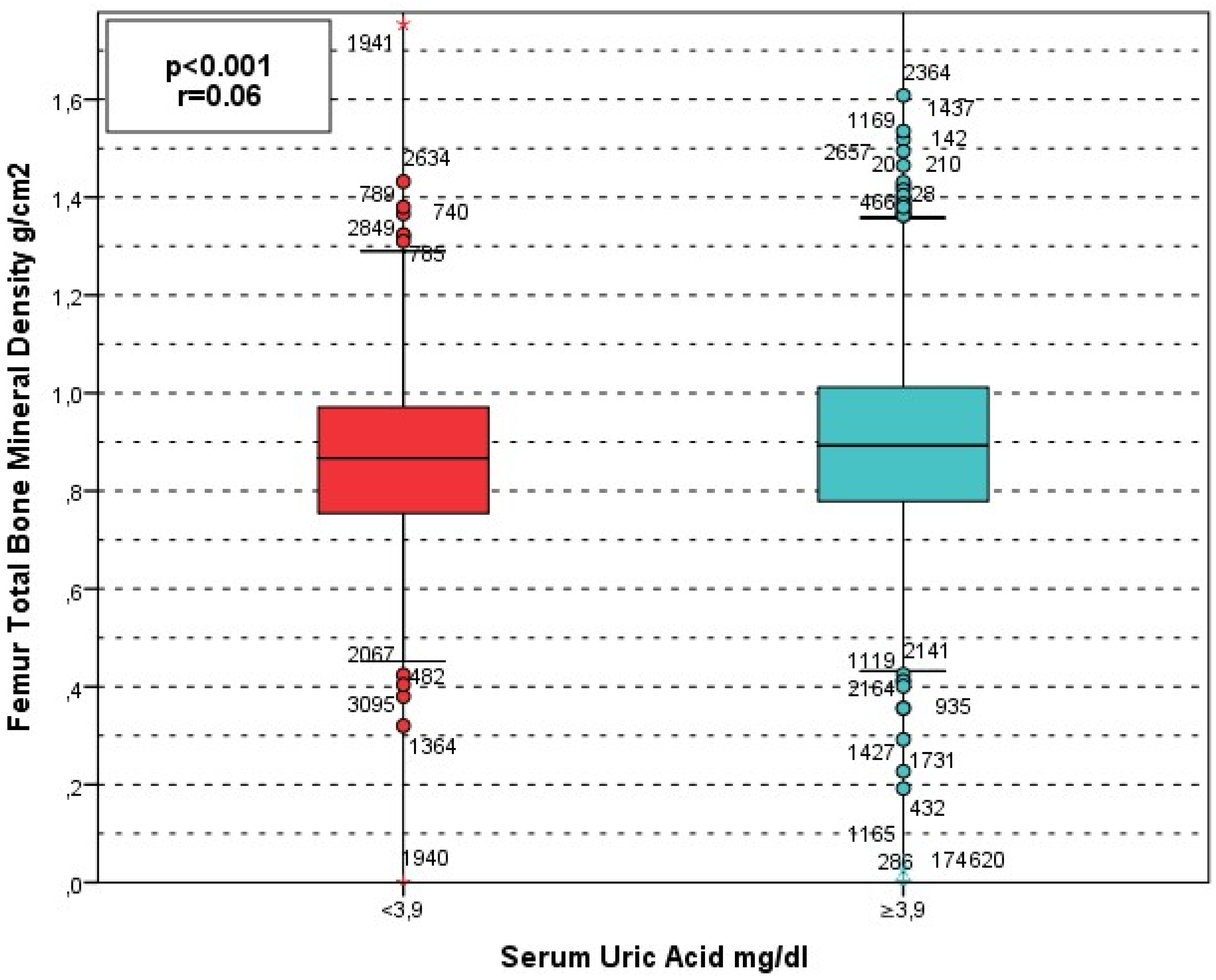
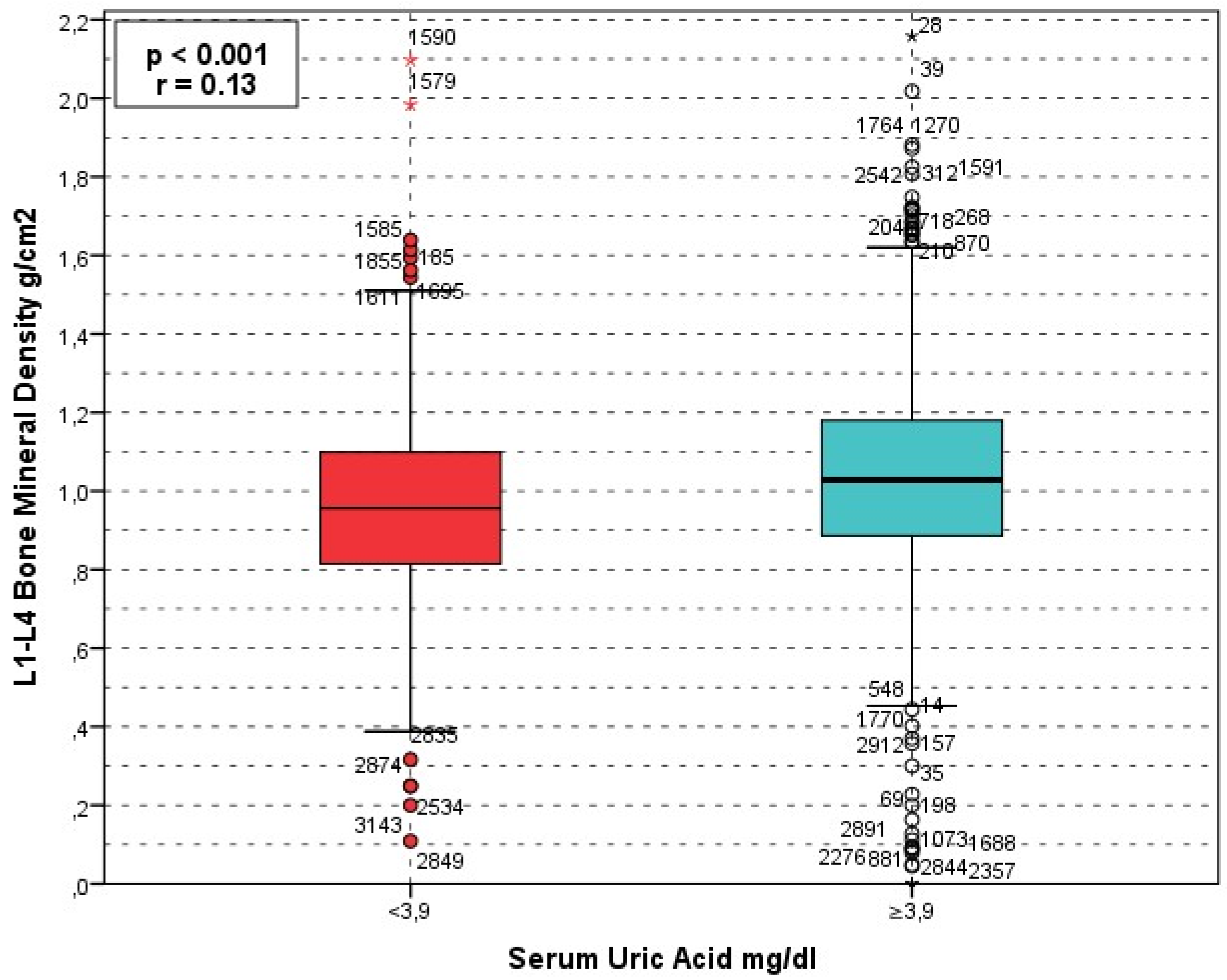
The relationship between BMD (g/cm2) and laboratory markers was assessed using the Kruskal–Wallis test which revealed that there was a significant correlation between Lumbar BMD (g/cm2) and age (p < 0.001), SUA (p < 0.001), ALP (p < 0.001), serum Calcium (p = 0.02), albümin (p < 0.001), and PTH (p < 0.001) (Figure 4). While no signiificant relation was observed between lumbar BMD and phosphore (p = 0.3), and vitamin D (p = 0.5). The analysis for total hip BMD revealed that, age (p < 0.001), SUA (p < 0.001), calcium (p < 0.001), albümin (p < 0.001), Parathormon (p < 0.001), phosphore (p = 0.039), and ALP (p = 0.001) significantly linked with total hip BMD. Meanwhile vitamin D was not significantly linked with total hip BMD (p = 0.9).
Lumbar spine BMD (g/cm2) increased progressively across serum uric acid quartiles, with median values of 0.958 (IQR 0.289), 0.985 (0.305), 1.034 (0.281), and 1.069 (0.279) from the lowest to highest quartile, respectively (p < 0.001). A similar trend was observed for total hip BMD, with median values of 0.864 (0.223), 0.876 (0.222), 0.902 (0.237), and 0.915 (0.253), respectively (p < 0.001). Consistently, mean rank analysis demonstrated a stepwise increase in BMD across quartiles for both lumbar spine (χ2 = 86.9, p < 0.001) and total hip (χ2 = 32.4, p < 0.001).
In multivariable logistic regression analysis, age was an independent risk factor for both lumbar and total hip osteoporosis (lumbar: OR 1.047, 95% CI 1.033–1.062; total hip: OR 1.098, 95% CI 1.079–1.117; both p < 0.001). Serum uric acid was independently and inversely associated with osteoporosis at both sites (lumbar: OR 0.700, 95% CI 0.635–0.772; total hip: OR 0.807, 95% CI 0.722–0.901; p < 0.001). Parathyroid hormone was an independent predictor of increased osteoporosis risk at both the lumbar spine and total hip (OR 1.010 for both; p < 0.001). Alkaline phosphatase was significantly associated only with lumbar osteoporosis (OR 1.005, 95% CI 1.001–1.009; p = 0.019). In contrast, albumin, BMI, calcium, and phosphorus were not independent determinants of osteoporosis at either anatomical site (all p > 0.05) (Table 3).

4. Discussion

Osteoporosis is a common global public health issue, with its prevalence increasing significantly with age and sex as menopausal status is an important determinant of both serum uric acid metabolism and bone mineral density. Estrogen decline after menopause is associated with increased SUA levels and accelerated bone loss, suggesting a shared biological pathway [21].
A report using data from the U.S. National Health and Nutrition Examination Survey found that, in 2017–2018, 12.6% of individuals had osteoporosis at the femoral neck, lumbar spine, or both, with women affected at a rate of 19.6% and men at a rate of 4.4% [19]. Reports from different areas have reported that the prevalence of osteoporosis of the femoral neck in men ranges from 4.4% to 11.7%, whereas the corresponding rates in women range from 19.6% to 23.1% [21,22]. In Turkey, the FRACTURK study initially included 26,424 individuals aged ≥50 years who were screened for a history of fracture, and, among a subcohort of 1971 participants who underwent bone mineral density measurements, osteopenia was identified in 49.6% and osteoporosis in 25.6% [23].
In our cohort, lumbar spine osteoporosis was present in 444 patients (13.5%) overall, including 85/1141 (7.4%) and 359/2139 women (16.7%), while total hip osteoporosis was observed in 258 patients (7.9%) overall, including 80/1141 men (7.0%) and 178/2139 women (8.3%). Although most epidemiological studies, including NHANES, report site-specific prevalence based on femoral neck measurements, our analysis was based on total hip BMD.
Various factors, including metabolic- and lifestyle-related comorbidities, have been identified as risk factors for developing osteoporosis. Worldwide, a high prevalence of OP was found in patients with T2DM [24,25]. However, regarding diabetes mellitus Zeng et al. reported no significant difference between the osteoporosis (22.2%) and non-osteoporosis (28.1%) groups (p = 0.274) [26].
Hypertension and osteoporosis share a connected biological pathway [27]. The NHANES analysis reported a progressive increase in hypertension prevalence with worsening bone density [28]. Zeng et al. showed higher systolic blood pressure in osteoporosis (p < 0.001) rather than diagnosis-based comparisons, and Wang et al. found comparable hypertension rates across groups (p = 0.799) [26,29].
Smoking and alcohol consumption demonstrated the most consistent pattern, with both Zeng et al. and Wang et al. reporting significantly lower smoking and alcohol use in osteoporosis groups (smoking 38.8% vs. 43.5%, p = 0.026; alcohol 40.3% vs. 61.8%, p < 0.001; both p < 0.001 in Wang et al.), indicating a shared trend toward reduced exposure to these lifestyle factors in individuals with lower bone mineral density [26,29].
In our study, the prevalence of diabetes mellitus significantly declined as bone mineral density worsened, dropping from 40.7% to 37.4% in lumbar DXA and from 40.4% to 32.2% in total hip DXA (p = 0.005 and p = 0.001, respectively). Hypertension showed a slight decrease across lumbar categories, from 59.4% to 54.4% (p = 0.017), but remained relatively unchanged across total hip categories, from 55.3% to 58.4% (p = 0.57). Active smoking decreased notably with worsening BMD at both sites, from 29.6% to 14.8% (p < 0.001 for both), and active alcohol use also markedly declined, from 8.4% to 4.8% in lumbar and from 9.7% to 3.7% in total hip DXA categories (p = 0.03 and p < 0.001, respectively).
Qu et al. found that higher serum PTH levels were causally and inversely associated with BMD across multiple skeletal sites, supporting a site- and age-specific role of PTH in the development of osteoporosis [30]. Salamat et al. reported no significant overall relationship between routine biochemical parameters (calcium, phosphorus, ALP, vitamin D, magnesium) and BMD, although limited site-specific correlations were observed [31]. Yilmaz et al. showed that bone resorption markers had stronger diagnostic performance for osteoporosis than bone formation markers, while ALP-related markers were relatively weak discriminators [32].
Our study showed that lumbar osteoporosis significantly related to age, ALP, serum calcium, albumin, and parathyroid hormone (all p ≤ 0.02). Phosphorus and vitamin D showed no significant link. For total hip osteoporosis, significant links were with age, SUA, calcium, albumin, parathormone, phosphorus, and ALP (all p ≤ 0.039), while vitamin D was not. Multivariable regression found older age and higher parathyroid hormone as independent risk factors at both sites. ALP was an independent predictor only for lumbar osteoporosis; albumin, calcium, phosphorus, and BMI were not independently linked.
Uric acid, a by-product of purine metabolism, has gained increasing attention due to its antioxidant properties and potential protective role in bone metabolism, as it scavenges reactive oxygen species (ROS) and inhibits NADPH oxidase activity, thereby protecting osteoblasts from oxidative damage, as demonstrated in experimental and clinical studies [16,18,33]. A large meta-analysis conducted by Shen et al. showed a significant positive correlation between SUA and BMD, the risk of osteoporosis was significantly lower in patients with higher SUA levels (OR  =  0.59; 95% CI: 0.52, 0.67; p  <  0.001; I2  =  30.3%) [33]. Similarly, Xu et al. showed a significant association between BMD and SUA by adjusting for BMI, gender, age, vitamin D, and blood urea nitrogen. Their analysis indicated that a 0.0286 g/cm2 increase in BMD was observed per 100 μmol/L rise in SUA levels [34]. In another study, after adjustment for all covariates, higher serum uric acid levels were independently associated with a reduced risk of osteoporosis or osteopenia, with each unit increase in SUA associated with a 0.3% lower odds, and individuals in the highest quartile demonstrating a 34.9% lower risk compared with the lowest quartile, while restricted cubic spline analysis confirmed a significant linear inverse dose–response relationship without evidence of non-linearity [35]. A large cross-sectional study including American and Chinese adults demonstrated similar results. Additionally, their nonlinear analysis identified saturation thresholds, with maximal protective effects observed at approximately 410–452 μmol/L in Americans and 429–468 μmol/L in Chinese individuals [36]. Liu et al. reported that individuals with the highest serum uric acid levels had a 49% lower risk of osteoporosis compared with those in the lowest group (OR = 0.513). The reduction in osteoporosis risk became evident at approximately 5.3 mg/dL. Furthermore, Mendelian randomization analysis confirmed a causal protective effect of higher serum uric acid levels on osteoporosis risk (OR = 0.870) [37].
In contrast to the predominantly protective associations reported in prior literature, Li et al. found no significant association between serum uric acid levels and lumbar spine bone mineral density in a cross-sectional study of 6704 adult men after adjustment for confounders (β = −0.003, 95% CI −0.007 to 0.002). However, the inclusion of a relatively young population, with over half of participants under 40 years of age, and the exclusive assessment of lumbar spine BMD may have limited the ability to detect associations at higher-risk ages or other clinically relevant skeletal sites such as the total hip, potentially explaining the null findings [18]. Also, Kang et al. demonstrated no independent relationship between serum uric acid (SUA) levels and bone mineral density at either the lumbar spine or hip. Although higher SUA tertiles were associated with numerically higher BMD values, these differences were not statistically significant, and multivariable regression analyses, adjusting for age, BMI, body composition, and metabolic parameters, confirmed the absence of an independent association [38].
In our study, serum uric acid (SUA) showed a significant positive association with bone mineral density and an inverse association with osteoporosis risk. ROC analysis identified a SUA threshold of 3.9 mg/dL (AUC 0.374, 95% CI 0.346–0.402, p < 0.001), and patients with SUA ≥ 3.9 mg/dL had significantly higher lumbar and total hip BMD values together with lower osteoporosis prevalence compared with those below this level (lumbar p < 0.001; total hip p = 0.003). The relatively low AUC indicates limited discriminative performance of serum uric acid. However, complementary analyses using continuous BMD values demonstrated a significant and consistent increase in both lumbar spine and total hip BMD across SUA quartiles, supporting a biologically relevant dose–response relationship rather than a threshold-based effect. In the correlation analyses, SUA was significantly associated with both lumbar and total hip BMD (p < 0.001 for both). After adjustment for potential confounders, including age, BMI, albumin, calcium, phosphorus, ALP, and parathyroid hormone, serum uric acid remained independently associated with osteoporosis risk at both skeletal sites. each 1 mg/dL increase in SUA was associated with a 30% reduction in the odds of lumbar osteoporosis (OR 0.700, 95% CI 0.635–0.772, p < 0.001) and a 19% reduction in the odds of total hip osteoporosis (OR 0.807, 95% CI 0.722–0.901, p < 0.001).
Given the retrospective observational design, the findings demonstrate association rather than causation, and causal relationships cannot be inferred. This study has several limitations that should be acknowledged. First, serum uric acid levels were measured at a single time point, and potential biological fluctuations over time could not be assessed. Because uric acid levels may vary with hydration status, metabolic stress, and short-term dietary influences, a single measurement may not fully reflect long-term exposure. In addition, dietary factors that could act as potential confounders were not comprehensively evaluated. The consumption of purine-rich foods, such as shellfish and organ meats, was not quantified, which may have influenced serum uric acid levels. In addition, dietary and lifestyle-related factors that may influence both serum uric acid levels and bone metabolism were not comprehensively evaluated. Variables such as dietary habits, physical activity, and supplementation (including calcium and vitamin D) were not available in the dataset. Although we performed multivariable analyses adjusting for key clinical and biochemical parameters, residual confounding due to unmeasured lifestyle factors cannot be fully excluded and should be considered when interpreting the observed associations. Another limitation is the multicenter acquisition of DXA measurements. Inter-scanner variability and potential differences in calibration cannot be fully excluded. However, such variability would be expected to introduce non-differential measurement error and bias the results toward the null, rather than account for the observed associations.
Despite these limitations, the current study has many strengths that impact current knowledge. One of the major strengths of our study is its multicenter design, which incorporates data from different geographic regions of Türkiye and includes both men and postmenopausal women, thereby enhancing national representativeness and generalizability. In addition, considering the multifactorial nature of osteoporosis, we performed comprehensive adjustments for key determinants of bone metabolism, including age, body mass index, albumin, calcium, phosphorus, alkaline phosphatase, and parathyroid hormone. Furthermore, the identification of a clinically relevant threshold through ROC analysis may influence future bone health assessment algorithms. Moreover, in quartile-based analysis, higher SUA levels were associated with progressively higher BMD values at both skeletal sites, supporting a biologically relevant dose–response relationship beyond categorical thresholds.

5. Conclusions

Collectively, these findings position our study beyond a purely correlational analysis and provide clinically interpretable evidence regarding the potential relationship between serum uric acid and bone health.

Supplementary Materials

The following supporting information can be downloaded at: https://www.mdpi.com/article/10.3390/jcm15083020/s1, Figure S1: Study population by province; Table S1: Baseline laboratory characteristics of the overall study cohort; Table S2: Sex-stratified clinical characteristics and bone mineral density distribution according to serum uric acid categories.

Author Contributions

Conceptualization: A.A., H.B.P., K.K. and S.G.A.; Data curation: A.A., T.P.K., S.K., E.A., O.O., N.S.B., G.S.C., M.S.M., K.A., S.B., H.B.P., K.K., O.F.A., I.S., G.Z.G., S.U., A.O., N.O.S., C.C., B.D., C.U., O.E., O.Y., S.B.K., A.K. and N.K.; Formal Analysis: A.A., S.U. and S.G.A.; Funding acquisition: A.A.; Investigation: A.A., S.G.A. and C.U.; Methodology: A.A., T.P.K. and S.G.A.; Project administration: A.A. and S.G.A.; Resources: A.A., S.G.A. and O.E.; Supervision: A.A. and S.G.A.; Validation: S.U., S.G.A. and N.K.; Visualization: A.A. and S.G.A.; Writing—original draft: A.A., S.K., O.O., G.S.C., K.A., S.B., O.F.A., I.S., G.Z.G., S.G.A., A.O., C.C., B.D., C.U., S.B.K., A.K. and N.K.; Writing—review & editing: A.A., T.P.K., E.A., N.S.B., M.S.M., H.B.P., K.K., S.U., S.G.A., N.O.S., O.E. and O.Y. All authors have read and agreed to the published version of the manuscript.

Funding

This research received no external funding.

Institutional Review Board Statement

This study was conducted in accordance with the ethical principles of the Declaration of Helsinki. Patients provided written informed consent, and the Local Ethics Committee approved the study in 20 February 2025 with decision number E-10840098-202.3.02-1588.

Informed Consent Statement

Written informed consent was obtained from all participants.

Data Availability Statement

The raw data supporting the conclusions of this article will be made available by the authors on request.

Acknowledgments

During the preparation of this manuscript, the author used Grammarly Pro (https://www.grammarly.com/pro) for the purposes of improving clarity of the language and avoiding linguistic mistakes. The authors have reviewed and edited the output and take full responsibility for the content of this publication.

Conflicts of Interest

The authors declare no conflicts of interest.

References

  1. Kanis, J.A. Assessment of Osteoporosis at the Primary Health-Care Level; WHO Scientific Group Technical Report; World Health Organization: Geneva, Switzerland, 2007. [Google Scholar]
  2. Johnston, C.B.; Dagar, M. Osteoporosis in older adults. Med. Clin. North. Am. 2020, 104, 873–884. [Google Scholar] [CrossRef]
  3. Compston, J.E.; McClung, M.R.; Leslie, W.D. Osteoporosis. Lancet 2019, 393, 364–376. [Google Scholar] [CrossRef] [PubMed]
  4. Sànchez-Riera, L.; Carnahan, E.; Vos, T.; Veerman, L.; Norman, R.; Lim, S.S.; Hoy, D.; Smith, E.; Wilson, N.; Nolla, J.M.; et al. The global burden attributable to low bone mineral density. Ann. Rheum. Dis. 2014, 73, 1635–1645. [Google Scholar] [CrossRef]
  5. Kimball, J.S.; Johnson, J.P.; Carlson, D.A. Oxidative stress and osteoporosis. J. Bone Jt. Surg. Am. 2021, 103, 1451–1461. [Google Scholar] [CrossRef]
  6. Bai, X.C.; Lu, D.; Bai, J.; Zheng, H.; Ke, Z.Y.; Li, X.M.; Luo, S.Q. Oxidative stress inhibits osteoblastic differentiation of bone cells by ERK and NF-κB. Biochem. Biophys. Res. Commun. 2004, 314, 197–207. [Google Scholar] [CrossRef]
  7. Dalbeth, N.; Gosling, A.L.; Gaffo, A.; Abhishek, A. Gout. Lancet 2021, 397, 1843–1855. [Google Scholar] [CrossRef]
  8. Ames, B.N.; Cathcart, R.; Schwiers, E.; Hochstein, P. Uric acid provides an antioxidant defense in humans against oxidant- and radical-caused aging and cancer: A hypothesis. Proc. Natl. Acad. Sci. USA 1981, 78, 6858–6862. [Google Scholar] [CrossRef] [PubMed]
  9. Feig, D.I.; Kang, D.H.; Johnson, R.J. Uric acid and cardiovascular risk. N. Engl. J. Med. 2008, 359, 1811–1821. [Google Scholar] [CrossRef]
  10. Kanbay, M.; Jensen, T.; Solak, Y.; Le, M.; Roncal-Jimenez, C.; Rivard, C.; Lanaspa, M.A.; Nakagawa, T.; Johnson, R.J. Uric acid in metabolic syndrome: From an innocent bystander to a central player. Eur. J. Intern. Med. 2016, 29, 3–8. [Google Scholar] [CrossRef]
  11. Aydin, A.; Goktas Aydin, S. Associations of serum uric acid levels and anthropometric parameters with non-alcoholic fatty liver disease in healthy individuals: Innovative insights from a cross-sectional study. Curr. Med. Res. Opin. 2024, 40, 209–215. [Google Scholar] [CrossRef]
  12. Lin, K.M.; Lu, C.L.; Hung, K.C.; Wu, P.C.; Pan, C.F.; Wu, C.J.; Syu, R.S.; Chen, J.S.; Hsiao, P.J.; Lu, K.C. The paradoxical role of uric acid in osteoporosis. Nutrients 2019, 11, 2111. [Google Scholar] [CrossRef]
  13. Chen, F.; Wang, Y.; Guo, Y.; Wang, J.; Yang, A.; Lv, Q.; Liu, Y.; Ma, G.; Liu, Y.; Wang, D. Specific higher levels of serum uric acid might have a protective effect on bone mineral density within a Chinese population over 60 years old: A cross-sectional study from northeast China. Clin. Interv. Aging 2019, 14, 1065–1073. [Google Scholar] [CrossRef] [PubMed]
  14. Lee, J.W.; Kwon, B.C.; Choi, H.G. Analyses of the relationship between hyperuricemia and osteoporosis. Sci. Rep. 2021, 11, 12080. [Google Scholar] [CrossRef]
  15. Li, J.Y.; Lee, J.I.; Lu, C.C.; Su, Y.D.; Chiu, C.T.; Chen, S.C.; Geng, J.H.; Chen, C.H. Hyperuricemia and its association with osteoporosis in a large Asian cohort. Nutrients 2022, 14, 2206. [Google Scholar] [CrossRef]
  16. Dalbeth, N.; Horne, A.; Mihov, B.; Gamble, G.D.; Merriman, T.R.; Stamp, L.K.; Reid, I.R. Elevated urate levels do not alter bone turnover markers: Randomized controlled trial of inosine supplementation in postmenopausal women. Arthritis Rheumatol. 2021, 73, 1758–1764. [Google Scholar] [CrossRef] [PubMed]
  17. Hu, Z.; Zhang, L.; Lin, Z.; Liu, W.; Zhang, J.; Li, W.; Chu, Y. Prevalence and risk factors for bone loss in rheumatoid arthritis patients from South China: Modeled by three methods. BMC Musculoskelet. Disord. 2021, 22, 534. [Google Scholar] [CrossRef]
  18. Li, X.; Li, L.; Yang, L.; Yang, J.; Lu, H. No association between serum uric acid and lumbar spine bone mineral density in US adult males: A cross-sectional study. Sci. Rep. 2021, 11, 15588. [Google Scholar] [CrossRef] [PubMed]
  19. Sarafrazi, N.; Wambogo, E.A.; Shepherd, J.A. Osteoporosis or low bone mass in older adults: United States, 2017–2018. NCHS Data Brief 2021, 1–8. [Google Scholar]
  20. Salari, N.; Ghasemi, H.; Mohammadi, L.; Rabieenia, E.; Shohaimi, S.; Mohammadi, M. The global prevalence of osteoporosis in the world: A comprehensive systematic review and meta-analysis. J. Orthop. Surg. Res. 2021, 16, 609. [Google Scholar] [CrossRef]
  21. Vorobeľová, L.; Danková, Z.; Candráková-Čerňanová, V.; Falbová, D.; Cvíčelová, M.; Beňuš, R.; Siváková, D. Association of the ESR1 polymorphism with menopause and MLXIPL genetic variant influence serum uric acid levels in Slovak midlife women. Menopause 2019, 26, 1185–1192. [Google Scholar] [CrossRef] [PubMed]
  22. Borgström, F.; Karlsson, L.; Ortsäter, G.; Norton, N.; Halbout, P.; Cooper, C.; Lorentzon, M.; McCloskey, E.V.; Harvey, N.C.; Javaid, M.K.; et al. Fragility fractures in Europe: Burden, management and opportunities. Arch. Osteoporos. 2020, 15, 59. [Google Scholar] [CrossRef]
  23. Tuzun, S.; Eskiyurt, N.; Akarirmak, U.; Saridogan, M.; Senocak, M.; Johansson, H.; Kanis, J.A. Incidence of hip fracture and prevalence of osteoporosis in Turkey: The FRACTURK study. Osteoporos. Int. 2012, 23, 949–955. [Google Scholar] [CrossRef] [PubMed]
  24. Liu, X.; Chen, F.; Liu, L.; Zhang, Q. Prevalence of osteoporosis in patients with diabetes mellitus: A systematic review and meta-analysis of observational studies. BMC Endocr. Disord. 2023, 23, 1. [Google Scholar] [CrossRef] [PubMed]
  25. Kalra, S.; Joshi, A.; Kapoor, N. Osteoporosis and diabetes: The dual pandemics. J. Pak. Med. Assoc. 2022, 72, 1663–1664. [Google Scholar] [CrossRef]
  26. Zeng, J.; Li, T.; Pan, Z.; Liu, Q.; He, J.; Cai, X.; Gong, M.; Deng, X.; Gong, Y.; Li, N.; et al. Role of TyG, TyG-BMI and METS-IR in osteoporosis risk among older men: A retrospective cohort study. Asia Pac. J. Clin. Nutr. 2025, 34, 477–485. [Google Scholar] [CrossRef]
  27. Gutierrez, Y.; Shaju, R.A.; Sepulveda, A.; Coban, S. Exploring the interplay between hypertension and osteoporosis: A narrative review. Cureus 2025, 17, e97459. [Google Scholar] [CrossRef]
  28. Shi, L.; Yu, X.; Pang, Q.; Chen, X.; Wang, C. The associations between bone mineral density and long-term risks of cardiovascular disease, cancer, and all-cause mortality. Front. Endocrinol. 2022, 13, 938399. [Google Scholar] [CrossRef]
  29. Wang, H.; Wang, Q.; He, B.; Bai, J.; Wang, N.; Liu, D.; Cai, J.; Wang, J.; Xie, Q. Osteoporosis and cardiac remodeling in middle-aged and older adults: A cross-sectional study. Sci. Rep. 2026, 16, 6511. [Google Scholar] [CrossRef]
  30. Qu, Z.; Yang, F.; Hong, J.; Wang, W.; Yan, S. Parathyroid hormone and bone mineral density: A Mendelian randomization study. J. Clin. Endocrinol. Metab. 2020, 105, e4038–e4045. [Google Scholar] [CrossRef]
  31. Salamat, M.R.; Momeni, S.; Rastegari, A.A. Relation between biochemical parameters and bone density in postmenopausal women with osteoporosis. Adv. Biomed. Res. 2023, 12, 162. [Google Scholar] [CrossRef] [PubMed]
  32. Yilmaz, N.; Bayram, M.; Erbağci, A.B.; Kilinçer, M.S. Diagnostic value of biochemical markers of bone turnover and postmenopausal osteoporosis. Clin. Chem. Lab. Med. 1999, 37, 137–143. [Google Scholar] [CrossRef] [PubMed]
  33. Shen, L.; Meng, F.; Jiang, Q.; Sheng, J.; Feng, H.; Wang, Y.; Long, H.; Xie, D.; Yang, T.; Ding, X.; et al. Association of serum uric acid level with bone mineral density and the risk of osteoporosis: A dose-response meta-analysis. Int. J. Rheum. Dis. 2025, 28, e70013. [Google Scholar] [CrossRef] [PubMed]
  34. Xu, M.Z.; Lu, K.; Yang, X.F.; Ye, Y.W.; Xu, S.M.; Shi, Q.; Gong, Y.Q.; Li, C. Association between serum uric acid levels and bone mineral density in patients with osteoporosis: A cross-sectional study. BMC Musculoskelet. Disord. 2023, 24, 306. [Google Scholar] [CrossRef]
  35. Xiu, Z.; Gao, Z.; Luo, L. The triangular relationship of serum uric acid, osteoporosis or osteopenia, and body mass index for men and postmenopausal women. Sci. Rep. 2025, 15, 24859. [Google Scholar] [CrossRef]
  36. Li, X.; Peng, Y.; Chen, K.; Zhou, Y.; Luo, W. Association between serum uric acid levels and bone mineral density in Chinese and American populations: A cross-sectional study. Sci. Rep. 2025, 15, 8304. [Google Scholar] [CrossRef] [PubMed]
  37. Liu, Q.P.; Zhang, L.X.; Luo, J.H.; Gao, H.Z.; Wang, K. Association between serum uric acid levels and osteoporosis risk: Evidence from a cross-sectional study and Mendelian randomization analysis. Clin. Rheumatol. 2026, 45, 2195–2207. [Google Scholar] [CrossRef]
  38. Kang, S.; Kwon, D.; Lee, J.; Chung, Y.J.; Kim, M.R.; Namkung, J.; Jeung, I.C. Association between serum uric acid levels and bone mineral density in postmenopausal women: A cross-sectional and longitudinal study. Healthcare 2021, 9, 1681. [Google Scholar] [CrossRef]
Figure 1. BMD femur and SUA. Circles (○) represent outliers, and asterisks (*) represent extreme outliers.
Jcm 15 03020 g001
Figure 2. BMD lomber and SUA. Circles (○) represent outliers, and asterisks (*) represent extreme outliers.
Jcm 15 03020 g002
Figure 3. SUA and femur t score.
Jcm 15 03020 g003
Figure 4. SUA lomber t score.
Jcm 15 03020 g004
Table 1. Patient Characteristics.
Patient CharacteristicsN = 3280%
Age median (range)62 (45–94)
Gender
 Male114134.8
 Female213965.2
Diabetes mellitus
Yes125738.3
No202261.6
Missing data10.01
Hypertension
Yes151046.0
No116035.4
Missing data60918.6
Dyslipidemia
Yes150545.9
No177354.1
History of fragility fracture
Yes 3259.9
No234471.5
Missing data61118.6
History of stroke
Yes1584.8
No239473
Missing data61118.6
Coronary artery disease
Yes40512.3
No226569.1
Missing Data60918.6
Alcohol use
Yes1835.6
No248375.7
Missing data61318.7
Smoking
Yes62619.1
No204162.2
Missing data61218.2
Serum uric acid
  <3.958417.8
  ≥3.9269682.2
BMI category
<18.5 kg/m2230.7
18.5–24.9 kg/m243613.2
25.0–29.9 kg/m2112634.3
≥30.0 kg/m2151446.1
Not assessed1815.7
T-scores for DXA L1–L4
  ≥−1.0162549.5
  −1.0–(−2.5)120736.8
  ≤−2.544413.5
Not assessed40.01
T-scores for DXA total hip
  ≥−1.0168251.3
  −1.0–(−2.5)133740.8
  ≤−2.52587.9
Not assessed30.01
Table 2. Demographic, clinical, and biochemical characteristics according to bone mineral density categories based on DXA T-scores at the lumbar spine and total hip.
CategoryT-Scores for L1-L4pT Scores for Total Hipp
≥−1.0−1.0–(−2.5)≤−2.5 ≥−1.0−1.0–(−2.5)≤−2.5
N (%)N (%)N (%) N (%)N (%)N (%)
BMI <0.001 <0.001
  <18.55 (0.3)11 (1.0)7 (1.7)2 (0.1)10 (0.8)11 (4.4)
  18.5–24.9183 (11.7)163 (14.5)89 (21.9)142 (9)216 (17.1)77 (31)
  24.9-29.9539 (34.5)436 (38.8)150 (36.9)549 (34.6)486 (38.5)91 (36.7)
  >30836 (53.5)515 (45.8)161 (39.6)892 (56.3)551 (43.6)69 (27.8)
Gender <0.001 <0.001
 Male718 (44.2)338 (28.0)85 (19.1)656 (39)405 (30.3)80 (31)
 Female907 (55.8)869 (72.0)359 (80.9)1026 (61)932 (69.7)178 (69)
Diabetes mellitus 0.005 0.001
Yes662 (40.7)427 (35.4)166 (37.4)679 (40.4)494 (36.9)83 (32.2)
No963 (59.3)780 (64.6)277 (62.4)1003 (59.6)843 (63.1)174 (67.4)
Hypertension 0.017 0.57
Yes
No697 (59.4)582 (54.3)229 (54.4)687 (55.3)680 (57.5)142 (58.4)
Missing data477 (40.6)490 (45.7)191 (45.4)556 (44.7)502 (42.4)101 (41.6)
Active Alcohol use 0.03 <0.001
Yes99 (8.4)64 (6.0)20 (4.8)121 (9.7)53 (4.5)9 (3.7)
No1075 (91.6)1007 (93.9)397 (95.2)1120 (90.2)1128 (95.5)233 (96.3)
Active Smoking <0.001 <0.001
Yes
No368 (29.6)220 (18.6)36 (14.8)368 (29.6)220 (18.6)36 (14.8)
Missing data875 (70.4)959 (81.3)207 (85.2)875 (70.4)959 (81.4)207 (85.2)
Serum uric acid <0.001 0.003
  <3.9231 (14.2)224 (18.6)129 (29.1)268 (15.9)254 (19)61 (23.6)
  ≥3.91394 (85.8)983 (81.4)315 (70.9)1414 (84.1)1083 (81)197 (76.4)
25-OH D, 0.19 0.93
<12 ng/mL383 (23.7)288 (24.1)123 (28.3)403 (24)326 (24.7)65 (25.7)
12–20 ng/mL444 (27.4)346 (28.9)106 (24.4)472 (28.1)355 (26.9)68 (26.9)
>20 ng/mL792 (48.9)563 (47.0)206 (47.4)803 (47.9)640 (48.4)120 (47.4)
Table 3. Multivariable logistic regression analysis evaluating clinical and biochemical factors associated with osteoporosis defined by DXA T-scores at the lumbar spine and total femur.
FactorsCoefficient (β)Wald χ2p ValueOR95% CI
Lumbar total osteoporosisAge (years)0.04645.69<0.0011.0471.033–1.062
Uric acid (mg/dL)−0.35650.68<0.0010.7000.635–0.772
Parathyroid hormone (pg/mL)0.01019.40<0.0011.0101.005–1.014
Albumin (g/dL)−0.1861.670.1970.8300.626–1.101
Body mass index (kg/m2)0.0002.540.1111.0001.000–1.000
Alkaline phosphatase (U/L)0.0055.500.0191.0051.001–1.009
Calcium (mg/dL)0.0560.200.6531.0570.830–1.347
Phosphorus (mg/dL)0.1501.900.1681.1620.939–1.439
Hip total osteoporosisAge (years)0.093113.71<0.0011.0981.079–1.117
Uric acid (mg/dL)−0.21514.54<0.0010.8070.722–0.901
Parathyroid hormone (pg/mL)0.01015.80<0.0011.0101.005–1.015
Albumin (g/dL)−0.3093.030.0820.7340.518–1.040
Body mass index (kg/m2)0.0000.810.3671.0001.000–1.000
Alkaline phosphatase (U/L)0.0031.360.2431.0030.998–1.008
Calcium (mg/dL)−0.2182.400.1210.8040.611–1.059
Phosphorus (mg/dL)−0.0250.040.8500.9760.755–1.260
Disclaimer/Publisher’s Note: The statements, opinions and data contained in all publications are solely those of the individual author(s) and contributor(s) and not of MDPI and/or the editor(s). MDPI and/or the editor(s) disclaim responsibility for any injury to people or property resulting from any ideas, methods, instructions or products referred to in the content.