Hybrid Reconstruction in Head and Neck Surgery: Integration of Virtual Planning, Navigation, and Robotic Microsurgery
 , ,
, ,
Abstract
1. Introduction
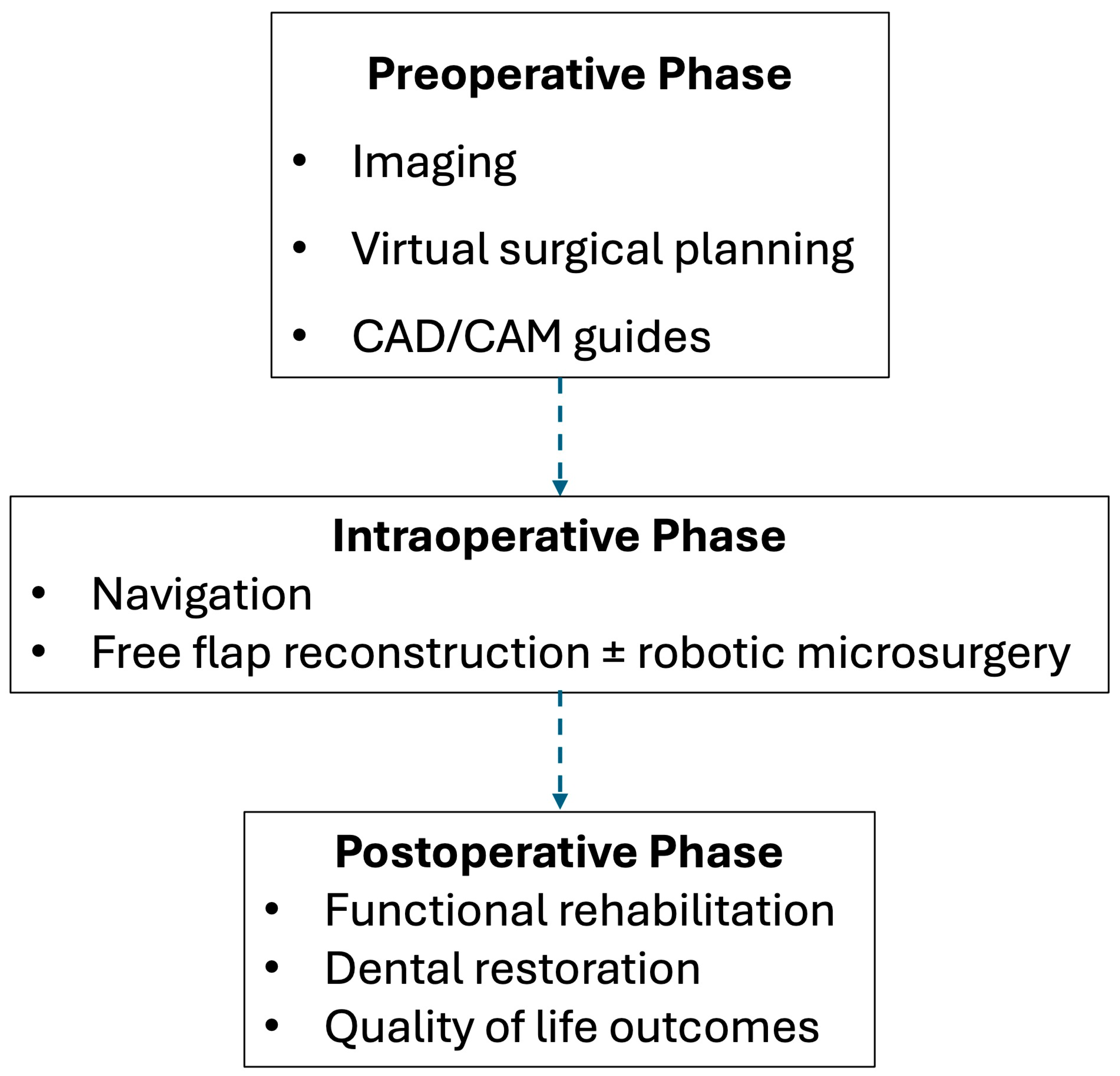
2. Hybrid Reconstruction in Head and Neck Surgery
3. Medical Advances and Their Impact on Hybrid Reconstruction
4. Preoperative Digital Planning and Virtual Surgical Simulation
5. Hybrid Bone Reconstruction in Head and Neck Surgery
5.1. Mandibular Reconstruction
5.2. Maxillary and Midface Reconstruction
5.3. Functional Considerations in Hybrid Bone Reconstruction
5.4. Limitations and Current Challenges
6. Intraoperative Technologies as Enabling Tools in Hybrid Reconstruction
6.1. Intraoperative Navigation and Real-Time Guidance
6.2. Robot-Assisted Microsurgery
6.3. Integration of Intraoperative Technologies Within Hybrid Reconstruction
7. Functional and Morphologic Outcomes in Hybrid Head and Neck Reconstruction
7.1. Functional Outcomes
7.2. Morphologic and Aesthetic Outcomes
7.3. Patient-Reported Outcomes and Quality of Life
8. Challenges, Limitations, and Controversies in Hybrid Head and Neck Reconstruction
8.1. Cost, Resource Utilization, and Access
8.2. Training, Learning Curves, and Workflow Integration
8.3. Evidence Gaps and Outcome Heterogeneity
8.4. Risk of Technology-Driven Overuse
9. Future Directions in Hybrid Head and Neck Reconstruction
10. Conclusions
Author Contributions
Funding
Institutional Review Board Statement
Informed Consent Statement
Data Availability Statement
Conflicts of Interest
References
- Hanasono, M.M.; Matros, E.; Disa, J.J. Important aspects of head and neck reconstruction. Plast. Reconstr. Surg. 2014, 134, 968e–980e. [Google Scholar] [CrossRef]
- Ragbir, M.; Brown, J.S.; Mehanna, H. Reconstructive considerations in head and neck surgical oncology: United Kingdom National Multidisciplinary Guidelines. J. Laryngol. Otol. 2016, 130, S191–S197. [Google Scholar] [CrossRef] [PubMed]
- Gerressen, M.; Pastaschek, C.I.; Riediger, D.; Hilgers, R.D.; Holzle, F.; Noroozi, N.; Ghassemi, A. Microsurgical free flap reconstructions of head and neck region in 406 cases: A 13-year experience. J. Oral Maxillofac. Surg. 2013, 71, 628–635. [Google Scholar] [CrossRef]
- Wu, C.C.; Lin, P.Y.; Chew, K.Y.; Kuo, Y.R. Free tissue transfers in head and neck reconstruction: Complications, outcomes and strategies for management of flap failure: Analysis of 2019 flaps in single institute. Microsurgery 2014, 34, 339–344. [Google Scholar] [CrossRef]
- Ho, M.W.; Nugent, M.; Puglia, F.; Shaw, R.J.; Blackburn, T.K.; Parmar, S.; Dhanda, J.; Fry, A.M.; Brennan, P.; Barry, C.P.; et al. Results of flap reconstruction: Categorisation to reflect outcomes and process in the management of head and neck defects. Br. J. Oral Maxillofac. Surg. 2019, 57, 935–937. [Google Scholar] [CrossRef]
- Gao, R.W.; Nuyen, B.A.; Divi, V.; Sirjani, D.; Rosenthal, E.L. Outcomes in Head and Neck Resections That Require Multiple-Flap Reconstructions: A Systematic Review. JAMA Otolaryngol. Head Neck Surg. 2018, 144, 746–752. [Google Scholar] [CrossRef]
- Zebolsky, A.L.; Patel, N.; Heaton, C.M.; Park, A.M.; Seth, R.; Knott, P.D. Patient-Reported Aesthetic and Psychosocial Outcomes After Microvascular Reconstruction for Head and Neck Cancer. JAMA Otolaryngol. Head Neck Surg. 2021, 147, 1035–1044. [Google Scholar] [CrossRef]
- Padilla, P.L.; Mericli, A.F.; Largo, R.D.; Garvey, P.B. Computer-Aided Design and Manufacturing versus Conventional Surgical Planning for Head and Neck Reconstruction: A Systematic Review and Meta-Analysis. Plast. Reconstr. Surg. 2021, 148, 183–192. [Google Scholar] [CrossRef] [PubMed]
- Nyirjesy, S.C.; Heller, M.; von Windheim, N.; Gingras, A.; Kang, S.Y.; Ozer, E.; Agrawal, A.; Old, M.O.; Seim, N.B.; Carrau, R.L.; et al. The role of computer aided design/computer assisted manufacturing (CAD/CAM) and 3-dimensional printing in head and neck oncologic surgery: A review and future directions. Oral Oncol. 2022, 132, 105976. [Google Scholar] [CrossRef] [PubMed]
- Largo, R.D.; Garvey, P.B. Updates in Head and Neck Reconstruction. Plast. Reconstr. Surg. 2018, 141, 271e–285e. [Google Scholar] [CrossRef]
- Rodby, K.A.; Turin, S.; Jacobs, R.J.; Cruz, J.F.; Hassid, V.J.; Kolokythas, A.; Antony, A.K. Advances in oncologic head and neck reconstruction: Systematic review and future considerations of virtual surgical planning and computer aided design/computer aided modeling. J. Plast. Reconstr. Aesthet. Surg. 2014, 67, 1171–1185. [Google Scholar] [CrossRef]
- Bengur, F.B.; Humar, P.; Saadoun, R.; Khan, N.; Anstadt, E.; Dang, S.; Fadia, N.; Moroni, E.A.; Bottegal, M.T.; Acarturk, T.O.; et al. Computer-Aided Design and Manufacturing in Free Fibula Reconstruction of the Mandible: Comparison of Long-Term Outcomes. Plast. Reconstr. Surg. 2025, 155, 910e–920e. [Google Scholar] [CrossRef]
- Soh, H.Y.; Hu, L.H.; Yu, Y.; Wang, T.; Zhang, W.B.; Peng, X. Navigation-assisted maxillofacial reconstruction: Accuracy and predictability. Int. J. Oral Maxillofac. Surg. 2022, 51, 874–882. [Google Scholar] [CrossRef]
- Rotter, N.; Haisch, A.; Bucheler, M. Cartilage and bone tissue engineering for reconstructive head and neck surgery. Eur. Arch. Otorhinolaryngol. 2005, 262, 539–545. [Google Scholar] [CrossRef]
- Rehman, U.; Whiteman, E.; Sarwar, M.S.; Brennan, P.A. Reconstruction of head and neck oncological soft tissue defects post-resection using robotic surgery: A systematic review of the current literature. Br. J. Oral Maxillofac. Surg. 2023, 61, 514–521. [Google Scholar] [CrossRef]
- Staricha, K.L.; Smith, J.D.; Raad, R.A.; Sridharan, S.; Contrera, K.J.; Chinn, S.B.; Spector, M.E. Next generation of head and neck free flap reconstruction: The future of innovation and refinement. Curr. Opin. Otolaryngol. Head Neck Surg. 2025, 33, 324–330. [Google Scholar] [CrossRef]
- Barr, M.L.; Haveles, C.S.; Rezzadeh, K.S.; Nolan, I.T.; Castro, R.; Lee, J.C.; Steinbacher, D.; Pfaff, M.J. Virtual Surgical Planning for Mandibular Reconstruction With the Fibula Free Flap: A Systematic Review and Meta-analysis. Ann. Plast. Surg. 2020, 84, 117–122. [Google Scholar] [CrossRef] [PubMed]
- Pucci, R.; Weyh, A.; Smotherman, C.; Valentini, V.; Bunnell, A.; Fernandes, R. Accuracy of virtual planned surgery versus conventional free-hand surgery for reconstruction of the mandible with osteocutaneous free flaps. Int. J. Oral Maxillofac. Surg. 2020, 49, 1153–1161. [Google Scholar] [CrossRef] [PubMed]
- Sudarman, J.P.; Triatmoko, S.E.; Siburian, E.S.; Budiarty, A. Effectiveness and safety of robotic microsurgery in free-flap reconstruction: A systematic review and single-arm meta-analysis. J. Plast. Reconstr. Aesthet. Surg. 2026, 115, 1–10. [Google Scholar] [CrossRef] [PubMed]
- Song, S.S.; Lee, Z.H.; Yu, J.Z. Transoral Robotic Surgery (TORS) in Head and Neck Reconstruction. J. Clin. Med. 2025, 14, 5775. [Google Scholar] [CrossRef]
- Innocenti, M.; Malzone, G.; Menichini, G. First-in-Human Free Flap Tissue Reconstruction Using a Dedicated Microsurgical Robotic Platform. Plast. Reconstr. Surg. 2023, 151, 1078–1082. [Google Scholar] [CrossRef]
- Ghantous, Y.; Nashef, A.; Mohanna, A.; Abu-El-Naaj, I. Three-Dimensional Technology Applications in Maxillofacial Reconstructive Surgery: Current Surgical Implications. Nanomaterials 2020, 10, 2523. [Google Scholar] [CrossRef]
- Molteni, G.; Gazzini, L.; Plotegher, C.; Lanaro, L.; Fior, A.; Marchioni, D.; Nocini, P.F. Reconstruction of Complex Oromandibular Defects in Head and Neck Cancer: Role of the Chimeric Subscapular Free Flap. J. Craniofac. Surg. 2020, 31, e266–e270. [Google Scholar] [CrossRef]
- Patel, S.A.; Chang, E.I. Principles and practice of reconstructive surgery for head and neck cancer. Surg. Oncol. Clin. N. Am. 2015, 24, 473–489. [Google Scholar] [CrossRef]
- Jones, E.A.; Huang, A.T. Virtual Surgical Planning in Head and Neck Reconstruction. Otolaryngol. Clin. N. Am. 2023, 56, 813–822. [Google Scholar] [CrossRef]
- Liu, Y.; Zhao, X.; Xu, C.; Yu, D.; Liu, X. Robotic surgery: The convergence of digital innovations in head and neck surgery. J. Craniomaxillofac. Surg. 2025, 53, 2005–2011. [Google Scholar] [CrossRef] [PubMed]
- Ballestin, A.; Malzone, G.; Menichini, G.; Lucattelli, E.; Innocenti, M. New Robotic System with Wristed Microinstruments Allows Precise Reconstructive Microsurgery: Preclinical Study. Ann. Surg. Oncol. 2022, 29, 7859–7867. [Google Scholar] [CrossRef]
- Lai, C.S.; Lu, C.T.; Liu, S.A.; Tsai, Y.C.; Chen, Y.W.; Chen, I.C. Robot-assisted microvascular anastomosis in head and neck free flap reconstruction: Preliminary experiences and results. Microsurgery 2019, 39, 715–720. [Google Scholar] [CrossRef] [PubMed]
- Aboaid, H.; Khalid, T.; Hussain, A.; Myat, Y.M.; Nanda, R.K.; Srinivasmurthy, R.; Nguyen, K.; Jones, D.T.; Bigcas, J.L.; Thein, K.Z. Advances and challenges in immunotherapy in head and neck cancer. Front. Immunol. 2025, 16, 1596583. [Google Scholar] [CrossRef]
- Gupta, T.; Kannan, S.; Ghosh-Laskar, S.; Agarwal, J.P. Systematic review and meta-analyses of intensity-modulated radiation therapy versus conventional two-dimensional and/or or three-dimensional radiotherapy in curative-intent management of head and neck squamous cell carcinoma. PLoS ONE 2018, 13, e0200137. [Google Scholar] [CrossRef] [PubMed]
- Frank, S.J.; Busse, P.M.; Lee, J.J.; Rosenthal, D.I.; Hernandez, M.; Swanson, D.M.; Garden, A.S.; Gunn, G.B.; Patel, S.H.; Snider, J.W.; et al. Proton versus photon radiotherapy for patients with oropharyngeal cancer in the USA: A multicentre, randomised, open-label, non-inferiority phase 3 trial. Lancet 2026, 407, 174–184. [Google Scholar] [CrossRef]
- Imamura, Y.; Kanno, M.; Fujieda, S. Comparative review of KEYNOTE-689 and NIVOPOSTOP trials and their impact on perioperative immunotherapy in locally advanced head and neck cancer. Cancer Treat. Rev. 2025, 140, 103018. [Google Scholar] [CrossRef]
- Peterson, D.E.; Koyfman, S.A.; Yarom, N.; Lynggaard, C.D.; Ismaila, N.; Forner, L.E.; Fuller, C.D.; Mowery, Y.M.; Murphy, B.A.; Watson, E.; et al. Prevention and Management of Osteoradionecrosis in Patients With Head and Neck Cancer Treated With Radiation Therapy: ISOO-MASCC-ASCO Guideline. J. Clin. Oncol. 2024, 42, 1975–1996. [Google Scholar] [CrossRef]
- Saba, N.F.; Zalaquett, N.G.; Rashid, S.; Rao, K.N.; Takes, R.P.; Bradford, C.; de Bree, R.; Beitler, J.J.; Forastiere, A.A.; Vermorken, J.B.; et al. Head and Neck Cancer Salvage Surgery in the Era of Immunotherapy and Beyond: A Review. JAMA Otolaryngol. Head Neck Surg. 2025, 151, 1091–1097. [Google Scholar] [CrossRef]
- Leeman, J.E.; Romesser, P.B.; Zhou, Y.; McBride, S.; Riaz, N.; Sherman, E.; Cohen, M.A.; Cahlon, O.; Lee, N. Proton therapy for head and neck cancer: Expanding the therapeutic window. Lancet Oncol. 2017, 18, e254–e265. [Google Scholar] [CrossRef]
- Mody, M.D.; Rocco, J.W.; Yom, S.S.; Haddad, R.I.; Saba, N.F. Head and neck cancer. Lancet 2021, 398, 2289–2299. [Google Scholar] [CrossRef]
- Ritter, A.; Koirala, N.; Wieland, A.; Kaumaya, P.T.P.; Mitchell, D.L. Therapeutic Cancer Vaccines for the Management of Recurrent and Metastatic Head and Neck Cancer: A Review. JAMA Otolaryngol. Head Neck Surg. 2023, 149, 168–176. [Google Scholar] [CrossRef] [PubMed]
- Feng, Y.; Qiao, W.; Li, Z.; Li, Y. Comparative efficacy and safety of neoadjuvant immunotherapy vs chemotherapy in resectable head and neck squamous cell carcinoma: An umbrella review of randomized controlled trials and single-arm studies. BMC Med. 2025, 23, 610. [Google Scholar] [CrossRef] [PubMed]
- Petit, C.; Lacas, B.; Pignon, J.P.; Le, Q.T.; Gregoire, V.; Grau, C.; Hackshaw, A.; Zackrisson, B.; Parmar, M.K.B.; Lee, J.W.; et al. Chemotherapy and radiotherapy in locally advanced head and neck cancer: An individual patient data network meta-analysis. Lancet Oncol. 2021, 22, 727–736. [Google Scholar] [CrossRef] [PubMed]
- Fulcher, C.D.; Haigentz, M., Jr.; Ow, T.J.; The Education Committee of the American Head and Neck Society. AHNS Series: Do you know your guidelines? Principles of treatment for locally advanced or unresectable head and neck squamous cell carcinoma. Head Neck 2018, 40, 676–686. [Google Scholar] [CrossRef]
- Chow, L.Q.M. Head and Neck Cancer. N. Engl. J. Med. 2020, 382, 60–72. [Google Scholar] [CrossRef]
- Huang, Q.Y.; Xu, L.F.; Wu, Y.; Chen, J. Neoadjuvant chemoimmunotherapy in patients with locally advanced squamous head and neck cancer: A retrospective study. Front. Oncol. 2025, 15, 1576800. [Google Scholar] [CrossRef]
- Zhang, Z.; Wu, B.; Peng, G.; Xiao, G.; Huang, J.; Ding, Q.; Yang, C.; Xiong, X.; Ma, H.; Shi, L.; et al. Neoadjuvant Chemoimmunotherapy for the Treatment of Locally Advanced Head and Neck Squamous Cell Carcinoma: A Single-Arm Phase 2 Clinical Trial. Clin. Cancer Res. 2022, 28, 3268–3276. [Google Scholar] [CrossRef] [PubMed]
- Liu, Z.; Wang, D.; Li, G.; Yi, M.; Zhang, Z.; Zhong, G.; Xu, L.; Jiang, R.; Zheng, Y.; Huang, L.; et al. Neoadjuvant with low-dose radiotherapy, tislelizumab, albumin-bound paclitaxel, and cisplatin for resectable locally advanced head and neck squamous cell carcinoma: Phase II single-arm trial. Nat. Commun. 2025, 16, 4608. [Google Scholar] [CrossRef] [PubMed]
- Georgy, J.T.; Regi, S.S.; Georgy, R.V.; Sasidharan, B.K.; Joel, A.; Philip, D.S.J.; John, A.O.; Thumaty, D.B.; Marimuthu, P.K.; Jambunathan, P.; et al. Low-dose nivolumab plus induction chemotherapy for locally advanced or unresectable head and neck cancer is associated with high response rates and conversion to definitive therapy. Sci. Rep. 2025, 15, 35110. [Google Scholar] [CrossRef] [PubMed]
- Vergeer, M.R.; Doornaert, P.A.; Rietveld, D.H.; Leemans, C.R.; Slotman, B.J.; Langendijk, J.A. Intensity-modulated radiotherapy reduces radiation-induced morbidity and improves health-related quality of life: Results of a nonrandomized prospective study using a standardized follow-up program. Int. J. Radiat. Oncol. Biol. Phys. 2009, 74, 1–8. [Google Scholar] [CrossRef]
- Den, R.B.; Doemer, A.; Kubicek, G.; Bednarz, G.; Galvin, J.M.; Keane, W.M.; Xiao, Y.; Machtay, M. Daily image guidance with cone-beam computed tomography for head-and-neck cancer intensity-modulated radiotherapy: A prospective study. Int. J. Radiat. Oncol. Biol. Phys. 2010, 76, 1353–1359. [Google Scholar] [CrossRef]
- Hsieh, C.H.; Shueng, P.W.; Wang, L.Y.; Huang, Y.C.; Liao, L.J.; Lo, W.C.; Lin, Y.C.; Wu, L.J.; Tien, H.J. Impact of postoperative daily image-guided intensity-modulated radiotherapy on overall and local progression-free survival in patients with oral cavity cancer. BMC Cancer 2016, 16, 139. [Google Scholar] [CrossRef]
- Castelli, J.; Simon, A.; Lafond, C.; Perichon, N.; Rigaud, B.; Chajon, E.; De Bari, B.; Ozsahin, M.; Bourhis, J.; de Crevoisier, R. Adaptive radiotherapy for head and neck cancer. Acta Oncol. 2018, 57, 1284–1292. [Google Scholar] [CrossRef]
- Miller, H.; Bush, K.; Delancy, M.; Leo, N.; Joshi, H.; Saracco, B.; Adams, A.; Gaughan, J.; Bonawitz, S. Effect of preoperative radiation on free flap outcomes for head and neck reconstruction: An updated systematic review and meta-analysis. J. Plast. Reconstr. Aesthet. Surg. 2022, 75, 743–752. [Google Scholar] [CrossRef]
- Makiuchi, Y.; Kageyama, D.; Arikawa, M.; Akazawa, S. Vessel Selection in Head and Neck Reconstruction After Neck Dissection or Radiotherapy. Microsurgery 2025, 45, e70116. [Google Scholar] [CrossRef] [PubMed]
- Dormand, E.L.; Banwell, P.E.; Goodacre, T.E. Radiotherapy and wound healing. Int. Wound J. 2005, 2, 112–127. [Google Scholar] [CrossRef]
- Alessia, D.R.; Alice, B.; Renaud, P.; Justine, L.; Dylan, J.; Melanie, D.; Romain, M.; Laure, H.; Nazim, K.; Sebastien, G.; et al. Head and neck radiotherapy after reconstructive flap surgery: Results of the multicentric XFLAP1 study. Radiother. Oncol. 2026, 218, 111437. [Google Scholar] [CrossRef]
- Dunn, L.A.; Ho, A.L.; Pfister, D.G. Head and Neck Cancer: A Review. JAMA 2026, 335, 531–541. [Google Scholar] [CrossRef] [PubMed]
- Sun, K.; Tan, J.Y.; Thomson, P.J.; Choi, S.W. Influence of time between surgery and adjuvant radiotherapy on prognosis for patients with head and neck squamous cell carcinoma: A systematic review. Head Neck 2023, 45, 2108–2119. [Google Scholar] [CrossRef] [PubMed]
- Price, J.M.; Garcez, K.; Hughes, C.; Lee, L.W.; Mistry, H.M.; Motamedi-Ghahfarokhi, G.; Price, G.J.; West, C.M.; Thomson, D.J. The effect of time from surgery to commencing adjuvant radiotherapy for patients with head and neck squamous cell carcinoma. Oral Oncol. 2025, 161, 107138. [Google Scholar] [CrossRef]
- Fenske, J.; Lampert, P.; Kreiker, H.; Steffen, C.; Koerdt, S.; Doll, C.; Neckel, N.; Heiland, M.; Rendenbach, C.; Kreutzer, K. Reconstructing complexity: Indications for simultaneous and chimeric free flaps in extensive maxillofacial defects. J. Craniomaxillofac. Surg. 2025, 53, 2043–2048. [Google Scholar] [CrossRef]
- Mays, A.C.; Yarlagadda, B.; Achim, V.; Jackson, R.; Pipkorn, P.; Huang, A.T.; Rajasekaran, K.; Sridharan, S.; Rosko, A.J.; Orosco, R.K.; et al. Examining the relationship of immunotherapy and wound complications following flap reconstruction in patients with head and neck cancer. Head Neck 2021, 43, 1509–1520. [Google Scholar] [CrossRef]
- Pedroso, C.M.; de Pauli Paglioni, M.; Normando, A.G.C.; Chaves, A.L.F.; Kowalski, L.P.; de Castro Junior, G.; Matos, L.L.; Willian Junior, W.N.; de Oliveira, T.B.; de Marchi, P.; et al. Preoperative neoadjuvant chemotherapy or immunotherapy in head and neck cancer: A systematic review and meta-analysis of surgical risk and pathologic response. Crit. Rev. Oncol. Hematol. 2025, 212, 104742. [Google Scholar] [CrossRef]
- Kuo, P.J.; Lin, P.C.; Hsieh, C.H. Wound healing in cancer patients under immunotherapy. Int. J. Surg. 2025, 111, 7087–7098. [Google Scholar] [CrossRef]
- Sindt, J.E.; Fitzgerald, L.A.; Kuznicki, J.; Prelewicz, S.; Odell, D.W.; Brogan, S.E. Antiplatelet and Wound Healing Implications of Immunotherapy and Targeted Cancer Therapies in the Perioperative Period. Anesthesiology 2023, 139, 511–522. [Google Scholar] [CrossRef]
- van Rooij, J.A.F.; Roubos, J.; Vrancken Peeters, N.; Rijken, B.F.M.; Corten, E.M.L.; Mureau, M.A.M. Long-term patient-reported outcomes after reconstructive surgery for head and neck cancer: A systematic review. Head Neck 2023, 45, 2469–2477. [Google Scholar] [CrossRef]
- You, Q.; Jing, X.; Fan, S.; Wang, Y.; Yang, Z. Comparison of functional outcomes and health-related quality of life one year after treatment in patients with oral and oropharyngeal cancer treated with three different reconstruction methods. Br. J. Oral Maxillofac. Surg. 2020, 58, 759–765. [Google Scholar] [CrossRef] [PubMed]
- Nutting, C.M.; Morden, J.P.; Harrington, K.J.; Urbano, T.G.; Bhide, S.A.; Clark, C.; Miles, E.A.; Miah, A.B.; Newbold, K.; Tanay, M.; et al. Parotid-sparing intensity modulated versus conventional radiotherapy in head and neck cancer (PARSPORT): A phase 3 multicentre randomised controlled trial. Lancet Oncol. 2011, 12, 127–136. [Google Scholar] [CrossRef] [PubMed]
- Tang, N.S.J.; Ahmadi, I.; Ramakrishnan, A. Virtual surgical planning in fibula free flap head and neck reconstruction: A systematic review and meta-analysis. J. Plast. Reconstr. Aesthet. Surg. 2019, 72, 1465–1477. [Google Scholar] [CrossRef]
- Chang, E.I.; Jenkins, M.P.; Patel, S.A.; Topham, N.S. Long-Term Operative Outcomes of Preoperative Computed Tomography-Guided Virtual Surgical Planning for Osteocutaneous Free Flap Mandible Reconstruction. Plast. Reconstr. Surg. 2016, 137, 619–623. [Google Scholar] [CrossRef] [PubMed]
- Fletcher, J. Methods and Applications of 3D Patient-Specific Virtual Reconstructions in Surgery. In Biomedical Visualisation; Advances in Experimental Medicine and Biology; Springer: Cham, Switzerland, 2022; Volume 1356, pp. 53–71. [Google Scholar] [CrossRef]
- Elsharabasy, I.M.; Elhafez, H.; Ahmed, S.A.E.; Ayad, W.M. Evaluation of the Accuracy of Three-Dimensional Virtual Surgical Planning for Reconstruction of Mandibular Defects Using Free Fibular Flap. J. Craniofac. Surg. 2020, 31, 950–955. [Google Scholar] [CrossRef]
- Yang, L.H.; Merema, B.B.J.; Kraeima, J.; Boeve, K.; Schepman, K.P.; Huijing, M.A.; van der Beek, E.S.J.; Stenekes, M.W.; Vister, J.; de Visscher, S.; et al. Three-Dimensional Surgical Planning in Mandibular Cancer: A Decade of Clinical Experience and Outcomes. Cancers 2026, 18, 271. [Google Scholar] [CrossRef]
- Yu, Y.; Zhang, W.B.; Liu, X.J.; Guo, C.B.; Yu, G.Y.; Peng, X. Three-Dimensional Accuracy of Virtual Planning and Surgical Navigation for Mandibular Reconstruction With Free Fibula Flap. J. Oral Maxillofac. Surg. 2016, 74, 1503.e1–1503.e10. [Google Scholar] [CrossRef]
- Bernstein, J.M.; Daly, M.J.; Chan, H.; Qiu, J.; Goldstein, D.; Muhanna, N.; de Almeida, J.R.; Irish, J.C. Accuracy and reproducibility of virtual cutting guides and 3D-navigation for osteotomies of the mandible and maxilla. PLoS ONE 2017, 12, e0173111. [Google Scholar] [CrossRef]
- Yang, W.F.; Choi, W.S.; Wong, M.C.; Powcharoen, W.; Zhu, W.Y.; Tsoi, J.K.; Chow, M.; Kwok, K.W.; Su, Y.X. Three-Dimensionally Printed Patient-Specific Surgical Plates Increase Accuracy of Oncologic Head and Neck Reconstruction Versus Conventional Surgical Plates: A Comparative Study. Ann. Surg. Oncol. 2021, 28, 363–375. [Google Scholar] [CrossRef]
- Lee, Z.H.; Alfonso, A.R.; Ramly, E.P.; Kantar, R.S.; Yu, J.W.; Daar, D.; Hirsch, D.L.; Jacobson, A.; Levine, J.P. The Latest Evolution in Virtual Surgical Planning: Customized Reconstruction Plates in Free Fibula Flap Mandibular Reconstruction. Plast. Reconstr. Surg. 2020, 146, 872–879. [Google Scholar] [CrossRef]
- Mollmann, H.L.; Apeltrath, L.; Karnatz, N.; Wilkat, M.; Riedel, E.; Singh, D.D.; Rana, M. Comparison of the Accuracy and Clinical Parameters of Patient-Specific and Conventionally Bended Plates for Mandibular Reconstruction. Front. Oncol. 2021, 11, 719028. [Google Scholar] [CrossRef] [PubMed]
- Shergill, K.S.; Aulakh, A.S.; Robibo, E.; Kurten, C.; Tran, K.L.; Dial, H.S.; Prisman, E. The utility of patient-specific surgical plates in free flap mandibular reconstruction: A systematic review and meta-analysis. Oral Oncol. 2025, 168, 107497. [Google Scholar] [CrossRef] [PubMed]
- Blanc, J.; Fuchsmann, C.; Nistiriuc-Muntean, V.; Jacquenot, P.; Philouze, P.; Ceruse, P. Evaluation of virtual surgical planning systems and customized devices in fibula free flap mandibular reconstruction. Eur. Arch. Otorhinolaryngol. 2019, 276, 3477–3486. [Google Scholar] [CrossRef] [PubMed]
- Toto, J.M.; Chang, E.I.; Agag, R.; Devarajan, K.; Patel, S.A.; Topham, N.S. Improved operative efficiency of free fibula flap mandible reconstruction with patient-specific, computer-guided preoperative planning. Head Neck 2015, 37, 1660–1664. [Google Scholar] [CrossRef]
- Glas, H.H.; Vosselman, N.; de Visscher, S. The use of 3D virtual surgical planning and computer aided design in reconstruction of maxillary surgical defects. Curr. Opin. Otolaryngol. Head Neck Surg. 2020, 28, 122–128. [Google Scholar] [CrossRef]
- Alhefzi, M.; Redwood, J.; Hatchell, A.C.; Matthews, J.L.; Hill, W.K.F.; McKenzie, C.D.; Chandarana, S.P.; Matthews, T.W.; Hart, R.D.; Dort, J.C.; et al. Identifying Factors of Operative Efficiency in Head and Neck Free Flap Reconstruction. JAMA Otolaryngol. Head Neck Surg. 2023, 149, 796–802. [Google Scholar] [CrossRef]
- Irawati, N.; Every, J.; Dawson, R.; Leinkram, D.; Elliott, M.; Ch’ng, S.; Low, H.; Palme, C.E.; Clark, J.; Wykes, J. Effect of operative time on complications associated with free flap reconstruction of the head and neck. Clin. Otolaryngol. 2023, 48, 175–181. [Google Scholar] [CrossRef] [PubMed]
- Pu, J.J.; Lo, A.W.I.; Wong, M.C.M.; Choi, W.S.; Ho, G.; Yang, W.F.; Su, Y.X. A quantitative comparison of bone resection margin distances in virtual surgical planning versus histopathology: A prospective study. Int. J. Surg. 2024, 110, 111–118. [Google Scholar] [CrossRef]
- Xiao, J.B.; Banyi, N.; Tran, K.L.; Prisman, E. Cost Outcomes of Virtual Surgical Planning in Head and Neck Reconstruction: A Systematic Review. Head Neck 2025, 47, 1037–1057. [Google Scholar] [CrossRef]
- Mazzola, F.; Smithers, F.; Cheng, K.; Mukherjee, P.; Hubert Low, T.H.; Ch’ng, S.; Palme, C.E.; Clark, J.R. Time and cost-analysis of virtual surgical planning for head and neck reconstruction: A matched pair analysis. Oral Oncol. 2020, 100, 104491. [Google Scholar] [CrossRef] [PubMed]
- Fatima, A.; Hackman, T.G.; Wood, J.S. Cost-Effectiveness Analysis of Virtual Surgical Planning in Mandibular Reconstruction. Plast. Reconstr. Surg. 2019, 143, 1185–1194. [Google Scholar] [CrossRef]
- Awad, L.; Reed, B.; Adams, J.; Kennedy, M.; Saleh, D.B.; Ragbir, M.; Ahmed, O.A.; Berner, J.E. Virtual surgical planning in microsurgical head and neck reconstruction: The Newcastle experience. J. Plast. Reconstr. Aesthet. Surg. 2025, 100, 254–261. [Google Scholar] [CrossRef] [PubMed]
- Maniskas, S.; Pourtaheri, N.; Chandler, L.; Lu, X.; Bruckman, K.C.; Steinbacher, D.M. Conformity of the Virtual Surgical Plan to the Actual Result Comparing Five Craniofacial Procedure Types. Plast. Reconstr. Surg. 2021, 147, 915–924. [Google Scholar] [CrossRef]
- Balasundaram, I.; Al-Hadad, I.; Parmar, S. Recent advances in reconstructive oral and maxillofacial surgery. Br. J. Oral Maxillofac. Surg. 2012, 50, 695–705. [Google Scholar] [CrossRef] [PubMed]
- Bevans, S.; Hammer, D. Tenants of Mandibular Reconstruction in Segmental Defects. Otolaryngol. Clin. N. Am. 2023, 56, 653–670. [Google Scholar] [CrossRef]
- Taylor, G.I.; Corlett, R.J.; Ashton, M.W. The Evolution of Free Vascularized Bone Transfer: A 40-Year Experience. Plast. Reconstr. Surg. 2016, 137, 1292–1305. [Google Scholar] [CrossRef]
- Wuster, J.; Voss, P.J.; Tunn, S.M.; Brauchle, J.; Schmelzeisen, R.; Metzger, M.C.; Fuessinger, M.A.; Brandenburg, L.S. Comparison of CAD/CAM and conventional microvascular free bone flaps in reconstructive head and neck surgery: A retrospective analysis of over 110 cases. Clin. Oral Investig. 2025, 29, 548. [Google Scholar] [CrossRef]
- D’Alpaos, D.; Badiali, G.; Ceccariglia, F.; Nosrati, A.; Tarsitano, A. Use of CAD/CAM Workflow and Patient-Specific Implants for Maxillary Reconstruction: A Systematic Review. J. Clin. Med. 2026, 15, 647. [Google Scholar] [CrossRef]
- Cordeiro, P.G.; Disa, J.J.; Hidalgo, D.A.; Hu, Q.Y. Reconstruction of the mandible with osseous free flaps: A 10-year experience with 150 consecutive patients. Plast. Reconstr. Surg. 1999, 104, 1314–1320. [Google Scholar] [CrossRef]
- Awad, M.E.; Altman, A.; Elrefai, R.; Shipman, P.; Looney, S.; Elsalanty, M. The use of vascularized fibula flap in mandibular reconstruction; A comprehensive systematic review and meta-analysis of the observational studies. J. Craniomaxillofac. Surg. 2019, 47, 629–641. [Google Scholar] [CrossRef]
- Powcharoen, W.; Yang, W.F.; Yan Li, K.; Zhu, W.; Su, Y.X. Computer-Assisted versus Conventional Freehand Mandibular Reconstruction with Fibula Free Flap: A Systematic Review and Meta-Analysis. Plast. Reconstr. Surg. 2019, 144, 1417–1428. [Google Scholar] [CrossRef]
- Roser, S.M.; Ramachandra, S.; Blair, H.; Grist, W.; Carlson, G.W.; Christensen, A.M.; Weimer, K.A.; Steed, M.B. The accuracy of virtual surgical planning in free fibula mandibular reconstruction: Comparison of planned and final results. J. Oral Maxillofac. Surg. 2010, 68, 2824–2832. [Google Scholar] [CrossRef] [PubMed]
- Stirling Craig, E.; Yuhasz, M.; Shah, A.; Blumberg, J.; Salomon, J.; Lowlicht, R.; Fusi, S.; Steinbacher, D.M. Simulated surgery and cutting guides enhance spatial positioning in free fibular mandibular reconstruction. Microsurgery 2015, 35, 29–33. [Google Scholar] [CrossRef]
- Harbison, R.A.; Shan, X.F.; Douglas, Z.; Bevans, S.; Li, Y.; Moe, K.S.; Futran, N.; Houlton, J.J. Navigation Guidance During Free Flap Mandibular Reconstruction: A Cadaveric Trial. JAMA Otolaryngol. Head Neck Surg. 2017, 143, 226–233. [Google Scholar] [CrossRef] [PubMed][Green Version]
- Chen, J.; Zhang, R.; Liang, Y.; Ma, Y.; Song, S.; Jiang, C. Deviation Analyses of Computer-Assisted, Template-Guided Mandibular Reconstruction With Combined Osteotomy and Reconstruction Pre-Shaped Plate Position Technology: A Comparative Study. Front. Oncol. 2021, 11, 719466. [Google Scholar] [CrossRef] [PubMed]
- Chang, Y.M.; Chana, J.S.; Wei, F.C.; Tsai, C.Y.; Chen, S.H. Osteotomy to treat malocclusion following reconstruction of the mandible with the free fibula flap. Plast. Reconstr. Surg. 2003, 112, 31–36. [Google Scholar] [CrossRef]
- Wang, Y.Y.; Zhang, H.Q.; Fan, S.; Zhang, D.M.; Huang, Z.Q.; Chen, W.L.; Ye, J.T.; Li, J.S. Mandibular reconstruction with the vascularized fibula flap: Comparison of virtual planning surgery and conventional surgery. Int. J. Oral Maxillofac. Surg. 2016, 45, 1400–1405. [Google Scholar] [CrossRef]
- Bao, T.; He, J.; Yu, C.; Zhao, W.; Lin, Y.; Wang, H.; Liu, J.; Zhu, H. Utilization of a pre-bent plate-positioning surgical guide system in precise mandibular reconstruction with a free fibula flap. Oral Oncol. 2017, 75, 133–139. [Google Scholar] [CrossRef]
- Ren, W.; Gao, L.; Li, S.; Chen, C.; Li, F.; Wang, Q.; Zhi, Y.; Song, J.; Dou, Z.; Xue, L.; et al. Virtual Planning and 3D printing modeling for mandibular reconstruction with fibula free flap. Med. Oral Patol. Oral Cir. Bucal 2018, 23, e359–e366. [Google Scholar] [CrossRef]
- May, M.M.; Howe, B.M.; O’Byrne, T.J.; Alexander, A.E.; Morris, J.M.; Moore, E.J.; Kasperbauer, J.L.; Janus, J.R.; Van Abel, K.M.; Dickens, H.J.; et al. Short and long-term outcomes of three-dimensional printed surgical guides and virtual surgical planning versus conventional methods for fibula free flap reconstruction of the mandible: Decreased nonunion and complication rates. Head Neck 2021, 43, 2342–2352. [Google Scholar] [CrossRef]
- Garajei, A.; Modarresi, A.; Arabkheradmand, A.; Shirkhoda, M. Functional and esthetic outcomes of virtual surgical planning versus the conventional technique in mandibular reconstruction with a free fibula flap: A retrospective study of 24 cases. J. Craniomaxillofac. Surg. 2024, 52, 454–463. [Google Scholar] [CrossRef]
- Kang, Y.F.; Ding, M.K.; Qiu, S.Y.; Cai, Z.G.; Zhang, L.; Shan, X.F. Mandibular Reconstruction Using Iliac Flap Based on Occlusion-Driven Workflow Transferred by Digital Surgical Guides. J. Oral Maxillofac. Surg. 2022, 80, 1858–1865. [Google Scholar] [CrossRef]
- Salinero, L.; Boczar, D.; Barrow, B.; Berman, Z.P.; Diep, G.K.; Trilles, J.; Howard, R.; Chaya, B.F.; Rodriguez Colon, R.; Rodriguez, E.D. Patient-centred outcomes and dental implant placement in computer-aided free flap mandibular reconstruction: A systematic review and meta-analysis. Br. J. Oral Maxillofac. Surg. 2022, 60, 1283–1291. [Google Scholar] [CrossRef] [PubMed]
- Zhu, H.; Zhang, L.; Cai, Z.; Shan, X. Dental Implant Rehabilitation After Jaw Reconstruction Assisted by Virtual Surgical Planning. Int. J. Oral Maxillofac. Implant. 2019, 34, 1223–1230. [Google Scholar] [CrossRef] [PubMed]
- Antunez-Conde, R.; Salmeron, J.I.; Diez-Montiel, A.; Agea, M.; Gascon, D.; Sada, A.; Navarro Cuellar, I.; Tousidonis, M.; Ochandiano, S.; Arenas, G.; et al. Mandibular Reconstruction With Fibula Flap and Dental Implants Through Virtual Surgical Planning and Three Different Techniques: Double-Barrel Flap, Implant Dynamic Navigation and CAD/CAM Mesh With Iliac Crest Graft. Front. Oncol. 2021, 11, 719712. [Google Scholar] [CrossRef] [PubMed]
- Crosetti, E.; Tos, P.; Berrone, M.; Battiston, B.; Arrigoni, G.; Succo, G. Long-Term Follow-Up of Computer-Assisted Microvascular Mandibular Reconstruction: A Retrospective Study. J. Clin. Med. 2024, 13, 3899. [Google Scholar] [CrossRef]
- Al-Sabahi, M.E.; Jamali, O.M.; Shindy, M.I.; Moussa, B.G.; Amin, A.A.; Zedan, M.H. Aesthetic Reconstruction of Onco-surgical Mandibular Defects Using Free Fibular Flap with and without CAD/CAM Customized Osteotomy Guide: A Randomized Controlled Clinical Trial. BMC Cancer 2022, 22, 1252. [Google Scholar] [CrossRef]
- Eskander, A.; Kang, S.Y.; Teknos, T.N.; Old, M.O. Advances in midface reconstruction: Beyond the reconstructive ladder. Curr. Opin. Otolaryngol. Head Neck Surg. 2017, 25, 422–430. [Google Scholar] [CrossRef]
- Lee, Z.H.; Cripps, C.; Rodriguez, E.D. Current Concepts in Maxillary Reconstruction. Plast. Reconstr. Surg. 2022, 150, 168e–175e. [Google Scholar] [CrossRef]
- McCrary, H.C.; Seim, N.B.; Old, M.O. History, Innovation, Pearls, and Pitfalls in Complex Midface Reconstruction. Otolaryngol. Clin. N. Am. 2023, 56, 703–713. [Google Scholar] [CrossRef] [PubMed]
- Melville, J.C.; Manis, C.S.; Shum, J.W.; Alsuwied, D. Single-Unit 3D-Printed Titanium Reconstruction Plate for Maxillary Reconstruction: The Evolution of Surgical Reconstruction for Maxillary Defects-A Case Report and Review of Current Techniques. J. Oral Maxillofac. Surg. 2019, 77, 874.e1–874.e13. [Google Scholar] [CrossRef]
- Cordeiro, P.G.; Chen, C.M. A 15-year review of midface reconstruction after total and subtotal maxillectomy: Part I. Algorithm and outcomes. Plast. Reconstr. Surg. 2012, 129, 124–136. [Google Scholar] [CrossRef]
- Matsui, Y.; Ohno, K.; Shirota, T.; Imai, S.; Yamashita, Y.; Michi, K. Speech function following maxillectomy reconstructed by rectus abdominis myocutaneous flap. J. Craniomaxillofac. Surg. 1995, 23, 160–164. [Google Scholar] [CrossRef]
- Dugast, S.; Longis, J.; Anquetil, M.; Piot, B.; Corre, P.; Huon, J.F.; Bertin, H. Reconstruction techniques of the orbit after Brown class III maxillectomy: A systematic review. Head Neck 2023, 45, 1581–1593. [Google Scholar] [CrossRef]
- Verdoy, S.B.; Sadeghi, P.; Ojeda, A.L.; Palacin Porte, J.A.; Vinyals Vinyals, J.M.; Barcelo, L.H.; Lluis, E.C.; Compta, X.G.; Diaz, A.T.; Segu, J.O.B. Evaluation of virtual surgical planning and three-dimensional configurations for reconstruction of maxillary defects using the fibula free flap. Microsurgery 2022, 42, 749–756. [Google Scholar] [CrossRef]
- Wang, Y.; Qu, X.; Jiang, J.; Sun, J.; Zhang, C.; He, Y. Aesthetical and Accuracy Outcomes of Reconstruction of Maxillary Defect by 3D Virtual Surgical Planning. Front. Oncol. 2021, 11, 718946. [Google Scholar] [CrossRef]
- Swendseid, B.P.; Roden, D.F.; Vimawala, S.; Richa, T.; Sweeny, L.; Goldman, R.A.; Luginbuhl, A.; Heffelfinger, R.N.; Khanna, S.; Curry, J.M. Virtual Surgical Planning in Subscapular System Free Flap Reconstruction of Midface Defects. Oral Oncol. 2020, 101, 104508. [Google Scholar] [CrossRef] [PubMed]
- Navarro Cuellar, C.; Martinez, E.B.; Navarro Cuellar, I.; Lopez Lopez, A.M.; Rial, M.T.; Perez, A.S.; Salmeron Escobar, J.I. Primary Maxillary Reconstruction With Fibula Flap and Dental Implants: A Comparative Study Between Virtual Surgical Planning and Standard Surgery in Class IIC Defects. J. Oral Maxillofac. Surg. 2021, 79, 237–248. [Google Scholar] [CrossRef] [PubMed]
- Lim, H.K.; Choi, Y.J.; Choi, W.C.; Song, I.S.; Lee, U.L. Reconstruction of maxillofacial bone defects using patient-specific long-lasting titanium implants. Sci. Rep. 2022, 12, 7538. [Google Scholar] [CrossRef]
- Zhang, W.B.; Mao, C.; Liu, X.J.; Guo, C.B.; Yu, G.Y.; Peng, X. Outcomes of Orbital Floor Reconstruction After Extensive Maxillectomy Using the Computer-Assisted Fabricated Individual Titanium Mesh Technique. J. Oral Maxillofac. Surg. 2015, 73, 2065.e1–2065.e15. [Google Scholar] [CrossRef]
- Rauso, R.; Chirico, F.; Federico, F.; Francesco Nicoletti, G.; Colella, G.; Fragola, R.; Pafundi, P.C.; Tartaro, G. Maxillo-facial reconstruction following cancer ablation during COVID-19 pandemic in southern Italy. Oral Oncol. 2021, 115, 105114. [Google Scholar] [CrossRef]
- Qing, H.; Liu, Z.; Yang, J.; Tan, Z.; Shen, L.; Deng, J.; Xiao, R.; Zhang, H.; Qing, S. Assessment of the efficacy of 3D virtual surgical planning compared with traditional planning in maxillofacial reconstruction for facial traumatic deformity. J. Craniomaxillofac. Surg. 2026, 54, 104472. [Google Scholar] [CrossRef] [PubMed]
- Stranix, J.T.; Stern, C.S.; Rensberger, M.; Ganly, I.; Boyle, J.O.; Allen, R.J., Jr.; Disa, J.J.; Mehrara, B.J.; Garfein, E.S.; Matros, E. A Virtual Surgical Planning Algorithm for Delayed Maxillomandibular Reconstruction. Plast. Reconstr. Surg. 2019, 143, 1197–1206. [Google Scholar] [CrossRef]
- Nwagu, U.; Swendseid, B.; Ross, H.; Ganti, R.; Kane, A.; Curry, J.M. Maxillectomy Reconstruction Revision Using Virtual Surgical Planning and Intraoperative Navigation. Laryngoscope 2021, 131, E2655–E2659. [Google Scholar] [CrossRef] [PubMed]
- Prucher, G.M.; Gaggio, L.; Neri, F.; Astarita, F.; Sani, L.; Desiderio, C.; Allegri, D.; Pauro, N.; Sandi, A.; Baietti, A.M. Conformational Reconstruction in Head and Neck Bone Cancer: Could Fibula Free Flap Become the Gold Standard Flap? J. Clin. Med. 2025, 14, 8159. [Google Scholar] [CrossRef]
- Vosselman, N.; Alberga, J.; Witjes, M.H.J.; Raghoebar, G.M.; Reintsema, H.; Vissink, A.; Korfage, A. Prosthodontic rehabilitation of head and neck cancer patients-Challenges and new developments. Oral Dis. 2021, 27, 64–72. [Google Scholar] [CrossRef]
- Wax, M.K. Reconstruction-The Final Dimension in Head and Neck Surgery: The 2017 Hayes Martin Lecture. JAMA Otolaryngol. Head Neck Surg. 2017, 143, 1252–1254. [Google Scholar] [CrossRef]
- Velarde, K.; Cafino, R.; Isla, A., Jr.; Ty, K.M.; Palmer, X.L.; Potter, L.; Nadorra, L.; Pueblos, L.V.; Velasco, L.C. Virtual surgical planning in craniomaxillofacial surgery: A structured review. Comput. Assist. Surg. 2023, 28, 2271160. [Google Scholar] [CrossRef] [PubMed]
- Pu, J.J.; Choi, W.S.; Yang, W.F.; Zhu, W.Y.; Su, Y.X. Unexpected Change of Surgical Plans and Contingency Strategies in Computer-Assisted Free Flap Jaw Reconstruction: Lessons Learned From 98 Consecutive Cases. Front. Oncol. 2022, 12, 746952. [Google Scholar] [CrossRef]
- Zavattero, E.; Ramieri, G.; Volpe, F.; Borbon, C. Navigation-Assisted Resection and Fibula Free-Flap Reconstruction of an Extensive Maxillary Tumor. J. Craniofac. Surg. 2021, 32, e450–e452. [Google Scholar] [CrossRef] [PubMed]
- Wu, J.; Sun, J.; Shen, S.G.; Xu, B.; Li, J.; Zhang, S. Computer-assisted navigation: Its role in intraoperatively accurate mandibular reconstruction. Oral Surg. Oral Med. Oral Pathol. Oral Radiol. 2016, 122, 134–142. [Google Scholar] [CrossRef]
- Brouwer de Koning, S.G.; Geldof, F.; van Veen, R.L.P.; van Alphen, M.J.A.; Karssemakers, L.H.E.; Nijkamp, J.; Schreuder, W.H.; Ruers, T.J.M.; Karakullukcu, M.B. Electromagnetic surgical navigation in patients undergoing mandibular surgery. Sci. Rep. 2021, 11, 4657. [Google Scholar] [CrossRef]
- Hasan, W.; Daly, M.J.; Chan, H.H.L.; Qiu, J.; Irish, J.C. Intraoperative cone-beam CT-guided osteotomy navigation in mandible and maxilla surgery. Laryngoscope 2020, 130, 1166–1172. [Google Scholar] [CrossRef]
- Liu, T.J.; Ko, A.T.; Tang, Y.B.; Lai, H.S.; Chien, H.F.; Hsieh, T.M. Clinical Application of Different Surgical Navigation Systems in Complex Craniomaxillofacial Surgery: The Use of Multisurface 3-Dimensional Images and a 2-Plane Reference System. Ann. Plast. Surg. 2016, 76, 411–419. [Google Scholar] [CrossRef]
- Nguyen, A.; Vanderbeek, C.; Herford, A.S.; Thakker, J.S. Use of Virtual Surgical Planning and Virtual Dataset With Intraoperative Navigation to Guide Revision of Complex Facial Fractures: A Case Report. J. Oral Maxillofac. Surg. 2019, 77, 790.e1–790.e17. [Google Scholar] [CrossRef]
- Ranz-Colio, A.; Almeida-Parra, F.; De Leyva-Moreno, P.; Cardenas-Serres, C.; Garcia-Cosio, M.; Acero-Sanz, J. Navigation-guided resection of locally advanced midface malignancies. Does it improve the safety of oncologic resection? Oral Oncol. 2023, 143, 106455. [Google Scholar] [CrossRef] [PubMed]
- Le, P.H.; Hoang, H.T.; Lam, P.H.; Nguyen, T.V.; Le, C.T. Comparison of customized plate navigation and traditional methods in mandibular reconstruction: Enhanced accuracy and efficiency. Int. J. Oral Maxillofac. Surg. 2026; in press. [CrossRef]
- Austin, R.E.; Antonyshyn, O.M. Current applications of 3-d intraoperative navigation in craniomaxillofacial surgery: A retrospective clinical review. Ann. Plast. Surg. 2012, 69, 271–278. [Google Scholar] [CrossRef] [PubMed]
- Chow, V.L.; Ho, V.W.; Lo, A.S. Trans-hairline robotic neck dissection and robotic microvascular free flap reconstruction in oral cavity cancer. Oral Oncol. 2026, 172, 107819. [Google Scholar] [CrossRef]
- Selber, J.C. Can I Make Robotic Surgery Make Sense in My Practice? Plast. Reconstr. Surg. 2017, 139, 781e–792e. [Google Scholar] [CrossRef]
- Sundar, T.A.; Shetty, P.; Hegde, P.; Shreya, S. From static to robotic: Evolving navigation systems in oral and maxillofacial surgery. Oral Surg. Oral Med. Oral Pathol. Oral Radiol. 2026, 141, e1–e9. [Google Scholar] [CrossRef] [PubMed]
- Seth, I.; Lim, K.; Chang, E.; Rozen, W.M.; Ng, S.K. Evaluating the Clinical Utility of Robotic Systems in Plastic and Reconstructive Surgery: A Systematic Review. Sensors 2025, 25, 3238. [Google Scholar] [CrossRef] [PubMed]
- Feng, A.L.; Razavi, C.R.; Lakshminarayanan, P.; Ashai, Z.; Olds, K.; Balicki, M.; Gooi, Z.; Day, A.T.; Taylor, R.H.; Richmon, J.D. The robotic ENT microsurgery system: A novel robotic platform for microvascular surgery. Laryngoscope 2017, 127, 2495–2500. [Google Scholar] [CrossRef] [PubMed]
- Struebing, F.; Kneser, U.; Bigdeli, A.; Gazyakan, E.; Weigel, J.; Vollbach, F.H.; Boecker, A. Ergonomic Considerations in Robotic-assisted Microsurgery. J. Craniofac. Surg. 2025, 36, 349–353. [Google Scholar] [CrossRef] [PubMed]
- Selber, J.C. Transoral robotic reconstruction of oropharyngeal defects: A case series. Plast. Reconstr. Surg. 2010, 126, 1978–1987. [Google Scholar] [CrossRef]
- Lechien, J.R. Learning process of transoral robotic surgery for head and neck cancers: A scoping review. Oral Oncol. 2025, 171, 107788. [Google Scholar] [CrossRef]
- Awad, L.; Bollen, E.; Reed, B.; Langridge, B.J.; Jasionowska, S.; Nikkhah, D.; Butler, P.E.M.; Ponniah, A. Clinical, Preclinical, and Educational Applications of Robotic-Assisted Flap Reconstruction and Microsurgery: A Systematic Review. Microsurgery 2024, 44, e31246. [Google Scholar] [CrossRef] [PubMed]
- Oliveira, C.M.; Nguyen, H.T.; Ferraz, A.R.; Watters, K.; Rosman, B.; Rahbar, R. Robotic surgery in otolaryngology and head and neck surgery: A review. Minim. Invasive Surg. 2012, 2012, 286563. [Google Scholar] [CrossRef][Green Version]
- Holsinger, F.C.; Ismaila, N.; Adkins, D.R.; Barber, B.R.; Burnette, G.; Fakhry, C.; Galloway, T.J.; Goepfert, R.P.; Miles, B.A.; Paleri, V.; et al. Transoral Robotic Surgery in the Multidisciplinary Care of Patients With Oropharyngeal Squamous Cell Carcinoma: ASCO Guideline. J. Clin. Oncol. 2025, 43, 1369–1392. [Google Scholar] [CrossRef]
- Lechien, J.R.; Paleri, V.; Baudouin, R.; Brunet, A.; Chiesa-Estomba, C.M.; Crosetti, E.; De Vito, A.; Cammaroto, G.; De Virgilio, A.; Fakhry, N.; et al. European surgical guidelines: Transoral robotic surgery for head and neck cancers. Oral Oncol. 2026, 173, 107826. [Google Scholar] [CrossRef]
- Liu, H.; Wang, Y.; Wu, C.; Sun, X.; Li, L.; Li, C.; Chen, Q.; Luo, E. Robotic compared with open operations for cancers of the head and neck: A systematic review and meta-analysis. Br. J. Oral Maxillofac. Surg. 2019, 57, 967–976. [Google Scholar] [CrossRef]
- Lira, R.B.; Kowalski, L.P. Robotic Head and Neck Surgery: Beyond TORS. Curr. Oncol. Rep. 2020, 22, 88. [Google Scholar] [CrossRef] [PubMed]
- Eu, D.; Daly, M.J.; Irish, J.C. Imaging-based navigation technologies in head and neck surgery. Curr. Opin. Otolaryngol. Head Neck Surg. 2021, 29, 149–155. [Google Scholar] [CrossRef] [PubMed]
- Arrighi-Allisan, A.E.; Brody, R.M.; Cannady, S.B. Review of recent advancements in oropharyngeal reconstruction for transoral robotic surgery defects: Emerging techniques, functional preservation, and technological innovations. Curr. Opin. Otolaryngol. Head Neck Surg. 2026, 34, 120–126. [Google Scholar] [CrossRef]
- Graboyes, E.M.; Barbon, C.E.A. Optimizing Function and Appearance After Head and Neck Reconstruction: Measurement and Intervention. Otolaryngol. Clin. N. Am. 2023, 56, 835–852. [Google Scholar] [CrossRef]
- Lewis, C.M.; Aloia, T.A.; Shi, W.; Martin, I.; Lai, S.Y.; Selber, J.C.; Hessel, A.C.; Hanasono, M.M.; Hutcheson, K.A.; Robb, G.L.; et al. Development and Feasibility of a Specialty-Specific National Surgical Quality Improvement Program (NSQIP): The Head and Neck-Reconstructive Surgery NSQIP. JAMA Otolaryngol. Head Neck Surg. 2016, 142, 321–327. [Google Scholar] [CrossRef] [PubMed]
- Mendez, A.; Seikaly, H.; Eurich, D.; Dzioba, A.; Aalto, D.; Osswald, M.; Harris, J.R.; O’Connell, D.A.; Lazarus, C.; Urken, M.; et al. Development of a Patient-Centered Functional Outcomes Questionnaire in Head and Neck Cancer. JAMA Otolaryngol. Head Neck Surg. 2020, 146, 437–443. [Google Scholar] [CrossRef] [PubMed]
- Sabiq, F.; Cherukupalli, A.; Khalil, M.; Tran, L.K.; Kwon, J.J.Y.; Milner, T.; Durham, J.S.; Prisman, E. Evaluating the benefit of virtual surgical planning on bony union rates in head and neck reconstructive surgery. Head Neck 2024, 46, 1322–1330. [Google Scholar] [CrossRef] [PubMed]
- Tabet, P.; Bellavance, S.; Harris, J.R.; Ansari, K.; Osswald, M.; Nayar, S.; Seikaly, H. Prefabricated Fibula Flap vs Bone-Driven and Delayed Implant Installation for Jaw Reconstruction. JAMA Otolaryngol. Head Neck Surg. 2024, 150, 483–491. [Google Scholar] [CrossRef]
- Linsen, S.S.; Oikonomou, A.; Martini, M.; Teschke, M. Mandibular kinematics and maximum voluntary bite force following segmental resection of the mandible without or with reconstruction. Clin. Oral Investig. 2018, 22, 1707–1716. [Google Scholar] [CrossRef]
- Mahendru, S.; Jain, R.; Aggarwal, A.; Aulakh, H.S.; Jain, A.; Khazanchi, R.K.; Sarin, D. CAD-CAM vs conventional technique for mandibular reconstruction with free fibula flap: A comparison of outcomes. Surg. Oncol. 2020, 34, 284–291. [Google Scholar] [CrossRef]
- Ritschl, L.M.; Mucke, T.; Fichter, A.M.; Roth, M.; Kaltenhauser, C.; Pho Duc, J.M.; Kesting, M.R.; Wolff, K.D.; Loeffelbein, D.J. Axiographic results of CAD/CAM-assisted microvascular, fibular free flap reconstruction of the mandible: A prospective study of 21 consecutive cases. J. Craniomaxillofac. Surg. 2017, 45, 113–119. [Google Scholar] [CrossRef]
- Sun, R.; Zhou, Y.; Malouta, M.Z.; Cai, Y.; Shui, C.; Zhu, L.; Wang, X.; Zhu, J.; Li, C. Digital surgery group versus traditional experience group in head and neck reconstruction: A retrospective controlled study to analyze clinical value and time-economic-social effect. World J. Surg. Oncol. 2022, 20, 220. [Google Scholar] [CrossRef] [PubMed]
- Lagana, F.; Marzi Manfroni, A.; Arcuri, F.; Ferri, A.; Bianchi, B. Computer Aided Design/Computer Aided Manufacturing-Guided Scapular Tip Free Flap Reconstruction for Complex Maxillofacial Defects. Microsurgery 2026, 46, e70176. [Google Scholar] [CrossRef] [PubMed]
- Ledderhof, N.J.; Carlson, E.R.; Heidel, R.E.; Winstead, M.L.; Fahmy, M.D.; Johnston, D.T. Are Tracheotomies Required for Patients Undergoing Composite Mandibular Resections for Oral Cancer? J. Oral Maxillofac. Surg. 2020, 78, 1427–1435. [Google Scholar] [CrossRef] [PubMed]
- Schuderer, J.G.; Reider, L.; Wunschel, M.; Spanier, G.; Spoerl, S.; Gottsauner, M.J.; Maurer, M.; Meier, J.K.; Kummer, P.; Reichert, T.E.; et al. Elective Tracheotomy in Patients Receiving Mandibular Reconstructions: Reduced Postoperative Ventilation Time and Lower Incidence of Hospital-Acquired Pneumonia. J. Clin. Med. 2023, 12, 883. [Google Scholar] [CrossRef]
- Lapis, P.N.; DeLacure, M.D.; Givi, B. Factors in Successful Elimination of Elective Tracheotomy in Mandibular Reconstruction With Microvascular Tissue. JAMA Otolaryngol. Head Neck Surg. 2016, 142, 46–51. [Google Scholar] [CrossRef]
- Tan, S.K.; Leung, W.K.; Tang, A.T.H.; Zwahlen, R.A. How does mandibular advancement with or without maxillary procedures affect pharyngeal airways? An overview of systematic reviews. PLoS ONE 2017, 12, e0181146. [Google Scholar] [CrossRef]
- Niskanen, I.; Kurimo, J.; Jarnstedt, J.; Himanen, S.L.; Helminen, M.; Peltomaki, T. Effect of Maxillomandibular Advancement Surgery on Pharyngeal Airway Volume and Polysomnography Data in Obstructive Sleep Apnea Patients. J. Oral Maxillofac. Surg. 2019, 77, 1695–1702. [Google Scholar] [CrossRef]
- Trevisiol, L.; Bersani, M.; Sanna, G.; Nocini, R.; D’Agostino, A. Posterior airways and orthognathic surgery: What really matters for successful long-term results? Am. J. Orthod. Dentofac. Orthop. 2022, 161, e486–e497. [Google Scholar] [CrossRef]
- Jiang, C.; Yi, Y.; Jiang, C.; Fang, S.; Wang, J. Pharyngeal Airway Space and Hyoid Bone Positioning After Different Orthognathic Surgeries in Skeletal Class II Patients. J. Oral Maxillofac. Surg. 2017, 75, 1482–1490. [Google Scholar] [CrossRef]
- Benito Anguita, M.; Khayat, S.; Lopez Martin, S.; Bravo Quelle, N.; Navarro Cuellar, I.; Lopez Lopez, A.; Cebrian Carretero, J.L.; Del Castillo Pardo de Vera, J.L.; Montes Fernandez-Micheltorena, P.; Tousidonis Rial, M.; et al. Virtual Guided and Customized Orthognathic Surgery in Patients with Obstructive Sleep Apnea Syndrome: Accuracy and Clinical Outcomes. J. Clin. Med. 2025, 14, 3780. [Google Scholar] [CrossRef]
- Joachim, M.V.; Miloro, M. The Evolution of Virtual Surgical Planning in Craniomaxillofacial Surgery: A Comprehensive Review. J. Oral Maxillofac. Surg. 2025, 83, 294–306. [Google Scholar] [CrossRef]
- Chang, E.I.; Hanasono, M.M. State-of-the-art reconstruction of midface and facial deformities. J. Surg. Oncol. 2016, 113, 962–970. [Google Scholar] [CrossRef] [PubMed]
- Hwang, K. The Wounded Face in Uniform: Surgical Reconstruction and Identity Restoration in Military Facial Trauma. J. Craniofac. Surg. 2025, 37, 394–397. [Google Scholar] [CrossRef] [PubMed]
- Day, K.M.; Kelley, P.K.; Harshbarger, R.J.; Dorafshar, A.H.; Kumar, A.R.; Steinbacher, D.M.; Patel, P.; Combs, P.D.; Levine, J.P. Advanced Three-Dimensional Technologies in Craniofacial Reconstruction. Plast. Reconstr. Surg. 2021, 148, 94e–108e. [Google Scholar] [CrossRef]
- Ettinger, K.S.; Mohamed, A.K.; Nathan, J.M.; Vierkant, R.A.; Morris, J.M.; Sears, V.A.; Arce, K. Patient-specific Implants Improve Volumetric Surgical Accuracy Compared to Stock Reconstruction Plates in Modern Paradigm Virtual Surgical Planning of Fibular Free Flaps for Head and Neck Reconstruction. J. Oral Maxillofac. Surg. 2024, 82, 1311–1328. [Google Scholar] [CrossRef] [PubMed]
- Tran, K.L.; Mong, M.L.; Durham, J.S.; Prisman, E. Benefits of Patient-Specific Reconstruction Plates in Mandibular Reconstruction Surgical Simulation and Resident Education. J. Clin. Med. 2022, 11, 5306. [Google Scholar] [CrossRef]
- Wurm, M.C.; Hagen, J.; Nkenke, E.; Neukam, F.W.; Schlittenbauer, T. The fitting accuracy of pre-bend reconstruction plates and their impact on the temporomandibular joint. J. Craniomaxillofac. Surg. 2019, 47, 53–59. [Google Scholar] [CrossRef] [PubMed]
- Ong, H.S.; Liu, J.N.; Ahmed, A.; Qu, X.Z.; Wan, K.; Xie, D.P.; Zhang, C.P. Improved accuracy of hemimandibular reconstructions involving the condyle by utilizing hydroformed reconstruction plates rather than hand-bent stock plates. Head Neck 2019, 41, 3168–3176. [Google Scholar] [CrossRef]
- Seier, T.; Hingsammer, L.; Schumann, P.; Gander, T.; Rucker, M.; Lanzer, M. Virtual planning, simultaneous dental implantation and CAD/CAM plate fixation: A paradigm change in maxillofacial reconstruction. Int. J. Oral Maxillofac. Surg. 2020, 49, 854–861. [Google Scholar] [CrossRef]
- Ochandiano, S.; Garcia-Mato, D.; Gonzalez-Alvarez, A.; Moreta-Martinez, R.; Tousidonis, M.; Navarro-Cuellar, C.; Navarro-Cuellar, I.; Salmeron, J.I.; Pascau, J. Computer-Assisted Dental Implant Placement Following Free Flap Reconstruction: Virtual Planning, CAD/CAM Templates, Dynamic Navigation and Augmented Reality. Front. Oncol. 2021, 11, 754943. [Google Scholar] [CrossRef]
- Zweifel, D.; Bredell, M.G.; Lanzer, M.; Rostetter, C.; Rucker, M.; Studer, S. Precision of Simultaneous Guided Dental Implantation in Microvascular Fibular Flap Reconstructions With and Without Additional Guiding Splints. J. Oral Maxillofac. Surg. 2019, 77, 971–976. [Google Scholar] [CrossRef]
- Sharma, K.; Steele, K.; Birks, M.; Jones, G.; Miller, G. Patient-Reported Outcome Measures in Plastic Surgery: An Introduction and Review of Clinical Applications. Ann. Plast. Surg. 2019, 83, 247–252. [Google Scholar] [CrossRef]
- Voineskos, S.H.; Nelson, J.A.; Klassen, A.F.; Pusic, A.L. Measuring Patient-Reported Outcomes: Key Metrics in Reconstructive Surgery. Annu. Rev. Med. 2018, 69, 467–479. [Google Scholar] [CrossRef]
- Alwadeai, M.; Al-Aroomy, L.; Amin, A.; Shindy, M.; Zedan, M.; Baz, S. Virtual Surgical Guidance Improves Quality of Life Following Scapular Free-Flap Reconstruction of Maxillary Defects. J. Oral Maxillofac. Surg. 2024, 82, 600–609. [Google Scholar] [CrossRef]
- Petrides, G.A.; Dunn, M.; Charters, E.; Venchiarutti, R.; Cheng, K.; Froggatt, C.; Mukherjee, P.; Wallace, C.; Howes, D.; Leinkram, D.; et al. Health-related quality of life in maxillectomy patients undergoing dentoalveolar rehabilitation. Oral Oncol. 2022, 126, 105757. [Google Scholar] [CrossRef] [PubMed]
- Chan, T.J.; Long, C.; Wang, E.; Prisman, E. The state of virtual surgical planning in maxillary Reconstruction: A systematic review. Oral Oncol. 2022, 133, 106058. [Google Scholar] [CrossRef] [PubMed]
- Madrigal, J.; Mukdad, L.; Han, A.Y.; Tran, Z.; Benharash, P.; St John, M.A.; Blackwell, K.E. Impact of Hospital Volume on Outcomes Following Head and Neck Cancer Surgery and Flap Reconstruction. Laryngoscope 2022, 132, 1381–1387. [Google Scholar] [CrossRef]
- Morita, Y.; Uzawa, N. Current status and prospects of computer-assisted surgery (CAS) in oral and maxillofacial reconstruction. Int. J. Clin. Oncol. 2025. [Google Scholar] [CrossRef]
- Sharaf, B.A.; Abushehab, A.; Michaelcheck, C.E.; Hussein, S.M.; Gibreel, W.; Alser, O.; Kouzani, A.Z.; Pazelli, A.M.; Lee, K.H.; Oh, Y.; et al. Virtual surgical planning in craniomaxillofacial surgery: A systematic review and meta-analysis of accuracy, operative time, and cost-effectiveness. J. Plast. Reconstr. Aesthet. Surg. 2025, 105, 305–314. [Google Scholar] [CrossRef]
- Sharaf, B.; Kuruoglu, D.; Cantwell, S.R.; Alexander, A.E.; Dickens, H.J.; Morris, J.M. EPPOCRATIS: Expedited Preoperative Point-of-Care Reduction of Fractures to Normalized Anatomy and Three-Dimensional Printing to Improve Surgical Outcomes. Plast. Reconstr. Surg. 2022, 149, 695–699. [Google Scholar] [CrossRef]
- Ferretti, F.; Nonis, F.; Novaresio, A.; Panico, E.; Zavattero, E.; Borbon, C.; Moos, S.; Vezzetti, E.; Fasolis, M.; Ramieri, G. Virtual reality and 3D printing in head and neck cancer: An educational experience. Front. Oncol. 2025, 15, 1695870. [Google Scholar] [CrossRef]
- Vranckx, J.J.; Desmet, O.; Bila, M.; Wittesaele, W.; Wilssens, N.; Poorten, V.V. Maxillomandibular Reconstruction Using Insourced Virtual Surgical Planning and Homemade CAD/CAM: A Single-Center Evolution in 75 Patients. Plast. Reconstr. Surg. 2023, 152, 143e–154e. [Google Scholar] [CrossRef] [PubMed]
- Beier, J.P.; Hackenberg, S.; Boos, A.M.; Modabber, A.; Duong Dinh, T.A.; Hölzle, F. First Series of Free Flap Reconstruction Using a Dedicated Robotic System in a Multidisciplinary Microsurgical Center. Plast. Reconstr. Surg. Glob. Open 2023, 11, e5240. [Google Scholar] [CrossRef] [PubMed]
- Malzone, G.; Menichini, G.; Innocenti, M.; Ballestín, A. Microsurgical robotic system enables the performance of microvascular anastomoses: A randomized in vivo preclinical trial. Sci. Rep. 2023, 13, 14003. [Google Scholar] [CrossRef] [PubMed]
- Fung, E.; Patel, D.; Tatum, S. Artificial intelligence in maxillofacial and facial plastic and reconstructive surgery. Curr. Opin. Otolaryngol. Head Neck Surg. 2024, 32, 257–262. [Google Scholar] [CrossRef]
- Makitie, A.A.; Alabi, R.O.; Ng, S.P.; Takes, R.P.; Robbins, K.T.; Ronen, O.; Shaha, A.R.; Bradley, P.J.; Saba, N.F.; Nuyts, S.; et al. Artificial Intelligence in Head and Neck Cancer: A Systematic Review of Systematic Reviews. Adv. Ther. 2023, 40, 3360–3380. [Google Scholar] [CrossRef]
- Zhong, N.N.; Wang, H.Q.; Huang, X.Y.; Li, Z.Z.; Cao, L.M.; Huo, F.Y.; Liu, B.; Bu, L.L. Enhancing head and neck tumor management with artificial intelligence: Integration and perspectives. Semin. Cancer Biol. 2023, 95, 52–74. [Google Scholar] [CrossRef] [PubMed]
- Wilson, C.B. Adoption of new surgical technology. BMJ 2006, 332, 112–114. [Google Scholar] [CrossRef]
- Teh, M.T. The Precision Frontier: Revolutionising Head and Neck Cancer Management Through Theranostics, Liquid Biopsy, and AI-Powered Imaging. Cancers 2025, 17, 3792. [Google Scholar] [CrossRef] [PubMed]
- Holsinger, F.C.; Birkeland, A.C.; Topf, M.C. Precision head and neck surgery: Robotics and surgical vision technology. Curr. Opin. Otolaryngol. Head Neck Surg. 2021, 29, 161–167. [Google Scholar] [CrossRef]
- Nassar, S.I.; Suk, A.; Nguyen, S.A.; Adilbay, D.; Pang, J.; Nathan, C.O. The Role of ctDNA and Liquid Biopsy in the Diagnosis and Monitoring of Head and Neck Cancer: Towards Precision Medicine. Cancers 2024, 16, 3129. [Google Scholar] [CrossRef] [PubMed]
- Alter, I.L.; Chan, K.; Lechien, J.; Rameau, A. An introduction to machine learning and generative artificial intelligence for otolaryngologists-head and neck surgeons: A narrative review. Eur. Arch. Otorhinolaryngol. 2024, 281, 2723–2731. [Google Scholar] [CrossRef] [PubMed]
- Rana, M.; Sakkas, A.; Zimmermann, M.; Kostyuk, M.; Schwarz, G. Artificial Intelligence in Oral and Maxillofacial Surgery: Integrating Clinical Innovation and Workflow Optimization. J. Clin. Med. 2026, 15, 427. [Google Scholar] [CrossRef]
- Ostas, D.; Almasan, O.; Ilesan, R.R.; Andrei, V.; Thieringer, F.M.; Hedesiu, M.; Rotar, H. Point-of-Care Virtual Surgical Planning and 3D Printing in Oral and Cranio-Maxillofacial Surgery: A Narrative Review. J. Clin. Med. 2022, 11, 6625. [Google Scholar] [CrossRef]
- Nayak, V.V.; Slavin, B.; Bergamo, E.T.P.; Boczar, D.; Slavin, B.R.; Runyan, C.M.; Tovar, N.; Witek, L.; Coelho, P.G. Bone Tissue Engineering (BTE) of the Craniofacial Skeleton, Part I: Evolution and Optimization of 3D-Printed Scaffolds for Repair of Defects. J. Craniofac. Surg. 2023, 34, 2016–2025. [Google Scholar] [CrossRef]
- Yazdanian, M.; Alam, M.; Abbasi, K.; Rahbar, M.; Farjood, A.; Tahmasebi, E.; Tebyaniyan, H.; Ranjbar, R.; Hesam Arefi, A. Synthetic materials in craniofacial regenerative medicine: A comprehensive overview. Front. Bioeng. Biotechnol. 2022, 10, 987195. [Google Scholar] [CrossRef]
- Najafi, N.; Vartanian, K.B.; Eskandar, T.; Ghookas, K.; Rostomian, E.; Agrawal, D.K. Bioprinting for craniofacial reconstruction: A review of advancements, clinical use, and challenges. J. Craniomaxillofac. Surg. 2025, 53, 2255–2269. [Google Scholar] [CrossRef]
- Wu, Z.; Wu, Y.; Alam, J.; Viet, C.T.; Dharmaraj, N.; Molina, A.; Sunga, G.; Young, S.; Amit, M.; Li, X.; et al. Hydrogels in head and neck cancer: Innovations and translational advances in research and therapy. Biomaterials 2026, 330, 124049. [Google Scholar] [CrossRef]
- Accorona, R.; Gazzini, L.; Grigolato, R.; Fazio, E.; Nitro, L.; Abousiam, M.; Giorgetti, G.; Pignataro, L.; Capaccio, P.; Calabrese, L. Free Periosteal Flaps with Scaffold: An Overlooked Armamentarium for Maxillary and Mandibular Reconstruction. Cancers 2021, 13, 4373. [Google Scholar] [CrossRef] [PubMed]
- Patel, S.; Ziai, K.; Lighthall, J.G.; Walen, S.G. Biologics and acellular dermal matrices in head and neck reconstruction: A comprehensive review. Am. J. Otolaryngol. 2022, 43, 103233. [Google Scholar] [CrossRef] [PubMed]
- Rapolti, D.; Neumeister, M.W. Technology in Microsurgery. Clin. Plast. Surg. 2026, 53, 183–186. [Google Scholar] [CrossRef] [PubMed]
- Foroutan, A.; Phuyal, D.; Babb, G.; Ting, J.; Mashhadiagha, G.; Najafi, N.; Djohan, R.; Bishop, S.N.; Schwarz, G.S. Robotic Horizons in Plastic Surgery: A Look Toward the Future. J. Clin. Med. 2026, 15, 602. [Google Scholar] [CrossRef]

Disclaimer/Publisher’s Note: The statements, opinions and data contained in all publications are solely those of the individual author(s) and contributor(s) and not of MDPI and/or the editor(s). MDPI and/or the editor(s) disclaim responsibility for any injury to people or property resulting from any ideas, methods, instructions or products referred to in the content. |
© 2026 by the authors. Licensee MDPI, Basel, Switzerland. This article is an open access article distributed under the terms and conditions of the Creative Commons Attribution (CC BY) license.
Share and Cite
Sorenson, T.J.; Lisk, R.; Jacobson, A.B.; Jacobson, A.; Levine, J.P. Hybrid Reconstruction in Head and Neck Surgery: Integration of Virtual Planning, Navigation, and Robotic Microsurgery. J. Clin. Med. 2026, 15, 2963. https://doi.org/10.3390/jcm15082963
Sorenson TJ, Lisk R, Jacobson AB, Jacobson A, Levine JP. Hybrid Reconstruction in Head and Neck Surgery: Integration of Virtual Planning, Navigation, and Robotic Microsurgery. Journal of Clinical Medicine. 2026; 15(8):2963. https://doi.org/10.3390/jcm15082963
Chicago/Turabian StyleSorenson, Thomas J., Rebecca Lisk, Alexis B. Jacobson, Adam Jacobson, and Jamie P. Levine. 2026. "Hybrid Reconstruction in Head and Neck Surgery: Integration of Virtual Planning, Navigation, and Robotic Microsurgery" Journal of Clinical Medicine 15, no. 8: 2963. https://doi.org/10.3390/jcm15082963
APA StyleSorenson, T. J., Lisk, R., Jacobson, A. B., Jacobson, A., & Levine, J. P. (2026). Hybrid Reconstruction in Head and Neck Surgery: Integration of Virtual Planning, Navigation, and Robotic Microsurgery. Journal of Clinical Medicine, 15(8), 2963. https://doi.org/10.3390/jcm15082963